WO2024142935A1 - 眼鏡レンズの製造方法 - Google Patents
眼鏡レンズの製造方法 Download PDFInfo
- Publication number
- WO2024142935A1 WO2024142935A1 PCT/JP2023/044607 JP2023044607W WO2024142935A1 WO 2024142935 A1 WO2024142935 A1 WO 2024142935A1 JP 2023044607 W JP2023044607 W JP 2023044607W WO 2024142935 A1 WO2024142935 A1 WO 2024142935A1
- Authority
- WO
- WIPO (PCT)
- Prior art keywords
- oil
- water
- spectacle lens
- layer
- lens substrate
- Prior art date
- Legal status (The legal status is an assumption and is not a legal conclusion. Google has not performed a legal analysis and makes no representation as to the accuracy of the status listed.)
- Ceased
Links
Images
Classifications
-
- G—PHYSICS
- G02—OPTICS
- G02B—OPTICAL ELEMENTS, SYSTEMS OR APPARATUS
- G02B1/00—Optical elements characterised by the material of which they are made; Optical coatings for optical elements
- G02B1/10—Optical coatings produced by application to, or surface treatment of, optical elements
- G02B1/11—Anti-reflection coatings
- G02B1/113—Anti-reflection coatings using inorganic layer materials only
-
- G—PHYSICS
- G02—OPTICS
- G02B—OPTICAL ELEMENTS, SYSTEMS OR APPARATUS
- G02B1/00—Optical elements characterised by the material of which they are made; Optical coatings for optical elements
- G02B1/10—Optical coatings produced by application to, or surface treatment of, optical elements
- G02B1/14—Protective coatings, e.g. hard coatings
-
- G—PHYSICS
- G02—OPTICS
- G02B—OPTICAL ELEMENTS, SYSTEMS OR APPARATUS
- G02B1/00—Optical elements characterised by the material of which they are made; Optical coatings for optical elements
- G02B1/10—Optical coatings produced by application to, or surface treatment of, optical elements
- G02B1/18—Coatings for keeping optical surfaces clean, e.g. hydrophobic or photo-catalytic films
-
- G—PHYSICS
- G02—OPTICS
- G02C—SPECTACLES; SUNGLASSES OR GOGGLES INSOFAR AS THEY HAVE THE SAME FEATURES AS SPECTACLES; CONTACT LENSES
- G02C7/00—Optical parts
Definitions
- This disclosure relates to a method for manufacturing eyeglass lenses.
- Patent Document 1 describes a water- and oil-repellent layer formed on an eyeglass lens substrate by a vacuum deposition method.
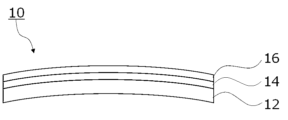
- FIG. 1 is a cross-sectional view of one embodiment of a spectacle lens.
- the spectacle lens 10 shown in FIG. 1 includes a spectacle lens substrate 12, an anti-reflection coating 14, and a water- and oil-repellent layer 16, in that order.
- the above-mentioned eyeglass lens 10 includes an anti-reflection film 14, but the anti-reflection film 14 is an optional component, and the eyeglass lens of the present disclosure only needs to include at least an eyeglass lens substrate and a water- and oil-repellent layer.
- the water- and oil-repellent layer 16 is disposed on only one side of the lens substrate 12, but the water- and oil-repellent layer 16 may be disposed on both sides of the eyeglass lens substrate 12.
- the eyeglass lens may have a water- and oil-repellent layer on both sides of the eyeglass lens substrate.
- the type of plastic (so-called resin) contained in the plastic eyeglass lens substrate is not particularly limited, but examples thereof include (meth)acrylic acid ester resin, thiourethane resin, allyl resin, episulfide resin, polycarbonate, urethane resin, polyester, polystyrene, polyethersulfone, poly-4-methylpentene-1, and diethylene glycol bisallyl carbonate resin (CR-39).
- resin diethylene glycol bisallyl carbonate resin
- thiourethane resin, episulfide resin, and diethylene glycol bisallyl carbonate resin are preferably used.
- the thiourethane resin is obtained from a polyisocyanate compound and a polythiol compound.
- polyisocyanate compound it is preferable to use at least one selected from m-xylylene diisocyanate, a mixture of 2,5-bis(isocyanatomethyl)-bicyclo[2,2,1]heptane and 2,6-bis(isocyanatomethyl)-bicyclo[2,2,1]-heptane, isophorone diisocyanate, hexamethylene diisocyanate, and tolylene diisocyanate.
- polythiol compound it is preferable to use at least one selected from pentaerythritol tetrakis(3-mercaptopropionate), 1,2-bis[(2-mercaptoethyl)thio]-3-mercaptopropane, and a mixture of 5,7-dimercaptomethyl-1,11-dimercapto-3,6,9-trithiaundecane, 4,7-dimercaptomethyl-1,11-dimercapto-3,6,9-trithiaundecane, and 4,8-dimercaptomethyl-1,11-dimercapto-3,6,9-trithiaundecane.
- pentaerythritol tetrakis(3-mercaptopropionate) 1,2-bis[(2-mercaptoethyl)thio]-3-mercaptopropane
- the episulfide resin is obtained by ring-opening polymerization of a monomer having an episulfide group (also called an epithio group) or a mixed monomer containing this monomer.
- a monomer having an episulfide group also called an epithio group
- a mixed monomer containing this monomer it is preferable to use at least one selected from bis(2,3-epithiopropyl)sulfide and bis(2,3-epithiopropyl)disulfide.
- a known hard coat layer can be used as the hard coat layer, for example, an organic hard coat layer, an inorganic hard coat layer, and an organic-inorganic hybrid hard coat layer.
- an organic-inorganic hybrid hard coat layer is commonly used.
- the type of the organic solvent is not particularly limited, and examples thereof include alcohol solvents, ketone solvents, ether solvents, ester solvents, hydrocarbon solvents, halogenated hydrocarbon solvents, amide solvents, sulfone solvents, and sulfoxide solvents.
- the thickness of the hard coat layer is not particularly limited, but is preferably 1 ⁇ m or more, more preferably 3 ⁇ m or more, and even more preferably 10 ⁇ m or more.
- the upper limit of the thickness can be, for example, 30 ⁇ m or less.
- the above film thickness is an average film thickness, and is measured by measuring the film thickness at any five points on the hard coat layer and calculating the arithmetic average thereof.
- the material constituting the water- and oil-repellent layer is not particularly limited, and examples thereof include fluorine-containing compounds (compounds containing fluorine atoms) and silicon-containing compounds (compounds containing silicon atoms).
- the water- and oil-repellent layer preferably contains a fluorine-containing compound, and more preferably contains at least one selected from the group consisting of fluorine-substituted alkyl group-containing organosilicon compounds, their hydrolysates, and their hydrolyzed condensates, in order to obtain more excellent water- and oil-repellent properties.
- the materials constituting the water- and oil-repellent layer may be used alone or in combination of two or more.
- the water- and oil-repellent layer forming process uses a vacuum deposition method. More specifically, in a reduced pressure environment, a material for forming the water- and oil-repellent layer is vaporized from a vapor deposition source, and the vaporized material is brought into contact with the object to form the water- and oil-repellent layer on the object.
- the vacuum deposition method is carried out, for example, in a vacuum chamber.
- the base pressure of the vacuum chamber pressure when deposition or the like is not being carried out
- the pressure inside the vacuum chamber is measured using a Bayard-Alpert vacuum gauge, which is a type of hot cathode ionization vacuum gauge.
- the Bayard-Alpert vacuum gauge used has its sensitivity corrected using nitrogen gas.
- the deposition source When performing the vacuum deposition method, the deposition source may be heated.
- the evaporation source can be heated by, for example, resistance heating. When the evaporation source is heated, the heating temperature can be adjusted according to the material used and the desired evaporation rate.
- the material for forming the water- and oil-repellent layer contained in the deposition source is as described above. That is, the deposition source is preferably a fluorine-containing compound (a compound containing a fluorine atom), and the fluorine-containing compound is preferably a fluorine-containing compound having a hydrolyzable group (for example, an organosilicon compound containing a fluorine-substituted alkyl group).
- the deposition source may consist of only the material for forming the water- and oil-repellent layer, or may be a pellet impregnated with the material for forming the water- and oil-repellent layer.
- a plastic substrate having a refractive index of 1.60 was prepared as a plastic eyeglass lens substrate.
- the prepared plastic eyeglass lens substrate was placed in the rotating dome of a vacuum deposition apparatus with the convex surface facing inward.
- the plastic eyeglass lens substrate was heated to a temperature of 70° C., and in the heated state, the vacuum chamber was evacuated until the pressure in the vacuum chamber reached 1.0 ⁇ 10 ⁇ 3 Pa.
- the pressure inside the vacuum chamber was measured using a BAG302 (hot cathode ionization vacuum gauge (Bayard-Alpert vacuum gauge)) manufactured by INFICON.
- Fourth layer SiO 2 (refractive index 1.47), optical thickness 0.060 ⁇
- Sixth layer SiO 2 (refractive index 1.47), optical thickness 0.340 ⁇
- a water-repellent and oil-repellent layer was formed on the surface of the sixth layer opposite to the plastic eyeglass lens substrate side.
- a material was used as the deposition source, which was a mixture of KY164 (manufactured by Shin-Etsu Chemical Co., Ltd.), UD-100 (manufactured by Daikin Industries, Ltd.), and KP911 (manufactured by Shin-Etsu Chemical Co., Ltd.) in a mass ratio of 50:25:25 in terms of solid content.
- the water- and oil-repellent layer was formed by heating the deposition source while argon gas was being introduced while adjusting the flow rate with a flow rate control valve so that the pressure inside the vacuum chamber was 4.8 ⁇ 10 ⁇ 3 Pa.
- the deposition source was heated by passing electricity through a resistor provided in the above-mentioned device.
- the amount of electricity during deposition was set to 90 A.
- the amount of argon gas introduced when the above-mentioned pressure was adjusted to the above-mentioned device was 4 sccm.
- Industrial argon gas (purity: 99.99% by volume or more) was used as the argon gas to be introduced.
- the plastic eyeglass lens substrate was placed in the rotating dome of a vacuum deposition device so that the concave surface of the plastic eyeglass lens substrate faced inward. After placing the plastic eyeglass lens substrate in the dome, the concave surface was irradiated with an argon ion beam using the same procedure as for the convex surface. After the argon ion beam irradiation, an anti-reflection film was formed on the plastic eyeglass lens substrate.
- a water- and oil-repellent layer was formed on the surface opposite to the plastic eyeglass lens substrate side of the sixth layer.
- the conditions for forming the water- and oil-repellent layer were the same as those for the convex side.
- Example 1 A spectacle lens was obtained in the same manner as in Example 1, except that in the procedure for obtaining the spectacle lens of Example 1, the argon gas introduced during the formation of the water- and oil-repellent layer was changed to oxygen gas (industrial oxygen gas (purity: 99.999% by volume or more)).
- oxygen gas industrial oxygen gas (purity: 99.999% by volume or more)
- Example 2 A spectacle lens was obtained in the same manner as in Example 1, except that in the procedure for obtaining the spectacle lens of Example 1, the deposition source used for forming the water- and oil-repellent layer was changed to KY164 (manufactured by Shin-Etsu Chemical Co., Ltd.).
- Example 3 A spectacle lens was obtained in the same manner as in Example 1, except that in the procedure for obtaining the spectacle lens of Example 1, the deposition source used for forming the water- and oil-repellent layer was changed to UD-100 (manufactured by Daikin Industries, Ltd.).
- Example 4 A spectacle lens was obtained in the same manner as in Example 1, except that in the procedure for obtaining the spectacle lens of Example 1, the deposition source used for forming the water- and oil-repellent layer was changed to UD-120 (manufactured by Daikin Industries, Ltd.).
- Example 5 A spectacle lens was obtained in the same manner as in Example 1, except that in the procedure for obtaining the spectacle lens of Example 1, the deposition source used for forming the water- and oil-repellent layer was changed to DSX-E (manufactured by Daikin Industries, Ltd.).
- Example 6 to 10 and Comparative Examples 6 to 10 The spectacle lenses of Examples 6 to 10 and Comparative Examples 6 to 10 were obtained in the same manner as in Examples 1 to 5 and Comparative Examples 1 to 5, respectively, except that the deposition source was heated while the flow rate was adjusted with a flow rate adjustment valve so that the pressure inside the vacuum chamber was 5.4 ⁇ 10 -2 Pa. The amount of argon gas introduced when the above-mentioned apparatus was adjusted to the above-mentioned pressure was 7 sccm.
- REFERENCE SIGNS LIST 10 eyeglass lens 12: eyeglass lens substrate 14: anti-reflection film 16: water- and oil-repellent layer
Landscapes
- Physics & Mathematics (AREA)
- General Physics & Mathematics (AREA)
- Optics & Photonics (AREA)
- Chemical & Material Sciences (AREA)
- Health & Medical Sciences (AREA)
- Ophthalmology & Optometry (AREA)
- Inorganic Chemistry (AREA)
- Chemical Kinetics & Catalysis (AREA)
- General Health & Medical Sciences (AREA)
- Surface Treatment Of Optical Elements (AREA)
- Physical Vapour Deposition (AREA)
Priority Applications (1)
| Application Number | Priority Date | Filing Date | Title |
|---|---|---|---|
| JP2024567451A JPWO2024142935A1 (https=) | 2022-12-26 | 2023-12-13 |
Applications Claiming Priority (2)
| Application Number | Priority Date | Filing Date | Title |
|---|---|---|---|
| JP2022-207955 | 2022-12-26 | ||
| JP2022207955 | 2022-12-26 |
Publications (1)
| Publication Number | Publication Date |
|---|---|
| WO2024142935A1 true WO2024142935A1 (ja) | 2024-07-04 |
Family
ID=91717690
Family Applications (1)
| Application Number | Title | Priority Date | Filing Date |
|---|---|---|---|
| PCT/JP2023/044607 Ceased WO2024142935A1 (ja) | 2022-12-26 | 2023-12-13 | 眼鏡レンズの製造方法 |
Country Status (2)
| Country | Link |
|---|---|
| JP (1) | JPWO2024142935A1 (https=) |
| WO (1) | WO2024142935A1 (https=) |
Citations (7)
| Publication number | Priority date | Publication date | Assignee | Title |
|---|---|---|---|---|
| JP2004074487A (ja) * | 2002-08-13 | 2004-03-11 | Oike Kaihatsu Kenkyusho:Kk | 防紋防汚面形成方法及び該方法によって防紋防汚面が形成された積層体 |
| JP2008096886A (ja) * | 2006-10-16 | 2008-04-24 | Seiko Epson Corp | プラスチックレンズおよびカラーレンズの製造方法 |
| WO2008053712A1 (en) * | 2006-10-31 | 2008-05-08 | Nikon-Essilor Co., Ltd. | Eyeglass lens and method for production thereof |
| JP2008152085A (ja) * | 2006-12-19 | 2008-07-03 | Hoya Corp | 眼鏡用レンズの製造方法、眼鏡用レンズの成膜装置および眼鏡用レンズ |
| JP2015193747A (ja) * | 2014-03-31 | 2015-11-05 | 株式会社ダイセル | 硬化性組成物及び成形体 |
| WO2016068112A1 (ja) * | 2014-10-30 | 2016-05-06 | 旭硝子株式会社 | 防汚膜付き基体 |
| JP2022509087A (ja) * | 2018-11-19 | 2022-01-20 | エシロール アンテルナショナル | 耐摩耗性を改善するためのフィルタリング干渉コーティング及び多層系を有する光学レンズ |
-
2023
- 2023-12-13 JP JP2024567451A patent/JPWO2024142935A1/ja active Pending
- 2023-12-13 WO PCT/JP2023/044607 patent/WO2024142935A1/ja not_active Ceased
Patent Citations (7)
| Publication number | Priority date | Publication date | Assignee | Title |
|---|---|---|---|---|
| JP2004074487A (ja) * | 2002-08-13 | 2004-03-11 | Oike Kaihatsu Kenkyusho:Kk | 防紋防汚面形成方法及び該方法によって防紋防汚面が形成された積層体 |
| JP2008096886A (ja) * | 2006-10-16 | 2008-04-24 | Seiko Epson Corp | プラスチックレンズおよびカラーレンズの製造方法 |
| WO2008053712A1 (en) * | 2006-10-31 | 2008-05-08 | Nikon-Essilor Co., Ltd. | Eyeglass lens and method for production thereof |
| JP2008152085A (ja) * | 2006-12-19 | 2008-07-03 | Hoya Corp | 眼鏡用レンズの製造方法、眼鏡用レンズの成膜装置および眼鏡用レンズ |
| JP2015193747A (ja) * | 2014-03-31 | 2015-11-05 | 株式会社ダイセル | 硬化性組成物及び成形体 |
| WO2016068112A1 (ja) * | 2014-10-30 | 2016-05-06 | 旭硝子株式会社 | 防汚膜付き基体 |
| JP2022509087A (ja) * | 2018-11-19 | 2022-01-20 | エシロール アンテルナショナル | 耐摩耗性を改善するためのフィルタリング干渉コーティング及び多層系を有する光学レンズ |
Also Published As
| Publication number | Publication date |
|---|---|
| JPWO2024142935A1 (https=) | 2024-07-04 |
Similar Documents
| Publication | Publication Date | Title |
|---|---|---|
| CA2841414C (en) | Method for obtaining optical articles having superior abrasion resistant properties, and coated articles prepared according to such method | |
| CN100590460C (zh) | 塑料透镜以及制造塑料透镜的方法 | |
| EP2928616B1 (en) | Method for coating an optical article with a topcoat using vacuum air plasma treatment | |
| JP2021009205A (ja) | 眼鏡レンズ | |
| US20230072027A1 (en) | Optical member | |
| US10732324B2 (en) | Method for laminating an interference coating comprising an organic/inorganic layer, and item thus obtained | |
| WO2024142935A1 (ja) | 眼鏡レンズの製造方法 | |
| JPH10123301A (ja) | 反射防止層を有する光学物品 | |
| WO2025263370A1 (ja) | 蒸着源の保管方法、眼鏡レンズの製造方法 | |
| CA3181969C (en) | Optical member | |
| WO2026083763A1 (ja) | 光学物品 | |
| CA3242537C (en) | Liquid composition, hard coat layer, and spectacle lens | |
| EP4737955A1 (en) | Laminate and spectacle lens | |
| EP4737952A1 (en) | Method for producing lens | |
| WO2024116961A1 (ja) | 光学物品の製造方法 | |
| WO2025229952A1 (ja) | 眼鏡レンズ | |
| WO2025070120A1 (ja) | 眼鏡レンズ | |
| WO2026048537A1 (ja) | 眼鏡レンズの製造方法 | |
| WO2025070123A1 (ja) | 眼鏡レンズ | |
| EP4737954A1 (en) | Multilayer body and spectacle lens | |
| WO2025258437A1 (ja) | 眼鏡レンズの評価方法 | |
| US20260126567A1 (en) | Laminate and spectacle lens | |
| WO2025057689A1 (ja) | レンズの製造方法 | |
| JP2008046390A (ja) | 反射防止層を有する眼鏡レンズおよび眼鏡レンズの製造方法 | |
| WO2024219214A1 (ja) | 積層体、眼鏡レンズの製造方法 |
Legal Events
| Date | Code | Title | Description |
|---|---|---|---|
| 121 | Ep: the epo has been informed by wipo that ep was designated in this application |
Ref document number: 23911716 Country of ref document: EP Kind code of ref document: A1 |
|
| WWE | Wipo information: entry into national phase |
Ref document number: 2024567451 Country of ref document: JP |
|
| NENP | Non-entry into the national phase |
Ref country code: DE |
|
| 122 | Ep: pct application non-entry in european phase |
Ref document number: 23911716 Country of ref document: EP Kind code of ref document: A1 |