WO2024127543A1 - 電機子及び電動機 - Google Patents
電機子及び電動機 Download PDFInfo
- Publication number
- WO2024127543A1 WO2024127543A1 PCT/JP2022/045983 JP2022045983W WO2024127543A1 WO 2024127543 A1 WO2024127543 A1 WO 2024127543A1 JP 2022045983 W JP2022045983 W JP 2022045983W WO 2024127543 A1 WO2024127543 A1 WO 2024127543A1
- Authority
- WO
- WIPO (PCT)
- Prior art keywords
- winding
- teeth
- armature
- phase
- insulating
- Prior art date
- Legal status (The legal status is an assumption and is not a legal conclusion. Google has not performed a legal analysis and makes no representation as to the accuracy of the status listed.)
- Ceased
Links
Images








Classifications
-
- H—ELECTRICITY
- H02—GENERATION; CONVERSION OR DISTRIBUTION OF ELECTRIC POWER
- H02K—DYNAMO-ELECTRIC MACHINES
- H02K3/00—Details of windings
- H02K3/04—Windings characterised by the conductor shape, form or construction, e.g. with bar conductors
- H02K3/28—Layout of windings or of connections between windings
-
- H—ELECTRICITY
- H02—GENERATION; CONVERSION OR DISTRIBUTION OF ELECTRIC POWER
- H02K—DYNAMO-ELECTRIC MACHINES
- H02K1/00—Details of the magnetic circuit
- H02K1/06—Details of the magnetic circuit characterised by the shape, form or construction
- H02K1/12—Stationary parts of the magnetic circuit
- H02K1/14—Stator cores with salient poles
- H02K1/146—Stator cores with salient poles consisting of a generally annular yoke with salient poles
- H02K1/148—Sectional cores
-
- H—ELECTRICITY
- H02—GENERATION; CONVERSION OR DISTRIBUTION OF ELECTRIC POWER
- H02K—DYNAMO-ELECTRIC MACHINES
- H02K3/00—Details of windings
- H02K3/04—Windings characterised by the conductor shape, form or construction, e.g. with bar conductors
- H02K3/18—Windings for salient poles
-
- H—ELECTRICITY
- H02—GENERATION; CONVERSION OR DISTRIBUTION OF ELECTRIC POWER
- H02K—DYNAMO-ELECTRIC MACHINES
- H02K3/00—Details of windings
- H02K3/32—Windings characterised by the shape, form or construction of the insulation
- H02K3/325—Windings characterised by the shape, form or construction of the insulation for windings on salient poles, such as claw-shaped poles
-
- H—ELECTRICITY
- H02—GENERATION; CONVERSION OR DISTRIBUTION OF ELECTRIC POWER
- H02K—DYNAMO-ELECTRIC MACHINES
- H02K3/00—Details of windings
- H02K3/46—Fastening of windings on the stator or rotor structure
-
- H—ELECTRICITY
- H02—GENERATION; CONVERSION OR DISTRIBUTION OF ELECTRIC POWER
- H02K—DYNAMO-ELECTRIC MACHINES
- H02K3/00—Details of windings
- H02K3/46—Fastening of windings on the stator or rotor structure
- H02K3/52—Fastening salient pole windings or connections thereto
- H02K3/521—Fastening salient pole windings or connections thereto applicable to stators only
- H02K3/522—Fastening salient pole windings or connections thereto applicable to stators only for generally annular cores with salient poles
-
- H—ELECTRICITY
- H02—GENERATION; CONVERSION OR DISTRIBUTION OF ELECTRIC POWER
- H02K—DYNAMO-ELECTRIC MACHINES
- H02K41/00—Propulsion systems in which a rigid body is moved along a path due to dynamo-electric interaction between the body and a magnetic field travelling along the path
- H02K41/02—Linear motors; Sectional motors
- H02K41/03—Synchronous motors; Motors moving step by step; Reluctance motors
-
- H—ELECTRICITY
- H02—GENERATION; CONVERSION OR DISTRIBUTION OF ELECTRIC POWER
- H02K—DYNAMO-ELECTRIC MACHINES
- H02K41/00—Propulsion systems in which a rigid body is moved along a path due to dynamo-electric interaction between the body and a magnetic field travelling along the path
- H02K41/02—Linear motors; Sectional motors
- H02K41/03—Synchronous motors; Motors moving step by step; Reluctance motors
- H02K41/031—Synchronous motors; Motors moving step by step; Reluctance motors of the permanent magnet type
-
- H—ELECTRICITY
- H02—GENERATION; CONVERSION OR DISTRIBUTION OF ELECTRIC POWER
- H02K—DYNAMO-ELECTRIC MACHINES
- H02K2203/00—Specific aspects not provided for in the other groups of this subclass relating to the windings
- H02K2203/12—Machines characterised by the bobbins for supporting the windings
Definitions
- This disclosure relates to an armature with electric wires wound around teeth and an electric motor equipped with the armature.
- Patent Document 1 discloses a technology that reduces the number of connection processes after winding by winding coils for two different phases around one tooth and winding each phase coil with a single electric wire.
- Patent Document 1 has the problem that the number of winding and connection steps increases because the wire for one phase coil is wound first, and then the wire for another different phase coil is wound.
- the present disclosure has been made in consideration of the above, and aims to obtain an armature that reduces the number of winding steps and the number of post-winding connection steps.
- the armature according to the present disclosure is disposed opposite the field magnet via an air gap, and is driven by three-phase AC excitation.
- the armature has a plurality of teeth each including an iron core, an insulating retaining member attached to the iron core, and a winding section in which a coil is formed by winding an electric wire having an insulating coating over the insulating retaining member and around the iron core.
- the plurality of teeth includes a first tooth having a winding section only for the coil of one phase, and a second tooth having a winding section for the coils of two different phases. In the second tooth, the winding sections of the two different phases are formed from a single electric wire, and are wound continuously via an intermediate fixing member provided on the insulating retaining member.
- the armature disclosed herein has the effect of reducing the number of winding man-hours and the number of connection man-hours after winding.
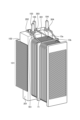
- FIG. 4 is a perspective view of a first tooth of the linear motor according to the first embodiment
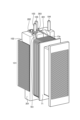
- FIG. 4 is a perspective view of a second tooth of the electric motor according to the first embodiment
- FIG. 11 is a diagram showing a second teeth manufacturing process of the electric motor according to the first embodiment
- FIG. 11 is a diagram showing a second teeth manufacturing process of the electric motor according to the first embodiment
- FIG. 2 is a schematic diagram illustrating a cross section of a second tooth of the linear motor according to the first embodiment
- 1 is a schematic cross-sectional view of a linear motor according to a second embodiment of the present invention
- FIG. 13 is a perspective view of a second tooth of a linear motor according to a second embodiment
- FIG. 11 is a diagram showing a second teeth manufacturing process of the linear motor according to the second embodiment
- FIG. 11 is a diagram showing a second teeth manufacturing process of a linear motor according to the second embodiment
- FIG. 13 is a schematic diagram illustrating a cross section of a second tooth of a linear motor according to a second embodiment
- 1 is a schematic cross-sectional view of a linear motor according to a third embodiment of the present invention
- FIG. 13 is a perspective view of a second tooth of a linear motor according to a third embodiment
- FIG. 13 is a diagram showing a second teeth manufacturing process of the linear motor according to the third embodiment
- FIG. 13 is a schematic cross-sectional view of a linear motor according to a modification of the third embodiment
- 1 is a schematic cross-sectional view of a linear motor according to a fourth embodiment of the present invention
- FIG. 13 is a perspective view of a second tooth of a linear motor according to a fourth embodiment
- Embodiment 1. 1 is a schematic diagram of a cross section of a linear motor according to embodiment 1.
- a linear motor 10 according to embodiment 1 includes a mover 1, which is an armature, and a stator 3, which is a field magnet that faces the mover 1 across an air gap.
- the stator 3 includes a permanent magnet 31 and a mounting seat 32 to which the permanent magnet 31 is fixed.
- the mover 1 includes teeth 11, 12, 13, 14, and 15.
- the teeth 11, 12, 13, 14, and 15 include iron cores 111, 121, 131, 141, and 151, an insulating holding member 201 having a function of holding an electric wire and a function of insulating, and winding portions 11a, 12a, 13a, 13b, 14a, and 15a in which an electric wire having an insulating coating is wound from above the insulating holding member 201 around the iron cores 111, 121, 131, 141, and 151 and the insulating holding member 201 to form a coil.
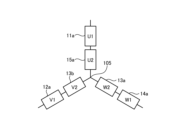
- FIG. 2 is a wiring diagram of a linear motor according to the first embodiment.
- the windings 11a and 15a form a U-phase coil
- the windings 12a and 13b form a V-phase coil
- the windings 13a and 14a form a W-phase coil.
- the windings 14a and 13a which are W-phase coils
- are connected in series and the coils of each phase are connected in a Y-connection via a neutral point.
- the teeth 13 have windings of two different phases, the windings 13b, which are V-phase coils, and the windings 13a, which are W-phase coils.
- the windings 13a and 13b, which are two different phases, of the teeth 13 are coils that are directly connected to the neutral point.
- one winding section formed by winding electric wire around a tooth core constitutes a coil of one phase. That is, in a typical electric motor, one tooth has one winding section.
- the linear motor 10 according to embodiment 1 has a structure in which the number of teeth is not a multiple of three, and among the teeth 11, 12, 13, 14, and 15, tooth 13 has winding sections 13a and 13b for coils of two different phases.
- teeth 11, 12, 14, 15 that have winding portions 11a, 12a, 14a, 15a for only one phase coil are referred to as first teeth
- teeth 13 that have winding portions 13a, 13b for two different phase coils are referred to as second teeth.
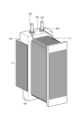
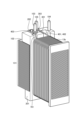
- FIG. 3 is a perspective view of a first tooth of a linear motor according to embodiment 1.
- the core 111 is formed by stacking multiple electromagnetic steel sheets 102.
- the winding start fixing member 103 and the winding end fixing member 104 are members that fix the electric wire by drawing it out and winding it in the winding process, and both are fixed to the insulating holding member 201.
- the winding start fixing member 103 is used to fix the electric wire when winding begins, and the winding end fixing member 104 is used when winding the electric wire ends.
- the coil forming process for the first tooth will be described using the tooth 11 as an example.
- the electric wire is wound around the winding start fixing member 103 to form the winding start portion 301, and then the electric wire is wound counterclockwise around the insulating holding member 201 for a preset number of turns to form the winding portion 11a that generates magnetic flux in the tooth 11.
- the electric wire is prevented from falling off the insulating holding member 201 during the winding process to form the winding portion 11a.
- the electric wire is wound around the winding end fixing member 104 provided on the insulating holding member 201 in the same manner as the winding start portion 301 to form the winding end portion 304, completing the formation of the coil on the tooth 11.
- the coil of the tooth 11 is composed of only the winding portion 11a of one phase. Note that the coils of the teeth 12, 14, and 15, which are also the first teeth, are formed in the same process as the tooth 11.
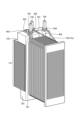
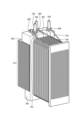
- FIG. 4 is a perspective view of the second teeth of the electric motor according to the first embodiment.
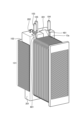
- FIGS. 5 and 6 are diagrams showing the manufacturing process of the second teeth of the electric motor according to the first embodiment.
- the insulating retaining member 201 includes an intermediate fixing member 105, a jumper protrusion 202 used to align the electric wire when performing the winding process of the second phase winding portion 13b described below, and a winding start groove 701 that determines the position of the winding start electric wire of the winding portion 13b.
- the iron core 131 is formed by stacking multiple electromagnetic steel sheets 102.
- the electric wire is wound around the winding start fixing member 103 to form the winding start portion 301.
- the electric wire is then wound counterclockwise around the insulating holding member 201 for a preset number of turns to form the winding portion 13a for the first phase.
- the winding end electric wire 401 of the winding portion 13a is not wound around the winding end fixing member 104 and is free to move.
- the winding of the intermediate portion 303 is performed to form the second phase winding portion 13b.
- the winding end electric wire 401 of the winding portion 13a is wound around the intermediate fixing member 105 provided between the winding start fixing member 103 and the winding end fixing member 104, forming the crossover wire 402 connecting the winding portion 13a and the intermediate portion 303 and the intermediate portion 303 which is the electric wire wound around the intermediate fixing member 105, and the electric wire is placed in the winding start groove 701.
- the electric wire is placed along the crossover protrusion 202 provided on the insulating holding member 201 so as not to come into contact with the winding start fixing member 103, and the crossover wire 403 connecting the neutral point and the winding start of the winding portion 13b is formed.
- the electric wire is wound a preset number of times in the same direction as the winding portion 13a so as to overlap the winding portion 13a, forming the winding portion 13b.
- the wire is wound around the end-of-winding fixing member 104, and the end-of-winding portion 304 is formed, after which the wire is cut.
- the linear motor 10 according to embodiment 1 allows the first-phase winding portion 13a and the second-phase winding portion 13b to be wound continuously with a single electric wire, making it possible to reduce the number of winding steps. Also, as shown in FIG. 2, since the winding portions 13a and 13b are coils that are directly connected to the neutral point, it is also possible for the intermediate fixing member 105 to be the neutral point during connection. This reduces the number of end points of the electric wires that make up the winding portions 11a, 12a, 13a, 13b, 14a, and 15a of each phase, making it possible to reduce the number of connection steps.
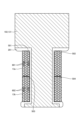
- FIG. 7 is a schematic diagram showing a cross section of a second tooth of a linear motor according to embodiment 1.
- the first-phase winding portion 13a is wound counterclockwise, with the start wire 501 at the start and the end wire 502 at the end of the first-phase winding portion 13a.
- the second-phase winding portion 13b is wound in the same winding direction as the first-phase winding portion 13a, with the start wire 503 at the start and the end wire 504 at the end.
- the current flowing through the winding portion 13a is from the start wire 501 of the winding portion 13a to the end wire 502 of the winding portion 13a, i.e., current direction 601.
- the start wire 503 of the second phase winding portion 13b is connected to the neutral point, the current flowing is from the end wire 504 to the start wire 503, i.e., current direction 602.
- the end wire 502 of the winding portion 13a and the start wire 503 of the winding portion 13b which are the contact points between the first phase winding portion 13a and the second phase winding portion 13b, are connected to the neutral point side, so the potential difference at the contact points between the winding portions 13a and 13b caused by the surge voltage generated during current excitation is smaller than when the end wire 502 of the winding portion 13a and the start wire 503 of the winding portion 13b are not connected to the neutral point.
- the intermediate fixing member 105 is disposed between the winding start fixing member 103 and the winding end fixing member 104, but it is sufficient that the intermediate fixing member 105 is disposed with a necessary insulation distance between them, and it is not necessary that the intermediate fixing member 105 is disposed between the winding start fixing member 103 and the winding end fixing member 104.
- the winding portions 13a and 13b are each wound counterclockwise, but the same effect can be obtained if each is wound clockwise. The same effect can also be obtained if one of the winding portions 13a and 13b is wound clockwise and the other is wound counterclockwise. That is, in the second tooth, tooth 13, the winding portions 13a and 13b of two different phases may be wound around the iron core 131 and insulating retaining member 201 in the same winding direction, or may be wound around the iron core 131 and insulating retaining member 201 in different winding directions.
- a linear motor 10 is given as an example in which the stator 3 has a four-pole field magnet and the armature, the mover 1, is a six-phase armature, but the combination of phases that make up the magnets and armature may be any combination that allows the linear motor 10 to be driven appropriately.
- the first embodiment uses a linear motor 10 as an example, the same implementation is possible with a rotating electric motor.
- the linear motor 10 reduces the number of winding steps by continuously winding the first-phase winding portion 13a and the second-phase winding portion 13b, and also reduces the number of connection steps after winding by providing an intermediate portion 303 between the winding portions 13a and 13b.
- Embodiment 2. 8 is a schematic diagram of a cross section of a linear motor according to embodiment 2.
- the connection of the mover 1A of the linear motor 10 according to embodiment 2 is the same as that of the mover 1 of the linear motor 10 according to embodiment 1.
- the teeth 13 are second teeth having a winding portion 13b which is a V-phase coil and a winding portion 13a which is a W-phase coil, and the winding portion 13a and the winding portion 13b are wound in a state of contact with each other.
- the winding portion 13a When the winding portions 13a and 13b which constitute coils of two different phases are arranged side by side along the arrangement direction of the mover 1A and the stator 3, the winding portion 13a is closer to the core back portion of the teeth 13 than the winding portion 13b, and more magnetic flux passes through it, so that the W-phase having the winding portion 13a as a component has a higher induced voltage than the V-phase having the winding portion 13b as a component.
- FIGS. 10 and 11 are diagrams showing the manufacturing process of the second teeth of the linear motor according to the second embodiment. The process of forming the coil of the second teeth will be described starting with the winding process of the first phase winding section 13a.
- the electric wire is wound around the winding start fixing member 103 to form the winding start section 301.
- the first phase winding section 13a is formed by winding the electric wire counterclockwise around the insulating holding member 201 for a preset number of turns.
- the winding end electric wire 401 of the first phase winding section 13a is not wound around the winding end fixing member 104 and is in a state in which it can move freely.
- the intermediate section 303 is wound.
- the winding end electric wire 401 of the winding section 13a is wound around the intermediate fixing member 105 provided between the winding start fixing member 103 and the winding end fixing member 104 to form the intermediate section 303, and the electric wire is placed in the winding start groove 701.
- the electric wire is wound along the jump protrusion 202 provided on the insulating holding member 201 so as not to come into contact with the winding start fixing member 103.
- the electric wire is wound in a preset counterclockwise direction to form the winding section 13b on the stator 3 side rather than the winding section 13a in the arrangement direction of the mover 1A and the stator 3, and then the electric wire is wound around the winding end fixing member 104 to form the winding end section 304.
- the winding structure shown in FIG. 9 is obtained.
- FIG. 12 is a schematic diagram showing a cross section of a second tooth of a linear motor according to embodiment 2.
- the first-phase winding portion 13a is wound counterclockwise from the winding start wire 501 to the winding end wire 502.
- the second-phase winding portion 13b is also wound counterclockwise from the winding start wire 503 to the winding end wire 504, similar to the first-phase winding portion 13a.
- start wire 501 of winding portion 13a and end wire 504 of winding portion 13b can be positioned apart, making it possible to avoid insulation failure due to sudden surge voltages without providing an insulating member such as insulating paper between winding portions 13a and 13b. This makes it possible to improve the winding space factor and reduce the effect of temperature rise due to copper loss in a motor of the same size.
- the winding section 13a and the winding section 13b are arranged side by side along the arrangement direction of the mover 1A and the stator 3, which allows fine adjustment of the induced voltage in each phase and improves the design freedom.
- Embodiment 3. 13 is a schematic diagram of a cross section of a linear motor according to embodiment 3.
- the teeth 13 are second teeth including a winding portion 13b which is a V-phase coil and a winding portion 13a which is a W-phase coil.
- the winding portion 13b and the winding portion 13a are wound with an insulating member 71 sandwiched therebetween.
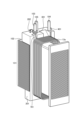
- FIG. 14 is a perspective view of the second teeth of the linear motor according to the third embodiment.
- FIG. 15 is a diagram showing the manufacturing process of the second teeth of the linear motor according to the third embodiment. The process of forming the coil of the second teeth will be described starting from the winding process of the first phase winding portion 13a. The process from winding the winding portion 13a to arranging the electric wire in the winding start groove 701 is the same as that of the mover 1A of the linear motor 10 according to the second embodiment.
- an insulating member 71 is arranged on the stator 3 side of the winding portion 13a in the arrangement direction of the mover 1B and the stator 3, and then the second teeth are formed by winding the second phase winding portion 13b.
- Fig. 16 is a schematic diagram of a cross section of a linear motor according to a modification of embodiment 3.
- the windings 13a and 13b are arranged side by side along the arrangement direction of the mover 1B and the stator 3, but the same effect can be obtained even if the windings 13a and 13b are arranged side by side in the winding center direction, as in the mover 1C of the linear motor 10 according to embodiment 3.
- Fig. 17 is a schematic diagram of a cross section of a linear motor according to embodiment 4.
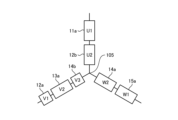
- Fig. 18 is a connection diagram of a linear motor according to embodiment 4.
- Teeth 12 are second teeth having winding portion 12b which is a U-phase coil and winding portion 12a which is a V-phase coil.
- Teeth 14 are second teeth having winding portion 14b which is a V-phase coil and winding portion 14a which is a W-phase coil.
- mover 1D which is an armature has two second teeth.
- the winding process for teeth 12 and 14 is the same as that for teeth 13 of linear motor 10 according to embodiment 1.
- FIG. 19 is a perspective view of the second tooth of a linear motor according to embodiment 4.
- the winding process for the first phase winding portion 13a is the same as that for the tooth 13 according to embodiment 1 shown in FIG. 4.
- the crossover wire 402 connecting the winding portion 13a to the intermediate portion 303 and the crossover wire 403 connecting the intermediate portion 303 to the winding portion 13b are cut.
- the end wire 401 of the winding portion 13a and the start wire 404 of the winding portion 13b can be separated from the intermediate fixing member 105, eliminating the need to connect the end wire 401 of the winding portion 13a and the start wire 404 of the winding portion 13b to the neutral point, improving the freedom of design.
- stator 10: linear motor, 11, 12, 13, 14, 15: teeth, 11a, 12a, 12b, 13a, 13b, 14a, 14b, 15a: winding section, 31: permanent magnet, 32: mounting seat, 71: insulating member, 102: electromagnetic steel sheet, 103: winding start fixing member, 104: winding end fixing member, 105 Intermediate fixing member, 111, 121, 131, 141, 151 iron core, 201 insulating retaining member, 202 jumper protrusion, 301 winding start portion, 303 intermediate portion, 304 winding end portion, 401, 502, 504 winding end electric wire, 404, 501, 503 winding start electric wire, 402, 403 jumper wire, 601, 602 current direction, 701 winding start groove.
Landscapes
- Engineering & Computer Science (AREA)
- Power Engineering (AREA)
- Physics & Mathematics (AREA)
- Chemical & Material Sciences (AREA)
- Combustion & Propulsion (AREA)
- Electromagnetism (AREA)
- Windings For Motors And Generators (AREA)
- Insulation, Fastening Of Motor, Generator Windings (AREA)
Priority Applications (5)
| Application Number | Priority Date | Filing Date | Title |
|---|---|---|---|
| KR1020247041515A KR102781387B1 (ko) | 2022-12-14 | 2022-12-14 | 전기자 및 전동기 |
| US18/879,814 US12395028B2 (en) | 2022-12-14 | 2022-12-14 | Armature and electric motor |
| JP2023530028A JP7325696B1 (ja) | 2022-12-14 | 2022-12-14 | 電機子及び電動機 |
| PCT/JP2022/045983 WO2024127543A1 (ja) | 2022-12-14 | 2022-12-14 | 電機子及び電動機 |
| CN202280097664.7A CN119487731B (zh) | 2022-12-14 | 2022-12-14 | 电枢及电动机 |
Applications Claiming Priority (1)
| Application Number | Priority Date | Filing Date | Title |
|---|---|---|---|
| PCT/JP2022/045983 WO2024127543A1 (ja) | 2022-12-14 | 2022-12-14 | 電機子及び電動機 |
Publications (1)
| Publication Number | Publication Date |
|---|---|
| WO2024127543A1 true WO2024127543A1 (ja) | 2024-06-20 |
Family
ID=87563141
Family Applications (1)
| Application Number | Title | Priority Date | Filing Date |
|---|---|---|---|
| PCT/JP2022/045983 Ceased WO2024127543A1 (ja) | 2022-12-14 | 2022-12-14 | 電機子及び電動機 |
Country Status (5)
| Country | Link |
|---|---|
| US (1) | US12395028B2 (https=) |
| JP (1) | JP7325696B1 (https=) |
| KR (1) | KR102781387B1 (https=) |
| CN (1) | CN119487731B (https=) |
| WO (1) | WO2024127543A1 (https=) |
Families Citing this family (1)
| Publication number | Priority date | Publication date | Assignee | Title |
|---|---|---|---|---|
| JP2024065398A (ja) * | 2022-10-31 | 2024-05-15 | ニデック株式会社 | モータ、および無人飛行体 |
Citations (4)
| Publication number | Priority date | Publication date | Assignee | Title |
|---|---|---|---|---|
| JP2005102477A (ja) * | 2003-08-26 | 2005-04-14 | Honda Motor Co Ltd | ステータ巻線及びステータ巻線の製造方法 |
| WO2019008848A1 (ja) * | 2017-07-04 | 2019-01-10 | 三菱電機株式会社 | 回転電機および直動電動機 |
| JP2021180596A (ja) * | 2020-05-15 | 2021-11-18 | 株式会社デンソー | 回転電機 |
| JP7080409B1 (ja) * | 2021-03-23 | 2022-06-03 | 三菱電機株式会社 | 電動機 |
Family Cites Families (6)
| Publication number | Priority date | Publication date | Assignee | Title |
|---|---|---|---|---|
| JP3564252B2 (ja) | 1997-02-06 | 2004-09-08 | 三菱電機株式会社 | 電機子巻線 |
| KR100225035B1 (ko) * | 1997-10-07 | 1999-10-15 | 정운익 | 도로의 제설제 살포장치 |
| JP5426180B2 (ja) * | 2009-01-20 | 2014-02-26 | 富士機械製造株式会社 | リニアモータ |
| JP5928642B2 (ja) * | 2014-07-01 | 2016-06-01 | ダイキン工業株式会社 | 電機子、回転電機、クロスフローファン、電機子のティース対の製造方法 |
| JP2016052224A (ja) | 2014-09-02 | 2016-04-11 | アイシン精機株式会社 | ステータ、そのステータを適用した回転電機及びステータの結線方法 |
| JP7103299B2 (ja) * | 2019-04-22 | 2022-07-20 | 株式会社デンソー | 回転電機 |
-
2022
- 2022-12-14 US US18/879,814 patent/US12395028B2/en active Active
- 2022-12-14 JP JP2023530028A patent/JP7325696B1/ja active Active
- 2022-12-14 KR KR1020247041515A patent/KR102781387B1/ko active Active
- 2022-12-14 WO PCT/JP2022/045983 patent/WO2024127543A1/ja not_active Ceased
- 2022-12-14 CN CN202280097664.7A patent/CN119487731B/zh active Active
Patent Citations (4)
| Publication number | Priority date | Publication date | Assignee | Title |
|---|---|---|---|---|
| JP2005102477A (ja) * | 2003-08-26 | 2005-04-14 | Honda Motor Co Ltd | ステータ巻線及びステータ巻線の製造方法 |
| WO2019008848A1 (ja) * | 2017-07-04 | 2019-01-10 | 三菱電機株式会社 | 回転電機および直動電動機 |
| JP2021180596A (ja) * | 2020-05-15 | 2021-11-18 | 株式会社デンソー | 回転電機 |
| JP7080409B1 (ja) * | 2021-03-23 | 2022-06-03 | 三菱電機株式会社 | 電動機 |
Also Published As
| Publication number | Publication date |
|---|---|
| JPWO2024127543A1 (https=) | 2024-06-20 |
| KR102781387B1 (ko) | 2025-03-17 |
| CN119487731A (zh) | 2025-02-18 |
| CN119487731B (zh) | 2025-11-25 |
| US20250175049A1 (en) | 2025-05-29 |
| KR20240177752A (ko) | 2024-12-27 |
| JP7325696B1 (ja) | 2023-08-14 |
| US12395028B2 (en) | 2025-08-19 |
Similar Documents
| Publication | Publication Date | Title |
|---|---|---|
| US20030042815A1 (en) | Electric rotating machine and electromagnetic machine and apparatus | |
| WO2018180721A1 (ja) | 電動モータ | |
| JP4883327B2 (ja) | ギャップワインディング形モータ | |
| CN113544944A (zh) | 发电电动机及其制造方法 | |
| EP3625874A1 (en) | Dual magnetic phase material rings for ac electric machines | |
| US20100026115A1 (en) | Stator windings and an electric rotary machine | |
| JP2005224052A (ja) | 電動機およびその製造方法 | |
| WO2017110760A1 (ja) | 回転電機およびその製造方法 | |
| JP7325696B1 (ja) | 電機子及び電動機 | |
| JPWO2021131575A5 (https=) | ||
| US20230318382A1 (en) | Stator and motor | |
| CN114552836A (zh) | 旋转电机 | |
| WO2019064373A1 (ja) | 電動機及び電動機の製造方法 | |
| JP3819350B2 (ja) | 電動機及びその製造方法 | |
| JP6582973B2 (ja) | 回転電機およびその製造方法 | |
| JPWO2024127543A5 (https=) | ||
| Tawfiq et al. | Analysis of different rewinding configurations of five-phase synchronous reluctance machines | |
| CN110867994B (zh) | 旋转电机 | |
| WO2021256178A1 (ja) | 成形コイル、ステータ及び回転電機 | |
| JPWO2021256178A5 (https=) | ||
| US12170459B2 (en) | Tapped winding method for extended constant horsepower speed range | |
| JP7781354B1 (ja) | 直動電動機 | |
| JP7191279B1 (ja) | 電動機 | |
| JP7483577B2 (ja) | ステータ-コイルアセンブリ及びこれを備えた電動モータ | |
| US20240339879A1 (en) | Coil assembly, armature and rotating electric machine |
Legal Events
| Date | Code | Title | Description |
|---|---|---|---|
| WWE | Wipo information: entry into national phase |
Ref document number: 2023530028 Country of ref document: JP |
|
| 121 | Ep: the epo has been informed by wipo that ep was designated in this application |
Ref document number: 22968455 Country of ref document: EP Kind code of ref document: A1 |
|
| ENP | Entry into the national phase |
Ref document number: 20247041515 Country of ref document: KR Kind code of ref document: A |
|
| WWE | Wipo information: entry into national phase |
Ref document number: 1020247041515 Country of ref document: KR |
|
| WWE | Wipo information: entry into national phase |
Ref document number: 18879814 Country of ref document: US Ref document number: 202280097664.7 Country of ref document: CN |
|
| WWP | Wipo information: published in national office |
Ref document number: 202280097664.7 Country of ref document: CN |
|
| WWP | Wipo information: published in national office |
Ref document number: 18879814 Country of ref document: US |
|
| NENP | Non-entry into the national phase |
Ref country code: DE |
|
| WWG | Wipo information: grant in national office |
Ref document number: 18879814 Country of ref document: US |
|
| 122 | Ep: pct application non-entry in european phase |
Ref document number: 22968455 Country of ref document: EP Kind code of ref document: A1 |