WO2024117013A1 - コンピュータプログラム、情報処理装置及び情報処理方法 - Google Patents
コンピュータプログラム、情報処理装置及び情報処理方法 Download PDFInfo
- Publication number
- WO2024117013A1 WO2024117013A1 PCT/JP2023/042098 JP2023042098W WO2024117013A1 WO 2024117013 A1 WO2024117013 A1 WO 2024117013A1 JP 2023042098 W JP2023042098 W JP 2023042098W WO 2024117013 A1 WO2024117013 A1 WO 2024117013A1
- Authority
- WO
- WIPO (PCT)
- Prior art keywords
- observed
- variables
- observation
- causal
- variable
- Prior art date
- Legal status (The legal status is an assumption and is not a legal conclusion. Google has not performed a legal analysis and makes no representation as to the accuracy of the status listed.)
- Ceased
Links
Images










Classifications
-
- G—PHYSICS
- G06—COMPUTING OR CALCULATING; COUNTING
- G06N—COMPUTING ARRANGEMENTS BASED ON SPECIFIC COMPUTATIONAL MODELS
- G06N20/00—Machine learning
-
- G—PHYSICS
- G06—COMPUTING OR CALCULATING; COUNTING
- G06N—COMPUTING ARRANGEMENTS BASED ON SPECIFIC COMPUTATIONAL MODELS
- G06N5/00—Computing arrangements using knowledge-based models
- G06N5/02—Knowledge representation; Symbolic representation
- G06N5/022—Knowledge engineering; Knowledge acquisition
- G06N5/025—Extracting rules from data
-
- G—PHYSICS
- G05—CONTROLLING; REGULATING
- G05B—CONTROL OR REGULATING SYSTEMS IN GENERAL; FUNCTIONAL ELEMENTS OF SUCH SYSTEMS; MONITORING OR TESTING ARRANGEMENTS FOR SUCH SYSTEMS OR ELEMENTS
- G05B13/00—Adaptive control systems, i.e. systems automatically adjusting themselves to have a performance which is optimum according to some preassigned criterion
- G05B13/02—Adaptive control systems, i.e. systems automatically adjusting themselves to have a performance which is optimum according to some preassigned criterion electric
- G05B13/0265—Adaptive control systems, i.e. systems automatically adjusting themselves to have a performance which is optimum according to some preassigned criterion electric the criterion being a learning criterion
-
- G—PHYSICS
- G05—CONTROLLING; REGULATING
- G05B—CONTROL OR REGULATING SYSTEMS IN GENERAL; FUNCTIONAL ELEMENTS OF SUCH SYSTEMS; MONITORING OR TESTING ARRANGEMENTS FOR SUCH SYSTEMS OR ELEMENTS
- G05B13/00—Adaptive control systems, i.e. systems automatically adjusting themselves to have a performance which is optimum according to some preassigned criterion
- G05B13/02—Adaptive control systems, i.e. systems automatically adjusting themselves to have a performance which is optimum according to some preassigned criterion electric
- G05B13/04—Adaptive control systems, i.e. systems automatically adjusting themselves to have a performance which is optimum according to some preassigned criterion electric involving the use of models or simulators
- G05B13/048—Adaptive control systems, i.e. systems automatically adjusting themselves to have a performance which is optimum according to some preassigned criterion electric involving the use of models or simulators using a predictor
-
- G—PHYSICS
- G06—COMPUTING OR CALCULATING; COUNTING
- G06F—ELECTRIC DIGITAL DATA PROCESSING
- G06F16/00—Information retrieval; Database structures therefor; File system structures therefor
- G06F16/90—Details of database functions independent of the retrieved data types
- G06F16/901—Indexing; Data structures therefor; Storage structures
- G06F16/9024—Graphs; Linked lists
-
- G—PHYSICS
- G06—COMPUTING OR CALCULATING; COUNTING
- G06N—COMPUTING ARRANGEMENTS BASED ON SPECIFIC COMPUTATIONAL MODELS
- G06N5/00—Computing arrangements using knowledge-based models
- G06N5/02—Knowledge representation; Symbolic representation
-
- H—ELECTRICITY
- H10—SEMICONDUCTOR DEVICES; ELECTRIC SOLID-STATE DEVICES NOT OTHERWISE PROVIDED FOR
- H10P—GENERIC PROCESSES OR APPARATUS FOR THE MANUFACTURE OR TREATMENT OF DEVICES COVERED BY CLASS H10
- H10P72/00—Handling or holding of wafers, substrates or devices during manufacture or treatment thereof
- H10P72/06—Apparatus for monitoring, sorting, marking, testing or measuring
- H10P72/0604—Process monitoring, e.g. flow or thickness monitoring
Definitions
- (Embodiment 1) 1 is a diagram illustrating a configuration of an information processing system according to an embodiment of the present invention, which includes an information processing apparatus 100 and a substrate processing apparatus 200 that are communicatively connected to each other.
- the substrate processing apparatus 200 is, for example, a semiconductor manufacturing apparatus including at least one of an exposure apparatus, an etching apparatus, a film forming apparatus, an ion implantation apparatus, an ashing apparatus, a sputtering apparatus, etc.
- the substrate processing apparatus 200 may be a display manufacturing apparatus that manufactures FDPs (Flat Display Panels) such as liquid crystal display panels and organic EL (Electro-Luminescence) panels.
- various settings are set in the substrate processing apparatus 200, such as the substrate temperature, the pressure and gas flow rate in the chamber, and the voltage applied from the high-frequency power supply.
- the substrate processing apparatus 200 is also provided with a number of sensors that measure the substrate temperature, the pressure and gas flow rate in the chamber, and the voltage applied to the upper and lower electrodes while the process is being performed.
- the substrate processing apparatus 200 outputs the settings set at the start of a process and the measurement values measured during the process to the information processing apparatus 100 as observation data.
- the information processing device 100 acquires observation data from the observation system to be monitored (substrate processing device 200 in this embodiment). Based on the acquired observation data, the information processing device 100 searches for causal relationships between observed variables, and modifies the causal relationships according to the constraint conditions to be applied between the observed variables, thereby deriving the causal structure of all observed variables in the observation system.
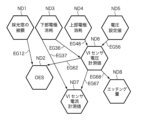
- the directed acyclic graph shown in Figure 2 is composed of nodes ND1 to ND8 corresponding to eight observed variables, and multiple edges EG12, EG36, EG37, EG46, EG56, EG62, EG67, and EG68 that represent the causal relationships between the observed variables (between nodes).
- nodes ND1 to ND8 are shown as regular hexagonal icons, but the shape of the icons is not limited to a regular hexagon and may be circular or another shape.
- the character string shown inside the icon represents the variable name of each observed variable.
- Edge EG12 is shown drawn from node ND1 in the direction of node ND2.
- Edge EG12 connecting the two nodes ND1 and ND2 represents a causal relationship between the observation variable corresponding to node ND1 (the coating of the light-gathering window) and the observation variable corresponding to node ND2 (OES).
- the coating of the light-gathering window represents the amount of coating that accumulates on the light-gathering window.
- OES stands for Optical Emission Spectrometer, and represents the measurement data of the emission intensity of the plasma.
- the direction of edge EG12 (indicated by the arrow) represents the effect of the coating of the light-gathering window on OES. The same applies to the causal relationships between the other nodes.
- the first observed variable when a first observed variable has an influence on a second observed variable, the first observed variable is also called the observed variable upstream of the second observed variable, and the second observed variable is also called the observed variable downstream of the first observed variable.
- the configuration of the information processing device 100 that derives the causal structure will be described below.
- 3 is a block diagram showing the internal configuration of the information processing device 100.
- the information processing device 100 is, for example, a dedicated or general-purpose computer including a control unit 101, a storage unit 102, a communication unit 103, an operation unit 104, and a display unit 105.
- the control unit 101 includes a CPU (Central Processing Unit), a ROM (Read Only Memory), a RAM (Random Access Memory), etc.
- the ROM included in the control unit 101 stores control programs and the like that control the operation of each piece of hardware included in the information processing device 100.
- the CPU in the control unit 101 reads and executes the control programs stored in the ROM and computer programs (described below) stored in the memory unit 102, and controls the operation of each piece of hardware, causing the entire device to function as the information processing device of the present disclosure.
- the RAM included in the control unit 101 temporarily stores data used during the execution of calculations.
- control unit 101 is configured to include a CPU, ROM, and RAM, but the configuration of the control unit 101 is not limited to the above.
- the control unit 101 may be, for example, one or more control circuits or arithmetic circuits including a GPU (Graphics Processing Unit), an FPGA (Field Programmable Gate Array), a DSP (Digital Signal Processor), a quantum processor, volatile or non-volatile memory, etc.
- the control unit 101 may have functions such as a clock that outputs date and time information, a timer that measures the elapsed time from when an instruction to start measurement is given to when an instruction to end measurement is given, and a counter that counts numbers.
- the memory unit 102 includes a storage device such as a hard disk drive (HDD), a solid state drive (SSD), or an electronically erasable programmable read only memory (EEPROM).
- the memory unit 102 stores various computer programs executed by the control unit 101 and various data used by the control unit 101.
- the computer program (program product) stored in the memory unit 102 includes a causal structure learning program PG1 for causing a computer to execute a process of deriving a causal structure of observed variables from observation data of the substrate processing apparatus 200.
- the causal structure learning program PG1 may be a single computer program, or may be composed of multiple computer programs.
- the causal structure learning program PG1 may also be executed by multiple computers in cooperation. Furthermore, the causal structure learning program PG1 may partially use an existing library.
- the memory unit 102 may also include a prediction model generation program PG2 that generates a prediction model based on the causal relationships between observed variables, a prediction program PG3 that predicts observed data using a prediction model, and a cause estimation program PG4 that estimates the cause of process variation and recommends countermeasures.
- a prediction model generation program PG2 that generates a prediction model based on the causal relationships between observed variables
- a prediction program PG3 that predicts observed data using a prediction model
- a cause estimation program PG4 that estimates the cause of process variation and recommends countermeasures.
- Each of these programs PG1 to PG4 may be an independent computer program, or may be integrated into a single computer program.
- a computer program including the causal structure learning program PG1 is provided by a non-transitory recording medium RM on which the computer program is recorded in a readable manner.
- the recording medium RM is a portable memory such as a CD-ROM, USB memory, a Secure Digital (SD) card, a micro SD card, or a Compact Flash (registered trademark).
- the control unit 101 reads various computer programs from the recording medium RM using a reading device not shown in the figure, and stores the various computer programs that have been read in the memory unit 102.
- the computer programs stored in the memory unit 102 may also be provided by communication. In this case, the control unit 101 may acquire the computer program by communication via the communication unit 103, and store the acquired computer program in the memory unit 102.
- the communication unit 103 has a communication interface for transmitting and receiving various data to and from an external device.
- a communication interface conforming to a communication standard such as LAN (Local Area Network) can be used as the communication interface of the communication unit 103.
- the external device is the above-mentioned substrate processing apparatus 200 or a user terminal (not shown).
- the communication unit 103 transmits the data to the destination external device, and when data transmitted from the external device is received, the communication unit 103 outputs the received data to the control unit 101.
- the operation unit 104 includes operation devices such as a touch panel, a keyboard, and switches, and accepts various operations and settings by the user.
- the control unit 101 performs appropriate control based on various operation information provided by the operation unit 104, and stores setting information in the storage unit 102 as necessary.
- the display unit 105 includes a display device such as an LCD monitor or an organic EL (Electro-Luminescence) display, and displays information to be notified to the user, etc., in response to instructions from the control unit 101.
- a display device such as an LCD monitor or an organic EL (Electro-Luminescence) display, and displays information to be notified to the user, etc., in response to instructions from the control unit 101.
- the information processing device 100 in this embodiment may be a single computer, or may be a computer system composed of multiple computers and peripheral devices. Furthermore, the information processing device 100 may be a virtual machine whose entity has been virtualized, or may be a cloud. Furthermore, in this embodiment, the information processing device 100 and the substrate processing device 200 are described as separate entities, but the information processing device 100 may be provided inside the substrate processing device 200.
- a method for deriving a causal structure by the information processing device 100 will be described below.
- (1) Search for causal relationships Causal relationships between observed variables are modeled, for example, by a structural equation model.
- LiNGAM Linear Non-Gaussian Acyclic Model
- the probability distribution of exogenous variables is a non-Gaussian distribution under a linear acyclic model.
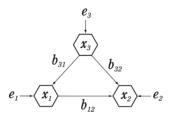
- the relationship between observed variables is expressed by a directed acyclic graph.
- FIG. 4 shows a directed acyclic graph representing the relationship between observed variables.
- the structural equation model is expressed by Equation 1.
- the DirectLiNGAM algorithm has been proposed as one of the algorithms (causal search algorithms) for searching structural equation models (see, for example, S. Shimizu et al. Journal of Machine Learning Research, 12(Apr): 1225-1248(2011)).
- the linear regression coefficients b ij can be optimized by repeating regression analysis and evaluation of the independence of regression residuals. By drawing edges between nodes based on the optimized coefficients b ij , a directed acyclic graph such as that shown in FIG. 4 can be drawn.
- FIG. 5 is a schematic diagram showing an example of a directed acyclic graph in which edges are drawn from multiple other nodes to one node.
- the example of Fig. 5 shows a case in which edges are drawn from the nodes ND2, ND6, and ND7 representing the OES, VI sensor voltage measurement value, and VI sensor current measurement value to the node ND8 representing the etching amount.
- This case shows that the observation variables of the OES, VI sensor voltage measurement value, and VI sensor current measurement value have strong collinearity with each other and are also correlated with the observation variable representing the etching amount.
- a constraint is added that prohibits edges from being drawn from multiple collinear observation variables to one observation variable at the same time. Specifically, an experiment is performed to determine which edge would provide the highest accuracy, and edges other than the edge with the highest accuracy are designated as prohibited edges. At this time, the acyclic constraint also changes, so a re-search for the causal structure is also performed.
- FIG. 5 shows a state in which, of the edges from nodes ND2, ND6, and ND7 to node ND8, the edges from nodes ND2 and ND7 to ND8 are designated as prohibited edges.
- prohibited edges are designated, the acyclic constraint also changes, and the causal search algorithm described above is executed again.
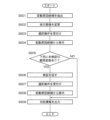
- FIG. 6 is a flowchart showing the procedure for deriving a causal structure.
- the control unit 101 of the information processing device 100 reads out the causal structure learning program PG1 from the storage unit 102 and executes it to perform the following processing.
- the control unit 101 acquires observation data corresponding to multiple types of observation variables from the substrate processing apparatus 200, which is the observation system to be monitored (step S101).
- the observation data acquired by the control unit 101 includes data measured by the substrate processing apparatus 200 and data set by the substrate processing apparatus 200, such as the coating of the light-collecting window, OES, wear of the lower electrode, wear of the upper electrode, voltage setting value, voltage measurement value of the VI sensor, current measurement value of the VI sensor, and etching amount.
- the control unit 101 acquires these observation data by communicating with the substrate processing apparatus 200 via the communication unit 103.
- the control unit 101 searches for causal relationships between observed variables based on the acquired observation data (step S102).
- searching for causal relationships as a preprocessing step, an observed variable used to derive a causal structure may be selected, or a constraint condition may be added between observed variables using prior knowledge of the process in the substrate processing apparatus 200.
- the control unit 101 uses the above-mentioned causal search algorithm to search for causal relationships between observed variables, thereby deriving a causal structure of all observed variables.
- control unit 101 optimizes the linear regression coefficient b ij by repeating regression analysis and evaluation of the independence of regression residuals on the assumption that there is linearity between observed variables, that there is acyclicity in the causal structure, that the probability distribution of the exogenous variables is a non-Gaussian distribution, and that different exogenous variables are independent of each other.
- the control unit 101 generates a directed acyclic graph by drawing edges between nodes based on the optimized coefficients b ij . This allows a causal structure between observed variables in which edges from multiple nodes having collinearity may be mixed to be obtained.
- the control unit 101 detects edges drawn from multiple other collinear nodes to one node from the causal structure obtained in step S102 (step S103).
- the control unit 101 determines whether or not there is a corresponding edge (step S104), and if it determines that there is a corresponding edge (S104: YES), it designates all edges other than the edge with the highest accuracy as prohibited edges (step S105) in order to add a constraint condition that prohibits edges from being drawn from multiple collinear observation variables to one observation variable at the same time, and then returns the process to step S102.
- step S104 If it is determined in step S104 that no corresponding edge exists (S104: NO), the control unit 101 ends the processing according to this flowchart.
- the control unit 101 may display the derived causal structure on the display unit 105, or may notify a user terminal (not shown) via the communication unit 103.
- the causal structure of all observed variables can be derived based on the observation data obtained from the monitored observation system (substrate processing apparatus 200), and the causal relationships between the observed variables can be presented to the user.
- edge pruning is implemented to prevent multiple collinear nodes from simultaneously having a causal relationship with other nodes, thereby preventing misidentification of edges and enabling more reliable learning of causal structures.
- FIG. 7 is an explanatory diagram for explaining the operation of correcting the causal structure.
- the control unit 101 of the information processing device 100 derives the causal structure of all observed variables using the method disclosed in the first embodiment, and displays the derived causal structure on the display unit 105.
- the causal structure is drawn by a directed acyclic graph.
- the control unit 101 calculates the degree of influence (linear regression coefficient b ij ) from one node to another node, so the thickness and color of the edge between the nodes may be changed based on the degree of influence. For example, if the degree of influence from one node to another node is relatively high, the thickness of the edge connecting these two nodes may be made thicker, and it may be displayed in a color different from other edges, such as red or blue.
- edges EG36 and EG68 are shown thicker than the other edges, which indicates that the influence of the VI sensor voltage measurement value and the wear of the lower electrode on the amount of etching is greater than the wear of the upper electrode and the voltage setting value.
- the control unit 101 accepts, via the operation unit 104, a user's modification operation on the directed acyclic graph displayed on the display unit 105.
- the control unit 101 accepts an operation to draw a new edge using a mouse or a touch panel provided in the operation unit 104. This operation allows the user to add a new edge that should exist between any two nodes.
- the control unit 101 may also accept an operation to select an edge to be deleted and a predetermined operation to delete the selected edge (for example, pressing a delete key) using a mouse or a keyboard provided in the operation unit 104. This operation allows the user to delete unnecessary edges.
- the control unit 101 may also accept an operation to move the start point or end point of an edge to another node using a mouse or a touch panel provided in the operation unit 104. This operation allows the user to change the causal relationship between observed variables.
- Figure 7 shows an example in which an operation to move the starting point of edge EG17 from node ND1 to node ND3 has been accepted.
- edge EG17 between nodes ND1 and ND7 disappears, and a new edge EG7 is generated between nodes ND3 and ND7.
- an operation to delete edge EG17 and an operation to draw a new edge (edge EG37) between nodes ND3 and ND7 may be accepted.
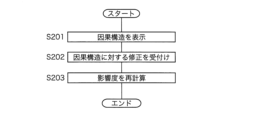
- FIG. 8 is a flowchart showing the procedure for modifying the causal structure by the user.
- the control unit 101 of the information processing device 100 derives the causal structure of all observed variables using the same procedure as in embodiment 1, and displays the derived causal structure on the display unit 105 (step S201).
- the thickness and color of the edges may be changed based on the degree of influence from one node to other nodes.
- the control unit 101 accepts, via the operation unit 104, modifications to the causal structure displayed on the display unit 105 (step S202). Through the operation unit 104, the control unit 101 accepts operations such as adding new edges that should exist, deleting unnecessary edges, and changing causal relationships.
- the control unit 101 recalculates the influence degree based on the corrected causal structure (step S203). Since the influence degree changes depending on the addition or deletion of an edge, the control unit 101 recalculates the influence degree (linear regression coefficient b ij ) using Equation 1 without changing the causal structure.
- the causal structure algorithm alone may not be able to fully correct the causal relationships between observed variables.
- FIG. 9 is a flowchart showing the procedure for generating a prediction model.
- the control unit 101 of the information processing device 100 reads out the prediction model generation program PG2 from the storage unit 102 and executes it to perform the following processing. Note that it is assumed that the causal structure for the observation system to be monitored has already been derived.
- the control unit 101 accepts the selection of a performance parameter to be monitored (step S301).
- a performance parameter to be monitored is selected from the causal structure displayed on the display unit 105.
- the control unit 101 extracts one or more observed variables that have a direct causal relationship with the performance parameter selected in step S301 (step S302). For example, if the causal structure in FIG. 2 is the derived causal structure and the etching amount of node ND8 is the performance parameter selected in step S301, the control unit 101 extracts the VI sensor voltage measurement value of node ND6 as an observed variable that has a direct causal relationship with the etching amount.
- the control unit 101 generates a prediction model using the performance parameter selected in step S301 as the objective variable and the observation variable selected in step S302 as the explanatory variable (step S303).
- Any model can be used for the prediction model.
- the prediction model is not limited to a linear function, and any function can be used.
- the prediction model may also be a machine learning learning model.
- the third embodiment when a performance parameter is specified, it is possible to extract observed variables having a direct causal relationship based on the derived causal structure, and generate a prediction model that predicts the performance parameter from the observed variables. In other words, in the third embodiment, it is possible to eliminate parameters that fall into a spurious correlation, and generate a prediction model that is robust against factors that may fluctuate the results.
- control unit 101 is configured to extract an observation variable (explanatory variable) that has a direct causal relationship with the performance parameter, but the user may select an explanatory variable of their choice.
- the user can refer to the causal structure displayed on the display unit 105 and use the operation unit 104 to select a node corresponding to the observation variable to be used as the explanatory variable.
- the observation variable extracted as the explanatory variable is the VI sensor voltage measurement value, but if the user wishes, an observation variable such as OES that does not have a direct causal relationship can be added to the explanatory variable.
- FIG. 10 is a flowchart showing the procedure for executing performance prediction. After generating a prediction model, the control unit 101 of the information processing device 100 reads out the prediction program PG3 from the storage unit 102 and executes it to perform the following processing.
- the control unit 101 acquires observation data corresponding to the explanatory variables of the prediction model from the substrate processing apparatus 200, which is the observation device to be monitored (step S401). If the explanatory variable is a VI sensor voltage measurement value, the control unit 101 acquires data of the voltage measurement value obtained from the VI sensor.
- the control unit 101 inputs the acquired observation data into a prediction model and predicts the performance (step S402).
- the control unit 101 can predict the performance by executing a calculation using the prediction model.
- the control unit 101 compares the performance predicted in step S402 with a reference value (step S403) and determines whether the reference value is met (step S404). If it is determined that the reference value is met (S404: YES), the control unit 101 determines that the process being performed in the substrate processing apparatus 200 is normal, and ends the processing according to this flowchart.
- control unit 101 determines that the process being performed in the substrate processing apparatus 200 is not normal, outputs an alarm (step S405), and ends the processing according to this flowchart.
- the control unit 101 outputs the alarm, for example, by displaying information that the process is not normal on the display unit 105.
- the control unit 101 may notify a user terminal (not shown) of the information that the process is not normal via the communication unit 103.
- the performance is predicted using a prediction model, and by determining whether the predicted performance meets a reference value, it is possible to determine whether the process being performed in the substrate processing apparatus 200 is normal.
- the derived causal structure is used to identify the cause of variation in an observed variable whose cause is unknown by checking the upstream of the fluctuating observed variable.
- Figure 11 is an explanatory diagram explaining a method for estimating the cause of variation.
- the causal structure shown in Figure 2 is obtained as the causal structure of the observed variables.
- the observed variables that affect the VI sensor voltage measurement value of node ND6 are the lower electrode wear of node ND3, the upper electrode wear of node ND4, and the voltage setting value of node ND5.
- the observed variables that affect the VI current measurement value of node ND7 are the lower electrode wear of node ND3 and the VI sensor voltage measurement value of ND6.
- the VI sensor voltage measurement value and the VI sensor current measurement value are calculated using the following formula:
- VI sensor voltage measurement value w1 ⁇ voltage setting value+w2 ⁇ lower electrode wear+w3 ⁇ upper electrode wear
- VI sensor current measurement value w4 ⁇ VI sensor voltage measurement value+w5 lower electrode wear
- w1 to w5 are coefficients expressing the degree of influence of the edge.
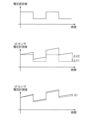
- the top row of Figure 11 shows the time variation of the voltage setting value
- the middle row shows the time variation of the VI sensor voltage measurement value
- the bottom row shows the time variation of the VI sensor current measurement value.
- the VI sensor current measurement value could be explained only by the VI sensor voltage measurement value, and should therefore fluctuate as shown by the dashed line in the lower graph.
- the actual measurement value fluctuates as shown by the solid line, it is presumed that the VI sensor current measurement value has been affected by wear on the lower electrode.
- the difference between the dashed line and the solid line in the lower graph includes the difference ⁇ I caused by the lower electrode.
- the control unit 101 can estimate the degree of wear of the lower electrode and upper electrode by optimizing the estimated results of the VI sensor voltage measurement value and the VI sensor current measurement value so that they match the actual measured values.
- FIG. 12 is a flowchart showing the procedure for estimating the cause of variation. After deriving the causal structure, the control unit 101 of the information processing device 100 reads out the cause estimation program PG4 from the storage unit 102 and executes it to perform the following processing.
- the control unit 101 assumes that there is no cause of variation and estimates each observed variable by performing regression based on the edge influence degree (step S501).
- the control unit 101 compares the actual measured value and the estimated value of the observed variable (step S502).
- An observed variable whose actual measured value and estimated value are significantly different can be considered to have fluctuated due to the intervention of a fluctuation causative factor.
- the control unit 101 optimizes the degree of variability of the variation causes so as to fill the difference between the actual measured value and the estimated value, and estimates the cause of variation to be the one with a relatively large optimized degree of variability (step S503).
- FIG. 13 is a flowchart showing the procedure for outputting handling information. After estimating the cause of the fluctuation, the control unit 101 executes the following processing as necessary.
- the control unit 101 searches the causal structure for observed variables that can suppress the effect of the cause of variation (step S521), and determines whether or not a corresponding observed variable is found (step S522).
- a controllable variable e.g., a voltage setting value
- the control unit 101 If a controllable variable (e.g., a voltage setting value) is found in the substrate processing apparatus 200, it is determined that a corresponding observed variable is present (S522: YES), and the control unit 101 outputs countermeasure information to suppress the cause of fluctuation in the observed variable (step S523).
- the countermeasure information is displayed on the display unit 105. Alternatively, the countermeasure information is notified to the user terminal via the communication unit 103.
- a controllable variable e.g., wear of the lower electrode or upper electrode
- the control unit 101 outputs removal or replacement of the cause of the variation as handling information (step S524).
- the handling information is displayed on the display unit 105. Alternatively, the handling information is notified to the user terminal via the communication unit 103.
- the cause of variation in one observed variable can be estimated, and information on how to deal with the cause of variation can be presented to the user.
- FIG. 14 is an explanatory diagram for explaining the operation when narrowing down the candidate variation causes.
- node ND6 VI sensor voltage measurement value
- ND3 lower electrode wear
- ND4 upper electrode wear
- ND5 voltage setting value
- the control unit 101 of the information processing device 100 changes the colors of these nodes ND3, ND4, ND5, ND6, and ND8 and displays them on the display unit 105.
- the display mode of the candidate variation causes may be changed by changing the size of the nodes or the thickness of the edges connecting the nodes.
- the control unit 101 accepts user operations to narrow down candidate variation causes through the operation unit 104.
- the user can efficiently narrow down the possibilities by referring to the causal structure displayed on the display unit 105 and checking the observation data obtained for the candidate variation causes. For example, if the relationship between the VI sensor voltage measurement value and the etching amount is normal, the VI sensor voltage measurement value can be excluded from the candidate variation causes.
- the control unit 101 accepts a selection operation (e.g., a click operation) for node ND6, it excludes the VI sensor voltage measurement value of node ND6 from the candidate variation causes and returns the display state of node ND6 to the original state.
- a selection operation e.g., a click operation
- the variation of the observation variables downstream of the candidates may be verified. For example, to verify the influence of the bottom electrode wear of node ND3, the VI sensor voltage measurement value of ND6 and the VI sensor current measurement value of node ND7 may be checked to verify the influence of the bottom electrode wear. At this time, if the relationship between the VI sensor voltage measurement value and the VI sensor current measurement value is normal, the bottom electrode wear can be excluded from the candidate variation causes.
- the control unit 101 receives a selection operation (e.g., a click operation) for node ND3, it excludes the bottom electrode wear of node ND3 from the candidate variation causes, and returns the display mode of node ND3 to the original state.
- a selection operation e.g., a click operation
- the control unit 101 outputs, as countermeasure information, information encouraging replacement of the upper electrode.
- the control unit 101 also outputs, as countermeasure information, information encouraging adjustment of the voltage setting value.
- FIG. 15 is a flowchart showing the procedure for accepting an operation to narrow down the variation causes.
- the control unit 101 of the information processing device 100 After deriving the causal structure, the control unit 101 of the information processing device 100 reads out the cause estimation program PG4 from the storage unit 102 and executes it to perform the following processing.
- the control unit 101 extracts one or more observation variables that are candidates for the cause of variation for one observation variable specified by the user (step S601).
- the control unit 101 changes the display mode of the node corresponding to the extracted observation variable (step S602).
- the control unit 101 may also change the display mode of the node corresponding to the one observation variable specified by the user in the same manner.
- the control unit 101 accepts a selection operation via the operation unit 104 to select observed variables to be excluded from the candidate causes of variation (step S603), and excludes the selected observed variables from the candidate causes of variation (step S604).
- steps S603-S604 observed variables that the user has determined to be problem-free as a result of verification, and observed variables that are unrelated based on the user's knowledge, are excluded from the candidate causes of variation. If there are further upstream observed variables, the processing of steps S603-S604 is executed repeatedly.
- the control unit 101 determines whether there is an unverified observation variable downstream of the variation cause candidate (step S605), and if there is an unverified observation variable (S605: YES), prompts the user to verify it (step S606).
- the user checks the variation of the downstream observation variable, and if there is no variation, removes it from the variation cause candidate. That is, the control unit 101 accepts a selection operation via the operation unit 104 to select an observation variable to be removed from the variation cause candidate (step S607), and removes the selected observation variable from the variation cause candidate (step S608). If it is determined in step S605 that there is no unverified observation variable downstream (S605: NO), the control unit 101 transitions the process to step S609.
- the control unit 101 outputs countermeasure information based on the candidate fluctuation causes narrowed down in the procedure of steps S603 to S608 (step S609).
- the countermeasure information is displayed on the display unit 105. Alternatively, the countermeasure information is notified to the user terminal via the communication unit 103.
- the candidate variation causes can be narrowed down based on the user's verification or knowledge.
- countermeasure information can be presented to the user.
- FIG. 16 is a flowchart showing the procedure for deriving a causal structure in embodiment 7.
- the control unit 101 of the information processing device 100 reads out the causal structure learning program PG1 from the storage unit 102 and executes it to perform the following processing.
- the control unit 101 acquires observation data corresponding to multiple types of observation variables from the substrate processing apparatus 200, which is the observation system to be monitored (step S701).
- the observation data acquired by the control unit 101 includes data measured by the substrate processing apparatus 200 and data set by the substrate processing apparatus 200.
- the control unit 101 acquires these observation data by communicating with the substrate processing apparatus 200 via the communication unit 103.
- the control unit 101 searches for causal relationships between observed variables based on the acquired observation data (step S702).
- the observed variables to be used for deriving the causal structure may be selected, or constraints may be added between the observed variables using prior knowledge of the process in the substrate processing apparatus 200.
- the function form is unknown, an algorithm capable of performing searches including nonlinearity is known, and therefore the control unit 101 uses the algorithm to search for causal relationships between observed variables, thereby deriving the causal structure of all observed variables.
- edges drawn from multiple other nodes that have collinearity to one node may be detected using a procedure similar to that of embodiment 1, and edges other than the edge with the highest accuracy may be designated as prohibited edges.
- the control unit 101 estimates a function form for each causal relationship (step S703). At this time, the control unit 101 may estimate the function form based on the constraints and knowledge of the domain of the substrate processing apparatus 200.
- the control unit 101 complements the causal structure derived in step S702 by introducing the estimated function form into the causal structure derived in step S702 (step S704).
- the derived causal structure may be displayed on the display unit 105, or may be notified to a user terminal (not shown) via the communication unit 103.
- FIG. 17 is a schematic diagram showing an example of a causal structure with a complemented functional form.
- the causal structure is drawn by a directed acyclic graph using nodes representing each observed variable and edges representing the causal relationships between the nodes.
- FIG. 17 shows a causal structure with only eight observed variables selected and with the functional forms between the observed variables complemented.
- the directed acyclic graph shown in Figure 17 is composed of nodes ND1 to ND4 and ND7 to ND10 corresponding to eight observed variables, nodes ND5 and ND6 corresponding to two functions, and edges EG15, EG25, EG28, EG35, EG36, EG46, EG57, EG68, EG79, and EG810 representing the causal relationships between the nodes.
- nodes ND1 to ND10 are shown as regular octagonal icons, but the shape of the icons is not limited to a regular octagon and may be circular or another shape.
- the character string shown inside the icon represents the variable name or function form of each observed variable.
- nodes ND1 to ND4, ND7 to ND10 which indicate observed variables, and nodes ND5 and ND6 which indicate functions are shown in different colors.
- edges between observed variables are shown with solid lines, and edges which indicate inputs to functions and outputs from functions are shown with dashed lines.
- a causal structure that takes into account nonlinearity between observed variables can be derived based on observation data obtained from the monitored observation system (substrate processing apparatus 200) and presented to the user.
- FIG. 18 is a schematic diagram showing an example of a graphical display of a nonlinear relationship.
- the value of observed variable A is fixed, and it shows how observed variable C changes by moving the value of observed variable B with a slider.
- Figure 19 is a schematic diagram showing an example of visualization as knowledge of process mechanisms.
- Figure 19 shows an example of visualization of the relationship between the flow rate of Gas A (Gas A Flow), the flow rate of Gas B (Gas B Flow), RF power (RF1 Pow), and the etching rate (E/R) as a causal relationship between each observed variable.
- etching rate Even for the etching rate alone, it is difficult to grasp how much the gas flow rate, RF power, DC bias, etc. should be varied, and it is difficult to determine what is out of sync without referring to knowledge that overlooks the entire system, including the sensors. Therefore, a causal structure is created using a method similar to that shown in Figure 7 based on the observation data obtained from the experiment, and by visualizing it as shown in Figure 19, the relationship between features can be left as knowledge that is easy to refer to and use.
- the eighth embodiment by making it possible to leave knowledge in the form of a causal structure, it is possible to leave knowledge in a form that can be deployed by non-experts as well.
- formalizing and visualizing the causal structure, including the functional form it is possible to obtain knowledge on whether to experiment by varying the set value by degrees, or how to get closer to the desired outcome.
- Figure 20 is a schematic diagram showing an example of a causal structure used for failure prediction.
- simply limiting the set values of the DC voltage (DC Volt) and cooling temperature (Brine temp) does not allow the DC current (DC Current) and lower electrode temperature (Lower temp) to be directly specified.
- the etching rate (E/R) is expected to improve with an increase in plasma flow rate and energy, but at the same time, an increase in the electrode temperature is expected. For this reason, if the DC voltage is increased to its limit, there is a risk of the electrode being damaged by heating.
- control unit 101 creates a table of the processable range (process window) based on the causal structure and presents it to the user. If it is outside the process window, the control unit 101 may suggest an alternative recipe that fits within the window with minimal modifications.
- FIG. 21 is a flowchart showing the procedure for creating a process window.
- the control unit 101 creates a causal structure that complements a function form for a nonlinear relationship using the same procedure as in embodiment 7, and generates a judgment model that indicates whether the sensor value falls within an acceptable range based on the created causal structure (step S901).
- the control unit 101 uses the generated judgment model to generate a multidimensional table that indicates the possible range for dynamic setting values (step S902). For example, when generating a table (two-dimensional table) for two setting values such as RF power 1 and RF power 2, a table may be generated that indicates that the combination of the two setting values (RF power 1, RF power 2) is not possible when it is (1000V, 100V), is possible when it is (1000V, 200V), etc.
- the control unit 101 presents a process window according to the setting of the fixed value based on the generated multidimensional table (step S903).
- RF power 1 (or RF power 2) may be fixed, and the range of RF power 2 (or RF power 1) may be generated as the process window and displayed on the display unit 105.
- the substrate processing apparatus 200 has been described as an example of the observation system to be monitored.
- the observation system to be monitored is not limited to the substrate processing apparatus 200, but may be a manufacturing device in which any manufacturing process is carried out, such as electrical equipment, chemical industrial products, pharmaceuticals, food, or chemical industrial products.
- the observation system to be monitored is not limited to a device or system in which any manufacturing process is carried out, but may be any system that appropriately combines human living environments, economic activities, meteorological environments, etc.
Landscapes
- Engineering & Computer Science (AREA)
- Theoretical Computer Science (AREA)
- Software Systems (AREA)
- Physics & Mathematics (AREA)
- General Physics & Mathematics (AREA)
- Artificial Intelligence (AREA)
- Evolutionary Computation (AREA)
- General Engineering & Computer Science (AREA)
- Data Mining & Analysis (AREA)
- Computer Vision & Pattern Recognition (AREA)
- Medical Informatics (AREA)
- Computing Systems (AREA)
- Mathematical Physics (AREA)
- Health & Medical Sciences (AREA)
- Databases & Information Systems (AREA)
- Automation & Control Theory (AREA)
- Computational Linguistics (AREA)
- Testing And Monitoring For Control Systems (AREA)
- Debugging And Monitoring (AREA)
- General Factory Administration (AREA)
Priority Applications (4)
| Application Number | Priority Date | Filing Date | Title |
|---|---|---|---|
| KR1020257021478A KR20250117399A (ko) | 2022-11-29 | 2023-11-24 | 컴퓨터 프로그램, 정보 처리 장치 및 정보 처리 방법 |
| JP2024561441A JPWO2024117013A1 (https=) | 2022-11-29 | 2023-11-24 | |
| CN202380082100.0A CN120266131A (zh) | 2022-11-29 | 2023-11-24 | 计算机程序、信息处理装置以及信息处理方法 |
| US19/221,714 US20250291849A1 (en) | 2022-11-29 | 2025-05-29 | Recording medium, information processing apparatus, and information processing method |
Applications Claiming Priority (2)
| Application Number | Priority Date | Filing Date | Title |
|---|---|---|---|
| US202263428526P | 2022-11-29 | 2022-11-29 | |
| US63/428,526 | 2022-11-29 |
Related Child Applications (1)
| Application Number | Title | Priority Date | Filing Date |
|---|---|---|---|
| US19/221,714 Continuation US20250291849A1 (en) | 2022-11-29 | 2025-05-29 | Recording medium, information processing apparatus, and information processing method |
Publications (1)
| Publication Number | Publication Date |
|---|---|
| WO2024117013A1 true WO2024117013A1 (ja) | 2024-06-06 |
Family
ID=91323887
Family Applications (2)
| Application Number | Title | Priority Date | Filing Date |
|---|---|---|---|
| PCT/JP2023/042098 Ceased WO2024117013A1 (ja) | 2022-11-29 | 2023-11-24 | コンピュータプログラム、情報処理装置及び情報処理方法 |
| PCT/JP2023/042110 Ceased WO2024117019A1 (ja) | 2022-11-29 | 2023-11-24 | コンピュータプログラム、情報処理装置及び情報処理方法 |
Family Applications After (1)
| Application Number | Title | Priority Date | Filing Date |
|---|---|---|---|
| PCT/JP2023/042110 Ceased WO2024117019A1 (ja) | 2022-11-29 | 2023-11-24 | コンピュータプログラム、情報処理装置及び情報処理方法 |
Country Status (6)
| Country | Link |
|---|---|
| US (2) | US20250292119A1 (https=) |
| JP (2) | JPWO2024117019A1 (https=) |
| KR (2) | KR20250117398A (https=) |
| CN (2) | CN120266131A (https=) |
| TW (2) | TW202441666A (https=) |
| WO (2) | WO2024117013A1 (https=) |
Cited By (1)
| Publication number | Priority date | Publication date | Assignee | Title |
|---|---|---|---|---|
| WO2025110000A1 (ja) * | 2023-11-20 | 2025-05-30 | 東京エレクトロン株式会社 | コンピュータプログラム、情報処理装置及び情報処理方法 |
Families Citing this family (2)
| Publication number | Priority date | Publication date | Assignee | Title |
|---|---|---|---|---|
| JP2026000603A (ja) * | 2024-06-18 | 2026-01-06 | 株式会社東芝 | 情報処理装置、情報処理システム、情報処理方法およびプログラム |
| CN121666898A (zh) * | 2024-07-01 | 2026-03-13 | 株式会社日立高新技术 | 半导体器件制造系统、服务器以及异物产生原因确定方法 |
Citations (8)
| Publication number | Priority date | Publication date | Assignee | Title |
|---|---|---|---|---|
| JPH02102453A (ja) * | 1988-10-11 | 1990-04-16 | Mitsubishi Heavy Ind Ltd | プラント水質監視診断システム |
| JP2008217711A (ja) * | 2007-03-07 | 2008-09-18 | Omron Corp | 因果構造決定装置、因果構造決定装置の制御方法、および因果構造決定装置の制御プログラム |
| JP2020052714A (ja) * | 2018-09-27 | 2020-04-02 | 株式会社日立製作所 | 監視システム及び監視方法 |
| JP2020149299A (ja) * | 2019-03-13 | 2020-09-17 | オムロン株式会社 | グラフ表示装置、グラフ表示方法、及びグラフ表示プログラム |
| JP2020149301A (ja) * | 2019-03-13 | 2020-09-17 | オムロン株式会社 | 解析装置、解析方法、及び解析プログラム |
| WO2022104616A1 (en) * | 2020-11-18 | 2022-05-27 | Alibaba Group Holding Limited | Non-linear causal modeling based on encoded knowledge |
| US20220343193A1 (en) * | 2021-04-22 | 2022-10-27 | Abb Schweiz Ag | Decision Support in Industrial Plants |
| JP2022170171A (ja) * | 2021-04-28 | 2022-11-10 | 三菱電機株式会社 | 管理装置、管理方法およびプログラム |
Family Cites Families (13)
| Publication number | Priority date | Publication date | Assignee | Title |
|---|---|---|---|---|
| US6807583B2 (en) * | 1997-09-24 | 2004-10-19 | Carleton University | Method of determining causal connections between events recorded during process execution |
| JP6166980B2 (ja) * | 2013-08-02 | 2017-07-19 | エヌ・ティ・ティ・コムウェア株式会社 | 情報処理装置、情報処理方法、および情報処理プログラム |
| US10083073B2 (en) * | 2015-09-14 | 2018-09-25 | Dynatrace Llc | Method and system for real-time causality and root cause determination of transaction and infrastructure related events provided by multiple, heterogeneous agents |
| US10628424B2 (en) * | 2016-09-15 | 2020-04-21 | Oracle International Corporation | Graph generation for a distributed event processing system |
| US10699450B2 (en) * | 2017-09-28 | 2020-06-30 | International Business Machines Corporation | Interactive tool for causal graph construction |
| US11687801B2 (en) * | 2018-04-23 | 2023-06-27 | Qliktech International Ab | Knowledge graph data structures and uses thereof |
| EP3582007A1 (en) * | 2018-06-15 | 2019-12-18 | ASML Netherlands B.V. | Determining significant relationships between parameters describing operation of an apparatus |
| US11210149B2 (en) * | 2018-11-16 | 2021-12-28 | International Business Machines Corporation | Prioritization of data collection and analysis for incident detection |
| US11238129B2 (en) * | 2019-12-11 | 2022-02-01 | International Business Machines Corporation | Root cause analysis using Granger causality |
| US11474509B2 (en) * | 2020-08-03 | 2022-10-18 | Palo Alto Research Center Incorporated | System and method for casual inference in manufacturing process |
| JP2022086627A (ja) * | 2020-11-30 | 2022-06-09 | 株式会社日立製作所 | 異常検知装置、異常検知方法 |
| CN115082080A (zh) * | 2021-03-12 | 2022-09-20 | 日本电气株式会社 | 用于数据处理的方法、设备、介质和产品 |
| US12001546B2 (en) * | 2021-05-27 | 2024-06-04 | Salesforce, Inc. | Systems and methods for causality-based multivariate time series anomaly detection |
-
2023
- 2023-11-24 JP JP2024561446A patent/JPWO2024117019A1/ja active Pending
- 2023-11-24 KR KR1020257021472A patent/KR20250117398A/ko active Pending
- 2023-11-24 CN CN202380082100.0A patent/CN120266131A/zh active Pending
- 2023-11-24 KR KR1020257021478A patent/KR20250117399A/ko active Pending
- 2023-11-24 JP JP2024561441A patent/JPWO2024117013A1/ja active Pending
- 2023-11-24 WO PCT/JP2023/042098 patent/WO2024117013A1/ja not_active Ceased
- 2023-11-24 CN CN202380082167.4A patent/CN120283244A/zh active Pending
- 2023-11-24 WO PCT/JP2023/042110 patent/WO2024117019A1/ja not_active Ceased
- 2023-11-29 TW TW112146271A patent/TW202441666A/zh unknown
- 2023-11-29 TW TW112146270A patent/TW202431116A/zh unknown
-
2025
- 2025-05-29 US US19/221,654 patent/US20250292119A1/en active Pending
- 2025-05-29 US US19/221,714 patent/US20250291849A1/en active Pending
Patent Citations (8)
| Publication number | Priority date | Publication date | Assignee | Title |
|---|---|---|---|---|
| JPH02102453A (ja) * | 1988-10-11 | 1990-04-16 | Mitsubishi Heavy Ind Ltd | プラント水質監視診断システム |
| JP2008217711A (ja) * | 2007-03-07 | 2008-09-18 | Omron Corp | 因果構造決定装置、因果構造決定装置の制御方法、および因果構造決定装置の制御プログラム |
| JP2020052714A (ja) * | 2018-09-27 | 2020-04-02 | 株式会社日立製作所 | 監視システム及び監視方法 |
| JP2020149299A (ja) * | 2019-03-13 | 2020-09-17 | オムロン株式会社 | グラフ表示装置、グラフ表示方法、及びグラフ表示プログラム |
| JP2020149301A (ja) * | 2019-03-13 | 2020-09-17 | オムロン株式会社 | 解析装置、解析方法、及び解析プログラム |
| WO2022104616A1 (en) * | 2020-11-18 | 2022-05-27 | Alibaba Group Holding Limited | Non-linear causal modeling based on encoded knowledge |
| US20220343193A1 (en) * | 2021-04-22 | 2022-10-27 | Abb Schweiz Ag | Decision Support in Industrial Plants |
| JP2022170171A (ja) * | 2021-04-28 | 2022-11-10 | 三菱電機株式会社 | 管理装置、管理方法およびプログラム |
Cited By (1)
| Publication number | Priority date | Publication date | Assignee | Title |
|---|---|---|---|---|
| WO2025110000A1 (ja) * | 2023-11-20 | 2025-05-30 | 東京エレクトロン株式会社 | コンピュータプログラム、情報処理装置及び情報処理方法 |
Also Published As
| Publication number | Publication date |
|---|---|
| TW202441666A (zh) | 2024-10-16 |
| CN120283244A (zh) | 2025-07-08 |
| WO2024117019A1 (ja) | 2024-06-06 |
| CN120266131A (zh) | 2025-07-04 |
| JPWO2024117013A1 (https=) | 2024-06-06 |
| TW202431116A (zh) | 2024-08-01 |
| KR20250117398A (ko) | 2025-08-04 |
| KR20250117399A (ko) | 2025-08-04 |
| US20250292119A1 (en) | 2025-09-18 |
| US20250291849A1 (en) | 2025-09-18 |
| JPWO2024117019A1 (https=) | 2024-06-06 |
Similar Documents
| Publication | Publication Date | Title |
|---|---|---|
| WO2024117013A1 (ja) | コンピュータプログラム、情報処理装置及び情報処理方法 | |
| JP7461440B2 (ja) | 根本的原因分析を実行してプラントワイド操業での希少イベントの発生の予測モデルを構築するコンピュータシステムおよび方法 | |
| KR102039394B1 (ko) | 탐색 장치 및 탐색 방법 | |
| TWI391840B (zh) | 使用處理資料及良率資料之處理控制 | |
| JP6877735B2 (ja) | 製造不良原因の探索支援方法及び情報処理装置 | |
| JP6631540B2 (ja) | 情報処理システム、変化点検出方法、およびプログラム | |
| WO2016147656A1 (ja) | 情報処理装置、情報処理方法、及び、記録媒体 | |
| KR20080098332A (ko) | 다변수 결함 기여도를 나타내기 위한 그래픽 사용자인터페이스 | |
| WO2016079972A1 (ja) | 要因分析装置、要因分析方法と記録媒体、及び、要因分析システム | |
| JP6280862B2 (ja) | イベント分析システムおよび方法 | |
| CN117836734A (zh) | 用于确定处理设备性能的综合分析模块 | |
| US20250085699A1 (en) | Substrate manufacturing equipment comprehensive digital twin fleet | |
| CN112543897B (zh) | 分析装置、分析方法以及存储介质 | |
| KR20250026319A (ko) | 반도체 처리를 위한 모델들의 학습의 표시들의 생성 | |
| Ni et al. | Information dynamic spectrum characterizes system instability toward critical transitions | |
| JP2019102574A (ja) | 情報処理装置、情報処理装置の制御方法、およびプログラム | |
| JP7710965B2 (ja) | 情報処理装置、情報処理方法およびプログラム | |
| WO2025110000A1 (ja) | コンピュータプログラム、情報処理装置及び情報処理方法 | |
| JP6488168B2 (ja) | 時系列データ処理方法、時系列データ処理プログラム、および、時系列データ処理装置 | |
| US20250086357A1 (en) | Substrate manufacturing equipment comprehensive digital twin fleet | |
| US20250225410A1 (en) | Causality-based fleet matching | |
| US20250224721A1 (en) | Causality-based fleet matching | |
| CN120958467A (zh) | 计算机程序、信息处理装置以及信息处理方法 | |
| KR20250007976A (ko) | 정보 처리 장치, 이상 검지 방법 및 반도체 제조 시스템 | |
| WO2024195506A1 (ja) | 状態判定方法、データ生成方法、状態判定装置、およびデータ生成装置 |
Legal Events
| Date | Code | Title | Description |
|---|---|---|---|
| 121 | Ep: the epo has been informed by wipo that ep was designated in this application |
Ref document number: 23897661 Country of ref document: EP Kind code of ref document: A1 |
|
| WWE | Wipo information: entry into national phase |
Ref document number: 2024561441 Country of ref document: JP |
|
| WWE | Wipo information: entry into national phase |
Ref document number: 202380082100.0 Country of ref document: CN |
|
| NENP | Non-entry into the national phase |
Ref country code: DE |
|
| WWP | Wipo information: published in national office |
Ref document number: 202380082100.0 Country of ref document: CN |
|
| WWP | Wipo information: published in national office |
Ref document number: 1020257021478 Country of ref document: KR |
|
| 122 | Ep: pct application non-entry in european phase |
Ref document number: 23897661 Country of ref document: EP Kind code of ref document: A1 |