WO2024116939A1 - 加圧装置 - Google Patents
加圧装置 Download PDFInfo
- Publication number
- WO2024116939A1 WO2024116939A1 PCT/JP2023/041652 JP2023041652W WO2024116939A1 WO 2024116939 A1 WO2024116939 A1 WO 2024116939A1 JP 2023041652 W JP2023041652 W JP 2023041652W WO 2024116939 A1 WO2024116939 A1 WO 2024116939A1
- Authority
- WO
- WIPO (PCT)
- Prior art keywords
- pressure
- movable body
- tip
- plate
- elastic body
- Prior art date
- Legal status (The legal status is an assumption and is not a legal conclusion. Google has not performed a legal analysis and makes no representation as to the accuracy of the status listed.)
- Ceased
Links
Images




Classifications
-
- F—MECHANICAL ENGINEERING; LIGHTING; HEATING; WEAPONS; BLASTING
- F15—FLUID-PRESSURE ACTUATORS; HYDRAULICS OR PNEUMATICS IN GENERAL
- F15B—SYSTEMS ACTING BY MEANS OF FLUIDS IN GENERAL; FLUID-PRESSURE ACTUATORS, e.g. SERVOMOTORS; DETAILS OF FLUID-PRESSURE SYSTEMS, NOT OTHERWISE PROVIDED FOR
- F15B15/00—Fluid-actuated devices for displacing a member from one position to another; Gearing associated therewith
- F15B15/08—Characterised by the construction of the motor unit
- F15B15/14—Characterised by the construction of the motor unit of the straight-cylinder type
- F15B15/1423—Component parts; Constructional details
- F15B15/1466—Hollow piston sliding over a stationary rod inside the cylinder
-
- B—PERFORMING OPERATIONS; TRANSPORTING
- B22—CASTING; POWDER METALLURGY
- B22D—CASTING OF METALS; CASTING OF OTHER SUBSTANCES BY THE SAME PROCESSES OR DEVICES
- B22D17/00—Pressure die casting or injection die casting, i.e. casting in which the metal is forced into a mould under high pressure
- B22D17/20—Accessories: Details
- B22D17/2015—Means for forcing the molten metal into the die
- B22D17/2069—Exerting after-pressure on the moulding material
-
- B—PERFORMING OPERATIONS; TRANSPORTING
- B30—PRESSES
- B30B—PRESSES IN GENERAL
- B30B15/00—Details of, or accessories for, presses; Auxiliary measures in connection with pressing
- B30B15/06—Platens or press rams
- B30B15/062—Press plates
Definitions
- the present invention relates to a pressure device that applies pressure to an object to be acted upon.
- pressurizing devices that use a cylinder device to pressurize the object being acted upon by using the pressure of a fluid, and the piston moves inside the cylinder when it receives the pressure of the fluid, thereby pressurizing the object being acted upon.
- the pressurizing device in Patent Document 1 includes a cylinder device, a pump, and an accumulator. Pressurized fluid is supplied to the cylinder device from the pump and the accumulator, causing the piston to move relative to the cylinder and pressurize the object being acted upon.
- a plunger tip with a larger diameter than the piston rod is attached to the tip of the piston rod, and the plunger tip is configured to stably pressurize the pressurized surface of the acted upon object over a wide area.
- the plunger tip is made thin.
- the plunger tip may be locally deformed by the pressure of the pressurized fluid, causing an uneven surface pressure, and there is a risk that the acted upon object may not be pressurized stably due to a relative inclination between the acted upon object and the piston.
- the present invention was made with a focus on these problems, and aims to provide a pressure device that can apply pressure while suppressing bias in the surface pressure on the pressure-receiving surface of the object being acted upon.
- the pressurizing device of the present invention comprises: A pressure applying device having a base body and a movable body that is driven to move forward and backward relative to the base body to apply pressure to an acted body,
- the pressure applying device includes an elastic body disposed between the tip surface of the movable body and the pressure-applied surface of the applied body. According to this, the stress acting on the tip surface of the movable body can be dispersed by the elastic body, so that pressure can be applied while suppressing bias in the surface pressure on the pressure-receiving surface of the acted body.
- the pressure applying device may include a pressure plate disposed between the elastic body and the pressure receiving surface. This allows the surface pressure to be stably applied while effectively preventing unevenness in the surface pressure.
- the movable body may further include a locking portion that locks a tip surface of the movable body with the pressure plate. According to this, excessive separation between the tip surface of the movable body and the pressure plate can be restricted, so that the elastic body is not affected.
- a closed space is formed between the tip end surface of the movable body and the pressing plate,
- the elastic body may be disposed within the enclosed space. This prevents the elastic body from leaking out of the closed space when pressure is applied, and allows the pressure to be efficiently transmitted to the pressure-receiving surface.
- the movable body may be driven to move back and forth by gas pressure within a pressure space provided between the movable body and the base body. According to this, even if the gas pressure in the pressure space fluctuates, it is possible to suppress bias in the surface pressure on the pressurized surface of the object to be acted upon and apply pressure.
- the tip plate of the movable body may be thicker at the center than at the outer edge. With this, even if stress is applied to the tip plate portion, the tip plate portion deforms evenly, and pressure can be applied while suppressing bias in the surface pressure on the pressurized surface.
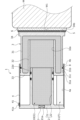
- FIG. 2 is a vertical cross-sectional view showing a contracted state of the pressure device according to the first embodiment of the present invention.
- FIG. 4 is a vertical cross-sectional view showing an expanded state of the pressure device in the first embodiment.
- FIG. 4 is a vertical cross-sectional view showing the vicinity of a pressure applying portion of the pressure applying device in a contracted state.
- FIG. 11 is a vertical cross-sectional view showing a pressure device according to a second embodiment of the present invention.
- FIG. 11 is a vertical cross-sectional view showing a pressure device according to a third embodiment of the present invention.
- FIG. 11 is a vertical cross-sectional view showing a pressure device according to a fourth embodiment of the present invention.
- the pressure application device will be described with reference to Figures 1 to 3.
- the left side of Figure 1 will be referred to as the right side of the pressure application device (sometimes referred to as the tip side), and the right side of Figure 1 will be referred to as the left side of the pressure application device (sometimes referred to as the back side).
- the top and bottom of Figure 1 will be referred to as the top and bottom of the pressure application device.
- the pressurizing device 1 uses the pressure of a fluid to pressurize the object W.
- the object W is disposed on the right side of the pressurizing device 1, and the position of the pressurized surface W1 is described as changing in the axial direction, i.e., in the left-right direction on the paper in FIG. 1, depending on the usage state.
- the pressurizing device 1 uses the pressure of a fluid to pressurize the workpiece W, but the pressurizing device may also be configured to pressurize the workpiece W using, for example, electric drive.
- the pressure device 1 is mainly composed of a base body 2, a movable body 3, a cylindrical body 4 serving as a guide body, an elastic body 5, and a pressure plate 6.
- the base body 2 is composed of a large diameter portion 21 and a small diameter portion 22.
- the large diameter portion 21 is disk-shaped and has a through hole 21a formed in its center.
- a plug 7 is attached to the through hole 21a.
- the small diameter section 22 is cylindrical and extends from the center of the large diameter section 21 to the right.
- the left end of the small diameter section 22 is closed by the large diameter section 21, and the right end opens to the right.
- annular recesses 22a, 22c, and 22d are provided on the outer peripheral surface of the right end of the small diameter portion 22, spaced apart in the axial direction and recessed in the inner radial direction.
- the leftmost annular recess 22a and the central annular recess 22c are formed deeper than the rightmost annular recess 22d. Furthermore, a seal ring 9 is fitted into the annular recess 22a and the annular recess 22c, respectively. Note that a seal ring 9 is not fitted into the annular recess 22d, but a bearing member called a wear ring may be installed therein depending on the application.
- the seal ring 9 can be of any type, such as an X-ring, an O-ring, or a lip seal. Furthermore, since multiple seal rings 9, specifically two, are arranged in the axial direction, oil leakage to the pressure accumulator 10 (described below) is virtually eliminated, and the movable body 3 is less likely to tilt when it moves.
- the annular recess 22d when the annular recess 22d is a space, it has a gas reservoir function and an oil reservoir function. This prevents gas leakage between the base body 2 and the movable body 3 and allows smooth relative sliding. Furthermore, when a wear ring is installed in the annular recess 22d, the wear ring prevents galling, reduces eccentricity, and improves the durability of the seal ring.
- the seal ring 9 is axially slidable against the inner circumferential surface 32a of the movable body 3 and regulates the movement of fluid in the axial direction.
- the movable body 3 is composed of an outer diameter side cylindrical portion 31, an inner diameter side cylindrical portion 32, a back plate portion 33, and a tip plate portion 34.
- the outer diameter side cylindrical portion 31 has a larger diameter than the inner diameter side cylindrical portion 32 and is positioned away from the inner diameter side cylindrical portion 32 on the outer diameter side.
- the outer peripheral surface of the flange 31a extending outward from the left end of the outer diameter side cylindrical portion 31 has annular recesses 31b, 31c recessed inwardly and spaced apart in the axial direction.
- a seal ring 8 is fitted into the right annular recess 31b.
- the left annular recess 31c is shallower than the annular recess 31b and does not have a seal ring 8 fitted into it, but a wear ring may be installed depending on the application.
- the seal ring 8 can be any type, such as an O-ring, X-ring, or lip seal.
- the annular recess 31c also has an oil reservoir function, which allows the movable body 3 to slide smoothly.
- the annular recess 31c may be located anywhere in the axial direction of the outer circumferential surface of the flange 31a, as long as it is possible to improve sliding properties.
- the inner diameter side cylindrical portion 32 is concentric with the outer diameter side cylindrical portion 31 when viewed in the axial direction.
- the inner diameter side cylindrical portion 32 is shorter in the axial direction than the outer diameter side cylindrical portion 31.
- the back plate portion 33 connects the left end of the outer diameter side cylindrical portion 31 and the left end of the inner diameter side cylindrical portion 32, and is annular when viewed in the axial direction.
- the back plate portion 33 extends radially perpendicular to the central axis of the outer diameter side cylindrical portion 31 and the inner diameter side cylindrical portion 32.
- the tip plate portion 34 has a rectangular shape larger than the outer diameter side cylindrical portion 31 when viewed in the axial direction, and closes the right end of the outer diameter side cylindrical portion 31. In addition, the tip plate portion 34 is spaced apart in the axial direction from the right end of the inner diameter side cylindrical portion 32.
- the joint 35 between the tip plate 34 and the outer diameter side tubular portion 31 has an outer circumferential surface that is curved and recessed toward the inner diameter side in cross section, forming a rounded shape.
- the portion of the tip plate 34 that protrudes toward the outer diameter side beyond the outer diameter side tubular portion 31 is referred to as the step portion 34a.
- the tip plate portion 34 is also thin. This allows the axial size of the movable body 3 to be reduced, making it possible to achieve a large stroke in a small installation space.
- the small diameter section 22 of the base body 2 is inserted into the inside of the inner diameter side cylindrical section 32 of the movable body 3 so that it can move relative to the base body 2.
- the volume of this pressure accumulator section 10 changes when the movable body 3 moves as described below (see Figure 2).
- High-pressure gas G is sealed into the pressure accumulator 10 from the outside through a gas inlet (not shown) of the plug 7.
- the pressure accumulator 10 is a cylindrical gas chamber.
- the left end of the cylindrical body 4 is connected and fixed to the outer circumferential surface of the large diameter portion 21 of the base body 2.
- the inner circumferential surface 4a of the cylindrical body 4 is capable of sliding in the axial direction relative to the outer circumferential surface of the flange 31a of the movable body 3.
- a seal ring 8 restricts the movement of fluid in the axial direction between the inner circumferential surface 4a of the cylindrical body 4 and the outer circumferential surface of the flange 31a of the movable body 3.
- a space 11 is formed by the base body 2, the movable body 3, and the cylindrical body 4. Oil F is held in the space 11 as a lubricating fluid. The volume of this space 11 changes as the movable body 3 moves, as described below (see Figure 2).
- a ventilation hole 41 is formed in the upper left part of the cylindrical body 4. In other words, the space 11 is connected to the external atmospheric space through the ventilation hole 41.
- the right end 4b of the cylindrical body 4 protrudes toward the inner diameter side. As described below, the end 4b comes into contact with the step 34a of the movable body 3 when the movable body 3 moves to the leftmost position. Referring to FIG. 2, the end 4b comes into contact with the flange 31a of the movable body 3 when the movable body 3 moves to the rightmost position.
- the elastic body 5 is a sheet-shaped rubber material with a hardness of durometer A30.
- This elastic body 5 has a rectangular shape when viewed in the axial direction, and is formed to be larger than the outer shape of the tip plate portion 34 of the movable body 3.
- the back surface of this elastic body 5 is fixed to the tip surface 34b of the tip plate portion 34 with an adhesive or the like.
- the hardness of the elastic body 5 is preferably durometer A50 or less, and more preferably durometer A30 or less. In other words, it is preferable that the elastic body 5 has a low hardness.
- the material of the movable body 3 may be freely selected as long as it is harder than the elastic body 5.
- the pressure plate 6 is made of metal and is formed to be larger than the outer shape of the elastic body 5.
- the back surface of the pressure plate 6 is fixed to the tip surface of the elastic body 5 with an adhesive or the like.
- the tip surface of the pressure plate 6 is in face contact with the pressure-receiving surface W1 of the workpiece W.
- the pressure plate 6 is not limited to metal, and may be freely changed to a resin or the like as long as it is harder than the elastic body 5.
- the base body 2 is fixed to a fixed body (not shown) and is immobile at least in the axial direction, i.e., in the left-right direction.
- the pressurizing device 1 when the object to be acted upon W is positioned at the leftmost position, the pressurizing device 1 is in a contracted state with the movable body 3 having moved to the leftmost position.
- the step 34a of the movable body 3 abuts against the end 4b of the cylindrical body 4, specifically, its right end, restricting the movement of the movable body 3 to the left.
- the capacity of the pressure accumulator 10 is at its smallest within the stroke range of the movable body 3, and the gas G is in its most compressed state.
- the two seal rings 9 restrict the gas G from moving into the space 11 on the left side.
- the pressure of the gas G in the pressure accumulator 10 acts to move the movable body 3 to the right.
- the breathing hole 41 of the cylindrical body 4 is located to the left of the movable body 3. In other words, the breathing hole 41 is not blocked.
- a water-repellent, breathable sheet 41s is installed to cover the ventilation hole 41, preventing water from entering the space 11 from the outside and allowing gas to flow while preventing oil from leaking from the space 11.
- the liquid level of the oil F is located near the bottom of the breathing hole 41. This allows the oil F to be supplied to the gap between the outer circumferential surface of the small diameter portion 22 of the base body 2 and the inner circumferential surface 32a of the movable body 3, and prevents the oil F from leaking from the breathing hole 41 into the atmospheric space.
- the pressurizing device 1 when the position of the pressurized surface W1 of the acted body W is positioned at the rightmost position, the pressurizing device 1 is in an extended state with the movable body 3 moved to the rightmost position.
- the flange 31a of the movable body 3 specifically its right end face, abuts the end 4b of the cylindrical body 4, specifically its left end face, restricting the movement of the movable body 3 to the right.
- the capacity of the pressure accumulator 10 is at its largest within the stroke range of the movable body 3, and the pressure of the gas G is reduced.
- the movable body 3 moves in a direction away from the breathing hole 41, i.e., to the right, more than when the pressure applying device 1 is in the contracted state, so the breathing hole 41 is not blocked. Also, the liquid level of the oil F is located below the inner circumferential surface 32a of the inner diameter side cylindrical portion 32 of the movable body 3.
- the movable body 3 strokes according to the position of the pressurized surface W1 of the acted upon body W.
- the compressed gas G expands and the movable body 3 moves to the right relative to the base body 2, following the acted upon body W.
- the movable body 3 pressed by it follows the acted upon body W and moves to the left relative to the base body 2 while compressing the gas G.
- the movable body 3 stroking according to the position of the pressurized surface W1 it is possible to continue to apply pressure to the acted upon body W in the axial direction regardless of the position of the acted upon body W.
- the movable body 3 strokes, as shown in FIG. 1, if the volume of the space 11 is small and the level of the oil F reaches the inner circumferential surface 32a of the inner diameter side cylindrical portion 32, the oil F is supplied to the gap between the outer circumferential surface of the small diameter portion 22 and the inner circumferential surface 32a of the inner diameter side cylindrical portion 32.
- the oil F in the space 11 also enters the gap between the outer peripheral surface of the flange 31a of the outer diameter side cylindrical portion 31 and the inner peripheral surface of the cylindrical body 4, and is retained in the annular recess 31c, contributing to the lubrication of the stroke of the movable body 3.
- the gas G in the pressure accumulator 10 is in its most compressed state.
- the tip plate portion 34 of the movable body 3 is formed in a thin plate shape, and therefore the pressure of the gas G may cause the center portion to bulge to the right. Note that for ease of explanation, the deformation of the tip plate portion 34 is shown in Figure 3 to be larger than it actually is.
- the stress acting on the tip plate portion 34 of the movable body 3 is dispersed in the surface direction by the elastic body 5 arranged between the tip plate portion 34 and the pressure plate 6, and is transmitted to the object to be acted upon W via the pressure plate 6 with a substantially uniform surface pressure.
- pressure can be applied while suppressing bias in the surface pressure on the pressurized surface W1 of the object to be acted upon. This regulates the relative inclination between the tip surface of the pressure plate 6 and the pressurized surface W1 of the object to be acted upon W.
- the elastic body 5 is also formed to be larger than the outer shape of the tip plate portion 34 of the movable body 3. In other words, the elastic body 5 covers the entire tip surface 34b of the tip plate portion 34, so that the tip surface 34b of the movable body 3 does not come into direct contact with the pressure plate 6, and pressure can be applied to the workpiece W while suppressing bias in the surface pressure.
- a pressure plate 6 is disposed which is harder than the elastic body 5 and has a tip surface which comes into contact with the pressure receiving surface W1 of the body W to be acted upon.
- This pressure plate 6 transmits the force dispersed by the elastic body 5 to the pressure receiving surface W1 with a substantially uniform surface pressure, so that the bias of the surface pressure on the pressure receiving surface W1 can be further suppressed while applying pressure.
- the movable body 3 is driven to move forward and backward by the pressure of the pressure accumulation section 10. Even if the pressure inside the pressure accumulation section 10 fluctuates, as described above, the elastic body 5 can suppress bias in the surface pressure on the pressure-receiving surface W1 of the object W to be acted upon, thereby allowing pressure to be applied.
- the tip plate portion 134 of the movable body 103 of the pressure applying device 100 of this embodiment 2 is composed of an outer edge portion 134A and a central portion 134B.
- the central portion 134B is a portion that has a thickness that bulges out to the left in the center of the tip plate portion 134, i.e., toward the opposite side of the pressure receiving surface W1 from the outer edge portion 134A, and has a convex shape in cross section.
- the outer edge portion 134A is a portion of the tip plate portion 134 other than the central portion 134B, and is approximately parallel to the pressure plate 106.
- the elastic body 105 is arranged without any gap between the tip plate portion 134 of the movable body 103 and the pressure plate 106.
- the central portion 134B is thicker than the outer edge portion 134A, and therefore has high rigidity. Even if a force is applied to the tip plate portion 134 due to an increase in pressure in the pressure accumulator 10, the deformation of the tip plate portion 134 is balanced, and the pressure force can be transmitted to the elastic body without bias, and the pressure force can be transmitted to the pressure-receiving surface W1 efficiently.
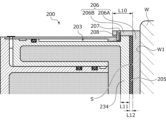
- the pressure plate 206 of the pressure device 200 of this embodiment 3 is cylindrical with a bottom.
- the pressure plate 206 is composed of a bottom plate portion 206A and a cylindrical portion 206B extending leftward from the outer edge of the bottom plate portion 206A. This pressure plate 206 is adapted to be fitted onto the tip plate portion 234 of the movable body 203 from the right side.
- the inner peripheral surface of the cylindrical portion 206B is capable of sliding against the outer peripheral surface of the tip plate portion 234.
- the elastic body 205 is disposed without any gaps within the substantially closed closed space S formed between the tip plate portion 234 of the movable body 203 and the pressure plate 206.
- the closed space S is a closed space that is isolated from the outside space, and it goes without saying that it is not limited to only a space in which fluid cannot flow between the space and the outside space.
- the axial length L10 of the cylindrical portion 206B is longer than the sum of the axial length L11 (i.e., thickness L11) of the tip plate portion 234 and the axial length L12 (i.e., thickness L12) of the elastic body 205 (L10>L11+L12).
- This cylindrical portion 206B has multiple screw holes 207 formed in the circumferential direction. Screws 208 serving as locking portions are screwed into these screw holes 207 from the outer diameter side.
- the screw 208 screwed into the screw hole 207 abuts against the back surface of the tip plate portion 234. This restricts the distance between the tip plate portion 234 and the pressure plate 206.
- the screw 208 can prevent excessive separation between the tip plate 234 of the movable body 203 and the pressure plate 206, so there is no effect on the elastic body 205.
- the distance between the tip plate 234 and the pressure plate 206 is maintained by the screw 208, so the contact surface between the tip plate 234 and the elastic body 205 and the contact surface between the elastic body 205 and the pressure plate 206 will not peel off.
- the relative inclination between the tip plate 234 and the bottom plate 206A of the pressure plate 206 is regulated, so pressure can be applied while suppressing bias in the surface pressure on the pressure-receiving surface W1 of the workpiece W.
- the elastic body 205 is disposed within the closed space S, the elastic body 205 is prevented from leaking out of the closed space S when pressure is applied, and the pressure can be efficiently transmitted to the pressure-receiving surface W1.
- the screw 208 is exemplified as the locking portion, but this is not limited to this and may be freely changed.
- the tip plate portion and the pressure plate may be clamped in the axial direction by a clamp or the like.
- the movable body 303 of the pressure device 300 of this fourth embodiment is provided with an edge portion 336 that protrudes to the right from the outer edge of its tip plate portion 334. That is, on the right side of the movable body 303, a recess 337 that opens to the right side is formed by the tip plate portion 334 and the edge portion 336. This recess 337 has a rectangular shape when viewed in the axial direction.
- the elastic body 305 is surrounded by the edge portion 336 and the tip plate portion 334 and is positioned without any gaps within the recess 337.
- the pressure plate 306 is surrounded by the edge 336 and the elastic body 305 and is positioned without any gaps within the recess 337.
- the elastic body 305 is placed without any gaps within the substantially closed space S1 formed between the tip plate portion 334 and edge portion 336 of the movable body 303 and the pressure plate 306.
- the elastic body 305 is disposed within the closed space S1, the elastic body 305 is prevented from leaking out of the closed space S1 when pressure is applied, and the pressure can be efficiently transmitted to the pressurized surface W1.
- the thicknesses of the tip plate, pressure plate, and elastic body are illustrated in descending order, but these thicknesses may be freely changed.
- the tip plate portion, the pressure plate, and the elastic body are exemplified as being rectangular when viewed in the axial direction, but this is not limited thereto, and for example, they may be circular when viewed in the axial direction.
- the pressure device has a pressure plate, but it is not necessary to provide a pressure plate.
- the elastic body may be in direct contact with the surface to be pressed.
- the elastic body covers the entire tip surface of the movable body, but this is not limited thereto, and the elastic body may be provided partially on the tip surface of the movable body. In this case, it is preferable that multiple elastic bodies are distributed and disposed on the tip surface of the movable body.
- the elastic body is a sheet-like rubber material, but this is not limited thereto, and any material that can disperse the stress acting on the tip surface of the movable body may be used, for example, a synthetic resin, or a spring that is placed between the tip surface of the movable body and the pressure plate.
- the movable body is driven to move back and forth relative to the base body by the pressure of the pressure accumulator, but this is not limited thereto, and the movable body may be driven to move back and forth by the pressure of a fluid supplied from an external pump, accumulator, etc.
- a gas is stored in the pressure storage section, but a liquid such as oil or a mixture of liquid and gas may be sealed in the pressure storage section.
Landscapes
- Engineering & Computer Science (AREA)
- Mechanical Engineering (AREA)
- Physics & Mathematics (AREA)
- Fluid Mechanics (AREA)
- General Engineering & Computer Science (AREA)
- Supply Devices, Intensifiers, Converters, And Telemotors (AREA)
- Presses And Accessory Devices Thereof (AREA)
- Sealing Devices (AREA)
Priority Applications (3)
| Application Number | Priority Date | Filing Date | Title |
|---|---|---|---|
| JP2024561395A JPWO2024116939A1 (https=) | 2022-11-30 | 2023-11-20 | |
| EP23897587.4A EP4628294A1 (en) | 2022-11-30 | 2023-11-20 | Pressurizing device |
| CN202380077287.5A CN120152845A (zh) | 2022-11-30 | 2023-11-20 | 加压装置 |
Applications Claiming Priority (2)
| Application Number | Priority Date | Filing Date | Title |
|---|---|---|---|
| JP2022-191714 | 2022-11-30 | ||
| JP2022191714 | 2022-11-30 |
Publications (1)
| Publication Number | Publication Date |
|---|---|
| WO2024116939A1 true WO2024116939A1 (ja) | 2024-06-06 |
Family
ID=91323722
Family Applications (1)
| Application Number | Title | Priority Date | Filing Date |
|---|---|---|---|
| PCT/JP2023/041652 Ceased WO2024116939A1 (ja) | 2022-11-30 | 2023-11-20 | 加圧装置 |
Country Status (4)
| Country | Link |
|---|---|
| EP (1) | EP4628294A1 (https=) |
| JP (1) | JPWO2024116939A1 (https=) |
| CN (1) | CN120152845A (https=) |
| WO (1) | WO2024116939A1 (https=) |
Citations (12)
| Publication number | Priority date | Publication date | Assignee | Title |
|---|---|---|---|---|
| FR686942A (fr) * | 1929-02-14 | 1930-08-01 | Presse à frapper et à estamper | |
| GB350985A (en) * | 1929-10-03 | 1931-05-28 | Wellit Ges Pless & Co | A record and a process for the manufacture thereof |
| GB714544A (en) * | 1951-08-01 | 1954-09-01 | Rommler G M B H H | Hydraulic press for the manufacture of platelike bodies |
| FR2024981A1 (en) * | 1968-12-02 | 1970-09-04 | Asea Ab | Hydraulic press for moulding railway wheels |
| US4401614A (en) * | 1981-09-08 | 1983-08-30 | Ptx-Pentronix, Inc. | Anvil assembly for a powder-compacting anvil press |
| JPH037480B2 (https=) * | 1983-04-15 | 1991-02-01 | Hitachi Ltd | |
| JPH11303913A (ja) * | 1998-04-22 | 1999-11-02 | Nisshinbo Ind Inc | 摩擦部材用金型、摩擦材仮成形品用金型、摩擦部材の製造方法及び摩擦材仮成形品の製造方法 |
| JP4157672B2 (ja) * | 1999-09-06 | 2008-10-01 | 日機装株式会社 | 加圧成形装置 |
| JP2013006397A (ja) * | 2011-06-27 | 2013-01-10 | Mitsubishi Cable Ind Ltd | 圧力均一化装置及びそれを用いたプレス製品の製造方法 |
| JP2019217520A (ja) * | 2018-06-18 | 2019-12-26 | 大野精工株式会社 | プレス装置 |
| JP2020157325A (ja) * | 2019-03-25 | 2020-10-01 | 株式会社トヨタプロダクションエンジニアリング | プレス成型装置 |
| JP2021020224A (ja) | 2019-07-24 | 2021-02-18 | 芝浦機械株式会社 | 局部加圧装置 |
-
2023
- 2023-11-20 JP JP2024561395A patent/JPWO2024116939A1/ja active Pending
- 2023-11-20 WO PCT/JP2023/041652 patent/WO2024116939A1/ja not_active Ceased
- 2023-11-20 EP EP23897587.4A patent/EP4628294A1/en active Pending
- 2023-11-20 CN CN202380077287.5A patent/CN120152845A/zh active Pending
Patent Citations (12)
| Publication number | Priority date | Publication date | Assignee | Title |
|---|---|---|---|---|
| FR686942A (fr) * | 1929-02-14 | 1930-08-01 | Presse à frapper et à estamper | |
| GB350985A (en) * | 1929-10-03 | 1931-05-28 | Wellit Ges Pless & Co | A record and a process for the manufacture thereof |
| GB714544A (en) * | 1951-08-01 | 1954-09-01 | Rommler G M B H H | Hydraulic press for the manufacture of platelike bodies |
| FR2024981A1 (en) * | 1968-12-02 | 1970-09-04 | Asea Ab | Hydraulic press for moulding railway wheels |
| US4401614A (en) * | 1981-09-08 | 1983-08-30 | Ptx-Pentronix, Inc. | Anvil assembly for a powder-compacting anvil press |
| JPH037480B2 (https=) * | 1983-04-15 | 1991-02-01 | Hitachi Ltd | |
| JPH11303913A (ja) * | 1998-04-22 | 1999-11-02 | Nisshinbo Ind Inc | 摩擦部材用金型、摩擦材仮成形品用金型、摩擦部材の製造方法及び摩擦材仮成形品の製造方法 |
| JP4157672B2 (ja) * | 1999-09-06 | 2008-10-01 | 日機装株式会社 | 加圧成形装置 |
| JP2013006397A (ja) * | 2011-06-27 | 2013-01-10 | Mitsubishi Cable Ind Ltd | 圧力均一化装置及びそれを用いたプレス製品の製造方法 |
| JP2019217520A (ja) * | 2018-06-18 | 2019-12-26 | 大野精工株式会社 | プレス装置 |
| JP2020157325A (ja) * | 2019-03-25 | 2020-10-01 | 株式会社トヨタプロダクションエンジニアリング | プレス成型装置 |
| JP2021020224A (ja) | 2019-07-24 | 2021-02-18 | 芝浦機械株式会社 | 局部加圧装置 |
Non-Patent Citations (1)
| Title |
|---|
| See also references of EP4628294A1 |
Also Published As
| Publication number | Publication date |
|---|---|
| CN120152845A (zh) | 2025-06-13 |
| EP4628294A1 (en) | 2025-10-08 |
| JPWO2024116939A1 (https=) | 2024-06-06 |
Similar Documents
| Publication | Publication Date | Title |
|---|---|---|
| US9388902B2 (en) | Piston bearing structure for fluid pressure cylinder | |
| WO2014142265A1 (ja) | メカニカルシール装置 | |
| JP6518064B2 (ja) | 摺動シール構造 | |
| JPH083349B2 (ja) | シール装置 | |
| US8720902B2 (en) | Pressure balanced radial rotary shaft seal | |
| CN110537044A (zh) | 密封组件 | |
| US10989317B2 (en) | Two-way valve | |
| JP5447787B2 (ja) | 往復動用密封装置 | |
| JP2016020711A (ja) | シール構造 | |
| JP2018115689A (ja) | 密封装置 | |
| WO2024116939A1 (ja) | 加圧装置 | |
| US7637508B2 (en) | High temperature high pressure seal stack having run-dry capability | |
| CN116438396A (zh) | 用于旋转轴设备的柔性密封膜和密封组件 | |
| JP6815749B2 (ja) | 密封装置 | |
| JP6858930B2 (ja) | シールリング及び密封構造 | |
| CN110546413A (zh) | 密封装置 | |
| EP1612461A1 (en) | Sector shaft pressure seal | |
| WO2023243703A1 (ja) | 加圧装置 | |
| US20140203515A1 (en) | Pressure balanced radial rotary shaft seal | |
| JP4894397B2 (ja) | 油圧式クラッチレリーズ装置用シール | |
| JP2003329143A (ja) | 密封装置 | |
| JP5531292B2 (ja) | メカニカルシール | |
| WO2023243704A1 (ja) | 加圧装置 | |
| JP2006112486A (ja) | 密封装置 | |
| CN214998578U (zh) | 活塞结构及使用其的油缸 |
Legal Events
| Date | Code | Title | Description |
|---|---|---|---|
| 121 | Ep: the epo has been informed by wipo that ep was designated in this application |
Ref document number: 23897587 Country of ref document: EP Kind code of ref document: A1 |
|
| WWE | Wipo information: entry into national phase |
Ref document number: 2024561395 Country of ref document: JP |
|
| WWE | Wipo information: entry into national phase |
Ref document number: 202380077287.5 Country of ref document: CN |
|
| WWP | Wipo information: published in national office |
Ref document number: 202380077287.5 Country of ref document: CN |
|
| WWE | Wipo information: entry into national phase |
Ref document number: 2023897587 Country of ref document: EP |
|
| NENP | Non-entry into the national phase |
Ref country code: DE |
|
| ENP | Entry into the national phase |
Ref document number: 2023897587 Country of ref document: EP Effective date: 20250630 |
|
| WWP | Wipo information: published in national office |
Ref document number: 2023897587 Country of ref document: EP |