WO2024116332A1 - 無人搬送車 - Google Patents
無人搬送車 Download PDFInfo
- Publication number
- WO2024116332A1 WO2024116332A1 PCT/JP2022/044203 JP2022044203W WO2024116332A1 WO 2024116332 A1 WO2024116332 A1 WO 2024116332A1 JP 2022044203 W JP2022044203 W JP 2022044203W WO 2024116332 A1 WO2024116332 A1 WO 2024116332A1
- Authority
- WO
- WIPO (PCT)
- Prior art keywords
- cart
- transport
- unit
- automated guided
- guided vehicle
- Prior art date
- Legal status (The legal status is an assumption and is not a legal conclusion. Google has not performed a legal analysis and makes no representation as to the accuracy of the status listed.)
- Ceased
Links
Images








Classifications
-
- G—PHYSICS
- G05—CONTROLLING; REGULATING
- G05D—SYSTEMS FOR CONTROLLING OR REGULATING NON-ELECTRIC VARIABLES
- G05D1/00—Control of position, course, altitude or attitude of land, water, air or space vehicles, e.g. using automatic pilots
- G05D1/60—Intended control result
- G05D1/656—Interaction with payloads or external entities
- G05D1/667—Delivering or retrieving payloads
-
- B—PERFORMING OPERATIONS; TRANSPORTING
- B65—CONVEYING; PACKING; STORING; HANDLING THIN OR FILAMENTARY MATERIAL
- B65G—TRANSPORT OR STORAGE DEVICES, e.g. CONVEYORS FOR LOADING OR TIPPING, SHOP CONVEYOR SYSTEMS OR PNEUMATIC TUBE CONVEYORS
- B65G1/00—Storing articles, individually or in orderly arrangement, in warehouses or magazines
- B65G1/02—Storage devices
- B65G1/04—Storage devices mechanical
- B65G1/10—Storage devices mechanical with relatively movable racks to facilitate insertion or removal of articles
-
- G—PHYSICS
- G05—CONTROLLING; REGULATING
- G05D—SYSTEMS FOR CONTROLLING OR REGULATING NON-ELECTRIC VARIABLES
- G05D2105/00—Specific applications of the controlled vehicles
- G05D2105/20—Specific applications of the controlled vehicles for transportation
- G05D2105/28—Specific applications of the controlled vehicles for transportation of freight
-
- G—PHYSICS
- G05—CONTROLLING; REGULATING
- G05D—SYSTEMS FOR CONTROLLING OR REGULATING NON-ELECTRIC VARIABLES
- G05D2107/00—Specific environments of the controlled vehicles
- G05D2107/70—Industrial sites, e.g. warehouses or factories
-
- G—PHYSICS
- G05—CONTROLLING; REGULATING
- G05D—SYSTEMS FOR CONTROLLING OR REGULATING NON-ELECTRIC VARIABLES
- G05D2109/00—Types of controlled vehicles
- G05D2109/10—Land vehicles
Definitions
- This specification discloses an automated guided vehicle.
- a transport AGV that slides under a trolley and couples with it by fitting a coupling pin into the coupling groove of the trolley to transport the trolley (see, for example, Patent Document 1).
- a coupling ring is provided on the front surface of the base of the trolley, and a coupling hook is provided on the rear surface of the base of the trolley, and the trolleys are coupled to each other by engaging the coupling hook of the front trolley with the coupling link of the rear trolley between multiple trolleys arranged in front and behind each other.
- the transport AGV is equipped with a rod that protrudes outward from the vehicle body, a lever that is fixed integrally so as to be perpendicular to the rod, and a rotational motor that rotates the lever around the rod.
- Patent Document 1 describes how a transport AGV can be used to separate multiple carts that are connected to each other, but does not mention how a cart to be transported can be transported to a destination from a group of closely packed carts without interfering with the other carts.
- the main objective of this disclosure is to transport a cart to be transported among multiple closely packed carts to its destination without interfering with the other carts.
- the automated guided vehicle of the present disclosure includes: An automated guided vehicle that transports a cart, A vehicle body including a drive unit; A connecting portion that is detachably connected to the carriage; a control unit that controls the coupling unit and the drive unit so as to couple the cart to a target cart among a plurality of closely packed carts, move the target cart away from adjacent carts, and then transport the target cart to a destination;
- the gist of the invention is to provide the following:
- the automated guided vehicle is coupled to a target cart among a group of closely packed carts, and the target cart is moved away from the adjacent carts before being transported to the destination. This makes it possible to transport the target cart among a group of closely packed carts to the destination without it interfering with the other carts.
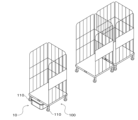
- FIG. 2 is an external perspective view of a plurality of basket carts arranged closely together in a cart storage area and an automated guided vehicle that transports the basket carts.
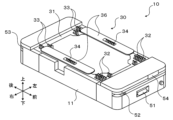
- FIG. 2 is an external perspective view of an automatic guided vehicle.
- FIG. FIG. FIG. 11 is an explanatory diagram showing a state in which the automated guided vehicle has slipped under the cart.
- FIG. 10 is an explanatory diagram showing a state in which the automated guided vehicle is coupled to a cart.
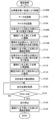
- 1 is a block diagram of an automated guided vehicle system including an automated guided vehicle and a management device. 10 is a flowchart showing an example of a transport control routine.
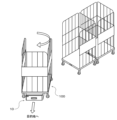
- FIG. 11 is an explanatory diagram showing a state in which a target cart is transported from a crowded basket cart.
- FIG. 11 is an explanatory diagram showing a state in which a target cart is transported from a crowded basket cart.
- FIG. 11 is an explanatory diagram showing a state in which a target cart is transported from a crowded basket cart.
- FIG. 11 is an explanatory diagram showing a state in which a target cart is transported from a crowded basket cart.
- FIG. 11 is an explanatory diagram showing a state in which a target cart is transported from a crowded basket cart.
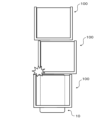
- FIG. 11 is an explanatory diagram showing a mode in which a transport target cart interferes with an adjacent cart.
- FIG. 11 is an explanatory diagram showing a mode in which a transport target cart interferes with an adjacent cart.
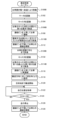
- FIG. 9 is a flowchart showing a modified transport control routine of FIG. 8 .
- 13 is a flowchart showing a transport control routine according to another embodiment.
- 18 is a flowchart showing a modified transport control routine of FIG. 17 .
- FIG. 11 is an explanatory diagram showing another example of the arrangement of the carts.
- FIG. 1 is an external perspective view of multiple cage carts 100 arranged closely together in a cage storage area L, and an automated guided vehicle 10 that transports the cage carts 100.
- FIG. 2 is an external perspective view of the automated guided vehicle 10.
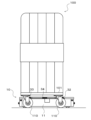
- FIGS. 3 and 4 are side views of the automated guided vehicle 10.
- FIG. 5 is an explanatory diagram showing the automated guided vehicle 10 slipping under the cage cart 100.
- FIG. 6 is an explanatory diagram showing the automated guided vehicle 10 coupled to the cage cart 100.
- FIG. 7 is a block diagram of an automated guided vehicle system 1 including the automated guided vehicle 10 and a management device 60.
- the automated guided vehicle 10 of this embodiment is used in logistics centers, warehouses, stores, etc., and is an autonomous transport robot (AMR: Autonomous Mobile Robot) that is coupled to a basket trolley 100 for transport as shown in FIG. 1.
- AMR Autonomous Mobile Robot
- the automated guided vehicle system 1 includes the automated guided vehicle 10 and a management device 60 that manages the operation of the automated guided vehicle 10 as shown in FIG. 7.
- the basket cart 100 is a basket cart having a rectangular, mesh-shaped platform 101 capable of carrying luggage, and a plurality of (e.g., four) casters 110 rotatably attached to the underside of the platform 101.
- the platform 101 of the basket cart 100 is provided with a marker M, such as an AR marker, a two-dimensional code, or a barcode, for identifying the basket cart 100.
- the automated guided vehicle 10 recognizes the basket cart 100 to be transported (the cart to be transported) by reading the marker M.
- the marker M may be attached to luggage loaded on the platform 101.
- the automated guided vehicle 10 may also recognize the external shape of the basket cart 100 instead of the marker M.
- the automated guided vehicle 10 of this embodiment has a low, flat, rectangular parallelepiped appearance.
- the automated guided vehicle 10 includes a vehicle body 11, a plurality of (e.g., four) wheels 21 rotatably attached to the bottom surface of the vehicle body 11, and a plurality of (e.g., four) drive motors 22 (see FIG. 7) that rotate and drive the corresponding wheels 21.
- the wheels 21 are configured as Mecanum wheels having a plurality of rollers on the outer periphery of the wheel that can rotate around an axis inclined at 45 degrees to the rotation axis of the wheel.
- the automated guided vehicle 10 can move the vehicle body 11 in all directions and turn (such as a super-pivot turn, a pivot turn, or a gentle turn) by independently controlling the rotation direction and rotation speed of the corresponding wheels 21 with the plurality of drive motors 22.
- the wheels 21 may be configured as omniwheels having a plurality of rollers that can rotate around an axis that crosses the rotation axis of the wheel.
- the multiple wheels 21 may be any type of wheels that can move and turn the vehicle body 11 in multiple directions.
- the automated guided vehicle 10 is provided with a connecting part 30 that is provided on the upper surface of the vehicle body part 11 and can be connected to the cart 100 when the vehicle body part 11 is under the cart 100.
- the connecting part 30 has a flat lift plate 31, connecting pins 32, 33, and 34 that are provided to extend upward from the lift plate 31, and a lifting device 35 that raises and lowers the lift plate 31.
- the lift plate 31 has a left-right width that is approximately the same as the left-right width of the vehicle body part 11 so as to cover the upper surface of the vehicle body part 11, and has a front-to-rear width that is slightly shorter than the front-to-rear width of the vehicle body part 11.
- the connecting pin 32 is provided at the front of the lift plate 31, the connecting pin 33 is provided at the rear of the lift plate 31, and the connecting pin 34 is provided at the intermediate part between the front and rear of the lift plate 31.
- the lifting device 35 raises the lifting plate 31 of the connecting portion 30, so that at least one of the connecting pins 32, 33, and 34 engages with the back side of the loading platform 101 of the cart 100. This connects the automated guided vehicle 10 and the cart 100, and the automated guided vehicle 10 can transport (tow) the cart 100.
- contact detection sensors 36 are provided on both the left and right sides of the lift plate 31 to detect when the connecting portion 30 (connecting pins 32, 33, 34) comes into contact with (connects to) the loading platform 101 of the basket cart 100.
- the contact detection sensor 36 has a plate that is biased upward by a spring and has its upper end at approximately the same height as the connecting pins 32, 33, 34 relative to the lift plate 31.
- the connecting pins 32, 33, 34 engage with the loading platform 101 of the basket cart 100
- the plate of the contact detection sensor 36 comes into contact with the loading platform 101 and descends relative to the connecting pins 32, 33, 34 while the spring is compressed.
- the contact detection sensor 36 detects when the plate has descended relatively, thereby detecting when the connecting portion 30 has come into contact with (connects to) the loading platform 101 of the basket cart 100.
- the automated guided vehicle 10 includes a control unit 40 that controls the entire system, a memory unit 41 that stores various information including map information, a communication unit 42 for communicating (wireless communication) with the management device 60 and other automated guided vehicles, a camera unit 51 as an imaging device, sensor units 52 and 53, and a light emitting unit 54 that illuminates the front of the vehicle body unit 11.
- the camera unit 51 is installed on the front of the vehicle body unit 11 so as to recognize the front of the vehicle body unit 11.
- the sensor units 52 and 53 are installed on the front and rear of the vehicle body unit 11, respectively, so as to detect surrounding interference objects.
- the sensor units 52 and 53 detect surrounding objects and distances to objects.
- the sensor units 52 and 53 use LiDAR (Light Detection And Ranging) sensors that scan the surroundings with laser light, receive each reflected light, and measure the time until the reflected light is received, thereby measuring distance data for each scan angle and obtaining surrounding point cloud data.
- the light-emitting unit 54 is installed on the front of the vehicle body 11 and illuminates the area ahead, making it easier for the camera unit 51 to recognize surrounding objects in dark places.
- the control unit 40 is configured as a microprocessor with a CPU at its core, and in addition to the CPU, it is equipped with a ROM for storing processing programs, a RAM for temporarily storing data, a timer, etc. As shown in FIG. 7, image signals from the camera unit 51 and detection signals from the sensor units 52, 53 and the contact detection sensor 36 are input to the control unit 40. The control unit 40 outputs control signals to the drive motor 22 and the lifting device 35, etc.
- the management device 60 includes a processing unit 61, a memory unit 62 that stores various information including map information, and a communication unit 63 for communicating (wireless communication) with each automated guided vehicle 10.
- the processing unit 61 is configured as a microprocessor centered around a CPU, and includes, in addition to the CPU, a ROM that stores processing programs, a RAM that temporarily stores data, etc.
- FIG. 8 is a flowchart showing an example of a transport control routine executed by the control unit 40 of the automated guided vehicle 10. This process is executed when an instruction to transport the basket cart 100 (baggage) is issued by the management device 60.
- the transport control routine will be described below with reference to FIGS. 9 to 13.
- the control unit 40 When the transport control routine is executed, the control unit 40 first controls the drive motor 22 so that the vehicle body unit 11 approaches the cart storage area L facing forward by forward driving (S100, FIG. 9). Next, the control unit 40 recognizes the basket cart 100 (cart to be transported) to be transported by recognizing the marker M attached to the basket cart 100 or the baggage placed on the loading platform unit 101 with the camera unit 51 provided on the front of the vehicle body unit 11 (S102). Note that the control unit 40 may recognize the cart to be transported based on point cloud data detected by the sensor unit 52 instead of the camera unit 51.
- the control unit 40 recognizes the casters 110 of the recognized transport target cart (S104). This process is performed by recognizing two objects (casters 110) that are located below the position where the marker M is recognized by the camera unit 51 based on the point cloud data detected by the sensor unit 52.
- the control unit 40 may recognize the casters 110 by a combination of the camera unit 51 and the sensor unit 52, or may recognize the two objects (casters 110) based only on the point cloud data detected by the sensor unit 52.
- the control unit 40 then controls the drive motor 22 so that the vehicle body unit 11 moves forward to slip between the casters 110 of the transport target cart and under the transport target cart (S106, FIG. 10).
- control unit 40 controls the drive motor 22 to move forward to a first position that is shallower than the position directly below the transport target cart and stop there.
- This control can be performed, for example, by measuring the distance from the vehicle body 11 to the caster 110 using the sensor unit 52, and moving the vehicle body 11 forward a predetermined amount from a state where the measured distance is a predetermined distance.
- the control unit 40 raises the connecting pins 32, 33, 34 by the lifting device 35 so that they engage with the platform 101 of the cart to be transported, and connects it to the cart to be transported (S108).
- the connecting pins 32, 33, 34 are provided at the front, rear, and middle parts in the fore-and-aft direction on the upper surface of the car body 11, respectively. Therefore, if a part of the car body 11 is inserted under the cart to be transported, the cart to be transported can be connected to the car body 11.
- the fore-and-aft width of the car body 11 is greater than the fore-and-aft width of the cart to be transported.
- the car body 11 when connecting to the cart to be transported, a part of the car body 11 is placed under the cart to be transported (first position), which prevents the car body 11 from interfering with (colliding with) the caster 110 of the basket cart 100 adjacent to the cart to be transported.
- control unit 40 controls the drive motor 22 so that the connected transport target cart moves backward until a certain clearance C is secured from the adjacent basket cart 100 (S110, FIG. 11). In this embodiment, this process is performed by moving the cart backward a predetermined distance. The control unit 40 then lowers the connecting pins 32, 33, and 34 using the lifting device 35 to temporarily release the connection with the transport target cart (S112).
- control unit 40 controls the drive motor 22 so that the vehicle body unit 11 travels forward to a second position (a position immediately below the vehicle) that is deeper than the target vehicle (S114, FIG. 12).
- the control unit 40 can do this by moving the vehicle body unit 11 forward a predetermined distance from the first position described above.
- the control unit 40 raises the connecting pins 32, 33, and 34 using the lifting device 35 so that they engage with the loading platform unit 101 of the vehicle, reconnecting it to the vehicle (S116).
- the control unit 40 acquires the transport route and controls the drive motor 22 to rotate (e.g., pivot) the vehicle body 11 so that it faces forward in the transport direction (S118, FIG. 13).
- the control unit 40 then controls the drive motor 22 to start transport to the destination according to the transport route (S120). If the unmanned transport vehicle 10 turns while the transport target cart connected to the unmanned transport vehicle 10 and the adjacent cart cart 100 are in close proximity to each other, the transport target cart will interfere with (collide with) the adjacent cart cart 100, as shown in FIG. 15. In this embodiment, a certain clearance C is ensured between the transport target cart and the adjacent cart cart 100, so that when the unmanned transport vehicle 10 turns, the transport target cart can be avoided from colliding with the adjacent cart cart 100 and transported smoothly.
- the transportation route is acquired by grasping the shape of the surroundings based on the point cloud data measured by the sensor units 52 and 53 (LiDAR), comparing (collating) the grasped shape of the surroundings with the map information stored in the memory unit 41 to recognize the current location of the vehicle, and searching for a route based on the map information based on the recognized current location and the specified destination.
- the transportation route may be acquired by recognizing the current location and transmitting it to the management device, and receiving the transportation route generated by the management device based on the current location.
- the transportation route may be acquired at any timing between the start of execution of the transportation control routine and the start of processing in S120.
- control unit 40 When the control unit 40 starts transportation of the transportation target cart, it acquires its own position (S122) and determines whether or not the destination has been reached (S124). When the control unit 40 determines that the destination has not been reached, it returns to S122 and continues traveling. On the other hand, when the control unit 40 determines that the destination has been reached, it stops traveling (S126), releases the connection with the transportation target cart (S128), and ends this routine.
- the basket cart 100 (cart to be transported) of this embodiment is an example of a cart of the present disclosure
- the drive motor 22 is an example of a drive unit
- the car body unit 11 is an example of a car body unit
- the connecting unit 30 is an example of a connecting unit
- the control unit 40 corresponds to an example of a control unit.
- the sensor units 52, 53 are an example of a detection unit.
- control unit 40 controls the drive motor 22 so that after processing S112 in the transport control routine of FIG. 8, the car body unit 11 moves forward to slide under the cart to be transported to the second position.
- control unit 40 may retreat to a position where the cart to be transported can be recognized (S130), recognize the casters 110 of the cart to be transported (S132), and control the drive motor 22 so that the car body unit 11 moves forward to slide under the cart to be transported between the casters 110 to the second position (S114).
- FIG 17 is a flowchart showing a transport control routine according to another embodiment.
- the same processes as those in the routine of Figure 8 described above are assigned the same step numbers. Also, detailed explanations of the same processes will be omitted to avoid duplication.
- the control unit 40 controls the drive motor 22 so that the vehicle body unit 11 approaches the cart parking area L backwards by traveling backwards (S100B).
- the control unit 40 recognizes the marker M of the basket cart 100 (cart to be transported) placed in the cart parking area L and also recognizes the casters 110 of the cart to be transported (S102, S104).
- the automated guided vehicle 10 may be provided with a camera unit (recognition unit) on the rear surface of the vehicle body unit 11, and the control unit 40 may recognize the marker M by the camera unit.
- the drive motor 22 is controlled so that the vehicle body unit 11 travels backwards to slip under the cart to be transported between the casters 110 of the cart to be transported to a first position (S106B).
- control unit 40 couples with the transport target cart (S108) and controls the drive motor 22 so that the coupled transport target cart moves forward until a certain clearance C is secured from the adjacent cart 100 (S110B). Then, the control unit 40 temporarily releases the coupling with the transport target cart (S112) and controls the drive motor 22 so that the car body unit 11 moves backward to move further under the transport target cart to a second position (a position immediately below the transport target cart) (S114B).
- the control unit 40 reconnects with the cart to be transported (S116).
- the control unit 40 then controls the drive motor 22 to rotate the car body 11 so that it faces forward in the transport direction of the transport route (S118), and then controls the drive motor 22 to start transporting the cart to the destination along the transport route (S120-S128).
- the amount of rotation required to face forward for the subsequent transport route can be reduced.
- control unit 40 controls the drive motor 22 so that, after processing S112, the car body unit 11 moves backward to slide under the cart to be transported to the second position.
- control unit 40 may move forward to a position where the cart to be transported can be recognized (S130B), recognize the casters 110 of the cart to be transported (S132), and control the drive motor 22 so that the car body unit 11 moves backward to slide under the cart to be transported between the casters 110 to the second position (S114B).
- control unit 40 may use the sensor units 52, 53 to detect obstacles around the car body unit 11 and move the car body unit 11 to an area free of obstacles, thereby ensuring a certain clearance C between the transport target cart and the adjacent basket cart 100.
- the cart to be transported is connected and transported from multiple basket carts 100 arranged in a dense state in a corner surrounded by a wall W as a cart storage area L.
- control unit 40 when the control unit 40 moves the target cart away from the adjacent basket cart 100, the control unit 40 moves part of the car body 11 under the target cart to connect the target cart. However, if the size of the car body 11 fits completely under the loading platform 101 of the target cart, the control unit may move the car body 11 completely under the target cart to connect the target cart. In this case, the control unit 40 may connect the target cart from multiple closely packed basket carts 100 to the car body 11 and move it away from the adjacent basket cart 100, and then transport the target cart to the destination without first releasing the connection with the target cart.
- the control unit 40 measures the distance from the vehicle body unit 11 to the casters 110 of the transport target cart using the sensor unit 52 provided on the front of the vehicle body unit 11, and controls the position (depth) at which the vehicle body unit 11 slides into the transport target cart based on the measured distance.
- the automated guided vehicle 10 may also be provided with an object detection sensor on the top of the vehicle body unit 11 with a detection range above, and the control unit 40 may control the position (depth) at which the vehicle body unit 11 slides into the transport target cart based on the detection result of the object detection sensor.
- the position at which the vehicle body unit 11 slides into the transport target cart may be controlled by advancing the vehicle body unit 11 a predetermined amount after the loading platform unit 101 of the transport target cart is detected by the object detection sensor.
- the automated guided vehicle 10 tows the basket cart 100 by engaging the connecting pin 34 of the connecting portion 30 with the loading platform portion 101 of the basket cart 100.
- the automated guided vehicle 100 may also be configured to lift the basket cart 100 with the connecting portion 30 and transport it.
- the automated guided vehicle disclosed herein couples to a target cart among a group of closely packed carts, moves the target cart away from adjacent carts, and then transports the target cart to its destination. This makes it possible to transport the target cart among a group of closely packed carts to its destination without it interfering with the other carts.
- the coupling unit is provided on the upper part of the vehicle body unit, and the control unit may control the coupling unit and the drive unit to cause the vehicle body unit to slide under the target cart to a position shallower than a predetermined position, couple it to the target cart, move the target cart away from the adjacent carts, and then temporarily release the coupling to the target cart, cause the vehicle body unit to slide under the predetermined position, and recouple it to the target cart to transport the target cart to its destination.
- the vehicle body unit slides under the target cart to a shallow position from a state in which multiple carts are crowded together to couple the target cart, interference between the vehicle body unit and adjacent carts can be suppressed.
- the vehicle body unit can be caused to slide under the target cart to a deep position, so that the target cart can be more reliably coupled to the vehicle body unit.
- a detection unit may be provided that detects the distance between the transport target cart and the vehicle body, and the control unit may control the drive unit so that the vehicle body moves into a target position below the transport cart based on the detection result of the detection unit. In this way, the position at which the vehicle body moves into can be controlled more accurately.
- control unit may control the drive unit to approach the target cart by moving forward and couple to the target cart, and then move backward to move the target cart away from the adjacent cart, or the control unit may control the drive unit to approach the target cart by moving backward and couple to the target cart, and then move forward to move the target cart away from the adjacent cart. In this way, the target cart can be moved away from the adjacent cart with simple control.
- control unit may control the drive unit so that after moving the target cart away from the adjacent cart, the cart turns and travels forward to transport the target cart to the destination. In this way, the target cart can be transported more smoothly.
- This disclosure can be used in the automated guided vehicle manufacturing industry, etc.
- Automated guided vehicle system 10. Automated guided vehicle, 11. Vehicle body, 21. Wheels, 22. Driving motor, 30. Connection, 31. Lifting plate, 32, 33, 34. Connection pins, 35. Lifting device, 36. Contact detection sensor, 40. Control unit, 41. Memory unit, 42. Communication unit, 51. Camera unit, 52, 53. Sensor unit, 54. Light-emitting unit, 60. Management device, 61. Processing unit, 62. Memory unit, 63. Communication unit, 100. Basket cart, 101. Cargo platform, 110. Casters, L. Cart storage area, M. Marker, S. Shelf, W. Wall.
Landscapes
- Engineering & Computer Science (AREA)
- Mechanical Engineering (AREA)
- Aviation & Aerospace Engineering (AREA)
- Radar, Positioning & Navigation (AREA)
- Remote Sensing (AREA)
- Physics & Mathematics (AREA)
- General Physics & Mathematics (AREA)
- Automation & Control Theory (AREA)
- Control Of Position, Course, Altitude, Or Attitude Of Moving Bodies (AREA)
Priority Applications (4)
| Application Number | Priority Date | Filing Date | Title |
|---|---|---|---|
| JP2024561063A JPWO2024116332A1 (https=) | 2022-11-30 | 2022-11-30 | |
| CN202280102079.1A CN120187653A (zh) | 2022-11-30 | 2022-11-30 | 无人搬运车 |
| PCT/JP2022/044203 WO2024116332A1 (ja) | 2022-11-30 | 2022-11-30 | 無人搬送車 |
| EP22967165.6A EP4628428A4 (en) | 2022-11-30 | 2022-11-30 | AUTOMATICALLY GUIDED VEHICLE |
Applications Claiming Priority (1)
| Application Number | Priority Date | Filing Date | Title |
|---|---|---|---|
| PCT/JP2022/044203 WO2024116332A1 (ja) | 2022-11-30 | 2022-11-30 | 無人搬送車 |
Publications (1)
| Publication Number | Publication Date |
|---|---|
| WO2024116332A1 true WO2024116332A1 (ja) | 2024-06-06 |
Family
ID=91323110
Family Applications (1)
| Application Number | Title | Priority Date | Filing Date |
|---|---|---|---|
| PCT/JP2022/044203 Ceased WO2024116332A1 (ja) | 2022-11-30 | 2022-11-30 | 無人搬送車 |
Country Status (4)
| Country | Link |
|---|---|
| EP (1) | EP4628428A4 (https=) |
| JP (1) | JPWO2024116332A1 (https=) |
| CN (1) | CN120187653A (https=) |
| WO (1) | WO2024116332A1 (https=) |
Citations (5)
| Publication number | Priority date | Publication date | Assignee | Title |
|---|---|---|---|---|
| JPH10101222A (ja) | 1996-09-30 | 1998-04-21 | Mazda Motor Corp | 物品の搬送方法 |
| JP2013232078A (ja) * | 2012-04-27 | 2013-11-14 | Hitachi Ltd | 無人搬送車 |
| WO2017022048A1 (ja) * | 2015-08-03 | 2017-02-09 | 株式会社日立製作所 | 棚搬送システム、棚搬送車、及び棚搬送方法 |
| WO2017090108A1 (ja) * | 2015-11-25 | 2017-06-01 | 株式会社日立製作所 | 棚配置システム、搬送ロボット及び棚配置方法 |
| US20220135384A1 (en) * | 2019-03-04 | 2022-05-05 | Panasonic Intellectual Property Management Co., Ltd. | Mover control method, mover control system, and program |
Family Cites Families (1)
| Publication number | Priority date | Publication date | Assignee | Title |
|---|---|---|---|---|
| US11124401B1 (en) * | 2019-03-31 | 2021-09-21 | Staples, Inc. | Automated loading of delivery vehicles |
-
2022
- 2022-11-30 JP JP2024561063A patent/JPWO2024116332A1/ja active Pending
- 2022-11-30 EP EP22967165.6A patent/EP4628428A4/en active Pending
- 2022-11-30 WO PCT/JP2022/044203 patent/WO2024116332A1/ja not_active Ceased
- 2022-11-30 CN CN202280102079.1A patent/CN120187653A/zh active Pending
Patent Citations (5)
| Publication number | Priority date | Publication date | Assignee | Title |
|---|---|---|---|---|
| JPH10101222A (ja) | 1996-09-30 | 1998-04-21 | Mazda Motor Corp | 物品の搬送方法 |
| JP2013232078A (ja) * | 2012-04-27 | 2013-11-14 | Hitachi Ltd | 無人搬送車 |
| WO2017022048A1 (ja) * | 2015-08-03 | 2017-02-09 | 株式会社日立製作所 | 棚搬送システム、棚搬送車、及び棚搬送方法 |
| WO2017090108A1 (ja) * | 2015-11-25 | 2017-06-01 | 株式会社日立製作所 | 棚配置システム、搬送ロボット及び棚配置方法 |
| US20220135384A1 (en) * | 2019-03-04 | 2022-05-05 | Panasonic Intellectual Property Management Co., Ltd. | Mover control method, mover control system, and program |
Non-Patent Citations (1)
| Title |
|---|
| See also references of EP4628428A1 |
Also Published As
| Publication number | Publication date |
|---|---|
| CN120187653A (zh) | 2025-06-20 |
| JPWO2024116332A1 (https=) | 2024-06-06 |
| EP4628428A4 (en) | 2026-02-18 |
| EP4628428A1 (en) | 2025-10-08 |
Similar Documents
| Publication | Publication Date | Title |
|---|---|---|
| CN109160451B (zh) | 自主导航无人叉车、系统及控制方法 | |
| US11643312B2 (en) | Vehicle-mounted device, cargo handling machine, control circuit, control method, and program thereof | |
| CN106647762B (zh) | 用于感测由材料搬运车辆运送的负载的系统和方法 | |
| JP7052666B2 (ja) | 搬送装置 | |
| JP7702760B2 (ja) | 搬送システム、及び搬送制御方法 | |
| JP2020077295A (ja) | 無人搬送車、無人搬送車の制御方法、及びプログラム | |
| JP7500484B2 (ja) | 無人搬送車、無人搬送システム及び搬送プログラム | |
| JP7081194B2 (ja) | 搬送車の走行制御システム、及び、搬送車の走行制御方法 | |
| US20210284233A1 (en) | Autonomous traveling device and autonomous traveling control method | |
| JP7004248B2 (ja) | 連結装置、連結移動装置及び自律移動装置 | |
| CN115712287A (zh) | 基于agv运输装置的货物搬运系统 | |
| JP2022028342A (ja) | 無人搬送車システム | |
| JP2023071149A (ja) | 搬送システム、及び搬送制御方法 | |
| JP7207046B2 (ja) | 自律移動装置、誘導システムおよび自律移動装置の移動方法 | |
| WO2024116332A1 (ja) | 無人搬送車 | |
| JP7575836B1 (ja) | 搬送装置 | |
| JP7121925B2 (ja) | 連結装置、連結走行装置及び自律走行装置 | |
| WO2025017805A1 (ja) | 無人搬送車および台車位置特定方法 | |
| WO2024157301A1 (ja) | 搬送システム | |
| CN121039043A (zh) | 用于操作自主导引的工业卡车的方法 | |
| JP7631913B2 (ja) | 搬送制御システム、搬送制御方法、プログラム | |
| WO2024134831A1 (ja) | 搬送システム | |
| WO2026033767A1 (ja) | 自動搬送システム | |
| WO2025032822A1 (ja) | 無人搬送車および無人搬送車の制御方法 | |
| WO2025083885A1 (ja) | 搬送システムおよび搬送方法 |
Legal Events
| Date | Code | Title | Description |
|---|---|---|---|
| 121 | Ep: the epo has been informed by wipo that ep was designated in this application |
Ref document number: 22967165 Country of ref document: EP Kind code of ref document: A1 |
|
| WWE | Wipo information: entry into national phase |
Ref document number: 2024561063 Country of ref document: JP |
|
| WWE | Wipo information: entry into national phase |
Ref document number: 202280102079.1 Country of ref document: CN |
|
| WWP | Wipo information: published in national office |
Ref document number: 202280102079.1 Country of ref document: CN |
|
| WWE | Wipo information: entry into national phase |
Ref document number: 2022967165 Country of ref document: EP |
|
| NENP | Non-entry into the national phase |
Ref country code: DE |
|
| ENP | Entry into the national phase |
Ref document number: 2022967165 Country of ref document: EP Effective date: 20250630 |
|
| WWP | Wipo information: published in national office |
Ref document number: 2022967165 Country of ref document: EP |