WO2024111017A1 - スワッピング式シェアドバッテリ充電設備 - Google Patents
スワッピング式シェアドバッテリ充電設備 Download PDFInfo
- Publication number
- WO2024111017A1 WO2024111017A1 PCT/JP2022/042963 JP2022042963W WO2024111017A1 WO 2024111017 A1 WO2024111017 A1 WO 2024111017A1 JP 2022042963 W JP2022042963 W JP 2022042963W WO 2024111017 A1 WO2024111017 A1 WO 2024111017A1
- Authority
- WO
- WIPO (PCT)
- Prior art keywords
- charging
- plug
- battery
- shared
- type
- Prior art date
- Legal status (The legal status is an assumption and is not a legal conclusion. Google has not performed a legal analysis and makes no representation as to the accuracy of the status listed.)
- Ceased
Links
Images


Classifications
-
- H—ELECTRICITY
- H02—GENERATION; CONVERSION OR DISTRIBUTION OF ELECTRIC POWER
- H02J—ELECTRIC POWER NETWORKS; CIRCUIT ARRANGEMENTS OR SYSTEMS FOR SUPPLYING OR DISTRIBUTING ELECTRIC POWER; SYSTEMS FOR STORING ELECTRIC ENERGY
- H02J7/00—Circuit arrangements for charging or discharging batteries or for supplying loads from batteries
-
- H—ELECTRICITY
- H02—GENERATION; CONVERSION OR DISTRIBUTION OF ELECTRIC POWER
- H02J—ELECTRIC POWER NETWORKS; CIRCUIT ARRANGEMENTS OR SYSTEMS FOR SUPPLYING OR DISTRIBUTING ELECTRIC POWER; SYSTEMS FOR STORING ELECTRIC ENERGY
- H02J7/00—Circuit arrangements for charging or discharging batteries or for supplying loads from batteries
- H02J7/02—Circuit arrangements for charging or discharging batteries or for supplying loads from batteries for charging batteries from AC mains by converters
Definitions
- the present invention relates to a swapping-type shared battery charging facility.
- a battery sharing service has been proposed in which a replaceable battery is used as a shared battery shared by multiple users (for example, Non-Patent Document 1).
- a service provider (administrator) of the battery sharing service provides a shared battery to be shared by multiple users.
- a battery sharing service for example, when one user uses a shared battery, that user borrows a charged shared battery from the service provider.
- the shared battery which has been used and has a reduced charge, is returned to the service provider by the user who used it.
- the shared battery returned to the service provider is recharged and lent to that user or to other users.
- a shared battery charging facility has been proposed that can store and stock such shared batteries and charge them when stored (for example, Patent Document 1).
- the shared battery charging equipment described in Patent Document 1 has a plurality of slots capable of accommodating and charging shared batteries provided for a battery sharing service.
- the shared battery charging equipment is configured to be able to accept a used shared battery into an empty slot and to permit removal of a charged shared battery from the slot as a pair.
- This enables battery swapping in the shared battery charging equipment, in which a discharged used shared battery of a user is exchanged for a charged shared battery accommodated in the shared battery charging equipment.
- the shared battery charging equipment is supplied with charging power from a commercial power source.
- a shared battery that can be charged by a swapping-type shared battery charging facility that enables such battery swapping is not limited to electric saddle-type vehicles, and may be used in vehicles such as small electric cars and further in various electric devices.
- a shared battery charging facility a user's discharged shared battery can be easily exchanged with a shared battery charged by the swapping-type shared battery charging facility, and the time it takes for the user to charge the shared battery can also be reduced.
- An object of the present invention is to popularize charging facilities for shared batteries used in battery sharing services.
- Shared quick-charging equipment for plug-in vehicles is configured to enable direct quick charging of plug-in electric vehicles that are equipped with a battery and a power receiving unit for charging the battery.
- Shared quick-charging equipment for plug-in vehicles can quickly charge plug-in electric vehicles by communicating with the plug-in electric vehicles that comply with the international standard quick-charging specifications and supplying power.
- the present inventor has considered popularizing swapping-type shared battery charging equipment by utilizing common-type quick-charging equipment for plug-in vehicles.
- a quick-charging standard power receiving unit and a swapping-type shared battery charging control unit are provided in the swapping-type shared battery charging equipment.
- the quick-charging standard power receiving unit is electrically connected to the common-type quick-charging equipment for plug-in vehicles in accordance with the quick-charging standard so as to be able to receive power from the common-type quick-charging equipment for plug-in vehicles and to communicate with the common-type quick-charging equipment for plug-in vehicles.
- the swapping-type shared battery charging control unit charges the shared battery accommodated in the slot with power supplied from the common-type quick-charging equipment for plug-in vehicles via the quick-charging standard power receiving unit so as to be provided for the battery sharing service. In this way, the swapping-type shared battery charging control unit enables battery swapping.
- the swapping-type shared battery charging equipment is electrically connected to the common-type quick charging equipment for plug-in type vehicles, and can charge the shared battery housed in the slot with the power supplied from the common-type quick charging equipment for plug-in type vehicles.
- the swapping-type shared battery charging equipment can charge the shared battery housed in the slot using the power output by the common-type quick charging equipment for plug-in type vehicles.
- the swapping-type shared battery charging equipment can charge the shared battery without being connected to a high-power commercial power source for charging the shared battery.
- the swapping-type shared battery charging equipment can be installed in a location where the common-type quick charging equipment for plug-in type vehicles is already installed, the swapping-type shared battery charging equipment can be installed without having to install a separate commercial power source, such as a high-power commercial power source, for charging the shared battery.
- a separate commercial power source such as a high-power commercial power source
- the shared-type quick charging equipment for plug-in vehicles can be installed close to a parking space where plug-in vehicles are parked for charging.
- a swapping-type shared battery charging equipment configured as described above is installed around the shared-type quick charging equipment for plug-in vehicles, a vehicle carrying or carrying a shared battery to be used for battery swapping can use the parking space when swapping the shared battery.
- the swapping-type shared battery charging equipment can provide a new means for more widely popularizing charging equipment for shared batteries.
- a swapping-type shared battery charging facility has the following configuration.
- a swapping-type shared battery charging facility having a plurality of slots capable of accommodating and charging shared batteries to be provided for a battery sharing service, and configured to enable battery swapping by pairing the acceptance of a used shared battery into an empty slot with the removal of a charged shared battery from the slot,
- the swapping-type shared battery charging facility has the following features: a quick-charging standard power receiving unit that is electrically connected to the plug-in vehicle common quick-charging equipment in accordance with the quick-charging standard so as to be able to receive power from the plug-in vehicle common quick-charging equipment and to communicate with the plug-in vehicle common quick-charging equipment; and a swapping-type shared battery charging control unit that enables the battery swapping by charging the shared battery accommodated in the slot with power supplied from the plug-in type vehicle common-type quick charging equipment via the quick charging standard power receiving unit so that the shared battery is provided to the battery sharing service.
- the swapping-type shared battery charging equipment of (1) includes a quick-charging standard power receiving unit and a swapping-type shared battery charging control unit.
- the swapping-type shared battery charging equipment has a plurality of slots capable of accommodating and charging shared batteries provided for a battery sharing service.
- the swapping-type shared battery charging equipment accepts a used shared battery into an empty slot and permits removal of a charged shared battery from the slot, in pairs. In this way, the swapping-type shared battery charging equipment is configured to enable battery swapping.
- the rapid charging standard power receiving unit is electrically connected to the shared rapid charging equipment for plug-in type vehicles in accordance with the rapid charging standard so as to be able to receive power from the shared rapid charging equipment for plug-in type vehicles and to communicate with the shared rapid charging equipment for plug-in type vehicles.
- the charge control unit of the swapping-type shared battery charges the shared battery accommodated in the slot with power supplied from the plug-in type vehicle common-type quick charging equipment via the quick charging standard power receiving unit so that the shared battery is provided for the battery sharing service. In this way, the charge control unit of the swapping-type shared battery enables battery swapping.
- the swapping-type shared battery charging equipment of (1) is electrically connected to a common-type quick charging equipment for plug-in type vehicles, and can charge the shared battery accommodated in the slot with the power supplied from the common-type quick charging equipment for plug-in type vehicles.
- the swapping-type shared battery charging equipment can charge the shared battery accommodated in the slot using the power output by the common-type quick charging equipment for plug-in type vehicles.
- the swapping-type shared battery charging equipment of (1) can charge the shared battery without being connected to a high-power commercial power source for charging the shared battery.
- the swapping-type shared battery charging equipment of (1) can be installed in a location where a common-type quick charging equipment for plug-in type vehicles is already installed, without having to install a commercial power source, such as a high-power commercial power source, for charging the shared battery. Therefore, the swapping-type shared battery charging equipment of (1) can be installed more easily than, for example, installing a separate commercial power source for charging the shared battery.
- the swapping-type shared battery charging equipment of (1) is equipped with a rapid charging standard receiving unit that is electrically connected to the common-type rapid charging equipment for plug-in vehicles, and can be installed in close proximity to a parking space where a plug-in vehicle is parked for charging.
- a rapid charging standard receiving unit that is electrically connected to the common-type rapid charging equipment for plug-in vehicles, and can be installed in close proximity to a parking space where a plug-in vehicle is parked for charging.
- a vehicle carrying or transporting a shared battery to be used for battery swapping can use the parking space when swapping the shared battery.
- the swapping-type shared battery charging equipment of (1) can popularize charging equipment for shared batteries provided for battery sharing services.
- a swapping-type shared battery charging facility can adopt the following configuration.
- the swapping-type shared battery charging control unit is configured to communicate with the common-type rapid charging equipment for plug-in type vehicles via the rapid charging standard power receiving unit, and to control the reception of power for charging the shared battery from the common-type rapid charging equipment for plug-in type vehicles via the rapid charging standard power receiving unit.
- the swapping-type shared battery charging control unit communicates with the common-type quick-charging equipment for plug-in vehicles via the quick-charging standard power receiving unit.
- the swapping-type shared battery charging control unit controls the receipt of the supply of power for charging the shared battery from the common-type quick-charging equipment for plug-in vehicles via the quick-charging standard power receiving unit. Therefore, the swapping-type shared battery charging equipment of (2) can utilize more types of existing common-type quick-charging equipment for plug-in vehicles.
- the swapping-type shared battery charging equipment of (2) can further popularize charging equipment for shared batteries provided for battery sharing services.
- a swapping-type shared battery charging facility can adopt the following configuration.
- the rapid charging standard power receiving unit is provided in the plug-in type vehicle shared rapid charging equipment and is configured to enable removal and attachment of a charging plug that complies with the rapid charging standard; the removal refers to the charging plug being removed from the rapid charging standard power receiving unit in order to be connected to a plug-in electric vehicle when the charging plug is used for rapid charging the plug-in electric vehicle;
- the attachment means that the charging plug is attached to the rapid charging standard power receiving unit so that the common rapid charging equipment for plug-in vehicles and the rapid charging standard power receiving unit are electrically connected when the charging plug is not used for rapid charging the plug-in electric vehicle.
- the rapid charging standard receiving unit is configured to allow the charging plug of the common-type rapid charging equipment for plug-in vehicles to be removed and attached.
- the charging plug is removed from the rapid charging standard receiving unit of the swapping-type shared battery charging equipment and connected to the plug-in type electric vehicle.
- the charging plug is attached to the rapid charging standard receiving unit of the swapping-type shared battery charging equipment. In other words, the charging plug is returned to the swapping-type shared battery charging equipment.
- the swapping-type shared battery charging equipment in (3) can utilize existing common-type quick charging equipment for plug-in type vehicles, and can charge shared batteries in addition to plug-in type electric vehicles. As a result, the swapping-type shared battery charging equipment in (3) can popularize charging equipment for shared batteries provided for battery sharing services.
- a swapping-type shared battery charging facility can adopt the following configuration. (4) A swapping-type shared battery charging facility according to (1) or (2), the rapid charging standard power receiving unit is provided in the plug-in type vehicle shared rapid charging equipment and is configured to be connected to a charging plug conforming to the rapid charging standard; The swapping-type shared battery charging facility further includes an extension charging plug that is connectable to a plug-in type electric vehicle and conforms to the fast charging standard.
- the swapping-type shared battery charging equipment of (4) includes an extended charging plug.
- the extended charging plug can be connected to a plug-in electric vehicle.
- the power supplied from the common-type quick charging equipment for plug-in vehicles via the quick charging standard power receiving unit is supplied to the plug-in electric vehicle through the extended charging plug.
- the plug-in electric vehicle is not being charged, the power supplied from the common-type quick charging equipment for plug-in vehicles is supplied to the shared battery via the quick charging standard power receiving unit connected to the charging plug.
- the swapping-type shared battery charging equipment of (4) makes it possible to charge the shared battery in addition to the plug-in electric vehicle by utilizing the existing common-type quick charging equipment for plug-in vehicles.
- the swapping-type shared battery charging equipment of (4) can popularize charging equipment for shared batteries provided for battery sharing services.
- the swapping-type shared battery charging equipment of (1) or (2) may be configured to have the configuration of (3) or (4).
- a swapping-type shared battery charging facility can adopt the following configuration. (5) A swapping-type shared battery charging facility according to (4), The rapid charging standard power receiving unit is configured such that the charging plug is connected in a manner that prevents or inhibits a user from removing the charging plug.
- the charging plug is configured to prevent or suppress removal of the charging plug by a user. Therefore, it is possible to encourage users to use the extended charging plug instead of using the charging plug to charge a plug-in type electric vehicle. This allows the swapping-type shared battery charging facility of (5) to more effectively popularize charging facilities for shared batteries provided for battery sharing services. Note that there are no particular limitations on the manner in which removal of the charging plug by a user can be prevented or suppressed, and examples thereof include the following: A mechanism (e.g., a lock mechanism) is provided to prevent the charging plug from being removed from the rapid charging standard power receiving unit.
- a mechanism e.g., a lock mechanism
- a rapid charging standard power receiving unit to which a charging plug is connected is provided at a position that is not visible or is difficult to be visible by a user; and An aspect in which a member (cover member) is provided for covering a connection portion between the rapid charging standard power receiving unit and the charging plug so that the connection portion is not accessed or is difficult to access by a user.
- a swapping-type shared battery charging facility can adopt the following configuration. (6) A swapping-type shared battery charging facility according to (4) or (5), The swapping-type shared battery charging control unit is configured to supply, when the extension charging plug is connected to a plug-in type electric vehicle, power supplied from the common rapid charging equipment for plug-in type vehicles via the rapid charging standard power receiving unit to the plug-in type electric vehicle through the extension charging plug without going through the shared battery.
- a swapping-type shared battery charging facility can adopt the following configuration. (7) A swapping-type shared battery charging facility according to any one of (4) to (6), The swapping-type shared battery charging control unit is configured to supply, when the extended charging plug is connected to a plug-in type electric vehicle, power discharged from the shared battery to the plug-in type electric vehicle via the extended charging plug, in addition to power supplied from the common rapid charging equipment for plug-in type vehicles via the rapid charging standard power receiving unit without passing through the shared battery.
- the swapping-type shared battery charging equipment of (7) when the extended charging plug is connected to a plug-in electric vehicle, in addition to the power supplied from the common-type quick charging equipment for plug-in vehicles, the power discharged from the shared battery is supplied to the plug-in electric vehicle. Therefore, the swapping-type shared battery charging equipment of (7) can simultaneously supply both power from the common-type quick charging equipment for plug-in vehicles and power from the shared battery to the plug-in electric vehicle. As a result, the swapping-type shared battery charging equipment of (7) can supply to the plug-in electric vehicle a power greater than the power supplied by the common-type quick charging equipment for plug-in vehicles.
- the swapping-type shared battery charging equipment of (7) can perform quick charging of the plug-in electric vehicle at a rate higher than the quick charging rate by the common-type quick charging equipment for plug-in vehicles.
- the swapping-type shared battery charging equipment of (7) can popularize charging equipment for shared batteries provided for battery sharing services.
- a battery sharing service system can employ the following configuration.
- a battery sharing service system includes: A swapping-type shared battery charging facility according to any one of (1) to (7), a battery sharing service management server capable of communicating with the swapping-type shared battery charging facility; the swapping-type shared battery charging equipment transmits to the battery sharing service management server management data indicating the provided battery, which is the shared battery removed from the slot of the swapping-type shared battery charging equipment, and power amount data corresponding to the amount of power charged to the provided battery from the plug-in type vehicle common-type quick-charging equipment via the quick-charging standard power receiving unit,
- the battery sharing service management server stores the management data of the provided battery in association with the power amount data.
- the battery sharing service system of (8) comprises any one of the swapping type shared battery charging facilities of (1) to (7) and a battery sharing service management server.
- the battery sharing service management server is capable of communicating with any one of the swapping type shared battery charging facilities of (1) to (7).
- a user of the battery sharing service removes a shared battery from a slot of the swapping type shared battery charging facility.
- the swapping type shared battery charging facility transmits management data indicating the provided battery, which is the removed shared battery, and power amount data according to the amount of power charged to the provided battery to the battery sharing service management server.
- the power charged to the provided battery is supplied from a common-type quick charging facility for plug-in vehicles via a quick charging standard receiving unit of the swapping type shared battery charging facility.
- the management data of the provided battery is not particularly limited, and may be, for example, identification data of the swapping-type shared battery charging equipment and the slot in which the provided battery is charged, identification data of the provided battery, or identification data of the user who has permitted removal of the provided battery, or a combination of two or more of these types of identification data.
- the power amount data may be, for example, data representing the amount of power, or data representing the fee for the amount of power.
- the battery sharing service management server stores the management data of the provided battery received from the swapping-type shared battery charging equipment in association with the power amount data.
- the battery sharing service management server may be, for example, a billing management server that has the function of managing billing for users of the battery sharing service.
- the battery sharing service management server of the battery sharing service system of (8) stores management data of the provided battery in association with the power amount data. This allows, for example, the provider of the battery sharing service to calculate the charging fee for the battery sharing service based on the management data and the power amount data stored in the battery sharing service management server. In this way, according to the battery sharing service system of (8), the management data of the provided battery is stored in association with the power amount data so that the user's payment for the battery sharing service can be made to the battery sharing service without being made to the common-type quick charging equipment for plug-in type vehicles or its service.
- the management data of the provided battery is stored in association with the power amount data so that the user's payment for the battery sharing service can be made to the battery sharing service, independent of the common-type quick charging equipment for plug-in type vehicles or its service.
- the swapping-type shared battery charging equipment is electrically connected to the plug-in type vehicle common rapid charging equipment, so that while there is a physical connection as a device, the battery sharing service system can be separated from the plug-in type vehicle common rapid charging equipment or its service when it comes to billing users for the battery sharing service. Therefore, the battery sharing service system of (8) enables efficient management of users of the battery sharing service, such as management of billing, and can popularize charging equipment for shared batteries provided for the battery sharing service.
- Battery sharing is a mechanism in which multiple users share and use a battery. A situation in which each individual owns a battery does not fall under battery sharing.
- a battery sharing service is a service that provides batteries to be shared by multiple users.
- a battery provided for a battery sharing service is called a shared battery.
- the user borrows a charged shared battery from a service provider.
- a shared battery that has been discharged through use, i.e., whose charge has decreased, is returned to the service provider by being inserted into a slot of a swapping-type shared battery charging facility.
- the shared battery returned to the service provider is recharged and lent to that user or another user.
- An example of a battery sharing service is "Gachako" by Gachako Co., Ltd.
- Another example of a battery sharing service is "Gogoro (registered trademark)" by Gogoro Inc.
- a shared battery is a rechargeable battery that can be detachably attached to an electrical device.
- the electrical device operates when the shared battery attached to the electrical device is discharged.
- the shared batteries are all-purpose batteries that are manufactured to the same standard specifications and are configured to be used with a variety of electrical devices.
- the shared battery is different from replaceable but non-rechargeable batteries such as commonly sold dry batteries. For example, when the charge level of a shared battery attached to an electrical device becomes low, the user can replace the low-charged shared battery with a charged shared battery. At this time, the user can remove the low-charged shared battery from the electrical device. A charged shared battery is attached to the electrical device. As a result, if a charged shared battery is available, even if the charge level of the shared battery becomes low, the charged battery can be replaced and attached, thereby reducing the charging time of the electrical device with the shared battery attached.
- An electric device is a device that runs on electricity.
- An example of the electric device is a vehicle, i.e., an EV (Electric Vehicle).
- An EV may be a BEV (Battery-powered Electric Vehicle) or a HEV (Hybrid Electric Vehicle) having an internal combustion engine.
- An example of the electric device is a PHEV (Plug-in Hybrid Electric Vehicle).
- Examples of the vehicle type include electric straddle-type vehicles. Examples of the electric straddle-type vehicles include electric two-wheelers and electric three-wheelers.
- the electric straddle-type vehicles may include bicycles that can be run by pedaling force, or may not include such bicycles.
- the electric device provided on the bicycle here may be configured to output a driving force that can run the bicycle without inputting pedaling force, or may be configured to output a driving force to assist running by pedaling force.
- the vehicle is not limited to the above examples, and may be an electric car, an electric truck, an electric bus, an electric ship, an electric drone, or an electric aircraft.
- the electric device is not limited to a vehicle, and may be a device that is not moved when in use, such as a pump device, an electric oven, or a machine tool. In this case, the used shared battery is removed from the electric device and transported to the swapping-type shared battery charging facility by, for example, a vehicle, and replaced with a charged shared battery.
- Battery swapping refers to exchanging a shared battery owned by a user with a shared battery owned by a service provider. More specifically, battery swapping refers to the pairing of the service provider collecting (accepting) a shared battery that has been discharged by the user's use and providing the user with a charged battery owned by the service provider. By performing battery swapping, the user can obtain a charged shared battery without waiting for the charging time of the shared battery.
- the procedure for battery swapping is, for example, to collect a discharged shared battery first and then provide a charged battery, but the procedure is not particularly limited, and for example, the charged battery may be provided first and then the discharged shared battery may be collected.
- a swapping-type shared battery charging equipment is a shared battery charging equipment that enables battery swapping.
- the swapping-type shared battery charging equipment In the swapping-type shared battery charging equipment, a shared battery returned by a user is charged.
- the swapping-type shared battery charging equipment is owned, for example, by a service provider of a battery sharing service.
- the swapping-type shared battery charging equipment is used, for example, as a shared battery charging equipment. Battery chargers owned by individuals, such as for personal or household use, do not fall under the category of swapping-type shared battery charging equipment.
- the swapping-type shared battery charging equipment has, for example, multiple slots that accommodate shared batteries. The shared batteries accommodated in each slot are charged by the swapping-type shared battery charging equipment.
- a user of the shared battery for example, removes a charged shared battery from a slot of the swapping-type shared battery charging equipment and inserts a used shared battery with a reduced charge into the slot.
- Shared rapid charging equipment for plug-in vehicles is configured to supply power to plug-in electric vehicles in order to rapidly charge the plug-in electric vehicles.
- Plug-in refers to directly charging an electric device such as an electric vehicle from shared rapid charging equipment.
- a charging plug is connected to shared rapid charging equipment for plug-in vehicles via a charging cable.
- Shared rapid charging equipment for plug-in vehicles directly charges plug-in electric vehicles via a charging cable and charging plug.
- a household power source can be used to charge a plug-in electric vehicle, but does not qualify as shared rapid charging equipment for plug-in vehicles.
- the shared rapid charging equipment for plug-in vehicles is installed, for example, in a rapid charging station.
- a rapid charging station is a public space for rapid charging of plug-in electric vehicles. Rapid charging stations are installed, for example, along roads, at service areas and parking areas on highways, shopping facilities, and car dealerships.
- the shared rapid charging equipment for plug-in vehicles may be installed in places that can be used jointly by multiple people, such as in apartment parking lots, outdoor parking lots, and offices. For example, household power sources and personal charging equipment installed in personal spaces such as private homes do not fall under the category of shared rapid charging equipment for plug-in vehicles.
- the rapid charging station has a parking space where the vehicle to be charged is parked.
- a shared rapid charging equipment for plug-in vehicles is installed in part of the parking space. At the rapid charging station, the shared rapid charging equipment for plug-in vehicles charges the plug-in electric vehicle parked in the parking space.
- the common-type quick-charging equipment for plug-in vehicles complies with a specific quick-charging standard.
- the common-type quick-charging equipment for plug-in vehicles can charge plug-in electric vehicles that comply with the quick-charging standard.
- the common-type quick-charging equipment for plug-in vehicles communicates with the plug-in electric vehicle and supplies power to the plug-in electric vehicle.
- the common-type quick-charging equipment for plug-in vehicles does not necessarily need to provide a large current for quick charging to the plug-in electric vehicle.
- the common-type quick-charging equipment for plug-in vehicles communicates with the plug-in electric vehicle to which the charging plug is connected, and performs charging according to the situation, taking into account the state of the plug-in electric vehicle, its own state, etc.
- a quick charging standard is, for example, a charging standard that allows quick charging, determined by the International Electrotechnical Commission (IEC).
- IEC International Electrotechnical Commission
- a quick charging standard specifies, for example, the charging method (e.g., DC or AC), charging voltage and current, communication method, and the shape of the charging plug and power receiving unit (receptacle).
- Specific examples of quick charging standards include CHAdeMO (registered trademark), GB/T, and CCS.
- the power standard specifies the charging method (e.g., DC or AC), charging voltage and current
- the communication standard specifies the communication method (e.g., CAN communication).
- Compliant with the quick charging standard specified in a common-type quick charging equipment for plug-in vehicles does not necessarily mean that the equipment has all of the specifications specified in the quick charging standard.
- the communication standard allows communication with a common-type quick charging equipment for plug-in vehicles and allows power to be received that conforms to the power standard, the charging plug and receptacle shapes, etc., of the charging plug and the quick charging standard power receiving unit do not need to match.
- the charging plug and the quick charging standard power receiving unit can be connected via a conversion adapter, communication is possible and power can be supplied.
- the charging plug is electrically connected to the power receiving unit of the plug-in electric vehicle and the rapid charging standard receiving unit of the swapping-type shared battery charging equipment.
- the charging plug is connected to the power receiving unit of the plug-in electric vehicle or the rapid charging standard receiving unit with or without a conversion adapter. Power from the shared rapid charging equipment for plug-in vehicles is supplied to the plug-in electric vehicle via the charging cable and charging plug.
- a plug-in electric vehicle is a vehicle equipped with a battery for driving a drive motor, and the battery is charged by directly connecting the charging plug of a plug-in vehicle common-type quick charging equipment to the vehicle body.
- a plug-in electric vehicle has a specific quick charging standard, and is charged by a plug-in vehicle common-type quick charging equipment that complies with the quick charging standard that the vehicle possesses.
- a plug-in electric vehicle is, for example, an electric car.
- a vehicle equipped with an externally chargeable battery may be, for example, a plug-in hybrid electric vehicle (PHEV).
- PHEV plug-in hybrid electric vehicle
- a plug-in electric vehicle may also be an electric straddle-type vehicle such as an electric motorcycle or a plug-in hybrid motorcycle.
- the body of the plug-in electric vehicle is equipped with a power receiving unit to which the charging plug of the plug-in vehicle common-type quick charging equipment is electrically connected.
- the plug-in electric vehicle receives power from the plug-in vehicle common-type quick charging equipment by communicating with the plug-in vehicle common-type quick charging equipment via the charging plug and the power receiving unit, and is charged.
- the quick charging standard power receiving unit is the part that is the inlet through which power is supplied to the plug-in type vehicle shared type quick charging equipment.
- the quick charging standard power receiving unit is configured so that a power line and a communication line that comply with the quick charging standard are electrically connected. When only one of the power line and the communication line is connected, it does not fall under the category of quick charging standard power receiving unit.
- the quick charging standard power receiving unit is also called, for example, a receptacle, an inlet, or a charging port.
- the quick charging standard power receiving unit is formed so that, for example, a charging plug fits into it.
- the quick charging standard power receiving unit is not limited to this, and may be configured to be connected to a charging plug via a conversion adapter.
- the physical shape does not matter as long as it is configured so that it can be connected to the power line and the communication line of the plug-in type vehicle shared type quick charging equipment.
- the quick charging standard power receiving unit is provided in a swapping type shared battery charging equipment, for example, a charging plug of the plug-in type vehicle shared type quick charging equipment is connected to the quick charging standard power receiving unit. Power from the plug-in vehicle shared rapid charging equipment is supplied to the swapping shared battery charging equipment via a rapid charging standard power receiving unit.
- the extended charging plug is a charging plug provided in a swapping-type shared battery charging facility to supply power from the plug-in vehicle common-type rapid charging facility to a plug-in electric vehicle via the swapping-type shared battery charging facility.
- the extended charging plug is configured to be electrically connected to a plug-in electric vehicle.
- the extended charging plug is different from a charging plug connected to a plug-in vehicle common-type rapid charging stand.
- the plug-in electric vehicle communicates with the plug-in vehicle common-type rapid charging facility via the swapping-type shared battery charging facility and receives a supply of power from the plug-in vehicle common-type rapid charging facility.
- the present invention makes it possible to popularize shared battery charging stations for shared batteries used in battery sharing services.
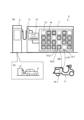
- FIG. 1 is a diagram showing the configuration of a shared battery charging facility according to an embodiment of the present invention
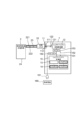
- FIG. 2 is a diagram illustrating an example of an electrical configuration of the shared battery charging facility of FIG. 1.
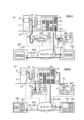
- FIG. 2 is a diagram showing an overview of an embodiment of the shared battery charging facility of FIG. 1.
- FIG. 4 is a block diagram showing a current flow from the vehicle rapid charging facility to the shared battery charging facility and the plug-in electric vehicle in the embodiment (ii) of FIG. 3 .
- FIG. 1 is a diagram illustrating a battery sharing service system according to an application example of an embodiment of the present invention.
- FIG. 1 is a diagram showing the configuration of a shared battery charging equipment 1 according to an embodiment of the present invention.
- the shared battery charging equipment 1 shown in part (a) of Fig. 1 has a plurality of slots 13.
- the plurality of slots 13 are configured to be capable of accommodating and charging shared batteries 14.
- the shared batteries 14 are batteries provided for a battery sharing service.
- the shared battery 14 is detachably attached by a user of the battery sharing service to an electric device such as the electric motorcycle 3.
- the electric motorcycle 3 with the charged shared battery 14 attached becomes capable of traveling.
- the shared battery charging equipment 1 for example, accepts a used shared battery 14-1 into an empty slot 13-1 ((A) in part (a) of FIG.
- the shared battery charging equipment 1 is configured as a swapping-type shared battery charging equipment that enables battery swapping.
- the slots 13-1 and 13-2 are each one of the slots 13
- the shared batteries 14-1 and 14-2 are each one of the shared batteries 14.
- the shared battery charging facility 1 in part (a) of FIG. 1 includes a rapid charging standard power receiving unit 11 and a swapping type shared battery charging control unit 12.
- the rapid charging standard power receiving unit 11 is electrically connected to the vehicle rapid charging equipment 2.
- the rapid charging standard power receiving unit 11 complies with the rapid charging standard. By complying with the rapid charging standard, the rapid charging standard power receiving unit 11 is able to receive power from the vehicle rapid charging equipment 2 and communicate with the vehicle rapid charging equipment 2.
- the swapping type shared battery charging control unit 12 charges the shared battery 14 accommodated in the slot 13 with power supplied from the vehicle rapid charging equipment 2 via the rapid charging standard power receiving unit 11 so as to be provided for the battery sharing service.
- the shared battery 14 accommodated in the slot and charged so as to be provided for the battery sharing service can be removed from the slot 13.
- the swapping type shared battery charging control unit 12 will also be simply referred to as the shared battery charging control unit 12.
- the shared battery charging equipment 1 is electrically connected to the vehicle rapid charging equipment 2, and can charge the shared battery 14 accommodated in the slot 13 with the power supplied from the vehicle rapid charging equipment 2. In other words, the shared battery charging equipment 1 can charge the shared battery 14 accommodated in the slot 13 using the power output by the vehicle rapid charging equipment 2. Therefore, the shared battery charging equipment 1 can charge the shared battery 14 without being connected to a high-power commercial power source for charging the shared battery 14. Therefore, the shared battery charging equipment 1 can be installed in a location where the vehicle rapid charging equipment 2 is already installed, without having to perform construction work to install a commercial power source, such as a high-power commercial power source, for charging the shared battery. Therefore, the shared battery charging equipment 1 can be installed more easily than, for example, a case in which construction work is performed to install a separate power line for charging the shared battery 14.
- the vehicle rapid charging equipment 2 is a shared rapid charging equipment for plug-in vehicles that is installed in a rapid charging station 5, which is a shared space for rapid charging of plug-in electric vehicles 4, and is used by multiple users.
- the vehicle rapid charging equipment 2 itself has a structure for rapid charging of the plug-in electric vehicle 4 (see part (b) of FIG. 1).
- the rapid charging of the plug-in electric vehicle 4 by the vehicle rapid charging equipment 2 in this embodiment will be described in detail in the examples described later.
- the rapid charging standard power receiving unit 11 of the shared battery charging equipment 1 is electrically connected to the vehicle rapid charging equipment 2.
- the shared battery charging equipment 1 is installed, for example, close to a parking space of a rapid charging station 5 for parking a plug-in electric vehicle 4 during charging.
- the shared battery charging equipment 1 is installed around the vehicle rapid charging equipment 2, for example, an electric two-wheeled vehicle 3 equipped with a shared battery to be used for battery swapping, or a vehicle transporting a shared battery to be used for battery swapping, can also use the parking space when swapping the shared batteries 14-1, 14-2.
- the shared battery charging equipment 1 can popularize charging equipment for the shared batteries 14 provided for the battery sharing service. Furthermore, the shared battery charging equipment 1 includes a rapid charging standard power receiving unit 11 electrically connected to the vehicle rapid charging equipment 2, and is therefore capable of receiving a supply of high voltage and high current power from the vehicle rapid charging equipment 2. On the other hand, the power required when charging the shared battery 14 is generally set low in both voltage and current. Therefore, the shared battery charging equipment 1 can utilize the power of the vehicle rapid charging equipment 2.
- FIG. 2 is a diagram showing an example of the electrical configuration of the shared battery charging facility 1 in Figure 1.
- the rapid charging standard power receiving unit 11 of the shared battery charging equipment 1 has a structure to be connected to a charging plug 22 of the vehicle rapid charging equipment 2.
- the charging plug 22 is connected to a main body 24 of the vehicle rapid charging equipment 2 by a charging cable 23.
- a power line 221 and a communication line 222 are built into the charging cable 23 and the charging plug 22.
- the rapid charging standard power receiving unit 11 of the shared battery charging equipment 1 has a connection unit 111 to which the power line 221 of the vehicle rapid charging equipment 2 is connected, and a connection unit 112 to which the communication line 222 is connected.
- the rapid charging standard power receiving unit 11 and the shared battery charging control unit 12 are connected by a power line 121 and a communication line 122.
- the rapid charging standard power receiving unit 11 is configured in a receptacle shape that receives the charging plug 22.
- the shared battery charging facility 1 shown in FIG. 2 only one rapid charging standard power receiving unit 11 is provided in principle, but the number of rapid charging standard power receiving units 11 is not particularly limited, and there may be a plurality of rapid charging standard power receiving units 11.
- the shared battery charging equipment 1 includes a shared battery charging unit 15.
- the slots 13 are arranged in the shared battery charging unit 15.
- the shared battery charging unit 15 is connected to the shared battery charging control unit 12 by a power line 151 and a communication line 152.
- the power line 151 connects the shared battery charging control unit 12 and the shared battery charging unit 15 via a DC/DC converter 153.
- the shared battery charging unit 15 charges each of the shared batteries 14 accommodated in the slots 13 with power supplied from the vehicle rapid charging equipment 2.
- the shared battery charging control unit 12 of the shared battery charging equipment 1 communicates with the vehicle rapid charging equipment 2 via the rapid charging standard power receiving unit 11.
- the shared battery charging control unit 12 is configured to control the acceptance of the supply of power for charging the shared battery 14 from the vehicle rapid charging equipment 2 via the rapid charging standard power receiving unit 11.
- the shared battery charging control unit 12 communicates with the vehicle rapid charging equipment 2 via communication lines 222 and 122.
- the vehicle rapid charging equipment 2 supplies power to the shared battery charging equipment 1 via the power line 221.
- the power supplied to the shared battery charging equipment 1 is supplied from the rapid charging standard power receiving unit 11 to the shared battery charging unit 15 via the power line 121, the shared battery charging control unit 12, and the power line 151, and charges the shared batteries 14 accommodated in the slots 13.
- the shared battery charging control unit 12 communicates with the vehicle rapid charging equipment 2 using the communication standard of the rapid charging standard.
- the shared battery charging control unit 12 controls the supply of power from the vehicle rapid charging equipment 2 according to the power standard of the rapid charging standard. Therefore, the shared battery charging equipment 1 can easily use existing vehicle rapid charging equipment or newly installed vehicle rapid charging equipment. As a result, the shared battery charging equipment 1 can popularize charging equipment for shared batteries provided for battery sharing services.
- the shared battery charging equipment 1 receives power from the vehicle rapid charging equipment 2, but may also have a power supply unit that can receive power directly from a commercial power source 180 (dashed line).
- the additional components are a commercial power plug 181 and an AC/DC converter 182.
- the commercial power plug 181 is electrically connected to the shared battery charging unit 15 via the AC/DC converter 182 (dashed line). These are used to perform the minimum operation for swapping the shared battery 14 when the shared battery charging equipment 1 cannot receive power from the vehicle rapid charging equipment 2 due to, for example, a failure of the vehicle rapid charging equipment 2.
- Fig. 3 is a diagram showing an outline of the embodiment of the shared battery charging facility 1 of Fig. 1 .
- the shared battery charging facility 1 can be configured in the following two embodiments (i) or (ii). Part (a) of Fig. 3 shows the configuration of embodiment (i), and part (b) of Fig. 3 shows the configuration of embodiment (ii).
- Example (i) The rapid charging standard power receiving unit 11 of the shared battery charging equipment 1 is provided in the vehicle rapid charging equipment 2 and is configured to enable removal and attachment of a charging plug 22 that complies with the rapid charging standard.
- Removal refers to removal of the charging plug 22 from the rapid charging standard power receiving unit 11 in order to connect to the plug-in electric vehicle 4 when the charging plug 22 is used for rapid charging the plug-in electric vehicle 4.
- Attachment refers to attachment to the rapid charging standard power receiving unit 11 so that the vehicle rapid charging equipment 2 and the rapid charging standard power receiving unit 11 are electrically connected when the charging plug 22 is not used for rapid charging the plug-in electric vehicle 4.
- Example (ii) The rapid charging standard power receiving unit 11 of the shared battery charging equipment 1 is provided in the vehicle rapid charging equipment 2 and is configured to be connected to a charging plug 22 that complies with the rapid charging standard.
- the shared battery charging equipment 1 further includes an extension charging plug 16.
- the extension charging plug 16 is connectable to a plug-in electric vehicle 4 and complies with the rapid charging standard.
- the shared battery charging facility 1 may be configured to have both the configurations of embodiment (i) and (ii).
- the rapid charging standard power receiving unit 11 of the shared battery charging equipment 1 is configured so that the charging plug 22 of the vehicle rapid charging equipment 2 can be removed and attached.
- the charging plug 22 is removed from the rapid charging standard power receiving unit 11 of the shared battery charging equipment 1 and connected to the plug-in electric vehicle 4.
- the charging plug 22 is connected to the rapid charging standard power receiving unit 11 of the shared battery charging equipment 1.
- the charging plug 22 is returned to the shared battery charging equipment 1. Therefore, the plug-in electric vehicle 4 can be charged by the vehicle rapid charging equipment 2 alone, without going through the shared battery charging equipment 1, and when the plug-in electric vehicle 4 is not being charged, the shared battery 14 is charged.
- the shared battery 14 cannot be charged in the shared battery charging equipment 1.
- the shared battery charging equipment 1 can perform battery swapping of the shared battery 14 (allowing removal of a charged shared battery 14 and storing a discharged shared battery 14).
- the power of the shared battery 14 stored in the shared battery charging equipment 1 can be used as power for communicating replacement instructions, displaying, etc.
- the vehicle rapid charging equipment 2 has a charging plug hold 25 that holds the charging plug 22 during non-vehicle charging when the plug-in electric vehicle 4 is not being charged.
- a charging plug hold cover 26 is attached to the charging plug hold 25 so as to prevent the charging plug 22 from being held by the charging plug hold 25.
- the shared battery charging equipment 1 charges the shared battery 14 using power output from the existing vehicle rapid charging equipment 2.
- the shared battery 14 is charged during non-vehicle charging when the vehicle rapid charging equipment 2 is not charging the plug-in electric vehicle 4, so the output of the vehicle rapid charging equipment 2 can be used efficiently.
- the frequency of charging the plug-in electric vehicle 4 by the vehicle rapid charging equipment 2 often peaks during the daytime, for example, and is off-peak at night. For this reason, according to this embodiment, it is possible to concentrate the power supply to the shared battery charging equipment 1 during the nighttime. By using power at night, charging costs can be reduced, and long-term charging is possible during off-peak hours, so the shared battery can be charged efficiently at low cost.
- the shared battery charging equipment 1 can effectively utilize the time when the vehicle rapid charging equipment 2 is not charging the plug-in electric vehicle 4. Therefore, the shared battery charging equipment 1 can make use of the existing vehicle rapid charging equipment 2 and charge the shared battery 14 in addition to the plug-in electric vehicle 4. As a result, the shared battery charging equipment 1 can popularize charging equipment for shared batteries 14 provided for battery sharing services.
- the vehicle rapid charging equipment 2 may have multiple sets of charging plugs 22 and charging cables 23.
- the second set of charging plugs 22-1 and charging cables 23-1 is shown by dashed lines.
- the vehicle rapid charging equipment 2 can simultaneously charge both the plug-in electric vehicle 4 and the shared battery 14 of the shared battery charging equipment 1. Therefore, the vehicle rapid charging equipment 2 can prevent the shared battery 14 of the shared battery charging equipment 1 from being unable to be charged.
- the charging plug 22-1 of the vehicle rapid charging equipment 2 is held in the charging plug hold 25-1 (dashed line) during non-vehicle charging when the plug-in electric vehicle 4 is not being charged.
- the shared battery charging equipment 1 has an extended charging plug 16.
- the extended charging plug 16 is provided to charge the plug-in electric vehicle 4 parked in the quick charging station 5.
- the shared battery charging control unit 12 supplies the power supplied from the vehicle quick charging equipment 2 via the quick charging standard power receiving unit 11 to the plug-in electric vehicle 4 via the extended charging plug 16 without via the shared battery 14 to the plug-in electric vehicle 4.
- FIG. 4 is a block diagram showing the flow of current from the vehicle quick charging equipment 2 to the shared battery charging equipment 1 and the plug-in electric vehicle 4 in embodiment (ii).
- the shared battery charging equipment 1 can use the extended charging plug 16 to charge the plug-in electric vehicle 4 parked at the rapid charging station 5.
- a user of the rapid charging station 5 connects the extended charging plug 16 to the plug-in electric vehicle 4 in order to charge the plug-in electric vehicle 4.
- the plug-in electric vehicle 4 communicates with the shared battery charging control unit 12 and the vehicle rapid charging equipment 2.
- the communication is performed via communication lines 222, 122 and a communication line 162 connected to the extended charging plug 16.
- power is supplied from the vehicle rapid charging equipment 2 to the plug-in electric vehicle 4 via the shared battery charging equipment 1.
- the power supplied from the vehicle rapid charging equipment 2 is supplied to the plug-in electric vehicle 4 without passing through the shared battery 14. Specifically, the current is supplied through the power lines 221, 121 and the power line 161 connected to the extended charging plug 16, and the shared battery charging control unit 12 (route X). This allows the vehicle rapid charging equipment 2 to charge the plug-in electric vehicle 4 without supplying power to the shared battery 14, even through the shared battery charging equipment 1. Therefore, the vehicle rapid charging equipment 2 can charge the plug-in electric vehicle 4 with the same power as when the charging plug 22 is directly connected to the plug-in electric vehicle 4.
- the shared battery charging control unit 12 of the shared battery charging equipment 1 communicates with the vehicle rapid charging equipment 2 and the shared battery charging unit 15.
- the communication is performed through communication lines 222, 122, and 152.
- power is supplied from the vehicle rapid charging equipment 2 to the shared battery 14 of the shared battery charging equipment 1.
- a current is supplied through the power lines 221, 121, and 151 and the shared battery charging control unit 12 (route Y).
- the plug-in electric vehicle 4 when the plug-in electric vehicle 4 is not being charged (when a vehicle is not being charged), the power from the vehicle rapid charging equipment 2 can be used to charge the shared battery 14 accommodated in the shared battery charging equipment 1. Therefore, in the embodiment (ii), similarly to the embodiment (i), the shared battery charging equipment 1 can efficiently utilize the spare time of the vehicle rapid charging equipment 2. Charging at night is also efficient, similarly to the embodiment (i). As a result, in the embodiment (ii), battery swapping and charging of the plug-in electric vehicle 4 can be realized using the same facility with a relatively simple configuration.
- the shared battery charging equipment 1 can charge the plug-in electric vehicle 4 with further increased power.
- a second example of vehicle charging by the vehicle rapid charging equipment 2 will be described with reference to part (c) of FIG. 4 .
- the shared battery charging equipment 1 is configured to supply power discharged from the shared battery 14 to the plug-in electric vehicle 4 via the extended charging plug 16 in addition to the power supplied from the vehicle rapid charging equipment 2 via the rapid charging standard power receiving unit 11 when the extended charging plug 16 is connected to the plug-in electric vehicle 4.
- the plug-in electric vehicle 4 communicates with the vehicle rapid charging equipment 2 and the shared battery charging control unit 12. The communication is performed via communication lines 222, 122 and a communication line 162.
- the shared battery charging control unit 12 also communicates with the shared battery charging unit 15 via a communication line 152. As a result of the communication, current is supplied from the vehicle rapid charging equipment 2 to the plug-in electric vehicle 4 through the power lines 221, 121, and 161 and the shared battery charging control unit 12 (route Z1). Also, current is supplied from the shared battery 14 of the shared battery charging unit 15 to the plug-in electric vehicle 4 through the power lines 151 and 161 and the shared battery charging control unit 12 (route Z2). This allows the shared battery charging equipment 1 to simultaneously supply power from both the vehicle rapid charging equipment 2 and the shared battery 14 to the plug-in electric vehicle 4. As a result, the shared battery charging equipment 1 can supply greater power to the plug-in electric vehicle 4 than the power supplied by the vehicle rapid charging equipment 2.
- the shared battery charging equipment 1 can rapid charge the plug-in electric vehicle 4 at a higher rate than when only the vehicle rapid charging equipment 2 is used. Due to the advantages of the shared battery charging equipment 1 for charging the plug-in electric vehicle 4, it is possible to popularize the use of charging equipment for the shared battery 14 provided for the battery sharing service.
- the rapid charging standard power receiving unit 11 may be configured so that the charging plug 22 is connected in a manner that can prevent or suppress removal of the charging plug 22 by a user.
- the rapid charging standard power receiving unit 11 may be configured in a manner that includes a locking mechanism for prohibiting removal of the charging plug 22 from the rapid charging standard power receiving unit 11.
- two or more extended charging plugs 16 may be provided.
- the extended charging plugs 16 can be configured to have different quick charging standards.
- the first extended charging plug 16 may be configured to comply with a first quick charging standard exclusively for four-wheeled vehicles
- the second extended charging plug may be configured to comply with a second quick charging standard exclusively for electric saddle-type vehicles that do not use the shared battery 14.
- FIG. 5 is a diagram for explaining battery sharing service systems (1000-1 and 1000-2) according to an application example of the embodiment of the present invention.
- part (a) of FIG. 5 is a diagram for explaining a battery sharing service system 1000-1 according to an application example of the embodiment (i) of part (a) of FIG. 3.
- part (b) of FIG. 5 is a diagram for explaining a battery sharing service system 1000-2 according to an application example of the embodiment (ii) of part (b) of FIG. 3.
- the battery sharing service system 1000-1 includes a shared battery charging facility 1 and a battery sharing service management server 101.
- the battery sharing service management server 101 is capable of communicating with the shared battery charging facility 1 via a network 600.
- the battery sharing service management server 101 and the shared battery charging facility 1 are managed by a service provider 100 of the battery sharing service.
- a user 300 of the battery sharing service removes a shared battery 14 from a slot 13 of a shared battery charging facility 1.
- the removed shared battery 14 is referred to as a provided battery 14-n.
- the shared battery charging facility 1 transmits management data D1 indicating the provided battery 14-n and power amount data D2 corresponding to the amount of power charged to the provided battery 14-n to the battery sharing service management server 101.
- the power charged to the provided battery 14-n is supplied from the vehicle rapid charging facility 2 via the rapid charging standard power receiving unit 11 of the shared battery charging facility 1.
- the management data of the provided battery 14-n may be, for example, identification data of the shared battery charging facility 1 and the slot 13 that charged the provided battery 14-n, identification data of the provided battery 14-n, or identification data of a user who has permitted removal of the provided battery 14-n, or a combination of any two or more of these types of identification data.
- the battery sharing service management server 101 stores the management data D1 of the providing battery 14-n received from the shared battery charging facility 1 in association with the power amount data D2.
- the battery sharing service system 1000-2 can charge a plug-in type electric vehicle 4 with power from a vehicle rapid charging equipment 2 via an extended charging plug 16.
- the shared battery charging equipment 1 transmits the following power amount data D3 and D4 to the battery sharing service management server 101 in addition to the management data D1 and power amount data D2 of the battery sharing service system 1000-1 described above.
- Electricity amount data D3 Electricity amount data according to the amount of electricity supplied from the vehicle rapid charging equipment 2 to the shared battery charging equipment 1.
- Electricity amount data D4 Electricity amount data according to the amount of electricity charged from the shared battery 14 to the plug-in electric vehicle 4 (when electricity from the shared battery 14 of the shared battery charging equipment 1 is added to the charging of the plug-in electric vehicle 4 (see part (c) of FIG. 4 ).
- the battery sharing service management server 101 stores the electric energy data D3 and D4 acquired from the shared battery charging facility 1. At this time, if there is identification data of the owner of the plug-in electric vehicle 4, the identification data of the owner of the plug-in electric vehicle 4 may be stored in association with the acquired electric energy data D3 and D4.
- the battery sharing service management servers 101 of the battery sharing service systems 1000-1 (part (a) of FIG. 5) and 1000-2 (part (b) of FIG. 5) can communicate with the quick charging service management server 201 via a network 600. Furthermore, the quick charging service management server 201 can communicate with the vehicle quick charging equipment 2 via the network 600. The quick charging service management server 201 and the vehicle quick charging equipment 2 are managed by a service provider 200 of the quick charging service.
- the battery sharing service management server 101 transmits the above-mentioned energy data D2 to D4 (only D2 in embodiment (i) of part (a) of FIG. 5, and D2 to D4 in embodiment (ii) of part (b) of FIG.
- management data D5 indicating the shared battery charging equipment 1 to the rapid charging service management server 201.
- the management data D5 is a part of the management data D1.
- the rapid charging service management server 201 stores the energy data D2 to D4 in association with the management data D5 of the shared battery charging equipment 1.
- a service provider 100 of the battery sharing service can calculate fees based on data stored in a battery sharing service management server 101.
- a service provider 200 of the rapid charging service can calculate fees based on data stored in a rapid charging service management server 201.
- the battery sharing service systems 1000-1 and 1000-2 it is possible to manage charges for users of the battery sharing service independently of the vehicle shared rapid charging facility 2.
- the fee calculated by the battery sharing service management server 101 can be transmitted via the network 600 to a portable information terminal 301 owned by the user 300 of the battery sharing service and a portable information terminal 401 owned by the owner 400 of the plug-in electric vehicle 4.
- the fee calculated by the rapid charging service management server 201 can be transmitted via the network 600 to the portable information terminal 401 owned by the owner 400 of the plug-in electric vehicle 4.
- the portable information terminals 301 and 401 are, for example, smartphones.
- the management data of the provided battery 14-n is stored in association with the power amount data so that the user's payment for the battery sharing service can be made to the battery sharing service without being made to the vehicle rapid charging equipment 2 or its service.
- the management data of the provided battery 14-n is stored in association with the power amount data so that the user's payment for the battery sharing service can be made in the battery sharing service, independent of the vehicle rapid charging equipment 2 or its service.
- the battery sharing service system can be separated from the vehicle rapid charging equipment 2 or its service in terms of the billing of the user for the battery sharing service. This enables efficient management of users of the battery sharing service, and the use of charging equipment for shared batteries provided for the battery sharing service can be popularized.
Landscapes
- Engineering & Computer Science (AREA)
- Power Engineering (AREA)
- Charge And Discharge Circuits For Batteries Or The Like (AREA)
- Electric Propulsion And Braking For Vehicles (AREA)
Priority Applications (3)
| Application Number | Priority Date | Filing Date | Title |
|---|---|---|---|
| PCT/JP2022/042963 WO2024111017A1 (ja) | 2022-11-21 | 2022-11-21 | スワッピング式シェアドバッテリ充電設備 |
| JP2024559738A JPWO2024111017A1 (https=) | 2022-11-21 | 2022-11-21 | |
| TW112139724A TWI887811B (zh) | 2022-11-21 | 2023-10-18 | 置換式共享電池充電設備 |
Applications Claiming Priority (1)
| Application Number | Priority Date | Filing Date | Title |
|---|---|---|---|
| PCT/JP2022/042963 WO2024111017A1 (ja) | 2022-11-21 | 2022-11-21 | スワッピング式シェアドバッテリ充電設備 |
Publications (1)
| Publication Number | Publication Date |
|---|---|
| WO2024111017A1 true WO2024111017A1 (ja) | 2024-05-30 |
Family
ID=91195806
Family Applications (1)
| Application Number | Title | Priority Date | Filing Date |
|---|---|---|---|
| PCT/JP2022/042963 Ceased WO2024111017A1 (ja) | 2022-11-21 | 2022-11-21 | スワッピング式シェアドバッテリ充電設備 |
Country Status (3)
| Country | Link |
|---|---|
| JP (1) | JPWO2024111017A1 (https=) |
| TW (1) | TWI887811B (https=) |
| WO (1) | WO2024111017A1 (https=) |
Citations (2)
| Publication number | Priority date | Publication date | Assignee | Title |
|---|---|---|---|---|
| JPH04358950A (ja) * | 1991-05-31 | 1992-12-11 | Honda Motor Co Ltd | 電動式車両 |
| JP2019004693A (ja) * | 2013-07-04 | 2019-01-10 | レスク株式会社 | 電動車両用バッテリ交換システム及びプログラム |
Family Cites Families (5)
| Publication number | Priority date | Publication date | Assignee | Title |
|---|---|---|---|---|
| JP2001211554A (ja) * | 2000-01-26 | 2001-08-03 | Honda Motor Co Ltd | 電動車両用充電装置 |
| JP2010110044A (ja) * | 2008-10-28 | 2010-05-13 | Shikoku Electric Power Co Inc | 電動車両用充電装置 |
| US11447105B2 (en) * | 2018-03-29 | 2022-09-20 | Gogoro Inc. | Systems and methods for managing batteries in a battery exchange station |
| WO2020059833A1 (ja) * | 2018-09-20 | 2020-03-26 | 本田技研工業株式会社 | 蓄電装置管理システム、保管装置、サーバー装置、蓄電装置管理方法、プログラム、および記憶媒体 |
| CN111216591B (zh) * | 2020-01-07 | 2022-08-12 | 董摄 | 一种电动车公共电池更换系统及其使用方法 |
-
2022
- 2022-11-21 JP JP2024559738A patent/JPWO2024111017A1/ja not_active Ceased
- 2022-11-21 WO PCT/JP2022/042963 patent/WO2024111017A1/ja not_active Ceased
-
2023
- 2023-10-18 TW TW112139724A patent/TWI887811B/zh active
Patent Citations (2)
| Publication number | Priority date | Publication date | Assignee | Title |
|---|---|---|---|---|
| JPH04358950A (ja) * | 1991-05-31 | 1992-12-11 | Honda Motor Co Ltd | 電動式車両 |
| JP2019004693A (ja) * | 2013-07-04 | 2019-01-10 | レスク株式会社 | 電動車両用バッテリ交換システム及びプログラム |
Also Published As
| Publication number | Publication date |
|---|---|
| TWI887811B (zh) | 2025-06-21 |
| JPWO2024111017A1 (https=) | 2024-05-30 |
| TW202422992A (zh) | 2024-06-01 |
Similar Documents
| Publication | Publication Date | Title |
|---|---|---|
| US10946758B2 (en) | Light electric vehicle parking and charging stations and smart charging systems for the vehicle batteries | |
| JP5596789B2 (ja) | 電池を動力源とする車両における貯蔵エネルギー管理の方法および装置 | |
| CN107554318B (zh) | 缆上控制盒、电动车辆充电方法及供应设备通信控制器 | |
| CN110329106A (zh) | 一种无需充电桩的电动车的快速充电系统及方法 | |
| US8085034B2 (en) | Managing charging of electric vehicles | |
| CN214396452U (zh) | 换电柜、换电系统及组合适配器 | |
| US20100230188A1 (en) | Electric Vehicle Having Exchangeable Battery Modules and Method of Resupply Therefor | |
| US20130138542A1 (en) | Managing charging of electric vehicles | |
| Nanaki | Electric vehicles for smart cities: trends, challenges, and opportunities | |
| CN102763302A (zh) | 储能和充电装置 | |
| WO2008070163A2 (en) | Plug-in vehicle | |
| US20160039299A1 (en) | Electric Vehicle Having Exchangeable Battery Modules and Method of Resupply Therefor | |
| US10926644B1 (en) | Compact electric vehicle fast charger with energy storage | |
| KR102194678B1 (ko) | 요금 설정 장치, 요금 설정 방법 및 요금 설정 시스템 | |
| KR102432038B1 (ko) | 전기차 충전 케이블에 탑재되는 인-케이블 컨트롤 박스 및 이를 이용한 전기차 충전 방법 | |
| US12558989B2 (en) | Integrated multi-port electric vehicle (EV) charging system | |
| WO2023005212A1 (zh) | 储能模块、车载充电系统及其充电方法 | |
| JP2022075352A (ja) | 充電管理システム、充電システム、充電管理方法、及びプログラム | |
| Chakravarthy et al. | Review on charging methods and charging solutions for electric vehicles | |
| WO2024111017A1 (ja) | スワッピング式シェアドバッテリ充電設備 | |
| Sivaraman et al. | Fast-Charging Infrastructure for Electric and Hybrid Electric Vehicles: Methods for Large-Scale Penetration Into Electric Distribution Networks | |
| US20260084564A1 (en) | Mobile charging station and method for charging electric vehicles in a mobile manner | |
| JP2004173467A (ja) | モータ駆動車両向け電力供給方法 | |
| Kumar et al. | Battery Swapping Stations-A Viable Option for Faster Adoption of EVs in India | |
| CN211731060U (zh) | 一种插入式可交换电池系统装置及电动车 |
Legal Events
| Date | Code | Title | Description |
|---|---|---|---|
| 121 | Ep: the epo has been informed by wipo that ep was designated in this application |
Ref document number: 22966428 Country of ref document: EP Kind code of ref document: A1 |
|
| WWE | Wipo information: entry into national phase |
Ref document number: 2024559738 Country of ref document: JP |
|
| NENP | Non-entry into the national phase |
Ref country code: DE |
|
| 122 | Ep: pct application non-entry in european phase |
Ref document number: 22966428 Country of ref document: EP Kind code of ref document: A1 |