WO2024101285A1 - 炭酸カルシウム配合セメント組成物用分散剤及び炭酸カルシウム配合セメント組成物 - Google Patents
炭酸カルシウム配合セメント組成物用分散剤及び炭酸カルシウム配合セメント組成物 Download PDFInfo
- Publication number
- WO2024101285A1 WO2024101285A1 PCT/JP2023/039791 JP2023039791W WO2024101285A1 WO 2024101285 A1 WO2024101285 A1 WO 2024101285A1 JP 2023039791 W JP2023039791 W JP 2023039791W WO 2024101285 A1 WO2024101285 A1 WO 2024101285A1
- Authority
- WO
- WIPO (PCT)
- Prior art keywords
- calcium carbonate
- mass
- dispersant
- cement composition
- group
- Prior art date
- Legal status (The legal status is an assumption and is not a legal conclusion. Google has not performed a legal analysis and makes no representation as to the accuracy of the status listed.)
- Ceased
Links
Classifications
-
- C—CHEMISTRY; METALLURGY
- C04—CEMENTS; CONCRETE; ARTIFICIAL STONE; CERAMICS; REFRACTORIES
- C04B—LIME, MAGNESIA; SLAG; CEMENTS; COMPOSITIONS THEREOF, e.g. MORTARS, CONCRETE OR LIKE BUILDING MATERIALS; ARTIFICIAL STONE; CERAMICS; REFRACTORIES; TREATMENT OF NATURAL STONE
- C04B14/00—Use of inorganic materials as fillers, e.g. pigments, for mortars, concrete or artificial stone; Treatment of inorganic materials specially adapted to enhance their filling properties in mortars, concrete or artificial stone
- C04B14/02—Granular materials, e.g. microballoons
- C04B14/26—Carbonates
- C04B14/28—Carbonates of calcium
-
- C—CHEMISTRY; METALLURGY
- C04—CEMENTS; CONCRETE; ARTIFICIAL STONE; CERAMICS; REFRACTORIES
- C04B—LIME, MAGNESIA; SLAG; CEMENTS; COMPOSITIONS THEREOF, e.g. MORTARS, CONCRETE OR LIKE BUILDING MATERIALS; ARTIFICIAL STONE; CERAMICS; REFRACTORIES; TREATMENT OF NATURAL STONE
- C04B24/00—Use of organic materials as active ingredients for mortars, concrete or artificial stone, e.g. plasticisers
- C04B24/24—Macromolecular compounds
- C04B24/26—Macromolecular compounds obtained by reactions only involving carbon-to-carbon unsaturated bonds
-
- C—CHEMISTRY; METALLURGY
- C04—CEMENTS; CONCRETE; ARTIFICIAL STONE; CERAMICS; REFRACTORIES
- C04B—LIME, MAGNESIA; SLAG; CEMENTS; COMPOSITIONS THEREOF, e.g. MORTARS, CONCRETE OR LIKE BUILDING MATERIALS; ARTIFICIAL STONE; CERAMICS; REFRACTORIES; TREATMENT OF NATURAL STONE
- C04B28/00—Compositions of mortars, concrete or artificial stone, containing inorganic binders or the reaction product of an inorganic and an organic binder, e.g. polycarboxylate cements
- C04B28/02—Compositions of mortars, concrete or artificial stone, containing inorganic binders or the reaction product of an inorganic and an organic binder, e.g. polycarboxylate cements containing hydraulic cements other than calcium sulfates
Definitions
- the present invention relates to a dispersant for a calcium carbonate-containing cement composition and a calcium carbonate-containing cement composition.
- cement dispersants are generally added to cement compositions for the purpose of increasing fluidity, etc.
- Cement dispersants used in cement compositions that may contain calcium carbonate as a component have been disclosed, including one that uses a modified acrylic acid polymer of a specific structure as a dispersant (see Patent Document 1).
- Patent Documents 2 to 4 also disclosed are concrete compositions (Patent Documents 2 to 4) and hydraulic blast furnace slag compositions (Patent Document 5), which contain a water-soluble vinyl copolymer of a specific structure as an admixture, such as a water-soluble vinyl copolymer having a structural unit containing at least one selected from maleic acid and maleic anhydride, a water-soluble vinyl copolymer of a specific molecular weight having a specific ratio of one or more structural units X selected from structural units formed from methacrylic acid and structural units formed from methacrylates, a structural unit Y formed from a specific methoxypolyethylene glycol methacrylate, a structural unit formed from a (meth)allyl sulfonate, and one or more structural units Z selected from structural units formed from methyl (meth)acrylate, and a PC grout composition (Patent Document 6), which contains a PC grout dispersant containing a polycarboxylic acid copolymer of a
- dispersants for use in cement compositions containing calcium carbonate as an ingredient have been disclosed, but the dispersing performance of these dispersants when used in cement compositions containing calcium carbonate is insufficient, and there is room for the development of a dispersant that can further reduce the viscosity of the cement composition and improve its workability.
- the present invention was made in consideration of the above-mentioned current situation, and aims to provide a dispersant that can effectively reduce the viscosity of cement compositions containing calcium carbonate.
- the present inventors have investigated dispersants for use in cement compositions containing calcium carbonate, and have discovered that a copolymer having a structural unit derived from an unsaturated polyalkylene glycol ether monomer of a specified structure and a structural unit derived from an unsaturated carboxylic acid monomer, in which the content ratio of the structural unit derived from the unsaturated carboxylic acid monomer and the molecular weight are within a specified range, can effectively reduce the viscosity of a cement composition containing calcium carbonate, thus arriving at the present invention.
- R 1 , R 2 and R 3 are the same or different and represent a hydrogen atom or a methyl group;
- R 4 represents a direct bond, a CH 2 group or a CH 2 CH 2 group;
- AO are the same or different and represent an oxyalkylene group having 2 to 18 carbon atoms;
- n represents the number of repetitions of the oxyalkylene group and is a number from 1 to 300; and
- R 5 represents a hydrogen atom or a hydrocarbon group having 1 to 18 carbon atoms
- a dispersant for a calcium carbonate-containing cement composition comprising a copolymer having a weight-average molecular weight of 5,000 to 35,000.
- a dispersant for a calcium carbonate-containing cement composition according to any one of [1] to [3], characterized in that it is used in a calcium carbonate-containing cement composition containing 5 to 50 mass% calcium carbonate.
- a calcium carbonate-blended cement composition comprising a dispersant for calcium carbonate-blended cement compositions according to any one of [1] to [4], cement, and 5 to 95% by mass of calcium carbonate relative to the total mass of the composition.
- the dispersant for calcium carbonate-containing cement compositions of the present invention is a useful dispersant that can effectively reduce the viscosity of cement compositions containing calcium carbonate and improve the workability at the site where the cement composition is used.
- Dispersant for calcium carbonate-blended cement composition is a dispersant represented by the following formula (1);
- R 1 , R 2 and R 3 are the same or different and each represents a hydrogen atom or a methyl group;
- R 4 is a direct bond, a CH 2 group or a CH 2 CH 2 group;
- AO are the same or different and each represents an oxyalkylene group having 2 to 18 carbon atoms;
- n is the number of repetitions of the oxyalkylene group and is a number from 1 to 300;
- R 5 is a hydrogen atom or a hydrocarbon group having 1 to 18 carbon atoms.
- a structural unit derived from an unsaturated carboxylic acid monomer the content of the structural unit derived from the unsaturated carboxylic acid monomer being 20 to 70 mass% relative to 100 mass% of all structural units, and the weight average molecular weight being 5,000 to 35,000.
- the structural unit derived from a monomer is not limited to one formed by polymerizing a monomer, and may be one formed by a reaction other than a polymerization reaction.
- AO may be the same or different and represent an oxyalkylene group having 2 to 18 carbon atoms, preferably an oxyalkylene group having 2 to 8 carbon atoms, and more preferably an oxyalkylene group having 2 to 4 carbon atoms.
- the oxyalkylene group is preferably ethylene oxide, propylene oxide, or butylene oxide, and more preferably ethylene oxide or propylene oxide.
- the oxyalkylene group is an adduct of any two or more kinds of alkylene oxides selected from ethylene oxide, propylene oxide, butylene oxide, etc., it may be in any form of random addition, block addition, alternating addition, etc.
- the oxyalkylene groups in the polyalkylene glycol have oxyethylene groups as an essential component, more preferably 50 mol % or more of oxyethylene groups, even more preferably 80 mol % or more of oxyethylene groups, and particularly preferably 90 mol % or more of oxyethylene groups.
- n represents the number of repeats of the oxyalkylene group and is a number between 1 and 300, preferably between 30 and 300, more preferably between 32 and 250, even more preferably between 35 and 200, particularly preferably between 37 and 150, particularly preferably between 40 and 100, and most preferably between 45 and 70.
- R5 represents a hydrogen atom or a hydrocarbon group having 1 to 18 carbon atoms
- the hydrocarbon group is preferably one having 1 to 8 carbon atoms, more preferably one having 1 to 6 carbon atoms, and particularly preferably a hydrogen atom or a hydrocarbon group having 1 to 3 carbon atoms.
- the hydrocarbon group include an alkyl group (linear, branched, or cyclic), a phenyl group, an alkyl-substituted phenyl group, an alkenyl group, an alkynyl group, an aryl group, etc.
- an alkyl group linear, branched, or cyclic
- a methyl group, an ethyl group, or a propyl group is more preferred.
- the unsaturated polyalkylene glycol ether monomer represented by the above formula (1) includes, for example, compounds in which 1 to 500 moles of alkylene oxide are added to any one of vinyl alcohol, (meth)allyl alcohol, 3-methyl-3-buten-1-ol (isoprenol), 3-methyl-2-buten-1-ol, 2-methyl-3-buten-2-ol, 2-methyl-2-buten-1-ol, and 2-methyl-3-buten-1-ol, and one or more of these can be used.
- preferred are compounds in which 1 to 500 moles of alkylene oxide are added to vinyl alcohol, methallyl alcohol, and 3-methyl-3-buten-1-ol (isoprenol).
- vinyloxybutyl polyethylene glycol (a compound in which ethylene oxide is added to 4-hydroxybutyl-1-monovinyl ether), polyethylene glycol monoallyl ether, polyethylene glycol monomethallyl ether, polyethylene glycol mono(3-methyl-3-butenyl) ether, and the like, and one or more of these can be used.
- the content of the structural unit derived from the unsaturated polyalkylene glycol ether monomer represented by the above formula (1) is preferably 30 to 80% by mass relative to 100% by mass of all structural units. More preferably, it is 30 to 75% by mass, even more preferably 50 to 75% by mass, and particularly preferably 55 to 70% by mass.
- the above unsaturated carboxylic acid monomers include unsaturated monocarboxylic acid monomers having 3 to 12 carbon atoms, such as (meth)acrylic acid, crotonic acid, isocrotonic acid, tiglic acid, 3-methylcrotonic acid, 2-methyl-2-pentenoic acid, ⁇ -hydroxyacrylic acid, or salts thereof; unsaturated dicarboxylic acid monomers such as unsaturated dicarboxylic acids having 4 to 12 carbon atoms, such as fumaric acid, maleic acid, itaconic acid, citraconic acid, or salts thereof; half esters of the above unsaturated dicarboxylic acids with alcohols having 1 to 30 carbon atoms, which will be described later, and half amides of amines having 1 to 30 carbon atoms, etc.
- unsaturated monocarboxylic acid monomers having 3 to 12 carbon atoms such as (meth)acrylic acid, crotonic acid, isocrotonic acid, tiglic acid, 3-methylcrot
- the above salt is preferably a metal salt, an ammonium salt, an organic amine salt, etc.
- Suitable metal atoms forming the metal salt include, for example, monovalent metal atoms such as alkali metal atoms such as lithium, sodium, potassium, etc.; divalent metal atoms such as alkaline earth metal atoms such as calcium, magnesium, etc.; and trivalent metal atoms such as aluminum, iron, etc.
- Suitable organic amine salts include alkanolamine salts such as ethanolamine salts, diethanolamine salts, triethanolamine salts, etc., and triethylamine salts.
- the above salt is preferably an alkali metal salt, more preferably a sodium salt.
- Examples of the alcohol having 1 to 30 carbon atoms include aliphatic alcohols such as methanol, ethanol, 1-propanol, 2-propanol, 1-butanol, 2-butanol, 1-pentanol, 2-pentanol, 3-pentanol, 1-hexanol, 2-hexanol, 3-hexanol, octanol, 2-ethyl-1-hexanol, nonyl alcohol, lauryl alcohol, cetyl alcohol, and stearyl alcohol; alicyclic alcohols such as cyclohexanol; and unsaturated alcohols such as (meth)allyl alcohol, 3-buten-1-ol, and 3-methyl-3-buten-1-ol.
- aliphatic alcohols such as methanol, ethanol, 1-propanol, 2-propanol, 1-butanol, 2-butanol, 1-pentanol, 2-pentanol, 3-pentanol, 1-he
- Examples of the amine having 1 to 30 carbon atoms include aliphatic amines such as methylamine, dimethylamine, ethylamine, diethylamine, propylamine, dipropylamine, butylamine, dibutylamine, isopropylamine, and diisopropylamine.
- the unsaturated carboxylic acid monomer is preferably an unsaturated monocarboxylic acid monomer, more preferably (meth)acrylic acid, and particularly preferably acrylic acid.
- the content of the structural units derived from the unsaturated carboxylic acid monomer is 20 to 70% by mass, preferably 25 to 70% by mass, more preferably 25 to 50% by mass, and particularly preferably 30 to 45% by mass, based on 100% by mass of all structural units.
- the content (% by mass) is calculated in terms of the corresponding sodium salt.
- the mass ratio of the structural unit derived from methacrylic acid is calculated as the mass ratio (% by mass) of the corresponding sodium salt, sodium methacrylate.
- the copolymer may have a structural unit derived from a monomer other than the structural unit derived from the unsaturated polyalkylene glycol ether monomer represented by the above formula (1) and the structural unit derived from the unsaturated carboxylic acid monomer.
- Examples of other monomers include hydroxyalkyl (meth)acrylates such as hydroxyethyl (meth)acrylate and hydroxypropyl (meth)acrylate; esters of unsaturated monocarboxylic acids such as methyl (meth)acrylate and glycidyl (meth)acrylate with alcohols having 1 to 30 carbon atoms; diesters of unsaturated dicarboxylic acids such as maleic acid (anhydride), fumaric acid and itaconic acid with alcohols having 1 to 30 carbon atoms; diamides of the above unsaturated dicarboxylic acids with amines having 1 to 30 carbon atoms; alkylene esters of the above alcohols or amines having 2 to 18 carbon atoms; diesters of the above-mentioned unsaturated dicarboxylic acids and alkyl (poly)alkylene glycols to which 1 to 500 moles of an oxide have been added; diesters of the above-mentioned unsaturated dicarboxylic
- the content of structural units derived from other monomers is preferably 50% by mass or less relative to 100% by mass of all structural units. More preferably, it is 30% by mass or less, and even more preferably, it is 10% by mass or less.
- the weight-average molecular weight of the copolymer is 5,000 to 35,000, and the copolymer having such a weight-average molecular weight can provide a good balance between the effect of the cement composition having excellent fluidity and the effect of the solid content being less likely to separate and settle.
- the weight-average molecular weight of the copolymer is preferably 6,000 to 25,000, and more preferably 7,500 to 15,000.
- the weight average molecular weight of the copolymer can be measured by the method described in the Examples below.
- the calcium carbonate-blended cement composition in which the dispersant of the present invention is used contains 5 to 95% by mass of calcium carbonate.
- the dispersant of the present invention can effectively reduce the viscosity of such a calcium carbonate-blended cement composition while suppressing separation of the solid content, thereby improving workability at a construction site, and the cement composition in which the dispersant of the present invention is used preferably contains 5 to 50% by mass of calcium carbonate.
- the content ratio of calcium carbonate in the calcium carbonate-blended cement composition is more preferably 5 to 30% by mass.
- the content of calcium carbonate in the calcium carbonate-blended cement composition of the present invention is the ratio of calcium carbonate to the total amount of cement, hydraulic fine powder other than cement, and calcium carbonate, i.e., the amount of calcium carbonate/(amount of cement+amount of hydraulic fine powder other than cement+amount of calcium carbonate) (mass %).
- the method for producing the copolymer is not particularly limited, but the copolymer can be produced by polymerizing a monomer component containing a monomer that is a raw material for the copolymer. Specific examples and preferred examples of the monomers contained in the monomer component are as described above. In addition, the content ratio of each monomer component relative to 100% by mass of the total monomer components is preferably the same as the content ratio of each structural unit relative to 100% by mass of the total structural units described above.
- a chain transfer agent can be used to adjust the molecular weight of the resulting polymer.
- the chain transfer agent include thiol-based chain transfer agents such as mercaptoethanol, thioglycerol, thioglycolic acid, 3-mercaptopropionic acid, thiomalic acid, and 2-mercaptoethanesulfonic acid; secondary alcohols such as isopropyl alcohol; and hydrophilic chain transfer agents such as lower oxides and salts of phosphorous acid, hypophosphorous acid, and salts thereof (sodium hypophosphite, potassium hypophosphite, etc.), sulfurous acid, hydrogen sulfite, dithionous acid, metabisulfite, and salts thereof (sodium sulfite, sodium hydrogen sulfite, sodium dithionite, sodium metabisulfite, etc.).
- a hydrophobic chain transfer agent can also be used.
- a hydrophobic chain transfer agent for example, a thiol-based chain transfer agent having a hydrocarbon group having 3 or more carbon atoms, such as butanethiol, octanethiol, decanethiol, dodecanethiol, hexadecanethiol, octadecanethiol, cyclohexyl mercaptan, thiophenol, octyl thioglycolate, or octyl 3-mercaptopropionate, is preferably used.
- a monomer having high chain transfer property such as (meth)allylsulfonic acid (salts).
- the amount of the chain transfer agent used may be set appropriately, but is preferably 0.1 mol or more, more preferably 0.25 mol or more, and even more preferably 0.5 mol or more, relative to 100 mol of the total amount of the monomer components, and is preferably 20 mol or less, more preferably 15 mol or less, and even more preferably 10 mol or less.
- the above polymerization reaction can be carried out by a method such as solution polymerization or bulk polymerization, using a radical polymerization initiator as necessary.
- the solution polymerization can be carried out in a batch system, a continuous system, or a combination thereof.
- the solvent used in the polymerization examples include water; alcohols such as methyl alcohol, ethyl alcohol, and isopropyl alcohol; aromatic or aliphatic hydrocarbons such as benzene, toluene, xylene, cyclohexane, and n-hexane; ester compounds such as ethyl acetate; ketone compounds such as acetone and methyl ethyl ketone; and cyclic ether compounds such as tetrahydrofuran and dioxane.
- the polymerization by the aqueous solution polymerization method is preferable.
- a water-soluble polymerization initiator for example, persulfates such as ammonium persulfate, sodium persulfate, and potassium persulfate; hydrogen peroxide; azoamidine compounds such as 2,2'-azobis-2-methylpropionamidine hydrochloride, cyclic azoamidine compounds such as 2,2'-azobis-2-(2-imidazolin-2-yl)propane hydrochloride, water-soluble azo initiators such as azonitrile compounds such as 2-carbamoylazoisobutyronitrile, and the like are used, and in this case, an accelerator such as an alkali metal sulfite such as sodium hydrogensulfite, metabisulfite, sodium hypophosphite, Fe(II) salt such as Mohr's salt, sodium hydroxymethanesulfinate dihydrate, hydroxylamine hydrochloride, thi
- persulfates such as ammonium persulfate, sodium persulfate, potassium persulfate, etc.
- accelerators such as L-ascorbic acid (salts), etc.
- radical polymerization initiators When solution polymerization is carried out using a lower alcohol, an aromatic or aliphatic hydrocarbon, an ester compound, or a ketone compound as a solvent, or when bulk polymerization is carried out, peroxides such as benzoyl peroxide, lauroyl peroxide, and sodium peroxide; hydroperoxides such as t-butyl hydroperoxide and cumene hydroperoxide; and azo compounds such as azobisisobutyronitrile are used as radical polymerization initiators.
- accelerators such as amine compounds can also be used in combination.
- the above-mentioned various radical polymerization initiators or combinations of radical polymerization initiators and accelerators can be appropriately selected and used.
- the amount of the radical polymerization initiator used is preferably 0.001 mol or more, more preferably 0.01 mol or more, even more preferably 0.1 mol or more, particularly preferably 0.2 mol or more, and is preferably 20 mol or less, even more preferably 10 mol or less, particularly preferably 5 mol or less, and most preferably 3 mol or less, per 100 mol of the total amount of the monomer components.
- polymerization conditions such as polymerization temperature are appropriately determined depending on the polymerization method, solvent, polymerization initiator, and chain transfer agent used, but the polymerization temperature is preferably 0°C or higher and 150°C or lower. It is more preferably 30°C or higher, and even more preferably 50°C or higher. It is also more preferably 120°C or lower, and even more preferably 100°C or lower.
- the method of feeding each monomer component into the reaction vessel is not particularly limited, and examples thereof include a method of feeding the entire amount into the reaction vessel all at once at the beginning, a method of feeding the entire amount into the reaction vessel in portions or continuously, a method of feeding a portion into the reaction vessel at the beginning and feeding the remainder into the reaction vessel in portions or continuously, etc.
- the feeding rate of each monomer into the reaction vessel during the reaction may be changed continuously or stepwise to change the feeding weight ratio of each monomer per unit time continuously or stepwise, thereby synthesizing two or more copolymers having different monomer ratios simultaneously during the polymerization reaction.
- the radical polymerization initiator may be charged into the reaction vessel from the beginning, or may be added dropwise to the reaction vessel, or these may be combined depending on the purpose.
- the copolymer obtained by the above polymerization reaction can be used as a dispersant as it is, but if necessary, it may be further neutralized with an alkaline substance before use.
- Suitable alkaline substances include inorganic salts such as hydroxides and carbonates of monovalent or divalent metals; ammonia; and organic amines. Furthermore, after the reaction is completed, the concentration can be adjusted if necessary.
- Cement composition containing calcium carbonate The present invention also relates to a cement composition containing the dispersant for a cement composition containing calcium carbonate of the present invention, cement, and 5 to 95 mass % of calcium carbonate based on the total mass of the composition.
- the calcium carbonate-containing cement composition of the present invention is a cement composition having excellent fluidity due to the inclusion of the dispersant for a cement composition containing calcium carbonate of the present invention.
- the type of calcium carbonate contained in the calcium carbonate-blended cement composition of the present invention is not particularly limited, and may be light calcium carbonate (produced by a chemical reaction by blowing carbon dioxide into an aqueous calcium hydroxide solution) or heavy calcium carbonate (produced by excavating limestone and crushing or pulverizing it).
- calcium carbonate blended into cement as one of the responses to global environmental issues is light calcium carbonate produced by reacting carbon dioxide in the atmosphere with calcium, and it is one of the preferred embodiments of the present invention that the calcium carbonate-blended cement composition of the present invention contains such light calcium carbonate.
- the proportion of light calcium carbonate in the total calcium carbonate contained in the cement composition is not particularly limited, but it is preferable that the proportion of light calcium carbonate in the total calcium carbonate is 0 to 100 mass %. More preferably, it is 10 to 100 mass %, and even more preferably, it is 50 to 100 mass %.
- various Portland cements ordinary, early strength, extra early strength, moderate heat, low heat, sulfate resistant and their respective low alkali forms
- various blended cements blast furnace cement, silica cement, fly ash cement
- ecocement white Portland cement, alumina cement, etc.
- the calcium carbonate-blended cement composition of the present invention may contain hydraulic fine powder such as blast furnace slag, fly ash, silica fume, etc., and gypsum, and may further contain fine aggregate (sand, etc.), coarse aggregate (crushed stone, etc.), etc.
- aggregates include gravel, crushed stone, granulated slag, recycled aggregate, etc., as well as refractory aggregates such as silica, clay, zircon, high alumina, silicon carbide, graphite, chrome, chromium-magnesium, and magnesia, and heavy calcium carbonate with a large particle size can also be used as an aggregate.
- refractory aggregates such as silica, clay, zircon, high alumina, silicon carbide, graphite, chrome, chromium-magnesium, and magnesia, and heavy calcium carbonate with a large particle size can also be used as an aggregate.
- the content of the dispersant of the present invention in a calcium carbonate-blended cement composition containing the dispersant of the present invention is preferably 0.05 to 2 mass% relative to the total amount of hydraulic fine powder in the cement composition (the total amount of cement and hydraulic fine powder other than cement) and calcium carbonate fine powder with a particle size of less than 0.5 mm, 100 mass%, since the amounts of cement, hydraulic fine powder other than cement, and calcium carbonate fine powder affect the fluidity of the cement composition. More preferably, it is 0.1 to 1.5 mass%, and even more preferably, it is 0.1 to 1.0 mass%.
- the calcium carbonate-blended cement composition of the present invention preferably contains water.
- the unit water amount per 1 m3, the total amount of hydraulic fine powder including cement, and the water/hydraulic fine powder ratio are preferably 100-185 kg/ m3 , 250-800 kg/ m3 , and 0.1-0.7, respectively, and more preferably 120-175 kg/ m3 , 270-800 kg/ m3 , and 0.2-0.65, respectively.
- the composition can be used in a wide range of mixtures from lean to rich, and is effective for both high-strength concrete with a large unit cement amount and lean concrete with a unit cement amount of 300 kg/ m3 or less.
- the calcium carbonate-blended cement composition of the present invention may contain additives other than the dispersant of the present invention.
- additives include water-soluble polymeric substances (polyethylene glycol, etc.), polymer emulsions, defoamers (mineral oil-based defoamers, oil-based defoamers, fatty acid-based defoamers, fatty acid ester-based defoamers, oxyalkylene-based defoamers, alcohol-based defoamers, amide-based defoamers, phosphate ester-based defoamers, metal soap-based defoamers, silicone-based defoamers, etc.), retarders (oxycarboxylic acids such as gluconic acid, etc.), early-strengthening agents/accelerators, AE agents, surfactants, waterproofing agents, rust inhibitors, crack reducing agents, expanding agents, cement wetting agents, thickeners, separation reducing agents, flocculants,
- the calcium carbonate-blended cement composition of the present invention may further contain other commonly used cement dispersants within the range not impairing the effects of the present invention, and a plurality of such dispersants may also be used in combination.
- the other cement dispersants are not particularly limited, but examples thereof include various sulfonic acid compounds having a sulfonic acid group in the molecule, various polycarboxylic acid copolymers having a polyoxyalkylene chain and a carboxyl group in the molecule other than the dispersant for calcium carbonate-blended cement compositions of the present invention, and various phosphoric acid compounds having a phosphoric acid group in the molecule.
- sulfonic acid-based dispersants water-reducing agents
- examples of the sulfonic acid-based dispersants include naphthalenesulfonic acid formaldehyde condensates, melamine sulfonic acid formaldehyde condensates, aminoarylsulfonic acid-phenol-formaldehyde condensates, lignin sulfonates, modified lignin sulfonates, and polystyrene sulfonate-based dispersants.
- the polycarboxylic acid dispersant is preferably a polymer obtained by copolymerizing a monomer component containing an unsaturated carboxylic acid monomer and a (poly)alkylene glycol monomer.
- the unsaturated carboxylic acid monomer may be the above-mentioned monomer such as (meth)acrylic acid, and the (poly)alkylene glycol monomer may be specifically, for example, the unsaturated polyalkylene glycol ether monomer represented by the above formula (1), an ester of an unsaturated carboxylic acid monomer and a (poly)alkylene glycol having an average added mole number of 1 to 300, or a terminal hydrophobic modified product thereof.
- the phosphoric acid dispersant include a phosphoric acid polymer containing polyalkylene glycol and a phosphoric acid condensate.
- the phosphoric acid polymer is preferably a polymer obtained by copolymerizing a monomer component containing a (poly)alkylene glycol monomer and a phosphoric acid monomer.
- the phosphoric acid monomer include mono(2-hydroxyethyl)(meth)acrylic acid ester, di- ⁇ (2-hydroxyethyl)(meth)acrylic acid ⁇ ester, and (poly)alkylene glycol mono(meth)acrylate acid phosphoric acid ester.
- Examples of the phosphoric acid condensate are condensates of phosphoric acid ester and aldehyde compounds.
- the phosphoric acid ester is not particularly limited as long as it is an esterification product of phosphoric acid (which may be a salt) and a hydroxyl group-containing compound, and one or more types can be used.
- phosphoric acid monoester, phosphoric acid diester, and phosphoric acid triester may be used.
- Standard material for preparing calibration curve polyethylene glycol (peak top molecular weight (Mp) 272500, 219300, 107000, 50000, 24000, 12600, 7100, 4250, 1470)
- Calibration curve A third-order equation was prepared based on the Mp values and elution times of the above standard substances. Flow rate: 1 mL/min Column temperature: 40° C. Measurement time: 45 minutes.
- Standard substance sample solution injection amount 100 ⁇ L (eluent solution with polymer concentration of 0.1% by mass).
- Amount of polymer sample solution injected 100 ⁇ L (eluent solution with polymer concentration of 0.5% by mass)
- Polymerization Example 1 In a glass reaction vessel equipped with a thermometer, a stirrer, a dropping device, a nitrogen inlet tube and a reflux condenser, ion-exchanged water and an unsaturated polyalkylene glycol ether monomer (IPN-50) in which an average of 50 moles of ethylene oxide were added to 3-methyl-3-buten-1-ol were charged, followed by replacing the inside of the reaction vessel with nitrogen under stirring, and then heating to 60°C under a nitrogen atmosphere, followed by adding an aqueous hydrogen peroxide solution.
- IPN-50 unsaturated polyalkylene glycol ether monomer
- a predetermined amount (listed in Table 2) of C, B (B1, B2 or B3), and W were charged into a kneading vessel equipped with a stainless steel beater (mixing blade) attached to a HOBART N-50 mixer, and kneaded at first speed for 30 seconds, after which S was added and kneaded at second speed for 30 seconds. Then, kneading was stopped, the mortar attached to the vessel wall was scraped off for 15 seconds, and the vessel was left to stand for 2 minutes and 45 seconds.
- kneading was completed by kneading at second speed for 1 minute, and the mortar was transferred from the kneading vessel to a 1L polyethylene vessel to prepare the mortar of each Example and Comparative Example.
- the copolymers used in the mortar of each Example and Comparative Example and the amount of the copolymer added were as listed in Table 3, and "%/P" in the table is the amount of copolymer solid content added (mass%) relative to the total amount of cement and calcium carbonate (C+B1/B2/B3).
- the mortar fluidity (flow value) was measured using a mortar slump test tool conforming to JIS-A-1171 according to the following procedure.
- the mortar prepared above for each Example and Comparative Example was stirred 20 times with a spatula, and then half of the mortar was packed into a slump cone (upper inner diameter 50 mm, lower inner diameter 100 mm, height 150 mm) placed on a horizontally placed steel plate, and the mortar was uniformly filled by tapping it 15 times with a dipstick, and the remaining half was further filled in the same manner, and the surface was uniformly smoothed.
- the slump cone was pulled up vertically, and after the mortar stopped flowing, the diameter of the spread mortar was measured at two points vertically and horizontally, and the average value was taken as the flow value.
- the flow values are shown in Table 3 below.
- the rubber stopper was removed to allow the mortar to flow out, and the time from the start of the mortar flow until 1000 g flowed out was measured with a stopwatch, and this was defined as the funnel flow time.
- the funnel flow time was measured with a stopwatch.
Landscapes
- Chemical & Material Sciences (AREA)
- Engineering & Computer Science (AREA)
- Ceramic Engineering (AREA)
- Materials Engineering (AREA)
- Structural Engineering (AREA)
- Organic Chemistry (AREA)
- Chemical Kinetics & Catalysis (AREA)
- Inorganic Chemistry (AREA)
- Civil Engineering (AREA)
- Macromonomer-Based Addition Polymer (AREA)
Abstract
本発明は、炭酸カルシウムを配合したセメント組成物の粘性を効果的に低下させることができる分散剤を提供する。 本発明は、炭酸カルシウムを5~95質量%含む炭酸カルシウム配合セメント組成物に用いられる分散剤であって、該分散剤は、下記式(1)(式中、R1、R2及びR3は、同一又は異なって、水素原子又はメチル基を表す。R4は、直接結合、CH2基又はCH2CH2基を表す。AOは、同一又は異なって、炭素数2~18のオキシアルキレン基を表す。nは、オキシアルキレン基の繰り返し数を表し、1~300の数である。R5は、水素原子又は炭素数1~18の炭化水素基を表す。)で表される不飽和ポリアルキレングリコールエーテル系単量体由来の構造単位と、不飽和カルボン酸系単量体由来の構造単位とを有し、該不飽和カルボン酸系単量体由来の構造単位の含有割合が全構造単位100質量%に対して20~70質量%であり、重量平均分子量が5000~35000である共重合体を含むことを特徴とする炭酸カルシウム配合セメント組成物用分散剤である。
Description
本発明は、炭酸カルシウム配合セメント組成物用分散剤及び炭酸カルシウム配合セメント組成物に関する。
地球環境問題への意識の高まりとともに、様々な産業分野で二酸化炭素削減の取り組みがなされている。建設業界においても大気中の二酸化炭素とカルシウムとを反応させることで生成する炭酸カルシウムをセメント組成物に配合して使用する技術が開発され、今後の利用の拡大が見込まれている。
セメント組成物には、セメント、骨材、水の他に流動性を高める等の目的のための分散剤が添加されることが一般的である。これまでに炭酸カルシウムを成分として含み得るセメント組成物に使用されるセメント用分散剤が開示されており、所定の構造の変性アクリル酸ポリマーを分散剤として使用するもの(特許文献1参照)が開示されている。またマレイン酸、無水マレイン酸から選ばれる少なくとも1つを含む構造単位を有する水溶性ビニル共重合体や、メタクリル酸から形成された構造単位、及びメタクリル酸塩から形成された構造単位から選ばれる1つ以上の構成単位X、所定のメトキシポリエチレングリコールメタクリレートから形成された構成単位Y、(メタ)アリルスルホン酸塩から形成された構造単位、及びメチル(メタ)アクリレートから形成された構造単位から選ばれる1つ以上の構成単位Zを所定の割合で有する所定の分子量の水溶性ビニル共重合体等の所定の構造の水溶性ビニル共重合体を混和剤として含み、結合材として石灰石微粉末を含むコンクリート組成物(特許文献2~4)や水硬性高炉スラグ組成物(特許文献5参照)、所定の構造のポリカルボン酸系共重合体を含有するPCグラウト用分散剤と、セメントを含む結合材と石灰石粉末等から選択される混和材とを含むPCグラウト組成物(特許文献6参照)が開示されている。
上記のとおり、これまでに炭酸カルシウムを成分として含むセメント組成物に使用される分散剤が開示されているが、炭酸カルシウムを配合したセメント組成物に用いられた場合の分散性能は十分とはいえず、更にセメント組成物の粘性を低下させ、作業性を向上させることができる分散剤を開発する余地があった。
本発明は、上記現状に鑑みてなされたものであり、炭酸カルシウムを配合したセメント組成物の粘性を効果的に低下させることができる分散剤を提供することを目的とする。
本発明者は、炭酸カルシウムを配合したセメント組成物に使用する分散剤について検討し、所定の構造の不飽和ポリアルキレングリコールエーテル系単量体由来の構造単位と、不飽和カルボン酸系単量体由来の構造単位とを有し、不飽和カルボン酸系単量体由来の構造単位の含有割合、及び、分子量が所定の範囲にある共重合が、炭酸カルシウムを配合したセメント組成物の粘性を効果的に低下させることができることを見出し、本発明に到達したものである。
すなわち本発明は、以下のとおりである。
[1]炭酸カルシウムを5~95質量%含む炭酸カルシウム配合セメント組成物に用いられる分散剤であって、該分散剤は、下記式(1);
[1]炭酸カルシウムを5~95質量%含む炭酸カルシウム配合セメント組成物に用いられる分散剤であって、該分散剤は、下記式(1);

(式中、R1、R2及びR3は、同一又は異なって、水素原子又はメチル基を表す。R4は、直接結合、CH2基又はCH2CH2基を表す。AOは、同一又は異なって、炭素数2~18のオキシアルキレン基を表す。nは、オキシアルキレン基の繰り返し数を表し、1~300の数である。R5は、水素原子又は炭素数1~18の炭化水素基を表す。)で表される不飽和ポリアルキレングリコールエーテル系単量体由来の構造単位と、不飽和カルボン酸系単量体由来の構造単位とを有し、
該不飽和カルボン酸系単量体由来の構造単位の含有割合が全構造単位100質量%に対して20~70質量%であり、
重量平均分子量が5000~35000である共重合体を含む
ことを特徴とする炭酸カルシウム配合セメント組成物用分散剤。
該不飽和カルボン酸系単量体由来の構造単位の含有割合が全構造単位100質量%に対して20~70質量%であり、
重量平均分子量が5000~35000である共重合体を含む
ことを特徴とする炭酸カルシウム配合セメント組成物用分散剤。
[2]前記不飽和カルボン酸系単量体は、不飽和モノカルボン酸系単量体であることを特徴とする[1]に記載の炭酸カルシウム配合セメント組成物用分散剤。
[3]前記共重合体における前記不飽和カルボン酸系単量体由来の構造単位の含有割合が全構造単位100質量%に対して25~70質量%であることを特徴とする[1]又は[2]に記載の炭酸カルシウム配合セメント組成物用分散剤。
[4]炭酸カルシウムを5~50質量%含む炭酸カルシウム配合セメント組成物に用いられることを特徴とする[1]~[3]のいずれかに記載の炭酸カルシウム配合セメント組成物用分散剤。
[5][1]~[4]のいずれかに記載の炭酸カルシウム配合セメント組成物用分散剤と、セメントと、組成物の全質量に対して5~95質量%の炭酸カルシウムとを含むことを特徴とする炭酸カルシウム配合セメント組成物。
[6]前記炭酸カルシウムは、軽質炭酸カルシウムを含むことを特徴とする[5]に記載の炭酸カルシウム配合セメント組成物。
本発明の炭酸カルシウム配合セメント組成物用分散剤は、炭酸カルシウムを配合したセメント組成物の粘性を効果的に低下させることができ、セメント組成物を使用する現場での作業性を向上させることができる有用な分散剤である。
以下に本発明を詳述する。
なお、以下において記載する本発明の個々の好ましい形態を2つ以上組み合わせたものもまた、本発明の好ましい形態である。
なお、以下において記載する本発明の個々の好ましい形態を2つ以上組み合わせたものもまた、本発明の好ましい形態である。
1.炭酸カルシウム配合セメント組成物用分散剤
本発明の炭酸カルシウム配合セメント組成物用分散剤(以下、本発明の分散剤ともいう)は、下記式(1);
本発明の炭酸カルシウム配合セメント組成物用分散剤(以下、本発明の分散剤ともいう)は、下記式(1);

(式中、R1、R2及びR3は、同一又は異なって、水素原子又はメチル基を表す。R4は、直接結合、CH2基又はCH2CH2基を表す。AOは、同一又は異なって、炭素数2~18のオキシアルキレン基を表す。nは、オキシアルキレン基の繰り返し数を表し、1~300の数である。R5は、水素原子又は炭素数1~18の炭化水素基を表す。)で表される不飽和ポリアルキレングリコールエーテル系単量体由来の構造単位と、不飽和カルボン酸系単量体由来の構造単位とを有し、該不飽和カルボン酸系単量体由来の構造単位の含有割合が全構造単位100質量%に対して20~70質量%であり、重量平均分子量が5000~35000である共重合体を含むことを特徴とする。このような共重合体を含む分散剤を用いることで、炭酸カルシウム配合セメント組成物の固形分の分離沈降を抑制しつつ、セメント組成物の流動性を高めてセメント組成物を使用する現場での作業性を向上させることができる。
なお、本発明において、単量体由来の構造単位とは、単量体の炭素-炭素二重結合(C=C)部分が単結合に置き換わって隣り合う炭素原子と結合を形成した構造(-C-C-)を意味する。本発明において、単量体由来の構造単位は単量体を重合することによって形成されたものに限定されず、重合反応以外の反応により形成されたものであってもよい。
なお、本発明において、単量体由来の構造単位とは、単量体の炭素-炭素二重結合(C=C)部分が単結合に置き換わって隣り合う炭素原子と結合を形成した構造(-C-C-)を意味する。本発明において、単量体由来の構造単位は単量体を重合することによって形成されたものに限定されず、重合反応以外の反応により形成されたものであってもよい。
上記式(1)において、AOは、同一又は異なって、炭素数2~18のオキシアルキレン基を表すが、炭素数2~8のオキシアルキレン基であることが好ましい。より好ましくは、炭素数2~4のオキシアルキレン基である。
オキシアルキレン基として好ましくは、エチレンオキシド、プロピレンオキシド、ブチレンオキシドであり、より好ましくは、エチレンオキシド、プロピレンオキシドである。
また、上記オキシアルキレン基が、エチレンオキシド、プロピレンオキシド、ブチレンオキシド等の中から選ばれる任意の2種類以上のアルキレンオキシド付加物である場合、ランダム付加、ブロック付加、交互付加等のいずれの形態であってもよい。
なお、親水性と疎水性とのバランス確保のため、ポリアルキレングリコール中のオキシアルキレン基として、オキシエチレン基を必須成分として有することが好ましく、50モル%以上がオキシエチレン基であることがより好ましく、80モル%以上がオキシエチレン基であることが更に好ましく、90モル%以上がオキシエチレン基であることが特に好ましい。
また上記式(1)において、nは、オキシアルキレン基の繰り返し数を表し、1~300の数であるが、好ましくは30~300であり、より好ましくは32~250であり、更に好ましくは35~200であり、特に好ましくは37~150であり、中でも特に好ましくは40~100であり、最も好ましくは45~70である。
上記式(1)において、R5は、水素原子又は炭素数1~18の炭化水素基を表すが、炭化水素基としては、炭素数1~8のものが好ましい。より好ましくは、炭素数1~6のものであり、特に好ましくは、水素原子または炭素原子数1~3の炭化水素基である。
炭化水素基としては、例えば、アルキル基(直鎖、分岐鎖又は環状)、フェニル基、アルキル置換フェニル基、アルケニル基、アルキニル基、アリール等が挙げられる。中でも、アルキル基(直鎖、分岐鎖又は環状)が好ましく、メチル基、エチル基、プロピル基がより好ましい。
炭化水素基としては、例えば、アルキル基(直鎖、分岐鎖又は環状)、フェニル基、アルキル置換フェニル基、アルケニル基、アルキニル基、アリール等が挙げられる。中でも、アルキル基(直鎖、分岐鎖又は環状)が好ましく、メチル基、エチル基、プロピル基がより好ましい。
上記式(1)で表される不飽和ポリアルキレングリコールエーテル系単量体としては、例えば、ビニルアルコール、(メタ)アリルアルコール、3-メチル-3-ブテン-1-オール(イソプレノール)、3-メチル-2-ブテン-1-オール、2-メチル-3-ブテン-2-オール、2-メチル-2-ブテン-1-オール、2-メチル-3-ブテン-1-オールのいずれかにアルキレンオキシドを1~500モル付加した化合物等が挙げられ、これらの1種又は2種以上を用いることができる。これらの中でも好ましくは、ビニルアルコール、メタリルアルコール、3-メチル-3-ブテン-1-オール(イソプレノール)にアルキレンオキシドを1~500モル付加した化合物である。具体的には、ビニルオキシブチルポリエチレングリコール(4-ヒドロキシブチル-1-モノビニルエーテルにエチレンオキシドを付加した化合物)、ポリエチレングリコールモノアリルエーテル、ポリエチレングリコールモノメタリルエーテル、ポリエチレングリコールモノ(3-メチル-3-ブテニル)エーテル等が挙げられ、これらの1種又は2種以上を用いることができる。
上記共重合体において、上記式(1)で表される不飽和ポリアルキレングリコールエーテル系単量体由来の構造単位の含有割合は、全構造単位100質量%に対して30~80質量%であることが好ましい。より好ましくは、30~75質量%であり、更に好ましくは、50~75質量%であり、特に好ましくは、55~70質量%である。
上記不飽和カルボン酸系単量体としては、(メタ)アクリル酸、クロトン酸、イソクロトン酸、チグリン酸、3-メチルクロトン酸、2-メチル-2-ペンテン酸、α-ヒドロキシアクリル酸又はこれらの塩等の炭素数3~12の不飽和モノカルボン酸系単量体;フマル酸、マレイン酸、イタコン酸、シトラコン酸等の炭素数4~12の不飽和ジカルボン酸又はこれらの塩等の不飽和ジカルボン酸系単量体等;上記不飽和ジカルボン酸と後述する炭素数1~30のアルコールとのハーフエステル、炭素数1~30のアミンとのハーフアミド等が挙げられる。
上記塩としては、金属塩、アンモニウム塩、有機アミン塩等であることが好ましい。金属塩を形成する金属原子としては、例えば、リチウム、ナトリウム、カリウム等のアルカリ金属原子等の1価の金属原子;カルシウム、マグネシウム等のアルカリ土類金属原子等の2価の金属原子;アルミニウム、鉄等の3価の金属原子が好適であり、また、有機アミン塩としては、エタノールアミン塩、ジエタノールアミン塩、トリエタノールアミン塩等のアルカノールアミン塩や、トリエチルアミン塩が好適である。
上記塩としては、アルカリ金属塩が好ましく、より好ましくは、ナトリウム塩である。
上記塩としては、アルカリ金属塩が好ましく、より好ましくは、ナトリウム塩である。
上記炭素数1~30のアルコールとしては、例えば、メタノール、エタノール、1-プロパノール、2-プロパノール、1-ブタノール、2-ブタノール、1-ペンタノール、2-ペンタノール、3-ペンタノール、1-ヘキサノール、2-ヘキサノール、3-ヘキサノール、オクタノール、2-エチル-1-ヘキサノール、ノニルアルコール、ラウリルアルコール、セチルアルコール、ステアリルアルコール等の脂肪族アルコール類;シクロヘキサノール等の脂環族アルコール類;(メタ)アリルアルコール、3-ブテン-1-オール、3-メチル-3-ブテン-1-オール等の不飽和アルコール類等が挙げられる。
上記炭素数1~30のアミンとしては、メチルアミン、ジメチルアミン、エチルアミン、ジエチルアミン、プロピルアミン、ジプロピルアミン、ブチルアミン、ジブチルアミン、イソプロピルアミン、ジイソプロピルアミン等の脂肪族アミン類を挙げることができる。
上記炭素数1~30のアミンとしては、メチルアミン、ジメチルアミン、エチルアミン、ジエチルアミン、プロピルアミン、ジプロピルアミン、ブチルアミン、ジブチルアミン、イソプロピルアミン、ジイソプロピルアミン等の脂肪族アミン類を挙げることができる。
上記のものの中でも、不飽和カルボン酸系単量体としては不飽和モノカルボン酸系単量体が好ましく、(メタ)アクリル酸がより好ましく、とりわけアクリル酸が好ましい。
上記共重合体において、不飽和カルボン酸系単量体由来の構造単位の含有割合は、全構造単位100質量%に対して20~70質量%であるが、好ましくは、25~70質量%であり、より好ましくは、25~50質量%である。特に好ましくは、30~45質量%である。
なお、本発明において、上記不飽和カルボン酸系単量体由来の構造単位の含有割合(質量%)を計算する場合は、対応するナトリウム塩換算で計算するものとする。例えば、メタクリル酸に由来する構造単位の質量割合は、対応するナトリウム塩であるメタクリル酸ナトリウムの質量割合(質量%)として計算する。
なお、本発明において、上記不飽和カルボン酸系単量体由来の構造単位の含有割合(質量%)を計算する場合は、対応するナトリウム塩換算で計算するものとする。例えば、メタクリル酸に由来する構造単位の質量割合は、対応するナトリウム塩であるメタクリル酸ナトリウムの質量割合(質量%)として計算する。
上記共重合体は、上記式(1)で表される不飽和ポリアルキレングリコールエーテル系単量体由来の構造単位、不飽和カルボン酸系単量体由来の構造単位以外のその他の単量体由来の構造単位を有していてもよい。
その他の単量体としては、ヒドロキシエチル(メタ)アクリレート、ヒドロキシプロピル(メタ)アクリレート等のヒドロキシアルキル(メタ)アクリレート類;メチル(メタ)アクリレート、グリシジル(メタ)アクリレート等の不飽和モノカルボン酸と炭素原子数1~30のアルコールとのエステル類;(無水)マレイン酸、フマル酸、イタコン酸等の不飽和ジカルボン酸と炭素原子数1~30のアルコールとのジエステル類;上記不飽和ジカルボン酸と炭素原子数1~30のアミンとのジアミド類;上記アルコールやアミンに炭素原子数2~18のアルキレンオキシドを1~500モル付加させたアルキル(ポリ)アルキレングリコールと上記不飽和ジカルボン酸とのジエステル類;上記不飽和ジカルボン酸と炭素原子数2~18のグリコール又はこれらのグリコールの付加モル数2~500のポリアルキレングリコールとジエステル類;(ポリ)エチレングリコールジ(メタ)アクリレート、(ポリ)プロピレングリコールジ(メタ)アクリレート等の(ポリ)アルキレングリコールジ(メタ)アクリレート類;ヘキサンジオールジ(メタ)アクリレート、トリメチロールプロパントリ(メタ)アクリレート等の多官能(メタ)アクリレート類;ポリエチレングリコールジマレート等の(ポリ)アルキレングリコールジマレート類;ビニルスルホネート、(メタ)アリルスルホネート、2-メチルプロパンスルホン酸(メタ)アクリルアミド、スチレンスルホン酸等の不飽和スルホン酸(塩)類;メチル(メタ)アクリルアミド等の不飽和モノカルボン酸と炭素原子数1~30のアミンとのアミド類;スチレン、α-メチルスチレン、ビニルトルエン等のビニル芳香族類;1,4-ブタンジオールモノ(メタ)アクリレート等のアルカンジオールモノ(メタ)アクリレート類;ブタジエン、イソプレン等のジエン類;(メタ)アクリル(アルキル)アミド、N-メチロール(メタ)アクリルアミド、N,N-ジメチル(メタ)アクリルアミド等の不飽和アミド類;(メタ)アクリロニトリル等の不飽和シアン類;酢酸ビニル等の不飽和エステル類;(メタ)アクリル酸アミノエチル、(メタ)アクリル酸ジメチルアミノエチル、ビニルピリジン等の不飽和アミン類;ジビニルベンゼン等のジビニル芳香族類;(メタ)アリルアルコール、グリシジル(メタ)アリルエーテル等のアリル類等が挙げられ、これらの1種又は2種以上を用いることができる。
その他の単量体としては、ヒドロキシエチル(メタ)アクリレート、ヒドロキシプロピル(メタ)アクリレート等のヒドロキシアルキル(メタ)アクリレート類;メチル(メタ)アクリレート、グリシジル(メタ)アクリレート等の不飽和モノカルボン酸と炭素原子数1~30のアルコールとのエステル類;(無水)マレイン酸、フマル酸、イタコン酸等の不飽和ジカルボン酸と炭素原子数1~30のアルコールとのジエステル類;上記不飽和ジカルボン酸と炭素原子数1~30のアミンとのジアミド類;上記アルコールやアミンに炭素原子数2~18のアルキレンオキシドを1~500モル付加させたアルキル(ポリ)アルキレングリコールと上記不飽和ジカルボン酸とのジエステル類;上記不飽和ジカルボン酸と炭素原子数2~18のグリコール又はこれらのグリコールの付加モル数2~500のポリアルキレングリコールとジエステル類;(ポリ)エチレングリコールジ(メタ)アクリレート、(ポリ)プロピレングリコールジ(メタ)アクリレート等の(ポリ)アルキレングリコールジ(メタ)アクリレート類;ヘキサンジオールジ(メタ)アクリレート、トリメチロールプロパントリ(メタ)アクリレート等の多官能(メタ)アクリレート類;ポリエチレングリコールジマレート等の(ポリ)アルキレングリコールジマレート類;ビニルスルホネート、(メタ)アリルスルホネート、2-メチルプロパンスルホン酸(メタ)アクリルアミド、スチレンスルホン酸等の不飽和スルホン酸(塩)類;メチル(メタ)アクリルアミド等の不飽和モノカルボン酸と炭素原子数1~30のアミンとのアミド類;スチレン、α-メチルスチレン、ビニルトルエン等のビニル芳香族類;1,4-ブタンジオールモノ(メタ)アクリレート等のアルカンジオールモノ(メタ)アクリレート類;ブタジエン、イソプレン等のジエン類;(メタ)アクリル(アルキル)アミド、N-メチロール(メタ)アクリルアミド、N,N-ジメチル(メタ)アクリルアミド等の不飽和アミド類;(メタ)アクリロニトリル等の不飽和シアン類;酢酸ビニル等の不飽和エステル類;(メタ)アクリル酸アミノエチル、(メタ)アクリル酸ジメチルアミノエチル、ビニルピリジン等の不飽和アミン類;ジビニルベンゼン等のジビニル芳香族類;(メタ)アリルアルコール、グリシジル(メタ)アリルエーテル等のアリル類等が挙げられ、これらの1種又は2種以上を用いることができる。
上記共重合体において、その他の単量体由来の構造単位の含有割合は、全構造単位100質量%に対して50質量%以下であることが好ましい。より好ましくは、30質量%以下であり、更に好ましくは、10質量%以下である。
上記共重合体の重量平均分子量は、5000~35000であり、共重合体がこのような重量平均分子量のものであることで、セメント組成物が流動性に優れる効果と固形分が分離沈降しにくい効果とをバランス良く発揮することができる。共重合体の重量平均分子量は好ましくは、6000~25000であり、更に好ましくは、7500~15000である。
共重合体の重量平均分子量は、後述する実施例に記載の方法で測定することができる。
共重合体の重量平均分子量は、後述する実施例に記載の方法で測定することができる。
本発明の分散剤が使用される炭酸カルシウム配合セメント組成物は、炭酸カルシウムを5~95質量%含むものである。本発明の分散剤は、このような炭酸カルシウム配合セメント組成物の固形分の分離を抑制しつつ粘度を効果的に低下させ、建設現場での作業性を向上させることができるものであるが、本発明の分散剤が使用されるセメント組成物は、炭酸カルシウムを5~50質量%含むものであることが好ましい。このような割合で炭酸カルシウムを含む炭酸カルシウム配合セメント組成物に対して用いられた場合に、本発明の分散剤の効果がより十分に発揮される。炭酸カルシウム配合セメント組成物における炭酸カルシウムの含有割合は、より好ましくは5~30質量%である。
なお、本発明の炭酸カルシウム配合セメント組成物における炭酸カルシウムの含有割合は、セメント、セメント以外の水硬性微粉末及び炭酸カルシウムの合計量に対する炭酸カルシウムの割合、すなわち、炭酸カルシウム量/(セメント量+セメント以外の水硬性微粉末量+炭酸カルシウム量)(質量%)である。
なお、本発明の炭酸カルシウム配合セメント組成物における炭酸カルシウムの含有割合は、セメント、セメント以外の水硬性微粉末及び炭酸カルシウムの合計量に対する炭酸カルシウムの割合、すなわち、炭酸カルシウム量/(セメント量+セメント以外の水硬性微粉末量+炭酸カルシウム量)(質量%)である。
2.共重合体の製造方法
上記共重合体を製造する方法は特に制限されないが、共重合体の原料となる単量体を含む単量体成分を重合することにより製造することができる。単量体成分が含む単量体の具体例及び好ましい例は、上述のとおりである。また、全単量体成分100質量%に対する各単量体成分の含有割合は、上述した全構造単位100質量%に対する各構造単位の割合と同様であることが好ましい。
上記共重合体を製造する方法は特に制限されないが、共重合体の原料となる単量体を含む単量体成分を重合することにより製造することができる。単量体成分が含む単量体の具体例及び好ましい例は、上述のとおりである。また、全単量体成分100質量%に対する各単量体成分の含有割合は、上述した全構造単位100質量%に対する各構造単位の割合と同様であることが好ましい。
上記共重合体の製造においては、得られる重合体の分子量調整のために、連鎖移動剤を使用することができる。
連鎖移動剤としては、例えば、メルカプトエタノール、チオグリセロール、チオグリコール酸、3-メルカプトプロピオン酸、チオリンゴ酸、2-メルカプトエタンスルホン酸等のチオール系連鎖移動剤;イソプロピルアルコール等の2級アルコール;亜リン酸、次亜リン酸及びその塩(次亜リン酸ナトリウム、次亜リン酸カリウム等)、亜硫酸、亜硫酸水素、亜二チオン酸、メタ重亜硫酸及びその塩(亜硫酸ナトリウム、亜硫酸水素ナトリウム、亜二チオン酸ナトリウム、メタ重亜硫酸ナトリウム等)の低級酸化物及びその塩等の親水性連鎖移動剤が挙げられる。
連鎖移動剤としては、例えば、メルカプトエタノール、チオグリセロール、チオグリコール酸、3-メルカプトプロピオン酸、チオリンゴ酸、2-メルカプトエタンスルホン酸等のチオール系連鎖移動剤;イソプロピルアルコール等の2級アルコール;亜リン酸、次亜リン酸及びその塩(次亜リン酸ナトリウム、次亜リン酸カリウム等)、亜硫酸、亜硫酸水素、亜二チオン酸、メタ重亜硫酸及びその塩(亜硫酸ナトリウム、亜硫酸水素ナトリウム、亜二チオン酸ナトリウム、メタ重亜硫酸ナトリウム等)の低級酸化物及びその塩等の親水性連鎖移動剤が挙げられる。
上記連鎖移動剤としてはまた、疎水性連鎖移動剤を使用することもできる。
疎水性連鎖移動剤としては、例えば、ブタンチオール、オクタンチオール、デカンチオール、ドデカンチオール、ヘキサデカンチオール、オクタデカンチオール、シクロヘキシルメルカプタン、チオフェノール、チオグリコール酸オクチル、3-メルカプトプロピオン酸オクチル等の炭素数3以上の炭化水素基を有するチオール系連鎖移動剤が好適に使用される。
また、共重合体の分子量調整のためには、(メタ)アリルスルホン酸(塩)類等の連鎖移動性の高い単量体を用いることも有効である。
疎水性連鎖移動剤としては、例えば、ブタンチオール、オクタンチオール、デカンチオール、ドデカンチオール、ヘキサデカンチオール、オクタデカンチオール、シクロヘキシルメルカプタン、チオフェノール、チオグリコール酸オクチル、3-メルカプトプロピオン酸オクチル等の炭素数3以上の炭化水素基を有するチオール系連鎖移動剤が好適に使用される。
また、共重合体の分子量調整のためには、(メタ)アリルスルホン酸(塩)類等の連鎖移動性の高い単量体を用いることも有効である。
上記連鎖移動剤の使用量は、適宜設定すればよいが、単量体成分の総量100モルに対し、好ましくは0.1モル以上、より好ましくは0.25モル以上、更に好ましくは0.5モル以上であり、また、好ましくは20モル以下、より好ましくは15モル以下、更に好ましくは10モル以下である。
上記重合反応は、必要に応じてラジカル重合開始剤を使用し、溶液重合や塊状重合等の方法により行うことができる。
溶液重合は、回分式でも連続式でも又はそれらの組み合わせでも行うことができ、その際に使用される溶媒としては、例えば、水;メチルアルコール、エチルアルコール、イソプロピルアルコール等のアルコール;ベンゼン、トルエン、キシレン、シクロヘキサン、n-ヘキサン等の芳香族又は脂肪族炭化水素;酢酸エチル等のエステル化合物;アセトン、メチルエチルケトン等のケトン化合物;テトラヒドロフラン、ジオキサン等の環状エーテル化合物等が挙げられる。
中でも、水溶液重合法によって重合することが好適である。
溶液重合は、回分式でも連続式でも又はそれらの組み合わせでも行うことができ、その際に使用される溶媒としては、例えば、水;メチルアルコール、エチルアルコール、イソプロピルアルコール等のアルコール;ベンゼン、トルエン、キシレン、シクロヘキサン、n-ヘキサン等の芳香族又は脂肪族炭化水素;酢酸エチル等のエステル化合物;アセトン、メチルエチルケトン等のケトン化合物;テトラヒドロフラン、ジオキサン等の環状エーテル化合物等が挙げられる。
中でも、水溶液重合法によって重合することが好適である。
上記水溶液重合を行う場合は、ラジカル重合開始剤として、水溶性の重合開始剤、例えば、過硫酸アンモニウム、過硫酸ナトリウム、過硫酸カリウム等の過硫酸塩;過酸化水素;2,2′-アゾビス-2-メチルプロピオンアミジン塩酸塩等のアゾアミジン化合物、2,2′-アゾビス-2-(2-イミダゾリン-2-イル)プロパン塩酸塩等の環状アゾアミジン化合物、2-カルバモイルアゾイソブチロニトリル等のアゾニトリル化合物等の水溶性アゾ系開始剤等が使用され、この際、亜硫酸水素ナトリウム等のアルカリ金属亜硫酸塩、メタ二亜硫酸塩、次亜燐酸ナトリウム、モール塩等のFe(II)塩、ヒドロキシメタンスルフィン酸ナトリウム二水和物、ヒドロキシルアミン塩酸塩、チオ尿素、L-アスコルビン酸(塩)、エリソルビン酸(塩)等の促進剤を併用することもできる。中でも、過硫酸アンモニウム、過硫酸ナトリウム、過硫酸カリウム等の過硫酸塩、過酸化水素とL-アスコルビン酸(塩)等の促進剤との組み合わせが好ましい。これらのラジカル重合開始剤や促進剤はそれぞれ単独で用いてもよく、2種以上を併用してもよい。
また、低級アルコール、芳香族若しくは脂肪族炭化水素、エステル化合物又はケトン化合物を溶媒とする溶液重合を行う場合、又は、塊状重合を行う場合には、ベンゾイルパーオキシド、ラウロイルパーオキシド、ナトリウムパーオキシド等のパーオキシド;t-ブチルハイドロパーオキシド、クメンハイドロパーオキシド等のハイドロパーオキシド;アゾビスイソブチロニトリル等のアゾ化合物等がラジカル重合開始剤として用いられる。この際アミン化合物等の促進剤を併用することもできる。更に、水-低級アルコール混合溶媒を用いる場合には、上記の種々のラジカル重合開始剤又はラジカル重合開始剤と促進剤の組み合わせの中から適宜選択して用いることができる。
また、低級アルコール、芳香族若しくは脂肪族炭化水素、エステル化合物又はケトン化合物を溶媒とする溶液重合を行う場合、又は、塊状重合を行う場合には、ベンゾイルパーオキシド、ラウロイルパーオキシド、ナトリウムパーオキシド等のパーオキシド;t-ブチルハイドロパーオキシド、クメンハイドロパーオキシド等のハイドロパーオキシド;アゾビスイソブチロニトリル等のアゾ化合物等がラジカル重合開始剤として用いられる。この際アミン化合物等の促進剤を併用することもできる。更に、水-低級アルコール混合溶媒を用いる場合には、上記の種々のラジカル重合開始剤又はラジカル重合開始剤と促進剤の組み合わせの中から適宜選択して用いることができる。
上記ラジカル重合開始剤の使用量は、単量体成分の総量100モルに対し、好ましくは0.001モル以上、より好ましくは0.01モル以上、更に好ましくは0.1モル以上、特に好ましくは0.2モル以上であり、また、好ましくは20モル以下、更により好ましくは10モル以下、特に好ましくは5モル以下、最も好ましくは3モル以下である。
上記重合反応において、重合温度等の重合条件としては、用いられる重合方法、溶媒、重合開始剤、連鎖移動剤により適宜定められるが、重合温度としては、0℃以上であることが好ましく、また、150℃以下であることが好ましい。より好ましくは30℃以上であり、更に好ましくは50℃以上である。また、より好ましくは120℃以下であり、更に好ましくは100℃以下である。
上記重合反応において、各単量体成分の反応容器への投入方法は特に限定されず、全量を反応容器に初期に一括投入する方法;全量を反応容器に分割又は連続投入する方法;一部を反応容器に初期に投入し、残りを反応容器に分割又は連続投入する方法等が挙げられる。また、反応途中で各モノマーの反応容器への投入速度を連続的又は段階的に変えて、各単量体の単位時間あたりの投入重量比を連続的又は段階的に変化させることにより、モノマー比が異なる2種以上の共重合体を重合反応中に同時に合成するようにしてもよい。
なお、ラジカル重合開始剤は反応容器に初めから仕込んでもよく、反応容器へ滴下してもよく、また目的に応じてこれらを組み合わせてもよい。
なお、ラジカル重合開始剤は反応容器に初めから仕込んでもよく、反応容器へ滴下してもよく、また目的に応じてこれらを組み合わせてもよい。
上記重合反応で得られた共重合体は、そのままでも分散剤として用いることができるが、必要に応じて、更にアルカリ性物質で中和して用いてもよい。アルカリ性物質としては、一価金属又は二価金属の水酸化物や炭酸塩等の無機塩;アンモニア;有機アミンが好適である。また、反応終了後、必要ならば濃度調整を行うこともできる。
3.炭酸カルシウム配合セメント組成物
本発明はまた、本発明の炭酸カルシウム配合セメント組成物用分散剤と、セメントと、組成物の全質量に対して5~95質量%の炭酸カルシウムとを含む炭酸カルシウム配合セメント組成物でもある。本発明の炭酸カルシウム配合セメント組成物は、本発明の炭酸カルシウム配合セメント組成物用分散剤を含むことで流動性に優れるセメント組成物である。
本発明はまた、本発明の炭酸カルシウム配合セメント組成物用分散剤と、セメントと、組成物の全質量に対して5~95質量%の炭酸カルシウムとを含む炭酸カルシウム配合セメント組成物でもある。本発明の炭酸カルシウム配合セメント組成物は、本発明の炭酸カルシウム配合セメント組成物用分散剤を含むことで流動性に優れるセメント組成物である。
本発明の炭酸カルシウム配合セメント組成物に含まれる炭酸カルシウムの種類は特に制限されず、軽質炭酸カルシウム(水酸化カルシウム水溶液に二酸化炭素を吹き込むことで,化学反応により製造される)であってもよく、重質炭酸カルシウム(石灰岩を掘削し、破砕や粉砕をすることで製造される)であってもよいが、地球環境問題への対応の1つとしてセメントに配合される炭酸カルシウムは、大気中の二酸化炭素とカルシウムとを反応させることで生成される軽質炭酸カルシウムであり、本発明の炭酸カルシウム配合セメント組成物が、このような軽質炭酸カルシウムを含むものであることは、本発明の好適な実施形態の1つである。
本発明の炭酸カルシウム配合セメント組成物が軽質炭酸カルシウムを含む場合、セメント組成物中に含まれる炭酸カルシウム全体のうちの軽質炭酸カルシウムの割合は特に制限されないが、炭酸カルシウム全体のうちの軽質炭酸カルシウムの割合が0~100質量%であることが好ましい。より好ましくは、10~100質量%であり、更に好ましくは、50~100質量%である。
本発明の炭酸カルシウム配合セメント組成物におけるセメントとしては、各種ポルトランドセメント(普通、早強、超早強、中庸熱、低熱、耐硫酸塩及びそれぞれの低アルカリ形)、各種混合セメント(高炉セメント、シリカセメント、フライアッシュセメント)、エコセメント、白色ポルトランドセメント、アルミナセメント等が使用できる。
本発明の炭酸カルシウム配合セメント組成物は、高炉スラグ、フライアッシュ、シリカヒューム等の水硬性微粉末や石膏を含有してもよく、さらに、細骨材(砂等)や粗骨材(砕石等)等を含有していてもよい。骨材としては、砂利、砕石、水砕スラグ、再生骨材等以外に、珪石質、粘土質、ジルコン質、ハイアルミナ質、炭化珪素質、黒鉛質、クロム質、クロマグ質、マグネシア質等の耐火骨材が挙げられ、粒径の大きな重質炭酸カルシウムも骨材として用いることができる。
本発明の炭酸カルシウム配合セメント組成物は、高炉スラグ、フライアッシュ、シリカヒューム等の水硬性微粉末や石膏を含有してもよく、さらに、細骨材(砂等)や粗骨材(砕石等)等を含有していてもよい。骨材としては、砂利、砕石、水砕スラグ、再生骨材等以外に、珪石質、粘土質、ジルコン質、ハイアルミナ質、炭化珪素質、黒鉛質、クロム質、クロマグ質、マグネシア質等の耐火骨材が挙げられ、粒径の大きな重質炭酸カルシウムも骨材として用いることができる。
本発明の分散剤を含む炭酸カルシウム配合セメント組成物中における本発明の分散剤の含有量は、セメントとセメント以外の水硬性微粉末と炭酸カルシウム微粉末の量がセメント組成物の流動性に影響を与えることから、セメント組成物中の水硬性微粉末の総量(セメントと、セメント以外の水硬性微粉末の合計量)及び粒径が0.5mm未満の炭酸カルシウム微粉末の合計100質量%に対して、0.05~2質量%であることが好ましい。より好ましくは、0.1~1.5質量%であり、更に好ましくは、0.1~1.0質量%である。
本発明の炭酸カルシウム配合セメント組成物は水を含むことが好ましい。
本発明の炭酸カルシウム配合セメント組成物における、その1m3あたりの単位水量、セメントを含む水硬性微粉末の総量及び水/水硬性微粉末比としては、単位水量100~185kg/m3、使用水硬性微粉末量250~800kg/m3、水/水硬性微粉末比(質量比)=0.1~0.7とすることが好ましく、より好ましくは、単位水量120~175kg/m3、使用水硬性微粉末量270~800kg/m3、水/水硬性微粉末比(質量比)=0.2~0.65が推奨され、貧配合~富配合まで幅広く使用可能であり、単位セメント量の多い高強度コンクリート、単位セメント量が300kg/m3以下の貧配合コンクリートのいずれにも有効である。
本発明の炭酸カルシウム配合セメント組成物における、その1m3あたりの単位水量、セメントを含む水硬性微粉末の総量及び水/水硬性微粉末比としては、単位水量100~185kg/m3、使用水硬性微粉末量250~800kg/m3、水/水硬性微粉末比(質量比)=0.1~0.7とすることが好ましく、より好ましくは、単位水量120~175kg/m3、使用水硬性微粉末量270~800kg/m3、水/水硬性微粉末比(質量比)=0.2~0.65が推奨され、貧配合~富配合まで幅広く使用可能であり、単位セメント量の多い高強度コンクリート、単位セメント量が300kg/m3以下の貧配合コンクリートのいずれにも有効である。
本発明の炭酸カルシウム配合セメント組成物は、本発明の分散剤以外の添加剤を含んでいてもよい。その他の添加剤としては、水溶性高分子物質(ポリエチレングリコール等)、高分子エマルジョン、消泡剤(鉱油系消泡剤、油脂系消泡剤、脂肪酸系消泡剤、脂肪酸エステル系消泡剤、オキシアルキレン系消泡剤、アルコール系消泡剤、アミド系消泡剤、リン酸エステル系消泡剤、金属石鹸系消泡剤、シリコーン系消泡剤等)、遅延剤(グルコン酸等のオキシカルボン酸類等)、早強剤・促進剤、AE剤、界面活性剤、防水剤、防錆剤、ひび割れ低減剤、膨張材、セメント湿潤剤、増粘剤、分離低減剤、凝集剤、乾燥収縮低減剤、強度増進剤、セルフレベリング剤、防錆剤、着色剤、防カビ剤等が挙げられ、これらの1種又は2種以上を用いることができる。
本発明の炭酸カルシウム配合セメント組成物はまた、本発明の効果を損なわない範囲内で、通常使用される他のセメント分散剤を更に含有していてもよく、複数の併用も可能である。
他のセメント分散剤としては特に限定されないが、例えば、分子中にスルホン酸基を有する各種スルホン酸系化合物、本発明の炭酸カルシウム配合セメント組成物用分散剤以外の分子中にポリオキシアルキレン鎖とカルボキシル基とを有する各種ポリカルボン酸系共重合体、分子中にリン酸基を有する各種リン酸系化合物等が挙げられる。
上記スルホン酸系分散剤(減水剤)としては、例えば、ナフタレンスルホン酸ホルムアルデヒド縮合物、メラミンスルホン酸ホルムアルデヒド縮合物、アミノアリールスルホン酸-フェノール-ホルムアルデヒド縮合物、リグニンスルホン酸塩、変性リグニンスルホン酸塩、ポリスチレンスルホン酸塩系分散剤等が挙げられる。
上記ポリカルボン酸系分散剤としては、不飽和カルボン酸系単量体と(ポリ)アルキレングリコール系単量体とを含む単量体成分を共重合して得られる重合体が好ましい。不飽和カルボン酸系単量体としては、(メタ)アクリル酸等の上述の単量体が挙げられ、(ポリ)アルキレングリコール系単量体としては、具体的には例えば、上述の式(1)で表される不飽和ポリアルキレングリコールエーテル系単量体や、不飽和カルボン酸系単量体と平均付加モル数1~300の(ポリ)アルキレングリコールとのエステル化物及びこれらの末端疎水変性物等が挙げられる。
上記リン酸系分散剤としては、例えば、ポリアルキレングリコールを含むリン酸系重合体、リン酸系縮合物が挙げられる。リン酸系重合体としては、(ポリ)アルキレングリコール系単量体とリン酸系単量体とを含む単量体成分を共重合して得られる重合体が好ましい。上記リン酸系単量体としては、例えば、リン酸モノ(2-ヒドロキシエチル)(メタ)アクリル酸エステル、リン酸ジ-{(2-ヒドロキシエチル)(メタ)アクリル酸}エステル、(ポリ)アルキレングリコールモノ(メタ)アクリレートアシッドリン酸エステル等が挙げられる。リン酸系縮合物としては、例えば、リン酸エステルとアルデヒド化合物との縮合物が好適である。リン酸エステルとしては、リン酸類(塩であってもよい)と、水酸基含有化合物とのエステル化物であれば特に限定されず、1種又は2種以上を使用することができる。なお、リン酸モノエステル、リン酸ジエステル、リン酸トリエステルのいずれであってもよい。
以下、実施例により本発明を具体的に説明するが、本発明はこれら実施例になんら限定されるものではない。なお、特に明記しない限り、実施例における部および%は質量基準である。
<GPC分析法>
下記重合例で製造した重合体の重量平均分子量は、以下の測定条件により測定した。測定された重量平均分子量の値は表1において示す通りである。
装置:Waters Alliance(2695)
解析ソフト:Waters社製、Empower2プロフェッショナル+GPCオプション
使用カラム:東ソー(株)製、TSKguardcolumnsSWXL+TSKgel G4000SWXL+G3000SWXL+G2000SWXL
検出器:示差屈折率計(RI)検出器(Waters 2414)、多波長可視紫外(PDA)検出器(Waters 2996)
溶離液:水10999g、アセトニトリル6001gの混合溶媒に酢酸ナトリウム三水和物115.6gを溶解し、さらに酢酸でpH6.0に調整したもの。
較正曲線作成用標準物質:ポリエチレングリコール(ピークトップ分子量(Mp)272500、219300、107000、50000、24000、12600、7100、4250、1470)
較正曲線:上記標準物質のMp値と溶出時間とを基礎にして3次式で作成した。
流量:1mL/分
カラム温度:40℃
測定時間:45分
標準物質試料液注入量:100μL(重合体濃度0.1質量%の溶離液溶液)
重合体試料液注入量:100μL(重合体濃度0.5質量%の溶離液溶液)
<高速液体クロマトグラフィー(LC)>
下記重合例で反応原料として用いた各単量体の残存量は、以下の条件で測定し、共重合体中の構造単位の割合を計算することに使用した。
装置:Alliance 2695(Waters社製)
解析ソフト:Empowerプロフェッショナル(Waters社製)
カラム:Atlantis dC18 5μm(内径4.6mm×長さ250mm)×2本(Waters社製)
検出器:示差屈折率計(RI)検出器(Waters 2414)、多波長可視紫外(PDA)検出器(Waters 2996)
溶媒:100mM酢酸ナトリウム水溶液とアセトニトリルを6:4の比率で混合した溶液流量:1mL/分
カラム温度:40℃
測定時間:30分
試料液注入量:100μL(試料濃度は1質量%)
〔重合例1〕
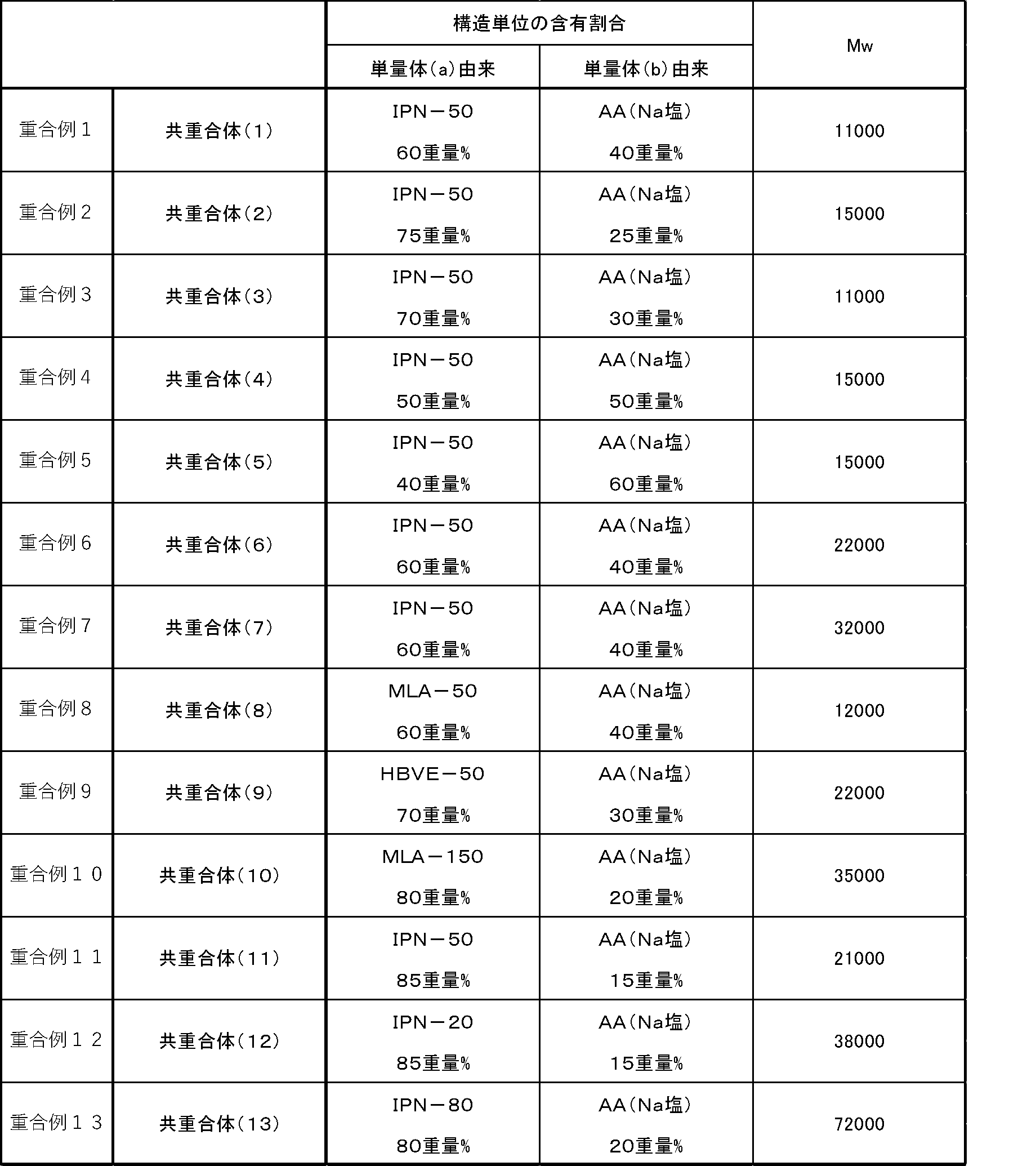
温度計、撹拌機、滴下装置、窒素導入管及び還流冷却器を備えたガラス製反応容器に、イオン交換水と3-メチル-3-ブテン-1-オールにエチレンオキシドが平均50モル付加した不飽和ポリアルキレングリコールエーテル系単量体(IPN-50)を仕込み、続いて撹拌下に反応容器内を窒素置換し、窒素雰囲気下で60℃に昇温した後、過酸化水素水溶液を投入した。次に、L-アスコルビン酸及び3-メルカプトプロピオン酸をイオン交換水部に溶解させた水溶液を4時間かけて、アクリル酸(AA)を3時間かけて、それぞれ一定速度で計量滴下した。この間の温度は60℃で一定とし、滴下終了後、1時間引き続き60℃を維持し、重合反応を終了した。その後、重合反応温度以下の温度において水酸化ナトリウム水溶液を用いて反応溶液のpHをpH=6.3まで中和し、共重合体(1)を含む重合体水溶液を得た。得られた当該共重合体(1)の重量平均分子量Mwは11000であった。また、単量体の残存量に基づき算出した当該共重合体(1)中の各構造単位の含有割合は表1に示すとおりである。
温度計、撹拌機、滴下装置、窒素導入管及び還流冷却器を備えたガラス製反応容器に、イオン交換水と3-メチル-3-ブテン-1-オールにエチレンオキシドが平均50モル付加した不飽和ポリアルキレングリコールエーテル系単量体(IPN-50)を仕込み、続いて撹拌下に反応容器内を窒素置換し、窒素雰囲気下で60℃に昇温した後、過酸化水素水溶液を投入した。次に、L-アスコルビン酸及び3-メルカプトプロピオン酸をイオン交換水部に溶解させた水溶液を4時間かけて、アクリル酸(AA)を3時間かけて、それぞれ一定速度で計量滴下した。この間の温度は60℃で一定とし、滴下終了後、1時間引き続き60℃を維持し、重合反応を終了した。その後、重合反応温度以下の温度において水酸化ナトリウム水溶液を用いて反応溶液のpHをpH=6.3まで中和し、共重合体(1)を含む重合体水溶液を得た。得られた当該共重合体(1)の重量平均分子量Mwは11000であった。また、単量体の残存量に基づき算出した当該共重合体(1)中の各構造単位の含有割合は表1に示すとおりである。
〔重合例2~13〕
各重合例2~13につき、各種の不飽和ポリアルキレングリコールエーテル系単量体及びアクリル酸を用いて重合例1に準じた方法で重合反応を行い、共重合体(2)~(13)のいずれかを含む各重合体水溶液を其々得た。得られた当該各共重合体(2)~(13)其々の、重量平均分子量Mw及び単量体の残存量に基づき算出した各構造単位の含有割合は表1に示すとおりである。尚、表1中の略号と当該略号が示す化合物の関係は以下に記載した通りである。
(単量体の略号)
<不飽和ポリアルキレングリコールエーテル系単量体(a)>
IPN-50:3-メチル-3-ブテン-1-オールにエチレンオキシドが平均50モル付加した単量体
IPN-20:3-メチル-3-ブテン-1-オールにエチレンオキシドが平均20モル付加した単量体
IPN-80:3-メチル-3-ブテン-1-オールにエチレンオキシドが平均80モル付加した単量体
MLA-50:2-メチル-2-プロペン-1-オールにエチレンオキシドが平均50モル付加した単量体
MLA-150:2-メチル-2-プロペン-1-オールにエチレンオキシドが平均150モル付加した単量体
HBVE-50:ヒドロキシブチルビニルエーテルにエチレンオキシドが平均50モル付加した単量体
<不飽和カルボン酸系単量体(b)>
AA(Na塩):アクリル酸ナトリウム
[試験例:モルタル試験]
(モルタル配合)
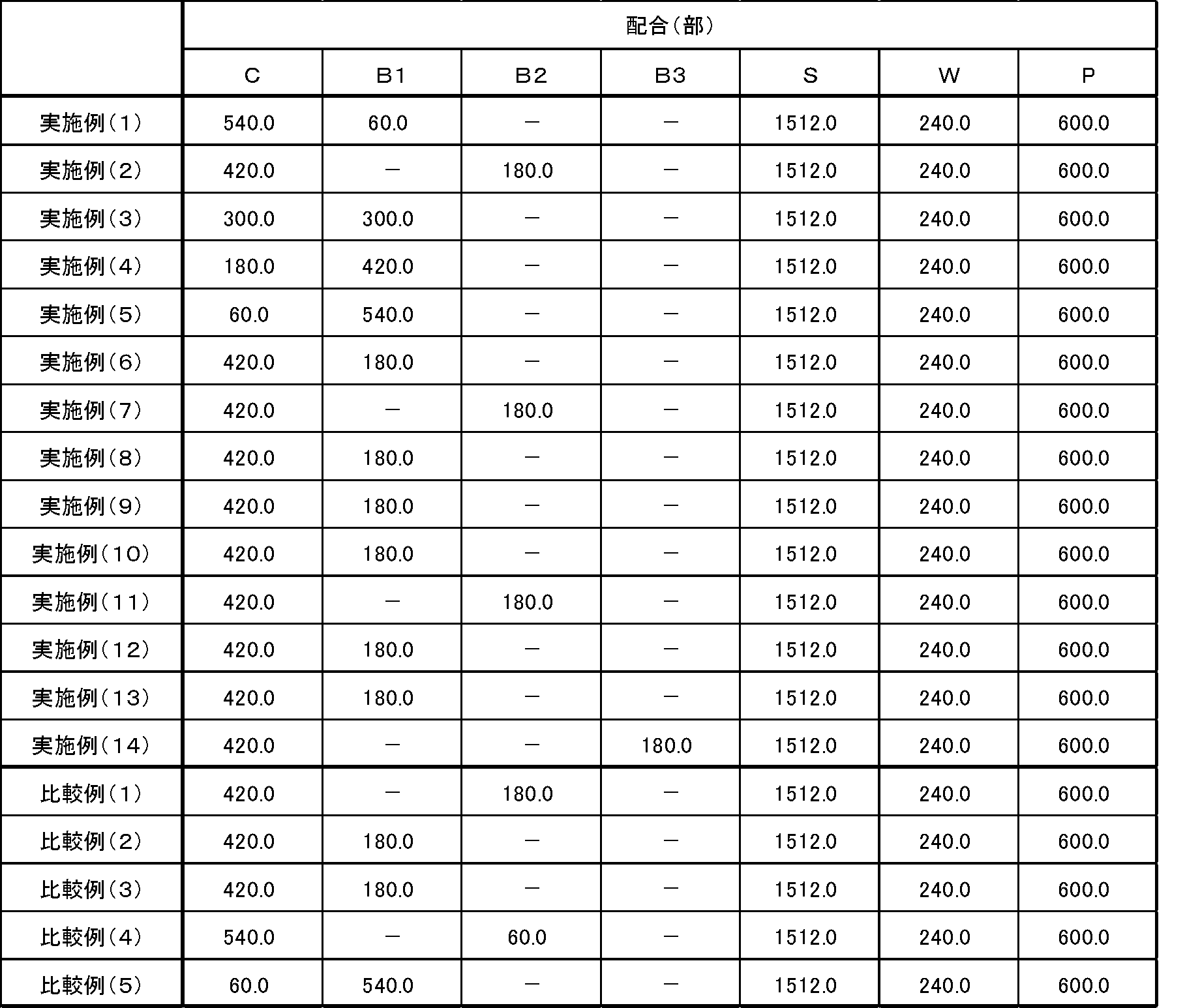
下記試験の各実施例・比較例で使用されるモルタル配合の組成比は、下記表2に示す通りである。尚、以下で使用される下記記号は其の右に記載されるものを示す。
C:普通ポルトランドセメント(太平洋セメント社製)
B1:炭酸カルシウム(重質炭酸カルシウム:丸東社製、D50=2.5μm)
B2:エコタンカル(ボイラー排ガス中の二酸化炭素を固定化した軽質炭酸カルシウム:日本コンクリート工業社製、D50=16.9μm)
B3:炭酸カルシウム(重質炭酸カルシウム:丸東社製、D50=17.7μm)
S:山砂
W:イオン交換水(共重合体、消泡剤を含む)
P:C+B1/B2/B3
(モルタル配合)
下記試験の各実施例・比較例で使用されるモルタル配合の組成比は、下記表2に示す通りである。尚、以下で使用される下記記号は其の右に記載されるものを示す。
C:普通ポルトランドセメント(太平洋セメント社製)
B1:炭酸カルシウム(重質炭酸カルシウム:丸東社製、D50=2.5μm)
B2:エコタンカル(ボイラー排ガス中の二酸化炭素を固定化した軽質炭酸カルシウム:日本コンクリート工業社製、D50=16.9μm)
B3:炭酸カルシウム(重質炭酸カルシウム:丸東社製、D50=17.7μm)
S:山砂
W:イオン交換水(共重合体、消泡剤を含む)
P:C+B1/B2/B3
(モルタル調製手順)
以下で行う実験は、20℃プラスマイナス1℃、湿度60%プラスマイナス10%の環境下で行った。
最初に、上記で製造した共重合体(1)~(13)のいずれかを含む水溶液の所定量に対して、消泡剤としてアデカノールLG-299(アデカ社製)を前記水溶液の固形分に対して5質量%加え、更にイオン交換水を加えて総量240gとし、十分に均一溶解させることで下記で使用される各イオン交換水(W)を用意した。
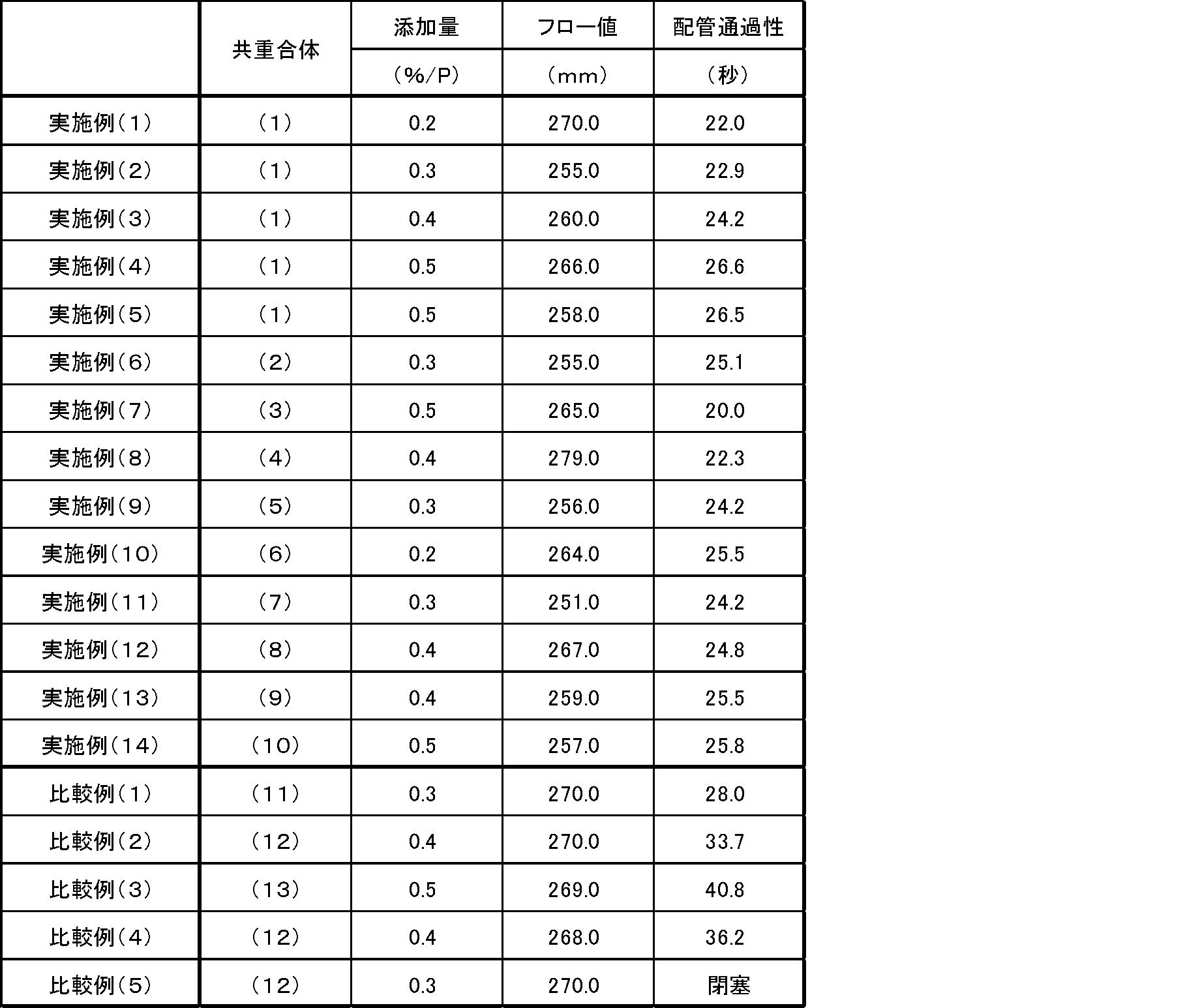
次に、各実施例・比較例につき、HOBART社製のN-50ミキサーにステンレス製ビーター(撹拌羽根)を取り付けた混練容器に所定量(表2記載)のC、B(B1、B2又はB3)、Wを仕込み、1速で30秒間混練したのち、Sを投入して引き続き2速で30秒間混練した。その後、混練を停止して15秒間、容器壁に付いたモルタルを掻き落し、2分45秒静置した。さらに2速で1分間混練して混練終了とし、モルタルを混練容器からポリエチレン製1L容器に移して各実施例・比較例のモルタルを用意した。尚、各実施例・比較例のモルタルで使用される共重合体及びその添加量は表3に記載された通りで、表中の「%/P」は、セメントと炭酸カルシウムとの合計量(C+B1/B2/B3)に対する共重合体固形分の添加量(質量%)である。
(モルタル流動性測定手順)
モルタル流動性(フロー値)の測定は、下記手順に従って、JIS-A-1171準拠のモルタルスランプ試験用器具を用いて行った。
上記で用意された各実施例・比較例のモルタルをスパチュラで20回撹拌した後、水平に設置した鋼製平板上に置かれたスランプコーン(上端内径50mm、下端内径100mm、高さ150mm)の中にモルタルの半量を詰め、付棒で15回付いて均一に充填し、さらに同様の手順で残りの半量を充填し、表面を均一に馴らした。続いて、スランプコーンを垂直に引き上げ、モルタルの流動が止まってから、広がったモルタルの直径を縦横2点計測し、其の平均値をフロー値とした。当該フロー値は下記表3に示す。
モルタル流動性(フロー値)の測定は、下記手順に従って、JIS-A-1171準拠のモルタルスランプ試験用器具を用いて行った。
上記で用意された各実施例・比較例のモルタルをスパチュラで20回撹拌した後、水平に設置した鋼製平板上に置かれたスランプコーン(上端内径50mm、下端内径100mm、高さ150mm)の中にモルタルの半量を詰め、付棒で15回付いて均一に充填し、さらに同様の手順で残りの半量を充填し、表面を均一に馴らした。続いて、スランプコーンを垂直に引き上げ、モルタルの流動が止まってから、広がったモルタルの直径を縦横2点計測し、其の平均値をフロー値とした。当該フロー値は下記表3に示す。
(配管通過性)
ポンプ圧送時の配管通過性評価として、モルタルのロート流下試験を下記手順に従って実施した。
土木学会基準JSCE-F541に規定されたJ14ロート(上端内径70mm、下端内径14mm、高さ392mm)の下端にゴム栓をし、台で鉛直に支持した。次に、流出したモルタル量を計測するための電子はかりをJ14ロート下端の下方に設置した。
上記で用意された各実施例・比較例のモルタルをJ14ロート上面まで流し込み上面をならした。次に、ゴム栓を外してモルタルを流出させ、モルタル流出開始より1000g流下するまでの時間をストップウォッチで計測し、これをロート流下時間とした。
なお、モルタルが途中で閉塞することなく、しかも短時間で流下したものは配管通過性が良好と判断し、ロート流下時間を5%以上短縮できる場合は特に配管通過性に優れるものと言える。
Claims (6)
- 炭酸カルシウムを5~95質量%含む炭酸カルシウム配合セメント組成物に用いられる分散剤であって、
該分散剤は、下記式(1);

該不飽和カルボン酸系単量体由来の構造単位の含有割合が全構造単位100質量%に対して20~70質量%であり、
重量平均分子量が5000~35000である共重合体を含む
ことを特徴とする炭酸カルシウム配合セメント組成物用分散剤。 - 前記不飽和カルボン酸系単量体は、不飽和モノカルボン酸系単量体であることを特徴とする請求項1に記載の炭酸カルシウム配合セメント組成物用分散剤。
- 前記共重合体における前記不飽和カルボン酸系単量体由来の構造単位の含有割合が全構造単位100質量%に対して25~70質量%であることを特徴とする請求項1に記載の炭酸カルシウム配合セメント組成物用分散剤。
- 炭酸カルシウムを5~50質量%含む炭酸カルシウム配合セメント組成物に用いられることを特徴とする請求項1に記載の炭酸カルシウム配合セメント組成物用分散剤。
- 請求項1~4のいずれかに記載の炭酸カルシウム配合セメント組成物用分散剤と、セメントと、組成物の全質量に対して5~95質量%の炭酸カルシウムとを含むことを特徴とする炭酸カルシウム配合セメント組成物。
- 前記炭酸カルシウムは、軽質炭酸カルシウムを含むことを特徴とする請求項5に記載の炭酸カルシウム配合セメント組成物。
Priority Applications (1)
| Application Number | Priority Date | Filing Date | Title |
|---|---|---|---|
| JP2024557379A JPWO2024101285A1 (ja) | 2022-11-11 | 2023-11-06 |
Applications Claiming Priority (2)
| Application Number | Priority Date | Filing Date | Title |
|---|---|---|---|
| JP2022180992 | 2022-11-11 | ||
| JP2022-180992 | 2022-11-11 |
Publications (1)
| Publication Number | Publication Date |
|---|---|
| WO2024101285A1 true WO2024101285A1 (ja) | 2024-05-16 |
Family
ID=91032345
Family Applications (1)
| Application Number | Title | Priority Date | Filing Date |
|---|---|---|---|
| PCT/JP2023/039791 Ceased WO2024101285A1 (ja) | 2022-11-11 | 2023-11-06 | 炭酸カルシウム配合セメント組成物用分散剤及び炭酸カルシウム配合セメント組成物 |
Country Status (2)
| Country | Link |
|---|---|
| JP (1) | JPWO2024101285A1 (ja) |
| WO (1) | WO2024101285A1 (ja) |
Citations (6)
| Publication number | Priority date | Publication date | Assignee | Title |
|---|---|---|---|---|
| JPS63256557A (ja) * | 1987-04-15 | 1988-10-24 | 電気化学工業株式会社 | セメント混和材及びセメント組成物 |
| JP2002193648A (ja) * | 2000-12-22 | 2002-07-10 | Kao Corp | 水硬性組成物用粉末分散剤 |
| JP2007119337A (ja) * | 2005-09-28 | 2007-05-17 | Nippon Shokubai Co Ltd | セメント混和剤及びセメント組成物 |
| JP2007326776A (ja) * | 2007-08-01 | 2007-12-20 | Kao Corp | セメント分散剤の製造方法 |
| JP2013103945A (ja) * | 2011-11-10 | 2013-05-30 | Nippon Shokubai Co Ltd | セメント混和剤用共重合体の製造方法 |
| JP2021088479A (ja) * | 2019-12-04 | 2021-06-10 | 日本製紙株式会社 | 水硬性組成物 |
-
2023
- 2023-11-06 WO PCT/JP2023/039791 patent/WO2024101285A1/ja not_active Ceased
- 2023-11-06 JP JP2024557379A patent/JPWO2024101285A1/ja active Pending
Patent Citations (6)
| Publication number | Priority date | Publication date | Assignee | Title |
|---|---|---|---|---|
| JPS63256557A (ja) * | 1987-04-15 | 1988-10-24 | 電気化学工業株式会社 | セメント混和材及びセメント組成物 |
| JP2002193648A (ja) * | 2000-12-22 | 2002-07-10 | Kao Corp | 水硬性組成物用粉末分散剤 |
| JP2007119337A (ja) * | 2005-09-28 | 2007-05-17 | Nippon Shokubai Co Ltd | セメント混和剤及びセメント組成物 |
| JP2007326776A (ja) * | 2007-08-01 | 2007-12-20 | Kao Corp | セメント分散剤の製造方法 |
| JP2013103945A (ja) * | 2011-11-10 | 2013-05-30 | Nippon Shokubai Co Ltd | セメント混和剤用共重合体の製造方法 |
| JP2021088479A (ja) * | 2019-12-04 | 2021-06-10 | 日本製紙株式会社 | 水硬性組成物 |
Also Published As
| Publication number | Publication date |
|---|---|
| JPWO2024101285A1 (ja) | 2024-05-16 |
Similar Documents
| Publication | Publication Date | Title |
|---|---|---|
| JP6188412B2 (ja) | 共重合体とその用途 | |
| JP7495556B2 (ja) | 重合体及びセメント混和剤 | |
| JP6514806B2 (ja) | セメント組成物 | |
| JP2020023422A (ja) | 再生骨材含有セメント組成物用添加剤 | |
| JP2008534412A (ja) | セメント混和剤 | |
| JP6145381B2 (ja) | (ポリ)アルキレングリコール系ブロック共重合体及びその用途 | |
| JP2014125509A (ja) | 共重合体およびその用途 | |
| JP6249630B2 (ja) | 共重合体とその用途 | |
| JP6864479B2 (ja) | セメント混和剤およびセメント組成物 | |
| JP6747962B2 (ja) | セメント用添加剤およびセメント組成物 | |
| JP2020050532A (ja) | 再生骨材含有セメント組成物用添加剤 | |
| JP6715599B2 (ja) | セメント分散性向上助剤およびセメント組成物 | |
| JP6403602B2 (ja) | セメント分散剤組成物およびセメント組成物 | |
| JP6587853B2 (ja) | セメント分散剤組成物およびセメント組成物 | |
| JP2018111621A (ja) | セメント分散性向上助剤およびセメント組成物 | |
| JP6626376B2 (ja) | 水硬性組成物用強度向上剤、水硬性組成物用添加剤、およびコンクリート組成物 | |
| JP6042203B2 (ja) | 共重合体並びにその用途 | |
| JP7090504B2 (ja) | 再生骨材含有セメント組成物用添加剤 | |
| JP6998221B2 (ja) | セメント用添加剤、およびセメント組成物 | |
| JP2003183338A (ja) | 新規共重合体及びその用途 | |
| JP7650820B2 (ja) | セメント添加剤 | |
| JP6672031B2 (ja) | セメント用添加剤およびセメント組成物 | |
| JP6602612B2 (ja) | セメント用添加剤およびセメント組成物 | |
| JP2005126271A (ja) | コンクリート組成物 | |
| JP6602149B2 (ja) | セメント用添加剤およびセメント組成物 |
Legal Events
| Date | Code | Title | Description |
|---|---|---|---|
| 121 | Ep: the epo has been informed by wipo that ep was designated in this application |
Ref document number: 23888633 Country of ref document: EP Kind code of ref document: A1 |
|
| WWE | Wipo information: entry into national phase |
Ref document number: 2024557379 Country of ref document: JP |
|
| NENP | Non-entry into the national phase |
Ref country code: DE |
|
| 122 | Ep: pct application non-entry in european phase |
Ref document number: 23888633 Country of ref document: EP Kind code of ref document: A1 |