WO2024101271A1 - 熱硬化性組成物、樹脂フィルム、プリプレグ、金属張積層板、及びプリント配線板 - Google Patents
熱硬化性組成物、樹脂フィルム、プリプレグ、金属張積層板、及びプリント配線板 Download PDFInfo
- Publication number
- WO2024101271A1 WO2024101271A1 PCT/JP2023/039617 JP2023039617W WO2024101271A1 WO 2024101271 A1 WO2024101271 A1 WO 2024101271A1 JP 2023039617 W JP2023039617 W JP 2023039617W WO 2024101271 A1 WO2024101271 A1 WO 2024101271A1
- Authority
- WO
- WIPO (PCT)
- Prior art keywords
- thermosetting composition
- group
- compound
- peroxide
- prepreg
- Prior art date
- Legal status (The legal status is an assumption and is not a legal conclusion. Google has not performed a legal analysis and makes no representation as to the accuracy of the status listed.)
- Ceased
Links
Classifications
-
- B—PERFORMING OPERATIONS; TRANSPORTING
- B32—LAYERED PRODUCTS
- B32B—LAYERED PRODUCTS, i.e. PRODUCTS BUILT-UP OF STRATA OF FLAT OR NON-FLAT, e.g. CELLULAR OR HONEYCOMB, FORM
- B32B15/00—Layered products comprising a layer of metal
- B32B15/04—Layered products comprising a layer of metal comprising metal as the main or only constituent of a layer, which is next to another layer of the same or of a different material
- B32B15/08—Layered products comprising a layer of metal comprising metal as the main or only constituent of a layer, which is next to another layer of the same or of a different material of synthetic resin
-
- C—CHEMISTRY; METALLURGY
- C08—ORGANIC MACROMOLECULAR COMPOUNDS; THEIR PREPARATION OR CHEMICAL WORKING-UP; COMPOSITIONS BASED THEREON
- C08F—MACROMOLECULAR COMPOUNDS OBTAINED BY REACTIONS ONLY INVOLVING CARBON-TO-CARBON UNSATURATED BONDS
- C08F290/00—Macromolecular compounds obtained by polymerising monomers on to polymers modified by introduction of aliphatic unsaturated end or side groups
- C08F290/02—Macromolecular compounds obtained by polymerising monomers on to polymers modified by introduction of aliphatic unsaturated end or side groups on to polymers modified by introduction of unsaturated end groups
- C08F290/06—Polymers provided for in subclass C08G
-
- C—CHEMISTRY; METALLURGY
- C08—ORGANIC MACROMOLECULAR COMPOUNDS; THEIR PREPARATION OR CHEMICAL WORKING-UP; COMPOSITIONS BASED THEREON
- C08J—WORKING-UP; GENERAL PROCESSES OF COMPOUNDING; AFTER-TREATMENT NOT COVERED BY SUBCLASSES C08B, C08C, C08F, C08G or C08H
- C08J5/00—Manufacture of articles or shaped materials containing macromolecular substances
- C08J5/24—Impregnating materials with prepolymers which can be polymerised in situ, e.g. manufacture of prepregs
-
- H—ELECTRICITY
- H10—SEMICONDUCTOR DEVICES; ELECTRIC SOLID-STATE DEVICES NOT OTHERWISE PROVIDED FOR
- H10W—GENERIC PACKAGES, INTERCONNECTIONS, CONNECTORS OR OTHER CONSTRUCTIONAL DETAILS OF DEVICES COVERED BY CLASS H10
- H10W70/00—Package substrates; Interposers; Redistribution layers [RDL]
- H10W70/60—Insulating or insulated package substrates; Interposers; Redistribution layers
- H10W70/67—Insulating or insulated package substrates; Interposers; Redistribution layers characterised by their insulating layers or insulating parts
- H10W70/69—Insulating materials thereof
Definitions
- the present invention relates to a thermosetting composition, a resin film, a prepreg, a metal-clad laminate, and a printed wiring board.
- Polyphenylene ether which has excellent dielectric properties (low dielectric constant and low dielectric tangent) as a resin for thermosetting compositions, is suitable as an electronic circuit board material that meets the above-mentioned requirements and has attracted attention.
- Dialkyl peroxides with t-Bu groups that decompose at high temperatures and have high hydrogen abstraction capabilities are commonly used as curing agents for polyphenylene ether (Patent Documents 1 and 2).
- Organic peroxides with a t-Bu group such as di-2-(t-butylperoxyisopropyl)benzene, have a high hydrogen abstraction ability and are therefore commonly used in fields requiring high crosslink density.
- these organic peroxides have high temperatures among organic peroxides, they decompose too quickly in the curing process at high temperatures of 190°C or higher, meaning that the curing reaction cannot proceed sufficiently and the heat resistance of the cured product cannot be ensured sufficiently, so improvements are being sought.
- thermosetting composition that can produce a cured product that has excellent dielectric properties and excellent heat resistance.
- the present invention provides a thermosetting composition containing an alkylsilyl peroxide and a radical polymerizable compound
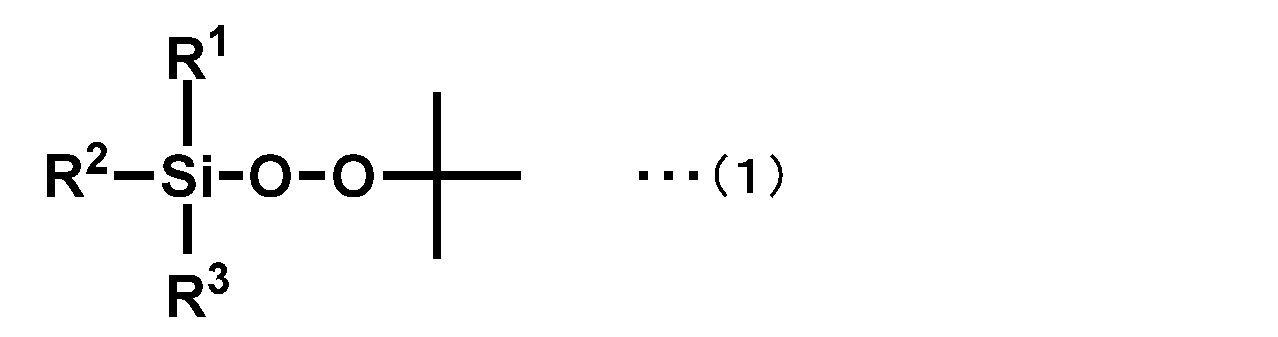
- the alkylsilyl peroxide has the general formula (1): (in formula (1), R 1 and R 2 are independently an alkyl group or a phenyl group having 1 to 6 carbon atoms, and R 3 is an alkyl group or a phenyl group having 4 to 6 carbon atoms), and a compound represented by general formula (2):
- the present invention relates to a thermosetting composition which is an alkylsilyl peroxide represented by formula (2) in which R 4 is an ethylene group or an acetylene group.
- the present invention also relates to a resin film formed from the thermosetting composition.
- the present invention also relates to a prepreg in which the thermosetting composition is impregnated or applied to a fibrous substrate.
- the present invention also relates to a metal-clad laminate in which the resin film or the prepreg is laminated with a metal foil.
- the present invention also relates to a printed wiring board in which a portion of the metal foil has been removed from the metal-clad laminate.
- thermosetting composition of the present invention contains an alkylsilyl peroxide having a t-Bu group and a silyl group bonded to a specific substituent, and therefore has a higher decomposition temperature and higher hydrogen abstraction ability than a dialkyl peroxide, allowing the curing process of the thermosetting composition to be carried out efficiently at high temperatures, improving the heat resistance of the resulting cured product.
- low-polarity decomposition products such as carbon radicals generated by the decomposition of the alkylsilyl peroxide bonded to a specific substituent can be introduced to the terminal of the resin formed from the radical polymerizable compound during the curing of the thermosetting composition, improving the dielectric properties of the cured product.
- thermosetting composition of the present invention contains an alkylsilyl peroxide having a t-Bu group and a silyl group to which a specific substituent is bonded, and a radical polymerizable compound.
- the alkylsilyl peroxide of the present invention is represented by the general formula (1): (In formula (1), R 1 and R 2 are independently an alkyl group or a phenyl group having 1 to 6 carbon atoms, and R 3 is an alkyl group or a phenyl group having 4 to 6 carbon atoms), and a compound represented by general formula (2): (in formula (2), R 4 is an ethylene group or an acetylene group).
- examples of R1 and R2 include a methyl group, an ethyl group, an n-propyl group, an isopropyl group, an n-butyl group, an isobutyl group, a sec-butyl group, a t-butyl group, an n-pentyl group, a t-amyl group, a neopentyl group, an n-hexyl group, a t-hexyl group, a thexyl group, and a phenyl group.
- examples of R3 include an n-butyl group, an isobutyl group, a sec-butyl group, a t-butyl group, an n-pentyl group, a t-amyl group, a neopentyl group, an n-hexyl group, a t-hexyl group, a thexyl group, and a phenyl group.
- alkylsilyl peroxide of the present invention are shown below, but the present invention is not limited to these.
- the dialkyl peroxide is selected from Compound 1 to Compound 12, and more preferably, Compound 1, Compound 2, Compound 5, Compound 6, Compound 9, Compound 10, Compound 11, and Compound 12 are selected from the viewpoints of availability of raw materials and ease of synthesis of alkylsilyl peroxide.
- the method for producing the alkylsilyl peroxide represented by the general formula (1) is not limited in any way.
- the method for producing the alkylsilyl peroxide represented by the general formula (3): and a hydroperoxide compound represented by general formula (4): (hereinafter also referred to as step (X))
- the method for producing the alkylsilyl peroxide represented by the general formula (2) is not limited in any way.
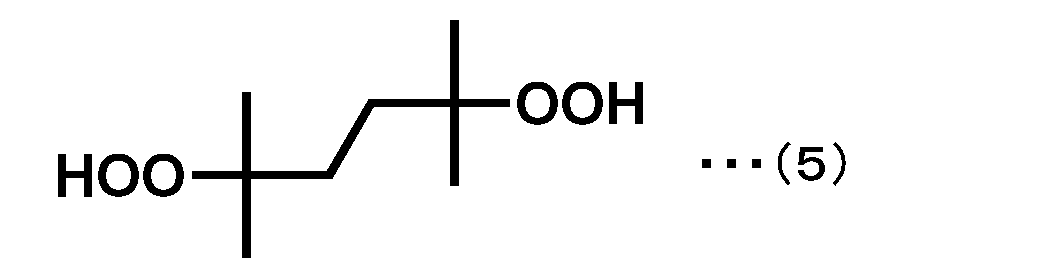
- the method for producing the alkylsilyl peroxide represented by the general formula (5): and a hydroperoxide compound represented by general formula (6): (hereinafter also referred to as step (Y))
- the hydroperoxide compound represented by the general formula (3) or the general formula (5) and the silyl chloride compound represented by the general formula (4) or the general formula (6) may be commercially available products.
- the hydroperoxide compound represented by the general formula (3) is preferably used in an amount of 0.8 to 5.0 moles, more preferably 1.0 to 3.0 moles, per 1.0 mole of the silyl chloride compound represented by the general formula (4), from the viewpoint of increasing the yield of the target product.
- the hydroperoxide compound represented by the general formula (5) is preferably used in an amount of 0.4 to 10.0 moles, more preferably 0.5 to 6.0 moles, per 1.0 mole of the silyl chloride compound represented by the general formula (6), from the viewpoint of increasing the yield of the target product.
- a base catalyst In the step (X) or the step (Y), it is preferable to use a base catalyst.
- the base catalyst is not particularly limited, but examples thereof include pyridine, dimethylaminopyridine, triethylamine, sodium hydroxide, potassium hydroxide, sodium carbonate, and the like.
- the base catalyst may be used alone or in combination of two or more kinds.
- the amount of the base catalyst used is not particularly limited, but from the viewpoint of increasing the yield of the target product, it is preferable to use 0.1 to 5.0 moles, and more preferably 1.0 to 3.0 moles, per 1.0 mole of the silyl chloride compound represented by the general formula (4).
- an organic solvent is not particularly limited, but is preferably an organic solvent that is inactive in the reaction system.
- the organic solvent include non-polar compounds such as pentane, hexane, and toluene; and polar compounds such as acetone, acetonitrile, tetrahydrofuran, and ethyl acetate.
- the organic solvent may be used alone or in combination of two or more kinds.
- the amount of the organic solvent used is not particularly limited, but is usually about 0.1 to 100 parts by mass per part by mass of the chloride compound represented by the general formula (4) or the general formula (6).
- the reaction temperature in step (X) or step (Y) is preferably -10°C or higher, more preferably 0°C or higher, from the viewpoint of increasing the yield of the target product, and is preferably 60°C or lower, more preferably 50°C or lower, from the viewpoint of safety.
- reaction time of step (X) or step (Y) cannot be determined in general because it varies depending on the raw materials and reaction temperature, but from the viewpoint of increasing the yield of the target product, it is usually preferably 0.1 hours or more, more preferably 0.5 hours or more, and preferably 5 hours or less.
- the step (X) or the step (Y) can be carried out under an air atmosphere at normal pressure, but can also be carried out under a nitrogen atmosphere or nitrogen gas flow.
- the alkylsilyl peroxide can be purified by washing with, for example, an aqueous electrolyte solution such as sodium hydroxide, potassium hydroxide, sodium carbonate, sodium sulfite, hydrogen chloride, sulfuric acid, or sodium chloride, or ion-exchanged water to remove excess raw materials and by-products.
- an aqueous electrolyte solution such as sodium hydroxide, potassium hydroxide, sodium carbonate, sodium sulfite, hydrogen chloride, sulfuric acid, or sodium chloride, or ion-exchanged water to remove excess raw materials and by-products.
- the resulting alkylsilyl peroxide can be identified using gas chromatography (GC), liquid chromatography (LC), nuclear magnetic resonance spectroscopy (NMR), infrared spectroscopy (IR), mass spectrometry (MS), etc.
- GC gas chromatography
- LC liquid chromatography
- NMR nuclear magnetic resonance spectroscopy
- IR infrared spectroscopy
- MS mass spectrometry
- the radical polymerizable compound is not particularly limited as long as it can be polymerized by a thermal radical polymerization reaction, and examples thereof include compounds having an ethylenically unsaturated group such as a vinyl group, an allyl group, a methacryl group, a styryl group, a meth(acryl) group, or a maleimide group. From the viewpoint of being able to improve the dielectric properties and heat resistance of a cured product using the above-mentioned alkylsilyl peroxide, examples thereof include polyphenylene ether.
- the polyphenylene ether is not particularly limited as long as it is a polyphenylene ether having a radically polymerizable double bond at the molecular end.
- the polyphenylene ether having the radically polymerizable double bond can be used alone or in combination of two or more kinds.
- the structural unit of the polyphenylene ether examples include, for example, a copolymer of 2,6-dimethylphenol and other phenols (for example, 2,3,6-trimethylphenol, 2-methyl-6-butylphenol, 2-allylphenol, etc.); a polyphenylene ether copolymer obtained by coupling 2,6-dimethylphenol with biphenols or bisphenols; and a polyphenylene ether having a linear or branched structure obtained by heating poly(2,6-dimethyl-1,4-phenylene ether) or the like with a phenolic compound such as a bisphenol or trisphenol in a toluene solvent in the presence of an organic peroxide to cause a redistribution reaction.
- the phenylene group in the phenylene ether unit may have a substituent, and the polyphenylene ether may contain other structural units other than the phenylene ether unit within a range that does not impair the effects of the present invention.
- Examples of the radically polymerizable double bond at the molecular end include (meth)acryloyl groups, styryl groups, vinylbenzyl groups, vinyl groups, allyl groups, and 1,3-butadienyl groups.
- (meth)acryloyl groups and vinylbenzyl groups are preferred from the viewpoints of high reactivity during heat curing and excellent dielectric constant and dielectric dissipation factor of the cured product.
- the number of radically polymerizable double bonds in one molecule of the polyphenylene ether having radically polymerizable double bonds at the molecular terminal is preferably 1.5 to 6 on average, more preferably 1.6 to 4 on average, and even more preferably 1.7 to 3 on average.
- the number of ethylenically unsaturated double bonds in one molecule of the polyphenylene ether having a radically polymerizable double bond at the molecular end can be measured, for example, by measuring the number of hydroxyl groups remaining in the polyphenylene ether and calculating the reduction from the number of hydroxyl groups in the polyphenylene ether before modification with a compound having an ethylenically unsaturated double bond.
- the method for measuring the number of hydroxyl groups remaining in the polyphenylene ether conforms to the method described in Polymer Research Papers, vol. 51, No. 7, p. 480 (1994), in which tetraethylammonium hydroxide is added to a methylene chloride solution of the polyphenylene ether and the absorbance of the mixed solution at a wavelength of 318 nm is measured.
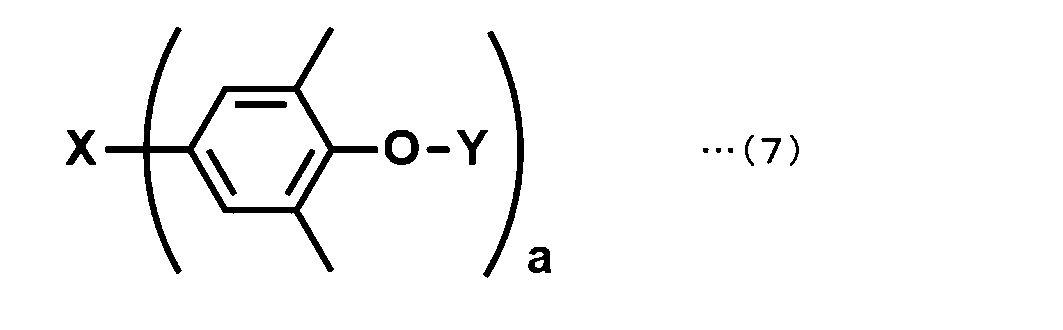
- the polyphenylene ether having a radically polymerizable double bond at the molecular end preferably has a structure represented by the following general formula (7).
- X is any linking group having a valence of a
- Y is a radically polymerizable double bond at the molecular end
- a is an integer from 1 to 6.
- X in the formula (7) include divalent phenols such as bisphenol A, bisphenol F, bisphenol S, fluorene bisphenol, 4,4'-dihydroxybiphenyl, 2,2'-dihydroxybiphenyl, 4,4'-dihydroxy-3,3'5,5'-tetramethylbiphenyl, 4,4'-dihydroxy-2,2',3,3'5,5'-hexamethylbiphenyl, hydroquinone, and resorcin, and trivalent or higher phenols such as tris-(4-hydroxyphenyl)methane, 1,1,2,2-tetrakis(4-hydroxyphenyl)ethane, phenol novolac, o-cresol novolac, and naphthol novolac.
- divalent phenols such as bisphenol A, bisphenol F, bisphenol S, fluorene bisphenol, 4,4'-dihydroxybiphenyl, 2,2'-dihydroxybiphenyl, 4,4'
- the polyphenylene ether having a radically polymerizable double bond at the molecular end preferably has a number average molecular weight of 800 or more and 5000 or less, more preferably 900 or more and 4500 or less, and even more preferably 1000 or more and 3000 or less, from the viewpoint of dielectric properties and impregnation into fibrous substrates.
- the number average molecular weight may be measured by a general molecular weight measurement method, such as a polystyrene equivalent value measured using gel permeation chromatography (GPC).
- GPC gel permeation chromatography
- the measurement can be performed using a measurement device HLC-8220GPC (manufactured by Tosoh Corporation), column: ShodexGPC KF-405L HQ x 3 (manufactured by Showa Denko K.K.), eluent: chloroform, injection amount: 20 ⁇ L, flow rate: 0.3 mL/min, column temperature: 40°C, detector: RI.
- the method for synthesizing the polyphenylene ether having a radically polymerizable double bond at the molecular end is not particularly limited, as long as it is possible to synthesize a modified polyphenylene ether modified with a radically polymerizable double bond.
- Specific examples include a method in which a compound having an ethylenically unsaturated double bond and a chlorine atom is reacted with the polyphenylene ether before modification.
- Examples of the compound having an ethylenically unsaturated double bond and a chlorine atom include (meth)acryloyl chloride and vinylbenzyl chloride.
- polyphenylene ether having a radically polymerizable double bond at the molecular end may be a commercially available product, such as those under the product names "OPE-2St” (manufactured by Mitsubishi Gas Chemical Co., Ltd.) and "Noryl SA9000” (manufactured by SABIC Innovative Plastics).
- the dialkyl peroxide may be used in any amount relative to the radical polymerizable compound, and is usually used in an amount of preferably 0.05 to 10 parts by mass, more preferably 0.1 to 5 parts by mass, and most preferably 0.5 to 3 parts by mass relative to 100 parts by mass of the radical polymerizable compound.
- thermosetting composition of the present invention may further contain other components in appropriate combination.
- other components include elastomers such as polyfunctional monomers, solvents, organic peroxides, azo compounds, bismaleimide, polyisoprene, polybutadiene, styrene-butadiene rubber, butyl rubber, ethylene-propylene rubber, ethylene-propylene-diene rubber, styrene-butadiene-styrene block copolymers, styrene-ethylene-butylene-styrene block copolymers, ethylene-styrene-divinylbenzene copolymers, ethylene-hexene-styrene-divinylbenzene copolymers, fluororubbers, and silicone rubbers, inorganic fillers such as natural silica, fused silica, synthetic silica, amorphous silica, hollow silica, alumina,
- the polyfunctional monomer can be blended from the viewpoint of adjusting the viscosity of the thermosetting composition and improving the heat resistance of the cured product.
- the polyfunctional monomer include polyfunctional (meth)acrylates such as ethylene glycol di(meth)acrylate, hexanediol di(meth)acrylate, trimethylolpropane tri(meth)acrylate, pentaerythritol tetra(meth)acrylate, and dipentaerythritol hexa(meth)acrylate, vinylbenzene derivatives such as 1,4-divinylbenzene and 4-vinylbenzoic acid-2-acryloylethyl ester, alkenyl isocyanurate derivatives such as triallyl isocyanurate (TAIC), and alkenyl cyanurate derivatives such as triallyl cyanurate (TAC).
- triallyl isocyanurate and triallyl cyanurate are preferred because of their excellent heat resistance.
- the amount of the polyfunctional monomer is preferably 5 to 50 parts by mass, more preferably 7 to 40 parts by mass, and even more preferably 10 to 30 parts by mass, per 100 parts by mass of the radical polymerizable compound.
- the solvent may be added from the viewpoint of improving the viscosity of the thermosetting composition, the impregnation of the glass cloth, the smoothness of the cured film, etc.
- the solvent is not particularly limited as long as it can dissolve or disperse the above components and is a solvent that volatilizes when dried.
- the solvent is preferably an aromatic solvent such as toluene or xylene; a ketone solvent such as acetone, methyl ethyl ketone, cyclopentanone or cyclohexanone; or an amide solvent such as dimethylformamide, dimethylacetamide or N-methylpyrrolidone.
- aromatic solvent such as toluene or xylene
- ketone solvent such as acetone, methyl ethyl ketone, cyclopentanone or cyclohexanone
- an amide solvent such as dimethylformamide, dimethylacetamide or N-methylpyrrolidone.
- the amount of the solvent used is preferably 10 to 1000 parts by mass, and more preferably 20 to 500 parts by mass, per 100 parts by mass of the solid content of the thermosetting composition.
- thermosetting composition ⁇ Method of preparing thermosetting composition>
- the alkylsilyl peroxide, the radical polymerizable compound, and other components as necessary are charged into a container, and dissolved or dispersed according to a conventional method using a ball mill, a bead mill, a planetary mixer, a roll mill, or the like. At this time, heating may be performed as necessary.
- the radical polymerizable compound or the like is dissolved in a solvent by heating, unnecessary gelation can be suppressed by cooling the solution to 50° C. or less after dissolution and then blending the alkylsilyl peroxide.
- filtration through a mesh or membrane filter or the like may be performed as necessary.
- the resin film of the present invention is formed from the thermosetting composition.
- the resin film contains the thermosetting composition before curing, but the thermosetting composition may be partially cured.
- the resin film can be obtained, for example, by drying a resin varnish, which is a mixture of the thermosetting composition and the solvent, alone, or by applying the resin varnish onto a support such as a support film and then drying it.
- the solvent is dried and removed using a hot air dryer or the like, for example, at 20°C to 180°C.
- the drying temperature is preferably 20°C to 150°C, more preferably 50°C to 130°C.
- the support for the resin film examples include polyesters such as polyethylene terephthalate and polyethylene naphthalate, polyolefins such as polyethylene, polypropylene and polyvinyl chloride, polycarbonate, polyimide, ethylene tetrafluoroethylene copolymer, metal foils such as copper foil and aluminum foil, and release paper.
- the resin-coated metal foil obtained by applying the thermosetting composition to a metal foil and then drying and removing the solvent with a hot air dryer or the like is also called the resin-coated metal foil.
- the support may have been subjected to a chemical or physical treatment such as a mud treatment, a corona treatment or a release treatment.
- the resin film is suitable as an interlayer insulating sheet, adhesive film, etc. for laminates such as multilayer printed wiring boards.
- the prepreg of the present invention is a composite of a fibrous substrate and the thermosetting composition.
- the prepreg contains a thermosetting composition before curing, but a part of the thermosetting composition may be cured.
- the prepreg is preferably a composite of a fibrous substrate and a thermosetting composition impregnated or applied to the fibrous substrate. Even when the thermosetting composition is applied to the surface of the fibrous substrate to form a layer, a structure in which the cured product of the thermosetting composition is impregnated into the substrate can be obtained by press molding for curing the prepreg.
- the prepreg can be obtained, for example, by impregnating or applying a substrate such as glass cloth with a resin varnish which is a mixture of the thermosetting composition of the present invention and a solvent, and then drying and removing the solvent. It is also possible to repeat the impregnation or application multiple times. Furthermore, the amount of impregnation can be adjusted to the desired amount by repeating the impregnation or application using multiple thermosetting compositions with different concentrations and compositions.
- the solvent is dried and removed using a hot air dryer or the like, for example, at 20 ° C. to 180 ° C.
- the drying temperature is preferably from 20°C to 150°C, and more preferably from 50°C to 130°C.
- the fibrous substrate examples include glass cloth, aramid cloth, polyester cloth, glass nonwoven fabric, aramid nonwoven fabric, pulp paper, and linter paper.
- glass cloth is preferred because it provides excellent mechanical strength to the printed wiring board, and flattened glass cloth is even more preferred.
- These fibrous substrates can be used alone or in combination of two or more types.
- the thickness of the fibrous substrate can be, for example, 1 to 300 ⁇ m.
- the proportion of the solid content of the thermosetting composition in the solid content of the prepreg is preferably 30 to 80 mass%, and more preferably 40 to 70 mass%. If the above proportion is less than 30 mass%, the insulation reliability tends to be poor when the prepreg is used for electronic boards, etc. If the above proportion is more than 80 mass%, the mechanical properties such as flexural modulus tend to be poor when used for electronic boards, etc.
- the metal-clad laminate of the present invention is a laminate in which the resin film or the prepreg is laminated with a metal foil.
- the laminate can be produced by stacking one or more of the resin films and/or prepregs on a substrate such as a metal foil, and then curing the thermosetting composition by press molding to form an insulating layer. It is also possible to use the resin-coated metal foil instead of the metal foil.
- the hot molding can be carried out, for example, at a temperature of 180°C to 240°C, a heating time of 30 minutes to 300 minutes, and a surface pressure of 20 kgf/ cm2 to 40 kgf/ cm2 .
- the metal foil is not particularly limited, but examples include aluminum and copper foil, and among these, copper foil is preferred because of its low electrical resistance.
- the thickness of the metal foil that can be used is, for example, 1 to 50 ⁇ m.
- the resin film and prepreg to be combined with the metal foil may be one or more sheets, and depending on the application, the metal foil is laminated on one or both sides to be processed into a laminate.
- Metal-clad laminates are particularly suitable for use as printed wiring boards.
- the printed wiring board of the present invention is obtained by forming a circuit on the surface of the resin film or prepreg by partially removing the metal foil on the surface of the metal-clad laminate by etching or the like and forming wiring.
- the printed wiring board contains the thermosetting composition, and is therefore excellent in dielectric properties such as dielectric constant and dielectric loss tangent, moldability, and heat resistance.
- thermosetting composition is used for molding, lamination, adhesives, composite materials such as copper-clad laminates, etc.
- an isocyanate or epoxy body when used alone or in combination, typical applications include prepregs made from semi-cured resins and laminates made from cured prepregs.
- an epoxy body when used, typical applications include semiconductor encapsulation materials.
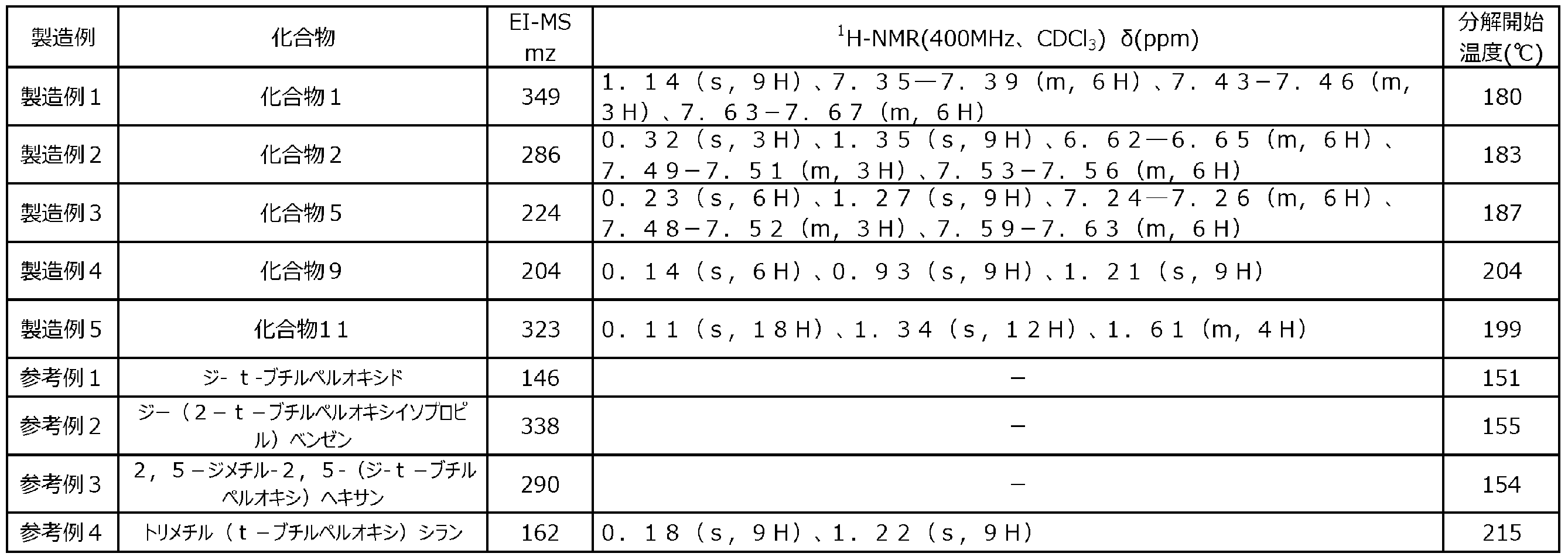
- the structure of the alkylsilyl peroxide was identified by 1 H-NMR measurement and 13 C-NMR measurement using an AVANCEN NMR spectrometer (manufactured by BRUCKER) and by TOFMS (manufactured by JEOL Ltd.). The purity was calculated by the simple area method using GC (Shimadzu Corporation GC-2014 series). The analytical results of the obtained compound 1 by EI-MS and 1 H-NMR are shown in Table 1.
- Examples 1 to 8 and Comparative Examples 1 to 6> ⁇ Production of Cured Product and Evaluation of Dielectric Properties>
- Each component (parts by mass) shown in Tables 2 and 3 was diluted with toluene to a concentration of 50% by mass, and 6 g of the solvent-dissolved composition was placed in an aluminum dish and dried at 400 Pa and 60°C for 2 hours using a vacuum dryer (EYELA VACUUM OVEN VOS-3LSD), and then further dried in the solvent at 80°C for 2 hours.
- the obtained powder was molded at 130°C using a hand press (manufactured by Toyo Seiki Co., Ltd.) and cured at 200°C to obtain a cured product (film, 16 cm circular, 60 ⁇ m thick).
- the dielectric constant and dielectric loss tangent at 1 GHz of the obtained cured product were measured according to a method conforming to IPC-TM-650-2.5.5.9, and evaluated according to the following criteria.
- ⁇ The dielectric constant (Dk) is less than 2.90, and the dielectric loss tangent (Df) is less than 0.0040.
- Good The dielectric constant (Dk) is 2.90 or more and 3.00 or less, and the dielectric loss tangent (Df) is 0.0040 or more and 0.0050 or less.
- ⁇ The dielectric constant (Dk) and the dielectric loss tangent (Df) are other than the above ⁇ or ⁇ .
- the glass transition temperature of the cured product was measured using a DSC (differential scanning calorimeter) "DSC-7000X" manufactured by Hitachi High-Tech Science Corporation. For the measurement, about 2 mg of the synthetic sample was placed in an Al cell, and the temperature was raised from 50°C to 350°C at a heating rate of 10°C per minute in a nitrogen atmosphere. The temperature was determined as the point where a straight line equidistant in the vertical direction from the straight line extending the low-temperature side and high-temperature side baselines intersects with the curve of the stepwise change portion of the glass transition. The evaluation was performed according to the following criteria, and the results are shown in Table 2.
- ⁇ Glass transition temperature (°C) is 180 or higher.
- A The glass transition temperature (° C.) is 175 or higher.
- ⁇ The glass transition temperature (° C.) is less than 175° C.
- OPE-2St 2200 is polyphenylene ether having an average of two ethylenically unsaturated double bonds at the molecular terminals (number average molecular weight: 2200, manufactured by Mitsubishi Gas Chemical Company, Inc.);
- OPE-2St 1200 is a polyphenylene ether having an average of two ethylenically unsaturated double bonds at the molecular terminals (number average molecular weight: 1200, manufactured by Mitsubishi Gas Chemical Company, Inc.);
- SA9000 is a polyphenylene ether having an average of two ethylenically unsaturated double bonds at the molecular terminals (number average molecular weight is 2756, manufactured by SABIC Innovative Plastics);
- Compound 1 is triphenyl(t-butylperoxy)silane (purity 22.2%) of Preparation Example 1;
- Compound 2 is methyldiphenyl(t-butylperoxy)silane (purity 21.5%) of Preparation
- Examples 1 to 8 were able to produce cured products with superior physical properties.
Landscapes
- Chemical & Material Sciences (AREA)
- Engineering & Computer Science (AREA)
- Health & Medical Sciences (AREA)
- Chemical Kinetics & Catalysis (AREA)
- Medicinal Chemistry (AREA)
- Polymers & Plastics (AREA)
- Organic Chemistry (AREA)
- Materials Engineering (AREA)
- Manufacturing & Machinery (AREA)
- Microelectronics & Electronic Packaging (AREA)
- Reinforced Plastic Materials (AREA)
Abstract
Description
前記アルキルシリルペルオキシドは、一般式(1):


本発明の熱硬化性組成物は、t-Bu基及び特定の置換基が結合したシリル基を有するアルキルシリルペルオキシド、及びラジカル重合性化合物を含有する。
本発明のアルキルシリルペルオキシドは、一般式(1):





ラジカル重合性化合物は、熱ラジカル重合反応により重合可能であれば、特に制限はなく、例えば、ビニル基、アリル基、メタクリル基、スチリル基、メタ(アクリル)基、マレイミド基等のエチレン性不飽和基を有する化合物が挙げられ、上記のアルキルシリルペルオキシドを用いて硬化物の誘電特性や耐熱性を向上できる観点では、例えば、ポリフェニレンエーテル等が挙げられる。
本発明の熱硬化性組成物は、更にその他の成分を適宜組み合わせて含有させることができる。その他の成分としては、多官能モノマー、溶剤、有機過酸化物、アゾ化合物、ビスマレイミド、ポリイソプレン、ポリブタジエン、スチレンブタジエンゴム、ブチルゴム、エチレンプロピレンゴム、エチレンプロピレンジエゴム、スチレンブタジエンスチレンブロック共重合体、スチレンエチレンブチレンスチレンブロック共重合体、エチレンスチレンジビニルベンゼン共重合体、エチレンヘキセンスチレンジビニルベンゼン共重合体、フッ素ゴム、シリコーンゴム等のエラストマー、天然シリカ、溶融シリカ、合成シリカ、アモルファスシリカ、中空シリカ、アルミナ、窒化ホウ素、窒化アルミニウム、クレー、タルク及びガラス短繊維等の無機充填剤、γ-アミノプロピルトリエトキシシラン、γ-グリシドキシプロピルトリメトキシシラン、γ-(メタ)アクリロキシプロピルトリメトキシシラン等のシランカップリング剤、難燃剤、重合禁止剤、紫外線吸収剤、光安定剤、金属不活性化剤、界面活性剤、滑剤、増粘剤、消泡剤、帯電防止剤、顔料、染料等が挙げられる。
前記熱硬化性組成物を調製する場合には、収納容器内に前記アルキルシリルペルオキシド、及びラジカル重合性化合物、必要に応じてその他の成分を投入し、ボールミル、ビーズミル、プラネタリーミキサー、ロールミル等を用いて、常法に従って溶解または分散させればよい。この際に必要に応じて加熱してもよい。加熱によりラジカル重合性化合物等を溶剤に溶解させる場合には、溶解後に50℃以下に冷却した後にアルキルシリルペルオキシドを配合することで、不要なゲル化を抑制することができる。また、必要に応じて、メッシュまたはメンブレンフィルター等通してろ過してもよい。
本発明の樹脂フィルムは、前記熱硬化性組成物から形成される。前記樹脂フィルムは、硬化前の熱硬化性組成物を含むが、熱硬化性組成物の一部が硬化していてもよい。前記樹脂フィルムは、例えば、前記熱硬化性組成物と前記溶剤との混合物である樹脂ワニスを単独で乾燥させること、又は、前記樹脂ワニスを支持フィルム等の支持体の上に塗布した後乾燥させることで得ることができる。溶剤の乾燥除去は熱風乾燥機等で、例えば、20℃から180℃で行われる。乾燥温度は20℃から150℃であることが好ましく、50℃から130℃であることがより好ましい。
本発明のプリプレグは、繊維質基材と、前記熱硬化性組成物との複合体である。前記プリプレグは、硬化前の熱硬化性組成物を含むが、熱硬化性組成物の一部が硬化していてもよい。前記プリプレグは、繊維質基材と、この繊維質基材に含浸又は塗布された熱硬化性組成物との複合体であることが好ましい。熱硬化性組成物が繊維質基材表面に塗布され層を形成している場合であっても、プリプレグを硬化させるためのプレス成型によって、熱硬化性組成物の硬化物が基材中に含浸された構造を得ることができる。前記プリプレグは、例えば、ガラスクロス等の基材に、本発明の熱硬化性組成物と溶剤との混合物である樹脂ワニスに含浸又は塗布した後、溶剤を乾燥除去することにより得ることができる。また、含浸又は塗布を複数回繰り返すことも可能である。更に、濃度や組成の異なる複数の熱硬化性組成物を用いて含浸又は塗布を繰り返すことにより、採取的に希望する含浸量に調整することもできる。溶剤の乾燥除去は熱風乾燥機等で、例えば、20℃から180℃で行われる。乾燥温度は20℃から150℃であることが好ましく、50℃から130℃であることがより好ましい。
本発明の金属張積層板は、前記樹脂フィルム又は前記プリプレグと、金属箔とが積層された積層体である。前記積層体は、1枚又は複数枚の前記樹脂フィルム及び/又はプリプレグを、金属箔等の基板と重ねた後、プレス成型により前記熱硬化性組成物を硬化させ、絶縁層を形成することにより製造することができる。金属箔の替わりに前記樹脂付金属箔を用いることも可能である。加熱成形は、例えば、温度180℃から240℃、加熱時間30分から300分、面圧20kgf/cm2から40kgf/cm2で行うことができる。
本発明のプリント配線板は、前記金属張積層板の表面の金属箔をエッチング加工等により部分的に除去し、配線を形成することにより、樹脂フィルム、またはプリプレグの表面に回路を形成させることにより得られる。前記プリント配線板は、前記熱硬化性組成物を含むことにより、誘電率や誘電正接等の誘電特性、成形性、耐熱性に優れる。
<製造例1、化合物1の合成>
500mL丸底フラスコに、トリフェニルシリルクロライド(純度99%、56.03g、0.19mol)、トルエン(146.62g)、t-ブチルハイドロパーオキサイドのトルエン溶液(純度50.0%、37.59g、0.21mol)を添加・攪拌させた。上記溶液を30℃まで加温し、ピリジン(純度99%、18.03g、0.23mol)を滴下した。滴下終了後2時間攪拌し、得られた溶液を1%塩酸で洗浄したのちに水で洗浄した。その後、硫酸ナトリウムと硫酸マグネシウムを用いて脱水し、上記一般式(1)R1及びR2及びR3がフェニル基で表されるトリフェニル(t-ブチルペルオキシ)シランのトルエン溶液(190.2g、純度22.2%、収率63.7質量%)を得た。
製造例1のトリフェニルシリルクロライドをメチルジフェニルシリルクロライドに変更した以外同様である。メチルジフェニル(t-ブチルペルオキシ)シランのトルエン溶液(163.3g、純度21.5%、収率64.5質量%)を得た。得られた化合物2のEI-MSおよび1H-NMRによる分析結果を表1に示す。
製造例1のトリフェニルシリルクロライドをジメチルフェニルシリルクロライドに変更した以外同様である。ジメチルフェニル(t-ブチルペルオキシ)シランのトルエン溶液(149.4g、純度19.8%、収率69.4質量%)を得た。得られた化合物5のEI-MSおよび1H-NMRによる分析結果を表1に示す。
製造例1のトリフェニルシリルクロライドをt-ブチルジメチルシリルクロライドに変更した以外同様である。t-ブチルジメチル(t-ブチルペルオキシ)シランのトルエン溶液(120.0g、純度57.3%、収率67.3質量%)を得た。得られた化合物5のEI-MSおよび1H-NMRによる分析結果を表1に示す。
500mL丸底フラスコに、ジメチルアミノピリジン(純度99%、68.42g、0.56mol)、テトラヒドロフラン(15.41g)、2,5-ジメチル-2,5-ジ-t-ブチルハイドロパーオキサイドのテトラヒドロフラン溶液(純度19.0%、139.41g、0.15mol)を添加・攪拌させた。上記溶液を15℃まで冷却し、トリメチルシリルクロライド(純度99%、30.42g、0.28mol)のテトラヒドロフラン(30.0g)溶液を滴下した。滴下終了後3時間攪拌し、得られた溶液を亜硫酸ナトリウム水溶液で還元洗浄したのちに水で洗浄した。その後、硫酸ナトリウムと硫酸マグネシウムを用いて脱水し、上記一般式(2)R5及びR6及びR7がメチル基、R8がエチレン基で表される2,2,5,5,8,8,11,11-オクタメチル-3,4,9,10-テトラオキサ-2,11-ジシラドデカンのトルエン溶液を得た。その後、シリカゲルカラムクロマトグラフィーにより単離し2,2,5,5,8,8,11,11-オクタメチル-3,4,9,10-テトラオキサ-2,11-ジシラドデカン(45.4g、純度99.9%、収率50.2質量%)を得た。得られた化合物11のEI-MSおよび1H-NMRによる分析結果を表1に示す。
製造例1のトリフェニルシリルクロライドをトリメチルシリルクロライドに変更した以外同様である。トリメチル(t-ブチルペルオキシ)シランのトルエン溶液(132.2g、純度53.0%、収率43.2質量%)を得た。得られた化合物のEI-MSおよび1H-NMRによる分析結果を表1に示す。
DSC(示差走査熱量分析計)として、株式会社日立ハイテクサイエンス社製の「DSC-7000X」を使用した。測定は、約8mgの合成サンプルをSUSセルに入れ、窒素雰囲気下で、昇温速度毎分10℃として50℃から300℃まで昇温した。なお、分解開始温度は、DSCの元のベースラインと変曲点での接線の交点とした。製造例1~5で合成したジアルキルペルオキシドの分解開始温度(℃)の測定結果を表1に示す。また、製造例1~5の比較対象の参考例として、ジ-t-ブチルペルオキシド、ジ-(2-t-ブチルペルオキシイソプロピル)ベンゼン、2,5-ジメチル‐2,5-(ジ-t-ブチルペルオキシ)ヘキサン、トリメチル(t-ブチルペルオキシ)シランの結果を示す。
<硬化物の製造および誘電特性の評価>
表2および3に示す各成分(質量部)をトルエンで希釈して濃度が50質量%になるように配合した組成物の溶媒溶解物6gをアルミ皿に入れ、真空乾燥機(EYELA VACUUM OVEN VOS-3LSD)を用いて400Pa、60℃にて2時間乾燥後、さらに80℃にて2時間溶剤乾燥を行った。得られた粉体をハンドプレス(東洋精機社製)を用いて130℃で成形、200℃で硬化し、硬化物(フィルム、16cmの円形、厚み60μm)を得た。得られた硬化物の1GHzでの誘電率及び誘電正接を、IPC-TM-650-2.5.5.9に準拠の方法で測定し、以下の基準で評価した。
◎:誘電率(Dk)が2.90未満であり、誘電正接(Df)が0.0040未満である。
〇:誘電率(Dk)が2.90以上3.00以下であり、誘電正接(Df)が0.0040以上0.0050以下である。
×:誘電率(Dk)及び誘電正接(Df)が上記の◎又は〇以外である。
上記硬化物のガラス転移温度を、DSC(示差走査熱量分析計)として、株式会社日立ハイテクサイエンス社製の「DSC-7000X」を使用し測定した。測定は、約2mgの合成サンプルをAlセルに入れ、窒素雰囲気下で、昇温速度毎分10℃として50℃から350℃まで昇温した。なお、低温側及び高温側のベースラインの延長した直線から縦軸方向に等距離にある直線と、ガラス転移の階段状変化部分の曲線とが交わる点の温度とする。
以下の基準で評価し、結果を表2に示した。
◎:ガラス転移温度(℃)が180以上である。
〇:ガラス転移温度(℃)が175以上である。
×:ガラス転移温度(℃)が175未満である。


OPE-2St 1200は、分子末端に平均2個のエチレン性不飽和二重結合を有するポリフェニレンエーテル(数平均分子量が1200)、三菱ガス化学株式会社製);
SA9000は、分子末端に平均2個のエチレン性不飽和二重結合を有するポリフェニレンエーテル(数平均分子量が2756)、SABICイノベーティブプラスチック社製);
化合物1は、製造例1のトリフェニル(t-ブチルペルオキシ)シラン(純度22.2%);
化合物2は、製造例2のメチルジフェニル(t-ブチルペルオキシ)シラン(純度21.5%);
化合物5は、製造例3のジメチルフェニル(t-ブチルペルオキシ)シラン(純度19.8%);
化合物9は、製造例4のt-ブチルジメチル(t-ブチルペルオキシ)シラン(純度57.3%);
化合物11は、製造例5の2,2,5,5,8,8,11,11-オクタメチル-3,4,9,10-テトラオキサ-2,11-ジシラドデカン(純度99.9%);
ジ-t-ブチルペルオキシドは、日油株式会社製(純度98%);
ジ-(2-t-ブチルペルオキシイソプロピル)ベンゼンは、日油株式会社製(純度99%);
2,5-ジメチル-2,5-(ジ-t-ブチルペルオキシ)ヘキサンは、日油株式会社製(純度94%);
トリメチル(t-ブチルペルオキシ)シランは、参考例4(純度53.0%);
TAIC(Triallyl Isocyanurate)は、東京化成工業株式会社製(純度96.0%);を示す。
Claims (6)
- アルキルシリルペルオキシド、及びラジカル重合性化合物を含有する熱硬化性組成物であって、
前記アルキルシリルペルオキシドは、一般式(1):


- 前記ラジカル重合性化合物が、ポリフェニレンエーテルであることを特徴とする請求項1に記載の熱硬化性組成物。
- 請求項2に記載の熱硬化性組成物から形成されることを特徴とする樹脂フィルム。
- 請求項2に記載の熱硬化性組成物を、繊維質基材に含浸又は塗布されたことを特徴とするプリプレグ。
- 請求項3に記載の樹脂フィルム又は請求項4に記載のプリプレグと、金属箔とが積層されたことを特徴とする金属張積層板。
- 請求項5に記載の金属張積層板から、前記金属箔の一部が除去されていることを特徴とするプリント配線板。
Priority Applications (3)
| Application Number | Priority Date | Filing Date | Title |
|---|---|---|---|
| KR1020257003886A KR20250103607A (ko) | 2022-11-09 | 2023-11-02 | 열경화성 조성물, 수지 필름, 프리프레그, 금속 피복 적층판, 및 프린트 배선판 |
| CN202380048425.7A CN119317653A (zh) | 2022-11-09 | 2023-11-02 | 热固性组合物、树脂膜、预浸料、覆金属层压板及印刷线路板 |
| JP2024557374A JPWO2024101271A1 (ja) | 2022-11-09 | 2023-11-02 |
Applications Claiming Priority (2)
| Application Number | Priority Date | Filing Date | Title |
|---|---|---|---|
| JP2022179373 | 2022-11-09 | ||
| JP2022-179373 | 2022-11-09 |
Publications (1)
| Publication Number | Publication Date |
|---|---|
| WO2024101271A1 true WO2024101271A1 (ja) | 2024-05-16 |
Family
ID=91032374
Family Applications (1)
| Application Number | Title | Priority Date | Filing Date |
|---|---|---|---|
| PCT/JP2023/039617 Ceased WO2024101271A1 (ja) | 2022-11-09 | 2023-11-02 | 熱硬化性組成物、樹脂フィルム、プリプレグ、金属張積層板、及びプリント配線板 |
Country Status (5)
| Country | Link |
|---|---|
| JP (1) | JPWO2024101271A1 (ja) |
| KR (1) | KR20250103607A (ja) |
| CN (1) | CN119317653A (ja) |
| TW (1) | TW202419551A (ja) |
| WO (1) | WO2024101271A1 (ja) |
Cited By (1)
| Publication number | Priority date | Publication date | Assignee | Title |
|---|---|---|---|---|
| WO2026009902A1 (ja) * | 2024-07-03 | 2026-01-08 | デンカ株式会社 | 低誘電放熱材 |
Citations (3)
| Publication number | Priority date | Publication date | Assignee | Title |
|---|---|---|---|---|
| JPS6071631A (ja) * | 1983-09-29 | 1985-04-23 | Toshiba Corp | 光硬化性組成物 |
| JPS6151066A (ja) * | 1984-08-20 | 1986-03-13 | Toshiba Corp | コ−テイング材用エポキシ樹脂組成物 |
| JPS61195113A (ja) * | 1985-02-26 | 1986-08-29 | Toshiba Corp | 硬化性樹脂組成物 |
Family Cites Families (2)
| Publication number | Priority date | Publication date | Assignee | Title |
|---|---|---|---|---|
| JP5237284B2 (ja) | 2006-09-15 | 2013-07-17 | サビック・イノベーティブ・プラスチックス・アイピー・ベスローテン・フェンノートシャップ | ポリ(アリーレンエーテル)組成物、方法および物品 |
| JP7081950B2 (ja) | 2018-03-27 | 2022-06-07 | 旭化成株式会社 | 樹脂組成物、プリプレグ、金属張積層板、及びプリント配線板 |
-
2023
- 2023-11-02 CN CN202380048425.7A patent/CN119317653A/zh active Pending
- 2023-11-02 WO PCT/JP2023/039617 patent/WO2024101271A1/ja not_active Ceased
- 2023-11-02 TW TW112142177A patent/TW202419551A/zh unknown
- 2023-11-02 KR KR1020257003886A patent/KR20250103607A/ko active Pending
- 2023-11-02 JP JP2024557374A patent/JPWO2024101271A1/ja active Pending
Patent Citations (3)
| Publication number | Priority date | Publication date | Assignee | Title |
|---|---|---|---|---|
| JPS6071631A (ja) * | 1983-09-29 | 1985-04-23 | Toshiba Corp | 光硬化性組成物 |
| JPS6151066A (ja) * | 1984-08-20 | 1986-03-13 | Toshiba Corp | コ−テイング材用エポキシ樹脂組成物 |
| JPS61195113A (ja) * | 1985-02-26 | 1986-08-29 | Toshiba Corp | 硬化性樹脂組成物 |
Cited By (1)
| Publication number | Priority date | Publication date | Assignee | Title |
|---|---|---|---|---|
| WO2026009902A1 (ja) * | 2024-07-03 | 2026-01-08 | デンカ株式会社 | 低誘電放熱材 |
Also Published As
| Publication number | Publication date |
|---|---|
| KR20250103607A (ko) | 2025-07-07 |
| TW202419551A (zh) | 2024-05-16 |
| CN119317653A (zh) | 2025-01-14 |
| JPWO2024101271A1 (ja) | 2024-05-16 |
Similar Documents
| Publication | Publication Date | Title |
|---|---|---|
| CN112313265B (zh) | 树脂组合物和其应用 | |
| EP2133384B1 (en) | Bismaleamic acid, bismaleimide and cured product thereof | |
| KR101576108B1 (ko) | 수지 조성물, 프리프레그 및 이의 용도 | |
| CN101550221B (zh) | 树脂组合物、预浸料和贴有金属箔的层压板 | |
| TWI657108B (zh) | 環氧樹脂組合物、預浸料、層壓板和印刷電路板 | |
| CN115667355B (zh) | 多官能乙烯基树脂及其制造方法 | |
| US20210054197A1 (en) | Resin composition, and prepreg, resin-coated film, resin-coated metal foil, metal-clad laminate, and wiring board each obtained using said resin composition | |
| JP7511163B2 (ja) | 樹脂組成物、プリプレグ、樹脂付きフィルム、樹脂付き金属箔、金属張積層板、及び配線板 | |
| WO2023032534A1 (ja) | アリルエーテル化合物、樹脂組成物及びその硬化物 | |
| TW202323434A (zh) | 熱固性組合物、樹脂膜、預浸料、覆金屬箔層壓板及印刷線路板 | |
| WO2024101271A1 (ja) | 熱硬化性組成物、樹脂フィルム、プリプレグ、金属張積層板、及びプリント配線板 | |
| US20040137251A1 (en) | Poly(phenylene ether)-polyvinyl thermosetting adhesives films, and substrates made therefrom | |
| WO2023276760A1 (ja) | アリルエーテル化合物、その樹脂組成物、及びその硬化物、並びにアリルエーテル化合物の製造方法 | |
| WO2024070840A1 (ja) | アルキルシリルペルオキシド、熱硬化性組成物、樹脂フィルム、プリプレグ、金属積層板、及びプリント配線板 | |
| WO2025205423A1 (ja) | 硬化剤、熱硬化性組成物、樹脂フィルム、プリプレグ、金属張積層板及び硬化剤の製造方法 | |
| JP2026055830A (ja) | 熱硬化性組成物、樹脂フィルム、プリプレグ、金属張積層板、及びプリント配線板 | |
| JP5812468B2 (ja) | シアナト基で変性したオリゴ(フェニレンオキシ)基含有環状ホスファゼン化合物およびその製造方法 | |
| WO2022009977A1 (ja) | 樹脂組成物、プリプレグ、樹脂付き金属箔、樹脂付きフィルム、金属張積層板、及び配線基板、並びに、変性ポリフェニレンエーテルの製造方法 | |
| TWI920090B (zh) | 多官能乙烯基樹脂及其製造方法、多官能乙烯基樹脂組成物、硬化物、預浸體、樹脂片以及積層板 | |
| WO2024018918A1 (ja) | 多官能ビニル樹脂、その製造方法、多官能ビニル樹脂組成物及びその硬化物 | |
| WO2024106209A1 (ja) | 多官能ビニル樹脂、その製造方法、多官能ビニル樹脂組成物及びその硬化物 | |
| JP2024125557A (ja) | ビニル樹脂の製造方法 | |
| TW202440603A (zh) | 磷化合物、其合成方法及其用途 | |
| JP2025147405A (ja) | リン含有(メタ)アクリロイル化合物を含む難燃性樹脂組成物、硬化物、及び電子回路基板用積層板 | |
| JP2024121511A (ja) | リン含有ビニルベンジル化合物、その製造方法、これを含む難燃性樹脂組成物および電子回路基板用積層板 |
Legal Events
| Date | Code | Title | Description |
|---|---|---|---|
| 121 | Ep: the epo has been informed by wipo that ep was designated in this application |
Ref document number: 23888619 Country of ref document: EP Kind code of ref document: A1 |
|
| WWE | Wipo information: entry into national phase |
Ref document number: 2024557374 Country of ref document: JP |
|
| WWE | Wipo information: entry into national phase |
Ref document number: 202380048425.7 Country of ref document: CN |
|
| WWP | Wipo information: published in national office |
Ref document number: 202380048425.7 Country of ref document: CN |
|
| NENP | Non-entry into the national phase |
Ref country code: DE |
|
| WWP | Wipo information: published in national office |
Ref document number: 1020257003886 Country of ref document: KR |
|
| 122 | Ep: pct application non-entry in european phase |
Ref document number: 23888619 Country of ref document: EP Kind code of ref document: A1 |