WO2024084701A1 - 発電素子、発電モジュール、回転数検出器及び発電機 - Google Patents
発電素子、発電モジュール、回転数検出器及び発電機 Download PDFInfo
- Publication number
- WO2024084701A1 WO2024084701A1 PCT/JP2022/039352 JP2022039352W WO2024084701A1 WO 2024084701 A1 WO2024084701 A1 WO 2024084701A1 JP 2022039352 W JP2022039352 W JP 2022039352W WO 2024084701 A1 WO2024084701 A1 WO 2024084701A1
- Authority
- WO
- WIPO (PCT)
- Prior art keywords
- magnetic
- power generating
- generating element
- wires
- magnet
- Prior art date
- Legal status (The legal status is an assumption and is not a legal conclusion. Google has not performed a legal analysis and makes no representation as to the accuracy of the status listed.)
- Ceased
Links
Images




Classifications
-
- G—PHYSICS
- G01—MEASURING; TESTING
- G01P—MEASURING LINEAR OR ANGULAR SPEED, ACCELERATION, DECELERATION, OR SHOCK; INDICATING PRESENCE, ABSENCE, OR DIRECTION, OF MOVEMENT
- G01P3/00—Measuring linear or angular speed; Measuring differences of linear or angular speeds
- G01P3/42—Devices characterised by the use of electric or magnetic means
- G01P3/44—Devices characterised by the use of electric or magnetic means for measuring angular speed
-
- G—PHYSICS
- G01—MEASURING; TESTING
- G01P—MEASURING LINEAR OR ANGULAR SPEED, ACCELERATION, DECELERATION, OR SHOCK; INDICATING PRESENCE, ABSENCE, OR DIRECTION, OF MOVEMENT
- G01P3/00—Measuring linear or angular speed; Measuring differences of linear or angular speeds
- G01P3/42—Devices characterised by the use of electric or magnetic means
- G01P3/44—Devices characterised by the use of electric or magnetic means for measuring angular speed
- G01P3/48—Devices characterised by the use of electric or magnetic means for measuring angular speed by measuring frequency of generated current or voltage
- G01P3/481—Devices characterised by the use of electric or magnetic means for measuring angular speed by measuring frequency of generated current or voltage of pulse signals
- G01P3/487—Devices characterised by the use of electric or magnetic means for measuring angular speed by measuring frequency of generated current or voltage of pulse signals delivered by rotating magnets
-
- H—ELECTRICITY
- H02—GENERATION; CONVERSION OR DISTRIBUTION OF ELECTRIC POWER
- H02K—DYNAMO-ELECTRIC MACHINES
- H02K11/00—Structural association of dynamo-electric machines with electric components or with devices for shielding, monitoring or protection
- H02K11/20—Structural association of dynamo-electric machines with electric components or with devices for shielding, monitoring or protection for measuring, monitoring, testing, protecting or switching
- H02K11/21—Devices for sensing speed or position, or actuated thereby
- H02K11/215—Magnetic effect devices, e.g. Hall-effect or magneto-resistive elements
-
- H—ELECTRICITY
- H02—GENERATION; CONVERSION OR DISTRIBUTION OF ELECTRIC POWER
- H02K—DYNAMO-ELECTRIC MACHINES
- H02K35/00—Generators with reciprocating, oscillating or vibrating coil system, magnet, armature or other part of the magnetic circuit
- H02K35/02—Generators with reciprocating, oscillating or vibrating coil system, magnet, armature or other part of the magnetic circuit with moving magnets and stationary coil systems
-
- H—ELECTRICITY
- H02—GENERATION; CONVERSION OR DISTRIBUTION OF ELECTRIC POWER
- H02K—DYNAMO-ELECTRIC MACHINES
- H02K2213/00—Specific aspects, not otherwise provided for and not covered by codes H02K2201/00 - H02K2211/00
- H02K2213/03—Machines characterised by numerical values, ranges, mathematical expressions or similar information
Definitions
- This disclosure relates to a power generating element having a magnetic wire with a large Barkhausen effect and a pickup coil, and a power generating module, a rotation speed detector, and a generator that include the power generating element.
- a power generating element having a magnetic wire with the Great Barkhausen effect and a pickup coil the pickup coil is wound around the magnetic wire.
- a power generating element having a magnetic wire with the Great Barkhausen effect and a pickup coil will be simply referred to as a power generating element.
- Patent Document 1 discloses a power generating element in which a pickup coil is wound around at least two magnetic wires.
- the power generating element disclosed in Patent Document 1 has a pickup coil wound around multiple magnetic wires, so compared to a power generating element with a single magnetic wire, the voltage generated in the pickup coil is higher when the trigger magnetic field strength is exceeded.
- the power generating element disclosed in Patent Document 1 suffers from a discrepancy in the timing of power generation due to minute variations in the trigger magnetic field strength of each magnetic wire caused by manufacturing variations in the magnetic wire, or slight differences in the magnetic field applied from the magnet to each magnetic wire.
- the number of magnetic wires is N
- the voltage generated in the pickup coil becomes N times lower than when there is only one magnetic wire. For this reason, there is a demand for a power generating element that suppresses the reduction in voltage generated in the pickup coil caused by manufacturing variations in the magnetic wire.
- the present disclosure has been made in consideration of the above, and aims to obtain a power generating element that suppresses the reduction in voltage generated in the pickup coil due to manufacturing variations in the magnetic wire.
- the power generating element of the present disclosure comprises a plurality of magnetic wires having a large Barkhausen effect and a pickup coil wound around a bundle of the plurality of magnetic wires.
- the power generating element comprises magnetic connecting members at both ends of the plurality of magnetic wires that magnetically connect the ends of the plurality of magnetic wires to each other.
- the present disclosure has the effect of providing a power generating element that suppresses the voltage generated in the pickup coil from decreasing due to manufacturing variations in the magnetic wire.
- FIG. 1 is a perspective view showing a configuration of a power generating element according to a first embodiment
- FIG. 13 is a schematic diagram showing the effect of magnetically connecting both ends of a magnetic wire of a power generating element according to the first embodiment
- FIG. 13 is a schematic diagram showing the effect of covering both ends of the magnetic wire of the power generating element according to the first embodiment with a cylindrical magnetic member.
- FIG. 13 is a perspective view showing a configuration of a power generating element according to a second embodiment
- FIG. 13 is a perspective view showing a configuration of a power generation module according to a third embodiment
- FIG. 13 is a perspective view showing a configuration of a rotation speed detector according to a fourth embodiment
- FIG. 13 is a plan view showing a magnet and a power generating element of a rotation speed detector according to a fourth embodiment;
- FIG. 13 is a perspective view showing a configuration of a generator according to a fifth embodiment.
- FIG. 13 is a perspective view showing a configuration of a power generating element provided in a stator of a generator according to a fifth embodiment.
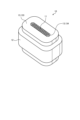
- Embodiment 1. 1 is a perspective view showing the configuration of a power generating element according to embodiment 1.
- a power generating element 10 according to embodiment 1 includes a plurality of magnetic wires 11 having a large Barkhausen effect, a pickup coil 12 wound around a bundle of the magnetic wires 11, and magnetic connection members 13 disposed on both ends of the magnetic wires 11.
- the magnetic connection member 13 includes a cylindrical magnetic member 131 and a resin sealing material 132 filled inside the cylindrical magnetic member 131.
- the magnetic wire 11 has a magnetostrictive effect and expands and contracts due to magnetostriction in response to changes in the applied magnetic field.
- the cylindrical magnetic member 131 is a cylinder made of a soft magnetic material such as iron.
- the magnetic permeability of the cylindrical magnetic member 131 may be higher than that of air, but is preferably higher than that of the magnetic wire 11.
- the soft magnetic material may be a steel material such as SS400 or S45C, a magnetic stainless steel material such as SUS430 or SUS440, or a high magnetic permeability material such as permalloy or permendur.
- one of the two cylindrical magnetic members 131 is disposed at one end of the magnetic wire 11 or as close as possible to that end, and the other of the two cylindrical magnetic members 131 is disposed at the other end of the magnetic wire 11 or as close as possible to that end.
- the resin sealing material 132 is hard enough not to prevent the expansion and contraction of the magnetic wire 11 due to magnetostriction.
- the resin sealing material 132 fixes the magnetic wire 11 with each end of the magnetic wire 11 in contact with the cylindrical magnetic member 131. Therefore, the ends of the magnetic wire 11 are magnetically connected to each other.
- FIG. 2 is a schematic diagram showing the effect of magnetically connecting the ends of the magnetic wires of the power generating element according to the first embodiment.
- FIG. 2 shows the waveform of the voltage generated in the pickup coil 12 when the ends of the three magnetic wires 11 are not magnetically connected and when they are connected.
- the vertical axis represents the voltage
- the horizontal axis represents the elapsed time from a certain reference time.
- the waveforms of the dashed line, the one-dot chain line, and the two-dot chain line represent the waveform of the voltage when the ends of the three magnetic wires 11 are not magnetically connected
- the waveform of the solid line represents the waveform of the voltage when the ends of the three magnetic wires 11 are magnetically connected.
- each magnetic wire 11 When the ends of the three magnetic wires 11 are not magnetically connected, there is a variation in the power generation timing of each magnetic wire 11 due to a slight variation in the trigger magnetic field strength of each magnetic wire due to a manufacturing error of the magnetic wires 11, or a slight difference in the magnetic field applied to each magnetic wire from a magnet.
- the characteristics of the three magnetic wires 11 are classified as A, B, and C, normally, when the three magnetic wires 11 are simply bundled together, each of the magnetic wires 11 generates a voltage in the pickup coil 12 at a different timing. In the example shown in Fig.
- the time when the voltage generated in the pickup coil 12 by the magnetic wire 11 with characteristic A is maximum is shifted by 10 [ ⁇ s] from the time when the voltage generated in the pickup coil 12 by the magnetic wire 11 with characteristic C is maximum, and the voltage obtained by superimposing the voltages generated in the pickup coil 12 by each of the three magnetic wires 11 is not three times the voltage generated in the pickup coil 12 by each of the three magnetic wires 11.
- the timing of power generation is synchronized for the magnetic wire 11 with characteristic A, the magnetic wire 11 with characteristic B, and the magnetic wire 11 with characteristic C, as shown by the waveform shown by the solid line in Figure 2, and a higher voltage is generated in the pickup coil 12 compared to when the three magnetic wires 11 are not bundled together.
- FIG. 3 is a schematic diagram showing the effect of covering both ends of the magnetic wire of the power generating element of embodiment 1 with a cylindrical magnetic member.
- FIG. 3 shows a schematic waveform of the measurement result of the voltage generated in the pickup coil 12 when both ends of the magnetic wire 11 are covered with the cylindrical magnetic member 131 and when they are not covered.
- the vertical axis represents the voltage
- the horizontal axis represents the elapsed time from a certain reference time.
- the waveform of the dashed line represents the voltage waveform when both ends of the magnetic wire 11 are not covered with the cylindrical magnetic member 131
- the waveform of the solid line represents the voltage waveform when both ends of the magnetic wire 11 are covered with the cylindrical magnetic member 131.
- FIG. 3 shows a schematic diagram showing the effect of covering both ends of the magnetic wire of the power generating element of embodiment 1 with a cylindrical magnetic member.
- FIG. 3 shows a schematic waveform of the measurement result of the voltage generated in the pickup coil 12 when both ends of the magnetic wire 11 are covered with the cylindrical
- the voltage generated in the pickup coil 12 is higher than when both ends of the magnetic wire 11 are not covered with the cylindrical magnetic member 131.
- the reason why the voltage generated in the pickup coil 12 can be increased by covering both ends of the magnetic wire 11 with the cylindrical magnetic member 131 is presumably because the magnitude of the demagnetizing field is reduced when all of the multiple magnetic wires 11 come into contact with the cylindrical magnetic member 131.
- the voltage generated in the pickup coil 12 decreases when both ends of the magnetic wire 11 are firmly fixed. This is because the magnetic wire 11 has a magnetostrictive effect, and the magnetic wire 11 expands and contracts due to magnetostriction in response to changes in the applied magnetic field. However, it is believed that when both ends of the magnetic wire 11 are firmly fixed, the expansion and contraction of the magnetic wire 11 is hindered, which inhibits magnetic changes and makes it difficult for magnetization reversal to occur, resulting in a decrease in the generated voltage.
- the inside of the cylindrical magnetic member 131 is filled with a resin sealing material 132, and the resin sealing material 132 is present between the magnetic wire 11 and the cylindrical magnetic member 131.
- the resin sealing material 132 is hard enough not to interfere with the expansion and contraction of the magnetic wire 11 due to magnetostriction, so the expansion and contraction of the magnetic wire 11 due to magnetostriction is not hindered by the resin sealing material 132, and the decrease in the voltage generated in the pickup coil 12 can be suppressed.
- the ends of the magnetic wire 11 are magnetically connected by a magnetic connecting member 13 having a cylindrical magnetic member 131 and a resin sealing material 132, so that the voltage generated in the pickup coil 12 can be prevented from decreasing due to manufacturing variations in the magnetic wire 11.
- Embodiment 2. 4 is a perspective view showing the configuration of a power generating element according to the second embodiment.
- the power generating element 10 according to the second embodiment has a plurality of magnetic wires 11, a pickup coil 12 wound around a bundle of the magnetic wires 11, and magnetic connection members 13 arranged at both ends of the magnetic wires 11, as in the power generating element 10 according to the first embodiment.
- the magnetic connection member 13 has a cylindrical member 133 covering both ends of the magnetic wires 11, and a magnetic resin sealing material 134 filled in the cylindrical member 133.
- the cylindrical member 133 may be a non-magnetic material.
- the plurality of magnetic wires 11 are arranged with gaps between them.
- the magnetic resin sealing material 134 is a composite resin material in which magnetic powder, which is a dispersoid, is dispersed in resin, which is a dispersion medium.
- the magnetic resin sealing material 134 has a hardness that does not hinder the expansion and contraction of the magnetic wire 11 due to magnetostriction.
- the magnetic resin sealing material 134 exists between the magnetic wire 11 and the tubular member 133, and between the magnetic wires 11 themselves. Therefore, the ends of the magnetic wire 11 are magnetically connected to each other by the magnetic resin sealing material 134.
- the magnetic wires 11 are arranged with a gap between them, so only the ends are magnetically connected to each other, and the parts other than the ends are not in contact with each other.
- the ends of the magnetic wire 11 are magnetically connected by a magnetic connecting member 13 having a cylindrical member 133 and a magnetic resin sealing material 134, so that the voltage generated in the pickup coil 12 can be prevented from decreasing due to manufacturing variations in the magnetic wire 11.
- the power generating element 10 can obtain a power generating effect due to magnetization reversal by using multiple magnetic wires 11 while reducing the magnitude of the demagnetizing field.
- the ends of the magnetic wire 11 may also be magnetically connected to each other by bundling them with magnetic metal tape.
- the magnetic connection member 13 in embodiment 2 may have a cylindrical magnetic member 131 and a resin sealing material 132 as in embodiment 1, with the magnetic wires 11 spaced from each other and each in contact with the cylindrical magnetic member 131.
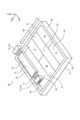
- FIG. 5 is a perspective view showing the configuration of a power generation module according to the third embodiment.
- the power generation module 20 according to the third embodiment includes a power generation element 10, a magnet unit 30, and a housing unit 40.
- the power generation element 10 includes a plurality of magnetic wires 11, a pickup coil 12 wound around the magnetic wires 11, and magnetic connection members 13 arranged at both ends of the magnetic wires 11.
- the magnetic connection member 13 includes a cylindrical member 133 and a magnetic metal tape 135 wound around the end of the magnetic wire 11.
- An example of a magnetic metal that is a material for the magnetic metal tape 135 is permalloy, but the material for the magnetic metal tape 135 may be a magnetic metal other than permalloy.
- the end of the magnetic wire 11 around which the magnetic metal tape 135 is wound is inserted into the cylinder of the cylindrical member 133.
- the plurality of magnetic wires 11 are arranged side by side in the X direction, which is a direction perpendicular to the Y direction, which is the longitudinal direction.
- the direction perpendicular to both the X direction and the Y direction is defined as the Z direction.
- the Y direction is the first direction and the X direction is the second direction.
- the magnet section 30 has a first magnet 31 and a second magnet 32 arranged side by side in the X direction.
- the first magnet 31 and the second magnet 32 are composed of permanent magnets.
- a spacer 33 made of a non-magnetic material is arranged between the first magnet 31 and the second magnet 32.
- the non-magnetic material is a material with a relative magnetic permeability of 1 or less.
- the first magnet 31, the second magnet 32, and the spacer 33 are fixed together to form the magnet section 30.
- Methods for fixing the first magnet 31, the second magnet 32, and the spacer 33 include, but are not limited to, gluing, integral molding, screw fastening, and fastening with a fastening band.
- the magnet section 30 is such that the first magnet 31 and the second magnet 32 can be displaced together in the X direction while maintaining a constant gap between them. Note that if the first magnet 31 and the second magnet 32 can be displaced together in the X direction while maintaining a constant gap between them, the spacer 33 may be air.
- the housing 40 is made of a non-magnetic material, more specifically, a resin molded body.
- the housing 40 has a bottom plate 43 parallel to the XY plane, a pair of frame portions 41 located at both ends of the bottom plate 43 in the Y direction, and a pair of frame portions 42 located at both ends of the bottom plate 43 in the X direction.
- the magnet portion 30 is held in a recess 44 surrounded by the frame portions 41, 42 and the bottom plate 43.
- the width of the recess 44 in the X direction i.e., the spacing of the frame portion 42 in the X direction, is wider than the width of the magnet portion 30 in the X direction. Therefore, the magnet portion 30 can be displaced in the X direction within the recess 44.
- the amount of displacement of the magnet part 30 is more than twice the distance between the first magnet 31 and the second magnet 32.
- the movement of the magnet part 30 in the +Z direction is restricted by a guide part (not shown) that protrudes from the frame parts 41 and 42 into the recess 44 like an eave.
- the power generating element 10 is arranged in the +Z direction relative to the range in which the magnet section 30 can be displaced.
- FIG. 5 shows the state in which the first magnet 31 faces the power generating element 10.
- the second magnet 32 faces the power generating element 10. That is, the magnetic pole applied to the power generating element 10 is switched by the linear movement of the magnet section 30.
- the state in which the first magnet 31 faces the power generating element 10 changes to the state in which the second magnet 32 faces the power generating element 10
- the magnetic field applied to the magnetic wire 11 is reversed, and a voltage is generated in the pickup coil 12.
- the state in which the second magnet 32 faces the power generating element 10 changes to the state in which the first magnet 31 faces the power generating element 10, the magnetic field applied to the magnetic wire 11 is reversed, and a voltage is generated in the pickup coil 12.
- the magnetic wires 11 are arranged in the X direction, so that the distance between each magnetic wire 11 and the magnet section 30 in the Z direction is the same. This makes it difficult for the power generation timing of each magnetic wire 11 to vary, and the voltage generated in the pickup coil 12 is unlikely to decrease.
- the power generation module 20 may be constructed using the power generation element 10 according to embodiment 1 or embodiment 2.
- the power generation module 20 can suppress the voltage generated in the pickup coil 12 from decreasing due to manufacturing variations in the magnetic wire 11, and can therefore increase the voltage generated in the pickup coil 12 when the magnet section 30 is displaced in the X direction due to vibration or the like.
- the magnetic connection member 13 in embodiment 3 is shown to have a configuration including a tubular member 133 and a magnetic metal tape 135, it may also have a configuration including a tubular magnetic member 131 and a resin sealing material 132 as in embodiment 1, or a configuration including a tubular member 133 and a magnetic resin sealing material 134 as in embodiment 2.
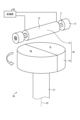
- Embodiment 4. 6 is a perspective view showing the configuration of a rotation speed detector according to the fourth embodiment.
- the rotation speed detector 50 according to the fourth embodiment is a magnetic rotation speed detector that detects the rotation speed of a rotating body based on an induced voltage generated according to a change in a magnetic field.
- the rotation speed detector 50 detects the number of rotations of the rotating body per unit time.
- the rotation speed detector 50 includes a power generation module 20 and a processing unit 60.
- the power generation module 20 includes the power generation element 10 according to the first or second embodiment, and a magnet unit constituted by a magnet 70 arranged opposite the power generation element 10.
- the magnet 70 is attached to the shaft 21 and rotates together with the shaft 21.
- the magnetic pole applied to the power generation element 10 is switched by the rotational movement of the magnet unit constituted by the magnet 70.
- the power generation element 10 generates an induced voltage in the pickup coil 12 according to the change in the magnetic field caused by the rotation of the magnet 70.
- a signal due to the voltage generated in the pickup coil 12 is input to the processing unit 60.
- the processing unit 60 counts the number of pulses generated by power generation based on the signal from the power generation element 10. By counting the number of pulses, the processing unit 60 detects the number of rotations of the shaft 21. Since the processing unit 60 can operate using induced voltage, it can detect the number of rotations of the shaft 21 without a power source.
- the power generating element 10 is disposed opposite the magnet 70 in a direction parallel to the rotation axis 22 of the shaft 21.
- the power generating element 10 faces the surface of the magnet 70 opposite the surface fixed to the shaft 21.
- the power generating element 10 may be disposed opposite the surface of the magnet 70 fixed to the shaft 21.
- FIG. 7 is a plan view showing the magnet and power generating element of the rotation speed detector according to the fourth embodiment.
- FIG. 7 shows the rotation speed detector 50 with the magnet 70 and power generating element 10 viewed in a direction parallel to the rotation axis 22 and from the opposite side to the shaft 21.
- the processing unit 60 is omitted from FIG. 7.
- the power generating element 10 is disposed facing the magnet 70 at a position away from the center 71 of the circle that is the planar shape of the magnet 70.
- the rotation speed detector 50 is generally used in conjunction with an angle detector that detects the rotation angle of a rotating body.
- the angle detector includes a disk for optical detection with an optical slit formed therein, a light emitting unit that generates light, and a light receiving unit that detects the light emitted from the light emitting unit and passed through the optical slit.
- the disk is fixed to the rotating body on the upper surface side of the magnet 70.
- the light emitting unit and the light receiving unit are provided at positions facing the optical slit.
- the angle detector is omitted from FIG. 7.
- the rotation speed detector 50 according to the fourth embodiment can suppress the voltage generated in the pickup coil 12 from decreasing due to manufacturing variations in the magnetic wire 11, and can increase the voltage generated in the pickup coil 12 by the rotation of the shaft 21.
- Embodiment 5. 8 is a perspective view showing the configuration of a generator according to the fifth embodiment.
- the generator 100 according to the fifth embodiment has a rotor 80 and a stator 90.
- the rotor 80 has a cylindrical base 81 and a plurality of magnets 82 arranged on the outer circumferential surface of the base 81.
- the plurality of magnets 82 are arranged in a circumferential direction of the base 81 with the north pole facing outward and the south pole facing outward alternately.
- the stator 90 includes a plurality of power generating elements 10 arranged on the same arc having a center on the central axis of rotation 83 of the rotor 80.
- the plurality of power generating elements 10 are installed at equal angular intervals.
- twelve power generating elements 10 are arranged at intervals of 30 degrees.
- the power generating element 10 includes a plurality of magnetic wires 11, a pickup coil 12 wound around the plurality of magnetic wires 11, and magnetic connection members 13 arranged at both ends of the magnetic wires 11.
- the magnetic connection member 13 includes a cylindrical member 133 and a magnetic resin sealing material 134 filled in the cylindrical member 133.
- the power generating element 10 provided in the stator 90 of the generator 100 according to the fifth embodiment has the same configuration as the power generating element 10 according to the second embodiment, but the number of magnetic wires 11 is greater than that of the power generating element 10 according to the second embodiment, and is generally two to three digits.
- the number of magnetic wires 11 may be one digit or four digits or more, and is not limited to a specific number.
- a magnetic resin sealing material 134 is present between the ends of the magnetic wires 11, and the ends of the magnetic wires 11 are magnetically connected to each other.
- the magnet 82 of the rotor 80 is magnetized to generate magnetic lines of force that pass through the pickup coil 12.
- the power generating element 10 alternates between facing the north pole and facing the south pole, generating an AC voltage in the pickup coil 12.
- an iron core which is a magnetic material with high magnetic permeability, is often placed inside the windings in order to generate electricity efficiently in response to the rotation of the magnet.
- the generator 100 according to the fifth embodiment uses a bundle of magnetic wires 11 instead of an iron core, and is therefore able to obtain a higher voltage than a typical generator by using the magnetic wires 11 as a self-generating force due to magnetization reversal.
- stator 90 includes a power generating element 10 having a structure similar to that of the power generating element 10 in embodiment 2, but the power generating element 10 included in the stator 90 may also have a structure similar to that of the power generating element 10 in embodiment 1.
Landscapes
- Engineering & Computer Science (AREA)
- Power Engineering (AREA)
- Physics & Mathematics (AREA)
- General Physics & Mathematics (AREA)
- Microelectronics & Electronic Packaging (AREA)
- General Electrical Machinery Utilizing Piezoelectricity, Electrostriction Or Magnetostriction (AREA)
Priority Applications (4)
| Application Number | Priority Date | Filing Date | Title |
|---|---|---|---|
| DE112022007937.1T DE112022007937T5 (de) | 2022-10-21 | 2022-10-21 | Stromerzeugungselement, stromerzeugungsmodul, drehzahlmesser und stromgenerator |
| JP2024551188A JP7825730B2 (ja) | 2022-10-21 | 2022-10-21 | 発電素子、発電モジュール、回転数検出器及び発電機 |
| CN202280100901.0A CN120019746A (zh) | 2022-10-21 | 2022-10-21 | 发电元件、发电模块、转速检测器及发电机 |
| PCT/JP2022/039352 WO2024084701A1 (ja) | 2022-10-21 | 2022-10-21 | 発電素子、発電モジュール、回転数検出器及び発電機 |
Applications Claiming Priority (1)
| Application Number | Priority Date | Filing Date | Title |
|---|---|---|---|
| PCT/JP2022/039352 WO2024084701A1 (ja) | 2022-10-21 | 2022-10-21 | 発電素子、発電モジュール、回転数検出器及び発電機 |
Publications (1)
| Publication Number | Publication Date |
|---|---|
| WO2024084701A1 true WO2024084701A1 (ja) | 2024-04-25 |
Family
ID=90737290
Family Applications (1)
| Application Number | Title | Priority Date | Filing Date |
|---|---|---|---|
| PCT/JP2022/039352 Ceased WO2024084701A1 (ja) | 2022-10-21 | 2022-10-21 | 発電素子、発電モジュール、回転数検出器及び発電機 |
Country Status (4)
| Country | Link |
|---|---|
| JP (1) | JP7825730B2 (https=) |
| CN (1) | CN120019746A (https=) |
| DE (1) | DE112022007937T5 (https=) |
| WO (1) | WO2024084701A1 (https=) |
Cited By (1)
| Publication number | Priority date | Publication date | Assignee | Title |
|---|---|---|---|---|
| WO2024219243A1 (ja) * | 2023-04-17 | 2024-10-24 | オリエンタルモーター株式会社 | 発電センサ |
Citations (4)
| Publication number | Priority date | Publication date | Assignee | Title |
|---|---|---|---|---|
| JP2007251819A (ja) * | 2006-03-17 | 2007-09-27 | Kri Inc | アンテナ |
| JP2008014799A (ja) * | 2006-07-06 | 2008-01-24 | Yaskawa Electric Corp | 絶対値エンコーダ装置 |
| JP2012044851A (ja) * | 2010-08-13 | 2012-03-01 | Katsuhiro Sakai | 自動自立式エネルギー発生システム |
| WO2020250439A1 (ja) * | 2019-06-14 | 2020-12-17 | 三菱電機株式会社 | 回転数検出器 |
-
2022
- 2022-10-21 WO PCT/JP2022/039352 patent/WO2024084701A1/ja not_active Ceased
- 2022-10-21 JP JP2024551188A patent/JP7825730B2/ja active Active
- 2022-10-21 CN CN202280100901.0A patent/CN120019746A/zh active Pending
- 2022-10-21 DE DE112022007937.1T patent/DE112022007937T5/de active Pending
Patent Citations (4)
| Publication number | Priority date | Publication date | Assignee | Title |
|---|---|---|---|---|
| JP2007251819A (ja) * | 2006-03-17 | 2007-09-27 | Kri Inc | アンテナ |
| JP2008014799A (ja) * | 2006-07-06 | 2008-01-24 | Yaskawa Electric Corp | 絶対値エンコーダ装置 |
| JP2012044851A (ja) * | 2010-08-13 | 2012-03-01 | Katsuhiro Sakai | 自動自立式エネルギー発生システム |
| WO2020250439A1 (ja) * | 2019-06-14 | 2020-12-17 | 三菱電機株式会社 | 回転数検出器 |
Cited By (1)
| Publication number | Priority date | Publication date | Assignee | Title |
|---|---|---|---|---|
| WO2024219243A1 (ja) * | 2023-04-17 | 2024-10-24 | オリエンタルモーター株式会社 | 発電センサ |
Also Published As
| Publication number | Publication date |
|---|---|
| JP7825730B2 (ja) | 2026-03-06 |
| DE112022007937T5 (de) | 2025-08-28 |
| JPWO2024084701A1 (https=) | 2024-04-25 |
| CN120019746A (zh) | 2025-05-16 |
Similar Documents
| Publication | Publication Date | Title |
|---|---|---|
| KR101531736B1 (ko) | 직동 회전 엑츄에이터 | |
| EP2938971B1 (en) | Integrated multi-turn absolute position sensor for high pole count motors | |
| CN100510641C (zh) | 磁性编码器设备及致动器 | |
| US8928313B2 (en) | Magnetic encoder with improved resolution | |
| JP4103018B2 (ja) | サーボモータ | |
| JP7825730B2 (ja) | 発電素子、発電モジュール、回転数検出器及び発電機 | |
| CN1312461A (zh) | 磁导率位置检测器 | |
| US20220003617A1 (en) | Torque detection sensor | |
| JP2019198147A (ja) | 回転電機 | |
| JP2022116385A (ja) | 回転検出器及びそれを備えたモータ | |
| JPWO2024084701A5 (https=) | ||
| JPH01234071A (ja) | 磁気式エンコーダ装置付き超音波モータ | |
| JP7209911B1 (ja) | 回転数検出器 | |
| WO2024075465A1 (ja) | 発電素子、発電システムおよびエンコーダ | |
| JP5135277B2 (ja) | 回転型位置検出装置 | |
| JP7584767B2 (ja) | 筒型リニアモータ | |
| JP2019115239A (ja) | 円筒型リニアモーター | |
| JPH0754259B2 (ja) | 回転数検出器 | |
| JP2006074881A (ja) | シリンダ形リニアモータの移動子 | |
| CN119437302A (zh) | 一种测量装置 | |
| JP2026006613A (ja) | ロータリエンコーダ | |
| JPH0145264Y2 (https=) | ||
| JP2000262031A (ja) | ダンパ/発電装置 | |
| JPS6245788B2 (https=) | ||
| JP2022030905A (ja) | ハイブリッド型ステッピングモータ |
Legal Events
| Date | Code | Title | Description |
|---|---|---|---|
| 121 | Ep: the epo has been informed by wipo that ep was designated in this application |
Ref document number: 22962808 Country of ref document: EP Kind code of ref document: A1 |
|
| WWE | Wipo information: entry into national phase |
Ref document number: 2024551188 Country of ref document: JP |
|
| WWE | Wipo information: entry into national phase |
Ref document number: 202280100901.0 Country of ref document: CN |
|
| WWP | Wipo information: published in national office |
Ref document number: 202280100901.0 Country of ref document: CN |
|
| WWE | Wipo information: entry into national phase |
Ref document number: 112022007937 Country of ref document: DE |
|
| WWP | Wipo information: published in national office |
Ref document number: 112022007937 Country of ref document: DE |
|
| 122 | Ep: pct application non-entry in european phase |
Ref document number: 22962808 Country of ref document: EP Kind code of ref document: A1 |