WO2024075167A1 - 光送信器 - Google Patents
光送信器 Download PDFInfo
- Publication number
- WO2024075167A1 WO2024075167A1 PCT/JP2022/037030 JP2022037030W WO2024075167A1 WO 2024075167 A1 WO2024075167 A1 WO 2024075167A1 JP 2022037030 W JP2022037030 W JP 2022037030W WO 2024075167 A1 WO2024075167 A1 WO 2024075167A1
- Authority
- WO
- WIPO (PCT)
- Prior art keywords
- driver
- peltier element
- optical modulator
- optical
- temperature
- Prior art date
- Legal status (The legal status is an assumption and is not a legal conclusion. Google has not performed a legal analysis and makes no representation as to the accuracy of the status listed.)
- Ceased
Links
Images



Classifications
-
- H—ELECTRICITY
- H10—SEMICONDUCTOR DEVICES; ELECTRIC SOLID-STATE DEVICES NOT OTHERWISE PROVIDED FOR
- H10W—GENERIC PACKAGES, INTERCONNECTIONS, CONNECTORS OR OTHER CONSTRUCTIONAL DETAILS OF DEVICES COVERED BY CLASS H10
- H10W40/00—Arrangements for thermal protection or thermal control
- H10W40/20—Arrangements for cooling
- H10W40/28—Arrangements for cooling comprising Peltier coolers
-
- G—PHYSICS
- G02—OPTICS
- G02B—OPTICAL ELEMENTS, SYSTEMS OR APPARATUS
- G02B6/00—Light guides; Structural details of arrangements comprising light guides and other optical elements, e.g. couplings
- G02B6/24—Coupling light guides
- G02B6/42—Coupling light guides with opto-electronic elements
- G02B6/4201—Packages, e.g. shape, construction, internal or external details
- G02B6/4266—Thermal aspects, temperature control or temperature monitoring
- G02B6/4268—Cooling
- G02B6/4271—Cooling with thermo electric cooling
-
- G—PHYSICS
- G02—OPTICS
- G02F—OPTICAL DEVICES OR ARRANGEMENTS FOR THE CONTROL OF LIGHT BY MODIFICATION OF THE OPTICAL PROPERTIES OF THE MEDIA OF THE ELEMENTS INVOLVED THEREIN; NON-LINEAR OPTICS; FREQUENCY-CHANGING OF LIGHT; OPTICAL LOGIC ELEMENTS; OPTICAL ANALOGUE/DIGITAL CONVERTERS
- G02F1/00—Devices or arrangements for the control of the intensity, colour, phase, polarisation or direction of light arriving from an independent light source, e.g. switching, gating or modulating; Non-linear optics
- G02F1/01—Devices or arrangements for the control of the intensity, colour, phase, polarisation or direction of light arriving from an independent light source, e.g. switching, gating or modulating; Non-linear optics for the control of the intensity, phase, polarisation or colour
- G02F1/015—Devices or arrangements for the control of the intensity, colour, phase, polarisation or direction of light arriving from an independent light source, e.g. switching, gating or modulating; Non-linear optics for the control of the intensity, phase, polarisation or colour based on semiconductor elements having potential barriers, e.g. having a PN or PIN junction
-
- G—PHYSICS
- G02—OPTICS
- G02F—OPTICAL DEVICES OR ARRANGEMENTS FOR THE CONTROL OF LIGHT BY MODIFICATION OF THE OPTICAL PROPERTIES OF THE MEDIA OF THE ELEMENTS INVOLVED THEREIN; NON-LINEAR OPTICS; FREQUENCY-CHANGING OF LIGHT; OPTICAL LOGIC ELEMENTS; OPTICAL ANALOGUE/DIGITAL CONVERTERS
- G02F1/00—Devices or arrangements for the control of the intensity, colour, phase, polarisation or direction of light arriving from an independent light source, e.g. switching, gating or modulating; Non-linear optics
- G02F1/01—Devices or arrangements for the control of the intensity, colour, phase, polarisation or direction of light arriving from an independent light source, e.g. switching, gating or modulating; Non-linear optics for the control of the intensity, phase, polarisation or colour
- G02F1/015—Devices or arrangements for the control of the intensity, colour, phase, polarisation or direction of light arriving from an independent light source, e.g. switching, gating or modulating; Non-linear optics for the control of the intensity, phase, polarisation or colour based on semiconductor elements having potential barriers, e.g. having a PN or PIN junction
- G02F1/017—Structures with periodic or quasi periodic potential variation, e.g. superlattices, quantum wells
-
- H—ELECTRICITY
- H04—ELECTRIC COMMUNICATION TECHNIQUE
- H04B—TRANSMISSION
- H04B10/00—Transmission systems employing electromagnetic waves other than radio-waves, e.g. infrared, visible or ultraviolet light, or employing corpuscular radiation, e.g. quantum communication
- H04B10/50—Transmitters
- H04B10/501—Structural aspects
-
- G—PHYSICS
- G02—OPTICS
- G02B—OPTICAL ELEMENTS, SYSTEMS OR APPARATUS
- G02B6/00—Light guides; Structural details of arrangements comprising light guides and other optical elements, e.g. couplings
- G02B6/24—Coupling light guides
- G02B6/42—Coupling light guides with opto-electronic elements
- G02B6/4201—Packages, e.g. shape, construction, internal or external details
- G02B6/4204—Packages, e.g. shape, construction, internal or external details the coupling comprising intermediate optical elements, e.g. lenses, holograms
- G02B6/4206—Optical features
-
- G—PHYSICS
- G02—OPTICS
- G02F—OPTICAL DEVICES OR ARRANGEMENTS FOR THE CONTROL OF LIGHT BY MODIFICATION OF THE OPTICAL PROPERTIES OF THE MEDIA OF THE ELEMENTS INVOLVED THEREIN; NON-LINEAR OPTICS; FREQUENCY-CHANGING OF LIGHT; OPTICAL LOGIC ELEMENTS; OPTICAL ANALOGUE/DIGITAL CONVERTERS
- G02F2202/00—Materials and properties
- G02F2202/10—Materials and properties semiconductor
- G02F2202/102—In×P and alloy
-
- H—ELECTRICITY
- H10—SEMICONDUCTOR DEVICES; ELECTRIC SOLID-STATE DEVICES NOT OTHERWISE PROVIDED FOR
- H10W—GENERIC PACKAGES, INTERCONNECTIONS, CONNECTORS OR OTHER CONSTRUCTIONAL DETAILS OF DEVICES COVERED BY CLASS H10
- H10W90/00—Package configurations
- H10W90/701—Package configurations characterised by the relative positions of pads or connectors relative to package parts
- H10W90/751—Package configurations characterised by the relative positions of pads or connectors relative to package parts of bond wires
- H10W90/753—Package configurations characterised by the relative positions of pads or connectors relative to package parts of bond wires between laterally-adjacent chips
-
- H—ELECTRICITY
- H10—SEMICONDUCTOR DEVICES; ELECTRIC SOLID-STATE DEVICES NOT OTHERWISE PROVIDED FOR
- H10W—GENERIC PACKAGES, INTERCONNECTIONS, CONNECTORS OR OTHER CONSTRUCTIONAL DETAILS OF DEVICES COVERED BY CLASS H10
- H10W90/00—Package configurations
- H10W90/701—Package configurations characterised by the relative positions of pads or connectors relative to package parts
- H10W90/751—Package configurations characterised by the relative positions of pads or connectors relative to package parts of bond wires
- H10W90/755—Package configurations characterised by the relative positions of pads or connectors relative to package parts of bond wires between a chip and a laterally-adjacent insulating package substrate, interpose or RDL
Definitions
- the present invention relates to an optical transmitter used in optical communications. More specifically, the present invention relates to an implementation form of an optical transmitter that includes a semiconductor optical modulator and its driver IC.
- an optical transceiver in which an optical receiver and an optical transmitter are integrated is used.
- broadband analog components such as radio frequency (RF) electrical circuits are required; for example, an optical modulator requires a modulation bandwidth of 40 GHz or more.
- RF radio frequency
- HB-CDM High-Bandwidth Coherent Driver Modulator
- ICR Integrated Coherent Receiver
- semiconductor-based optical modulators are attracting attention as an alternative to conventional lithium niobate (LN) optical modulators due to their compact size and low cost.
- Compound semiconductors such as InP are mainly used for faster modulation operations.
- Si-based optical devices Furthermore, in systems where compact size and low cost are important, research and development is focused on Si-based optical devices.
- the semiconductor optical modulators mentioned above have their own advantages and disadvantages specific to each material.
- temperature control of the optical modulator chip is essential during operation in order to control the band-edge absorption effect.
- a Si optical modulator has the advantage of not needing temperature control, but has a smaller electro-optic effect than other material systems. This makes it necessary to lengthen the electro-optic interaction length, which can result in increased high-frequency loss as a result of the device length increasing.
- the operating temperature (case temperature) of an optical transmitter using HB-CDM must be in the range of at least -5°C to 75°C. In order to ensure this operating temperature, it has been common to only mount the optical modulator chip on a Peltier element, taking into account power consumption (Patent Document 1).
- the present invention provides a new configuration and implementation form of an optical transmitter that suppresses the temperature dependency of an optical transmitter including a driver IC, has excellent high-speed performance, and is capable of stable operation regardless of the environmental temperature.
- One aspect of the present invention is an optical transmitter comprising an optical modulator, a driver integrated circuit (driver IC) that supplies a modulated electrical signal for the optical modulator, a first Peltier element that controls the temperature of the optical modulator, and a second Peltier element that controls the temperature of the driver IC, the optical modulator and the driver IC are connected by wire, and the temperature of the second Peltier element is set lower than the temperature of the first Peltier element.
- driver IC driver integrated circuit
- the present invention makes it possible to realize a new configuration and implementation form of an optical transmitter that suppresses the temperature dependency of the optical transmitter including the driver IC, has excellent speed, and is capable of stable operation regardless of the environmental temperature.
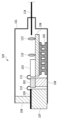
- FIG. 1 is a cross-sectional side view of a prior art HB-CDM optical transmitter implementation.
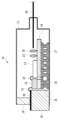
- 1 is a side cross-sectional view of an implementation of an optical transmitter using HB-CDM of the present invention.
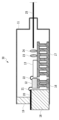
- 10A and 10B are diagrams for explaining limitations in the height direction of wire connection points in an optical transmitter; 11 is a side cross-sectional view of another implementation of an optical transmitter using HB-CDM of the present invention.
- FIG. FIG. 13 is a diagram for explaining restrictions on pad positions, etc. on the circuit surface of the optical transmitter.
- 4A and 4B are diagrams for explaining the density arrangement of Peltier elements in the optical transmitter of the present invention.
- the present invention presents new configurations for improving the temperature dependency of the high-frequency characteristics of an optical transmitter in an optical transmitter in which an optical modulator and its driver IC are integrated into a package, and mounting forms compatible with each configuration.
- the configuration for improving the temperature dependency includes a new usage form of a temperature regulator (TEC: ThermoElectric Cooler) in the optical transmitter.
- TEC ThermoElectric Cooler
- various mounting forms of the driver IC, optical modulator chip, and spatial optical components compatible with the new usage form of the TEC are also proposed.
- TECs are also known as thermoelectric coolers, and are known as small cooling devices that use Peltier junctions. TECs are made up of n-type semiconductors, p-type semiconductors, and metals, and when a direct current is passed through both sides of the plate-shaped element, heat absorption occurs on one side and heat dissipation occurs on the other. Reversing the direction of the current switches between heat absorption and dissipation, allowing for localized and precise temperature control of ICs and electronic components. For simplicity's sake, in the following explanation, the temperature regulator will be referred to as a TEC and will be described as a Peltier element. Any device that can control the temperature of a driver IC or optical modulator chip is not limited to one that uses a Peltier element.
- FIG. 1 is a side cross-sectional view showing the implementation of an optical transmitter using HB-CDM, a conventional technology.
- the optical transmitter 100 contains a driver IC 102, an optical modulator chip 103, and lenses 112 and 113, which are spatial optical components, inside a package housing 101 made of ceramic, metal, or a combination of these. More specifically, the optical modulator chip 103 is mounted on the inside bottom surface of the housing 101 via a subcarrier 104 on a Peltier element 105. The right end of the optical modulator chip 103 in the drawing has an output facet for modulated light, and lenses 112 and 113 for optically coupling the modulated light to an optical fiber 114 are also mounted on the subcarrier.
- a driver IC 102 is mounted on a metal block or ceramic material 106 adjacent to the optical modulator chip 103.
- the package housing 101 has a wiring board base 107 and a package wall 108 as the left wall in the drawing, which, together with the package housing 101, separate the outside from the internal space of the optical transmitter.
- the optical transmitter 100 can also be constructed so that the entire package is airtight.
- the modulated electrical signal supplied from an external digital signal processor (DSP) is supplied to the optical modulator chip 103 via the wiring layer 109 and driver IC 102 of the wiring board base 107.
- the wiring layer 109 and the driver IC 102, and the driver IC 102 and the optical modulator chip 103 are connected by gold wires 110, 111, etc., respectively.
- the modulated electrical signal includes an I channel and a Q channel for each of the X polarization and the Y polarization.
- one channel is supplied as an electrical signal in a differential signal format, at least eight signal wirings and a GND wiring are required for one optical modulator, but the modulated signal format is not limited to this.
- the optical transmitter 100 shown in FIG. 1 can be mounted on a common device substrate together with an ICR package in which the receiving side TIA and optical receiver are integrated, and a DSP, to form an optical transmitting and receiving device.
- the Peltier element 105 in the optical transmitter. Temperature control is essential for the optical modulator chip 103 fabricated on an InP substrate, and the Peltier element 105 controls the temperature to a predetermined operating temperature. As shown in FIG. 1, the Peltier element 105 has a size that covers at least the entire area of the optical modulator chip 103, and its position may overlap the area of spatial optical components such as lenses.
- the optical transmitter 100 of the conventional technology it was considered that temperature control of the driver IC 102 was not necessary, and it was fixed in the package by a member 106 such as a metal block or ceramic. If the external temperature (ambient temperature) of the optical transmitter 100 rises, the increased temperature becomes the operating temperature of the driver IC 102.
- the driver IC is also a heat source, so considering the heat generated by the driver, it is estimated that the operating temperature of the driver IC is about +5 to +10°C higher than the external temperature. If the maximum ambient temperature at which an optical transmission/reception device including an optical transmitter is used is 85°C, the temperature of the driver IC 102 itself is at least 85°C or higher. The driver IC also consumes a large amount of power, and the driver IC itself generates heat. This means that the backside temperature of the driver IC will exceed the maximum environmental temperature of 85°C due to the heat generated by the driver IC.
- the driver IC has temperature-dependent amplification characteristics (high frequency characteristics) of high frequency electrical signals, and at high temperatures the high frequency band tends to decrease compared to room temperature. Conversely, at low temperatures the high frequency band tends to increase compared to room temperature. Thus, the high frequency characteristics of the driver IC differ between low and high temperatures.
- the modulation signal supplied to the driver IC is optimized and compensated in various ways by the DSP at room temperature. However, dynamically updating such compensation in line with temperature fluctuations is a complex process and is not generally implemented. Because operation continues at a constant compensation state at room temperature, the compensation state of the modulation signal deviates from the optimal point when the state changes to a low or high temperature. This causes fluctuations and deterioration in the optical transmission characteristics and waveform quality of the optical transmitter.
- the IQ modulator of the optical modulator chip 103 is a linear modulator that preserves the amplitude and phase of the electrical signal, and fluctuations in the level and waveform quality of the modulated electrical signal directly affect the quality of the modulated output light. If the external temperature changes while the optical transmitter is in operation, the optical modulator chip itself is maintained at a constant temperature because its temperature is controlled by a Peltier element, but the operating temperature of the driver IC changes. As a result, fluctuations in the level and quality of the modulated light of HB-CDM occur, and the transmission characteristics deteriorate and become unstable due to changes in the environmental temperature over time.
- the deterioration of characteristics due to the environmental temperature on the high frequency side of the electrical signal causes waveform distortion of the modulated signal, degrading the modulation accuracy of the modulated output light from the optical modulator.
- a floor appears in the BER characteristics, leading to a deterioration in the transmission characteristics of the system.
- the present invention presents a new configuration and implementation form that improves the temperature dependency of high frequency characteristics and optical transmission characteristics in an optical transmitter in which an optical modulator and its driver IC are packaged together.
- FIG. 2 is a side cross-sectional view showing the mounting form of an optical transmitter using the HB-CDM of the present invention.
- an InP optical modulator chip 13 its driver IC 12, and other components are integrally configured inside a package housing 11 along the HB-CDM, as in the conventional technology configuration shown in FIG. 1.
- the package housing 11 has a wiring board base 18 and a package wall 19 as the wall surface on the left side of the drawing, and the configuration that divides the inside and outside of the package is also similar.
- the difference from the conventional technology configuration of FIG. 1 is the use of the TEC, i.e., the Peltier element, which controls the temperature.
- the driver IC 12 is also mounted on the Peltier element 16.
- the Peltier element 16 of the driver IC 12 is separate and independent from the Peltier element 17 that controls the temperature of the optical modulator chip 13, and the optical transmitter 10 has two Peltier elements.
- the optical modulator chip 13 and lenses 23, 24 are mounted on the Peltier element 17 via the subcarrier 14.
- the subcarrier 14 functions as a base for fixing and holding the optical modulator chip and spatial optical components.
- the subcarrier 14 has wiring for connecting to the DC wiring of the optical modulator chip, positioning markers for mounting the spatial optical components, and other components formed by metal patterns.
- the material of the subcarrier 14 is preferably one with excellent thermal conductivity, since it will be used to mount the optical modulator chip 13, which is the object of temperature control.
- a ceramic substrate such as an AlN substrate is preferable.
- the material constant of the AlN substrate is close to that of InP, so it is also compatible with the InP optical modulator in terms of behavior with respect to temperature changes.
- the ceramic on the top surface of the Peltier element 17 is made of AlN.
- the subcarrier 14 is depicted as being made of a single layer of AlN, but it can also be a multi-layer AlN substrate. By using a multi-layer substrate, it is possible to perform a flexible element and wiring layout that makes full use of multi-layer wiring when there are many DC wirings to the optical modulator or when cross wiring is required to change the order of the terminals.
- the driver IC 12 which is temperature controlled independently of the optical modulator chip 13, is also preferably mounted on the Peltier element 16 via a holding member 15 so that its height is aligned with the optical modulator chip 13 and the RF terrace, which is the upper surface of the wiring board base 18.
- the holding member 15 can be a metal block or a ceramic substrate. Taking thermal conductivity into consideration, for example, if DC wiring is not required for the driver IC 12, a metal block such as a CuW block can be used, and if DC wiring is required for the driver, a ceramic such as an AlN substrate can be used. If an AlN substrate is used and the number of wirings to the driver IC is large and complex, a multilayer substrate can be used, similar to the subcarrier 14 of the optical modulator chip described above.
- the driver IC is a heating element and was not considered to be a target for temperature control by a Peltier element. Driving power is required to operate the Peltier element, and no consideration was given to using extra power for a heating element.
- the inventors came up with the new idea of adding temperature control to the heating element.
- the optical transmitter 10 of the present invention is equipped with two Peltier elements 16, 17 that are independently controlled as described above, making it possible to independently manage the temperatures of the optical modulator chip 13 and the driver IC 12. Although not shown in FIG. 2, the two Peltier elements are connected to separate control current sources. As for the specific control temperatures of each part, it is generally desirable to use an InP optical modulator at around 45 ⁇ 10°C, since the modulation efficiency decreases if the temperature is too low.
- the high frequency characteristics of the driver IC 12 are better at low temperatures than at high temperatures, so the lower the set temperature, the more desirable it is.
- setting the temperature too low increases the power consumption of the Peltier element, but there is only a limited improvement in the high frequency characteristics of the driver IC. Therefore, from the perspective of balancing power consumption and high frequency characteristics, it is most appropriate to operate the driver IC at, for example, 30 ⁇ 10°C, which is close to room temperature.
- the optical transmitter 10 of the present invention can therefore be implemented as an optical transmitter comprising an optical modulator 13, a driver integrated circuit (driver IC) 12 that supplies a modulated electrical signal for the optical modulator, a first Peltier element 17 that controls the temperature of the optical modulator, and a second Peltier element 16 that controls the temperature of the driver IC, with the optical modulator and the driver IC connected by wire, and the temperature of the second Peltier element being set lower than the temperature of the first Peltier element.
- driver IC driver integrated circuit
- the parts between which the temperature is controlled by the Peltier element must be mounted with conductive paste or solder with excellent thermal conductivity of 30 W/mK or more to improve heat transfer by the Peltier element.
- conductive paste or solder with excellent thermal conductivity of 30 W/mK or more to improve heat transfer by the Peltier element.
- the same conductive paste or solder may be used for all parts, or a combination of pastes or solders with different fixed temperatures may be used.
- All spatial optical components such as lenses 23 and 24 are mounted on the Peltier element 17 to suppress variations in adhesive thickness caused by temperature changes. This makes it possible to minimize variations in optical insertion loss caused by deviations in the optical axis due to temperature changes.
- Spatial optical components also include components for fixing the fiber and a PBC (Polarization Beam Combiner), etc.
- an optical transmitter 10 in HB-CDM form is shown as an example, but similar effects can be obtained with other package forms as long as the optical transmission module has an integrated driver IC and optical modulator.
- an example is shown in which wiring from a DSP that supplies a modulation signal to the driver IC 12 is connected by a flexible printed circuit board (FPC) on an RF terrace. That is, the metal pattern 20 on the top surface of the wiring board base 18 on the outside of the optical transmitter is connected to an FPC cable (not shown).
- FPC flexible printed circuit board
- the FPC interface has superior high-frequency characteristics because it does not require RF vias (VIAs), etc.
- the electrode pads of the driver IC and the electrode pads of the RF terrace, and the electrode pads of the driver IC and the electrode pads of the optical modulator are connected by wires 21 and 22, respectively. If the wires are long, the series inductance component increases, causing the roll-off frequency in the high-frequency characteristics to shift to the low-frequency side due to LC resonance. Therefore, in order to suppress deterioration of the high-frequency characteristics of the driver IC and achieve a smooth connection, it is desirable for the wire inductance to be low. Therefore, in the optical transmitter 10, regulations are set for the height and planar directions of each part to be wire-connected.
- Figure 3 is a diagram explaining the height restrictions on wire connection points in an optical transmitter.
- the electrode 20 on the RF terrace, the driver IC 12, and the vicinity of the top surface of the optical modulator chip 13 are shown enlarged in the height direction.
- the difference in height between the pads to be wire-connected is 100 ⁇ m or less between the electrode pads of the driver IC and the electrode pads of the RF terrace, and between the electrode pads of the driver IC and the electrode pads of the optical modulator.
- This restriction is the minimum range that can be achieved, taking into account the variation in thickness of each chip and the variation in mounting components such as subcarriers.
- the driver IC 12 and the optical modulator chip 13 are arranged so that one side of each is parallel to each other, and are mounted so that they overhang from the member directly below. That is, one side of the driver IC 12 is mounted on the circuit plane so that it overhangs the optical modulator chip 13 side from the holding member 15 of the member directly below the driver IC, and one side of the optical modulator chip is mounted on the circuit plane so that it overhangs the driver IC 12 side from the subcarrier 14 directly below the chip.
- the IC and chip overhang is a device to prevent the adhesive or the like used for fixing from warping up on the top surface of the IC and chip.
- the effect of improving the temperature dependency of the high frequency characteristics and the optical transmission characteristics is largely contributed to by the temperature control of the driver IC by the Peltier element.
- overhanging implementation we explain a specific example of an overhanging implementation, but if technology emerges that allows parallel wire implementation without height differences between pads, the difference in height of the wire connection points shown in Figure 3 may not be essential. Also, overhanging implementation may not be essential if other structures or methods can be used that can effectively control warping of adhesives, etc.
- the optical modulator chip is designed to be 300 ⁇ m thick and the driver IC is designed to be 300 ⁇ m thick, and the two Peltier elements 16, 17 are the same height, then if the holding member 15 and the subcarrier 14 are made the same height, the heights of the pads on the top surface of the driver IC and the optical modulator chip will be the same.
- the height of the holding member 15 under the driver IC and the height of the Peltier element 16 so that the top surface of the driver IC is slightly lower than the RF terrace section.
- the driver IC 12 is very thin, such as 100 ⁇ m, and the optical modulator chip is designed to be 300 ⁇ m thick, and the heights of the two Peltier elements 16 and 17 are the same, then if the holding member 15 and the subcarrier 14 are made the same height, a height difference of 200 ⁇ m will be created between the top surfaces of the two chips. In such a case, it is necessary to adjust the heights of the holding member 15 and the subcarrier 14. For example, if a 250 ⁇ m metal block is added and mounted under the driver IC, the top surface height of the driver IC 12 from the common top surface position of the Peltier elements will be 350 ⁇ m, and the top surface height of the optical modulator chip will be 300 ⁇ m.
- the height difference between the driver IC 12 and the optical modulator chip will be 50 ⁇ m, and an ideal state in which the top surface of the driver IC is at a higher position can be created.
- the height of the RF terrace must be adjusted to match the top surface height of the driver IC 12.
- FIG. 4 is a side cross-sectional view showing another implementation of an optical transmitter using the HB-CDM of the present invention.
- the optical transmitter 30 has a configuration in which the number of components is reduced to reduce costs compared to the optical transmitter 10 shown in FIG. 2, and the driver IC 12 and the optical modulator chip 13 are directly mounted on the Peltier elements 16 and 17, respectively. As explained in conjunction with FIG. 3, the height-adjustable holding member 15 and the subcarrier 14 are omitted. In the case of the simplified configuration shown in FIG. 4, it is also possible to adjust the height difference between the upper surfaces of the chips by changing the heights of the two Peltier elements 16 and 17.
- the configuration of the optical transmitter 30 shown in FIG. 4 has fewer components and fewer parts that require adhesive, so it is expected that the thermal resistance will be improved by reducing the number of adhesive parts, and that this will lead to lower power consumption.
- the driver IC 12 and the optical modulator chip 13 are also arranged so that their respective sides are parallel, and are mounted so that they overhang the components directly below. That is, one side of the driver IC 12 is mounted so that it overhangs the optical modulator chip 13 side relative to the Peltier element 16, which is the component directly below the driver IC in the circuit plane, and one side of the optical modulator chip is mounted so that it overhangs the driver IC 12 side relative to the Peltier element 17 directly below the chip in the circuit plane.
- the effect of improving the temperature dependency of the high frequency characteristics and the optical transmission characteristics is largely due to the temperature control of the driver IC by the Peltier element. Therefore, even without the difference in the height direction of the wire connection points in FIG. 3 or the overhang mounting in FIG. 4, it is still possible to realize an optical transmitter that can operate stably regardless of the environmental temperature.
- FIG. 5 is a diagram explaining limitations of pads, etc., within the circuit surface of the optical transmitter.
- the gap between the optical modulator chip 13 and the driver IC 12 within the circuit surface is directly related to the length of the wire, so it is desirable to minimize the gap between the two chips. Considering the workability of the mounting process and the risk of short circuits, it is desirable to control it to 50 ⁇ m or less. In addition, even if only the gap between the two chips is controlled, if the electrode pads are formed in a location away from the chip end, it will not be effective in shortening the wire length, so the electrode pads are set to 50 ⁇ m or less from each chip end.
- the distance from the chip end to the electrode pad is 50 ⁇ m or less, it is a value that can be fully realized by normal dicing and cleavage processes.
- one side of the driver IC is mounted on the optical modulator chip side with respect to the member directly below the driver IC in the circuit surface, and one side of the optical modulator chip can be mounted on the driver IC side with respect to the member directly below the chip in the circuit surface.
- Figure 5 shows the output electrode pad on the driver IC side and the input electrode pad on the optical modulator chip side.
- the output electrode pad on the driver IC side is GSGSG and the optical modulator chip is GSSG, but the shape of each electrode pad is the same in layouts other than Figure 5.
- in Figure 5 in order to reduce the inductance of the wire, only the connection wire between the signal electrode pads is connected with two wires. From the perspective of reducing inductance, it is effective not only to use ball wires as in this figure, but also to use a configuration that further reduces inductance, such as a wide ribbon wire.
- the effect of the inductance at these connections is smaller than the inductance between the driver IC and the optical modulator chip, so it is desirable to keep this gap, for example, to 100 ⁇ m or less.
- lenses 23 and 24 are implemented as spatial optical components, but this also includes fiber fixing members, PBC, etc.
- FIG. 6 is a diagram explaining the density arrangement of Peltier elements in the optical transmitter of the present invention.
- a Peltier element has many n-type and p-type semiconductor elements arranged between upper and lower metal surfaces, and realizes the transfer of heat between the two surfaces as a whole. Therefore, the arrangement density of the semiconductor elements in the Peltier element can be set according to the amount of heat generated by the object to be temperature controlled. Considering the amount of heat generated by each part in the optical transmitter, the driver IC generates the most heat, followed by the optical modulator chip and the spatial optical components. Specifically, the element density of the Peltier elements is set so that the mounting area of the driver IC > mounting area of the optical modulator chip > mounting area of the spatial optical components.
- the Peltier element 16 that controls the driver IC has the highest element density.
- the area directly below the optical modulator may have a medium density, while the area 17-2 for spatial optical components, etc. may have a low density.
- the optical transmitter of the present invention can suppress the temperature dependency of the optical modulation output characteristics, and realize a new configuration and implementation form of an optical transmitter with excellent high speed performance.
- This invention can be used in optical communication networks.
Landscapes
- Physics & Mathematics (AREA)
- Nonlinear Science (AREA)
- General Physics & Mathematics (AREA)
- Optics & Photonics (AREA)
- Electromagnetism (AREA)
- Engineering & Computer Science (AREA)
- Computer Networks & Wireless Communication (AREA)
- Signal Processing (AREA)
- Optical Modulation, Optical Deflection, Nonlinear Optics, Optical Demodulation, Optical Logic Elements (AREA)
Priority Applications (3)
| Application Number | Priority Date | Filing Date | Title |
|---|---|---|---|
| US19/115,364 US20260107771A1 (en) | 2022-10-03 | 2022-10-03 | Optical Transmitter |
| PCT/JP2022/037030 WO2024075167A1 (ja) | 2022-10-03 | 2022-10-03 | 光送信器 |
| JP2024555489A JP7817633B2 (ja) | 2022-10-03 | 2022-10-03 | 光送信器 |
Applications Claiming Priority (1)
| Application Number | Priority Date | Filing Date | Title |
|---|---|---|---|
| PCT/JP2022/037030 WO2024075167A1 (ja) | 2022-10-03 | 2022-10-03 | 光送信器 |
Publications (1)
| Publication Number | Publication Date |
|---|---|
| WO2024075167A1 true WO2024075167A1 (ja) | 2024-04-11 |
Family
ID=90607796
Family Applications (1)
| Application Number | Title | Priority Date | Filing Date |
|---|---|---|---|
| PCT/JP2022/037030 Ceased WO2024075167A1 (ja) | 2022-10-03 | 2022-10-03 | 光送信器 |
Country Status (3)
| Country | Link |
|---|---|
| US (1) | US20260107771A1 (https=) |
| JP (1) | JP7817633B2 (https=) |
| WO (1) | WO2024075167A1 (https=) |
Citations (6)
| Publication number | Priority date | Publication date | Assignee | Title |
|---|---|---|---|---|
| JP2003209267A (ja) * | 2002-01-17 | 2003-07-25 | Hitachi Cable Ltd | 光部品の実装方法 |
| JP2010263157A (ja) * | 2009-05-11 | 2010-11-18 | Opnext Japan Inc | 光伝送モジュール |
| US20150180580A1 (en) * | 2012-11-14 | 2015-06-25 | Infinera Corp. | Interconnect Bridge Assembly for Photonic Integrated Circuits |
| JP2017123379A (ja) * | 2016-01-05 | 2017-07-13 | 富士通株式会社 | 半導体装置 |
| JP2021509483A (ja) * | 2017-12-26 | 2021-03-25 | 住友電気工業株式会社 | 光モジュール及び光モジュールの組立方法 |
| WO2021084602A1 (ja) * | 2019-10-29 | 2021-05-06 | 日本電信電話株式会社 | 光モジュール |
-
2022
- 2022-10-03 US US19/115,364 patent/US20260107771A1/en active Pending
- 2022-10-03 WO PCT/JP2022/037030 patent/WO2024075167A1/ja not_active Ceased
- 2022-10-03 JP JP2024555489A patent/JP7817633B2/ja active Active
Patent Citations (6)
| Publication number | Priority date | Publication date | Assignee | Title |
|---|---|---|---|---|
| JP2003209267A (ja) * | 2002-01-17 | 2003-07-25 | Hitachi Cable Ltd | 光部品の実装方法 |
| JP2010263157A (ja) * | 2009-05-11 | 2010-11-18 | Opnext Japan Inc | 光伝送モジュール |
| US20150180580A1 (en) * | 2012-11-14 | 2015-06-25 | Infinera Corp. | Interconnect Bridge Assembly for Photonic Integrated Circuits |
| JP2017123379A (ja) * | 2016-01-05 | 2017-07-13 | 富士通株式会社 | 半導体装置 |
| JP2021509483A (ja) * | 2017-12-26 | 2021-03-25 | 住友電気工業株式会社 | 光モジュール及び光モジュールの組立方法 |
| WO2021084602A1 (ja) * | 2019-10-29 | 2021-05-06 | 日本電信電話株式会社 | 光モジュール |
Also Published As
| Publication number | Publication date |
|---|---|
| US20260107771A1 (en) | 2026-04-16 |
| JPWO2024075167A1 (https=) | 2024-04-11 |
| JP7817633B2 (ja) | 2026-02-19 |
Similar Documents
| Publication | Publication Date | Title |
|---|---|---|
| JP7335539B2 (ja) | 高速光送受信装置 | |
| JP5144628B2 (ja) | To−can型tosaモジュール | |
| JP5180176B2 (ja) | To−can型tosaモジュール | |
| US20180067341A1 (en) | High-frequency transmission line and optical circuit | |
| WO2020121928A1 (ja) | 光送信機 | |
| US6735353B2 (en) | Module for optical transmitter | |
| CN114063227A (zh) | 光次组件模组中的热管理技术 | |
| JP2011108940A (ja) | To−can型tosaモジュール用実装構成およびto−can型tosaモジュール | |
| JP4718135B2 (ja) | 光モジュール | |
| JP2024091613A (ja) | 光モジュール | |
| EP1355179A2 (en) | Optical module equipped with a wiring plate | |
| JP7817633B2 (ja) | 光送信器 | |
| CN114069381A (zh) | 光次组件模组中的热管理技术及用于镭射二极管温度控制的加热装置 | |
| US20250383577A1 (en) | Optical device and optical transmission apparatus using the same | |
| US20260104606A1 (en) | Optical Transmitter | |
| WO2024075171A1 (ja) | 光送信器 | |
| WO2024075168A1 (ja) | 光送信器 | |
| WO2024075170A1 (ja) | 光送信器 | |
| WO2024075172A1 (ja) | 光送信器 | |
| US20260128798A1 (en) | Optical Transmitter | |
| US20260126675A1 (en) | Optical Transmitter | |
| US11722221B2 (en) | Optical module | |
| WO2024075169A1 (ja) | 光送信器 | |
| JP5837389B2 (ja) | 光通信装置 | |
| JP7718504B2 (ja) | 光送信モジュールおよび光モジュール |
Legal Events
| Date | Code | Title | Description |
|---|---|---|---|
| 121 | Ep: the epo has been informed by wipo that ep was designated in this application |
Ref document number: 22961358 Country of ref document: EP Kind code of ref document: A1 |
|
| WWE | Wipo information: entry into national phase |
Ref document number: 2024555489 Country of ref document: JP |
|
| NENP | Non-entry into the national phase |
Ref country code: DE |
|
| 122 | Ep: pct application non-entry in european phase |
Ref document number: 22961358 Country of ref document: EP Kind code of ref document: A1 |