WO2024070669A1 - アゾ色素、染料組成物、陽極酸化アルミニウム用着色剤および着色方法、ならびに該色素の製造方法 - Google Patents
アゾ色素、染料組成物、陽極酸化アルミニウム用着色剤および着色方法、ならびに該色素の製造方法 Download PDFInfo
- Publication number
- WO2024070669A1 WO2024070669A1 PCT/JP2023/033237 JP2023033237W WO2024070669A1 WO 2024070669 A1 WO2024070669 A1 WO 2024070669A1 JP 2023033237 W JP2023033237 W JP 2023033237W WO 2024070669 A1 WO2024070669 A1 WO 2024070669A1
- Authority
- WO
- WIPO (PCT)
- Prior art keywords
- general formula
- represented
- dye
- azo dye
- formula
- Prior art date
- Legal status (The legal status is an assumption and is not a legal conclusion. Google has not performed a legal analysis and makes no representation as to the accuracy of the status listed.)
- Ceased
Links
Classifications
-
- C—CHEMISTRY; METALLURGY
- C09—DYES; PAINTS; POLISHES; NATURAL RESINS; ADHESIVES; COMPOSITIONS NOT OTHERWISE PROVIDED FOR; APPLICATIONS OF MATERIALS NOT OTHERWISE PROVIDED FOR
- C09B—ORGANIC DYES OR CLOSELY-RELATED COMPOUNDS FOR PRODUCING DYES, e.g. PIGMENTS; MORDANTS; LAKES
- C09B31/00—Disazo and polyazo dyes of the type A->B->C, A->B->C->D, or the like, prepared by diazotising and coupling
- C09B31/02—Disazo dyes
- C09B31/12—Disazo dyes from other coupling components "C"
- C09B31/14—Heterocyclic components
-
- C—CHEMISTRY; METALLURGY
- C09—DYES; PAINTS; POLISHES; NATURAL RESINS; ADHESIVES; COMPOSITIONS NOT OTHERWISE PROVIDED FOR; APPLICATIONS OF MATERIALS NOT OTHERWISE PROVIDED FOR
- C09B—ORGANIC DYES OR CLOSELY-RELATED COMPOUNDS FOR PRODUCING DYES, e.g. PIGMENTS; MORDANTS; LAKES
- C09B33/00—Disazo and polyazo dyes of the types A->K<-B, A->B->K<-C, or the like, prepared by diazotising and coupling
- C09B33/02—Disazo dyes
- C09B33/08—Disazo dyes in which the coupling component is a hydroxy-amino compound
- C09B33/10—Disazo dyes in which the coupling component is a hydroxy-amino compound in which the coupling component is an amino naphthol
-
- C—CHEMISTRY; METALLURGY
- C09—DYES; PAINTS; POLISHES; NATURAL RESINS; ADHESIVES; COMPOSITIONS NOT OTHERWISE PROVIDED FOR; APPLICATIONS OF MATERIALS NOT OTHERWISE PROVIDED FOR
- C09B—ORGANIC DYES OR CLOSELY-RELATED COMPOUNDS FOR PRODUCING DYES, e.g. PIGMENTS; MORDANTS; LAKES
- C09B67/00—Influencing the physical, e.g. the dyeing or printing properties of dyestuffs without chemical reactions, e.g. by treating with solvents grinding or grinding assistants, coating of pigments or dyes; Process features in the making of dyestuff preparations; Dyestuff preparations of a special physical nature, e.g. tablets, films
- C09B67/006—Preparation of organic pigments
-
- C—CHEMISTRY; METALLURGY
- C09—DYES; PAINTS; POLISHES; NATURAL RESINS; ADHESIVES; COMPOSITIONS NOT OTHERWISE PROVIDED FOR; APPLICATIONS OF MATERIALS NOT OTHERWISE PROVIDED FOR
- C09B—ORGANIC DYES OR CLOSELY-RELATED COMPOUNDS FOR PRODUCING DYES, e.g. PIGMENTS; MORDANTS; LAKES
- C09B67/00—Influencing the physical, e.g. the dyeing or printing properties of dyestuffs without chemical reactions, e.g. by treating with solvents grinding or grinding assistants, coating of pigments or dyes; Process features in the making of dyestuff preparations; Dyestuff preparations of a special physical nature, e.g. tablets, films
- C09B67/0071—Process features in the making of dyestuff preparations; Dehydrating agents; Dispersing agents; Dustfree compositions
- C09B67/0083—Solutions of dyes
-
- C—CHEMISTRY; METALLURGY
- C25—ELECTROLYTIC OR ELECTROPHORETIC PROCESSES; APPARATUS THEREFOR
- C25D—PROCESSES FOR THE ELECTROLYTIC OR ELECTROPHORETIC PRODUCTION OF COATINGS; ELECTROFORMING; APPARATUS THEREFOR
- C25D11/00—Electrolytic coating by surface reaction, i.e. forming conversion layers
- C25D11/02—Anodisation
- C25D11/04—Anodisation of aluminium or alloys based thereon
- C25D11/18—After-treatment, e.g. pore-sealing
Definitions
- the present invention relates to an azo dye and dye composition suitable for use as a colorant for anodized aluminum.
- the present invention also relates to a method for coloring anodized aluminum using the dye and dye composition, and a method for producing the dye.
- a method for coloring the surface of aluminum involves passing electricity through the aluminum as the anode in an electrolyte containing water and a suitable acid (anodic oxidation), forming a porous aluminum oxide film (anodized film) on the surface, and then coloring the surface with an organic pigment (or organic dye) as a colorant (Patent Documents 1 to 6).
- Chromium-containing dyes for anodized aluminum coatings have excellent light and heat resistance and have been widely used, but in recent years, from an environmental perspective, there has been a demand for pigments with a variety of hues that do not contain heavy metals such as chromium or halogens such as chlorine or bromine.
- Sanodye (registered trademark) Black OA from Clariant is known as a black dye for anodized aluminum films that does not contain heavy metals. However, although this dye has good light resistance when dyed in dark colors, it has insufficient light resistance when dyed in light colors (Patent Document 7).
- One of the objects of the present invention is to provide an azo dye capable of forming an anodized film on the surface of aluminum or an aluminum alloy that has excellent light resistance, is free of heavy metals such as chromium and halogens, and is monochromatic (single dye) and black or brown.
- Another object of the present invention is to provide a dye composition containing the azo dye, a colorant for anodized aluminum that contains the dye composition, a method for coloring anodized aluminum or anodized aluminum alloy using the dye, and a method for producing the azo dye.
- the present invention comprises the following:
- R 1 to R 3 each independently represent -H, an alkyl group having 1 to 3 carbon atoms, -NO 2 , -SO 2 CH 3 , -SO 2 CH 2 CH 3 or -COOX
- R 4 to R 17 each independently represent —H, —OH, —SO 3 X, —COOX, or an amide group having 7 to 12 carbon atoms which may have a substituent
- R 18 to R 20 each independently represent -H, an alkyl group having 1 to 3 carbon atoms, -NO 2 , -SO 2 CH 3 , -SO 2 CH 2 CH 3 , -SO 3 X or -COOX
- R 21 each independently represents an alkyl group having 1 to 3 carbon atoms or a non-color-forming cation
- Each X independently represents a non-color-forming cation
- Each Z independently represents an oxygen atom or a sulfur atom.
- the azo dye according to [1], which is represented by formula (3) and R 18 to R 20 are each independently -H, -CH 3 , -NO 2 , -SO 2 CH 3 , -SO 3 H, -SO 3 Na, -COOH or -COONa.
- a method for coloring anodized aluminum or anodized aluminum alloy comprising using a dye composition containing 0.02 to 10 mass % of the azo dye described in any one of [1] to [10].
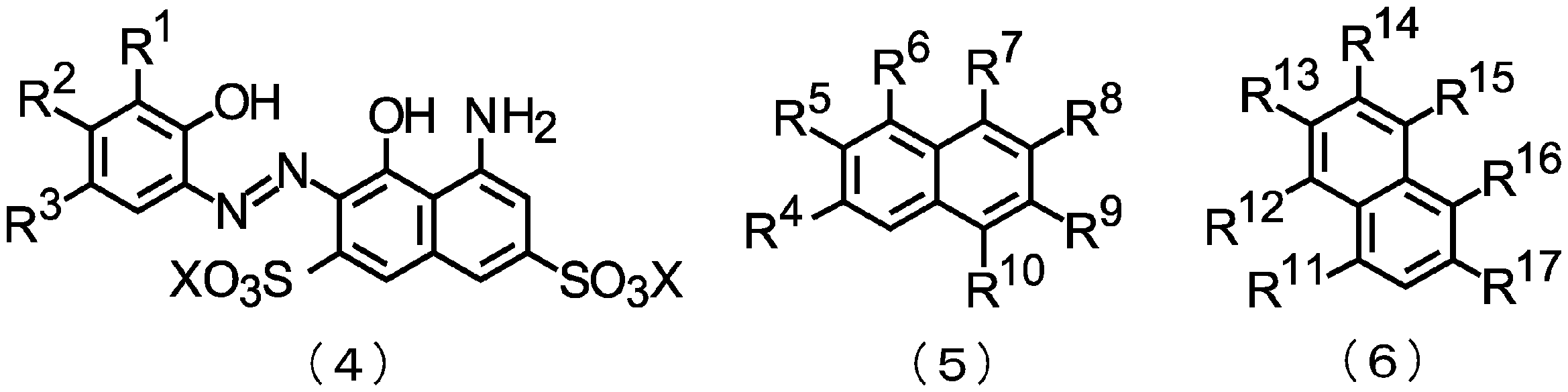
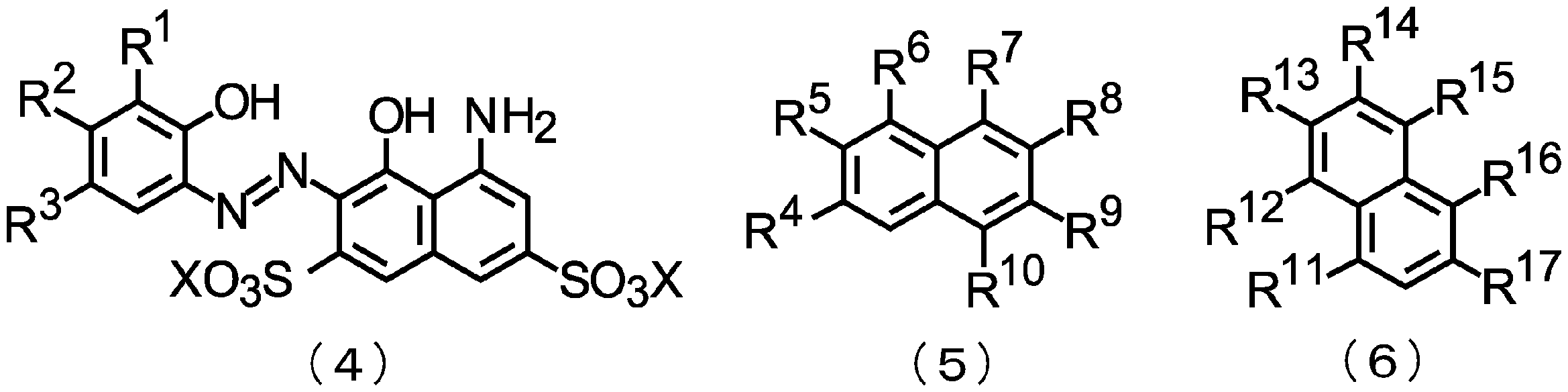
- the azo dye represented by the general formula (1) or (2) is obtained by a diazo coupling reaction between a diazotized product obtained by diazotizing a compound represented by the following general formula (4) and a compound represented by the following general formula (5) or (6) and/or a salt thereof:
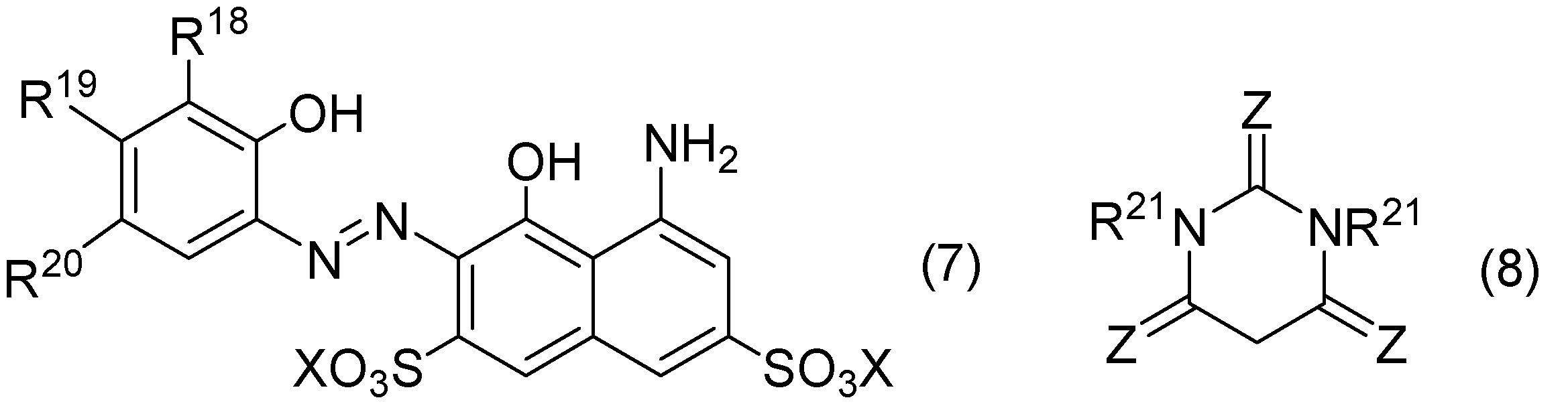
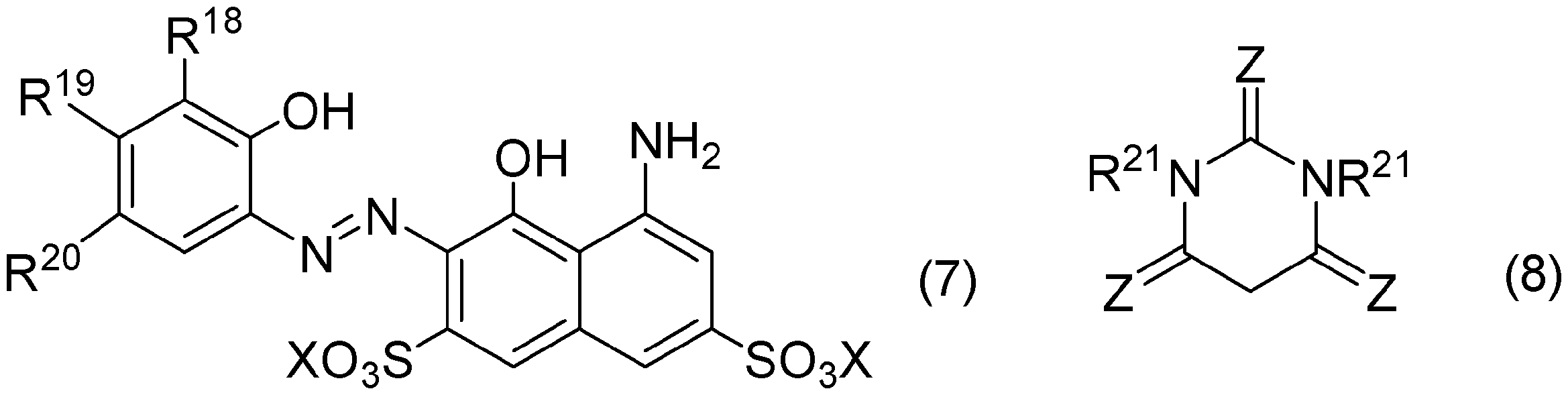
- the azo dye represented by the general formula (3) is obtained by a diazo coupling reaction between a diazotized product obtained by diazotizing a compound represented by the following general formula (7) and a compound represented by the following general formula (8) and/or a salt thereof:
- the present invention can provide an azo dye capable of forming an anodized film on the surface of aluminum or an aluminum alloy that has excellent light resistance, is free of heavy metals such as chromium and halogens, and is monochrome (single dye) and black to brown in color.
- the present invention can also provide a dye composition containing the azo dye, a colorant for anodized aluminum that contains the dye composition, a method for coloring anodized aluminum or anodized aluminum alloy using the dye, and a method for producing the azo dye.
- alkyl group having 1 to 3 carbon atoms represented by R 1 to R 3 and R 18 to 21 include a methyl group, an ethyl group, an n-propyl group and an isopropyl group.
- non-color-forming cation represented by "X” contained in “X", “-SO 3 X” or “-COOX” in the general formulae (1), (2) and (3) is a cation that does not have a chromophore (e.g., a nitro group, an azo group, a carbonyl group).
- a chromophore e.g., a nitro group, an azo group, a carbonyl group.
- alkali metal ions such as hydrogen ion (H + ), lithium ion (Li + ), sodium ion (Na + ) and potassium ion (K + ); and ammonium ions represented by NH 4 + and N + R 22 R 23 R 24 R 25.
- R 22 to R 25 each independently represent an alkyl group having 1 to 3 carbon atoms (methyl group, ethyl group, n-propyl group, isopropyl group).
- a plurality of Xs may be the same or different. It is preferable that each X is independently H + , Na + or NH 4 + .
- R 31 " and “R 32 " represent the "substituent” in the "amide group having 7 to 12 carbon atoms which may have a substituent”.
- R 31 or R 32 include -H, -OH, -SO 3 X, -COOX, a methyl group, an ethyl group, an n-propyl group, an isopropyl group, -NO 2 , -SO 2 CH 3 , -SO 2 CH 2 CH 3 , or a phenyl group.
- the "phenyl group” represented by R 31 and R 32 may further have the above-mentioned "substituent".
- the substituent is preferably a methyl group, an ethyl group, or -NO 2 .
- "7 to 12 carbon atoms" in the "amide group having 7 to 12 carbon atoms which may have a substituent" includes the number of carbon atoms contained in the "substituent".
- R 1 to R 3 each independently represent -H, an alkyl group having 1 to 3 carbon atoms, -NO 2 , -SO 2 CH 3 , -SO 2 CH 2 CH 3 or -COOX.
- R 1 to R 3 in general formulas (1) and (2) are -NO 2.
- R 3 in general formulas (1) and (2) is an alkyl group having 1 to 3 carbon atoms (particularly preferably -CH 3 ) or -SO 2 CH 3 .
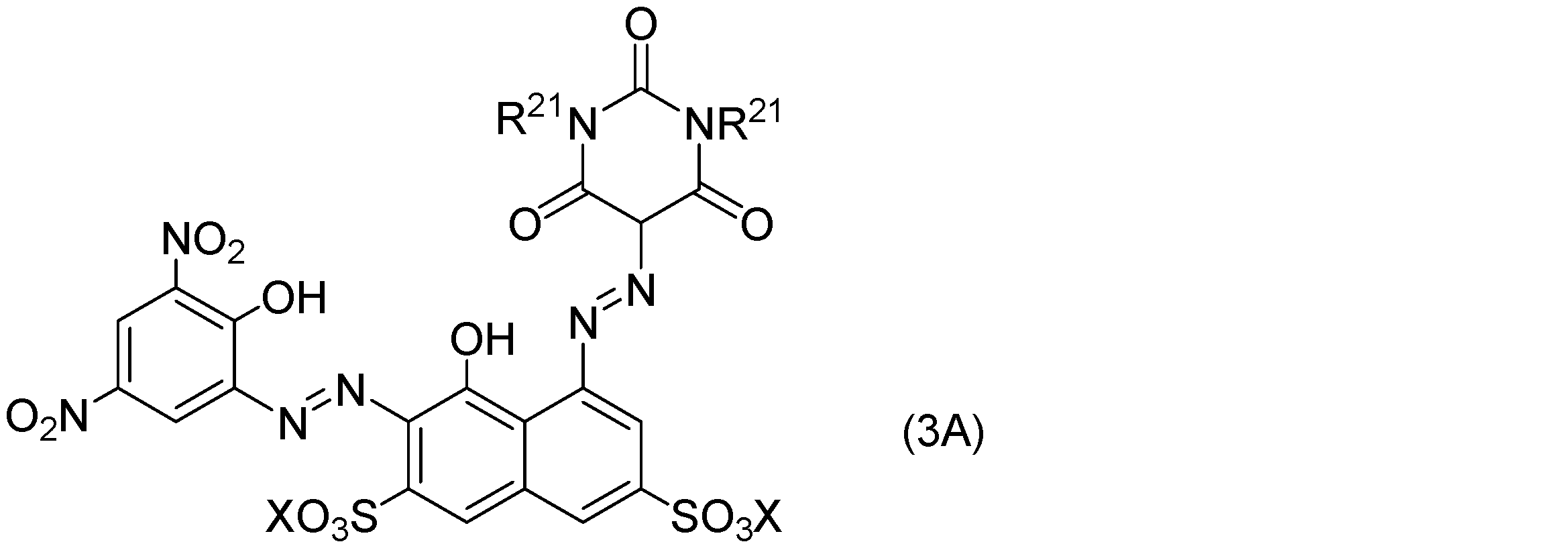
- the azo dye represented by general formula (1) or (2) in which one or two of R 1 to R 3 are -NO 2 preferably has a structure represented by the following general formula (Ia) or formula (Ib).
- R 1 in general formula (Ia) has the same meaning as R 1 in general formulas (1) and (2).
- R 1 in general formula (Ia) is preferably -H or -NO 2 , and more preferably -NO 2 .
- the azo dye represented by general formula (1) or (2) in which R 3 is an alkyl group having 1 to 3 carbon atoms or -SO 2 CH 3 preferably has a structure represented by the following general formula (Ic).
- R 3a represents an alkyl group having 1 to 3 carbon atoms or -SO 2 CH 3
- R 3a is preferably -CH 3 or -SO 2 CH 3 , and more preferably -SO 2 CH 3 .
- R 4 to R 17 each independently represent -H, -OH, -SO 3 X, -COOX, or an amide group having 7 to 12 carbon atoms which may have a substituent, and each X independently represents a non-color-forming cation.
- R 4 to R 10 it is preferable that any one or two of R 4 to R 10 are -OH, or it is preferable that any one or two of R 4 to R 10 are -SO 3 Na.
- any one or two of R 11 to R 17 are -OH, or it is preferable that any one or two of R 11 to R 17 are -SO 3 Na.
- R 4 or R 6 is preferably -OH.
- the azo dye represented by general formula (1) preferably has a structure represented by the following general formula (IIa) or (IIb).
- R 5 to R 10 have the same meanings as R 5 to R 10 in general formula (1)
- R 4a represents -H, -SO 3 X, -COOX, or an amide group having 7 to 12 carbon atoms which may have a substituent.
- the azo dye represented by general formula (1) preferably has a structure represented by general formula (IIa), and more preferably has a structure represented by the following general formulas (IIa-1) to (IIa-3).
- the azo dye represented by formula (2) preferably has a structure represented by the following formula (III) in which R 11 is -OH:
- R 12 to R 17 have the same meanings as R 12 to R 17 in formula (1)
- R 11a represents -H, -SO 3 X, -COOX, or an amide group having 7 to 12 carbon atoms which may have a substituent.
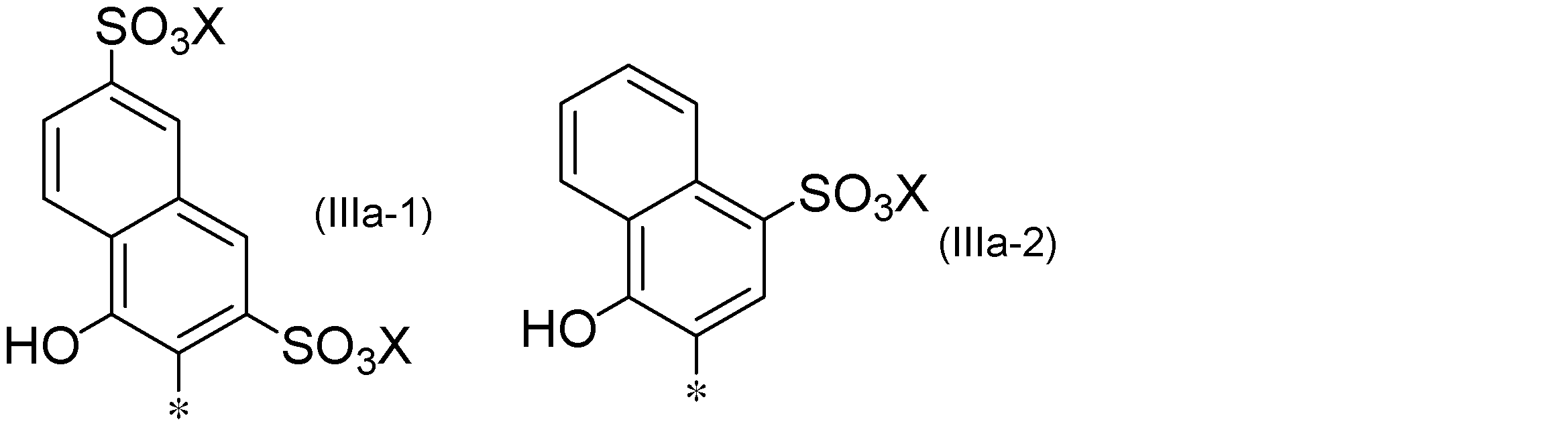
- the azo dye represented by general formula (2) preferably has a structure represented by general formula (IIIa), and more preferably has a structure represented by the following general formula (IIIa-1) or (IIIa-2).
- R 21 each independently represents an alkyl group having 1 to 3 carbon atoms or a non-color-forming cation.
- a plurality of R 21 may be the same or different.
- All R 21 may be a non-color-forming cation, and all R 21 may be —H, since this makes it easier to obtain an anodized coating having superior light resistance.
- Z represents an oxygen atom or a sulfur atom.
- a plurality of Z's may be the same or different.
- 1 to 3 Z's may be oxygen atoms
- 2 to 3 Z's may be oxygen atoms
- 3 Z's may be oxygen atoms because an anodized film having better light resistance is easily obtained.
- the azo dye represented by general formula (3) preferably has a structure represented by the following general formula (IV), and more preferably has a structure represented by the following general formula (IVa), because an anodized film having better light resistance is easily obtained.
- R 18 to R 20 are each independently —H, —CH 3 , —NO 2 , —SO 2 CH 3 , —SO 3 H, —SO 3 Na, —COOH or —COONa. It is preferable that one or two of R 18 to R 20 are —NO 2.
- the azo dye represented by general formula (3) preferably has a structure represented by general formula (Ia), (Ib) or (Ic) above, and more preferably has a structure represented by general formula (Ia) above.
- the azo dyes of the present invention represented by general formula (1), (2) or (3) include all possible stereoisomers and tautomers, and the specific examples of the compounds shown below have planar structural formulas.
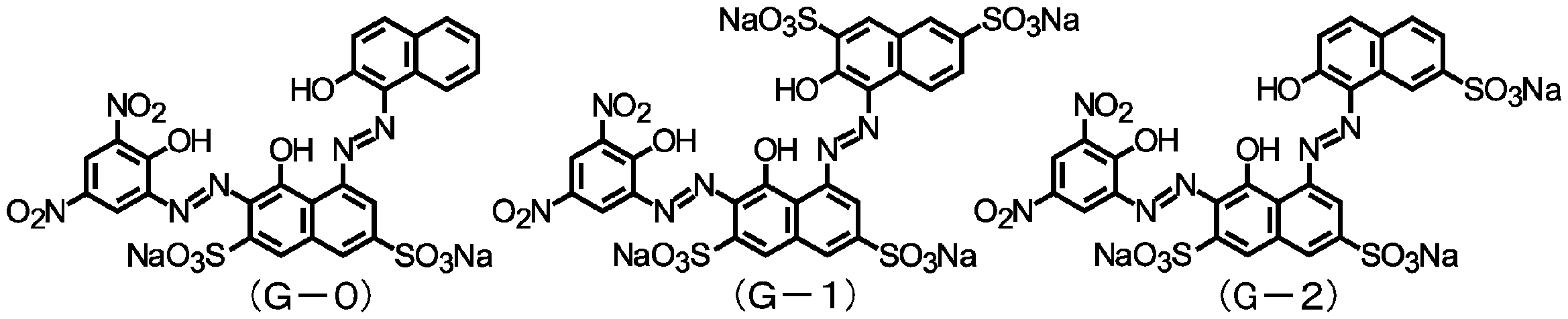
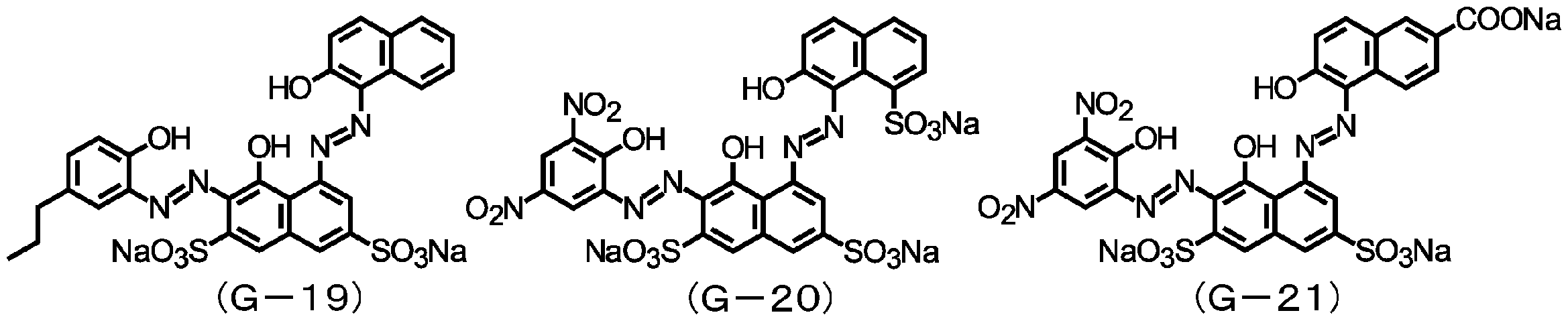
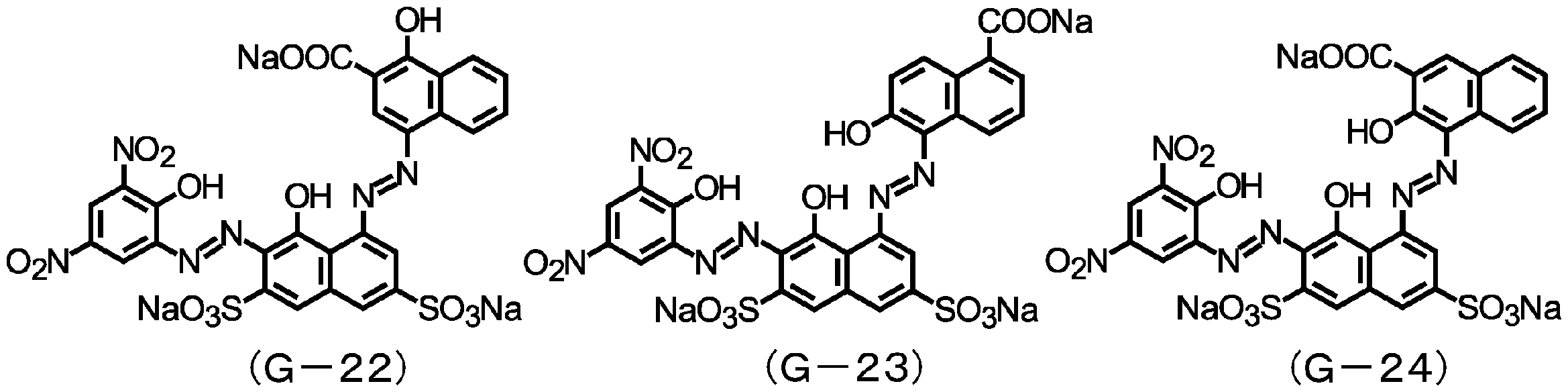
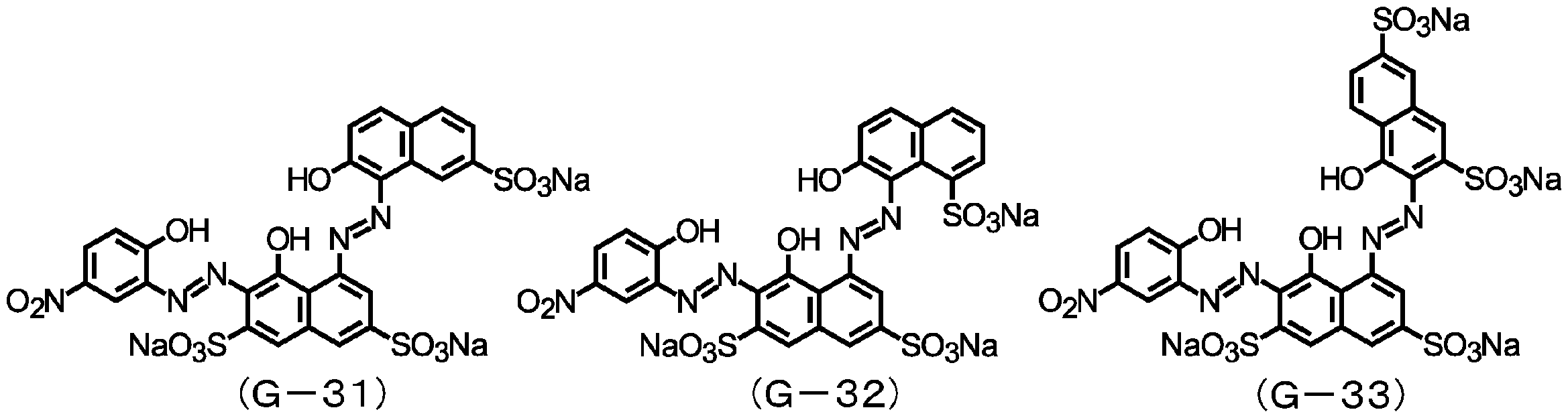
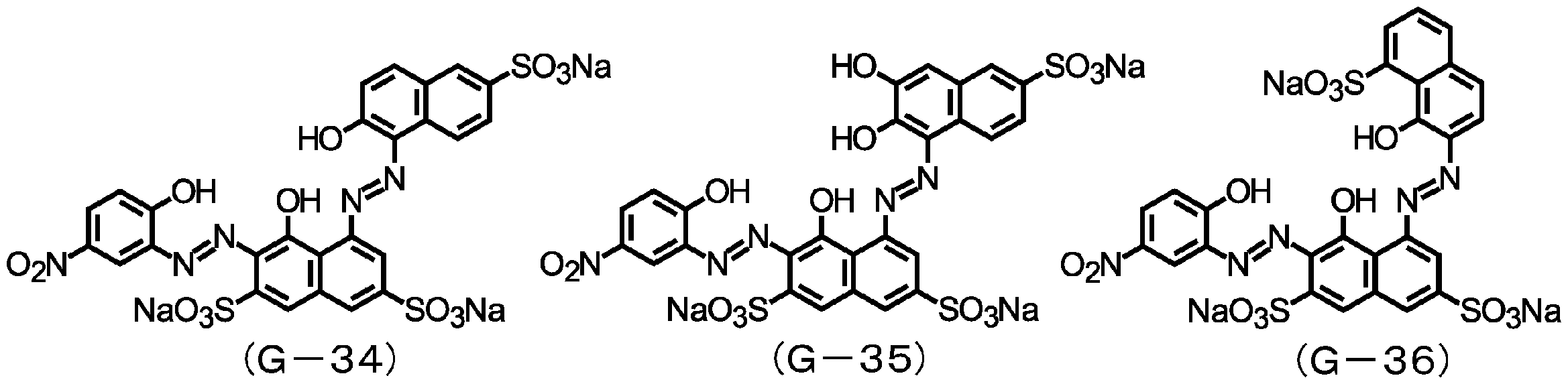
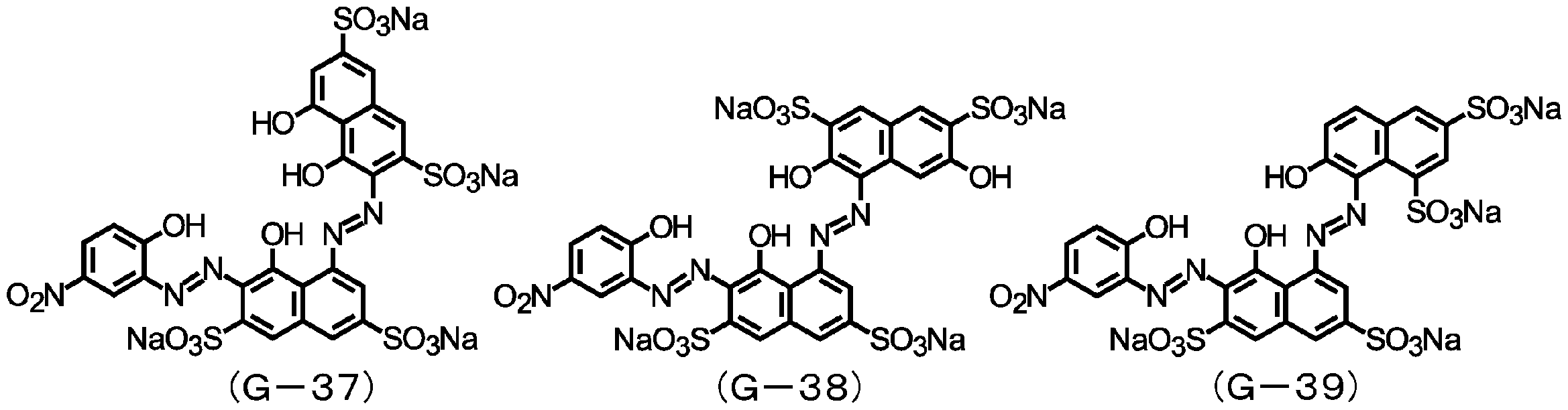
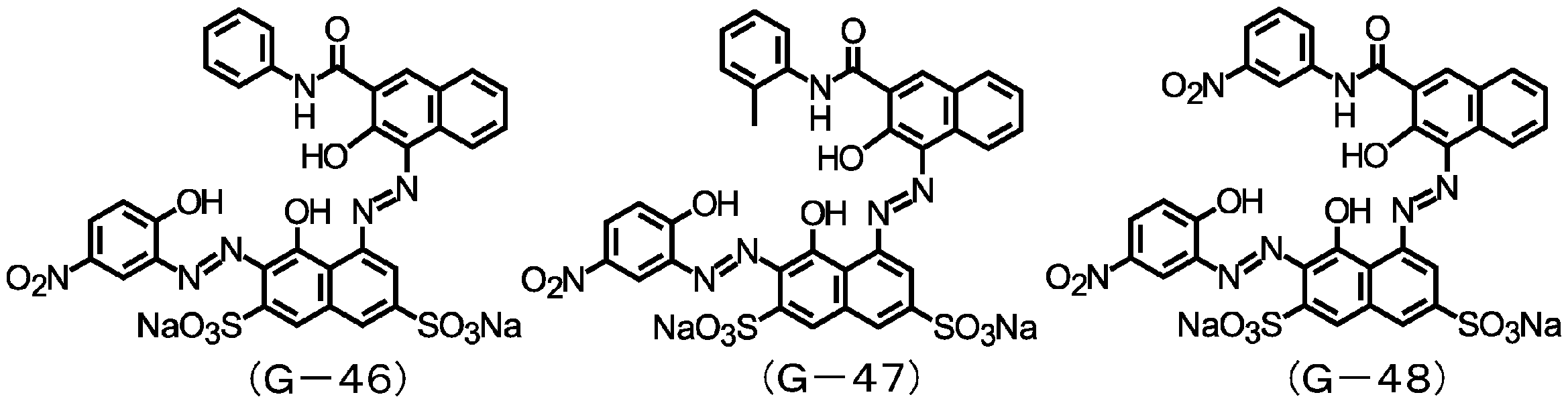
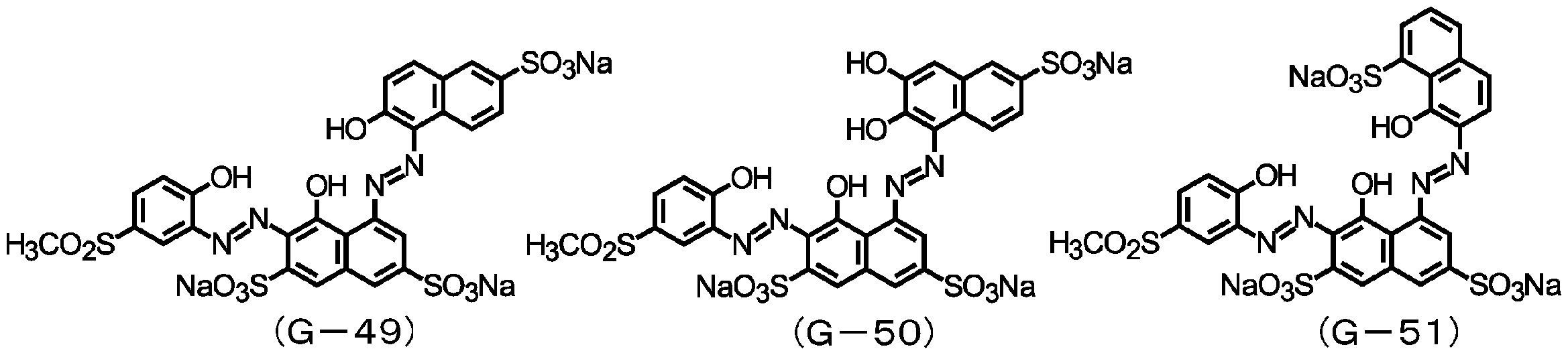
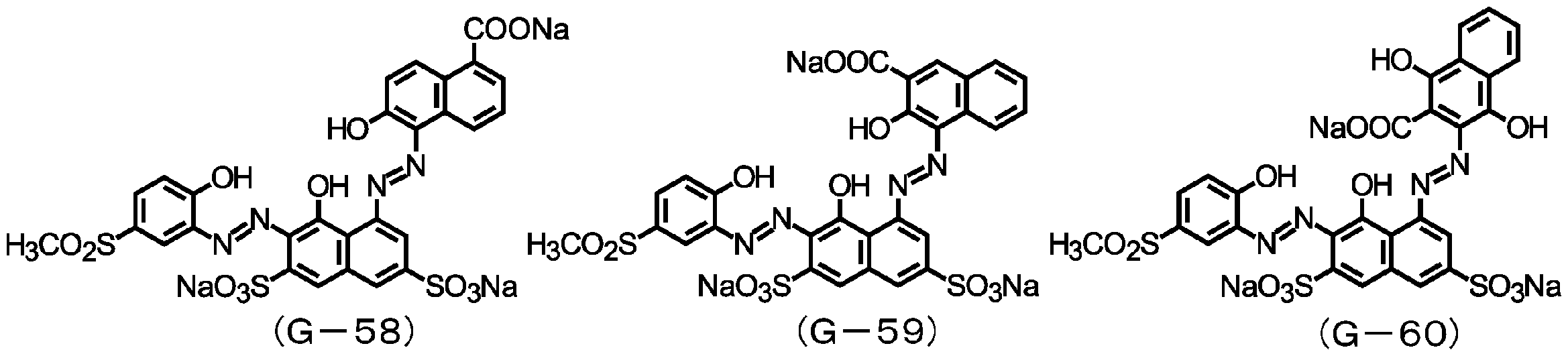
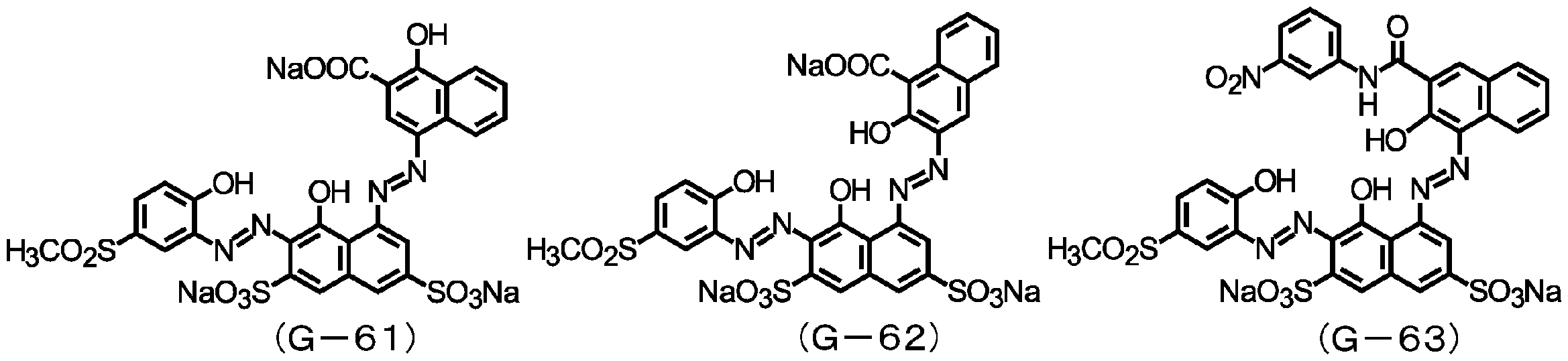
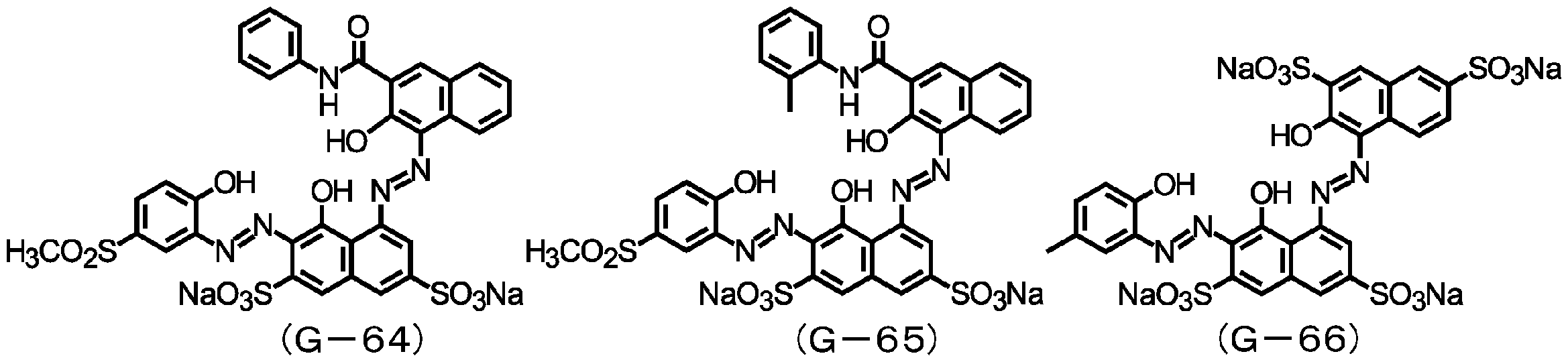
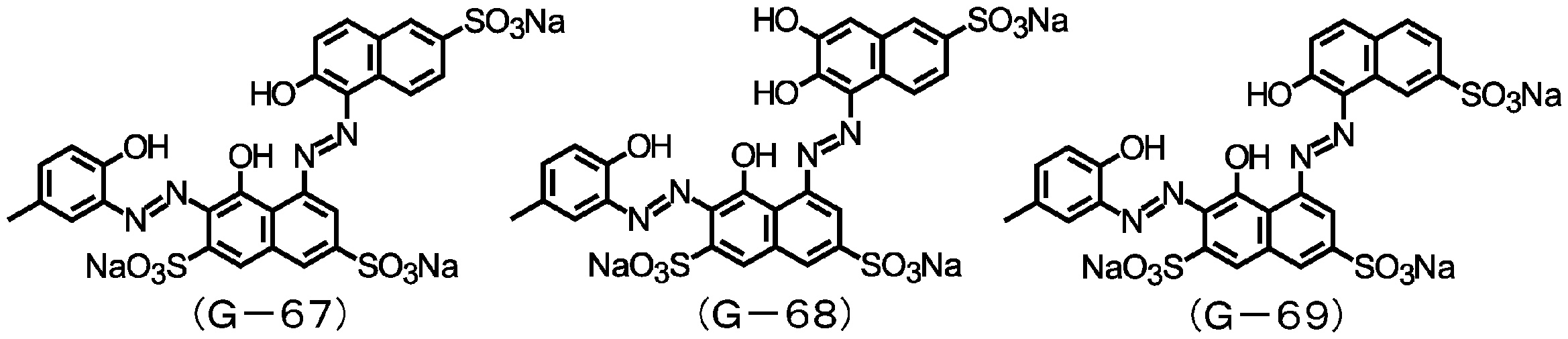
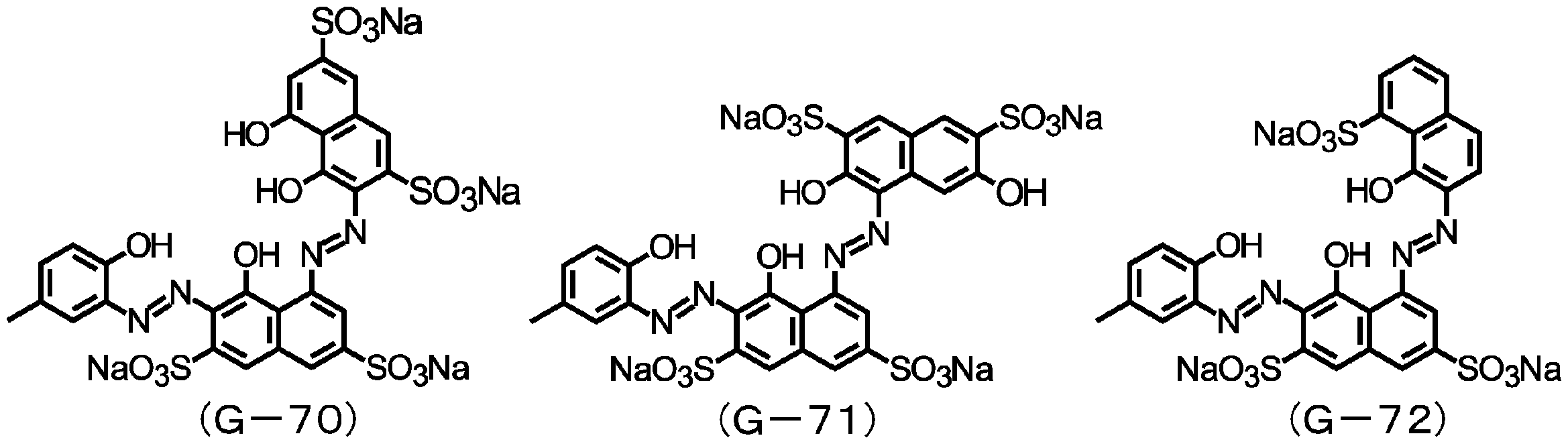
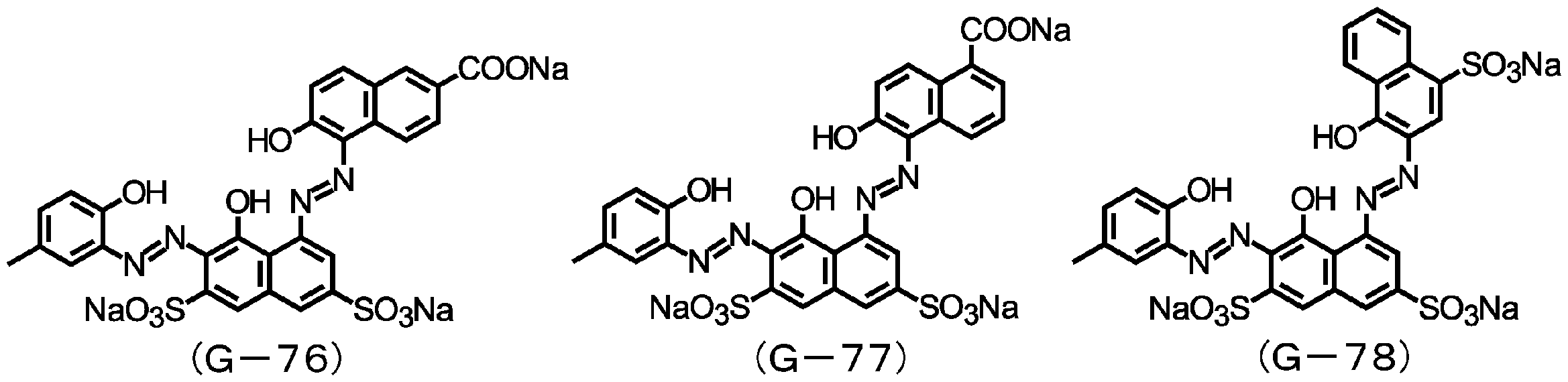
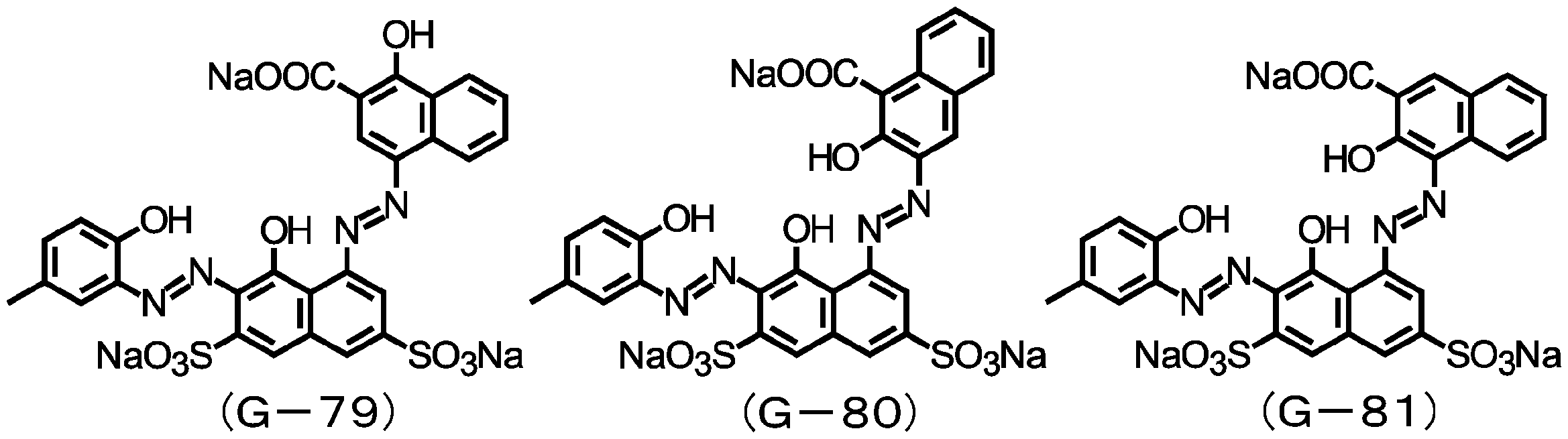
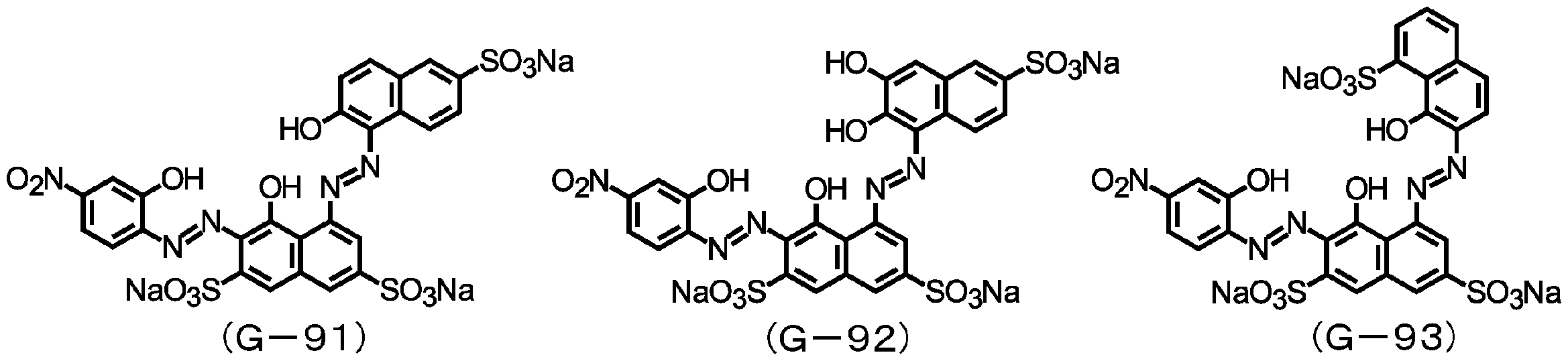
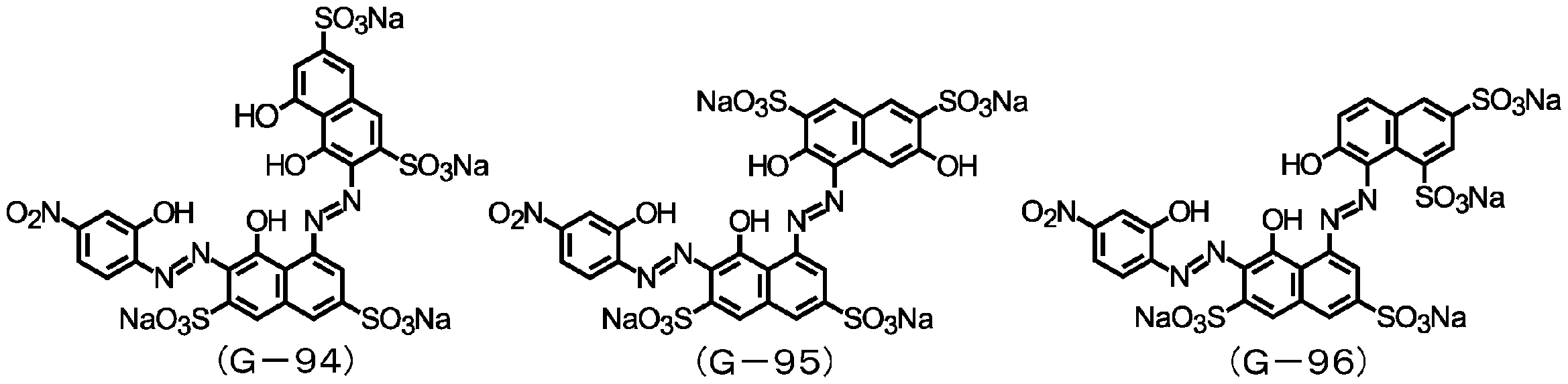
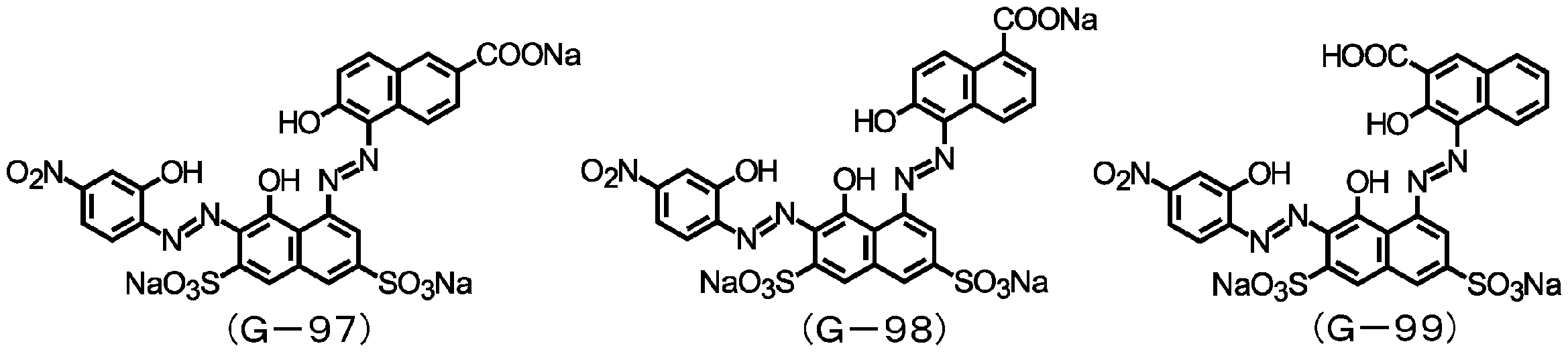
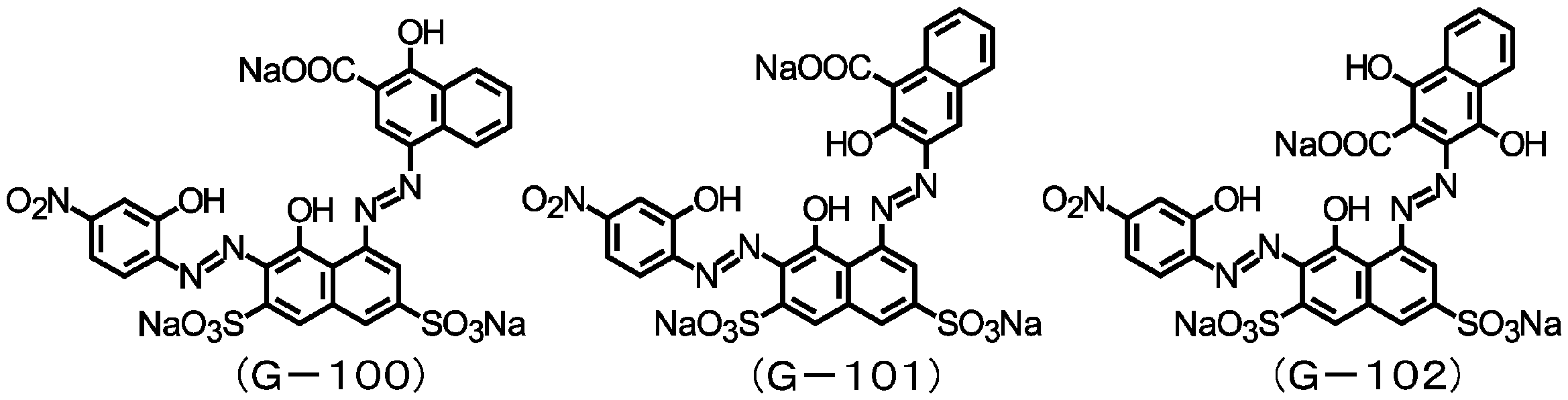
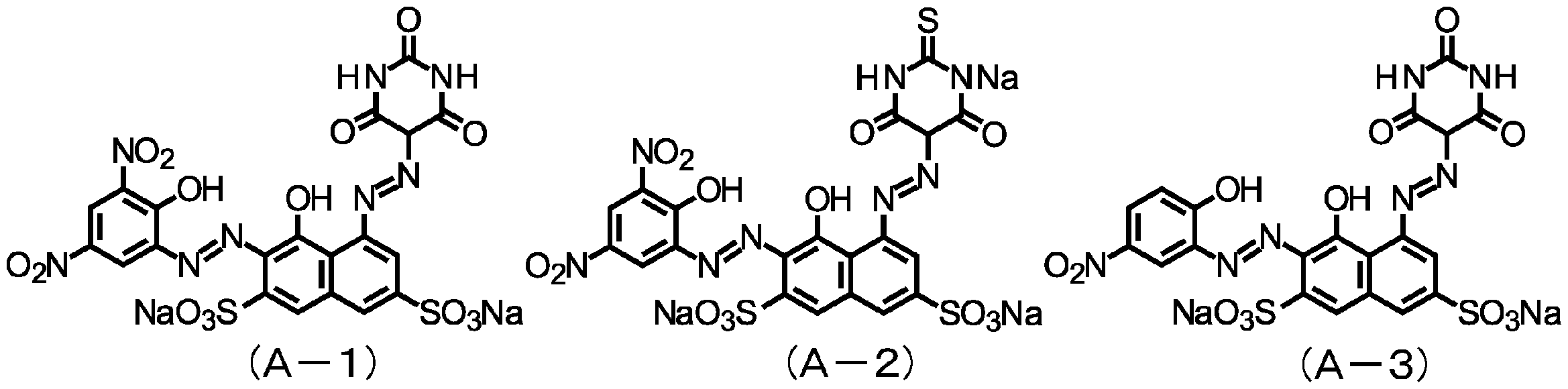
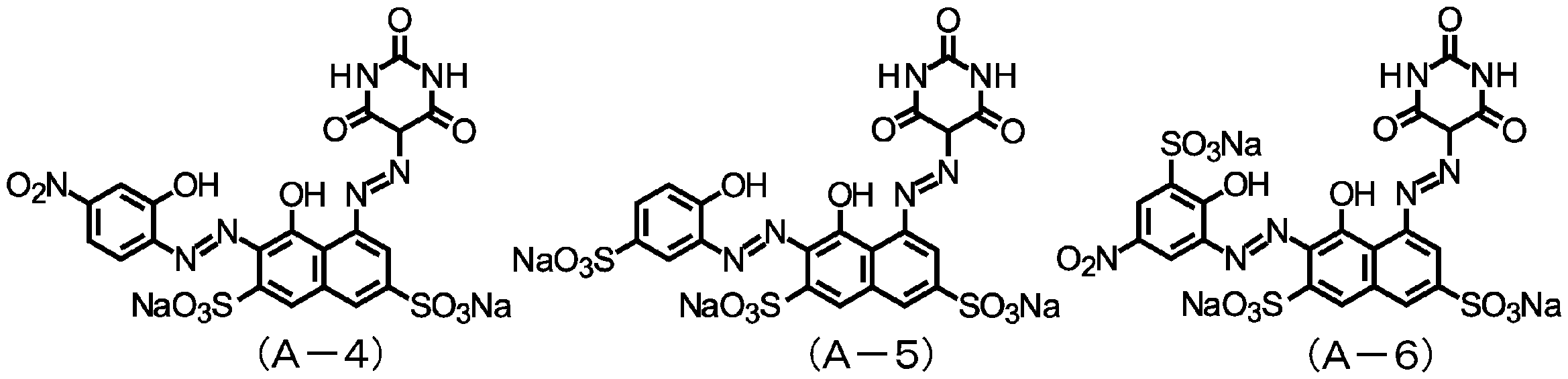
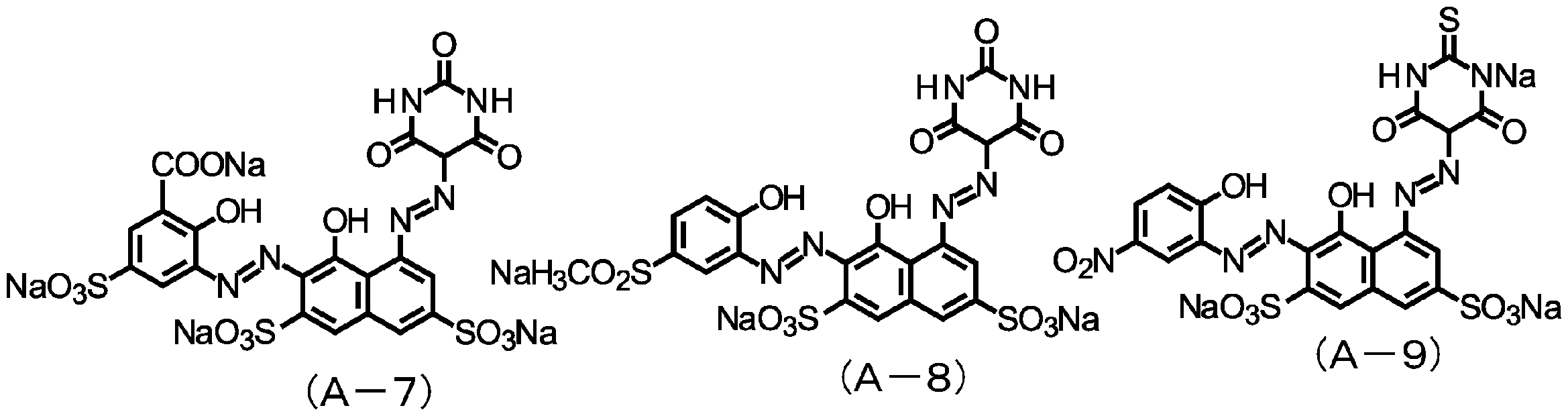
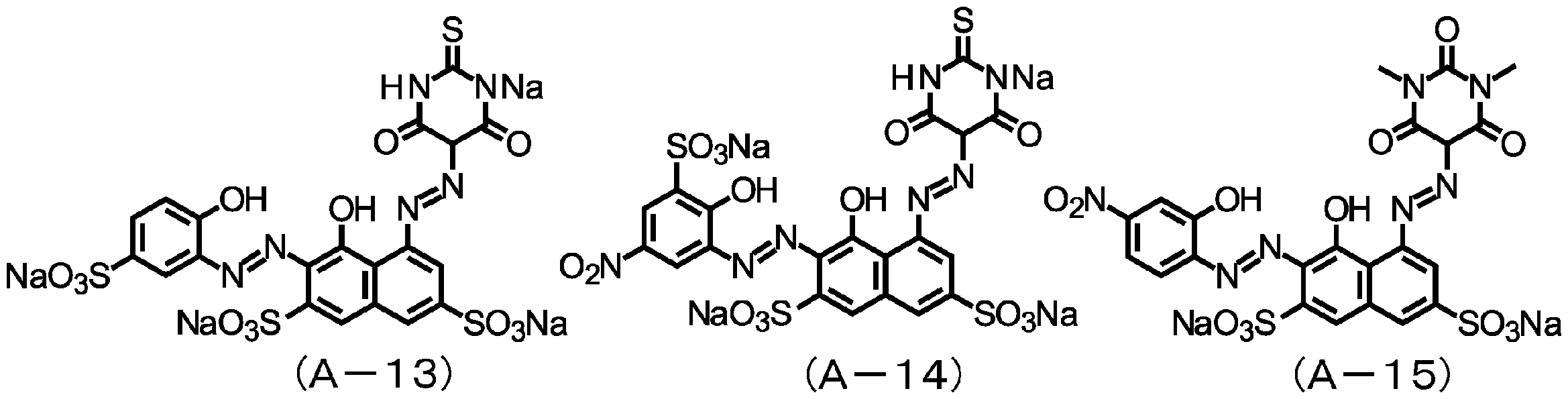
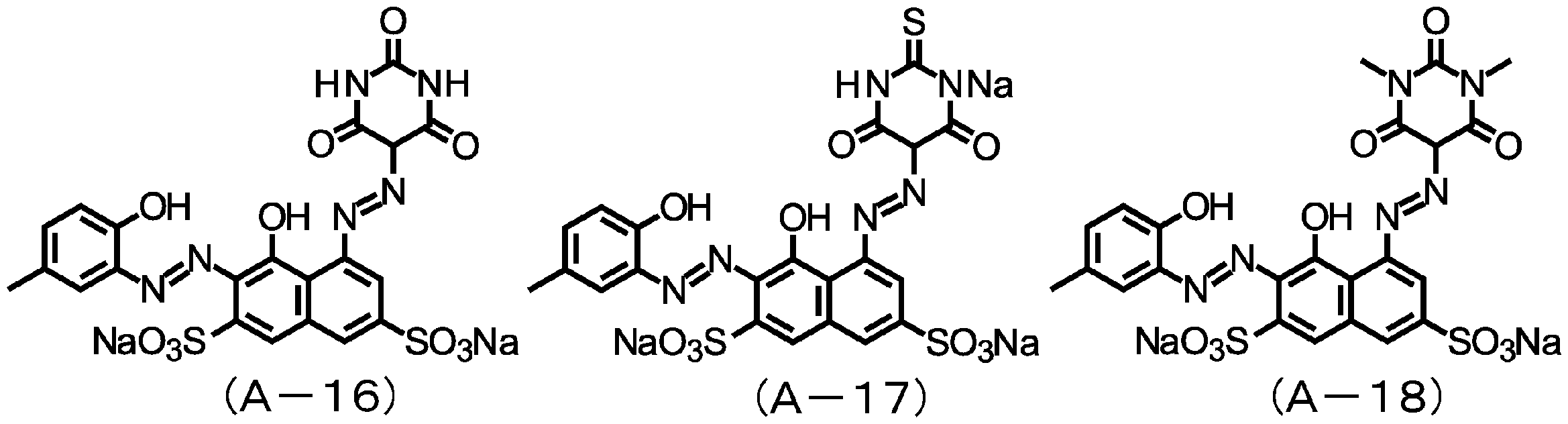
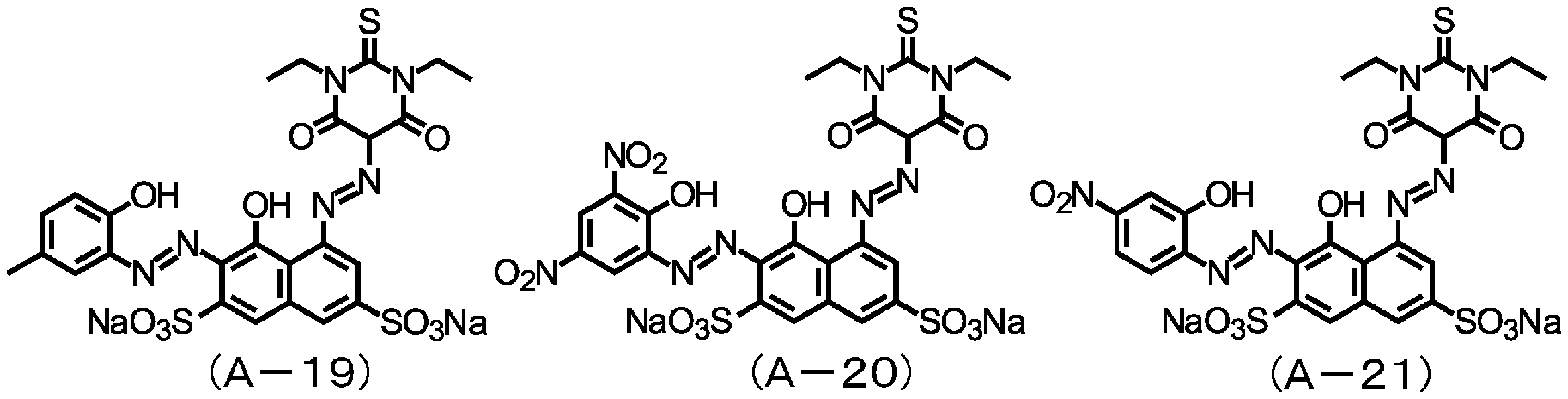
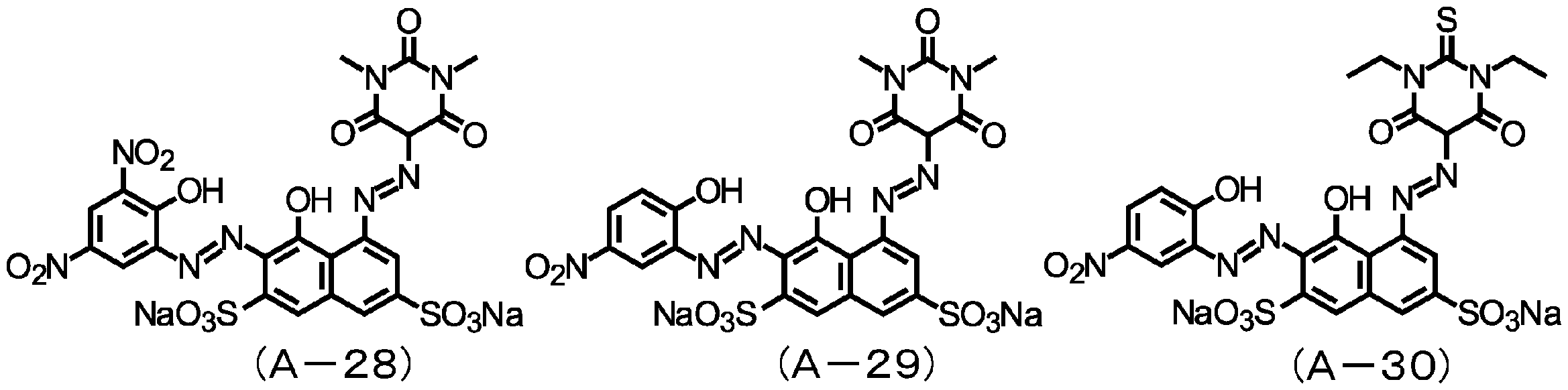
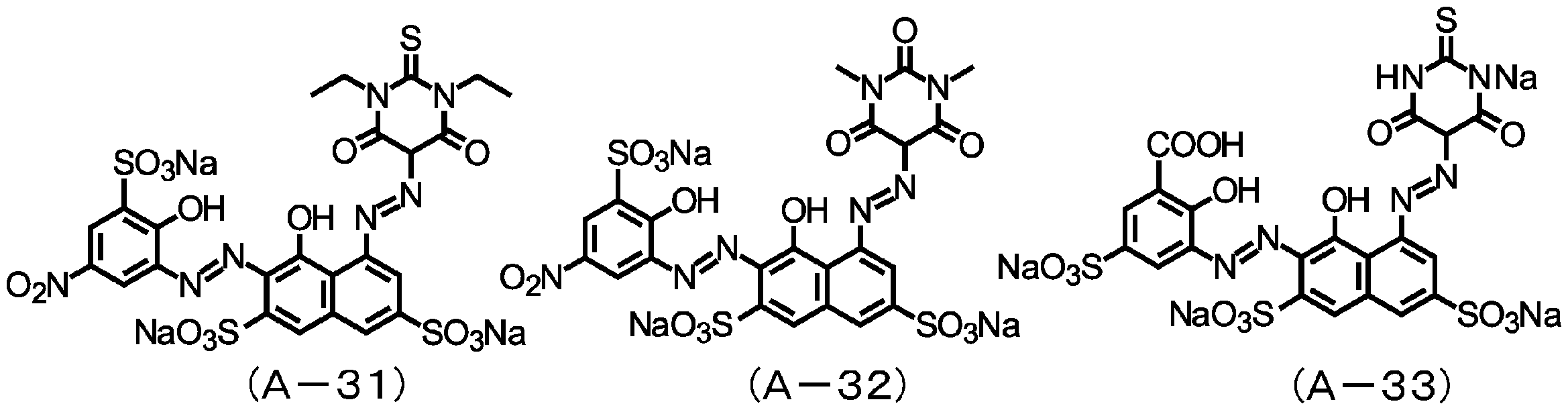
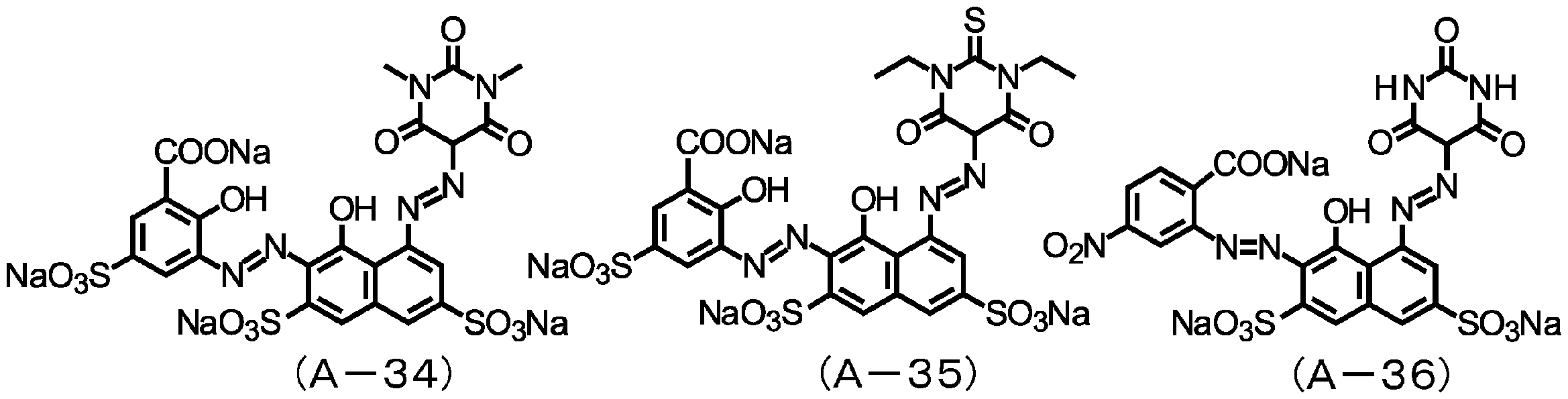
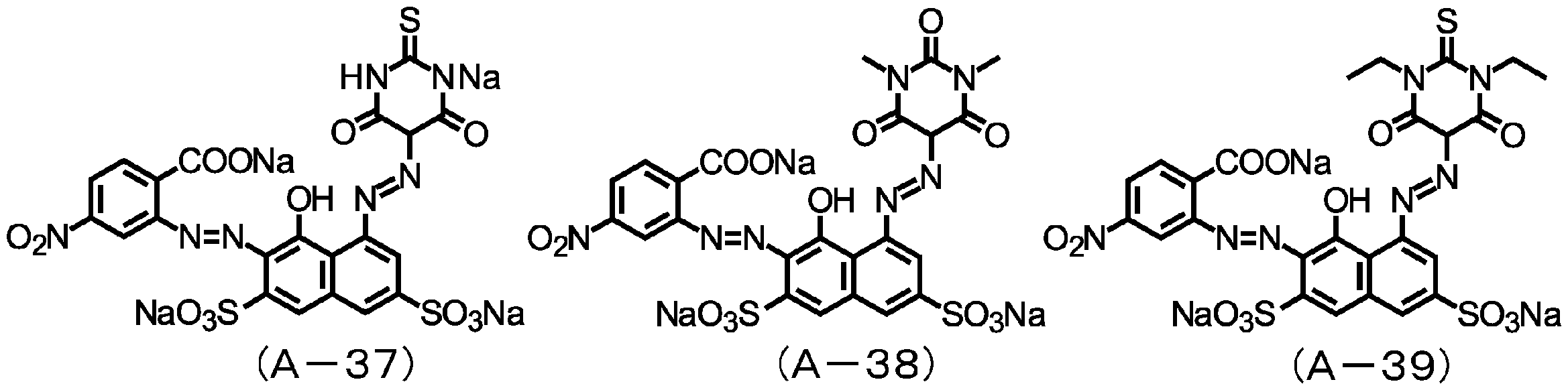
- Preferred specific examples of dyes (1) to (3) are shown in the following formulas (G-0) to (G-105) and (A-1) to (A-39), but the present invention is not limited to these.
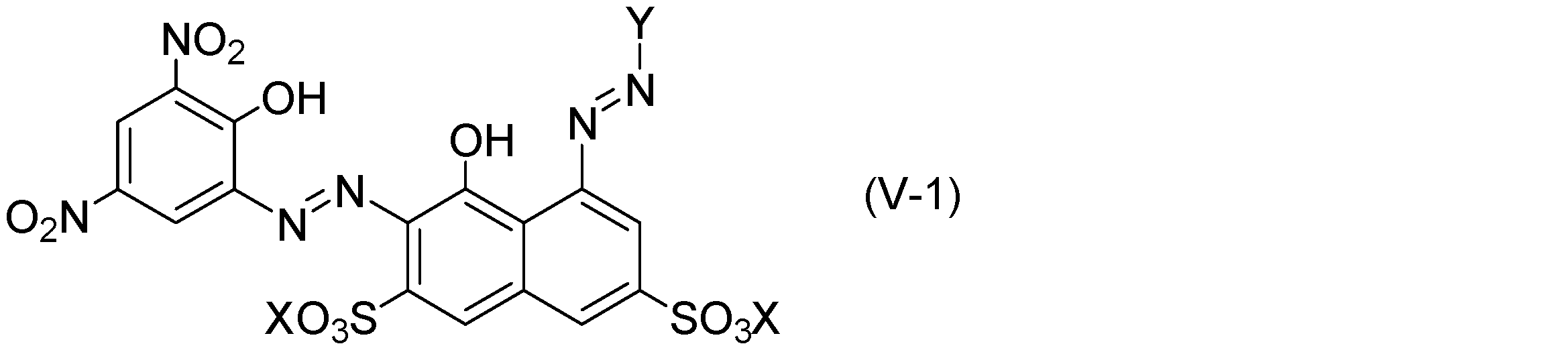
- the dyes (1) to (3) are preferably compounds represented by the following general formula (V-1), and among the compounds represented by general formula (V-1), it is particularly preferable that they are compounds represented by formula (G-2), formula (G-4) or formula (A-1).
- V-1 general formula
- G-2 formula
- G-4 formula (A-1)
- a compound represented by the following general formula (V-1) particularly a compound represented by formula (G-2), formula (G-4) or formula (A-1)
- Y represents a group represented by formula (IIa-3), formula (IIIa-1), or formula (IVa), in which X and R21 have the same meanings as X and R21 defined above.
- the compound represented by general formula (1) or (2) can be obtained, for example, by a method including a step of diazo coupling reaction (coupling step) between a diazotized product obtained by diazotizing a compound represented by the following general formula (4) and a compound represented by the following general formula (5) or (6) and/or a salt thereof. That is, the compound represented by general formula (4) may be obtained by a diazo coupling reaction between a diazotized product obtained by diazotizing a compound represented by the following general formula (4) and a compound represented by the following general formula (5) or (6) and/or a salt thereof.
- an example of a method for producing the compound (azo dye) of the present invention represented by the general formula (1) or (2) is shown below, but is not limited to this method. Specifically, first, an aromatic amine derivative having an appropriate substituent represented by the general formula (4) is reacted with a basic aqueous solution prepared using sodium nitrite or the like in an aqueous acid solution such as hydrochloric acid or sulfuric acid at an appropriate temperature to obtain a compound represented by the following general formula (4a) and/or its salt (diazo component).
- a salt (coupler component) of the compound represented by the general formula (5) or (6) can be obtained by dissolving the compound represented by the general formula (5) or (6) in an aqueous solution of sodium hydroxide or the like and reacting it.
- the compound represented by the general formula (5) or (6) can also be used as it is as a coupler component (also simply referred to as coupler component (5) or (6)).
- the diazo component (4a) represented by the general formula (4a) is reacted (diazo coupling reaction) with the coupler component (5) or (6) to obtain a compound represented by the general formula (1) or (2) and/or a salt thereof as an azo compound (azo dye).
- the method for producing the compound represented by the general formula (1) or (2) (azo dye) according to this embodiment includes a step of obtaining the compound represented by the general formula (1) or (2) obtained as described above.
- the compound represented by general formula (3) can be obtained, for example, by a method including a step of diazo coupling reaction (coupling step) between a diazotized product obtained by diazotizing a compound represented by the following general formula (7) and a compound represented by the following general formula (8) and/or a salt thereof. That is, the compound represented by general formula (7) may be obtained by a diazo coupling reaction between a diazotized product obtained by diazotizing a compound represented by the following general formula (7) and a compound represented by the following general formula (8) and/or a salt thereof.
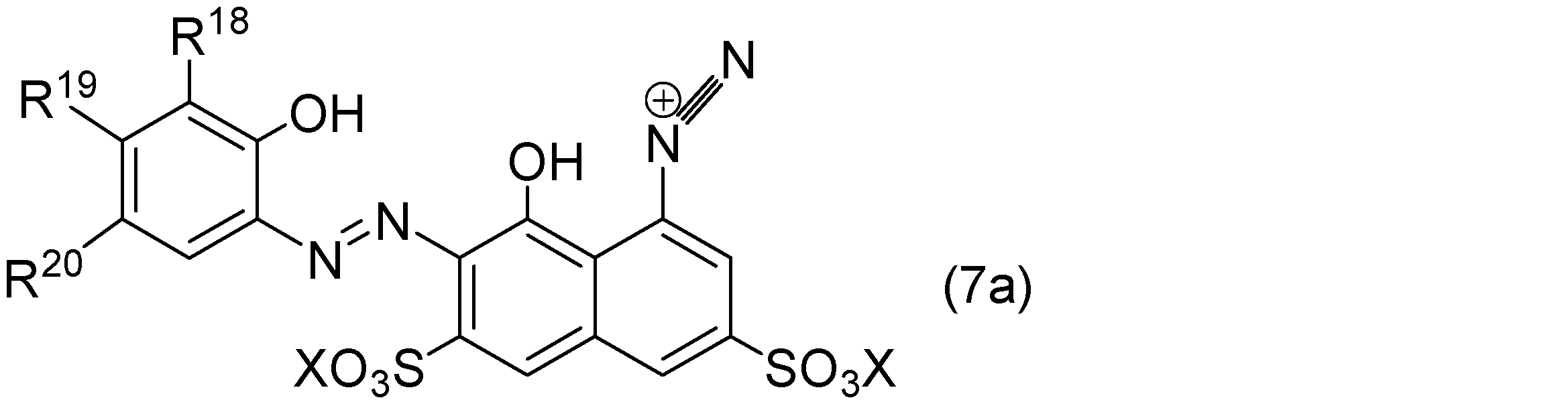
- an example of a method for producing the compound (azo dye) of the present invention represented by the above general formula (3) is shown below, but is not limited to this method. Specifically, first, an aromatic amine derivative having an appropriate substituent represented by the above general formula (7) is reacted with a basic aqueous solution prepared using sodium nitrite or the like in an aqueous acid solution such as hydrochloric acid or sulfuric acid at an appropriate temperature to obtain a compound represented by the following general formula (7a) and/or its salt (diazo component).
- a salt of the compound represented by the general formula (8) (coupler component) can be obtained by dissolving the compound represented by the general formula (8) in an aqueous solution of sodium hydroxide or the like and reacting it.
- the general formula (8) can also be used as it is as a coupler component (also simply referred to as coupler component (8)).
- the method for producing the compound represented by the general formula (3) (azo dye) according to this embodiment includes a step of obtaining the compound represented by the general formula (3) obtained as described above.
- the dyes (1), (2) or (3) can be purified by known methods such as purification by column chromatography; adsorption purification using silica gel, activated carbon, activated clay or the like; recrystallization using a solvent or various crystallization methods using an acid or the like.
- the dyes (1) to (3) of the present invention, their intermediates, or various products obtained by the above-mentioned manufacturing method can be identified and their physical properties evaluated using ultraviolet-visible absorption spectroscopy (UV-Vis), thermogravimetry-differential thermal analysis (TG-DTA), gas chromatography analysis (GC), thin layer chromatography analysis (TLC), high performance liquid chromatography (HPLC), liquid chromatography-mass spectrometry (LC/MS), gas chromatography-mass spectrometry (GC/MS), nuclear magnetic resonance analysis (NMR) analysis, etc.
- UV-Vis ultraviolet-visible absorption spectroscopy
- TG-DTA thermogravimetry-differential thermal analysis
- GC gas chromatography analysis
- TLC thin layer chromatography analysis
- HPLC high performance liquid chromatography
- LC/MS liquid chromatography-mass spectrometry
- GC/MS gas chromatography-mass spectrometry
- NMR nuclear magnetic resonance analysis
- the azo dyes represented by the general formulas (1) to (3) can be used as components of dye compositions.
- the dyes (1) to (3) can be used as dye compounds for coloring aluminum or fibers, etc., using one type of monochromatic dye alone.
- the dyes (1) to (3) may be used in combination of two or more types to obtain a variety of colors by mixing colors.
- the dye composition may be mixed with other components for optimal dyeing (coloring using dyes). Specific examples include liquids (solvents) such as water, alcohol, and solvents; additives such as surfactants; and the like. Water is preferred as the solvent.
- the dyes (1) to (3) may be used as components of dye compositions in combination with other dyes.
- the other dyes are compounds, pigments, or dyes other than the dyes (1) or (2), and specific examples include ruthenium complexes, coumarin dyes, cyanine dyes, merocyanine dyes, rhodacyanine dyes, phthalocyanine dyes, porphyrin dyes, and other xanthene dyes.
- the amount of the other components used relative to dyes (1) to (3) is preferably 10 to 200% by mass, and more preferably 20 to 100% by mass.
- the dye composition of the present invention can be used as a colorant for anodized aluminum.
- the concentration of the dyes (1) to (3) in the dye composition containing the dyes (1) to (3) is preferably 0.02 to 10 mass%, more preferably 0.05 to 3 mass%. The lower the concentration of the compound, the lighter the coloring can be, and the higher the concentration, the medium to darker the coloring can be.
- anodized aluminum refers to aluminum that has been electrolytically treated in an electrolyte such as an acidic aqueous solution, and has been treated to form an oxide layer with fine pores on the surface.
- a colorant for anodized aluminum refers to an agent that can color (dye) this aluminum surface with fine pores by adsorbing a dye into the pores.
- a sealing treatment is carried out to close the pores after coloring, in order to improve the durability and light resistance of the colored aluminum surface.
- the aluminum in anodized aluminum can be aluminum, aluminum oxide, or a metal or metal compound containing aluminum, such as an aluminum alloy with another metal.
- the method of coloring aluminum using a colorant for anodized aluminum can be a method known as anodized dyeing.
- anodized dyeing For example, the methods described in the Japanese Industrial Standards (JIS H 8601:1999 "Anodized Films of Aluminum and Aluminum Alloys") and Patent Documents 1 to 4 and 6 can be used.
- the method of coloring aluminum is not particularly limited, but an example is shown below.
- an aluminum plate is degreased using an aqueous acid solution such as sulfuric acid, oxalic acid, chromic acid, or sulfonic acid, and washed with water.
- an aqueous acid solution such as sulfuric acid, oxalic acid, chromic acid, or sulfonic acid
- the degreased aluminum plate is used as an anode and electrolyzed using an aqueous acid solution as an electrolyte to form an anodized film (alumite film) that forms many pores on the aluminum anode surface (anodizing treatment), and washed with water.
- the anodized film is appropriately subjected to surface conditioning, washing with water, etc., and then immersed in an aqueous colorant solution for anodized aluminum containing a dye composition containing the compound of the present invention, etc., to adsorb the dye into the pores on the surface of the anodized film (dyeing, electrolytic coloring), and the pores on the surface are sealed with aluminum oxide hydrate or the like to form a sealing material, thereby coloring the anodized film.
- a mixed solution of all the dyes to be used may be prepared and the anodized aluminum may be immersed in the mixed solution, or each dye solution may be prepared separately and the anodized aluminum may be immersed in each solution in turn.
- the electrolysis conditions during coloring in the present invention may be DC electrolysis or AC electrolysis, with DC electrolysis being preferred.
- the current density is preferably 0.1 to 10 A/ dm2 , more preferably 0.5 to 3 A/ dm2 .
- the current application time is preferably 10 seconds to 60 minutes.
- the thickness of the anodized film is preferably 2 to 20 ⁇ m. With regard to these anodizing conditions, the longer the current application time and the thicker the anodized film, the darker the coloring will be, and therefore, by adjusting these conditions, it is possible to adjust the color from light to medium to dark.
- the processing temperature for each of the above steps is preferably an appropriate temperature.
- the temperature for anodizing is preferably 0 to 80°C.
- the temperature for dyeing is preferably 10 to 70°C.
- the temperatures for other processes are preferably 10 to 80°C.
- the dye composition in this embodiment can be used in the same way for anodized oxides using metals other than aluminum.
- it can be applied to non-metals such as conductive plastics, as long as the anodized pores can adsorb the dye, such as magnesium, zinc, titanium, and zirconium.
- the colorant for anodized aluminum of this embodiment can be evaluated by measuring the properties of a sample colored on aluminum, such as hue and light resistance.
- the hue can also be evaluated visually in terms of color tone and uniformity.
- the hue may be measured using a color difference meter as density (K/Sd), color tone (L * , a * , b * ) and color difference ( ⁇ E * ).
- Colors that can be expressed using the colorant for anodized aluminum of this embodiment are, for example, black or brown colors. Different shades of these colors, such as light colors (light black, light brown, etc.) or dark colors (dark black, dark brown, etc.), can also be expressed.
- the colorant for anodized aluminum of this embodiment can also express mixed colors (intermediate colors) by using the above-mentioned compounds in combination with other pigments.
- the light fastness test of the aluminum colored with the coloring agent for anodized aluminum of this embodiment may be performed by irradiating the sample with light for a certain period of time using a tester that simulates sunlight including ultraviolet light, and measuring the change in the hue of the colored aluminum before and after the test.
- the color fastness may be evaluated by measuring the color tone in the CIE L * a * b * color system using a color difference meter or the like, and then judging the color fastness by visually observing the hue of the colored aluminum using a gray scale according to the method defined in the Japanese Industrial Standards (JIS L 0804 "Gray scale for discoloration").
- Colored aluminum produced using the colorant for anodized aluminum of this embodiment can be used in a wide variety of aluminum sheet materials or products such as aluminum exteriors.
- a compound represented by the general formula (1), (2) or (3) is provided for coloring anodized aluminum.
- a use of a compound represented by the general formula (1), (2) or (3) for coloring anodized aluminum is provided.
- a use (application) of a compound represented by the general formula (1), (2) or (3) for producing a colorant for anodized aluminum is provided.
- Coupler Component 1 - Diazo Coupling Reaction 1 Next, 38.0 g of H acid hydrate (4-amino-5-hydroxy-2,7-naphthalenedisulfonic acid sodium hydrate) (manufactured by Tokyo Chemical Industry Co., Ltd.) was added to a reaction vessel, 250 mL of water was added to disperse it, and then 6.8 g of 24% aqueous sodium hydroxide solution (manufactured by Kanto Chemical Co., Ltd.) and 9.0 g of sodium carbonate (manufactured by Kanto Chemical Co., Ltd.) were added and dissolved.
- H acid hydrate (4-amino-5-hydroxy-2,7-naphthalenedisulfonic acid sodium hydrate) (manufactured by Tokyo Chemical Industry Co., Ltd.) was added to a reaction vessel, 250 mL of water was added to disperse it, and then 6.8 g of 24% aqueous sodium hydroxide solution (manufactured by Kanto Chemical Co.,
- This solution was stirred at 5°C or less in an ice bath to obtain a coupler component solution.
- the previously synthesized diazotized solution 1 was added to the stirred coupler component solution, the pH was adjusted to 9.0-9.5, and the solution was stirred overnight to carry out a diazo coupling reaction. After stirring, a resorcin check was performed to confirm that no diazotized product remained, and the reaction was terminated.
- the temperature was raised to 40°C, and 95% sulfuric acid (manufactured by Kanto Chemical Co., Ltd.) was added to adjust the pH to 6.0-6.5, and the precipitated solid was filtered.
- the obtained solid was dried to obtain a compound represented by the following formula (3-G-0) as a black purple powder (yield: 52.0 g, 100%).
- Diazo Component 2 (Preparation of Diazo Component 2) 10.9 g of the compound (3-G-0) was placed in a reaction vessel, 140 mL of water was added, and 4.1 g of 35% hydrochloric acid was added. The mixture was stirred for 3 hours at 5°C or less in an ice bath. After stirring, 3.4 g of a 40% aqueous sodium nitrite solution was added dropwise to the reaction liquid, and the mixture was stirred for 3 hours. After stirring, sulfamic acid was added to decompose the excess sodium nitrite, and diazotized liquid 2 was obtained.
- Coupler Component 2 - Diazo Coupling Reaction 2 (Preparation of Coupler Component 2 - Diazo Coupling Reaction 2) 2.74 g of 2-naphthol (Tokyo Chemical Industry Co., Ltd.) and 150 mL of water were added to a reaction vessel, and after dispersing, 3.8 g of 24% aqueous sodium hydroxide solution and 1.9 g of sodium carbonate were added and dissolved. This solution was stirred in an ice bath at 5°C or less to obtain a coupler component solution. The previously synthesized diazotized solution 2 was added to the stirred coupler component solution, and the pH was adjusted to 9.0-9.5. After stirring overnight, it was confirmed by a resorcin check that no diazotized product remained, and the reaction was terminated.
- 2-naphthol Tokyo Chemical Industry Co., Ltd.
- Synthesis Example 19 Synthesis of Dye (A-1) Sodium picramate (28.2 g) was placed in a reaction vessel and dispersed in water (242 mL), and 35% hydrochloric acid (6.9 g, manufactured by Kanto Chemical Co., Ltd.) was added. After stirring at 5° C. or less in an ice bath, 40% aqueous sodium nitrite solution (6.4 g, manufactured by Kanto Chemical Co., Ltd.) was added dropwise. After stirring for 3 hours, sulfamic acid (manufactured by Fujifilm Wako Pure Chemical Industries, Ltd.) was added to remove excess sodium nitrite to obtain a diazotized liquid.
- H acid hydrate (38.0 g, manufactured by Tokyo Chemical Industry Co., Ltd.) was placed in a reaction vessel and dispersed in water (250 mL), and then 24% aqueous sodium hydroxide solution (6.8 g) and sodium carbonate (9.0 g, manufactured by Kanto Chemical Co., Ltd.) were added and dissolved. While stirring this solution at 5° C. or less in an ice bath, the previously synthesized diazotized liquid was added, and the pH was adjusted to 9.0 to 9.5. After stirring overnight (2 hours or more), it was confirmed by a resorcin check that no diazotized product remained.
- the compound (2-A-1) (10.9 g) was placed in a reaction vessel and dispersed in water (140 mL), and 35% hydrochloric acid (4.1 g, manufactured by Kanto Chemical Co., Ltd.) was added. After stirring at 5°C or less in an ice bath, 40% aqueous sodium nitrite solution (3.4 g, manufactured by Kanto Chemical Co., Ltd.) was added dropwise. After stirring for 3 hours, sulfamic acid (manufactured by Fujifilm Wako Pure Chemical Industries, Ltd.) was added to remove excess sodium nitrite.
- Barbituric acid (2.6 g, manufactured by Tokyo Chemical Industry Co., Ltd.) was placed in a reaction vessel and dispersed in water (150 mL), and then 24% aqueous sodium hydroxide solution (3.8 g) and sodium carbonate (1.9 g) were added and dissolved. While stirring this solution at 5°C or less in an ice bath, the previously synthesized diazotization liquid was added to adjust the pH to 9.0-9.5. After stirring overnight (more than 2 hours), a resorcin check confirmed that no diazotization product remained. The temperature was raised to 40°C, and the pH was adjusted to 6.0-6.5 with 95% sulfuric acid (Kanto Chemical Co., Ltd.), and then filtered. The resulting solid was dried to obtain dye (A-1) as a black powder (yield: 11.7 g, yield: 86%).
- Synthesis Example 21 Synthesis of dye (A-3) Dye (A-3) was obtained as a black powder (yield: 16.1 g, yield: 91%) in the same manner as in Synthesis Example 19, except that 2-amino-4-nitrophenol was used instead of sodium picramate.
- Synthesis Example 22 Synthesis of dye (A-4) Dye (A-4) was obtained as a black powder (yield: 9.84 g, yield: 78%) in the same manner as in Synthesis Example 19, except that 2-amino-5-nitrophenol was used instead of sodium picramate.
- Synthesis Example 23 Synthesis of dye (A-5) Dye (A-6) was obtained as a black powder (yield: 6.1 g, yield: 45%) in the same manner as in Synthesis Example 19, except that 2-aminophenol-4-sulfonic acid was used instead of sodium picramate.
- Synthesis Example 24 Synthesis of dye (A-6) Dye (A-6) was obtained as a black powder (yield: 13.5 g, yield: 92%) in the same manner as in Synthesis Example 19, except that nitramic acid was used instead of sodium picramate.
- Example 1 ⁇ Preparation of colored aluminum> Colored aluminum was produced by anodizing an aluminum substrate in the following manner: In the anodizing and dyeing steps, the treatment time and the dye compound concentration were set. (Degreasing) A degreasing solution was prepared by mixing 150 mL of a degreasing agent (manufactured by Okuno Chemical Industries Co., Ltd., product name: TOP ADD-100), 70 mL of 98% sulfuric acid, and 1000 mL of water in a degreasing container. An aluminum substrate for dyeing cut to an appropriate size was immersed in the solution and subjected to a degreasing treatment at 60° C. for 3 minutes, and then washed with water.
- a degreasing agent manufactured by Okuno Chemical Industries Co., Ltd., product name: TOP ADD-100
- An aluminum substrate for dyeing cut to an appropriate size was immersed in the solution and subjected to a degreasing treatment at 60° C. for
- An electrolyte of 180 g/L was prepared in an electrolyte container using 98% sulfuric acid, and an aluminum substrate was connected to the electrodes of an electrolysis device and immersed in an electrolyte tank. Anodization was performed at a temperature of 20 ⁇ 1° C. (19 to 21° C.), with a current density of 1.0 A/ dm2 and for the following current application times to obtain an anodized film with the following thickness. After oxidation, the substrate was washed with water.
- Anodizing conditions Electric current for 15 minutes
- a surface conditioner (TAC Somar 121, manufactured by Okuno Chemical Industries Co., Ltd.) and water were used to prepare a surface conditioner solution with a concentration of 50 mL/L, and the aluminum substrate was immersed in the solution for 1 minute at 45° C. After immersion, the aluminum substrate was washed with water.
- Dyeing Using the dye (G-1) obtained in Synthesis Example 1, dyeing aqueous solutions containing the dyes in the following concentrations were prepared as the dye compositions of the present invention, and the aluminum substrates were immersed for the following dyeing times and dyed at a temperature (make-up bath temperature) of 55° C.
- a lightfastness test was carried out on a colored aluminum plate colored with the dye (G-1) by the following method. Using a xenon fade meter/ATLAS Ci3000+Xenon Weather Ometer (manufactured by ATLAS), the colored aluminum plate was irradiated for 50 hours under the conditions of irradiance: 300-400 nm, 60 W/m 2 , temperature in a test chamber: 38° C., humidity: 50%, and black panel (BP) temperature: 63° C., and the hue and color difference ⁇ E * before and after light irradiation were measured by a color difference meter.
- the lightfastness was judged by visual judgment of the color fastness according to the grayscale grade (JIS L 0804 "grayscale for discoloration").
- the grade is the highest at grade 5 and the lowest at grade 1, and the higher the grade, the darker the color (the smaller the color difference ⁇ E * ) and the more the hue before irradiation is maintained.
- the results of the series are divided into three stages and evaluated according to the following criteria. The results are shown in Table 1.
- Grayscale criterion Correspondence between the grade and the evaluation in the present invention Grade 5 to Grade 4: A (particularly good light resistance) Grade 3: B (normal level of light resistance) Grade 2 or below: C (low light resistance)
- Example 2 to 10 Colored aluminum plates were prepared in the same manner as in Example 1, except that dyes (G-2) to (G-7) or (A-1) to (A-3) were used instead of dye (G-1). The results of evaluating the hue, color difference ⁇ E * , and light fastness by visual observation are shown in Table 1.
- a dye composition containing the azo dye according to the present invention By using a dye composition containing the azo dye according to the present invention, it is possible to obtain a colorant for anodized aluminum that is free of heavy metals such as chromium and halogens and that forms a monochromatic (single dye) black or brown colored coating having excellent light resistance. Furthermore, by using the colorant, it is possible to obtain an anodized aluminum coating that is monochromatically colored black or brown and has excellent light resistance.
Landscapes
- Chemical & Material Sciences (AREA)
- Organic Chemistry (AREA)
- Chemical Kinetics & Catalysis (AREA)
- Engineering & Computer Science (AREA)
- Electrochemistry (AREA)
- Materials Engineering (AREA)
- Metallurgy (AREA)
- Nitrogen And Oxygen Or Sulfur-Condensed Heterocyclic Ring Systems (AREA)
- Developing Agents For Electrophotography (AREA)
- Photoreceptors In Electrophotography (AREA)
Abstract
Description
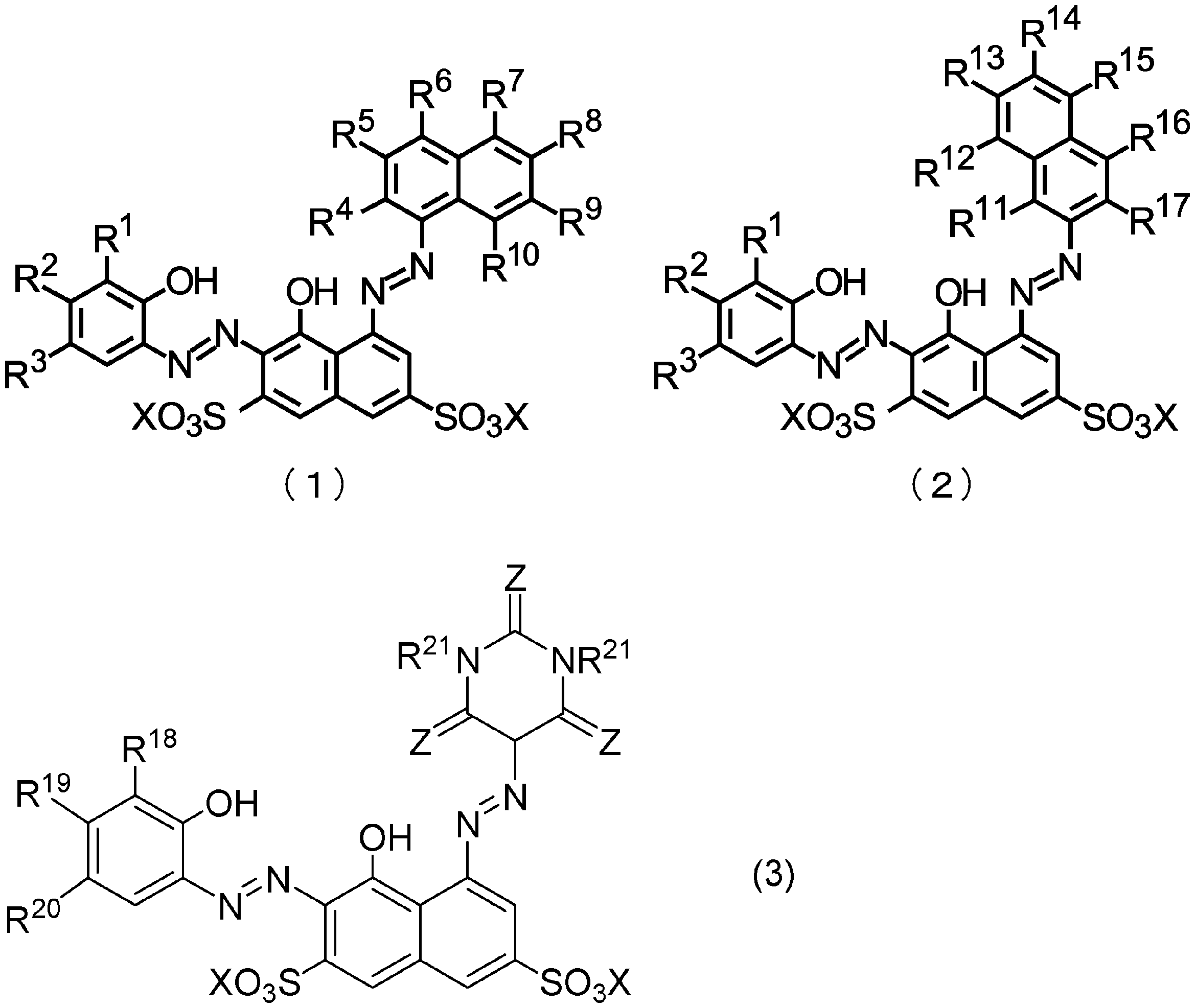
R1~R3はそれぞれ独立に、―H、炭素原子数1~3のアルキル基、―NO2、―SO2CH3、―SO2CH2CH3または―COOXを表し、
R4~R17はそれぞれ独立に、―H、―OH、―SO3X、―COOX、または、置換基を有していてもよい炭素原子数7~12のアミド基を表し、
R18~R20はそれぞれ独立に、―H、炭素原子数1~3のアルキル基、―NO2、―SO2CH3、―SO2CH2CH3、―SO3Xまたは―COOXを表し、
R21はそれぞれ独立に、炭素原子数1~3のアルキル基、または、非発色カチオンを表し、
Xはそれぞれ独立に非発色性カチオンを表し、
Zはそれぞれ独立に、酸素原子または硫黄原子を表す。]


前記一般式(1)または(2)で表されるアゾ色素が、下記一般式(4)で表される化合物をジアゾ化して得られるジアゾ化物と、下記一般式(5)または(6)で表される化合物および/またはその塩とのジアゾカップリング反応により得られるものである、製造方法。
前記一般式(3)で表されるアゾ色素が、下記一般式(7)で表される化合物をジアゾ化して得られるジアゾ化物と、下記一般式(8)で表される化合物および/またはその塩とのジアゾカップリング反応により得られるものである、製造方法。























本発明の染料組成物を2種以上併用する場合、あるいは本発明の染料組成物を他の色素と併用する場合、使用するすべての色素の混合溶液を調製して陽極酸化アルミニウムを浸漬してもよく、また、各色素溶液を別々に調製し、各溶液に陽極酸化アルミニウムを順に浸漬してもよい。
(ジアゾ成分の調製1)
反応容器にピクラミン酸ナトリウム28.2gを入れ、水242mLを入れ分散し、35%塩酸6.9g(関東化学株式会社製)を添加し、氷浴下の5℃以下で2時間撹拌した。撹拌後、反応液中に40%亜硝酸ナトリウム水溶液6.4g(関東化学株式会社製)を滴下し、3時間撹拌した。撹拌後、反応液中にスルファミン酸(富士フイルム和光純薬株式会社製)を添加して過剰の亜硝酸ナトリウムを分解し、ジアゾ化液1を得た。
(カプラー成分の調製1~ジアゾカップリング反応1)
次に、反応容器にH酸水和物(4-アミノ-5-ヒドロキシ-2,7-ナフタレンジスルホン酸ナトリウム水和物)(東京化成工業株式会社製)38.0gを入れ、水250mLを入れ分散した後、24%水酸化ナトリウム水溶液6.8g(関東化学株式会社製)および炭酸ナトリウム9.0g(関東化学株式会社製)を加え溶解した。この溶液を氷浴下の5℃以下で撹拌し、カプラー成分液を得た。撹拌中のカプラー成分液に、先に合成した前記ジアゾ化液1を入れ、pH9.0~9.5に調整し、終夜撹拌し、ジアゾカップリング反応を行った。撹拌後、レゾルシンチェックにてジアゾ化物が残存していないことを確認し、反応終了とした。40℃に昇温し、95%硫酸(関東化学株式会社製)を添加してpH6.0~6.5に調整後、析出した固体をろ過した。得られた固体を乾燥し、下記式(3-G-0)で表される化合物を黒紫色粉末として得た(収量52.0g、収率100%)。

反応容器に前記化合物(3-G-0)10.9gを入れ、水140mLを入れ分散し、35%塩酸4.1gを添加した。氷浴下の5℃以下で3時間撹拌した。撹拌後、反応液中に40%亜硝酸ナトリウム水溶液3.4gを滴下し、3時間撹拌した。撹拌後、スルファミン酸を添加して過剰の亜硝酸ナトリウムを分解し、ジアゾ化液2を得た。
(カプラー成分の調製2~ジアゾカップリング反応2)
反応容器に2-ナフトール2.74g(東京化成工業株式会社製)、水150mLを入れ、分散させた後、24%水酸化ナトリウム水溶液3.8g、炭酸ナトリウム1.9gを加え溶解した。この溶液を氷浴下にて5℃以下に撹拌し、カプラー成分液を得た。撹拌中のカプラー成分液に先に合成した前記ジアゾ化液2を入れ、pH9.0~9.5に調整し、終夜撹拌後、レゾルシンチェックにてジアゾ化物が残存していないことを確認し、反応終了とした。40℃に昇温し、95%硫酸を添加してpH6.0~6.5に調整後、ろ過した。得られた固体を乾燥し、色素(G-0)を黒色粉末として得た(収量12.7g、収率92%)。
合成実施例(G-0)において、2-ナフトールに代えてR酸(3-ヒドロキシナフタレン-2,7-ジスルホン酸)を用いたこと以外は同様の方法で、色素(G-1)を黒色粉末として得た(収量16.1g、収率91%)。
合成実施例(G-0)において、2-ナフトールに代えて2-ナフトール-7-スルホン酸ナトリウムを用いたこと以外は同様の方法で、色素(G-2)を黒色粉末として得た(収量9.6g、収率61%)。
合成実施例(G-0)において、2-ナフトールに代えて3,6-ジヒドロキシナフタレン-2,7-ジスルホン酸二ナトリウムを用いたこと以外は同様の方法で、色素(G-3)を黒色粉末として得た(収量14.1g、収率78%)。
合成実施例(G-0)において、2-ナフトールに代えて1-ナフトール-3,6-ジスルホン酸二ナトリウムを用いたこと以外は同様の方法で、色素(G-4)を黒色粉末として得た(収量14.1g、収率80%)。
合成実施例(G-0)において、2-ナフトールに代えて1-ナフトール-4-スルホン酸ナトリウムを用いたこと以外は同様の方法で、色素(G-5)を黒色粉末として得た(収量11.6g、収率71%)。
合成実施例(G-0)において、2-ナフトールに代えてR酸二ナトリウムを用い、ピクラミン酸ナトリウムに代えて3-アミノ-4-ヒドロキシフェニルメチルスルホンを用いたこと以外は同様の方法で、色素(G-6)を黒色粉末として得た(収量11.9g、収率81%)。
合成実施例(G-0)において、2-ナフトールに代えて1-ナフトール-4-スルホン酸ナトリウムを用い、ピクラミン酸ナトリウムに代えて3-アミノ-4-ヒドロキシフェニルメチルスルホンを用いたこと以外は同様の方法で、色素(G-7)を黒色粉末として得た(収量10.6g、収率76%)。
合成実施例(G-0)において、2-ナフトールに代えて2-ナフトール-6-スルホン酸ナトリウム水和物を用いたこと以外は同様の方法で、色素(G-8)を黒色粉末として得た(収量15.0g、収率95%)。
合成実施例(G-0)において、2-ナフトールに代えて6,7―ジヒドロキシナフタレン-2-スルホン酸ナトリウムを用いたこと以外は同様の方法で、色素(G-9)を黒色粉末として得た(収量14.5g、収率90%)。
合成実施例(G-0)において、2-ナフトールに代えて1-ナフトール-8-スルホン酸ナトリウムを用いたこと以外は同様の方法で、色素(G-10)を黒色粉末として得た(収量10.8g、収率69%)。
合成実施例(G-0)において、2-ナフトールに代えてクロモトロープ酸二ナトリウム二水和物を用いたこと以外は同様の方法で、色素(G-11)を黒色粉末として得た(収量11.0g、収率61%)。
合成実施例(G-0)において、2-ナフトールに代えて2-ナフトール-6,8-ジスルホン酸二カリウムを用いたこと以外は同様の方法で、色素(G-12)を黒色粉末として得た(収量3.5g、収率20%)。
合成実施例(G-0)において、ピクラミン酸ナトリウムに代えて2-アミノ-4-ニトロフェノールを用いたこと以外は同様の方法で、色素(G-13)を黒色粉末として得た(収量48.7g、収率97%)。
合成実施例(G-0)において、2-ナフトールに代えて1-ナフトール-4-スルホン酸ナトリウムを用い、ピクラミン酸ナトリウムに代えて2-アミノ-4-ニトロフェノールを用いたこと以外は同様の方法で、色素(G-14)を黒色粉末として得た(収量7.0g、収率55%)。
合成実施例(G-0)において、ピクラミン酸ナトリウムに代えて3-アミノ-4-ヒドロキシフェニルメチルスルホンを用いたこと以外は同様の方法で、色素(G-15)を黒色粉末として得た(収量9.2g、収率80%)。
合成実施例(G-0)において、2-ナフトールに代えて2-ナフトール-7-スルホン酸ナトリウムを用い、ピクラミン酸ナトリウムに代えて3-アミノ-4-ヒドロキシフェニルメチルスルホンを用いたこと以外は同様の方法で、色素(G-16)を黒色粉末として得た(収量10.5g、収率80%)。
合成実施例(G-0)において、ピクラミン酸ナトリウムに代えて2-アミノ-p-クレゾールを用いたこと以外は同様の方法で、色素(G-17)を黒色粉末として得た(収量5.4g、収率44%)。
合成実施例(G-0)において、2-ナフトールに代えて1-ナフトール-4-スルホン酸ナトリウムを用い、ピクラミン酸ナトリウムに代えて2-アミノ-4-ニトロフェノールを用いたこと以外は同様の方法で、色素(G-18)を黒色粉末として得た(収量7.5g、収率60%)。
反応容器にピクラミン酸ナトリウム(28.2g)を入れ、水(242mL)中に分散して、35%塩酸(6.9g、関東化学株式会社製)を添加した。氷浴下にて5℃以下で撹拌後、40%亜硝酸ナトリウム水溶液(6.4g、関東化学株式会社製)を滴下した。3時間撹拌後、スルファミン酸(富士フイルム和光純薬株式会社製)を添加して過剰の亜硝酸ナトリウムを除去してジアゾ化液を得た。反応容器にH酸水和物(38.0g、東京化成工業株式会社製)を投入し、水(250mL)中に分散させた後、24%水酸化ナトリウム水溶液(6.8g)、炭酸ナトリウム(9.0g、関東化学株式会社製)を加え溶解した。この溶液を氷浴下にて5℃以下に撹拌しているところに先に合成した前記ジアゾ化液を添加して、pH9.0~9.5に調製した。終夜(2時間以上)撹拌後、レゾルシンチェックにてジアゾ化物の残存がないことを確認した。40℃に昇温し、95%硫酸(関東化学株式会社製)を用いてpH6.0~6.5に調整後、ろ過した。得られた固体を乾燥することにより、下記式(2-A-1)で表される化合物を黒紫色粉末として得た(収量:52.0g、収率:100%)。

バルビツール酸に代えて2-チオバルビツール酸ナトリウムを用いたこと以外は合成実施例19と同様にして、色素(A-2)を黒色粉末として得た(収量:10.0g、収率:70%)
ピクラミン酸ナトリウムに代えて2-アミノ-4-ニトロフェノールを用いたこと以外は合成実施例19と同様にして、色素(A-3)を黒色粉末として得た(収量:16.1g、収率:91%)。
ピクラミン酸ナトリウムに代えて2-アミノ-5-ニトロフェノールを用いたこと以外は合成実施例19と同様にして、色素(A-4)を黒色粉末として得た(収量:9.84g、収率:78%)。
ピクラミン酸ナトリウムに代えて2-アミノフェノール-4-スルホン酸を用いたこと以外は合成実施例19と同様にして、色素(A-6)を黒色粉末として得た(収量:6.1g、収率:45%)。
ピクラミン酸ナトリウムに代えてニトラミン酸を用いたこと以外は合成実施例19と同様にして、色素(A-6)を黒色粉末として得た(収量:13.5 g、収率:92%)。
<着色アルミニウムの作製>
以下の手順で、アルミニウム基板上に陽極酸化処理し、着色アルミニウムを作製した。なお、陽極酸化および染色の工程で、処理時間と染料化合物濃度を設定した。
(脱脂) 脱脂用の容器に、脱脂剤(奥野製薬工業株式会社製、製品名:トップADD-100)150mL、98%硫酸70mL、水1000mLを混合したものを脱脂液として調製し、適当な寸法に裁断した染色用アルミニウム基板を浸漬し、60℃で3分間脱脂処理を行い、処理後水洗した。
(陽極酸化) 電解液用の容器に、98%硫酸を用いて180g/Lの電解液を調製し、電解装置の電極にアルミニウム基板を接続し、電解液槽に浸漬し、温度20±1℃(19~21℃)、電流密度1.0A/dm2の以下の通電時間の条件で陽極酸化を行い、以下の厚さの陽極酸化皮膜を得た。酸化後、水洗した。
陽極酸化条件:通電15分間 陽極酸化皮膜厚:5μm
(表面調整) 表面調整剤(奥野製薬工業株式会社製、TACソマール121)および水を用いて、濃度50mL/Lの表面調整液を調製し、45℃で1分間、アルミニウム基板を浸漬した。浸漬後アルミニウム基板を水洗した。
(染色) 合成実施例1で得られた色素(G-1)を用い、本発明の染料組成物としてそれぞれ下記の濃度の色素を含有する染色用水溶液を調製し、以下の染色時間で浸漬し、ともに温度(建浴温度)55℃で染色した。染色後アルミニウム基板を水洗した。
染色条件:色素濃度2.0質量% 染色時間:30秒間
(封孔) 封孔剤(奥野製薬工業株式会社製、製品名:トップシールH-298)および水を用いて40mL/Lの封孔液を調製し、約90℃で15分間封孔処理を行った。封孔処理後、温風で乾燥した。
色素(G-1)を用いて着色した着色アルミニウム板の色相を目視と色差計(装置名:コニカミノルタ製分光色差計 型式:CM-3700A)でCIE L*a*b*表色系により評価した。評価した色相の結果を表1に示す。
色素(G-1)を用いて着色した着色アルミニウム板について、次の方法で耐光性試験を行った。キセノンフェードメーター/ATLAS Ci3000+Xenon Weather Ometer(ATLAS社製)を用いて、放射照度:300~400nm、60W/m2、試験槽内温度:38℃、湿度:50%、ブラックパネル(BP)温度:63℃の条件で、着色アルミニウム板に50時間照射したものについて、色差計による色相および光照射前後の色差ΔE*の測定を行い、また、グレースケールの級数による染色堅牢度の目視判定(JIS L 0804「変退色用グレースケール」)により耐光性の判定を行った。級数は、5級が最高で、1級が最低であり、級数が高いものほど色が濃く(色差ΔE*が小さく)照射前の色相を保持していることを示す。本発明の評価方法では、級数の判定結果を3段階に分け、以下の判定基準で評価し、結果を表1に示す。
グレースケール判定基準:級数と本発明における評価との対応
5級~4級:A(特に良好な耐光性)
3級:B(通常レベルの耐光性)
2級以下:C(耐光性低い)
色素(G-1)の代わりに、色素(G-2)~(G-7)、または(A-1)~(A-3)を用いたこと以外は、実施例1と同様の方法で、着色アルミニウム板を作製し、色相、色差ΔE*および目視による耐光性を評価した結果を表1にまとめて示す。
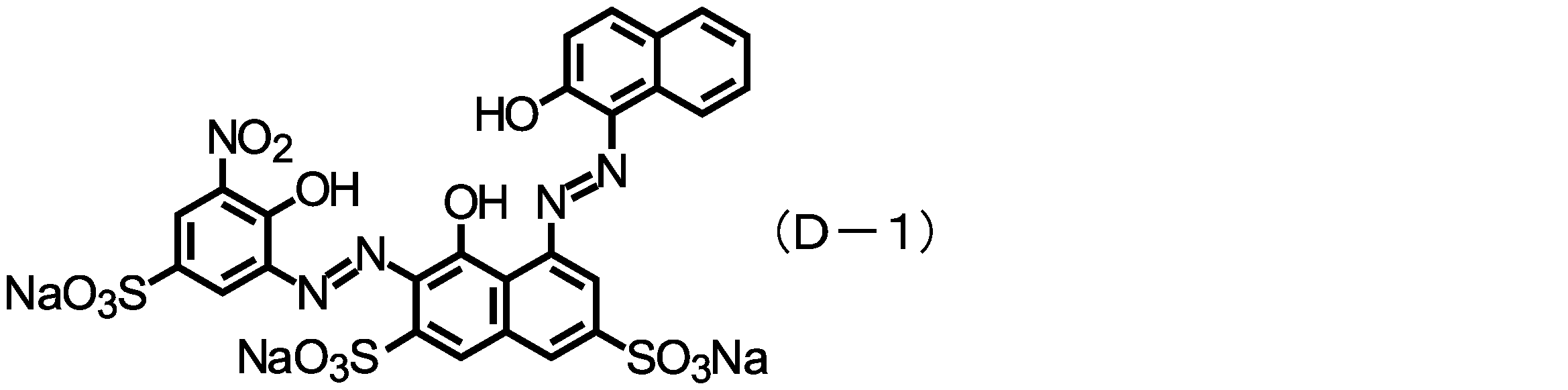
色素(G-1)の代わりに、本発明に属さない、下記式で表される次の色素:(D-1)について、実施例1と同様の作製条件で着色アルミニウムを作製し、色相、色差ΔE*および目視による耐光性を評価した結果を表1にまとめて示す。

Claims (15)
- 下記一般式(1)、(2)または(3)で表されるアゾ色素。

R1~R3はそれぞれ独立に、―H、炭素原子数1~3のアルキル基、―NO2、―SO2CH3、―SO2CH2CH3または―COOXを表し、
R4~R17はそれぞれ独立に、―H、―OH、―SO3X、―COOX、または、置換基を有していてもよい炭素原子数7~12のアミド基を表し、
R18~R20はそれぞれ独立に、―H、炭素原子数1~3のアルキル基、―NO2、―SO2CH3、―SO2CH2CH3、―SO3Xまたは―COOXを表し、
R21はそれぞれ独立に、炭素原子数1~3のアルキル基、または、非発色カチオンを表し、
Xはそれぞれ独立に非発色性カチオンを表し、
Zはそれぞれ独立に、酸素原子または硫黄原子を表す。] - 前記一般式(1)または(2)で表され、
R1~R3のうち1個または2個が―NO2である、請求項1に記載のアゾ色素。 - 前記一般式(1)または(2)で表され、
R3が―CH3または―SO2CH3である、請求項1に記載のアゾ色素。 - 前記一般式(1)で表され、
R4~R10のいずれか1個または2個が―OHである、または、R4~R10のいずれか1個または2個が―SO3Naである、請求項1に記載のアゾ色素。 - 前記一般式(2)で表され、
R11~R17のいずれか1個または2個が―OHである、または、R11~R17のいずれか1個または2個が―SO3Naである、請求項1に記載のアゾ色素。 - 前記一般式(3)で表され、
R18~R20がそれぞれ独立に、―H、―CH3、―NO2、―SO2CH3、―SO3H、―SO3Na、―COOHまたは―COONaである、請求項1に記載のアゾ色素。 - Xがそれぞれ独立に、H+、Na+またはNH4 +である、請求項1に記載のアゾ色素。
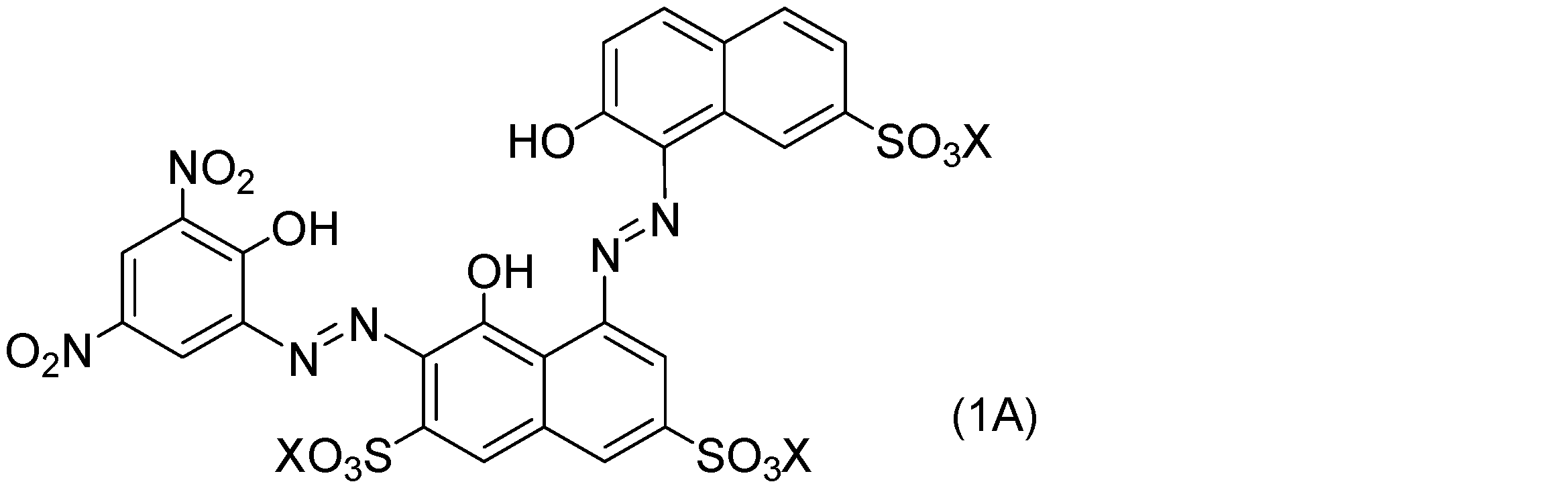
- 下記一般式(1A)で表される、請求項1に記載のアゾ色素。
- 下記一般式(2A)で表される、請求項1に記載のアゾ色素。

- 下記一般式(3A)で表される、請求項1に記載のアゾ色素。
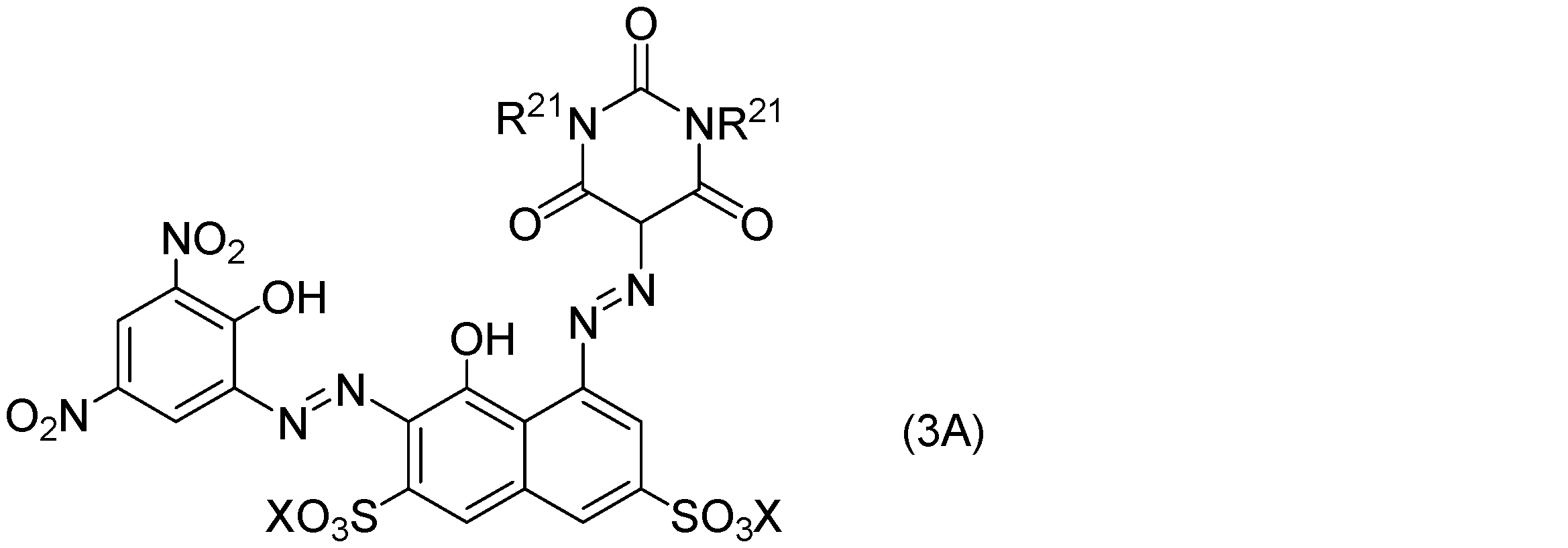
- 請求項1~10のいずれか一項に記載のアゾ色素を含有する、染料組成物。
- 請求項11に記載の染料組成物を含有する、陽極酸化アルミニウム用着色剤。
- 請求項1に記載のアゾ色素を、0.02~10質量%含有する染料組成物を用いることを特徴とする、陽極酸化アルミニウムまたは陽極酸化アルミニウム合金の着色方法。
- 請求項1に記載のアゾ色素の製造方法であって、
前記一般式(1)または(2)で表されるアゾ色素が、下記一般式(4)で表される化合物をジアゾ化して得られるジアゾ化物と、下記一般式(5)または(6)で表される化合物および/またはその塩とのジアゾカップリング反応により得られるものである、製造方法。
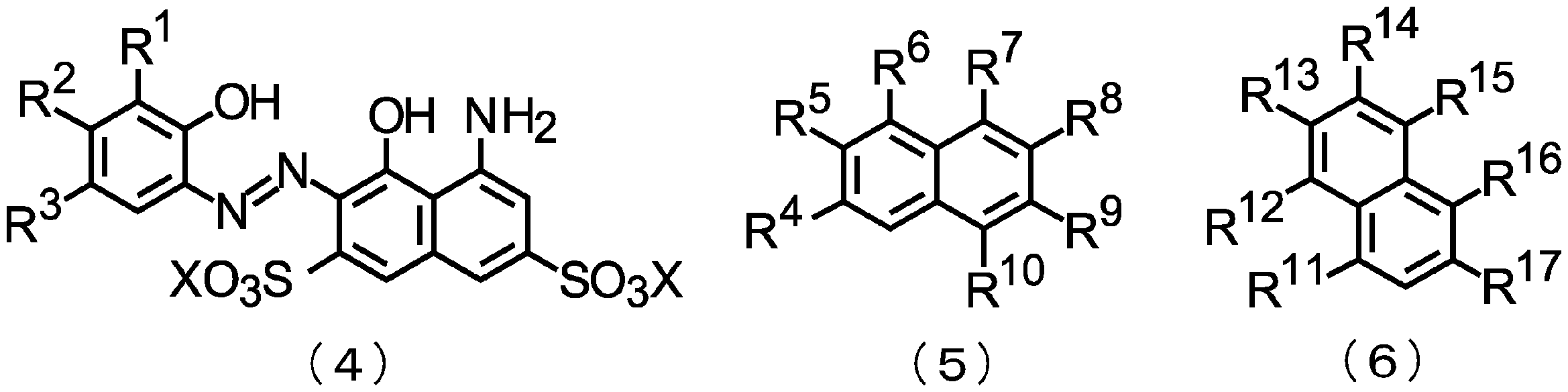
- 請求項1に記載のアゾ色素の製造方法であって、
前記一般式(3)で表されるアゾ色素が、下記一般式(7)で表される化合物をジアゾ化して得られるジアゾ化物と、下記一般式(8)で表される化合物および/またはその塩とのジアゾカップリング反応により得られるものである、製造方法。
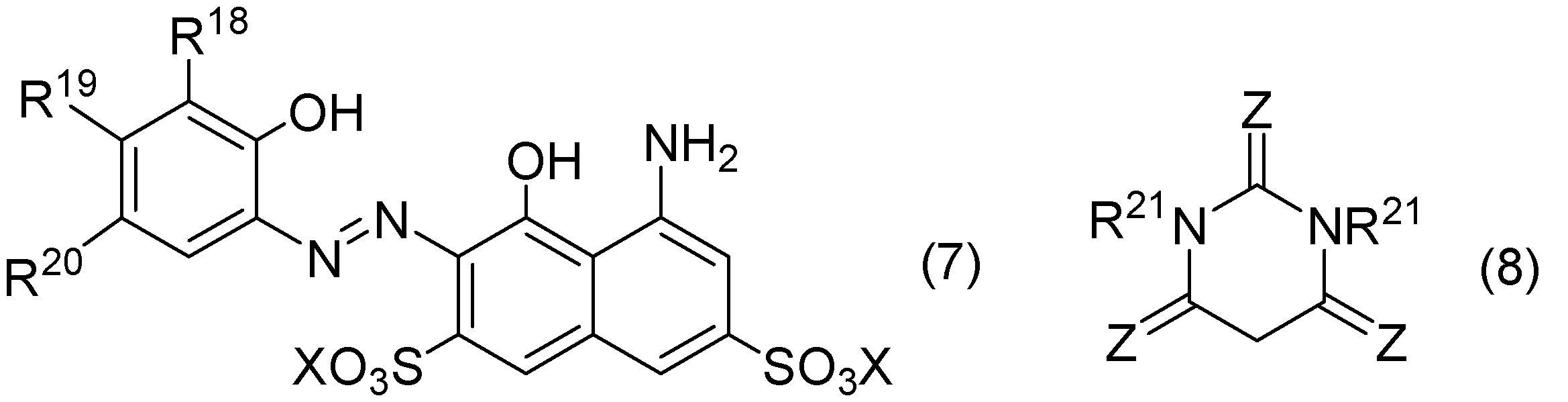
Priority Applications (3)
| Application Number | Priority Date | Filing Date | Title |
|---|---|---|---|
| JP2024523798A JP7599619B2 (ja) | 2022-09-30 | 2023-09-12 | アゾ色素、染料組成物、陽極酸化アルミニウム用着色剤および着色方法、ならびに該色素の製造方法 |
| CN202380068796.1A CN119948115A (zh) | 2022-09-30 | 2023-09-12 | 偶氮色素、染料组合物、阳极氧化铝用着色剂及着色方法、以及该色素的制造方法 |
| KR1020257013093A KR20250077536A (ko) | 2022-09-30 | 2023-09-12 | 아조 색소, 염료 조성물, 양극 산화알루미늄용 착색제 및 착색 방법, 그리고 그 색소의 제조 방법 |
Applications Claiming Priority (4)
| Application Number | Priority Date | Filing Date | Title |
|---|---|---|---|
| JP2022159139 | 2022-09-30 | ||
| JP2022-159139 | 2022-09-30 | ||
| JP2023027834 | 2023-02-24 | ||
| JP2023-027834 | 2023-02-24 |
Publications (1)
| Publication Number | Publication Date |
|---|---|
| WO2024070669A1 true WO2024070669A1 (ja) | 2024-04-04 |
Family
ID=90477565
Family Applications (1)
| Application Number | Title | Priority Date | Filing Date |
|---|---|---|---|
| PCT/JP2023/033237 Ceased WO2024070669A1 (ja) | 2022-09-30 | 2023-09-12 | アゾ色素、染料組成物、陽極酸化アルミニウム用着色剤および着色方法、ならびに該色素の製造方法 |
Country Status (5)
| Country | Link |
|---|---|
| JP (1) | JP7599619B2 (ja) |
| KR (1) | KR20250077536A (ja) |
| CN (1) | CN119948115A (ja) |
| TW (1) | TW202432724A (ja) |
| WO (1) | WO2024070669A1 (ja) |
Citations (6)
| Publication number | Priority date | Publication date | Assignee | Title |
|---|---|---|---|---|
| US2551056A (en) * | 1947-09-19 | 1951-05-01 | Geigy Ag J R | Chrome monoazo dyestuffs |
| CH278471A (de) * | 1949-04-14 | 1951-10-15 | Ag Sandoz | Verfahren zur Herstellung eines eisenhaltigen Disazofarbstoffes. |
| US2580867A (en) * | 1949-04-14 | 1952-01-01 | Sandoz Ag | Disazo dyestuffs and their chromium, iron and cobalt complexes |
| US4537955A (en) * | 1982-03-02 | 1985-08-27 | Basf Aktiengesellschaft | Unsymmetrical 1:2 chromium complex of a monoazo dyestuff and a disazo dyestuff which is non-fiber reactive and contains no sulfonamido or amino groups |
| US4988804A (en) * | 1987-11-10 | 1991-01-29 | Ciba-Geigy Corporation | Polyazo dyes obtained by successive coupling of H-acid and two further anilinic diazo components on resorcinol or the like |
| US20050155162A1 (en) * | 2002-02-06 | 2005-07-21 | Hans-Thomas Schacht | Process for the coloration of aluminium |
Family Cites Families (7)
| Publication number | Priority date | Publication date | Assignee | Title |
|---|---|---|---|---|
| DE3514387C2 (de) | 1984-04-27 | 2003-12-24 | Clariant Finance Bvi Ltd | 1:2-Metallkomplex-azoverbindungen, ihre Herstellung und Verwendung |
| CS275129B2 (en) * | 1990-02-26 | 1992-02-19 | Vyzk Ustav Organickych Syn | 2+1 cobaltic complexes of diazodyestuffs and method of their production |
| CH685119A5 (de) | 1992-06-24 | 1995-03-31 | Sandoz Ag | Asymmetrische 1:2-Metallkomplex-azoverbindungen. |
| JP2002522617A (ja) | 1998-08-14 | 2002-07-23 | クラリアント インターナショナル リミティド | 1:2クロム錯体染料、その製法、及びその使用 |
| JP2009302256A (ja) | 2008-06-12 | 2009-12-24 | Tdk Corp | 希土類磁石の製造方法 |
| KR102580867B1 (ko) | 2017-06-30 | 2023-09-19 | 노르스크 티타늄 아에스 | 금속 적층 가공에 있어서의 현위치 가스 제트 충돌의 적용을 통한 응고 미세화 및 일반적인 상 변태 제어 |
| JP7219755B2 (ja) | 2018-03-27 | 2023-02-08 | 保土谷化学工業株式会社 | 錯塩化合物、染料組成物、陽極酸化アルミニウム用着色剤および着色方法、ならびに該化合物の製造方法 |
-
2023
- 2023-09-12 KR KR1020257013093A patent/KR20250077536A/ko active Pending
- 2023-09-12 CN CN202380068796.1A patent/CN119948115A/zh active Pending
- 2023-09-12 JP JP2024523798A patent/JP7599619B2/ja active Active
- 2023-09-12 WO PCT/JP2023/033237 patent/WO2024070669A1/ja not_active Ceased
- 2023-09-14 TW TW112135081A patent/TW202432724A/zh unknown
Patent Citations (6)
| Publication number | Priority date | Publication date | Assignee | Title |
|---|---|---|---|---|
| US2551056A (en) * | 1947-09-19 | 1951-05-01 | Geigy Ag J R | Chrome monoazo dyestuffs |
| CH278471A (de) * | 1949-04-14 | 1951-10-15 | Ag Sandoz | Verfahren zur Herstellung eines eisenhaltigen Disazofarbstoffes. |
| US2580867A (en) * | 1949-04-14 | 1952-01-01 | Sandoz Ag | Disazo dyestuffs and their chromium, iron and cobalt complexes |
| US4537955A (en) * | 1982-03-02 | 1985-08-27 | Basf Aktiengesellschaft | Unsymmetrical 1:2 chromium complex of a monoazo dyestuff and a disazo dyestuff which is non-fiber reactive and contains no sulfonamido or amino groups |
| US4988804A (en) * | 1987-11-10 | 1991-01-29 | Ciba-Geigy Corporation | Polyazo dyes obtained by successive coupling of H-acid and two further anilinic diazo components on resorcinol or the like |
| US20050155162A1 (en) * | 2002-02-06 | 2005-07-21 | Hans-Thomas Schacht | Process for the coloration of aluminium |
Also Published As
| Publication number | Publication date |
|---|---|
| CN119948115A (zh) | 2025-05-06 |
| JPWO2024070669A1 (ja) | 2024-04-04 |
| TW202432724A (zh) | 2024-08-16 |
| KR20250077536A (ko) | 2025-05-30 |
| JP7599619B2 (ja) | 2024-12-13 |
Similar Documents
| Publication | Publication Date | Title |
|---|---|---|
| JP7219754B2 (ja) | 錯塩化合物、染料組成物、陽極酸化アルミニウム用着色剤および着色方法、ならびに該化合物の製造方法 | |
| US3202550A (en) | Process for dyeing aluminum oxide layers | |
| JP7587935B2 (ja) | 化合物、染料組成物、陽極酸化アルミニウム用着色剤および着色方法、ならびに該化合物の製造方法 | |
| JP2003213168A (ja) | インク組成物、及びインクジェット記録方法 | |
| US6696553B1 (en) | Anthraquinone-azo dyes and use of such compounds | |
| DE3514387C2 (de) | 1:2-Metallkomplex-azoverbindungen, ihre Herstellung und Verwendung | |
| JP7599619B2 (ja) | アゾ色素、染料組成物、陽極酸化アルミニウム用着色剤および着色方法、ならびに該色素の製造方法 | |
| CA2294642A1 (en) | Method for dying aluminum oxide layers | |
| US4469485A (en) | Use of the 1:2 chromium complex of 1-amino-2-(3', 5'-dinitro-2'-hydroxyphenylazo)-4-sulfonaphthalene and alkali metal salts thereof for dyeing polyamides and oxide layers on aluminum and aluminum alloys | |
| JP7527920B2 (ja) | キサンテン系色素、染料組成物、陽極酸化アルミニウム用着色剤および着色方法、ならびに該色素の製造方法 | |
| CA2217854C (en) | 1:2 chromium complexes, their production and use | |
| US2816101A (en) | Chrome containing monoazo dyestuffs | |
| US5283325A (en) | 1:2 chromium and cobalt complexes of monoazo compounds having further unsubstituted or substituted nitro-2-hydroxyphenyl diazo component radicals and 6- or 7-acyl-amino-1-hydroxy-3-sulfonaphthalene coupling component radicals | |
| JPS6342670B2 (ja) | ||
| DEG0012615MA (ja) |
Legal Events
| Date | Code | Title | Description |
|---|---|---|---|
| ENP | Entry into the national phase |
Ref document number: 2024523798 Country of ref document: JP Kind code of ref document: A |
|
| 121 | Ep: the epo has been informed by wipo that ep was designated in this application |
Ref document number: 23871902 Country of ref document: EP Kind code of ref document: A1 |
|
| WWE | Wipo information: entry into national phase |
Ref document number: 202380068796.1 Country of ref document: CN |
|
| ENP | Entry into the national phase |
Ref document number: 20257013093 Country of ref document: KR Kind code of ref document: A |
|
| WWE | Wipo information: entry into national phase |
Ref document number: 202547038442 Country of ref document: IN |
|
| NENP | Non-entry into the national phase |
Ref country code: DE |
|
| WWP | Wipo information: published in national office |
Ref document number: 202380068796.1 Country of ref document: CN |
|
| WWP | Wipo information: published in national office |
Ref document number: 202547038442 Country of ref document: IN |
|
| 122 | Ep: pct application non-entry in european phase |
Ref document number: 23871902 Country of ref document: EP Kind code of ref document: A1 |