WO2024070467A1 - スパンボンド不織布、および、その製造方法、積層不織布ならびに、これらを用いてなる衛生材料、衣料 - Google Patents
スパンボンド不織布、および、その製造方法、積層不織布ならびに、これらを用いてなる衛生材料、衣料 Download PDFInfo
- Publication number
- WO2024070467A1 WO2024070467A1 PCT/JP2023/031734 JP2023031734W WO2024070467A1 WO 2024070467 A1 WO2024070467 A1 WO 2024070467A1 JP 2023031734 W JP2023031734 W JP 2023031734W WO 2024070467 A1 WO2024070467 A1 WO 2024070467A1
- Authority
- WO
- WIPO (PCT)
- Prior art keywords
- nonwoven fabric
- resin
- polypropylene
- spunbond nonwoven
- less
- Prior art date
- Legal status (The legal status is an assumption and is not a legal conclusion. Google has not performed a legal analysis and makes no representation as to the accuracy of the status listed.)
- Ceased
Links
Classifications
-
- D—TEXTILES; PAPER
- D04—BRAIDING; LACE-MAKING; KNITTING; TRIMMINGS; NON-WOVEN FABRICS
- D04H—MAKING TEXTILE FABRICS, e.g. FROM FIBRES OR FILAMENTARY MATERIAL; FABRICS MADE BY SUCH PROCESSES OR APPARATUS, e.g. FELTS, NON-WOVEN FABRICS; COTTON-WOOL; WADDING ; NON-WOVEN FABRICS FROM STAPLE FIBRES, FILAMENTS OR YARNS, BONDED WITH AT LEAST ONE WEB-LIKE MATERIAL DURING THEIR CONSOLIDATION
- D04H3/00—Non-woven fabrics formed wholly or mainly of yarns or like filamentary material of substantial length
- D04H3/005—Synthetic yarns or filaments
- D04H3/007—Addition polymers
-
- C—CHEMISTRY; METALLURGY
- C08—ORGANIC MACROMOLECULAR COMPOUNDS; THEIR PREPARATION OR CHEMICAL WORKING-UP; COMPOSITIONS BASED THEREON
- C08F—MACROMOLECULAR COMPOUNDS OBTAINED BY REACTIONS ONLY INVOLVING CARBON-TO-CARBON UNSATURATED BONDS
- C08F10/00—Homopolymers and copolymers of unsaturated aliphatic hydrocarbons having only one carbon-to-carbon double bond
- C08F10/04—Monomers containing three or four carbon atoms
- C08F10/06—Propene
-
- C—CHEMISTRY; METALLURGY
- C08—ORGANIC MACROMOLECULAR COMPOUNDS; THEIR PREPARATION OR CHEMICAL WORKING-UP; COMPOSITIONS BASED THEREON
- C08F—MACROMOLECULAR COMPOUNDS OBTAINED BY REACTIONS ONLY INVOLVING CARBON-TO-CARBON UNSATURATED BONDS
- C08F8/00—Chemical modification by after-treatment
- C08F8/50—Partial depolymerisation
-
- D—TEXTILES; PAPER
- D04—BRAIDING; LACE-MAKING; KNITTING; TRIMMINGS; NON-WOVEN FABRICS
- D04H—MAKING TEXTILE FABRICS, e.g. FROM FIBRES OR FILAMENTARY MATERIAL; FABRICS MADE BY SUCH PROCESSES OR APPARATUS, e.g. FELTS, NON-WOVEN FABRICS; COTTON-WOOL; WADDING ; NON-WOVEN FABRICS FROM STAPLE FIBRES, FILAMENTS OR YARNS, BONDED WITH AT LEAST ONE WEB-LIKE MATERIAL DURING THEIR CONSOLIDATION
- D04H3/00—Non-woven fabrics formed wholly or mainly of yarns or like filamentary material of substantial length
- D04H3/08—Non-woven fabrics formed wholly or mainly of yarns or like filamentary material of substantial length characterised by the method of strengthening or consolidating
- D04H3/16—Non-woven fabrics formed wholly or mainly of yarns or like filamentary material of substantial length characterised by the method of strengthening or consolidating with bonds between thermoplastic filaments produced in association with filament formation, e.g. immediately following extrusion
-
- D—TEXTILES; PAPER
- D10—INDEXING SCHEME ASSOCIATED WITH SUBLASSES OF SECTION D, RELATING TO TEXTILES
- D10B—INDEXING SCHEME ASSOCIATED WITH SUBLASSES OF SECTION D, RELATING TO TEXTILES
- D10B2321/00—Fibres made from polymers obtained by reactions only involving carbon-to-carbon unsaturated bonds
- D10B2321/02—Fibres made from polymers obtained by reactions only involving carbon-to-carbon unsaturated bonds polyolefins
- D10B2321/022—Fibres made from polymers obtained by reactions only involving carbon-to-carbon unsaturated bonds polyolefins polypropylene
-
- D—TEXTILES; PAPER
- D10—INDEXING SCHEME ASSOCIATED WITH SUBLASSES OF SECTION D, RELATING TO TEXTILES
- D10B—INDEXING SCHEME ASSOCIATED WITH SUBLASSES OF SECTION D, RELATING TO TEXTILES
- D10B2509/00—Medical; Hygiene
Definitions
- the present invention relates to a spunbond nonwoven fabric that has excellent mechanical properties and high-level processability in addition to flexibility, a method for producing the same, and hygiene materials and clothing made using the same.
- Spunbond nonwoven fabrics made from polyolefins, especially polypropylene spunbond nonwoven fabrics, are low cost and easy to process, so they are widely used, primarily for sanitary material applications.
- Patent Document 1 proposes a microfiber nonwoven web formed from reactant particles of a treated polymer, the polymer having a specific molecular weight distribution and a melt flow rate equal to or higher than a certain level.
- Patent Document 2 also proposes a method for producing a nonwoven fabric, in which a propylene-based polymer and an organic peroxide are fed into an extruder equipped with a screw equipped with a cross saw and a unimelt, the propylene-based polymer resin composition containing the propylene-based polymer and the organic peroxide in the extruder is melt-kneaded, and the melt-kneaded propylene-based polymer resin composition is spun into fibers to produce a nonwoven fabric. It is described that this method for producing a nonwoven fabric suppresses thread breakage and produces a nonwoven fabric with excellent spinnability.
- Patent Document 3 proposes an organic peroxide-containing polypropylene resin composition, which is a resin composition in which a certain amount of organic peroxide is blended with a propylene- ⁇ -olefin random copolymer polymerized with a metallocene catalyst and having certain characteristics, and is characterized in that the ratio of the melt flow rate of the resin composition to the melt flow rate after the resin composition has been subjected to a vacuum constant temperature drying process is equal to or less than a certain value. It also describes that such a resin composition can be used as a useful resin composition that can adjust the melt viscosity during molding processing, either alone or in combination with other polypropylene resins as a master batch.
- Patent Document 1 describes that according to the technology, the polymer is treated to narrow the molecular weight distribution and also to reduce the molecular weight of the polymer, i.e., to increase the melt flow rate, and as a result, the nonwoven web according to the present invention can be produced with high efficiency by the melt blowing method.
- the fiber strength decreases, and the mechanical properties of the nonwoven fabric decrease significantly, making advanced processing such as pleating and bonding to other members difficult, and there are problems with the mechanical properties of the final product itself being deteriorated.
- the object of the present invention is to provide a spunbond nonwoven fabric that, in addition to flexibility, has excellent mechanical properties and is easy to process in advanced ways, such as pleating and bonding to other components.
- the inventors have found that in order to make a spunbond nonwoven fabric more flexible, the fiber diameter must be made finer, and excellent mechanical properties can be achieved by increasing the strength of the fibers themselves.
- the inventors came up with the idea of using a certain amount of peroxide, which is used as a radical generator to increase the melt flow rate of the raw material, as a crystal nucleating agent by leaving it in the spunbond nonwoven fabric, and further, of setting the branching degree ⁇ within a specific range.
- the inventors conducted extensive research based on this knowledge to achieve the above object, and discovered that by setting the amount of organic peroxide and the degree of branching ⁇ of the polypropylene resin in the fibers constituting the spunbond nonwoven fabric within a specific range, and further setting the melt flow rate of the spunbond nonwoven fabric within a specific range, the fiber diameter can be made finer, thereby improving flexibility, and defects that occur in the nonwoven fabric due to fiber breakage can be suppressed, resulting in a high-quality spunbond nonwoven fabric; and by suppressing the orientation relaxation of the resulting fibers and increasing the molecular orientation ( ⁇ n), which in turn increases the strength of the fibers, resulting in a spunbond nonwoven fabric with excellent mechanical properties and that is easy to process in advanced ways, such as pleating and bonding to other members, thereby completing the present invention.
- the present invention aims to solve the above problems, and provides the following inventions:
- the amount of organic peroxide extracted by ultrasonic treatment of the spunbonded nonwoven fabric immersed in a chloroform/methanol solvent in a volume ratio of 1:1 for 15 minutes at 45 kHz and a solution temperature of 30° C. is 100 ppm or more and 1000 ppm or less.
- the melt flow rate of the polypropylene-based resin is 20 g/10 min or more and 400 g/10 min or less.
- the branching degree ⁇ per molecule of the polypropylene-based resin is 1.0 x 10 -7 or more and 1.0 x 10 -3 or less, calculated from the molecular weight and radius of gyration determined by gel permeation chromatography/multi-angle light scattering measurement device using trifunctional random branching theory.
- (1) The amount of residual organic peroxide extracted by ultrasonic treatment of the spunbonded nonwoven fabric immersed in a chloroform/methanol solvent in a volume ratio of 1:1 for 15 minutes at 45 kHz and a solution temperature of 30° C. is 100 ppm or more and 1000 ppm or less.
- the melt flow rate of the polypropylene-based resin is 20 g/10 min or more and 400 g/10 min or less.
- the branching degree ⁇ per molecule of the polypropylene-based resin is 1.0 x 10 -7 or more and 1.0 x 10 -3 or less, calculated using trifunctional random branching theory from the molecular weight and radius of gyration determined by gel permeation chromatography/multi-angle light scattering measurement device.
- a laminated nonwoven fabric comprising the spunbond nonwoven fabric described in [1] or [2] above.
- a sanitary material comprising the spunbond nonwoven fabric described in [1] or [2] above, or the laminated nonwoven fabric described in [5] above.
- the spunbond nonwoven fabric of the present invention has high quality and flexibility, and because a certain amount of organic peroxide remains in the nonwoven fabric, it acts as a crystal nucleating agent to promote oriented crystallization. Furthermore, by setting the branching degree ⁇ per molecule within a specific range, it is possible to suppress relaxation of the fiber orientation after pulling in the spunbonding process, and it exhibits excellent mechanical properties. It also exhibits excellent properties in terms of ease of advanced processing such as pleating and joining with other components.
- the spunbond nonwoven fabric of the present invention is a spunbond nonwoven fabric composed of fibers made of a polypropylene-based resin, and the spunbond nonwoven fabric satisfies the following conditions (1) to (3), and the average single fiber diameter of the fibers is 5.0 ⁇ m or more and 20.0 ⁇ m or less.
- the amount of organic peroxide extracted by ultrasonic treatment of the spunbonded nonwoven fabric immersed in a chloroform/methanol solvent having a volume ratio of 1:1 for 15 minutes at 45 kHz and a solution temperature of 30° C. is 100 ppm or more and 1000 ppm or less.
- the melt flow rate is 20 g/10 min or more and 400 g/10 min or less.
- the branching degree ⁇ per molecule of the polypropylene resin is 1.0 ⁇ 10 ⁇ 7 or more and 1.0 ⁇ 10 ⁇ 3 or less, calculated using the trifunctional random branching theory from the molecular weight and radius of gyration determined by gel permeation chromatography/multi-angle light scattering measurement device.
- the spunbonded nonwoven fabric of the present invention will be described in detail below, but the present invention is not limited to the scope described below as long as it does not deviate from the gist of the invention, and various modifications are possible without departing from the gist of the invention.
- the spunbonded nonwoven fabric of the present invention is composed of fibers (polypropylene fibers) composed of a polypropylene-based resin.
- the polypropylene-based resin means a resin in which the molar fraction of propylene units in the repeating units is 80 mol % to 100 mol %.
- the polypropylene-based resin used in the present invention may be a homopolymer of propylene or a copolymer of propylene and various ⁇ -olefins.
- the copolymerization ratio of the various ⁇ -olefins is preferably 10 mol% or less, more preferably 5 mol% or less, and even more preferably 3 mol% or less, in order to give the fibers higher tensile strength.
- the polypropylene resin used in the present invention can be blended with other component resins to the extent that the effects of the present invention are not impaired.
- other component resins include polyolefin resins such as polyethylene and poly-4-methyl-1-pentene, which have melting points close to those of polypropylene, as well as low-melting polyester resins and low-melting polyamide resins.
- low-crystalline olefin resins are preferably used.
- low-crystalline olefin resins for example, ethylene-propylene copolymers are preferably used.
- the mass ratio of the other component resin is preferably 20% by mass or less, and more preferably 10% by mass or less, when the total mass ratio of the polypropylene resin and the other component resins is 100% by mass, in order to fully express the properties of the polypropylene resin.
- the polypropylene resin used in the present invention can contain additives such as pigments for coloring, antioxidants, lubricants such as polyethylene wax and fatty acid amide compounds, and heat stabilizers, as long as the effects of the present invention are not impaired.
- the polypropylene resin further satisfies the following conditions (4) and (5).
- the present inventors have found that the smaller the Mw/Mn and Mz/Mw, the higher the molecular orientation ( ⁇ n) of the fibers obtained even at the same spinning speed, and the higher the fiber strength. From this viewpoint, Mw/Mn ⁇ 2.95 and Mz/Mw ⁇ 1.98 are more preferable.
- the Mw of the polypropylene resin used in the present invention is preferably 120,000 or more and 350,000 or less. Mw is correlated with MFR, and an Mw of 350,000 or less increases the fluidity of the polypropylene resin, improving spinnability and reducing thread breakage defects. From this perspective, the smaller the Mw, the more preferable it is, with 250,000 or less being more preferable, 210,000 or less being even more preferable, and 180,000 or less being particularly preferable. On the other hand, by setting the Mw to preferably 120,000 or more, more preferably 130,000 or more, even more preferably 150,000 or more, and particularly preferably 200,000 or more, fiber strength can be improved and sheet defects due to thread breakage can be suppressed.
- GPC gel permeation chromatography
- Mw, Mn, and Mz refer to values measured and calculated by the following methods.
- the solution may be heated at 165°C for 20 minutes to facilitate dissolution.
- the solution is then filtered using a PTFE filter (pore size: 0.45 ⁇ m) to prepare a sample solution.
- the PTFE filter may be, for example, "T010A” manufactured by Advantec Toyo Co., Ltd.
- (3) The sample solution obtained in (2) is measured using GPC under the following conditions.
- Mw, Mn, and Mz can be obtained by analyzing the emission curve in GPC using "Empower” manufactured by Wyatt Technology. Apparatus: For example, “PL-220” manufactured by Polymer Laboratories, etc.
- Detector Differential refractive index detector RI Column: Shodex HT-G (guard column) + Shodex HT-806M x 2 (8.0 mm x 30 cm, for example, manufactured by Showa Denko K.K.) Solvent: 1,2,4-trichlorobenzene (with 0.1% BHT) Flow rate: 1.0 mL/min Column temperature: 145° C. Injection volume: 0.20 mL Standard samples: monodisperse polystyrene (for example, manufactured by Tosoh Corporation), dibenzyl (for example, manufactured by Tokyo Chemical Industry Co., Ltd.).
- the spunbonded nonwoven fabric of the present invention is composed of fibers made of the polypropylene-based resin.
- the average single fiber diameter of the fibers is 5.0 ⁇ m or more and 20.0 ⁇ m or less.
- the upper limit of the range of the average single fiber diameter is 20.0 ⁇ m or less, preferably 16.0 ⁇ m or less, so that the surface of the spunbonded nonwoven fabric feels smooth to the touch.
- the small fiber diameter leads to a decrease in the moment of inertia of area, resulting in a spunbonded nonwoven fabric with excellent flexibility.
- the lower limit of the range of the average single fiber diameter is 5.0 ⁇ m or more, preferably 8.0 ⁇ m or more, so that the spunbonded nonwoven fabric has high tensile strength and few defects.
- the average single fiber diameter ( ⁇ m) of the fibers refers to the value obtained by taking 10 5 mm x 5 mm test pieces at random from the area excluding the ends of the spunbond nonwoven fabric, observing the side of the fibers constituting the spunbond nonwoven fabric in the area other than the embossed bonded area of each test piece using a digital microscope (such as "VHX-2000" manufactured by Keyence Corporation), determining the fiber diameter, and rounding off the arithmetic mean value ( ⁇ m) of the fiber diameter measured for each test piece to one decimal place.
- the ends of the spunbond nonwoven fabric refer to an area that is 10% of both ends of the width of the spunbond nonwoven fabric.
- the ⁇ n which is an index of the molecular orientation of the fibers that make up the spunbond nonwoven fabric of the present invention, is preferably 0.020 or more. With a ⁇ n of 0.020 or more, the orientation of the fibers is improved, and the fiber strength and sheet strength are increased. In addition, heat resistance is also increased, allowing thermal bonding such as embossing to be carried out at high temperatures, making it easier to thermally bond the fibers, resulting in a spunbond nonwoven fabric with good mechanical properties and easy advanced processing such as pleating and bonding to other members.
- the ⁇ n of the fibers constituting the spunbond nonwoven fabric of the present invention refers to the value obtained by taking ten test pieces at random using the same method as the above-mentioned method for measuring the average single fiber diameter, extracting ten single yarns from the parts of the test pieces other than the embossed bonded parts, and using a polarizing microscope (such as "BH2" manufactured by Olympus Corporation) to determine the retardation using the compensator method while the sample is immersed in liquid paraffin.
- the arithmetic mean value (without units) of the calculated value is rounded off to the fourth decimal place.
- the tensile strength of the fibers constituting the spunbond nonwoven fabric of the present invention is preferably 2.0 cN/dtex or more. With a fiber tensile strength of 2.0 cN/dtex or more, the strength of the sheet is high, resulting in a spunbond nonwoven fabric with good mechanical properties and easy advanced processing such as pleating and bonding to other members.
- the tensile strength of the fibers constituting the spunbonded nonwoven fabric of the present invention refers to a value measured and calculated by the following method. (1) Using the same method as in the measurement of the average single fiber diameter described above, ten test pieces are randomly taken from locations, and ten single yarns are extracted from the portions of the test pieces other than the embossed bonded portions.
- Single fiber fineness (dtex) ⁇ (average single fiber diameter of fiber ( ⁇ m)/2) 2 ⁇ 0.91 (g/cm 3 ) ⁇ 100,000 (cm).
- the cross-sectional shape of the fibers constituting the spunbonded nonwoven fabric of the present invention is not particularly limited as long as it does not impair the effects of the present invention, and may be a round cross-section or an irregular cross-section such as a triangle, ellipse, hexagon, or hollow, but a round cross-section is preferred because it is highly productive and has excellent flexibility.
- the cross-sectional shape of the polypropylene fibers constituting the spunbonded nonwoven fabric of the present invention is an irregular cross-section, there is a bending direction in which the second moment of area for the same cross-sectional area is larger than that of a circular cross-section, and therefore the spunbonded nonwoven fabric may have high rigidity, but with a circular cross-section, there is no such bending direction, and the flexibility is particularly excellent.
- the fibers constituting the spunbond nonwoven fabric of the present invention are preferably composite fibers made by combining two or more types of resin.
- Composite fibers can be appropriately selected from sheath-core, sea-island, side-by-side, eccentric sheath-core, etc., but among them, the composite form of sheath-core, especially concentric sheath-core, is preferred because of its excellent spinnability and the ability to uniformly bond the fibers together by thermal bonding.
- the spunbond nonwoven fabric of the present invention is a spunbond nonwoven fabric composed of the fibers made of the polypropylene-based resin described above. By doing so, as described above, a spunbond nonwoven fabric is obtained that has excellent mechanical properties in addition to flexibility and is easy to process in advanced steps such as pleating and bonding to other members.
- the spunbond nonwoven fabric of the present invention satisfies the following conditions (1) to (3).
- the amount of organic peroxide extracted by ultrasonically treating the spunbonded nonwoven fabric immersed in a chloroform/methanol solvent with a volume ratio of 1:1 for 15 minutes at 45 kHz and a solution temperature of 30° C. is 100 ppm or more and 1000 ppm or less.
- the melt flow rate is 20 g/10 min or more and 400 g/10 min or less.
- the branching degree ⁇ per molecule of the polypropylene resin is 1.0 ⁇ 10 ⁇ 7 or more and 1.0 ⁇ 10 ⁇ 3 or less, calculated using the trifunctional random branching theory from the molecular weight and radius of gyration determined by gel permeation chromatography/multi-angle light scattering measurement device.
- the polypropylene resin constituting the spunbond nonwoven fabric of the present invention has an organic peroxide content of 100 ppm or more and 1000 ppm or less, which is extracted by ultrasonically treating the spunbond nonwoven fabric immersed in a chloroform/methanol solvent with a volume ratio of 1:1 for 15 minutes at 45 kHz.
- the organic peroxide content By setting the lower limit of the range of the organic peroxide content to 100 ppm or more, preferably 200 ppm or more, more preferably 300 ppm or more, the organic peroxide acts as a crystal nucleating agent during the cooling and solidifying process during spinning, promoting molecular orientation and crystallization.
- the amount of organic peroxide refers to a value measured and calculated by the following method.
- Five test pieces each weighing 25 mg are randomly taken from the area of the spunbond nonwoven fabric excluding the ends.
- the ends of the nonwoven fabric refer to an area of 10% of both ends of the nonwoven fabric in the width direction.
- (2) The test piece obtained in (1) is immersed in a chloroform/methanol solvent with a volume ratio of 1:1, and ultrasonically treated for 15 minutes at 45 kHz and a solution temperature of 30° C.
- an ultrasonic cleaner "VS-100III" manufactured by AS ONE Corporation can be used.
- the amount of the solvent relative to the mass of the test piece is 0.8 mL of solvent per 1 mg of the test piece, and extraction is performed while cooling with a cooling agent or the like so that the solution temperature is maintained at 30° C.
- (3) The ultrasonically treated solution obtained in (2) is filtered through a polytetrafluoroethylene (PTFE) filter (hereinafter, simply referred to as a "PTFE filter”; pore size: 0.45 ⁇ m) to obtain a sample solution.
- PTFE filter may be, for example, "T010A” manufactured by Advantec Toyo Co., Ltd.
- organic peroxide 0.1 g is dissolved in 10 mL of a chloroform/methanol solution with a volume ratio of 1:1 to prepare a standard stock solution (10 ⁇ g/mL). Then, this standard stock solution is diluted with the chloroform/methanol solution to prepare standard solutions of each concentration (0.1 ⁇ g/mL, 0.2 ⁇ g/mL, 0.5 ⁇ g/mL, 1.0 ⁇ g/mL). At this time, the above organic peroxides include the following, and standard solutions of each concentration are prepared for each of them.
- organic peroxide other than the following organic peroxides is contained by other methods (e.g., iodometric titration method, polarographic method, etc.), or when it is at least suspected that it is contained, a standard solution of the organic peroxide is also prepared.
- High performance liquid chromatography HPLC: For example, Shimadzu Corporation's "LC-20A” Mass spectrometer (MS): For example, Sciex's "API4000" Column: ODS column (for example, Sumika Chemical Analysis Center's "SUMIPAX ODS A series” etc.) Mobile phase: 0.1% formic acid aqueous solution + methanol (gradient extraction conditions) Injection volume: 5 ⁇ L Ionization: Electrospray ionization (ESI) (6) The organic peroxides are identified from the mass spectrum (MS) of each sample solution, and the amount of organic peroxide (ppm) is quantified from the peak area using a calibration curve obtained from the standard solution of the organic peroxide. (7) The arithmetic mean value (ppm) measured for each test piece is rounded off to one decimal place to determine the amount of organic peroxide (ppm).
- the amount of organic peroxide in the polypropylene resin that constitutes the spunbond nonwoven fabric of the present invention can be controlled by the form and temperature at which the organic peroxide is added to the raw resin.
- the organic peroxides used in the present invention include ketone peroxides such as "methyl ethyl ketone peroxide, methyl isobutyl ketone peroxide", diacyl peroxides such as "dibenzoyl peroxide, di-(3,5,5-trimethylhexanoyl) peroxide, dilauroyl peroxide, didecanoyl peroxide, di-(2,4-dichlorobenzoyl) peroxide", hydroperoxides such as "t-butyl hydroperoxide, cumene hydroperoxide, diisopropylbenzene hydroperoxide, 2,5-dimethylhexane-2,5-dihydroperoxide", di-t-butyl peroxide, dicumyl peroxide, 2,5-dimethyl-2,5-bis(t-butylperoxy)hexane, 2,5-dimethyl-2,5-bis(t-butylperoxy)
- the melt flow rate (hereinafter sometimes simply referred to as MFR) of the spunbond nonwoven fabric of the present invention is 20 g/10 min or more and 400 g/10 min or less.
- MFR melt flow rate
- the lower limit is 20 g/10 min or more, preferably 60 g/10 min or more, more preferably 100 g/10 min or more
- the spunbond nonwoven fabric will have excellent flexibility.
- the upper limit is 400 g/10 min or less, preferably 300 g/10 min or less, the mechanical strength of the embossed portion of the spunbond nonwoven fabric will be increased, resulting in a spunbond nonwoven fabric with high tensile strength.
- the MFR of the spunbond nonwoven fabric in the present invention is determined in accordance with "Chapter 8, Method A: Mass measurement” of JIS K7210-1:2014 "Plastics - Determination of melt mass flow rate (MFR) and melt volume flow rate (MVR) of thermoplastic plastics - Part 1: Standard test method", by randomly taking 5 test pieces of 20 g each from the area of the spunbond nonwoven fabric excluding the ends, and rounding off the first decimal place of the arithmetic mean value (g/10 min) measured under conditions of a load of 2160 g and a temperature of 230°C for each test piece.
- the ends of the nonwoven fabric refer to the area of 10% of both ends of the nonwoven fabric in the width direction.
- a melt indexer "F-F01" manufactured by Toyo Seiki Seisakusho Co., Ltd. can be used.
- the MFR of spunbond nonwoven fabric can be controlled by the weight average molecular weight of the polypropylene resin.
- the weight average molecular weight can be controlled by the weight average molecular weight of the raw resin and the amount of organic peroxide added.
- the spunbonded nonwoven fabric of the present invention has a branching degree ⁇ per molecule of the polypropylene resin (hereinafter, sometimes simply abbreviated as "branching degree ⁇ per molecule”) of 1.0 ⁇ 10-7 or more and 1.0 ⁇ 10-3 or less, calculated from the molecular weight and radius of gyration determined by gel permeation chromatography/multi-angle light scattering measurement (hereinafter, sometimes simply abbreviated as "GPC-MALS”) using trifunctional random branching theory.
- branching degree ⁇ per molecule of the polypropylene resin hereinafter, sometimes simply abbreviated as "branching degree ⁇ per molecule”
- GPC-MALS gel permeation chromatography/multi-angle light scattering measurement
- the range of the branching degree ⁇ per molecule if the lower limit is 1.0 ⁇ 10-7 or more, preferably 1.0 ⁇ 10-6 or more, more preferably 5.0 ⁇ 10-6 or more, the molecules of the polypropylene resin will have a more branched structure, resulting in a spunbonded nonwoven fabric with higher fiber strength and excellent mechanical properties.
- the upper limit of the above range 1.0 ⁇ 10-3 or less, preferably 1.0 ⁇ 10-4 or less, and more preferably 5.0 ⁇ 10-5 or less, yarn breakage during spinning due to an excessively branched structure can be suppressed, resulting in a high-quality spunbonded nonwoven fabric with few defects.
- the degree of branching ⁇ per molecule refers to a value measured and calculated by the following method.
- the sample solution obtained in (2) is subjected to measurement using GPC-MALS under the following conditions: Gel permeation chromatograph (GPC): For example, “HLC-8321GPC/HT” manufactured by Tosoh Corporation. Differential refractive index detector: For example, “HL-8321GPC/HT” manufactured by Tosoh Corporation. Multi-angle light scattering detector (MALS): For example, “DAWNNEON” manufactured by Wyatt Technology.
- GPC Gel permeation chromatograph
- MALS Multi-angle light scattering detector
- a polypropylene resin having a branched structure has a smaller radius of gyration at the same molecular weight than a linear polypropylene resin having no branched structure (for example, "Novatec" (registered trademark) PP FY6 manufactured by Japan Polypropylene Corporation).
- Novatec registered trademark
- PP FY6 manufactured by Japan Polypropylene Corporation
- the branching degree ⁇ per molecule can be controlled by the branching degree ⁇ per molecule of the raw material resin used. For example, the greater the branching degree ⁇ per molecule of the raw material resin, the greater the branching degree ⁇ of the polypropylene resin.
- the basis weight of the spunbonded nonwoven fabric of the present invention is preferably 3 g/ m2 or more and 50 g/ m2 or less.
- the lower limit of the above basis weight range is preferably 3 g/ m2 or more, more preferably 5 g/ m2 or more, so that the spunbonded nonwoven fabric has sufficient strength, is less likely to break in a later process, and has excellent processability.
- the upper limit of the above basis weight range is preferably 50 g/ m2 or less, or 30 g/ m2 or less, so that the flexibility of the spunbonded nonwoven fabric can be suitably expressed.
- the basis weight of the spunbond nonwoven fabric in the present invention is determined in accordance with "6.2 Mass per unit area (ISO method)" of JIS L1913:2010 "Testing methods for general nonwoven fabrics” by randomly taking three 20 cm x 25 cm test pieces per 1 m width from the portion of the spunbond nonwoven fabric excluding the ends, measuring the mass (g) of each piece under standard conditions, calculating the arithmetic mean value (g), converting it to mass per m2 (g/ m2 ), and rounding off to the nearest whole number.
- the ends of the nonwoven fabric refer to an area that is 10% of both ends of the nonwoven fabric in the width direction.
- the spunbond nonwoven fabric of the present invention preferably has a tensile strength per unit area weight of 0.30 (N/25 mm)/(g/ m2 ) or more and 5.00 (N/25 mm)/(g/ m2 ) or less.
- the lower limit of the range of the tensile strength per unit area weight is preferably 0.3 (N/25 mm)/(g/ m2 ) or more, more preferably 0.50 (N/25 mm)/(g/ m2 ) or more, and even more preferably 0.70 (N/25 mm)/(g/ m2 ) or more, so that the fabric can withstand the process of manufacturing paper diapers and the like and can withstand use as a product, and the upper limit of the range is preferably 5.00 (N/25 mm)/(g/ m2 ) or less, so that the fabric is flexible.
- the tensile strength per unit area weight of the spunbond nonwoven fabric refers to a value measured by the following procedure in accordance with "6.3 Tensile strength and elongation (ISO method)" of JIS L1913:2010 "General nonwoven fabric testing methods.”
- ISO method Tensile strength and elongation
- Three test pieces of 25 mm x 30 mm are randomly taken from the area of the spunbond nonwoven fabric excluding the ends in the length direction and width direction of the nonwoven fabric.
- the ends of the nonwoven fabric refer to 10% of the area on both ends of the nonwoven fabric in the width direction.
- a tensile test is carried out at a tensile speed of 20 mm/min, the maximum point load (N/25 mm) is measured, and the arithmetic average value (N/25 mm) of all maximum point loads measured in the length direction and width direction for each test piece is calculated.
- Tensile strength per unit area (N/25 mm)/(g/m 2 ) arithmetic mean value of maximum point load (N/25 mm)/unit area (g/m 2 ).
- the bending resistance of the spunbond nonwoven fabric of the present invention is preferably 0.5 mN ⁇ cm or more and 3.0 mN ⁇ cm or less.
- the bending resistance is an index of flexibility, and a bending resistance of 3.0 mN ⁇ cm or less provides high flexibility.
- the lower the bending resistance the better the flexibility, so a bending resistance of 2.0 mN ⁇ cm or less is more preferable.
- the bending resistance is too low, the fabric is easily taken up by the roll, making advanced processing such as pleating and joining to other components difficult, so a bending resistance of 0.5 mN ⁇ cm or more is preferable, and 1.0 mN ⁇ cm or more is more preferable.
- the bending resistance of the spunbond nonwoven fabric of the present invention refers to a value measured by the following procedure in accordance with "6.7.3 41.5° cantilever method" of JIS L1913:2010 "General nonwoven fabric testing method.”
- Three test pieces of 25 mm x 250 mm are randomly taken from the area of the spunbond nonwoven fabric excluding the ends in the length direction and width direction of the nonwoven fabric.
- the ends of the nonwoven fabric refer to 10% of the area on both ends of the nonwoven fabric in the width direction.
- the method for producing a spunbonded nonwoven fabric of the present invention includes the steps of: adding an organic peroxide to a raw material resin and decomposing the raw material resin to obtain a polypropylene-based resin prepared so as to satisfy the following conditions (1) to (3); spinning the polypropylene-based resin to obtain fibers having an average single fiber diameter of 5.0 ⁇ m or more and 20.0 ⁇ m or less; and collecting the fibers.
- (1) The amount of residual organic peroxide extracted by soaking the spunbond nonwoven fabric in a chloroform/methanol solvent in a 1:1 volume ratio and subjecting it to ultrasonic treatment at 45 kHz for 15 minutes is 100 ppm or more and 1000 ppm or less.
- the melt flow rate of the polypropylene-based resin is 20 g/10 min or more and 400 g/10 min or less.
- the branching degree ⁇ per molecule of the polypropylene-based resin is 1.0 x 10 -7 or more and 1.0 x 10 -3 or less, calculated using trifunctional random branching theory from the molecular weight and radius of gyration determined by gel permeation chromatography/multi-angle light scattering measurement device. Specific examples of this will be described.
- (a) Step of Obtaining Polypropylene Resin In the method for producing the spunbonded nonwoven fabric of the present invention, first, an organic peroxide is added to the raw resin to decompose the raw resin.
- the raw resin used at this time means a resin in which the molar fraction of propylene units in the repeating units is 80 mol% to 100 mol%. Therefore, specific examples of the raw resin include a homopolymer of propylene, or a copolymer of propylene and various ⁇ -olefins.
- the copolymerization ratio of the various ⁇ -olefins is preferably 10 mol% or less, more preferably 5 mol% or less, and even more preferably 3 mol% or less in order to increase the tensile strength of the spunbonded nonwoven fabric.
- the raw resin is a recycled resin.
- recycled resin refers to resin in which 10% by mass or more of the resin is made up of process waste generated during product manufacturing or used products. Examples of process waste generated during product manufacturing include film scraps, textiles, and scraps of nonwoven fabric. This technology decomposes raw resin to meet specific conditions, and raw resins with a wide range of MFR can be used, making it suitable for using recycled resin. In this way, the amount of virgin petrochemical raw materials used can be reduced, and the environmental impact during the production of spunbond nonwoven fabric can be reduced.
- the raw resin used in the present invention may contain additives such as pigments for coloring, antioxidants, lubricants such as polyethylene wax and fatty acid amide compounds, and heat stabilizers, as long as the additives do not impair the effects of the present invention.
- additives such as pigments for coloring, antioxidants, lubricants such as polyethylene wax and fatty acid amide compounds, and heat stabilizers, as long as the additives do not impair the effects of the present invention.
- the organic peroxides used in the manufacturing method of the spunbond nonwoven fabric of the present invention include the organic peroxides described in [Spunbond nonwoven fabric].
- the polypropylene-based resin prepared by adding the organic peroxide to the raw resin and decomposing the raw resin so as to satisfy the above conditions (1) to (3) can be directly subjected to the spinning described below without drying or the like.
- the organic peroxide may be kneaded in an extruder and pelletized to form a polypropylene-based resin before being subjected to the spinning described below, but a method may also be adopted in which the organic peroxide and polypropylene-based resin are kneaded during spinning using the extruder used during spinning, and the polypropylene-based resin is obtained at the same time as melt spinning.
- the MFR of the resulting polypropylene-based resin can be increased by increasing the amount of organic peroxide added. Also, if the amount added is constant, the higher the MFR of the raw material resin, the higher the MFR of the resulting polypropylene-based resin.
- the MFR of the raw material resin is measured in the same manner as the method of measuring the MFR of the spunbond nonwoven fabric described above, in accordance with "Chapter 8, Method A: Mass measurement method” of JIS K7210-1:2014 "Plastics - Determination of melt mass flow rate (MFR) and melt volume flow rate (MVR) of thermoplastics - Part 1: Standard test methods", by preparing five samples of 20 g each of raw material resin, and rounding off the first decimal place of the arithmetic mean value of the values (g/10 min) measured for each sample under conditions of a load of 2160 g and a temperature of 230°C.
- a melt indexer "F-F01" manufactured by Toyo Seiki Seisakusho Co., Ltd. can be used.
- the branching degree ⁇ per molecule of the raw resin is preferably as large as possible, and is preferably 1.0 ⁇ 10 ⁇ 7 or more.
- the branching degree ⁇ per molecule of the raw resin is preferably 1.0 ⁇ 10 ⁇ 3 or less, thread breakage during spinning due to an increase in the elongational viscosity of the resulting polypropylene-based resin can be suppressed.
- the branching degree ⁇ per molecule of the raw material resin can be measured and calculated in the same manner as the branching degree ⁇ per molecule of the polypropylene resin described above.
- the raw resin used in the present invention can be blended with other component resins to the extent that the effect of the present invention is not impaired.
- other component resins include polyolefin resins such as polyethylene and poly-4-methyl-1-pentene, which have melting points close to those of polypropylene, as well as low-melting point polyester resins and low-melting point polyamide resins.
- low-crystalline olefin resins are preferably used.
- low-crystalline olefin resins for example, ethylene-propylene copolymers are preferably used.
- the mass ratio of the other component resin is preferably 20 mass% or less, more preferably 10 mass% or less, so as not to impair the properties of the polypropylene resin, particularly the heat resistance of the spunbond nonwoven fabric.
- the amount of organic peroxide remaining in the polypropylene resin can be controlled by the temperature and form of the peroxide when the organic peroxide is added to the raw resin.
- the extrusion temperature is preferably 180°C or higher, and more preferably 200°C or higher.
- the extrusion temperature is preferably 280°C or lower, and more preferably 260°C or lower.
- the form of the organic peroxide by adding the organic peroxide in the form of a masterbatch of polypropylene resin, self-decomposition in the extruder is suppressed under conditions of constant addition amount and extrusion temperature, so that a large amount of the organic peroxide can remain in the polypropylene resin.
- the polypropylene-based resin is spun to obtain fibers having an average single fiber diameter of 5.0 ⁇ m or more and 20.0 ⁇ m or less.
- melt spinning technique using an extruder such as a single-screw or twin-screw extruder can be applied.
- the polypropylene resin extruded from the extruder passes through piping, is metered by a metering device such as a gear pump, passes through a filter to remove foreign matter, and is then guided to the spinneret.
- the temperature from the resin piping to the spinneret is preferably set to 180°C or higher and 280°C or lower to increase fluidity.
- the spinneret used for extrusion preferably has a nozzle hole diameter D of 0.1 mm or more and 1.0 mm or less, and L/D, defined as the quotient of the land length L of the nozzle hole (the length of the straight tube section that is the same as the nozzle hole diameter) divided by the hole diameter D, is preferably 1 or more and 10 or less.
- the yarn discharged from the nozzle holes may be cooled and solidified by blowing air onto it.
- the temperature of the cooling air can be determined in consideration of the cooling efficiency and the cooling air speed, but it is preferable that the temperature be between 0°C and 20°C from the viewpoint of uniformity of fineness.
- the temperature of the cooling air is 20°C or lower, more preferably 16°C or lower, and even more preferably 12°C or lower, the cooling effect of the fibers is improved, uniformity is increased, and a spunbond nonwoven fabric with fewer yarn breakage defects is obtained.
- the cooling gas is blown almost perpendicularly to the yarn (when the fibers are running up and down, this means a direction parallel to the ground) to cool the yarn.
- the speed of the cooling air is preferably 10 m/min to 100 m/min.
- the cooling air speed preferably 10 m/min or more, the cooling effect is enhanced, the uniformity is increased, and a spunbond nonwoven fabric with fewer thread breakage defects is obtained.
- the cooling air speed preferably 100 m/min or less, thread shaking caused by the cooling air can be suppressed, thereby reducing thread breakage during spinning.
- the distance from the nozzle hole of the spinneret to the position where cooling begins is preferably 20 mm or more and 800 mm or less.
- the nozzle surface temperature does not drop excessively and discharge is stabilized, reducing thread breakage during spinning.
- the upper limit of the above distance range to preferably 800 mm or less, the cooling effect is enhanced, uniformity is increased, and a spunbond nonwoven fabric with fewer thread breakage defects is obtained.
- the yarn discharged from the nozzle hole is air-pulled (pulled by accelerated air flow) preferably at a position between 400 mm and 7000 mm from the spinneret, regardless of whether cooling air is blown.
- the accelerated air flow can be achieved by sealing the area where the cooling air is blown and gradually reducing the cross-sectional area of the sealed area as it moves downstream of the spinning line, thereby accelerating the air flow rate, but in order to obtain a higher air flow rate, it is preferable to use an ejector.
- the yarn is accelerated by this air flow rate, and the spinning speed, which is the running speed of the fiber, reaches a speed close to the air flow rate.
- the gas used for air-pulling is not limited to ordinary air, but may be nitrogen or water vapor as long as the humidity is 100% RH or less.
- the spinning speed In order to reduce the average single fiber diameter, it is preferable for the spinning speed to be 3 km/min or more, and more preferably 4 km/min. Similarly, it is preferable for the air flow rate to be 3 km/min or more.
- the upper limit of the spinning speed is about 12 km/min.
- Q represents the single-hole output rate (g/min)
- W represents the average single fiber diameter ( ⁇ m)
- ⁇ represents the density (g/cm 3 ).
- a density value of 0.91 is used for the polypropylene-based resin used in the present invention.
- the average single fiber diameter value is the value measured and calculated by the method described above in [Fibers].
- fibers are formed with an average single fiber diameter of 5.0 ⁇ m or more and 20.0 ⁇ m or less.
- the collected fiber web may be directly used as a spunbonded nonwoven fabric, but more preferably, the fiber web is conveyed at a speed of 10 m/min to 1000 m/min and subjected to a thermal bonding process or the like to obtain a spunbonded nonwoven fabric.
- Methods for integrating the fibers constituting the fiber web by thermal bonding include methods of thermal bonding using various rolls, such as a thermal embossing roll having engraved (uneven) portions on the surfaces of a pair of upper and lower rolls, a thermal embossing roll consisting of a combination of a roll with one flat (smooth) surface and a roll with engraved (uneven) portions on the surface of the other roll, and a thermal calendar roll consisting of a combination of a pair of upper and lower flat (smooth) rolls.
- various rolls such as a thermal embossing roll having engraved (uneven) portions on the surfaces of a pair of upper and lower rolls, a thermal embossing roll consisting of a combination of a roll with one flat (smooth) surface and a roll with engraved (uneven) portions on the surface of the other roll, and a thermal calendar roll consisting of a combination of a pair of upper and lower flat (smooth) rolls.
- the embossed adhesive area ratio during thermal bonding is preferably 5% or more and 30% or less.
- the nonwoven fabric has a high tensile strength that can be practically used as a spunbond nonwoven fabric, and it is easy to perform advanced processing such as pleating and bonding with other members.
- the adhesive area is set to 30% or less, sufficient flexibility can be obtained, especially when used as a spunbond nonwoven fabric for sanitary materials.
- the adhesive area refers to the proportion of the entire nonwoven fabric where the convex parts of the upper roll and the convex parts of the lower roll overlap and come into contact with the fiber web, when thermal bonding is performed using a pair of uneven rolls. Also, when thermal bonding is performed using an uneven roll and a flat roll, the adhesive area refers to the proportion of the entire nonwoven fabric where the convex parts of the uneven roll come into contact with the fiber web.
- the shapes of the engravings applied to the hot embossing roll can be circles, ellipses, squares, rectangles, parallelograms, diamonds, regular hexagons, and regular octagons.
- the spunbonded nonwoven fabric of the present invention uses a polypropylene resin with a high MFR as a raw material, which improves the deformation followability of the polypropylene resin in the thinning behavior during the spinning process, significantly reducing thread breakage defects.
- the resulting spunbond nonwoven fabric will have problems such as low tensile strength and difficulty in advanced processing such as pleating and bonding to other components due to its high MFR. Therefore, another important point in the process of manufacturing the spunbond nonwoven fabric of the present invention is that the crystal nucleating effect of the organic peroxide and the effect of suppressing orientation relaxation due to the branched structure can increase ⁇ n, which is an index of the molecular orientation of the fibers, and increase the strength of the fibers.
- the spunbond nonwoven fabric obtained in this way has excellent flexibility and sufficient tensile strength for use in spunbond nonwoven fabrics, making it easy to perform advanced processing such as pleating and bonding to other components.
- the laminated nonwoven fabric of the present invention includes the spunbonded nonwoven fabric.
- the spunbonded nonwoven fabric of the present invention has excellent tensile strength even when used alone, but when laminated with a heat-fusible nonwoven fabric, it exhibits even more excellent mechanical properties.
- Examples of the heat-fusible nonwoven fabric include a melt-blown nonwoven fabric having a low softening temperature and excellent heat fusion, and a spunbonded nonwoven fabric made of a low-melting polypropylene resin polymerized with a metallocene catalyst.
- the laminated nonwoven fabric may have a lamination structure of S/M, S/S, S/M/M, M/S/M, S/S/M, S/M/M/S, S/M/M/M/S, or S/M/M/M/S, with the spunbonded nonwoven fabric being S and the melt-blown nonwoven fabric being M.
- a preferred method for producing the laminated nonwoven fabric includes a method in which each nonwoven fabric layer discharged from a plurality of spinnerets is laminated on a conveyor, and the resulting laminated web is partially bonded using an embossing roll or the like.
- the sanitary materials and clothing of the present invention are at least partially comprised of a spunbonded nonwoven fabric or the laminated nonwoven fabric described above.
- the spunbonded nonwoven fabric and the laminated nonwoven fabric have excellent flexibility and feel, uniform texture, and sufficient tensile strength for practical use, so that the sanitary materials and clothing obtained are comfortable to wear.
- the sanitary materials and clothing referred to here are primarily disposable items used for health-related purposes, such as medical care and nursing care.
- the sanitary material of the present invention includes disposable diapers, sanitary napkins, gauze, bandages, masks, gloves, bandages, etc., and also includes the components thereof, such as the top sheet, back sheet, and side gathers in the case of disposable diapers.
- it is suitable for use in the back sheet of disposable diapers, which requires high tensile strength and flexibility.
- Clothing according to the present invention includes protective clothing, examination gowns, and surgical outerwear used in medical settings, as well as work clothes and dust-proof clothing used in clean rooms, and the components thereof, such as the inner layer of protective clothing that comes into direct contact with bare skin, and the intermediate and outer layer members that require a barrier function, are also included.
- the present invention is suitable for use in the inner layer of protective clothing that requires high tensile strength and flexibility.
- MFR of raw material resin and spunbond nonwoven fabric The MFR of the spunbond nonwoven fabric was measured using a melt indexer "F-F01" manufactured by Toyo Seiki Seisakusho Co., Ltd. according to the above-mentioned method.
- the detection limit in the above measurement is 5 ppm, so if no organic peroxides were detected, this is indicated as ⁇ 5 ppm in the table.
- Branching degree ⁇ of raw material resin and spunbond nonwoven fabric was measured using a gel permeation chromatograph (GPC) manufactured by Tosoh Corporation's "HLC-8321GPC/HT," a differential refractive index detector manufactured by Tosoh Corporation's “HL-8321GPC/HT,” a multi-angle light scattering detector (MALS) manufactured by Wyatt Technology's “DAWNNEON,” and a column manufactured by Showa Denko K.K.'s “Shodex HT-806M.” Data analysis of the discharge curve was performed using Wyatt Technology's "Empower” and Wyatt Technology's "ASTRA 8.0.1.21,” and Japan Polypropylene Corporation's "Novatec” (registered trademark) PP FY6 was used as a linear polypropylene resin having no branched structure, and the measurements and calculations were performed using the above-mentioned methods.
- GPC gel permeation chromatograph
- HLC-8321GPC/HT a differential refractive
- D. Mn, Mw, and Mz of raw material resin and spunbond nonwoven fabric The Mn, Mw, and Mz of the polypropylene resin were measured by the above-mentioned method using a PTFE filter "T010A” manufactured by Advantec Toyo Co., Ltd., an apparatus "PL-220” manufactured by Polymer Laboratories, a column Shodex HT-G (guard column) + Shodex HT-806M x 2 (8.0 mm x 30 cm, manufactured by Showa Denko K.K.), and standard samples monodisperse polystyrene manufactured by Tosoh Corporation and dibenzyl manufactured by Tokyo Chemical Industry Co., Ltd., and the data analysis of the discharge curve was performed using "Empower" manufactured by Wyatt Technology.
- E. Average Single Fiber Diameter and Spinning Speed The average single fiber diameter of the fibers was measured using a "VHX-2000" manufactured by Keyence Corp. The spinning speed (km/min) was calculated from the obtained average single fiber diameter using the above formula.
- Basis weight of spunbond nonwoven fabric The basis weight of the spunbond nonwoven fabric was measured and calculated by the method described above.
- Tensile strength per unit area of spunbond nonwoven fabric The tensile strength per unit area weight of the spunbonded nonwoven fabric was measured using a tensile tester "UTM-III-100" manufactured by Orientec Co., Ltd., and was measured and calculated according to the above-mentioned method.
- J. Bending resistance of spunbond nonwoven fabric The bending resistance of the spunbonded nonwoven fabric was measured by the method described above.
- K. Number of defects in spunbond nonwoven fabric A 10 cm square area of the spunbonded nonwoven fabric other than the end was visually observed with a magnifying glass, and defects were counted for those in which the fiber diameter was twice or more larger than the average fiber diameter due to thread breakage, and those in which the fiber ends were rounded and looked twice or more larger than the average fiber diameter. This observation was repeated five times in the longitudinal (MD) direction of the nonwoven fabric, and the total number was taken as the number of defects (pieces) of the spunbonded nonwoven fabric.
- the end of the nonwoven fabric refers to an area of 10% of both ends of the nonwoven fabric in the width direction.
- a spunbonded nonwoven fabric with a score of 4 or more was judged to be excellent in processability.
- the ends of the nonwoven fabric refer to the areas of both ends that are 10% of the length of the nonwoven fabric in the width direction.
- 5 points No fibers attached to the roll, and no fuzz or tears in the nonwoven fabric.
- 4 points There is fiber adhesion to the roll, but no fuzz or tears in the nonwoven fabric are observed.
- 3 points There is fiber adhesion to the roll and some fuzz in the nonwoven fabric, but no tears are observed.
- (Raw material resin A) A propylene homopolymer obtained using a Ziegler-Natta catalyst, having an MFR of 6 g/10 min, an Mw of 458,000, an Mw/Mn of 5.31, an Mz/Mw of 2.79, and a branching degree ⁇ of 1.0 ⁇ 10 ⁇ 6 .
- (Raw material resin B) A propylene homopolymer obtained using a Ziegler-Natta catalyst, having an MFR of 0.3 g/10 min, an Mw of 1,319,362, an Mw/Mn of 6.31, an Mz/Mw of 3.06, and a branching degree ⁇ of 1.0 ⁇ 10 ⁇ 6 .
- (Raw material resin C) A propylene homopolymer obtained using a Ziegler-Natta catalyst, having an MFR of 0.05 g/10 min, Mw of 2,483,427, Mw/Mn of 7.55, Mz/Mw of 4.79, and a branching degree ⁇ of 1.0 ⁇ 10 ⁇ 6 .
- (Raw material resin D) A propylene homopolymer obtained using a Ziegler-Natta catalyst, having an MFR of 10 g/10 min, Mw of 382638, Mw/Mn of 4.90, Mz/Mw of 2.54, and a branching degree ⁇ of 1.0 ⁇ 10 ⁇ 6 .
- (Raw material resin E) A propylene homopolymer obtained using a Ziegler-Natta catalyst, having an MFR of 15 g/10 min, an Mw of 331610, an Mw/Mn of 4.55, an Mz/Mw of 2.45, and a branching degree ⁇ of 1.0 ⁇ 10 ⁇ 6 .
- (Raw material resin F) A propylene homopolymer obtained using a Ziegler-Natta catalyst, having an MFR of 0.01 g/10 min, Mw of 4,383,165, Mw/Mn of 7.98, Mz/Mw of 5.11, and a branching degree ⁇ of 1.0 ⁇ 10 ⁇ 6 .
- (Raw material resin G) A propylene homopolymer obtained using a Ziegler-Natta catalyst, having an MFR of 0.3 g/10 min, an Mw of 1,319,362, an Mw/Mn of 6.31, an Mz/Mw of 3.06, and a branching degree ⁇ of 1.0 ⁇ 10 ⁇ 5 .
- (Raw material resin H) A propylene homopolymer obtained using a Ziegler-Natta catalyst, having an MFR of 0.3 g/10 min, an Mw of 1,319,362, an Mw/Mn of 6.31, an Mz/Mw of 3.06, and a branching degree ⁇ of 1.0 ⁇ 10 ⁇ 7 .
- (Raw Material Resin I) A propylene homopolymer obtained using a Ziegler-Natta catalyst, having an MFR of 60 g/10 min, an Mw of 204987, an Mw/Mn of 7.98, an Mz/Mw of 5.11, a melting point of 160° C., and a branching degree ⁇ of 1.0 ⁇ 10 ⁇ 6 .
- (Raw material resin J) A propylene homopolymer obtained using a Ziegler-Natta catalyst, having an MFR of 230 g/10 min, an Mw of 151,000, an Mw/Mn of 5.31, an Mz/Mw of 2.70, and a branching degree ⁇ of 0.
- (Raw material resin K) A propylene homopolymer obtained using a Ziegler-Natta catalyst, having an MFR of 3.3 g/10 min, an Mw of 575,000, an Mw/Mn of 6.69, an Mz/Mw of 3.20, and a branching degree ⁇ of 0.
- Polypropylene masterbatch ⁇ Polypropylene masterbatch ⁇
- Polytechs'"VMPP10X Polypropylene masterbatch: containing 10% by mass of 2,5-dimethyl-2,5-bis(t-butylperoxy)hexane).
- Example 1 (a) Step of obtaining polypropylene-based resin 2.5 parts by mass of polypropylene master batch ⁇ was chip-blended with 100 parts by mass of raw material resin A. The chips blended in the above were melt-extruded at 230°C by a single-screw extruder, and the molten resin was supplied to a spinneret while being metered by a gear pump. The MFR of the obtained polypropylene-based resin was 200g/10min, Mw was 132899, Mw/Mn was 2.95, Mz/Mw was 1.85, and the branching degree ⁇ was 1.0 ⁇ 10-6 .
- the extruded fibrous resin was cooled and solidified by applying cooling air at a temperature of 12°C and a speed of 30 m/min from the outside, and then the fiber was obtained by pulling the resin with the air flow at a spinning speed of 4.0 km/min using a rectangular ejector.
- the evaluation results of the obtained spunbonded nonwoven fabric are shown in Table 1.
- the obtained spunbonded nonwoven fabric had an average single fiber diameter of 12.0 ⁇ m, a tensile strength per unit area of the spunbonded nonwoven fabric of 0.89 (N/25 mm)/(g/m 2 ), a bending resistance of 1.6 mN ⁇ cm, and two defects.
- the obtained nonwoven fabric had excellent mechanical properties in addition to flexibility, few defects, and no problems with high-order processability.
- Example 2 A spunbonded nonwoven fabric was obtained in the same manner as in Example 1, except that in step (a), raw material resin A was changed to raw material resin B, and in step (b), the spinning speed was changed from 4.0 km/min to 3.5 km/min.
- the polypropylene resin obtained in step (a) had an MFR of 55 g/10 min, an Mw of 209623, an Mw/Mn of 2.97, an Mz/Mw of 1.91, and a branching degree ⁇ of 1.0 ⁇ 10-6 .
- the evaluation results of the obtained spunbonded nonwoven fabric are shown in Table 1.
- the obtained spunbonded nonwoven fabric had an average single fiber diameter of 13.0 ⁇ m, a tensile strength per unit area of the spunbonded nonwoven fabric of 0.91 (N/25 mm)/(g/m 2 ), a bending resistance of 1.8 mN ⁇ cm, and three defects.
- the obtained nonwoven fabric had excellent mechanical properties in addition to flexibility, few defects, and no problems with high-order processability.
- Example 3 A spunbonded nonwoven fabric was obtained in the same manner as in Example 1, except that in step (a), raw material resin A was changed to raw material resin C, and in step (b), the spinning speed was changed from 4.0 km/min to 2.5 km/min.
- the polypropylene resin obtained in step (a) had an MFR of 20 g/10 min, an Mw of 299587, an Mw/Mn of 2.98, an Mz/Mw of 1.93, and a branching degree ⁇ of 1.0 ⁇ 10-6 .
- the evaluation results of the obtained spunbonded nonwoven fabric are shown in Table 1.
- the obtained spunbonded nonwoven fabric had an average single fiber diameter of 15.0 ⁇ m, a tensile strength per unit area of the spunbonded nonwoven fabric of 0.89 (N/25 mm)/(g/m 2 ), a bending resistance of 2.0 mN ⁇ cm, and five defects.
- the obtained nonwoven fabric had excellent mechanical properties in addition to flexibility, few defects, and no problems with high-order processability.
- Example 4 A spunbonded nonwoven fabric was obtained in the same manner as in Example 1, except that in step (a), raw material resin A was changed to raw material resin D, and in step (b), the spinning speed was changed from 4.0 km/min to 4.5 km/min.
- the polypropylene resin obtained in step (a) had an MFR of 380 g/10 min, an Mw of 105955, an Mw/Mn of 2.92, an Mz/Mw of 1.83, and a branching degree ⁇ of 1.0 ⁇ 10-6 .
- the evaluation results of the obtained spunbonded nonwoven fabric are shown in Table 1.
- the obtained spunbonded nonwoven fabric had an average single fiber diameter of 11.2 ⁇ m, a tensile strength per unit area of the spunbonded nonwoven fabric of 0.79 (N/25 mm)/(g/m 2 ), a bending resistance of 1.2 mN ⁇ cm, and one defect.
- the obtained nonwoven fabric had excellent mechanical properties in addition to flexibility, few defects, and no problems with high-order processability.
- Example 1 A spunbonded nonwoven fabric was obtained in the same manner as in Example 1, except that in step (a), raw material resin A was changed to raw material resin E, and in step (b), the spinning speed was changed from 4.0 km/min to 4.5 km/min.
- the polypropylene resin obtained in step (a) had an MFR of 500 g/10 min, an Mw of 96,173, an Mw/Mn of 2.90, an Mz/Mw of 1.81, and a branching degree ⁇ of 1.0 ⁇ 10-6 .
- the evaluation results of the obtained spunbonded nonwoven fabric are shown in Table 2.
- the obtained spunbonded nonwoven fabric had an average single fiber diameter of 11.4 ⁇ m, a tensile strength per unit area of the spunbonded nonwoven fabric of 0.45 (N/25 mm)/(g/m 2 ), a bending resistance of 0.9 mN ⁇ cm, and one defect.
- the obtained nonwoven fabric had excellent flexibility and few defects, but was inferior in mechanical properties compared to Example 1 and had problems with high-order processability.
- Example 2 A spunbonded nonwoven fabric was obtained in the same manner as in Example 1, except that in step (a), raw material resin A was changed to raw material resin F, and in step (b), the spinning speed was changed from 4.0 km/min to 2.0 km/min.
- the polypropylene resin obtained in step (a) had an MFR of 10 g/10 min, an Mw of 382637, an Mw/Mn of 3.00, an Mz/Mw of 1.95, and a branching degree ⁇ of 1.0 ⁇ 10-6 .
- the evaluation results of the obtained spunbonded nonwoven fabric are shown in Table 2.
- the obtained spunbonded nonwoven fabric had an average single fiber diameter of 16.0 ⁇ m, a tensile strength per unit area of the spunbonded nonwoven fabric of 0.70 (N/25 mm)/(g/m 2 ), a bending resistance of 3.5 mN ⁇ cm, and more than 20 defects, and the obtained nonwoven fabric had excellent mechanical properties and no problems with advanced processability, but was poor in flexibility and had many defects.
- step (a) 2.5 parts by mass of polypropylene masterbatch ⁇ was chip-blended with 100 parts by mass of raw material resin A, whereas 0.25 parts by mass of organic peroxide ⁇ was chip-blended with 100 parts by mass of raw material resin B, and in step (b), the spinning speed was changed from 4.0 km/min to 3.5 km/min. Except for this, a spunbonded nonwoven fabric was obtained in the same manner as in Example 1.
- the polypropylene resin obtained in step (a) had an MFR of 55 g/10 min, an Mw of 209623, an Mw/Mn of 2.97, an Mz/Mw of 1.91, and a branching degree ⁇ of 1.0 ⁇ 10-6 .
- the evaluation results of the obtained spunbonded nonwoven fabric are shown in Table 2.
- the obtained spunbonded nonwoven fabric had an average single fiber diameter of 13.0 ⁇ m, a tensile strength per unit area of the spunbonded nonwoven fabric of 0.87 (N/25 mm)/(g/m 2 ), a bending resistance of 1.8 mN ⁇ cm, and three defects.
- the obtained nonwoven fabric had excellent mechanical properties in addition to flexibility, few defects, and no problems with advanced processability.
- Example 6 A spunbonded nonwoven fabric was obtained in the same manner as in Example 2, except that in step (a), the temperature during melt extrusion was changed from 230° C. to 200° C.
- the polypropylene resin obtained in step (a) had an MFR of 55 g/10 min, an Mw of 209623, an Mw/Mn of 2.97, an Mz/Mw of 1.96, and a branching degree ⁇ of 1.0 ⁇ 10-6 .
- the evaluation results of the obtained spunbonded nonwoven fabric are shown in Table 2.
- the obtained spunbonded nonwoven fabric had an average single fiber diameter of 13.0 ⁇ m, a tensile strength per unit area of the spunbonded nonwoven fabric of 0.93 (N/25 mm)/(g/m 2 ), a bending resistance of 1.8 mN ⁇ cm, and two defects.
- the obtained nonwoven fabric had excellent mechanical properties in addition to flexibility, few defects, and no problems with advanced processability.
- Example 7 A spunbonded nonwoven fabric was obtained in the same manner as in Example 1, except that in step (a), raw material resin A was changed to raw material resin G, and in step (b), the spinning speed was changed from 4.0 km/min to 1.5 km/min.
- the polypropylene resin obtained in step (a) had an MFR of 55 g/10 min, an Mw of 209623, an Mw/Mn of 2.97, an Mz/Mw of 1.91, and a branching degree ⁇ of 1.0 ⁇ 10-5 .
- the evaluation results of the obtained spunbonded nonwoven fabric are shown in Table 3.
- the obtained spunbonded nonwoven fabric had an average single fiber diameter of 16.4 ⁇ m, a tensile strength per unit area of the spunbonded nonwoven fabric of 0.71 (N/25 mm)/(g/m 2 ), a bending resistance of 1.8 mN ⁇ cm, and eight defects.
- the obtained nonwoven fabric had excellent mechanical properties in addition to flexibility, few defects, and no problems with advanced processability.
- Example 8 A spunbonded nonwoven fabric was obtained in the same manner as in Example 1, except that in step (a), raw material resin A was changed to raw material resin H, and in step (b), the spinning speed was changed from 4.0 km/min to 3.5 km/min.
- the polypropylene resin obtained in step (a) had an MFR of 55 g/10 min, an Mw of 209623, an Mw/Mn of 2.96, an Mz/Mw of 1.91, and a branching degree ⁇ of 1.0 ⁇ 10-7 .
- the evaluation results of the obtained spunbonded nonwoven fabric are shown in Table 3.
- the obtained spunbonded nonwoven fabric had an average single fiber diameter of 13.0 ⁇ m, a tensile strength per unit area of the spunbonded nonwoven fabric of 0.85 (N/25 mm)/(g/m 2 ), a bending resistance of 3.0 mN ⁇ cm, and three defects.
- the obtained nonwoven fabric had excellent mechanical properties in addition to flexibility, few defects, and no problems with advanced processability.
- Example 3 A spunbonded nonwoven fabric was obtained in the same manner as in Example 1, except that in step (a), raw material resin A was changed to raw material resin I, polypropylene masterbatch ⁇ was not used (organic peroxide was not added), and in step (b), the spinning speed was changed from 4.0 km/min to 3.5 km/min.
- the polypropylene resin obtained in step (a) had an MFR of 55 g/10 min, an Mw of 209623, an Mw/Mn of 3.22, an Mz/Mw of 2.36, and a branching degree ⁇ of 1.0 ⁇ 10-6 .
- the evaluation results of the obtained spunbonded nonwoven fabric are shown in Table 3.
- the obtained spunbonded nonwoven fabric had an average single fiber diameter of 13.0 ⁇ m, a tensile strength per unit area of the spunbonded nonwoven fabric of 0.52 (N/25 mm)/(g/m 2 ), a bending resistance of 1.8 mN ⁇ cm, and three defects.
- the obtained nonwoven fabric had excellent flexibility and few defects, but was inferior in mechanical properties compared to Example 2 and had problems with high-order processability.
- a spunbonded nonwoven fabric was obtained in the same manner as in Example 2, except that in step (a), the temperature during melt extrusion was changed from 230° C. to 180° C.
- the polypropylene resin obtained in step (a) had an MFR of 55 g/10 min, an Mw of 209623, an Mw/Mn of 2.97, an Mz/Mw of 1.96, and a branching degree ⁇ of 1.0 ⁇ 10-6 .
- the evaluation results of the obtained spunbonded nonwoven fabric are shown in Table 3.
- the obtained spunbonded nonwoven fabric had an average single fiber diameter of 13.0 ⁇ m, a tensile strength per unit area of the spunbonded nonwoven fabric of 0.89 (N/25 mm)/(g/m 2 ), a bending resistance of 1.6 mN ⁇ cm, and three defects, and the obtained nonwoven fabric had excellent mechanical properties in addition to flexibility, few defects, and no problems with advanced processability.
- the cell survival rate after culture was less than 95%.
- Example 5 A spunbonded nonwoven fabric was obtained in the same manner as in Example 1, except that in step (a), raw material resin A was changed to raw material resin J, polypropylene masterbatch ⁇ was not used (organic peroxide was not added), and in step (b), the spinning speed was changed from 4.0 km/min to 4.2 km/min.
- the polypropylene resin obtained in step (a) had an MFR of 230 g/10 min, an Mw of 151,000, an Mw/Mn of 5.31, an Mz/Mw of 2.70, and a branching degree ⁇ of 0.
- the evaluation results of the obtained spunbonded nonwoven fabric are shown in Table 4.
- the obtained spunbonded nonwoven fabric had an average single fiber diameter of 11.7 ⁇ m, a tensile strength per unit area of the spunbonded nonwoven fabric of 0.90 (N/25 mm)/(g/m 2 ), a bending resistance of 0.8 mN ⁇ cm, and one defect.
- the obtained nonwoven fabric had excellent mechanical properties and few defects, but had problems with high-order processability.
- Example 9 A spunbonded nonwoven fabric was obtained in the same manner as in Example 1, except that in step (a), 2.5 parts by mass of polypropylene masterbatch ⁇ was chip-blended per 100 parts by mass of raw material resin A, but 1.1 parts by mass of polypropylene masterbatch ⁇ was chip-blended, and in step (b), the spinning speed was changed from 4.0 km/min to 3.5 km/min.
- the polypropylene resin obtained in step (a) had an MFR of 55 g/10 min, an Mw of 209,000, an Mw/Mn of 3.71, an Mz/Mw of 2.26, and a branching degree ⁇ of 5.0 ⁇ 10-7 .
- the evaluation results of the obtained spunbonded nonwoven fabric are shown in Table 4.
- the obtained spunbonded nonwoven fabric had an average single fiber diameter of 12.8 ⁇ m, a tensile strength per unit area of the spunbonded nonwoven fabric of 0.90 (N/25 mm)/(g/m 2 ), a bending resistance of 2.0 mN ⁇ cm, and three defects.
- the obtained nonwoven fabric had excellent mechanical properties in addition to flexibility, few defects, and no problems with advanced processability.
- step (a) 2.5 parts by mass of polypropylene masterbatch ⁇ was chip-blended with respect to 100 parts by mass of raw material resin A, but other than this, 3.5 parts by mass of polypropylene masterbatch ⁇ was chip-blended with respect to 100 parts by mass of raw material resin A.
- a spunbonded nonwoven fabric was obtained in the same manner as in Example 1.
- the polypropylene resin obtained in step (a) had an MFR of 380 g/10 min, an Mw of 105,000, an Mw/Mn of 2.80, an Mz/Mw of 1.80, and a branching degree ⁇ of 5.0 ⁇ 10-5 .
- the evaluation results of the obtained spunbonded nonwoven fabric are shown in Table 4.
- the obtained spunbonded nonwoven fabric had an average single fiber diameter of 12.0 ⁇ m, a tensile strength per unit area of the spunbonded nonwoven fabric of 0.85 (N/25 mm)/(g/m 2 ), a bending resistance of 1.5 mN ⁇ cm, and two defects.
- the obtained nonwoven fabric had excellent mechanical properties in addition to flexibility, few defects, and no problems with advanced processability.
- a spunbonded nonwoven fabric was obtained in the same manner as in Example 1, except that in step (a), raw material resin A was changed to raw material resin K, and in step (b), the spinning speed was changed from 4.0 km/min to 3.6 km/min.
- the polypropylene resin obtained in step (a) had an MFR of 220 g/10 min, an Mw of 147,000, an Mw/Mn of 2.96, an Mz/Mw of 1.91, and a branching degree ⁇ of 0.
- the evaluation results of the obtained spunbonded nonwoven fabric are shown in Table 4.
- the obtained spunbonded nonwoven fabric had an average single fiber diameter of 12.5 ⁇ m, a tensile strength per unit area of the spunbonded nonwoven fabric of 0.90 (N/25 mm)/(g/m 2 ), a bending resistance of 0.7 mN ⁇ cm, and one defect.
- the obtained nonwoven fabric had excellent mechanical properties and few defects, but had problems with high-order processability.
- Example 11 A spunbonded nonwoven fabric was obtained in the same manner as in Example 1, except that in step (c), the adhesion temperature in the hot embossing roll was changed from 130° C. to 135° C.
- the polypropylene resin obtained in step (a) had an MFR of 200 g/10 min, an Mw of 132,899, an Mw/Mn of 2.95, an Mz/Mw of 1.85, and a branching degree ⁇ of 1.0 ⁇ 10-6 .
- the evaluation results of the obtained spunbonded nonwoven fabric are shown in Table 5.
- the obtained spunbonded nonwoven fabric had an average single fiber diameter of 12.0 ⁇ m, a tensile strength per unit area of the spunbonded nonwoven fabric of 1.09 (N/25 mm)/(g/m 2 ), a bending resistance of 1.9 mN ⁇ cm, and two defects.
- the obtained nonwoven fabric had excellent mechanical properties in addition to flexibility, few defects, and no problems with advanced processability.
Landscapes
- Chemical & Material Sciences (AREA)
- Polymers & Plastics (AREA)
- Health & Medical Sciences (AREA)
- Textile Engineering (AREA)
- Chemical Kinetics & Catalysis (AREA)
- Medicinal Chemistry (AREA)
- Engineering & Computer Science (AREA)
- Organic Chemistry (AREA)
- General Chemical & Material Sciences (AREA)
- Nonwoven Fabrics (AREA)
- Absorbent Articles And Supports Therefor (AREA)
- Addition Polymer Or Copolymer, Post-Treatments, Or Chemical Modifications (AREA)
- Artificial Filaments (AREA)
Abstract
Description
(1)体積比率を1:1としたクロロホルム/メタノール溶媒中に浸漬させた前記スパンボンド不織布を15分間、45kHz、溶液温度が30℃の条件で超音波処理することで抽出される、有機過酸化物量が100ppm以上1000ppm以下である
(2)前記ポリプロピレン系樹脂のメルトフローレートが20g/10分以上400g/10分以下である
(3)ゲル浸透クロマトグラフィー法/多角度光散乱測定器により求められる分子量および回転半径より、3官能ランダム分岐理論を用いて算出される、前記ポリプロピレン系樹脂の1分子当たりの分岐度λが1.0×10-7以上1.0×10-3以下である
[2] 前記ポリプロピレン系樹脂がさらに以下の条件(4)および(5)も満たす、前記[1]に記載のスパンボンド不織布。
(4)2.50≦Mw/Mn≦3.20
(5)1.82≦Mz/Mw≦2.20
ここで、Mw、Mn、Mzは、それぞれゲル浸透クロマトグラフィー法により求められる重量平均分子量、数平均分子量、z平均分子量である。
前記ポリプロピレン系樹脂を紡出して、平均単繊維径が5.0μm以上20.0μm以下である繊維を得る工程と、
前記繊維を捕集する工程と、を有する、前記[1]または[2]に記載のスパンボンド不織布の製造方法。
(1)体積比率を1:1としたクロロホルム/メタノール溶媒中に浸漬させた前記スパンボンド不織布を15分間、45kHz、溶液温度が30℃の条件で超音波処理することで抽出される、有機過酸化物残量が100ppm以上1000ppm以下である
(2)前記ポリプロピレン系樹脂のメルトフローレートが20g/10分以上400g/10分以下である
(3)ゲル浸透クロマトグラフィー法/多角度光散乱測定器により求められる分子量および回転半径より、3官能ランダム分岐理論を用いて算出される、前記ポリプロピレン系樹脂の1分子当たりの分岐度λが1.0×10-7以上1.0×10-3以下である
[4] 前記原料樹脂が、リサイクル樹脂である、前記[3]に記載のスパンボンド不織布の製造方法。
(1)体積比率を1:1としたクロロホルム/メタノール溶媒中に浸漬させた前記スパンボンド不織布を15分間、45kHz、溶液温度が30℃の条件で超音波処理することで抽出される、有機過酸化物量が100ppm以上1000ppm以下である
(2)メルトフローレートが20g/10分以上400g/10分以下である
(3)ゲル浸透クロマトグラフィー法/多角度光散乱測定器により求められる分子量および回転半径より、3官能ランダム分岐理論を用いて算出される、前記ポリプロピレン系樹脂の1分子当たりの分岐度λが1.0×10-7以上1.0×10-3以下である
以下に、本発明のスパンボンド不織布について詳細に説明するが、本発明はその要旨を超えない限り、以下に説明する範囲に何ら限定されるものではなく、そして、本発明の要旨を逸脱しない範囲で種々の変更が可能である。
本発明のスパンボンド不織布は、ポリプロピレン系樹脂で構成されてなる繊維(ポリプロピレン繊維)で構成されてなる。本発明において、ポリプロピレン系樹脂とは、繰り返し単位に占めるプロピレン単位のモル分率が80モル%~100モル%である樹脂を意味する。ポリプロピレン系樹脂を用いることにより、低コストであり、かつ、柔軟性に優れたスパンボンド不織布とすることができる。
(4)2.50≦Mw/Mn≦3.20
(5)1.82≦Mz/Mw≦2.20
本発明者らはMw/Mn、Mz/Mwが小さくなるほど、同一紡糸速度でも得られる繊維の分子配向(Δn)が高くなり、さらに繊維強度が高まることを見出した。この観点からはより好ましくは、Mw/Mn≦2.95、Mz/Mw≦1.98である。一方、好ましくは、2.50≦Mw/Mn、1.82≦Mz/Mwとすることで、繊維の分子配向を適度なものとし、糸切れが抑制されることで、シート欠点の少ない高品位のスパンボンド不織布となる。
(1) スパンボンド不織布の端部を除いた領域から試験片を5mgずつランダムに5点採取する。なお、スパンボンド不織布の端部とは、スパンボンド不織布の幅方向の長さに対して、両端の10%の領域のことを指す。
(2) (1)で得られた試験片に対して、1,2,4-トリクロロベンゼン(例えば、富士フイルム和光純薬株式会社製など)5mLを加える。試料の性質に依存して、前記の溶液を165℃で20分間加熱して溶解を容易にすることができる。次いで、前記の溶液をPTFEフィルター(孔径:0.45μm)を用いて濾過を行い、試料溶液を作製する。ここで、PTFEフィルターは、例えば、アドバンテック東洋株式会社製「T010A」など)を用いることができる。
(3) (2)で得られた試料溶液については、GPCを用いて、以下の条件で測定を行い、例えば、Wyatt Technology製「Empower」などを用いて、GPCにおける排出曲線についての解析を行うことで、Mw、Mn、Mzを求めることができる。
・装置:例えば、Polymer Laboratories社製「PL-220」など
・検出器:示差屈折率検出器RI
・カラム:Shodex HT-G(ガードカラム)+Shodex HT-806M×2本(8.0mm×30cm、例えば、昭和電工株式会社製など)
・溶媒:1,2,4-トリクロロベンゼン(0.1%BHT添加)
・流速:1.0mL/分
・カラム温度:145℃
・注入量:0.20mL
・標準試料:単分散ポリスチレン(例えば、東ソー株式会社製のものなど)、ジベンジル(例えば、東京化成工業株式会社製のものなど)。
本発明のスパンボンド不織布は、前記のポリプロピレン系樹脂からなる繊維で構成されてなる。そして、この繊維の平均単繊維径は、5.0μm以上20.0μm以下である。平均単繊維径の範囲について、その上限が20.0μm以下、好ましくは16.0μm以下であることにより、スパンボンド不織布の表面に触れたときの触感が滑らかなものとなる。加えて、繊維径が細いことによる断面2次モーメントの低下も発現することにより、優れた柔軟性を有するスパンボンド不織布となる。一方、平均単繊維径の範囲について、その下限が5.0μm以上、好ましくは8.0μm以上であることにより、引張強度が高く、欠点の少ないスパンボンド不織布となる。
(1) 前記の平均単繊維径の測定と同様の方法で試験片をランダムに10箇所採取し、試験片のエンボス接着部以外の部分から、単糸を10本抜き出す。
(2) JIS L1015:2010「化学繊維ステープル試験方法」」の「8.7 引張強さ及び伸び率」に準じて、引張試験機(例えば、株式会社オリエンテック製「UTM-III-100」など)につかみ間隔20mmで単糸をセットし、引張速度20mm/分で引張試験を実施し、最大点荷重(cN)を測定する。
(3) 次いで、前記の最大点荷重を以下式より求めた単糸繊度(dtex)で除した値の算術平均値(cN/dtex)の小数点以下第2位を四捨五入する。
本発明のスパンボンド不織布は、前記のポリプロピレン系樹脂からなる、前記の繊維で構成されてなるスパンボンド不織布である。このようにすることで、前記のとおり、柔軟性に加えて、優れた力学物性を有し、プリーツ加工や他部材との接合などの高次加工がしやすいスパンボンド不織布となる。
(1)体積比率を1:1としたクロロホルム/メタノール溶媒中に浸漬させた前記スパンボンド不織布を15分間、45kHz、溶液温度が30℃の条件で超音波処理することで抽出される、有機過酸化物量が100ppm以上1000ppm以下である
(2)メルトフローレートが20g/10分以上400g/10分以下である
(3)ゲル浸透クロマトグラフィー法/多角度光散乱測定器により求められる分子量および回転半径より、3官能ランダム分岐理論を用いて算出される、前記ポリプロピレン系樹脂の1分子当たりの分岐度λが1.0×10-7以上1.0×10-3以下である
この(1)~(3)の条件をすべて満たすことで、柔軟性に加えて、優れた力学物性を有し、プリーツ加工や他部材との接合などの高次加工がしやすいスパンボンド不織布となる。これらについて、さらに詳細を説明する。
(1) スパンボンド不織布の端部を除いた領域から試験片を25mgずつランダムに5点採取する。なお、不織布の端部とは、不織布の幅方向の長さに対して、両端の10%の領域のことを指す。
(2) (1)で得られた試験片を、体積比率を1:1としたクロロホルム/メタノール溶媒中に浸漬させ、15分間、45kHz、溶液温度が30℃の条件で超音波処理する。この超音波処理には、例えば、アズワン株式会社製超音波洗浄器「VS-100III」などを用いることができる。また、試験片の質量に対する前記の溶媒の量は、試験片1mgに対し溶媒0.8mLで行うものとし、溶液温度が30℃に保たれるよう、保冷剤などで冷却しながら抽出する。
(3) (2)で得られた超音波処理後の溶液を、ポリテトラフルオロエチレン(PTFE)製のフィルター(以降、単に「PTFEフィルター」と略記することがある。孔径:0.45μm)で濾過を行い、試料溶液とする。ここで、PTFEフィルターは、例えば、アドバンテック東洋株式会社製「T010A」など)を用いることができる。
(4) 有機過酸化物0.1gを、体積比率1:1としたクロロホルム/メタノール溶液10mLに溶解させ、標準原液(10μg/mL)を調製する。そして、この標準原液を前記のクロロホルム/メタノール溶液で希釈することにより、各濃度(0.1μg/mL、0.2μg/mL、0.5μg/mL、1.0μg/mL)の標準溶液を調製する。このとき、上記の有機過酸化物としては、下記のものが挙げられ、それぞれについて、各濃度の標準溶液を調製する。また、他の方法(例えば、ヨウ素滴定法、ポーラログラフ法など)によって、下記の有機過酸化物以外の有機過酸化物を含有していることが明らかな場合、あるいは、少なくとも含有していることが推測される場合には、当該有機過酸化物の標準溶液も調製する。
・メチルエチルケトンパーオキシド
・メチルイソブチルケトンパーオキシド
・ジベンゾイルパーオキシド
・ジ-(3,5,5-トリメチルヘキサノイル)パーオキシド
・ジラウロイルパーオキシド
・ジデカノイルパーオキシド
・ジ-(2,4-ジクロロベンゾイル)パーオキシド
・t-ブチルヒドロパーオキシド
・クメンヒドロパーオキシド
・ジイソプロピルベンゼンヒドロパーオキシド
・2,5-ジメチルヘキサン-2,5-ジヒドロパーオキシド
・ジ-t-ブチルパーオキシド、ジクミルパーオキシド
・2,5-ジメチル-2,5-ビス(t-ブチルパーオキシ)ヘキサン
・2,5-ジメチル-2,5-ビス(t-ブチルパーオキシ)ヘキシン-3,α,α’-ビス(t-ブチルパーオキシ)ジイソプロピルベンゼン
・1,1-ビス(t-ブチルパーオキシ)-3,3,5-トリメチルシクロヘキサン
・2,2-ビス(t-ブチルパーオキシ)ブタン
・t-ブチルパーオキシオクトエート
・t-ブチルパーオキシピバレート
・t-ブチルパーオキシネオデカノエート
・t-ブチルパーオキシベンゾエート
・ジ-(2-エチルヘキシル)パーオキシジカーボネート
・ジイソプロピルパーオキシジカーボネート
・ビス(4-t-ブチルシクロヘキシル)パーオキシジカーボネート
・ジ-sec-ブチルパーオキシジカーボネート
・t-ブチルパーオキシイソプロピルカーボネート
(5) 前記の試料溶液を用いて、以下の条件で液体クロマトグラフ質量分析(LC/MS/MS)に供する。
・高速液体クロマトグラフィー(HPLC): 例えば、株式会社島津製作所製「LC-20A」など
・質量分析計(MS): 例えば、Sciex製「API4000」など
・カラム: ODS系カラム(例えば、株式会社住化分析センター製「SUMIPAX ODS Aシリーズ」など)
・移動相: 0.1%ギ酸水溶液+メタノール(グラジエント抽出条件)
・注入量: 5μL
・イオン化: エレクトロスプレーイオン化法(ESI)
(6) 各試料溶液のマススペクトル(MS)より有機過酸化物を同定し、前記の有機過酸化物の標準溶液より得られた検量線を用いて、ピーク面積より有機過酸化物量(ppm)を定量する。
(7) 各試験片について測定した値の算術平均値(ppm)の小数点以下第1位を四捨五入し、有機過酸化物量(ppm)を求める。
(1) スパンボンド不織布の端部を除いた領域から試験片を5mgずつランダムに5点採取する。なお、不織布の端部とは、不織布の幅方向の長さに対して、両端の10%の領域のことを指す。
(2) (1)で得られた試験片に対して、1,2,4-トリクロロベンゼン(例えば、富士フイルム和光純薬株式会社製など)5mLを加える。試料が溶解しにくい場合には、前記溶液を165℃で20分間加熱して溶解させても良い。次いで、前記溶液をPTFEフィルター(孔径:0.45μm、例えば、アドバンテック東洋株式会社製「T010A」など)を用いて濾過を行い、試料溶液を作製する。
(3) (2)で得られた試料溶液について、GPC-MALSを用いて、以下の条件で測定を行う。
・ゲル浸透クロマトグラフ(GPC): 例えば、東ソー株式会社製「HLC-8321GPC/HT」など
・示差屈折率検出器: 例えば、東ソー株式会社製「HL-8321GPC/HT」など
・多角度光散乱検出器(MALS): 例えば、Wyatt Technology製「DAWNNEON」など
・カラム: 例えば、昭和電工株式会社製「Shodex HT-806M」など
・溶媒: 1,2,4-トリクロロベンゼン(0.1%BHT添加、例えば、富士フイルム和光純薬株式会社製など)
・カラム温度/検出器温度: 145℃/145℃
・試料溶液注入量: 0.300mL
・データ処理部: GPC:例えば、Wyatt Technology製「Empower」など、MALS:例えば、Wyatt Technology製「ASTRA 8.0.1.21」など
(4) 各試料溶液について、得られたGPC-MALS曲線より、前記のデータ処理ソフトウェアを用いて、各溶出時間における、分子量および回転半径を算出する。ここで、分子量と回転半径の関係について、分岐構造を有するポリプロピレン系樹脂では、分岐構造を有さない直鎖状のポリプロピレン系樹脂(例えば、日本ポリプロ株式会社製「「ノバテック」(登録商標)PP FY6」など)と比較して、同一分子量における回転半径が小さくなることが知られている。3官能ランダム分岐理論では、回転半径Sと各分子量における分岐点数λMとの間に以下の式が成り立つ。

(5) 上式を用いて、各試料の分岐点数λMを求める。次いで、前記の分岐点数λMを対応する絶対分子量で除した値(単位なし)の有効数字の小数点以下第2位を四捨五入し、1分子あたりの分岐点数(単位なし)を算出する。
(6) (5)で算出した1分子あたりの分岐点数の内、絶対分子量10万以上の領域での最大値を1分子当たりの分岐度λとする。なお、1分子当たりの分岐度λは、1.0×10⁻⁸以下の場合は、検出下限以下であるため、0とみなす。
(1) スパンボンド不織布の端部を除いた領域から25mm×30mmの試験片を、不織布の長さ方向と不織布の幅方向のそれぞれについて、ランダムに3枚採取する。なお、不織布の端部とは、不織布の幅方向の長さに対して、両端の10%の領域のことを指す。
(2) 試験片をつかみ間隔20mmで引張試験機にセットする。
(3) 引張速度20mm/分で引張試験を実施し、最大点荷重(N/25mm)を測定し、各試験片で測定した長さ方向と幅方向のすべての最大点荷重の算術平均値(N/25mm)を求める。
(4) 前述の方法で測定した目付(g/m2)、最大点荷重の算術平均値(N/25mm)から、下記式に従って目付当たりの引張強度を算出し、小数点以下第3位を四捨五入する。
(1) スパンボンド不織布の端部を除いた領域から25mm×250mmの試験片を、不織布の長さ方向と不織布の幅方向のそれぞれについて、ランダムに3枚採取する。なお、不織布の端部とは、不織布の幅方向の長さに対して、両端の10%の領域のことを指す。
(2) 試験片を41.5°カンチレバー形試験機にセットし、鋼製定規と試験片とを一緒に斜面の方向に緩やかに一定速度で押し出す。
(3) 試験片が斜面に接触するまで鋼製定規を移動し、試験片の突き出た長さを1mmまで鋼製定規から読み取る。1つの試験片について表裏及び両端の4回測定を行い、それらの算術平均値の半分を曲げ長さ(cm)とする。
(4) さらに長さ方向、幅方向それぞれについて、すべての試験片の曲げ長さの算術平均値(cm)を求め、小数点以下第2位を四捨五入して全平均の曲げ長さ(cm)とする。
(5) 前述の方法で測定した目付(g/m2)、全平均の曲げ長さ(cm)から、下記式に従って剛軟度(mN・cm)を算出し、小数点以下第2位を四捨五入する。
・剛軟度(mN・cm)=目付(g/m2)×[全平均の曲げ長さ(cm)]3×10-3。
本発明のスパンボンド不織布の製造方法は、原料樹脂に有機過酸化物を添加し、該原料樹脂を分解して、以下の条件(1)~(3)を満たすように調製されたポリプロピレン系樹脂を得る工程と、前記ポリプロピレン系樹脂を紡出して、平均単繊維径が5.0μm以上20.0μm以下である繊維を得る工程と、前記繊維を捕集する工程と、を有する。
(1)体積比率を1:1としたクロロホルム/メタノール溶媒中に浸漬させた前記スパンボンド不織布を15分間、45kHzの条件で超音波処理することで抽出される、有機過酸化物残量が100ppm以上1000ppm以下である
(2)前記ポリプロピレン系樹脂のメルトフローレートが20g/10分以上400g/10分以下である
(3)ゲル浸透クロマトグラフィー法/多角度光散乱測定器により求められる分子量および回転半径より、3官能ランダム分岐理論を用いて算出される、前記ポリプロピレン系樹脂の1分子当たりの分岐度λが1.0×10-7以上1.0×10-3以下である
これについて、具体例を説明する。
本発明のスパンボンド不織布の製造方法において、まず、原料樹脂に有機過酸化物を添加し、該原料樹脂を分解する。このとき用いられる原料樹脂とは、繰り返し単位に占めるプロピレン単位のモル分率が80モル%~100モル%である樹脂を意味する。そのため、原料樹脂の具体例としては、プロピレンの単独重合体、もしくはプロピレンと各種α-オレフィンとの共重合体などが挙げられる。原料樹脂として、プロピレンと各種α-オレフィンとの共重合体を用いる場合、各種α-オレフィンの共重合比率は、スパンボンド不織布の引張強度を高めるため、10mol%以下が好ましく、より好ましくは5mol%以下であり、さらに好ましくは3mol%以下である。
本工程では、前記のポリプロピレン系樹脂を紡出して、平均単繊維径が5.0μm以上20.0μm以下である繊維を得る。
紡糸速度(km/分)=Q・1000/((W/2)2×π×ρ)
(式中、Qは単孔吐出量(g/分)を表し、Wは平均単繊維径(μm)を表し、ρは密度(g/cm3)を表す。本発明に用いるポリプロピレン系樹脂においては密度の値は0.91を用いる。また、平均単繊維径の値は、前記の[繊維]で記載した方法によって測定、算出される値を用いる)。
空気牽引された糸条(繊維)は、周囲の空気流速を減じるような開繊部を通過することにより開繊され、その後、裏面から空気吸引されるネットコンベアーに着地し、繊維ウェブとして捕集される方法をとることができる。
そして、捕集された繊維ウェブは、そのままスパンボンド不織布としてもよいが、より好ましくは、10m/分以上1000m/分以下の速度でコンベア搬送して、繊維ウェブに熱接着加工などを行うことによりスパンボンド不織布を得ることである。上記の繊維ウェブを構成する繊維を熱接着により一体化する方法としては、上下一対のロール表面にそれぞれ彫刻(凹凸部)が施された熱エンボスロール、片方のロール表面がフラット(平滑)なロールと他方のロール表面に彫刻(凹凸部)が施されたロールとの組み合わせからなる熱エンボスロール、および上下一対のフラット(平滑)ロールの組み合わせからなる熱カレンダーロールなど、各種のロールにより熱接着する方法が挙げられる。
本発明の積層不織布は、前記のスパンボンド不織布を含む。本発明のスパンボンド不織布は、単独でも引張強度に優れるが、熱融着性不織布と積層することにより、さらに優れた力学物性を発現する。熱融着性不織布とは、例えば、軟化温度が低く熱融着性に優れたメルトブロー不織布や、メタロセン触媒により重合された低融点のポリプロピレン系樹脂からなるスパンボンド不織布が挙げられる。そして、積層不織布の積層構成としては、スパンボンド不織布をS、メルトブロー不織布をMとして、例えば、S/M、S/S、S/M/M、M/S/M、S/S/M、S/M/S、S/M/M/S、S/M/M/M/Sなどが挙げられる。また、前記の積層不織布の好ましい製造方法としては、複数の紡糸口金から吐出された、各不織布層をコンベア上で積層し、得られた積層ウェブを、エンボスロール等を用いて部分接着させる方法が挙げられる。
本発明の衛生材料および衣料は、スパンボンド不織布または前記の積層不織布を少なくとも一部に具備してなる。前記のスパンボンド不織布および前記の積層不織布は、柔軟性や肌触りに優れ、地合が均一であり、実用に供しうる十分な引張強度を有していることから、着用時の快適性に優れた衛生材料および衣料が得られる。
実施例中の各特性値は、次の方法で求めた。なお、測定方法について特段記載のないものについては、前記された方法によって測定されたものとする。
スパンボンド不織布のMFRは、前記の方法に従って、株式会社東洋精機製作所製メルトインデックサ「F-F01」を用いて測定した。
スパンボンド不織布中の有機過酸化物量は、高速液体クロマトグラフィー(HPLC)として、株式会社島津製作所製「LC-20A」、質量分析計(MS)として、Sciex製「API4000」、カラムとして、株式会社住化分析センター製「SUMIPAX ODS Aシリーズ」を用いて測定、算出を行った。
スパンボンド不織布の分岐度λは、ゲル浸透クロマトグラフ(GPC)として、東ソー株式会社製「HLC-8321GPC/HT」、示差屈折率検出器として、東ソー株式会社製「HL-8321GPC/HT」、多角度光散乱検出器(MALS)として、Wyatt Technology製「DAWNNEON」、カラムとして、昭和電工株式会社製「Shodex HT-806M」を用いて測定し、排出曲線のデータ解析は、Wyatt Technology製「Empower」およびWyatt Technology製「ASTRA 8.0.1.21」を用い、分岐構造を有さない直鎖状のポリプロピレン系樹脂として、日本ポリプロ株式会社製「「ノバテック」(登録商標)PP FY6」を用いて、前記の方法で測定、算出を行った。
ポリプロピレン系樹脂のMn、Mw、Mzは、PTFEフィルターとして、アドバンテック東洋株式会社製「T010A」を、装置として、Polymer Laboratories社製「PL-220」を、カラムとして、Shodex HT-G(ガードカラム)+Shodex HT-806M×2本(8.0mm×30cm、昭和電工株式会社製)を、標準試料として、東ソー株式会社製単分散ポリスチレン、東京化成工業株式会社製ジベンジルを用い、前記の方法で測定し、排出曲線のデータ解析は、Wyatt Technology製「Empower」を用いた。
繊維の平均単繊維径の測定には、株式会社キーエンス製「VHX-2000」を用いた。また、得られた平均単繊維径より前述の式より紡糸速度(km/分)を求めた。
繊維の分子配向Δnは、偏光顕微鏡として、オリンパス株式会社製「BH2」を用いて、前記の方法で測定した。
繊維の引張強度(cN/dtex)は、引張試験機として、株式会社オリエンテック製「UTM-III-100」を用いて、前記の方法で測定した。
スパンボンド不織布の目付は、前記の方法で測定、算出した。
スパンボンド不織布の単位目付当たりの引張強度の測定には、引張試験機として、株式会社オリエンテック製「UTM-III-100」を用いて、前記の方法で測定、算出した。
スパンボンド不織布の剛軟度は、前記の方法で測定した。
スパンボンド不織布の端部以外の領域の10cm角の領域をルーペで目視観察し、糸切れに起因して繊維径が平均の繊維直径よりも2倍以上太くなっているもの、また繊維の切れ端が丸くなって平均の繊維直径よりも2倍以上太く見えるものを欠点として扱い、その個数を数えた。この観察を不織布の長手(MD)方向に5回繰り返し、合計の個数をスパンボンド不織布の欠点数(個)とした。なお、不織布の端部とは、不織布の幅方向の長さに対して、両端の10%の領域のことを指す。
プリーツ加工や他部材との接合などの高次加工のしやすさを把握するために、スパンボンド不織布の端部を除いたシート状の試験片(幅:100mm、長さ:300m)を用意し、線圧を300N/cmに設定した、1対のシリコンゴム製(硬度:12°)ローラー(ゴム部外径:15cm、表面粗さRa: 6.3μm)間を20m/分で10分間走行させた。このときのロールへの繊維などの付着の有無と、スパンボンド不織布の状態を観察し、次の基準で点数付けを行い加工性(点)とした。4点以上のものを加工性に優れるスパンボンド不織布と判断した。なお、不織布の端部とは、不織布の幅方向の長さに対して、両端の10%の領域のことを指す。
・5点:ロールに繊維の付着がなく、不織布の毛羽、破れも見られない。
・4点:ロールに繊維の付着があるが、不織布の毛羽、破れは見られない。
・3点:ロールに繊維の付着があり、不織布の毛羽もあるが、破れは見られない。
・2点:ロールに繊維の付着があり、不織布の毛羽もあり、破れがある。
・1点:シートの破れによりロールに不織布が巻きつく。
スパンボンド不織布の端部を除いた領域から採取した10cm角の試験片を、株式会社ジャパン・ティッシュ・エンジニアリング社製「LabCyte EPI-MODEL24well 6日培養品」(敏感肌想定ヒト表皮モデル)とともに、培地内で、37℃で24時間培養した。培養後、ISO 10993-5:2009「医療機器の生物学的評価」 AnnexCに基づき、3-(4,5-ジメチル-2-チアゾリル)-2,5-ジフェニルテトラゾリウムブロミド(MTT)アッセイを添加して色素検出を行い、OD570の吸光度を測定することで、細胞生存率(%)を算出し、次の基準(〇、△、×)で評価した。
・〇:細胞生存率が99%以上
・△:細胞生存率が95%以上99%未満
・×:細胞生存率が95%未満
なお、不織布の端部とは、不織布の幅方向の長さに対して、両端の10%の領域のことを指す。
実施例、比較例で使用した原料樹脂、ポリプロピレンマスターバッチ、有機過酸化物は、以下のとおりである。
ジーグラー・ナッタ触媒を用いて得られたプロピレン単独重合体であり、MFRが6g/10分、Mwが458000、Mw/Mnが5.31、Mz/Mwが2.79、分岐度λが1.0×10-6であるポリプロピレン。
ジーグラー・ナッタ触媒を用いて得られたプロピレン単独重合体であり、MFRが0.3g/10分、Mwが1319362、Mw/Mnが6.31、Mz/Mwが3.06、分岐度λが1.0×10-6であるポリプロピレン。
ジーグラー・ナッタ触媒を用いて得られたプロピレン単独重合体であり、MFRが0.05g/10分、Mwが2483427、Mw/Mnが7.55、Mz/Mwが4.79、分岐度λが1.0×10-6であるポリプロピレン。
ジーグラー・ナッタ触媒を用いて得られたプロピレン単独重合体であり、MFRが10g/10分、Mwが382638、Mw/Mnが4.90、Mz/Mwが2.54、分岐度λが1.0×10-6であるポリプロピレン。
ジーグラー・ナッタ触媒を用いて得られたプロピレン単独重合体であり、MFRが15g/10分、Mwが331610、Mw/Mnが4.55、Mz/Mwが2.45、分岐度λが1.0×10-6であるポリプロピレン。
ジーグラー・ナッタ触媒を用いて得られたプロピレン単独重合体であり、MFRが0.01g/10分、Mwが4383165、Mw/Mnが7.98、Mz/Mwが5.11、分岐度λが1.0×10-6であるポリプロピレン。
ジーグラー・ナッタ触媒を用いて得られたプロピレン単独重合体であり、MFRが0.3g/10分、Mwが1319362、Mw/Mnが6.31、Mz/Mwが3.06、分岐度λが1.0×10-5であるポリプロピレン。
ジーグラー・ナッタ触媒を用いて得られたプロピレン単独重合体であり、MFRが0.3g/10分、Mwが1319362、Mw/Mnが6.31、Mz/Mwが3.06、分岐度λが1.0×10-7であるポリプロピレン。
ジーグラー・ナッタ触媒を用いて得られたプロピレン単独重合体であり、MFRが60g/10分、Mwが204987、Mw/Mnが7.98、Mz/Mwが5.11、融点が160℃、分岐度λが1.0×10-6であるポリプロピレン。
ジーグラー・ナッタ触媒を用いて得られたプロピレン単独重合体であり、MFRが230g/10分、Mwが151000、Mw/Mnが5.31、Mz/Mwが2.70、分岐度λが0であるポリプロピレン。
ジーグラー・ナッタ触媒を用いて得られたプロピレン単独重合体であり、MFRが3.3g/10分、Mwが575000、Mw/Mnが6.69、Mz/Mwが3.20、分岐度λが0であるポリプロピレン。
Polytechs社製「VMPP10X」(ポリプロピレンマスターバッチ:2,5-ジメチル-2,5-ビス(t-ブチルパーオキシ)ヘキサン10質量%含有)。
日油株式会社製「パーヘキサ25B」(有機過酸化物:2,5-ジメチル-2,5-ビス(t-ブチルパーオキシ)ヘキサン)。
(a)ポリプロピレン系樹脂を得る工程
原料樹脂A100質量部に対し、ポリプロピレンマスターバッチαを2.5質量部チップブレンドした。そして、前記でブレンドしたチップを単軸エクストルーダーによって230℃で溶融押出しし、ギアーポンプで計量しつつ紡糸口金に溶融樹脂を供給した。得られたポリプロピレン系樹脂のMFRが200g/10分、Mwが132899、Mw/Mnが2.95、Mz/Mwが1.85、分岐度λが1.0×10-6であった。
続いて、紡糸温度(口金温度)は230℃とし、孔径Dが0.30mmで、ランド長Lが0.75mmの口金孔から、単孔吐出量0.4g/分の条件でポリプロピレン系樹脂を吐出させた。口金孔の直上に位置する導入孔はストレート孔とし、導入孔と口金孔の接続部分はテーパーとした紡糸口金を用いた。
続いて、前記で得られた繊維を、周囲の空気流速が減じられるような開繊部を通過することにより開繊させ、その後、裏面から空気吸引されるネットコンベアー上に着地させることで捕集し、繊維ウェブを得た。この後、繊維ウェブを、11m/分の速度で搬送した。
引き続き、上記のようにして得られた繊維ウェブを、上ロールに金属製で水玉柄の彫刻がなされた接着面積率16%のエンボスロールを用い、下ロールに金属製フラットロールで構成される上下一対の熱エンボスロールを用いて、130℃の温度で熱接着し、目付が30g/m2のスパンボンド不織布を得た。
工程(a)において、原料樹脂Aを原料樹脂Bに変えたこと、工程(b)において、紡糸速度を4.0km/分から3.5km/分に変更したこと以外は、実施例1と同じ方法でスパンボンド不織布を得た。なお、工程(a)において得られたポリプロピレン系樹脂のMFRが55g/10分、Mwが209623、Mw/Mnが2.97、Mz/Mwが1.91、分岐度λが1.0×10-6であった。
工程(a)において、原料樹脂Aを原料樹脂Cに変えたこと、工程(b)において、紡糸速度を4.0km/分から2.5km/分に変更したこと以外は、実施例1と同じ方法でスパンボンド不織布を得た。なお、工程(a)において得られたポリプロピレン系樹脂のMFRが20g/10分、Mwが299587、Mw/Mnが2.98、Mz/Mwが1.93、分岐度λが1.0×10-6であった。
工程(a)において、原料樹脂Aを原料樹脂Dに変えたこと、工程(b)において、紡糸速度を4.0km/分から4.5km/分に変更したこと以外は、実施例1と同じ方法でスパンボンド不織布を得た。なお、工程(a)において得られたポリプロピレン系樹脂のMFRが380g/10分、Mwが105955、Mw/Mnが2.92、Mz/Mwが1.83、分岐度λが1.0×10-6であった。
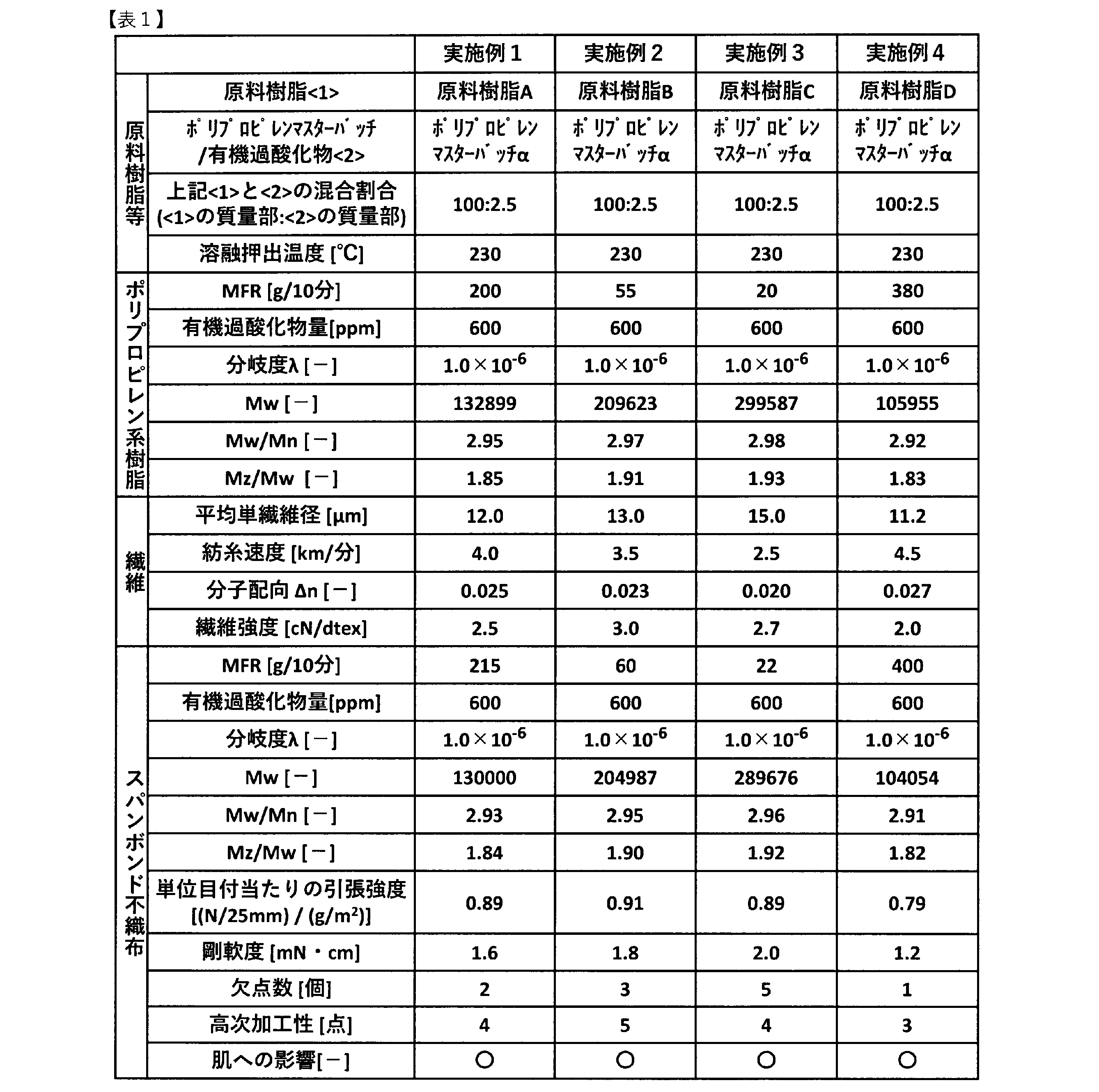
工程(a)において、原料樹脂Aを原料樹脂Eに変えたこと、工程(b)において、紡糸速度を4.0km/分から4.5km/分に変更したこと以外は、実施例1と同じ方法でスパンボンド不織布を得た。なお、工程(a)において得られたポリプロピレン系樹脂のMFRが500g/10分、Mwが96173、Mw/Mnが2.90、Mz/Mwが1.81、分岐度λが1.0×10-6であった。
工程(a)において、原料樹脂Aを原料樹脂Fに変えたこと、工程(b)において、紡糸速度を4.0km/分から2.0km/分に変更したこと以外は、実施例1と同じ方法でスパンボンド不織布を得た。なお、工程(a)において得られたポリプロピレン系樹脂のMFRが10g/10分、Mwが382637、Mw/Mnが3.00、Mz/Mwが1.95、分岐度λが1.0×10-6であった。
工程(a)において、原料樹脂A100質量部に対し、ポリプロピレンマスターバッチαを2.5質量部チップブレンドしていたところ、原料樹脂B100質量部に対し、有機過酸化物βを0.25質量部チップブレンドすることとしたこと、そして、工程(b)において、紡糸速度を4.0km/分から3.5km/分に変更したこと以外は、実施例1と同じ方法でスパンボンド不織布を得た。なお、工程(a)において得られたポリプロピレン系樹脂のMFRが55g/10分、Mwが209623、Mw/Mnが2.97、Mz/Mwが1.91、分岐度λが1.0×10-6であった。
工程(a)において、溶融押出する際の温度が230℃であったところ、200℃に変更したこと以外は、実施例2と同じ方法でスパンボンド不織布を得た。なお、工程(a)において得られたポリプロピレン系樹脂のMFRが55g/10分、Mwが209623、Mw/Mnが2.97、Mz/Mwが1.96、分岐度λが1.0×10-6であった。
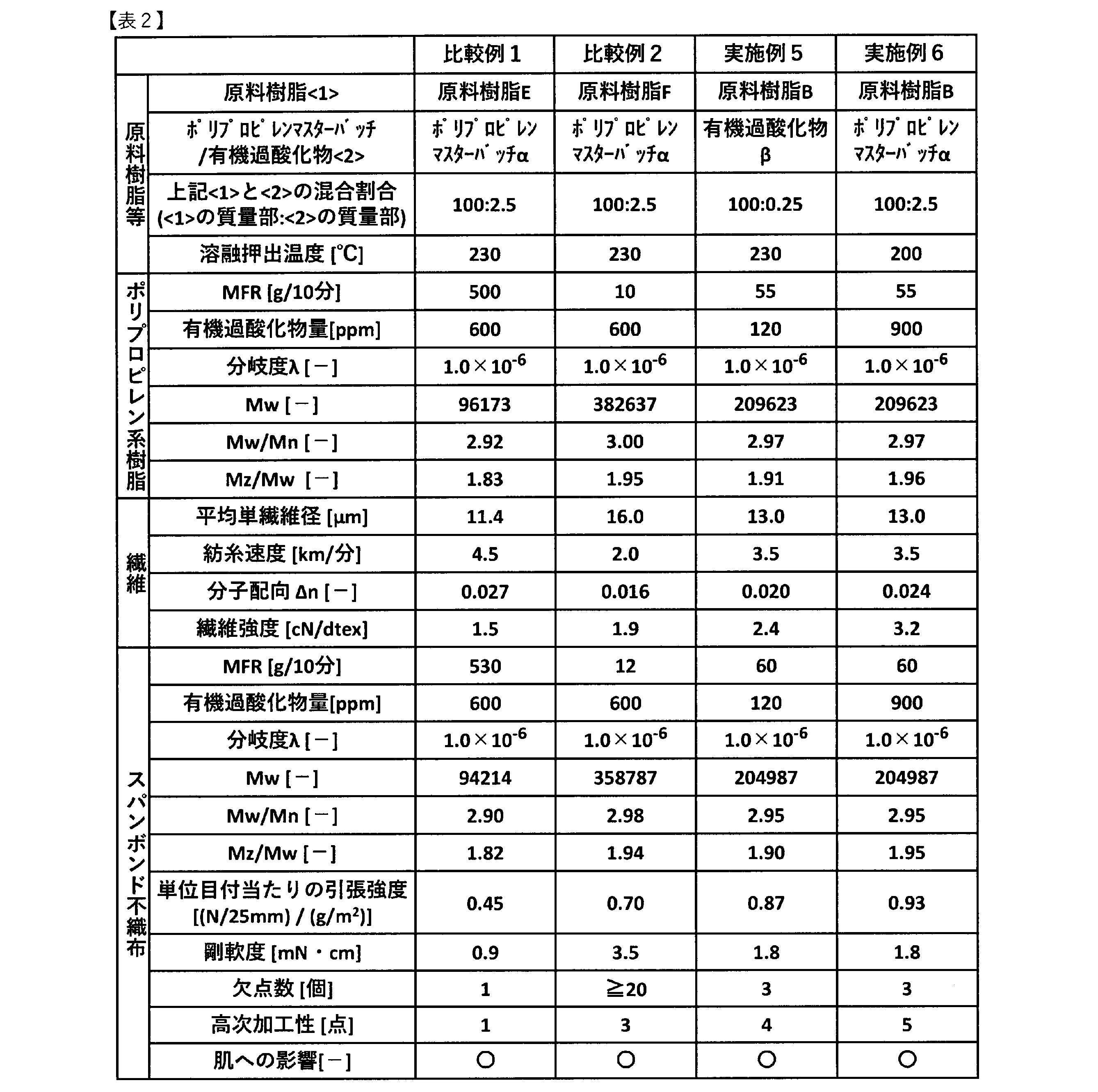
工程(a)において、原料樹脂Aを原料樹脂Gに変えたこと、工程(b)において、紡糸速度を4.0km/分から1.5km/分に変更したこと以外は、実施例1と同じ方法でスパンボンド不織布を得た。なお、工程(a)において得られたポリプロピレン系樹脂のMFRが55g/10分、Mwが209623、Mw/Mnが2.97、Mz/Mwが1.91、分岐度λが1.0×10-5であった。
工程(a)において、原料樹脂Aを原料樹脂Hに変えたこと、工程(b)において、紡糸速度を4.0km/分から3.5km/分に変更したこと以外は、実施例1と同じ方法でスパンボンド不織布を得た。なお、工程(a)において得られたポリプロピレン系樹脂のMFRが55g/10分、Mwが209623、Mw/Mnが2.96、Mz/Mwが1.91、分岐度λが1.0×10-7であった。
工程(a)において、原料樹脂Aを原料樹脂Iに変え、ポリプロピレンマスターバッチαを用いないこととした(有機過酸化物を添加しないこととした)こと、工程(b)において、紡糸速度を4.0km/分から3.5km/分と変更したこと以外は、実施例1と同じ方法でスパンボンド不織布を得た。なお、工程(a)において得られたポリプロピレン系樹脂のMFRが55g/10分、Mwが209623、Mw/Mnが3.22、Mz/Mwが2.36、分岐度λが1.0×10-6であった。
工程(a)において、溶融押出する際の温度が230℃であったところ、180℃に変更したこと以外は、実施例2と同じ方法でスパンボンド不織布を得た。なお、工程(a)において得られたポリプロピレン系樹脂のMFRが55g/10分、Mwが209623、Mw/Mnが2.97、Mz/Mwが1.96、分岐度λが1.0×10-6であった。
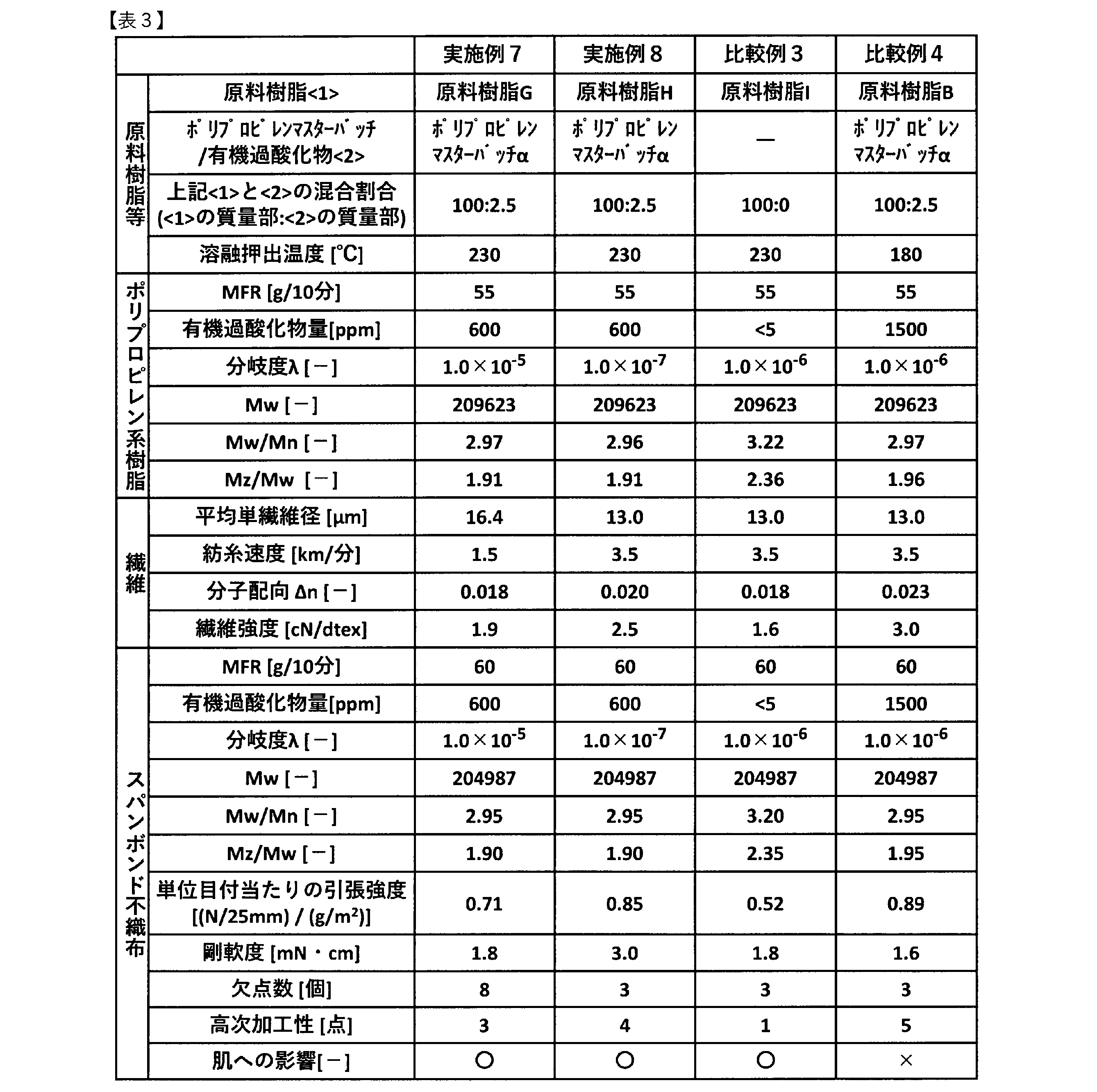
工程(a)において、原料樹脂Aを原料樹脂Jに変え、ポリプロピレンマスターバッチαを用いないこととした(有機過酸化物を添加しないこととした)こと、工程(b)において、紡糸速度を4.0km/分から4.2km/分と変更したこと以外は、実施例1と同じ方法でスパンボンド不織布を得た。なお、工程(a)において得られたポリプロピレン系樹脂のMFRが230g/10分、Mwが151000、Mw/Mnが5.31、Mz/Mwが2.70、分岐度λが0であった。
工程(a)において、原料樹脂A100質量部に対し、ポリプロピレンマスターバッチαを2.5質量部チップブレンドしていたところ、1.1質量部チップブレンドすることとしたこと、工程(b)において、紡糸速度を4.0km/分から3.5km/分に変更したこと以外は、実施例1と同じ方法でスパンボンド不織布を得た。なお、工程(a)において得られたポリプロピレン系樹脂のMFRが55g/10分、Mwが209000、Mw/Mnが3.71、Mz/Mwが2.26、分岐度λが5.0×10-7であった。
工程(a)において、原料樹脂A100質量部に対し、ポリプロピレンマスターバッチαを2.5質量部チップブレンドしていたところ、3.5質量部チップブレンドすることとしたこと以外は、実施例1と同じ方法でスパンボンド不織布を得た。なお、工程(a)において得られたポリプロピレン系樹脂のMFRが380g/10分、Mwが105000、Mw/Mnが2.80、Mz/Mwが1.80、分岐度λが5.0×10-5であった。
工程(a)において、原料樹脂Aを原料樹脂Kに変え、工程(b)において、紡糸速度を4.0km/分から3.6km/分と変更したこと以外は、実施例1と同じ方法でスパンボンド不織布を得た。なお、工程(a)において得られたポリプロピレン系樹脂のMFRが220g/10分、Mwが147000、Mw/Mnが2.96、Mz/Mwが1.91、分岐度λが0であった。
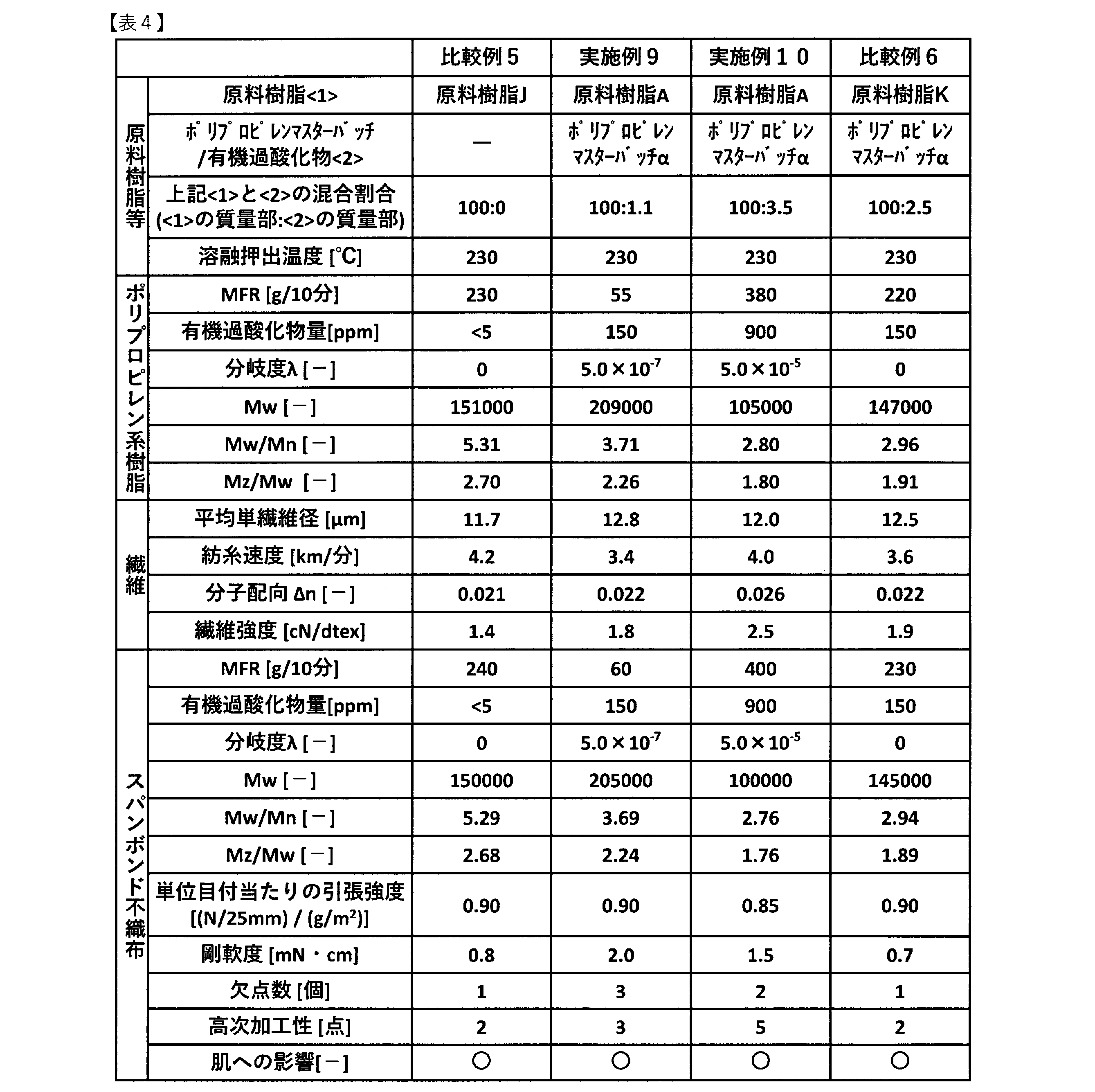
工程(c)において、熱エンボスロールでの接着温度を130℃から135℃に変更したこと以外は、実施例1と同じ方法でスパンボンド不織布を得た。なお、工程(a)において得られたポリプロピレン系樹脂のMFRが200g/10分、Mwが132899、Mw/Mnが2.95、Mz/Mwが1.85、分岐度λが1.0×10-6であった。
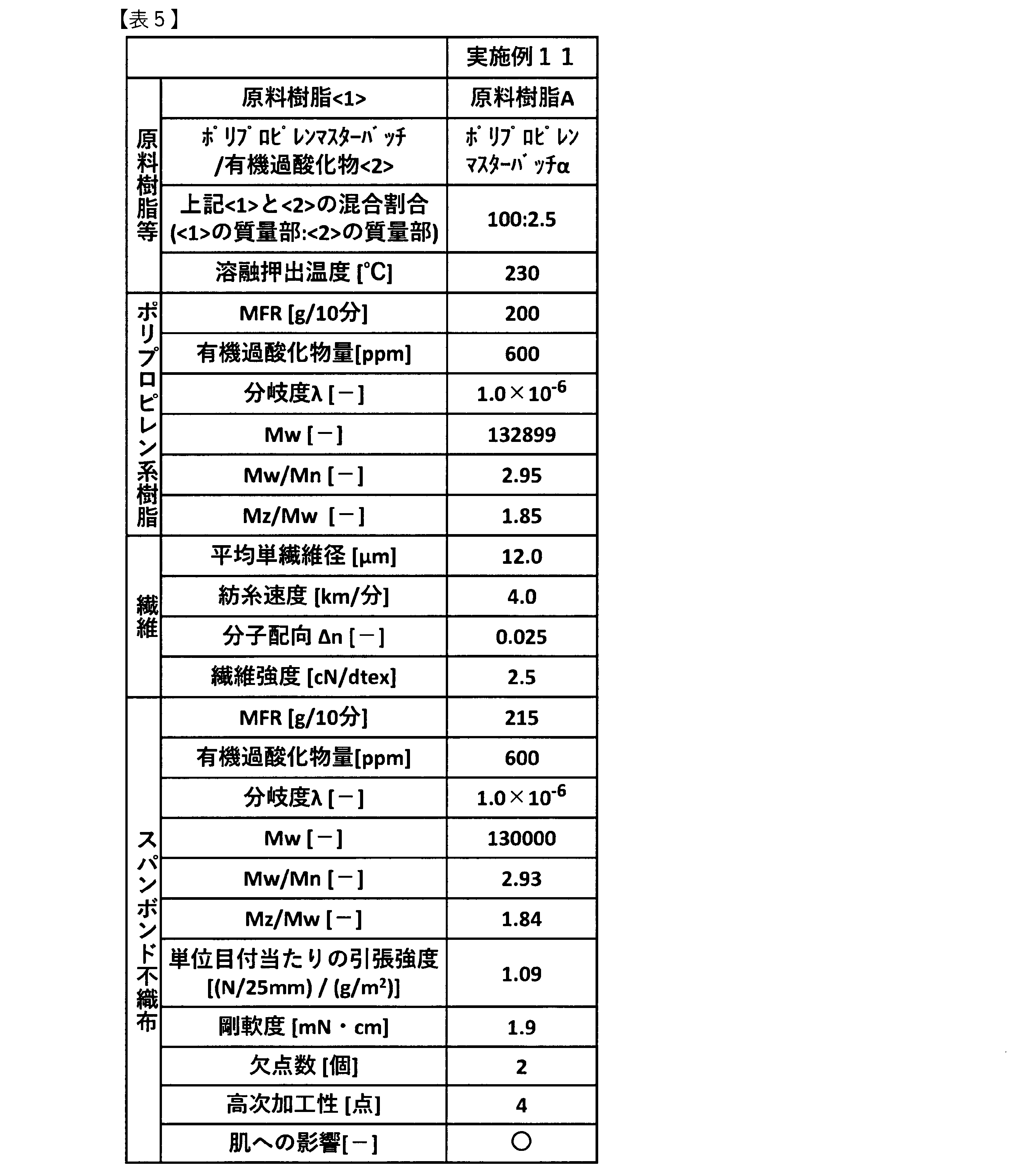
Claims (7)
- ポリプロピレン系樹脂からなる繊維で構成されてなるスパンボンド不織布であって、前記スパンボンド不織布が以下の条件(1)~(3)を満たし、前記繊維の平均単繊維径が5.0μm以上20.0μm以下である、スパンボンド不織布。
(1)体積比率を1:1としたクロロホルム/メタノール溶媒中に浸漬させた前記スパンボンド不織布を15分間、45kHz、溶液温度が30℃の条件で超音波処理することで抽出される、有機過酸化物量が100ppm以上1000ppm以下である
(2)メルトフローレートが20g/10分以上400g/10分以下である
(3)ゲル浸透クロマトグラフィー法/多角度光散乱測定器により求められる分子量および回転半径より、3官能ランダム分岐理論を用いて算出される、前記ポリプロピレン系樹脂の1分子当たりの分岐度λが1.0×10-7以上1.0×10-3以下である - 前記ポリプロピレン系樹脂がさらに以下の条件(4)および(5)も満たす、請求項1に記載のスパンボンド不織布。
(4)2.50≦Mw/Mn≦3.20
(5)1.82≦Mz/Mw≦2.20
ここで、Mw、Mn、Mzは、それぞれゲル浸透クロマトグラフィー法により求められる重量平均分子量、数平均分子量、z平均分子量である。 - 原料樹脂に有機過酸化物を添加し、該原料樹脂を分解して、以下の条件(1)~(3)を満たすように調製されたポリプロピレン系樹脂を得る工程と、
前記ポリプロピレン系樹脂を紡出して、平均単繊維径が5.0μm以上20.0μm以下である繊維を得る工程と、
前記繊維を捕集する工程と、を有する、請求項1または2に記載のスパンボンド不織布の製造方法。
(1)体積比率を1:1としたクロロホルム/メタノール溶媒中に浸漬させた前記スパンボンド不織布を15分間、45kHz、溶液温度が30℃の条件で超音波処理することで抽出される、有機過酸化物量が100ppm以上1000ppm以下である
(2)メルトフローレートが20g/10分以上400g/10分以下である
(3)ゲル浸透クロマトグラフィー法/多角度光散乱測定器により求められる分子量および回転半径より、3官能ランダム分岐理論を用いて算出される、前記ポリプロピレン系樹脂の1分子当たりの分岐度λが1.0×10-7以上1.0×10-3以下である - 前記原料樹脂が、リサイクル樹脂である、請求項3に記載のスパンボンド不織布の製造方法。
- 請求項1に記載のスパンボンド不織布を含む、積層不織布。
- 請求項1に記載のスパンボンド不織布、または、請求項5に記載の積層不織布を用いてなる、衛生材料。
- 請求項1に記載のスパンボンド不織布、または、請求項5に記載の積層不織布を用いてなる、衣料。
Priority Applications (3)
| Application Number | Priority Date | Filing Date | Title |
|---|---|---|---|
| JP2023553548A JP7452769B1 (ja) | 2022-09-27 | 2023-08-31 | スパンボンド不織布、および、その製造方法、積層不織布ならびに、これらを用いてなる衛生材料、衣料 |
| KR1020257008312A KR20250076527A (ko) | 2022-09-27 | 2023-08-31 | 스펀본드 부직포 및 그 제조 방법, 적층 부직포, 그리고 이들을 사용해서 이루어지는 위생 재료, 의료 |
| CN202380064787.5A CN119895091B (zh) | 2022-09-27 | 2023-08-31 | 纺粘无纺布及其制造方法、层叠无纺布和使用它们而成的卫生材料、衣物 |
Applications Claiming Priority (2)
| Application Number | Priority Date | Filing Date | Title |
|---|---|---|---|
| JP2022153268 | 2022-09-27 | ||
| JP2022-153268 | 2022-09-27 |
Publications (1)
| Publication Number | Publication Date |
|---|---|
| WO2024070467A1 true WO2024070467A1 (ja) | 2024-04-04 |
Family
ID=90477310
Family Applications (1)
| Application Number | Title | Priority Date | Filing Date |
|---|---|---|---|
| PCT/JP2023/031734 Ceased WO2024070467A1 (ja) | 2022-09-27 | 2023-08-31 | スパンボンド不織布、および、その製造方法、積層不織布ならびに、これらを用いてなる衛生材料、衣料 |
Country Status (4)
| Country | Link |
|---|---|
| JP (1) | JP7452769B1 (ja) |
| KR (1) | KR20250076527A (ja) |
| CN (1) | CN119895091B (ja) |
| WO (1) | WO2024070467A1 (ja) |
Families Citing this family (1)
| Publication number | Priority date | Publication date | Assignee | Title |
|---|---|---|---|---|
| WO2025204973A1 (ja) * | 2024-03-27 | 2025-10-02 | 東レ株式会社 | スパンボンド不織布、積層不織布、ならびに、プリーツ成形体、集塵フィルター、集塵装置 |
Citations (4)
| Publication number | Priority date | Publication date | Assignee | Title |
|---|---|---|---|---|
| JP2001518569A (ja) * | 1997-10-01 | 2001-10-16 | ミネソタ マイニング アンド マニュファクチャリング カンパニー | 低レベルの抽出性炭化水素を有するエレクトレット繊維およびフィルターウェブ |
| JP2004510849A (ja) * | 2000-10-05 | 2004-04-08 | アトフイナ・リサーチ・ソシエテ・アノニム | ポリプロピレンの製造 |
| JP2011132627A (ja) * | 2009-12-24 | 2011-07-07 | Toray Ind Inc | 抗菌性有機重合体製品 |
| US20180094089A1 (en) * | 2015-04-28 | 2018-04-05 | Exxonmobil Chemical Patents Inc. | Propylene-Based Impact Copolymers |
Family Cites Families (9)
| Publication number | Priority date | Publication date | Assignee | Title |
|---|---|---|---|---|
| JP4210448B2 (ja) | 2001-10-30 | 2009-01-21 | 日本ポリプロ株式会社 | マスターバッチ及びこれを用いた成形体 |
| WO2005080497A1 (en) * | 2004-02-12 | 2005-09-01 | Exxonmobil Chemical Patents Inc. | Polypropylene resin suitable for fibers and nonwovens |
| JP2007119014A (ja) | 2005-10-28 | 2007-05-17 | Nsk Ltd | 軸受の梱包方法及び梱包された軸受 |
| US8389426B2 (en) * | 2010-01-04 | 2013-03-05 | Trevira Gmbh | Bicomponent fiber |
| ES2474090T3 (es) * | 2010-01-28 | 2014-07-08 | Borealis Ag | Fibra soplada en fusión |
| JP5900322B2 (ja) * | 2012-12-28 | 2016-04-06 | 日本ポリプロ株式会社 | 極細繊維及びその製造方法 |
| CN104250883B (zh) * | 2013-06-28 | 2017-03-29 | 中国石油化工股份有限公司 | 一种聚丙烯无纺布及其制备方法 |
| US20160311944A1 (en) * | 2013-12-13 | 2016-10-27 | Braskem S.A. | Method for producing controlled rheology polypropylene, polypropylene, use thereof and manufactured articles |
| JP6599078B1 (ja) | 2019-02-14 | 2019-10-30 | 三井化学株式会社 | 不織布の製造方法及びスクリュー |
-
2023
- 2023-08-31 CN CN202380064787.5A patent/CN119895091B/zh active Active
- 2023-08-31 KR KR1020257008312A patent/KR20250076527A/ko active Pending
- 2023-08-31 WO PCT/JP2023/031734 patent/WO2024070467A1/ja not_active Ceased
- 2023-08-31 JP JP2023553548A patent/JP7452769B1/ja active Active
Patent Citations (4)
| Publication number | Priority date | Publication date | Assignee | Title |
|---|---|---|---|---|
| JP2001518569A (ja) * | 1997-10-01 | 2001-10-16 | ミネソタ マイニング アンド マニュファクチャリング カンパニー | 低レベルの抽出性炭化水素を有するエレクトレット繊維およびフィルターウェブ |
| JP2004510849A (ja) * | 2000-10-05 | 2004-04-08 | アトフイナ・リサーチ・ソシエテ・アノニム | ポリプロピレンの製造 |
| JP2011132627A (ja) * | 2009-12-24 | 2011-07-07 | Toray Ind Inc | 抗菌性有機重合体製品 |
| US20180094089A1 (en) * | 2015-04-28 | 2018-04-05 | Exxonmobil Chemical Patents Inc. | Propylene-Based Impact Copolymers |
Also Published As
| Publication number | Publication date |
|---|---|
| CN119895091A (zh) | 2025-04-25 |
| JPWO2024070467A1 (ja) | 2024-04-04 |
| JP7452769B1 (ja) | 2024-03-19 |
| CN119895091B (zh) | 2026-08-07 |
| KR20250076527A (ko) | 2025-05-29 |
Similar Documents
| Publication | Publication Date | Title |
|---|---|---|
| RU2748508C2 (ru) | Нетканый материал спанбонд с извитыми тонкими волокнами и улучшенной однородностью | |
| EP2925920B1 (en) | Polypropylene fibers and fabrics | |
| EP1709225B2 (en) | Soft extensible nonwoven webs containing fibers with high melt flow rates | |
| EP2341174B1 (en) | Polyethylene-based, soft nonwoven fabric | |
| US6632504B1 (en) | Multicomponent apertured nonwoven | |
| EP2644763A1 (en) | Spunbonded nonwoven fabric laminate | |
| AU742081B2 (en) | Nonwoven webs having improved softness and barrier properties | |
| CN101563490B (zh) | 包含多组分纳米复合纤维的可延展非织造纤维网 | |
| EP3901346B1 (en) | Spunbonded non-woven fabric, sanitary material, and method of manufacturing spunbonded non-woven fabric | |
| CN101646818A (zh) | 包含单组分纳米复合纤维的可延展非织造纤维网 | |
| EP3464690B1 (en) | Thermo-fusible conjugate fibers and method for producing same, and nonwoven fabric using same | |
| JP7452769B1 (ja) | スパンボンド不織布、および、その製造方法、積層不織布ならびに、これらを用いてなる衛生材料、衣料 | |
| US11345791B2 (en) | Polymeric material | |
| DE112018000359T5 (de) | Technik zum ausbilden poröser fasern | |
| US11154635B2 (en) | Porous polyester material | |
| KR101001042B1 (ko) | 방사구 및 섬유 제조 방법 | |
| JP2022168838A (ja) | スパンボンド不織布およびその製造方法、ならびに、衛生材料 | |
| JP2024128359A (ja) | スパンボンド不織布の製造方法 | |
| WO2020095947A1 (ja) | 不織布及びその製造方法 | |
| JPWO2001053585A1 (ja) | スパンボンド不織布および積層体 |
Legal Events
| Date | Code | Title | Description |
|---|---|---|---|
| ENP | Entry into the national phase |
Ref document number: 2023553548 Country of ref document: JP Kind code of ref document: A |
|
| 121 | Ep: the epo has been informed by wipo that ep was designated in this application |
Ref document number: 23871707 Country of ref document: EP Kind code of ref document: A1 |
|
| WWE | Wipo information: entry into national phase |
Ref document number: 202380064787.5 Country of ref document: CN |
|
| WWE | Wipo information: entry into national phase |
Ref document number: 202547036798 Country of ref document: IN |
|
| WWP | Wipo information: published in national office |
Ref document number: 202380064787.5 Country of ref document: CN |
|
| NENP | Non-entry into the national phase |
Ref country code: DE |
|
| WWP | Wipo information: published in national office |
Ref document number: 202547036798 Country of ref document: IN |
|
| 122 | Ep: pct application non-entry in european phase |
Ref document number: 23871707 Country of ref document: EP Kind code of ref document: A1 |