WO2024069960A1 - 搬送装置 - Google Patents
搬送装置 Download PDFInfo
- Publication number
- WO2024069960A1 WO2024069960A1 PCT/JP2022/036766 JP2022036766W WO2024069960A1 WO 2024069960 A1 WO2024069960 A1 WO 2024069960A1 JP 2022036766 W JP2022036766 W JP 2022036766W WO 2024069960 A1 WO2024069960 A1 WO 2024069960A1
- Authority
- WO
- WIPO (PCT)
- Prior art keywords
- arm
- pickup
- arm body
- suction
- tip
- Prior art date
- Legal status (The legal status is an assumption and is not a legal conclusion. Google has not performed a legal analysis and makes no representation as to the accuracy of the status listed.)
- Ceased
Links
Images




Classifications
-
- B—PERFORMING OPERATIONS; TRANSPORTING
- B65—CONVEYING; PACKING; STORING; HANDLING THIN OR FILAMENTARY MATERIAL
- B65H—HANDLING THIN OR FILAMENTARY MATERIAL, e.g. SHEETS, WEBS, CABLES
- B65H29/00—Delivering or advancing articles from machines; Advancing articles to or into piles
- B65H29/24—Delivering or advancing articles from machines; Advancing articles to or into piles by air blast or suction apparatus
-
- B—PERFORMING OPERATIONS; TRANSPORTING
- B65—CONVEYING; PACKING; STORING; HANDLING THIN OR FILAMENTARY MATERIAL
- B65H—HANDLING THIN OR FILAMENTARY MATERIAL, e.g. SHEETS, WEBS, CABLES
- B65H5/00—Feeding articles separated from piles; Feeding articles to machines
- B65H5/08—Feeding articles separated from piles; Feeding articles to machines by grippers, e.g. suction grippers
Definitions
- This invention relates to a conveying device that picks up parts by suction from a placement surface on which multiple parts obtained by cutting a sheet material are placed, and conveys them to the next process.
- Patent Document 1 discloses a cutting device that obtains multiple parts from a sheet material by projecting the outlines of the parts onto the surface of the sheet material, generating cutting data that adjusts the orientation of the parts, etc., and cutting the sheet material based on the generated cutting data.
- Patent Document 1 the multiple parts obtained by cutting the sheet material remain on the cutting table where the cutting was performed, so the cut parts need to be moved to a placement table adjacent to the cutting table or to a transport table for sending them to the next process, such as a sewing process.
- a transport device having a robot arm with a suction part at the tip for suctioning parts could be placed next to the cutting table, and the robot arm could pick up the parts on the cutting table one by one and move them to a transport table or the like (see Patent Document 2).
- the present invention aims to provide a conveying device that can reduce the space required regardless of the position of the suction part.
- This invention is a conveying device that picks up and moves a plurality of parts obtained by cutting a sheet material from a placement surface on which the parts are placed, and is characterized in that it comprises one or more pickup arms having an adsorption portion at the tip that adsorbs the parts, a support portion that supports the base of the pickup arm, and a moving means that moves at least the pickup arm in a substantially horizontal conveying direction, the pickup arm being formed of a link mechanism that connects a plurality of link members that have a thickness in the vertical direction, with a direction that intersects the conveying direction in a plan view being the intersecting direction, and the device is also characterized in that it comprises an arm body that moves the adsorption portion in the intersecting direction, and an actuator that operates the link mechanism of the arm body.
- the placement surface mentioned above refers to the upper surface of a cutting table on which the sheet material is cut, or the upper surface of a table adjacent to the cutting table.
- the transport direction refers to, for example, a direction toward a transport path or a mounting table provided adjacent to the mounting surface.
- Moving the pickup arm in the transport direction means moving the pickup arm substantially parallel to the transport direction, or rotating the pickup arm around the support in the transport direction.
- the link mechanism is a mechanism in which flat plate-shaped link members are combined so as to be able to pivot freely, and is, for example, a parallel link mechanism.
- the suction part moves in the cross direction by the arm body, which is formed by connecting multiple link members that have a thickness in the vertical direction, so the vertical length of the arm body does not change in conjunction with the movement of the suction part.
- the conveying device can shorten the vertical length of the arm body compared to, for example, a robot arm whose arm portion is connected via a drive motor.
- the transport device can reduce the space required regardless of the position of the suction part.
- the transport device can reduce the weight of the arm body.
- the arm body may be configured in a pantograph shape that is expandable and contractible in the intersecting direction by connecting a plurality of pairs of the link members that are cross-connected. According to this configuration, since the arm body is in the shape of a pantograph that can expand and contract in intersecting directions, it is possible to achieve both compact folding of the arm body and movement of the suction part farther with a simple and lightweight configuration.
- the actuator may have one end supported by the support column and the other end connected to the pair of link members on the support column side of the arm body.
- the support pillar side of the arm body refers to the support pillar side of the arm body substantially in the center in the cross direction.
- the actuator is connected to the support part side of the arm body, so the overall length of the actuator can be made shorter than when the actuator is connected near the tip of the arm body. This allows the transport device to prevent the actuator from protruding in the cross direction beyond the suction part when the arm body is folded.
- the conveying device can reduce the space required in both the vertical direction and the cross direction, thereby making it possible to reduce the space required by the device.
- the pickup arm may include an extensible guide portion having one end supported by the support column and the other end connected to a tip of the arm body, and configured to expand and contract in the intersecting direction.
- the arm body can be supported by the extendable guide portion, one end of which is supported by the support portion.
- the transport device can use the extendable guide portion to prevent the tip of the arm body from sagging due to the weight of the suction portion, thereby making it possible for the transport device to stabilize the movement trajectory of the suction portion. Therefore, even if the arm body of the transport device is configured with a link mechanism, the positional accuracy of the suction part can be ensured.
- the pickup arm may include a plurality of suspending sections between the support section and the suction section that suspend the arm body from the telescopic guide section, and the suspending sections may include rollers that roll on the telescopic guide section.
- the transport device can prevent the movement of the link mechanism of the arm body from being hindered by frictional resistance between the suspending part and the telescopic guide part.
- the transport device to move the suction part smoothly and accurately.
- the roller running noise can be reduced compared to a metal roller, so that the conveying device can be made quieter.
- the pickup arm may include an arm portion extending in the intersecting direction and having the suction portion fixed to its tip, and a pivot portion that pivotally connects the arm portion to the arm body with the vertical direction as a rotation axis.
- the arm portion provided with the suction portion is pivotally connected to the arm body, so that the part placed on the placement surface can be moved more reliably.
- the transport device can easily bring the suction parts closer together while keeping the arm bodies apart.
- a cover member may be provided that integrally covers at least the arm body and the actuator when the suction portion is located at a position closest to the support column. According to this configuration, when the suction portion is located at the position closest to the support column, the cover member can prevent at least the arm body and the actuator from being exposed to the outside.
- the transport device can prevent the arm body and actuator from starting to operate due to foreign objects from the outside, and can improve the appearance when the suction part is retracted to the standby position.
- a lifting section may be provided that is supported by the support section extending in a vertical direction and that lifts and lowers the pickup arm. According to this configuration, it is possible to move the pickup arm not only in the transport direction but also in the vertical direction.
- the transport device is capable of moving the suction part not only in the transport direction and the intersecting direction but also in the vertical direction.
- the transport device can more easily pick up the part placed on the mounting surface. This allows the transport device to reliably pick up the part placed on the mounting surface even with a weak suction force.
- the conveying device can prevent the pickup arm from becoming larger and heavier than if a lifting part that raises and lowers the suction part was provided at the tip of the arm body. This allows the conveying device to efficiently pick up parts placed on the placement surface without increasing the size of the pickup arm.
- a control unit may be provided that controls at least the operation of the moving means and the operation of the actuator based on cutting data in which part position information indicating the positions of the parts is registered.
- the part position information refers to position information registered in cutting data for cutting a sheet material, position information obtained by image analysis of a sheet material placed on a placement surface, and the like.
- the operation of the moving means and the operation of the actuator can be controlled by effectively utilizing cutting data used in the preceding process of cutting the sheet material.
- This allows the transport device to precisely deploy the compactly folded arm body, thereby enabling the suction portion to be reliably moved to a desired position.
- the present invention makes it possible to provide a conveying device that requires less space regardless of the position of the suction part.
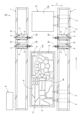
- FIG. 2 is a plan view showing the external appearance of the transport device.
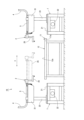
- FIG. 2 is a side view showing the appearance of the transport device.
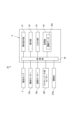
- FIG. 2 is a block diagram showing an internal configuration of a transport device.
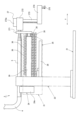
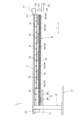
- FIG. 4 is a side view showing the appearance of the transport mechanism.
- FIG. 2 is a plan view showing the appearance of the pickup arm.
- FIG. 4 is a side view showing the transport mechanism with the pickup arm extended.
- FIG. 4 is a side view showing a main part of the pickup arm.
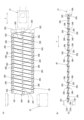
- FIG. 4 is a plan view illustrating the arm body.
- FIG. FIG. 4 is a front view illustrating the extendable guide portion.
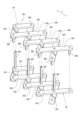
- FIG. 2 is an external perspective view showing the appearance of a three-stage sliding rail.
- 11 is a flowchart showing a processing operation of the transport device.
- the conveying device 10 of this embodiment is a device that picks up a plurality of parts P from a sheet material S cut by a cutting device (not shown) in a previous process and conveys them to a next process.
- a conveying device 10 will be described with reference to Figs. 1 to 11.
- Fig. 1 shows a plan view of the exterior of the conveying device 10
- Fig. 2 shows a side view of the exterior of the conveying device 10
- Fig. 3 shows a block diagram of the internal configuration of the conveying device 10
- Fig. 4 shows a side view of the exterior of the conveying mechanism unit 2
- Fig. 5 shows a plan view of the exterior of the pickup arm 25.
- Figure 6 shows a side view of the transport mechanism 2 with the pickup arm 25 extended
- Figure 7 shows a side view of the main parts of the pickup arm 25
- Figure 8 shows an explanatory diagram illustrating the arm main body 26 in a plan view
- Figure 9 shows an exploded oblique view with a portion of the arm main body 26 disassembled.
- FIG. 10 is an explanatory diagram illustrating the extendable guide portion 29 as seen from the front
- FIG. 11 is an external perspective view of the three-stage sliding rail 29a.
- the direction from left to right in Fig. 1 is the conveying direction X of the parts P
- the upper side in Fig. 2 is the top of the conveying device 10
- the lower side in Fig. 2 is the bottom of the conveying device 10.
- the cover member 31 is shown by a two-dot chain line in Figs. 4, 6, and 10.
- the conveying device 10 of this embodiment is configured to be able to convey parts P of the sheet material S from a pickup table 11 on which the sheet material S conveyed from a cutting device (not shown) is placed, to a placement table 12.
- the sheet material S is, for example, a seat cover member that is attached to a vehicle seat, a vehicle airbag, or a cloth or leather material used for sewn products such as clothing.
- the sheet material S is cut into desired shapes by a cutting device (not shown), and the resulting parts are called parts P.
- a single sheet material S is cut so that a plurality of parts P can be obtained.
- the portion of the sheet material S excluding the parts P is referred to as a blank portion Sa.
- the pickup table 11 is disposed adjacent to the cutting device in the conveying direction X. As shown in Figs. 1 and 2, the pickup table 11 is a rectangular table in a plan view that is larger than the sheet material S, and the upper surface of the top plate portion forms a placement surface 11a on which the sheet material S conveyed from the cutting device is placed.
- the placement table 12 is located at a predetermined distance from the pickup table 11 in the transport direction X, and is provided as a place to stack parts P to be transported to the next process.
- the placement table 12 is a generally rectangular table in plan view that is smaller than the pickup table 11, and the upper surface of the top plate portion forms a placement surface 12a on which the picked up parts P are placed.
- the placement surface 11a of the pickup table 11 and the placement surface 12a of the placement table 12 are formed at approximately the same height in the up-down direction.
- the conveying device 10 that picks up the above-mentioned parts P and conveys them to the next process includes a pair of guide rails 1 that extend in the conveying direction X and sandwich a pickup table 11 and a loading table 12 between them, as shown in Figures 1 and 2, and multiple conveying mechanism parts 2 arranged on the guide rails 1.
- the conveying device 10 includes a vacuum pump 3 (see FIG. 3), an air hose 4 and an expandable tube 5 which connect the vacuum pump 3 to the conveying mechanism unit 2, and an operation panel 6 which receives input from an operator and controls the operation of each unit.
- the conveying device 10 is equipped with a detection sensor and a camera that detect the sheet material S conveyed from the cutting device to the pickup table 11.
- the pair of guide rails 1 are formed to have a length in the transport direction X that is longer than the pickup table 11 and the loading table 12 that are arranged side by side in the transport direction X.
- the guide rails 1 are configured to be able to guide the movement of the transport mechanism 2 in the transport direction X and in the direction opposite to the transport direction X.
- the multiple transport mechanism units 2 will be described in detail later, so will be described briefly here. As shown in Figures 1 and 2, two transport mechanism units 2 are attached to one guide rail 1 at a predetermined interval in the transport direction X. The plurality of transport mechanism units 2 are configured to be movable along the guide rails 1 in the transport direction X and in a direction opposite to the transport direction X.
- the transport mechanism 2 is configured to be movable between a standby position between the pickup table 11 and the loading table 12, a pickup position adjacent to the pickup table 11, and a transport completion position adjacent to the loading table 12.
- the transport mechanism 2 is provided with a pickup arm 25 that can expand and contract in a direction that is approximately perpendicular to the transport direction X in a plan view, and is configured so that the tip of the pickup arm 25 can be moved to a desired position on the mounting surface 11a of the pickup table 11 and the mounting surface 12a of the mounting table 12.
- the vacuum pump 3 is connected to a control unit 65 of the operation panel 6 described later, and is operated by a control signal from the control unit 65, and has the function of discharging the air sucked from the connected air hose 4 to the outside.
- the air hose 4 is, for example, a flexible resin tube having a bellows shape, and one end of the air hose 4 is connected to the vacuum pump 3 and the other end of the air hose 4 is connected to an expandable tube 5 .
- the telescopic tube 5 is constructed with a telescopic structure in which multiple cylindrical bodies with different outer diameters are connected in a telescopic manner, and is connected to the air hose 4 and the arm tip 27 of the pickup arm 25, which will be described later.
- the largest diameter cylindrical portion of the telescopic tube 5 is supported by the lifting mechanism 24 of the transport mechanism 2, which will be described later, and the smallest diameter cylindrical portion is supported by the arm tip 27 of the pickup arm 25, which will be described later.
- the operation panel 6 also includes an operation reception unit 61 that receives various operations from the operator, a display unit 62 that displays various information, an input/output unit 63 that inputs and outputs various information to and from external devices, a memory unit 64 that stores various information, and a control unit 65 that controls the operation of each unit.
- an operation reception unit 61 that receives various operations from the operator
- a display unit 62 that displays various information
- an input/output unit 63 that inputs and outputs various information to and from external devices
- a memory unit 64 that stores various information
- a control unit 65 that controls the operation of each unit.
- the operation reception unit 61 is composed of buttons such as a start button, a stop button, an emergency stop button, and a touch panel, and has the function of receiving input operations by an operator and the function of outputting a signal indicating the received input to the control unit 65.
- the display unit 62 is configured, for example, by a liquid crystal display, and has a function of displaying various information in response to a control signal from the control unit 65 .
- the input/output unit 63 is composed of an input/output terminal such as a USB, and has a function of connecting to an external device such as a cutting device, and a function of sending and receiving various information to and from the external device.
- the storage unit 64 is composed of a hard disk or non-volatile memory, and has the function of writing and storing various information, and the function of reading out various information. This storage unit 64 stores cutting data 64a that is used when the cutting device cuts the sheet material S.
- the cutting data 64a is data acquired from the cutting device via the input/output unit 63, and part position information indicating the positions of parts P arranged with good yield relative to the shape of the sheet material S and part shape information indicating the contour shape of parts P are registered in association with each other.
- the control unit 65 is composed of hardware such as a CPU and a memory, and software such as a control program, etc.
- This control unit 65 has a processing function related to sending and receiving various information to and from each of the above-mentioned units, and a function to control the operation of each unit connected via a predetermined bus.
- the control unit 65 has a function for processing signals from the detection sensors and cameras, a processing function related to the operation of the transport mechanism unit 2, and a processing function related to the operation of the vacuum pump 3.
- the control unit 65 controls the operation of each unit so that the part P placed on the placement surface 11a of the pickup table 11 is picked up by at least one transport mechanism unit 2 and moved to the placement table 12 based on signals from the detection sensor and camera and the cutting data 64a in the memory unit 64.
- the transport mechanism 2 operates based on a control signal from the control unit 65 of the operation panel 6 described above, and is configured to be able to move the tip of the pickup arm 25 in the transport direction X and in the direction opposite to the transport direction X.
- the transport mechanism 2 operates based on a control signal from the control unit 65 of the operation panel 6 described above, and is configured to be able to move the tip of the pickup arm 25 in a direction that is approximately perpendicular to the transport direction X in a plan view.
- such a transport mechanism 2 includes a base 21 placed on the guide rail 1, a moving section 22 that moves the base 21 along the guide rail 1, a support section 23 erected on the base 21, and a lifting mechanism 24 and a pickup arm 25 supported by the support section 23.
- the base 21 of the transport mechanism 2 is a plate-like shape that is approximately rectangular in plan view and short in the transport direction X, and is attached to the guide rail 1 so as to be movable in the transport direction X and in the direction opposite to the transport direction X.
- the moving section 22 of the transport mechanism 2 is composed of a transport motor 22a fixed to the underside of the base section 21, and a power transmission mechanism section (not shown) that transmits the driving force of the transport motor 22a to the guide rail 1.
- the transport motor 22 a is connected to a control unit 65 of the operation panel 6 , which will be described later, as shown in FIG. 3, and is configured to be rotated by a control signal from the control unit 65 .
- the support 23 of the transport mechanism 2 is composed of a pair of pillars 23a arranged opposite each other in the transport direction X with the pickup arm 25 in between, and each is fixed to the upper surface of the base 21.
- a lifting mechanism 24 is connected to the support 23 , and supports a pickup arm 25 via the lifting mechanism 24 .
- one of the pair of pillars 23a is formed so that the length in the transport direction X in a plan view is longer than the other pillar 23a.
- the lifting mechanism 24 of the transport mechanism 2 is a mechanism for lifting and lowering the pickup arm 25 relative to the support column 23, and is configured of a linear motion mechanism using, for example, a ball screw.
- the lifting mechanism 24 is composed of a lifting motor 24a, a reduction mechanism (not shown) that reduces the rotation speed of the lifting motor 24a, a ball screw connected to the reduction mechanism and supported rotatably on one of the columnar bodies 23a, and a pair of slide bodies 24b (see Figure 10) that slide along the support body 23.
- one slide body 24b is screwed onto a ball screw. Furthermore, as shown in FIG. 3, the lift motor 24 a is connected to a control unit 65 of the operation panel 6 , and is configured to be operated by a control signal from the control unit 65 .
- the pickup arm 25 of the transport mechanism 2 includes a pair of arm bodies 26 that can expand and contract in a direction Y that is approximately perpendicular to the transport direction X in a plan view, and an arm tip portion 27 that is connected to the tip of the arm body 26.
- the pickup arm 25 includes an actuator 28 that expands and contracts the pair of arm bodies 26, an expansion and contraction guide section 29 that guides the movement of the arm tip section 27 in response to the expansion and contraction of the arm body 26, a plurality of suspension sections 30 that support the pair of arm bodies 26, and a cover member 31 that covers these.
- the extension/contraction direction Y refers to the direction in which the arm tip 27 moves toward the support 23 and the direction in which the arm tip 27 moves away from the support 23.
- the pair of arm bodies 26 are configured such that the arm bodies 26 that are extendable in the extension/contraction direction Y are arranged opposite each other in the vertical direction and are connected in the vertical direction.
- the arm body 26 is a link mechanism in which a plurality of link members each having a thickness in the vertical direction are connected together, and is configured in a pantograph shape that is extendable and contractable in the extension/contraction direction Y.
- the pair of arm bodies 26 are then transformed by the actuator 28 described below into a state in which the pantograph shape is roughly diamond-shaped when viewed from the front, with its length in the conveying direction X (see FIG. 8(a)), and a state in which the shape is roughly diamond-shaped when viewed from the front, with its length in the extension/contraction direction Y (see FIG. 8(b)).
- the arm body 26 is configured by connecting a pair of pillar side link members 261 and a pair of tip side link members 262 assembled in a roughly V-shape in plan view, and multiple pairs of intermediate link members 263 assembled in an X-shape in plan view, in the order of the pair of pillar side link members 261, the multiple pairs of intermediate link members 263, and the pair of tip side link members 262 from the pillar section 23 side.
- the pillar side link member 261, the tip side link member 262, and the intermediate link member 263 are generally strip-shaped plates when viewed from above, and the pillar side link member 261 and the tip side link member 262 are formed so that their longitudinal lengths are shorter than those of the intermediate link member 263.
- a pair of support-side link members 261 and a pair of tip-side link members 262 cross each other so that one end of the longitudinal direction overlaps in the vertical direction, and the crossing portion is rotatably connected by a terminal shaft portion 264 extending in the vertical direction to form an approximately V-shape in plan view.
- the pair of intermediate link members 263 are crossed so that their approximate longitudinal centers overlap in the vertical direction, and the crossing portion is rotatably connected by an intermediate shaft portion 265 extending in the vertical direction to form an X-shape in plan view.
- the arm body 26 crosses the other longitudinal ends of a pair of pillar-side link members 261 and one longitudinal end of a pair of adjacent intermediate link members 263 so that they overlap in the vertical direction, and the crossing portion is rotatably connected by a connecting shaft portion 266 extending in the vertical direction.
- the arm body 26 crosses the other longitudinal end of a pair of intermediate link members 263 and one longitudinal end of a pair of adjacent intermediate link members 263 so that they overlap in the vertical direction, and the crossing portion is rotatably connected by a connecting shaft portion 266 extending in the vertical direction.
- the arm body 26 crosses the other longitudinal ends of a pair of intermediate link members 263 and the other longitudinal ends of a pair of adjacent tip link members 262 so that they overlap in the vertical direction, and the crossing portion is rotatably connected by a connecting shaft portion 266 that extends in the vertical direction.
- a pair of pillar side link members 261, a plurality of pairs of intermediate link members 263, and a pair of tip side link members 262 are connected by the connecting shaft portion 266 to form a pantograph-shaped arm body 26 that can expand and contract in the expansion/contraction direction Y.
- terminal shaft portion 264, intermediate shaft portion 265, and connecting shaft portion 266 of the arm body 26 are integrally formed with the terminal shaft portion 264, intermediate shaft portion 265, and connecting shaft portion 266 of the other arm body 26 arranged oppositely in the vertical direction, thereby forming a pair of arm bodies 26 connected in the vertical direction.
- the pair of arm bodies 26 have the end shaft portion 264 of the support side link member 261 connected to the slide body 24b of the lifting mechanism section 24, and the end shaft portion 264 of the tip side link member 262 connected to the tip rail 29b of the telescopic guide section 29 described later.
- the travel distance of the terminal shaft portion 264 of the tip side link member 262 is increased by 14.5 times compared to the travel distance of the actuator 28 described below.
- the arm tip 27 has the function of adsorbing the part P and the function of releasing the held state of the adsorbed part P by working together with the vacuum pump 3 and the control unit 65 of the operation panel 6.
- this arm tip 27 includes a connecting plate 271 located at the tip and above the pair of arm bodies 26, and a first tip arm 272 connected and fixed to one main surface of the connecting plate 271.
- the arm tip 27 includes a rotating tube portion 273 extending downward from the first tip arm portion 272, a second tip arm portion 274 connected to the lower end of the rotating tube portion 273, and an adsorption portion 275 fixed to the tip of the second tip arm portion 274.
- the connecting plate portion 271 is formed in a generally plate-like shape having a thickness in the extension/retraction direction Y, and a tip of the extension guide portion 29 is connected and fixed to the support portion 23. Furthermore, a first tip arm portion 272 is fixed to a main surface of the connecting plate portion 271 on the opposite side to the support portion 23 at a position above the extension guide portion 29.
- the connecting plate portion 271 supports the smallest diameter tubular body in the telescopic tube 5 at approximately the same vertical position as the first distal arm portion 272 in a state in which the tubular body communicates with the first distal arm portion 272 .
- the first distal arm portion 272 is, for example, a hollow box-like shape, and has a built-in cylindrical body (not shown) that connects the distal end of the telescopic tube 5 and the swivel cylinder portion 273 . Furthermore, as shown in FIG. 4, a rotary table 272a is fixed to the upper surface of the first distal arm 272. The rotary table 272a is rotated about a rotation axis in the vertical direction by air from a pressure pump (not shown).
- this rotary table 272a when viewed in a plane, this rotary table 272a is configured to be able to rotate the second tip arm 274 clockwise and counterclockwise within a range of 90 degrees when viewed in a plane from a state in which the suction portion 275 described later is positioned in the extension/contraction direction Y.
- the operation of the pressure pump is controlled by a control signal from the control unit 65 of the operation panel 6 .
- the swivel cylinder portion 273 is a cylindrical body that extends in the vertical direction, with its upper end connected to the rotary table 272 a and supported by the first distal arm portion 272 so as to be rotatable.
- the internal space of the swivel cylinder portion 273 communicates with the telescopic tube 5 via the cylindrical body of the first distal arm portion 272 .
- the second distal arm portion 274 is approximately box-shaped and generally rectangular in plan view, with its elongated shape in the extension/contraction direction Y.
- the lower end of the swiveling tube portion 273 is fixed to the upper surface on one end side in the extension/contraction direction Y, and the suction portion 275 is fixed to the lower surface on the other end side in the extension/contraction direction Y.
- An air flow passage that connects the swiveling cylinder portion 273 and the suction portion 275 is formed inside the second distal arm portion 274 .
- the suction portion 275 is generally cylindrical and extends in the vertical direction, and has a suction port (not shown) on the underside that sucks the part P using the suction force of the vacuum pump 3. Furthermore, the suction portion 275 is formed in a shape having an internal flow path that communicates the suction port on the lower surface with the air flow path of the second distal arm 274 .
- an opening/closing valve 275a is provided inside the suction part 275 to open and close the internal flow path that connects the suction port and the cylindrical body of the second distal arm 274.
- the opening/closing valve 275a is configured as a shutter or a valve body that blocks the internal flow path of the suction part 275.
- this on-off valve 275a is connected to the control unit 65 of the operation panel 6, and is configured to be able to transition between a closed state in which the internal flow path of the suction unit 275 is blocked and an open state in which the flow path is unblocked, in response to a control signal from the control unit 65.
- the actuator 28 is a drive mechanism that extends and retracts the arm body 26 in the extension/retraction direction Y, and is configured, for example, with a linear motion mechanism using a ball screw. As shown in FIG. 7, the actuator 28 is disposed below the pair of arm bodies 26 and on the support column 23 side, and one end of the actuator 28 in the extension/retraction direction Y is supported by the slide body 24b of the lifting mechanism 24.
- the actuator 28 includes a slider 281 that is screwed onto a ball screw (not shown) that extends in the extension/contraction direction Y, a slide guide 282 that rotatably supports the ball screw, and an actuator motor 283 (see FIG. 3) that rotates the ball screw.
- the slider 281 is configured to be movable in the extension/contraction direction Y along the slide guide 282. As shown in FIG. 7, the slider 281 is connected to the intermediate shaft portion 265 located closest to the support portion 23 among the multiple intermediate shaft portions 265 that pivotally support the intersection portion of a pair of intermediate link members 263. In other words, the slider 281 is connected to the intermediate shaft portion 265 located closest to the end shaft portion 264 that pivotally supports the intersection portion of the tip side link member 262.
- the slide guide 282 is a part that guides the movement of the slider 281, and is formed in a generally rectangular shape in plan view that is long in the extension/retraction direction Y.
- This slide guide 282 is formed with a length in the extension/retraction direction Y that is shorter than the arm body 26 in its most contracted state (see FIG. 8(a)), and one end of the extension/retraction direction Y is supported by the lifting mechanism 24.
- the actuator motor 283 is fixed inside the slide guide 282 or to one end of the slide guide 282 in the extension/contraction direction Y, and has a ball screw connected to its tip. As shown in Figure 3, this actuator motor 283 is connected to the control unit 65 of the operation panel 6 and is configured to be rotated by a control signal from the control unit 65.
- the pair of telescopic guide units 29 are arranged opposite each other in the horizontal direction along the conveying direction X above the arm main body 26, and are each configured to be telescopic in the telescopic direction Y.
- this extendable guide portion 29 is composed of four three-stage sliding rails 29a connected horizontally along the transport direction X, and one tip rail 29b.
- the extension guide portion 29 is configured to be extendable and retractable by approximately the same length in the extension direction Y as the arm body 26 .
- the three-stage sliding rail 29a is constructed by assembling an outer rail 291, an intermediate rail 292, and an inner rail 293, which have different lengths in the vertical direction, in this order from one side in the horizontal direction along the transport direction X.
- the outer rail 291 is formed in the shape of a ring-shaped body that is elongated in the vertical direction and has a generally rectangular cross section, with one horizontal side being open.
- the intermediate rail 292 is a downwardly elongated ring-shaped member having a generally rectangular cross-section with one horizontal side open, and is formed with a vertical length shorter than that of the outer rail 291.
- This intermediate rail 292 is assembled inside the outer rail 291 with multiple bearing balls 294 interposed between its upper surface and the outer rail 291, and between its lower surface and the outer rail 291.
- the inner rail 293 is an annular body with a generally rectangular cross section that is long downward and has an opening on the other horizontal side, and is formed with a vertical length that is shorter than that of the intermediate rail 292.
- This inner rail 293 is assembled inside the intermediate rail 292 with a plurality of bearing balls 294 interposed between the upper surface and the intermediate rail 292 and between the lower surface and the intermediate rail 292 .
- the tip rail 29b of the extendable guide portion 29 is formed of an outer rail 291 of a three-stage sliding rail 29a, as shown in FIG. 10(b).
- the outer rail 291 of the adjacent three-stage sliding rail 29a is fixed to the inner rail 293 of the three-stage sliding rail 29a, thereby connecting the four three-stage sliding rails 29a horizontally along the transport direction X.
- the telescopic guide section 29 is formed by fixing the tip rail 29b to the inner rail 293 of the three-stage sliding rail 29a, which faces the other telescopic guide section 29 in the horizontal direction along the transport direction X.
- the outer rail 291 of the three-stage sliding rail 29a that is furthest horizontally from the other telescopic guide section 29 is fixed to the lifting mechanism section 24, and the tip rail 29b is fixed to the connecting plate section 271 of the arm tip section 27.
- the telescopic guide section 29 has a terminal shaft section 264 that pivots the intersection of the tip side link member 262 in the arm body 26 connected to the tip rail 29b. Therefore, the telescopic guide section 29 telescopically expands and contracts in the telescopic direction Y in response to the expansion and contraction of the arm body 26.
- the multiple suspension parts 30 are members that suspend the arm main body 26 from the outer rail 291 and tip rail 29b of the extension/retraction guide part 29, and are arranged in multiple parts along the extension/retraction direction Y.
- the suspension unit 30 is composed of a suspension shaft unit 30a that is connected to the arm body 26 and has a generally T-shape when viewed from the side, and a pair of rollers 30b that are axially supported by the suspension shaft unit 30a.
- the suspension shaft portion 30a is connected to an intermediate shaft portion 265 that pivots on the intersection of a pair of intermediate link members 263, and is formed in a roughly T-shape in side view with a vertical portion (symbol omitted) that extends upward and a horizontal portion (symbol omitted) that extends from the upper end of the vertical portion in both horizontal directions along the transport direction X.
- the pair of rollers 30b are made of, for example, resin bearings, and are rotatably attached to the tip of the horizontal part of the suspension shaft part 30a.
- the peripheral surface of the rollers 30b is formed with a cross-sectional shape that follows the cross-sectional shape of the outer rail 291 of the telescopic guide part 29.
- the suspension shaft portion 30a supports the arm body 26 in a suspended state by placing rollers 30b on the upper surface of the outer rail 291 and the upper surface of the tip rail 29b of the telescopic guide portion 29.
- the cover member 31 of the pickup arm 25 is made of, for example, a metal plate having a predetermined thickness. As shown in FIG. 4, this cover member 31 is formed in a shape that integrally covers the arm body 26, the actuator 28, the pair of telescopic guide parts 29, the multiple suspension parts 30, and the lifting mechanism part 24 when the arm body 26 is in its most retracted state.
- FIG. 12 shows a flowchart of the processing operation of the conveying device 10.
- step S101 determines whether or not cutting data 64a has been acquired from the cutting device via the input/output section 63, as shown in Figure 12 (step S101). If the cutting data 64a has not been acquired from the cutting device (step S101: No), the control unit 65 puts the process on hold until the cutting data 64a is acquired.
- step S101 if cutting data 64a is obtained from the cutting device (step S101: Yes), the control unit 65 obtains part position information indicating the position of each part P and part shape information indicating the contour shape of each part P from the cutting data 64a and temporarily stores them (step S102).
- control unit 65 operates the vacuum pump 3 to start suction via the suction unit 275 (step S103), and then determines whether or not the sheet material S has been placed on the placement surface 11a of the pickup table 11 based on output signals from a detection sensor and a camera (not shown) (step S104).
- step S104 the control unit 65 waits to perform processing until a sheet material S is placed on the placement surface 11a of the pickup table 11.
- step S104 if the sheet material S is placed on the placement surface 11a of the pickup table 11 (step S104: Yes), the control unit 65 drives the transport motor 22a to move the transport mechanism unit 2, which is waiting at the standby position, to the pickup position (step S105).
- control unit 65 drives the actuator motor 283 to extend the pickup arm 25 so that the suction unit 275 is positioned directly above the part P (step S106).
- control unit 65 drives the rotary table 272a to rotate the second tip arm 274 in accordance with the position of the adjacent transport mechanism unit 2 and the position of the part P, thereby moving the suction unit 275 directly above the part P.
- the arm body 26 of the pickup arm 25 changes shape from a generally rhombus shape long in the transport direction X when viewed from the front to a generally rhombus shape long in the extension direction Y when viewed from the front in conjunction with the movement of the slider 281 of the actuator 28, thereby moving the arm tip 27 to one side in the extension direction Y.
- the telescopic guide section 29 extends in accordance with the deformation of the arm body 26, and the suspension section 30 moves on the telescopic guide section 29, restricting the deformation of the arm body 26 to one side in the telescopic direction Y. Therefore, the suction section 275 of the pickup arm 25 moves in a linear movement trajectory along the telescopic direction Y in a plan view.
- control unit 65 drives the lift motor 24a to lower the pickup arm 25 to a predetermined position where the suction port of the suction unit 275 is close to the sheet material S, as shown in FIG. 12 (step S107).
- the control unit 65 drives the lift motor 24a in the reverse direction to lift the pickup arm 25 (step S108). Thereafter, the control unit 65 drives the transport motor 22a so that the transport mechanism 2 moves in the transport direction X from the pick-up position to the transport completion position (step S109).
- control unit 65 drives the lift motor 24a to lower the pickup arm 25, and then closes the open on-off valve 275a (step S110). As a result, the part P held by the pickup arm 25 is released from the held state and placed on the placement surface 11 a of the placement table 12 .
- control unit 65 returns the process to step S101 and repeats the processes from step S101 to step S110 until, for example, the operator presses the stop button on the operation panel 6.
- the conveying device 10 picks up the part P from the sheet material S placed on the pickup table 11, and moves the picked up part P to the placement table 12 adjacent to the pickup table 11.
- the conveying device 10 of this embodiment is a device that picks up and moves parts P from the loading surface 11a of the pickup table 11 on which multiple parts P obtained by cutting the sheet material S are placed.
- This conveying device 10 is equipped with one or more pickup arms 25 each having an adsorption portion 275 at its tip for adsorbing a part P, a support portion 23 for supporting the base of the pickup arm 25, and a moving means (moving portion 22 and control portion 65) for moving the pickup arm 25 in a substantially horizontal conveying direction X.
- the pickup arm 25 is composed of a link mechanism that connects multiple link members that have a thickness in the vertical direction, and is equipped with an arm body 26 that moves the suction part 275 in the extension/contraction direction Y, and an actuator 28 that operates the link mechanism of the arm body 26.
- the suction portion 275 moves in the extension direction Y by the arm body 26, which is formed by connecting multiple link members that have a thickness in the vertical direction, so the vertical length of the arm body 26 does not change in conjunction with the movement of the suction portion 275.
- the conveying device 10 can shorten the vertical length of the arm body 26 compared to, for example, a robot arm whose arm is connected via a drive motor.
- the transport device 10 can reduce the space required regardless of the position of the suction portion 275. In addition, since there is no need for a drive motor that pivotally connects the arms together as in a robot arm, the transport device 10 can reduce the weight of the arm body 26.
- the arm body 26 is configured in a pantograph shape that can expand and contract in the expansion direction Y by connecting multiple pairs of cross-connected link members (the support side link member 261, the tip side link member 262, and the intermediate link member 263). Therefore, the conveying device 10 can fold the arm body 26 compactly and move the suction part 275 farther with a simple and lightweight configuration.
- the actuator 28 has one end supported by the support portion 23 and the other end connected to an intermediate shaft portion 265 that pivots on the intersecting portion of a pair of intermediate link members 263 located closest to the support portion 23 .
- the overall length of the actuator 28 can be made shorter than when the actuator 28 is connected near the tip of the arm body 26. Therefore, the transport device 10 can prevent the actuator 28 from protruding beyond the suction portion 275 in the extension/contraction direction Y when the arm body 26 is in a folded state.
- the conveying device 10 can reduce both the space required in the vertical direction and the space required in the extension/contraction direction Y, thereby achieving space saving for the device.
- the pickup arm 25 has one end supported by the support 23 and the other end connected to the tip of the arm body 26, and is equipped with an extension guide portion 29 that extends and retracts in the extension direction Y. Therefore, the conveying device 10 can support the arm body 26 by the extension guide portion 29.
- the transport device 10 can prevent the tip of the arm body 26 from sagging due to the weight of the suction part 275 by the extendable guide part 29. Therefore, the transport device 10 can stabilize the movement trajectory of the suction part 275. Therefore, the transport device 10 can ensure the positional accuracy of the suction portion 275 even if the arm body 26 is configured with a link mechanism.
- the pickup arm 25 also includes a plurality of suspending sections 30 that suspend the arm body 26 from the telescopic guide section 29 between the support section 23 and the suction section 275.
- the suspending sections 30 include rollers 30b that roll on the telescopic guide section 29.
- the arm main body 26 is suspended from the extendable guide portion 29 via the suspension portion 30, so that the arm main body 26 can be prevented from bending downward, for example, between the support portion 23 and the suction portion 275. Furthermore, since the suspension part is equipped with rollers 30b that roll on the telescopic guide part 29, the conveying device 10 can prevent the movement of the link mechanism of the arm main body 26 from being hindered by frictional resistance between the suspension part 30 and the telescopic guide part 29.
- the pickup arm 25 also extends in the extension/contraction direction Y and includes a second distal arm 274 with an adsorption portion 275 fixed to its tip, and a first distal arm 272 and a rotating cylinder portion 273 that connect the second distal arm 274 to the arm body 26 so that the second distal arm 274 can pivot about the vertical axis.
- the second distal arm 274 provided with the suction portion 275 is pivotally connected to the arm body 26, so that the part P placed on the placement surface 11a of the pickup table 11 can be moved more reliably.
- the second distal arm 274 to which the suction portion 275 is fixed and the arm body 26 are pivotally connected via the first distal arm 272 and the rotating cylinder portion 273, so that the conveying device 10 can easily bring the suction portions 275 close to each other while the arm body 26 is spaced apart.
- the transport device 10 includes a cover member 31 that integrally covers at least the arm body 26 and the actuator 28 when the suction portion 275 is located at a position closest to the support portion 23 .
- the cover member 31 can prevent at least the arm body 26 and the actuator 28 from being exposed to the outside.
- the conveying device 10 can prevent the start of operation of the arm body 26 and the actuator 28 from being hindered by foreign objects from the outside, and can improve the appearance when the suction part 275 is retracted to the standby position.
- the conveying device 10 since the conveying device 10 is supported by the support pillars 23 extending in the vertical direction and is equipped with a lifting mechanism 24 that raises and lowers the pickup arm 25, the conveying device 10 can move the pickup arm 25 not only in the conveying direction X, but also in the vertical direction. In other words, the conveying device 10 can move the suction part 275 not only in the conveying direction X and the extension/contraction direction Y, but also in the vertical direction.
- the transport device 10 can more easily pick up the part P placed on the mounting surface 11a of the pickup table 11. This allows the transport device 10 to reliably pick up the part P placed on the mounting surface 11a of the pickup table 11 even with a weak suction force.
- the conveying device 10 can prevent the pickup arm 25 from becoming larger and heavier than if a lifting mechanism that raises and lowers the suction portion 275 was provided at the tip of the arm main body 26. This allows the transport device 10 to efficiently pick up the parts P placed on the placement surface 11a of the pickup table 11 without increasing the size of the pickup arm 25.
- the machine also includes a control unit 65 that controls at least the operation of the moving unit 22 and the operation of the actuator 28 based on cutting data 64a in which part position information indicating the position of the part P is registered.
- the operation of the moving part 22 and the operation of the actuator 28 can be controlled by effectively utilizing the cutting data 64a used in the preceding cutting process of the sheet material S.
- the transport device 10 can precisely deploy the compactly folded arm body 26, so that the suction portion 275 can be reliably moved to a desired position.
- the placement surface of the present invention corresponds to the placement surface 11a of the pickup table 11 of the embodiment.
- the moving means corresponds to the moving unit 22 and the control unit 65.
- the cross direction corresponds to the stretch direction Y
- the pair of link members corresponds to a pair of pillar side link members 261, a pair of tip side link members 262, and a pair of intermediate link members 263.
- the arm corresponds to the second distal arm 274,
- the pivot portion corresponds to the first distal arm portion 272 and the rotating cylinder portion 273.
- the lifting unit corresponds to the lifting mechanism 24.
- the present invention is not limited to the configurations of the above-described embodiments, and many other embodiments can be obtained.
- the placement surface 11a of the pickup table 11 and the placement surface 12a of the placement table 12 are at approximately the same vertical height, but this is not limited thereto, and the placement surface 11a of the pickup table 11 and the placement surface 12a of the placement table 12 may be at different vertical heights.
- the conveying device 10 moves the parts P from the pickup table 11 adjacent to the cutting device to the loading table 12, but this is not limited to this, and the conveying device may move the parts P from the cutting table of the cutting device where the sheet material S is cut to the loading table 12.
- the destination of the parts P may be a belt conveyor that transports the placed parts P in order in the transport direction X, or the like.
- the moving unit 22 moves the pickup arm 25 in the transport direction X, but is not limited to this.
- the moving unit may rotate the pickup arm 25 in the transport direction X around the support portion as a rotation center.
- the pickup arm 25 has a pair of arm bodies 26 in the above embodiment, but is not limited thereto, and the pickup arm 25 may have a single arm body 26 .
- the arm body 26 has a pantograph shape formed by combining a plurality of link members, but this is not limited to this, and any suitable configuration may be used as long as the arm body is formed by a link mechanism that combines a plurality of link members.
- the movement trajectory of the suction portion 275 is not limited to a linear movement trajectory along the extension/contraction direction Y described above, but may be any appropriate movement trajectory as long as it moves between a position close to the support portion 23 and a position away from the support portion 23.
- the actuator 28 is configured as a linear motion mechanism using a ball screw, but is not limited to this. As long as it is configured to move the intermediate shaft portion 265 of the arm body 26, it may be an actuator having a rack gear and pinion gear, an air cylinder, or any other suitable configuration.
- the arm body 26 is configured to be extended and retracted by the actuator 28 that moves the slide body 24b in the extension/retraction direction Y, but this is not limited to this, and the arm body 26 may be configured to be extended and retracted by an actuator that extends and retracts in the transport direction X and in the direction opposite to the transport direction X.
- a pair of pillar-side link members 261 in the arm body 26 are cross-connected in an X-shape in plan view, similar to the intermediate link members 263, and an actuator that expands and contracts in the conveying direction X and in the direction opposite to the conveying direction X is connected to the free end of the pillar-side link member 261.
- the arm body 26 can be expanded and contracted in the expansion/contraction direction Y in conjunction with the expansion and contraction of the actuator.
- the lifting mechanism 24 is configured as a linear motion mechanism using a ball screw, but is not limited to this, and may be configured as appropriate, such as a lifting mechanism having a rack gear and pinion gear, as long as it is capable of raising and lowering the pickup arm 25.
- the telescopic guide section 29 is configured with four three-stage sliding rails 29a and a tip rail 29b, but is not limited to this and may be configured as appropriate as long as it can extend and retract in accordance with the arm body 26 and can guide the extension and retraction of the arm body 26.
- cover member 31 is used to cover the arm body 26 and the telescopic guide portion 29 in the most retracted state, but this is not limited to this, and a cover member that can expand and contract following the arm body 26 may also be used. In this case, the arm body 26 and the telescopic guide portion 29 are not exposed to the outside, which improves the appearance and better prevents the intrusion of foreign matter.
- the part P is attracted to the suction unit 275 by the suction force of the vacuum pump 3, but this is not limiting.
- the vacuum pump 3 may be replaced with a pressure pump, and an ejector may be provided inside the suction unit 275 instead of the on-off valve 275a. Even with this configuration, the part P can be attracted by the negative pressure generated by the ejector.
- the part P held by the suction unit 275 is placed on the placement table 12 by closing the on-off valve 275a, but this is not limited to the above.
- the control unit 65 may stop the operation of the vacuum pump 3 to place the part P held by the suction unit 275 on the placement table 12.
- the suction may be stopped by closing an on-off valve provided in the flow path close to the vacuum pump 3 , and the part P held by the suction unit 275 may be placed on the placement table 12 .
- the conveying device 10 can suppress an increase in weight of the arm tip part 27 .
- the above-mentioned processing operation of the conveying device 10 (steps S101 to S110) is just one example, and is not limited to this as long as the part P placed on the placement surface 11a of the pickup table 11 can be moved to the placement surface 12a of the placement table 12.
- the suction portion 275 is moved directly above the part P based on the cutting data 64a obtained from the cutting device, but the suction portion 275 may also be moved directly above the part P based on part position information obtained by image analysis of the sheet material S placed on the loading surface 11a of the pickup table 11.
Landscapes
- Engineering & Computer Science (AREA)
- Mechanical Engineering (AREA)
- Delivering By Means Of Belts And Rollers (AREA)
- Feeding Of Articles By Means Other Than Belts Or Rollers (AREA)
- Manipulator (AREA)
- Sheets, Magazines, And Separation Thereof (AREA)
Priority Applications (3)
| Application Number | Priority Date | Filing Date | Title |
|---|---|---|---|
| PCT/JP2022/036766 WO2024069960A1 (ja) | 2022-09-30 | 2022-09-30 | 搬送装置 |
| JP2023568629A JP7425524B1 (ja) | 2022-09-30 | 2022-09-30 | 搬送装置 |
| TW112133970A TW202415827A (zh) | 2022-09-30 | 2023-09-07 | 搬送裝置 |
Applications Claiming Priority (1)
| Application Number | Priority Date | Filing Date | Title |
|---|---|---|---|
| PCT/JP2022/036766 WO2024069960A1 (ja) | 2022-09-30 | 2022-09-30 | 搬送装置 |
Publications (1)
| Publication Number | Publication Date |
|---|---|
| WO2024069960A1 true WO2024069960A1 (ja) | 2024-04-04 |
Family
ID=89718047
Family Applications (1)
| Application Number | Title | Priority Date | Filing Date |
|---|---|---|---|
| PCT/JP2022/036766 Ceased WO2024069960A1 (ja) | 2022-09-30 | 2022-09-30 | 搬送装置 |
Country Status (3)
| Country | Link |
|---|---|
| JP (1) | JP7425524B1 (https=) |
| TW (1) | TW202415827A (https=) |
| WO (1) | WO2024069960A1 (https=) |
Citations (5)
| Publication number | Priority date | Publication date | Assignee | Title |
|---|---|---|---|---|
| JPS61248849A (ja) * | 1985-04-26 | 1986-11-06 | Kaneda Kikai Seisakusho:Kk | 巻取紙の自動紙継用前処理装置 |
| US20080310941A1 (en) * | 2007-06-15 | 2008-12-18 | Sidel Participations | Device for transferring items by means of a group modules having variable spacing |
| JP2015202946A (ja) * | 2014-04-15 | 2015-11-16 | 曙機械工業株式会社 | 製品取り出し装置とその製品取り出し方法 |
| CN108147197A (zh) * | 2017-11-22 | 2018-06-12 | 兰如平 | 适用于布料的上胶及补强布粘贴一体机 |
| JP2021048926A (ja) * | 2019-09-20 | 2021-04-01 | Juki株式会社 | 縫製システム |
-
2022
- 2022-09-30 JP JP2023568629A patent/JP7425524B1/ja active Active
- 2022-09-30 WO PCT/JP2022/036766 patent/WO2024069960A1/ja not_active Ceased
-
2023
- 2023-09-07 TW TW112133970A patent/TW202415827A/zh unknown
Patent Citations (5)
| Publication number | Priority date | Publication date | Assignee | Title |
|---|---|---|---|---|
| JPS61248849A (ja) * | 1985-04-26 | 1986-11-06 | Kaneda Kikai Seisakusho:Kk | 巻取紙の自動紙継用前処理装置 |
| US20080310941A1 (en) * | 2007-06-15 | 2008-12-18 | Sidel Participations | Device for transferring items by means of a group modules having variable spacing |
| JP2015202946A (ja) * | 2014-04-15 | 2015-11-16 | 曙機械工業株式会社 | 製品取り出し装置とその製品取り出し方法 |
| CN108147197A (zh) * | 2017-11-22 | 2018-06-12 | 兰如平 | 适用于布料的上胶及补强布粘贴一体机 |
| JP2021048926A (ja) * | 2019-09-20 | 2021-04-01 | Juki株式会社 | 縫製システム |
Also Published As
| Publication number | Publication date |
|---|---|
| JP7425524B1 (ja) | 2024-01-31 |
| JPWO2024069960A1 (https=) | 2024-04-04 |
| TW202415827A (zh) | 2024-04-16 |
Similar Documents
| Publication | Publication Date | Title |
|---|---|---|
| KR101928578B1 (ko) | 반송 로봇 | |
| JP5990359B2 (ja) | 搬入出ロボット | |
| KR101419948B1 (ko) | 산업용 로봇 및 집합 처리 장치 | |
| CN101890711B (zh) | 机器人系统 | |
| JP4291709B2 (ja) | 直線移動機構およびこれを用いた搬送ロボット | |
| JP4495509B2 (ja) | トランスファロボット | |
| JP2019218165A (ja) | 荷役装置、及びプログラム | |
| TW201400396A (zh) | 天花板搬送車及物品搬送設備 | |
| KR20060049255A (ko) | 트랜스퍼 로봇 | |
| WO2024069960A1 (ja) | 搬送装置 | |
| JP7458091B2 (ja) | 移送装置 | |
| JP2019119043A (ja) | ロボット用キャリアおよびこれを有するロボット | |
| KR200466172Y1 (ko) | 기판반송로봇 | |
| CN111747111B (zh) | 一种自动化板件方位判别上下料装置 | |
| WO2026037378A1 (zh) | 物料运输车 | |
| JP2824892B2 (ja) | ワーク把持装置 | |
| JP7454901B1 (ja) | 移送装置のピックアップアーム | |
| JP5665417B2 (ja) | 産業用ロボット | |
| JP2022073058A (ja) | 吸着型吊り上げ装置 | |
| JP2005246460A (ja) | プレス間のワーク搬送装置 | |
| CN110282328A (zh) | 一种物料移载车及其系统、及控制方法 | |
| KR20240100414A (ko) | 이송 장치 | |
| WO2025023258A1 (ja) | ロボットハンド | |
| CN117566419A (zh) | 一种搬运机构及搬运机器人 | |
| KR20260040809A (ko) | 개선된 병진 구조를 갖는 그리퍼 및 이를 포함하는 로봇 |
Legal Events
| Date | Code | Title | Description |
|---|---|---|---|
| ENP | Entry into the national phase |
Ref document number: 2023568629 Country of ref document: JP Kind code of ref document: A |
|
| 121 | Ep: the epo has been informed by wipo that ep was designated in this application |
Ref document number: 22961019 Country of ref document: EP Kind code of ref document: A1 |
|
| NENP | Non-entry into the national phase |
Ref country code: DE |
|
| 122 | Ep: pct application non-entry in european phase |
Ref document number: 22961019 Country of ref document: EP Kind code of ref document: A1 |