WO2024062932A1 - 制振材用組成物、制振材及び部材 - Google Patents
制振材用組成物、制振材及び部材 Download PDFInfo
- Publication number
- WO2024062932A1 WO2024062932A1 PCT/JP2023/032630 JP2023032630W WO2024062932A1 WO 2024062932 A1 WO2024062932 A1 WO 2024062932A1 JP 2023032630 W JP2023032630 W JP 2023032630W WO 2024062932 A1 WO2024062932 A1 WO 2024062932A1
- Authority
- WO
- WIPO (PCT)
- Prior art keywords
- group
- meth
- damping material
- composition
- acrylate
- Prior art date
- Legal status (The legal status is an assumption and is not a legal conclusion. Google has not performed a legal analysis and makes no representation as to the accuracy of the status listed.)
- Ceased
Links
Images
Classifications
-
- C—CHEMISTRY; METALLURGY
- C08—ORGANIC MACROMOLECULAR COMPOUNDS; THEIR PREPARATION OR CHEMICAL WORKING-UP; COMPOSITIONS BASED THEREON
- C08F—MACROMOLECULAR COMPOUNDS OBTAINED BY REACTIONS ONLY INVOLVING CARBON-TO-CARBON UNSATURATED BONDS
- C08F220/00—Copolymers of compounds having one or more unsaturated aliphatic radicals, each having only one carbon-to-carbon double bond, and only one being terminated by only one carboxyl radical or a salt, anhydride ester, amide, imide or nitrile thereof
- C08F220/02—Monocarboxylic acids having less than ten carbon atoms; Derivatives thereof
- C08F220/10—Esters
- C08F220/12—Esters of monohydric alcohols or phenols
-
- C—CHEMISTRY; METALLURGY
- C08—ORGANIC MACROMOLECULAR COMPOUNDS; THEIR PREPARATION OR CHEMICAL WORKING-UP; COMPOSITIONS BASED THEREON
- C08F—MACROMOLECULAR COMPOUNDS OBTAINED BY REACTIONS ONLY INVOLVING CARBON-TO-CARBON UNSATURATED BONDS
- C08F290/00—Macromolecular compounds obtained by polymerising monomers on to polymers modified by introduction of aliphatic unsaturated end or side groups
- C08F290/02—Macromolecular compounds obtained by polymerising monomers on to polymers modified by introduction of aliphatic unsaturated end or side groups on to polymers modified by introduction of unsaturated end groups
- C08F290/04—Polymers provided for in subclasses C08C or C08F
Definitions
- the present invention relates to a composition for a damping material, a damping material, and a member containing the damping material.
- Damping material In the field of building materials such as housing, the field of transportation such as automobiles, ships, and aircraft, and the field of machinery, electricity, and electronics, various types of materials are used inside or on the surface of structures for the purpose of suppressing or preventing vibrations and noise associated with vibrations.
- Damping material contains, for example, a conjugated diene polymer (A), a thermoplastic resin (B), and a crystalline propylene elastomer (C), and the component (A) and the component (B) ) and the component (C), respectively, in predetermined amounts.
- Vibration damping materials made of molded bodies of thermoplastic polymer compositions are known.
- JP2020-152811A Japanese Patent Application Publication No. 2000-063638
- the value of tan ⁇ is less than half of the maximum value at 50° C., and there is a possibility that excellent damping performance cannot be maintained in a high temperature region.
- one criterion is that the temperature range in which the tan ⁇ value is 0.5 or more is required to be wide.
- the present invention provides a damping material composition capable of providing a damping material having a tan ⁇ value of 0.5 or more over a wide temperature range, and a damping material obtained by curing the vibration damping material composition. It is an object of the present invention to provide a vibration damping material and a member including the vibration damping material.
- the present invention includes the embodiments [1] to [13] below.
- a composition for vibration damping material comprising: [In general formula (a1), R 1 to R 3 each independently represent a hydrogen atom, an alkyl group having 1 to 6 carbon atoms, an alkenyl group having 2 to 6 carbon atoms, an aryl group having 6 to 12 carbon atoms, or an aralkyl group having 7 to 13 carbon atoms; R 4 represents a (meth)acryloyl group, a vinylphenyl group, or an alkenyl group having 2 to 6 carbon atoms; and n represents an integer of 1 to 6.] [2] In the general formula (I), R 1 and R 2 are hydrogen atoms, R 3 is a hydrogen atom or a methyl group, n is an integer of 1 to 4, and R 4 is a (meth)acryloy
- [3] The composition for vibration damping materials according to the above [1] or [2], wherein the component (B) contains a monofunctional polymerizable monomer (B1).
- [4] The composition for vibration damping materials according to the above [3], wherein the component (B1) has a (meth)acryloyl group.
- [5] The vibration damping material composition according to the above [3], wherein the component (B1) comprises at least one selected from the group consisting of alkyl or cycloalkyl (meth)acrylates (B1-1) and hydroxyalkyl (meth)acrylates (B1-2).
- component (B2) contains a poly(meth)acrylate.
- poly(meth)acrylate comprises at least one selected from the group consisting of urethane poly(meth)acrylates and epoxy poly(meth)acrylates.
- a damping material composition capable of providing a damping material having a tan ⁇ value of 0.5 or more over a wide temperature range, and a damping material obtained by curing the vibration damping material composition. It is possible to provide a vibration damping material and to provide a member including the vibration damping material.
- the (meth)acryloyl group includes both an acryloyl group and a methacryloyl group.
- (Meth)acrylate includes both acrylate and methacrylate.
- each of the following components used in the production of the vibration damping material composition may be at least partially reacted or unreacted in the composition. . Furthermore, components that have at least partially reacted and components that have not reacted may coexist.
- composition for vibration damping material is A polyfunctional polymerizable compound (A) represented by the following general formula (a1) [hereinafter sometimes simply referred to as “multifunctional polymerizable compound (A)” or “component (A)”. ] 0.05 to 9.5% by mass, and polymerizable monomer (B) [hereinafter sometimes referred to as "component (B)”.
- a composition for vibration damping material comprising: [In general formula (a1), R 1 to R 3 are each independently a hydrogen atom, an alkyl group having 1 to 6 carbon atoms, an alkenyl group having 2 to 6 carbon atoms, an aryl group having 6 to 12 carbon atoms, or It represents an aralkyl group having 7 to 13 carbon atoms, and R 4 represents a (meth)acryloyl group, a vinylphenyl group, or an alkenyl group having 2 to 6 carbon atoms. n represents an integer from 1 to 6. ]
- the composition for a vibration damping material of the present embodiment is a vibration damping material that has a tan ⁇ value of 0.5 or more in a wide temperature range by containing the predetermined amount of the polyfunctional polymerizable compound (A).
- the composition for vibration damping material of this embodiment is liquid at 25° C., it can also be referred to as a "liquid composition for vibration damping material.”
- liquid refers to having fluidity, and specifically refers to having a viscosity of 10,000 mPa ⁇ s or less when measured with a cone plate type viscometer, and The viscosity value is preferably 7,000 mPa ⁇ s or less, more preferably 5,000 mPa ⁇ s or less.
- Polyfunctional polymerizable compound (A) Component (A) is a polyfunctional polymerizable compound and is represented by the general formula (a1).
- polyfunctional polymerizable means that the compound represented by the general formula (a1) has a polymerizable functional group R4 and a polymerizable functional group having the following structure. This is because it has Note that even if the polymerizability may be lowered depending on the type of R 1 to R 3 or the value of n, the compound is referred to as a polyfunctional polymerizable compound in the present invention.
- R 1 to R 3 are each independently a hydrogen atom, an alkyl group having 1 to 6 carbon atoms, an alkenyl group having 2 to 6 carbon atoms, an aryl group having 6 to 12 carbon atoms, or a carbon Represents an aralkyl group of numbers 7 to 13.
- the alkyl group having 1 to 6 carbon atoms each independently represented by R 1 to R 3 is preferably an alkyl group having 1 to 3 carbon atoms, more preferably an alkyl group having 1 or 3 carbon atoms, from the viewpoint of damping properties in a wide temperature range.
- 2 is an alkyl group.
- alkyl group examples include methyl group, ethyl group, n-propyl group, isopropyl group, n-butyl group, t-butyl group, n-propyl group, n-hexyl group, and the like.
- the alkenyl group having 2 to 6 carbon atoms each independently represented by R 1 to R 3 is preferably an alkenyl group having 2 to 4 carbon atoms, more preferably an alkenyl group having 2 to 4 carbon atoms, and more preferably an alkenyl group having 2 to 4 carbon atoms or 3 is an alkenyl group.
- alkenyl group examples include vinyl group, allyl group, 1-propenyl group, 1-butenyl group, 1-pentenyl group, 3-pentenyl group, 5-pentenyl group, 1-hexenyl group, 3-hexenyl group, 6 -hexenyl group, etc.
- the aryl group having 6 to 12 carbon atoms each independently represented by R 1 to R 3 is preferably an aryl group having 6 to 10 carbon atoms from the viewpoint of damping properties in a wide temperature range.
- the aryl group examples include a phenyl group, a naphthyl group, and a biphenylyl group.
- the aralkyl group having 7 to 13 carbon atoms each independently represented by R 1 to R 3 is preferably an aralkyl group having 7 to 9 carbon atoms from the viewpoint of damping properties in a wide temperature range.
- Examples of the aralkyl group include a benzyl group and a phenethyl group.
- R 1 and R 2 are each preferably a hydrogen atom or an alkyl group having 1 to 6 carbon atoms, and more preferably a hydrogen atom.
- R 3 is preferably a hydrogen atom, an alkyl group having 1 to 6 carbon atoms, more preferably a hydrogen atom or a methyl group, and still more preferably a methyl group.
- R 4 represents a (meth)acryloyl group, a vinylphenyl group, or an alkenyl group having 2 to 6 carbon atoms.
- the alkenyl group having 2 to 6 carbon atoms represented by R 4 is preferably an alkenyl group having 2 to 4 carbon atoms, more preferably an alkenyl group having 2 or 3 carbon atoms, from the viewpoint of damping properties over a wide temperature range.
- Examples of the alkenyl group include the same ones as in the case of R 1 to R 3 .
- R 4 is preferably a (meth)acryloyl group or a vinylphenyl group, more preferably a (meth)acryloyl group, and still more preferably a methacryloyl group.
- n represents an integer of 1 to 6.
- n is preferably an integer of 1 to 4, more preferably an integer of 1 to 3, still more preferably 1 or 2, and particularly preferably 1 from the viewpoint of damping properties over a wide temperature range.
- R 1 and R 2 in general formula (I) are hydrogen atoms
- R 3 is a hydrogen atom or a methyl group
- n is an integer from 1 to 4
- R 4 is a (meth)acryloyl group.
- an embodiment in which it is a vinyl phenyl group is also preferred, and a more preferred embodiment is as described above.
- the component (A) is preferably a polyfunctional polymerizable compound represented by the following general formula (a2).
- R 5 represents a hydrogen atom or a methyl group.
- R 5 is preferably a methyl group.
- the polyfunctional polymerizable compound represented by the general formula (a2) can be obtained by, for example, reacting (meth)acrylic acid with an alcohol having an unsaturated double bond structure corresponding to the above structure in a known esterification reaction. This can be obtained by In addition, by referring to or applying the method for producing a polyfunctional polymerizable compound represented by the general formula (a2), the polyfunctional polymerizable compound (A) represented by the general formula (a1) can be easily produced. can do.
- the vibration damping material composition of the present embodiment contains component (A) in an amount of 0.05 to 9.5% by mass, preferably 0.10 to 9.5% by mass. 0% by weight, more preferably 0.15-8.0% by weight, even more preferably 0.15-5.0% by weight, particularly preferably 0.15-3.0% by weight, most preferably 0.15-8.0% by weight. Contains 1.5% by mass.
- component (A) in the composition of the present embodiment is at least the lower limit, the temperature range in which the value of tan ⁇ is 0.5 or more becomes wider.
- the content of the component (A) in the composition of the present embodiment is at most the above-mentioned upper limit, a temperature range in which deterioration of damping properties can be suppressed and the value of tan ⁇ is 0.5 or more. It tends to be possible to suppress the narrowing of the area.
- the content of component (A) in the composition of the present embodiment is It is preferable not to increase too much, for example, it is preferably 8.0% by mass or less, more preferably 5.0% by mass or less, even more preferably 3.0% by mass or less, and 1 It is particularly preferable that the content be .5% by mass or less.
- Component (B) is a polymerizable monomer (but does not contain component (A)).
- Component (B) is a monofunctional polymerizable monomer (B1) [hereinafter sometimes referred to as component (B1)] from the viewpoint of damping properties in a wide temperature range. ] or a polyfunctional polymerizable monomer (B2) [hereinafter sometimes referred to as component (B2). ], or may contain both a monofunctional polymerizable monomer (B1) and a polyfunctional polymerizable monomer (B2).
- Component (B1) is a monomer having one polymerizable functional group.
- the polymerizable functional group include a (meth)acryloyl group, a vinylphenyl group, and an alkenyl group having 2 to 6 carbon atoms.
- the alkenyl group having 2 to 6 carbon atoms include the same ones as in the case of R 4 .
- the polymerizable functional group is preferably a (meth)acryloyl group or a vinylphenyl group, more preferably a (meth)acryloyl group, and still more preferably an acryloyl group.
- Component (B1) may be used alone or in combination of two or more.
- component (B1) is preferably used in combination of two or more types, more preferably in combination with 2 to 6 types, even more preferably in combination with 2 to 4 types, and even more preferably in combination of 3 types. It is particularly preferable to use them together.
- component (B1) having a (meth)acryloyl group Methyl (meth)acrylate, ethyl (meth)acrylate, propyl (meth)acrylate, isopropyl (meth)acrylate, n-butyl (meth)acrylate, sec-butyl (meth)acrylate, t-butyl (meth)acrylate, isobutyl ( meth)acrylate, n-hexyl(meth)acrylate, cyclohexyl(meth)acrylate, 2-ethylhexyl(meth)acrylate, lauryl(meth)acrylate, cetyl(meth)acrylate, stearyl(meth)acrylate, isobornyl(meth)acrylate, etc.
- alkyl or cycloalkyl (meth)acrylate (B1-1) [however, it does not include hydroxyalkyl (meth)acrylate (B1-2) and halogenated alkyl (meth)acrylate (B1-3) described below.
- Hydroxyalkyl (meth)acrylate (B1-2) such as 4-hydroxybutyl (meth)acrylate
- Halogenated alkyl (meth)acrylate (B1-3) such as 2,3-dibromopropyl (meth)acrylate
- Aromatic (meth)acrylates (B1-4) such as benzyl (meth)acrylate and phenyl (meth)acrylate
- Silyl group-containing (meth)acrylates (B1-5) such as 3-(meth)acryloyloxypropyltrimethoxysilane and 11-(meth)acryloyloxyundecyltrimethoxysilane; can be mentioned.
- the component (B1) having a (meth)acryloyl group contains at least one selected from the group consisting of alkyl or cycloalkyl (meth)acrylate (B1-1) and hydroxyalkyl (meth)acrylate (B1-2). It is preferable that at least one selected from the group consisting of isobornyl (meth)acrylate, 4-hydroxybutyl (meth)acrylate, and lauryl (meth)acrylate is included, and isobornyl acrylate, 4-hydroxybutyl It is more preferable that at least one selected from the group consisting of acrylate and lauryl acrylate is included.
- Alkyl or cycloalkyl (meth)acrylate (B1-1) tends to improve heat resistance and damping properties
- hydroxyalkyl (meth)acrylate (B1-2) has a tendency to improve heat resistance and damping properties.
- the composition of the present embodiment preferably contains both of these components as component (B1) because they tend to improve adhesion.
- composition of this embodiment contains both alkyl or cycloalkyl (meth)acrylate (B1-1) and hydroxyalkyl (meth)acrylate (B1-2) as component (B1), their content ratio [(B1 -1)/(B1-2)] is a mass ratio of preferably 40/60 to 90/10, more preferably 50/50 to 90/10, still more preferably 55/45 to 85/15, particularly preferably is from 60/40 to 85/15, most preferably from 65/35 to 85/15.
- composition of the present embodiment contains both alkyl (meth)acrylate and cycloalkyl (meth)acrylate as the component (B1-1), their content ratio [alkyl (meth)acrylate/cycloalkyl (meth)acrylate] ) acrylate] is preferably 10/90 to 60/40, more preferably 15/85 to 50/50, even more preferably 20/80 to 45/55, and particularly preferably 25/75 to 45/55 in mass ratio. It is 55.
- the alkyl group or cycloalkyl group possessed by the alkyl or cycloalkyl (meth)acrylate (B1-1) is preferably an alkyl group having 1 to 20 carbon atoms or a cycloalkyl group having 3 to 20 carbon atoms, more preferably An alkyl group having 4 to 18 carbon atoms or a cycloalkyl group having 4 to 14 carbon atoms, more preferably an alkyl group having 8 to 14 carbon atoms or a cycloalkyl group having 5 to 10 carbon atoms.
- component (B1) monomers other than the above-mentioned monomers may be used as long as the monomer has one polymerizable functional group.
- component (B) contains a monofunctional polymerizable monomer (B1)
- the content of component (B1) in the composition of this embodiment is preferably 60 to It is 98.5% by mass, more preferably 65 to 98.5% by mass, may be 70 to 98.5% by mass, or may be 80 to 98.5% by mass.
- Component (B2) is a monomer having two or more polymerizable functional groups. Therefore, component (B2) can also function as a crosslinking agent.
- the polymerizable functional group is explained in the same manner as in the case of (B1) above, and the preferred ones are also the same.
- Component (B2) may contain poly(meth)acrylate. Examples of the poly(meth)acrylate include urethane poly(meth)acrylate, epoxy poly(meth)acrylate, and other poly(meth)acrylates.
- the poly(meth)acrylate preferably includes at least one selected from the group consisting of urethane poly(meth)acrylate and epoxy poly(meth)acrylate.
- the urethane poly(meth)acrylate is a poly(meth)acrylate having a polyurethane skeleton.
- the polyurethane skeleton may contain an aliphatic skeleton (excluding the rubber skeleton and hydrogenated rubber skeleton described below), or one or more rubber skeletons selected from the group consisting of polybutadiene and polyisoprene. It may contain one or more hydrogenated rubber skeletons selected from the group consisting of hydrogenated polybutadiene and hydrogenated polyisoprene, or it may contain a polyether skeleton, a polycarbonate skeleton, and a polyester skeleton. It may contain one or more skeletons selected from the group.
- the urethane poly(meth)acrylate may be urethane di(meth)acrylate.
- the weight average molecular weight (Mw) of the urethane poly(meth)acrylate is not particularly limited, but from the viewpoint of operability, it is preferably 1,000 to 30,000, more preferably 2,500 to 15,000, and even more preferably is 3,000 to 10,000, particularly preferably 3,500 to 7,500.
- the weight average molecular weight is the weight average molecular weight in terms of polystyrene determined from gel permeation chromatography (GPC) measurements.
- GPC gel permeation chromatography
- UV-3700B manufactured by Mitsubishi Chemical Corporation, Mw; 38,000
- UA10000B manufactured by KSM Corporation, Mw; 25,000
- UN7700 manufactured by Neagari Industries, Ltd., Mw; 20,000
- UN-9200A manufactured by Neagami Kogyo Co., Ltd., Mw; 15,000
- UN-9000H manufactured by Negami Kogyo Co., Ltd., Mw; 5,000
- EBECRYL registered trademark
- epoxy poly(meth)acrylate examples include bisphenol type epoxy (meth)acrylate, novolak type epoxy (meth)acrylate, aliphatic type epoxy (meth)acrylate, and the like.
- the weight average molecular weight of the epoxy poly(meth)acrylate is not particularly limited, but from the viewpoint of operability, it is preferably 200 to 3,000, more preferably 300 to 1,700, even more preferably 300 to 1,300, Particularly preferably 300 to 1,000.
- Examples of other poly(meth)acrylates include dipropylene glycol di(meth)acrylate, 1,6- Di(meth)acrylates such as hexanediol di(meth)acrylate, tripropylene glycol di(meth)acrylate, tricyclodecane dimethanol di(meth)acrylate; trimethylolpropane tri(meth)acrylate, trimethylolpropane ethoxytri( Tri(meth)acrylates such as meth)acrylate and pentaerythritol tri(meth)acrylate; Tetra(meth)acrylates such as dipentaerythritol ethoxytetra(meth)acrylate and ditrimethylolpropane tetra(meth)acrylate; Dipentaerythritol hexa( Examples include hexa(meth)acrylates such as meth
- component (B2) component When component (B) contains a monofunctional polymerizable monomer (B2), the content of component (B2) in the composition of the present embodiment is preferably 1 to 1, from the viewpoint of damping properties in a wide temperature range. It is 40% by weight, more preferably 3 to 35% by weight, may be 5 to 30% by weight, or may be 5 to 15% by weight.
- the content of component (B2) relative to the total amount of component (B) is preferably 20% by mass or less, more preferably 15% by mass or less, from the viewpoint of damping properties in a wide temperature range, and is particularly limited to the lower limit. It may be 1% by mass or more, 3% by mass or more, or 5% by mass or more.
- composition of the present embodiment contains component (B) in an amount of 90.5 to 99.95% by mass, preferably 91 to 99.90% by mass, more preferably 92 to 99% by mass. .85% by weight, more preferably 95-99.85% by weight, particularly preferably 97-99.85% by weight, most preferably 98.5-99.85% by weight.
- the total content of the (A) component and the (B) component may be 100% by mass, or the total content including the below-mentioned (C) component.
- [(A)+(B)+(C)] may be 100% by mass, or the total content [(A)+(B)+( C) + other components] may be 100% by mass.
- the composition of the present embodiment preferably further contains (C) 0.1 to 3% by mass of a polymerization initiator, from the viewpoint of further increasing vibration damping properties and curing speed, and (C) 0.5% by mass of a polymerization initiator. It is more preferable to contain up to 2% by mass.
- the polymerization initiator may be a photopolymerization initiator, a thermal polymerization initiator, or both a photopolymerization initiator and a thermal polymerization initiator.
- a known photopolymerization initiator can be used, such as an acetophenone polymerization initiator, a benzophenone polymerization initiator, a Michler's ketone polymerization initiator, a benzoin polymerization initiator, and a thioxanthone polymerization initiator.
- examples include initiators, acylphosphine oxide polymerization initiators, titanocene polymerization initiators, and the like.
- an acetophenone polymerization initiator and a benzophenone polymerization initiator are preferred, and an acetophenone polymerization initiator is more preferred.
- composition of this embodiment may further contain a sensitizer.
- the sensitizer include n-butylamine, di-n-butylamine, tri-n-butylphosphine, allylthiouric acid, triethylamine, diethylaminoethyl methacrylate, and the like.
- thermal polymerization initiator a known thermal polymerization initiator can be used, and examples thereof include azo compounds, peroxides, persulfates, pinacol, and the like. Among these, azo compounds, peroxides, and persulfates are preferable as thermal polymerization initiators.
- Thermal polymerization initiators may be used alone or in combination of two or more.
- the composition of this embodiment contains a thermal polymerization initiator, it may further contain a reducing agent. By containing a reducing agent, the amount of thermal polymerization initiator used can be reduced.
- thermal polymerization initiator and a reducing agent examples include a combination of the above-mentioned persulfate and a reducing agent such as sodium metabisulfite and sodium hydrogensulfite; a combination of the above-mentioned peroxide and a tertiary amine, etc. It will be done.
- the composition of this embodiment may or may not further contain other components.
- the content of the other components is preferably 0.1 to 5% by mass, from the viewpoint of damping properties in a wide temperature range. More preferably, it is 0.1 to 2% by mass.
- the composition for vibration damping material of this embodiment contains two or more types of other components, it is preferable that the content of each is within the above range.
- the other components include, but are not limited to, sensitizers, reducing agents, plasticizers, fillers, anti-aging agents, preservatives, thickeners, and pigments.
- one type may be used alone, or two or more types may be used in combination.
- the above (A) component, (B) component, optionally (C) component, and optionally other components are heated preferably at 5 to 60°C, more preferably at 15 to 55°C, even more preferably at 20 to 50°C.
- the composition of this embodiment can be obtained.
- it is preferable to set the mixing temperature high from the viewpoint of operability for example, 30 to 60°C is preferable, and 40 to 60°C is more preferable. , but is not particularly limited.
- a cured product of the composition that is, a vibration damping material obtained by curing the vibration damping material composition
- active energy rays can be obtained by irradiating the composition with active energy rays.
- active energy ray a light beam, an electromagnetic wave, a particle beam, or a combination thereof can be used, but from the viewpoint of curing speed, availability of irradiation equipment, price, etc., ultraviolet rays and electron beams are preferable, and ultraviolet rays are more preferable. preferable.
- a high-pressure mercury lamp for ultraviolet irradiation, a high-pressure mercury lamp, an ultra-high-pressure mercury lamp, a carbon arc lamp, a metal halide lamp, a xenon lamp, a chemical lamp, an LED, etc. that emit light in the wavelength range of 150 to 450 nm can be used.
- the cumulative amount of active energy rays is preferably 500 to 10,000 mJ/cm 2 , more preferably 1,000 to 5,000 mJ/cm 2 , and still more preferably 3,000 to 4,000 mJ/cm 2 .
- the curability of the composition can be improved, and when it is at most the upper limit value, deterioration of the composition and the damping material can be suppressed.
- the composition of this embodiment contains a thermal polymerization initiator
- a cured product of the composition can be obtained by heating.
- the heating temperature is preferably 50 to 250°C, more preferably 70 to 200°C. Since the heating time varies depending on the type of thermal polymerization initiator, the type of components in the composition, the reaction temperature, etc., it may be adjusted as appropriate.
- tan ⁇ in the temperature range to which the composition is applied is preferably 0.18 or more, more preferably 0.4 or more, even more preferably 0.6 or more, particularly preferably 0.7 or more, and most preferably 1.0 or more, with no particular upper limit, and may be 1.5 or less, or 1.3 or less.
- the temperature range to which the composition is applied includes, for example, a temperature range including 50°C.
- the vibration damping material of this embodiment has a wide temperature range in which the tan ⁇ value is 0.5 or more, and the temperature width (the absolute value of the difference from the minimum temperature to the maximum temperature in which the tan ⁇ value is 0.5 or more) is preferably 51° C. or more, more preferably 53° C. or more, and may be 60° C. or more, 80° C. or more, or 90° C. or more.
- the upper limit of the temperature width may be 130° C. or less, 110° C. or less, or 100° C. or less.
- the present invention also provides a member including the vibration-damping material of this embodiment.
- Components containing the vibration-damping material of this embodiment are not particularly limited, but examples include automobile components such as automobile interior materials and exterior panels; home appliances; packaging materials; construction materials; civil engineering materials; fishery materials; other industrial materials; information equipment; and video equipment.
- the vibration-damping material of this embodiment may be installed under the component, on the surface of the component, inside the component, any combination of these, or in other ways, and the installation manner is not particularly limited.
- vibration damping properties were evaluated according to the following method.
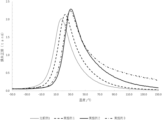
- (1. Evaluation method of vibration damping property) The loss tangent (tan ⁇ ) was measured using a dynamic viscoelasticity measuring device "Reogel-E4000" (manufactured by UBM Co., Ltd.) at a frequency of 15 Hz, a heating rate of 3 °C/min, and a temperature range of -50 to 150 °C. The obtained tan ⁇ was used as an index of damping performance.
- Table 1 shows the maximum value of tan ⁇ , tan ⁇ at 50° C., the temperature range where tan ⁇ is 0.5 or more, and the temperature range where tan ⁇ is 0.5 or more.
- Examples 1 to 3 and Comparative Example 1 The components listed in Table 1 were mixed at 50° C. for Example 1 and Comparative Example 1, and at 25° C. for the other examples in the amounts listed in Table 1 to obtain compositions for vibration damping materials. Using the obtained composition for damping material, it was sandwiched between PET film (manufactured by Toyobo Co., Ltd.) and alkali-free glass (manufactured by As One Co., Ltd.) so that the thickness of the composition before curing was 100 ⁇ m, and exposed to a UV irradiator.
- PET film manufactured by Toyobo Co., Ltd.
- alkali-free glass manufactured by As One Co., Ltd.
- Component (B) Component (B1) IBOA: isobornyl acrylate LA: lauryl acrylate 4HBA: 4-hydroxybutyl acrylate Component (B2) EB230: "EBECRYL (registered trademark) 230", aliphatic urethane diacrylate, weight average molecular weight 5,000, manufactured by Daicel Allnex Corporation
Landscapes
- Chemical & Material Sciences (AREA)
- Health & Medical Sciences (AREA)
- Chemical Kinetics & Catalysis (AREA)
- Medicinal Chemistry (AREA)
- Polymers & Plastics (AREA)
- Organic Chemistry (AREA)
- Compositions Of Macromolecular Compounds (AREA)
- Vibration Prevention Devices (AREA)
Priority Applications (1)
| Application Number | Priority Date | Filing Date | Title |
|---|---|---|---|
| JP2024548191A JPWO2024062932A1 (https=) | 2022-09-22 | 2023-09-07 |
Applications Claiming Priority (2)
| Application Number | Priority Date | Filing Date | Title |
|---|---|---|---|
| JP2022151481 | 2022-09-22 | ||
| JP2022-151481 | 2022-09-22 |
Publications (1)
| Publication Number | Publication Date |
|---|---|
| WO2024062932A1 true WO2024062932A1 (ja) | 2024-03-28 |
Family
ID=90454263
Family Applications (1)
| Application Number | Title | Priority Date | Filing Date |
|---|---|---|---|
| PCT/JP2023/032630 Ceased WO2024062932A1 (ja) | 2022-09-22 | 2023-09-07 | 制振材用組成物、制振材及び部材 |
Country Status (3)
| Country | Link |
|---|---|
| JP (1) | JPWO2024062932A1 (https=) |
| TW (1) | TW202428656A (https=) |
| WO (1) | WO2024062932A1 (https=) |
Citations (4)
| Publication number | Priority date | Publication date | Assignee | Title |
|---|---|---|---|---|
| JPH04351651A (ja) * | 1991-05-28 | 1992-12-07 | Asahi Chem Ind Co Ltd | 制振性の優れた耐候性耐衝撃性重合体組成物 |
| JP2002284821A (ja) * | 2001-03-22 | 2002-10-03 | Kuraray Co Ltd | 制振材用材料及び合成樹脂用制振性改良剤 |
| JP2011236364A (ja) * | 2010-05-12 | 2011-11-24 | Kaneka Corp | 制振材用硬化性組成物および制振材 |
| CN107814891A (zh) * | 2016-09-12 | 2018-03-20 | 翁秋梅 | 一种基于动态聚合物热塑性弹性体的吸能方法 |
-
2023
- 2023-09-07 JP JP2024548191A patent/JPWO2024062932A1/ja active Pending
- 2023-09-07 WO PCT/JP2023/032630 patent/WO2024062932A1/ja not_active Ceased
- 2023-09-14 TW TW112135035A patent/TW202428656A/zh unknown
Patent Citations (4)
| Publication number | Priority date | Publication date | Assignee | Title |
|---|---|---|---|---|
| JPH04351651A (ja) * | 1991-05-28 | 1992-12-07 | Asahi Chem Ind Co Ltd | 制振性の優れた耐候性耐衝撃性重合体組成物 |
| JP2002284821A (ja) * | 2001-03-22 | 2002-10-03 | Kuraray Co Ltd | 制振材用材料及び合成樹脂用制振性改良剤 |
| JP2011236364A (ja) * | 2010-05-12 | 2011-11-24 | Kaneka Corp | 制振材用硬化性組成物および制振材 |
| CN107814891A (zh) * | 2016-09-12 | 2018-03-20 | 翁秋梅 | 一种基于动态聚合物热塑性弹性体的吸能方法 |
Also Published As
| Publication number | Publication date |
|---|---|
| TW202428656A (zh) | 2024-07-16 |
| JPWO2024062932A1 (https=) | 2024-03-28 |
Similar Documents
| Publication | Publication Date | Title |
|---|---|---|
| JP4780269B2 (ja) | 無溶剤型液状組成物 | |
| JP6443991B2 (ja) | エンチオール系硬化性組成物およびその硬化物 | |
| TWI883089B (zh) | 光聚合起始劑與其製造方法、光硬化性樹脂組成物、塗佈組成物、油墨組成物、黏著劑組成物、接著劑組成物以及立體造形用組成物 | |
| TWI576018B (zh) | A hardened composition for a printed wiring board is used, and a hardened coating film and a printed wiring board are used | |
| CN116507680B (zh) | 可自由基聚合的交联剂、可固化组合物和由其得到的粘合剂 | |
| WO2018021352A1 (ja) | 硬化型組成物 | |
| JP6493699B2 (ja) | 樹脂シート及びその製造方法 | |
| JP7245824B2 (ja) | 重合体ならびにそれを用いた酸素吸収剤および樹脂組成物 | |
| JP2018178071A (ja) | 活性エネルギー線硬化型樹脂組成物及びその硬化物 | |
| JP2024001645A (ja) | 硬化性組成物、硬化物および高分子化合物 | |
| WO2024062932A1 (ja) | 制振材用組成物、制振材及び部材 | |
| JP2003327898A (ja) | 粉体塗料 | |
| JP2022160186A (ja) | 水系ハードコート剤 | |
| JP3606260B2 (ja) | 活性エネルギー線硬化型被覆用組成物 | |
| JPH11148045A (ja) | 活性エネルギー線硬化型塗料組成物及びそれを用いた被膜形成方法 | |
| JP7734506B2 (ja) | 抗ウイルス防指紋ハードコート樹脂組成物及びそれを用いた積層体 | |
| JP4109176B2 (ja) | エネルギー線硬化型樹脂組成物及びこれを用いた塗料 | |
| JP6343883B2 (ja) | 活性エネルギー線硬化型樹脂組成物 | |
| WO2014038592A1 (ja) | 湿気硬化性及び光硬化性樹脂組成物 | |
| JP2009001730A (ja) | 高分子化合物およびその製造方法 | |
| WO2024062930A1 (ja) | 接着剤、硬化物及び部材 | |
| JP2008201955A (ja) | 多官能(メタ)アクリレートを含有する熱硬化性樹脂組成物 | |
| JP2002080509A (ja) | マレイミドビニルエーテル誘導体及びそれを含有する光硬化性樹脂組成物 | |
| JP6880809B2 (ja) | 活性エネルギー線硬化型封止剤用組成物 | |
| JPH0321629A (ja) | 光硬化性樹脂組成物 |
Legal Events
| Date | Code | Title | Description |
|---|---|---|---|
| 121 | Ep: the epo has been informed by wipo that ep was designated in this application |
Ref document number: 23868055 Country of ref document: EP Kind code of ref document: A1 |
|
| WWE | Wipo information: entry into national phase |
Ref document number: 2024548191 Country of ref document: JP |
|
| NENP | Non-entry into the national phase |
Ref country code: DE |
|
| 122 | Ep: pct application non-entry in european phase |
Ref document number: 23868055 Country of ref document: EP Kind code of ref document: A1 |