WO2024048627A1 - 導電性塗料、及びシールド層を有する樹脂成形品の製造方法 - Google Patents
導電性塗料、及びシールド層を有する樹脂成形品の製造方法 Download PDFInfo
- Publication number
- WO2024048627A1 WO2024048627A1 PCT/JP2023/031409 JP2023031409W WO2024048627A1 WO 2024048627 A1 WO2024048627 A1 WO 2024048627A1 JP 2023031409 W JP2023031409 W JP 2023031409W WO 2024048627 A1 WO2024048627 A1 WO 2024048627A1
- Authority
- WO
- WIPO (PCT)
- Prior art keywords
- curing agent
- conductive paint
- mass
- parts
- particles
- Prior art date
- Legal status (The legal status is an assumption and is not a legal conclusion. Google has not performed a legal analysis and makes no representation as to the accuracy of the status listed.)
- Ceased
Links
Images

Classifications
-
- C—CHEMISTRY; METALLURGY
- C09—DYES; PAINTS; POLISHES; NATURAL RESINS; ADHESIVES; COMPOSITIONS NOT OTHERWISE PROVIDED FOR; APPLICATIONS OF MATERIALS NOT OTHERWISE PROVIDED FOR
- C09D—COATING COMPOSITIONS, e.g. PAINTS, VARNISHES OR LACQUERS; FILLING PASTES; CHEMICAL PAINT OR INK REMOVERS; INKS; CORRECTING FLUIDS; WOODSTAINS; PASTES OR SOLIDS FOR COLOURING OR PRINTING; USE OF MATERIALS THEREFOR
- C09D5/00—Coating compositions, e.g. paints, varnishes or lacquers, characterised by their physical nature or the effects produced; Filling pastes
- C09D5/24—Electrically-conducting paints
-
- C—CHEMISTRY; METALLURGY
- C08—ORGANIC MACROMOLECULAR COMPOUNDS; THEIR PREPARATION OR CHEMICAL WORKING-UP; COMPOSITIONS BASED THEREON
- C08G—MACROMOLECULAR COMPOUNDS OBTAINED OTHERWISE THAN BY REACTIONS ONLY INVOLVING UNSATURATED CARBON-TO-CARBON BONDS
- C08G59/00—Polycondensates containing more than one epoxy group per molecule; Macromolecules obtained by polymerising compounds containing more than one epoxy group per molecule using curing agents or catalysts which react with the epoxy groups
- C08G59/18—Macromolecules obtained by polymerising compounds containing more than one epoxy group per molecule using curing agents or catalysts which react with the epoxy groups ; e.g. general methods of curing
- C08G59/40—Macromolecules obtained by polymerising compounds containing more than one epoxy group per molecule using curing agents or catalysts which react with the epoxy groups ; e.g. general methods of curing characterised by the curing agents used
-
- C—CHEMISTRY; METALLURGY
- C08—ORGANIC MACROMOLECULAR COMPOUNDS; THEIR PREPARATION OR CHEMICAL WORKING-UP; COMPOSITIONS BASED THEREON
- C08G—MACROMOLECULAR COMPOUNDS OBTAINED OTHERWISE THAN BY REACTIONS ONLY INVOLVING UNSATURATED CARBON-TO-CARBON BONDS
- C08G59/00—Polycondensates containing more than one epoxy group per molecule; Macromolecules obtained by polymerising compounds containing more than one epoxy group per molecule using curing agents or catalysts which react with the epoxy groups
- C08G59/18—Macromolecules obtained by polymerising compounds containing more than one epoxy group per molecule using curing agents or catalysts which react with the epoxy groups ; e.g. general methods of curing
- C08G59/40—Macromolecules obtained by polymerising compounds containing more than one epoxy group per molecule using curing agents or catalysts which react with the epoxy groups ; e.g. general methods of curing characterised by the curing agents used
- C08G59/4007—Curing agents not provided for by the groups C08G59/42 - C08G59/66
- C08G59/4014—Nitrogen containing compounds
- C08G59/4028—Isocyanates; Thioisocyanates
-
- C—CHEMISTRY; METALLURGY
- C08—ORGANIC MACROMOLECULAR COMPOUNDS; THEIR PREPARATION OR CHEMICAL WORKING-UP; COMPOSITIONS BASED THEREON
- C08G—MACROMOLECULAR COMPOUNDS OBTAINED OTHERWISE THAN BY REACTIONS ONLY INVOLVING UNSATURATED CARBON-TO-CARBON BONDS
- C08G59/00—Polycondensates containing more than one epoxy group per molecule; Macromolecules obtained by polymerising compounds containing more than one epoxy group per molecule using curing agents or catalysts which react with the epoxy groups
- C08G59/18—Macromolecules obtained by polymerising compounds containing more than one epoxy group per molecule using curing agents or catalysts which react with the epoxy groups ; e.g. general methods of curing
- C08G59/40—Macromolecules obtained by polymerising compounds containing more than one epoxy group per molecule using curing agents or catalysts which react with the epoxy groups ; e.g. general methods of curing characterised by the curing agents used
- C08G59/50—Amines
- C08G59/5046—Amines heterocyclic
- C08G59/5053—Amines heterocyclic containing only nitrogen as a heteroatom
- C08G59/5073—Amines heterocyclic containing only nitrogen as a heteroatom having two nitrogen atoms in the ring
-
- C—CHEMISTRY; METALLURGY
- C08—ORGANIC MACROMOLECULAR COMPOUNDS; THEIR PREPARATION OR CHEMICAL WORKING-UP; COMPOSITIONS BASED THEREON
- C08J—WORKING-UP; GENERAL PROCESSES OF COMPOUNDING; AFTER-TREATMENT NOT COVERED BY SUBCLASSES C08B, C08C, C08F, C08G or C08H
- C08J7/00—Chemical treatment or coating of shaped articles made of macromolecular substances
- C08J7/04—Coating
- C08J7/0427—Coating with only one layer of a composition containing a polymer binder
-
- C—CHEMISTRY; METALLURGY
- C08—ORGANIC MACROMOLECULAR COMPOUNDS; THEIR PREPARATION OR CHEMICAL WORKING-UP; COMPOSITIONS BASED THEREON
- C08J—WORKING-UP; GENERAL PROCESSES OF COMPOUNDING; AFTER-TREATMENT NOT COVERED BY SUBCLASSES C08B, C08C, C08F, C08G or C08H
- C08J7/00—Chemical treatment or coating of shaped articles made of macromolecular substances
- C08J7/04—Coating
- C08J7/044—Forming conductive coatings; Forming coatings having anti-static properties
-
- C—CHEMISTRY; METALLURGY
- C08—ORGANIC MACROMOLECULAR COMPOUNDS; THEIR PREPARATION OR CHEMICAL WORKING-UP; COMPOSITIONS BASED THEREON
- C08K—Use of inorganic or non-macromolecular organic substances as compounding ingredients
- C08K3/00—Use of inorganic substances as compounding ingredients
- C08K3/02—Elements
- C08K3/08—Metals
-
- C—CHEMISTRY; METALLURGY
- C09—DYES; PAINTS; POLISHES; NATURAL RESINS; ADHESIVES; COMPOSITIONS NOT OTHERWISE PROVIDED FOR; APPLICATIONS OF MATERIALS NOT OTHERWISE PROVIDED FOR
- C09D—COATING COMPOSITIONS, e.g. PAINTS, VARNISHES OR LACQUERS; FILLING PASTES; CHEMICAL PAINT OR INK REMOVERS; INKS; CORRECTING FLUIDS; WOODSTAINS; PASTES OR SOLIDS FOR COLOURING OR PRINTING; USE OF MATERIALS THEREFOR
- C09D163/00—Coating compositions based on epoxy resins; Coating compositions based on derivatives of epoxy resins
-
- C—CHEMISTRY; METALLURGY
- C09—DYES; PAINTS; POLISHES; NATURAL RESINS; ADHESIVES; COMPOSITIONS NOT OTHERWISE PROVIDED FOR; APPLICATIONS OF MATERIALS NOT OTHERWISE PROVIDED FOR
- C09D—COATING COMPOSITIONS, e.g. PAINTS, VARNISHES OR LACQUERS; FILLING PASTES; CHEMICAL PAINT OR INK REMOVERS; INKS; CORRECTING FLUIDS; WOODSTAINS; PASTES OR SOLIDS FOR COLOURING OR PRINTING; USE OF MATERIALS THEREFOR
- C09D175/00—Coating compositions based on polyureas or polyurethanes; Coating compositions based on derivatives of such polymers
- C09D175/04—Polyurethanes
-
- C—CHEMISTRY; METALLURGY
- C09—DYES; PAINTS; POLISHES; NATURAL RESINS; ADHESIVES; COMPOSITIONS NOT OTHERWISE PROVIDED FOR; APPLICATIONS OF MATERIALS NOT OTHERWISE PROVIDED FOR
- C09D—COATING COMPOSITIONS, e.g. PAINTS, VARNISHES OR LACQUERS; FILLING PASTES; CHEMICAL PAINT OR INK REMOVERS; INKS; CORRECTING FLUIDS; WOODSTAINS; PASTES OR SOLIDS FOR COLOURING OR PRINTING; USE OF MATERIALS THEREFOR
- C09D7/00—Features of coating compositions, not provided for in group C09D5/00; Processes for incorporating ingredients in coating compositions
- C09D7/40—Additives
- C09D7/60—Additives non-macromolecular
- C09D7/61—Additives non-macromolecular inorganic
-
- C—CHEMISTRY; METALLURGY
- C09—DYES; PAINTS; POLISHES; NATURAL RESINS; ADHESIVES; COMPOSITIONS NOT OTHERWISE PROVIDED FOR; APPLICATIONS OF MATERIALS NOT OTHERWISE PROVIDED FOR
- C09D—COATING COMPOSITIONS, e.g. PAINTS, VARNISHES OR LACQUERS; FILLING PASTES; CHEMICAL PAINT OR INK REMOVERS; INKS; CORRECTING FLUIDS; WOODSTAINS; PASTES OR SOLIDS FOR COLOURING OR PRINTING; USE OF MATERIALS THEREFOR
- C09D7/00—Features of coating compositions, not provided for in group C09D5/00; Processes for incorporating ingredients in coating compositions
- C09D7/40—Additives
- C09D7/60—Additives non-macromolecular
- C09D7/61—Additives non-macromolecular inorganic
- C09D7/62—Additives non-macromolecular inorganic modified by treatment with other compounds
-
- C—CHEMISTRY; METALLURGY
- C09—DYES; PAINTS; POLISHES; NATURAL RESINS; ADHESIVES; COMPOSITIONS NOT OTHERWISE PROVIDED FOR; APPLICATIONS OF MATERIALS NOT OTHERWISE PROVIDED FOR
- C09D—COATING COMPOSITIONS, e.g. PAINTS, VARNISHES OR LACQUERS; FILLING PASTES; CHEMICAL PAINT OR INK REMOVERS; INKS; CORRECTING FLUIDS; WOODSTAINS; PASTES OR SOLIDS FOR COLOURING OR PRINTING; USE OF MATERIALS THEREFOR
- C09D7/00—Features of coating compositions, not provided for in group C09D5/00; Processes for incorporating ingredients in coating compositions
- C09D7/40—Additives
- C09D7/60—Additives non-macromolecular
- C09D7/63—Additives non-macromolecular organic
Definitions
- the present invention relates to a method for manufacturing a resin molded article having a conductive paint and a shield layer.
- Electronic devices such as mobile phones and tablet terminals are equipped with many electronic components for wireless communication to transmit large amounts of data.
- Such electronic components for wireless communication not only easily generate noise, but also have a problem in that they are highly sensitive to noise and tend to malfunction when exposed to external noise.
- Methods for forming a shield layer on the surface of a resin molded product include pasting a conductive sheet, metal foil, or metal mesh, and electroless plating, which forms a metal film by immersing the resin molded product in a plating solution.
- the shield layers obtained by these methods sometimes fail to provide sufficient shielding properties and adhesion.
- the resin molded product depending on the shape of the resin molded product, there is the problem that conductive sheets, metal foils, etc. cannot be pasted, and with electroless plating, the resin molded product is immersed in a plating solution, so a shield layer cannot be formed partially.
- the curing temperature is 100 to 120°C, so it is not applicable to resin molded products with a heat resistance temperature of less than 100°C. I could't do it.
- the present invention has been made in view of the above, and aims to provide a conductive paint that has a low curing temperature and has excellent conductivity and adhesion, and a method for manufacturing a resin molded product having a shield layer. shall be.
- the present invention includes the embodiments shown below.
- the conductive paint according to the present invention can be cured at a low temperature, for example, 80° C. or lower, and excellent conductivity and adhesion can be obtained.
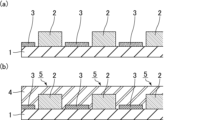
- FIGS. 1A and 1B are schematic diagrams schematically showing an example of a package forming process of a method for manufacturing a shield package according to an embodiment.
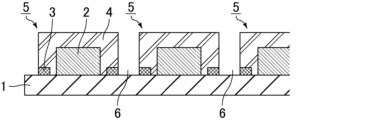
- FIG. 2 is a schematic diagram schematically showing an example of the package individualization step of the method for manufacturing a shielded package according to an embodiment.
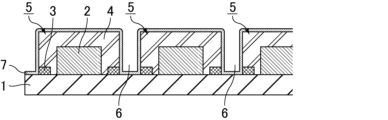
- FIG. 3 is a schematic diagram schematically showing an example of a conductive paint application step of the method for manufacturing a shield package according to an embodiment.
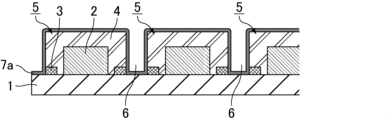
- FIG. 4 is a schematic diagram schematically showing an example of a shield layer forming step of a method for manufacturing a shield package according to an embodiment.
- FIG. 5 is a schematic diagram schematically showing an example of a cutting process in a method for manufacturing a shield package according to an embodiment.
- FIGS. 6A and 6B are schematic diagrams schematically showing a method for evaluating coating stability.
- the conductive paint according to the present embodiment contains 1200 to 3200 parts by mass of metal particles (B) and 70 to 200 parts by mass of blocked isocyanate curing agent (C) to 100 parts by mass of binder component (A) containing an epoxy resin. parts by mass, 5 to 50 parts by mass of a curing agent (D) which is at least one selected from the group consisting of an amine curing agent, and an imidazole curing agent, and 100 to 1500 parts by mass of a solvent (E). Contains.
- the proportion of the epoxy resin in the binder component (A) is preferably 5 to 100% by mass, more preferably 30 to 100% by mass, even more preferably 50 to 100% by mass, and even more preferably 70 to 100% by mass. Particularly preferred is % by weight, most preferably 90-100% by weight.
- the epoxy resin may be a solid epoxy resin or a liquid epoxy resin, but preferably contains both.
- the proportion of the solid epoxy resin in the binder component (A) is preferably 5 to 80% by mass, more preferably 20 to 60% by mass.
- the proportion of the liquid epoxy resin in the binder component (A) is preferably 20 to 95% by mass, more preferably 40 to 80% by mass.
- the solid epoxy resin refers to an epoxy resin that does not have fluidity in a solvent-free state at room temperature (23° C.).
- the liquid epoxy resin refers to an epoxy resin that has fluidity in a solvent-free state at room temperature (23° C.).
- the solid epoxy resin preferably has an epoxy equivalent within the range of 150 to 10,000 g/eq, and preferably has a weight average molecular weight within the range of 900 to 60,000.
- the epoxy equivalent is 150 g/eq or more, it is easy to obtain a cured product with better adhesiveness of the conductive paint.
- the epoxy equivalent is 10,000 g/eq or less, a cured product with better conductivity and heat resistance of the conductive coating material can be easily obtained.
- epoxy equivalent is measured according to JIS K7236:2009.
- weight average molecular weight can be measured by gel permeation chromatography (GPC), and is a value calculated using a polystyrene-equivalent calibration curve using tetrahydrofuran as a mobile phase. .
- solid epoxy resins are not particularly limited, and include, for example, bisphenol epoxy resins such as bisphenol A epoxy resin, bisphenol F epoxy resin, and bisphenol S epoxy resin, spirocyclic epoxy resins, naphthalene epoxy resins, Biphenyl type epoxy resin, terpene type epoxy resin, glycidyl ether type epoxy resin such as tris(glycidyloxyphenyl)methane, tetrakis(glycidyloxyphenyl)ethane, glycidylamine type epoxy resin such as tetraglycidyldiaminodiphenylmethane, tetrabromo bisphenol A type Epoxy resins, novolak-type epoxy resins such as cresol novolac-type epoxy resins, phenol novolak-type epoxy resins, ⁇ -naphthol novolak-type epoxy resins, brominated phenol novolak-type epoxy resins, rubber-modified epoxy resins, etc. can be
- Rubber-modified epoxy resin refers to the above-mentioned solid epoxy resin in which a rubber component is dispersed.
- the rubber components include butadiene rubber (BR), acrylic rubber (ACM), silicone rubber, butyl rubber (IIR), isoprene rubber (IR), chloroprene rubber (CR), nitrile rubber (NBR), and styrene-butadiene rubber (SBR), ethylene propylene rubber (EPR), etc.
- BR butadiene rubber
- ACM acrylic rubber
- IIR isoprene rubber
- CR chloroprene rubber
- NBR nitrile rubber
- SBR styrene-butadiene rubber
- EPR ethylene propylene rubber
- the above rubber components may be used alone or in combination of two or more.
- the liquid epoxy resin preferably has an epoxy equivalent within the range of 90 to 500 g/eq, and preferably has a weight average molecular weight within the range of 150 to 500.
- the epoxy equivalent is 90 g/eq or more, a cured product with better adhesion of the conductive paint can be easily obtained.
- it is 500 g/eq or less, a cured product with better conductivity and heat resistance of the conductive coating material can be easily obtained.
- liquid epoxy resin is not particularly limited, and liquid glycidyl amine-based epoxy resins, liquid glycidyl ether-based epoxy resins, liquid glycidyl ester-based epoxy resins, etc. can be used. These may be used alone or in combination of two or more.
- the binder component (A) can contain alkyd resins, melamine resins, xylene resins, silicone resins, urethane resins, acrylic resins, etc. as components other than epoxy resins.
- the content of these in the binder component (A) is preferably 30% by mass or less, more preferably 10% by mass or less. Use of these resins provides good adhesion.
- the content of the metal particles (B) is not particularly limited as long as it is 1200 to 3200 parts by mass based on 100 parts by mass of the binder component (A), but it is preferably 1500 to 3000 parts by mass, and 1700 to 2900 parts by mass. It is more preferable that it is part.
- the metal particles (B) include copper particles, silver particles, nickel particles, silver-coated copper particles, gold-coated copper particles, silver-coated nickel particles, gold-coated nickel particles, silver-coated copper alloy particles, etc. These may be used alone or in combination of two or more.
- the metal particles (B) are preferably at least one selected from the group consisting of silver particles, silver-coated copper particles, and silver-coated copper alloy particles.
- the silver-coated copper particles are not particularly limited as long as they include copper particles and a silver-containing layer that covers at least a portion of the copper particles.
- the silver-coated copper alloy particles are not particularly limited as long as they include copper alloy particles and a silver-containing layer covering at least a portion of the copper alloy particles.
- the copper alloy particles contain 0.5 to 25% by mass of zinc and/or 0.5 to 30% by mass of nickel, with the balance consisting of copper, and the remaining copper may contain unavoidable impurities.
- the content of the silver-containing layer in the silver-coated copper particles and the silver-coated copper alloy particles is not particularly limited, but is preferably 4 to 24% by mass. Although the silver content in the silver-containing layer is not particularly limited, it is preferably 90 to 100% by mass.
- the shape of the metal particles (B) is not particularly limited, and spherical, flaky (scale-like), dendritic, and fibrous shapes can be used, and spherical and flake-like (scale-like) are preferable.
- the "spherical" metal particles include not only approximately true spheres (atomized powder), but also approximately spherical particles such as approximately polyhedral spheres (reduced powder) and irregularly shaped particles (electrolytic powder).
- the average particle diameter of the metal particles (B) is preferably 1 to 20 ⁇ m.
- the average particle diameter of the metal particles is 1 ⁇ m or more, the dispersibility of the metal particles is good, so that aggregation can be prevented. Moreover, the metal particles become less likely to be oxidized.
- the average particle diameter of the metal particles is 20 ⁇ m or less, when the conductive paint is cured and becomes a shield layer, the connectivity with the ground circuit of the package will be good.
- the "average particle diameter of metal particles” means the number-based average particle diameter D50 (median diameter) measured by a laser diffraction/scattering method.
- blocked isocyanate curing agent (C) one prepared by blocking polyisocyanate with a sealant can be used.
- polyisocyanates examples include aliphatic diisocyanates such as hexamethylene diisocyanate (including trimers), tetramethylene diisocyanate, and trimethylhexamethylene diisocyanate; Cyclic polyisocyanates; Aromatic diisocyanates such as 4,4'-diphenylmethane diisocyanate, tolylene diisocyanate, and xylylene diisocyanate; Modified products of these diisocyanates (urethanized products, carbodiimides, uretdiones, uretonimines, biurets, and/or isocyanurate modifications) things, etc.); These may be used alone or in combination of two or more.
- sealants include monohydric alkyl (or aromatic) alcohols such as n-butanol, n-hexyl alcohol, 2-ethylhexanol, lauryl alcohol, phenol carbinol, methylphenyl carbinol; ethylene glycol mono Cellosolves such as hexyl ether and ethylene glycol mono-2-ethylhexyl ether; polyether-type double-terminated diols such as polyethylene glycol, polypropylene glycol, and polytetramethylene ether glycol phenol; ethylene glycol, propylene glycol, 1,4-butanediol, etc.
- monohydric alkyl (or aromatic) alcohols such as n-butanol, n-hexyl alcohol, 2-ethylhexanol, lauryl alcohol, phenol carbinol, methylphenyl carbinol
- ethylene glycol mono Cellosolves such as hexyl
- polyester-type double-terminated polyols obtained from diols and dicarboxylic acids such as oxalic acid, succinic acid, adipic acid, suberic acid, and sebacic acid; phenols such as para-t-butylphenol and cresol; dimethyl ketoxime, methyl ethyl ketox Oximes such as oxime, methylisobutylketoxime, methylamylketoxime, and cyclohexanoneoxime; pyrazoles such as dimethylpyrazole; and lactams represented by ⁇ -caprolactam and ⁇ -butyrolactam are preferably used. These may be used alone or in combination of two or more.
- the content of the blocked isocyanate curing agent (C) is not particularly limited as long as it is 70 to 200 parts by weight based on 100 parts by weight of the binder component, but it is more preferably 100 to 200 parts by weight.
- the curing agent (D) at least one selected from the group consisting of amine curing agents and imidazole curing agents may be used, and two or more types may be used in an appropriate combination.
- the curing agent (D) functions as a curing aid to aid in curing the blocked isocyanate curing agent (C), and can promote curing of the conductive paint at low temperatures.
- amine-based curing agents examples include aliphatic amine-based curing agents (e.g., (poly)alkylene polyamines such as ethylenediamine, hexamethylenediamine, diethylenetriamine, triethylenetetramine, tetraethylenepentamine, diethylaminopropylamine, etc.), alicyclic curing agents, etc.
- aliphatic amine-based curing agents e.g., (poly)alkylene polyamines such as ethylenediamine, hexamethylenediamine, diethylenetriamine, triethylenetetramine, tetraethylenepentamine, diethylaminopropylamine, etc.
- Group amine curing agents e.g.
- menzendiamine isophoronediamine, bis(4-amino-3-methylcyclohexyl)methane, 3,9-bis(3-aminopropyl)-2,4,8,10-tetraoxa) monocyclic aliphatic polyamines such as spiro[5.5]undecane; crosslinked cyclic polyamines such as norbornane diamine), aromatic amine curing agents (e.g., polyaminoarenes (e.g., para-phenylene diamine, meta-phenylene diamine, etc.) diaminoarenes, preferably diamino C 6-10 arenes), polyamino-alkylarenes (e.g.
- diamino-alkylarene such as diethyltoluene diamine, preferably diamino-mono to tri-C 1-4 alkyl C 6-10 arenes
- poly (aminoalkyl)arenes e.g. di(aminoalkyl)arenes such as xylylenediamine, preferably di(aminoC 1-4 alkyl)C 6-10 arenes
- poly(aminoaryl)alkanes e.g.
- di(amino C 6-12 aryl) sulfones such as diaminodiphenylsulfone, preferably di(amino C 6-10 aryl) sulfones)
- aliphatic amine curing agents are particularly preferred.
- C m-n " in "C 1-4 alkyl” etc. means that the number of carbon atoms is m to n, and even if any one of the carbon numbers m to n, 2 More than one species may be mixed.
- the amine curing agent it is more preferable to use an aliphatic amine curing agent with a reaction initiation temperature of 60 to 100°C.
- the reaction initiation temperature is 60° C. or higher, the storage stability of the conductive paint can be improved. Curability can be improved when the reaction initiation temperature is 100°C or less.
- the reaction initiation temperature is more preferably 60 to 90°C.
- imidazole curing agents examples include imidazoles (for example, alkylimidazoles such as 2-methylimidazole, 2-phenylimidazole, 2-heptadecylimidazole, and 2-ethyl-4-methylimidazole; 2-phenylimidazole; - phenyl-4-methylimidazole, 2-phenyl-4-methyl-5-hydroxymethylimidazole, 1-benzyl-2-phenylimidazole, etc.), imidazole salts (e.g., formate, phenol salt, phenol Organic salts such as novolac salts; salts such as carbonates), reaction products (or adducts) of epoxy compounds (for example, polyepoxy compounds such as diglycidyl ether of bisphenol A) and imidazoles, and the like.
- imidazoles for example, alkylimidazoles such as 2-methylimidazole, 2-phenylimidazole, 2-heptadecylimid
- the imidazole curing agent it is preferable to use an imidazole curing agent having a reaction initiation temperature of 60 to 100°C.
- the reaction initiation temperature of the imidazole curing agent is 60° C. or higher, the storage stability of the conductive paint can be improved. Curability can be improved when the reaction initiation temperature is 100°C or less.
- the reaction initiation temperature is more preferably 60 to 90°C.
- the reaction initiation temperature of the curing agent is measured as follows. That is, for 100 parts by mass of a bisphenol A epoxy resin with an epoxy equivalent of 186 g/eq and a weight average molecular weight of 370, the curing agent is 15 parts by mass in the case of an amine-based curing agent and 10 parts by mass in the case of an imidazole-based curing agent.
- Prepare the sample by mixing and stirring to form a paste. Using a DSC (differential scanning calorimeter), the sample is heated at a rate of 10° C./min, and the temperature at which the exothermic peak begins to rise is defined as the reaction initiation temperature.
- the content of the curing agent (D) is not particularly limited as long as it is 5 to 50 parts by weight based on 100 parts by weight of the binder component, but it is preferably 10 to 40 parts by weight.
- the total content of the curing agent (total amount of the curing agent (C) and curing agent (D)) is not particularly limited, but is preferably 80 to 220 parts by mass based on 100 parts by mass of the binder component. More preferably, it is 100 to 200 parts by mass.
- the content ratio of curing agent (C) and curing agent (D) is not particularly limited, but it is preferably 1.4 to 40 in mass ratio, and 2. It is more preferable that it is between 40 and 40.
- the mass ratio of curing agent (C)/curing agent (D) may be from 5 to 40, or from 5 to 20.
- Examples of the solvent (E) include alcohols such as terpineol, benzyl alcohol, 1-methoxy-2-propanol, and isobutanol; ketones such as methyl ethyl ketone, acetone, and acetophenone; methyl cellosolve, ethyl cellosolve, butyl cellosolve, and methyl carbitol.
- alcohols such as terpineol, benzyl alcohol, 1-methoxy-2-propanol, and isobutanol
- ketones such as methyl ethyl ketone, acetone, and acetophenone
- methyl cellosolve ethyl cellosolve
- butyl cellosolve methyl carbitol.
- ethyl carbitol butyl carbitol, diethylene glycol dimethyl ether, tetrahydrofuran and other ethers; methyl cellosolve acetate, ethyl carbitol acetate, butyl carbitol acetate, methyl methoxy butyl acetate, propylene glycol monomethyl ethyl acetate, methoxy butyl acetate, ethyl acetate, Examples include esters such as butyl acetate and methyl acetate. These may be used alone or in combination of two or more.
- the content of the solvent (E) is not particularly limited as long as it is 100 to 1500 parts by weight based on 100 parts by weight of the binder component, but it is preferably 200 to 1500 parts by weight, and preferably 300 to 1400 parts by weight. More preferably, the amount is 400 to 1300 parts by mass.
- the conductive paint of the present invention can be obtained by blending the above-mentioned components in predetermined amounts and thoroughly mixing them.
- additives that have been conventionally added to the same type of conductive paint can also be added to the conductive paint of the present invention within a range that does not depart from the purpose of the present invention.
- examples include curing catalysts, defoamers, thickeners, tackifiers, fillers, antisettling agents, colorants, antioxidants, plasticizers, ultraviolet absorbers, flame retardants, and the like.
- the viscosity of the conductive paint of the present invention at a liquid temperature of 25°C is preferably 0.1 to 5.0 Pa ⁇ s, more preferably 0.3 to 4.5 Pa ⁇ s, More preferably, it is .5 to 4.0 Pa ⁇ s. If the viscosity of the conductive paint is 0.1 Pa ⁇ s or more, when the conductive paint is cured to form a shield layer, it is possible to prevent liquid dripping on the wall surface of the package and form the shield layer evenly. At the same time, precipitation of metal particles can be prevented. When the viscosity of the conductive paint is 5.0 Pa ⁇ s or less, clogging of the spray nozzle is prevented when the conductive paint is sprayed, and a shield layer is easily formed evenly on the package surface and side wall surface.
- the "viscosity of the conductive paint” means the viscosity measured at a rotation speed of 10 rpm using a BH type viscometer.
- An example of the manufacturing method of the shield package of this embodiment shown below includes (1) package forming step, (2) package individualization step, (3) conductive paint application step, and (4) shield layer forming step. and (5) a cutting step.
- (2) package individualization step is not an essential step and may be omitted depending on the purpose.
- a package 5 is produced by filling the electronic component 2 and the ground circuit pattern 3 with a sealing material 4 and curing it to seal the electronic component 2.
- the sealing material is not particularly limited, but metals such as iron and aluminum, resins mixed with metal particles thereof, resins such as epoxy resins, ceramics, etc. can be used.
- the sealing material 4 between the plurality of electronic components 2 is cut to form grooves 6.
- the groove portion 6 allows the package 5 to be individualized for each electronic component 2.
- at least a portion of the ground circuit pattern 3 is exposed from the wall surface forming the groove portion 6.
- the package 5 can be easily separated into pieces as described later. Further, in the conductive paint application step described below, the conductive paint can also be applied to the side surface of the package 5.
- the method of applying the conductive paint is not particularly limited, and for example, it may be applied by brushing, or it may be sprayed with a spray gun or the like.
- spray conditions such as spray pressure, spray flow rate, and distance from the spray gun nozzle to the surface of the package 5 as appropriate.
- the heating temperature is not particularly limited, but is preferably 70 to 80°C. Since the conductive paint 7 is the conductive paint of the present invention, the conductive paint 7 is sufficiently cured even at such a low heating temperature.
- the substrate 1 is cut along the grooves 6 so that the packages 5 are separated into individual pieces.
- the method of cutting the substrate 1 is not particularly limited, it can be cut using a dicing saw or the like.
- the shield package 8 in which the shield layer 7a is formed on the package 5 can be manufactured.
- the conductive paint of the present invention is cured at a relatively low curing temperature, damage to electronic components due to heat can be suppressed.
- An example of the method for manufacturing a resin molded article having a shield layer of the present invention described below includes (1) a conductive paint coating step, and (2) a shield layer forming step.
- the conductive paint according to the present invention is applied onto the resin molded product.
- the method of applying the conductive paint is not particularly limited, and for example, it may be applied by brushing, or it may be sprayed with a spray gun or the like.
- spray conditions such as spray pressure, spray flow rate, and distance from the spray gun nozzle to the surface of the resin molded product as appropriate.
- the conductive paint is dried and then heated to harden the conductive paint to form a shield layer.
- drying and curing of the conductive paint may be performed simultaneously or separately.
- each component was mixed to prepare a conductive paint.
- ⁇ Curability 1> The conductive paint according to each Example and each Comparative Example was applied to a glass plate to a thickness of 20 ⁇ m, heated at 80° C. for 120 minutes, and the curability of the conductive paint was evaluated.
- the evaluation criteria are as follows. ⁇ : The conductive paint was completely cured. ⁇ : The conductive paint was not cured or was in a semi-cured state.
- ⁇ Conductivity> The conductive paint according to each example and each comparative example was applied to a 150 mm x 150 mm square PP (polypropylene) sheet to a thickness of 20 ⁇ m, and heated at 80°C for 120 minutes to obtain a cured conductive paint. Ta.
- the sheet resistance value of the obtained cured product was measured using a surface resistance measuring jig (milliohm high tester). It was evaluated that the conductivity was excellent if the sheet resistance value was 50 m ⁇ or less.
- FIGS. 6(a) and 6(b) are schematic diagrams showing the substrates used for evaluating coating stability.
- the conductive paints prepared in each example and each comparative example were applied to a square glass epoxy substrate (10 cm long x 10 cm wide x 1 mm thick) shown in Figure 6(a) using a spray device manufactured by Nordson Asymtek.
- the coating stability of the conductive paint was evaluated by spraying it as follows.
- each polyimide tape 32 to 36 is 1 cm x 1 cm (dimensions a and b in FIG.
- the dimensions c and d in 6(a) are both 1 cm), and the tape is attached so that the sides of the tape are parallel to the sides of the substrate.
- spray coating is performed on the glass epoxy substrate 31 under the following spray conditions, and heated at 80° C. for 120 minutes to form a cured conductive paint with a thickness of 20 ⁇ m. did.
- cured product A the cured product of the conductive paint formed immediately after putting the conductive paint into the spray device
- cured product A the cured product of the conductive paint formed 20 minutes after putting the conductive paint into the spray device
- cured product B The cured product of the paint is referred to as "cured product B.”
- each of the polyimide tapes 32 to 36 was peeled off. As shown in FIG.
- the thickness of each part (arrow Y) where the cured material 41 of the conductive paint was formed on the glass epoxy substrate 31 adjacent to the peeled part was measured with a micrometer, and the thickness was determined at five locations by subtracting the former from the latter. The thickness of the cured conductive paint was determined.
- Coating stability was evaluated from the thickness of cured product A and the thickness of cured product B.
- the evaluation criteria are as follows. The evaluation results are shown in Tables 1 and 2. Good: The thickness of cured product A at all five locations and the thickness of cured product B at all five locations were within the range of 20 ⁇ m ⁇ 5 ⁇ m. ⁇ : Cured material A and/or cured material B whose thickness did not fall within the range of 20 ⁇ m ⁇ 5 ⁇ m was formed at one or more locations.
- a copper-clad laminate was prepared to evaluate the adhesion to the ground circuit, and a mold resin was prepared to evaluate the adhesion to the package surface.
- a mold resin was prepared to evaluate the adhesion to the package surface.
- Each was masked with polyimide tape so that an opening with a width of 5 cm and a length of 10 cm was formed, and the conductive paint according to each example and each comparative example was applied using a spray coating device "SL-940E" (Nordson Asymtek Co., Ltd.).
- the conductive paint was spray-coated using a commercially available product manufactured by A. Thereafter, the conductive paint was cured by heating at 80° C. for 120 minutes, and the polyimide tape was peeled off to form a coating film with a thickness of about 20 ⁇ m.
- a cross-cut test was conducted on the copper foil on which the coating film was formed and on the mold resin.
- Adhesion was evaluated based on the following criteria. ⁇ : The edges of the cut were completely smooth, and there was no peeling at any of the grid points. ⁇ : Small peeling of the coating film occurred at the intersection of cuts. Alternatively, peeling occurred at the edges of cuts, at intersections, and across the entire surface.
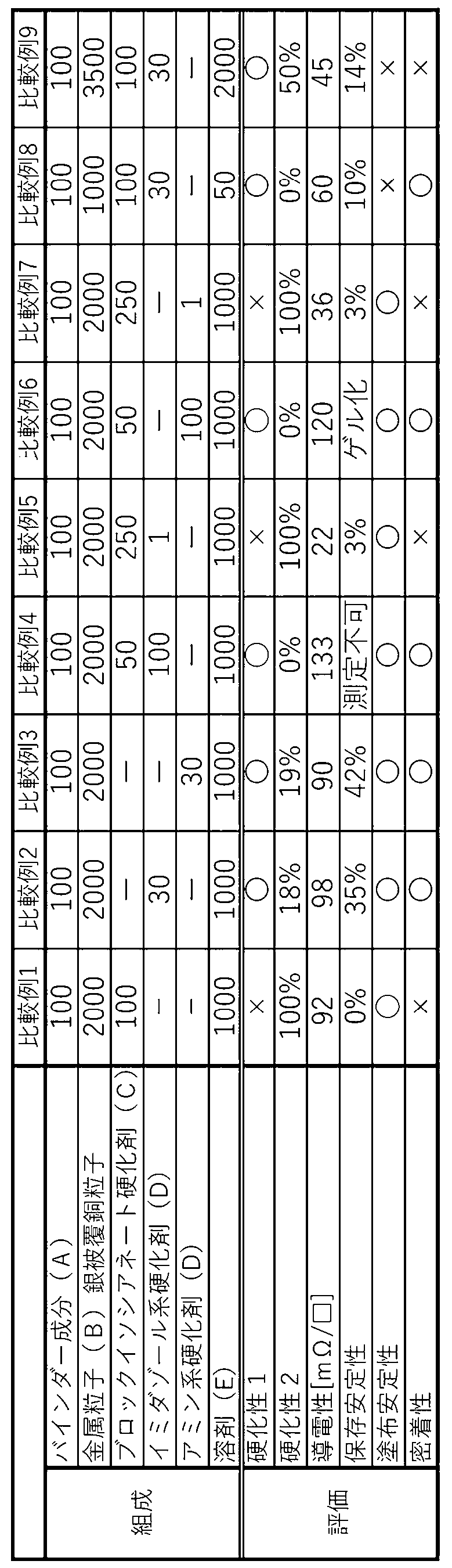
- Examples 1 to 10 are all excellent in curability, conductivity, storage stability, coating stability, and adhesion.
- Comparative Example 1 is an example in which only a blocked isocyanate curing agent was used as a curing agent, and the curing properties 1 and 2, conductivity, and adhesion were poor.
- Comparative Examples 2 and 3 are examples in which an imidazole-based curing agent or an amine-based curing agent was used as a curing agent, and the conductivity and storage stability were poor.
- Comparative Example 4 was an example in which the content of the blocked isocyanate curing agent was less than the lower limit and the content of the imidazole curing agent exceeded the upper limit, and the conductivity was poor.
- the viscosity (V7) after being left for 7 days was so high that it could not be measured with a measuring device.
- Comparative Example 5 is an example in which the content of the blocked isocyanate curing agent exceeds the upper limit and the content of the imidazole curing agent is less than the lower limit, and the curing properties 1 and 2 and adhesion were poor.
- Comparative Example 6 was an example in which the content of the blocked isocyanate curing agent was less than the lower limit and the content of the amine curing agent exceeded the upper limit, and the conductivity was poor. Regarding storage stability, the sample gelled after being left for 7 days.
- Comparative Example 7 is an example in which the content of the blocked isocyanate curing agent exceeds the upper limit and the content of the amine curing agent is less than the lower limit, and the curing properties 1 and 2 and adhesion were poor.
- Comparative Example 8 was an example in which the metal particle content was less than the lower limit and the solvent content was less than the lower limit, and the conductivity and coating stability were poor.
- Comparative Example 9 is an example in which the metal particle content exceeds the upper limit and the solvent content exceeds the upper limit, and the curability 2, coating stability, and adhesion were poor.
Landscapes
- Chemical & Material Sciences (AREA)
- Organic Chemistry (AREA)
- Wood Science & Technology (AREA)
- Life Sciences & Earth Sciences (AREA)
- Engineering & Computer Science (AREA)
- Materials Engineering (AREA)
- Medicinal Chemistry (AREA)
- Polymers & Plastics (AREA)
- Chemical Kinetics & Catalysis (AREA)
- Health & Medical Sciences (AREA)
- Inorganic Chemistry (AREA)
- Paints Or Removers (AREA)
- Compositions Of Macromolecular Compounds (AREA)
- Epoxy Resins (AREA)
Abstract
Description
[1] エポキシ樹脂を含むバインダー成分(A)100質量部に対して、金属粒子(B)を1200~3200質量部と、ブロックイソシアネート硬化剤(C)を70~200質量部と、アミン系硬化剤、及びイミダゾール系硬化剤からなる群から選択される少なくとも1種である硬化剤(D)を5~50質量部と、溶剤(E)を100~1500質量部とを含有する、導電性塗料。
[2] 前記金属粒子(B)は、銀粒子、銀被覆銅粒子、及び銀被覆銅合金粒子からなる群から選択される少なくとも1種である、[1]に記載の導電性塗料。
[3] 前記アミン系硬化剤は、反応開始温度が60~100℃の脂肪族アミン系硬化剤である、[1]又は[2]に記載の導電性塗料。
[4] 前記イミダゾール系硬化剤の反応開始温度が60~100℃である、[1]~[3]のいずれか1項に記載の導電性塗料。
[5] 前記ブロックイソシアネート硬化剤(C)と前記硬化剤(D)との質量比(C)/(D)が1.4~40である、[1]~[4]のいずれか1項に記載の導電性塗料。
[6] [1]~[5]のいずれか1項に記載の導電性塗料を樹脂成形品に塗布する導電性塗料塗布工程と、前記塗料が塗布された樹脂成形品を70~80℃の温度で加熱し、前記塗料を硬化させることでシールド層を形成するシールド層形成工程とを有する、樹脂成形品の製造方法。
まず、図1(a)に示すように、複数の電子部品2が搭載され、これら複数の電子部品2間にグランド回路パターン3が設けられた基板1を準備する。
次に、図2に示すように、複数の電子部品2間の封止材4を切削して溝部6を形成する。この溝部6によって電子部品2毎にパッケージ5を個別化させる。この際、溝部6を構成する壁面からグランド回路パターン3の少なくとも一部を露出させる。
次に、図3に示すように、パッケージ5が形成された基板1上に、導電性塗料7を塗布する。
次に、導電性塗料7を乾燥させた後、導電性塗料7が塗布された基板1を加熱して、導電性塗料7を硬化させることにより、図4に示すようにシールド層7aを形成する。本工程において、導電性塗料7の乾燥と硬化は同時に行ってもよく、別々に行ってもよい。
図5に示すように、パッケージ5が個片化するように、溝部6に沿って基板1を切断する。基板1の切断方法は特に限定されないが、ダイシングソー等により切断することができる。
樹脂成形品上に、本発明に係る導電性塗料を塗布する。導電性塗料を塗布する方法は、特に限定されず、例えば、はけ塗をしてもよく、スプレーガン等によって噴霧してもよい。噴霧により導電性塗料を塗布する場合の噴射圧力、噴射流量、スプレーガンの噴射口から樹脂成形品の表面までの距離等の噴霧条件は、適宜設定することが好ましい。
次に、導電性塗料を乾燥させた後、加熱して、導電性塗料を硬化させることによりシールド層を形成する。本工程において、導電性塗料の乾燥と硬化は同時に行ってもよく、別々に行ってもよい。
・金属粒子(B)銀被覆銅粒子:平均粒径2μmの球状銀被覆銅粒子(銀含有割合=10質量%)、及び、平均粒径5μmのフレーク状銀被覆銅粒子(銀含有割合=10質量%、アスペクト比=5)の混合物(混合比は質量比(球状:フレーク状)で1:4)
・金属粒子(B)銀粒子:平均粒径2μmの球状銀粒子、及び、平均粒径5μmのフレーク状銀粒子(アスペクト比=5)の混合物(混合比は質量比(球状:フレーク状)で1:4)
・金属粒子(B)銀被覆銅合金粒子:平均粒径2μmの球状銀被覆銅合金粒子(銀含有割合=10質量%)、及び、平均粒径5μmのフレーク状銀被覆銅合金粒子(銀含有割合=10質量%、アスペクト比=5)の混合物(混合比は質量比(球状:フレーク状)で1:4)、銅合金はニッケルを5質量%の割合で含む
・ブロックイソシアネート硬化剤(C):東ソー(株)製、商品名「コロネート2554」
・アミン系硬化剤(D):(株)T&K TOKA製、商品名「フジキュア-7001」(反応開始温度=80℃)
・イミダゾール系硬化剤(D):四国化成工業(株)製、商品名「2MZ-H」、2-メチル-イミダゾール(反応開始温度=75℃)
・溶剤(E):1-メトキシ-2-プロパノール
各実施例及び各比較例に係る導電性塗料を、厚さ20μmになるようにガラスプレートに塗布し、80℃で120分間加熱し、導電性塗料の硬化性を評価した。評価基準は以下のとおりである。
〇:導電性塗料が、完全に硬化していた。
×:導電性塗料が、硬化していなかった、又は、半硬化状態であった。
上記硬化性1で得られた硬化サンプルを用いた。アセトンをしみ込ませたペーパータオルを、硬化物サンプル上で10往復させた。そして、硬化物サンプルにおいて、下記式(1)により、導電性塗料の硬化物が剥がれた率(%)を測定した。本評価では、導電性塗料の硬化物の剥がれた率が低い程、導電性塗料はよく硬化していることを示しており、20%以下であれば硬化性に優れていると評価した。
導電性塗料が剥がれた率={1-([ペーパータオルで処理した後に残留している硬化物の面積]/[ペーパータオルで処理する前の硬化物サンプルの面積])}×100・・・(1)
各実施例及び各比較例に係る導電性塗料を、厚さ20μmになるようにPP(ポリプロピレン)シート150mm×150mm角に塗布し、80℃で120分間加熱し、導電性塗料の硬化物を得た。得られた硬化物について、表面抵抗測定治具(ミリオームハイテスタ)を用いてシート抵抗値を測定した。シート抵抗値が50mΩ以下であれば導電性に優れていると評価した。
製造直後の各実施例及び各比較例に係る導電性塗料の粘度をBH型粘度計ローターNo.7(10rpm)を用いて測定した。測定した粘度を初期粘度(V0)とした。次に、製造してから常温で7日放置後の各実施例及び各比較例に係る導電性塗料の粘度をBH型粘度計ローターNo.7(10rpm)を用いて測定した。測定した粘度を7日放置後粘度(V7)とした。そして、下記式(2)により粘度の変化率(%)を算出し、導電性塗料の保存安定性を評価した。変化率が20%以下であれば、保存安定性に優れていると評価した。
変化率={(V7-V0)/V0}×100・・・(2)
図6(a)および図6(b)は、塗布安定性の評価に用いた基板を示す模式図である。各実施例および各比較例で作製した導電性塗料を、Nordson Asymtek社製スプレー装置を用いて、図6(a)に示す正方形のガラスエポキシ基板(縦10cm×横10cm×厚さ1mm)に以下の要領で噴霧塗布して、導電性塗料の塗布安定性を評価した。
Nordson Asymtek社製「SL-940E」
ペースト押し出し圧力:2.8Psi
アシストエアー(噴霧化エアー):5Psi
パッケージ表面の温度:22℃
パッケージ表面からノズルまでの距離:約150mm
スプレーヘッド移動ピッチ:3mm
スプレーヘッド移動スピード:250mm/秒
スプレー回数:4回
〇:5箇所全ての硬化物Aの厚さ、及び、5箇所全ての硬化物Bの厚さが、20μm±5μmの範囲に入っていた。
×:1箇所以上で、厚さが20μm±5μmの範囲に入らない硬化物A、及び/又は、硬化物Bが形成されていた。
シールド層とパッケージ表面又はグランド回路との密着性を、JIS K 5600-5-6:1999(クロスカット法)に基づき評価した。
○:カットの縁が完全に滑らかで、どの格子の目にもはがれがなかった。
×:カットの交差点において塗膜の小さなはがれが生じていた。もしくは、カットの縁部分、交差点、全面的にはがれが生じていた。

2 電子部品
3 グランド回線パターン
4 封止材
5 パッケージ
6 溝部
7 導電性塗料
7a シールド層
8 シールドパッケージ
31 ガラスエポキシ基板
32~36 ポリイミドテープ
41 導電性塗料の硬化物
Claims (6)
- エポキシ樹脂を含むバインダー成分(A)100質量部に対して、
金属粒子(B)を1200~3200質量部と、
ブロックイソシアネート硬化剤(C)を70~200質量部と、
アミン系硬化剤、及びイミダゾール系硬化剤からなる群から選択される少なくとも1種である硬化剤(D)を5~50質量部と、
溶剤(E)を100~1500質量部とを含有する、導電性塗料。 - 前記金属粒子(B)は、銀粒子、銀被覆銅粒子、及び銀被覆銅合金粒子からなる群から選択される少なくとも1種である、請求項1に記載の導電性塗料。
- 前記アミン系硬化剤は、反応開始温度が60~100℃の脂肪族アミン系硬化剤である、請求項1又は2に記載の導電性塗料。
- 前記イミダゾール系硬化剤の反応開始温度が60~100℃である、請求項1又は2に記載の導電性塗料。
- 前記ブロックイソシアネート硬化剤(C)と前記硬化剤(D)との質量比(C)/(D)が1.4~40である、請求項1又は2に記載の導電性塗料。
- 請求項1~5のいずれか1項に記載の導電性塗料を樹脂成形品に塗布する導電性塗料塗布工程と、
前記塗料が塗布された樹脂成形品を70~80℃の温度で加熱し、前記塗料を硬化させることでシールド層を形成するシールド層形成工程とを有する、樹脂成形品の製造方法。
Priority Applications (2)
| Application Number | Priority Date | Filing Date | Title |
|---|---|---|---|
| JP2024544316A JPWO2024048627A1 (ja) | 2022-09-01 | 2023-08-30 | |
| KR1020257010338A KR20250057000A (ko) | 2022-09-01 | 2023-08-30 | 도전성 도료, 및 차폐층을 가지는 수지 성형품의 제조 방법 |
Applications Claiming Priority (2)
| Application Number | Priority Date | Filing Date | Title |
|---|---|---|---|
| JP2022-139202 | 2022-09-01 | ||
| JP2022139202 | 2022-09-01 |
Publications (1)
| Publication Number | Publication Date |
|---|---|
| WO2024048627A1 true WO2024048627A1 (ja) | 2024-03-07 |
Family
ID=90099681
Family Applications (1)
| Application Number | Title | Priority Date | Filing Date |
|---|---|---|---|
| PCT/JP2023/031409 Ceased WO2024048627A1 (ja) | 2022-09-01 | 2023-08-30 | 導電性塗料、及びシールド層を有する樹脂成形品の製造方法 |
Country Status (4)
| Country | Link |
|---|---|
| JP (1) | JPWO2024048627A1 (ja) |
| KR (1) | KR20250057000A (ja) |
| TW (1) | TW202411363A (ja) |
| WO (1) | WO2024048627A1 (ja) |
Citations (5)
| Publication number | Priority date | Publication date | Assignee | Title |
|---|---|---|---|---|
| JPS59124965A (ja) * | 1982-12-29 | 1984-07-19 | Nissan Motor Co Ltd | 防錆塗料 |
| JP2011252140A (ja) * | 2010-02-05 | 2011-12-15 | Toyo Ink Sc Holdings Co Ltd | 導電性インキ、および導電パターン付き積層体とその製造方法 |
| JP2013149596A (ja) * | 2011-12-21 | 2013-08-01 | Shoei Chem Ind Co | 熱硬化型導電性ペースト |
| WO2014119463A1 (ja) * | 2013-01-30 | 2014-08-07 | Dic株式会社 | 導電性ペースト、導電性パターンの形成方法及び導電性パターン印刷物 |
| WO2021014964A1 (ja) * | 2019-07-25 | 2021-01-28 | タツタ電線株式会社 | 導電性塗料、及びそれを用いたシールドパッケージの製造方法、並びにシールド層を有する樹脂成形品の製造方法 |
Family Cites Families (3)
| Publication number | Priority date | Publication date | Assignee | Title |
|---|---|---|---|---|
| TWI704196B (zh) | 2016-03-29 | 2020-09-11 | 日商拓自達電線股份有限公司 | 導電性塗料及使用其之屏蔽封裝體之製造方法 |
| US11912897B2 (en) | 2018-04-10 | 2024-02-27 | Tatsuta Electric Wire & Cable Co., Ltd. | Electroconductive coating material and method for producing shielded package using said electroconductive coating material |
| JP7164386B2 (ja) | 2018-10-04 | 2022-11-01 | タツタ電線株式会社 | 導電性塗料 |
-
2023
- 2023-08-30 WO PCT/JP2023/031409 patent/WO2024048627A1/ja not_active Ceased
- 2023-08-30 TW TW112132730A patent/TW202411363A/zh unknown
- 2023-08-30 KR KR1020257010338A patent/KR20250057000A/ko active Pending
- 2023-08-30 JP JP2024544316A patent/JPWO2024048627A1/ja active Pending
Patent Citations (5)
| Publication number | Priority date | Publication date | Assignee | Title |
|---|---|---|---|---|
| JPS59124965A (ja) * | 1982-12-29 | 1984-07-19 | Nissan Motor Co Ltd | 防錆塗料 |
| JP2011252140A (ja) * | 2010-02-05 | 2011-12-15 | Toyo Ink Sc Holdings Co Ltd | 導電性インキ、および導電パターン付き積層体とその製造方法 |
| JP2013149596A (ja) * | 2011-12-21 | 2013-08-01 | Shoei Chem Ind Co | 熱硬化型導電性ペースト |
| WO2014119463A1 (ja) * | 2013-01-30 | 2014-08-07 | Dic株式会社 | 導電性ペースト、導電性パターンの形成方法及び導電性パターン印刷物 |
| WO2021014964A1 (ja) * | 2019-07-25 | 2021-01-28 | タツタ電線株式会社 | 導電性塗料、及びそれを用いたシールドパッケージの製造方法、並びにシールド層を有する樹脂成形品の製造方法 |
Also Published As
| Publication number | Publication date |
|---|---|
| KR20250057000A (ko) | 2025-04-28 |
| JPWO2024048627A1 (ja) | 2024-03-07 |
| TW202411363A (zh) | 2024-03-16 |
Similar Documents
| Publication | Publication Date | Title |
|---|---|---|
| EP3202866B1 (en) | Conductive coating material and method for producing shield package using same | |
| EP3279261B1 (en) | Resin composition, electroconductive resin composition, adhesive, electroconductive adhesive, paste for forming electrodes, and semiconductor device | |
| TWI770013B (zh) | 導電性塗料及使用其之屏蔽封裝體之製造方法 | |
| TWI704196B (zh) | 導電性塗料及使用其之屏蔽封裝體之製造方法 | |
| US11834586B2 (en) | Conductive paint, method for producing shield package using the same, and method for producing resin molded article having shield layer | |
| CN111902498B (zh) | 导电性涂料及使用该导电性涂料的屏蔽封装体的制造方法 | |
| TW201807091A (zh) | 導電性塗料及使用其之屏蔽封裝體之製造方法 | |
| CN109415586A (zh) | 导电性涂料及使用该导电性涂料的屏蔽封装体的制备方法 | |
| JP6139172B2 (ja) | 熱硬化性樹脂充填材及びそれを用いて得られるプリント配線板 | |
| JP7164386B2 (ja) | 導電性塗料 | |
| TW201904764A (zh) | 導電性樹脂組成物及使用其之屏蔽封裝體之製造方法 | |
| WO2024048627A1 (ja) | 導電性塗料、及びシールド層を有する樹脂成形品の製造方法 | |
| JP2024122282A (ja) | シールドパッケージとその製造方法 | |
| TW202214761A (zh) | 含金屬粒子之樹脂組成物 | |
| HK1229833A1 (en) | Conductive coating material and method for producing shield package using same | |
| JP2007130538A (ja) | 導電性皮膜の製造方法 |
Legal Events
| Date | Code | Title | Description |
|---|---|---|---|
| 121 | Ep: the epo has been informed by wipo that ep was designated in this application |
Ref document number: 23860389 Country of ref document: EP Kind code of ref document: A1 |
|
| WWE | Wipo information: entry into national phase |
Ref document number: 2024544316 Country of ref document: JP |
|
| ENP | Entry into the national phase |
Ref document number: 20257010338 Country of ref document: KR Kind code of ref document: A |
|
| NENP | Non-entry into the national phase |
Ref country code: DE |
|
| WWP | Wipo information: published in national office |
Ref document number: 1020257010338 Country of ref document: KR |
|
| 122 | Ep: pct application non-entry in european phase |
Ref document number: 23860389 Country of ref document: EP Kind code of ref document: A1 |