WO2024047703A1 - 転削工具およびセンサ装置 - Google Patents
転削工具およびセンサ装置 Download PDFInfo
- Publication number
- WO2024047703A1 WO2024047703A1 PCT/JP2022/032427 JP2022032427W WO2024047703A1 WO 2024047703 A1 WO2024047703 A1 WO 2024047703A1 JP 2022032427 W JP2022032427 W JP 2022032427W WO 2024047703 A1 WO2024047703 A1 WO 2024047703A1
- Authority
- WO
- WIPO (PCT)
- Prior art keywords
- sensor
- shaft
- main surface
- section
- milling tool
- Prior art date
- Legal status (The legal status is an assumption and is not a legal conclusion. Google has not performed a legal analysis and makes no representation as to the accuracy of the status listed.)
- Ceased
Links
Images











Classifications
-
- B—PERFORMING OPERATIONS; TRANSPORTING
- B23—MACHINE TOOLS; METAL-WORKING NOT OTHERWISE PROVIDED FOR
- B23Q—DETAILS, COMPONENTS, OR ACCESSORIES FOR MACHINE TOOLS, e.g. ARRANGEMENTS FOR COPYING OR CONTROLLING; MACHINE TOOLS IN GENERAL CHARACTERISED BY THE CONSTRUCTION OF PARTICULAR DETAILS OR COMPONENTS; COMBINATIONS OR ASSOCIATIONS OF METAL-WORKING MACHINES, NOT DIRECTED TO A PARTICULAR RESULT
- B23Q17/00—Arrangements for observing, indicating or measuring on machine tools
- B23Q17/09—Arrangements for observing, indicating or measuring on machine tools for indicating or measuring cutting pressure or for determining cutting-tool condition, e.g. cutting ability, load on tool
- B23Q17/0952—Arrangements for observing, indicating or measuring on machine tools for indicating or measuring cutting pressure or for determining cutting-tool condition, e.g. cutting ability, load on tool during machining
-
- B—PERFORMING OPERATIONS; TRANSPORTING
- B23—MACHINE TOOLS; METAL-WORKING NOT OTHERWISE PROVIDED FOR
- B23B—TURNING; BORING
- B23B31/00—Chucks; Expansion mandrels; Adaptations thereof for remote control
- B23B31/005—Cylindrical shanks of tools
-
- B—PERFORMING OPERATIONS; TRANSPORTING
- B23—MACHINE TOOLS; METAL-WORKING NOT OTHERWISE PROVIDED FOR
- B23C—MILLING
- B23C9/00—Details or accessories so far as specially adapted to milling machines or cutter
-
- B—PERFORMING OPERATIONS; TRANSPORTING
- B23—MACHINE TOOLS; METAL-WORKING NOT OTHERWISE PROVIDED FOR
- B23Q—DETAILS, COMPONENTS, OR ACCESSORIES FOR MACHINE TOOLS, e.g. ARRANGEMENTS FOR COPYING OR CONTROLLING; MACHINE TOOLS IN GENERAL CHARACTERISED BY THE CONSTRUCTION OF PARTICULAR DETAILS OR COMPONENTS; COMBINATIONS OR ASSOCIATIONS OF METAL-WORKING MACHINES, NOT DIRECTED TO A PARTICULAR RESULT
- B23Q17/00—Arrangements for observing, indicating or measuring on machine tools
- B23Q17/09—Arrangements for observing, indicating or measuring on machine tools for indicating or measuring cutting pressure or for determining cutting-tool condition, e.g. cutting ability, load on tool
- B23Q17/0952—Arrangements for observing, indicating or measuring on machine tools for indicating or measuring cutting pressure or for determining cutting-tool condition, e.g. cutting ability, load on tool during machining
- B23Q17/0985—Arrangements for observing, indicating or measuring on machine tools for indicating or measuring cutting pressure or for determining cutting-tool condition, e.g. cutting ability, load on tool during machining by measuring temperature
-
- B—PERFORMING OPERATIONS; TRANSPORTING
- B23—MACHINE TOOLS; METAL-WORKING NOT OTHERWISE PROVIDED FOR
- B23B—TURNING; BORING
- B23B2231/00—Details of chucks, toolholder shanks or tool shanks
- B23B2231/02—Features of shanks of tools not relating to the operation performed by the tool
- B23B2231/0216—Overall cross sectional shape of the shank
- B23B2231/0244—Special forms not otherwise provided for
-
- B—PERFORMING OPERATIONS; TRANSPORTING
- B23—MACHINE TOOLS; METAL-WORKING NOT OTHERWISE PROVIDED FOR
- B23C—MILLING
- B23C2210/00—Details of milling cutters
- B23C2210/02—Connections between the shanks and detachable cutting heads
-
- B—PERFORMING OPERATIONS; TRANSPORTING
- B23—MACHINE TOOLS; METAL-WORKING NOT OTHERWISE PROVIDED FOR
- B23C—MILLING
- B23C2260/00—Details of constructional elements
- B23C2260/76—Sensors
Definitions
- the present disclosure relates to a milling tool and a sensor device.
- Patent Document 1 U.S. Patent Application Publication No. 2015/0261207 (Patent Document 1), JP 2018-54611 (Patent Document 2), JP 2009-285804 (Patent Document 3), International Publication No. 2017/002762 (Patent Document 4), Patent No. 5988066 (Patent Document 5), Practical New patent registration No. 3170029 (Patent Document 6), Japanese Patent Application Publication No. 2015-77658 (Patent Document 7), International Publication No. 2015/056495 (Patent Document 8), European Patent Application Publication No. 3292929 (Patent Document 9), and (See European Patent Application Publication No. 3292930 (Patent Document 10)).
- a milling tool includes a shaft portion extending from a first end to a second end along a rotation axis, a sensor portion disposed on the shaft portion, and a sensor portion extending around the rotation axis of the shaft portion.
- a cutting tool is provided with arranged cutting edges.
- the sensor section includes a sensor module including a battery, a first sensor that detects a first physical quantity of the shaft section, and a substrate electrically connected to the first sensor.
- the substrate has a first main surface and a second main surface, a first portion disposed such that the first main surface faces the outer peripheral surface of the shaft portion, and a third main surface and a fourth main surface. , a second portion disposed on the outer peripheral side of the first portion in the radial direction of the shaft portion so that the third principal surface faces the shaft portion side, and electrically connected to the first portion.
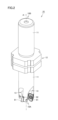
- FIG. 1 is a schematic perspective view showing the structure of a milling tool.
- FIG. 2 is a schematic perspective view showing the structure of the shaft portion.
- FIG. 3 is a schematic perspective view showing the structure of the shaft portion seen from a different perspective from FIG. 2.
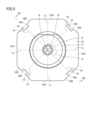
- FIG. 4 is a schematic plan view showing the structure of the shaft section as viewed from the first end side in the direction of the rotation axis.
- FIG. 5 is a schematic plan view showing the structure of the shaft portion as viewed from the second end side in the direction of the rotation axis.
- FIG. 6 is a schematic plan view showing the structure of the shaft section as viewed in a direction perpendicular to the axial direction.
- FIG. 7 is a schematic cross-sectional view showing a cross section taken along line VII-VII in FIG.
- FIG. 8 is a schematic cross-sectional view showing the structure near the sensor section.
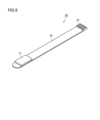
- FIG. 9 is a schematic perspective view showing the structure of the strain sensor component.
- FIG. 10 is a schematic plan view showing the structure of the substrate module.
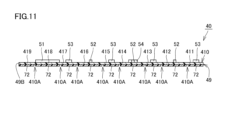
- FIG. 11 is a schematic cross-sectional view showing a cross section taken along line segment XI-XI in FIG.
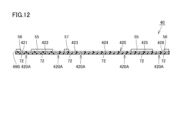
- FIG. 12 is a schematic cross-sectional view showing a cross section taken along line segment XII-XII in FIG.
- FIG. 13 is a schematic plan view showing a state in which the board module is attached.
- FIG. 14 is a schematic cross-sectional view showing a cross section taken along line segment XIV-XIV in FIG.
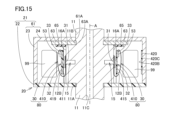
- FIG. 15 is a schematic cross-sectional view showing a cross section taken along line segment XV-XV in FIG.
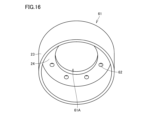
- FIG. 16 is a schematic perspective view showing the structure of the case body.
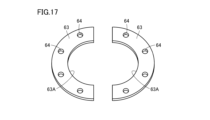
- FIG. 17 is a schematic perspective view showing the structure of the first fixing member.
- FIG. 18 is a schematic perspective view showing the structure of the second fixing member.
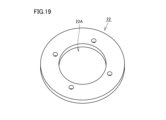
- FIG. 19 is a schematic perspective view showing the structure of the lid (bottom wall portion).
- FIG. 20 is a schematic perspective view showing the structure of a milling tool according to the second embodiment.
- FIG. 21 is a schematic perspective view showing the structure of a milling tool in Embodiment 3.
- FIG. 22 is a schematic perspective view showing the structure of a milling tool in Embodiment 4.
- FIG. 23 is a schematic perspective view showing an exploded state of the milling tool according to the fourth embodiment.
- FIG. 24 is a schematic diagram showing the configuration of a milling tool system in Embodiment 5.
- An object of the present disclosure is to provide a milling tool and a sensor device that can efficiently install parts for transmitting a signal containing information obtained by a sensor to a receiver installed externally. There is one.
- the milling tool and the sensor device are capable of efficiently installing a component for transmitting a signal containing information obtained by the sensor to a receiver installed outside.
- a sensor device can be provided.
- the milling tool of the present disclosure includes a shaft portion extending from a first end to a second end along a rotation axis, a sensor portion disposed on the shaft portion, and a sensor portion disposed around the rotation axis of the shaft portion.
- This is a milling tool equipped with a cutting edge.
- the sensor section includes a sensor module including a battery, a first sensor that detects a first physical quantity of the shaft section, and a substrate electrically connected to the first sensor.
- the substrate has a first main surface and a second main surface, a first portion disposed such that the first main surface faces the outer peripheral surface of the shaft portion, and a third main surface and a fourth main surface. , a second portion disposed on the outer peripheral side of the first portion in the radial direction of the shaft portion so that the third principal surface faces the shaft portion side, and electrically connected to the first portion.
- the substrate included in the sensor module includes a first portion and a second portion disposed on the outer peripheral side of the first portion. This ensures a sufficient area of the board for installing a large number of components for transmitting signals including information obtained by the sensor to the outside. As a result, according to the cutting tool of the present disclosure, it is possible to efficiently install a component for transmitting a signal including information obtained by the sensor to a receiver installed outside.
- the sensor module may further include a battery socket electrically connected to the battery and disposed on the third main surface.
- the battery socket is an important component for supplying power from the battery to the first sensor and components installed on the board.
- connection direction of the battery socket may be along the rotation axis.
- the battery may be arranged between the first part and the second part in the radial direction of the shaft part.
- first portion and the second portion may be electrically connected by a first connecting portion.
- the first connection portion may be a flexible substrate. This configuration facilitates installation of the substrate including the first portion and the second portion.
- the first portion, the second portion, and the first connecting portion may include an integrated flexible substrate. This configuration allows the substrate to be easily deformed. As a result, installation of the substrate including the first portion and the second portion becomes easier.
- the sensor section may further include a case that houses the sensor module.
- the case may include a cylindrical side wall that surrounds the shaft and extends in a direction along the rotation axis.
- the first portion may be arranged to extend in the circumferential direction of the shaft portion along the outer peripheral surface of the shaft portion.
- the second portion may be arranged to extend in the circumferential direction of the side wall along the inner circumferential surface of the side wall.
- the sensor module may further include an antenna that transmits a signal including information on the first physical quantity detected by the first sensor to the outside.
- the substrate may further include a third portion electrically connected to the first portion by a second connection portion.
- the antenna may be located in the third portion. This configuration allows the antenna to be easily placed.
- the third portion may be arranged between the first portion and the second portion in the radial direction of the shaft portion.
- the sensor module may further include a power switch that switches the state of power supply from the battery.
- the substrate may further include a fourth portion electrically connected to the second portion by a third connection portion.
- a power switch may be located in the fourth part. With this configuration, the power switch can be easily arranged.
- the fourth portion may be arranged between the first portion and the second portion in the radial direction of the shaft portion.
- the sensor module may include a plurality of batteries.
- the plurality of batteries may be arranged at equal intervals in the circumferential direction of the shaft portion.
- the sensor module may include a plurality of batteries.
- the plurality of batteries may be arranged symmetrically with respect to the rotation axis when viewed in the rotation axis direction.
- the sensor module may further include an AD converter that converts an analog signal containing the first physical quantity detected by the first sensor into a digital signal.
- the AD converter may be placed on the second main surface.
- a sensor device includes a shaft portion extending from a first end to a second end along a rotation axis, and a sensor portion disposed on the shaft portion.
- This sensor device can constitute a sensor section of a milling tool that cuts a workpiece by rotating around a rotation axis.
- This sensor device includes a sensor module including a battery, a first sensor that detects a first physical quantity of the shaft portion, and a substrate electrically connected to the first sensor.
- the substrate has a first main surface and a second main surface, a first portion disposed such that the first main surface faces the outer peripheral surface of the shaft portion, and a third main surface and a fourth main surface. , a second portion disposed on the outer peripheral side of the first portion in the radial direction of the shaft portion so that the third principal surface faces the shaft portion side, and electrically connected to the first portion.
- a sensor device includes a shaft region extending along a rotation axis, a sensor section disposed in the shaft region, and an end portion of the shaft region in a direction along the rotation axis, and includes a cutting edge.
- a connection part to which a processing unit having a processing unit can be connected is provided.
- the sensor section includes a sensor module including a battery, a first sensor that detects a first physical quantity in the shaft region, and a substrate electrically connected to the first sensor.
- the substrate has a first main surface and a second main surface, a first portion disposed such that the first main surface faces the outer peripheral surface of the shaft region, and a third main surface and a fourth main surface. , a second portion disposed on the outer peripheral side of the first portion in the radial direction of the shaft region so that the third main surface faces the shaft region side, and electrically connected to the first portion.
- the substrate included in the sensor module includes a first portion and a second portion disposed on the outer peripheral side of the first portion. This ensures a sufficient area of the board for installing a large number of components for transmitting signals including information obtained by the sensor to the outside. As a result, according to the sensor device of the present disclosure, components for transmitting a signal including information obtained by the sensor to a receiver installed outside can be efficiently installed.
- FIG. 1 is a schematic perspective view showing the structure of a milling tool.
- the milling tool 1 in this embodiment includes a shaft section 10 and a sensor section 20.
- the shaft portion 10 extends along the rotation axis A from the first end 10A to the second end 10B.
- the sensor section 20 is arranged so as to surround a portion of the shaft section 10 in the longitudinal direction.
- a plurality (here, four) of recesses 13 are formed at equal intervals in the circumferential direction and are open at the first end 10A and the outer circumferential surface.
- a cutting tip 91 serving as a cutting edge is attached to the wall surface defining the recess 13.
- the cutting tip 91 is arranged around the rotation axis A of the shaft portion 10.
- the milling tool 1 is a milling tool that cuts a workpiece by rotating around the rotation axis A of the shaft portion 10.
- FIG. 2 is a schematic perspective view showing the structure of the shaft section viewed from the second end 10B side.
- FIG. 3 is a schematic perspective view showing the structure of the shaft section viewed from the first end 10A side.
- FIG. 4 is a schematic plan view showing the structure of the shaft section as viewed from the first end side in the direction of the rotation axis.
- FIG. 5 is a schematic plan view showing the structure of the shaft portion as viewed from the second end side in the direction of the rotation axis.
- FIG. 6 is a schematic plan view showing the structure of the shaft section as viewed in a direction perpendicular to the axial direction.
- FIG. 7 is a schematic cross-sectional view showing a cross section taken along line VII-VII in FIG. The structure of the shaft portion 10 will be described with reference to FIGS. 2 to 7.
- the shaft portion 10 includes a main body portion 11 and an enlarged diameter portion 12 as a first region.
- the main body portion 11 has a cylindrical shape.
- the rotation axis A coincides with the central axis of the main body portion 11 .
- the enlarged diameter portion 12 is a portion having a larger diameter than the main body portion 11.
- the position of the expanded diameter part 12 in the longitudinal direction of the main body part 11 is not particularly limited, in this embodiment, it is arranged at the central part in the longitudinal direction of the main body part 11.
- the enlarged diameter portion 12 is arranged in a region of the shaft portion 10 surrounded by the sensor portion 20 .
- the cutting tip 91 is attached to the wall defining the recess 13 of the shaft portion 10, as described above.
- the cutting tip 91 is fixed to the shaft portion 10 by inserting a screw 92 into a screw hole formed in the cutting tip 91 and tightening it.
- the enlarged diameter portion 12 has an octagonal prism shape.
- the enlarged diameter portion 12 has an octagonal shape when viewed in the direction along the rotation axis A. More specifically, the enlarged diameter portion 12 has an octagonal shape in a cross section perpendicular to the rotation axis A, in which four right-angled isosceles triangles of the same shape are removed from each of the four corners of a square. ing.
- the rotation axis A passes through the center of gravity of this octagon.
- This octagonal shape is the same in the direction along the rotation axis A.
- the central axis of the main body portion 11 and the central axis of the enlarged diameter portion 12 coincide.
- the central axis of the enlarged diameter portion 12 means a straight line passing through the center of gravity of the octagon.
- the octagon when viewed in the direction along the rotation axis A, has an outer peripheral surface 12A corresponding to the long sides arranged alternately, and an outer peripheral surface 12A corresponding to the short sides shorter than the long sides. It is constituted by the surface 12B.
- the angles ⁇ formed by the perpendicular lines L A and L B passing through the rotation axis A of the outer circumferential surfaces 12A and 12B of the enlarged diameter portion 12 corresponding to each side of the octagon that are adjacent in the circumferential direction are equal to each other. Specifically, the angle ⁇ is 45°.
- the octagonal shape is not limited to the above shape, and the lengths of the outer circumferential surface 12A and the outer circumferential surface 12B may be the same when viewed in the direction along the rotation axis A.
- a first recess 16 extending in a direction along the rotation axis A is formed in each outer peripheral surface 12B.
- a bottom surface 16A defining the first recess 16 is a flat surface.
- the first recess 16 is arranged at a position intersecting the perpendicular line LB.
- the first recess 16 penetrates the outer peripheral surface 12B in the direction along the rotation axis A.
- a second recess 15 extending in the circumferential direction of the enlarged diameter portion 12 is formed in the outer circumferential surfaces 12A, 12B of the enlarged diameter portion 12.
- the second recess 15 is formed to overlap the first recess 16.
- the second recess 15 intersects (orthogonally) with the first recess 16.
- the second recess 15 is formed over the entire circumference of the outer peripheral surfaces 12A, 12B of the enlarged diameter portion 12. That is, the second recess 15 is formed in an annular shape.
- the depth d2 of the second recess 15 is greater than the depth d1 of the first recess 16.
- a first small-diameter portion 11A having a smaller diameter than other portions is formed at the boundary between the main body portion 11 and the enlarged-diameter portion 12 on the first end 10A side.
- a second small-diameter portion 11B having a smaller diameter than other portions is formed at the boundary between the main body portion 11 and the enlarged-diameter portion 12 on the second end 10B side.
- the shaft portion 10 is formed with a through hole 10C that penetrates the shaft portion 10 in a direction along the rotation axis A.
- the through hole 10C extends to include the rotation axis A.
- sensor section 20 includes a sensor module 80 and a case 21 that accommodates sensor module 80.
- the sensor module 80 includes a plurality of strain sensors 31 as a plurality of first sensors, a substrate 49 electrically connected to the strain sensors 31, and a wireless communication section 51 electrically connected to the substrate 49 (see FIG. 10). ).
- the strain sensor 31 detects strain as a first physical quantity of the shaft portion 10 .
- Wireless communication section 51 includes an antenna 51A.
- the antenna 51A of the wireless communication unit 51 transmits a signal including information on the strain detected by the strain sensor 31 to the outside.
- strain sensor 31 constitutes strain sensor component 30.
- the strain sensor component 30 includes a strain sensor 31 and a wiring 32 that is connected to the strain sensor 31 and has a connector 33 at its tip.
- the wiring 32 has a band-like shape. Strain sensor 31 is placed near one end of wiring 32 .
- a connector 33 is arranged at the other end of the wiring 32.
- the substrate 49 constitutes the substrate module 40.
- the board 49 includes a board main body made of an insulator such as resin, and a circuit pattern (not shown) made of a conductive material such as copper formed on the surface of the board main body.
- the board module 40 includes a board 49, a wireless communication section 51, an acceleration sensor 52 as a second sensor, a socket 53, an AD converter 54, a power supply circuit 55, and a battery socket 56. , a charging connector 57 , and a power switch 58 .
- the wireless communication unit 51, the acceleration sensor 52, the socket 53, the AD converter 54, the power supply circuit 55, the battery socket 56, the charging connector 57, and the power switch 58 are arranged on the board 49, and the circuit pattern of the board 49 ) is electrically connected to the
- the acceleration sensor 52 detects acceleration of the shaft portion 10 as a second physical quantity.
- a plurality of acceleration sensors 52 are arranged on the substrate 49.
- the wireless communication unit 51 is electrically connected to the acceleration sensor 52 via the board 49.
- the antenna 51A of the wireless communication section 51 transmits a signal including information on the acceleration of the shaft section 10 detected by the acceleration sensor 52 to the outside.
- the substrate 49 includes a first portion 410, a second portion 420, a first connection portion 430, a third portion 440, a second connection portion 450, a fourth portion 460, and a third connection portion 470. .
- the first portion 410 and the second portion 420 each have a band-like shape.
- the first part 410 includes a first part first area 411, a first part second area 412, a first part third area 413, and a first part fourth area 414. , a first part fifth area 415, a first part sixth area 416, a first part seventh area 417, a first part eighth area 418, and a first part ninth area 419.
- the areas are arranged in this order.
- a bendable portion 410A is arranged between each of these adjacent areas.
- the first portion 410 includes a main body 49B that is a flexible substrate (a flexible substrate), and one main surface of the main body 49B (the side opposite to the side on which the circuit pattern is formed).
- the reinforcing plate 72 has a Young's modulus larger than that of the main body portion 49B.
- the reinforcing plate 72 has a first section 411, a second section 412, a third section 413, a fourth section 414, a fifth section 415, and a sixth section 415. They are arranged in areas corresponding to the area 416, the seventh area 417 of the first part, the eighth area 418 of the first part, and the ninth area 419 of the first part.
- the reinforcing plate 72 is not arranged in the area corresponding to the bendable portion 410A. As a result, the bendable portion 410A is bendable.
- each of the first section 411 and the ninth section 419 includes one or more (in this case, plural, specific) penetrating the first section 410 in the thickness direction.
- two through holes 59 are formed.
- the two through holes 59 are arranged side by side in a direction intersecting (orthogonal to) the longitudinal direction of the first portion 410, that is, in the width direction of the first portion 410.
- the sockets 53 are arranged on the first section 411, the third section 413, the fifth section 415, and the seventh section 417, respectively.
- the socket 53 is arranged at the end of the first portion 410 in the width direction.
- Acceleration sensors 52 are arranged above the first section second section 412, the first section fourth section 414, and the first section sixth section 416, respectively.
- An AD converter 54 is arranged on the first section fourth section 414.
- the acceleration sensor 52 and the AD converter 54 are arranged side by side in the width direction of the first section 410.
- the second portion 420 includes a second portion first area 421, a second portion second area 422, a second portion third area 423, and a second portion fourth area 424. , a second section fifth section 425, and a second section sixth section 426, and these sections are arranged in this order.
- a bendable portion 420A is arranged between each of these adjacent areas.
- the second portion 420 is installed on a main body 49B, which is a flexible substrate, and on one main surface (the main surface opposite to the side on which the circuit pattern is formed) of the main body 49B,
- the reinforcing plate 72 has a larger Young's modulus than the main body portion 49B.
- the reinforcing plate 72 includes a second section first section 421, a second section second section 422, a second section third section 423, a second section fourth section 424, a second section fifth section 425, and a second section sixth section. They are placed in each of the areas corresponding to the area 426.
- the reinforcing plate 72 is not arranged in the area corresponding to the bendable portion 420A. As a result, the bendable portion 420A is bendable.
- a through hole 59 is formed in each of the second section first section 421 and the second section sixth section 426, which penetrates the second section 420 in the thickness direction.
- Battery sockets 56 are arranged on the second section first section 421 and the second section sixth section 426, respectively.
- the battery socket 56 is arranged at the center of the second portion 420 in the width direction.
- the connection direction of the battery socket 56 (the connection direction ⁇ of the connector connected to the battery socket 56) is a direction along the width direction of the second portion 420.
- the connection direction ⁇ of the battery socket 56 becomes a direction along the rotation axis A.
- a power supply circuit 55 is arranged on each of the second section second section 422 and the second section fifth section 425.
- a charging connector 57 is arranged on the second section third section 423.
- the first section sixth section 416 and the second section fourth section 424 are physically and electrically connected by a first connecting section 430 having a band-like shape.
- the first connecting portion 430, the main body portion 49B of the first portion 410, and the main body portion 49B of the second portion 420 are constructed from an integrated flexible substrate. That is, the first portion 410 , the second portion 420 , and the first connection portion 430 include an integral flexible substrate extending over the entire first portion 410 , the second portion 420 , and the first connection portion 430 .
- the first section eighth section 418 and the third section 440 are physically and electrically connected by a second connection section 450.
- a wireless communication unit 51 including an antenna 51A is arranged on the third portion 440.
- the second section third section 423 and the fourth section 460 are physically and electrically connected by a third connection section 470.
- a power switch 58 is arranged on the fourth portion 460.
- the board 49 is an integrated flexible board, with reinforcing plates installed in the parts where rigidity is required, and bendable in parts where the reinforcing plates are not installed.
- the length of the first portion ninth section 419 corresponds to the outer circumferential surface 12B, which is the short side of the octagon when the enlarged diameter portion 12 is viewed in the direction along the rotation axis A.
- the lengths of the first section second section 412, the first section fourth section 414, the first section sixth section 416, and the first section eighth section 418 in the longitudinal direction of the first section 410 are such that the enlarged diameter section 12 rotates.
- the length corresponds to the outer circumferential surface 12A, which is the long side of the octagon when viewed in the direction along the axis A.
- the strain sensor component 30 is arranged so that the strain sensor 31 straddles the second recess 15 and is housed in the first recess 16 (see FIGS. 2, 4, 8, etc.). That is, the strain sensor 31 is arranged to detect strain in the direction along the rotation axis A.
- the strain sensor component 30 is installed on each of the four outer peripheral surfaces 12B. As a result, when viewed in the direction along the rotation axis A, the strain sensor 31 detects that the perpendicular lines L and B passing through the rotation axis A make a 90° angle with each other on the outer peripheral surface of the enlarged diameter portion 12 corresponding to each side of the octagon. It is arranged on the entire outer circumferential surface 12B (the outer circumferential surface corresponding to the short side) of the enlarged diameter portion 12.
- the first portion 410 of the substrate 49 includes a first main surface 410B and a second main surface 410C located on the opposite side in the thickness direction from the first main surface 410B.
- the first portion 410 is arranged such that the first main surface 410B faces the outer peripheral surface of the shaft portion 10.
- a wireless communication unit 51, an acceleration sensor 52, a socket 53, an AD converter 54, and the like are mounted on the second main surface 410C.
- the first portion 410 is wound around the enlarged diameter portion 12 such that the first main surface 410B contacts the outer circumferential surfaces 12A, 12B of the enlarged diameter portion 12.
- the first section 411 of the first section, the third section 413 of the first section, the fifth section 415 of the first section, the seventh section 417 of the first section, and the ninth section 419 of the first section are arranged on the outer peripheral surface 12B.
- a first section second section 412, a first section fourth section 414, a first section sixth section 416, and a first section eighth section 418 are arranged on the outer peripheral surface 12A.
- the first portion 410 is bent at the bendable portion 410A.
- the first section 411 of the first portion and the ninth section 419 of the first section overlap so that the through holes 59 formed therein are aligned.
- a fixing member (not shown) is installed to pass through this through hole 59, thereby fixing the first portion 410 to the shaft portion 10.
- the first portion 410 when viewed in the direction along the rotation axis A, the first portion 410 is arranged along the outer circumferential surfaces 12A, 12B of the enlarged diameter portion 12.
- the socket 53 is arranged on the first portion 410 located on the outer peripheral surface 12B.
- a connector 33 located at the end of the wiring 32 connected to the strain sensor 31 is connected to the socket 53.
- the first portion 410 and the strain sensor 31 are electrically connected.
- the wiring 32 straddles the first portion 410 in the width direction (direction along the rotation axis A).
- the wiring 32 is curved in an arch shape. That is, the wiring 32 connects the strain sensor 31 and the socket 53 with some slack.
- the acceleration sensor 52 is constructed of an enlarged diameter portion where perpendicular lines L A passing through the rotation axis A form 90° with each other, among the outer peripheral surface of the enlarged diameter portion 12 corresponding to each side of the octagon when viewed in a direction along the rotation axis A. 12 (outer peripheral surface corresponding to the long side).
- the strain sensor 31 and the acceleration sensor 52 are arranged on the outer peripheral surfaces 12A and 12B of the enlarged diameter portion 12 corresponding to different sides of the octagon.
- the second portion 420 of the substrate 49 includes a third main surface 420B and a fourth main surface 420C located on the opposite side in the thickness direction from the third main surface 420B.
- the second portion 420 is arranged on the outer peripheral side of the first portion 410 in the radial direction of the shaft portion 10 so that the third main surface 420B faces the shaft portion 10 side.
- a first connecting portion 430 that electrically connects the first portion 410 and the second portion 420 is arranged between the first portion 410 and the second portion 420 in the radial direction of the shaft portion 10.
- the case 21 includes a cylindrical side wall portion 23 that surrounds the shaft portion 10 and extends in the direction along the rotation axis A, a bottom wall portion 22 that closes a first opening of the side wall portion 23 in the direction along the rotation axis A, and a rotational
- the upper wall portion 24 closes the second opening of the side wall portion located on the opposite side of the first opening in the direction along the axis A.
- the bottom wall portion 22 is made of resin.
- the first portion 410 is arranged to extend in the circumferential direction of the shaft portion 10 along the outer circumferential surface of the shaft portion 10 .
- the second portion 420 is arranged so as to extend in the circumferential direction of the side wall portion 23 along the inner peripheral surface of the side wall portion 23 .
- the second portion 420 is bent at the bendable portion 420A.
- a power supply circuit 55, a battery socket 56, a charging connector 57, and the like are arranged on the third main surface 420B of the second portion 420.
- the connection direction ⁇ of the battery socket 56 is along the rotation axis A.
- sensor module 80 includes a battery 99.
- sensor module 80 includes a plurality of (specifically two) batteries 99.
- the battery 99 is arranged between the first portion 410 and the second portion 420 in the radial direction of the shaft portion 10 .
- the plurality of batteries 99 are arranged at equal intervals in the circumferential direction of the shaft portion 10.
- the plurality of batteries 99 are arranged symmetrically with respect to the rotation axis A when viewed in a direction along the rotation axis A.
- the battery 99 is a rechargeable battery, that is, a secondary battery.
- the battery 99 is connected to the wireless communication unit 51 on the first part 410 , which is connected to the second part 420 by the first connection part 430 via the battery socket 56 and the power supply circuit 55 arranged on the second part 420 . Power is supplied to the acceleration sensor 52, socket 53, AD converter 54, and the like. The battery 99 is charged via the charging connector 57 located on the second portion 420. Note that the battery 99 may be a primary battery.
- the third portion 440 serving as a base member on which the wireless communication unit 51 including the antenna 51A is mounted is arranged between the first portion 410 and the second portion 420 in the radial direction of the shaft portion 10.
- the installation state of the wireless communication section 51 including the antenna 51A is adjusted.
- wireless communication unit 51 including antenna 51A is mounted on mounting surface 440A as the first surface of third portion 440.
- the base member is a substrate.
- the base member of the present disclosure is not limited to a substrate, and support members having various shapes having a first surface (mounting surface) on which the antenna 51A (wireless communication unit 51 including the antenna 51A) is mounted may be employed as the base member. can.
- Antenna 51A is a chip antenna or a pattern antenna.
- the antenna 51A transmits to the outside information on strain, which is a first physical quantity detected by the strain sensor 31 as a first sensor, and information on acceleration, which is a second physical quantity detected by an acceleration sensor 52 as a second sensor. It is a transmitting antenna that transmits data.
- the first direction ⁇ which is a direction perpendicular to the mounting surface 440A, is inclined with respect to the plane ⁇ perpendicular to the rotation axis A and the rotation axis A.
- the angle between the plane ⁇ perpendicular to the rotation axis A and the first direction ⁇ is preferably 5° or more and 85° or less, 15° or more and 75° or less, and more preferably 20° or more and 70° or less.
- the angle between the plane ⁇ perpendicular to the rotation axis A and the first direction ⁇ can be, for example, 30° or more and 45° or less.
- the fourth portion 460 on which the power switch 58 is mounted is arranged between the first portion 410 and the second portion 420 in the radial direction of the shaft portion 10. By bending the third connecting portion 470, the installation state of the power switch 58 can be adjusted.
- the power supply switch 58 can switch the power supply state (on or off) from the battery 99.
- case 21 includes a case body 61, a first fixing member 63, a second fixing member 65, and a lid 22.
- the case body 61 includes a disk-shaped upper wall portion 24 having a through hole 61A in the center, and a side wall portion 23 that rises from the outer peripheral surface of the upper wall portion 24 and has a cylindrical shape.
- a plurality of screw holes 62 are formed at equal intervals in the circumferential direction, passing through the upper wall portion 24 in the thickness direction.
- the material constituting the case body 61 is, for example, metal. Examples of metals that can be used include aluminum alloys and iron alloys (steel such as stainless steel).
- the first fixing member 63 has an annular flat plate shape divided into two parts.
- the first fixing member 63 has a plurality of screw holes 64 in the circumferential direction so as to correspond to the screw holes 62 in the upper wall portion 24 of the case body 61 (here, the first fixing member 63 is divided into two parts). 8 in total) are formed at equal intervals.
- the inner circumferential surface 63A of the first fixing member 63 has a shape corresponding to the second small diameter portion 11B of the shaft portion 10. When the two first fixing members 63 are combined to form an annular shape, the diameter of the inner circumferential surface 63A is the same as or slightly larger than the diameter of the first small diameter portion 11A.
- the material constituting the first fixing member 63 is, for example, metal. Examples of metals that can be used include aluminum alloys and iron alloys (steel such as stainless steel).
- the second fixing member 65 is a part having a flat circular arc shape.
- case 21 includes two second fixing members 65.
- the inner peripheral surface 65A of each second fixing member 65 has a shape corresponding to a part of the planar shape of the outer peripheral surface of the enlarged diameter portion 12, that is, a shape corresponding to a part of an octagon.
- the second fixing member 65 has a plurality of screw holes 66 (in this case, each second fixing member (two for each member 65).
- the material constituting the second fixing member 65 is, for example, resin.
- the lid (bottom wall portion) 22 has a disc-like shape with a through hole 22A in the center.
- the material constituting the lid 22 is, for example, resin.
- the case body 61 is arranged so that the body portion 11 of the shaft portion 10 passes through the through hole 61A of the upper wall portion 24 of the case body 61.
- the first fixing member 63 is fitted into the second small diameter portion 11B so that the inner circumferential surface 63A contacts the wall surface of the second small diameter portion 11B of the main body portion 11 while being disposed in contact with the upper wall portion 24. It will be done.
- the second fixing member 65 is placed in contact with the first fixing member 63 and is placed such that its inner circumferential surface 65A contacts the outer circumferential surfaces 12A and 12B of the enlarged diameter portion 12.
- the case body 61, the first fixing member 63 and The second fixing members 65 are fixed to each other.
- the inner diameter of the first fixing member 63 corresponds to the outer diameter of the second small diameter portion 11B
- the central axis of the case body 61 and the rotation axis A coincide.
- the inner peripheral surface 65A of the second fixing member 65 has a shape corresponding to a part of the planar shape of the outer peripheral surface of the enlarged diameter portion 12 (a shape corresponding to a part of the octagon)
- the case body 61 is prevented from rotating in the circumferential direction relative to the shaft portion 10.
- the lid (bottom wall portion) 22 is fixed to the enlarged diameter portion 12 by, for example, screws, while being in contact with the end surface of the side wall portion 23 and the end surface of the enlarged diameter portion 12 .
- the case 21 is fixed to the shaft portion 10 with the sensor module 80 housed therein.
- the milling tool 1 rotates around the rotation axis A.
- the workpiece is then machined by the cutting tip 91 coming into contact with the workpiece.
- the strain and acceleration of the shaft portion 10 are detected by the strain sensor 31 and the acceleration sensor 52, respectively.
- the strain and acceleration information which are analog signals, are converted into digital signals by the AD converter 54 and then transmitted to the outside by the antenna 51A of the wireless communication unit 51.
- the wireless communication unit 51 and the AD converter 54 operate with power supplied from the battery 99 via the battery socket 56 and the power supply circuit 55. Since the lid (bottom wall portion) 22 of the case 21 is made of resin, the wireless communication unit 51 can transmit signals to the outside through the lid (bottom wall portion) 22. This signal is received and analyzed by a receiver installed externally, so that the state of the shaft portion 10 can be grasped.
- the first direction ⁇ which is a direction perpendicular to the mounting surface 440A of the third portion 440 on which the wireless communication unit 51 including the antenna 51A, which is a transmitting antenna, is mounted is the rotation axis. It is inclined with respect to both the plane ⁇ perpendicular to A and the axis of rotation A. Thereby, it is possible to avoid the occurrence of a timing when the electric field strength of polarized waves in a direction that is easy to receive by the receiving antenna becomes extremely weak. As a result, the milling tool 1 of the present embodiment suppresses the loss of information obtained by the strain sensor 31 and the like, while making it easy to receive a signal containing the information in an externally installed receiver. It is a turning tool.
- the milling tool 1 of this embodiment employs a bottom wall portion 22 made of resin.
- the signal from the antenna can be easily transmitted to the outside while suppressing a decrease in the rigidity of the case 21.
- the top wall portion 24 may be made of resin, or only a portion of the bottom wall portion 22 and the top wall portion 24 may be made of resin.
- the battery socket 56 which is a component disposed on the second portion 420 disposed on the outer peripheral side of the first portion 410, has a main body facing toward the shaft portion 10. It is arranged on the third main surface 420B which is a surface. As a result, the battery socket 56 is prevented from falling off due to centrifugal force. Furthermore, the power supply circuit and the charging connector 57, which are components arranged on the second portion 420, are also arranged on the third main surface 420B, thereby preventing them from falling off due to centrifugal force.
- the battery 99 is arranged between the first portion 410 and the second portion 420 in the radial direction of the shaft portion 10. In this way, by bringing the battery with a large mass as close to the rotation axis A as possible, the centrifugal force that the battery 99 receives is suppressed.
- the first connecting portion 430 is a flexible substrate. In this way, by connecting the first portion 410 and the second portion 420 with a flexible substrate, it is easy to properly install the first portion 410 and the second portion 420.
- the first portion 410, the second portion 420, and the first connecting portion 430 include an integrated flexible substrate. More specifically, the first connecting portion 430, the main body portion 49B of the first portion 410, and the main body portion 49B of the second portion 420 are configured from an integrated flexible substrate.
- a reinforcing plate 72 is installed in a portion of the integrated flexible substrate that requires rigidity, and the portion where the reinforcing plate 72 is not installed can be bent. As a result, a high degree of freedom in designing the board module 40 is ensured.
- connection direction ⁇ of the battery socket 56 is a direction along the rotation axis A. This prevents the connector from falling off from the battery socket 56 due to the centrifugal force accompanying the rotation of the milling tool 1.
- the first portion 410 is arranged so as to extend in the circumferential direction of the shaft portion 10 along the outer circumferential surface of the shaft portion 10.
- the second portion 420 is arranged to extend in the circumferential direction of the side wall 23 along the inner peripheral surface of the side wall 23 . This makes it easy to fix the first portion 410 and the second portion 420.
- the wireless communication unit 51 including the antenna 51A is arranged in the third part 440 that is electrically connected to the first part 410 and the second connecting part 450. This increases the degree of freedom in installing the wireless communication section 51 including the antenna 51A.
- the third portion 440 is arranged between the first portion 410 and the second portion 420 in the radial direction of the shaft portion 10. This further increases the degree of freedom in installing the wireless communication section 51 including the antenna 51A.
- the power switch 58 is arranged in the fourth portion 460 that is electrically connected to the second portion 420 by the third connecting portion 470. This increases the degree of freedom in installing the power switch 58.
- the fourth portion 460 is arranged between the first portion 410 and the second portion 420 in the radial direction of the shaft portion 10. This further increases the degree of freedom in installing the power switch 58.
- the plurality of batteries 99 are arranged at equal intervals in the circumferential direction of the shaft portion 10. By arranging the batteries 99 having a large mass in this manner, stable rotation of the milling tool 1 can be achieved.
- the plurality of batteries 99 are arranged symmetrically with respect to the rotation axis A when viewed in the direction of the rotation axis A.
- the AD converter 54 is arranged on the second main surface 410C.
- the AD converter 54 which has a relatively large mass, on the second main surface 410C close to the rotation axis A, it is possible to suppress the AD converter 54 from falling off due to centrifugal force.
- the strain sensor 31 and the acceleration sensor 52 are employed as the first sensor and the second sensor, respectively.
- the acceleration sensor 52 as the second sensor may be omitted.
- the strain sensor 31 may be omitted and only the acceleration sensor 52 may be employed.
- the first sensor may be an acceleration sensor.
- a sensor that detects a physical quantity other than strain and acceleration for example, a temperature sensor may be employed instead of one or both of the strain sensor 31 and the acceleration sensor 52, or may be employed in addition to these. good.
- an end mill was described as an example of the milling tool of the present disclosure, but the milling tool of the present disclosure is not limited to this.
- the milling tool of the present disclosure may be, for example, a drill, milling cutter, boring, reamer, tap, etc.
- the planar shape of the enlarged diameter portion may be a 4n-gon (n is a natural number of 2 or more), and may be, for example, a dodecagon, a hexagon, or an icosagon.
- the strain sensor 31 is configured to operate on an enlarged diameter portion whose perpendicular lines passing through the rotation axis A make an angle of 90° to each other among the outer circumferential surfaces 12A and 12B of the enlarged diameter portion 12 corresponding to each side of the octagon.
- the strain sensors are arranged on all (four surfaces) of the twelve outer circumferential surfaces 12B, it is sufficient that the strain sensors are arranged on at least two surfaces.
- the rotation axis is determined by the relationship between the first outer circumferential surface and the first outer circumferential surface of each surface of the outer circumferential surface of the first region (expanded diameter portion) corresponding to each side of the 4n-gon.
- a total of three outer circumferential surfaces constitute a set of outer circumferential surfaces, and a strain sensor is arranged on each of the set of outer circumferential surfaces.
- strain sensors By installing strain sensors on the first outer circumferential surface and the second outer circumferential surface where perpendicular lines passing through the rotation axis make an angle of 90 degrees to each other, information regarding the magnitude and direction of the load acting in a plane perpendicular to the rotation axis can be obtained. Obtainable. Furthermore, by installing a strain sensor on the third outer peripheral surface, the influence of loads parallel to the rotation axis can be removed, and information regarding the magnitude and direction of loads acting in a plane perpendicular to the rotation axis can be obtained. can be obtained accurately. There may be a plurality of the above-mentioned set of outer circumferential surfaces.
- strain sensors are arranged on each set of outer circumferential surfaces including two outer circumferential surfaces or three outer circumferential surfaces. That is, strain sensors are arranged on a maximum of six outer peripheral surfaces. There is no limit to the angle between the two sets of outer peripheral surfaces.
- first fixing member 63 and the second fixing member 65 are separate bodies.
- first fixing member 63 and the second fixing member 65 may be integrated.
- first fixing member 63 and the second fixing member 65 may be an integral metal member.
- the method of attaching the sensor section 20 is not limited to this.
- the sensor portion 20 may be attached to the shaft portion 10 by other methods, such as shrink fitting.
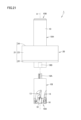
- FIG. 20 is a schematic perspective view showing the structure of a milling tool according to the second embodiment.
- a milling tool 1 according to the present embodiment basically has the same structure as the milling tool 1 according to the first embodiment described based on FIGS. It works as well as produces similar effects.
- the milling tool 1 of the second embodiment differs from that of the first embodiment mainly in the structure of the shaft portion 10.
- the shaft portion 10 of this embodiment has a radial direction (direction perpendicular to the rotation axis A) in a region closer to the second end 10B than the sensor portion 20. It includes a first annular protrusion 10D and a second annular protrusion 10E.
- the second protrusion 10E is arranged on the second end 10B side when viewed from the first protrusion 10D.
- a region between the first protrusion 10D and the second protrusion 10E of the shaft portion 10 is a groove 10G.
- the region opposite to the first protrusion 10D when viewed from the second protrusion 10E is a tapered portion 10F whose diameter decreases as it approaches the second end. That is, the shaft portion 10 of this embodiment includes a tapered portion 10F having a truncated conical shape.
- the tapered portion 10F is inserted into the recess formed in the main shaft of the machine tool, so that the milling tool 1 is held on the main shaft of the machine tool.
- the shapes of the tapered portion 10F, the first protruding portion 10D, and the second protruding portion 10E can be appropriately selected according to the tool holding mechanism provided in the main shaft of the machine tool.
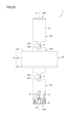
- FIG. 21 is a schematic perspective view showing the structure of a milling tool in Embodiment 3.
- a milling tool 1 according to the present embodiment basically has the same structure as the milling tool 1 according to the first embodiment described based on FIGS. It works as well as produces similar effects.
- the milling tool 1 of the third embodiment is different from the first embodiment in that the portion including the sensor section 20 as the sensor device of the present disclosure and the portion including the first end portion 10A are separable. The case is different.
- a tip region 10I as a machining unit including the first end portion 10A is smaller than the region surrounded by the sensor portion 20. It is possible to separate the portion near the end 10A.
- the portion of the shaft portion 10 other than the distal end region 10I is a proximal end region 10H as a shaft region of the sensor device.
- a male threaded portion 19A is formed at the end of the tip region 10I on the second end 10B side.
- the male threaded portion 19A is a cylindrical protrusion that protrudes along the rotation axis A toward the second end 10B.
- a spiral thread is formed on the outer peripheral surface of the male threaded portion 19A.
- a female threaded portion 19B serving as a connecting portion is formed at the end of the base end region 10H on the first end 10A side.
- the female screw portion 19B is a cylindrical recess that is recessed along the rotation axis A toward the second end 10B.
- the female threaded portion 19B is a recessed portion having a shape corresponding to the shape of the male threaded portion 19A.
- a spiral thread groove corresponding to the thread of the male threaded portion 19A is formed on the inner circumferential surface defining the female threaded portion 19B.
- the distal end region 10I and the proximal end region 10H are integrated. Thereby, a milling tool 1 similar to that of the first embodiment is obtained. By releasing the coupling between the male threaded portion 19A and the female threaded portion 19B, the distal end region 10I and the proximal end region 10H can be separated.
- male threaded portion 19A is formed in the distal region 10I and the female threaded portion 19B is formed in the proximal region 10H.
- a male threaded portion 19A may be formed in the end region 10H.
- the boundary between the distal end region 10I and the proximal end region 10H is located closer to the first end portion 10A than the sensor section 20 in the direction along the rotation axis A.
- the boundary between the distal end region 10I and the proximal end region 10H may exist closer to the second end portion 10B than the sensor section 20.
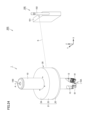
- FIG. 22 is a schematic perspective view showing the structure of a milling tool in Embodiment 4.
- FIG. 23 is a schematic perspective view showing a disassembled state of the milling tool according to the fourth embodiment.
- a milling tool 1 according to the present embodiment basically has the same structure as the milling tool 1 according to the first embodiment described based on FIGS. 1 to 19. However, it operates in the same way and produces the same effects.
- the portion corresponding to the sensor device of the present disclosure including the sensor section 20, the portion including the first end 10A, and the portion including the second end 10B are respectively This is different from the first embodiment in that it is separable.
- shaft portion 10 of milling tool 1 in Embodiment 4 includes tip region 10J as a processing unit including first end 10A, and second end 10B.
- the base end region 10L is separable from the intermediate region 10K, which is the shaft region of the sensor device and includes the region surrounded by the sensor section 20.
- a recess 19C is formed at the end of the tip region 10J on the second end 10B side.
- the recess 19C is a region recessed in the direction along the rotation axis A toward the first end 10A.
- a convex portion 19D serving as a connecting portion is formed at the end of the intermediate region 10K on the first end 10A side.
- the convex portion 19D is a region that protrudes in the direction along the rotation axis A toward the first end 10A side.
- the concave portion 19C is a concave portion having a shape corresponding to the shape of the convex portion 19D.
- the concave portion 19C and the convex portion 19D are configured to be able to engage with each other.
- a recess 19E is formed at the end of the intermediate region 10K on the second end 10B side.
- the recess 19E is a region recessed in the direction along the rotation axis A toward the first end 10A.
- a protrusion 19F is formed at the end of the base region 10L on the first end 10A side.
- the convex portion 19F is a region that protrudes in the direction along the rotation axis A toward the first end 10A side.
- the concave portion 19E is a concave portion having a shape corresponding to the shape of the convex portion 19F.
- the concave portion 19E and the convex portion 19F are configured to be able to engage with each other.
- the tip region 10J and the intermediate region 10K are integrated. Further, by engaging the concave portion 19E and the convex portion 19F, the intermediate region 10K and the base end region 10L are integrated. As a result, a milling tool 1 similar to that of the first embodiment is obtained. By disengaging the concave portion 19C and the convex portion 19D, the tip region 10J and the intermediate region 10K can be separated. By releasing the engagement between the concave portion 19E and the convex portion 19F, the intermediate region 10K and the base end region 10L can be separated.
- the shaft portion may be an integral member that cannot be separated as in the first embodiment, or may be separable as in the third and fourth embodiments. good.
- the sensor device of the present disclosure may include a sensor section that is separable from the shaft section as in the first embodiment, or a sensor section that is part of the shaft section as in the third and fourth embodiments.
- the integral shaft portion may be configured by connecting a portion of the shaft portion and another portion of the shaft portion.
- FIG. 24 is a schematic diagram showing the configuration of a milling tool system in Embodiment 5.
- FIG. 24 is a diagram showing a state in which the milling tool and receiver included in the milling tool system are installed in an operable state.
- the XY plane corresponds to the horizontal plane
- the Z direction corresponds to the vertical direction.
- a milling tool system 200 includes the milling tool 1 according to the first embodiment and a receiver 100.
- Receiver 100 includes a main body 101 and a linear antenna 102 installed on main body 101.
- the linear antenna 102 is a receiving antenna that receives a signal S including strain and acceleration information transmitted from the antenna (transmission antenna) of the milling tool 1 .
- the linear antenna 102 is, for example, a monopole antenna or a dipole antenna.
- the milling tool 1 is installed so that the rotation axis A is along the Z-axis direction, which is a vertical direction, in consideration of ease of installation and operation.
- the receiver 100 is installed, for example, on a side wall surface in a room where the milling tool 1 is installed.
- the linear antenna 102 of the receiver 100 is installed along the Z-axis direction, which is a vertical direction, in order to avoid interference with other equipment.
- the third portion 440 is equipped with the wireless communication section 51 including the antenna 51A which is a transmitting antenna.
- the first direction ⁇ which is a direction perpendicular to the mounting surface 440A, is inclined with respect to both the plane ⁇ (XY plane) perpendicular to the rotation axis A and the rotation axis A (Z-axis direction). That is, the first direction ⁇ is non-parallel to all of the X-axis, Y-axis, and Z-axis.
- the milling tool system 200 of the present embodiment is capable of suppressing the omission of information obtained by the strain sensor 31 and the like while receiving the signal S including the information at the receiver 100 installed outside. This is an easy milling tool system.
Landscapes
- Engineering & Computer Science (AREA)
- Mechanical Engineering (AREA)
- Milling Processes (AREA)
- Arrangements For Transmission Of Measured Signals (AREA)
Priority Applications (5)
| Application Number | Priority Date | Filing Date | Title |
|---|---|---|---|
| PCT/JP2022/032427 WO2024047703A1 (ja) | 2022-08-29 | 2022-08-29 | 転削工具およびセンサ装置 |
| CN202280097836.0A CN119486832A (zh) | 2022-08-29 | 2022-08-29 | 铣削工具以及传感器装置 |
| JP2022574651A JP7239080B1 (ja) | 2022-08-29 | 2022-08-29 | 転削工具およびセンサ装置 |
| EP22957307.6A EP4582203A4 (en) | 2022-08-29 | 2022-08-29 | MILLING TOOL AND SENSOR DEVICE |
| JP2023031118A JP2024032638A (ja) | 2022-08-29 | 2023-03-01 | 転削工具およびセンサ装置 |
Applications Claiming Priority (1)
| Application Number | Priority Date | Filing Date | Title |
|---|---|---|---|
| PCT/JP2022/032427 WO2024047703A1 (ja) | 2022-08-29 | 2022-08-29 | 転削工具およびセンサ装置 |
Publications (1)
| Publication Number | Publication Date |
|---|---|
| WO2024047703A1 true WO2024047703A1 (ja) | 2024-03-07 |
Family
ID=85556200
Family Applications (1)
| Application Number | Title | Priority Date | Filing Date |
|---|---|---|---|
| PCT/JP2022/032427 Ceased WO2024047703A1 (ja) | 2022-08-29 | 2022-08-29 | 転削工具およびセンサ装置 |
Country Status (4)
| Country | Link |
|---|---|
| EP (1) | EP4582203A4 (https=) |
| JP (2) | JP7239080B1 (https=) |
| CN (1) | CN119486832A (https=) |
| WO (1) | WO2024047703A1 (https=) |
Families Citing this family (1)
| Publication number | Priority date | Publication date | Assignee | Title |
|---|---|---|---|---|
| JP2024145591A (ja) * | 2023-03-31 | 2024-10-15 | 三菱マテリアル株式会社 | 切削工具ユニット |
Citations (10)
| Publication number | Priority date | Publication date | Assignee | Title |
|---|---|---|---|---|
| JP2009285804A (ja) | 2008-05-30 | 2009-12-10 | Genichi Sato | 切削工具 |
| JP3170029U (ja) | 2011-06-09 | 2011-09-01 | 伊藤 幸男 | センサ内蔵工具ホルダ |
| JP2015077658A (ja) | 2013-10-17 | 2015-04-23 | 株式会社神戸製鋼所 | 状態計測装置及び状態計測システム |
| US20150261207A1 (en) | 2014-03-11 | 2015-09-17 | Pro-Micron Gmbh & Co. Kg | Method for setting and/or monitoring operating parameters of a workpiece processing machine |
| JP5988066B1 (ja) | 2015-06-02 | 2016-09-07 | 伊藤 幸男 | 発信器内蔵締結具と発信器内蔵締結具による環状刃具の保持装置 |
| WO2017002762A1 (ja) | 2015-06-27 | 2017-01-05 | 株式会社山本金属製作所 | リアルタイム状況検知用のセンサ付き回転加工工具 |
| EP3292930A1 (en) | 2016-09-09 | 2018-03-14 | Sandvik Intellectual Property AB | Estimation of deflection of a cutting edge |
| EP3292929A1 (en) | 2016-09-09 | 2018-03-14 | Sandvik Intellectual Property AB | Estimation of orientation of a cutting tool |
| JP2018054611A (ja) | 2016-09-27 | 2018-04-05 | 株式会社山本金属製作所 | 振動測定装置 |
| JP2019166601A (ja) * | 2018-03-23 | 2019-10-03 | 三菱マテリアル株式会社 | 転削工具用ホルダ、転削工具および転削方法 |
Family Cites Families (3)
| Publication number | Priority date | Publication date | Assignee | Title |
|---|---|---|---|---|
| JP7443213B2 (ja) * | 2020-09-28 | 2024-03-05 | 株式会社日立製作所 | 工具状態検知システム |
| JP7156581B1 (ja) * | 2020-12-10 | 2022-10-19 | 住友電気工業株式会社 | 切削工具 |
| WO2022123739A1 (ja) * | 2020-12-10 | 2022-06-16 | 住友電気工業株式会社 | 切削工具 |
-
2022
- 2022-08-29 JP JP2022574651A patent/JP7239080B1/ja active Active
- 2022-08-29 CN CN202280097836.0A patent/CN119486832A/zh active Pending
- 2022-08-29 EP EP22957307.6A patent/EP4582203A4/en active Pending
- 2022-08-29 WO PCT/JP2022/032427 patent/WO2024047703A1/ja not_active Ceased
-
2023
- 2023-03-01 JP JP2023031118A patent/JP2024032638A/ja active Pending
Patent Citations (12)
| Publication number | Priority date | Publication date | Assignee | Title |
|---|---|---|---|---|
| JP2009285804A (ja) | 2008-05-30 | 2009-12-10 | Genichi Sato | 切削工具 |
| JP3170029U (ja) | 2011-06-09 | 2011-09-01 | 伊藤 幸男 | センサ内蔵工具ホルダ |
| JP2015077658A (ja) | 2013-10-17 | 2015-04-23 | 株式会社神戸製鋼所 | 状態計測装置及び状態計測システム |
| WO2015056495A1 (ja) | 2013-10-17 | 2015-04-23 | 株式会社神戸製鋼所 | 状態計測装置及び状態計測システム |
| US20150261207A1 (en) | 2014-03-11 | 2015-09-17 | Pro-Micron Gmbh & Co. Kg | Method for setting and/or monitoring operating parameters of a workpiece processing machine |
| JP5988066B1 (ja) | 2015-06-02 | 2016-09-07 | 伊藤 幸男 | 発信器内蔵締結具と発信器内蔵締結具による環状刃具の保持装置 |
| JP2016221665A (ja) | 2015-06-02 | 2016-12-28 | 伊藤 幸男 | 発信器内蔵締結具と発信器内蔵締結具による環状刃具の保持装置 |
| WO2017002762A1 (ja) | 2015-06-27 | 2017-01-05 | 株式会社山本金属製作所 | リアルタイム状況検知用のセンサ付き回転加工工具 |
| EP3292930A1 (en) | 2016-09-09 | 2018-03-14 | Sandvik Intellectual Property AB | Estimation of deflection of a cutting edge |
| EP3292929A1 (en) | 2016-09-09 | 2018-03-14 | Sandvik Intellectual Property AB | Estimation of orientation of a cutting tool |
| JP2018054611A (ja) | 2016-09-27 | 2018-04-05 | 株式会社山本金属製作所 | 振動測定装置 |
| JP2019166601A (ja) * | 2018-03-23 | 2019-10-03 | 三菱マテリアル株式会社 | 転削工具用ホルダ、転削工具および転削方法 |
Non-Patent Citations (1)
| Title |
|---|
| See also references of EP4582203A4 |
Also Published As
| Publication number | Publication date |
|---|---|
| JP7239080B1 (ja) | 2023-03-14 |
| JP2024032638A (ja) | 2024-03-12 |
| CN119486832A (zh) | 2025-02-18 |
| JPWO2024047703A1 (https=) | 2024-03-07 |
| EP4582203A1 (en) | 2025-07-09 |
| EP4582203A4 (en) | 2025-11-19 |
Similar Documents
| Publication | Publication Date | Title |
|---|---|---|
| US7082865B2 (en) | Digital torque wrench | |
| EP4260977B1 (en) | Cutting tool | |
| JP6975143B2 (ja) | センサが組み込まれたツールホルダ | |
| EP1292416A1 (en) | Tool coupling | |
| JP2024032638A (ja) | 転削工具およびセンサ装置 | |
| US8800374B2 (en) | Portable vibration monitoring device | |
| CN110274678B (zh) | 间隔件和包括该间隔件的传感器模块 | |
| JP2018051760A (ja) | 手持ち式工具に用いる無線式測定ユニット | |
| US20020175251A1 (en) | Sensor mount attachment device | |
| WO2024047704A1 (ja) | 転削工具、転削工具システムおよびセンサ装置 | |
| JP7156581B1 (ja) | 切削工具 | |
| EP2362946B1 (en) | Flow sensors | |
| JPWO2022123740A5 (https=) | ||
| JP6864499B2 (ja) | 軸力を検出するための締結ボルト装置 | |
| JP2025065171A (ja) | 切削加工システム、および切削工具 | |
| JP3573325B2 (ja) | ノッキング検出センサの取付けアダプタ及びそれを用いたノッキング検出センサユニット | |
| JP7584752B2 (ja) | 締着強度検出装置に使用する無線電波送信装置 | |
| US20230286092A1 (en) | Intelligent tool holder | |
| JP7597276B1 (ja) | 切削加工システム、および転削工具 | |
| CN223769453U (zh) | 一种角位移传感器系统和真空断路器 | |
| JP2003291014A (ja) | スローアウェイ式ドリル | |
| JPWO2007077695A1 (ja) | ジョイント | |
| KR20030079349A (ko) | 회전축과 측정기기간의 연결구 | |
| EP2187222A1 (en) | Flow sensors | |
| CN208075824U (zh) | 一种冷却器螺纹检规 |
Legal Events
| Date | Code | Title | Description |
|---|---|---|---|
| ENP | Entry into the national phase |
Ref document number: 2022574651 Country of ref document: JP Kind code of ref document: A |
|
| 121 | Ep: the epo has been informed by wipo that ep was designated in this application |
Ref document number: 22957307 Country of ref document: EP Kind code of ref document: A1 |
|
| WWE | Wipo information: entry into national phase |
Ref document number: 202280097836.0 Country of ref document: CN |
|
| WWP | Wipo information: published in national office |
Ref document number: 202280097836.0 Country of ref document: CN |
|
| WWE | Wipo information: entry into national phase |
Ref document number: 2022957307 Country of ref document: EP |
|
| NENP | Non-entry into the national phase |
Ref country code: DE |
|
| ENP | Entry into the national phase |
Ref document number: 2022957307 Country of ref document: EP Effective date: 20250331 |
|
| WWP | Wipo information: published in national office |
Ref document number: 2022957307 Country of ref document: EP |