WO2024038873A1 - 化合物、組成物、表面処理剤、コーティング液、物品、及び物品の製造方法 - Google Patents
化合物、組成物、表面処理剤、コーティング液、物品、及び物品の製造方法 Download PDFInfo
- Publication number
- WO2024038873A1 WO2024038873A1 PCT/JP2023/029592 JP2023029592W WO2024038873A1 WO 2024038873 A1 WO2024038873 A1 WO 2024038873A1 JP 2023029592 W JP2023029592 W JP 2023029592W WO 2024038873 A1 WO2024038873 A1 WO 2024038873A1
- Authority
- WO
- WIPO (PCT)
- Prior art keywords
- group
- compound
- carbon atoms
- bond
- formula
- Prior art date
- Legal status (The legal status is an assumption and is not a legal conclusion. Google has not performed a legal analysis and makes no representation as to the accuracy of the status listed.)
- Ceased
Links
Images

Classifications
-
- C—CHEMISTRY; METALLURGY
- C07—ORGANIC CHEMISTRY
- C07F—ACYCLIC, CARBOCYCLIC OR HETEROCYCLIC COMPOUNDS CONTAINING ELEMENTS OTHER THAN CARBON, HYDROGEN, HALOGEN, OXYGEN, NITROGEN, SULFUR, SELENIUM OR TELLURIUM
- C07F7/00—Compounds containing elements of Groups 4 or 14 of the Periodic Table
- C07F7/02—Silicon compounds
- C07F7/08—Compounds having one or more C—Si linkages
- C07F7/18—Compounds having one or more C—Si linkages as well as one or more C—O—Si linkages
-
- C—CHEMISTRY; METALLURGY
- C08—ORGANIC MACROMOLECULAR COMPOUNDS; THEIR PREPARATION OR CHEMICAL WORKING-UP; COMPOSITIONS BASED THEREON
- C08G—MACROMOLECULAR COMPOUNDS OBTAINED OTHERWISE THAN BY REACTIONS ONLY INVOLVING UNSATURATED CARBON-TO-CARBON BONDS
- C08G65/00—Macromolecular compounds obtained by reactions forming an ether link in the main chain of the macromolecule
- C08G65/02—Macromolecular compounds obtained by reactions forming an ether link in the main chain of the macromolecule from cyclic ethers by opening of the heterocyclic ring
- C08G65/32—Polymers modified by chemical after-treatment
- C08G65/329—Polymers modified by chemical after-treatment with organic compounds
- C08G65/336—Polymers modified by chemical after-treatment with organic compounds containing silicon
-
- C—CHEMISTRY; METALLURGY
- C09—DYES; PAINTS; POLISHES; NATURAL RESINS; ADHESIVES; COMPOSITIONS NOT OTHERWISE PROVIDED FOR; APPLICATIONS OF MATERIALS NOT OTHERWISE PROVIDED FOR
- C09D—COATING COMPOSITIONS, e.g. PAINTS, VARNISHES OR LACQUERS; FILLING PASTES; CHEMICAL PAINT OR INK REMOVERS; INKS; CORRECTING FLUIDS; WOODSTAINS; PASTES OR SOLIDS FOR COLOURING OR PRINTING; USE OF MATERIALS THEREFOR
- C09D201/00—Coating compositions based on unspecified macromolecular compounds
- C09D201/02—Coating compositions based on unspecified macromolecular compounds characterised by the presence of specified groups, e.g. terminal or pendant functional groups
-
- C—CHEMISTRY; METALLURGY
- C09—DYES; PAINTS; POLISHES; NATURAL RESINS; ADHESIVES; COMPOSITIONS NOT OTHERWISE PROVIDED FOR; APPLICATIONS OF MATERIALS NOT OTHERWISE PROVIDED FOR
- C09D—COATING COMPOSITIONS, e.g. PAINTS, VARNISHES OR LACQUERS; FILLING PASTES; CHEMICAL PAINT OR INK REMOVERS; INKS; CORRECTING FLUIDS; WOODSTAINS; PASTES OR SOLIDS FOR COLOURING OR PRINTING; USE OF MATERIALS THEREFOR
- C09D5/00—Coating compositions, e.g. paints, varnishes or lacquers, characterised by their physical nature or the effects produced; Filling pastes
- C09D5/16—Antifouling paints; Underwater paints
-
- C—CHEMISTRY; METALLURGY
- C09—DYES; PAINTS; POLISHES; NATURAL RESINS; ADHESIVES; COMPOSITIONS NOT OTHERWISE PROVIDED FOR; APPLICATIONS OF MATERIALS NOT OTHERWISE PROVIDED FOR
- C09K—MATERIALS FOR MISCELLANEOUS APPLICATIONS, NOT PROVIDED FOR ELSEWHERE
- C09K3/00—Materials not provided for elsewhere
- C09K3/18—Materials not provided for elsewhere for application to surfaces to minimize adherence of ice, mist or water thereto; Thawing or antifreeze materials for application to surfaces
Definitions
- the present invention relates to compounds, compositions, surface treatment agents, coating liquids, articles, and methods for producing articles.
- a fluorine-containing compound having a fluorine-containing organic group such as a fluoroalkyl group or a fluoropolyether chain and a hydrolyzable silyl group can form a surface layer exhibiting high lubricity, water and oil repellency, etc. on the surface of a base material. Therefore, it is suitably used as a surface treatment agent.
- Surface treatment agents containing fluorine-containing compounds have the ability, for example, to maintain water and oil repellency even when the surface layer is repeatedly rubbed with fingers (friction resistance), and to easily remove fingerprints attached to the surface layer by wiping. (fingerprint stain removability) is required to be maintained for a long period of time.
- Patent Document 1 discloses a perfluoro(poly)ether group-containing silane compound having a specific fluoropolyether chain and a specific hydrolyzable silyl group.
- glass-coated casings are sometimes used for mobile devices such as smartphones and tablet terminals, and the above-mentioned surface treatment agent is sometimes used on the casing side.
- the surface layer formed by current surface treatment agents can be slippery, and there is a risk of the device slipping off when operating the device or placing it on a desk.
- the present invention includes a compound, a composition, a surface treatment agent, a coating liquid, a surface layer formed from the compound, etc., which can form a surface layer that can suppress slipping while maintaining abrasion resistance and fingerprint stain removability.
- the object of the present invention is to provide an article having excellent abrasion resistance, fingerprint stain removability, and slip-off prevention effect, and a method for manufacturing the article.
- the present invention provides compounds, compositions, surface treatment agents, coating liquids, articles, and methods for producing articles having the following configurations [1] to [13].
- T 1 a reactive group
- R 1 is a hydrogen atom or a fluoroalkyl group
- At least one carbon atom in formula (1) has a bond that is bonded to the reactive group (T 1 ) directly or via another group
- m1 is an integer of 1 or more.
- R f2 is a fluoroalkylene group having 1 to 6 carbon atoms
- R f3 is a fluoroalkylene group having 1 to 6 carbon atoms
- m2 is 0 or 1
- m3 is an integer of 1 or more
- the bond * is bonded to the carbon atom having the bond in the formula (1)
- the bond ** is bonded to the reactive group (T 1 ) directly or via a linking group
- the plurality of R f3s may be the same or different from each other.
- R f6 is a fluoroalkyl group having 1 to 6 carbon atoms
- R 10 is a hydrogen atom, an alkyl group or fluoroalkyl group having 1 to 6 carbon atoms which may have a substituent, or an aryl group which may have a substituent
- Ar is an aryl group that may have a substituent
- X 2 is an alkali metal ion or ammonium ion
- X 3 is a halide ion
- X 4 is a halogen atom
- R a1 is a hydrolyzable group, a group having a hydrolyzable group, or a hydroxyl group
- R a11 is a hydrocarbon group
- z1 is an integer from 1 to 3
- the plurality of R 10 , R a1 or R a11 may be the same or different from each other.
- R f [-Q 1 (-T 1 ) x1 ] y1 ...(3) however, R f is a group containing a fluoroether ring which may have a substituent, Q 1 is a 1+x monovalent linking group, T 1 is a reactive group, x1 is an integer from 1 to 10, y1 is an integer from 1 to 6, When there is a plurality of Q 1 , T 1 , or x1, the plurality of Q 1 , T 1 , or x1 may be the same or different.
- a surface treatment agent comprising the compound of any one of [1] to [7] or the composition of [8].
- a coating liquid comprising the compound of any one of [1] to [7] or the composition of [8] and a liquid medium.
- a method for manufacturing an article comprising forming a surface layer by a dry coating method using the surface treatment agent of [9] above.
- a method for manufacturing an article comprising forming a surface layer by a wet coating method using the coating liquid of [10].
- the present invention provides a surface layer formed from a compound, composition, surface treatment agent, coating liquid, compound, etc. that can form a surface layer that can suppress slipping while maintaining abrasion resistance and fingerprint stain removability. It is possible to provide an article with excellent abrasion resistance, fingerprint stain removability, and slip-off prevention effect, and a method for manufacturing the article.
- FIG. 1 is a schematic cross-sectional view showing an example of the article of the present invention.
- a (fluoro)alkyl group is a general term for an alkyl group and a fluoroalkyl group. This also applies to (fluoro)alkylene groups, etc.
- the fluoroalkyl group is a general term for perfluoroalkyl groups and partial fluoroalkyl groups.
- a perfluoroalkyl group means a group in which all hydrogen atoms of an alkyl group are substituted with fluorine atoms.
- a partial fluoroalkyl group is an alkyl group in which one or more hydrogen atoms are substituted with a fluorine atom and has one or more hydrogen atoms. That is, a fluoroalkyl group is an alkyl group having one or more fluorine atoms.
- “Reactive silyl group” is a general term for hydrolyzable silyl group and silanol group (Si-OH), and "hydrolyzable silyl group” refers to a group that can undergo a hydrolysis reaction to form a silanol group. means.
- Organic group means a hydrocarbon group which may have a substituent and may have a heteroatom or other bond in the carbon chain.
- a “hydrocarbon group” is a group consisting of carbon atoms and hydrogen atoms, including aliphatic hydrocarbon groups (straight-chain alkylene groups, branched alkylene groups, cycloalkylene groups, etc.), aromatic hydrocarbon groups (phenylene groups, etc.), and aromatic hydrocarbon groups (phenylene groups). etc.) and combinations thereof.
- “Surface layer” means a layer formed on the surface of a base material.
- the “molecular weight” of the polyfluoroether chain is the number average molecular weight calculated by determining the number (average value) of oxyfluoroalkylene units based on the terminal group by 1 H-NMR and 19 F-NMR. " ⁇ " indicating a numerical range means that the numerical values written before and after it are included as lower and upper limits.
- the compound according to the present invention (hereinafter also referred to as the present compound) is characterized by having a group (R f ) containing a fluoroether ring that may have a substituent and a reactive group (T 1 ). shall be.
- This compound has a reactive group (T 1 ).
- This compound having a reactive group (T 1 ) has excellent abrasion resistance of the surface layer because the reactive group (T 1 ) and the base material are strongly bonded.
- the present compound also has a group (R f ) containing a fluoroether ring. Since the fluoroether ring contains an oxyfluoroalkylene unit as a constituent unit, it has water and oil repellency and is excellent in removing fingerprint stains. On the other hand, it is presumed that the movement of the fluoroether ring in the surface layer is suppressed compared to the chain polyfluoroether. Therefore, it is estimated that the surface layer formed by this compound has a large coefficient of friction. As a result, articles such as mobile devices that include a surface layer formed of the present compound are prevented from sliding down (hereinafter also referred to as anti-slip properties).
- the group (R f ) has at least a fluoroether ring.
- the fluoroether ring includes a polyfluoroether ring, and represents a ring containing one or more oxyfluoroalkylene units as a constituent unit.
- the fluoroether ring imparts water and oil repellency and anti-slip properties to the surface layer formed from the present compound.
- the fluoroether ring is a residue having a bond that is bonded directly to the reactive group (T 1 ) or via another group. From the viewpoint of water and oil repellency and anti-slip properties, the fluoroether ring is preferably a ring represented by the following formula (1).
- R 1 is a hydrogen atom or a fluoroalkyl group
- At least one carbon atom in formula (1) has a bond that is bonded to the reactive group (T 1 ) directly or via another group
- m1 is an integer of 1 or more.
- the plurality of R f1 's may be the same or different from each other.
- the fluoroalkylene group having 1 to 6 carbon atoms in R f1 may be a linear fluoroalkylene group or a branched fluoroalkylene group.
- Specific examples of the fluoroalkylene group include -CF 2 -, -CHF-, -CF 2 CF 2 -, -CF 2 CHF-, -CF 2 CF 2 CF 2 -, -CF 2 CHFCF 2 -, -CF 2 CHFCHF-, -CF 2 CF (CF 3 )-, -CF 2 CF 2 CF 2 CF 2 -, -CF 2 CHFCF 2 CF 2 -, -CF 2 CF (CF 3 ) -CF 2 -, -CF 2 CHFCF 2 CF 2 -, -CF 2 CF (CF 3 ) -CF 2 -, -CF 2 C Examples include (CF 3 ) 2 -CF 2 -, -CF 2 CF 2 CF 2 CF 2 CF 2
- the fluoroalkylene group is preferably a perfluoroalkylene group from the viewpoints of water and oil repellency, fingerprint stain removability, and anti-slip properties. Further, from the viewpoint of wear resistance, a linear fluoroalkylene group is preferable.
- R 11 and R 12 are fluoroalkylene groups which may have a substituent having 1 to 11 carbon atoms, and the total number of carbon atoms of R 11 and R 12 is 2 to 12.
- the fluoroalkylene group for R 11 and R 12 may be linear or branched, and a linear fluoroalkylene group is preferable from the viewpoint of wear resistance.
- the fluoroalkyl group in R 1 may be linear or branched, and a linear fluoroalkyl group is preferable from the viewpoint of wear resistance.
- the number of carbon atoms in R 1 , R 11 and R 12 is preferably independently 1 to 6, more preferably 1 to 3.
- Examples of the fluoroalkylene group having 2 to 12 carbon atoms in which at least some of the carbon atoms constitute a ring and which may have a substituent in R f1 include a fluorocyclobutanediyl group, a fluorocyclohexanediyl group, a fluorocyclohexanediyl group, and a fluorocyclobutanediyl group. Examples thereof include a cyclopentanediyl group and a fluorophenylene group, and may have a fluorine atom, a fluoroalkyl group having 1 to 6 carbon atoms, etc. as a substituent.
- R f1 is a straight chain or branched carbon atom having 1 to 1 carbon atoms that does not have the above-mentioned specific bond or ring structure.
- a fluoroalkylene group of 6 is preferred, and a linear fluoroalkylene group is more preferred.
- the fluoroether ring represented by formula (1) is preferably a ring represented by formula (G1) below.
- G1 a ring represented by formula (G1) below.
- G1 is a fluoroalkylene group having 1 carbon number
- G f2 is a fluoroalkylene group having 2 carbon atoms
- G f3 is a fluoroalkylene group having 3 carbon atoms
- G f4 is a fluoroalkylene group having 4 carbon atoms
- G f5 is a fluoroalkylene group having 5 carbon atoms
- G f6 is a fluoroalkylene group having 6 carbon atoms
- G f7
- m11, m12, m13, m14, m15, m16, and m17 each independently represent an integer of 0 or 1 or more, and m11 + m12 + m13 + m14 + m15 + m16 + m17 (m1 in formula (1)) is preferably an integer of 1 to 200. Further, m17 is preferably an integer of 0 to 2. Note that the bonding order of (OG f1 ) to (OG f7 ) in formula (G1) is arbitrary. m11 to m17 in formula (G11) represent the numbers of (OG f1 ) to (OG f7 ), respectively, and do not represent the arrangement.
- (OG f5 ) m5 represents that the number of (OG f5 ) is m15, and does not represent the block arrangement structure of (OG f5 ) m15 .
- the order of (OG f1 ) to (OG f7 ) does not represent the bonding order of the respective units.
- the above-mentioned fluoroalkylene group having 3 to 6 carbon atoms may be a linear fluoroalkylene group or a branched fluoroalkylene group.
- G f1 examples include -CF 2 - and -CHF-.
- G f2 examples include -CF 2 CF 2 -, -CHFCF 2 -, -CHFCHF-, -CH 2 CF 2 -, -CH 2 CHF-, and the like.
- G f3 include -CF 2 CF 2 CF 2 -, -CF 2 CHFCF 2 -, -CF 2 CH 2 CF 2 -, -CHFCF 2 CF 2 -, -CHFCHFCF 2 -, -CHFCHFCHF-, - CHFCH 2 CF 2 -, -CH 2 CF 2 CF 2 -, -CH 2 CHFCF 2 -, -CH 2 CH 2 CF 2 -, -CH 2 CF 2 CHF-, -CH 2 CHFCHF-, -CH 2 CH 2 CHF-, -CF(CF 3 )-CF 2 -, -CF(CHF 2 )-CF 2 -, -CF(CH 2 F)-CF 2 -, -CF(CH 3 )-CF 2 -, -CF (CF 3 )-CHF-, -CF(CHF 2 )-CHF-, -CF(CH 2 F)-CF 2 -, -CF(CH 3
- G f4 include -CF 2 CF 2 CF 2 CF 2 -, -CHFCF 2 CF 2 CF 2 -, -CH 2 CF 2 CF 2 -, -CF 2 CHFCF 2 CF 2 -, -CHFCHFCF 2 CF 2 -, -CH 2 CHFCF 2 CF 2 -, -CF 2 CH 2 CF 2 CF 2 -, -CHFCH 2 CF 2 CF 2 -, -CH 2 CH 2 CF 2 CF 2 -, -CHFCF 2 CHFCF 2 -, -CH 2 CHFCF 2 -, -CF 2 CHFCHF 2 -, -CHFCHFCF 2 -, -CH 2 CHFCHF 2 -, -CF 2 CH 2 CHFCF 2 -, -CHFCH 2 CHFCF 2 -, -CH 2 CH 2 CHFCF 2 -, -CF 2 CH 2 CF 2 -, -CHFCH 2 CHFCF 2 -
- G f5 include -CF 2 CF 2 CF 2 CF 2 CF 2 -, -CHFCF 2 CF 2 CF 2 -, -CH 2 CHFCF 2 CF 2 CF 2 -, -CF 2 CHFCF 2 CF 2 CF 2 -, -CHFCHFCF 2 CF 2 CF 2 -, -CF 2 CH 2 CF 2 CF 2 -, -CHFCH 2 CF 2 CF 2 CF 2 -, -CH 2 CH 2 CF 2 CF 2 CF 2 -, -CF 2 CF 2 CHFCF 2 CF 2 -, -CHFCF 2 CHFCF 2 CF 2 -, -CH 2 CHFCF 2 CF 2 -, -CH 2 CF 2 CHFCF 2 CF 2 -, -CH 2 CF 2 CHFCF 2 CF 2 CH 2 -, -CF 2 C (C 2F 5 )FCF 2 - and the like.
- G F6 is -cf 2 CF 2 CF 2 CF 2 CF 2 CF 2- , -cf 2 CF 2 CHFCHFCF 2 CF 2- , -CHFCF 2 CF 2 CF 2 CF 2 CF 2- , -CHFCHFCHFCHFCHFCHFF- , -CHFCF 2 CF 2 CF 2 CF 2 CH 2 -, -CH 2 CF 2 CF 2 CF 2 CH 2 -, and the like.
- G f7 include perfluorocyclobutanediyl group (perfluorocyclobutane-1,2-diyl group, etc.), perfluorocyclopentanediyl group (perfluorocyclopentane-1,2-diyl group, perfluorocyclopentane-1,3-diyl group, etc.) diyl group, etc.), perfluorocyclohexanediyl group (perfluorocyclohexane-1,2-diyl group, perfluorocyclohexane-1,4-diyl group, etc.), -CF 2 CF 2 NHCF 2 CF 2 -, and the like.
- the ring represented by formula (1) preferably has a structure represented by the following formulas (G2) to (G5) from the viewpoint of superior water and oil repellency, fingerprint stain removal properties, and slip-off prevention properties. is preferred.
- the symbols in formulas (G2) to (G5) are the same as in formula (G1).
- (G2) and (G3) the order in which (OG f1 ) and (OG f2 ) and (OG f2 ) and (OG f4 ) are combined is arbitrary.
- (OG f1 ) and (OG f2 ) may be arranged alternately, (OG f1 ) and (OG f2 ) may be arranged in each block, or may be arranged randomly.
- m11 is preferably 1 to 50, more preferably 2 to 30.
- m12 is preferably 1 to 50, more preferably 2 to 30.
- m12 is preferably 1 to 50, more preferably 2 to 30.
- m14 is preferably 1 to 50, more preferably 2 to 30.
- m13 is preferably 1 to 50, more preferably 2 to 30.
- Formula (G5) represents crown ethers. From the viewpoint of ease of synthesis, m12 in formula (G5) is preferably 2 to 12, more preferably 4 to 8.
- the group (R f ) containing a fluoroether ring preferably further includes a group represented by the following formula (2) from the viewpoint of abrasion resistance, water/oil repellency, and fingerprint stain removability.
- R f2 is a fluoroalkylene group having 1 to 6 carbon atoms
- R f3 is a fluoroalkylene group having 1 to 6 carbon atoms
- m2 is 0 or 1
- m3 is an integer of 1 or more
- the bond * is bonded to the carbon atom having the bond in the formula (1)
- the bond ** is bonded to the reactive group (T 1 ) directly or via a linking group
- the plurality of R f3s may be the same or different from each other.
- the fluoroalkylene group having 1 to 6 carbon atoms in R f2 and R f3 may be linear or branched. Specific examples of the fluoroalkylene group having 1 to 6 carbon atoms include those listed above for G f1 to G f6 .
- m2 is 0 or 1.
- m2 is 0, the carbon atom of the fluoroether ring of formula (1) and the terminal oxygen atom of (OR f3 ) m3 are bonded.
- m2 is 1, the carbon atom of the fluoroether ring of formula (1) and the carbon atom of R f2 are bonded. From the viewpoint of ease of synthesis and wear resistance, m2 is preferably 1.
- (OR f3 ) m3 preferably has a structure represented by the following formula (G11). [(OG f11 ) m21 (OG f12 ) m22 (OG f13 ) m23 (OG f14 ) m24 (OG f15 ) m25 (OG f16 ) m26 ]
- G f11 is a fluoroalkylene group having 1 carbon number
- G f12 is a fluoroalkylene group having 2 carbon atoms
- G f13 is a fluoroalkylene group having 3 carbon atoms
- G f14 is a fluoroalkylene group having 4 carbon atoms
- G f15 is a fluoroalkylene group having 5 carbon atoms
- G f16 is a fluoroalkylene group having 6 carbon atoms
- m21, m22, m23, m24, m25, and m26 each independently represent an integer of 0 or 1
- (OR f3 ) m3 preferably has a structure represented by the following formulas (G12) to (G14) from the viewpoint of superior water and oil repellency, abrasion resistance, and fingerprint stain removability.
- the symbols in formulas (G12) to (G14) are the same as in formula (G11).
- formulas (G12) and (G13) the order in which (OG f11 ) and (OG f12 ) and (OG f12 ) and (OG f14 ) are combined is arbitrary.
- (OG f1 ) and (OG f2 ) may be arranged alternately, (OG f11 ) and (OG f12 ) may be arranged in each block, or may be arranged randomly.
- m21 is preferably 1 to 30, more preferably 1 to 20.
- m22 is preferably 1 to 30, more preferably 1 to 20.
- m22 is preferably 1 to 30, more preferably 1 to 20.
- m24 is preferably 1 to 30, more preferably 1 to 20.
- m23 is preferably 1 to 30, more preferably 1 to 20.
- the group (R f ) containing a fluoroether ring is preferably a group represented by the following formula (11) from the viewpoint of excellent water and oil repellency, fingerprint stain removability, abrasion resistance, and slip prevention property.
- R r1 is a y1-valent residue of the fluoroether ring represented by the above formula (1), y1 is an integer from 1 to 6, R f2 , R f3 , m2 and m3 are the same as those in the formula (2),
- the bond ** is a bond that is bonded to the reactive group (T 1 ) directly or via a linking group.
- y1 may be an integer of 1 to 6, preferably 1 to 3, and more preferably 1 to 2, from the viewpoint of excellent fingerprint stain removal properties and anti-slip effect, and ease of manufacturing the present compound.
- the group (R f ) containing a fluoroether ring may have a hydrogen atom.
- the proportion of fluorine atoms represented by the following formula (I) in R f is preferably 60% or more, more preferably 80% or more, and substantially It is even more preferable to have 100% perfluoropolyether chains. If the fluorine atom content is 60% or more, the amount of fluorine in the fluoropolyether chain increases, and the slipperiness and fingerprint removability are further improved.
- Formula (I): Percentage of fluorine atoms (%) (number of fluorine atoms) / ⁇ (number of fluorine atoms) + (number of hydrogen atoms) ⁇ x 100
- the molecular weight of the group (R f ) is preferably from 2,000 to 20,000, more preferably from 2,500 to 15,000, and more preferably from 2,500 to 15,000, from the viewpoint of achieving both fingerprint stain removability and slip resistance of the surface layer. ⁇ 10,000 is more preferable.
- the molecular weight of R f is 2,000 or more, the flexibility of the fluoropolyether chain is improved, and the amount of fluorine in the molecule is increased, so that the finger slip property and fingerprint removability are further improved.
- the molecular weight of the fluoropolyether chain is 20,000 or less, the surface layer will have better abrasion resistance.
- R f include the following structures.
- each n is independently an integer of 1 to 200.
- F in the ring indicates that the ring has one or more F atoms. Note that Rf is not limited to these.
- T 1 is a reactive group, and the present compound exhibits various functions due to the reactivity of T 1 .
- Such functions include, for example, the function of improving adhesion to the surface of the substrate, the function of imparting photocurability or thermosetting property to the present compound, the function of imparting acidity/alkalinity to the present compound, and the function of imparting specific properties of the present compound. Examples include a function to adjust solubility in a solvent, and a function as a precursor when synthesizing other compounds.
- the fluoroalkyl group for R 10 preferably has 1 to 6 carbon atoms.
- the fluoroalkyl group may have other substituents.
- This compound having a fluoroalkyl group as T1 has a high fluorine content, and has properties such as low refractive index, low dielectric constant, water and oil repellency, heat resistance, chemical resistance, chemical stability, and transparency. Excellent in various properties.
- substituents that the fluoroalkyl group may have include halogen atoms such as fluorine atoms and chlorine atoms, alkyl groups having 1 to 6 carbon atoms, and the same substituents as those exemplified as the reactive group T1 . Things can be mentioned.
- Examples of the aryl group for Ar and R10 include a phenyl group and a naphthyl group, and may further have a substituent.
- substituents that the aryl group may have include halogen atoms such as fluorine atoms and chlorine atoms, alkyl groups having 1 to 6 carbon atoms, and those similar to those exemplified as the reactive group T1 . can be mentioned.
- the alkyl group in R 10 preferably has 1 to 6 carbon atoms.
- the alkyl group may have other substituents. Examples of substituents that the alkyl group may have include halogen atoms such as chlorine atoms, alkyl groups having 1 to 6 carbon atoms, and those similar to those exemplified as the reactive group T1 . .
- T1 as hydroxy group, N-hydroxy group, aldehyde group, ketone group, amino group, quaternary ammonium group, nitrile group, imino group, diazo group, carboxy group, carboxylate, acid anhydride group, sulfo group, sulfone
- This compound having an acid salt, a phosphoric acid group, or a phosphate has various properties such as acidity, alkalinity, and hydrophilicity due to the reactive group T1 , and for example, improves solubility in a specific solvent. It also provides functions such as improving adhesion to specific substrates.
- Examples of the counter ion of the quaternary ammonium salt include halide ions.
- Counter ions for carboxylates, sulfonates, and phosphates include alkali metal ions, ammonium ions, and the like.
- Examples of the group having a carbon-carbon double bond include a vinyl group, an acryloyloxy group, a methacryloyloxy group, an olefin, and the like. This compound having a carbon-carbon double bond can be combined with a photoinitiator to prepare a photocurable composition, and the cured coating film obtained from the composition has water and oil repellency and hard coat properties. It has both.
- this compound having an isocyanate group, an epoxy group, a glycidyl group, an oxetanyl group, or a mercapto group can be used in combination with an epoxy curing agent to prepare a thermosetting or photocurable composition, and the cured coating obtained from the composition can be used in combination with an epoxy curing agent.
- the film has both water and oil repellency and hard coat properties.
- the amide bond, ester bond, ether bond, thioether bond, siloxane bond, and urea bond in T 1 are bonds that connect the alkyl group, fluoroalkyl group, aryl group, heteroaryl group, etc. contained in T 1 . It may also have other functionality-imparting groups via these bonds.
- the reactive group T 1 of the present compound is preferably a hydroxyl group, an amino group, or a group having a carbon-carbon double bond from the viewpoint of synthesis, chemical stability, adhesion to a substrate, and the like. Also, among the groups having a carbon-carbon double bond, acryloyl groups, methacryloyl groups, vinyl groups, allyl groups, or olefins are preferred.
- T 1 is preferably a group having a reactive silyl group.
- a group represented by the following formula (5) is preferable.
- R a1 is a hydrolyzable group, a group having a hydrolyzable group, or a hydroxyl group
- R a11 is a hydrocarbon group
- z1 is an integer from 1 to 3
- each of the multiple R a1 , R a11 , and z1 may be the same or different.
- R a1 When R a1 is a hydroxyl group, it constitutes a silanol (Si-OH) group together with the Si atom.
- a hydrolyzable group is a group that becomes a hydroxyl group through a hydrolysis reaction.
- the silanol groups further react intermolecularly to form Si--O--Si bonds. Further, the silanol group undergoes a dehydration condensation reaction with the hydroxyl group (base material -OH) on the surface of the base material to form a chemical bond (base material -O-Si). Since Compound 1 has T 1 of 1 or more, it has excellent wear resistance after the surface layer is formed.
- Examples of the hydrolyzable group for R a1 include an alkoxy group, an aryloxy group, a halogen atom, an acyl group, an acyloxy group, an isocyanate group (-NCO), and the like.
- the alkoxy group is preferably an alkoxy group having 1 to 4 carbon atoms.
- the acyl group is preferably an acyl group having 1 to 6 carbon atoms.
- the acyloxy group is preferably an acyloxy group having 1 to 6 carbon atoms.
- the group having a hydrolyzable group for R a1 may be, for example, a group having a hydrolyzable group exemplified above.
- the group having a hydrolyzable group is preferably -O-L A -L B.
- L A is an alkylene group which may have an etheric oxygen atom
- L B is a hydrolyzable group.
- the alkylene group preferably has 1 to 10 carbon atoms.
- the alkylene group represented by L A may have an ether oxygen atom between carbon atoms. The number of the etheric oxygen atoms may be 1 or 2 or more.
- L A is an alkylene group having an etheric oxygen atom
- the atom bonded to the -O- side in -OLA -L B is a carbon atom constituting the alkylene group having an etheric oxygen atom. It is preferable.
- the hydrolyzable group represented by L B has the same meaning as the hydrolyzable group represented by R a1 , and the preferred embodiments are also the same.
- R a1 is particularly preferably an alkoxy group having 1 to 4 carbon atoms or a halogen atom.
- the alkoxy group in R a1 is preferably an alkoxy group having 1 to 4 carbon atoms, since the storage stability of Compound 1 is excellent and outgassing during reaction is suppressed, and from the viewpoint of long-term storage stability, an ethoxy group is preferable. Particularly preferred is a methoxy group from the viewpoint of shortening the hydrolysis reaction time.
- the halogen atom a chlorine atom is particularly preferable.
- R a11 is a hydrocarbon group.
- the hydrocarbon group include an alkyl group, a cycloalkyl group, an alkenyl group, an allyl group, and the like, and an alkyl group is preferable from the viewpoint of ease of synthesis.
- the number of carbon atoms in the hydrocarbon group is preferably 1 to 6, more preferably 1 to 3, and even more preferably 1 to 2.
- the number z1 of R a1 within one T 1 may be 1 to 3, preferably 2 or 3, and more preferably 3 from the viewpoint of adhesion to the base material.
- Specific examples of T 1 include -Si(OCH 3 ) 3 , -SiCH 3 (OCH 3 ) 2 , -Si(OCH 2 CH 3 ) 3 , -SiCl 3 , -Si(OCOCH 3 ) 3 , -Si( NCO) 3 etc. From the viewpoint of ease of handling during production, -Si(OCH 3 ) 3 is particularly preferred.
- the number of T 1 in one molecule of the present compound may be 1 to 20, preferably 1 to 12, and more preferably 1 to 6 from the viewpoint of ease of synthesis and ease of handling of the present compound. preferable.
- the T 1 may have the same structure or different structures.
- T 1 having no reactive silyl group include the following structures.
- R a represents an alkyl group, a fluoroalkyl group, or an aryl group that may have a substituent
- R b represents a fluoroalkyl group, or an aryl group that may have a substituent.
- * indicates a bond.
- the present compound having a group containing a fluoroether ring (R f ) and a reactive group (T 1 ) has excellent abrasion resistance, fingerprint stain removability, and slip-off prevention properties of the resulting surface layer, and From the viewpoint of ease of synthesis, a compound represented by the following formula (3) is preferred.
- R f [-Q 1 (-T 1 ) x1 ] y1 ...(3) however, R f is a group containing a fluoroether ring which may have a substituent, Q 1 is a 1+x monovalent linking group, T 1 is a reactive group, x1 is an integer from 1 to 10, y1 is an integer from 1 to 6, When there is a plurality of Q 1 , T 1 , or x1, the plurality of Q 1 , T 1 , or x1 may be the same or different. Note that R f , T 1 , and y1 in formula (3) are as described above, so their explanations here will be omitted.
- Q 1 is a 1+x1-valent linking group that connects the fluoroether ring-containing group (R f ) and the reactive group (T 1 ).
- the structure of Q 1 is not particularly limited, but from the viewpoint of chemical stability and ease of synthesis of the present compound, it is represented by the following formula (4) as -Q 1 (-T 1 ) x1 .
- the structure includes a structure.
- R 2 is a single bond, a fluoroalkylene group having 1 to 20 carbon atoms, an alkylene group, or an alkylene group containing an ether oxygen atom between carbon atoms
- L 1 is a single bond or a 1+x monovalent group
- R 3 is an alkylene group or an alkylene group having an etheric oxygen atom
- x1 is an integer from 1 to 10
- the bond * connects with R f , When there is a plurality of R 3 or T 1 , the plurality of R 3 or T 1 may be the same or different.
- R 2 is a single bond, a fluoroalkylene group having 1 to 20 carbon atoms, an alkylene group, or an alkylene group containing an ether oxygen atom between carbon atoms.
- R f3 located at the terminal of (OR f3 ) m3 in R f has a structure in which it directly bonds with L 1 .
- R 2 is an alkylene group
- the alkylene group may be linear, branched, or have a ring structure, and may have an etheric oxygen atom between carbon atoms. May have.
- R 2 is preferably a linear alkylene group from the viewpoint of wear resistance. Further, from the viewpoint of ease of synthesis, etc., the number of carbon atoms in the alkylene group is preferably 1 to 6, more preferably 1 to 3.
- R 2 is a fluoroalkylene group
- the alkylene group may be linear, branched, or have a ring structure.
- L 1 is a 1+x1-valent group that may have a single bond or a heteroatom such as N, O, S, Si, etc., and may have a branch point. Atoms bonded to R 2 and R 3 in L 1 are each independently an N, O, S, Si atom, or a carbon atom constituting a branch point. When L 1 is a single bond, R 2 and R 3 in formula (4) are directly bonded. Further, when L 1 is a single bond and R 2 is a single bond, the present compound has a structure in which (OR f3 ) m3 and R 3 are directly bonded.
- L 1 is at least one branch point (hereinafter referred to as "branched point") selected from the group consisting of C, N, Si, a ring structure, and a (1+x1)-valent organopolysiloxane residue. point P 1 ).
- the branch point P 1 When N is a branch point P 1 , the branch point P 1 is expressed as *-N(-**) 2, for example. However, * is a bond on the R 2 side, and ** is a bond on the R 3 side. When C becomes a branch point P 1 , the branch point P 1 is represented by *-C(-**) 3 or *-CR 29 (-**) 2, for example. However, * is a bond on the R 2 side, ** is a bond on the R 3 side, and R 29 is a monovalent group, such as a hydrogen atom, a hydroxyl group, an alkyl group, an alkoxy group, etc.
- the branch point P 1 is represented by *-Si(-**) 3 or *-SiR 29 (-**) 2, for example.
- * is a bond on the R 2 side
- ** is a bond on the R 3 side
- R 29 is a monovalent group, such as a hydrogen atom, a hydroxyl group, an alkyl group, an alkoxy group, etc.
- the ring structure constituting the branch point P1 is a 3- to 8-membered aliphatic ring, from the viewpoint of easy production of the present compound and superior abrasion resistance, light resistance, and chemical resistance of the surface layer;
- One type selected from the group consisting of a 3- to 8-membered aromatic ring, a 3- to 8-membered heterocycle, and a fused ring consisting of two or more of these rings is preferred, and the ring listed in the following formula Structures are particularly preferred.
- organopolysiloxane residue constituting the branch point P1 examples include the following groups.
- R 25 in the following formula is a hydrogen atom, an alkyl group, an alkoxy group, or a phenyl group.
- the number of carbon atoms in the alkyl group and alkoxy group of R 25 is preferably 1 to 10, more preferably 1.
- L 1 having a valence of two or more is -C(O)N(R 26 )-, -N(R 26 )C(O)-, -C(O)O-, -OC(O)-, -C( O)-, -O-, -N(R 26 )-, -S-, -OC(O)O-, -NHC(O)O-, -OC(O)NH-, -NHC(O)N (R 26 )-, -SO 2 N(R 26 )-, -N(R 26 )SO 2 -, -Si(R 26 ) 2 -, -OSi(R 26 ) 2 -, -Si(CH 3 ) It may have at least one bond (hereinafter referred to as "bond B 4 ") selected from the group consisting of 2 -Ph-Si(CH 3 ) 2 - and divalent organopolysiloxane residues.
- R 26 is a hydrogen atom, an alkyl group having 1 to 6 carbon atoms, or a phenyl group, and Ph is a phenylene group.
- the number of carbon atoms in the alkyl group of R 26 is preferably 1 to 6, more preferably 1 to 3, and even more preferably 1 to 2 from the viewpoint of ease of manufacturing the present compound.
- Examples of the divalent organopolysiloxane residue include groups of the following formula.
- R 27 in the following formula is a hydrogen atom, an alkyl group, an alkoxy group, or a phenyl group.
- the number of carbon atoms in the alkyl group and alkoxy group of R 27 is preferably 1 to 10, more preferably 1.
- Bond B 4 is composed of -C(O)NR 26 -, -N(R 26 )C(O)-, -C(O)-, and -NR 26 - from the viewpoint of easy production of the present compound. At least one type of bond selected from the group is preferred, and from the viewpoint of further improving the light resistance and chemical resistance of the surface layer, -C(O)NR 26 -, -N(R 26 )C(O)-, or -C (O)- is more preferred.
- Specific examples of trivalent or higher L 1 include one or more branch points P 1 (for example, ⁇ *-P 1 (-**) x1 ⁇ ), one or more branch points P 1 and one or more bonds.
- R 28 is a single bond or a divalent organic group
- * is a bond on the R 2 side
- ** is a bond on the R 3 side.
- the atoms bonded to R 2 and R 3 are each independently an N, O, S, Si atom, or a carbon atom having an oxo group ( ⁇ O). That is, the atoms adjacent to R 2 and R 3 are each constituent elements of bond B 4 .
- Specific examples of divalent L 1 include a single bond, one or more bonds B 4 (for example, *-B 4 -**, *-B 4 -R 28 -B 4 -**), etc.
- R 28 is a single bond or a divalent organic group
- * is a bond on the R 2 side
- ** is a bond on the R 3 side.
- Examples of the divalent organic group in R 28 include divalent aliphatic hydrocarbon groups (alkylene group, cycloalkylene group, etc.), divalent aromatic hydrocarbon groups (phenylene group, etc.), and carbon It may have a bond B 4 between two or more carbon atoms of a hydrocarbon group.
- the number of carbon atoms in the divalent organic group is preferably 1 to 10, more preferably 1 to 6, and even more preferably 1 to 4.
- the above L 1 is preferably a group represented by any one of the following formulas (E1) to (E7) from the viewpoint of easy production of the present compound.
- E 1 is a single bond, -B 5 -, -B 6 -R 40 -, or -B 6 -R 40 -B 5 -, and R 40 is an alkylene group or a group having 2 or more carbon atoms.
- B 5 is -C(O)NR E6 -, -C(O)-, -NR E6 - or -O-
- B 6 is -C(O)NR E6 -, -C(O)-, or -NR E6 -
- E 2 is a single bond or -B 6 -R 40 -
- E 3 is E 1 when the atom in Z 1 to which E 3 is bonded is a carbon atom, and is E 2 when the atom in Z 1 to which E 3 is bonded is a nitrogen atom
- E 11 is a single bond, -O-, an alkylene group, or a bond between carbon atoms of an alkylene group having 2 or more carbon atoms -C(O)NR E6 -, -C(O)-, -NR
- E 23 is a single bond or -R 40 -B 6 -, and two E 23s may be the same or different
- E 24 is E 22 when the atom in Z 1 to which E 24 is bonded is a carbon atom
- two or more E24s may be the same or different
- E 25 is a single bond or -R 40 -B 6 -, and when it has two or more E 25s , two or more E 25s may be the same or different
- E 26 is a single bond or -R 40 -B 6 -
- Z 1 is a group having an (e4+1) valence ring structure having a carbon atom or nitrogen atom to which E 3 is directly bonded and a carbon atom or nitrogen atom to which E 24 is directly bonded
- R E1 is a hydrogen atom or an alkyl group, and when it has two or more R E
- the number of carbon atoms in the alkylene group of R 40 is preferably 1 to 10, more preferably 1 to 6, from the viewpoint of easy production of the present compound and superior abrasion resistance, light resistance, and chemical resistance of the surface layer. , 1 to 4 are more preferred. However, when the alkylene group has a specific bond between carbon atoms, the lower limit of the number of carbon atoms is 2.
- Examples of the ring structure in Z 1 include the ring structures described above, and preferred forms are also the same. Note that since E 24 is directly bonded to the ring structure in Z 1 , for example, an alkylene group is not connected to the ring structure and E 24 is not connected to the alkylene group.
- the number of carbon atoms in the alkyl group of R E1 , R E2 or R E3 is preferably 1 to 6, more preferably 1 to 3, and even more preferably 1 to 2, from the viewpoint of ease of manufacturing the present compound.
- the number of carbon atoms in the alkyl group portion of the acyloxy group in R E2 is preferably 1 to 6, more preferably 1 to 3, and even more preferably 1 to 2, from the viewpoint of ease of manufacturing the present compound.
- g4 is preferably 2 to 6, more preferably 2 to 4, and even more preferably 2 or 3, from the viewpoint of ease of manufacturing the present compound and superior abrasion resistance and fingerprint stain removability of the surface layer.
- L 1 include groups represented by any of the following formulas (E11) to (E17).
- E G is a group represented by the following formula (E G ), and two or more E Gs included in L 1 may be the same or different.
- the symbols other than E G are the same as those in equations (E1) to (E7).
- the Si side is connected to E 22 , E 23 , E 24 , E 25 or E 26
- the E 3 side is connected to R 3 .
- R 23 is an alkyl group.
- E 3 is a single bond or -R 45 -B 6 -, R 45 is an alkylene group, or -C(O)NR 46 - between the carbon atoms of the alkylene group having 2 or more carbon atoms, A group having -C(O)-, -NR 46 - or -O-, or -(OSi(R 24 ) 2 ) p -O-, and two or more E 3s may be the same or different.
- k is 2 or 3.
- R 46 is a hydrogen atom, an alkyl group having 1 to 6 carbon atoms, or a phenyl group.
- R 24 is an alkyl group, a phenyl group, or an alkoxy group, and two R 24s may be the same or different.
- p is an integer from 0 to 5, and when p is 2 or more, two or more (OSi(R 24 ) 2 ) may be the same or different.
- the number of carbon atoms in the alkylene group of E 3 is preferably 1 to 10, more preferably 1 to 6, from the viewpoint of easy production of the present compound and superior abrasion resistance, light resistance, and chemical resistance of the surface layer. , 1 to 4 are more preferred. However, when the alkylene group has a specific bond between carbon atoms, the lower limit of the number of carbon atoms is 2.
- the number of carbon atoms in the alkyl group of R 23 is preferably 1 to 6, more preferably 1 to 3, and even more preferably 1 to 2 from the viewpoint of ease of manufacturing the present compound.
- the number of carbon atoms in the alkyl group of R 24 is preferably 1 to 6, more preferably 1 to 3, and even more preferably 1 to 2 from the viewpoint of ease of manufacturing the present compound.
- the number of carbon atoms in the alkoxy group of R 24 is preferably 1 to 6, more preferably 1 to 3, and even more preferably 1 to 2, from the viewpoint of excellent storage stability of the present compound.
- p is preferably
- R 3 is a single bond, an alkylene group, or an alkylene group having an ether oxygen atom.
- the atom bonded to L 1 may be an etheric oxygen atom, or may have an etheric oxygen atom between carbon atoms.
- the plural R 3s may be the same or different from each other.
- the R 3 is preferably a group represented by the following formula (6).
- R 41 is an alkylene group having 1 to 12 carbon atoms, and multiple R 41s may be the same or different from each other
- R 42 is an alkylene group having 1 to 30 carbon atoms
- a6 is 0 or 1
- a7 is an integer greater than or equal to 0
- * is a bond bonding to L 1
- ** is a bond bonded to T1 .
- a6 When a6 is 0, the atom having the bond * is a carbon atom, and when a6 is 1, the atom having the bond * is an oxygen atom.
- a6 may be either 0 or 1, and may be selected as appropriate from the viewpoint of ease of synthesis.
- a7 is the repeating number of R 41 O, and from the viewpoint of durability as a surface layer, it is preferably 0 to 6, more preferably 0 to 3, and even more preferably 0 to 1.
- the alkylene group for R 41 may be any linear or branched alkylene group having 1 to 12 carbon atoms, preferably an alkylene group having 1 to 6 carbon atoms, and more preferably an alkylene group having 1 to 3 carbon atoms.
- the alkylene group is preferably a straight chain alkylene group.
- the alkylene group for R 42 may be any linear or branched alkylene group having 1 to 30 carbon atoms, preferably an alkylene group having 1 to 20 carbon atoms, and more preferably an alkylene group having 2 to 20 carbon atoms.
- the alkylene group of R 42 may have 1 to 12 carbon atoms, 1 to 10 carbon atoms, 2 to 6 carbon atoms, or 2 to 3 carbon atoms. Further, the alkylene group is preferably a straight chain alkylene group.
- -Q 1 (-T 1 ) x1 include the following structures. Note that -Q 1 (-T 1 ) x1 is not limited to these.
- ⁇ in the above (CH 2 ) ⁇ is an integer representing the number of methylene groups, preferably from 1 to 30, more preferably from 1 to 20, even more preferably from 2 to 20, may be from 2 to 10, and from 2 to 30. It may be 6. Examples include 2, 3, 8, 9, and 11. Further, the number of carbon atoms may be 1 to 10.
- a plurality of ⁇ 's contained in the same compound may be the same or different, but are preferably the same. For example, all of the plurality of ⁇ s contained in the same compound are 2, 3, 8, 9, and 11.
- Compound 3 includes the following. Note that n and m in the following formula each independently represent an integer of 1 to 200.
- the method for producing the present compound includes, for example, (I) adding a fluoroether ring to a linear polyfluoroether chain to synthesize a group (R f ) containing a fluoroether ring, and adding a reactive group to the R f .
- (II) A method of cyclizing a branched polyfluoroether chain to synthesize a group (R f ) containing a fluoroether ring, and adding a reactive group T 1 to the R f ; etc. can be mentioned.
- the methods (I) and (II) above will be specifically explained, but the method for producing the present compound is not limited thereto.
- examples of the method for synthesizing R f include a method of reacting a compound represented by the following formula (21) with a compound represented by the following formula (22).
- R r2 - (D 1 ) y1 formula (21) D 2 -(OR f3 ) m3 -D 3 formula (22) however, R r2 is a y1-valent residue of a (fluoro)ether ring, D 1 is a group containing a group capable of reacting with D 2 , D2 is a group containing a group capable of reacting with D1 , D 3 is -Q 1 (-T 1 ) x1 or a group into which -Q 1 (-T 1 ) x1 can be introduced by subsequent operation, D 1 and D 2 are groups that become R f2 in formula (11) after the reaction.
- the compound represented by the above formula (21) for example, a commercially available crown ether having a substituent can be used.
- the compound represented by formula (21) may be fluorinated, and may be fluorinated after the above reaction.
- the compound represented by the above formula (22) may be a commercially available product or may be synthesized.
- reaction conditions for the above reaction may be adjusted as appropriate depending on the combination of D 1 and D 2 .
- reaction conditions for the above reaction may be adjusted as appropriate depending on the combination of D 1 and D 2 .
- R 31 is a hydrogen atom, a fluorine atom, or a (fluoro)alkylene group having 1 to 6 carbon atoms
- D 11 is a group containing a group capable of reacting with D 12
- D 13 is -Q 1 (-T 1 ) x1 or a group into which -Q 1 (-T 1 ) x1 can be introduced by subsequent operation
- R f4 is a (fluoro)alkylene group having 1 to 6 carbon atoms
- m4 is an integer of 1 or more.
- a group D14 capable of reacting with each other is introduced into the terminal of the compound represented by the above formula (33), and the polyfluoroether chain is represented by the following formula (34).
- Examples include a method in which the D 14s are made into a compound and then reacted with each other. [D 14 -(R f4 O) m4 -] 2 CR 31 -D 13 Formula (34)
- Examples of D 14 include groups containing a carbon-carbon double bond.
- composition contains one or more fluorine-containing ether compounds, which are the present compounds, and other fluorine-containing ether compounds other than the present compound. In addition, this composition does not contain the liquid medium mentioned later.
- fluorine-containing ether compounds include both compounds that are unavoidably included and compounds that are used in combination depending on the application.
- Compounds used in combination with the present compound include known fluorine-containing ether compounds and fluorine-containing oils.
- fluorine-containing oils examples include polytetrafluoroethylene (PTFE), ethylene-chlorotrifluoroethylene copolymer (ECTFE), polyvinylidene fluoride (PVDF), polyvinyl fluoride (PVF), and polychlorotrifluoroethylene (PCTFE).
- PTFE polytetrafluoroethylene
- ECTFE ethylene-chlorotrifluoroethylene copolymer
- PVDF polyvinylidene fluoride
- PVF polyvinyl fluoride
- PCTFE polychlorotrifluoroethylene
- examples of known fluorine-containing ether compounds include fluorine-containing ether compounds that are commercially available as surface treatment agents. When the present composition contains a known fluorine-containing ether compound, new effects such as supplementing the properties of the present compound may be exhibited.
- Examples of known fluorine-containing ether compounds include those described in the following literature. perfluoropolyether-modified aminosilane described in Japanese Patent Application Publication No. 11-029585, Silicon-containing organic fluorine-containing polymer described in Japanese Patent No. 2874715, Organosilicon compounds described in Japanese Patent Application Publication No. 2000-144097, perfluoropolyether-modified aminosilane described in Japanese Patent Application Publication No.
- Examples include AF series, Optool (registered trademark) DSX, Optool (registered trademark) AES, Optool (registered trademark) UF503, Optool (registered trademark) UD509, and Optool (registered trademark) UD120 manufactured by Daikin Industries.
- the content ratio when the present compound is combined with a known fluorine-containing ether compound, the content ratio may be adjusted as appropriate depending on the use and the like.
- the content of the present compound in the composition is preferably 10 to 90% by mass, more preferably 20 to 80% by mass, and even more preferably 25 to 75% by mass.
- Examples of compounds that are unavoidably included include fluorine-containing ether compounds (hereinafter also referred to as "by-product fluorine-containing ether compounds”) that are by-produced in the manufacturing process of the present compound.
- Examples of the by-product fluorine-containing ether compound include an unreacted fluorine-containing ether compound and a fluorine-containing ether compound in which a part of the allyl group is isomerized to an inner olefin during hydrosilylation in the production of the present compound.
- the present composition contains a by-product fluorine-containing ether compound
- the by-product fluorine-containing ether compound can be removed by purification, but it may be added to the present composition to the extent that the properties of the present compound can be fully exhibited. May contain. Thereby, the purification process of the by-product fluorine-containing ether compound can be simplified.
- the content of this compound in this composition is preferably 60% by mass or more and less than 100% by mass, more preferably 70% by mass or more and less than 100% by mass, and 80% by mass or more and less than 100% by mass. Particularly preferred.
- the content of the by-product fluorine-containing ether compound is preferably more than 0% by mass and not more than 40% by mass, more preferably more than 0% by mass and not more than 30% by mass, particularly more than 0% by mass and not more than 20% by mass. preferable. If the content of the present compound and the content of the by-product fluorine-containing ether compound are within the above ranges, the initial water and oil repellency, abrasion resistance, fingerprint stain removability, light resistance and chemical resistance of the surface layer will further improve. Excellent.
- examples of compounds that are inevitably included include additives such as acid catalysts and basic catalysts that promote hydrolysis and condensation reactions of hydrolyzable silyl groups.
- the acid catalyst include hydrochloric acid, nitric acid, acetic acid, sulfuric acid, phosphoric acid, sulfonic acid, methanesulfonic acid, and p-toluenesulfonic acid.
- the basic catalyst include sodium hydroxide, potassium hydroxide, and ammonia. The content of these in the present composition is preferably 0 to 9.999% by mass, particularly preferably 0 to 0.99% by mass.
- the surface treatment agent containing this compound (hereinafter also referred to as the present surface treatment agent) has the property that the water and oil repellency does not easily deteriorate even when the surface layer is repeatedly rubbed with fingers (friction resistance), and the surface layer can be easily rubbed by wiping.
- Applications that require the ability to easily remove attached fingerprints (fingerprint smudge removability) to be maintained over a long period of time such as surface treatment of components that make up the surface of touch panels that are touched by fingers, glasses lenses, and displays of wearable terminals. It is suitably used as an agent.
- the surface layer obtained using the present compound has excellent anti-slipping properties, it can be suitably used as a surface treatment agent for the housing of electronic devices and the like.
- the coating liquid of the present invention contains the present compound and a liquid medium.
- the present coating liquid may be in a liquid form, and may be a solution or a dispersion.
- the present coating liquid only needs to contain the present fluorine-containing ether compound, and may contain impurities such as by-products generated in the manufacturing process of the present fluorine-containing ether compound.
- the concentration of the present fluorine-containing ether compound in the present coating liquid is preferably 0.001 to 40% by mass, preferably 0.01 to 20% by mass, and more preferably 0.1 to 10% by mass.
- an organic solvent is preferred.
- the organic solvent may be a fluorine-containing organic solvent, a non-fluorine organic solvent, or may contain both solvents.
- the fluorine-containing organic solvent include fluorinated alkanes, fluorinated aromatic compounds, fluoroalkyl ethers, fluorinated alkylamines, fluoroalcohols, and the like.
- the fluorinated alkane compounds having 4 to 8 carbon atoms are preferred.
- C 6 F 13 H manufactured by AGC Corporation, Asahiklin (registered trademark) AC-2000
- C 6 F 13 C 2 H 5 manufactured by AGC Corporation, Asahiklin (registered trademark) AC-6000
- C 2 F 5 CHFCHFCF 3 manufactured by Chemours, Bartrel (registered trademark) XF
- fluorinated aromatic compound examples include hexafluorobenzene, trifluoromethylbenzene, perfluorotoluene, and bis(trifluoromethyl)benzene.
- fluoroalkyl ether compounds having 4 to 12 carbon atoms are preferred.
- CF 3 CH 2 OCF 2 CF 2 H manufactured by AGC, Asahiklin (registered trademark) AE-3000
- C 4 F 9 OCH 3 manufactured by 3M, Novec (registered trademark) 7100
- C 4 F 9 OC 2 H 5 manufactured by 3M Company, Novec (registered trademark) 7200
- C 2 F 5 CF OH 3 )C 3 F 7
- fluorinated alkylamine include perfluorotripropylamine and perfluorotributylamine.
- fluoroalcohol examples include 2,2,3,3-tetrafluoropropanol, 2,2,2-trifluoroethanol, and hexafluoroisopropanol.
- non-fluorine organic solvents compounds consisting only of hydrogen atoms and carbon atoms, and compounds consisting only of hydrogen atoms, carbon atoms, and oxygen atoms are preferable, such as hydrocarbon-based organic solvents, alcohol-based organic solvents, ketone-based organic solvents, Examples include ether organic solvents and ester organic solvents.
- the present coating liquid preferably contains the liquid medium in an amount of 75 to 99.999% by mass, preferably 85 to 99.99% by mass, and particularly preferably 90 to 99.9% by mass.
- the present coating liquid may contain other components to the extent that the effects of the present invention are not impaired.
- other components include known additives such as acid catalysts and basic catalysts that promote hydrolysis and condensation reactions of hydrolyzable silyl groups.
- the content of other components in this coating liquid is preferably 10% by mass or less, more preferably 1% by mass or less.
- the total concentration of the present compound and other components (hereinafter also referred to as solid content concentration) of the present coating liquid is preferably 0.001 to 40% by mass, more preferably 0.01 to 20% by mass, and 0.01% by mass. It is more preferably from 10% by weight, and particularly preferably from 0.01 to 1% by weight.
- the solid content concentration of the coating liquid is a value calculated from the mass of the coating liquid before heating and the mass after heating in a convection dryer at 120° C. for 4 hours.
- FIG. 1 is a schematic cross-sectional view showing an example of the article of the present invention.
- a first article of the present invention is an article 20 having a base material 12, a base layer 14, and a surface layer 22 in this order, the base layer 14 containing an oxide containing silicon, and the surface layer 22. contains a condensate of the present composition.
- the material and shape of the base material 12 in the first article may be appropriately selected depending on the use of the article 20, etc.
- Examples of the material of the base material 12 include glass, resin, sapphire, metal, ceramic, stone, and composite materials thereof.
- the glass may be chemically strengthened.
- examples of the base material 12 required to have water and oil repellency include base materials for touch panels, base materials for displays, and base materials constituting the housings of electronic devices.
- the base material for a touch panel and the base material for a display have translucency. "Having light transmittance" means that the perpendicular incidence type visible light transmittance according to JIS R3106:1998 (ISO 9050:1990) is 25% or more.
- As the material for the touch panel base material glass or transparent resin is preferable.
- the surface of the base material 12 on which the base layer 14 is provided may be subjected to surface treatment such as corona discharge treatment, plasma treatment, plasma graft polymerization treatment, etc.
- surface treatment such as corona discharge treatment, plasma treatment, plasma graft polymerization treatment, etc.
- the surface that has been subjected to surface treatment has even better adhesion between the base material 12 and the base layer 14, and as a result, the abrasion resistance of the surface layer 22 is further improved.
- corona discharge treatment or plasma treatment is preferable since the wear resistance of the surface layer 22 is further excellent.
- the base layer 14 is a layer containing at least an oxide containing silicon, and may further contain other elements. Since the base layer 14 contains silicon oxide, T1 of the present composition is dehydrated and condensed, and Si--O--Si bonds are formed with the base layer 14, resulting in a surface layer 22 having excellent wear resistance. It is formed.
- the content of silicon oxide in the base layer 14 may be 65% by mass or more, preferably 80% by mass or more, more preferably 85% by mass or more, and even more preferably 90% by mass or more.
- the content of silicon oxide is the remainder obtained by subtracting the total content of other elements (in the case of oxides, the amount converted into oxides) from the mass of the base layer 14.
- the oxides in the base layer 14 further include alkali metal elements, alkaline earth metal elements, platinum group elements, boron, aluminum, phosphorus, titanium, zirconium, iron, nickel, and chromium. , molybdenum, and tungsten. By containing these elements, the bond between the base layer 14 and the present composition is strengthened, and wear resistance is improved.
- the base layer 14 contains one or more selected from iron, nickel, and chromium
- the total content thereof is preferably 10 to 1,100 ppm by mass relative to silicon oxide, and 50 to 1,100 mass ppm. ppm is more preferable, even more preferably 50 to 500 ppm by mass, and particularly preferably 50 to 250 ppm by mass.
- the base layer 14 contains one or more selected from aluminum and zirconium
- the total content thereof is preferably 10 to 2,500 ppm by mass, more preferably 15 to 2,000 ppm by mass, and 20 to 2,000 ppm by mass. More preferably 1,000 ppm by mass.
- the base layer 14 contains an alkali metal element
- the total content thereof is preferably 0.05 to 15% by mass, more preferably 0.1 to 13% by mass, and further preferably 1.0 to 10% by mass. preferable.
- examples of the alkali metal elements include lithium, sodium, potassium, rubidium, and cesium.
- platinum group elements the total content thereof is preferably 0.02 to 800 mass ppm, more preferably 0.04 to 600 mass ppm, and still more preferably 0.7 to 200 mass ppm. preferable.
- platinum group elements include platinum, rhodium, ruthenium, palladium, osmium, and iridium.
- the base layer 14 contains one or more selected from boron and phosphorus
- the total content of these is determined by the total content of boron and phosphorus relative to the molar concentration of silicon, from the viewpoint of wear resistance of the surface layer 22.
- the molar concentration ratio is preferably 0.003 to 9, preferably 0.003 to 2, and more preferably 0.003 to 0.5.
- the base layer 14 contains alkaline earth metal elements
- the total content of these elements is determined by the total molar concentration of the alkaline earth metal elements relative to the molar concentration of silicon, from the viewpoint of the wear resistance of the surface layer 22.
- the ratio is preferably 0.005 to 5, preferably 0.005 to 2, and more preferably 0.007 to 2.
- alkaline earth metal elements include lithium, sodium, potassium, rubidium, and cesium.
- the base layer 14 is preferably a silicon oxide layer containing alkali metal atoms.
- the average concentration of alkali metal atoms in a region with a depth of 0.1 to 0.3 nm from the surface in contact with the surface layer 22 is 2.0 ⁇ 10 19 atoms/cm 3 or more. It is preferable that there be.
- the average concentration of the alkali metal atoms is preferably 4.0 ⁇ 10 22 atoms/cm 3 or less.
- the thickness of the base layer 14 is preferably 1 to 200 nm, particularly preferably 2 to 20 nm. If the thickness of the base layer 14 is at least the lower limit of the above range, the effect of improving the adhesion by the base layer 14 is likely to be sufficiently achieved. If the thickness of the base layer 14 is less than or equal to the upper limit of the above range, the wear resistance of the base layer 14 itself will be high. Examples of methods for measuring the thickness of the base layer 14 include a method of observing a cross section of the base layer 14 using an electron microscope (SEM, TEM, etc.), a method using an optical interference film thickness meter, a spectroscopic ellipsometer, a step meter, etc. .
- Examples of the method for forming the base layer 14 include a method of depositing a vapor deposition material having a desired composition of the base layer 14 onto the surface of the base material 12.
- An example of the vapor deposition method is a vacuum vapor deposition method.
- the vacuum evaporation method is a method in which a evaporation material is evaporated in a vacuum chamber and adhered to the surface of the base material 12.
- the temperature during vapor deposition eg, the temperature of the boat on which the vapor deposition material is placed when using a vacuum vapor deposition apparatus
- the temperature during vapor deposition is preferably 100 to 3,000°C, particularly preferably 500 to 3,000°C.
- the pressure during vapor deposition (for example, when using a vacuum vapor deposition apparatus, the absolute pressure in the tank in which the vapor deposition material is placed) is preferably 1 Pa or less, particularly preferably 0.1 Pa or less.
- one vapor deposition material may be used, or two or more vapor deposition materials containing different elements may be used.
- Methods for evaporating the evaporation material include the resistance heating method, in which the evaporation material is melted and evaporated on a resistance heating boat made of high-melting point metal, and the evaporation material is irradiated with an electron beam to directly heat the evaporation material, melting the surface.
- An example of this is the electron gun method, which involves evaporation.
- the method of evaporating the evaporation material is that it can evaporate high-melting-point substances because it can locally heat the material, and because the area not hit by the electron beam is at a low temperature, there is no risk of reaction with the container or contamination with impurities. Gun law is preferred.
- molten granules or sintered bodies are preferable because they are difficult to scatter even when air currents are generated.
- the surface layer 22 on the base layer 14 contains a condensate of the compounds contained in the present composition.
- a silanol group Si-OH
- Si-OH silanol group
- Si-OH silanol group
- Si-OM groups where M is an alkali metal element
- the surface layer 22 may contain a condensate of a fluorine-containing ether compound other than the compound contained in the present composition. That is, the surface layer 22 contains a fluorine-containing ether compound having a reactive silyl group in a state where some or all of the reactive silyl groups of the fluorine-containing ether compound have undergone a condensation reaction.
- the thickness of the surface layer 22 is preferably 1 to 100 nm, particularly preferably 1 to 50 nm. If the thickness of the surface layer 22 is at least the lower limit of the above range, the effect of the surface layer 22 can be sufficiently obtained. If the thickness of the surface layer 22 is less than or equal to the upper limit of the above range, the utilization efficiency is high.
- the thickness of the surface layer 22 is the thickness obtained with an X-ray diffractometer for thin film analysis.
- the thickness of the surface layer 22 can be calculated from the vibration period of the interference pattern obtained by obtaining an interference pattern of reflected X-rays by the X-ray reflectance method using an X-ray diffractometer for thin film analysis.
- a second article of the present invention is an article 20 having a base layer-coated base material 10 and a surface layer 22 in this order, wherein the base layer-coated base material 10 contains an oxide containing silicon, and the surface layer No. 22 contains the condensate of the present composition.
- the wear resistance of the surface layer 22 is improved even if the surface layer 22 is directly formed on the base material 10 with a base layer. Excellent in sex.
- the material of the base layer-attached base material 10 in the second article may be any material as long as it has the composition of the base layer 14, and may be, for example, a glass base material.
- the details of the material of the base material 10 with a base layer are the same as those of the base material 12 and the base layer 14, so the description thereof will be omitted here. Further, since the structure of the surface layer 22 is also the same as that of the first article, a description thereof will be omitted here.
- a method for manufacturing an article according to the present invention is a method of forming a surface layer by a dry coating method or a wet coating method using the fluorine-containing ether compound, the surface treatment agent, or the coating liquid.
- the present fluorine-containing ether compound and the present surface treatment agent can be used as they are in the dry coating method. Further, the present composition and the present surface treatment agent are suitable for forming a surface layer with excellent adhesion by a dry coating method. Examples of the dry coating method include vacuum deposition, CVD, and sputtering. A vacuum evaporation method is preferably used from the viewpoint of suppressing decomposition of the present composition and the simplicity of the apparatus. For vacuum deposition, a pellet-like substance in which the present composition is supported on a metal porous body made of a metal material such as iron or steel may be used. A pellet-like substance supporting the present composition can be produced by impregnating a porous metal body with a solution of the present composition and drying to remove the liquid medium. The present coating liquid can be used as the solution of the present composition.
- This coating liquid can be suitably used in a wet coating method.
- Wet coating methods include spin coating, wipe coating, spray coating, squeegee coating, dip coating, die coating, inkjet, flow coating, roll coating, casting, Langmuir-Blodgett, and gravure. Examples include the coating method.
- an operation may be performed to promote the reaction between the present composition and the base material, if necessary.
- Such operations include heating, humidification, light irradiation, and the like.
- a hydrolysis reaction of hydrolyzable groups, a reaction between hydroxyl groups, etc. on the surface of the base material and silanol groups, and a condensation reaction of silanol groups are performed. It can promote reactions such as the formation of siloxane bonds.
- compounds in the surface layer that are not chemically bonded to other compounds or the base material may be removed as necessary. Specific methods include, for example, a method of pouring a solvent onto the surface layer, a method of wiping it off with a cloth impregnated with a solvent, and the like.
- n2 8.
- Example 2 a ring with F attached thereto indicates that it has the following structure.
- n2 8.
- n2 8.
- n2 8.
- Example 5 (Synthesis example 5-1) 5.0 g of tetrahydrofuran and 10 g of AE-3000 were placed in a 200 mL eggplant flask equipped with a stirrer, and 6.0 mL of 0.7 mol/L allylmagnesium bromide was added dropwise. Furthermore, 5.1 g of compound (1-8) was added dropwise, and the mixture was stirred at 55°C for 12 hours. The mixture was cooled to 25° C., and 12 mL of 1N aqueous hydrochloric acid solution was added to stop the reaction. The obtained lower phase was purified by column chromatography to obtain 3.7 g of compound (5-1).
- Example 8 (Synthesis example 8-1) 6.0 g of compound (1-1), 200 mL of dichloromethane, and 5.2 g of 2,6-lutidine were added to a 500 mL eggplant flask equipped with a stirrer, and the mixture was stirred in an ice bath. 12.5 g of trifluoromethanesulfonic anhydride was slowly added to the liquid phase while stirring was continued. After stirring for 1 hour, 200 mL of water was added and the mixture was separated. The organic layer was washed with saturated aqueous sodium bicarbonate, aqueous ammonium chloride, and brine. It was dried over anhydrous sodium sulfate and concentrated using an evaporator. The obtained crude liquid was purified by column chromatography to obtain 3.2 g of compound (8-1).
- Example 9 A perfluoropolyether group-containing silane compound (9-1) was obtained according to Synthesis Example 2 of International Publication No. 2018/143433. CF 3 O(CF 2 CF 2 O) 20 (CF 2 O) 16 CF 2 CONHCH 2 C[CH 2 CH 2 CH 2 Si(OCH 3 ) 3 ] 3 ...(9-1)
- a substrate was surface-treated using the compounds and compositions obtained in each of the above examples to obtain articles.
- the surface treatment method the following dry coating method and wet coating method were used for each example. Chemically strengthened glass was used as the base material.
- the obtained article was evaluated by the following method. The results are shown in the table.
- the dry coating was performed using a vacuum evaporation device (VTR350M, manufactured by ULVAC) (vacuum evaporation method).
- VTR350M vacuum evaporation device
- 0.5 g of each compound was filled into a molybdenum boat in a vacuum evaporation apparatus, and the inside of the vacuum evaporation apparatus was evacuated to 1 ⁇ 10 ⁇ 3 Pa or less.
- the boat containing the compound or composition is heated at a temperature increase rate of 10° C./min or less, and when the deposition rate exceeds 1 nm/sec using a crystal oscillation type film thickness meter, the shutter is opened to deposit the compound or composition on the surface of the substrate. Film production has started.
- the shutter was closed to complete the film formation on the surface of the substrate.
- the base material on which the compound or composition has been deposited is heat-treated at 200°C for 30 minutes, and washed with C 6 F 13 H (AGC Co., Ltd., Asahi Clean (registered trademark) AC-2000) to remove the base material.
- C 6 F 13 H APC Co., Ltd., Asahi Clean (registered trademark) AC-2000
- the initial water contact angle and the initial n-hexadecane contact angle were measured using the measurement method described above.
- the evaluation criteria are as follows.
- Initial n-hexadecane contact angle A (excellent): 66 degrees or higher.
- ⁇ Slip resistance> The coefficient of dynamic friction of the surface layer against artificial skin (manufactured by Idemitsu Technofine Co., Ltd., PBZ13001) was measured using a variable load abrasion test system (manufactured by Shinto Kagakusha Co., Ltd., HHS2000) under conditions of contact area: 3 cm x 3 cm, load 0.98 N. It was measured with The larger the coefficient of dynamic friction, the better the slip resistance.
- the evaluation criteria are as follows. A (excellent): Dynamic friction coefficient is 0.6 or more. B (Good): Dynamic friction coefficient is 0.5 or more and less than 0.6. C (acceptable): Dynamic friction coefficient is 0.4 or more and less than 0.5. D (impossible): Dynamic friction coefficient is less than 0.4.
- the haze value was measured for each round trip of wiping, and the number of times the haze became 10% or less from the initial value was measured. The fewer the number of times of wiping, the easier fingerprint stains can be removed, and the fingerprint stain removability is excellent.
- the evaluation criteria are as follows. A (Excellent): The number of times of wiping was 3 or less. B (Good): Wiping was performed 4 to 5 times. C (Acceptable): The number of times of wiping is 6 to 8 times. D (impossible): The number of times of wiping is 9 or more.
- Examples of articles equipped with a surface layer containing the present compound include optical articles used as parts of the following products, touch panels, antireflection films, antireflection glasses, SiO2- treated glass, tempered glass, and sapphire glass. It is useful as a quartz substrate, mold metal, etc.
- Products Car navigation, mobile phones, digital cameras, digital video cameras, personal digital assistants (PDAs), portable audio players, car audio, game equipment, eyeglass lenses, camera lenses, lens filters, sunglasses, medical equipment (gastrocameras, etc.) ), copying machines, personal computers (PCs), liquid crystal displays, organic EL displays, plasma displays, touch panel displays, protective films, anti-reflection films, anti-reflection glass, nanoimprint templates, molds, etc.
Landscapes
- Chemical & Material Sciences (AREA)
- Organic Chemistry (AREA)
- Engineering & Computer Science (AREA)
- Materials Engineering (AREA)
- Wood Science & Technology (AREA)
- Life Sciences & Earth Sciences (AREA)
- Combustion & Propulsion (AREA)
- General Chemical & Material Sciences (AREA)
- Health & Medical Sciences (AREA)
- Chemical Kinetics & Catalysis (AREA)
- Medicinal Chemistry (AREA)
- Polymers & Plastics (AREA)
- Paints Or Removers (AREA)
Abstract
耐摩擦性や指紋汚れ除去性を維持しながら、滑落が抑制できる表面層を形成可能な化合物、組成物、表面処理剤、コーティング液、当該化合物等から形成された表面層を備え、耐摩擦性、指紋汚れ除去性及び滑落抑制効果に優れた物品、及び当該物品の製造方法を提供する。 置換基を有していてもよいフルオロエーテル環を含む基(Rf)と、反応性基(T1)とを有する化合物である。
Description
本発明は、化合物、組成物、表面処理剤、コーティング液、物品、及び物品の製造方法に関する。
フルオロアルキル基、フルオロポリエーテル鎖等の含フッ素有機基と、加水分解性シリル基とを有する含フッ素化合物は、高い潤滑性、撥水撥油性等を示す表面層を基材の表面に形成できるため、表面処理剤に好適に用いられる。含フッ素化合物を含む表面処理剤は、例えば表面層が指で繰り返し摩擦されても撥水撥油性が低下しにくい性能(耐摩擦性)及び拭き取りによって表面層に付着した指紋を容易に除去できる性能(指紋汚れ除去性)が長期間維持されることが求められる。
例えば特許文献1には、特定のフルオロポリエーテル鎖と特定の加水分解性シリル基とを有するペルフルオロ(ポリ)エーテル基含有シラン化合物が開示されている。
例えば特許文献1には、特定のフルオロポリエーテル鎖と特定の加水分解性シリル基とを有するペルフルオロ(ポリ)エーテル基含有シラン化合物が開示されている。
近年、スマートフォン、タブレット端末等の携帯デバイスは、ガラスコーティングされた筐体が用いられることがあり、上記表面処理剤は筐体側に用いられることがある。現行の表面処理剤により形成された表面層は滑りやすい場合があり、携帯デバイスを操作する際や、机上に置いている際に滑落する恐れがあった。
本発明は、耐摩擦性や指紋汚れ除去性を維持しながら、滑落が抑制できる表面層を形成可能な化合物、組成物、表面処理剤、コーティング液、当該化合物等から形成された表面層を備え、耐摩擦性、指紋汚れ除去性及び滑落抑制効果に優れた物品、及び当該物品の製造方法の提供を目的とする。
本発明は、下記[1]~[13]の構成を有する化合物、組成物、表面処理剤、コーティング液、物品、及び物品の製造方法を提供する。
[1] 置換基を有していてもよいフルオロエーテル環を含む基(Rf)と、反応性基(T1)とを有する、化合物。
[2] 前記フルオロエーテル環が、下記式(1)で表される、前記[1]の化合物。
*-(ORf1)m1-** ・・・(1)
ただし、
結合手*と結合手**とが連結して環構造を形成し、
Rf1は、炭素数1~6のフルオロアルキレン基、置換基を有していてもよく炭素-炭素結合間に-NR1-、-C(=O)-、-C(=O)NR1-、又は-C(=O)-O-を有していてもよい炭素数2~12のフルオロアルキレン基、又は、炭素原子の少なくとも一部が環を構成し、置換基を有していてもよい炭素数2~12のフルオロアルキレン基であり、
R1は、水素原子、又はフルオロアルキル基であり、
式(1)中の少なくとも一つの炭素原子が、前記反応性基(T1)と直接、又は他の基を介して結合する結合手を有し、
m1は1以上の整数である。
[3] 前記Rfが、下記式(2)で表される基を含む、前記[1]又は[2]の化合物。
*-(Rf2)m2-(ORf3)m3-** ・・・(2)
ただし、
Rf2は、炭素数1~6のフルオロアルキレン基であり、
Rf3は、炭素数1~6のフルオロアルキレン基であり、
m2は0又は1であり、
m3は1以上の整数であり、
結合手*は、前記式(1)中の結合手を有する炭素原子と結合し、
結合手**は前記反応性基(T1)と直接、又は連結基を介して結合し、
Rf3が複数ある場合、当該複数あるRf3は互いに同一であっても異なっていてもよい。
[4] 前記反応性基(T1)が、-Ar、-SR10、-NOR10、-C(=O)R10、-N(R10)2、-N+(R10)3X3、-C≡N、-C(=NR10)-R10、-N+≡N、-N=NR10、-C(=O)OR10、-C(=O)OX2、-C(=O)OX4、-C(=O)OC(=O)R10、-SO2R10、-SO3H、-SO3X2、-O-P(=O)(-OR10)2、-O-P(=O)(-OR10)(-OX2)、-N=C=O、-SiRa1 z1Ra11 3-z1、-C(R10)=C(R10)2、-C≡C(R10)、-C(=O)N(R10)2、-N(R10)C(=O)R10、-Si(R10)2-O-Si(R10)3、-NH-C(=O)R10、-C(=O)NHR10、-I、

のいずれかである、[1]~[3]のいずれかの化合物。
ただし、
Rf6は、炭素数1~6のフルオロアルキル基であり、
R10は、水素原子、置換基を有していてもよい炭素数1~6のアルキル基又はフルオロアルキル基、置換基を有していてもよいアリール基であり、
Arは、置換基を有していてもよいアリール基であり、
X2は、アルカリ金属イオン又はアンモニウムイオンであり、
X3は、ハロゲン化物イオンであり、
X4は、ハロゲン原子であり、
Ra1は、加水分解性基、加水分解性基を有する基又は水酸基であり、
Ra11は、炭化水素基であり、
z1は、1~3の整数であり、
R10、Ra1又はRa11が複数ある場合、当該複数あるR10、Ra1又はRa11は、互いに同一であっても異なっていてもよい。
[5] 下記式(3)で表される、前記[1]~[4]のいずれかの化合物。
Rf[-Q1(-T1)x1]y1 ・・・(3)
ただし、
Rfは、置換基を有していてもよいフルオロエーテル環を含む基であり、
Q1は、1+x1価の連結基であり、
T1は、反応性基であり、
x1は1~10の整数であり、
y1は1~6の整数であり、
Q1、T1、又はx1が複数ある場合、当該複数あるQ1、T1、又はx1は互いに同一であっても異なっていてもよい。
[6] 前記-Q1(-T1)x1が、下記式(4)で表される、前記[5]の化合物。
*-R2-L1(-R3-T1)x1 ・・・(4)
ただし、
R2は、単結合、炭素数1~20のフルオロアルキレン基、アルキレン基、又は炭素-炭素原子間にエーテル性酸素原子を含むアルキレン基であり、
L1は、単結合又は、1+x1価の基であり、
R3は、アルキレン基、又はエーテル性酸素原子を有するアルキレン基であり、
x1は1~10の整数であり、
結合手*はRfと連結し、
R3又はT1が複数ある場合、当該複数あるR3又はT1は互いに同一であっても異なっていてもよい。
[7] 前記反応性基が、下記式(5)で表される基である、前記[1]~[6]のいずれかの化合物。
-SiRa1 z1Ra11 3-z1 ・・・(5)
ただし、
Ra1は、加水分解性基、加水分解性基を有する基又は水酸基であり、
Ra11は、炭化水素基であり、
z1は、1~3の整数であり、
Ra1、Ra11、及びz1が複数ある場合、当該複数あるRa1、Ra11、及びz1は各々同一であっても異なっていてもよい。
[8] 前記[1]~[7]のいずれかの化合物と、他の含フッ素エーテル化合物とを含有する組成物。
[9] 前記[1]~[7]のいずれかの化合物、又は[8]の組成物を含む、表面処理剤。
[10] 前記[1]~[7]のいずれかの化合物、又は[8]の組成物と、液状媒体とを含む、コーティング液。
[11] 前記[1]~[7]のいずれかの化合物、又は[8]の組成物から形成された表面層を基材の表面に有する、物品。
[12] 前記[9]の表面処理剤を用いて、ドライコーティング法により表面層を形成する、物品の製造方法。
[13] 前記[10]のコーティング液を用いて、ウェットコーティング法により表面層を形成する、物品の製造方法。
[1] 置換基を有していてもよいフルオロエーテル環を含む基(Rf)と、反応性基(T1)とを有する、化合物。
[2] 前記フルオロエーテル環が、下記式(1)で表される、前記[1]の化合物。
*-(ORf1)m1-** ・・・(1)
ただし、
結合手*と結合手**とが連結して環構造を形成し、
Rf1は、炭素数1~6のフルオロアルキレン基、置換基を有していてもよく炭素-炭素結合間に-NR1-、-C(=O)-、-C(=O)NR1-、又は-C(=O)-O-を有していてもよい炭素数2~12のフルオロアルキレン基、又は、炭素原子の少なくとも一部が環を構成し、置換基を有していてもよい炭素数2~12のフルオロアルキレン基であり、
R1は、水素原子、又はフルオロアルキル基であり、
式(1)中の少なくとも一つの炭素原子が、前記反応性基(T1)と直接、又は他の基を介して結合する結合手を有し、
m1は1以上の整数である。
[3] 前記Rfが、下記式(2)で表される基を含む、前記[1]又は[2]の化合物。
*-(Rf2)m2-(ORf3)m3-** ・・・(2)
ただし、
Rf2は、炭素数1~6のフルオロアルキレン基であり、
Rf3は、炭素数1~6のフルオロアルキレン基であり、
m2は0又は1であり、
m3は1以上の整数であり、
結合手*は、前記式(1)中の結合手を有する炭素原子と結合し、
結合手**は前記反応性基(T1)と直接、又は連結基を介して結合し、
Rf3が複数ある場合、当該複数あるRf3は互いに同一であっても異なっていてもよい。
[4] 前記反応性基(T1)が、-Ar、-SR10、-NOR10、-C(=O)R10、-N(R10)2、-N+(R10)3X3、-C≡N、-C(=NR10)-R10、-N+≡N、-N=NR10、-C(=O)OR10、-C(=O)OX2、-C(=O)OX4、-C(=O)OC(=O)R10、-SO2R10、-SO3H、-SO3X2、-O-P(=O)(-OR10)2、-O-P(=O)(-OR10)(-OX2)、-N=C=O、-SiRa1 z1Ra11 3-z1、-C(R10)=C(R10)2、-C≡C(R10)、-C(=O)N(R10)2、-N(R10)C(=O)R10、-Si(R10)2-O-Si(R10)3、-NH-C(=O)R10、-C(=O)NHR10、-I、
ただし、
Rf6は、炭素数1~6のフルオロアルキル基であり、
R10は、水素原子、置換基を有していてもよい炭素数1~6のアルキル基又はフルオロアルキル基、置換基を有していてもよいアリール基であり、
Arは、置換基を有していてもよいアリール基であり、
X2は、アルカリ金属イオン又はアンモニウムイオンであり、
X3は、ハロゲン化物イオンであり、
X4は、ハロゲン原子であり、
Ra1は、加水分解性基、加水分解性基を有する基又は水酸基であり、
Ra11は、炭化水素基であり、
z1は、1~3の整数であり、
R10、Ra1又はRa11が複数ある場合、当該複数あるR10、Ra1又はRa11は、互いに同一であっても異なっていてもよい。
[5] 下記式(3)で表される、前記[1]~[4]のいずれかの化合物。
Rf[-Q1(-T1)x1]y1 ・・・(3)
ただし、
Rfは、置換基を有していてもよいフルオロエーテル環を含む基であり、
Q1は、1+x1価の連結基であり、
T1は、反応性基であり、
x1は1~10の整数であり、
y1は1~6の整数であり、
Q1、T1、又はx1が複数ある場合、当該複数あるQ1、T1、又はx1は互いに同一であっても異なっていてもよい。
[6] 前記-Q1(-T1)x1が、下記式(4)で表される、前記[5]の化合物。
*-R2-L1(-R3-T1)x1 ・・・(4)
ただし、
R2は、単結合、炭素数1~20のフルオロアルキレン基、アルキレン基、又は炭素-炭素原子間にエーテル性酸素原子を含むアルキレン基であり、
L1は、単結合又は、1+x1価の基であり、
R3は、アルキレン基、又はエーテル性酸素原子を有するアルキレン基であり、
x1は1~10の整数であり、
結合手*はRfと連結し、
R3又はT1が複数ある場合、当該複数あるR3又はT1は互いに同一であっても異なっていてもよい。
[7] 前記反応性基が、下記式(5)で表される基である、前記[1]~[6]のいずれかの化合物。
-SiRa1 z1Ra11 3-z1 ・・・(5)
ただし、
Ra1は、加水分解性基、加水分解性基を有する基又は水酸基であり、
Ra11は、炭化水素基であり、
z1は、1~3の整数であり、
Ra1、Ra11、及びz1が複数ある場合、当該複数あるRa1、Ra11、及びz1は各々同一であっても異なっていてもよい。
[8] 前記[1]~[7]のいずれかの化合物と、他の含フッ素エーテル化合物とを含有する組成物。
[9] 前記[1]~[7]のいずれかの化合物、又は[8]の組成物を含む、表面処理剤。
[10] 前記[1]~[7]のいずれかの化合物、又は[8]の組成物と、液状媒体とを含む、コーティング液。
[11] 前記[1]~[7]のいずれかの化合物、又は[8]の組成物から形成された表面層を基材の表面に有する、物品。
[12] 前記[9]の表面処理剤を用いて、ドライコーティング法により表面層を形成する、物品の製造方法。
[13] 前記[10]のコーティング液を用いて、ウェットコーティング法により表面層を形成する、物品の製造方法。
本発明により、耐摩擦性や指紋汚れ除去性を維持しながら、滑落が抑制できる表面層を形成可能な化合物、組成物、表面処理剤、コーティング液、当該化合物等から形成された表面層を備え、耐摩擦性、指紋汚れ除去性及び滑落抑制効果に優れた物品、及び当該物品の製造方法が提供できる。
本明細書において、式(3)で表される化合物を、化合物(3)と記すことがある。他の式で表される化合物、基等もこれらに準ずる。
(フルオロ)アルキル基とは、アルキル基とフルオロアルキル基との総称である。(フルオロ)アルキレン基等もこれに準ずる。
フルオロアルキル基とは、ペルフルオロアルキル基とパーシャルフルオロアルキル基とを合わせた総称である。ペルフルオロアルキル基とは、アルキル基の水素原子が全てフッ素原子で置換された基を意味する。またパーシャルフルオロアルキル基とは、水素原子の1個以上がフッ素原子で置換され、かつ、水素原子を1個以上有するアルキル基である。すなわちフルオロアルキル基は1個以上のフッ素原子を有するアルキル基である。
「反応性シリル基」とは、加水分解性シリル基及びシラノール基(Si-OH)の総称であり、「加水分解性シリル基」とは、加水分解反応してシラノール基を形成し得る基を意味する。
「有機基」とは、置換基を有していてもよく、炭素鎖中にヘテロ原子又は他の結合を有してもよい炭化水素基を意味する。
「炭化水素基」とは、炭素原子と水素原子からなる基であり、脂肪族炭化水素基(直鎖アルキレン基、分岐を有するアルキレン基、シクロアルキレン基等)、芳香族炭化水素基(フェニレン基等)及びこれらの組み合わせからなる基である。
「表面層」とは、基材の表面に形成される層を意味する。
ポリフルオロエーテル鎖の「分子量」は、1H-NMR及び19F-NMRによって、末端基を基準にしてオキシフルオロアルキレン単位の数(平均値)を求めて算出される数平均分子量である。
数値範囲を示す「~」は、その前後に記載された数値を下限値及び上限値として含むことを意味する。
(フルオロ)アルキル基とは、アルキル基とフルオロアルキル基との総称である。(フルオロ)アルキレン基等もこれに準ずる。
フルオロアルキル基とは、ペルフルオロアルキル基とパーシャルフルオロアルキル基とを合わせた総称である。ペルフルオロアルキル基とは、アルキル基の水素原子が全てフッ素原子で置換された基を意味する。またパーシャルフルオロアルキル基とは、水素原子の1個以上がフッ素原子で置換され、かつ、水素原子を1個以上有するアルキル基である。すなわちフルオロアルキル基は1個以上のフッ素原子を有するアルキル基である。
「反応性シリル基」とは、加水分解性シリル基及びシラノール基(Si-OH)の総称であり、「加水分解性シリル基」とは、加水分解反応してシラノール基を形成し得る基を意味する。
「有機基」とは、置換基を有していてもよく、炭素鎖中にヘテロ原子又は他の結合を有してもよい炭化水素基を意味する。
「炭化水素基」とは、炭素原子と水素原子からなる基であり、脂肪族炭化水素基(直鎖アルキレン基、分岐を有するアルキレン基、シクロアルキレン基等)、芳香族炭化水素基(フェニレン基等)及びこれらの組み合わせからなる基である。
「表面層」とは、基材の表面に形成される層を意味する。
ポリフルオロエーテル鎖の「分子量」は、1H-NMR及び19F-NMRによって、末端基を基準にしてオキシフルオロアルキレン単位の数(平均値)を求めて算出される数平均分子量である。
数値範囲を示す「~」は、その前後に記載された数値を下限値及び上限値として含むことを意味する。
[化合物]
本発明に係る化合物(以下、本化合物とも記す。)は、置換基を有していてもよいフルオロエーテル環を含む基(Rf)と、反応性基(T1)とを有することを特徴とする。
本発明に係る化合物(以下、本化合物とも記す。)は、置換基を有していてもよいフルオロエーテル環を含む基(Rf)と、反応性基(T1)とを有することを特徴とする。
本化合物は反応性基(T1)を有する。反応性基(T1)を有する本化合物は、反応性基(T1)と基材とが強固に結合するため、表面層の耐摩擦性に優れる。また本化合物はフルオロエーテル環を含む基(Rf)を有する。フルオロエーテル環は、オキシフルオロアルキレン単位を構成単位として含むため、撥水撥油性を有し、指紋汚れ除去性に優れている。一方、フルオロエーテル環は、鎖状のポリフルオロエーテルと比較して、表面層中での動きが抑制されていると推定される。そのため、本化合物により形成された表面層は、摩擦係数が大きいものと推定される。その結果、本化合物により形成された表面層を備える携帯デバイス等の物品は滑落が抑制される(以下、滑落防止性ともいう)。
<フルオロエーテル環を含む基(Rf)>
基(Rf)は、少なくともフルオロエーテル環を有する。当該フルオロエーテル環は、ポリフルオロエーテル環を含むものとし、1個以上のオキシフルオロアルキレン単位を構成単位として含む環を表す。当該フルオロエーテル環は、本化合物から形成された表面層に撥水撥油性、及び、滑落防止性を付与する。なおフルオロエーテル環は、反応性基(T1)と直接、又は他の基を介して結合する結合手を有する残基である。当該撥水撥油性及び滑落防止性の観点から、フルオロエーテル環は、下記式(1)で表される環が好ましい。
*-(ORf1)m1-** ・・・(1)
ただし、
結合手*と結合手**とが連結して環構造を形成し、
Rf1は、炭素数1~6のフルオロアルキレン基、置換基を有していてもよく炭素-炭素結合間に-NR1-、-C(=O)-、-C(=O)NR1-、又は-C(=O)-O-を有していてもよい炭素数2~12のフルオロアルキレン基、又は、炭素原子の少なくとも一部が環を構成し、置換基を有していてもよい炭素数2~12のフルオロアルキレン基であり、
R1は、水素原子、又はフルオロアルキル基であり、
式(1)中の少なくとも一つの炭素原子が、前記反応性基(T1)と直接、又は他の基を介して結合する結合手を有し、
m1は1以上の整数である。なお、Rf1が複数ある場合、当該複数のRf1は互いに同一であっても異なっていてもよい。
基(Rf)は、少なくともフルオロエーテル環を有する。当該フルオロエーテル環は、ポリフルオロエーテル環を含むものとし、1個以上のオキシフルオロアルキレン単位を構成単位として含む環を表す。当該フルオロエーテル環は、本化合物から形成された表面層に撥水撥油性、及び、滑落防止性を付与する。なおフルオロエーテル環は、反応性基(T1)と直接、又は他の基を介して結合する結合手を有する残基である。当該撥水撥油性及び滑落防止性の観点から、フルオロエーテル環は、下記式(1)で表される環が好ましい。
*-(ORf1)m1-** ・・・(1)
ただし、
結合手*と結合手**とが連結して環構造を形成し、
Rf1は、炭素数1~6のフルオロアルキレン基、置換基を有していてもよく炭素-炭素結合間に-NR1-、-C(=O)-、-C(=O)NR1-、又は-C(=O)-O-を有していてもよい炭素数2~12のフルオロアルキレン基、又は、炭素原子の少なくとも一部が環を構成し、置換基を有していてもよい炭素数2~12のフルオロアルキレン基であり、
R1は、水素原子、又はフルオロアルキル基であり、
式(1)中の少なくとも一つの炭素原子が、前記反応性基(T1)と直接、又は他の基を介して結合する結合手を有し、
m1は1以上の整数である。なお、Rf1が複数ある場合、当該複数のRf1は互いに同一であっても異なっていてもよい。
Rf1における炭素数1~6のフルオロアルキレン基は、直鎖フルオロアルキレン基であっても、分岐を有するフルオロアルキレン基であってもよい。フルオロアルキレン基の具体例としては、-CF2-、-CHF-、-CF2CF2-、-CF2CHF-、-CF2CF2CF2-、-CF2CHFCF2-、-CF2CHFCHF-、-CF2CF(CF3)-、-CF2CF2CF2CF2-、-CF2CHFCF2CF2-、-CF2CF(CF3)-CF2-、-CF2C(CF3)2-CF2-、-CF2CF2CF2CF2CF2-、-CF2CF2CF2CF2CF2CF2-等が挙げられる。撥水撥油性、指紋汚れ除去性及び滑落防止性の点から、フルオロアルキレン基はペルフルオロアルキレン基が好ましい。また耐摩耗性の点から直鎖フルオロアルキレン基が好ましい。
Rf1における、置換基を有していてもよく、炭素-炭素結合間に-NR1-、-C(=O)-、-C(=O)NR1-、又は-C(=O)-O-を有していてもよい炭素数2~12のフルオロアルキレン基としては、-R11-NR1-R12-、-R11-C(=O)-R12-、-R11-C(=O)NR1-R12-、-R11-C(=O)-O-R12-が挙げられる。ここで、R11及びR12は炭素数1~11の置換基を有してもよいフルオロアルキレン基であって、R11とR12の合計炭素数は2~12である。
R11、R12におけるフルオロアルキレン基は、直鎖であってもよく分岐を有していてもよく、耐摩耗性の点から直鎖フルオロアルキレン基が好ましい。また、R1におけるフルオロアルキル基は、直鎖であってもよく分岐を有していてもよく、耐摩耗性の点から直鎖フルオロアルキル基が好ましい。また、撥水撥油性、耐摩耗性の点から、R1、R11及びR12の炭素数は、各々独立に1~6が好ましく、1~3がより好ましい。
炭素-炭素結合間に上記特定の結合を有するフルオロアルキレン基の具体例としては、-CF2CF2NHCF2CF2-、-CF2CF2N(CF3)CF2CF2-、-CF2CF2C(=O)CF2CF2-、-CF2CF2C(=O)-OCF2CF2-、-CF2CF2C(=O)NHCF2CF2-、-CF2CF2C(=O)N(CF3)CF2CF2-等が挙げられる。
R11、R12におけるフルオロアルキレン基は、直鎖であってもよく分岐を有していてもよく、耐摩耗性の点から直鎖フルオロアルキレン基が好ましい。また、R1におけるフルオロアルキル基は、直鎖であってもよく分岐を有していてもよく、耐摩耗性の点から直鎖フルオロアルキル基が好ましい。また、撥水撥油性、耐摩耗性の点から、R1、R11及びR12の炭素数は、各々独立に1~6が好ましく、1~3がより好ましい。
炭素-炭素結合間に上記特定の結合を有するフルオロアルキレン基の具体例としては、-CF2CF2NHCF2CF2-、-CF2CF2N(CF3)CF2CF2-、-CF2CF2C(=O)CF2CF2-、-CF2CF2C(=O)-OCF2CF2-、-CF2CF2C(=O)NHCF2CF2-、-CF2CF2C(=O)N(CF3)CF2CF2-等が挙げられる。
Rf1における、炭素原子の少なくとも一部が環を構成し、置換基を有していてもよい炭素数2~12のフルオロアルキレン基としては、例えば、フルオロシクロブタンジイル基、フルオロシクロヘキサンジイル基、フルオロシクロペンタンジイル基、フルオロフェニレン基等が挙げられ、置換基としてフッ素原子、炭素数1~6のフルオロアルキル基等を有していてもよい。
製造の容易性、耐摩耗性、撥水撥油性、及び、滑落防止性の点からは、Rf1は、上記特定の結合、及び環構造を有しない、直鎖又は分岐を有する炭素数1~6のフルオロアルキレン基が好ましく、直鎖フルオロアルキレン基がより好ましい。
式(1)で表されるフルオロエーテル環は、下記式(G1)で表される環が好ましい。
*-[(OGf1)m11(OGf2)m12(OGf3)m13(OGf4)m14(OGf5)m15(OGf6)m16(OGf7)m17]-** 式(G1)
ただし、
Gf1は、炭素数1のフルオロアルキレン基であり、
Gf2は、炭素数2のフルオロアルキレン基であり、
Gf3は、炭素数3のフルオロアルキレン基であり、
Gf4は、炭素数4のフルオロアルキレン基であり、
Gf5は、炭素数5のフルオロアルキレン基であり、
Gf6は、炭素数6のフルオロアルキレン基であり、
Gf7は、置換基を有していてもよく、炭素-炭素結合間に-NR1-、-C(=O)-、-C(=O)NR1-、又は-C(=O)-O-を有していてもよい炭素数2~12のフルオロアルキレン基、又は、炭素原子の少なくとも一部が環を構成し、置換基を有していてもよい炭素数2~12のフルオロアルキレン基であり、
m11、m12、m13、m14、m15、m16、m17は、それぞれ独立に0又は1以上の整数を表し、m11+m12+m13+m14+m15+m16+m17(式(1)におけるm1)は1~200の整数が好ましい。またm17は0~2の整数が好ましい。
なお、式(G1)における(OGf1)~(OGf7)の結合順序は任意である。式(G11)のm11~m17は、それぞれ、(OGf1)~(OGf7)の個数を表すものであり、配置を表すものではない。例えば、(OGf5)m5は、(OGf5)の数がm15個であることを表し、(OGf5)m15のブロック配置構造を表すものではない。同様に、(OGf1)~(OGf7)の記載順は、それぞれの単位の結合順序を表すものではない。
また上記炭素数3~6のフルオロアルキレン基は、直鎖フルオロアルキレン基であってもよく、分岐を有するフルオロアルキレン基であってもよい。
*-[(OGf1)m11(OGf2)m12(OGf3)m13(OGf4)m14(OGf5)m15(OGf6)m16(OGf7)m17]-** 式(G1)
ただし、
Gf1は、炭素数1のフルオロアルキレン基であり、
Gf2は、炭素数2のフルオロアルキレン基であり、
Gf3は、炭素数3のフルオロアルキレン基であり、
Gf4は、炭素数4のフルオロアルキレン基であり、
Gf5は、炭素数5のフルオロアルキレン基であり、
Gf6は、炭素数6のフルオロアルキレン基であり、
Gf7は、置換基を有していてもよく、炭素-炭素結合間に-NR1-、-C(=O)-、-C(=O)NR1-、又は-C(=O)-O-を有していてもよい炭素数2~12のフルオロアルキレン基、又は、炭素原子の少なくとも一部が環を構成し、置換基を有していてもよい炭素数2~12のフルオロアルキレン基であり、
m11、m12、m13、m14、m15、m16、m17は、それぞれ独立に0又は1以上の整数を表し、m11+m12+m13+m14+m15+m16+m17(式(1)におけるm1)は1~200の整数が好ましい。またm17は0~2の整数が好ましい。
なお、式(G1)における(OGf1)~(OGf7)の結合順序は任意である。式(G11)のm11~m17は、それぞれ、(OGf1)~(OGf7)の個数を表すものであり、配置を表すものではない。例えば、(OGf5)m5は、(OGf5)の数がm15個であることを表し、(OGf5)m15のブロック配置構造を表すものではない。同様に、(OGf1)~(OGf7)の記載順は、それぞれの単位の結合順序を表すものではない。
また上記炭素数3~6のフルオロアルキレン基は、直鎖フルオロアルキレン基であってもよく、分岐を有するフルオロアルキレン基であってもよい。
Gf1の具体例としては、-CF2-、-CHF-が挙げられる。
Gf2の具体例としては、-CF2CF2-、-CHFCF2-、-CHFCHF-、-CH2CF2-、-CH2CHF-等が挙げられる。
Gf3の具体例としては、-CF2CF2CF2-、-CF2CHFCF2-、-CF2CH2CF2-、-CHFCF2CF2-、-CHFCHFCF2-、-CHFCHFCHF-、-CHFCH2CF2-、-CH2CF2CF2-、-CH2CHFCF2-、-CH2CH2CF2-、-CH2CF2CHF-、-CH2CHFCHF-、-CH2CH2CHF-、-CF(CF3)-CF2-、-CF(CHF2)-CF2-、-CF(CH2F)-CF2-、-CF(CH3)-CF2-、-CF(CF3)-CHF-、-CF(CHF2)-CHF-、-CF(CH2F)-CHF-、-CF(CH3)-CHF-、-CF(CF3)-CH2-、-CF(CHF2)-CH2-、-CF(CH2F)-CH2-、-CF(CH3)-CH2-、-CH(CF3)-CF2-、-CH(CHF2)-CF2-、-CH(CH2F)-CF2-、-CH(CH3)-CF2-、-CH(CF3)-CHF-、-CH(CHF2)-CHF-、-CH(CH2F)-CHF-、-CH(CH3)-CHF-、-CH(CF3)-CH2-、-CH(CHF2)-CH2-、-CH(CH2F)-CH2-等が挙げられる。
Gf4の具体例としては、-CF2CF2CF2CF2-、-CHFCF2CF2CF2-、-CH2CF2CF2CF2-、-CF2CHFCF2CF2-、-CHFCHFCF2CF2-、-CH2CHFCF2CF2-、-CF2CH2CF2CF2-、-CHFCH2CF2CF2-、-CH2CH2CF2CF2-、-CHFCF2CHFCF2-、-CH2CF2CHFCF2-、-CF2CHFCHFCF2-、-CHFCHFCHFCF2-、-CH2CHFCHFCF2-、-CF2CH2CHFCF2-、-CHFCH2CHFCF2-、-CH2CH2CHFCF2-、-CF2CH2CH2CF2-、-CHFCH2CH2CF2-、-CH2CH2CH2CF2-、-CHFCH2CH2CHF-、-CH2CH2CH2CHF-、-CF2C(CF3)FCF2-等が挙げられる。
Gf5の具体例としては、-CF2CF2CF2CF2CF2-、-CHFCF2CF2CF2CF2-、-CH2CHFCF2CF2CF2-、-CF2CHFCF2CF2CF2-、-CHFCHFCF2CF2CF2-、-CF2CH2CF2CF2CF2-、-CHFCH2CF2CF2CF2-、-CH2CH2CF2CF2CF2-、-CF2CF2CHFCF2CF2-、-CHFCF2CHFCF2CF2-、-CH2CF2CHFCF2CF2-、-CH2CF2CF2CF2CH2-、-CF2C(C2F5)FCF2-等が挙げられる。
Gf6の具体例としては、-CF2CF2CF2CF2CF2CF2-、-CF2CF2CHFCHFCF2CF2-、-CHFCF2CF2CF2CF2CF2-、-CHFCHFCHFCHFCHFCHF-、-CHFCF2CF2CF2CF2CH2-、-CH2CF2CF2CF2CF2CH2-等が挙げられる。
Gf7の具体例としては、ペルフルオロシクロブタンジイル基(ペルフルオロシクロブタン-1,2-ジイル基等)、ペルフルオロシクロペンタンジイル基(ペルフルオロシクロペンタン-1,2-ジイル基、ペルフルオロシクロペンタン-1,3-ジイル基等)、ペルフルオロシクロヘキサンジイル基(ペルフルオロシクロヘキサン-1,2-ジイル基、ペルフルオロシクロヘキサン-1,4-ジイル基等)、-CF2CF2NHCF2CF2-等が挙げられる。
Gf2の具体例としては、-CF2CF2-、-CHFCF2-、-CHFCHF-、-CH2CF2-、-CH2CHF-等が挙げられる。
Gf3の具体例としては、-CF2CF2CF2-、-CF2CHFCF2-、-CF2CH2CF2-、-CHFCF2CF2-、-CHFCHFCF2-、-CHFCHFCHF-、-CHFCH2CF2-、-CH2CF2CF2-、-CH2CHFCF2-、-CH2CH2CF2-、-CH2CF2CHF-、-CH2CHFCHF-、-CH2CH2CHF-、-CF(CF3)-CF2-、-CF(CHF2)-CF2-、-CF(CH2F)-CF2-、-CF(CH3)-CF2-、-CF(CF3)-CHF-、-CF(CHF2)-CHF-、-CF(CH2F)-CHF-、-CF(CH3)-CHF-、-CF(CF3)-CH2-、-CF(CHF2)-CH2-、-CF(CH2F)-CH2-、-CF(CH3)-CH2-、-CH(CF3)-CF2-、-CH(CHF2)-CF2-、-CH(CH2F)-CF2-、-CH(CH3)-CF2-、-CH(CF3)-CHF-、-CH(CHF2)-CHF-、-CH(CH2F)-CHF-、-CH(CH3)-CHF-、-CH(CF3)-CH2-、-CH(CHF2)-CH2-、-CH(CH2F)-CH2-等が挙げられる。
Gf4の具体例としては、-CF2CF2CF2CF2-、-CHFCF2CF2CF2-、-CH2CF2CF2CF2-、-CF2CHFCF2CF2-、-CHFCHFCF2CF2-、-CH2CHFCF2CF2-、-CF2CH2CF2CF2-、-CHFCH2CF2CF2-、-CH2CH2CF2CF2-、-CHFCF2CHFCF2-、-CH2CF2CHFCF2-、-CF2CHFCHFCF2-、-CHFCHFCHFCF2-、-CH2CHFCHFCF2-、-CF2CH2CHFCF2-、-CHFCH2CHFCF2-、-CH2CH2CHFCF2-、-CF2CH2CH2CF2-、-CHFCH2CH2CF2-、-CH2CH2CH2CF2-、-CHFCH2CH2CHF-、-CH2CH2CH2CHF-、-CF2C(CF3)FCF2-等が挙げられる。
Gf5の具体例としては、-CF2CF2CF2CF2CF2-、-CHFCF2CF2CF2CF2-、-CH2CHFCF2CF2CF2-、-CF2CHFCF2CF2CF2-、-CHFCHFCF2CF2CF2-、-CF2CH2CF2CF2CF2-、-CHFCH2CF2CF2CF2-、-CH2CH2CF2CF2CF2-、-CF2CF2CHFCF2CF2-、-CHFCF2CHFCF2CF2-、-CH2CF2CHFCF2CF2-、-CH2CF2CF2CF2CH2-、-CF2C(C2F5)FCF2-等が挙げられる。
Gf6の具体例としては、-CF2CF2CF2CF2CF2CF2-、-CF2CF2CHFCHFCF2CF2-、-CHFCF2CF2CF2CF2CF2-、-CHFCHFCHFCHFCHFCHF-、-CHFCF2CF2CF2CF2CH2-、-CH2CF2CF2CF2CF2CH2-等が挙げられる。
Gf7の具体例としては、ペルフルオロシクロブタンジイル基(ペルフルオロシクロブタン-1,2-ジイル基等)、ペルフルオロシクロペンタンジイル基(ペルフルオロシクロペンタン-1,2-ジイル基、ペルフルオロシクロペンタン-1,3-ジイル基等)、ペルフルオロシクロヘキサンジイル基(ペルフルオロシクロヘキサン-1,2-ジイル基、ペルフルオロシクロヘキサン-1,4-ジイル基等)、-CF2CF2NHCF2CF2-等が挙げられる。
式(1)で表される環は、撥水撥油性、指紋汚れ除去性及び滑落防止性により優れる点から、中でも、下記式(G2)~下記式(G5)で表される構造を有することが好ましい。
*-(OGf1)m11-(OGf2)m12-** ・・・式(G2)
*-(OGf2)m12-(OGf4)m14-** ・・・式(G3)
*-(OGf3)m13-** ・・・式(G4)
*-(OGf2)m12-** ・・・式(G5)
ただし、式(G2)~式(G5)の各符号は、前記式(G1)と同様である。
*-(OGf1)m11-(OGf2)m12-** ・・・式(G2)
*-(OGf2)m12-(OGf4)m14-** ・・・式(G3)
*-(OGf3)m13-** ・・・式(G4)
*-(OGf2)m12-** ・・・式(G5)
ただし、式(G2)~式(G5)の各符号は、前記式(G1)と同様である。
式(G2)及び式(G3)において、(OGf1)と(OGf2)、(OGf2)と(OGf4)の結合順序は各々任意である。例えば(OGf1)と(OGf2)が交互に配置されてもよく、(OGf1)と(OGf2)が各々ブロックに配置されてもよく、またランダムであってもよい。式(G3)においても同様である。
式(G2)において、m11は1~50が好ましく、2~30がより好ましい。またm12は1~50が好ましく、2~30がより好ましい。
式(G3)において、m12は1~50が好ましく、2~30がより好ましい。またm14は1~50が好ましく、2~30がより好ましい。
式(G4)において、m13は1~50が好ましく、2~30がより好ましい。
式(G5)はクラウンエーテル類を表す。式(G5)におけるm12は合成の容易性等の点から、2~12が好ましく、4~8がより好ましい。
式(G2)において、m11は1~50が好ましく、2~30がより好ましい。またm12は1~50が好ましく、2~30がより好ましい。
式(G3)において、m12は1~50が好ましく、2~30がより好ましい。またm14は1~50が好ましく、2~30がより好ましい。
式(G4)において、m13は1~50が好ましく、2~30がより好ましい。
式(G5)はクラウンエーテル類を表す。式(G5)におけるm12は合成の容易性等の点から、2~12が好ましく、4~8がより好ましい。
フルオロエーテル環を含む基(Rf)は、耐摩耗性、撥水撥油性、及び指紋汚れ除去性の点から、更に下記式(2)で表される基を含むことが好ましい。
*-(Rf2)m2-(ORf3)m3-** ・・・(2)
ただし、
Rf2は、炭素数1~6のフルオロアルキレン基であり、
Rf3は、炭素数1~6のフルオロアルキレン基であり、
m2は0又は1であり、
m3は1以上の整数であり、
結合手*は、前記式(1)中の結合手を有する炭素原子と結合し、
結合手**は前記反応性基(T1)と直接、又は連結基を介して結合し、
Rf3が複数ある場合、当該複数あるRf3は互いに同一であっても異なっていてもよい。
*-(Rf2)m2-(ORf3)m3-** ・・・(2)
ただし、
Rf2は、炭素数1~6のフルオロアルキレン基であり、
Rf3は、炭素数1~6のフルオロアルキレン基であり、
m2は0又は1であり、
m3は1以上の整数であり、
結合手*は、前記式(1)中の結合手を有する炭素原子と結合し、
結合手**は前記反応性基(T1)と直接、又は連結基を介して結合し、
Rf3が複数ある場合、当該複数あるRf3は互いに同一であっても異なっていてもよい。
Rf2及びRf3における炭素数1~6のフルオロアルキレン基は、直鎖であってもよく分岐を有していてもよい。炭素数1~6のフルオロアルキレン基の具体例としては、前記Gf1~Gf6で挙げたものと同様のものが挙げられる。
m2は0又は1である。m2が0の場合、式(1)のフルオロエーテル環の炭素原子と、(ORf3)m3の末端の酸素原子が結合する。m2が1の場合、式(1)のフルオロエーテル環の炭素原子と、Rf2の炭素原子が結合する。合成の容易性及び耐摩耗性の点から、m2は1が好ましい。
(ORf3)m3は、下記式(G11)で表される構造を有することが好ましい。
[(OGf11)m21(OGf12)m22(OGf13)m23(OGf14)m24(OGf15)m25(OGf16)m26] 式(G11)
ただし、
Gf11は、炭素数1のフルオロアルキレン基であり、
Gf12は、炭素数2のフルオロアルキレン基であり、
Gf13は、炭素数3のフルオロアルキレン基であり、
Gf14は、炭素数4のフルオロアルキレン基であり、
Gf15は、炭素数5のフルオロアルキレン基であり、
Gf16は、炭素数6のフルオロアルキレン基であり、
m21、m22、m23、m24、m25、m26は、それぞれ独立に0又は1以上の整数を表し、m21+m22+m23+m24+m25+m26(式(2)におけるm3)は1~200の整数が好ましい。
なお、式(G11)における(OGf11)~(OGf16)の結合順序は任意である。Gf11~Gf16の具体例は、順に前記Gf1~Gf6と同様のものが挙げられる。
[(OGf11)m21(OGf12)m22(OGf13)m23(OGf14)m24(OGf15)m25(OGf16)m26] 式(G11)
ただし、
Gf11は、炭素数1のフルオロアルキレン基であり、
Gf12は、炭素数2のフルオロアルキレン基であり、
Gf13は、炭素数3のフルオロアルキレン基であり、
Gf14は、炭素数4のフルオロアルキレン基であり、
Gf15は、炭素数5のフルオロアルキレン基であり、
Gf16は、炭素数6のフルオロアルキレン基であり、
m21、m22、m23、m24、m25、m26は、それぞれ独立に0又は1以上の整数を表し、m21+m22+m23+m24+m25+m26(式(2)におけるm3)は1~200の整数が好ましい。
なお、式(G11)における(OGf11)~(OGf16)の結合順序は任意である。Gf11~Gf16の具体例は、順に前記Gf1~Gf6と同様のものが挙げられる。
(ORf3)m3は、撥水撥油性、耐摩擦性、指紋汚れ除去性により優れる点から、中でも、下式(G12)~下式(G14)で表される構造を有することが好ましい。
(OGf11)m21-(OGf12)m22 式(G12)
(OGf12)m22-(OGf14)m24 式(G13)
(OGf13)m23 式(G14)
ただし、式(G12)~式(G14)の各符号は、前記式(G11)と同様である。
(OGf11)m21-(OGf12)m22 式(G12)
(OGf12)m22-(OGf14)m24 式(G13)
(OGf13)m23 式(G14)
ただし、式(G12)~式(G14)の各符号は、前記式(G11)と同様である。
式(G12)及び式(G13)において、(OGf11)と(OGf12)、(OGf12)と(OGf14)の結合順序は各々任意である。例えば式(G12)において(OGf1)と(OGf2)が交互に配置されてもよく、(OGf11)と(OGf12)が各々ブロックに配置されてもよく、またランダムであってもよい。式(G13)においても同様である。
式(G12)において、m21は1~30が好ましく、1~20がより好ましい。またm22は1~30が好ましく、1~20がより好ましい。
式(G13)において、m22は1~30が好ましく、1~20がより好ましい。またm24は1~30が好ましく、1~20がより好ましい。
式(G14)において、m23は1~30が好ましく、1~20がより好ましい。
式(G12)において、m21は1~30が好ましく、1~20がより好ましい。またm22は1~30が好ましく、1~20がより好ましい。
式(G13)において、m22は1~30が好ましく、1~20がより好ましい。またm24は1~30が好ましく、1~20がより好ましい。
式(G14)において、m23は1~30が好ましく、1~20がより好ましい。
フルオロエーテル環を含む基(Rf)は、撥水撥油性、指紋汚れ除去性、耐摩耗性及び滑落防止性に優れる点から下記式(11)で表される基が好ましい。
Rr1-[(Rf2)m2-(ORf3)m3-**]y1 ・・・(11)
但し、Rr1は前記式(1)で表されるフルオロエーテル環のy1価の残基であり、
y1は1~6の整数であり、
Rf2、Rf3、m2及びm3は、前記式(2)におけるものと同様であり、
結合手**は反応性基(T1)と直接、又は連結基を介して結合する結合手である。
Rr1-[(Rf2)m2-(ORf3)m3-**]y1 ・・・(11)
但し、Rr1は前記式(1)で表されるフルオロエーテル環のy1価の残基であり、
y1は1~6の整数であり、
Rf2、Rf3、m2及びm3は、前記式(2)におけるものと同様であり、
結合手**は反応性基(T1)と直接、又は連結基を介して結合する結合手である。
y1は、指紋汚れ除去性及び滑落抑制効果に優れ、本化合物の製造容易性の点から、1~6の整数であればよく、1~3が好ましく、1~2がより好ましい。
フルオロエーテル環を含む基(Rf)は水素原子を有していてもよい。表面層の耐摩擦性及び指紋汚れ除去性により優れる点からは、Rf中の下記数式(I)で表されるフッ素原子の割合は60%以上が好ましく、80%以上がより好ましく、実質的に100%、すなわちペルフルオロポリエーテル鎖であることが更に好ましい。フッ素原子が60%以上であれば、フルオロポリエーテル鎖のフッ素量が増大して、滑り性や指紋除去性がより向上する。
数式(I):フッ素原子の割合の割合(%)=(フッ素原子の数)/{(フッ素原子の数)+(水素原子の数)}×100
数式(I):フッ素原子の割合の割合(%)=(フッ素原子の数)/{(フッ素原子の数)+(水素原子の数)}×100
基(Rf)の分子量は、表面層の指紋汚れ除去性及び耐滑り性を両立する点から、2,000~20,000が好ましく、2,500~15,000がより好ましく、3,000~10,000が更に好ましい。Rfの分子量が2,000以上であれば、フルオロポリエーテル鎖の柔軟性が向上するとともに、分子中のフッ素量が増加して、指滑り性や指紋除去性がより向上する。一方、フルオロポリエーテル鎖の分子量が20,000以下であれば、表面層の耐摩擦性により優れる。
Rfの具体例としては、以下のような構造が挙げられる。下式中のnは各々独立に1~200の整数である。また、環中のFは、環が1個以上のF原子を有することを示す。なおRfはこれらに限定されるものではない。
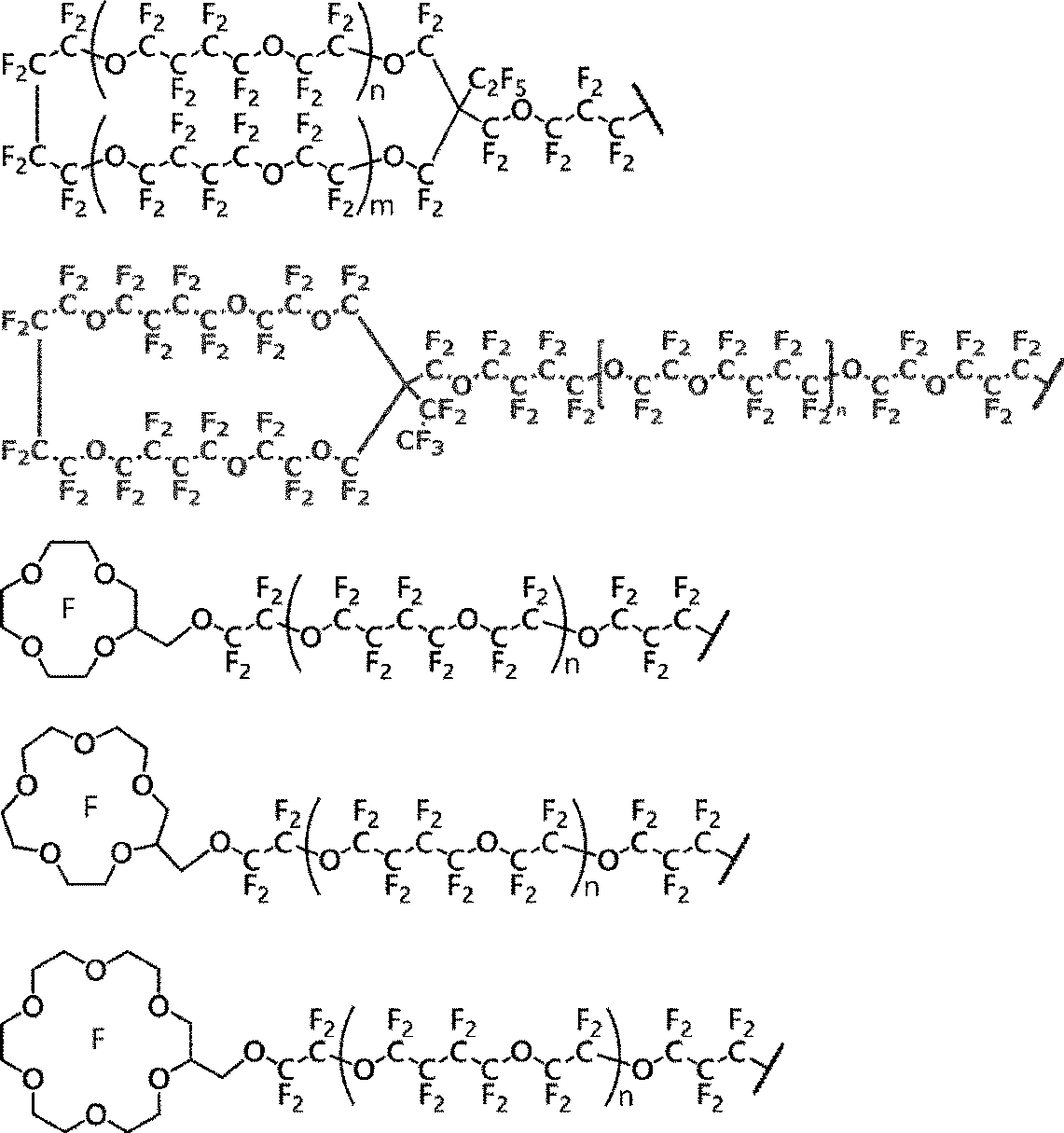
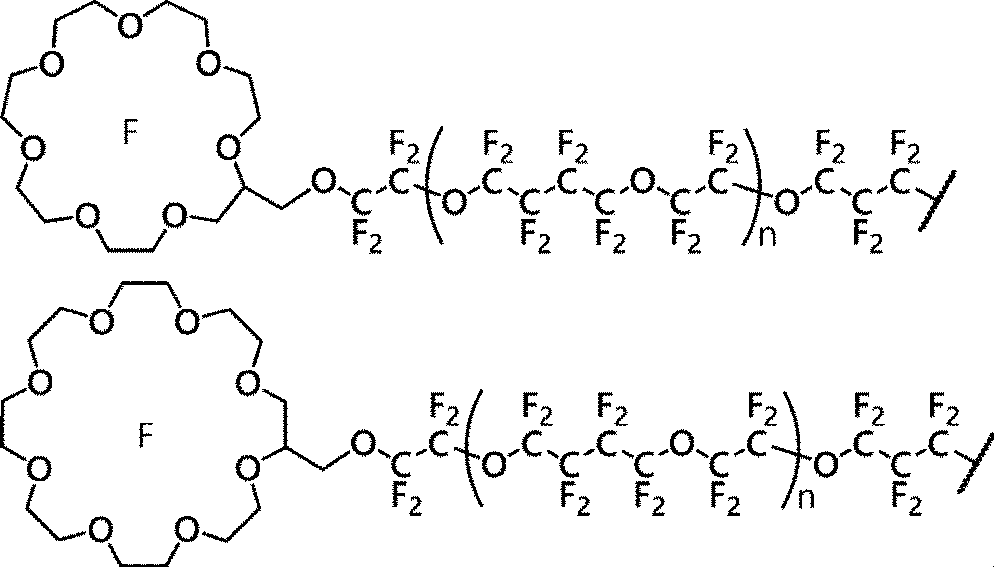
<反応性基(T1)>
T1は反応性基であり、T1が有する反応性に起因して、本化合物は種々の機能を発現する。当該機能としては、例えば、基材表面との密着性を向上する機能、本化合物に光硬化性や熱硬化性を付与する機能、本化合物に酸性アルカリ性等を付与する機能、本化合物の特定の溶媒に対する溶解性を調整する機能、更に、他の化合物を合成する際の前駆体しての機能等が挙げられる。
前記反応性基の具体的な例としては、例えば、-Ar、-SR10、-NOR10、-C(=O)R10、-N(R10)2、-N+(R10)3X3、-C≡N、-C(=NR10)-R10、-N+≡N、-N=NR10、-C(=O)OR10、-C(=O)OX2、-C(=O)OX4、-C(=O)OC(=O)R10、-SO2R10、-SO3H、-SO3X2、-O-P(=O)(-OR10)2、-O-P(=O)(-OR10)(-OX2)、-N=C=O、-SiRa1 z1Ra11 3-z1、-C(R10)=C(R10)2、-C≡C(R10)、-C(=O)N(R10)2、-N(R10)C(=O)R10、-Si(R10)2-O-Si(R10)3、-NH-C(=O)R10、-C(=O)NHR10、-I、
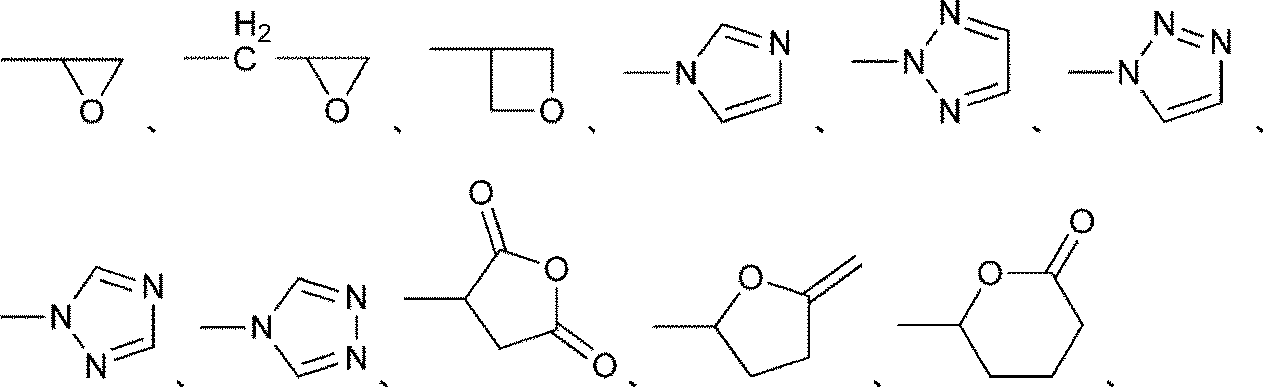
等の基が挙げられる。
ただし、
R10は、水素原子、置換基を有していてもよい炭素数1~6のアルキル基又はフルオロアルキル基、置換基を有していてもよいアリール基であり、
Arは、置換基を有していてもよいアリール基であり、
X2は、アルカリ金属イオン又はアンモニウムイオンであり、
X3は、ハロゲン化物イオンであり、
X4は、ハロゲン原子であり、
Ra1は、加水分解性基、加水分解性基を有する基又は水酸基であり、
Ra11は、炭化水素基であり、
z1は、1~3の整数であり、
R10、Ra1又はRa11が複数ある場合において、当該複数あるR10、Ra1又はRa11は、互いに同一であっても異なっていてもよい。
T1は反応性基であり、T1が有する反応性に起因して、本化合物は種々の機能を発現する。当該機能としては、例えば、基材表面との密着性を向上する機能、本化合物に光硬化性や熱硬化性を付与する機能、本化合物に酸性アルカリ性等を付与する機能、本化合物の特定の溶媒に対する溶解性を調整する機能、更に、他の化合物を合成する際の前駆体しての機能等が挙げられる。
前記反応性基の具体的な例としては、例えば、-Ar、-SR10、-NOR10、-C(=O)R10、-N(R10)2、-N+(R10)3X3、-C≡N、-C(=NR10)-R10、-N+≡N、-N=NR10、-C(=O)OR10、-C(=O)OX2、-C(=O)OX4、-C(=O)OC(=O)R10、-SO2R10、-SO3H、-SO3X2、-O-P(=O)(-OR10)2、-O-P(=O)(-OR10)(-OX2)、-N=C=O、-SiRa1 z1Ra11 3-z1、-C(R10)=C(R10)2、-C≡C(R10)、-C(=O)N(R10)2、-N(R10)C(=O)R10、-Si(R10)2-O-Si(R10)3、-NH-C(=O)R10、-C(=O)NHR10、-I、
ただし、
R10は、水素原子、置換基を有していてもよい炭素数1~6のアルキル基又はフルオロアルキル基、置換基を有していてもよいアリール基であり、
Arは、置換基を有していてもよいアリール基であり、
X2は、アルカリ金属イオン又はアンモニウムイオンであり、
X3は、ハロゲン化物イオンであり、
X4は、ハロゲン原子であり、
Ra1は、加水分解性基、加水分解性基を有する基又は水酸基であり、
Ra11は、炭化水素基であり、
z1は、1~3の整数であり、
R10、Ra1又はRa11が複数ある場合において、当該複数あるR10、Ra1又はRa11は、互いに同一であっても異なっていてもよい。
R10におけるフルオロアルキル基は、炭素数1~6が好ましい。当該フルオロアルキル基は他の置換基を有していてもよい。T1としてフルオロアルキル基を有する本化合物は、フッ素含有割合の高い化合物となり、低屈折率、低誘電率、撥水・撥油性、耐熱性、耐薬品性、化学的安定性、透明性等の諸特性に優れている。フルオロアルキル基が有していてもよい置換基としては、フッ素原子、塩素原子等のハロゲン原子、炭素数1~6のアルキル基、及び、反応性基T1として例示されているものと同様のものが挙げられる。
Ar及びR10におけるアリール基は、フェニル基、ナフチル基等が挙げられ、更に置換基を有していてもよい。アリール基が有していてもよい置換基としては、フッ素原子、塩素原子等のハロゲン原子、炭素数1~6のアルキル基、及び、反応性基T1として例示されているものと同様のものが挙げられる。
R10におけるアルキル基は、炭素数1~6が好ましい。当該アルキル基は他の置換基を有していてもよい。アルキル基が有していてもよい置換基としては、塩素原子等のハロゲン原子、炭素数1~6のアルキル基、及び、反応性基T1として例示されているものと同様のものが挙げられる。
Ar及びR10におけるアリール基は、フェニル基、ナフチル基等が挙げられ、更に置換基を有していてもよい。アリール基が有していてもよい置換基としては、フッ素原子、塩素原子等のハロゲン原子、炭素数1~6のアルキル基、及び、反応性基T1として例示されているものと同様のものが挙げられる。
R10におけるアルキル基は、炭素数1~6が好ましい。当該アルキル基は他の置換基を有していてもよい。アルキル基が有していてもよい置換基としては、塩素原子等のハロゲン原子、炭素数1~6のアルキル基、及び、反応性基T1として例示されているものと同様のものが挙げられる。
T1としてヒドロキシ基、N-ヒドロキシ基、アルデヒド基、ケトン基、アミノ基、4級アンモニウム基、ニトリル基、イミノ基、ジアゾ基、カルボキシ基、カルボン酸塩、酸無水物基、スルホ基、スルホン酸塩、リン酸基、リン酸塩を有する本化合物は、当該反応性基T1により、酸性、アルカリ性、親水性等の各種特性が付与されており、例えば、特定の溶媒に対する溶解性が向上したり、特定の基材に対する密着性が向上する等の機能を付与する。4級アンモニウム塩の対イオンとしては、ハロゲン化物イオン等が挙げられる。カルボン酸塩、スルホン酸塩、リン酸塩の対イオンとしては、アルカリ金属イオン、アンモニウムイオン等が挙げられる。
炭素-炭素二重結合を有する基としては、ビニル基、アクリロイルオキシ基、メタクリロイルオキシ基、オレフィン等が挙げられる。炭素-炭素二重結合を有する本化合物は、光開始剤等と組み合わせることにより、光硬化性組成物を調製でき、当該組成物により得られる硬化塗膜は、撥水撥油性とハードコート性とを兼ね備える。
また、イソシアネート基、エポキシ基、グリシジル基、オキセタニル基、メルカプト基を有する本化合物は、エポキシ硬化剤と組み合わせることにより熱硬化性又は光硬化性組成物を調製でき、当該組成物により得られる硬化塗膜は、撥水撥油性とハードコート性とを兼ね備える。
T1におけるアミド結合、エステル結合、エーテル結合、チオエーテル結合、シロキサン結合、ウレア結合は、T1に含まれる、アルキル基、フルオロアルキル基、アリール基、ヘテロアリール基等を連結する結合である。これらの結合を介して更に他の機能性付与基を有していてもよい。
炭素-炭素二重結合を有する基としては、ビニル基、アクリロイルオキシ基、メタクリロイルオキシ基、オレフィン等が挙げられる。炭素-炭素二重結合を有する本化合物は、光開始剤等と組み合わせることにより、光硬化性組成物を調製でき、当該組成物により得られる硬化塗膜は、撥水撥油性とハードコート性とを兼ね備える。
また、イソシアネート基、エポキシ基、グリシジル基、オキセタニル基、メルカプト基を有する本化合物は、エポキシ硬化剤と組み合わせることにより熱硬化性又は光硬化性組成物を調製でき、当該組成物により得られる硬化塗膜は、撥水撥油性とハードコート性とを兼ね備える。
T1におけるアミド結合、エステル結合、エーテル結合、チオエーテル結合、シロキサン結合、ウレア結合は、T1に含まれる、アルキル基、フルオロアルキル基、アリール基、ヘテロアリール基等を連結する結合である。これらの結合を介して更に他の機能性付与基を有していてもよい。
本化合物の反応性基T1としては、合成や化学的安定性、基材との密着性等の点から、ヒドロキシル基、アミノ基、又は炭素-炭素二重結合を有する基が好ましい。また、炭素-炭素二重結合を有する基の中でも、アクリロイル基、メタクリロイル基、ビニル基、アリル基、又はオレフィンが好ましい。
また、本化合物を耐摩擦性等の耐久性に優れた表面層を形成するための表面処理剤として用いる場合、T1は反応性シリル基を有する基であることが好ましい。反応性シリル基を有する基としては、下記式(5)で表される基が好ましい。
-SiRa1 z1Ra11 3-z1 ・・・式(5)
ただし、
Ra1は、加水分解性基、加水分解性基を有する基又は水酸基であり、
Ra11は、炭化水素基であり、
z1は、1~3の整数であり、
Ra1、Ra11、及びz1が複数ある場合、当該複数あるRa1、Ra11、及びz1は各々同一であっても異なっていてもよい。
-SiRa1 z1Ra11 3-z1 ・・・式(5)
ただし、
Ra1は、加水分解性基、加水分解性基を有する基又は水酸基であり、
Ra11は、炭化水素基であり、
z1は、1~3の整数であり、
Ra1、Ra11、及びz1が複数ある場合、当該複数あるRa1、Ra11、及びz1は各々同一であっても異なっていてもよい。
Ra1が水酸基の場合は、Si原子と共にシラノール(Si-OH)基を構成する。また、加水分解性基は加水分解反応によって水酸基となる基である。シラノール基は、更に分子間で反応してSi-O-Si結合を形成する。また、シラノール基は、基材の表面の水酸基(基材-OH)と脱水縮合反応して、化学結合(基材-O-Si)を形成する。化合物1は、T1を1以上有することにより、表面層形成後の耐摩耗性に優れる。
Ra1の加水分解性基としては、アルコキシ基、アリールオキシ基、ハロゲン原子、アシル基、アシルオキシ基、イソシアナート基(-NCO)等が挙げられる。アルコキシ基としては、炭素数1~4のアルコキシ基が好ましい。アシル基としては、炭素数1~6のアシル基が好ましい。アシルオキシ基としては、炭素数1~6のアシルオキシ基が好ましい。
Ra1の加水分解性基を有する基としては、例えば、上記で例示される加水分解性基を有する基であればよい。加水分解性基を有する基は、-O-LA-LBが好ましい。LAはエーテル性酸素原子を有していてもよいアルキレン基であり、LBは加水分解性基である。
アルキレン基の炭素数は、1~10が好ましい。
LAで表される上記アルキレン基は、炭素原子-炭素原子間にエーテル性酸素原子を有していてもよい。上記エーテル性酸素原子の数は、1又は2以上であってもよい。LAがエーテル性酸素原子を有するアルキレン基である場合、-O-LA-LB中の-O-側に結合する原子は、エーテル性酸素原子を有するアルキレン基を構成する炭素原子であることが好ましい。
LBで表される加水分解性基は、Ra1で表される加水分解性基と同義であり、好適態様も同じである。
アルキレン基の炭素数は、1~10が好ましい。
LAで表される上記アルキレン基は、炭素原子-炭素原子間にエーテル性酸素原子を有していてもよい。上記エーテル性酸素原子の数は、1又は2以上であってもよい。LAがエーテル性酸素原子を有するアルキレン基である場合、-O-LA-LB中の-O-側に結合する原子は、エーテル性酸素原子を有するアルキレン基を構成する炭素原子であることが好ましい。
LBで表される加水分解性基は、Ra1で表される加水分解性基と同義であり、好適態様も同じである。
Ra1は、合成の容易性の点から、炭素数1~4のアルコキシ基又はハロゲン原子が特に好ましい。Ra1におけるアルコキシ基は、化合物1の保存安定性に優れ、反応時のアウトガスが抑制される点から、炭素数1~4のアルコキシ基が好ましく、長期の保存安定性の点からはエトキシ基が特に好ましく、加水分解反応時間を短時間にする点からはメトキシ基が特に好ましい。また、ハロゲン原子としては、塩素原子が特に好ましい。
Ra11は、炭化水素基である。炭化水素基としては、アルキル基、シクロアルキル基、アルケニル基、アリル基等が挙げられ、合成の容易性等の点から、アルキル基が好ましい。また、合成の容易性等の点から、炭化水素基の炭素数は、1~6が好ましく、1~3がより好ましく、1~2が更に好ましい。
1つのT1内における、Ra1の数z1は、1~3であればよく、基材との密着性の点からは、2又は3が好ましく、3がより好ましい。
T1の具体例としては、-Si(OCH3)3、-SiCH3(OCH3)2、-Si(OCH2CH3)3、-SiCl3、-Si(OCOCH3)3、-Si(NCO)3等が挙げられる。製造における取扱いやすさの点から、-Si(OCH3)3が特に好ましい。
T1の具体例としては、-Si(OCH3)3、-SiCH3(OCH3)2、-Si(OCH2CH3)3、-SiCl3、-Si(OCOCH3)3、-Si(NCO)3等が挙げられる。製造における取扱いやすさの点から、-Si(OCH3)3が特に好ましい。
本化合物の1分子中のT1の数は、1~20であればよく、合成の容易性や、本化合物の取り扱いの容易性等の点から、1~12が好ましく、1~6がより好ましい。本化合物の1分子中に2個以上のT1がある場合において、当該T1は、互いに同一の構造であってもよく、異なる構造であってもよい。
T1が反応性シリル基を有さない場合の具体例としては、以下の構造が挙げられる。ただし、式中のRaは、置換基を有していてもよいアルキル基、フルオロアルキル基、又はアリール基を示し、Rbは置換基を有していてもよいフルオロアルキル基、又はアリール基を示し、*は結合手を示す。

フルオロエーテル環を含む基(Rf)と、反応性基(T1)とを有する本化合物は、得られる表面層の耐摩擦性、指紋汚れ除去性、滑落防止性に優れ、且つ、本化合物の合成の容易性の点から、下記式(3)で表される化合物が好ましい。
Rf[-Q1(-T1)x1]y1 ・・・(3)
ただし、
Rfは、置換基を有していてもよいフルオロエーテル環を含む基であり、
Q1は、1+x1価の連結基であり、
T1は、反応性基であり、
x1は1~10の整数であり、
y1は1~6の整数であり、
Q1、T1、又はx1が複数ある場合、当該複数あるQ1、T1、又はx1は互いに同一であっても異なっていてもよい。
なお、式(3)におけるRf、T1及びy1は前述の通りであるためここでの説明は省略する。
Rf[-Q1(-T1)x1]y1 ・・・(3)
ただし、
Rfは、置換基を有していてもよいフルオロエーテル環を含む基であり、
Q1は、1+x1価の連結基であり、
T1は、反応性基であり、
x1は1~10の整数であり、
y1は1~6の整数であり、
Q1、T1、又はx1が複数ある場合、当該複数あるQ1、T1、又はx1は互いに同一であっても異なっていてもよい。
なお、式(3)におけるRf、T1及びy1は前述の通りであるためここでの説明は省略する。
Q1は、フルオロエーテル環を含む基(Rf)と反応性基(T1)とを連結する1+x1価の連結基である。Q1の構造は特に限定されるものではないが、本化合物の化学的安定性や合成の容易性の点から、-Q1(-T1)x1として、下記式(4)で表される構造を備えることが好ましい。
*-R2-L1(-R3-T1)x1 ・・・(4)
ただし、
R2は、単結合、炭素数1~20のフルオロアルキレン基、アルキレン基、又は炭素-炭素原子間にエーテル性酸素原子を含むアルキレン基であり、
L1は、単結合又は、1+x1価の基であり、
R3は、アルキレン基、又はエーテル性酸素原子を有するアルキレン基であり、
x1は1~10の整数であり、
結合手*はRfと連結し、
R3又はT1が複数ある場合、当該複数あるR3又はT1は互いに同一であっても異なっていてもよい。
*-R2-L1(-R3-T1)x1 ・・・(4)
ただし、
R2は、単結合、炭素数1~20のフルオロアルキレン基、アルキレン基、又は炭素-炭素原子間にエーテル性酸素原子を含むアルキレン基であり、
L1は、単結合又は、1+x1価の基であり、
R3は、アルキレン基、又はエーテル性酸素原子を有するアルキレン基であり、
x1は1~10の整数であり、
結合手*はRfと連結し、
R3又はT1が複数ある場合、当該複数あるR3又はT1は互いに同一であっても異なっていてもよい。
R2は、単結合、炭素数1~20のフルオロアルキレン基、アルキレン基、又は炭素-炭素原子間にエーテル性酸素原子を含むアルキレン基である。R2が単結合である場合、Rf中の(ORf3)m3の末端に位置するRf3が、L1と直接結合する構造を有する。
R2がアルキレン基である場合、当該アルキレン基は、直鎖であってもよく、分岐を有してもよく、環構造を有してもよく、炭素-炭素原子間にエーテル性酸素原子を有してもよい。R2は、耐摩耗性の点から直鎖アルキレン基が好ましい。また、合成容易性等の観点から、アルキレン基の炭素数は1~6が好ましく、1~3がより好ましい。
R2がフルオロアルキレン基である場合、当該アルキレン基は、直鎖であってもよく、分岐を有してもよく、環構造を有してもよい。
R2がフルオロアルキレン基である場合、当該アルキレン基は、直鎖であってもよく、分岐を有してもよく、環構造を有してもよい。
L1は、単結合又は、N、O、S、Si等のヘテロ原子を有してもよく、分岐点を有していてもよい1+x1価の基である。L1中のR2及びR3に結合する原子は、各々独立に、N、O、S、Si原子、分岐点を構成する炭素原子である。
L1が単結合の場合、式(4)のR2とR3は直接結合する。また、L1が単結合であり、かつR2が単結合である場合、本化合物は(ORf3)m3とR3が直接結合する構造を有する。
L1が単結合の場合、式(4)のR2とR3は直接結合する。また、L1が単結合であり、かつR2が単結合である場合、本化合物は(ORf3)m3とR3が直接結合する構造を有する。
L1が3価以上の基の場合、L1はC、N、Si、環構造及び(1+x1)価のオルガノポリシロキサン残基からなる群から選ばれる少なくとも1種の分岐点(以下、「分岐点P1」と記す。)を有する。
Nが分岐点P1となる場合、分岐点P1は、例えば*-N(-**)2で表される。ただし、*はR2側の結合手であり、**はR3側の結合手である。
Cが分岐点P1となる場合、分岐点P1は、例えば*-C(-**)3又は*-CR29(-**)2で表される。ただし、*はR2側の結合手であり、**はR3側の結合手であり、R29は1価の基であり、水素原子、水酸基、アルキル基、アルコキシ基等が挙げられる。
Siが分岐点P1となる場合、分岐点P1は、例えば*-Si(-**)3又は*-SiR29(-**)2で表される。ただし、*はR2側の結合手であり、**はR3側の結合手であり、R29は1価の基であり、水素原子、水酸基、アルキル基、アルコキシ基等が挙げられる。
Cが分岐点P1となる場合、分岐点P1は、例えば*-C(-**)3又は*-CR29(-**)2で表される。ただし、*はR2側の結合手であり、**はR3側の結合手であり、R29は1価の基であり、水素原子、水酸基、アルキル基、アルコキシ基等が挙げられる。
Siが分岐点P1となる場合、分岐点P1は、例えば*-Si(-**)3又は*-SiR29(-**)2で表される。ただし、*はR2側の結合手であり、**はR3側の結合手であり、R29は1価の基であり、水素原子、水酸基、アルキル基、アルコキシ基等が挙げられる。
分岐点P1を構成する環構造としては、本化合物を製造しやすい点、及び表面層の耐摩擦性、耐光性及び耐薬品性が更に優れる点から、3~8員環の脂肪族環、3~8員環の芳香族環、3~8員環のヘテロ環、及びこれらの環のうちの2つ以上からなる縮合環からなる群から選ばれる1種が好ましく、下式に挙げられる環構造が特に好ましい。環構造は、ハロゲン原子、アルキル基(炭素-炭素原子間にエーテル性酸素原子を含んでいてもよい。)、シクロアルキル基、アルケニル基、アリル基、アルコキシ基、オキソ基(=O)等の置換基を有してもよい。
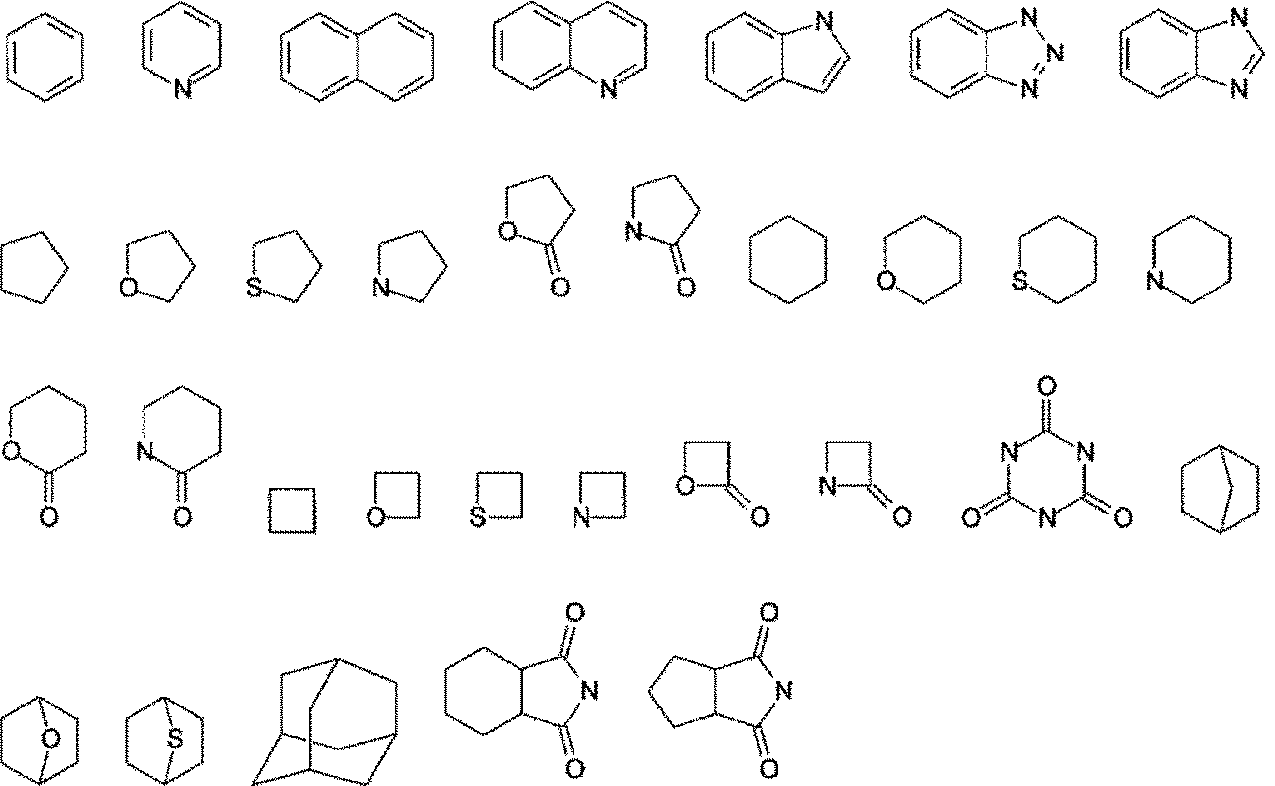
分岐点P1を構成するオルガノポリシロキサン残基としては、例えば、下記の基が挙げられる。ただし、下式におけるR25は、水素原子、アルキル基、アルコキシ基、又はフェニル基である。R25のアルキル基及びアルコキシ基の炭素数は、1~10が好ましく、1がより好ましい。
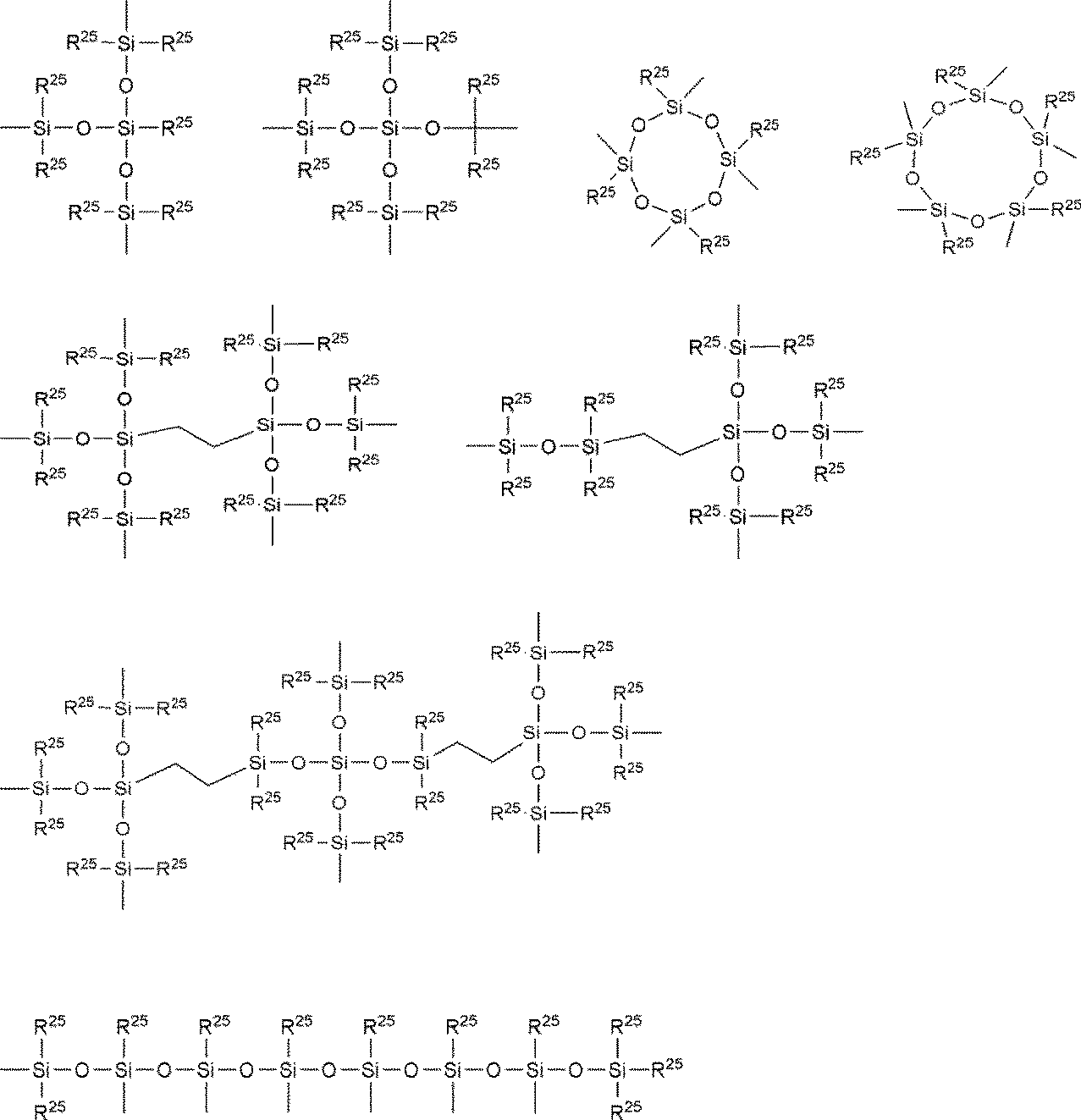
2価以上のL1は、-C(O)N(R26)-、-N(R26)C(O)-、-C(O)O-、-OC(O)-、-C(O)-、-O-、-N(R26)-、-S-、-OC(O)O-、-NHC(O)O-、-OC(O)NH-、-NHC(O)N(R26)-、-SO2N(R26)-、-N(R26)SO2-、-Si(R26)2-、-OSi(R26)2-、-Si(CH3)2-Ph-Si(CH3)2-及び2価のオルガノポリシロキサン残基からなる群から選ばれる少なくとも1種の結合(以下、「結合B4」と記す。)を有していてもよい。
ただし、R26は、水素原子、炭素数1~6のアルキル基又はフェニル基であり、Phは、フェニレン基である。R26のアルキル基の炭素数は、本化合物を製造しやすい点から、1~6が好ましく、1~3がより好ましく、1~2が更に好ましい。
ただし、R26は、水素原子、炭素数1~6のアルキル基又はフェニル基であり、Phは、フェニレン基である。R26のアルキル基の炭素数は、本化合物を製造しやすい点から、1~6が好ましく、1~3がより好ましく、1~2が更に好ましい。
2価のオルガノポリシロキサン残基としては、例えば、下式の基が挙げられる。ただし、下式におけるR27は、水素原子、アルキル基、アルコキシ基、又はフェニル基である。R27のアルキル基及びアルコキシ基の炭素数は、1~10が好ましく、1がより好ましい。
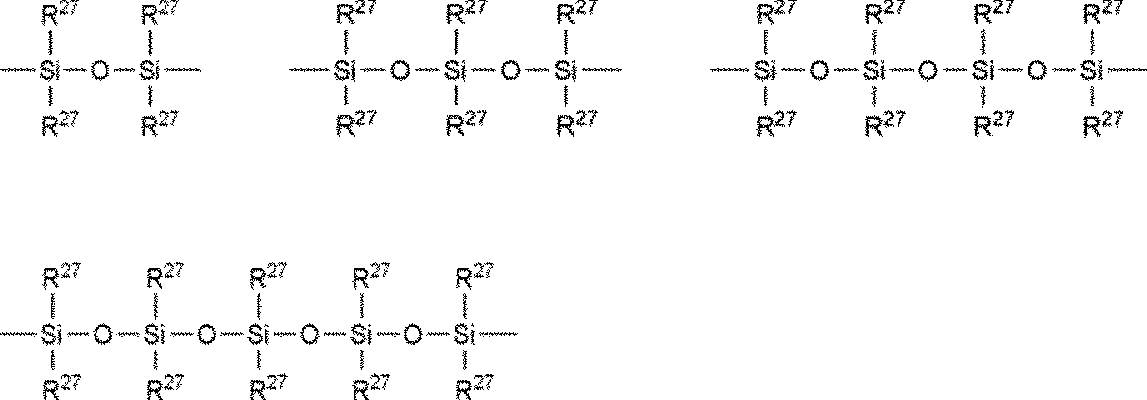
結合B4としては、本化合物を製造しやすい点から、-C(O)NR26-、-N(R26)C(O)-、-C(O)-、及び-NR26-からなる群から選ばれる少なくとも1種の結合が好ましく、表面層の耐光性及び耐薬品性が更に優れる点から、-C(O)NR26-、-N(R26)C(O)-又は-C(O)-がより好ましい。
3価以上のL1は、R2及びR3に結合する原子が、各々独立に、N、O、S、Si原子、分岐点を構成する炭素原子、又はオキソ基(=O)を有する炭素原子である。すなわち、R2及びR3に隣接する原子が各々結合B4又は分岐点P1の構成元素である。3価以上のL1の具体例としては、1個以上の分岐点P1(例えば{*-P1(-**)x1})、1個以上の分岐点P1と1個以上の結合B4との組み合わせ(例えば、{*-B4-R28-P1(-**)x1}、{*-B4-R28-P1(-R28-B4-**)x1})等が挙げられる。ただし、R28は単結合又は2価の有機基であり、*はR2側の結合手であり、**はR3側の結合手である。
また、2価のL1としては、R2及びR3に結合する原子が、各々独立に、N、O、S、Si原子又はオキソ基(=O)を有する炭素原子である。すなわち、R2及びR3に隣接する原子が各々結合B4の構成元素である。2価のL1の具体例としては、単結合、1個以上の結合B4(例えば、*-B4-**、*-B4-R28-B4-**)等が挙げられる。ただし、R28は単結合又は2価の有機基であり、*はR2側の結合手であり、**はR3側の結合手である。
上記R28における2価の有機基としては、例えば、2価の脂肪族炭化水素基(アルキレン基、シクロアルキレン基等)、2価の芳香族炭化水素基(フェニレン基等)が挙げられ、炭素数2以上の炭化水素基の炭素-炭素原子間に結合B4を有していてもよい。2価の有機基の炭素数は、1~10が好ましく、1~6がより好ましく、1~4が更に好ましい。
前記L1としては、本化合物を製造しやすい点から、下式(E1)~(E7)のいずれかで表される基が好ましい。

-E2-N(-E23-)2 ・・・式(E3)
-E3-Z1(-E24-)e4 ・・・式(E4)
-E2-Si(RE3)3-e3(-E25-)e3 ・・・式(E5)
-E1-E26- ・・・式(E6)
-E1-CH(-E22-)-Si(RE3)3-e5(-E25-)e5 ・・・式(E7)
ただし、式(E1)~式(E7)においては、E1、E2又はE3側が式(4)のR2と接続し、E22、E23、E24、E25又はE26側がR3に接続する。
ここで、E1は、単結合、-B5-、-B6-R40-、又は-B6-R40-B5-であって、R40はアルキレン基、又は炭素数2以上のアルキレン基の炭素-炭素原子間に-C(O)NRE6-、-C(O)-、-NRE6-又は-O-を有する基であり、B5は、-C(O)NRE6-、-C(O)-、-NRE6-又は-O-であり、B6は-C(O)NRE6-、-C(O)-、又は-NRE6-であり、
E2は、単結合又は-B6-R40-であり、
E3は、E3が結合するZ1における原子が炭素原子の場合、E1であり、E3が結合するZ1における原子が窒素原子の場合、E2であり、
E11は、単結合、-O-、アルキレン基、又は炭素数2以上のアルキレン基の炭素-炭素原子間に-C(O)NRE6-、-C(O)-、-NRE6-又は-O-を有する基であり、
E22は、単結合、-B5-、-R40-B6-又は-B5-R40-B6-であり、E22を2以上有する場合、2以上のE22は同一であっても異なっていてもよく、
E23は、単結合又は-R40-B6-であり、2個のE23は同一であっても異なっていてもよく、
E24は、E24が結合するZ1における原子が炭素原子の場合、E22であり、E24が結合するZ1における原子が窒素原子の場合、E23であり、E24を2以上有する場合、2以上のE24は同一であっても異なっていてもよく、
E25は、単結合、又は-R40-B6-であり、E25を2以上有する場合、2以上のE25は同一であっても異なっていてもよく、
E26は、単結合又は-R40-B6-であり、
Z1は、E3が直接結合する炭素原子又は窒素原子を有しかつE24が直接結合する炭素原子又は窒素原子を有する(e4+1)価の環構造を有する基であり、
RE1は、水素原子又はアルキル基であり、RE1を2以上有する場合、2以上のRE1は同一であっても異なっていてもよく、
RE2は、水素原子、水酸基、アルキル基又はアシルオキシ基であり、
RE3は、アルキル基であり、
RE6は、水素原子、炭素数1~6のアルキル基又はフェニル基であり、
e1は0~3の整数であり、e2は0~3の整数であって、e1+e2は1~6の整数であり、
e3は、1~3の整数であり、
e4は、1以上の整数であり、
e5は、1~3の整数である。
なお、e1+e2=x1、e3=x1、e4=x1、e5+1=x1である。
R40のアルキレン基の炭素数は、本化合物を製造しやすい点、及び表面層の耐摩擦性、耐光性及び耐薬品性が更に優れる点から、1~10が好ましく、1~6がより好ましく、1~4が更に好ましい。ただし、炭素-炭素原子間に特定の結合を有する場合のアルキレン基の炭素数の下限値は2である。
Z1における環構造としては、上述した環構造が挙げられ、好ましい形態も同様である。なお、Z1における環構造にはE24が直接結合するため、環構造に例えばアルキレン基が連結して、そのアルキレン基にE24が連結することはない。
RE1、RE2又はRE3のアルキル基の炭素数は、本化合物を製造しやすい点から、1~6が好ましく、1~3がより好ましく、1~2が更に好ましい。
RE2のアシルオキシ基のアルキル基部分の炭素数は、本化合物を製造しやすい点から、1~6が好ましく、1~3がより好ましく、1~2が更に好ましい。
g4は、本化合物を製造しやすい点、及び表面層の耐摩擦性及び指紋汚れ除去性が更に優れる点から、2~6が好ましく、2~4がより好ましく、2又は3が更に好ましい。
RE2のアシルオキシ基のアルキル基部分の炭素数は、本化合物を製造しやすい点から、1~6が好ましく、1~3がより好ましく、1~2が更に好ましい。
g4は、本化合物を製造しやすい点、及び表面層の耐摩擦性及び指紋汚れ除去性が更に優れる点から、2~6が好ましく、2~4がより好ましく、2又は3が更に好ましい。
前記L1の他の形態としては、下式(E11)~(E17)のいずれかで表される基が挙げられる。

-E2-N(-E23-EG)2 式(E13)
-E3-Z1(-E24-EG)e4 式(E14)
-E2-Si(RE3)3-e3(-E25-EG)e3 式(E15)
-E1-E26-EG 式(E16)
-E1-CH(-E22-)-Si(RE3)3-e5(-E25-EG)e5 式(E17)
ただし、式(E11)~式(E17)においては、E1、E2又はE3側が式(4)のR2と接続し、E22、E23、E24、E25又はE26側がR3に接続する。EGは、下記式(EG)で表される基であり、L1が有する2以上のEGは同一であっても異なっていてもよい。EG以外の符号は、式(E1)~式(E7)における符号と同じである。
-Si(R23)3-k(-E3-)k 式(EG)
ただし、式(EG)において、Si側がE22、E23、E24、E25又はE26に接続し、E3側がR3に接続する。R23は、アルキル基である。E3は、単結合、又は-R45-B6-であって、R45は、アルキレン基、又は炭素数2以上のアルキレン基の炭素-炭素原子間に-C(O)NR46-、-C(O)-、-NR46-又は-O-を有する基、又は-(OSi(R24)2)p-O-であり、2以上のE3は同一であっても異なっていてもよい。kは、2又は3である。R46は、水素原子、炭素数1~6のアルキル基又はフェニル基である。R24は、アルキル基、フェニル基又はアルコキシ基であり、2個のR24は同一であっても異なっていてもよい。pは、0~5の整数であり、pが2以上の場合、2以上の(OSi(R24)2)は同一であっても異なっていてもよい。
-Si(R23)3-k(-E3-)k 式(EG)
ただし、式(EG)において、Si側がE22、E23、E24、E25又はE26に接続し、E3側がR3に接続する。R23は、アルキル基である。E3は、単結合、又は-R45-B6-であって、R45は、アルキレン基、又は炭素数2以上のアルキレン基の炭素-炭素原子間に-C(O)NR46-、-C(O)-、-NR46-又は-O-を有する基、又は-(OSi(R24)2)p-O-であり、2以上のE3は同一であっても異なっていてもよい。kは、2又は3である。R46は、水素原子、炭素数1~6のアルキル基又はフェニル基である。R24は、アルキル基、フェニル基又はアルコキシ基であり、2個のR24は同一であっても異なっていてもよい。pは、0~5の整数であり、pが2以上の場合、2以上の(OSi(R24)2)は同一であっても異なっていてもよい。
E3のアルキレン基の炭素数は、本化合物を製造しやすい点、及び表面層の耐摩擦性、耐光性及び耐薬品性が更に優れる点から、1~10が好ましく、1~6がより好ましく、1~4が更に好ましい。ただし、炭素-炭素原子間に特定の結合を有する場合のアルキレン基の炭素数の下限値は2である。
R23のアルキル基の炭素数は、本化合物を製造しやすい点から、1~6が好ましく、1~3がより好ましく、1~2が更に好ましい。
R24のアルキル基の炭素数は、本化合物を製造しやすい点から、1~6が好ましく、1~3がより好ましく、1~2が更に好ましい。
R24のアルコキシ基の炭素数は、本化合物の保存安定性に優れる点から、1~6が好ましく、1~3がより好ましく、1~2が更に好ましい。
pは、0又は1が好ましい。
R23のアルキル基の炭素数は、本化合物を製造しやすい点から、1~6が好ましく、1~3がより好ましく、1~2が更に好ましい。
R24のアルキル基の炭素数は、本化合物を製造しやすい点から、1~6が好ましく、1~3がより好ましく、1~2が更に好ましい。
R24のアルコキシ基の炭素数は、本化合物の保存安定性に優れる点から、1~6が好ましく、1~3がより好ましく、1~2が更に好ましい。
pは、0又は1が好ましい。
R3は、単結合、アルキレン基、又はエーテル性酸素原子を有するアルキレン基である。R3がエーテル性酸素原子を有するアルキレン基である場合、L1に結合する原子がエーテル性酸素原子でもよく、炭素-炭素原子間にエーテル性酸素原子を有してもよい。
R3が複数ある場合、複数あるR3は互いに同一であっても異なっていてもよい。当該R3としては、下式(6)で表わす基であることが好ましい。
*-(O)a6-(R41O)a7-R42-** ・・・(6)
ただし、
R41は、炭素数1~12のアルキレン基であり、複数あるR41は互いに同一であっても異なっていてもよく、
R42は、炭素数1~30のアルキレン基であり、
a6は0又は1であり、
a7は0以上の整数であり、
*はL1に結合する結合手であり、
**はT1に結合する結合手である。
R3が複数ある場合、複数あるR3は互いに同一であっても異なっていてもよい。当該R3としては、下式(6)で表わす基であることが好ましい。
*-(O)a6-(R41O)a7-R42-** ・・・(6)
ただし、
R41は、炭素数1~12のアルキレン基であり、複数あるR41は互いに同一であっても異なっていてもよく、
R42は、炭素数1~30のアルキレン基であり、
a6は0又は1であり、
a7は0以上の整数であり、
*はL1に結合する結合手であり、
**はT1に結合する結合手である。
a6が0の場合において、結合手*を有する原子は、炭素原子であり、a6が1の場合において、結合手*を有する原子は、酸素原子である。化合物1において、a6は、0又は1のいずれでもよく、合成の容易性等の点から適宜選択すればよい。
a7はR41Oの繰り返し数であり、表面層としての耐久性等の点から、0~6が好ましく、0~3がより好ましく、0~1が更に好ましい。
R41のアルキレン基は、炭素数1~12の直鎖又は分岐を有するアルキレン基であればよく、炭素数1~6のアルキレン基が好ましく、炭素数1~3のアルキレン基がより好ましい。また、当該アルキレン基は直鎖アルキレン基が好ましい。
R42のアルキレン基は、炭素数1~30の直鎖又は分岐を有するアルキレン基であればよく、炭素数1~20のアルキレン基が好ましく、炭素数2~20のアルキレン基がより好ましい。R42のアルキレン基の炭素数は1~12であってもよく、1~10であってもよく、2~6であってもよく2~3であってもよい。また、当該アルキレン基は直鎖アルキレン基が好ましい。
a7はR41Oの繰り返し数であり、表面層としての耐久性等の点から、0~6が好ましく、0~3がより好ましく、0~1が更に好ましい。
R41のアルキレン基は、炭素数1~12の直鎖又は分岐を有するアルキレン基であればよく、炭素数1~6のアルキレン基が好ましく、炭素数1~3のアルキレン基がより好ましい。また、当該アルキレン基は直鎖アルキレン基が好ましい。
R42のアルキレン基は、炭素数1~30の直鎖又は分岐を有するアルキレン基であればよく、炭素数1~20のアルキレン基が好ましく、炭素数2~20のアルキレン基がより好ましい。R42のアルキレン基の炭素数は1~12であってもよく、1~10であってもよく、2~6であってもよく2~3であってもよい。また、当該アルキレン基は直鎖アルキレン基が好ましい。
-Q1(-T1)x1の具体例としては、以下のような構造が挙げられる。なお-Q1(-T1)x1はこれらに限定されるものではない。
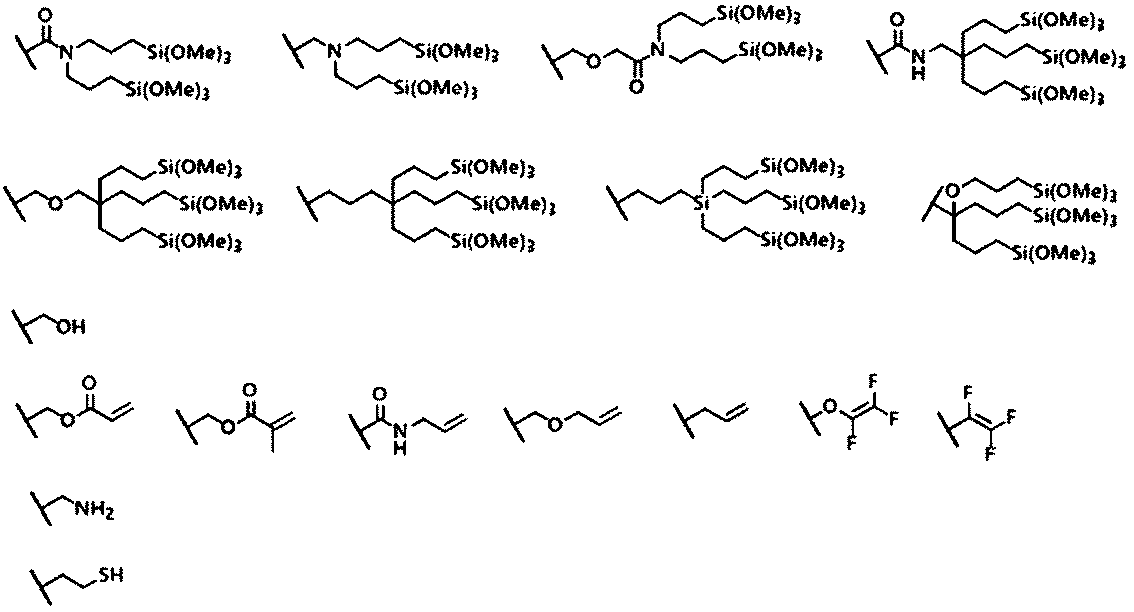

上記(CH2)αにおけるαはメチレン基の数を表す整数であり、1~30が好ましく、1~20がより好ましく、2~20が更に好ましく、2~10であってもよく、2~6であってもよい。例えば、2、3、8、9、11が挙げられる。また、前記炭素数は1~10であってもよい。同一化合物中に含まれる複数のαは同一であっても異なっていてもよいが、同一であることが好ましい。例えば、同一化合物中に含まれる複数のαが全て2、3、8、9、11である。
化合物3の具体例としては、例えば下記が挙げられる。なお、下記式中のn及びmは各々独立に1~200の整数を表す。
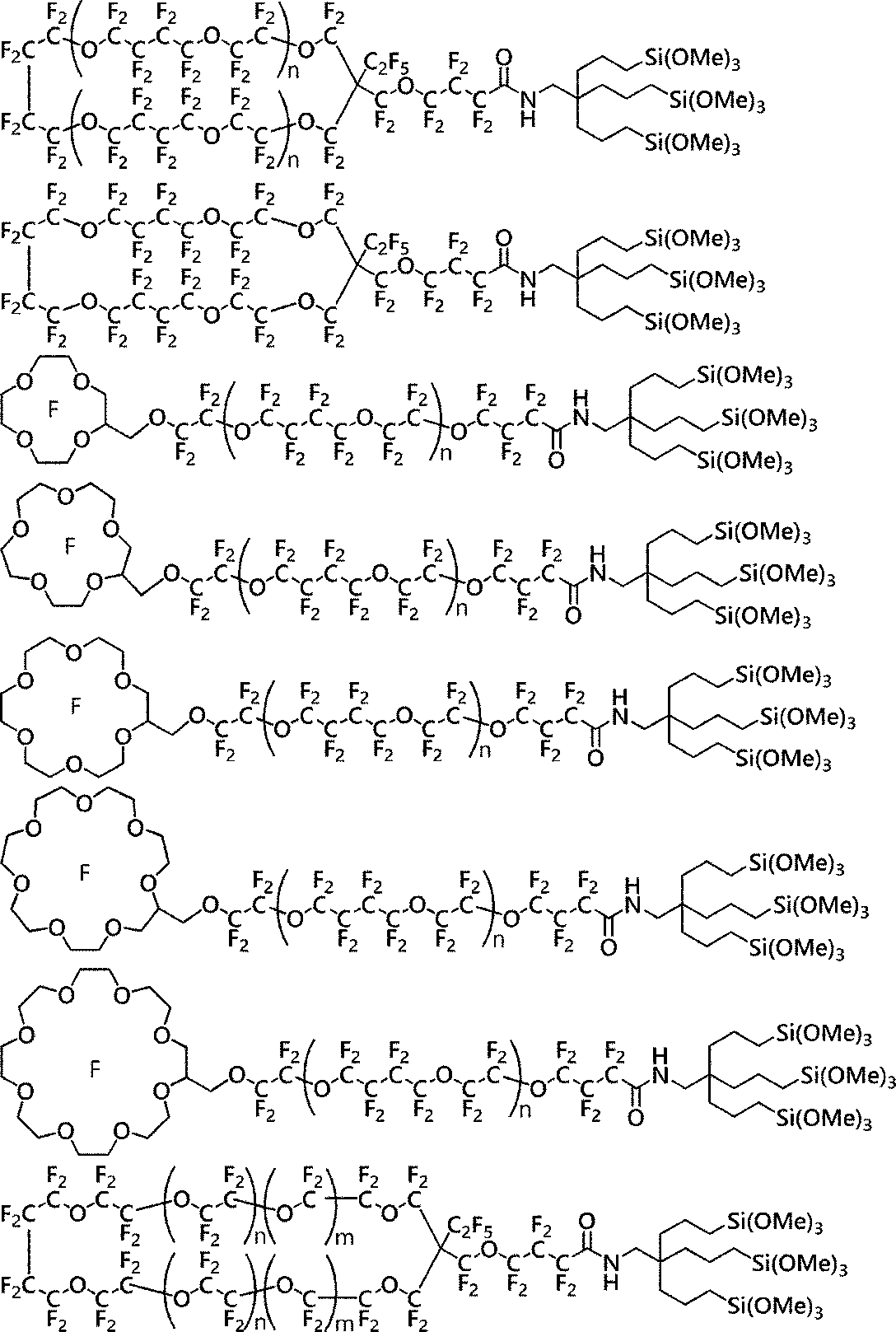
<本化合物の製造方法>
本化合物の製造方法としては、例えば、(I)直鎖状のポリフルオロエーテル鎖にフルオロエーテル環を付加してフルオロエーテル環を含む基(Rf)を合成し、当該Rfに反応性基T1を付加する方法;(II)分岐を有するポリフルオロエーテル鎖を環化してフルオロエーテル環を含む基(Rf)を合成し、当該Rfに反応性基T1を付加する方法;等が挙げられる。上記(I)(II)の方法を具体的に説明するが、本化合物の製造方法はこれらに限定されるものではない。
本化合物の製造方法としては、例えば、(I)直鎖状のポリフルオロエーテル鎖にフルオロエーテル環を付加してフルオロエーテル環を含む基(Rf)を合成し、当該Rfに反応性基T1を付加する方法;(II)分岐を有するポリフルオロエーテル鎖を環化してフルオロエーテル環を含む基(Rf)を合成し、当該Rfに反応性基T1を付加する方法;等が挙げられる。上記(I)(II)の方法を具体的に説明するが、本化合物の製造方法はこれらに限定されるものではない。
(製造方法(I))
上記(I)の方法において、Rfを合成する方法としては、例えば、下記式(21)で表される化合物と、下記式(22)で表される化合物とを反応させる方法が挙げられる。
Rr2-(D1)y1 式(21)
D2-(ORf3)m3-D3 式(22)
但し、
Rr2は(フルオロ)エーテル環のy1価の残基であり、
D1はD2と反応しうる基を含む基であり、
D2はD1と反応しうる基を含む基であり、
D3は、-Q1(-T1)x1であるか、又はその後の操作により-Q1(-T1)x1が導入可能な基であり、
D1とD2は反応後に式(11)におけるRf2となる基である。
上記(I)の方法において、Rfを合成する方法としては、例えば、下記式(21)で表される化合物と、下記式(22)で表される化合物とを反応させる方法が挙げられる。
Rr2-(D1)y1 式(21)
D2-(ORf3)m3-D3 式(22)
但し、
Rr2は(フルオロ)エーテル環のy1価の残基であり、
D1はD2と反応しうる基を含む基であり、
D2はD1と反応しうる基を含む基であり、
D3は、-Q1(-T1)x1であるか、又はその後の操作により-Q1(-T1)x1が導入可能な基であり、
D1とD2は反応後に式(11)におけるRf2となる基である。
上記式(21)で表される化合物は、例えば、置換基を有するクラウンエーテルの市販品等を用いることができる。式(21)で表される化合物はフッ素化されたものであってもよく、上記反応後にフッ素化してもよい。
また、上記式(22)で表される化合物は、市販品を用いてもよく、合成してもよい。
また、上記式(22)で表される化合物は、市販品を用いてもよく、合成してもよい。
上記反応の反応条件は、D1とD2の組み合わせに応じて適宜調整すればよい。また、D3に-Q1(-T1)x1を導入する方法は、例えば後述する含フッ素エーテル化合物が記載された文献の方法を適宜参照することができる。
(製造方法(II))
上記方法(II)において、分岐を有するポリフルオロエーテル鎖の合成方法としては、例えば、下記式(31)で表される化合物と、下記式(32)で表される化合物とを反応させて下記式(33)で表される化合物を得る方法が挙げられる。
(D11-)2CR31-D13 式(31)
D12-(ORf4)m4 式(32)
[(Rf4O)m4-]2CR31-D13 式(33)
但し、
R31は水素原子、フッ素原子、又は炭素数1~6の(フルオロ)アルキレン基であり、
D11はD12と反応しうる基を含む基であり、
D13は、-Q1(-T1)x1であるか、又はその後の操作により-Q1(-T1)x1が導入可能な基であり、
Rf4は炭素数1~6の(フルオロ)アルキレン基であり、
m4は1以上の整数である。
上記方法(II)において、分岐を有するポリフルオロエーテル鎖の合成方法としては、例えば、下記式(31)で表される化合物と、下記式(32)で表される化合物とを反応させて下記式(33)で表される化合物を得る方法が挙げられる。
(D11-)2CR31-D13 式(31)
D12-(ORf4)m4 式(32)
[(Rf4O)m4-]2CR31-D13 式(33)
但し、
R31は水素原子、フッ素原子、又は炭素数1~6の(フルオロ)アルキレン基であり、
D11はD12と反応しうる基を含む基であり、
D13は、-Q1(-T1)x1であるか、又はその後の操作により-Q1(-T1)x1が導入可能な基であり、
Rf4は炭素数1~6の(フルオロ)アルキレン基であり、
m4は1以上の整数である。
次に、分岐を有するポリフルオロエーテル鎖を環化する方法としては、前記式(33)で表される化合物の末端に互いに反応しうる基D14を導入して下記式(34)で表される化合物とした後、当該D14同士を反応させる方法が挙げられる。
[D14-(Rf4O)m4-]2CR31-D13 式(34)
D14としては、例えば炭素-炭素二重結合を含む基等が挙げられる。
[D14-(Rf4O)m4-]2CR31-D13 式(34)
D14としては、例えば炭素-炭素二重結合を含む基等が挙げられる。
製造方法(II)において、上記式(31)で表される化合物、及び上記式(32)で表される化合物は、市販品等を用いることができる。
上記各反応の反応条件は、D11とD12の組み合わせ、D14の種類に応じて適宜調整すればよく、例えば後述する含フッ素エーテル化合物が記載された文献の方法を適宜参照することができる。
上記各反応の反応条件は、D11とD12の組み合わせ、D14の種類に応じて適宜調整すればよく、例えば後述する含フッ素エーテル化合物が記載された文献の方法を適宜参照することができる。
[組成物]
本発明の組成物(以下、「本組成物」とも記す。)は、本化合物である含フッ素エーテル化合物の1種以上と、本化合物以外の他の含フッ素エーテル化合物とを含む。なお、本組成物は、後述する液状媒体を含まない。
本発明の組成物(以下、「本組成物」とも記す。)は、本化合物である含フッ素エーテル化合物の1種以上と、本化合物以外の他の含フッ素エーテル化合物とを含む。なお、本組成物は、後述する液状媒体を含まない。
他の含フッ素エーテル化合物としては、不可避的に含まれる化合物、用途等に応じて組み合わせて用いる化合物の両方が挙げられる。
本化合物と組み合わせて用いる化合物としては、公知の含フッ素エーテル化合物、含フッ素オイルが挙げられる。
含フッ素オイルとしては、例えば、ポリテトラフルオロエチレン(PTFE)、エチレン-クロロトリフルオロエチレン共重合体(ECTFE)、ポリフッ化ビニリデン(PVDF)、ポリフッ化ビニル(PVF)、ポリクロロトリフルオロエチレン(PCTFE)が挙げられる。
また、公知の含フッ素エーテル化合物としては、例えば、表面処理剤として市販されている含フッ素エーテル化合物が挙げられる。本組成物が公知の含フッ素エーテル化合物を含む場合、本化合物の特性を補う等の新たな作用効果が発揮される場合がある。
公知の含フッ素エーテル化合物としては、例えば、下記の文献に記載のものが挙げられる。
日本特開平11-029585号公報に記載のペルフルオロポリエーテル変性アミノシラン、
日本特許第2874715号公報に記載のケイ素含有有機含フッ素ポリマー、
日本特開2000-144097号公報に記載の有機ケイ素化合物、
日本特開2000-327772号公報に記載のペルフルオロポリエーテル変性アミノシラン、
日本特表2002-506887号公報に記載のフッ素化シロキサン、
日本特表2008-534696号公報に記載の有機シリコーン化合物、
日本特許第4138936号公報に記載のフッ素化変性水素含有重合体、
米国特許出願公開第2010/0129672号明細書、国際公開第2014/126064号、日本特開2014-070163号公報に記載の化合物、
国際公開第2011/060047号、国際公開第2011/059430号に記載のオルガノシリコン化合物、
国際公開第2012/064649号に記載の含フッ素オルガノシラン化合物、
日本特開2012-72272号公報に記載のフルオロオキシアルキレン基含有ポリマー、
国際公開第2013/042732号、国際公開第2013/121984号、国際公開第2013/121985号、国際公開第2013/121986号、国際公開第2014/163004号、日本特開2014-080473号公報、国際公開第2015/087902号、国際公開第2017/038830号、国際公開第2017/038832号、国際公開第2017/187775号に記載の含フッ素エーテル化合物、
日本特開2014-218639号公報、国際公開第2017/022437号、国際公開第2018/079743号、国際公開第2018/143433号に記載のペルフルオロ(ポリ)エーテル含有シラン化合物、
日本特開2015-199906号公報、日本特開2016-204656号公報、日本特開2016-210854号公報、日本特開2016-222859号公報に記載のフルオロポリエーテル基含有ポリマー変性シラン
国際公開第2018/216630号、国際公開第2019/039226号、国際公開第2019/039341号、国際公開第2019/039186号、国際公開第2019/044479号、日本特開2019-44158号公報、国際公開第2019/163282号に記載の含フッ素エーテル化合物。
国際公開第2019/151442号、国際公開第2019/151445号、国際公開第2020/066534号、国際公開第2020/066533号、国際公開第2020/111138号、国際公開第2021/029187号、国際公開第2021/111992号、特開2022-19577号公報に記載の含フッ素エーテル化合物。
また、含フッ素エーテル化合物の市販品としては、信越化学工業社製のKY-100シリーズ(KY-178、KY-185、KY-195等)、AGC社製のSURECO(登録商標) 2101S等のSURECO AFシリーズ、ダイキン工業社製のオプツール(登録商標)DSX、オプツール(登録商標)AES、オプツール(登録商標)UF503、オプツール(登録商標)UD509、オプツール(登録商標)UD120等が挙げられる。
公知の含フッ素エーテル化合物としては、例えば、下記の文献に記載のものが挙げられる。
日本特開平11-029585号公報に記載のペルフルオロポリエーテル変性アミノシラン、
日本特許第2874715号公報に記載のケイ素含有有機含フッ素ポリマー、
日本特開2000-144097号公報に記載の有機ケイ素化合物、
日本特開2000-327772号公報に記載のペルフルオロポリエーテル変性アミノシラン、
日本特表2002-506887号公報に記載のフッ素化シロキサン、
日本特表2008-534696号公報に記載の有機シリコーン化合物、
日本特許第4138936号公報に記載のフッ素化変性水素含有重合体、
米国特許出願公開第2010/0129672号明細書、国際公開第2014/126064号、日本特開2014-070163号公報に記載の化合物、
国際公開第2011/060047号、国際公開第2011/059430号に記載のオルガノシリコン化合物、
国際公開第2012/064649号に記載の含フッ素オルガノシラン化合物、
日本特開2012-72272号公報に記載のフルオロオキシアルキレン基含有ポリマー、
国際公開第2013/042732号、国際公開第2013/121984号、国際公開第2013/121985号、国際公開第2013/121986号、国際公開第2014/163004号、日本特開2014-080473号公報、国際公開第2015/087902号、国際公開第2017/038830号、国際公開第2017/038832号、国際公開第2017/187775号に記載の含フッ素エーテル化合物、
日本特開2014-218639号公報、国際公開第2017/022437号、国際公開第2018/079743号、国際公開第2018/143433号に記載のペルフルオロ(ポリ)エーテル含有シラン化合物、
日本特開2015-199906号公報、日本特開2016-204656号公報、日本特開2016-210854号公報、日本特開2016-222859号公報に記載のフルオロポリエーテル基含有ポリマー変性シラン
国際公開第2018/216630号、国際公開第2019/039226号、国際公開第2019/039341号、国際公開第2019/039186号、国際公開第2019/044479号、日本特開2019-44158号公報、国際公開第2019/163282号に記載の含フッ素エーテル化合物。
国際公開第2019/151442号、国際公開第2019/151445号、国際公開第2020/066534号、国際公開第2020/066533号、国際公開第2020/111138号、国際公開第2021/029187号、国際公開第2021/111992号、特開2022-19577号公報に記載の含フッ素エーテル化合物。
また、含フッ素エーテル化合物の市販品としては、信越化学工業社製のKY-100シリーズ(KY-178、KY-185、KY-195等)、AGC社製のSURECO(登録商標) 2101S等のSURECO AFシリーズ、ダイキン工業社製のオプツール(登録商標)DSX、オプツール(登録商標)AES、オプツール(登録商標)UF503、オプツール(登録商標)UD509、オプツール(登録商標)UD120等が挙げられる。
本組成物において、本化合物に公知の含フッ素エーテル化合物を組み合わせる場合、含有比率は用途等に応じて、適宜調整すればよい。本組成物中の本化合物の含有割合は、中でも、10~90質量%が好ましく、20~80質量%がより好ましく、25~75質量%が更に好ましい。上記範囲とすることで、本化合物の特性を十分に発揮するとともに、組み合わせて用いる含フッ素エーテル化合物の特性も十分に得られる。
不可避的に含まれる化合物としては、本化合物の製造工程で副生する含フッ素エーテル化合物(以下、「副生含フッ素エーテル化合物」とも記す。)が挙げられる。
副生含フッ素エーテル化合物としては、例えば、未反応の含フッ素エーテル化合物、本化合物の製造におけるヒドロシリル化の際にアリル基の一部がインナーオレフィンに異性化した含フッ素エーテル化合物が挙げられる。
副生含フッ素エーテル化合物としては、例えば、未反応の含フッ素エーテル化合物、本化合物の製造におけるヒドロシリル化の際にアリル基の一部がインナーオレフィンに異性化した含フッ素エーテル化合物が挙げられる。
本組成物が副生含フッ素エーテル化合物を含む場合、当該副生含フッ素エーテル化合物は精製により除去することも可能であるが、本化合物の特性を十分に発揮できる範囲で、本組成物中に含有していてもよい。これにより、副生含フッ素エーテル化合物の精製工程を簡略化することができる。
公知の含フッ素エーテル化合物を組み合わせない場合、
本組成物中の本化合物の含有量は、本組成物のうち、60質量%以上100質量%未満が好ましく、70質量%以上100質量%未満がより好ましく、80質量%以上100質量%未満が特に好ましい。
副生含フッ素エーテル化合物の含有量は、本組成物のうち、0質量%超40質量%以下が好ましく、0質量%超30質量%以下がより好ましく、0質量%超20質量%以下が特に好ましい。
本化合物の含有量及び副生含フッ素エーテル化合物の含有量が前記範囲内であれば、表面層の初期の撥水撥油性、耐摩擦性、指紋汚れ除去性、耐光性及び耐薬品性が更に優れる。
公知の含フッ素エーテル化合物を組み合わせない場合、
本組成物中の本化合物の含有量は、本組成物のうち、60質量%以上100質量%未満が好ましく、70質量%以上100質量%未満がより好ましく、80質量%以上100質量%未満が特に好ましい。
副生含フッ素エーテル化合物の含有量は、本組成物のうち、0質量%超40質量%以下が好ましく、0質量%超30質量%以下がより好ましく、0質量%超20質量%以下が特に好ましい。
本化合物の含有量及び副生含フッ素エーテル化合物の含有量が前記範囲内であれば、表面層の初期の撥水撥油性、耐摩擦性、指紋汚れ除去性、耐光性及び耐薬品性が更に優れる。
また、不可避的に含まれる化合物として、加水分解性シリル基の加水分解と縮合反応を促進する酸触媒や塩基性触媒等の添加剤が挙げられる。酸触媒としては、例えば、塩酸、硝酸、酢酸、硫酸、燐酸、スルホン酸、メタンスルホン酸、p-トルエンスルホン酸が挙げられる。塩基性触媒としては、例えば、水酸化ナトリウム、水酸化カリウム、アンモニアが挙げられる。
これらの含有量は、本組成物のうち、0~9.999質量%が好ましく、0~0.99質量%が特に好ましい。
これらの含有量は、本組成物のうち、0~9.999質量%が好ましく、0~0.99質量%が特に好ましい。
[表面処理剤]
本化合物を含む表面処理剤(以下、本表面処理剤ともいう。)は、表面層が指で繰り返し摩擦されても撥水撥油性が低下しにくい性能(耐摩擦性)及び拭き取りによって表面層に付着した指紋を容易に除去できる性能(指紋汚れ除去性)が長期間維持されることが求められる用途、例えば、タッチパネルの指で触れる面を構成する部材、メガネレンズ、ウェアラブル端末のディスプレイの表面処理剤として好適に用いられる。また本化合物により得られる表面層は滑落防止性に優れているため、電子機器等の筐体側の表面処理剤としても好適に用いることができる。
本化合物を含む表面処理剤(以下、本表面処理剤ともいう。)は、表面層が指で繰り返し摩擦されても撥水撥油性が低下しにくい性能(耐摩擦性)及び拭き取りによって表面層に付着した指紋を容易に除去できる性能(指紋汚れ除去性)が長期間維持されることが求められる用途、例えば、タッチパネルの指で触れる面を構成する部材、メガネレンズ、ウェアラブル端末のディスプレイの表面処理剤として好適に用いられる。また本化合物により得られる表面層は滑落防止性に優れているため、電子機器等の筐体側の表面処理剤としても好適に用いることができる。
[コーティング液]
本発明のコーティング液(以下、本コーティング液ともいう。)は、本化合物と液状媒体とを含む。本コーティング液は、液状であればよく、溶液であってもよく、分散液であってもよい。
本コーティング液は、本含フッ素エーテル化合物を含んでいればよく、本含フッ素エーテル化合物の製造工程で生成した副生物等の不純物を含んでもよい。
本含フッ素エーテル化合物の濃度は、本コーティング液中、0.001~40質量%が好ましく、0.01~20質量%が好ましく、0.1~10質量%がより好ましい。
本発明のコーティング液(以下、本コーティング液ともいう。)は、本化合物と液状媒体とを含む。本コーティング液は、液状であればよく、溶液であってもよく、分散液であってもよい。
本コーティング液は、本含フッ素エーテル化合物を含んでいればよく、本含フッ素エーテル化合物の製造工程で生成した副生物等の不純物を含んでもよい。
本含フッ素エーテル化合物の濃度は、本コーティング液中、0.001~40質量%が好ましく、0.01~20質量%が好ましく、0.1~10質量%がより好ましい。
液状媒体としては、有機溶媒が好ましい。有機溶媒は、含フッ素系有機溶媒であってもよく、非フッ素系有機溶媒であってもよく、両溶媒を含んでもよい。
含フッ素系有機溶媒としては、フッ素化アルカン、フッ素化芳香族化合物、フルオロアルキルエーテル、フッ素化アルキルアミン、フルオロアルコール等が挙げられる。
フッ素化アルカンとしては、炭素数4~8の化合物が好ましい。市販品としては、例えばC6F13H(AGC社製、アサヒクリン(登録商標)AC-2000)、C6F13C2H5(AGC社製、アサヒクリン(登録商標)AC-6000)、C2F5CHFCHFCF3(ケマーズ社製、バートレル(登録商標)XF)等が挙げられる。
フッ素化芳香族化合物としては、例えばヘキサフルオロベンゼン、トリフルオロメチルベンゼン、ペルフルオロトルエン、ビス(トリフルオロメチル)ベンゼン等が挙げられる。
フルオロアルキルエーテルとしては、炭素数4~12の化合物が好ましい。市販品としては、例えばCF3CH2OCF2CF2H(AGC社製、アサヒクリン(登録商標)AE-3000)、C4F9OCH3(3M社製、ノベック(登録商標)7100)、C4F9OC2H5(3M社製、ノベック(登録商標)7200)、C2F5CF(OCH3)C3F7(3M社製、ノベック(登録商標)7300)等が挙げられる。
フッ素化アルキルアミンとしては、例えばペルフルオロトリプロピルアミン、ペルフルオロトリブチルアミン等が挙げられる。
フルオロアルコールとしては、例えば2,2,3,3-テトラフルオロプロパノール、2,2,2-トリフルオロエタノール、ヘキサフルオロイソプロパノール等が挙げられる。
非フッ素系有機溶媒としては、水素原子及び炭素原子のみからなる化合物と、水素原子、炭素原子及び酸素原子のみからなる化合物が好ましく、炭化水素系有機溶媒、アルコール系有機溶媒、ケトン系有機溶媒、エーテル系有機溶媒、エステル系有機溶媒が挙げられる。
本コーティング液は、液状媒体を75~99.999質量%含むことが好ましく、85~99.99質量%含むことが好ましく、90~99.9質量%含むことが特に好ましい。
含フッ素系有機溶媒としては、フッ素化アルカン、フッ素化芳香族化合物、フルオロアルキルエーテル、フッ素化アルキルアミン、フルオロアルコール等が挙げられる。
フッ素化アルカンとしては、炭素数4~8の化合物が好ましい。市販品としては、例えばC6F13H(AGC社製、アサヒクリン(登録商標)AC-2000)、C6F13C2H5(AGC社製、アサヒクリン(登録商標)AC-6000)、C2F5CHFCHFCF3(ケマーズ社製、バートレル(登録商標)XF)等が挙げられる。
フッ素化芳香族化合物としては、例えばヘキサフルオロベンゼン、トリフルオロメチルベンゼン、ペルフルオロトルエン、ビス(トリフルオロメチル)ベンゼン等が挙げられる。
フルオロアルキルエーテルとしては、炭素数4~12の化合物が好ましい。市販品としては、例えばCF3CH2OCF2CF2H(AGC社製、アサヒクリン(登録商標)AE-3000)、C4F9OCH3(3M社製、ノベック(登録商標)7100)、C4F9OC2H5(3M社製、ノベック(登録商標)7200)、C2F5CF(OCH3)C3F7(3M社製、ノベック(登録商標)7300)等が挙げられる。
フッ素化アルキルアミンとしては、例えばペルフルオロトリプロピルアミン、ペルフルオロトリブチルアミン等が挙げられる。
フルオロアルコールとしては、例えば2,2,3,3-テトラフルオロプロパノール、2,2,2-トリフルオロエタノール、ヘキサフルオロイソプロパノール等が挙げられる。
非フッ素系有機溶媒としては、水素原子及び炭素原子のみからなる化合物と、水素原子、炭素原子及び酸素原子のみからなる化合物が好ましく、炭化水素系有機溶媒、アルコール系有機溶媒、ケトン系有機溶媒、エーテル系有機溶媒、エステル系有機溶媒が挙げられる。
本コーティング液は、液状媒体を75~99.999質量%含むことが好ましく、85~99.99質量%含むことが好ましく、90~99.9質量%含むことが特に好ましい。
本コーティング液は、本化合物と液状媒体の他に、本発明の効果を損なわない範囲で、それら以外の他の成分を含んでいてもよい。
他の成分としては、例えば、加水分解性シリル基の加水分解と縮合反応を促進する酸触媒や塩基性触媒等の公知の添加剤が挙げられる。
本コーティング液における、他の成分の含有量は、10質量%以下が好ましく、1質量%以下がより好ましい。
他の成分としては、例えば、加水分解性シリル基の加水分解と縮合反応を促進する酸触媒や塩基性触媒等の公知の添加剤が挙げられる。
本コーティング液における、他の成分の含有量は、10質量%以下が好ましく、1質量%以下がより好ましい。
本コーティング液の本化合物と他の成分の合計の濃度(以下、固形分濃度ともいう。)は、0.001~40質量%が好ましく、0.01~20質量%がより好ましく、0.01~10質量%が更に好ましく、0.01~1質量%が特に好ましい。コーティング液の固形分濃度は、加熱前のコーティング液の質量と、120℃の対流式乾燥機にて4時間加熱した後の質量とから算出する値である。
[物品]
図1は本発明の物品の一例を示す模式断面図である。本発明の第1の物品は、基材12と、下地層14と、表面層22とをこの順で有する物品20であって、下地層14がケイ素を含む酸化物を含有し、表面層22が、前記本組成物の縮合体を含有する。
図1は本発明の物品の一例を示す模式断面図である。本発明の第1の物品は、基材12と、下地層14と、表面層22とをこの順で有する物品20であって、下地層14がケイ素を含む酸化物を含有し、表面層22が、前記本組成物の縮合体を含有する。
上記第1の物品における基材12の材質及び形状は、本物品20の用途等に応じて適宜選択すればよい。基材12の材質としては、ガラス、樹脂、サファイア、金属、セラミック、石、これらの複合材料が挙げられる。ガラスは化学強化されていてもよい。特に、撥水撥油性が求められる基材12として、タッチパネル用基材、ディスプレイ用基材、電子機器の筐体を構成する基材等が挙げられる。タッチパネル用基材、ディスプレイ用基材は、透光性を有する。「透光性を有する」とは、JIS R3106:1998(ISO 9050:1990)に準じた垂直入射型可視光透過率が25%以上であることを意味する。タッチパネル用基材の材料としては、ガラス又は透明樹脂が好ましい。
基材12は、下地層14が設けられる面に、コロナ放電処理、プラズマ処理、プラズマグラフト重合処理等の表面処理を施したものであってもよい。表面処理を施した表面は、基材12と下地層14の接着性が更に優れ、その結果、表面層22の耐摩耗性が更に向上する。表面処理としては、表面層22の耐摩耗性が更に優れる点から、コロナ放電処理又はプラズマ処理が好ましい。
下地層14は少なくともケイ素を含む酸化物を含有する層であり、更に他の元素を有していてもよい。下地層14が酸化ケイ素を含有することで、前記本組成物のT1が脱水縮合し、下地層14との間でSi-O-Si結合が形成され摩耗耐久性に優れた表面層22が形成される。
下地層14中の酸化ケイ素の含有量は、65質量%以上であればよく、80質量%以上が好ましく、85質量%以上がより好ましく、90質量%以上が更に好ましい。酸化ケイ素の含有量が前記範囲の下限値以上であれば、下地層14においてSi-O-Si結合が充分に形成され、下地層14の機械特性が充分に確保される。酸化ケイ素の含有量は、他の元素の合計の含有量(酸化物の場合は酸化物換算した量)の合計を下地層14の質量から除いた残部である。
表面層22の耐久性の点から、下地層14中の酸化物は、更に、アルカリ金属元素、アルカリ土類金属元素、白金族元素、ホウ素、アルミニウム、リン、チタン、ジルコニウム、鉄、ニッケル、クロム、モリブデン、及びタングステンより選択される1種以上の元素を含有することが好ましい。これらの元素を含有することで、下地層14と前記本組成物との結合が強くなり耐摩耗性が向上する。
下地層14が、鉄、ニッケル及びクロムより選択される1種以上を含む場合、これらの合計の含有量は、酸化ケイ素に対する割合で10~1,100質量ppmが好ましく、50~1,100質量ppmがより好ましく、50~500質量ppmが更に好ましく、50~250質量ppmが特に好ましい。
下地層14が、アルミニウム及びジルコニウムより選択される1種以上を含む場合、これらの合計の含有量は、10~2,500質量ppmが好ましく、15~2,000質量ppmがより好ましく、20~1,000質量ppmが更に好ましい。
下地層14が、アルカリ金属元素を含む場合、これらの合計の含有量は、0.05~15質量%が好ましく、0.1~13質量%がより好ましく、1.0~10質量%が更に好ましい。なお、アルカリ金属元素としては、リチウム、ナトリウム、カリウム、ルビジウム及びセシウムが挙げられる。
下地層14が、白金族元素を含む場合、これらの合計の含有量は、0.02~800質量ppmが好ましく、0.04~600質量ppmがより好ましく、0.7~200質量ppmが更に好ましい。なお白金族元素としては、白金、ロジウム、ルテニウム、パラジウム、オスミウム、イリジウムが挙げられる。
下地層14が、ホウ素及びリンより選択される1種以上を含む場合、これらの合計の含有量は、表面層22の耐摩耗性の点から、ケイ素のモル濃度に対する、ホウ素及びリンの合計のモル濃度の比として0.003~9が好ましく、0.003~2が好ましく、0.003~0.5が更に好ましい。
下地層14が、アルカリ土類金属元素を含む場合、これらの合計の含有量は、表面層22の耐摩耗性の点から、ケイ素のモル濃度に対する、アルカリ土類金属元素の合計のモル濃度の比として0.005~5が好ましく、0.005~2が好ましく、0.007~2が更に好ましい。なお、アルカリ土類金属元素としては、リチウム、ナトリウム、カリウム、ルビジウム及びセシウムが挙げられる。
下地層14が、アルミニウム及びジルコニウムより選択される1種以上を含む場合、これらの合計の含有量は、10~2,500質量ppmが好ましく、15~2,000質量ppmがより好ましく、20~1,000質量ppmが更に好ましい。
下地層14が、アルカリ金属元素を含む場合、これらの合計の含有量は、0.05~15質量%が好ましく、0.1~13質量%がより好ましく、1.0~10質量%が更に好ましい。なお、アルカリ金属元素としては、リチウム、ナトリウム、カリウム、ルビジウム及びセシウムが挙げられる。
下地層14が、白金族元素を含む場合、これらの合計の含有量は、0.02~800質量ppmが好ましく、0.04~600質量ppmがより好ましく、0.7~200質量ppmが更に好ましい。なお白金族元素としては、白金、ロジウム、ルテニウム、パラジウム、オスミウム、イリジウムが挙げられる。
下地層14が、ホウ素及びリンより選択される1種以上を含む場合、これらの合計の含有量は、表面層22の耐摩耗性の点から、ケイ素のモル濃度に対する、ホウ素及びリンの合計のモル濃度の比として0.003~9が好ましく、0.003~2が好ましく、0.003~0.5が更に好ましい。
下地層14が、アルカリ土類金属元素を含む場合、これらの合計の含有量は、表面層22の耐摩耗性の点から、ケイ素のモル濃度に対する、アルカリ土類金属元素の合計のモル濃度の比として0.005~5が好ましく、0.005~2が好ましく、0.007~2が更に好ましい。なお、アルカリ土類金属元素としては、リチウム、ナトリウム、カリウム、ルビジウム及びセシウムが挙げられる。
本組成物の接着性を向上し、物品20の撥水撥油性及び耐摩耗性の向上の点から、下地層14は、アルカリ金属原子を含む酸化ケイ素層であることが好ましい。中でも当該酸化ケイ素層において、表面層22と接する面からの深さが0.1~0.3nmの領域におけるアルカリ金属原子の濃度の平均値が、2.0×10¹⁹atoms/cm3以上であることが好ましい。一方、酸化ケイ素層の機械特性を充分に確保する点から、前記アルカリ金属原子の濃度の平均値は、4.0×1022atoms/cm3以下であることが好ましい。
下地層14の厚さは、1~200nmが好ましく、2~20nmが特に好ましい。下地層14の厚さが前記範囲の下限値以上であれば、下地層14による接着性の向上効果が充分に得られやすい。下地層14の厚さが前記範囲の上限値以下であれば、下地層14自体の耐摩耗性が高くなる。下地層14の厚さを測定する方法としては、電子顕微鏡(SEM、TEM等)による下地層14の断面観察による方法や、光干渉膜厚計、分光エリプソメータ、段差計等を用いる方法が挙げられる。
下地層14の形成方法は、例えば、基材12の表面に、所望の下地層14の組成を有する蒸着材料を蒸着する方法等が挙げられる。
蒸着法は一例として、真空蒸着法が挙げられる。真空蒸着法は、蒸着材料を真空槽内で蒸発させ、基材12の表面に付着させる方法である。
蒸着時の温度(例えば、真空蒸着装置を用いる際には、蒸着材料を設置するボートの温度)は、100~3,000℃が好ましく、500~3,000℃が特に好ましい。
蒸着時の圧力(例えば、真空蒸着装置を用いる際には、蒸着材料を設置する槽内の絶対圧)は、1Pa以下が好ましく、0.1Pa以下が特に好ましい。
蒸着材料を用いて下地層14を形成する場合、1つの蒸着材料を用いてもよいし、異なる元素を含む2つ以上の蒸着材料を用いてもよい。
蒸着材料の蒸発方法としては、高融点金属製の抵抗加熱用ボート上で蒸着材料を溶融し、蒸発させる抵抗加熱法、電子ビームを蒸着材料に照射し、蒸着材料を直接加熱して表面を溶融し、蒸発させる電子銃法等が挙げられる。蒸着材料の蒸発方法としては、局所的に加熱できるため高融点物質も蒸発できる点、電子ビームが当たっていないところは低温であるため容器との反応や不純物の混入のおそれがない点から、電子銃法が好ましい。電子銃法に用いる蒸着材料としては、気流が生じても飛散しにくい点から、溶融粒状体又は焼結体が好ましい。
蒸着法は一例として、真空蒸着法が挙げられる。真空蒸着法は、蒸着材料を真空槽内で蒸発させ、基材12の表面に付着させる方法である。
蒸着時の温度(例えば、真空蒸着装置を用いる際には、蒸着材料を設置するボートの温度)は、100~3,000℃が好ましく、500~3,000℃が特に好ましい。
蒸着時の圧力(例えば、真空蒸着装置を用いる際には、蒸着材料を設置する槽内の絶対圧)は、1Pa以下が好ましく、0.1Pa以下が特に好ましい。
蒸着材料を用いて下地層14を形成する場合、1つの蒸着材料を用いてもよいし、異なる元素を含む2つ以上の蒸着材料を用いてもよい。
蒸着材料の蒸発方法としては、高融点金属製の抵抗加熱用ボート上で蒸着材料を溶融し、蒸発させる抵抗加熱法、電子ビームを蒸着材料に照射し、蒸着材料を直接加熱して表面を溶融し、蒸発させる電子銃法等が挙げられる。蒸着材料の蒸発方法としては、局所的に加熱できるため高融点物質も蒸発できる点、電子ビームが当たっていないところは低温であるため容器との反応や不純物の混入のおそれがない点から、電子銃法が好ましい。電子銃法に用いる蒸着材料としては、気流が生じても飛散しにくい点から、溶融粒状体又は焼結体が好ましい。
下地層14上の表面層22は、本組成物に含まれる化合物の縮合体を含有する。本化合物の縮合体は、本組成物に含まれる化合物中の加水分解性シリル基が加水分解反応することによってシラノール基(Si-OH)が形成され、シラノール基が分子間で縮合反応してSi-O-Si結合が形成されたもの、及び、本化合物中のシラノール基が下地層14の表面のシラノール基又はSi-OM基(ただし、Mはアルカリ金属元素である。)と縮合反応してSi-O-Si結合が形成されたものを含む。また、表面層22は本組成物に含まれる化合物以外の含フッ素エーテル化合物の縮合体を含んでいてもよい。すなわち、表面層22は、反応性シリル基を有する含フッ素エーテル化合物を、含フッ素エーテル化合物の反応性シリル基の一部又は全部が縮合反応した状態で含む。
表面層22の厚さは、1~100nmが好ましく、1~50nmが特に好ましい。表面層22の厚さが前記範囲の下限値以上であれば、表面層22による効果が充分に得られる。表面層22の厚さが前記範囲の上限値以下であれば、利用効率が高い。
表面層22の厚さは、薄膜解析用X線回折計で得られた厚さである。表面層22の厚さは、薄膜解析用X線回折計を用いて、X線反射率法によって反射X線の干渉パターンを得て、干渉パターンの振動周期から算出できる。
表面層22の厚さは、薄膜解析用X線回折計で得られた厚さである。表面層22の厚さは、薄膜解析用X線回折計を用いて、X線反射率法によって反射X線の干渉パターンを得て、干渉パターンの振動周期から算出できる。
本発明の第2の物品は、下地層付き基材10と、表面層22とをこの順で有する物品20であって、下地層付き基材10がケイ素を含む酸化物を含有し、表面層22が、前記本組成物の縮合体を含有する。
第2の物品は、下地層付き基材10が前記第1の物品における下地層14の組成を有するため、下地層付き基材10に直接表面層22を形成しても表面層22の摩耗耐久性に優れている。
第2の物品における下地層付き基材10の材質は、下地層14の組成を有するものであればよく、例えば、ガラス基材等であってもよい。下地層付き基材10の材質の詳細は、基材12及び下地層14の材質と同様であるため、ここでの説明は省略する。また、表面層22の構成も前記第1の物品と同様であるため、ここでの説明は省略する。
第2の物品における下地層付き基材10の材質は、下地層14の組成を有するものであればよく、例えば、ガラス基材等であってもよい。下地層付き基材10の材質の詳細は、基材12及び下地層14の材質と同様であるため、ここでの説明は省略する。また、表面層22の構成も前記第1の物品と同様であるため、ここでの説明は省略する。
[物品の製造方法]
本発明にかかる物品の製造方法は、前記含フッ素エーテル化合物、前記表面処理剤、又は前記コーティング液を用いて、ドライコーティング法又はウェットコーティング法により、表面層を形成する方法である。
本発明にかかる物品の製造方法は、前記含フッ素エーテル化合物、前記表面処理剤、又は前記コーティング液を用いて、ドライコーティング法又はウェットコーティング法により、表面層を形成する方法である。
本含フッ素エーテル化合物及び本表面処理剤は、ドライコーティング法にそのまま用いることができる。また、本組成物及び本表面処理剤は、ドライコーティング法によって密着性に優れた表面層を形成するのに好適である。ドライコーティング法としては、真空蒸着、CVD、スパッタリング等の手法が挙げられる。本組成物の分解を抑える点、及び装置の簡便さの点から、真空蒸着法が好適に利用できる。
真空蒸着には、鉄や鋼等の金属材料からなる金属多孔体に本組成物を担持させたペレット状物質を使用してもよい。本組成物を担持させたペレット状物質は、金属多孔体に本組成物の溶液を含浸し、乾燥して液状媒体を除去することにより製造できる。本組成物の溶液としては、本コーティング液を用いることができる。
真空蒸着には、鉄や鋼等の金属材料からなる金属多孔体に本組成物を担持させたペレット状物質を使用してもよい。本組成物を担持させたペレット状物質は、金属多孔体に本組成物の溶液を含浸し、乾燥して液状媒体を除去することにより製造できる。本組成物の溶液としては、本コーティング液を用いることができる。
本コーティング液は、ウェットコーティング法に好適に用いることができる。ウェットコーティング法としては、スピンコート法、ワイプコート法、スプレーコート法、スキージーコート法、ディップコート法、ダイコート法、インクジェット法、フローコート法、ロールコート法、キャスト法、ラングミュア・ブロジェット法、グラビアコート法等が挙げられる。
表面層の耐摩擦性を向上させるために、必要に応じて、本組成物と基材との反応を促進するための操作を行ってもよい。該操作としては、加熱、加湿、光照射等が挙げられる。
例えば、水分を有する大気中で表面層が形成された基材を加熱して、加水分解性基の加水分解反応、基材の表面の水酸基等とシラノール基との反応、シラノール基の縮合反応によるシロキサン結合の生成、等の反応を促進できる。
表面処理後、表面層中の化合物であって他の化合物や基材と化学結合していない化合物は、必要に応じて除去してもよい。具体的な方法としては、例えば、表面層に溶媒をかけ流す方法、溶媒をしみ込ませた布でふき取る方法等が挙げられる。
例えば、水分を有する大気中で表面層が形成された基材を加熱して、加水分解性基の加水分解反応、基材の表面の水酸基等とシラノール基との反応、シラノール基の縮合反応によるシロキサン結合の生成、等の反応を促進できる。
表面処理後、表面層中の化合物であって他の化合物や基材と化学結合していない化合物は、必要に応じて除去してもよい。具体的な方法としては、例えば、表面層に溶媒をかけ流す方法、溶媒をしみ込ませた布でふき取る方法等が挙げられる。
以下に実施例を用いて本発明を更に詳しく説明するが、本発明はこれら実施例に限定されるものではない。以下において「%」は特に断りのない限り「質量%」である。なお、例1~8が実施例であり、例9が比較例である。
[例1]
(合成例1-1)
攪拌子を備えた1,000mL三ツ口フラスコに、トリメチロールプロパンの91g、N,Nージメチルホルムアミドの500mL、炭酸カリウムの104g、及びベンジルー4-ブロモブチルエーテルの34gを加え、80℃で攪拌した。室温(25℃)に戻し、2N塩酸水溶液の1,000mLを加えた。酢酸エチルで抽出し、有機層を無水硫酸ナトリウムで乾燥し、エバポレーターで濃縮した。得られた粗液をカラムクロマトグラフィーにて精製し、化合物(1-1)の7.8g得た。
(合成例1-1)
攪拌子を備えた1,000mL三ツ口フラスコに、トリメチロールプロパンの91g、N,Nージメチルホルムアミドの500mL、炭酸カリウムの104g、及びベンジルー4-ブロモブチルエーテルの34gを加え、80℃で攪拌した。室温(25℃)に戻し、2N塩酸水溶液の1,000mLを加えた。酢酸エチルで抽出し、有機層を無水硫酸ナトリウムで乾燥し、エバポレーターで濃縮した。得られた粗液をカラムクロマトグラフィーにて精製し、化合物(1-1)の7.8g得た。

化合物(1-1)のNMRスペクトル:
1H-NMR(400.13MHz、CDCl3、TMS) σ(ppm):7.4(5H)、4.5(2H)、3.6(4H)、3.5(6H)、1.7(4H)、1.4(2H)、0.8(3H)。なお、TMSはテトラメチルシランである。
1H-NMR(400.13MHz、CDCl3、TMS) σ(ppm):7.4(5H)、4.5(2H)、3.6(4H)、3.5(6H)、1.7(4H)、1.4(2H)、0.8(3H)。なお、TMSはテトラメチルシランである。
(合成例1-2)
攪拌子を備えた500mLフラスコに、化合物(1-1)の7.0g、及び炭酸カリウムの7.2gを加え、120℃で攪拌した。次いで、2,2,3,3,4,4-ヘキサフルオロ-4-[(トリフルオロビニル)オキシ]ブタン-1-オールの67gを加えた。120℃で攪拌を続けた後、ナスフラスコ内を室温(25℃)にした。AC-2000及び塩酸水溶液をそれぞれ100g加えて分液し、有機層をエバポレーターで濃縮した。得られた粗液をカラムクロマトグラフィーにて精製し、化合物(1-2)の30gを得た。
攪拌子を備えた500mLフラスコに、化合物(1-1)の7.0g、及び炭酸カリウムの7.2gを加え、120℃で攪拌した。次いで、2,2,3,3,4,4-ヘキサフルオロ-4-[(トリフルオロビニル)オキシ]ブタン-1-オールの67gを加えた。120℃で攪拌を続けた後、ナスフラスコ内を室温(25℃)にした。AC-2000及び塩酸水溶液をそれぞれ100g加えて分液し、有機層をエバポレーターで濃縮した。得られた粗液をカラムクロマトグラフィーにて精製し、化合物(1-2)の30gを得た。
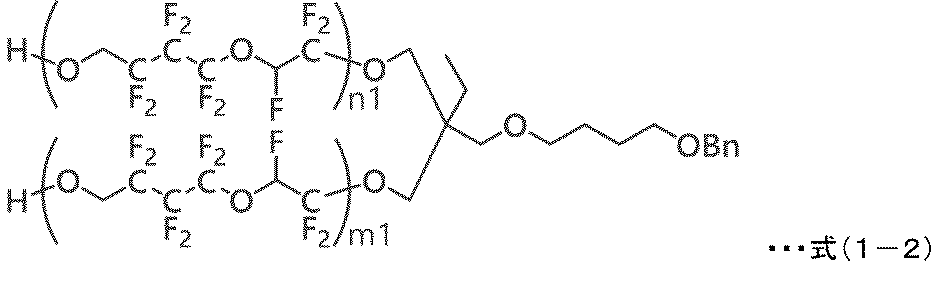
化合物(1-2)のNMRスペクトル:
1H-NMR(400.13MHz、CDCl3、TMS) σ(ppm):7.4(5H)、6.0(9H)、4.5(2H)、4.4(14H)、4.0(4H)、3.9(4H)、3.5(6H)、3.3(2H)、1.7(4H)、1.4(2H)、0.8(3H)。
19F-NMR(376.46MHz、CDCl3、CFCl3) σ(ppm):-84--88(18F)、-92(18F)、-121(14F)、-123(4F)、-128(18F)、-145(9F)。
1H-NMR(400.13MHz、CDCl3、TMS) σ(ppm):7.4(5H)、6.0(9H)、4.5(2H)、4.4(14H)、4.0(4H)、3.9(4H)、3.5(6H)、3.3(2H)、1.7(4H)、1.4(2H)、0.8(3H)。
19F-NMR(376.46MHz、CDCl3、CFCl3) σ(ppm):-84--88(18F)、-92(18F)、-121(14F)、-123(4F)、-128(18F)、-145(9F)。
(合成例1-3)
攪拌子を備えた500mLフラスコに、化合物(1-2)の30g、48%水酸化カリウム水溶液の11g、アリルブロミドの10g、及び1,3-ビス(トリフルオロメチル)ベンゼンの100gを加え、80℃で攪拌した。フラスコ内を室温(25℃)にした後、塩酸水溶液を100g加えて分液し、有機層をエバポレーターで濃縮した。得られた粗液をカラムクロマトグラフィーにて精製し、化合物(1-3)の22gを得た。
攪拌子を備えた500mLフラスコに、化合物(1-2)の30g、48%水酸化カリウム水溶液の11g、アリルブロミドの10g、及び1,3-ビス(トリフルオロメチル)ベンゼンの100gを加え、80℃で攪拌した。フラスコ内を室温(25℃)にした後、塩酸水溶液を100g加えて分液し、有機層をエバポレーターで濃縮した。得られた粗液をカラムクロマトグラフィーにて精製し、化合物(1-3)の22gを得た。

化合物(1-3)のNMRスペクトル:
1H-NMR(400.13MHz、CDCl3、TMS) σ(ppm):7.4(5H)、6.0(11H)、5.3(4H)、4.5(2H)、4.4(18H)、4.1(4H)、3.9(8H)、3.5(6H)、3.3(2H)、1.7(4H)、1.4(2H)、0.8(3H)。
19F-NMR(376.46MHz、CDCl3、CFCl3) σ(ppm):-84--88(18F)、-92(18F)、-121(18F)、-128(18F)、-145(9F)。
1H-NMR(400.13MHz、CDCl3、TMS) σ(ppm):7.4(5H)、6.0(11H)、5.3(4H)、4.5(2H)、4.4(18H)、4.1(4H)、3.9(8H)、3.5(6H)、3.3(2H)、1.7(4H)、1.4(2H)、0.8(3H)。
19F-NMR(376.46MHz、CDCl3、CFCl3) σ(ppm):-84--88(18F)、-92(18F)、-121(18F)、-128(18F)、-145(9F)。
(合成例1-4)
攪拌子とジムロートを備えた5Lフラスコに、化合物(1-3)の16g、1,4-ベンゾキノンの5.9g、及び1,3-ビス(トリフルオロメチル)ベンゼンの5.5Lを加えた。還流条件下、攪拌しながら第二世代グラブス触媒の1.0gを加え、攪拌を続けた後、フラスコ内を室温(25℃)に戻した。エチルビニルエーテルの14gを加え、更に攪拌を続けた後、反応粗液をエバポレーターで濃縮した。得られた粗液をカラムクロマトグラフィーにて精製し、化合物(1-4)の8.8g得た。
攪拌子とジムロートを備えた5Lフラスコに、化合物(1-3)の16g、1,4-ベンゾキノンの5.9g、及び1,3-ビス(トリフルオロメチル)ベンゼンの5.5Lを加えた。還流条件下、攪拌しながら第二世代グラブス触媒の1.0gを加え、攪拌を続けた後、フラスコ内を室温(25℃)に戻した。エチルビニルエーテルの14gを加え、更に攪拌を続けた後、反応粗液をエバポレーターで濃縮した。得られた粗液をカラムクロマトグラフィーにて精製し、化合物(1-4)の8.8g得た。
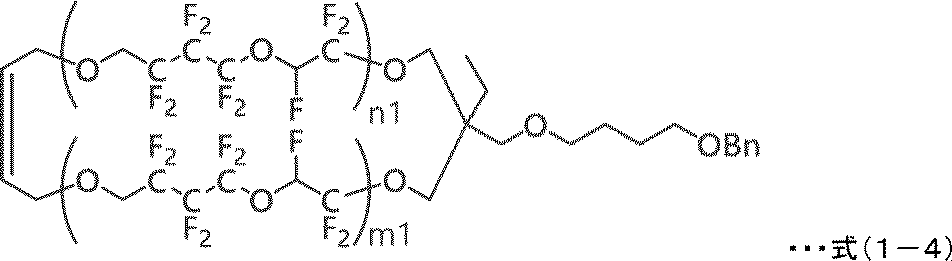
化合物(1-4)のNMRスペクトル:
1H-NMR(400.13MHz、CDCl3、TMS) σ(ppm):7.4(5H)、6.0(11H)、4.5(2H)、4.4(18H)、4.1(4H)、3.9(8H)、3.5(6H)、3.3(2H)、1.7(4H)、1.4(2H)、0.8(3H)。
19F-NMR(376.46MHz、CDCl3、CFCl3) σ(ppm):-84--88(18F)、-92(18F)、-121(18F)、-128(18F)、-145(9F)。
1H-NMR(400.13MHz、CDCl3、TMS) σ(ppm):7.4(5H)、6.0(11H)、4.5(2H)、4.4(18H)、4.1(4H)、3.9(8H)、3.5(6H)、3.3(2H)、1.7(4H)、1.4(2H)、0.8(3H)。
19F-NMR(376.46MHz、CDCl3、CFCl3) σ(ppm):-84--88(18F)、-92(18F)、-121(18F)、-128(18F)、-145(9F)。
(合成例1-5)
攪拌子を備えた300mLフラスコに、化合物(1-4)の8.8g、10%パラジウム-活性炭素の1.5g、及びメタノールの27gを加えた。水素で満たした風船を取り付け、密閉し、激しく攪拌した。セライトにて濾過し、濾液をエバポレーターで濃縮し、化合物(1-5)の8.3gを得た。
攪拌子を備えた300mLフラスコに、化合物(1-4)の8.8g、10%パラジウム-活性炭素の1.5g、及びメタノールの27gを加えた。水素で満たした風船を取り付け、密閉し、激しく攪拌した。セライトにて濾過し、濾液をエバポレーターで濃縮し、化合物(1-5)の8.3gを得た。
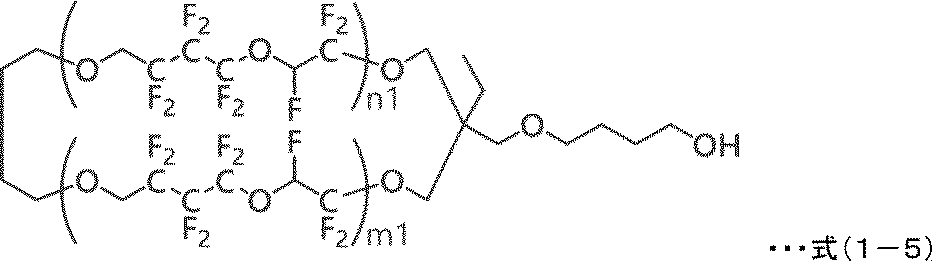
化合物(1-5)のNMRスペクトル:
1H-NMR(400.13MHz、CDCl3、TMS) σ(ppm):6.0(9H)、4.4(18H)、3.9(8H)、3.6(2H)、3.5(4H)、3.4(2H)、3.3(2H)、1.7(8H)、1.4(2H)、0.8(3H)。
19F-NMR(376.46MHz、CDCl3、CFCl3) σ(ppm):-84--88(18F)、-92(18F)、-121(18F)、-128(18F)、-145(9F)。
1H-NMR(400.13MHz、CDCl3、TMS) σ(ppm):6.0(9H)、4.4(18H)、3.9(8H)、3.6(2H)、3.5(4H)、3.4(2H)、3.3(2H)、1.7(8H)、1.4(2H)、0.8(3H)。
19F-NMR(376.46MHz、CDCl3、CFCl3) σ(ppm):-84--88(18F)、-92(18F)、-121(18F)、-128(18F)、-145(9F)。
(合成例1-6)
攪拌子を備えた50mLナスフラスコに、化合物(1-5)の8.3g、フッ化ナトリウムの粉末の1.5g、及びAC-2000の9.1gを加えた。攪拌しながらペルフルオロ(2-メチル-3-オキサヘキサノイル)フルオリドの6.7gを加え、攪拌を続けた。反応粗液を濾過し、濾液をエバポレーターで濃縮して、化合物(1-6)の8.7gを得た。
攪拌子を備えた50mLナスフラスコに、化合物(1-5)の8.3g、フッ化ナトリウムの粉末の1.5g、及びAC-2000の9.1gを加えた。攪拌しながらペルフルオロ(2-メチル-3-オキサヘキサノイル)フルオリドの6.7gを加え、攪拌を続けた。反応粗液を濾過し、濾液をエバポレーターで濃縮して、化合物(1-6)の8.7gを得た。

化合物(1-6)のNMRスペクトル:
1H-NMR(400.13MHz、CDCl3、TMS) σ(ppm):6.0(9H)、4.4(20H)、3.9(8H)、3.6(2H)、3.5(4H)、3.3(2H)、1.7(8H)、1.4(2H)、0.8(3H)。
19F-NMR(376.46MHz、CDCl3、CFCl3) σ(ppm):-80(1F)、-82(3F)、-83(3F)、-84--88(19F)、-92(18F)、-121(18F)、-128(18F)、-130(2F)、-132(1F)、-145(9F)。
1H-NMR(400.13MHz、CDCl3、TMS) σ(ppm):6.0(9H)、4.4(20H)、3.9(8H)、3.6(2H)、3.5(4H)、3.3(2H)、1.7(8H)、1.4(2H)、0.8(3H)。
19F-NMR(376.46MHz、CDCl3、CFCl3) σ(ppm):-80(1F)、-82(3F)、-83(3F)、-84--88(19F)、-92(18F)、-121(18F)、-128(18F)、-130(2F)、-132(1F)、-145(9F)。
(合成例1-7)
500mLの金属製反応器に、CFE-419の250gを加え、窒素ガスをバブリングし、次いで、窒素ガスで20vol%に希釈されたフッ素ガスをバブリングした。フッ素ガスをバブリングしながら、化合物(1-6)の8.7gをCFE-419の90gで希釈した溶液を導入した。ベンゼンの0.1質量部のCFE-419溶液を導入しながら、窒素ガスで希釈されたフッ素ガスをバブリングした。得られた粗液をエバポレーターで濃縮し、化合物(1-7)の11gを得た。
なお、CFE-419は溶媒CClF2CClFCF2OCF2CClF2である。
500mLの金属製反応器に、CFE-419の250gを加え、窒素ガスをバブリングし、次いで、窒素ガスで20vol%に希釈されたフッ素ガスをバブリングした。フッ素ガスをバブリングしながら、化合物(1-6)の8.7gをCFE-419の90gで希釈した溶液を導入した。ベンゼンの0.1質量部のCFE-419溶液を導入しながら、窒素ガスで希釈されたフッ素ガスをバブリングした。得られた粗液をエバポレーターで濃縮し、化合物(1-7)の11gを得た。
なお、CFE-419は溶媒CClF2CClFCF2OCF2CClF2である。

化合物(1-7)のNMRスペクトル:
19F-NMR(376.46MHz、CDCl3、CFCl3) σ(ppm):-64(2F)、-65(4F)、-78(3F)、-80(1F)、-81(1F)、-82(3F)、-83(3F)、-84(36F)、-90(44F)、-109(2F)、-127(44F)、-130(2F)、-132(1F)。
19F-NMR(376.46MHz、CDCl3、CFCl3) σ(ppm):-64(2F)、-65(4F)、-78(3F)、-80(1F)、-81(1F)、-82(3F)、-83(3F)、-84(36F)、-90(44F)、-109(2F)、-127(44F)、-130(2F)、-132(1F)。
(合成例1-8)
攪拌子を備えた100mLナスフラスコに、化合物(1-7)の11g、及びメタノールを20g加え、攪拌した。反応粗液をエバポレーターで濃縮し、化合物(1-8)の10gを得た。
攪拌子を備えた100mLナスフラスコに、化合物(1-7)の11g、及びメタノールを20g加え、攪拌した。反応粗液をエバポレーターで濃縮し、化合物(1-8)の10gを得た。

化合物(1-8)のNMRスペクトル:
1H-NMR(400.13MHz、CDCl3、TMS) σ(ppm):4.2(3H)。
19F-NMR(376.46MHz、CDCl3、CFCl3) σ(ppm):-64(2F)、-65(4F)、-78(3F)、-84(38F)、-90(40F)、-109(2F)、-120(2F)、-127(42F)。
1H-NMR(400.13MHz、CDCl3、TMS) σ(ppm):4.2(3H)。
19F-NMR(376.46MHz、CDCl3、CFCl3) σ(ppm):-64(2F)、-65(4F)、-78(3F)、-84(38F)、-90(40F)、-109(2F)、-120(2F)、-127(42F)。
(合成例1-9)
攪拌子を備えた50mLナスフラスコに、化合物(1-8)の5.0g、2,2-ジ-2-アリル-4-ペンテン-1-アミンの0.69g、及びAC-6000の5.0gを加え、40℃で攪拌した。反応粗液をカラムクロマトグラフィーにて精製し、化合物(1-9)の3.4g得た。
攪拌子を備えた50mLナスフラスコに、化合物(1-8)の5.0g、2,2-ジ-2-アリル-4-ペンテン-1-アミンの0.69g、及びAC-6000の5.0gを加え、40℃で攪拌した。反応粗液をカラムクロマトグラフィーにて精製し、化合物(1-9)の3.4g得た。

化合物(1-9)のNMRスペクトル:
1H-NMR(400.13MHz、CDCl3、TMS) σ(ppm):6.1(3H)、5.2(6H)、3.4(2H)、2.1(6H)。
19F-NMR(376.46MHz、CDCl3、CFCl3) σ(ppm):-64(2F)、-65(4F)、-78(3F)、-84(38F)、-90(40F)、-109(2F)、-121(2F)、-127(42F)。
1H-NMR(400.13MHz、CDCl3、TMS) σ(ppm):6.1(3H)、5.2(6H)、3.4(2H)、2.1(6H)。
19F-NMR(376.46MHz、CDCl3、CFCl3) σ(ppm):-64(2F)、-65(4F)、-78(3F)、-84(38F)、-90(40F)、-109(2F)、-121(2F)、-127(42F)。
(合成例1-10)
攪拌子を備えた50mLナスフラスコに、化合物(1-9)の1.0gを加えた。次いで、トリメトキシシランの0.10g、アニリンの0.0010g、AC-6000の1.0g、及び白金/1,3-ジビニル-1,1,3,3-テトラメチルジシロキサン錯体の0.0033gを加え、40℃で攪拌した。反応租液を、0hPa、60℃で減圧留去し、化合物(1-10)の1.1g得た。
攪拌子を備えた50mLナスフラスコに、化合物(1-9)の1.0gを加えた。次いで、トリメトキシシランの0.10g、アニリンの0.0010g、AC-6000の1.0g、及び白金/1,3-ジビニル-1,1,3,3-テトラメチルジシロキサン錯体の0.0033gを加え、40℃で攪拌した。反応租液を、0hPa、60℃で減圧留去し、化合物(1-10)の1.1g得た。

化合物(1-10)のNMRスペクトル:
1H-NMR(400.13MHz、CDCl3、TMS) σ(ppm):3.6(27H)、3.4(2H)、1.3(12H)、0.9(6H)。
19F-NMR(376.46MHz、CDCl3、CFCl3) σ(ppm):-64(2F)、-65(4F)、-78(3F)、-84(38F)、-90(40F)、-109(2F)、-121(2F)、-127(42F)。
1H-NMR(400.13MHz、CDCl3、TMS) σ(ppm):3.6(27H)、3.4(2H)、1.3(12H)、0.9(6H)。
19F-NMR(376.46MHz、CDCl3、CFCl3) σ(ppm):-64(2F)、-65(4F)、-78(3F)、-84(38F)、-90(40F)、-109(2F)、-121(2F)、-127(42F)。
[例2]
(合成例2-1)
攪拌子を備えた500mLフラスコに、2-(ヒドロキシメチル)-18-クラウン6-エーテルの1.0g、及び炭酸カリウムの0.52gを加え、120℃で攪拌し、更に、2,2,3,3,4,4-ヘキサフルオロ-4-[(トリフルオロビニル)オキシ]ブタン-1-オールの14gを加え、120℃で攪拌を続けた後、ナスフラスコ内を室温(25℃)にした。
AC-2000及び塩酸水溶液をそれぞれ15g加えて分液し、有機層をエバポレーターで濃縮した。得られた粗液をカラムクロマトグラフィーにて精製して、化合物(2-1)の10gを得た。
(合成例2-1)
攪拌子を備えた500mLフラスコに、2-(ヒドロキシメチル)-18-クラウン6-エーテルの1.0g、及び炭酸カリウムの0.52gを加え、120℃で攪拌し、更に、2,2,3,3,4,4-ヘキサフルオロ-4-[(トリフルオロビニル)オキシ]ブタン-1-オールの14gを加え、120℃で攪拌を続けた後、ナスフラスコ内を室温(25℃)にした。
AC-2000及び塩酸水溶液をそれぞれ15g加えて分液し、有機層をエバポレーターで濃縮した。得られた粗液をカラムクロマトグラフィーにて精製して、化合物(2-1)の10gを得た。
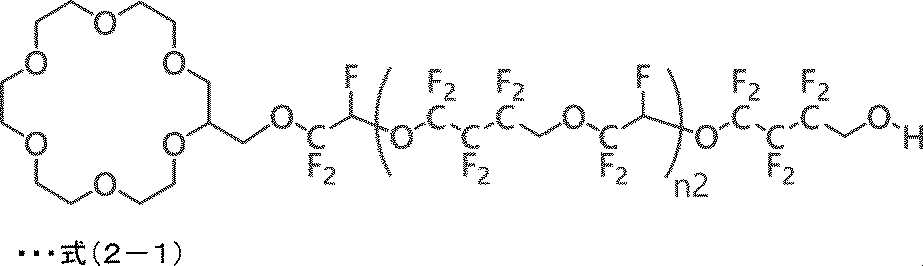
化合物(2-1)のNMRスペクトル:
1H-NMR(400.13MHz、CDCl3、TMS) σ(ppm):6.0(9H)、4.6(16H)、4.0(2H)、3.8(2H)、3.5(23H)。
19F-NMR(376.46MHz、CDCl3、CFCl3) σ(ppm):-84--88(18F)、-92(18F)、-121(16F)、-123(2F)、-128(18F)、-145(9F)。
1H-NMR(400.13MHz、CDCl3、TMS) σ(ppm):6.0(9H)、4.6(16H)、4.0(2H)、3.8(2H)、3.5(23H)。
19F-NMR(376.46MHz、CDCl3、CFCl3) σ(ppm):-84--88(18F)、-92(18F)、-121(16F)、-123(2F)、-128(18F)、-145(9F)。
(合成例2-2)
攪拌子を備えた50mLナスフラスコに、化合物(2-1)の10g、フッ化ナトリウムの粉末の1.5g、及びAC-2000の12gを加えた。次いで、攪拌しながらペルフルオロ(2-メチル-3-オキサヘキサノイル)フルオリドの3.2gを加え、攪拌を続けた。反応粗液を濾過し、濾液をエバポレーターで濃縮して、化合物(2-2)の11gを得た。
攪拌子を備えた50mLナスフラスコに、化合物(2-1)の10g、フッ化ナトリウムの粉末の1.5g、及びAC-2000の12gを加えた。次いで、攪拌しながらペルフルオロ(2-メチル-3-オキサヘキサノイル)フルオリドの3.2gを加え、攪拌を続けた。反応粗液を濾過し、濾液をエバポレーターで濃縮して、化合物(2-2)の11gを得た。
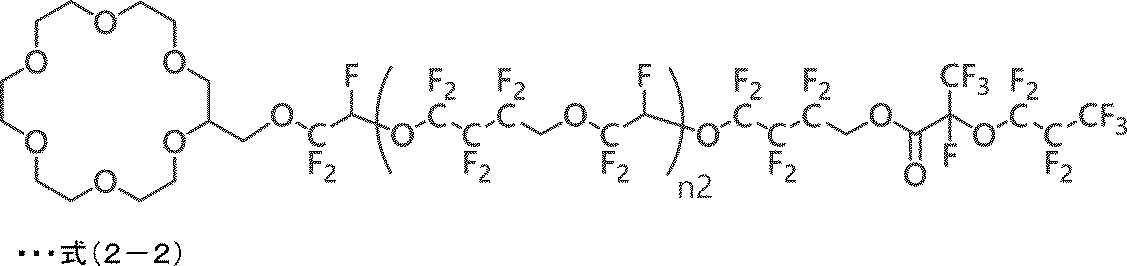
化合物(2-2)のNMRスペクトル:
1H-NMR(400.13MHz、CDCl3、TMS) σ(ppm):6.0(9H)、4.8(2H)、4.6(16H)、3.8(2H)、3.5(23H)。
19F-NMR(376.46MHz、CDCl3、CFCl3) σ(ppm):-80(1F)、-82(3F)、-83(3F)、-84--88(19F)、-92(18F)、-121(16F)、-120(2F)、-128(18F)、-130(2F)、-132(1F)、-145(9F)。
1H-NMR(400.13MHz、CDCl3、TMS) σ(ppm):6.0(9H)、4.8(2H)、4.6(16H)、3.8(2H)、3.5(23H)。
19F-NMR(376.46MHz、CDCl3、CFCl3) σ(ppm):-80(1F)、-82(3F)、-83(3F)、-84--88(19F)、-92(18F)、-121(16F)、-120(2F)、-128(18F)、-130(2F)、-132(1F)、-145(9F)。
(合成例2-3)
500mLの金属製反応器に、CFE-419の250gを加え、窒素ガスをバブリングし、次いで、窒素ガスで20体積%に希釈されたフッ素ガスをバブリングした。フッ素ガスのバブリングを続けながら、化合物(2-2)の10gをCFE-419の90gで希釈した溶液を導入した。ベンゼンの0.1質量部のCFE-419溶液を導入しながら、窒素ガスで希釈されたフッ素ガスをバブリングし、次いで、窒素ガスをバブリングした。反応粗液をエバポレーターで濃縮し、化合物(2-3)の8.2gを得た。
500mLの金属製反応器に、CFE-419の250gを加え、窒素ガスをバブリングし、次いで、窒素ガスで20体積%に希釈されたフッ素ガスをバブリングした。フッ素ガスのバブリングを続けながら、化合物(2-2)の10gをCFE-419の90gで希釈した溶液を導入した。ベンゼンの0.1質量部のCFE-419溶液を導入しながら、窒素ガスで希釈されたフッ素ガスをバブリングし、次いで、窒素ガスをバブリングした。反応粗液をエバポレーターで濃縮し、化合物(2-3)の8.2gを得た。

化合物(2-3)のNMRスペクトル:
1H-NMR(400.13MHz、CDCl3、TMS) σ(ppm):4.2(3H)。
19FーNMR(376.46MHz、CDCl3、CFCl3) σ(ppm):-72(2F)、-80(1F)、-81(1F)、-82(3F)、-83(3F)、-84(36F)、-90(58F)、-127(36F)、-130(2F)、-132(1F)、-140(1F)。
1H-NMR(400.13MHz、CDCl3、TMS) σ(ppm):4.2(3H)。
19FーNMR(376.46MHz、CDCl3、CFCl3) σ(ppm):-72(2F)、-80(1F)、-81(1F)、-82(3F)、-83(3F)、-84(36F)、-90(58F)、-127(36F)、-130(2F)、-132(1F)、-140(1F)。
なお、例2において環中にFを付したものは、下記の構造を有することを示す。
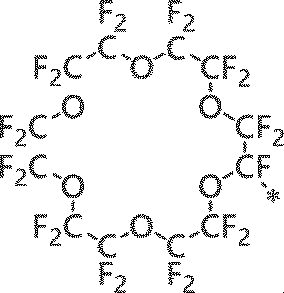
(合成例2-4)
攪拌子を備えた50mLナスフラスコに、化合物(2-3)の8.2g、及びメタノールの10g加え、攪拌した。反応粗液をエバポレーターで濃縮し、化合物(2-4)の7.5gを得た。
攪拌子を備えた50mLナスフラスコに、化合物(2-3)の8.2g、及びメタノールの10g加え、攪拌した。反応粗液をエバポレーターで濃縮し、化合物(2-4)の7.5gを得た。

化合物(2-4)のNMRスペクトル:
1H-NMR(400.13MHz、CDCl3、TMS) σ(ppm):4.2(3H)。
19F-NMR(376.46MHz、CDCl3、CFCl3) σ(ppm):-72(2F)、-84(34F)、-90(58F)、-120(2F)、-127(34F)、-140(1F)。
1H-NMR(400.13MHz、CDCl3、TMS) σ(ppm):4.2(3H)。
19F-NMR(376.46MHz、CDCl3、CFCl3) σ(ppm):-72(2F)、-84(34F)、-90(58F)、-120(2F)、-127(34F)、-140(1F)。
(合成例2-5)
攪拌子を備えた50mLナスフラスコに、化合物(2-4)の8.2g、2,2-ジ-2-アリル-4-ペンテン-1-アミンの1.2g、及びAC-6000の9.3gを加え、40℃で攪拌した。反応粗液をカラムクロマトグラフィーにて精製し、化合物(2-5)の1.7g得た。
攪拌子を備えた50mLナスフラスコに、化合物(2-4)の8.2g、2,2-ジ-2-アリル-4-ペンテン-1-アミンの1.2g、及びAC-6000の9.3gを加え、40℃で攪拌した。反応粗液をカラムクロマトグラフィーにて精製し、化合物(2-5)の1.7g得た。

化合物(2-5)のNMRスペクトル:
1H-NMR(400.13MHz、CDCl3、TMS) σ(ppm):6.1(3H)、5.2(6H)、3.4(2H)、2.1(6H)。
19F-NMR(376.46MHz、CDCl3、CFCl3) σ(ppm):-72(2F)、-84(34F)、-90(58F)、-121(2F)、-127(34F)、-140(1F)。
1H-NMR(400.13MHz、CDCl3、TMS) σ(ppm):6.1(3H)、5.2(6H)、3.4(2H)、2.1(6H)。
19F-NMR(376.46MHz、CDCl3、CFCl3) σ(ppm):-72(2F)、-84(34F)、-90(58F)、-121(2F)、-127(34F)、-140(1F)。
(合成例2-6)
攪拌子を備えた50mLナスフラスコに、化合物(3-5)の1.0g、トリメトキシシランの0.11g、アニリンの0.0010g、AC-6000の1.0g、及び白金/1,3-ジビニル-1,1,3,3-テトラメチルジシロキサン錯体の0.0033gを加え、40℃で攪拌した。反応終了後、0hPa、60℃で24時間減圧留去して、化合物(2-6)の1.1g得た。
攪拌子を備えた50mLナスフラスコに、化合物(3-5)の1.0g、トリメトキシシランの0.11g、アニリンの0.0010g、AC-6000の1.0g、及び白金/1,3-ジビニル-1,1,3,3-テトラメチルジシロキサン錯体の0.0033gを加え、40℃で攪拌した。反応終了後、0hPa、60℃で24時間減圧留去して、化合物(2-6)の1.1g得た。
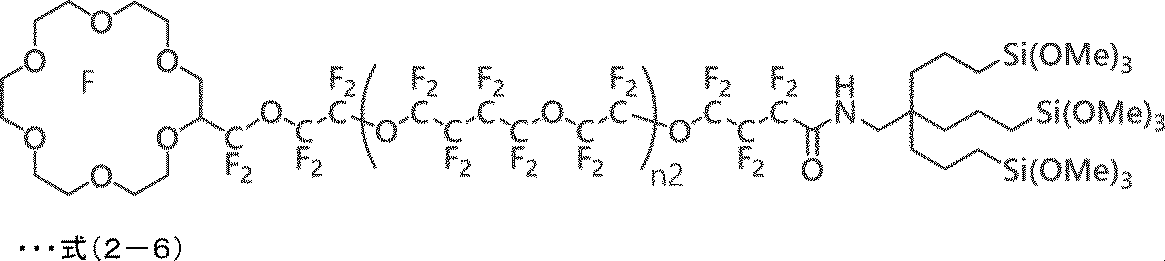
化合物(2-6)のNMRスペクトル:
1H-NMR(400.13MHz、CDCl3、TMS) σ(ppm):3.6(27H)、3.4(2H)、1.3(12H)、0.9(6H)。
19F-NMR(376.46MHz、CDCl3、CDCl3) σ(ppm):-72(2F)、-84(34F)、-90(58F)、-121(2F)、-127(34F)、-140(1F)。
1H-NMR(400.13MHz、CDCl3、TMS) σ(ppm):3.6(27H)、3.4(2H)、1.3(12H)、0.9(6H)。
19F-NMR(376.46MHz、CDCl3、CDCl3) σ(ppm):-72(2F)、-84(34F)、-90(58F)、-121(2F)、-127(34F)、-140(1F)。
[例3]
化合物(1-10)と、KY-185(信越化学工業社製の含フッ素エーテル化合物)とを、化合物(1-10):KY-185=70:30(質量比)で混合し、組成物を調製した。
化合物(1-10)と、KY-185(信越化学工業社製の含フッ素エーテル化合物)とを、化合物(1-10):KY-185=70:30(質量比)で混合し、組成物を調製した。
[例4]
(合成例4-1)
攪拌子を備えた300mLナスフラスコにピリチオンナトリウムの1.9g、及び1,3-ビストリフルオロメチルベンゼン(SRソルベント)の30mLを入れ、氷冷下で撹拌した。次いで、化合物(1-7)の10gを入れ、氷冷のまま2時間撹拌した。次いで、ヨウ素の3.9g、及び2,2-アゾビス(2-メチルプチロニトリル)の0.59gを加え、遮光していたアルミホイルを取り除き、85℃で24時間撹拌した。温度を25℃に戻し、メタノールを入れて撹拌した後、AC-6000を加え、下層を回収して溶媒を留去した。得られた租液をカラムクロマトグラフィーで精製し、化合物(4-1)の7.7gを得た。
(合成例4-1)
攪拌子を備えた300mLナスフラスコにピリチオンナトリウムの1.9g、及び1,3-ビストリフルオロメチルベンゼン(SRソルベント)の30mLを入れ、氷冷下で撹拌した。次いで、化合物(1-7)の10gを入れ、氷冷のまま2時間撹拌した。次いで、ヨウ素の3.9g、及び2,2-アゾビス(2-メチルプチロニトリル)の0.59gを加え、遮光していたアルミホイルを取り除き、85℃で24時間撹拌した。温度を25℃に戻し、メタノールを入れて撹拌した後、AC-6000を加え、下層を回収して溶媒を留去した。得られた租液をカラムクロマトグラフィーで精製し、化合物(4-1)の7.7gを得た。

化合物(4-1)のNMRスペクトル:
19F-NMR(376.46MHz、CDCl3、CFCl3) σ(ppm):-59(2F)、-64(2F)、-65(4F)、-78(3F)、-81(2F)、-84(38F)、-90(40F)、-109(2F)、-117(2F)、-127(40F)。
19F-NMR(376.46MHz、CDCl3、CFCl3) σ(ppm):-59(2F)、-64(2F)、-65(4F)、-78(3F)、-81(2F)、-84(38F)、-90(40F)、-109(2F)、-117(2F)、-127(40F)。
(合成例4-2)
攪拌子を備えた200mLナスフラスコに、化合物(4-1)の7.5g、及びSRソルベントの12gを加えた。25℃で撹拌しながら、アリルトリブチルスズの5.0g、及びアゾビスイソプチロニトリルの0.050gを加え、90℃で24時間撹拌した。25℃に戻し、水で洗浄した後、ヘキサンで再沈殿した。得られた固体をAC―2000に溶解し、硫酸マグネシウムで脱水した後、固体を濾過で取り除き、液体を濃縮した。得られた租液をカラムクロマトグラフィーで精製し、化合物(4-2)の6.3gを得た。
攪拌子を備えた200mLナスフラスコに、化合物(4-1)の7.5g、及びSRソルベントの12gを加えた。25℃で撹拌しながら、アリルトリブチルスズの5.0g、及びアゾビスイソプチロニトリルの0.050gを加え、90℃で24時間撹拌した。25℃に戻し、水で洗浄した後、ヘキサンで再沈殿した。得られた固体をAC―2000に溶解し、硫酸マグネシウムで脱水した後、固体を濾過で取り除き、液体を濃縮した。得られた租液をカラムクロマトグラフィーで精製し、化合物(4-2)の6.3gを得た。
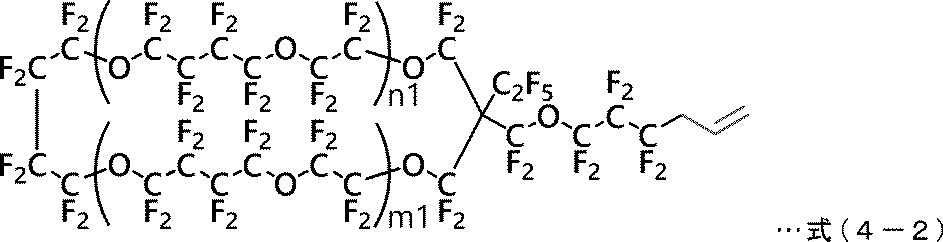
化合物(4-2)のNMRスペクトル:
1H-NMR(400.13MHz、CDCl3、TMS) σ(ppm):6.0(1H)、5.5(2H)、3.0(2H)。
19F-NMR(376.46MHz、CDCl3、CFCl3) σ(ppm):-64(2F)、-65(4F)、-78(3F)、-84(38F)、-90(42F)、-109(2F)、-114(2F)、-127(42F)。
1H-NMR(400.13MHz、CDCl3、TMS) σ(ppm):6.0(1H)、5.5(2H)、3.0(2H)。
19F-NMR(376.46MHz、CDCl3、CFCl3) σ(ppm):-64(2F)、-65(4F)、-78(3F)、-84(38F)、-90(42F)、-109(2F)、-114(2F)、-127(42F)。
(合成例4-3)
攪拌子を備えた50mLナスフラスコに、化合物(4-2)の6.0g、トリクロロシランの0.33g、SRソルベントの5.0g、及び白金/1,3-ジビニル-1,1,3,3-テトラメチルジシロキサン錯体の0.00083gを加え、40℃で8時間攪拌した。反応終了後、0hPa、60℃で減圧留去し、化合物(4-3)の6.0gを得た。
攪拌子を備えた50mLナスフラスコに、化合物(4-2)の6.0g、トリクロロシランの0.33g、SRソルベントの5.0g、及び白金/1,3-ジビニル-1,1,3,3-テトラメチルジシロキサン錯体の0.00083gを加え、40℃で8時間攪拌した。反応終了後、0hPa、60℃で減圧留去し、化合物(4-3)の6.0gを得た。
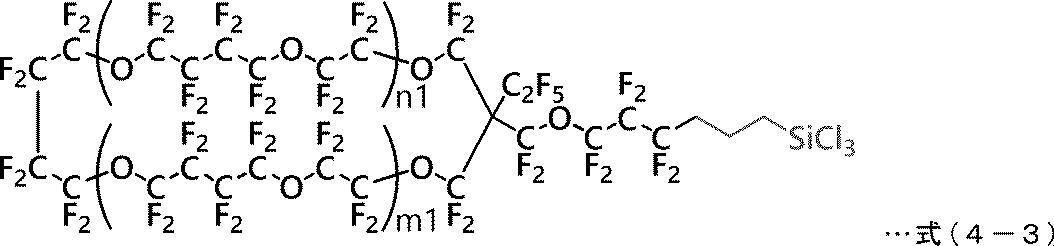
化合物(4-3)のNMRスペクトル:
1H-NMR(400.13MHz、CDCl3、TMS) σ(ppm):1.6-1.5(4H)、1.3(2H)。
19F-NMR(376.46MHz、CDCl3、CFCl3) σ(ppm):-64(2F)、-65(4F)、-78(3F)、-84(38F)、-90(42F)、-109(2F)、-114(2F)、-127(42F)。
1H-NMR(400.13MHz、CDCl3、TMS) σ(ppm):1.6-1.5(4H)、1.3(2H)。
19F-NMR(376.46MHz、CDCl3、CFCl3) σ(ppm):-64(2F)、-65(4F)、-78(3F)、-84(38F)、-90(42F)、-109(2F)、-114(2F)、-127(42F)。
(合成例4-4)
500mLナスフラスコに、化合物(4-3)の5.5g、及びテトラヒドロフランの12gを加え、0℃に冷却した。攪拌しながら0.1moL/Lのアリルマグネシウムクロリドの10mLを滴下し、更に2時間撹拌した。ナスフラスコ内の混合物を25℃に戻し、更に8時間撹拌した後、1moL/Lの塩酸水溶液の10mLを加えて反応を停止させた。AC-6000の10gを加えて、下相を抽出した。得られた粗液をカラムクロマトグラフィーで精製し、化合物(4-4)の5.0gを得た。
500mLナスフラスコに、化合物(4-3)の5.5g、及びテトラヒドロフランの12gを加え、0℃に冷却した。攪拌しながら0.1moL/Lのアリルマグネシウムクロリドの10mLを滴下し、更に2時間撹拌した。ナスフラスコ内の混合物を25℃に戻し、更に8時間撹拌した後、1moL/Lの塩酸水溶液の10mLを加えて反応を停止させた。AC-6000の10gを加えて、下相を抽出した。得られた粗液をカラムクロマトグラフィーで精製し、化合物(4-4)の5.0gを得た。

化合物(4-4)のNMRスペクトル:
1H-NMR(400.13MHz、CDCl3、TMS) σ(ppm):6.0(3H)、5.1(6H)、2.4-2.2(2H)、2.0(2H)、1.8(6H)、0.9(2H)。
19F-NMR(376.46MHz、CDCl3、CFCl3) σ(ppm):-64(2F)、-65(4F)、-78(3F)、-84(38F)、-90(42F)、-109(2F)、-114(2F)、-127(42F)。
1H-NMR(400.13MHz、CDCl3、TMS) σ(ppm):6.0(3H)、5.1(6H)、2.4-2.2(2H)、2.0(2H)、1.8(6H)、0.9(2H)。
19F-NMR(376.46MHz、CDCl3、CFCl3) σ(ppm):-64(2F)、-65(4F)、-78(3F)、-84(38F)、-90(42F)、-109(2F)、-114(2F)、-127(42F)。
(合成例4-5)
攪拌子を備えた50mLナスフラスコに、化合物(4-4)の1.0g、トリメトキシシランの0.24g、アニリンの0.00042g、AC-6000の1.0g、及び白金/1,3-ジビニル-1,1,3,3-テトラメチルジシロキサン錯体の0.00017gを加え、60℃で攪拌した。反応終了後、0hPa、60℃で減圧留去し、化合物(4-5)1.1gを得た。
攪拌子を備えた50mLナスフラスコに、化合物(4-4)の1.0g、トリメトキシシランの0.24g、アニリンの0.00042g、AC-6000の1.0g、及び白金/1,3-ジビニル-1,1,3,3-テトラメチルジシロキサン錯体の0.00017gを加え、60℃で攪拌した。反応終了後、0hPa、60℃で減圧留去し、化合物(4-5)1.1gを得た。

化合物(4-5)のNMRスペクトル:
1H-NMR(400.13MHz、CDCl3、TMS) σ(ppm):3.6(27H)、2.4-2.2(2H)、2.0(2H)、1.5(6H)、0.9-0.8(8H)、0.7(6H)。
19F-NMR(376.46MHz、CDCl3、CFCl3) σ(ppm):-64(2F)、-65(4F)、-78(3F)、-84(38F)、-90(42F)、-109(2F)、-114(2F)、-127(42F)。
1H-NMR(400.13MHz、CDCl3、TMS) σ(ppm):3.6(27H)、2.4-2.2(2H)、2.0(2H)、1.5(6H)、0.9-0.8(8H)、0.7(6H)。
19F-NMR(376.46MHz、CDCl3、CFCl3) σ(ppm):-64(2F)、-65(4F)、-78(3F)、-84(38F)、-90(42F)、-109(2F)、-114(2F)、-127(42F)。
[例5]
(合成例5-1)
攪拌子を備えた200mLナスフラスコに、テトラヒドロフランの5.0g、及びAE-3000の10gを入れ、0.7mol/Lのアリルマグネシウムブロミドの6.0mLを滴下した。更に化合物(1-8)の5.1gを滴下し、55℃で12時間撹拌した。25℃まで冷却し、1N塩酸水溶液の12mLを入れて反応を停止させた。得られた下相をカラムクロマトグラフィーにて精製し、化合物(5-1)の3.7gを得た。
(合成例5-1)
攪拌子を備えた200mLナスフラスコに、テトラヒドロフランの5.0g、及びAE-3000の10gを入れ、0.7mol/Lのアリルマグネシウムブロミドの6.0mLを滴下した。更に化合物(1-8)の5.1gを滴下し、55℃で12時間撹拌した。25℃まで冷却し、1N塩酸水溶液の12mLを入れて反応を停止させた。得られた下相をカラムクロマトグラフィーにて精製し、化合物(5-1)の3.7gを得た。
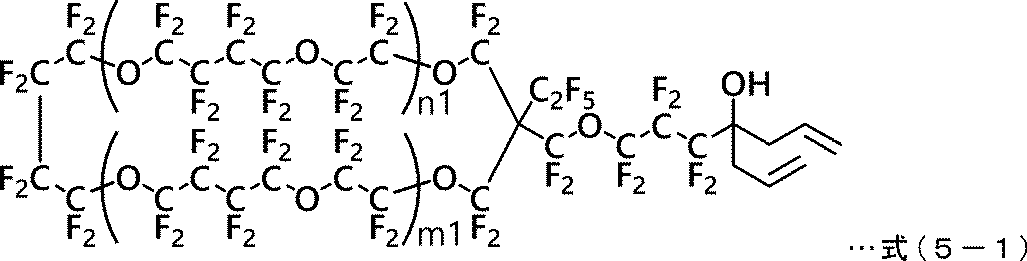
化合物(5-1)のNMRスペクトル:
1H-NMR(400.13MHz、CDCl3、TMS) σ(ppm):6.0(2H)、5.2(4H)、2.6-2.4(4H)。
19F-NMR(376.46MHz、CDCl3、CFCl3) σ(ppm):-64(2F)、-65(4F)、-78(3F)、-84(38F)、-90(42F)、-109(2F)、-116(2F)、-127(42F)。
1H-NMR(400.13MHz、CDCl3、TMS) σ(ppm):6.0(2H)、5.2(4H)、2.6-2.4(4H)。
19F-NMR(376.46MHz、CDCl3、CFCl3) σ(ppm):-64(2F)、-65(4F)、-78(3F)、-84(38F)、-90(42F)、-109(2F)、-116(2F)、-127(42F)。
(合成例5-2)
攪拌子を備えた50mLナスフラスコに、化合物(5-1)の1.0g、トリメトキシシランの0.13g、アニリンの0.00034g、AC-6000の1.0g、及び白金/1,3-ジビニル-1,1,3,3-テトラメチルジシロキサン錯体の0.00013gを加え、60℃で攪拌した。その後、0hPa、60℃で減圧留去し、化合物(5-1)の1.1gを得た。
攪拌子を備えた50mLナスフラスコに、化合物(5-1)の1.0g、トリメトキシシランの0.13g、アニリンの0.00034g、AC-6000の1.0g、及び白金/1,3-ジビニル-1,1,3,3-テトラメチルジシロキサン錯体の0.00013gを加え、60℃で攪拌した。その後、0hPa、60℃で減圧留去し、化合物(5-1)の1.1gを得た。
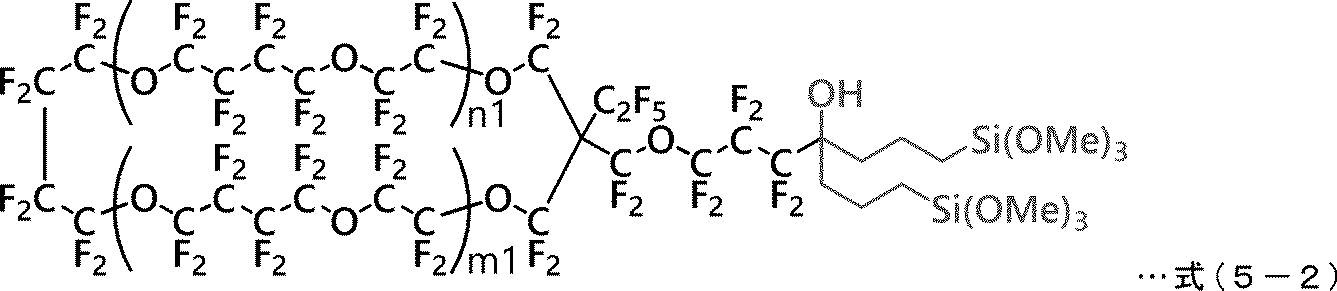
化合物(5-2)のNMRスペクトル:
1H-NMR(400.13MHz、CDCl3、TMS) σ(ppm):3.6(18H)、3.3(2H)、1.4-1.2(8H)、0.8-0.6(4H)。
19F-NMR(376.46MHz、CDCl3、CFCl3) σ(ppm):-64(2F)、-65(4F)、-78(3F)、-84(38F)、-90(42F)、-109(2F)、-116(2F)、-127(42F)。
1H-NMR(400.13MHz、CDCl3、TMS) σ(ppm):3.6(18H)、3.3(2H)、1.4-1.2(8H)、0.8-0.6(4H)。
19F-NMR(376.46MHz、CDCl3、CFCl3) σ(ppm):-64(2F)、-65(4F)、-78(3F)、-84(38F)、-90(42F)、-109(2F)、-116(2F)、-127(42F)。
[例6]
(合成例6-1)
攪拌子を備えた100mLナスフラスコに、化合物(5-1)の2.5g、臭化アリルの0.7g、テトラブチルアンモニウムヨージドの0.014g、及び水酸化カリウムの0.35gを加え、80℃で5時間撹拌した。25℃まで冷却し、AE-3000の10gを加え、水洗した。得られた粗液をクロマトグラフィーで精製し、化合物(6-1)の2.0gを得た。
(合成例6-1)
攪拌子を備えた100mLナスフラスコに、化合物(5-1)の2.5g、臭化アリルの0.7g、テトラブチルアンモニウムヨージドの0.014g、及び水酸化カリウムの0.35gを加え、80℃で5時間撹拌した。25℃まで冷却し、AE-3000の10gを加え、水洗した。得られた粗液をクロマトグラフィーで精製し、化合物(6-1)の2.0gを得た。

化合物(6-1)のNMRスペクトル:
1H-NMR(400.13MHz、CDCl3、TMS) σ(ppm):5.9(3H)、5.3-5.0(6H)、4.1(2H)、2.7-2.6(4H)。
19F-NMR(376.46MHz、CDCl3、CFCl3) σ(ppm):-64(2F)、-65(4F)、-78(3F)、-84(38F)、-90(42F)、-109(2F)、-116(2F)、-127(42F)。
1H-NMR(400.13MHz、CDCl3、TMS) σ(ppm):5.9(3H)、5.3-5.0(6H)、4.1(2H)、2.7-2.6(4H)。
19F-NMR(376.46MHz、CDCl3、CFCl3) σ(ppm):-64(2F)、-65(4F)、-78(3F)、-84(38F)、-90(42F)、-109(2F)、-116(2F)、-127(42F)。
(合成例6-2)
攪拌子を備えた50mLナスフラスコに、化合物(6-1)の1.0g、トリメトキシシランの0.19g、アニリンの0.00032g、AC-6000の1.0g、及び白金/1,3-ジビニル-1,1,3,3-テトラメチルジシロキサン錯体の0.00013gを加え、60℃で攪拌した。その後、0hPa、60℃で減圧留去し、化合物(6-2)の1.0gを得た。
攪拌子を備えた50mLナスフラスコに、化合物(6-1)の1.0g、トリメトキシシランの0.19g、アニリンの0.00032g、AC-6000の1.0g、及び白金/1,3-ジビニル-1,1,3,3-テトラメチルジシロキサン錯体の0.00013gを加え、60℃で攪拌した。その後、0hPa、60℃で減圧留去し、化合物(6-2)の1.0gを得た。
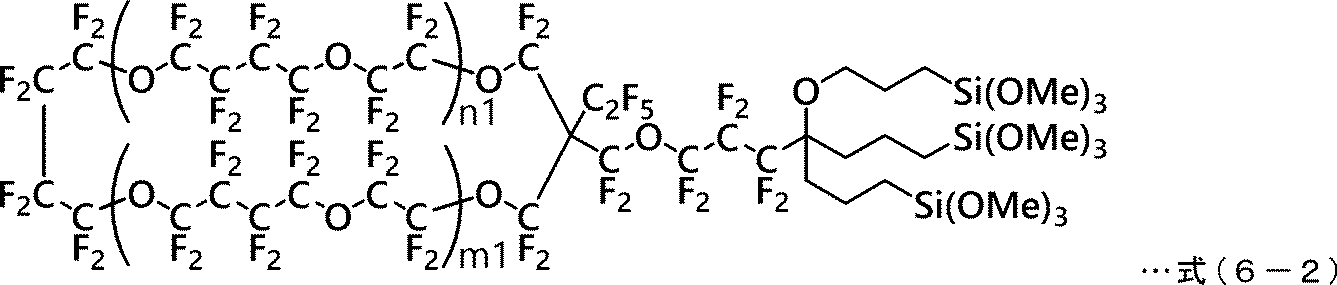
化合物(6-2)のNMRスペクトル:
1H-NMR(400.13MHz、CDCl3、TMS) σ(ppm):3.6(27H)、2.0-1,9(4H)、1.8-1.6(6H)、0.8-0.6(6H)。
19F-NMR(376.46MHz、CDCl3、CFCl3) σ(ppm):-64(2F)、-65(4F)、-78(3F)、-84(38F)、-90(42F)、-109(2F)、-116(2F)、-127(42F)。
1H-NMR(400.13MHz、CDCl3、TMS) σ(ppm):3.6(27H)、2.0-1,9(4H)、1.8-1.6(6H)、0.8-0.6(6H)。
19F-NMR(376.46MHz、CDCl3、CFCl3) σ(ppm):-64(2F)、-65(4F)、-78(3F)、-84(38F)、-90(42F)、-109(2F)、-116(2F)、-127(42F)。
[例7]
(合成例7-1)
攪拌子を備えた50mLナスフラスコに、化合物(1-8)の5.0g、2-(ウンデカ-10-エン-1-イル)トリデカ-12-エン-1-アミンの0.69g、及びAC-6000の5.0gを加え、40℃で攪拌した。反応粗液をカラムクロマトグラフィーにて精製し、化合物(7-1)の3.4g得た。
(合成例7-1)
攪拌子を備えた50mLナスフラスコに、化合物(1-8)の5.0g、2-(ウンデカ-10-エン-1-イル)トリデカ-12-エン-1-アミンの0.69g、及びAC-6000の5.0gを加え、40℃で攪拌した。反応粗液をカラムクロマトグラフィーにて精製し、化合物(7-1)の3.4g得た。

化合物(7-1)のNMRスペクトル:
1H-NMR(400.13MHz、CDCl3、TMS) σ(ppm):6.6(1H)、6.0(2H)5.1(4H)、3.3(2H)、2.1(4H)、1.5-1.1(33H)。
19F-NMR(376.46MHz、CDCl3、CFCl3) σ(ppm):-64(2F)、-65(4F)、-78(3F)、-84(38F)、-90(40F)、-109(2F)、-121(2F)、-127(42F)。
1H-NMR(400.13MHz、CDCl3、TMS) σ(ppm):6.6(1H)、6.0(2H)5.1(4H)、3.3(2H)、2.1(4H)、1.5-1.1(33H)。
19F-NMR(376.46MHz、CDCl3、CFCl3) σ(ppm):-64(2F)、-65(4F)、-78(3F)、-84(38F)、-90(40F)、-109(2F)、-121(2F)、-127(42F)。
(合成例7-2)
攪拌子を備えた50mLナスフラスコに、化合物(7-1)の1.0g、トリメトキシシランの0.15g、アニリンの0.0012g、AC-6000の1.0g、及び白金/1,3-ジビニル-1,1,3,3-テトラメチルジシロキサン錯体の0.00029gを加え、60℃で攪拌した。その後、0hPa、60℃で減圧留去し、化合物(7-2)の1.1gを得た。
攪拌子を備えた50mLナスフラスコに、化合物(7-1)の1.0g、トリメトキシシランの0.15g、アニリンの0.0012g、AC-6000の1.0g、及び白金/1,3-ジビニル-1,1,3,3-テトラメチルジシロキサン錯体の0.00029gを加え、60℃で攪拌した。その後、0hPa、60℃で減圧留去し、化合物(7-2)の1.1gを得た。

化合物(7-2)のNMRスペクトル:
1H-NMR(400.13MHz、CDCl3、TMS) σ(ppm):6.6(1H)、3.6(18H)、3.3(2H)、1.5-1.1(41H)、0.9(4H)。
19F-NMR(376.46MHz、CDCl3、CFCl3) σ(ppm):-64(2F)、-65(4F)、-78(3F)、-84(38F)、-90(40F)、-109(2F)、-121(2F)、-127(42F)。
1H-NMR(400.13MHz、CDCl3、TMS) σ(ppm):6.6(1H)、3.6(18H)、3.3(2H)、1.5-1.1(41H)、0.9(4H)。
19F-NMR(376.46MHz、CDCl3、CFCl3) σ(ppm):-64(2F)、-65(4F)、-78(3F)、-84(38F)、-90(40F)、-109(2F)、-121(2F)、-127(42F)。
[例8]
(合成例8-1)
撹拌子を備えた500mLナスフラスコに、化合物(1-1)の6.0g、ジクロロメタンの200mL、及び2,6-ルチジンの5.2g加え、氷浴下で攪拌した。攪拌を続けながらトリフルオロメタンスルホン酸無水物の12.5gをゆっくりと液相へ加えた。1時間攪拌した後、水200mLを加え分液した。有機層を飽和重曹水、塩化アンモニウム水溶液、ブラインで洗浄した。無水硫酸ナトリウムで乾燥し、エバポレーターで濃縮した。得られた粗液をカラムクロマトグラフィーで精製し、化合物(8-1)の3.2gを得た。
(合成例8-1)
撹拌子を備えた500mLナスフラスコに、化合物(1-1)の6.0g、ジクロロメタンの200mL、及び2,6-ルチジンの5.2g加え、氷浴下で攪拌した。攪拌を続けながらトリフルオロメタンスルホン酸無水物の12.5gをゆっくりと液相へ加えた。1時間攪拌した後、水200mLを加え分液した。有機層を飽和重曹水、塩化アンモニウム水溶液、ブラインで洗浄した。無水硫酸ナトリウムで乾燥し、エバポレーターで濃縮した。得られた粗液をカラムクロマトグラフィーで精製し、化合物(8-1)の3.2gを得た。

化合物(8-1)のNMRスペクトル:
1H-NMR(400.13MHz、CDCl3、TMS) σ(ppm):7.4(5H)、4.5(2H)、4.4(2H)、4.2(2H)、3.5(6H)、1.7(4H)、1.4(2H)、0.8(3H)。
19F-NMR(376.46MHz、CDCl3、CFCl3) σ(ppm):-75(3F)。
1H-NMR(400.13MHz、CDCl3、TMS) σ(ppm):7.4(5H)、4.5(2H)、4.4(2H)、4.2(2H)、3.5(6H)、1.7(4H)、1.4(2H)、0.8(3H)。
19F-NMR(376.46MHz、CDCl3、CFCl3) σ(ppm):-75(3F)。
(合成例8-2)
撹拌子とジムロートを備えた500mLナスフラスコに、化合物(8-1)の2.0g、SRソルベントの350g、フォンブリンD2の36g、及び炭酸セシウムの12gを加え、80℃で24時間攪拌した。室温(25℃)へ戻し、1N塩酸水溶液の100mLを加え分液した。有機相を無水硫酸ナトリウムで乾燥し、エバポレーターで濃縮した。得られた粗液をカラムクロマトグラフィーで精製し、化合物(8-2)を3.1g得た。
撹拌子とジムロートを備えた500mLナスフラスコに、化合物(8-1)の2.0g、SRソルベントの350g、フォンブリンD2の36g、及び炭酸セシウムの12gを加え、80℃で24時間攪拌した。室温(25℃)へ戻し、1N塩酸水溶液の100mLを加え分液した。有機相を無水硫酸ナトリウムで乾燥し、エバポレーターで濃縮した。得られた粗液をカラムクロマトグラフィーで精製し、化合物(8-2)を3.1g得た。

化合物(8-2)のNMRスペクトル:
1H-NMR(400.13MHz、CDCl3、TMS) σ(ppm):7.4(5H)、4.5(2H)、4.2(4H)、4.1(4H)、3.6(4H)、3.5(6H)、1.7(4H)、1.4(2H)、0.8(3H)。
19F-NMR(376.46MHz、CDCl3、CFCl3) σ(ppm):-56(44F)、-78~-81(4F)、-82~-85(4F)、-90(88F)。
1H-NMR(400.13MHz、CDCl3、TMS) σ(ppm):7.4(5H)、4.5(2H)、4.2(4H)、4.1(4H)、3.6(4H)、3.5(6H)、1.7(4H)、1.4(2H)、0.8(3H)。
19F-NMR(376.46MHz、CDCl3、CFCl3) σ(ppm):-56(44F)、-78~-81(4F)、-82~-85(4F)、-90(88F)。
(合成例8-3)
撹拌子とジムロートを備えた100mLナスフラスコに、化合物(8-2)の3.0g、SRソルベントの3.0g、臭化アリルの0.36g、及び48%水酸化カリウム水溶液の0.48gを加え、80℃で24時間攪拌した。室温(25℃)へ戻し、1N塩酸水溶液の10mLを加え分液した。有機相を無水硫酸ナトリウムで乾燥し、エバポレーターで濃縮した。得られた粗液をカラムクロマトグラフィーで精製し、化合物(8-3)の2.8gを得た。
撹拌子とジムロートを備えた100mLナスフラスコに、化合物(8-2)の3.0g、SRソルベントの3.0g、臭化アリルの0.36g、及び48%水酸化カリウム水溶液の0.48gを加え、80℃で24時間攪拌した。室温(25℃)へ戻し、1N塩酸水溶液の10mLを加え分液した。有機相を無水硫酸ナトリウムで乾燥し、エバポレーターで濃縮した。得られた粗液をカラムクロマトグラフィーで精製し、化合物(8-3)の2.8gを得た。

化合物(8-3)のNMRスペクトル:
1H-NMR(400.13MHz、CDCl3、TMS) σ(ppm):7.4(5H)、6.0(2H)、5.2(4H)、4.5(2H)、4.2(8H)、3.9(4H)、3.6(4H)、3.5(6H)、1.7(4H)、1.4(2H)、0.8(3H)。
19F-NMR(376.46MHz、CDCl3、CFCl3) σ(ppm):-56(44F)、-78~-81(8F)、-90(88F)。
1H-NMR(400.13MHz、CDCl3、TMS) σ(ppm):7.4(5H)、6.0(2H)、5.2(4H)、4.5(2H)、4.2(8H)、3.9(4H)、3.6(4H)、3.5(6H)、1.7(4H)、1.4(2H)、0.8(3H)。
19F-NMR(376.46MHz、CDCl3、CFCl3) σ(ppm):-56(44F)、-78~-81(8F)、-90(88F)。
(合成例8-4)
攪拌子とジムロートを備えた3Lフラスコに、化合物(8-3)の2.5g、1,4-ベンゾキノンの0.92g、及び1,3-ビス(トリフルオロメチル)ベンゼンの1.0Lを加えた。還流条件下、攪拌しながら第二世代グラブス触媒の0.16gを加え、攪拌を続けた後、フラスコ内を室温(25℃)に戻した。エチルビニルエーテルの2.0gを加え、更に攪拌を続けた後、反応粗液をエバポレーターで濃縮した。得られた粗液をカラムクロマトグラフィーにて精製し、化合物(8-4)の2.2gを得た。
攪拌子とジムロートを備えた3Lフラスコに、化合物(8-3)の2.5g、1,4-ベンゾキノンの0.92g、及び1,3-ビス(トリフルオロメチル)ベンゼンの1.0Lを加えた。還流条件下、攪拌しながら第二世代グラブス触媒の0.16gを加え、攪拌を続けた後、フラスコ内を室温(25℃)に戻した。エチルビニルエーテルの2.0gを加え、更に攪拌を続けた後、反応粗液をエバポレーターで濃縮した。得られた粗液をカラムクロマトグラフィーにて精製し、化合物(8-4)の2.2gを得た。

化合物(8-4)のNMRスペクトル:
1H-NMR(400.13MHz、CDCl3、TMS) σ(ppm):7.4(5H)、6.0(2H)、4.5(2H)、4.2(8H)、3.9(4H)、3.6(4H)、3.5(6H)、1.7(4H)、1.4(2H)、0.8(3H)。
19F-NMR(376.46MHz、CDCl3、CFCl3) σ(ppm):-56(44F)、-78~-81(8F)、-90(88F)。
1H-NMR(400.13MHz、CDCl3、TMS) σ(ppm):7.4(5H)、6.0(2H)、4.5(2H)、4.2(8H)、3.9(4H)、3.6(4H)、3.5(6H)、1.7(4H)、1.4(2H)、0.8(3H)。
19F-NMR(376.46MHz、CDCl3、CFCl3) σ(ppm):-56(44F)、-78~-81(8F)、-90(88F)。
(合成例8-5)
攪拌子を備えた100mLフラスコに、化合物(8-4)の2.2g、10%パラジウム-活性炭素の0.39g、及びメタノールの27gを加えた。水素で満たした風船を取り付け、密閉し、激しく攪拌した。セライトにて濾過し、得られた濾液をエバポレーターで濃縮し、化合物(8-5)の2.1gを得た。
攪拌子を備えた100mLフラスコに、化合物(8-4)の2.2g、10%パラジウム-活性炭素の0.39g、及びメタノールの27gを加えた。水素で満たした風船を取り付け、密閉し、激しく攪拌した。セライトにて濾過し、得られた濾液をエバポレーターで濃縮し、化合物(8-5)の2.1gを得た。
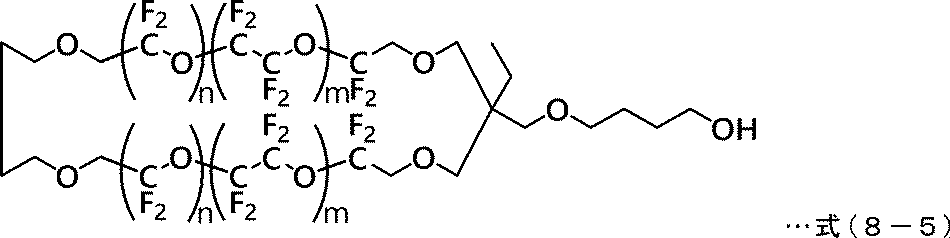
化合物(8-5)のNMRスペクトル:
1H-NMR(400.13MHz、CDCl3、TMS) σ(ppm):4.2(8H)、3.6(6H)、3.5(8H)、1.7(8H)、1.4(2H)、0.8(3H)。
19F-NMR(376.46MHz、CDCl3、CFCl3) σ(ppm):-56(44F)、-78~-81(8F)、-90(88F)。
1H-NMR(400.13MHz、CDCl3、TMS) σ(ppm):4.2(8H)、3.6(6H)、3.5(8H)、1.7(8H)、1.4(2H)、0.8(3H)。
19F-NMR(376.46MHz、CDCl3、CFCl3) σ(ppm):-56(44F)、-78~-81(8F)、-90(88F)。
(合成例8-6)
攪拌子を備えた50mLナスフラスコに、化合物(8-5)の2.1g、フッ化ナトリウムの粉末の0.51g、及びAC-2000の2.4gを加えた。攪拌しながらペルフルオロ(2-メチル-3-オキサヘキサノイル)フルオリドの0.27gを加え、攪拌を続けた後、反応粗液を濾過し、濾液をエバポレーターで濃縮して、化合物(8-6)の2.2gを得た。
攪拌子を備えた50mLナスフラスコに、化合物(8-5)の2.1g、フッ化ナトリウムの粉末の0.51g、及びAC-2000の2.4gを加えた。攪拌しながらペルフルオロ(2-メチル-3-オキサヘキサノイル)フルオリドの0.27gを加え、攪拌を続けた後、反応粗液を濾過し、濾液をエバポレーターで濃縮して、化合物(8-6)の2.2gを得た。
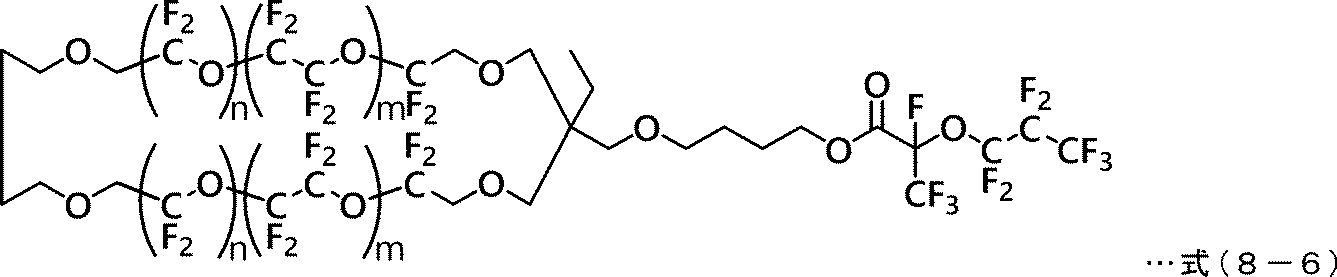
化合物(8-6)のNMRスペクトル:
1H-NMR(400.13MHz、CDCl3、TMS) σ(ppm):4.4(2H)、4.2(8H)、3.6(4H)、3.5(8H)、1.7(8H)、1.4(2H)、0.8(3H)。
19F-NMR(376.46MHz、CDCl3、CFCl3) σ(ppm):-56(44F)、-78~-81(10F)、-82(3F)、-83(3F)、-90(88F)、-130(2F)、-132(1F)。
1H-NMR(400.13MHz、CDCl3、TMS) σ(ppm):4.4(2H)、4.2(8H)、3.6(4H)、3.5(8H)、1.7(8H)、1.4(2H)、0.8(3H)。
19F-NMR(376.46MHz、CDCl3、CFCl3) σ(ppm):-56(44F)、-78~-81(10F)、-82(3F)、-83(3F)、-90(88F)、-130(2F)、-132(1F)。
(合成例8-7)
500mLの金属製反応器に、CFE-419の250gを加え、窒素ガスをバブリングし、次いで、窒素ガスで20vol%に希釈されたフッ素ガスをバブリングした。フッ素ガスをバブリングしながら、化合物(8-6)の2.2gをCFE-419の18gで希釈した溶液を導入した。ベンゼンの0.1質量部を含むCFE-419溶液を導入しながら、窒素ガスで希釈されたフッ素ガスをバブリングした。反応租液をエバポレーターで濃縮し、化合物(8-7)の2.5gを得た。
500mLの金属製反応器に、CFE-419の250gを加え、窒素ガスをバブリングし、次いで、窒素ガスで20vol%に希釈されたフッ素ガスをバブリングした。フッ素ガスをバブリングしながら、化合物(8-6)の2.2gをCFE-419の18gで希釈した溶液を導入した。ベンゼンの0.1質量部を含むCFE-419溶液を導入しながら、窒素ガスで希釈されたフッ素ガスをバブリングした。反応租液をエバポレーターで濃縮し、化合物(8-7)の2.5gを得た。
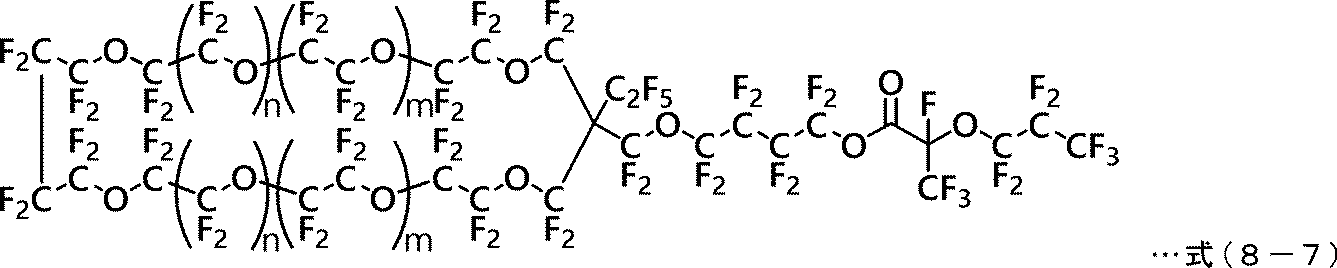
化合物(8-7)のNMRスペクトル:
19F-NMR(376.46MHz、CDCl3、CFCl3) σ(ppm):-56(44F)、-64(2F)、-65(4F)、-78(3F)、-80(1F)、-81(1F)、-82(3F)、-83(3F)、-90(104F)、-109(2F)、-127(8F)、-130(2F)、-132(1F)。
19F-NMR(376.46MHz、CDCl3、CFCl3) σ(ppm):-56(44F)、-64(2F)、-65(4F)、-78(3F)、-80(1F)、-81(1F)、-82(3F)、-83(3F)、-90(104F)、-109(2F)、-127(8F)、-130(2F)、-132(1F)。
(合成例8-8)
攪拌子を備えた100mLナスフラスコに、化合物(8-7)の2.5g、及びメタノールの10gを加え、攪拌した。反応粗液をエバポレーターで濃縮し、化合物(8-8)の10gを得た。
攪拌子を備えた100mLナスフラスコに、化合物(8-7)の2.5g、及びメタノールの10gを加え、攪拌した。反応粗液をエバポレーターで濃縮し、化合物(8-8)の10gを得た。
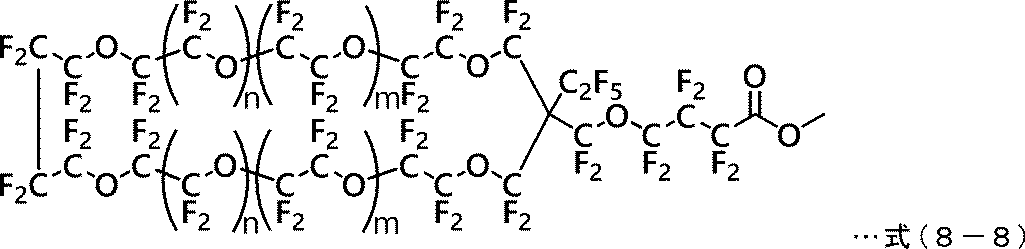
化合物(8-8)のNMRスペクトル:
1H-NMR(400.13MHz、CDCl3、TMS) σ(ppm):4.2(3H)。
19F-NMR(376.46MHz、CDCl3、CFCl3) σ(ppm):-56(44F)、-64(2F)、-65(4F)、-78(3F)、-85(2F)、-90(102F)、-109(2F)、-120(2F)、-127(6F)。
1H-NMR(400.13MHz、CDCl3、TMS) σ(ppm):4.2(3H)。
19F-NMR(376.46MHz、CDCl3、CFCl3) σ(ppm):-56(44F)、-64(2F)、-65(4F)、-78(3F)、-85(2F)、-90(102F)、-109(2F)、-120(2F)、-127(6F)。
(合成例8-9)
攪拌子を備えた50mLナスフラスコに、化合物(8-8)の2.0g、2,2-ジ-2-アリル-4-ペンテン-1-アミンの0.51g、及びAC-6000の2.3gを加え、40℃で攪拌した。反応粗液をカラムクロマトグラフィーにて精製し、化合物(8-9)の1.3g得た。
攪拌子を備えた50mLナスフラスコに、化合物(8-8)の2.0g、2,2-ジ-2-アリル-4-ペンテン-1-アミンの0.51g、及びAC-6000の2.3gを加え、40℃で攪拌した。反応粗液をカラムクロマトグラフィーにて精製し、化合物(8-9)の1.3g得た。

化合物(8-9)のNMRスペクトル:
1H-NMR(400.13MHz、CDCl3、TMS) σ(ppm):6.1(3H)、5.2(6H)、3.4(2H)、2.1(6H)。
19F-NMR(376.46MHz、CDCl3、CFCl3) σ(ppm):-56(44F)、-64(2F)、-65(4F)、-78(3F)、-85(2F)、-90(102F)、-109(2F)、-121(2F)、-127(6F)。
1H-NMR(400.13MHz、CDCl3、TMS) σ(ppm):6.1(3H)、5.2(6H)、3.4(2H)、2.1(6H)。
19F-NMR(376.46MHz、CDCl3、CFCl3) σ(ppm):-56(44F)、-64(2F)、-65(4F)、-78(3F)、-85(2F)、-90(102F)、-109(2F)、-121(2F)、-127(6F)。
(合成例8-10)
攪拌子を備えた50mLナスフラスコに、化合物(8-9)の1.0g、トリメトキシシランの0.10g、アニリンの0.0010g、AC-6000の1.0g、及び白金/1,3-ジビニル-1,1,3,3-テトラメチルジシロキサン錯体の0.0033gを加え、40℃で攪拌した後、0hPa、60℃で減圧留去し、化合物(8-10)の1.1g得た。
攪拌子を備えた50mLナスフラスコに、化合物(8-9)の1.0g、トリメトキシシランの0.10g、アニリンの0.0010g、AC-6000の1.0g、及び白金/1,3-ジビニル-1,1,3,3-テトラメチルジシロキサン錯体の0.0033gを加え、40℃で攪拌した後、0hPa、60℃で減圧留去し、化合物(8-10)の1.1g得た。
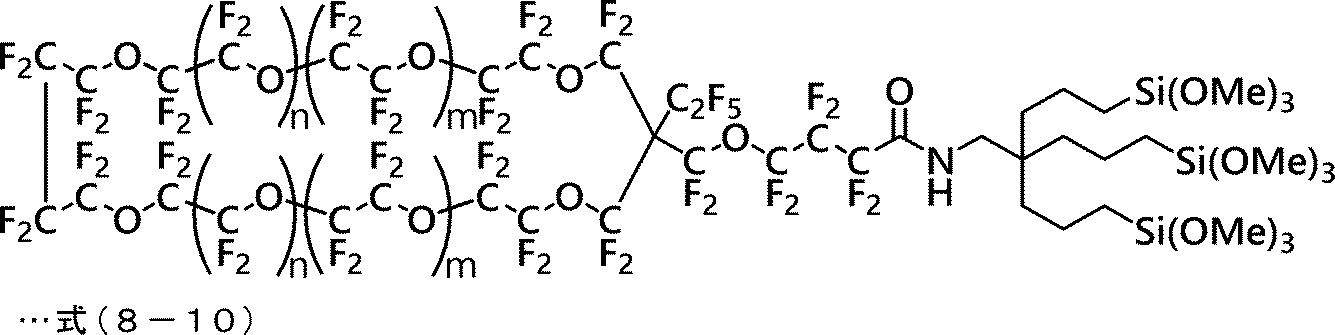
化合物(8-10)のNMRスペクトル:
1H-NMR(400.13MHz、CDCl3、TMS) σ(ppm):3.6(27H)、3.4(2H)、1.3(12H)、0.9(6H)。
19F-NMR(376.46MHz、CDCl3、CFCl3) σ(ppm):-56(44F)、-64(2F)、-65(4F)、-78(3F)、-85(2F)、-90(102F)、-109(2F)、-121(2F)、-127(6F)。
1H-NMR(400.13MHz、CDCl3、TMS) σ(ppm):3.6(27H)、3.4(2H)、1.3(12H)、0.9(6H)。
19F-NMR(376.46MHz、CDCl3、CFCl3) σ(ppm):-56(44F)、-64(2F)、-65(4F)、-78(3F)、-85(2F)、-90(102F)、-109(2F)、-121(2F)、-127(6F)。
[例9]
国際公開第2018/143433号の合成例2に従って、ペルフルオロポリエーテル基含有シラン化合物(9-1)を得た。
CF3O(CF2CF2O)20(CF2O)16CF2CONHCH2C[CH2CH2CH2Si(OCH3)3]3 ・・・(9-1)
国際公開第2018/143433号の合成例2に従って、ペルフルオロポリエーテル基含有シラン化合物(9-1)を得た。
CF3O(CF2CF2O)20(CF2O)16CF2CONHCH2C[CH2CH2CH2Si(OCH3)3]3 ・・・(9-1)
[物品の製造及び評価]
上記各例にて得られた化合物及び組成物を用いて基材を表面処理し物品を得た。表面処理方法として、各例について下記のドライコーティング法及びウェットコーティング法をそれぞれ用いた。基材としては化学強化ガラスを用いた。得られた物品について、下記の方法で評価した。結果を表に示す。
上記各例にて得られた化合物及び組成物を用いて基材を表面処理し物品を得た。表面処理方法として、各例について下記のドライコーティング法及びウェットコーティング法をそれぞれ用いた。基材としては化学強化ガラスを用いた。得られた物品について、下記の方法で評価した。結果を表に示す。
[ドライコーティング法]
ドライコーティングは、真空蒸着装置(ULVAC社製、VTR350M)を用いて行った(真空蒸着法)。各化合物の0.5gを真空蒸着装置内のモリブデン製ボートに充填し、真空蒸着装置内を1×10⁻³Pa以下に排気した。化合物又は組成物を配置したボートを昇温速度10℃/分以下の速度で加熱し、水晶発振式膜厚計による蒸着速度が1nm/秒を超えた時点でシャッターを開けて基材の表面への製膜を開始させた。
膜厚が約50nmとなった時点でシャッターを閉じて基材の表面への製膜を終了させた。化合物又は組成物が堆積された基材を、200℃で30分間加熱処理し、C6F13H(AGC社製、アサヒクリン(登録商標)AC-2000)にて洗浄して、基材の表面に表面層を有する物品を得た。
ドライコーティングは、真空蒸着装置(ULVAC社製、VTR350M)を用いて行った(真空蒸着法)。各化合物の0.5gを真空蒸着装置内のモリブデン製ボートに充填し、真空蒸着装置内を1×10⁻³Pa以下に排気した。化合物又は組成物を配置したボートを昇温速度10℃/分以下の速度で加熱し、水晶発振式膜厚計による蒸着速度が1nm/秒を超えた時点でシャッターを開けて基材の表面への製膜を開始させた。
膜厚が約50nmとなった時点でシャッターを閉じて基材の表面への製膜を終了させた。化合物又は組成物が堆積された基材を、200℃で30分間加熱処理し、C6F13H(AGC社製、アサヒクリン(登録商標)AC-2000)にて洗浄して、基材の表面に表面層を有する物品を得た。
[ウェットコーティング法]
各化合物又は組成物と、媒体としてのC4F9OC2H5(3M社製、ノベック(登録商標)7200)とを混合して、固形分濃度0.05%のコーティング液を調製した。コーティング液に基材をディッピングし、30分間静置後、基材を引き上げた(ディップコート法)。
塗膜を200℃で30分間乾燥させ、AC-2000にて洗浄して、基材の表面に表面層を有する物品を得た。
各化合物又は組成物と、媒体としてのC4F9OC2H5(3M社製、ノベック(登録商標)7200)とを混合して、固形分濃度0.05%のコーティング液を調製した。コーティング液に基材をディッピングし、30分間静置後、基材を引き上げた(ディップコート法)。
塗膜を200℃で30分間乾燥させ、AC-2000にて洗浄して、基材の表面に表面層を有する物品を得た。
(評価方法)
<接触角の測定方法>
表面層の表面に置いた約2μLの蒸留水又はn-ヘキサデカンの接触角を、接触角測定装置(協和界面科学社製、DM-500)を用いて測定した。表面層の表面における異なる5箇所で測定し、その平均値を算出した。接触角の算出には2θ法を用いた。
<接触角の測定方法>
表面層の表面に置いた約2μLの蒸留水又はn-ヘキサデカンの接触角を、接触角測定装置(協和界面科学社製、DM-500)を用いて測定した。表面層の表面における異なる5箇所で測定し、その平均値を算出した。接触角の算出には2θ法を用いた。
<初期接触角>
表面層について、初期水接触角及び初期n-ヘキサデカン接触角を前記測定方法で測定した。評価基準は下記のとおりである。
初期水接触角:
A(優) :115度以上。
B(良) :110度以上115度未満。
C(可) :100度以上110度未満。
D(不可):100度未満。
初期n-ヘキサデカン接触角:
A(優) :66度以上。
B(良) :65度以上66度未満。
C(可) :63度以上65度未満。
D(不可):63度未満。
表面層について、初期水接触角及び初期n-ヘキサデカン接触角を前記測定方法で測定した。評価基準は下記のとおりである。
初期水接触角:
A(優) :115度以上。
B(良) :110度以上115度未満。
C(可) :100度以上110度未満。
D(不可):100度未満。
初期n-ヘキサデカン接触角:
A(優) :66度以上。
B(良) :65度以上66度未満。
C(可) :63度以上65度未満。
D(不可):63度未満。
<耐摩擦性(スチールウール)>
表面層について、表面層について、JIS L0849:2013(ISO 105-X12:2001)に準拠して往復式トラバース試験機(ケイエヌテー社製)を用い、スチールウールボンスター(#0000)を圧力:98.07kPa、速度:320cm/分で1.5万回往復させた後、前記の方法で水の接触角を測定した。摩擦後における水の接触角の低下が小さいほど、摩擦による性能の低下が小さく、耐摩擦性に優れる。
A(優) :1.5万回往復後の水接触角度の変化が2度以下。
B(良) :1.5万回往復後の水接触角度の変化が2度超5度以下。
C(可) :1.5万回往復後の水接触角度の変化が5度超10度以下。
D(不可):1.5万回往復後の水接触角度の変化が10度超。
表面層について、表面層について、JIS L0849:2013(ISO 105-X12:2001)に準拠して往復式トラバース試験機(ケイエヌテー社製)を用い、スチールウールボンスター(#0000)を圧力:98.07kPa、速度:320cm/分で1.5万回往復させた後、前記の方法で水の接触角を測定した。摩擦後における水の接触角の低下が小さいほど、摩擦による性能の低下が小さく、耐摩擦性に優れる。
A(優) :1.5万回往復後の水接触角度の変化が2度以下。
B(良) :1.5万回往復後の水接触角度の変化が2度超5度以下。
C(可) :1.5万回往復後の水接触角度の変化が5度超10度以下。
D(不可):1.5万回往復後の水接触角度の変化が10度超。
<耐滑り性>
人工皮膚(出光テクノファイン社製、PBZ13001)に対する表面層の動摩擦係数を、荷重変動型摩耗試験システム(新東科学社製、HHS2000)を用い、接触面積:3cm×3cm、荷重0.98Nの条件で測定した。動摩擦係数が大きいほど耐滑り性に優れる。評価基準は下記のとおりである。
A(優) :動摩擦係数が0.6以上。
B(良) :動摩擦係数が0.5以上0.6未満。
C(可) :動摩擦係数が0.4以上0.5未満。
D(不可):動摩擦係数が0.4未満。
人工皮膚(出光テクノファイン社製、PBZ13001)に対する表面層の動摩擦係数を、荷重変動型摩耗試験システム(新東科学社製、HHS2000)を用い、接触面積:3cm×3cm、荷重0.98Nの条件で測定した。動摩擦係数が大きいほど耐滑り性に優れる。評価基準は下記のとおりである。
A(優) :動摩擦係数が0.6以上。
B(良) :動摩擦係数が0.5以上0.6未満。
C(可) :動摩擦係数が0.4以上0.5未満。
D(不可):動摩擦係数が0.4未満。
<指紋汚れ除去性>
人口指紋液(オレイン酸とスクアレンとからなる液)を、シリコンゴム栓の平坦面に付着させた後、余分な油分を不織布(旭化成社製、ベンコット(登録商標)M-3)にて拭き取って、指紋のスタンプを準備した。指紋スタンプを表面層状上に乗せ、荷重9.8Nにて10秒間押し付けた。指紋が付着した箇所のヘーズをヘーズメータにて測定し、初期値とした。指紋が付着した箇所について、ティッシュペーパーを取り付けた往復式トラバース試験機(ケイエヌテー社製)を用い、荷重4.9Nにて拭き取った。拭き取り一往復ごとにヘーズの値を測定し、ヘーズが初期値から10%以下になる拭き取り回数を測定した。拭き取り回数が少ないほど指紋汚れを容易に除去でき、指紋汚れ除去性に優れる。評価基準は下記のとおりである。
A(優) :拭き取り回数が3回以下。
B(良) :拭き取り回数が4~5回。
C(可) :拭き取り回数が6~8回。
D(不可):拭き取り回数が9回以上。
人口指紋液(オレイン酸とスクアレンとからなる液)を、シリコンゴム栓の平坦面に付着させた後、余分な油分を不織布(旭化成社製、ベンコット(登録商標)M-3)にて拭き取って、指紋のスタンプを準備した。指紋スタンプを表面層状上に乗せ、荷重9.8Nにて10秒間押し付けた。指紋が付着した箇所のヘーズをヘーズメータにて測定し、初期値とした。指紋が付着した箇所について、ティッシュペーパーを取り付けた往復式トラバース試験機(ケイエヌテー社製)を用い、荷重4.9Nにて拭き取った。拭き取り一往復ごとにヘーズの値を測定し、ヘーズが初期値から10%以下になる拭き取り回数を測定した。拭き取り回数が少ないほど指紋汚れを容易に除去でき、指紋汚れ除去性に優れる。評価基準は下記のとおりである。
A(優) :拭き取り回数が3回以下。
B(良) :拭き取り回数が4~5回。
C(可) :拭き取り回数が6~8回。
D(不可):拭き取り回数が9回以上。
<滑落角測定>
各物品の表面層を水平に保持し、水20mLを滴下した。次いで、表面層を徐々に傾けていき、水が転落した時の角度を測定した。測定は、KYOWA製接触角計(DMo-501 10091)を用いて行った。転落角が小さいほど優れている。
A(優) :転落角が30°以下。
B(良) :転落角が30°超過35°以下。
C(可) :転落角が35°超過40°以下。
D(不可):転落角が40°を超過。
各物品の表面層を水平に保持し、水20mLを滴下した。次いで、表面層を徐々に傾けていき、水が転落した時の角度を測定した。測定は、KYOWA製接触角計(DMo-501 10091)を用いて行った。転落角が小さいほど優れている。
A(優) :転落角が30°以下。
B(良) :転落角が30°超過35°以下。
C(可) :転落角が35°超過40°以下。
D(不可):転落角が40°を超過。
<滑落速度測定>
各物品の表面層を50°に傾けた状態で、水20mLを滴下し、水の滑落速度を測定した。測定は、KYOWA製接触角計(DMo-501 10091)を用いて行った。速度が速いほど優れている。
A(優) :0.1m/s以上。
B(良) :0.06m/s以上0.1m/s以下。
C(可) :0.03m/s以上0.6m/s以下。
D(不可):0.03m/s未満。
各物品の表面層を50°に傾けた状態で、水20mLを滴下し、水の滑落速度を測定した。測定は、KYOWA製接触角計(DMo-501 10091)を用いて行った。速度が速いほど優れている。
A(優) :0.1m/s以上。
B(良) :0.06m/s以上0.1m/s以下。
C(可) :0.03m/s以上0.6m/s以下。
D(不可):0.03m/s未満。

表1に示される通り、本化合物又は組成物を用いて形成された表面層は、耐摩擦性を維持しつつ、耐滑り性に優れていることが明らかとなった。
本化合物を含む表面層を備えた物品は、一例として、下記の製品の部品の一部として使用される光学物品、タッチパネル、反射防止フィルム、反射防止ガラス、SiO2処理ガラス、強化ガラス、サファイアガラス、石英基板、金型金属等として有用である。
製品:カーナビゲーション、携帯電話、デジタルカメラ、デジタルビデオカメラ、携帯情報端末(PDA)、ポータブルオーディオプレーヤー、カーオーディオ、ゲーム機器、眼鏡レンズ、カメラレンズ、レンズフィルター、サングラス、医療用器機(胃カメラ等)、複写機、パーソナルコンピュータ(PC)、液晶ディスプレイ、有機ELディスプレイ、プラズマディスプレイ、タッチパネルディスプレイ、保護フィルム、反射防止フィルム、反射防止ガラス、ナノインプリントのテンプレート、金型等。
製品:カーナビゲーション、携帯電話、デジタルカメラ、デジタルビデオカメラ、携帯情報端末(PDA)、ポータブルオーディオプレーヤー、カーオーディオ、ゲーム機器、眼鏡レンズ、カメラレンズ、レンズフィルター、サングラス、医療用器機(胃カメラ等)、複写機、パーソナルコンピュータ(PC)、液晶ディスプレイ、有機ELディスプレイ、プラズマディスプレイ、タッチパネルディスプレイ、保護フィルム、反射防止フィルム、反射防止ガラス、ナノインプリントのテンプレート、金型等。
この出願は、2022年8月18日に出願された日本出願特願2022-130646を基礎とする優先権を主張し、その開示の全てをここに取り込む。
10:下地層付き基材、 12:基材、 14:下地層、
20:物品、 22:表面層
20:物品、 22:表面層
Claims (13)
- 置換基を有していてもよいフルオロエーテル環を含む基(Rf)と、反応性基(T1)とを有する、化合物。
- 前記フルオロエーテル環が、下記式(1)で表される、請求項1に記載の化合物。
*-(ORf1)m1-** ・・・(1)
ただし、
結合手*と結合手**とが連結して環構造を形成し、
Rf1は、炭素数1~6のフルオロアルキレン基、置換基を有していてもよく炭素-炭素結合間に-NR1-、-C(=O)-、-C(=O)NR1-、又は-C(=O)-O-を有していてもよい炭素数2~12のフルオロアルキレン基、又は、炭素原子の少なくとも一部が環を構成し、置換基を有していてもよい炭素数2~12のフルオロアルキレン基であり、
R1は、水素原子、又はフルオロアルキル基であり、
式(1)中の少なくとも一つの炭素原子が、前記反応性基(T1)と直接、又は他の基を介して結合する結合手を有し、
m1は1以上の整数である。 - 前記Rfが、下記式(2)で表される基を含む、請求項2に記載の化合物。
*-(Rf2)m2-(ORf3)m3-** ・・・(2)
ただし、
Rf2は、炭素数1~6のフルオロアルキレン基であり、
Rf3は、炭素数1~6のフルオロアルキレン基であり、
m2は0又は1であり、
m3は1以上の整数であり、
結合手*は、前記式(1)中の結合手を有する炭素原子と結合し、
結合手**は前記反応性基(T1)と直接、又は連結基を介して結合し、
Rf3が複数ある場合、当該複数あるRf3は互いに同一であっても異なっていてもよい。 - 前記反応性基(T1)が、-Ar、-SR10、-NOR10、-C(=O)R10、-N(R10)2、-N+(R10)3X3、-C≡N、-C(=NR10)-R10、-N+≡N、-N=NR10、-C(=O)OR10、-C(=O)OX2、-C(=O)OX4、-C(=O)OC(=O)R10、-SO2R10、-SO3H、-SO3X2、-O-P(=O)(-OR10)2、-O-P(=O)(-OR10)(-OX2)、-N=C=O、-SiRa1 z1Ra11 3-z1、-C(R10)=C(R10)2、-C≡C(R10)、-C(=O)N(R10)2、-N(R10)C(=O)R10、-Si(R10)2-O-Si(R10)3、-NH-C(=O)R10、-C(=O)NHR10、-I、

ただし、
R10は、水素原子、置換基を有していてもよい炭素数1~6のアルキル基又はフルオロアルキル基、置換基を有していてもよいアリール基であり、
Arは、置換基を有していてもよいアリール基であり、
X2は、アルカリ金属イオン又はアンモニウムイオンであり、
X3は、ハロゲン化物イオンであり、
X4は、ハロゲン原子であり、
Ra1は、加水分解性基、加水分解性基を有する基又は水酸基であり、
Ra11は、炭化水素基であり、
z1は、1~3の整数であり、
R10、Ra1又はRa11が複数ある場合、当該複数あるR10、Ra1又はRa11は、互いに同一であっても異なっていてもよい。 - 下記式(3)で表される、請求項1~4のいずれか一項に記載の化合物。
Rf[-Q1(-T1)x1]y1 ・・・(3)
ただし、
Rfは、置換基を有していてもよいフルオロエーテル環を含む基であり、
Q1は、1+x1価の連結基であり、
T1は、反応性基であり、
x1は1~10の整数であり、
y1は1~6の整数であり、
Q1、T1、又はx1が複数ある場合、当該複数あるQ1、T1、又はx1は互いに同一であっても異なっていてもよい。 - 前記-Q1(-T1)x1が、下記式(4)で表される、請求項5に記載の化合物。
*-R2-L1(-R3-T1)x1 ・・・(4)
ただし、
R2は、単結合、炭素数1~20のフルオロアルキレン基、アルキレン基、又は炭素-炭素原子間にエーテル性酸素原子を含むアルキレン基であり、
L1は、単結合又は、1+x1価の基であり、
R3は、アルキレン基、又はエーテル性酸素原子を有するアルキレン基であり、
x1は1~10の整数であり、
結合手*はRfと連結し、
R3又はT1が複数ある場合、当該複数あるR3又はT1は互いに同一であっても異なっていてもよい。 - 前記反応性基が、下記式(5)で表される基である、請求項5に記載の化合物。
-SiRa1 z1Ra11 3-z1 ・・・(5)
ただし、
Ra1は、加水分解性基、加水分解性基を有する基又は水酸基であり、
Ra11は、炭化水素基であり、
z1は、1~3の整数であり、
Ra1、Ra11、及びz1が複数ある場合、当該複数あるRa1、Ra11、及びz1は各々同一であっても異なっていてもよい。 - 請求項1に記載の化合物と、他の含フッ素エーテル化合物とを含有する組成物。
- 請求項1に記載の化合物、又は請求項8に記載の組成物を含む、表面処理剤。
- 請求項1に記載の化合物、又は請求項8に記載の組成物と、液状媒体とを含む、コーティング液。
- 請求項1の化合物、又は請求項8に記載の組成物から形成された表面層を基材の表面に有する、物品。
- 請求項9に記載の表面処理剤を用いて、ドライコーティング法により表面層を形成する、物品の製造方法。
- 請求項10に記載のコーティング液を用いて、ウェットコーティング法により表面層を形成する、物品の製造方法。
Applications Claiming Priority (2)
| Application Number | Priority Date | Filing Date | Title |
|---|---|---|---|
| JP2022-130646 | 2022-08-18 | ||
| JP2022130646 | 2022-08-18 |
Publications (1)
| Publication Number | Publication Date |
|---|---|
| WO2024038873A1 true WO2024038873A1 (ja) | 2024-02-22 |
Family
ID=89941838
Family Applications (1)
| Application Number | Title | Priority Date | Filing Date |
|---|---|---|---|
| PCT/JP2023/029592 Ceased WO2024038873A1 (ja) | 2022-08-18 | 2023-08-16 | 化合物、組成物、表面処理剤、コーティング液、物品、及び物品の製造方法 |
Country Status (1)
| Country | Link |
|---|---|
| WO (1) | WO2024038873A1 (ja) |
Citations (3)
| Publication number | Priority date | Publication date | Assignee | Title |
|---|---|---|---|---|
| JP2013514999A (ja) * | 2009-12-17 | 2013-05-02 | ワシントン・ユニバーシティ | 抗血栓性ナノ粒子 |
| WO2020071330A1 (ja) * | 2018-10-05 | 2020-04-09 | Agc株式会社 | 含フッ素エーテル組成物、コーティング液、物品およびその製造方法 |
| WO2020162371A1 (ja) * | 2019-02-08 | 2020-08-13 | Agc株式会社 | 含フッ素エーテル化合物、含フッ素エーテル組成物、コーティング液、物品、物品の製造方法、及び含フッ素化合物の製造方法 |
-
2023
- 2023-08-16 WO PCT/JP2023/029592 patent/WO2024038873A1/ja not_active Ceased
Patent Citations (3)
| Publication number | Priority date | Publication date | Assignee | Title |
|---|---|---|---|---|
| JP2013514999A (ja) * | 2009-12-17 | 2013-05-02 | ワシントン・ユニバーシティ | 抗血栓性ナノ粒子 |
| WO2020071330A1 (ja) * | 2018-10-05 | 2020-04-09 | Agc株式会社 | 含フッ素エーテル組成物、コーティング液、物品およびその製造方法 |
| WO2020162371A1 (ja) * | 2019-02-08 | 2020-08-13 | Agc株式会社 | 含フッ素エーテル化合物、含フッ素エーテル組成物、コーティング液、物品、物品の製造方法、及び含フッ素化合物の製造方法 |
Similar Documents
| Publication | Publication Date | Title |
|---|---|---|
| CN109071797B (zh) | 含氟醚化合物、涂布液、物品和新型化合物 | |
| EP3922626B1 (en) | Fluorine-containing ether compound, fluorine-containing ether composition, coating liquid, article, method for producing article, and method for producing fluorine-containing compound | |
| JP7031689B2 (ja) | 含フッ素エーテル組成物、コーティング液および物品 | |
| TW201839051A (zh) | 含氟醚組成物、塗佈液及物品 | |
| CN114867730B (zh) | 含氟醚化合物、表面处理剂、含氟醚组合物、涂布液、物品和物品的制造方法 | |
| JP7764892B2 (ja) | 含フッ素エーテル化合物、表面処理剤、含フッ素エーテル組成物、コーティング液、物品、物品の製造方法、及び化合物 | |
| JP7468355B2 (ja) | 撥水撥油層付き基材、蒸着材料および撥水撥油層付き基材の製造方法 | |
| WO2023095806A1 (ja) | 化合物、組成物、表面処理剤、コーティング液、物品、及び物品の製造方法 | |
| WO2020080167A1 (ja) | 含フッ素エーテル化合物および物品 | |
| JP7472794B2 (ja) | 撥水撥油層付き基材、蒸着材料および撥水撥油層付き基材の製造方法 | |
| US20230256469A1 (en) | Substrate with water and oil repellent layer, and method for producing substrate with water and oil repellent layer | |
| WO2020137992A1 (ja) | 撥水撥油層付き基材、蒸着材料および撥水撥油層付き基材の製造方法 | |
| WO2021251396A1 (ja) | 含フッ素エーテル化合物及びその製造方法、化合物及びその製造方法、含フッ素エーテル組成物、コーティング液、並びに物品及びその製造方法 | |
| WO2024038870A1 (ja) | 化合物、組成物、表面処理剤、コーティング液、物品、及び物品の製造方法 | |
| JP6587040B2 (ja) | 蒸着用含フッ素エーテル組成物、ならびに蒸着膜付き物品およびその製造方法 | |
| WO2024038866A1 (ja) | 化合物、組成物、表面処理剤、コーティング液、物品、及び物品の製造方法 | |
| JP7806696B2 (ja) | 組成物、表面層付き基材、表面層付き基材の製造方法、化合物および化合物の製造方法 | |
| WO2021161905A1 (ja) | 含フッ素エーテル化合物、含フッ素エーテル組成物、コーティング液、物品、および物品の製造方法 | |
| WO2024038865A1 (ja) | 化合物、組成物、表面処理剤、コーティング液、物品、及び物品の製造方法 | |
| JP7790182B2 (ja) | 表面処理剤、コーティング液、物品及び物品の製造方法 | |
| JP2026083464A (ja) | 化合物、組成物、表面処理剤、物品、及び、物品の製造方法 | |
| WO2024203923A1 (ja) | 化合物、組成物、表面処理剤、物品、及び、物品の製造方法 | |
| WO2024080312A1 (ja) | 表面処理剤、物品及び物品の製造方法 | |
| WO2026048771A1 (ja) | 化合物、表面処理剤、物品、及び、物品の製造方法 |
Legal Events
| Date | Code | Title | Description |
|---|---|---|---|
| 121 | Ep: the epo has been informed by wipo that ep was designated in this application |
Ref document number: 23854907 Country of ref document: EP Kind code of ref document: A1 |
|
| NENP | Non-entry into the national phase |
Ref country code: DE |
|
| 122 | Ep: pct application non-entry in european phase |
Ref document number: 23854907 Country of ref document: EP Kind code of ref document: A1 |
|
| NENP | Non-entry into the national phase |
Ref country code: JP |