WO2024029233A1 - プリプレグ、繊維強化複合材料、繊維強化複合材料製管状体、ゴルフクラブシャフトおよび釣り竿 - Google Patents
プリプレグ、繊維強化複合材料、繊維強化複合材料製管状体、ゴルフクラブシャフトおよび釣り竿 Download PDFInfo
- Publication number
- WO2024029233A1 WO2024029233A1 PCT/JP2023/023765 JP2023023765W WO2024029233A1 WO 2024029233 A1 WO2024029233 A1 WO 2024029233A1 JP 2023023765 W JP2023023765 W JP 2023023765W WO 2024029233 A1 WO2024029233 A1 WO 2024029233A1
- Authority
- WO
- WIPO (PCT)
- Prior art keywords
- component
- mass
- parts
- epoxy resin
- fiber
- Prior art date
- Legal status (The legal status is an assumption and is not a legal conclusion. Google has not performed a legal analysis and makes no representation as to the accuracy of the status listed.)
- Ceased
Links
Classifications
-
- C—CHEMISTRY; METALLURGY
- C08—ORGANIC MACROMOLECULAR COMPOUNDS; THEIR PREPARATION OR CHEMICAL WORKING-UP; COMPOSITIONS BASED THEREON
- C08J—WORKING-UP; GENERAL PROCESSES OF COMPOUNDING; AFTER-TREATMENT NOT COVERED BY SUBCLASSES C08B, C08C, C08F, C08G or C08H
- C08J5/00—Manufacture of articles or shaped materials containing macromolecular substances
- C08J5/24—Impregnating materials with prepolymers which can be polymerised in situ, e.g. manufacture of prepregs
-
- A—HUMAN NECESSITIES
- A01—AGRICULTURE; FORESTRY; ANIMAL HUSBANDRY; HUNTING; TRAPPING; FISHING
- A01K—ANIMAL HUSBANDRY; AVICULTURE; APICULTURE; PISCICULTURE; FISHING; REARING OR BREEDING ANIMALS, NOT OTHERWISE PROVIDED FOR; NEW BREEDS OF ANIMALS
- A01K87/00—Fishing rods
-
- A—HUMAN NECESSITIES
- A63—SPORTS; GAMES; AMUSEMENTS
- A63B—APPARATUS FOR PHYSICAL TRAINING, GYMNASTICS, SWIMMING, CLIMBING, OR FENCING; BALL GAMES; TRAINING EQUIPMENT
- A63B53/00—Golf clubs
- A63B53/10—Non-metallic shafts
-
- C—CHEMISTRY; METALLURGY
- C08—ORGANIC MACROMOLECULAR COMPOUNDS; THEIR PREPARATION OR CHEMICAL WORKING-UP; COMPOSITIONS BASED THEREON
- C08G—MACROMOLECULAR COMPOUNDS OBTAINED OTHERWISE THAN BY REACTIONS ONLY INVOLVING UNSATURATED CARBON-TO-CARBON BONDS
- C08G59/00—Polycondensates containing more than one epoxy group per molecule; Macromolecules obtained by polymerising compounds containing more than one epoxy group per molecule using curing agents or catalysts which react with the epoxy groups
- C08G59/18—Macromolecules obtained by polymerising compounds containing more than one epoxy group per molecule using curing agents or catalysts which react with the epoxy groups ; e.g. general methods of curing
- C08G59/20—Macromolecules obtained by polymerising compounds containing more than one epoxy group per molecule using curing agents or catalysts which react with the epoxy groups ; e.g. general methods of curing characterised by the epoxy compounds used
- C08G59/22—Di-epoxy compounds
- C08G59/226—Mixtures of di-epoxy compounds
-
- C—CHEMISTRY; METALLURGY
- C08—ORGANIC MACROMOLECULAR COMPOUNDS; THEIR PREPARATION OR CHEMICAL WORKING-UP; COMPOSITIONS BASED THEREON
- C08G—MACROMOLECULAR COMPOUNDS OBTAINED OTHERWISE THAN BY REACTIONS ONLY INVOLVING UNSATURATED CARBON-TO-CARBON BONDS
- C08G59/00—Polycondensates containing more than one epoxy group per molecule; Macromolecules obtained by polymerising compounds containing more than one epoxy group per molecule using curing agents or catalysts which react with the epoxy groups
- C08G59/18—Macromolecules obtained by polymerising compounds containing more than one epoxy group per molecule using curing agents or catalysts which react with the epoxy groups ; e.g. general methods of curing
- C08G59/20—Macromolecules obtained by polymerising compounds containing more than one epoxy group per molecule using curing agents or catalysts which react with the epoxy groups ; e.g. general methods of curing characterised by the epoxy compounds used
- C08G59/22—Di-epoxy compounds
- C08G59/24—Di-epoxy compounds carbocyclic
- C08G59/245—Di-epoxy compounds carbocyclic aromatic
-
- C—CHEMISTRY; METALLURGY
- C08—ORGANIC MACROMOLECULAR COMPOUNDS; THEIR PREPARATION OR CHEMICAL WORKING-UP; COMPOSITIONS BASED THEREON
- C08G—MACROMOLECULAR COMPOUNDS OBTAINED OTHERWISE THAN BY REACTIONS ONLY INVOLVING UNSATURATED CARBON-TO-CARBON BONDS
- C08G59/00—Polycondensates containing more than one epoxy group per molecule; Macromolecules obtained by polymerising compounds containing more than one epoxy group per molecule using curing agents or catalysts which react with the epoxy groups
- C08G59/18—Macromolecules obtained by polymerising compounds containing more than one epoxy group per molecule using curing agents or catalysts which react with the epoxy groups ; e.g. general methods of curing
- C08G59/40—Macromolecules obtained by polymerising compounds containing more than one epoxy group per molecule using curing agents or catalysts which react with the epoxy groups ; e.g. general methods of curing characterised by the curing agents used
- C08G59/4007—Curing agents not provided for by the groups C08G59/42 - C08G59/66
- C08G59/4014—Nitrogen containing compounds
- C08G59/4021—Ureas; Thioureas; Guanidines; Dicyandiamides
-
- C—CHEMISTRY; METALLURGY
- C08—ORGANIC MACROMOLECULAR COMPOUNDS; THEIR PREPARATION OR CHEMICAL WORKING-UP; COMPOSITIONS BASED THEREON
- C08L—COMPOSITIONS OF MACROMOLECULAR COMPOUNDS
- C08L63/00—Compositions of epoxy resins; Compositions of derivatives of epoxy resins
-
- C—CHEMISTRY; METALLURGY
- C08—ORGANIC MACROMOLECULAR COMPOUNDS; THEIR PREPARATION OR CHEMICAL WORKING-UP; COMPOSITIONS BASED THEREON
- C08L—COMPOSITIONS OF MACROMOLECULAR COMPOUNDS
- C08L63/00—Compositions of epoxy resins; Compositions of derivatives of epoxy resins
- C08L63/04—Epoxynovolacs
-
- C—CHEMISTRY; METALLURGY
- C08—ORGANIC MACROMOLECULAR COMPOUNDS; THEIR PREPARATION OR CHEMICAL WORKING-UP; COMPOSITIONS BASED THEREON
- C08L—COMPOSITIONS OF MACROMOLECULAR COMPOUNDS
- C08L71/00—Compositions of polyethers obtained by reactions forming an ether link in the main chain; Compositions of derivatives of such polymers
- C08L71/08—Polyethers derived from hydroxy compounds or from their metallic derivatives
- C08L71/10—Polyethers derived from hydroxy compounds or from their metallic derivatives from phenols
-
- C—CHEMISTRY; METALLURGY
- C08—ORGANIC MACROMOLECULAR COMPOUNDS; THEIR PREPARATION OR CHEMICAL WORKING-UP; COMPOSITIONS BASED THEREON
- C08J—WORKING-UP; GENERAL PROCESSES OF COMPOUNDING; AFTER-TREATMENT NOT COVERED BY SUBCLASSES C08B, C08C, C08F, C08G or C08H
- C08J2363/00—Characterised by the use of epoxy resins; Derivatives of epoxy resins
- C08J2363/04—Epoxynovolacs
-
- C—CHEMISTRY; METALLURGY
- C08—ORGANIC MACROMOLECULAR COMPOUNDS; THEIR PREPARATION OR CHEMICAL WORKING-UP; COMPOSITIONS BASED THEREON
- C08J—WORKING-UP; GENERAL PROCESSES OF COMPOUNDING; AFTER-TREATMENT NOT COVERED BY SUBCLASSES C08B, C08C, C08F, C08G or C08H
- C08J2471/00—Characterised by the use of polyethers obtained by reactions forming an ether link in the main chain; Derivatives of such polymers
- C08J2471/08—Polyethers derived from hydroxy compounds or from their metallic derivatives
- C08J2471/10—Polyethers derived from hydroxy compounds or from their metallic derivatives from phenols
Definitions
- the present invention relates to prepregs, fiber-reinforced composite materials, and tubular bodies made of fiber-reinforced composite materials, which are suitably used for fiber-reinforced composite materials such as aerospace applications, general industrial applications, and sports applications.
- the present invention relates to golf club shafts and fishing rods that use tubular bodies made of composite materials.
- Fiber-reinforced composite materials using carbon fibers, aramid fibers, etc. as reinforcing fibers take advantage of their high specific strength and specific modulus to be used as structural materials for aircraft and automobiles, tennis rackets, golf club shafts, fishing rods, and bicycles. It is widely used in sports, general industrial applications, etc., such as housings.
- thermosetting resins are mainly used from the viewpoint of heat resistance and productivity, and epoxy resins are particularly preferred from the viewpoint of mechanical properties such as adhesion to reinforcing fibers. used.
- the fiber-reinforced composite materials used need to have high strength in the fiber direction and non-fiber direction, and these are used as matrix resins.
- the strength and elastic modulus of the epoxy resin itself have a major influence.
- high heat resistance is also required to withstand processing heat.
- the use of cross-cuts of reinforcing fibers as a design by clear coating the surface of fiber-reinforced composite materials is increasing. Therefore, for epoxy resins used as matrix resins, in addition to the cured product exhibiting excellent mechanical properties and heat resistance, importance has also been placed on the appearance of the cured product, such as weather resistance and transparency.
- Patent Document 1 a composition in which an oxazolidone type epoxy resin and a novolak type epoxy resin are blended is considered because it can achieve both mechanical properties and heat resistance. Further, Patent Document 2 considers a prepreg that does not become cloudy due to moisture absorption and has an excellent appearance as a fiber-reinforced composite material by using an epoxy resin composition having a parallel light transmittance of 30% or more. Furthermore, in Patent Document 3, in order to reduce the possibility that dicyandiamide used as a hardening agent remains undissolved and causes defects, a dissolution accelerator such as a sorbitol type epoxy resin is blended, and a towpreg with excellent fracture strain and transparency of the resin composition is created. Are considering.
- Patent Document 1 When using the technique of Patent Document 1, it is possible to achieve both elastic modulus and heat resistance, but no consideration is given to appearance such as weather resistance or transparency, and an excellent appearance cannot be stably obtained.
- the technology of Patent Document 2 although a cured resin product with excellent transparency and a molded product without clouding due to moisture absorption can be obtained, the elastic modulus of the cured resin product is low, and it is not necessarily superior in fiber-reinforced composite materials. However, it was not possible to obtain good mechanical properties.
- Patent Document 2 no consideration was given to weather resistance, and there was room for improvement in terms of weather resistance as well.
- Patent Document 3 although a cured resin product with excellent transparency is obtained, the elastic modulus and heat resistance of the cured resin product are low, and excellent mechanical properties and heat resistance are not necessarily obtained in fiber reinforced composite materials. Ta. Further, in Patent Document 3, no consideration was given to weather resistance, and excellent weather resistance could not be stably obtained.
- the present invention aims to provide a prepreg made of a resin composition that has excellent elastic modulus and heat resistance, as well as excellent appearance such as weather resistance and transparency, as well as fiber reinforcement using the prepreg that has excellent mechanical properties, heat resistance, and appearance.
- An object of the present invention is to provide a composite material, a tubular body made of fiber-reinforced composite material, a golf club shaft, and a fishing rod.
- a prepreg containing reinforcing fibers and a resin composition the resin composition containing the following components [A] to [D] and satisfying the following conditions (1) to (5).
- Condition (3) The content of component [C] is 10 to 40 parts by mass based on 100 parts by mass of the total epoxy resin.
- Component [F] A compound having a boiling point of 130° C.
- a prepreg made of a resin composition that has excellent elastic modulus and heat resistance as well as excellent appearance such as weather resistance and transparency, and fibers using the prepreg that have excellent mechanical properties, heat resistance, and appearance.
- a reinforced composite material, a tubular body made of fiber reinforced composite material, a golf club shaft, and a fishing rod can be obtained.
- the prepreg of the present invention includes a resin composition and reinforcing fibers. It is preferable to consist of a resin composition and reinforcing fibers.
- the resin composition contains components [A] to [D] as essential components.
- Component [A] in the present invention is a novolac type epoxy resin.
- component [A] the elastic modulus and heat resistance of the cured resin material are improved without impairing weather resistance, and a fiber-reinforced composite material having excellent mechanical properties, heat resistance, and appearance can be obtained.
- component [A] based on 100 parts by mass of the total epoxy resin contained in the resin composition.
- the lower limit is preferably 25 parts by mass or more, more preferably 30 parts by mass or more.
- the upper limit is preferably 45 parts by mass or less, more preferably 40 parts by mass or less.
- the lower limit of the softening point of the novolak epoxy resin is preferably 50°C or higher, and 60°C or higher. is even more preferable.
- the upper limit of the softening point is preferably 120°C or lower, more preferably 110°C or lower.
- component [A] examples include phenol novolac type epoxy resins and cresol novolac type epoxy resins.
- phenol novolac type epoxy resins include "jER (registered trademark)" 152, 154 (manufactured by Mitsubishi Chemical Corporation), EPPN-201 (manufactured by Nippon Kayaku Co., Ltd.), and "EPICLON (registered trademark)”. )"N-740, N-770 (softening point: 70°C), N-775 (softening point: 75°C, manufactured by DIC Corporation), etc.
- cresol novolac type epoxy resin Commercial products of cresol novolac type epoxy resin include "EPICLON (registered trademark)" N-660 (softening point: 66°C), N-665 (softening point: 70°C), N-670 (softening point: 73°C) , N-673 (softening point: 78°C), N-680 (softening point: 87°C), N-690 (softening point: 93°C), N-695 (softening point: 95°C, above, DIC Corporation) (manufactured by).
- EPICLON registered trademark
- Component [B] in the present invention is an oxazolidone-type epoxy resin.
- component [B] it is possible to improve the heat resistance of the cured resin material without impairing the weather resistance.
- component [B] it is possible to promote the dissolution of dicyandiamide, which is component [D], and improve the transparency of the cured resin product. That is, by including component [B], a fiber reinforced composite material having excellent heat resistance and appearance can be obtained.
- component [B] It is necessary to contain 10 to 40 parts by mass of component [B] based on 100 parts by mass of the total epoxy resin contained in the resin composition.
- the lower limit is preferably 15 parts by mass or more, more preferably 20 parts by mass or more.
- the upper limit is preferably 35 parts by mass or less, more preferably 30 parts by mass or less. If the content of component [B] is not less than the above lower limit, the cured resin product will have excellent heat resistance and transparency, and if it is not more than the above upper limit, the flexural modulus of the cured resin product will not be impaired. That is, by including component [B] in this range, the cured resin product has a good balance of transparency, heat resistance, and flexural modulus.
- component [B] Commercially available products of component [B] include AER4152, AER4151 (manufactured by Asahi Kasei E-Materials Co., Ltd.), and "D.E.R. (registered trademark)" 852, 858 (manufactured by Dow Chemical Co., Ltd.). (manufactured by ADEKA Corporation), TSR-400 (manufactured by DIC Corporation), ACR1348 (manufactured by ADEKA Corporation), etc. can be used.
- Component [C] in the present invention is either or both of a sorbitol-type epoxy resin and a glycerol-type epoxy resin.
- component [C] when both a sorbitol type epoxy resin and a glycerol type epoxy resin are included, they are collectively referred to as component [C]. These may be used alone or in combination.
- component [C] it is possible to improve the flexural modulus of the cured resin material without impairing weather resistance.
- component [C] has a hydroxyl group in its molecular structure and therefore has high polarity, which promotes the dissolution of component [D], dicyandiamide, and can improve the transparency of the cured resin product. That is, by including component [C], a fiber reinforced composite material having excellent flexural modulus and appearance can be obtained.
- component [C] It is necessary to contain 10 to 40 parts by mass of component [C] based on 100 parts by mass of the total epoxy resin contained in the resin composition.
- the lower limit is preferably 15 parts by mass or more, more preferably 20 parts by mass or more.
- the upper limit is preferably 35 parts by mass or less, more preferably 30 parts by mass or less. If the content of component [C] is at least the above lower limit, the cured resin product will have excellent bending elastic modulus and transparency, and if the content is at most the above upper limit, the heat resistance of the cured resin product will not be impaired. That is, by including component [C] in this range, the cured resin product has a good balance of transparency, heat resistance, and flexural modulus.
- glycerol-type epoxy resin of component [C] examples include monoglycerol-type epoxy resins, diglycerol-type epoxy resins, and polyglycerol-type epoxy resins.
- sorbitol-type epoxy resins include "Denacol (registered trademark)" EX-612, EX-614, EX-614B, and EX-622 (manufactured by Nagase ChemteX Co., Ltd.).
- Examples of commercially available glycerol-type epoxy resins include “Denacol (registered trademark)” EX-313 and EX-314 (manufactured by Nagase ChemteX Co., Ltd.).
- Commercial products of diglycerol type epoxy resin include “Denacol (registered trademark)” EX-421 (manufactured by Nagase ChemteX Co., Ltd.)
- commercial products of polyglycerol type epoxy resin include "Denacol (registered trademark)” Trademark)" EX-512, EX-521 (manufactured by Nagase ChemteX Co., Ltd.).
- Condition (4) in the present invention requires that the total content of component [B] and component [C] be 40 parts by mass or more based on 100 parts by mass of the total epoxy resin.
- the lower limit is preferably 45 parts by mass or more, more preferably 50 parts by mass or more.
- the upper limit is 80 parts by mass or less, which is the sum of the upper limits of each component in condition (2) and condition (3), but preferably 70 parts by mass or less, and 60 parts by mass or less. is even more preferable.
- Condition (5) in the present invention is that the component [E], the glycidylamine type epoxy resin, is not included, or even if it is included, it is not more than 10 parts by mass based on 100 parts by mass of the total epoxy resin. Moreover, even if component [E] is included, it is more preferably 5 parts by mass or less, and even more preferably 1 part by mass or less.
- component [E] By controlling the blending amount of component [E] to 10 parts by mass or less, a fiber-reinforced composite material having excellent weather resistance can be obtained without hindering the improvement in weather resistance of the cured resin product.
- Glycidylamine type epoxy resins of component [E] include glycidylamine type epoxy resins having an aromatic ring, aliphatic glycidylamine type epoxy resins, diaminodiphenylmethane type epoxy resins, diaminodiphenyl sulfone type epoxy resins, and aminophenol type epoxy resins. Examples include epoxy resin, metaxylene diamine type epoxy resin, and 1,3-bisaminomethylcyclohexane type epoxy resin.
- diaminodiphenylmethane type epoxy resins include ELM434 (manufactured by Sumitomo Chemical Co., Ltd.), "Araldite (registered trademark)” MY720, MY721, MY9512, MY9663 (manufactured by Huntsman Advanced Materials Co., Ltd.), Examples include “Epotote (registered trademark)” YH-434 (manufactured by Nippon Steel Chemical & Materials Co., Ltd.) and "jER (registered trademark)” 604 (manufactured by Mitsubishi Chemical Corporation).
- diaminodiphenylsulfone epoxy resins include TG3DAS (manufactured by Mitsui Chemicals Fine Co., Ltd.).
- aminophenol-type epoxy resins include ELM120, ELM100 (manufactured by Sumitomo Chemical Co., Ltd.), "jER (registered trademark)” 630 (manufactured by Mitsubishi Chemical Corporation), and "Araldite (registered trademark)” MY0500. , MY0510, MY0600, MY0610 (manufactured by Huntsman Advanced Materials, Inc.).
- a commercially available meta-xylene diamine type epoxy resin includes "TETRAD (registered trademark)" -X (manufactured by Mitsubishi Gas Chemical Co., Ltd.).
- a commercially available 1,3-bisaminomethylcyclohexane type epoxy resin includes "TETRAD (registered trademark)" -C (manufactured by Mitsubishi Gas Chemical Co., Ltd.).
- Epoxy resins other than those mentioned above may also be appropriately blended into the resin composition used in the present invention, within a range that does not impair the effects of the present invention.
- bisphenol type, isocyanuric acid type, dicyclopentadiene type, hydantoin type, trimethylolpropane type, pentaerythritol type, trishydroxyphenylmethane type and tetraphenylolethane type epoxy resins can be mentioned.
- bisphenol A epoxy resins include "jER (registered trademark)” 825, 828, 834, 1001, 1002, 1003, 1003F, 1004, 1004AF, 1005F, 1006FS, 1007, 1009, 1010 (the above, Mitsubishi Chemical Corporation), "EPICLON (registered trademark)” 850 (manufactured by DIC Corporation), “Epotote (registered trademark)” YD-128 (manufactured by Nippon Steel Chemical & Materials Corporation), and “D. E.R. (registered trademark)”-331, 332 (manufactured by Dow Chemical Co., Ltd.), and the like.
- bisphenol F-type epoxy resins include "Araldite (registered trademark)” GY282 (manufactured by Huntsman Advanced Materials Co., Ltd.), “jER (registered trademark)” 806, 807, 4005P, 4007P, 4010P (manufactured by Huntsman Advanced Materials, Inc.), and , manufactured by Mitsubishi Chemical Corporation), “EPICLON (registered trademark)” 830 (manufactured by DIC Corporation), and "EPOTOT (registered trademark)” YD-170 (manufactured by Nippon Steel Chemical & Materials Corporation). .
- Component [D] in the present invention is dicyandiamide.
- Dicyandiamide is excellent in providing high mechanical properties and heat resistance to cured products of epoxy resins, and is widely used as a curing agent for various epoxy resins. Furthermore, since the epoxy resin composition has excellent weather resistance and storage stability, it can be suitably used.
- Commercially available products of such dicyandiamide include DICY7 and DICY15 (all manufactured by Mitsubishi Chemical Corporation).
- the content of component [D] is preferably 4 to 12 parts by mass based on 100 parts by mass of the total epoxy resin.
- the lower limit is more preferably 5 parts by mass or more, and the upper limit is even more preferably 10 parts by mass or less.
- the resin composition used for the prepreg of the present invention preferably contains a phenoxy resin as component [G] from the viewpoint of controlling the viscosity of the resin composition and the tack of the prepreg.
- Phenoxy resin can improve the viscosity of the resin composition and the tack of the prepreg without impairing the weather resistance of the cured resin product, so it is preferably blended in order to create a prepreg that is easy to handle. .
- phenoxy resins examples include "Phenotote (registered trademark)" YP-50, YP-50S, and YP-70 (manufactured by Nippon Steel Chemical & Materials Co., Ltd.).
- a curing accelerator may be added to the resin composition used for the prepreg of the present invention from the viewpoint of controlling the curing speed.
- the curing accelerator include urea compounds and imidazole compounds, and urea compounds are particularly preferably used from the viewpoint of storage stability of the resin composition.
- urea compound examples include 3-(3,4-dichlorophenyl)-1,1-dimethylurea, 3-(4-chlorophenyl)-1,1-dimethylurea, phenyldimethylurea, and toluenebisdimethylurea.
- aromatic urea compounds DCMU99 (manufactured by Hodogaya Chemical Industry Co., Ltd.), "Omicure (registered trademark)" 24 (manufactured by PTI Japan Co., Ltd.), etc. can be used. can.
- the resin composition used in the present invention is a component [F] having a boiling point of 130°C or higher and a molecular weight m of 50 or more and 250 or less, since the elastic modulus of the cured resin increases. It is preferable that the compound contains a compound that does not have an epoxy group and does not have the ability to harden an epoxy resin.
- compounds such as amines and phenols that can undergo addition reactions with epoxy resins, acid anhydrides that can be copolymerized with epoxy resins, imidazole, aromatic urea compounds, and tertiary amine compounds that can serve as self-polymerization reaction initiators for epoxy resins are , is a compound that has the ability to harden epoxy resins, and is not included in component [F].
- “not having epoxy resin curing ability” refers to a property that does not chemically react with the epoxy resin and does not participate in the self-polymerization of the epoxy resin.
- component [F] exists in the voids without being incorporated into the crosslinked structure, and this state is maintained even after the epoxy resin is cured. This is considered to increase the elastic modulus of the resulting cured resin material. Moreover, surprisingly, by blending the above-mentioned component [F], a cured resin product having not only a high elastic modulus but also a high elongation and high strength can be obtained.
- the boiling point of component [F] is 130°C or higher, more preferably 180°C or higher, so that the volatilization of component [F] when the resin composition is cured can be suppressed, resulting in a cured resin product with excellent mechanical properties. and fiber-reinforced composite materials. Furthermore, it is preferable to set the boiling point of component [F] within this range because it is possible to suppress the generation of voids and deterioration of mechanical properties in the fiber-reinforced composite material obtained. Further, although there is no particular upper limit to the boiling point of component [F], the boiling points of the compounds commonly used in the present invention are often 400° C. or lower.
- Component [F] is preferably contained in an amount of 1 to 15 parts by weight, preferably 2 to 10 parts by weight, and more preferably 3 to 6 parts by weight, based on 100 parts by weight of the total epoxy resin.
- the molecular weight m of component [F] is 50 or more and 250 or less, more preferably 70 or more and 120 or less. By setting the molecular weight of component [F] within this range, component [F] is appropriately retained in the voids of the crosslinked structure formed by the reaction between the epoxy resin and dicyandiamide, and the elastic modulus, strength, and elongation are improved. An excellent cured product can be obtained.
- component [F] is preferably a compound having at least one functional group selected from the group consisting of an amide group, a ketone group, and a hydroxyl group in the molecule.
- component [F] has a highly polar functional group as described above in its molecule, a strong intermolecular interaction occurs between component [F] and the hydroxyl group in the crosslinked structure formed from the epoxy resin and dicyandiamide. Since the component [F] is easily retained appropriately in the voids of the crosslinked structure, particularly excellent effects of improving elongation and strength can be obtained.
- component [F] has a highly polar functional group as described above, it can promote the dissolution of dicyandiamide, component [D], and improve the transparency of the cured resin product.
- Such component [F] includes amides such as N-methylformamide, N-methylacetamide, 2-pyrrolidone, N-methylpropionamide, N-ethylacetamide, N-methylacetanilide, and N,N'-diphenylacetamide; and diols such as ethanediol, propanediol, butanediol, pentanediol, hexanediol, and heptanediol. These compounds may be used alone or in an appropriate combination.
- Preferred examples of the reinforcing fibers used in the prepreg and fiber-reinforced composite material of the present invention include carbon fibers, graphite fibers, aramid fibers, and glass fibers, with carbon fibers being particularly preferred.
- the form and arrangement of the reinforcing fibers are not limited, and for example, fiber structures such as long fibers aligned in one direction, single tow, woven fabric, knit, and braided cord are used.
- As reinforcing fibers two or more types of carbon fibers, glass fibers, aramid fibers, boron fibers, PBO fibers, high-strength polyethylene fibers, alumina fibers, silicon carbide fibers, and the like may be used in combination.
- carbon fibers include acrylic, pitch, and rayon carbon fibers, and acrylic carbon fibers with high tensile strength are particularly preferably used.
- twisted yarns, untwisted yarns, untwisted yarns, etc. can be used, but in the case of twisted yarns, the orientation of the filaments constituting the carbon fibers is not parallel, so the obtained carbon fiber reinforced composite material Therefore, it is preferable to use untwisted yarn or non-twisted yarn, which has a good balance between formability and strength characteristics of the carbon fiber reinforced composite material.
- the carbon fiber preferably has a tensile modulus in the range of 200 to 440 GPa.
- the tensile modulus of carbon fiber is influenced by the crystallinity of the graphite structure that constitutes the carbon fiber, and the higher the crystallinity, the higher the modulus of elasticity. This range is preferable because the carbon fiber reinforced composite material has both stiffness and strength balanced at a high level.
- a more preferable elastic modulus is within the range of 230 to 400 GPa, and even more preferably within the range of 260 to 370 GPa.
- the tensile modulus of carbon fiber is a value measured according to JIS R7601 (2006).
- the prepreg of the present invention can be manufactured by various known methods.
- a prepreg can be produced by a hot melt method in which a resin composition is heated to lower its viscosity and impregnated into reinforcing fibers without using an organic solvent.
- a reinforcing fiber is directly impregnated with a resin composition whose viscosity has been lowered by heating, or a release paper sheet with a resin film is first prepared by coating the resin composition on a release paper or the like.
- a method can be used in which a resin film is placed on the reinforcing fiber side from both sides or one side of the reinforcing fiber, and the reinforcing fiber is impregnated with the resin composition by heating and pressing.
- the content of reinforcing fibers in the prepreg is preferably 30 to 90% by mass, more preferably 35 to 85% by mass, and even more preferably 65 to 85% by mass.
- the fiber mass content is small, the amount of resin is too large, making it difficult to obtain the advantages of a fiber reinforced composite material having excellent specific strength and specific modulus.
- the amount of heat generated during curing may become too high.
- the fiber mass content is too large, poor resin impregnation may occur, and the resulting composite material may have many voids.
- the fiber-reinforced composite material of the present invention or the tubular body made of fiber-reinforced composite material can be manufactured by, for example, the method of laminating the prepregs of the present invention described above in a predetermined form and curing the resin by applying pressure and heating. I can do it.
- the method of applying heat and pressure includes a press molding method, an autoclave molding method, a bagging molding method, a wrapping tape method, an internal pressure molding method, and the like.
- a wrapping tape method is particularly preferably used as a method for forming the tubular body made of fiber-reinforced composite material.
- the wrapping tape method is a method in which a prepreg is wrapped around a core metal such as a mandrel to obtain a cylindrical molded body. Specifically, the prepreg is wrapped around a mandrel, a wrapping tape made of a thermoplastic resin film is wrapped around the outer periphery of the prepreg in order to fix the prepreg and apply pressure, and after the resin is heated and cured in an oven, the core is wrapped.
- This is a method of obtaining a cylindrical molded body by removing gold, and is suitable for producing tubular bodies such as golf club shafts and fishing rods.
- the cured product thereof has excellent mechanical properties, weather resistance, and transparency. Therefore, the tubular body made of the fiber reinforced composite material of the present invention has excellent bending strength, weather resistance, and appearance. Express.
- the fiber-reinforced composite material or the tubular body made of fiber-reinforced composite material of the present invention can be widely used in aerospace applications, general industrial applications, and sports applications. More specifically, in general industrial applications, it is suitably used in structures such as automobiles, ships, and railway vehicles. In sports applications, it is suitably used for golf club shafts, fishing rods, tennis and badminton rackets. Among these, the fiber-reinforced composite material tubular body of the present invention can be suitably used for golf club shafts and fishing rods.
- ⁇ Method for preparing resin composition> Preparation of hardening agent master 10 parts by mass of epoxy resin ([C]-1, [C]-2, [H]-1, [H]-2 correspond to this) that is liquid at room temperature (all epoxy (10 parts by mass per 100 parts by mass of resin) was prepared. Dicyandiamide, which is component [D], was added to each of these and kneaded at room temperature. A hardener master was prepared by passing the mixture twice through a three roll mill.
- ⁇ Method for producing cured resin material> After degassing the resin composition prepared according to the above ⁇ Method for Preparing a Resin Composition> in a vacuum, it was placed in a mold with a thickness of 2 mm using a 2 mm thick "Teflon (registered trademark)" spacer for 30 minutes. The temperature was raised from °C at a rate of 1.7 °C/min, and after reaching a temperature of 90 °C, it was held for 1 hour, and then the temperature was raised at a rate of 2.0 °C/min to reach a temperature of 135 °C. After that, the resin was cured for 2 hours to obtain a plate-shaped cured resin product with a thickness of 2 mm.
- Teflon registered trademark
- the above curing reaction was carried out in a mold set to a thickness of 1 mm with a 1 mm thick "Teflon (registered trademark)" spacer, and a plate-shaped cured resin product with a thickness of 1 mm was formed. Obtained.
- the resin composition prepared according to the above ⁇ Method for Preparing a Resin Composition> was applied onto a release paper using a knife coater to produce two resin films having a resin basis weight of 31 g/m 2 .
- the above -mentioned resin film was layered on each side of the reinforcing fibers (the above-mentioned "Torayka (registered trademark)" T1100G-24K) arranged in one direction so as to form a sheet with a fiber basis weight of 125 g/m2.
- the resin composition was impregnated by heating and pressurizing at a temperature of 110° C. and a maximum pressure of 2 MPa to obtain a prepreg.
- One cycle consisted of 102 minutes of irradiation without water jetting and 18 minutes of irradiation with water jetting under the conditions of intensity 180 W/m 2 , chamber temperature 28°C, and humidity 99% RH, and this cycle was repeated 12 times ( A repeated weathering test (i.e., 24 hours) was conducted.
- Weather resistance was evaluated by measuring the color difference ( ⁇ E) of the cured product before and after the weather resistance test using a multi-light source spectrophotometer MSC-P (manufactured by Suga Test Instruments Co., Ltd.).
- the tristimulus values (L * , a * , b * ) were determined by the reflection method using a D65 light source, 10° field of view, and d/8 optical conditions excluding specular reflection light, and the difference in tristimulus values before and after the weather resistance test (
- the color difference ( ⁇ E) was calculated using the following formula (I) using ⁇ L * , ⁇ a * , ⁇ b * ).
- a weather resistance test was conducted by placing this test piece in an outdoor location with no roof and no shade while the sun was out, and leaving it for two months.
- the test pieces before and after the weather resistance test were lined up side by side and 10 subjects were asked about the difference in color, and more than 8 out of 10 subjects answered that there was no change in color or that they did not notice any change in color. If three or more subjects answered that there was a color change, it was marked as "x".
- a cured resin product was produced from the obtained resin composition according to ⁇ Method for producing a cured product>.
- the flexural modulus, glass transition temperature, transparency, and weather resistance (color difference ⁇ E) of this cured resin were measured, the flexural modulus was 4.0 GPa, the glass transition temperature was 140°C, the transparency was A, and the color difference ⁇ E was 6. 7, and the physical properties and appearance of the cured resin product were good.
- a prepreg was produced from the obtained resin composition according to ⁇ Method for Preparing Prepreg> and measured according to "(5) Weather resistance of fiber reinforced composite material" in ⁇ Various evaluation methods>. The properties were good.
- Examples 2 to 14> A cured resin material and prepreg were produced in the same manner as in Example 1, except that the composition was changed as shown in Table 1. For each example, the flexural modulus, glass transition temperature, transparency, weather resistance (color difference ⁇ E) of the cured resin material, and weather resistance of the fiber reinforced composite material were as shown in Table 1, and all were good.
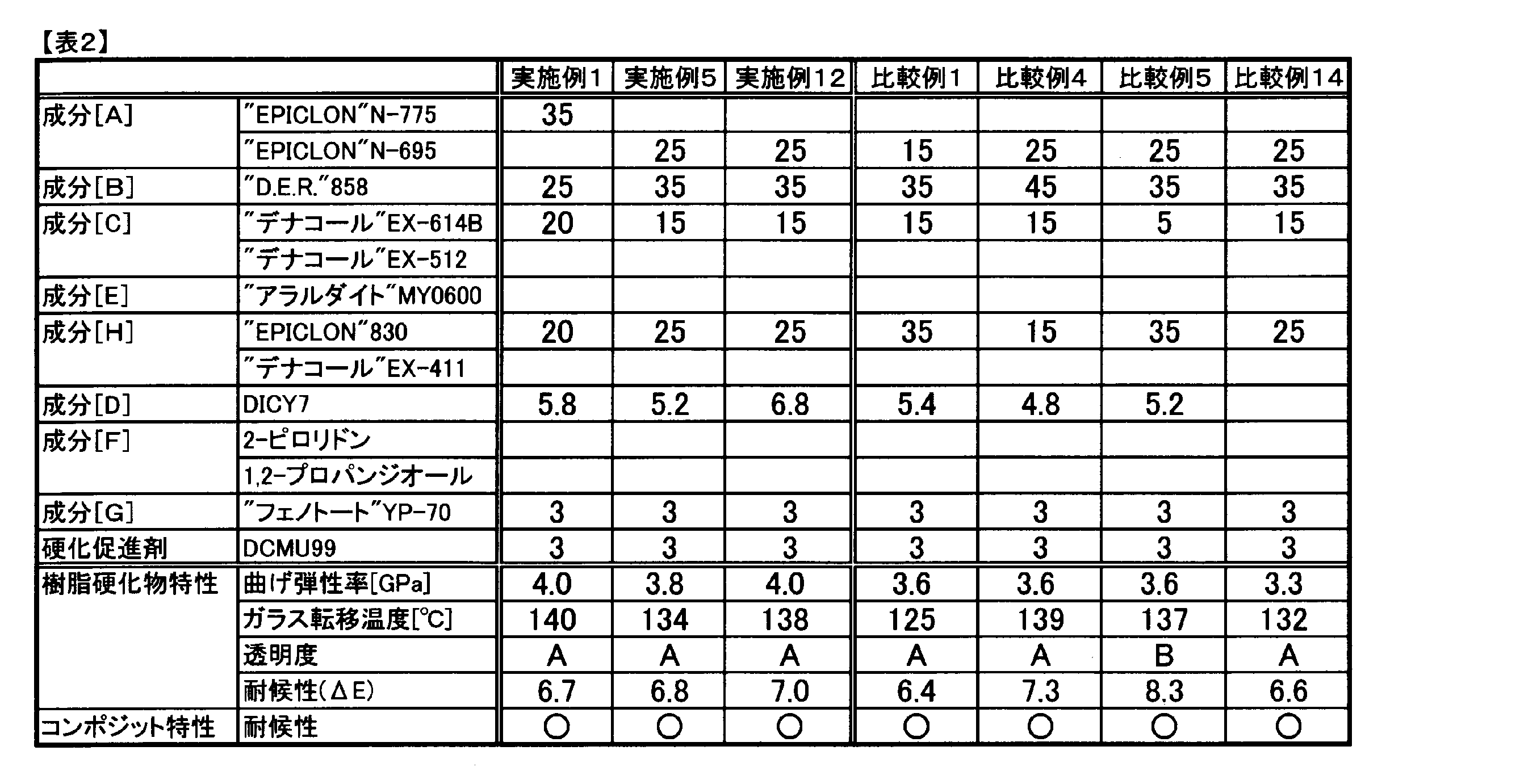
- ⁇ Comparative example 1> A cured resin material and a prepreg were produced using the composition shown in Table 2 and in the same manner as in Example 1. The physical property evaluation results are also shown in Table 1 (the same applies to subsequent comparative examples). The transparency and weather resistance of the cured resin product and the weather resistance of the fiber reinforced composite material were good. However, the content of component [A] in 100 parts by mass of the total epoxy resin was less than 20 parts by mass, and condition (1) was not satisfied. It was low compared to
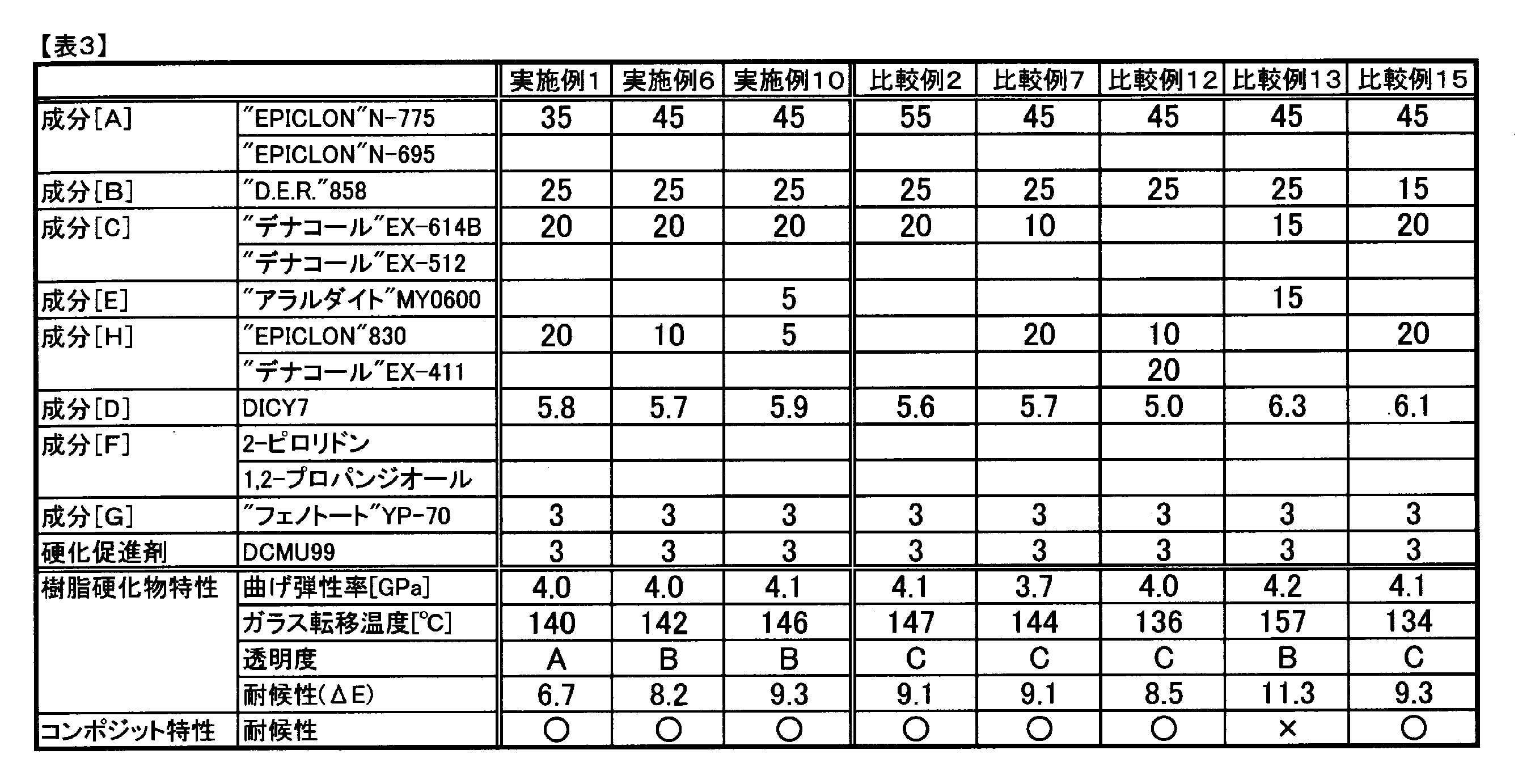
- Example 2 A cured resin product and prepreg were produced using the composition shown in Table 3 and in the same manner as in Example 1.
- the flexural modulus, glass transition temperature, and weather resistance of the cured resin product and the weather resistance of the fiber-reinforced composite material were good.
- the content of component [A] exceeded 50 parts by mass out of 100 parts by mass of the total epoxy resin, and condition (1) was not satisfied, so the transparency of the cured resin product was poor compared to Example 6.
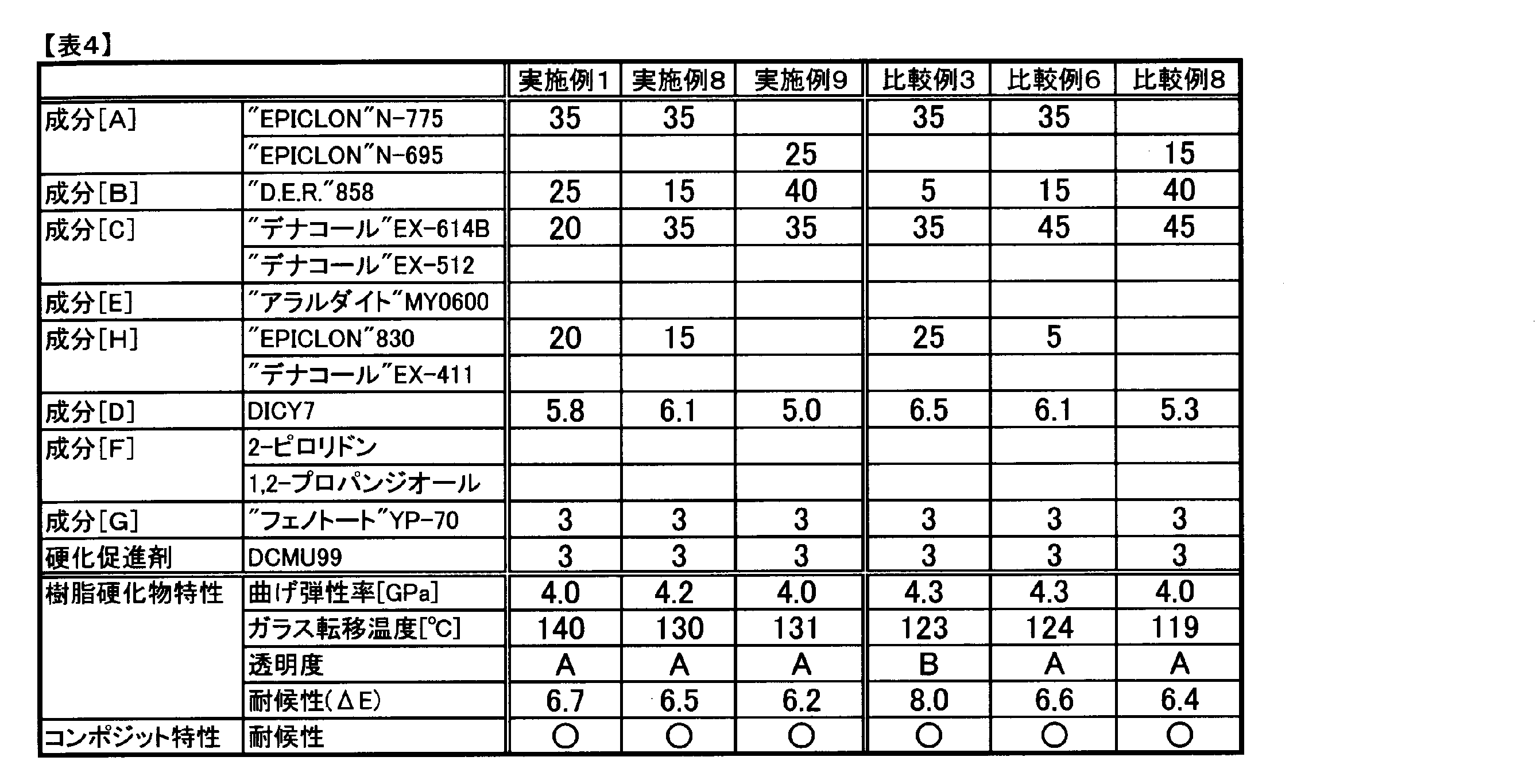
- Example 3 A cured resin product and a prepreg were produced using the composition shown in Table 4 and in the same manner as in Example 1.
- the flexural modulus, transparency, and weather resistance of the cured resin product and the weather resistance of the fiber-reinforced composite material were good.
- the content of component [B] was less than 10 parts by mass in 100 parts by mass of the total epoxy resin, and the condition (2) was not satisfied, so the glass transition temperature was lower than that of Example 8.
- ⁇ Comparative example 4> A cured resin material and a prepreg were produced using the composition shown in Table 2 and in the same manner as in Example 1. The glass transition temperature, transparency, and weather resistance of the cured resin product and the weather resistance of the fiber-reinforced composite material were good. However, the content of component [B] exceeded 40 parts by mass out of 100 parts by mass of the total epoxy resin, which did not satisfy condition (2), so the flexural modulus of the cured resin product was lower than that of Example 5.
- ⁇ Comparative example 5> A cured resin material and a prepreg were produced using the composition shown in Table 2 and in the same manner as in Example 1.
- the glass transition temperature, transparency, and weather resistance of the cured resin product and the weather resistance of the fiber-reinforced composite material were good.
- the content of component [C] in 100 parts by mass of the total epoxy resin was less than 10 parts by mass, and the condition (3) was not satisfied, so the flexural modulus was lower than that in Example 5.
- Example 6 A cured resin product and a prepreg were produced using the composition shown in Table 4 and in the same manner as in Example 1.
- the flexural modulus, transparency, and weather resistance of the cured resin product and the weather resistance of the fiber-reinforced composite material were good.
- the content of component [C] exceeded 40 parts by mass out of 100 parts by mass of the total epoxy resin, and condition (3) was not satisfied, so the glass transition temperature of the cured resin product was lower than that of Example 8.
- ⁇ Comparative example 7> A cured resin product and prepreg were produced using the composition shown in Table 3 and in the same manner as in Example 1. The flexural modulus, glass transition temperature, and weather resistance of the cured resin product and the weather resistance of the fiber-reinforced composite material were good. However, the total content of component [B] and component [C] out of 100 parts by mass of the total epoxy resin was less than 40 parts by mass, and condition (4) was not satisfied, so the transparency of the cured resin was lower than that of Example 6. It was poor compared to.
- Example 8 A cured resin product and a prepreg were produced using the composition shown in Table 4 and in the same manner as in Example 1.
- the flexural modulus, transparency, and weather resistance of the cured resin product and the weather resistance of the fiber-reinforced composite material were good.
- the content of component [C] out of 100 parts by mass of the total epoxy resin exceeds 40 parts by mass, which does not satisfy condition (3), and the content of component [A] does not meet 20 parts by mass, and the condition Since (1) was not satisfied, the glass transition temperature of the cured resin product was lower than that of Example 9.
- Example 12 A cured resin product and prepreg were produced using the composition shown in Table 3 and in the same manner as in Example 1.
- the flexural modulus, glass transition temperature, and weather resistance of the cured resin product and the weather resistance of the fiber-reinforced composite material were good.
- component [C] is not blended, and a pentaerythritol type epoxy resin (an aliphatic epoxy resin without hydroxyl groups) is blended instead, but this does not satisfy condition (3), so the transparency was poorer than Example 6.
- Example 13 A cured resin product and prepreg were produced using the composition shown in Table 3 and in the same manner as in Example 1.
- the flexural modulus, glass transition temperature, and transparency of the cured resin product were good.
- the content of component [E] exceeds 10 parts by mass in 100 parts by mass of the total epoxy resin, and condition (5) is not satisfied. It was poorer than Example 6 and Example 10.
- Example 14 A cured resin material and a prepreg were produced using the composition shown in Table 2 and in the same manner as in Example 1. The glass transition temperature, transparency, and weather resistance of the cured resin product and the weather resistance of the fiber-reinforced composite material were good. However, since component [D] was not blended, the flexural modulus of the cured resin product was lower than that of Example 5.
- ⁇ Comparative example 15> A cured resin product and prepreg were produced using the composition shown in Table 3 and in the same manner as in Example 1. The flexural modulus, glass transition temperature, and weather resistance of the cured resin product and the weather resistance of the fiber-reinforced composite material were good. However, the total content of component [B] and component [C] out of 100 parts by mass of the total epoxy resin was less than 40 parts by mass, and condition (4) was not satisfied, so the transparency of the cured resin was lower than that of Example 6. It was poor compared to.
Landscapes
- Chemical & Material Sciences (AREA)
- Health & Medical Sciences (AREA)
- Organic Chemistry (AREA)
- Chemical Kinetics & Catalysis (AREA)
- Polymers & Plastics (AREA)
- Medicinal Chemistry (AREA)
- Materials Engineering (AREA)
- Engineering & Computer Science (AREA)
- Life Sciences & Earth Sciences (AREA)
- Environmental Sciences (AREA)
- Manufacturing & Machinery (AREA)
- Marine Sciences & Fisheries (AREA)
- Physical Education & Sports Medicine (AREA)
- General Health & Medical Sciences (AREA)
- Biodiversity & Conservation Biology (AREA)
- Animal Husbandry (AREA)
- Reinforced Plastic Materials (AREA)
- Epoxy Resins (AREA)
Abstract
Description
成分[A]:ノボラック型エポキシ樹脂
成分[B]:オキサゾリドン型エポキシ樹脂
成分[C]:ソルビトール型エポキシ樹脂およびグリセロール型エポキシ樹脂のいずれかまたは両方
成分[D]:ジシアンジアミド
条件(1):成分[A]の含有量が、全エポキシ樹脂100質量部に対し、20~50質量部である。
条件(2):成分[B]の含有量が、全エポキシ樹脂100質量部に対し、10~40質量部である。
条件(3):成分[C]の含有量が、全エポキシ樹脂100質量部に対し、10~40質量部である。
条件(4):全エポキシ樹脂100質量部のうち、成分[B]と成分[C]を合計で40質量部以上含む。
条件(5):成分[E]:グリシジルアミン型エポキシ樹脂を含まないか、含んだとしても全エポキシ樹脂100質量部に対し、10質量部以下である。
2.前記成分[E]を含まないか、含んだとしても全エポキシ樹脂100質量部に対し、1質量部以下である、上記1に記載のプリプレグ。
3.成分[F]:沸点が130℃以上、かつ、分子量mが50以上250以下の化合物であって、分子内にエポキシ基を有さず、かつエポキシ樹脂の硬化能を有さない化合物を含む、上記1または2に記載のプリプレグ。
4.熱可塑性樹脂として、成分[G]:フェノキシ樹脂を含む、上記1~3のいずれかに記載のプリプレグ。
5.上記1~4のいずれかに記載のプリプレグを硬化させてなる、繊維強化複合材料。
6.上記1~4のいずれかに記載のプリプレグを成形してなる、繊維強化複合材料製管状体。
7.上記6に記載の繊維強化複合材料製管状体を用いてなる、ゴルフクラブシャフト。
8.上記6に記載の繊維強化複合材料製管状体を用いてなる、釣り竿。
(1)強化繊維
“トレカ(登録商標)”T1100G-24K(繊維数24000本、引張弾性率:324GPa、密度:1.8g/cm3、東レ(株)製)
(2)エポキシ樹脂
・成分[A]:ノボラック型エポキシ樹脂
[A]-1 “EPICLON(登録商標)”N-775(フェノールノボラック型エポキシ樹脂、エポキシ当量:189、DIC(株)製)
[A]-2 “EPICLON(登録商標)”N-695(クレゾールノボラック型エポキシ樹脂、エポキシ当量:214、DIC(株)製)
・成分[B]:オキサゾリドン型エポキシ樹脂
[B]-1 “D.E.R. (登録商標)”858(エポキシ当量:400、ダウ・ケミカル(株)製)
・成分[C]:ソルビトール型エポキシ樹脂、グリセロール型エポキシ樹脂
[C]-1 “デナコール(登録商標)”EX-614B(ソルビトール型エポキシ樹脂、エポキシ当量:173、ナガセケムテックス(株)製)
[C]-2 “デナコール(登録商標)”EX-512(ポリグリセロール型エポキシ樹脂、エポキシ当量:168、ナガセケムテックス(株)製)
・成分[E]:グリシジルアミン型エポキシ樹脂
[E]-1 “アラルダイト(登録商標)”MY0600(アミノフェノール型エポキシ樹脂、エポキシ当量:118、ハンツマン・アドバンスト・マテリアルズ(株)製)
・成分[H]:その他のエポキシ樹脂
[H]-1 “EPICLON(登録商標)”830(ビスフェノールF型エポキシ樹脂、エポキシ当量:172、DIC(株)製)
[H]-2 “デナコール(登録商標)”EX-411(ペンタエリスリトール型エポキシ樹脂、エポキシ当量:229、ナガセケムテックス(株)製)
(3)成分[D]:ジシアンジアミド
[D]-1 DICY7(ジシアンジアミド、三菱ケミカル(株)製)
(4)成分[F]:沸点が130℃以上、かつ、分子量mが50以上250以下の化合物であって、分子内にエポキシ基を有さず、かつエポキシ樹脂の硬化能を有さない化合物
[F]-1 2-ピロリドン(沸点:245℃、分子量m:85、東京化成工業(株)製)
[F]-2 1,2-プロパンジオール(沸点:188℃、分子量m:76、東京化成工業(株)製)
(5)成分[G]:フェノキシ樹脂
[G]-1 “フェノトート(登録商標)”YP-70(日鉄ケミカル&マテリアル(株)製)
(6)硬化促進剤
DCMU99(3-(3,4-ジクロロフェニル)-1,1-ジメチルウレア、保土ケ谷化学工業(株)製)。
(1)硬化剤マスターの調製
常温で液状のエポキシ樹脂([C]-1、[C]-2、[H]-1、[H]-2がこれにあたる)を10質量部(全てのエポキシ樹脂100質量部に対して10質量部)用意した。これに成分[D]であるジシアンジアミドをそれぞれ添加し、室温で混練した。混合物を三本ロールミルに2回通すことで、硬化剤マスターを調製した。
上記(1)で使用した液状のエポキシ樹脂10質量部を除いた、全エポキシ樹脂90質量部をビーカーに投入した。混練しながら、150℃まで昇温した後、成分[G]:フェノキシ樹脂を投入し、150℃の温度で1時間加熱混練を行い、溶解させた。次いで、混練を続けたまま55~65℃の温度まで降温した後、上記(1)で調製した硬化剤マスターと、表に示す成分と量の成分[F]、硬化促進剤を投入し、同温度で30分間混練することで、樹脂組成物を得た。表1~5に各実施例および比較例の組成を示した。
上記<樹脂組成物の調製方法>に従い調製した樹脂組成物を真空中で脱泡した後、2mm厚の“テフロン(登録商標)”製スペーサーにより厚み2mmになるように設定したモールド中で、30℃から速度1.7℃/分で昇温して、90℃の温度に到達してから1時間保持した後、速度2.0℃/分で昇温して、135℃の温度に到達してから2時間硬化させ、厚さ2mmの板状の樹脂硬化物を得た。
上記<樹脂組成物の調製方法>に従い調製した樹脂組成物を、ナイフコーターを用いて離型紙上に塗布して、樹脂目付が31g/m2の樹脂フィルムを2枚作製した。次に、繊維目付が125g/m2のシート状となるように一方向に配列させた強化繊維(上記の“トレカ(登録商標)”T1100G-24K)の両面のそれぞれに、上記樹脂フィルムを重ねて、温度110℃、最大圧力2MPaの条件で加熱加圧して樹脂組成物を含浸させ、プリプレグを得た。
(1)樹脂硬化物の3点曲げ測定
上記<樹脂硬化物の作製方法>に従い作製した厚さ2mmの樹脂硬化物から、幅10mm、長さ60mmの試験片を切り出し、インストロン万能試験機(インストロン社製)を用い、スパンを32mm、クロスヘッドスピードを2.5mm/分、サンプル数n=6とし、JIS K7171(1994)に従って3点曲げを実施した時の、弾性率の平均値をそれぞれ樹脂硬化物の曲げ弾性率とした。
上記<樹脂硬化物の作製方法>に従い作製した厚さ2mmの樹脂硬化物から、幅12.7mm、長さ55mmの試験片を切り出した。この試験片について、粘弾性測定装置(ARES、ティー・エイ・インスツルメント社製)を用い、ねじり振動周波数1.0Hz、昇温速度5.0℃/分の条件下で、40~250℃の温度範囲でDMA測定を行い、ガラス転移温度を読み取った。ガラス転移温度は、貯蔵弾性率G’曲線において、ガラス状態での接線と転移状態での接線との交点における温度とした。
上記<樹脂硬化物の作製方法>に従い作製した厚さ1mmの樹脂硬化物を、文字が書かれた紙の上に置き、ランドルト環を用いて測定される視力1.0程度の視力を有する測定者が、樹脂硬化物の透明度を確認した。樹脂硬化物を置く前と同様に文字が明確に読める場合をA、朧気ではあるが読むことができる場合をB、文字が読めない場合をCと表記した。
上記<樹脂硬化物の作製方法>に従い作製した厚さ1mmの樹脂硬化物から、幅37mm、長さ68mmの試験片を切り出した。この試験片を対象として、促進耐候性試験機(スーパーキセノンウェザーメーターSX―75、スガ試験機(株)製)を用い、強度180W/m2、ブラックパネル温度63℃、湿度50%RHの条件で、水噴射なしの照射102分間と、強度180W/m2、槽内温度28℃、湿度99%RHの条件で、水噴射しながらの照射18分間とを1サイクルとし、これを12回(すなわち24時間)繰り返す耐候性試験を行った。
上記<プリプレグの作製方法>で作製したプリプレグの繊維方向を揃えて20プライ積層し、オートクレーブにて0.7MPaの圧力下、30℃から速度1.7℃/分で90℃まで昇温して、90℃の温度で60分間保持した後、速度2.0℃/分で135℃まで昇温して、135℃の温度で120分間成形して、厚み2mmの一方向材のCFRP板を作製し、幅37mm、長さ68mmの試験片を切り出した。この試験片を、屋根がなく太陽が出ている間は日陰にならない屋外の場所に設置し、2ヶ月間放置することで耐候性試験を行った。耐候性試験前後の試験片を横に並べ、10人の被験者に色の違いをヒアリングし、10人中8人以上の被験者が「色の変化がない」、または、「色の変化がわからない」と答えた場合を「〇」、3人以上の被験者が「色の変化がある」と答えた場合を「×」とした。
エポキシ樹脂の内、成分[A]として“EPICLON(登録商標)”N-775を35質量部、成分[B]として“D.E.R.(登録商標)”858を25質量部、成分[C]として“デナコール(登録商標)”EX-614Bを20質量部、その他のエポキシ樹脂(成分[H])として“EPICLON(登録商標)”830を20質量部、成分[D]としてジシアンジアミドとしてDICY7を5.8質量部、成分[G]:フェノキシ樹脂として“フェノトート(登録商標)”YP-70を3質量部、硬化促進剤としてDCMU99を3質量部用い、上記<樹脂組成物の調製方法>に従って樹脂組成物を調製した。
組成を表1に示したように変更した以外は、実施例1と同じ方法で樹脂硬化物、プリプレグを作製した。各実施例について、樹脂硬化物の曲げ弾性率、ガラス転移温度、透明度、耐候性(色差ΔE)、繊維強化複合材料の耐候性は表1に記載の通りであり、いずれも良好であった。
表2に示した組成とし、実施例1と同じ方法で樹脂硬化物、プリプレグを作製した。物性評価結果は表1に併せて示した(以降の比較例において同様)。樹脂硬化物の透明度、耐候性、繊維強化複合材料の耐候性は良好であった。しかし、全エポキシ樹脂100質量部中、成分[A]の含有量が20質量部に満たず、条件(1)を満たさないため、樹脂硬化物の曲げ弾性率、ガラス転移温度が実施例5に比べて低かった。
表3に示した組成とし、実施例1と同じ方法で樹脂硬化物、プリプレグを作製した。樹脂硬化物の曲げ弾性率、ガラス転移温度、耐候性、繊維強化複合材料の耐候性は良好であった。しかし、全エポキシ樹脂100質量部中、成分[A]の含有量が50質量部を超え、条件(1)を満たさないため、樹脂硬化物の透明度が実施例6に比べて不良であった。
表4に示した組成とし、実施例1と同じ方法で樹脂硬化物、プリプレグを作製した。樹脂硬化物の曲げ弾性率、透明度、耐候性、繊維強化複合材料の耐候性は良好であった。しかし、全エポキシ樹脂100質量部中、成分[B]の含有量が10質量部に満たず、条件(2)を満たさないため、ガラス転移温度が実施例8に比べて低かった。
表2に示した組成とし、実施例1と同じ方法で樹脂硬化物、プリプレグを作製した。樹脂硬化物のガラス転移温度、透明度、耐候性、繊維強化複合材料の耐候性は良好であった。しかし、全エポキシ樹脂100質量部中、成分[B]の含有量が40質量部を超え、条件(2)を満たさないため、樹脂硬化物の曲げ弾性率が実施例5に比べて低かった。
<比較例5>
表2に示した組成とし、実施例1と同じ方法で樹脂硬化物、プリプレグを作製した。樹脂硬化物のガラス転移温度、透明度、耐候性、繊維強化複合材料の耐候性は良好であった。しかし、全エポキシ樹脂100質量部中、成分[C]の含有量が10質量部に満たず、条件(3)を満たさないため、曲げ弾性率が実施例5に比べて低かった。
表4に示した組成とし、実施例1と同じ方法で樹脂硬化物、プリプレグを作製した。樹脂硬化物の曲げ弾性率、透明度、耐候性、繊維強化複合材料の耐候性は良好であった。しかし、全エポキシ樹脂100質量部中、成分[C]の含有量が40質量部を超え、条件(3)を満たさないため、樹脂硬化物のガラス転移温度が実施例8に比べて低かった。
表3に示した組成とし、実施例1と同じ方法で樹脂硬化物、プリプレグを作製した。樹脂硬化物の曲げ弾性率、ガラス転移温度、耐候性、繊維強化複合材料の耐候性は良好であった。しかし、全エポキシ樹脂100質量部中、成分[B]と成分[C]の含有量が合計で40質量部に満たず、条件(4)を満たさないため、樹脂硬化物の透明度が実施例6に比べて不良であった。
表4に示した組成とし、実施例1と同じ方法で樹脂硬化物、プリプレグを作製した。樹脂硬化物の曲げ弾性率、透明度、耐候性、繊維強化複合材料の耐候性は良好であった。しかし、全エポキシ樹脂100質量部中、成分[C]の含有量が40質量部を超え、条件(3)を満たさないことと、成分[A]の含有量が20質量部に満たず、条件(1)も満たさないため、樹脂硬化物のガラス転移温度が実施例9に比べて低かった。
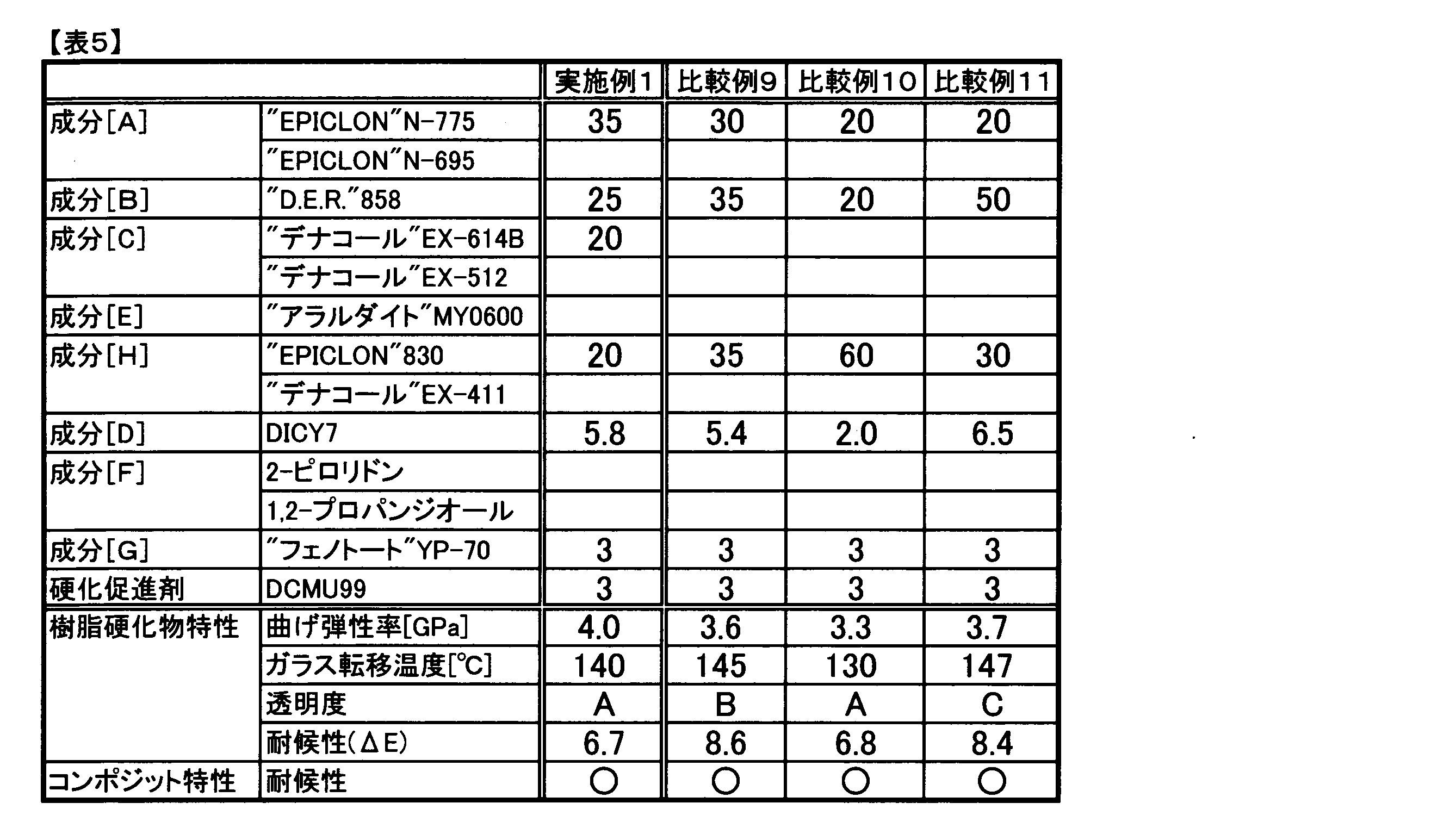
表5に示した組成とし、実施例1と同じ方法で樹脂硬化物、プリプレグを作製した。樹脂硬化物のガラス転移温度、透明度、耐候性、繊維強化複合材料の耐候性は良好であった。しかし、成分[C]が配合されておらず、条件(3)を満たさないため、曲げ弾性率が全実施例に比べて低かった。
表5に示した組成とし、実施例1と同じ方法で樹脂硬化物、プリプレグを作製した。樹脂硬化物の曲げ弾性率、ガラス転移温度、耐候性、繊維強化複合材料の耐候性は良好であった。しかし、成分[C]が配合されておらず、条件(3)を満たさないため、透明度が全実施例に比べて不良であった。
表3に示した組成とし、実施例1と同じ方法で樹脂硬化物、プリプレグを作製した。樹脂硬化物の曲げ弾性率、ガラス転移温度、耐候性、繊維強化複合材料の耐候性は良好であった。しかし、成分[C]が配合されておらず、代わりにペンタエリスリトール型エポキシ樹脂(水酸基を有さない脂肪族エポキシ樹脂)が配合されているが、これでは条件(3)を満たさないため、透明度が実施例6に比べて不良であった。
表3に示した組成とし、実施例1と同じ方法で樹脂硬化物、プリプレグを作製した。樹脂硬化物の曲げ弾性率、ガラス転移温度、透明度は良好であった。しかし、全エポキシ樹脂100質量部中、成分[E]の含有量が10質量部を超え、条件(5)を満たさないため、樹脂硬化物の耐候性、繊維強化複合材料の耐候性が実施例6や実施例10に比べて不良であった。
表2に示した組成とし、実施例1と同じ方法で樹脂硬化物、プリプレグを作製した。樹脂硬化物のガラス転移温度、透明度、耐候性、繊維強化複合材料の耐候性は良好であった。しかし、成分[D]が配合されていないため、樹脂硬化物の曲げ弾性率が実施例5に比べて低かった。
表3に示した組成とし、実施例1と同じ方法で樹脂硬化物、プリプレグを作製した。樹脂硬化物の曲げ弾性率、ガラス転移温度、耐候性、繊維強化複合材料の耐候性は良好であった。しかし、全エポキシ樹脂100質量部中、成分[B]と成分[C]の含有量が合計で40質量部に満たず、条件(4)を満たさないため、樹脂硬化物の透明度が実施例6に比べて不良であった。

Claims (8)
- 強化繊維と樹脂組成物とを含むプリプレグであって、該樹脂組成物は、次の成分[A]~成分[D]を含み、かつ、下記条件(1)~条件(5)を満たす、プリプレグ。
成分[A]:ノボラック型エポキシ樹脂
成分[B]:オキサゾリドン型エポキシ樹脂
成分[C]:ソルビトール型エポキシ樹脂およびグリセロール型エポキシ樹脂のいずれかまたは両方
成分[D]:ジシアンジアミド
条件(1):成分[A]の含有量が、全エポキシ樹脂100質量部に対し、20~50質量部である。
条件(2):成分[B]の含有量が、全エポキシ樹脂100質量部に対し、10~40質量部である。
条件(3):成分[C]の含有量が、全エポキシ樹脂100質量部に対し、10~40質量部である。
条件(4):全エポキシ樹脂100質量部のうち、成分[B]と成分[C]を合計で40質量部以上含む。
条件(5):成分[E]:グリシジルアミン型エポキシ樹脂を含まないか、含んだとしても全エポキシ樹脂100質量部に対し、10質量部以下である。 - 前記成分[E]を含まないか、含んだとしても全エポキシ樹脂100質量部に対し、1質量部以下である、請求項1に記載のプリプレグ。
- さらに、成分[F]:沸点が130℃以上、かつ、分子量mが50以上250以下の化合物であって、分子内にエポキシ基を有さず、かつエポキシ樹脂の硬化能を有さない化合物を含む、請求項1に記載のプリプレグ。
- 熱可塑性樹脂として、成分[G]:フェノキシ樹脂を含む、請求項1に記載のプリプレグ。
- 請求項1~4のいずれかに記載のプリプレグを硬化させてなる、繊維強化複合材料。
- 請求項1~4のいずれかに記載のプリプレグを成形してなる、繊維強化複合材料製管状体。
- 請求項6に記載の繊維強化複合材料製管状体を用いてなる、ゴルフクラブシャフト。
- 請求項6に記載の繊維強化複合材料製管状体を用いてなる、釣り竿。
Priority Applications (3)
| Application Number | Priority Date | Filing Date | Title |
|---|---|---|---|
| KR1020257000779A KR20250048230A (ko) | 2022-08-02 | 2023-06-27 | 프리프레그, 섬유 강화 복합 재료, 섬유 강화 복합 재료제 관상체, 골프 클럽 샤프트 및 낚싯대 |
| CN202380053408.2A CN119546679A (zh) | 2022-08-02 | 2023-06-27 | 预浸料、纤维增强复合材料、纤维增强复合材料制管状体、高尔夫球杆杆身及钓竿 |
| JP2023544672A JP7893257B2 (ja) | 2022-08-02 | 2023-06-27 | プリプレグ、繊維強化複合材料、繊維強化複合材料製管状体、ゴルフクラブシャフトおよび釣り竿 |
Applications Claiming Priority (2)
| Application Number | Priority Date | Filing Date | Title |
|---|---|---|---|
| JP2022123191 | 2022-08-02 | ||
| JP2022-123191 | 2022-08-02 |
Publications (1)
| Publication Number | Publication Date |
|---|---|
| WO2024029233A1 true WO2024029233A1 (ja) | 2024-02-08 |
Family
ID=89848870
Family Applications (1)
| Application Number | Title | Priority Date | Filing Date |
|---|---|---|---|
| PCT/JP2023/023765 Ceased WO2024029233A1 (ja) | 2022-08-02 | 2023-06-27 | プリプレグ、繊維強化複合材料、繊維強化複合材料製管状体、ゴルフクラブシャフトおよび釣り竿 |
Country Status (5)
| Country | Link |
|---|---|
| JP (1) | JP7893257B2 (ja) |
| KR (1) | KR20250048230A (ja) |
| CN (1) | CN119546679A (ja) |
| TW (1) | TW202409189A (ja) |
| WO (1) | WO2024029233A1 (ja) |
Cited By (1)
| Publication number | Priority date | Publication date | Assignee | Title |
|---|---|---|---|---|
| WO2024252878A1 (ja) * | 2023-06-06 | 2024-12-12 | ナガセケムテックス株式会社 | 熱硬化性エポキシ樹脂組成物および繊維強化複合材料 |
Citations (3)
| Publication number | Priority date | Publication date | Assignee | Title |
|---|---|---|---|---|
| JP2021055103A (ja) * | 2018-10-01 | 2021-04-08 | 三菱ケミカル株式会社 | プリプレグ、繊維強化複合材料、及び繊維強化複合材料の製造方法 |
| JP2021147550A (ja) * | 2020-03-23 | 2021-09-27 | 東レ株式会社 | 成形材料および繊維強化複合材料 |
| JP2022096749A (ja) * | 2020-12-18 | 2022-06-30 | 三菱ケミカル株式会社 | エポキシ樹脂組成物、およびプリプレグ |
Family Cites Families (3)
| Publication number | Priority date | Publication date | Assignee | Title |
|---|---|---|---|---|
| JP2003261744A (ja) | 2002-01-04 | 2003-09-19 | Mitsubishi Rayon Co Ltd | エポキシ樹脂組成物、及び自己接着性プリプレグ |
| JP7524764B2 (ja) | 2018-10-17 | 2024-07-30 | 三菱ケミカル株式会社 | プリプレグ、繊維強化複合樹脂成形体、管状成形体の製造方法、エポキシ樹脂組成物、および管状成形体 |
| JP2020158594A (ja) | 2019-03-26 | 2020-10-01 | 東レ株式会社 | トウプレグおよびその製造方法、圧力容器の製造方法 |
-
2023
- 2023-06-27 KR KR1020257000779A patent/KR20250048230A/ko active Pending
- 2023-06-27 CN CN202380053408.2A patent/CN119546679A/zh active Pending
- 2023-06-27 JP JP2023544672A patent/JP7893257B2/ja active Active
- 2023-06-27 WO PCT/JP2023/023765 patent/WO2024029233A1/ja not_active Ceased
- 2023-07-12 TW TW112125965A patent/TW202409189A/zh unknown
Patent Citations (3)
| Publication number | Priority date | Publication date | Assignee | Title |
|---|---|---|---|---|
| JP2021055103A (ja) * | 2018-10-01 | 2021-04-08 | 三菱ケミカル株式会社 | プリプレグ、繊維強化複合材料、及び繊維強化複合材料の製造方法 |
| JP2021147550A (ja) * | 2020-03-23 | 2021-09-27 | 東レ株式会社 | 成形材料および繊維強化複合材料 |
| JP2022096749A (ja) * | 2020-12-18 | 2022-06-30 | 三菱ケミカル株式会社 | エポキシ樹脂組成物、およびプリプレグ |
Cited By (1)
| Publication number | Priority date | Publication date | Assignee | Title |
|---|---|---|---|---|
| WO2024252878A1 (ja) * | 2023-06-06 | 2024-12-12 | ナガセケムテックス株式会社 | 熱硬化性エポキシ樹脂組成物および繊維強化複合材料 |
Also Published As
| Publication number | Publication date |
|---|---|
| TW202409189A (zh) | 2024-03-01 |
| JPWO2024029233A1 (ja) | 2024-02-08 |
| CN119546679A (zh) | 2025-02-28 |
| JP7893257B2 (ja) | 2026-07-22 |
| KR20250048230A (ko) | 2025-04-08 |
Similar Documents
| Publication | Publication Date | Title |
|---|---|---|
| JP5321464B2 (ja) | エポキシ樹脂組成物、プリプレグおよび繊維強化複合材料 | |
| JP5061813B2 (ja) | プリプレグおよびゴルフクラブシャフト | |
| JP7172995B2 (ja) | プリプレグおよび繊維強化複合材料 | |
| JP5747763B2 (ja) | エポキシ樹脂組成物、プリプレグおよび繊維強化複合材料 | |
| JP6977560B2 (ja) | プリプレグおよび繊維強化複合材料 | |
| JP5747762B2 (ja) | エポキシ樹脂組成物、プリプレグおよび繊維強化複合材料 | |
| WO2023176934A1 (ja) | エポキシ樹脂組成物、繊維強化複合材料およびその製造方法 | |
| KR20250048230A (ko) | 프리프레그, 섬유 강화 복합 재료, 섬유 강화 복합 재료제 관상체, 골프 클럽 샤프트 및 낚싯대 | |
| JP5573650B2 (ja) | エポキシ樹脂組成物、エポキシ樹脂硬化物、プリプレグおよび繊維強化複合材料 | |
| WO2022039050A1 (ja) | エポキシ樹脂組成物、プリプレグおよび繊維強化複合材料 | |
| US11912859B2 (en) | Epoxy resin composition, prepreg, and fiber-reinforced composite material | |
| JP7775710B2 (ja) | エポキシ樹脂組成物、プリプレグおよび繊維強化複合材料 | |
| JP7666581B2 (ja) | プリプレグ、繊維強化複合材料、繊維強化複合材料製管状体、ゴルフクラブシャフトおよび釣り竿 | |
| JP2024021045A (ja) | プリプレグ、繊維強化複合材料、繊維強化複合材料製管状体、ゴルフクラブシャフトおよび釣り竿 | |
| JP2025084060A (ja) | プリプレグ、繊維強化複合材料、繊維強化複合材料製管状体、ゴルフクラブシャフト、釣り竿、自動車構造部材および外装用部材 | |
| CN111372978B (zh) | 预浸料及纤维增强复合材料 | |
| WO2021095628A1 (ja) | エポキシ樹脂組成物、プリプレグおよび繊維強化複合材料 | |
| JP7647102B2 (ja) | エポキシ樹脂組成物、プリプレグおよび繊維強化複合材料 | |
| JP2020204026A (ja) | エポキシ樹脂組成物、プリプレグおよび繊維強化複合材料 | |
| JP7707805B2 (ja) | プリプレグおよび繊維強化複合材料 | |
| JP2020019932A (ja) | エポキシ樹脂組成物、プリプレグおよび繊維強化複合材料 | |
| JP7622436B2 (ja) | エポキシ樹脂組成物、プリプレグおよび繊維強化複合材料 | |
| JP7622437B2 (ja) | エポキシ樹脂組成物、プリプレグおよび繊維強化複合材料 | |
| JP2025086435A (ja) | プリプレグ、繊維強化複合材料、繊維強化複合材料製管状体、ゴルフクラブシャフト、釣り竿、自動車構造部材および外装用部材 | |
| JP2023140493A (ja) | 織物プリプレグ、繊維強化複合材料および自動車用構造材料 |
Legal Events
| Date | Code | Title | Description |
|---|---|---|---|
| ENP | Entry into the national phase |
Ref document number: 2023544672 Country of ref document: JP Kind code of ref document: A |
|
| 121 | Ep: the epo has been informed by wipo that ep was designated in this application |
Ref document number: 23849792 Country of ref document: EP Kind code of ref document: A1 |
|
| WWE | Wipo information: entry into national phase |
Ref document number: 18879509 Country of ref document: US |
|
| WWE | Wipo information: entry into national phase |
Ref document number: 202380053408.2 Country of ref document: CN |
|
| WWP | Wipo information: published in national office |
Ref document number: 202380053408.2 Country of ref document: CN |
|
| NENP | Non-entry into the national phase |
Ref country code: DE |
|
| WWP | Wipo information: published in national office |
Ref document number: 1020257000779 Country of ref document: KR |
|
| 122 | Ep: pct application non-entry in european phase |
Ref document number: 23849792 Country of ref document: EP Kind code of ref document: A1 |