WO2024009593A1 - 粘着剤組成物及び保護シート - Google Patents
粘着剤組成物及び保護シート Download PDFInfo
- Publication number
- WO2024009593A1 WO2024009593A1 PCT/JP2023/016463 JP2023016463W WO2024009593A1 WO 2024009593 A1 WO2024009593 A1 WO 2024009593A1 JP 2023016463 W JP2023016463 W JP 2023016463W WO 2024009593 A1 WO2024009593 A1 WO 2024009593A1
- Authority
- WO
- WIPO (PCT)
- Prior art keywords
- meth
- acrylate
- ethylenically unsaturated
- polyurethane
- unsaturated group
- Prior art date
- Legal status (The legal status is an assumption and is not a legal conclusion. Google has not performed a legal analysis and makes no representation as to the accuracy of the status listed.)
- Ceased
Links
Images

Classifications
-
- C—CHEMISTRY; METALLURGY
- C09—DYES; PAINTS; POLISHES; NATURAL RESINS; ADHESIVES; COMPOSITIONS NOT OTHERWISE PROVIDED FOR; APPLICATIONS OF MATERIALS NOT OTHERWISE PROVIDED FOR
- C09J—ADHESIVES; NON-MECHANICAL ASPECTS OF ADHESIVE PROCESSES IN GENERAL; ADHESIVE PROCESSES NOT PROVIDED FOR ELSEWHERE; USE OF MATERIALS AS ADHESIVES
- C09J11/00—Features of adhesives not provided for in group C09J9/00, e.g. additives
- C09J11/02—Non-macromolecular additives
- C09J11/06—Non-macromolecular additives organic
-
- C—CHEMISTRY; METALLURGY
- C09—DYES; PAINTS; POLISHES; NATURAL RESINS; ADHESIVES; COMPOSITIONS NOT OTHERWISE PROVIDED FOR; APPLICATIONS OF MATERIALS NOT OTHERWISE PROVIDED FOR
- C09J—ADHESIVES; NON-MECHANICAL ASPECTS OF ADHESIVE PROCESSES IN GENERAL; ADHESIVE PROCESSES NOT PROVIDED FOR ELSEWHERE; USE OF MATERIALS AS ADHESIVES
- C09J175/00—Adhesives based on polyureas or polyurethanes; Adhesives based on derivatives of such polymers
- C09J175/04—Polyurethanes
- C09J175/08—Polyurethanes from polyethers
-
- C—CHEMISTRY; METALLURGY
- C09—DYES; PAINTS; POLISHES; NATURAL RESINS; ADHESIVES; COMPOSITIONS NOT OTHERWISE PROVIDED FOR; APPLICATIONS OF MATERIALS NOT OTHERWISE PROVIDED FOR
- C09J—ADHESIVES; NON-MECHANICAL ASPECTS OF ADHESIVE PROCESSES IN GENERAL; ADHESIVE PROCESSES NOT PROVIDED FOR ELSEWHERE; USE OF MATERIALS AS ADHESIVES
- C09J175/00—Adhesives based on polyureas or polyurethanes; Adhesives based on derivatives of such polymers
- C09J175/04—Polyurethanes
- C09J175/14—Polyurethanes having carbon-to-carbon unsaturated bonds
-
- C—CHEMISTRY; METALLURGY
- C09—DYES; PAINTS; POLISHES; NATURAL RESINS; ADHESIVES; COMPOSITIONS NOT OTHERWISE PROVIDED FOR; APPLICATIONS OF MATERIALS NOT OTHERWISE PROVIDED FOR
- C09J—ADHESIVES; NON-MECHANICAL ASPECTS OF ADHESIVE PROCESSES IN GENERAL; ADHESIVE PROCESSES NOT PROVIDED FOR ELSEWHERE; USE OF MATERIALS AS ADHESIVES
- C09J4/00—Adhesives based on organic non-macromolecular compounds having at least one polymerisable carbon-to-carbon unsaturated bond ; adhesives, based on monomers of macromolecular compounds of groups C09J183/00 - C09J183/16
-
- C—CHEMISTRY; METALLURGY
- C09—DYES; PAINTS; POLISHES; NATURAL RESINS; ADHESIVES; COMPOSITIONS NOT OTHERWISE PROVIDED FOR; APPLICATIONS OF MATERIALS NOT OTHERWISE PROVIDED FOR
- C09J—ADHESIVES; NON-MECHANICAL ASPECTS OF ADHESIVE PROCESSES IN GENERAL; ADHESIVE PROCESSES NOT PROVIDED FOR ELSEWHERE; USE OF MATERIALS AS ADHESIVES
- C09J7/00—Adhesives in the form of films or foils
- C09J7/30—Adhesives in the form of films or foils characterised by the adhesive composition
- C09J7/38—Pressure-sensitive adhesives [PSA]
Definitions
- the present invention relates to an adhesive composition and a protective sheet.
- This application claims priority based on Japanese Patent Application No. 2022-110520 filed in Japan on July 8, 2022, the contents of which are incorporated herein.
- a protective sheet (surface protection sheet) is generally laminated on the surface of these optical films for the purpose of preventing stains and scratches during transportation, manufacturing, and inspection steps. This protective sheet is peeled off in a subsequent process such as an assembly process.
- Various urethane adhesives have been proposed as adhesives for such protective sheets.
- Patent Document 1 describes polyurethane (A), alkyl mono(meth)acrylate (B) whose alkyl group has 6 to 18 carbon atoms, polyfunctional (meth)acrylate (C), and plasticizer (D).
- a UV-curable adhesive composition for a protective film is disclosed.
- the polyurethane (A) is a reaction product of a polyol (a1), a polyisocyanate (a2), a hydroxyl group-containing (meth)acrylate (a3), and a hydroxyl group-containing photopolymerization initiator (a4).
- These protective sheets may be cut into a desired shape with a cutter or the like in a process before or after pasting them onto the adherend. At this time, cutting debris of the adhesive layer is generated on the cross section of the protective sheet, which may lead to contamination of the surface of the adherend.
- the protective sheet is repeatedly laminated or peeled off, or if an impact is applied from the outside, the adhesive layer may be damaged and the adherend may be contaminated, or the adherend may be damaged due to insufficient strength of the adhesive layer. In some cases, the shock was transmitted to the device and the device was damaged.
- the protective sheet is required to have appropriate adhesiveness (peel strength) and to be able to be peeled off with a lighter force (light peelability).
- the present invention has been made to solve the above-mentioned problems, and it is possible to reduce the generation of cutting chips and damage to the adhesive layer during cutting, and to obtain an adhesive layer with appropriate peeling force and strength.
- the purpose of the present invention is to provide a pressure-sensitive adhesive composition that can be used as an adhesive composition.
- a further object of the present invention is to provide a protective sheet having an adhesive layer that reduces generation of cutting debris during cutting and damage to the adhesive layer, and has appropriate peeling force and strength.
- the present invention includes the following aspects.
- the polyurethane (A) is a polyurethane having a skeleton including a polyol-derived structure and a polyisocyanate-derived structure, and has an ethylenically unsaturated group at the terminal,
- the ethylenically unsaturated group-containing monomer (B) contains a monofunctional (meth)acrylate (B1), and the monofunctional (meth)acrylate (B1) is a chain alkyl group having 6 to 18 carbon atoms.
- the ethylenically unsaturated group-containing monomer (B) contains a monofunctional (meth)acrylate (B1) and a polyfunctional (meth)acrylate (B2) according to [1] to [7].
- the pressure-sensitive adhesive composition according to any one of the above. [9] Contains 5 to 89 mass% of monofunctional (meth)acrylate (B1) based on the total of 100 mass% of the polyurethane (A) and the ethylenically unsaturated group-containing monomer (B), and contains polyfunctional (meth)acrylate (B1) in an amount of 5 to 89 mass%.
- [10] Contains 10 to 90% by mass of polyurethane (A) based on a total of 100% by mass of the polyurethane (A) and the ethylenically unsaturated group-containing monomer (B), and contains the ethylenically unsaturated group-containing monomer ( The adhesive composition according to claim 1, containing 10 to 90% by mass of B). [11] The adhesive composition according to any one of [1] to [9], further containing a plasticizer (D).
- [12] Contains 0.05 to 5 parts by mass of a photopolymerization initiator (C) based on a total of 100 parts by mass of the polyurethane (A) and the ethylenically unsaturated group-containing monomer (B), and the plasticizer
- [13] A cured product of the pressure-sensitive adhesive composition according to [1] or [11].
- the cured product according to [13] which has an elongation at break of 92 to 300% and a breaking strength of 300 to 800 g/mm 2 .
- a protective sheet comprising a base material and an adhesive layer formed on one side of the base material and made of the cured product according to [13].
- a pressure-sensitive adhesive composition that reduces the generation of cutting debris during cutting and damage to the pressure-sensitive adhesive layer, and provides a pressure-sensitive adhesive layer having appropriate peeling force and strength. Furthermore, it is possible to provide a protective sheet having an adhesive layer that reduces generation of cutting debris during cutting and damage to the adhesive layer, and has appropriate peeling force and strength.
- FIG. 2 is a mock diagram showing the dimensions of a test piece used in a tensile test in an example.
- This is a cross-sectional micrograph of the adhesive sheet obtained in an evaluation test for cutting debris and cracks in the adhesive layer for the protective sheet of Example 1 (using A4300) (upper layer: adhesive layer, lower layer: base material).
- This is a cross-sectional micrograph of the adhesive sheet obtained in an evaluation test for cutting debris and cracks in the adhesive layer for the protective sheet of Comparative Example 1 (using A4300) (upper layer: adhesive layer, lower layer: base material).
- This is a cross-sectional micrograph of the adhesive sheet obtained in an evaluation test for cutting debris and cracks in the adhesive layer for the protective sheet of Comparative Example 4 (using A4300) (upper layer: adhesive layer, lower layer: base material).
- the adhesive composition of this embodiment includes a polyurethane (A), an ethylenically unsaturated group-containing monomer (B), and a photopolymerization initiator (C).
- a plasticizer (D) may be included if necessary.
- the polyurethane (A) used in this embodiment is a polyurethane having a skeleton including a structure derived from a polyol and a structure derived from a polyisocyanate, and has an ethylenically unsaturated group at the end.
- a "polyol-derived structure” is a structure introduced by using a polyol, which is a compound having two or more hydroxy groups, as a raw material for polyurethane.
- Structure derived from polyisocyanate is a structure introduced by using polyisocyanate, which is a compound having two or more isocyanate groups, as a raw material for polyurethane.
- Methods for introducing ethylenically unsaturated groups at the terminals include adding a hydroxy group-containing ethylenically unsaturated compound to an isocyanate group-terminated urethane prepolymer; Examples include a method of adding a compound.
- Polyurethane (A) may have ethylenically unsaturated groups at sites other than the terminals as necessary, from the viewpoint of reducing the peeling force when peeling the protective sheet from the adherend.
- Examples of methods for introducing ethylenically unsaturated groups into sites other than the terminals include methods using ethylenically unsaturated group-containing polyols or ethylenically unsaturated group-containing polyisocyanates as raw materials for synthesizing polyurethane (A). It will be done.
- Polyol The polyol used in this embodiment is a compound that does not have an isocyanate group and has two or more hydroxy groups.
- the number of hydroxyl groups in the polyol is preferably 2 from the viewpoint of suppressing gelation during synthesis and uniformly elongating the polymer.
- Preferred polyols include polyoxyalkylene polyols having a polyoxyalkylene chain, from the viewpoint of improving the elongation rate of the adhesive layer and more effectively suppressing the generation of cutting debris during cutting. Particularly in conditions where the base material that makes up the protective sheet is hard or thick, cutting chips and damage are likely to occur due to the brittleness of the adhesive layer when cutting or when external impact is applied. It is preferable to use polyoxyalkylene polyol as the polyol.
- the alkylene chain constituting the polyoxyalkylene chain preferably has 2 to 8 carbon atoms, more preferably 2 to 6 carbon atoms, and even more preferably 2 to 4 carbon atoms.
- polyoxyethylene polyol polyoxypropylene polyol
- polyoxybutylene polyol polyoxybutylene polyol
- polyoxyalkylene glycol is preferably used, polypropylene glycol and polytetramethylene glycol are particularly preferable, and polypropylene glycol is even more preferably used.
- polyoxyalkylene polyol may contain two or more types of alkylene chains.
- polyurethane (A) may have a structure in which structures derived from two or more different polyoxyalkylene polyols are bonded with polyisocyanate interposed therebetween.
- the number average molecular weight of the polyoxyalkylene polyol is preferably from 300 to 1,800, more preferably from 330 to 1,500, even more preferably from 360 to 1,200.
- the peeling force when peeling the protective sheet from the adherend can be reduced.
- the number average molecular weight of the polyoxyalkylene polyol is 1800 or less, the weight average molecular weight of the polyurethane (A) can be reduced, and an adhesive layer having good hardness can be obtained. Therefore, it is possible to reduce the occurrence of cutting chips and damage when an external impact is applied to the protective sheet, or when a force is applied during cutting, pasting, or peeling operations.
- the hydroxyl value of the polyoxyalkylene polyol is preferably 30 to 400 mgKOH/g, more preferably 50 to 350 mgKOH/g, and even more preferably 80 to 300 mgKOH/g.
- the hydroxyl value is 30 mgKOH/g or more, there is an advantage that generation of cutting debris during cutting can be reduced.
- the hydroxyl value is 300 mgKOH/g or less, there is an advantage that a cured product having appropriate adhesive strength can be obtained. Note that the hydroxyl value is measured by a method based on method B of JIS K1557-1.
- polyol is an ethylenically unsaturated group-containing polyol from the viewpoint of reducing the peeling force when peeling the protective sheet from the adherend.
- the above conditions are conditions that require lower peeling from the viewpoint of the strength of the adherend, such as miniaturization and thinning of the adherend, or conditions such as high peel strength, insufficient crosslinking of the adhesive layer, and low cohesive force. This is a condition where cutting chips and damage are likely to occur due to shortages.
- Examples of the ethylenically unsaturated group contained in the ethylenically unsaturated group-containing polyol include a (meth)acryloyloxy group, a vinyl group, an allyl group, and the like, and a (meth)acryloyloxy group is preferable from the viewpoint of reducing peeling force.
- a (meth)acryloyloxy group is preferable from the viewpoint of reducing peeling force.
- the (meth)acryloyloxy group-containing polyol can be obtained, for example, by performing an acid-catalyzed cleavage reaction of the epoxy group of a (meth)acryloyloxy group-containing epoxy compound to synthesize a compound having two hydroxy groups. can.
- Examples of the (meth)acryloyloxy group-containing epoxy compound include glycidyl (meth)acrylate, 3,4-epoxycyclohexylmethyl (meth)acrylate, (meth)acrylate having an alicyclic epoxy group and its lactone adduct, 3 , 4-epoxycyclohexylmethyl-3',4'-epoxycyclohexanecarboxylate, epoxidized products of dicyclopentenyl (meth)acrylate, and epoxidized products of dicyclopentenyloxyethyl (meth)acrylate.
- the (meth)acryloyloxy group-containing polyol a compound obtained by adding a carboxy group-containing ethylenically unsaturated compound such as (meth)acrylic acid to a polyepoxy compound such as 1,6-hexanediol diglycidyl ether is used. It's okay.
- a commercially available product may be used as the (meth)acryloyloxy group-containing polyol.
- the commercially available products include glycerin monomethacrylate (Blenmer (registered trademark) GLM, manufactured by NOF), which is obtained by cleaving the epoxy group of glycidyl methacrylate, and an acrylic acid adduct of 1,6-hexanediol diglycidyl ether (Showa Denko). Co., Ltd., Ripoxy (trademark) SP-16LDA).
- polyols may be used alone or in combination of two or more. From the viewpoint of balancing multiple performances, such as suppressing the generation of cutting debris during cutting and reducing peeling force, it is preferable to use an ethylenically unsaturated group-containing polyol and a polyoxyalkylene polyol in combination.
- the ratio (mole ratio) of ethylenically unsaturated group-containing polyol/polyoxyalkylene polyol is preferably 0.03 to 0.8, more preferably 0.08 to 0.7, and 0.1 It is more preferably 0.6 to 0.6, particularly preferably 0.1 to 0.4.
- Polyisocyanate The polyisocyanate used in this embodiment is not particularly limited as long as it is a compound that does not have a hydroxyl group and has two or more isocyanate groups.
- the number of isocyanate groups that the polyisocyanate has is preferably 2 from the viewpoint of suppressing gelation during synthesis and uniformly elongating the polymer.
- polyisocyanate examples include tolylene diisocyanate and its hydrogenated product, xylylene diisocyanate and its hydrogenated product, diphenylmethane diisocyanate and its hydrogenated product, 1,5-naphthylene diisocyanate and its hydrogenated product, hexamethylene diisocyanate, Polyisocyanates that do not contain ethylenically unsaturated groups such as trimethylhexamethylene diisocyanate, tetramethylxylylene diisocyanate, isophorone diisocyanate, 4,4'-dicyclohexyl diisocyanate, 1,3-bis(isocyanate methyl)cyclohexane, and norbornane diisocyanate can be mentioned.
- polyisocyanates having a cyclic hydrocarbon structure are preferred from the viewpoint of easy reaction control when synthesizing polyurethane (A) and imparting rigidity to the adhesive, such as isophorone diisocyanate, 4,4'- More preferred are at least one selected from dicyclohexyl diisocyanate, 1,3-bis(isocyanatomethyl)cyclohexane, and norbornane diisocyanate, and isophorone diisocyanate is even more preferred.
- the polyisocyanate preferably contains an ethylenically unsaturated group-containing polyisocyanate from the viewpoint of reducing the peeling force when peeling the protective sheet from the adherend.
- the above conditions include conditions that require lower peeling from the viewpoint of the strength of the adherend, such as miniaturization and thinning of the adherend, high peel strength, insufficient crosslinking of the adhesive layer, insufficient cohesive force, etc. This is a condition where cutting chips and damage are likely to occur.
- Examples of the ethylenically unsaturated group contained in the ethylenically unsaturated group-containing polyisocyanate include a (meth)acryloyloxy group, a vinyl group, an allyl group, and the like, and a (meth)acryloyloxy group is preferred from the viewpoint of reducing peeling force.
- the ethylenically unsaturated group-containing polyisocyanate it is possible to introduce the ethylenically unsaturated group to sites other than the terminals (in the molecular chain) of the polyurethane (A). Thereby, the peel strength of the adhesive layer can be reduced, particularly the peel strength during high-speed peeling. Further, by improving the crosslinking density and cohesive force of the adhesive layer, cutting debris and damage can be suppressed.
- Examples of the (meth)acryloyloxy group-containing polyisocyanate include a reaction product of a hydroxy group-containing (meth)acrylate and a polyisocyanate. It can be obtained by performing urethanization and allophanate formation according to the methods described in Japanese Patent Publication No. 2002-533542, JP2012-111851, etc., and synthesizing a compound having an allophanate bond.
- examples of hydroxy group-containing (meth)acrylates include those similar to the hydroxy group-containing (meth)acrylates exemplified as hydroxy group-containing ethylenically unsaturated compounds that are raw materials for polyurethane (A) described below. can.
- polyisocyanate As the polyisocyanate, the same compounds as mentioned above can be mentioned. Among these, an allophanate bond-containing compound obtained by reacting a hydroxy group-containing (meth)acrylate and a diisocyanate with an excess of diisocyanate is preferable. More preferred is an allophanate bond-containing compound obtained by reacting a hydroxyalkyl (meth)acrylate and an alkylene diisocyanate with an excess of the alkylene diisocyanate.
- 2-hydroxyethyl (meth)acrylate 2-hydroxypropyl (meth)acrylate, and 2-hydroxybutyl (meth)acrylate
- one or more selected from hexamethylene diisocyanate and trimethylhexamethylene diisocyanate are more preferable.
- a commercially available product may be used as the (meth)acryloyloxy group-containing polyisocyanate.
- Examples of the commercially available product include Laromer (registered trademark) PR9000 manufactured by BASF, which is a reaction product of 2-hydroxyethyl acrylate and hexamethylene diisocyanate and contains an allophanate bond.
- polyisocyanates may be used alone or in combination of two or more. From the perspective of balancing multiple properties, such as suppressing the generation of cutting debris during cutting and reducing peeling force, it is possible to use polyisocyanates containing ethylenically unsaturated groups and polyisocyanates not containing ethylenically unsaturated groups together. preferable.
- the ratio (mole ratio) of ethylenically unsaturated group-containing polyisocyanate/ethylenic unsaturated group-free polyisocyanate is preferably 0.03 to 0.8, and preferably 0.08 to 0.7. is more preferable, even more preferably from 0.1 to 0.6, particularly preferably from 0.1 to 0.4.
- the total amount of isocyanate groups in the polyisocyanate is preferably 1.05 to 1.8 mol per 1 mol of the hydroxyl groups in the polyol. It is more preferably from 1 to 1.7, and even more preferably from 1.15 to 1.6. If the total amount of isocyanate groups is 1.05 moles or more, the weight average molecular weight of the polyurethane (A) will be within the appropriate range.
- the total amount of hydroxy groups in the polyol is preferably 1.05 to 1.8 mol per 1 mol of the total isocyanate groups in the polyisocyanate. It is more preferably from 1 to 1.7, and even more preferably from 1.15 to 1.6. If the total amount of hydroxy groups is 1.05 moles or more, the weight average molecular weight of the polyurethane (A) will be within the appropriate range.
- the hydroxy group-containing ethylenically unsaturated compound is not particularly limited as long as it does not have an isocyanato group and has a hydroxy group and an ethylenically unsaturated group.
- the ethylenically unsaturated group is preferably at least one selected from the group consisting of a vinyl group, an allyl group, and a (meth)acryloyloxy group; It is preferable that there be.
- the hydroxy group-containing ethylenically unsaturated compound of this embodiment is preferably a hydroxy group-containing (meth)acrylate.
- the hydroxy group-containing (meth)acrylate is not particularly limited as long as it is a compound that does not have an isocyanato group and has a hydroxy group and a (meth)acryloyloxy group.
- hydroxyalkyl (meth)acrylates such as 2-hydroxyethyl (meth)acrylate, 2-hydroxypropyl (meth)acrylate, 4-hydroxybutyl (meth)acrylate; 1,3-butanediol mono(meth)acrylate, 1 , 6-hexanediol mono(meth)acrylate, 3-methylpentanediol mono(meth)acrylate, and other monools having a (meth)acryloyl group derived from various polyols.
- hydroxyalkyl (meth)acrylate is preferable, and hydroxyalkyl (meth)acrylate having an alkyl group having 2 to 6 carbon atoms is preferable. More preferred are 2-hydroxyethyl (meth)acrylate and 4-hydroxybutyl (meth)acrylate. These may be used alone or in combination of two or more.
- the hydroxy group-containing ethylenically unsaturated compound of this embodiment may be a compound that does not have an isocyanato group but has a hydroxy group and a vinyl group.
- Examples of the compound having a hydroxyl group and a vinyl group include polyalkylene glycol monovinyl ether, hydroxyalkyl vinyl ether, hydroxycarboxylic acid vinyl ester, hydroxyalkyl vinyl ester, and the like.
- Examples of the polyalkylene glycol monovinyl ether include diethylene glycol monovinyl ether, triethylene glycol monovinyl ether, and the like.
- Examples of the hydroxyalkyl vinyl ether include 4-hydroxybutyl vinyl ether and 4-hydroxycyclohexyl vinyl ether.
- Examples of the hydroxycarboxylic acid vinyl ester include vinyl hydroxyacetate, vinyl hydroxypropanoate, vinyl hydroxybutanoate, vinyl hydroxyhexanoate, vinyl 4-hydroxycyclohexyl acetate, and the like.
- Examples of the hydroxyalkyl vinyl ester include vinyl hydroxycyclohexylcarboxylate.
- the hydroxy group-containing ethylenically unsaturated compound of this embodiment may be a compound that does not have an isocyanato group but has a hydroxy group and an allyl group.
- Examples of the compound having a hydroxy group and an allyl group include hydroxyalkyl allyl ether, hydroxycarboxylic acid allyl ester, hydroxyalkyl allyl ester, and the like.
- hydroxyalkyl allyl ether examples include 2-hydroxyethyl allyl ether, 4-hydroxybutyl allyl ether, glycerol monoallyl ether, and 4-hydroxycyclohexyl allyl ether.
- hydroxycarboxylic acid allyl ester examples include allyl hydroxyacetate, allyl hydroxypropanoate, allyl hydroxybutanoate, allyl hydroxyhexanoate, allyl 4-hydroxycyclohexyl acetate, and the like.
- hydroxyalkyl allyl ester examples include hydroxyethyl allyl ester, hydroxypropyl allyl ester, hydroxybutyl allyl ester, hydroxyisobutyl allyl ester, hydroxycyclohexyl allyl ester, and the like.
- the proportion of the hydroxy group-containing ethylenically unsaturated compound is preferably set so that the total amount of hydroxy groups in the polyol and the hydroxy group-containing ethylenically unsaturated compound is equivalent to the total amount of isocyanate groups in the polyisocyanate.
- Equivalent means that the difference in the number of moles between the two is preferably 0.05 mol or less, more preferably 0.01 mol or less. If the difference in the number of moles between the two is 0.05 mole or less, the amount of unreacted monomers can be sufficiently reduced, and the amount of unreacted hydroxy groups and isocyanate groups can also be sufficiently reduced, so even if it is made into a cured product, it will not change over time. Changes in gel fraction can be suppressed.
- the isocyanato group-containing ethylenically unsaturated compound is not particularly limited as long as it is a compound that does not have a hydroxyl group and has an isocyanato group and an ethylenically unsaturated group. It is preferable that the isocyanato group-containing ethylenically unsaturated compound is an isocyanato group-containing (meth)acrylate.
- isocyanatoalkyl (meth)acrylates such as 2-isocyanatoethyl (meth)acrylate, 2-isocyanatopropyl (meth)acrylate, 4-isocyanatobutyl (meth)acrylate, and 6-isocyanatohexyl (meth)acrylate. etc.
- isocyanatosialkyl (meth)acrylates having an alkyl group having 2 to 6 carbon atoms are preferred; -isocyanatoethyl (meth)acrylate and 4-isocyanatobutyl (meth)acrylate are more preferred. These may be used alone or in combination of two or more.
- the proportion of the isocyanato group-containing ethylenically unsaturated compound can be set such that the total amount of isocyanato groups in the polyisocyanate and the isocyanato groups in the isocyanato group-containing ethylenically unsaturated compound is equivalent to the total amount of hydroxy groups in the polyol.
- Equivalent means that the difference in the number of moles between the two is preferably 0.05 mol or less, more preferably 0.01 mol or less.
- the difference in the number of moles between the two is 0.05 mole or less, the amount of unreacted monomers can be sufficiently reduced, and the amount of unreacted hydroxy groups and isocyanate groups can also be sufficiently reduced, so even if it is made into a cured product, it will not change over time. Changes in gel fraction can be suppressed.
- the weight average molecular weight of the polyurethane (A) is 3,000 to 30,000, preferably 5,000 to 28,000, and more preferably 6,000 to 25,000. When the weight average molecular weight is 3000 or more, the cured product of the pressure-sensitive adhesive composition has sufficient flexibility, and the protective sheet having this cured product as the pressure-sensitive adhesive layer has sufficient lamination properties. When the weight average molecular weight is 30,000 or less, when used as an adhesive layer, it has appropriate hardness, suppresses the generation of cutting chips during cutting, and prevents the adhesive layer from forming when external impact is applied. Breakage, damage to adherends, and contamination can be reduced.
- the weight average molecular weight of the polyurethane (A) may range from 3,000 to less than 10,000. In this case, the proportion of polyurethane (A) in the pressure-sensitive adhesive composition can be increased while maintaining the coatability of the pressure-sensitive adhesive composition, so that the surface strength of the coating film is relatively high.
- the urethane bond concentration of polyurethane (A) is preferably 1.0 to 5 mol/kg, more preferably 1.5 to 5 mol/kg, and even more preferably 1.85 to 3.5 mol/kg.
- the adhesive layer has an appropriate elongation rate and has good hardness and tensile strength.
- the protective sheet has good low releasability and can prevent damage to the adherend when peeled from the adherend.
- the ethylenically unsaturated group equivalent of the polyurethane (A) is preferably 900 to 3000 g/mol, more preferably 950 to 2700 g/mol, even more preferably 1000 to 2500 g/mol, even more preferably 1100 to 2300 g/mol.
- the adhesive layer has good flexibility and elongation.
- the pressure-sensitive adhesive layer has good hardness and tensile strength.
- the lower limit of the ethylenically unsaturated group equivalent of polyurethane (A) is preferably 900 g/mol or more, more preferably 950 g/mol or more, even more preferably 1000 g/mol or more, and even more preferably 1100 g/mol or more.
- the adhesive layer has good flexibility and elongation.
- the upper limit of the ethylenically unsaturated group equivalent of polyurethane (A) is preferably 3000 g/mol or less, more preferably 2700 g/mol or less, even more preferably 2500 g/mol or less, and even more preferably 2300 g/mol.
- the pressure-sensitive adhesive layer has good hardness and tensile strength.
- the above upper limit value and lower limit value can be arbitrarily combined.
- the content of the polyurethane (A) is preferably 10 to 90% by mass, and preferably 25 to 80% by mass, based on the total of 100% by mass of the polyurethane (A) and the ethylenically unsaturated group-containing monomer (B).
- the amount is more preferably 35 to 75% by weight, even more preferably 40 to 70% by weight.
- the content of polyurethane (A) is 10% by mass or more, the elongation rate and tensile strength of the adhesive layer are good.
- the protective sheet has good low releasability.
- the lower limit of the content of polyurethane (A) is preferably 10% by mass or more, more preferably 25% by mass or more, based on the total of 100% by mass of polyurethane (A) and ethylenically unsaturated group-containing monomer (B). , more preferably 35% by mass or more, even more preferably 40% by mass or more.
- the content of polyurethane (A) is 10% by mass or more, the elongation rate and tensile strength of the adhesive layer are good.
- the upper limit of the content of polyurethane (A) is preferably 90% by mass or less, more preferably 80% by mass or less, based on the total 100% by mass of polyurethane (A) and ethylenically unsaturated group-containing monomer (B). , more preferably 75% by mass or less, even more preferably 70% by mass or less.
- the protective sheet has good low releasability.
- the above upper limit value and lower limit value can be arbitrarily combined.
- the ethylenically unsaturated group-containing monomer (B) is not particularly limited as long as it is a monomer having an ethylenically unsaturated group. From the viewpoint of curability, it is preferable to have a vinyl group or a (meth)acryloyl group, and more preferably to have a (meth)acryloyl group. Among them, the ethylenically unsaturated group-containing monomer (B) is monofunctional (meth)acrylate (B1) from the viewpoints of dilubility of the adhesive composition, punching workability of the protective sheet, reduction of cutting debris during cutting, etc. It is preferable to contain.
- the ethylenically unsaturated group-containing monomer (B) may contain a polyfunctional (meth)acrylate (B2) as necessary.
- “Monofunctional” means having only one (meth)acryloyloxy group
- “polyfunctional” means having multiple (meth)acryloyloxy groups.
- Examples of the monofunctional (meth)acrylate (B1) include alkyl (meth)acrylate, cyclic alkyl (meth)acrylate, alkoxyalkyl (meth)acrylate, alkoxy(poly)alkylene glycol (meth)acrylate, and hydroxy group-containing (meth)acrylate. ) acrylate, carboxy group-containing (meth)acrylate, fluorinated alkyl (meth)acrylate, dialkylaminoalkyl (meth)acrylate, (meth)acrylamide, epoxy group-containing (meth)acrylate, and the like.
- alkyl (meth)acrylate examples include methyl (meth)acrylate, ethyl (meth)acrylate, n-propyl (meth)acrylate, n-butyl (meth)acrylate, tert-butyl (meth)acrylate, and isobutyl (meth)acrylate.
- Acrylate 2-ethylhexyl (meth)acrylate, isodecyl (meth)acrylate, n-hexyl (meth)acrylate, isooctyl (meth)acrylate, isostearyl (meth)
- cyclic alkyl (meth)acrylate examples include cyclohexyl (meth)acrylate, norbornyl (meth)acrylate, isobornyl (meth)acrylate, norbornanyl (meth)acrylate, dicyclopentenyl (meth)acrylate, and dicyclopentenyloxyethyl (meth)acrylate.
- alkoxyalkyl (meth)acrylate examples include ethoxyethyl (meth)acrylate, methoxyethyl (meth)acrylate, butoxyethyl (meth)acrylate, 2-methoxyethoxyethyl (meth)acrylate, and 2-ethoxyethoxyethyl (meth)acrylate.
- alkoxyalkyl (meth)acrylate examples include acrylate.
- alkoxy(poly)alkylene glycol (meth)acrylate examples include methoxydiethylene glycol (meth)acrylate, ethoxydiethylene glycol (meth)acrylate, and methoxydipropylene glycol (meth)acrylate.
- hydroxy group-containing (meth)acrylates examples include 2-hydroxyethyl (meth)acrylate, 2-hydroxypropyl (meth)acrylate, 4-hydroxybutyl (meth)acrylate, 1,3-butanediol (meth)acrylate, Examples include 1,4-butanediol (meth)acrylate, 1,6-hexanediol (meth)acrylate, and 3-methylpentanediol (meth)acrylate.
- carboxy group-containing (meth)acrylate examples include (meth)acrylic acid, ⁇ -carboxyethyl (meth)acrylate, and the like.
- fluorinated alkyl (meth)acrylate examples include octafluoropentyl (meth)acrylate.
- dialkylaminoalkyl (meth)acrylate examples include N,N-dimethylaminoethyl (meth)acrylate, N,N-diethylaminoethyl (meth)acrylate, and the like.
- (meth)acrylamide examples include (meth)acrylamide, N-methyl(meth)acrylamide, N-ethyl(meth)acrylamide, N-propyl(meth)acrylamide, N-isopropylacrylamide, and N-hexyl(meth)acrylamide. , N,N-dimethyl(meth)acrylamide, N,N-diethyl(meth)acrylamide, (meth)acryloylmorpholine, diacetone acrylamide and the like.
- epoxy group-containing (meth)acrylate examples include glycidyl (meth)acrylate.
- alkyl (meth)acrylates are preferred, and chain alkyl (meth)acrylates having 6 to 18 carbon atoms are more preferred. More specifically, 2-ethylhexyl (meth)acrylate, lauryl (meth)acrylate, isooctyl (meth)acrylate, isostearyl (meth)acrylate, and isobornyl (meth)acrylate are preferred, and 2-ethylhexyl (meth)acrylate and lauryl (Meth)acrylate is more preferred. Furthermore, the monofunctional (meth)acrylate (B1) may be composed of one type of compound, or may be composed of two or more types of compounds.
- the polyfunctional (meth)acrylate (B2) is preferably an ester compound of a polyol compound and (meth)acrylic acid, more preferably a tri- to hexa-functional (meth)acrylate.
- 1,6-hexanediol di(meth)acrylate, trimethylolpropane tri(meth)acrylate, trimethylolpropane ethoxylate tri(meth)acrylate, dipentaerythritol Trihydroxy(meth)acrylate and pentaerythritol tetra(meth)acrylate are more preferred, and trimethylolpropane tri(meth)acrylate and trimethylolpropane ethoxylate tri(meth)acrylate are even more preferred.
- the polyfunctional (meth)acrylate (B2) may be composed of one type of compound, or may be composed of two or more types of compounds.
- the ethylenically unsaturated group-containing monomer (B) may contain an ethylenically unsaturated group-containing monomer (B3) other than the components (B1) and (B2).
- Ethylenically unsaturated group-containing monomers (B3) other than components (B1) and (B2) include acrylonitrile, methacrylonitrile, styrene, ⁇ -methylstyrene, vinyl acetate, vinyl propionate, vinyl stearate, vinyl chloride, and chloride.
- Examples include monovinyl ether or diethylene glycol monovinyl ether, methyl vinyl ketone, N-acrylamidomethyltrimethylammonium chloride, allyltrimethylammonium chloride, dimethylallyl vinyl ketone, and the like.
- the content of the ethylenically unsaturated group-containing monomer (B) is preferably 10 to 90% by mass with respect to the total 100% by mass of the polyurethane (A) and the ethylenically unsaturated group-containing monomer (B), It is more preferably 20 to 75% by weight, even more preferably 25 to 65% by weight, even more preferably 30 to 60% by weight.
- the content of the ethylenically unsaturated group-containing monomer (B) is 10% by mass or more, the protective sheet has good low peelability.
- the content of the ethylenically unsaturated group-containing monomer (B) is 90% by mass or less, the elongation rate and tensile strength of the adhesive layer are good.
- the lower limit of the content of the ethylenically unsaturated group-containing monomer (B) may be 10% by mass or more based on the total of 100% by mass of the polyurethane (A) and the ethylenically unsaturated group-containing monomer (B). It is preferably 20% by mass or more, more preferably 25% by mass or more, even more preferably 30% by mass or more.
- the protective sheet has good low peelability.
- the upper limit of the content of the ethylenically unsaturated group-containing monomer (B) is 90% by mass or less based on the total of 100% by mass of the polyurethane (A) and the ethylenically unsaturated group-containing monomer (B). It is preferably 75% by mass or less, more preferably 65% by mass or less, even more preferably 60% by mass or less.
- the protective sheet has good low peelability.
- the above upper limit value and lower limit value can be arbitrarily combined.
- the ethylenically unsaturated group-containing monomer (B) contains a monofunctional (meth)acrylate (B1) and a polyfunctional (meth)acrylate (B2)
- the content of the monofunctional (meth)acrylate (B1) is preferably 5 to 89% by mass, more preferably 15 to 74% by mass, based on the total of 100% by mass of the polyurethane (A) and the ethylenically unsaturated group-containing monomer (B). , more preferably 25 to 57% by mass.
- the content of the monofunctional (meth)acrylate (B1) is 5% by mass or more, the protective sheet has good low releasability.
- the adhesive When the content of the monofunctional (meth)acrylate (B1) is 89% by mass or less, the adhesive has an appropriate viscosity, making it easy to apply when creating a pressure-sensitive adhesive sheet.
- the content of the polyfunctional (meth)acrylate (B2) should be 0.1 to 30% by mass with respect to the total 100% by mass of the polyurethane (A) and the ethylenically unsaturated group-containing monomer (B).
- the amount is preferably from 1 to 20% by weight, more preferably from 3 to 15% by weight.
- the content of the monofunctional (meth)acrylate (B1) When the content of the monofunctional (meth)acrylate (B1) is 0.1% by mass or more, generation of cutting debris and damage to the adhesive layer are suppressed, and the protective sheet has good low releasability.
- the content of monofunctional (meth)acrylate (B1) When the content of monofunctional (meth)acrylate (B1) is 30% by mass or less, the elongation rate of the adhesive
- the photopolymerization initiator (C) is not particularly limited as long as it is a polymerization initiator that generates radicals when irradiated with light, but includes carbonyl photopolymerization initiators, sulfide photopolymerization initiators, acylphosphine oxides, and quinone photopolymerization initiators. Examples include initiators, sulfochloride photopolymerization initiators, thioxanthone photopolymerization initiators, and the like.
- Examples of the carbonyl photopolymerization initiator include benzophenone, benzyl, benzoin, ⁇ -bromoacetophenone, chloroacetone, acetophenone, 2,2-diethoxyacetophenone, 2,2-dimethoxy-2-phenylacetophenone, p-dimethylamino Acetophenone, p-dimethylaminopropiophenone, 2-chlorobenzophenone, 4,4'-dichlorobenzophenone, 4,4'-bisdiethylaminobenzophenone, Michler's ketone, benzoin methyl ether, benzoin isobutyl ether, benzoin-n-butyl ether, benzyl methyl Ketal, 1-hydroxycyclohexyl phenyl ketone, 2-hydroxy-2-methyl-1-phenyl-propan-1-one, 1-(4-isopropylphenyl)-2-hydroxy-2-methylpropan-1-one, methyl
- Examples include
- sulfide-based photopolymerization initiator examples include diphenyl disulfide, dibenzyl disulfide, tetraethylthiuram disulfide, and tetramethylammonium monosulfide.
- acylphosphine oxides examples include 2,4,6-trimethylbenzoyldiphenylphosphine oxide, 2,4,6-trimethylbenzoylphenylethoxyphosphine oxide, and the like.
- quinone photopolymerization initiator examples include quinone photopolymerization initiators such as benzoquinone and anthraquinone.
- Examples of the sulfochloride photopolymerization initiator include 2-naphthalenesulfonyl chloride.
- thioxanthone-based photopolymerization initiator examples include thioxanthone, 2-chlorothioxanthone, and 2-methylthioxanthone.
- the photopolymerization initiator (C) may be composed of one type of compound, or may be composed of two or more types of compounds.
- the content of the photopolymerization initiator (C) is preferably 0.05 to 5 parts by mass, and preferably 0.1 to 5 parts by mass, based on a total of 100 parts by mass of the polyurethane (A) and the ethylenically unsaturated group-containing monomer (B). More preferably 3 parts by mass, and even more preferably 0.3 to 1 part by mass.
- the content of the photopolymerization initiator (C) is 0.05 parts by mass or more, the pressure-sensitive adhesive composition has sufficient photocurability.
- the content of the photopolymerization initiator (C) is 5 parts by mass or less, contamination of the adherend when the protective sheet is peeled off can be suppressed.
- plasticizer (D) any known plasticizer can be used without particular limitation.
- fatty acid esters can be preferably used.
- the plasticizer (D) can improve the lamination properties (wettability) and bubble removal properties (ease of releasing air bubbles trapped during lamination) of the protective sheet.
- Fatty acid esters include monobasic acids with 8 to 18 carbon atoms, esters of polybasic acids and branched alcohols with 18 or less carbon atoms, unsaturated fatty acids with 14 to 18 carbon atoms, or acids with branched chains. Examples include esters of and tetrahydric alcohols. A preferred specific example of the fatty acid ester is ethylhexyl stearate.
- the content is preferably 1 to 30 parts by mass, and 5 to 25 parts by mass, based on a total of 100 parts by mass of the polyurethane (A) and the ethylenically unsaturated group-containing monomer (B). is more preferable, and 10 to 23 parts by mass is even more preferable.
- the content of the plasticizer (D) is 1 part by mass or more, the plasticizer (D) can improve the lamination properties (wettability) of the protective sheet and the bubble release properties (ease of releasing air bubbles caught during lamination). It can be fully expected that the addition of D) will bring out the effects.
- the content of the plasticizer (D) is 30 parts by mass or less, contamination of the adherend when peeling off the protective sheet can be sufficiently suppressed.
- the adhesive composition of this embodiment contains the ethylenically unsaturated group-containing monomer (B) as a low molecular weight component, it can be adjusted to a viscosity that allows coating without adding a solvent. That is, the adhesive composition does not need to substantially contain a solvent. In that case, when manufacturing the protective sheet, the step of heating and drying the solvent can be omitted, increasing productivity. In particular, when manufacturing a protective sheet with a thickness of more than 50 ⁇ m, it is preferable that the adhesive composition does not substantially contain the solvent.
- the meaning of "substantially not included” in the present invention means that the content of the solvent in the adhesive composition of the present invention is 0 to 1% by mass, preferably 0 to 0.5% by mass or less, and more preferably 0 to 0.5% by mass. ⁇ 0.1% by mass or less.
- a solvent may be added to the adhesive composition for the purpose of adjusting viscosity during coating.
- the solvent can be appropriately selected depending on other components contained in the adhesive composition, but organic solvents are preferred.
- organic solvent used examples include, but are not limited to, methyl ethyl ketone, acetone, ethyl acetate, tetrahydrofuran, dioxane, cyclohexanone, n-hexane, toluene, xylene, n-propanol, isopropanol, and the like. These organic solvents may be used alone or in combination of two or more. It is preferable that the solvent is removed by drying after applying the adhesive composition to a base material, etc., and then photocuring is performed.
- additives may be added to the pressure-sensitive adhesive composition as necessary within a range that does not impair transparency.
- additives include surface lubricants, leveling agents, softeners, antioxidants, anti-aging agents, light stabilizers, ultraviolet absorbers, polymerization inhibitors, benzotriazole-based light stabilizers, and phosphoric acid ester-based light stabilizers. and other flame retardants, antistatic agents such as surfactants, dyes, etc.
- the reaction between the hydroxyl group and the isocyanate group is carried out in the presence of an organic solvent inert to the isocyanate group, using a urethane such as dibutyltin dilaurate, dibutyltin diethylhexoate, dioctyltin dilaurate, etc. It is carried out using a chemical catalyst.
- the reaction is preferably continuously carried out at 30 to 100°C for 1 to 5 hours.
- the amount of the urethanization catalyst used is preferably 50 to 500 ppm by mass based on the total mass of the reactants.
- a polyisocyanate containing an ethylenically unsaturated group and a polyisocyanate not containing an ethylenically unsaturated group are used together as the polyisocyanate, they may be added at the same time or separately, and the order in which they are added may be changed. good.
- the introduction position of the ethylenically unsaturated group in the main chain of the polyurethane (A) can also be adjusted in the order in which the ethylenically unsaturated group-containing polyisocyanate and the ethylenically unsaturated group-free polyisocyanate are added.
- an ethylenically unsaturated group is also introduced near the center of the main chain. That is, it is preferable to add the ethylenically unsaturated group-containing polyisocyanate first, or to add the ethylenically unsaturated group-containing polyisocyanate and the ethylenically unsaturated group-free polyisocyanate at the same time. It is more preferable to add it first.
- a polyoxyalkylene polyol and an ethylenically unsaturated group-containing polyol are used together as polyols, they may be added at the same time or separately, and the order of addition may be either. From the viewpoint of reducing the peeling of the adhesive layer, it is preferable to add the ethylenically unsaturated group-containing polyol first, or to add the ethylenically unsaturated group-containing polyol and the polyoxyalkylene polyol simultaneously. It is more preferable to add the polyol first.
- the isocyanato group-containing urethane prepolymer and the hydroxy group-containing ethylenically unsaturated compound are reacted to synthesize a polyurethane (A) in which an ethylenically unsaturated group is introduced at the end of the molecular chain.
- Ethylenically unsaturated groups are preferably introduced into 90 to 100% of the terminals of the polyurethane contained in the ethylenically unsaturated group-containing polyurethane (A), more preferably 95 to 100%, and 100% is even more preferable.
- the amount of ethylenically unsaturated groups introduced is 90% or more based on the number of isocyanate groups, sufficient cohesive force can be obtained in the adhesive layer obtained by curing the adhesive composition.
- the ratio of the number of ends into which ethylenically unsaturated groups have been introduced to the number of ends of all polyurethane molecular chains can be measured by IR, NMR, or the like.
- polyol and polyisocyanate are prepared in such a ratio that the amount of hydroxy groups (on a number basis, the same applies hereinafter) is greater than the amount of isocyanate groups (on a number basis, the same below), and these are reacted to form a urethane polymer having a hydroxy group at the end.
- Synthesize polymers Specific examples of the polyoxyalkylene polyol and polyisocyanate are as exemplified in the section of polyurethane (A).
- a polyurethane (A) in which an ethylenically unsaturated group is introduced at the end of the molecular chain.
- Ethylenically unsaturated groups are preferably introduced into 90 to 100% of the terminals of the polyurethane contained in the polyurethane (A), more preferably 95 to 100%, and even more preferably 100%.
- the amount of ethylenically unsaturated groups introduced is 90% or more based on the number of hydroxyl groups, sufficient cohesive force can be obtained in the adhesive layer obtained by curing the adhesive composition.
- the ratio of the number of ends into which ethylenically unsaturated groups have been introduced to the number of ends of all polyurethane molecular chains can be measured by IR, NMR, or the like.
- a pressure-sensitive adhesive composition is produced by mixing the organic solvent and the organic solvent.
- the mixing method is not particularly limited, but can be carried out using, for example, a stirring device equipped with a stirring blade such as a homodisper or a paddle blade.
- all the components may be added and mixed at once, or the addition and mixing may be repeated multiple times for each component.
- this component can be dissolved by adding it as a solution in a solvent or dispersing in a dispersion medium, or adding it as a component that has been heated and melted. It becomes easier to mix into the adhesive composition with high uniformity.
- the protective sheet according to this embodiment includes a base material and an adhesive layer, and the adhesive layer made of a cured product of the above-mentioned adhesive composition is formed on one side of the base material.
- the thickness of the adhesive layer is preferably 3 to 150 ⁇ m, more preferably 5 to 130 ⁇ m, and even more preferably 10 to 100 ⁇ m. If the thickness of the adhesive layer is 3 ⁇ m or more, the strength of the adhesive layer is sufficient, and if the thickness is 150 ⁇ m or less, the thickness of the adhesive layer can be easily controlled. Furthermore, when it is desired that the protective sheet has the function of protecting the adherend from impact (impact resistance), the thickness of the adhesive layer is preferably 50 ⁇ m or more.
- the material of the base material can be selected as appropriate depending on the use of the protective sheet, and examples include resin films.
- the protective sheet is used, for example, as a protective sheet for the display surface in the manufacturing process of optical components, etc., and when inspecting the adherend, that is, the presence of scratches or foreign matter on the product, the protective sheet is laminated.
- the substrate is preferably transparent.
- the transparent base material include polyethylene terephthalate, polyethylene, polypropylene, polystyrene, polyimide, polyvinyl alcohol, polyvinyl chloride, cellulose, and the like.
- the thickness of the base material can be appropriately selected depending on the use of the protective sheet and is not particularly limited, but in the case of a resin film, the thickness of the base material is preferably 5 ⁇ m or more from the viewpoint of handling properties and strength. More preferably, it is 10 ⁇ m or more, and still more preferably 20 ⁇ m or more. Moreover, considering the flexibility of the resin film, the thickness of the base material is preferably 200 ⁇ m or less, more preferably 150 ⁇ m or less, and even more preferably 100 ⁇ m or less.
- the base material one that has been subjected to antistatic treatment is preferably used.
- the antistatic treatment applied to the base material is not particularly limited, but a method of providing an antistatic layer on at least one side of the base material, a method of kneading an antistatic agent into the base material, etc. can be used.
- the surface of the base material forming the adhesive layer may be subjected to adhesion-facilitating treatment such as acid treatment, alkali treatment, primer treatment, corona treatment, plasma treatment, ultraviolet ray treatment, ozone treatment, etc., as necessary. good.
- a release film can be laminated on the surface of the adhesive layer in the protective sheet for the purpose of protecting the adhesive layer.
- the material for the release film for example, paper, plastic film, etc. can be used, but plastic film is preferred because of its excellent surface smoothness.
- the plastic film used as the release film is not particularly limited as long as it can protect the above-described adhesive layer, and examples thereof include polyethylene, polypropylene, polyethylene terephthalate, polybutene, and the like. Moreover, it is preferable that the surface in contact with the adhesive layer is subjected to easy-peel treatment.
- the method for manufacturing the protective sheet according to the present embodiment includes, for example, applying an adhesive composition to a base material, laminating a release film if necessary, and then irradiating the adhesive composition with ultraviolet rays to photocure it. It can be obtained by The ultraviolet rays may be irradiated from a transparent release film, or if the base material is transparent, the ultraviolet rays may be irradiated from the base material side.
- the method of applying the adhesive composition to the base material is not particularly limited and can be selected as appropriate.
- various coaters such as a gravure roll coater, reverse roll coater, kiss roll coater, dip roll coater, bar coater, knife coater, spray coater, comma coater, and direct coater can be used to apply the adhesive composition to the base material. Examples of methods used include screen printing.
- examples of the light source for photocuring the adhesive composition include a black light, a low-pressure mercury lamp, a high-pressure mercury lamp, an ultra-high-pressure mercury lamp, a metal halide lamp, a xenon lamp, and the like.
- the light irradiation intensity may be sufficient as long as it can sufficiently cure the adhesive composition, and is preferably, for example, 50 to 3000 mW/cm 2 . Note that if the light irradiation intensity is low, curing takes time, resulting in a decrease in productivity.
- the protective sheet may be cut to match the shape of the product or component before it is laminated onto the product or component.
- the product or component is laminated with a protective sheet and then punched out.
- a protective sheet may be suitably used for the purpose of protecting the surface of a plastic film used as an optical component.
- the optical components include polarizing plates, wavelength plates, retardation plates, optical compensation films, reflective sheets, brightness enhancement films, etc. used in liquid crystal displays of smartphones, personal computers, televisions, and the like.
- the protective sheet according to the present embodiment When the protective sheet according to the present embodiment is used as such a protective sheet, it is required that the protective sheet does not generate cutting debris during cutting in order to prevent contamination of the adherend. It is also required to have hardness and tensile strength to the extent that the adhesive layer and the adherend will not be damaged when external impact or peeling force is applied. In that case, it is preferable that the adhesive layer constituting the protective sheet has a hardness of a certain level or higher, and has appropriate elongation and tensile strength. From these viewpoints, the pencil hardness (coating film surface strength) of the adhesive layer is preferably 4B or higher.
- the elongation rate at break of the adhesive layer is preferably 40 to 300%, preferably 50 to 300%, more preferably 92 to 300%, and preferably 92 to 250%. Even more preferred.
- the breaking strength (tensile strength) of the adhesive layer is preferably 100 to 800 g/mm 2 , more preferably 200 to 800 g/mm 2 , even more preferably 300 to 800 g/mm 2 , Even more preferably, it is 330 to 600 g/mm 2 . Specific methods for measuring these physical properties in the adhesive layer of the protective sheet will be described later in Examples.
- the protective sheet according to the present embodiment when used as the above-mentioned protective sheet, the protective sheet needs to have a minimum peel strength in order to prevent it from peeling off from the product or component during handling such as transportation. become.
- the peeling force of the protective sheet when the peeling speed is 0.3 m/min, is preferably 0.1 to 10 gf/25 mm, depending on the thickness of the base material and the adhesive layer.
- the peeling speed is 2.4 m/min, it is preferably 1 to 50 gf/25 mm, more preferably 1.5 to 40 gf/25 mm, although it depends on the thickness of the base material and the adhesive layer. It is more preferably 1.5 to 10 gf/25 mm, even more preferably 1.5 to 4.5 gf/25 mm. A specific method for measuring the peel strength of the protective sheet will be described later in Examples.
- a protective sheet is required to have a plurality of performances, and the optimal range of required performance may change depending on the thickness and type of the base material and adhesive used in the protective sheet. For example, if the thickness of the base material is increased or the pencil hardness of the base material is increased, the impact when cutting the protective sheet is more easily transmitted to the adhesive layer, and cutting debris is more likely to be generated. From this viewpoint, the physical properties of the adhesive layer that further reduce the generation of cutting debris are preferably an elongation rate of 92% or more and a tensile strength of 300 gf/mm 2 or more.
- alkyl (meth)acrylate that is a monofunctional (meth)acrylate (B1) as the ethylenically unsaturated group-containing monomer (B)
- a chain alkyl (meth)acrylate having 8 to 18 carbon atoms more preferably a chain alkyl (meth)acrylate having 12 to 18 carbon atoms, and using lauryl (meth)acrylate. It is even more preferable.
- the elongation rate of the adhesive layer can also be improved by using a polyoxyalkylene polyol as the polyol used in the polyurethane (A), lowering the number average molecular weight of the polyoxyalkylene polyol, and increasing the urethane bond concentration as the polyurethane (A). can be improved.
- a polyoxyalkylene polyol with a number average molecular weight of 360 to 1200
- the urethane bond concentration of polyurethane (A) is preferably 1.9 to 5 mol/kg, and preferably 2 to 5 mol/kg. It is more preferable that the amount is 2.3 to 5 mol/kg.
- the elongation rate of the protective sheet decreases with the use of polyfunctional (meth)acrylate (B2), from the viewpoint of balancing both performances, the elongation rate of the protective sheet should not be less than 92%.
- the content of the polyfunctional (meth)acrylate (B2) is 0.1 to 15% by mass based on the total 100% by mass of the polyurethane (A) and the ethylenically unsaturated group-containing monomer (B).
- the amount is preferably from 1 to 12% by weight, more preferably from 3 to 10% by weight.
- various performances can also be adjusted by changing the blending ratio of polyurethane (A) and monofunctional (meth)acrylate (B1).
- polyurethane (A) 50% by mass of polyurethane (A) is % or more is preferable.
- increasing the amount of monofunctional (meth)acrylate (B1) tends to increase the elongation rate of the adhesive layer and lowering the peeling force
- increasing the amount of polyurethane (A) increases the hardness and strength of the adhesive layer. It tends to rise.
- the content of polyurethane (A) should be 50 to 70% by mass
- the content of monofunctional (meth)acrylate (B1) should be 50 to 70% by mass.
- the content is preferably 20 to 50% by mass.
- the weight average molecular weight of the obtained polyurethane (A) was determined by gel permeation chromatography (Shodex (registered trademark) GPC-101 manufactured by Showa Denko Co., Ltd., hereinafter referred to as GPC). This is a polystyrene equivalent value measured by The GPC measurement conditions are as follows. Column: LF-804 manufactured by Showa Denko Co., Ltd.
- PR9000 is a compound represented by the following formula (1).
- Example 1 ⁇ Preparation of adhesive composition PU1> 50 parts by mass of the polyurethane (A-i) obtained in Synthesis Example 1 as the polyurethane (A), 50 parts by mass of EHA which is a monofunctional (meth)acrylate as the ethylenically unsaturated group-containing monomer (B), and photopolymerization initiation.
- EHA which is a monofunctional (meth)acrylate as the ethylenically unsaturated group-containing monomer
- photopolymerization initiation 0.6 parts by mass of Irg-184 as the agent (C) and 20 parts by mass of IPM as the plasticizer (D) were blended and mixed using a disper at 25°C to obtain the adhesive composition PU1 according to Example 1. was prepared.
- ⁇ Production 1 of protective sheet PUS1> A protective sheet having an adhesive layer on one side of a base material of an optical PET film was produced. First, using an applicator, apply the adhesive composition PU1 prepared above as a base material to a 75 ⁇ m thick optical PET film (A4300 manufactured by Toyobo Co., Ltd.) or a 75 ⁇ m thick PET film (Higashiyama Film Co., Ltd. HY- S10). The applied adhesive composition was covered with a 75 ⁇ m thick release PET film (E7006 manufactured by Toyobo Co., Ltd.).
- the sheet covered with the release PET film is irradiated with ultraviolet rays from the side of the release PET film to make it stick.
- the adhesive composition was photocured to prepare an adhesive layer.
- the ultraviolet irradiation distance was 25 cm
- the lamp moving speed was 1.0 m/min
- the irradiation amount was 1000 mJ/cm 2 .
- the thickness of the adhesive layer after curing is determined by measuring the thickness of the protective sheet using a dial gauge, then subtracting the thickness of the optical PET film, 75 ⁇ m, and the thickness of the release PET film, 75 ⁇ m from this measured value. Calculated.
- the measuring surface of the dial gauge was a circular plane with a diameter of 5 mm, and the measuring force was 0.8 N.
- a protective sheet PUS1 of Example 1 with an adhesive layer having a thickness of 71 ⁇ m was obtained.
- the protective sheet PUS1 was evaluated in terms of coating surface strength (pencil hardness) of the adhesive layer, peel strength of the protective sheet, cutting debris, and cracking of the adhesive layer using the following evaluation methods. The results are shown in Table 3.
- Sample PUS1 for the tensile test in which both sides of the adhesive layer are made of release PET film, was prepared in the same manner as in Preparation 1 of the protective sheet, except that a 75 ⁇ m thick release PET film (E7006 manufactured by Toyobo Co., Ltd.) was used as the base material. Created. A tensile test (elongation rate, tensile strength) was evaluated using the following evaluation method. The results are shown in Table 3.
- Adhesive compositions PUS2-21 and cPS1-15 according to Examples 2-21 and Comparative Examples 1-15 were prepared in the same manner as in Example 1 except that the components and their blending amounts listed in Tables 3-7 were used. did.
- Protective sheets PUS2-21, cPUS1-15 of Examples 2-21 and Comparative Examples 1-15 were prepared in the same manner as in Example 1, except that the adhesive compositions PUS2-21 and cPS1-15 obtained above were used. I got it.
- the protective sheet was evaluated for the coating surface strength (pencil hardness) of the adhesive layer and the peel strength of the protective sheet. The results are shown in Tables 3-7.
- EHA 2-ethylhexyl acrylate (manufactured by Toagosei Co., Ltd.)
- LA Lauryl acrylate (manufactured by Osaka Organic Chemical Industry Co., Ltd.)
- TMPTA Trimethylolpropane triacrylate (M-309, manufactured by Toagosei Co., Ltd.)
- Irg-184 1-Hydroxycyclohexyl Phenyl Ketone (manufactured by Tokyo Chemical Industry Co., Ltd.)
- IPM Exepal IPM (manufactured by Kao Corporation)
- HY-S10 Manufactured by Higashiyama Film Co., Ltd.
- A4300 Manufactured by Toyobo Co., Ltd.
- the produced protective sheet was cut into a size of 100 mm x 100 mm, and the release PET film was peeled off.
- the device used was an electric pencil scratch hardness tester (manufactured by Yasuda Seiki Seisakusho Co., Ltd., product name "No. 553-M”).
- the pencil used was Mitsubishi Pencil Co., Ltd.'s pencil "Uni (product name).”
- the pencil hardness of the surface of the adhesive layer of the protective sheet was measured under the condition of 100 g load according to JIS K 5600-5-4.
- ⁇ Peel strength of protective sheet> The prepared protective sheet was cut into a size of 25 mm x 150 mm, and the release PET film was peeled off. Next, the exposed adhesive surface was bonded to a glass plate, and a 2 kg rubber roller (width: approximately 50 mm) was moved back and forth once to prepare a measurement sample. 30 minutes after crimping, a tensile test was performed in a 180° direction at a peeling speed of 0.3 m/min and 2.4 m/min, and the peel strength (g/25 mm) of the protective sheet against the glass plate was measured according to JIS Z0237. did.
- ⁇ Tensile test (elongation rate, tensile strength)> As shown in FIG. 1, the sample prepared for the tensile test was cut into a dumbbell shape with a width of 5 mm and a length of 50 mm, and the release PET film on both sides was peeled off to expose the adhesive layer. The elongation at break and the strength at break (tensile strength) were measured according to the method of JIS K 7161-1:2014. A tensile tester (manufactured by Stable MicroSystems) was used as the device. A tensile test of the adhesive layer was conducted under conditions of a distance between gauge lines of 20 mm and a tensile speed of 100 mm/min. The elongation rate was calculated according to the following formula (A).
- Elongation rate ⁇ (distance between gauge lines at break) - (initial distance between gauge lines 20 mm) ⁇ / (initial distance between gauge lines 20 mm) ⁇ 100 (A)
- the prepared protective sheet was cut with a pinnacle blade (blade height: 0.80 mm, blade angle: 50° (manufactured by Tsukatani Hamono Seisakusho Co., Ltd.)), and the release PET film was peeled off.
- the end face of the adhesive layer after cutting was observed with a microscope (magnification: 800 times (RH-2000, manufactured by Hirox Co., Ltd.)) with the adhesive layer on the upper side and the base layer on the lower side, and evaluated according to the following criteria. .
- the protection has an adhesive layer that is a cured product of the above-mentioned adhesive composition, reduces the generation of cutting chips during cutting and damage to the adhesive layer, and has an appropriate peeling force and strength. sheets can be provided.
Landscapes
- Chemical & Material Sciences (AREA)
- Organic Chemistry (AREA)
- Adhesives Or Adhesive Processes (AREA)
- Macromonomer-Based Addition Polymer (AREA)
Abstract
Description
本願は、2022年7月8日に、日本に出願された特願2022-110520号に基づき優先権を主張し、その内容をここに援用する。
更に本発明は、切断時の切断屑の発生や粘着剤層の破損を低減し、適度な剥離力や強度を有する粘着剤層を有する保護シートを提供することを目的とする。
[1] ポリウレタン(A)と、
エチレン性不飽和基含有モノマー(B)と、
光重合開始剤(C)と、を含有し、
前記ポリウレタン(A)が、ポリオール由来の構造及びポリイソシアネート由来の構造を含む骨格を有するポリウレタンであり、末端にエチレン性不飽和基を有し、
前記ポリウレタン(A)の重量平均分子量が、3000~30000である粘着剤組成物。
[2] 前記ポリオールが、数平均分子量300~1800のポリオキシアルキレンポリオールである、[1]に記載の粘着剤組成物。
[3] 前記ポリウレタン(A)のエチレン性不飽和基当量が、900~3000g/molである、[1]又は[2]に記載の粘着剤組成物。
[4] 前記ポリウレタン(A)のウレタン結合の濃度が、1.0~5mol/kgである、[1]~[3]のいずれかに記載の粘着剤組成物。
[5] 前記ポリウレタン(A)が、末端以外の部位にエチレン性不飽和基を有する、[1]~[4]のいずれかに記載の粘着剤組成物。
[6] 前記ポリイソシアネートが、エチレン性不飽和基含有ポリイソシアネートと、エチレン性不飽和基非含有ポリイソシアネートとを含有する、[1]~[5]のいずれかに記載の粘着剤組成物。
[7] 前記エチレン性不飽和基含有モノマー(B)が、単官能(メタ)アクリレート(B1)を含有し、前記単官能(メタ)アクリレート(B1)が、炭素数6~18の鎖状アルキル(メタ)アクリレートである、[1]~[6]のいずれかに記載の粘着剤組成物。
[8] 前記エチレン性不飽和基含有モノマー(B)が、単官能(メタ)アクリレート(B1)と、多官能(メタ)アクリレート(B2)と、を含有する、[1]~[7]のいずれかに記載の粘着剤組成物。
[9] 前記ポリウレタン(A)及び前記エチレン性不飽和基含有モノマー(B)の合計100質量%に対して、単官能(メタ)アクリレート(B1)を5~89質量%含有し、多官能(メタ)アクリレート(B2)を0.1~30質量%含有する、[8]に記載の粘着剤組成物。
[10] 前記ポリウレタン(A)及び前記エチレン性不飽和基含有モノマー(B)の合計100質量%に対して、ポリウレタン(A)を10~90質量%含有し、エチレン性不飽和基含有モノマー(B)を10~90質量%含有する、請求項1に記載の粘着剤組成物。
[11] 可塑剤(D)をさらに含有する、[1]~[9]のいずれかに記載の粘着剤組成物。
[12] 前記ポリウレタン(A)及び前記エチレン性不飽和基含有モノマー(B)の合計100質量部に対して、光重合開始剤(C)を0.05~5質量部含有し、前記可塑剤(D)を1~30質量部含有する、[11]に記載の粘着剤組成物。
[13] [1]または[11]に記載の粘着剤組成物の硬化物。
[14] 破断時の伸び率92~300%、且つ破断強度が300~800g/mm2である、[13]に記載の硬化物。
[15] 基材と、前記基材の片面に形成されている、[13]に記載の硬化物からなる粘着剤層と、を有する保護シート。
本実施形態の粘着剤組成物は、ポリウレタン(A)と、エチレン性不飽和基含有モノマー(B)と、光重合開始剤(C)とを有する。必要に応じて、可塑剤(D)を含有しても良い。
本実施形態の粘着剤組成物を保護シートの粘着剤層として用いることにより、切断時の切断屑の発生や粘着剤層の破損を低減することができる。粘着剤層の切断屑や破損の発生には、複数の要因が複雑に関係していると考えられる。例えば、基材や粘着剤層の種類や厚み、保護シート使用時の工程の種類や条件、被着体の種類、外部から加わる衝撃の種類など、外的要因も含めて様々の要因が挙げられる。これらの要因のうち、粘着剤層の切断屑や破損の発生に顕著に関係する要因を低減するための各成分の組み合わせを用いることで、効果的に粘着剤層の切断屑や破損を低減することができる。
本実施形態に用いるポリウレタン(A)は、ポリオール由来の構造及びポリイソシアネート由来の構造を含む骨格を有するポリウレタンであり、末端にエチレン性不飽和基を有する。「ポリオール由来の構造」とは、ポリウレタンの原料として、2個以上のヒドロキシ基を有する化合物であるポリオールを用いることにより、導入される構造である。「ポリイソシアネート由来の構造」とは、ポリウレタンの原料として、2個以上のイソシアナト基を有する化合物であるポリイソシアネートを用いることにより、導入される構造である。末端にエチレン性不飽和基を導入する方法としては、イソシアナト基末端のウレタンプレポリマーにヒドロキシ基含有エチレン性不飽和化合物を付加する方法、ヒドロキシ基末端のウレタンプレポリマーにイソシアナト基含有エチレン性不飽和化合物を付加する方法が挙げられる。ポリウレタン(A)は、保護シートを被着体から剥離する際の剥離力低減の観点から、必要に応じて末端以外の部位にも、エチレン性不飽和基を有しても良い。末端以外の部位にエチレン性不飽和基を導入する方法としては、ポリウレタン(A)を合成するための原料として、エチレン性不飽和基含有ポリオールやエチレン性不飽和基含有ポリイソシアネートを用いる方法が挙げられる。
本実施形態に用いるポリオールは、イソシアナト基を有さず、2個以上のヒドロキシ基を有する化合物である。ポリオールが有するヒドロキシ基数は、合成時のゲル化の抑制や、ポリマーを均一に伸長させることができる点から、2個であることが好ましい。
エチレン性不飽和基含有ポリオールが有するエチレン性不飽和基としては、(メタ)アクリロイルオキシ基、ビニル基、アリル基等が挙げられ、剥離力低減の観点から(メタ)アクリロイルオキシ基が好ましい。エチレン性不飽和基含有ポリオールを使用することにより、ポリウレタン(A)の末端以外(分子鎖中)の部位にもエチレン性不飽和基を導入することができる。これにより、粘着剤層の剥離強度を低減することができ、特に高速剥離時の剥離強度を低減することができる。また、粘着剤層の架橋密度や凝集力の向上により、切断屑や破損を抑制することができる。
(メタ)アクリロイルオキシ基含有エポキシ化合物としては、例えば、グリシジル(メタ)アクリレート、3,4-エポキシシクロヘキシルメチル(メタ)アクリレート、脂環式エポキシ基を有する(メタ)アクリレートおよびそのラクトン付加物、3,4-エポキシシクロヘキシルメチル-3’,4’-エポキシシクロヘキサンカルボキシレート、ジシクロペンテニル(メタ)アクリレートのエポキシ化物、並びにジシクロペンテニルオキシエチル(メタ)アクリレートのエポキシ化物等が挙げられる。
また、(メタ)アクリロイルオキシ基含有ポリオールとしては、1,6-ヘキサンジオールジグリシジルエーテル等のポリエポキシ化合物に、(メタ)アクリル酸等のカルボキシ基含有エチレン性不飽和化合物を付加した化合物を用いても良い。
本実施形態に用いるポリイソシアネートは、ヒドロキシ基を有さず、2個以上のイソシアナト基を有する化合物であれば特に限定されない。ポリイソシアネートが有するイソシアナト基数は、合成時のゲル化の抑制や、ポリマーを均一に伸長させることができる点から、2個であることが好ましい。
切断時の切断屑発生の抑制と剥離力の低減など、複数の性能のバランスを取る観点からは、エチレン性不飽和基含有ポリイソシアネートとエチレン性不飽和基非含有のポリイソシアネートを併用することが好ましい。エチレン性不飽和基含有ポリイソシアネート/エチレン性不飽和基非含有のポリイソシアネートの割合(モル比)は、0.03~0.8であることが好ましく、0.08~0.7であることがより好ましく、0.1~0.6であることがさらに好ましく、0.1~0.4であることが特に好ましい。
ヒドロキシ基含有エチレン性不飽和化合物は、イソシアナト基を有さず、ヒドロキシ基とエチレン性不飽和基とを有する化合物であれば特に限定されない。硬化性の観点からは、エチレン性不飽和基は、ビニル基、アリル基、及び(メタ)アクリロイルオキシ基からなる群から選択される少なくとも1種であることが好ましく、(メタ)アクリロイルオキシ基であることが好ましい。
本実施態様のヒドロキシ基含有エチレン性不飽和化合物は、ヒドロキシ基含有(メタ)アクリレートであることが好ましい。ヒドロキシ基含有(メタ)アクリレートとしては、イソシアナト基を有さず、ヒドロキシ基と(メタ)アクリロイルオキシ基を有する化合物であれば特に限定されない。例えば、2-ヒドロキシエチル(メタ)アクリレート、2-ヒドロキシプロピル(メタ)アクリレート、4-ヒドロキシブチル(メタ)アクリレート等のヒドロキシアルキル(メタ)アクリレート;1,3-ブタンジオールモノ(メタ)アクリレート、1,6-ヘキサンジオールモノ(メタ)アクリレート、3-メチルペンタンジオールモノ(メタ)アクリレート等の各種ポリオール由来の(メタ)アクリロイル基を有するモノオール等が挙げられる。ポリイソシアネートのイソシアナト基との反応性、粘着剤組成物としての光硬化性の観点からは、ヒドロキシアルキル(メタ)アクリレートが好ましく、炭素数2~6のアルキル基を有するヒドロキシアルキル(メタ)アクリレートがより好ましく、2-ヒドロキシエチル(メタ)アクリレート、4-ヒドロキシブチル(メタ)アクリレートがより好ましい。これらは、一種を単独で使用してもよく、2種以上を併用しても良い。
本実施態様のヒドロキシ基含有エチレン性不飽和化合物は、イソシアナト基を有さず、ヒドロキシ基とビニル基を有する化合物であってもよい。ヒドロキシ基とビニル基を有する化合物としては、ポリアルキレングリコールモノビニルエーテル、ヒドロキシアルキルビニルエーテル、ヒドロキシカルボン酸ビニルエステル、ヒドロキシアルキルビニルエステルなどが挙げられる。
ヒドロキシアルキルビニルエーテルとしては、4-ヒドロキシブチルビニルエーテル、4-ヒドロキシシクロヘキシルビニルエーテル等が挙げられる。
ヒドロキシカルボン酸ビニルエステルとしては、ヒドロキシ酢酸ビニル、ヒドロキシプロパン酸ビニル、ヒドロキシブタン酸ビニル、ヒドロキシヘキサン酸ビニル、4-ヒドロキシシクロヘキシル酢酸ビニル等が挙げられる。
ヒドロキシアルキルビニルエステルとしては、ヒドロキシシクロヘキシルカルボン酸ビニル等が挙げられる。
本実施態様のヒドロキシ基含有エチレン性不飽和化合物は、イソシアナト基を有さず、ヒドロキシ基とアリル基を有する化合物であってもよい。ヒドロキシ基とアリル基を有する化合物としては、ヒドロキシアルキルアリルエーテル、ヒドロキシカルボン酸アリルエステル、ヒドロキシアルキルアリルエステル等が挙げられる。
ヒドロキシカルボン酸アリルエステルとしては、ヒドロキシ酢酸アリル、ヒドロキシプロパン酸アリル、ヒドロキシブタン酸アリル、ヒドロキシヘキサン酸アリル、4-ヒドロキシシクロヘキシル酢酸アリル等が挙げられる。
ヒドロキシアルキルアリルエステルとしては、ヒドロキシエチルアリルエステル、ヒドロキシプロピルアリルエステル、ヒドロキシブチルアリルエステル、ヒドロキシイソブチルアリルエステル、ヒドロキシシクロヘキシルアリルエステル等が挙げられる。
イソシアナト基含有エチレン性不飽和化合物としては、ヒドロキシ基を有さず、イソシアナト基とエチレン性不飽和基を有する化合物であれば特に限定されない。イソシアナト基含有エチレン性不飽和化合物がイソシアナト基含有(メタ)アクリレートであることが好ましい。例えば、2-イソシアナトエチル(メタ)アクリレート、2-イソシアナトプロピル(メタ)アクリレート、4-イソシアナトブチル(メタ)アクリレート、6-イソシアナトヘキシル(メタ)アクリレート等のイソシアナトアルキル(メタ)アクリレート等が挙げられる。ポリオキシアルキレンポリオール(a1)のヒドロキシ基との反応性、粘着剤組成物としての光硬化性の観点からは、炭素数2~6のアルキル基を有するイソシアナトシアルキル(メタ)アクリレートが好ましく、2-イソシアナトエチル(メタ)アクリレート、4-イソシアナトブチル(メタ)アクリレートがより好ましい。これらは、一種を単独で使用してもよく、2種以上を併用しても良い。
上記上限値と下限値は任意に組み合わせることができる。
ポリウレタン(A)の含有量の上限値は、ポリウレタン(A)及びエチレン性不飽和基含有モノマー(B)の合計100質量%に対して、90質量%以下が好ましく、80質量%以下がより好ましく、75質量%以下がさらに好ましく、70質量%以下がよりさらに好ましい。ポリウレタン(A)の含有量が90質量%以下であると、保護シートとしての低剥離性が良好である。
上記上限値と下限値は任意に組み合わせることができる。
エチレン性不飽和基含有モノマー(B)は、エチレン性不飽和基を有する単量体であれば特に限定されない。硬化性の観点からは、ビニル基又は(メタ)アクリロイル基を有することが好ましく、(メタ)アクリロイル基を有することがより好ましい。中でも、粘着剤組成物の希釈性、保護シートの打ち抜き加工性、切断時の切断屑の低減などの観点から、エチレン性不飽和基含有モノマー(B)は、単官能(メタ)アクリレート(B1)を含有することが好ましい。さらに、保護シートの低剥離性、硬度や引張強度の向上の観点から、エチレン性不飽和基含有モノマー(B)は、必要に応じて多官能(メタ)アクリレート(B2)を含有しても良い。「単官能」とは、(メタ)アクリロイルオキシ基を1つのみ有することを意味し、「多官能」とは、複数の(メタ)アクリロイルオキシ基を有することを意味する。
エチレン性不飽和基含有モノマー(B)の含有量の上限値は、ポリウレタン(A)及びエチレン性不飽和基含有モノマー(B)の合計100質量%に対して、90質量%以下であることが好ましく、75質量%以下であることがより好ましく、65質量%以下であることがさらに好ましく、60質量%以下であることがよりさらに好ましい。エチレン性不飽和基含有モノマー(B)の含有量が90質量%以下であると、保護シートとしての低剥離性が良好である。
上記上限値と下限値は任意に組み合わせることができる。
光重合開始剤(C)は、光照射によりラジカルを発生する重合開始剤であれば特に限定されないが、カルボニル系光重合開始剤、スルフィド系光重合開始剤、アシルホスフィンオキサイド類、キノン系光重合開始剤、スルホクロリド系光重合開始剤、チオキサントン系光重合開始剤等が挙げられる。
可塑剤(D)は、公知の物を特に制限なく使用することができる。例えば、脂肪酸エステルを好ましく使用することができる。可塑剤(D)は、保護シートのラミネート性(濡れ性)、泡抜け性(貼合時に挟み込んだ気泡の抜けやすさ)を向上させることができる。
本実施形態の粘着剤組成物は、低分子量成分として、エチレン性不飽和基含有モノマー(B)を含んでいるため、溶媒を加えなくとも塗布可能な粘度に調整することができる。すなわち、粘着剤組成物は、溶媒を実質に含まなくても良い。その場合、保護シートを製造する際、溶媒を加熱乾燥する工程が省略することができ、生産性が高くなる。特に、50μmを超える膜厚の保護シートを製造する際に、粘着剤組成物がその溶媒を実質に含まないことが好ましい。本発明の「実質に含まない」の意味は、本発明の粘着剤組成物における前記溶媒の含有量が0~1質量%であり、好ましく0~0.5質量%以下であり、より好ましく0~0.1質量%以下である。
粘着剤組成物には、塗工時の粘度調整を目的として溶媒を添加してもよい。溶媒は粘着剤組成物に含まれるその他の成分等によって適宜選択可能であるが、有機溶媒が好ましい。用いられる有機溶媒としては、特に限定されないが、メチルエチルケトン、アセトン、酢酸エチル、テトラヒドロフラン、ジオキサン、シクロヘキサノン、n-へキサン、トルエン、キシレン、n-プロパノール、イソプロパノール等が挙げられる。これらの有機溶媒は単独で使用してもよく、また2種以上を混合して用いてもよい。溶媒は、粘着剤組成物を基材等に塗布した後、乾燥することにより除去し、その後に光硬化を行うことが好ましい。
以下、本実施形態の粘着剤組成物に含まれるポリウレタン(A)の好ましい合成方法の一例について説明するが、ポリウレタン(A)の合成方法はこれに限られず、合成に用いる原料や設備等の条件によって適宜変更可能である。また、この例においては、ヒドロキシ基とイソシアナト基の反応は、いずれの工程においても、イソシアナト基に不活性な有機溶媒の存在下で、ジブチルスズジラウレート、ジブチルスズジエチルヘキソエート、ジオクチルスズジラウレート等のウレタン化触媒を用いて行われる。反応は、30~100℃で1~5時間継続して行われることが好ましい。ウレタン化触媒の使用量は、反応物の総質量に対して、50~500質量ppmであることが好ましい。
まず、ポリオールとポリイソシアネートとを、イソシアナト基量(数基準、以下同じ)がヒドロキシ基量(数基準、以下同じ)より多くなる割合で仕込み、これらを反応させて末端にイソシアナト基を有するウレタンプレポリマーを合成する。ポリオール及びポリイソシアネートの具体的な例は、ポリウレタン(A)の項で例示したとおりである。
数基準で、エチレン性不飽和基含有ポリウレタン(A)に含まれるポリウレタンの末端の90~100%にエチレン性不飽和基が導入されていることが好ましく、95~100%がより好ましく、100%がさらに好ましい。エチレン性不飽和基の導入量が、イソシアナト基に対して、数基準で90%以上であれば、粘着剤組成物を硬化して得られる粘着剤層の凝集力が十分に得られる。全てのポリウレタン分子鎖の末端の数に対するエチレン性不飽和基が導入されている末端の数の割合は、IR、NMR等により測定することができる。
まず、ポリオールとポリイソシアネートとを、ヒドロキシ基量(数基準、以下同じ)がイソシアナト基量(数基準、以下同じ)より多くなる割合で仕込み、これらを反応させて末端にヒドロキシ基を有するウレタンプレポリマーを合成する。ポリオキシアルキレンポリオール及びポリイソシアネートの具体的な例は、ポリウレタン(A)の項で例示したとおりである。
数基準で、ポリウレタン(A)に含まれるポリウレタンの末端の90~100%にエチレン性不飽和基が導入されていることが好ましく、95~100%がより好ましく、100%がさらに好ましい。エチレン性不飽和基の導入量が、ヒドロキシ基に対して、数基準で90%以上であれば、粘着剤組成物を硬化して得られる粘着剤層の凝集力が十分に得られる。全てのポリウレタン分子鎖の末端の数に対するエチレン性不飽和基が導入されている末端の数の割合は、IR、NMR等により測定することができる。
エチレン性不飽和基含有ポリウレタン(A)と、エチレン性不飽和基含有モノマー(B)と、光重合開始剤(C)と、必要に応じて、可塑剤(D)と、その他の添加剤、及び有機溶媒とを混合することで、粘着剤組成物を製造される。混合方法は、特に限定されないが、例えば、ホモディスパー、パドル翼等の攪拌翼を取り付けた攪拌装置を用いて行うことができる。
<保護シートの構成>
本実施形態にかかる保護シートは、基材と粘着剤層とを含み、前記基材の片面に、上記粘着剤組成物の硬化物からなる粘着剤層が形成されている。粘着剤層の厚みは、3~150μmであることが好ましく、5~130μmであることがより好ましく、10~100μmであることがさらに好ましい。粘着剤層の膜厚が3μm以上であれば粘着剤層の強度が十分であり、膜厚が150μm以下であれば粘着剤層の膜厚の制御が容易である。
さらに、被着体を衝撃から守る機能(耐衝撃性)を保護シートに付与させたい場合には、粘着剤層の膜厚は50μm以上であることが好ましい。
本実施形態にかかる保護シートの製造方法は、例えば、基材に粘着剤組成物を塗布し、必要に応じて剥離フィルムをラミネートした後、粘着剤組成物に紫外線を照射して光硬化させることにより得ることができる。紫外線は透明な剥離フィルムから照射しても良く、あるいは基材が透明である場合には基材側から照射しても良い。
光学部品等の製造工程においては、製品または部品に保護シートをラミネートする前段階で、製品や部品の形状に合わせて保護シートが切断されることがある。また製品または部品に保護シートがラミネートされた状態で、打ち抜き加工されることもある。また、保護シートは、光学部品として用いられるプラスチックフィルムの表面を保護する目的で好適に用いられることもある。前記光学部品としては、例えば、スマートフォン、パソコン、テレビ等の液晶ディスプレイなどに用いられる偏光板、波長板、位相差板、光学補償フィルム、反射シート、輝度向上フィルム等が挙げられる。
その場合、保護シートを構成する粘着剤層の硬度が一定以上であることや、適度な伸び率、引張強度を有することが好ましい。
これらの観点から、粘着剤層の鉛筆硬度(塗膜表面強度)は、4B以上の硬さであることが好ましい。粘着剤層の破断時の伸び率は、40~300%であることが好ましく、50~300%であることが好ましく、92~300%であることがより好ましく、92~250%であることがよりさらに好ましい。粘着剤層の破断強度(引張強度)は、100~800g/mm2であることが好ましく、200~800g/mm2であることがより好ましく、300~800g/mm2であることがさらに好ましく、330~600g/mm2であることがよりさらに好ましい。保護シートの粘着剤層におけるこれらの物性の具体的な測定方法は実施例において後述する。
(合成例1)
温度計、撹拌器、滴下ロート、乾燥管付き冷却管を備えた四つ口フラスコに、水酸基価が111mgKOH/gのヒドロキシ基を末端に有するポリプロピレングリコールD-1000(三井化学製、数平均分子量1000)を2mol、イソホロンジイソシアネート(デスモジュールI、住化コベストロウレタン製)を3mol仕込み、80℃まで昇温して7時間反応させた。得られたウレタンプレポリマーに、2-ヒドロキシエチルアクリレート2molを加えた。その後、80℃で2時間反応させ、アクリロイルオキシ基を末端に有するポリウレタン(A-i)を得た。このポリウレタン(A-i)は、IRにより分析され、イソシアナト基由来のピークが消失したことが確認された。得られたポリウレタン(A-i)の重量平均分子量は、7,000であった。重量平均分子量、ウレタン結合濃度、エチレン性不飽和基当量にについて、それぞれ以下の方法で評価した結果を表1と表2に示す。
合成例及び比較合成例において、得られたポリウレタン(A)の重量平均分子量は、ゲル・パーミエーション・クロマトグラフィー(昭和電工株式会社製Shodex(登録商標) GPC-101、以下、GPCとする。)により測定されたポリスチレン換算の値である。GPCの測定条件は以下のとおりである。
カラム:昭和電工株式会社製LF-804
カラム温度:40℃
試料:ポリウレタン(A)の0.2質量%テトラヒドロフラン溶液
流量:1ml/分
溶離液:テトラヒドロフラン
検出器:RI検出器(示差屈折率検出器)
各原料の仕込み量から算出した理論値である。
各原料の仕込み量から算出した理論値である。
表1と表2に記載のポリオール及びポリイソシアネートを表1と表2の配合量で用いる以外は合成例1と同様にして、ポリウレタン(A-ii)~(A-ix)、(cA-i)~(cA-vi)を得た。合成例1と同様な方法で、重量平均分子量、ウレタン結合濃度、エチレン性不飽和基当量にについて、それぞれのポリウレタンを評価した。その結果を表1と表2に示す。

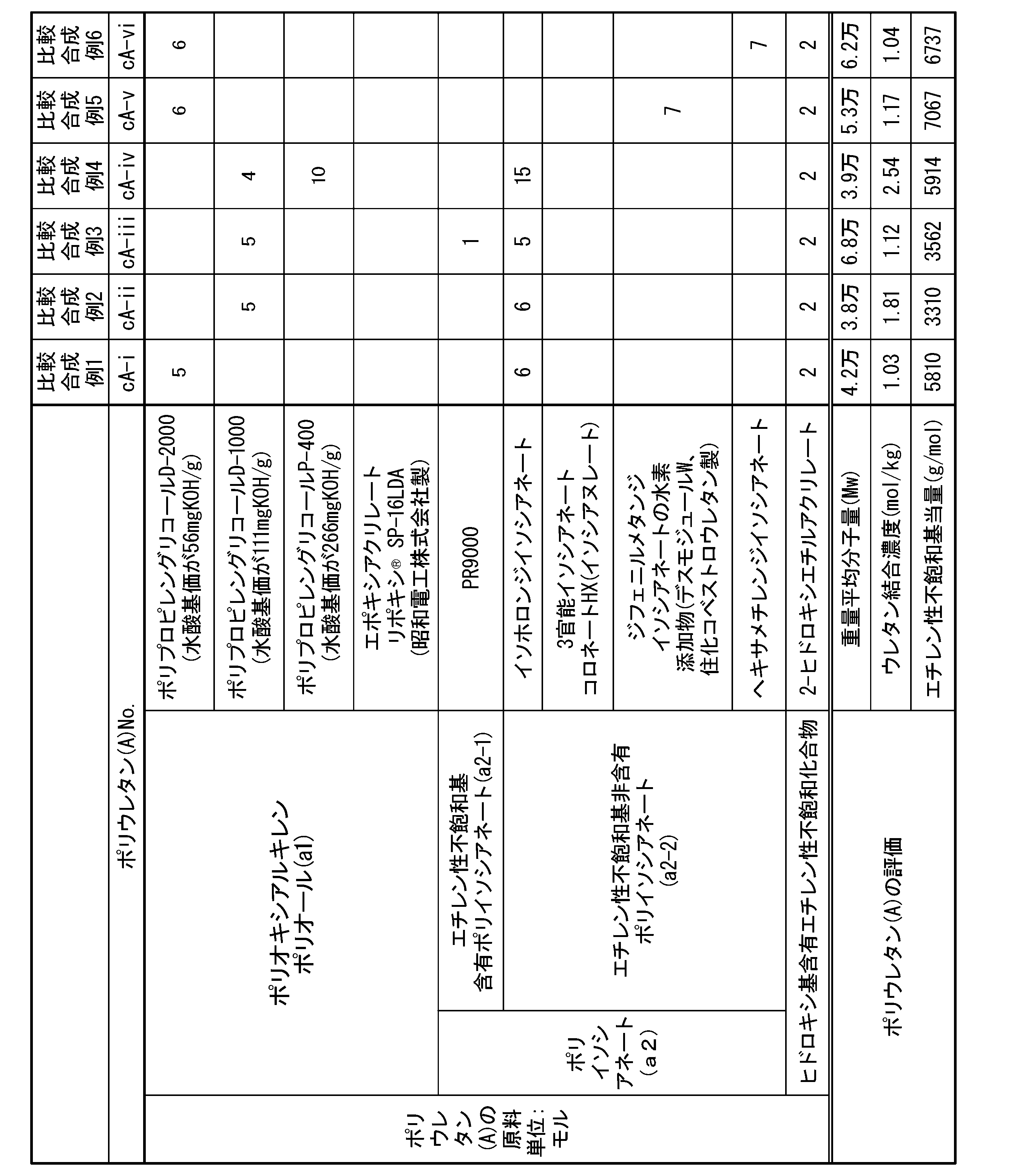

・ポリプロピレングリコールD-2000(三井化学製、数平均分子量2000)
・ポリプロピレングリコールD-1000(三井化学製、数平均分子量1000)
・ポリプロピレングリコールD-400(三井化学製、数平均分子量400)
・エポキシアクアリレート(昭和電工株式会社製、リポキシ(商標)SP-16LDA)・PR9000:Laromer(登録商標) PR9000(BASF製)
・イソホロンジイソシアネート(デスモジュールI、住化コベストロウレタン製)
・コロネートHX:ヘキサメチレンジイソシアネートのイソシアヌレート体(東ソー製)・ジフェニルメタンジイソシアネートの水素添加物(デスモジュールW、住化コベストロウレタン製)
・ヘキサメチレンジイソシアネート(旭化成製)
・2-ヒドロキシエチルアクリレート(大阪有機化学工業製)
<粘着剤組成物PU1の調製>
ポリウレタン(A)として合成例1で得られたポリウレタン(A-i)50質量部と、エチレン性不飽和基含有モノマー(B)として単官能(メタ)アクリレートであるEHA50質量部と、光重合開始剤(C)としてIrg-184 0.6質量部と、可塑剤(D)としてIPM 20質量部を、配合し、25℃でディスパーを用いて混合し、実施例1にかかる粘着剤組成物PU1を調製した。
光学用PETフィルムの基材の片面に粘着剤層を有する保護シートを作製した。まず、アプリケーターを用いて、上記調整した粘着剤組成物PU1を、基材として厚さ75μmの光学用PETフィルム(東洋紡株式会社製A4300)または厚さ75μmのPETフィルム(東山フィルム株式会社製HY-S10)上に塗布した。塗布された粘着剤組成物の上から、厚さ75μmの剥離PETフィルム(東洋紡株式会社製E7006)で覆った。次に、紫外線照射装置(アイグラフィックス株式会社製、UV照射装置3kW、高圧水銀ランプ)を用い、剥離PETフィルムで覆われたシートに対し、剥離PETフィルム側の面から紫外線を照射して粘着剤組成物を光硬化させて粘着剤層を作製した。紫外線の照射距離は25cm、ランプ移動速度は1.0m/分、照射量は1000mJ/cm2である。硬化後の粘着剤層の厚さはダイヤルゲージを用いて、保護シートの厚さを測定した後、この測定値から光学用PETフィルムの厚さ75μmと剥離PETフィルムの厚さ75μmとを引いて算出した。ダイヤルゲージの測定面は、直径5mmの円形の平面で、測定力は0.8Nとした。粘着剤層の厚さ71μmの実施例1の保護シートPUS1を得た。下記の評価方法で、粘着剤層の塗膜表面強度(鉛筆硬度)、保護シートの剥離強度、切断屑および粘着層のひび割れについて、保護シートPUS1を評価した。その結果を表3に示す。
基材として厚さ75μmの剥離PETフィルム(東洋紡株式会社製E7006)を用いる以外は、保護シートの作製1と同様にして、粘着剤層の両面が剥離PETフィルムである引張試験用のサンプルPUS1を作製した。下記の評価方法で、引張試験(伸び率、引張強度)の評価を行った。その結果を表3に示す。
<粘着剤組成物の調製>
表3~7に記載の成分とその配合量を用いた以外は実施例1と同様に、実施例2~21、比較例1~15にかかる粘着剤組成物PUS2~21、cPS1~15を調製した。
上記得られた粘着剤組成物PUS2~21、cPS1~15を用いた以外は、実施例1と同じ方法で、実施例2~21、比較例1~15の保護シートPUS2~21、cPUS1~15を得た。実施例1と同様な評価方法で、粘着剤層の塗膜表面強度(鉛筆硬度)、保護シートの剥離強度について、保護シートを評価した。その結果を表3~7に示す。
上記得られた粘着剤組成物PUS2~21、cPS1~15を用いた以外は、実施例1と同じ方法で、実施例2~21、比較例1~15の引張試験用のサンプルPUS2~21、cPUS1~15を得た。実施例1と同様な評価方法で、引張試験(伸び率、引張強度)について、引張試験用のサンプルを評価した。その結果を表3~7に示す。
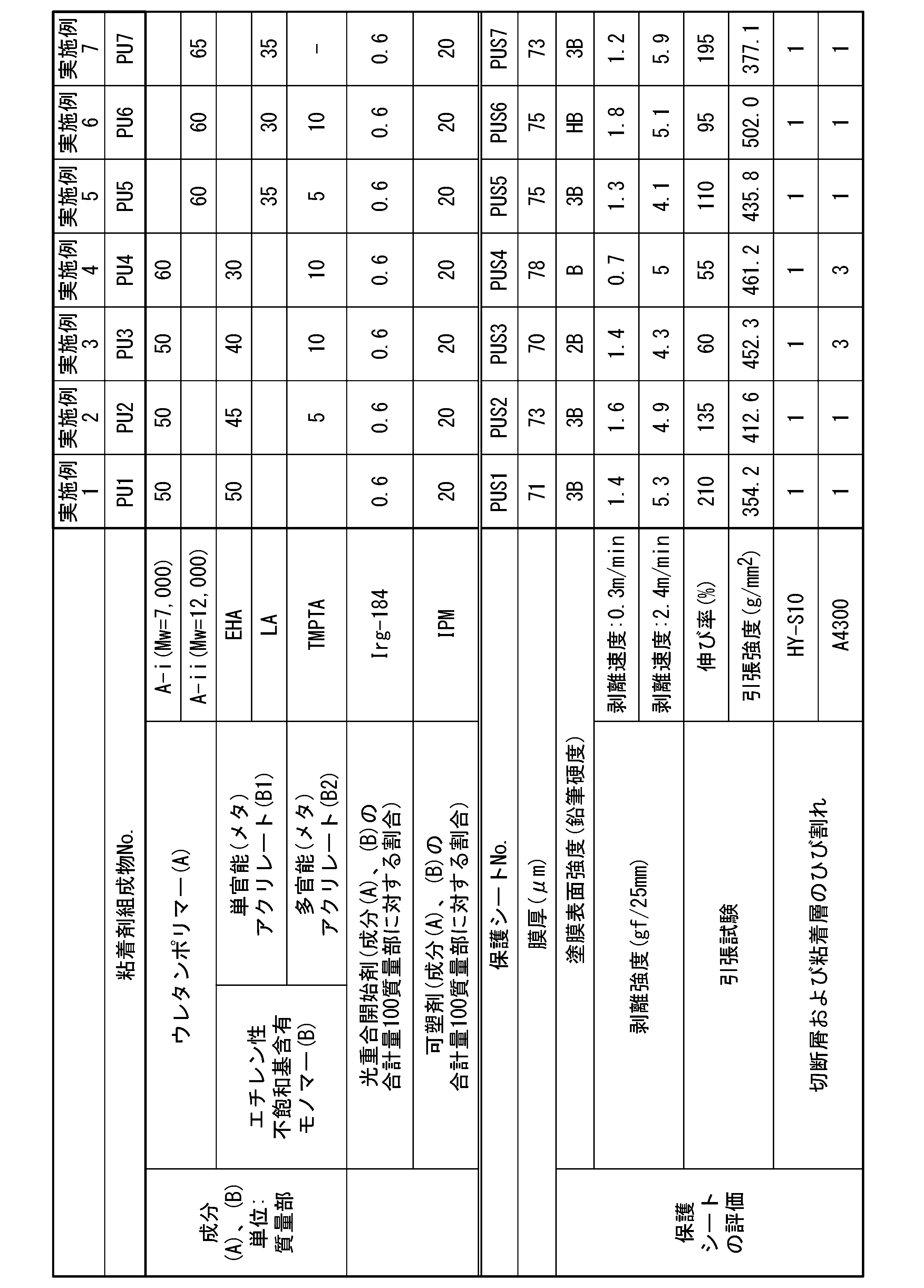
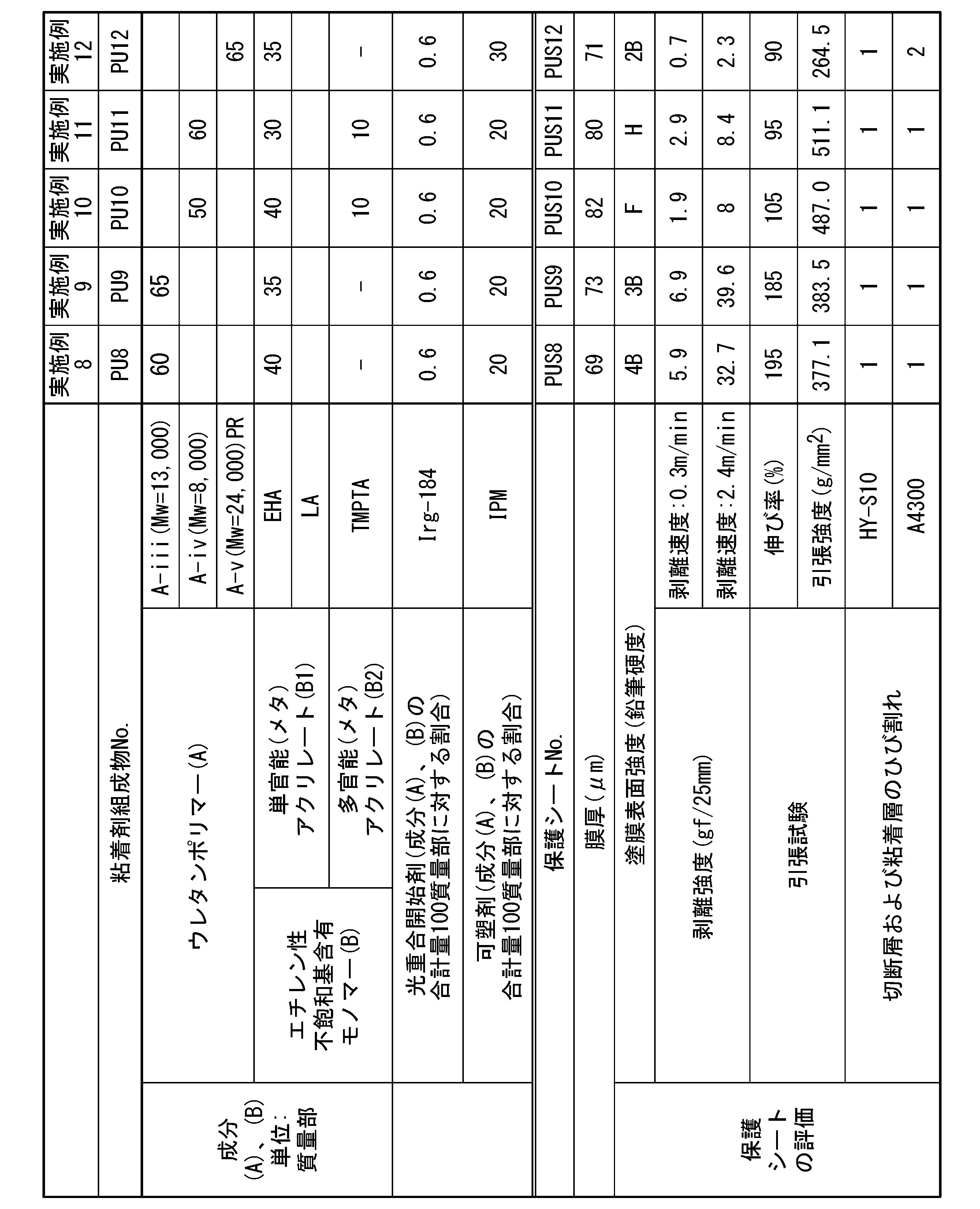
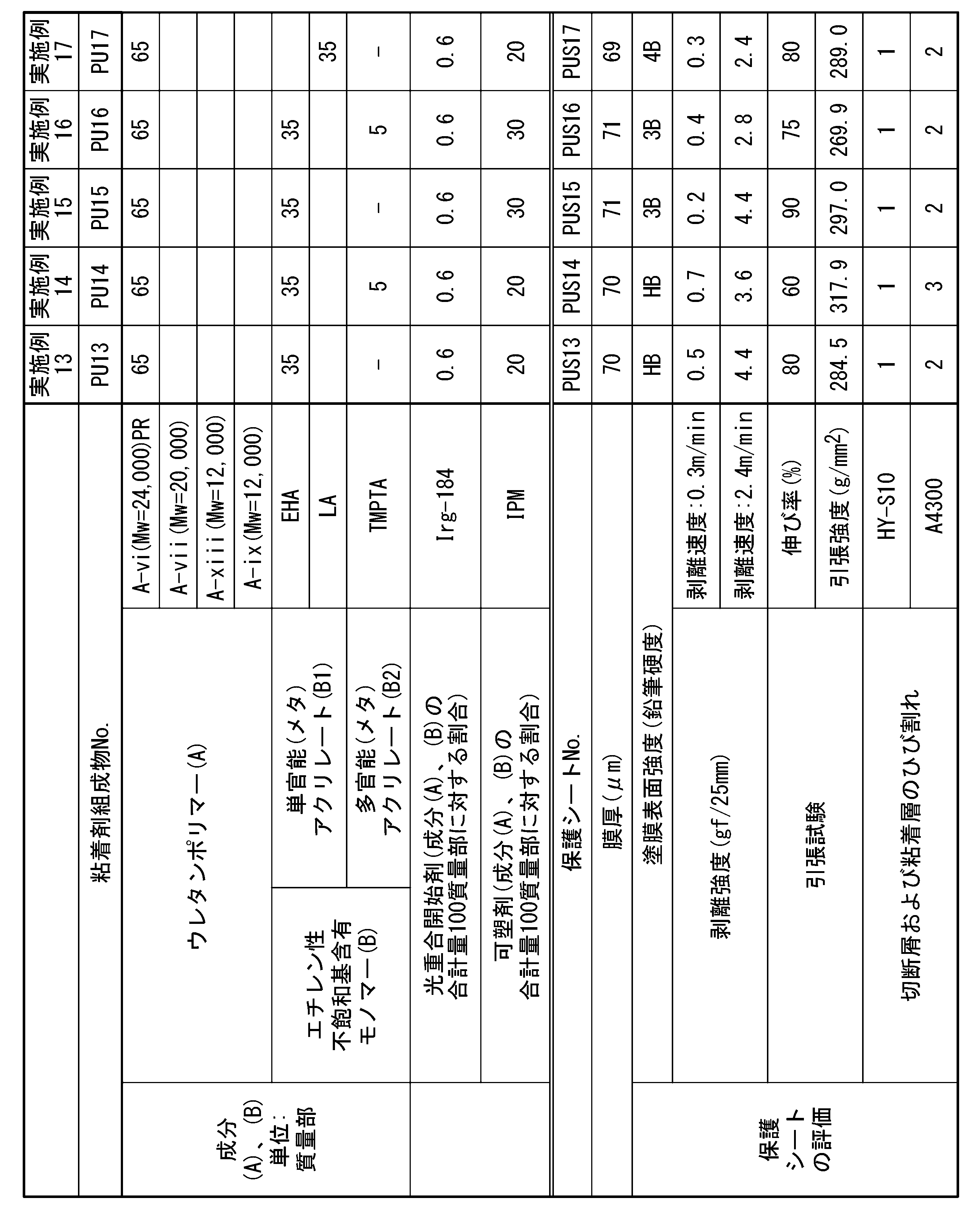
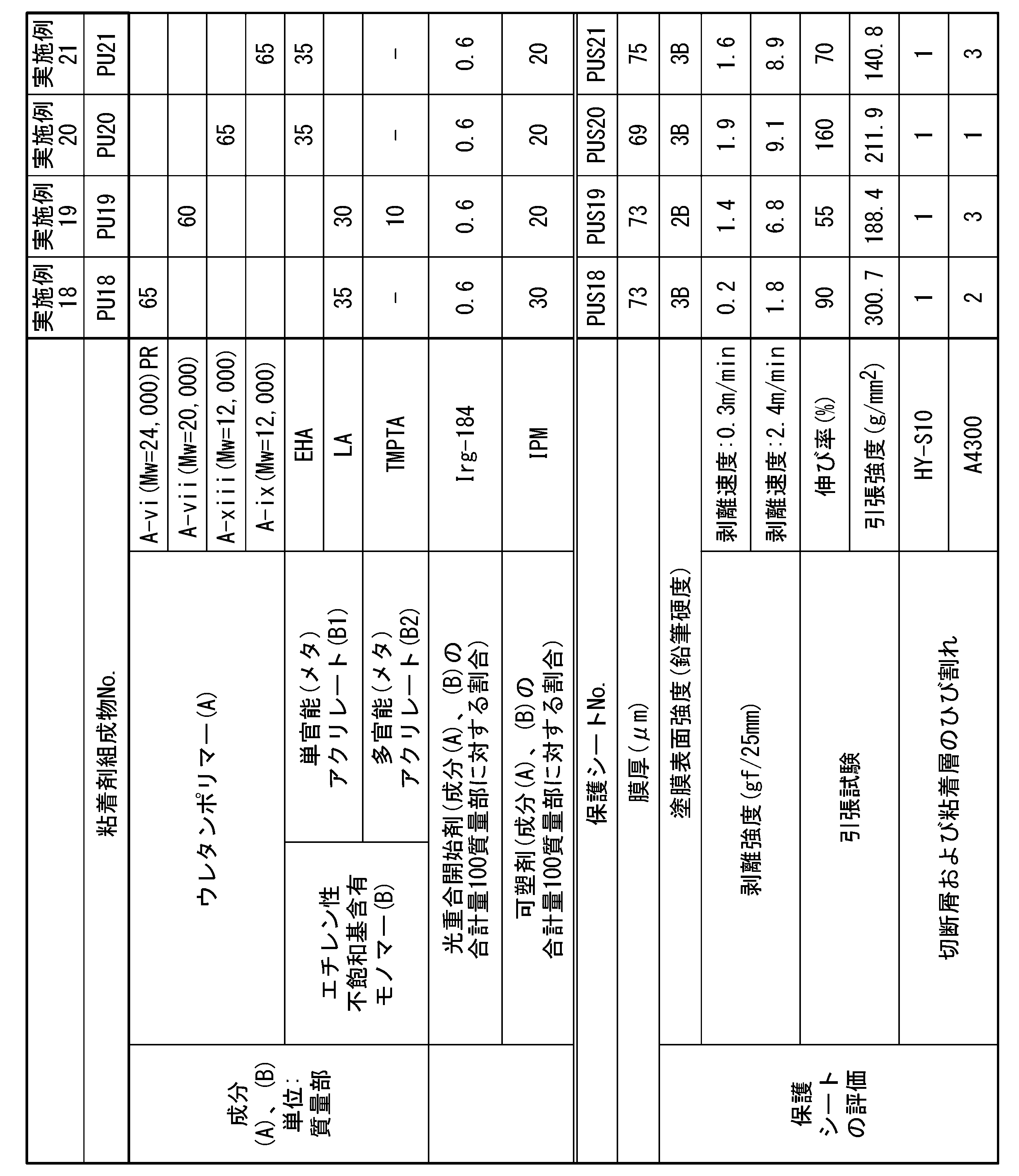
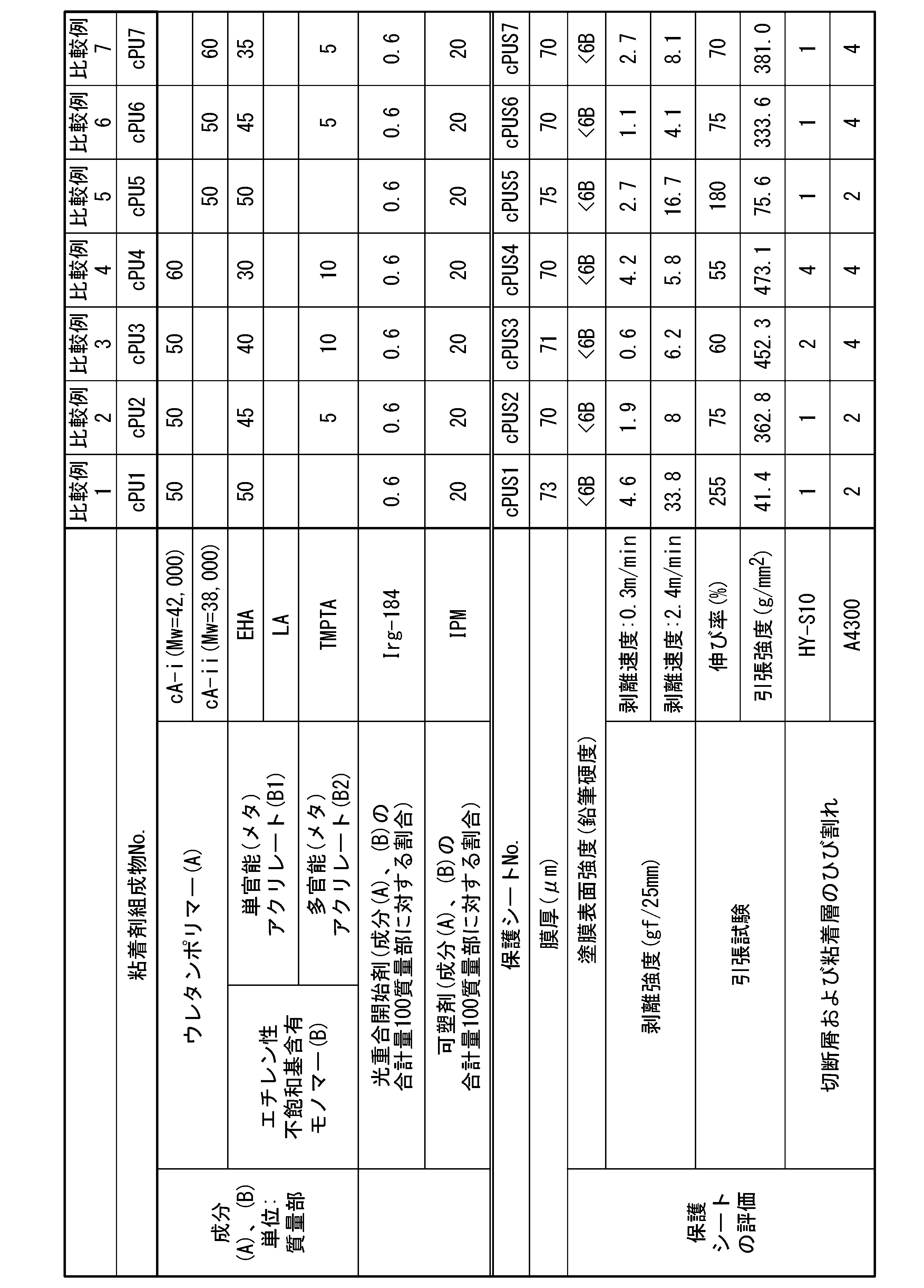

EHA:2-エチルヘキシルアクリレート(東亜合成株式会社製)
LA:ラウリルアクリレート(大阪有機化学工業株式会社製)
TMPTA:トリメチロールプロパントリアクリレート(M-309、東亜合成株式会社製)
Irg-184:1-Hydroxycyclohexyl Phenyl Ketone(東京化成工業株式会社製)
IPM:エキセパールIPM(花王株式会社製)
HY-S10:東山フィルム株式会社製
A4300:東洋紡株式会社製
作製した保護シートを100mm×100mmの大きさに切り取り、剥離PETフィルムを剥がした。装置は電動鉛筆引っかき硬度試験機(安田精機製作所社製,製品名「No.553-M」)を用いた。また、鉛筆は三菱鉛筆株式会社の鉛筆「ユニ(商品名)」を用いた。そして、JIS K 5600-5-4に準じて、100g荷重の条件で、保護シートの粘着剤層表面の鉛筆硬度を測定した。
作製した保護シートを25mm×150mmの大きさに切り取り、剥離PETフィルムを剥がした。次に、露出した粘着面をガラス板に貼合し、2kgのゴムローラー(幅:約50mm)を1往復させて、測定用サンプルを作製した。
圧着から30分後に剥離速度0.3m/min及び2.4m/minで180°方向の引張試験を行って、保護シートのガラス板に対する剥離強度(g/25mm)を、JISZ0237に準じて、測定した。
引張試験用に作製したサンプルを図1に示すように、幅5mm、長さ50mmのダンベル形状に切り取り、両面の剥離PETフィルムを剥がして粘着剤層を露出させた。JIS K 7161-1:2014の方法に従って破断時伸び率および破断強度(引張強度)を測定した。装置は引張試験機(Stable MicroSystems製)を用いた。標線間距離20mm、引張速度100mm/minの条件で粘着剤層の引張試験を行った。伸び率は、以下の式(A)に従って算出した。
全長:50mm
平行部長さ:25mm
標線間距離:20mm
平行部幅:5mm
厚さは表3~7を参照
つかみ部幅:20mm
つかみ具感距離:30mm
作製した保護シートをピナクル刃(刃高:0.80mm、刃角:50°(株式会社塚谷刃物製作所製))で、切断し、剥離PETフィルムを剥がした。切断後の粘着剤層の端面を、上側を粘着剤層、下側を基材層としてマイクロスコープ(倍率:800倍(株式会社ハイロックス製 RH-2000))で観察し、下記基準で評価した。
1:粘着剤層に切断屑、もしくはひび割れが確認されない(例えば、図2に示す断面図)
2:粘着剤層の一部に切断屑が確認され、ひび割れは確認されない(例えば、図3に示す断面図)
3:粘着層の一部にひび割れが確認され、切断屑は確認されない
4:粘着剤層の全体に切断屑、もしくはひび割れが確認される(例えば、図4に示す断面図)
Claims (15)
- ポリウレタン(A)と、
エチレン性不飽和基含有モノマー(B)と、
光重合開始剤(C)と、を含有し、
前記ポリウレタン(A)が、ポリオール由来の構造及びポリイソシアネート由来の構造を含む骨格を有するポリウレタンであり、末端にエチレン性不飽和基を有し、
前記ポリウレタン(A)の重量平均分子量が、3000~30000である粘着剤組成物。 - 前記ポリオールが、数平均分子量300~1800のポリオキシアルキレンポリオールである、請求項1に記載の粘着剤組成物。
- 前記ポリウレタン(A)のエチレン性不飽和基当量が、900~3000g/molである、請求項1または2に記載の粘着剤組成物。
- 前記ポリウレタン(A)のウレタン結合の濃度が、1.0~5mol/kgである、請求項1または2に記載の粘着剤組成物。
- 前記ポリウレタン(A)が、末端以外の部位にエチレン性不飽和基を有する、請求項1または2に記載の粘着剤組成物。
- 前記ポリイソシアネートが、エチレン性不飽和基含有ポリイソシアネートと、エチレン性不飽和基非含有ポリイソシアネートとを含有する、請求項1または2に記載の粘着剤組成物。
- 前記エチレン性不飽和基含有モノマー(B)が、単官能(メタ)アクリレート(B1)を含有し、前記単官能(メタ)アクリレート(B1)が、炭素数6~18の鎖状アルキル(メタ)アクリレートである、請求項1または2に記載の粘着剤組成物。
- 前記エチレン性不飽和基含有モノマー(B)が、単官能(メタ)アクリレート(B1)と、多官能(メタ)アクリレート(B2)と、を含有する、請求項1または2に記載の粘着剤組成物。
- 前記ポリウレタン(A)及び前記エチレン性不飽和基含有モノマー(B)の合計100質量%に対して、単官能(メタ)アクリレート(B1)を5~89質量%含有し、多官能(メタ)アクリレート(B2)を0.1~30質量%含有する、請求項8に記載の粘着剤組成物。
- 前記ポリウレタン(A)及び前記エチレン性不飽和基含有モノマー(B)の合計100質量%に対して、ポリウレタン(A)を10~90質量%含有し、エチレン性不飽和基含有モノマー(B)を10~90質量%含有する、請求項1または2に記載の粘着剤組成物。
- 可塑剤(D)をさらに含有する、請求項1に記載の粘着剤組成物。
- 前記ポリウレタン(A)及び前記エチレン性不飽和基含有モノマー(B)の合計100質量部に対して、光重合開始剤(C)を0.05~5質量部含有し、前記可塑剤(D)を1~30質量部含有する、請求項11に記載の粘着剤組成物。
- 前記請求項1または11に記載の粘着剤組成物の硬化物。
- 破断時の伸び率92~300%、且つ破断強度が300~800g/mm2である、請求項13に記載の硬化物。
- 基材と、前記基材の片面に形成されている、請求項13に記載の硬化物からなる粘着剤層と、を有する保護シート。
Priority Applications (2)
| Application Number | Priority Date | Filing Date | Title |
|---|---|---|---|
| CN202380038779.3A CN119156433A (zh) | 2022-07-08 | 2023-04-26 | 粘着剂组合物及保护片 |
| JP2024531930A JPWO2024009593A1 (ja) | 2022-07-08 | 2023-04-26 |
Applications Claiming Priority (2)
| Application Number | Priority Date | Filing Date | Title |
|---|---|---|---|
| JP2022-110520 | 2022-07-08 | ||
| JP2022110520 | 2022-07-08 |
Publications (1)
| Publication Number | Publication Date |
|---|---|
| WO2024009593A1 true WO2024009593A1 (ja) | 2024-01-11 |
Family
ID=89453051
Family Applications (1)
| Application Number | Title | Priority Date | Filing Date |
|---|---|---|---|
| PCT/JP2023/016463 Ceased WO2024009593A1 (ja) | 2022-07-08 | 2023-04-26 | 粘着剤組成物及び保護シート |
Country Status (4)
| Country | Link |
|---|---|
| JP (1) | JPWO2024009593A1 (ja) |
| CN (1) | CN119156433A (ja) |
| TW (1) | TW202409226A (ja) |
| WO (1) | WO2024009593A1 (ja) |
Citations (8)
| Publication number | Priority date | Publication date | Assignee | Title |
|---|---|---|---|---|
| JP2012056985A (ja) * | 2010-09-06 | 2012-03-22 | Nitto Denko Corp | 発泡粘着体 |
| JP2012111851A (ja) * | 2010-11-25 | 2012-06-14 | Toyo Ink Sc Holdings Co Ltd | (メタ)アクリロイル基を有するウレタン樹脂及び該ウレタン樹脂を含有する活性エネルギー線硬化性接着剤、並びに太陽電池用裏面保護シート |
| WO2015141537A1 (ja) * | 2014-03-17 | 2015-09-24 | Kjケミカルズ株式会社 | ウレタンオリゴマー及びそれを含有する活性エネルギー線硬化性樹脂組成物 |
| WO2017018270A1 (ja) * | 2015-07-24 | 2017-02-02 | デンカ株式会社 | 半導体加工用粘着テープ及びそれを用いた半導体チップ又は半導体部品の製造方法 |
| WO2019124197A1 (ja) * | 2017-12-22 | 2019-06-27 | 三菱ケミカル株式会社 | 活性エネルギー線硬化性剥離型粘着剤組成物および剥離型粘着シート |
| JP2019156959A (ja) * | 2018-03-13 | 2019-09-19 | アイカ工業株式会社 | 光硬化性粘着樹脂組成物 |
| WO2020100832A1 (ja) * | 2018-11-15 | 2020-05-22 | デンカ株式会社 | 組成物 |
| WO2020196755A1 (ja) * | 2019-03-28 | 2020-10-01 | リンテック株式会社 | 粘着シート、粘着シートの製造方法及び半導体装置の製造方法 |
-
2023
- 2023-04-26 JP JP2024531930A patent/JPWO2024009593A1/ja active Pending
- 2023-04-26 CN CN202380038779.3A patent/CN119156433A/zh active Pending
- 2023-04-26 WO PCT/JP2023/016463 patent/WO2024009593A1/ja not_active Ceased
- 2023-04-27 TW TW112115720A patent/TW202409226A/zh unknown
Patent Citations (8)
| Publication number | Priority date | Publication date | Assignee | Title |
|---|---|---|---|---|
| JP2012056985A (ja) * | 2010-09-06 | 2012-03-22 | Nitto Denko Corp | 発泡粘着体 |
| JP2012111851A (ja) * | 2010-11-25 | 2012-06-14 | Toyo Ink Sc Holdings Co Ltd | (メタ)アクリロイル基を有するウレタン樹脂及び該ウレタン樹脂を含有する活性エネルギー線硬化性接着剤、並びに太陽電池用裏面保護シート |
| WO2015141537A1 (ja) * | 2014-03-17 | 2015-09-24 | Kjケミカルズ株式会社 | ウレタンオリゴマー及びそれを含有する活性エネルギー線硬化性樹脂組成物 |
| WO2017018270A1 (ja) * | 2015-07-24 | 2017-02-02 | デンカ株式会社 | 半導体加工用粘着テープ及びそれを用いた半導体チップ又は半導体部品の製造方法 |
| WO2019124197A1 (ja) * | 2017-12-22 | 2019-06-27 | 三菱ケミカル株式会社 | 活性エネルギー線硬化性剥離型粘着剤組成物および剥離型粘着シート |
| JP2019156959A (ja) * | 2018-03-13 | 2019-09-19 | アイカ工業株式会社 | 光硬化性粘着樹脂組成物 |
| WO2020100832A1 (ja) * | 2018-11-15 | 2020-05-22 | デンカ株式会社 | 組成物 |
| WO2020196755A1 (ja) * | 2019-03-28 | 2020-10-01 | リンテック株式会社 | 粘着シート、粘着シートの製造方法及び半導体装置の製造方法 |
Also Published As
| Publication number | Publication date |
|---|---|
| TW202409226A (zh) | 2024-03-01 |
| CN119156433A (zh) | 2024-12-17 |
| JPWO2024009593A1 (ja) | 2024-01-11 |
Similar Documents
| Publication | Publication Date | Title |
|---|---|---|
| JP7145868B2 (ja) | 粘着剤組成物及び粘着シート | |
| CN102361947B (zh) | 保护粘着膜、屏板及携带电子终端 | |
| KR101770649B1 (ko) | 우레탄 올리고머 및 그것을 함유하는 활성 에너지선 경화성 수지 조성물 | |
| JPWO2013115250A1 (ja) | 光硬化性透明粘着シート用組成物、光学用粘着シート | |
| JP7012427B2 (ja) | 光硬化性組成物、及び粘着シート | |
| WO2013088889A1 (ja) | 透明両面粘着シートの製造方法、透明両面粘着シート | |
| KR102535559B1 (ko) | 표면 보호 시트용 점착제 조성물 및 표면 보호 시트 | |
| JP5566046B2 (ja) | 粘着剤、それを用いてなる粘着シート、一時表面保護用粘着剤、それを用いてなる一時表面保護用粘着シート、およびその一時表面保護用粘着シートの使用方法、ならびに活性エネルギー線硬化型樹脂組成物。 | |
| WO2013161759A1 (ja) | 透明粘接着シート用組成物、その製造方法及び透明粘接着シート | |
| JP7380577B2 (ja) | 表面保護シート用粘着剤組成物及び表面保護シート | |
| KR102887741B1 (ko) | 점착제 조성물 및 보호 시트 | |
| TW202409226A (zh) | 黏著劑組成物及保護薄片 | |
| WO2023120067A1 (ja) | 粘着剤組成物及び保護シート | |
| WO2023277008A1 (ja) | エチレン性不飽和基含有ウレタンポリマー、その製造方法、及び粘着剤組成物 |
Legal Events
| Date | Code | Title | Description |
|---|---|---|---|
| 121 | Ep: the epo has been informed by wipo that ep was designated in this application |
Ref document number: 23835134 Country of ref document: EP Kind code of ref document: A1 |
|
| ENP | Entry into the national phase |
Ref document number: 2024531930 Country of ref document: JP Kind code of ref document: A |
|
| WWE | Wipo information: entry into national phase |
Ref document number: 202380038779.3 Country of ref document: CN |
|
| NENP | Non-entry into the national phase |
Ref country code: DE |
|
| 122 | Ep: pct application non-entry in european phase |
Ref document number: 23835134 Country of ref document: EP Kind code of ref document: A1 |