WO2024009375A1 - アクチュエータ用コイル基板及びアクチュエータ - Google Patents
アクチュエータ用コイル基板及びアクチュエータ Download PDFInfo
- Publication number
- WO2024009375A1 WO2024009375A1 PCT/JP2022/026661 JP2022026661W WO2024009375A1 WO 2024009375 A1 WO2024009375 A1 WO 2024009375A1 JP 2022026661 W JP2022026661 W JP 2022026661W WO 2024009375 A1 WO2024009375 A1 WO 2024009375A1
- Authority
- WO
- WIPO (PCT)
- Prior art keywords
- actuator
- coil
- flexible insulating
- insulating substrate
- coils
- Prior art date
- Legal status (The legal status is an assumption and is not a legal conclusion. Google has not performed a legal analysis and makes no representation as to the accuracy of the status listed.)
- Ceased
Links
Images

















Classifications
-
- H—ELECTRICITY
- H02—GENERATION; CONVERSION OR DISTRIBUTION OF ELECTRIC POWER
- H02K—DYNAMO-ELECTRIC MACHINES
- H02K3/00—Details of windings
- H02K3/04—Windings characterised by the conductor shape, form or construction, e.g. with bar conductors
- H02K3/26—Windings characterised by the conductor shape, form or construction, e.g. with bar conductors consisting of printed conductors
-
- H—ELECTRICITY
- H02—GENERATION; CONVERSION OR DISTRIBUTION OF ELECTRIC POWER
- H02K—DYNAMO-ELECTRIC MACHINES
- H02K3/00—Details of windings
- H02K3/32—Windings characterised by the shape, form or construction of the insulation
-
- H—ELECTRICITY
- H02—GENERATION; CONVERSION OR DISTRIBUTION OF ELECTRIC POWER
- H02K—DYNAMO-ELECTRIC MACHINES
- H02K3/00—Details of windings
- H02K3/46—Fastening of windings on the stator or rotor structure
- H02K3/47—Air-gap windings, i.e. iron-free windings
-
- H—ELECTRICITY
- H02—GENERATION; CONVERSION OR DISTRIBUTION OF ELECTRIC POWER
- H02K—DYNAMO-ELECTRIC MACHINES
- H02K41/00—Propulsion systems in which a rigid body is moved along a path due to dynamo-electric interaction between the body and a magnetic field travelling along the path
- H02K41/02—Linear motors; Sectional motors
- H02K41/03—Synchronous motors; Motors moving step by step; Reluctance motors
- H02K41/031—Synchronous motors; Motors moving step by step; Reluctance motors of the permanent magnet type
Definitions
- the present disclosure relates to an actuator coil substrate and an actuator.
- Actuators that move in parallel are used in applications such as chip mounting of semiconductor manufacturing equipment.
- a shaft-type linear motor that has a shaft-shaped magnet that has a higher magnetic flux utilization rate than a flat magnet.
- a shaft-type linear motor having a shaft-shaped magnet will be referred to as shaft linear.
- a typical shaft linear armature is made by creating multiple coils wound into a cylindrical shape, arranging the multiple coils at predetermined intervals using a holding member or bobbin, and then (For example, see Patent Document 1).
- the coil disclosed in Patent Document 1 uses a magnet wire for winding, and is formed by winding the magnet wire into a cylindrical shape. Since shaft linear coils are used in the heads of chip mounters, etc., shaft linear coils are often small and have small diameters. For this reason, it is difficult to form the magnet wire into a cylinder with high precision, resulting in unrolled windings and intermingling between the windings. The collapse of the windings and the crossing of the windings cause the coil to become enlarged. When arranging a plurality of coils, axial positional deviations tend to occur, and electrical phase deviations occur within the same phase, thereby increasing the thrust pulsation of the actuator.
- Patent Document 1 includes a winding member typified by a bobbin, and the invention can suppress axial positional deviation to some extent by the winding member.
- this invention has problems in that the number of parts increases due to the winding member, manufacturing cost increases, and the armature as a whole becomes bulky. The enlargement of the entire armature affects the enlargement of the entire shaft linear.
- the present disclosure has been made in view of the above, and an object of the present disclosure is to obtain a coil substrate for an actuator having a coil that can be molded while suppressing an increase in the size of the armature and the number of parts.
- an actuator coil substrate includes a flexible insulating substrate wound around an axis, and a flexible insulating substrate arranged in the axial direction. It has multiple printed coils. Each of the plurality of coils has a conductor arranged to extend in the circumferential direction of the shaft.
- the flexible insulating substrate is wound in a cylindrical shape in the long side direction of each of the plurality of coils, or so that the cross section perpendicular to the axis is polygonal.
- the actuator coil substrate according to the present disclosure has the effect of being able to have a coil that can be molded while suppressing an increase in the size of the armature and the number of parts.
- a perspective view of an actuator coil board according to Embodiment 1 Schematic diagram of the actuator coil substrate according to Embodiment 1 before winding the flexible insulating substrate included in the actuator coil substrate
- a perspective view of an actuator coil board according to Embodiment 1 A diagram schematically showing a cross section of the actuator coil substrate according to Embodiment 1 when the flexible insulating substrate of FIG. 4 is cut into one cross section.
- a perspective view of an actuator coil board according to Embodiment 2 A schematic diagram of the actuator coil substrate in the middle of winding the flexible insulating substrate included in the actuator coil substrate according to Embodiment 2.
- a perspective view of an actuator coil board according to Embodiment 3 Schematic diagram of the actuator coil substrate according to Embodiment 3 before winding the flexible insulating substrate included in the actuator coil substrate
- Schematic diagram of an actuator coil board according to Embodiment 4 Schematic diagram of an actuator coil board according to Embodiment 4 Diagram showing an example of a coil pattern that is not concentrated winding Diagram showing an example of a coil pattern that is not concentrated winding
- Schematic diagram of an actuator coil board according to Embodiment 5 Schematic diagram of an actuator coil board according to Embodiment 6
- a perspective view of an actuator according to Embodiment 7 A perspective view of an actuator according to Embodiment 7 Cross-sectional view of one cross section of the actuator according to Embodiment 7 Cross-sectional view of one cross section of the actuator according to Embodiment 7
- FIG. 1 is a perspective view of an actuator coil substrate 1 according to the first embodiment.
- FIG. 1 schematically shows an actuator coil substrate 1.
- the actuator coil substrate 1 includes a flexible insulating substrate 11 wound around a shaft 10, and three coils 21, 22, 23 printed on the flexible insulating substrate 11. Axis 10 does not actually exist.
- the shaft 10 is shown in FIG. 1 to explain the actuator coil substrate 1.
- the three coils 21, 22, 23 are arranged side by side in the axial direction.
- the three coils 21, 22, and 23 are an example of a plurality of coils.
- Each of the three coils 21, 22, 23 is made up of a conductor 30.
- the conductor 30 is arranged so that a portion of the conductor 30 extends in the direction in which the shaft 10 is wound.
- the direction in which the shaft 10 is wound is the circumferential direction of a cylinder with the shaft 10 as the central axis.
- each of the three coils 21, 22, 23 has a longitudinal direction and a transverse direction.
- a longitudinal conductor 30 of each of the three coils 21 , 22 , 23 is wound around the axis 10 .
- the longitudinally extending conductor 30 of each of the three coils 21 , 22 , 23 is located in a plane perpendicular to the axis 10 .
- the flexible insulating substrate 11 is wound in a cylindrical shape in the long side direction of each of the three coils 21, 22, and 23. Alternatively, the flexible insulating substrate 11 is wound so that the cross section perpendicular to the axis 10 is polygonal. That is, the flexible insulating substrate 11 becomes cylindrical by being wound around the shaft 10.
- the cross section of the flexible insulating substrate 11 perpendicular to the axis 10 has a substantially polygonal shape.
- the conductor 30 of each of the three coils 21, 22, 23 may be wound in a spiral shape.
- Each of the three coils 21, 22, and 23 is arranged such that the conductor 30 in the short direction is arranged in the axial direction and the conductor 30 in the longitudinal direction is wound around the shaft 10.
- Each of the three coils 21, 22, and 23 may be arranged to wind one or more turns around the shaft 10.
- any half line extending radially from the axis 10 may penetrate the conductor 30 multiple times, or it may pass through the entire conductor 30.
- a half-line extending radially from the shaft 10 over the circumference may pass through the conductor 30 multiple times.
- the direction of a half line extending from the axis 10 in a cross section perpendicular to the axis 10 is called the radial direction, and the direction perpendicular to the radial direction and rotating around the axis 10 is called the circumferential direction.
- the fact that the above-mentioned half-line passes through the conductor 30 multiple times means that the conductor 30 overlaps multiple times in the radial direction.
- a conductor 30 included in each of the three coils 21 , 22 , 23 is arranged to extend in the circumferential direction of the shaft 10 .
- the conductor 30 extending in the longitudinal direction of each of the three coils 21, 22, 23 may be arranged in a plane that is not perpendicular to the axis 10. In this case, when the flexible insulating substrate 11 is wound around one turn or more, the extending portion of the conductor 30 has a spiral shape.
- the conductor 30 may be bent in the middle in the longitudinal direction and may be extended in the longitudinal direction while having steps. In this case, the wound conductor 30 is arranged in multiple planes with respect to the axis 10.
- the actuator coil substrate 1 is constructed by winding a flexible insulating substrate 11, on which three coils 21, 22, and 23 are printed on one side, into a cylindrical shape.
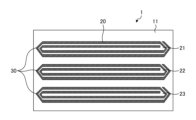
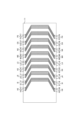
- FIG. 2 is a schematic diagram of the actuator coil substrate 1 before winding the flexible insulating substrate 11 included in the actuator coil substrate 1 according to the first embodiment. Also shown in FIG. 2 are three coils 21, 22, 23 printed on one side of the flexible insulating substrate 11. The three coils 21, 22, 23 are arranged in parallel. The longitudinal straight portion of the conductor 30 of each of the three coils 21, 22, 23 is folded back at the terminal end and connected to another longitudinal straight portion of the same coil via the folded portion.
- the conductor 30 of each of the three coils 21, 22, and 23 is traced in one direction from one end to the other in the longitudinal direction, the first straight part and the first straight part are connected through a folded part.
- the direction of travel is opposite to that of the second straight portion connected to the second straight portion at the opposing portion.
- the traveling direction of each of the first straight part and the second straight part becomes the circumferential direction.
- each of the three coils 21, 22, 23 has a long side 20 in a direction perpendicular to the direction in which the three coils 21, 22, 23 are lined up. That is, each of the three coils 21, 22, 23 has a long side portion 20 in the circumferential direction.
- the long side portion 20 is illustrated as extending linearly, but the long side portion 20 may be bent or curved in the middle.
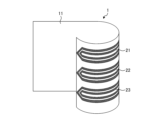
- FIG. 3 is a schematic diagram of the actuator coil substrate 1 in which the flexible insulating substrate 11 of the actuator coil substrate 1 according to the first embodiment is being wound.
- the flexible insulating substrate 11 is wound in the longitudinal direction of each of the three coils 21, 22, 23.
- the flexible insulating substrate 11 is wound so that the coil printed surface is located on the outside.
- the coil print surface is a surface on which three coils 21, 22, and 23 of the two planes of the flexible insulating substrate 11 are printed.
- the flexible insulating substrate 11 may be wound so that the coil printed surface is located on the inside.
- the flexible insulating substrate 11 may overlap in the radial direction, but since the flexible insulating substrate 11 has insulation performance, the two planes of the coil printed surface and the flexible insulating substrate 11 overlap. There is no risk of short-circuiting even if the side of the coil that is not printed on comes into contact with the other side.
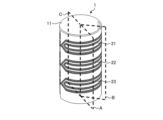
- FIG. 4 is a perspective view of the actuator coil substrate 1 according to the first embodiment.
- FIG. 4 schematically shows the actuator coil substrate 1 shown in FIG. 1, and also shows a cross section A, a cross section B, and a cross section C for explaining the actuator coil substrate 1.
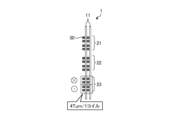
- FIG. 5 is a diagram schematically showing a cross section of the actuator coil substrate 1 according to the first embodiment when the flexible insulating substrate 11 of FIG. 4 is cut along the cross section A.
- the three coils 21, 22, 23 are arranged at pitch intervals determined by a printed pattern in the axial direction of the cylindrical flexible insulating substrate 11 and at intervals equal to the thickness of the flexible insulating substrate 11 in the radial direction. Ru.
- the number of turns of each of the three coils 21, 22, and 23 is the total number of conductors 30 aligned in the cross section perpendicular to the axis 10, and the number of turns of each of the three coils 21, 22, and 23 is the total number of conductors 30 aligned in the cross section perpendicular to the axis 10, and the number of turns of the flexible insulating substrate 11 is the same as the number of turns before winding the flexible insulating substrate 11. It is the product of the number of laminated layers of the substrate 11. In FIG. 5, the number of turns per coil is 4 because the number of turns before winding is 2 and the number of stacked layers of the flexible insulating substrate 11 is 2. However, the number of turns is arbitrary.
- Possible causes of misalignment in the aligned windings include the etching tolerance of the printed pattern, misalignment between the laminated layers when the flexible insulating substrate 11 is wound, and the creation of gaps due to bulges in the windings. It is estimated that the line deviation is less than 0.1 mm in any case. The amount of deviation of the winding does not depend on the cross-sectional dimensions of the winding. On the other hand, when a coil is formed using a magnet wire and the winding collapses, the amount of deviation is expected to be anywhere from 1 to an integer multiple of 2 or more times the side length of the cross section of the winding. The side length is the winding diameter when the cross section is circular. Since the typical finished outer diameter of the winding is 0.1 mm or more, the amount of deviation in the winding that occurs in the coil structure of Embodiment 1 is smaller than the amount of deviation that occurs in almost all types of winding magnet wire coils. .
- the amount of positional deviation between the coils in the coil structure of Embodiment 1, only the etching tolerance of the printed pattern contributes to the deviation between the coils, and the amount of deviation is estimated to be 0.01 mm or less. This is clearly smaller than the amount of deviation after winding the magnet wire coil. Furthermore, in the coil structure of Embodiment 1, a holding member such as a bobbin is not required for positioning the coil, so an increase in the number of parts and a decrease in the winding space can be prevented.
- the rigidity of the flexible insulating substrate 11 does not change much anywhere in the circumferential direction.
- the cross-sectional shapes of cross-section A and cross-section B in FIG. Although it is low, as the number of turns of the flexible insulating substrate 11 increases, the difference between the rigidity of the flexible insulating substrate 11 at cross sections A and B and the rigidity of the flexible insulating substrate 11 at cross section C becomes smaller. Become.
- the rigidity of the flexible insulating substrate 11 approaches uniformity in the circumferential direction. Therefore, when the number of windings of the flexible insulating substrate 11 increases, in addition to improving the workability when winding the flexible insulating substrate 11, the end face in the axial direction after winding becomes less likely to be distorted, and the This can prevent the windings from coming close to each other in the circumferential direction. Thereby, even if the gap between the conductors 30 in the circumferential direction is narrowed, insulation performance is maintained, and it becomes possible to improve the conductor space factor of the actuator.
- the actuator coil substrate 1 includes a flexible insulating substrate 11 wound around the shaft 10, and 3 parts printed on the flexible insulating substrate 11 aligned in the axial direction. coils 21, 22, and 23.
- Each of the three coils 21 , 22 , 23 has a conductor 30 arranged to extend in the circumferential direction of the shaft 10 .
- the flexible insulating substrate 11 is wound in a cylindrical shape in the long side direction of each of the three coils 21, 22, and 23, or is wound so that the cross section perpendicular to the axis 10 is polygonal. has been done.
- the actuator coil substrate 1 prevents the enlargement of the coil. It is possible to suppress the increase in thrust pulsation and thrust pulsation. Furthermore, since the winding direction of the flexible insulating substrate 11 coincides with the long side direction of the coil, the rigidity of the flexible insulating substrate 11 is uniform in the same direction, and as a result, according to the actuator coil substrate 1, , the effect of making it easier to wind the flexible insulating substrate 11 during manufacturing can be obtained.
- the flexible insulating substrate 11 is easily deformable, and the flexible insulating substrate 11 can be wound around the printed coil. Insulation between the coils is ensured by the insulating material of the flexible insulating substrate 11 or by providing a separate insulating layer.
- the spacing between the conductors 30 of the coil wound in this manner is determined in the axial direction by the printing accuracy during substrate manufacturing, and in the radial direction by the thickness of the flexible insulating substrate 11 or the thickness of the insulating layer.
- the spacing between the conductors 30 in the axial direction means the spacing between the conductors 30 in the vertical direction of the cross section shown in FIG.
- the actuator coil substrate 1 can suppress the enlargement of the coil. Coils that are printed side by side in the axial direction will not be misaligned beyond the printing accuracy, and an increase in thrust pulsation can be suppressed. Furthermore, the actuator coil substrate 1 can have a coil that can be molded while suppressing an increase in the size of the armature and the number of parts.
- FIG. 6 is a perspective view of an actuator coil substrate 1A according to the second embodiment.
- FIG. 6 schematically shows the actuator coil substrate 1A.
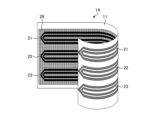
- the actuator coil substrate 1A differs from the actuator coil substrate 1 according to the first embodiment in that coils are printed on both sides of the flexible insulating substrate 11.
- the coils printed on both sides of the flexible insulating substrate 11 are connected via vias.
- the number of turns on the actuator coil substrate 1A is twice the number of turns when the coil is printed only on one side of the flexible insulating substrate 11.
- FIG. 6 three coils 21, 22, 23 printed on the front side of the flexible insulating substrate 11 and a coil 21 printed on the back side of the flexible insulating substrate 11 are shown. has been done.
- the surface of the flexible insulating substrate 11 is the outer surface of the flexible insulating substrate 11 that is wound around the shaft 10 to form a cylindrical shape.
- the back surface is the inner surface of the flexible insulating substrate 11 in a state where the flexible insulating substrate 11 is wound around the shaft 10 to form a cylindrical shape.
- FIG. 6 also shows a cross section E for explaining the actuator coil substrate 1A.
- FIG. 7 is a schematic diagram of the actuator coil substrate 1A in which the flexible insulating substrate 11 included in the actuator coil substrate 1A according to the second embodiment is being wound.
- the coil on one side, and the coil on the back side in FIG. 7 is coated with an insulating layer 28 to ensure insulation performance.
- the coating of the insulating layer 28 is performed by applying a solder resist to the surface on which the coil is printed, or by attaching an insulating sheet to the surface on which the coil is printed.
- the insulating layer 28 may be provided on both sides of the flexible insulating substrate 11.
- FIG. 8 is a sectional view of the actuator coil substrate 1A according to the second embodiment when the flexible insulating substrate 11 of FIG. 6 is cut along the cross section E.
- FIG. 8 schematically shows a cross section of the actuator coil substrate 1A.
- the number of turns of the coil when the coil is arranged on both sides of the flexible insulating substrate 11 is twice the number of turns of the coil when the coil is arranged on only one side of the flexible insulating substrate 11.
- the number of turns is eight. Therefore, when forming coils with the same number of turns, in the actuator coil substrate 1A according to the second embodiment, the coils are arranged on only one side of the flexible insulating substrate 11.
- the length in the winding direction can be shortened by half, and the longest dimension of the flexible insulating substrate 11 when manufacturing the actuator coil substrate 1A can be relaxed.
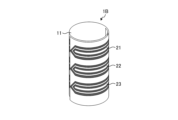
- FIG. 9 is a perspective view of an actuator coil board 1B according to the third embodiment.
- FIG. 9 schematically shows the actuator coil substrate 1B.
- FIG. 10 is a schematic diagram of the actuator coil substrate 1B before winding the flexible insulating substrate 11 included in the actuator coil substrate 1B according to the third embodiment.
- the actuator coil board 1B Of the three coils 21, 22, 23 that the actuator coil board 1B has, it is the long side portion 20 of each of the three coils 21, 22, 23 that generates thrust in the direction of movement of the actuator.
- the crossover wire portion 20A at the end of the coil that connects the long side portions 20 of the same phase in the axial direction hardly contributes to the thrust force in the traveling direction of the actuator.
- the crossover portion 20A will be referred to as a "coil end portion 20A.” That is, in the three coils 21, 22, and 23 facing the magnet, the larger the proportion occupied by the long side portion 20 is than the proportion occupied by the coil end portion 20A, the greater the thrust force in the advancing direction of the actuator.
- the length of the winding in the long side direction of each of the three coils 21, 22, 23 formed on the flexible insulating substrate 11 is the same as that after the flexible insulating substrate 11 is made into a cylinder. It is configured to be longer than the inner circumference length. In other words, when the flexible insulating substrate 11 is wound, there will be places where the long sides 20 overlap in the radial direction, and for each of the three coils 21, 22, 23, the first winding and the second winding will overlap. It can be considered that the subsequent windings are connected in the circumferential direction, and the proportion occupied by the long side portion 20 can be increased.
- the ratio of the long side portion 20 to the coil end portion 20A is expressed by equation (2).
- the ratio of equation (2) is larger than the ratio of equation (1). Therefore, in the coil structure of Embodiment 3, the thrust force in the traveling direction of the actuator is larger than that in the case where the longitudinal portion of each of the three coils 21, 22, 23 is completed in one circumferential turn. Further, as can be seen from equation (2), the larger the number of turns n of the flexible insulating substrate 11, the larger the proportion of the long side portion 20, and the larger the rate of increase in thrust force.
- the length of the long side 20 of each of the three coils 21, 22, 23 in the winding direction of the flexible insulating substrate 11 is longer than that of the flexible insulating substrate. 11 is longer than the inner circumference of the cylinder after it is wound around the cylinder.
- the long side portion 20 that contributes to the thrust force is wound around one turn or more, and the ratio of the long side portion 20 to the length of the coil increases. Contributes to an increase in thrust.
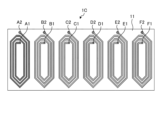
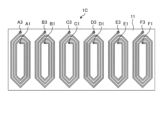
- Embodiment 4. 11 and 12 are both schematic diagrams of an actuator coil substrate 1C according to the fourth embodiment.
- the spiral object is a coil.
- 11 and 12 show the actuator coil substrate 1C before the flexible insulating substrate 11 is wound around it.
- FIG. 11 shows the actuator coil substrate 1C on the front side of the flexible insulating substrate 11
- FIG. 12 shows the actuator coil substrate 1C when the back side of the flexible insulating substrate 11 is seen through from the front side. It shows.
- the direction in which the flexible insulating substrate 11 is wound is the vertical direction, and coils are printed on both sides of the flexible insulating substrate 11.
- the coil pattern is formed such that the axial center positions of each winding coincide. In other words, the coil is a so-called concentrated winding coil.
- FIGS. 11 and 12 the connection portion beyond each coil end is omitted.
- the coils located at the same position on the front and back sides of the flexible insulating substrate 11 in the axial direction are connected to two terminals A1, B1, . . . , E1 located at the same position via inner vias or the like.
- the above-mentioned axial direction is the left-right direction in FIGS. 11 and 12.
- Coils at different positions in the axial direction are connected in series or in parallel so that the current phases match.
- terminals A2, B2, and C2 become the inflow sources of current for each phase
- terminal A3 is connected to terminal D2
- terminal B3 is connected to terminal E2.
- a configuration may be considered in which the terminal C3 is connected to the terminal F2, and the terminal D3, the terminal E3, and the terminal F3 are short-circuited.
- the flexible insulating substrate 11 also has an end in the axial direction.
- the coil is a concentrated winding coil as shown in FIGS. 11 and 12, it is possible to arrange the coil up to both left and right ends of both sides of the flexible insulating substrate 11.
- FIGS. 13 and 14 are diagrams for comparison with FIGS. 11 and 12, and are diagrams showing examples of coil patterns that are not concentrated winding.
- the spiral object is a coil.
- 13 and 14 show the actuator coil substrate before the flexible insulating substrate 11 is wound around it.
- FIG. 13 shows the actuator coil substrate on the front side of the flexible insulating substrate 11, and
- FIG. 14 shows the actuator coil substrate when the back side of the flexible insulating substrate 11 is seen through from the front side. There is.
- FIGS. 13 and 14 show how each winding is arranged so as to be shifted at a constant interval in the axial direction.
- FIGS. 13 and 14 show so-called distributed winding.
- one turn of the coil winding is comprised of the front side and the back side of the flexible insulating substrate 11.
- Two terminals H2,..., H6, I2,..., I6,..., P2,..., P6 located at the same position on both sides of the flexible insulating substrate 11 are connected to inner vias, etc.
- the loops of each winding are staggered in the axial direction to form three turns per coil.
- the wires between the coils are connected so that the long sides on the front side and the long sides on the back side of each coil are energized in the same phase and in the same direction.
- terminal H1, terminal I7, and terminal J1 become the inflow sources of each phase current
- terminal H7 is connected to terminal K7
- terminal K1 is connected to terminal N1.
- terminal I1 is connected to terminal L1
- terminal L7 is connected to terminal O7
- terminal J7 is connected to terminal M7
- terminal M1 is connected to terminal P1
- terminal N7, terminal O1, and terminal P7 are connected.
- Possible configurations include short-circuited configurations.
- the long sides cannot be printed on the right side in the axial direction of the front surface and the left side in the axial direction of the back side due to the relationship between the coil ends, or the long sides and coil ends It is necessary to print by changing the length of the part, both of which lead to a reduction in the thrust of the actuator.
- the coils can be arranged up to the axial ends of both sides of the flexible insulating substrate 11, which contributes to improving the thrust of the actuator. Then you can say.
- each of the three coils 21, 22, and 23 is printed with concentrated winding, which is a winding method in which the axial positions of each winding turn in one coil coincide. ing. Therefore, it becomes possible to arrange the coils 21, 22, 23 on both sides of the flexible insulating substrate 11 up to the end in the axial direction, and the number of turns of each of the three coils 21, 22, 23 increases, and the actuator The thrust of the actuator having the coil substrate 1C increases.
- FIG. 15 is a schematic diagram of an actuator coil substrate 1D according to the fifth embodiment.
- the spiral object is a coil.
- FIG. 15 shows how each winding is bent at 90 degrees at the coil end of a coil printed with concentrated winding.
- the ends of the long sides of each of the plurality of coils are bent at 90 degrees inside the flexible insulating substrate 11.
- This allows the long side portion that generates thrust to be the longest for the same coil length.
- the thrust of the actuator having the actuator coil substrate 1D increases.
- the actuator coil substrate 1D since the length of the coil end portion in the winding direction is the shortest, there is also an advantage that the area where the rigidity changes during winding can be minimized.
- the conductor windings are densely distributed up to the ends of the flexible insulating substrate 11, the effect of making it easier to wind the actuator coil substrate 1D can be obtained.
- FIG. 16 is a schematic diagram of an actuator coil substrate 1E according to the sixth embodiment.
- FIG. 16 shows the actuator coil board 1E before the board is wound, and shows different surfaces of the boards 11A and 11B on the left and right sides.
- the spiral object is a coil.
- the substrates 11A and 11B are flexible insulating substrates.
- the direction in which the substrates 11A and 11B are wound is the left-right direction.
- the coils printed on the substrates 11A and 11B are not formed inside the left and right substrates 11A and 11B, respectively. Each coil is printed so that each coil is formed when the left and right substrates 11A and 11B are connected in the winding direction.
- a terminal 29 is provided at the end of the winding to be connected on one of the substrates 11A and 11B, and is connected to the terminal 29 at the same axial position on the other substrate by wiring or the like.
- the axial direction mentioned above is the vertical direction.
- the flexible insulating substrate is divided in the winding direction.
- the coils printed on each divided board are electrically connected between each divided board. That is, the actuator coil substrate 1E according to the sixth embodiment can eliminate manufacturing limitations on the length of the substrate in the winding direction, and can be used in cases where the flexible insulating substrate has a very large number of turns, or when the number of turns is large. Can be used for cases with very large diameters.
- FIG. 16 shows two left and right boards 11A and 11B, three or more boards may be connected.
- the boards including the coil end portions are the left end board and the right end board.
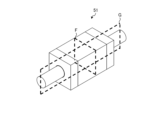
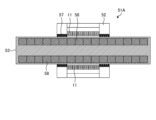
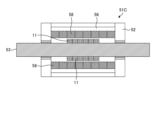
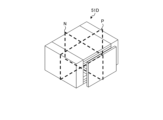
- Embodiment 7. 17 and 18 are perspective views of the actuator 51 according to the seventh embodiment. 17 and 18 schematically show the actuator 51.
- FIG. FIG. 18 shows a cross section F and a cross section G for explaining the actuator 51.
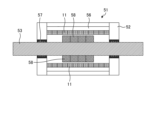
- FIG. 19 is a cross-sectional view of actuator 51 according to Embodiment 7 at cross-section F.
- FIG. FIG. 20 is a sectional view of the actuator 51 according to the seventh embodiment at cross section G. 19 and 20 schematically show a cross section of the actuator 51.
- the actuator 51 has a housing portion 52 having a rectangular parallelepiped outer shape, and a cylindrical shaft 53 protruding from the housing portion 52.
- the housing portion 52 is covered on the outside by brackets 54A, 54B and a frame 55, and the inner surface of the frame 55 has a cylindrical shape.
- a core 56 made of a soft magnetic material is inserted along the inner peripheral surface of the frame 55, and an actuator coil substrate having a flexible insulating substrate 11 wound into a cylindrical shape is inserted inside the core 56.
- a bearing 57 is installed in the radial center of the brackets 54A, 54B to reduce sliding resistance in the axial direction, and the shaft 53 is held by the bearings 57 of the brackets 54A, 54B on both sides.
- a magnet 58 is attached to the surface of the shaft 53 inside the housing 52, and the magnet 58 faces the flexible insulating substrate 11 with a certain gap in between.
- the magnet 58 is radially magnetized, and the magnetization orientation is alternated at regular intervals in the axial direction.
- a four-pole magnet 58 and twelve flexible insulating substrates 11 are shown, but the number of poles of the magnet 58, the number of flexible insulating substrates 11, and the number of magnets 58 and flexible insulating substrates 11 are The arrangement of the insulating substrate 11 is not limited to that shown in FIG. 20.
- the flexible insulating substrate 11 By applying a current with a certain periodicity to the flexible insulating substrate 11, the flexible insulating substrate 11 becomes an armature, and the housing portion 52 or the shaft 53 moves in translation in the axial direction. Therefore, by fixing one of the housing portion 52 and the shaft 53 so as not to move, it is possible to move only the other.
- the actuator 51 according to the seventh embodiment shown in FIG. The space of the actuator 51 increases, and the thrust of the actuator 51 increases.
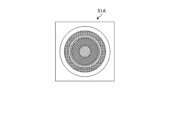
- Embodiment 8. 21 and 22 are perspective views of an actuator 51A according to the eighth embodiment. 21 and 22 schematically show the actuator 51A.
- FIG. 22 shows a cross section H and a cross section I for explaining the actuator 51A.
- FIG. 23 is a cross-sectional view of the actuator 51A according to the eighth embodiment at cross section H.
- FIG. 24 is a cross-sectional view of the actuator 51A according to the eighth embodiment at cross section I. 23 and 24 schematically show a cross section of the actuator 51A.
- the magnet 58 is not attached to the surface of the shaft 53, It is located inside the shaft 53.
- Possible methods for manufacturing the shaft 53 include inserting a cylindrical magnet 58 into the cylindrical shaft 53, or molding the shaft 53 so that the magnet 58 is included.
- the actuator 51A since the diameter of the shaft 53 is constant over the entire section, the movable range of the shaft 53 can be widened in the axial direction. Since there is no need to secure a space in the housing section 52 to avoid contact with the magnet 58, the actuator 51A allows the housing section 52 to be shortened in the axial direction.
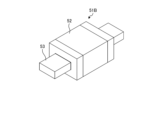
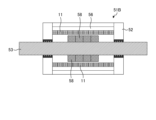
- Embodiment 9. 25 and 26 are perspective views of an actuator 51B according to the ninth embodiment. 25 and 26 schematically show the actuator 51B.
- FIG. 26 shows a cross section J and a cross section K for explaining the actuator 51B.
- FIG. 27 is a cross-sectional view of actuator 51B according to Embodiment 9 at cross-section J.
- FIG. 28 is a cross-sectional view of actuator 51B at cross section K according to the ninth embodiment. 27 and 28 schematically show a cross section of the actuator 51B.
- the actuator 51B according to the ninth embodiment shown in FIG. It is a rectangle with the long side as the long side.
- the core 56 and the flexible insulating substrate 11 located inside the casing 52 have rectangular cross sections in the axial direction.
- a plate-shaped or block-shaped magnet 58 is attached to the upper and lower surfaces of the shaft 53 so as to face the flexible insulating substrate 11 over a wide area.
- the magnetization orientation of the magnet 58 is reversed in the radial direction on the upper and lower surfaces, and the upper and lower magnetization orientations are reversed at regular intervals in the axial direction.
- the cross section of the actuator 51B is rectangular, so that the actuator 51B can be installed in a narrow space. Since the rectangular magnet 58 is used, the magnet 58 can be easily processed, and the manufacturing cost of the actuator 51B is reduced.
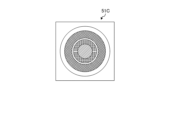
- Embodiment 10. 29 and 30 are perspective views of an actuator 51C according to the tenth embodiment. 29 and 30 schematically show the actuator 51C.
- FIG. 30 shows a cross section L and a cross section M for explaining the actuator 51C.
- FIG. 31 is a cross-sectional view of actuator 51C in cross section L according to the tenth embodiment.
- FIG. 32 is a cross-sectional view of actuator 51C according to Embodiment 10 at cross-section M.
- FIG. 31 and 32 schematically show a cross section of the actuator 51C.
- a magnet 58 is attached to the inside of the core 56 of the housing portion 52, and the flexible insulating substrate 11 is wound around the surface of the shaft 53.
- the flexible insulating substrate 11 when manufacturing the casing 52, a flexible A possible manufacturing process is to wind the insulating substrate 11, remove the jig after bonding, and attach the flexible insulating substrate 11 to the core 56.
- the flexible insulating substrate 11 can be directly wound around the shaft 53 using the shaft 53 as a core, which simplifies the manufacturing process. With the structure of the actuator 51C, there is no need to remove the jig, so there is no risk of damage to the inner peripheral surface of the flexible insulating substrate 11 due to sliding of the jig.
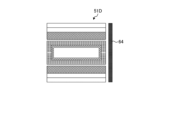
- Embodiment 11 33 and 34 are perspective views of an actuator 51D according to the eleventh embodiment. 33 and 34 schematically show the actuator 51D.
- FIG. 34 shows a cross section N and a cross section P for explaining the actuator 51D.
- FIG. 35 is a cross-sectional view of actuator 51D according to the eleventh embodiment at cross section N.
- FIG. 36 is a sectional view of actuator 51D according to the eleventh embodiment at cross section P. 35 and 36 schematically show a cross section of the actuator 51D.
- the actuator 51D does not have the shaft 53 that the actuators 51, 51A, 51B, and 51C have.
- the actuator 51D has a support core 61 arranged at the center of the housing portion 52 instead of the shaft 53.
- Support core 61 is connected to brackets 54A and 54B.
- the cross-sectional shape of the support core 61 is rectangular, and sliding parts 62 are attached to each surface of the support core 61, and the flexible insulating substrate 11 is wound around the outside of the sliding parts 62. This allows the flexible insulating substrate 11 to move in parallel around the support core 61.
- a support 63 extends from a portion of the sliding component 62 where the flexible insulating substrate 11 is not wound, and the support 63 supports a table 64 located outside the housing portion 52. Therefore, the parallel motion of the flexible insulating substrate 11 is transmitted to the table 64 via the sliding component 62.
- a core 56 is arranged inside the frame 55 of the housing section 52, and a magnet 58 is attached inside the core 56, and the magnet 58 faces the front and back surfaces of the flexible insulating substrate 11.
- the table 64 is attached with the pillars 63 extending from one side of the housing 52, but the pillars 63 can be extended from both sides of the housing 52, or the magnets 58 can also be placed on the vacant sides. It is also possible to consider a structure in which the number of facing surfaces between the magnet 58 and the coil is increased by attaching a .
- the actuator 51D when the armature side is used as the movable element, it is possible to reduce the weight of the movable element excluding the table 64 as much as possible, and it is possible to obtain a high thrust density.
- the actuators 51, 51A, 51B, 51C, and 51D of Embodiments 7 to 11 include an actuator coil board and a magnet 58 arranged to face the actuator coil board.
- the actuator coil substrate is an actuator coil substrate according to any one of the first to sixth embodiments.
- the actuators 51, 51A, 51B, 51C, and 51D according to each embodiment from Embodiment 7 to Embodiment 11 have a simplified structure because the number of holding members around the coil can be reduced. Since the space of the armature occupying the housing portion 52 increases, the thrust of the actuators 51, 51A, 51B, 51C, and 51D increases.
- a mover or a stator including a magnet 58 is arranged inside each of the plurality of coils.
- a mover or a stator including a magnet is arranged outside each of the plurality of coils.
- the flexible insulating substrate 11 can be directly wound around the shaft 53 or the sliding component 62 as a core, which simplifies the manufacturing process.
- the flexible insulating substrate 11 can be wound around the actuators 51C and 51D, and the actuators 51C and 51D contribute to improving the thrust of the motor.
Landscapes
- Engineering & Computer Science (AREA)
- Power Engineering (AREA)
- Physics & Mathematics (AREA)
- Chemical & Material Sciences (AREA)
- Combustion & Propulsion (AREA)
- Electromagnetism (AREA)
- Windings For Motors And Generators (AREA)
- Linear Motors (AREA)
- Parts Printed On Printed Circuit Boards (AREA)
- Reciprocating, Oscillating Or Vibrating Motors (AREA)
Priority Applications (5)
| Application Number | Priority Date | Filing Date | Title |
|---|---|---|---|
| JP2023567242A JP7499984B2 (ja) | 2022-07-05 | 2022-07-05 | アクチュエータ用コイル基板及びアクチュエータ |
| US18/879,895 US20260005568A1 (en) | 2022-07-05 | 2022-07-05 | Actuator coil substrate and actuator |
| DE112022007487.6T DE112022007487T5 (de) | 2022-07-05 | 2022-07-05 | Aktorspulensubstrat und aktor |
| PCT/JP2022/026661 WO2024009375A1 (ja) | 2022-07-05 | 2022-07-05 | アクチュエータ用コイル基板及びアクチュエータ |
| JP2024073731A JP7621540B2 (ja) | 2022-07-05 | 2024-04-30 | アクチュエータ用コイル基板及びアクチュエータ |
Applications Claiming Priority (1)
| Application Number | Priority Date | Filing Date | Title |
|---|---|---|---|
| PCT/JP2022/026661 WO2024009375A1 (ja) | 2022-07-05 | 2022-07-05 | アクチュエータ用コイル基板及びアクチュエータ |
Publications (1)
| Publication Number | Publication Date |
|---|---|
| WO2024009375A1 true WO2024009375A1 (ja) | 2024-01-11 |
Family
ID=89453021
Family Applications (1)
| Application Number | Title | Priority Date | Filing Date |
|---|---|---|---|
| PCT/JP2022/026661 Ceased WO2024009375A1 (ja) | 2022-07-05 | 2022-07-05 | アクチュエータ用コイル基板及びアクチュエータ |
Country Status (4)
| Country | Link |
|---|---|
| US (1) | US20260005568A1 (https=) |
| JP (2) | JP7499984B2 (https=) |
| DE (1) | DE112022007487T5 (https=) |
| WO (1) | WO2024009375A1 (https=) |
Cited By (1)
| Publication number | Priority date | Publication date | Assignee | Title |
|---|---|---|---|---|
| EP4641885A1 (en) * | 2024-04-22 | 2025-10-29 | Shinshu University | Motor coil substrate |
Citations (6)
| Publication number | Priority date | Publication date | Assignee | Title |
|---|---|---|---|---|
| JPH09502597A (ja) * | 1994-05-18 | 1997-03-11 | ハントレイ テクノロジー パブリック リミテッド カンパニー | リニア磁気アクチュエータ |
| JP2004228416A (ja) * | 2003-01-24 | 2004-08-12 | Seizo Hataya | ソレノイドコイルおよびアクチュェーター |
| JP2012016173A (ja) * | 2010-06-30 | 2012-01-19 | Brother Ind Ltd | 振動発電機 |
| JP2012039824A (ja) * | 2010-08-10 | 2012-02-23 | Brother Ind Ltd | 振動発電機 |
| US20180085559A1 (en) * | 2016-09-28 | 2018-03-29 | Project Moray, Inc. | Base station, charging station, and/or server for robotic catheter systems and other uses, and improved articulated devices and systems |
| US20190356210A1 (en) * | 2018-05-21 | 2019-11-21 | Apple Inc. | Double Helix Actuator |
Family Cites Families (9)
| Publication number | Priority date | Publication date | Assignee | Title |
|---|---|---|---|---|
| AT323285B (de) * | 1973-03-13 | 1975-07-10 | Retobobina Handelsanstalt | Elektrische ankerwicklung |
| JPH0619296Y2 (ja) * | 1984-07-11 | 1994-05-18 | 旭化成工業株式会社 | リニアアクチュエ−タ用プリントコイル |
| US7239065B2 (en) | 2003-07-08 | 2007-07-03 | Tibion Corporation | Electrostatic actuator with fault tolerant electrode structure |
| US20070296369A1 (en) | 2005-09-16 | 2007-12-27 | Showway Yeh | Thin linear, rotary, and step motor and electromagnet driver using printed coil board |
| JP4784856B2 (ja) | 2005-10-17 | 2011-10-05 | 株式会社安川電機 | リニアアクチュエータおよび駆動システム |
| JP5624888B2 (ja) | 2008-09-30 | 2014-11-12 | Thk株式会社 | 直線・回転複合アクチュエータ |
| JP2011166893A (ja) | 2010-02-05 | 2011-08-25 | Onkyo Corp | 振動発電機 |
| CA2834736A1 (en) | 2011-04-11 | 2012-10-18 | Allied Motion Technologies Inc. | Flexible winding for an electric motor and method of producing |
| JP7412291B2 (ja) | 2020-07-06 | 2024-01-12 | 三菱電機株式会社 | コイル体、固定子、回転機、コイル体の製造方法およびプリント配線板 |
-
2022
- 2022-07-05 JP JP2023567242A patent/JP7499984B2/ja active Active
- 2022-07-05 WO PCT/JP2022/026661 patent/WO2024009375A1/ja not_active Ceased
- 2022-07-05 DE DE112022007487.6T patent/DE112022007487T5/de active Pending
- 2022-07-05 US US18/879,895 patent/US20260005568A1/en active Pending
-
2024
- 2024-04-30 JP JP2024073731A patent/JP7621540B2/ja active Active
Patent Citations (6)
| Publication number | Priority date | Publication date | Assignee | Title |
|---|---|---|---|---|
| JPH09502597A (ja) * | 1994-05-18 | 1997-03-11 | ハントレイ テクノロジー パブリック リミテッド カンパニー | リニア磁気アクチュエータ |
| JP2004228416A (ja) * | 2003-01-24 | 2004-08-12 | Seizo Hataya | ソレノイドコイルおよびアクチュェーター |
| JP2012016173A (ja) * | 2010-06-30 | 2012-01-19 | Brother Ind Ltd | 振動発電機 |
| JP2012039824A (ja) * | 2010-08-10 | 2012-02-23 | Brother Ind Ltd | 振動発電機 |
| US20180085559A1 (en) * | 2016-09-28 | 2018-03-29 | Project Moray, Inc. | Base station, charging station, and/or server for robotic catheter systems and other uses, and improved articulated devices and systems |
| US20190356210A1 (en) * | 2018-05-21 | 2019-11-21 | Apple Inc. | Double Helix Actuator |
Cited By (1)
| Publication number | Priority date | Publication date | Assignee | Title |
|---|---|---|---|---|
| EP4641885A1 (en) * | 2024-04-22 | 2025-10-29 | Shinshu University | Motor coil substrate |
Also Published As
| Publication number | Publication date |
|---|---|
| US20260005568A1 (en) | 2026-01-01 |
| JP7621540B2 (ja) | 2025-01-24 |
| JP7499984B2 (ja) | 2024-06-14 |
| JP2024094427A (ja) | 2024-07-09 |
| DE112022007487T5 (de) | 2025-05-08 |
| JPWO2024009375A1 (https=) | 2024-01-11 |
Similar Documents
| Publication | Publication Date | Title |
|---|---|---|
| JP4699961B2 (ja) | 回転電機用コイルとその製造方法、並びに回転電機とその製造方法 | |
| EP2063516B1 (en) | Stator for rotating machine and rotating machine using the same | |
| CN106464111B (zh) | 轴向气隙型旋转电机 | |
| US20090140595A1 (en) | Stator for Rotating Machine and Rotating Machine Using the Same | |
| WO2018139245A1 (ja) | コアレス電気機械装置、コイル用導線、及び、コアレス電気機械装置の製造方法 | |
| JPWO2004047252A1 (ja) | ブラシレスモータのステータ、及び、これを備えたブラシレスモータ、並びにコイル構造 | |
| WO2007037298A9 (ja) | リニアモータ及びその製造方法 | |
| JP4883327B2 (ja) | ギャップワインディング形モータ | |
| JP2018166353A (ja) | 電動モータ | |
| CN114337172A (zh) | 轴向磁通式pcb绕组永磁同步电机及其定子 | |
| WO2023228518A1 (ja) | アキシャルギャップ型モータ | |
| JP7621540B2 (ja) | アクチュエータ用コイル基板及びアクチュエータ | |
| JP3550678B2 (ja) | リニアモータ | |
| WO2001099261A1 (fr) | Moteur lineaire | |
| JPWO2021131575A5 (https=) | ||
| WO2021131575A1 (ja) | コイル及びそれを備えたステータ、モータ | |
| JP2001197718A (ja) | コアレスリニアモータ | |
| JP7570586B1 (ja) | 多軸アクチュエータ用コイルおよび多軸アクチュエータ | |
| JP2002034229A (ja) | コアレスリニアモータ | |
| JP7446552B1 (ja) | 電動機 | |
| JP5454150B2 (ja) | θZアクチュエータ | |
| JP7621131B2 (ja) | 回転電機 | |
| JP2013094030A (ja) | 電機子コイル及び同期回転機 | |
| JP2020171095A (ja) | ステータ | |
| CN116846117A (zh) | 印刷电路板绕组组件和电机 |
Legal Events
| Date | Code | Title | Description |
|---|---|---|---|
| WWE | Wipo information: entry into national phase |
Ref document number: 2023567242 Country of ref document: JP |
|
| 121 | Ep: the epo has been informed by wipo that ep was designated in this application |
Ref document number: 22950169 Country of ref document: EP Kind code of ref document: A1 |
|
| WWE | Wipo information: entry into national phase |
Ref document number: 18879895 Country of ref document: US |
|
| WWE | Wipo information: entry into national phase |
Ref document number: 112022007487 Country of ref document: DE |
|
| WWP | Wipo information: published in national office |
Ref document number: 112022007487 Country of ref document: DE |
|
| 122 | Ep: pct application non-entry in european phase |
Ref document number: 22950169 Country of ref document: EP Kind code of ref document: A1 |
|
| WWP | Wipo information: published in national office |
Ref document number: 18879895 Country of ref document: US |