WO2023282161A1 - 低分子化抗体 - Google Patents
低分子化抗体 Download PDFInfo
- Publication number
- WO2023282161A1 WO2023282161A1 PCT/JP2022/026122 JP2022026122W WO2023282161A1 WO 2023282161 A1 WO2023282161 A1 WO 2023282161A1 JP 2022026122 W JP2022026122 W JP 2022026122W WO 2023282161 A1 WO2023282161 A1 WO 2023282161A1
- Authority
- WO
- WIPO (PCT)
- Prior art keywords
- aav
- adeno
- amino acid
- associated virus
- acid sequence
- Prior art date
- Legal status (The legal status is an assumption and is not a legal conclusion. Google has not performed a legal analysis and makes no representation as to the accuracy of the status listed.)
- Ceased
Links
Images




Classifications
-
- C—CHEMISTRY; METALLURGY
- C07—ORGANIC CHEMISTRY
- C07K—PEPTIDES
- C07K1/00—General methods for the preparation of peptides, i.e. processes for the organic chemical preparation of peptides or proteins of any length
- C07K1/14—Extraction; Separation; Purification
- C07K1/16—Extraction; Separation; Purification by chromatography
- C07K1/22—Affinity chromatography or related techniques based upon selective absorption processes
-
- C—CHEMISTRY; METALLURGY
- C07—ORGANIC CHEMISTRY
- C07K—PEPTIDES
- C07K16/00—Immunoglobulins [IG], e.g. monoclonal or polyclonal antibodies
-
- C—CHEMISTRY; METALLURGY
- C07—ORGANIC CHEMISTRY
- C07K—PEPTIDES
- C07K16/00—Immunoglobulins [IG], e.g. monoclonal or polyclonal antibodies
- C07K16/08—Immunoglobulins [IG], e.g. monoclonal or polyclonal antibodies against material from viruses
-
- C—CHEMISTRY; METALLURGY
- C12—BIOCHEMISTRY; BEER; SPIRITS; WINE; VINEGAR; MICROBIOLOGY; ENZYMOLOGY; MUTATION OR GENETIC ENGINEERING
- C12N—MICROORGANISMS OR ENZYMES; COMPOSITIONS THEREOF; PROPAGATING, PRESERVING, OR MAINTAINING MICROORGANISMS; MUTATION OR GENETIC ENGINEERING; CULTURE MEDIA
- C12N15/00—Mutation or genetic engineering; DNA or RNA concerning genetic engineering, vectors, e.g. plasmids, or their isolation, preparation or purification; Use of hosts therefor
- C12N15/09—Recombinant DNA-technology
- C12N15/63—Introduction of foreign genetic material using vectors; Vectors; Use of hosts therefor; Regulation of expression
-
- C—CHEMISTRY; METALLURGY
- C12—BIOCHEMISTRY; BEER; SPIRITS; WINE; VINEGAR; MICROBIOLOGY; ENZYMOLOGY; MUTATION OR GENETIC ENGINEERING
- C12N—MICROORGANISMS OR ENZYMES; COMPOSITIONS THEREOF; PROPAGATING, PRESERVING, OR MAINTAINING MICROORGANISMS; MUTATION OR GENETIC ENGINEERING; CULTURE MEDIA
- C12N15/00—Mutation or genetic engineering; DNA or RNA concerning genetic engineering, vectors, e.g. plasmids, or their isolation, preparation or purification; Use of hosts therefor
- C12N15/09—Recombinant DNA-technology
- C12N15/63—Introduction of foreign genetic material using vectors; Vectors; Use of hosts therefor; Regulation of expression
- C12N15/74—Vectors or expression systems specially adapted for prokaryotic hosts other than E. coli, e.g. Lactobacillus, Micromonospora
-
- C—CHEMISTRY; METALLURGY
- C12—BIOCHEMISTRY; BEER; SPIRITS; WINE; VINEGAR; MICROBIOLOGY; ENZYMOLOGY; MUTATION OR GENETIC ENGINEERING
- C12N—MICROORGANISMS OR ENZYMES; COMPOSITIONS THEREOF; PROPAGATING, PRESERVING, OR MAINTAINING MICROORGANISMS; MUTATION OR GENETIC ENGINEERING; CULTURE MEDIA
- C12N15/00—Mutation or genetic engineering; DNA or RNA concerning genetic engineering, vectors, e.g. plasmids, or their isolation, preparation or purification; Use of hosts therefor
- C12N15/09—Recombinant DNA-technology
- C12N15/63—Introduction of foreign genetic material using vectors; Vectors; Use of hosts therefor; Regulation of expression
- C12N15/79—Vectors or expression systems specially adapted for eukaryotic hosts
- C12N15/80—Vectors or expression systems specially adapted for eukaryotic hosts for fungi
-
- C—CHEMISTRY; METALLURGY
- C12—BIOCHEMISTRY; BEER; SPIRITS; WINE; VINEGAR; MICROBIOLOGY; ENZYMOLOGY; MUTATION OR GENETIC ENGINEERING
- C12N—MICROORGANISMS OR ENZYMES; COMPOSITIONS THEREOF; PROPAGATING, PRESERVING, OR MAINTAINING MICROORGANISMS; MUTATION OR GENETIC ENGINEERING; CULTURE MEDIA
- C12N15/00—Mutation or genetic engineering; DNA or RNA concerning genetic engineering, vectors, e.g. plasmids, or their isolation, preparation or purification; Use of hosts therefor
- C12N15/09—Recombinant DNA-technology
- C12N15/63—Introduction of foreign genetic material using vectors; Vectors; Use of hosts therefor; Regulation of expression
- C12N15/79—Vectors or expression systems specially adapted for eukaryotic hosts
- C12N15/80—Vectors or expression systems specially adapted for eukaryotic hosts for fungi
- C12N15/81—Vectors or expression systems specially adapted for eukaryotic hosts for fungi for yeasts
-
- C—CHEMISTRY; METALLURGY
- C12—BIOCHEMISTRY; BEER; SPIRITS; WINE; VINEGAR; MICROBIOLOGY; ENZYMOLOGY; MUTATION OR GENETIC ENGINEERING
- C12N—MICROORGANISMS OR ENZYMES; COMPOSITIONS THEREOF; PROPAGATING, PRESERVING, OR MAINTAINING MICROORGANISMS; MUTATION OR GENETIC ENGINEERING; CULTURE MEDIA
- C12N5/00—Undifferentiated human, animal or plant cells, e.g. cell lines; Tissues; Cultivation or maintenance thereof; Culture media therefor
- C12N5/10—Cells modified by introduction of foreign genetic material
-
- C—CHEMISTRY; METALLURGY
- C12—BIOCHEMISTRY; BEER; SPIRITS; WINE; VINEGAR; MICROBIOLOGY; ENZYMOLOGY; MUTATION OR GENETIC ENGINEERING
- C12N—MICROORGANISMS OR ENZYMES; COMPOSITIONS THEREOF; PROPAGATING, PRESERVING, OR MAINTAINING MICROORGANISMS; MUTATION OR GENETIC ENGINEERING; CULTURE MEDIA
- C12N7/00—Viruses; Bacteriophages; Compositions thereof; Preparation or purification thereof
Definitions
- the present invention relates to minibodies.
- Adeno-associated virus (AAV) vectors are important molecules in medical fields such as gene therapy. For its use, there is a demand for a purification technique for efficiently recovering AAV vectors from biological samples such as cell cultures.
- solids such as cells and cell debris are first removed by filtration from the culture medium of transformed cells in which the virus is produced, and then purification is performed by ultracentrifugation, chromatography, or the like. is known (Patent Document 1, etc.).
- Affinity chromatography is a technique that separates the target molecule from other impurities using a carrier in which a ligand such as a low-molecular-weight antibody that specifically binds to the target molecule is immobilized on a base material such as beads.
- a ligand such as a low-molecular-weight antibody that specifically binds to the target molecule is immobilized on a base material such as beads.
- affinity chromatography used for AAV vector purification, commercially available products such as Cytiva's Capto (registered trademark) AVB and Thermo Fisher Scientific's POROS (registered trademark) CaptureSelect (registered trademark) AAVX are known.
- Non-Patent Document 1 there was a problem in efficiently purifying the AAV vector while maintaining the titer.
- the object of the present invention is to solve the above-mentioned problems in the past and to achieve the following objects. That is, the present invention provides a low-molecular-weight antibody that dissociates from AAV in a weakly acidic solution, and an efficient method for producing AAV using the same.
- a low-molecular-weight antibody that binds to adeno-associated virus (AAV), wherein the adeno-associated virus (AAV) and the low-molecular-weight antibody
- the dissociation rate constant at pH 5.0 is 1 ⁇ 10 -2 (s -1 ) or more, and the dissociation rate constant at pH 5.0 is 10 times or more the dissociation rate constant at pH 7.0
- a minibody characterized in that it binds to adeno-associated virus (AAV), wherein the amino acid sequence of variable heavy chain complementarity determining region 2 is the amino acid sequence set forth in SEQ ID NO: 1, or In the amino acid sequence set forth in SEQ ID NO: 1, at least one selected from the group consisting of serine at position 2 from the N-terminus and threonine at position 6 from the N-terminus is substituted with another amino acid, and variable heavy chain complementarity
- the amino acid sequence of the determining region 3 is the amino acid sequence set
- At least one of the amino acid sequence of the variable heavy chain complementarity determining region 2 or the amino acid sequence of the variable heavy chain complementarity determining region 3 is set forth in SEQ ID NO: 1 Among the amino acid sequences, at least one selected from the group consisting of the second serine and the sixth threonine from the N-terminus is substituted with another amino acid or the amino acid sequence set forth in SEQ ID NO: 2, the N-terminus and at least one selected from the group consisting of arginine and the fourth tryptophan from the N-terminus is an amino acid sequence substituted with another amino acid, or an adeno-associated virus (AAV) A low-molecular-weight antibody that binds, wherein the amino acid sequence of framework region 3 is arginine at position 15 and asparagine at position 16 from the N-terminus in the amino acid sequence set forth in SEQ ID NOs: 3, 4, 36, or 37 An amino acid sequence in which at least one selected from the group consisting of acid, asparagine or isole
- AAV adeno-associated virus
- a low-molecular-weight antibody that can solve the above-mentioned conventional problems and achieve the above-mentioned objects, and that dissociates from AAV in a weakly acidic solution, and an efficient method for producing AAV using the same. can do.
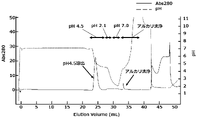
- FIG. 1 is a chromatogram of AAV adsorption/desorption by Carrier 1.
- FIG. 2 is a chromatogram of AAV adsorption/desorption by carrier 2.
- FIG. 3 is a chromatogram of AAV adsorption/desorption by carrier 3.
- FIG. 4 is a chromatogram of AAV adsorption/desorption by carrier 4.
- FIG. 5 is a chromatogram of AAV adsorption/desorption by carrier 7.
- FIG. FIG. 6 is a chromatogram of AAV adsorption/desorption by carrier 9.
- FIG. 7 is a chromatogram of AAV adsorption/desorption by carrier 6.
- FIG. 8 is a chromatogram of AAV adsorption/desorption by carrier 8.
- FIG. 9 shows the results of measurement of gene transfer efficiency of AAV2 eluted with pH 4.5 or pH 2.1 buffers.
- FIG. 10 shows the results of measuring the gene transfer efficiency of AAV2 eluted with pH 4.5 or pH 2.1 buffers.
- FIG. 11 is a chromatogram of AAV adsorption/desorption by the carrier 10.
- FIG. 12 is a chromatogram of AAV adsorption/desorption by carrier 7.
- the low-molecular-weight antibody is a low-molecular-weight antibody that binds to adeno-associated virus (AAV), (1)
- the dissociation rate constant at pH 5.0 between the adeno-associated virus (AAV) and the low-molecular-weight antibody is 1 ⁇ 10 ⁇ 2 (s ⁇ 1 ) or more, and the dissociation rate at pH 5.0 a constant greater than or equal to 10 times the dissociation rate constant at pH 7.0;
- the amino acid sequence of the variable heavy chain complementarity determining region 2 is the amino acid sequence set forth in SEQ ID NO: 1, or from the second serine and the sixth threonine from the N-terminus in the amino acid sequence set forth in SEQ ID NO: 1;
- At least one selected from the group consisting of an amino acid sequence substituted with other amino acids, and the amino acid sequence of the variable heavy chain complementarity determining region 3 is the amino acid sequence set forth in SEQ ID NO: 2, or the amino acid sequence set forth in
- At least one selected from the group consisting of N-terminal arginine and 4th tryptophan from the N-terminus in the amino acid sequence or the amino acid sequence shown in SEQ ID NO: 2 in which at least one is substituted with other amino acids is substituted with other amino acids is a substituted amino acid sequence, or (3) the amino acid sequence of framework region 3 is arginine at position 15, aspartic acid at position 16, asparagine at position 17, or asparagine at position 17 from the N-terminus in the amino acid sequence set forth in SEQ ID NOs: 3, 4, 36, or 37; An amino acid sequence in which at least one selected from the group consisting of isoleucine, glycine or lysine at position 19, asparagine at position 20, and tyrosine at position 23 is substituted with another amino acid.
- the low-molecular-weight antibody dissociates from adeno-associated virus (AAV) in a weakly acidic solution.
- Antibody is a general name that focuses on the function of immunoglobulins.
- Immunoglobulins are glycoproteins produced by lymphocyte B cells, and have the function of recognizing and binding to molecules such as specific proteins. Immunoglobulins have the function of specifically binding to this specific molecule (antigen) and the function of detoxifying and removing antigen-bearing factors in cooperation with other biomolecules and cells.
- Immunoglobulin G (hereinafter sometimes abbreviated as "IgG") is a monomeric immunoglobulin, composed of two heavy chains ( ⁇ chains) and two light chains, and has two antigen binding sites. has parts.
- the region corresponding to the lower half vertical bar of the antibody "Y” is called the Fc region, and the upper half “V” is called the Fab region.
- the Fc region has an effector function that elicits a reaction after an antibody binds to an antigen, and the Fab region has a function of binding to an antigen.
- the Fab region and Fc region of the heavy chain are connected by a hinge region, and the proteolytic enzyme papain contained in papaya degrades this hinge region to cleave it into two Fab regions (fragments) and one Fc region.
- a portion (domain) of the Fab region near the tip of the "Y” is called a variable region (V region) because various changes are observed in the amino acid sequence so that it can bind to various antigens.
- the light chain variable region is called the VL region
- the heavy chain variable region is called the VH region.
- the Fab region and the Fc region other than the V region are regions that undergo relatively little change and are called constant regions (C regions).
- the light chain constant region is called the CL region
- the heavy chain constant region is called the CH region.
- the CH region is further divided into three regions, CH1 to CH3.
- the Fab region of the heavy chain consists of the VH region and CH1, and the Fc region of the heavy chain consists of CH2 and CH3.
- the hinge portion is located between CH1 and CH2.
- heavy-chain antibodies which are antibodies composed only of heavy chains without light chains.
- Camelid-derived heavy-chain antibodies are distinguished from normal IgG antibodies (IgG1), which have light chains, and are termed IgG2, IgG3.
- fish-derived heavy chain antibodies are called IgNAR (new antigen receptor).
- a low-molecular-weight antibody in the present invention is an antibody fragment in which a portion of a full-length antibody (whole antibody, for example, whole IgG, etc.) is deleted, and is not particularly limited as long as it has the ability to bind to an antigen.
- the minibodies of the present invention preferably do not have CH2 and CH3 domains.
- the minibodies of the present invention preferably contain either or both of a heavy chain variable region (VH) and a light chain variable region (VL).
- VH or VL amino acid sequence can contain additions, deletions and/or substitutions.
- VH or VL, or a portion of both can be deleted as long as they bind to the antigen.
- the low-molecular-weight antibody is not particularly limited and can be appropriately selected depending on the purpose.
- Variable region V-NAR
- Fab fragment antigen
- Fab' single chain antibody
- single chain antibody single chain antibody: scFv
- diabody tribody
- minibody minibody
- those containing camelid-derived heavy chain antibody variable regions (VHH) or single chain antibodies (scFv) are preferable from the viewpoint of stability and production efficiency.
- variable region (VHH) of the camelid-derived heavy chain antibody is not particularly limited and can be appropriately selected according to the purpose. Examples include those designed based on heavy chain antibodies and produced by expressing VHH genes in host cells, and those chemically synthesized based on amino acid sequences.
- the camelid is not particularly limited and can be appropriately selected depending on the intended purpose.
- the host cell in which the VHH gene is expressed is not particularly limited and can be appropriately selected according to the purpose. Examples include bacteria such as E. coli, fungi such as yeast, animal cells, and plant cells.
- the method of immunizing the camelid with the target to be adsorbed is not particularly limited and can be appropriately selected depending on the purpose.
- the method of producing VHH genes by expressing them in host cells is not particularly limited and can be appropriately selected according to the purpose. and the method described in .
- the single-chain antibody is obtained by linking the VH and VL of the antibody.
- VH and VL are joined via a linker, preferably a peptide linker (Proc. Natl. Acad. Sci. USA 1988 85:5879).
- the peptide linker is not particularly limited. For example, any single-chain peptide consisting of about 3 to 25 residues can be used as a linker.
- the scFv is not particularly limited and can be appropriately selected depending on the intended purpose. Examples thereof include those produced by expressing scFv genes in host cells, and those produced chemically based on amino acid sequences.
- the host cell in which the scFv gene is expressed is not particularly limited and can be appropriately selected according to the purpose. Examples include bacteria such as E. coli, fungi such as yeast, animal cells, and plant cells.
- Minibodies in the present invention preferably include single domain antibodies.
- the single domain antibody is not particularly limited and can be appropriately selected depending on the purpose, but preferably includes the variable region (VHH) of the camelid-derived heavy chain antibody.
- VHH variable region
- the minibodies in the present invention may be chimerized or humanized.
- the molecular weight of the low-molecular-weight antibody is not particularly limited and can be appropriately selected depending on the purpose. 30,000 or less is particularly preferred, and 20,000 or less is most preferred.
- the affinity of minibodies for AAV can be quantified by the "dissociation rate constant".
- the dissociation rate constant of the adeno-associated virus (AAV) and the low-molecular-weight antibody at pH 5.0 is preferably 1 ⁇ 10 ⁇ 2 (s ⁇ 1 ) or more, more preferably 2 ⁇ 10 ⁇ 2 (s ⁇ 1 ). 3 ⁇ 10 ⁇ 2 (s ⁇ 1 ) or more is more preferable, 5 ⁇ 10 ⁇ 2 (s ⁇ 1 ) or more is particularly preferable, and 1 ⁇ 10 ⁇ 1 (s ⁇ 1 ) or more is particularly preferable.
- the dissociation rate constant at pH 5.0 is preferably 10 times or more, more preferably 15 times or more, and even more preferably 20 times or more, the dissociation rate constant at pH 7.0.
- the dissociation rate constant is measured as follows.
- the low-molecular-weight antibody is first biotinylated to obtain a biotinylated low-molecular-weight antibody.
- Dulbecco's phosphate-buffered saline (PBS Sigma-Aldrich) was added so that the concentration of the low-molecular-weight antibody converted using the absorbance of the low-molecular-weight antibody and the extinction coefficient of bovine serum albumin (BSA) was 500 ⁇ g/mL.
- BSA bovine serum albumin
- 12.6 ⁇ L of EZ-LinkTM NHS-PEG4-Biotin solution dissolved in PBS to 1 mM was added to the solution diluted with , reacted at 4° C. for 4 hours, and passed through a 0.2 ⁇ m filter.
- the resulting solution is diluted 5-fold with PBS to obtain a biotinylated low-molecular-weight antibody solution.
- a biosensor Octet RED 384 system (Sartorius) using biolayer interferometry is used to analyze the affinity of the low-molecular-weight antibody to AAV2. Immobilization of the biotinylated low-molecular-weight antibody to the sensor chip is performed. Immobilization on a sensor chip (Octet (registered trademark) Streptavidin (SA) Biosensor, Sartorius) is performed using the affinity between the biotin molecule attached to the low-molecular-weight antibody and streptavidin on the sensor chip.
- SA Streptavidin
- Octet (registered trademark) Kinetics Buffer 10X (Sartorius) is diluted 10-fold with PBS to prepare Kinetics Buffer. After immersing the sensor chip in Kinetics Buffer at a shaking speed of 1,000 rpm for 60 seconds at a temperature of 30°C, the sensor chip was immersed in a biotinylated low-molecular-weight antibody solution at a shaking speed of 1,000 rpm for 5 minutes at a temperature of 30°C.
- the immobilization reaction is carried out until the In order to block excess streptavidin on the sensor chip, the sensor chip is immersed in a 25 ⁇ g/mL biocytin solution dissolved in PBS at a shaking speed of 1,000 rpm for 5 minutes at a temperature of 30°C.
- the sensor chip is immersed in Kinetics Buffer at a shaking speed of 1,000 rpm for 200 seconds at a temperature of 30°C.
- the immobilized minibodies are allowed to bind to AAV2 empty particles (EP).
- a dissociation solution to measure the dissociation reaction of AAV2.
- the sensor chip is immersed in various dissociation solutions under conditions of a shaking speed of 1,000 rpm, a temperature of 30° C., and a temperature of 30° C. for 500 seconds.
- Fitting analysis is performed on the obtained binding/dissociation curve using a 1:1 or 2:1 binding model between the miniaturized antibody and the VP3 protein in AAV2, and the dissociation rate constant (koff) for AAV2 is calculated.
- fitting analysis is performed using a 2:1 binding model, and among the calculated koff, the larger value is taken as the dissociation rate constant between the low-molecular-weight antibody and AAV.
- the dissociation rate constant is calculated by the fitting analysis with the 1:1 binding model.
- the fitting analysis uses the attached software (Data Analysis) and follows the parameters below.
- the structure of the minibodies is not particularly limited and can be appropriately selected depending on the purpose. 2 (FR2), variable heavy chain complementarity determining region 2 (CDR2), framework region 3 (FR3), variable heavy chain complementarity determining region 3 (CDR3), and framework region 4 (FR4). structure is preferred.
- the framework region and the variable heavy chain complementarity determining region may be defined based on the three-dimensional structure or may be defined by alignment by BLAST based on the annotation of the heavy chain of the IgG antibody (ACS Synth. Biol. 2018 7: 2480-2484), and in the present application, the latter is defined by BLAST alignment based on the heavy chain annotation of IgG antibodies (Med Microbiol Immunol 2009 198: 157-174).
- the amino acid sequence of the variable heavy chain complementarity determining region 2 is the amino acid sequence set forth in SEQ ID NO: 1, or in the amino acid sequence set forth in SEQ ID NO: 1, the second serine from the N-terminus and 6 is an amino acid sequence in which at least one selected from the group consisting of threonine is substituted with another amino acid, and the amino acid sequence of variable heavy chain complementarity determining region 3 is the amino acid sequence set forth in SEQ ID NO: 2, or SEQ ID NO: 2, wherein at least one amino acid sequence selected from the group consisting of N-terminal arginine and N-terminal tryptophan is substituted with another amino acid, and the variable heavy chain complementarity determination is performed.
- amino acids before substitution amino acids before mutation introduction
- proline amino acids other than cysteine
- amino acids before substitution amino acids before mutation
- amino acids before mutation more preferably amino acids excluding proline, glycine, and cysteine
- amino acids before substitution amino acids before mutation
- proline amino acids before mutation
- amino acids before mutation amino acids before mutation
- amino acids before mutation amino acids before mutation
- amino acids before mutation excluding proline, serine, glycine, threonine, aspartic acid, methionine, and cysteine
- Amino acids are more preferred, and alanine, glutamic acid, glutamine, and tryptophan are particularly preferred.
- the amino acid sequence of the variable heavy chain complementarity determining region 1 of the minibody is not particularly limited as long as it satisfies any one of the above (1) to (3), and can be appropriately selected according to the purpose.
- an amino acid sequence set forth in any one of SEQ ID NOs: 5 to 7, 52, or 53 an amino acid sequence having high sequence identity with the amino acid sequence set forth in any one of SEQ ID NOs: 5 to 7, 52, or 53, and the like.
- the amino acid sequence having high sequence identity with the amino acid sequence set forth in any one of SEQ ID NOs: 5 to 7, 52, or 53 is not particularly limited and can be appropriately selected depending on the purpose.
- the sequence identity with the amino acid sequence according to any one of -7, 52, or 53 is preferably 50% or more, more preferably 60% or more, even more preferably 70% or more, particularly preferably 80% or more, and 90 % or more is most preferable.
- the amino acid sequence of the variable heavy chain complementarity determining region 2 of the minibody is not particularly limited as long as it satisfies any one of the above (1) to (3), and can be appropriately selected according to the purpose.
- the amino acid sequence set forth in SEQ ID NO: 1, 31, 32, or 50 an amino acid sequence having high sequence identity with the amino acid sequence set forth in SEQ ID NO: 1, 31, 32, or 50, and the like.
- the amino acid sequence having high sequence identity with the amino acid sequence set forth in SEQ ID NOS: 1, 31, 32, or 50 is not particularly limited and can be appropriately selected depending on the purpose.
- the sequence identity with the amino acid sequence described in 32 or 50 is preferably 50% or more, more preferably 60% or more, even more preferably 70% or more, particularly preferably 80% or more, most preferably 90% or more.
- the amino acid sequence of the variable heavy chain complementarity determining region 3 of the minibody is not particularly limited as long as it satisfies any one of the above (1) to (3), and can be appropriately selected according to the purpose.
- the amino acid sequence having high sequence identity with the amino acid sequence set forth in SEQ ID NOS: 2, 33, 51, or 54 is not particularly limited and can be appropriately selected depending on the purpose.
- the sequence identity with the amino acid sequence described in 51 or 54 is preferably 50% or more, more preferably 60% or more, even more preferably 70% or more, particularly preferably 80% or more, most preferably 90% or more.
- the amino acid sequence of the framework region 3 of the minibody is not particularly limited as long as it satisfies any one of the above (1) to (3), and can be appropriately selected according to the purpose. , 4, 36, or 37, amino acid sequences having high sequence identity with the amino acid sequences of SEQ ID NOS: 3, 4, 36, or 37, and the like.
- the amino acid sequence having high sequence identity with the amino acid sequence set forth in SEQ ID NOS: 3, 4, 36, or 37 is not particularly limited and can be appropriately selected depending on the purpose.
- the sequence identity with the amino acid sequence described in 36 or 37 is preferably 50% or more, more preferably 60% or more, even more preferably 70% or more, particularly preferably 80% or more, most preferably 90% or more.
- the amino acid sequence of the minibody before substitution is not particularly limited and can be appropriately selected depending on the purpose.
- the amino acid sequence having high sequence identity with the amino acid sequence set forth in any one of SEQ ID NOS: 8 to 10, 34, or 35 is not particularly limited and can be appropriately selected depending on the purpose.
- the sequence identity with the amino acid sequence according to any one of -10, 34, or 35 is preferably 70% or more, more preferably 80% or more, even more preferably 90% or more, particularly preferably 95% or more, and 99 % or more is most preferable.
- the adeno-associated virus is a virus belonging to the Parvoviridae family that contains linear single-stranded DNA in the capsid.
- the serotypes of the adeno-associated virus include type 1 AAV (AAV1), type 2 AAV (AAV2), type 3 AAV (AAV3), type 4 AAV (AAV4), type 5 AAV (AAV5), type 6 AAV (AAV6 ), type 7 AAV (AAV7), type 8 AAV (AAV8), type 9 AAV (AAV9), and type 10 AAV (AAV10).
- type 2 AAV (AAV2) is preferred.
- the adeno-associated virus may be an adeno-associated virus capsid or a vector containing an adeno-associated virus gene.
- the low-molecular-weight antibody binds to adeno-associated virus (AAV) in a neutral pH range and dissociates from adeno-associated virus (AAV) in a weakly acidic pH range. can be used as a modified antibody.
- the low-molecular-weight antibody binds to adeno-associated virus (AAV) in the neutral pH range, and has reduced AAV-binding ability in the weakly acidic pH range compared to the low-molecular-weight antibody before substitution.
- AAV adeno-associated virus
- the neutral pH range is pH 6.0 or more and less than 8.0
- the weakly acidic pH range is pH 3.5 or more and less than 6.0.
- nucleic acid includes a base sequence encoding the minibody or the miniantibody for adeno-associated virus (AAV) weakly acidic elution, and can further include other elements.
- AAV adeno-associated virus
- the low-molecular-weight antibody or the low-molecular-weight adeno-associated virus (AAV) weakly acidic elution antibody is as described above.
- the vector contains the nucleic acid and can contain other elements.
- the nucleic acid is as described above.
- the cell contains the nucleic acid and can contain other elements.
- the nucleic acid is as described above.
- the cells are not particularly limited and can be appropriately selected depending on the intended purpose, and include bacteria such as Escherichia coli, fungi such as yeast, animal cells, and plant cells. Said cell may be said host cell.
- the method for producing the low-molecular-weight antibody or low-molecular-weight antibody for weakly acidic elution antibody includes the step of culturing the cell, and may further include other steps.
- the cells are as described above.
- the culture is not particularly limited and can be appropriately selected according to the purpose, and examples include a method of seeding the cells in a culture medium and allowing the cells to stand, stir or shake.
- the affinity carrier has a water-insoluble substrate and the low-molecular-weight antibody or the low-molecular-weight adeno-associated virus (AAV) weakly acidic elution antibody immobilized on the water-insoluble substrate, It can have other elements as well. That is, in the affinity carrier, the water-insoluble base and the low-molecular-weight antibody or the low-molecular-weight adeno-associated virus (AAV) weakly acidic elution antibody may be directly connected, or the water-insoluble group The material and the low-molecular-weight antibody or the low-molecular-weight adeno-associated virus (AAV) weakly acidic eluting antibody may be connected via other elements.
- the low-molecular-weight antibody or the low-molecular-weight adeno-associated virus (AAV) weakly acidic elution antibody is as described above.
- the density (ligand density) of the low-molecular-weight antibody or the low-molecular-weight adeno-associated virus (AAV) weakly acidic elution antibody in the affinity carrier (ligand density) is not particularly limited, and can be appropriately selected according to the purpose. 1 to 20 mg/mL is preferred, 1 to 10 mg/mL is more preferred, and 2 to 10 mg/mL is even more preferred.
- the ligand density is measured as follows.
- the filtrate from the immobilization of the ligand on the water-insoluble substrate is recovered, passed through a 0.2 ⁇ m filter, and then the absorbance is measured to calculate the ligand density of the ligand immobilized on the water-insoluble substrate.
- the ligand density is calculated from the absorbance of the filtrate and a calibration curve prepared using the absorbance of the low-molecular-weight antibody and the absorbance coefficient of BSA.
- the water-insoluble substrate is not particularly limited and can be appropriately selected depending on the intended purpose. Examples thereof include water-insoluble fibers, beads, membranes (including hollow fibers), and monoliths. Among these, water-insoluble fibers or beads are preferred.
- the lower limit of the thickness of the water-insoluble fiber is not particularly limited, and can be appropriately selected according to the purpose. Preferably, 0.12 mm or more is more preferable.
- the upper limit of the thickness of the water-insoluble fiber is not particularly limited and can be appropriately selected according to the purpose. It is preferably 0.30 mm or less, and more preferably 0.30 mm or less.
- the lower limit of the basis weight of the water - insoluble fiber is not particularly limited and can be appropriately selected according to the purpose. is more preferred.
- the upper limit of the basis weight of the water - insoluble fiber is not particularly limited and can be appropriately selected according to the purpose. 2 or less is more preferable, 80 g/m 2 or less is even more preferable, and 70 g/m 2 or less is particularly preferable.
- the lower limit of the bulk density of the water-insoluble fiber is not particularly limited and can be appropriately selected according to the purpose. m 3 or more is preferable, 60 kg/m 3 or more is more preferable, and 70 kg/m 3 or more is even more preferable.
- the upper limit of the bulk density of the water - insoluble fiber is not particularly limited and can be appropriately selected according to the purpose. is more preferable, and 300 kg/m 3 or less is even more preferable.
- the bulk density is a value obtained by measuring the weight per 1 m 3 of the water-insoluble fiber.
- the shape of the water-insoluble fiber is not particularly limited and can be appropriately selected according to the purpose. Examples include circular, square, triangular, and bale-shaped.
- the surface of the water-insoluble fiber may be modified by graft polymerization, polymer coating, treatment with chemicals such as alkali or acid, plasma treatment, or the like.
- the graft polymerization is not particularly limited and can be appropriately selected depending on the intended purpose. Examples thereof include a graft polymerization method in which electron beam irradiation is performed.
- a water-insoluble fiber is irradiated with an electron beam in advance to generate radicals, and then a radically polymerizable compound is applied to the water-insoluble fiber in which the generated species is generated.
- a so-called pre-irradiation method in which the polymerization of the graft-polymerizable compound is promoted by post-polymerization, and a radical-polymerizable compound is applied to the water-insoluble fiber, which is then irradiated with an electron beam to generate radicals, followed by post-polymerization.
- both the pre-irradiation method and the simultaneous irradiation method can be employed.
- a film is laminated on the surface of the water-insoluble fiber after the radically polymerizable compound is applied to the water-insoluble fiber until the post-polymerization is completed. is preferred.
- volatilization of the radically polymerizable compound can be prevented, the graft polymerization is started uniformly, and deactivation of radicals by oxygen in the air is suppressed by shutting off the air.
- the surface of the water-insoluble fiber is sealed with a film even when the electron beam is irradiated, and the water-insoluble fiber and the radically polymerizable compound are shielded from oxygen in the air. Oxidation of water-insoluble fibers due to is less likely to occur.
- a polymer film having a thickness of 0.01 to 0.20 mm is used, which has an appropriate thickness according to the penetrating power of the electron beam used.
- the material of the film is not particularly limited and can be appropriately selected depending on the intended purpose. Examples thereof include polyesters such as polyethylene terephthalate and polyolefins. Among these, polyethylene terephthalate is preferable. In particular, in the case of the simultaneous irradiation method, a polyethylene terephthalate film with low polymer radical generation efficiency and low oxygen permeability by electron beam irradiation is suitable.
- water-insoluble fibers are irradiated with an electron beam to generate radicals (polymer radicals, etc.) that induce a polymerization reaction.
- radicals polymer radicals, etc.
- the ambient temperature during electron beam irradiation the lower the temperature, the higher the radical generation efficiency, but normal room temperature may be used.
- the irradiation conditions of the electron beam in the case of the pre-irradiation method are not particularly limited, and can be appropriately selected according to the purpose.
- 100 to 2000 kilovolts hereinafter abbreviated as “kV”), more preferably 120 to 300 kV and a current of 1 to 100 mA, are appropriately determined according to the thickness of the water-insoluble fiber, the target graft ratio, and the like.
- the irradiation dose of the electron beam may be appropriately determined in consideration of the target graft rate and the deterioration of the physical properties of the water-insoluble fiber due to irradiation, and is usually about 10 to 300 kilograys (hereinafter abbreviated as "kGy"). and preferably 10 to 200 kGy. If the irradiation dose is less than 10 kGy, the generation of radicals required for a sufficient amount of graft polymerization does not occur. I don't like it because it happens.
- the irradiation atmosphere in the case of the pre-irradiation method is preferably an inert gas atmosphere such as nitrogen gas, but may be an air atmosphere. However, in an air atmosphere, oxygen in the air may oxidize the water-insoluble fibers.
- a radically polymerizable compound is applied to the water-insoluble fibers after the electron beam irradiation.
- the water-insoluble fiber is immersed in a bath of a radically polymerizable compound solution from which dissolved oxygen has been removed by passing nitrogen gas through it, or is passed through the bath of the radically polymerizable compound solution for a predetermined period of time. is sufficiently provided with a radically polymerizable compound.
- “Immersion” in the present invention means that the water-insoluble fibers are brought into contact with the radically polymerizable compound solution. Therefore, various coating methods can be used as a method of applying the radically polymerizable compound to the water-insoluble fibers. Among them, impregnation coating, comma direct coating, comma reverse coating, kiss coating, gravure coating, etc. are preferable because they can be coated efficiently.
- the water-insoluble fiber to which the radically polymerizable compound has been applied is removed from the solution bath. At that time, it is preferable to laminate a film on the surface of the water-insoluble fiber.
- the water-insoluble fiber is sheet-like or fibrous
- the water-insoluble fiber to which the radically polymerizable compound solution has been applied is sandwiched between two films and brought into close contact.
- the graft reaction is further promoted by allowing the water-insoluble fiber and the radically polymerizable compound to react in a space sealed by laminating the film.
- laminating in the present invention means bringing the water-insoluble fiber and the film into contact with each other.
- the water-insoluble fibers taken out of the solution tank are retained in a post-polymerization tank at a predetermined temperature for a predetermined period of time, thereby promoting the graft polymerization of the radically polymerizable compound (post-polymerization).
- the post-polymerization temperature at this time is 0°C to 130°C, more preferably 40°C to 70°C. This promotes the graft polymerization reaction between the water-insoluble fiber and the radically polymerizable compound. After that, the grafted fiber can be obtained by washing and drying.
- the post-polymerization atmosphere is preferably an inert gas atmosphere such as nitrogen gas, but may be an air atmosphere when the post-polymerization is performed with the film laminated.
- the solution is immersed in a bath of the radically polymerizable compound solution from which dissolved oxygen has been removed by passing nitrogen gas through it, or is allowed to stay for a predetermined time by immersing and passing through the bath.
- a sufficient amount of the radically polymerizable compound is applied to the insoluble fibers. After that, it is taken out from the solution bath and irradiated with an electron beam.
- it is preferable to laminate a film on the surface of the water-insoluble fiber and irradiate it with an electron beam in this state.
- the acceleration voltage in the simultaneous irradiation method may be appropriately determined depending on the type of polymer material, the total thickness of the water-insoluble fiber to which the radically polymerizable compound solution is applied and the laminated film, and the target graft ratio. , an acceleration voltage of about 100 to 2000 kV is appropriate.
- the irradiation dose of the electron beam may be the same as in the case of the pretreatment method.
- the atmosphere during electron beam irradiation is preferably an inert gas atmosphere such as nitrogen or helium, but if a film is laminated on the surface of the water-insoluble fiber, the irradiation atmosphere will not affect the graft polymerization, so economic efficiency should be considered. Therefore, in-air irradiation is suitable.
- the post-polymerization atmosphere is preferably an inert gas atmosphere such as nitrogen gas, but an air atmosphere may be used when the post-polymerization is performed in a laminated state of the film.
- the radically polymerizable compound used in the present invention is a compound that forms bonds with polymer radicals generated in water-insoluble fibers by electron beam irradiation.
- unsaturated compounds having an acidic group such as acrylic acid, methacrylic acid, itaconic acid, methacrylsulfonic acid, and styrenesulfonic acid, their esters, unsaturated carboxylic acid amides such as acrylamide and methacrylamide, and terminally glycidyl unsaturated compounds having groups, hydroxyl groups, amino groups or formyl groups, unsaturated organic phosphoric acid esters such as vinyl phosphonates, basic methacrylic acid esters such as quaternary ammonium salts and tertiary ammonium salts, fluoroacrylates, acrylonitrile, etc.
- a composite grafted fiber can be obtained in which the graft chain is a copolymer of at least two kinds of radically polymerizable compounds.
- acrylic monomers from the viewpoint of graft ratio. Furthermore, from the viewpoint of reactivity with ligands having amino groups, hydroxyl groups, thiol groups, etc., acrylic monomers having carboxy groups or epoxy groups at the molecular ends are preferred, more preferably acrylic acid, methacrylic acid, and methacrylic acid. It is at least one selected from the group consisting of glycidyl (hereinafter abbreviated as "GMA").
- GMA glycidyl
- the above radically polymerizable compound may be a diluted solution using water, an organic solvent such as a lower alcohol, or a mixed solution thereof as a solvent.
- concentration of the radically polymerizable compound in this diluted solution varies depending on the desired grafting ratio, but it can be prepared in the range of 1 to 70% by volume.
- the generation of a homopolymer may be suppressed by adding a metal salt of copper or iron to a diluted solution of the radically polymerizable compound.
- the lower limit of the concentration of the radically polymerizable compound in the solution is not particularly limited and can be appropriately selected depending on the intended purpose. , more preferably 5% by weight or more, and particularly preferably 10% by weight or more.
- the upper limit of the concentration of the radically polymerizable compound in the solution is not particularly limited and can be appropriately selected depending on the purpose. % by weight or less is more preferable, and 40% by weight or less is particularly preferable.
- the graft ratio is improved.
- concentration of the emulsifier in the solvent it is preferable to adjust the concentration of the emulsifier in the solvent to be in the range of 0.1 to 5% by weight.
- the emulsifier is not particularly limited and can be appropriately selected depending on the intended purpose.
- polysorbate is preferable.
- Polysorbate 20 which has a high degree of toughness, is more preferred.
- the graft ratio of the graft polymerization reaction is not particularly limited and can be appropriately selected according to the purpose, but is preferably 50% or more.
- the material of the water-insoluble fiber is not particularly limited and can be appropriately selected according to the purpose.
- examples include polyolefin, polypropylene, maleic anhydride polypropylene, modified polypropylene, polyethylene, cellulose, regenerated cellulose, cellulose acetate, Cellulose diacetate, cellulose triacetate, ethyl cellulose, cellulose acetate, polyethylene terephthalate (PET), polybutylene terephthalate (PBT), acrylic resin, polycarbonate, polyester, polyacrylonitrile, polyamide, polystyrene, brominated polystyrene, polyalkyl(meth)acrylate , polyvinyl chloride, polychloroprene, polyurethane, polyvinyl alcohol, polyvinyl acetate, polysulfone, polyethersulfone, polybutadiene, butadiene-acrylonitrile copolymer, styrene-butadiene copolymer,
- polyolefin-based or cellulose-based materials are preferable, polyolefin-based materials are more preferable, and polypropylene is even more preferable, from the viewpoint of good reactivity in electron beam graft polymerization.
- the lower limit of the average fiber diameter of the water-insoluble fibers is not particularly limited and can be appropriately selected according to the purpose. is preferred, 0.4 ⁇ m or more is more preferred, and 0.5 ⁇ m or more is even more preferred.
- the upper limit of the average fiber diameter of the water-insoluble fibers is not particularly limited and can be appropriately selected according to the purpose. The following is more preferable, and 3 ⁇ m or less is particularly preferable. Those having an average fiber diameter of more than 15 ⁇ m are not preferable because of low refining performance.
- the lower limit of the average pore size of the water-insoluble fibers is not particularly limited and can be appropriately selected depending on the intended purpose. is preferred, 1.0 ⁇ m or more is more preferred, and 1.5 ⁇ m or more is even more preferred.
- the upper limit of the average pore size of the water-insoluble fiber is not particularly limited and can be appropriately selected according to the purpose. is more preferable, and 10 ⁇ m or less is particularly preferable.
- the water-insoluble fiber is not particularly limited and can be appropriately selected according to the purpose. It may be a nonwoven fabric, a woven fabric or a knitted fabric. is preferred.
- the method for producing the nonwoven fabric is not particularly limited and can be appropriately selected depending on the intended purpose.
- a thermal bond method, a chemical bond method, a needle punch method, a spunlace method (water flow entanglement method), a stitch bond method, a steam jet method, and the like can be mentioned.
- the meltblowing method, the electrospinning method, the flash spinning method, the papermaking method, and the like are preferable because ultrafine fibers can be obtained.
- the melt blowing method is not particularly limited and can be appropriately selected according to the purpose.
- a thermoplastic resin melted in an extruder is blown out in a fibrous form from a melt blowing die at a high temperature and high speed with an air flow, and fibrous.
- There is a method of obtaining a non-woven fabric of self-adhesive ultrafine fibers with no binder by causing entanglement and fusion between fibers by accumulating stretched resin on a conveyor.
- the fiber diameter, basis weight, fiber orientation, and fiber dispersibility of the nonwoven fabric can be adjusted. can be controlled. Furthermore, it is possible to control the thickness and average pore diameter of the nonwoven fabric by heat press processing, tenter processing, or the like.
- the beads are not particularly limited and can be appropriately selected depending on the purpose, but epoxidized beads or NHS (N-hydroxysuccinimide) esterified beads are preferred.
- the average particle size of the beads is not particularly limited, and can be appropriately selected according to the intended purpose. If the volume average particle diameter is 20 ⁇ m or more, it is possible to keep the back pressure low when filling the device. On the other hand, if the volume average particle diameter is 1000 ⁇ m or less, the surface area increases and the adsorption amount of the target compound increases.
- the volume average particle diameter is more preferably 30 ⁇ m or more, more preferably 40 ⁇ m or more, more preferably 250 ⁇ m or less, still more preferably 125 ⁇ m or less, even more preferably 100 ⁇ m or less, and even more preferably 60 ⁇ m or less.
- the volume average particle size of the porous beads can be determined by measuring the particle size of 100 randomly selected porous beads.
- the particle size of each porous bead can be measured by taking a micrograph of each porous bead, saving it as electronic data, and using particle size measurement software (e.g., "Image Pro Plus” manufactured by MediaCybernetics).
- particle size measurement software e.g., "Image Pro Plus” manufactured by MediaCybernetics.
- the porous beads are preferably crosslinked with a polyfunctional compound according to a conventional method in order to improve strength and the like.
- the material for the beads is not particularly limited and can be appropriately selected depending on the intended purpose.
- examples include polysaccharides such as cellulose, agarose, dextran, starch, pullulan, chitosan and chitin; Synthetic polymers such as poly(meth)acrylic acid esters, polyacrylamides, and polyvinyl alcohol, and crosslinked products thereof; glasses such as silica glass, borosilicate glass, optical glass, and soda glass;
- the surface of a substrate made of a synthetic polymer having no functional groups, such as polystyrene or a styrene-divinylbenzene copolymer may be coated with a polymeric material having reactive functional groups such as hydroxyl groups.
- Such polymeric materials for coating include hydroxyethyl methacrylate, graft copolymers such as copolymers of a monomer having a polyethylene oxide chain and other polymerizable monomers having a reactive functional group, and the like. can be mentioned. These may be used individually by 1 type, and may use 2 or more types together.
- Commercially available products include porous cellulose gel GCL2000, Sephacryl (registered trademark) S-1000 obtained by covalently cross-linking allyl dextran and methylenebisacrylamide, methacrylate-based carrier Toyopearl (registered trademark), and agarose-based cross-linked carrier.
- Sepharose CL4B which is a cellulose-based crosslinked carrier Cellufine (registered trademark)
- POROS (registered trademark) 50OH which is a carrier obtained by coating a styrene-divinylbenzene copolymer with a polymer material.
- POROS (registered trademark) 50OH is preferable because it has a preferable particle size range and because it has a reactive functional group and facilitates modification reaction.
- the monolith is not particularly limited and can be appropriately selected depending on the intended purpose, but a carboximidazole-activated monolith is preferred.
- the average pore diameter of the monolith is not particularly limited and can be appropriately selected according to the purpose. 0 ⁇ m or more is more preferable, and 1.5 ⁇ m or more is even more preferable.
- the upper limit of the average pore size of the monolith is not particularly limited and can be appropriately selected according to the purpose. Preferably, 10 ⁇ m or less is particularly preferable.
- the monolith is constructed from a polyvinyl monomer and a monovinyl monomer, and the types of the polyvinyl monomer and the monovinyl monomer are not particularly limited and can be appropriately selected according to the purpose.
- the polyvinyl monomer include divinylbenzene and divinylnaphthalene.
- alkylene dimethacrylates alkylene dimethacrylates, hydroxyalkylene dimethacrylates, hydroxyalkylene diacrylates, oligoethylene glycol diacrylates, vinyl polycarboxylic acids, vinyl ethers, pentaerythritol di-, tri- or tetramethacrylate or pentaerythritol di-, tri-, or tetraacrylate, trimethylolpropane trimethylacrylate or trimethylolpropane acrylate, alkylenebisacrylamides or alkylenebismethacrylamides, Ethylene dimethacrylate, and mixtures thereof.
- Examples of the monovinyl monomer include styrene, ring-substituted styrene (wherein the substituents are chloromethyl group, alkyl group having up to 18 carbon atoms, hydroxyl group, t-butyloxygarbonyl group, halogen group, nitro group, amino (including protected hydroxyl or amino groups), vinyl naphthalene, acrylates, methacrylates, glycidyl methacrylate, vinyl acetate, and pyrrolidone, and mixtures thereof.
- Examples of commercially available products include CIMmic (registered trademark) CDI-0.1 Disk (Carboxy imidazole) (manufactured by Sartorius) constructed from ethylene dimethacrylate and glycidyl methacrylate.
- the other elements are not particularly limited and can be appropriately selected depending on the intended purpose. Examples thereof include spacers.
- the affinity carrier containing the spacer is not particularly limited and can be appropriately selected depending on the intended purpose. etc.
- the functional group possessed by the spacer is not particularly limited and can be appropriately selected according to the purpose. Examples thereof include an amino group, a hydroxy group, an epoxy group and a carboxy group. Spacers having these functional groups may be used singly or in combination of two or more. Among these, an epoxy group is preferable from the viewpoint of stability, reactivity, and ease of connection with a ligand.
- the spacer is not particularly limited and can be appropriately selected depending on the purpose. Examples include those containing polymers, monomers, dimers, trimers, and tetramers. Among these, those containing polymers are preferred. Said polymer may be a copolymer.
- the polymer is not particularly limited and can be appropriately selected according to the purpose.
- examples thereof include hydrophilic polymers and hydrophobic polymers.
- those containing a hydrophilic polymer are preferable because they can be handled with an aqueous solvent and suppress non-specific hydrophobic action between the protein and the spacer.
- the hydrophilic polymer is not particularly limited and can be appropriately selected according to the purpose. Examples include those containing polyamines and polysaccharides.
- the polyamine is not particularly limited and can be appropriately selected depending on the intended purpose. , piperazine, 2,5-dimethylpiperazine, isophoronediamine, 4,4′-dicyclohexylmethanediamine, 1,4-cyclohexanediamine and other diamines; diethylenetriamine, dipropylenetriamine, triethylenetetramine and other polyamines; hydrazine, N ,N'-dimethylhydrazine, 1,6-hexamethylenebishydrazine; and dihydrazides such as succinic acid dihydrazide, adipic acid dihydrazide, glutaric acid dihydrazide, sebacic acid dihydrazide, and isophthalic acid dihydrazide. These may be used individually by 1 type, and may use 2 or more types together. Among these, those containing polyethylenimine or polyallylamine are preferable because molecules with different molecular weights are readily available.
- the polysaccharides are not particularly limited and can be appropriately selected depending on the intended purpose. etc. These may be used individually by 1 type, and may use 2 or more types together. Among these, chitosan is preferable because it contains an amino group.
- the lower limit of the molar mass of the polymer is not particularly limited, and can be appropriately selected according to the purpose. Preferably, 10,000 g/mol or more is more preferable, and 60,000 g/mol or more is particularly preferable.
- the upper limit of the molar mass of the polymer is not particularly limited and can be appropriately selected according to the purpose. 000,000 g/mol or less is more preferable, 500,000 g/mol or less is even more preferable, and 200,000 g/mol or less is particularly preferable.
- the polymer may be a polymer having a branched chain or a linear polymer, but a polymer having a branched chain is preferable from the standpoint of bioparticle adsorption.
- the method for producing the affinity carrier includes a step of connecting a water-insoluble substrate and a low-molecular-weight antibody or the low-molecular-weight adeno-associated virus (AAV) weakly acidic elution antibody, and further includes other steps. be able to.
- the water-insoluble substrate and the low-molecular-weight antibody or the low-molecular-weight adeno-associated virus (AAV) weakly acidic elution antibody are as described above.
- connection between the water-insoluble substrate and the low-molecular-weight antibody or the low-molecular-weight adeno-associated virus (AAV) weakly acidic elution antibody is not particularly limited, and can be appropriately selected according to the purpose.
- the ligand may be attached to the carrier by conventional coupling methods utilizing amino, carboxyl, or thiol groups present on the ligand.
- the carrier is reacted with cyanogen bromide, epichlorohydrin, diglycidyl ether, tosyl chloride, tresyl chloride, hydrazine, sodium periodate, or the like to activate the carrier (or to introduction of a reactive functional group), a coupling reaction with a compound to be immobilized as a ligand, and immobilization;
- a fixing method by adding a reagent having a plurality of functional groups in the molecule, such as aldehyde, and condensing and cross-linking can be mentioned.
- the operation for connecting the water-insoluble substrate and the low-molecular-weight antibody or the low-molecular-weight adeno-associated virus (AAV) weakly acidic eluting antibody is not particularly limited, and may be performed according to the purpose.
- a method of adding the low-molecular-weight antibody or the low-molecular-weight adeno-associated virus (AAV) weakly acidic eluting antibody to the water-insoluble base material and mixing by inversion, or the water-insoluble base material is not particularly limited, and may be performed according to the purpose.
- a method of adding the low-molecular-weight antibody or the low-molecular-weight adeno-associated virus (AAV) weakly acidic eluting antibody to the water-insoluble base material and mixing by inversion, or the water-insoluble base material.
- the time for the inversion mixing is not particularly limited and can be appropriately selected depending on the purpose. From the above, 24 hours or less is more preferable, and 8 hours or more and 24 hours or less is particularly preferable.
- the method for producing the affinity carrier containing the spacer is not particularly limited and can be appropriately selected depending on the purpose. , or the step of connecting the adeno-associated virus (AAV) weakly acidic low-molecular-weight antibody for elution.
- the spacer, the water-insoluble base material, and the low-molecular-weight antibody or the low-molecular-weight adeno-associated virus (AAV) weakly acidic elution antibody are as described above.
- the order of connecting the water-insoluble substrate to one end of the spacer and connecting the low-molecular-weight antibody or the low-molecular-weight antibody for weakly acidic elution of adeno-associated virus (AAV) to the other end of the spacer is
- AAV adeno-associated virus
- connection of the water-insoluble base material to one end of the spacer is not particularly limited and can be appropriately selected according to the purpose. mentioned.
- the time for the inversion mixing is not particularly limited and can be appropriately selected according to the purpose. From the above, 24 hours or less is more preferable, and 8 hours or more and 24 hours or less is particularly preferable.
- connection of the low-molecular-weight antibody to the other end of the spacer or the low-molecular-weight adeno-associated virus (AAV) weakly acidic elution antibody is not particularly limited, and can be appropriately selected according to the purpose.
- a low-molecular-weight antibody or the low-molecular-weight adeno-associated virus (AAV) weakly acidic eluting antibody is added to a water-insoluble base material, and the mixture is mixed by inversion.
- the time for the inversion mixing is not particularly limited and can be appropriately selected according to the purpose. From the above, 24 hours or less is more preferable, and 8 hours or more and 24 hours or less is particularly preferable.
- the shape of the device for filling the affinity carrier is not particularly limited, and a disk shape, cylindrical shape, plate shape, or the like can be selected.
- a disk shape or a cylindrical shape is preferable from the viewpoint of realizing uniform liquid passage.
- the method for producing the adeno-associated virus (AAV) includes a contacting step of contacting the affinity carrier with the adeno-associated virus (AAV), and may further include other steps.
- the affinity carrier and the adeno-associated virus (AAV) are as described above. Through the contacting step, the affinity carrier and the adeno-associated virus (AAV) can be bound or adsorbed.
- the contact is not particularly limited and can be appropriately selected depending on the purpose.
- Examples include a method of mixing the affinity carrier and the adeno-associated virus (AAV), a method of Examples include a method in which a solution containing adeno-associated virus (AAV) is passed through.
- AAV adeno-associated virus
- the material of the column is not particularly limited and can be appropriately selected according to the purpose. Examples thereof include glass, resins such as polypropylene and acrylic, and metals such as stainless steel.
- the other steps are not particularly limited and can be appropriately selected depending on the purpose.
- the adeno-associated virus (AAV) bound to the affinity carrier is separated from the affinity carrier. and a separation step to be performed.
- the separation step the adeno-associated virus (AAV) can be separated, dissociated, or eluted from the affinity carrier.
- the separation is not particularly limited and can be appropriately selected depending on the purpose.
- a separation buffer (elution buffer) is passed through a column filled with the affinity carrier to which adeno-associated virus (AAV) is bound.
- AAV adeno-associated virus
- the separation buffer is not particularly limited and can be appropriately selected according to the purpose. Buffers with a pH of 4.5 or higher are particularly preferred.
- the gene transfer efficiency of the adeno-associated virus (AAV) separated in the separation step 24 hours after separation is not particularly limited and can be appropriately selected depending on the purpose. ), it is preferably 50% or more, more preferably 60% or more, still more preferably 70% or more, and particularly preferably 80% or more.
- the gene transfer efficiency of the adeno-associated virus (AAV) separated in the separation step 24 hours after separation was determined by an antibody that binds to the adeno-associated virus (AAV) with a buffer of pH 1.7 to 2.5.
- Adeno-associated virus (AAV) isolated from an affinity carrier having an antibody that dissociates from adeno-associated virus (AAV) using a buffer of pH 2.1 is more than 1.2 times as efficient as gene transfer after 24 hours of isolation. is preferred, 1.5 times or more is more preferred, 2 times or more is even more preferred, and 2.5 times or more is particularly preferred.
- Cytiva's Capto (registered trademark) AVB can be preferably used.
- the method for purifying adeno-associated virus (AAV) includes a contacting step of contacting the affinity carrier with adeno-associated virus (AAV), and may further include other steps. Said affinity carrier, said adeno-associated virus (AAV), said contacting, and said other steps are as described above.
- the method for inhibiting reduction of the infectivity titer of adeno-associated virus (AAV) includes a contacting step of contacting the affinity carrier with adeno-associated virus (AAV), and may further include other steps. Said affinity carrier, said adeno-associated virus (AAV), said contacting, and said other steps are as described above.
- ⁇ Production Example 1 Production of water-insoluble fiber (nonwoven fabric 1)> Using polypropylene as a material, a nonwoven fabric having an average fiber diameter of 0.56 ⁇ m, a basis weight of 15 g/m 2 and a thickness of 0.11 mm was produced by a melt blow method. This was subjected to graft polymerization using GMA as a monomer. The radically polymerizable compound solution was prepared by mixing GMA/polysorbate 20/water at a weight percentage of 8/2/90, and nitrogen gas was passed through the mixture to remove dissolved oxygen.
- the produced nonwoven fabric was irradiated with an electron beam at room temperature in a nitrogen gas atmosphere under the conditions of an acceleration voltage of 250 kV and an irradiation dose of 50 kGy.
- the nonwoven fabric after electron beam irradiation was immersed in a radically polymerizable compound solution and heated in a reaction tank at 50° C. for 40 minutes to accelerate the polymerization reaction. Thereafter, the nonwoven fabric was washed with water at room temperature and then dried to obtain a water-insoluble fiber (nonwoven fabric 1) with a graft ratio of 70%.
- ⁇ Production Example 2 Production of water-insoluble fiber disc> Using a punch, the nonwoven fabric 1 produced in Production Example 1 was punched into a circular shape with a diameter of 5 mm or 25 mm to produce water-insoluble fiber discs (nonwoven fabric disc 1, nonwoven fabric disc 2) for packing into columns.
- ⁇ Comparative Example 1 Preparation of anti-AAV2-VHH antibody> An immunization experiment was performed by the method described in Example 6 of WO2020/067418 pamphlet. Antibody gene clusters were obtained from the blood of the immunized alpaca by the method described in Example 1 of JP-A-2015-119637, and a phage library of anti-AAV2-VHH antibodies was prepared. Screening of anti-AAV2-VHH antibodies from the phage library was performed by the biopanning method described in Example 1 of JP-A-2015-119637 using AAV2 empty particles (EP) as antigens. An EP solution of AAV2 was prepared by the method described in Example 3 of WO2020/067418.
- the phage-infected E. coli after biopanning was serially diluted and cultured on 2YT agar medium (1.6% tryptone, 1.0% yeast extract, 2.0% agar) containing 100 ⁇ g/mL ampicillin and 2% glucose.
- a single colony was cultured overnight at 37° C. in 3 mL of 2YT medium containing 100 ⁇ g/mL ampicillin and 2% glucose.
- 30 ⁇ L of the overnight culture medium was added to 5 mL of 2YT medium containing 100 ⁇ g/mL ampicillin, and cultured at 37° C. and 300 rpm for 1 hour.
- the binding activity to AAV2 was evaluated by the method described in International Publication No. 2020/067418, and multiple clones with high binding activity were selected.
- primer 1 SEQ ID NO: 11
- primer 2 SEQ ID NO: 12
- a linearized vector was prepared by PCR using pET-28b (manufactured by Merck) as a template and primer 3 (SEQ ID NO: 13) and primer 4 (SEQ ID NO: 14).
- Anti-AAV-VHH antibody 1 expression vector and anti-AAV-VHH antibody were prepared by In-Fusion (registered trademark) HD cloning kit (manufactured by Takara Bio Inc.) using the VHH antibody nucleic acid sequence and linearized vector solution prepared by PCR, respectively.
- SOC medium (20 g / L bacto tryptone (manufactured by Becton, Dickinson and Company (BD)), 5 g / L bacto yeast extract (manufactured by BD), 10 mM sodium chloride, 2.5 mM potassium chloride, 10 mM magnesium sulfate, 100 ⁇ L of 10 mM magnesium chloride, 20 mM glucose) was added, and recovery culture was performed at 37° C. for 1 hour.
- BD Becton, Dickinson and Company
- LBK selective agar plate (10 g / L polypeptone (manufactured by BD), 5 g / L bacto yeast extract (manufactured by BD), 10 g / L sodium chloride, 50 ⁇ g / L kanamycin, 15 g / L agarose), 37 ° C.
- Strains growing in static culture for 16 hours were selected, and 3 types of VHH ligand-expressing strains were obtained.
- 2 mL of 2YT medium (1.6% (w/v) polypeptone (Nihon Pharmaceutical Co., Ltd.), 1% (w/v) yeast extract (BD ), 0.5% (w/v) sodium chloride) and precultured at 37° C.
- Anti-AAV2-VHH antibodies were purified from the obtained VHH expression culture medium by cation exchange chromatography using AKTA (registered trademark) york 25 (Cytiva).
- the purified anti-AAV-VHH antibody was concentrated with a centrifugal ultrafiltration unit OMEGA Membrane 1K (manufactured by PALL) to obtain a purified VHH antibody (VHH ligand 1) with an amino acid sequence of SEQ ID NO: 8 and an amino acid sequence of SEQ ID NO: 9.
- a purified VHH antibody (VHH ligand 2) and a purified VHH antibody (VHH ligand 3) having the amino acid sequence of SEQ ID NO: 10 were obtained.
- Example 1 Preparation of anti-AAV2-VHH antibody mutant> (1) Preparation of plasmid expressing anti-AAV2-VHH antibody mutant 1 Using the DNA expressing the VHH ligand 1 as a template, PCR using the 1stPCR-1 primer combination shown in Table 1 (1stPCR-1) and PCR using the 1stPCR-2 primer combination (1stPCR- 2) was performed. Subsequently, using a mixture of the amplified fragment obtained in the 1stPCR-1 and the amplified fragment obtained in the 1stPCR-2 as a template, primer 5 (SEQ ID NO: 15) and primer 18 (SEQ ID NO: 28) were used.
- mutant gene VHH ligand 4 mutant gene VHH ligand 5, mutant gene VHH ligand 6, mutant gene VHH ligand 7, with NdeI upstream and Bpu1102I restriction enzyme sites added downstream.
- mutant gene VHH ligand 8, and mutant gene VHH ligand 9 were prepared.
- VHH ligands 4 to 9 expressed by the mutant gene VHH ligand 4, mutant gene VHH ligand 5, mutant gene VHH ligand 6, mutant gene VHH ligand 7, mutant gene VHH ligand 8, and mutant gene VHH ligand 9 are all VHH A single amino acid substitution variant of ligand 1.
- the VHH ligand 4 and the VHH ligand 5 are linked to the variable heavy chain complementarity determining region 2 (CDR2)
- the VHH ligand 6 and the VHH ligand 7 are linked to the framework region 3 (FR3)
- the VHH ligand 8 and the VHH ligand 9 is a VHH ligand in which one of the amino acids present in the variable heavy chain complementarity determining region 3 (CDR3) is mutated.
- the CDR2 amino acid sequence has an amino acid sequence in which the second serine from the N-terminus in the amino acid sequence shown in SEQ ID NO: 1 is substituted with alanine
- the VHH ligand 5 has a CDR2
- the amino acid sequence has an amino acid sequence in which the 6th threonine from the N-terminus in the amino acid sequence shown in SEQ ID NO: 1 is substituted with alanine
- the VHH ligand 6 has an amino acid sequence of FR3 in which the second asparagine from the N-terminus in the amino acid sequence shown in SEQ ID NO: 3 is substituted with alanine
- the VHH ligand 7 has an amino acid sequence of FR3.
- the amino acid sequence has an amino acid sequence in which arginine at position 15 from the N-terminus is substituted with alanine in the amino acid sequence shown in SEQ ID NO:3.
- the VHH ligand 8 has a CDR3 amino acid sequence in which the N-terminal arginine in the amino acid sequence shown in SEQ ID NO: 2 is replaced with alanine
- the VHH ligand 9 has a CDR3 amino acid sequence of , having an amino acid sequence in which the fourth tryptophan from the N-terminus is substituted with alanine in the amino acid sequence shown in SEQ ID NO:2.
- DH5 ⁇ was transformed using the mutant heavy chain antibody expression vector constructed above, the resulting transformant was cultured in 1.5 mL of kanamycin-containing TB medium, and various plasmids were obtained from the resulting cells.
- VHH ligand 10 expression vector 0.1 ⁇ L of the VHH ligand 10 expression vector prepared above and 1 ⁇ L of Escherichia coli competent cell line BL21 (DE3) (manufactured by Merck) were mixed on ice and allowed to stand for 20 minutes. Warmed to 42° C. for 45 seconds and chilled on ice.
- SOC medium (20 g / L bacto tryptone (manufactured by Becton, Dickinson and Company (BD)), 5 g / L bacto yeast extract (manufactured by BD), 10 mM sodium chloride, 2.5 mM potassium chloride, 10 mM magnesium sulfate, 100 ⁇ L of 10 mM magnesium chloride, 20 mM glucose) was added, and recovery culture was performed at 37° C. for 1 hour.
- BD Becton, Dickinson and Company
- LBK selective agar plate (10 g / L polypeptone (manufactured by BD), 5 g / L bacto yeast extract (manufactured by BD), 10 g / L sodium chloride, 50 ⁇ g / L kanamycin, 15 g / L agarose), 37 ° C., A strain that grew in static culture for 16 hours was selected to obtain a VHH ligand 10-expressing strain.
- VHH ligand 10 expressed by the VHH ligand 10-expressing strain is a single amino acid substitution mutant of VHH ligand 2, and a VHH in which one of the amino acids present in framework region 3 (FR3) is mutated. is a ligand.
- the VHH ligand 10 has an amino acid sequence in which the FR3 amino acid sequence of SEQ ID NO: 4 is substituted with alanine for arginine at position 15 from the N-terminus.
- VHH ligand 11-expressing strain was obtained in the same manner as in Example 1 (2) except that the DNA expressing VHH ligand 3 was used instead of the DNA expressing VHH ligand 2 as a template.
- the VHH ligand 11 expressed by the mutant gene VHH ligand 11 is a single amino acid substitution mutant of VHH ligand 3, and a VHH in which one of the amino acids present in framework region 3 (FR3) is mutated. is a ligand.
- the VHH ligand 11 has an amino acid sequence in which arginine at position 15 from the N-terminus in the amino acid sequence shown in SEQ ID NO: 4 is substituted with alanine.
- Adeno-associated virus (AAV2) production by animal cells and preparation of AAV2 pretreatment solution An AAV2 production plasmid expressing VENUS (GenBank: ACQ43955.1), which is a variant of the fluorescent protein GFP, was produced using an AAV vector production kit (“AAVpro (registered trademark) Helper Free System” manufactured by Takara Bio Inc.). . Cultured HEK293 cells were transfected with a plasmid prepared using a transfection reagent (“Polyethyleneimine MAX” manufactured by Polysciences, MW: 40,000) to produce AAV2. After culturing, the cells were detached and the cell culture medium was collected.
- AAV2-producing cells obtained above were suspended in Dulbecco's phosphate-buffered saline (manufactured by Sigma-Aldrich, hereinafter abbreviated as "PBS") containing 0.1% Triton X-100, and placed on ice. Stirred for 20 minutes to disrupt cells. To the obtained cell lysate, 7.5 v/v% 1 M magnesium chloride aqueous solution and 0.1 v/v% 250 kU/mL KANEKA Endonuclease (manufactured by Kaneka Corporation) were added and allowed to stand at 37°C for 30 minutes.
- PBS Dulbecco's phosphate-buffered saline
- Triton X-100 0.1% Triton X-100
- ⁇ Production Example 4 Preparation of crude purified AAV2 solution>
- the AAV2 pretreatment solution prepared in Production Example 3 was purified by cation exchange chromatography with reference to Non-Patent Document (Journal of Virological Methods 2007 140:183-192).
- POROS (registered trademark) 50HS (manufactured by Thermo) was packed in Tricorn (registered trademark) 10/150 (manufactured by Cytiva) to form a column for cation exchange purification.
- the following solutions A to F were prepared and passed through a 0.2 ⁇ m filter before use.
- liquid F was passed through to retain AAV2 on the column carrier, followed by washing with liquid A, liquid B, and liquid A in that order, and AAV2 was eluted with liquid C. After completion of elution, the column was washed with D solution and E solution. The degree of purification of crudely purified AAV2 was confirmed by SDS-PAGE, and the amount of AAV2 in the solution was quantified by quantitative PCR (qPCR).
- ⁇ Test Example 1 Measurement of dissociation rate constant of VHH antibody> Biotinylation of the VHH antibody was performed for use in measuring dissociation rate constants.
- EZ-Link dissolved in PBS to 1 mM was added to a solution diluted with PBS so that the VHH antibody concentration was 500 ⁇ g/mL, which was converted using the absorbance of the VHH ligand and the extinction coefficient of bovine serum albumin (BSA).
- BSA bovine serum albumin
- NHS-PEG4-Biotin solution (12.6 ⁇ L) was added, reacted at 4° C. for 4 hours, and passed through a 0.2 ⁇ m filter. The resulting solution was diluted 5-fold with PBS to obtain a biotinylated VHH antibody solution.
- VHH antibodies VHH ligand 1, VHH ligands 4 to 9
- AAV2 Affinities of VHH antibodies (VHH ligand 1, VHH ligands 4 to 9) to AAV2 were analyzed using a biosensor Octet RED 384 system (Sartorius) utilizing biolayer interferometry. Immobilization of biotinylated VHH antibodies to sensor chips was performed. Immobilization on a sensor chip (Octet (registered trademark) Streptavidin (SA) Biosensor, Sartorius) was performed using the affinity between the biotin molecule attached to the VHH antibody and streptavidin on the sensor chip. First, Octet (registered trademark) Kinetics Buffer 10X (Sartorius) was diluted 10-fold with PBS to prepare Kinetics Buffer.
- the sensor chip After immersing the sensor chip in Kinetics Buffer at a shaking speed of 1,000 rpm for 60 seconds and a temperature of 30°C, the sensor chip was immersed in a biotinylated VHH antibody solution at a shaking speed of 1,000 rpm for 5 minutes at a temperature of 30°C to reach a steady state. The immobilization reaction was continued until In order to block excess streptavidin on the sensor chip, the sensor chip was immersed in a 25 ⁇ g/mL biocytin solution dissolved in PBS at a shaking speed of 1,000 rpm for 5 minutes at a temperature of 30°C. Next, the sensor chip was immersed in Kinetics Buffer at a shaking speed of 1,000 rpm for 200 seconds and a temperature of 30°C.
- the immobilized VHH antibody was then allowed to bind to the AAV2 EP.
- the sensor chip was immersed in various dissociation solutions (compositions are shown in Table 3) under conditions of a shaking speed of 1,000 rpm, a temperature of 30° C. for 500 seconds.
- the resulting binding-dissociation curve was subjected to fitting analysis using a 1:1 or 2:1 binding model between the VHH ligand and the VP3 protein in AAV2, and the dissociation rate constant (koff) for AAV2 was calculated.
- a fitting analysis is performed using a 2:1 binding model, and among the calculated koff, the larger value is taken as the dissociation rate constant between the low-molecular-weight antibody and AAV.
- the dissociation rate constant is calculated by the fitting analysis with the 1:1 binding model. Attached software (Data Analysis) was used for fitting analysis, and the following parameters were followed.
- Example 2 Production of Carrier 1> (1) Functionalization of bead base material 1.8 mL of ultrapure water and 0.8 mL of 2N sodium hydroxide aqueous solution are added to 3.0 mL-gel of wet volume of POROS (registered trademark) 50OH (manufactured by Thermo Scientific). 6 mL was added and mixed by inversion for 30 minutes. 3 mL of 1,4-butanediol diglycidyl ether (manufactured by Nagase) was added and mixed by inversion at 37° C. for 2 hours. After the reaction, the beads were transferred to a glass filter and washed with pure water to obtain epoxidized beads 1.
- POROS registered trademark
- 50OH manufactured by Thermo Scientific
- the beads were transferred to a glass filter and washed with the above carbonate buffer. The filtrate at this time was collected, and the absorbance was measured to calculate the (immobilization yield) of the VHH ligand. Subsequently, 0.2 mol/L phosphate buffer (pH 8.0) containing 0.1 mol/L NaCl and 10% v/v thioglycerol was used to seal the epoxy groups remaining in the washed beads. was added and mixed by inversion at 37° C. for 6 hours. After the reaction, the beads were transferred to a glass filter and washed with pure water and 20% ethanol to obtain carrier 1, which is a VHH-immobilized bead carrier. The ligand density was measured to be 4.7 mg/mL-gel (Table 5).
- Example 3 Preparation of carrier 2> (1) Immobilization of polyethyleneimine (PEI) spacer to nonwoven fabric 1 PEI solution (manufactured by Alfa Aesar, Mw: 70,000, branched chain) was added to the nonwoven fabric disk 1 obtained in Production Example 2, and the mixture was heated at 37°C. and mixed by inversion for 16 hours. After the reaction, the nonwoven fabric was transferred to a glass filter and washed with pure water to obtain a nonwoven fabric with PEI spacers immobilized thereon (PEI spacer-immobilized nonwoven fabric 1).
- PEI spacer-immobilized nonwoven fabric PEI spacer-immobilized nonwoven fabric 1
- Carrier 3 which is a VHH-immobilized bead carrier, was prepared in the same manner as in Example 2 except that VHH ligand 7 was used instead of VHH ligand 8. The ligand density was measured to be 4.9 mg/mL-gel (Table 5).
- Carrier 4 which is a VHH-immobilized non-woven fabric carrier, was prepared in the same manner as in Example 3 except that VHH ligand 7 was used instead of VHH ligand 8. The ligand density was measured and found to be 9.9 mg/mL-column (Table 5).
- Carrier 5 which is a VHH-immobilized bead carrier, was prepared in the same manner as in Example 2 except that VHH ligand 9 was used instead of VHH ligand 8. The ligand density was measured to be 2.6 mg/mL-gel (Table 5).
- Carrier 6 which is a VHH-immobilized nonwoven fabric carrier, was produced in the same manner as in Example 5, except that nonwoven fabric disc 2 was used instead of nonwoven fabric disc 1 .
- the ligand density was measured to be 3.0 mg/mL-gel (Table 5).
- Carrier 7 which is a VHH-immobilized bead carrier, was produced in the same manner as in Example 2, except that VHH ligand 1 produced in Comparative Example 1 was used instead of VHH ligand 8.
- the ligand density was measured to be 4.9 mg/mL-gel (Table 5).
- Carrier 8 which is a VHH-immobilized non-woven fabric carrier, was prepared in the same manner as in Example 7 except that VHH ligand 1 produced in Comparative Example 1 was used instead of VHH ligand 8.
- the ligand density was measured to be 4.2 mg/mL-gel (Table 5).
- ⁇ Production Example 9 Packing Carrier 7 into Column> 0.2 mL-gel of carrier 7 prepared in Comparative Example 2 was measured in wet volume and packed into a Tricorn (registered trademark) 5/20 column (manufactured by Cytiva).
- ⁇ Test Example 2 Purification of AAV2 by carrier 1> Using the column of Carrier 1 prepared in Production Example 5, the crude AAV2 solution prepared in Production Example 4 was purified by affinity chromatography. The following solutions A to G were prepared and filtered through a 0.2 ⁇ m filter before use.
- a column filled with carrier 1 prepared in Production Example 5 was connected to AKTA (registered trademark) Avant 25 (Cytiva), the flow rate was set to 0.2 mL/min, washed with pure water, and equilibrated with liquid A. . After that, liquid G was passed through to retain AAV2 on the column carrier, followed by washing with liquid A, and AAV2 was eluted with liquid B. After completion of elution, the column was washed with C solution, A solution, D solution, A solution and E solution in this order. After washing, the column was replaced with F solution and stored in a refrigerator. A chromatogram during purification is shown in FIG.
- the amount of AAV2 contained in each fraction was quantified by quantitative PCR (qPCR) using a QuantStudio3 real-time PCR system (manufactured by Thermo Fisher Scientific), and a buffer of pH 4.5 was used for the amount of AAV2 contained in the total recovered solution.
- the amount of AAV2 in the elution peak in the elution step was calculated as the recovery rate at pH 4.5.
- the amount of AAV2 in the elution peak in the elution step using the pH 2.1 buffer relative to the amount of AAV2 contained in the total recovered solution was calculated as the recovery rate at pH 2.1. Table 6 shows the results.
- ⁇ Test Example 3 Purification of AAV2 by Carrier 2> A crude purified AAV2 solution was purified by affinity chromatography in the same manner as in Test Example 2, except that the column filled with carrier 2 produced in Production Example 6 was used instead of the column of bead carrier 1. The chromatogram obtained is shown in FIG. Recovered AAV2 at pH 4.5 and recovered AAV2 at pH 2.1 were calculated in the same manner as in Test Example 2. Table 6 shows the results.
- ⁇ Test Example 4 Purification of AAV2 by carrier 3> A crude purified AAV2 solution was purified by affinity chromatography in the same manner as in Test Example 2, except that the column filled with carrier 3 produced in Production Example 7 was used instead of the column of bead carrier 1. The resulting chromatogram is shown in FIG. Recovered AAV2 at pH 4.5 and recovered AAV2 at pH 2.1 were calculated in the same manner as in Test Example 2. Table 6 shows the results.
- ⁇ Test Example 5 Purification of AAV2 with Carrier 4> A crude purified AAV2 solution was purified by affinity chromatography in the same manner as in Test Example 2, except that the column filled with carrier 4 produced in Production Example 8 was used instead of the column of bead carrier 1. The chromatogram obtained is shown in FIG. Recovered AAV2 at pH 4.5 and recovered AAV2 at pH 2.1 were calculated in the same manner as in Test Example 2. Table 6 shows the results.
- ⁇ Test Example 6 Purification of AAV2 with Carrier 7> A crude purified AAV2 solution was purified by affinity chromatography in the same manner as in Test Example 2, except that the column filled with carrier 7 produced in Production Example 9 was used instead of the column of bead carrier 1. The resulting chromatogram is shown in FIG. Recovered AAV2 at pH 4.5 and recovered AAV2 at pH 2.1 were calculated in the same manner as in Test Example 2. Table 6 shows the results.
- ⁇ Test Example 7 Purification of AAV2 by Carrier 9> A crude purified AAV2 solution was purified by affinity chromatography in the same manner as in Test Example 2, except that the column filled with carrier 9 produced in Production Example 10 was used instead of the column of bead carrier 1. The resulting chromatogram is shown in FIG. Recovered AAV2 at pH 4.5 and recovered AAV2 at pH 2.1 were calculated in the same manner as in Test Example 2. Table 6 shows the results.
- VHH ligand 10-immobilized carrier column Production of VHH ligand 10-immobilized carrier column> VHH ligand 10 obtained in Example 1 was immobilized on a carrier. A HiTrap (registered trademark) NHS-activated HP (manufactured by Cytiva) column was used for immobilization onto the carrier. The following solutions A to F were prepared and passed through a 0.2 ⁇ m filter before use.
- HiTrap registered trademark
- NHS-activated HP manufactured by Cytiva
- VHH ligand 10 was diluted with A solution to 5 mg/mL. Liquid B cooled in an ice bath was passed through the column at 6 column volumes at a flow rate of 1 mL/min to remove isopropanol in the column. Immediately thereafter, one column volume of VHH ligand 10 solution diluted with A solution was added, and the mixture was allowed to stand at room temperature for 30 minutes.
- Liquid C was passed through 6 column volumes, liquid D was passed through 6 column volumes, and liquid C was passed through 6 column volumes, and left standing at room temperature for 20 minutes.
- Liquid D was passed through 6 column volumes, liquid C was passed through 6 column volumes, solution D was passed through 6 column volumes, and liquid E was passed through to prepare a VHH ligand 10-immobilized carrier column.
- VHH ligand 11-immobilized carrier column Preparation of VHH ligand 11-immobilized carrier column> A VHH ligand 11-immobilized carrier column was prepared in the same manner as in Production Example 11, except that VHH ligand 11 was used instead of VHH ligand 10.
- VHH ligand 2-immobilized carrier column Production of VHH ligand 2-immobilized carrier column> A VHH ligand 2-immobilized carrier column was prepared in the same manner as in Production Example 11 except that VHH ligand 2 obtained in Comparative Example 1 was used instead of VHH ligand 10.
- VHH ligand 3-immobilized support column Production of VHH ligand 3-immobilized support column> A VHH ligand 3-immobilized carrier column was prepared in the same manner as in Production Example 11 except that VHH ligand 3 obtained in Comparative Example 1 was used instead of VHH ligand 10.
- ⁇ Test Example 8 AAV2 Purification by VHH Ligand 10-Immobilized Carrier Column> Using the VHH ligand 10-immobilized carrier column prepared in Production Example 11, the AAV2 crude purified liquid prepared in Production Example 4 was purified. The amount of AAV recovered in each elution step of the anti-AAV-VHH antibody column immobilized with the anti-AAV-VHH antibody before mutation was calculated using a buffer of pH 4.5 or pH 2.1.
- Solution B was eluted with 5 column volumes, followed by a linear gradient of 20 column volumes from solution B to solution C, and then solution C was passed through 10 column volumes to elute AAV remaining in the column.
- the amount of AAV2 contained in each fraction was quantified by quantitative PCR (qPCR) using a QuantStudio3 real-time PCR system (manufactured by Thermo Fisher Scientific), and contained in all eluates in the elution step using solution B and solution C.
- the amount of AAV2 in the elution peak in the elution step using the pH 4.5 buffer relative to the amount of AAV2 was calculated as the recovery rate at pH 4.5. The results are shown in Table 7.
- ⁇ Test Example 9 AAV2 Purification by VHH Ligand 11-Immobilized Carrier Column> AAV2 crude purified solution was purified by affinity chromatography in the same manner as in Test Example 8 except that the VHH ligand 11-immobilized carrier column produced in Production Example 12 was used instead of the VHH ligand 10-immobilized carrier column.
- the amount of AAV2 at the elution peak in the elution step using a pH 4.5 buffer with respect to the amount of AAV2 contained in the entire eluate in the elution steps using solution B and solution C was adjusted to pH 4.5. was calculated as the recovery rate of The results are shown in Table 7.
- ⁇ Test Example 10 AAV2 Purification by VHH Ligand 2-Immobilized Carrier Column>
- the crude AAV2 solution was purified by affinity chromatography in the same manner as in Test Example 8, except that the VHH ligand 2-immobilized carrier column produced in Production Example 13 was used instead of the column of Bead Carrier 1.
- the amount of AAV2 in the elution peak in the elution step using a pH 4.5 buffer relative to the amount of AAV2 contained in the total eluate in the elution step was calculated as the recovery rate at pH 4.5. was shown in Table 7.
- ⁇ Test Example 11 Purification of AAV2 by VHH ligand 3-immobilized carrier column> A crude AAV2 purified solution was purified by affinity chromatography in the same manner as in Test Example 8, except that the VHH ligand 3-immobilized carrier column produced in Production Example 14 was used instead of the column of Bead Carrier 1. In the same manner as in Test Example 8, the amount of AAV2 in the elution peak in the elution step using a pH 4.5 buffer relative to the amount of AAV2 contained in the total eluate in the elution step was calculated as the recovery rate at pH 4.5. was shown in Table 7.
- ⁇ Test Example 12 AAV Recovery Test Using Carrier 5> 0.01 mL-gel of the carrier 5 prepared in Example 6 was measured in a wet volume, to which the AAV2 crude purified liquid (about 1.5 ⁇ 10 12 vg) prepared in Production Example 4 was added and left for 16 hours. AAV2 was adsorbed to the carrier by inversion mixing.
- a washing solution (20 mM Tris-hydrochloric acid, 0.5 M sodium chloride, pH 8.0) was added to wash the carrier, and then an eluate (citric acid (100 mmol / L), sodium chloride (500 mmol / L) , pH 4.5) was added to elute AAV2 from the carrier, and then an eluent (citric acid (100 mmol/L), sodium chloride (500 mmol/L), pH 2.1) was added to elute AAV2 from the carrier. .
- the amount of AAV contained in each solution was quantified by quantitative PCR (qPCR) using a QuantStudio3 real-time PCR system (manufactured by Thermo Fisher Scientific).
- the amount of AAV2 in the elution peak in the elution step using the pH 4.5 buffer relative to the amount of AAV2 contained in the total recovered solution was calculated as the recovery rate at pH 4.5.
- the amount of AAV2 at the elution peak in the elution step using the pH 2.1 buffer relative to the amount of AAV2 contained in the total recovered solution was calculated as the recovery rate at pH 2.1. Table 8 shows the results.
- ⁇ Test Example 13 Purification of AAV2 from AAV2 pretreatment solution using Carrier 4>
- the AAV2 pretreatment liquid was purified by affinity chromatography in the same manner as in Test Example 5 except that the AAV2 pretreatment liquid prepared in Production Example 3 was used instead of the AAV2 crude purification liquid. Recovered AAV2 at pH 4.5 and recovered AAV2 at pH 2.1 were calculated in the same manner as in Test Example 2. The results are shown in Table 9.
- ⁇ Test Example 14 Purification of AAV2 from AAV2 pretreatment solution using carrier 9>
- the AAV2 pretreatment liquid was purified by affinity chromatography in the same manner as in Test Example 7, except that the AAV2 pretreatment liquid prepared in Production Example 3 was used instead of the AAV2 crude purification liquid. Recovered AAV2 at pH 4.5 and recovered AAV2 at pH 2.1 were calculated in the same manner as in Test Example 2. The results are shown in Table 9.
- ⁇ Production Example 16 Packing Carrier 8 into Column>
- the carrier 8 prepared in Comparative Example 3 was stacked one by one, and 1.0 mL-column portion was filled in a column prepared by cutting.
- ⁇ Test Example 15 Purification of AAV2 with Carrier 6> Using the column of carrier 6 prepared in Production Example 15, the crude AAV2 solution prepared in Production Example 4 was purified by affinity chromatography. The following solutions A to G were prepared and filtered through a 0.2 ⁇ m filter before use.
- a column filled with carrier 6 prepared in Production Example 15 is connected to AKTA (registered trademark) Avant 25 (Cytiva), the flow rate is set to 6.0 mL / min, washed with pure water, and equilibrated with A solution. bottom. After that, liquid G was passed through to retain AAV2 on the column carrier, the flow rate was set to 1.0 mL/min, the column was washed with liquid A, and AAV2 was eluted with liquid B. After completion of elution, the column was washed with C solution, A solution, D solution, A solution and E solution in this order. After washing, the column was replaced with F solution and stored in a refrigerator. A chromatogram during purification is shown in FIG.
- the amount of AAV2 contained in each fraction was quantified by quantitative PCR (qPCR) using a QuantStudio3 real-time PCR system (Thermo Fisher Scientific), and the amount of AAV2 contained in the total recovered solution was eluted using a pH 4.5 buffer.
- the amount of AAV2 in the elution peak in the process was calculated as the recovery at pH 4.5.
- the amount of AAV2 at the elution peak in the elution step using the pH 2.1 buffer relative to the amount of AAV2 contained in the total recovered solution was calculated as the recovery rate at pH 2.1. Table 10 shows the results.
- ⁇ Test Example 16 Purification of AAV2 by Carrier 8> A crude purified AAV2 solution was purified by affinity chromatography in the same manner as in Test Example 15, except that the column packed with carrier 8 produced in Production Example 16 was used instead of the column packed with carrier 6. The resulting chromatogram is shown in FIG. In the same manner as in Test Example 15, the amount of AAV2 at the elution peak in the elution step using the pH 4.5 buffer relative to the amount of AAV2 contained in the total recovered solution was calculated as the recovery rate at pH 4.5. In addition, the amount of AAV2 in the elution peak in the elution step using the pH 2.1 buffer relative to the amount of AAV2 contained in the total recovered solution was calculated as the recovery rate at pH 2.1. Table 10 shows the results.
- ⁇ Test Example 17 Measurement of gene transfer efficiency of AAV2 eluted with pH 4.5 buffer> Collagen diluted 100-fold with PBS (Atelocollagen Bovine dermis 5 mg/mL, manufactured by Koken Co., Ltd.) was placed in a 96-well plate (Nunc (registered trademark) MicroWell (registered trademark) 96-Well, Nunclon Delta-Treated, Flat-Bottom Microplate, ThermoFisher company) was added to each well and collected immediately. After that, 2 ⁇ 10 3 cells of HEK293 cells were seeded in each well and incubated overnight under conditions of 37° C. and 5% CO 2 to adhere to the plate. The medium used in this case was FluoroBrite DMEM (ThermoFisher) supplemented with 10% FBS and 1 ⁇ GlutaMAXTM Supplement (Gibco).
- the AAV2-containing eluate collected in Test Example 5 and eluted with a pH 4.5 buffer was neutralized to around pH 7 with a 1 mol/L Tris aqueous solution 1, 16 and 24 hours after elution.
- the AAV2-containing eluate after neutralization was added to the wells of the 96-well plate to which the HEK293 cells had adhered so that the MOI (multiplicity of infection) was 10000, and the mixture was incubated at 37° C., 5% CO 2 for 3 hours. A daily culture was performed.
- ⁇ Test Example 18 Measurement of gene transfer efficiency of AAV2 eluted with pH 2.1 buffer> Except that the AAV2-containing eluate collected in Test Example 7 and eluted with a pH 2.1 buffer was used instead of the AAV2-containing eluate collected in Test Example 5 and eluted with a pH 4.5 buffer. measured the fluorescence intensity of VENUS as an index of gene transfer efficiency in the same manner as in Test Example 17. The results are shown in Table 11 and FIG.
- ⁇ Test Example 19 Measurement of AAV2 gene transfer efficiency in crudely purified AAV2 solution> Fluorescence of VENUS in the same manner as in Test Example 17 except that the AAV2-containing eluate collected in Test Example 5 and eluted with a pH 4.5 buffer was replaced with the AAV2 crude purified solution prepared in Production Example 4. Intensity was measured as an index of gene transfer efficiency. The results are shown in Table 12 and FIG.
- ⁇ Test Example 20 Measurement of gene transfer efficiency of AAV2 eluted with pH 4.5 buffer> Except that the AAV2-containing eluate collected in Test Example 13 and eluted with a pH 4.5 buffer was used instead of the AAV2-containing eluate collected in Test Example 5 and eluted with a pH 4.5 buffer. measured the fluorescence intensity of VENUS as an index of gene transfer efficiency in the same manner as in Test Example 17. The results are shown in Table 12 and FIG.
- ⁇ Test Example 21 Measurement of AAV2 gene transfer efficiency eluted with pH 2.1 buffer> Except that the AAV2-containing eluate collected in Test Example 14 and eluted with a pH 2.1 buffer was used instead of the AAV2-containing eluate collected in Test Example 5 and eluted with a pH 4.5 buffer. measured the fluorescence intensity of VENUS as an index of gene transfer efficiency in the same manner as in Test Example 17. The results are shown in Table 12 and FIG.
- VHH ligand 12 expressed by the mutant gene VHH ligand 12 VHH ligand 13 expressed by the mutant gene VHH ligand 13, VHH ligand 14 expressed by the mutant gene VHH ligand 14, and VHH expressed by the mutant gene VHH ligand 15
- VHH ligand 16 expressed by mutated gene VHH ligand 16 and VHH ligand 17 expressed by mutated gene VHH ligand 17 are single amino acid substitution variants of VHH ligand 1, with A VHH ligand in which one of the amino acids present has been mutated.
- the VHH ligand 12 has an amino acid sequence of FR3 in which arginine at position 15 from the N-terminus in the amino acid sequence shown in SEQ ID NO: 3 is replaced with glutamic acid, and the VHH ligand 13 is an amino acid sequence of FR3.
- the amino acid sequence of SEQ ID NO: 3 has an amino acid sequence in which arginine at position 15 from the N-terminus is replaced with glutamine, and the VHH ligand 14 has an FR3 amino acid sequence of SEQ ID NO: 3.
- the VHH ligand 15 has an amino acid sequence in which arginine at position 15 from the N-terminus is substituted with tryptophan in the described amino acid sequence, and the amino acid sequence of FR3 of the VHH ligand 15 is N
- the VHH ligand 16 has an amino acid sequence in which the 16th aspartic acid from the terminal is replaced with alanine, and the FR3 amino acid sequence of the VHH ligand 16 has the 17th asparagine from the N-terminal in the amino acid sequence shown in SEQ ID NO: 3.
- the VHH ligand 17 has an amino acid sequence in which tyrosine at position 23 from the N-terminus is substituted with alanine in the amino acid sequence of FR3 shown in SEQ ID NO: 3. have.
- ⁇ Test Example 22 Measurement of dissociation rate constant of VHH antibody> Analysis of the affinity of VHH antibodies (VHH ligands 12 to 17) for AAV2 in the same manner as in Test Example 1, except that VHH ligands 12 to 17 were used instead of VHH ligands 1 and 4 to 9. bottom. Each result is shown in Table 14.
- Carrier 10 which is a VHH-immobilized bead carrier, was prepared in the same manner as in Example 2 except that VHH ligand 17 was used instead of VHH ligand 8.
- Table 15 shows the results of measuring the ligand density.
- ⁇ Test Example 23 Purification of AAV2 by carrier 10> Using the column of Carrier 10 prepared in Example 9, the crude AAV2 solution prepared in Production Example 4 was purified by affinity chromatography. The following solutions A to G were prepared and filtered through a 0.2 ⁇ m filter before use.
- a column filled with carrier 10 prepared in Production Example 17 was connected to AKTA (registered trademark) Avant 25 (Cytiva), the flow rate was set to 0.2 mL/min, washed with pure water, and equilibrated with liquid A. . After that, liquid I was passed through to retain AAV2 on the column carrier, followed by washing with liquid A, eluting AAV2 with liquid B, eluting AAV2 with liquid C, and then eluting with liquid D. AAV2 was eluted with After completion of elution, the column was washed with E solution, A solution, F solution, A solution and G solution in this order. After washing, the column was replaced with H solution and stored in a refrigerator. A chromatogram during purification is shown in FIG.
- the amount of AAV2 contained in each fraction was quantified by quantitative PCR (qPCR) using a QuantStudio3 real-time PCR system (manufactured by Thermo Fisher Scientific), and a buffer of pH 4.5 was used for the amount of AAV2 contained in all the collected liquids. Calculate the total amount of AAV2 in the elution peak in the elution step using a buffer of pH 4.0 with respect to the amount of AAV2 in the elution peak in the elution step and the amount of AAV2 contained in the total recovery solution as the recovery rate at pH 4.0 or higher bottom.
- ⁇ Test Example 24 Purification of AAV2 with carrier 7> A crude purified AAV2 solution was purified by affinity chromatography in the same manner as in Test Example 23, except that the column filled with carrier 7 produced in Production Example 9 was used instead of the column of bead carrier 10. The resulting chromatogram is shown in FIG. Recovered AAV2 at pH 4.0 or higher and recovered AAV2 at pH less than 4.0 were calculated in the same manner as in Test Example 23. The results are shown in Table 16.
- Embodiments of the present invention include, for example, the following.
- ⁇ 1> A low-molecular-weight antibody that binds to adeno-associated virus (AAV), wherein the dissociation rate constant of the adeno-associated virus (AAV) and the low-molecular-weight antibody at pH 5.0 is 1 ⁇ 10 -2 ( s ⁇ 1 ) or more, and the dissociation rate constant at pH 5.0 is 10 times or more the dissociation rate constant at pH 7.0.
- ⁇ 3> A minibody that binds to adeno-associated virus (AAV), wherein the amino acid sequence of framework region 3 is the amino acid sequence set forth in SEQ ID NO: 3, 4, 36, or 37, , 15th arginine, 16th aspartic acid, 17th asparagine or isoleucine, 19th glycine or lysine, 20th asparagine, and 23rd tyrosine at least one selected from the group consisting of other amino acids A low-molecular-weight antibody characterized by having a substituted amino acid sequence.
- a minibody according to any one of ⁇ 1> to ⁇ 3>, which is a camelid-derived heavy chain antibody variable region (VHH).
- VHH camelid-derived heavy chain antibody variable region
- a nucleic acid comprising: ⁇ 7> A vector comprising the nucleic acid according to ⁇ 6> above.
- ⁇ 8> A cell containing the nucleic acid according to ⁇ 6>.
- ⁇ 9> A method for producing the low-molecular-weight antibody according to any one of ⁇ 1> to ⁇ 4> or the low-molecular-weight adeno-associated virus (AAV) weakly acidic elution antibody according to ⁇ 5>, , a method comprising the step of culturing the cell according to ⁇ 8>.
- ⁇ 11> The affinity carrier according to ⁇ 10>, wherein the low-molecular-weight antibody is immobilized on the water-insoluble substrate at a density of 1 to 20 mg/mL.
- ⁇ 14> The method for producing an adeno-associated virus (AAV) according to ⁇ 13>, wherein in the separation step, the adeno-associated virus (AAV) is separated from the affinity carrier using a buffer of pH 4 or higher.
- Adeno-associated virus (AAV) isolated from an affinity carrier having an antibody that dissociates from adeno-associated virus (AAV) using a buffer of pH 2.1 using a buffer of pH 2.1 is more than doubled compared to the gene transfer efficiency 24 hours after isolation.
- AAV adeno-associated virus
- ⁇ 19> The method for inhibiting reduction of the infectivity titer of adeno-associated virus (AAV) according to ⁇ 18>, wherein in the separation step, the adeno-associated virus (AAV) is separated from the affinity carrier using a buffer of pH 4 or higher.
- the gene transfer efficiency of adeno-associated virus (AAV) isolated from an affinity carrier having an antibody that dissociates from adeno-associated virus (AAV) by using a buffer of pH 2.1 is more than doubled compared to the gene transfer efficiency 24 hours after isolation.
Landscapes
- Health & Medical Sciences (AREA)
- Life Sciences & Earth Sciences (AREA)
- Genetics & Genomics (AREA)
- Chemical & Material Sciences (AREA)
- Organic Chemistry (AREA)
- Engineering & Computer Science (AREA)
- Bioinformatics & Cheminformatics (AREA)
- Zoology (AREA)
- Wood Science & Technology (AREA)
- Biomedical Technology (AREA)
- Biotechnology (AREA)
- General Engineering & Computer Science (AREA)
- General Health & Medical Sciences (AREA)
- Biochemistry (AREA)
- Biophysics (AREA)
- Molecular Biology (AREA)
- Microbiology (AREA)
- Medicinal Chemistry (AREA)
- Plant Pathology (AREA)
- Physics & Mathematics (AREA)
- Mycology (AREA)
- Proteomics, Peptides & Aminoacids (AREA)
- Immunology (AREA)
- Virology (AREA)
- Analytical Chemistry (AREA)
- Cell Biology (AREA)
- Peptides Or Proteins (AREA)
Priority Applications (1)
| Application Number | Priority Date | Filing Date | Title |
|---|---|---|---|
| JP2023533572A JPWO2023282161A1 (https=) | 2021-07-09 | 2022-06-29 |
Applications Claiming Priority (2)
| Application Number | Priority Date | Filing Date | Title |
|---|---|---|---|
| JP2021114100 | 2021-07-09 | ||
| JP2021-114100 | 2021-07-09 |
Publications (1)
| Publication Number | Publication Date |
|---|---|
| WO2023282161A1 true WO2023282161A1 (ja) | 2023-01-12 |
Family
ID=84801561
Family Applications (1)
| Application Number | Title | Priority Date | Filing Date |
|---|---|---|---|
| PCT/JP2022/026122 Ceased WO2023282161A1 (ja) | 2021-07-09 | 2022-06-29 | 低分子化抗体 |
Country Status (2)
| Country | Link |
|---|---|
| JP (1) | JPWO2023282161A1 (https=) |
| WO (1) | WO2023282161A1 (https=) |
Cited By (3)
| Publication number | Priority date | Publication date | Assignee | Title |
|---|---|---|---|---|
| CN116751284A (zh) * | 2023-06-13 | 2023-09-15 | 康元医疗科技(大连)有限公司 | 一种纳米抗体、包含该纳米抗体的多肽及其应用 |
| CN120137016A (zh) * | 2025-03-27 | 2025-06-13 | 尚纯生物科技(武汉)有限公司 | 抗腺相关病毒不同血清型的纳米抗体及其应用 |
| WO2026048975A1 (ja) * | 2024-08-29 | 2026-03-05 | 株式会社ダイセル | Aavカプシドに結合する抗体 |
Citations (3)
| Publication number | Priority date | Publication date | Assignee | Title |
|---|---|---|---|---|
| JP2018507707A (ja) * | 2015-02-09 | 2018-03-22 | インスティチュート ナショナル デ ラ サンテ エ デ ラ ルシェルシュ メディカル (インセルム) | アフィニティー精製工程を含む組換えアデノ随伴ウイルス粒子の精製 |
| WO2020067418A1 (ja) * | 2018-09-28 | 2020-04-02 | 株式会社カネカ | アデノ随伴ウイルスのカプシドタンパク質の製造方法及びその利用 |
| CN114196638A (zh) * | 2021-12-28 | 2022-03-18 | 武汉美博尔津生物科技有限公司 | 一种腺相关病毒纯化试剂盒及纯化方法 |
-
2022
- 2022-06-29 WO PCT/JP2022/026122 patent/WO2023282161A1/ja not_active Ceased
- 2022-06-29 JP JP2023533572A patent/JPWO2023282161A1/ja active Pending
Patent Citations (3)
| Publication number | Priority date | Publication date | Assignee | Title |
|---|---|---|---|---|
| JP2018507707A (ja) * | 2015-02-09 | 2018-03-22 | インスティチュート ナショナル デ ラ サンテ エ デ ラ ルシェルシュ メディカル (インセルム) | アフィニティー精製工程を含む組換えアデノ随伴ウイルス粒子の精製 |
| WO2020067418A1 (ja) * | 2018-09-28 | 2020-04-02 | 株式会社カネカ | アデノ随伴ウイルスのカプシドタンパク質の製造方法及びその利用 |
| CN114196638A (zh) * | 2021-12-28 | 2022-03-18 | 武汉美博尔津生物科技有限公司 | 一种腺相关病毒纯化试剂盒及纯化方法 |
Non-Patent Citations (1)
| Title |
|---|
| LINS-AUSTIN BRIDGET, PATEL SAAJAN, MIETZSCH MARIO, BROOKE DEWEY, BENNETT ANTONETTE, VENKATAKRISHNAN BALASUBRAMANIAN, VAN VLIET KIM: "Adeno-Associated Virus (AAV) Capsid Stability and Liposome Remodeling During Endo/Lysosomal pH Trafficking", VIRUSES, vol. 12, no. 6, pages 668, XP093020694, DOI: 10.3390/v12060668 * |
Cited By (7)
| Publication number | Priority date | Publication date | Assignee | Title |
|---|---|---|---|---|
| CN116751284A (zh) * | 2023-06-13 | 2023-09-15 | 康元医疗科技(大连)有限公司 | 一种纳米抗体、包含该纳米抗体的多肽及其应用 |
| CN117777279A (zh) * | 2023-06-13 | 2024-03-29 | 康元医疗科技(大连)有限公司 | 一种纳米抗体、包含该纳米抗体的多肽及其应用 |
| CN116751284B (zh) * | 2023-06-13 | 2024-06-04 | 康元医疗科技(大连)有限公司 | 一种纳米抗体、包含该纳米抗体的多肽及其应用 |
| WO2024255024A1 (zh) * | 2023-06-13 | 2024-12-19 | 康元医疗科技(大连)有限公司 | 一种纳米抗体、包含该纳米抗体的多肽及其应用 |
| CN117777279B (zh) * | 2023-06-13 | 2025-02-14 | 康元医疗科技(大连)有限公司 | 一种纳米抗体、包含该纳米抗体的多肽及其应用 |
| WO2026048975A1 (ja) * | 2024-08-29 | 2026-03-05 | 株式会社ダイセル | Aavカプシドに結合する抗体 |
| CN120137016A (zh) * | 2025-03-27 | 2025-06-13 | 尚纯生物科技(武汉)有限公司 | 抗腺相关病毒不同血清型的纳米抗体及其应用 |
Also Published As
| Publication number | Publication date |
|---|---|
| JPWO2023282161A1 (https=) | 2023-01-12 |
Similar Documents
| Publication | Publication Date | Title |
|---|---|---|
| US20230331870A1 (en) | Mutated immunoglobulin-binding polypeptides | |
| WO2023282161A1 (ja) | 低分子化抗体 | |
| JP6862008B2 (ja) | 突然変異免疫グロブリン結合ポリペプチド | |
| CN107108700B (zh) | 修饰的κ轻链-结合多肽 | |
| CN103443120B (zh) | 免疫球蛋白结合性新型多肽 | |
| US12037359B2 (en) | Mutated immunoglobulin-binding polypeptides | |
| JP7122974B2 (ja) | 変異免疫グロブリン結合ポリペプチド | |
| CN103998456B (zh) | 用于蛋白质的混合式色谱纯化的固相 | |
| KR20130031351A (ko) | 크로마토그래피 매질 및 방법 | |
| US20240024851A1 (en) | Structure, method for producing same, adsorbent in which same is used, and method for purifying bioparticles | |
| CN120965875B (zh) | 纳米抗体4c12及促进人白蛋白纯化的应用 | |
| CN101060931B (zh) | 色谱配体 | |
| US20250179442A1 (en) | Method of producing adeno-associated virus | |
| WO2023282162A1 (ja) | 低分子化抗体 | |
| Bhut | Design of advanced ion-exchange membranes and their performance assessment for downstream chromatographic bioseparations |
Legal Events
| Date | Code | Title | Description |
|---|---|---|---|
| 121 | Ep: the epo has been informed by wipo that ep was designated in this application |
Ref document number: 22837577 Country of ref document: EP Kind code of ref document: A1 |
|
| WWE | Wipo information: entry into national phase |
Ref document number: 2023533572 Country of ref document: JP |
|
| NENP | Non-entry into the national phase |
Ref country code: DE |
|
| 122 | Ep: pct application non-entry in european phase |
Ref document number: 22837577 Country of ref document: EP Kind code of ref document: A1 |