WO2023276641A1 - コード-ゴム複合体、ゴム製品及びコード-ゴム複合体の製造方法 - Google Patents
コード-ゴム複合体、ゴム製品及びコード-ゴム複合体の製造方法 Download PDFInfo
- Publication number
- WO2023276641A1 WO2023276641A1 PCT/JP2022/023658 JP2022023658W WO2023276641A1 WO 2023276641 A1 WO2023276641 A1 WO 2023276641A1 JP 2022023658 W JP2022023658 W JP 2022023658W WO 2023276641 A1 WO2023276641 A1 WO 2023276641A1
- Authority
- WO
- WIPO (PCT)
- Prior art keywords
- rubber
- cord
- metal nanoparticles
- metal
- steel
- Prior art date
- Legal status (The legal status is an assumption and is not a legal conclusion. Google has not performed a legal analysis and makes no representation as to the accuracy of the status listed.)
- Ceased
Links
Images


Classifications
-
- D—TEXTILES; PAPER
- D07—ROPES; CABLES OTHER THAN ELECTRIC
- D07B—ROPES OR CABLES IN GENERAL
- D07B1/00—Constructional features of ropes or cables
- D07B1/06—Ropes or cables built-up from metal wires, e.g. of section wires around a hemp core
-
- D—TEXTILES; PAPER
- D07—ROPES; CABLES OTHER THAN ELECTRIC
- D07B—ROPES OR CABLES IN GENERAL
- D07B1/00—Constructional features of ropes or cables
- D07B1/06—Ropes or cables built-up from metal wires, e.g. of section wires around a hemp core
- D07B1/0606—Reinforcing cords for rubber or plastic articles
- D07B1/0666—Reinforcing cords for rubber or plastic articles the wires being characterised by an anti-corrosive or adhesion promoting coating
-
- D—TEXTILES; PAPER
- D07—ROPES; CABLES OTHER THAN ELECTRIC
- D07B—ROPES OR CABLES IN GENERAL
- D07B2201/00—Ropes or cables
- D07B2201/20—Rope or cable components
- D07B2201/2001—Wires or filaments
- D07B2201/201—Wires or filaments characterised by a coating
- D07B2201/2011—Wires or filaments characterised by a coating comprising metals
-
- D—TEXTILES; PAPER
- D07—ROPES; CABLES OTHER THAN ELECTRIC
- D07B—ROPES OR CABLES IN GENERAL
- D07B2205/00—Rope or cable materials
- D07B2205/20—Organic high polymers
- D07B2205/2075—Rubbers, i.e. elastomers
-
- D—TEXTILES; PAPER
- D07—ROPES; CABLES OTHER THAN ELECTRIC
- D07B—ROPES OR CABLES IN GENERAL
- D07B2205/00—Rope or cable materials
- D07B2205/30—Inorganic materials
- D07B2205/3021—Metals
- D07B2205/3025—Steel
-
- D—TEXTILES; PAPER
- D07—ROPES; CABLES OTHER THAN ELECTRIC
- D07B—ROPES OR CABLES IN GENERAL
- D07B2205/00—Rope or cable materials
- D07B2205/30—Inorganic materials
- D07B2205/3021—Metals
- D07B2205/3067—Copper (Cu)
-
- D—TEXTILES; PAPER
- D07—ROPES; CABLES OTHER THAN ELECTRIC
- D07B—ROPES OR CABLES IN GENERAL
- D07B2205/00—Rope or cable materials
- D07B2205/30—Inorganic materials
- D07B2205/3021—Metals
- D07B2205/3071—Zinc (Zn)
Definitions
- the present disclosure relates to cord-rubber composites, rubber products and methods of making cord-rubber composites.
- This application claims priority based on Japanese Application No. 2021-109610 filed on June 30, 2021, and incorporates all the descriptions described in the above Japanese Application.
- the cord-rubber composite of the present disclosure includes one or more steel cords including steel wire rods, and rubber covering at least a portion of the surface of the steel cords, and the steel cords are combined with the steel wire rods. , having a metal nanoparticle layer laminated on the surface of the steel wire, the metal nanoparticle layer containing first metal nanoparticles and second metal nanoparticles, the first metal nanoparticles containing copper, The second metal nanoparticles contain one or more selected from zinc, cobalt, tin, iron, nickel, aluminum and oxides thereof.
- the method for producing a cord-rubber composite of the present disclosure includes the steps of applying a metal nanoink containing metal nanoparticles and a solvent for dispersing the metal nanoparticles to the surface of a steel wire, and A step of drying the coating film of the metal nano-ink, a step of drawing the steel wire after the drying step, and a step of coating at least part of the surface of the steel cord formed after the drawing step with rubber.
- the metal nanoparticles contain first metal nanoparticles and second metal nanoparticles, the first metal nanoparticles comprise copper, and the second metal nanoparticles are zinc, cobalt, tin, iron, nickel , aluminum and oxides thereof.
- FIG. 1 is a schematic cross-sectional view of a cord-rubber composite according to one aspect of the present disclosure.
- FIG. 2 is a schematic partial cross-sectional view of a rubber product according to one aspect of the present disclosure.
- the hot diffusion plating method in which zinc is plated on the copper-plated layer and then the brass-plated layer is formed by thermal diffusion, is generally adopted as a means of brass plating. It is In recent years, while various environmental problems have been emphasized, there is a growing movement worldwide to reduce carbon dioxide and move toward a low-carbon society.
- the present disclosure has been made based on the above circumstances, and can produce a cord-rubber composite having excellent adhesion between rubber and steel cord, and a cord-rubber composite having excellent adhesion between rubber and steel cord.
- Another object of the present invention is to provide a method for producing a cord-rubber composite that can reduce carbon dioxide during production.
- a cord-rubber composite according to an aspect of the present disclosure has excellent adhesion between rubber and steel cords. According to the method for producing a cord-rubber composite according to another aspect of the present disclosure, it is possible to produce a cord-rubber composite having excellent adhesion between rubber and steel cord, and to reduce carbon dioxide during production. can be done.
- the cord-rubber composite of the present disclosure includes one or more steel cords including steel wire rods, and rubber covering at least a portion of the surface of the steel cords, and the steel cords are combined with the steel wire rods. , having a metal nanoparticle layer laminated on the surface of the steel wire, the metal nanoparticle layer containing first metal nanoparticles and second metal nanoparticles, the first metal nanoparticles containing copper, The second metal nanoparticles contain one or more selected from zinc, cobalt, tin, iron, nickel, aluminum and oxides thereof.
- the cord-rubber composite has excellent adhesion between rubber and steel cord, and can contribute to the reduction of carbon dioxide during manufacturing.
- the reason why such an effect occurs is presumed as follows, for example. Since the metal nanoparticle layer laminated on the surface of the steel wire contains the first metal nanoparticles and the second metal nanoparticles, the copper- The sulfur layer exists three-dimensionally rather than planarly. As a result, the anchor effect can further improve the adhesiveness between the rubber and the steel cord.
- the provision of the metal nanoparticle layer eliminates the need for a heat treatment process such as the thermal diffusion plating method, it can contribute to the reduction of carbon dioxide during production.
- the second metal nanoparticles preferably contain zinc or zinc oxide.
- zinc or zinc oxide in the second metal nanoparticles, the adhesion between the rubber and the steel cord in the cord-rubber composite can be further improved.
- the mass ratio of the total amount of the first metal nanoparticles to the total amount of the second metal nanoparticles in the metal nanoparticle layer is preferably 1 or more and 9 or less.
- the mass ratio of the total amount of the first metal nanoparticles to the total amount of the second metal nanoparticles in the metal nanoparticle layer is within the above range, the adhesion between the rubber and the steel cord in the cord-rubber composite can be improved.
- the average thickness of the metal nanoparticle layer is preferably 0.01 ⁇ m or more and 1.0 ⁇ m or less. When the average thickness of the metal nanoparticle layer is within the above range, the adhesion between the metal nanoparticle layer and rubber can be further improved.
- the rubber product of the present disclosure includes the cord-rubber composite having excellent adhesion between rubber and steel cord. Therefore, the rubber product can have improved durability.
- the method for producing a cord-rubber composite of the present disclosure includes the steps of applying a metal nanoink containing metal nanoparticles and a solvent for dispersing the metal nanoparticles to the surface of a steel wire, and A step of drying the coating film of the metal nano-ink, a step of drawing the steel wire after the drying step, and a step of coating at least part of the surface of the steel cord formed after the drawing step with rubber.
- the metal nanoparticles contain first metal nanoparticles and second metal nanoparticles, the first metal nanoparticles comprise copper, and the second metal nanoparticles are zinc, cobalt, tin, iron, nickel , aluminum and oxides thereof.
- the hot diffusion plating method is generally used as a means of brass plating, in which zinc is plated on the copper plating layer, and then the brass plating layer is formed by thermal diffusion.
- thermal diffusion causes carbon dioxide to be emitted from the factory.
- the coating film of the metal nano-ink is dried on the surface of the steel wire, so a thermal diffusion process such as brass plating is unnecessary. Therefore, the cord-rubber composite production method can reduce carbon dioxide during production.
- the metal nanoink for forming the coating film contains the first metal nanoparticles and the second metal nanoparticles, so that the steel wire and the rubber
- the copper-sulfur layer of the first metal nanoparticles exists three-dimensionally, not planarly.
- the anchor effect can further improve the adhesiveness between the rubber and the steel cord. Therefore, the method for producing a cord-rubber composite can produce a cord-rubber composite having excellent adhesion between rubber and steel cord, and can reduce carbon dioxide during production.
- the primary particles of the metal nanoparticles have a particle diameter of more than 10 nm and less than 150 nm, and a median diameter of 30 nm or more and 100 nm or less.
- the particle diameter and median diameter of the primary particles of the metal nanoparticles are within the above ranges, the dispersibility and stability of the metal nanoparticles can be improved, and the adhesion between the steel cord and the rubber can be improved.
- the "metal nanoparticles" include the first metal nanoparticles and the second metal nanoparticles.
- the “median diameter (D50)” is a value at which the volume-based integrated distribution calculated according to JIS-Z-8819-2 (2001) is 50%.
- the median diameter of the metal nanoparticles in the metal nanoink is calculated from the volume-based cumulative distribution measured by the laser diffraction method. After coating the metal nanoink, it can be calculated by analyzing an SEM (Scanning Electron Microscope) image. Specifically, it is calculated from the average value for two fields of 100,000-fold SEM images.
- nanoparticle is meant a particle having an average particle size of less than 1 ⁇ m, calculated as one-half of the sum of the maximum microscopic length and the maximum width perpendicular to this length.
- Average thickness means the value obtained by measuring the thickness at 10 arbitrary points and averaging the values.
- the cord-rubber composite exists in a form included in the rubber product and functions as a reinforcing material for the rubber product.
- This cord-rubber composite does not require plating on the surface of the steel cord, but instead applies ink with dispersed nanoparticles, eliminating the need for a heat treatment process. of adhesion is obtained. Therefore, the steel cord of the present disclosure can improve the durability of rubber products.
- FIG. 1 is a schematic cross-sectional view of the cord-rubber composite.
- the cord-rubber composite 1 has one or a plurality of steel cords 10 containing steel wire rods 2 and rubber (topping rubber) 4 covering at least part of the surface of the steel cords 10 .
- FIG. 1 shows a widthwise cross section of a steel cord 10 covered with rubber 4 .
- the steel wire rod 2 has a metal nanoparticle layer 3 laminated on its surface. That is, the metal nanoparticle layer 3 exists at the interface between the rubber 4 and the steel wire 2 .
- the steel cord 10 includes one or more steel wires 2 and a metal nanoparticle layer 3 laminated on the surface of the steel wires 2 .
- the metal nanoparticle layer 3 may be laminated on the surfaces of only some of the plurality of steel wires 2.
- the steel wire rod 2 is not particularly limited, but a high carbon steel wire is preferred.
- a plurality of strands twisted together at a constant pitch or a plurality of strands aligned in parallel without being twisted together can be used.
- the twisted structure of the steel wire 2 may be a single twist (1 ⁇ N) in which N wires are twisted once. exemplified. The number N of single-twisted filaments can be set as appropriate.
- Another twisted structure of the steel wire 2 may be a laminar twist (N+M) in which M sheaths are wound around N cores in layers.
- the cord-rubber composite 1 includes a metal nanoparticle layer 3 laminated on the surface of the steel wire 2 .
- the metal nanoparticle layer 3 can be formed by drying a coating film of metal nanoink containing metal nanoparticles. Applying an ink in which metal nanoparticles are dispersed eliminates the need for a heat treatment process, which contributes to the reduction of carbon dioxide during production.
- the metal nanoparticles contain first metal nanoparticles and second metal nanoparticles.
- the first metal nanoparticles contain copper.
- the second metal nanoparticles contain one or more selected from zinc, cobalt, tin, iron, nickel, aluminum and oxides thereof.
- the first metal nanoparticles and the second metal nanoparticles may be a single metal, or may form an alloy. Since the metal nanoparticle layer 3 contains the first metal nanoparticles and the second metal nanoparticles, the copper-sulfur layer of the first metal nanoparticles is flat between the steel wire 2 and the rubber 4. Instead, it exists three-dimensionally. As a result, the adhesiveness between the rubber 4 and the steel cord 10 can be further improved due to the anchor effect.
- Combinations of the first metal nanoparticles and the second metal nanoparticles include, for example, copper and zinc oxide, copper and zinc, copper and zinc and cobalt, copper and zinc oxide and cobalt, copper and cobalt, copper and cobalt oxide (CoO , Co2O3 , Co3O4 , etc.), copper and tin, copper and tin oxide ( SnO, SnO2, SnO3 , etc.).
- the second metal nanoparticles preferably contain zinc or zinc oxide.
- zinc or zinc oxide in the second metal nanoparticles, the adhesion between the rubber 4 and the steel cord 10 in the cord-rubber composite 1 can be further improved.
- the mass ratio of the total amount of the first metal nanoparticles to the total amount of the second metal nanoparticles is preferably 1 or more and 9 or less, more preferably 1.5 or more and 4 or less, and 2 or more. 3 or less is more preferable.
- the mass ratio of the first metal nanoparticles to the second metal nanoparticles is within the above range, the adhesion between the rubber 4 and the steel cord 10 in the cord-rubber composite 1 can be further improved.
- the average aspect ratio of the metal nanoparticles in the metal nanoparticle layer 3 is preferably 1 or more and 20 or less, more preferably 1 or more and 10 or less, and even more preferably 1 or more and 5 or less.
- Adhesion between the rubber 4 and the steel cord 10 can be obtained by setting the average aspect ratio of the metal nanoparticles within the above range.
- the aspect ratio is measured using a cross-sectional image of the steel cord 10 by a transmission electron microscope (TEM).
- TEM transmission electron microscope
- the “aspect ratio” is defined as A/B, where A is the maximum length of the metal nanoparticles in the wire drawing direction of the steel cord 10 and B is the maximum width perpendicular to the maximum length. It is an index representing the shape.
- Average aspect ratio means an average value obtained by measuring the aspect ratio at 10 points.
- the lower limit of the average thickness of the metal nanoparticle layer 3 is preferably 0.01 ⁇ m, more preferably 0.02 ⁇ m.
- the upper limit of the average thickness of the metal nanoparticle layer 3 is preferably 1.0 ⁇ m, more preferably 0.8 ⁇ m. If the average thickness of the metal nanoparticle layer 3 is less than 0.01 ⁇ m, there is a possibility that sufficient adhesion between the steel cord 10 and the rubber 4 cannot be obtained due to the thin adhesive layer. On the other hand, if the average thickness of the metal nanoparticle layer 3 exceeds 1.0 ⁇ m, cracks may occur in the metal nanoparticle layer 3 and sufficient adhesion between the steel cord 10 and the rubber 4 may not be obtained.
- the lower limit of the area ratio of the metal nanoparticles in the cross section of the metal nanoparticle layer 3 is preferably 50%, more preferably 60%.
- the upper limit of the area ratio of the metal nanoparticles in the cross section of the metal nanoparticle layer 3 is more preferably 100%.
- the rubber (topping rubber) 4 that coats at least part of the surface of the steel cord 10 is not particularly limited, and a general rubber composition that has been conventionally used can be used.
- the rubber composition may contain, for example, a rubber component, a vulcanizing agent, a filler and other various additives.
- rubber components include modified natural rubber such as natural rubber, epoxidized natural rubber, deproteinized natural rubber, isoprene rubber (IR), styrene-butadiene rubber (SBR), butadiene rubber (BR), acrylonitrile-butadiene rubber ( NBR), isoprene-isobutylene rubber (IIR), ethylene-propylene-diene rubber (EPDM), halogenated butyl rubber (HR), chloroprene rubber (CR), and various other synthetic rubbers.
- modified natural rubber such as natural rubber, epoxidized natural rubber, deproteinized natural rubber, isoprene rubber (IR), styrene-butadiene rubber (SBR), butadiene rubber (BR), acrylonitrile-butadiene rubber ( NBR), isoprene-isobutylene rubber (IIR), ethylene-propylene-diene rubber (EPDM), halogenated butyl rubber (HR), chloroprene rubber (CR), and various
- Examples of the vulcanizing agent include sulfur and sulfur-containing compounds.
- Examples of the filler include inorganic fillers such as carbon black and silica.
- Various chemicals generally used in rubber compositions can be used as the additive. Examples of the above additives include vulcanization accelerators, vulcanization retarders, process oils, antioxidants, organic acids, organic cobalt compounds, zinc oxide and the like.
- the cord-rubber composite has excellent adhesion between rubber and steel cord.
- the metal nanoparticle layer is provided without the brass plating layer, the heat treatment process becomes unnecessary, which can contribute to the reduction of carbon dioxide during production.
- a method for producing a cord-rubber composite includes a step of applying metal nano-ink containing metal nanoparticles and a solvent for dispersing the metal nanoparticles onto the surface of a steel wire (hereinafter referred to as coating a step of drying the metal nano-ink coating film applied to the steel wire (hereinafter also referred to as a drying step); and a step of drawing the steel wire after the drying step ( hereinafter also referred to as a wire drawing step), and a step of coating at least part of the surface of the steel cord formed after the wire drawing step with rubber (hereinafter also referred to as a rubber coating step).
- the steel wire is coated with the metal nano-ink described above.
- a metal nanoink includes, for example, a solvent, metal nanoparticles dispersed in the solvent, and a dispersant.
- the metal nanoparticles contained in the metal nanoink can be formed by a wave high-temperature treatment method, a liquid phase reduction method, a gas phase method, or the like.
- a liquid phase reduction method for precipitating is preferably used.
- the metal nanoparticles contain first metal nanoparticles and second metal nanoparticles.
- the first metal nanoparticles contain copper.
- the second metal nanoparticles contain one or more selected from zinc, cobalt, tin, iron, nickel, aluminum and oxides thereof. Since the details of the metal nanoparticles are as described above, the description is omitted.
- the range of the particle size of the primary particles of the metal nanoparticles is preferably more than 10 nm and less than 150 nm, more preferably more than 10 nm and less than 100 nm, and even more preferably 30 nm or more and less than 80 nm. If the primary particle size of the metal nanoparticles is less than 10 nm, for example, the dispersibility and stability of the metal nanoparticles in the metal nanoink may be reduced. On the other hand, when the particle size of the primary particles of the metal nanoparticles exceeds 150 nm, the gaps between the metal nanoparticles become large, which may make it impossible to form a dense metal nanoparticle layer.
- the lower limit of the median diameter of the primary particles of the metal nanoparticles is preferably 30 nm, more preferably 50 nm.
- the upper limit of the median diameter of the primary particles of the metal nanoparticles is preferably 100 nm, more preferably 80 nm. If the median diameter of the primary particles of the metal nanoparticles is less than 30 nm, for example, the dispersibility and stability of the metal nanoparticles in the metal nanoink may be reduced.
- the median diameter of the primary particles of the metal nanoparticles is 100 nm, the voids in the metal nanoparticle layer formed become large, and there is a risk that sufficient adhesion between the steel cord and the rubber cannot be obtained.
- the type and blending ratio of the metal compound, dispersant, and other additives are adjusted, and the stirring speed, temperature, time, pH, etc. in the reduction step of reducing the metal compound are controlled. should be adjusted.
- solvent for the metal nanoink is not particularly limited, but water is preferably used, and an organic solvent may be blended with water.
- Various water-soluble organic solvents can be used as the organic solvent to be blended in the metal nanoink.
- specific examples thereof include alcohols such as methyl alcohol, ethyl alcohol, n-propyl alcohol, isopropyl alcohol, n-butyl alcohol, isobutyl alcohol, sec-butyl alcohol and tert-butyl alcohol; ketones such as acetone and methyl ethyl ketone;
- Examples include polyhydric alcohols such as ethylene glycol and glycerin, other esters, and glycol ethers such as ethylene glycol monoethyl ether and diethylene glycol monobutyl ether.
- the content of water which is the solvent in the metal nanoink, is preferably 20 parts by mass or more and 1900 parts by mass or less per 100 parts by mass of the metal nanoparticles. If the water content is less than 20 parts by mass, the concentration of the metal nanoparticles becomes too high, and there is a risk that uniform coating with the metal nanoink will not be possible. On the other hand, when the content of water exceeds 1900 parts by mass, the proportion of metal nanoparticles in the metal nanoink is reduced, and a good metal having the thickness and density required for the surface of the steel wire rod of the cord-rubber composite. A nanoparticle layer may not be formed.
- the metal nanoink may further contain a dispersant, for example.
- a dispersant examples include polyethylene glycol, polyvinyl alcohol, and polymeric materials of polycarboxylic acid.
- the content of the dispersant is preferably 0.5 parts by mass or more and 20 parts by mass or less per 100 parts by mass of the metal nanoparticles.
- the dispersant surrounds the metal nanoparticles to prevent aggregation and disperse the metal nanoparticles well. may become On the other hand, if the content of the dispersant exceeds 20 parts by mass, the excessive dispersant may reduce the adhesion between the steel wire and the metal nanoparticle layers.
- the metal nanoink may contain other additives within a range that does not impede these effects.
- Other additives include, for example, ascorbic acid and amine-based polymers.
- the method for producing metal nanoink includes, for example, a step of depositing metal nanoparticles by a liquid phase reduction method, a step of separating the metal nanoparticles deposited in the step of depositing the metal nanoparticles, and a step of separating the metal nanoparticles.
- the method of applying metal nano-ink to steel wire is not particularly limited.
- the coating method conventionally known coating methods such as a spin coating method, a spray coating method, a bar coating method, a die coating method, a slit coating method, a roll coating method and a dip coating method can be used.
- the metal nano-ink coating film on the steel wire is dried.
- the metal nano-ink can be dried by cold air drying or natural drying. Therefore, no heating is required in the drying process.
- the wind speed of the cold air is preferably set to a level that does not make the coating film rippling.
- a specific wind speed of the cold air on the coating film surface can be, for example, 5 m/sec or more and 10 m/sec or less.
- wire drawing process In the wire drawing step, the steel wire after the drying step is drawn. Through this process, the steel cord can have the desired size and strength.
- wire drawing can be performed without heating after the ink is applied.
- wire drawing conditions and the like are not particularly limited as long as the wire drawing is performed according to a conventional method using a wire drawing machine normally used in the wire drawing process of steel wire rods.
- metal nanoparticles can be mixed in the liquid lubricating liquid, and the coating process and the wire drawing process can be performed at the same time.
- Rubber coating process In the rubber coating step, at least part of the surface of the steel cord formed after the wire drawing step is coated with rubber.
- the method of coating the steel cord with rubber is also not particularly limited, and known methods can be used. For example, it can be manufactured by arranging steel cords in parallel at regular intervals, embedding the steel cords in a rubber composition, and then vulcanizing the steel cords.
- rubber compositions include compositions containing rubber components, vulcanizing agents, fillers and other various additives, as described above.
- FIG. 2 is a schematic partial cross-sectional view of a rubber product according to one aspect of the present disclosure.
- the rubber product 50 shown in FIG. 2 includes the cord-rubber composite 1 .
- FIG. 2 shows a longitudinal section of the cord-rubber composite 1 embedded in the rubber substrate 8 of the rubber product 50.
- a plurality of the cord-rubber composites 1 are embedded in the rubber base material 8, thereby forming a skeleton of a portion that requires durability such as repeated bending, for example. .
- the steel cord of the present disclosure is embedded in a sheet-like unvulcanized rubber made of a rubber composition to obtain a reinforcing belt structure.
- the rubber composition used for the rubber product for example, the same rubber compositions as those exemplified for the above rubber can be used. Thereafter, the reinforcing belt structure and the tire constituent members are bonded together, set in a vulcanizer, and vulcanized by pressing, heating, etc., to obtain a tire as a rubber composite. As a result, a tire with excellent durability can be manufactured.
- Test No. 1 provided with a steel cord having a metal nanoparticle layer. 1 and test no. Two cord-rubber composites were made.
- a metal nanoink containing metal nanoparticles with a weight ratio of zinc oxide and copper of 1:3 was prepared.
- the metal nano-ink was applied to the surface of a steel wire rod cut to a diameter of ⁇ 1 mm and a length of 150 mm to a length of 75 mm from the tip, and the coating film was dried to prepare 30 steel cords. After that, 30 steel cords were embedded in rubber and vulcanized at 165° C. for 18 minutes. No. 1 cord-rubber composite was made. Test no. Observation of the cross section of No. 1 with a transmission electron microscope confirmed a metal nanoparticle layer at the interface between the steel wire and the rubber. The average thickness of the metal nanoparticle layer was 0.05 ⁇ m.
- the composition of the brass plating layer was such that the mass ratio of zinc and copper was 1:3.
- Other test no. Wire drawing was performed in the same manner as in 1 to prepare 30 steel cords. After that, 30 steel cords were embedded in rubber and vulcanized at 165° C. for 18 minutes. Two cord-rubber composites were made. Test no. Observation of the cross section of No. 2 with a transmission electron microscope confirmed a uniform brass plating layer at the interface between the steel wire rod and the rubber. The average thickness of the brass plating layer was 0.25 ⁇ m.
- Test No. provided with steel cords laminated with metal nanoparticle layers containing first metal nanoparticles and second metal nanoparticles.
- the cord-rubber composite of No. 1 had excellent adhesion between the steel cord and the rubber.
- Test No. 1 was provided with a steel cord in which copper plating and zinc plating were sequentially applied to the surface of a steel wire material, and a brass plating layer was laminated by performing thermal diffusion treatment. 2 cord-rubber composite was tested in test no. The adhesion was inferior to that of the cord-rubber composite of No. 1.
- the cord-rubber composite has excellent adhesion between rubber and steel cord, and does not require heat diffusion treatment unlike the brass plating layer, which reduces carbon dioxide emissions during manufacturing. can be planned.
- cord - rubber composite 1 steel wire rod 3 metal nanoparticle layer 4 rubber (topping rubber) 8 rubber substrate 10 steel cord 50 rubber product
Landscapes
- Ropes Or Cables (AREA)
Abstract
Description
本出願は、2021年6月30日出願の日本出願第2021-109610号に基づく優先権を主張し、上記日本出願に記載された全ての記載内容を援用するものである。
上述のスチールワイヤの表面にブラスめっきが施されたスチールコードが埋設されたコード-ゴム複合体においては、スチールコードとゴムとの接着はゴム中の硫黄とスチールコードが持つブラスめっき中の銅とが反応し接着層となっている。従来の製造プロセスでは、上記反応層である銅-硫黄層が均一の膜であるため、欠陥がある場合、破壊起点から面で剥離が生じやすく、密着性が低下するおそれがある。
本開示の一態様に係るコード-ゴム複合体は、ゴムとスチールコードとの接着性に優れる。本開示の他の態様に係るコード-ゴム複合体の製造方法によれば、ゴムとスチールコードとの接着性に優れるコード-ゴム複合体を製造できるとともに、製造時における二酸化炭素の削減を図ることができる。
最初に本開示の実施態様を列記して説明する。
<コード-ゴム複合体>
以下、本開示の一実施形態に係るコード-ゴム複合体について詳説する。
スチールコード10は、1又は複数の鋼線材2と、鋼線材2の表面に積層される金属ナノ粒子層3を含む。ここで、当該コード-ゴム複合体1においては、鋼線材2が複数の場合、複数本の鋼線材2のうちの一部のみの表面に金属ナノ粒子層3が積層されていてもよい。
鋼線材2は特に限定されないが、高炭素鋼線が好ましい。鋼線材2としては、複数の素線を一定のピッチで撚り合せたものや、複数の素線を撚り合わせずに平行に引き揃えたものを用いることができる。鋼線材2として、複数の素線を撚り合せた撚素線を用いる場合、鋼線材2の撚り構造としては、N本の素線を一回撚り合わせる単撚り(1×N)である場合が例示される。単撚りのフィラメントの本数Nについては、適宜設定することができる。また、鋼線材2の他の撚り構造としては、N本のコアに、M本のシースを層状に巻き付けた層撚り(N+M)であってもよい。
当該コード-ゴム複合体1は、鋼線材2の表面に積層される金属ナノ粒子層3を備える。上記金属ナノ粒子層3は、金属ナノ粒子を含有する金属ナノインクの塗工膜の乾燥を行うことにより形成できる。金属ナノ粒子を分散させたインクを塗布することで、熱処理工程が不要になり、製造時における二酸化炭素の削減に寄与することができる。
上記スチールコード10の表面の少なくとも一部を被覆するゴム(トッピングゴム)4としては、特に限定されず、従来から用いられている一般的なゴム組成物を用いることができる。上記ゴム組成物としては、例えばゴム成分、加硫剤、充填材及びその他各種添加剤を含んでいてもよい。
次に、本開示の一実施形態に係るコード-ゴム複合体の製造方法について詳説する。
上記塗工工程では、上述の金属ナノインクを鋼線材に塗工する。
金属ナノインクは、例えば溶媒、この溶媒中に分散される金属ナノ粒子及び分散剤を含む。
金属ナノインクに含有される金属ナノ粒子は、波高温処理法、液相還元法、気相法等によって形成することができ、中でも、水溶液中で還元剤により金属イオンを還元することで金属ナノ粒子を析出させる液相還元法が好適に用いられる。
金属ナノインクの溶媒としては、特に限定されるものではないが、水が好適に用いられ、水に有機溶媒を配合してもよい。
金属ナノインクは、例えばさらに分散剤を含んでいてもよい。分散剤としては、例えば、ポリエチレングリコール、ポリビニルアルコール、ポリカルボン酸の重合材等が挙げられる。
上記乾燥工程では、鋼線材上の金属ナノインクの塗工膜を乾燥させる。上記塗工工程後後は、冷風乾燥又はそのまま自然乾燥により金属ナノインクを乾燥することができる。従って、乾燥工程においては、加熱することを要しない。冷風の風速としては、塗工膜を波立たせない程度とすることが好ましい。具体的な冷風の塗工膜表面での風速としては、例えば5m/秒以上10m/秒以下とすることができる。
伸線工程では、上記乾燥工程後の鋼線材を伸線する。本工程により、スチールコードにおいて目的とするサイズと強度を得ることができる。当該コード-ゴム複合体の製造方法においては、インク塗布後、加熱することなく伸線することができる。伸線工程については、鋼線材の伸線工程において通常使用される伸線機を用いて、常法に従って伸線加工を行うものであれば、伸線条件等については特に限定されない。
ゴム被覆工程では、上記伸線工程後に形成されるスチールコードの表面の少なくとも一部をゴムで被覆する。スチールコードをゴムで被覆する方法についても特に制限はなく、既知の方法を用いることができる。例えば、スチールコードを一定間隔で平行に並べ、このスチールコードをゴム組成物に埋設し、その後、加硫することにより製造することができる。ゴム組成物としては、上述の通り、例えばゴム成分、加硫剤、充填材及びその他各種添加剤を含む組成物が挙げられる。
当該ゴム製品は、ゴムとスチールコードとの接着性に優れた当該コード-ゴム複合体を含む。従って、当該ゴム製品は、耐久性を向上できる。当該ゴム製品としては、例えばタイヤ、ホース、搬送ベルト等が挙げられる。図2は、本開示の一態様に係るゴム製品の模式的部分断面図である。図2に示す当該ゴム製品50は、当該コード-ゴム複合体1を含む。図2は、当該ゴム製品50のゴム基材8に埋設された当該コード-ゴム複合体1の長手方向の断面を示している。当該ゴム製品50は、複数本の当該コード-ゴム複合体1がゴム基材8の中に埋設されることで、例えば屈曲が繰り返されるような耐久性を要求される部位の骨格が形成される。
初めに、酸化亜鉛及び銅の質量比が1:3の金属ナノ粒子を含有する金属ナノインクを製造した。次に、直径φ1mmで長さ150mmにカットした鋼線材の表面に上記金属ナノインクをそれぞれ先端から75mmの長さまで塗工し、塗工膜を乾燥させて30本のスチールコードを作製した。その後、30本のスチールコードをゴムに埋設し、165℃で18分間加硫して、試験No.1のコード-ゴム複合体を作製した。試験No.1について断面を透過型電子顕微鏡で観察すると、鋼線材とゴムとの界面で金属ナノ粒子層を確認することができた。金属ナノ粒子層の平均厚さは、0.05μmであった。
直径φ1mm、線径150mmの鋼線材の表面に、銅めっき及び亜鉛めっきを順次施し、600℃10秒で熱拡散処理を行うことによりブラスめっき層を積層した。ブラスめっき層の組成は、亜鉛及び銅の質量比を1:3とした。その他は試験No.1と同様に、伸線を行い、30本のスチールコードを作製した。その後、30本のスチールコードをゴムに埋設し、165℃で18分間加硫して、試験No.2のコード-ゴム複合体を作製した。試験No.2について断面を透過型電子顕微鏡で観察すると、鋼線材とゴムとの界面で均一なブラスめっき層を確認することができた。ブラスめっき層の平均厚さは、0.25μmであった。
(スチールコードとゴムとの接着性評価)
80℃、RH95%の環境下で5日間保持後、ゴムからスチールコードを剥がした際に、スチールコードの表面に残存したゴムの割合を測定した。スチールコードとゴムとの接着性についてはA~Dの4段階で評価した。上記接着性の評価基準は以下の通りとした。接着性の評価がAからCであれば合格とする。評価結果を表1に示す。
A:90質量%以上
B:75質量%以上
C:40質量%以上
D:40質量%未満
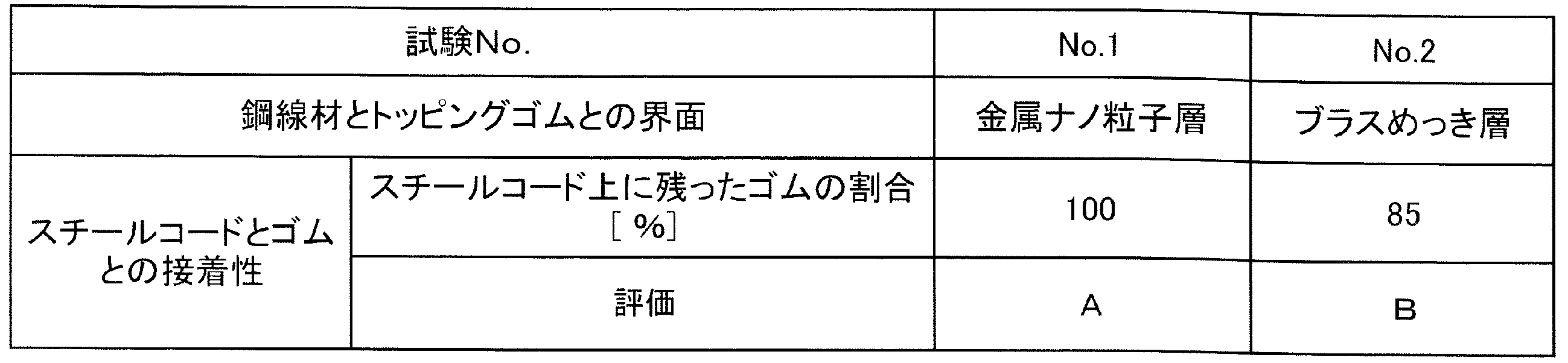
一方、鋼線材の表面に、銅めっき及び亜鉛めっきを順次施し、熱拡散処理を行うことによりブラスめっき層を積層したスチールコードを備える試験No.2のコード-ゴム複合体は、試験No.1のコード-ゴム複合体よりも接着性が劣っていた。
2 鋼線材
3 金属ナノ粒子層
4 ゴム(トッピングゴム)
8 ゴム基材
10 スチールコード
50 ゴム製品
Claims (7)
- 鋼線材を含む1又は複数のスチールコードと、
上記スチールコードの表面の少なくとも一部を被覆するゴムと
を備えており、
上記スチールコードが、上記鋼線材と、上記鋼線材の表面に積層される金属ナノ粒子層を有し、
上記金属ナノ粒子層が第一金属ナノ粒子及び第二金属ナノ粒子を含有し、
上記第一金属ナノ粒子が銅を含み、
上記第二金属ナノ粒子が亜鉛、コバルト、錫、鉄、ニッケル、アルミニウム及びこれらの酸化物から選ばれる1種又は2種以上を含むコード-ゴム複合体。 - 上記第二金属ナノ粒子が亜鉛又は亜鉛の酸化物を含む請求項1に記載のコード-ゴム複合体。
- 上記金属ナノ粒子層中の上記第二金属ナノ粒子の総量に対する上記第一金属ナノ粒子の総量の質量比が、1以上9以下である請求項1又は請求項2に記載のコード-ゴム複合体。
- 上記金属ナノ粒子層の平均厚さが0.01μm以上1.0μm以下である請求項1、請求項2又は請求項3に記載のコード-ゴム複合体。
- 請求項1から請求項4のいずれか1項に記載のコード-ゴム複合体を含むゴム製品。
- 金属ナノ粒子とこの金属ナノ粒子を分散する溶媒とを含有する金属ナノインクを鋼線材の表面に塗工する工程と、
上記鋼線材に塗工された当該金属ナノインクの塗工膜を乾燥する工程と、
上記乾燥工程後の鋼線材を伸線する工程と
上記伸線工程後に形成されるスチールコードの表面の少なくとも一部をゴムで被覆する工程と
を備え、
上記金属ナノ粒子が第一金属ナノ粒子及び第二金属ナノ粒子を含有し、
上記第一金属ナノ粒子が銅を含み、
上記第二金属ナノ粒子が亜鉛、コバルト、錫、鉄、ニッケル、アルミニウム及びこれらの酸化物から選ばれる1種又は2種以上を含むコード-ゴム複合体の製造方法。 - 上記金属ナノ粒子の一次粒子における粒径が10nm超150nm未満であり、メジアン径が30nm以上100nm以下である請求項6に記載のコード-ゴム複合体の製造方法。
Priority Applications (4)
| Application Number | Priority Date | Filing Date | Title |
|---|---|---|---|
| US18/558,615 US20240229351A1 (en) | 2021-06-30 | 2022-06-13 | Cord-rubber composite body, rubber product and method for producing cord-rubber composite body |
| DE112022003318.5T DE112022003318T5 (de) | 2021-06-30 | 2022-06-13 | Kord-gummi-verbundwerkstoff, gummiprodukt und verfahren zur herstellung eines kord-gummi-verbundwerkstoffs |
| CN202280029211.0A CN117222791A (zh) | 2021-06-30 | 2022-06-13 | 帘线-橡胶复合体、橡胶制品以及帘线-橡胶复合体的制造方法 |
| JP2023531766A JPWO2023276641A1 (ja) | 2021-06-30 | 2022-06-13 |
Applications Claiming Priority (2)
| Application Number | Priority Date | Filing Date | Title |
|---|---|---|---|
| JP2021-109610 | 2021-06-30 | ||
| JP2021109610 | 2021-06-30 |
Publications (1)
| Publication Number | Publication Date |
|---|---|
| WO2023276641A1 true WO2023276641A1 (ja) | 2023-01-05 |
Family
ID=84692243
Family Applications (1)
| Application Number | Title | Priority Date | Filing Date |
|---|---|---|---|
| PCT/JP2022/023658 Ceased WO2023276641A1 (ja) | 2021-06-30 | 2022-06-13 | コード-ゴム複合体、ゴム製品及びコード-ゴム複合体の製造方法 |
Country Status (5)
| Country | Link |
|---|---|
| US (1) | US20240229351A1 (ja) |
| JP (1) | JPWO2023276641A1 (ja) |
| CN (1) | CN117222791A (ja) |
| DE (1) | DE112022003318T5 (ja) |
| WO (1) | WO2023276641A1 (ja) |
Citations (4)
| Publication number | Priority date | Publication date | Assignee | Title |
|---|---|---|---|---|
| WO2007063951A1 (ja) * | 2005-12-01 | 2007-06-07 | Sumitomo Rubber Industries, Ltd. | 金属コード、ゴム・コード複合体、及びそれを用いた空気入りタイヤ |
| WO2007102233A1 (ja) * | 2006-03-08 | 2007-09-13 | Kabushiki Kaisha Bridgestone | ゴム物品補強用のブラスめっき鋼線とその製造方法 |
| JP2015511998A (ja) * | 2012-02-06 | 2015-04-23 | ナムローゼ・フェンノートシャップ・ベーカート・ソシエテ・アノニムN V Bekaert Societe Anonyme | 三元または四元黄銅合金被覆物を備えた細長い鋼製エレメントおよび対応する方法 |
| WO2020156967A1 (en) * | 2019-01-31 | 2020-08-06 | Nv Bekaert Sa | Steel cord with a brass coating enriched with iron particles |
Family Cites Families (8)
| Publication number | Priority date | Publication date | Assignee | Title |
|---|---|---|---|---|
| CN1762629A (zh) * | 2004-10-20 | 2006-04-26 | 弘德钢丝绳株式会社 | 用于金属丝放电加工的焊条钢丝及其制造方法 |
| US8962152B2 (en) * | 2009-09-09 | 2015-02-24 | Bridgestone Corporation | Brass-plated steel cord and steel cord-rubber composite, and tire using the same |
| CN102605308A (zh) * | 2012-04-19 | 2012-07-25 | 南京工程学院 | 钢帘线直接热镀铜锌合金环保生产工艺及装置 |
| FR2999975B1 (fr) * | 2012-12-20 | 2015-02-27 | Michelin & Cie | Renfort metallique pret a l'emploi dont la surface est pourvue de nanoparticules de sulfure metallique |
| JP6408281B2 (ja) * | 2014-07-31 | 2018-10-17 | 株式会社ブリヂストン | ゴム物品補強用スチールワイヤの製造方法 |
| CN110199056A (zh) * | 2017-01-26 | 2019-09-03 | 日本制铁株式会社 | 镀覆钢丝、钢丝帘线及橡胶-镀覆钢丝复合体 |
| JP7375565B2 (ja) | 2020-01-15 | 2023-11-08 | 株式会社ジェイテクト | ステアリング装置 |
| CN111979568B (zh) * | 2020-07-09 | 2022-08-12 | 江苏兴达钢帘线股份有限公司 | 一种一步法电镀黄铜钢丝镀后处理方法 |
-
2022
- 2022-06-13 WO PCT/JP2022/023658 patent/WO2023276641A1/ja not_active Ceased
- 2022-06-13 JP JP2023531766A patent/JPWO2023276641A1/ja active Pending
- 2022-06-13 CN CN202280029211.0A patent/CN117222791A/zh active Pending
- 2022-06-13 US US18/558,615 patent/US20240229351A1/en active Pending
- 2022-06-13 DE DE112022003318.5T patent/DE112022003318T5/de not_active Withdrawn
Patent Citations (4)
| Publication number | Priority date | Publication date | Assignee | Title |
|---|---|---|---|---|
| WO2007063951A1 (ja) * | 2005-12-01 | 2007-06-07 | Sumitomo Rubber Industries, Ltd. | 金属コード、ゴム・コード複合体、及びそれを用いた空気入りタイヤ |
| WO2007102233A1 (ja) * | 2006-03-08 | 2007-09-13 | Kabushiki Kaisha Bridgestone | ゴム物品補強用のブラスめっき鋼線とその製造方法 |
| JP2015511998A (ja) * | 2012-02-06 | 2015-04-23 | ナムローゼ・フェンノートシャップ・ベーカート・ソシエテ・アノニムN V Bekaert Societe Anonyme | 三元または四元黄銅合金被覆物を備えた細長い鋼製エレメントおよび対応する方法 |
| WO2020156967A1 (en) * | 2019-01-31 | 2020-08-06 | Nv Bekaert Sa | Steel cord with a brass coating enriched with iron particles |
Also Published As
| Publication number | Publication date |
|---|---|
| US20240229351A1 (en) | 2024-07-11 |
| CN117222791A (zh) | 2023-12-12 |
| DE112022003318T5 (de) | 2024-05-23 |
| JPWO2023276641A1 (ja) | 2023-01-05 |
Similar Documents
| Publication | Publication Date | Title |
|---|---|---|
| CN103140338B (zh) | 包含自粘性复合补强体的充气轮胎 | |
| CN102947109B (zh) | 具有排气线的充气车辆轮胎以及用于该排气线的导电涂层的制造方法 | |
| JP3820473B2 (ja) | ステンレス鋼製品を処理してゴム組成物への接着性を良くする方法 | |
| JP5940399B2 (ja) | ゴム・コード複合体、及びそれを用いた空気入りタイヤ | |
| CN106367979A (zh) | 高耐磨玻璃纤维布及其制备方法 | |
| CN113527770B (zh) | 一种高原航空轮胎子口保护层挂胶及其制备方法和应用 | |
| JP2008202196A (ja) | スチールコードの製造方法、スチールコード及び空気入りタイヤ | |
| CN100467713C (zh) | 橡胶增强用钢丝帘线、橡胶增强用钢丝帘线的制造方法及充气轮胎 | |
| WO2023276641A1 (ja) | コード-ゴム複合体、ゴム製品及びコード-ゴム複合体の製造方法 | |
| JPH03176212A (ja) | タイヤ用ビードワイヤ、ゴムコーティングタイヤ用ビードワイヤおよびそれを用いたタイヤ | |
| JP4393172B2 (ja) | スチールコード用接着性ゴム組成物及び空気入りタイヤ | |
| JP2002338749A (ja) | スチールコードとゴム組成物の複合体およびそれを用いたタイヤ | |
| CN107857959A (zh) | 水下探测用高强度复合电缆及其制备方法 | |
| CN116657343A (zh) | 浸润剂、改性玄武岩纤维织物及其制备方法和应用 | |
| CN104829911A (zh) | 一种高耐寒硅烷交联聚乙烯电缆料及其制作方法 | |
| CN107383713A (zh) | 水下探测用高强度复合橡胶及其制备方法 | |
| JP6623727B2 (ja) | ゴム・コード複合体、及びそれを用いた空気入りタイヤ | |
| CN114599525B (zh) | 轮胎帘子线、其制造方法和包括其的轮胎 | |
| JPWO2023276641A5 (ja) | ||
| KR102567446B1 (ko) | 코발트 도금된 스틸코드 및 이를 포함하는 래디얼 타이어 | |
| CN113795625B (zh) | 橡胶补强用金属线及橡胶补强用金属线的制造方法 | |
| CN116589764A (zh) | 一种高性能橡胶复合材料及其制备方法 | |
| JPWO2003103988A1 (ja) | 空気入りタイヤの製造方法 | |
| JP2018189595A (ja) | 接着状態の判定方法、金属−ゴム複合体、空気入りタイヤ、及び空気入りタイヤの製造方法 | |
| CN114989505B (zh) | 航空航天用耐低温电缆制备方法 |
Legal Events
| Date | Code | Title | Description |
|---|---|---|---|
| 121 | Ep: the epo has been informed by wipo that ep was designated in this application |
Ref document number: 22832797 Country of ref document: EP Kind code of ref document: A1 |
|
| WWE | Wipo information: entry into national phase |
Ref document number: 202280029211.0 Country of ref document: CN |
|
| WWE | Wipo information: entry into national phase |
Ref document number: 2023531766 Country of ref document: JP |
|
| WWE | Wipo information: entry into national phase |
Ref document number: 18558615 Country of ref document: US |
|
| WWE | Wipo information: entry into national phase |
Ref document number: 2301008302 Country of ref document: TH |
|
| WWE | Wipo information: entry into national phase |
Ref document number: 202347088008 Country of ref document: IN |
|
| 122 | Ep: pct application non-entry in european phase |
Ref document number: 22832797 Country of ref document: EP Kind code of ref document: A1 |