WO2023248733A1 - 充電装置 - Google Patents
充電装置 Download PDFInfo
- Publication number
- WO2023248733A1 WO2023248733A1 PCT/JP2023/020129 JP2023020129W WO2023248733A1 WO 2023248733 A1 WO2023248733 A1 WO 2023248733A1 JP 2023020129 W JP2023020129 W JP 2023020129W WO 2023248733 A1 WO2023248733 A1 WO 2023248733A1
- Authority
- WO
- WIPO (PCT)
- Prior art keywords
- power
- charging
- coil
- power transmission
- foreign object
- Prior art date
- Legal status (The legal status is an assumption and is not a legal conclusion. Google has not performed a legal analysis and makes no representation as to the accuracy of the status listed.)
- Ceased
Links
Images








Classifications
-
- H—ELECTRICITY
- H02—GENERATION; CONVERSION OR DISTRIBUTION OF ELECTRIC POWER
- H02J—ELECTRIC POWER NETWORKS; CIRCUIT ARRANGEMENTS OR SYSTEMS FOR SUPPLYING OR DISTRIBUTING ELECTRIC POWER; SYSTEMS FOR STORING ELECTRIC ENERGY
- H02J50/00—Circuit arrangements or systems for wireless supply or distribution of electric power
- H02J50/10—Circuit arrangements or systems for wireless supply or distribution of electric power using inductive coupling
-
- H—ELECTRICITY
- H02—GENERATION; CONVERSION OR DISTRIBUTION OF ELECTRIC POWER
- H02J—ELECTRIC POWER NETWORKS; CIRCUIT ARRANGEMENTS OR SYSTEMS FOR SUPPLYING OR DISTRIBUTING ELECTRIC POWER; SYSTEMS FOR STORING ELECTRIC ENERGY
- H02J50/00—Circuit arrangements or systems for wireless supply or distribution of electric power
- H02J50/40—Circuit arrangements or systems for wireless supply or distribution of electric power using two or more transmitting or receiving devices
- H02J50/402—Circuit arrangements or systems for wireless supply or distribution of electric power using two or more transmitting or receiving devices the two or more transmitting or the two or more receiving devices being integrated in the same unit, e.g. power mats with several coils or antennas with several sub-antennas
-
- H—ELECTRICITY
- H02—GENERATION; CONVERSION OR DISTRIBUTION OF ELECTRIC POWER
- H02J—ELECTRIC POWER NETWORKS; CIRCUIT ARRANGEMENTS OR SYSTEMS FOR SUPPLYING OR DISTRIBUTING ELECTRIC POWER; SYSTEMS FOR STORING ELECTRIC ENERGY
- H02J50/00—Circuit arrangements or systems for wireless supply or distribution of electric power
- H02J50/60—Circuit arrangements or systems for wireless supply or distribution of electric power responsive to the presence of foreign objects, e.g. detection of living beings
-
- H—ELECTRICITY
- H02—GENERATION; CONVERSION OR DISTRIBUTION OF ELECTRIC POWER
- H02J—ELECTRIC POWER NETWORKS; CIRCUIT ARRANGEMENTS OR SYSTEMS FOR SUPPLYING OR DISTRIBUTING ELECTRIC POWER; SYSTEMS FOR STORING ELECTRIC ENERGY
- H02J50/00—Circuit arrangements or systems for wireless supply or distribution of electric power
- H02J50/90—Circuit arrangements or systems for wireless supply or distribution of electric power involving detection or optimisation of position, e.g. alignment
-
- H—ELECTRICITY
- H02—GENERATION; CONVERSION OR DISTRIBUTION OF ELECTRIC POWER
- H02J—ELECTRIC POWER NETWORKS; CIRCUIT ARRANGEMENTS OR SYSTEMS FOR SUPPLYING OR DISTRIBUTING ELECTRIC POWER; SYSTEMS FOR STORING ELECTRIC ENERGY
- H02J7/00—Circuit arrangements for charging or discharging batteries or for supplying loads from batteries
- H02J7/60—Circuit arrangements for charging or discharging batteries or for supplying loads from batteries including safety or protection arrangements
-
- H—ELECTRICITY
- H02—GENERATION; CONVERSION OR DISTRIBUTION OF ELECTRIC POWER
- H02J—ELECTRIC POWER NETWORKS; CIRCUIT ARRANGEMENTS OR SYSTEMS FOR SUPPLYING OR DISTRIBUTING ELECTRIC POWER; SYSTEMS FOR STORING ELECTRIC ENERGY
- H02J50/00—Circuit arrangements or systems for wireless supply or distribution of electric power
- H02J50/005—Mechanical details of housing or structure aiming to accommodate the power transfer means, e.g. mechanical integration of coils, antennas or transducers into emitting or receiving devices
-
- H—ELECTRICITY
- H02—GENERATION; CONVERSION OR DISTRIBUTION OF ELECTRIC POWER
- H02J—ELECTRIC POWER NETWORKS; CIRCUIT ARRANGEMENTS OR SYSTEMS FOR SUPPLYING OR DISTRIBUTING ELECTRIC POWER; SYSTEMS FOR STORING ELECTRIC ENERGY
- H02J50/00—Circuit arrangements or systems for wireless supply or distribution of electric power
- H02J50/80—Circuit arrangements or systems for wireless supply or distribution of electric power involving the exchange of data, concerning supply or distribution of electric power, between transmitting devices and receiving devices
-
- H—ELECTRICITY
- H02—GENERATION; CONVERSION OR DISTRIBUTION OF ELECTRIC POWER
- H02J—ELECTRIC POWER NETWORKS; CIRCUIT ARRANGEMENTS OR SYSTEMS FOR SUPPLYING OR DISTRIBUTING ELECTRIC POWER; SYSTEMS FOR STORING ELECTRIC ENERGY
- H02J7/00—Circuit arrangements for charging or discharging batteries or for supplying loads from batteries
- H02J7/02—Circuit arrangements for charging or discharging batteries or for supplying loads from batteries for charging batteries from AC mains by converters
Definitions
- the present disclosure relates to a charging device.
- Patent Document 2 a charging device that determines that the position of the receiver has shifted when communication of received power from the receiver side is interrupted, and corrects the position of the receiver.
- Patent Document 1 The problem with the charging device disclosed in Patent Document 1 is that it is not possible to distinguish whether the power loss calculated from the relationship between the transmitted power and the received power is caused by a foreign object or a positional shift of the receiver. was there.
- the charging device disclosed in Patent Document 2 has a problem in that it is not possible to determine the positional shift of the receiver in a region where communication of received power is not interrupted. Furthermore, if the area where communication of the received power is interrupted is outside the foreign object detection range, there is a problem that the foreign object detection is activated before the positional shift of the receiver is detected, resulting in the transmission power being cut off. Ta.
- An object of the present disclosure is to provide a charging device that can continue charging as much as possible even if a power transmitting coil and a power receiving coil are misaligned or a foreign object is inserted between a power transmitting coil and a power receiving coil.
- a charging device is a charging device that performs contactless charging by placing a terminal device equipped with a power receiving coil that receives wirelessly transmitted power on a charging stand, and includes a power transmitting coil that transmits power to the terminal device. a power transmission instruction section that causes the power transmission coil to transmit power; a transmission power acquisition section that acquires the magnitude of the transmitted power transmitted by the power transmission instruction section; and a received power acquisition section that acquires the magnitude of the received power received by the power reception coil. It includes an acquisition unit, a calculation unit that calculates a ratio of received power to transmitted power, and a charging state control unit that limits transmitted power when the ratio is less than a threshold value.
- charging can be continued as much as possible even if the power transmitting coil and the power receiving coil are misaligned or a foreign object is inserted between the power transmitting coil and the power receiving coil.
- FIG. 1 is a block diagram showing an example of a schematic configuration of a charging device according to an embodiment.
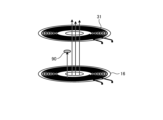
- FIG. 2 is a diagram showing an example of a schematic structure of a charging stand.
- FIG. 3A is a diagram illustrating an example of a power transmission state when a foreign object exists between the power transmitting coil and the power receiving coil.
- FIG. 3B is a diagram illustrating an example of a power transmission state when a positional shift occurs between the power transmitting coil and the power receiving coil.
- FIG. 4 is a functional block diagram showing an example of the functional configuration of a control unit included in the charging device of the embodiment.
- FIG. 5 is a diagram illustrating an example of the operation of the charging device when a positional shift of the power receiving coil occurs.
- FIG. 1 is a block diagram showing an example of a schematic configuration of a charging device according to an embodiment.
- FIG. 2 is a diagram showing an example of a schematic structure of a charging stand.
- FIG. 3A is a diagram illustrating
- FIG. 6A is a diagram illustrating an example of the positional relationship between the power receiving coil and the power transmitting coil at time t7 in FIG. 5.
- FIG. 6B is a diagram showing an example of how the charging device moves the position of the power transmission coil between time t8 and time t13 in FIG.
- FIG. 7 is a flowchart illustrating an example of the flow of processing performed by the charging device of the embodiment.
- FIG. 8 is a diagram illustrating an example of the operation of the charging device when a metal foreign object is inserted between the power receiving coil and the power transmitting coil.
- FIG. 9A is a diagram showing an example of the positional relationship between the power receiving coil and the power transmitting coil at time t4 in FIG. 8.
- FIG. 9B is a diagram showing an example of how the charging device moves the position of the power transmission coil between time t5 and time t10 in FIG.
- FIG. 10 is a diagram illustrating an example of the operation of the charging device when there is a metal foreign object between the power receiving coil and the power transmitting coil from the beginning.
- FIG. 11 is a diagram illustrating an example of the operation of a charging device that continues charging even when the efficiency of the power receiving coil is originally low.
- FIG. 12 is a diagram illustrating an example of the operation of the charging device when the user moves the position of the terminal device during charging.
- FIG. 13 is a flowchart illustrating an example of the operation of the first modification of the charging device of the embodiment.
- FIG. 14 is a flowchart illustrating an example of the operation of the second modified example of the charging device of the embodiment.
- FIG. 15 is a flowchart illustrating an example of the operation of the third modified example of the charging device of the embodiment.
- FIG. 1 is a block diagram showing an example of a schematic configuration of a charging device according to an embodiment.
- the charging device 10 performs contactless charging (hereinafter simply referred to as charging) to the terminal device 30.
- the terminal device 30 is, for example, a smartphone.
- the charging device 10 includes a DC power supply 11, a DC-DC converter 12, a bridge circuit 13, a voltage detection circuit 14, a current detection circuit 15, a power transmission coil 16, a movement mechanism 17, and a position detection controller 18. , a power receiving coil position detection circuit 20, a foreign object detection circuit 21, and a control section 22.
- the DC power supply 11 supplies DC power to operate the charging device 10.
- the DC-DC converter 12 steps up or steps down the DC voltage of the DC power supply 11 to a predetermined DC voltage.
- the bridge circuit 13 converts the DC voltage boosted or stepped down by the DC-DC converter 12 into an AC voltage. Note that the bridge circuit 13 may be a full bridge circuit or a half bridge circuit.
- the voltage detection circuit 14 detects the DC voltage boosted or stepped down by the DC-DC converter 12.
- the current detection circuit 15 detects the output current of the bridge circuit 13.
- the power transmission coil 16 generates magnetic flux according to the principle of electromagnetic induction in response to the AC voltage applied from the bridge circuit 13.
- the generated magnetic flux passes through the power receiving coil 31 included in the terminal device 30 placed so as to overlap the power transmitting coil 16, thereby generating an induced electromotive force in the power receiving coil 31.
- the internal battery of the terminal device 30 is charged by the induced electromotive force generated at this time. That is, power is transmitted from the power transmitting coil 16 to the power receiving coil 31. Further, communication based on the Qi standard is performed from the power receiving coil 31 to the power transmitting coil 16, and, for example, the amount of power received by the power receiving coil 31 is transmitted.
- the moving mechanism 17 moves the position of the power transmitting coil 16 within two-dimensional coordinates including the coil surface.
- the structure of the moving mechanism 17 will be described in detail later (see FIG. 2). That is, the position of the power transmission coil 16 can be changed by the moving mechanism 17. Therefore, in the following description, the power transmission coil 16 may be referred to as a moving coil.
- the position detection controller 18 includes a plurality of pattern coils, and operates according to the coupling state of the plurality of pattern coils and the power receiving coil 31 in accordance with the pulse outputted from a pulse output circuit (not shown) connected to each pattern coil.
- the receiving coil position detection circuit 20 detects the reflected wave that changes due to the change in the power receiving coil position.
- the upper surface of the charging stand 19 is a flat surface on which the terminal device 30 can be placed.
- the power receiving coil position detection circuit 20 acquires the reflected wave from the position detection controller 18 and detects the center position of the power receiving coil 31.
- the foreign object detection circuit 21 detects whether or not there is a metal foreign object at a position overlapping the power transmission coil 16 when the charging device 10 is not charging. More specifically, the foreign object detection circuit 21 is connected in series between the bridge circuit 13 and the power transmission coil 16 when the bridge circuit 13 applies an AC voltage to the power transmission coil 16 while changing the frequency. The sharpness (Q value) of the series resonance state due to the capacitance component (capacitance) of the capacitor C and the resistance component (inductance) of the power transmission coil 16 is calculated. Then, the foreign object detection circuit 21 determines that there is a metal foreign object between the power transmitting coil 16 and the power receiving coil 31 by detecting that the calculated Q value is lower than the expected Q value. . Note that a more detailed detection method is disclosed in Patent Document 2, for example.
- the control unit 22 performs various controls related to the charging state of the charging device 10.
- the control unit 22 includes a calculation unit 22a, a calculation result comparison unit 22b, a calculation result storage unit 22c, and a power transmission coil position control unit 22d.
- the calculation unit 22a calculates the power to be transmitted to the power transmission coil 16 from the voltage detected by the voltage detection circuit 14 and the current detected by the current detection circuit 15.
- the calculation unit 22a calculates the received power of the power receiving coil 31 based on the communication data that the power transmitting coil 16 receives from the power receiving coil 31.
- the calculation result comparison unit 22b compares the calculated efficiency E(t) with a preset threshold Eth. Further, the calculation result comparison unit 22b instructs the DC-DC converter 12 and the bridge circuit 13 to start and end charging. Further, the calculation result comparison unit 22b instructs the DC-DC converter 12 and the bridge circuit 13 to continue charging with normal power or with limited power. Further, the calculation result comparison unit 22b instructs the power transmission coil position control unit 22d to move the position of the power transmission coil 16.
- the calculation result storage unit 22c stores the maximum value of the efficiency E(t) calculated by the calculation unit 22a while updating it sequentially.
- the power transmitting coil position control unit 22d controls the moving mechanism 17 based on the current position of the power receiving coil 31 detected by the power receiving coil position detection circuit 20 and the instruction to move the position of the power transmitting coil 16 from the calculation result comparison unit 22b. , instructs the moving position of the power transmitting coil 16.
- the charging stand 19 includes the power transmission coil 16 (movable coil) whose position is variable, but the power transmission coil 16 may also include a plurality of fixed coils.
- the power transmission coil 16 is configured to include a plurality of fixed coils, the position detection controller 18 and the power reception coil position detection circuit 20 in FIG. 2 are unnecessary, and instead of the moving mechanism 17 in FIG.
- the power transmission coil position control section 22d instructs the power supply control section to change the fixed coil to be energized.
- FIG. 2 is a diagram showing an example of a schematic structure of a charging stand.
- the charging stand 19 is equipped with the power transmission coil 16 whose position is variable is demonstrated.
- the charging stand 19 is packaged in a housing 40 and includes the moving mechanism 17.
- the moving mechanism 17 moves the power transmission coil 16 along the upper surface of the charging stand 19 in the X-axis direction and the Y-axis direction.
- the moving mechanism 17 moves the power transmission coil 16 along the X-axis and the Y-axis by the operation of the servo motor 32 controlled by the position control circuit 38 .
- the servo motor 32 includes an X-axis servo motor 32a and a Y-axis servo motor 32b.
- the X-axis servo motor 32a is an actuator that moves the power transmission coil 16 along the X-axis.
- the Y-axis servo motor 32b is an actuator that moves the power transmission coil 16 along the Y-axis.
- the X-axis servo motor 32a rotationally drives a pair of X-axis threaded rods 33a installed parallel to each other along the X-axis.
- the pair of X-axis threaded rods 33a each have a belt 35 wrapped around each end thereof, and rotate in synchronization with each other in a direction corresponding to the rotational direction of the X-axis servo motor 32a.
- An X-axis nut material 34a is screwed into each of the pair of X-axis threaded rods 33a.
- a guide rod (not shown in FIG. 2), which is installed parallel to the pair of X-axis threaded rods 33a and is not shown in FIG.
- the X-axis nuts 34a screwed into the pair of X-axis threaded rods 33a are connected by a Y-axis threaded rod 33b and a guide rod 36, which are installed parallel to each other.
- the power transmission coil 16 is configured with a wire wound around a core 37 made of a magnetic material such as ferrite. AC voltage is supplied to the power transmission coil 16 from a power supply circuit 39 .
- a Y-axis nut material 34b is installed on the back side of the core 37, and a Y-axis threaded rod 33b is screwed into the Y-axis nut material 34b. Further, the guide rod 36 passes through the core 37 in parallel with the Y-axis threaded rod 33b.
- the Y-axis servo motor 32b is installed on one of the X-axis nut members 34a and rotates a Y-axis threaded rod 33b installed along the Y-axis.
- the Y-axis threaded rod 33b rotates with the rotation of the Y-axis servo motor 32b
- the Y-axis nut material 34b moves in a direction corresponding to the rotational direction of the Y-axis threaded rod 33b.
- the power transmission coil 16 moves along the Y-axis. Note that the above is an example, and the power transmission coil moving mechanism can be realized with another configuration or with only one axis, either the X axis or the Y axis.
- the charging stand 19 may be configured to include a plurality of power transmission coils whose installation positions are fixed.
- FIG. 3A is a diagram illustrating an example of a power transmission state when a foreign object exists between the power transmitting coil and the power receiving coil.
- FIG. 3B is a diagram illustrating an example of a power transmission state when a positional shift occurs between the power transmitting coil and the power receiving coil.
- the transmitted power Pout(t) of the power transmitting coil 16 is 14.5W
- the received power Rp(t) of the power receiving coil 31 is 10W.
- a certain amount of power loss occurs between the power transmitted by the power transmitting coil 16 Pout(t) and the power received by the power receiving coil 31 Rp(t) even when there is no metallic foreign object 90.
- This power loss is assumed to be 2W.
- the transmitted power of the charging device 10 is lost by 2W due to power loss, and further by 2.5W due to the metal foreign object 90.
- the metal foreign object 90 absorbs this 2.5W power and generates heat. Due to the heat generated by the metal foreign object 90, there is a risk of getting burned by touching the charging device 10 or the terminal device 30, or there is a risk of getting burned due to the heat generated by the metal foreign object 90, and there is a risk of the charging device 10 and the terminal device 30 deteriorating or catching fire. Therefore, in general, when the loss of transmitted power exceeds a threshold value, charging by the charging device 10 is stopped.
- FIG. 3B shows a state in which the power transmitting coil 16 and the power receiving coil 31 are charging in a state where the center positions of the coils are shifted from each other.
- FIG. 3B shows an example in which the coil surface of the power receiving coil 31 moves on a plane parallel to the coil surface of the power transmitting coil 16; The same applies to the case where the object moves in a direction away from the surface.
- the distance between the power transmitting coil 16 and the power receiving coil 31 is greater when placed on the charging stand 19, compared to a case where there is no cover. Power loss also occurs in such cases.
- a camera lens is installed on the back surface of the terminal device 30, that is, on the side where the power receiving coil 31 is installed, the outer frame of the lens may protrude from the back surface of the terminal device 30.
- the power loss due to the metal foreign object 90 and the power loss due to the positional deviation between the power transmitting coil 16 and the power receiving coil 31 are equal. If power loss occurs due to misalignment between the power transmitting coil 16 and the power receiving coil 31 as shown in FIG. 3B, there is no need to stop charging because the metal foreign object 90 does not generate heat.
- the power transmission power Pout(t ) continue charging as long as possible.
- FIG. 3B if there is a positional deviation between the power transmitting coil 16 and the power receiving coil 31, move the position of the power transmitting coil 16 or select a power transmitting coil 16 with a higher coupling state, as much as possible. Continue charging. Note that if it is detected that the metal foreign object 90 is present, power transmission may be stopped and the user may be instructed to remove the metal foreign object 90.
- FIG. 4 is a functional block diagram showing an example of the functional configuration of a control unit included in the charging device of the embodiment.
- the control unit 22 of the charging device 10 includes the functional parts shown in FIG. 4. That is, the control unit 22 includes a power transmission coil position setting unit 41, a power transmission instruction unit 42, a transmitted power acquisition unit 43, a received power acquisition unit 44, a power reception efficiency calculation unit 45, a power reception efficiency comparison unit 46, and a power transmission It includes a power control section 47, a power transmission coil position search section 48, a charging state control section 49, and a foreign object detection section 50.
- Each of these functional parts may be realized by software installed in the control unit 22 as a control program, or may be realized by dedicated hardware. Further, it may be realized by a hybrid configuration of software and dedicated hardware.
- the power transmitting coil position setting unit 41 sets the position of the power transmitting coil 16 at a position that is not misaligned with the power receiving coil 31.
- the charging device 10 is configured to include a power transmitting coil 16 (movable coil) whose position is variable
- the power transmitting coil position setting unit 41 determines the position of the power receiving coil 31 based on the position of the power receiving coil 31 detected by the power receiving coil position detection circuit 20. The position of the power transmitting coil 16 is set to a position facing the power receiving coil 31. Then, the power transmission coil 16 is moved by the moving mechanism 17 to the position set by the power transmission coil position setting section 41.
- the power transmission coil position setting unit 41 sequentially energizes each fixed coil and determines the position of the fixed coil with the best power reception efficiency. Set at the position of the power transmission coil 16.
- the power transmission instruction section 42 controls the DC-DC converter 12 and the bridge circuit 13 based on instructions from a transmission power control section 47 and/or a charging state control section 49, which will be described later. As a result, power is supplied to the power transmission coil 16. Specifically, the power transmission instruction unit 42 instructs the DC-DC converter 12 and the bridge circuit 13 to energize, thereby causing the power transmission coil 16 to generate magnetic flux, thereby causing the power transmission coil 16 to transmit power. The magnetic flux generated by the power transmitting coil 16 generates an induced electromotive force in the power receiving coil 31, and the terminal device 30 is charged.
- the transmitted power acquisition unit 43 acquires the magnitude of the transmitted power Pout(t) that the power transmission instruction unit 42 causes the power transmission coil 16 to transmit. Note that the transmitted power acquisition unit 43 acquires the magnitude of the transmitted power Pout(t) by integrating the voltage detected by the voltage detection circuit 14 and the current detected by the current detection circuit 15 at the same time t.
- the received power acquisition unit 44 acquires the magnitude of the received power Rp(t) received by the power receiving coil 31 at time t from the terminal device 30. More specifically, the received power acquisition unit 44 receives information including received power Rp(t), received power target value, etc. sent from the terminal device 30 by packet communication. Then, the received power acquisition unit 44 acquires the received power Rp(t) by demodulating the received information.
- the power receiving efficiency calculation unit 45 calculates the efficiency E(t) of the received power Rp(t) with respect to the transmitted power Pout(t). Note that the efficiency E(t) is an example of a ratio in the present disclosure. Further, the power reception efficiency calculation unit 45 is an example of a calculation unit in the present disclosure.
- the power reception efficiency comparison unit 46 compares the efficiency E(t) calculated during charging with a preset threshold Eth. When the efficiency E(t) is less than the threshold value Eth, the power reception efficiency comparison unit 46 determines that a positional shift of the terminal device 30 has occurred or that a metal foreign object 90 has been inserted. In addition, the power reception efficiency comparison unit 46 calculates the efficiency E(t ) are compared and the highest efficiency E(t) is stored. Further, the power reception efficiency comparison unit 46 compares the efficiency E(t) when charging is started and the highest efficiency E(t) obtained when the power transmission coil 16 is moved.
- the value of the threshold Eth can be set for each terminal device 30 to be charged.
- the types of terminal devices 30 that can be charged by the charging device 10 are limited to the vehicle owner, family members, etc.;
- the efficiency E(t) may be measured in advance for each time, and the terminal device 30 and the value of the threshold value Eth may be stored in association with each other.
- the terminal device 30 When the terminal device 30 is placed on the charging device 10 and charging is started, the terminal device 30 transmits information that can identify the model of the terminal device 30 to the charging device 10. can specify the model of the terminal device 30 placed thereon. The charging device 10 may then call and set the threshold value Eth associated with the identified model. Furthermore, when the user places the terminal device 30 on the charging device 10, the user inputs identification information for identifying the terminal device 30 placed on the charging device 10 using an operation system not shown in FIG. Good too. The charging device 10 may then call and set the threshold value Eth associated with the terminal device 30 from the input identification information.
- the transmitted power control unit 47 performs control regarding the power transmitted from the power transmitting coil 16 to the power receiving coil 31.
- the transmitted power control unit 47 performs control regarding the restriction of the transmitted power Pout(t) and the cancellation of the restriction, for example, based on instructions from the charging state control unit 49, which will be described later.
- the power transmission coil position search unit 48 moves the position of the power transmission coil 16 while the transmission power Pout(t) is limited by the transmission power control unit 47 when the efficiency E(t) is less than the threshold value Eth.
- the position of the power transmitting coil 16 where the efficiency E(t) calculated by the power receiving efficiency calculation unit 45 is maximized is searched.
- the power transmitting coil position search unit 48 moves the position of the power transmitting coil 16 using the moving mechanism 17 to obtain the efficiency E(t ) is searched for the position of the power transmitting coil 16 where the value is maximum.
- the power transmission coil position search unit 48 sequentially energizes each fixed coil and selects the fixed coil with the maximum efficiency E(t). Explore. Note that the power transmission coil position search unit 48 is an example of a power transmission position search unit in the present disclosure.
- the charging state control unit 49 controls the power transmission coil 16 searched by the power transmission coil position search unit 48 to At the position, the transmitted power control unit 47 releases the restriction on the transmitted power Pout(t) and continues charging.
- the charging state control unit 49 cuts off the supply of power to the power transmission coil 16 when the efficiency E(t) at the position of the power transmission coil 16 searched by the power transmission coil position search unit 48 is less than the threshold value Eth. This will stop charging.
- the charging state control unit 49 determines whether the terminal device 30 is in a fully charged state. Specifically, when the charging state control unit 49 receives a packet called EPT (End Power Transfer) from the terminal device 30, or when a packet called CEP (Control Error Packet) indicating the received power target value is received, When the average value is extremely low, it is determined that the terminal device 30 is in a fully charged state.
- EPT End Power Transfer
- CEP Control Error Packet
- the foreign object detection unit 50 detects a state of coupling between the power transmitting coil 16 and the power receiving coil 31 when the power receiving coil 31 is placed at a position that is not misaligned with the power transmitting coil 16 while the charging device 10 is not charging. , it is detected whether there is a metal foreign object 90 between the power transmitting coil 16 and the power receiving coil 31.
- FIG. 5 is a diagram illustrating an example of the operation of the charging device when a positional shift of the power receiving coil occurs.
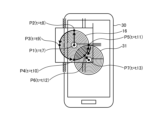
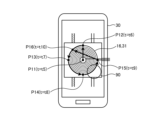
- FIG. 6A is a diagram illustrating an example of the positional relationship between the power receiving coil and the power transmitting coil at time t7 in FIG. 5.
- FIG. 6B is a diagram showing an example of how the charging device moves the position of the power transmission coil between time t8 and time t13 in FIG.
- This first operation example corresponds to a flowchart shown in FIG. 7, which will be described later.
- the terminal device 30 when the charging device 10 is used in a vehicle, the terminal device 30 is simply placed on the charging stand 19, so the position of the terminal device 30 may change due to vibrations of the vehicle.
- the loss of the transmitted power Pout(t) of the charging device 10 increases, so as shown in FIG. 5, the efficiency E(t) decreases.
- the efficiency E(t) falls below a preset threshold value Eth (for example, 70%).
- the charging state control unit 49 causes the transmission power control unit 47 to limit the transmission power Pout(t) to be transmitted to the power transmission coil 16.
- the amount of transmission power limit is set to, for example, about half of the initial transmission power Pout(t), but in the example of FIG. 5, the transmission power Pout(t) is limited to 8.0W. be done.
- the power transmitting coil 16 and the power receiving coil 31 are in the positional relationship shown in FIG. 6A. That is, the terminal device 30 is misaligned with respect to the power transmission coil 16 in the direction of 4:30 o'clock on the analog clock.
- the power reception efficiency calculation unit 45 calculates the efficiency E(t7).
- the calculated efficiency E(t7) is stored in the calculation result storage section 22c.
- the power transmission coil position search unit 48 moves the position of the power transmission coil 16 while the transmission power control unit 47 limits the transmission power Pout(t), and calculates the efficiency E(t) calculated by the power reception efficiency calculation unit 45.
- the position of the power transmitting coil 16 where the value is maximized is searched.
- the power receiving efficiency calculating unit 45 calculates the efficiency E(t) at each position to which the power transmitting coil 16 has moved, with the transmitted power Pout(t) being limited. Note that the sampling interval of the efficiency E(t) shown in FIG. 5 is based on the received power packet interval notified from the terminal device 30. That is, even while the power transmission coil 16 is moving, the efficiency E(t) is calculated at any time.
- charging device 10 determines that position P7 is the position where terminal device 30 has shifted. Since the efficiency E(t13) exceeds the threshold value Eth, the charging device 10 determines that there is no metallic foreign object between the power transmitting coil 16 and the power receiving coil 31.
- the charging state control unit 49 cancels the restriction on the transmitted power Pout(t) by the transmitted power control unit 47 and continues charging.
- the charging device 10 includes a plurality of fixed coils instead of the movable power transmitting coil 16
- the position of the power receiving coil 31 can be changed in the same way as described above by selecting and energizing the fixed coils in order. be explored.
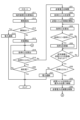
- FIG. 7 is a flowchart illustrating an example of the flow of processing performed by the charging device of the embodiment.
- the charging device 10 monitors the efficiency E(t) after the start of charging, and if it is not determined that the efficiency E(t) is equal to or higher than the threshold, the charging device 10 connects the power transmitting coil 16 and the power receiving coil 31. Transmitted power is limited in consideration of the possibility that metal foreign objects may exist between the two.
- the power transmitting coil 16 by moving the power transmitting coil 16 and searching for a position where the efficiency E(t) is equal to or greater than a threshold value while the transmitted power is limited, the positional deviation between the power transmitting coil 16 and the power receiving coil 31 is eliminated. If the efficiency E(t) does not improve beyond the threshold value even after moving the power transmitting coil 16, it is assumed that there is a possibility that a metallic foreign object exists between the power transmitting coil 16 and the power receiving coil 31, so the power Cut off.
- the charging device 10 detects the position of the terminal device 30 (step S11). Specifically, when the terminal device 30 is placed on the charging stand 19, the power transmitting coil position setting unit 41 sets the position of the power transmitting coil 16 at a position that is not misaligned with the power receiving coil 31.
- the power transmitting coil position setting unit 41 determines the position of the power receiving coil 31 based on the position of the power receiving coil 31 detected by the power receiving coil position detection circuit 20. The position of the power transmitting coil 16 is set to a position facing the power receiving coil 31.
- the power transmission coil 16 is moved by the moving mechanism 17 to the position set by the power transmission coil position setting section 41, and various authentications are performed between the charging device 10 and the terminal device 30.
- the charging device 10 is configured to include a plurality of fixed coils as the power transmission coil 16
- the power transmission coil position setting unit 41 sequentially energizes each fixed coil and determines the position of the fixed coil with the best power reception efficiency. Set at the position of the power transmission coil 16. Once the position of the power transmission coil is set, various types of authentication are performed between the charging device 10 and the terminal device 30.
- the foreign object detection unit 50 detects whether or not there is a metal foreign object 90 between the power transmitting coil 16 and the power receiving coil 31 in a state where charging is not performed (step S12).
- the foreign object detection unit 50 determines whether a foreign object is detected (step S13). If it is determined that a foreign object has been detected (step S13: Yes), the process proceeds to step S14. On the other hand, if it is not determined that a foreign object has been detected (step S13: No), the process proceeds to step S15.
- step S13 If it is determined in step S13 that a foreign object has been detected, the charging state control unit 49 cuts off the power supply to the power transmission coil 16 (step S14). After that, charging device 10 ends the process of FIG. 7 . Note that, at this time, the charging device 10 may notify that the metal foreign object 90 may be inserted using an indicator, monitor, buzzer, speaker, etc. not shown in FIG. 1.
- step S13 If it is determined in step S13 that no foreign object has been detected, the charging state control unit 49 instructs the power transmission instruction unit 42 to start charging the terminal device 30 (step S15).
- the power reception efficiency calculation unit 45 calculates the efficiency E(t) (step S18). Specifically, the received power efficiency calculation unit 45 calculates the efficiency E(t) from the transmitted power Pout(t) acquired by the transmitted power acquisition unit 43 and the received power Rp(t) acquired by the received power acquisition unit 44. Calculate.
- the power reception efficiency comparison unit 46 determines whether the efficiency E(t) calculated in step S18 is greater than or equal to the threshold value Eth (step S19). If the efficiency E(t) is determined to be equal to or greater than the threshold value Eth (step S19: Yes), the process proceeds to step S20. On the other hand, if the efficiency E(t) is not determined to be equal to or greater than the threshold value Eth (step S19: No), the process proceeds to step S21.
- step S19 If it is determined in step S19 that the efficiency E(t) is equal to or greater than the threshold value Eth, the charging state control unit 49 determines whether the terminal device 30 is in a fully charged state (step S20). When it is determined that the terminal device 30 is fully charged (step S20: Yes), the charging device 10 ends the process of FIG. 7. On the other hand, if it is not determined that the terminal device 30 is in a fully charged state (step S20: No), the process returns to step S18.
- step S19 if the efficiency E(t) is not determined to be equal to or greater than the threshold value Eth, the charging state control unit 49 instructs the transmission power control unit 47 to control the transmission power Pout(t) to be transmitted to the power transmission coil 16. to be restricted (step S21).
- the power reception efficiency calculation unit 45 calculates the efficiency E(t) when the transmitted power Pout(t) is limited, and stores it in the calculation result storage unit 22c. Note that the efficiency E(t) stored at this time is defined as the efficiency Q (step S22). Further, at this time, the position of the power transmission coil 16 is also stored in the calculation result storage section 22c.
- the power transmission coil position search unit 48 starts moving the power transmission coil (step S23).
- the power transmission coil position search unit 48 moves the power transmission coil 16 based on a predetermined rule in order to search for the position of the power transmission coil 16 where the efficiency E(t) is maximized.
- the power reception efficiency calculation unit 45 calculates the efficiency E(t) at predetermined time intervals while the power transmission coil 16 is moving (step S24).
- the power reception efficiency comparison unit 46 determines whether the efficiency E(t) calculated in step S24 is greater than the efficiency Q (step S25). If it is determined that the efficiency E(t) is greater than the efficiency Q (step S25: Yes), the process proceeds to step S26. On the other hand, if the efficiency E(t) is not determined to be greater than the efficiency Q (step S25: No), the process proceeds to step S27.
- step S25 If it is determined in step S25 that the efficiency E(t) is greater than the efficiency Q, the power reception efficiency comparison unit 46 replaces the efficiency Q with the efficiency E(t) calculated in step S24 (step S26).
- the replaced value of efficiency Q is stored in the calculation result storage unit 22c together with the position of the power transmission coil 16 at that time.
- the power transmission coil position search unit 48 determines whether the power transmission coil 16 has been moved within a predetermined range (step S27). If it is determined that the power transmitting coil 16 has been moved within a predetermined range (step S27: Yes), the process proceeds to step S28. On the other hand, if it is not determined that the power transmitting coil 16 has been moved within the predetermined range (step S27: No), the process returns to step S24. That is, the processes from step S24 to step S26 are repeated until the power transmission coil 16 is moved within a predetermined range.
- step S27 If it is determined in step S27 that the power transmitting coil 16 has been moved within a predetermined range, the power receiving efficiency comparison unit 46 determines whether the efficiency Q is equal to or greater than the threshold value Eth used in step S19 (step S28). If it is determined that the efficiency Q is equal to or greater than the threshold value Eth (step S28: Yes), the process proceeds to step S29. On the other hand, if it is not determined that the efficiency Q is equal to or greater than the threshold value Eth (step S28: No), the process proceeds to step S31.
- step S28 If it is determined in step S28 that the efficiency Q is equal to or greater than the threshold value Eth, the power transmission coil position search unit 48 moves the power transmission coil 16 to the position where the efficiency Q is maximum (step S29).
- the charging state control unit 49 cancels the restriction on the transmitted power performed in step S21 (step S30). After that, the process returns to step S18.
- the charging state control unit 49 cuts off the power supply to the power transmission coil 16 (step S31). After that, charging device 10 ends the process of FIG. 7 .
- FIG. 8 is a diagram illustrating an example of the operation of the charging device when a metal foreign object is inserted between the power receiving coil and the power transmitting coil.
- FIG. 9A is a diagram showing an example of the positional relationship between the power receiving coil and the power transmitting coil at time t4 in FIG. 8.
- FIG. 9B is a diagram illustrating an example of how the charging device moves the position of the power transmission coil between time t5 and time t10 in FIG. 8. This second operation example corresponds to the flowchart shown in FIG. 7 described above.
- the charging device 10 when the charging device 10 is used in a vehicle, the terminal device 30 is simply placed on the charging stand 19, so the vibrations of the vehicle may cause coins or gum to come between the terminal device 30 and the charging stand 19.
- Foreign metal objects such as wrapping paper (aluminum foil) may be inserted.
- the efficiency E(t) decreases.
- the charging state control unit 49 causes the transmission power control unit 47 to limit the transmission power Pout(t) to be transmitted to the power transmission coil 16. Note that it is desirable that the amount of transmission power limit is set to, for example, approximately half of the initial transmission power Pout(t), but in the example of FIG. 8, the transmission power Pout(t) is limited to 8.0W. Ru.
- the power reception efficiency calculation unit 45 calculates the efficiency E(t5).
- the calculated efficiency E(t5) is stored in the calculation result storage section 22c.
- the power transmission coil position search unit 48 moves the position of the power transmission coil 16 while the transmission power control unit 47 limits the transmission power Pout(t), and calculates the efficiency E(t) calculated by the power reception efficiency calculation unit 45.
- the position of the power transmitting coil 16 where the value is maximized is searched.
- the power reception efficiency calculation unit 45 calculates the efficiency E(t) at each position to which the power transmission coil 16 has moved, with the transmitted power Pout(t) being limited. Note that the sampling interval of the efficiency E(t) shown in FIG. 8 depends on the received power packet interval notified from the terminal device 30. That is, even while the power transmission coil 16 is moving, the efficiency E(t) is calculated at any time.
- the charging state control unit 49 determines that the efficiency E(t) is not improved. That is, the charging device 10 determines that the metal foreign object 90 has been inserted between the power transmitting coil 16 and the power receiving coil 31, rather than that the positional deviation between the power transmitting coil 16 and the power receiving coil 31 has occurred.
- the charging device 10 includes a plurality of fixed coils instead of the movable power transmitting coil 16
- the position of the power receiving coil 31 can be changed in the same way as described above by selecting and energizing the fixed coils in order. be explored.
- FIG. 10 is a diagram illustrating an example of the operation of the charging device when there is a metal foreign object between the power receiving coil and the power transmitting coil from the beginning. This third operation example corresponds to the flowchart shown in FIG. 7 described above.
- the efficiency E(t1) calculated by the power reception efficiency calculation unit 45 has a value less than the threshold value Eth (for example, 70%).
- the transmission power control unit 47 limits the transmission power Pout(t) transmitted to the power transmission coil 16 to 8.0W.
- the power transmission coil position search unit 48 moves the position of the power transmission coil 16 while the transmission power control unit 47 limits the transmission power Pout(t), and calculates the efficiency E(t) calculated by the power reception efficiency calculation unit 45.
- the position of the power transmitting coil 16 where the value is maximized is searched.
- the power reception efficiency calculation unit 45 calculates efficiency E(t) that changes with time as needed.
- the charging device 10 it is desirable for the charging device 10 to notify that there is a possibility that a metal foreign object 90 is present between the power receiving coil 31 and the power transmitting coil 16.
- FIG. 7 Example of operation of charging device (4)
- a fourth operation example of the charging device 10 will be described using FIG. 11.
- the efficiency is not improved even if the power transmitting coil 16 is moved, the power is cut off considering the possibility that there is a metal foreign object between the power transmitting coil 16 and the power receiving coil 31.
- charging may be continued by further limiting the transmitted power without cutting off the power. That is, in the flowchart shown in FIG. 7, if it is not determined that the efficiency Q is equal to or greater than the threshold value Eth (step S28: No), the charging state control unit 49 further limits the power transmitted to the power transmitting coil 16 and performs charging. It is also possible to continue.
- FIG. 11 shows an example of the operation of the charging device in which when the power efficiency of the power transmitting coil 16 and the power receiving coil 31 is originally poor, the efficiency E(t1) is not improved, so the power transmitted is further limited and charging is continued. It is a diagram.
- the efficiency E(t1) calculated by the power reception efficiency calculation unit 45 has a value less than the threshold value Eth (for example, 70%).
- the power transmission coil position search unit 48 moves the position of the power transmission coil 16 while the transmission power control unit 47 limits the transmission power Pout(t), and calculates the efficiency E(t) calculated by the power reception efficiency calculation unit 45.
- the position of the power transmitting coil 16 where the value is maximized is searched.
- the search method is the same as that described with reference to FIG.
- the charging state control unit 49 At t7, the transmitted power control unit 47 is caused to limit the transmitted power Pout(t) transmitted to the power transmitting coil 16 to 4.0W.
- the transmitted power control unit 47 may limit the transmitted power Pout(t), or may limit the power difference ⁇ W between the transmitted power Pout(t) and the received power Rp(t).
- the charging device 10 notifies that charging is being performed with the transmitted power Pout(t) being limited.
- FIG. 12 is a diagram illustrating an example of the operation of the charging device when the user moves the position of the terminal device during charging. This fifth operation example corresponds to the flowchart shown in FIG. 14, which will be described later.
- the charging state control unit 49 cancels the restriction on the transmitted power Pout(t) by the transmitted power control unit 47, that is, returns the transmitted power Pout(t) to its original state, and starts charging. continue.
- the charging state control unit 49 releases the restriction on the transmitted power Pout(t) by the transmitted power control unit 47, and You may continue charging.
- the mounting position of the terminal device 30 is shifted outside the movable range of the power transmission coil 16 or when the power transmission coil 16 includes a plurality of fixed coils, the mounting position of the terminal device 30 may be changed. If the fixed coil is shifted outside the fixed coil, the user's position correction operation can be effectively utilized.
- the charging device 10 may issue a notification prompting the user to confirm the placement position of the terminal device 30.
- FIG. 13 is a flowchart illustrating an example of the operation of the first modification of the charging device of the embodiment.
- the charging device 10 of this modification temporarily stops charging when the efficiency E(t) is less than the threshold value Eth, and detects the position of the terminal device 30 and detects the position of the power transmitting coil 16 while charging is temporarily stopped. Detection is performed as to whether or not a metal foreign object 90 exists between the power receiving coil 31 and the power receiving coil 31 .
- description of processes similar to those in the flowchart of FIG. 7 will be omitted.
- the power transmission coil position setting unit 41 detects the position of the terminal device 30 (step S41).
- the foreign object detection unit 50 detects whether there is a metal foreign object 90 between the power transmitting coil 16 and the power receiving coil 31 in a state where charging is not performed (step S42).
- the foreign object detection unit 50 determines whether a foreign object is detected (step S43). If it is determined that a foreign object has been detected (step S43: Yes), the process advances to step S56. On the other hand, if it is not determined that a foreign object has been detected (step S43: No), the process proceeds to step S44.
- step S43 If it is determined in step S43 that a foreign object has been detected, the charging state control unit 49 starts charging in the power limited state (step S56). After that, the process advances to step S57.
- step S43 if it is determined in step S43 that no foreign object has been detected, the charging state control unit 49 causes the power transmission instruction unit 42 to start charging the terminal device 30 (step S44).
- the power reception efficiency calculation unit 45 calculates efficiency E(t) (step S45).
- the power reception efficiency comparison unit 46 determines whether the efficiency E(t) calculated in step S45 is greater than or equal to the threshold value Eth (step S46). If the efficiency E(t) is determined to be equal to or greater than the threshold value Eth (step S46: Yes), the process proceeds to step S47. On the other hand, if the efficiency E(t) is not determined to be equal to or greater than the threshold value Eth (step S46: No), the process proceeds to step S48.
- step S46 determines whether the efficiency E(t) is equal to or greater than the threshold value Eth. If it is determined in step S46 that the efficiency E(t) is equal to or greater than the threshold value Eth, the charging state control unit 49 determines whether the terminal device 30 is in a fully charged state (step S47). When it is determined that the terminal device 30 is in a fully charged state (step S47: Yes), the charging device 10 ends the process of FIG. 13. On the other hand, if it is not determined that the terminal device 30 is in a fully charged state (step S47: No), the process returns to step S45.
- the charging device 10 notifies the terminal device 30 that charging will be interrupted (step S48).
- the terminal device 30 receives the notification, it operates in the same manner as when it is being charged by the charging device 10 while maintaining the communication state with the charging device. Subsequently, the charging state control unit 49 cuts off the power supply to the power transmission coil 16 (step S49).
- the control unit 22 stops the process in FIG. 13 for a predetermined period of time (step S50).
- the predetermined time it is desirable to stop for 5 seconds or more, for example. Further, for example, the same amount of time may be secured by delaying the notification of resumption of charging to the terminal device 30 in step S53.
- the power transmission coil position setting unit 41 detects the position of the terminal device 30 (step S51).
- the power transmitting coil position setting unit 41 sets the position of the power transmitting coil 16 at a position that is not misaligned with the power receiving coil 31 .
- the power transmitting coil position setting unit 41 determines the position of the power receiving coil 31 based on the position of the power receiving coil 31 detected by the power receiving coil position detection circuit 20.
- the position of the power transmitting coil 16 is set to a position facing the power receiving coil. Then, the power transmission coil 16 is moved by the moving mechanism 17 to the position set by the power transmission coil position setting section 41.
- the power transmission coil position setting unit 41 sequentially energizes each fixed coil and selects the position of the fixed coil with the highest power reception efficiency for power transmission. Set the position of the coil 16. Note that in step S41, various authentications are performed between the charging device 10 and the terminal device 30 before charging starts, but in this step S51, various authentications are not performed.
- control unit 22 causes the power transmission coil 16 to transmit a small amount of power to the terminal device 30 in order to determine whether the terminal device 30 is placed on the charging stand 19 (step S52). More specifically, the control unit 22 causes the power transmission coil 16 to transmit a small amount of power for communication to the terminal device 30. The terminal device 30 determines that it is placed on the charging stand 19 by receiving this minute power. Subsequently, the charging device 10 notifies the terminal device 30 that charging will be resumed (step S53).
- the foreign object detection unit 50 detects a metal foreign object 90 between the power transmitting coil 16 and the power receiving coil 31 in a state where charging is not performed (step S54). Subsequently, the foreign object detection unit 50 determines whether a foreign object has been detected (step S55). If it is determined that a foreign object has been detected (step S55: Yes), the process proceeds to step S56. On the other hand, if it is not determined that a foreign object has been detected (step S55: No), the process returns to step S44 and charging is restarted.
- step S55 If it is determined in step S55 that a foreign object has been detected, the charging state control unit 49 starts charging in the power limited state (step S56).
- the charging state control unit 49 determines whether the terminal device 30 is fully charged (step S57). When it is determined that the terminal device 30 is fully charged (step S57: Yes), the charging device 10 ends the process of FIG. 13. On the other hand, if it is not determined that the terminal device 30 is in a fully charged state (step S57: No), step S57 is repeated.
- the charging device 10 monitors whether communication with the terminal device 30 continues. If it is detected that communication with the terminal device 30 has been interrupted, the process moves to step S41 and the process of FIG. 13 is redone.
- the charging device 10 moves the power transmission coil 16 using the power transmission coil position search unit 48, as described in the flowchart of FIG. You may also search for a position where it is resolved.
- FIG. 14 is a flowchart illustrating an example of the operation of the second modified example of the charging device of the embodiment.
- the charging device 10 of this modification limits the transmitted power when the efficiency E(t) is less than the threshold value Eth, and then releases the restriction on the transmitted power when the value of the efficiency E(t) improves.
- the charging device 10 of this modification (2) corresponds to the fifth operation example described in FIG. 12. That is, when a positional shift of the terminal device 30 occurs during charging, for example, when the user moves the terminal device 30 to the correct position and the positional shift of the terminal device 30 is resolved, the transmission power is limited. The terminal device 30 can be charged by canceling the charge.
- descriptions of processes similar to those in the flowchart of FIG. 7 will be omitted as appropriate.
- the foreign object detection unit 50 detects whether or not there is a metal foreign object 90 between the power transmitting coil 16 and the power receiving coil 31 in a state where charging is not performed (step S62).
- the foreign object detection unit 50 determines whether a foreign object is detected (step S63). If it is determined that a foreign object has been detected (step S63: Yes), the process advances to step S64. On the other hand, if it is not determined that a foreign object has been detected (step S63: No), the process proceeds to step S65.
- step S63 If it is determined in step S63 that a foreign object has been detected, the charging state control unit 49 cuts off the power supply to the power transmission coil 16 (step S64). After that, charging device 10 ends the process of FIG. 14.
- step S63 if it is determined in step S63 that no foreign object has been detected, the charging state control unit 49 causes the power transmission instruction unit 42 to start charging the terminal device 30 (step S65).
- the power reception efficiency calculation unit 45 calculates the efficiency E(t) (step S68).
- the power reception efficiency comparison unit 46 determines whether the efficiency E(t) calculated in step S68 is greater than or equal to the threshold value Eth (step S69). If it is determined that the efficiency E(t) is equal to or greater than the threshold value Eth (step S69: Yes), the process proceeds to step S70. On the other hand, if the efficiency E(t) is not determined to be equal to or greater than the threshold value Eth (step S69: No), the process proceeds to step S71.
- step S69 If it is determined in step S69 that the efficiency E(t) is greater than or equal to the threshold value Eth, the charging state control unit 49 determines whether the terminal device 30 is in a fully charged state (step S70). When it is determined that the terminal device 30 is fully charged (step S70: Yes), the charging device 10 ends the process of FIG. 14. On the other hand, if it is not determined that the terminal device 30 is in a fully charged state (step S70: No), the process returns to step S68.
- step S69 if it is not determined that the efficiency E(t) is equal to or greater than the threshold value Eth, the charging state control unit 49 causes the transmission power control unit 47 to limit the transmission power Pout(t) to be transmitted to the power transmission coil 16. (step S71).
- the power reception efficiency calculation unit 45 calculates the efficiency E(t) when the transmitted power Pout(t) is limited, and stores it in the calculation result storage unit 22c. Note that the efficiency E(t) stored at this time is defined as the efficiency Q (step S72). Further, at this time, the position of the power transmission coil 16 is also stored in the calculation result storage section 22c.
- the charging state control unit 49 determines whether the terminal device 30 is fully charged (step S73). When it is determined that the terminal device 30 is in a fully charged state (step S73: Yes), the charging device 10 ends the process of FIG. 14. On the other hand, if it is not determined that the terminal device 30 is in a fully charged state (step S73: No), the process proceeds to step S74.
- step S73 if it is not determined that the terminal device 30 is in a fully charged state, the power reception efficiency calculation unit 45 calculates the efficiency E(t) (step S74). Note that when the user moves the terminal device 30 during charging, the value of the efficiency E(t) calculated in step S74 changes.
- the power reception efficiency comparison unit 46 determines whether the efficiency E(t) calculated in step S74 is greater than the efficiency Q (step S75). If it is determined that the efficiency E(t) is greater than the efficiency Q (step S75: Yes), the process proceeds to step S76. On the other hand, if the efficiency E(t) is not determined to be greater than the efficiency Q (step S75: No), the process returns to step S73.
- step S75 If it is determined in step S75 that the efficiency E(t) is greater than the efficiency Q, the power reception efficiency comparison unit 46 replaces the efficiency Q with the efficiency E(t) calculated in step S74 (step S76).
- the replaced value of efficiency Q is stored in the calculation result storage unit 22c together with the position of the power transmission coil 16 at that time.
- the power reception efficiency comparison unit 46 determines whether the efficiency Q is greater than or equal to the threshold value Eth (step S77). If it is determined that the efficiency Q is equal to or greater than the threshold value Eth (step S77: Yes), the process proceeds to step S78. On the other hand, if it is not determined that the efficiency Q is equal to or greater than the threshold value Eth (step S77: No), the process returns to step S73.
- step S77 If it is determined in step S77 that the efficiency Q is equal to or greater than the threshold value Eth, the charging state control unit 49 cancels the restriction on the transmitted power performed in step S71 (step S78). After that, the process returns to step S68.
- the charging device 10 monitors whether communication with the terminal device 30 is continuing. If it is detected that communication with the terminal device 30 has been interrupted, the process moves to step S61 and the process of FIG. 14 is redone.
- FIG. 15 is a flowchart illustrating an example of the operation of the third modified example of the charging device of the embodiment.
- the flowchart shown in FIG. 15 differs from the flowchart shown in FIG. 7 in the processing from steps S81 to S91.
- the charging device 10 of this modification if the efficiency E(t) does not improve even after moving the power transmitting coil 16, there is a possibility that a metal foreign object 90 exists between the power transmitting coil 16 and the power receiving coil 31. Since the charge is high, the charging is temporarily stopped, and while the charging is temporarily stopped, it is detected whether or not the metal foreign object 90 is present. If a metal foreign object 90 is detected, charging is restarted with the transmitted power further restricted.
- description of processes similar to those in the flowcharts of FIGS. 7 and 13 will be omitted.
- step S28 If the charging device 10 of this modification does not determine that the efficiency Q is equal to or higher than the threshold Eth in step S28 (step S28: No), it notifies the terminal device 30 that charging will be interrupted (step S81). ). When the terminal device 30 receives the notification, it operates in the same manner as when it is being charged by the charging device 10 while maintaining the communication state with the charging device. Subsequently, the charging state control unit 49 cuts off the power supply to the power transmission coil 16 (step S82).
- the foreign object detection unit 50 detects a metal foreign object 90 between the power transmitting coil 16 and the power receiving coil 31 (step S83). Subsequently, when the foreign object detection unit 50 determines that a foreign object has been detected (step S84: Yes), the process proceeds to step S86. On the other hand, if it is determined that no foreign object has been detected (step S84: No), the charging state control unit 49 restarts charging with the transmitted power limited in step S21 (step S85), and proceeds to step S91.
- step S86 the control unit 22 stops the process of FIG. 13 for a predetermined period of time.
- the predetermined time it is desirable to stop for 5 seconds or more, for example. Further, for example, the same amount of time may be secured by delaying the notification of resumption of charging to the terminal device 30 in step S89.
- step S87 the power transmission coil position search unit 48 moves the power transmission coil 16 to the position where the efficiency Q is maximum.
- step S88 the control unit 22 causes the power transmission coil 16 to transmit minute power to the terminal device 30 in order to determine whether the terminal device 30 is placed on the charging stand 19. Subsequently, in step S89, the charging device 10 notifies the terminal device 30 that charging will be resumed.
- step S90 the charging state control unit 49 limits the transmitted power further than the transmitted power in step S21 and restarts charging.
- step S91 the charging state control unit 49 determines whether the terminal device 30 is fully charged, and repeats the process of step S91 until it is determined that the terminal device 30 is fully charged.
- the charging device 10 monitors whether communication with the terminal device 30 continues. If it is detected that the communication with the terminal device 30 has been interrupted, the process moves to step S11 and the process of FIG. 15 is redone.
- step S28 of the flowchart of FIG. 7 if it is not determined that the efficiency Q is equal to or greater than the threshold value Eth (step S28: No), the charging state control unit 49 further controls the power supply without cutting off the power supply to the power transmission coil 16. Charging may be continued by limiting the transmitted power.
- step S50 a predetermined period of time is waited (step S50) before detecting the position of the terminal device 30 (step S51), but the timing at which the process of step S50 is executed is not limited to this, and the steps from step S49 to It may be executed at any timing during S56.
- step S52 the timing at which the processing of micropower transmission to the terminal device 30 (step S52) and notification of resumption of charging to the terminal device 30 (step S53) is not limited to this, and for example, step S55 It may be executed after the foreign object determination.
- a charging device that performs contactless charging by placing a terminal device including a power receiving coil that receives wirelessly transmitted power on a charging stand, the power transmitting coil that transmits power to the terminal device, and the power transmitting coil that transmits power to the terminal device.
- a power transmission instruction unit that causes the power transmission coil to transmit power
- a transmission power acquisition unit that acquires the magnitude of the transmitted power transmitted by the power transmission instruction unit
- a received power that acquires the magnitude of the received power received by the power reception coil.
- a charging device comprising: an acquisition unit; a calculation unit that calculates a ratio of the received power to the transmitted power; and a charging state control unit that limits the transmitted power when the ratio is less than a threshold.
- a power transmission position search unit (power transmission coil position search unit) that searches for a position of the power transmission coil where the ratio is maximized while the transmission power is limited when the ratio is less than a threshold value.
- the state of charge control unit controls the power transmission coil position at the position of the power transmission coil searched by the power transmission position search unit when the ratio at the position of the power transmission coil searched by the power transmission position search unit is greater than or equal to the threshold value.
- the position of the power transmitting coil can be changed without stopping charging, the position of the power transmitting coil where the ratio is improved to a threshold value or more, in other words, the position of the power transmitting coil where there is no misalignment between the power transmitting coil and the power receiving coil. It is possible to correct this and continue charging. Therefore, the extension of charging time and power loss due to positional deviation between the power transmitting coil and the power receiving coil can be reduced.
- the charging state control unit stops charging or further limits the transmitted power when the ratio at the position of the power transmission coil searched by the power transmission position search unit is less than the threshold value.
- (Technology 8) Further comprising a foreign object detection unit that detects whether a metal foreign object is present between the power transmission coil and the power reception coil, and the charging state control unit is configured to detect the power transmission coil detected by the power transmission position search unit. Charging is stopped when the ratio at the position is less than the threshold value, and the foreign object detection unit detects whether or not the metal foreign object is present in the state where the charging is stopped by the charging state control unit, and the charging The charging device according to technique 4, wherein the state control unit further limits the transmitted power and restarts charging after a predetermined time has elapsed when the metal foreign object is detected by the foreign object detection unit.
- the position of the fixed coil with the best ratio of received power to transmitted power (efficiency E(t)) is set as the power transmitting coil position, and power is transmitted from the fixed coil to the terminal device to continue charging. be able to.
- a charging device that performs contactless charging by placing a terminal device including a power receiving coil that receives wirelessly transmitted power on a charging stand, the power transmitting coil that transmits power to the terminal device, and the power transmitting coil that transmits power to the terminal device.
- a power transmission instruction unit that causes the power transmission coil to transmit power
- a transmission power acquisition unit that acquires the magnitude of the transmitted power transmitted by the power transmission instruction unit
- a received power that acquires the magnitude of the received power received by the power reception coil.
- the power transmitting coil position setting unit further includes a power transmitting coil position setting unit that sets the position of the power transmitting coil according to the mounting position of the terminal device, and the power transmitting coil is configured to set the power transmitting coil at the position set by the power transmitting coil position setting unit.
- transmitting power to the device the power transmitting coil position setting unit sets the position of the power transmitting coil when charging is stopped when the ratio is less than the threshold, and the charging state control unit sets the position of the power transmitting coil when the ratio is less than the threshold.
- the charging device according to technique 12, wherein charging is stopped when is less than the threshold, and charging is restarted at a position of the power transmitting coil set by the power transmitting coil position setting unit.
- the position of the power transmitting coil can be corrected to a position where there is no misalignment between the power transmitting coil and the power receiving coil, and charging can be continued. Therefore, the extension of charging time and power loss due to positional deviation between the power transmitting coil and the power receiving coil can be reduced.
- the foreign object detection section further includes a foreign object detection section that detects whether a metal foreign object is present between the power transmission coil and the power reception coil, and the foreign object detection section stops charging when the ratio is less than the threshold value. Then, the charge state control section detects whether there is a metal foreign object between the power transmission coil and the power reception coil, and when the ratio is less than the threshold value, the charging state control section stops charging, and the foreign object detection section.
- the charging device wherein when a metal foreign object is detected, the transmitted power is limited and charging is restarted.
- the charging device and the terminal device maintain the communication state, so there is no need to perform various authentication procedures between the charging device and the terminal device before resuming charging. For example, while charging is stopped, the terminal device can operate in the same manner as when it is being charged from the charging device. Furthermore, since there is no need to perform various authentication procedures, charging can be quickly resumed after the charging device has decided to resume charging.
- the power transmission coil transmits electric power for determining whether the terminal device is placed on the charging stand after power transmission to the terminal device is stopped. 18.
- the charging device according to any one of Item 17.
- the terminal device can determine that it is placed on the charging stand by receiving the power. Then, the terminal device continues the same operation as in the state in which it is being charged by the charging device, and can quickly resume charging after the charging device decides to resume charging.
- the position of the fixed coil with the best ratio of received power to transmitted power (efficiency E(t)) is set as the power transmitting coil position, and power is transmitted from the fixed coil to the terminal device to perform charging. Can be done.
- Charging device 11 DC power supply 12 DC-DC converter 13 Bridge circuit 14 Voltage detection circuit 15 Current detection circuit 16 Power transmission coil (moving coil) 17 Moving mechanism 18 Position detection controller 19 Charging stand 20 Power reception coil position detection circuit 21 Foreign object detection circuit 22 Control section 22a Operation section 22b Operation result comparison section 22c Operation result storage section 22d Power transmission coil position control section 30 Terminal device 31 Power reception coil 32 Servo motor 32a X-axis servo motor 32b Y-axis servo motor 33a X-axis threaded rod 33b Y-axis threaded rod 34a X-axis nut material 34b Y-axis nut material 35 Belt 36 Guide rod 37 Core 38 Position control circuit 39 Power supply circuit 40 Housing 41 Power transmission coil position setting unit 42 Power transmission instruction unit 43 Transmission power acquisition unit 44 Received power acquisition unit 45 Power reception efficiency calculation unit (calculation unit) 46 Power reception efficiency comparison unit 47 Transmission power control unit 48 Power transmission coil position search unit (power transmission position search unit) 49 Charge state control unit 50 Foreign object detection unit 90 Metal foreign object C Cap
Landscapes
- Engineering & Computer Science (AREA)
- Power Engineering (AREA)
- Computer Networks & Wireless Communication (AREA)
- Charge And Discharge Circuits For Batteries Or The Like (AREA)
Priority Applications (4)
| Application Number | Priority Date | Filing Date | Title |
|---|---|---|---|
| CN202380047933.3A CN119404413A (zh) | 2022-06-20 | 2023-05-30 | 充电装置 |
| EP23826921.1A EP4542826A4 (en) | 2022-06-20 | 2023-05-30 | CHARGING DEVICE |
| JP2024528676A JPWO2023248733A1 (https=) | 2022-06-20 | 2023-05-30 | |
| US18/990,058 US20250125665A1 (en) | 2022-06-20 | 2024-12-20 | Charging device |
Applications Claiming Priority (4)
| Application Number | Priority Date | Filing Date | Title |
|---|---|---|---|
| JP2022098973 | 2022-06-20 | ||
| JP2022-098973 | 2022-06-20 | ||
| JP2023030764 | 2023-03-01 | ||
| JP2023-030764 | 2023-03-01 |
Related Child Applications (1)
| Application Number | Title | Priority Date | Filing Date |
|---|---|---|---|
| US18/990,058 Continuation US20250125665A1 (en) | 2022-06-20 | 2024-12-20 | Charging device |
Publications (1)
| Publication Number | Publication Date |
|---|---|
| WO2023248733A1 true WO2023248733A1 (ja) | 2023-12-28 |
Family
ID=89379870
Family Applications (1)
| Application Number | Title | Priority Date | Filing Date |
|---|---|---|---|
| PCT/JP2023/020129 Ceased WO2023248733A1 (ja) | 2022-06-20 | 2023-05-30 | 充電装置 |
Country Status (5)
| Country | Link |
|---|---|
| US (1) | US20250125665A1 (https=) |
| EP (1) | EP4542826A4 (https=) |
| JP (1) | JPWO2023248733A1 (https=) |
| CN (1) | CN119404413A (https=) |
| WO (1) | WO2023248733A1 (https=) |
Cited By (1)
| Publication number | Priority date | Publication date | Assignee | Title |
|---|---|---|---|---|
| WO2025216933A1 (en) * | 2024-04-11 | 2025-10-16 | Apple Inc. | Detecting coil misalignment in wireless charging systems |
Citations (9)
| Publication number | Priority date | Publication date | Assignee | Title |
|---|---|---|---|---|
| US8039995B2 (en) | 2004-05-11 | 2011-10-18 | Access Business Group International Llc | Controlling inductive power transfer systems |
| JP2012191721A (ja) * | 2011-03-09 | 2012-10-04 | Fujitsu Ten Ltd | 無線電力伝送装置及び無線電力伝送方法 |
| WO2012173128A1 (ja) | 2011-06-17 | 2012-12-20 | 三洋電機株式会社 | 充電台 |
| JP2013128400A (ja) * | 2011-12-16 | 2013-06-27 | Tdk Corp | ワイヤレス給電装置、及び、ワイヤレス電力伝送システム |
| JP2014113058A (ja) * | 2006-11-08 | 2014-06-19 | Panasonic Corp | 非接触充電器、電子機器及び非接触充電システム |
| JP2016039735A (ja) * | 2014-08-08 | 2016-03-22 | キヤノン株式会社 | 充電装置及びその制御方法 |
| JP2016054596A (ja) * | 2014-09-03 | 2016-04-14 | トヨタ自動車株式会社 | 異物検知装置 |
| JP2017175803A (ja) * | 2016-03-24 | 2017-09-28 | ローム株式会社 | ワイヤレス受電制御回路、ワイヤレス受電装置の制御方法、電子機器 |
| JP2018033317A (ja) * | 2013-04-19 | 2018-03-01 | キヤノン株式会社 | 受電装置およびその制御方法 |
-
2023
- 2023-05-30 JP JP2024528676A patent/JPWO2023248733A1/ja active Pending
- 2023-05-30 EP EP23826921.1A patent/EP4542826A4/en active Pending
- 2023-05-30 WO PCT/JP2023/020129 patent/WO2023248733A1/ja not_active Ceased
- 2023-05-30 CN CN202380047933.3A patent/CN119404413A/zh active Pending
-
2024
- 2024-12-20 US US18/990,058 patent/US20250125665A1/en active Pending
Patent Citations (9)
| Publication number | Priority date | Publication date | Assignee | Title |
|---|---|---|---|---|
| US8039995B2 (en) | 2004-05-11 | 2011-10-18 | Access Business Group International Llc | Controlling inductive power transfer systems |
| JP2014113058A (ja) * | 2006-11-08 | 2014-06-19 | Panasonic Corp | 非接触充電器、電子機器及び非接触充電システム |
| JP2012191721A (ja) * | 2011-03-09 | 2012-10-04 | Fujitsu Ten Ltd | 無線電力伝送装置及び無線電力伝送方法 |
| WO2012173128A1 (ja) | 2011-06-17 | 2012-12-20 | 三洋電機株式会社 | 充電台 |
| JP2013128400A (ja) * | 2011-12-16 | 2013-06-27 | Tdk Corp | ワイヤレス給電装置、及び、ワイヤレス電力伝送システム |
| JP2018033317A (ja) * | 2013-04-19 | 2018-03-01 | キヤノン株式会社 | 受電装置およびその制御方法 |
| JP2016039735A (ja) * | 2014-08-08 | 2016-03-22 | キヤノン株式会社 | 充電装置及びその制御方法 |
| JP2016054596A (ja) * | 2014-09-03 | 2016-04-14 | トヨタ自動車株式会社 | 異物検知装置 |
| JP2017175803A (ja) * | 2016-03-24 | 2017-09-28 | ローム株式会社 | ワイヤレス受電制御回路、ワイヤレス受電装置の制御方法、電子機器 |
Non-Patent Citations (1)
| Title |
|---|
| See also references of EP4542826A4 |
Cited By (1)
| Publication number | Priority date | Publication date | Assignee | Title |
|---|---|---|---|---|
| WO2025216933A1 (en) * | 2024-04-11 | 2025-10-16 | Apple Inc. | Detecting coil misalignment in wireless charging systems |
Also Published As
| Publication number | Publication date |
|---|---|
| US20250125665A1 (en) | 2025-04-17 |
| EP4542826A4 (en) | 2025-10-29 |
| CN119404413A (zh) | 2025-02-07 |
| JPWO2023248733A1 (https=) | 2023-12-28 |
| EP4542826A1 (en) | 2025-04-23 |
Similar Documents
| Publication | Publication Date | Title |
|---|---|---|
| CN105226844B (zh) | 无线电力传输系统以及无线电力传输系统的送电装置 | |
| JP2010136464A (ja) | 電力伝送装置および電力伝送方法 | |
| US12288998B2 (en) | Power receiving apparatus, power transmitting apparatus, control methods thereof, and a non-transitory computer-readable storage medium | |
| JP6798428B2 (ja) | 送電装置および受電装置 | |
| US20220278554A1 (en) | Contactless power transmission system capable of controlling power transmitter apparatus to stably supply load device with required power | |
| JP6213353B2 (ja) | 受電装置およびそれを備える車両 | |
| CN102904348A (zh) | 能量接收器、能量发送器、检测装置及检测方法 | |
| US20160118811A1 (en) | Power transmitting apparatus, control method, and storage medium | |
| JP2018121388A (ja) | 送電装置及び電力伝送システム | |
| JP6772978B2 (ja) | 送電装置 | |
| WO2023248733A1 (ja) | 充電装置 | |
| JP7654469B2 (ja) | 送電装置、受電装置、それらが行う方法及びプログラム | |
| WO2020144963A1 (ja) | 非接触電力伝送システム | |
| CN110875639B (zh) | 电力传输装置、电力接收装置和电力传输装置的控制方法 | |
| US20150188363A1 (en) | Electric power transmitting apparatus capable of performing wireless power transmission, controlling method for electric power transmitting apparatus, and storage medium | |
| JP2020114111A (ja) | 送電装置の制御装置、送電装置、及び非接触電力伝送システム | |
| JP6565808B2 (ja) | 送電装置及び電力伝送システム | |
| US12463472B2 (en) | Charging device and charging method | |
| WO2017077886A1 (ja) | 送電機器 |
Legal Events
| Date | Code | Title | Description |
|---|---|---|---|
| 121 | Ep: the epo has been informed by wipo that ep was designated in this application |
Ref document number: 23826921 Country of ref document: EP Kind code of ref document: A1 |
|
| WWE | Wipo information: entry into national phase |
Ref document number: 2024528676 Country of ref document: JP |
|
| WWE | Wipo information: entry into national phase |
Ref document number: 202380047933.3 Country of ref document: CN |
|
| WWE | Wipo information: entry into national phase |
Ref document number: 2023826921 Country of ref document: EP |
|
| NENP | Non-entry into the national phase |
Ref country code: DE |
|
| ENP | Entry into the national phase |
Ref document number: 2023826921 Country of ref document: EP Effective date: 20250120 |
|
| WWP | Wipo information: published in national office |
Ref document number: 202380047933.3 Country of ref document: CN |
|
| WWP | Wipo information: published in national office |
Ref document number: 2023826921 Country of ref document: EP |