WO2023238321A1 - エレベーター - Google Patents
エレベーター Download PDFInfo
- Publication number
- WO2023238321A1 WO2023238321A1 PCT/JP2022/023277 JP2022023277W WO2023238321A1 WO 2023238321 A1 WO2023238321 A1 WO 2023238321A1 JP 2022023277 W JP2022023277 W JP 2022023277W WO 2023238321 A1 WO2023238321 A1 WO 2023238321A1
- Authority
- WO
- WIPO (PCT)
- Prior art keywords
- car
- delay
- acceleration
- elevator
- control device
- Prior art date
- Legal status (The legal status is an assumption and is not a legal conclusion. Google has not performed a legal analysis and makes no representation as to the accuracy of the status listed.)
- Ceased
Links
Images





Classifications
-
- B—PERFORMING OPERATIONS; TRANSPORTING
- B66—HOISTING; LIFTING; HAULING
- B66B—ELEVATORS; ESCALATORS OR MOVING WALKWAYS
- B66B1/00—Control systems of elevators in general
- B66B1/02—Control systems without regulation, i.e. without retroactive action
- B66B1/06—Control systems without regulation, i.e. without retroactive action electric
-
- B—PERFORMING OPERATIONS; TRANSPORTING
- B66—HOISTING; LIFTING; HAULING
- B66B—ELEVATORS; ESCALATORS OR MOVING WALKWAYS
- B66B11/00—Main component parts of lifts in, or associated with, buildings or other structures
- B66B11/04—Driving gear ; Details thereof, e.g. seals
- B66B11/08—Driving gear ; Details thereof, e.g. seals with hoisting rope or cable operated by frictional engagement with a winding drum or sheave
Definitions
- the present disclosure relates to an elevator.
- Patent Document 1 discloses an example of an elevator.
- the elevator control device detects vibration components of the car using an acceleration detector installed in the car.
- the control device generates a torque signal for suppressing vibration components and feeds it back to the torque control system of the hoisting machine.
- the control device generates a speed signal for suppressing vibration components, and feeds the speed signal back to the speed control system of the hoist.
- the elevator control device of Patent Document 1 uses a limiter to stop vibration suppression control in order to avoid oscillation when the vibration component exceeds a set level due to disturbance. For this reason, the control device may not be able to suppress the vibration of the car when the vibration of the car becomes large due to a disturbance that includes a component of the resonant frequency.
- the present disclosure relates to solving such problems.
- the present disclosure provides an elevator that can suppress vibrations of a car while maintaining control stability even when vibrations of the car caused by disturbances are large.
- the elevator includes a hoisting machine that generates a torque to rotate a sheave, a main rope wound around the sheave, a car supported by the main rope, and a hoist provided in the car, and configured to adjust the acceleration of the car.
- a car acceleration detector for detecting the car acceleration
- the control device is configured to set a torque command value to suppress vibration of the car based on the acceleration of the car detected by the car acceleration detector.
- a delay compensator for compensating the input or output of the acceleration controller so as to cancel the influence of the delay of the acceleration controller.
- the vibration of the car can be suppressed while maintaining control stability.
- FIG. 1 is a configuration diagram of an elevator according to Embodiment 1.
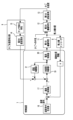
- FIG. 1 is a block diagram showing a first example of the configuration of a control device according to Embodiment 1.
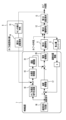
- FIG. 2 is a block diagram showing a second example of the configuration of the control device according to the first embodiment.
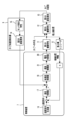
- FIG. 3 is a block diagram showing a third example of the configuration of the control device according to the first embodiment.
- FIG. 3 is a block diagram showing a fourth example of the configuration of the control device according to the first embodiment.
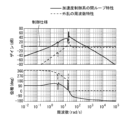
- FIG. 3 is a diagram showing an example of closed-loop characteristics of acceleration control in the control device according to the first embodiment.
- FIG. 9 is a block diagram equivalent to FIG. 8 in an ideal situation where there is no error in model parameters;
- FIG. 2 is a block diagram showing a first example of the configuration of a delay compensator according to Embodiment 1.
- FIG. 7 is a block diagram showing a fifth example of the configuration of the control device according to the first embodiment.
- 3 is a block diagram showing a second example of the configuration of the delay compensator according to the first embodiment.
- FIG. FIG. 3 is a block diagram showing a third example of the configuration of the delay compensator according to the first embodiment.
- 1 is a hardware configuration diagram of main parts of an elevator according to Embodiment 1.
- FIG. 3 is a block diagram showing a first example of the configuration of a delay compensator according to a second embodiment.
- FIG. 3 is a block diagram showing a second example of the configuration of a delay compensator according to a second embodiment.
- FIG. FIG. 3 is a block diagram showing an example of a configuration of a delay compensator according to
- FIG. 1 is a configuration diagram of an elevator 1 according to the first embodiment.
- the elevator 1 is applied to buildings having multiple floors.
- a hoistway 2 for an elevator 1 is provided in a building.
- the hoistway 2 is a vertically long space spanning multiple floors of a building.
- a machine room for the elevator 1 may be provided in the upper or lower part of the hoistway 2.
- the elevator 1 includes a hoist 3, a main rope 4, a car 5, a counterweight 6, and a control device 7.
- the hoisting machine 3 has a sheave.
- the hoisting machine 3 is a device that has a function of generating torque to rotate the sheave.
- the main rope 4 is wound around the sheave of the hoist 3.
- the main rope 4 supports the load of the car 5 by suspending the car 5 in the hoistway 2.
- the main rope 4 supports the load of the counterweight 6 by suspending the counterweight 6 in the hoistway 2.
- the main rope 4 is, for example, a carbon fiber rope.
- the carbon fiber rope is a rope in which carbon fiber is used for the load support portion that receives the load supported by the main rope 4.
- the main rope 4 may be, for example, a belt rope.
- the main rope 4 may be made of, for example, a fiber-reinforced composite material using carbon fiber or other fibers.
- the main rope 4 may be a steel strand rope or the like.
- the car 5 and the counterweight 6 travel in opposite directions in the hoistway 2 as the main rope 4 moves due to the rotation of the sheave of the hoist 3.
- the car 5 is a device that transports passengers and the like between a plurality of floors by running vertically inside the hoistway 2.
- the counterweight 6 is a device that balances the load on the main rope 4 with the car 5 on both sides of a pulley around which the main rope 4, such as a sheave of the hoist 3, is wound.
- the car 5 and the counterweight 6 travel in the vertical direction inside the hoistway 2 by being guided by, for example, a guide rail (not shown).
- the control device 7 is a device that controls the operation of the elevator 1.
- the control device 7 controls, for example, the running of the car 5 in response to a call.
- the control device 7 is connected to the hoisting machine 3.
- the control device 7 calculates a current command and a voltage command that are drive commands to the hoist 3 and supplies the drive current and drive voltage to the hoist 3.
- disturbances may be applied directly to the car 5.
- the disturbances applied to the car 5 include, for example, disturbances caused by passengers getting on and off the car 5, or disturbances caused by contact between the car 5 and the guide rails.
- the car 5 may vibrate, for example, in the vertical direction due to such directly applied disturbances.
- the control device 7 causes the hoisting machine 3 to function as an active vibration damping device so as to suppress vibrations of the car 5 caused by such disturbances.
- the elevator 1 includes a hoist encoder 8, a car acceleration detector 9, and a weighing device 10. Each of the hoist encoder 8, car acceleration detector 9, and weighing device 10 is connected to the control device 7.
- the hoisting machine encoder 8 is applied to the hoisting machine 3.
- the hoisting machine encoder 8 is equipped with a function of outputting one or both of a magnetic pole position and a rotational speed corresponding to the rotational position of the sheave of the hoisting machine 3.
- the hoist encoder 8 may be a magnetic encoder, an optical encoder, or another type of encoder.
- the car acceleration detector 9 is mounted on the car 5.
- the car acceleration detector 9 is equipped with a function of detecting the acceleration of the car 5.
- the car acceleration detector 9 detects the acceleration of the vibration of the car 5 in the vertical direction due to, for example, a disturbance applied to the car 5.
- the weighing device 10 is mounted on the car 5.
- the weighing device 10 is equipped with a function of detecting the loading amount of the car 5.
- FIG. 2 is a block diagram showing a first example of the configuration of the control device 7 according to the first embodiment.
- the elevator 1 has first mechanical properties 11 and second mechanical properties 12.
- the first mechanical characteristic 11 corresponds to the mechanical characteristic around the rotation axis of the sheave of the hoisting machine 3.
- the first mechanical characteristic 11 receives, for example, the drive torque of the hoist 3, the displacement of the car 5 and the displacement of the counterweight 6 (not shown in FIG. 2) as input, and outputs the rotational position of the hoist 3.
- the second mechanical properties 12 correspond to the mechanical properties of the main rope 4 between the sheave of the hoist 3 and the car 5.
- the second mechanical property 12 receives, for example, the rotational position of the hoist 3, which is the output of the first mechanical property 11, and a disturbance acting directly on the car 5 as input, and outputs the acceleration of the car 5.
- the elevator 1 includes a first delay element 13 and a second delay element 14.
- the first delay element 13 is a delay element corresponding to a mechanical delay until the torque generated by the hoist 3 is transmitted to the car 5 through the main rope 4.
- the first delay element 13 corresponds to, for example, a delay time until the expansion and contraction of the main rope 4 caused by the torque of the hoist 3 reaches the car 5.
- the amount of delay of the first delay element 13 changes depending on the length of the main rope 4 between the sheave of the hoist 3 and the car 5. Note that the length of the main rope 4 between the sheave of the hoist 3 and the car 5 varies depending on the position of the car 5 in the hoistway 2.
- the second delay element 14 is a delay element corresponding to a delay due to communication from the car acceleration detector 9 to the control device 7.
- the second delay element 14 corresponds to, for example, a time difference between when the car acceleration detector 9 detects the vibration acceleration of the car 5 and when the control device 7 receives a signal of the vibration acceleration.
- the car acceleration detector 9 includes a second delay element 14 and a sensor detection characteristic block 15.
- the sensor detection characteristic block 15 corresponds to detection characteristics of an acceleration sensor mounted on the car acceleration detector 9, etc.
- Sensor detection characteristic block 15 indicates the response band of car acceleration detector 9.
- the hoisting machine encoder 8 outputs the magnetic pole position of the hoisting machine 3.
- the control device 7 internally converts the output of the hoist encoder 8 into a rotational speed.
- the hoisting machine encoder 8 may output the rotational speed of the hoisting machine 3.
- the control device 7 may internally convert the output of the hoist encoder 8 into a magnetic pole position.
- the control device 7 includes a speed command generator 16, a speed controller 17, a car acceleration command generator 18, an acceleration controller 19, a current controller 20, and a delay compensator 21.
- the speed command generator 16 outputs a speed command value for the hoisting machine 3 in response to a call such as a car call or a hall call.
- the speed command generator 16 may include a filter that prevents the output speed command value from including a resonance frequency component of the car 5.
- the speed controller 17 causes the rotational speed of the hoisting machine 3 to follow the speed command based on the speed command value and information on the magnetic pole position or rotational speed of the hoisting machine 3 detected by the hoisting machine encoder 8. Performs accurate speed control.
- the speed controller 17 generates a first torque command value that follows the speed command.
- the car acceleration command generator 18 outputs an acceleration command value for the car 5 from the speed command value for the hoisting machine 3, which is the output of the speed command generator 16.
- the acceleration command for the car 5 corresponds to the time differential of the speed command for the hoist 3.
- the car acceleration command generator 18 may include an LPF (Low Pass Filter) for smoothing so as to avoid discontinuity of the acceleration command due to discrete time differentiation.
- the acceleration controller 19 applies a second torque command value to the hoisting machine 3 so that the detected acceleration of the car 5 by the car acceleration detector 9 follows the acceleration command value generated by the car acceleration command generator 18. Output.
- acceleration controller 19 and speed controller 17 are configured in parallel.
- the current controller 20 inputs a third torque command value obtained by adding the first torque command value that is the output of the speed controller 17 and the second torque command value that is the output of the acceleration controller 19.
- the current controller 20 controls the current of the hoisting machine 3 so that the drive torque of the hoisting machine 3 follows the input third torque command value.
- the current control system is shown as a block representing closed loop characteristics.
- the third torque command value such as the q-axis current command value, converted into torque current matches the detected current of the q-axis current converted by a current detector and coordinate converter (not shown). controlled to do so.
- the delay compensator 21 corrects the delay of at least one of the first delay element 13 and the second delay element 14.
- the delay compensator 21 receives the third torque command value or the q-axis current command value as an input and corrects the detected value of the car acceleration detector 9 which is fed back to the acceleration control.
- the method of delay compensation in the delay compensator 21 may be, for example, compensation using a Smith compensator, or a method using an observer that regards the influence of delay as a disturbance.
- FIG. 3 is a block diagram showing a second example of the configuration of the control device 7 according to the first embodiment.
- the acceleration controller 19 may be connected in series as an inner loop of the speed controller 17. Even with such a configuration, the control device 7 operates without problems.
- the acceleration controller 19 is connected in series to the speed controller 17, the current controller 20 controls the current of the hoisting machine 3 so that the drive torque of the hoisting machine 3 follows the third torque command value. Take control.
- FIG. 4 is a block diagram showing a third example of the configuration of the control device 7 according to the first embodiment.
- the delay compensator 21 is connected in series to the acceleration controller 19. At this time, the delay compensator 21 may be a phase advance compensator that advances the phase by the delay time. In this example, acceleration controller 19 is connected in parallel to speed controller 17.
- FIG. 5 is a block diagram showing a fourth example of the configuration of the control device 7 according to the first embodiment.
- the delay compensator 21 is connected in series to the acceleration controller 19. At this time, the delay compensator 21 may be a phase advance compensator that advances the phase by the delay time. In this example, acceleration controller 19 is connected in series with speed controller 17.
- FIG. 6 is a diagram showing an example of closed-loop characteristics of acceleration control in the control device 7 according to the first embodiment.
- the vibration of the car 5 can become large in the following three cases, for example.
- the speed controller 17 excites the car 5, which increases the vibration of the car 5.
- the hoist 3 itself generates torque disturbance due to loss torque, torque ripple, cogging torque, or the like.
- a torque disturbance with a frequency proportional to the rotational speed of the hoist 3 occurs.
- the rotation speed of the hoist 3 follows a preset speed pattern through speed control.
- the frequency of the torque disturbance matches the resonance frequency of the main rope 4 by following the speed pattern of the rotation speed of the hoist 3, the vibration of the car 5 may become large.
- the vibration of the car 5 may increase due to disturbances acting on the car 5. More specifically, this may occur when a passenger shakes the car 5, when there is contact with a guide rail, or when a vertical force is applied to the car 5 due to an earthquake.
- the vibration of the car 5 may increase due to oscillation due to instability of the acceleration control system of the control device 7.
- the control device 7 of the present disclosure aims at stably damping the vibration of the car 5 at the resonance frequency, and introduces a delay compensator 21 as a countermeasure against instability of acceleration control in the third case in particular.
- the torque of the hoisting machine 3 is delayed due to the propagation time until the expansion and contraction of the main rope 4 caused by the torque reaches the car 5.
- the time during which the expansion or contraction propagates changes depending on the length of the main rope 4.
- the car acceleration detector 9 installed in the car 5 and the control device 7 installed in the hoistway 2 or the machine room are not installed at the same location but are installed separately.
- communication delays occur when When performing feedback control of the vibration of the car 5 in the elevator 1, two delays occur: an expansion/contraction delay and a communication delay. If measures are not taken against these delays, the phase margin of the acceleration controller 19 will become smaller due to the influence of the delays, and the vibration damping effect of acceleration control will decrease, or the acceleration controller 19 will cause the car 5 to Sometimes I end up shaking it.
- the gain crossover frequency of the control design of the acceleration controller 19 is lowered, and the resonance frequency of the main rope 4 of the elevator 1 is generally set in a relatively low frequency band around 0.5 Hz to 10 Hz. Therefore, it is possible to take measures such as performing low-frequency gain compensation.
- the height of the building differs depending on the property, and the length of the main rope 4 between the sheave of the hoist 3 and the car 5 changes depending on the position of the car 5 in the hoistway 2.
- the rigidity of the main rope 4 changes as the length of the relevant portion of the main rope 4 changes.
- the weight of the car 5 differs depending on the property, and even in elevators 1 of the same model, the tension applied to the main rope 4 changes depending on the loading capacity of the car 5. At this time, the resonant frequency of the main rope 4 changes.
- the control performance of the acceleration controller 19 may differ between when the car 5 is near the bottom floor and when the car 5 is near the top floor, even if controlled using the same control parameters.
- the open loop characteristic of acceleration control includes the second mechanical characteristic 12, so the change in the second mechanical characteristic 12 due to the change in the length of the main rope 4 between the sheave of the hoisting machine 3 and the car 5
- the open-loop characteristics of acceleration control change may be used for cases where car 5 is near the bottom floor and cases where car 5 is near the top floor.
- it is difficult to meet the demands of Such a case can be dealt with by changing the control parameters in stages according to the situation of the elevator 1, such as the position of the car 5, for example.
- the Smith compensator is used when compensating for dead time.
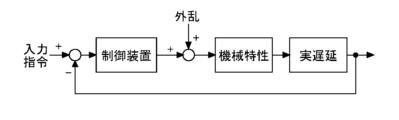
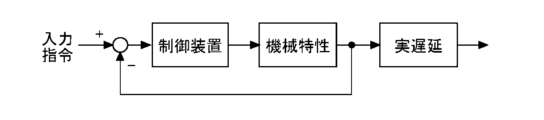
- FIG. 7 is a block diagram of a feedback system with delay.
- delayed information is fed back by the actual delay block and input to the control device. Then, the output of the control device plus the disturbance is input to the mechanical characteristics, and output information to be controlled is output.
- feedback information may be delayed due to the delay of the actual delay block, and the phase margin of the control device may become small. As described above, the control performance of the control device may deteriorate due to the delay.
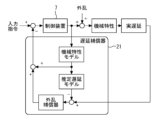
- FIG. 8 is a block diagram in which a delay compensator is introduced into the feedback system of FIG. 7. In the system shown in FIG. 8, a delay compensator is introduced in addition to the configuration shown in FIG.
- the delay compensator includes a mechanical characteristic model that simulates mechanical characteristics and an estimated delay model that simulates the amount of delay.
- the delay compensator inputs the output of the control device into the mechanical characteristic model to estimate output information of the mechanical characteristic.
- the delay compensator compensates the input of the controller so as to feed back an estimate of the output information based on the mechanical property model.
- the delay compensator subtracts information that delays the output of the mechanical characteristic model by the amount of delay simulated by the estimated delay model from the information fed back to the control device in FIG.
- FIG. 9 is a block diagram equivalent to FIG. 8 in an ideal situation where there is no error in model parameters.
- the block diagram in FIG. 9 is equivalent to the block diagram in FIG. 8 when there is no error in the model parameters of the mechanical property model and the estimated delay model.
- the delay compensator eliminates the effects of delay. As a result, vibrations due to delay do not occur, and control by the control device is prevented from becoming unstable.
- the delay compensator 21 receives the second torque command, which is the output of the acceleration controller 19, and detects the detection of the car acceleration detector 9. The output is the acceleration compensation value added to the value.
- the delay compensator 21 may use a q-axis current command, that is, a torque current command, instead of the torque command as an input.
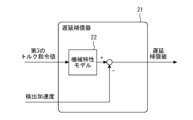
- FIG. 10 is a block diagram showing a first example of the configuration of delay compensator 21 according to the first embodiment.
- FIG. 10 an example of the internal configuration of the delay compensator 21 of FIG. 2 is shown.
- the delay compensator 21 performs delay compensation using the mechanical characteristic model 22 and the estimated delay model 23.
- the mechanical property model 22 includes a current control closed loop model 24, a first mechanical property model 25, and a second mechanical property model 26.
- the mechanical characteristic model 22 may include a model 27 of sensor detection characteristics of the car acceleration detector 9.
- the delay compensator 21 outputs a delay compensation value by calculating the difference between the output of the mechanical characteristic model 22 including these internal models and the output delayed by the estimated delay amount of the estimated delay model 23. As explained using the schematic diagrams of the Smith compensator shown in FIGS. 7 to 9, by configuring the delay compensator 21 in this manner, the influence of delay can be removed from the feedback loop.
- FIG. 11 is a block diagram showing a fifth example of the configuration of the control device 7 according to the first embodiment.
- the delay compensator 21 is a communication delay observer that regards all effects of delay as disturbances and performs delay compensation as a disturbance observer.
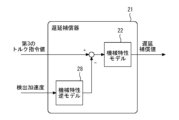
- the delay compensator 21 When the delay compensator 21 is a disturbance observer, the delay compensator 21 inputs the third torque command value and the detected value of the acceleration of the car 5 which is the output of the car acceleration detector 9. The delay compensator 21 regards the difference between the information on the acceleration of the car 5 estimated from the third torque command value and the detected value of the acceleration of the car 5 as a disturbance including the influence of the delay. The delay compensator 21 outputs a correction value for the detected acceleration value of the car 5 based on this disturbance.
- FIG. 12 is a block diagram showing a second example of the configuration of delay compensator 21 according to the first embodiment.
- FIG. 13 is a block diagram showing a third example of the configuration of delay compensator 21 according to the first embodiment. 12 and 13, an example of the internal configuration of the delay compensator 21 of FIG. 11 is shown.
- the block diagrams in FIGS. 12 and 13 are equivalent to each other, and FIG. 12 shows the case where the mechanical property inverse model 28 is used, and FIG. 13 shows the case where the mechanical property inverse model 28 is not used.
- the mechanical property inverse model 28 indicates a property obtained by inverting the input and output of the mechanical property model 22. That is, the mechanical characteristic inverse model 28 inputs the detected acceleration value of the car 5 and outputs the torque value.
- the delay compensator 21 having such a configuration does not require a model that simulates the amount of delay. Therefore, even if there is no delay amount model and the delay amount cannot be estimated, it is possible to compensate for the influence of the delay.
- the elevator 1 includes the hoist 3, the main rope 4, the car 5, the car acceleration detector 9, and the control device 7.
- the hoist 3 generates torque to rotate the sheave.
- the main rope 4 is wound around a sheave of the hoist 3.
- the car 5 is supported by the main rope 4.
- a car acceleration detector 9 is provided in the car 5.
- Car acceleration detector 9 detects the acceleration of car 5.
- the control device 7 includes an acceleration controller 19 and a delay compensator 21.
- the acceleration controller 19 outputs a torque command value based on the acceleration of the car 5 detected by the car acceleration detector 9 so as to suppress vibrations of the car 5.
- the delay compensator 21 compensates for one or both of the communication delay from the car acceleration detector 9 to the control device 7 and the mechanical delay until the torque generated by the hoisting machine 3 is transmitted to the car 5 through the main rope 4.
- the input or output of acceleration controller 19 is compensated to cancel the effect of the delay.
- the control device 7 can suppress the occurrence of a phase difference between the vibration of the car 5, which is the damping target, and the damping torque, and can control the vibration damping control based on the phase difference. Destabilization can be suppressed. Further, the control device 7 does not require a limiter to avoid oscillation due to phase difference due to delay. The control device 7 does not cancel the vibration damping control even if the vibration of the car 5 becomes large due to a disturbance or the like. Therefore, the control device 7 of the elevator 1 can suppress the vibration of the car 5 while maintaining control stability even when the vibration of the car 5 caused by the disturbance is large.
- both the vibration damping ability and the robustness for damping the vibration of the car 5 can be achieved.
- the rigidity of the mechanical system including the hoist 3, main rope 4, and car 5 of the elevator 1 decreases.
- the control device 7 can more effectively control the car 5 by active damping using the hoisting machine 3 in an elevator 1 in which the main rope 4 has a long overall length, such as a high-lift elevator or an elevator without a machine room. to suppress vibrations.
- the main rope 4 may be a carbon fiber rope.
- a carbon fiber rope may be used to reduce weight.
- carbon fiber ropes generally have lower stiffness and lower damping characteristics than steel ropes of comparable strength.
- the control device 7 more effectively suppresses the vibration of the car 5 by active vibration damping using the hoisting machine 3.
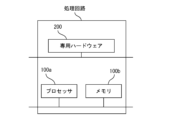
- FIG. 14 is a hardware configuration diagram of the main parts of the elevator 1 according to the first embodiment.
- Each function of the elevator 1 can be realized by a processing circuit.
- the processing circuit includes at least one processor 100a and at least one memory 100b.
- the processing circuitry may include at least one dedicated hardware 200 along with or in place of the processor 100a and memory 100b.
- each function of the elevator 1 is realized by software, firmware, or a combination of software and firmware. At least one of the software and firmware is written as a program. The program is stored in memory 100b.
- the processor 100a implements each function of the elevator 1 by reading and executing programs stored in the memory 100b.
- the processor 100a is also referred to as a CPU (Central Processing Unit), processing device, arithmetic device, microprocessor, microcomputer, or DSP.
- the memory 100b is configured of a nonvolatile or volatile semiconductor memory such as RAM, ROM, flash memory, EPROM, and EEPROM.
- the processing circuit comprises dedicated hardware 200
- the processing circuit is implemented, for example, as a single circuit, a composite circuit, a programmed processor, a parallel programmed processor, an ASIC, an FPGA, or a combination thereof.
- Each function of the elevator 1 can be realized by a respective processing circuit. Alternatively, each function of the elevator 1 can be realized all together by a processing circuit. Regarding each function of the elevator 1, some may be realized by the dedicated hardware 200, and other parts may be realized by software or firmware. In this way, the processing circuit realizes each function of the elevator 1 using dedicated hardware 200, software, firmware, or a combination thereof.
- Embodiment 2 In Embodiment 2, points that are different from the example disclosed in Embodiment 1 will be explained in particular detail. As for the features not described in the second embodiment, any of the features in the examples disclosed in the first embodiment may be adopted.
- the delay compensator 21 requires the mechanical characteristic model 22 inside.
- the mechanical characteristics may change depending on the position of the car 5 and the loading amount of the car 5. More specifically, in particular the second mechanical properties 12 may vary. Therefore, by correcting the mechanical characteristic model 22 based on the position of the car 5 or the loading amount of the car 5, delay compensation can be performed more accurately.
- the control device 7 of the second embodiment corrects the model parameters of the mechanical characteristic model 22 and the like.
- FIG. 15 is a block diagram showing a first example of the configuration of delay compensator 21 according to the second embodiment.
- FIG. 15 shows an example of the internal configuration of the delay compensator 21 when model parameter correction is applied to the delay compensator 21 of FIG.
- delay compensator 21 is a Smith compensator.
- the elevator 1 includes a car position detector (not shown in FIG. 15) that detects the position of the car 5 in the hoistway 2.
- the car position detector detects the position of the car 5 based on, for example, the output of the hoist encoder 8.
- the car position detector may detect the position of the car 5 based on the output of a speed governor encoder applied to a speed governor that suppresses excessive traveling speed of the car 5, for example.
- the car position detector is mounted on, for example, the control device 7 or the like.
- the delay compensator 21 includes a parameter corrector 29.
- the parameter corrector 29 corrects the parameters of the mechanical characteristic model 22 and estimated delay model 23 of the delay compensator 21.
- the parameter corrector 29 inputs the loading amount of the car 5 detected by the weighing device 10 and corrects the model parameters of the mechanical property model 22, such as the tension of the main rope 4, for example. Further, the parameter corrector 29 receives the position of the car 5 detected by the car position detector as input, and corrects model parameters of the mechanical characteristic model 22 such as the stiffness of the main rope 4, for example.
- the parameter corrector 29 may correct the model parameters of the mechanical characteristic model 22 by inputting both the loading amount and the position of the car 5 and outputting correction values for the model parameters. Further, the parameter corrector 29 may correct the estimated delay model 23 by outputting a delay amount correction value based on input such as the loading amount or position of the car 5.
- correction values for model parameters such as mechanical characteristics or estimated delay amount depending on the position or loading amount of the car 5 may be stored in a preset table.
- the delay compensator 21 refers to the table and outputs a correction value of the model parameter according to the position or loading amount of the car 5. Further, the delay compensator 21 may output a correction value of the model parameter according to the position or loading amount of the car 5, for example, using a preset continuous function or the like.
- the parameter corrector 29 may output a preset drive command to the hoisting machine 3 when no passenger is on the car 5 or during maintenance and inspection.
- the drive command includes, for example, a displacement command, a speed command, an acceleration command, or the like.
- the parameter corrector 29 uses one or both of the detection value of the car acceleration detector 9 and the detection value of the weighing device 10, which vary depending on the drive command, to adjust the model parameters based on the relationship with the output drive command. identify
- the parameter corrector 29 estimates the amount of delay, for example, from the relationship between the detected value of the car acceleration detector 9 or the weighing device 10 and the drive command.
- the amount of delay estimated at this time includes effects due to one or both of expansion and contraction delays due to propagation of expansion and contraction of the main rope 4 and communication delays due to communication between the car acceleration detector 9 and the control device 7.
- FIG. 16 is a block diagram showing a second example of the configuration of delay compensator 21 according to the second embodiment.
- FIG. 16 shows an example of the internal configuration of the delay compensator 21 when model parameter correction is applied to the delay compensator 21 of FIG. 13.
- delay compensator 21 is a disturbance observer.
- the input and output of the parameter corrector 29 are the same as in the case where the delay compensator 21 is a Smith compensator.
- the delay compensator 21, which is a disturbance observer does not require the estimated delay model 23. Therefore, the parameter corrector 29 applied to the delay compensator 21, which is a disturbance observer, is not applied to the delay compensator 21, which is a Smith compensator, except that there is no need to correct the estimated delay model 23. It operates in the same way as the parameter corrector 29.
- parameter corrector 29 can be similarly applied to other examples of the delay compensator 21 described in the first embodiment.
- the delay compensator 21 of FIG. 12 it is possible to apply a parameter corrector 29 whose correction targets are the mechanical characteristic model 22 and the mechanical characteristic inverse model 28.
- the elevator 1 includes the weighing device 10, the car position detection device, and the parameter corrector 29.
- the weighing device 10 detects the loading amount of the car 5.
- the car position detector detects the position of the car 5.
- the parameter corrector 29 corrects the parameters used for compensation by the delay compensator 21 based on one or both of the loading amount of the car 5 detected by the scale device 10 and the position of the car 5 detected by the car position detector.
- the delay compensator 21 performs delay compensation using a mechanical characteristic model 22 that models the mechanical characteristics of a mechanical system including the hoist 3, the main rope 4, and the car 5.
- the parameter corrector 29 corrects the parameters of the mechanical property model 22.
- the parameters of the mechanical characteristic model 22 in the delay compensator 21 are corrected based on the state of the elevator 1 such as the position of the car 5 and the loading capacity of the car 5, so that delays caused by changes in the state of the elevator 1 can be corrected. Deterioration in performance of the compensator 21 is suppressed.
- the delay compensator 21 performs delay compensation using an estimated delay model 23 that simulates the amount of delay.
- the parameter corrector 29 corrects the parameters of the estimated delay model 23.
- the parameters of the estimated delay model 23 in the delay compensator 21 are corrected based on the status of the elevator 1 such as the position of the car 5 and the loading capacity of the car 5, so that delays due to changes in the status of the elevator 1 are corrected. Deterioration in performance of the compensator 21 is suppressed.
- parameter corrector 29 outputs a preset drive command to the hoisting machine 3.
- the drive command is either a displacement command, a speed command, or an acceleration command for the car 5.
- Parameter corrector 29 identifies parameters used for compensation by delay compensator 21 based on one or both of the detected value of car acceleration detector 9 and the detected value of scale device 10, which vary depending on the drive command.
- parameters are identified based on measured values of the state of the elevator 1. Thereby, even if the principle expression of model parameters such as the mechanical characteristic model 22 or the estimated delay model 23 is unknown, the parameter corrector 29 can identify and correct the model parameters.
- Embodiment 3 In Embodiment 3, points that are different from the examples disclosed in Embodiment 1 or Embodiment 2 will be explained in particular detail. For features not described in Embodiment 3, any of the features disclosed in Embodiment 1 or Embodiment 2 may be adopted.
- FIG. 17 is a block diagram showing an example of the configuration of the delay compensator 21 according to the third embodiment.
- the delay compensator 21 of the control device 7 includes a disturbance compensator.
- a disturbance compensator is a control element that functions to suppress the effects of disturbances.
- the disturbance compensator is configured, for example, by combining one or more of proportional compensation, integral compensation, differential compensation, or filter processing.
- the elevator according to the present disclosure can be applied to buildings having multiple floors.
Landscapes
- Engineering & Computer Science (AREA)
- Automation & Control Theory (AREA)
- Civil Engineering (AREA)
- Mechanical Engineering (AREA)
- Structural Engineering (AREA)
- Elevator Control (AREA)
- Cage And Drive Apparatuses For Elevators (AREA)
Priority Applications (2)
| Application Number | Priority Date | Filing Date | Title |
|---|---|---|---|
| JP2022564076A JP7298788B1 (ja) | 2022-06-09 | 2022-06-09 | エレベーター |
| PCT/JP2022/023277 WO2023238321A1 (ja) | 2022-06-09 | 2022-06-09 | エレベーター |
Applications Claiming Priority (1)
| Application Number | Priority Date | Filing Date | Title |
|---|---|---|---|
| PCT/JP2022/023277 WO2023238321A1 (ja) | 2022-06-09 | 2022-06-09 | エレベーター |
Publications (1)
| Publication Number | Publication Date |
|---|---|
| WO2023238321A1 true WO2023238321A1 (ja) | 2023-12-14 |
Family
ID=86900599
Family Applications (1)
| Application Number | Title | Priority Date | Filing Date |
|---|---|---|---|
| PCT/JP2022/023277 Ceased WO2023238321A1 (ja) | 2022-06-09 | 2022-06-09 | エレベーター |
Country Status (2)
| Country | Link |
|---|---|
| JP (1) | JP7298788B1 (https=) |
| WO (1) | WO2023238321A1 (https=) |
Cited By (2)
| Publication number | Priority date | Publication date | Assignee | Title |
|---|---|---|---|---|
| CN118004848A (zh) * | 2024-03-01 | 2024-05-10 | 上海三菱电梯有限公司 | 电梯驱动控制系统 |
| WO2025169306A1 (ja) * | 2024-02-06 | 2025-08-14 | 三菱電機ビルソリューションズ株式会社 | 支援システム |
Citations (3)
| Publication number | Priority date | Publication date | Assignee | Title |
|---|---|---|---|---|
| JP2009221008A (ja) * | 2008-03-18 | 2009-10-01 | Toshiba Elevator Co Ltd | エレベータの制御装置 |
| JP2019112234A (ja) * | 2017-10-06 | 2019-07-11 | 三菱電機株式会社 | エレベータロープの制振装置及びエレベータ装置 |
| WO2020070795A1 (ja) * | 2018-10-02 | 2020-04-09 | 三菱電機株式会社 | ガバナシステムの特性制御装置、及びエレベータ装置 |
-
2022
- 2022-06-09 JP JP2022564076A patent/JP7298788B1/ja active Active
- 2022-06-09 WO PCT/JP2022/023277 patent/WO2023238321A1/ja not_active Ceased
Patent Citations (3)
| Publication number | Priority date | Publication date | Assignee | Title |
|---|---|---|---|---|
| JP2009221008A (ja) * | 2008-03-18 | 2009-10-01 | Toshiba Elevator Co Ltd | エレベータの制御装置 |
| JP2019112234A (ja) * | 2017-10-06 | 2019-07-11 | 三菱電機株式会社 | エレベータロープの制振装置及びエレベータ装置 |
| WO2020070795A1 (ja) * | 2018-10-02 | 2020-04-09 | 三菱電機株式会社 | ガバナシステムの特性制御装置、及びエレベータ装置 |
Cited By (2)
| Publication number | Priority date | Publication date | Assignee | Title |
|---|---|---|---|---|
| WO2025169306A1 (ja) * | 2024-02-06 | 2025-08-14 | 三菱電機ビルソリューションズ株式会社 | 支援システム |
| CN118004848A (zh) * | 2024-03-01 | 2024-05-10 | 上海三菱电梯有限公司 | 电梯驱动控制系统 |
Also Published As
| Publication number | Publication date |
|---|---|
| JP7298788B1 (ja) | 2023-06-27 |
| JPWO2023238321A1 (https=) | 2023-12-14 |
Similar Documents
| Publication | Publication Date | Title |
|---|---|---|
| EP3378820B1 (en) | Dynamic compensation control for elevator systems | |
| US5828014A (en) | Elevator speed control circuit | |
| RU2482049C2 (ru) | Способ управления положением кабины лифта и лифтовая система | |
| JP7298788B1 (ja) | エレベーター | |
| JP3937363B2 (ja) | エレベータの速度制御装置 | |
| WO2009036423A2 (en) | System and method to minimize rope sway in elevators | |
| CN100400402C (zh) | 电梯控制装置 | |
| KR20200059148A (ko) | 진동식 기술 시스템의 진동을 상쇄하는 진동 컨트롤러 및 그에 따른 방법 | |
| KR101263568B1 (ko) | 엘리베이터 제어 장치 | |
| JP5659727B2 (ja) | クレーン振れ角検出方法及び装置、並びにクレーン振れ止め制御方法及び装置 | |
| CN114667262B (zh) | 电梯的索条体的减振装置 | |
| CN113023570B (zh) | 悬挂式起重机的控制装置以及逆变器装置 | |
| JP2012056689A (ja) | エレベータ | |
| JP2011001169A (ja) | エレベータの起動秤自動調整装置 | |
| JPWO2023238321A5 (https=) | ||
| JP4810539B2 (ja) | エレベータの振動低減装置 | |
| JP2011195286A (ja) | エレベータの制御装置 | |
| JP5942875B2 (ja) | エレベータの振動低減装置及びエレベータ | |
| JP2005170537A (ja) | エレベータの制御装置 | |
| JP5746373B2 (ja) | エレベーターの制御装置およびその制御方法 | |
| JP6727437B2 (ja) | エレベータ装置 | |
| WO2021240593A1 (ja) | エレベーターの着床制御システム | |
| JP2015000796A (ja) | エレベーター | |
| JP2006232420A (ja) | エレベータの荷重補償方法及び荷重補償装置 | |
| JP2004091199A (ja) | エレベータの制御装置 |
Legal Events
| Date | Code | Title | Description |
|---|---|---|---|
| ENP | Entry into the national phase |
Ref document number: 2022564076 Country of ref document: JP Kind code of ref document: A |
|
| 121 | Ep: the epo has been informed by wipo that ep was designated in this application |
Ref document number: 22945823 Country of ref document: EP Kind code of ref document: A1 |
|
| NENP | Non-entry into the national phase |
Ref country code: DE |
|
| 122 | Ep: pct application non-entry in european phase |
Ref document number: 22945823 Country of ref document: EP Kind code of ref document: A1 |