WO2023238295A1 - 自動走行装置、エスカレータおよび自動走行装置のエスカレータ乗車方法 - Google Patents
自動走行装置、エスカレータおよび自動走行装置のエスカレータ乗車方法 Download PDFInfo
- Publication number
- WO2023238295A1 WO2023238295A1 PCT/JP2022/023171 JP2022023171W WO2023238295A1 WO 2023238295 A1 WO2023238295 A1 WO 2023238295A1 JP 2022023171 W JP2022023171 W JP 2022023171W WO 2023238295 A1 WO2023238295 A1 WO 2023238295A1
- Authority
- WO
- WIPO (PCT)
- Prior art keywords
- escalator
- automatic traveling
- traveling device
- command
- wireless communication
- Prior art date
- Legal status (The legal status is an assumption and is not a legal conclusion. Google has not performed a legal analysis and makes no representation as to the accuracy of the status listed.)
- Ceased
Links
Images






Classifications
-
- B—PERFORMING OPERATIONS; TRANSPORTING
- B66—HOISTING; LIFTING; HAULING
- B66B—ELEVATORS; ESCALATORS OR MOVING WALKWAYS
- B66B25/00—Control of escalators or moving walkways
-
- B—PERFORMING OPERATIONS; TRANSPORTING
- B66—HOISTING; LIFTING; HAULING
- B66B—ELEVATORS; ESCALATORS OR MOVING WALKWAYS
- B66B29/00—Safety devices of escalators or moving walkways
- B66B29/08—Means to facilitate passenger entry or exit
-
- B—PERFORMING OPERATIONS; TRANSPORTING
- B66—HOISTING; LIFTING; HAULING
- B66B—ELEVATORS; ESCALATORS OR MOVING WALKWAYS
- B66B31/00—Accessories for escalators, or moving walkways, e.g. for sterilising or cleaning
Definitions
- the present disclosure relates to an automatic traveling device, an escalator, and an escalator riding method for the automatic traveling device.
- the passenger conveyor device described in Patent Document 1 includes a communication unit for transmitting and receiving signals between the passenger conveyor and a robot travel control device for controlling the travel of the robot, and a communication unit for transmitting and receiving signals between the passenger conveyor and a robot travel control device for controlling the travel of the robot.
- a speed control unit that changes the speed of the passenger conveyor to a speed at which the robot can get on and off the passenger conveyor received by the communication unit based on a command to change the speed of the passenger conveyor received by the communication unit in accordance with the expected arrival time of the passenger conveyor; Equipped with.
- Patent Document 1 does not provide a means for supporting an automatic traveling device such as a robot so that it does not fall down while riding on an escalator. Therefore, the automatic traveling device may fall down while riding on the escalator.
- an object of the present disclosure is to provide an automatic traveling device, an escalator, and an escalator riding method for an automatic traveling device that can prevent the automatic traveling device from falling down while riding on the escalator.
- the automatic traveling device of the present disclosure includes an arm, a memory that stores a program, and a processor that executes the program.
- the processor detects the movement of the escalator tread when the automatic traveling device arrives at the escalator boarding position, controls the arm to grab the tread cleat, and after the arm grabs the tread cleat. , move the automatic traveling device forward to get on the escalator.
- the method of riding an escalator using an automatic traveling device is such that the automatic traveling device stops the automatic traveling device only when no person is riding on the escalator when the automatic traveling device arrives at the escalator boarding position. , a step of also transmitting a deceleration command or a stop command to the escalator; a step of decelerating or stopping the running of the steps and the moving handrail of the escalator when the escalator receives the deceleration command or the stop command from the automatic traveling device;
- the traveling device detects the movement of the step of the escalator, the arm of the automatic traveling device grabs the cleat of the step, and after the arm grabs the cleat of the step, the automatic traveling device moves forward and rides the escalator.
- FIG. 5 is a diagram showing the configuration of an escalator 50.
- FIG. 1 is a diagram showing the configuration of an automatic traveling device 10.
- FIG. It is a figure showing the structure of left arm 17A and right arm 17B.
- 5 is a diagram showing a state in which the left arm 17A and the right arm 17B are connected to the step 4 of the escalator 50 while the automatic traveling device 10 is riding on the escalator 50.
- FIG. 5 is a diagram showing a state in which the left arm 17A and the right arm 17B are connected to the step 4 of the escalator 50 immediately before the automatic traveling device 10 gets off the escalator 50.
- FIG. 3 is a diagram showing the positional relationship between the arms 17A, 17B and the step 4 when the automatic traveling device 10 rides on the up escalator 50.
- FIG. 4 is a diagram showing the positional relationship between arms 17A, 17B and step 4 when automatic traveling device 10 is riding on up escalator 50.
- FIG. 4 is a diagram showing the positional relationship between the arms 17A, 17B and the step 4 when the automatic traveling device 10 gets off the up escalator 50.
- FIG. 3 is a diagram showing the positional relationship between arms 17A, 17B and step 4 when automatic traveling device 10 rides down escalator 50.
- FIG. 3 is a diagram showing the positional relationship between arms 17A, 17B and step 4 when automatic traveling device 10 is riding on down escalator 50.
- FIG. 4 is a diagram showing the positional relationship between arms 17A, 17B and step 4 when automatic traveling device 10 is riding on down escalator 50.
- FIG. 1 is a diagram showing the configuration of an escalator 50.
- the main frame 1 spans between the upper floor where the escalator 50 is placed and the lower floor where the escalator 50 is placed.
- the upper entrance 2A is located on the upper floor where the escalator 50 is located.
- the lower entrance 2B is arranged on the lower floor where the escalator 50 is arranged.
- the escalator 50 is an up escalator
- the lower entrance 2B is the boarding position
- the upper entrance 2A is the exit position.
- the escalator 50 is a down escalator
- the lower entrance 2B is the exit position
- the upper entrance 2A is the boarding position.
- a floor plate 7A forming a floor surface is arranged at the upper entrance 2A.
- a floor plate 7B forming a floor surface is arranged at the lower entrance 2B.
- the control panel 6 controls the operation of the entire escalator 50, such as the running control of the steps 4 and the moving handrail 5.
- the wireless communication device 21 is configured to be able to communicate with the automatic traveling device 10.
- the control device 8 is configured to control and manage a plurality of escalators 50 in the building through the control panel 6.
- the control device 8 displays necessary information on the display 9 and outputs it from the speaker 3.
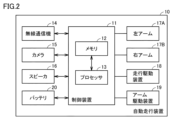
- FIG. 2 is a diagram showing the configuration of the automatic traveling device 10.
- the automatic traveling device 10 includes a wireless communication device 14, a camera 15, a speaker 16, a left arm 17A, a right arm 17B, a battery 20, a traveling drive device 18, an arm drive device 19, and a control device 11. Equipped with
- the control device 11 includes a memory 12 and a processor 13.
- Memory 12 stores programs.
- Processor 13 executes programs stored in memory 12. The operation of the control device 11 described below is performed by the processor 13 executing a program in the memory 12.
- the wireless communication device 14 communicates with the control panel 6 of the escalator 50 via, for example, a wireless LAN (Local Area Network).
- a wireless LAN Local Area Network
- the camera 15 images the escalator 50 and its surroundings when getting on and off the escalator 50, and outputs the captured image to the control device 11.
- the battery 20 supplies electric power for operating each device that makes up the automatic traveling device 10.
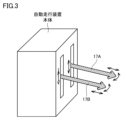
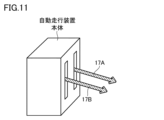
- FIG. 3 is a diagram showing the configuration of the left arm 17A and the right arm 17B.
- FIG. 5 is a diagram showing a state in which the left arm 17A and right arm 17B are connected to the step 4 of the escalator 50 immediately before the automatic traveling device 10 gets off the escalator 50.
- the arm driving device 19 moves the protruding portions 42 of the left arm 17A and the right arm 17B to the left to the fulcrum of the left arm 17A.
- a force is applied to the fulcrum of the right arm 17B in the right direction.
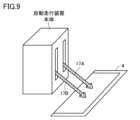
- FIG. 6 is a diagram showing the positional relationship between the arms 17A, 17B and the step 4 when the automatic traveling device 10 gets on the up escalator 50.
- FIG. 7 is a diagram showing the positional relationship between the arms 17A, 17B and the step 4 when the automatic traveling device 10 is riding on the up escalator 50.
- the arm driving device 19 slides the left arm 17A and the right arm 17B upward in response to the rise of the step 4, and so that the tip of the left arm 17A and the tip of the right arm 17B move upward, Rotate the left arm 17A and right arm 17B.
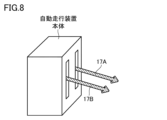
- FIG. 8 is a diagram showing the positional relationship between the arms 17A, 17B and the step 4 when the automatic traveling device 10 gets off the up escalator 50.
- the arm drive device 19 controls the left arm 17A and the right arm 17B so that they can release the step 4 of the escalator 50.
- the arm driving device 19 controls the left arm 17A and the right arm 17B so that they can grip the steps 4 of the escalator 50 by moving the tips of the left arm 17A and the right arm 17B downward.
- FIG. 11 is a diagram showing the positional relationship between the arms 17A, 17B and the step 4 when the automatic traveling device 10 gets off the down escalator 50.
- the arm drive device 19 controls the left arm 17A and the right arm 17B so that they can release the step 4 of the escalator 50, and the left arm 17A and the right arm 17B can retract.
- FIG. 12 is a flowchart showing the operating procedure of the automatic traveling device 10 and the escalator 50 of the first embodiment.
- step S101 the control device 11 determines whether the automatic traveling device 10 has arrived at the boarding position of the escalator 50 based on the image obtained from the camera 15.
- the process advances to step S102.
- step S102 the control device 11 stops the automatic traveling device 10 from traveling by controlling the traveling drive device 18.
- step S103 the control device 11 determines whether a person is on the escalator 50 based on the image obtained from the camera 15. If a person is on the escalator 50, the process advances to step S104. If no person is on the escalator 50, the process advances to step S105.
- step S104 the control device 11 controls the travel drive device 18 based on the image obtained from the camera 15 until the escalator 50 is no longer occupied, thereby causing the automatic travel device 10 to run. Stop.
- step S105 the control device 11 transmits a command to stop the escalator 50 to the escalator 50 via the wireless communication device 14.
- the wireless communication device 21 of the escalator 50 receives the stop command.
- the control panel 6 of the escalator 50 stops the steps 4 and the moving handrail 5 of the escalator 50 from running.
- step S106 the control device 11 causes the speaker 16 to output an announcement sound that the escalator 50 will stop.
- step S107 the control device 11 detects the movement of the step 4 of the escalator 50 based on the image obtained from the camera 15, and causes the arms 17A and 17B to grip the cleat 41 of the step 4 through the arm drive device 19.
- the arms 17A and 17B are controlled so that the
- step S110 the control device 11 controls the traveling drive device 18 to advance the automatic traveling device 10 by a predetermined distance and then stop it.
- step S111 the control device 11 causes the speaker 16 to output an announcement voice requesting that no one get on the escalator 50.
- step S112 the control device 11 determines whether the automatic traveling device 10 has arrived at a predetermined position on the escalator 50 based on the image obtained from the camera 15.
- the process advances to step S113.
- the predetermined position is, for example, when the step 4 held by the arms 17A, 17B is connected to the alighting position.
- step S113 the control device 11 controls the arms 17A, 17B through the arm drive device 19 so that the arms 17A, 17B can release the cleat 41 of the step 4.
- step S114 the control device 11 determines whether the automatic traveling device 10 has arrived just before the exit position of the escalator 50 based on the image obtained from the camera 15.
- the process advances to step S115.
- Immediately before the alighting position is when the step 4 on which the automatic traveling device 10 is placed is connected to the alighting position.
- step S115 the control device 11 transmits a command to stop the escalator 50 to the escalator 50 via the wireless communication device 14.
- the wireless communication device 21 of the escalator 50 receives the stop command.
- the control panel 6 of the escalator 50 stops the steps 4 and the moving handrail 5 of the escalator 50 from running.
- step S116 the control device 11 causes the speaker 16 to output an announcement sound that the escalator 50 will stop.
- step S117 the control device 11 controls the travel drive device 18 to move the automatic travel device 10 forward.
- step S118 the control device 11 transmits a command to start the escalator 50 to the escalator 50 via the wireless communication device 14.
- the wireless communication device 21 of the escalator 50 receives the activation command.
- the control panel 6 of the escalator 50 causes the steps 4 and the moving handrail 5 of the escalator 50 to travel.
- step S119 the control device 11 causes the speaker 16 to output an announcement sound indicating that the escalator 50 will start.
- Embodiment 2 In the first embodiment, when the automatic traveling device 10 gets on and off the escalator 50, the escalator 50 is stopped. In the second embodiment, when the automatic traveling device 10 gets on and off the escalator 50, the escalator 50 is decelerated.
- FIG. 13 is a flowchart showing the operating procedure of the automatic traveling device 10 and the escalator 50 of the second embodiment.
- step S201 the control device 11 determines whether the automatic traveling device 10 has arrived at the boarding position of the escalator 50 based on the image obtained from the camera 15.
- the process advances to step S202.
- step S202 the control device 11 stops the automatic traveling device 10 from traveling by controlling the traveling drive device 18.
- step S203 the control device 11 determines whether a person is on the escalator 50 based on the image obtained from the camera 15. If a person is on the escalator 50, the process advances to step S204. If no person is on the escalator 50, the process advances to step S205.
- step S207 the control device 11 detects the movement of the step 4 of the escalator 50 based on the image obtained from the camera 15, and causes the arms 17A and 17B to grip the cleat 41 of the step 4 through the arm drive device 19.
- the arms 17A and 17B are controlled so that the
- step S212 the control device 11 determines whether the automatic traveling device 10 has arrived at a predetermined position on the escalator 50 based on the image obtained from the camera 15.
- the process advances to step S213.
- the predetermined position is, for example, when the step 4 held by the arms 17A, 17B is connected to the alighting position.
- step S214 the control device 11 causes the speaker 16 to output an announcement sound that the escalator 50 will decelerate.
- step S218 the control device 11 transmits a command to increase the speed of the escalator 50 to the escalator 50 via the wireless communication device 14.
- the wireless communication device 21 of the escalator 50 receives the speed increase command.
- the control panel 6 of the escalator 50 increases the speed of the steps 4 and the moving handrail 5 of the escalator 50.
- the speaker 16 of the automatic traveling device 10 announces the deceleration of the escalator 50, etc., but the invention is not limited to this.
- the speaker 3 of the escalator 50 may announce the deceleration of the escalator 50, etc.
Landscapes
- Escalators And Moving Walkways (AREA)
Priority Applications (3)
| Application Number | Priority Date | Filing Date | Title |
|---|---|---|---|
| PCT/JP2022/023171 WO2023238295A1 (ja) | 2022-06-08 | 2022-06-08 | 自動走行装置、エスカレータおよび自動走行装置のエスカレータ乗車方法 |
| CN202280096867.4A CN119325450B (zh) | 2022-06-08 | 2022-06-08 | 自动行驶装置、自动扶梯以及自动行驶装置的自动扶梯搭乘方法 |
| JP2024526128A JP7580668B2 (ja) | 2022-06-08 | 2022-06-08 | 自動走行装置、エスカレータおよび自動走行装置のエスカレータ乗車方法 |
Applications Claiming Priority (1)
| Application Number | Priority Date | Filing Date | Title |
|---|---|---|---|
| PCT/JP2022/023171 WO2023238295A1 (ja) | 2022-06-08 | 2022-06-08 | 自動走行装置、エスカレータおよび自動走行装置のエスカレータ乗車方法 |
Publications (1)
| Publication Number | Publication Date |
|---|---|
| WO2023238295A1 true WO2023238295A1 (ja) | 2023-12-14 |
Family
ID=89117743
Family Applications (1)
| Application Number | Title | Priority Date | Filing Date |
|---|---|---|---|
| PCT/JP2022/023171 Ceased WO2023238295A1 (ja) | 2022-06-08 | 2022-06-08 | 自動走行装置、エスカレータおよび自動走行装置のエスカレータ乗車方法 |
Country Status (3)
| Country | Link |
|---|---|
| JP (1) | JP7580668B2 (https=) |
| CN (1) | CN119325450B (https=) |
| WO (1) | WO2023238295A1 (https=) |
Citations (5)
| Publication number | Priority date | Publication date | Assignee | Title |
|---|---|---|---|---|
| JPS54124488A (en) * | 1978-03-04 | 1979-09-27 | Orenstein & Koppel Ag | Moving stairway provided with taking device for carrying cart |
| JPH11335057A (ja) * | 1998-05-29 | 1999-12-07 | Nippon Fillester Co Ltd | エスカレータの車椅子乗載装置 |
| JP2019001613A (ja) * | 2017-06-15 | 2019-01-10 | 株式会社日立ビルシステム | 乗客コンベアー装置、乗客コンベアー装置の制御方法、および乗客コンベアー装置制御システム |
| US20190369622A1 (en) * | 2019-06-28 | 2019-12-05 | Lg Electronics Inc. | Method for entering mobile robot into moving walkway and mobile robot thereof |
| WO2022029971A1 (ja) * | 2020-08-06 | 2022-02-10 | 三菱電機ビルテクノサービス株式会社 | 自律移動体の制御装置および自律移動体 |
Family Cites Families (4)
| Publication number | Priority date | Publication date | Assignee | Title |
|---|---|---|---|---|
| ES2775452T3 (es) * | 2016-03-10 | 2020-07-27 | Inventio Ag | Dispositivo para la fabricación asistida por robot de un armazón de soporte para una instalación de transporte de personas |
| CN106966283B (zh) * | 2017-04-21 | 2018-07-24 | 福建省永春县亿达农副产品贸易有限公司 | 一种用于踏步式电动扶梯隔断的自动化清理设备 |
| CN113651220B (zh) * | 2021-07-13 | 2023-09-12 | 日立楼宇技术(广州)有限公司 | 一种辅助机器人搭乘扶梯系统、方法、装置及存储介质 |
| CN113651221B (zh) * | 2021-07-13 | 2023-05-02 | 日立楼宇技术(广州)有限公司 | 一种机器人搭乘扶梯的方法、装置及存储介质 |
-
2022
- 2022-06-08 JP JP2024526128A patent/JP7580668B2/ja active Active
- 2022-06-08 CN CN202280096867.4A patent/CN119325450B/zh active Active
- 2022-06-08 WO PCT/JP2022/023171 patent/WO2023238295A1/ja not_active Ceased
Patent Citations (5)
| Publication number | Priority date | Publication date | Assignee | Title |
|---|---|---|---|---|
| JPS54124488A (en) * | 1978-03-04 | 1979-09-27 | Orenstein & Koppel Ag | Moving stairway provided with taking device for carrying cart |
| JPH11335057A (ja) * | 1998-05-29 | 1999-12-07 | Nippon Fillester Co Ltd | エスカレータの車椅子乗載装置 |
| JP2019001613A (ja) * | 2017-06-15 | 2019-01-10 | 株式会社日立ビルシステム | 乗客コンベアー装置、乗客コンベアー装置の制御方法、および乗客コンベアー装置制御システム |
| US20190369622A1 (en) * | 2019-06-28 | 2019-12-05 | Lg Electronics Inc. | Method for entering mobile robot into moving walkway and mobile robot thereof |
| WO2022029971A1 (ja) * | 2020-08-06 | 2022-02-10 | 三菱電機ビルテクノサービス株式会社 | 自律移動体の制御装置および自律移動体 |
Also Published As
| Publication number | Publication date |
|---|---|
| JP7580668B2 (ja) | 2024-11-11 |
| CN119325450B (zh) | 2025-10-21 |
| CN119325450A (zh) | 2025-01-17 |
| JPWO2023238295A1 (https=) | 2023-12-14 |
Similar Documents
| Publication | Publication Date | Title |
|---|---|---|
| JP5572018B2 (ja) | 自律移動装置同乗エレベータシステム | |
| JP2019001613A (ja) | 乗客コンベアー装置、乗客コンベアー装置の制御方法、および乗客コンベアー装置制御システム | |
| WO2018066056A1 (ja) | エレベーターシステム | |
| EP3628622B1 (en) | Validation of elevator call passenger boarding | |
| CN113401753A (zh) | 通过机器人的电梯系统人群检测 | |
| EP4345045B1 (en) | Emergency evacuation robot | |
| JP2002255460A (ja) | エレベータシステムの運行制御方法および運行制御装置 | |
| CN117105027A (zh) | 机器人专用电梯系统 | |
| CN110775790A (zh) | 在多门电梯中用于乘客出梯的电梯门控制 | |
| JP7580668B2 (ja) | 自動走行装置、エスカレータおよび自動走行装置のエスカレータ乗車方法 | |
| CN1878711A (zh) | 自动乘客输送机的低速运行 | |
| CN111086932A (zh) | 用于监视大堂活动以确定是否取消电梯服务的系统 | |
| JP7099579B1 (ja) | 移動体制御装置、移動体連携装置および移動体連携システム | |
| JP7677738B1 (ja) | エレベータ制御システムおよびエレベータ制御方法 | |
| JP7679552B2 (ja) | 自動走行装置、エスカレータおよび自動走行装置のエスカレータ乗車方法 | |
| JP2008308268A (ja) | 乗客コンベア運転装置 | |
| JP2002220161A (ja) | ダブルデッキエレベータ | |
| JP7750367B1 (ja) | 乗客コンベア誘導装置 | |
| JP7625751B1 (ja) | 自律移動体、乗客コンベア制御システムおよび乗客コンベア制御方法 | |
| JP7670207B1 (ja) | 設備システム、設備制御装置、設備制御方法、および設備制御プログラム | |
| JP7775376B1 (ja) | 自律移動体、自律移動体制御システムおよび自律移動体制御方法 | |
| JP7625753B1 (ja) | 自律移動体制御システムおよび自律移動体制御方法 | |
| JP4868765B2 (ja) | エスカレータのスケジュール運転制御装置 | |
| JPWO2023228240A5 (https=) | ||
| KR102308850B1 (ko) | 에스컬레이터 및 무빙워크의 안전운행 제어장치 |
Legal Events
| Date | Code | Title | Description |
|---|---|---|---|
| 121 | Ep: the epo has been informed by wipo that ep was designated in this application |
Ref document number: 22945798 Country of ref document: EP Kind code of ref document: A1 |
|
| ENP | Entry into the national phase |
Ref document number: 2024526128 Country of ref document: JP Kind code of ref document: A |
|
| WWE | Wipo information: entry into national phase |
Ref document number: 202280096867.4 Country of ref document: CN |
|
| NENP | Non-entry into the national phase |
Ref country code: DE |
|
| WWP | Wipo information: published in national office |
Ref document number: 202280096867.4 Country of ref document: CN |
|
| 122 | Ep: pct application non-entry in european phase |
Ref document number: 22945798 Country of ref document: EP Kind code of ref document: A1 |
|
| WWG | Wipo information: grant in national office |
Ref document number: 202280096867.4 Country of ref document: CN |