WO2023238187A1 - 電動車両及び車両用電動アシスト装置 - Google Patents
電動車両及び車両用電動アシスト装置 Download PDFInfo
- Publication number
- WO2023238187A1 WO2023238187A1 PCT/JP2022/022773 JP2022022773W WO2023238187A1 WO 2023238187 A1 WO2023238187 A1 WO 2023238187A1 JP 2022022773 W JP2022022773 W JP 2022022773W WO 2023238187 A1 WO2023238187 A1 WO 2023238187A1
- Authority
- WO
- WIPO (PCT)
- Prior art keywords
- arm
- vehicle
- bracket
- electric
- drive wheel
- Prior art date
- Legal status (The legal status is an assumption and is not a legal conclusion. Google has not performed a legal analysis and makes no representation as to the accuracy of the status listed.)
- Ceased
Links
Images



Classifications
-
- A—HUMAN NECESSITIES
- A61—MEDICAL OR VETERINARY SCIENCE; HYGIENE
- A61G—TRANSPORT, PERSONAL CONVEYANCES, OR ACCOMMODATION SPECIALLY ADAPTED FOR PATIENTS OR DISABLED PERSONS; OPERATING TABLES OR CHAIRS; CHAIRS FOR DENTISTRY; FUNERAL DEVICES
- A61G5/00—Chairs or personal conveyances specially adapted for patients or disabled persons, e.g. wheelchairs
- A61G5/04—Chairs or personal conveyances specially adapted for patients or disabled persons, e.g. wheelchairs motor-driven
- A61G5/047—Chairs or personal conveyances specially adapted for patients or disabled persons, e.g. wheelchairs motor-driven by a modular detachable drive system
Definitions
- the present invention relates to an electric vehicle and a vehicle electric assist device.
- Patent Document 1 discloses an electric assist device used for a wheelchair.
- This electric assist device includes a main body including a battery, an electric motor, and a drive wheel, and a mounting bar.
- An electric motor drives the drive wheels.
- the mounting bar is a member for mounting the main body on the body of the wheelchair.
- the position of the main body mounted on the vehicle body via the mounting bar can be switched between a standby position and a drive position. In the standby position, the drive wheels are lifted off the road surface. In the drive position, the drive wheels are in contact with the road surface. By driving the drive wheels when in the drive position, the electric assist device assists the wheelchair in moving.
- a wheelchair equipped with the conventional electric assist device described above travels with the main body portion fixed at the driving position. Therefore, shocks and vibrations from the road surface are directly transmitted to the main body via the drive wheels. Such shocks and vibrations may cause failure of the electric motor mounted on the main body, peripheral devices for driving the drive wheels, and the like.
- An electric vehicle includes a vehicle body having wheels, a bracket fixed to the vehicle body, an arm supported by the bracket so as to be swingable in the vertical direction, and a distal end portion of the arm.
- the device includes a drive wheel provided, an actuator that drives the drive wheel, and an elastic member that is provided between the bracket and the arm and urges the arm downward.
- this embodiment seen from another point of view is a vehicle electric assist device mounted on a vehicle.
- This electric power assist device for a vehicle includes a bracket fixed to the vehicle, an arm provided on the bracket so as to be swingable in the vertical direction, a drive wheel provided at the tip of the arm, and a drive wheel that drives the drive wheel.
- the device includes an actuator, and an elastic member provided between the bracket and the arm and urging the arm downward.
- the contact pressure of the drive wheels can be increased while damping vibrations from the drive wheels.
- FIG. 1 is a perspective view of an electric wheelchair according to an embodiment.
- FIG. 2 is a diagram showing the main parts of the electric wheelchair when viewed from the rear.
- FIG. 3 is an enlarged view of the main part of FIG.
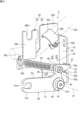
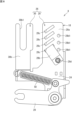
- FIG. 4 is an enlarged perspective view showing the bracket and arm of the drive unit.
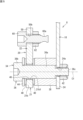
- FIG. 5 is a cross-sectional view of the bracket and arm.
- FIG. 6A is a diagram showing the relationship between the drive wheel and the main wheel when the arm body is in the lower swing position.
- FIG. 6B is a diagram showing the relationship between the drive wheels and the main wheels when the vehicle body is placed on the road surface.
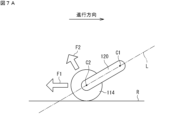
- Figure 7A shows the force that acts on the arm when the electric wheelchair, in which the straight line passing through the center of swing of the arm and the center of rotation of the drive wheel is not parallel to the road surface, applies the brakes to the drive wheel while traveling. It is a diagram.
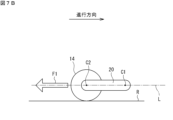
- FIG. 7B is a diagram showing the force that acts on the arm when the electric wheelchair of this embodiment applies brakes to the drive wheels while it is running.
- FIG. 8 is a diagram showing a bracket of a drive unit according to another embodiment.
- An electric vehicle includes a vehicle body having wheels, a bracket fixed to the vehicle body, an arm supported by the bracket so as to be swingable in the vertical direction, and a distal end portion of the arm.
- the device includes a drive wheel provided, an actuator that drives the drive wheel, and an elastic member that is provided between the bracket and the arm and urges the arm downward.
- the driving wheel can be pressed against the road surface while the wheel is in contact with the ground.
- the contact pressure of the drive wheels can be increased while damping vibrations from the drive wheels.
- the electric vehicle may further include a low friction member interposed between the bracket and the arm.
- a low friction member interposed between the bracket and the arm.
- the bracket has a support member including a support shaft that swingably supports the arm, and the low friction member is provided on the outer peripheral side of the support shaft and is connected to the arm. , it is preferable to include a low-friction washer interposed between the support member and the support member.
- the arm has a protrusion that protrudes along the longitudinal direction of the arm on the base end side of the arm, and the bracket is provided above the protrusion and the arm
- the arm may include an upper wall part that the protrusion comes into contact with when the arm swings, and a lower wall part that is provided below the protrusion and comes into contact with the protrusion when the arm swings.
- the swing range of the protrusion can be limited by the upper wall and the lower wall. This makes it possible to limit the range of swing of the arm. As a result, it is possible to prevent the arm from swinging beyond a necessary range.
- the vehicle body may include a wheelchair.
- this embodiment seen from another point of view is a vehicle electric assist device mounted on a vehicle.
- This electric power assist device for a vehicle includes a bracket fixed to the vehicle, an arm provided on the bracket so as to be swingable in the vertical direction, a drive wheel provided at the tip of the arm, and a drive wheel that drives the drive wheel.
- the device includes an actuator, and an elastic member provided between the bracket and the arm and urging the arm downward.
- the bracket since the bracket includes the elastic member that urges the arm downward, the bracket can be fixed to the vehicle body so that the drive wheels are pressed against the road surface when the wheels of the vehicle are in contact with the ground. As a result, the drive wheels are pressed against the road surface by the elastic member. As a result, the contact pressure of the drive wheels can be increased while damping vibrations from the drive wheels.
- the bracket includes a main body portion on which the arm is provided, and a fixing portion that fixes the main body portion at a predetermined height position in the vehicle.
- the predetermined height position corresponds to the center of swing of the arm and the center of rotation of the drive wheel when the wheels of the vehicle to which the vehicle electric assist device is attached and the drive wheels touch the road surface.
- the passing straight line is parallel to the road surface. In this case, it is possible to reduce the ground contact pressure of the driving wheels and to suppress vertical vibrations occurring in the driving wheels.
- the bracket may include a main body portion on which the arm is provided, and a fixing portion capable of adjusting a height position of the main body portion in the vehicle.
- a straight line passing through the center of swing of the arm and the center of rotation of the drive wheel when the wheel of the vehicle to which the vehicle electric assist device is mounted and the drive wheel touch the road surface is The height position of the main body part can be adjusted so that it is parallel to the road surface. As a result, it is possible to reduce the ground contact pressure of the drive wheels and to suppress vertical vibrations occurring in the drive wheels.
- FIG. 1 is a perspective view of an electric wheelchair according to an embodiment.
- FIG. 2 is a diagram showing the main parts of the electric wheelchair when viewed from the rear.
- This electric wheelchair 1 has a function of driving the drive wheels of the electric wheelchair 1 when pushed from behind by an operator to assist the operator.
- the electric wheelchair 1 is an electric vehicle that includes a vehicle body 2 and a vehicle electric assist device 4.
- the vehicle main body 2 is a general wheelchair, and includes a frame 2a mainly made of metal pipes, a pair of main wheels 2b, and a pair of casters 2c.
- the frame 2a includes a pair of rear tubes 2a1, a pair of front tubes 2a2, a pair of upper tubes 2a3, and a pair of lower tubes 2a4.
- the pair of rear tubes two a1 extend in the vertical direction.
- the pair of rear tubes 2a1 are arranged parallel to each other at a constant interval in the left-right direction.
- the pair of lower tubes two a4 are connected to the lower ends of the pair of rear tubes two a1.
- the pair of upper tubes two a3 are connected to the pair of rear tubes two a1.
- a portion of the pair of rear tubes 2a1 where the pair of upper tubes 2a3 are connected is above the lower end.
- the pair of upper tubes 2a3 and the pair of lower tubes 2a4 extend in the front-rear direction.
- the pair of upper tubes 2a3 and the pair of lower tubes 2a4 are arranged substantially parallel to each other at a constant interval in the left-right direction.
- a portion of the pair of lower tubes 2a4 that is rearward of the rear tube 2a1 is a tipping bar 2t.
- the tipping bar 2t is a member that is stepped on by the operator's foot. When the operator steps on the tipping bar 2t, the caster 2c is lifted upward using the main wheel 2b as a fulcrum.
- the pair of front tubes 2a2 extend in the vertical direction.
- the pair of front tubes 2a2 connects the tips of the pair of upper tubes 2a3 and the tips of the pair of lower tubes 2a4. Therefore, the pair of front tubes 2a2 are shorter than the pair of rear tubes 2a1.
- a pair of casters 2c are provided at the lower end of the front tube 2a2.
- the pair of main wheels 2b are provided at the lower end of the rear tube 2a1.
- the pair of main wheels 2b are provided behind the pair of casters 2c.
- the pair of main wheels 2b are rear wheels.
- the pair of casters 2c are front wheels.
- the vehicle body 2 further includes a seat portion 2d on which a passenger sits, and a backrest portion 2e.
- the seat portion 2d is fixed to a pair of upper tubes 2a3.
- the backrest portion 2e is fixed to a pair of rear tubes 2a1.
- the electric wheelchair 1 is configured by mounting a vehicle electric assist device 4 on a vehicle body 2 that can be used as a wheelchair.
- the direction in which the front of the passenger faces when the passenger gets on the electric wheelchair 1 (the direction in which the backrest portion 2e faces the front) is referred to as the front direction, and the opposite direction is referred to as the rear direction. Therefore, the passenger gets on the electric wheelchair 1 facing forward.
- the direction toward the left when viewed from the passenger is referred to as the left direction
- the direction toward the right when viewed from the passenger is referred to as the right direction.
- the vehicle electric assist device 4 includes a pair of drive units 8 and a pair of operation sections 10. As shown in FIG. 1, a pair of protrusions 2a5 are provided at the upper ends of the pair of rear tubes 2a1. The pair of protrusions 2a5 protrudes further rearward than the backrest 2e. The pair of operation parts 10 are provided on the pair of protrusions 2a5. Therefore, the pair of operation parts 10 are arranged above the left and right sides of the backrest part 2e. Each of the pair of operation units 10 has a grip 12. The grip 12 is movable in the front-rear direction relative to the protrusion 2a5. The operation unit 10 further includes a potentiometer (not shown). The potentiometer detects the amount of displacement of the grip 12 in the front-rear direction. The operating unit 10 provides an output indicating the amount of displacement of the grip 12 to a control device (described later).
- a pair of drive units 8 are fixed to the left and right sides of the frame 2a.
- the pair of drive units 8 are arranged on the vehicle inner side of the pair of main wheels 2b.
- the pair of drive units 8 each include a drive wheel 14 and an actuator 16.
- Actuator 16 drives drive wheel 14 .
- the actuator 16 is an in-wheel motor and is provided inside the drive wheel 14.
- the drive unit 8 will be detailed later.
- the vehicle electric assist device 4 further includes a control box (not shown) that houses a battery, a control device for controlling each part, and the like.
- the battery stores electric power to be supplied to the pair of drive units 8 (actuators 16) and various parts.
- the control device has a function of controlling the pair of actuators 16 based on outputs given from the pair of operation units 10. As described above, the outputs of the pair of operating units 10 indicate the amount of displacement of the pair of grips 12.
- the control device controls the pair of actuators 16 based on the amount of displacement of the pair of grips 12 so that the relative position between the grip 12 and the frame 2a (vehicle body 2) is maintained.
- the control device can cause the actuator 16 to drive the drive wheels 14 to accelerate the vehicle body 2 or maintain the speed. Further, the control device can brake the drive wheels 14 and decelerate the vehicle body 2 by causing the actuator 16 to perform regenerative braking, short-circuit braking, or the like.
- the control device moves the vehicle body 2 forward based on the outputs of the pair of operation parts 10 so as to return the grip 12 to its original position.
- the grip 12 is pulled rearward by the operator, the grip 12 is displaced rearward.
- the control device moves the vehicle body 2 backward so as to return the grip 12 to its original position.
- the control device adjusts the amount of operation of the actuator 16 in accordance with the pushing and pulling of the grip 12 by the operator.
- the control device controls the pair of actuators 16 so that the relative position between the grip 12 and the vehicle body 2 is maintained.
- FIG. 3 is an enlarged view of the main part of FIG. In FIG. 3, the right main wheel 2b, the left drive wheel 14, and the actuator 16 are omitted for ease of understanding.
- the drive unit 8 further includes a bracket 18 and an arm 20.
- Bracket 18 is a plate-shaped member.
- the bracket 18 is fixed to the lower tube two a4 and the rear tube two a1.
- the arm 20 is supported by the bracket 18 so as to be swingable in the vertical direction.
- the arm 20 includes an arm body 21 and a protrusion 22 integrally provided on the arm body 21.
- a notch 21a1 is provided at the tip 21a of the arm body 21.
- An axle 14a extending from the drive wheel 14 is fixed to the notch 21a1.
- the drive wheel 14 and the actuator 16 are provided at the tip portion 21a of the arm body 21. Therefore, when the arm body 21 swings in the vertical direction, the drive wheel 14 and the actuator 16 move in the vertical direction.
- a rotor (not shown) included in the actuator 16 can rotate integrally with the drive wheel 14. Further, a stator (not shown) included in the actuator 16 is fixed to the arm 20 side. Thereby, the actuator 16 rotationally drives the drive wheel 14.
- FIG. 4 is an enlarged perspective view showing the bracket 18 and arm 20 of the drive unit 8.
- the bracket 18 and arm 20 of the left drive unit 8 are shown.
- the left and right drive units 8 have the same configuration. Therefore, here, the left drive unit 8 will be explained.
- the bracket 18 has a main body portion 24 and a fixing portion 26.
- the main body portion 24 is provided with an arm 20 .
- the fixing part 26 is provided on the upper side of the main body part 24.
- the fixing part 26 fixes the main body part 24 at a predetermined height position in the vehicle main body 2.
- the fixing section 26 includes a front fixing section 28 and a rear fixing section 30.
- the front fixing part 28 has a rectangular plate-like part 28a connected to the main body part 24 and a semi-cylindrical member 28b. One end of the semi-cylindrical member 28b is inserted into a slit 28c provided in the plate-shaped portion 28a, and is fixed to the plate-shaped portion 28a.
- the other end of the semi-cylindrical member 28b is fixed to the plate-shaped portion 28a with a bolt 28d.
- a lower tube 2a4 passes between the plate-shaped portion 28a and the semi-cylindrical member 28b (see FIG. 3).
- the lower tube 2a4 is held between the plate-shaped portion 28a and the semi-cylindrical member 28b. Thereby, the front fixing part 28 is fixed to the lower tube 2a4.
- the rear fixing portion 30 has a protrusion 30a that protrudes inward from the edge of the main body 24 and a column 30b that extends upward from the tip of the protrusion 30a.
- the upper surface of the protrusion 30a is in contact with the lower tube 2a4 (see FIG. 3).
- a notch portion 30b1 is provided at the tip of the column portion 30b.
- a threaded portion 3a protruding from the hub 3 of the main wheel 2b fixed to the rear tube 2a1 is fixed to the notch 30b1 (see FIG. 3).
- the column portion 30b is held between the hub 3 and a nut 3b that is screwed into the threaded portion 3a.
- the fixing portion 30 is fixed to the rear tube two a1.
- the fixing portion 26 is fixed to the lower tube two a4 and the rear tube two a1.
- the fixing part 26 fixes the main body part 24 to the frame 2a.
- FIG. 5 is a cross-sectional view of the bracket 18 and arm 20.
- FIG. 5 shows a cross section along the vertical direction including the central axis C1.
- the bracket 18 further includes a support member 34.
- the support member 34 is a member that supports the arm 20 in a swingable manner.
- the support member 34 includes a support shaft 36, a spacer 38, a washer 44, and a nut 42.
- the support member 34 is fixed to a support hole 24a provided in the main body portion 24.
- the support hole 24a is a hole centered on the central axis C1.
- the support shaft 36 has a shaft portion 36a, a head portion 36b, and a threaded portion 36c.
- the head 36b is provided at one end of the shaft portion 36a.
- the threaded portion 36c is provided at the other end of the shaft portion 36a.
- a nut 42 is screwed onto the threaded portion 36c.
- the support member 34 is configured by arranging the arm 20, a spacer 38, and a washer 44 on the outer peripheral side of the support shaft 36. Further, a pair of low friction washers 40 are incorporated into the support member 34 . A pair of low friction washers 40 are arranged on both sides of arm 20. A washer 44, a low-friction washer 40, an arm 20, a low-friction washer 40, a spacer 38, and a main body 24 are arranged in order from the head 36b toward the threaded portion 36c on the outer peripheral side of the support shaft 36.
- the washer 44 is a member for preventing each member from falling off from the support shaft 36.
- Spacer 38 is a cylindrical member.
- the shaft portion 36a is inserted into the inner peripheral side of the spacer 38.
- the spacer 38 is a member for ensuring a distance between the main body portion 24 and the arm 20.
- a hole 21b1 is provided on the base end 21b side of the arm body 21.
- the shaft portion 36a is inserted into the hole portion 21b1.
- a sliding bearing 46 is interposed between the hole portion 21b1 and the shaft portion 36a.
- the pair of low-friction washers 40 are washers with low friction coefficients on the front and back surfaces. Low friction washer 40 is interposed between arm 20 and spacer 38 and between arm 20 and washer 44 .
- the low-friction washer 40 examples include a normal washer whose front and back surfaces are coated with a low-friction material that reduces the coefficient of friction, such as a fluororesin, and a washer formed from a low-friction material. Further, a spring washer or a wave washer can also be used as the low friction washer 40. A spring washer or a wave washer can reduce the coefficient of friction appropriately by reducing the contact area between the spring washer and the member that comes into contact with the washer.
- the washer 44, the low friction washer 40, the arm 20, the low friction washer 40, the spacer 38, and the main body 24 are tightened between the head 36b and the nut 42. That is, the arm 20, the main body 24, and other members are held between the support shaft 36 and the nut 42, which are fastening members.
- the frictional force between the arm 20 and the support member 34 can be appropriately reduced. That is, even if a simple configuration in which the arm 20 and the main body part 24 are held between fastening members as in the present embodiment is adopted, the frictional force between the arm 20 and the support member 34 can be appropriately reduced.
- the arm 20 can be swingably provided with respect to the support member 34 (bracket 18).
- the protrusion 22 of the arm 20 is provided on the base end 21b side of the arm body 21.
- the protrusion 22 has a radial portion 50 and a longitudinal portion 52 .
- the radial portion 50 projects from the side surface 21c of the arm body 21.
- the radial portion 50 extends along a radial direction perpendicular to the central axis C1. Further, the radial portion 50 extends from the base end portion 21b in a direction intersecting the longitudinal direction of the arm body 21.
- the longitudinal section 52 extends from the side surface 50a of the radial section 50.
- the longitudinal portion 52 extends in a direction opposite to the direction in which the arm body 21 extends.
- the longitudinal portion 52 extends substantially parallel to the longitudinal direction of the arm body 21.
- the bracket 18 has a bent portion 54 that projects inward of the vehicle along the side edge of the main body portion 24.
- the bent portion 54 has a recess 55 .
- the recessed portion 55 is formed by cutting out the edge of the bent portion 54.
- the recess 55 has an upper wall 55a and a lower wall 55b.
- the upper wall portion 55a and the lower wall portion 55b face each other.
- the longitudinal part 52 is inserted into the recess 55. Therefore, the upper wall portion 55a is provided above the longitudinal portion 52.
- the lower wall portion 55b is provided below the longitudinal portion 52.
- the longitudinal portion 52 protrusion 22
- the longitudinal portion 52 swings together with the swing of the arm body 21.
- the arm body 21 swings downward by a predetermined angle
- the longitudinal portion 52 swings upward and comes into contact with the upper wall portion 55a. In this case, further upward swinging of the longitudinal section 52 is restricted.
- the longitudinal portion 52 swings downward and comes into contact with the lower wall portion 55b. In this case, further downward swinging of the longitudinal section 52 is restricted.
- the swing range of the longitudinal portion 52 is limited by the upper wall portion 55a and the lower wall portion 55b.
- the swing range of the arm 20 can be limited.
- the swing range of the arm body 21 is from the position of the arm body 21 where the longitudinal part 52 and the upper wall part 55a abut to the position of the arm body 21 where the longitudinal part 52 and the lower wall part 55b abut. limited to the range of In the following description, the position of the arm body 21 where the longitudinal part 52 and the upper wall part 55a are in contact will be referred to as the lower swing position, and the position of the arm body 21 where the longitudinal part 52 and the lower wall part 55b are in contact will be referred to as the lower swing position.
- the position 21 is called the upper swing position.
- the drive unit 8 further includes an elastic member 58.
- Elastic member 58 is provided between bracket 18 and arm 20.
- the elastic member 58 urges the arm 20 (arm main body 21) downward.
- the elastic member 58 is, for example, a tension coil spring.
- An L-shaped spring hanging part 24b is provided at the rear end of the main body part 24. Further, a spring bolt 60 is provided on the radial portion 50 of the projection 22 . The spring bolt 60 is inserted into the hole 50b of the radial portion 50 (see FIG. 5). The spring bolt 60 tightens the radial portion 50 by screwing into the nut 62. This fixes the spring bolt 60 to the radial portion 50.
- One end of the elastic member 58 is hung on the spring hook 24b.
- the other end of the elastic member 58 is hung in a groove 60a at the tip of a spring bolt 60.
- the elastic member 58 applies a tensile force between the spring hook portion 24b and the spring hook bolt 60. Therefore, when no force is applied to swing the arm body 21 upward, the arm body 21 is at the lower swing position.
- the elastic member 58 applies a tensile force between the spring hanging portion 24b and the spring hanging bolt 60. Therefore, when the arm main body 21 is located between the lower swing position and the upper swing position, the elastic member 58 urges the arm 20 (arm main body 21) downward.
- FIG. 6A is a diagram showing the relationship between the drive wheel 14 and the main wheel 2b when the arm body 21 is in the lower swing position.
- the arm main body 21 is in the lower swing position.
- the lowest part of the drive wheel 14 is lower than the lowest part of the main wheel 2b.
- FIG. 6B is a diagram showing the relationship between the drive wheels 14 and the main wheels 2b when the vehicle body 2 is placed on the road surface R.
- the caster 2c, the main wheel 2b, and the drive wheel 14 are in contact with the road surface R. Therefore, the position of the arm body 21 is between the lower swing position and the upper swing position.
- the elastic member 58 urges the vertically swingable arm body 21 downward, so the drive wheel 14 is pressed against the road surface R by the tensile force of the elastic member 58.
- the contact pressure of the drive wheels 14 can be increased while damping vibrations transmitted from the drive wheels 14 to the vehicle body 2.
- the straight line L when the caster 2c, the main wheel 2b, and the drive wheel 14 are in contact with the road surface R is configured to be parallel to the road surface R.
- the straight line L is a straight line that passes through the center axis C1, which is the center of swing of the arm body 21, and the rotation center C2 of the drive wheel 14.
- the straight line L is parallel to the road surface R includes the case where the straight line L is parallel to the road surface R, as well as the case where the straight line L is almost parallel to the road surface R. Also included.
- the straight line L is parallel to the road surface R means that the acute angle ⁇ of the angle between the straight line along the road surface R and the straight line L is 0 degrees or more and 8 degrees or less.
- a position of the arm body 21 where the straight line L is substantially parallel to the road surface R is included between the lower swing position and the upper swing position.
- FIG. 7A is a diagram showing the force that acts on the arm when the electric wheelchair, in which the straight line L is not parallel to the road surface R, applies the brakes to the drive wheels 114 while the electric wheelchair is running.
- FIG. 7A shows a case where the electric wheelchair travels in a direction (forward) from the rotation center C2 of the drive wheels 114 toward the central axis C1 of the arm 120.
- a brake regenerative braking or short-circuit braking
- a force F1 that is pulled by the drive wheel 114 in a direction opposite to the traveling direction acts on the tip end 120A of the arm 120.
- a force F2 may be generated in the arm 120 in a direction that causes the arm 120 to rotate upward.
- the ground contact pressure of the drive wheel 114 is reduced, and the drive wheel 114 may vibrate in the vertical direction.
- FIG. 7B is a diagram showing the force that acts on the arm when the electric wheelchair of this embodiment applies brakes to the drive wheels while it is running.
- FIG. 7B when the straight line L is parallel to the road surface R, even if the force pulled by the drive wheels 14 acts on the arm 20, a force that rotates the arm 20 upward is generated. can be suppressed. As a result, it is possible to reduce the ground contact pressure of the drive wheels 14 and suppress vertical vibrations occurring in the drive wheels.
- FIG. 8 is a diagram showing a bracket 18 of a drive unit 8 according to another embodiment.
- This embodiment has the following points: the notch 30b1 provided in the column 30b is longer in the height direction, and a plurality of slits 28c and bolt holes 28b1 are arranged in the height direction. This is different from the above embodiment.
- the fixing part 26 of this embodiment has the above-mentioned configuration, so that the height position of the main body part 24 in the vehicle main body 2 can be adjusted. Therefore, the height position of the main body portion 24 can be adjusted so that the straight line L is parallel to the road surface. As a result, it is possible to reduce the ground contact pressure of the driving wheels 14 and suppress vertical vibrations occurring in the driving wheels 14.
- the position of the arm body 21 where the straight line L is approximately parallel to the road surface R is included between the lower swing position and the upper swing position.
- a lower swing position and an upper swing position may be included within the range of the position of the arm body 21 where L is substantially parallel to the road surface R.
- the swing range of the arm body 21 can be limited to a range where the straight line L is substantially parallel to the road surface R.
- the vehicle main body 2 is illustrated as having front and rear wheels (the caster 2c and the main wheel 2b), but the vehicle main body 2 may have a configuration having at least one of the front and rear wheels.
- the vehicle electric assist device 4 is attached to the vehicle main body 2, which is a general wheelchair, but the vehicle main body 2 may be a cart, a wagon, or the like other than a wheelchair.
- the scope of the present invention is not limited to the above-described embodiments, and includes all modifications within the scope of equivalents to the configurations described in the claims.
- Vehicle main body 4 Vehicle electric assist device 14 Drive wheel 16 Actuator 18 Bracket 20 Arm 21a Distal end 21b Base end 22 Projection 24 Main body 26 Fixing section 34 Support member 36 Support shaft 40 Low friction washer (low friction member) 55a Upper wall portion 55b Lower wall portion 58 Elastic member
Landscapes
- Health & Medical Sciences (AREA)
- Life Sciences & Earth Sciences (AREA)
- Animal Behavior & Ethology (AREA)
- General Health & Medical Sciences (AREA)
- Public Health (AREA)
- Veterinary Medicine (AREA)
- Handcart (AREA)
- Automatic Cycles, And Cycles In General (AREA)
Priority Applications (5)
| Application Number | Priority Date | Filing Date | Title |
|---|---|---|---|
| US18/856,190 US20250339321A1 (en) | 2022-06-06 | 2022-06-06 | Electric vehicle and vehicle electric assist device |
| JP2024526036A JPWO2023238187A1 (https=) | 2022-06-06 | 2022-06-06 | |
| PCT/JP2022/022773 WO2023238187A1 (ja) | 2022-06-06 | 2022-06-06 | 電動車両及び車両用電動アシスト装置 |
| DE112022007341.1T DE112022007341T5 (de) | 2022-06-06 | 2022-06-06 | Elektrisches Fahrzeug und Elektrische Unterstützungsvorrichtung für Fahrzeuge |
| CN202280096479.6A CN119604263A (zh) | 2022-06-06 | 2022-06-06 | 电动车辆以及车用电动辅助装置 |
Applications Claiming Priority (1)
| Application Number | Priority Date | Filing Date | Title |
|---|---|---|---|
| PCT/JP2022/022773 WO2023238187A1 (ja) | 2022-06-06 | 2022-06-06 | 電動車両及び車両用電動アシスト装置 |
Publications (1)
| Publication Number | Publication Date |
|---|---|
| WO2023238187A1 true WO2023238187A1 (ja) | 2023-12-14 |
Family
ID=89117972
Family Applications (1)
| Application Number | Title | Priority Date | Filing Date |
|---|---|---|---|
| PCT/JP2022/022773 Ceased WO2023238187A1 (ja) | 2022-06-06 | 2022-06-06 | 電動車両及び車両用電動アシスト装置 |
Country Status (5)
| Country | Link |
|---|---|
| US (1) | US20250339321A1 (https=) |
| JP (1) | JPWO2023238187A1 (https=) |
| CN (1) | CN119604263A (https=) |
| DE (1) | DE112022007341T5 (https=) |
| WO (1) | WO2023238187A1 (https=) |
Citations (6)
| Publication number | Priority date | Publication date | Assignee | Title |
|---|---|---|---|---|
| JPS5424857U (https=) * | 1977-07-22 | 1979-02-17 | ||
| US5222567A (en) * | 1991-04-26 | 1993-06-29 | Genus Inc. | Power assist device for a wheelchair |
| JPH09122184A (ja) * | 1995-10-24 | 1997-05-13 | Ulrich Alber Gmbh | 車いすのための駆動及び制動補助装置 |
| WO1998055066A1 (en) * | 1997-06-06 | 1998-12-10 | Misawahomu Kabushiki Kaisha | Wheelchair |
| US20110083913A1 (en) * | 2009-10-09 | 2011-04-14 | Invacare Corporation | Wheelchair suspension |
| JP2012236063A (ja) * | 2007-04-19 | 2012-12-06 | Panasonic Corp | マッサージ装置 |
Family Cites Families (1)
| Publication number | Priority date | Publication date | Assignee | Title |
|---|---|---|---|---|
| JP6351521B2 (ja) | 2015-02-17 | 2018-07-04 | 公立大学法人前橋工科大学 | 車いす用電動アシスト装置 |
-
2022
- 2022-06-06 CN CN202280096479.6A patent/CN119604263A/zh active Pending
- 2022-06-06 DE DE112022007341.1T patent/DE112022007341T5/de active Granted
- 2022-06-06 JP JP2024526036A patent/JPWO2023238187A1/ja active Pending
- 2022-06-06 WO PCT/JP2022/022773 patent/WO2023238187A1/ja not_active Ceased
- 2022-06-06 US US18/856,190 patent/US20250339321A1/en active Pending
Patent Citations (6)
| Publication number | Priority date | Publication date | Assignee | Title |
|---|---|---|---|---|
| JPS5424857U (https=) * | 1977-07-22 | 1979-02-17 | ||
| US5222567A (en) * | 1991-04-26 | 1993-06-29 | Genus Inc. | Power assist device for a wheelchair |
| JPH09122184A (ja) * | 1995-10-24 | 1997-05-13 | Ulrich Alber Gmbh | 車いすのための駆動及び制動補助装置 |
| WO1998055066A1 (en) * | 1997-06-06 | 1998-12-10 | Misawahomu Kabushiki Kaisha | Wheelchair |
| JP2012236063A (ja) * | 2007-04-19 | 2012-12-06 | Panasonic Corp | マッサージ装置 |
| US20110083913A1 (en) * | 2009-10-09 | 2011-04-14 | Invacare Corporation | Wheelchair suspension |
Also Published As
| Publication number | Publication date |
|---|---|
| CN119604263A (zh) | 2025-03-11 |
| US20250339321A1 (en) | 2025-11-06 |
| DE112022007341T5 (de) | 2025-03-27 |
| JPWO2023238187A1 (https=) | 2023-12-14 |
Similar Documents
| Publication | Publication Date | Title |
|---|---|---|
| EP2001697B1 (en) | Driving wheel structure for motor vehicle | |
| US7537223B2 (en) | Vehicle wheel suspension assembly | |
| WO2013125287A1 (ja) | 電気自動車 | |
| JP4966782B2 (ja) | 車両用電動ダンパ装置 | |
| JP6718237B2 (ja) | ブレーキユニットを備えた鉄道車両用操舵台車 | |
| US6766876B2 (en) | Rear wheel suspension system in vehicle | |
| US6808033B2 (en) | Vehicle suspension system | |
| JPH02212263A (ja) | 鉄道車両用台車 | |
| WO2023238187A1 (ja) | 電動車両及び車両用電動アシスト装置 | |
| JP2006199118A (ja) | 運転席 | |
| JP2022071730A (ja) | ブレーキキャリパ装置 | |
| JP2000264198A (ja) | モノレール車両用台車及びモノレール車両 | |
| JP2000052979A (ja) | モノレール車両用台車 | |
| JP3510424B2 (ja) | 案内軌道車の走行装置 | |
| JP2009179274A (ja) | 車両用インホイールモータ支持構造 | |
| JP7816513B2 (ja) | 車両用電動アシスト装置、及び電動車両 | |
| CN223420699U (zh) | 一种防抱死结构及其挂车轮毂 | |
| JP2004299671A (ja) | 鉄道車両支持用1軸台車 | |
| JP2018196576A (ja) | 電動車両 | |
| JP4095257B2 (ja) | 車両構造 | |
| JP2025515953A (ja) | 鉄道車両用台車および鉄道車両 | |
| JPH0134823B2 (https=) | ||
| TWM674147U (zh) | 風鏡模組 | |
| JP2025079233A (ja) | 鉄道車両用台車 | |
| CN121608553A (zh) | 一种高度可调节的前麦弗逊独立悬架结构 |
Legal Events
| Date | Code | Title | Description |
|---|---|---|---|
| 121 | Ep: the epo has been informed by wipo that ep was designated in this application |
Ref document number: 22945697 Country of ref document: EP Kind code of ref document: A1 |
|
| WWE | Wipo information: entry into national phase |
Ref document number: 2024526036 Country of ref document: JP |
|
| WWE | Wipo information: entry into national phase |
Ref document number: 18856190 Country of ref document: US |
|
| WWE | Wipo information: entry into national phase |
Ref document number: 202280096479.6 Country of ref document: CN |
|
| WWE | Wipo information: entry into national phase |
Ref document number: 112022007341 Country of ref document: DE |
|
| WWP | Wipo information: published in national office |
Ref document number: 202280096479.6 Country of ref document: CN |
|
| WWP | Wipo information: published in national office |
Ref document number: 112022007341 Country of ref document: DE |
|
| 122 | Ep: pct application non-entry in european phase |
Ref document number: 22945697 Country of ref document: EP Kind code of ref document: A1 |
|
| WWP | Wipo information: published in national office |
Ref document number: 18856190 Country of ref document: US |