WO2023233464A1 - 細胞移動装置 - Google Patents
細胞移動装置 Download PDFInfo
- Publication number
- WO2023233464A1 WO2023233464A1 PCT/JP2022/021920 JP2022021920W WO2023233464A1 WO 2023233464 A1 WO2023233464 A1 WO 2023233464A1 JP 2022021920 W JP2022021920 W JP 2022021920W WO 2023233464 A1 WO2023233464 A1 WO 2023233464A1
- Authority
- WO
- WIPO (PCT)
- Prior art keywords
- container
- suction
- cells
- cell
- tip
- Prior art date
- Legal status (The legal status is an assumption and is not a legal conclusion. Google has not performed a legal analysis and makes no representation as to the accuracy of the status listed.)
- Ceased
Links
Images





Classifications
-
- C—CHEMISTRY; METALLURGY
- C12—BIOCHEMISTRY; BEER; SPIRITS; WINE; VINEGAR; MICROBIOLOGY; ENZYMOLOGY; MUTATION OR GENETIC ENGINEERING
- C12M—APPARATUS FOR ENZYMOLOGY OR MICROBIOLOGY; APPARATUS FOR CULTURING MICROORGANISMS FOR PRODUCING BIOMASS, FOR GROWING CELLS OR FOR OBTAINING FERMENTATION OR METABOLIC PRODUCTS, i.e. BIOREACTORS OR FERMENTERS
- C12M33/00—Means for introduction, transport, positioning, extraction, harvesting, peeling or sampling of biological material in or from the apparatus
- C12M33/04—Means for introduction, transport, positioning, extraction, harvesting, peeling or sampling of biological material in or from the apparatus by injection or suction, e.g. using pipettes, syringes, needles
- C12M33/06—Means for introduction, transport, positioning, extraction, harvesting, peeling or sampling of biological material in or from the apparatus by injection or suction, e.g. using pipettes, syringes, needles for multiple inoculation or multiple collection of samples
-
- C—CHEMISTRY; METALLURGY
- C12—BIOCHEMISTRY; BEER; SPIRITS; WINE; VINEGAR; MICROBIOLOGY; ENZYMOLOGY; MUTATION OR GENETIC ENGINEERING
- C12M—APPARATUS FOR ENZYMOLOGY OR MICROBIOLOGY; APPARATUS FOR CULTURING MICROORGANISMS FOR PRODUCING BIOMASS, FOR GROWING CELLS OR FOR OBTAINING FERMENTATION OR METABOLIC PRODUCTS, i.e. BIOREACTORS OR FERMENTERS
- C12M23/00—Constructional details, e.g. recesses, hinges
- C12M23/02—Form or structure of the vessel
- C12M23/12—Well or multiwell plates
-
- C—CHEMISTRY; METALLURGY
- C12—BIOCHEMISTRY; BEER; SPIRITS; WINE; VINEGAR; MICROBIOLOGY; ENZYMOLOGY; MUTATION OR GENETIC ENGINEERING
- C12M—APPARATUS FOR ENZYMOLOGY OR MICROBIOLOGY; APPARATUS FOR CULTURING MICROORGANISMS FOR PRODUCING BIOMASS, FOR GROWING CELLS OR FOR OBTAINING FERMENTATION OR METABOLIC PRODUCTS, i.e. BIOREACTORS OR FERMENTERS
- C12M41/00—Means for regulation, monitoring, measurement or control, e.g. flow regulation
- C12M41/30—Means for regulation, monitoring, measurement or control, e.g. flow regulation of concentration
- C12M41/36—Means for regulation, monitoring, measurement or control, e.g. flow regulation of concentration of biomass, e.g. colony counters or by turbidity measurements
-
- C—CHEMISTRY; METALLURGY
- C12—BIOCHEMISTRY; BEER; SPIRITS; WINE; VINEGAR; MICROBIOLOGY; ENZYMOLOGY; MUTATION OR GENETIC ENGINEERING
- C12M—APPARATUS FOR ENZYMOLOGY OR MICROBIOLOGY; APPARATUS FOR CULTURING MICROORGANISMS FOR PRODUCING BIOMASS, FOR GROWING CELLS OR FOR OBTAINING FERMENTATION OR METABOLIC PRODUCTS, i.e. BIOREACTORS OR FERMENTERS
- C12M47/00—Means for after-treatment of the produced biomass or of the fermentation or metabolic products, e.g. storage of biomass
- C12M47/04—Cell isolation or sorting
Definitions
- the present invention relates to a cell transfer device that moves cells scattered in one container to another container.
- a sorting container that sorts cultured single cells, cell colonies, etc. (herein sometimes simply referred to as "cells").
- An operation may be performed to transfer the cells to a working container.
- a cell transfer device in which a head equipped with a suction tip aspirates one target cell from the sorting container and discharges the aspirated target cell into a well of the work container. ing.
- the operation of causing the suction tip to aspirate one cell in the source sorting container and discharging the aspirated cell in the destination work container must be repeated multiple times. In other words, the head must be moved back and forth between the source container and the destination container multiple times, which increases the takt time.
- Patent Document 1 discloses an object observation device equipped with a suction tip capable of suctioning and holding a plurality of cells. However, Patent Document 1 assumes the use of a specially shaped suction tip that includes a cell trapping section having a horizontal section.
- An object of the present invention is to provide a cell transfer device that can efficiently transfer a plurality of cells scattered in one container to another container.
- a cell transfer device is a cell transfer device that transfers cells scattered in a first container to a second container, and is equipped with a suction tip capable of sucking and discharging the cells, and the cell transfer device moves cells scattered in a first container to a second container.
- a head equipped with a generation mechanism that generates suction force and ejection force at the tip opening of the tip, a movement mechanism that moves the head horizontally and vertically, and an image of the first container in which the cells are scattered is captured.
- a cell recognition unit that recognizes the position of the cell based on the image; and control that controls the head and the movement mechanism to execute a movement operation of the cell based on the result of the position recognition.
- the control unit is configured to stepwise aspirate into the suction tip a predetermined number of target cells of 2 or more from among the cells scattered in the first container. After moving the head to the second container, the set number of target cells sucked into the suction tip are discharged to the same location in the second container.
- FIG. 1 is a schematic diagram schematically showing the configuration of a cell transfer device according to an embodiment of the present invention.
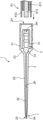
- FIG. 2 is a cross-sectional view of the suction tip attached to the head of the cell transfer device.
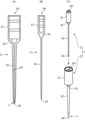
- FIG. 3(A) is a sectional view of a syringe that is a component of the suction tip
- FIG. 3(B) is a sectional view of the plunger
- FIG. 3(C) is an exploded perspective view of the suction tip.
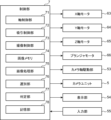
- FIG. 4 is a block diagram showing the control configuration of the cell transfer device.
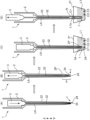
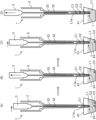
- FIGS. 5A to 5D are diagrams showing the steps of aspirating cells into the suction tip.
- FIGS. 6(A) to 6(D) are diagrams showing the steps of sucking cells into the suction tip.
- FIGS. 7A to 7C are diagrams showing the movement process and discharge process of the aspirated cells.
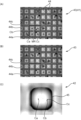
- 8(A) and (B) are examples of images of the first container having a storage compartment before and after cell suction
- FIG. 8(C) is an image of the well of the second container into which cells have been discharged.
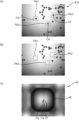
- 9(A) and (B) are examples of images of the first container without a storage compartment before and after cell suction
- FIG. 9(C) is an image of the well of the second container into which cells have been discharged.
- FIG. 10 is a flowchart showing an example of the operation of the cell transfer device.
- FIG. 11 is a flowchart showing the operation of the cell transfer process by the cell transfer device.
- FIG. 12 is a flowchart showing details of the cell suction operation by the head.
- FIG. 13 is a diagram showing a pattern for confirming the success or failure of cell aspiration.
- FIG. 14 is a perspective view showing an example of a cell migration line assembled into a cell migration device.
- the cell transfer device can aspirate and transfer cells derived from various living organisms.
- Cells derived from living organisms include, for example, single cells such as blood cells and single cells, small tissue pieces such as histoculture, cell aggregates such as spheroids and organoids, individuals such as zebrafish, nematodes, and fertilized eggs, and 2D or 3D cells. Cell colonies, etc.
- FIG. 1 is a diagram schematically showing the overall configuration of the cell transfer device S.
- a cell transfer device S that transfers cells C between two containers is illustrated.
- the cell transfer device S includes a translucent base BP having a horizontal mounting surface, a camera unit 5 disposed below the base BP, and a head unit 6 disposed above the base BP. including.
- a first container 41 to which the cells C are to be moved is placed at the first placement position P1 of the base BP, and a second container 42 to which the cells C are to be moved is placed to the second placement position P2. It is placed.
- the first container 41 includes a dish 43 that holds (arranges) the cells C in a scattered manner.
- the second container 42 includes a large number of wells 45 that can accommodate cells C.
- the camera unit 5 and head unit 6 are movable at least in the X direction.
- the head unit 6 includes a plurality of heads 61 to which suction tips 1 for suctioning and discharging cells C are attached.
- the head 61 is movable in the Z direction.
- the cell transfer device S moves the cells C from the first container 41 at the first mounting position P1 to the second container 42 at the second mounting position P2.
- the cell transfer device S selects target cells C to be transferred from a large number of cells scattered on the dish 43 of the first container 41, sucks the target cells C with the suction tip 1, and holds them. do.
- the suction tip 1 holding the cells C together with the head unit 6 is moved to the second container 42, and the cells C are discharged into the well 45 of the second container 42.
- a set number of target cells C which is set in advance to 2 or more, is aspirated into the suction tip 1, and these cells C are transferred to the second container 42. It is discharged into one well 45 (same location).
- the base BP is a rectangular flat plate that has a predetermined rigidity and is partially or entirely made of a translucent material.
- a preferred base BP is a glass plate.
- the first container 41 stores the medium L and holds the cell sorting dish 43 in a state immersed in the medium L.
- the dish 43 has a plurality of accommodation compartments 44 capable of accommodating cells C on the upper surface side.
- the accommodation compartments 44 are made up of recesses that can accommodate the cells C, and are arranged in a matrix. Note that FIGS. 8(A) and 8(B) show top views of the dish 43.
- the medium L is not particularly limited as long as it does not deteriorate the properties of the cells C, and can be appropriately selected depending on the type of cells C.
- the first container 41 has a rectangular upper opening 11H on its upper surface side.
- the upper opening 11H is an opening for inputting the cells C and picking up the sorted cells C.
- Inputting cells C is a step of discharging a cell suspension containing a large amount of cells C from a dispensing tip (not shown). Pick-up of cells C is performed by the above-mentioned suction tip 1.
- the dish 43 is arranged below the upper opening 11H.
- the first container 41 and the dish 43 are made of a translucent resin material or glass. This is to enable the camera unit 5 disposed below the first container 41 to observe the cells C supported on the dish 43.
- the second container 42 is, for example, a microplate equipped with a plurality of wells 45 (accommodating portions).
- the well 45 is a hole with a bottom that opens on the upper surface of the second container 42 .
- One well 45 accommodates the required number of cells C together with the medium L.
- the second container 42 is also made of a translucent resin material or glass for imaging by the camera unit 5. When discharging cells C, the tip t of the suction tip 12 enters the well 45.
- Each well 45 has an opening diameter that allows the tip t to enter with a margin.
- the camera unit 5 (a part of the cell recognition unit) captures images of the cells C held in the first container 41 or the second container 42 from the bottom side thereof.
- the camera unit 5 includes a lens section 51 and a camera body 52.
- the lens unit 51 is an objective lens used in an optical microscope, and includes a lens group that forms an optical image with a predetermined magnification, and a lens barrel that accommodates this lens group.
- the camera body 52 includes an image sensor such as a CCD image sensor.
- the lens unit 51 forms an optical image of the object to be imaged on the light receiving surface of the image sensor.
- the camera unit 5 is horizontally movable along a guide rail 5G extending in the X direction. Further, the camera unit 5 may also be movable in the Y direction perpendicular to the plane of FIG. 1 by a moving mechanism (not shown).
- the head unit 6 is a unit responsible for picking cells C from the first container 41 and moving them to the second container 42, and includes a head group 6H including a plurality of heads 61 described above and a head to which the head group 6H is assembled.
- a main body 62 is included.
- a suction tip 1 capable of suctioning and discharging cells C is attached to the tip of each head 61.
- Each head 61 is equipped with a generating mechanism that generates a suction force and a discharge force at the tip t of the suction tip 1.
- the head body 62 holds the head 61 so as to be movable up and down in +Z and -Z directions.
- the head unit 6 moves along the guide rail 6G (moving mechanism) in the X direction where the first container 41 and the second container 42 are lined up.
- the head unit 6 is also movable in the Y direction perpendicular to the plane of FIG. 1 by a moving mechanism (not shown). In this way, the head unit 6 functions as a movement mechanism that horizontally moves the suction tip 1 in the XY directions and moves it up and down in the Z direction.
- FIG. 2 is a cross-sectional view of the suction tip 1.
- 3(A) is a sectional view of the syringe 2
- FIG. 3(B) is a sectional view of the plunger 3
- FIG. 3(C) is an exploded perspective view of the suction tip 1.
- the suction tip 1 includes a syringe 2 that includes a tubular passage 2P that serves as a suction path for cells C, and a plunger 3 that is slidably accommodated in the tubular passage 2P.
- the syringe 2 includes a syringe proximal end 21 having a large diameter cylindrical shape, a syringe main body 22 having a small diameter and elongated cylindrical shape, and a tapered cylindrical part 23 connecting the proximal end 21 and the main body 22. including.
- the tubular passage 2P is formed in the syringe main body portion 22.
- a tip opening 24 that serves as a suction port or discharge port for the cells C is provided in the tip portion t located at one end of the syringe main body portion 22 . This tip opening 24 is connected to one end of the tubular passage 2P.
- the syringe proximal end portion 21 is connected to the other end side of the syringe main body portion 22 via a tapered cylinder portion 23 .
- the plunger 3 is a member that is inserted into the tubular passage 2P of the syringe 2 and generates negative pressure for cell suction or positive pressure for cell discharge at the tip opening 24 by moving forward and backward within the tubular passage 2P.
- the plunger 3 includes a plunger base end 31 having a cylindrical shape, a needle-like plunger main body 32, a hemispherical part 33 connecting the base end 31 and the main body 32, and a plunger that is a protruding tip of the plunger main body 32.
- the distal end portion 34 is included.
- the syringe base end portion 21 includes a cylindrical hollow portion 2H.
- the outer diameter of the plunger base end portion 31 is set smaller than the inner diameter of the hollow portion 2H by a predetermined length.
- the outer diameter of the plunger body 32 is set slightly smaller than the inner diameter of the tubular passage 2P.
- the shape of the inner circumferential surface of the tapered cylindrical portion 23 matches the curved shape of the outer circumferential surface of the hemispherical portion 33.
- the plunger 3 is assembled to the syringe 2 in such a manner that the plunger base end portion 31 is housed in the hollow portion 2H, and the plunger body portion 32 is inserted into the tubular passage 2P of the syringe body portion 22.
- FIG. 3(C) shows a state in which the plunger 3 is pulled out from the syringe 2
- FIG. It shows the lowest state.
- the hemispherical portion 33 is completely received in the cavity of the tapered cylindrical portion 23.
- the plunger body 32 is slightly longer than the syringe body 22, and in the state shown in FIG. 2, the plunger tip 34 protrudes from the tip opening 24. Further, a gap exists between the inner circumferential surface of the syringe proximal end 21 and the outer circumferential surface of the plunger proximal end 31.
- the plunger 3 can be moved upward relative to the syringe 2 from the state shown in FIG.
- the plunger tip 34 sinks into the tubular passage 2P.
- a suction force is generated in the tip opening 24, and the fluid around the tip opening 24, in this embodiment, the medium L containing the cells C, can be sucked into the tubular passage 2P.
- the fluid suctioned into the tubular passage 2P can be discharged from the tip opening 24.
- the suction tip 1 is attached to the tip of the head 61 shown in FIG.
- the head 61 includes a first cylindrical rod 611 , a second cylindrical rod 612 disposed outside the first cylindrical rod 611 , and a plunger rod 613 disposed within the hollow portion of the first cylindrical rod 611 . mechanism/moving member).
- the plunger base end 31 is provided with a mounting hole 3H, which is a cylindrical hollow space.
- the lower end of the plunger rod 613 is press-fitted into the mounting hole 3H.
- the upper end surface of the plunger base end portion 31 faces the lower end surface of the first cylindrical rod 611.
- a lower end portion of an immovable second cylindrical rod 612 is press-fitted into the hollow portion 2H of the syringe base end portion 21.
- FIG. 4 is a block diagram showing the electrical configuration of the cell transfer device S.
- the cell transfer device S includes a control unit 7 that controls the movement operation of the head unit 6, the suction and ejection operations of the cells C by the suction tip 1, the movement and imaging operation of the camera unit 5, and the like.
- the cell transfer device S also includes a camera shaft drive unit 53 as a mechanism for horizontally moving the camera unit 5, an X-axis motor 63 and a Y-axis motor 64 as a mechanism for horizontally moving the head unit 6, and a Z-axis as a mechanism for raising and lowering the head 61.
- a shaft motor 65 and a plunger motor 66 are provided as a mechanism for suctioning and discharging cells C, and a display section 54 and an input section 55 are also provided.
- the camera shaft drive section 53 includes a drive motor that horizontally moves the camera unit 5 along the guide rail 5G.
- the X-axis motor 63 and the Y-axis motor 64 are drive sources for a movement mechanism that horizontally moves the head unit 6 along the guide rail 6G.
- a preferable embodiment of the movement mechanism is such that it includes an X-axis ball screw and a Y-axis ball screw and a nut member, and the X-axis motor 63 and the Y-axis motor 64 rotate the ball screws forward or backward, respectively.
- the Z-axis motor 65 and plunger motor 66 are built into the head body 62.
- the Z-axis motor 65 moves the head 61 up and down between a lowered position where the head 61 extends downward from the head body 62 and an elevated position where most of the head 61 is housed in the head body 62.
- the plunger motor 66 generates a suction force and a discharge force at the tip opening 24 of the suction tip 1 by raising and lowering a plunger rod 613 (FIG. 2) disposed within the head 61.
- the display unit 54 is composed of a liquid crystal display or the like, and displays images taken by the camera unit 5, images processed by the control unit 7, etc.
- the input unit 55 includes a keyboard, a touch panel, or a communication unit that performs data communication with other communication devices, and receives input of operation information and various data from the user.
- the input unit 55 receives from the user an input of a set quantity of cells C to be discharged into one well 45 of the second container 42 as the destination. In other words, an input for setting the number of target cells C to be aspirated by one suction tip 1 in the first container 41 is accepted from the user.
- the control unit 7 includes a processor that performs various calculation processes, and includes an axis control unit 71 (part of the movement mechanism), a suction control unit 72, an imaging control unit 73, an image memory 74, and an image processing unit 75 (cell recognition unit). ), a sorting section 76 , a determining section 77 , and a storage section 78 .
- the axis control section 71 moves the head unit 6 to a predetermined target position in the horizontal direction by controlling the operations of the X-axis motor 63 and the Y-axis motor 64. Movement of the head 61 equipped with the suction tip 1 between the first container 41 and the second container 42, vertical positioning of the dish 43 relative to the accommodation section 44, and well of the second container 42 to be discharged. 45 in the vertical sky is realized by controlling the X-axis motor 63 and the Y-axis motor 64 by the axis control section 71.
- the suction control unit 72 controls the operations of the Z-axis motor 65 and the plunger motor 66 to cause the suction tip 1 to perform suction and discharge operations of the cells C.
- the suction control unit 72 lowers and raises the head 61 to be controlled toward a predetermined target position by controlling the operation of the Z-axis motor 65.
- the suction control unit 72 generates suction force or discharge force at the tip opening 24 of the suction tip 1 at a predetermined timing by controlling the operation of the plunger motor 66 installed in the head 61 to be controlled. .
- the suction control unit 72 gradually suctions target cells C in a preset quantity of 2 or more from among the cells C scattered on the dish 43 of the first container 41. A suction operation is performed into the chip 1.
- the set quantity is the quantity accepted by the input unit 55 from the user.
- the suction control section 72 transfers the set number of target cells C sucked into the suction tip 1 to the same location in the second container 42. In other words, the operation of discharging to one well 45 is performed.
- the imaging control section 73 controls the camera axis drive section 53 to cause the camera unit 5 to move along the guide rail 5G. Further, the imaging control section 73 controls the imaging operation of the first container 41 or the second container 42 by the camera unit 5.
- the image memory 74 is a storage area included in the microcomputer, an external storage, or the like.
- the image memory 74 temporarily stores image data acquired by the camera unit 5.
- the image processing unit 75 performs image processing on the image data captured by the camera unit 5 and stored in the image memory 74.
- the image processing unit 75 performs a process of recognizing the position of the cells C on the dish 43 on the image based on the image of the dish 43 in the first container 41 after the cells C have been dispensed.
- the image processing unit 75 performs processing for recognizing the distribution of cells C, and processing for recognizing the size, shape, color tone, etc. of recognized cells C, using image processing technology.
- the axis control unit 71 and the suction control unit 72 control the movement of the head 61 and the suction/discharge of the suction tip 1 based on the position recognition of the cells C, and execute the movement operation of the cells C.
- the sorting unit 76 performs a process of selecting target cells C to be transferred to the second container 42 from among the group of cells C scattered in the first container 41 based on predetermined selection criteria. conduct.
- the sorting unit 76 derives an evaluation value of the quality of the cells C scattered on the dish 43 of the first container 41 based on the image captured by the camera unit 5. Specifically, based on the image processing result of the image processing unit 75, the feature quantities of the cell C, such as the area and estimated volume of the cell C, the color and pattern of the cell C, and the light intensity when the cell C is made to fluoresce, are determined. Extracted. Further, the number of cells C accommodated in one accommodation section 44 is also detected as one of the feature amounts. This is because if a plurality of cells C are housed in the storage compartment 44, it is difficult to control the number of cells C aspirated into the suction tip 1, and cells C overlap, making it difficult to perform accurate evaluation. by.
- the selection unit 76 identifies cells whose evaluation value exceeds a predetermined threshold value as the target cells C. That is, the extracted feature amount of each cell C is compared with a selection criterion parameter predetermined as a range of cells C to be selected, and it is evaluated whether it belongs to the range of the selection criterion parameter. Target cell C is identified. Through the processing of the sorting unit 76, only the cells C that have been evaluated as having excellent quality among the cells C accommodated in the first container 41 can be moved to the second container 42 as target cells C.
- the storage unit 78 stores various setting values and data in the cell transfer device S. In addition, the storage unit 78 also stores selection criteria parameters for cells C to be moved. Cells C may have different standards for determining whether they are good or bad depending on their size or type, and it is desirable to have a selection standard obtained from, for example, the results of machine learning for each size or type.
- the sorting section 76 reads out the sorting criteria stored in the storage section 78 during the above sorting process.
- the cell migration operation includes the following steps (1) to (4) that are performed sequentially.
- FIGS. 5(A) to (D) and FIGS. 6(A) to (D) are diagrams showing the preliminary treatment step (1) and the suction step (2).
- FIG. 5(A) shows the suction tip 1 in a state where the pretreatment liquid LA is held in the space between the syringe main body 22 and the plunger main body 32.
- the pretreatment step (1) for example, the tip t of the syringe 2 is immersed in a container filled with the pretreatment liquid LA, and the plunger 3 is moved back and forth about three times. By this operation, the pretreatment liquid LA is trapped in the space between the syringe main body 22 and the plunger main body 32.
- physiological saline or the like may be used as the pretreatment liquid LA, it is preferable to use the medium L.
- FIGS. 5(A) and 5(B) are also diagrams showing a step of forming an air layer H within the tubular passage 2P before performing the suction step (2).
- the suction control unit 72 operates the plunger motor 66 from a state where the tip t of the suction tip 1 is placed in the air and the plunger tip 34 protrudes from the tip opening 24 of the syringe 2, as shown in FIG. 5(A).
- the plunger 3 is raised by a predetermined length. As a result, an air layer H is formed in the tubular passage 2P near the tip opening 24.
- FIGS. 5(C) to 6(D) sequentially show the execution status of the suction step (2).
- the first container 41 is shown in a simplified manner.
- the medium L1 stored in the first container 41 is dotted with first cells C1, second cells C2, and third cells C3 selected as target cells to be migrated.
- first cells C1, second cells C2, and third cells C3 selected as target cells to be migrated.
- the position coordinates of each cell C1, C2, and C3 are determined.
- the suction control unit 72 causes the cells C1, C2, and C3 to be suctioned into one suction chip 1 in stages. At this time, it is determined in what order the cells C1, C2, and C3 are to be aspirated, that is, how the moving route of the head 61 is to be set. As for the movement route, in order to shorten the takt time, it is desirable to select a route that provides the shortest movement distance by referring to the position coordinates of the cells C1, C2, and C3. Here, three target cells lined up horizontally are suctioned stepwise in the order of first cell C1, second cell C2, and third cell C3.
- FIG. 5(C) shows a state in which the tip opening 24 of the suction tip 1 is aligned with the first cell C1.
- the axis control section 71 moves the head unit 6 so that the suction tip 1 is positioned above the first container 41 .
- the head 61 is moved so that the tip opening 24 of the suction tip 1 is located vertically above the first cell C1.
- the suction control unit 72 drives the Z-axis motor 65 until the tip t is immersed in the medium L1 in the first container 41, specifically, until the tip opening 24 is directly above the first cell C1 in the medium L1.
- the head 61 is lowered until it is located nearby.
- FIG. 5(C) shows the state after this descent.
- the suction control unit 72 drives the plunger motor 66 to raise the plunger 3 by a predetermined distance.
- the tip opening 24 becomes negative pressure and generates a suction force, and a part of the culture medium L1 in the first container 41 and the first cells C1 are sucked from the tip opening 24 into the tubular passage 2P.
- the first cells C1 float in the sucked medium L1a.
- FIG. 5(D) shows the state of the first cell C1 after suction.
- the pretreatment liquid LA since the pretreatment liquid LA is held in advance in the space between the syringe body 22 and the plunger body 32, the culture medium L1 flows through the tubular passage 2P due to capillary action, internal pressure, etc. It will not rise rapidly.
- the air layer H functions as a sealing layer that separates the pretreatment liquid LA and the culture medium L1a containing the first cells C1 that is sucked in thereafter in the tubular passage 2P. Therefore, the aspirated first cells C1 do not migrate into the pretreatment liquid LA. Therefore, it is possible to prevent the first cell C1 from being caught between the syringe main body 22 and the plunger main body 32.
- the pretreatment liquid LA may be mixed with the culture medium L1, or the pretreatment liquid LA may be discharged into the second container 42 in the subsequent discharge step (4). can be prevented.
- FIG. 6(A) shows a state in which the head 61 is horizontally moved by a small distance and the tip opening 24 of the suction tip 1 is aligned with the second cell C2.
- the suction control unit 72 drives the Z-axis motor 65 to lower the head 61 until the tip opening 24 of the suction tip 1 is located close to directly above the second cell C2.
- the suction control unit 72 drives the plunger motor 66 to raise the plunger 3 by a predetermined distance, generates a suction force at the tip opening 24, and sucks the second cell C2 from the tip opening 24.
- FIG. 6(B) shows the state of the second cell C2 after suction. At this stage, the first cell C1 and the second cell C2 are held in the suction tip 1 so as to be lined up one above the other.
- FIG. 6(C) shows a state in which the head 61 is further horizontally moved by a minute distance and the tip opening 24 of the suction tip 1 is aligned with the third cell C3.
- the suction control unit 72 drives the Z-axis motor 65 to lower the head 61 until the tip opening 24 of the suction tip 1 is located close to directly above the third cell C3. Subsequently, the suction control unit 72 drives the plunger motor 66 to further raise the plunger 3 by a predetermined distance, generates a suction force at the tip opening 24, and sucks the third cell C3 from the tip opening 24.
- FIG. 6(D) shows the state of the third cell C2 after suction. In this example, stepwise aspiration of target cells is now complete. When the suction step (2) is completed, the first cell C1, the second cell C2, and the third cell C3 are held in the suction tip 1 so that they are vertically aligned in a line.
- FIGS. 7(A) and 7(B) are diagrams showing the execution status of the above moving step (3).
- the axis control section 71 moves the head unit 6 so that the suction tip 1 holding the cells C1, C2, and C3 is positioned above the second container 42.
- the second container 42 is schematically depicted.
- the second container 42 also stores the culture medium L2.
- the head unit 6 is moved so that the tip t of the suction tip 1 is aligned with one well 45 to be discharged among the plurality of wells 45 included in the second container 42 .
- FIG. 7(C) is a diagram showing the situation after execution of the above-mentioned discharge step (3).
- the suction control unit 72 drives the Z-axis motor 65 to lower the head 61 until the tip opening 24 of the suction tip 1 is immersed in the culture medium L2 of the second container 42 .
- the suction control unit 72 drives the plunger motor 66 to lower the plunger 3 by a predetermined distance. Specifically, the plunger 3 is lowered until the plunger tip 34 protrudes from the tip opening 24.
- the medium L1a and the cells C1, C2, and C3 held in the suction tip 1 are discharged all at once into the medium L2 of the second container 42.
- FIGS. 8(A) and 8(B) are examples of images of the first container 41 having the storage compartment 44 before and after cell suction.
- the first container 41 includes a dish 43 having storage compartments 44 arranged in a matrix, and a large number of cells C are scattered on the dish 43.
- cells Ca, Cb, and Cc accommodated one each in the accommodation compartments 44a, 44b, and 44c are target cells to be sucked into one suction tip 1.
- it is specified as
- the suction control unit 72 sets the movement route MR that passes through the accommodation sections 44a, 44b, and 44c in the shortest distance as the movement route of the head 61 to which the one suction tip 1 is attached. Then, while the axis control section 71 intermittently moves the head 61 along the movement route MR, the suction control section 72 causes the one suction tip 1 to suction the cells Ca, Cb, and Cc in stages. That is, the suction control unit 72 moves the head 61 across the plurality of accommodation sections 44a, 44b, and 44c until the suction tip 1 finishes suctioning the set number of target cells, and causes the suction tip 1 to perform suction operation. Execute.
- the storage compartments 44a, 44b, and 44c become empty, as shown in FIG. 8(B). If cells Ca, Cb, and Cc remain in the storage compartments 44a, 44b, and 44c, this means that suction has failed. That is, by capturing an image of the first container 41 after aspirating the cells and confirming the presence of cells Ca, Cb, and Cc, it is possible to confirm whether or not suction of the target cells by the suction tip 1 has been successful.
- FIG. 8(C) is an example of an image of one well 45 after cell discharge. Necessary operations such as charging reagents are performed on the wells 45 that accommodate the cells Ca, Cb, and Cc.
- FIGS. 9(A) and 9(B) are examples of images of the flat-bottomed first container 410 without the storage compartment 44 before and after cell suction.
- a large number of cells C are scattered in the first container 410.
- cells Cd, Ce, and Cf which exist one each in areas PA1, PA2, and PA3, serve as target cells to be sucked into one suction tip 1.
- a movement route that passes through areas PA1, PA2, and PA3 in the shortest distance is determined, and cells Cd, Ce, and Cf are suctioned into one suction tip 1 in stages.
- FIG. 9(C) is an example of an image after cells Cd, Ce, and Cf are discharged into one well 45.
- a set number of target cells C are suctioned in stages in the first container 41 to each suction tip 1 attached to a plurality of heads 61 included in the head unit 6. Then, the set number of target cells C is discharged from each suction tip 1 into each of the plurality of wells 45 of the second container 42 at once. That is, two or more target cells C held by each suction tip 1 are discharged into the well 45 assigned to each suction tip 1.
- a set number of target cells C are transferred from each suction tip 1 to each well 45 of the second container 42 by one movement of the head unit 6 from the first container 41 to the second container 42. can be moved to
- FIG. 10 is a flowchart showing an example of the operation of the cell transfer device S.
- the input unit 55 receives a set number of target cells C to be sucked into one suction tip 1 from the user (step S1).
- the set quantity is 3. If the set quantity is too large, it will be difficult to aspirate the cells C into one suction tip 1, so it is desirable to select the set quantity from a range of approximately 2 to 5.
- the imaging control section 73 controls the camera unit 5 to take an image of the first container 41 before the cells are aspirated.
- the image processing unit 75 performs image processing on the acquired pre-suction image data to identify the positions of the cells C scattered in the first container 41 (step S2).
- the sorting unit 76 derives an evaluation value regarding the quality of the cells C based on the pre-aspiration image, and identifies cells whose evaluation value exceeds a predetermined threshold as target cells C to be moved (step S3 ).
- Step S4 After discharging the aspirated target cells C into the second container 42, the imaging control section 73 controls the camera unit 5 to capture an image of the first container 41 after the cells have been aspirated. Then, the determination unit 77 compares the pre-aspiration image obtained in step S2 and the post-aspiration image obtained in this step to determine whether or not the aspiration of the target cells C was successful. It is confirmed whether the movement was successful (step S5).
- step S6 If the set amount of target cells C has been successfully aspirated (YES in step S6), the process ends. On the other hand, if part or all of the suction of the target cells C fails (NO in step S6), the process returns to step S3 and the cell movement process for recovery is performed again.
- FIG. 11 is a flowchart showing the operation of the cell migration process in step S4.
- the three heads 61 are referred to as a first head, a second head, and a third head in the flowchart of FIG.
- the suction control unit 72 determines the movement route of the first head, second head, and third head on the first container 41 in order to suction them. settings (step S11). Thereafter, the suction control unit 72 sequentially suctions three target cells C1 to C9 per suction tip 1 while moving the first to third heads along the set movement route.
- the suction control unit 72 gradually suctions the cells C1, C2, and C3 to the suction tip 1 attached to the first head (steps S12, S13, and S14).
- This series of suction operations involves raising and lowering and horizontally moving the first head.
- the steps include lowering the first head, suctioning cells Ca (C1) to the suction tip 1, and raising the first head.
- a suction operation is performed (step S12).
- the first head is horizontally moved above the storage compartment 44b to be approached second, and the suction operation for the cell Cb (C2) is similarly performed (step S13).
- the horizontal movement of the first head and the suction operation for the cells Cc (C3) are also performed (step S14).
- the suction control unit 72 causes the suction tip 1 attached to the second head to suction the cells C4, C5, and C6 in stages (steps S15, S16, and S17). Further, the suction control unit 72 gradually suctions the cells C7, C8, and C9 to the suction tip 1 attached to the third head (steps S18, S19, and S20). The operations in these steps are the same as the suction operations (steps S12 to S14) for the first head.
- the axis control section 71 moves the head unit 6 above the second container 42 (step S21). Thereafter, the suction control unit 72 causes the target cells C1 to C9 to be discharged from each of the suction tips 1 of the first to third heads to the designated wells 45 (step S22). Specifically, the suction tip 1 of the first head is aligned with the first well 45 specified in advance, and the cells C1, C2, and C3 are discharged into the first well 45.
- cells C4, C5, and C6 are discharged from the suction tip 1 of the second head to the prespecified second well 45, and cells C7 are discharged from the suction tip 1 of the third head to the prespecified third well 45.
- C8, and C9 are discharged.
- FIG. 12 is a flowchart showing details of the cell suction operation of a set number of target cells C by the suction tip 1 of one head 61.
- the "head" in the flowchart of FIG. 12 corresponds to any one of the first head, second head, or third head in the flowchart of FIG. 11.
- the set number of target cells C to be aspirated by one suction tip 1 is set to 3.
- the suction operations #1, #2, and #3 here are the same as the suction operations previously explained in steps S12, S13, and S14.
- the head 61 is moved to the second container 42, and the suction control unit 72 discharges the target cells C suctioned in suction operations #1, #2, and #3 into the predetermined well 45 (step S34 ).
- the determination unit 77 determines the target based on the comparison between the image of the first container 41 before cell suction and the image of the first container 41 after cell suction, or the image of the second container 42 after cell ejection.
- a process is performed to determine whether or not suction of cells C was successful (step S36). If suction operations #1, #2, and #3 are all successful (YES in step S37), the process for the current head 61 (for example, the first head) is completed, and the process for the next head 61 (for example, the second head) is completed. Move to processing. If all suction operations #1, #2, and #3 are not successful (NO in step S37), it is determined whether all suction operations #1, #2, and #3 were failures (step S38). .
- the suction control unit 72 retries the suction operations. That is, the suction control unit 72 returns the head 61 to the first container and performs three suction operations #1, #2, and #3 on the target cell C with the suction tip 1 attached to the head 61. (Steps S39, S40, S41). Subsequently, the head 61 is moved to the second container 42, and the suction control unit 72 discharges the target cells C suctioned in the retry suction operations #1, #2, and #3 into the predetermined well 45. (Step S42). Thereafter, the determination unit 77 determines whether the suction is successful or not (step S43).
- the process ends. After that, if all suction operations #1, #2, and #3 are not successful, the well 45 may be retried again, or the well 45 may be treated as NG without retrying.
- step S44 If all of suction operations #1, #2, and #3 are not failures (NO at step S38), the number of failures of suction operations is confirmed (step S44). If the suction of the two target cells C has failed, the suction control unit 72 returns the head 61 to the first container, and injects the target cells C twice into the suction tip 1 attached to the head 61. The retry suction operations #1 and #2 are executed (steps S45 and S46). Subsequently, the head 61 is moved to the second container 42, and the suction control unit 72 discharges the target cells C suctioned in retry suction operations #1 and #2 into the predetermined well 45 (step S47). . Thereafter, the determination unit 77 determines whether the suction is successful or not (step S48).
- step S44 if it is determined that suction of one target cell C has failed, the suction control unit 72 returns the head 61 to the first container, and attaches the suction tip 1 attached to the head 61 to the suction control unit 72.
- One retry suction operation #1 is performed on the target cell C (step S49).
- the head 61 is moved to the second container 42, and the suction control unit 72 discharges the target cells C suctioned in retry suction operation #1 into the predetermined well 45 (step S50).
- the determination unit 77 determines whether the suction is successful or not (step S51).
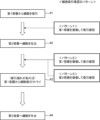
- the control unit 7 causes the head 61 equipped with the suction tip 1 to perform a suction operation of the target cells C in the first container 41 (step #1), and transfers the target cells C to the second container. 42 (step #2). If the suction fails, the system returns to the first container 41 and performs a retry suction operation for the target cells C (step #3), and then discharges the target cells C into the second container 42 again (step #4).
- the camera unit 5 captures an image of the first container 41 after suction.
- the determination unit 77 determines the success or failure of cell suction by comparing this post-suction image with a pre-suction image of the first container 41 acquired before the suction operation.
- success/failure confirmation is performed before step #2.
- success or failure is known at the stage when the head 61 is present near the first container 41, so when a suction failure is detected, retry suction can be performed as is.
- step #2 that is, after discharging a set number of target cells C into the second container 42
- the camera unit 5 is made to take an image of the first container 41 after suction, and the success or failure can be confirmed. be done. If a plurality of cells C are sucked into the suction tip 1 for a long time, problems such as the cells C settling and forming a lump within the suction tip 1 or blocking the tip opening 24 may occur. According to pattern 2, since the aspirated target cells C are discharged into the second container 42 in advance, the occurrence of the above-mentioned problems can be suppressed.
- the camera unit 5 is made to take an image of the second container 42 after discharging, and success or failure is confirmed. That is, the determination unit 77 determines whether the cell suction has been successful or not by comparing the post-ejection image and the pre-suction image. In pattern 3, it is possible to confirm whether or not the set number of target cells C has been successfully ejected from the second container 42 based on the post-ejection image. In other words, the success or failure of suction can be determined based on the result of ejection into the second container 42, so a more reliable determination can be made.
- FIG. 14 is a perspective view showing a configuration example of the cell transfer device 8.
- the cell transfer device 8 includes a cell transfer line 80, a camera unit 5, a head unit 6, and an illumination unit 56.
- the description of the base supporting the cell migration line 80 and the movement mechanism of each unit is omitted.
- the camera unit 5 and head unit 6 are as described in FIG. 1.
- a head unit 6 including eight heads 61 to which the suction tips 1 are attached is illustrated.
- the head unit 6 is movable in the X direction and the Y direction, and can move along a predetermined movement path on the cell movement line 80. Further, the head 61 can move up and down in the Z direction.
- the cell transfer line 80 includes, in order from the -X end, a dispensing tip stock section 82, a cell stock section 81, a tip stock section 84, a chip imaging section 85, a cell sorting section 83, a black cover mounting section 87, and a cell transfer section.
- the section 86 and the chip disposal section 88 are arranged in a line.
- the cell stock part 81 is a part that stores a cell culture solution in which a large amount of cells are dispersed, which is a source of dispensing.
- the cell stock section 81 includes a tube 811 that is a cylindrical container that stores a cell culture solution containing cells.
- the dispensing tip stock section 82 is a part that stores a plurality of dispensing tips 821.
- the dispensing tip stock section 82 is equipped with a holder 822 that holds dispensing tips 821 arranged in a matrix in an upright state.
- the cell sorting section 83 is a part for sorting cells of a desired size from a cell culture solution containing cells of various sizes.
- the cell sorting unit 83 includes a first container 41 that accommodates a cell culture solution, a holding table 831 that positions and holds the first container 41, and a table lid member 832 that covers the upper surface of the first container 41. It is desirable that the first container 41 includes a dish 43 similarly to the first container 41 shown in FIG. An image of the cells supported in the first container 41 is captured by the camera unit 5 under illumination from the illumination unit 56. This specifies the position of the cells to be aspirated.
- the tip stock section 84 includes a holding box 841 that holds a large number of the above-mentioned suction tips 1 arranged in a matrix.
- the suction tip 1 can be attached to and removed from the head 61 of the head unit 6.
- the suction tip 1 functions to aspirate cells supported in the first container 41, transport the cells as the head unit 6 moves, and discharge the cells to the second container 42 of the cell transfer section 86.
- the suction tip 1 is held in the holding box 841 in a state where it can be easily attached to the head 61 moving in the Z direction.
- a reservoir 842 that stores an impregnating liquid that wets the tip opening 24 of the suction tip 1 is also arranged in the tip stock section 84 .
- the chip imaging section 85 is a pit that provides a position where an image of the suction tip 1 attached to the head 61 is taken. The imaging is performed by the camera unit 5. Based on the image of the suction tip 1 and the focal position information at the time of imaging, the XYZ coordinate position of the tip opening 24 of the suction tip 1 is determined. A correction value is derived from the difference between the coordinate position and a predetermined reference position, and is used as a correction value when controlling the movement of the head 61.
- the cell transfer section 86 is a site to which cells sucked by the suction tip 1 from the first container 41 of the cell sorting section 83 are transferred.
- the cell transfer unit 86 includes a second container 42 and a holding table 861 that positions and holds the second container 42.
- the second container 42 is a plate in which a large number of wells 45 each having an open top surface are arranged in a matrix. The cells held in the suction tip 1 are discharged into these wells 45 .
- the black cover mounting section 87 is a section on which a first black cover 871 that is placed on the cell transfer section 86 and a second black cover 872 that is placed on the cell sorting section 83 are placed.
- the first and second black covers 871 and 872 are used to image cells supported in the first container 41 or the second container 42 in a light-blocked state for fluorescence observation of cells.
- the tip disposal section 88 is a section where the used suction tip 1 and dispensing tip 821 are discarded after the cell suction and discharge operations have been completed.
- the cell transfer device 8 includes an unillustrated controller that comprehensively controls the operation of the cell transfer device 8.
- the controller causes the cell transfer device 8 to broadly classify a dispensing operation using the dispensing tip 821 and a cell transfer operation using the suction tip 1.
- the controller sequentially executes the following controls 1 to 4 in the dispensing operation.
- Control 1 The head unit 6 is moved onto the dispensing tip stock section 82, and the dispensing tip 821 is attached to the unillustrated dispensing nozzle mounted on the head unit 6.
- Control 2 The head unit 6 is moved onto the cell stock section 81, and a predetermined amount of the cell culture solution containing cells stored in the tube 811 is aspirated into the dispensing tip 821.
- the controller sequentially executes the following controls 5 to 8 in the cell movement operation.
- Control 5 The head unit 6 is moved onto the tip stock section 84, and the suction tip 1 is externally fitted onto the tip of the head 61.
- Control 6 The head unit 6 is moved above the cell sorting section 83 and the cells accommodated in the first container 41 are sucked into the suction tip 1. At this time, target cells in a preset number of two or more are suctioned into the suction tip 1 in stages.
- the head unit 6 is moved onto the cell transfer section 86 and a set number of target cells in the suction tip 1 are discharged into the same location of the second container 42, that is, into one well 45.
- Control 8 The head unit 6 is moved onto the tip disposal section 88, the used suction tip 1 is removed from the head 61, and the used suction tip 1 is disposed of in the tip disposal section 88.
- a set number of target cells C are collectively sucked into one suction tip 1 in the first container 41, and these are discharged into one well 45 of the second container 41. It is possible to improve the efficiency of the moving work of C.
- the head 61 In the conventional method, when a plurality of target cells C are required to be moved to one well 45 of the second container 41, the head 61 must be moved back and forth between the first container 41 and the second container 42 multiple times. Cell migration requires a lot of time.
- the suction tip 1 sequentially aspirates the set number of target cells C in the first container 41, the head 61 is moved to the second container 42, and all at once. It is discharged into one well 45. Therefore, the number of times the head 61 moves back and forth between the first container 41 and the second container 42 can be reduced, and the time required for the cell transfer operation can be reduced.
- a cell transfer device is a cell transfer device that transfers cells scattered in a first container to a second container, and is equipped with a suction tip capable of sucking and discharging the cells, and the cell transfer device moves cells scattered in a first container to a second container.
- a head equipped with a generation mechanism that generates suction force and ejection force at the tip opening of the tip, a movement mechanism that moves the head horizontally and vertically, and an image of the first container in which the cells are scattered is captured.
- a cell recognition unit that recognizes the position of the cell based on the image; and control that controls the head and the movement mechanism to execute a movement operation of the cell based on the result of the position recognition.
- the control unit is configured to stepwise aspirate into the suction tip a predetermined number of target cells of 2 or more from among the cells scattered in the first container. After moving the head to the second container, the set number of target cells sucked into the suction tip are discharged to the same location in the second container.
- a set number of target cells are collectively sucked into the suction tip in the first container, and these are discharged to the same location in the second container, so that the efficiency of cell transfer work can be improved.
- one target cell is aspirated by a suction tip in a first container and moved to a second container, and the one target cell is discharged to a specific location in the second container.
- the head when a plurality of target cells are required to be moved to the specific location in the second container, the head must be moved back and forth multiple times between the first container and the second container, which requires a lot of work to move the cells. It takes time.
- the suction tip sequentially aspirates a set number of target cells in the first container
- the head is moved to the second container and the target cells are discharged all at once to the same location. Therefore, the number of times the head moves back and forth between the first container and the second container can be reduced, and the time required for the cell transfer operation can be reduced.
- the suction tip includes a syringe having a tubular passage connected to the tip opening, and a plunger that is slidably housed in the tubular passage and generates negative pressure in the tip opening;
- the head includes a moving member that moves the plunger forward and backward as the generation mechanism, and the control unit moves the head so as to align the tip opening of the suction tip with the target cell, and moves the head to align the tip opening of the suction tip with the target cell. Control may be performed to repeat the operation of moving the plunger to generate suction force and suctioning the target cells into the suction tip by the set amount.
- the above cell transfer device further includes a head unit including a plurality of the heads, the second plate has a plurality of accommodating parts into which the target cells are discharged, and the control part controls the plurality of heads.
- the set number of target cells may be sucked into each suction tip, and the set number of target cells may be discharged from each suction tip into each of the plurality of storage sections.
- a set number of target cells can be moved from each suction tip to the plurality of storage sections of the second container by one movement of the head unit from the first container to the second container. Therefore, the time required for cell migration work can be further reduced.
- control unit derives an evaluation value of the quality of the cells scattered in the first container based on the image taken by the camera, and the evaluation value exceeds a predetermined threshold. It is also possible to specify a cell that is a target cell as the target cell.
- only cells that are evaluated to be of excellent quality among the cells housed in the first container can be moved to the second container as target cells.
- control unit determines a movement route of the head when sucking the set number of target cells into the suction tip in stages based on an image captured by the camera. is desirable.
- control unit causes the suction tip to perform an operation of suctioning the set number of target cells from the first container, and then causes the camera to capture an image of the first container after suction. Then, based on the post-aspiration image, it may be determined whether or not the aspiration tip is aspirating the set number of target cells.
- control unit causes the camera to take a post-suction image of the first container after discharging the set number of target cells into the second container.
- control unit causes the camera to perform an operation of discharging the set number of target cells from the suction tip into the second container, and then captures a post-discharge image of the second container. Then, based on the post-ejection image, it may be determined whether the suction tip is ejecting the set number of target cells.
- the first container has a plurality of storage compartments each capable of accommodating cells, and the control unit controls the suction tip until the suction tip finishes suctioning the set number of target cells.
- the head may be moved across a plurality of accommodation sections to cause the suction tip to perform a suction operation.
Landscapes
- Life Sciences & Earth Sciences (AREA)
- Health & Medical Sciences (AREA)
- Engineering & Computer Science (AREA)
- Chemical & Material Sciences (AREA)
- Wood Science & Technology (AREA)
- Organic Chemistry (AREA)
- Bioinformatics & Cheminformatics (AREA)
- Zoology (AREA)
- Biotechnology (AREA)
- Biomedical Technology (AREA)
- Sustainable Development (AREA)
- Microbiology (AREA)
- Biochemistry (AREA)
- General Engineering & Computer Science (AREA)
- General Health & Medical Sciences (AREA)
- Genetics & Genomics (AREA)
- Molecular Biology (AREA)
- Clinical Laboratory Science (AREA)
- Cell Biology (AREA)
- Analytical Chemistry (AREA)
- Apparatus Associated With Microorganisms And Enzymes (AREA)
Priority Applications (4)
| Application Number | Priority Date | Filing Date | Title |
|---|---|---|---|
| PCT/JP2022/021920 WO2023233464A1 (ja) | 2022-05-30 | 2022-05-30 | 細胞移動装置 |
| EP22944051.6A EP4512884A1 (en) | 2022-05-30 | 2022-05-30 | Cell transfer apparatus |
| JP2024524527A JP7780009B2 (ja) | 2022-05-30 | 2022-05-30 | 細胞移動装置 |
| CN202280096390.XA CN119256073A (zh) | 2022-05-30 | 2022-05-30 | 细胞移动装置 |
Applications Claiming Priority (1)
| Application Number | Priority Date | Filing Date | Title |
|---|---|---|---|
| PCT/JP2022/021920 WO2023233464A1 (ja) | 2022-05-30 | 2022-05-30 | 細胞移動装置 |
Publications (1)
| Publication Number | Publication Date |
|---|---|
| WO2023233464A1 true WO2023233464A1 (ja) | 2023-12-07 |
Family
ID=89025922
Family Applications (1)
| Application Number | Title | Priority Date | Filing Date |
|---|---|---|---|
| PCT/JP2022/021920 Ceased WO2023233464A1 (ja) | 2022-05-30 | 2022-05-30 | 細胞移動装置 |
Country Status (4)
| Country | Link |
|---|---|
| EP (1) | EP4512884A1 (https=) |
| JP (1) | JP7780009B2 (https=) |
| CN (1) | CN119256073A (https=) |
| WO (1) | WO2023233464A1 (https=) |
Citations (5)
| Publication number | Priority date | Publication date | Assignee | Title |
|---|---|---|---|---|
| JP5897733B2 (ja) | 2012-12-13 | 2016-03-30 | ヤマハ発動機株式会社 | 吸引チップ、該吸引チップを用いた対象物観察装置ならびに対象物観察方法 |
| WO2017110004A1 (ja) * | 2015-12-25 | 2017-06-29 | ヤマハ発動機株式会社 | 対象物移動方法及び装置 |
| WO2018193718A1 (ja) * | 2017-04-20 | 2018-10-25 | ヤマハ発動機株式会社 | 細胞ハンドリング装置 |
| WO2018193719A1 (ja) * | 2017-04-20 | 2018-10-25 | ヤマハ発動機株式会社 | 細胞移動装置及び細胞移動方法 |
| WO2021019623A1 (ja) * | 2019-07-26 | 2021-02-04 | 株式会社島津製作所 | 細胞ピッキング装置 |
-
2022
- 2022-05-30 WO PCT/JP2022/021920 patent/WO2023233464A1/ja not_active Ceased
- 2022-05-30 EP EP22944051.6A patent/EP4512884A1/en active Pending
- 2022-05-30 JP JP2024524527A patent/JP7780009B2/ja active Active
- 2022-05-30 CN CN202280096390.XA patent/CN119256073A/zh active Pending
Patent Citations (5)
| Publication number | Priority date | Publication date | Assignee | Title |
|---|---|---|---|---|
| JP5897733B2 (ja) | 2012-12-13 | 2016-03-30 | ヤマハ発動機株式会社 | 吸引チップ、該吸引チップを用いた対象物観察装置ならびに対象物観察方法 |
| WO2017110004A1 (ja) * | 2015-12-25 | 2017-06-29 | ヤマハ発動機株式会社 | 対象物移動方法及び装置 |
| WO2018193718A1 (ja) * | 2017-04-20 | 2018-10-25 | ヤマハ発動機株式会社 | 細胞ハンドリング装置 |
| WO2018193719A1 (ja) * | 2017-04-20 | 2018-10-25 | ヤマハ発動機株式会社 | 細胞移動装置及び細胞移動方法 |
| WO2021019623A1 (ja) * | 2019-07-26 | 2021-02-04 | 株式会社島津製作所 | 細胞ピッキング装置 |
Also Published As
| Publication number | Publication date |
|---|---|
| CN119256073A (zh) | 2025-01-03 |
| EP4512884A1 (en) | 2025-02-26 |
| JPWO2023233464A1 (https=) | 2023-12-07 |
| JP7780009B2 (ja) | 2025-12-03 |
Similar Documents
| Publication | Publication Date | Title |
|---|---|---|
| US9977042B2 (en) | Object moving device | |
| CN105814188A (zh) | 对象物的移动装置 | |
| CN110383042B (zh) | 摄像系统 | |
| JP2017023112A (ja) | 対象物移動方法及び装置 | |
| JP6883648B2 (ja) | 細胞ハンドリング装置 | |
| JPWO2019163270A1 (ja) | 生体対象物のピックアップ装置 | |
| WO2017110005A1 (ja) | 対象物のピックアップ方法 | |
| JP6450476B2 (ja) | 対象物移動方法及び装置 | |
| JP6913184B2 (ja) | 生体対象物処理装置 | |
| CN114591805A (zh) | 细胞拾取装置和细胞拾取方法 | |
| JP6387427B2 (ja) | 対象物の移動装置 | |
| JP7780009B2 (ja) | 細胞移動装置 | |
| JP6694796B2 (ja) | 細胞移動装置 | |
| JPWO2019150756A1 (ja) | 生体対象物の移動方法及び移動装置 | |
| US20200339935A1 (en) | Pretreatment method for cell migration and cell migration device | |
| CN111699243B (zh) | 摄像系统以及生物对象物移动装置 | |
| WO2025037480A1 (ja) | 細胞移動装置および方法 | |
| WO2025028303A1 (ja) | 細胞移動装置 | |
| JP2026026502A (ja) | 吸引吐出装置、液滴除去用治具、吸引吐出装置の制御方法および液滴除去方法 |
Legal Events
| Date | Code | Title | Description |
|---|---|---|---|
| 121 | Ep: the epo has been informed by wipo that ep was designated in this application |
Ref document number: 22944051 Country of ref document: EP Kind code of ref document: A1 |
|
| WWE | Wipo information: entry into national phase |
Ref document number: 2024524527 Country of ref document: JP |
|
| WWE | Wipo information: entry into national phase |
Ref document number: 18865116 Country of ref document: US |
|
| WWE | Wipo information: entry into national phase |
Ref document number: 2022944051 Country of ref document: EP |
|
| WWE | Wipo information: entry into national phase |
Ref document number: 202280096390.X Country of ref document: CN |
|
| ENP | Entry into the national phase |
Ref document number: 2022944051 Country of ref document: EP Effective date: 20241121 |
|
| NENP | Non-entry into the national phase |
Ref country code: DE |
|
| WWP | Wipo information: published in national office |
Ref document number: 202280096390.X Country of ref document: CN |