EP4512884A1 - Cell transfer apparatus - Google Patents
Cell transfer apparatus Download PDFInfo
- Publication number
- EP4512884A1 EP4512884A1 EP22944051.6A EP22944051A EP4512884A1 EP 4512884 A1 EP4512884 A1 EP 4512884A1 EP 22944051 A EP22944051 A EP 22944051A EP 4512884 A1 EP4512884 A1 EP 4512884A1
- Authority
- EP
- European Patent Office
- Prior art keywords
- suction
- container
- cells
- head
- cell
- Prior art date
- Legal status (The legal status is an assumption and is not a legal conclusion. Google has not performed a legal analysis and makes no representation as to the accuracy of the status listed.)
- Pending
Links
Images






Classifications
-
- C—CHEMISTRY; METALLURGY
- C12—BIOCHEMISTRY; BEER; SPIRITS; WINE; VINEGAR; MICROBIOLOGY; ENZYMOLOGY; MUTATION OR GENETIC ENGINEERING
- C12M—APPARATUS FOR ENZYMOLOGY OR MICROBIOLOGY; APPARATUS FOR CULTURING MICROORGANISMS FOR PRODUCING BIOMASS, FOR GROWING CELLS OR FOR OBTAINING FERMENTATION OR METABOLIC PRODUCTS, i.e. BIOREACTORS OR FERMENTERS
- C12M33/00—Means for introduction, transport, positioning, extraction, harvesting, peeling or sampling of biological material in or from the apparatus
- C12M33/04—Means for introduction, transport, positioning, extraction, harvesting, peeling or sampling of biological material in or from the apparatus by injection or suction, e.g. using pipettes, syringes, needles
- C12M33/06—Means for introduction, transport, positioning, extraction, harvesting, peeling or sampling of biological material in or from the apparatus by injection or suction, e.g. using pipettes, syringes, needles for multiple inoculation or multiple collection of samples
-
- C—CHEMISTRY; METALLURGY
- C12—BIOCHEMISTRY; BEER; SPIRITS; WINE; VINEGAR; MICROBIOLOGY; ENZYMOLOGY; MUTATION OR GENETIC ENGINEERING
- C12M—APPARATUS FOR ENZYMOLOGY OR MICROBIOLOGY; APPARATUS FOR CULTURING MICROORGANISMS FOR PRODUCING BIOMASS, FOR GROWING CELLS OR FOR OBTAINING FERMENTATION OR METABOLIC PRODUCTS, i.e. BIOREACTORS OR FERMENTERS
- C12M23/00—Constructional details, e.g. recesses, hinges
- C12M23/02—Form or structure of the vessel
- C12M23/12—Well or multiwell plates
-
- C—CHEMISTRY; METALLURGY
- C12—BIOCHEMISTRY; BEER; SPIRITS; WINE; VINEGAR; MICROBIOLOGY; ENZYMOLOGY; MUTATION OR GENETIC ENGINEERING
- C12M—APPARATUS FOR ENZYMOLOGY OR MICROBIOLOGY; APPARATUS FOR CULTURING MICROORGANISMS FOR PRODUCING BIOMASS, FOR GROWING CELLS OR FOR OBTAINING FERMENTATION OR METABOLIC PRODUCTS, i.e. BIOREACTORS OR FERMENTERS
- C12M41/00—Means for regulation, monitoring, measurement or control, e.g. flow regulation
- C12M41/30—Means for regulation, monitoring, measurement or control, e.g. flow regulation of concentration
- C12M41/36—Means for regulation, monitoring, measurement or control, e.g. flow regulation of concentration of biomass, e.g. colony counters or by turbidity measurements
-
- C—CHEMISTRY; METALLURGY
- C12—BIOCHEMISTRY; BEER; SPIRITS; WINE; VINEGAR; MICROBIOLOGY; ENZYMOLOGY; MUTATION OR GENETIC ENGINEERING
- C12M—APPARATUS FOR ENZYMOLOGY OR MICROBIOLOGY; APPARATUS FOR CULTURING MICROORGANISMS FOR PRODUCING BIOMASS, FOR GROWING CELLS OR FOR OBTAINING FERMENTATION OR METABOLIC PRODUCTS, i.e. BIOREACTORS OR FERMENTERS
- C12M47/00—Means for after-treatment of the produced biomass or of the fermentation or metabolic products, e.g. storage of biomass
- C12M47/04—Cell isolation or sorting
Definitions
- the present invention relates to a cell transfer apparatus for transferring cells scattered in one container to another container.
- a cell transfer apparatus uses a head to which a suction tip is attached to perform the operation of suctioning one target cell from the sorting container and discharging the suctioned target cell into a well of the work container.
- Patent Literature 1 discloses a target object observation device equipped with a suction tip that can suction and hold multiple cells. However, Patent Literature 1 assumes the use of a suction tip with a special shape having a cell trap part with a horizontal part.
- An object of the present invention is to provide a cell transfer apparatus that can efficiently transfer multiple cells scattered in one container to another container.
- the first container 41 includes a rectangular upper opening 11H on the upper surface side.
- the upper opening 11H is an opening for injecting the cells C and picking up the sorted cells C.
- the injection of the cells C is a step of discharging a cell suspension containing a large amount of cells C from a dispenser tip (not shown).
- the pickup of the cells C is performed by the suction tip 1 described above.
- the dish 43 is placed below the upper opening 11H.
- the first container 41 and the dish 43 are produced using a translucent resin material or glass. This is to allow the camera unit 5 placed below the first container 41 to observe the cells C carried in the dish 43.
- FIG. 2 is a cross-sectional view of the suction tip 1.
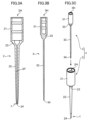
- FIG. 3A is a cross-sectional view of a syringe 2
- FIG. 3B is a cross-sectional view of a plunger 3
- FIG. 3C is an exploded perspective view of the suction tip 1.
- the suction tip 1 includes the syringe 2 with a tubular passage 2P that serves as a suction path for the cells C, and the plunger 3 that is slidably accommodated inside the tubular passage 2P.
- the plunger 3 is a member that is inserted into the tubular passage 2P of the syringe 2 and generates negative pressure for cell suction or positive pressure for cell discharge in the distal end opening 24 by moving back and forth inside the tubular passage 2P.
- the plunger 3 includes a plunger proximal end 31 having a cylindrical shape, a needle-shaped plunger body 32, a dome-shaped part 33 connecting the proximal end 31 and the body 32, and a plunger distal end 34 that is a protruding end of the plunger body 32.
- the syringe proximal end 21 includes a cylindrical hollow part 2H.
- the outer diameter of the plunger proximal end 31 is set to be smaller than the inner diameter of the hollow part 2H by a predetermined length.
- the outer diameter of the plunger body 32 is set to be slightly smaller than the inner diameter of the tubular passage 2P.
- the shape of the inner circumferential surface of the taper cylinder part 23 matches the curved surface shape of the outer circumferential surface of the dome-shaped part 33.
- the plunger 3 is assembled with respect to the syringe 2 in a mode in which the plunger proximal end 31 is accommodated in the hollow part 2H, and the plunger body 32 is inserted into the tubular passage 2P of the syringe body 22.
- FIG. 3C shows the state where the plunger 3 is pulled out from the syringe 2
- FIG. 2 shows the state where the plunger body 32 is inserted deepest into the syringe body 22, that is, the state where the plunger 3 has descended the most.
- the dome-shaped part 33 is completely accommodated in the cavity of the taper cylinder part 23.
- the length of the plunger body 32 is slightly longer than the syringe body 22, and in the state shown in FIG. 2 , the plunger distal end 34 protrudes from the distal end opening 24.
- the plunger 3 can move upward with respect to the syringe 2 from the state shown in FIG. 2 .
- the plunger distal end 34 will be submerged inside the tubular passage 2P.
- suction force is generated in the distal end opening 24, and the fluid around the distal end opening 24, the culture medium L including the cells C in the present embodiment can be suctioned into the tubular passage 2P.
- the fluid suctioned into the tubular passage 2P can be discharged from the distal end opening 24.
- the suction tip 1 is attached to the distal end of the head 61 shown in FIG. 2 .
- the head 61 includes a first cylindrical rod 611, a second cylindrical rod 612 placed outside of the first cylindrical rod 611, and a plunger rod 613 (generating mechanism/moving member) placed in the hollow part of the first cylindrical rod 611.
- the plunger proximal end 31 includes a mounting hole 3H, a cylindrical hollow space.
- the lower end of the plunger rod 613 is press-fitted into the mounting hole 3H.
- the upper end surface of the plunger proximal end 31 faces the lower end surface of the first cylindrical rod 611.
- the lower end of the fixed second cylindrical rod 612 is press-fitted into the hollow part 2H of the syringe proximal end 21.
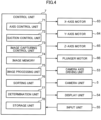
- FIG. 4 is a block diagram showing the electric configuration of the cell transfer apparatus S.
- the cell transfer apparatus S includes a control unit 7 that controls the movement operation of the head unit 6, the suction and discharge operation of the cells C by the suction tip 1, the movement and image capturing operation of the camera unit 5, and the like.
- the cell transfer apparatus S includes a camera axis driving unit 53 as a mechanism for causing the camera unit 5 to horizontally move, an X-axis motor 63 and Y-axis motor 64 as mechanisms for horizontally moving the head unit 6, a Z-axis motor 65 as a mechanism for raising and lowering the head 61, and a plunger motor 66 as a mechanism for performing suction and discharge operations of the cells C, and further includes a display unit 54 and an input unit 55.
- the camera axis driving unit 53 includes a driving motor for causing the camera unit 5 to horizontally move along the guide rail 5G.
- the X-axis motor 63 and the Y-axis motor 64 are driving sources for the movement mechanism that causes the head unit 6 to move horizontally along the guide rail 6G.
- the preferred mode of the movement mechanism includes ball screws and nut members for the X axis and Y axis, and the X-axis motor 63 and the Y-axis motor 64 each rotate the ball screw forward or backward.
- the Z-axis motor 65 and the plunger motor 66 are built into the head body 62.
- the Z-axis motor 65 causes the head 61 to move up and down between the lowered position where the head 61 extends downward from the head body 62 and the raised position where most of the head 61 is accommodated in the head body 62.
- the plunger motor 66 generates suction force and discharge force in the distal end opening 24 of the suction tip 1 by raising and lowering the plunger rod 613 placed in the head 61 ( FIG. 2 ).
- the display unit 54 includes a liquid crystal display or the like, and displays images captured by the camera unit 5 and images that undergo image processing or the like by the control unit 7.
- the control unit 7 includes a processor or the like that performs various arithmetic processes, and includes an axis control unit 71 (part of the movement mechanism), a suction control unit 72, an image capturing control unit 73, an image memory 74, an image processing unit 75 (part of the cell recognition unit), a sorting unit 76, a determination unit 77, and a storage unit 78.
- the axis control unit 71 controls the operation of the X-axis motor 63 and the Y-axis motor 64 to cause the head unit 6 to move to a predetermined horizontal target position.
- the movement of the head 61 to which the suction tip 1 is attached between the first container 41 and the second container 42, positioning perpendicularly above the accommodation sections 44 of the dish 43, positioning perpendicularly above the well 45 of the second container 42 where discharge is performed, and the like are implemented by controlling the X-axis motor 63 and the Y-axis motor 64 by the axis control unit 71.
- the suction control unit 72 controls the operation of the Z-axis motor 65 and the plunger motor 66 to perform the suction and discharge operation of the cells C by the suction tip 1.
- the suction control unit 72 controls the operation of the Z-axis motor 65 to raise and lower the head 61 to be controlled toward a predetermined target position.
- the suction control unit 72 controls the operation of the plunger motor 66 equipped on the head 61 to be controlled to generate suction force or discharge force in the distal end opening 24 of the suction tip 1 at a predetermined timing.
- the suction control unit 72 performs an operation of gradually suctioning the set quantity of the target cells C that is set to two or more in advance from among the cells C scattered on the dish 43 of the first container 41 into one suction tip 1.
- the set quantity is a quantity received in the input unit 55 from the user.
- the suction control unit 72 performs an operation of discharging the set quantity of the target cells C suctioned by the suction tip 1 into the same location in the second container 42, that is, one well 45.
- Such control will be described using diagrams later with reference to FIGS. 5 to 7 .
- the image capturing control unit 73 controls the camera axis driving unit 53 to perform the operation of causing the camera unit 5 to move along the guide rail 5G. In addition, the image capturing control unit 73 controls the image capturing operation of the first container 41 or the second container 42 by the camera unit 5.
- the image processing unit 75 performs image processing on image data captured by the camera unit 5 and stored in the image memory 74.
- the image processing unit 75 performs processing to recognize the position on the image of the cells C on the dish 43 based on the image of the dish 43 of the first container 41 after the cells C are dispensed.
- the image processing unit 75 performs processing to recognize the distribution of the cells C, to recognize the size, shape, color tone, and the like of the recognized cells C, and the like by using the image processing technology.
- the axis control unit 71 and the suction control unit 72 control the movement of the head 61 and the suction and discharge of the suction tip 1 based on the position recognition of the cells C, and perform the transfer operation of the cells C.
- the sorting unit 76 performs processing to sort the target cells C to be transferred to the second container 42 from a group of the cells C scattered in the first container 41 based on sorting criteria determined in advance.
- the sorting unit 76 derives the quality evaluation value of the cells C scattered on the dish 43 of the first container 41 based on the image captured by the camera unit 5. Specifically, based on image processing results by the image processing unit 75, for example, the feature amounts of the cell C such as the area or estimated volume of the cell C, the color or pattern of the cell C, and the light intensity when the cell C is fluorescent are extracted.
- the number of cells C accommodated in one accommodation section 44 is also detected as one of the feature amounts. This is because when multiple cells C are accommodated in the accommodation section 44, it is difficult to control the number of cells C suctioned to the suction tip 1, the cells C overlap, making accurate evaluation difficult, and other reasons.
- the sorting unit 76 identifies the cell with the evaluation value exceeding a predetermined threshold as the target cell C. That is, the extracted feature amount of each cell C is compared with a selection criteria parameter that is determined in advance as the range of cells C to be selected, and the target cell C is identified by evaluating whether the cell falls within the range of the selection criteria parameter. Through the processing by the sorting unit 76, only the cell C that is evaluated as having superior quality among the cells C accommodated in the first container 41 can be transferred to the second container 42 as the target cell C.
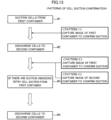
- the determination unit 77 determines whether the suction or discharge of the set quantity of the target cells C is achieved. This determination pattern will be described in detail later with reference to FIG. 13 .
- the storage unit 78 stores various setting values and data in the cell transfer apparatus S. In addition, the storage unit 78 also stores the selection criteria parameter of the cell C to be transferred. The criteria for determining whether the cell C is good or bad may differ depending on the size and type, and, for example, it is preferable to have sorting criteria obtained from results of machine learning for each size and type.
- the sorting unit 76 reads the sorting criteria stored in the storage unit 78 during the sorting process.
- FIGS. 5A to 5D and FIGS. 6A to 6D are diagrams showing the above-mentioned preliminary treatment step (1) and suction step (2).
- FIG. 5A shows the suction tip 1 in a state of holding the preliminary treatment liquid LA in the space between the syringe body 22 and the plunger body 32.
- the preliminary treatment step (1) for example, the distal end t of the syringe 2 is immersed in a container filled with the preliminary treatment liquid LA, and the plunger 3 moves back and forth about three times. This operation brings the preliminary treatment liquid LA into the space between the syringe body 22 and the plunger body 32.
- a physiological saline solution or the like may be used as the preliminary treatment liquid LA, but it is preferable to use the culture medium L.
- FIGS. 5A and 5B are also diagrams showing the step of forming an air layer H inside the tubular passage 2P before performing the suction step (2).
- the suction control unit 72 places the distal end t of the suction tip 1 in the air as shown in FIG. 5A , and drives the plunger motor 66 from the state where the plunger distal end 34 protrudes from the distal end opening 24 of the syringe 2 to raise the plunger 3 by a predetermined length.
- the air layer H is formed in the tubular passage 2P near the distal end opening 24.
- FIGS. 5C to 6D show the execution status of the suction step (2) sequentially.
- the first container 41 is shown in a simplified manner.
- the first cell C1, the second cell C2, and the third cell C3 selected as target cells to be transferred are scattered.
- the set quantity of the target cells 3.
- the position coordinates of each of the cells C1, C2, and C3 are determined.
- the suction control unit 72 causes one suction tip 1 to suction the cells C1, C2, and C3 gradually. At this time, it is determined in what order to suction the cells C1, C2, and C3, that is, how to set the movement route for the head 61. As the movement route, it is preferable to select a route that is the shortest movement distance by referring to the position coordinates of the cells C1, C2, and C3 in order to shorten the tact time.
- the three target cells lined up horizontally are gradually suctioned in the order of the first cell C1, the second cell C2, and the third cell C3.
- the suction control unit 72 drives the plunger motor 66 to raise the plunger 3 by a predetermined distance.
- the distal end opening 24 is depressurized to generate suction force, causing a part of the culture medium L1 and the first cell C1 in the first container 41 to be suctioned from the distal end opening 24 into the tubular passage 2P.
- the first cell C1 will float in the suctioned culture medium L1a.
- FIG. 5D shows the state after the first cell C1 is suctioned.
- FIGS. 8A and 8B are examples of images of the first container 41 having the accommodation sections 44 before and after the cell suction.
- the first container 41 includes the dish 43 having matrix-arrayed accommodation sections 44, and numerous cells C are scattered in the dish 43.
- FIG. 8A it is assumed that, among these cells C, the cells Ca, Cb, and Cc accommodated one by one in the accommodation sections 44a, 44b, and 44c, respectively, are identified as target cells to be suctioned to one suction tip 1.
- the accommodation sections 44a, 44b, and 44c become empty. If the cells Ca, Cb, and Cc remain in the accommodation sections 44a, 44b, and 44c, the suction will be considered a failure. That is, by capturing an image of the first container 41 after the cell suction and confirming the presence of the cells Ca, Cb, and Cc, it is possible to confirm whether the suction of the target cells by the suction tip 1 is successful or not.
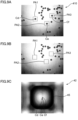
- FIG. 8C is an example of an image of the one well 45 after the cell discharge.
- necessary operations such as introducing reagents are performed.
- FIGS. 9A and 9B are examples of images of a first container 410 with a flat bottom having no accommodation sections 44 before and after cell suction. Numerous cells C are scattered in the first container 410. As shown in FIG. 9A , it is assumed that, among the cells C, cells Cd, Ce, and Cf that exist one by one in regions PA1, PA2, and PA3 respectively are identified as target cells to be suctioned into one suction tip 1. In this case as well, a movement route that passes through the regions PA1, PA2, and PA3 in the shortest distance is defined, and the cells Cd, Ce, and Cf are gradually suctioned into one suction tip 1. Whether the suction is successful can be determined, for example, by image matching processing of the pre-suction image in FIG. 9A and the post-suction image in FIG. 9B.
- FIG. 9C is an example of an image after the cells Cd, Ce, and Cf are discharged into one well 45.
- the set quantity of the target cells C in the first container 41 is gradually suctioned into each suction tip 1 attached to the multiple heads 61 included in the head unit 6. Then, the set quantity of the target cells C is discharged all at once from each suction tip 1 into each of the plurality of wells 45 of the second container 42. That is, two or more target cells C held in each suction tip 1 are discharged into the well 45 assigned to each suction tip 1. According to the present embodiment, it is possible to transfer the set quantity of the target cells C from each suction tip 1 to each well 45 of the second container 42 in one movement operation of the head unit 6 from the first container 41 to the second container 42.
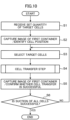
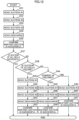
- FIG. 10 is a flowchart showing an operation example of the cell transfer apparatus S.
- the input unit 55 receives the set quantity of the target cells C to be suctioned by one suction tip 1 from the user (step S1).
- the image capturing control unit 73 controls the camera unit 5 to capture an image of the first container 41 before cell suction.
- the image processing unit 75 performs image processing on data of the acquired pre-suction image to identify the position of the cells C scattered in the first container 41 (step S2).
- the sorting unit 76 derives an evaluation value about the quality of the cells C based on the pre-suction image, and identifies the cells with the evaluation value exceeding a predetermined threshold as target cells C to be transferred (step S3).
- the cell transfer step including the above-described preliminary treatment step (1), suction step (2), movement step (3), and discharge step (4) is performed (step S4).
- the image capturing control unit 73 controls the camera unit 5 to capture images of the first container 41 after the cell suction. Then, by comparing the pre-suction image acquired in step S2 with the post-suction image acquired in this step, the determination unit 77 confirms whether the suction of the target cells C is successful, that is, whether the transfer of the target cells is successful (step S5).
- step S6 When all the set quantity of the target cells C is successfully suctioned (YES in step S6), the process ends. On the other hand, when the suction of the target cells C fails partially or completely (NO in step S6), returning to step S3, the cell transfer step for recovery is performed again.
- the determination unit 77 performs processing to determine whether the suction of the target cells C is successful based on the comparison of images of the first container 41 before cell suction and images of the first container 41 after cell suction, or images of the second container 42 after cell discharge (step S36).
- the process for the head 61 this time for example, first head
- the process for the next head 61 for example, second head
- the cell stock unit 81 is a section that stores cell culture solution in which a large amount of cells are dispersed, which is the source of dispensing.
- the cell stock unit 81 includes a tube 811 that is a cylindrical container for storing the cell culture solution containing cells.
- the dispenser tip stock unit 82 is a section that stores a plurality of dispenser tips 821.
- the dispenser tip stock unit 82 is provided with a holder 822 that holds the dispenser tips 821 arranged in a matrix in an upright position.
- the cell sorting unit 83 is a section for sorting cells of a desired size from the cell culture solution containing cells of various sizes.
- the cell sorting unit 83 includes the first container 41 that accommodates the cell culture solution, a holding table 831 that positions and holds the first container 41, and a table lid member 832 that covers an upper surface of the first container 41.
- the first container 41 preferably includes the dish 43, in a similar manner to the first container 41 shown in FIG. 1 .
- An image of the cells carried in the first container 41 is captured by the camera unit 5 under lighting by the lighting unit 56. This identifies the location of the cells to be suctioned.
- the tip image capturing unit 85 is a pit that provides a location where an image of the suction tip 1 attached to the head 61 is captured.
- the image capturing is performed by the camera unit 5.
- the XYZ coordinate position of the distal end opening 24 of the suction tip 1 is obtained.
- a correction value is derived from the difference between the coordinate position and a predetermined reference position, and is used as a correction value when controlling the movement of the head 61.
- the cell relocation unit 86 is a section to which the cells suctioned by the suction tip 1 from the first container 41 of the cell sorting unit 83 are transferred.
- the cell relocation unit 86 includes the second container 42 and a holding table 861 that positions and holds the second container 42.
- the second container 42 is a plate with numerous wells 45 with an upper surface open as described above arranged in a matrix. The cells held by the suction tip 1 are discharged into the wells 45.
- the black cover placement unit 87 is a section on which a first black cover 871 placed over the cell relocation unit 86 and a second black cover 872 placed over the cell sorting unit 83 are placed.
- the first and second black covers 871 and 872 are used when capturing images of cells carried in the first container 41 or the second container 42 in a state protected from light for cell fluorescence observation.
- the tip disposal unit 88 is a section where the suction tip 1 and the dispenser tip 821 are disposed of after use, after the cell suction and discharge operations are finished.
- the cell transfer apparatus 8 includes a controller (not shown) that controls the overall operation of the cell transfer apparatus 8.
- the controller broadly causes the cell transfer apparatus 8 to perform the dispensing operation by the dispenser tip 821 and the cell transfer operation using the suction tip 1.
- the controller sequentially performs the following controls 1 to 4 in the dispensing operation.
- the controller sequentially performs the following controls 5 to 8 in the cell transfer operation.
- one suction tip 1 suctions the set quantity of the target cells C together in the first container 41 to discharge the cells into one well 45 of the second container 41, thereby improving the efficiency of the transfer work of the cells C.
- the head 61 has to reciprocate multiple times between the first container 41 and the second container 42, and the cell transfer work takes a lot of time.
- the head 61 moves to the second container 42 and then discharges the cells into one well 45 all at once. Therefore, the number of reciprocations of the head 61 between the first container 41 and the second container 42 can be reduced, and the time required for the cell transfer work can be shortened.
- a cell transfer apparatus is a cell transfer apparatus for transferring cells scattered in a first container to a second container, and includes: a head to which a suction tip configured to suction and discharge the cells is attached, the head including a generating mechanism that generates suction force and discharge force in a distal end opening of the suction tip; a movement mechanism that causes the head to perform horizontal movement and up-and-down movement; a cell recognition unit that includes a camera that captures an image of the first container in which the cells are scattered, the cell recognition unit performing position recognition on the cells based on the image; and a control unit that controls the head and the movement mechanism to perform a transfer operation of the cells based on a result of the position recognition, in which the control unit causes the suction tip to gradually suction a set quantity of target cells from among the cells scattered in the first container, the set quantity being set in advance to two or more, and after causing the head to move to the second container, the control unit causes the suction tip to discharge the set quantity of the target
- the suction tip suctions the set quantity of the target cells together in the first container to discharge the cells into the same location of the second container, thereby improving the efficiency of the cell transfer work.
- the suction tip suctions one target cell in the first container and moves to the second container, and discharges the one target cell into a specific location of the second container.
- the head has to reciprocate multiple times between the first container and the second container, and the cell transfer work takes a lot of time.
- the sequential suction of the set quantity of the target cells into the suction tip and the discharge thereof can be performed.
- the cell transfer apparatus may further include a head unit including a plurality of the heads, the second plate may include a plurality of accommodation portions into which the target cells are discharged, and the control unit may cause each suction tip of the plurality of heads to suction the set quantity of the target cells, and discharge the set quantity of the target cells from the each suction tip into each of the plurality of accommodation portions.
- control unit may be configured to derive an evaluation value of quality of the cells scattered in the first container based on the image captured by the camera, and to identify the cells with the evaluation value exceeding a predetermined threshold as the target cells.
- only the cells that are evaluated as having superior quality among the cells accommodated in the first container can be transferred to the second container as the target cells.
- control unit preferably determines a movement route for the head when the set quantity of the target cells is gradually suctioned into the suction tip based on the image captured by the camera.
- control unit may cause the camera to capture a post-suction image of the first container after performing an operation of suctioning the set quantity of the target cells from the first container to the suction tip, and determine whether the suction tip suctions the set quantity of the target cells based on the post-suction image.
- the suction of the set quantity of the target cells in the first container is successful based on the post-suction image. If it is determined that the suction has failed, it is possible to additionally transfer the missing target cells to a predetermined location in the second container.
- the first container may have a plurality of accommodation sections each capable of accommodating cells, and the control unit may cause the head to move across the plurality of accommodation sections and cause the suction tip to perform a suction operation until the suction tip finishes suctioning the set quantity of the target cells.
Landscapes
- Life Sciences & Earth Sciences (AREA)
- Health & Medical Sciences (AREA)
- Engineering & Computer Science (AREA)
- Chemical & Material Sciences (AREA)
- Wood Science & Technology (AREA)
- Organic Chemistry (AREA)
- Bioinformatics & Cheminformatics (AREA)
- Zoology (AREA)
- Biotechnology (AREA)
- Biomedical Technology (AREA)
- Sustainable Development (AREA)
- Microbiology (AREA)
- Biochemistry (AREA)
- General Engineering & Computer Science (AREA)
- General Health & Medical Sciences (AREA)
- Genetics & Genomics (AREA)
- Molecular Biology (AREA)
- Clinical Laboratory Science (AREA)
- Cell Biology (AREA)
- Analytical Chemistry (AREA)
- Apparatus Associated With Microorganisms And Enzymes (AREA)
Applications Claiming Priority (1)
| Application Number | Priority Date | Filing Date | Title |
|---|---|---|---|
| PCT/JP2022/021920 WO2023233464A1 (ja) | 2022-05-30 | 2022-05-30 | 細胞移動装置 |
Publications (1)
| Publication Number | Publication Date |
|---|---|
| EP4512884A1 true EP4512884A1 (en) | 2025-02-26 |
Family
ID=89025922
Family Applications (1)
| Application Number | Title | Priority Date | Filing Date |
|---|---|---|---|
| EP22944051.6A Pending EP4512884A1 (en) | 2022-05-30 | 2022-05-30 | Cell transfer apparatus |
Country Status (4)
| Country | Link |
|---|---|
| EP (1) | EP4512884A1 (https=) |
| JP (1) | JP7780009B2 (https=) |
| CN (1) | CN119256073A (https=) |
| WO (1) | WO2023233464A1 (https=) |
Family Cites Families (5)
| Publication number | Priority date | Publication date | Assignee | Title |
|---|---|---|---|---|
| EP2933625A4 (en) | 2012-12-13 | 2015-12-02 | Yamaha Motor Co Ltd | SUCTION TIP, OBJECT OBSERVATION DEVICE WITH THE SAID TIP AND METHOD FOR OBSERVING AN OBJECT |
| JP6450476B2 (ja) | 2015-12-25 | 2019-01-09 | ヤマハ発動機株式会社 | 対象物移動方法及び装置 |
| US11572537B2 (en) * | 2017-04-20 | 2023-02-07 | Yamaha Hatsudoki Kabushiki Kaisha | Cell handling device |
| JP6841903B2 (ja) * | 2017-04-20 | 2021-03-10 | ヤマハ発動機株式会社 | 細胞移動装置及び細胞移動方法 |
| CN114127255B (zh) * | 2019-07-26 | 2024-12-13 | 株式会社岛津制作所 | 细胞拾取装置 |
-
2022
- 2022-05-30 WO PCT/JP2022/021920 patent/WO2023233464A1/ja not_active Ceased
- 2022-05-30 EP EP22944051.6A patent/EP4512884A1/en active Pending
- 2022-05-30 JP JP2024524527A patent/JP7780009B2/ja active Active
- 2022-05-30 CN CN202280096390.XA patent/CN119256073A/zh active Pending
Also Published As
| Publication number | Publication date |
|---|---|
| CN119256073A (zh) | 2025-01-03 |
| WO2023233464A1 (ja) | 2023-12-07 |
| JPWO2023233464A1 (https=) | 2023-12-07 |
| JP7780009B2 (ja) | 2025-12-03 |
Similar Documents
| Publication | Publication Date | Title |
|---|---|---|
| JP6262254B2 (ja) | 対象物の移動装置 | |
| US9977042B2 (en) | Object moving device | |
| US20200398265A1 (en) | Device for picking up biological subject | |
| CN107922907B (zh) | 对象物移动方法及对象物移动装置 | |
| CN110383042B (zh) | 摄像系统 | |
| JP6883648B2 (ja) | 細胞ハンドリング装置 | |
| JP6450476B2 (ja) | 対象物移動方法及び装置 | |
| JP6913184B2 (ja) | 生体対象物処理装置 | |
| JP6387427B2 (ja) | 対象物の移動装置 | |
| CN114591805A (zh) | 细胞拾取装置和细胞拾取方法 | |
| EP4512884A1 (en) | Cell transfer apparatus | |
| US20190381495A1 (en) | Tubular instrument and manipulation system | |
| JP7525657B2 (ja) | 細胞移動装置 | |
| US11367294B2 (en) | Image capture system | |
| US20200339935A1 (en) | Pretreatment method for cell migration and cell migration device | |
| CN114540171A (zh) | 细胞拾取装置和细胞拾取方法 | |
| CN111699243B (zh) | 摄像系统以及生物对象物移动装置 | |
| JP2000206011A (ja) | 微細物体の自動採取装置および採取方法 | |
| WO2025037480A1 (ja) | 細胞移動装置および方法 | |
| WO2018070153A1 (ja) | 細胞の撮像方法 |
Legal Events
| Date | Code | Title | Description |
|---|---|---|---|
| STAA | Information on the status of an ep patent application or granted ep patent |
Free format text: STATUS: THE INTERNATIONAL PUBLICATION HAS BEEN MADE |
|
| PUAI | Public reference made under article 153(3) epc to a published international application that has entered the european phase |
Free format text: ORIGINAL CODE: 0009012 |
|
| STAA | Information on the status of an ep patent application or granted ep patent |
Free format text: STATUS: REQUEST FOR EXAMINATION WAS MADE |
|
| 17P | Request for examination filed |
Effective date: 20241121 |
|
| AK | Designated contracting states |
Kind code of ref document: A1 Designated state(s): AL AT BE BG CH CY CZ DE DK EE ES FI FR GB GR HR HU IE IS IT LI LT LU LV MC MK MT NL NO PL PT RO RS SE SI SK SM TR |
|
| P01 | Opt-out of the competence of the unified patent court (upc) registered |
Free format text: CASE NUMBER: APP_12486/2025 Effective date: 20250313 |
|
| DAV | Request for validation of the european patent (deleted) | ||
| DAX | Request for extension of the european patent (deleted) |