WO2023219114A1 - mRNAキャップアナログ及びその製造方法、mRNAの製造方法、並びにキット - Google Patents
mRNAキャップアナログ及びその製造方法、mRNAの製造方法、並びにキット Download PDFInfo
- Publication number
- WO2023219114A1 WO2023219114A1 PCT/JP2023/017621 JP2023017621W WO2023219114A1 WO 2023219114 A1 WO2023219114 A1 WO 2023219114A1 JP 2023017621 W JP2023017621 W JP 2023017621W WO 2023219114 A1 WO2023219114 A1 WO 2023219114A1
- Authority
- WO
- WIPO (PCT)
- Prior art keywords
- group
- compound
- mrna
- bond
- functional group
- Prior art date
- Legal status (The legal status is an assumption and is not a legal conclusion. Google has not performed a legal analysis and makes no representation as to the accuracy of the status listed.)
- Ceased
Links
Images






Classifications
-
- C—CHEMISTRY; METALLURGY
- C07—ORGANIC CHEMISTRY
- C07H—SUGARS; DERIVATIVES THEREOF; NUCLEOSIDES; NUCLEOTIDES; NUCLEIC ACIDS
- C07H19/00—Compounds containing a hetero ring sharing one ring hetero atom with a saccharide radical; Nucleosides; Mononucleotides; Anhydro-derivatives thereof
- C07H19/02—Compounds containing a hetero ring sharing one ring hetero atom with a saccharide radical; Nucleosides; Mononucleotides; Anhydro-derivatives thereof sharing nitrogen
- C07H19/04—Heterocyclic radicals containing only nitrogen atoms as ring hetero atom
- C07H19/16—Purine radicals
- C07H19/20—Purine radicals with the saccharide radical esterified by phosphoric or polyphosphoric acids
- C07H19/207—Purine radicals with the saccharide radical esterified by phosphoric or polyphosphoric acids the phosphoric or polyphosphoric acids being esterified by a further hydroxylic compound, e.g. flavine adenine dinucleotide or nicotinamide-adenine dinucleotide
-
- C—CHEMISTRY; METALLURGY
- C07—ORGANIC CHEMISTRY
- C07H—SUGARS; DERIVATIVES THEREOF; NUCLEOSIDES; NUCLEOTIDES; NUCLEIC ACIDS
- C07H1/00—Processes for the preparation of sugar derivatives
-
- C—CHEMISTRY; METALLURGY
- C07—ORGANIC CHEMISTRY
- C07H—SUGARS; DERIVATIVES THEREOF; NUCLEOSIDES; NUCLEOTIDES; NUCLEIC ACIDS
- C07H21/00—Compounds containing two or more mononucleotide units having separate phosphate or polyphosphate groups linked by saccharide radicals of nucleoside groups, e.g. nucleic acids
-
- C—CHEMISTRY; METALLURGY
- C07—ORGANIC CHEMISTRY
- C07H—SUGARS; DERIVATIVES THEREOF; NUCLEOSIDES; NUCLEOTIDES; NUCLEIC ACIDS
- C07H21/00—Compounds containing two or more mononucleotide units having separate phosphate or polyphosphate groups linked by saccharide radicals of nucleoside groups, e.g. nucleic acids
- C07H21/02—Compounds containing two or more mononucleotide units having separate phosphate or polyphosphate groups linked by saccharide radicals of nucleoside groups, e.g. nucleic acids with ribosyl as saccharide radical
-
- C—CHEMISTRY; METALLURGY
- C12—BIOCHEMISTRY; BEER; SPIRITS; WINE; VINEGAR; MICROBIOLOGY; ENZYMOLOGY; MUTATION OR GENETIC ENGINEERING
- C12N—MICROORGANISMS OR ENZYMES; COMPOSITIONS THEREOF; PROPAGATING, PRESERVING, OR MAINTAINING MICROORGANISMS; MUTATION OR GENETIC ENGINEERING; CULTURE MEDIA
- C12N15/00—Mutation or genetic engineering; DNA or RNA concerning genetic engineering, vectors, e.g. plasmids, or their isolation, preparation or purification; Use of hosts therefor
- C12N15/09—Recombinant DNA-technology
- C12N15/11—DNA or RNA fragments; Modified forms thereof; Non-coding nucleic acids having a biological activity
Definitions
- the present invention relates to an mRNA cap analog, a method for producing the same, a method for producing mRNA, and a kit.
- a method using in vitro transcription is known as one method for producing mRNA (messenger RNA).
- This method uses template DNA to polymerize nucleoside triphosphates (NTPs) with RNA polymerase.
- NTPs nucleoside triphosphates
- ARC anti-reverse CAP analog
- Patent Document 1 discloses an mRNA cap analog useful for such in vitro transcription.
- mRNA that does not have a 5' cap structure (that is, the 5' end has a triphosphate structure) is produced as a by-product. It is desirable to separate and remove mRNA that does not have a 5' cap structure because it triggers innate immunity and reduces translation efficiency, but it is difficult to separate using purification methods such as chromatography. Therefore, separating mRNA that does not have a 5' cap structure and is produced as a by-product during the production of mRNA by in vitro transcription can be a useful technique in the production of drug substances using mRNA.
- the present invention was made to solve the above problems, and provides an mRNA cap analog capable of separating mRNA having a 5' cap structure and mRNA not having a 5' cap structure, a method for producing the same, and a method for producing the mRNA.
- the purpose is to provide a manufacturing method and a kit.
- the present inventors have discovered that the 5' cap structure can be improved by introducing a linker having a specific structure into the sugar part or base part of the nucleotides constituting the mRNA cap analog.
- the present inventors have discovered that it is possible to separate mRNA having a 5' cap structure from mRNA without a 5' cap structure, and have completed the present invention. That is, the present invention is illustrated below.
- mRNA cap analog comprising a linker containing a functional group and having a structure that can be cleaved by light or fluoride ions at the sugar or base part of a nucleotide.
- R 1 is OH, OCH 3 or the following general formula (3):
- R2 is OH or OCH3
- R 3 is O, OH, NH 2 , NHCH 3 or N(CH 3 ) 2
- R 3 is O, OH, NH 2 , NHCH 3 or N(CH 3 ) 2
- R 3 is O, the bond between C bonded to R 3 and R 3 is a double bond
- R 3 is OH, NH 2 , NHCH 3 or N(CH 3 ) 2 , the bond between the C bonded to R 3 and R 3 is a single bond.
- a single bond, the bond between C bonded to R 3 and the adjacent N is a double bond
- R 4 is NH 2 , NHCH 3 , N(CH 3 ) 2 or H
- R 5 is a propargyloxy group or an azidoethoxy group
- R 6 and R 7 may be the same or different and are OH or OCH 3
- a is 3 to 6
- b is 0 to 19
- Base is adenin-9-yl, N6-methyladenin-9-yl, guanine-9-yl, cytosin-1-yl, 5-methylcytosin-1-yl, uracil-1-yl, uracil-5-yl. or 1-methyluracil-5-yl.
- [5] Mixing an mRNA cap analog containing a functional group A and having a linker having a structure that can be cleaved by light or fluoride ions in the sugar or base part of the nucleotide, nucleoside triphosphate, template DNA, and RNA polymerase. , obtaining a preparation comprising an mRNA with a 5′ cap structure by in vitro transcription; mixing the preparation with an insoluble carrier having a functional group B capable of reacting with the functional group A to produce a conjugate of the mRNA and the insoluble carrier; filtering and washing the conjugate; and cleaving the linker by applying light or fluoride ions to the conjugate to isolate the mRNA having a 5' cap structure.
- the functional groups A and B are a combination of an amino group and a carboxylic acid active ester, a combination of an aminooxy group or a hydrazino group and a carbonyl group, a combination of a thiol group and a thiol group, a haloacetyl group, or a Michael acceptor functional group. or a combination of an alkynyl group and a 1,3-dipole functional group, the manufacturing method according to [5].
- R 1 is OH, OCH 3 or the following general formula (3):
- R2 is OH or OCH3
- R 3 is O, OH, NH 2 , NHCH 3 or N(CH 3 ) 2
- R 3 is O, OH, NH 2 , NHCH 3 or N(CH 3 ) 2
- R 3 is O, the bond between C bonded to R 3 and R 3 is a double bond
- R 3 is OH, NH 2 , NHCH 3 or N(CH 3 ) 2 , the bond between the C bonded to R 3 and R 3 is a single bond.
- a single bond, the bond between C bonded to R 3 and the adjacent N is a double bond
- R 4 is NH 2 , NHCH 3 , N(CH 3 ) 2 or H
- R 5 is a propargyloxy group or an azidoethoxy group
- R 6 and R 7 may be the same or different and are OH or OCH 3
- a is 3 to 6
- b is 0 to 19
- Base is adenin-9-yl, N6-methyladenin-9-yl, guanine-9-yl, cytosin-1-yl, 5-methylcytosin-1-yl, uracil-1-yl, uracil-5-yl. or 1-methyluracil-5-yl.
- Sup is an insoluble carrier structure
- Sup is an insoluble carrier structure
- [12] Function selected from amino group, carboxylic acid active ester group, aminooxy group, hydrazino group, carbonyl group, thiol group, haloacetyl group, Michael acceptor functional group, alkynyl group, 1,3-dipole functional group a step of introducing a linker containing a group and having a structure that is cleavable by light or fluoride ions into the sugar part or base part of the first nucleotide; A method for producing an mRNA cap analog, comprising the step of linking the first nucleotide into which the linker has been introduced with a second nucleotide in the presence of magnesium chloride.
- a kit used for producing mRNA having a 5' cap structure comprising: Functional group A selected from amino group, carboxylic acid active ester group, aminooxy group, hydrazino group, carbonyl group, thiol group, haloacetyl group, Michael acceptor functional group, alkynyl group, and 1,3-dipole functional group and a linker having a structure cleavable by light or fluoride ions in the sugar or base part of the nucleotide;
- a kit comprising an insoluble carrier having a functional group B capable of reacting with the functional group A.
- the functional groups A and B are a combination of an amino group and a carboxylic acid active ester, a combination of an aminooxy group or a hydrazino group and a carbonyl group, a thiol group and a thiol group, a haloacetyl group, or a Michael acceptor functional group. or a combination of an alkynyl group and a 1,3-dipolar functional group, according to [13].
- R 1 is OH, OCH 3 or the following general formula (3):
- R2 is OH or OCH3
- R 3 is O, OH, NH 2 , NHCH 3 or N(CH 3 ) 2
- R 3 is O, OH, NH 2 , NHCH 3 or N(CH 3 ) 2
- R 3 is O, the bond between C bonded to R 3 and R 3 is a double bond
- R 3 is OH, NH 2 , NHCH 3 or N(CH 3 ) 2 , the bond between the C bonded to R 3 and R 3 is a single bond.
- a single bond, the bond between C bonded to R 3 and the adjacent N is a double bond
- R 4 is NH 2 , NHCH 3 , N(CH 3 ) 2 or H
- R 5 is a propargyloxy group or an azidoethoxy group
- R 6 and R 7 may be the same or different and are OH or OCH 3
- a is 3 to 6
- b is 0 to 19
- Base is adenin-9-yl, N6-methyladenin-9-yl, guanine-9-yl, cytosin-1-yl, 5-methylcytosin-1-yl, uracil-1-yl, uracil-5-yl. or 1-methyluracil-5-yl.
- Sup is an insoluble carrier structure
- Sup is an insoluble carrier structure
- kit according to any one of [13] to [19], further comprising one or more selected from nucleoside triphosphates, template DNA, and RNA polymerase.
- an mRNA cap analog capable of separating mRNA having a 5' cap structure and mRNA not having a 5' cap structure, a method for producing the same, a method for producing mRNA, and a kit.
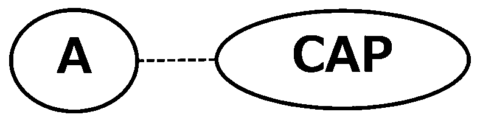
- FIG. 2 is a schematic diagram for explaining the structure of the mRNA cap analog of the present invention.
- FIG. 2 is a schematic diagram illustrating a process for separating mRNA having a 5' cap structure and mRNA not having a 5' cap structure generated by in vitro transcription using the mRNA cap analog of the present invention.
- FIG. 1 is a schematic diagram for explaining the structure of the mRNA cap analog of the present invention.
- the mRNA cap analog of the present invention has a nucleotide (denoted as "CAP") that provides a 5' cap structure, a functional group A (denoted as “A”) that can react with functional group B, and and are connected by a structure (represented by a dotted line) that can be cleaved by light or fluoride ions.
- CAP nucleotide
- A functional group A
- linker the portion represented by A and the dotted line in FIG. 1 is referred to as a "linker.”
- FIG. 2 is a schematic diagram for explaining the process of separating mRNA having a 5' cap structure and mRNA not having a 5' cap structure produced by in vitro transcription using the mRNA cap analog of the present invention.
- mRNA having a 5' cap structure referred to as "Capped RNA”
- Uncapped RNA mRNA having no 5' cap structure
- mRNA having a 5' cap structure has a functional group A capable of reacting with a functional group B (denoted as "B”) introduced into the 5' cap structure, so it can be bound by reacting with an insoluble carrier having a functional group B.
- mRNA that does not have a 5' cap structure can be separated and removed by filtration and washing.
- the linker of the separated and recovered conjugate is cleaved (cleaved) by application of light or fluoride ions, and only mRNA having a 5' cap structure is isolated.
- the mRNA cap analogs according to embodiments of the invention include amino groups, carboxylic acid active ester groups, aminooxy groups, hydrazino groups, carbonyl groups, thiol groups, haloacetyl groups, Michael acceptor functional groups, alkynyl groups, and 1,3 - A linker containing a functional group A selected from dipole functional groups and having a structure cleavable by light or fluoride ions is provided in the sugar or base part of the nucleotide.
- An mRNA cap analog having such a structure can be bonded to an insoluble carrier having a functional group B capable of reacting with functional group A through various known reactions. It becomes possible to separate mRNA that does not have a cap structure.
- mRNA cap analog means a capping reagent used to produce mRNA having a 5' cap structure by in vitro transcription.
- a “nucleotide” is a compound containing a base and a sugar to which a phosphate group is covalently bonded. Nucleotides may be modified with any of a variety of substituents.
- the functional group A of the mRNA cap analog is an amino group
- an insoluble carrier whose functional group B is a carboxylic acid active ester group an mRNA having a 5' cap structure into which the functional group A is introduced;
- a conjugate having an amide bond (-CONH-) generated by reaction with an insoluble carrier having functional group B can be produced.
- the functional group A of the mRNA cap analog is a carboxylic acid active ester group
- an insoluble carrier in which the functional group B is an amino group in combination
- it has a 5' cap structure into which the functional group A is introduced.
- a conjugate having an amide bond resulting from the reaction of mRNA and an insoluble carrier having functional group B can be produced.
- the amino group is not particularly limited, but includes, for example, a monomethylamino group, a monoethylamino group, a mono-n-propylamino group, a monoisopropylamino group, a mono-n-butylamino group, a mono-sec-butylamino group, Mono-tert-butylamino group, mono-isobutylamino group, tert-butylisopropylamino group, mono-n-hexylamino group, mono-n-octylamino group, mono-n-decylamino group, monophenylamino group, trimethylsilyl Examples include an amino group, a mono-tert-butyldimethylsilylamino group, a pyrrolidinyl group, a piperidinyl group, a carbazolyl group, a dihydroindolyl group, and a dihydroisoindolyl group
- carboxylic acid active ester groups include, but are not limited to, carboxylic acid halides, thiophenyl esters, 4-nitrophenyl thioesters, cyanomethyl esters, nitro esters, dinitrophenyl esters, N-hydroxysuccinimide esters, p-nitrophenyl esters, etc.
- Phenyl ester, 2,3,5-trichlorophenyl ester, 2,4,6-trichlorophenyl ester, 2,4,5-trichlorophenyl ester, pentachlorophenyl ester, 2,4-dinitrophenyl ester, N-hydroxyphthalimide ester Examples include.
- the functional group A of the mRNA cap analog is an aminooxy group
- the functional group A of the mRNA cap analog is a carbonyl group
- an insoluble carrier in which the functional group B is an aminooxy group in combination
- a conjugate having an oxime bond generated by reaction with an insoluble carrier having a functional group B can be produced.
- the carbonyl group is not particularly limited, but includes, for example, a methoxycarbonyl group, a tert-butoxycarbonyl group, an ethoxycarbonyl group, an aldehyde group, a ketone group, and the like. Carbonyl groups may be optionally substituted.
- the functional group A of the mRNA cap analog is a hydrazino group
- the functional group A of the mRNA cap analog is a carbonyl group
- an insoluble carrier whose functional group B is a hydrazino group an mRNA having a 5' cap structure into which the functional group A is introduced;
- a conjugate having a hydrazone bond generated by reaction with an insoluble carrier having a functional group B can be produced.
- the hydrazino group includes, but is not particularly limited to, a methylhydrazino group, an ethylhydrazino group, and the like.
- the functional group A of the mRNA cap analog is a thiol group
- an insoluble carrier in which the functional group B is a thiol group in combination mRNA having a 5' cap structure into which the functional group A has been introduced and the functional group B A conjugate having a disulfide bond (-SS-) can be produced by reaction with an insoluble carrier having a disulfide bond (-SS-).
- the functional group A of the mRNA cap analog is a haloacetyl group
- an insoluble carrier in which the functional group B is a thiol group in combination mRNA having a 5' cap structure into which the functional group A is introduced and the functional group B A conjugate having a thioether bond (-S-) can be produced by reaction with an insoluble carrier having a thioether bond (-S-).
- the functional group A of the mRNA cap analog is a thiol group
- an insoluble carrier whose functional group B is a haloacetyl group
- an mRNA having a 5' cap structure into which the functional group A is introduced A conjugate having a thioether bond generated by reaction with an insoluble carrier having a functional group B can be produced.
- the haloacetyl group include, but are not limited to, a chloroacetyl group, a bromoacetyl group, an iodoacetyl group, and the like.
- a haloacetyl group may be optionally substituted.
- the functional group A of the mRNA cap analog is a Michael acceptor functional group
- an insoluble carrier whose functional group B is a thiol group an mRNA having a 5' cap structure into which the functional group A is introduced;
- a conjugate that is a Michael adduct resulting from reaction with an insoluble carrier having functional group B can be produced.
- the functional group A of the mRNA cap analog is a thiol group
- by using an insoluble carrier in which the functional group B is a Michael acceptor functional group in combination it has a 5' cap structure in which the functional group A is introduced.
- a conjugate that is a Michael adduct of mRNA and an insoluble carrier having a functional group B can be produced.
- Michael acceptor functional group means a functional group that can be used as a Michael acceptor.
- the Michael acceptor functional group includes, but is not particularly limited to, a maleimide group, an ⁇ , ⁇ -unsaturated carbonyl group, and the like.
- the Michael acceptor functionality may be optionally substituted.
- the functional group A of the mRNA cap analog When the functional group A of the mRNA cap analog is an alkynyl group, it has a 5' cap structure into which the functional group A is introduced by using in combination with an insoluble carrier whose functional group B is a 1,3-dipolar functional group. A conjugate having a bond due to 1,3-dipolar cyclization resulting from the reaction of mRNA and an insoluble carrier having functional group B can be produced.
- the functional group A of the mRNA cap analog is a 1,3-dipolar functional group
- a 5' cap into which the functional group A is introduced can be prepared by using an insoluble carrier in which the functional group B is an alkynyl group in combination.
- a conjugate having a bond due to 1,3-dipolar cyclization generated by the reaction of mRNA having the structure and an insoluble carrier having the functional group B can be produced.
- the reaction resulting from this combination is called a click reaction.
- the click reaction is particularly preferred among the above-mentioned combinations because it allows a quantitative reaction to be carried out under very mild conditions.
- An alkynyl group is a straight or branched hydrocarbon chain containing one or more triple bonds.
- An alkynyl group can have, for example, 2 to 20 carbon atoms.
- Typical alkynyl groups include ethynyl, propynyl, butynyl, pentynyl, hexynyl, and the like. Alkynyl groups may be optionally substituted.
- 1,3-dipole functional group examples include, but are not limited to, a nitrone group, an azomethine imine group, an azomethine ylide group, an azimine group, an azoxy group, a nitro group, a carbonyl ylide group, a carbonylimine group, a carbonyl oxide group, and a nitrosoimine group. group, nitrosoxide group, nitrile oxide group, nitrile imine group, nitrile ylide group, diazoalkane group, azide group, and the like. These may be optionally substituted.
- a triazole ring can be formed by bonding with an alkynyl group by a click reaction.
- the structure of the linker that can be cleaved by light or fluoride ions is not particularly limited, but includes, for example, an o-nitrobenzyl ether structure or a silyl ether structure.
- the o-nitrobenzyl ether structure can be cleaved (cleaved) by the application of light (typically UV irradiation with a wavelength of 365 nm).
- the silyl ether structure can be cleaved (cleaved) by the action of fluoride ions.
- fluoride ions tetrabutylammonium fluoride (TBAF), cesium fluoride (CsF), or the like can be used.
- the base portion of the nucleotide to which the linker is connected is not particularly limited and may be adenine (A), guanine (G), cytosine (C) or uracil (U), but guanine (G) is preferable.
- the position of the sugar moiety of the nucleotide to which the linker is connected is not particularly limited, and can be the 2' carbon or the 3' carbon, but the 2' carbon is preferable.
- the position of the base portion of the nucleotide to which the linker is connected is not particularly limited, but in the case of adenine or guanine having a purine skeleton, carbon 2 or carbon 6 is preferable. Further, in the case of cytosine or uracil having a pyrimidine skeleton, the nitrogen at the 3rd position, the carbon at the 4th position, the carbon at the 5th position, or the carbon at the 6th position is preferable.
- the mRNA cap analog according to the embodiment of the present invention can typically be represented by the following general formula (1) or (2).
- An mRNA cap analog having such a structure has good efficiency in in vitro transcription reaction.
- R 1 is OH, OCH 3 or a group represented by the following general formula (3).
- R2 is OH or OCH3 .
- R 3 is O, OH, NH 2 , NHCH 3 or N(CH 3 ) 2 , and when R 3 is O, the bond between C bonded to R 3 and R 3 (dotted line and solid line ) is a double bond, and the bond between C bonded to R 3 and its adjacent N (bond represented by a dotted line and a solid line) is a single bond, and R 3 is OH, NH 2 , NHCH 3 or N(CH 3 ) 2 , the bond between C bonded to R 3 and R 3 (the bond represented by the dotted line and solid line) is a single bond, and the C bonded to R 3 and its adjacent The bond with N (the bond represented by the dotted line and the solid line) is a double bond.
- R 3 is O.
- R 4 is NH 2 , NHCH 3 , N(CH 3 ) 2 or H.
- R 4 is NH 2 .
- R 5 is a propargyloxy group or an azidoethoxy group.
- R 5 is an azidoethoxy group.
- R 6 and R 7 may be the same or different and are OH or OCH 3 .
- a is 3-6.
- a is 3.
- b is 0 to 19.
- Base is adenin-9-yl, N6-methyladenin-9-yl, guanine-9-yl, cytosin-1-yl, 5-methylcytosin-1-yl, uracil-1-yl, uracil. -5-yl or 1-methyluracil-5-yl.
- the mRNA cap analog according to the embodiment of the present invention can be produced according to a known method.
- An example of a method for producing an mRNA cap analog according to an embodiment of the present invention will be described below.
- the method for producing an mRNA cap analog according to an embodiment of the present invention includes an amino group, a carboxylic acid active ester group, an aminooxy group, a hydrazino group, a carbonyl group, a thiol group, a haloacetyl group, a Michael acceptor functional group, an alkynyl group, and a step of introducing a linker containing a functional group A selected from 1,3-dipole functional groups and having a structure cleavable by light or fluoride ions into the sugar moiety or base moiety of the first nucleotide; and a step of linking a first nucleotide into which a linker has been introduced with a second nucleotide in the presence of magnesium.
- the linker can be synthesized using known methods depending on the functional group A and the type of structure that can be cleaved by light or fluoride ions.
- Conditions for introducing the linker into the sugar part or base part of the first nucleotide are not particularly limited, and may be appropriately set depending on the types of the linker and the first nucleotide.
- the first nucleotide is not particularly limited, but for example, guanylic acid can be used.
- the conditions for linking the first nucleotide into which a linker has been introduced with the second nucleotide are not particularly limited, except that it is performed in the presence of magnesium chloride, and the types of the linker, the first nucleotide, and the second nucleotide are It may be set appropriately depending on the situation.
- the second nucleotide is not particularly limited, but for example, guanosine diphosphate can be used.
- a method for producing mRNA having a 5' cap structure includes a preparation step (hereinafter referred to as “method for producing mRNA") of a preparation containing mRNA having a 5' cap structure. , a conjugate production step (hereinafter referred to as the “second step”), a conjugate separation and washing step (hereinafter referred to as the “third step”), and a 5' cap structure. It includes an mRNA isolation step (hereinafter referred to as the "fourth step”).
- the first step is to prepare an mRNA cap analog containing a functional group A and having a linker having a structure that can be cleaved by light or fluoride ions in the sugar or base part of the nucleotide, a nucleoside triphosphate, template DNA, and RNA polymerase. mixing and obtaining a preparation containing mRNA with a 5' cap structure by in vitro transcription. The preparation obtained in this step also contains mRNA without a 5' cap structure.
- the first step can be performed according to existing conditions, except for using an mRNA cap analog with a specific structure. Note that the details of the mRNA cap analog having a specific structure have already been explained above, so the explanation thereof will be omitted.
- the second step is a step of mixing an insoluble carrier having a functional group B capable of reacting with functional group A with the above preparation to produce a conjugate of mRNA having a 5' cap structure and the insoluble carrier.
- the conditions for forming the conjugate are not particularly limited, and may be set depending on the types of the functional group A of the mRNA having a 5' cap structure and the functional group B of the insoluble carrier.
- Functional groups A and B are a combination of an amino group and a carboxylic acid active ester, a combination of an aminooxy group or a hydrazino group and a carbonyl group, a combination of a thiol group and a thiol group, a haloacetyl group, or a Michael acceptor functional group, or It can be a combination of an alkynyl group and a 1,3-dipolar functional group.
- the combination of an amino group and a carboxylic acid active ester is a combination in which functional group A is an amino group and functional group B is a carboxylic acid active ester, and a combination in which functional group A is a carboxylic acid active ester.
- the insoluble carrier is not particularly limited as long as it is insoluble in an aqueous solution.
- Insoluble carriers include carriers made from polysaccharides such as agarose, alginate, carrageenan, chitin, cellulose, dextrin, dextran, and starch, polyvinyl alcohol, polymethacrylate, poly(2-hydroxyethyl methacrylate), Examples include carriers made from synthetic polymers such as polyurethane, and carriers made from ceramics such as silica. Moreover, various commercially available insoluble carriers may be used.
- Examples of commercially available carriers include Primer Support (registered trademark) 5G (manufactured by Cytiva) and EAH Sepharose (registered trademark) 4B (manufactured by Cytiva), which are used for oligonucleotide synthesis.
- the insoluble carrier can be represented by the following formula (4).
- Sup is an insoluble carrier structure.
- the insoluble carrier structure is a part composed of the above-mentioned carrier.
- the insoluble carrier is represented by the following formula (5), (6) or (7). be able to.
- a click reaction can be performed without the presence of copper (I) ions, so it is possible to avoid contamination with copper (I) ions during mRNA production. .
- Sup is an insoluble carrier structure.
- the insoluble carrier structure is a part composed of the above-mentioned carrier.
- the third step is a step of filtering and washing the above-mentioned conjugate.
- the conjugate of mRNA with a 5' cap structure and an insoluble carrier is solid, whereas the mRNA without a 5' cap structure is liquid, so by filtering and washing this conjugate, mRNA that does not have a 5' cap structure can be separated and removed.
- the methods and conditions for filtration and washing are not particularly limited, and can be carried out according to known methods.
- the fourth step is to cleave the linker by applying light or fluoride ions to the above conjugate and isolate the mRNA having a 5' cap structure. Cleavage of the linker with acid or alkali may affect mRNA with a 5' cap structure, but since the linker is cleaved with light or fluoride ions, there is no effect on mRNA with a 5' cap structure. can be reduced.
- the cleavage conditions for the linker are not particularly limited, and may be appropriately set depending on the structure of the linker that can be cleaved by light or fluoride ions.
- the linker when the structure is an o-nitrobenzyl ether structure, the linker can be cleaved (cleaved) by irradiating the compound with ultraviolet light having a wavelength of 365 nm. Further, when the structure is a silyl ether structure, the linker can be cleaved (cleaved) by applying a solution containing fluoride ions to the compound.
- Kits according to embodiments of the present invention are used for producing mRNA having a 5' cap structure.
- Kits according to embodiments of the present invention contain amino groups, carboxylic acid active ester groups, aminooxy groups, hydrazino groups, carbonyl groups, thiol groups, haloacetyl groups, Michael acceptor functional groups, alkynyl groups, and 1,3-dipolar groups.
- An mRNA cap analog comprising a linker containing a functional group A selected from child functional groups and having a structure cleavable by light or fluoride ions in the sugar or base part of the nucleotide, and a functional group capable of reacting with the functional group A. and an insoluble carrier having group B.
- mRNA without a 5' cap structure produced as a by-product during the production of mRNA with a 5' cap structure can be separated and removed, and the 5' cap structure can be removed. can be isolated. Note that the details of the mRNA cap analog and the insoluble carrier used in the kit according to the embodiment of the present invention have already been described above, so the description thereof will be omitted.
- the kit according to the embodiment of the present invention may further contain one or more selected from nucleoside triphosphates, template DNA, and RNA polymerase, as necessary.
- These components are the raw materials used when preparing mRNA having a 5' cap structure by in vitro transcription. Therefore, by using a kit containing these components, mRNA having a 5' cap structure can be easily prepared.
- Me represents a methyl group
- Et represents an ethyl group
- Ac represents an acetyl group
- the filtrate was diluted with ethyl acetate and washed with 1 mol/L hydrochloric acid and saturated sodium hydrogen carbonate.
- the organic layer was dried with anhydrous sodium sulfate, and after concentration, the concentrate was purified by medium pressure silica gel column chromatography (Biotage (registered trademark) Sfar Silica HC D, 25 g, 10-20 w/w% AcOEt in Hexane), and the compound 14 (4.20 g, 5.31 mmol, 78.3%) was obtained.
- the filtrate was diluted with ethyl acetate and washed with water.
- the organic layer was dried over anhydrous sodium sulfate, and after concentration, the concentrate was purified by medium pressure silica gel column chromatography (Biotage® Sfar Silica HCD, 25 g, 20 w/w% AcOEt in Hexane) to obtain compound 16 ( 1.60 g, 1.96 mmol, 70%) was obtained.
- the filtrate was diluted with ethyl acetate and washed with water.
- the organic layer was dried over anhydrous sodium sulfate, and after concentration, the concentrate was purified by medium pressure silica gel column chromatography (Biotage® Sfar Silica HC D, 25 g, 20 w/w% AcOEt in Hexane) to obtain compound 18 ( 1.74g, 2.06mmol, 71.7%) was obtained.
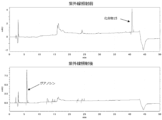
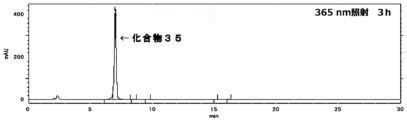
- a linker cutting test was conducted on Compound 15 by irradiating it with ultraviolet light having a wavelength of 365 nm. Specifically, an ultraviolet lamp was placed in an aqueous solution of compound 15, and ultraviolet light having a wavelength of 365 nm was irradiated at room temperature for 2 hours to investigate whether the following photocleavage reaction would proceed.
- compound 21 (5.93 g, 8.31 mmol) was dissolved in dichloromethane (55.4 mL), 2,4,6-triisopropylbenzenesulfonyl chloride (4.03 g, 13.3 mmol), triethylamine (1. 85 mL, 13.3 mmol) and 4-dimethylaminopyridine (101 mg, 0.831 mmol) were added, and the mixture was stirred at room temperature for 48 hours. The reaction solution was diluted with chloroform and washed with saturated aqueous sodium bicarbonate.
- the concentrate was purified by medium pressure silica gel column chromatography (Biotage (registered trademark) Sfar Silica HC D, 25 g, 20 w/w% AcOEt in Hexane) to obtain compound 22. (7.52g, 7.67mmol, 92.4%) was obtained.
- compound 22 (6.00 g, 6.12 mmol) and compound 5 (1.52 g, 7.34 mmol) were dissolved in 1,2-dimethoxyethane (61 mL), and molecular sieves 4A (12.0 g) was added. and stirred at room temperature for 1 hour. After adding 1,4-diazabicyclo[2.2.2]octane (1.37 mg, 12.2 mmol) and stirring at room temperature for 1 hour, 1,8-diazabicyclo[5.4.0]undec-7-ene ( 1.83 mL, 12.2 mmol) was added thereto, and the mixture was stirred at room temperature for 15 hours.
- the filtrate was diluted with ethyl acetate and washed with water. After drying and concentrating the organic layer with anhydrous sodium sulfate, the concentrate was purified by medium pressure silica gel column chromatography (Biotage (registered trademark) Sfar Silica HC D, 50 g, 20-35 w/w% AcOEt in Hexane), Compound 23 (4.09 g, 4.53 mmol, 74.0%) was obtained.
- Biotage registered trademark
- the concentrate was purified by medium pressure silica gel column chromatography (Biotage (registered trademark) Sfar Silica HC D, 25 g, 25-50 w/w% AcOEt in Hexane) to obtain compound 24 (1.84 g, 1.77 mmol, 80.0 %) was obtained.
- compound 24 (1.80 g, 1.74 mmol) was dissolved in tetrahydrofuran (8.68 mL), and a 1.0 mol/L tetrabutylammonium fluoride solution in tetrahydrofuran (2.60 mL, 2.60 mmol) was added. Stirred at room temperature for 30 minutes. After concentrating the reaction solution, ethyl acetate was added to the concentrate, washed with saturated brine, and the organic layer was dried over anhydrous sodium sulfate and concentrated.
- the concentrate was purified by medium pressure silica gel column chromatography (Biotage (registered trademark) Sfar Silica HC D, 25 g, 1 w/w% MeOH in CHCl 3 , fractions containing by-products were repurified under similar conditions), and the compound 25 (1.31 g, 1.42 mmol, 81.8%) was obtained.
- compound 25 (1.03 g, 1.12 mmol) was dissolved in acetonitrile (5.58 mL), and 2-cyanoethyl N,N,N',N'-tetraisopropyl phosphorodiamidite (0.53 mL, 1. 67 mmol) and 1H-tetrazole (117 mg, 1.67 mmol) were added, and the mixture was stirred at room temperature for 3 hours. The reaction solution was diluted with ethyl acetate, washed with water, and the organic layer was dried over anhydrous sodium sulfate and concentrated.
- the concentrate was purified by medium pressure silica gel column chromatography (Yamazen Silica Gel 2L, 3.0 x 20.0 cm, 55 g, 25-33-50 w/w% AcOEt in Hexane). After concentrating the fraction containing the target product, the concentrate was dissolved in dichloromethane (3 mL) and added dropwise to hexane (500 mL). The resulting precipitate was collected by filtration, washed (hexane), and then dried under vacuum to obtain Compound 26 (0.89 g, 0.79 mmol, 71.0%).
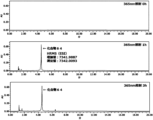
- HRMS (ESI) m/z Theoretical value as [MH] - ion of C 59 H 62 N 8 O 13 P - 1121.4179; Measured value 1121.4127
- the obtained crude compound 28 was azeotroped three times with acetonitrile, and the residue was dissolved in acetonitrile (10 mL), and triethylamine (0.0717 mL, 0.515 mmol) and Cytiva Primer support (registered trademark) 5G amino (1. 23 g, 0.45 mmol/g) was added thereto, and the mixture was stirred at room temperature for 17 hours. After confirming by TLC that there were no raw materials in the supernatant, insoluble matter was collected by filtration. Then, it was washed with acetonitrile and dried under vacuum (1.29 g).
- oligonucleotide derivatives Two types of oligonucleotide derivatives (dimer (compound 30) and 21-mer ( Compound 31)) was synthesized. At this time, the amidite of compound 26 and the dT amidite were diluted with acetonitrile to a concentration of 0.15 mol/L. Other synthesis conditions were as follows.
- Dimeric oligonucleotide derivative (compound 30) (3.37 ⁇ mol), copper(I) iodide (12.8 mg in 50 w/w% MeCN, 3.37 mL), tris[(1-benzyl-1H-1, After mixing 2,3-triazol-4-yl)methyl]amine (TBTA) (71.5 mg) and sodium ascorbate (66.8 mg), an insoluble carrier (compound 29) (100 mg, 33.5 ⁇ mol) was added. Click reaction was performed by stirring at room temperature for 2 hours. Thereafter, the insoluble carrier (reactant) was collected by filtration, washed with MeCN, and then vacuum-dried (104 mg).
- the obtained insoluble carrier was suspended in acetonitrile (1 mL) and a 100 mmol/L aqueous solution of disodium ethylenediaminetetraacetate (3 mL), and the suspension was stirred at room temperature for 16 hours. After the insoluble carrier was filtered off, it was washed with deionized water and then with acetonitrile, and vacuum dried to obtain a conjugate of an oligonucleotide derivative and an insoluble carrier (compound 32).
- 21-mer oligonucleotide derivative (compound 31) (1.12 mL), deionized water (2.24 mL), copper(I) iodide (12.8 mg in 50 w/w% MeCN, 3.37 mL), Tris[ After mixing (1-benzyl-1H-1,2,3-triazol-4-yl)methyl]amine (TBTA) (71.5 mg) and sodium ascorbate (66.8 mg), the insoluble carrier (29) 100 mg, 33.5 ⁇ mol) and stirred at room temperature for 6 hours to perform a click reaction. Thereafter, the insoluble carrier (reactant) was collected by filtration, washed with MeCN, and then dried in vacuum.
- TBTA (1-benzyl-1H-1,2,3-triazol-4-yl)methyl]amine
- sodium ascorbate 66.8 mg
- the obtained insoluble carrier was suspended in acetonitrile (1 mL) and a 100 mmol/L aqueous solution of disodium ethylenediaminetetraacetate (3 mL), and the suspension was stirred at room temperature for 16 hours. After filtering off the insoluble carrier, it was washed with deionized water and then with acetonitrile, and vacuum dried to obtain a conjugate (compound 33) of an oligonucleotide derivative and an insoluble carrier.
- the organic layers were combined, concentrated, and dissolved in 100 mmol/L triethylammonium acetate (50 mL). Purified by ODS silica gel column chromatography (100 mmol/L triethylammonium acetate to 50 w/w% acetonitrile, 100 mmol/L triethylammonium acetate). The fraction containing the target product was concentrated to a small amount and extracted three times with chloroform. The organic layers were combined and concentrated, and the concentrate was dissolved in methanol (30.6 mL). A 40 w/w% methylamine methanol solution (10.2 mL) was added to this solution, and the mixture was stirred at room temperature for 24 hours.
- the concentrate was made into a 200 mmol/L triethylammonium acetate solution (500 mL) and subjected to ODS silica gel column chromatography (YAMAZEN ODS-SM 30 ⁇ m, L, 3.0 x 16.5 cm, 37 g, 100 mmol/L). Purified by triethylammonium acetate ⁇ 50 w/w% acetonitrile, 100 mmol/L triethylammonium acetate). After concentrating the fraction containing the target product, the concentrate was azeotroped with deionized water 10 times.
- the obtained crystalline residue was heated and dissolved in ethanol (75 mL), and the precipitated crystals were collected by filtration and dried to obtain Compound 42 (2.41 g, 3.37 mmol, 55.1%).
- the crystal mother liquor was purified by ODS silica gel column chromatography (YAMAZEN ODS-SM 30 ⁇ m, L, 3.0 x 16.5 cm, 37 g, 100 mmol/L triethylammonium acetate to 50 w/w% acetonitrile, 100 mmol/L triethylammonium acetate). Repurification was performed to obtain an additional 0.28 g of Compound 42.
- Tributylamine (163 ⁇ L, 637 ⁇ mol) was added to an aqueous solution of compound 48 (84.8 mmol/L, 4.51 mL, 382 ⁇ mol), concentrated, and the concentrate was azeotroped three times with N,N-dimethylformamide. The residue was dissolved in N,N-dimethylformamide (1.59 mL), 1,1'-carbonyldimidazole (129 mg, 0.797 mmol) was added, and the mixture was stirred at room temperature for 3 hours.
- oligonucleotide derivative compound 53; 0.025 mmol; sequence 5'-G OMe G OMe G AGA CGC GUG UUA AAU AAC-3'; G OMe is 2' A solution of OMe-G) dissolved in dimethyl sulfoxide (2 mL) and a solution of magnesium chloride hexahydrate (50 mg, 0.25 mmol) dissolved in N,N-dimethylformamide (1 mL) were added sequentially, and the mixture was heated at room temperature. Stirred for 20 hours.
- the EAH Sepharose (registered trademark) 4B (7-12 ⁇ mol/mL) suspension was centrifuged at 2,000 rpm for 5 minutes (volume after centrifugation: 10 mL), and the supernatant was removed by decantation.
- the precipitate was suspended in acetonitrile (10 mL), centrifuged at 2,000 rpm for 5 minutes, the supernatant was removed by decantation, and the above operation was repeated 5 times.
- the above precipitate was suspended in acetonitrile (10 mL), N,N-diisopropylethylamine (25 ⁇ L, 0.14 mmol) and Compound 59 (61 mg, 70 ⁇ mol) were added, and the mixture was stirred at room temperature for 15 hours.
- N,N-diisopropylethylamine (25 ⁇ L, 0.14 mmol) and Compound 59 (61 mg, 70 ⁇ mol) were added and stirred overnight at room temperature, which was repeated twice.
- N-acetylimidazole (7.7 mg, 70 ⁇ mol) was added thereto, and the mixture was stirred at room temperature for 24 hours.
- the suspension was centrifuged at 2,000 rpm for 5 minutes, and the supernatant was removed by decantation.
- the precipitate was suspended in acetonitrile (10 mL), centrifuged at 2,000 rpm for 5 minutes, the supernatant was removed by decantation, and the above operation was repeated 5 times to obtain a precipitate (compound 60).
- the precipitate was made up to 10 mL with deionized water.
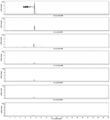
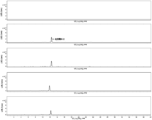
- a suspension of compound 60 (0.50 mL, 1.60 ⁇ mol), a solution of compound 54 (0.5 mL, 0.083 ⁇ mol), and compound 53 as an internal standard were mixed and stirred at room temperature for 4 days. During this time, the reaction solution was analyzed over time, and it was confirmed that the click reaction was progressing by confirming that the peak of compound 54 in the reaction solution was decreasing (FIG. 9).
- the concentrate was purified by silica gel column chromatography (75-85-100 w/w% ethyl acetate-hexane to 2 w/w% methanol-ethyl acetate) to obtain compound 67 (0.80 g, 1.2 mmol). , 82%).
- the EAH Sepharose (registered trademark) 4B (7-12 ⁇ mol/mL) suspension was centrifuged at 2,000 rpm for 5 minutes (volume after centrifugation: 10 mL), and the supernatant was removed by decantation.
- the precipitate was suspended in acetonitrile (10 mL), centrifuged at 2,000 rpm for 5 minutes, the supernatant was removed by decantation, and the above operation was repeated 5 times.
- the above precipitate was suspended in acetonitrile (10 mL), N,N-diisopropylethylamine (37 ⁇ L, 0.21 mmol) and Compound 71 (67 mg, 70 ⁇ mol) were added, and the mixture was stirred at room temperature for 16 hours.
- N,N-diisopropylethylamine 37 ⁇ L, 0.21 mmol
- Compound 71 67 mg, 70 ⁇ mol
- N-acetylimidazole 27 mg, 0.21 mmol
- the suspension was centrifuged at 4,000 rpm for 10 minutes, and the supernatant was removed by decantation.
- the precipitate was suspended in 100 mmol/mL triethylammonium acetate aqueous solution (20 mL), centrifuged at 4,000 rpm for 10 minutes, the supernatant was removed by decantation, and the above operation was repeated three times to remove the precipitate (compound 72). Obtained.
- the precipitate was made up to 10 mL with deionized water.
- Compound 72 was treated according to the following scheme.
- SEQ ID NO: 1 Oligonucleotide derivative (21-mer) synthesized in Example SEQ ID NO: 2: Oligonucleotide derivative used in Examples (Compound 53)
Landscapes
- Chemical & Material Sciences (AREA)
- Health & Medical Sciences (AREA)
- Life Sciences & Earth Sciences (AREA)
- Organic Chemistry (AREA)
- Engineering & Computer Science (AREA)
- Genetics & Genomics (AREA)
- Molecular Biology (AREA)
- Biochemistry (AREA)
- Biotechnology (AREA)
- General Health & Medical Sciences (AREA)
- Biomedical Technology (AREA)
- General Engineering & Computer Science (AREA)
- Bioinformatics & Cheminformatics (AREA)
- Wood Science & Technology (AREA)
- Zoology (AREA)
- Physics & Mathematics (AREA)
- Biophysics (AREA)
- Plant Pathology (AREA)
- Microbiology (AREA)
- Saccharide Compounds (AREA)
Priority Applications (3)
| Application Number | Priority Date | Filing Date | Title |
|---|---|---|---|
| JP2024520478A JPWO2023219114A1 (https=) | 2022-05-10 | 2023-05-10 | |
| EP23803589.3A EP4524146A1 (en) | 2022-05-10 | 2023-05-10 | Mrna cap analog and method for producing same, method for producing mrna, and kit |
| KR1020247037435A KR20250009433A (ko) | 2022-05-10 | 2023-05-10 | mRNA캡 아날로그 및 그 제조 방법, mRNA의 제조 방법, 그리고 키트 |
Applications Claiming Priority (2)
| Application Number | Priority Date | Filing Date | Title |
|---|---|---|---|
| JP2022-077734 | 2022-05-10 | ||
| JP2022077734 | 2022-05-10 |
Publications (1)
| Publication Number | Publication Date |
|---|---|
| WO2023219114A1 true WO2023219114A1 (ja) | 2023-11-16 |
Family
ID=88730294
Family Applications (1)
| Application Number | Title | Priority Date | Filing Date |
|---|---|---|---|
| PCT/JP2023/017621 Ceased WO2023219114A1 (ja) | 2022-05-10 | 2023-05-10 | mRNAキャップアナログ及びその製造方法、mRNAの製造方法、並びにキット |
Country Status (4)
| Country | Link |
|---|---|
| EP (1) | EP4524146A1 (https=) |
| JP (1) | JPWO2023219114A1 (https=) |
| KR (1) | KR20250009433A (https=) |
| WO (1) | WO2023219114A1 (https=) |
Cited By (2)
| Publication number | Priority date | Publication date | Assignee | Title |
|---|---|---|---|---|
| WO2026014365A1 (ja) * | 2024-07-08 | 2026-01-15 | 国立大学法人東海国立大学機構 | 5´キャップアナログ |
| WO2026018876A1 (ja) * | 2024-07-18 | 2026-01-22 | 国立大学法人 東京大学 | 化合物の製造方法 |
Citations (3)
| Publication number | Priority date | Publication date | Assignee | Title |
|---|---|---|---|---|
| JP2009544754A (ja) | 2006-07-28 | 2009-12-17 | アプライド バイオシステムズ, エルエルシー | ジヌクレオチドmrnaキャップアナログ |
| WO2013059475A1 (en) * | 2011-10-18 | 2013-04-25 | Life Technologies Corporation | Alkynyl-derivatized cap analogs, preparation and uses thereof |
| JP2015535430A (ja) * | 2012-11-26 | 2015-12-14 | モデルナ セラピューティクス インコーポレイテッドMo | 末端修飾rna |
-
2023
- 2023-05-10 JP JP2024520478A patent/JPWO2023219114A1/ja active Pending
- 2023-05-10 KR KR1020247037435A patent/KR20250009433A/ko active Pending
- 2023-05-10 WO PCT/JP2023/017621 patent/WO2023219114A1/ja not_active Ceased
- 2023-05-10 EP EP23803589.3A patent/EP4524146A1/en active Pending
Patent Citations (3)
| Publication number | Priority date | Publication date | Assignee | Title |
|---|---|---|---|---|
| JP2009544754A (ja) | 2006-07-28 | 2009-12-17 | アプライド バイオシステムズ, エルエルシー | ジヌクレオチドmrnaキャップアナログ |
| WO2013059475A1 (en) * | 2011-10-18 | 2013-04-25 | Life Technologies Corporation | Alkynyl-derivatized cap analogs, preparation and uses thereof |
| JP2015535430A (ja) * | 2012-11-26 | 2015-12-14 | モデルナ セラピューティクス インコーポレイテッドMo | 末端修飾rna |
Non-Patent Citations (4)
| Title |
|---|
| BIOORGANIC & MEDICINAL CHEMISTRY, vol. 21, no. 22, 2013, pages 6886 - 6892 |
| MALGORZATA HONCHARENKO, JOANNA ROMANOWSKA, MARGARITA ALVIRA, MARTINA JEZOWSKA, MIKAEL KJELLGREN, C. I. EDVARD SMITH, ROGER STRÖMBE: "Capping of oligonucleotides with "clickable" m3G-CAPs", RSC ADVANCES, RSC PUBLISHING, vol. 2, no. 33, 1 January 2012 (2012-01-01), pages 12949, XP055110611, ISSN: 20462069, DOI: 10.1039/c2ra22345g * |
| ORGANIC & BIOMOLECULAR CHEMISTRY, vol. 12, no. 14, 2014, pages 2263 - 2272 |
| SHANMUGASUNDARAM, M. et al. Design, synthesis and biological evaluation of dinucleotide mRNA cap analog containing propargyl moiety. Bioorganic & Medicinal Chemistry. 2016, vol. 24, no. 6, pp. 1204-1208, DOI: 10.1016/j.bmc.2016.01.048 * |
Cited By (2)
| Publication number | Priority date | Publication date | Assignee | Title |
|---|---|---|---|---|
| WO2026014365A1 (ja) * | 2024-07-08 | 2026-01-15 | 国立大学法人東海国立大学機構 | 5´キャップアナログ |
| WO2026018876A1 (ja) * | 2024-07-18 | 2026-01-22 | 国立大学法人 東京大学 | 化合物の製造方法 |
Also Published As
| Publication number | Publication date |
|---|---|
| JPWO2023219114A1 (https=) | 2023-11-16 |
| EP4524146A1 (en) | 2025-03-19 |
| KR20250009433A (ko) | 2025-01-17 |
Similar Documents
| Publication | Publication Date | Title |
|---|---|---|
| JP6038860B2 (ja) | リン原子修飾核酸の合成方法 | |
| JP2511005B2 (ja) | インビトロにおけるオリゴヌクレオチド合成法並びにそれに用いる試薬 | |
| US8344118B2 (en) | Preparation and isolation of 5′ capped MRNA | |
| CN103068834B (zh) | 用于反向合成rna的亚磷酰胺 | |
| US20120178710A1 (en) | Synthesis of cyclic diguanosine monophosphate and thiophosphate analogs thereof | |
| JPH10501809A (ja) | 分子内求核置換による公知および新規2′−ヌクレオシドの新規製造方法 | |
| WO2006022323A1 (ja) | ホスホロアミダイト化合物及びオリゴrnaの製法 | |
| WO2023219114A1 (ja) | mRNAキャップアナログ及びその製造方法、mRNAの製造方法、並びにキット | |
| CN117534719B (zh) | 一种c6'取代锁核酸修饰加帽类似物及其应用 | |
| FR2607507A1 (fr) | Nouveaux derives a-d-oligonucleotides, leur preparation et leur emploi | |
| CN103492405A (zh) | 使用捕获标记物的三磷酸化寡核苷酸的纯化 | |
| JP2011184318A (ja) | リボヌクレシドh−ボラノホスホネート | |
| WO1988004301A1 (fr) | OLIGONUCLEOTIDES alpha | |
| JP2001501581A (ja) | ヌクレオシド類似体 | |
| CN117980316A (zh) | 具有通过甲基转移酶转移在靶生物分子上的活性基团的s-和se-腺苷-l-甲硫氨酸类似物 | |
| US20230212178A1 (en) | Method of producing photoreactive nucleotide analog | |
| US9353142B2 (en) | Protecting group for indole group, nucleic acid-synthesizing amidite and nucleic acid-synthesizing method | |
| WO2005070946A1 (ja) | リボ核酸化合物及びオリゴ核酸化合物の液相合成法 | |
| Ishikawa et al. | Synthesis and Properties of Gapmer Oligonucleotides Containing 4′‐Carboxy‐and 4′‐Carbamoyl‐Thymidine Analogs | |
| JP7776154B2 (ja) | ホスホロチオエート及びボラノホスフェートを含むキメラ型核酸オリゴマー、及びその製造方法 | |
| US6486313B1 (en) | Oligonucleotides having alkylphosphonate linkages and methods for their preparation | |
| US8816062B2 (en) | Maleimide-furanyl compounds that can be used in a general method for preparing maleimide-oligonucleotide derivatives | |
| Das et al. | Phosphorodiamidate Linkages In DNA: Synthesis and Biophysical Studies | |
| WO2025021654A1 (en) | Phosphoramidite linkers | |
| Sakakibara et al. | First synthesis of [6-15N]-cladribine using ribonucleoside as a starting material |
Legal Events
| Date | Code | Title | Description |
|---|---|---|---|
| 121 | Ep: the epo has been informed by wipo that ep was designated in this application |
Ref document number: 23803589 Country of ref document: EP Kind code of ref document: A1 |
|
| WWE | Wipo information: entry into national phase |
Ref document number: 2024520478 Country of ref document: JP |
|
| WWE | Wipo information: entry into national phase |
Ref document number: 2023803589 Country of ref document: EP |
|
| NENP | Non-entry into the national phase |
Ref country code: DE |
|
| ENP | Entry into the national phase |
Ref document number: 2023803589 Country of ref document: EP Effective date: 20241210 |