WO2023219007A1 - 熱硬化性樹脂組成物、成形品、繊維強化複合材料用成形材料および繊維強化複合材料 - Google Patents
熱硬化性樹脂組成物、成形品、繊維強化複合材料用成形材料および繊維強化複合材料 Download PDFInfo
- Publication number
- WO2023219007A1 WO2023219007A1 PCT/JP2023/016826 JP2023016826W WO2023219007A1 WO 2023219007 A1 WO2023219007 A1 WO 2023219007A1 JP 2023016826 W JP2023016826 W JP 2023016826W WO 2023219007 A1 WO2023219007 A1 WO 2023219007A1
- Authority
- WO
- WIPO (PCT)
- Prior art keywords
- resin composition
- thermosetting resin
- component
- registered trademark
- composition according
- Prior art date
- Legal status (The legal status is an assumption and is not a legal conclusion. Google has not performed a legal analysis and makes no representation as to the accuracy of the status listed.)
- Ceased
Links
Classifications
-
- C—CHEMISTRY; METALLURGY
- C08—ORGANIC MACROMOLECULAR COMPOUNDS; THEIR PREPARATION OR CHEMICAL WORKING-UP; COMPOSITIONS BASED THEREON
- C08G—MACROMOLECULAR COMPOUNDS OBTAINED OTHERWISE THAN BY REACTIONS ONLY INVOLVING UNSATURATED CARBON-TO-CARBON BONDS
- C08G18/00—Polymeric products of isocyanates or isothiocyanates
- C08G18/06—Polymeric products of isocyanates or isothiocyanates with compounds having active hydrogen
- C08G18/08—Processes
- C08G18/16—Catalysts
-
- C—CHEMISTRY; METALLURGY
- C08—ORGANIC MACROMOLECULAR COMPOUNDS; THEIR PREPARATION OR CHEMICAL WORKING-UP; COMPOSITIONS BASED THEREON
- C08G—MACROMOLECULAR COMPOUNDS OBTAINED OTHERWISE THAN BY REACTIONS ONLY INVOLVING UNSATURATED CARBON-TO-CARBON BONDS
- C08G18/00—Polymeric products of isocyanates or isothiocyanates
- C08G18/06—Polymeric products of isocyanates or isothiocyanates with compounds having active hydrogen
- C08G18/28—Polymeric products of isocyanates or isothiocyanates with compounds having active hydrogen characterised by the compounds used containing active hydrogen
- C08G18/40—High-molecular-weight compounds
- C08G18/58—Epoxy resins
-
- C—CHEMISTRY; METALLURGY
- C08—ORGANIC MACROMOLECULAR COMPOUNDS; THEIR PREPARATION OR CHEMICAL WORKING-UP; COMPOSITIONS BASED THEREON
- C08G—MACROMOLECULAR COMPOUNDS OBTAINED OTHERWISE THAN BY REACTIONS ONLY INVOLVING UNSATURATED CARBON-TO-CARBON BONDS
- C08G59/00—Polycondensates containing more than one epoxy group per molecule; Macromolecules obtained by polymerising compounds containing more than one epoxy group per molecule using curing agents or catalysts which react with the epoxy groups
- C08G59/18—Macromolecules obtained by polymerising compounds containing more than one epoxy group per molecule using curing agents or catalysts which react with the epoxy groups ; e.g. general methods of curing
- C08G59/40—Macromolecules obtained by polymerising compounds containing more than one epoxy group per molecule using curing agents or catalysts which react with the epoxy groups ; e.g. general methods of curing characterised by the curing agents used
-
- C—CHEMISTRY; METALLURGY
- C08—ORGANIC MACROMOLECULAR COMPOUNDS; THEIR PREPARATION OR CHEMICAL WORKING-UP; COMPOSITIONS BASED THEREON
- C08J—WORKING-UP; GENERAL PROCESSES OF COMPOUNDING; AFTER-TREATMENT NOT COVERED BY SUBCLASSES C08B, C08C, C08F, C08G or C08H
- C08J5/00—Manufacture of articles or shaped materials containing macromolecular substances
- C08J5/04—Reinforcing macromolecular compounds with loose or coherent fibrous material
-
- C—CHEMISTRY; METALLURGY
- C08—ORGANIC MACROMOLECULAR COMPOUNDS; THEIR PREPARATION OR CHEMICAL WORKING-UP; COMPOSITIONS BASED THEREON
- C08K—Use of inorganic or non-macromolecular organic substances as compounding ingredients
- C08K5/00—Use of organic ingredients
- C08K5/36—Sulfur-, selenium-, or tellurium-containing compounds
- C08K5/43—Compounds containing sulfur bound to nitrogen
- C08K5/435—Sulfonamides
-
- C—CHEMISTRY; METALLURGY
- C08—ORGANIC MACROMOLECULAR COMPOUNDS; THEIR PREPARATION OR CHEMICAL WORKING-UP; COMPOSITIONS BASED THEREON
- C08K—Use of inorganic or non-macromolecular organic substances as compounding ingredients
- C08K7/00—Use of ingredients characterised by shape
- C08K7/02—Fibres or whiskers
-
- C—CHEMISTRY; METALLURGY
- C08—ORGANIC MACROMOLECULAR COMPOUNDS; THEIR PREPARATION OR CHEMICAL WORKING-UP; COMPOSITIONS BASED THEREON
- C08L—COMPOSITIONS OF MACROMOLECULAR COMPOUNDS
- C08L63/00—Compositions of epoxy resins; Compositions of derivatives of epoxy resins
-
- C—CHEMISTRY; METALLURGY
- C08—ORGANIC MACROMOLECULAR COMPOUNDS; THEIR PREPARATION OR CHEMICAL WORKING-UP; COMPOSITIONS BASED THEREON
- C08L—COMPOSITIONS OF MACROMOLECULAR COMPOUNDS
- C08L75/00—Compositions of polyureas or polyurethanes; Compositions of derivatives of such polymers
- C08L75/04—Polyurethanes
Definitions
- the present invention relates to a thermosetting resin composition preferably used for aerospace components and general industrial applications, and molded articles using the same, molding materials for fiber-reinforced composite materials, and fiber-reinforced composite materials.
- thermosetting resins made from isocyanate compounds have excellent heat resistance, fracture toughness, and adhesive properties, and are used in various fields such as paints, adhesives, foams, and elastomer materials.
- thermosetting resins composed of isocyanate compounds and epoxy resins produce rigid oxazolidone rings through thermosetting, and in addition to the above properties, they also have excellent moist heat resistance, so they are expected to be applied to structural material applications. ing.
- isocyanate compounds have the disadvantage of high reactivity and short pot life, and are therefore not suitable for use in structural material applications such as fiber-reinforced composite materials, especially injection molding methods such as resin transfer molding (RTM method). It was difficult to apply it to
- Patent Document 1 discloses a method for improving the pot life at room temperature of a thermosetting resin composition by using an imidazolium catalyst as a catalyst for a resin composition consisting of an epoxy resin and a polyisocyanate. There is.
- Patent Document 2 describes a technique of adding a carboxamide compound to a urethane prepolymer and an isocyanate to obtain a urethane polyisocyanate resin composition that achieves both curing speed and pot life.
- Patent Document 3 discloses a method of heating and reacting an epoxy resin and a polyisocyanate in the presence of an alkali halide catalyst to obtain a polymer having a polyoxazolidinone structure with excellent heat resistance.
- thermosetting resin composition described in Patent Document 1 can be handled relatively stably at room temperature, but the viscosity stability during high temperature injection was insufficient. Further, although the heat resistance of the cured product obtained from the thermosetting resin composition is excellent, there is no mention of the elastic modulus under wet heat and the fracture toughness value.
- thermosetting resin composition described in Patent Document 2 exhibits a long pot life, but the deformability and fracture toughness of the cured product were insufficient.
- An object of the present invention is to provide a thermosetting resin composition, a molded article, and a fiber-reinforced composite material using the same, which improve the drawbacks of the prior art.
- thermosetting resin composition having the following structure, and completed the present invention.
- the present invention and its preferred embodiments consist of the following configurations.
- [1] A thermosetting resin composition containing the following components [A], [B], [C] and [D].
- R 1 represents a substituted or unsubstituted linear or branched alkyl group having 1 to 10 carbon atoms, a substituted or unsubstituted cycloalkyl or aryl ring.
- R 2 represents hydrogen or a substituted or unsubstituted cycloalkyl or aryl ring. Represents a substituted linear or branched alkyl group having 1 to 10 carbon atoms.
- R 1 in formula (I) is a tolyl group, a phenyl group, or a chlorophenyl group.
- the value (Mh/Me) obtained by dividing the number of moles of isocyanate groups (Mh) contained in component [B] by the total number of moles of epoxy groups (Me) contained in component [A] is 0.7 to 2.0, the thermosetting resin composition according to any one of [1] to [3].
- Component [C] The thermosetting resin composition according to any one of [1] to [4], wherein the catalyst is a quaternary onium salt.
- Component [C] The thermosetting resin composition according to [6], containing component [E].
- E] A compound having a structure represented by formula (II) in its molecule.
- n represents an integer of 1 to 6
- m represents an integer of 4 to 1,000.
- R 1 ' and R 2 ' are independently a hydrogen atom, an alkyl group, a hydroxyl group, or an aryl group.
- R 1 and R 2 independently represent a hydrogen atom, an alkyl group, a hydroxyl group, or an aryl group.
- X represents O, NH, S, or COO.
- COO represents OCO.
- Component [A] The thermosetting resin composition according to any one of [1] to [8], which contains an aliphatic epoxy resin as the epoxy resin.
- Component [A] The thermosetting resin composition according to [9], which contains 10% by mass or more and 80% by mass or less of an aliphatic epoxy resin in 100% by mass of the epoxy resin.
- Component [F] The thermosetting resin composition according to any one of [1] to [10], which contains a toughening agent.
- a molding material for a fiber-reinforced composite material comprising the thermosetting resin composition according to any one of [1] to [12] and reinforcing fibers.
- a fiber-reinforced composite material comprising a molded article obtained by heat-curing the thermosetting resin composition according to [12] and reinforcing fibers.
- a fiber-reinforced composite material obtained by heating and curing the molding material for fiber-reinforced composite material according to [13].
- thermosetting resin composition that has excellent fracture toughness and heat resistance of a cured resin product, as well as excellent elastic modulus in a moist heat environment.
- thermosetting resin composition of the present invention can control the flow time and curing time of the resin in the injection process, and can provide the above performance, so it can be used for fiber reinforced composite materials by injection molding. It can be suitably used as a thermosetting resin composition suitable for manufacturing.
- thermosetting resin composition of the present invention includes [A] an epoxy resin, [B] an isocyanate compound, [C] a catalyst, and [D] a sulfonamide compound represented by formula (I) as essential components. First, these components will be explained.
- Component [A] in the present invention is an epoxy resin.
- Such epoxy resin is not particularly limited as long as it is a compound having an epoxy group in its molecule. Examples include bisphenol A type epoxy resin, bisphenol F type epoxy resin, amine type epoxy resin, aliphatic epoxy resin, and the like.
- the epoxy resins may be used alone or in combination of multiple types.
- Examples of commercially available bisphenol A epoxy resins include “jER (registered trademark)” 825, “jER (registered trademark)” 828 (manufactured by Mitsubishi Chemical Corporation), and “Epotote (registered trademark)” YD-128. , “Epotote (registered trademark)” YD-8125, (all manufactured by Nippon Steel Chemical & Materials Co., Ltd.), “DER (registered trademark)” 331, “DER (registered trademark)” 332 (all manufactured by Dow Chemical Co., Ltd.) ) etc. can be used.
- bisphenol F-type epoxy resins include, for example, "jER (registered trademark)” 806, “jER (registered trademark)” 807, “jER (registered trademark)” 4004P (manufactured by Mitsubishi Chemical Corporation), “EPICLON (registered trademark)” 830 (manufactured by DIC Corporation), “Epototh (registered trademark)” YD-170, “Epototh (registered trademark)” YDF-8170C, (manufactured by Nippon Steel Chemical & Materials Co., Ltd.) ) etc. can be used.
- Examples of the amine-type epoxy resin used in the present invention include tetraglycidyldiaminodiphenylmethane, triglycidylaminophenol, diglycidylaniline, and the like. Specific examples of such epoxy resins include the following.
- Examples of commercially available tetraglycidyldiaminodiphenylmethane include "Sumi Epoxy (registered trademark)” ELM434 (manufactured by Sumitomo Chemical Co., Ltd.), YH434L (manufactured by Nippon Steel Chemical & Materials Co., Ltd.), and “jER (registered trademark)” 604 (manufactured by Nippon Steel Chemical & Materials Co., Ltd.). Mitsubishi Chemical Corporation), “Araldite (registered trademark)” MY720, “Araldite (registered trademark)” MY721 (manufactured by Huntsman Advanced Materials), etc. can be used.
- Examples of commercially available triglycidylaminophenols include "Sumiepoxy (registered trademark)” ELM100, “Sumiepoxy (registered trademark)” ELM120 (manufactured by Sumitomo Chemical Co., Ltd.), “Araldite (registered trademark)” MY0500, and “Araldite”. (registered trademark)” MY0510, “Araldite (registered trademark)” MY0600 (manufactured by Huntsman Advanced Materials), “jER (registered trademark)” 630 (manufactured by Mitsubishi Chemical Corporation), etc. can.
- GAN N,N-diglycidylaniline
- GOT N,N-diglycidyl-o-toluidine
- TOREP registered trademark
- )''A-204E diglycidyl-p-phenoxyaniline
- Examples of the aliphatic epoxy resin used in the present invention include ethylene glycol diglycidyl ether, propylene glycol diglycidyl ether, neopentyl glycol diglycidyl ether, 1,4-butanediol diglycidyl ether, and 1,6-hexanediol diglycidyl ether.
- Examples include glycidyl ether, hydrogenated bisphenol A diglycidyl ether, polyethylene glycol diglycidyl ether, polypropylene glycol diglycidyl ether, and the like.
- Examples of commercially available aliphatic epoxy resins include "Denacol (registered trademark)” EX-810, “Denacol (registered trademark)” EX-841, “Denacol (registered trademark)” EX-211, and “Denacol (registered trademark)”.
- thermosetting resin composition of the present invention preferably contains at least one type of aliphatic epoxy resin as component [A].
- the thermosetting resin composition of the present invention can achieve both high levels of heat resistance and fracture toughness, which are usually a trade-off. This effect of improving heat resistance and fracture toughness is not seen when other epoxy resin curing agents such as amine compounds or acid anhydride compounds are used, but when component [B]: isocyanate compound is used as a curing agent. This is a specific effect that occurs only in
- the thermosetting resin composition of the present invention preferably contains an aliphatic epoxy resin in 10% by mass or more and 80% by mass or less, and preferably 30% by mass or more and 70% by mass or less in 100% by mass of component [A]. More preferably, the content is 30% by mass or more and 50% by mass or less. When the content of the aliphatic epoxy resin is within this range, the balance between heat resistance and fracture toughness is better, so the thermosetting resin composition of the present invention is more suitable as a matrix resin for fiber-reinforced composite materials. It can be suitably used.
- Component [B] in the present invention is an isocyanate compound.
- Such an isocyanate compound is not particularly limited as long as it has an isocyanate group in its molecule.
- the isocyanate group reacts with the epoxy group of component [A] by heat curing to form a rigid oxazolidone ring structure, whereby the molded product exhibits excellent moist heat resistance and toughness.
- isocyanate compounds include aromatic isocyanates, aliphatic isocyanates, alicyclic isocyanates, and the like.
- aromatic isocyanates containing aromatics in their molecular skeletons are preferably used because they exhibit excellent curing reactivity and excellent heat resistance.
- Isocyanate compounds preferably used in the present invention include, for example, aliphatic isocyanates such as hexamethylene diisocyanate and 1,2,3,4-tetraisocyanate butane, p-phenylene diisocyanate, tolylene diisocyanate, and diphenyl-4,4-diisocyanate.
- aromatic isocyanates such as benzene-1,2,4-triisocyanate, xylylene diisocyanate, diphenylmethane diisocyanate (MDI), diphenylpropane diisocyanate, tetramethylene xylene diisocyanate, polymethylene polyphenyl polyisocyanate, cyclohexane diisocyanate, isophorone diisocyanate, lysine Examples include alicyclic isocyanates such as diisocyanate, methylene bis(4-cyclohexyl isocyanate), and isopropylidene dicyclohexyl diisocyanate. Note that these isocyanate compounds and the like may be used alone or in combination of two or more.
- aliphatic isocyanates for example, HDI (manufactured by Tosoh Corporation), “Duranate (registered trademark)” D101, “Duranate (registered trademark)” D201 (all manufactured by Asahi Kasei Corporation), etc. can be used. I can do it.
- aromatic isocyanates examples include “Lupranate (registered trademark)” MS, “Lupranate (registered trademark)” MI, “Lupranate (registered trademark)” M20S, “Lupranate (registered trademark)” M11S, and “Lupranate (registered trademark)”.
- Examples of commercially available alicyclic isocyanates include "Takenate (registered trademark)” 600 (manufactured by Mitsui Chemicals, Inc.) and “Fortimo (registered trademark)” 1,4-H6XDI (manufactured by Mitsui Chemicals, Inc.). Can be mentioned.
- the thermosetting resin composition of the present invention has a value (Mh) obtained by dividing the number of moles of isocyanate groups (Mh) contained in component [B] by the total number of moles of epoxy groups (Me) contained in component [A].
- /Me) is preferably in the range of 0.7 to 2.0, more preferably in the range of 1.0 to 1.5.
- Me (mass of epoxy resin A/epoxy equivalent of epoxy resin A)+(mass of epoxy resin B/epoxy equivalent of epoxy resin B)+...+(mass of epoxy resin W/epoxy equivalent of epoxy resin W) ).
- the glass transition temperature (Tg) of the cured resin product of the thermosetting resin composition of the present invention is determined by the storage modulus and temperature obtained by temperature-rising measurement of DMA measurement (dynamic viscoelasticity measurement). It can be calculated from a scatter diagram.
- the glass transition temperature is the temperature at the intersection of the tangent line drawn to the glass region and the tangent line drawn to the glass transition region in the above scatter diagram.
- Component [C] in the present invention is a catalyst.
- the catalyst promotes the curing reaction between the epoxy group of component [A] and the isocyanate group of component [B].
- the oxazolidone cyclization reaction proceeds preferentially, and a fiber-reinforced composite material with excellent fracture toughness, deformation ability, and moist heat resistance of the cured product is obtained.
- catalysts preferably used in the present invention include imidazole compounds, tertiary amine compounds, heterocyclic amine compounds, imidazolium salts, quaternary onium salts, and inorganic salts. These catalysts may be used alone or in combination of two or more. Among these, quaternary onium salts represented by quaternary ammonium salts and quaternary phosphonium salts can be preferably used because they exhibit high heat resistance and mechanical properties.
- imidazole compounds include, for example, “Curezol (registered trademark)” 2E4MZ, “Curezol (registered trademark)” 2PZ, “Curezol (registered trademark)” 2P4MZ, “Cureduct (registered trademark)” P-0505 (the above, (manufactured by Shikoku Kasei Co., Ltd.), 1-methylimidazole (manufactured by Tokyo Kasei Kogyo Co., Ltd.), and the like can be used.
- tertiary amine compounds examples include triethylamine, tributylamine, triphenylamine, and N,N-dimethylbenzylamine (manufactured by Tokyo Kasei Kogyo Co., Ltd.).
- heterocyclic amine compounds include, for example, 1,8-diazabicyclo[5.4.0]undec-7-ene, 1,5-diazabicyclo[4.3.0]-5-nonene, and 7-methyl.
- 1,8-diazabicyclo[5.4.0]undec-7-ene 1,5-diazabicyclo[4.3.0]-5-nonene
- 7-methyl 1,8-diazabicyclo[4.4.0]dec-5-ene
- 1,5,7-triazabicyclo[4.4.0]dec-5-ene 1,4-diazabicyclo [2.2.2]
- Octane 4-dimethylaminopyridine, 4-aminopyridine (all manufactured by Tokyo Chemical Industry Co., Ltd.), etc. can be used.
- imidazolium salts examples include 1-ethyl-3-methylimidazolium bromide, 1-ethyl-3-methylimidazolium bromide, 1-ethyl-3-methylimidazolium chloride, and 1-ethyl-3-methyl Imidazolium iodide, 1-hexyl-3-methylimidazolium bromide, 1-hexyl-3-methylimidazolium chloride (manufactured by Tokyo Kasei Kogyo Co., Ltd.), and the like can be used.
- quaternary ammonium salts include, for example, benzyltrimethylammonium chloride, benzyltrimethylammonium bromide, tetrabutylammonium chloride, tetrabutylammonium bromide, tetrabutylammonium iodide, tetrapropylammonium bromide, tetrapropylammonium chloride, and tetrapropylammonium.
- Iodide manufactured by Tokyo Kasei Kogyo Co., Ltd.
- Iodide manufactured by Tokyo Kasei Kogyo Co., Ltd.
- Examples of commercially available quaternary phosphonium salts include “TBP-BB (registered trademark),” “TPP-PB (registered trademark),” “TPP-MB (registered trademark),” and “TPP-EB (registered trademark).” , “TPP-IPI (registered trademark)” (all manufactured by Hokuko Sangyo Co., Ltd.), (2-hydroxy-5-methylphenyl)triphenylphosphonium bromide, 1-ethyl-3-methylimidazolium bromide (all manufactured by Tokyo (manufactured by Kasei Kogyo Co., Ltd.), etc. can be used.
- inorganic salts include alkali metal salts, alkaline earth metal salts, first transition metal salts, and the like.
- Commercial products of such inorganic salts include calcium chloride, calcium bromide, calcium iodide, magnesium chloride, magnesium bromide, magnesium iodide, potassium chloride, potassium bromide, potassium iodide, sodium chloride, sodium bromide, and iodine.
- Sodium chloride, lithium chloride, lithium bromide, lithium iodide (all manufactured by Tokyo Kasei Kogyo Co., Ltd.), etc. can be used.
- Component [D] in the present invention is a sulfonamide compound represented by the following formula (I).
- R 1 represents a substituted or unsubstituted linear or branched alkyl group having 1 to 10 carbon atoms, a substituted or unsubstituted cycloalkyl or aryl ring.
- R 2 represents hydrogen or a substituted or unsubstituted cycloalkyl or aryl ring. represents a substituted straight-chain or branched alkyl group having 1 to 10 carbon atoms).
- the thermosetting resin composition of the present invention exhibits excellent latent properties that cannot be achieved with component [A], component [B], and component [C] alone. Specifically, in the temperature range from room temperature to which it is exposed in the resin injection step, the thermosetting resin composition exhibits a certain period (hereinafter referred to as induction time) in which the reaction does not proceed. In addition, it exhibits fast curing properties in which the reaction rapidly progresses after the induction time has elapsed. Generally, there is a trade-off relationship between latent and fast curing properties, and it is difficult to have both at the same time, but the thermosetting resin composition of the present invention can simultaneously achieve the above characteristics.
- component [D] inhibits for a certain period of time the reaction between epoxy groups and isocyanate groups promoted by component [C], and the multimerization reaction between isocyanate groups that occurs at room temperature. .
- component [C] inhibits for a certain period of time the reaction between epoxy groups and isocyanate groups promoted by component [C], and the multimerization reaction between isocyanate groups that occurs at room temperature. .
- this is a remarkable effect that can only be achieved with the sulfonamide compound represented by formula (I), and it is necessary that at least one hydrogen atom is covalently bonded to the nitrogen atom in the sulfonamide bond.
- the induction time and curing time are the values obtained by dividing the curing time (Tc) measured by the induction time (Ti) when the thermosetting resin composition is exposed to a predetermined temperature, that is, Tc/Ti can be evaluated using the value as an index.
- the curing time is defined as the time from the time of exposure to a predetermined temperature until the curing is completed, and includes the induction time. Therefore, since the value of Tc will never be greater than the value of Ti, the value of Tc/Ti will never be less than 1. In the thermosetting resin composition of the present invention, it is preferable that 1 ⁇ Tc/Ti ⁇ 9.
- Tc/Ti When Tc/Ti is 9 or less, it is possible to optimize the fluidity retention time during the thermosetting process without prolonging the curing time, that is, the molding cycle time, so it is suitable for resin injection and impregnation processes. It can be suitably used.
- the value of Tc/Ti more preferably satisfies 1 ⁇ Tc/Ti ⁇ 5, further preferably satisfies 1 ⁇ Tc/Ti ⁇ 3, and particularly preferably satisfies 1 ⁇ Tc/Ti ⁇ 2. .
- the thermosetting resin composition of the present invention preferably contains an inorganic salt as component [C].
- An inorganic salt is a salt composed of a cation made of an inorganic substance such as a metal element and an anion derived from a base.
- an inorganic salt as component [C]
- the curing time can be shortened without significantly shortening the induction time. That is, the value of Tc/Ti becomes smaller, and the balance between latent and fast curing properties becomes better.
- it is preferable to include an alkali metal halide as component [C] since the thermosetting epoxy resin composition can be cured in a wide temperature range from 50°C to 200°C.
- thermosetting resin composition of the present invention simultaneously contains a quaternary onium salt and an inorganic salt as component [C].
- a quaternary onium salt and an inorganic salt By simultaneously containing a quaternary onium salt and an inorganic salt, rapid curing properties that cannot be achieved with an inorganic salt alone are exhibited. It is speculated that this effect is due to the catalyst activation effect of the inorganic salt being promoted by the quaternary onium salt.
- the induction time (Ti) in the present invention can be evaluated from the complex viscosity ⁇ * measured for the thermosetting epoxy resin composition of the present invention at a predetermined temperature.
- Ti is the time required for ⁇ * measured at a predetermined temperature using a dynamic viscoelasticity measuring device to reach four times the value from the measurement start point.
- the curing time (Tc) in the present invention can be determined by observing the change over time in the complex viscosity ⁇ * at a predetermined temperature, and obtaining the time at which ⁇ * reaches saturation as Tc.
- thermosetting resin composition of the present invention Furthermore, by including the component [D] in the thermosetting resin composition of the present invention, the deformability and fracture toughness of the cured resin become extremely excellent. In addition, since it is possible to suppress the deterioration of physical properties when water is absorbed, the elastic modulus under wet heat and the heat resistance after wetting are also excellent, so it is suitably used as a fiber reinforced composite material for structural materials.
- the thermosetting resin composition of the present invention has a value obtained by dividing the flexural modulus of a cured resin product obtained by curing the resin composition (moist heat 82 degrees) by the flexural modulus (23 degrees Celsius, 50% RH), That is, it has a characteristic that E 82 /E 23 is larger than 0.70.
- E 82 /E 23 is larger than 0.70, the mechanical properties of the fiber-reinforced composite material made of the thermosetting resin composition when used in high temperature and high humidity conditions, especially the compressive strength under moist heat, become difficult to decrease. Therefore, it can be widely applied to structural materials.
- the upper limit of E 82 /E 23 is 1 because the flexural modulus (moist heat 82° C.) is never higher than the flexural modulus (23° C., 50% RH).
- the bending elastic modulus (82° C. in wet heat) and the bending elastic modulus (23° C., 50% RH) can be evaluated by a three-point bending test according to JIS K7171 (1994).
- the bending elastic modulus (moist heat 82°C) can be evaluated by, for example, performing a three-point bending test on a cured resin material that has been immersed in boiling water for two days in a constant temperature bath set at 82°C.
- R 2 is preferably hydrogen.
- the induction time can be more effectively expressed, so the Tc/Ti value is small, that is, it has excellent latent and fast curing properties, so it is suitable for the resin injection process. Can be used.
- R 1 is preferably selected from a tolyl group, a phenyl group, or a chlorophenyl group.
- R 1 is the above-mentioned substituent, the water absorption rate is lowered, so that the cured resin has an excellent elastic modulus under wet heat.
- R 1 is a tolyl group or a chlorophenyl group, the deformation ability of the cured resin material is simultaneously increased, so that the fatigue properties of the fiber-reinforced composite material are improved.
- R 2 is other than hydrogen in formula (I)
- commercially available compounds in which R 2 is other than hydrogen in formula (I) include, for example, N-methylmethanesulfonamide, N-ethylmethanesulfonamide, N-cyclohexylmethanesulfonamide, N- Methylbenzenesulfonamide, N-ethylbenzenesulfonamide, N-methyl-p-toluenesulfonamide, N-methyl-p-chlorobenzenesulfonamide, N-ethyl-p-chlorobenzenesulfonamide, N-methylphenylmethanesulfonamide, N - Ethyl phenyl methanesulfonamide, N-methylcyclohexane sulfonamide, N-ethylcyclohexane sulfonamide (manufactured by Tokyo Kasei Kogyo Co., Ltd.
- R 2 is hydrogen in formula (I)
- compounds in which R 2 is hydrogen in formula (I) include methanesulfonamide, benzenesulfonamide, m-toluenesulfonamide, p-chlorobenzenesulfonamide, and phenylmethanesulfonamide.
- cyclohexylsulfonamide manufactured by Tokyo Kasei Kogyo Co., Ltd.
- Top Sizer registered trademark
- No. 1 S p-toluenesulfonamide
- orthoamide o-toluenesulfonamide
- the value (Mc/Ms) obtained by dividing the number of moles (Mc) of component [C] by the number of moles (Ms) of component [D] is in the range of 0.1 to 10. It is preferable that the Within this range, the induction time (Ti) can be arbitrarily controlled without impairing fast curing properties. That is, in the injection or impregnation process, it is possible to design the induction time depending on the molding temperature and time.
- component [E] When the thermosetting resin composition of the present invention contains an inorganic salt as component [C], component [E] preferably contains a compound having a structure represented by the following formula (II) in the molecule.
- n represents an integer of 1 to 6
- m represents an integer of 4 to 1,000.
- R 1 ' and R 2 ' are independently a hydrogen atom, an alkyl group, a hydroxyl group, or Represents an aryl group.
- R 1 and R 2 independently represent a hydrogen atom, an alkyl group, a hydroxyl group, or an aryl group.
- X represents O, NH, S, or COO.
- COO represents OCO (including the chemical structure of).
- thermosetting resin composition of the present invention When an inorganic salt is included as component [C], by simultaneously including component [E], the compatibility of the inorganic salt with the resin composition increases, and the fast curing properties of the thermosetting resin composition of the present invention are more excellent. It becomes something. Further, since the homogeneity of the thermosetting resin composition is improved, the mechanical properties of a molded article obtained by heating and curing the thermosetting resin composition of the present invention are also excellent.
- thermosetting resin composition of the present invention simultaneously contains a quaternary onium salt and an inorganic salt as component [C], and also contains component [E].
- R 1 ', R 2 ', R 1 and R 2 of component [E] is an alkyl group
- the number of carbon atoms contained in the alkyl group is preferably 1 to 5.
- the compatibility between component [C] and the epoxy resin increases, and the curing properties and mechanical properties of the cured resin product tend to be even better.
- alkyl groups having 1 to 5 carbon atoms include methyl, ethyl, propyl, butyl, isopropyl, pentyl, and the like.
- the thermosetting resin composition of the present invention may include component [F]: a toughening agent.
- the toughening agent is an additive that improves the toughness of a molded article obtained by heating and curing the thermosetting resin composition of the present invention, and includes component [A], component [B], component [C], and component [ By simultaneously containing component [F] in the thermosetting resin composition containing [D], the fracture toughness value of the molded article obtained by heating and curing the thermosetting resin composition is specifically improved.
- component [F] examples include crosslinked rubber particles such as core-shell rubber particles, thermoplastic elastomers such as block copolymers, carboxyl group-terminated butadiene nitrile rubber (hereinafter sometimes referred to as CTBN), and the like.
- CTBN carboxyl group-terminated butadiene nitrile rubber
- crosslinked rubber particles include, for example, "Kane Ace (registered trademark)” MX-153, “Kane Ace (registered trademark)” MX-154, “Kane Ace (registered trademark)” MX-257, and “Kane Ace (registered trademark)”.
- MX-416 manufactured by Kaneka Co., Ltd. or the like can be used.
- thermoplastic elastomers examples include “NanoStrength (registered trademark)” M52N, “Nanostrength (registered trademark)” M22N, “Nanostrength (registered trademark)” E21, and “Nanostrength (registered trademark)” M41 ( As mentioned above, products such as those manufactured by Arkema Co., Ltd. can be used.
- CTBN Commercial products of CTBN include, for example, “Hypro (registered trademark)” 1300X31, “Hypro (registered trademark)” 1300X13, “Hypro (registered trademark)” 1300X13NA, “Hypro (registered trademark)” 1300 (manufactured by) etc. can be used.
- the thermosetting resin composition of the present invention may include component [G]: an internal mold release agent.
- internal mold release agent refers to a compound that, when added, prevents a molded article obtained by heating and curing a thermosetting resin composition from coming into too close contact with a mold.
- component [G] for example, general internal mold release agents such as metal salts such as zinc stearate, ester compounds, silicone compounds, and fluorine-containing compounds can be used. Among these, ester compounds that do not generate heat of reaction with component (B) are preferred.
- the heat generation chart obtained by this measurement represents the reactivity at that temperature. Therefore, the calorific value per unit mass in the chart can be used as an index of reactivity, and if it is 15 J/g or less, the reaction heat is negligible and it can be judged that no reaction heat is generated. can.
- ester compounds include ester compounds of organic fatty acids and alcohols, ester compounds of carboxylic acids and alcohols, and the like.
- mold release agents include, for example, "MOLD WIZ (registered trademark)" INT-1846, INT-1836, INT-1850, INT-1854, INT-1888LE (hereinafter referred to as AXEL PLASTICS RESEARCH LABORATORIES).
- thermosetting resin composition of the present invention may be kneaded using a machine such as a kneader, a planetary mixer, a three-roll extruder, or a twin-screw extruder, or, if uniform kneading is possible, You can also mix by hand using a beaker and spatula.
- a machine such as a kneader, a planetary mixer, a three-roll extruder, or a twin-screw extruder, or, if uniform kneading is possible, You can also mix by hand using a beaker and spatula.
- thermosetting resin composition of the present invention can be used as a fiber-reinforced composite material that is integrated with a reinforcing fiber base material.
- the epoxy resin composition prepared by the above method and the reinforcing fiber base material are integrated into a composite and thermally cured to produce a fiber-reinforced composite material using the cured product of the thermosetting resin composition of the present invention as a matrix resin.
- the method of composite integration of the thermosetting resin composition and the fiber-reinforced base material is not particularly limited, but examples include RTM method, liquid composite molding method, filament winding method, hand lay-up method, pultrusion method, and prepreg method. Laws etc.
- thermosetting resin composition of the present invention maintains the resin at a low viscosity for an arbitrary period of time by controlling the Mc/Ms ratio described above at a temperature range from room temperature to thermosetting temperature, for example, 23°C to 180°C. Therefore, the impregnation characteristics of the reinforcing fiber base material can be optimized depending on the molding process.
- it since it can be cured at high speed at the thermosetting temperature, it is particularly suitable for use in the RTM method.
- a reinforcing fiber base material or preform is placed in a mold, a liquid matrix resin is injected into the mold to impregnate the reinforcing fibers, and then heated to release the thermosetting resin composition. This is a method of curing a material to obtain a fiber-reinforced composite material, which is a molded product.
- thermosetting resin composition in the method for producing a fiber reinforced composite material by injection molding using the thermosetting resin composition of the present invention is not particularly limited, but is maintained at 23°C to 180°C. It is preferable to place a reinforcing fiber base material in a mold and inject the thermosetting resin composition of the present invention. Note that the thermosetting temperature does not need to be the same as the temperature at the time of injection, and the time required for thermosetting may be shortened by increasing the temperature as appropriate.
- the mold used in the RTM method may be a closed mold made of a rigid material, or an open mold made of a rigid material and a flexible film (bag).
- the reinforcing fiber substrate can be placed between an open mold of rigid material and a flexible film.
- the rigid material various existing materials such as metal such as steel and aluminum, fiber reinforced plastic (FRP), wood, and plaster are used.
- FRP fiber reinforced plastic
- Polyamide, polyimide, polyester, fluororesin, silicone resin, etc. are used as the material for the flexible film.
- the reinforcing fibers used in the reinforcing fiber base material used in the fiber-reinforced composite material of the present invention are not particularly limited, and examples include glass fibers, carbon fibers, aramid fibers, boron fibers, alumina fibers, silicon carbide fibers, etc. can be used. Two or more of these fibers may be used in combination. From the viewpoint of obtaining a lightweight and highly rigid fiber-reinforced composite material, it is preferable to use carbon fiber.
- the fiber-reinforced composite material of the present invention has excellent mechanical properties, compressive strength under wet heat, and impact resistance, so it can be used in aircraft parts such as fuselages, main wings, tails, rotor blades, fairings, cowls, doors, seats, interior materials, etc.
- Spacecraft parts such as motor cases and main wings, artificial satellite parts such as structures and antennas, automobile parts such as outer panels, chassis, aerodynamic parts, and seats, railway vehicle parts such as structures and seats, ship parts such as hulls and seats, etc. It can be preferably used for many structural materials.
- ⁇ Other additives substitutes for component [D]
- N,N'-diethyl-p-toluenesulfonamide manufactured by Tokyo Chemical Industry Co., Ltd.
- Benzamide manufactured by Tokyo Kasei Kogyo Co., Ltd.
- N-methylbenzamide manufactured by Tokyo Kasei Kogyo Co., Ltd.
- component [E] component [C] and component [E] were made compatible in advance and then mixed with component [B] to obtain a curing agent liquid.
- thermosetting resin composition was obtained by mixing a predetermined amount of an epoxy base liquid and a curing agent liquid or another epoxy resin curing agent and kneading the mixture for 3 minutes using a planetary mixer.
- the resin compositions are as shown in Tables 1 to 9.
- ⁇ Measurement of viscosity of resin composition> Using a dynamic viscoelasticity measuring device (ARES-G2: manufactured by TA Instruments), using a parallel plate with a diameter of 40 mm, under the measurement conditions of a frequency of 1 Hz and a gap of 1.0 mm, the above ⁇ Method for Preparing a Resin Composition> The complex viscosity ( ⁇ * ) of the resin composition prepared according to the following was measured. At this time, the resin composition was placed on a parallel plate set at the measurement temperature listed in Tables 1 to 9, and ⁇ * obtained 10 seconds later was defined as the viscosity ( ⁇ 0 ) of the resin composition.
- RATS-G2 dynamic viscoelasticity measuring device
- Tc Measurement of curing time (Tc)> Changes over time in the dynamic viscoelasticity of the resin composition prepared according to the above ⁇ Preparation of the resin composition> using a polymer curing measuring device (ATD-1000: manufactured by Alpha Technologies) at a frequency of 1 Hz and a strain amount of 1%. was measured at the measurement temperatures listed in Tables 1 to 9, and the time when the complex viscosity ⁇ * reached 1,000,000 Pa ⁇ s was defined as the curing time (Tc).
- ATTD-1000 manufactured by Alpha Technologies
- a test piece with a width of 12.7 mm and a length of 45 mm was cut out from this cured resin product, and the test piece was set in a solid twisting jig using a dynamic viscoelasticity measuring device (ARES-G2, manufactured by TA Instruments). Measurements were conducted over a temperature range of 40 to 260°C at a temperature increase rate of 5°C/min, a frequency of 1Hz, and a strain of 0.08%. At this time, the glass transition temperature (dry Tg) was defined as the temperature at the intersection of the tangent line drawn to the glass state and the tangent line drawn to the glass transition temperature region in the obtained storage modulus versus temperature graph.
- Example 1 Component [A]: As an epoxy resin [A]-1: 100 parts by mass of “jER (registered trademark)” 828, Component [B]: As an isocyanate compound [B]-2: “Lupranate (registered trademark)” MI 66 parts by mass, component [C]: as a catalyst [C]-1: 2.8 parts by mass of tetrabutylammonium bromide, [D]: as a sulfonamide compound represented by formula (I) [D]-2: " A thermosetting resin composition was prepared using 2.1 parts by mass of Topsizer (registered trademark) No. 3 according to the above ⁇ Method for Preparing a Resin Composition>.
- Topsizer registered trademark
- thermosetting resin composition the Tc/Ti measured at 100°C was 7.8 according to the above ⁇ Measurement of induction time (Ti)> and ⁇ Measurement of curing time (Tc)>, and the latent and rapid Curability was good.
- thermosetting resin composition the above ⁇ Evaluation method for flexural modulus of cured resin product (23°C, 50% RH): E 23 > and ⁇ Bending elastic modulus of cured resin product (humid heat 82°C): E 82
- the E 23 was 3.6 GPa
- the E 82 was 2.9 GPa
- the E 82 /E 23 was 0.81, showing an excellent moist heat elastic modulus.
- the amount of bending strain was 4.0%, which was good.
- thermosetting resin composition and a cured resin product were produced in the same manner as in Example 1, except that the resin composition was changed as shown in Tables 1 to 7.
- thermosetting resin composition of each example was 1.2 to 8.8, and had an excellent balance between latent and fast curing properties. Furthermore, when E 82 and E 23 , wet and dry Tg, water absorption, and fracture toughness values were evaluated, good physical properties were obtained at all levels. Furthermore, when the epoxy resin compositions of each example were evaluated for viscosity at the measurement temperatures listed in Tables 1 to 7, the viscosity was 10 to 336 mPa ⁇ s, indicating a viscosity suitable for injection molding. In addition, in Examples 44 to 46, the surface was smooth and the cured resin product did not deform or warp during demolding, demonstrating good demoldability.
- thermosetting resin composition was produced in the same manner as in Example 1 except that the resin composition shown in Table 8 was used. Since the resin composition does not contain component [D], the Tc/Ti measured at 100°C according to the above ⁇ Measurement of induction time (Ti)> and ⁇ Measurement of curing time (Tc)> is insufficient at 70. Met.
- thermosetting resin composition the above ⁇ Evaluation method for flexural modulus of cured resin product (23°C, 50% RH): E 23 > and ⁇ Bending elastic modulus of cured resin product (humid heat 82°C): E 82
- the E 23 was high at 4.6 GPa, but the E 82 was extremely low at 1.5 GPa, and the E 82 /E 23 was 0.33. Further, the amount of bending strain was 0.5%, and the deformation ability was extremely low.
- Heat resistance was evaluated according to the above ⁇ Method for evaluating the glass transition temperature (dry Tg) of cured resin products> and ⁇ Method for evaluating the glass transition temperature (wet Tg) of cured resin products>, and the dry Tg was 92°C, wet Tg. Tg was 75°C, which was insufficient. Note that the water absorption rate was 8.0%. Further, when the fracture toughness value was evaluated according to the above ⁇ Method for evaluating fracture toughness value of cured resin product>, the cured resin product was extremely brittle and could not be evaluated.
- thermosetting resin composition was prepared in the same manner as in Example 1, except that the corresponding resin composition listed in Table 8 was used, and Tc/Ti, E82 and E23 , wet and dry Tg, water absorption, and fracture The toughness value was evaluated.
- thermosetting resin composition of Comparative Example 2 contains a sulfonamide compound (N,N'-diethyl-p-toluenesulfonamide) in which hydrogen is not covalently bonded to the nitrogen atom, instead of component [D].
- Ti was short and unstable at 0.5 minutes.
- component [D] was not included, the water absorption rate was as high as 8.7%, and the wet heat elastic modulus was extremely low, with E 82 of 2.0 GPa and E 82 /E 23 of 0.47. Further, the amount of bending strain was as low as 1.0%, and the fracture toughness value was so low that it could not be evaluated.
- thermosetting resin composition of Comparative Example 3 contained benzamide instead of component [D], but the Ti was short at 1.5 minutes and was unstable. Further, the water absorption rate was as high as 8.3%, the E 82 was 1.8 GPa, and the E 82 /E 23 was 0.41, which resulted in a significantly low wet heat elastic modulus. Further, the amount of bending strain was as low as 0.8%, and the fracture toughness value was so low that it could not be evaluated.
- thermosetting resin composition of Comparative Example 4 contained N-methylbenzamide instead of component [D], but the Ti was short at 1.5 minutes and was unstable. Furthermore, the water absorption rate was as high as 8.2%, the E 82 was 1.9 GPa, and the E 82 /E 23 was 0.41, which resulted in a significantly low wet heat elastic modulus. Further, the amount of bending strain was as low as 0.5%, and the fracture toughness value was so low that it could not be evaluated.
- thermosetting resin composition of Comparative Example 5 did not contain component [B], component [C], and component [D], but contained "jER Cure (registered trademark)" W as a curing agent for the epoxy resin. .
- Ti was stable for 50 minutes, but Tc was long at 610 minutes, resulting in insufficient fast curing properties. Further, the fracture toughness value was 0.70 MPa ⁇ m 0.5 , which was insufficient.
- thermosetting resin composition of Comparative Example 6 did not contain component [B], component [C], and component [D], but contained “Lonzacure (registered trademark)” M-MIPA as a curing agent for the epoxy resin. did. Ti was stable at 85 minutes, but Tc was long at 800 minutes, resulting in insufficient fast curing properties. Furthermore, the fracture toughness value was 0.80 MPa ⁇ m 0.5 , which was insufficient.
- thermosetting resin composition of Comparative Example 7 did not contain component [B], component [C], and component [D], but "RIKACID (registered trademark)" HH was blended as a curing agent for the epoxy resin.
- Tc showed quick curing properties of 25 minutes, but Ti had a short curing time of 1.0 minutes and was unstable. Further, the fracture toughness value was 0.70 MPa ⁇ m 0.5 , which was insufficient.
- thermosetting resin composition was prepared in the same manner as in Example 1, except that the corresponding resin composition listed in Table 9 was used, and Tc/Ti, E82 and E23 , wet and dry Tg, water absorption, and fracture The toughness value was evaluated.
- thermosetting resin compositions of Comparative Examples 8 to 10 were prepared by adding component [F] to the epoxy resin compositions of Comparative Examples 5 to 7, respectively.
- component [F] the fracture toughness value of all compositions improved, but compared to the examples, at least among component [A], component [B], component [C], and component [D] Since it did not contain one, the improvement effect was general.
- thermosetting resin composition was prepared in the same manner as in Example 1, except that the corresponding resin composition listed in Table 9 was used, and Tc/Ti, E82 and E23 , wet and dry Tg, water absorption, and fracture The toughness value was evaluated.
- thermosetting resin composition of Comparative Example 11 contains an aliphatic epoxy resin as component [A], but does not contain component [B], component [C], and component [D].
- "jER Cure (registered trademark)" W was blended as a curing agent for the epoxy resin.
- the bending strain was 12.1%
- the fracture toughness value was 1.01 MPa ⁇ m 0.5 , which were excellent values, but the wet and dry Tg were decreased, and the heat resistance was It was not possible to achieve both fracture toughness and fracture toughness.
- thermosetting resin composition of Comparative Example 12 contains an aliphatic epoxy resin as component [A], but does not contain component [B], component [C], and component [D].
- “Rikacid (registered trademark)” HH was blended as a curing agent for the epoxy resin.
- the bending strain was 8.3% and the fracture toughness value was 0.97 MPa ⁇ m 0.5 , which were excellent values, but the wet and dry Tg were decreased, and the heat resistance was It was not possible to achieve both fracture toughness and fracture toughness.
- thermosetting resin composition of the present invention can control the resin flow time and curing speed, and can provide a cured resin that has high fracture toughness and high elastic modulus under moist heat.
- the fiber-reinforced composite material made of the epoxy resin composition has excellent compressive properties and impact resistance under wet heat, so it can be suitably used for aerospace parts and structural members for general industry.
Landscapes
- Chemical & Material Sciences (AREA)
- Health & Medical Sciences (AREA)
- Chemical Kinetics & Catalysis (AREA)
- Medicinal Chemistry (AREA)
- Polymers & Plastics (AREA)
- Organic Chemistry (AREA)
- Engineering & Computer Science (AREA)
- Manufacturing & Machinery (AREA)
- Materials Engineering (AREA)
- Epoxy Resins (AREA)
Abstract
本発明は、樹脂流動時間と硬化速度を制御可能で、破壊靱性と湿熱時の弾性率が高い熱硬化性樹脂組成物、および、当該エポキシ樹脂組成物からなる繊維強化複合材料を提供することを課題とする。 本発明は、次の成分[A]、[B]、[C]および[D]を含む熱硬化性樹脂組成物である。 [A]:エポキシ樹脂 [B]:イソシアネート化合物 [C]:触媒 [D]:式(I)で示されるスルホンアミド化合物 (式(I)において、R1は置換もしくは非置換の炭素原子数1~10の直鎖もしくは分岐アルキル基、置換もしくは非置換のシクロアルキルまたはアリール環を表す。R2は水素または置換もしくは非置換の炭素原子数1~10の直鎖もしくは分岐アルキル基を表す。)
Description
本発明は、航空・宇宙用部材、一般産業用途に好ましく用いられる熱硬化性樹脂組成物、およびそれを用いた成形品、繊維強化複合材料用成形材料、繊維強化複合材料に関するものである。
イソシアネート化合物を原料とする熱硬化性樹脂は、耐熱性、破壊靱性、および接着性に優れるという特徴を生かし、塗料、接着剤、発泡体、エラストマー材料等、様々な分野に使用される。特に、イソシアネート化合物とエポキシ樹脂から構成される熱硬化性樹脂は、熱硬化により剛直なオキサゾリドン環を生成するために、前記特性に加え耐湿熱性にも優れるため、構造材料用途への適用が期待されている。
一方で、イソシアネート化合物は反応性が高く可使時間が短い欠点があり、繊維強化複合材料を代表とする構造材料用途への適用、特に、レジン・トランスファー・モールディング(RTM法)等の注入成形法への適用は困難なものであった。
一般に注入成形法では、マトリックス樹脂が低粘度の状態を一定時間維持するとともに、硬化時間をプロセスに合わせて最適化する必要があるが、低粘度を維持するために硬化触媒の反応性を下げると、硬化に要する時間が長くなるため、成形サイクルが長期化する問題があった。また、樹脂組成物の粘度を下げるために希釈剤等を添加する方法もあるが、繊維強化複合材料の耐熱性や機械特性、特に湿熱時の特性が低下する問題があった。そこで、湿熱時の機械特性と耐熱性を損なう事なく、成形プロセスに応じて任意に樹脂の流動性と硬化時間を制御する技術の構築が望まれている。
特許文献1には、熱硬化性樹脂組成物に関して、エポキシ樹脂、ポリイソシアネートからなる樹脂組成物の触媒としてイミダゾリウム系の触媒を用いることで、室温でのポットライフを向上させる方法が開示されている。
特許文献2には、熱硬化性樹脂組成物に関して、ウレタンプレポリマーとイソシアネートにカルボキサミド化合物を添加し、硬化速度とポットライフを両立したウレタンポリイソシアネート樹脂組成物を得る技術が記載されている。
特許文献3には、エポキシ樹脂とポリイソシアネートをアルカリハロゲン化物触媒の存在下で加熱・反応させ、耐熱性に優れるポリオキサゾリジノン構造を有する重合体を得る方法が開示されている。
特許文献1に記載の熱硬化性樹脂組成物は、室温では比較的安定に取り扱うことができるが、高温注入時の粘度安定性は不十分であった。また、当該熱硬化性樹脂組成物から得られる硬化物の耐熱性は優れるが、湿熱時弾性率および破壊靱性値については言及がない。
特許文献2に記載の熱硬化性樹脂組成物は、長時間のポットライフを示すが、硬化物の変形能力と破壊靱性値が不十分であった。
特許文献3に記載の重合体は、耐熱性に優れるものの、加熱・反応時のポットライフについては言及も示唆もない。
本発明は、かかる従来技術の欠点を改良した熱硬化性樹脂組成物、成形品ならびにこれを用いた繊維強化複合材料を提供することを目的とする。
本発明者は、上記課題を解決すべく鋭意検討した結果、下記構成からなる熱硬化性樹脂組成物を見出し、本発明を完成させるに至った。本発明およびその好ましい態様は、以下の構成からなる。
[1]次の成分[A]、[B]、[C]および[D]を含む熱硬化性樹脂組成物。
[A]:エポキシ樹脂
[B]:イソシアネート化合物
[C]:触媒
[D]:式(I)で示されるスルホンアミド化合物
[1]次の成分[A]、[B]、[C]および[D]を含む熱硬化性樹脂組成物。
[A]:エポキシ樹脂
[B]:イソシアネート化合物
[C]:触媒
[D]:式(I)で示されるスルホンアミド化合物
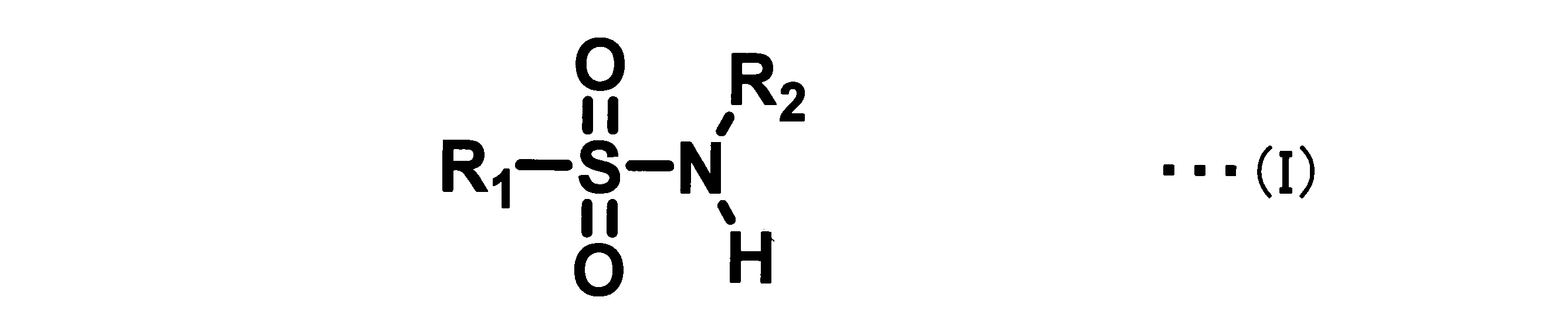
(式(I)において、R1は置換もしくは非置換の炭素原子数1~10の直鎖もしくは分岐アルキル基、置換もしくは非置換のシクロアルキルまたはアリール環を表す。R2は水素または置換もしくは非置換の炭素原子数1~10の直鎖もしくは分岐アルキル基を表す。)
[2]式(I)においてR2が水素である、[1]に記載の熱硬化性樹脂組成物。
[3]式(I)においてR1がトリル基、フェニル基またはクロロフェニル基である、[1]または[2]に記載の熱硬化性樹脂組成物。
[4]成分[B]に含まれるイソシアネート基のモル数(Mh)を、成分[A]に含まれるエポキシ基モル数の総和(Me)で除した値(Mh/Me)が0.7~2.0である、[1]~[3]のいずれかに記載の熱硬化性樹脂組成物。
[5]成分[C]:触媒が4級オニウム塩である、[1]~[4]のいずれかに記載の熱硬化性樹脂組成物。
[6]成分[C]:触媒として無機塩を含む、[1]~[5]のいずれかに記載の熱硬化性樹脂組成物。
[7]成分[E]を含む、[6]に記載の熱硬化性樹脂組成物。
[E]:式(II)で示される構造を分子内に有する化合物。

(式(II)において、nは1~6の整数を表し、mは4~1,000の整数を表す。また、R1’およびR2’は独立に水素原子、アルキル基ヒドロキシル基またはアリール基を表す。また、R1およびR2は独立に水素原子、アルキル基、ヒドロキシル基またはアリール基を表す。また、XはO、NH、SまたはCOOを表す。ここで、COOにはOCOの化学構造も含む。)
[8]成分[C]:触媒として4級オニウム塩および無機塩を含む、[1]~[7]のいずれかに記載の熱硬化性樹脂組成物。
[9]成分[A]:エポキシ樹脂として、脂肪族エポキシ樹脂を含む、[1]~[8]のいずれかに記載の熱硬化性樹脂組成物。
[10]成分[A]:エポキシ樹脂100質量%中に、脂肪族エポキシ樹脂を10質量%以上80質量%以下含む、[9]に記載の熱硬化性樹脂組成物。
[11]成分[F]:強靭化剤を含む、[1]~[10]のいずれかに記載の熱硬化性樹脂組成物。
[12][1]~[11]のいずれかに記載の熱硬化性樹脂組成物が加熱硬化されてなる成形品。
[13][1]~[12]のいずれかに記載の熱硬化性樹脂組成物と、強化繊維とを含んでなる繊維強化複合材料用成形材料。
[14][12]に記載の熱硬化性樹脂組成物が加熱硬化されてなる成形品と、強化繊維とを含んでなる繊維強化複合材料。
[15][13]に記載の繊維強化複合材料用成形材料が加熱硬化されてなる繊維強化複合材料。
本発明によれば、樹脂硬化物の破壊靱性と耐熱性、ならびに、湿熱環境下での弾性率に優れる熱硬化性樹脂組成物を提供することができる。また、本発明の熱硬化性樹脂組成物は、注入工程における樹脂の流動時間と硬化時間を制御することができ、かつ、上記性能を付与することができるため、注入成形による繊維強化複合材料の製造に適した熱硬化性樹脂組成物として好適に用いることができる。
本発明の熱硬化性樹脂組成物は、[A]エポキシ樹脂、[B]イソシアネート化合物、[C]触媒および[D]式(I)で示されるスルホンアミド化合物を必須成分として含む。まず、これらの構成要素について説明する。
(成分[A])
本発明における構成要素[A]はエポキシ樹脂である。かかるエポキシ樹脂は、分子内にエポキシ基を有する化合物であれば特に限定されない。例えば、ビスフェノールA型エポキシ樹脂、ビスフェノールF型エポキシ樹脂、アミン型エポキシ樹脂、脂肪族エポキシ樹脂等が挙げられる。エポキシ樹脂は、これらを単独で用いても、複数種類を組み合わせてもよい。
本発明における構成要素[A]はエポキシ樹脂である。かかるエポキシ樹脂は、分子内にエポキシ基を有する化合物であれば特に限定されない。例えば、ビスフェノールA型エポキシ樹脂、ビスフェノールF型エポキシ樹脂、アミン型エポキシ樹脂、脂肪族エポキシ樹脂等が挙げられる。エポキシ樹脂は、これらを単独で用いても、複数種類を組み合わせてもよい。
ビスフェノールA型エポキシ樹脂の市販品としては例えば、“jER(登録商標)”825、“jER(登録商標)”828(以上、三菱ケミカル(株)製)、“エポトート(登録商標)”YD-128、“エポトート(登録商標)”YD-8125、(以上、日鉄ケミカル&マテリアル(株)製)、“DER(登録商標)”331、“DER(登録商標)”332(以上、ダウケミカル(株)製)等を使用することができる。
ビスフェノールF型エポキシ樹脂の市販品としては、例えば、“jER(登録商標)”806、“jER(登録商標)”807、“jER(登録商標)”4004P(以上、三菱ケミカル(株)製)、“EPICLON(登録商標)”830(DIC(株)製)、“エポトート(登録商標)”YD-170、“エポトート(登録商標)”YDF-8170C、(以上、日鉄ケミカル&マテリアル(株)製)等を使用することができる。
本発明で用いられるアミン型エポキシ樹脂としては、例えば、テトラグリシジルジアミノジフェニルメタン、トリグリシジルアミノフェノール、ジグリシジルアニリン等が挙げられる。かかるエポキシ樹脂の具体例として以下のものが挙げられる。
テトラグリシジルジアミノジフェニルメタンの市販品としては例えば、“スミエポキシ(登録商標)”ELM434(住友化学(株)製)、YH434L(日鉄ケミカル&マテリアル(株)製)、“jER(登録商標)”604(三菱ケミカル(株)製)、“アラルダイト(登録商標)”MY720、“アラルダイト(登録商標)”MY721(以上、ハンツマン・アドバンスド・マテリアルズ社製)等を使用することができる。
トリグリシジルアミノフェノールの市販品としては例えば、“スミエポキシ(登録商標)”ELM100、“スミエポキシ(登録商標)”ELM120(以上、住友化学(株)製)、“アラルダイト(登録商標)”MY0500、“アラルダイト(登録商標)”MY0510、“アラルダイト(登録商標)”MY0600(以上、ハンツマン・アドバンスド・マテリアルズ社製)、“jER(登録商標)”630(三菱ケミカル(株)製)等を使用することができる。
ジグリシジルアニリンの市販品としては例えば、GAN(N,N-ジグリシジルアニリン)、GOT(N,N-ジグリシジル-o-トルイジン)(以上、日本化薬(株)製)、“TOREP(登録商標)”A-204E(ジグリシジル-p-フェノキシアニリン)(東レ・ファインケミカル(株)製)等を使用することができる。
本発明で用いられる脂肪族エポキシ樹脂としては、例えば、エチレングリコールジグリシジルエーテル、プロピレングリコールジグリシジルエーテル、ネオペンチルグリコールジグリシジルエーテル、1,4-ブタンジオールジグリシジルエーテル、1,6-ヘキサンジオールジグリシジルエーテル、水添ビスフェノールAジグリシジルエーテル、ポリエチレングリコールジグリシジルエーテル、ポリプロピレングリコールジグリシジルエーテル等が挙げられる。
かかる脂肪族エポキシ樹脂の市販品としては例えば、“デナコール(登録商標)”EX-810、“デナコール(登録商標)”EX-841、“デナコール(登録商標)”EX-211、“デナコール(登録商標)”EX-212、“デナコール(登録商標)”EX-214、“デナコール(登録商標)”EX-252、“デナコール(登録商標)”EX-931(以上、ナガセケムテックス(株)製)、“アデカグリシロール(登録商標)”ED-503、“アデカグリシロール(登録商標)”ED-523、“アデカグリシロール(登録商標)”ED-506(以上、(株)ADEKA製)等を使用することができる。
本発明の熱硬化性樹脂組成物は、成分[A]として、少なくとも1種類の脂肪族エポキシ樹脂を含むことが好ましい。脂肪族エポキシ樹脂を含むことで、本発明の熱硬化性樹脂組成物は、通常はトレードオフとなる耐熱性と破壊靭性を高いレベルで両立することができる。この耐熱性と破壊靭性の向上効果は、アミン化合物や酸無水物化合物といったその他のエポキシ樹脂硬化剤を使用した場合には見られず、成分[B]:イソシアネート化合物を硬化剤として用いた場合にのみ発現する特異的な効果である。
本発明の熱硬化性樹脂組成物は、成分[A]100質量%中に、脂肪族エポキシ樹脂を10質量%以上80質量%以下含むことが好ましく、30質量%以上70質量%以下含むことがより好ましく、30質量%以上50質量%以下含むことがさらに好ましい。脂肪族エポキシ樹脂の含有量がかかる範囲にあることで、耐熱性と破壊靭性のバランスがより優れたものになるため、本発明の熱硬化性樹脂組成物を繊維強化複合材料用マトリックス樹脂としてより好適に用いることができる。
(成分[B])
本発明における成分[B]は、イソシアネート化合物である。かかるイソシアネート化合物は、分子内にイソシアネート基を有する化合物であれば特に限定されない。かかるイソシアネート基が、熱硬化により成分[A]のエポキシ基と反応し、剛直なオキサゾリドン環構造を形成することにより、成形品が優れた耐湿熱性と靱性を発現する。
本発明における成分[B]は、イソシアネート化合物である。かかるイソシアネート化合物は、分子内にイソシアネート基を有する化合物であれば特に限定されない。かかるイソシアネート基が、熱硬化により成分[A]のエポキシ基と反応し、剛直なオキサゾリドン環構造を形成することにより、成形品が優れた耐湿熱性と靱性を発現する。
かかるイソシアネート化合物としては例えば、芳香族イソシアネート、脂肪族イソシアネート、脂環式イソシアネート等が使用できる。中でも、分子骨格に芳香族を含む芳香族イソシアネートは、硬化反応性に優れ、かつ優れた耐熱性を発現することから好ましく用いられる。
本発明で好ましく用いられるイソシアネート化合物としては、例えば、ヘキサメチレンジイソシアネート、1,2,3,4-テトライソシアネートブタン等の脂肪族イソシアネート、p-フェニレンジイソシアネート、トリレンジイソシアネート、ジフェニル-4,4-ジイソシアネート、ベンゼン-1,2,4-トリイソシアネート、キシリレンジイソシアネート、ジフェニルメタンジイソシアネート(MDI)、ジフェニルプロパンジイソシアネート、テトラメチレンキシレンジイソシアネート、ポリメチレンポリフェニルポリイソシアネート等の芳香族イソシアネート、シクロヘキサンジイソシアネート、イソホロンジイソシアネート、リジンジイソシアネート、メチレンビス(4-シクロヘキシルイソシアネート)、イソプロピリデンジシクロヘキシルジイソシアネート等の脂環式イソシアネート等が挙げられる。なお、これらのイソシアネート化合物等を単独あるいは2種以上混合して用いてもよい。
脂肪族イソシアネートの市販品としては例えば、HDI(東ソー(株)製)、“デュラネート(登録商標)”D101、“デュラネート(登録商標)”D201(以上、旭化成(株)製)等を使用することができる。
芳香族イソシアネートの市販品としては例えば、“ルプラネート(登録商標)”MS、“ルプラネート(登録商標)”MI、“ルプラネート(登録商標)”M20S、“ルプラネート(登録商標)”M11S、“ルプラネート(登録商標)”M5S、“ルプラネート(登録商標)”T-80、“ルプラネート(登録商標)”MM-103、“ルプラネート(登録商標)”MM-102、“ルプラネート(登録商標)”MM-301(以上、BASF INOAC ポリウレタン(株)製)、“ミリオネート(登録商標)”MT、“ミリオネート(登録商標)”MT-F、“ミリオネート(登録商標)”MT-NBP、“ミリオネート(登録商標)”NM、“ミリオネート(登録商標)”MR-100、“ミリオネート(登録商標)”MR-200、“ミリオネート(登録商標)”MR-400、“コロネート(登録商標)”T-80、“コロネート(登録商標)”T-65、“コロネート(登録商標)”T-100(以上、東ソー(株)製)、“コスモネート(登録商標)”PH、“コスモネート(登録商標)”M-50、“コスモネート(登録商標)”T-80(以上、三井化学(株)製)等を使用することができる。
脂環式イソシアネートの市販品としては例えば、“タケネート(登録商標)”600(三井化学(株)製)、“フォルティモ(登録商標)”1,4-H6XDI(三井化学(株)製)等が挙げられる。
本発明の熱硬化性樹脂組成物は、成分[B]に含まれるイソシアネート基のモル数(Mh)を、成分[A]に含まれるエポキシ基モル数の総和(Me)で除した値(Mh/Me)が0.7~2.0の範囲になることが好ましく、より好ましくは1.0~1.5の範囲である。かかる範囲とすることで、エポキシ樹脂とイソシアネート化合物との反応が効率的に起きるため、樹脂硬化物の架橋状態が適正化され、曲げ弾性率を損なうことなく、変形能力と破壊靱性値を高めることができる。また、樹脂硬化物の吸水率が下がるため、樹脂硬化物の湿熱弾性率が高いものとなり、より高い湿熱時圧縮特性を示す繊維強化複合材料が得られる。
なお、成分[A]に含まれるエポキシ基モル数の総和(Me)とは、各エポキシ樹脂活性基のモル数の和のことであり、下式で表される。
Me=(エポキシ樹脂Aの質量/エポキシ樹脂Aのエポキシ当量)+(エポキシ樹脂Bの質量/エポキシ樹脂Bのエポキシ当量)+・・・・+(エポキシ樹脂Wの質量/エポキシ樹脂Wのエポキシ当量)。
Me=(エポキシ樹脂Aの質量/エポキシ樹脂Aのエポキシ当量)+(エポキシ樹脂Bの質量/エポキシ樹脂Bのエポキシ当量)+・・・・+(エポキシ樹脂Wの質量/エポキシ樹脂Wのエポキシ当量)。
また、成分[B]に含まれるイソシアネート基のモル数(Mh)は、イソシアネート化合物の質量をイソシアネート化合物の活性イソシアネート当量で除することにより求められ、下式で表される。
Mh=成分[B]の質量/成分[B]の活性イソシアネート当量。
Mh=成分[B]の質量/成分[B]の活性イソシアネート当量。
ここで、本発明の熱硬化性樹脂組成物の樹脂硬化物の破壊靱性値としては、たとえば、ASTM D5045-99に記載のSENB試験から得たK1c値を用いて評価することができる。
また、本発明の熱硬化性樹脂組成物の樹脂硬化物のガラス転移温度(Tg)は、DMA測定(動的粘弾性測定)の昇温測定を実施して得られる、貯蔵弾性率と温度の散布図から算出することができる。ガラス転移温度は、上記散布図において、ガラス領域に引いた接線と、ガラス転移領域に引いた接線との交点における温度である。
(成分[C])
本発明における成分[C]は触媒である。本発明において触媒は、成分[A]のエポキシ基と成分[B]のイソシアネート基との硬化反応を促進する。かかる触媒が配合されることにより、オキサゾリドン環化反応が優先的に進行し、硬化物の破壊靱性と変形能力、および耐湿熱性に優れた繊維強化複合材料が得られる。
本発明における成分[C]は触媒である。本発明において触媒は、成分[A]のエポキシ基と成分[B]のイソシアネート基との硬化反応を促進する。かかる触媒が配合されることにより、オキサゾリドン環化反応が優先的に進行し、硬化物の破壊靱性と変形能力、および耐湿熱性に優れた繊維強化複合材料が得られる。
本発明で好ましく用いられる触媒は、例えば、イミダゾール化合物、3級アミン化合物、複素環式アミン化合物、イミダゾリウム塩、4級オニウム塩、無機塩等が挙げられる。これら触媒は単独で使用してもよいし、2種類以上併用して使用してもよい。なかでも、高い耐熱性と力学特性を発現することから、4級アンモニウム塩および4級ホスホニウム塩に代表される4級オニウム塩を好適に使用することができる。
イミダゾール化合物の市販品としては例えば、“キュアゾール(登録商標)”2E4MZ、“キュアゾール(登録商標)”2PZ、“キュアゾール(登録商標)”2P4MZ、“キュアダクト(登録商標)”P-0505(以上、四国化成(株)製)、1-メチルイミダゾール(東京化成工業(株)製)等を使用することができる。
3級アミン化合物の市販品としては例えば、トリエチルアミン、トリブチルアミン、トリフェニルアミン、N,N-ジメチルベンジルアミン(以上、東京化成工業(株)製)等を使用することができる。
複素環式アミン化合物の市販品としては例えば、1,8-ジアザビシクロ[5.4.0]ウンデカ-7-エン、1,5-ジアザビシクロ[4.3.0]-5-ノネン、7-メチル-1,5,7-トリアザビシクロ[4.4.0]デカ-5-エン、1,5,7-トリアザビシクロ[4.4.0]デカ-5-エン、1,4-ジアザビシクロ[2.2.2]オクタン、4-ジメチルアミノピリジン、4-アミノピリジン(以上、東京化成工業(株)製)等を使用することができる。
イミダゾリウム塩の市販品としては例えば、1-エチル-3-メチルイミダゾリウムブロミド、1-エチル-3-メチルイミダゾリウムブロミド、1-エチル-3-メチルイミダゾリウムクロリド、1-エチル-3-メチルイミダゾリウムヨージド、1-ヘキシル-3-メチルイミダゾリウムブロミド、1-ヘキシル-3-メチルイミダゾリウムクロリド(以上、東京化成工業(株)製)等を使用することができる。
4級アンモニウム塩の市販品としては例えば、ベンジルトリメチルアンモニウムクロリド、ベンジルトリメチルアンモニウムブロミド、テトラブチルアンモニウムクロリド、テトラブチルアンモニウムブロミド、テトラブチルアンモニウムヨージド、テトラプロピルアンモニウムブロミド、テトラプロピルアンモニウムクロリド、テトラプロピルアンモニウムヨージド(以上、東京化成工業(株)製)等を使用することができる。
4級ホスホニウム塩の市販品としては例えば、“TBP-BB(登録商標)”、“TPP-PB(登録商標)”、“TPP-MB(登録商標)”、“TPP-EB(登録商標)”、“TPP-IPI(登録商標)”(以上、北興産業(株)製)、(2-ヒドロキシ-5-メチルフェニル)トリフェニルホスホニウムブロミド、1-エチル-3-メチルイミダゾリウムブロミド(以上、東京化成工業(株)製)等を使用することができる。
無機塩としては例えば、アルカリ金属塩、アルカリ土類金属塩、第一遷移金属塩等が挙げられる。かかる無機塩の市販品としては、塩化カルシウム、臭化カルシウム、ヨウ化カルシウム、塩化マグネシウム、臭化マグネシウム、ヨウ化マグネシウム、塩化カリウム、臭化カリウム、ヨウ化カリウム、塩化ナトリウム、臭化ナトリウム、ヨウ化ナトリウム、塩化リチウム、臭化リチウム、ヨウ化リチウム(以上、東京化成工業(株)製)等を使用することができる。
(成分[D])
本発明における成分[D]は、下記式(I)に示されるスルホンアミド化合物である。
本発明における成分[D]は、下記式(I)に示されるスルホンアミド化合物である。

(式(I)において、R1は置換もしくは非置換の炭素原子数1~10の直鎖もしくは分岐アルキル基、置換もしくは非置換のシクロアルキルまたはアリール環を表す。R2は水素または置換もしくは非置換の炭素原子数1~10の直鎖もしくは分岐アルキル基を表す)。
本発明の熱硬化性樹脂組成物は、成分[D]を含むことで、成分[A]、成分[B]、成分[C]のみでは達成できない、優れた潜在性を示す。具体的には、室温から樹脂注入工程で曝される温度領域で、当該熱硬化性樹脂組成物は、反応が進行しない一定の期間(以下、誘導時間)を発現する。また、誘導時間の経過後には反応が急速に進行する速硬化性を示す。一般に、潜在性と速硬化性はトレードオフの関係があり、同時に具備することは困難であるが、本発明の熱硬化性樹脂組成物は、前記特性を同時に達成できる。これは、成分[D]を含むことで、成分[C]が促進するエポキシ基とイソシアネート基との反応、および室温で起こるイソシアネート基同士の多量化反応を、一定時間阻害するためと考えている。なお、式(I)で示されるスルホンアミド化合物でしか到達できない顕著な作用であり、スルホンアミド結合中の窒素原子に、少なくとも1つの水素原子が共有結合していることが必要である。
ここで、誘導時間と硬化時間は、熱硬化性樹脂組成物を所定の温度に暴露した際に、測定される硬化時間(Tc)を誘導時間(Ti)で除した値、すなわち、Tc/Tiの値を指標に評価することができる。なお、硬化時間は所定の温度に暴露した時点から硬化が完了するまでの時間で、誘導時間を含むと定義する。したがって、Tcの値はTiの値より大きくなることはないためTc/Tiの値は1以下にはならない。本発明の熱硬化性樹脂組成物は、1<Tc/Ti≦9であることが好ましい。Tc/Tiが9以下であることで、硬化時間、すなわち成形のサイクルタイムを長期化せずに、熱硬化過程における流動性の保持時間を適正化することができるため、樹脂注入および含浸プロセスに好適に用いることができる。なお、Tc/Tiの値は、1<Tc/Ti≦5を満たすことがより好ましく、さらに好ましくは、1<Tc/Ti≦3を満たし、特に好ましくは、1<Tc/Ti≦2を満たす。
ここで、本発明の熱硬化性樹脂組成物は、成分[C]として無機塩を含むことが好ましい。無機塩は、金属元素に代表される無機物からなる陽イオンと塩基由来の陰イオンから構成される塩である。成分[C]として無機塩を含むことで誘導時間を大幅に短くさせることなく硬化時間を短くすることができる。すなわち、Tc/Tiの値がより小さくなり、潜在性と速硬化性のバランスがより優れたものとなる。なかでも、50℃から200℃の広い温度領域で、熱硬化性エポキシ樹脂組成物を硬化させることが可能であることから、成分[C]としてアルカリ金属のハロゲン化物を含むことが好ましい。
また、本発明の熱硬化性樹脂組成物は、成分[C]として4級オニウム塩と無機塩を同時に含むことがさらに好ましい。4級オニウム塩と無機塩を同時に含むことで、無機塩単独では達成できない速硬化性が発現する。この効果は、4級オニウム塩により無機塩の触媒活性化作用が促進されるためだと推察している。
ここで、本発明における誘導時間(Ti)は、本発明の熱硬化性エポキシ樹脂組成物を所定の温度で測定した複素粘性率η*から評価できる。本発明では、動的粘弾性測定装置を用い、所定の温度で測定したη*が、測定開始時点から4倍に到達するまでの時間をTiとする。
また、本発明における硬化時間(Tc)は、所定の温度での複素粘性率η*の経時変化を観測し、η*が飽和に達した時間をTcとして得ることができる。
また、本発明の熱硬化性樹脂組成物は、成分[D]を含むことで、当該樹脂硬化物の変形能力と破壊靱性値が、著しく優れたものになる。また、吸水時の物性低下を抑えることができるため、湿熱時の弾性率と湿潤後の耐熱性も優れたものとなるため、構造材料向けの繊維強化複合材料として好適に用いられる。
本発明の熱硬化性樹脂組成物は、当該樹脂組成物を硬化させてなる樹脂硬化物の曲げ弾性率(湿熱82度)を、曲げ弾性率(23℃、50%RH)で除した値、すなわち、E82/E23が0.70よりも大きいという特徴を有する。E82/E23が0.70よりも大きい場合、熱硬化性樹脂組成物からなる繊維強化複合材料を高温多湿下で使用した際の力学特性、特に、湿熱時の圧縮強度が低下しづらくなるため、構造材料に広く適用することが可能となる。なお、曲げ弾性率(湿熱82℃)が曲げ弾性率(23℃、50%RH)よりも高くなることはないため、E82/E23の上限値は1である。
ここで、曲げ弾性率(湿熱82℃)および曲げ弾性率(23℃、50%RH)は、JIS K7171(1994)に従った3点曲げ試験で評価することができる。曲げ弾性率(湿熱82℃)については、例えば、沸騰水に2日間浸漬した樹脂硬化物を、82℃に設定した恒温槽内で3点曲げ試験をすることで評価できる。
ここで、本発明の熱硬化性樹脂組成物は、[D]:式(I)で示されるスルホンアミド化合物について、R2が水素であることが好ましい。R2が水素であることで、より効果的に誘導時間を発現させることができるため、Tc/Tiの値が小さくなる、すなわち、潜在性と速硬化性に優れるため、樹脂注入工程に好適に用いることができる。
また、[D]:式(I)で示されるスルホンアミド化合物について、R1はトリル基、フェニル基またはクロロフェニル基から選ばれることが好ましい。R1が前記置換基であることで吸水率が下がるため、樹脂硬化物の湿熱時弾性率が優れたものとなる。中でも、R1がトリル基またはクロロフェニル基であると、樹脂硬化物の変形能力も同時に高まるため、繊維強化複合材料の疲労特性が向上する。
かかる成分[D]について、式(I)中、R2が水素以外の化合物の市販品としては例えば、N-メチルメタンスルホンアミド、N-エチルメタンスルホンアミド、N-シクロヘキシルメタンスルホンアミド、N-メチルベンゼンスルホンアミド、N-エチルベンゼンスルホンアミド、N-メチル-p-トルエンスルホンアミド、N-メチル-p-クロロベンゼンスルホンアミド、N-エチル-p-クロロベンゼンスルホンアミド、N-メチルフェニルメタンスルホンアミド、N-エチルフェニルメタンスルホンアミド、N-メチルシクロヘキサンスルホンアミド、N-エチルシクロヘキサンスルホンアミド(以上、東京化成工業(株)製)、“トップサイザー(登録商標)”3号(N-エチル-o/p-トルエンスルホンアミド、富士アミドケミカル(株)製)等を使用することができる。
かかる成分[D]について、式(I)中、R2が水素の化合物の市販品としては例えば、メタンスルホンアミド、ベンゼンスルホンアミド、m-トルエンスルホンアミド、p-クロロベンゼンスルホンアミド、フェニルメタンスルホンアミド、シクロヘキシルスルホンアミド(以上、東京化成工業(株)製)、“トップサイザー(登録商標)”1号S(p-トルエンスルホンアミド)、オルソアミド(o-トルエンスルホンアミド)(以上、富士アミドケミカル(株)製)等を使用することができる。
本発明の熱硬化性樹脂組成物は、成分[C]のモル数(Mc)を、成分[D]のモル数(Ms)で除した値(Mc/Ms)が0.1~10の範囲にあることが好ましい。かかる範囲にある場合、速硬化性を損なうことなく誘導時間(Ti)を任意に制御することができる。すなわち、注入もしくは含浸プロセスにおいて、成形温度と時間に応じた、誘導時間を設計することが可能である。
(成分[E])
本発明の熱硬化性樹脂組成物は、成分[C]として無機塩を含む場合、成分[E]:下記式(II)で示される構造を分子内に有する化合物を含むことが好ましい。
本発明の熱硬化性樹脂組成物は、成分[C]として無機塩を含む場合、成分[E]:下記式(II)で示される構造を分子内に有する化合物を含むことが好ましい。
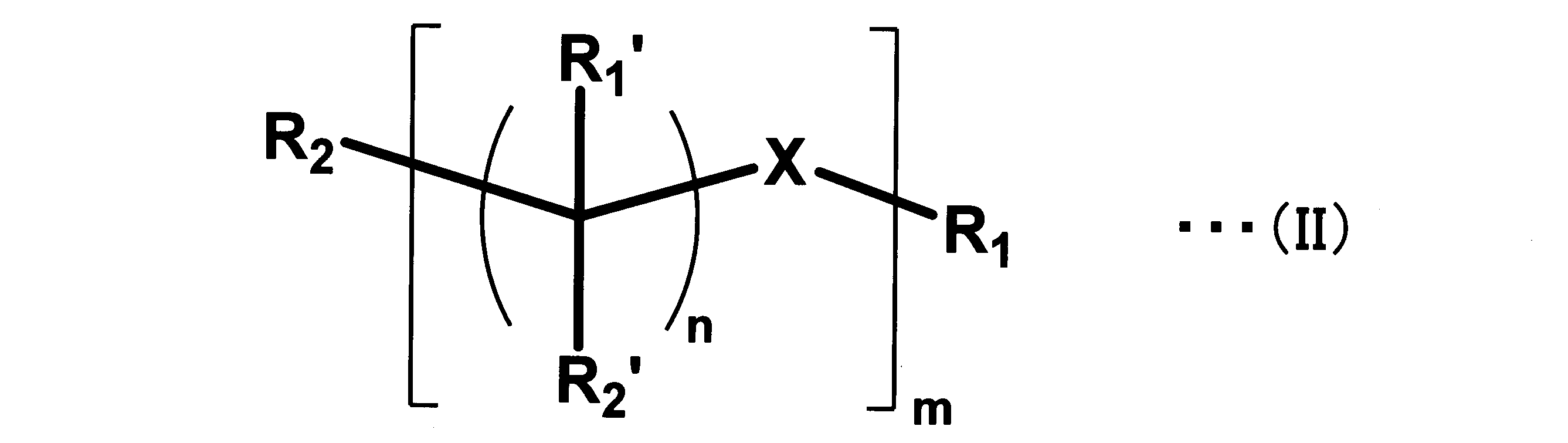
(式(II)において、nは1~6の整数を表し、mは4~1,000の整数を表す。また、R1’およびR2’は独立に水素原子、アルキル基、ヒドロキシル基またはアリール基を表す。また、R1およびR2は独立に水素原子、アルキル基、ヒドロキシル基またはアリール基を表す。また、XはO、NH、SまたはCOOを表す。ここで、COOにはOCOの化学構造も含む)。
成分[C]として無機塩を含む場合に成分[E]を同時に含むことで、樹脂組成物への無機塩の相溶性が高まり、本発明の熱硬化性樹脂組成物の速硬化性がより優れたものとなる。また、熱硬化性樹脂組成物の均質性が向上するため、本発明の熱硬化性樹脂組成物を加熱硬化した成形品の機械特性も優れたものとなる。
本発明の熱硬化性樹脂組成物は、成分[C]として4級オニウム塩および無機塩を同時に含み、かつ、成分[E]も含むことが特に好ましい。上記成分をすべて含むことで、本発明の熱硬化性樹脂組成物のTc/Tiの値および加熱硬化した成形品の機械特性すべてが優れたものとなる。
成分[E]のうちX=Oの化合物としては、エチレングリコール鎖、プロピレングリコール鎖、トリメチレングリコール鎖、ヘキサメチレングリコール鎖等を含む化合物が挙げられる。また、X=NHの化合物としては、エチレンイミン鎖、トリメチレンイミン鎖等を含む化合物が挙げられる。X=Sの化合物としては、2-(メチルチオ)エタノール、エチルスルフィド、メチオノール、ジエチルスルフィド、イソプロピルエチルスルフィド、トリメチレンスルフィド等が挙げられる。X=COOの化合物としては、メチルエステル鎖、エチルエステル鎖等を含む化合物が挙げられる。
前記X=Oの化合物の市販品としては例えば、PEG-200、PEG-400、PEG-1000、“サンニックス(登録商標)”PP-200、“サンニックス(登録商標)”PP-600、“ニューポール(登録商標)”BPE-40、“ニューポール(登録商標)”BPE-60、“ニューポール(登録商標)”BPE-100、“ニューポール(登録商標)”BP-5P(以上、三洋化成工業(株)製)、“ユニオックス(登録商標)”M-400、“ユニオックス(登録商標)”M-550(以上、日油(株)製)等を使用することができる。
前記X=NHの化合物の市販品としては例えば、“エポミン(登録商標)”SP-003、“エポミン(登録商標)”SP-006、“エポミン(登録商標)”SP-012(以上、日本触媒(株)製)等が挙げられる。
前記X=COOの化合物の市販品としては例えば、“サンフレックス(登録商標)”EB、“サンフレックス(登録商標)”GPA-3000(以上、三洋化成工業(株)製)等を使用することができる。
ここで、成分[E]として、X=Oの化合物が好適に用いられる。X=Oの構造、すなわちエーテル構造を有することで、成分[C]とエポキシ樹脂の相溶性がより高まり、硬化特性と樹脂硬化物の機械特性がさらに優れたものとなるため、好ましい。本発明の熱硬化性エポキシ樹脂組成物において、成分[C]とエポキシ樹脂の相溶性が特に高まり、硬化特性と樹脂硬化物の機械特性をさらに優れたものとするため、成分[E]のR1’およびR2’は水素原子であり、かつ、XがO原子であることがより好ましい。成分[E]のR1’およびR2’が水素原子であり、かつ、XがO原子である化合物の市販品としては例えば、PEG-200、PEG-400、PEG-1000等が挙げられる。
また、成分[E]のR1’、R2’、R1、R2のいずれかがアルキル基である場合、アルキル基に含まれる炭素原子の数は1~5個であることが好ましい。炭素原子の数が1~5個の場合、成分[C]とエポキシ樹脂の相溶性がより高まり、硬化特性と樹脂硬化物の機械特性がさらに優れたものになりやすい。炭素原子が1~5個のアルキル基の例としては例えば、メチル基、エチル基、プロピル基、ブチル基、イソプロピル基、ペンチル基等が挙げられる。
(成分[F])
本発明の熱硬化性樹脂組成物は、成分[F]:強靭化剤を含んでもよい。強靭化剤は、本発明の熱硬化性樹脂組成物を加熱硬化して得られる成形品の靭性を向上させる添加剤であり、成分[A]、成分[B]、成分[C]、成分[D]を含む熱硬化性樹脂組成物中に成分[F]が同時に含まれることで、当該熱硬化性樹脂組成物を加熱硬化して得られる成形品の破壊靭性値が特異的に向上する。
本発明の熱硬化性樹脂組成物は、成分[F]:強靭化剤を含んでもよい。強靭化剤は、本発明の熱硬化性樹脂組成物を加熱硬化して得られる成形品の靭性を向上させる添加剤であり、成分[A]、成分[B]、成分[C]、成分[D]を含む熱硬化性樹脂組成物中に成分[F]が同時に含まれることで、当該熱硬化性樹脂組成物を加熱硬化して得られる成形品の破壊靭性値が特異的に向上する。
かかる成分[F]としては、例えば、コアシェルゴム粒子等の架橋ゴム粒子、ブロックコポリマー等の熱可塑性エラストマー、カルボキシル基末端ブタジエンニトリルゴム(以下、CTBNという場合がある)等が挙げられる。
架橋ゴム粒子の市販品としては例えば、“カネエース(登録商標)”MX-153、“カネエース(登録商標)”MX-154、“カネエース(登録商標)”MX-257、“カネエース(登録商標)”MX-416(以上、(株)カネカ製)等を使用することができる。
熱可塑性エラストマーの市販品としては例えば、“ナノストレングス(登録商標)”M52N、“ナノストレングス(登録商標)”M22N、“ナノストレングス(登録商標)”E21、“ナノストレングス(登録商標)”M41(以上、アルケマ(株)製)等を使用することができる。
CTBNの市販品としては例えば、“Hypro(登録商標)”1300X31、“Hypro(登録商標)”1300X13、“Hypro(登録商標)”1300X13NA、“Hypro(登録商標)”1300X8(以上、CVC Thermoset Specialties社製)等を使用することができる。
(成分[G])
本発明の熱硬化性樹脂組成物は、成分[G]:内部離型剤を含んでもよい。内部離型剤とは、配合することにより、熱硬化性樹脂組成物を加熱硬化して得られる成形品と金型が密着しすぎることを防ぐ化合物をいう。かかる成分[G]としては例えば、ステアリン酸亜鉛等の金属塩やエステル化合物、シリコーン化合物、フッ素含有化合物等の一般的な内部離型剤が適用できる。なかでも、成分(B)と反応熱を生じないエステル化合物であることが好ましい。かかるエステル化合物を使用することにより、保管時に樹脂の粘度が上昇することなく、反応性が高い成分(B)が含まれる熱硬化性樹脂組成物においても、優れた離型機能を付与することができる。ここで、「成分(B)と反応熱を生じない」とは、成分(B)と成分(G)を等モル量になるよう混合し、示差走査熱量計を用いて30℃から250℃まで5℃/分で昇温し測定することにより観測できる発熱量が15J/g以下であることである。成分(G)の分子量が不明である場合は、成分(B)の質量部数を1部とした際に、成分(G)の質量部数10部を等モルと仮定し反応熱を測定する。該測定によって得られる、横軸に温度、縦軸に熱流量を取った発熱チャートは、その温度における反応性を表している。そのため、チャートにおける単位質量当たりの発熱量は、反応性の指標として用いることができ、15J/g以下であれば、反応熱が無視できる程度に小さく、反応熱が生じていないと判断することができる。このようなエステル化合物としては、例えば、有機脂肪酸とアルコールとのエステル化合物や、カルボン酸とアルコールとのエステル化合物等が挙げられる。
本発明の熱硬化性樹脂組成物は、成分[G]:内部離型剤を含んでもよい。内部離型剤とは、配合することにより、熱硬化性樹脂組成物を加熱硬化して得られる成形品と金型が密着しすぎることを防ぐ化合物をいう。かかる成分[G]としては例えば、ステアリン酸亜鉛等の金属塩やエステル化合物、シリコーン化合物、フッ素含有化合物等の一般的な内部離型剤が適用できる。なかでも、成分(B)と反応熱を生じないエステル化合物であることが好ましい。かかるエステル化合物を使用することにより、保管時に樹脂の粘度が上昇することなく、反応性が高い成分(B)が含まれる熱硬化性樹脂組成物においても、優れた離型機能を付与することができる。ここで、「成分(B)と反応熱を生じない」とは、成分(B)と成分(G)を等モル量になるよう混合し、示差走査熱量計を用いて30℃から250℃まで5℃/分で昇温し測定することにより観測できる発熱量が15J/g以下であることである。成分(G)の分子量が不明である場合は、成分(B)の質量部数を1部とした際に、成分(G)の質量部数10部を等モルと仮定し反応熱を測定する。該測定によって得られる、横軸に温度、縦軸に熱流量を取った発熱チャートは、その温度における反応性を表している。そのため、チャートにおける単位質量当たりの発熱量は、反応性の指標として用いることができ、15J/g以下であれば、反応熱が無視できる程度に小さく、反応熱が生じていないと判断することができる。このようなエステル化合物としては、例えば、有機脂肪酸とアルコールとのエステル化合物や、カルボン酸とアルコールとのエステル化合物等が挙げられる。
内部離型剤の市販品としては例えば、“MOLD WIZ(登録商標)”INT-1846、INT-1836、INT-1850、INT-1854、INT-1888LE(以上、AXEL PLASTICS RESEARCH LABORATORIES INC.製)、“ケムリース(登録商標)”IC-35(ケムリースジャパン(株)製)、Licowax S、Licowax P、Licowax OP、Licowax PE190、Licowax PED(以上、クラリアントジャパン社製)、ステアリルステアレート SL-900A(理研ビタミン(株)製)、“レオドール(登録商標)”430V、440V、SP-030V、“エキセパール(登録商標)”PE-MO、BP-DL(以上、花王(株)製)、KF-96、KF-965、KF-54(以上、信越化学工業(株)製)、酢酸ヘプチル、トリアセチン、トリオレイン、ペンタエリトリトールテトラオレート、くえん酸トリヘキシルブチリル(以上、東京化成工業(株)製)等が挙げられる。なかでも、“MOLD WIZ(登録商標)”INT-1846、INT-1836、INT-1850、INT-1854、INT-1888LE、“ケムリース(登録商標)”IC-35、酢酸ヘプチル、トリアセチン、トリオレイン、ペンタエリトリトールテトラオレート、くえん酸トリヘキシルブチリル等が成分(B)と反応熱を生じないエステルであるため、より好ましい。
本発明の熱硬化性樹脂組成物の調製には、例えばニーダー、プラネタリーミキサー、3本ロールおよび2軸押出機といった機械を用いて混練してもよいし、均一な混練が可能であれば、ビーカーとスパチュラ等を用い、手で混ぜてもよい。
本発明の熱硬化性樹脂組成物は、強化繊維基材と複合一体化した繊維強化複合材料として用いることができる。上記方法にて調製したエポキシ樹脂組成物と強化繊維基材とを複合一体化させ、熱硬化することにより、本発明の熱硬化性樹脂組成物の硬化物をマトリックス樹脂とした繊維強化複合材料を得ることができる。熱硬化性樹脂組成物と繊維強化基材との複合一体化の方法は特に限定されないが、たとえば、RTM法、リキッド・コンポジット・モールディング法、フィラメントワインディング法、ハンドレイアップ法、プルトルージョン法、プリプレグ法等が挙げられる。
本発明の熱硬化性樹脂組成物は、室温から熱硬化させる温度、例えば23℃~180℃の温度域で、上述のMc/Ms比の制御により、任意の時間、樹脂を低粘度で保持することができるため、強化繊維基材への含浸特性を成形プロセスに応じて最適化できる。加えて、熱硬化させる温度では高速硬化できるため、特にRTM法に好適に用いられる。RTM法とは、強化繊維基材あるいはプリフォームを成形型内に設置し、その成形型内に液状のマトリックス樹脂を注入して強化繊維に含浸させ、その後に加熱して当該熱硬化性樹脂組成物を硬化させて、成形品である繊維強化複合材料を得る方法である。
本発明の熱硬化性樹脂組成物を用いた注入成形法による繊維強化複合材料の製造方法における熱硬化性樹脂組成物の注入時の温度は、特に限定されないが、23℃~180℃に保持した成形型内に強化繊維基材を設置し、本発明の熱硬化性樹脂組成物を注入することが好ましい。なお、熱硬化温度は注入時の温度と同一である必要はなく、適宜、昇温して熱硬化に要する時間を短縮してもよい。
本発明において、RTM法に用いる型は、剛性材料からなるクローズドモールドを用いてもよく、剛性材料のオープンモールドと可撓性のフィルム(バッグ)を用いることも可能である。後者の場合、強化繊維基材は、剛性材料のオープンモールドと可撓性フィルムの間に設置することができる。剛性材料としては、スチールやアルミニウム等の金属、繊維強化プラスチック(FRP)、木材、石膏等既存の各種のものが用いられる。可撓性のフィルムの材料には、ポリアミド、ポリイミド、ポリエステル、フッ素樹脂、シリコーン樹脂等が用いられる。
本発明の繊維強化複合材料に用いられる強化繊維基材に使用される強化繊維は特に限定されることはなく、例えば、ガラス繊維、炭素繊維、アラミド繊維、ボロン繊維、アルミナ繊維、炭化ケイ素繊維等が使用できる。これらの繊維を2種以上混合して用いても構わない。軽量かつ高剛性な繊維強化複合材料が得られる観点から、炭素繊維を用いることが好ましい。
本発明の繊維強化複合材料は優れた機械特性、湿熱時圧縮強度、耐衝撃性を有するため、胴体、主翼、尾翼、動翼、フェアリング、カウル、ドア、座席、内装材等の航空機部材、モーターケース、主翼等の宇宙機部材、構体、アンテナ等の人工衛星部材、外板、シャシー、空力部材、座席等の自動車部材、構体、座席等の鉄道車両部材、船体、座席等の船舶部材等多くの構造材料に好ましく用いることができる。
以下に実施例を示し、本発明をさらに具体的に説明するが、本発明はこれら実施例の記載のみに限定されるものではない。
本実施例で用いる構成要素は以下の通りである。
<使用した材料>
・成分[A]:エポキシ樹脂
[A]-1 ビスフェノールA型エポキシ樹脂“jER(登録商標)”828(三菱ケミカル(株)製)
[A]-2 ビスフェノールF型エポキシ樹脂“jER(登録商標)”806(三菱ケミカル(株)製)
[A]-3 ビスフェノールA型エポキシ樹脂(“カネエース(登録商標)”MX-257((株)カネカ製)のエポキシ樹脂成分)
[A]-4 ネオペンチルグリコールジグリシジルエーテル“アデカグリシロール(登録商標)”ED-523((株)ADEKA製)
[A]-5 1,6-ヘキサンジオールジグリシジルエーテル“アデカグリシロール(登録商標)”ED-503((株)ADEKA製)
[A]-6 ポリプロピレングリコールジグリシジルエーテル“アデカグリシロール(登録商標)”ED-506((株)ADEKA製)。
・成分[B]:イソシアネート化合物
[B]-1 ポリメリックMDI“ルプラネート(登録商標)”M20S(BASF INOAC ポリウレタン(株)製)
[B]-2 モノメリックMDI“ルプラネート(登録商標)”MI(BASF INOAC ポリウレタン(株)製)。
[B]-1 ポリメリックMDI“ルプラネート(登録商標)”M20S(BASF INOAC ポリウレタン(株)製)
[B]-2 モノメリックMDI“ルプラネート(登録商標)”MI(BASF INOAC ポリウレタン(株)製)。
・成分[C]:触媒
[C]-1 テトラブチルアンモニウムブロミド(東京化成工業(株)製)
[C]-2 テトラブチルアンモニウムクロリド(東京化成工業(株)製)
[C]-3 テトラフェニルホスホニウムブロミド“TPP-PB(登録商標)”(北興産業(株)製)
[C]-4 テトラブチルホスホニウムブロミド“TBP-BB(登録商標)”(北興産業(株)製)
[C]-5 (2-ヒドロキシ-5-メチルフェニル)トリフェニルホスホニウムブロミド(東京化成工業(株)製)
[C]-6 1-エチル-3-メチルイミダゾリウムブロミド(東京化成工業(株)製)
[C]-7 2-エチル-4-メチルイミダゾール“キュアゾール(登録商標)”2E4MZ(四国化成(株)製)
[C]-8 1,8-ジアザビシクロ[5.4.0]ウンデカ-7-エン(東京化成工業(株)製)
[C]-9 N,N-ジメチルベンジルアミン(東京化成工業(株)製)
[C]-10 臭化リチウム(東京化成工業(株)製)
[C]-11 塩化リチウム(東京化成工業(株)製)
[C]-12 ヨウ化カルシウム(東京化成工業(株)製)。
・成分[D]:式(I)で示されるスルホンアミド化合物
[D]-1 p-トルエンスルホンアミド“トップサイザー(登録商標)”1号S(富士アミドケミカル(株)製)
[D]-2 N-エチル-o/p-トルエンスルホンアミド“トップサイザー(登録商標)”3号(富士アミドケミカル(株)製)
[D]-3 N-ブチル-ベンゼンスルホンアミド“トップサイザー(登録商標)”7号(富士アミドケミカル(株)製)
[D]-4 メタンスルホンアミド(東京化成工業(株)製)
[D]-5 ベンゼンスルホンアミド(東京化成工業(株)製)
[D]-6 p-クロロベンゼンスルホンアミド(東京化成工業(株)製)。
[D]-1 p-トルエンスルホンアミド“トップサイザー(登録商標)”1号S(富士アミドケミカル(株)製)
[D]-2 N-エチル-o/p-トルエンスルホンアミド“トップサイザー(登録商標)”3号(富士アミドケミカル(株)製)
[D]-3 N-ブチル-ベンゼンスルホンアミド“トップサイザー(登録商標)”7号(富士アミドケミカル(株)製)
[D]-4 メタンスルホンアミド(東京化成工業(株)製)
[D]-5 ベンゼンスルホンアミド(東京化成工業(株)製)
[D]-6 p-クロロベンゼンスルホンアミド(東京化成工業(株)製)。
・成分[E]:式(II)で示される構造を分子内に有する化合物
[E]-1 PEG-300(三洋化成工業(株)製)、
[E]-2 ビスフェノールAエチレンオキサイド付加物“ニューポール(登録商標)”BPE-60(三洋化成工業(株)製)。
[E]-1 PEG-300(三洋化成工業(株)製)、
[E]-2 ビスフェノールAエチレンオキサイド付加物“ニューポール(登録商標)”BPE-60(三洋化成工業(株)製)。
・成分[F]:強靭化剤
[F]-1 “カネエース(登録商標)”MX-257ゴム粒子成分((株)カネカ製)。
[F]-1 “カネエース(登録商標)”MX-257ゴム粒子成分((株)カネカ製)。
・成分[G]:内部離型剤
[G]-1 INT-1846(AXEL PLASTICS RESEARCH LABORATORIES INC.社製)
[G]-2 IC-35(ケムリースジャパン(株)製)
[G]-3 トリオレイン(東京化成工業(株)製)。
[G]-1 INT-1846(AXEL PLASTICS RESEARCH LABORATORIES INC.社製)
[G]-2 IC-35(ケムリースジャパン(株)製)
[G]-3 トリオレイン(東京化成工業(株)製)。
・その他の添加剤(成分[D]の代替物)
N,N’-ジエチル-p-トルエンスルホンアミド(東京化成工業(株)製)、
ベンズアミド(東京化成工業(株)製)、
N-メチルベンズアミド(東京化成工業(株)製)。
N,N’-ジエチル-p-トルエンスルホンアミド(東京化成工業(株)製)、
ベンズアミド(東京化成工業(株)製)、
N-メチルベンズアミド(東京化成工業(株)製)。
・その他のエポキシ樹脂硬化剤
ジエチルトルエンジアミン“jERキュア(登録商標)”WA(三菱ケミカル(株)製)、
4,4’-メチレンビス(2ーイソプロピルー6-メチルアニリン)“Lonzacure(登録商標)”M-MIPA(Lonza社製)、
ヘキサヒドロ無水フタル酸“リカシッド(登録商標)”HH(新日本理化(株)製)。
ジエチルトルエンジアミン“jERキュア(登録商標)”WA(三菱ケミカル(株)製)、
4,4’-メチレンビス(2ーイソプロピルー6-メチルアニリン)“Lonzacure(登録商標)”M-MIPA(Lonza社製)、
ヘキサヒドロ無水フタル酸“リカシッド(登録商標)”HH(新日本理化(株)製)。
<樹脂組成物の調製方法>
ステンレスビーカーに、成分[A]:エポキシ樹脂、成分[D]:式(I)で示されるスルホンアミド化合物、または、その他の添加剤を所定量入れ、60~150℃まで昇温し、各成分が相溶するまで適宜混練してエポキシ主剤液を得た。別の容器に、成分[B]:イソシアネート化合物、成分[C]:触媒を添加し、必要に応じて加熱して相溶化させて硬化剤液を得た。成分[E]を添加する場合は、あらかじめ成分[C]と成分[E]を相溶化させてから成分[B]と混合して硬化剤液を得た。所定量のエポキシ主剤液と硬化剤液、または、その他のエポキシ樹脂硬化剤を混合し、プラネタリーミキサーで3分間混練することにより、熱硬化性樹脂組成物を得た。樹脂組成は、表1~9に示した通りである。
ステンレスビーカーに、成分[A]:エポキシ樹脂、成分[D]:式(I)で示されるスルホンアミド化合物、または、その他の添加剤を所定量入れ、60~150℃まで昇温し、各成分が相溶するまで適宜混練してエポキシ主剤液を得た。別の容器に、成分[B]:イソシアネート化合物、成分[C]:触媒を添加し、必要に応じて加熱して相溶化させて硬化剤液を得た。成分[E]を添加する場合は、あらかじめ成分[C]と成分[E]を相溶化させてから成分[B]と混合して硬化剤液を得た。所定量のエポキシ主剤液と硬化剤液、または、その他のエポキシ樹脂硬化剤を混合し、プラネタリーミキサーで3分間混練することにより、熱硬化性樹脂組成物を得た。樹脂組成は、表1~9に示した通りである。
<樹脂組成物の粘度の測定>
動的粘弾性測定装置(ARES-G2:TAインスツルメント社製)を用い、直径40mmのパラレルプレートを用い、周波数1Hz、ギャップ1.0mmの測定条件で、上記<樹脂組成物の調製方法>に従い調製した樹脂組成物の複素粘性率(η*)を測定した。この際、表1~9に記載の測定温度に設定したパラレルプレート上に樹脂組成物を配置して10秒後に得られたη*を樹脂組成物の粘度(η0)とした。
動的粘弾性測定装置(ARES-G2:TAインスツルメント社製)を用い、直径40mmのパラレルプレートを用い、周波数1Hz、ギャップ1.0mmの測定条件で、上記<樹脂組成物の調製方法>に従い調製した樹脂組成物の複素粘性率(η*)を測定した。この際、表1~9に記載の測定温度に設定したパラレルプレート上に樹脂組成物を配置して10秒後に得られたη*を樹脂組成物の粘度(η0)とした。
<誘導時間(Ti)の測定>
動的粘弾性測定装置(ARES-G2:TAインスツルメント社製)を用い、直径40mmのパラレルプレートを用い、周波数1Hz、ギャップ1.0mmの測定条件で、上記<樹脂組成物の調製方法>に従い調製した樹脂組成物の複素粘性率η*の経時変化を、表1~9に記載の測定温度で測定した。η0と比較し、η*が4倍の値に到達した時間を誘導時間(Ti)とした。
動的粘弾性測定装置(ARES-G2:TAインスツルメント社製)を用い、直径40mmのパラレルプレートを用い、周波数1Hz、ギャップ1.0mmの測定条件で、上記<樹脂組成物の調製方法>に従い調製した樹脂組成物の複素粘性率η*の経時変化を、表1~9に記載の測定温度で測定した。η0と比較し、η*が4倍の値に到達した時間を誘導時間(Ti)とした。
<硬化時間(Tc)の測定>
ポリマー硬化測定装置(ATD-1000:アルファテクノロジーズ社製)を用い、周波数1Hz、歪み量1%の条件で、上記<樹脂組成物の調製>に従い調製した樹脂組成物の動的粘弾性の経時変化を表1~9に記載の測定温度で測定し、複素粘性率η*が1,000,000Pa・sに到達した時間を硬化時間(Tc)とした。
ポリマー硬化測定装置(ATD-1000:アルファテクノロジーズ社製)を用い、周波数1Hz、歪み量1%の条件で、上記<樹脂組成物の調製>に従い調製した樹脂組成物の動的粘弾性の経時変化を表1~9に記載の測定温度で測定し、複素粘性率η*が1,000,000Pa・sに到達した時間を硬化時間(Tc)とした。
<樹脂硬化物の曲げ弾性率(23℃、50%RH):E23の評価方法>
上記<樹脂組成物の調製方法>に従って得られた樹脂組成物を真空中で脱泡した後、2mm厚の“テフロン(登録商標)”製スペーサーにより厚み2mmになるように設定したモールド中で、表1~9に記載の対応する未硬化樹脂特性の測定温度と同じ温度にて、上記<硬化時間(Tc)の測定>から得られたTcの時間加熱した後、180℃の温度で2時間加熱処理して、厚さ2mmの樹脂硬化板を得た。この樹脂硬化物から、幅10mm、長さ60mmの試験片を切り出し、インストロン万能試験機(インストロン社製)を用い、スパンを32mm、クロスヘッドスピードを10mm/分とし、JIS K7171(1994)に従って、室温環境下(23℃、50%RH)で、3点曲げを実施し、曲げ弾性率(23℃、50%RH)、および曲げひずみ量を測定した。この際、サンプル数n=6で測定した値を曲げ弾性率および曲げひずみ量の値として採用した。
上記<樹脂組成物の調製方法>に従って得られた樹脂組成物を真空中で脱泡した後、2mm厚の“テフロン(登録商標)”製スペーサーにより厚み2mmになるように設定したモールド中で、表1~9に記載の対応する未硬化樹脂特性の測定温度と同じ温度にて、上記<硬化時間(Tc)の測定>から得られたTcの時間加熱した後、180℃の温度で2時間加熱処理して、厚さ2mmの樹脂硬化板を得た。この樹脂硬化物から、幅10mm、長さ60mmの試験片を切り出し、インストロン万能試験機(インストロン社製)を用い、スパンを32mm、クロスヘッドスピードを10mm/分とし、JIS K7171(1994)に従って、室温環境下(23℃、50%RH)で、3点曲げを実施し、曲げ弾性率(23℃、50%RH)、および曲げひずみ量を測定した。この際、サンプル数n=6で測定した値を曲げ弾性率および曲げひずみ量の値として採用した。
<樹脂硬化物の曲げ弾性率(湿熱82℃):E82の評価方法>
上記<樹脂硬化物の曲げ弾性率(23℃、50%RH):E23の評価方法>と同様の方法で樹脂硬化物を得て、幅10mm、長さ60mmの試験片を切り出した後、沸騰水に48時間浸漬した。取り出した試験片を、インストロン万能試験機(インストロン社製)を用い、スパンを32mm、クロスヘッドスピードを10mm/分とし、JIS K7171(1994)に従って、高温環境下(82℃)で、3点曲げを実施し、曲げ弾性率(湿熱82℃)を測定した。この際、サンプル数n=6で測定した値を曲げ弾性率の値として採用した。なお、沸騰水に48時間浸漬する前後の質量を量っておき、質量の差分から、吸水率を測定した。
上記<樹脂硬化物の曲げ弾性率(23℃、50%RH):E23の評価方法>と同様の方法で樹脂硬化物を得て、幅10mm、長さ60mmの試験片を切り出した後、沸騰水に48時間浸漬した。取り出した試験片を、インストロン万能試験機(インストロン社製)を用い、スパンを32mm、クロスヘッドスピードを10mm/分とし、JIS K7171(1994)に従って、高温環境下(82℃)で、3点曲げを実施し、曲げ弾性率(湿熱82℃)を測定した。この際、サンプル数n=6で測定した値を曲げ弾性率の値として採用した。なお、沸騰水に48時間浸漬する前後の質量を量っておき、質量の差分から、吸水率を測定した。
<樹脂硬化物のガラス転移温度(乾燥Tg)の評価方法>
上記<樹脂組成物の調製方法>に従って得られた樹脂組成物を真空中で脱泡した後、2mm厚の“テフロン(登録商標)”製スペーサーにより厚み2mmになるように設定したモールド中で、表1~9に記載の対応する未硬化樹脂特性の測定温度と同じ温度で、上記<硬化時間(Tc)の測定>から得られたTcの時間加熱した後、180℃の温度で2時間加熱処理して、厚さ2mmの樹脂硬化板を得た。この樹脂硬化物から、幅12.7mm、長さ45mmの試験片を切り出し、動的粘弾性測定装置(ARES-G2、TAインスツルメント社製)を用い、固体ねじり治具に試験片をセットし、昇温速度5℃/min、周波数1Hz、ひずみ量0.08%にて、40~260℃の温度範囲について測定を行った。この際、ガラス転移温度(乾燥Tg)は、得られた貯蔵弾性率と温度のグラフにおいて、ガラス状態に引いた接線と、ガラス転移温度領域に引いた接線との交点における温度とした。
上記<樹脂組成物の調製方法>に従って得られた樹脂組成物を真空中で脱泡した後、2mm厚の“テフロン(登録商標)”製スペーサーにより厚み2mmになるように設定したモールド中で、表1~9に記載の対応する未硬化樹脂特性の測定温度と同じ温度で、上記<硬化時間(Tc)の測定>から得られたTcの時間加熱した後、180℃の温度で2時間加熱処理して、厚さ2mmの樹脂硬化板を得た。この樹脂硬化物から、幅12.7mm、長さ45mmの試験片を切り出し、動的粘弾性測定装置(ARES-G2、TAインスツルメント社製)を用い、固体ねじり治具に試験片をセットし、昇温速度5℃/min、周波数1Hz、ひずみ量0.08%にて、40~260℃の温度範囲について測定を行った。この際、ガラス転移温度(乾燥Tg)は、得られた貯蔵弾性率と温度のグラフにおいて、ガラス状態に引いた接線と、ガラス転移温度領域に引いた接線との交点における温度とした。
<樹脂硬化物のガラス転移温度(湿潤Tg)の評価方法>
上記<樹脂硬化物のガラス転移温度(乾燥Tg)の評価方法>と同様の方法で樹脂硬化物を得て、幅12.7mm、長さ45mmの試験片を切り出した後、沸騰水に48時間浸漬した。上記<樹脂硬化物のガラス転移温度(乾燥Tg)の評価方法>と同様の方法で粘弾性測定を行い、ガラス転移温度(湿潤Tg)を得た。
上記<樹脂硬化物のガラス転移温度(乾燥Tg)の評価方法>と同様の方法で樹脂硬化物を得て、幅12.7mm、長さ45mmの試験片を切り出した後、沸騰水に48時間浸漬した。上記<樹脂硬化物のガラス転移温度(乾燥Tg)の評価方法>と同様の方法で粘弾性測定を行い、ガラス転移温度(湿潤Tg)を得た。
<樹脂硬化物の破壊靱性値の評価方法>
上記<樹脂組成物の調製方法>に従って得られた樹脂組成物を真空中で脱泡した後、6mm厚の“テフロン(登録商標)”製スペーサーにより厚み6mmになるように設定したモールド中で、表1~9に記載の対応する未硬化樹脂特性の測定温度と同じ温度で、上記<硬化時間(Tc)の測定>から得られたTcの時間加熱した後、180℃の温度で2時間加熱処理して、厚さ6mmの樹脂硬化板を得た。得られた樹脂硬化板を、ASTM D5045-99に記載の試験片形状に加工を行った後、ASTM D5045-99に従ってSENB試験を実施した。この際、サンプル数n=16とし、その平均値をK1c値として採用した。
上記<樹脂組成物の調製方法>に従って得られた樹脂組成物を真空中で脱泡した後、6mm厚の“テフロン(登録商標)”製スペーサーにより厚み6mmになるように設定したモールド中で、表1~9に記載の対応する未硬化樹脂特性の測定温度と同じ温度で、上記<硬化時間(Tc)の測定>から得られたTcの時間加熱した後、180℃の温度で2時間加熱処理して、厚さ6mmの樹脂硬化板を得た。得られた樹脂硬化板を、ASTM D5045-99に記載の試験片形状に加工を行った後、ASTM D5045-99に従ってSENB試験を実施した。この際、サンプル数n=16とし、その平均値をK1c値として採用した。
(実施例1)
成分[A]:エポキシ樹脂として[A]-1:“jER(登録商標)”828を100質量部、成分[B]:イソシアネート化合物として[B]-2:“ルプラネート(登録商標)”MIを66質量部、成分[C]:触媒として[C]-1:テトラブチルアンモニウムブロミドを2.8質量部、[D]:式(I)で示されるスルホンアミド化合物として[D]-2:“トップサイザー(登録商標)”3号を2.1質量部用い、上記<樹脂組成物の調製方法>にしたがって熱硬化性樹脂組成物を調製した。
成分[A]:エポキシ樹脂として[A]-1:“jER(登録商標)”828を100質量部、成分[B]:イソシアネート化合物として[B]-2:“ルプラネート(登録商標)”MIを66質量部、成分[C]:触媒として[C]-1:テトラブチルアンモニウムブロミドを2.8質量部、[D]:式(I)で示されるスルホンアミド化合物として[D]-2:“トップサイザー(登録商標)”3号を2.1質量部用い、上記<樹脂組成物の調製方法>にしたがって熱硬化性樹脂組成物を調製した。
この熱硬化性樹脂組成物について、上記<誘導時間(Ti)の測定>ならびに<硬化時間(Tc)の測定>に従い、100℃で測定したTc/Tiは7.8であり、潜在性と速硬化性は良好であった。
この熱硬化性樹脂組成物について、上記<樹脂硬化物の曲げ弾性率(23℃、50%RH):E23の評価方法>ならびに<樹脂硬化物の曲げ弾性率(湿熱82℃):E82の評価方法>に従い、曲げ特性を取得したところ、E23は3.6GPa、E82は2.9GPaであり、E82/E23は0.81と優れた湿熱弾性率を示した。また、曲げひずみ量は4.0%と良好なものであった。
また、上記<樹脂硬化物のガラス転移温度(乾燥Tg)の評価方法>ならびに<樹脂硬化物のガラス転移温度(湿潤Tg)の評価方法>に従い、耐熱性を評価したところ、乾燥Tgは153℃、湿潤Tgは138℃と優れた耐熱性を示した。なお、吸水率は2.8%と良好であった。また、上記<樹脂硬化物の破壊靱性値の評価方法>に従い、破壊靱性値を評価したところ0.95MPa・m0.5と良好であった。
(実施例2~46)
樹脂組成をそれぞれ表1~7に示したように変更した以外は、実施例1と同じ方法で熱硬化性樹脂組成物、樹脂硬化物を作製した。
樹脂組成をそれぞれ表1~7に示したように変更した以外は、実施例1と同じ方法で熱硬化性樹脂組成物、樹脂硬化物を作製した。
各実施例の熱硬化性樹脂組成物のTc/Tiは1.2~8.8であり、潜在性と速硬化性のバランスに優れるものであった。また、E82およびE23、湿潤および乾燥Tg、吸水率、および破壊靱性値を評価したところ、全ての水準で良好な物性が得られた。また、各実施例のエポキシ樹脂組成物について、表1~7に記載の測定温度における粘度を評価したところ、10~336mPa・sとなり、注入成形において好適な粘度を示した。加えて、実施例44~46では、脱型時に表面が平滑で樹脂硬化物に変形や反りがなく、良好な脱型性を示した。
(比較例1)
表8に記載の樹脂組成で配合した以外は実施例1と同じ方法で、熱硬化性樹脂組成物を作製した。当該樹脂組成物は成分[D]を含まないため、上記<誘導時間(Ti)の測定>ならびに<硬化時間(Tc)の測定>に従って100℃で測定したTc/Tiは70と不十分なものであった。
表8に記載の樹脂組成で配合した以外は実施例1と同じ方法で、熱硬化性樹脂組成物を作製した。当該樹脂組成物は成分[D]を含まないため、上記<誘導時間(Ti)の測定>ならびに<硬化時間(Tc)の測定>に従って100℃で測定したTc/Tiは70と不十分なものであった。
この熱硬化性樹脂組成物について、上記<樹脂硬化物の曲げ弾性率(23℃、50%RH):E23の評価方法>ならびに<樹脂硬化物の曲げ弾性率(湿熱82℃):E82の評価方法>に従い、曲げ特性を取得したところ、E23は4.6GPaと高いものであったが、E82は1.5GPaと著しく低く、E82/E23は0.33となった。また、曲げひずみ量は0.5%であり、著しく変形能力が低いものであった。
上記<樹脂硬化物のガラス転移温度(乾燥Tg)の評価方法>ならびに<樹脂硬化物のガラス転移温度(湿潤Tg)の評価方法>に従い、耐熱性を評価したところ、乾燥Tgは92℃、湿潤Tgは75℃と不十分なものであった。なお、吸水率は8.0%であった。また、上記<樹脂硬化物の破壊靱性値の評価方法>に従い、破壊靱性値を評価したところ、樹脂硬化物が極めて脆弱で評価不能であった。
(比較例2~7)
表8に記載の対応する樹脂組成で配合した以外は実施例1と同じ方法で熱硬化性樹脂組成物を作製し、Tc/Ti、E82およびE23、湿潤および乾燥Tg、吸水率、破壊靱性値を評価した。
表8に記載の対応する樹脂組成で配合した以外は実施例1と同じ方法で熱硬化性樹脂組成物を作製し、Tc/Ti、E82およびE23、湿潤および乾燥Tg、吸水率、破壊靱性値を評価した。
比較例2の熱硬化性樹脂組成物は、成分[D]の代わりに、窒素原子に水素が共有結合していないスルホンアミド化合物(N,N’-ジエチル-p-トルエンスルホンアミド)を含むため、Tiが0.5分と短く不安定なものであった。また、成分[D]を含まないため、吸水率が8.7%と大きく、E82が2.0GPa、E82/E23は0.47と、湿熱弾性率が著しく低いものとなった。また、曲げひずみ量は1.0%と低く、破壊靱性値は評価不能なレベルで低いものであった。
比較例3の熱硬化性樹脂組成物は、成分[D]の代わりに、ベンズアミドを含むが、Tiが1.5分と短く不安定なものであった。また、吸水率が8.3%と大きく、E82が1.8GPa、E82/E23は0.41と、湿熱弾性率が著しく低いものとなった。また、曲げひずみ量は0.8%と低く、破壊靱性値は評価不能なレベルで低いものであった。
比較例4の熱硬化性樹脂組成物は、成分[D]の代わりに、N-メチルベンズアミドを含むが、Tiが1.5分と短く不安定なものであった。また、吸水率が8.2%と大きく、E82が1.9GPa、E82/E23は0.41と、湿熱弾性率が著しく低いものとなった。また、曲げひずみ量は0.5%と低く、破壊靱性値は評価不能なレベルで低いものであった。
なお、成分[D]の代わりにその代替物を用いた比較例2~4については、当該代替物のモル数をMsに見立てて算出したMc/Msを表8に示す。
比較例5の熱硬化性樹脂組成物は、成分[B]、成分[C]および成分[D]を含まないが、エポキシ樹脂の硬化剤として、“jERキュア(登録商標)”Wを配合した。Tiは50分と安定であったが、Tcが610分と長く、速硬化性が不足した。また、破壊靱性値が0.70MPa・m0.5と不十分なものであった。
比較例6の熱硬化性樹脂組成物は、成分[B]、成分[C]および成分[D]を含まないが、エポキシ樹脂の硬化剤として、“Lonzacure(登録商標)”M-MIPAを配合した。Tiは85分と安定なものであったが、Tcが800分と長く、速硬化性が不足した。また、破壊靱性値が0.80MPa・m0.5と不十分なものであった。
比較例7の熱硬化性樹脂組成物は、成分[B]、成分[C]および成分[D]を含まないが、エポキシ樹脂の硬化剤として、“リカシッド(登録商標)”HHを配合した。Tcは25分と速硬化性を示したが、Tiが1.0分と短く、不安定であった。また、破壊靱性値が0.70MPa・m0.5と不十分なものであった。
(比較例8~10)
表9に記載の対応する樹脂組成で配合した以外は実施例1と同じ方法で熱硬化性樹脂組成物を作製し、Tc/Ti、E82およびE23、湿潤および乾燥Tg、吸水率、破壊靱性値を評価した。
表9に記載の対応する樹脂組成で配合した以外は実施例1と同じ方法で熱硬化性樹脂組成物を作製し、Tc/Ti、E82およびE23、湿潤および乾燥Tg、吸水率、破壊靱性値を評価した。
比較例8~10の熱硬化性樹脂組成物は、比較例5~7のエポキシ樹脂組成物それぞれに対し、成分[F]を配合した。成分[F]を含むことで、いずれの組成も破壊靭性値が向上したが、実施例と比較して成分[A]、成分[B]、成分[C]、成分[D]のうち、少なくとも1つを含まないため、その向上効果は一般的なものであった。
(比較例11、12)
表9に記載の対応する樹脂組成で配合した以外は実施例1と同じ方法で熱硬化性樹脂組成物を作製し、Tc/Ti、E82およびE23、湿潤および乾燥Tg、吸水率、破壊靱性値を評価した。
表9に記載の対応する樹脂組成で配合した以外は実施例1と同じ方法で熱硬化性樹脂組成物を作製し、Tc/Ti、E82およびE23、湿潤および乾燥Tg、吸水率、破壊靱性値を評価した。
比較例11の熱硬化性樹脂組成物は、成分[A]として脂肪族エポキシ樹脂を含むが、成分[B]、成分[C]および成分[D]を含まない。エポキシ樹脂の硬化剤として、“jERキュア(登録商標)”Wを配合した。脂肪族エポキシ樹脂を含むことで、曲げひずみが12.1%、破壊靭性値が1.01MPa・m0.5と優れた値を示したが、湿潤および乾燥Tgが低下しており、耐熱性と破壊靭性値を両立することはできなかった。
比較例12の熱硬化性樹脂組成物は、成分[A]として脂肪族エポキシ樹脂を含むが、成分[B]、成分[C]および成分[D]を含まない。エポキシ樹脂の硬化剤として、“リカシッド(登録商標)”HHを配合した。脂肪族エポキシ樹脂を含むことで、曲げひずみが8.3%、破壊靭性値が0.97MPa・m0.5と優れた値を示したが、湿潤および乾燥Tgが低下しており、耐熱性と破壊靭性値を両立することはできなかった。
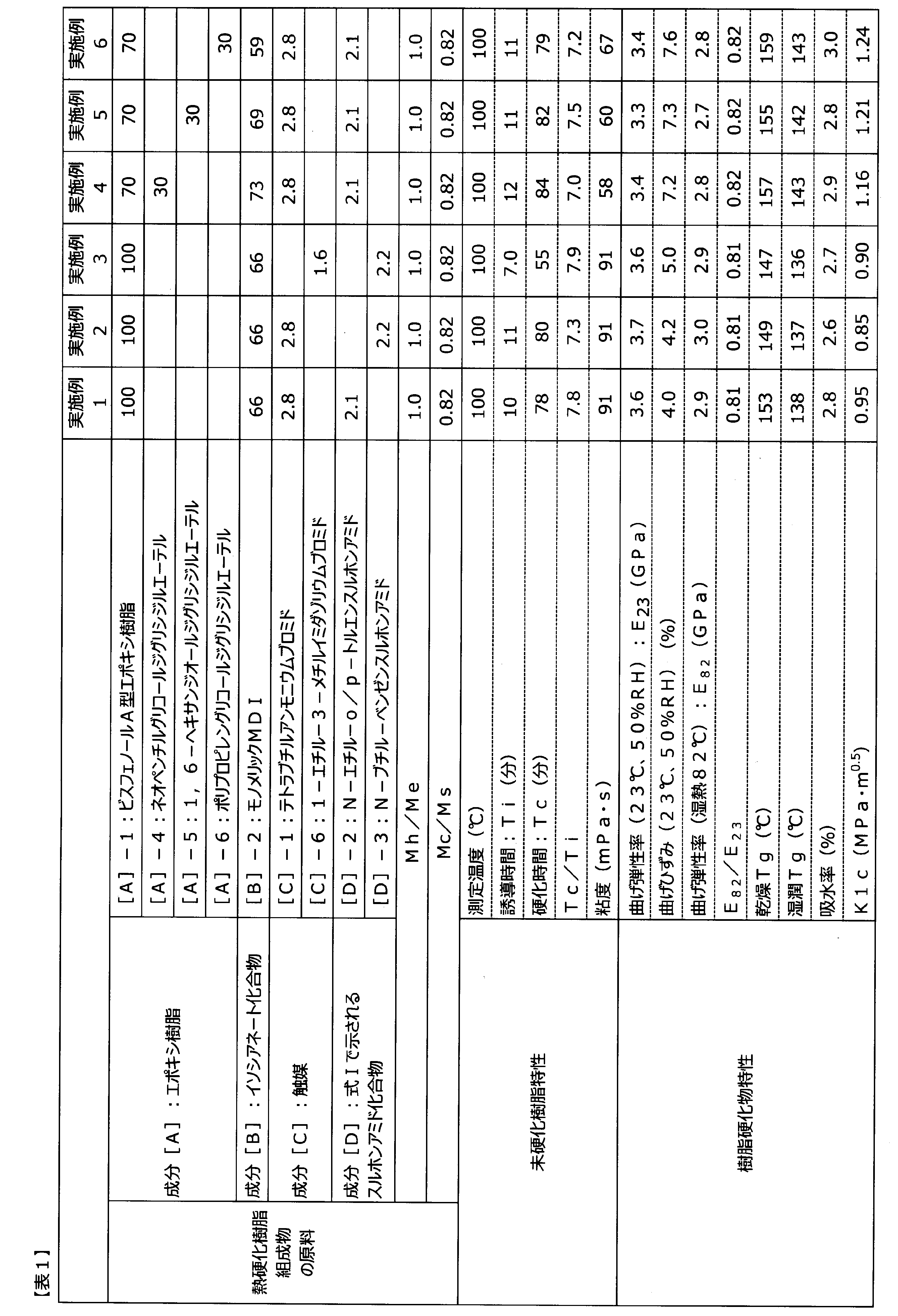
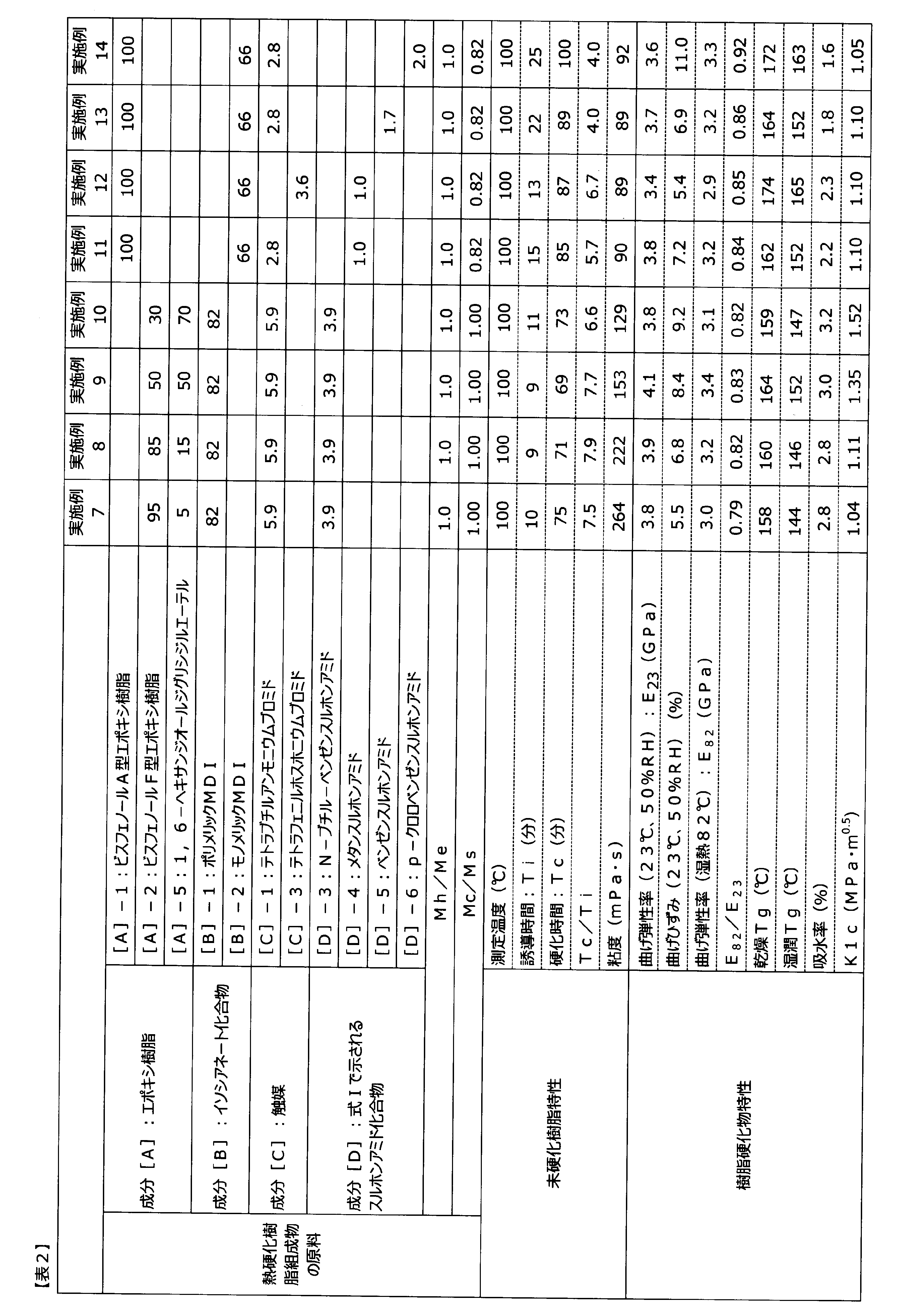
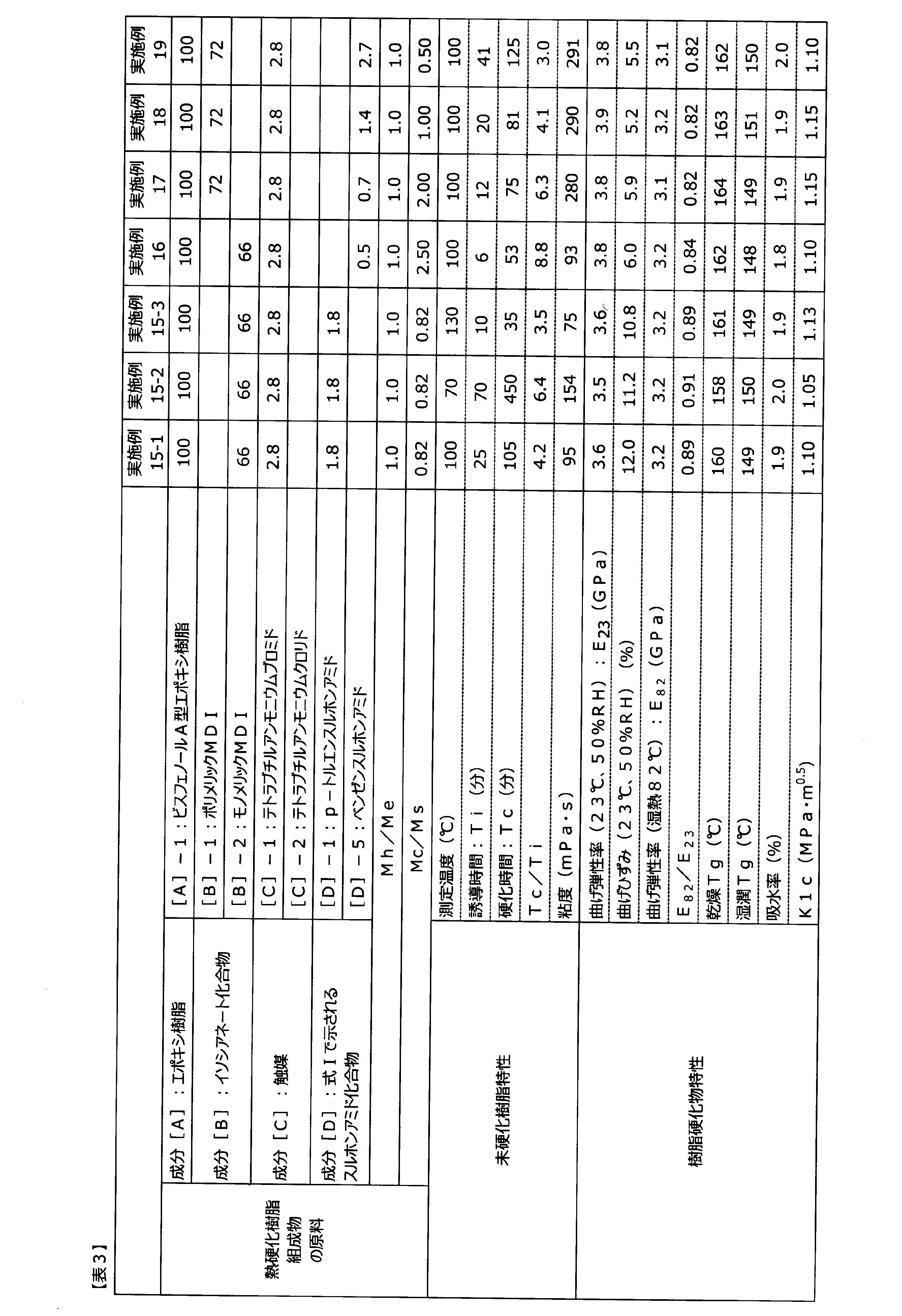
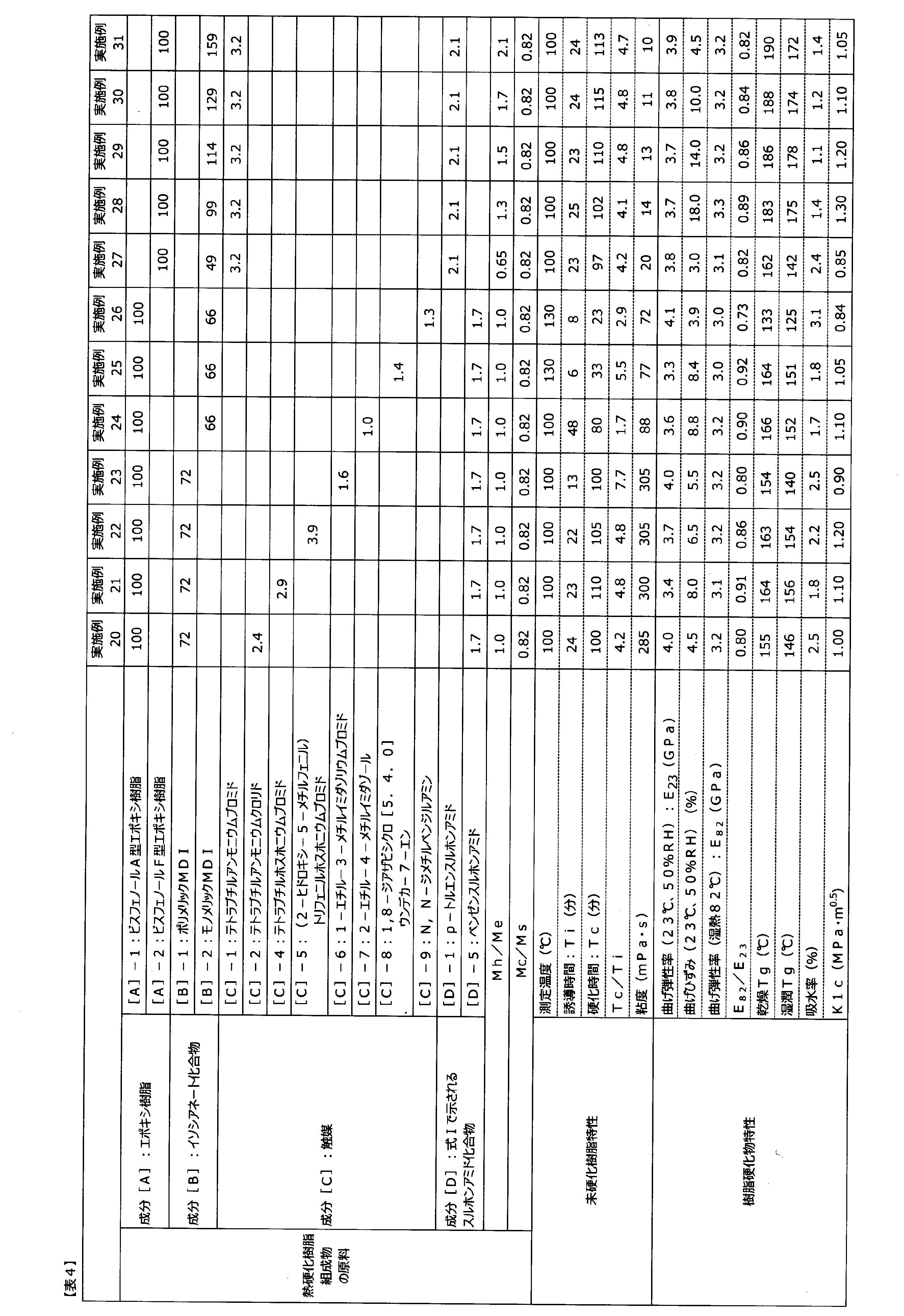
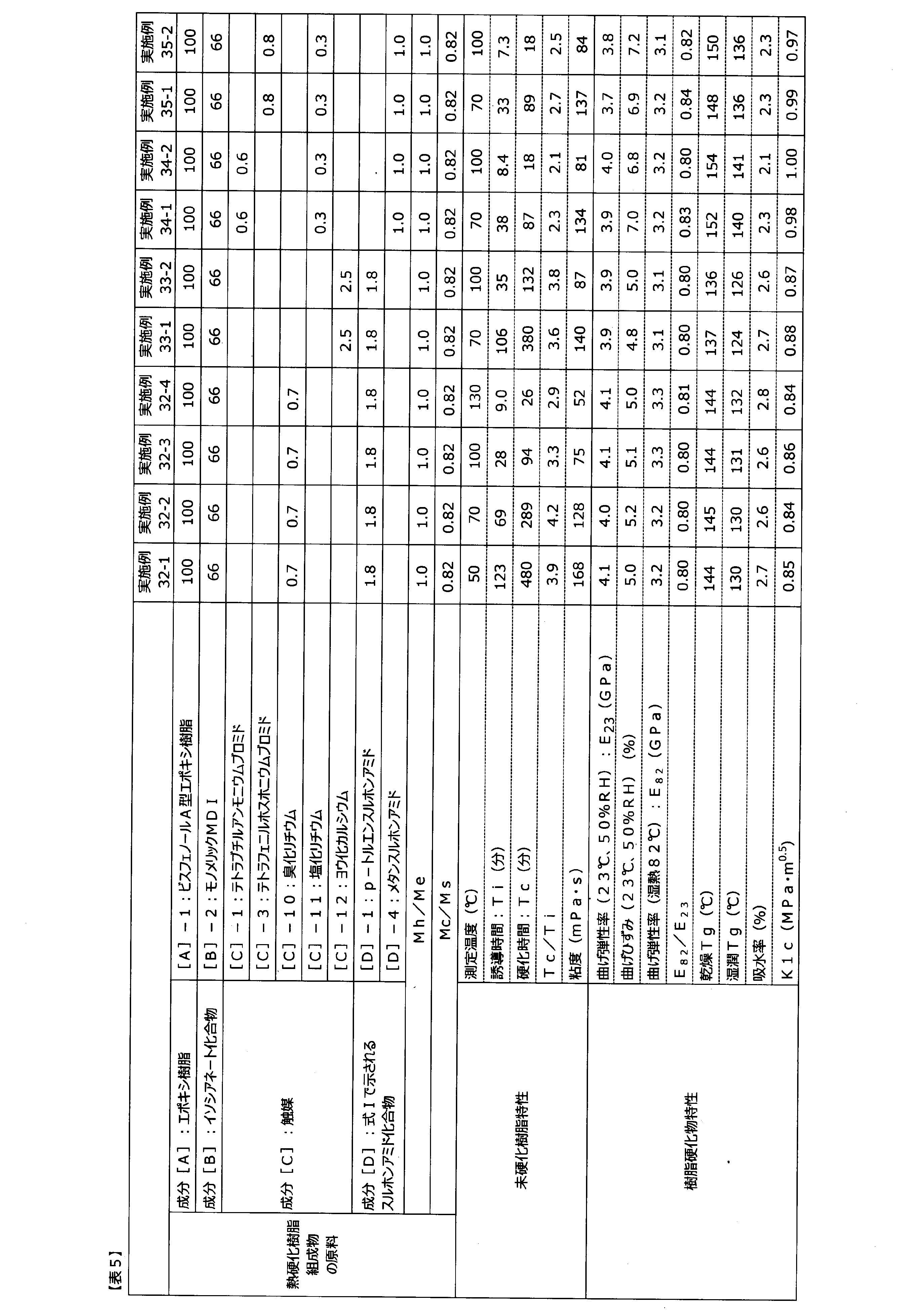
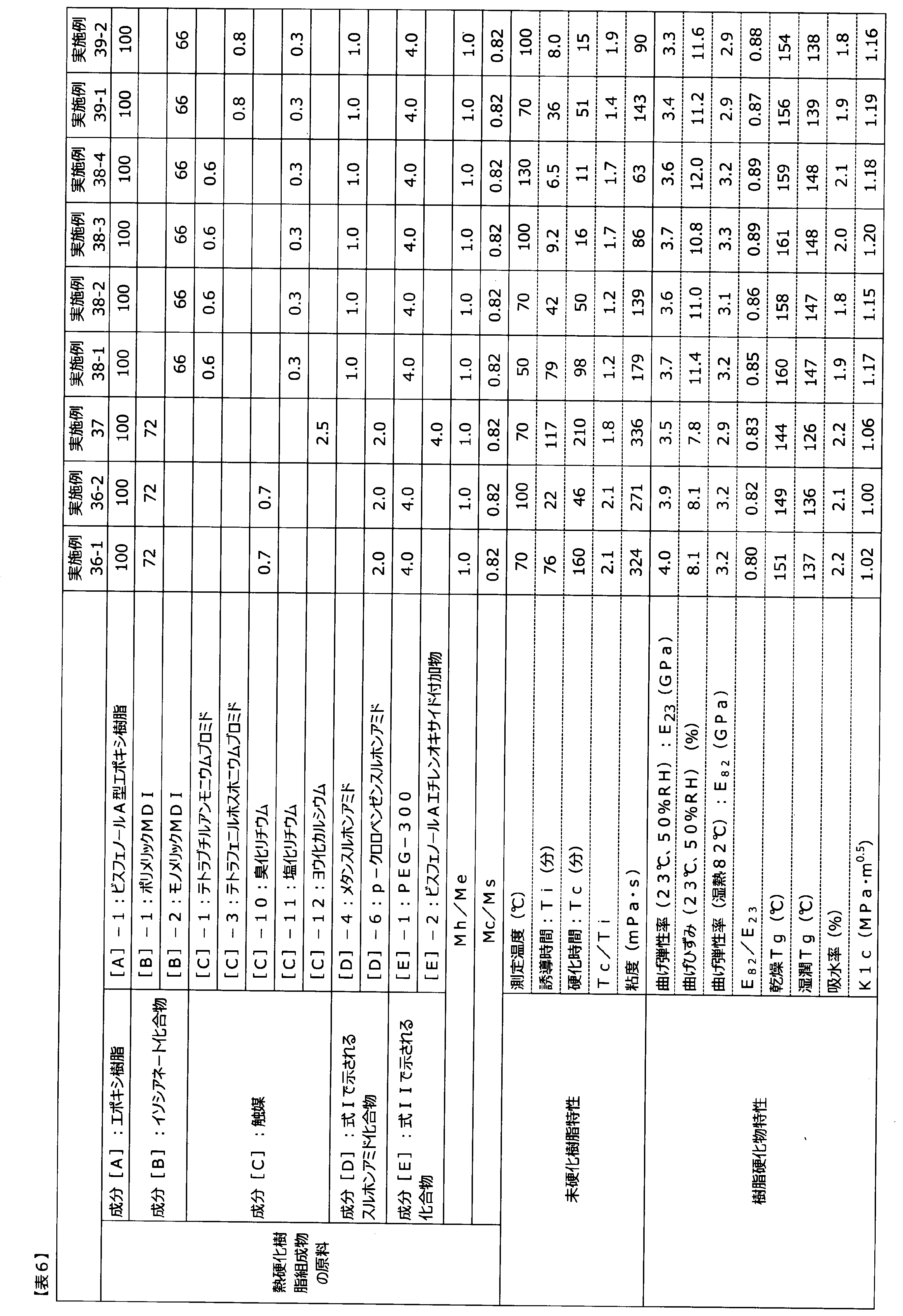
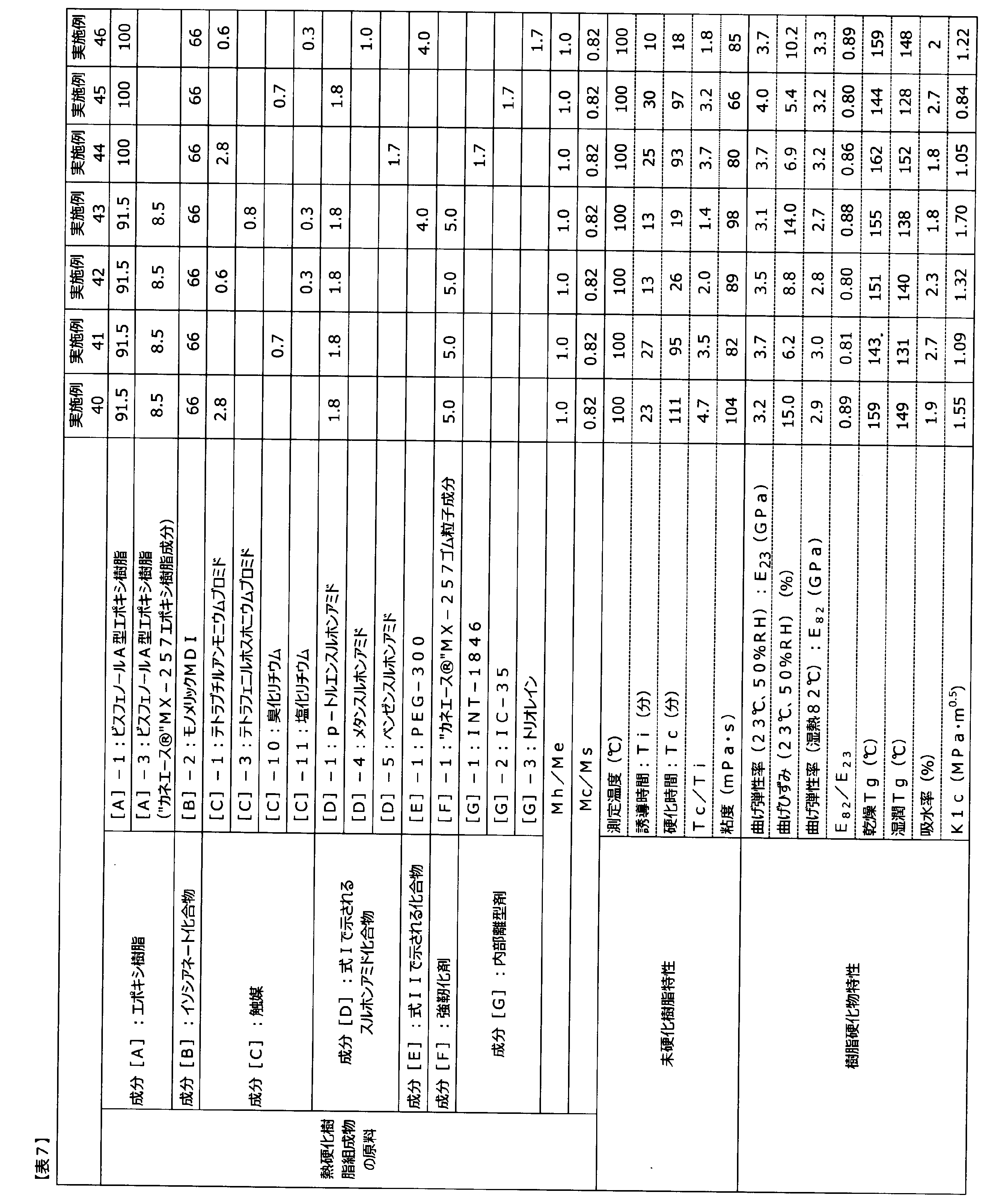

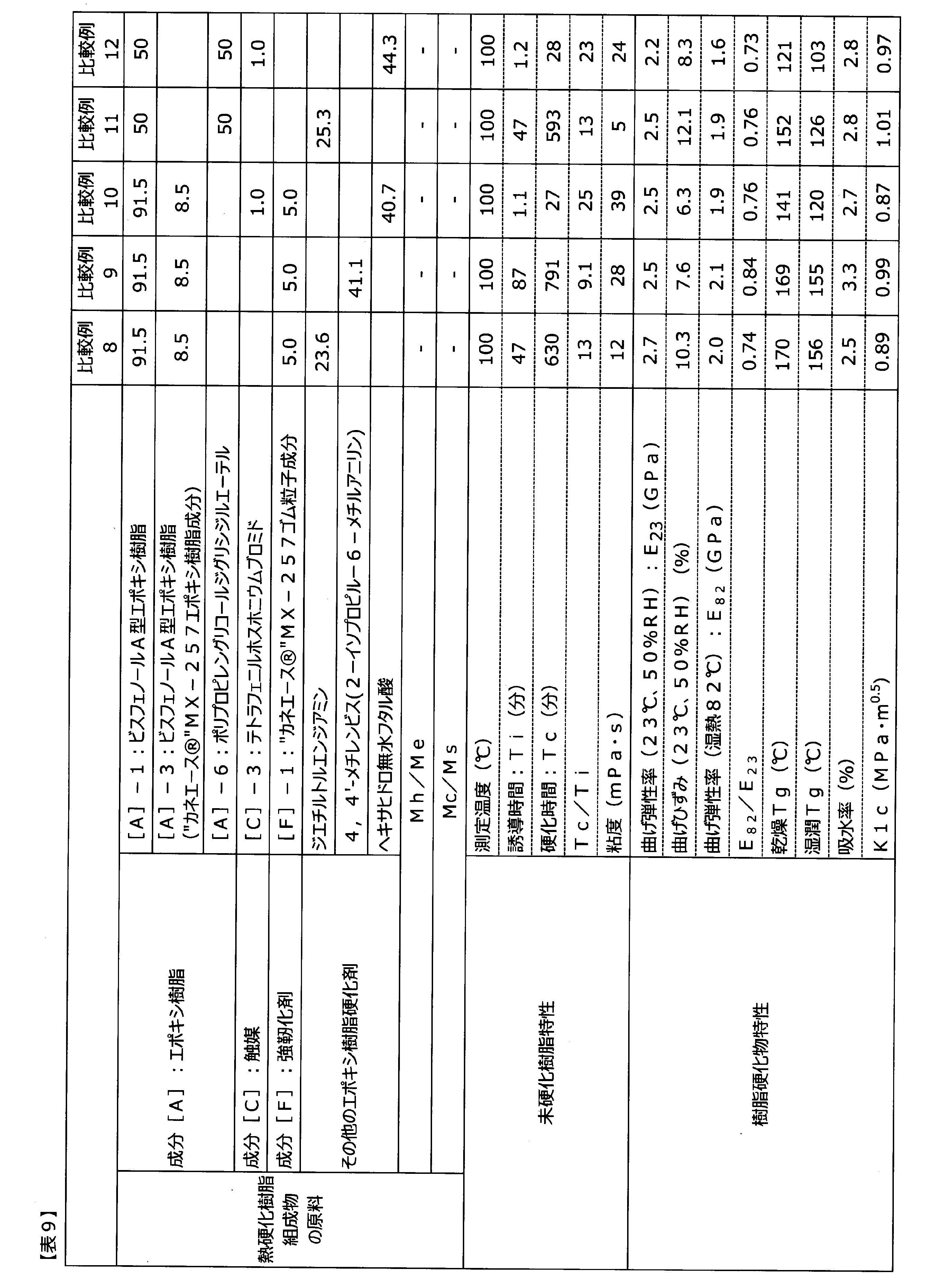
なお、表中の各成分の単位は質量部である。
本発明の熱硬化性樹脂組成物は、樹脂流動時間と硬化速度を制御可能で、かつ、破壊靱性と湿熱時の弾性率が高い樹脂硬化物を提供することが可能である。当該エポキシ樹脂組成物からなる繊維強化複合材料は、湿熱時の圧縮特性や耐衝撃性にも優れるため、航空・宇宙部材、および、一般産業用の構造部材に好適に使用することができる。
Claims (15)
- 次の成分[A]、[B]、[C]および[D]を含む熱硬化性樹脂組成物。
[A]:エポキシ樹脂
[B]:イソシアネート化合物
[C]:触媒
[D]:式(I)で示されるスルホンアミド化合物
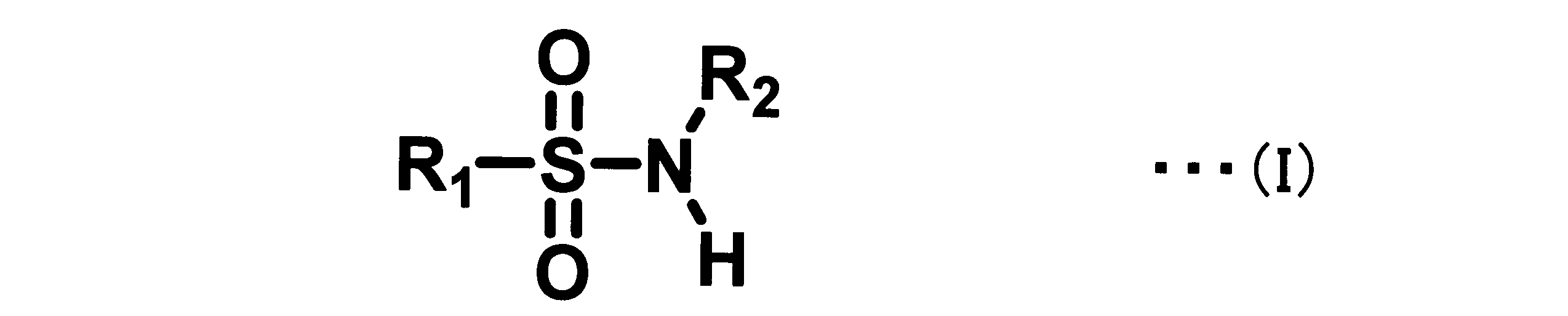
- 式(I)においてR2が水素である、請求項1に記載の熱硬化性樹脂組成物。
- 式(I)においてR1がトリル基、フェニル基またはクロロフェニル基である、請求項1または2に記載の熱硬化性樹脂組成物。
- 成分[B]に含まれるイソシアネート基のモル数(Mh)を、成分[A]に含まれるエポキシ基モル数の総和(Me)で除した値(Mh/Me)が0.7~2.0である、請求項1または2に記載の熱硬化性樹脂組成物。
- 成分[C]:触媒が4級オニウム塩である、請求項1または2に記載の熱硬化性樹脂組成物。
- 成分[C]:触媒として無機塩を含む、請求項1または2に記載の熱硬化性樹脂組成物。
- 成分[E]を含む、請求項6に記載の熱硬化性樹脂組成物。
[E]:式(II)で示される構造を分子内に有する化合物。
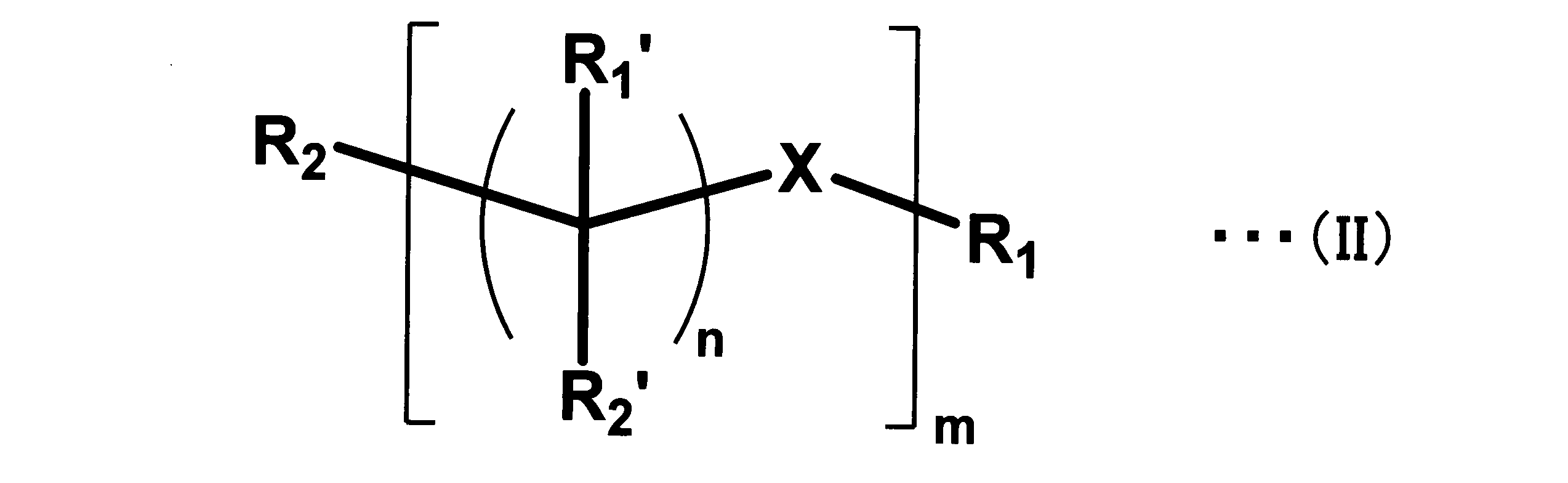
- 成分[C]:触媒として4級オニウム塩および無機塩を含む、請求項6に記載の熱硬化性樹脂組成物。
- 成分[A]:エポキシ樹脂として、脂肪族エポキシ樹脂を含む、請求項1または2に記載の熱硬化性樹脂組成物。
- 成分[A]:エポキシ樹脂100質量%中に、脂肪族エポキシ樹脂を10質量%以上80質量%以下含む、請求項9に記載の熱硬化性樹脂組成物。
- 成分[F]:強靭化剤を含む、請求項1または2に記載の熱硬化性樹脂組成物。
- 請求項1または2に記載の熱硬化性樹脂組成物が加熱硬化されてなる成形品。
- 請求項1または2に記載の熱硬化性樹脂組成物と、強化繊維とを含んでなる繊維強化複合材料用成形材料。
- 請求項12に記載の熱硬化性樹脂組成物が加熱硬化されてなる成形品と、強化繊維とを含んでなる繊維強化複合材料。
- 請求項13に記載の繊維強化複合材料用成形材料が加熱硬化されてなる繊維強化複合材料。
Priority Applications (1)
| Application Number | Priority Date | Filing Date | Title |
|---|---|---|---|
| JP2023530574A JPWO2023219007A1 (ja) | 2022-05-09 | 2023-04-28 |
Applications Claiming Priority (8)
| Application Number | Priority Date | Filing Date | Title |
|---|---|---|---|
| JP2022-076856 | 2022-05-09 | ||
| JP2022076856 | 2022-05-09 | ||
| JP2022-089384 | 2022-06-01 | ||
| JP2022089384 | 2022-06-01 | ||
| JP2022-137500 | 2022-08-31 | ||
| JP2022137500 | 2022-08-31 | ||
| JP2023012527 | 2023-01-31 | ||
| JP2023-012527 | 2023-01-31 |
Publications (1)
| Publication Number | Publication Date |
|---|---|
| WO2023219007A1 true WO2023219007A1 (ja) | 2023-11-16 |
Family
ID=88730480
Family Applications (1)
| Application Number | Title | Priority Date | Filing Date |
|---|---|---|---|
| PCT/JP2023/016826 Ceased WO2023219007A1 (ja) | 2022-05-09 | 2023-04-28 | 熱硬化性樹脂組成物、成形品、繊維強化複合材料用成形材料および繊維強化複合材料 |
Country Status (2)
| Country | Link |
|---|---|
| JP (1) | JPWO2023219007A1 (ja) |
| WO (1) | WO2023219007A1 (ja) |
Cited By (1)
| Publication number | Priority date | Publication date | Assignee | Title |
|---|---|---|---|---|
| JP2024022869A (ja) * | 2022-08-08 | 2024-02-21 | トヨタ自動車株式会社 | 複合部材及び複合部材の製造方法 |
Citations (6)
| Publication number | Priority date | Publication date | Assignee | Title |
|---|---|---|---|---|
| JPH02289609A (ja) * | 1987-04-09 | 1990-11-29 | Ashland Oil Inc | 一成分型硬化性エポキシ樹脂組成物 |
| JP2006241187A (ja) * | 2005-02-28 | 2006-09-14 | Asahi Kasei Corp | 新規エポキシ硬化促進剤及びそれを含有する硬化性組成物 |
| CN108841286A (zh) * | 2018-05-21 | 2018-11-20 | 三江学院 | 一种耐磨耐腐蚀表面涂层材料及其制备方法 |
| CN112662090A (zh) * | 2020-12-21 | 2021-04-16 | 淄博科信腾达信息科技有限公司 | 一种改性硬质聚氯乙烯泡沫及其制备方法 |
| WO2022102467A1 (ja) * | 2020-11-16 | 2022-05-19 | 東レ株式会社 | 熱硬化性エポキシ樹脂組成物とその成形品、繊維強化複合材料、繊維強化複合材料用成形材料、および繊維強化複合材料の製造方法 |
| WO2022124191A1 (ja) * | 2020-12-08 | 2022-06-16 | 東レ株式会社 | 熱硬化性エポキシ樹脂組成物、熱硬化性エポキシ樹脂成形品、繊維強化複合材料用成形材料、繊維強化複合材料、および繊維強化複合材料の製造方法 |
-
2023
- 2023-04-28 WO PCT/JP2023/016826 patent/WO2023219007A1/ja not_active Ceased
- 2023-04-28 JP JP2023530574A patent/JPWO2023219007A1/ja active Pending
Patent Citations (6)
| Publication number | Priority date | Publication date | Assignee | Title |
|---|---|---|---|---|
| JPH02289609A (ja) * | 1987-04-09 | 1990-11-29 | Ashland Oil Inc | 一成分型硬化性エポキシ樹脂組成物 |
| JP2006241187A (ja) * | 2005-02-28 | 2006-09-14 | Asahi Kasei Corp | 新規エポキシ硬化促進剤及びそれを含有する硬化性組成物 |
| CN108841286A (zh) * | 2018-05-21 | 2018-11-20 | 三江学院 | 一种耐磨耐腐蚀表面涂层材料及其制备方法 |
| WO2022102467A1 (ja) * | 2020-11-16 | 2022-05-19 | 東レ株式会社 | 熱硬化性エポキシ樹脂組成物とその成形品、繊維強化複合材料、繊維強化複合材料用成形材料、および繊維強化複合材料の製造方法 |
| WO2022124191A1 (ja) * | 2020-12-08 | 2022-06-16 | 東レ株式会社 | 熱硬化性エポキシ樹脂組成物、熱硬化性エポキシ樹脂成形品、繊維強化複合材料用成形材料、繊維強化複合材料、および繊維強化複合材料の製造方法 |
| CN112662090A (zh) * | 2020-12-21 | 2021-04-16 | 淄博科信腾达信息科技有限公司 | 一种改性硬质聚氯乙烯泡沫及其制备方法 |
Cited By (2)
| Publication number | Priority date | Publication date | Assignee | Title |
|---|---|---|---|---|
| JP2024022869A (ja) * | 2022-08-08 | 2024-02-21 | トヨタ自動車株式会社 | 複合部材及び複合部材の製造方法 |
| JP7735957B2 (ja) | 2022-08-08 | 2025-09-09 | トヨタ自動車株式会社 | 複合部材及び複合部材の製造方法 |
Also Published As
| Publication number | Publication date |
|---|---|
| JPWO2023219007A1 (ja) | 2023-11-16 |
Similar Documents
| Publication | Publication Date | Title |
|---|---|---|
| ES2361026T3 (es) | Composiciones endurecibles. | |
| EP3425005B1 (en) | Epoxy resin composition, molding material, and fiber-reinforced composite material | |
| JP5933707B2 (ja) | 熱硬化性エポキシ系の強化剤用付加体 | |
| JP5728383B2 (ja) | イソシアネート系強靱化剤を含んでなるベンゾオキサジン系組成物 | |
| CN110088163A (zh) | 固化性树脂组合物以及使用其的膜、成型品、预浸料和纤维增强塑料 | |
| ES2909123T3 (es) | Composición curada con alta resistencia al impacto y estabilidad frente a la temperatura, que se basa en una resina epoxídica y un poliisocianato | |
| JP2022513473A (ja) | ポリイソシアヌレート系ポリマー及び繊維強化複合材料 | |
| JP7647101B2 (ja) | 繊維強化複合材料の成形方法、およびそれに用いられるエポキシ樹脂組成物 | |
| WO2023176935A1 (ja) | Rtm用エポキシ樹脂組成物、樹脂硬化物、繊維強化複合材料およびその製造方法 | |
| KR102566314B1 (ko) | 에폭시 화합물, 이를 포함하는 에폭시 수지 조성물 및 이를 포함하는 일액형 에폭시 접착제 조성물 | |
| WO2022102467A1 (ja) | 熱硬化性エポキシ樹脂組成物とその成形品、繊維強化複合材料、繊維強化複合材料用成形材料、および繊維強化複合材料の製造方法 | |
| CN112955495A (zh) | 热固性成型材料、纤维增强复合材料、纤维增强塑料用热固性环氧树脂组合物、热固性成型材料的制造方法、纤维增强塑料 | |
| WO2024181251A1 (ja) | Rtm用エポキシ樹脂組成物、樹脂硬化物および繊維強化複合材料ならびにその製造方法 | |
| JP2018053065A (ja) | 繊維強化複合材料用エポキシ樹脂組成物、および繊維強化複合材料 | |
| WO2023176934A1 (ja) | エポキシ樹脂組成物、繊維強化複合材料およびその製造方法 | |
| JP6804487B2 (ja) | 熱可塑性ポリウレタン樹脂製造用2液硬化型組成物、熱可塑性ポリウレタン樹脂および繊維強化樹脂 | |
| JP3415349B2 (ja) | 複合材料用エポキシ樹脂組成物 | |
| CN106574065A (zh) | 耐光的聚氨酯预浸料坯和由其制成的纤维复合元件 | |
| WO2022124191A1 (ja) | 熱硬化性エポキシ樹脂組成物、熱硬化性エポキシ樹脂成形品、繊維強化複合材料用成形材料、繊維強化複合材料、および繊維強化複合材料の製造方法 | |
| JP2016525605A (ja) | イソシアネートエポキシフォーム系 | |
| JP2011184616A (ja) | エポキシ樹脂組成物 | |
| CN114761457B (zh) | 环氧树脂组合物、纤维增强复合材料用成型材料及纤维增强复合材料 | |
| KR102600560B1 (ko) | 에폭시 수지 조성물 및 이를 포함하는 일액형 에폭시 접착제 조성물 | |
| JP2023050699A (ja) | エポキシ樹脂組成物及び硬化物 | |
| JP7160219B1 (ja) | 熱硬化性エポキシ樹脂組成物とその成形品、繊維強化複合材料、繊維強化複合材料用成形材料、および繊維強化複合材料の製造方法 |
Legal Events
| Date | Code | Title | Description |
|---|---|---|---|
| ENP | Entry into the national phase |
Ref document number: 2023530574 Country of ref document: JP Kind code of ref document: A |
|
| 121 | Ep: the epo has been informed by wipo that ep was designated in this application |
Ref document number: 23803485 Country of ref document: EP Kind code of ref document: A1 |
|
| NENP | Non-entry into the national phase |
Ref country code: DE |
|
| 122 | Ep: pct application non-entry in european phase |
Ref document number: 23803485 Country of ref document: EP Kind code of ref document: A1 |