WO2023210447A1 - 光学積層シートの製造方法及び光学物品の製造方法 - Google Patents
光学積層シートの製造方法及び光学物品の製造方法 Download PDFInfo
- Publication number
- WO2023210447A1 WO2023210447A1 PCT/JP2023/015505 JP2023015505W WO2023210447A1 WO 2023210447 A1 WO2023210447 A1 WO 2023210447A1 JP 2023015505 W JP2023015505 W JP 2023015505W WO 2023210447 A1 WO2023210447 A1 WO 2023210447A1
- Authority
- WO
- WIPO (PCT)
- Prior art keywords
- optical
- sheet
- laminate
- group
- prepolymer
- Prior art date
- Legal status (The legal status is an assumption and is not a legal conclusion. Google has not performed a legal analysis and makes no representation as to the accuracy of the status listed.)
- Ceased
Links
Images


Classifications
-
- B—PERFORMING OPERATIONS; TRANSPORTING
- B32—LAYERED PRODUCTS
- B32B—LAYERED PRODUCTS, i.e. PRODUCTS BUILT-UP OF STRATA OF FLAT OR NON-FLAT, e.g. CELLULAR OR HONEYCOMB, FORM
- B32B7/00—Layered products characterised by the relation between layers; Layered products characterised by the relative orientation of features between layers, or by the relative values of a measurable parameter between layers, i.e. products comprising layers having different physical, chemical or physicochemical properties; Layered products characterised by the interconnection of layers
- B32B7/04—Interconnection of layers
- B32B7/12—Interconnection of layers using interposed adhesives or interposed materials with bonding properties
-
- G—PHYSICS
- G02—OPTICS
- G02B—OPTICAL ELEMENTS, SYSTEMS OR APPARATUS
- G02B5/00—Optical elements other than lenses
- G02B5/20—Filters
- G02B5/22—Absorbing filters
- G02B5/23—Photochromic filters
-
- G—PHYSICS
- G02—OPTICS
- G02C—SPECTACLES; SUNGLASSES OR GOGGLES INSOFAR AS THEY HAVE THE SAME FEATURES AS SPECTACLES; CONTACT LENSES
- G02C7/00—Optical parts
- G02C7/02—Lenses; Lens systems ; Methods of designing lenses
-
- G—PHYSICS
- G02—OPTICS
- G02C—SPECTACLES; SUNGLASSES OR GOGGLES INSOFAR AS THEY HAVE THE SAME FEATURES AS SPECTACLES; CONTACT LENSES
- G02C7/00—Optical parts
- G02C7/12—Polarisers
Definitions
- the present invention relates to a method for manufacturing an optical laminated sheet and a method for manufacturing an optical article.
- Plastic glasses are glasses that use plastic lenses.
- Plastic lenses are manufactured, for example, by subjecting semi-finished lenses, which are semi-finished products, to various processes.
- a functional layer such as a hard coat layer or an antireflection film is provided on the convex surface of the semi-finished lens. Further, the concave back surface of the semi-finished lens is subjected to cutting and polishing processing.
- a photochromic lens is obtained by applying a photochromic compound to a plastic lens.
- a photochromic compound is a compound that can reversibly generate two or more isomers having different light absorption spectra by the action of light.
- methods for manufacturing photochromic lenses include a kneading method in which a photochromic compound is dispersed in the matrix of a semi-finished lens, and a lamination method in which a layer containing a photochromic compound is provided on the surface of a semi-finished lens. .
- the binder sheet method is a method for manufacturing semi-finished lenses by integrating a binder sheet in which a resin layer containing a photochromic compound is sandwiched between two optical sheets with a lens base material.
- semi-finished lenses can be manufactured using self-standing articles containing photochromic compounds, so compared to the kneading method and lamination method, production efficiency tends to be higher and mass production is easier. .
- An object of the present invention is to provide a method for manufacturing an optical laminated sheet with excellent appearance, and a method for manufacturing an optical article including this optical laminated sheet.
- a first method for manufacturing an optical laminate sheet includes a first optical sheet, a second optical sheet, and an adhesive layer.
- the adhesive layer is located between the first optical sheet and the second optical sheet.
- the adhesive layer contains at least one resin selected from the group consisting of urethane resin, urethane urea resin, thiourethane resin, and thiourethane urea resin and a functional dye.
- At least one of the first optical sheet and the second optical sheet is an unstretched polyvinyl alcohol film.
- This manufacturing method includes providing a first coating film of an adhesive composition containing a functional dye and an iso(thio)cyanate compound on at least one main surface of a first optical sheet, and disposing a first coating film on the first coating film.
- the method includes laminating two optical sheets to obtain a first laminate, and heat-treating the first laminate at a temperature of 80° C. or more and 200° C. or less under atmospheric pressure.
- a second method for manufacturing an optical laminate sheet includes a first optical sheet, a second optical sheet, and an adhesive layer.
- the adhesive layer is located between the first optical sheet and the second optical sheet.
- the adhesive layer contains at least one resin selected from the group consisting of urethane resin, urethane urea resin, thiourethane resin, and thiourethane urea resin and a functional dye.
- the first optical sheet and the second optical sheet are stretched polyvinyl alcohol films.
- This manufacturing method includes providing a first coating film of an adhesive composition containing a functional dye and an iso(thio)cyanate compound on at least one main surface of a first optical sheet, and disposing a first coating film on the first coating film. obtaining a first laminate by laminating two optical sheets; humidifying the first laminate; and heating the first laminate after the humidification at a temperature of 80°C or more and 200°C or less under atmospheric pressure. This includes heat treatment.
- a method of manufacturing an optical article includes coating at least one surface of the first optical sheet and the second optical sheet of the optical laminated sheet obtained by the method according to the embodiment with an optical element base material.
- a method for manufacturing an optical laminated sheet with excellent appearance and a method for manufacturing an optical article including this optical laminated sheet are provided.
- FIG. 1 is a cross-sectional view schematically showing an example of an optical laminated sheet.
- FIG. 1 is a cross-sectional view schematically showing an example of an optical article.
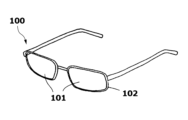
- FIG. 1 is a perspective view schematically showing an example of eyeglasses including an optical article.
- a first method for manufacturing an optical laminate sheet includes a first optical sheet, a second optical sheet, and an adhesive layer.
- the adhesive layer is located between the first optical sheet and the second optical sheet.
- the adhesive layer contains at least one resin selected from the group consisting of urethane resin, urethane urea resin, thiourethane resin, and thiourethane urea resin and a functional dye.
- At least one of the first optical sheet and the second optical sheet is an unstretched polyvinyl alcohol film.
- This manufacturing method includes providing a first coating film of an adhesive composition containing a functional dye and an iso(thio)cyanate compound on at least one main surface of a first optical sheet, and disposing a first coating film on the first coating film.
- the method includes laminating two optical sheets to obtain a first laminate, and heat-treating the first laminate at a temperature of 80° C. or more and 200° C. or less under atmospheric pressure.
- an optical laminated sheet with excellent appearance can be obtained.
- the present inventors believe that the reason for this is as follows.
- air bubbles may be generated in the first laminate. Since air bubbles impair the appearance of the optical laminate sheet, it is desirable to remove them. Therefore, for example, the first laminate may be heated under vacuum or reduced pressure to perform deaeration treatment. However, even if this deaeration treatment is performed, sufficient air bubbles may not be removed from the first laminate.
- the present inventors have discovered that by heat-treating the first laminate at a relatively high temperature under atmospheric pressure, an optical laminate sheet with fewer bubbles and excellent appearance can be obtained.
- the bubbles contained in the first laminate can contain gas generated from the first coating film in addition to air taken in from the outside air.
- This gas is thought to be generated, for example, in the following process.
- the iso(thio)cyanate group of the iso(thio)cyanate compound contained in the first coating film and the hydroxyl group present on the surface of the polyvinyl alcohol film react to form a (thio)urethane bond. This increases the adhesion between the adhesive layer and the polyvinyl alcohol film.
- this iso(thio)cyanate group can react with air, the first coating, and the water contained in the polyvinyl alcohol to produce amines and carbon dioxide.
- the first laminate is heat-treated in a relatively high temperature environment of 80° C. or higher and 200° C. or lower under atmospheric pressure. Under such an environment, inside the first laminate, while suppressing the generation of gas due to the production of carbon dioxide, heating reduces the rigidity of the polyvinyl alcohol film, including air taken in from the outside air. It is thought that it can be degassed. Therefore, according to the method according to the embodiment, an optical laminated sheet with few bubbles and excellent appearance can be obtained.
- the optical laminated sheet includes a first optical sheet, a second optical sheet, and an adhesive layer located between them.
- the optical laminated sheet may include a first optical sheet, a second optical sheet, a transparent support, a first adhesive layer, and a second adhesive layer.
- the first optical sheet and the transparent support are bonded together by a first adhesive layer.
- the transparent support and the second optical sheet are bonded together by a second adhesive layer.
- the thickness of the optical laminated sheet is preferably 90 ⁇ m or more, more preferably 110 ⁇ m or more, and even more preferably 130 ⁇ m or more.
- the thickness of the optical laminate sheet is thick, the strength of the optical laminate sheet increases and the yield tends to increase.
- the thickness of the optical laminated sheet one example is 1000 ⁇ m or less, and another example is 500 ⁇ m or less.
- FIG. 1 is a cross-sectional view schematically showing an example of an optical laminated sheet.
- the optical laminated sheet 1 shown in FIG. 1 includes a first optical sheet 2, a second optical sheet 3, and an adhesive layer 4 interposed between them.
- the adhesive layer 4 covers one entire main surface of the first optical sheet 2 and one entire main surface of the second optical sheet 3.
- the adhesive layer 4 may cover both entire main surfaces of the first optical sheet 2 and both entire main surfaces of the second optical sheet 3, or may cover only a portion of each main surface. Good too.
- First and second optical sheets At least one of the first and second optical sheets is an unstretched polyvinyl alcohol film. Both the first and second optical sheets may be unstretched polyvinyl alcohol films. One may be a stretched polyvinyl alcohol film, or may be a film made of a resin other than polyvinyl alcohol.
- the polyvinyl alcohol film contains polyvinyl alcohol (PVA) resin.
- PVA polyvinyl alcohol
- the polyvinyl alcohol film may be composed only of PVA resin or may contain other resins. Examples of other resins include polyvinyl formal modified with aldehydes, polyvinyl acetal, polyvinyl butyral, and the like.
- the moisture content of the unstretched polyvinyl alcohol film is preferably 1% by mass or more, more preferably 3% by mass or more.
- the moisture content of the unstretched polyvinyl alcohol film is preferably 20% by mass or less, more preferably 15% by mass or less, and even more preferably 10% by mass or less.
- the moisture content can be measured, for example, by the following method.
- the mass of the sample is, for example, 5 g.
- This sample is placed on the pan of a moisture meter and heated to 120°C.
- the sample is kept warm at 120° C. until the moisture change rate for 30 seconds reaches 0.02%, and the mass of the sample is measured when the moisture change rate for 30 seconds reaches 0.02%.
- the ratio of the mass of evaporated water to the mass of the sample before drying that is, the moisture content of the polyvinyl alcohol film, is determined.
- As the moisture meter for example, a moisture meter MOC63u manufactured by Shimadzu Corporation is used.
- the average degree of polymerization of the PVA resin is, for example, 100 or more and 10,000 or less, preferably 1,500 or more and 8,000 or less, and more preferably 2,000 or more and 5,000 or less.
- the average degree of polymerization of the PVA resin is determined by a method based on Japanese Industrial Standards (JIS) K6726; 1994.
- the PVA resin may contain boric acid.
- Boric acid is used as a crosslinking agent to crosslink PVA.
- the boric acid content of the PVA resin is, for example, 0.1% by mass or more and 20% by mass or less, preferably 0.5% by mass or more and 15% by mass or less, and more preferably 1% by mass or more and 10% by mass. % or less.
- This boric acid content can be calculated by inductively coupled plasma (IPC) emission spectrometry. Specifically, first, an optical sheet is dissolved in an aqueous nitric acid solution to obtain a solution. IPC analysis is performed using this solution to calculate the boron content. This boron content is converted into boric acid content.
- IPC inductively coupled plasma
- the optical sheet may contain a dye.
- the dye includes a dichroic substance.
- Dichroic substances include iodine and dichroic dyes.
- the dichroic dye may be azo-based or anthraquinone-based. Specific examples of dichroic dyes include chloranthine fast red (C.I. 28160), Congo red (C.I. 22120), brilliant blue B (C.I. 24410), benzopurpurin (C.I. 23500), Chlorazole Black BH (C.I. 22590), Direct Blue 2B (C.I. 22610), Diamine Green (C.I. 30295), Chrysophenine (C.I. 24895), Sirius Yellow (C.I.
- the thickness of the unstretched polyvinyl alcohol film is, for example, 10 ⁇ m or more, preferably 30 ⁇ m or more, and more preferably 50 ⁇ m or more.
- the use of thicker films tends to improve production efficiency.
- the thickness of the unstretched polyvinyl alcohol film one example is 100 ⁇ m or less, and another example is 80 ⁇ m or less.
- the thicknesses of the first and second optical sheets may be the same or different.
- the stretching method for the stretched polyvinyl alcohol film may be either uniaxial stretching or biaxial stretching.
- the stretching direction may be any of the machine flow direction (MD) of the unstretched film, a direction perpendicular thereto (TD), and a direction oblique to the machine flow direction.
- the uniaxially stretched sheet is a sheet obtained by stretching an unstretched sheet in one of the above directions.
- a biaxially stretched sheet is one that has been stretched in two of the stretching directions mentioned above, and even if it is a simultaneous biaxially stretched sheet that is stretched simultaneously, it can be stretched in two consecutive directions that are stretched in a predetermined direction and then in another direction. It may also be an axially stretched sheet. In the case of biaxially stretched sheets, those stretched in MD and TD are generally preferred.
- the stretching ratio is preferably 1.5 to 8 times, more preferably 2 to 6 times.
- the moisture content of the stretched polyvinyl alcohol film is preferably 1% by mass or more, more preferably 3% by mass or more, and even more preferably 5% by mass or more.
- the moisture content is preferably 20% by mass or less, more preferably 15% by mass or less.
- the moisture content can be measured in the same manner as for unstretched polyvinyl alcohol films.
- the stretched polyvinyl alcohol film may be a polarizing film having polarizing properties.
- the optical sheet having polarization properties preferably has a luminous transmittance of 10% or more and 80% or less, and a polarization degree of 30% or more and 99.9% or less.
- the stretched polyvinyl alcohol film having polarizing properties contains the dichroic substance described above.
- the thickness of the stretched polyvinyl alcohol film is, for example, 10 ⁇ m or more and 100 ⁇ m or less.
- the resin film other than the polyvinyl alcohol film various resin films having light transmittance can be used.
- the resin is selected from the group consisting of, for example, polyethylene terephthalate resin, polycarbonate resin, polyamide resin, polyester resin, cellulose resin, (meth)acrylic resin, polyurethane resin, polyurethane urea resin, polyimide resin, epoxy resin, and polyolefin resin. At least one kind is used.
- the polyamide resin an alicyclic polyamide resin, a semi-aromatic polyamide resin, or an aromatic polyamide resin may be used.
- the cellulose resin for example, acetyl cellulose such as triacetyl cellulose and diacetyl cellulose may be used, and propyl cellulose such as tripropyl cellulose and dipropyl cellulose may be used.
- the resin film other than PVA has a surface modified region on its surface.
- the surface modified region has reactive functional groups.
- reactive functional groups include hydroxyl group, thiol group, carboxy group, amino group, sulfo group, iso(thio)cyanate group, allyl group, (meth)acryloyl group, vinyl group, epoxy group, oxetane group, thioepoxy group, and a silanol group.
- the surface modified region is provided by at least one method selected from the group consisting of silane coupling agent application, plasma treatment, corona discharge treatment, and etching treatment.
- the type and amount of reactive functional groups contained in the surface modification layer can be confirmed by a combination of X-ray photoelectron spectroscopy (XPS) analysis, Fourier transform infrared spectroscopy (FT-IR) analysis, Raman spectroscopy, etc. can.
- XPS X-ray photoelectron spectroscopy
- FT-IR Fourier transform infrared spectroscopy
- Raman spectroscopy etc.
- the adhesive layer may contain at least one selected from the group consisting of polyurethane resin, polyurethane urea resin, polythiourethane resin, and polythiourethane urea resin.
- the adhesive layer may contain a functional dye such as a photochromic compound.
- the adhesive layer may contain a cured product of the adhesive composition described below.
- the thickness of the adhesive layer is, for example, 0.1 ⁇ m or more and 100 ⁇ m or less.
- the thickness of the adhesive layer may be thinner or thicker than the thickness of the first and second optical sheets.
- the adhesive composition contains a functional dye and a polymeric component.
- the polymeric component becomes the matrix of the adhesive layer.
- the polymerization component includes a second prepolymer or first polymer and a second prepolymer or third prepolymer.
- the adhesive composition includes a first combination of a polymer component including a second prepolymer and a functional dye, and a second combination of a polymer component and a functional dye including a first polymer and a second prepolymer.
- a fourth combination may be included.
- the functional dye includes, for example, at least one selected from the group consisting of photochromic compounds, ultraviolet absorbers, blue light absorbers, infrared absorbers, and electromic compounds.
- the photochromic compound for example, at least one selected from the group consisting of chromene compounds, fulgide compounds, and spirooxazine compounds is used.
- a chromene compound includes a compound having a 1-benzopyran skeleton, a spiropyran compound having a spiropyran skeleton, and a naphthopyran compound having a naphthopyran skeleton.
- Naphthopyran compounds include indenonaphthopyran compounds having an indenonaphthopyran skeleton.
- the chromene compound preferably includes an indenonaphthopyran compound having an indeno[2,1-f]naphtho[1,2-b]pyran skeleton.
- a cured product containing a chromene compound having an indeno[2,1-f]naphtho[1,2-b]pyran skeleton tends to have excellent durability.
- the indenonaphthopyran compound preferably contains a compound represented by the following formula (IIIa).
- the Z ring is a substituted or unsubstituted spiro ring in which the 13th-position carbon atom is a spiro atom.
- the Z ring may form an aliphatic ring, a fused polycyclic ring, a heterocyclic ring, or a heteroaromatic ring together with the carbon atom at the 13th position. It may be formed.
- the Z ring is preferably an aliphatic ring having 5 to 16 carbon atoms. More preferably, the aliphatic ring has an alkyl group having 1 to 3 carbon atoms as a substituent.
- R 11 , R 12 , R 13 , R 14 , R 15 , R 16 , and R 17 each independently represent a hydrogen atom, a hydroxyl group, a methoxycarbonyl group, an ethoxycarbonyl group, an alkyl group, Cycloalkyl group, haloalkyl group, alkoxy group, amino group, substituted amino group, heterocyclic group that may have a substituent, halogen atom, alkylthio group, arylthio group that may have a substituent, nitro group, formyl group, hydroxycarbonyl group, alkylcarbonyl group, alkoxycarbonyl group, aralkyl group that may have a substituent, aralkoxy group that may have a substituent, aryloxy group that may have a substituent, substituent An aryl group that may have a substituent, a heteroaryl group that may have a substituent, a thiol group, an alk
- the number of carbon atoms in the alkyl group is preferably 1 to 10.
- alkyl groups include methyl, ethyl, n-propyl, isopropyl, n-butyl, sec-butyl, tert-butyl, pentyl, and hexyl.
- the haloalkyl group preferably has 1 to 10 carbon atoms.
- the haloalkyl group is preferably an alkyl group substituted with a fluorine atom, a chlorine atom, or a bromine atom.
- suitable haloalkyl groups include trifluoromethyl, tetrafluoroethyl, chloromethyl, 2-chloroethyl, and bromomethyl.
- the number of ring carbon atoms in the cycloalkyl group is preferably 3 to 8.
- Examples of the cycloalkyl group include cyclopropyl group, cyclobutyl group, cyclopentyl group, and cyclohexyl group. Note that the cycloalkyl group may have a substituent, but the number of carbon atoms (3 to 8 carbon atoms) does not include the number of carbon atoms in the substituent.
- the number of carbon atoms in the alkoxy group is preferably 1 to 10, more preferably 1 to 6.
- suitable alkoxy groups include methoxy, ethoxy, n-propoxy, isopropoxy, n-butoxy, sec-butoxy, and tert-butoxy.
- the amino group is a primary amino group (-NH 2 ), and the substituted amino group is a secondary or tertiary amino group substituted with one or two hydrogen atoms.
- substituents contained in the substituted amino group include alkyl groups having 1 to 6 carbon atoms, haloalkyl groups having 1 to 6 carbon atoms, alkoxy groups having 1 to 6 carbon atoms, cycloalkyl groups having 3 to 7 carbon atoms, and 6 carbon atoms. Examples thereof include an aryl group having 1 to 14 carbon atoms, a heteroaryl group having 4 to 14 carbon atoms, and the like.
- suitable amino groups include amino, methylamino, dimethylamino, ethylamino, diethylamino, phenylamino, and diphenylamino groups.
- the number of atoms in the heterocyclic group is preferably 3 to 10.
- the heterocyclic group may be an aliphatic heterocyclic group or an aromatic heterocyclic group. Specific examples of the aliphatic heterocyclic group include morpholino group, piperidino group, pyrrolidinyl group, piperazino group, and N-methylpiperazino group. A specific example of the aromatic heterocyclic group includes an indolinyl group.
- the heterocyclic group may have a substituent. Preferred substituents include alkyl groups having 1 to 10 carbon atoms. Suitable heterocyclic groups having substituents include, for example, 2,6-dimethylmorpholino group, 2,6-dimethylpiperidino group, and 2,2,6,6-tetramethylpiperidino group.
- halogen atom examples include a fluorine atom, a chlorine atom, a bromine atom, and an iodine atom.
- the number of carbon atoms in the alkylthio group is preferably 1 to 10.
- alkylthio groups include methylthio, ethylthio, n-propylthio, isopropylthio, n-butylthio, sec-butylthio, and t-butylthio.
- the number of carbon atoms in the arylthio group is preferably 6 to 10.
- arylthio groups include phenylthio, 1-naphthylthio, and 2-naphthylthio.
- the number of carbon atoms in the alkylcarbonyl group is preferably 2 to 10.
- alkylcarbonyl groups include acetyl and ethylcarbonyl groups.
- the number of carbon atoms in the alkoxycarbonyl group is preferably 2 to 10.
- Examples of the alkoxycarbonyl group include a methoxycarbonyl group and an ethoxycarbonyl group.
- the number of carbon atoms in the aralkyl group is preferably 7 to 11.
- aralkyl groups include benzyl, phenylethyl, phenylpropyl, phenylbutyl, and naphthylmethyl.
- the number of carbon atoms in the aralkoxy group is preferably 7 to 11.
- Examples of aralkoxy groups include benzyloxy and naphthylmethoxy groups.
- the number of carbon atoms in the aryl group is preferably 6 to 12.
- aryl groups include phenyl, 1-naphthyl, and 2-naphthyl.
- the number of carbon atoms in the aryloxy group is preferably 6 to 12.
- Examples of aryloxy groups include phenyloxy and naphthyloxy groups.
- the number of carbon atoms in the heteroaryl group is preferably 3 to 12.
- heteroaryl groups include thienyl, furyl, pyrrolinyl, pyridyl, benzothienyl, benzofuranyl, and benzopyrrolinyl groups.
- the number of carbon atoms in the alkoxyalkylthio group is preferably 2 to 10.
- Examples of the alkoxyalkylthio group include methoxymethylthio group, methoxyethylthio group, methoxy n-propylthio group, methoxy n-butylthio group, ethoxyethylthio group, and n-propoxypropylthio group.
- the haloalkylthio group preferably has 1 to 10 carbon atoms.
- Examples of haloalkylthio groups include trifluoromethylthio, tetrafluoroethylthio, chloromethylthio, 2-chloroethylthio, and bromomethylthio.
- the number of carbon atoms in the cycloalkylthio group is preferably 3 to 8.
- Examples of cycloalkylthio groups include cyclopropylthio, cyclobutylthio, cyclopentylthio, and cyclohexylthio.
- the cycloalkylthio group may have a substituent, but the number of carbon atoms (3 to 8 carbon atoms) does not include the number of carbon atoms in the substituent.
- cycloalkyl group, arylthio group, aralkyl group, aralkoxy group, aryloxy group, aryl group, heteroaryl group, and cycloalkylthio group may be unsubstituted or may have a substituent.
- a cycloalkyl group, arylthio group, aralkyl group, aralkoxy group, aryloxy group, aryl group, heteroaryl group, and cycloalkylthio group may have include a primary amino group, a secondary amino group, a tertiary amino group, and a cycloalkylthio group.
- the substituents may be selected from the group consisting of: The number of substituents may be one or two or more.
- R 13 and R 14 , R 14 and R 15 , and R 15 and R 16 are bonded to each other to form an aliphatic ring having 2 to 5 carbon atoms, or a C 1 to 4 aliphatic ring containing 1 to 3 heteroatoms. It may form an aliphatic heterocycle, an aromatic ring having 4 to 12 carbon atoms, or an aromatic heterocycle having 3 to 11 carbon atoms and containing 1 to 6 heteroatoms.
- the aliphatic ring, aliphatic heterocycle, aromatic ring, and aromatic heterocycle may be unsubstituted or may have at least one substituent selected from the above substituent group.
- the ultraviolet absorber has an absorption wavelength in the ultraviolet (UV) region of 400 nm or less.
- the ultraviolet absorber may have a maximum absorption wavelength in a range from 330 nm to 380 nm, or may have a maximum absorption wavelength in a range from 250 nm to less than 330 nm.
- An organic compound can be used as the ultraviolet absorber.
- As the ultraviolet absorber for example, at least one selected from the group consisting of benzophenone derivatives, ethylhexyl methoxycinnamate, benzotriazole derivatives, and triazine derivatives is used.
- the ultraviolet absorber preferably contains at least one selected from the group consisting of benzophenone derivatives, ethylhexyl methoxycinnamate, and benzotriazole derivatives.
- the blue light absorber a compound having an absorption peak in the wavelength region higher than 400 nm and lower than 450 nm in the absorption spectrum can be used.
- a compound is, for example, at least one selected from the group consisting of perylene compounds, porphyrin compounds, carotenoid compounds, and cyanine compounds.
- the blue light absorber it is preferable to use a porphyrin compound, and it is more preferable to use a tetraazaporphyrin compound.
- the high-energy visible light absorber is a blue light absorber that has an absorption peak in a wavelength range of 400 nm or more and 420 nm or less.
- the high-energy visible light absorber those similar to the blue light absorber can be used.
- the dye preferably contains a compound that has an absorption peak in the wavelength region of 540 nm or more and 650 nm or less, and more preferably contains a compound that has an absorption peak in the wavelength region of 550 nm or more and 600 nm or less in the absorption spectrum.
- a compound that has an absorption peak in the wavelength region of 540 nm or more and 650 nm or less preferably contains a compound that has an absorption peak in the wavelength region of 550 nm or more and 600 nm or less in the absorption spectrum.
- examples of such compounds include nitro compounds, azo compounds, anthraquinone compounds, threne compounds, porphyrin compounds, and rare earth metal compounds.
- electromic compound examples include organic substances such as viologen, polymers having electromic properties, metal salt complexes having a d atom, and the like.
- the proportion of the functional dye in the solid content of the adhesive composition is, for example, 0.1% by mass or more and 10% by mass or less, preferably 1% by mass or more and 5% by mass or less.
- the second prepolymer is a first prepolymer obtained by reacting a first polyfunctional active hydrogen compound and a first iso(thio)cyanate compound, and a second polyfunctional active hydrogen compound that is a chain extender. You can get it.
- the second prepolymer has two or more iso(thio)cyanate groups.
- the second prepolymer preferably has iso(thio)cyanate groups at both ends of the main chain.
- the second prepolymer includes at least one selected from the group consisting of urethane prepolymer, urea prepolymer, urethaneurea prepolymer, thiourethane prepolymer, thiourea prepolymer, and thiourethane urea prepolymer.
- the second prepolymer is chemically bonded to water in the atmosphere and hydroxyl groups on the surfaces of the first and second optical sheets, and is composed of a (thio)urethane resin, a (thio)urea resin, and a (thio)urethane urea resin. Generate at least one type selected from the group.
- the number average molecular weight of the second prepolymer is preferably 5,000 or more, more preferably 10,000 or more, and even more preferably 13,000 or more.
- the peel strength of the optical laminate sheet tends to increase. That is, it is considered that the second prepolymers having a large number average molecular weight tend to become entangled with each other, thereby increasing the cohesive force and therefore the adhesive force.
- the number average molecular weight of the second prepolymer is preferably 50,000 or less, more preferably 40,000 or less, and even more preferably 30,000 or less. If the number average molecular weight of the second prepolymer is excessively large, the peel strength of the optical laminate sheet tends to decrease. That is, the second prepolymer having a large number average molecular weight contains a small amount of iso(thio)cyanate groups per unit mass, and therefore tends to have a weak adhesive force.
- the number average molecular weight of the second prepolymer can be measured by gel permeation chromatography (GPC).
- GPC gel permeation chromatography
- GPC analysis software "Empower Personal GPC Option" manufactured by Nippon Waters Co., Ltd. is used.
- the softening point of the second prepolymer is preferably 90°C or higher, more preferably 100°C or higher, and even more preferably 110°C or higher.
- the softening point of the second prepolymer in one example it is 200°C or lower, and in another example it is 160°C or lower.
- the softening point of the second prepolymer is measured, for example, by the following method.
- the concentration of the second prepolymer in the solution is, for example, 34% by mass.
- This solution is poured into a stainless steel container and dried at 40° C. for 10 hours, at 60° C. for 10 hours, and then in a vacuum dryer at 60° C. for 12 hours to prepare a test piece with a thickness of 1 mm.
- the obtained test piece is analyzed using a thermomechanical measuring device (TMA120C, manufactured by Seiko Instruments Inc.) to obtain the softening point.
- the measurement conditions are a temperature increase rate of 10° C./min, a measurement temperature range of 30 to 200° C., and a penetrating probe with a tip diameter of 0.5 mm.
- the second prepolymer may occupy the main component.
- the proportion of the second prepolymer in the solid content of the adhesive composition is, for example, 90% by mass or more and 99% by mass or less.
- the proportion of the second prepolymer in the solid content of the adhesive composition is, for example, 5% by mass or more and 50% by mass or less, preferably 10% by mass or more and 40% by mass or less.
- the first prepolymer is obtained by reacting a first polyfunctional active hydrogen compound and a first iso(thio)cyanate compound.
- the first prepolymer has two or more iso(thio)cyanate groups.
- the first prepolymer preferably has iso(thio)cyanate groups at both ends of the main chain.
- the first prepolymer includes at least one selected from the group consisting of a urethane prepolymer, a urea prepolymer, a thiourethane prepolymer, and a thiourea prepolymer.
- the first prepolymer becomes a raw material for the second prepolymer.
- the number average molecular weight of the first prepolymer is preferably 500 or more and 10,000 or less, more preferably 1,000 or more and 5,000 or less.
- the number average molecular weight of the first prepolymer can be measured in the same manner as the second prepolymer.
- the first iso(thio)cyanate compound has two or more iso(thio)cyanate groups. It is preferable that the first iso(thio)cyanate compound has two iso(thio)cyanate groups. More preferably, the first iso(thio)cyanate compound is a diisocyanate compound containing two isocyanate groups.
- the molar mass of the first iso(thio)cyanate compound is preferably 100 or more and 500 or less. When the first iso(thio)cyanate compound within this range is used, the second prepolymer and the first polymer having the desired number average molecular weights tend to be obtained.
- the molar mass of the first iso(thio)cyanate compound is more preferably 150 or more and 300 or less.
- the first iso(thio)cyanate compound includes at least one selected from the group consisting of aliphatic iso(thio)cyanate compounds, alicyclic iso(thio)cyanate compounds, and aromatic iso(thio)cyanate compounds.
- the first iso(thio)cyanate compound is preferably an alicyclic iso(thio)cyanate compound.
- As the first iso(thio)cyanate compound a single type may be used, or a plurality of types may be mixed and used.
- aliphatic isocyanate compounds include pentamethylene diisocyanate, hexamethylene diisocyanate, heptamethylene diisocyanate, octamethylene diisocyanate, 2,4,4,-trimethylhexamethylene diisocyanate, 1,2-bis(2-isocyanatoethylthio) Examples include ethane.
- cycloaliphatic isocyanate compounds include isophorone diisocyanate, 1,3-bis(isocyanatomethyl)cyclohexane, 1,4-bis(isocyanatomethyl)cyclohexane, dicyclohexylmethane-4,4'-diisocyanate (hydrogenated diphenylmethane) diisocyanate), norbornane diisocyanate, 2,5-bis(isocyanatemethyl)-bicyclo[2,2,1]-heptane, 2,6-bis(isocyanatemethyl)-bicyclo[2,2,1]-heptane, etc. It will be done.
- aromatic isocyanate compounds include xylene diisocyanate (o-, m-, p-), toluene-2,4-diisocyanate, toluene-2,6-diisocyanate, 1,3-bis(isocyanatomethyl)cyclohexane, Examples include 1,4-bis(isocyanatomethyl)cyclohexane and 4,4'-diphenylmethane diisocyanate.
- aliphatic isothiocyanate compounds include hexamethylene diisothiocyanate, 1,2-diisothiocyanate ethane, 1,3-diisothiocyanate propane, 1,4-diisothiocyanate butane, and 1,6-diisothiocyanate.
- cycloaliphatic isothiocyanate compounds include isophorone diisothiocyanate, cyclohexane diisothiocyanate, 2,4-bis(isothiocyanatomethyl)norbornane, 2,5-bis(isothiocyanatomethyl)norbornane, 2,6 -bis(isothiocyanatomethyl)norbornane, 3,5-bis(isothiocyanatomethyl)norbornane, norbornane diisocyanate, and the like.
- aromatic isothiocyanate compounds include p-phenylene diisopropylidene diisothiocyanate, 1,2-diisothiocyanate benzene, 1,3-diisothiocyanate benzene, 1,4-diisothiocyanate benzene, 2,4 -diisothiocyanate toluene, xylene diisothiocyanate (o-, m-, p-), 2,4-tolylene diisothiocyanate, 2,6-tolylene diisothiocyanate, 1,1'-methylenebis(4-isothiocyanate) benzene), 1,1'-methylenebis(4-isothiocyanate 2-methylbenzene), 1,1'-methylenebis(4-isothiocyanate 3-methylbenzene), and the like.
- the first polyfunctional active hydrogen compound has two or more active hydrogen groups. It is preferable that the first polyfunctional active hydrogen compound has two active hydrogen groups.
- the active hydrogen group includes at least one selected from the group consisting of a hydroxyl group, an amino group, a carboxy group, and a thiol group.
- the first polyfunctional active hydrogen compound is, for example, a polyol compound containing two or more hydroxyl groups, a polyamine compound containing two or more amino groups, a dicarboxylic acid containing two carboxyl groups, and a polythiol compound containing two or more thiol groups. At least one selected from the group consisting of: As the first polyfunctional active hydrogen compound, a single type may be used, or a plurality of types may be mixed and used.
- the first polyfunctional active hydrogen compound contains a polyol compound.
- a polyol compound When a polyol compound is used, a first prepolymer having (thio)urethane bonds is obtained.
- the repeating structural portion of the polyol compound can contribute to providing a matrix in the adhesive layer that is less likely to hinder the structural change of the photochromic compound.
- the photochromic properties of the optical laminate sheet tend to increase.
- the number average molecular weight of the polyol compound is preferably 500 or more and 3000 or less. When a polyol compound having a number average molecular weight within this range is used, it is likely that the second prepolymer and first polymer having the desired number average molecular weight can be obtained.
- the number average molecular weight of the polyol compound is more preferably 800 or more and 2000 or less.
- the polyol compound may include at least one selected from the group consisting of polyether polyol, polyester polyol, polycarbonate polyol, and polycaprolactone polyol.
- the polyol compound includes a polycarbonate polyol. When polycarbonate polyol is used, the adhesion of the optical laminate sheet tends to increase.
- Polycarbonate polyols can be obtained, for example, by monophosgenation of low-molecular polyols, or by transesterification of ethylene carbonate, diethyl carbonate, diphenyl carbonate, and the like.
- low molecular weight polyols include ethylene glycol, 1,2-propanediol, 1,3-propanediol, 2-methyl-1,3-propanediol, 1,2-butanediol, 1,3-butanediol, 1,4-butanediol, 1,5-pentanediol, 1,6-hexanediol, 1,8-octanediol, 1,9-nonanediol, 1,10-decanediol, 3-methyl-1,5- Pentanediol, 2-ethyl-4-butyl-1,3-propanediol, diethylene glycol, dipropylene glycol,
- polycarbonate polyols examples include the "Duranol (registered trademark)” series manufactured by Asahi Kasei Corporation, the “Kuraray Polyol (registered trademark)” series manufactured by Kuraray Co., Ltd., the “Plaxel (registered trademark)” series manufactured by Daicel Corporation, and the “Duranol (registered trademark)” series manufactured by Tosoh Corporation.
- the Nipporan (registered trademark) series, the ETERNACOLL (registered trademark) series manufactured by UBE Corporation, etc. can be used.
- Polycaprolactone polyol is obtained, for example, by ring-opening polymerization of ⁇ -caprolactone.
- the polycaprolactone polyol the "Plaxel (registered trademark)" series manufactured by Daicel Corporation, etc. can be used.
- a polyether polyol can be obtained, for example, by reacting a compound having two or more active hydrogen groups in the molecule with an alkylene oxide.
- compounds having two or more active hydrogen-containing groups include water, ethylene glycol, propylene glycol, butanediol, glycerin, trimethylolpropane, hexanetriol, triethanolamine, diglycerin, pentaerythritol, trimethylolpropane, hexanetriol, etc. can be mentioned.
- the alkylene oxide include cyclic ether compounds such as ethylene oxide, propylene oxide, and tetrahydrofuran.
- polyether polyols examples include the "Excenol (registered trademark)” series and “Emulstar (registered trademark)” series manufactured by AGC Corporation, and the “ADEKA Polyether” series manufactured by ADEKA Corporation.
- a polyester polyol can be obtained, for example, by a condensation reaction between a polyhydric alcohol and a polybasic acid.
- polyhydric alcohols include ethylene glycol, 1,2-propanediol, 1,3-butanediol, 1,4-butanediol, 3-methyl-1,5-pentanediol, 1,6-hexanediol, 3, Examples include 3'-dimethylolheptane, 1,4-cyclohexanedimethanol, neopentyl glycol, 3,3-bis(hydroxymethyl)heptane, diethylene glycol, dipropylene glycol, glycerin, and trimethylolpropane.
- polybasic acids examples include succinic acid, adipic acid, azelaic acid, sebacic acid, dodecanedicarboxylic acid, cyclopentanedicarboxylic acid, cyclohexanedicarboxylic acid, orthophthalic acid, isophthalic acid, terephthalic acid, naphthalene dicarboxylic acid, and the like.
- polyester polyols examples include the "Polylite (registered trademark)” series manufactured by DIC Corporation, the “Nipporan (registered trademark)” series manufactured by Tosoh Corporation, and the “Maximol (registered trademark)” series manufactured by Air Water Performance Chemical Co., Ltd. can be used.
- the polythiol compound may include at least one selected from the group consisting of aliphatic polythiols, aromatic polythiols, and polythiols containing a sulfur atom in addition to a mercapto group.
- aliphatic polythiols examples include methanedithiol, 1,2-ethanedithiol, 1,1-propanedithiol, 1,2-propanedithiol, 1,3-propanedithiol, 2,2-propanedithiol, 1,6- Hexanedithiol, 1,2,3-propanetrithiol, tetrakis(mercaptomethyl)methane, 1,1-cyclohexanedithiol, 1,2-cyclohexanedithiol, 2,2-dimethylpropane-1,3-dithiol, 3,4 -dimethoxybutane-1,2-dithiol, 2-methylcyclohexane-2,3-dithiol, 1,1-bis(mercaptomethyl)cyclohexane, thiomalic acid bis(2-mercaptoethyl ester), 2,3-dimercaptosuccinic acid acid (2-mercaptoethyl este
- aromatic polythiols examples include 1,2-dimercaptobenzene, 1,3-dimercaptobenzene, 1,4-dimercaptobenzene, 1,2-bis(mercaptomethyl)benzene, 1,3-bis(mercaptobenzene).
- polythiols containing sulfur atoms in addition to mercapto groups include bis(mercaptomethyl) sulfide, bis(mercaptoethyl) sulfide, bis(mercaptopropyl) sulfide, bis(mercaptomethylthio)methane, and bis(2-mercaptoethylthio).
- the amount of the first polyfunctional active hydrogen compound is determined by the molar amount M11 of active hydrogen groups contained in the first polyfunctional active hydrogen compound and the molar amount M11 of iso(thio)cyanate groups contained in the first iso(thio)cyanate compound. It is preferable that the ratio M11/M12 with M12 is adjusted to be 0.1 or more and 0.5 or less. When the ratio M11/M12 is within the above range, a sufficient amount of at least one of urethane bonds and urea bonds is formed in the first prepolymer, and a flexible adhesive layer that does not easily inhibit structural changes of the photochromic compound is formed. Can be formed.
- the ratio M11/M12 is preferably 0.30 or more and 0.50 or less, and more preferably 0.5.
- the ratio S1/S2 of the mass S1 of the first polyfunctional active hydrogen compound and the mass S2 of the first iso(thio)cyanate compound is preferably 0.1 or more and 10 or less.
- the ratio S1/S2 is preferably 0.8 or more and 5 or less, more preferably 1 or more and 3 or less.
- the second polyfunctional active hydrogen compound has two or more active hydrogen groups.
- the second polyfunctional active hydrogen compound reacts with the first prepolymer to produce a second prepolymer.
- the second polyfunctional active hydrogen compound functions as a chain extender that connects the first prepolymers. It is preferable that the second polyfunctional active hydrogen compound has two active hydrogen groups.
- the compounds mentioned for the first polyfunctional active hydrogen compound can be used.
- the second polyfunctional active hydrogen compound contains a polyamine.
- a polyamine When a polyamine is used, a second prepolymer having (thio)urethane urea bonds is obtained. When such a second prepolymer is used, the adhesion of the optical laminate sheet tends to increase.
- the molar mass of the polyamine is preferably 50 or more and 500 or less. When a polyamine having a molar mass within this range is used, a second prepolymer having a desired number average molecular weight tends to be obtained.
- the molar mass of the polyamine is more preferably 50 or more and 300 or less.
- Polyamines include diamines and triamines, and preferably include diamines.
- polyamines examples include isophorone diamine, ethylene diamine, 1,2-diaminopropane, 1,3-diaminopropane, 1,2-diaminobutane, 1,3-diaminobutane, 1,4-diaminobutane, and 1,5-diaminopentane.
- 1,6-diaminohexane piperazine, N,N-bis-(2-aminoethyl)piperazine, bis-(4-aminocyclohexyl)methane, bis-(4-amino-3-butylcyclohexyl)methane, 1, 2-, 1,3- and 1,4-diaminocyclohexane, norbornanediamine, hydrazine, dihydrazine adipate, phenylenediamine, 4,4'-diphenylmethanediamine, N,N'-diethylethylenediamine, N,N'-dimethyl
- Examples include ethylenediamine, N,N'-dipropylethylenediamine, N,N'-dibutylethylenediamine, N-methylethylenediamine, N-ethylethylenediamine, bis(hexamethylene)triamine, and 1,2,5-pentanetriamine.
- the polyamine preferably contains at least one selected from the group consisting of isophoronediamine, ethylenediamine, bis-(4-aminocyclohexyl)methane, and 1,6-diaminohexane.
- the amount of the second polyfunctional active hydrogen compound is the ratio of the molar amount M13 of active hydrogen groups contained in the second polyfunctional active hydrogen compound to the molar amount M14 of iso(thio)cyanate groups contained in the first prepolymer. It is preferable that M13/M14 is adjusted to be 0.21 or more and 0.50 or less. When the ratio M13/M14 is within the above range, a sufficient amount of the second prepolymer is produced.
- the ratio S3/S4 of the mass S3 of the second polyfunctional active hydrogen compound and the mass S4 of the first prepolymer is preferably 0.01 or more and 0.5 or less. When the ratio S3/S4 is within the above range, a second prepolymer having a sufficient amount of isocyanate groups per unit mass can be obtained.
- the ratio S3/S4 is more preferably 0.08 or more and 0.3 or less.
- the first polymer is obtained by reacting the second prepolymer with a monofunctional active hydrogen compound having one active hydrogen group.
- the first polymer typically does not have iso(thio)cyanate groups.
- the terminal end of the first polymer is modified with a non-reactive functional group.
- the first polymer includes at least one selected from the group consisting of urethane polymer, urea polymer, urethaneurea polymer, thiourethane polymer, thiourea polymer, and thiourethane urea polymer.
- the first polymer chemically bonds with the second prepolymer and/or the third prepolymer and the hydroxyl groups on the surfaces of the first and second optical sheets under high temperature to form a (thio)urethane resin and a (thio)urea resin. At least one selected from the group consisting of resin and (thio)urethane urea resin is produced.
- the number average molecular weight of the first polymer is preferably 5,000 or more, more preferably 10,000 or more, and even more preferably 13,000 or more. When a first polymer having a large number average molecular weight is used, the peel strength of the optical laminate sheet tends to increase.
- the number average molecular weight of the first polymer is preferably 50,000 or less, more preferably 40,000 or less, and even more preferably 30,000 or less. If the number average molecular weight of the first polymer is excessively large, the peel strength of the optical laminate sheet tends to decrease. This number average molecular weight can be measured in the same manner as the second prepolymer.
- the softening point of the first polymer is preferably 90°C or higher, more preferably 100°C or higher, and even more preferably 110°C or higher.
- the softening point of the first polymer in one example it is 200°C or lower, and in another example it is 160°C or lower.
- the softening point of the mixture can be measured in the same manner as for the second prepolymer.
- the first polymer may be present as a mixture with the second prepolymer.
- a mixture of the first polymer and the second prepolymer is obtained by adjusting the amount of monofunctional active hydrogen compound. That is, the ratio M5/M6 of the molar amount M6 of iso(thio)cyanate groups contained in the second prepolymer and the molar amount M5 of active hydrogen groups contained in the monofunctional active hydrogen compound is adjusted to be less than 1. By doing so, a mixture of the second prepolymer and the first polymer in which the iso(thio)cyanate group of the second prepolymer is protected with a monofunctional active hydrogen compound is produced.
- the ratio M5/M6 is preferably 0.75 or more and 0.95 or less.
- the number average molecular weight of this mixture is preferably 5,000 or more, more preferably 10,000 or more, and even more preferably 13,000 or more. When a mixture with a high number average molecular weight is used, the peel strength of the optical laminate sheet tends to increase.
- the number average molecular weight of the mixture is preferably 50,000 or less, more preferably 40,000 or less, and even more preferably 30,000 or less. If the number average molecular weight of the mixture is excessively large, the peel strength of the optical laminate sheet tends to decrease. This number average molecular weight can be measured in the same manner as the second prepolymer.
- the softening point of this mixture is preferably 90°C or higher, more preferably 100°C or higher, and even more preferably 110°C or higher.
- the softening point of the mixture is high, the heat resistance of the optical laminate sheet tends to improve, and the adhesion tends to further increase.
- the softening point of the mixture in one example it is 200°C or lower, and in another example it is 160°C or lower.
- the softening point of the mixture can be measured in the same manner as for the second prepolymer.
- the proportion of the first polymer in the solid content of the adhesive composition is, for example, 75% by mass or more and 95% by mass or less.
- the mixture of the first polymer and the second prepolymer may include a fourth prepolymer.
- the fourth prepolymer is a compound in which a portion of the iso(thio)cyanate groups of the second prepolymer are protected with a monofunctional active hydrogen compound, and the remainder is not protected.
- the fourth prepolymer may include one iso(thio)cyanate group and one monofunctional active hydrogen compound protecting group. Since the fourth prepolymer has an iso(thio)cyanate group, it can improve the adhesion of the optical laminate sheet similarly to the second prepolymer.
- the proportion occupied by the first polymer is, in one example, 1% by mass or more and 40% by mass or less, and in another example, 10% by mass.
- the content is 30% by mass or less.
- the proportion occupied by the second prepolymer is, according to one example, 1% by mass or more and 40% by mass or less, and according to another example, the proportion occupied by the second prepolymer is 10% by mass or more and 30% by mass or less.
- the proportion occupied by the fourth prepolymer is, according to one example, 1% by mass or more and 80% by mass or less, and according to another example, the proportion occupied by the fourth prepolymer is 40% by mass or more and 80% by mass or less.
- the adhesive layer may be a cured adhesive composition containing a first polymer, a second prepolymer, and a fourth prepolymer, and may be a cured adhesive composition containing the first polymer and a fourth prepolymer. It may be the body.
- a monofunctional active hydrogen compound has one active hydrogen group.
- the monofunctional active hydrogen compound reacts with the iso(thio)cyanate groups of the second prepolymer to form the first polymer and terminate further reaction.
- the active hydrogen group includes at least one selected from the group consisting of a hydroxyl group, an amino group, a carboxyl group, and a thiol group.
- Monofunctional active hydrogen compounds are, for example, from the group consisting of monool compounds containing one hydroxyl group, monoamine compounds containing one amino group, carboxylic acids containing one carboxyl group, and monothiol compounds containing one thiol group. Contains at least one selected type. As the monofunctional active hydrogen compound, a single type may be used, or a mixture of multiple types may be used.
- the monofunctional active hydrogen compound is preferably a monoamine compound.
- a monoamine compound When a monoamine compound is used, a first polymer having (thio)urea bonds is obtained.
- the monofunctional active hydrogen compound preferably contains an amine having a 2,2,6,6-pentamethyl-4-piperidyl moiety, as represented by the following formula (3). Since the amine having a 2,2,6,6-pentamethyl-4-piperidyl moiety can function as a hindered amine, it can improve the photostability of the optical laminate sheet.
- R 21 is a hydrogen atom or an alkyl group having 1 to 3 carbon atoms.
- R 22 is an alkylene group having 1 to 3 carbon atoms.
- a is 0 or 1.
- the monofunctional active hydrogen compound is preferably 1,2,2,6,6-pentamethyl-4-aminopiperidine in which R 21 is a methyl group and a is 0.
- the ratio S5/S6 of the mass S5 of the monofunctional active hydrogen compound to the mass S6 of the second prepolymer is preferably 0.001 or more and 0.100 or less. When the ratio S5/S6 is within the above range, a first polymer having a sufficient amount of isocyanate groups per unit mass can be obtained.
- the ratio S5/S6 is more preferably 0.010 or more and 0.030 or less.
- the third prepolymer is a compound having two or more iso(thio)cyanate groups obtained by reacting the first polyfunctional active hydrogen compound and the first iso(thio)cyanate compound. That is, the third prepolymer is a compound similar to the first prepolymer.
- the third prepolymer chemically bonds with the hydroxyl groups on the surfaces of the first prepolymer and the first and second optical sheets under high temperature to form a (thio)urethane resin, a (thio)urea resin, and a (thio)urethane resin. At least one selected from the group consisting of urethane urea resins is produced.
- the proportion of the third prepolymer in the solid content of the adhesive composition is: For example, it is 5% by mass or more and 20% by mass or less.
- the adhesive composition includes, for example, a polymerization catalyst, a polymerization initiator, an antistatic agent, an internal mold release agent, an antioxidant, a light stabilizer, an anti-coloring agent, a fluorescent dye, a dye, a pigment, a fragrance, a solvent, a leveling agent, and a resin modifier.
- the adhesive composition contains at least one of an antioxidant and a leveling agent.
- IRGANOX245 ethylenebis(oxyethylene)bis[3,5-tert-butyl-4-hydroxy-m -Toluyl] propionate], BASF Japan Co., Ltd.
- IRGANOX1076 Octadecyl-3-(3,5-di-tert-butyl-4-hydroxyphenyl) propionate, BASF Japan Co., Ltd.
- IRGANOX1010 Pentaerythritol tetrakis [3-(3 , 5-di-tert-butyl-4-hydroxyphenyl) propionate], IRGANOX 1035, 1075, 104, 3790, 5057, 565 manufactured by BASF Japan Co., Ltd., etc. can be used.
- silicone surfactants As the leveling agent, silicone surfactants, fluorine-containing surfactants, etc. can be used. Specifically, Dow Toray Industries, Ltd. L-7001, L-7002, L-7604, FZ-2123, DIC Corporation Megafac F-470, Megafac F-1405, Megafac F-479, 3M Fluorad FC-430 manufactured by Japan Co., Ltd., etc. can be used.
- a hindered amine compound having a 2,2,6,6-tetramethyl-4-piperidyl skeleton 2,2,6,6-tetramethyl-4-piperidyl skeleton
- commercially available ones can be used.
- the product name is ADEKA STAB (registered trademark) LA series (LA-52, LA-57, LA-63P, LA-68, LA-72, LA-77Y, LA-81, LA-82, etc.) manufactured by ADEKA Co., Ltd. , TINUVIN (registered trademark) series (TINUVIN123, TINUVIN171, TINUVIN249, TINUVIN292, TINUVIN765, TINUVIN622SF, etc.) manufactured by BASF Japan Co., Ltd., Chimassorb (registered trademark) series (Chimassorb20 20FDL, Chimassorb944FDL), etc.
- the proportion of the additive in the solid content of the adhesive composition is, for example, 0.1% by mass or more and 1% by mass or less.
- the adhesive composition may contain an organic solvent to adjust its viscosity.
- the organic solvent may include at least one selected from the group consisting of tetrahydrofuran, diethyl ketone, t-butyl alcohol, isopropyl alcohol, propylene glycol monomethyl ether, toluene, ethyl acetate, and cyclohexanone.
- the proportion of the organic solvent is, for example, 30% by mass or more and 80% by mass or less.
- the adhesive composition can be obtained, for example, by the following first to fourth manufacturing methods.
- a first method for producing an adhesive composition includes reacting a first polyfunctional active hydrogen compound and a first iso(thio)cyanate compound to obtain a first prepolymer, and reacting the first prepolymer and a second polyfunctional
- the method includes reacting a functionally active hydrogen compound to obtain a second prepolymer, and mixing the second prepolymer, a photochromic compound, and optional additives.
- a second method for producing an adhesive composition includes reacting a first polyfunctional active hydrogen compound and a first iso(thio)cyanate compound to obtain a first prepolymer; reacting the second prepolymer with a monofunctional active hydrogen compound to obtain a second prepolymer; reacting the second prepolymer with a monofunctional active hydrogen compound to obtain a mixture of the first polymer and the second prepolymer; mixing the polymer, second prepolymer, photochromic compound, and optional additives.
- a third method for producing an adhesive composition includes reacting a first polyfunctional active hydrogen compound and a first iso(thio)cyanate compound to obtain a first prepolymer and a third prepolymer; Reacting a polymer and a second polyfunctional active hydrogen compound to obtain a second prepolymer; Reacting the second prepolymer and a monofunctional active hydrogen compound to obtain a first polymer; and mixing a third prepolymer, a photochromic compound, and optional additives.
- a fourth method for producing an adhesive composition includes reacting a first polyfunctional active hydrogen compound and a first iso(thio)cyanate compound to obtain a first prepolymer; reacting with a functionally active hydrogen compound to obtain a second prepolymer; and reacting the second prepolymer with a monofunctionally active hydrogen compound to obtain a mixture of the first polymer, the second prepolymer, and the fourth prepolymer. and mixing the first polymer, second prepolymer, fourth prepolymer, photochromic compound, and optional additives.
- the reaction between the first polyfunctional active hydrogen compound and the first iso(thio)cyanate compound is preferably performed in the presence of an organic solvent.
- an organic solvent those mentioned above can be used.
- This reaction is preferably carried out under a nitrogen atmosphere. Further, this reaction is carried out, for example, at a reaction temperature of 60° C. or more and 150° C. or less, for 3 hours or more and 10 hours or less. This reaction is preferably carried out until the end point is confirmed by back titration of isocyanate groups.
- the reaction between the first prepolymer and the second polyfunctional active hydrogen compound is preferably performed in the presence of an organic solvent.
- an organic solvent those mentioned above can be used.
- This reaction is preferably carried out under a nitrogen atmosphere. Further, this reaction is carried out, for example, at a reaction temperature of 10° C. or more and 30° C. or less for 0.1 hour or more and 5 hours.
- the reaction between the second prepolymer and the monofunctional active hydrogen compound is preferably carried out in the presence of an organic solvent.
- an organic solvent those mentioned above can be used.
- This reaction is preferably carried out under a nitrogen atmosphere. Further, this reaction is carried out, for example, at a reaction temperature of -10° C. or more and 10° C. or less for 0.1 hour or more and 5 hours or less.
- the transparent support is, for example, a self-supporting film that can improve the strength of the optical laminate sheet.
- the transparent support only needs to be optically transparent.
- the transparent support may be colorless and transparent, white and transparent, or colored and transparent.
- the luminous transmittance of the transparent support is preferably 30% or more.
- the luminous transmittance of the transparent support can be measured using a UV-Vis spectrophotometer.
- the material of the transparent support is not particularly limited.
- the transparent support is, for example, a resin film or a ceramic film.
- the transparent support preferably contains at least one resin selected from the group consisting of polyethylene terephthalate, triacetyl cellulose, polyamide, polycarbonate sheet, cellulose acetate butyrate, and (meth)acrylic. It is more preferable that at least one resin selected from the group consisting of acetylcellulose, polyamide, and polycarbonate sheet is included.
- the thickness of the transparent support is preferably thicker than the thickness of the first and second optical sheets.
- the thickness of the transparent support is preferably 50 ⁇ m or more, preferably 100 ⁇ m or more, and more preferably 200 ⁇ m or more. The thicker the transparent support, the stronger the optical laminate sheet tends to be. Although there is no particular upper limit to the thickness of the transparent support, in one example it is 1000 ⁇ m or less, and in another example it is 500 ⁇ m or less.
- the thickness of the transparent support can be measured, for example, in the same manner as the thickness of the PVA sheet.
- the transparent support preferably has a surface-modified region on its surface, similar to the other resin films mentioned above.
- a transparent support having a surface-modified region is used, the adhesiveness with the first and second adhesive layers tends to increase.
- the surface-modified regions are provided on both main surfaces of the transparent support.
- the first and second adhesive layers may have a similar structure to the adhesive layer described above.
- the second adhesive layer may or may not contain a functional dye such as a photochromic compound.
- a functional dye such as a photochromic compound.
- its structure may be the same as or different from the functional dye contained in the first adhesive layer.
- the thickness of the second adhesive layer may be the same as that of the first adhesive layer, and may be thicker or thinner.
- the thickness of the second adhesive layer is, for example, 0.1 ⁇ m or more and 100 ⁇ m or less, preferably 10 ⁇ m or more and 50 ⁇ m or less.
- the thickness of the second adhesive layer may be thinner or thicker than the thicknesses of the first and second optical sheets.
- an adhesive composition is applied onto at least one main surface of the first optical sheet to obtain a first coating film.
- the method of applying the adhesive composition is not particularly limited. Examples of methods for applying the adhesive composition include a method using a device such as a bar coater, a spin coating method, a brush coating method, a dipping method, and the like.
- the first coating film is preferably dried at a temperature of 60° C. or higher and 150° C. or lower for 1 minute or more and 1 hour or less, for example.
- a second optical sheet is laminated on the first coating film, for example, so as to face each other directly to obtain a first laminate.
- the first laminate may be laminated together using a laminating roll or the like.
- the first laminate may be obtained by the following method. First, an adhesive composition is applied to a resin film other than the first and second optical sheets, such as polyethylene terephthalate, to form a first coating film. This first coating film is laminated on at least one surface of the first optical sheet. A second optical sheet is laminated on this first coating film. The obtained laminate may be processed with a laminating roll.
- a resin film other than the first and second optical sheets such as polyethylene terephthalate
- the first laminate is heat-treated at a temperature of 80° C. or higher and 200° C. or lower under atmospheric pressure.
- the heating temperature is preferably 90°C or higher and 150°C or lower, more preferably 100°C or higher and 130°C or lower.
- the heat treatment time is preferably 1 hour or more and 10 hours or less, more preferably 2 hours or more and 8 hours or less, and even more preferably 3 hours or more and 7 hours or less.
- the first laminate it is preferable to subject the first laminate to heat treatment within 12 hours after obtaining it. If the first laminate is allowed to stand still for a long time in an environment ranging from room temperature to less than 80° C., carbon dioxide may be generated inside the first coating film, and bubbles may be generated. Therefore, it is preferable to subject the first laminate to heat treatment immediately after obtaining the first laminate, more preferably within 10 hours, still more preferably within 6 hours. Further, it is preferable that the first laminate is subjected to heat treatment within 20 hours after forming the first coating film. The structure after the heat treatment may be left at room temperature for one week or more. Moreover, after obtaining the first laminate, it is preferable that the first laminate is subjected to heat treatment without being subjected to deaeration treatment.
- the degassing treatment is performed, for example, by allowing the first laminate to stand still under a vacuum or reduced pressure of 5000 Pa to 500 Pa at a temperature of 30° C. or more and 80° C. or less for 5 hours or more.
- a vacuum or reduced pressure of 5000 Pa to 500 Pa at a temperature of 30° C. or more and 80° C. or less for 5 hours or more.
- a transparent support may be used. That is, the transparent support may be attached to at least one of the first and second optical sheets to obtain the first laminate, and then the transparent support may be removed from each optical sheet. Further, after laminating a transparent support on the first coating film, an adhesive composition is applied onto the transparent support to form a second coating film, and a second optical sheet is placed on the second coating film. They may be laminated to form a first laminate.
- the optical laminated sheet thus obtained has an excellent appearance because bubbles are less likely to be generated from the first coating film.
- the first optical sheet and the second optical sheet are stretched polyvinyl alcohol films.
- This manufacturing method includes applying an adhesive composition containing a functional dye and an iso(thio)cyanate compound onto at least one main surface of a first optical sheet to obtain a first coating film; obtaining a first laminate by laminating a second optical sheet thereon; performing humidification treatment on the first laminate; and heating the first laminate after the humidification treatment at 80°C or more and 200°C or less under atmospheric pressure. and heat treatment at a temperature of .
- a second method for producing an optical laminated sheet includes using a stretched polyvinyl alcohol film instead of an unstretched polyvinyl alcohol film as the first optical sheet and the second optical sheet, and after applying a humidifying treatment to the first laminate.
- the manufacturing method is the same as the first manufacturing method except that it is subjected to heat treatment.
- the present inventors have found that when using a stretched polyvinyl alcohol film for the first and second optical sheets, by applying a humidification treatment to the first laminate, an optical laminate with less bubbles and excellent appearance can be obtained.
- a humidification treatment to the first laminate.
- the gas barrier properties of the stretched polyvinyl alcohol film are higher than those of the unstretched polyvinyl alcohol film. That is, when a stretched polyvinyl alcohol film with excessively high gas barrier properties is used, gas that may be generated from the first coating film is difficult to be released to the outside. Furthermore, since the optical laminated sheet is easily wrinkled, it may result in poor appearance.
- the gas barrier properties of the stretched polyvinyl alcohol film can be temporarily reduced. I can do it well. Therefore, by heat-treating the first laminate after the humidification process, it is possible to obtain an optical laminate sheet with fewer bubbles and wrinkles and an excellent appearance.
- the temperature of the humidification treatment is preferably 70°C or higher and 100°C or lower. By performing humidification treatment in this temperature range, bubbles are less likely to be generated.
- the temperature of the humidification treatment is more preferably 75°C or higher and 95°C or lower, and even more preferably 80°C or higher and 90°C or lower.
- the relative humidity of the humidification treatment is preferably 70% RH or more and 90% RH or less. By performing humidification treatment within this relative humidity range, bubbles are less likely to form.
- the relative humidity of the humidification treatment is more preferably 75% RH or more and 85% RH or less.
- the humidification treatment time is preferably 30 minutes or more and 3 hours or less. By performing the humidification treatment within this time, the stretched polyvinyl alcohol film can sufficiently absorb moisture while suppressing the generation of carbon dioxide within the first coating film.
- the humidification treatment time is preferably 1 hour or more and 2.5 hours or less, more preferably 1.5 hours or more and 2.5 hours or less.
- the first laminate is subjected to humidification treatment within 6 hours after obtaining it, and more preferably to subject it to humidification treatment within 4 hours. Further, it is preferable that the first laminate after the humidification treatment is subjected to heat treatment within 3 hours, and more preferably within 2 hours. Moreover, it is preferable to subject the first laminate to a humidification treatment within 20 hours after forming the first coating film, and it is preferable to subject the first laminate to a heat treatment within 24 hours. Moreover, after obtaining the first laminate, it is preferable that the first laminate is subjected to heat treatment without being subjected to deaeration treatment.
- optical articles includes an optical laminate sheet obtained by the first or second manufacturing method according to the embodiment.
- optical articles include lenses, window glasses for houses and automobiles, liquid crystal displays, sun visors, watches, and the like.
- Lenses include semi-finished lenses and finished lenses.
- FIG. 2 is a cross-sectional view schematically showing an example of an optical article.
- the optical article 10 shown in FIG. 2 includes a first optical element base material 11, a second optical element base material 12, and an optical laminated sheet 1 interposed between them.
- the optical article 10 has a concave-convex lens shape.
- the optical laminated sheet 1 has a curved surface that follows the shape of the lens.
- the first optical element base material 11 is located on the concave side
- the second optical element base material 12 is located on the convex side.
- the first optical element base material 11 covers the entire surface of a first optical sheet (not shown) of the optical laminated sheet 1.
- the second optical element base material 12 covers the entire surface of a second optical sheet (not shown) of the optical laminated sheet 1.
- the side surfaces of the optical laminated sheet 1 are not covered with the first and second optical element base materials.
- the side surfaces of the optical laminated sheet 1 may be covered with the first and second optical element base materials.
- FIG. 3 is a perspective view schematically showing an example of eyeglasses including an optical article.
- Eyeglasses 100 shown in FIG. 3 include a lens 101 and a frame 102 that supports this lens 101.
- Lens 101 includes the optical article shown in FIG.
- the method for manufacturing an optical article includes coating the surface of at least one of the first optical sheet and the second optical sheet of the optical laminated sheet obtained by the method according to the embodiment with an optical element base material.
- the optical element base material may contain resin.
- the resin is selected from the group consisting of polyester resin, polyamide resin, allyl resin, acrylic resin, methacrylic resin, polyurethane resin, polyurethane urea resin, polythiourethane resin, polythiourethane urea resin, polythioepoxy resin, and polycarbonate resin. It may contain at least one kind.
- the mold includes an upper mold and a lower mold. By combining the upper mold and the lower mold, a hollow part is formed inside.
- the gasket is installed at the interface between the upper mold and the lower mold.
- a notch for fixing the optical laminated sheet is provided inside the gasket.
- a protrusion or a recess may be provided inside the gasket instead of the notch.
- the mold and gasket are, for example, those used for molding a well-known plastic lens.
- the hollow part of this mold is filled with a curable composition capable of forming an optical element base material.
- the mold filled with the curable composition is heat treated to harden the curable composition.
- the temperature is gradually raised from room temperature to the curing temperature, and after reaching the curing temperature, it is held for a certain period of time.
- Curing temperature varies depending on the type of curable composition.
- the curing temperature is, for example, 60°C or higher and 100°C or lower.
- the temperature increase rate is, for example, 1° C./hour or more and 10° C./hour or less.
- the holding time at the curing temperature is, for example, 1 hour or more and 30 hours or less.
- the optical article may be obtained by the following method. First, a portion of the curable composition is filled into the lower mold of the mold. An optical lamination sheet is installed on the surface of the curable composition after filling. Next, an upper mold is installed to face the lower mold to form a hollow part. This hollow space is filled with the remainder of the curable composition. The obtained mold is heated in the same manner as above to obtain a cured product. In this way, an optical article according to an embodiment in which the entire main surface and side surfaces of the optical laminate sheet are covered with the optical element base material is obtained.
- the optical laminated sheet may be obtained by the following method. First, an optical laminated sheet is placed along the top surface of the mold. A curable composition is filled into the surface of the optical laminate sheet that is not in contact with the top surface of the mold, that is, toward the back surface, and heat treated under the same conditions as above to obtain a first optical element base material. This first optical element base material is placed in a mold. A curable composition is filled toward the surface of the optical laminate sheet that is not covered by the first optical element base material, and heat treated under the same conditions as above to obtain a second optical element base material. In this way, a laminate is obtained in which the main surface and optionally the side surfaces of the optical laminate sheet are covered with the optical element base material.
- the curable composition for forming an optical element substrate will be described in detail.
- the curable composition for allyl-based resin contains an allyl monomer having an allyl group and a polymerization initiator.
- the allyl monomer includes, for example, at least one selected from the group consisting of diethylene glycol bisallyl carbonate, diallyl isophthalate, and diallyl terephthalate.
- the polymerization initiator includes, for example, diisopropyl peroxycarbonate.
- the curable composition for (meth)acrylic resin contains a (meth)acrylic monomer having a (meth)acrylate group and a polymerization initiator.
- the curable composition for urethane urea resin includes a prepolymer of a polyisocyanate compound and a polyol compound, and a diamine compound.
- a polyisocyanate compound polyol compound, and diamine compound, those mentioned above in the adhesive composition can be used.
- the curable composition for thiourethane resin contains a polyisocyanate compound, a polythiol compound, and a polymerization catalyst.
- a polyisocyanate compound those mentioned above in the adhesive composition can be used.
- the curable composition for thioepoxy resin contains a monomer having a thioepoxy group, a curing agent, and a polymerization catalyst.
- Example 1> Manufacture of first prepolymer FPP1
- a mixture was obtained by charging 100 g of the first isocyanate compound FI1, 315 g of the first polyfunctional active hydrogen compound FA1, and 40 g of the organic solvent OS1 into a 2 L reaction vessel. Isophorone diisocyanate was used as the first isocyanate compound FI1.
- As the first polyfunctional active hydrogen compound FA1 polycarbonate diol having a number average molecular weight of 1000 was used. Diethyl ketone was used as the organic solvent OS1.
- This mixture was stirred at 150 rpm for 5 hours at 100° C. under a nitrogen atmosphere to obtain a reaction solution containing the first prepolymer.
- this first prepolymer will also be referred to as first prepolymer FPP1. The end point of the reaction was confirmed by back titration of isocyanate groups.
- Second prepolymer SPP1 After adding 560 g of organic solvent OS1 and 150 g of organic solvent OS2 to the 10°C reaction solution containing the first prepolymer FPP1, the liquid temperature was maintained at 15°C. Tert-butyl alcohol was used as the organic solvent OS2. 21.3 g of the second polyfunctional active hydrogen compound SA1 was added dropwise to this reaction solution, and the reaction was carried out at 15° C. for 1 hour to obtain a reaction solution containing the second prepolymer. As this second polyfunctional active hydrogen compound SA1, bis-(4-aminocyclohexyl)methane was used. Hereinafter, this second prepolymer will also be referred to as second prepolymer SPP1. In addition, in the reaction liquid containing the second prepolymer SPP1, the solid content concentration was 37.6% by mass.
- the number average molecular weight of the second prepolymer SPP1 was measured and found to be 13,000. Moreover, the softening point was 98°C.
- adhesive composition AC1 100 g of reaction solution containing second prepolymer SPP1, 1.02 g of photochromic compound PC1, 0.34 g of ethylenebis(oxyethylene)bis[3-(5-tert-butyl-4-hydroxy-m-tolyl)propionate ], and 0.05 g of DOW CORNING TORAY L-7001 were mixed and stirred at room temperature to obtain an adhesive composition.
- this adhesive composition will also be referred to as adhesive composition AC1.
- photochromic compound PC1 a compound represented by the following formula was used.
- Adhesive composition AC1 was coated on unstretched polyvinyl alcohol film PVF1 using a bar coater to form a first coating film.
- the thickness of the unstretched polyvinyl alcohol film PVF1 was 75 ⁇ m, the boric acid content was 0% by mass, and the moisture content was 5% by mass.
- This first coating was dried at a temperature of 100° C. for 5 minutes.
- the thickness of the first coating film after drying was 30 ⁇ m.
- An unstretched polyvinyl alcohol film PVF1 was laminated onto the dried first coating film using a laminating roll to obtain a first laminate. Note that the first laminate had a rectangular strip shape. One end in the long side direction of the first laminate was not coated with the adhesive composition, and was left uncoated.
- optical laminate sheet OL1 Three hours after obtaining this first laminate, it was heated at 100° C. for 1 hour under atmospheric pressure while being held down on all sides to prevent shrinkage, to obtain an optical laminate sheet.
- this optical laminate sheet will also be referred to as optical laminate sheet OL1.
- Examples 2 to 7 and 9> As shown in Table 2, an optical laminate sheet was obtained in the same manner as in Example 1, except that the heat treatment conditions were changed.
- the stretched polyvinyl alcohol film PVF2 had a thickness of 30 ⁇ m, a boric acid concentration of 5.4% by mass, and a water content of 10% by mass.
- the stretched polyvinyl alcohol film was used in the form of a laminate in which a 70 ⁇ m protective film was attached to the main surface of the stretched polyvinyl alcohol film PVF2 opposite to the main surface on which the first coating film was provided.
- Example 10 An optical laminate sheet was obtained in the same manner as in Example 1, except that the first laminate was degassed under vacuum at a temperature of 40° C. for 40 hours and then heat treated.
- Example 11 An optical laminate sheet was obtained in the same manner as in Example 1, except that the first laminate was degassed under vacuum at a temperature of 40° C. for 75 hours and the heat treatment was omitted.
- Example 12 Same as Example 1 except that the first laminate was heat-treated at 40°C under atmospheric pressure for 24 hours and then degassed under vacuum at 60°C for 51 hours. An optical laminated sheet was obtained using the method described above.
- Example 13 An optical laminate sheet was obtained in the same manner as in Example 1, except that the first laminate was degassed under vacuum at a temperature of 100° C. for 6 hours and the heat treatment under atmospheric pressure was omitted.
- Example 14 An optical laminated sheet was obtained in the same manner as in Example 1, except that a 4-fold stretched polyvinyl alcohol film PVF2 was used as the first and second optical sheets, and a humidification treatment was performed before the heat treatment. Note that the 4x stretched polyvinyl alcohol film PVF2 is used in the form of a laminate with a 70 ⁇ m protective film attached to the main surface opposite to the main surface on which the first coating film of the 4x stretched polyvinyl alcohol film PVF2 is provided. there was.
- the first laminate was left standing for one hour in a constant temperature bath set at a temperature of 80° C. and a relative humidity of 80% RH. Note that the first laminate was subjected to humidification treatment within 3 hours after it was obtained. Further, the first laminate after the humidification treatment was subjected to a heat treatment within one hour.
- Example 15 and Example 16> An optical laminate sheet was obtained in the same manner as in Example 14, except that the humidification conditions were changed as shown in Table 4.
- Example 17 An optical laminate sheet was obtained in the same manner as in Example 14, except that the first laminate was immersed in water at 25° C. for 30 seconds and then subjected to heat treatment.
- Example 18 An optical laminate sheet was obtained in the same manner as in Example 14, except that the unstretched polyvinyl alcohol film PVF1 was used as the second optical sheet.
- Example 19 An optical laminate sheet was obtained in the same manner as in Example 18, except that the humidification temperature was changed to 60°C.
- Example 20 Same as Example 14, except that the humidification treatment and the heat treatment under atmospheric pressure of the first laminate were omitted, and the first laminate was subjected to a deaeration treatment under vacuum at a temperature of 40°C for 75 hours. An optical laminated sheet was obtained using the method described above.
- Example 21 The first laminate was heat-treated at a temperature of 40°C for 24 hours under atmospheric pressure, and then degassed under vacuum at a temperature of 60°C for 51 hours.
- An optical laminate sheet was obtained in the same manner as in Example 14, except that.
- Example 22 An optical laminate sheet was obtained in the same manner as in Example 14, except that the humidification treatment of the first laminate was omitted.
- Example 23 An optical laminated sheet was obtained in the same manner as in Example 22, except that a 4-fold stretched polyvinyl alcohol film PVF4 was used as the first and second optical sheets.
- the thickness of the 4-fold stretched polyvinyl alcohol film PVF4 was 30 ⁇ m, the boric acid concentration was 10.7% by mass, and the water content was 10% by mass.
- Example 24 An optical laminate sheet was obtained in the same manner as in Example 23, except that the heat treatment was performed under vacuum.
- Example 25 An optical laminate sheet was obtained in the same manner as in Example 22, except that the heat treatment time was shortened to 1 hour.
- Example 26 An optical laminate sheet was obtained in the same manner as in Example 23, except that the heat treatment temperature was changed to 120° C. and the heat treatment time was shortened to 1 hour.
- the maximum absorption wavelength and the absorbance at the maximum absorption wavelength of the optical laminated sheet before the 96-hour deterioration test were obtained using a spectrophotometer (instantaneous multichannel photodetector MCPD3000) manufactured by Otsuka Electronics Co., Ltd. . This absorbance was defined as absorbance ⁇ (0).
- the photochromic compound was irradiated with a xenon lamp for 900 seconds at an illuminance of 50,000 lux to cause the photochromic compound to develop color.
- a xenon lamp L-2480 (300W) SHL-100 manufactured by Hamamatsu Photonics was used as a light source.
- This xenon lamp had an irradiance value specified by the International Organization for Standardization (ISO) 8980-3.
- the absorbance at the maximum absorption wavelength after xenon lamp irradiation was determined by the same method as above, and the absorbance ⁇ (900) after color development was obtained.
- the value obtained by subtracting the absorbance ⁇ (0) from the absorbance ⁇ (900) was defined as the color density (A0) before the 96-hour deterioration test.
- a 96-hour accelerated deterioration test of the optical laminated sheet was conducted using a xenon weather meter X25 manufactured by Suga Test Instruments Co., Ltd.
- the color density of the optical laminated sheet after the deterioration test was determined by the same method as above, and was defined as the color density (A96) after the 96-hour deterioration test.
- the residual rate of photochromic property (%) was calculated by dividing the color density (A96) by the color density (A0).
- the peel strengths of the optical laminate sheets obtained in Examples 1 to 3 and 5 were measured. Specifically, the optical laminated sheet was cut into a strip of 25 mm x 100 mm to obtain a test piece. At this time, it was cut out so as to include one long side edge that did not include the coating film of the adhesive composition. The parts of the first optical sheet and the second optical sheet of this test piece that are not coated with the adhesive composition are sandwiched between an upper jig and a lower jig, respectively.Testing machine: Autograph AGS-500NX, manufactured by Shimadzu Corporation It was installed in The upper jig was pulled at a crosshead speed of 100 mm/min, and the maximum peeling force was measured.
- the peel strengths of the optical laminate sheets of Examples 1, 2, 3, and 5 were 15 N/25 mm, 50 N/25 mm, 50 N/25 mm, and 65 N/25 mm, respectively.
- optical laminated sheet The appearance of the optical laminate sheet was evaluated by the following method. First, the optical laminated sheet was visually observed and the number of bubbles was measured. When there were two or less bubbles, it was determined that there were no bubbles, and when there were three or more bubbles, it was determined that there were bubbles.
- the optical laminate sheet was visually observed and the number of wrinkles was measured. When there was one or less wrinkles, it was determined that there were no wrinkles, and when there were two or more wrinkles, it was determined that there were wrinkles. The results are shown in Tables 2 and 4.
- a method providing a first coating film of an adhesive composition containing a functional dye and an iso(thio)cyanate compound on at least one main surface of the first optical sheet; Laminating the second optical sheet on the first coating film to obtain a first laminate; A method for producing an optical laminate sheet, comprising heat-treating the first laminate at a temperature of 80° C. or more and 200° C. or less under atmospheric pressure.
- a method for manufacturing an optical article including:
- a method for producing an optical laminate sheet comprising heating the first laminate after the humidification treatment at a temperature of 80° C. or more and 200° C. or less under atmospheric pressure.
- a method for manufacturing an optical article including:
Landscapes
- Physics & Mathematics (AREA)
- Health & Medical Sciences (AREA)
- Ophthalmology & Optometry (AREA)
- General Physics & Mathematics (AREA)
- Optics & Photonics (AREA)
- General Health & Medical Sciences (AREA)
- Laminated Bodies (AREA)
- Lining Or Joining Of Plastics Or The Like (AREA)
Priority Applications (1)
| Application Number | Priority Date | Filing Date | Title |
|---|---|---|---|
| JP2024517225A JPWO2023210447A1 (https=) | 2022-04-25 | 2023-04-18 |
Applications Claiming Priority (2)
| Application Number | Priority Date | Filing Date | Title |
|---|---|---|---|
| JP2022071502 | 2022-04-25 | ||
| JP2022-071502 | 2022-04-25 |
Publications (1)
| Publication Number | Publication Date |
|---|---|
| WO2023210447A1 true WO2023210447A1 (ja) | 2023-11-02 |
Family
ID=88518631
Family Applications (1)
| Application Number | Title | Priority Date | Filing Date |
|---|---|---|---|
| PCT/JP2023/015505 Ceased WO2023210447A1 (ja) | 2022-04-25 | 2023-04-18 | 光学積層シートの製造方法及び光学物品の製造方法 |
Country Status (2)
| Country | Link |
|---|---|
| JP (1) | JPWO2023210447A1 (https=) |
| WO (1) | WO2023210447A1 (https=) |
Citations (6)
| Publication number | Priority date | Publication date | Assignee | Title |
|---|---|---|---|---|
| JP2003191404A (ja) * | 2001-09-18 | 2003-07-08 | Tokuyama Corp | ガスバリア性フィルム |
| JP2012230317A (ja) * | 2011-04-27 | 2012-11-22 | Tokuyama Corp | フォトクロミックレンズ、及びその製造方法 |
| JP2012242718A (ja) * | 2011-05-23 | 2012-12-10 | Tokuyama Corp | 積層体、フォトクロミックレンズ、及びその製造方法 |
| JP2016161838A (ja) * | 2015-03-04 | 2016-09-05 | 株式会社トクヤマ | フォトクロミック積層シートの製造方法 |
| JP2016168720A (ja) * | 2015-03-12 | 2016-09-23 | 株式会社ホプニック研究所 | プラスチックレンズの製造方法、フィルムの位置決め方法 |
| WO2019163728A1 (ja) * | 2018-02-23 | 2019-08-29 | 株式会社トクヤマ | 機能性積層体、及び機能性積層体を用いた機能性レンズ |
-
2023
- 2023-04-18 JP JP2024517225A patent/JPWO2023210447A1/ja active Pending
- 2023-04-18 WO PCT/JP2023/015505 patent/WO2023210447A1/ja not_active Ceased
Patent Citations (6)
| Publication number | Priority date | Publication date | Assignee | Title |
|---|---|---|---|---|
| JP2003191404A (ja) * | 2001-09-18 | 2003-07-08 | Tokuyama Corp | ガスバリア性フィルム |
| JP2012230317A (ja) * | 2011-04-27 | 2012-11-22 | Tokuyama Corp | フォトクロミックレンズ、及びその製造方法 |
| JP2012242718A (ja) * | 2011-05-23 | 2012-12-10 | Tokuyama Corp | 積層体、フォトクロミックレンズ、及びその製造方法 |
| JP2016161838A (ja) * | 2015-03-04 | 2016-09-05 | 株式会社トクヤマ | フォトクロミック積層シートの製造方法 |
| JP2016168720A (ja) * | 2015-03-12 | 2016-09-23 | 株式会社ホプニック研究所 | プラスチックレンズの製造方法、フィルムの位置決め方法 |
| WO2019163728A1 (ja) * | 2018-02-23 | 2019-08-29 | 株式会社トクヤマ | 機能性積層体、及び機能性積層体を用いた機能性レンズ |
Also Published As
| Publication number | Publication date |
|---|---|
| JPWO2023210447A1 (https=) | 2023-11-02 |
Similar Documents
| Publication | Publication Date | Title |
|---|---|---|
| CN108351539B (zh) | 层叠体及使用该层叠体的光学物品 | |
| US12287450B2 (en) | Functional laminate and functional lens comprising the functional laminate | |
| JP4805785B2 (ja) | 防眩性積層体、塗膜防眩性積層体、防眩性材料、及び該防眩性材料の製造方法 | |
| WO2008018168A1 (fr) | Lentille polarisante en plastique et procédé servant à produire celle-ci | |
| JP5832128B2 (ja) | フォトクロミックレンズ | |
| JP5743616B2 (ja) | フォトクロミック組成物 | |
| WO2009098886A1 (ja) | プラスチック偏光レンズ及びその製造方法 | |
| JP7734269B2 (ja) | ポリチオウレタンフィルム、メガネレンズ用資材、メガネレンズ及びメガネレンズの製造方法 | |
| US20230088268A1 (en) | Moisture curable polyurethane composition and laminate | |
| JP5863317B2 (ja) | フォトクロミック組成物 | |
| EP4516823A1 (en) | Curable composition, cured body, laminate, optical article, lens, and spectacles | |
| WO2023085051A1 (ja) | 光学積層シート、光学物品、レンズ、眼鏡、及び光学積層シートの製造方法 | |
| WO2023210447A1 (ja) | 光学積層シートの製造方法及び光学物品の製造方法 | |
| JP2019111808A (ja) | 積層体、該積層体からなる光学基材、および該光学基材を備えた光学物品 | |
| EP4560367A1 (en) | Layered body, optical article, lens, and spectacles | |
| JP2024080623A (ja) | 積層体、光学物品、コート層含有積層体、レンズ、及び眼鏡 | |
| JP2024175158A (ja) | 光学積層シート、光学物品、レンズ、及び眼鏡 | |
| EP4679147A1 (en) | Multilayer body, optical article, coating layer-containing multilayer body, lens, eyeglasses, and film for windows | |
| JP2024175156A (ja) | 光学積層シート、光学物品、レンズ、眼鏡、及び光学積層シートの製造方法 | |
| CN120917119A (zh) | 粘接性组合物、固化物、层叠体、光学物品、镜片、及眼镜 | |
| WO2026042884A1 (ja) | 光学素子積層体の製造方法 | |
| WO2026042881A1 (ja) | 積層体、光学素子積層体、光学物品、レンズ、眼鏡、及び窓用フィルム |
Legal Events
| Date | Code | Title | Description |
|---|---|---|---|
| 121 | Ep: the epo has been informed by wipo that ep was designated in this application |
Ref document number: 23796190 Country of ref document: EP Kind code of ref document: A1 |
|
| ENP | Entry into the national phase |
Ref document number: 2024517225 Country of ref document: JP Kind code of ref document: A |
|
| NENP | Non-entry into the national phase |
Ref country code: DE |
|
| 122 | Ep: pct application non-entry in european phase |
Ref document number: 23796190 Country of ref document: EP Kind code of ref document: A1 |