WO2023210027A1 - 高伝播性シロアリ防除剤組成物 - Google Patents
高伝播性シロアリ防除剤組成物 Download PDFInfo
- Publication number
- WO2023210027A1 WO2023210027A1 PCT/JP2022/021345 JP2022021345W WO2023210027A1 WO 2023210027 A1 WO2023210027 A1 WO 2023210027A1 JP 2022021345 W JP2022021345 W JP 2022021345W WO 2023210027 A1 WO2023210027 A1 WO 2023210027A1
- Authority
- WO
- WIPO (PCT)
- Prior art keywords
- termite
- termite control
- control agent
- bait
- soil
- Prior art date
- Legal status (The legal status is an assumption and is not a legal conclusion. Google has not performed a legal analysis and makes no representation as to the accuracy of the status listed.)
- Ceased
Links
Images



Classifications
-
- A—HUMAN NECESSITIES
- A01—AGRICULTURE; FORESTRY; ANIMAL HUSBANDRY; HUNTING; TRAPPING; FISHING
- A01P—BIOCIDAL, PEST REPELLANT, PEST ATTRACTANT OR PLANT GROWTH REGULATORY ACTIVITY OF CHEMICAL COMPOUNDS OR PREPARATIONS
- A01P7/00—Arthropodicides
- A01P7/04—Insecticides
-
- A—HUMAN NECESSITIES
- A01—AGRICULTURE; FORESTRY; ANIMAL HUSBANDRY; HUNTING; TRAPPING; FISHING
- A01M—CATCHING, TRAPPING OR SCARING OF ANIMALS; APPARATUS FOR THE DESTRUCTION OF NOXIOUS ANIMALS OR NOXIOUS PLANTS
- A01M29/00—Scaring or repelling devices, e.g. bird-scaring apparatus
- A01M29/12—Scaring or repelling devices, e.g. bird-scaring apparatus using odoriferous substances, e.g. aromas, pheromones or chemical agents
-
- A—HUMAN NECESSITIES
- A01—AGRICULTURE; FORESTRY; ANIMAL HUSBANDRY; HUNTING; TRAPPING; FISHING
- A01N—PRESERVATION OF BODIES OF HUMANS OR ANIMALS OR PLANTS OR PARTS THEREOF; BIOCIDES, e.g. AS DISINFECTANTS, AS PESTICIDES OR AS HERBICIDES; PEST REPELLANTS OR ATTRACTANTS; PLANT GROWTH REGULATORS
- A01N25/00—Biocides, pest repellants or attractants, or plant growth regulators, characterised by their forms, or by their non-active ingredients or by their methods of application, e.g. seed treatment or sequential application; Substances for reducing the noxious effect of the active ingredients to organisms other than pests
- A01N25/002—Biocides, pest repellants or attractants, or plant growth regulators, characterised by their forms, or by their non-active ingredients or by their methods of application, e.g. seed treatment or sequential application; Substances for reducing the noxious effect of the active ingredients to organisms other than pests containing a foodstuff as carrier or diluent, i.e. baits
- A01N25/006—Biocides, pest repellants or attractants, or plant growth regulators, characterised by their forms, or by their non-active ingredients or by their methods of application, e.g. seed treatment or sequential application; Substances for reducing the noxious effect of the active ingredients to organisms other than pests containing a foodstuff as carrier or diluent, i.e. baits insecticidal
-
- A—HUMAN NECESSITIES
- A01—AGRICULTURE; FORESTRY; ANIMAL HUSBANDRY; HUNTING; TRAPPING; FISHING
- A01N—PRESERVATION OF BODIES OF HUMANS OR ANIMALS OR PLANTS OR PARTS THEREOF; BIOCIDES, e.g. AS DISINFECTANTS, AS PESTICIDES OR AS HERBICIDES; PEST REPELLANTS OR ATTRACTANTS; PLANT GROWTH REGULATORS
- A01N25/00—Biocides, pest repellants or attractants, or plant growth regulators, characterised by their forms, or by their non-active ingredients or by their methods of application, e.g. seed treatment or sequential application; Substances for reducing the noxious effect of the active ingredients to organisms other than pests
- A01N25/02—Biocides, pest repellants or attractants, or plant growth regulators, characterised by their forms, or by their non-active ingredients or by their methods of application, e.g. seed treatment or sequential application; Substances for reducing the noxious effect of the active ingredients to organisms other than pests containing liquids as carriers, diluents or solvents
- A01N25/04—Dispersions, emulsions, suspoemulsions, suspension concentrates or gels
-
- A—HUMAN NECESSITIES
- A01—AGRICULTURE; FORESTRY; ANIMAL HUSBANDRY; HUNTING; TRAPPING; FISHING
- A01N—PRESERVATION OF BODIES OF HUMANS OR ANIMALS OR PLANTS OR PARTS THEREOF; BIOCIDES, e.g. AS DISINFECTANTS, AS PESTICIDES OR AS HERBICIDES; PEST REPELLANTS OR ATTRACTANTS; PLANT GROWTH REGULATORS
- A01N43/00—Biocides, pest repellants or attractants, or plant growth regulators containing heterocyclic compounds
- A01N43/90—Biocides, pest repellants or attractants, or plant growth regulators containing heterocyclic compounds having two or more relevant hetero rings, condensed among themselves or with a common carbocyclic ring system
Definitions
- the present invention is characterized by containing dichloromesothiaz as an active ingredient, which has moderate slow-acting properties and extremely high insecticidal activity against termites, and has high propagation performance derived from/attributable to the slow-acting property and high insecticidal activity.
- the present invention relates to a termite control agent composition, a method for controlling termites using the composition, and a method for using the same.
- the present invention also relates to a method of using a composition containing dichloromesothiaz as an active ingredient as a termite control composition.
- termites There are two types of termites: termites that live in dry wood and subterranean termites. Of these two types, subterranean termites typically live in the soil, from which they construct tunnels or ant tracks into structural timber, which they use as feeding grounds. That is, this type of termite has the property of moving through the soil. This type of termite, such as Reticulitermes and Coptotermes, may have 20,000 to 1,000,000 individuals in one colony. Such a large number of individuals causes problems such as damage to wood. Furthermore, the tunnels constructed by these termites can extend over 50 meters from the main center of the nest.
- Termites form colonies centered around a queen, and the worker ants forage and take care of the queen and larvae (exchanging nutrients, cleaning insect bodies, etc.), and also exchange nutrients and groom each other (licking each other). conduct.
- termite control agents that are non-repellent and non-repellent to termites, such as fipronil, chlorfenapyr, chlorantraniliprole, and brofuranilide, which are said to have a propagating effect in termite control.
- Compounds with delayed action are known, and termite control agents containing these compounds as active ingredients are commercially available (see Non-Patent Document 1).
- neonicotinoid compounds such as imidacloprid, dinotefuran, clothianidin, and thiamethoxam are also used as termite control agents that are said to have similar propagation effects because they are relatively fast-acting rather than slow-acting, but are non-repellent.
- a termite control agent containing as an active ingredient has been disclosed (for example, see Patent Document 1 and Non-Patent Documents 1 and 2).
- transmissibility refers to the termite control properties of a drug when the termiticidal effect of the drug is transmitted from one termite individual to another termite individual. Therefore, it is necessary for a certain compound to have a delayed termiticidal effect on individual termites in order to produce a transmissible effect.
- Methods for controlling termites using chemicals can be broadly divided into “wood treatment,” which involves applying a chemical solution to wood, etc., and “wood treatment,” which involves spraying it on the soil under floors and on concrete surfaces, or spraying, injecting, or mixing it into the soil around the building's periphery.
- wood treatment which involves applying a chemical solution to wood, etc.
- wood treatment which involves spraying it on the soil under floors and on concrete surfaces, or spraying, injecting, or mixing it into the soil around the building's periphery.
- ⁇ soil treatment'' to control the termites ⁇ ant trail treatment'' to treat (mainly using powder) the termite trails that termites construct for movement between nests and damaged areas, and wood substrates and cellulose that termites prefer.
- a bait agent prepared by impregnating or mixing an active ingredient into a base material (poison bait containing an insecticidal active ingredient; a preparation that mixes an active ingredient with the bait that insects like and kills insects by feeding it) is buried or installed in the soil.
- a "bait construction method” is known (for example, see Patent Document 4).
- neonicotinoid termite control agents are fast-acting, other worker ants avoid the worker ants that die or exhibit abnormalities before the primary propagation effect occurs, causing not only secondary spread. The problem is that even primary propagation is not sufficient.
- existing termite control agents other than neonicotinoids that have a slow-acting effect the effects (agony, death) appear on individual termites that come into contact with the agent faster than the time required for them to return to their nests. Therefore, the colony eradication effect cannot be expected to be sufficient. Therefore, there is a need for a more delayed-acting termite agent than the existing slow-acting termite agents.
- the present inventors have developed a new termite-controlling agent that is non-repellent and has a slower-acting and more active compound than existing termite control agents, and is expected to eradicate colonies due to its high propagation effect.
- the present inventors have found that by using dicloromezotiaz as an active ingredient, it has remarkable spreadability superior to existing agents, especially in the practical usage and dosage of frequently used soil treatment agents. They discovered this and completed the claimed invention.
- the dosage form according to [1] is any one of a liquid, an emulsion, an aqueous suspension, a stick or chalk-like solidified rod, a microcapsule, a powder, a granule, and a bait.
- termite control agent composition [9] A bait agent whose dosage form is a rod-shaped agent or a solid substance prepared by impregnating and/or mixing an active ingredient into a wood material and/or cellulose base material as bait for termites; The termite control agent composition according to any one of [1] and [2], [10] The termite control agent composition according to any one of [1] and [2], which is in the form of a bait agent and contains 0.1 to 10 parts by weight of dichloromesothiaz in 100 parts by weight of the bait agent.
- a method for controlling termites using the termite control composition includes a soil treatment in which the composition is sprayed and mixed into the soil, an ant trail treatment in which the termite trail is treated with the composition, and a method in which the composition is applied to the soil.
- any one of the following methods can be used: soil treatment by spraying and mixing into the soil, ant trail treatment by blowing a small amount of powder into the termite trail, and the bait method in which a bait agent (poisonous bait) is installed in the soil.
- a bait agent poisonous bait
- dicloromezotiaz which is an active ingredient of the termite control composition of the present invention, is a known compound that is known to have insecticidal activity against lepidopteran pests and is also known to have a termite control effect.
- Patent Documents 2 and 3 For example, see Patent Documents 2 and 3.
- none of the documents discloses the control effect using the slow-acting propagation of dichloromesothiaz. Therefore, the effects of the termite control agent composition according to the present invention are remarkable effects that even those skilled in the art cannot predict from the prior art.
- FIG. 3 is a diagram schematically showing a test method in Test Example 2.
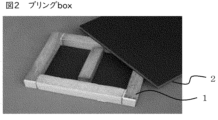
- FIG. FIG. 3 is a photographic diagram showing a container (bling box) used in Test Example 4 in which the prepared bait agent is placed.
- FIG. 2 is a schematic diagram showing a side surface of an injection molded product (molded product size ⁇ 10 ⁇ height 200 mm) used for injection of a drug in Test Example 6. Each number represents the length, and the unit is mm.
- FIG. 6 is a schematic diagram showing from the side the installation situation of a box-shaped container, an untreated pile, and a stick-shaped termiticide used in Test Example 6. Each numerical value indicated by a straight arrow represents a length, and the unit is mm.
- the highly transmissible termite control composition of the present invention is non-repellent to termites, has high insecticidal activity that causes termites to become inactive, agonize, and die at a very small effective dose, and is effective against termites that come into contact with the drug. It is characterized by high propagation performance because it contains dichloromesothiaz as an active ingredient, which has a moderately slow-acting effect that becomes effective after the insects return to their nests (colonies).
- the terms "high propagation performance” and “high propagation properties” refer to the excellent propagation properties of a composition, compound, or medium such as soil.
- high propagation performance and “high propagation potential” refer to a propagation capability that exceeds that of existing termite control substances such as imidacloprid.
- propagation effect refers to the effect of a composition or compound that is transmitted from one termite individual to another termite individual so as to have some negative impact on the other termite individual.
- highly disseminable refers to compositions and compounds that have high dissemination properties, and means that those compositions and compounds have high dissemination properties.
- the highly transmissible termite control agent composition of the present invention for soil treatment or ant trail treatment, it is necessary to use an appropriate solid carrier and/or liquid carrier, etc. according to the commonly used formulation. If necessary, it is blended with adjuvants etc. in an appropriate proportion and dissolved, suspended, mixed, impregnated, adsorbed or adhered, and formulated into an appropriate dosage form depending on the purpose of use, such as an emulsion, solution, or aqueous suspension. (flowable agent), stick-like or chalk-like hardened rod-like agent, microcapsule agent, bait agent, granule agent, powder agent, etc. may be prepared and used by a known method.
- the object to which the termite control composition of the present invention is applied is not limited as long as it has a structure using wood. Examples of such objects include wood, houses made of wood, wooden buildings other than houses, furniture, crafts, and works of art.
- the content of dichloromesothiaz is 100 parts by weight for each entire preparation. (the same applies below), the amount is preferably 0.005 to 70 parts by weight, more preferably 0.01 to 50 parts by weight. These contents may be considered as effective amounts.
- the range specified by the symbol " ⁇ " in this specification represents a range that includes the numerical values shown at both ends of the symbol.
- the highly transmissible termite control agent composition of the present invention is used as a composition for soil treatment or ant track treatment
- its dosage form is not particularly limited.
- dosage forms used in these treatment methods include emulsions, liquids, aqueous suspensions, sticks or chalk-like solidified rods, microcapsules, granules, and powders.
- the content of dichloromesothiaz is preferably 0.005 to 5 parts by weight, and preferably 0.01 to 5 parts by weight. More preferably, the amount is 1 part by weight.
- the content of dichloromesothiaz may be 0.01 to 50 parts by weight, and 5 to 50 parts by weight. The amount is preferably 30 parts by weight, and more preferably 10 to 25 parts by weight.
- the aqueous suspension agent of the present invention one containing attapulgite is preferred at least in terms of the viscosity and stability of the agent.
- the content of dichloromesothiaz may be 0.01 to 50 parts by weight, and may be 0.1 to 20 parts by weight. It is preferably 1 to 10 parts by weight, more preferably 1 to 10 parts by weight.
- the content of dichloromesothiaz is preferably 0.05 to 20 parts by weight, and preferably 0.1 to 5 parts by weight. Parts by weight are even more preferred. These contents may be considered as effective amounts.
- fipronil 0.5% powder, Termidor Dust, a termite extermination powder sold by the former Aventis Crop Science Shionogi Co., Ltd. Environmental Science Division
- metaflumizone 50% powder, Agri Co., Ltd.
- dichloromesothiaz is dissolved in a suitable liquid carrier, and then impregnated into wood or cellulose substrate as bait, or Dichloromesothiaz is mixed or attached to wood base material powder and then molded and solidified, or dichloromesothiaz and cellulose powder are mixed and mixed with a suitable fixing agent or binder and then molded and solidified to make a bait agent. and use it.
- the content of dichloromesothiaz is preferably 0.0001 to 20 parts by weight, and preferably 0.001 to 20 parts by weight. More preferably, the amount is 10 parts by weight. These contents may be considered as effective amounts.
- solid carrier used in the highly propagating termite control agent composition of the present invention examples include quartz, clay, kaolinite, pyrophyllite, sericite, talc, bentonite, fubasami clay, ceramic, acid clay, attapulgite, zeolite, colemanite, Natural minerals such as diatomaceous earth and sulfur; Inorganic salts such as calcium carbonate, ammonium sulfate, sodium sulfate, potassium chloride; Organic solid carriers such as synthetic silicic acid, synthetic silicates, synthetic hydrated silicon oxides, hydrated silica, starch, cellulose, vegetable powders (e.g.
- Plastic carriers such as polyethylene, polypropylene, polyvinylidene chloride; Synthetic resins (polyester resins such as polypropylene, polyacrylonitrile, polymethyl methacrylate, and polyethylene terephthalate; Nylon resins such as nylon-6, nylon-11, nylon-66; polyamide resin, polyvinyl chloride, polyvinylidene chloride, vinyl chloride-propylene copolymer, etc.), urea, inorganic hollow bodies, plastic hollow bodies, activated carbon, fumed silica (white carbon), hydrophobic silica, chemical fertilizers ( ammonium sulfate, ammonium phosphorus, ammonium nitrate, urea, ammonium chloride, etc.), pumice, calcite, sepiolite, dolomite, olivine, pyroxene, amphibole, feldspar, alumina, vermiculite, perlite,
- liquid carriers examples include monohydric alcohols such as methanol, ethanol, propanol, isopropanol, and butanol, and polyhydric alcohols such as ethylene glycol, diethylene glycol, propylene glycol, hexylene glycol, polyethylene glycol, polypropylene glycol, and glycerin.
- monohydric alcohols such as methanol, ethanol, propanol, isopropanol, and butanol
- polyhydric alcohols such as ethylene glycol, diethylene glycol, propylene glycol, hexylene glycol, polyethylene glycol, polypropylene glycol, and glycerin.
- Alcohols such as; Polyhydric alcohol compounds such as propylene glycol ether; Ketones such as acetone, methyl ethyl ketone, methyl isobutyl ketone, diisobutyl ketone, cyclohexanone; Ethers such as ethyl ether, dioxane, ethylene glycol monoethyl ether, dipropyl ether, and tetrahydrofuran; Aliphatic hydrocarbons such as normal paraffins, naphthenes, isoparaffins, kerosene, mineral oil; Aromatic hydrocarbons such as benzene, toluene, xylene, solvent naphtha, alkylnaphthalene; Halogenated hydrocarbons such as dichloromethane, chloroform, carbon tetrachloride; Esters such as ethyl acetate, diisopropyl phthalate, dibutyl phthalate, dioctyl phthal
- Surfactants used as adjuvants such as dispersants, wetting agents, spreading agents, spreading agents, etc. in the highly propagating termite control agent composition of the present invention; binders, tackifiers, thickeners, colorants, Examples include freeze-reconstructing agents, anti-caking agents, disintegrants, decomposition inhibitors, pH regulators, light stabilizers, and anti-sedimentation agents. Other additives such as preservatives and plant pieces may be used as necessary. These additive components may be used alone or in combination of two or more.
- Surfactants suitable for use in the highly transmissible termite control compositions of the present invention can be any known in the art.
- Examples of surfactants used as dispersants, wetting agents, spreading agents, spreading agents, etc. include vegetable oil type nonionic surfactants, alcohol type nonionic surfactants, and polyoxyethylene/polyoxypropylene blocks.
- Examples include type nonionic surfactants, silicone type nonionic surfactants, and fluorine type nonionic surfactants.
- Examples of vegetable oil type nonionic surfactants include hydrogenated castor oil, polyoxyalkylene castor oil (e.g., polyoxyethylene castor oil, etc.), and polyoxyalkylene hydrogenated castor oil (e.g., polyoxyethylene hydrogenated castor oil, etc.). It will be done.
- Examples of alcohol type nonionic surfactants include polyoxyethylene alkyl ether, polyoxyethylene alkylaryl ether, poly(ethylene glycol-ran-propylene glycol) monobutyl ether, acetylene diol, polyoxyalkylene-added acetylene diol, and the like. can be mentioned.
- polyoxyethylene/polyoxypropylene block polymer type nonionic surfactants include polyoxyethylene/polyoxypropylene block polymers, polystyrene polyoxyethylene block polymers, alkyl polyoxyethylene/polyoxypropylene block polymer ethers, Examples include polyoxyethylene alkylamine, alkylphenyl polyoxyethylene/polyoxypropylene block polymer ether, and the like.
- alkylphenol type nonionic surfactants include polyoxyethylene alkylphenyl ether, polyoxyethylene dialkylphenyl ether, polyoxyalkylene benzylphenyl ether, polyoxyalkylene styrylphenyl ether, polyoxyethylene alkylphenyl ether formalin condensation Examples include things.
- sugar ester type nonionic surfactants include polyoxyethylene sorbitan fatty acid ester, polyoxyalkylene sorbitol fatty acid ester (e.g., polyoxyethylene sorbitol fatty acid ester, etc.), glycerin fatty acid ester, polyoxyethylene fatty acid amide, and sucrose. Examples include fatty acid esters.
- fatty acid ester type nonionic surfactants include sorbitan fatty acid ester, polyoxyethylene fatty acid ester, polyoxyethylene resin acid ester, and polyoxyethylene fatty acid diester.
- bisphenol type nonionic surfactant include polyoxybisphenyl ether, polyoxyethylene fatty acid bisphenyl ether, and the like.
- polyaromatic nonionic surfactant include polyoxyalkylene benzylphenyl ether, polyoxyalkylene styryl phenyl ether, and the like.
- silicone type nonionic surfactants include polyoxyethylene ether type silicone surfactants, polyoxyethylene ester type silicone surfactants, and the like.
- anionic surfactant examples include sulfate type anionic surfactants, sulfonate type anionic surfactants, phosphate type anionic surfactants, and carboxylic acid type anionic surfactants.
- sulfate-type anionic surfactants include alkyl sulfates, polyoxyethylene alkyl ether sulfates, polyoxyethylene alkylphenyl ether sulfates, polyoxyethylene styrylphenyl ether sulfates, alkylbenzene sulfonates, and alkylaryl sulfones.
- Examples thereof include acid salts, lignin sulfonates, alkyl sulfosuccinates, naphthalene sulfonates, alkylnaphthalene sulfonates, formalin condensate salts of naphthalene sulfonic acid, and polyoxyethylene/polyoxypropylene block polymer sulfates.
- sulfonate-type anionic surfactants include paraffin sulfonates, dialkyl sulfosuccinates, alkylbenzene sulfonates, monoalkylnaphthalene sulfonates, dialkylnaphthalene sulfonates, formalin condensate salts of alkylnaphthalene sulfonic acids, Examples include alkyl diphenyl ether disulfonates.
- phosphate-type anionic surfactants include polyoxyethylene alkyl ether phosphate, polyoxyethylene alkyl phenyl ether phosphate, polyoxyethylene dialkyl phenyl ether phosphate, polyoxyethylene styrylphenyl ether phosphate, and polyoxyethylene alkyl phenyl ether phosphate.
- examples include ethylene/polyoxypropylene block polymer phosphate and alkyl phosphate.
- carboxylic acid type anionic surfactants include fatty acid salts such as sodium fatty acid, potassium fatty acid, and ammonium fatty acid, polycarboxylic acid salts, polyacrylic acid salts, N-methyl-fatty acid sarcosinate, sodium resinate, and potassium resinate. resin acid salts, etc., and the like.
- Examples of the cationic surfactant include alkylamine salts, ammonium type cationic surfactants, and benzalkonium type cationic surfactants.
- Examples of the alkylamine salt include laurylamine hydrochloride, stearylamine hydrochloride, oleylamine hydrochloride, stearylamine acetate, stearylaminopropylamine acetate, alkyltrimethylammonium chloride, alkyldimethylbenzalkonium chloride, and the like.
- ammonium type cationic surfactants include methylpolyoxyethylene alkylammonium chloride, alkyl N-methylpyridinium bromide, mono- or dialkylmethylated ammonium chloride, and alkylpentamethylpropylene diamine chloride.
- examples of the benzalkonium type cationic surfactant include alkyldimethylbenzalkonium chloride, benzethonium chloride, octylphenoxyethoxyethyldimethylbenzyl ammonium chloride, and the like.
- amphoteric surfactant examples include amino acid type or betaine type amphoteric surfactants.
- betaine-type amphoteric surfactants include dialkyldiaminoethylbetaine, alkyldimethylbenzylbetaine, alkyldimethylaminoacetic acid betaine, coconut oil fatty acid amidopropyl betaine, and amidopropyl octanoate
- amino acid type include, for example, Examples include alkyldimethylamine oxide.
- fixing agents examples include casein, carboxymethylcellulose and its salts, dextrin, water-soluble starch, xanthan gum, guar gum, sucrose, polyvinylpyrrolidone, gum arabic, and polyvinyl.
- Alcohol polyethylene glycol, gelatin, alginic acid, xanthan gum, polyvinyl acetate, sodium polyacrylate, polyethylene glycol with an average molecular weight of 6,000 to 20,000, polyethylene oxide with an average molecular weight of 100,000 to 5 million, phospholipids (e.g.
- Attapulgite has a function as a thickener and/or a settling and solidifying agent in aqueous suspensions. These agents may be used alone or in combination of two or more.
- Things that can be used as dietary components and/or attracting components include, for example, monosaccharides such as glucose and xylose; Disaccharides such as sucrose and lactose; Polysaccharides such as cellulose, starch, dextrin, etc.; Amino acids, proteins, fragrances (including synthetic fragrances, natural fragrances, or blended fragrances thereof); Wood materials (e.g.
- coniferous trees such as red pine, black pine, and hemlock; hardwoods such as birch and pecan; and sugarcane pomace);
- Cellulose derivatives cellulose ethers or alkali metal salts thereof, such as methylcellulose, hydroxypropylcellulose, hydroxypropylmethylcellulose, carboxymethylcellulose, carboxymethylcellulose sodium salt, etc.
- Examples include plant extracts, animal extracts, signpost pheromones, and the like. These may be used alone or in combination of two or more. Particularly preferred are wood materials, cellulose, and cellulose derivatives.
- Powders containing cellulose as a main component include cellulose powder, sawdust, wood flour, etc.
- wood powder the wood species preferred by termites are preferably cherry, oak, pine, spruce, etc. Cedar and the like are preferred.
- a fixing agent for solidifying powders whose main component is cellulose artificially synthesized ones such as tab powder, starch powder, glutinous rice, vinyl acetate emulsion type, synthetic rubber type, epoxy resin type, cyanoacrylate type, and vinyl chloride type are used.
- a fixing agent or the like it is preferable to use tab flour, starch powder, or glutinous rice.
- the blending amount of the fixing agent is desirably 20 parts by weight or more and 60 parts by weight or less per 100 parts by weight of the powder whose main component is cellulose.
- the highly transmissible termite control agent composition of the present invention can be applied to soil treatment by spraying and mixing it into the soil, ant trail treatment by blowing a small amount of powder into termite ant trails, and injecting a bait agent (poison bait) into the soil. It can be used in the bait construction method.
- soil treatment refers to spraying on subfloor soil and soil around building foundations using a spray gun, soil injection treatment in which a chemical solution is sent under high pressure to a nozzle inserted into the soil, and soil treatment in which a chemical solution is sent into a stick shape using pulp or the like.
- composition and shape of the highly transmissible termite control agent composition used for soil treatment of the present invention are not limited, and the composition is a liquid obtained by adding dichloromesothiaz and water to a molding material containing pulp, cellulose fibers, and starch. Examples include those obtained by injection molding. Bars are especially good.
- the size of the rod-shaped agent of the present invention is not limited, and examples thereof include an outer diameter of about 8 mm to 12 mm and a length (height) of about 180 mm to 220 mm.
- the content of dichloromesothiaz in the rod-shaped agent of the present invention is also not limited, and is exemplified by about 2.0% by weight to about 4.0% by weight.
- the number of sticks of the present invention to be installed and the installation method are not limited, and for example, they may be installed by driving them around an object that requires termite control at intervals of about 25 cm to about 35 cm.
- the termite control composition comprising the rod-shaped termiticide of the present invention preferably exhibits a control effect on termites such as the domestic termite within about one year.
- the termite control agent composition comprising the rod-shaped agent (stick-shaped termiticide) of the present invention more preferably exhibits a controlling effect on termites such as the domestic termite within about one year, and then for about two years or more than two years. maintain.
- Ant track treatment in the present invention is a treatment method in which a small amount of powder of a drug in any dosage form is blown into the termite track as described above.
- An ant trail is a tunnel-like path made by mounding soil for termites to block dry air and sunlight above ground.
- a treatment method may be used in which powder or the like is blown into a hole made in a part of the ant trail using a sprayer or the like.
- the highly transmissible termite control agent composition of the present invention can also be used in a method of administering to termite habitats, feeding damage sites, underground, and into xylem.
- Such an administration method involves investigating termites in a building using an existing termite detector, making holes in areas where termites live or are feeding on them, and administering the present termite control composition into the holes. , a method for controlling termites.
- the diameter of the hole when making the hole is preferably about 20 mm or less.
- termites By filling the termite control composition of the present invention preferably at intervals of about 30 cm to about 3 m, termites can be prevented in a preventive manner. Furthermore, holes are drilled in advance at intervals of about 3 cm to about 2 m, preferably about every 5 cm to about 30 cm, in the wood that is susceptible to damage by termites using an electric drill, and the present termite control composition is administered into the holes. By doing so, termites can be controlled preventively.
- the amount of the termite control composition of the present invention to be treated in the method of the present invention is not limited as long as the desired effect is achieved. Such treatment amount is, for example, 0.001 to 100 g/m 2 , preferably 0.001 to 10 g/m 2 as the amount of dichloromesothiaz.
- bait construction method refers to a treatment method in which wood that has been impregnated with a chemical in the soil, or a molded and solidified wood base material or cellulose base material that has been mixed and adhered with a chemical, is buried and installed in the soil. shows.
- a drug may be placed in an arbitrary container and the container may be installed.
- An example of such a container is a bling box.
- a method using a bait agent containing about 10 ppm to about 100 ppm of dichloromesothiaz is preferred.
- Wood for example, unprocessed trees, construction timbers and elements, various finished wood products (logs and planks, planks and lumber, with large surface areas such as slabs, siding, square timbers, wall elements, etc.) elements, furniture, boxes, pallets, containers, vessels, outdoor furniture and other wood products), import and export wood, lumber material wood, wood beams, wood vehicles, outdoor fixed structures (wooden buildings, wooden balconies, telephone poles, wooden fences, racks, poles, wooden piers, components of bridges and piers, jetties, railway sleepers, boat piers), wooden windows and doors, residential construction, woodworking and construction.
- Wood-containing materials such as joinery and wood products used in the industry, wood products or wood/plastic composites (WPC; thermoplastically processable composites made of wood, plastics and additives), plywood, chipboard, fibres. boards, oriented strand boards (OSB), composite boards, diatomaceous earth panels, and the like.
- WPC wood/plastic composites
- OSB oriented strand boards
- the highly transmissible termite control agent composition of the present invention is suitable for controlling termites, such as Reticulitermes amamianus, Incisitermes minor, Coptotermes formosanus Shiraki, and Hodotermopsis japonica. ), Glyptotermes fuscus, Reticulitermes sp., Reticulitermes flaviceps amamianus, Glyptotermes kushimensis, Coptotermes guangzhoensis, Neotermes koshunensis, Kodama termite (Glyptotermes kodamai), Glyptotermes satsumensis, Hodotermitidae, Cryptotermes domesticus (Haviland), Odontotermes formosanus (Shiraki), Nasutitermes takasagoensis, Glyptoterm es nakajimai), Pericapritermes nitobei, Reticulitermes miyatakei, Musha termite (
- the termite control agent composition of the present invention preferably exhibits at least the same effect in controlling termites as a composition containing a compound used in a neonicotinoid termite control agent.
- Examples of compounds used in neonicotinoid termite control agents include imidacloprid, clothianidin, dinotefuran, and thiamethoxam.
- the termite control agent composition of the present invention preferably exhibits at least the same effect in controlling termites as the slow-acting termite control agent.
- Examples of compounds used in the slow-acting termite control agent include fipronil, chlorantraniliprole, chlorfenapyr, and profuranilide.
- test examples of the present invention are illustrated below, but the present invention is not limited to these.
- "part” indicates “part by weight (%W/W)”.
- the method for preparing the chemically treated soil in the test example is the one specified in the Japan Wood Preservation Association Standards JWPA-TS-(1) (2016) "Performance standards and test methods for termiticides, etc. for soil treatment”. The treatment was carried out according to the soil preparation method.
- Formulation example 1 67.3 parts of water, 3.0 parts of acrylic acid copolymer, 2.0 parts of poly(ethylene glycol-ran-propylene glycol) monobutyl ether, 6.8 parts of propylene glycol, 0.5 parts of dimethylpolysiloxane, 1,2- Add 0.2 parts of benzisothiazolin-3-one, mix and dissolve with a stirrer, then add 19.0 parts of dichloromesothiaz, disperse, and finely grind with a wet grinder until the average particle size is 1.0 ⁇ m. A pulverized product was obtained. 0.2 parts of xanthan gum and 1.0 parts of attapulgite were added to this pulverized product and mixed uniformly to obtain an aqueous suspension composition (aqueous suspension).
- Test example 1 Drug efficacy test against Coptotermes Formosanus Shiraki 99.875 parts of water was added to 0.125 parts of the aqueous suspension composition shown in Formulation Example 1 to prepare a test drug solution containing 0.023 parts of dichloromesothiaz. did.
- a glass Petri dish with a diameter of 90 mm was filled with hardened plaster, and 15 ml each of the test chemical solution of the example and the test chemical solution of the comparative example were evenly dropped over the entire surface of the plaster, and then the worker ants of the house termite (Coptotermes Formosanus Shiraki) Ten insects were released, and the cells were placed in a constant temperature room (25° C./60% relative humidity) with a lid. Observe the number of abnormal insects and the number of dead insects in the released Termite every hour until 10 hours have passed from immediately after releasing the Termite, and calculate the abnormal insect rate + death insect rate using the following [Equation 1]. It was calculated as the abnormality/mortality rate (%), and the speed of onset of effect of each drug was compared. Each test drug was tested in 1 Petri dish in 1 area, and the tests were conducted in duplicate. The results are shown in Table 1.
- Test example 2 Test of propagation treatment effect on Coptotermes Formosanus Shiraki 99.875 parts of water was added to 0.125 parts of the aqueous suspension composition shown in Formulation Example 1 to prepare a test chemical solution containing 0.023 parts of dichloromesothiaz. Prepared.
- practical concentration water dilutions of four commercially available neonicotinoid termite control agents and four delayed-acting termite control agents listed in Table 2 were prepared as test chemical solutions.
- “Drug concentration (%)” indicates the concentration of each active ingredient contained in the composition or termite control agent of the present invention
- “Test drug concentration (%)” indicates the concentration of each active ingredient in the prepared test drug solution. Indicates the concentration of active ingredient.
- the termite control agent composition of the present invention has primary spreadability and secondary spreadability that are superior to conventional agents.
- Test example 3 Extermination test against Coptotermes Formosanus Shiraki using a simulated ant trail using powder (propagation treatment effectiveness test) 50 mg of each powder consisting of 0.5% by weight of dichloromesothiaz, 96.5% by weight of polyethylene, and 3.0% by weight of hydrophobic silica was spread thinly in a petri dish. Twenty worker ants (Coptotermes Formosanus Shiraki) were placed there and left in contact with the chemical for 10 minutes. Termite worker ants exposed to the above chemical were transferred to a test plot where 5 g of mountain soil was moistened with 1 ml of distilled water at a field test site in Kagoshima. House termites were observed over time, and the rate of abnormal and dead insects (abnormal and dead insect rate) was investigated.
- control drugs such as fipronil (0.5% powder, termite extermination powder Termidor Dust, formerly sold by Aventis Crop Science Shionogi Co., Ltd.'s Environmental Science Division), and metaflumizone (The secondary propagation effect was investigated using a 50% powder (Agrimart Co., Ltd./Colony Buster) and a powder base material (no active ingredient) as an untreated control, using the abnormality/mortality rate (%) as an index. The results are shown in Table 7.
- Test example 4 Field tests on houses and buildings where damage and activity by the Japanese termite have been confirmed in areas where the termite (Coptotermes Formosanus Shiraki) inhabits west of Kansai. ) effects were confirmed at houses and buildings where damage and activity was confirmed.
- the amount of injection was approximately 1g per location, and approximately 10 to 15g per site (the amount was increased or decreased depending on the number of ant trails per site and the situation of the damaged area).
- the first survey was conducted 2 to 3 weeks after application of the chemical, and the effectiveness was confirmed by observing the ant trails and damaged areas (presence of living insects and presence of carcasses). The results are shown in Table 8.
- the termite control agent composition (powder) of the present invention has a control effect against termites even in sites where termites are infested.
- Test example 5 Field test for exterminating house termites (Coptotermes Formosanus Shiraki) using a bait containing dichloromesothiaz. Shake 2 g of dichloromesothiaz into 198 g of powdered cellulose (KC-200Y/manufactured by Nippon Paper Industries Co., Ltd.) in a PP bag. They were mixed to make a 10,000 ppm bulk powder. Based on the bulk powder, the bait was diluted 1,000 ppm, 100 ppm, and 10 ppm by 10 times in the same manner to obtain a bait agent with a predetermined concentration. The method of installing the prepared bait agent as shown in FIG.
- the termite control agent composition of the present invention even in the form of a bait agent, has a control effect on termites, even at sites where termites are infested.
- Test example 6 Field test for extermination of Coptotermes Formosanus Shiraki using PIM, a stick type termiticide containing dichloromesothiaz.
- a chemical treatment was performed using a stick-shaped termiticide 3 produced by injection (molded product size ⁇ 10 ⁇ height 200 mm, see FIG. 3).
- the termite control composition of the present invention exhibits a control effect against domestic termites within at least one year and lasts for at least two years using a stick-form termite control agent, especially pulp injection molded PIM. Became.
- This kind of termite control effect that is exhibited at an early stage and continues for a long period of time is a particularly remarkable effect that conventional termite control agents do not have.
- composition containing dichloromesothiaz as an active ingredient was found to be more effective in controlling the spread of termites than the existing agent as a comparative example.
- the present invention uses dichloromesothiaz as an active ingredient, which is non-repellent to termites, moderately slow-acting, and has extremely high insecticidal activity. It is possible to provide a termite control agent composition or a termite control agent that has superior propagation performance.
Landscapes
- Life Sciences & Earth Sciences (AREA)
- Pest Control & Pesticides (AREA)
- Health & Medical Sciences (AREA)
- General Health & Medical Sciences (AREA)
- Environmental Sciences (AREA)
- Wood Science & Technology (AREA)
- Zoology (AREA)
- Engineering & Computer Science (AREA)
- Plant Pathology (AREA)
- Dentistry (AREA)
- Agronomy & Crop Science (AREA)
- Insects & Arthropods (AREA)
- Toxicology (AREA)
- Chemical & Material Sciences (AREA)
- Chemical Kinetics & Catalysis (AREA)
- General Chemical & Material Sciences (AREA)
- Dispersion Chemistry (AREA)
- Food Science & Technology (AREA)
- Birds (AREA)
- Agricultural Chemicals And Associated Chemicals (AREA)
- Catching Or Destruction (AREA)
Priority Applications (1)
| Application Number | Priority Date | Filing Date | Title |
|---|---|---|---|
| US18/857,056 US20250255304A1 (en) | 2022-04-26 | 2022-05-25 | Highly transmissible termite controlling composition |
Applications Claiming Priority (2)
| Application Number | Priority Date | Filing Date | Title |
|---|---|---|---|
| JP2022-072649 | 2022-04-26 | ||
| JP2022072649A JP2023161977A (ja) | 2022-04-26 | 2022-04-26 | 高伝播性シロアリ防除剤組成物 |
Publications (1)
| Publication Number | Publication Date |
|---|---|
| WO2023210027A1 true WO2023210027A1 (ja) | 2023-11-02 |
Family
ID=88518212
Family Applications (1)
| Application Number | Title | Priority Date | Filing Date |
|---|---|---|---|
| PCT/JP2022/021345 Ceased WO2023210027A1 (ja) | 2022-04-26 | 2022-05-25 | 高伝播性シロアリ防除剤組成物 |
Country Status (3)
| Country | Link |
|---|---|
| US (1) | US20250255304A1 (https=) |
| JP (1) | JP2023161977A (https=) |
| WO (1) | WO2023210027A1 (https=) |
Citations (3)
| Publication number | Priority date | Publication date | Assignee | Title |
|---|---|---|---|---|
| JP2013501061A (ja) * | 2009-08-05 | 2013-01-10 | イー・アイ・デュポン・ドウ・ヌムール・アンド・カンパニー | メソイオン性殺虫剤 |
| WO2017104692A1 (ja) * | 2015-12-15 | 2017-06-22 | Meiji Seikaファルマ株式会社 | シロアリ防除剤 |
| JP2021066661A (ja) * | 2018-02-09 | 2021-04-30 | 全国農業協同組合連合会 | 有害生物防除用組成物 |
-
2022
- 2022-04-26 JP JP2022072649A patent/JP2023161977A/ja active Pending
- 2022-05-25 US US18/857,056 patent/US20250255304A1/en active Pending
- 2022-05-25 WO PCT/JP2022/021345 patent/WO2023210027A1/ja not_active Ceased
Patent Citations (3)
| Publication number | Priority date | Publication date | Assignee | Title |
|---|---|---|---|---|
| JP2013501061A (ja) * | 2009-08-05 | 2013-01-10 | イー・アイ・デュポン・ドウ・ヌムール・アンド・カンパニー | メソイオン性殺虫剤 |
| WO2017104692A1 (ja) * | 2015-12-15 | 2017-06-22 | Meiji Seikaファルマ株式会社 | シロアリ防除剤 |
| JP2021066661A (ja) * | 2018-02-09 | 2021-04-30 | 全国農業協同組合連合会 | 有害生物防除用組成物 |
Non-Patent Citations (11)
| Title |
|---|
| "Nexus Z20WSC", 18 April 2022 (2022-04-18), Retrieved from the Internet <URL:https://www.agrimart.co.jp/product/> * |
| "NEXUS Z800 Product Catalog", 1 June 2021 (2021-06-01), pages 1 - 4, XP093103793, Retrieved from the Internet <URL:https://www.agrimart.co.jp/wp-content/uploads/2021/06/catalog_nexusZ800.pdf> * |
| "Nexus Z800", 1 September 2021 (2021-09-01), Retrieved from the Internet <URL:https://www.agrimart.co.jp/product/> * |
| "Sekisan Shiryo (surveying information) Pocket Edition WEB. Nexus Z800", 1 September 2021 (2021-09-01), Retrieved from the Internet <URL:http://www.pocket-ban.com/details/ci0506100_mi330714> * |
| ANONYMOUS: "Announcement regarding "Nexus Z800" termite control agent for new soil treatment", PRODUCT INFORMATION, 27 May 2021 (2021-05-27), XP093103767, Retrieved from the Internet <URL:https://www.nichino.co.jp/contents/000003556.pdf> * |
| ANONYMOUS: "Announcement regarding the launch of the new soil treatment termite control agent "Nexus Z800" | Nihon Nohyaku", 27 May 2021 (2021-05-27), XP093103783, Retrieved from the Internet <URL:http://prcross.net/4997/76767759fcb9c07c2cdcd575c6d97d1d/> * |
| ANONYMOUS: "Knowledge of chemicals No. 9 About the new soil treatment agent Nexus Zeta 800 | Literature information | J-GLOBAL Science and Technology Link Center", 1 July 2021 (2021-07-01), XP093103788, Retrieved from the Internet <URL:https://jglobal.jst.go.jp/detail?JGLOBAL_ID=202102288468925462> * |
| ANONYMOUS: "New termite control agent for soil treatment "Nexus Z800" released jointly developed with Nihon Nohyaku and others | News | Pesticides | JAcom Agricultural Cooperative Newspaper", 28 May 2021 (2021-05-28), XP093103773, Retrieved from the Internet <URL:https://www.jacom.or.jp/nouyaku/news/2021/05/210528-51565.php> * |
| ANONYMOUS: "Nexus Z800 launched, termite control agent for soil treatment ~Japan Nohaku etc.~", 31 May 2021 (2021-05-31), XP093103777, Retrieved from the Internet <URL:https://www.nouson-n.com/media/2021/05/31/6506> * |
| ANONYMOUS: "Termite agent for soil treatment "Nexus Z (Zeta) 800" released | Nihon Nohyō Shimbunsha", 31 May 2021 (2021-05-31), XP093103781, Retrieved from the Internet <URL:https://agripress.co.jp/archives/11843> * |
| FUJIMOTO IZUMI, YOSHIMURA TSUYOSHI : "Evaluation method for transfer effect of termiticides", MOKUZAI HOZON (WOOD PROTECTION), vol. 48, no. 1, 1 January 2022 (2022-01-01), pages 18 - 22, XP093103803 * |
Also Published As
| Publication number | Publication date |
|---|---|
| US20250255304A1 (en) | 2025-08-14 |
| JP2023161977A (ja) | 2023-11-08 |
Similar Documents
| Publication | Publication Date | Title |
|---|---|---|
| KR100232245B1 (ko) | 헥사플루무론 및 관련 화합물의 흰개미살충제로서의 신규한 용도 | |
| US9974308B2 (en) | Liquid termiticide compositions of pyrethroids and neonicitinoids | |
| US6841570B2 (en) | Materials and methods for controlling wood-boring insects | |
| US20220304306A1 (en) | Termiticide composition and methods for treating termites | |
| DE69721758T2 (de) | Köder zur bekämpfung von schuppenameisen | |
| EP3316686B1 (en) | A composition and method of controlling pests | |
| US20170150722A1 (en) | Use of active compound compositions | |
| WO2023210027A1 (ja) | 高伝播性シロアリ防除剤組成物 | |
| WO2014149684A1 (en) | Fluid bait formulations and their use with active termite infestation | |
| AU2004206964A1 (en) | Termiticide compositions | |
| AU2006214661A1 (en) | Method for controlling termites using liquid termiticides in a bait formulation | |
| ES2273395T3 (es) | Arilpirroles para la proteccion de madera, productos de madera y estructuras de madera contra ataques de insectos. | |
| JP5337831B2 (ja) | 農園芸上有害な害虫の防除用組成物及び農園芸上有害な害虫の防除方法 | |
| KR101250424B1 (ko) | 목재톱밥을 주요 성분으로 함유하는 흰개미 유인 및 살충용 조성물 | |
| JP4745651B2 (ja) | 有害生物防除用組成物及び有害生物の防除方法 | |
| JPH03128305A (ja) | 殺虫組成物 | |
| JP2002363020A (ja) | シロアリ嗜好物 | |
| AU2005306648A1 (en) | Method for control of termite populations | |
| JPH11217310A (ja) | 木材保存剤 | |
| JPS62103001A (ja) | 白アリ用防除剤 | |
| JPS5925307A (ja) | 土壌処理方法 | |
| JPS59225904A (ja) | 木材の防虫方法 |
Legal Events
| Date | Code | Title | Description |
|---|---|---|---|
| 121 | Ep: the epo has been informed by wipo that ep was designated in this application |
Ref document number: 22938748 Country of ref document: EP Kind code of ref document: A1 |
|
| REG | Reference to national code |
Ref country code: BR Ref legal event code: B01A Ref document number: 112024020661 Country of ref document: BR |
|
| WWE | Wipo information: entry into national phase |
Ref document number: 18857056 Country of ref document: US |
|
| WWE | Wipo information: entry into national phase |
Ref document number: 12024552495 Country of ref document: PH |
|
| WWE | Wipo information: entry into national phase |
Ref document number: 202447090997 Country of ref document: IN |
|
| NENP | Non-entry into the national phase |
Ref country code: DE |
|
| ENP | Entry into the national phase |
Ref document number: 112024020661 Country of ref document: BR Kind code of ref document: A2 Effective date: 20241004 |
|
| 122 | Ep: pct application non-entry in european phase |
Ref document number: 22938748 Country of ref document: EP Kind code of ref document: A1 |
|
| WWP | Wipo information: published in national office |
Ref document number: 18857056 Country of ref document: US |