WO2023203425A1 - 半導体装置及び半導体装置の作製方法 - Google Patents
半導体装置及び半導体装置の作製方法 Download PDFInfo
- Publication number
- WO2023203425A1 WO2023203425A1 PCT/IB2023/053563 IB2023053563W WO2023203425A1 WO 2023203425 A1 WO2023203425 A1 WO 2023203425A1 IB 2023053563 W IB2023053563 W IB 2023053563W WO 2023203425 A1 WO2023203425 A1 WO 2023203425A1
- Authority
- WO
- WIPO (PCT)
- Prior art keywords
- layer
- insulating layer
- conductive layer
- insulating
- conductive
- Prior art date
- Legal status (The legal status is an assumption and is not a legal conclusion. Google has not performed a legal analysis and makes no representation as to the accuracy of the status listed.)
- Ceased
Links
Images


































Classifications
-
- H—ELECTRICITY
- H10—SEMICONDUCTOR DEVICES; ELECTRIC SOLID-STATE DEVICES NOT OTHERWISE PROVIDED FOR
- H10D—INORGANIC ELECTRIC SEMICONDUCTOR DEVICES
- H10D30/00—Field-effect transistors [FET]
- H10D30/60—Insulated-gate field-effect transistors [IGFET]
- H10D30/67—Thin-film transistors [TFT]
- H10D30/6757—Thin-film transistors [TFT] characterised by the structure of the channel, e.g. transverse or longitudinal shape or doping profile
-
- H—ELECTRICITY
- H10—SEMICONDUCTOR DEVICES; ELECTRIC SOLID-STATE DEVICES NOT OTHERWISE PROVIDED FOR
- H10D—INORGANIC ELECTRIC SEMICONDUCTOR DEVICES
- H10D30/00—Field-effect transistors [FET]
- H10D30/60—Insulated-gate field-effect transistors [IGFET]
- H10D30/67—Thin-film transistors [TFT]
- H10D30/6729—Thin-film transistors [TFT] characterised by the electrodes
- H10D30/673—Thin-film transistors [TFT] characterised by the electrodes characterised by the shapes, relative sizes or dispositions of the gate electrodes
- H10D30/6733—Multi-gate TFTs
-
- H—ELECTRICITY
- H10—SEMICONDUCTOR DEVICES; ELECTRIC SOLID-STATE DEVICES NOT OTHERWISE PROVIDED FOR
- H10D—INORGANIC ELECTRIC SEMICONDUCTOR DEVICES
- H10D86/00—Integrated devices formed in or on insulating or conducting substrates, e.g. formed in silicon-on-insulator [SOI] substrates or on stainless steel or glass substrates
- H10D86/40—Integrated devices formed in or on insulating or conducting substrates, e.g. formed in silicon-on-insulator [SOI] substrates or on stainless steel or glass substrates characterised by multiple TFTs
- H10D86/60—Integrated devices formed in or on insulating or conducting substrates, e.g. formed in silicon-on-insulator [SOI] substrates or on stainless steel or glass substrates characterised by multiple TFTs wherein the TFTs are in active matrices
-
- G—PHYSICS
- G09—EDUCATION; CRYPTOGRAPHY; DISPLAY; ADVERTISING; SEALS
- G09F—DISPLAYING; ADVERTISING; SIGNS; LABELS OR NAME-PLATES; SEALS
- G09F9/00—Indicating arrangements for variable information in which the information is built-up on a support by selection or combination of individual elements
-
- G—PHYSICS
- G09—EDUCATION; CRYPTOGRAPHY; DISPLAY; ADVERTISING; SEALS
- G09F—DISPLAYING; ADVERTISING; SIGNS; LABELS OR NAME-PLATES; SEALS
- G09F9/00—Indicating arrangements for variable information in which the information is built-up on a support by selection or combination of individual elements
- G09F9/30—Indicating arrangements for variable information in which the information is built-up on a support by selection or combination of individual elements in which the desired character or characters are formed by combining individual elements
-
- H—ELECTRICITY
- H05—ELECTRIC TECHNIQUES NOT OTHERWISE PROVIDED FOR
- H05B—ELECTRIC HEATING; ELECTRIC LIGHT SOURCES NOT OTHERWISE PROVIDED FOR; CIRCUIT ARRANGEMENTS FOR ELECTRIC LIGHT SOURCES, IN GENERAL
- H05B33/00—Electroluminescent light sources
- H05B33/10—Apparatus or processes specially adapted to the manufacture of electroluminescent light sources
-
- H—ELECTRICITY
- H05—ELECTRIC TECHNIQUES NOT OTHERWISE PROVIDED FOR
- H05B—ELECTRIC HEATING; ELECTRIC LIGHT SOURCES NOT OTHERWISE PROVIDED FOR; CIRCUIT ARRANGEMENTS FOR ELECTRIC LIGHT SOURCES, IN GENERAL
- H05B33/00—Electroluminescent light sources
- H05B33/12—Light sources with substantially two-dimensional [2D] radiating surfaces
- H05B33/14—Light sources with substantially two-dimensional [2D] radiating surfaces characterised by the chemical or physical composition or the arrangement of the electroluminescent material, or by the simultaneous addition of the electroluminescent material in or onto the light source
-
- H—ELECTRICITY
- H10—SEMICONDUCTOR DEVICES; ELECTRIC SOLID-STATE DEVICES NOT OTHERWISE PROVIDED FOR
- H10D—INORGANIC ELECTRIC SEMICONDUCTOR DEVICES
- H10D30/00—Field-effect transistors [FET]
- H10D30/01—Manufacture or treatment
- H10D30/021—Manufacture or treatment of FETs having insulated gates [IGFET]
- H10D30/031—Manufacture or treatment of FETs having insulated gates [IGFET] of thin-film transistors [TFT]
- H10D30/0318—Manufacture or treatment of FETs having insulated gates [IGFET] of thin-film transistors [TFT] of vertical TFTs
-
- H—ELECTRICITY
- H10—SEMICONDUCTOR DEVICES; ELECTRIC SOLID-STATE DEVICES NOT OTHERWISE PROVIDED FOR
- H10D—INORGANIC ELECTRIC SEMICONDUCTOR DEVICES
- H10D30/00—Field-effect transistors [FET]
- H10D30/60—Insulated-gate field-effect transistors [IGFET]
- H10D30/67—Thin-film transistors [TFT]
- H10D30/6704—Thin-film transistors [TFT] having supplementary regions or layers in the thin films or in the insulated bulk substrates for controlling properties of the device
- H10D30/6706—Thin-film transistors [TFT] having supplementary regions or layers in the thin films or in the insulated bulk substrates for controlling properties of the device for preventing leakage current
-
- H—ELECTRICITY
- H10—SEMICONDUCTOR DEVICES; ELECTRIC SOLID-STATE DEVICES NOT OTHERWISE PROVIDED FOR
- H10D—INORGANIC ELECTRIC SEMICONDUCTOR DEVICES
- H10D30/00—Field-effect transistors [FET]
- H10D30/60—Insulated-gate field-effect transistors [IGFET]
- H10D30/67—Thin-film transistors [TFT]
- H10D30/6728—Vertical TFTs
-
- H—ELECTRICITY
- H10—SEMICONDUCTOR DEVICES; ELECTRIC SOLID-STATE DEVICES NOT OTHERWISE PROVIDED FOR
- H10D—INORGANIC ELECTRIC SEMICONDUCTOR DEVICES
- H10D30/00—Field-effect transistors [FET]
- H10D30/60—Insulated-gate field-effect transistors [IGFET]
- H10D30/67—Thin-film transistors [TFT]
- H10D30/6729—Thin-film transistors [TFT] characterised by the electrodes
-
- H—ELECTRICITY
- H10—SEMICONDUCTOR DEVICES; ELECTRIC SOLID-STATE DEVICES NOT OTHERWISE PROVIDED FOR
- H10D—INORGANIC ELECTRIC SEMICONDUCTOR DEVICES
- H10D30/00—Field-effect transistors [FET]
- H10D30/60—Insulated-gate field-effect transistors [IGFET]
- H10D30/67—Thin-film transistors [TFT]
- H10D30/6729—Thin-film transistors [TFT] characterised by the electrodes
- H10D30/673—Thin-film transistors [TFT] characterised by the electrodes characterised by the shapes, relative sizes or dispositions of the gate electrodes
-
- H—ELECTRICITY
- H10—SEMICONDUCTOR DEVICES; ELECTRIC SOLID-STATE DEVICES NOT OTHERWISE PROVIDED FOR
- H10D—INORGANIC ELECTRIC SEMICONDUCTOR DEVICES
- H10D30/00—Field-effect transistors [FET]
- H10D30/60—Insulated-gate field-effect transistors [IGFET]
- H10D30/67—Thin-film transistors [TFT]
- H10D30/6729—Thin-film transistors [TFT] characterised by the electrodes
- H10D30/673—Thin-film transistors [TFT] characterised by the electrodes characterised by the shapes, relative sizes or dispositions of the gate electrodes
- H10D30/6736—Thin-film transistors [TFT] characterised by the electrodes characterised by the shapes, relative sizes or dispositions of the gate electrodes characterised by the shape of gate insulators
-
- H—ELECTRICITY
- H10—SEMICONDUCTOR DEVICES; ELECTRIC SOLID-STATE DEVICES NOT OTHERWISE PROVIDED FOR
- H10D—INORGANIC ELECTRIC SEMICONDUCTOR DEVICES
- H10D30/00—Field-effect transistors [FET]
- H10D30/60—Insulated-gate field-effect transistors [IGFET]
- H10D30/67—Thin-film transistors [TFT]
- H10D30/674—Thin-film transistors [TFT] characterised by the active materials
- H10D30/6755—Oxide semiconductors, e.g. zinc oxide, copper aluminium oxide or cadmium stannate
-
- H—ELECTRICITY
- H10—SEMICONDUCTOR DEVICES; ELECTRIC SOLID-STATE DEVICES NOT OTHERWISE PROVIDED FOR
- H10K—ORGANIC ELECTRIC SOLID-STATE DEVICES
- H10K50/00—Organic light-emitting devices
- H10K50/10—OLEDs or polymer light-emitting diodes [PLED]
Definitions
- One embodiment of the present invention relates to a semiconductor device, a display device, a display module, and an electronic device.
- One embodiment of the present invention relates to a method for manufacturing a semiconductor device and a method for manufacturing a display device.
- one embodiment of the present invention is not limited to the above technical field.
- the technical fields of one embodiment of the present invention include semiconductor devices, display devices, light-emitting devices, power storage devices, storage devices, electronic devices, lighting devices, input devices (e.g., touch sensors), input/output devices (e.g., touch panels), and the like.
- An example of this is a method for driving the same or a method for producing the same.
- Semiconductor devices having transistors are widely used in display devices and electronic devices, and there is a demand for higher integration and higher speed of semiconductor devices. For example, when applying a semiconductor device to a high-definition display device, a highly integrated semiconductor device is required. 2. Description of the Related Art As one means of increasing the degree of integration of transistors, the development of microsized transistors is progressing.
- VR virtual reality
- AR augmented reality
- SR substitute reality
- MR mixed reality
- Display devices for XR are desired to have high definition and high color reproducibility in order to enhance the sense of reality and immersion.
- Examples of devices that can be applied to the display device include a liquid crystal display device, an organic EL (Electro Luminescence) device, or a light emitting device including a light emitting device (also referred to as a light emitting element) such as a light emitting diode (LED). It will be done.
- Patent Document 1 discloses a display device for VR using an organic EL device (also referred to as an organic EL element).
- An object of one embodiment of the present invention is to provide a semiconductor device having a microsized transistor and a method for manufacturing the same.
- an object of one embodiment of the present invention is to provide a small-sized semiconductor device and a method for manufacturing the same.
- an object of one embodiment of the present invention is to provide a semiconductor device including a transistor with high on-state current, and a method for manufacturing the same.
- an object of one embodiment of the present invention is to provide a semiconductor device with good electrical characteristics and a method for manufacturing the same.
- an object of one embodiment of the present invention is to provide a highly reliable semiconductor device and a method for manufacturing the same.
- an object of one embodiment of the present invention is to provide a method for manufacturing a semiconductor device with high productivity.
- an object of one embodiment of the present invention is to provide a novel semiconductor device and a method for manufacturing the same.
- One embodiment of the present invention includes a semiconductor layer, a first conductive layer, a second conductive layer, a third conductive layer, a fourth conductive layer, a first insulating layer, and a second insulating layer.
- the second conductive layer is provided on the first conductive layer, the second conductive layer has a first opening that overlaps with the first conductive layer, and the second conductive layer has a first opening that overlaps with the first conductive layer;
- the conductive layer is provided on the second conductive layer, the third conductive layer has a second opening that overlaps with the first opening, and the first insulating layer is provided on the second conductive layer.
- the semiconductor layer is in contact with the sidewall of the first opening, the semiconductor layer is in contact with the top surface of the first conductive layer, the side surface of the first insulating layer, and the top surface of the third conductive layer, and the second insulating layer is on the semiconductor layer.
- the fourth conductive layer is provided on the second insulating layer, and the first insulating layer is sandwiched between the sidewall of the first opening of the second conductive layer and the semiconductor layer.
- the semiconductor layer is a semiconductor device having a region sandwiched between the sidewall of the first opening of the second conductive layer and the fourth conductive layer.
- the first insulating layer has a region in contact with the sidewall of the second opening.
- the first conductive layer functions as one of the source and drain of the transistor
- the third conductive layer functions as the other of the source and drain of the transistor
- the second conductive layer functions as the other of the source and drain of the transistor.
- the fourth conductive layer functions as the first gate and the fourth conductive layer functions as the second gate of the transistor.
- the first conductive layer functions as one of the source and drain of the transistor
- the third conductive layer functions as the other of the source and drain of the transistor
- the fourth conductive layer functions as the other of the source and drain of the transistor.
- the second conductive layer functions as a first gate and is electrically connected to the first conductive layer.
- one embodiment of the present invention includes a semiconductor layer, a first conductive layer, a second conductive layer, a third conductive layer, a fourth conductive layer, a first insulating layer, and a second conductive layer.
- an insulating layer, a third insulating layer, and a fourth insulating layer, the first insulating layer is provided on the first conductive layer, and the first insulating layer is provided on the first conductive layer.
- the second conductive layer has a first opening that overlaps with the conductive layer, the second conductive layer is provided on the first insulating layer, and the second conductive layer has a second opening that overlaps with the first opening.
- the second insulating layer is provided on the second conductive layer, the second insulating layer has a third opening that overlaps with the first opening, and the third conductive layer has a third opening that overlaps with the first opening.
- the third conductive layer has a fourth opening that overlaps with the first opening, and the third insulating layer has a sidewall of the first opening and a sidewall of the second opening.
- the semiconductor layer is in contact with the top surface of the first conductive layer, the side surface of the third insulating layer, and the top surface of the third conductive layer
- the fourth insulating layer is in contact with the top surface of the first conductive layer, the side wall of the third conductive layer, and the side wall of the third opening.
- the fourth conductive layer is provided on the fourth insulating layer, and the third insulating layer is connected to the sidewall of the first opening of the first insulating layer and the semiconductor layer.
- the semiconductor layer is a semiconductor device having a region sandwiched between the sidewall of the second opening of the second conductive layer and a fourth conductive layer.
- the first insulating layer has a laminated structure of a first layer and a second layer on the first layer, and the first layer has a film density higher than that of the second layer. It is preferable that the area has a high area.
- the second insulating layer has a laminated structure of a third layer and a fourth layer on the third layer, and the fourth layer has a film density higher than that of the third layer. It is preferable that the area has a high area.
- the third insulating layer has a laminated structure of a fifth layer and a sixth layer, and the fifth layer has a region having a higher film density than the sixth layer.
- the fifth layer is preferably in contact with the sidewall of the first opening, the sidewall of the second opening, and the sidewall of the third opening, and the sixth layer is preferably in contact with the semiconductor layer.
- a first conductive layer is formed by forming a first conductive film and removing a portion of the first conductive film, and a first conductive layer is formed on the first conductive layer.
- forming an insulating film forming a second conductive film on the first insulating film, forming a second conductive layer by removing a portion of the second conductive film, and forming a second conductive layer on the second conductive layer; forming a second insulating film, forming a third conductive film on the second insulating film, forming a resist mask on the third conductive film using photolithography, and forming a resist mask on the third conductive film.
- a region that does not overlap with the resist mask is removed by etching to form a first opening
- a region that does not overlap with the resist mask is removed by etching to form a second opening
- a second conductive film is formed.
- a region that does not overlap with the resist mask is removed by etching to provide a third opening
- a region that does not overlap with the resist mask is removed by etching to provide a fourth opening. exposing the upper surface of the conductive layer, the upper surface of the third conductive film, the exposed upper surface of the first conductive layer, the side wall of the first opening, the side wall of the second opening, and the third opening.
- a third insulating film is formed to cover the sidewall of the fourth opening and the sidewall of the fourth opening, and the third insulating film is processed by anisotropic etching to form a sidewall insulating layer covering the sidewall of the third opening.
- the sidewall insulating layer covers the sidewall of the fourth opening and the sidewall of the second opening.
- the sidewall insulating layer covers the sidewall of the fourth opening, the sidewall of the second opening, and the sidewall of the first opening.
- a semiconductor device including a microsized transistor and a method for manufacturing the same can be provided.
- a small-sized semiconductor device and a method for manufacturing the same can be provided.
- a semiconductor device including a transistor with high on-current and a method for manufacturing the same can be provided.
- a semiconductor device with good electrical characteristics and a method for manufacturing the same can be provided.
- a highly reliable semiconductor device and a method for manufacturing the same can be provided.
- a method for manufacturing a semiconductor device with high productivity can be provided.
- one embodiment of the present invention can provide a novel semiconductor device and a method for manufacturing the same.
- FIG. 1A is a top view showing an example of a transistor.
- FIG. 1B is a cross-sectional view showing an example of a transistor.
- FIG. 2 is a cross-sectional view showing an example of a transistor.
- 3A and 3B are perspective views showing an example of a transistor.
- FIG. 4 is a cross-sectional view showing an example of a transistor.
- 5A to 5D are cross-sectional views showing an example of a transistor.
- FIG. 6 is a cross-sectional view showing an example of a transistor.
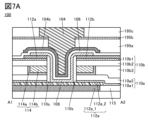
- 7A and 7B are cross-sectional views showing an example of a transistor.
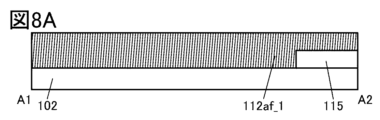
- 8A to 8D are cross-sectional views illustrating an example of a method for manufacturing a transistor.
- FIGS. 9A to 9D are cross-sectional views illustrating an example of a method for manufacturing a transistor.
- 10A to 10C are cross-sectional views showing an example of a transistor.
- 11A and 11B are cross-sectional views showing an example of a transistor.
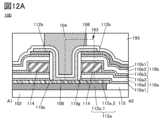
- 12A and 12B are cross-sectional views showing an example of a transistor.
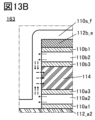
- 13A to 13D are cross-sectional views showing an example of a transistor.
- FIG. 14 is a perspective view showing an example of a display device.
- FIG. 15 is a cross-sectional view showing an example of a display device.
- FIG. 16 is a cross-sectional view showing an example of a display device.
- FIG. 17 is a cross-sectional view showing an example of a display device.
- FIG. 15 is a cross-sectional view showing an example of a display device.
- FIG. 16 is a cross-sectional view showing an example of a display device.
- FIG. 17 is a cross-sectional view
- FIG. 18 is a cross-sectional view showing an example of a display device.
- FIG. 19 is a cross-sectional view showing an example of a display device.
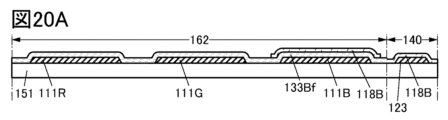
- 20A to 20F are cross-sectional views illustrating an example of a method for manufacturing a display device.
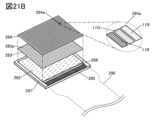
- 21A and 21B are diagrams illustrating an example of the configuration of a display device.
- FIG. 22 is a diagram illustrating a configuration example of a display device.
- FIG. 23 is a diagram showing a configuration example of a display device.
- FIG. 24 is a diagram showing a configuration example of a display device.
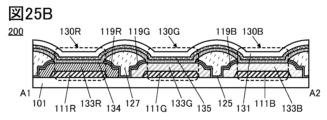
- 25A to 25C are diagrams illustrating configuration examples of a display device.
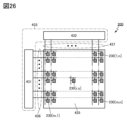
- FIG. 26 is a block diagram of the display device.
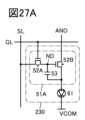
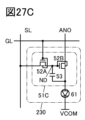
- 27A to 27D are circuit diagrams of pixel circuits.
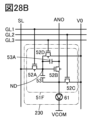
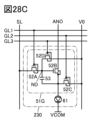
- 28A to 28D are circuit diagrams of pixel circuits.
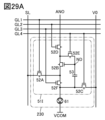
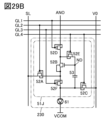
- 29A and 29B are circuit diagrams of pixel circuits.
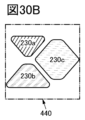
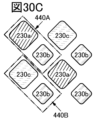
- 30A to 30G are diagrams showing examples of pixels.
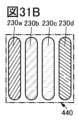
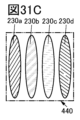
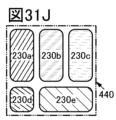
- 31A to 31K are diagrams showing examples of pixels.
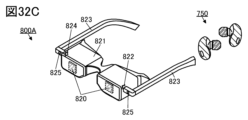
- 32A to 32D are diagrams illustrating an example of an electronic device.
- 33A to 33F are diagrams illustrating an example of an electronic device.
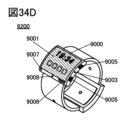
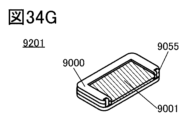
- 34A to 34G are diagrams illustrating an example of an electronic device.
- film and “layer” can be interchanged depending on the situation or circumstances.
- conductive layer can be changed to the term “conductive film.”
- insulating film can be changed to the term “insulating layer.”
- a device manufactured using a metal mask or an FMM may be referred to as a device with an MM (metal mask) structure.
- a device manufactured without using a metal mask or FMM may be referred to as a device with an MML (metal maskless) structure.
- SBS Side By Side
- materials and configurations can be optimized for each light emitting device, which increases the degree of freedom in selecting materials and configurations, making it easier to improve brightness and reliability.
- holes or electrons may be referred to as “carriers.”
- a hole injection layer or an electron injection layer is called a “carrier injection layer”
- a hole transport layer or an electron transport layer is called a “carrier transport layer”
- a hole blocking layer or an electron blocking layer is called a “carrier injection layer.”
- the carrier injection layer, carrier transport layer, and carrier block layer described above may not be clearly distinguishable depending on their respective cross-sectional shapes or characteristics.
- one layer may serve as two or three functions among a carrier injection layer, a carrier transport layer, and a carrier block layer.
- a light emitting device has an EL layer between a pair of electrodes.
- the EL layer has at least a light emitting layer.
- the layers (also referred to as functional layers) included in the EL layer include a light emitting layer, a carrier injection layer (a hole injection layer and an electron injection layer), a carrier transport layer (a hole transport layer and an electron transport layer), and a carrier Block layers (hole block layer and electron block layer) can be mentioned.
- a light-receiving device (also referred to as a light-receiving element) has an active layer that functions as at least a photoelectric conversion layer between a pair of electrodes.
- the term “island-like” refers to a state in which two or more layers made of the same material and formed in the same process are physically separated.
- an island-shaped light emitting layer indicates that the light emitting layer and an adjacent light emitting layer are physically separated.
- the term "tapered shape” refers to a shape in which at least a part of the side surface of the structure is inclined with respect to the substrate surface or the surface to be formed.
- a region where the angle between the inclined side surface and the substrate surface or the surface to be formed (also referred to as a taper angle) is less than 90 degrees, and preferably to have a region where the angle is 45 degrees or more and less than 90 degrees.
- the angle is greater than or equal to 85 degrees, more preferably an area where the angle is greater than or equal to 65 degrees and less than or equal to 85 degrees, further preferably an area where the angle is greater than or equal to 65 degrees and less than or equal to 80 degrees, and even more preferably greater than or equal to 70 degrees and less than or equal to 80 degrees. It is preferable to have a region of less than or equal to 100%. Note that the side surface of the structure, the substrate surface, and the surface to be formed do not necessarily have to be completely flat, and may be substantially planar with a minute curvature or substantially planar with minute irregularities.
- a mask layer also referred to as a sacrificial layer
- a light emitting layer is located above at least a light emitting layer (more specifically, a layer that is processed into an island shape among the layers constituting an EL layer), It has the function of protecting the light emitting layer during the manufacturing process.
- step breakage refers to a phenomenon in which a layer, film, or electrode is separated due to the shape of the surface on which it is formed (for example, a step difference).
- the upper surface shapes roughly match means that at least a portion of the outlines of the stacked layers overlap. For example, this includes a case where the upper layer and the lower layer are processed using the same mask pattern or partially the same mask pattern. However, strictly speaking, the contours may not overlap, and the upper layer may be located inside the lower layer, or the upper layer may be located outside the lower layer, and in this case, it is also said that the top surface shapes approximately match.
- the heights are approximately equal refers to a configuration in which the heights from a reference surface (for example, a flat surface such as a substrate surface) are approximately equal in cross-sectional view.
- a flattening process typically a CMP (Chemical Mechanical Polishing) process
- the heights of surfaces to be processed are approximately the same.
- the heights may not strictly match depending on the material of the film, etc., but in this specification, it is assumed that the heights "approximately match” in this case as well. .
- FIG. 1A A top view (also referred to as a plan view) of the transistor 100 is shown in FIG. 1A.
- FIG. 1B shows a sectional view taken along the dashed-dotted line A1-A2 shown in FIG. 1A
- FIG. 2 shows a sectional view taken along the dashed-dotted line B1-B2.
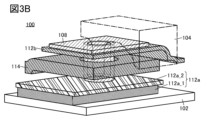
- FIG. 3A A perspective view of some of the components of the transistor 100 is shown in FIG. 3A, and a perspective view of the transistor 100 is shown in FIG. 3B, respectively.
- FIG. 1A some of the components of the transistor 100 (such as an insulating layer) are omitted.
- FIG. 3B a perspective view of the transistor 100
- Transistor 100 is provided on substrate 102.
- the transistor 100 includes a conductive layer 104, an insulating layer 106, a semiconductor layer 108, a conductive layer 114, an insulating layer 110s, a conductive layer 112a, and a conductive layer 112b.
- the conductive layer 104 functions as a gate electrode.
- Conductive layer 114 functions as a second gate electrode.
- a portion of the insulating layer 106 functions as a gate insulating layer.
- the insulating layer 110s functions as a second gate insulating layer.
- the conductive layer 112a functions as one of a source electrode and a drain electrode, and the conductive layer 112b functions as the other.
- the entire region between the source electrode and the drain electrode that overlaps with the gate electrode via the gate insulating layer functions as a channel formation region. Further, in the semiconductor layer 108, a region in contact with the source electrode functions as a source region, and a region in contact with the drain electrode functions as a drain region.
- An insulating layer 115 and a conductive layer 112a are provided on the substrate 102, an insulating layer 110a is provided on the conductive layer 112a, a conductive layer 114 is provided on the insulating layer 110a, and a conductive layer 114 is provided on the insulating layer 110a and the conductive layer 114.
- An insulating layer 110b is provided, and a conductive layer 112b is provided on the insulating layer 110b.
- the insulating layer 110a and the insulating layer 110b have a region sandwiched between the conductive layer 112a and the conductive layer 112b.
- the conductive layer 112a has a region overlapping with the conductive layer 112b via the insulating layer 110a and the insulating layer 110b.
- the insulating layer 110a has a stacked structure of an insulating layer 110a1 and an insulating layer 110a2 on the insulating layer 110a1.
- the insulating layer 110b has a stacked structure of an insulating layer 110b2 and an insulating layer 110b1 on the insulating layer 110b2.
- the conductive layer 114 has a region sandwiched between an insulating layer 110a2 and an insulating layer 110b2.
- the insulating layer 110a2 has a region in contact with the lower surface of the conductive layer 114.
- the insulating layer 110b2 is in contact with the upper surface of the conductive layer 114, for example.
- the insulating layer 110a, the conductive layer 114, the insulating layer 110b, and the conductive layer 112b each have an opening.
- Each opening has, for example, a region that overlaps with the conductive layer 112a.
- the insulating layer 110s is provided on the conductive layer 112a.
- the insulating layer 110s includes an opening in the insulating layer 110a (area not shown in the figure), an opening 142 in the conductive layer 114, an opening in the insulating layer 110b (area not shown in the figure), and an opening in the conductive layer 112b. 143 along each side wall.
- the side walls of the openings of the insulating layer 110a, the conductive layer 114, the insulating layer 110b, and the conductive layer 112b form a continuous side surface, and the insulating layer 110s is formed along the continuous side surface. is formed.
- the insulating layer 110s is sometimes called a sidewall, a sidewall insulating layer, a sidewall protective layer, or the like.
- the opening 142 and the opening 143 each have a region that overlaps with the conductive layer 112a. Further, the opening 142 and the opening 143 have regions that overlap with each other.
- the semiconductor layer 108 is provided along a recess (sometimes called a depression) whose bottom is the upper surface of the conductive layer 112a and whose inner wall is the side wall 141 of the insulating layer 110s.
- the semiconductor layer 108 overlaps with the conductive layer 112a in a region inside the sidewall 141 of the insulating layer 110s in plan view. In this region, the semiconductor layer 108 contacts, for example, the upper surface of the conductive layer 112a.
- the semiconductor layer 108 overlaps with the conductive layer 112b in a region outside the side wall 141 of the insulating layer 110s in plan view. In this region, the semiconductor layer 108 contacts, for example, the upper surface of the conductive layer 112b.
- the transistor 100 can be called a bottom contact transistor because the lower surface of the semiconductor layer 108 is in contact with the source electrode and the drain electrode.
- the semiconductor layer 108 has a region provided along the top surface of the conductive layer 112a, a region provided along the sidewall 141 of the insulating layer 110s, and a region provided along the top surface of the conductive layer 112b.
- the semiconductor layer 108 has a region facing the sidewall of the opening 142 with the insulating layer 110s interposed therebetween. Further, in this region, the semiconductor layer 108 is preferably in contact with the side wall 141 of the insulating layer 110s.
- FIG. 1B It may be a layer.
- a common material is used in several components that are successive layers.
- multiple components in one continuous layer may be fabricated, for example, in the same step.
- multiple components may be observed as one continuous layer.
- the insulating layer 110a2 and the insulating layer 110s may be observed as a continuous layer.
- the insulating layer 110b2 and the insulating layer 110s may be observed as a continuous layer.
- FIG. 4 shows an example of a cross section when the insulating layer 110a2, the insulating layer 110b2, and the insulating layer 110s are observed as a continuous layer (indicated as an insulating layer 110_2 in FIG. 4).
- the conductive layer 112a and the conductive layer 112b may each have a stacked structure.
- the conductive layer 112a has a stacked structure of a conductive layer 112a_1 and a conductive layer 112a_2 over the conductive layer 112a_1.
- the conductive layer 112a_1 is embedded in the opening of the insulating layer 115, and the upper surface of the conductive layer 112a_1 and the upper surface of the insulating layer 115 are flattened.
- the conductive layer 112a_2 is located on the conductive layer 112a_1 and the insulating layer 115.
- the structure is such that the height of the top surface of the insulating layer 115 and the height of the top surface of the conductive layer 112a_1 approximately match.
- FIG. 1B etc. show an example in which the end of the conductive layer 112a_2 is located outside the end of the conductive layer 112a_1, the end of the conductive layer 112a_2 is located inside the end of the conductive layer 112a_1. You may. Further, in the case of providing a plug that connects the conductive layer 112a and the upper conductive layer, the conductive layer 112a_1 is extended to the outside of the conductive layer 112a_2, and in the extended region, the upper surface of the conductive layer 112a_1 and the plug are It is also possible to have a configuration in which the two are in contact with each other. The plug is provided so as to fill the openings in the insulating layer 110a, the insulating layer 110b, the insulating layer 195, etc.
- An insulating layer 106 is provided on the semiconductor layer 108.
- the insulating layer 106 has a region overlapping with the conductive layer 112a with the semiconductor layer 108 in between, a region overlapping with the conductive layer 114 with the semiconductor layer 108 and the insulating layer 110s in between, and a region with the semiconductor layer 108 in between. and a region overlapping with the conductive layer 112b.
- the insulating layer 106 has a region facing the upper surface of the conductive layer 112a with the semiconductor layer 108 in between, and a region facing the side surface of the conductive layer 114 with the semiconductor layer 108 and the insulating layer 110s in between. and a region facing the upper surface of the conductive layer 112b with the semiconductor layer 108 therebetween.
- An insulating layer 195 is provided to cover the conductive layer 112a, the semiconductor layer 108, the conductive layer 112b, the insulating layer 106, and the like of the transistor 100.
- the insulating layer 195 functions as a protective layer for the transistor 100.
- a conductive layer 104 is provided on the insulating layer 106.
- the conductive layer 104 has a region that overlaps with the semiconductor layer 108 between the conductive layers 112a and 112b with the insulating layer 106 interposed therebetween. Further, the conductive layer 104 has a region overlapping with the conductive layer 114 with the insulating layer 106, the semiconductor layer 108, and the insulating layer 110s interposed therebetween.
- an insulating layer 106 is provided between the conductive layer 104 and the conductive layer 112a. Further, in a region of the transistor 100 where the conductive layer 104 and the conductive layer 112b are insulated, for example, an insulating layer 106 is provided between the conductive layer 104 and the conductive layer 112b.
- the semiconductor layer 108 is provided along a recess whose bottom is the upper surface of the conductive layer 112a and whose inner wall is the side wall 141 of the insulating layer 110s, and the upper surface of the semiconductor layer 108 has a recess.
- the insulating layer 106 is provided on the semiconductor layer 108, and the upper surface of the insulating layer 106 has a recessed portion.
- the conductive layer 104 is provided so as to fill the recess. Thereby, the conductive layer 104 can be made thicker, and the electrical resistance can be lowered.
- the conductive layer 104 is provided so as to fill the opening of the insulating layer 195, and the upper surfaces of the conductive layer 104 and the insulating layer 195 are substantially aligned.
- one of the conductive layer 104 and the conductive layer 114 can function as a gate, and the other can function as a back gate.
- the conductive layer 104 and the conductive layer 114 are preferably arranged to sandwich the channel formation region of the semiconductor layer 108.
- the field effect mobility of the transistor can be increased. Further, by changing the potential of the back gate, the threshold voltage of the transistor can be changed.
- the potential of the back gate can be the same as that of the gate. Alternatively, the potential of the back gate may be a ground potential or an arbitrary potential. Further, the potential of the back gate may be set to be the same potential as the source or drain.
- the back gate and the gate When applying the same potential to the back gate as the gate, the back gate and the gate may be electrically connected and conductive.
- the back gate and the source or drain When applying the same potential to the back gate as the source or drain, the back gate and the source or drain may be electrically connected and conductive.
- reliability can be improved by configuring the gate or back gate to be electrically connected to the source.
- the transistor can function as a diode, for example.
- a common wiring electrically connected to the back gates of a plurality of transistors may be provided and the potential may be applied to the common wiring.
- variations in characteristics among a plurality of transistors can be reduced in some cases.
- variations in threshold values among a plurality of transistors can be reduced in some cases.
- the upper surface shapes of the opening 142, the opening 143, and the side wall 141 can each be, for example, circular or elliptical.
- the upper surface shapes of the opening 142, the opening 143, and the side wall 141 may each be a polygon such as a triangle, a quadrangle (including a rectangle, a rhombus, and a square), a pentagon, or a shape with rounded corners of these polygons.
- the upper surfaces of the openings 142 and 143 are preferably circular.
- the upper surface shapes of the openings 142 and 143 By making the upper surface shapes of the openings 142 and 143 circular, it is possible to improve the processing accuracy when forming the openings 142 and 143, and it is possible to form the openings 142 and 143 with minute sizes. Note that in this specification and the like, circular is not limited to a perfect circle.
- the top surface shape of the side wall 141 of the insulating layer 110s changes depending on the shape of the opening in the insulating layer 110a, the opening 142 in the conductive layer 114, the opening in the insulating layer 110b, and the opening 143 in the conductive layer 112b. .
- the top surface shape of the side wall 141 can also be made circular.
- the coverage of the semiconductor layer 108 provided along the side wall 141 can be improved.
- the thickness of the semiconductor layer 108 and the insulation formed on the semiconductor layer 108 in the corner region are smaller than in the region where the upper surface is a straight line or a circle.
- the thickness of layer 106 may be non-uniform.
- electric field concentration will occur between the semiconductor layer 108 and the gate electrode in a region where the film thickness is non-uniform. Electric field concentration may cause deterioration of the transistor.
- the opening of the insulating layer 110a, the opening 142 of the conductive layer 114, the opening of the insulating layer 110b, and the opening 143 of the conductive layer 112b are formed, for example, by forming a mask on the surface to be processed and using an etching process. be able to.
- a resist mask may be used as the mask, or a hard mask made of an insulating layer or a conductive layer may be used.
- the opening 143 in the conductive layer 112b, the opening in the insulating layer 110b, the opening 142 in the conductive layer 114, and the opening in the insulating layer 110a are successively formed, and then the mask is removed. This can also serve as a mask forming process, and the diameters of the respective openings can also be made approximately the same.
- the process of successively forming a plurality of openings using the same mask may be referred to as batch opening.
- the configuration shown in FIG. 1B, FIG. 2, etc. can be manufactured.
- the step of forming the openings by approximately matching the diameters of the respective openings, the coverage of the insulating layer 110s can be improved.
- the openings in the insulating layer 110a, the openings 142 in the conductive layer 114, the openings in the insulating layer 110b, and the openings 143 in the conductive layer 112b do not have to be formed continuously.
- a mask may be formed when each opening is provided.
- FIG. 3A is a perspective view showing a portion of each component of the transistor 100.
- FIG. 3B is a perspective view of the transistor 100 on the substrate 102. Note that in FIG. 3B, among the components of the transistor 100, the conductive layer 112a, the conductive layer 114, the semiconductor layer 108, the conductive layer 112b, and the conductive layer 104 are shown, and the insulating layers such as the insulating layer 110s and the insulating layer 106 are not shown. Not yet. Furthermore, in order to make other components easier to see, the conductive layer 104 is shown with broken lines.
- the channel length and channel width of the transistor 100 will be explained.
- the region in contact with the conductive layer 112a functions as one of the source region and the drain region
- the region in contact with the conductive layer 112b functions as the other of the source region and the drain region
- the region between the source region and the drain region functions as a channel forming region.
- the channel length of transistor 100 is the distance between the source and drain regions.
- the channel length L100 of the transistor 100 is indicated by a dashed double-headed arrow.
- the channel length L100 is the length of the side surface and the top surface of the insulating layer 110s.
- the channel length L100 of the transistor 100 is the sum of the thickness of the insulating layer 110a, the thickness of the conductive layer 114, and the thickness of the insulating layer 110b in a region sandwiched between the upper surface of the conductive layer 112a and the lower surface of the conductive layer 112b.
- a thickness T110 (the thickness T110 is indicated by a double-dashed dashed arrow in FIGS. 1B and 2) may be used.
- the sum of the thickness T110 and the thickness of the conductive layer 112b may be used as the channel length L100 of the transistor 100.
- the channel length L100 of the transistor 100 is determined by the thickness of the insulating layer 110a, the thickness of the conductive layer 114, the thickness of the insulating layer 110b, the thickness of the insulating layer 110s, the sidewall 141 of the insulating layer 110s, and the thickness of the insulating layer 110a. It is determined by the angle ⁇ 110 formed with the surface to be formed (in this case, the upper surface of the conductive layer 112a), and is not affected by the performance of the exposure apparatus used for manufacturing the transistor. Therefore, the channel length L100 can be set to a value smaller than the limit resolution of the exposure apparatus, and a fine-sized transistor can be realized.
- the channel length L100 is preferably 500 nm or less, 200 nm or less, 100 nm or less, 60 nm or less, 50 nm or less, 40 nm or less, 30 nm or less, 20 nm or less, or 10 nm or less, and preferably 1 nm or more, or 5 nm or more.
- the thickness T110 is preferably 1 ⁇ m or less, 500 nm or less, 200 nm or less, 100 nm or less, 60 nm or less, 50 nm or less, 40 nm or less, 30 nm or less, 20 nm or less, or 10 nm or less, and preferably 1 nm or more, or 5 nm or more.
- the angle between the conductive layer 112a and the surface on which the insulating layer 110s is formed is defined as an angle ⁇ 110. It is preferable that the angle ⁇ 110 is approximately 90 degrees or close to 90 degrees. Specifically, for example, the angle ⁇ 110 is, for example, 60 degrees or more and 115 degrees or less, preferably 70 degrees or more and 105 degrees or less, and more preferably 80 degrees or more and 95 degrees or less.
- the insulating layer 110s can be selectively formed on the side surfaces of the insulating layer 110a, the conductive layer 114, and the insulating layer 110b in the process of forming the insulating layer 110s (for example, an etch-back process). can remain.
- the insulating layer 110s may not follow all areas of the sidewalls of the openings of the insulating layer 110a, the conductive layer 114, the insulating layer 110b, and the conductive layer 112b.
- the opening 112b may be provided along only a part of the side wall of the opening 143.
- FIG. 5A is an enlarged view of region 161 shown in FIG. 1B.
- FIG. 5A shows a configuration in which the height of the top surface of the insulating layer 110s approximately matches the height of the top surface of the conductive layer 112b.
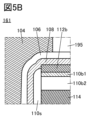
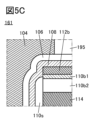
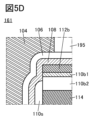
- 5B and 5C are examples of configurations that differ from FIG. 5A in the height of the upper surface of the insulating layer 110s, etc.
- FIG. 5B shows a configuration in which the height of the top surface of the insulating layer 110s is lower than the height of the top surface of the conductive layer 112b and higher than the height of the top surface of the insulating layer 110b1 located below the conductive layer 112b.
- the side surface of the conductive layer 112b has a region in contact with the semiconductor layer 108.
- the contact area between the semiconductor layer 108 and the conductive layer 112b is increased, and the resistance may be reduced.
- FIG. 5C shows a configuration in which the height of the top surface of the insulating layer 110s is lower than the height of the top surface of the insulating layer 110b1.
- the side surface of the conductive layer 112b has a region in contact with the semiconductor layer 108
- the side surface of the insulating layer 110b1 has a region in contact with the semiconductor layer 108.
- FIG. 5D shows a configuration in which the height of the top surface of the insulating layer 110s is lower than the height of the top surface of the insulating layer 110b2.
- the side surface of the conductive layer 112b has a region in contact with the semiconductor layer 108
- the side surface of the insulating layer 110b1 has a region in contact with the semiconductor layer 108
- the side surface of the insulating layer 110b2 has a region in contact with the semiconductor layer 108. It has a region in contact with the semiconductor layer 108.
- the thickness of the insulating layer 110s may be reduced by lengthening the etching time.
- the height of the upper surface of the insulating layer 110s may become lower than the height of the conductive layer 112b.
- the height of the top surface of the insulating layer 110s is preferably higher than at least the height of the top surface of the conductive layer 114.
- the on-state current of the transistor 100 can be increased.
- the transistor 100 By using the transistor 100, a circuit that can operate at high speed can be manufactured. Furthermore, it becomes possible to reduce the area occupied by the circuit. Therefore, when the transistor of one embodiment of the present invention is applied to a semiconductor device, the device can be miniaturized.
- the frame of the display device can be made narrower.
- the transistor of one embodiment of the present invention when applied to a large display device or a high-definition display device, even if the number of wires increases, signal delay in each wire can be reduced, and display unevenness can be reduced. can be suppressed.
- the channel width of the transistor 100 is the width of the source region or the width of the drain region in the direction perpendicular to the channel length direction.
- the channel width is the width of the region where the semiconductor layer 108 and the conductive layer 112a are in contact, or the width of the region where the semiconductor layer 108 and the conductive layer 112b are in contact in the direction perpendicular to the channel length direction.
- the semiconductor layer 108 is provided along a concave portion whose bottom is the upper surface of the conductive layer 112a and whose inner wall is the side wall 141 of the insulating layer 110s. Therefore, the circumference of the inner wall of the side wall 141 of the insulating layer 110s in plan view may be used as the channel width.
- the insulating layer 110s can also be expressed as having a shape having an opening at or near the center of a cylinder, for example. The circumference of the opening can also be used as the channel width of the semiconductor layer 108.
- the channel width of the transistor 100 will be described as the width of a region where the semiconductor layer 108 and the conductive layer 112b are in contact with each other in a direction perpendicular to the channel length direction.
- the channel width W100 of the transistor 100 is indicated by a solid double-headed arrow.
- the channel width W100 is the length of the opening 143 when viewed from above.
- the channel width W100 is determined by the top shape of the opening 143.
- the width D143 of the opening 143 is indicated by a two-dot chain double-headed arrow.
- the width D143 refers to the short side of the smallest rectangle circumscribing the opening 143 when viewed from above.
- the width D143 of the opening 143 is equal to or larger than the resolution limit of the exposure apparatus.
- the width D143 is, for example, 0.20 ⁇ m or more and less than 5.0 ⁇ m. Note that when the top surface shape of the opening 143 is circular, the width D143 corresponds to the diameter of the opening 143, and the channel width W100 can be calculated as "D143 ⁇ ".
- the semiconductor material that can be used for the semiconductor layer 108 is not particularly limited.
- an elemental semiconductor or a compound semiconductor can be used.
- silicon or germanium can be used as the single semiconductor.
- the compound semiconductor include gallium arsenide and silicon germanium.
- an organic substance having semiconductor properties or a metal oxide having semiconductor properties also referred to as an oxide semiconductor
- these semiconductor materials may contain impurities as dopants.
- the crystallinity of the semiconductor material used for the semiconductor layer 108 is not particularly limited; ) may be used. It is preferable to use a semiconductor having crystallinity because deterioration of transistor characteristics can be suppressed.
- Silicon can be used for the semiconductor layer 108.
- Examples of silicon include single crystal silicon, polycrystalline silicon, microcrystalline silicon, and amorphous silicon.
- Examples of polycrystalline silicon include low temperature polysilicon (LTPS).
- a transistor using amorphous silicon for the semiconductor layer 108 can be formed over a large glass substrate and can be manufactured at low cost.
- a transistor using polycrystalline silicon for the semiconductor layer 108 has high field effect mobility and can operate at high speed.
- a transistor using microcrystalline silicon for the semiconductor layer 108 has higher field effect mobility than a transistor using amorphous silicon, and can operate at high speed.
- the semiconductor layer 108 preferably includes a metal oxide (oxide semiconductor).
- metal oxides that can be used for the semiconductor layer 108 include indium oxide, gallium oxide, and zinc oxide.
- the metal oxide contains at least indium (In) or zinc (Zn).
- the metal oxide has two or three selected from indium, element M, and zinc.
- element M is gallium, aluminum, silicon, boron, yttrium, tin, copper, vanadium, beryllium, titanium, iron, nickel, germanium, zirconium, molybdenum, lanthanum, cerium, neodymium, hafnium, tantalum, tungsten, cobalt, and magnesium.
- the element M is preferably one or more selected from aluminum, gallium, yttrium, and tin. Element M is more preferably gallium.
- the semiconductor layer 108 is made of, for example, indium oxide, indium zinc oxide (In-Zn oxide), indium tin oxide (In-Sn oxide), indium titanium oxide (In-Ti oxide), or indium aluminum zinc oxide.
- In-Al-Zn oxide, also written as IAZO indium tin zinc oxide (In-Sn-Zn oxide), indium titanium zinc oxide (In-Ti-Zn oxide), indium gallium zinc oxide (In-Ga-Zn oxide, also written as IGZO), indium gallium tin zinc oxide (In-Ga-Sn-Zn oxide, also written as IGZTO), indium gallium aluminum zinc oxide (In-Ga-Al-Zn oxide (also referred to as IGAZO or IAGZO), etc. can be used.
- indium tin oxide containing silicon or the like can be used.
- a sputtering method or an atomic layer deposition (ALD) method can be suitably used to form the metal oxide.
- the atomic ratio of the target and the atomic ratio of the metal oxide may be different.
- the atomic ratio of the metal oxide may be smaller than the atomic ratio of the target.
- the atomic ratio of zinc contained in the target may be about 40% or more and 90% or less.
- a specific example of forming the semiconductor layer 108 using an atomic layer deposition (ALD) method is a thermal ALD (atomic layer deposition) method or a PEALD (plasma enhanced ALD) method.
- ALD atomic layer deposition
- PEALD plasma enhanced ALD
- Membrane method can be used preferable.
- the thermal ALD method is preferable because it shows extremely high step coverage.
- the PEALD method is preferable because it not only shows high step coverage but also enables low-temperature film formation.
- composition of the metal oxide included in the semiconductor layer 108 greatly affects the electrical characteristics and reliability of the transistor 100.
- a transistor with a large on-current can be realized.
- a metal oxide that does not contain gallium or has a low gallium content in the semiconductor layer 108 a transistor that has high reliability against application of a positive bias can be obtained.
- a metal oxide with a low content of element M for the semiconductor layer 108 a transistor with high reliability against application of a positive bias can be obtained.
- a transistor with high reliability against light can be obtained.
- the semiconductor layer 108 is preferably a metal oxide layer having crystallinity.
- a metal oxide layer having a CAAC (c-axis aligned crystal) structure, a polycrystalline structure, a microcrystalline (NC: nano-crystal) structure, etc. can be used.
- CAAC c-axis aligned crystal
- NC microcrystalline
- the density of defect levels in the semiconductor layer 108 can be reduced, and a highly reliable transistor can be realized.
- the semiconductor layer 108 may have a stacked structure of two or more metal oxide layers having different crystallinities.
- the layered structure includes a first metal oxide layer and a second metal oxide layer provided on the first metal oxide layer, and the second metal oxide layer
- the structure can include a region having higher crystallinity than the oxide layer.
- the second metal oxide layer may have a region having lower crystallinity than the first metal oxide layer.
- the two or more metal oxide layers included in the semiconductor layer 108 may have the same or approximately the same composition. By forming a stacked structure of metal oxide layers having the same composition, for example, the same sputtering target can be used to form the layers, thereby reducing manufacturing costs.
- a stacked structure of two or more metal oxide layers having different crystallinity can be formed.
- the two or more metal oxide layers included in the semiconductor layer 108 may have different compositions.
- the thickness of the semiconductor layer 108 is preferably 3 nm or more and 100 nm or less, more preferably 5 nm or more and 100 nm or less, further preferably 10 nm or more and 100 nm or less, further preferably 10 nm or more and 70 nm or less, and even more preferably 15 nm or more and 70 nm or less. , more preferably 15 nm or more and 50 nm or less, further preferably 20 nm or more and 50 nm or less, further preferably 20 nm or more and 40 nm or less, and even more preferably 25 nm or more and 40 nm or less.
- V O oxygen vacancies
- a defect in which hydrogen is present in an oxygen vacancy (hereinafter referred to as V OH ) functions as a donor, and electrons, which are carriers, may be generated.
- a portion of hydrogen may combine with oxygen that is bonded to a metal atom to generate electrons, which are carriers. Therefore, a transistor using an oxide semiconductor containing a large amount of hydrogen tends to have normally-on characteristics. Further, since hydrogen in an oxide semiconductor is easily moved by stress such as heat or an electric field, if the oxide semiconductor contains a large amount of hydrogen, the reliability of the transistor may deteriorate.
- V OH can function as a donor for the oxide semiconductor.
- V OH in the semiconductor layer 108 when an oxide semiconductor is used for the semiconductor layer 108, it is preferable to reduce V OH in the semiconductor layer 108 as much as possible to make the semiconductor layer 108 highly pure or substantially pure.
- impurities such as water and hydrogen in the oxide semiconductor are removed (sometimes referred to as dehydration or dehydrogenation treatment). Therefore, it is important to supply oxygen to the oxide semiconductor to repair oxygen vacancies (V O ).
- an oxide semiconductor in which impurities such as V OH are sufficiently reduced for a channel formation region of a transistor stable electrical characteristics can be provided. Note that supplying oxygen to an oxide semiconductor to repair oxygen vacancies (V O ) may be referred to as oxygenation treatment.
- the carrier concentration of the oxide semiconductor in a region functioning as a channel formation region is preferably 1 ⁇ 10 18 cm ⁇ 3 or less, and less than 1 ⁇ 10 17 cm ⁇ 3 . More preferably, it is less than 1 ⁇ 10 16 cm ⁇ 3 , even more preferably less than 1 ⁇ 10 13 cm ⁇ 3 , even more preferably less than 1 ⁇ 10 12 cm ⁇ 3 .
- the lower limit of the carrier concentration of the oxide semiconductor in the region functioning as a channel formation region is not particularly limited, but can be set to 1 ⁇ 10 ⁇ 9 cm ⁇ 3 , for example.
- a transistor using an oxide semiconductor (hereinafter referred to as an OS transistor) has extremely high field effect mobility compared to a transistor using amorphous silicon.
- OS transistors have extremely low source-drain leakage current (hereinafter also referred to as off-state current) in the off state, and can retain the charge accumulated in the capacitor connected in series with the transistor for a long period of time. is possible. Further, by applying an OS transistor to a semiconductor device, power consumption of the semiconductor device can be reduced.
- OS transistors can be applied to display devices.
- a light emitting device included in a pixel circuit of a display device it is necessary to increase the amount of current flowing through the light emitting device.
- the source-drain voltage of the drive transistor included in the pixel circuit Since an OS transistor has a higher breakdown voltage between the source and drain than a transistor using silicon (hereinafter referred to as a Si transistor), a high voltage can be applied between the source and drain of the OS transistor. Therefore, by applying the OS transistor to the drive transistor of the pixel circuit, the amount of current flowing through the light emitting device can be increased, and the luminance of the light emitting device can be increased.
- an OS transistor When a transistor operates in a saturation region, an OS transistor can make a change in source-drain current smaller than a Si transistor with respect to a change in gate-source voltage. Therefore, by applying an OS transistor as a drive transistor included in a pixel circuit, the current flowing between the source and drain can be precisely determined by changing the gate-source voltage, so the amount of current flowing through the light emitting device can be controlled. It can be precisely controlled. Therefore, the number of gradations in the pixel circuit can be increased.
- OS transistors are able to flow a more stable current (saturation current) than Si transistors even when the source-drain voltage gradually increases. can. Therefore, by using an OS transistor as a drive transistor, a stable current can be passed through the light-emitting device even if, for example, there are variations in the current-voltage characteristics of the light-emitting device. That is, when the OS transistor operates in the saturation region, the source-drain current does not substantially change even if the source-drain voltage is increased, so that the luminance of the light-emitting device can be stabilized.
- OS transistors as drive transistors included in pixel circuits, it is possible to "suppress black floating,” “increase luminance,” “multiple gradations,” and “suppress variations in light-emitting devices.” can be achieved.
- OS transistors have small variations in electrical characteristics due to radiation irradiation, that is, have high resistance to radiation, and therefore can be suitably used even in environments where radiation may be incident. It can also be said that OS transistors have high reliability against radiation.
- an OS transistor can be suitably used in a pixel circuit of an X-ray flat panel detector.
- OS transistors can be suitably used in semiconductor devices used in outer space. Radiation includes electromagnetic radiation (eg, x-rays, and gamma rays), and particle radiation (eg, alpha, beta, neutron, and proton radiation).
- an inorganic insulating material or an organic insulating material can be used as the insulating layer.
- a laminated structure of an inorganic insulating material and an organic insulating material may be used as the insulating layer.
- the inorganic insulating material one or more of oxides, oxynitrides, nitrided oxides, and nitrides can be used.
- oxynitride refers to a material whose composition contains more oxygen than nitrogen.
- a nitrided oxide refers to a material whose composition contains more nitrogen than oxygen.
- silicon oxynitride refers to a material whose composition contains more oxygen than nitrogen
- silicon nitride oxide refers to a material whose composition contains more nitrogen than oxygen.
- the content of oxygen and nitrogen can be analyzed using, for example, secondary ion mass spectrometry (SIMS) or X-ray photoelectron spectroscopy (XPS).
- SIMS secondary ion mass spectrometry
- XPS X-ray photoelectron spectroscopy
- the film density of the insulating layer or the like can be evaluated using, for example, Rutherford Backscattering Spectrometry (RBS) or X-Ray Reflection (XRR). Further, the difference in film density may be evaluated using a cross-sectional transmission electron microscopy (TEM) image.
- TEM transmission electron microscopy
- the nitrogen content of the insulating layer can be confirmed by, for example, EDX.
- EDX EDX-ray electron spectroscopy
- the nitrogen content can be evaluated using the ratio of the peak height of nitrogen to the peak height of silicon.
- the peak of a certain element is the peak of a certain element when the count number of the element reaches the maximum value in the spectrum where the horizontal axis shows the energy of the characteristic X-ray and the vertical axis shows the count number (detected value) of the characteristic X-ray.
- the difference in nitrogen content may be confirmed by the ratio of the count number of nitrogen to the count number of silicon using the count number at the energy of the characteristic X-ray unique to the element. For example, counts at 1.739 keV (Si-K ⁇ ) can be used for silicon, and counts at 0.392 keV (N-K ⁇ ) can be used for nitrogen.
- the hydrogen concentration in the insulating layer can be evaluated by, for example, secondary ion mass spectrometry (SIMS).
- SIMS secondary ion mass spectrometry
- oxygen can be supplied from the insulating layer to the semiconductor layer 108.
- oxygen vacancies (V O ) and V O H in the semiconductor layer 108 can be reduced, and a transistor exhibiting good electrical characteristics and high reliability can be obtained. It can be done.
- the treatment for supplying oxygen to the semiconductor layer 108 includes heat treatment in an atmosphere containing oxygen, plasma treatment in an atmosphere containing oxygen, and the like.
- Oxygen vacancies (V O ) and V OH in the channel formation region of the transistor 100 are preferably small.
- the channel length L100 when the channel length L100 is short, the influence of oxygen vacancies (V O ) and V O H in the channel forming region on the electrical characteristics and reliability becomes large.
- the carrier concentration in the channel formation region increases due to the diffusion of V OH from the source region or the drain region to the channel formation region, which may cause a fluctuation in the threshold voltage of the transistor 100 or a decrease in reliability.
- the shorter the channel length L100 of the transistor 100 the greater the influence of such V O H diffusion on the electrical characteristics and reliability.
- the insulating layer in contact with the semiconductor layer 108 or the insulating layer located around the semiconductor layer 108 preferably releases little impurity (for example, water and hydrogen) from itself.
- impurity for example, water and hydrogen
- Oxygen may be desorbed from the semiconductor layer 108 due to heat applied in steps subsequent to the formation of the semiconductor layer 108.
- the increase in oxygen vacancies (V O ) and V O H is suppressed. be able to.
- the degree of freedom in processing temperature can be increased in steps subsequent to the formation of the semiconductor layer 108. Specifically, the processing temperature can be increased even in steps subsequent to the formation of the semiconductor layer 108. Therefore, the transistor 100 exhibiting good electrical characteristics and high reliability can be formed.
- Insulating layer 110a, insulating layer 110b An inorganic insulating material or an organic insulating material can be used as the insulating layer 110a and the insulating layer 110b, respectively.
- the insulating layer 110a and the insulating layer 110b may have a laminated structure of an inorganic insulating material and an organic insulating material.
- An inorganic insulating material can be suitably used as the insulating layer 110a and the insulating layer 110b.
- the inorganic insulating material one or more of oxides, oxynitrides, nitrided oxides, and nitrides can be used.
- the insulating layer 110a and the insulating layer 110b include silicon oxide, silicon oxynitride, aluminum oxide, hafnium oxide, yttrium oxide, zirconium oxide, gallium oxide, tantalum oxide, magnesium oxide, lanthanum oxide, cerium oxide, neodymium oxide, silicon nitride, One or more of silicon nitride oxide and aluminum nitride can be used.
- the insulating layer 110a and the insulating layer 110b may have a stacked structure of two or more layers.
- the insulating layer 110a has a stacked structure of an insulating layer 110a1 and an insulating layer 110a2 on the insulating layer 110a1
- the insulating layer 110b has a stacked structure of an insulating layer 110b2 and an insulating layer 110b1 on the insulating layer 110b2.
- a configuration having a laminated structure is shown.
- the insulating layer 110a1, the insulating layer 110a2, the insulating layer 110b2, and the insulating layer 110b1 can each use a material that can be used for the above-described insulating layer 110a and insulating layer 110b. Note that the insulating layer 110a1, the insulating layer 110a2, the insulating layer 110b2, and the insulating layer 110b1 may use the same material or different materials.
- the insulating layer 110a1, the insulating layer 110a2, the insulating layer 110b2, and the insulating layer 110b1 release little impurity (for example, water and hydrogen) from themselves.
- the thickness of the insulating layer 110a2 can be configured to be thicker than the thickness of the insulating layer 110a1. Further, the thickness of the insulating layer 110b2 can be configured to be thicker than the thickness of the insulating layer 110b1.
- the deposition rate of the insulating layer 110a2 is preferably fast. By increasing the deposition rate of a thick film, productivity can be increased.
- the insulating layer 110a1 and the insulating layer 110b1 function as blocking films that suppress desorption of gas from the insulating layer 110a2 and the insulating layer 110b1, respectively. It is preferable that the insulating layer 110a1 and the insulating layer 110b1 are each made of a material that does not easily diffuse gas. It is preferable that the insulating layer 110a1 has a region having a higher film density than the insulating layer 110a2. Further, it is preferable that the insulating layer 110b1 has a region having a higher film density than the insulating layer 110b2. Blocking properties can be improved by increasing the film density of the insulating layer. By slowing down the deposition rate of the insulating layer, the film density can be increased and blocking properties can be improved.
- an oxide or an oxynitride for the insulating layer 110a2 and the insulating layer 110b2. It is preferable to use a film that releases oxygen when heated as the insulating layer 110a2 and the insulating layer 110b2.
- silicon oxide or silicon oxynitride can be suitably used as the insulating layer 110a2 and the insulating layer 110b2.
- the insulating layer 110a2 and the insulating layer 110b2 release oxygen, oxygen can be supplied from the insulating layer 110a2 and the insulating layer 110b2 to the semiconductor layer 108.
- the insulating layer 110a2 and the insulating layer 110b2 preferably have a high oxygen diffusion coefficient. By increasing the diffusion coefficient of oxygen, oxygen can be easily diffused in the insulating layer 110b, and oxygen can be efficiently supplied to the semiconductor layer 108.
- the insulating layer 110a1, the insulating layer 110a2, the insulating layer 110b1, and the insulating layer 110b2 are preferably formed by a film formation method such as a sputtering method, an ALD method, or a plasma CVD method.
- the film can be formed using a silicon target in an atmosphere containing an oxidizing gas.
- silicon nitride is formed by a sputtering method
- the film can be formed using a silicon target in an atmosphere containing nitrogen gas, for example.
- the film can be formed using an aluminum target in an atmosphere containing an oxidizing gas.
- silicon oxide and silicon nitride can be formed using, for example, the PEALD method.
- aluminum oxide and hafnium oxide can be formed into films using, for example, a thermal ALD method.
- the insulating layer 110a1 a material containing more nitrogen than the insulating layer 110a2 can be used. Further, the insulating layer 110b1 can be made of a material containing more nitrogen than the insulating layer 110b2. Blocking properties can be improved by increasing the nitrogen content of the insulating layer.
- the insulating layer 110a1 may have a region where the hydrogen concentration in the film is lower than that of the insulating layer 110a2.
- the insulating layer 110b1 may have a region where the hydrogen concentration in the film is lower than that of the insulating layer 110b2.
- the insulating layer 110a1 and the insulating layer 110b1 each have difficulty in transmitting oxygen.
- the insulating layer 110a1 and the insulating layer 110b1 function as a blocking film that suppresses desorption of oxygen from the insulating layer 110a2 and the insulating layer 110b2. Further, it is preferable that each of the insulating layer 110a1 and the insulating layer 110b1 is difficult to transmit hydrogen.
- the insulating layer 110a1 and the insulating layer 110b1 function as a blocking film that suppresses hydrogen from diffusing from outside the transistor to the semiconductor layer 108 through the insulating layer 110a1 and the insulating layer 110b1.
- the film density of the insulating layer 110a1 and the insulating layer 110b1 is high. By increasing the film density, oxygen and hydrogen blocking properties can be improved.
- silicon oxide or silicon oxynitride is used for the insulating layer 110a2 and the insulating layer 110b2
- silicon nitride or silicon nitride oxide can be used for the insulating layer 110a1 and the insulating layer 110b1, respectively.
- hafnium oxide or aluminum oxide can be suitably used as the insulating layer 110a1 and the insulating layer 110b1.
- insulating layer 110a1 and the insulating layer 110b1 a structure in which two or more layers selected from silicon nitride, silicon nitride oxide, hafnium oxide, and aluminum oxide are stacked can be used, respectively.
- oxygen contained in the insulating layer 110b2 diffuses upward from a region of the insulating layer 110b2 that is not in contact with the semiconductor layer 108 (for example, the upper surface of the insulating layer 110b2), the amount of oxygen supplied from the insulating layer 110b2 to the semiconductor layer 108 increases. It may become less.
- oxygen contained in the insulating layer 110b2 can be suppressed from diffusing from a region of the insulating layer 110b2 that is not in contact with the semiconductor layer 108.
- the insulating layer 110a1 under the insulating layer 110a2, it is possible to suppress diffusion downward from the region of the insulating layer 110a2 that is not in contact with the semiconductor layer 108. Therefore, the amount of oxygen supplied from the insulating layer 110a2 to the semiconductor layer 108 increases, and oxygen vacancies (V O ) and V O H in the semiconductor layer 108 can be reduced.
- Oxygen contained in the insulating layer 110a2 may oxidize the conductive layer 112a and the conductive layer 112b, resulting in increased resistance.
- the amount of oxygen supplied from the insulating layer 110a2 to the semiconductor layer 108 may decrease.
- the insulating layer 110a1 between the insulating layer 110a2 and the conductive layer 112a oxidation of the conductive layer 112a and increase in resistance can be suppressed.
- oxidation of the conductive layer 112b and increase in resistance can be suppressed.
- the amount of oxygen supplied from the insulating layer 110b2 to the semiconductor layer 108 increases, and oxygen vacancies (V O ) and V O H in the semiconductor layer 108 can be reduced.
- the insulating layer 110a1 and the insulating layer 110b1 diffusion of hydrogen into the semiconductor layer 108 can be suppressed, and oxygen vacancies (V O ) and V O H in the semiconductor layer 108 can be reduced.
- the insulating layer 110a1 and the insulating layer 110b1 each preferably have a thickness that functions as an oxygen and hydrogen blocking film. If the film thickness is thin, the function as a blocking film may be reduced. On the other hand, if the film thickness is large, the area of the semiconductor layer 108 in contact with the insulating layer 110a2 and the insulating layer 110b2 becomes narrow, and the amount of oxygen supplied to the semiconductor layer 108 may decrease.
- the thickness of the insulating layer 110a1 and the insulating layer 110b1 is preferably 1 nm or more and 2 nm or more, respectively, and preferably 200 nm or less, 100 nm or less, 60 nm or less, 50 nm or less, 40 nm or less, 30 nm or less, 20 nm or less, 10 nm or less, or 5 nm or less. .
- the insulating layer 106 and the insulating layer 110s that function as gate insulating layers preferably have low defect density. Since the defect density of the insulating layer 106 and the insulating layer 110s is low, the transistor can exhibit good electrical characteristics. Further, it is preferable that the insulating layer 106 has a high dielectric strength voltage. Since the insulating layer 106 and the insulating layer 110s have a high dielectric strength voltage, a highly reliable transistor can be obtained.
- the insulating layer 106 and the insulating layer 110s for example, one or more of an oxide, an oxynitride, a nitride oxide, and a nitride each having an insulating property can be used.
- the insulating layer 106 and the insulating layer 110s are made of silicon oxide, silicon oxynitride, silicon nitride oxide, silicon nitride, aluminum oxide, aluminum oxynitride, aluminum nitride oxide, aluminum nitride, hafnium oxide, hafnium oxynitride, gallium oxide, gallium oxynitride.
- the insulating layer 106 and the insulating layer 110s may each be a single layer or a laminated layer.
- the insulating layer 106 and the insulating layer 110s may have a laminated structure of oxide and nitride, for example.
- a material with a high dielectric constant also referred to as a high-k material
- the insulating layer 106 and the insulating layer 110s preferably release little impurity (for example, water and hydrogen) from themselves. Since little impurity is released from the insulating layer 106 and the insulating layer 110s, diffusion of impurities into the semiconductor layer 108 is suppressed, and a transistor with good electrical characteristics and high reliability can be obtained.
- impurity for example, water and hydrogen
- the films are preferably formed under conditions that cause less damage to the semiconductor layer 108.
- the film can be formed under conditions where the film formation rate (also referred to as film formation rate) is sufficiently slow.
- the film formation rate also referred to as film formation rate
- damage to the semiconductor layer 108 can be reduced by forming the insulating layer 106 under low power conditions.
- the insulating layer 106 and the insulating layer 110s will be specifically described using a structure in which a metal oxide is used for the semiconductor layer 108 as an example.
- an oxide for at least the sides of the insulating layer 106 and the insulating layer 110s that are in contact with the semiconductor layer 108.
- the insulating layer 106 and the insulating layer 110s for example, one or more of silicon oxide and silicon oxynitride can be suitably used. Further, it is more preferable to use a film that releases oxygen when heated for the insulating layer 106.
- the insulating layer 106 and the insulating layer 110s may have a stacked structure.
- the insulating layer 106 and the insulating layer 110s can have a stacked structure of an oxide film in contact with the semiconductor layer 108 and a nitride film in contact with the conductive layer 104.
- the oxide film for example, one or more of silicon oxide and silicon oxynitride can be suitably used. Silicon nitride can be suitably used as the nitride film.
- the thickness of the insulating layer 106 and the insulating layer 110s is preferably 1 nm or more and 20 nm or less, more preferably 0.5 nm or more and 15 nm or less, and even more preferably 0.5 nm or more and 10 nm or less.
- the insulating layer 106 and the insulating layer 110s only need to have a region with the thickness described above at least in part.
- the insulating layer 106 and the insulating layer 110s preferably have a function of supplying oxygen.
- the conductive layer 112a and the conductive layer 112b functioning as a source electrode or a drain electrode are made of chromium, copper, aluminum, gold, silver, zinc, tantalum, titanium, tungsten, manganese, nickel, iron, cobalt, molybdenum, and niobium, respectively. They can be formed using one or more metals, or an alloy containing one or more of the metals mentioned above.
- a low-resistance conductive material containing one or more of copper, silver, gold, or aluminum can be suitably used. In particular, copper or aluminum is preferable because it is excellent in mass productivity.
- a metal oxide film (also referred to as an oxide conductor) can be used for each of the conductive layer 112a and the conductive layer 112b.
- the oxide conductor for example, In-Sn oxide (ITO), In-W oxide, In-W-Zn oxide, In-Ti oxide, In-Ti-Sn oxide. , In-Zn oxide, In-Sn-Si oxide (ITSO), and In-Ga-Zn oxide.
- oxide conductor (OC)
- OC oxide conductor
- the conductive layer 112a and the conductive layer 112b may each have a laminated structure of a conductive film containing the above-described oxide conductor (metal oxide) and a conductive film containing a metal or an alloy. By using a conductive film containing metal or an alloy, wiring resistance can be reduced.
- a Cu-X alloy film (X is Mn, Ni, Cr, Fe, Co, Mo, Ta, or Ti) may be applied to the conductive layer 112a and the conductive layer 112b, respectively.
- X is Mn, Ni, Cr, Fe, Co, Mo, Ta, or Ti
- the Cu-X alloy film it can be processed by a wet etching process, making it possible to suppress manufacturing costs.
- the conductive layer 112a and the conductive layer 112b may be made of the same material or different materials.
- the conductive layer 112a and the conductive layer 112b will be specifically described using a structure in which a metal oxide is used for the semiconductor layer 108 as an example.
- the conductive layer 112a and the conductive layer 112b may be oxidized by oxygen contained in the semiconductor layer 108, resulting in increased resistance.
- Oxygen contained in the insulating layer 110b may oxidize the conductive layer 112a and the conductive layer 112b, resulting in increased resistance.
- oxygen vacancies (V O ) in the semiconductor layer 108 may increase.
- the conductive layers 112a and 112b are oxidized by oxygen contained in the insulating layer 110b, the amount of oxygen supplied from the insulating layer 110b to the semiconductor layer 108 may decrease.
- the conductive layer 112a and the conductive layer 112b are each made of a material that is not easily oxidized. It is preferable to use an oxide conductor for each of the conductive layer 112a and the conductive layer 112b.
- an oxide conductor for each of the conductive layer 112a and the conductive layer 112b.
- ITO In-Sn oxide
- ITSO In-Sn-Si oxide
- a nitride conductor may be used for each of the conductive layer 112a and the conductive layer 112b. Examples of nitride conductors include tantalum nitride and titanium nitride.
- the conductive layer 112a and the conductive layer 112b may each have a stacked structure of the aforementioned materials.
- the conductive layer 112a and the conductive layer 112b in contact with the semiconductor layer 108 are preferably made of a material that is not easily oxidized. However, when using a material that is difficult to oxidize, the resistance may become high. Since the conductive layer 112a and the conductive layer 112b function as wiring, they preferably have low resistance. Therefore, by using a material that is difficult to oxidize for the conductive layer 112a_2 that has a region in contact with the semiconductor layer 108, and using a material with low resistance for the conductive layer 112a_1 that does not have a region in contact with the semiconductor layer 108, the resistance of the conductive layer 112a can be reduced. It can be lowered. Furthermore, oxygen vacancies (V O ) and V OH in the semiconductor layer 108 can be reduced.
- the conductive layer 112a_2 one or more of an oxide conductor and a nitride conductor can be suitably used. It is preferable that the conductive layer 112a_1 uses a material having a lower resistance than the conductive layer 112a_2.
- the conductive layer 112a_1 for example, one or more of copper, aluminum, titanium, tungsten, and molybdenum, or an alloy containing one or more of the above metals can be suitably used.
- In-Sn-Si oxide (ITSO) can be suitably used for the conductive layer 112a_2, and tungsten can be suitably used for the conductive layer 112a_1.
- the configuration of the conductive layer 112a may be determined depending on the wiring resistance required for the conductive layer 112a. For example, if the length of the wiring (conductive layer 112a) is short and the required wiring resistance is relatively high, the conductive layer 112a may have a single-layer structure and a material that is not easily oxidized may be used. On the other hand, when the length of the wiring (conductive layer 112a) is long and the required wiring resistance is relatively low, it is preferable to apply a laminated structure of a material that is difficult to oxidize and a material with low resistance to the conductive layer 112a.
- the conductive layer 104 and the conductive layer 114 include, for example, one or more of chromium, copper, aluminum, gold, silver, zinc, molybdenum, tantalum, titanium, tungsten, manganese, nickel, iron, cobalt, and niobium, or the metals listed above. Each can be formed using an alloy containing one or more of the following. Further, as the conductive layer 104 and the conductive layer 114, a nitride or an oxide that can be used for the conductive layer 112a and the conductive layer 112b may be used.
- the conductive layer 104 may have a two-layer stacked structure of a conductive layer 104a and a conductive layer 104b over the conductive layer 104a.
- nitride or oxide can be used as the conductive layer 104a
- chromium, copper, aluminum, gold, silver, zinc, molybdenum, tantalum, titanium, tungsten, manganese, nickel, iron, cobalt, and niobium can be used as the conductive layer 104b.
- An alloy containing one or more of the above-mentioned metals or one or more of the above-mentioned metals can be used.
- the insulating layer 195 that functions as a protective layer of the transistor 100 is preferably made of a material in which impurities are difficult to diffuse. By providing the insulating layer 195, diffusion of impurities into the transistor from the outside can be effectively suppressed, and reliability of the transistor can be improved. Examples of impurities include water and hydrogen.
- the insulating layer 195 can be an insulating layer containing an inorganic material or an insulating layer containing an organic material. For example, an inorganic material such as an oxide or a nitride can be suitably used for the insulating layer 195.
- silicon nitride, silicon nitride oxide, silicon oxynitride, aluminum oxide, aluminum oxynitride, aluminum nitride, hafnium oxide, and hafnium aluminate can be used.
- the organic material for example, one or more of acrylic resin and polyimide resin can be used.
- a photosensitive material may be used as the organic material.
- two or more of the above-mentioned insulating layers may be stacked and used.
- the insulating layer 195 may have a stacked structure of an insulating layer containing an inorganic material and an insulating layer containing an organic material.
- Insulating layer 115 As the insulating layer 115, an inorganic insulating material or an organic insulating material can be used.
- the insulating layer 115 may have a laminated structure of an inorganic insulating material and an organic insulating material.
- the materials and structures listed for the insulating layer 110a1, the insulating layer 110a2, the insulating layer 195, etc. can be suitably used.
- Substrate 102 There are no major restrictions on the material of the substrate 102, but it must have at least enough heat resistance to withstand subsequent heat treatment.
- a single crystal semiconductor substrate made of silicon or silicon carbide, a polycrystalline semiconductor substrate, a compound semiconductor substrate such as silicon germanium, an SOI substrate, a glass substrate, a quartz substrate, a sapphire substrate, a ceramic substrate, or an organic resin substrate, It may also be used as the substrate 102.
- a substrate on which a semiconductor element is provided may be used as the substrate 102. Note that the shapes of the semiconductor substrate and the insulating substrate may be circular or square.
- a flexible substrate may be used as the substrate 102, and the transistor 100 and the like may be formed directly on the flexible substrate.
- a peeling layer may be provided between the substrate 102 and the transistor 100 or the like. The peeling layer can be used to separate a semiconductor device from the substrate 102 and transfer it to another substrate after partially or completely completing a semiconductor device thereon. In this case, the transistor 100 and the like can be transferred to a substrate with poor heat resistance or a flexible substrate.
- composition of metal oxide included in semiconductor layer 108 The composition of the metal oxide included in the semiconductor layer 108 will be described below.
- composition of the metal oxide included in the semiconductor layer 108 greatly affects the electrical characteristics and reliability of the transistor 100.
- the atomic ratio of indium is greater than or equal to the atomic ratio of zinc.
- the atomic ratio of indium is greater than or equal to the atomic ratio of tin.
- a metal oxide in which the atomic ratio of indium is higher than the atomic ratio of tin can be used. Furthermore, it is preferable to use a metal oxide in which the atomic ratio of zinc is higher than the atomic ratio of tin.
- a metal oxide in which the atomic ratio of indium is higher than the atomic ratio of aluminum can be used. Furthermore, it is preferable to use a metal oxide in which the atomic ratio of zinc is higher than that of aluminum.
- a metal oxide in which the atomic ratio of indium to the number of atoms of the metal element is higher than the atomic ratio of gallium can be used. Furthermore, it is more preferable to use a metal oxide in which the atomic ratio of zinc is higher than the atomic ratio of gallium.
- a metal oxide in which the atomic ratio of indium to the number of atoms of the metal element is higher than the atomic ratio of the element M can be used. Furthermore, it is more preferable to use a metal oxide in which the atomic ratio of zinc is higher than the atomic ratio of element M.
- the sum of the atomic ratios of the metal elements can be the atomic ratio of the element M.
- the atomic ratio of the element M can be the sum of the atomic ratio of gallium and the atomic ratio of aluminum.
- the atomic ratio of indium, element M, and zinc is within the above-mentioned range.
- the atomic ratio of the element M can be the sum of the atomic ratio of gallium and the atomic ratio of tin.
- the atomic ratio of indium, element M, and zinc is within the above-mentioned range.
- the ratio of the number of indium atoms to the number of atoms of the metal element contained in the metal oxide is 30 atom % or more and 100 atom % or less, preferably 30 atom % or more and 95 atom % or less, more preferably 35 atom % or more and 95 atom %. % or less, more preferably 35 atom % or more and 90 atom % or less, more preferably 40 atom % or more and 90 atom % or less, more preferably 45 atom % or more and 90 atom % or less, more preferably 50 atom % or more and 80 atom % or less.
- a metal oxide whose content is more preferably 60 atom % or more and 80 atom % or less, more preferably 70 atom % or more and 80 atom % or less.
- the ratio of the number of indium atoms to the total number of atoms of indium, element M, and zinc is within the above range.
- the ratio of the number of indium atoms to the number of atoms of the metal element contained is sometimes referred to as the indium content rate. The same applies to other metal elements.
- the composition of metal oxides can be analyzed using, for example, energy dispersive X-ray spectroscopy (EDX), X-ray photoelectron spectroscopy (XPS), or inductively coupled plasma mass spectroscopy.
- Analysis method ICP-MS: Inductively Coupled Plasma-Mass Spectrometry
- ICP-AES Inductively Coupled Plasma-Atomic Em
- analysis may be performed by combining two or more of these methods. Note that for elements with low content rates, the actual content rate and the content rate obtained by analysis may differ due to the influence of analysis accuracy. For example, when the content of element M is low, the content of element M obtained by analysis may be lower than the actual content.
- a nearby composition includes a range of ⁇ 30% of a desired atomic ratio.
- the atomic ratio of M when the atomic ratio of indium is 5, the atomic ratio of M is greater than 0.1. 2 or less, including cases where the atomic ratio of zinc is 5 or more and 7 or less.
- the atomic ratio of indium when the atomic ratio of indium is 1, the atomic ratio of M is greater than 0.1. 2 or less, including cases where the atomic ratio of zinc is greater than 0.1 and 2 or less.
- GBT Gate Bias Temperature
- PBTS Positive Bias Temperature Stress
- NBTS Negative Bias Temperature Stress
- the PBTS test and NBTS test performed under light irradiation are respectively PBTIS (Positive Bias Temperature Illumination Stress) test and NBTIS (Negative Bias Temperature Illumination Stress) test. It is called the Illumination Stress test.
- n-type transistor In an n-type transistor, a positive potential is applied to the gate when the transistor is turned on (state where current flows), so the amount of variation in threshold voltage in the PBTS test is an indicator of the reliability of the transistor. This is one of the important items to pay attention to.
- the transistor By using a metal oxide that does not contain gallium or has a low gallium content for the semiconductor layer 108, the transistor can have high reliability with respect to application of a positive bias. In other words, a transistor with a small threshold voltage variation in the PBTS test can be obtained. Further, when using a metal oxide containing gallium, it is preferable that the gallium content is lower than the indium content. Thereby, a highly reliable transistor can be realized.
- One of the factors that causes the threshold voltage to fluctuate in the PBTS test is the defect level at or near the interface between the semiconductor layer and the gate insulating layer.
- gallium contained in metal oxides has a property of attracting oxygen more easily than other metal elements (for example, indium or zinc). Therefore, it is presumed that at the interface between the metal oxide containing a large amount of gallium and the gate insulating layer, gallium combines with excess oxygen in the gate insulating layer, making it easier to generate carrier (electron in this case) trap sites. . Therefore, when a positive potential is applied to the gate, carriers are trapped at the interface between the semiconductor layer and the gate insulating layer, which may cause the threshold voltage to fluctuate.
- a metal oxide in which the atomic ratio of indium is higher than the atomic ratio of gallium can be applied to the semiconductor layer 108.
- a metal oxide in which the atomic ratio of zinc is higher than the atomic ratio of gallium it is preferable to apply to the semiconductor layer 108 a metal oxide in which the atomic ratio of metal elements satisfies In>Ga and Zn>Ga.
- the ratio of the number of gallium atoms to the number of atoms of the metal element contained is greater than 0 atom % and less than 50 atom %, preferably 0.1 atom % or more and less than 40 atom %, more preferably 0. 1 atomic % or more and 35 atomic % or less, more preferably 0.1 atomic % or more and 30 atomic % or less, more preferably 0.1 atomic % or more and 25 atomic % or less, more preferably 0.1 atomic % or more and 20 atomic % or less , more preferably 0.1 atomic % or more and 15 atomic % or less, more preferably 0.1 atomic % or more and 10 atomic % or less.
- V O oxygen vacancy
- a metal oxide that does not contain gallium may be applied to the semiconductor layer 108.
- In--Zn oxide can be applied to the semiconductor layer 108.
- the field effect mobility of the transistor can be increased by increasing the ratio of the number of atoms of indium to the number of atoms of the metal element contained in the metal oxide.
- the metal oxide becomes highly crystalline, which suppresses fluctuations in the electrical characteristics of the transistor and increases reliability. be able to.
- a metal oxide that does not contain gallium and zinc, such as indium oxide may be used for the semiconductor layer 108 . By using a metal oxide that does not contain gallium, it is possible to make threshold voltage fluctuations extremely small, especially in PBTS tests.
- an oxide containing indium and zinc can be used for the semiconductor layer 108.
- the present invention can also be applied to a case where element M is used instead of gallium. It is preferable to use a metal oxide in which the atomic ratio of indium is higher than the atomic ratio of the element M to the semiconductor layer 108 . Further, it is preferable to use a metal oxide in which the atomic ratio of zinc is higher than the atomic ratio of element M.
- a transistor with high reliability against application of a positive bias can be obtained.
- a highly reliable semiconductor device can be obtained.
- the electrical characteristics of the transistor may change.
- a transistor applied to a region where light can enter has small fluctuations in electrical characteristics under light irradiation and high reliability against light. Reliability with respect to light can be evaluated, for example, by the amount of variation in threshold voltage in an NBTIS test.
- a transistor with high reliability against light can be obtained.
- a transistor whose threshold voltage fluctuates in the NBTIS test can be small.
- a metal oxide in which the atomic ratio of element M is greater than or equal to that of indium has a larger band gap, which can reduce the amount of variation in threshold voltage in transistor NBTIS tests.
- the band gap of the metal oxide of the semiconductor layer 108 is preferably 2.0 eV or more, more preferably 2.5 eV or more, further preferably 3.0 eV or more, further preferably 3.2 eV or more, and even more preferably 3.0 eV or more. .3 eV or more is preferable, more preferably 3.4 eV or more, and still more preferably 3.5 eV or more.
- the semiconductor layer 108 is such that the ratio of the number of atoms of the element M to the number of atoms of the metal element contained is 20 atom % or more and 70 atom % or less, preferably 30 atom % or more and 70 atom % or less, and more preferably 30 atom %. % or more and 60 atomic % or less, more preferably 40 atomic % or more and 60 atomic % or less, and more preferably 50 atomic % or more and 60 atomic % or less.
- a metal oxide in which the atomic ratio of indium to the number of atoms of the metal element is equal to or lower than the atomic ratio of gallium can be used.
- the ratio of the number of gallium atoms to the number of atoms of the metal element contained is 20 atom % or more and 60 atom % or less, preferably 20 atom % or more and 50 atom % or less, and more preferably 30 atom %.
- Metal oxides having a content of at least 40 at % and no more than 60 at %, more preferably at least 50 at % and no more than 60 at % can be suitably used.
- the electrical characteristics and reliability of the transistor vary depending on the composition of the metal oxide applied to the semiconductor layer 108. Therefore, by varying the composition of the metal oxide depending on the electrical characteristics and reliability required of the transistor, a semiconductor device that has both excellent electrical characteristics and high reliability can be obtained.
- the semiconductor layer 108 may have a stacked structure including two or more metal oxide layers.
- the two or more metal oxide layers included in the semiconductor layer 108 may have the same or approximately the same composition.
- the same sputtering target can be used to form the layers, thereby reducing manufacturing costs.
- the two or more metal oxide layers included in the semiconductor layer 108 may have different compositions.
- a first metal oxide layer having a composition of In:M:Zn 1:3:4 [atomic ratio] or a composition close to that, and In:M:Zn provided on the first metal oxide layer.
- a laminated structure with a second metal oxide layer having an atomic ratio of 1:1:1 or a composition close to this can be suitably used.
- the element M it is particularly preferable to use gallium or aluminum.
- a laminated structure of one selected from indium oxide, indium gallium oxide, and IGZO and one selected from IAZO, IAGZO, and ITZO (registered trademark) may be used. good.
- FIG. 7A shows a configuration example of the transistor 100.
- FIG. 7A shows an example of a configuration different from FIG. 1B as a cross-sectional view taken along the dashed-dotted line A1-A2 in the top view shown in FIG. 1A.
- the transistor 100 shown in FIG. 7A differs from FIG. 1B mainly in that it includes a conductive layer 104b and that the upper surface of an insulating layer 110b is planarized.
- the conductive layer 104b is provided along the recessed portion of the insulating layer 106.
- the upper surface of the conductive layer 104b has a recess, and the conductive layer 104 is provided so as to fill the recess on the upper surface of the conductive layer 104b.
- the conductive layer 104 has a thicker region than the conductive layer 104b.
- the conductive layer 104b functions as a gate electrode. Further, the conductive layer 104 functions as a gate electrode or a conductive layer electrically connected to the gate electrode. In the configuration shown in FIG. 7A, a conductive layer 104b is provided between the conductive layer 104 and the insulating layer 106.
- the conductive layer 104b it is preferable to use a material that is less easily oxidized than the conductive layer 104 as the conductive layer 104b. Further, it is preferable to use a material having higher thermal stability than that of the conductive layer 104, for example, as the conductive layer 104b.
- the thickness of the conductive layer 104b can be made thinner than that of the conductive layer 104.
- stress in the conductive layer can be reduced and adhesion between the conductive layer 104b and the insulating layer 106 can be improved in some cases.
- the conductive layer 104 uses a material having a lower resistance than the conductive layer 104b. Further, even when the same material as the conductive layer 104b is used as the conductive layer 104, the resistance of the conductive layer 104 may be low because the conductive layer 104 has a thicker region than the conductive layer 104b.
- metal nitride As the conductive layer 104b, it is preferable to use metal nitride as the conductive layer 104b. By using a metal nitride, the adhesion between the conductive layer 104b and the insulating layer 106 may be increased.
- the transistor 100 includes both the conductive layer 104b and the conductive layer 104, the resistance of the gate electrode can be reduced, the gate electrode can be stably manufactured, and the characteristics and reliability of the transistor can be improved. can.
- the structure shown in FIG. 7A has an insulating layer 110b3 between an insulating layer 110a2 and an insulating layer 110b2.
- the conductive layer 114 is formed so as to be embedded in the opening of the insulating layer 110b3. Since the structure shown in FIG. 7A includes the insulating layer 110b3, the step on the top surface of the insulating layer 110b2 can be further reduced compared to the structure shown in FIG. 1B, and the step on the top surface of the conductive layer 112b can be further reduced. be able to.
- the insulating layer 195 may have a stacked structure.
- the insulating layer 195 includes an insulating layer 195a, an insulating layer 195b over the insulating layer 195a, and an insulating layer 195c over the insulating layer 195b.
- the conductive layer 104 shown in FIG. 7A can be formed using, for example, a dual damascene method.
- the formation of the plug and the formation of the conductive layer can be performed at the same time, so that the process can be simplified.
- the insulating layer 195b preferably functions as an etching stopper when processing the insulating layer 195c. Therefore, it is preferable to use a different material for the insulating layer 195b and that for the insulating layer 195c.
- silicon oxide can be used for the insulating layer 195c
- silicon nitride can be used for the insulating layer 195b.
- the material is not limited to this, and a material that can be used for the insulating layer 110a2 and the like can be used for the insulating layer 195c, and a material that can be used for the insulating layer 110a1 and the like can be used for the insulating layer 195b. Further, for example, a material that can be used for the above-mentioned insulating layer 110a2 etc. can be applied to the insulating layer 195a.
- the conductive layer 114 may have a two-layer stacked structure of a conductive layer 114a and a conductive layer 114b over the conductive layer 114a.
- a conductive layer 114a nitride or oxide can be used as the conductive layer 114a, and chromium, copper, aluminum, gold, silver, zinc, molybdenum, tantalum, titanium, tungsten, manganese, nickel, iron, cobalt, and niobium can be used as the conductive layer 114b.
- An alloy containing one or more of the above-mentioned metals or one or more of the above-mentioned metals can be used.
- FIG. 7B shows a configuration example of the transistor 100.
- FIG. 7B shows an example of a configuration different from FIG. 1B as a cross-sectional view taken along the dashed line A1-A2 in the top view shown in FIG. 1A.
- the transistor 100 illustrated in FIG. 7B is different in that the shape of the conductive layer 114 is different, the shape of the conductive layer 104 is different, the conductive layer 112a_1 is not embedded in the opening of the insulating layer 115, and the shape of the insulating layer 195 is different. This is mainly different from FIG. 1B.
- the outer side surface of the conductive layer 114 has a tapered shape.
- the outer side surface of the conductive layer 114 refers to, for example, the outer side surface in a cross-sectional view of a region including the conductive layer 114.
- the inner side surface of the conductive layer 114 refers to, for example, the side surface facing the insulating layer 110s. That is, at least a portion of the outer side surface of the conductive layer 114 is inclined with respect to the substrate surface or the surface on which the conductive layer 114 is formed (here, for example, the upper surface of the insulating layer 110a on which the conductive layer 114 is formed). provided.
- the outer side surface of the conductive layer 114 is covered with an insulating layer 110b. Since the outer side surface of the conductive layer 114 has a tapered shape, the coverage of the insulating layer 110b can be improved, for example, at the corner formed by the upper surface and the side surface of the conductive layer 114 and at the side surface of the conductive layer 114. Improving the coverage of the insulating layer means, for example, that the thickness of the insulating layer formed on the surface to be covered is highly uniform. Alternatively, it refers to the fact that the insulating layer to be covered is formed to follow the shape of the surface to be covered. Alternatively, it refers to the high adhesion between the covering insulating layer and the surface to be covered.
- the conductive layer 104 is provided along the recess on the upper surface of the semiconductor layer 108, and the upper surface of the conductive layer 104 has a recess.
- the insulating layer 195 is provided along the recess on the upper surface of the conductive layer 104, and the upper surface of the insulating layer 195 has a recess. Further, neither the upper surface of the conductive layer 104 nor the upper surface of the insulating layer 195 is planarized.
- the structure shown in FIG. 7B can be manufactured without performing a planarization process for the conductive layer 104 and the insulating layer 195, so that the manufacturing process of the transistor can be simplified. Further, since the thicknesses of the conductive layer 104 and the insulating layer 195 can be reduced, this is suitable when a material with a slow deposition rate or a material with high cost is used.
- a conductive layer 112a is provided over the substrate 102, and an insulating layer 110a is provided over the conductive layer 112a.
- the conductive layer 112a has a structure in which a conductive layer 112a_1 and a conductive layer 112a_2 are stacked.
- the insulating layer 110a is preferably provided in contact with a side surface of the conductive layer 112a_1 and a side surface and a top surface of the conductive layer 112a_2.
- both the side surface of the conductive layer 112a_1 and the side surface of the conductive layer 112a_2 may have a tapered shape. Since both the side surface of the conductive layer 112a_1 and the side surface of the conductive layer 112a_2 have a tapered shape, the insulating layer The coverage of 110a can be improved.
- the insulating layer 115 is not provided, and the conductive layer 112a_1 is not embedded in the opening of the insulating layer 115.
- the manufacturing process of the transistor can be simplified.
- Example of manufacturing method> A method for manufacturing a transistor according to one embodiment of the present invention will be described below with reference to drawings. Here, description will be made using the transistor 100 shown in FIG. 1B and the like as an example.
- thin films (insulating films, semiconductor films, conductive films, etc.) constituting a semiconductor device can be formed using a sputtering method, a chemical vapor deposition (CVD) method, a vacuum evaporation method, or a pulsed laser deposition (PLD) method. ) method, atomic layer deposition (ALD) method, or the like.
- CVD chemical vapor deposition
- PLD pulsed laser deposition
- ALD atomic layer deposition
- Sputtering methods include an RF sputtering method that uses a high frequency power source as a sputtering power source, a DC sputtering method that uses a DC power source, and a pulsed DC sputtering method that changes the voltage applied to the electrode in a pulsed manner.
- the RF sputtering method is mainly used when forming an insulating film
- the DC sputtering method is mainly used when forming a metal conductive film.
- the pulsed DC sputtering method is mainly used when forming a film of a compound such as an oxide, nitride, or carbide by a reactive sputtering method.
- the CVD method can be classified into a plasma CVD (PECVD) method that uses plasma, a thermal CVD (TCVD) method that uses heat, a photo CVD (Photo CVD) method that uses light, and the like. Furthermore, depending on the raw material gas used, it can be divided into a metal CVD (MCVD) method and a metal organic CVD (MOCVD) method.
- PECVD plasma CVD
- TCVD thermal CVD
- Photo CVD Photo CVD
- MCVD metal CVD
- MOCVD metal organic CVD
- the plasma CVD method can obtain a high quality film at a relatively low temperature. Further, since the thermal CVD method does not use plasma, it is a film forming method that can reduce plasma damage to the object to be processed. For example, wiring, electrodes, elements (transistors, capacitors, etc.) included in a semiconductor device may be charged up by receiving charges from plasma. At this time, the accumulated charges may destroy wiring, electrodes, elements, etc. included in the semiconductor device. On the other hand, in the case of a thermal CVD method that does not use plasma, such plasma damage does not occur, so that the yield of semiconductor devices can be increased. Further, in the thermal CVD method, since plasma damage does not occur during film formation, a film with fewer defects can be obtained.
- a thermal ALD method in which a reaction between a precursor and a reactant is performed using only thermal energy
- a PEALD method in which a plasma-excited reactant is used, etc. can be used.
- the CVD method and the ALD method are different from the sputtering method in which particles emitted from a target or the like are deposited. Therefore, this is a film forming method that is not easily affected by the shape of the object to be processed and has good step coverage.
- the ALD method has excellent step coverage and excellent thickness uniformity, and is therefore suitable for, for example, coating the surface of an opening with a high aspect ratio.
- the ALD method since the ALD method has a relatively slow film formation rate, it may be preferable to use it in combination with other film formation methods that have a fast film formation rate, such as the CVD method.
- a film having an arbitrary composition can be formed by changing the flow rate ratio of source gases.
- the flow rate ratio of source gases by changing the flow rate ratio of source gases during film formation, it is possible to form a film whose composition changes continuously.
- the time required for film forming is reduced because it does not require time for transport or pressure adjustment. can do. Therefore, it may be possible to improve the productivity of semiconductor devices.
- a film having an arbitrary composition can be formed by simultaneously introducing a plurality of different types of precursors.
- a film of any composition can be formed by controlling the number of cycles for each precursor.
- Thin films (insulating films, semiconductor films, conductive films, etc.) that make up semiconductor devices can be manufactured using spin coating, dipping, spray coating, inkjet, dispensing, screen printing, offset printing, doctor knife, slit coating, roll coating, curtain coating, knife coating, etc. It can be formed by a method such as coating.
- a photolithography method or the like When processing a thin film that constitutes a semiconductor device, a photolithography method or the like can be used.
- the thin film may be processed by a nanoimprint method, a sandblasting method, a lift-off method, or the like.
- an island-shaped thin film may be directly formed by a film forming method using a shielding mask such as a metal mask.
- the photolithography method typically includes the following two methods.
- One method is to form a resist mask on a thin film to be processed, process the thin film by etching or the like, and then remove the resist mask.
- the other method is to form a photosensitive thin film, then perform exposure and development to process the thin film into a desired shape.
- the light used for exposure can be, for example, i-line (wavelength: 365 nm), g-line (wavelength: 436 nm), h-line (wavelength: 405 nm), or a mixture of these.
- ultraviolet rays, KrF laser light, ArF laser light, etc. can also be used.
- exposure may be performed using immersion exposure technology.
- extreme ultraviolet (EUV) light or X-rays may be used.
- an electron beam can be used instead of the light used for exposure. It is preferable to use extreme ultraviolet light, X-rays, or electron beams because extremely fine processing becomes possible. Note that when exposure is performed by scanning a beam such as an electron beam, a photomask is not necessary.
- etching the thin film for example, a dry etching method, a wet etching method, or a sandblasting method can be used.
- a polishing treatment method such as chemical mechanical polishing (CMP) can be suitably used to planarize the thin film.
- CMP chemical mechanical polishing
- a reflow method in which the conductive layer is heat-treated to be fluidized can be suitably used.
- the reflow method and the CMP method may be used in combination.
- dry etching treatment and plasma treatment may be used. Note that the polishing treatment, dry etching treatment, and plasma treatment may be performed multiple times, or may be performed in combination.
- the order of the steps is not particularly limited, and may be appropriately set according to the uneven state of the surface to be treated.
- a CMP method is used to accurately process the thin film to a desired thickness.
- polishing is performed at a constant processing speed until a part of the upper surface of the thin film is exposed. Thereafter, by polishing the thin film at a slower processing speed until it reaches a desired thickness, it becomes possible to process the thin film with high precision.
- the end point of polishing can be detected by an optical method that irradiates light onto the surface of the surface to be processed and detects changes in the reflected light, or by detecting changes in the polishing resistance that the processing device receives from the surface to be processed.
- the thickness of the thin film is monitored by an optical method using a laser interferometer, etc., and the thickness of the thin film is reduced by polishing at a slow processing speed. Can be controlled with high precision. Note that, if necessary, the polishing process may be performed multiple times until the thin film has a desired thickness.
- FIGS. 8A to 10C are diagram illustrating a method for manufacturing the transistor 100. Each figure shows a cross-sectional view taken along the dashed line A1-A2.
- An insulating film serving as an insulating layer 115 is formed on the substrate 102. After that, a portion of the insulating film is removed to form an insulating layer 115 having an opening. A conductive film 112af_1 is formed to fill the opening of the insulating layer 115 (FIG. 8A).
- the conductive film 112af_1 is planarized so that the surface of the insulating layer 115 is exposed.
- the conductive layer 112a_1 embedded in the insulating layer 115 can be formed.
- a CMP method can be used as the planarization process.
- a conductive film to become a conductive layer 112a_2 is formed over the conductive layer 112a_1 and the insulating layer 115, and a part of the conductive film is removed to form the conductive layer 112a_2 (FIG. 8B).
- the conductive film may be processed using one or both of a wet etching method and a dry etching method.
- an insulating film 110a1_f is formed over the conductive layer 112a_2 and the insulating layer 115, and an insulating film 110a2_f is formed over the insulating film 110a1_f.
- any material that can be used for the insulating layer 110a1 described above can be used as appropriate.
- silicon nitride, silicon nitride oxide, aluminum oxide, hafnium oxide, or the like can be suitably used as the insulating film 110a1_f.
- silicon nitride can be formed as the insulating film 110a1_f using a sputtering method, for example.
- silicon nitride can be formed using a PEALD method.
- aluminum oxide can be formed into a film using a sputtering method.
- silicon nitride can be formed using a PEALD method.
- a structure in which aluminum oxide and silicon nitride are laminated can be used.
- aluminum oxide formed using a sputtering method and silicon nitride formed using a PEALD method can be stacked and used.
- any material that can be used for the insulating layer 110a2 described above can be used as appropriate.
- silicon oxide, silicon oxynitride, or the like can be suitably used as the insulating film 110a2_f.
- silicon oxide can be formed as the insulating film 110a2_f using a sputtering method, for example.
- silicon oxide can be formed using a PECVD method.
- silicon oxynitride can be formed using a PECVD method.
- silicon oxide formed using a sputtering method and silicon oxide or silicon oxynitride formed using a PECVD method can be stacked and used.
- Heat treatment may be performed after forming the insulating film 110a1_f and the insulating film 110a2_f. By performing the heat treatment, water and hydrogen can be released from the surface and inside of the insulating film 110a1_f and the insulating film 110a2_f.
- the temperature of the heat treatment is preferably 150°C or higher and lower than the strain point of the substrate, more preferably 200°C or higher and 450°C or lower, further preferably 250°C or higher and 450°C or lower, and even more preferably 300°C or higher and 450°C or lower. Further, the temperature is preferably 300°C or more and 400°C or less, and even more preferably 350°C or more and 400°C or less.
- the heat treatment can be performed in an atmosphere containing one or more of a rare gas, nitrogen, or oxygen. Dry air (CDA: Clean Dry Air) may be used as the atmosphere containing nitrogen or the atmosphere containing oxygen. Note that it is preferable that the content of hydrogen, water, etc. in the atmosphere is as low as possible.
- the atmosphere it is preferable to use a high-purity gas having a dew point of -60°C or lower, preferably -100°C or lower.
- a high-purity gas having a dew point of -60°C or lower, preferably -100°C or lower.
- an atmosphere containing as little hydrogen, water, or the like as possible it is possible to prevent hydrogen, water, and the like from being taken into the insulating film 110a1_f and the insulating film 110a2_f as much as possible.
- an oven or a rapid thermal annealing (RTA) device can be used. By using an RTA device, the heat treatment time can be shortened.
- a step of supplying oxygen to the insulating film may be performed.
- a metal oxide layer is formed to supply oxygen to the insulating film 110a1_f and the insulating layer 110a2_f.
- heat treatment may be performed after forming the metal oxide layer.
- oxygen can be effectively supplied from the metal oxide layer to the insulating film 110a1_f and the insulating film 110a2_f, so that oxygen can be contained in the insulating film.
- the oxygen supplied to the insulating film is supplied to the semiconductor layer 108 in a later step, so that oxygen vacancies (V O ) and V O H in the semiconductor layer 108 can be reduced.
- oxygen may be further supplied to the insulating film through the metal oxide layer.
- a method for supplying oxygen for example, an ion implantation method, an ion doping method, a plasma immersion ion implantation method, or a plasma treatment can be used.
- the plasma treatment an apparatus that turns oxygen gas into plasma using high-frequency power can be suitably used. Examples of devices that turn gas into plasma using high-frequency power include plasma etching devices and plasma ashing devices.
- the metal oxide layer may be an insulating layer or a conductive layer.
- metal oxide layer for example, aluminum oxide, hafnium oxide, hafnium aluminate, indium oxide, indium tin oxide (ITO), or silicon-containing indium tin oxide (ITSO) can also be used.
- an oxide material containing one or more of the same elements as the semiconductor layer 108 is preferable to use as the metal oxide layer.
- an oxide semiconductor material that can be used for the semiconductor layer 108 is preferable to use an oxide semiconductor material that can be used for the semiconductor layer 108.
- a material having a higher gallium composition (content ratio) than the semiconductor layer 108 can be used for the metal oxide layer. It is preferable to use a material with a high gallium composition (content ratio) for the metal oxide layer, since it is possible to further improve the blocking property against oxygen.
- the metal oxide layer is preferably formed in an atmosphere containing oxygen, for example.
- oxygen can be suitably supplied to the insulating film when forming the metal oxide layer.
- the metal oxide layer is removed.
- a wet etching method can be suitably used for the metal oxide layer.
- the process for supplying oxygen to the insulating film 110a1_f and the insulating film 110a2_f is not limited to the above-described method.
- oxygen radicals, oxygen atoms, oxygen atomic ions, oxygen molecular ions, etc. are supplied to the insulating film 110a1_f and the insulating film 110a2_f by ion doping, ion implantation, plasma treatment, or the like.
- oxygen may be supplied to the insulating film 110a1_f and the insulating film 110a2_f through the film.
- the film is removed after supplying oxygen.
- a conductive film or a semiconductor film containing one or more of indium, zinc, gallium, tin, aluminum, chromium, tantalum, titanium, molybdenum, nickel, iron, cobalt, or tungsten is used as the film for suppressing the above-mentioned oxygen desorption. be able to.
- a conductive film to be a conductive layer 114_e is formed over the insulating film 110a2_f, and a part of the conductive film is removed to process the conductive film to form a conductive layer 114_e (FIG. 8C).
- the conductive layer 114 can be formed by providing an opening in the conductive layer 114_e in a later structure.
- an insulating film 110b2_f is formed over the insulating film 110a2_f and the conductive layer 114_e, and an insulating film 110b1_f is formed over the insulating film 110b2_f.
- any material that can be used for the insulating layer 110b2 described above can be used as appropriate.
- any material that can be used for the insulating layer 110b1 described above can be used as appropriate.
- the description of the insulating film 110a2_f can be referred to. Further, the description of the insulating film 110a1_f can be referred to for the material and film formation method that can be used as the insulating film 110b1_f.
- a conductive film 112b_f is formed on the insulating film 110b1_f.
- the conductive film 112b_f any material that can be used for the conductive layer 112b described above can be used as appropriate.
- a resist mask 191a is formed on the conductive film 112b_f using photolithography (FIG. 8D).
- An insulating film 110s_f is formed to cover the sidewall of the opening in the layer 110a1 and the exposed upper surface of the conductive layer 112a_2 (FIG. 9A).
- any material that can be used for the insulating layer 110s described above can be used as appropriate.
- the insulating film 110s_f is well coated on the sidewalls of the openings of the conductive layer 112b_e, the insulating layer 110b, the conductive layer 114, and the insulating layer 110a. This is preferable because it can be done.
- the insulating layer 110s is formed by removing a portion of the insulating film 110s_f by etching. Specifically, by etching a part of the insulating film 110s_f and leaving a region in contact with the sidewalls of the openings of the conductive layer 112b_e, the insulating layer 110b, the conductive layer 114, and the insulating layer 110a in the insulating film 110s_f. , an insulating layer 110s can be formed.
- anisotropic etching can be used for etching the insulating film 110s_f. More specifically, for example, the insulating layer 110s can be formed by performing highly anisotropic etching in dry etching.
- this process reduces the unevenness of the film by forming a flattening film on the uneven film surface and performing highly anisotropic etching (for example, dry etching) on the uneven film together with the flattening film. This is sometimes called an "etchback process.”
- the thickness of the insulating layer 110s can be adjusted by changing the anisotropic etching conditions or film thickness.
- a resist mask 191b is formed to cover the upper surface of the conductive layer 112b_e and the like (FIG. 9B). Thereafter, using the resist mask 191b as a mask, a portion of the conductive layer 112b_e is removed to form the conductive layer 112b. After forming the conductive layer 112b, the resist mask 191b is removed (FIG. 9C).
- a resist mask 191b is formed on the conductive film 112b_f, the conductive film 112b_f is processed, and after the resist mask 191b is removed, the resist mask 191a is formed.
- the conductive film 112b_f, the insulating film 110b1_f, the insulating film 110b2_f, the conductive layer 114_e, the insulating film 110a2_f, and the insulating film 110a1_f may be processed.
- a sidewall insulating layer exemplified as an insulating layer 110w may be formed on the side surface of the conductive layer 112b.
- FIG. 9D corresponds to the area surrounded by a broken line in FIG. 9C.
- a sidewall insulating layer may be formed at the end of the pattern.
- a sidewall insulating layer such as the insulating layer 110w may be formed not only on the side surface of the conductive layer 112b but also at a portion having unevenness on the surface on which the insulating film 110s_f is formed.
- a semiconductor film to become the semiconductor layer 108 is formed to cover the exposed upper surface of the conductive layer 112a_2, the sidewall of the insulating layer 110s, the upper surface of the conductive layer 112b, and the upper surface of the insulating layer 110b1. Thereafter, a portion of the semiconductor film is removed by etching to form a semiconductor layer 108. Subsequently, an insulating layer 106 is formed to cover the semiconductor layer 108, the conductive layer 112b, and the insulating layer 110b1 (FIG. 10A).
- the semiconductor layer 108 be formed into a film having as uniform a thickness as possible on the sidewall of the insulating layer 110s. Therefore, it is preferable to form the film using the ALD method.
- a film forming method such as a thermal ALD (Atomic Layer Deposition) method or a PEALD (Plasma Enhanced ALD) method.
- the thermal ALD method is preferable because it shows extremely high step coverage.
- the PEALD method is preferable because it not only shows high step coverage but also enables low-temperature film formation.
- a metal oxide when used for the semiconductor layer 108, it can be formed by an ALD method using a precursor containing a constituent metal element and an oxidizing agent.
- three precursors can be used: a precursor containing indium, a precursor containing gallium, and a precursor containing zinc.
- a precursor containing indium a precursor containing gallium
- a precursor containing zinc a precursor containing zinc
- two precursors may be used, one containing indium and the other containing gallium and zinc.
- the precursor containing indium triethyl indium, tris(2,2,6,6-tetramethyl-3,5-heptanedioic acid) indium, cyclopentadienyl indium, indium (III) chloride, etc. can be used.
- precursors containing gallium include trimethylgallium, triethylgallium, gallium trichloride, tris(dimethylamide)gallium, gallium(III) acetylacetonate, tris(2,2,6,6-tetramethyl-3,5- Gallium (heptanedioate), dimethylchlorogallium, diethylchlorogallium, gallium (III) chloride, etc. can be used.
- a precursor containing zinc dimethylzinc, diethylzinc, bis(2,2,6,6-tetramethyl-3,5-heptanedioic acid)zinc, zinc chloride, etc. can be used.
- oxidizing agent for example, ozone, oxygen, water, etc. can be used.
- Examples of methods for controlling the composition of the obtained film include adjusting the flow rate ratio of the raw material gases, the time for flowing the raw material gases, the order in which the raw material gases are flowed, and the like. Further, by adjusting these, it is also possible to form a film whose composition changes continuously. Furthermore, it becomes possible to successively form films having different compositions.
- heat treatment may be performed.
- water and hydrogen contained in the semiconductor film can be reduced, and oxygen can be supplied from the insulating layer 110a, the insulating layer 110b, the insulating layer 110s, and the like.
- the heat treatment may be performed after processing the semiconductor film.
- the semiconductor layer 108 is not limited to the ALD method, but other film forming methods can be used. For example, it is preferable to use a sputtering method because a film with a low hydrogen content can be obtained relatively easily.
- the substrate temperature during formation of the semiconductor layer 108 is preferably from room temperature (25° C.) to 200° C., more preferably from room temperature to 130° C. By setting the substrate temperature within the above range, when a large-area glass substrate is used, deflection or distortion of the substrate can be suppressed.
- the insulating layer 106 is also preferably formed using a film formation method that provides high step coverage, and is preferably formed using the ALD method. Note that if the semiconductor layer 108 can be sufficiently covered, the insulating layer 106 may be formed by a method other than the ALD method, and for example, a film forming method such as a PECVD method or a sputtering method can be used.
- an insulating film 195f is formed to cover the insulating layer 106 (FIG. 10B).
- the insulating film 195f can be formed using the same material and method as the insulating layer 110a2, for example.
- an insulating layer may be provided above the insulating layer 106 to function as an etching stopper when etching the insulating film 195f.
- the insulating layer 106 can have a two-layer stacked structure, and an insulating layer formed using the same material and method as the insulating layer 110a1 can be used as the upper layer.
- a portion of the insulating film 195f is removed to expose the insulating layer 106, and an insulating layer 195 having an opening is formed.
- a conductive film that will become the conductive layer 104 is formed so as to fill the opening of the insulating layer 195, and a planarization process is performed until the upper surface of the insulating layer 195 is exposed, thereby forming the conductive layer 104. Yes ( Figure 10C).
- the transistor 100 can be manufactured.
- FIG. 11A shows a configuration example of the transistor 100.
- FIG. 11A shows an example of a configuration different from FIG. 1B as a cross-sectional view taken along a dashed-dotted line A1-A2 in the top view shown in FIG. 1A.
- FIG. 11B is an enlarged view of region 162 shown in FIG. 11A.
- the transistor 100 shown in FIG. 11A mainly differs from FIG. 1B in that the insulating layer 110s has a stacked structure of an insulating layer 110s1 and an insulating layer 110s2 over the insulating layer 110s1.
- the material and manufacturing method used for the insulating layer 110a1 can be applied to the insulating layer 110s1. Further, for example, the material used for the insulating layer 110a2, the manufacturing method, etc. can be applied to the insulating layer 110s2.
- the insulating layer 110s2 having a function of supplying oxygen is in contact with the conductive layer 114, the conductive layer 114 is oxidized, the amount of oxygen in the insulating layer 110s2 is reduced, and the oxygen is supplied from the insulating layer 110s2 to the semiconductor layer 108. There is a concern that the amount of oxygen being absorbed may decrease.
- the insulating layer 110s By forming the insulating layer 110s to have a laminated structure of the insulating layer 110s1 and the insulating layer 110s2, it is possible to have a structure in which the insulating layer 110s2 and the conductive layer 114 are not in contact with each other.
- FIG. 12A shows a configuration example of the transistor 100.
- FIG. 12A shows an example of a configuration different from FIG. 1B as a cross-sectional view taken along the dashed line A1-A2 in the top view shown in FIG. 1A.
- FIG. 12B is an enlarged view of region 163 shown in FIG. 12A.
- the transistor 100 illustrated in FIG. 12A includes an insulating layer 110g between the conductive layer 114 and the insulating layer 110s, the insulating layer 110a further includes an insulating layer 110a3 in addition to the insulating layer 110a1 and the insulating layer 110a2, and
- the main difference from FIG. 1B is that the insulating layer 110b further includes an insulating layer 110b3 in addition to the insulating layer 110b1 and the insulating layer 110b2.
- the insulating layer 110a3 has a region sandwiched between the conductive layer 114 and the insulating layer 110a2, and the insulating layer 110b3 has a region sandwiched between the conductive layer 114 and the insulating layer 110b2.
- the material, manufacturing method, film thickness, etc. used for the insulating layer 110a1 can be applied to the insulating layer 110a3 and the insulating layer 110b3.
- the insulating layer 110g includes, for example, an oxide of the element included in the conductive layer 114.
- the insulating layer 110g is an oxide of the metal.
- the insulating layer 110g is made of silicon oxide, for example.
- metal oxides such as aluminum oxide and tantalum oxide can be used as the insulating layer 110g, and it is particularly preferable to use aluminum oxide.
- the insulating layer 110g can function as a gate insulating layer of the transistor 100.
- a stacked structure of an insulating layer 110s and an insulating layer 110g functions as a gate insulating layer of the transistor 100.
- the transistor 100 a stacked structure of the insulating layer 110s and the insulating layer 110g is used as the gate insulating layer, so even if the insulating property of the insulating layer 110g is lower than that of the insulating layer 110s, If sufficient insulation can be obtained by stacking, the characteristics and reliability of the transistor 100 may be sufficiently ensured in some cases.
- the thickness of the insulating layer 110s can be reduced in some cases. By reducing the thickness of the insulating layer 110s, the dielectric constant of the gate insulating layer of the transistor 100 can be increased. Further, for example, a material having a higher dielectric constant than the material used for the insulating layer 110s can be suitably used as the insulating layer 110g.
- the insulating layer 110g can be formed in a self-aligned manner by forming a layer capable of supplying oxygen so as to be in contact with the surface of the conductive layer 114.
- the height of the insulating layer 110s is lower than the height of the upper surface of the conductive layer 114 during etching when forming the insulating layer 110s, or when the height of the insulating layer 110s is higher than the height of the upper surface of the conductive layer 114, If the difference is small, there is a concern that leakage current will flow between the semiconductor layer 108 and the conductive layer 114, and the characteristics of the transistor 100 will deteriorate. Even in such a case, since the transistor 100 includes the insulating layer 110g, leakage between the semiconductor layer 108 and the conductive layer 114 can be suppressed.
- the insulating layer 110g is, for example, a layer formed by oxidizing the conductive layer 114. An example of a method for manufacturing the insulating layer 110g will be described below.
- FIG. 13A shows a structure including an insulating layer 115, a conductive layer 112a, an insulating layer 110a, an insulating layer 110b, a conductive layer 112b_e, and an insulating film 110s_f over the substrate 102.
- the structure shown in FIG. 13A can be manufactured with reference to the steps shown in FIGS. 8A to 9A, and in addition, before forming a conductive film to become the conductive layer 114_e, an insulating layer is formed on the insulating layer 110a2_f. An insulating film to become the insulating layer 110a3 may be formed, and an insulating film to become the insulating layer 110b3 may be formed after the conductive layer 114_e is formed.
- An aluminum film is preferably used as the conductive film serving as the conductive layer 114_e. Since aluminum has low resistance and is easily oxidized, the conductivity of the conductive layer 114 can be increased and the insulating layer 110g can be suitably formed.
- heat treatment it is preferable to perform heat treatment after forming the insulating film 110s_f. Note that the heat treatment may be performed after the insulating layer 110s is formed by etching the insulating film 110s_f.
- FIG. 13B shows an enlarged view of region 163 shown in FIG. 13A.
- the dotted arrows shown in FIG. 13B schematically show how oxygen is supplied from the insulating layer 110a2 and the insulating layer 110b2 to the insulating film 110s_f, and the broken line arrows show how oxygen is supplied from the insulating film 110s_f to the conductive layer 114.
- This diagram schematically shows how
- the supply of oxygen from the insulating layer 110a2 and the insulating layer 110b2 to the insulating film 110s_f can occur, for example, during heat treatment after forming the insulating film 110s_f. Further, it may occur when forming the insulating film 110s_f. Further, it may occur due to heat applied during the manufacturing process of the transistor 100.
- the supply of oxygen from the insulating film 110s_f to the conductive layer 114 can occur, for example, during heat treatment after forming the insulating film 110s_f. Further, it may occur when forming the insulating film 110s_f. Further, it may occur due to heat applied during the manufacturing process of the transistor 100.
- the sidewalls of the conductive layer 114 are oxidized by oxygen supplied from the insulating film 110s_f, etc., and the insulating layer 110g is formed (FIG. 13C).
- the sidewall of the opening in the conductive layer 114 may be subjected to oxidation treatment.
- oxidation treatment can be performed before forming the insulating film 110s_f.
- FIG. 13D after forming a conductive layer 112b_e having an opening, an insulating layer 110b having an opening (insulating layers 110b1, 110b2, 110b3), and a conductive layer 114 having an opening, a film that becomes the insulating layer 110a ( Before forming the openings in the insulating films 110a1_f, 110a2_f, 110a3_f), oxidation treatment may be performed on the sidewalls of the openings in the conductive layer 114.
- plasma treatment or the like can be used as the oxidation treatment.
- the upper surface of the conductive layer 112a_1 is covered with the insulating film 110a1_f or the like, so oxidation of the conductive layer 112a_1 and the conductive layer 112a_2 can be suppressed.
- an oxidation treatment such as plasma treatment is performed with the sidewall of the opening of the conductive layer 114 exposed, but the oxidation treatment is performed after the step of forming the insulating film 110s_f shown in FIG. 13A. It's okay. Further, after forming the insulating film 110s_f, the oxidation treatment may be performed after forming the insulating layer 110s by anisotropic etching. When performing oxidation treatment through the insulating film 110s_f and when performing oxidation treatment through the insulating layer 110s, oxygen is supplied to the insulating film 110s_f and the insulating layer 110s as well as oxidizing the sidewall of the conductive layer 114. be able to.
- the display device of this embodiment can be a high-resolution display device or a large-sized display device. Therefore, the display device of this embodiment can be used, for example, on relatively large screens such as television devices, desktop or notebook personal computers, computer monitors, digital signage, and large game machines such as pachinko machines.
- the present invention can be used in display units of digital cameras, digital video cameras, digital photo frames, mobile phones, portable game machines, personal digital assistants, and sound reproduction devices.
- the display device of this embodiment can be a high-definition display device. Therefore, the display device of this embodiment can be used, for example, in a display unit of an information terminal (wearable device) such as a wristwatch type or a bracelet type, as well as a device for VR such as a head mounted display (HMD), and glasses. It can be used in the display section of wearable devices that can be worn on the head, such as AR devices.
- an information terminal such as a wristwatch type or a bracelet type
- VR head mounted display (HMD)
- AR devices head mounted display
- a semiconductor device of one embodiment of the present invention can be used for a display device or a module including the display device.
- the module having the display device include a module in which a connector such as a flexible printed circuit board (hereinafter referred to as FPC) or TCP (Tape Carrier Package) is attached to the display device, and a COG (Chip On Glass) module.
- FPC flexible printed circuit board
- TCP Transmission Carrier Package
- COG Chip On Glass
- Examples include a module in which an integrated circuit (IC) is mounted using a COF (Chip On Film) method or the like.
- FIG. 14 shows a perspective view of the display device 50A.
- the display device 50A has a configuration in which a substrate 152 and a substrate 151 are bonded together.
- the substrate 152 is indicated by a broken line.
- the display device 50A includes a display section 168, a connection section 140, a circuit section 164, wiring 165, and the like.
- FIG. 14 shows an example in which an IC 173 and an FPC 172 are mounted on the display device 50A. Therefore, the configuration shown in FIG. 14 can also be called a display module including the display device 50A, an IC, and an FPC.
- the connecting portion 140 is provided outside the display portion 168.
- the connecting portion 140 can be provided along one side or a plurality of sides of the display portion 168.
- the connecting portion 140 may be singular or plural.
- FIG. 14 shows an example in which connection parts 140 are provided so as to surround the four sides of the display part.
- the connection part 140 the common electrode of the display element and the conductive layer are electrically connected, and a potential can be supplied to the common electrode.
- the circuit section 164 includes, for example, a scanning line drive circuit (also referred to as a gate driver). Furthermore, the circuit section 164 may include both a scanning line drive circuit and a signal line drive circuit (also referred to as a source driver).
- a scanning line drive circuit also referred to as a gate driver
- a signal line drive circuit also referred to as a source driver
- the wiring 165 has a function of supplying signals and power to the display section 168 and the circuit section 164.
- the signal and power are input to the wiring 165 from the outside via the FPC 172 or input to the wiring 165 from the IC 173.
- FIG. 14 shows an example in which the IC 173 is provided on the substrate 151 using a COG method, a COF method, or the like.
- a COG method a COG method
- COF method a COF method
- an IC having one or both of a scanning line drive circuit and a signal line drive circuit can be applied to the IC 173.
- the display device 50A and the display module may have a configuration in which no IC is provided.
- the IC may be mounted on the FPC using a COF method or the like.
- the transistor of one embodiment of the present invention can be applied to one or both of the display portion 168 and the circuit portion 164 of the display device 50A, for example.
- the transistor of one embodiment of the present invention when the transistor of one embodiment of the present invention is applied to a pixel circuit of a display device, the area occupied by the pixel circuit can be reduced, and a high-definition display device can be obtained.
- the transistor of one embodiment of the present invention when the transistor of one embodiment of the present invention is applied to a driver circuit of a display device (for example, one or both of a gate line driver circuit and a source line driver circuit), the area occupied by the driver circuit can be reduced. , it can be a display device with a narrow frame. Further, since the transistor of one embodiment of the present invention has good electrical characteristics, the reliability of the display device can be increased by using it for a display device.
- the display section 168 is an area for displaying images in the display device 50A, and has a plurality of periodically arranged pixels 210.
- FIG. 14 shows an enlarged view of one pixel 210.
- pixels in the display device of this embodiment there is no particular limitation on the arrangement of pixels in the display device of this embodiment, and various methods can be applied.
- pixel arrays include stripe array, S-stripe array, matrix array, delta array, Bayer array, and pentile array.
- the pixel 210 shown in FIG. 14 includes a subpixel 11R that emits red light, a subpixel 11G that emits green light, and a subpixel 11B that emits blue light.
- the subpixels 11R, 11G, and 11B each include a display element and a circuit that controls driving of the display element.
- Various elements can be used as the display element, such as a liquid crystal element and a light emitting element.
- a display element using a shutter method or optical interference method MEMS (Micro Electro Mechanical Systems) element, a microcapsule method, an electrophoresis method, an electrowetting method, an electronic powder fluid (registered trademark) method, etc. may be used. You can also do it.
- a QLED (Quantum-dot LED) using a light source and a color conversion technology using a quantum dot material may be used.
- liquid crystal element examples include a transmissive liquid crystal element, a reflective liquid crystal element, and a transflective liquid crystal element.
- the light emitting element examples include self-luminous light emitting elements such as an LED (Light Emitting Diode), an OLED (Organic LED), and a semiconductor laser.
- LED Light Emitting Diode
- OLED Organic LED
- semiconductor laser a semiconductor laser.
- the LED for example, a mini LED, a micro LED, etc. can be used.
- Examples of the light-emitting substance included in the light-emitting element include a substance that emits fluorescence (fluorescent material), a substance that emits phosphorescence (phosphorescent material), and a substance that exhibits thermally activated delayed fluorescence (thermally activated delayed fluorescence (TADF). ) materials), and inorganic compounds (quantum dot materials, etc.).
- the emitted light color of the light emitting element can be infrared, red, green, blue, cyan, magenta, yellow, white, or the like. Furthermore, color purity can be increased by providing a microcavity structure to the light emitting element.
- one electrode functions as an anode and the other electrode functions as a cathode.
- the display device of one embodiment of the present invention is a top-emission type that emits light in the opposite direction to the substrate on which the light-emitting element is formed, and a top-emission type that emits light in the opposite direction to the substrate on which the light-emitting element is formed. It may be either a bottom emission type that emits light on both sides (a bottom emission type) or a dual emission type that emits light on both sides.
- FIG. 15 shows part of the area including the FPC 172, part of the circuit part 164, part of the display part 168, part of the connection part 140, and part of the area including the end of the display device 50A. An example of a cross section when cut is shown.
- a display device 50A shown in FIG. 15 includes transistors 205D, 205R, 205G, 205B, a light emitting element 130R, a light emitting element 130G, a light emitting element 130B, etc. between a substrate 151 and a substrate 152.
- the light emitting element 130R is a display element included in the subpixel 11R that emits red light
- the light emitting element 130G is a display element included in the subpixel 11G that emits green light
- the light emitting element 130B is a display element that emits blue light. This is a display element included in the sub-pixel 11B.
- the SBS structure is applied to the display device 50A.
- materials and configurations can be optimized for each light emitting element, which increases the degree of freedom in selecting materials and configurations, making it easier to improve brightness and reliability.
- the display device 50A is of a top emission type.
- a transistor or the like can be placed overlapping the light-emitting region of the light-emitting element, so the aperture ratio of the pixel can be increased compared to the bottom-emission type.
- Transistors 205D, 205R, 205G, and 205B are all formed on substrate 151. These transistors can be manufactured using the same material and the same process.
- the display device 50A includes the transistor of one embodiment of the present invention in both the display portion 168 and the circuit portion 164.
- the transistor of one embodiment of the present invention in the display portion 168, the pixel size can be reduced and high definition can be achieved.
- the transistor of one embodiment of the present invention for the circuit portion 164 the area occupied by the circuit portion 164 can be reduced, and the frame can be made narrower.
- the description in the previous embodiment can be referred to.
- the transistors 205D, 205R, 205G, and 205B each have a conductive layer 104 that functions as one of the first gate and the second gate, and a conductive layer 104 that functions as the other of the first gate and the second gate.
- the semiconductor layer 108 includes an oxide.
- the transistor included in the display device of this embodiment is not limited to the transistor of one embodiment of the present invention.
- a transistor according to one embodiment of the present invention and a transistor having another structure may be included in combination.
- the display device of this embodiment may include, for example, one or more of a planar transistor, a staggered transistor, and an inverted staggered transistor.
- the transistor included in the display device of this embodiment may be either a top gate type or a bottom gate type.
- gates may be provided above and below the semiconductor layer in which the channel is formed.
- the display device of this embodiment may include a transistor using silicon for a channel formation region (Si transistor).
- Examples of silicon include single crystal silicon, polycrystalline silicon, amorphous silicon, and the like.
- a transistor having LTPS in a semiconductor layer (hereinafter also referred to as an LTPS transistor) can be used.
- LTPS transistors have high field effect mobility and good frequency characteristics.
- the OS transistor when the transistor operates in the saturation region, the OS transistor can make the change in the source-drain current smaller with respect to the change in the gate-source voltage than the Si transistor. Therefore, by applying an OS transistor as a drive transistor included in a pixel circuit, the current flowing between the source and drain can be precisely determined by changing the voltage between the gate and source, thereby controlling the amount of current flowing to the light emitting element. can be controlled. Therefore, the number of gradations in the pixel circuit can be increased.
- OS transistors allow a more stable current (saturation current) to flow than Si transistors even when the source-drain voltage gradually increases. be able to. Therefore, by using the OS transistor as a drive transistor, a stable current can be passed through the light emitting element even if, for example, variations occur in the current-voltage characteristics of the EL element. That is, when the OS transistor operates in the saturation region, the source-drain current does not substantially change even if the source-drain voltage changes, so that the luminance of the light emitting element can be stabilized.
- the transistor included in the circuit portion 164 and the transistor included in the display portion 168 may have the same structure or may have different structures.
- the plurality of transistors included in the circuit section 164 may all have the same structure, or may have two or more types.
- the plurality of transistors included in the display section 168 may all have the same structure, or may have two or more types.
- All the transistors included in the display section 168 may be OS transistors, all the transistors included in the display section 168 may be Si transistors, or some of the transistors included in the display section 168 may be OS transistors and the rest may be Si transistors. good.
- an LTPS transistor for example, by using both an LTPS transistor and an OS transistor in the display portion 168, a display device with low power consumption and high driving ability can be realized. Further, a configuration in which an LTPS transistor and an OS transistor are combined is sometimes referred to as an LTPO. Note that a more preferable example is a configuration in which an OS transistor is used as a transistor that functions as a switch for controlling conduction and non-conduction between wirings, and an LTPS transistor is used as a transistor that controls current. .
- one of the transistors included in the display portion 168 functions as a transistor for controlling current flowing to a light emitting element, and can also be called a drive transistor.
- One of the source and drain of the drive transistor is electrically connected to the pixel electrode of the light emitting element. It is preferable to use an LTPS transistor as the drive transistor. Thereby, the current flowing through the light emitting element in the pixel circuit can be increased.
- the other transistor included in the display section 168 functions as a switch for controlling selection and non-selection of pixels, and can also be called a selection transistor.
- the gate of the selection transistor is electrically connected to the gate line, and one of the source and drain is electrically connected to the source line (signal line). It is preferable to use an OS transistor as the selection transistor. This allows the pixel gradation to be maintained even if the frame frequency is significantly reduced (for example, 1 fps or less), so power consumption can be reduced by stopping the driver when displaying still images. can.
- An insulating layer 195 is provided to cover the transistors 205D, 205R, 205G, and 205B, and an insulating layer 235 is provided on the insulating layer 195.
- the insulating layer 195 preferably functions as a protective layer for the transistor.
- the insulating layer 195 it is preferable to use a material in which impurities such as water and hydrogen are difficult to diffuse. Thereby, the insulating layer 195 can function as a barrier layer. With this structure, diffusion of impurities into the transistor from the outside can be effectively suppressed, and the reliability of the display device can be improved.
- the insulating layer 195 preferably includes one or more inorganic insulating films.
- the inorganic insulating film include an oxide insulating film, a nitride insulating film, an oxynitride insulating film, and a nitride oxide insulating film. Specific examples of these inorganic insulating films are as described above.
- the insulating layer 235 preferably has a function as a planarizing layer, and is preferably an organic insulating film.
- examples of materials that can be used for the organic insulating film include acrylic resin, polyimide resin, epoxy resin, polyamide resin, polyimide amide resin, siloxane resin, benzocyclobutene resin, phenol resin, and precursors of these resins.
- the insulating layer 235 may have a stacked structure of an organic insulating film and an inorganic insulating film. The outermost layer of the insulating layer 235 preferably functions as an etching protection layer.
- a recess in the insulating layer 235 can be suppressed during processing of the pixel electrodes 111R, 111G, 111B, etc.
- a recess may be provided in the insulating layer 235 when processing the pixel electrodes 111R, 111G, 111B, etc.
- Light emitting elements 130R, 130G, and 130B are provided on the insulating layer 235.
- the light emitting element 130R includes a pixel electrode 111R on the insulating layer 235, an EL layer 113R on the pixel electrode 111R, and a common electrode 135 on the EL layer 113R.
- the light emitting element 130R shown in FIG. 15 emits red light (R).
- the EL layer 113R has a light emitting layer that emits red light.
- the light emitting element 130G includes a pixel electrode 111G on the insulating layer 235, an EL layer 113G on the pixel electrode 111G, and a common electrode 135 on the EL layer 113G.
- the light emitting element 130G shown in FIG. 15 emits green light (G).
- the EL layer 113G has a light emitting layer that emits green light.
- the light emitting element 130B includes a pixel electrode 111B on an insulating layer 235, an EL layer 113B on the pixel electrode 111B, and a common electrode 135 on the EL layer 113B.
- the light emitting element 130B shown in FIG. 15 emits blue light (B).
- the EL layer 113B has a light emitting layer that emits blue light.
- the thickness is not limited to this.
- the respective film thicknesses of the EL layers 113R, 113G, and 113B may be different.
- the pixel electrode 111R is electrically connected to the conductive layer 112b of the transistor 205R through openings provided in the insulating layer 106, the insulating layer 195, and the insulating layer 235.
- the pixel electrode 111G is electrically connected to the conductive layer 112b of the transistor 205G
- the pixel electrode 111B is electrically connected to the conductive layer 112b of the transistor 205B.
- the insulating layer 237 functions as a partition (also referred to as a bank, bank, or spacer).
- the insulating layer 237 can be provided in a single layer structure or a laminated structure using one or both of an inorganic insulating material and an organic insulating material.
- a material that can be used for the insulating layer 195 and a material that can be used for the insulating layer 235 can be used.
- the insulating layer 237 can electrically insulate the pixel electrode and the common electrode. Further, the insulating layer 237 can electrically insulate adjacent light emitting elements from each other.
- the common electrode 135 is a continuous film provided in common to the light emitting elements 130R, 130G, and 130B.
- a common electrode 135 that the plurality of light emitting elements have in common is electrically connected to the conductive layer 123 provided in the connection portion 140. It is preferable to use a conductive layer formed of the same material and in the same process as the pixel electrodes 111R, 111G, and 111B for the conductive layer 123.
- a conductive film that transmits visible light is used for the light extraction side of the pixel electrode and the common electrode. Further, it is preferable to use a conductive film that reflects visible light for the electrode on the side from which light is not extracted.
- a conductive film that transmits visible light may also be used for the electrode on the side from which light is not extracted.
- the material for forming the pair of electrodes of the light emitting element metals, alloys, electrically conductive compounds, mixtures thereof, and the like can be used as appropriate.
- the materials include aluminum, magnesium, titanium, chromium, manganese, iron, cobalt, nickel, copper, gallium, zinc, indium, tin, molybdenum, tantalum, tungsten, palladium, gold, platinum, silver, Examples include metals such as yttrium and neodymium, and alloys containing appropriate combinations of these metals.
- such materials include indium tin oxide (In-Sn oxide, also referred to as ITO), In-Si-Sn oxide (also referred to as ITSO), indium zinc oxide (In-Zn oxide), and In-Si-Sn oxide (also referred to as ITSO).
- ITO indium tin oxide
- ITSO indium zinc oxide
- ITSO indium zinc oxide
- ITSO In-Si-Sn oxide
- -W-Zn oxide etc. can be mentioned.
- such materials include alloys containing aluminum (aluminum alloys) such as alloys of aluminum, nickel, and lanthanum (Al-Ni-La), alloys of silver and magnesium, and alloys of silver, palladium, and copper.
- Al-Ni-La alloys of aluminum, nickel, and lanthanum
- Al-Ni-La alloys of silver and magnesium
- silver, palladium, and copper alloys of silver, palladium, and copper.
- APC alloys containing silver.
- such materials include elements belonging to Group 1 or Group 2 of the periodic table of elements (for example, lithium, cesium, calcium, strontium), rare earth metals such as europium and ytterbium, and appropriate combinations of these.
- elements belonging to Group 1 or Group 2 of the periodic table of elements for example, lithium, cesium, calcium, strontium
- rare earth metals such as europium and ytterbium
- Examples include alloys containing carbon dioxide, graphene, and the like.
- one of the pair of electrodes included in the light emitting element preferably has an electrode that is transparent and reflective to visible light (semi-transparent/semi-reflective electrode), and the other is an electrode that is reflective to visible light ( It is preferable to have a reflective electrode). Since the light emitting element has a microcavity structure, the light emitted from the light emitting layer can resonate between both electrodes, and the light emitted from the light emitting element can be intensified.
- the light transmittance of the transparent electrode is 40% or more.
- an electrode having a transmittance of visible light (light with a wavelength of 400 nm or more and less than 750 nm) of 40% or more as the transparent electrode of the light emitting element.
- the visible light reflectance of the semi-transparent/semi-reflective electrode is 10% or more and 95% or less, preferably 30% or more and 80% or less.
- the visible light reflectance of the reflective electrode is 40% or more and 100% or less, preferably 70% or more and 100% or less.
- the resistivity of these electrodes is preferably 1 ⁇ 10 ⁇ 2 ⁇ cm or less.
- the EL layers 113R, 113G, and 113B are each provided in an island shape.
- the ends of adjacent EL layers 113R and 113G overlap, the ends of adjacent EL layers 113G and EL layers 113B overlap, and the adjacent EL layers
- the end of the EL layer 113R and the end of the EL layer 113B overlap.
- the ends of adjacent EL layers may overlap each other, as shown in FIG. 15, but the invention is not limited to this. That is, adjacent EL layers do not overlap and may be spaced apart from each other. Furthermore, in the display device, there may be both a portion where adjacent EL layers overlap and a portion where adjacent EL layers do not overlap and are separated.
- Each of the EL layers 113R, 113G, and 113B has at least a light emitting layer.
- the light-emitting layer has one or more types of light-emitting substances.
- the luminescent substance a substance exhibiting a luminescent color such as blue, violet, blue-violet, green, yellow-green, yellow, orange, or red is appropriately used.
- a substance that emits near-infrared light can also be used as the light-emitting substance.
- Examples of the light-emitting substance include fluorescent materials, phosphorescent materials, TADF materials, quantum dot materials, and the like.
- the light-emitting layer may contain one or more types of organic compounds (host material, assist material, etc.) in addition to the light-emitting substance (guest material).
- organic compounds host material, assist material, etc.
- guest material the one or more organic compounds
- one or both of a substance with high hole-transporting properties (hole-transporting material) and a substance with high electron-transporting property (electron-transporting material) can be used.
- a bipolar substance (a substance with high electron transporting properties and hole transporting properties) or a TADF material may be used as one or more kinds of organic compounds.
- the light-emitting layer preferably includes, for example, a phosphorescent material and a hole-transporting material and an electron-transporting material that are a combination that tends to form an exciplex.
- ExTET Exciplex-Triplet Energy Transfer
- a combination that forms an exciplex that emits light that overlaps with the wavelength of the lowest energy absorption band of the light-emitting substance energy transfer becomes smoother and luminescence can be efficiently obtained.
- high efficiency, low voltage drive, and long life of the light emitting element can be achieved at the same time.
- the EL layer includes a layer containing a substance with high hole injection properties (hole injection layer), a layer containing a hole transporting material (hole transport layer), and a substance with high electron blocking properties.
- hole injection layer a layer containing a substance with high hole injection properties
- hole transport layer a layer containing a hole transporting material
- hole blocking layer a layer containing a substance with high electron blocking property
- the EL layer may include one or both of a bipolar material and a TADF material.
- the light-emitting element can be made of either a low-molecular compound or a high-molecular compound, and may also contain an inorganic compound.
- the layers constituting the light emitting element can be formed by a method such as a vapor deposition method (including a vacuum vapor deposition method), a transfer method, a printing method, an inkjet method, a coating method, or the like.
- a single structure (a structure having only one light emitting unit) or a tandem structure (a structure having a plurality of light emitting units) may be applied to the light emitting element.
- the light emitting unit has at least one light emitting layer.
- the tandem structure is a structure in which a plurality of light emitting units are connected in series via a charge generation layer.
- the charge generation layer has a function of injecting electrons into one of the two light emitting units and injecting holes into the other when a voltage is applied between the pair of electrodes.
- the EL layer 113R has a structure that has a plurality of light emitting units that emit red light
- the EL layer 113G has a structure that has a plurality of light emitting units that emit green light.
- the EL layer 113B preferably has a structure including a plurality of light emitting units that emit blue light.
- a protective layer 131 is provided on the light emitting elements 130R, 130G, and 130B.
- the protective layer 131 and the substrate 152 are bonded together via an adhesive layer 149.
- a light shielding layer 117 is provided on the substrate 152.
- a solid sealing structure or a hollow sealing structure can be applied to seal the light emitting element.
- the space between substrate 152 and substrate 151 is filled with adhesive layer 149, and a solid sealing structure is applied.
- the space may be filled with an inert gas (such as nitrogen or argon) and a hollow sealing structure may be applied.
- the adhesive layer 149 may be provided so as not to overlap the light emitting element.
- the space may be filled with a resin different from that of the adhesive layer 149 provided in a frame shape.
- the protective layer 131 is provided at least on the display section 168, and is preferably provided so as to cover the entire display section 168. It is preferable that the protective layer 131 is provided so as to cover not only the display section 168 but also the connection section 140 and the circuit section 164. Moreover, it is preferable that the protective layer 131 is provided up to the end of the display device 50A. On the other hand, in the connecting portion 204, there is a portion where the protective layer 131 is not provided in order to electrically connect the FPC 172 and the conductive layer 167.
- the reliability of the light emitting elements can be improved.
- the protective layer 131 may have a single layer structure or a laminated structure of two or more layers. Furthermore, the conductivity of the protective layer 131 does not matter. As the protective layer 131, at least one of an insulating film, a semiconductor film, and a conductive film can be used.
- the protective layer 131 includes an inorganic film, it prevents the common electrode 135 from being oxidized, prevents impurities (moisture, oxygen, etc.) from entering the light emitting element, suppresses deterioration of the light emitting element, and improves the performance of the display device. Reliability can be increased.
- an inorganic insulating film such as an oxide insulating film, a nitride insulating film, an oxynitride insulating film, and a nitride oxide insulating film can be used. Specific examples of these inorganic insulating films are as described above.
- the protective layer 131 preferably includes a nitride insulating film or a nitride oxide insulating film, and more preferably a nitride insulating film.
- an inorganic film containing ITO, In-Zn oxide, Ga-Zn oxide, Al-Zn oxide, IGZO, or the like can also be used. It is preferable that the inorganic film has a high resistance, and specifically, it is preferable that the inorganic film has a higher resistance than the common electrode 135.
- the inorganic film may further contain nitrogen.
- the protective layer 131 When emitting light from the light emitting element is extracted through the protective layer 131, the protective layer 131 preferably has high transparency to visible light.
- the protective layer 131 preferably has high transparency to visible light.
- ITO, IGZO, and aluminum oxide are preferable because they are inorganic materials with high transparency to visible light.
- the protective layer 131 for example, a laminated structure of an aluminum oxide film and a silicon nitride film on the aluminum oxide film, or a laminated structure of an aluminum oxide film and an IGZO film on the aluminum oxide film can be used. can.
- the laminated structure it is possible to suppress impurities (water, oxygen, etc.) from entering the EL layer side.
- the protective layer 131 may include an organic film.
- the protective layer 131 may include both an organic film and an inorganic film.
- Examples of the organic film that can be used for the protective layer 131 include an organic insulating film that can be used for the insulating layer 235.
- a connecting portion 204 is provided in a region of the substrate 151 where the substrate 152 does not overlap.
- the wiring 165 is electrically connected to the FPC 172 via the conductive layers 166, 167 and the connection layer 242.
- the wiring 165 has a stacked structure of a conductive film obtained by processing the same conductive film as the conductive layer 112a_1 and a conductive film obtained by processing the same conductive film as the conductive layer 112a_2.
- the conductive layer 166 has a single-layer structure of a conductive layer obtained by processing the same conductive film as the conductive layer 112b.
- the conductive layer 167 shows an example in which it has a single-layer structure of a conductive layer obtained by processing the same conductive film as the pixel electrodes 111R, 111G, and 111B.
- the conductive layer 167 is exposed on the upper surface of the connection portion 204. Thereby, the connection portion 204 and the FPC 172 can be electrically connected via the connection layer 242.
- the display device 50A is a top emission type. Light emitted by the light emitting element is emitted to the substrate 152 side.
- the substrate 152 is preferably made of a material that is highly transparent to visible light.
- the pixel electrodes 111R, 111G, and 111B include a material that reflects visible light, and the counter electrode (common electrode 135) includes a material that transmits visible light.
- the light shielding layer 117 can be provided between adjacent light emitting elements, at the connection portion 140, the circuit portion 164, and the like.
- a colored layer such as a color filter may be provided on the surface of the substrate 152 on the substrate 151 side or on the protective layer 131. By providing a color filter overlapping the light emitting element, the color purity of light emitted from the pixel can be increased.
- various optical members can be arranged on the outside of the substrate 152 (on the surface opposite to the substrate 151).
- the optical member include a polarizing plate, a retardation plate, a light diffusion layer (such as a diffusion film), an antireflection layer, and a light collecting film.
- surface protection is provided such as an antistatic film that suppresses the adhesion of dust, a water-repellent film that prevents dirt from adhering, a hard coat film that suppresses the occurrence of scratches due to use, and a shock absorption layer. Layers may be arranged.
- a glass layer or a silica layer (SiO x layer) as the surface protective layer, since surface contamination and scratches can be suppressed.
- the surface protective layer DLC (diamond-like carbon), aluminum oxide (AlO x ), polyester material, polycarbonate material, or the like may be used. Note that it is preferable to use a material with high transmittance to visible light for the surface protective layer. Moreover, it is preferable to use a material with high hardness for the surface protective layer.
- the substrate 151 and the substrate 152 glass, quartz, ceramic, sapphire, resin, metal, alloy, semiconductor, etc. can be used, respectively.
- a material that transmits the light is used for the substrate on the side from which the light from the light emitting element is extracted. If a flexible material is used for the substrate 151 and the substrate 152, the flexibility of the display device can be increased and a flexible display can be realized. Further, a polarizing plate may be used as at least one of the substrate 151 and the substrate 152.
- the substrate 151 and the substrate 152 are made of polyester resin such as polyethylene terephthalate (PET) or polyethylene naphthalate (PEN), polyacrylonitrile resin, acrylic resin, polyimide resin, polymethyl methacrylate resin, polycarbonate (PC) resin, or polyether, respectively.
- PET polyethylene terephthalate
- PEN polyethylene naphthalate
- Sulfone (PES) resin polyamide resin (nylon, aramid, etc.), polysiloxane resin, cycloolefin resin, polystyrene resin, polyamideimide resin, polyurethane resin, polyvinyl chloride resin, polyvinylidene chloride resin, polypropylene resin, polytetrafluoroethylene (PTFE) resin, ABS resin, cellulose nanofiber, etc.
- At least one of the substrate 151 and the substrate 152 may be made of glass having a thickness sufficient to have flexibility.
- a substrate with high optical isotropy has small birefringence (it can also be said that the amount of birefringence is small).
- films with high optical isotropy include triacetyl cellulose (TAC, also referred to as cellulose triacetate) film, cycloolefin polymer (COP) film, cycloolefin copolymer (COC) film, and acrylic film.
- various curable adhesives such as a photo-curable adhesive such as an ultraviolet curable adhesive, a reaction-curable adhesive, a thermosetting adhesive, and an anaerobic adhesive can be used.
- these adhesives include epoxy resins, acrylic resins, silicone resins, phenol resins, polyimide resins, imide resins, PVC (polyvinyl chloride) resins, PVB (polyvinyl butyral) resins, EVA (ethylene vinyl acetate) resins, and the like.
- materials with low moisture permeability such as epoxy resin are preferred.
- a two-liquid mixed type resin may be used.
- an adhesive sheet or the like may be used.
- connection layer 242 an anisotropic conductive film (ACF), anisotropic conductive paste (ACP), or the like can be used.
- ACF anisotropic conductive film
- ACP anisotropic conductive paste
- Display device 50B The display device 50B shown in FIG. 16 differs from the display device 50A mainly in that a light emitting element having a common EL layer 113 and a colored layer (such as a color filter) are used for subpixels of each color. . Note that in the following description of the display device, description of parts similar to those of the display device described above may be omitted.
- a display device 50B shown in FIG. 16 includes transistors 205D, 205R, 205G, 205B, light emitting elements 130R, 130G, 130B, a colored layer 132R that transmits red light, and a colored layer 132R that transmits green light between a substrate 151 and a substrate 152.
- the light emitting element 130R includes a pixel electrode 111R, an EL layer 113 on the pixel electrode 111R, and a common electrode 135 on the EL layer 113.
- the light emitted from the light emitting element 130R is extracted as red light to the outside of the display device 50B via the colored layer 132R.
- the light emitting element 130G includes a pixel electrode 111G, an EL layer 113 on the pixel electrode 111G, and a common electrode 135 on the EL layer 113.
- the light emitted from the light emitting element 130G is extracted as green light to the outside of the display device 50B via the colored layer 132G.
- the light emitting element 130B includes a pixel electrode 111B, an EL layer 113 on the pixel electrode 111B, and a common electrode 135 on the EL layer 113.
- the light emitted from the light emitting element 130B is extracted as blue light to the outside of the display device 50B via the colored layer 132B.
- the light emitting elements 130R, 130G, and 130B each share an EL layer 113 and a common electrode 135.
- a configuration in which a common EL layer 113 is provided for subpixels of each color can reduce the number of manufacturing steps, compared to a configuration in which different EL layers are provided for subpixels of each color.
- light emitting elements 130R, 130G, and 130B shown in FIG. 16 emit white light.
- the white light emitted by the light emitting elements 130R, 130G, and 130B passes through the colored layers 132R, 132G, and 132B, so that light of a desired color can be obtained.
- the light emitting element that emits white light preferably includes two or more light emitting layers.
- the light-emitting layers may be selected such that the emission colors of the two light-emitting layers are complementary colors. For example, by making the light emitting color of the first light emitting layer and the light emitting color of the second light emitting layer complementary, it is possible to obtain a configuration in which the light emitting element as a whole emits white light.
- the light emitting element as a whole may be configured to emit white light by combining the emitted light colors of the three or more light emitting layers.
- the EL layer 113 preferably includes, for example, a light-emitting layer containing a light-emitting substance that emits blue light and a light-emitting layer containing a light-emitting substance that emits visible light with a longer wavelength than blue light.
- the EL layer 113 preferably includes, for example, a light-emitting layer that emits yellow light and a light-emitting layer that emits blue light.
- the EL layer 113 preferably includes, for example, a light-emitting layer that emits red light, a light-emitting layer that emits green light, and a light-emitting layer that emits blue light.
- a tandem structure for a light emitting element that emits white light. Specifically, it has a two-stage tandem structure having a light emitting unit that emits yellow light and a light emitting unit that emits blue light, and a light emitting unit that emits red and green light, and a light emitting unit that emits blue light.
- a three-stage tandem structure, etc. which has a light-emitting unit that emits light of , a light-emitting unit that emits yellow, yellow-green, or green light, a light-emitting unit that emits red light, and a light-emitting unit that emits blue light, etc., is applied. can do.
- the number of stacked layers and the order of colors of the light-emitting units are: a two-tiered structure of B and Y, a two-tiered structure of B and the light-emitting unit X, a three-tiered structure of B, Y, and B, and a three-tiered structure of B, , B, and the order of the number and color of the light emitting layers in the light emitting unit It may have a two-layer structure, a three-layer structure of G, R, and G, or a three-layer structure of R, G, and R, or the like. Further, another layer may be provided between the two light emitting layers.
- the light emitting elements 130R, 130G, and 130B shown in FIG. 16 emit blue light.
- the EL layer 113 has one or more light emitting layers that emit blue light.
- blue light emitted by the light emitting element 130B can be extracted.
- a color conversion layer is provided between the light emitting element 130R or the light emitting element 130G and the substrate 152, so that the light emitting element 130R or It is possible to convert the blue light emitted by 130G to longer wavelength light and extract red or green light.
- a colored layer 132R is provided between the color conversion layer and the substrate 152 on the light emitting element 130R, and a colored layer 132G is provided between the color conversion layer and the substrate 152 on the light emitting element 130G.
- a part of the light emitted by the light emitting element may be transmitted as is without being converted by the color conversion layer.
- the colored layer absorbs light of a color other than the desired color, thereby increasing the color purity of the light exhibited by the subpixel.
- Display device 50C The display device 50C shown in FIG. 17 is mainly different from the display device 50B in that it is a bottom emission type display device.
- Light emitted by the light emitting element is emitted to the substrate 151 side. It is preferable to use a material that has high transparency to visible light for the substrate 151. On the other hand, the light transmittance of the material used for the substrate 152 does not matter.
- a light-blocking layer 117 is preferably formed between the substrate 151 and the transistor.
- a light shielding layer 117 is provided on a substrate 151
- an insulating layer 153 is provided on the light blocking layer 117
- a transistor 205D, a transistor 205R (not shown), a transistor 205G, a transistor 205B, etc. are provided on the insulating layer 153.
- a colored layer 132R (not shown), a colored layer 132G, and a colored layer 132B are provided on the insulating layer 195
- an insulating layer 235 is provided on the colored layer 132R (not shown), the colored layer 132G, and the colored layer 132B. It is provided.
- the light emitting element 130G overlapping the colored layer 132G includes a pixel electrode 111G, an EL layer 113, and a common electrode 135.
- the light emitting element 130B overlapping the colored layer 132B includes a pixel electrode 111B, an EL layer 113, and a common electrode 135.
- the pixel electrodes 111G and 111B are each made of a material that is highly transparent to visible light. It is preferable to use a material that reflects visible light for the common electrode 135. In a bottom emission type display device, a metal or the like with low resistance can be used for the common electrode 135, so it is possible to suppress a voltage drop caused by the resistance of the common electrode 135, and achieve high display quality.
- the transistor of one embodiment of the present invention can be miniaturized and occupy a small area; therefore, in a display device with a bottom emission structure, the aperture ratio of a pixel can be increased or the size of a pixel can be reduced.
- Display device 50D The display device 50D shown in FIG. 18 is mainly different from the display device 50A in that it includes a light receiving element 130S.
- the display device 50D includes a light emitting element and a light receiving element in each pixel.
- the organic EL element and the organic photodiode can be formed on the same substrate. Therefore, an organic photodiode can be built into a display device using an organic EL element.
- each pixel includes a light emitting element and a light receiving element
- the display section 168 has one or both of an imaging function and a sensing function. For example, in addition to displaying an image using all the subpixels of the display device 50D, some subpixels provide light as a light source, some other subpixels perform light detection, and the remaining subpixels You can also display images.
- the display device 50D it is not necessary to provide a light receiving section and a light source separately from the display device 50D, and the number of parts of the electronic device can be reduced. For example, there is no need to separately provide a biometric authentication device provided in the electronic device or a capacitive touch panel for scrolling or the like. Therefore, by using the display device 50D, it is possible to provide an electronic device with reduced manufacturing cost.
- the display device 50D can capture an image using the light receiving element.
- an image sensor can be used to capture images for personal authentication using a fingerprint, a palm print, an iris, a pulse shape (including a vein shape and an artery shape), a face, or the like.
- the light receiving element can be used as a touch sensor (also referred to as a direct touch sensor) or a non-contact sensor (also referred to as a hover sensor, a hover touch sensor, a touchless sensor), or the like.
- a touch sensor can detect a target object (such as a finger, hand, or pen) when the display device and the target object (finger, hand, pen, etc.) come into direct contact.
- a non-contact sensor can detect an object even if the object does not come into contact with the display device.
- the light receiving element 130S includes a pixel electrode 111S on an insulating layer 235, a functional layer 113S on the pixel electrode 111S, and a common electrode 135 on the functional layer 113S.
- Light Lin enters the functional layer 113S from outside the display device 50D.
- the pixel electrode 111S is electrically connected to the conductive layer 112b of the transistor 205S through openings provided in the insulating layer 106, the insulating layer 195, and the insulating layer 235.
- the end of the pixel electrode 111S is covered with an insulating layer 237.
- the common electrode 135 is a continuous film provided in common to the light receiving element 130S, the light emitting element 130R (not shown), the light emitting element 130G, and the light emitting element 130B.
- a common electrode 135 that the light emitting element and the light receiving element have in common is electrically connected to the conductive layer 123 provided in the connection part 140.
- the light shielding layer 117 is provided between two adjacent light emitting elements and between an adjacent light emitting element and a light receiving element. As shown in FIG. 18, the interval W1 between the light shielding layers 117 provided in the region adjacent to the light receiving element may be narrower than the interval W2 between the light shielding layers 117 provided in the region adjacent to the light emitting element. By narrowing the interval between the light shielding layers, for example, noise in the light receiving element can be reduced. Further, by widening the interval between the light shielding layers, for example, light emitted from the light emitting element is not blocked, and brightness can be increased.
- the functional layer 113S has at least an active layer (also referred to as a photoelectric conversion layer).
- the active layer includes a semiconductor.
- the semiconductor include inorganic semiconductors such as silicon, and organic semiconductors containing organic compounds.
- an organic semiconductor is used as the semiconductor included in the active layer.
- the light-emitting layer and the active layer can be formed by the same method (eg, vacuum evaporation method), and manufacturing equipment can be shared, which is preferable.
- the functional layer 113S includes a layer containing a substance with high hole transport properties, a substance with high electron transport properties, a bipolar substance (substance with high electron transport properties and high hole transport properties), etc. as a layer other than the active layer. It may further include. Furthermore, the material is not limited to the above, and may further include a layer containing a substance with high hole injection property, a hole blocking material, a material with high electron injection property, an electron blocking material, or the like. For layers other than the active layer included in the light-receiving element, materials that can be used in the above-mentioned light-emitting element can be used, for example.
- the light-receiving element can be made of either a low-molecular compound or a high-molecular compound, and may also contain an inorganic compound.
- the layers constituting the light-receiving element can be formed by a method such as a vapor deposition method (including a vacuum vapor deposition method), a transfer method, a printing method, an inkjet method, a coating method, or the like.
- a display device 50E shown in FIG. 19 is an example of a display device to which an MML (metal maskless) structure is applied. That is, the display device 50E has a light emitting element manufactured without using a fine metal mask. Note that the laminated structure from the substrate 151 to the insulating layer 235 and the laminated structure from the protective layer 131 to the substrate 152 are the same as those of the display device 50A, so their explanation will be omitted.
- light emitting elements 130R, 130G, and 130B are provided on an insulating layer 235.
- the light emitting element 130R includes a conductive layer 124R on the insulating layer 235, a conductive layer 126R on the conductive layer 124R, a layer 133R on the conductive layer 126R, a common layer 134 on the layer 133R, and a common electrode on the common layer 134. 135.
- the light emitting element 130R shown in FIG. 19 emits red light (R).
- Layer 133R has a light emitting layer that emits red light.
- the layer 133R and the common layer 134 can be collectively called an EL layer.
- one or both of the conductive layer 124R and the conductive layer 126R can be called a pixel electrode.
- the light emitting element 130G includes a conductive layer 124G on the insulating layer 235, a conductive layer 126G on the conductive layer 124G, a layer 133G on the conductive layer 126G, a common layer 134 on the layer 133G, and a common electrode on the common layer 134. 135.
- a light emitting element 130G shown in FIG. 19 emits green light (G).
- Layer 133G has a light emitting layer that emits green light.
- the layer 133G and the common layer 134 can be collectively called an EL layer.
- one or both of the conductive layer 124G and the conductive layer 126G can be called a pixel electrode.
- the light emitting element 130B includes a conductive layer 124B on the insulating layer 235, a conductive layer 126B on the conductive layer 124B, a layer 133B on the conductive layer 126B, a common layer 134 on the layer 133B, and a common electrode on the common layer 134. 135.
- the light emitting element 130B shown in FIG. 19 emits blue light (B).
- Layer 133B has a light emitting layer that emits blue light.
- the layer 133B and the common layer 134 can be collectively called an EL layer.
- one or both of the conductive layer 124B and the conductive layer 126B can be called a pixel electrode.
- a layer provided in an island shape for each light emitting element is referred to as a layer 133B, a layer 133G, or a layer 133R
- a layer shared by a plurality of light emitting elements is referred to as a layer 133B, a layer 133G, or a layer 133R.
- common layer 134 a layer 134 that is denoted as common layer 134.
- the layers 133R, 133G, and 133B may be referred to as an island-shaped EL layer, an island-shaped EL layer, or the like, without including the common layer 134.
- Layer 133R, layer 133G, and layer 133B are spaced apart from each other.
- the EL layer in an island shape for each light emitting element, leakage current between adjacent light emitting elements can be suppressed. Thereby, crosstalk caused by unintended light emission can be prevented, and a display device with extremely high contrast can be realized.
- the layers 133R, 133G, and 133B are all shown to have the same thickness in FIG. 19, the thickness is not limited to this.
- the layers 133R, 133G, and 133B may have different thicknesses.
- the conductive layer 124R is electrically connected to the conductive layer 112b of the transistor 205R through openings provided in the insulating layer 106, the insulating layer 195, and the insulating layer 235.
- the conductive layer 124G is electrically connected to the conductive layer 112b of the transistor 205G
- the conductive layer 124B is electrically connected to the conductive layer 112b of the transistor 205B.
- the conductive layers 124R, 124G, and 124B are formed to cover the opening provided in the insulating layer 235.
- a layer 128 is embedded in each of the recesses of the conductive layers 124R, 124G, and 124B.
- the layer 128 has a function of flattening the recessed portions of the conductive layers 124R, 124G, and 124B.
- conductive layers 126R, 126G, 126B are provided which are electrically connected to the conductive layers 124R, 124G, 124B. Therefore, the regions overlapping with the recesses of the conductive layers 124R, 124G, and 124B can also be used as light emitting regions, and the aperture ratio of the pixel can be increased. It is preferable to use a conductive layer that functions as a reflective electrode for the conductive layer 124R and the conductive layer 126R.
- Layer 128 may be an insulating layer or a conductive layer.
- various inorganic insulating materials, organic insulating materials, and conductive materials can be used as appropriate.
- layer 128 is preferably formed using an insulating material, and particularly preferably formed using an organic insulating material.
- an organic insulating material that can be used for the above-described insulating layer 237 can be applied to the layer 128.
- FIG. 19 shows an example in which the upper surface of the layer 128 has a flat portion
- the shape of the layer 128 is not particularly limited.
- the top surface of layer 128 can have at least one of a convex curve, a concave curve, and a flat surface.
- the height of the top surface of the layer 128 and the height of the top surface of the conductive layer 124R may be the same or approximately the same, or may be different from each other.
- the height of the top surface of layer 128 may be lower or higher than the height of the top surface of conductive layer 124R.
- the end of the conductive layer 126R may be aligned with the end of the conductive layer 124R, or may cover the side surface of the end of the conductive layer 124R. It is preferable that each end of the conductive layer 124R and the conductive layer 126R has a tapered shape. Specifically, it is preferable that each end of the conductive layer 124R and the conductive layer 126R has a tapered shape with a taper angle of less than 90°. When the end of the pixel electrode has a tapered shape, the layer 133R provided along the side surface of the pixel electrode also has a tapered shape. By tapering the side surfaces of the pixel electrode, it is possible to improve the coverage of the EL layer provided along the side surfaces of the pixel electrode.
- the conductive layers 124G, 126G and the conductive layers 124B, 126B are the same as the conductive layers 124R, 126R, so detailed explanations will be omitted.
- the upper surface and side surfaces of the conductive layer 126R are covered with a layer 133R.
- the top and side surfaces of conductive layer 126G are covered by layer 133G
- the top and side surfaces of conductive layer 126B are covered by layer 133B. Therefore, the entire region where the conductive layers 126R, 126G, and 126B are provided can be used as the light emitting region of the light emitting elements 130R, 130G, and 130B, so that the aperture ratio of the pixel can be increased.
- a portion of the upper surface and side surfaces of each of the layers 133R, 133G, and 133B are covered with insulating layers 125 and 127.
- a common layer 134 is provided on the layer 133R, layer 133G, layer 133B, and insulating layers 125 and 127, and a common electrode 135 is provided on the common layer 134.
- the common layer 134 and the common electrode 135 are each a continuous film provided in common to a plurality of light emitting elements.
- the insulating layer 237 shown in FIG. 15 and the like is not provided between the conductive layer 126R and the layer 133R.
- the display device 50E is not provided with an insulating layer (also referred to as a partition, bank, spacer, etc.) that is in contact with the pixel electrode and covers the upper end of the pixel electrode. Therefore, the interval between adjacent light emitting elements can be made extremely narrow. Therefore, a high-definition or high-resolution display device can be achieved. Further, a mask for forming the insulating layer is not required, and the manufacturing cost of the display device can be reduced.
- the layer 133R, the layer 133G, and the layer 133B each have a light emitting layer. It is preferable that the layer 133R, the layer 133G, and the layer 133B each include a light emitting layer and a carrier transport layer (an electron transport layer or a hole transport layer) on the light emitting layer. Alternatively, each of the layers 133R, 133G, and 133B preferably includes a light-emitting layer and a carrier block layer (hole block layer or electron block layer) on the light-emitting layer.
- each of the layers 133R, 133G, and 133B preferably includes a light-emitting layer, a carrier block layer on the light-emitting layer, and a carrier transport layer on the carrier block layer. Since the surfaces of the layer 133R, layer 133G, and layer 133B are exposed during the manufacturing process of the display device, by providing one or both of the carrier transport layer and the carrier block layer on the light emitting layer, the light emitting layer is placed on the outermost surface. Exposure can be suppressed and damage to the light emitting layer can be reduced. Thereby, the reliability of the light emitting element can be improved.
- the common layer 134 includes, for example, an electron injection layer or a hole injection layer.
- the common layer 134 may have an electron transport layer and an electron injection layer stacked together, or may have a hole transport layer and a hole injection layer stacked together.
- the common layer 134 is shared by the light emitting elements 130R, 130G, and 130B.
- each of the layers 133R, 133G, and 133B are covered with an insulating layer 125.
- the insulating layer 127 covers each side surface of the layer 133R, layer 133G, and layer 133B with the insulating layer 125 interposed therebetween.
- the common layer 134 (or the common electrode 135) is covered with at least one of the insulating layer 125 and the insulating layer 127, so that the side surfaces (and part of the top surface) of the layers 133R, 133G, and 133B are covered with at least one of the insulating layer 125 and the insulating layer 127.
- the pixel electrode, and the side surfaces of the layers 133R, 133G, and 133B thereby suppressing short-circuiting of the light emitting element. Thereby, the reliability of the light emitting element can be improved.
- the insulating layer 125 is preferably in contact with each side of the layer 133R, the layer 133G, and the layer 133B. With the structure in which the insulating layer 125 is in contact with the layers 133R, 133G, and 133B, peeling of the layers 133R, 133G, and 133B can be prevented, and the reliability of the light-emitting element can be improved.
- the insulating layer 127 is provided on the insulating layer 125 so as to fill the recessed portion of the insulating layer 125.
- the insulating layer 127 covers at least a portion of the side surface of the insulating layer 125.
- the space between adjacent island-like layers can be filled, so that the surface on which layers (for example, carrier injection layer, common electrode, etc.) to be provided on the island-like layer are formed can be It is possible to reduce the extreme unevenness of the surface and make it more flat. Therefore, coverage of the carrier injection layer, the common electrode, etc. can be improved.
- layers for example, carrier injection layer, common electrode, etc.
- the common layer 134 and the common electrode 135 are provided on the layer 133R, the layer 133G, the layer 133B, the insulating layer 125, and the insulating layer 127.
- the stage before providing the insulating layer 125 and the insulating layer 127 there are a region where the pixel electrode and the island-shaped EL layer are provided, a region where the pixel electrode and the island-like EL layer are not provided (a region between the light emitting elements), There is a step caused by this.
- the step can be flattened, and the coverage of the common layer 134 and the common electrode 135 can be improved. Therefore, connection failures due to disconnection can be suppressed.
- the upper surface of the insulating layer 127 has a highly flat shape.
- the upper surface of the insulating layer 127 may have at least one of a flat surface, a convex curved surface, and a concave curved surface.
- the upper surface of the insulating layer 127 preferably has a smooth convex curved shape with high flatness.
- the insulating layer 125 can be an insulating layer containing an inorganic material.
- an inorganic insulating film such as an oxide insulating film, a nitride insulating film, an oxynitride insulating film, and a nitride oxide insulating film can be used. Specific examples of these inorganic insulating films are as described above.
- the insulating layer 125 may have a single layer structure or a laminated structure. In particular, aluminum oxide is preferable because it has a high etching selectivity with respect to the EL layer and has a function of protecting the EL layer in forming an insulating layer 127 to be described later.
- the insulating layer 125 has fewer pinholes and has an excellent function of protecting the EL layer. can be formed.
- the insulating layer 125 may have a stacked structure of a film formed by an ALD method and a film formed by a sputtering method.
- the insulating layer 125 may have a laminated structure of, for example, an aluminum oxide film formed by an ALD method and a silicon nitride film formed by a sputtering method.
- the insulating layer 125 preferably functions as a barrier insulating layer against at least one of water and oxygen. Further, the insulating layer 125 preferably has a function of suppressing diffusion of at least one of water and oxygen. Furthermore, the insulating layer 125 preferably has a function of capturing or fixing (also referred to as gettering) at least one of water and oxygen.
- barrier insulating layer refers to an insulating layer having barrier properties.
- barrier property refers to the function of suppressing the diffusion of a corresponding substance (also referred to as low permeability). Alternatively, the function is to capture or fix (also referred to as gettering) the corresponding substance.
- the insulating layer 125 has a function as a barrier insulating layer or a gettering function, thereby suppressing the intrusion of impurities (typically, at least one of water and oxygen) that can diffuse into each light emitting element from the outside.
- impurities typically, at least one of water and oxygen
- the insulating layer 125 preferably has a low impurity concentration. This can prevent impurities from entering the EL layer from the insulating layer 125 and deteriorating the EL layer. Furthermore, by lowering the impurity concentration in the insulating layer 125, barrier properties against at least one of water and oxygen can be improved. For example, it is desirable that the insulating layer 125 has sufficiently low hydrogen concentration and carbon concentration, preferably both.
- the insulating layer 127 provided on the insulating layer 125 has a function of flattening extreme unevenness of the insulating layer 125 formed between adjacent light emitting elements. In other words, the presence of the insulating layer 127 has the effect of improving the flatness of the surface on which the common electrode 135 is formed.
- an insulating layer containing an organic material can be suitably used.
- the organic material it is preferable to use a photosensitive organic resin, and for example, it is preferable to use a photosensitive resin composition containing an acrylic resin.
- acrylic resin does not refer only to polymethacrylic acid ester or methacrylic resin, but may refer to the entire acrylic polymer in a broad sense.
- the insulating layer 127 acrylic resin, polyimide resin, epoxy resin, imide resin, polyamide resin, polyimide amide resin, silicone resin, siloxane resin, benzocyclobutene resin, phenol resin, precursors of these resins, etc. are used. It's okay.
- an organic material such as polyvinyl alcohol (PVA), polyvinyl butyral, polyvinylpyrrolidone, polyethylene glycol, polyglycerin, pullulan, water-soluble cellulose, or alcohol-soluble polyamide resin may be used.
- a photoresist may be used as the photosensitive resin.
- the photosensitive organic resin either a positive type material or a negative type material may be used.
- the insulating layer 127 may be made of a material that absorbs visible light. Since the insulating layer 127 absorbs light emitted from the light emitting element, light leakage from the light emitting element to an adjacent light emitting element via the insulating layer 127 (stray light) can be suppressed. Thereby, the display quality of the display device can be improved. Furthermore, since display quality can be improved without using a polarizing plate in the display device, the display device can be made lighter and thinner.
- Materials that absorb visible light include materials that contain pigments such as black, materials that contain dyes, resin materials that have light absorption properties (such as polyimide), and resin materials that can be used for color filters (color filter materials). ).
- resin materials that have light absorption properties such as polyimide
- resin materials that can be used for color filters color filter materials.
- by mixing color filter materials of three or more colors it is possible to form a black or nearly black resin layer.
- the transistor of one embodiment of the present invention can be miniaturized and occupy a small area; therefore, in a display device with a bottom emission structure, the aperture ratio of a pixel can be increased or the size of a pixel can be reduced.
- FIG. 20 shows cross-sectional views of three light emitting elements included in the display section 168 and the connection section 140 in each step.
- a vacuum process such as a vapor deposition method, and a solution process such as a spin coating method or an inkjet method can be used to manufacture a light emitting element.
- the vapor deposition method include physical vapor deposition methods (PVD method) such as sputtering method, ion plating method, ion beam vapor deposition method, molecular beam vapor deposition method, and vacuum vapor deposition method, and chemical vapor deposition method (CVD method).
- PVD method physical vapor deposition methods
- CVD method chemical vapor deposition method
- the functional layers (hole injection layer, hole transport layer, hole block layer, light emitting layer, electron block layer, electron transport layer, electron injection layer, charge generation layer, etc.) included in the EL layer are formed using the vapor deposition method ( vacuum evaporation method, etc.), coating method (dip coating method, die coating method, bar coating method, spin coating method, spray coating method, etc.), printing method (inkjet method, screen (stencil printing) method, offset (lithographic printing) method, It can be formed by a method such as a flexo (letterpress printing) method, a gravure method, or a microcontact method.
- the island-like layer (layer containing a light-emitting layer) manufactured by the method for manufacturing a display device described below is not formed using a fine metal mask, but is formed by forming a light-emitting layer over one surface and then It is formed by processing using a lithography method. Therefore, it is possible to realize a high-definition display device or a display device with a high aperture ratio, which has been difficult to realize up to now. Furthermore, since the light-emitting layer can be made separately for each color, a display device with extremely brightness, high contrast, and high display quality can be realized. Furthermore, by providing a sacrificial layer over the light-emitting layer, damage to the light-emitting layer during the manufacturing process of a display device can be reduced, and reliability of the light-emitting element can be improved.
- a display device is composed of three types of light-emitting elements: a light-emitting element that emits blue light, a light-emitting element that emits green light, and a light-emitting element that emits red light
- the film formation of the light-emitting layer and the photolithography By repeating the processing three times, three types of island-shaped light emitting layers can be formed.
- pixel electrodes 111R, 111G, 111B, and a conductive layer 123 are formed on a substrate 151 on which transistors 205R, 205G, 205B, etc. (not shown) are provided.
- a sputtering method or a vacuum evaporation method can be used to form a conductive film that will become a pixel electrode.
- the pixel electrodes 111R, 111G, and 111B and the conductive layer 123 can be formed by forming a resist mask on the conductive film by a photolithography process and then processing the conductive film.
- a wet etching method and a dry etching method can be used.
- Film 133Bf (later layer 133B) includes a light-emitting layer that emits blue light.
- an example will be described in which an island-shaped EL layer of a light-emitting element that emits blue light is first formed, and then an island-shaped EL layer of a light-emitting element that emits light of another color is formed. show.
- the pixel electrodes of the light emitting elements of the second and subsequent colors may be damaged by the previous process. As a result, the driving voltage of the light-emitting elements of the second and subsequent colors may become higher.
- the display device of one embodiment of the present invention it is preferable to manufacture the display device from an island-shaped EL layer of a light-emitting element that emits light with the shortest wavelength (for example, a blue light-emitting element).
- the island-shaped EL layers be produced in the order of blue, green, and red, or in the order of blue, red, and green.
- the state of the interface between the pixel electrode and the EL layer in the blue light emitting element can be maintained in good condition, and the driving voltage of the blue light emitting element can be prevented from increasing. Furthermore, the life of the blue light emitting element can be extended and its reliability can be improved. Note that red and green light emitting elements are less affected by increases in driving voltage than blue light emitting elements, so the driving voltage of the entire display device can be lowered and reliability can be increased.
- the order in which the island-shaped EL layers are produced is not limited to the above, and may be, for example, in the order of red, green, and blue.
- a film 133Bf is not formed on the conductive layer 123.
- the film 133Bf can be formed only in a desired region.
- a light emitting element can be manufactured through a relatively simple process.
- the heat resistance temperature of each compound contained in the film 133Bf is preferably 100°C or more and 180°C or less, preferably 120°C or more and 180°C or less, and more preferably 140°C or more and 180°C or less.
- the reliability of the light emitting element can be improved.
- the upper limit of the temperature that can be applied in the manufacturing process of a display device can be increased. Therefore, the range of selection of materials and forming methods used in the display device can be expanded, and yield and reliability can be improved.
- the heat-resistant temperature may be, for example, any one of the glass transition point, softening point, melting point, thermal decomposition temperature, and 5% weight loss temperature, preferably the lowest temperature among these.
- the film 133Bf can be formed by, for example, a vapor deposition method, specifically, a vacuum vapor deposition method. Further, the film 133Bf may be formed by a method such as a transfer method, a printing method, an inkjet method, or a coating method.
- a sacrificial layer 118B is formed on the film 133Bf and the conductive layer 123 (FIG. 20A).
- the sacrificial layer 118B can be formed by forming a resist mask on the film to be the sacrificial layer 118B by a photolithography process and then processing the film.
- the sacrificial layer 118B is preferably provided so as to cover each end of the pixel electrodes 111R, 111G, and 111B.
- the end of the layer 133B to be formed in a later step is located outside the end of the pixel electrode 111B. Since the entire upper surface of the pixel electrode 111B can be used as a light emitting region, the aperture ratio of the pixel can be increased. Further, since the end of the layer 133B may be damaged in a step after forming the layer 133B, it is preferable to be located outside the end of the pixel electrode 111B, that is, not to use it as a light emitting region. Thereby, variations in characteristics of the light emitting elements can be suppressed and reliability can be improved.
- each step after forming the layer 133B can be performed without exposing the pixel electrode 111B. If the end of the pixel electrode 111B is exposed, corrosion may occur during an etching process or the like. By suppressing corrosion of the pixel electrode 111B, the yield and characteristics of the light emitting element can be improved.
- the sacrificial layer 118B is also provided at a position overlapping with the conductive layer 123. This can prevent the conductive layer 123 from being damaged during the manufacturing process of the display device.
- a film having high resistance to the processing conditions of the film 133Bf specifically, a film having a high etching selectivity with respect to the film 133Bf is used.
- the sacrificial layer 118B is formed at a temperature lower than the allowable temperature limit of each compound included in the film 133Bf.
- the substrate temperature when forming the sacrificial layer 118B is typically 200°C or lower, preferably 150°C or lower, more preferably 120°C or lower, more preferably 100°C or lower, and still more preferably 80°C or lower. It is.
- the compound included in the film 133Bf has a high heat resistance temperature because the temperature at which the sacrificial layer 118B is formed can be increased.
- the substrate temperature when forming the sacrificial layer 118B can be set to 100° C. or higher, 120° C. or higher, or 140° C. or higher.
- a sputtering method for example, a sputtering method, an ALD method (including a thermal ALD method and a PEALD method), a CVD method, or a vacuum evaporation method can be used.
- the film may be formed using the wet film forming method described above.
- the sacrificial layer 118B (a layer provided in contact with the film 133Bf when the sacrificial layer 118B has a stacked layer structure) is preferably formed using a formation method that causes less damage to the film 133Bf.
- a formation method that causes less damage to the film 133Bf.
- the sacrificial layer 118B can be processed by a wet etching method or a dry etching method.
- the sacrificial layer 118B is preferably processed by anisotropic etching.
- the wet etching method By using the wet etching method, damage applied to the film 133Bf during processing of the sacrificial layer 118B can be reduced compared to when using the dry etching method.
- a developer for example, a tetramethylammonium hydroxide (TMAH) aqueous solution, dilute hydrofluoric acid, oxalic acid, phosphoric acid, acetic acid, nitric acid, or a mixed solution containing two or more of these can be used.
- TMAH tetramethylammonium hydroxide
- a mixed acid chemical solution containing water, phosphoric acid, dilute hydrofluoric acid, and nitric acid may be used.
- the chemical solution used in the wet etching process may be alkaline or acidic.
- the sacrificial layer 118B for example, one or more of a metal film, an alloy film, a metal oxide film, a semiconductor film, an inorganic insulating film, and an organic insulating film can be used.
- the sacrificial layer 118B includes, for example, a metal material such as gold, silver, platinum, magnesium, nickel, tungsten, chromium, molybdenum, iron, cobalt, copper, palladium, titanium, aluminum, yttrium, zirconium, and tantalum, or the metal. Alloy materials including materials can be used.
- the sacrificial layer 118B includes In-Ga-Zn oxide, indium oxide, In-Zn oxide, In-Sn oxide, indium titanium oxide (In-Ti oxide), and indium tin zinc oxide (In-Sn -Zn oxide), indium titanium zinc oxide (In-Ti-Zn oxide), indium gallium tin zinc oxide (In-Ga-Sn-Zn oxide), and indium tin oxide containing silicon. objects can be used.
- the element M is aluminum, silicon, boron, yttrium, copper, vanadium, beryllium, titanium, iron, nickel, germanium, zirconium, molybdenum, lanthanum, cerium, neodymium, hafnium, tantalum, tungsten
- M is aluminum, silicon, boron, yttrium, copper, vanadium, beryllium, titanium, iron, nickel, germanium, zirconium, molybdenum, lanthanum, cerium, neodymium, hafnium, tantalum, tungsten
- a semiconductor material such as silicon or germanium can be used as a material that is highly compatible with semiconductor manufacturing processes.
- oxides or nitrides of the above semiconductor materials can be used.
- a nonmetallic material such as carbon or a compound thereof can be used.
- metals such as titanium, tantalum, tungsten, chromium, and aluminum, or alloys containing one or more of these may be used.
- oxides containing the above metals, such as titanium oxide or chromium oxide, or nitrides, such as titanium nitride, chromium nitride, or tantalum nitride, can be used.
- various inorganic insulating films that can be used for the protective layer 131 can be used as the sacrificial layer 118B.
- an oxide insulating film is preferable because it has higher adhesion to the film 133Bf than a nitride insulating film.
- an inorganic insulating material such as aluminum oxide, hafnium oxide, silicon oxide, etc. can be used for the sacrificial layer 118B.
- an aluminum oxide film can be formed using, for example, an ALD method. It is preferable to use the ALD method because damage to the underlying layer (particularly the film 133Bf) can be reduced.
- an inorganic insulating film for example, an aluminum oxide film
- an inorganic film for example, an In-Ga-Zn oxide film, a silicon film, or a tungsten film
- the same inorganic insulating film can be used for both the sacrificial layer 118B and the insulating layer 125 that will be formed later.
- an aluminum oxide film formed using an ALD method can be used for both the sacrificial layer 118B and the insulating layer 125.
- the same film forming conditions may be applied to the sacrificial layer 118B and the insulating layer 125, or different film forming conditions may be applied to the sacrificial layer 118B and the insulating layer 125.
- the sacrificial layer 118B can be an insulating layer with high barrier properties against at least one of water and oxygen.
- the sacrificial layer 118B is a layer that will be mostly or completely removed in a later step, it is preferably easy to process. Therefore, the sacrificial layer 118B is preferably formed under conditions where the substrate temperature during film formation is lower than that of the insulating layer 125.
- An organic material may be used for the sacrificial layer 118B.
- a material that can be dissolved in a solvent that is chemically stable for at least the film located at the top of the film 133Bf may be used.
- materials that dissolve in water or alcohol can be suitably used.
- the material be dissolved in a solvent such as water or alcohol, applied by a wet film forming method, and then heat treated to evaporate the solvent. At this time, by performing heat treatment under a reduced pressure atmosphere, the solvent can be removed at low temperature and in a short time, so thermal damage to the film 133Bf can be reduced, which is preferable.
- the sacrificial layer 118B is made of organic resin such as polyvinyl alcohol (PVA), polyvinyl butyral, polyvinylpyrrolidone, polyethylene glycol, polyglycerin, pullulan, water-soluble cellulose, alcohol-soluble polyamide resin, or fluororesin such as perfluoropolymer. Resin may also be used.
- PVA polyvinyl alcohol
- polyvinyl butyral polyvinylpyrrolidone
- polyethylene glycol polyglycerin
- pullulan polyethylene glycol
- polyglycerin polyglycerin
- pullulan polyethylene glycol
- pullulan polyglycerin
- water-soluble cellulose polyglycerin
- alcohol-soluble polyamide resin or fluororesin such as perfluoropolymer. Resin may also be used.
- an organic film e.g., PVA film
- an inorganic film e.g., silicon nitride film
- part of the sacrificial film may remain as a sacrificial layer.
- the film 133Bf is processed to form a layer 133B (FIG. 20B).
- the laminated structure of the layer 133B and the sacrificial layer 118B remains on the pixel electrode 111B. Further, the pixel electrode 111R and the pixel electrode 111G are exposed. Further, in a region corresponding to the connection portion 140, the sacrificial layer 118B remains on the conductive layer 123.
- the film 133Bf is processed by anisotropic etching.
- anisotropic dry etching is preferred.
- wet etching may be used.
- the layer 133R is formed to include a light emitting layer that emits red light
- the layer 133G is formed to include a light emitting layer that emits green light.
- Materials that can be used for the sacrificial layer 118B can be used for the sacrificial layers 118R and 118G, and the same material or different materials may be used for both.
- the side surfaces of the layer 133B, the layer 133G, and the layer 133R are each preferably perpendicular or approximately perpendicular to the surface on which they are formed.
- the angle between the surface to be formed and these side surfaces be 60 degrees or more and 90 degrees or less.
- the distance between two adjacent layers 133B, 133G, and 133R formed using the photolithography method is 8 ⁇ m or less, 5 ⁇ m or less, 3 ⁇ m or less, 2 ⁇ m or less, or 1 ⁇ m or less. It can be narrowed down to Here, the distance can be defined as, for example, the distance between two adjacent opposing ends of the layer 133B, the layer 133G, and the layer 133R. In this way, by narrowing the distance between the island-shaped EL layers, a display device with high definition and a large aperture ratio can be provided.
- an insulating film 125f that will later become the insulating layer 125 is formed so as to cover the pixel electrode, the layer 133B, the layer 133G, the layer 133R, the sacrificial layer 118B, the sacrificial layer 118G, and the sacrificial layer 118R, and on the insulating film 125f.
- An insulating layer 127 is formed (FIG. 20D).
- the insulating film 125f it is preferable to form an insulating film having a thickness of 3 nm or more, 5 nm or more, or 10 nm or more, and 200 nm or less, 150 nm or less, 100 nm or less, or 50 nm or less.
- the insulating film 125f is preferably formed using, for example, an ALD method. It is preferable to use the ALD method because damage to the film can be reduced and a film with high coverage can be formed. As the insulating film 125f, it is preferable to form an aluminum oxide film using the ALD method, for example.
- the insulating film 125f may be formed using a sputtering method, a CVD method, or a PECVD method, which has a faster deposition rate than the ALD method. Thereby, a highly reliable display device can be manufactured with high productivity.
- the insulating film that becomes the insulating layer 127 is preferably formed by the above-mentioned wet film forming method (eg, spin coating) using, for example, a photosensitive resin composition containing an acrylic resin.
- a wet film forming method eg, spin coating
- heat treatment also referred to as pre-baking
- a part of the insulating film is exposed to light by irradiating visible light or ultraviolet rays.
- development is performed to remove the exposed area of the insulating film.
- heat treatment also referred to as post-bake
- the insulating layer 127 shown in FIG. 20D can be formed.
- the shape of the insulating layer 127 is not limited to the shape shown in FIG. 20D.
- the upper surface of the insulating layer 127 may have one or more of a convex curved surface, a concave curved surface, and a flat surface.
- the insulating layer 127 may cover the side surface of at least one end of the insulating layer 125, the sacrificial layer 118B, the sacrificial layer 118G, and the sacrificial layer 118R.
- etching is performed using the insulating layer 127 as a mask to remove the insulating film 125f and parts of the sacrificial layer 118B, the sacrificial layer 118G, and the sacrificial layer 118R.
- openings are formed in each of the sacrificial layer 118B, the sacrificial layer 118G, and the sacrificial layer 118R, and the upper surfaces of the layers 133B, 133G, 133R, and the conductive layer 123 are exposed.
- a portion of the sacrificial layer 118B, the sacrificial layer 118G, and the sacrificial layer 118R may remain at positions overlapping with the insulating layer 127 and the insulating layer 125 (sacrificial layer 119B, sacrificial layer 119G, and sacrificial layer 119R).
- the etching process can be performed by dry etching or wet etching. Note that it is preferable if the insulating film 125f is formed using the same material as the sacrificial layers 118B, 118G, and 118R because the etching process can be performed at once.
- the portions are divided into the common layer 134 and the common electrode 135 between each light emitting element. It is possible to suppress the occurrence of connection failures caused by , and increases in electrical resistance caused by locally thinner parts. Thereby, the display device of one embodiment of the present invention can improve display quality.
- a common layer 134 and a common electrode 135 are formed in this order on the insulating layer 127, layer 133B, layer 133G, and layer 133R (FIG. 20F).
- the common layer 134 can be formed by a vapor deposition method (including a vacuum vapor deposition method), a transfer method, a printing method, an inkjet method, a coating method, or the like.
- the common electrode 135 for example, a sputtering method or a vacuum evaporation method can be used. Alternatively, a film formed by vapor deposition and a film formed by sputtering may be stacked.
- the island-shaped layer 133B, the island-shaped layer 133G, and the island-shaped layer 133R are not formed using a fine metal mask. Since it is formed by forming a film over one surface and then processing it, it is possible to form an island-like layer with a uniform thickness. Then, a high-definition display device or a display device with a high aperture ratio can be realized. Furthermore, even if the definition or aperture ratio is high and the distance between subpixels is extremely short, it is possible to suppress the layers 133B, 133G, and 133R from coming into contact with each other in adjacent subpixels. Therefore, generation of leakage current between subpixels can be suppressed. Thereby, crosstalk caused by unintended light emission can be prevented, and a display device with extremely high contrast can be realized.
- the display device of one embodiment of the present invention can achieve both high definition and high display quality.
- a display device to which the semiconductor device of one embodiment of the present invention is applied can be an extremely high-definition display device.
- the display device of one embodiment of the present invention can be used for display parts of information terminals (wearable devices) such as wristwatch-type and bracelet-type devices, VR devices such as head-mounted displays, and glasses-type AR devices. It can be used for a display section of a device (HMD: Head Mounted Display) that can be mounted on the head, such as a device.
- HMD Head Mounted Display
- FIG. 21A shows a perspective view of display module 280.
- the display module 280 includes a display device 200A and an FPC 290.
- the display panel included in the display module 280 is not limited to the display device 200A, but may be a display device 200B or a display device 200C, which will be described later.
- Display module 280 has a substrate 291 and a substrate 292.
- the display module 280 has a display section 281.
- the display section 281 is an area that displays images.
- FIG. 21B shows a perspective view schematically showing the configuration of the substrate 291 side.
- a circuit section 282 On the substrate 291, a circuit section 282, a pixel circuit section 283 on the circuit section 282, and a pixel section 284 on the pixel circuit section 283 are stacked. Further, a terminal portion 285 for connecting to the FPC 290 is provided in a portion of the substrate 291 that does not overlap with the pixel portion 284.
- the terminal section 285 and the circuit section 282 are electrically connected by a wiring section 286 made up of a plurality of wires.
- the pixel section 284 includes a plurality of pixels 284a arranged periodically. An enlarged view of one pixel 284a is shown on the right side of FIG. 21B.
- the pixel 284a includes a subpixel 11R that emits red light, a subpixel 11G that emits green light, and a subpixel 11B that emits blue light.
- the pixel circuit section 283 includes a plurality of pixel circuits 283a arranged periodically.
- One pixel circuit 283a is a circuit that controls light emission of three light emitting devices included in one pixel 284a.
- One pixel circuit 283a may have a configuration in which three circuits that control light emission of one light emitting device are provided.
- the pixel circuit 283a can be configured to include at least one selection transistor, one current control transistor (drive transistor), and a capacitor for each light emitting device. At this time, a gate signal is input to the gate of the selection transistor, and a source signal is input to the source. As a result, an active matrix type display panel is realized.
- the circuit section 282 has a circuit that drives each pixel circuit 283a of the pixel circuit section 283.
- a gate line drive circuit and a source line drive circuit may include at least one of an arithmetic circuit, a memory circuit, a power supply circuit, and the like.
- a transistor provided in the circuit portion 282 may constitute part of the pixel circuit 283a. That is, the pixel circuit 283a may include a transistor included in the pixel circuit section 283 and a transistor included in the circuit section 282.
- the FPC 290 functions as wiring for supplying video signals, power supply potential, etc. to the circuit section 282 from the outside. Further, an IC may be mounted on the FPC 290.
- the display module 280 can have a configuration in which one or both of the pixel circuit section 283 and the circuit section 282 are provided below the pixel section 284, so that the aperture ratio (effective display area ratio) of the display section 281 is reduced. can be made extremely high.
- the aperture ratio of the display section 281 can be set to 40% or more and less than 100%, preferably 50% or more and 95% or less, and more preferably 60% or more and 95% or less.
- the pixels 284a can be arranged at extremely high density, and the definition of the display section 281 can be extremely high.
- pixels 284a may be arranged in the display section 281 with a resolution of 2000 ppi or more, preferably 3000 ppi or more, more preferably 5000 ppi or more, and still more preferably 6000 ppi or more, and 20000 ppi or less, or 30000 ppi or less. preferable.
- a display module 280 has extremely high definition, it can be suitably used for VR equipment such as a head-mounted display, or glasses-type AR equipment. For example, even if the display section of the display module 280 is configured to be visible through a lens, the display module 280 has an extremely high-definition display section 281, so even if the display section is enlarged with a lens, the pixels will not be visible. , it is possible to perform a highly immersive display. Furthermore, the display module 280 is not limited to this, and can be suitably used in electronic equipment having a relatively small display section. For example, it can be suitably used in a display section of a wearable electronic device such as a wristwatch.
- the display device 200A shown in FIG. 22 includes a substrate 331, a light emitting element 130R, a light emitting element 130G, a light emitting element 130B, a capacitor 240, and a transistor 320.
- the light emitting element 130R is a display element included in the subpixel 11R that emits red light
- the light emitting element 130G is a display element included in the subpixel 11G that emits green light
- the light emitting element 130B is a display element that emits blue light. This is a display element included in the sub-pixel 11B.
- Substrate 331 corresponds to substrate 291 in FIG. 21A.
- the transistor 320 is a vertical channel transistor in which an oxide semiconductor is used for a semiconductor layer in which a channel is formed.
- the transistor 320 any of the various transistors exemplified in Embodiment 1 can be used.
- An insulating layer 332 is provided on the substrate 331.
- the insulating layer 332 functions as a barrier layer that prevents impurities such as water or hydrogen from diffusing from the substrate 331 into the transistor 320 and prevents oxygen from desorbing from the semiconductor layer 108 to the insulating layer 332 side.
- a film in which hydrogen or oxygen is more difficult to diffuse than a silicon oxide film such as an aluminum oxide film, a hafnium oxide film, or a silicon nitride film, can be used.
- a conductive layer 112a_1 is provided over the insulating layer 332, and a conductive layer 112a_2 is provided over the conductive layer 112a_1. Further, an insulating layer 110a is provided over the conductive layer 112a_2, a conductive layer 114 is provided over the insulating layer 110a, an insulating layer 110b is provided over the conductive layer 114 and the insulating layer 110a, and a conductive layer 112b is provided over the insulating layer 110b. An opening is provided in each of the insulating layer 110a, the conductive layer 114, the insulating layer 110b, and the conductive layer 112b, and an insulating layer 110s is provided along the sidewall of each opening.
- a semiconductor layer 108 is provided so as to cover the top surface of the conductive layer 112a_2, the sidewalls of the insulating layer 110s, and the top surface of the conductive layer 112b.
- 104 is provided.
- An insulating layer 195 is provided over the insulating layer 106, and the conductive layer 104 is provided to fill the opening in the insulating layer 195.
- an insulating layer 266 is provided over the insulating layer 195 and the conductive layer 104.
- Insulating layer 266 functions as an interlayer insulating layer.
- a barrier layer that prevents impurities such as water or hydrogen from diffusing from the insulating layer 195 or the like to the transistor 320 may be provided between the insulating layer 266 and the insulating layer 195.
- As the barrier layer an insulating film similar to the insulating layer 332 can be used.
- a plug 274 electrically connected to the conductive layer 112b is provided so as to be embedded in the insulating layer 266, the insulating layer 195, and the insulating layer 106.
- the plug 274 includes a conductive layer 274a that covers the side surfaces of the openings of the insulating layer 266, the insulating layer 195, and the insulating layer 106, and a part of the upper surface of the conductive layer 112b, and a conductive layer that is in contact with the upper surface of the conductive layer 274a. 274b.
- Capacitor 240 is provided on the insulating layer 266.
- Capacitor 240 includes a conductive layer 241, a conductive layer 245, and an insulating layer 243 located between them.
- the conductive layer 241 functions as one electrode of the capacitor 240
- the conductive layer 245 functions as the other electrode of the capacitor 240
- the insulating layer 243 functions as a dielectric of the capacitor 240.
- the conductive layer 241 is provided on the insulating layer 266 and embedded in the insulating layer 254.
- the conductive layer 241 is electrically connected to the conductive layer 112b of the transistor 320 by a plug 274.
- An insulating layer 243 is provided to cover the conductive layer 241.
- the conductive layer 245 is provided in a region overlapping with the conductive layer 241 with the insulating layer 243 interposed therebetween.
- An insulating layer 255a is provided to cover the capacitor 240, an insulating layer 255b is provided on the insulating layer 255a, and an insulating layer 255c is provided on the insulating layer 255b.
- An inorganic insulating film can be preferably used for each of the insulating layer 255a, the insulating layer 255b, and the insulating layer 255c.
- the insulating layer 255b can function as an etching protection film.
- an example is shown in which a portion of the insulating layer 255c is etched to form a recess, but the insulating layer 255c does not need to be provided with a recess.
- a light emitting element 130R, a light emitting element 130G, and a light emitting element 130B are provided on the insulating layer 255c.
- the light emitting element 130R includes a pixel electrode 111R, a layer 133R, a common layer 134, and a common electrode 135.
- the light emitting element 130G includes a pixel electrode 111G, a layer 133G, a common layer 134, and a common electrode 135.
- the light emitting element 130B includes a pixel electrode 111B, a layer 133B, a common layer 134, and a common electrode 135.
- the common layer 134 and the common electrode 135 are provided in common to the light emitting element 130R, the light emitting element 130G, and the light emitting element 130B.
- the layer 133R included in the light emitting element 130R includes a luminescent organic compound that emits at least red light.
- the layer 133G included in the light emitting element 130G includes a luminescent organic compound that emits at least green light.
- the layer 133B included in the light emitting element 130B includes a luminescent organic compound that emits at least blue light.
- the layer 133R, the layer 133G, and the layer 133B can each be called an EL layer, and each has a layer (light-emitting layer) containing at least a light-emitting organic compound.
- the display device 200A different light emitting devices are made for each color of emitted light, so there is a small change in chromaticity between light emission at low brightness and light emission at high brightness. Furthermore, since the layers 133R, 133G, and 133B are separated from each other, it is possible to suppress the occurrence of crosstalk between adjacent subpixels even in a high-definition display panel. Therefore, a display panel with high definition and high display quality can be realized.
- An insulating layer 125, an insulating layer 127, and a layer 128 are provided in regions between adjacent light emitting elements.
- the pixel electrode 111R, pixel electrode 111G, and pixel electrode 111B of the light emitting element include a plug 256 embedded in an insulating layer 255a, an insulating layer 255b, and an insulating layer 255c, a conductive layer 241 embedded in an insulating layer 254, and
- the plug 274 is electrically connected to the conductive layer 112b of the transistor 320.
- the height of the top surface of the insulating layer 255c and the height of the top surface of the plug 256 match or approximately match.
- Various conductive materials can be used for the plug.
- a protective layer 131 is provided on the light emitting elements 130R, 130G, and 130B.
- a substrate 170 is bonded onto the protective layer 131 with an adhesive layer 171.
- An insulating layer covering the upper end of the pixel electrode 111 is not provided between two adjacent pixel electrodes 111. Therefore, the interval between adjacent light emitting elements can be made extremely narrow. Therefore, a high-definition or high-resolution display device can be achieved.
- Display device 200B Below, a display device having a partially different configuration from the above will be described. Note that parts common to the above will be referred to here and their explanations may be omitted.
- a display device 200B shown in FIG. 23 shows an example in which a transistor 320A, which is a planar transistor in which a semiconductor layer is formed on a plane, and a transistor 320B, which is a vertical channel transistor, are stacked.
- the transistor 320B has the same configuration as the transistor 320 in the display device 200A.
- the transistor 320A includes a semiconductor layer 351, an insulating layer 353, a conductive layer 354, a pair of conductive layers 355, an insulating layer 356, and a conductive layer 357.
- An insulating layer 352 is provided on the substrate 331.
- the insulating layer 352 functions as a barrier layer that prevents impurities such as water or hydrogen from diffusing from the substrate 331 into the transistor 320 and preventing oxygen from desorbing from the semiconductor layer 351 to the insulating layer 352 side.
- a film in which hydrogen or oxygen is more difficult to diffuse than a silicon oxide film such as an aluminum oxide film, a hafnium oxide film, or a silicon nitride film, can be used.
- a conductive layer 357 is provided over the insulating layer 352, and an insulating layer 356 is provided covering the conductive layer 357.
- the conductive layer 357 functions as a first gate electrode of the transistor 320A, and part of the insulating layer 356 functions as a first gate insulating layer. It is preferable to use an oxide insulating film such as a silicon oxide film for at least a portion of the insulating layer 356 that is in contact with the semiconductor layer 351.
- the upper surface of the insulating layer 356 is preferably flattened.
- the semiconductor layer 351 is provided on the insulating layer 356.
- the semiconductor layer 351 preferably includes a metal oxide (also referred to as oxide semiconductor) film that exhibits semiconductor characteristics.
- a pair of conductive layers 355 are provided on and in contact with the semiconductor layer 351, and function as a source electrode and a drain electrode.
- An insulating layer 358 and an insulating layer 350 are provided to cover the upper and side surfaces of the pair of conductive layers 355, the side surfaces of the semiconductor layer 351, and the like.
- the insulating layer 358 functions as a barrier layer that prevents impurities such as water or hydrogen from diffusing into the semiconductor layer 351 and prevents oxygen from desorbing from the semiconductor layer 351.
- an insulating film similar to the above-described insulating layer 352 can be used as the insulating layer 358.
- Openings reaching the semiconductor layer 351 are provided in the insulating layer 358 and the insulating layer 350.
- An insulating layer 353 in contact with the upper surface of the semiconductor layer 351 and a conductive layer 354 are embedded inside the opening.
- the conductive layer 354 functions as a second gate electrode, and the insulating layer 353 functions as a second gate insulating layer.
- the upper surface of the conductive layer 354, the upper surface of the insulating layer 353, and the upper surface of the insulating layer 350 are planarized so that their heights match or approximately match, and an insulating layer 359 is provided to cover them.
- the insulating layer 359 functions as a barrier layer that prevents impurities such as water or hydrogen from diffusing into the transistor 320A.
- an insulating film similar to the above-described insulating layer 352 can be used as the insulating layer 359.
- the transistor 320A has a structure in which a semiconductor layer in which a channel is formed is sandwiched between two gates.
- the transistor may be driven by connecting the two gates and supplying them with the same signal.
- the threshold voltage of the transistor may be controlled by applying a potential for controlling the threshold voltage to one of the two gates and applying a driving potential to the other.
- a display device 200C shown in FIG. 24 has a structure in which a transistor 310 whose channel is formed in a semiconductor substrate and a transistor 320B which is a vertical channel transistor are stacked.
- the transistor 310 is a transistor that has a channel formation region in the substrate 301.
- the substrate 301 for example, a semiconductor substrate such as a single crystal silicon substrate can be used.
- the transistor 310 includes a portion of a substrate 301, a conductive layer 311, a low resistance region 312, an insulating layer 313, and an insulating layer 314.
- the conductive layer 311 functions as a gate electrode.
- the insulating layer 313 is located between the substrate 301 and the conductive layer 311 and functions as a gate insulating layer.
- the low resistance region 312 is a region in which the substrate 301 is doped with impurities, and functions as either a source or a drain.
- the insulating layer 314 is provided to cover the side surface of the conductive layer 311.
- an element isolation layer 315 is provided between two adjacent transistors 310 so as to be embedded in the substrate 301 .
- FIG. 25 shows an example of a configuration applicable to the pixel section 284 in FIG. 21 and the like.
- One embodiment of the present invention is a display device including a light-emitting element (also referred to as a light-emitting device).
- a display device has two or more pixels that emit light of different colors. Each pixel has a light emitting element. Each light emitting element has a pair of electrodes and an EL layer between them.
- the light emitting device is preferably an organic EL device (organic electroluminescent device). Two or more light emitting elements that emit different colors each have an EL layer containing a different light emitting material.
- a full-color display device can be realized by having three types of light emitting elements that each emit red (R), green (G), or blue (B) light.
- each layer containing at least a light-emitting material (light-emitting layer) into an island shape.
- a method is known in which an island-shaped organic film is formed by a vapor deposition method using a shadow mask such as a metal mask.
- a shadow mask such as a metal mask.
- island-like organic Since the shape and position of the film deviate from the design, it is difficult to achieve high definition and high aperture ratio of the display device. Also, during vapor deposition, the outline of the layer may become blurred and the thickness at the edges may become thinner.
- the thickness of the island-shaped light emitting layer may vary depending on the location.
- the manufacturing yield will be low due to low dimensional accuracy of the metal mask and deformation due to heat or the like. Therefore, measures have been taken to artificially increase the definition (also called pixel density) by adopting special pixel arrangement methods such as pen tile arrangement.
- the term “island-like” refers to a state in which two or more layers made of the same material and formed in the same process are physically separated.
- an island-shaped light emitting layer indicates that the light emitting layer and an adjacent light emitting layer are physically separated.
- an EL layer is processed into a fine pattern by photolithography without using a shadow mask such as a fine metal mask (FMM).
- FMM fine metal mask
- the EL layers can be formed separately, it is possible to realize a display device that is extremely vivid, has high contrast, and has high display quality.
- the EL layer may be processed into a fine pattern using both a metal mask and photolithography.
- part or all of the EL layer can be physically divided. Thereby, it is possible to suppress leakage current between the light emitting elements via a layer commonly used between adjacent light emitting elements (also referred to as a common layer). Thereby, crosstalk caused by unintended light emission can be prevented, and a display device with extremely high contrast can be realized. In particular, a display device with high current efficiency at low brightness can be realized.
- One embodiment of the present invention can also be a display device that combines a light-emitting element that emits white light and a color filter.
- light-emitting elements having the same configuration can be applied to the light-emitting elements provided in pixels (sub-pixels) that emit light of different colors, and all the layers can be made into a common layer.
- part or all of each EL layer may be divided by photolithography.
- leakage current through the common layer is suppressed, and a display device with high contrast can be realized.
- devices with a tandem structure in which multiple light-emitting layers are laminated via a highly conductive intermediate layer leakage current through the intermediate layer can be effectively prevented, resulting in high brightness and high definition. It is possible to realize a display device having both high contrast and high contrast.
- an insulating layer that covers at least the side surfaces of the island-shaped light emitting layer.
- the insulating layer may cover a part of the upper surface of the island-shaped EL layer.
- the insulating layer it is preferable to use a material that has barrier properties against water and oxygen. For example, an inorganic insulating film that does not easily diffuse water or oxygen can be used. Thereby, deterioration of the EL layer can be suppressed and a highly reliable display device can be realized.
- a phenomenon occurs in which the common electrode is divided by the step at the end of the EL layer (also called step breakage), and the common electrode on the EL layer may become insulated. Therefore, it is preferable to use a structure in which a local step between two adjacent light emitting elements is filled with a resin layer that functions as a planarization film (also referred to as LFP: local filling planarization).
- LFP local filling planarization
- FIG. 25A shows a schematic top view of a display device 200 according to one embodiment of the present invention.
- the display device 200 includes, on the substrate 101, a plurality of light emitting elements 130R that exhibit red color, a plurality of light emitting elements 130G that exhibit green color, and a plurality of light emitting elements 130B that exhibit blue color.
- the symbols R, G, and B are attached to the light emitting region of each light emitting element.
- the light emitting elements 130R, 130G, and 130B are each arranged in a matrix.
- FIG. 25A shows a so-called stripe arrangement in which light emitting elements of the same color are arranged in one direction.
- the arrangement method of the light emitting elements is not limited to this, and an arrangement method such as an S stripe arrangement, a delta arrangement, a Bayer arrangement, a zigzag arrangement, etc. may be applied, and a pentile arrangement, a diamond arrangement, etc. may also be used.
- FIG. 25A shows a connection electrode 111C that is electrically connected to the common electrode 135.
- the connection electrode 111C is given a potential (for example, an anode potential or a cathode potential) to be supplied to the common electrode 135.
- the connection electrode 111C is provided outside the display area where the light emitting elements 130R and the like are arranged.
- connection electrode 111C can be provided along the outer periphery of the display area. For example, it may be provided along one side of the outer periphery of the display area, or may be provided over two or more sides of the outer periphery of the display area. That is, when the top surface shape of the display area is a rectangle, the top surface shape of the connection electrode 111C can be a strip shape (rectangle), an L shape, a U shape (square bracket shape), or a square shape. .
- FIG. 25B and 25C are schematic cross-sectional views corresponding to the dashed-dotted line A1-A2 and the dashed-dotted line A3-A4 in FIG. 25A, respectively.
- FIG. 25B shows a schematic cross-sectional view of the light-emitting element 130R, the light-emitting element 130G, and the light-emitting element 130B
- FIG. 25C shows a schematic cross-sectional view of the connection part 140 where the connection electrode 111C and the common electrode 135 are connected. ing.
- the light emitting element 130R includes a pixel electrode 111R, a layer 133R, a common layer 134, and a common electrode 135.
- the light emitting element 130G includes a pixel electrode 111G, a layer 133G, a common layer 134, and a common electrode 135.
- the light emitting element 130B includes a pixel electrode 111B, a layer 133B, a common layer 134, and a common electrode 135.
- the layer 133 and the common layer 134 can each independently have one or more of an electron injection layer, an electron transport layer, a hole injection layer, and a hole transport layer.
- the layer 133 can have a stacked structure of a hole injection layer, a hole transport layer, a light emitting layer, and an electron transport layer from the pixel electrode 111 side, and the common layer 134 can have an electron injection layer.
- a protective layer 131 is provided on the common electrode 135, covering the light emitting element 130R, the light emitting element 130G, and the light emitting element 130B.
- the protective layer 131 has a function of preventing impurities such as water from diffusing into each light emitting element from above.
- the end of the pixel electrode 111 has a tapered shape.
- the layer 133 provided along the end of the pixel electrode 111 can also have a tapered shape.
- the coverage of the layer 133 provided over the end of the pixel electrode 111 can be improved.
- the side surfaces of the pixel electrodes 111 be tapered because foreign matter (for example, also referred to as dust or particles) during the manufacturing process can be easily removed by processing such as cleaning.
- the layer 133 is processed into an island shape by photolithography. Therefore, the layer 133 may have a shape in which the angle formed between the top surface and the side surface is close to 90 degrees at the end portion thereof.
- organic films formed using FMM (Fine Metal Mask) etc. tend to gradually become thinner as they get closer to the edges. As a result, the top surface and side surfaces may be difficult to distinguish.
- An insulating layer 125, an insulating layer 127, and sacrificial layers are provided between two adjacent light emitting elements.
- each layer 133 Between two adjacent light emitting elements, the side surfaces of each layer 133 are provided opposite to each other with the insulating layer 127 interposed therebetween.
- the insulating layer 127 is located between two adjacent light emitting elements, and is provided so as to fill the ends of each layer 133 and the region between the two layers 133.
- the insulating layer 127 has a smooth convex upper surface shape, and a common layer 134 and a common electrode 135 are provided to cover the upper surface of the insulating layer 127.
- the insulating layer 125 is provided in contact with the side surface of the layer 133. Further, the insulating layer 125 is provided to cover the upper end portion of the layer 133. Further, a portion of the insulating layer 125 is provided in contact with the upper surface of the substrate 101.
- the insulating layer 125 is located between the insulating layer 127 and the layer 133 and functions as a protective film to prevent the insulating layer 127 from coming into contact with the layer 133.
- FIG. 25C shows a connection portion 140 where the connection electrode 111C and the common electrode 135 are electrically connected.
- the connection portion 140 openings are provided in the insulating layer 125 and the insulating layer 127 above the connection electrode 111C. In the opening, the connection electrode 111C and the common electrode 135 are electrically connected.
- FIG. 25C shows a connection portion 140 where the connection electrode 111C and the common electrode 135 are electrically connected, even if the common electrode 135 is provided on the connection electrode 111C via the common layer 134, good.
- the electrical resistivity of the material used for the common layer 134 is sufficiently low and the thickness can be made thin, so that the common layer 134 is located at the connection portion 140. In most cases, no problems occur. This allows the common electrode 135 and the common layer 134 to be formed using the same shielding mask, thereby reducing manufacturing costs.
- This embodiment mode can be implemented by appropriately combining at least a part of it with other embodiment modes described in this specification.
- FIG. 26 is a block diagram illustrating the display device 200.
- the display device 200 includes a display section 435, a first drive circuit section 431, and a second drive circuit section 432.
- the display section 435 has a plurality of pixels 230 arranged in a matrix of m rows (m is an integer of 1 or more) and n columns (n is an integer of 1 or more). Further, the plurality of pixels 230 can function as sub-pixels corresponding to different colors, for example. For example, the plurality of pixels 230 are classified into a pixel 230a, a pixel 230b, and a pixel 230c shown in FIG. 30A, which will be described later.
- the display section 435 corresponds to, for example, the display section 168 in FIG. 14, and the pixel 230a, pixel 230b, pixel 230c, and pixel 440 correspond to, for example, the subpixel 11R, subpixel 11G, subpixel 11B, and pixel 210 in FIG. 14, respectively. corresponds to
- the display section 435 corresponds to, for example, the display section 281 in FIG. 21, and the pixel 230a, pixel 230b, pixel 230c, and pixel 440 are, for example, the sub-pixel 11R, the sub-pixel 11G, the sub-pixel 11B, and the sub-pixel 11B in FIG. It corresponds to pixel 284a.
- the pixel 230 in the 1st row and nth column is shown as pixel 230[1,n]
- the pixel 230 in the mth row and 1st column is shown as pixel 230[m,1]
- the pixel 230 in the mth row and nth column is shown as pixel 230[1,n].
- an arbitrary pixel 230 included in the display section 435 may be referred to as pixel 230[r,s].
- r is an integer of 1 or more and m or less
- s is an integer of 1 or more and n or less.
- the circuit included in the first drive circuit section 431 functions as, for example, a scanning line drive circuit.
- the circuit included in the second drive circuit section 432 functions as, for example, a signal line drive circuit. Note that some kind of circuit may be provided at a position facing the first drive circuit section 431 with the display section 435 in between. Some kind of circuit may be provided at a position facing the second drive circuit section 432 with the display section 435 in between. Note that the circuits included in the first drive circuit section 431 and the second drive circuit section 432 are collectively referred to as a peripheral drive circuit 433.
- peripheral drive circuit 433 various circuits such as a shift register circuit, a level shifter circuit, an inverter circuit, a latch circuit, an analog switch circuit, a multiplexer circuit, a demultiplexer circuit, a logic circuit, etc. can be used.
- the transistor 100 according to one embodiment of the present invention or the like can be used for the peripheral driver circuit 433.
- the transistor included in the peripheral driver circuit and the transistor included in the pixel 230 may be formed in the same process.
- the display device 200 is provided with m wires 436, each of which is arranged substantially in parallel, and whose potential is controlled by a circuit included in the first drive circuit section 431, Further, it includes n wirings 437 whose potentials are controlled by a circuit included in the second drive circuit section 432.
- FIG. 26 shows an example in which a wiring 436 and a wiring 437 are connected to the pixel 230.
- the wiring 436 and the wiring 437 are just an example, and the wiring connected to the pixel 230 is not limited to the wiring 436 and the wiring 437.
- the pixel 230 includes a pixel circuit 51 (pixel circuit 51A, pixel circuit 51B, pixel circuit 51C, pixel circuit 51D, pixel circuit 51E, pixel circuit 51F, pixel circuit 51G, pixel circuit 51H, pixel circuit 51I, or pixel circuit 51J) and a light emitting circuit. It has an element 61.
- a light-emitting element (also referred to as a light-emitting device) described in this embodiment mode and the like refers to a self-emissive display element such as an organic EL element (also referred to as an organic light emitting diode (OLED)).
- OLED organic light emitting diode
- the light emitting element electrically connected to the pixel circuit can be a self-emitting type light emitting element such as an LED (Light Emitting Diode), a micro LED, a QLED (Quantum-dot Light Emitting Diode), or a semiconductor laser. It is.
- a pixel circuit 51A shown in FIG. 27A is a 2Tr1C type pixel circuit including a transistor 52A, a transistor 52B, and a capacitor 53.
- One of the source and drain of the transistor 52A is electrically connected to the wiring SL, and the gate of the transistor 52A is electrically connected to the wiring GL.
- One of the source and drain of the transistor 52A is electrically connected to the gate of the transistor 52B and one terminal of the capacitor 53.
- One of the source and drain of the transistor 52B is electrically connected to the wiring ANO.
- the other of the source and drain of transistor 52B is electrically connected to the other terminal of capacitor 53 and the anode of light emitting element 61.
- the cathode of the light emitting element 61 is electrically connected to the wiring VCOM.
- a region to which the other of the source or drain of transistor 52A, the gate of transistor 52B, and one terminal of capacitor 53 are electrically connected functions as node ND.
- the wiring GL corresponds to the wiring 436
- the wiring SL corresponds to the wiring 437.
- the wiring VCOM is a wiring that provides a potential for supplying current to the light emitting element 61.
- the transistor 52A has a function of controlling the conducting state or non-conducting state between the wiring SL and the gate of the transistor 52B based on the potential of the wiring GL. For example, VDD is supplied to the wiring ANO, and VSS is supplied to the wiring VCOM.
- an image signal is supplied from the wiring SL to the node ND. Thereafter, by turning off the transistor 52A, the image signal is held at the node ND.
- a transistor with low off-state current it is preferable to use a transistor with low off-state current as the transistor 52A.
- an OS transistor it is preferable to use an OS transistor as the transistor 52A.
- the transistor 52B has a function of controlling the amount of current flowing through the light emitting element 61.
- Capacitor 53 has a function of holding the gate potential of transistor 52B. The intensity of light emitted by the light emitting element 61 is controlled according to the image signal supplied to the gate (node ND) of the transistor 52B.
- the transistor 52A and the transistor 52B have a back gate.
- the back gate By electrically connecting a signal line or a power supply line to the back gate, any potential can be applied.
- the back gate may be electrically connected to a wiring that supplies a ground potential.
- the back gate may be electrically connected to the gate.
- the back gate may be electrically connected to the source or drain. Note that although an example in which all transistors have back gates is shown here, a structure in which only some transistors have back gates may be used.
- the pixel circuit 51B shown in FIG. 27B is a 3Tr1C type pixel circuit including a transistor 52A, a transistor 52B, a transistor 52C, and a capacitor 53.
- a pixel circuit 51B shown in FIG. 27B has a configuration in which a transistor 52C is added to the pixel circuit 51A shown in FIG. 27A.
- One of the source and drain of transistor 52C is electrically connected to the other source and drain of transistor 52B.
- the other of the source and drain of the transistor 52C is electrically connected to the wiring V0.
- a reference potential is supplied to the wiring V0.
- the transistor 52C has a function of controlling the conducting state or non-conducting state between the other of the source or drain of the transistor 52B and the wiring V0 based on the potential of the wiring GL.
- the wiring V0 is a wiring for applying a reference potential.
- variations in the gate-source potential of the transistor 52B can be suppressed by the reference potential of the wiring V0 applied via the transistor 52C.
- the wiring V0 can function as a monitor line for outputting the current flowing through the transistor 52B or the current flowing through the light emitting element 61 to the outside.
- the current output to the wiring V0 is converted into a voltage by a source follower circuit or the like, and can be output to the outside. Alternatively, it can be converted into a digital signal by an A-D converter or the like and output to the outside.
- the transistor 52A, the transistor 52B, and the transistor 52C have back gates.
- the back gate may be electrically connected to a wiring that supplies a ground potential.
- the back gate may be electrically connected to the gate.
- the back gate may be electrically connected to the source or drain. Note that although an example in which all transistors have back gates is shown here, a structure in which only some transistors have back gates may be used.
- a pixel circuit 51C shown in FIG. 27C is an example in which a transistor having a back gate and the back gate is electrically connected to the gate is applied to the transistor 52A and the transistor 52B of the pixel circuit 51A.
- a pixel circuit 51D shown in FIG. 27D is an example in which the transistor is applied to the pixel circuit 51B.
- the current that can flow through the transistor can be increased.
- all the transistors here are transistors whose gates and back gates are electrically connected, the present invention is not limited to this.
- a transistor having a gate and a back gate and electrically connected to different wirings may be used. For example, reliability can be improved by using a transistor in which either the gate or the back gate and the source are electrically connected.
- a pixel circuit 51E shown in FIG. 28A has a configuration in which a transistor 52D is added to the pixel circuit 51B shown in FIG. 27B.
- a pixel circuit 51E shown in FIG. 28A is a 4Tr1C type pixel circuit including a transistor 52A, a transistor 52B, a transistor 52C, a transistor 52D, and a capacitor 53.
- One of the source and drain of the transistor 52D is electrically connected to the node ND, and the other is electrically connected to the wiring V0. Further, the transistor 52D has a back gate.
- a wiring GL1, a wiring GL2, and a wiring GL3 are electrically connected to the pixel circuit 51E.
- the wiring GL1 is electrically connected to the gate of the transistor 52A
- the wiring GL2 is electrically connected to the gate of the transistor 52C
- the wiring GL3 is electrically connected to the gate of the transistor 52D.
- the wiring GL1, the wiring GL2, and the wiring GL3 may be collectively referred to as the wiring GL. Therefore, the number of wiring GL is not limited to one, but may be multiple.
- the source and gate of the transistor 52B are at the same potential, and the transistor 52B can be made non-conductive. Thereby, the current flowing through the light emitting element 61 can be forcibly cut off.
- Such a pixel circuit is suitable when using a display method in which display periods and light-off periods are provided alternately.
- a pixel circuit 51F shown in FIG. 28B is an example in which a capacitor 53A is added to the pixel circuit 51E.
- the capacitor 53A functions as a holding capacitor.
- the pixel circuit 51E shown in FIG. 28A is a 4Tr1C type pixel circuit.
- the pixel circuit 51F shown in FIG. 28B is a 4Tr2C type pixel circuit.
- the back gates of the transistors 52A, 52C, and 52D are electrically connected to the gates of the pixel circuits 51E and 51F, respectively, and A configuration is shown in which the back gate of transistor 52B is electrically connected to the source.
- a pixel circuit 51I shown in FIG. 29A is a 6Tr1C pixel circuit including a transistor 52A, a transistor 52B, a transistor 52C, a transistor 52D, a transistor 52E, a transistor 52F, and a capacitor 53.
- Transistors 52A to 52F have back gates.
- One of the source and drain of the transistor 52A is electrically connected to the wiring SL, and the gate of the transistor 52A is electrically connected to the wiring GL1.
- One of the source and drain of the transistor 52D is electrically connected to the wiring ANO, and the gate of the transistor 52D is electrically connected to the wiring GL2.
- the other one of the source and drain of transistor 52D is electrically connected to one of the source and drain of transistor 52B.
- the other of the source or drain of transistor 52B is electrically connected to the other of the source or drain of transistor 52A and one of the source or drain of transistor 52F.
- the gate of the transistor 52F is electrically connected to the wiring GL3.
- One of the source or drain of transistor 52E is electrically connected to the other source or drain of transistor 52D and one of the source or drain of transistor 52B.
- the other of the source and drain of transistor 52E is electrically connected to the gate of transistor 52B and one terminal of capacitor 53.
- the other terminal of the capacitor 53 is electrically connected to the other of the source or drain of the transistor 52F, the anode of the light emitting element 61, and one of the source or drain of the transistor 52C.
- the gate of transistor 52E and the gate of transistor 52C are electrically connected to wiring GL4.
- the other of the source and drain of the transistor 52C is electrically connected to the wiring V0.
- a region to which the other of the source or drain of transistor 52E, the gate of transistor 52B, and one terminal of capacitor 53 are electrically connected functions as node ND.
- transistor 52A, transistor 52C, transistor 52D, transistor 52E, and transistor 52F are electrically connected to the gate, and the back gate of transistor 52B is electrically connected to the other of the source or drain. Shows the connected configuration.
- the definition of the display device can be improved.
- the definition is 1000 ppi or more, preferably 2000 ppi or more, more preferably 3000 ppi or more, still more preferably 4000 ppi or more, even more preferably 5000 ppi or more, still more preferably 6000 ppi or more, and 10000 ppi or less, 9000 ppi or less, or 8000 ppi or less.
- a certain display device can be realized.
- the number of pixels of the display device can be increased (resolution can be increased). For example, HD (1280 x 720 pixels), FHD (1920 x 1080 pixels), WQHD (2560 x 1440 pixels), WQXGA (2560 x 1600 pixels), 4K2K (3840 x 2160 pixels), or 8K4K ( It is possible to realize a display device with extremely high resolution (pixel count: 7680 x 4320).
- the display quality of the display device can be improved.
- the aperture ratio of the pixel can be increased.
- a pixel with a high aperture ratio can achieve light emission with the same brightness as a pixel with a low aperture ratio, but with a lower current density than the pixel with a low aperture ratio. Therefore, the reliability of the display device can be improved.
- FIG. 25A A pixel layout different from that in FIG. 25A will be mainly described using FIGS. 30A to 30G and FIGS. 31A to 31K.
- the arrangement of subpixels There are no particular limitations on the arrangement of subpixels, and various pixel layouts can be applied. Examples of the sub-pixel arrangement include a stripe arrangement, an S-stripe arrangement, a matrix arrangement, a delta arrangement, a Bayer arrangement, and a pentile arrangement.
- top surface shape of the subpixel shown in FIGS. 25A, 30A to 30G, and 31A to 31K corresponds to the top surface shape of the light emitting region.
- top surface shape of the subpixel includes, for example, polygons such as triangles, quadrilaterals (including rectangles and squares), and pentagons, shapes with rounded corners of these polygons, ellipses, and circles.
- the pixel circuit 51 included in the subpixel (pixel 230) may be placed overlapping the light emitting region or may be placed outside the light emitting region.
- the S stripe arrangement is applied to the pixel 440 shown in FIG. 30A.
- the pixel 440 shown in FIG. 30A is composed of three types of subpixels: a pixel 230a, a pixel 230b, and a pixel 230c.
- the pixels 440 shown in FIG. 30B include a pixel 230a having a substantially trapezoidal top surface shape with rounded corners, a pixel 230b having a substantially triangular top surface shape with rounded corners, and a pixel 230b having a substantially quadrangular or substantially hexagonal top surface shape with rounded corners. It has a pixel 230c. Furthermore, the pixel 230b has a larger light emitting area than the pixel 230a. In this way, the shape and size of each subpixel can be determined independently. For example, a subpixel having a more reliable light emitting device can be made smaller in size.
- FIG. 30C shows an example in which a pixel 440A having a pixel 230a and a pixel 230b and a pixel 440B having a pixel 230b and a pixel 230c are arranged alternately.
- Pixel 440A has two subpixels (pixel 230a and pixel 230b) in the upper row (first row), and one subpixel (pixel 230c) in the lower row (second row).
- Pixel 440B has one subpixel (pixel 230c) in the top row (first row) and two subpixels (pixel 230a and pixel 230b) in the bottom row (second row).
- FIG. 30D shows an example in which each subpixel has a substantially rectangular top surface shape with rounded corners
- FIG. 30E shows an example in which each subpixel has a circular top surface shape
- FIG. 30F shows an example in which each subpixel , is an example having a substantially hexagonal upper surface shape with rounded corners.
- each subpixel is arranged inside a hexagonal area that is most densely arranged.
- Each subpixel is arranged so as to be surrounded by six subpixels when focusing on that one subpixel. Further, sub-pixels exhibiting the same color of light are provided so as not to be adjacent to each other. For example, when focusing on the pixel 230a, three pixels 230b and three pixels 230c are arranged so as to surround the pixel 230a, and the respective sub-pixels are provided so as to be arranged alternately.
- FIG. 30G is an example in which subpixels of each color are arranged in a zigzag pattern. Specifically, when viewed from above, the positions of the upper sides of two sub-pixels (for example, pixel 230a and pixel 230b, or pixel 230b and pixel 230c) aligned in the column direction are shifted.
- two sub-pixels for example, pixel 230a and pixel 230b, or pixel 230b and pixel 230c
- the pixel 230a is a subpixel R that emits red light
- the pixel 230b is a subpixel G that emits green light
- the pixel 230c is a subpixel B that emits blue light. It is preferable that Note that the configuration of the subpixels is not limited to this, and the colors exhibited by the subpixels and the order in which they are arranged can be determined as appropriate.
- the pixel 230b may be a subpixel R that emits red light
- the pixel 230a may be a subpixel G that emits green light.
- the top surface shape of a subpixel may be a polygon with rounded corners, an ellipse, or a circle.
- the resist film formed on the EL layer needs to be cured at a temperature lower than the heat resistance temperature of the EL layer. Therefore, depending on the heat resistance temperature of the material of the EL layer and the curing temperature of the resist material, curing of the resist film may be insufficient.
- a resist film that is insufficiently cured may take a shape that deviates from the desired shape during processing.
- the top surface shape of the EL layer may be a polygon with rounded corners, an ellipse, or a circle. For example, when attempting to form a resist mask with a square top surface shape, a resist mask with a circular top surface shape is formed, and the top surface shape of the EL layer may become circular.
- a technique (Optical Proximity Correction) technique is used to correct the mask pattern in advance so that the design pattern and the transferred pattern match. ) may be used. Specifically, in the OPC technique, a correction pattern is added to a corner of a figure on a mask pattern.
- a pixel can have a configuration including four types of subpixels.
- a stripe arrangement is applied to the pixels 440 shown in FIGS. 31A to 31C.
- FIG. 31A is an example in which each subpixel has a rectangular top surface shape
- FIG. 31B is an example in which each subpixel has a top surface shape in which two semicircles and a rectangle are connected
- FIG. 31C is an example in which each subpixel has a top surface shape in which two semicircles and a rectangle are connected. This is an example in which the subpixel has an elliptical top surface shape.
- a matrix arrangement is applied to the pixels 440 shown in FIGS. 31D to 31F.
- FIG. 31D shows an example in which each subpixel has a square top shape
- FIG. 31E shows an example in which each subpixel has a substantially square top shape with rounded corners
- FIG. 31F shows an example in which each subpixel has a square top shape.
- 31G and 31H show an example in which one pixel 440 is composed of subpixels arranged in two rows and three columns.
- the pixel 440 shown in FIG. 31G has three sub-pixels (pixel 230a, pixel 230b, pixel 230c) in the upper row (first row) within the pixel 440, and in the lower row (second row), It has one subpixel (pixel 230d).
- the pixel 440 has the pixel 230a in the left column (first column), the pixel 230b in the center column (second column), and the pixel 230c in the right column (third column). Furthermore, pixels 230d are provided over these three columns.
- the pixel 440 shown in FIG. 31H has three sub-pixels (pixel 230a, pixel 230b, pixel 230c) in the upper row (first row), and three sub-pixels 230d in the lower row (second row). has.
- the pixel 440 has a pixel 230a and a pixel 230d in the left column (first column) within the pixel 440, a pixel 230b and a pixel 230d in the center column (second column), and a pixel 230b and a pixel 230d in the center column (second column).
- a column (third column) has a pixel 230c and a pixel 230d.
- FIG. 31H by arranging the sub-pixels in the upper and lower rows in the same manner, it is possible to efficiently remove dust that may occur during the manufacturing process. Therefore, a display device with high display quality can be provided.
- FIG. 31I shows an example in which one pixel 440 is composed of subpixels arranged in three rows and two columns.
- the pixel 440 shown in FIG. 31I has a pixel 230a in the upper row (first row) within the pixel 440, has a pixel 230b in the middle row (second row), and has a pixel 230b in the middle row (second row). It has a pixel 230c across the eyes, and has one subpixel (pixel 230d) in the lower row (third row).
- the pixel 440 has a pixel 230a and a pixel 230b in the left column (first column) within the pixel 440, a pixel 230c in the right column (second column), and It has pixels 230d across the column.
- Pixel 440 shown in FIGS. 31A to 31I is composed of four subpixels: pixel 230a, pixel 230b, pixel 230c, and pixel 230d.
- the pixel 230a, the pixel 230b, the pixel 230c, and the pixel 230d can each include a light emitting device that emits light of a different color.
- the pixel 230a, pixel 230b, pixel 230c, and pixel 230d are subpixels of four colors R, G, B, and white (W), subpixels of four colors R, G, B, and Y, or R, G , B, and infrared light (IR) subpixels.
- the pixel 230a is a subpixel R that emits red light
- the pixel 230b is a subpixel G that emits green light
- the pixel 230c is a subpixel that emits blue light.
- B and the pixel 230d may be a sub-pixel W that emits white light, a sub-pixel Y that emits yellow light, or a sub-pixel IR that emits near-infrared light.
- the layout of R, G, and B becomes a stripe arrangement, so that display quality can be improved.
- the layout of R, G, and B is a so-called S stripe arrangement, so that display quality can be improved.
- the pixel 440 may include a subpixel having a light receiving element (also referred to as a light receiving device).
- any one of the pixels 230a to 230d may be a subpixel having a light receiving device.
- the pixel 230a is a subpixel R that emits red light
- the pixel 230b is a subpixel G that emits green light
- the pixel 230c is a subpixel that emits blue light.
- B and the pixel 230d may be a subpixel S having a light receiving device.
- the layout of R, G, and B becomes a stripe arrangement, so that display quality can be improved.
- the layout of R, G, and B is a so-called S stripe arrangement, so that display quality can be improved.
- the wavelength of light detected by the subpixel S having the light receiving device is not particularly limited.
- the subpixel S can be configured to detect one or both of visible light and infrared light.
- one pixel 440 may have five types of subpixels.
- FIG. 31J shows an example in which one pixel 440 is composed of subpixels arranged in two rows and three columns.
- the pixel 440 shown in FIG. 31J has three sub-pixels (pixel 230a, pixel 230b, pixel 230c) in the upper row (first row) within the pixel 440, and in the lower row (second row), It has two subpixels (pixel 230d and pixel 230e).
- the pixel 440 has pixels 230a and 230d in the left column (first column), pixel 230b in the center column (second column), and pixel 230b in the right column (third column).
- a pixel 230c is provided in the second column (column), and a pixel 230e is further provided from the second column to the third column.
- FIG. 31K shows an example in which one pixel 440 is composed of subpixels arranged in three rows and two columns.
- the pixel 440 shown in FIG. 31K has a pixel 230a in the upper row (first row) within the pixel 440, has a pixel 230b in the middle row (second row), and has a pixel 230b in the middle row (second row). It has a pixel 230c across the eyes, and has two sub-pixels (pixel 230d, pixel 230e) in the lower row (third row).
- the pixel 440 has pixels 230a, 230b, and 230d in the left column (first column), and has pixels 230c and 230e in the right column (second column).
- the pixel 230a is a subpixel R that emits red light
- the pixel 230b is a subpixel G that emits green light
- the pixel 230c is a subpixel that emits blue light. B is preferable.
- the layout of the sub-pixels is a striped arrangement, so that display quality can be improved.
- the subpixel layout is a so-called S stripe arrangement, so that display quality can be improved.
- a subpixel S having a light receiving device may be applied to at least one of the pixel 230d and the pixel 230e.
- the structures of the light receiving devices may be different from each other.
- the wavelength ranges of the light to be detected may be at least partially different.
- one of the pixels 230d and 230e may have a light receiving device that mainly detects visible light, and the other may have a light receiving device that mainly detects infrared light.
- one of the pixels 230d and 230e has a subpixel S having a light receiving device, and the other has a light emitting device that can be used as a light source. Subpixels may also be applied.
- one of the pixels 230d and 230e may be a subpixel IR that emits infrared light, and the other may be a subpixel S that has a light receiving device that detects infrared light.
- the subpixel IR is used as a light source, and the subpixel IR is displayed in the subpixel S.
- the reflected light of the emitted infrared light can be detected.
- various subpixel (pixel 230) layouts can be applied to the pixel 440. Further, a configuration in which the pixel 440 includes both a light emitting device and a light receiving device may be applied. Even in this case, various layouts can be applied.
- the electronic device of this embodiment includes the display device of one embodiment of the present invention in the display portion.
- the display device of one embodiment of the present invention can easily achieve high definition and high resolution. Therefore, it can be used in display units of various electronic devices.
- Examples of electronic devices include television devices, desktop or notebook personal computers, computer monitors, digital signage, large game machines such as pachinko machines, and other electronic devices with relatively large screens, as well as digital devices. Examples include cameras, digital video cameras, digital photo frames, mobile phones, portable game machines, personal digital assistants, and sound playback devices.
- the display device of one embodiment of the present invention can improve definition, so it can be suitably used for electronic devices having a relatively small display portion.
- electronic devices include wristwatch- and bracelet-type information terminals (wearable devices), VR devices such as head-mounted displays, glasses-type AR devices, and MR devices.
- wearable devices that can be attached to the body.
- the display device of one embodiment of the present invention includes HD (number of pixels 1280 x 720), FHD (number of pixels 1920 x 1080), WQHD (number of pixels 2560 x 1440), WQXGA (number of pixels 2560 x 1600), and 4K (number of pixels It is preferable to have an extremely high resolution such as 3840 ⁇ 2160) or 8K (pixel count 7680 ⁇ 4320). In particular, it is preferable to set the resolution to 4K, 8K, or higher.
- the pixel density (definition) in the display device of one embodiment of the present invention is preferably 100 ppi or more, preferably 300 ppi or more, more preferably 500 ppi or more, more preferably 1000 ppi or more, more preferably 2000 ppi or more, and 3000 ppi or more. More preferably, it is 5000 ppi or more, and even more preferably 7000 ppi or more.
- the display device can support various screen ratios such as 1:1 (square), 4:3, 16:9, and 16:10.
- the electronic device of this embodiment includes sensors (force, displacement, position, speed, acceleration, angular velocity, rotation speed, distance, light, liquid, magnetism, temperature, chemical substance, sound, time, hardness, electric field, current, voltage). , power, radiation, flow rate, humidity, tilt, vibration, odor, or infrared radiation).
- the electronic device of this embodiment can have various functions. For example, functions that display various information (still images, videos, text images, etc.) on the display, touch panel functions, calendars, functions that display date or time, etc., functions that execute various software (programs), wireless communication. It can have a function, a function of reading a program or data recorded on a recording medium, etc.
- FIGS. 32A to 32D An example of a wearable device that can be worn on the head will be described with reference to FIGS. 32A to 32D.
- These wearable devices have at least one of a function of displaying AR content, a function of displaying VR content, a function of displaying SR content, and a function of displaying MR content.
- an electronic device has a function of displaying at least one content such as AR, VR, SR, and MR, it becomes possible to enhance the user's immersive feeling.
- the electronic device 700A shown in FIG. 32A and the electronic device 700B shown in FIG. 32B each include a pair of display panels 751, a pair of casings 721, a communication section (not shown), and a pair of mounting sections 723. It has a control section (not shown), an imaging section (not shown), a pair of optical members 753, a frame 757, and a pair of nose pads 758.
- a display device of one embodiment of the present invention can be applied to the display panel 751. Therefore, an electronic device capable of extremely high definition display can be achieved.
- the electronic device 700A and the electronic device 700B can each project an image displayed on the display panel 751 onto the display area 756 of the optical member 753. Since the optical member 753 has translucency, the user can see the image displayed in the display area superimposed on the transmitted image visually recognized through the optical member 753. Therefore, the electronic device 700A and the electronic device 700B are each electronic devices capable of AR display.
- the electronic device 700A and the electronic device 700B may be provided with a camera capable of capturing an image of the front as an imaging unit. Further, the electronic device 700A and the electronic device 700B are each equipped with an acceleration sensor such as a gyro sensor to detect the direction of the user's head and display an image corresponding to the direction in the display area 756. You can also.
- an acceleration sensor such as a gyro sensor to detect the direction of the user's head and display an image corresponding to the direction in the display area 756. You can also.
- the communication unit has a wireless communication device, and can supply video signals and the like through the wireless communication device.
- a connector to which a cable to which a video signal and a power supply potential are supplied may be connected may be provided.
- the electronic device 700A and the electronic device 700B are provided with batteries, and can be charged wirelessly and/or by wire.
- the housing 721 may be provided with a touch sensor module.
- the touch sensor module has a function of detecting that the outer surface of the housing 721 is touched.
- the touch sensor module can detect a user's tap operation, slide operation, etc., and execute various processes. For example, a tap operation can be used to pause or restart a video, and a slide operation can be used to fast forward or rewind. Further, by providing a touch sensor module in each of the two housings 721, the range of operations can be expanded.
- touch sensors can be applied as the touch sensor module.
- various methods such as a capacitance method, a resistive film method, an infrared method, an electromagnetic induction method, a surface acoustic wave method, an optical method, etc. can be adopted.
- a photoelectric conversion element When using an optical touch sensor, a photoelectric conversion element can be used as the light receiving element.
- the active layer of the photoelectric conversion element one or both of an inorganic semiconductor and an organic semiconductor can be used.
- the electronic device 800A shown in FIG. 32C and the electronic device 800B shown in FIG. 32D each include a pair of display sections 820, a housing 821, a communication section 822, a pair of mounting sections 823, a control section 824, It has a pair of imaging units 825 and a pair of lenses 832.
- a display device of one embodiment of the present invention can be applied to the display portion 820. Therefore, an electronic device capable of extremely high definition display can be achieved. This allows the user to feel highly immersive.
- the display unit 820 is provided inside the housing 821 at a position where it can be viewed through the lens 832. Furthermore, by displaying different images on the pair of display units 820, three-dimensional display using parallax can be performed.
- the electronic device 800A and the electronic device 800B can each be said to be an electronic device for VR.
- a user wearing the electronic device 800A or the electronic device 800B can view the image displayed on the display unit 820 through the lens 832.
- the electronic device 800A and the electronic device 800B each have a mechanism that can adjust the left and right positions of the lens 832 and the display unit 820 so that they are in optimal positions according to the position of the user's eyes. It is preferable that you do so. Further, it is preferable to have a mechanism for adjusting the focus by changing the distance between the lens 832 and the display section 820.
- the attachment part 823 allows the user to attach the electronic device 800A or the electronic device 800B to the head.
- the shape is illustrated as a temple (also referred to as a joint or temple) of glasses, but the shape is not limited thereto.
- the mounting portion 823 only needs to be able to be worn by the user, and may have a helmet-shaped or band-shaped shape, for example.
- the imaging unit 825 has a function of acquiring external information.
- the data acquired by the imaging unit 825 can be output to the display unit 820.
- An image sensor can be used for the imaging unit 825.
- a plurality of cameras may be provided so as to be able to handle a plurality of angles of view such as telephoto and wide angle.
- a distance measurement sensor (hereinafter also referred to as a detection unit) that can measure the distance to an object may be provided. That is, the imaging unit 825 is one aspect of a detection unit.
- the detection unit for example, an image sensor or a distance image sensor such as LIDAR (Light Detection and Ranging) can be used.
- LIDAR Light Detection and Ranging
- the electronic device 800A may have a vibration mechanism that functions as a bone conduction earphone.
- a configuration having the vibration mechanism can be applied to one or more of the display section 820, the housing 821, and the mounting section 823.
- the user can enjoy video and audio simply by wearing the electronic device 800A without requiring additional audio equipment such as headphones, earphones, or speakers.
- the electronic device 800A and the electronic device 800B may each have an input terminal.
- a cable for supplying a video signal from a video output device or the like and power for charging a battery provided in the electronic device can be connected to the input terminal.
- An electronic device may have a function of wirelessly communicating with the earphone 750.
- Earphone 750 includes a communication section (not shown) and has a wireless communication function.
- Earphone 750 can receive information (eg, audio data) from an electronic device using a wireless communication function.
- electronic device 700A shown in FIG. 32A has a function of transmitting information to earphone 750 using a wireless communication function.
- electronic device 800A shown in FIG. 32C has a function of transmitting information to earphone 750 using a wireless communication function.
- the electronic device may include an earphone section.
- Electronic device 700B shown in FIG. 32B includes earphone section 727.
- the earphone section 727 and the control section can be configured to be connected to each other by wire.
- a portion of the wiring connecting the earphone section 727 and the control section may be arranged inside the housing 721 or the mounting section 723.
- electronic device 800B shown in FIG. 32D includes an earphone section 827.
- the earphone section 827 and the control section 824 can be configured to be connected to each other by wire.
- a part of the wiring connecting the earphone section 827 and the control section 824 may be arranged inside the housing 821 or the mounting section 823.
- the earphone section 827 and the mounting section 823 may include magnets. Thereby, the earphone part 827 can be fixed to the mounting part 823 by magnetic force, which is preferable because storage becomes easy.
- the electronic device may have an audio output terminal to which earphones, headphones, or the like can be connected. Further, the electronic device may have one or both of an audio input terminal and an audio input mechanism.
- the audio input mechanism for example, a sound collecting device such as a microphone can be used.
- the electronic device may be provided with a function as a so-called headset.
- the electronic devices of one embodiment of the present invention include both glasses type (electronic device 700A and electronic device 700B, etc.) and goggle type (electronic device 800A and electronic device 800B, etc.). suitable.
- An electronic device can transmit information to earphones by wire or wirelessly.
- Electronic device 6500 shown in FIG. 33A is a portable information terminal that can be used as a smartphone.
- the electronic device 6500 includes a housing 6501, a display portion 6502, a power button 6503, a button 6504, a speaker 6505, a microphone 6506, a camera 6507, a light source 6508, and the like.
- the display section 6502 has a touch panel function.
- a display device of one embodiment of the present invention can be applied to the display portion 6502.
- FIG. 33B is a schematic cross-sectional view including the end of the housing 6501 on the microphone 6506 side.
- a light-transmitting protective member 6510 is provided on the display surface side of the housing 6501, and a display panel 6511, an optical member 6512, a touch sensor panel 6513, and a print are placed in a space surrounded by the housing 6501 and the protective member 6510.
- a board 6517, a battery 6518, and the like are arranged.
- a display panel 6511, an optical member 6512, and a touch sensor panel 6513 are fixed to the protective member 6510 with an adhesive layer (not shown).
- a portion of the display panel 6511 is folded back, and an FPC 6515 is connected to the folded portion.
- An IC6516 is mounted on the FPC6515.
- the FPC 6515 is connected to a terminal provided on a printed circuit board 6517.
- a flexible display of one embodiment of the present invention can be applied to the display panel 6511. Therefore, extremely lightweight electronic equipment can be realized. Furthermore, since the display panel 6511 is extremely thin, a large-capacity battery 6518 can be mounted while suppressing the thickness of the electronic device. Moreover, by folding back a part of the display panel 6511 and arranging the connection part with the FPC 6515 on the back side of the pixel part, an electronic device with a narrow frame can be realized.
- FIG. 33C shows an example of a television device.
- a television device 7100 has a display section 7000 built into a housing 7101. Here, a configuration in which a casing 7101 is supported by a stand 7103 is shown.
- a display device of one embodiment of the present invention can be applied to the display portion 7000.
- the television device 7100 shown in FIG. 33C can be operated using an operation switch included in the casing 7101 and a separate remote controller 7111.
- the display section 7000 may include a touch sensor, and the television device 7100 may be operated by touching the display section 7000 with a finger or the like.
- the remote control device 7111 may have a display unit that displays information output from the remote control device 7111. Using operation keys or a touch panel included in the remote controller 7111, the channel and volume can be controlled, and the image displayed on the display section 7000 can be controlled.
- the television device 7100 is configured to include a receiver, a modem, and the like.
- the receiver can receive general television broadcasts. Also, by connecting to a wired or wireless communication network via a modem, information can be communicated in one direction (from the sender to the receiver) or in both directions (between the sender and the receiver, or between the receivers, etc.). is also possible.
- FIG. 33D shows an example of a notebook personal computer.
- the notebook personal computer 7200 includes a housing 7211, a keyboard 7212, a pointing device 7213, an external connection port 7214, and the like.
- a display unit 7000 is incorporated into the housing 7211.
- a display device of one embodiment of the present invention can be applied to the display portion 7000.
- FIGS. 33E and 33F An example of digital signage is shown in FIGS. 33E and 33F.
- the digital signage 7300 shown in FIG. 33E includes a housing 7301, a display portion 7000, a speaker 7303, and the like. Furthermore, it can have an LED lamp, an operation key (including a power switch or an operation switch), a connection terminal, various sensors, a microphone, and the like.
- FIG. 33F shows a digital signage 7400 attached to a cylindrical pillar 7401.
- Digital signage 7400 has a display section 7000 provided along the curved surface of pillar 7401.
- the display device of one embodiment of the present invention can be applied to the display portion 7000.
- the wider the display section 7000 is, the more information that can be provided at once can be increased. Furthermore, the wider the display section 7000 is, the easier it is to attract people's attention, and for example, the effectiveness of advertising can be increased.
- a touch panel to the display section 7000, not only images or videos can be displayed on the display section 7000, but also the user can operate the display section 7000 intuitively, which is preferable. Further, when used for providing information such as route information or traffic information, usability can be improved by intuitive operation.
- the digital signage 7300 or the digital signage 7400 can cooperate with an information terminal 7311 or an information terminal 7411 such as a smartphone owned by the user by wireless communication.
- advertisement information displayed on the display unit 7000 can be displayed on the screen of the information terminal 7311 or the information terminal 7411.
- the display on the display unit 7000 can be switched.
- the digital signage 7300 or the digital signage 7400 can execute a game using the screen of the information terminal 7311 or the information terminal 7411 as an operation means (controller). This allows an unspecified number of users to participate in and enjoy the game at the same time.
- the electronic device shown in FIGS. 34A to 34G includes a housing 9000, a display portion 9001, a speaker 9003, an operation key 9005 (including a power switch or an operation switch), a connection terminal 9006, and a sensor 9007 (force, displacement, position, speed). , acceleration, angular velocity, rotation speed, distance, light, liquid, magnetism, temperature, chemical substances, sound, time, hardness, electric field, current, voltage, power, radiation, flow rate, humidity, tilt, vibration, odor, or infrared rays. , detection, or measurement), a microphone 9008, and the like.
- the display device of one embodiment of the present invention can be applied to the display portion 9001.
- the electronic devices shown in FIGS. 34A to 34G have various functions. For example, functions that display various information (still images, videos, text images, etc.) on the display, touch panel functions, calendars, functions that display date or time, etc., functions that control processing using various software (programs), It can have a wireless communication function, a function of reading and processing a program or data recorded on a recording medium, and the like. Note that the functions of the electronic device are not limited to these, and can have various functions.
- the electronic device may have multiple display units.
- the electronic device may be equipped with a camera, etc., and may have the function of taking still images or videos and saving them on a recording medium (external or built-in to the camera), the function of displaying the taken images on a display unit, etc. .
- FIG. 34A is a perspective view showing a mobile information terminal 9101.
- the mobile information terminal 9101 can be used as, for example, a smartphone.
- the mobile information terminal 9101 may be provided with a speaker 9003, a connection terminal 9006, a sensor 9007, and the like.
- the mobile information terminal 9101 can display text and image information on multiple surfaces thereof.
- FIG. 34A shows an example in which three icons 9050 are displayed.
- information 9051 indicated by a dashed rectangle can also be displayed on another surface of the display section 9001. Examples of the information 9051 include notification of incoming e-mail, SNS, telephone, etc., title of e-mail or SNS, sender's name, date and time, remaining battery level, radio wave strength, and the like.
- an icon 9050 or the like may be displayed at the position where the information 9051 is displayed.
- FIG. 34B is a perspective view showing the mobile information terminal 9102.
- the mobile information terminal 9102 has a function of displaying information on three or more sides of the display unit 9001.
- information 9052, information 9053, and information 9054 are displayed on different surfaces.
- the user can check the information 9053 displayed at a position visible from above the mobile information terminal 9102 while storing the mobile information terminal 9102 in the chest pocket of clothes. The user can check the display without taking out the mobile information terminal 9102 from his pocket and determine, for example, whether to accept a call.
- FIG. 34C is a perspective view showing the tablet terminal 9103.
- the tablet terminal 9103 is capable of executing various applications such as mobile phone calls, e-mail, text viewing and creation, music playback, Internet communication, and computer games, for example.
- the tablet terminal 9103 has a display section 9001, a camera 9002, a microphone 9008, and a speaker 9003 on the front of the housing 9000, an operation key 9005 as an operation button on the left side of the housing 9000, and a connection terminal on the bottom. 9006.
- FIG. 34D is a perspective view of a wristwatch-type mobile information terminal 9200.
- the mobile information terminal 9200 can be used, for example, as a smart watch (registered trademark).
- the display portion 9001 is provided with a curved display surface, and can perform display along the curved display surface.
- the mobile information terminal 9200 can also make a hands-free call by mutually communicating with a headset capable of wireless communication, for example.
- the mobile information terminal 9200 can also perform data transmission and charging with other information terminals through the connection terminal 9006. Note that the charging operation may be performed by wireless power supply.
- FIGS. 34E and 34G are perspective views showing a foldable portable information terminal 9201. Further, FIG. 34E is a perspective view of the portable information terminal 9201 in an expanded state, FIG. 34G is a folded state, and FIG. 34F is a perspective view of a state in the middle of changing from one of FIGS. 34E and 34G to the other.
- the portable information terminal 9201 has excellent portability in the folded state, and has excellent display visibility due to its wide seamless display area in the unfolded state.
- a display portion 9001 included in a mobile information terminal 9201 is supported by three casings 9000 connected by hinges 9055. For example, the display portion 9001 can be bent with a radius of curvature of 0.1 mm or more and 150 mm or less.
Landscapes
- Physics & Mathematics (AREA)
- Engineering & Computer Science (AREA)
- General Physics & Mathematics (AREA)
- Theoretical Computer Science (AREA)
- Optics & Photonics (AREA)
- Manufacturing & Machinery (AREA)
- Thin Film Transistor (AREA)
Priority Applications (4)
| Application Number | Priority Date | Filing Date | Title |
|---|---|---|---|
| CN202380033870.6A CN119013791A (zh) | 2022-04-22 | 2023-04-07 | 半导体装置及半导体装置的制造方法 |
| JP2024515732A JPWO2023203425A1 (https=) | 2022-04-22 | 2023-04-07 | |
| KR1020247036054A KR20250003649A (ko) | 2022-04-22 | 2023-04-07 | 반도체 장치 및 반도체 장치의 제작 방법 |
| US18/855,696 US20250234591A1 (en) | 2022-04-22 | 2023-04-07 | Semiconductor device and method for fabricating the semiconductor device |
Applications Claiming Priority (2)
| Application Number | Priority Date | Filing Date | Title |
|---|---|---|---|
| JP2022-070618 | 2022-04-22 | ||
| JP2022070618 | 2022-04-22 |
Publications (1)
| Publication Number | Publication Date |
|---|---|
| WO2023203425A1 true WO2023203425A1 (ja) | 2023-10-26 |
Family
ID=88419330
Family Applications (1)
| Application Number | Title | Priority Date | Filing Date |
|---|---|---|---|
| PCT/IB2023/053563 Ceased WO2023203425A1 (ja) | 2022-04-22 | 2023-04-07 | 半導体装置及び半導体装置の作製方法 |
Country Status (5)
| Country | Link |
|---|---|
| US (1) | US20250234591A1 (https=) |
| JP (1) | JPWO2023203425A1 (https=) |
| KR (1) | KR20250003649A (https=) |
| CN (1) | CN119013791A (https=) |
| WO (1) | WO2023203425A1 (https=) |
Cited By (8)
| Publication number | Priority date | Publication date | Assignee | Title |
|---|---|---|---|---|
| WO2025062253A1 (ja) * | 2023-09-22 | 2025-03-27 | 株式会社半導体エネルギー研究所 | 半導体装置 |
| WO2025114845A1 (ja) * | 2023-12-01 | 2025-06-05 | 株式会社半導体エネルギー研究所 | 半導体装置 |
| WO2025114847A1 (ja) * | 2023-12-01 | 2025-06-05 | 株式会社半導体エネルギー研究所 | 半導体装置、及び半導体装置の作製方法 |
| WO2025114846A1 (ja) * | 2023-12-01 | 2025-06-05 | 株式会社半導体エネルギー研究所 | 半導体装置 |
| WO2025133871A1 (ja) * | 2023-12-22 | 2025-06-26 | 株式会社半導体エネルギー研究所 | 半導体装置、及び半導体装置の作製方法 |
| WO2025141446A1 (ja) * | 2023-12-28 | 2025-07-03 | 株式会社半導体エネルギー研究所 | 半導体装置、及び半導体装置の作製方法 |
| WO2025215498A1 (ja) * | 2024-04-12 | 2025-10-16 | 株式会社半導体エネルギー研究所 | 半導体装置、及び半導体装置の作製方法 |
| WO2026083206A1 (ja) * | 2024-10-17 | 2026-04-23 | 株式会社半導体エネルギー研究所 | 半導体装置、及び半導体装置の作製方法 |
Families Citing this family (1)
| Publication number | Priority date | Publication date | Assignee | Title |
|---|---|---|---|---|
| US12575132B2 (en) | 2022-04-15 | 2026-03-10 | Semiconductor Energy Laboratory Co., Ltd. | Semiconductor device |
Citations (5)
| Publication number | Priority date | Publication date | Assignee | Title |
|---|---|---|---|---|
| WO2004105140A1 (ja) * | 2003-05-22 | 2004-12-02 | Fujitsu Limited | 電界効果トランジスタ及びその製造方法 |
| JP2012174836A (ja) * | 2011-02-21 | 2012-09-10 | Fujitsu Ltd | 縦型電界効果トランジスタとその製造方法及び電子機器 |
| JP2016149552A (ja) * | 2015-02-11 | 2016-08-18 | 株式会社半導体エネルギー研究所 | 半導体装置、および半導体装置の作製方法 |
| JP2017168761A (ja) * | 2016-03-18 | 2017-09-21 | 株式会社ジャパンディスプレイ | 半導体装置 |
| JP2018157205A (ja) * | 2017-03-16 | 2018-10-04 | 東芝メモリ株式会社 | 半導体メモリ |
Family Cites Families (1)
| Publication number | Priority date | Publication date | Assignee | Title |
|---|---|---|---|---|
| KR20190076045A (ko) | 2016-11-10 | 2019-07-01 | 가부시키가이샤 한도오따이 에네루기 켄큐쇼 | 표시 장치 및 표시 장치의 구동 방법 |
-
2023
- 2023-04-07 JP JP2024515732A patent/JPWO2023203425A1/ja active Pending
- 2023-04-07 KR KR1020247036054A patent/KR20250003649A/ko active Pending
- 2023-04-07 US US18/855,696 patent/US20250234591A1/en active Pending
- 2023-04-07 CN CN202380033870.6A patent/CN119013791A/zh active Pending
- 2023-04-07 WO PCT/IB2023/053563 patent/WO2023203425A1/ja not_active Ceased
Patent Citations (5)
| Publication number | Priority date | Publication date | Assignee | Title |
|---|---|---|---|---|
| WO2004105140A1 (ja) * | 2003-05-22 | 2004-12-02 | Fujitsu Limited | 電界効果トランジスタ及びその製造方法 |
| JP2012174836A (ja) * | 2011-02-21 | 2012-09-10 | Fujitsu Ltd | 縦型電界効果トランジスタとその製造方法及び電子機器 |
| JP2016149552A (ja) * | 2015-02-11 | 2016-08-18 | 株式会社半導体エネルギー研究所 | 半導体装置、および半導体装置の作製方法 |
| JP2017168761A (ja) * | 2016-03-18 | 2017-09-21 | 株式会社ジャパンディスプレイ | 半導体装置 |
| JP2018157205A (ja) * | 2017-03-16 | 2018-10-04 | 東芝メモリ株式会社 | 半導体メモリ |
Cited By (8)
| Publication number | Priority date | Publication date | Assignee | Title |
|---|---|---|---|---|
| WO2025062253A1 (ja) * | 2023-09-22 | 2025-03-27 | 株式会社半導体エネルギー研究所 | 半導体装置 |
| WO2025114845A1 (ja) * | 2023-12-01 | 2025-06-05 | 株式会社半導体エネルギー研究所 | 半導体装置 |
| WO2025114847A1 (ja) * | 2023-12-01 | 2025-06-05 | 株式会社半導体エネルギー研究所 | 半導体装置、及び半導体装置の作製方法 |
| WO2025114846A1 (ja) * | 2023-12-01 | 2025-06-05 | 株式会社半導体エネルギー研究所 | 半導体装置 |
| WO2025133871A1 (ja) * | 2023-12-22 | 2025-06-26 | 株式会社半導体エネルギー研究所 | 半導体装置、及び半導体装置の作製方法 |
| WO2025141446A1 (ja) * | 2023-12-28 | 2025-07-03 | 株式会社半導体エネルギー研究所 | 半導体装置、及び半導体装置の作製方法 |
| WO2025215498A1 (ja) * | 2024-04-12 | 2025-10-16 | 株式会社半導体エネルギー研究所 | 半導体装置、及び半導体装置の作製方法 |
| WO2026083206A1 (ja) * | 2024-10-17 | 2026-04-23 | 株式会社半導体エネルギー研究所 | 半導体装置、及び半導体装置の作製方法 |
Also Published As
| Publication number | Publication date |
|---|---|
| KR20250003649A (ko) | 2025-01-07 |
| US20250234591A1 (en) | 2025-07-17 |
| JPWO2023203425A1 (https=) | 2023-10-26 |
| CN119013791A (zh) | 2024-11-22 |
Similar Documents
| Publication | Publication Date | Title |
|---|---|---|
| WO2023203425A1 (ja) | 半導体装置及び半導体装置の作製方法 | |
| JP2024019141A (ja) | 半導体装置、及び、半導体装置の作製方法 | |
| WO2023209493A1 (ja) | 半導体装置及び半導体装置の作製方法 | |
| WO2023218280A1 (ja) | 半導体装置、及び、半導体装置の作製方法 | |
| JP2024025721A (ja) | 表示装置 | |
| US20250374676A1 (en) | Semiconductor device | |
| WO2024042408A1 (ja) | 半導体装置 | |
| WO2024033735A1 (ja) | 半導体装置 | |
| US20260020288A1 (en) | Transistor and method for fabricating transistor | |
| WO2024033739A1 (ja) | 半導体装置、及び、半導体装置の作製方法 | |
| WO2023187543A1 (ja) | 表示装置 | |
| US20250098417A1 (en) | Semiconductor device and method for manufacturing semiconductor device | |
| US20250311297A1 (en) | Semiconductor device | |
| WO2024246718A1 (ja) | 半導体装置、及び、半導体装置の作製方法 | |
| WO2024018317A1 (ja) | 半導体装置 | |
| WO2024241137A1 (ja) | 半導体装置、及び、半導体装置の作製方法 | |
| WO2023227992A1 (ja) | 半導体装置 | |
| WO2023199159A1 (ja) | 半導体装置 | |
| WO2025094019A1 (ja) | 半導体装置、及び半導体装置の作製方法 | |
| WO2025114847A1 (ja) | 半導体装置、及び半導体装置の作製方法 | |
| WO2024047488A1 (ja) | 半導体装置 | |
| WO2024121698A1 (ja) | 半導体装置 | |
| WO2024134442A1 (ja) | 半導体装置 | |
| WO2025062255A1 (ja) | 半導体装置 | |
| WO2025078929A1 (ja) | 半導体装置、及びその作製方法 |
Legal Events
| Date | Code | Title | Description |
|---|---|---|---|
| 121 | Ep: the epo has been informed by wipo that ep was designated in this application |
Ref document number: 23791409 Country of ref document: EP Kind code of ref document: A1 |
|
| ENP | Entry into the national phase |
Ref document number: 2024515732 Country of ref document: JP Kind code of ref document: A |
|
| WWE | Wipo information: entry into national phase |
Ref document number: 18855696 Country of ref document: US |
|
| WWE | Wipo information: entry into national phase |
Ref document number: 202380033870.6 Country of ref document: CN |
|
| NENP | Non-entry into the national phase |
Ref country code: DE |
|
| 122 | Ep: pct application non-entry in european phase |
Ref document number: 23791409 Country of ref document: EP Kind code of ref document: A1 |
|
| WWP | Wipo information: published in national office |
Ref document number: 18855696 Country of ref document: US |