WO2023199690A1 - 毛髪用繊維及び頭髪装飾品 - Google Patents
毛髪用繊維及び頭髪装飾品 Download PDFInfo
- Publication number
- WO2023199690A1 WO2023199690A1 PCT/JP2023/010176 JP2023010176W WO2023199690A1 WO 2023199690 A1 WO2023199690 A1 WO 2023199690A1 JP 2023010176 W JP2023010176 W JP 2023010176W WO 2023199690 A1 WO2023199690 A1 WO 2023199690A1
- Authority
- WO
- WIPO (PCT)
- Prior art keywords
- mass
- less
- parts
- nonionic surfactant
- fiber
- Prior art date
- Legal status (The legal status is an assumption and is not a legal conclusion. Google has not performed a legal analysis and makes no representation as to the accuracy of the status listed.)
- Ceased
Links
Classifications
-
- A—HUMAN NECESSITIES
- A41—WEARING APPAREL
- A41G—ARTIFICIAL FLOWERS; WIGS; MASKS; FEATHERS
- A41G3/00—Wigs
-
- D—TEXTILES; PAPER
- D06—TREATMENT OF TEXTILES OR THE LIKE; LAUNDERING; FLEXIBLE MATERIALS NOT OTHERWISE PROVIDED FOR
- D06M—TREATMENT, NOT PROVIDED FOR ELSEWHERE IN CLASS D06, OF FIBRES, THREADS, YARNS, FABRICS, FEATHERS OR FIBROUS GOODS MADE FROM SUCH MATERIALS
- D06M13/00—Treating fibres, threads, yarns, fabrics or fibrous goods made from such materials, with non-macromolecular organic compounds; Such treatment combined with mechanical treatment
- D06M13/02—Treating fibres, threads, yarns, fabrics or fibrous goods made from such materials, with non-macromolecular organic compounds; Such treatment combined with mechanical treatment with hydrocarbons
-
- D—TEXTILES; PAPER
- D06—TREATMENT OF TEXTILES OR THE LIKE; LAUNDERING; FLEXIBLE MATERIALS NOT OTHERWISE PROVIDED FOR
- D06M—TREATMENT, NOT PROVIDED FOR ELSEWHERE IN CLASS D06, OF FIBRES, THREADS, YARNS, FABRICS, FEATHERS OR FIBROUS GOODS MADE FROM SUCH MATERIALS
- D06M13/00—Treating fibres, threads, yarns, fabrics or fibrous goods made from such materials, with non-macromolecular organic compounds; Such treatment combined with mechanical treatment
- D06M13/10—Treating fibres, threads, yarns, fabrics or fibrous goods made from such materials, with non-macromolecular organic compounds; Such treatment combined with mechanical treatment with compounds containing oxygen
- D06M13/165—Ethers
- D06M13/17—Polyoxyalkyleneglycol ethers
-
- D—TEXTILES; PAPER
- D06—TREATMENT OF TEXTILES OR THE LIKE; LAUNDERING; FLEXIBLE MATERIALS NOT OTHERWISE PROVIDED FOR
- D06M—TREATMENT, NOT PROVIDED FOR ELSEWHERE IN CLASS D06, OF FIBRES, THREADS, YARNS, FABRICS, FEATHERS OR FIBROUS GOODS MADE FROM SUCH MATERIALS
- D06M13/00—Treating fibres, threads, yarns, fabrics or fibrous goods made from such materials, with non-macromolecular organic compounds; Such treatment combined with mechanical treatment
- D06M13/10—Treating fibres, threads, yarns, fabrics or fibrous goods made from such materials, with non-macromolecular organic compounds; Such treatment combined with mechanical treatment with compounds containing oxygen
- D06M13/224—Esters of carboxylic acids; Esters of carbonic acid
-
- D—TEXTILES; PAPER
- D06—TREATMENT OF TEXTILES OR THE LIKE; LAUNDERING; FLEXIBLE MATERIALS NOT OTHERWISE PROVIDED FOR
- D06M—TREATMENT, NOT PROVIDED FOR ELSEWHERE IN CLASS D06, OF FIBRES, THREADS, YARNS, FABRICS, FEATHERS OR FIBROUS GOODS MADE FROM SUCH MATERIALS
- D06M13/00—Treating fibres, threads, yarns, fabrics or fibrous goods made from such materials, with non-macromolecular organic compounds; Such treatment combined with mechanical treatment
- D06M13/322—Treating fibres, threads, yarns, fabrics or fibrous goods made from such materials, with non-macromolecular organic compounds; Such treatment combined with mechanical treatment with compounds containing nitrogen
- D06M13/46—Compounds containing quaternary nitrogen atoms
- D06M13/463—Compounds containing quaternary nitrogen atoms derived from monoamines
-
- D—TEXTILES; PAPER
- D06—TREATMENT OF TEXTILES OR THE LIKE; LAUNDERING; FLEXIBLE MATERIALS NOT OTHERWISE PROVIDED FOR
- D06M—TREATMENT, NOT PROVIDED FOR ELSEWHERE IN CLASS D06, OF FIBRES, THREADS, YARNS, FABRICS, FEATHERS OR FIBROUS GOODS MADE FROM SUCH MATERIALS
- D06M15/00—Treating fibres, threads, yarns, fabrics, or fibrous goods made from such materials, with macromolecular compounds; Such treatment combined with mechanical treatment
- D06M15/19—Treating fibres, threads, yarns, fabrics, or fibrous goods made from such materials, with macromolecular compounds; Such treatment combined with mechanical treatment with synthetic macromolecular compounds
- D06M15/37—Macromolecular compounds obtained otherwise than by reactions only involving carbon-to-carbon unsaturated bonds
- D06M15/53—Polyethers
Definitions
- the present invention relates to hair fibers, hair accessories, etc.
- Hair fibers (fibers used for hair) can be used in hair accessories.
- Patent Document 1 listed below discloses a technique for treating base fibers using a fiber treatment agent.
- the fiber bundle should have excellent combability (easiness of combing) and stickiness resistance (ease of reducing stickiness) in order to prevent users from feeling uncomfortable. is required. Furthermore, since the softness of the fiber bundle may deteriorate when the fiber bundle is rinsed with water, hair fibers are also required to have excellent softness after rinsing with water.
- the present invention relates to the following [1] to [11].
- It has a base fiber, an oil component, a cationic surfactant, a first nonionic surfactant, and a second nonionic surfactant, and the oil component and the cationic surfactant agent, the first nonionic surfactant, and the second nonionic surfactant are present on at least a portion of the surface of the base fiber, and the oil component is triglyceride, fatty acid alkyl, and fat.
- the cationic surfactant has a carbon chain having 18 to 22 carbon atoms
- the first nonionic surfactant has a carbon chain having 10 to 20 carbon atoms.
- the first nonionic surfactant has a HLB value of 14.0 to 19.0
- the second nonionic surfactant has a carbon chain having 10 to 22 carbon atoms.
- the HLB value of the second nonionic surfactant is 6.0 or more and less than 14.0
- the oil content is 0.2 to 600 parts by mass relative to 100 parts by mass of the cationic surfactant. parts, and the oil content is 20 to 210 parts by mass with respect to the second nonionic surfactant having a content of 100 parts by mass, and the content of the cationic surfactant is 100 parts by mass.
- the base fiber comprises at least one member selected from the group consisting of vinyl chloride homopolymer, vinyl chloride-acrylonitrile copolymer, polyethylene terephthalate, polyamide resin, polypropylene, and acrylonitrile-styrene copolymer.
- R 11 represents a group containing a carbon chain having 18 to 22 carbon atoms
- R 12 , R 13 and R 14 each independently represent a monovalent group.
- the first nonionic surfactant and the second nonionic surfactant have a structure represented by the following general formula (2a), a structure represented by the following general formula (2b), and the following general formula. Any one of [1] to [8], including a compound having at least one type selected from the group consisting of the structure represented by formula (2c) and the structure represented by general formula (2d) below.
- R 21a , R 21b , R 21c and R 21d each independently represent a hydrophobic part containing a carbon chain having 10 to 20 carbon atoms in the first nonionic surfactant;
- R 22a , R 22b , R 22c , R 23c and R 22d each independently represent a hydrophilic part, R 23d is , indicates a hydrophobic part or a hydrophilic part.
- a hair accessory comprising the hair fiber according to any one of [1] to [10].
- hair fibers that are excellent in combability, stickiness resistance, and softness after rinsing with water.
- a hair accessory including such hair fibers can be provided.
- the numerical range "A or more” means A and a range exceeding A.
- the numerical range “A or less” means a range of A and less than A.
- the upper limit or lower limit of the numerical range of one step can be arbitrarily combined with the upper limit or lower limit of the numerical range of another step.
- the upper limit or lower limit of the numerical range may be replaced with the values shown in the examples.
- “A or B” may include either A or B, or may include both.
- the materials exemplified herein can be used alone or in combination of two or more, unless otherwise specified.
- the content of each component in the composition means the total amount of the plurality of substances present in the composition, unless otherwise specified.
- process is included in the term not only an independent process but also a process that cannot be clearly distinguished from other processes as long as the intended effect of the process is achieved.
- (Meth)acrylic acid means at least one of acrylic acid and the corresponding methacrylic acid.
- a "polyoxyalkylene group” and an “oxyalkylene group” are collectively referred to as a “(poly)oxyalkylene group.” The same applies to other expressions including "(poly)”.
- the hair fiber according to the present embodiment includes a base fiber, an oil component, a cationic surfactant, a nonionic surfactant b1 (first nonionic surfactant), and a nonionic surfactant b2 ( a second nonionic surfactant), and the oil, the cationic surfactant, the nonionic surfactant b1, and the nonionic surfactant b2 are present on at least a portion of the surface of the base fiber. are doing.
- the oil component is at least one selected from the group consisting of triglycerides, fatty acid alkyl esters, and aliphatic saturated hydrocarbons, and the cationic surfactant has a carbon chain with 18 to 22 carbon atoms and is nonionic.
- the surfactant b1 has a carbon chain having 10 to 20 carbon atoms, the HLB value of the nonionic surfactant b1 is 14.0 to 19.0, and the nonionic surfactant b2 has a carbon chain of 10 to 22 carbon atoms.
- the nonionic surfactant b2 has a carbon chain of 6.0 or more and less than 14.0.
- oil S triglycerides, fatty acid alkyls, and aliphatic saturated hydrocarbons
- cationic surfactants A cationic surfactants having a carbon chain of 18 to 22 carbon atoms
- the content of oil S (total amount of triglycerides, fatty acid alkyls, and aliphatic saturated hydrocarbons; hereinafter the same) is 0.2 to 600 parts by mass with respect to 100 parts by mass of cationic surfactant A.
- the content of oil S is 20 to 210 parts by mass relative to 100 parts by mass of nonionic surfactant b2
- the content of cationic surfactant A is 100 parts by mass of nonionic surfactant b1.
- the total amount of oil S, cationic surfactant A, nonionic surfactant b1, and nonionic surfactant b2 is 3 to 20 parts by mass based on the total amount of hair fibers. It is .002 to 4% by mass.
- the hair fiber according to this embodiment has excellent combability, stickiness resistance, and softness after rinsing with water.
- the combing resistance can be reduced to, for example, less than 265 gf (preferably 260 gf or less, 200 gf or less, etc.) in the evaluation in the Examples described below.
- One aspect of the hair fiber according to this embodiment also has excellent softness before rinsing with water.
- the fiber treatment agent according to the present embodiment is a fiber treatment agent for obtaining the hair fiber according to the present embodiment, and includes oil S, cationic surfactant A, nonionic surfactant b1, and nonionic surfactant b1. Contains activator b2. According to the fiber treatment agent according to the present embodiment, it is possible to obtain the hair fiber according to the present embodiment, and it is possible to obtain the hair fiber having excellent combability, stickiness resistance, and softness after rinsing with water. I can do it.
- One aspect of the fiber treatment agent according to this embodiment has excellent dispersibility (dispersion stability), and in the evaluation in the examples described later, solid components (mainly cationic surfactants) are agent) and a liquid component that does not mix with water are generally dispersed in a colloidal state (the fiber treatment agent is in a single phase state).
- the hair fiber according to this embodiment can be used as hair (for example, artificial hair), and can also be used to obtain hair (for example, artificial hair).
- the hair fiber according to this embodiment may be a fiber that has been subjected to a drawing process, or may be an undrawn fiber.
- the single fineness of the hair fiber according to the present embodiment may be 20 to 100 dtex after drawing treatment.
- Materials for the base fiber in the hair fiber include vinyl chloride resin, polyester resin, polyamide resin, polyolefin resin, vinyl acetate resin (ethylene-vinyl acetate copolymer (EVA), etc.). ), acrylonitrile resins (acrylonitrile-butadiene rubber (NBR), acrylonitrile-butadiene-styrene resin (ABS), acrylonitrile-styrene copolymer (AS), etc.), thermoplastic polyurethane (TPU), polyester thermoplastic elastomer (TPEE) ), methyl methacrylate-butadiene-styrene resin (MBS), polymethyl methacrylate (PMMA), and human hair materials (keratin, etc.).
- NBR acrylonitrile-butadiene rubber
- ABS acrylonitrile-butadiene-styrene resin
- AS acrylonitrile-styrene copolymer
- TPU polyester polyurethane
- the base fiber may contain at least one of these materials as a main component (main resin raw material). That is, the content of at least one of these materials may be 50% by mass or more, and may exceed 50% by mass, based on the total amount of base fibers.
- a vinyl chloride-based resin is a polymer having a structural unit derived from vinyl chloride (monomer unit of vinyl chloride), and is a polymer having vinyl chloride as a monomer unit.
- the vinyl chloride resin can be obtained by bulk polymerization, solution polymerization, suspension polymerization, emulsion polymerization, etc., and may be obtained by suspension polymerization from the viewpoint of excellent initial coloring properties of fibers.
- the base fiber may include a mixture of a vinyl chloride resin and a component capable of forming a polymer alloy with the vinyl chloride resin (for example, an acrylonitrile-styrene copolymer).
- vinyl chloride resin examples include vinyl chloride homopolymers (homopolymers, polyvinyl chloride), copolymers of vinyl chloride and other monomers, and mixtures thereof may also be used.
- Copolymers of vinyl chloride and other monomers include copolymers of vinyl chloride and vinyl esters (vinyl chloride-vinyl acetate copolymers, vinyl chloride-vinyl propionate copolymers, etc.); Copolymers of vinyl and (meth)acrylic acid compounds ((meth)acrylic acid, (meth)acrylic esters, etc.) (vinyl chloride-butyl acrylate copolymer, vinyl chloride-2-ethylhexyl acrylate copolymer) etc.); copolymers of vinyl chloride and olefins (vinyl chloride-ethylene copolymers, vinyl chloride-propylene copolymers, etc.); vinyl chloride-acrylonitrile copolymers (modacrylic), and the like.
- the vinyl chloride resin does not need to have a structural unit derived from a (meth)acrylic acid compound (a monomer unit of a (meth)acrylic acid compound).
- a monomer unit of a (meth)acrylic acid compound a monomer unit of a (meth)acrylic acid compound.
- the content of a monomer different from vinyl chloride can be determined depending on required qualities such as moldability and yarn properties.
- Vinyl chloride-based resins are made from vinyl chloride homopolymers and vinyl chloride-acrylonitrile copolymers from the viewpoint of providing excellent combability, softness (before and after water rinsing), and easy knitting properties. It may contain at least one selected from the group consisting of:
- polyester resin examples include polyethylene terephthalate (PET), polybutylene terephthalate, polyethylene-2,6-naphthalate, polymethylene terephthalate, glycol-modified polyethylene terephthalate (PETG), and the like.
- polyamide resin examples include nylon 6, nylon 66, nylon 11, nylon 12, nylon 6/10, and nylon 6/12.
- polyolefin resins examples include polyethylene (PE) and polypropylene (PP).
- the base fibers are vinyl chloride resins, polyester resins, polyamide resins, and polyolefins from the viewpoints of excellent combability, stickiness resistance, softness (before and after rinsing with water), and ease of weaving.
- at least one selected from the group consisting of human hair materials and at least one selected from the group consisting of vinyl chloride resins, polyester resins, polyamide resins, polyolefin resins, and acrylonitrile-styrene copolymers.
- It may contain at least one member selected from the group consisting of vinyl chloride homopolymer, vinyl chloride-acrylonitrile copolymer, polyethylene terephthalate, polyamide resin, polypropylene, and acrylonitrile-styrene copolymer.
- the base fiber may include a material (hereinafter referred to as "artificial hair material") different from human hair material (for example, keratin).
- artificial hair material a material different from human hair material (for example, keratin).
- human hair material for example, keratin.
- users may want to improve the handling properties (weaving properties when braiding, etc.) or texture (softness, combability, etc.) like human hair. ) are looking for.
- the handling and texture will be similar to that of human hair. may not be improved. Therefore, in order to improve base fibers containing artificial hair materials, methods suitable for artificial hair materials are required.
- the hair fiber according to the present embodiment even when using an artificial hair material, it is possible to obtain excellent tactile sensation and excellent handleability (braidability during braiding, etc.). be able to.
- the content of the artificial hair material or human hair material in the base fiber is 50% by mass or more, more than 50% by mass, 60% by mass or more, 70% by mass or more, 80% by mass or more, based on the total mass of the base fiber. , 90% by mass or more, 95% by mass or more, 98% by mass or more, or 99% by mass or more.
- the base fiber may be made of only artificial hair material or human hair material (substantially 100% by mass of the base fiber is artificial hair material or human hair material).
- the content of vinyl chloride resin, polyester resin, polyamide resin, polyolefin resin, or acrylonitrile resin in the base fiber is 50% by mass or more and more than 50% by mass based on the total mass of the base fiber. , 60% by mass or more, 70% by mass or more, 80% by mass or more, 90% by mass or more, 95% by mass or more, 98% by mass or more, or 99% by mass or more.
- the base fiber consists only of vinyl chloride resin, polyester resin, polyamide resin, polyolefin resin, or acrylonitrile resin (substantially 100% by mass of the base fiber is vinyl chloride resin, polyester resin). , polyamide resin, polyolefin resin, or acrylonitrile resin).
- the content of keratin in the base fiber is 50% by mass or more, more than 50% by mass, 60% by mass or more, 70% by mass or more, 80% by mass or more, or 90% by mass, based on the total mass of the base fiber. It may be more than that.
- the average fineness of the base fiber is 300 dtex or less, 200 dtex or less, or 100 dtex or less when unstretched, from the viewpoint that it is possible to reduce the drawing ratio to obtain hair fibers with fine fineness. It's good.
- the hair fiber according to the present embodiment includes an oil component S, a cationic surfactant A, a nonionic surfactant b1, and a nonionic surfactant b2, which are present on at least a portion of the surface of the base fiber.
- the cationic surfactant A has a carbon chain having 18 to 22 carbon atoms (hereinafter referred to as "carbon chain A”), and the nonionic surfactant b1 has a carbon chain having 10 to 20 carbon atoms (hereinafter referred to as “carbon chain A”).
- the nonionic surfactant b2 has a carbon chain having 10 to 22 carbon atoms (hereinafter referred to as “carbon chain b2").
- a “carbon chain” is a molecular chain formed by consecutively bonding carbon atoms.
- a “carbon chain having 18 to 22 carbon atoms” is a molecular chain formed by continuously bonding 18 to 22 carbon atoms. It is a molecular chain formed by
- the "carbon chain” may be linear, branched, or cyclic.
- the "carbon chain” may have an unsaturated bond or may not have an unsaturated bond.
- At least one cationic surfactant A having a carbon chain A at least one nonionic surfactant b1 having a carbon chain b1, and a carbon chain b2. At least one type of nonionic surfactant b2 is present.
- Each of the oil S, the cationic surfactant A, the nonionic surfactant b1, and the nonionic surfactant b2 may be present at the same location on the surface of the base fiber, or may be present at different locations from each other. good.
- the oil S is at least one selected from the group consisting of triglycerides, alkyl fatty acids, and saturated aliphatic hydrocarbons.
- the oil S may contain triglycerides, fatty acid alkyls, or aliphatic saturated hydrocarbons.
- the oil S may contain an oil (triglyceride, fatty acid alkyl, or aliphatic saturated hydrocarbon) having an iodine value within the following range.
- the iodine value is 200 or less, 190 or less, 180 or less, 170 or less, less than 170, 165 or less, 160 or less, 150 or less, 140 or less, 130 or less, 120 Below, it may be 100 or less, 90 or less, 80 or less, 70 or less, 50 or less, 30 or less, 20 or less, 15 or less, 11 or less, 10 or less, 7 or less, 5 or less, or 4 or less.
- Iodine value is more than 0, 0.1 or more, 4 or more, 5 or more, 7 or more, 10 or more, 11 or more, 15 or more, 20 or more, 30 or more, 50 or more, 70 or more, 80 or more, 90 or more, 100 or more. , 120 or more, 130 or more, 140 or more, 150 or more, 160 or more, 165 or more, or 170 or more. From these viewpoints, the iodine value is greater than 0 and less than 200, 5 to 200, 70 to 200, 100 to 200, more than 0 and less than 165, 5 to 165, 70 to 165, 100 to 165, more than 0 and less than 100, and 5 to 200.
- the iodine value can be measured according to the Quasi-drug Ingredients Standards 2021 (Gaigen-Ki 2021).
- Triglyceride is a compound that has a structure in which three molecules of fatty acid are ester-bonded to one molecule of glycerol.
- the triglyceride may include a compound having a structure derived from a fatty acid having no unsaturated bonds, and may include a compound having a structure derived from a fatty acid having a carbon chain containing an unsaturated bond.
- the number of unsaturated bonds in the carbon chain of the fatty acid having a carbon chain containing unsaturated bonds is 5 or less, 4 or less, 3 or less, or 2 or less, from the viewpoint of easy combability and odor resistance. It may be.
- the number of unsaturated bonds may be 1 or more, 2 or more, or 3 or more. From these viewpoints, the number of unsaturated bonds is 1 to 5, 1 to 4, 1 to 3, 1 to 2, 2 to 5, 2 to 4, 2 to 3, 3 to 5, or 3 to 4. It's good.
- the triglyceride may include a compound having a structure derived from a fatty acid having a carbon number in the following range.
- the number of carbon atoms in the fatty acid is 30 or less, 28 or less, 26 or less, 24 or less, 22 or less, 20 or less, 18 or less, 16 or less, 14 or less, 12 or less, 10 or less, from the viewpoint of easily obtaining excellent combability. Alternatively, it may be 8 or less.
- the carbon number of the fatty acid is 1 or more, 2 or more, 4 or more, 6 or more, 8 or more, 10 or more, 12 or more, 14 or more, 16 or more, from the viewpoint of easy to obtain excellent softness (before and after rinsing with water). Alternatively, it may be 18 or more. From these viewpoints, the number of carbon atoms in the fatty acid is 1 to 30, 8 to 30, 12 to 30, 18 to 30, 1 to 18, 8 to 18, 12 to 18, 1 to 12, 8 to 12, or 1. It may be between 8 and 8.
- Triglycerides include coconut oil, olive oil (olive fruit oil), sunflower oil (sunflower seed oil), rosehip oil (canina rose fruit oil), rice oil, corn oil, canola oil, rice bran oil, soybean oil, soybean white oil. , safflower oil, sesame oil, cottonseed oil, rapeseed oil, rapeseed white oil, peanut oil, grapeseed oil, perilla oil, evening primrose oil, jojoba oil, wheat germ oil, hempseed oil, teaseed oil, palm oil, palm Examples include kernel oil, fish oil, whale oil, beef tallow, pork fat, and the like.
- the triglyceride contains at least one selected from the group consisting of coconut oil, olive oil, sunflower oil, and rosehip oil, from the viewpoint of easy combability and softness (before and after rinsing with water). good.
- a fatty acid alkyl is a compound having a structure in which a fatty acid and an aliphatic alcohol are dehydrated and condensed.
- the fatty acid alkyl can include at least one selected from the group consisting of saturated fatty acid alkyl and unsaturated fatty acid alkyl.
- Fatty acid alkyl may include a compound having a structure derived from a monocarboxylic acid (fatty acid), and may include a compound having a structure derived from a dicarboxylic acid (fatty acid).
- the fatty acid alkyl may include a compound having a structure derived from a fatty acid having a carbon number in the following range.
- the number of carbon atoms in the fatty acid is 6 or more, 8 or more, 10 or more, 12 or more, 14 or more, 16 or more, or 18 from the viewpoint of easy combability and softness (before and after rinsing with water). It may be more than that.
- the number of carbon atoms in the fatty acid may be 30 or less, 26 or less, 22 or less, 20 or less, 18 or less, 16 or less, or 14 or less, from the viewpoint of easily obtaining excellent combability. From these viewpoints, the number of carbon atoms in fatty acids is 6-30, 12-30, 14-30, 18-30, 6-20, 12-20, 14-20, 18-20, 6-18, 12-18 , 14-18, 6-14, or 12-14.
- the fatty acid alkyl may include a compound having a structure derived from an aliphatic alcohol having a carbon number in the following range.
- the carbon number of the aliphatic alcohol is 1 or more, 2 or more, 3 or more, 4 or more, 5 or more, 6 or more, 7 from the viewpoint of easy combability and softness (before and after rinsing with water). or more, or may be eight or more.
- the number of carbon atoms in the aliphatic alcohol is 12 or less, 10 or less, 9 or less, 8 or less, 7 or less, 6 or less, 5 or less, 4 or less, or 3 or less, from the viewpoint of easily obtaining excellent combability. good. From these viewpoints, the aliphatic alcohol may have 1 to 12 carbon atoms, 3 to 12 carbon atoms, 8 to 12 carbon atoms, 1 to 8 carbon atoms, 3 to 8 carbon atoms, or 1 to 3 carbon atoms.
- fatty acid alkyl examples include methyl laurate, ethyl laurate, propyl laurate, isopropyl laurate, butyl laurate, hexyl laurate, heptyl laurate, octyl laurate, ethylhexyl laurate, decyl laurate, dodecyl laurate, Alkyl laurate such as myristyl laurate, cetyl laurate, hexyldecyl laurate, octyldodecyl laurate, caprylyl laurate; methyl myristate, ethyl myristate, propyl myristate, isopropyl myristate, butyl myristate, hexyl myristate Alkyl myristates such as , octyl myristate, ethylhexyl myristate, do
- the fatty acid alkyl consists of alkyl laurate, alkyl myristate, alkyl palmitate, alkyl stearate, and alkyl oleate from the viewpoint of easy combability and softness (before and after rinsing with water). It may contain at least one selected from the group consisting of alkyl myristates and alkyl oleates.
- the alkyl fatty acid may include alkyl myristate or isopropyl myristate from the viewpoint of easily obtaining excellent combability.
- the fatty acid alkyl may contain alkyl oleate and may contain octyl oleate from the viewpoint of easily obtaining excellent softness (before and after rinsing with water).
- the number of carbon atoms in carbon chain A in cationic surfactant A is 18 to 22.
- the number of carbon atoms in the carbon chain A is 18 or more, excellent softness (after rinsing with water) can be obtained.
- the factors are not limited, since the number of carbon atoms in the carbon chain A is 18 or more, the cationic surfactant A is difficult to run off when rinsed with water, resulting in excellent softness (after rinsing with water). It is assumed that.
- the number of carbon atoms in the carbon chain A is 22 or less, it is possible to obtain excellent combability and stickiness resistance, and it is also easy to obtain excellent dispersibility of the fiber treatment agent.
- the number of carbon atoms in the carbon chain A may be 19 or more, 20 or more, or 21 or more from the viewpoint of easily obtaining excellent softness (before and after rinsing with water).
- the number of carbon atoms in the carbon chain A may be 21 or less, 20 or less, or 19 or less from the viewpoint of easily obtaining excellent combability and stickiness resistance. From these viewpoints, the carbon chain A may have 18 to 20 carbon atoms or 20 to 22 carbon atoms.
- Cationic surfactant A is a surfactant that has a cationic hydrophilic group, and is a surfactant that has a hydrophilic group that dissociates into ions in water and becomes a cation.
- Examples of the cationic surfactant A include quaternary ammonium salts, amine salts, pyridium salts, and imidazolinium salts.
- Examples of the salt include halide salts, chloride salts, bromide salts, iodide salts, and the like.
- quaternary ammonium salts include aliphatic quaternary ammonium salts, aromatic quaternary ammonium salts (excluding compounds corresponding to heterocyclic quaternary ammonium salts), heterocyclic quaternary ammonium salts, etc.
- the amine salt include aliphatic amine salts, and monoalkylamine salts, dialkylamine salts, trialkylamine salts, and the like.
- the cationic surfactant A may contain a quaternary ammonium salt, and is a chloride salt, from the viewpoint of easily obtaining excellent combability, stickiness resistance, and softness (before and after rinsing with water). Quaternary ammonium salts (quaternary ammonium salts having chloride ions as counteranions) may be included.
- the cationic surfactant A has a cation having a structure represented by the following general formula (1) from the viewpoint of easily obtaining excellent combability, stickiness resistance, and softness (before and after rinsing with water).
- the compound may include a quaternary ammonium salt having a cation having a structure represented by the following general formula (1).
- R 11 represents a group containing a carbon chain having 18 to 22 carbon atoms
- R 12 , R 13 and R 14 each independently represent a monovalent group.
- R 11 examples include alkyl groups having 18 to 22 carbon atoms.
- R 12 , R 13 and R 14 examples include a hydrogen atom, a group containing a carbon atom (which may contain atoms other than carbon atoms), and the like. In the quaternary ammonium salt, R 12 , R 13 and R 14 may each independently be a group containing a carbon atom.
- Examples of groups containing carbon atoms include alkyl groups, aryl groups, carboxy groups, carboxylic acid groups, and alkoxy groups.
- the number of carbon atoms in the alkyl group is determined from 1 to 10, 1 to 8, and 1 from the viewpoint of obtaining excellent combability, stickiness resistance, softness (before and after water rinsing), and dispersibility of the fiber treatment agent. -6, 1-5, 1-4, 1-3, or 1-2.
- Examples of the aryl group include benzyl group, phenyl group, naphthyl group, and the like.
- the aryl group may be a benzyl group from the viewpoint of easily obtaining excellent stickiness resistance and softness (before and after rinsing with water).
- Cationic surfactant A satisfies at least one of the following from the viewpoint of providing excellent combability, stickiness resistance, softness (before and after water rinsing), and dispersibility of the fiber treatment agent. good.
- the cationic surfactant A may contain a quaternary ammonium salt in which at least one selected from the group consisting of R 12 and R 13 in the general formula (1) is an alkyl group or an aryl group; may include a quaternary ammonium salt in which at least one selected from the group consisting of R 12 , R 13 and R 14 is an alkyl group or an aryl group.
- the cationic surfactant A may contain a quaternary ammonium salt in which at least one selected from the group consisting of R 12 and R 13 in the general formula (1) is a methyl group or a benzyl group; may include a quaternary ammonium salt in which at least one selected from the group consisting of R 12 , R 13 and R 14 is a methyl group or a benzyl group.
- Cationic surfactant A may include a quaternary ammonium salt in which R 12 and R 13 in general formula (1) are methyl groups, and R 12 , R 13 and R 14 in general formula (1) are methyl groups. It may contain a quaternary ammonium salt in which R 12 and R 13 in general formula (1) are a methyl group and R 14 is a benzyl group.
- Cationic surfactant A is stearyltrimethylammonium chloride, oleyltrimethyl chloride, from the viewpoint of excellent combability, stickiness resistance, softness (before and after water rinsing), and easy dispersibility of the fiber treatment agent.
- the number of carbon atoms in the carbon chain b1 in the nonionic surfactant b1 is 10 to 20.
- the number of carbon atoms in the carbon chain b1 is 10 or more, it is possible to obtain excellent combability, stickiness resistance, and softness (after rinsing with water), and it is easy to obtain excellent dispersibility of the fiber treatment agent.
- the number of carbon atoms in the carbon chain b1 is 20 or less, it is possible to obtain excellent combability and stickiness resistance, and it is also easy to obtain excellent dispersibility of the fiber treatment agent.
- the number of carbon atoms in the carbon chain b1 is 12 or more, 14 or more, 16 or more, or 18 or more from the viewpoint of excellent softness (before and after rinsing with water) and easy dispersibility of the fiber treatment agent. Good too.
- the number of carbon atoms in the carbon chain b1 may be 18 or less, 16 or less, 14 or less, or 12 or less from the viewpoint of easily obtaining excellent combability, stickiness resistance, and dispersibility of the fiber treatment agent. From these viewpoints, the number of carbon atoms in the carbon chain b1 is 10 to 18, 10 to 16, 10 to 14, 10 to 12, 12 to 20, 12 to 18, 12 to 16, 12 to 14, 16 to 20, 16 ⁇ 18, or 18-20.
- the number of carbon atoms in the carbon chain b2 in the nonionic surfactant b2 is 10 to 22.
- the number of carbon atoms in the carbon chain b2 is 10 or more, excellent stickiness resistance can be obtained, and excellent dispersibility of the fiber treatment agent can be easily obtained.
- the number of carbon atoms in the carbon chain b2 is 22 or less, it is possible to obtain excellent combability and stickiness resistance, and it is also easy to obtain excellent dispersibility of the fiber treatment agent.
- the number of carbon atoms in the carbon chain b2 is 12 or more, 14 or more, 16 or more, 18 or more, or 20 or more, from the viewpoint of obtaining excellent softness (before and after rinsing with water) and dispersibility of the fiber treatment agent. It may be.
- the number of carbon atoms in the carbon chain b2 is 20 or less, 18 or less, 16 or less, 14 or less, or 12 or less, from the viewpoint of easy combability, stickiness resistance, and dispersibility of the fiber treatment agent. It's fine.
- the number of carbon atoms in carbon chain b2 is 10-20, 10-18, 10-16, 10-12, 12-22, 12-20, 12-18, 12-16, 16-22, 16 ⁇ 20, 16-18, 18-22, 18-20, or 20-22.
- the nonionic surfactant b1 and the nonionic surfactant b2 are surfactants that do not have a group that dissociates into ions in water. At least one selected from the group consisting of nonionic surfactant b1 and nonionic surfactant b2 has excellent combability, stickiness resistance, softness (before and after rinsing with water), and dispersion of a fiber treatment agent. At least one of the following may be satisfied from the viewpoint of easily obtaining the property.
- At least one type selected from the group consisting of nonionic surfactant b1 and nonionic surfactant b2 is polyoxyalkylene alkyl ether, fatty acid monoalkanolamide , fatty acid dialkanolamide, polyoxyalkylene dialkylamine, dipolyoxyalkylene alkylamine, and polyoxyalkylene fatty acid ester, and may contain polyoxyalkylene alkyl ether.
- the nonionic surfactant b1 may include a polyoxyalkylene alkyl ether, and at least one selected from the group consisting of polyoxyethylene decyl ether, polyoxyethylene lauryl ether, polyoxyethylene cetyl ether, and polyoxyethylene stearyl ether. May include one type.
- the nonionic surfactant b2 may include polyoxyalkylene alkyl ether, such as polyoxyethylene decyl ether, polyoxyethylene lauryl ether, polyoxyethylene cetyl ether, polyoxyethylene stearyl ether, and polyoxyethylene behenyl ether.
- At least one selected from the group consisting of: At least one selected from the group consisting of nonionic surfactant b1 and nonionic surfactant b2 may contain at least one selected from the group consisting of fatty acid monoalkanolamide and fatty acid dialkanolamide, and coconut oil fatty acid May include diethanolamide. At least one selected from the group consisting of nonionic surfactant b1 and nonionic surfactant b2 may include at least one selected from the group consisting of polyoxyalkylene dialkylamine and dipolyoxyalkylene alkylamine, Dipolyoxyethylene laurylamine may be included. At least one selected from the group consisting of nonionic surfactant b1 and nonionic surfactant b2 may contain polyoxyalkylene fatty acid ester and may contain polyoxyethylene lauric acid ester.
- At least one selected from the group consisting of nonionic surfactant b1 and nonionic surfactant b2 has excellent combability, stickiness resistance, From the viewpoint of ease of obtaining softness (before and after water rinsing) and dispersibility of the fiber treatment agent, it may contain at least one selected from the group consisting of ether compounds, ester compounds, amide compounds, and amine compounds, From the structure represented by the following general formula (2a), the structure represented by the following general formula (2b), the structure represented by the following general formula (2c), and the structure represented by the following general formula (2d)
- the compound may contain at least one compound selected from the group consisting of:
- R 21a , R 21b , R 21c and R 21d each independently represent a hydrophobic moiety containing a carbon chain having 10 to 20 carbon atoms (carbon chain b1) in the nonionic surfactant b1;
- a hydrophobic part includes a carbon chain having 10 to 22 carbon atoms (carbon chain b2)
- R 22a , R 22b , R 22c , R 23c and R 22d each independently represent a hydrophilic part.
- R 23d represents a hydrophobic part or a hydrophilic part.
- hydrophobic part examples include hydrocarbon groups such as alkyl groups.
- the hydrocarbon group (alkyl group, etc.) may be linear, branched, or cyclic.
- the hydrophilic part may be a group having a hydrophilic group or a hydrophilic group.
- the hydrophilic group include a (poly)oxyalkylene group, a hydroxy group, a carboxy group, a carboxylic acid group, a phosphoric acid group, a phosphoric acid group, a sulfonic acid group, a sulfonic acid group, and the like.
- the (poly)oxyalkylene group include a (poly)oxyethylene group and a (poly)oxypropylene group.
- Nonionic surfactant b1 is polyoxyethylene decyl ether, polyoxyethylene decyl ether, polyoxyethylene decyl ether, etc., from the viewpoint of providing excellent combability, stickiness resistance, softness (before and after water rinsing), and dispersibility of the fiber treatment agent. It may contain at least one selected from the group consisting of ethylene lauryl ether, polyoxyethylene laurate, dipolyoxyethylene lauryl amine, polyoxyethylene cetyl ether, coconut oil fatty acid diethanolamide, and polyoxyethylene stearyl ether.
- Nonionic surfactant b2 is polyoxyethylene decyl ether, polyoxyethylene decyl ether, polyoxyethylene decyl ether, etc.
- At least one selected from the group consisting of ethylene lauryl ether, polyoxyethylene laurate, dipolyoxyethylene lauryl amine, polyoxyethylene cetyl ether, coconut oil fatty acid diethanolamide, polyoxyethylene stearyl ether, and polyoxyethylene behenyl ether May include one type.
- the HLB value of the nonionic surfactant b1 is 14.0 to 19.0. That is, in the hair fiber and fiber treatment agent according to the present embodiment, at least one nonionic surfactant b1 having an HLB value of 14.0 to 19.0 is present.
- the HLB value of the nonionic surfactant b1 is 14.0 or more, it is possible to obtain excellent stickiness resistance and softness (after rinsing with water), and it is easy to obtain excellent dispersibility of the fiber treatment agent. .
- the HLB value of the nonionic surfactant b1 is 19.0 or less, it is possible to obtain excellent combability and stickiness resistance, and it is easy to obtain excellent dispersibility of the fiber treatment agent.
- a plurality of nonionic surfactants b1 having different HLB values may be present.
- the HLB value of the nonionic surfactant b1 is 14.5 or more, 15.0 or more from the viewpoint of achieving excellent stickiness resistance, softness (before and after water rinsing), and dispersibility of the fiber treatment agent. , 15.5 or more, 15.6 or more, 16.0 or more, 16.5 or more, 16.6 or more, 16.7 or more, 17.0 or more, 17.2 or more, or 17.4 or more good.
- the HLB value of the nonionic surfactant b1 is 17.5 or more, 18.0 or more, and 18.3 from the viewpoint of excellent softness (before and after water rinsing) and easy dispersibility of the fiber treatment agent. or more, or 18.5 or more.
- the HLB value of the nonionic surfactant b1 is 18.5 or less, 18.3 or less, 18.0 or less, from the viewpoint of easy combability, stickiness resistance, and dispersibility of the fiber treatment agent. It may be 17.5 or less, or 17.4 or less.
- the HLB value of the nonionic surfactant b1 is 17.2 or less, 17.0 or less, 16.7 or less, from the viewpoint of easy combability, stickiness resistance, and dispersibility of the fiber treatment agent. It may be 16.6 or less, 16.5 or less, 16.0 or less, 15.6 or less, or 15.5 or less.
- the HLB values of the nonionic surfactant b1 are 14.0 to 18.5, 14.0 to 18.0, 14.0 to 17.5, 14.0 to 17.0, and 15. 0-19.0, 15.0-18.5, 15.0-18.0, 15.0-17.5, 15.0-17.0, 16.0-19.0, 16.0- 18.5, 16.0-18.0, 16.0-17.5, 16.0-17.0, 16.5-19.0, 16.5-18.5, 16.5-18. 0, 16.5-17.5, 16.5-17.0, 17.0-19.0, 17.0-18.5, 17.0-18.0, or 17.0-17. It may be 5.
- the HLB value of the nonionic surfactant b2 is 6.0 or more and less than 14.0. That is, in the hair fiber and fiber treatment agent according to the present embodiment, at least one type of nonionic surfactant b2 having an HLB value of 6.0 or more and less than 14.0 is present.
- the HLB value of the nonionic surfactant b2 is 6.0 or more, it is possible to obtain excellent stickiness resistance, and it is easy to obtain excellent dispersibility of the fiber treatment agent.
- the HLB value of the nonionic surfactant b2 is less than 14.0, it is possible to obtain excellent stickiness resistance, and it is easy to obtain excellent dispersibility of the fiber treatment agent.
- a plurality of nonionic surfactants b2 having different HLB values may be present.
- the HLB value of nonionic surfactant b2 is 6.5 or more, 7.0 or more, 7.5 from the viewpoint of excellent softness (before and after water rinsing) and easy dispersibility of the fiber treatment agent. 8.0 or higher, 8.4 or higher, 8.5 or higher, 9.0 or higher, 9.2 or higher, 9.4 or higher, 9.5 or higher, 9.7 or higher, 10.0 or higher, 10.5 It may be 11.0 or more, 11.5 or more, 12.0 or more, or 12.5 or more.
- the HLB value of the nonionic surfactant b2 is 13.5 or less, 13.0 or less, 12.5 or less, from the viewpoint of easy combability, stickiness resistance, and dispersibility of the fiber treatment agent.
- the HLB value of nonionic surfactant b2 is 6.0 to 13.0, 6.0 to 10.0, 6.0 to 9.5, 8.0 or more and less than 14.0, 8 .0 to 13.0, 8.0 to 10.0, 8.0 to 9.5, 9.0 or more and less than 14.0, 9.0 to 13.0, 9.0 to 10.0, or It may be between 9.0 and 9.5.
- the HLB value of a nonionic surfactant can be calculated based on the Griffin method using the formula weight of the hydrophilic part and the molecular weight of the nonionic surfactant. After that, the molecular weight can be measured by GPC, the structure identified by NMR, etc., and then calculated based on the Griffin method.
- the HLB value of a nonionic surfactant can be adjusted, for example, by the length of the hydrophilic part ((poly)oxyalkylene group, etc.).
- the content of oil S is 0.2 to 600 parts by mass based on 100 parts by mass of cationic surfactant A.
- the content of oil S is 0.2 parts by mass or more, excellent combability can be obtained.
- the content of oil S is 600 parts by mass or less, excellent anti-stickiness can be obtained.
- the triglyceride content, the fatty acid alkyl content, or the aliphatic saturated hydrocarbon content is based on 100 parts by mass of the cationic surfactant A. It may be 0.2 to 600 parts by mass.
- the content of oil S is within the following range for 100 parts by mass of cationic surfactant A. It may be. From the viewpoint of easily obtaining excellent combability, the content C1 is 0.3 parts by mass or more, 0.5 parts by mass or more, 0.6 parts by mass or more, 0.7 parts by mass or more, 1 part by mass or more, 5 parts by mass or more.
- Parts by mass or more 10 parts by mass or more, 50 parts by mass or more, 100 parts by mass or more, 150 parts by mass or more, 200 parts by mass or more, 250 parts by mass or more, 300 parts by mass or more, 350 parts by mass or more, 400 parts by mass or more, 450 parts by mass or more
- the amount may be at least 500 parts by mass, or at least 550 parts by mass.
- Content C1 is 550 parts by mass or less, 500 parts by mass or less, 450 parts by mass or less, 400 parts by mass or less, 350 parts by mass, from the viewpoint of excellent stickiness resistance and softness (before and after rinsing with water).
- parts by weight or less 300 parts by mass or less, 250 parts by mass or less, 200 parts by mass or less, 150 parts by mass or less, 100 parts by mass or less, 50 parts by mass or less, 10 parts by mass or less, 5 parts by mass or less, 1 part by mass or less, or It may be 0.7 parts by mass or less.
- the content C1 is 0.2 to 500 parts by mass, 0.2 to 400 parts by mass, 0.2 to 300 parts by mass, 0.2 to 50 parts by mass, 50 to 600 parts by mass, 50 to 500 parts by mass, 50 to 400 parts by mass, 50 to 300 parts by mass, 200 to 600 parts by mass, 200 to 500 parts by mass, 200 to 400 parts by mass, 200 to 300 parts by mass, 300 to 600 parts by mass, 300 to 500 parts by mass parts, 300 to 400 parts by weight, or 400 to 600 parts by weight.
- the content C2 the content of oil S, the content of triglyceride, the content of fatty acid alkyl, or the content of aliphatic saturated hydrocarbon is 100 mass
- the nonionic surfactant b1 may be in the following range.
- Content C2 is 0.02 parts by mass or more, 0.05 parts by mass or more, 0.1 parts by mass or more, 0.02 parts by mass or more, 0.05 parts by mass or more, 0.02 parts by mass or more, .5 parts by mass or more, 1 part by mass or more, 5 parts by mass or more, 10 parts by mass or more, 12 parts by mass or more, 15 parts by mass or more, 20 parts by mass or more, 30 parts by mass or more, 40 parts by mass or more, 50 parts by mass or more , or 55 parts by mass or more.
- Content C2 is 60 parts by mass or less, 55 parts by mass or less, 50 parts by mass or less, 40 parts by mass or less, 30 parts by mass or less, from the viewpoint of easily obtaining excellent stickiness resistance and dispersibility of the fiber treatment agent.
- the amount may be 20 parts by weight or less, 15 parts by weight or less, 12 parts by weight or less, 10 parts by weight or less, 5 parts by weight or less, 1 part by weight or less, 0.5 parts by weight or less, or 0.1 parts by weight or less.
- the content C2 is 0.02 to 60 parts by mass, 0.02 to 50 parts by mass, 0.02 to 40 parts by mass, 0.02 to 30 parts by mass, 1 to 60 parts by mass, 1 to 50 parts by mass, 1 to 40 parts by mass, 1 to 30 parts by mass, 20 to 60 parts by mass, 20 to 50 parts by mass, 20 to 40 parts by mass, 20 to 30 parts by mass, 30 to 60 parts by mass, 30 to 50 parts by mass parts or 30 to 40 parts by mass.
- the content of oil S is 20 to 210 parts by mass based on 100 parts by mass of nonionic surfactant b2.
- the content of the oil S is 20 parts by mass or more, excellent combability can be obtained.
- the content of the oil S is 210 parts by mass or less, it is possible to obtain excellent stickiness resistance, and it is easy to obtain excellent dispersibility of the fiber treatment agent.
- the triglyceride content, the fatty acid alkyl content, or the aliphatic saturated hydrocarbon content is based on 100 parts by mass of the nonionic surfactant b2. It may be 20 to 210 parts by weight.
- content C3 the content of oil S, triglyceride content, fatty acid alkyl content, or aliphatic saturated hydrocarbon content has excellent combability, stickiness resistance, and softness (water From the viewpoint of adjusting the amount (before and after rinsing), the following range may be used for 100 parts by mass of nonionic surfactant b2.
- Content C3 may be 1 part by mass or more, 5 parts by mass or more, 10 parts by mass or more, 20 parts by mass or more, 30 parts by mass or more, 40 parts by mass or more, 50 parts by mass or more, or 60 parts by mass or more. .
- Content C3 is 200 parts by mass or less, 180 parts by mass or less, 150 parts by mass or less, 120 parts by mass or less, 100 parts by mass or less, 90 parts by mass, from the viewpoint of adjusting the stickiness resistance and the dispersibility of the fiber treatment agent. part or less, 80 parts by mass or less, 70 parts by mass or less, or 60 parts by mass or less. From these points of view, the content C3 is 1 to 200 parts by mass, 1 to 100 parts by mass, 1 to 80 parts by mass, 1 to 60 parts by mass, 30 to 200 parts by mass, 30 to 100 parts by mass, 30 to 80 parts by mass. parts, 30 to 60 parts by weight, 60 to 200 parts by weight, 60 to 100 parts by weight, or 60 to 80 parts by weight.
- the content of the cationic surfactant A is 3 to 20 parts by mass based on 100 parts by mass of the nonionic surfactant b1.
- the content of the cationic surfactant A is 3 parts by mass or more, excellent softness (after rinsing with water) can be obtained.
- the content of the cationic surfactant A is 20 parts by mass or less, it is possible to obtain excellent combability and stickiness resistance, and it is easy to obtain excellent dispersibility of the fiber treatment agent.
- the content of the cationic surfactant A may be in the following range with respect to 100 parts by mass of the nonionic surfactant b1.
- the content of cationic surfactant A is 4 parts by mass or more, 5 parts by mass or more, 6 parts by mass or more, 8 parts by mass or more, 10 parts by mass from the viewpoint of easily obtaining excellent softness (before and after rinsing with water). 12 parts by weight or more, 15 parts by weight or more, 16 parts by weight or more, 17 parts by weight or more, 18 parts by weight or more, or 19 parts by weight or more.
- the content of the cationic surfactant A is 19 parts by mass or less, 18 parts by mass or less, 17 parts by mass or less, from the viewpoint of obtaining excellent combability, stickiness resistance, and dispersibility of the fiber treatment agent.
- the amount may be 16 parts by weight or less, 15 parts by weight or less, 12 parts by weight or less, 10 parts by weight or less, 8 parts by weight or less, 6 parts by weight or less, 5 parts by weight or less, or 4 parts by weight or less. From these points of view, the content of cationic surfactant A is 3 to 19 parts by mass, 3 to 17 parts by mass, 3 to 15 parts by mass, 3 to 10 parts by mass, 4 to 20 parts by mass, 4 to 19 parts by mass.
- the content of the cationic surfactant A may be in the following range with respect to 100 parts by mass of the nonionic surfactant b2.
- the content of cationic surfactant A is 10 parts by mass or more, 15 parts by mass or more, 20 parts by mass or more, 30 parts by mass or more, 50 parts by mass or more, from the viewpoint of easily obtaining excellent softness (before and after rinsing with water). parts or more, 70 parts by mass or more, 100 parts by mass or more, 500 parts by mass or more, 1000 parts by mass or more, or 5000 parts by mass or more.
- the content of the cationic surfactant A is 10,000 parts by mass or less, 5,000 parts by mass or less, 1,000 parts by mass or less, from the viewpoint of obtaining excellent combability, stickiness resistance, and dispersibility of the fiber treatment agent.
- the amount may be 500 parts by mass or less, 100 parts by mass or less, 70 parts by mass or less, 50 parts by mass or less, 30 parts by mass or less, 20 parts by mass or less, or 15 parts by mass or less.
- the content of cationic surfactant A is 10 to 10,000 parts by mass, 10 to 1,000 parts by mass, 10 to 100 parts by mass, 10 to 30 parts by mass, 10 to 20 parts by mass, and 15 to 10,000 parts by mass.
- the content of the nonionic surfactant b1 may be in the following range with respect to 100 parts by mass of the nonionic surfactant b2.
- the content of nonionic surfactant b1 is 10 parts by mass or more, 50 parts by mass or more, 80 parts by mass or more, 100 parts by mass or more, 120 parts by mass, from the viewpoint of easily obtaining excellent softness (before and after rinsing with water). parts or more, 150 parts by mass or more, 180 parts by mass or more, 200 parts by mass or more, 250 parts by mass or more, 300 parts by mass or more, 350 parts by mass or more, or 400 parts by mass or more.
- the content of the nonionic surfactant b1 is 1000 parts by mass or less, 800 parts by mass or less, 600 parts by mass or less, 500 parts by mass or less, 400 parts by mass or less, from the viewpoint of easily obtaining excellent combability and stickiness resistance. , 350 parts by mass or less, 300 parts by mass or less, 250 parts by mass or less, 200 parts by mass or less, 180 parts by mass or less, 150 parts by mass or less, or 120 parts by mass or less. From these viewpoints, the content of the nonionic surfactant b1 is 10 to 1000 parts by mass, 10 to 500 parts by mass, 10 to 300 parts by mass, 10 to 200 parts by mass, 10 to 150 parts by mass, 100 to 1000 parts by mass.
- the amount may be 200 to 1000 parts by weight, 200 to 500 parts by weight, 200 to 300 parts by weight, 300 to 1000 parts by weight, or 300 to 500 parts by weight.
- the total amount of oil S, cationic surfactant A, nonionic surfactant b1, and nonionic surfactant b2 is 0.002 to 0.002 based on the total amount of hair fiber. 4% by mass (0.002 to 4.0% by mass). When the total amount is 0.002% by mass or more, it is possible to obtain excellent softness (after rinsing with water), and it is easy to obtain excellent softness (before rinsing with water). When the total amount is 4% by mass or less, excellent combability and stickiness resistance can be obtained.
- the total amount of oil S, cationic surfactant A, nonionic surfactant b1, and nonionic surfactant b2 is within the following range based on the total amount of hair fiber. It's good.
- the total amount is 0.004% by mass or more, 0.005% by mass or more, 0.01% by mass or more, 0.004% by mass or more, 0.005% by mass or more, 0.01% by mass or more, from the viewpoint of easy combability and softness (before and after rinsing with water). 02% by mass or more, 0.05% by mass or more, 0.1% by mass or more, 0.3% by mass or more, 0.5% by mass or more, 0.8% by mass or more, or 1% by mass or more .
- the total amount is 1.2% by mass or more, 1.4% by mass or more, 1.5% by mass or more, 1.6% by mass or more, 1 It may be .8% by mass or more, 2% by mass or more, 2.5% by mass or more, 3% by mass or more, or 3.5% by mass or more. From the viewpoint of easily obtaining excellent combability and stickiness resistance, the total amount is 3.5% by mass or less, 3% by mass or less, 2.5% by mass or less, 2% by mass or less, 1.8% by mass or less, It may be 1.6% by mass or less, 1.5% by mass or less, 1.4% by mass or less, 1.2% by mass or less, or 1% by mass or less.
- the total amount is 0.8% by mass or less, 0.5% by mass or less, 0.3% by mass or less, 0.1% by mass or less, 0.05% by mass or less, It may be 0.02% by mass or less, 0.01% by mass or less, or 0.005% by mass or less. From these points of view, the total amount is 0.005-4% by mass, 0.01-4% by mass, 0.1-4% by mass, 1-4% by mass, 0.002-2% by mass, 0.005% by mass. -2% by mass, 0.01-2% by mass, 0.1-2% by mass, 1-2% by mass, 0.002-1% by mass, 0.005-1% by mass, 0.01-1% by mass , or 0.1 to 1% by mass.
- the content C4 the content of oil S, the content of triglyceride, the content of fatty acid alkyl, or the content of aliphatic saturated hydrocarbon is the total amount of the hair fiber. As a standard, it exceeds 0% by mass and may be in the following range.
- the content C4 is 0.0005% by mass or more, 0.001% by mass or more, 0.005% by mass or more, 0.01% by mass or more, 0.05% by mass or more, from the viewpoint of easily obtaining excellent combability.
- Content C4 is 5% by mass or less, 3% by mass or less, 1% by mass or less, 0.5% by mass or less, from the viewpoint of excellent stickiness resistance and softness (before and after rinsing with water). 0.3% by mass or less, 0.2% by mass or less, 0.18% by mass or less, 0.16% by mass or less, 0.15% by mass or less, 0.12% by mass or less, or 0.1% by mass or less It may be.
- the content C4 is more than 0% by mass and not more than 5% by mass, more than 0% by mass and not more than 1% by mass, more than 0% by mass and not more than 0.5% by mass, more than 0% by mass and not more than 0.2% by mass, 0.05-5% by mass, 0.05-1% by mass, 0.05-0.5% by mass, 0.05-0.2% by mass, 0.1-5% by mass, 0.1-1% by mass %, 0.1-0.5% by weight, or 0.1-0.2% by weight.
- the content of the cationic surfactant A exceeds 0% by mass based on the total amount of the hair fiber, and may be in the following range.
- the content of cationic surfactant A is 0.0001% by mass or more, 0.0002% by mass or more, 0.0003% by mass or more, and 0.0001% by mass or more, 0.0002% by mass or more, 0.0003% by mass or more, and .0005 mass% or more, 0.0008 mass% or more, 0.001 mass% or more, 0.002 mass% or more, 0.003 mass% or more, 0.005 mass% or more, 0.008 mass% or more, 0.
- the content of cationic surfactant A is 1% by mass or less, 0.5% by mass or less, 0.45% by mass or less, 0.4% by mass from the viewpoint of easily obtaining excellent combability and stickiness resistance.
- the content of cationic surfactant A is more than 0% by mass and not more than 1% by mass, more than 0% by mass and not more than 0.1% by mass, more than 0% by mass and not more than 0.07% by mass, and 0% by mass.
- the content of the nonionic surfactant b1 exceeds 0% by mass based on the total amount of the hair fiber, and may be in the following range.
- the content of the nonionic surfactant b1 is 0.0001% by mass or more, 0.0005% by mass or more from the viewpoint of excellent softness (before and after water rinsing) and easy dispersibility of the fiber treatment agent.
- the content of the nonionic surfactant b1 is 5% by mass or less, 4% by mass or less, 3% by mass or less, 2% by mass or less, 1.5% by mass from the viewpoint of easily obtaining excellent combability and stickiness resistance.
- the content of the nonionic surfactant b1 is more than 0% by mass and not more than 5% by mass, more than 0% by mass and not more than 3% by mass, more than 0% by mass and not more than 2% by mass, more than 0% by mass and not more than 0.7% by mass.
- Mass% or less 0.1 to 5 mass%, 0.1 to 3 mass%, 0.1 to 2 mass%, 0.1 to 0.7 mass%, 0.3 to 5 mass%, 0.3 to It may be 3% by weight, 0.3-2% by weight, or 0.3-0.7% by weight.
- the content of the nonionic surfactant b2 exceeds 0% by mass based on the total amount of the hair fiber, and may be in the following range.
- the content of the nonionic surfactant b2 is 0.0005% by mass or more, 0.001% by mass or more, 0.005% by mass or more, 0.01% by mass from the viewpoint of easily obtaining excellent dispersibility of the fiber treatment agent. % or more, 0.05 mass% or more, 0.1 mass% or more, 0.2 mass% or more, 0.3 mass% or more, 0.4 mass% or more, 0.5 mass% or more, 0.7 mass% or more, or 1% by mass or more.
- the content of the nonionic surfactant b2 is 5% by mass or less, 4% by mass or less, 3% by mass or less, 2% by mass or less, from the viewpoint of achieving excellent stickiness resistance and softness (before and after rinsing with water). mass% or less, 1.5 mass% or less, 1 mass% or less, 0.7 mass% or less, 0.5 mass% or less, 0.4 mass% or less, 0.3 mass% or less, 0.2 mass% or less , 0.1% by mass or less, 0.05% by mass or less, 0.01% by mass or less, or 0.005% by mass or less.
- the content of nonionic surfactant b2 is more than 0% by mass and not more than 5% by mass, more than 0% by mass and not more than 2% by mass, more than 0% by mass and not more than 1% by mass, more than 0% by mass and not more than 0.5% by mass.
- Mass% or less 0.1 to 5 mass%, 0.1 to 2 mass%, 0.1 to 1 mass%, 0.1 to 0.5 mass%, 0.2 to 5 mass%, 0.2 to It may be 2% by weight, 0.2-1% by weight, or 0.2-0.5% by weight.
- the respective contents of oil S, cationic surfactant A, nonionic surfactant b1, and nonionic surfactant b2 were determined using NMR, GC-MS, HPLC, FT-IR, hot water extraction, solvent extraction, etc. It can be measured by The relative amounts among multiple components of oil S, cationic surfactant A, nonionic surfactant b1, and nonionic surfactant b2 in the hair fiber are equivalent to the relative amounts in the fiber treatment agent. Tend.
- the total amount of oil S, cationic surfactant A, nonionic surfactant b1, and nonionic surfactant b2 is within the following range based on the total amount of the fiber treatment agent. It's good.
- the total amount is 0.02% by mass or more, 0.05% by mass or more, 0.1% by mass or more, 0.02% by mass or more, 0.05% by mass or more, 0.02% by mass or more, 0.02% by mass or more, 0.1% by mass or more, from the viewpoint of easy combability and softness (before and after rinsing with water).
- the total amount is 40% by mass or less, 35% by mass or less, 30% by mass or less, 25% by mass or less, 20% by mass or less, 18% by mass or less, 16% by mass or less, 15% by mass or less, 14% by mass or less, 12% by mass or less, 10% by mass or less, 8% by mass or less, 5% by mass or less, 3% by mass or less, 1% by mass or less, 0.5% by mass or less, 0.2 It may be less than or equal to 0.1% by mass, or less than or equal to 0.05% by mass.
- the total amount is 0.02-40% by mass, 0.05-40% by mass, 0.1-40% by mass, 1-40% by mass, 10-40% by mass, 0.02-20% by mass.
- the content C5 is the total amount of the fiber treatment agent. As a standard, it exceeds 0% by mass and may be in the following range.
- Content C5 is 0.005% by mass or more, 0.01% by mass or more, 0.05% by mass or more, 0.1% by mass or more, 0.5% by mass or more, from the viewpoint of easily obtaining excellent combability. , 1% by mass or more, 1.2% by mass or more, or 1.5% by mass or more.
- Content C5 is 50% by mass or less, 30% by mass or less, 10% by mass or less, 5% by mass or less, 3% by mass or less, from the viewpoint of easily obtaining excellent stickiness resistance and dispersibility of the fiber treatment agent. Alternatively, it may be 2% by mass or less. From these viewpoints, the content C5 is more than 0% by mass and not more than 50% by mass, more than 0% by mass and not more than 10% by mass, more than 0% by mass and not more than 5% by mass, more than 0% by mass and not more than 2% by mass, and 0.5 to 50% by mass. 50% by mass, 0.5-10% by mass, 0.5-5% by mass, 0.5-2% by mass, 1-50% by mass, 1-10% by mass, 1-5% by mass, or 1- It may be 2% by mass.
- the content of the cationic surfactant A exceeds 0% by mass based on the total amount of the fiber treatment agent, and may be in the following range.
- the content of cationic surfactant A is 0.001% by mass or more, 0.002% by mass or more, 0.003% by mass or more, 0.001% by mass or more, 0.002% by mass or more, 0.002% by mass or more, .005% by mass or more, 0.008% by mass or more, 0.01% by mass or more, 0.02% by mass or more, 0.03% by mass or more, 0.05% by mass or more, 0.08% by mass or more, 0.
- the content of cationic surfactant A is 10% by mass or less, 5% by mass or less, and 4.5% by mass from the viewpoint of achieving excellent combability, stickiness resistance, and dispersibility of the fiber treatment agent.
- the content of cationic surfactant A is more than 0% by mass and not more than 10% by mass, more than 0% by mass and not more than 1% by mass, more than 0% by mass and not more than 0.7% by mass, more than 0% by mass and not more than 0% by mass. .6% by mass or less, 0.1 to 10% by mass, 0.1 to 1% by mass, 0.1 to 0.7% by mass, 0.1 to 0.6% by mass, 0.3 to 10% by mass, 0.3 to 1% by mass, 0.3 to 0.7% by mass, 0.3 to 0.6% by mass, 0.5 to 10% by mass, 0.5 to 1% by mass, or 0.5 to 1% by mass It may be 0.6% by mass.
- the content of the nonionic surfactant b1 exceeds 0% by mass based on the total amount of the fiber treatment agent, and may be in the following range.
- the content of the nonionic surfactant b1 is 0.001% by mass or more and 0.005% by mass or more from the viewpoint of excellent softness (before and after water rinsing) and easy dispersibility of the fiber treatment agent. , 0.01% by mass or more, 0.05% by mass or more, 0.1% by mass or more, 0.5% by mass or more, 1% by mass or more, 2% by mass or more, 3% by mass or more, 4% by mass or more, or , 5% by mass or more.
- the content of the nonionic surfactant b1 is 50% by mass or less, 40% by mass or less, 30% by mass or less, 20% by mass or less, 15% by mass or less, from the viewpoint of easily obtaining excellent combability and stickiness resistance. , 10% by mass or less, 9% by mass or less, 7% by mass or less, or 6% by mass or less. From these viewpoints, the content of nonionic surfactant b1 is more than 0% by mass and not more than 50% by mass, more than 0% by mass and not more than 30% by mass, more than 0% by mass and not more than 20% by mass, more than 0% by mass and not more than 7% by mass. Below, 1-50% by mass, 1-30% by mass, 1-20% by mass, 1-7% by mass, 3-50% by mass, 3-30% by mass, 3-20% by mass, or 3-7% by mass It may be %.
- the content of the nonionic surfactant b2 exceeds 0% by mass based on the total amount of the fiber treatment agent, and may be in the following range.
- the content of the nonionic surfactant b2 is 0.005% by mass or more, 0.01% by mass or more, 0.05% by mass or more, 0.1% by mass from the viewpoint of easily obtaining excellent dispersibility of the fiber treatment agent. % or more, 0.5% by mass or more, 1% by mass or more, 2% by mass or more, or 2.5% by mass or more.
- the content of nonionic surfactant b2 is 50% by mass or less, 40% by mass or less from the viewpoint of achieving excellent stickiness resistance, softness (before and after water rinsing), and dispersibility of the fiber treatment agent. , 30% by mass or less, 20% by mass or less, 15% by mass or less, 10% by mass or less, 7% by mass or less, 5% by mass or less, 4% by mass or less, or 3% by mass or less. From these viewpoints, the content of nonionic surfactant b2 is more than 0% by mass and not more than 50% by mass, more than 0% by mass and not more than 20% by mass, more than 0% by mass and not more than 10% by mass, more than 0% by mass and not more than 5% by mass. Below, 1-50% by mass, 1-20% by mass, 1-10% by mass, 1-5% by mass, 2-50% by mass, 2-20% by mass, 2-10% by mass, or 2-5% by mass It may be %.
- the fiber treatment agent according to this embodiment can contain water.
- the content of water may be in the following range based on the total amount of the fiber treatment agent.
- the water content is 60% by mass or more, 62% by mass or more, 65% by mass or more, 70% by mass or more, 75% by mass or more, from the viewpoint of obtaining excellent stickiness resistance and dispersibility of the fiber treatment agent. , 80% by mass or more, 85% by mass or more, or 90% by mass or more.
- the water content is 99.9% by mass or less, 99.5% by mass or less, 99% by mass or less, 97% by mass from the viewpoint of excellent combability and easy to obtain softness (before and after rinsing with water).
- the water content is 60-99.9% by mass, 62-99% by mass, 70-99% by mass, 85-99% by mass, 62-95% by mass, 62-92% by mass, 70% by mass. It may be ⁇ 95% by weight, or 85-95% by weight.
- the hair fiber according to the present embodiment includes other additives (oil S, cationic surfactant A, nonionic surfactant b1, and nonionic surfactant b2) present on at least a part of the surface of the base fiber.
- the fiber treatment agent according to the present embodiment may contain other additives (oil S, cationic surfactant A, nonionic surfactant b1, and nonionic surfactant b2). (not applicable components).
- Such additives include oils that do not fall under oil S (e.g. higher alcohols), cationic surfactants that do not fall under cationic surfactant A, nonionic surfactants b1 and nonionic surfactants b2.
- hair fiber examples include nonionic surfactants, antibacterial agents, deodorizing agents, antifungal agents, UV cut agents, softeners, SR agents, fragrance agents, flame retardants, antifoaming agents, fragrances, and the like.
- at least one selected from the group consisting of zeolite and zirconium carbide may not be present on the surface of the base fiber, and the base fiber is selected from the group consisting of zeolite and zirconium carbide. It is not necessary to contain at least one kind.
- alcohol consisting only of carbon atoms, hydrogen atoms, and oxygen atoms does not need to be present on the surface of the base fiber, and the fiber treatment agent according to this embodiment has carbon atoms, hydrogen atoms, and oxygen atoms. And, it is not necessary to contain alcohol consisting only of oxygen atoms.
- the content of oil S, the content of triglyceride, the content of fatty acid alkyl, or the content of aliphatic saturated hydrocarbon is 50% by mass or more, more than 50% by mass, 70% by mass or more, 90% by mass or more, 95% by mass or more , 98% by weight or more, 99% by weight or more, or substantially 100% by weight.
- the content of cationic surfactant A is the total amount of cationic surfactant present in the hair fiber or fiber treatment agent (cationic surfactant A, and the total amount of cationic surfactants that do not fall under cationic surfactant A), 50% by mass or more, more than 50% by mass, 70% by mass or more, 90% by mass or more, 95% by mass or more, 98 It may be greater than or equal to 99% by weight, or substantially 100% by weight.
- the total amount of nonionic surfactant b1 and nonionic surfactant b2 is the total amount of nonionic surfactant present in the hair fiber or fiber treatment agent ( 50% by mass or more, based on the total amount of nonionic surfactants b1, nonionic surfactants b2, and nonionic surfactants that do not fall under nonionic surfactants b1 and nonionic surfactants b2, It may be more than 50% by weight, 70% by weight or more, 90% by weight or more, 95% by weight or more, 98% by weight or more, 99% by weight or more, or substantially 100% by weight.
- the fiber treatment agent according to the present embodiment is brought into contact with the surface of the base fiber. That is, the method for producing hair fibers according to the present embodiment includes a fiber treatment step of bringing the fiber treatment agent according to the present embodiment into contact with the surface of the base fiber. In the fiber treatment step, the fiber treatment agent in a one-phase state can be brought into contact with the surface of the base fiber.
- a fiber treatment agent can be applied to at least a portion of the surface of the base fiber.
- conventionally known means for applying a liquid to the fibers can be used.
- a method of applying a fiber treatment agent to the base fiber using a roll having a surface to which the fiber treatment agent is attached roll transfer method
- a method of immersing the base fiber in a liquid bath containing the fiber treatment agent dipping method
- Means for dispersing the fiber treatment agent onto the base fibers means for adhering the fiber treatment agent to the base fibers through a coating tool such as a brush, and the like.
- the amount of fiber treatment agent applied can be adjusted by adjusting the number of times of application, the content of active ingredients in the fiber treatment agent, and the like.
- the method for producing hair fibers according to the present embodiment may include, before the fiber treatment step, a spinning step of obtaining base fibers by spinning a composition containing a material for the base fibers.
- a composition containing the material of the base fiber can be melt-spun (melt-deformed).
- the method for producing hair fibers according to the present embodiment may include a kneading step of melt-kneading a composition containing the material of the base fiber before the spinning step.
- a kneading step of melt-kneading a composition containing the material of the base fiber before the spinning step.
- various general kneading machines can be used as a device for melt-kneading. Examples of the kneading machine include a single screw extruder, a twin screw extruder, a roll, a Banbury mixer, and a kneader.
- the method for producing hair fibers according to the present embodiment may include, before the fiber treatment step, a stretching step of stretching the yarn (undrawn yarn) obtained in the spinning step.
- the stretching ratio in the stretching step may be 1.5 times or more, or 2.0 times or more, from the viewpoint that strength development of the fibers is likely to occur.
- the stretching ratio may be 5.0 times or less or 4.0 times or less from the viewpoint of preventing yarn breakage during the drawing process. From these viewpoints, the stretching ratio may be 1.5 to 5.0 times or 2.0 to 4.0 times.
- the drawing process may be carried out in a two-step method in which the undrawn yarn is once wound on a bobbin and then stretched in a process that is not continuous with the spinning process, or a process that is continuous with the spinning process without winding the undrawn yarn on the bobbin.
- a direct spinning/drawing method may be used.
- the stretching process may be performed by a single-stage stretching method in which the film is stretched to a target draw ratio in one step, or it may be performed in a multi-stage stretching method in which the film is stretched to a target draw ratio in two or more times.
- the temperature of the stretching treatment may be 80 to 120°C. When the temperature is 80° C. or higher, it is easy to ensure sufficient strength of the fibers and yarn breakage is less likely to occur. When the temperature is 120° C. or less, a suitable texture of the fibers can be easily obtained.
- the method for producing hair fibers according to the present embodiment may include, after the drawing step, a heat treatment step of heat-treating (annealing) the thread (drawn thread) obtained in the drawing step.
- a heat treatment step of heat-treating (annealing) the thread (drawn thread) obtained in the drawing step By performing the heat treatment step, the thermal shrinkage rate of the drawn yarn can be reduced.
- the heat treatment step can be performed before the fiber treatment step.
- the heat treatment temperature may be 100°C or higher, or 120°C or higher.
- the heat treatment temperature may be 200°C or lower or 150°C or lower.
- the heat treatment may be performed continuously after the stretching treatment, or may be performed at intervals after the film is once wound up.
- the method for producing hair fibers according to the present embodiment may include a processing step of processing the thread (drawn thread) after the heat treatment step.
- the processing step for example, the yarn may be subjected to shaping processing.
- the heat treatment step can be performed before or after the fiber treatment step.
- the hair accessory according to the present embodiment includes the hair fiber according to the present embodiment.
- the hair accessory according to the present embodiment is an article that can be attached to and removed from the head, and may be in the form of the hair fiber according to the present embodiment (for example, a fiber bundle of the hair fiber).
- Hair accessories include wigs, hair wigs, hairpieces, braids, hair extensions, false hair, and the like.
- Base fiber A fiber using a mixture of polyvinyl chloride (Taiyo PVC Co., Ltd., trade name "TH-700”) and acrylonitrile-styrene copolymer (Denka Co., Ltd., trade name "GR-AT-6S”) , polyvinyl chloride content: 50% by mass or more, acrylonitrile-styrene copolymer content: 30% by mass, from a nozzle having an exit cross section with a weak axis moment of inertia of 10 ⁇ 10 -4 mm 4 Spun fibers (fibers made by solution spinning method), average fineness 40 to 70 decitex (average fineness of 100 fibers)
- Base fiber B fiber using polyvinyl chloride (Taiyo PVC Co., Ltd., product name "TH-700”), from a nozzle with an exit cross section whose weak axis moment of inertia is 10 ⁇ 10
- Base fiber E fiber using polyamide resin (Asahi Kasei Chemicals Co., Ltd., trade name "Leona 1500”), spun from a nozzle with an exit cross section whose weak axis moment of inertia is 10 ⁇ 10 -4 mm 4 fibers (fibers produced by solution spinning), average fineness of 40 to 70 decitex (average fineness of 100 fibers)
- Base fiber F fiber using polypropylene (Sumitomo Chemical Co., Ltd., trade name "Sumitomo Noblen S131”), spun from a nozzle having an exit cross section with a moment of inertia of the weak axis of 10 x 10 -4 mm 4 .
- Base fiber G fiber using vinyl chloride-acrylonitrile copolymer (copolymerization ratio 50:50, weight average molecular weight 80,000 to 130,000), outlet with a moment of inertia of the weak axis of 10 ⁇ 10 -4 mm 4 Fiber spun from a nozzle with a cross section (fiber made by solution spinning method), average fineness 40 to 70 decitex (average fineness of 100 fibers)
- Base fiber H Human hair, Sun Taiyang's product name "VELVET REMI" used after washing with 40°C water
- Fiber treatment agents were prepared by mixing the oils and surfactants shown in Tables 1 to 9 with water.
- the oil content in the fiber treatment agent, the total amount of all surfactants (cationic surfactant, nonionic surfactant 1 and nonionic surfactant 2), and water content are the total amount of the fiber treatment agent. The content is based on .
- oils and surfactants marked with " ⁇ " in the table were used.
- the following reagents were used as oil and surfactant.
- stearyltrimethylammonium chloride and behenyltrimethylammonium chloride were used as cationic surfactants (mass ratio: 1:1).
- polyoxyethylene lauryl ether (12 carbon atoms in the carbon chain, HLB 17.4) and polyoxyethylene stearyl ether (18 carbon atoms in the carbon chain, HLB 16.6) were used as the nonionic surfactant 1. (mass ratio: 1:1).
- NIKKOL Sunflower Oil ⁇ Triglyceride 5: Triglyceride mainly added with rosehip oil (canina rose fruit oil), linoleic acid (18 carbon atoms, abbreviation 18:2) and linolenic acid (18 carbon atoms, abbreviation 18:3), iodine value 170-190 , Nikko Chemicals Co., Ltd., product name "NIKKOL Rosehip Oil”
- (Cationic surfactant) ⁇ Cetyltrimethylammonium chloride aqueous solution: Number of carbon atoms in the carbon chain is 16, Nikko Chemicals Co., Ltd., product name "CA-2330", active ingredient amount approximately 29% ⁇ Mixture of stearyltrimethylammonium chloride, isopropyl alcohol and water: 18 carbon atoms in the carbon chain, Toho Chemical Co., Ltd., trade name “Cachinal STC-25W”, active ingredient amount approximately 25% ⁇ Mixture of stearyldimethylbenzylammonium chloride and isopropyl alcohol: 18 carbon atoms in the carbon chain, Sanyo Kasei Co., Ltd., trade name "Cation S”, active ingredient amount approximately 91% -Mixture of behenyltrimethylammonium chloride and isopropyl alcohol: Toho Chemical Co., Ltd., trade name "Cachinal DC-80", number of carbon atoms in carbon chain: 22, active ingredient amount: approximately 80%
- Nonionic surfactant 1 ⁇ Polyoxyethylene octyl ether: 8 carbon atoms in the carbon chain, HLB 17.0, in-house preparation ⁇ Polyoxyethylene decyl ether: 10 carbon atoms in the carbon chain, HLB 17.0, in-house preparation ⁇ Polyoxyethylene lauryl ether: Carbon Chain carbon number 12, HLB 15.6, in-house preparation polyoxyethylene lauryl ether: carbon chain carbon number 12, HLB 17.4, Aoki Yushi Kogyo Co., Ltd., product name "Brownon EL-1530" ⁇ Polyoxyethylene lauryl ether: 12 carbon atoms in the carbon chain, HLB 18.5, in-house preparation ⁇ Polyoxyethylene lauryl ether: 12 carbon atoms in the carbon chain, HLB 19.5, in-house preparation ⁇ Polyoxyethylene lauric acid ester: Number of carbon atoms in the carbon chain: 12, HLB 17.0, in-house prepared product: Dipolyoxyethylene laurylamine: Number of carbon atom
- Nonionic surfactant 2 ⁇ Polyoxyethylene octyl ether: 8 carbon atoms in the carbon chain, HLB 10.1, in-house preparation ⁇ Polyoxyethylene decyl ether: 10 carbon atoms in the carbon chain, HLB 9.0, Aoki Yushi Kogyo Co., Ltd., product name "Fine Surf” D-1303” ⁇ Polyoxyethylene lauryl ether: Number of carbon atoms in the carbon chain is 12, HLB 9.7, Kao Corporation, product name "Emulgen 104P” ⁇ Polyoxyethylene lauryl ether: Number of carbon atoms in carbon chain: 12, HLB: 13.1, Aoki Yushi Kogyo Co., Ltd., product name: "Brownon EL-1509P” ⁇ Polyoxyethylene lauric acid ester: 12 carbon atoms in the carbon chain, HLB 9.7, in-house preparation ⁇ Dipolyoxyethylene laurylamine: 12 carbon atoms in the carbon chain, HLB 9.7
- This fiber treatment agent was allowed to stand still, and the condition was visually observed. If the solid components and the liquid components that are immiscible with water are completely colloidally dispersed without separating into two phases before mixing with water, it will be evaluated as "A”, and these components will be evaluated as “A”. was evaluated as "B” if it was not entirely dispersed in a colloidal form (including the case where it was separated into two phases). The results are shown in each table. Regarding comparative examples that did not use oil, cationic surfactant, nonionic surfactant 1, or nonionic surfactant 2, the same operation was performed without using the components.
- the gear pitch was 2.5 mm
- preheating was 90°C
- gear roll temperature was 90°C
- gear roll rotation speed was 1m/m. It was shaped and processed under certain conditions.
- the fiber bundle was immersed in the above-mentioned fiber treatment agent to apply the fiber treatment agent to the fiber bundle.
- the fiber bundle was dried in an oven at 40° C. for 6 hours. Fibers for evaluation were obtained by combing the fiber bundles to loosen and arrange them. The total amount of active ingredients in the fiber for evaluation after drying was adjusted by the number of dipping treatments, etc.
- Each table shows the amount of oil and surfactant adhered to the surface of the evaluation fiber (unit: mass %) as the content of the active ingredient in the evaluation fiber.
- the relative amounts among multiple components of oil, cationic surfactant, nonionic surfactant 1, and nonionic surfactant 2 in the fiber for evaluation tend to be equivalent to the relative amounts in the fiber treatment agent. Therefore, the adhesion amount was calculated from the following formula based on the solid content extracted from the evaluation fiber by a solvent extraction method.
- the ratio of oil to 100 parts by mass of cationic surfactant the ratio of oil to 100 parts by mass of nonionic surfactant 2
- the ratio of oil to 100 parts by mass of nonionic surfactant 1 the ratio of oil to 100 parts by mass of nonionic surfactant
- Adhesion amount [mass%] (mass of extracted solids [g] / mass of evaluation fiber before extraction [g]) ⁇ (amount of active ingredient for evaluation item in fiber treatment agent [mass%] / fiber treatment Active ingredient amount of all ingredients in the agent [mass%]) x 100
- the beaker, evaluation sample, and filter paper were washed with 20 mL of a solvent containing n-hexane and ethanol mixed at a ratio of 1:1.
- the volatile components in the obtained filtrate, including the solvent and water, were dried and solidified at 80°C. The mass of the dried material after water was completely removed was obtained as the mass of the extracted solid content.
- Example 59 Using a gear machine (NEW YAKI BRAID CRIMPING M/C-2.5mm/SUNG JIN INDUSTRIAL CO., LTD.) on the base fiber in the same manner as the above procedure without stretching the base fiber. Shaping was performed under the following conditions: gear pitch 2.5 mm, preheating 90° C., gear roll temperature 90° C., and gear roll rotation speed 1 m/m. After producing a fiber bundle of 1200 mm and 120 g from the processed fibers, the fiber bundle was immersed in the above-mentioned fiber treatment agent to apply the fiber treatment agent to the fiber bundle. After sufficiently removing the fiber treatment agent excessively attached to the fiber bundle, the fiber bundle was dried in an oven at 40° C. for 6 hours. Fibers for evaluation were obtained by combing the fiber bundles to loosen and arrange them.
- gear machine NAW YAKI BRAID CRIMPING M/C-2.5mm/SUNG JIN INDUSTRIAL CO., LTD.
- a fiber bundle was obtained using the same procedure using the above-mentioned base fiber (after shaping) before applying the fiber treatment agent, and the softness (without water rinsing) was determined using the same procedure. did.
Landscapes
- Engineering & Computer Science (AREA)
- Textile Engineering (AREA)
- Chemical & Material Sciences (AREA)
- Chemical Kinetics & Catalysis (AREA)
- Treatments For Attaching Organic Compounds To Fibrous Goods (AREA)
Abstract
基材繊維と、油分と、カチオン系界面活性剤と、第1のノニオン系界面活性剤と、第2のノニオン系界面活性剤と、を有し、油分、カチオン系界面活性剤、第1のノニオン系界面活性剤、及び、第2のノニオン系界面活性剤が基材繊維の表面の少なくとも一部に存在し、油分が、トリグリセリド、脂肪酸アルキル、及び、脂肪族飽和炭化水素からなる群より選ばれる少なくとも一種であり、カチオン系界面活性剤が炭素数18~22の炭素鎖を有し、第1のノニオン系界面活性剤が炭素数10~20の炭素鎖を有し、第1のノニオン系界面活性剤のHLB値が14.0~19.0であり、第2のノニオン系界面活性剤が炭素数10~22の炭素鎖を有し、第2のノニオン系界面活性剤のHLB値が6.0以上14.0未満である、毛髪用繊維。
Description
本発明は、毛髪用繊維、頭髪装飾品等に関する。
毛髪用繊維(毛髪に用いられる繊維)は、頭髪装飾品において用いることができる。下記特許文献1には、繊維処理剤を用いて基材繊維に対して処理を施す技術が開示されている。
毛髪用繊維に対しては、使用者に違和感を覚えさせることを防止する観点から、繊維束の櫛通り性(櫛の通りやすさ)及び耐べたつき性(べたつきの低減しやすさ)に優れることが求められる。また、繊維束を水ですすいだ際に柔らかさが劣化する場合があることから、毛髪用繊維に対しては、水すすぎ後における柔らかさに優れることも求められる。
本発明の一側面は、櫛通り性、耐べたつき性及び水すすぎ後の柔らかさに優れる毛髪用繊維を提供することを目的とする。本発明の他の一側面は、このような毛髪用繊維を備える頭髪装飾品を提供することを目的とする。
本発明は、いくつかの側面において、下記の[1]~[11]等に関する。
[1]基材繊維と、油分と、カチオン系界面活性剤と、第1のノニオン系界面活性剤と、第2のノニオン系界面活性剤と、を有し、前記油分、前記カチオン系界面活性剤、前記第1のノニオン系界面活性剤、及び、前記第2のノニオン系界面活性剤が前記基材繊維の表面の少なくとも一部に存在し、前記油分が、トリグリセリド、脂肪酸アルキル、及び、脂肪族飽和炭化水素からなる群より選ばれる少なくとも一種であり、前記カチオン系界面活性剤が炭素数18~22の炭素鎖を有し、前記第1のノニオン系界面活性剤が炭素数10~20の炭素鎖を有し、前記第1のノニオン系界面活性剤のHLB値が14.0~19.0であり、前記第2のノニオン系界面活性剤が炭素数10~22の炭素鎖を有し、前記第2のノニオン系界面活性剤のHLB値が6.0以上14.0未満であり、前記油分の含有量が100質量部の前記カチオン系界面活性剤に対して0.2~600質量部であり、前記油分の含有量が100質量部の前記第2のノニオン系界面活性剤に対して20~210質量部であり、前記カチオン系界面活性剤の含有量が100質量部の前記第1のノニオン系界面活性剤に対して3~20質量部であり、前記油分、前記カチオン系界面活性剤、前記第1のノニオン系界面活性剤、及び、前記第2のノニオン系界面活性剤の合計量が、当該毛髪用繊維の全量を基準として0.002~4質量%である、毛髪用繊維。
[2]前記基材繊維が、塩化ビニルの単独重合体、塩化ビニル-アクリロニトリル共重合体、ポリエチレンテレフタレート、ポリアミド系樹脂、ポリプロピレン、及び、アクリロニトリル-スチレン共重合体からなる群より選ばれる少なくとも一種を含む、[1]に記載の毛髪用繊維。
[3]前記油分がヨウ素価165以下の油分を含む、[1]又は[2]に記載の毛髪用繊維。
[4]前記油分が前記トリグリセリドを含む、[1]~[3]のいずれか一つに記載の毛髪用繊維。
[5]前記油分が前記脂肪酸アルキルを含む、[1]~[4]のいずれか一つに記載の毛髪用繊維。
[6]前記油分が前記脂肪族飽和炭化水素を含む、[1]~[5]のいずれか一つに記載の毛髪用繊維。
[7]前記カチオン系界面活性剤が、下記一般式(1)で表される構造のカチオンを有する第四級アンモニウム塩を含む、[1]~[6]のいずれか一つに記載の毛髪用繊維。

[式(1)中、R11は、炭素数18~22の炭素鎖を含む基を示し、R12、R13及びR14は、それぞれ独立に1価の基を示す。]
[8]前記カチオン系界面活性剤が、前記一般式(1)におけるR12及びR13がメチル基である第四級アンモニウム塩を含む、[7]に記載の毛髪用繊維。
[9]前記第1のノニオン系界面活性剤及び前記第2のノニオン系界面活性剤が、下記一般式(2a)で表される構造、下記一般式(2b)で表される構造、下記一般式(2c)で表される構造、及び、下記一般式(2d)で表される構造からなる群より選ばれる少なくとも一種を有する化合物を含む、[1]~[8]のいずれか一つに記載の毛髪用繊維。

[式中、R21a、R21b、R21c及びR21dは、それぞれ独立に、前記第1のノニオン系界面活性剤において、炭素数10~20の炭素鎖を含む疎水部を示し、前記第2のノニオン系界面活性剤において、炭素数10~22の炭素鎖を含む疎水部を示し、R22a、R22b、R22c、R23c及びR22dは、それぞれ独立に親水部を示し、R23dは、疎水部又は親水部を示す。]
[10]前記第1のノニオン系界面活性剤及び前記第2のノニオン系界面活性剤がポリオキシアルキレンアルキルエーテルを含む、[1]~[9]のいずれか一つに記載の毛髪用繊維。
[11][1]~[10]のいずれか一つに記載の毛髪用繊維を備える、頭髪装飾品。
[1]基材繊維と、油分と、カチオン系界面活性剤と、第1のノニオン系界面活性剤と、第2のノニオン系界面活性剤と、を有し、前記油分、前記カチオン系界面活性剤、前記第1のノニオン系界面活性剤、及び、前記第2のノニオン系界面活性剤が前記基材繊維の表面の少なくとも一部に存在し、前記油分が、トリグリセリド、脂肪酸アルキル、及び、脂肪族飽和炭化水素からなる群より選ばれる少なくとも一種であり、前記カチオン系界面活性剤が炭素数18~22の炭素鎖を有し、前記第1のノニオン系界面活性剤が炭素数10~20の炭素鎖を有し、前記第1のノニオン系界面活性剤のHLB値が14.0~19.0であり、前記第2のノニオン系界面活性剤が炭素数10~22の炭素鎖を有し、前記第2のノニオン系界面活性剤のHLB値が6.0以上14.0未満であり、前記油分の含有量が100質量部の前記カチオン系界面活性剤に対して0.2~600質量部であり、前記油分の含有量が100質量部の前記第2のノニオン系界面活性剤に対して20~210質量部であり、前記カチオン系界面活性剤の含有量が100質量部の前記第1のノニオン系界面活性剤に対して3~20質量部であり、前記油分、前記カチオン系界面活性剤、前記第1のノニオン系界面活性剤、及び、前記第2のノニオン系界面活性剤の合計量が、当該毛髪用繊維の全量を基準として0.002~4質量%である、毛髪用繊維。
[2]前記基材繊維が、塩化ビニルの単独重合体、塩化ビニル-アクリロニトリル共重合体、ポリエチレンテレフタレート、ポリアミド系樹脂、ポリプロピレン、及び、アクリロニトリル-スチレン共重合体からなる群より選ばれる少なくとも一種を含む、[1]に記載の毛髪用繊維。
[3]前記油分がヨウ素価165以下の油分を含む、[1]又は[2]に記載の毛髪用繊維。
[4]前記油分が前記トリグリセリドを含む、[1]~[3]のいずれか一つに記載の毛髪用繊維。
[5]前記油分が前記脂肪酸アルキルを含む、[1]~[4]のいずれか一つに記載の毛髪用繊維。
[6]前記油分が前記脂肪族飽和炭化水素を含む、[1]~[5]のいずれか一つに記載の毛髪用繊維。
[7]前記カチオン系界面活性剤が、下記一般式(1)で表される構造のカチオンを有する第四級アンモニウム塩を含む、[1]~[6]のいずれか一つに記載の毛髪用繊維。
[8]前記カチオン系界面活性剤が、前記一般式(1)におけるR12及びR13がメチル基である第四級アンモニウム塩を含む、[7]に記載の毛髪用繊維。
[9]前記第1のノニオン系界面活性剤及び前記第2のノニオン系界面活性剤が、下記一般式(2a)で表される構造、下記一般式(2b)で表される構造、下記一般式(2c)で表される構造、及び、下記一般式(2d)で表される構造からなる群より選ばれる少なくとも一種を有する化合物を含む、[1]~[8]のいずれか一つに記載の毛髪用繊維。
[10]前記第1のノニオン系界面活性剤及び前記第2のノニオン系界面活性剤がポリオキシアルキレンアルキルエーテルを含む、[1]~[9]のいずれか一つに記載の毛髪用繊維。
[11][1]~[10]のいずれか一つに記載の毛髪用繊維を備える、頭髪装飾品。
本発明の一側面によれば、櫛通り性、耐べたつき性及び水すすぎ後の柔らかさに優れる毛髪用繊維を提供することができる。本発明の他の一側面によれば、このような毛髪用繊維を備える頭髪装飾品を提供することができる。
以下、本発明の実施形態について詳細に説明する。
数値範囲の「A以上」とは、A、及び、Aを超える範囲を意味する。数値範囲の「A以下」とは、A、及び、A未満の範囲を意味する。本明細書に段階的に記載されている数値範囲において、ある段階の数値範囲の上限値又は下限値は、他の段階の数値範囲の上限値又は下限値と任意に組み合わせることができる。本明細書に記載されている数値範囲において、その数値範囲の上限値又は下限値は、実施例に示されている値に置き換えてもよい。「A又はB」とは、A及びBのどちらか一方を含んでいればよく、両方とも含んでいてもよい。本明細書に例示する材料は、特に断らない限り、1種を単独で又は2種以上を組み合わせて用いることができる。組成物中の各成分の含有量は、組成物中に各成分に該当する物質が複数存在する場合、特に断らない限り、組成物中に存在する当該複数の物質の合計量を意味する。「工程」との語は、独立した工程だけではなく、他の工程と明確に区別できない場合であってもその工程の所期の作用が達成されれば、本用語に含まれる。「(メタ)アクリル酸」とは、アクリル酸、及び、それに対応するメタクリル酸の少なくとも一方を意味する。「ポリオキシアルキレン基」及び「オキシアルキレン基」を合わせて「(ポリ)オキシアルキレン基」と表記する。「(ポリ)」を含む他の表現についても同様である。
本実施形態に係る毛髪用繊維は、基材繊維と、油分と、カチオン系界面活性剤と、ノニオン系界面活性剤b1(第1のノニオン系界面活性剤)と、ノニオン系界面活性剤b2(第2のノニオン系界面活性剤)と、を有し、油分、カチオン系界面活性剤、ノニオン系界面活性剤b1、及び、ノニオン系界面活性剤b2が基材繊維の表面の少なくとも一部に存在している。
油分は、トリグリセリド、脂肪酸アルキル(脂肪酸アルキルエステル)、及び、脂肪族飽和炭化水素からなる群より選ばれる少なくとも一種であり、カチオン系界面活性剤は炭素数18~22の炭素鎖を有し、ノニオン系界面活性剤b1は炭素数10~20の炭素鎖を有し、ノニオン系界面活性剤b1のHLB値は14.0~19.0であり、ノニオン系界面活性剤b2は炭素数10~22の炭素鎖を有し、ノニオン系界面活性剤b2のHLB値は6.0以上14.0未満である。以下、場合により、トリグリセリド、脂肪酸アルキル、及び、脂肪族飽和炭化水素を「油分S」と総称し、炭素数18~22の炭素鎖を有するカチオン系界面活性剤を「カチオン系界面活性剤A」と称する。
油分Sの含有量(トリグリセリド、脂肪酸アルキル、及び、脂肪族飽和炭化水素の合計量;以下、同様)は、100質量部のカチオン系界面活性剤Aに対して0.2~600質量部であり、油分Sの含有量は、100質量部のノニオン系界面活性剤b2に対して20~210質量部であり、カチオン系界面活性剤Aの含有量は、100質量部のノニオン系界面活性剤b1に対して3~20質量部であり、油分S、カチオン系界面活性剤A、ノニオン系界面活性剤b1、及び、ノニオン系界面活性剤b2の合計量は、毛髪用繊維の全量を基準として0.002~4質量%である。
本実施形態に係る毛髪用繊維は、櫛通り性、耐べたつき性及び水すすぎ後の柔らかさに優れる。櫛通り性に関して、本実施形態に係る毛髪用繊維によれば、後述の実施例における評価において、櫛通り抵抗力を例えば265gf未満(好ましくは、260gf以下、200gf以下等)に低減できる。本実施形態に係る毛髪用繊維の一態様は、水すすぎ前の柔らかさにも優れている。
本実施形態に係る繊維処理剤は、本実施形態に係る毛髪用繊維を得るための繊維処理剤であり、油分S、カチオン系界面活性剤A、ノニオン系界面活性剤b1、及び、ノニオン系界面活性剤b2を含有する。本実施形態に係る繊維処理剤によれば、本実施形態に係る毛髪用繊維を得ることが可能であり、櫛通り性、耐べたつき性及び水すすぎ後の柔らかさに優れる毛髪用繊維を得ることができる。本実施形態に係る繊維処理剤の一態様は、分散性(分散安定性)に優れており、後述の実施例における評価において、水と混合する前に固体状の成分(主にカチオン系界面活性剤)、及び、水と混ざらない液状成分が全体的にコロイド状に分散している(繊維処理剤が1相の状態である)。
本実施形態に係る毛髪用繊維は、毛髪(例えば人工毛髪)として用いることが可能であり、毛髪(例えば人工毛髪)を得るために用いることもできる。本実施形態に係る毛髪用繊維は、延伸処理後の繊維であってよく、未延伸の繊維であってもよい。本実施形態に係る毛髪用繊維の単繊度は、延伸処理後において20~100デシテックスであってよい。
本実施形態に係る毛髪用繊維における基材繊維の材料としては、塩化ビニル系樹脂、ポリエステル系樹脂、ポリアミド系樹脂、ポリオレフィン系樹脂、酢酸ビニル系樹脂(エチレン・酢酸ビニル共重合体(EVA)等)、アクリロニトリル系樹脂(アクリロニトリル・ブタジエンゴム(NBR)、アクリロニトリル・ブタジエン・スチレン樹脂(ABS)、アクリロニトリル-スチレン共重合体(AS)等)、熱可塑性ポリウレタン(TPU)、ポリエステル系熱可塑性エラストマー(TPEE)、メチルメタクリレート・ブタジエン・スチレン樹脂(MBS)、ポリメタクリル酸メチル(PMMA)、人毛材料(ケラチン等)などが挙げられる。塩化ビニル系樹脂以外の材料に該当し得る材料が塩化ビニルの単量体単位を有する場合、当該材料は塩化ビニル系樹脂に該当するものと定義する。基材繊維は、これらの材料の少なくとも一種を主成分(主樹脂原料)として含有してよい。すなわち、これらの材料の少なくとも一種の含有量は、基材繊維の全量を基準として、50質量%以上であってよく、50質量%を超えてよい。
塩化ビニル系樹脂は、塩化ビニル由来の構造単位(塩化ビニルの単量体単位)を有する重合体であり、塩化ビニルを単量体単位として有する重合体である。塩化ビニル系樹脂は、塊状重合、溶液重合、懸濁重合、乳化重合等により得ることが可能であり、繊維の初期着色性等に優れる観点から、懸濁重合により得られてよい。基材繊維は、塩化ビニル系樹脂、及び、塩化ビニル系樹脂とポリマーアロイを形成可能な成分(例えば、アクリロニトリル-スチレン共重合体)の混合物を含んでよい。
塩化ビニル系樹脂としては、塩化ビニルの単独重合体(ホモポリマー、ポリ塩化ビニル)、塩化ビニルと他の単量体との共重合体等が挙げられ、これらの混合物を用いてもよい。塩化ビニルと他の単量体との共重合体としては、塩化ビニルとビニルエステル類との共重合体(塩化ビニル-酢酸ビニル共重合体、塩化ビニル-プロピオン酸ビニル共重合体等);塩化ビニルと(メタ)アクリル酸化合物((メタ)アクリル酸、(メタ)アクリル酸エステル等)との共重合体(塩化ビニル-アクリル酸ブチル共重合体、塩化ビニル-アクリル酸2-エチルヘキシル共重合体等);塩化ビニルとオレフィン類との共重合体(塩化ビニル-エチレン共重合体、塩化ビニル-プロピレン共重合体等);塩化ビニル-アクリロニトリル共重合体(モダアクリル)などが挙げられる。塩化ビニル系樹脂は、(メタ)アクリル酸化合物由来の構造単位((メタ)アクリル酸化合物の単量体単位)を有さなくてもよい。共重合体において、塩化ビニルとは異なる単量体の含有量は、成型加工性、糸特性等の要求品質に応じて決めることができる。塩化ビニル系樹脂は、優れた櫛通り性、柔らかさ(水すすぎ前及び後)、並びに、編込み性を得やすい観点から、塩化ビニルの単独重合体、及び、塩化ビニル-アクリロニトリル共重合体からなる群より選ばれる少なくとも一種を含んでよい。
ポリエステル系樹脂としては、ポリエチレンテレフタレート(PET)、ポリブチレンテレフタレート、ポリエチレン-2,6-ナフタレート、ポリメチレンテレフタレート、グリコール変性ポリエチレンテレフタレート(PETG)等が挙げられる。
ポリアミド系樹脂としては、ナイロン6、ナイロン66、ナイロン11、ナイロン12、ナイロン6/10、ナイロン6/12等が挙げられる。
ポリオレフィン系樹脂としては、ポリエチレン(PE)、ポリプロピレン(PP)等が挙げられる。
基材繊維は、優れた櫛通り性、耐べたつき性、柔らかさ(水すすぎ前及び後)、並びに、編込み性を得やすい観点から、塩化ビニル系樹脂、ポリエステル系樹脂、ポリアミド系樹脂、ポリオレフィン系樹脂、アクリロニトリル系樹脂、及び、人毛材料からなる群より選ばれる少なくとも一種を含んでよく、塩化ビニル系樹脂、ポリエステル系樹脂、ポリアミド系樹脂、ポリオレフィン系樹脂、アクリロニトリル-スチレン共重合体、及び、人毛材料からなる群より選ばれる少なくとも一種を含んでよく、塩化ビニル系樹脂、ポリエステル系樹脂、ポリアミド系樹脂、ポリオレフィン系樹脂、及び、アクリロニトリル-スチレン共重合体からなる群より選ばれる少なくとも一種を含んでよく、塩化ビニルの単独重合体、塩化ビニル-アクリロニトリル共重合体、ポリエチレンテレフタレート、ポリアミド系樹脂、ポリプロピレン、及び、アクリロニトリル-スチレン共重合体からなる群より選ばれる少なくとも一種を含んでよい。
基材繊維は、人毛材料(例えばケラチン)とは異なる材料(以下、「人工毛髪材料」という)を含んでよい。ところで、人工毛髪材料を含む基材繊維を有する頭髪装飾品に対して、使用者は、人毛のような取扱性(三つ編み時の編み込み性等)又は触感(柔らかさ、櫛通り性等)を求めている。しかしながら、人毛の改善に用いられるヘアケア製品(ヘアコンディショナー、ヘアトリートメント等)に含まれる成分を用いて、人工毛髪材料を含む基材繊維を処理しても、人毛と同様の取扱性又は触感が改善されない場合がある。そのため、人工毛髪材料を含む基材繊維を改善するためには、人工毛髪材料に適した手法が求められる。これに対し、本実施形態に係る毛髪用繊維の一態様では、人工毛髪材料を用いる場合であっても、優れた触感を得つつ優れた取扱性(三つ編み時の編み込み性等)を得ることができる。
基材繊維における人工毛髪材料又は人毛材料の含有量は、基材繊維の全質量を基準として、50質量%以上、50質量%超、60質量%以上、70質量%以上、80質量%以上、90質量%以上、95質量%以上、98質量%以上、又は、99質量%以上であってよい。基材繊維は、人工毛髪材料又は人毛材料のみからなる(基材繊維の実質的に100質量%が人工毛髪材料又は人毛材料である)態様であってもよい。
基材繊維における塩化ビニル系樹脂、ポリエステル系樹脂、ポリアミド系樹脂、ポリオレフィン系樹脂、又は、アクリロニトリル系樹脂の含有量は、基材繊維の全質量を基準として、50質量%以上、50質量%超、60質量%以上、70質量%以上、80質量%以上、90質量%以上、95質量%以上、98質量%以上、又は、99質量%以上であってよい。基材繊維は、塩化ビニル系樹脂、ポリエステル系樹脂、ポリアミド系樹脂、ポリオレフィン系樹脂、又は、アクリロニトリル系樹脂のみからなる(基材繊維の実質的に100質量%が塩化ビニル系樹脂、ポリエステル系樹脂、ポリアミド系樹脂、ポリオレフィン系樹脂、又は、アクリロニトリル系樹脂である)態様であってもよい。基材繊維におけるケラチンの含有量は、基材繊維の全質量を基準として、50質量%以上、50質量%超、60質量%以上、70質量%以上、80質量%以上、又は、90質量%以上であってよい。
基材繊維の平均繊度は、細繊度の毛髪用繊維を得るために延伸倍率を小さくすることが可能である観点から、未延伸時において、300デシテックス以下、200デシテックス以下、又は、100デシテックス以下であってよい。
本実施形態に係る毛髪用繊維は、基材繊維の表面の少なくとも一部に存在する油分S、カチオン系界面活性剤A、ノニオン系界面活性剤b1及びノニオン系界面活性剤b2を有する。
カチオン系界面活性剤Aは炭素数18~22の炭素鎖(以下、「炭素鎖A」という)を有し、ノニオン系界面活性剤b1は炭素数10~20の炭素鎖(以下、「炭素鎖b1」という)を有し、ノニオン系界面活性剤b2は炭素数10~22の炭素鎖(以下、「炭素鎖b2」という)を有する。「炭素鎖」は、炭素原子が連続して結合することにより形成される分子鎖であり、例えば、「炭素数18~22の炭素鎖」は、18~22の炭素原子が連続して結合することにより形成される分子鎖である。「炭素鎖」は、直鎖状、分岐又は環状のいずれであってもよい。「炭素鎖」は、不飽和結合を有してよく、不飽和結合を有していなくてもよい。
本実施形態に係る毛髪用繊維及び繊維処理剤において、炭素鎖Aを有するカチオン系界面活性剤Aの少なくとも一種、炭素鎖b1を有するノニオン系界面活性剤b1の少なくとも一種、及び、炭素鎖b2を有するノニオン系界面活性剤b2の少なくとも一種が存在する。油分S、カチオン系界面活性剤A、ノニオン系界面活性剤b1及びノニオン系界面活性剤b2のそれぞれは、基材繊維の表面において、互いに同一箇所に存在してよく、互いに異なる箇所に存在してよい。
油分Sは、トリグリセリド、脂肪酸アルキル、及び、脂肪族飽和炭化水素からなる群より選ばれる少なくとも一種である。油分Sは、トリグリセリドを含む態様であってよく、脂肪酸アルキルを含む態様であってよく、脂肪族飽和炭化水素を含む態様であってよい。
油分Sは、下記の範囲のヨウ素価の油分(トリグリセリド、脂肪酸アルキル又は脂肪族飽和炭化水素)を含んでよい。ヨウ素価は、優れた櫛通り性及び耐臭性を得やすい観点から、200以下、190以下、180以下、170以下、170未満、165以下、160以下、150以下、140以下、130以下、120以下、100以下、90以下、80以下、70以下、50以下、30以下、20以下、15以下、11以下、10以下、7以下、5以下、又は、4以下であってよい。ヨウ素価は、0超、0.1以上、4以上、5以上、7以上、10以上、11以上、15以上、20以上、30以上、50以上、70以上、80以上、90以上、100以上、120以上、130以上、140以上、150以上、160以上、165以上、又は、170以上であってよい。これらの観点から、ヨウ素価は、0超200以下、5~200、70~200、100~200、0超165以下、5~165、70~165、100~165、0超100以下、5~100、70~100、0超70以下、5~70、又は、0超5以下であってよい。ヨウ素価は、医薬部外品原料規格2021(外原規2021)に準じて測定できる。
トリグリセリドは、1分子のグリセロールに3分子の脂肪酸がエステル結合した構造を有する化合物である。トリグリセリドは、不飽和結合を有さない脂肪酸に由来する構造を有する化合物を含んでよく、不飽和結合を含む炭素鎖を有する脂肪酸に由来する構造を有する化合物を含んでよい。
不飽和結合を含む炭素鎖を有する脂肪酸の当該炭素鎖における不飽和結合の数は、優れた櫛通り性及び耐臭性を得やすい観点から、5以下、4以下、3以下、又は、2以下であってよい。不飽和結合の数は、1以上、2以上、又は、3以上であってよい。これらの観点から、不飽和結合の数は、1~5、1~4、1~3、1~2、2~5、2~4、2~3、3~5、又は、3~4であってよい。
トリグリセリドは、下記の範囲の炭素数の脂肪酸に由来する構造を有する化合物を含んでよい。脂肪酸の炭素数は、優れた櫛通り性を得やすい観点から、30以下、28以下、26以下、24以下、22以下、20以下、18以下、16以下、14以下、12以下、10以下、又は、8以下、であってよい。脂肪酸の炭素数は、優れた柔らかさ(水すすぎ前及び後)を得やすい観点から、1以上、2以上、4以上、6以上、8以上、10以上、12以上、14以上、16以上、又は、18以上であってよい。これらの観点から、脂肪酸の炭素数は、1~30、8~30、12~30、18~30、1~18、8~18、12~18、1~12、8~12、又は、1~8であってよい。
トリグリセリドとしては、ヤシ油、オリーブ油(オリーブ果実油)、ヒマワリ油(ヒマワリ種子油)、ローズヒップ油(カニナバラ果実油)、コメ油、コーン油、キャノーラ油、米ぬか油、大豆油、大豆白絞油、サフラワー油、ごま油、綿実油、菜種油、菜種白絞油、落花生油、グレープシード油、しそ油、月見草油、ホホバ油、小麦胚芽油、麻の実油、茶の実油、パーム油、パーム核油、魚油、鯨油、牛脂、豚脂等が挙げられる。トリグリセリドは、優れた櫛通り性、並びに、柔らかさ(水すすぎ前及び後)を得やすい観点から、ヤシ油、オリーブ油、ヒマワリ油、及び、ローズヒップ油からなる群より選ばれる少なくとも一種を含んでよい。
脂肪酸アルキルは、脂肪酸と脂肪族アルコールとが脱水縮合した構造を有する化合物である。脂肪酸アルキルは、飽和脂肪酸アルキル及び不飽和脂肪酸アルキルからなる群より選ばれる少なくとも一種を含むことができる。脂肪酸アルキルは、モノカルボン酸(脂肪酸)に由来する構造を有する化合物を含んでよく、ジカルボン酸(脂肪酸)に由来する構造を有する化合物を含んでよい。
脂肪酸アルキルは、下記の範囲の炭素数の脂肪酸に由来する構造を有する化合物を含んでよい。脂肪酸の炭素数は、優れた櫛通り性、並びに、柔らかさ(水すすぎ前及び後)を得やすい観点から、6以上、8以上、10以上、12以上、14以上、16以上、又は、18以上であってよい。脂肪酸の炭素数は、優れた櫛通り性を得やすい観点から、30以下、26以下、22以下、20以下、18以下、16以下、又は、14以下であってよい。これらの観点から、脂肪酸の炭素数は、6~30、12~30、14~30、18~30、6~20、12~20、14~20、18~20、6~18、12~18、14~18、6~14、又は、12~14であってよい。
脂肪酸アルキルは、下記の範囲の炭素数の脂肪族アルコールに由来する構造を有する化合物を含んでよい。脂肪族アルコールの炭素数は、優れた櫛通り性、並びに、柔らかさ(水すすぎ前及び後)を得やすい観点から、1以上、2以上、3以上、4以上、5以上、6以上、7以上、又は、8以上であってよい。脂肪族アルコールの炭素数は、優れた櫛通り性を得やすい観点から、12以下、10以下、9以下、8以下、7以下、6以下、5以下、4以下、又は、3以下であってよい。これらの観点から、脂肪族アルコールの炭素数は、1~12、3~12、8~12、1~8、3~8、又は、1~3であってよい。
脂肪酸アルキルとしては、ラウリン酸メチル、ラウリン酸エチル、ラウリン酸プロピル、ラウリン酸イソプロピル、ラウリン酸ブチル、ラウリン酸ヘキシル、ラウリン酸へプチル、ラウリン酸オクチル、ラウリン酸エチルヘキシル、ラウリン酸デシル、ラウリン酸ドデシル、ラウリン酸ミリスチル、ラウリン酸セチル、ラウリン酸ヘキシルデシル、ラウリン酸オクチルドデシル、ラウリン酸カプリリル等のラウリン酸アルキル;ミリスチン酸メチル、ミリスチン酸エチル、ミリスチン酸プロピル、ミリスチン酸イソプロピル、ミリスチン酸ブチル、ミリスチン酸ヘキシル、ミリスチン酸オクチル、ミリスチン酸エチルヘキシル、ミリスチン酸ドデシル、ミリスチン酸ミリスチル、ミリスチン酸セチル、ミリスチン酸イソセチル、ミリスチン酸ヘキシルデシル、ミリスチン酸オクチルドデシル、ミリスチン酸ミリスチル等のミリスチン酸アルキル;パルミチン酸メチル、パルミチン酸エチル、パルミチン酸プロピル、パルミチン酸イソプロピル、パルミチン酸ブチル、パルミチン酸ヘキシル、パルミチン酸メチルヘプチル、パルミチン酸オクチル、パルミチン酸エチルヘキシル、パルミチン酸ドデシル、パルミチン酸ミリスチル、パルミチン酸セチル、パルミチン酸ヘキシルデシル、パルミチン酸オクチルドデシル等のパルミチン酸アルキル;ステアリン酸メチル、ステアリン酸エチル、ステアリン酸プロピル、ステアリン酸イソプロピル、ステアリン酸ブチル、ステアリン酸ヘキシル、ステアリン酸オクチル、ステアリン酸エチルヘキシル、ステアリン酸ドデシル、ステアリン酸ミリスチル、ステアリン酸セチル、ステアリン酸ヘキシルデシル、ステアリン酸オクチルドデシル、イソステアリン酸デシル、イソステアリン酸メチルヘプチル、等のステアリン酸アルキル;オレイン酸メチル、オレイン酸エチル、オレイン酸プロピル、オレイン酸イソプロピル、オレイン酸ブチル、オレイン酸ヘキシル、オレイン酸オクチル、オレイン酸エチルヘキシル、オレイン酸ドデシル、オレイン酸ミリスチル、オレイン酸セチル、オレイン酸ヘキシルデシル、オレイン酸オクチルドデシル等のオレイン酸アルキルなどが挙げられる。脂肪酸アルキルは、優れた櫛通り性、並びに、柔らかさ(水すすぎ前及び後)を得やすい観点から、ラウリン酸アルキル、ミリスチン酸アルキル、パルミチン酸アルキル、ステアリン酸アルキル、及び、オレイン酸アルキルからなる群より選ばれる少なくとも一種を含んでよく、ミリスチン酸アルキル、及び、オレイン酸アルキルからなる群より選ばれる少なくとも一種を含んでよい。脂肪酸アルキルは、優れた櫛通り性を得やすい観点から、ミリスチン酸アルキルを含んでよく、ミリスチン酸イソプロピルを含んでよい。脂肪酸アルキルは、優れた柔らかさ(水すすぎ前及び後)を得やすい観点から、オレイン酸アルキルを含んでよく、オレイン酸オクチルを含んでよい。
カチオン系界面活性剤Aにおける炭素鎖Aの炭素数は、18~22である。炭素鎖Aの炭素数が18以上であることにより、優れた柔らかさ(水すすぎ後)を得ることができる。要因は限定されないが、炭素鎖Aの炭素数が18以上であることにより、水ですすいだ際にカチオン系界面活性剤Aが流れ落ちづらいことから、優れた柔らかさ(水すすぎ後)が得られると推測される。炭素鎖Aの炭素数が22以下であることにより、優れた櫛通り性及び耐べたつき性を得ることができると共に、繊維処理剤の優れた分散性を得やすい。
炭素鎖Aの炭素数は、優れた柔らかさ(水すすぎ前及び後)を得やすい観点から、19以上、20以上、又は、21以上であってよい。炭素鎖Aの炭素数は、優れた櫛通り性及び耐べたつき性が得られやすい観点から、21以下、20以下、又は、19以下であってよい。これらの観点から、炭素鎖Aの炭素数は、18~20、又は、20~22であってよい。
カチオン系界面活性剤Aは、陽イオン性の親水基を有する界面活性剤であり、水中でイオンに解離して陽イオンとなる親水基を有する界面活性剤である。カチオン系界面活性剤Aとしては、第四級アンモニウム塩、アミン塩、ピリジウム塩、イミダゾリニウム塩等が挙げられる。塩としては、ハロゲン化物塩等が挙げられ、塩化物塩、臭化物塩、ヨウ化物塩等が挙げられる。
第四級アンモニウム塩としては、脂肪族第四級アンモニウム塩、芳香族第四級アンモニウム塩(複素環第四級アンモニウム塩に該当する化合物を除く)、複素環第四級アンモニウム塩等が挙げられる。アミン塩としては、脂肪族アミン塩等が挙げられ、モノアルキルアミン塩、ジアルキルアミン塩、トリアルキルアミン塩等が挙げられる。
カチオン系界面活性剤Aは、優れた櫛通り性、耐べたつき性、並びに、柔らかさ(水すすぎ前及び後)を得やすい観点から、第四級アンモニウム塩を含んでよく、塩化物塩である第四級アンモニウム塩(対アニオンとして塩化物イオンを有する第四級アンモニウム塩)を含んでよい。
カチオン系界面活性剤Aは、優れた櫛通り性、耐べたつき性、並びに、柔らかさ(水すすぎ前及び後)を得やすい観点から、下記一般式(1)で表される構造のカチオンを有する化合物を含んでよく、下記一般式(1)で表される構造のカチオンを有する第四級アンモニウム塩を含んでよい。
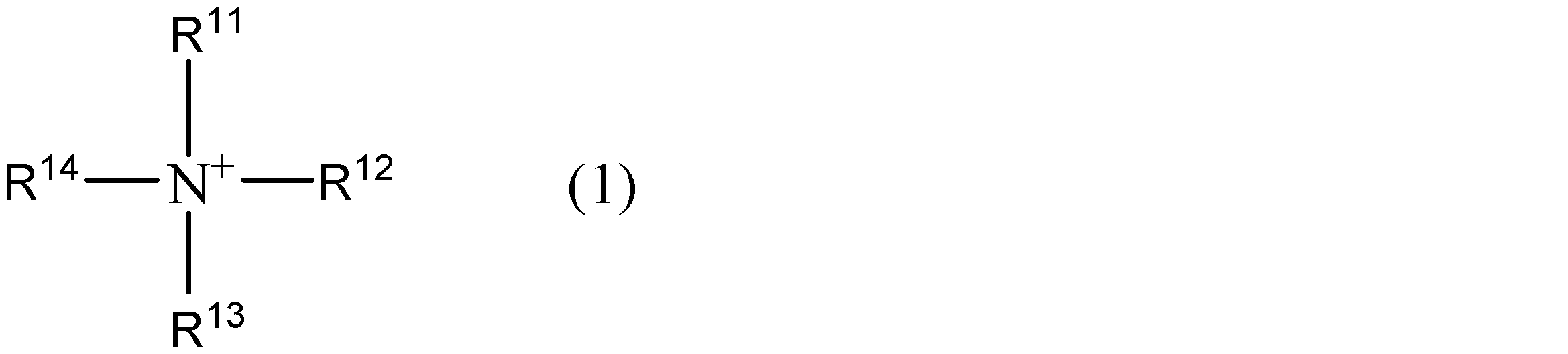
R11としては、炭素数18~22のアルキル基等が挙げられる。R12、R13及びR14の1価の基としては、水素原子、炭素原子を含む基(炭素原子以外の原子を含んでよい)等が挙げられる。第四級アンモニウム塩においてR12、R13及びR14は、それぞれ独立に、炭素原子を含む基であってよい。
炭素原子を含む基としては、アルキル基、アリール基、カルボキシ基、カルボン酸塩基、アルコキシ基等が挙げられる。アルキル基の炭素数は、優れた櫛通り性、耐べたつき性、柔らかさ(水すすぎ前及び後)、並びに、繊維処理剤の分散性を得やすい観点から、1~10、1~8、1~6、1~5、1~4、1~3、又は、1~2であってよい。アリール基としては、ベンジル基、フェニル基、ナフチル基等が挙げられる。アリール基は、優れた耐べたつき性、並びに、柔らかさ(水すすぎ前及び後)を得やすい観点から、ベンジル基であってよい。
カチオン系界面活性剤Aは、優れた櫛通り性、耐べたつき性、柔らかさ(水すすぎ前及び後)、並びに、繊維処理剤の分散性を得やすい観点から、下記の少なくとも一つを満たしてよい。
カチオン系界面活性剤Aは、一般式(1)におけるR12及びR13からなる群より選ばれる少なくとも一種がアルキル基又はアリール基である第四級アンモニウム塩を含んでよく、一般式(1)におけるR12、R13及びR14からなる群より選ばれる少なくとも一種がアルキル基又はアリール基である第四級アンモニウム塩を含んでよい。
カチオン系界面活性剤Aは、一般式(1)におけるR12及びR13からなる群より選ばれる少なくとも一種がメチル基又はベンジル基である第四級アンモニウム塩を含んでよく、一般式(1)におけるR12、R13及びR14からなる群より選ばれる少なくとも一種がメチル基又はベンジル基である第四級アンモニウム塩を含んでよい。
カチオン系界面活性剤Aは、一般式(1)におけるR12及びR13がメチル基である第四級アンモニウム塩を含んでよく、一般式(1)におけるR12、R13及びR14がメチル基である第四級アンモニウム塩を含んでよく、一般式(1)におけるR12及びR13がメチル基であると共にR14がベンジル基である第四級アンモニウム塩を含んでよい。
カチオン系界面活性剤Aは、一般式(1)におけるR12及びR13からなる群より選ばれる少なくとも一種がアルキル基又はアリール基である第四級アンモニウム塩を含んでよく、一般式(1)におけるR12、R13及びR14からなる群より選ばれる少なくとも一種がアルキル基又はアリール基である第四級アンモニウム塩を含んでよい。
カチオン系界面活性剤Aは、一般式(1)におけるR12及びR13からなる群より選ばれる少なくとも一種がメチル基又はベンジル基である第四級アンモニウム塩を含んでよく、一般式(1)におけるR12、R13及びR14からなる群より選ばれる少なくとも一種がメチル基又はベンジル基である第四級アンモニウム塩を含んでよい。
カチオン系界面活性剤Aは、一般式(1)におけるR12及びR13がメチル基である第四級アンモニウム塩を含んでよく、一般式(1)におけるR12、R13及びR14がメチル基である第四級アンモニウム塩を含んでよく、一般式(1)におけるR12及びR13がメチル基であると共にR14がベンジル基である第四級アンモニウム塩を含んでよい。
カチオン系界面活性剤Aは、優れた櫛通り性、耐べたつき性、柔らかさ(水すすぎ前及び後)、並びに、繊維処理剤の分散性を得やすい観点から、塩化ステアリルトリメチルアンモニウム、塩化オレイルトリメチルアンモニウム、塩化ノナデシルトリメチルアンモニウム、塩化イコシルトリメチルアンモニウム、塩化ヘンイコシルトリメチルアンモニウム、塩化ベヘニルトリメチルアンモニウム、塩化ステアリルジメチルベンジルアンモニウム、塩化オレイルジメチルベンジルアンモニウム、塩化ノナデシルジメチルベンジルアンモニウム、塩化イコシルジメチルベンジルアンモニウム、塩化ヘンイコシルジメチルベンジルアンモニウム、及び、塩化ベヘニルジメチルベンジルアンモニウムからなる群より選ばれる少なくとも一種を含んでよく、塩化ステアリルトリメチルアンモニウム、塩化ステアリルジメチルベンジルアンモニウム、及び、塩化ベヘニルトリメチルアンモニウムからなる群より選ばれる少なくとも一種を含んでよい。
ノニオン系界面活性剤b1における炭素鎖b1の炭素数は、10~20である。炭素鎖b1の炭素数が10以上であることにより、優れた櫛通り性、耐べたつき性及び柔らかさ(水すすぎ後)を得ることができると共に、繊維処理剤の優れた分散性を得やすい。炭素鎖b1の炭素数が20以下であることにより、優れた櫛通り性及び耐べたつき性を得ることができると共に、繊維処理剤の優れた分散性を得やすい。
炭素鎖b1の炭素数は、優れた柔らかさ(水すすぎ前及び後)、並びに、繊維処理剤の分散性を得やすい観点から、12以上、14以上、16以上、又は、18以上であってもよい。炭素鎖b1の炭素数は、優れた櫛通り性、耐べたつき性、及び、繊維処理剤の分散性を得やすい観点から、18以下、16以下、14以下、又は、12以下であってよい。これらの観点から、炭素鎖b1の炭素数は、10~18、10~16、10~14、10~12、12~20、12~18、12~16、12~14、16~20、16~18、又は、18~20であってよい。
ノニオン系界面活性剤b2における炭素鎖b2の炭素数は、10~22である。炭素鎖b2の炭素数が10以上であることにより、優れた耐べたつき性を得ることができると共に、繊維処理剤の優れた分散性を得やすい。炭素鎖b2の炭素数が22以下であることにより、優れた櫛通り性及び耐べたつき性を得ることができると共に、繊維処理剤の優れた分散性を得やすい。
炭素鎖b2の炭素数は、優れた柔らかさ(水すすぎ前及び後)、並びに、繊維処理剤の分散性を得やすい観点から、12以上、14以上、16以上、18以上、又は、20以上であってもよい。炭素鎖b2の炭素数は、優れた櫛通り性、耐べたつき性、及び、繊維処理剤の分散性を得やすい観点から、20以下、18以下、16以下、14以下、又は、12以下であってよい。これらの観点から、炭素鎖b2の炭素数は、10~20、10~18、10~16、10~12、12~22、12~20、12~18、12~16、16~22、16~20、16~18、18~22、18~20、又は、20~22であってよい。
ノニオン系界面活性剤b1及びノニオン系界面活性剤b2は、水中でイオンに解離する基を有しない界面活性剤である。ノニオン系界面活性剤b1及びノニオン系界面活性剤b2からなる群より選ばれる少なくとも一種は、優れた櫛通り性、耐べたつき性、柔らかさ(水すすぎ前及び後)、並びに、繊維処理剤の分散性を得やすい観点から、下記の少なくとも一つを満たしてよい。
ノニオン系界面活性剤b1及びノニオン系界面活性剤b2からなる群より選ばれる少なくとも一種(例えば、ノニオン系界面活性剤b1及びノニオン系界面活性剤b2)は、ポリオキシアルキレンアルキルエーテル、脂肪酸モノアルカノールアミド、脂肪酸ジアルカノールアミド、ポリオキシアルキレンジアルキルアミン、ジポリオキシアルキレンアルキルアミン、及び、ポリオキシアルキレン脂肪酸エステルからなる群より選ばれる少なくとも一種を含んでよく、ポリオキシアルキレンアルキルエーテルを含んでよい。
ノニオン系界面活性剤b1は、ポリオキシアルキレンアルキルエーテルを含んでよく、ポリオキシエチレンデシルエーテル、ポリオキシエチレンラウリルエーテル、ポリオキシエチレンセチルエーテル、及び、ポリオキシエチレンステアリルエーテルからなる群より選ばれる少なくとも一種を含んでよい。
ノニオン系界面活性剤b2は、ポリオキシアルキレンアルキルエーテルを含んでよく、ポリオキシエチレンデシルエーテル、ポリオキシエチレンラウリルエーテル、ポリオキシエチレンセチルエーテル、ポリオキシエチレンステアリルエーテル、及び、ポリオキシエチレンベヘニルエーテルからなる群より選ばれる少なくとも一種を含んでよい。
ノニオン系界面活性剤b1及びノニオン系界面活性剤b2からなる群より選ばれる少なくとも一種は、脂肪酸モノアルカノールアミド、及び、脂肪酸ジアルカノールアミドからなる群より選ばれる少なくとも一種を含んでよく、ヤシ油脂肪酸ジエタノールアミドを含んでよい。
ノニオン系界面活性剤b1及びノニオン系界面活性剤b2からなる群より選ばれる少なくとも一種は、ポリオキシアルキレンジアルキルアミン、及び、ジポリオキシアルキレンアルキルアミンからなる群より選ばれる少なくとも一種を含んでよく、ジポリオキシエチレンラウリルアミンを含んでよい。
ノニオン系界面活性剤b1及びノニオン系界面活性剤b2からなる群より選ばれる少なくとも一種は、ポリオキシアルキレン脂肪酸エステルを含んでよく、ポリオキシエチレンラウリン酸エステルを含んでよい。
ノニオン系界面活性剤b1及びノニオン系界面活性剤b2からなる群より選ばれる少なくとも一種(例えば、ノニオン系界面活性剤b1及びノニオン系界面活性剤b2)は、ポリオキシアルキレンアルキルエーテル、脂肪酸モノアルカノールアミド、脂肪酸ジアルカノールアミド、ポリオキシアルキレンジアルキルアミン、ジポリオキシアルキレンアルキルアミン、及び、ポリオキシアルキレン脂肪酸エステルからなる群より選ばれる少なくとも一種を含んでよく、ポリオキシアルキレンアルキルエーテルを含んでよい。
ノニオン系界面活性剤b1は、ポリオキシアルキレンアルキルエーテルを含んでよく、ポリオキシエチレンデシルエーテル、ポリオキシエチレンラウリルエーテル、ポリオキシエチレンセチルエーテル、及び、ポリオキシエチレンステアリルエーテルからなる群より選ばれる少なくとも一種を含んでよい。
ノニオン系界面活性剤b2は、ポリオキシアルキレンアルキルエーテルを含んでよく、ポリオキシエチレンデシルエーテル、ポリオキシエチレンラウリルエーテル、ポリオキシエチレンセチルエーテル、ポリオキシエチレンステアリルエーテル、及び、ポリオキシエチレンベヘニルエーテルからなる群より選ばれる少なくとも一種を含んでよい。
ノニオン系界面活性剤b1及びノニオン系界面活性剤b2からなる群より選ばれる少なくとも一種は、脂肪酸モノアルカノールアミド、及び、脂肪酸ジアルカノールアミドからなる群より選ばれる少なくとも一種を含んでよく、ヤシ油脂肪酸ジエタノールアミドを含んでよい。
ノニオン系界面活性剤b1及びノニオン系界面活性剤b2からなる群より選ばれる少なくとも一種は、ポリオキシアルキレンジアルキルアミン、及び、ジポリオキシアルキレンアルキルアミンからなる群より選ばれる少なくとも一種を含んでよく、ジポリオキシエチレンラウリルアミンを含んでよい。
ノニオン系界面活性剤b1及びノニオン系界面活性剤b2からなる群より選ばれる少なくとも一種は、ポリオキシアルキレン脂肪酸エステルを含んでよく、ポリオキシエチレンラウリン酸エステルを含んでよい。
ノニオン系界面活性剤b1及びノニオン系界面活性剤b2からなる群より選ばれる少なくとも一種(例えば、ノニオン系界面活性剤b1及びノニオン系界面活性剤b2)は、優れた櫛通り性、耐べたつき性、柔らかさ(水すすぎ前及び後)、並びに、繊維処理剤の分散性を得やすい観点から、エーテル化合物、エステル化合物、アミド化合物、及び、アミン化合物からなる群より選ばれる少なくとも一種を含んでよく、下記一般式(2a)で表される構造、下記一般式(2b)で表される構造、下記一般式(2c)で表される構造、及び、下記一般式(2d)で表される構造からなる群より選ばれる少なくとも一種を有する化合物を含んでよい。
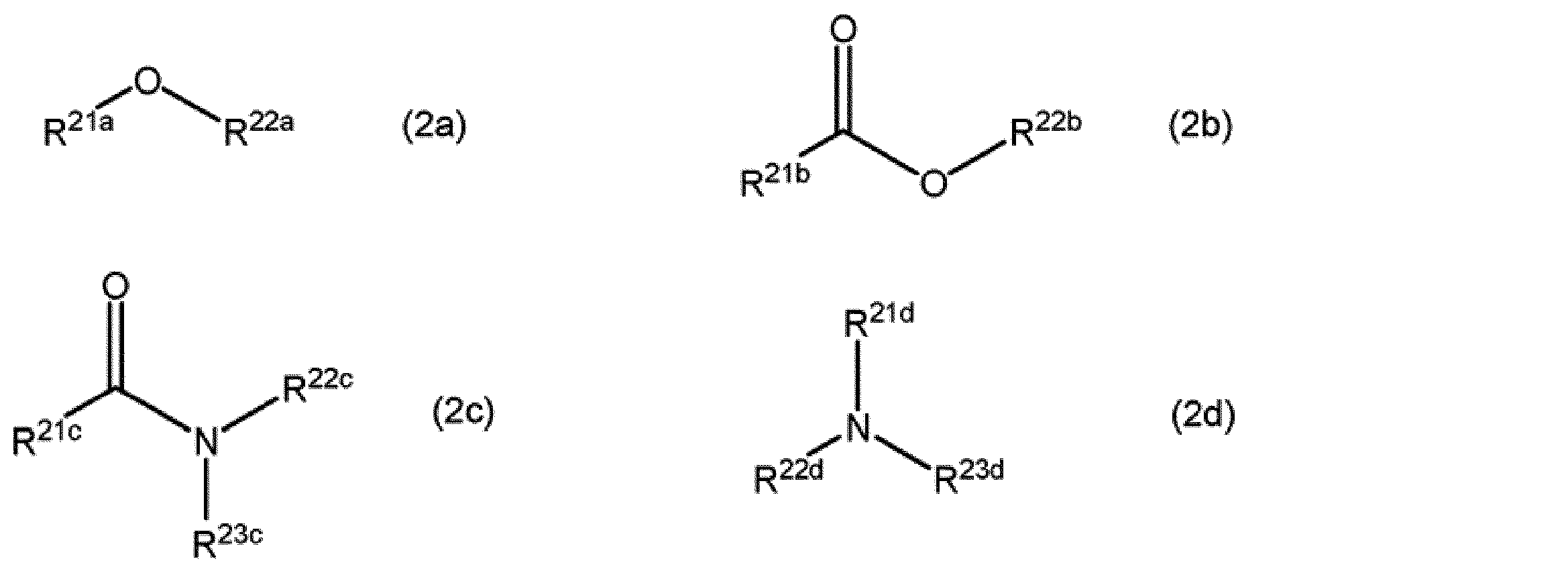
疎水部としては、アルキル基等の炭化水素基などが挙げられる。炭化水素基(アルキル基等)は、直鎖状、分岐又は環状のいずれであってもよい。
親水部は、親水性基を有する基、又は、親水性基であってよい。親水性基としては、(ポリ)オキシアルキレン基、ヒドロキシ基、カルボキシ基、カルボン酸塩基、リン酸基、リン酸塩基、スルホン酸基、スルホン酸塩基等が挙げられる。(ポリ)オキシアルキレン基としては、(ポリ)オキシエチレン基、(ポリ)オキシプロピレン基等が挙げられる。
ノニオン系界面活性剤b1は、優れた櫛通り性、耐べたつき性、柔らかさ(水すすぎ前及び後)、並びに、繊維処理剤の分散性を得やすい観点から、ポリオキシエチレンデシルエーテル、ポリオキシエチレンラウリルエーテル、ポリオキシエチレンラウリン酸エステル、ジポリオキシエチレンラウリルアミン、ポリオキシエチレンセチルエーテル、ヤシ油脂肪酸ジエタノールアミド、及び、ポリオキシエチレンステアリルエーテルからなる群より選ばれる少なくとも一種を含んでよい。ノニオン系界面活性剤b2は、優れた櫛通り性、耐べたつき性、柔らかさ(水すすぎ前及び後)、並びに、繊維処理剤の分散性を得やすい観点から、ポリオキシエチレンデシルエーテル、ポリオキシエチレンラウリルエーテル、ポリオキシエチレンラウリン酸エステル、ジポリオキシエチレンラウリルアミン、ポリオキシエチレンセチルエーテル、ヤシ油脂肪酸ジエタノールアミド、ポリオキシエチレンステアリルエーテル、及び、ポリオキシエチレンベヘニルエーテルからなる群より選ばれる少なくとも一種を含んでよい。
ノニオン系界面活性剤b1のHLB値は、14.0~19.0である。すなわち、本実施形態に係る毛髪用繊維及び繊維処理剤において、HLB値が14.0~19.0であるノニオン系界面活性剤b1の少なくとも一種が存在する。ノニオン系界面活性剤b1のHLB値が14.0以上であることにより、優れた耐べたつき性及び柔らかさ(水すすぎ後)を得ることができると共に、繊維処理剤の優れた分散性を得やすい。ノニオン系界面活性剤b1のHLB値が19.0以下であることにより、優れた櫛通り性及び耐べたつき性を得ることができると共に、繊維処理剤の優れた分散性を得やすい。本実施形態に係る毛髪用繊維及び繊維処理剤において、HLB値が異なる複数のノニオン系界面活性剤b1が存在してよい。
ノニオン系界面活性剤b1のHLB値は、優れた耐べたつき性、柔らかさ(水すすぎ前及び後)、並びに、繊維処理剤の分散性を得やすい観点から、14.5以上、15.0以上、15.5以上、15.6以上、16.0以上、16.5以上、16.6以上、16.7以上、17.0以上、17.2以上、又は、17.4以上であってよい。ノニオン系界面活性剤b1のHLB値は、優れた柔らかさ(水すすぎ前及び後)、並びに、繊維処理剤の分散性を得やすい観点から、17.5以上、18.0以上、18.3以上、又は、18.5以上であってよい。ノニオン系界面活性剤b1のHLB値は、優れた櫛通り性、耐べたつき性、及び、繊維処理剤の分散性を得やすい観点から、18.5以下、18.3以下、18.0以下、17.5以下、又は、17.4以下であってよい。ノニオン系界面活性剤b1のHLB値は、優れた櫛通り性、耐べたつき性、及び、繊維処理剤の分散性を得やすい観点から、17.2以下、17.0以下、16.7以下、16.6以下、16.5以下、16.0以下、15.6以下、又は、15.5以下であってよい。これらの観点から、ノニオン系界面活性剤b1のHLB値は、14.0~18.5、14.0~18.0、14.0~17.5、14.0~17.0、15.0~19.0、15.0~18.5、15.0~18.0、15.0~17.5、15.0~17.0、16.0~19.0、16.0~18.5、16.0~18.0、16.0~17.5、16.0~17.0、16.5~19.0、16.5~18.5、16.5~18.0、16.5~17.5、16.5~17.0、17.0~19.0、17.0~18.5、17.0~18.0、又は、17.0~17.5であってよい。
ノニオン系界面活性剤b2のHLB値は、6.0以上14.0未満である。すなわち、本実施形態に係る毛髪用繊維及び繊維処理剤において、HLB値が6.0以上14.0未満であるノニオン系界面活性剤b2の少なくとも一種が存在する。ノニオン系界面活性剤b2のHLB値が6.0以上であることにより、優れた耐べたつき性を得ることができると共に、繊維処理剤の優れた分散性を得やすい。ノニオン系界面活性剤b2のHLB値が14.0未満であることにより、優れた耐べたつき性を得ることができると共に、繊維処理剤の優れた分散性を得やすい。本実施形態に係る毛髪用繊維及び繊維処理剤において、HLB値が異なる複数のノニオン系界面活性剤b2が存在してよい。
ノニオン系界面活性剤b2のHLB値は、優れた柔らかさ(水すすぎ前及び後)、並びに、繊維処理剤の分散性を得やすい観点から、6.5以上、7.0以上、7.5以上、8.0以上、8.4以上、8.5以上、9.0以上、9.2以上、9.4以上、9.5以上、9.7以上、10.0以上、10.5以上、11.0以上、11.5以上、12.0以上、又は、12.5以上であってよい。ノニオン系界面活性剤b2のHLB値は、優れた櫛通り性、耐べたつき性、及び、繊維処理剤の分散性を得やすい観点から、13.5以下、13.0以下、12.5以下、12.0以下、11.5以下、11.0以下、10.5以下、10.0以下、9.7以下、9.5以下、9.4以下、9.2以下、9.0以下、8.5以下、又は、8.4以下であってよい。これらの観点から、ノニオン系界面活性剤b2のHLB値は、6.0~13.0、6.0~10.0、6.0~9.5、8.0以上14.0未満、8.0~13.0、8.0~10.0、8.0~9.5、9.0以上14.0未満、9.0~13.0、9.0~10.0、又は、9.0~9.5であってよい。
ノニオン系界面活性剤のHLB値は、親水部の式量、及び、ノニオン系界面活性剤の分子量を用いてグリフィン法に基づき算出可能であり、例えば、測定対象のノニオン系界面活性剤を抽出した後、GPCによる分子量測定、NMRによる構造特定等を経て、グリフィン法に基づき算出できる。ノニオン系界面活性剤のHLB値は、例えば、親水部((ポリ)オキシアルキレン基等)の長さで調整できる。
本実施形態に係る毛髪用繊維及び繊維処理剤において、油分Sの含有量は、100質量部のカチオン系界面活性剤Aに対して0.2~600質量部である。油分Sの含有量が0.2質量部以上であることにより、優れた櫛通り性を得ることができる。油分Sの含有量が600質量部以下であることにより、優れた耐べたつき性を得ることができる。本実施形態に係る毛髪用繊維及び繊維処理剤において、トリグリセリドの含有量、脂肪酸アルキルの含有量、又は、脂肪族飽和炭化水素の含有量は、100質量部のカチオン系界面活性剤Aに対して0.2~600質量部であってよい。
含有量C1として、油分Sの含有量、トリグリセリドの含有量、脂肪酸アルキルの含有量、又は、脂肪族飽和炭化水素の含有量は、100質量部のカチオン系界面活性剤Aに対して下記の範囲であってよい。含有量C1は、優れた櫛通り性を得やすい観点から、0.3質量部以上、0.5質量部以上、0.6質量部以上、0.7質量部以上、1質量部以上、5質量部以上、10質量部以上、50質量部以上、100質量部以上、150質量部以上、200質量部以上、250質量部以上、300質量部以上、350質量部以上、400質量部以上、450質量部以上、500質量部以上、又は、550質量部以上であってよい。含有量C1は、優れた耐べたつき性、並びに、柔らかさ(水すすぎ前及び後)を得やすい観点から、550質量部以下、500質量部以下、450質量部以下、400質量部以下、350質量部以下、300質量部以下、250質量部以下、200質量部以下、150質量部以下、100質量部以下、50質量部以下、10質量部以下、5質量部以下、1質量部以下、又は、0.7質量部以下であってよい。これらの観点から、含有量C1は、0.2~500質量部、0.2~400質量部、0.2~300質量部、0.2~50質量部、50~600質量部、50~500質量部、50~400質量部、50~300質量部、200~600質量部、200~500質量部、200~400質量部、200~300質量部、300~600質量部、300~500質量部、300~400質量部、又は、400~600質量部であってよい。
本実施形態に係る毛髪用繊維及び繊維処理剤において、含有量C2として、油分Sの含有量、トリグリセリドの含有量、脂肪酸アルキルの含有量、又は、脂肪族飽和炭化水素の含有量は、100質量部のノニオン系界面活性剤b1に対して下記の範囲であってよい。含有量C2は、優れた櫛通り性、並びに、柔らかさ(水すすぎ前及び後)を得やすい観点から、0.02質量部以上、0.05質量部以上、0.1質量部以上、0.5質量部以上、1質量部以上、5質量部以上、10質量部以上、12質量部以上、15質量部以上、20質量部以上、30質量部以上、40質量部以上、50質量部以上、又は、55質量部以上であってよい。含有量C2は、優れた耐べたつき性、及び、繊維処理剤の分散性を得やすい観点から、60質量部以下、55質量部以下、50質量部以下、40質量部以下、30質量部以下、20質量部以下、15質量部以下、12質量部以下、10質量部以下、5質量部以下、1質量部以下、0.5質量部以下、又は、0.1質量部以下であってよい。これらの観点から、含有量C2は、0.02~60質量部、0.02~50質量部、0.02~40質量部、0.02~30質量部、1~60質量部、1~50質量部、1~40質量部、1~30質量部、20~60質量部、20~50質量部、20~40質量部、20~30質量部、30~60質量部、30~50質量部、又は、30~40質量部であってよい。
本実施形態に係る毛髪用繊維及び繊維処理剤において、油分Sの含有量は、100質量部のノニオン系界面活性剤b2に対して20~210質量部である。油分Sの含有量が20質量部以上であることにより、優れた櫛通り性を得ることができる。油分Sの含有量が210質量部以下であることにより、優れた耐べたつき性を得ることができると共に、繊維処理剤の優れた分散性を得やすい。本実施形態に係る毛髪用繊維及び繊維処理剤において、トリグリセリドの含有量、脂肪酸アルキルの含有量、又は、脂肪族飽和炭化水素の含有量は、100質量部のノニオン系界面活性剤b2に対して20~210質量部であってよい。
含有量C3として、油分Sの含有量、トリグリセリドの含有量、脂肪酸アルキルの含有量、又は、脂肪族飽和炭化水素の含有量は、優れた櫛通り性、耐べたつき性、並びに、柔らかさ(水すすぎ前及び後)を調整する観点から、100質量部のノニオン系界面活性剤b2に対して下記の範囲であってよい。含有量C3は、1質量部以上、5質量部以上、10質量部以上、20質量部以上、30質量部以上、40質量部以上、50質量部以上、又は、60質量部以上であってよい。含有量C3は、耐べたつき性、及び、繊維処理剤の分散性を調整する観点から、200質量部以下、180質量部以下、150質量部以下、120質量部以下、100質量部以下、90質量部以下、80質量部以下、70質量部以下、又は、60質量部以下であってよい。これらの観点から、含有量C3は、1~200質量部、1~100質量部、1~80質量部、1~60質量部、30~200質量部、30~100質量部、30~80質量部、30~60質量部、60~200質量部、60~100質量部、又は、60~80質量部であってよい。
本実施形態に係る毛髪用繊維及び繊維処理剤において、カチオン系界面活性剤Aの含有量は、100質量部のノニオン系界面活性剤b1に対して3~20質量部である。カチオン系界面活性剤Aの含有量が3質量部以上であることにより、優れた柔らかさ(水すすぎ後)を得ることができる。カチオン系界面活性剤Aの含有量が20質量部以下であることにより、優れた櫛通り性及び耐べたつき性を得ることができると共に、繊維処理剤の優れた分散性を得やすい。
カチオン系界面活性剤Aの含有量は、100質量部のノニオン系界面活性剤b1に対して下記の範囲であってよい。カチオン系界面活性剤Aの含有量は、優れた柔らかさ(水すすぎ前及び後)を得やすい観点から、4質量部以上、5質量部以上、6質量部以上、8質量部以上、10質量部以上、12質量部以上、15質量部以上、16質量部以上、17質量部以上、18質量部以上、又は、19質量部以上であってよい。カチオン系界面活性剤Aの含有量は、優れた櫛通り性、耐べたつき性、及び、繊維処理剤の分散性を得やすい観点から、19質量部以下、18質量部以下、17質量部以下、16質量部以下、15質量部以下、12質量部以下、10質量部以下、8質量部以下、6質量部以下、5質量部以下、又は、4質量部以下であってよい。これらの観点から、カチオン系界面活性剤Aの含有量は、3~19質量部、3~17質量部、3~15質量部、3~10質量部、4~20質量部、4~19質量部、4~17質量部、4~15質量部、4~10質量部、5~20質量部、5~19質量部、5~17質量部、5~15質量部、5~10質量部、8~20質量部、8~19質量部、8~17質量部、8~15質量部、8~10質量部、10~20質量部、10~19質量部、10~17質量部、又は、10~15質量部であってよい。
本実施形態に係る毛髪用繊維及び繊維処理剤において、カチオン系界面活性剤Aの含有量は、100質量部のノニオン系界面活性剤b2に対して下記の範囲であってよい。カチオン系界面活性剤Aの含有量は、優れた柔らかさ(水すすぎ前及び後)を得やすい観点から、10質量部以上、15質量部以上、20質量部以上、30質量部以上、50質量部以上、70質量部以上、100質量部以上、500質量部以上、1000質量部以上、又は、5000質量部以上であってよい。カチオン系界面活性剤Aの含有量は、優れた櫛通り性、耐べたつき性、及び、繊維処理剤の分散性を得やすい観点から、10000質量部以下、5000質量部以下、1000質量部以下、500質量部以下、100質量部以下、70質量部以下、50質量部以下、30質量部以下、20質量部以下、又は、15質量部以下であってよい。これらの観点から、カチオン系界面活性剤Aの含有量は、10~10000質量部、10~1000質量部、10~100質量部、10~30質量部、10~20質量部、15~10000質量部、15~1000質量部、15~100質量部、15~30質量部、15~20質量部、20~10000質量部、20~1000質量部、20~100質量部、又は、20~30質量部であってよい。
本実施形態に係る毛髪用繊維及び繊維処理剤において、ノニオン系界面活性剤b1の含有量は、100質量部のノニオン系界面活性剤b2に対して下記の範囲であってよい。ノニオン系界面活性剤b1の含有量は、優れた柔らかさ(水すすぎ前及び後)を得やすい観点から、10質量部以上、50質量部以上、80質量部以上、100質量部以上、120質量部以上、150質量部以上、180質量部以上、200質量部以上、250質量部以上、300質量部以上、350質量部以上、又は、400質量部以上であってよい。ノニオン系界面活性剤b1の含有量は、優れた櫛通り性及び耐べたつき性を得やすい観点から、1000質量部以下、800質量部以下、600質量部以下、500質量部以下、400質量部以下、350質量部以下、300質量部以下、250質量部以下、200質量部以下、180質量部以下、150質量部以下、又は、120質量部以下であってよい。これらの観点から、ノニオン系界面活性剤b1の含有量は、10~1000質量部、10~500質量部、10~300質量部、10~200質量部、10~150質量部、100~1000質量部、100~500質量部、100~300質量部、100~200質量部、100~150質量部、150~1000質量部、150~500質量部、150~300質量部、150~200質量部、200~1000質量部、200~500質量部、200~300質量部、300~1000質量部、又は、300~500質量部であってよい。
本実施形態に係る毛髪用繊維において、油分S、カチオン系界面活性剤A、ノニオン系界面活性剤b1及びノニオン系界面活性剤b2の合計量は、毛髪用繊維の全量を基準として0.002~4質量%(0.002~4.0質量%)である。合計量が0.002質量%以上であることにより、優れた柔らかさ(水すすぎ後)を得ることができると共に、優れた柔らかさ(水すすぎ前)を得やすい。合計量が4質量%以下であることにより、優れた櫛通り性及び耐べたつき性を得ることができる。
本実施形態に係る毛髪用繊維において、油分S、カチオン系界面活性剤A、ノニオン系界面活性剤b1及びノニオン系界面活性剤b2の合計量は、毛髪用繊維の全量を基準として下記の範囲であってよい。合計量は、優れた櫛通り性、並びに、柔らかさ(水すすぎ前及び後)を得やすい観点から、0.004質量%以上、0.005質量%以上、0.01質量%以上、0.02質量%以上、0.05質量%以上、0.1質量%以上、0.3質量%以上、0.5質量%以上、0.8質量%以上、又は、1質量%以上であってよい。合計量は、優れた柔らかさ(水すすぎ前及び後)を得やすい観点から、1.2質量%以上、1.4質量%以上、1.5質量%以上、1.6質量%以上、1.8質量%以上、2質量%以上、2.5質量%以上、3質量%以上、又は、3.5質量%以上であってよい。合計量は、優れた櫛通り性及び耐べたつき性を得やすい観点から、3.5質量%以下、3質量%以下、2.5質量%以下、2質量%以下、1.8質量%以下、1.6質量%以下、1.5質量%以下、1.4質量%以下、1.2質量%以下、又は、1質量%以下であってよい。合計量は、優れた耐べたつき性を得やすい観点から、0.8質量%以下、0.5質量%以下、0.3質量%以下、0.1質量%以下、0.05質量%以下、0.02質量%以下、0.01質量%以下、又は、0.005質量%以下であってよい。これらの観点から、合計量は、0.005~4質量%、0.01~4質量%、0.1~4質量%、1~4質量%、0.002~2質量%、0.005~2質量%、0.01~2質量%、0.1~2質量%、1~2質量%、0.002~1質量%、0.005~1質量%、0.01~1質量%、又は、0.1~1質量%であってよい。
本実施形態に係る毛髪用繊維において、含有量C4として、油分Sの含有量、トリグリセリドの含有量、脂肪酸アルキルの含有量、又は、脂肪族飽和炭化水素の含有量は、毛髪用繊維の全量を基準として、0質量%を超えており、下記の範囲であってよい。含有量C4は、優れた櫛通り性を得やすい観点から、0.0005質量%以上、0.001質量%以上、0.005質量%以上、0.01質量%以上、0.05質量%以上、0.1質量%以上、0.12質量%以上、0.15質量%以上、0.16質量%以上、0.18質量%以上、0.2質量%以上、0.3質量%以上、又は、0.5質量%以上であってよい。含有量C4は、優れた耐べたつき性、並びに、柔らかさ(水すすぎ前及び後)を得やすい観点から、5質量%以下、3質量%以下、1質量%以下、0.5質量%以下、0.3質量%以下、0.2質量%以下、0.18質量%以下、0.16質量%以下、0.15質量%以下、0.12質量%以下、又は、0.1質量%以下であってよい。これらの観点から、含有量C4は、0質量%超5質量%以下、0質量%超1質量%以下、0質量%超0.5質量%以下、0質量%超0.2質量%以下、0.05~5質量%、0.05~1質量%、0.05~0.5質量%、0.05~0.2質量%、0.1~5質量%、0.1~1質量%、0.1~0.5質量%、又は、0.1~0.2質量%であってよい。
本実施形態に係る毛髪用繊維において、カチオン系界面活性剤Aの含有量は、毛髪用繊維の全量を基準として、0質量%を超えており、下記の範囲であってよい。カチオン系界面活性剤Aの含有量は、優れた柔らかさ(水すすぎ前及び後)を得やすい観点から、0.0001質量%以上、0.0002質量%以上、0.0003質量%以上、0.0005質量%以上、0.0008質量%以上、0.001質量%以上、0.002質量%以上、0.003質量%以上、0.005質量%以上、0.008質量%以上、0.01質量%以上、0.02質量%以上、0.03質量%以上、0.05質量%以上、0.07質量%以上、0.09質量%以上、0.1質量%以上、0.15質量%以上、又は、0.2質量%以上であってよい。カチオン系界面活性剤Aの含有量は、優れた櫛通り性及び耐べたつき性を得やすい観点から、1質量%以下、0.5質量%以下、0.45質量%以下、0.4質量%以下、0.35質量%以下、0.3質量%以下、0.25質量%以下、0.2質量%以下、0.15質量%以下、0.1質量%以下、0.09質量%以下、0.07質量%以下、0.05質量%以下、又は、0.03質量%以下であってよい。これらの観点から、カチオン系界面活性剤Aの含有量は、0質量%超1質量%以下、0質量%超0.1質量%以下、0質量%超0.07質量%以下、0質量%超0.05質量%以下、0.01~1質量%、0.01~0.1質量%、0.01~0.07質量%、0.01~0.05質量%、0.03~1質量%、0.03~0.1質量%、0.03~0.07質量%、0.03~0.05質量%、0.05~1質量%、0.05~0.1質量%、又は、0.05~0.07質量%であってよい。
本実施形態に係る毛髪用繊維において、ノニオン系界面活性剤b1の含有量は、毛髪用繊維の全量を基準として、0質量%を超えており、下記の範囲であってよい。ノニオン系界面活性剤b1の含有量は、優れた柔らかさ(水すすぎ前及び後)、並びに、繊維処理剤の分散性を得やすい観点から、0.0001質量%以上、0.0005質量%以上、0.001質量%以上、0.005質量%以上、0.01質量%以上、0.05質量%以上、0.1質量%以上、0.2質量%以上、0.3質量%以上、0.4質量%以上、0.5質量%以上、0.6質量%以上、0.7質量%以上、0.9質量%以上、1質量%以上、1.5質量%以上、又は、2質量%以上であってよい。ノニオン系界面活性剤b1の含有量は、優れた櫛通り性及び耐べたつき性を得やすい観点から、5質量%以下、4質量%以下、3質量%以下、2質量%以下、1.5質量%以下、1質量%以下、0.9質量%以下、0.7質量%以下、0.6質量%以下、0.5質量%以下、0.4質量%以下、0.3質量%以下、0.2質量%以下、0.1質量%以下、0.05質量%以下、0.01質量%以下、又は、0.005質量%以下であってよい。これらの観点から、ノニオン系界面活性剤b1の含有量は、0質量%超5質量%以下、0質量%超3質量%以下、0質量%超2質量%以下、0質量%超0.7質量%以下、0.1~5質量%、0.1~3質量%、0.1~2質量%、0.1~0.7質量%、0.3~5質量%、0.3~3質量%、0.3~2質量%、又は、0.3~0.7質量%であってよい。
本実施形態に係る毛髪用繊維において、ノニオン系界面活性剤b2の含有量は、毛髪用繊維の全量を基準として、0質量%を超えており、下記の範囲であってよい。ノニオン系界面活性剤b2の含有量は、優れた繊維処理剤の分散性を得やすい観点から、0.0005質量%以上、0.001質量%以上、0.005質量%以上、0.01質量%以上、0.05質量%以上、0.1質量%以上、0.2質量%以上、0.3質量%以上、0.4質量%以上、0.5質量%以上、0.7質量%以上、又は、1質量%以上であってよい。ノニオン系界面活性剤b2の含有量は、優れた耐べたつき性、並びに、柔らかさ(水すすぎ前及び後)を得やすい観点から、5質量%以下、4質量%以下、3質量%以下、2質量%以下、1.5質量%以下、1質量%以下、0.7質量%以下、0.5質量%以下、0.4質量%以下、0.3質量%以下、0.2質量%以下、0.1質量%以下、0.05質量%以下、0.01質量%以下、又は、0.005質量%以下であってよい。これらの観点から、ノニオン系界面活性剤b2の含有量は、0質量%超5質量%以下、0質量%超2質量%以下、0質量%超1質量%以下、0質量%超0.5質量%以下、0.1~5質量%、0.1~2質量%、0.1~1質量%、0.1~0.5質量%、0.2~5質量%、0.2~2質量%、0.2~1質量%、又は、0.2~0.5質量%であってよい。
油分S、カチオン系界面活性剤A、ノニオン系界面活性剤b1及びノニオン系界面活性剤b2のそれぞれの含有量は、NMR、GC-MS、HPLC、FT-IR、温水抽出、溶剤抽出等を用いて測定できる。毛髪用繊維における油分S、カチオン系界面活性剤A、ノニオン系界面活性剤b1及びノニオン系界面活性剤b2のうちの複数の成分の間の相対量は、繊維処理剤における相対量と同等である傾向がある。
本実施形態に係る繊維処理剤において、油分S、カチオン系界面活性剤A、ノニオン系界面活性剤b1及びノニオン系界面活性剤b2の合計量は、繊維処理剤の全量を基準として下記の範囲であってよい。合計量は、優れた櫛通り性、並びに、柔らかさ(水すすぎ前及び後)を得やすい観点から、0.02質量%以上、0.05質量%以上、0.1質量%以上、0.2質量%以上、0.5質量%以上、1質量%以上、3質量%以上、5質量%以上、8質量%以上、又は、10質量%以上であってよい。合計量は、優れた耐べたつき性を得やすい観点から、40質量%以下、35質量%以下、30質量%以下、25質量%以下、20質量%以下、18質量%以下、16質量%以下、15質量%以下、14質量%以下、12質量%以下、10質量%以下、8質量%以下、5質量%以下、3質量%以下、1質量%以下、0.5質量%以下、0.2質量%以下、0.1質量%以下、又は、0.05質量%以下であってよい。これらの観点から、合計量は、0.02~40質量%、0.05~40質量%、0.1~40質量%、1~40質量%、10~40質量%、0.02~20質量%、0.05~20質量%、0.1~20質量%、1~20質量%、10~20質量%、0.02~10質量%、0.05~10質量%、0.1~10質量%、又は、1~10質量%であってよい。
本実施形態に係る繊維処理剤において、含有量C5として、油分Sの含有量、トリグリセリドの含有量、脂肪酸アルキルの含有量、又は、脂肪族飽和炭化水素の含有量は、繊維処理剤の全量を基準として、0質量%を超えており、下記の範囲であってよい。含有量C5は、優れた櫛通り性を得やすい観点から、0.005質量%以上、0.01質量%以上、0.05質量%以上、0.1質量%以上、0.5質量%以上、1質量%以上、1.2質量%以上、又は、1.5質量%以上であってよい。含有量C5は、優れた耐べたつき性、及び、繊維処理剤の分散性を得やすい観点から、50質量%以下、30質量%以下、10質量%以下、5質量%以下、3質量%以下、又は、2質量%以下であってよい。これらの観点から、含有量C5は、0質量%超50質量%以下、0質量%超10質量%以下、0質量%超5質量%以下、0質量%超2質量%以下、0.5~50質量%、0.5~10質量%、0.5~5質量%、0.5~2質量%、1~50質量%、1~10質量%、1~5質量%、又は、1~2質量%であってよい。
本実施形態に係る繊維処理剤において、カチオン系界面活性剤Aの含有量は、繊維処理剤の全量を基準として、0質量%を超えており、下記の範囲であってよい。カチオン系界面活性剤Aの含有量は、優れた柔らかさ(水すすぎ前及び後)を得やすい観点から、0.001質量%以上、0.002質量%以上、0.003質量%以上、0.005質量%以上、0.008質量%以上、0.01質量%以上、0.02質量%以上、0.03質量%以上、0.05質量%以上、0.08質量%以上、0.1質量%以上、0.2質量%以上、0.3質量%以上、又は、0.5質量%以上であってよい。カチオン系界面活性剤Aの含有量は、優れた櫛通り性、耐べたつき性、及び、繊維処理剤の分散性を得やすい観点から、10質量%以下、5質量%以下、4.5質量%以下、4質量%以下、3.5質量%以下、3質量%以下、2.5質量%以下、2質量%以下、1.5質量%以下、1質量%以下、0.9質量%以下、0.7質量%以下、又は、0.6質量%以下であってよい。これらの観点から、カチオン系界面活性剤Aの含有量は、0質量%超10質量%以下、0質量%超1質量%以下、0質量%超0.7質量%以下、0質量%超0.6質量%以下、0.1~10質量%、0.1~1質量%、0.1~0.7質量%、0.1~0.6質量%、0.3~10質量%、0.3~1質量%、0.3~0.7質量%、0.3~0.6質量%、0.5~10質量%、0.5~1質量%、又は、0.5~0.6質量%であってよい。
本実施形態に係る繊維処理剤において、ノニオン系界面活性剤b1の含有量は、繊維処理剤の全量を基準として、0質量%を超えており、下記の範囲であってよい。ノニオン系界面活性剤b1の含有量は、優れた柔らかさ(水すすぎ前及び後)、並びに、繊維処理剤の分散性を得やすい観点から、0.001質量%以上、0.005質量%以上、0.01質量%以上、0.05質量%以上、0.1質量%以上、0.5質量%以上、1質量%以上、2質量%以上、3質量%以上、4質量%以上、又は、5質量%以上であってよい。ノニオン系界面活性剤b1の含有量は、優れた櫛通り性及び耐べたつき性を得やすい観点から、50質量%以下、40質量%以下、30質量%以下、20質量%以下、15質量%以下、10質量%以下、9質量%以下、7質量%以下、又は、6質量%以下であってよい。これらの観点から、ノニオン系界面活性剤b1の含有量は、0質量%超50質量%以下、0質量%超30質量%以下、0質量%超20質量%以下、0質量%超7質量%以下、1~50質量%、1~30質量%、1~20質量%、1~7質量%、3~50質量%、3~30質量%、3~20質量%、又は、3~7質量%であってよい。
本実施形態に係る繊維処理剤において、ノニオン系界面活性剤b2の含有量は、繊維処理剤の全量を基準として、0質量%を超えており、下記の範囲であってよい。ノニオン系界面活性剤b2の含有量は、優れた繊維処理剤の分散性を得やすい観点から、0.005質量%以上、0.01質量%以上、0.05質量%以上、0.1質量%以上、0.5質量%以上、1質量%以上、2質量%以上、又は、2.5質量%以上であってよい。ノニオン系界面活性剤b2の含有量は、優れた耐べたつき性、柔らかさ(水すすぎ前及び後)、並びに、繊維処理剤の分散性を得やすい観点から、50質量%以下、40質量%以下、30質量%以下、20質量%以下、15質量%以下、10質量%以下、7質量%以下、5質量%以下、4質量%以下、又は、3質量%以下であってよい。これらの観点から、ノニオン系界面活性剤b2の含有量は、0質量%超50質量%以下、0質量%超20質量%以下、0質量%超10質量%以下、0質量%超5質量%以下、1~50質量%、1~20質量%、1~10質量%、1~5質量%、2~50質量%、2~20質量%、2~10質量%、又は、2~5質量%であってよい。
本実施形態に係る繊維処理剤は、水を含有することができる。本実施形態に係る繊維処理剤において、水の含有量は、繊維処理剤の全量を基準として下記の範囲であってよい。水の含有量は、優れた耐べたつき性、及び、繊維処理剤の分散性を得やすい観点から、60質量%以上、62質量%以上、65質量%以上、70質量%以上、75質量%以上、80質量%以上、85質量%以上、又は、90質量%以上であってよい。水の含有量は、優れた櫛通り性、並びに、柔らかさ(水すすぎ前及び後)を得やすい観点から、99.9質量%以下、99.5質量%以下、99質量%以下、97質量%以下、95質量%以下、94質量%以下、93.5質量%以下、93質量%以下、92質量%以下、又は、90質量%以下であってよい。これらの観点から、水の含有量は、60~99.9質量%、62~99質量%、70~99質量%、85~99質量%、62~95質量%、62~92質量%、70~95質量%、又は、85~95質量%であってよい。
本実施形態に係る毛髪用繊維は、基材繊維の表面の少なくとも一部に存在する他の添加剤(油分S、カチオン系界面活性剤A、ノニオン系界面活性剤b1及びノニオン系界面活性剤b2に該当しない成分)を有してよく、本実施形態に係る繊維処理剤は、他の添加剤(油分S、カチオン系界面活性剤A、ノニオン系界面活性剤b1及びノニオン系界面活性剤b2に該当しない成分)を有してよい。このような添加剤としては、油分Sに該当しない油分(例えば高級アルコール)、カチオン系界面活性剤Aに該当しないカチオン系界面活性剤、ノニオン系界面活性剤b1及びノニオン系界面活性剤b2に該当しないノニオン系界面活性剤、抗菌加工剤、消臭加工剤、防カビ加工剤、UVカット剤、柔軟剤、SR加工剤、芳香加工剤、難燃剤、消泡剤、香料等が挙げられる。本実施形態に係る毛髪用繊維では、ゼオライト及び炭化ジルコニウムからなる群より選ばれる少なくとも一種が基材繊維の表面に存在しなくてよく、基材繊維が、ゼオライト及び炭化ジルコニウムからなる群より選ばれる少なくとも一種を含有しなくてよい。本実施形態に係る毛髪用繊維では、炭素原子、水素原子及び酸素原子のみからなるアルコールが基材繊維の表面に存在しなくてよく、本実施形態に係る繊維処理剤は、炭素原子、水素原子及び酸素原子のみからなるアルコールを含有しなくてよい。
本実施形態に係る毛髪用繊維及び繊維処理剤において、油分Sの含有量、トリグリセリドの含有量、脂肪酸アルキルの含有量、又は、脂肪族飽和炭化水素の含有量は、毛髪用繊維又は繊維処理剤に存在する油分の全量(油分S、及び、油分Sに該当しない油分の合計量)を基準として、50質量%以上、50質量%超、70質量%以上、90質量%以上、95質量%以上、98質量%以上、99質量%以上、又は、実質的に100質量%であってよい。
本実施形態に係る毛髪用繊維及び繊維処理剤において、カチオン系界面活性剤Aの含有量は、毛髪用繊維又は繊維処理剤に存在するカチオン系界面活性剤の全量(カチオン系界面活性剤A、及び、カチオン系界面活性剤Aに該当しないカチオン系界面活性剤の合計量)を基準として、50質量%以上、50質量%超、70質量%以上、90質量%以上、95質量%以上、98質量%以上、99質量%以上、又は、実質的に100質量%であってよい。
本実施形態に係る毛髪用繊維及び繊維処理剤において、ノニオン系界面活性剤b1及びノニオン系界面活性剤b2の合計量は、毛髪用繊維又は繊維処理剤に存在するノニオン系界面活性剤の全量(ノニオン系界面活性剤b1、ノニオン系界面活性剤b2、並びに、ノニオン系界面活性剤b1及びノニオン系界面活性剤b2に該当しないノニオン系界面活性剤の合計量)を基準として、50質量%以上、50質量%超、70質量%以上、90質量%以上、95質量%以上、98質量%以上、99質量%以上、又は、実質的に100質量%であってよい。
本実施形態に係る毛髪用繊維の製造方法では、本実施形態に係る繊維処理剤を基材繊維の表面に接触させる。すなわち、本実施形態に係る毛髪用繊維の製造方法は、本実施形態に係る繊維処理剤を基材繊維の表面に接触させる繊維処理工程を備える。繊維処理工程では、1相の状態である繊維処理剤を基材繊維の表面に接触させることができる。
繊維処理工程では、繊維処理剤を基材繊維の表面の少なくとも一部に塗布することができる。この場合、繊維に液体を塗布する従来公知の手段を用いることができる。例えば、繊維処理剤が付着した表面を有するロールにより繊維処理剤を基材繊維に塗布する手段(ロール転写法);繊維処理剤を貯めた液体槽に基材繊維を浸す手段(ディッピング法);繊維処理剤を基材繊維に対して散布する手段;ブラシ、刷毛等の塗り具を介して基材繊維に繊維処理剤を付着させる手段等が挙げられる。例えば、ディッピング法においては、塗布回数、繊維処理剤における有効成分の含有量等を調整することにより繊維処理剤の塗布量を調整できる。
本実施形態に係る毛髪用繊維の製造方法は、繊維処理工程の前に、基材繊維の材料を含有する組成物を紡糸することにより基材繊維を得る紡糸工程を備えてよい。紡糸工程では、基材繊維の材料を含有する組成物を溶融紡糸(溶融変形)することができる。
本実施形態に係る毛髪用繊維の製造方法は、紡糸工程の前に、基材繊維の材料を含有する組成物を溶融混練する混練工程を備えてよい。溶融混練するための装置としては、種々の一般的な混練機を用いることができる。混練機としては、一軸押出機、二軸押出機、ロール、バンバリーミキサー、ニーダー等が挙げられる。
本実施形態に係る毛髪用繊維の製造方法は、繊維処理工程の前に、紡糸工程で得られた糸(未延伸糸)を延伸処理する延伸工程を備えてよい。
延伸工程における延伸倍率は、繊維の強度発現が起こりやすい観点から、1.5倍以上、又は、2.0倍以上であってよい。延伸倍率は、延伸処理時に糸切れが発生しにくい観点から、5.0倍以下、又は、4.0倍以下であってよい。これらの観点から、延伸倍率は、1.5~5.0倍、又は、2.0~4.0倍であってよい。
延伸処理は、未延伸糸を一旦ボビンに巻き取った後、紡糸工程と連続しない工程で延伸する2工程法で行われてよく、未延伸糸をボビンに巻き取ることなく紡糸工程と連続する工程で延伸する直接紡糸延伸法で行われてもよい。延伸処理は、1回で目的の延伸倍率まで延伸する一段延伸法で行われてよく、2回以上の延伸によって目的の延伸倍率まで延伸する多段延伸法で行われてよい。
延伸処理の温度は、80~120℃であってよい。温度が80℃以上であることにより、繊維の強度を充分に確保しやすいと共に糸切れが発生しにくい。温度が120℃以下であることにより、繊維の好適な触感が得られやすい。
本実施形態に係る毛髪用繊維の製造方法は、延伸工程の後に、延伸工程で得られた糸(延伸糸)を熱処理(アニール)する熱処理工程を備えてよい。熱処理工程を行うことにより延伸糸の熱収縮率を低下させることができる。熱処理工程は、繊維処理工程の前に行うことができる。
熱処理温度は、100℃以上、又は、120℃以上であってよい。熱処理温度は、200℃以下、又は、150℃以下であってよい。熱処理は、延伸処理の後に連続して行ってよく、一旦巻き取った後に時間をあけて行ってもよい。
本実施形態に係る毛髪用繊維の製造方法は、熱処理工程の後に、糸(延伸糸)を加工する加工工程を備えてよい。加工工程では、例えば、糸に対して賦形加工を施してよい。熱処理工程は、繊維処理工程の前又は後に行うことができる。
本実施形態に係る頭髪装飾品は、本実施形態に係る毛髪用繊維を備える。本実施形態に係る頭髪装飾品は、頭部に装脱着可能な物品であり、本実施形態に係る毛髪用繊維からなる態様(例えば、毛髪用繊維の繊維束)であってもよい。頭髪装飾品としては、かつら、ヘアウィッグ、ヘアピース、ブレード、エクステンションヘアー、つけ毛等が挙げられる。
以下、本発明を実施例により具体的に説明するが、本発明はこれらの実施例に限定されるものではない。
<基材繊維の準備>
基材繊維として下記繊維を準備した。
基材繊維A:ポリ塩化ビニル(大洋塩ビ株式会社、商品名「TH-700」)及びアクリロニトリル-スチレン共重合体(デンカ株式会社、商品名「GR-AT-6S」)の混合物を用いた繊維、ポリ塩化ビニルの含有量:50質量%以上、アクリロニトリル-スチレン共重合体の含有量:30質量%、弱軸の断面二次モーメントが10×10-4mm4である出口断面を有するノズルから紡糸された繊維(溶液紡糸法により作製された繊維)、平均繊度40~70デシテックス(100本の繊維の繊度の平均値)
基材繊維B:ポリ塩化ビニル(大洋塩ビ株式会社、商品名「TH-700」)を用いた繊維、弱軸の断面二次モーメントが10×10-4mm4である出口断面を有するノズルから紡糸された繊維(溶液紡糸法により作製された繊維)、平均繊度40~70デシテックス(100本の繊維の繊度の平均値)
基材繊維C:アクリロニトリル-スチレン共重合体(デンカ株式会社、商品名「GR-AT-6S」)を用いた繊維、弱軸の断面二次モーメントが10×10-4mm4である出口断面を有するノズルから紡糸された繊維(溶液紡糸法により作製された繊維)、平均繊度40~70デシテックス(100本の繊維の繊度の平均値)
基材繊維D:PET(三井化学株式会社、商品名「J125S」)を用いた繊維、弱軸の断面二次モーメントが10×10-4mm4である出口断面を有するノズルから紡糸された繊維(溶融紡糸法により作製された繊維)、平均繊度40~70デシテックス(100本の繊維の繊度の平均値)
基材繊維E:ポリアミド系樹脂(旭化成ケミカルズ株式会社、商品名「レオナ1500」)を用いた繊維、弱軸の断面二次モーメントが10×10-4mm4である出口断面を有するノズルから紡糸された繊維(溶液紡糸法により作製された繊維)、平均繊度40~70デシテックス(100本の繊維の繊度の平均値)
基材繊維F:ポリプロピレン(住友化学株式会社、商品名「住友ノーブレンS131」)を用いた繊維、弱軸の断面二次モーメントが10×10-4mm4である出口断面を有するノズルから紡糸された繊維(溶融紡糸法により作製された繊維)、平均繊度40~70デシテックス(100本の繊維の繊度の平均値)
基材繊維G:塩化ビニル-アクリロニトリル共重合体(共重合比50:50、重量平均分子量80000~130000)を用いた繊維、弱軸の断面二次モーメントが10×10-4mm4である出口断面を有するノズルから紡糸された繊維(溶液紡糸法により作製された繊維)、平均繊度40~70デシテックス(100本の繊維の繊度の平均値)
基材繊維H:人毛、Sun Taiyang社の商品名「VELVET REMI」を40℃の水で洗浄した後に使用
基材繊維として下記繊維を準備した。
基材繊維A:ポリ塩化ビニル(大洋塩ビ株式会社、商品名「TH-700」)及びアクリロニトリル-スチレン共重合体(デンカ株式会社、商品名「GR-AT-6S」)の混合物を用いた繊維、ポリ塩化ビニルの含有量:50質量%以上、アクリロニトリル-スチレン共重合体の含有量:30質量%、弱軸の断面二次モーメントが10×10-4mm4である出口断面を有するノズルから紡糸された繊維(溶液紡糸法により作製された繊維)、平均繊度40~70デシテックス(100本の繊維の繊度の平均値)
基材繊維B:ポリ塩化ビニル(大洋塩ビ株式会社、商品名「TH-700」)を用いた繊維、弱軸の断面二次モーメントが10×10-4mm4である出口断面を有するノズルから紡糸された繊維(溶液紡糸法により作製された繊維)、平均繊度40~70デシテックス(100本の繊維の繊度の平均値)
基材繊維C:アクリロニトリル-スチレン共重合体(デンカ株式会社、商品名「GR-AT-6S」)を用いた繊維、弱軸の断面二次モーメントが10×10-4mm4である出口断面を有するノズルから紡糸された繊維(溶液紡糸法により作製された繊維)、平均繊度40~70デシテックス(100本の繊維の繊度の平均値)
基材繊維D:PET(三井化学株式会社、商品名「J125S」)を用いた繊維、弱軸の断面二次モーメントが10×10-4mm4である出口断面を有するノズルから紡糸された繊維(溶融紡糸法により作製された繊維)、平均繊度40~70デシテックス(100本の繊維の繊度の平均値)
基材繊維E:ポリアミド系樹脂(旭化成ケミカルズ株式会社、商品名「レオナ1500」)を用いた繊維、弱軸の断面二次モーメントが10×10-4mm4である出口断面を有するノズルから紡糸された繊維(溶液紡糸法により作製された繊維)、平均繊度40~70デシテックス(100本の繊維の繊度の平均値)
基材繊維F:ポリプロピレン(住友化学株式会社、商品名「住友ノーブレンS131」)を用いた繊維、弱軸の断面二次モーメントが10×10-4mm4である出口断面を有するノズルから紡糸された繊維(溶融紡糸法により作製された繊維)、平均繊度40~70デシテックス(100本の繊維の繊度の平均値)
基材繊維G:塩化ビニル-アクリロニトリル共重合体(共重合比50:50、重量平均分子量80000~130000)を用いた繊維、弱軸の断面二次モーメントが10×10-4mm4である出口断面を有するノズルから紡糸された繊維(溶液紡糸法により作製された繊維)、平均繊度40~70デシテックス(100本の繊維の繊度の平均値)
基材繊維H:人毛、Sun Taiyang社の商品名「VELVET REMI」を40℃の水で洗浄した後に使用
<繊維処理剤の調製>
表1~9に示す油分及び界面活性剤を水と混合することにより繊維処理剤を調製した。繊維処理剤における油分、並びに、全界面活性剤(カチオン系界面活性剤、ノニオン系界面活性剤1及びノニオン系界面活性剤2)の合計量、並びに、水の含有量は、繊維処理剤の全量を基準とした含有量である。
表1~9に示す油分及び界面活性剤を水と混合することにより繊維処理剤を調製した。繊維処理剤における油分、並びに、全界面活性剤(カチオン系界面活性剤、ノニオン系界面活性剤1及びノニオン系界面活性剤2)の合計量、並びに、水の含有量は、繊維処理剤の全量を基準とした含有量である。
各実施例及び比較例では、表中の「〇」の表示を付した油分及び界面活性剤を用いた。油分及び界面活性剤としては下記試薬を用いた。実施例11では、カチオン系界面活性剤として、塩化ステアリルトリメチルアンモニウム及び塩化ベヘニルトリメチルアンモニウムを用いた(質量比:1:1)。実施例17では、ノニオン系界面活性剤1として、ポリオキシエチレンラウリルエーテル(炭素鎖の炭素数12、HLB17.4)及びポリオキシエチレンステアリルエーテル(炭素鎖の炭素数18、HLB16.6)を用いた(質量比:1:1)。比較例10では、ノニオン系界面活性剤2として、ポリオキシエチレンラウリルエーテル(炭素鎖の炭素数12、HLB13.1)及びポリオキシエチレンセチルエーテル(炭素鎖の炭素数16、HLB9.4)を用いた(質量比:1:1)。比較例14では、ノニオン系界面活性剤1として、ポリオキシエチレンセチルエーテル(炭素鎖の炭素数16、HLB14.3)及びポリオキシエチレンセチルエーテル(炭素鎖の炭素数16、HLB16.7)を用いた(質量比:1:1)。
(油分)
・ミリスチン酸イソプロピル:日光ケミカルズ株式会社、商品名「NIKKOL IPM-100」、ヨウ素価0.5以下
・オレイン酸オクチル:自社調製品、ヨウ素価80~90
・流動パラフィン:Sonneborn社、商品名「KLEAROL」、ヨウ素価0.5以下
・トリグリセリド1:中鎖脂肪酸トリグリセリド、オクタン酸(炭素数8)が主に付加したトリグリセリド、ヨウ素価4以下、花王株式会社、商品名「ココナードRK」
・トリグリセリド2:ヤシ油、ラウリン酸(炭素数12)が主に付加したトリグリセリド、ヨウ素価7~11、日光ケミカルズ株式会社、商品名「NIKKOL TRIFAT C-24」
・トリグリセリド3:オリーブ果実油、オレイン酸(炭素数18、略称18:1)が主に付加したトリグリセリド、ヨウ素価79~88、日光ケミカルズ株式会社、商品名「NIKKOL オリーブ油」
・トリグリセリド4:ヒマワリ種子油、リノール酸(炭素数18、略称18:2)及びオレイン酸(炭素数18、略称18:1)が主に付加したトリグリセリド、ヨウ素価120~139、日光ケミカルズ株式会社、商品名「NIKKOL ヒマワリ油」
・トリグリセリド5:ローズヒップ油(カニナバラ果実油)、リノール酸(炭素数18、略称18:2)及びリノレン酸(炭素数18、略称18:3)が主に付加したトリグリセリド、ヨウ素価170~190、日光ケミカルズ株式会社、商品名「NIKKOL ローズヒップ油」
・ミリスチン酸イソプロピル:日光ケミカルズ株式会社、商品名「NIKKOL IPM-100」、ヨウ素価0.5以下
・オレイン酸オクチル:自社調製品、ヨウ素価80~90
・流動パラフィン:Sonneborn社、商品名「KLEAROL」、ヨウ素価0.5以下
・トリグリセリド1:中鎖脂肪酸トリグリセリド、オクタン酸(炭素数8)が主に付加したトリグリセリド、ヨウ素価4以下、花王株式会社、商品名「ココナードRK」
・トリグリセリド2:ヤシ油、ラウリン酸(炭素数12)が主に付加したトリグリセリド、ヨウ素価7~11、日光ケミカルズ株式会社、商品名「NIKKOL TRIFAT C-24」
・トリグリセリド3:オリーブ果実油、オレイン酸(炭素数18、略称18:1)が主に付加したトリグリセリド、ヨウ素価79~88、日光ケミカルズ株式会社、商品名「NIKKOL オリーブ油」
・トリグリセリド4:ヒマワリ種子油、リノール酸(炭素数18、略称18:2)及びオレイン酸(炭素数18、略称18:1)が主に付加したトリグリセリド、ヨウ素価120~139、日光ケミカルズ株式会社、商品名「NIKKOL ヒマワリ油」
・トリグリセリド5:ローズヒップ油(カニナバラ果実油)、リノール酸(炭素数18、略称18:2)及びリノレン酸(炭素数18、略称18:3)が主に付加したトリグリセリド、ヨウ素価170~190、日光ケミカルズ株式会社、商品名「NIKKOL ローズヒップ油」
(カチオン系界面活性剤)
・塩化セチルトリメチルアンモニウム水溶液:炭素鎖の炭素数16、日光ケミカルズ株式会社、商品名「CA-2330」、有効成分量約29%
・塩化ステアリルトリメチルアンモニウム、イソプロピルアルコール及び水の混合物:炭素鎖の炭素数18、東邦化学株式会社、商品名「カチナールSTC-25W」、有効成分量約25%
・塩化ステアリルジメチルベンジルアンモニウム及びイソプロピルアルコールの混合物:炭素鎖の炭素数18、三洋化成株式会社、商品名「カチオンS」、有効成分量約91%
・塩化ベヘニルトリメチルアンモニウム及びイソプロピルアルコールの混合物:東邦化学株式会社、商品名「カチナールDC-80」、炭素鎖の炭素数22、有効成分量約80%
・塩化テトラコシルトリメチルアンモニウム:炭素鎖の炭素数24、自社調製品
・塩化セチルトリメチルアンモニウム水溶液:炭素鎖の炭素数16、日光ケミカルズ株式会社、商品名「CA-2330」、有効成分量約29%
・塩化ステアリルトリメチルアンモニウム、イソプロピルアルコール及び水の混合物:炭素鎖の炭素数18、東邦化学株式会社、商品名「カチナールSTC-25W」、有効成分量約25%
・塩化ステアリルジメチルベンジルアンモニウム及びイソプロピルアルコールの混合物:炭素鎖の炭素数18、三洋化成株式会社、商品名「カチオンS」、有効成分量約91%
・塩化ベヘニルトリメチルアンモニウム及びイソプロピルアルコールの混合物:東邦化学株式会社、商品名「カチナールDC-80」、炭素鎖の炭素数22、有効成分量約80%
・塩化テトラコシルトリメチルアンモニウム:炭素鎖の炭素数24、自社調製品
(ノニオン系界面活性剤1)
・ポリオキシエチレンオクチルエーテル:炭素鎖の炭素数8、HLB17.0、自社調製品
・ポリオキシエチレンデシルエーテル:炭素鎖の炭素数10、HLB17.0、自社調製品
・ポリオキシエチレンラウリルエーテル:炭素鎖の炭素数12、HLB15.6、自社調製品
・ポリオキシエチレンラウリルエーテル:炭素鎖の炭素数12、HLB17.4、青木油脂工業株式会社、商品名「ブラウノンEL-1530」
・ポリオキシエチレンラウリルエーテル:炭素鎖の炭素数12、HLB18.5、自社調製品
・ポリオキシエチレンラウリルエーテル:炭素鎖の炭素数12、HLB19.5、自社調製品
・ポリオキシエチレンラウリン酸エステル:炭素鎖の炭素数12、HLB17.0、自社調製品
・ジポリオキシエチレンラウリルアミン:炭素鎖の炭素数12、HLB17.0、自社調製品
・ポリオキシエチレンセチルエーテル:炭素鎖の炭素数16、HLB14.3、青木油脂工業株式会社、商品名「ブラウノンCH-315L」
・ポリオキシエチレンセチルエーテル:炭素鎖の炭素数16、HLB15.5、青木油脂工業株式会社、商品名「ブラウノンCH-320L」
・ポリオキシエチレンセチルエーテル:炭素鎖の炭素数16、HLB16.7、青木油脂工業株式会社、商品名「ブラウノンCH-330L」
・ポリオキシエチレンセチルエーテル:炭素鎖の炭素数16、HLB18.3、自社調製品
・ヤシ油脂肪酸ジエタノールアミド:炭素鎖の炭素数12~18、HLB約17.0、自社調製品
・ポリオキシエチレンステアリルエーテル:炭素鎖の炭素数18、HLB16.6、青木油脂工業株式会社、商品名「ブラウノンSR-730」
・ポリオキシエチレンベヘニルエーテル:炭素鎖の炭素数22、HLB17.0、自社調製品
・ポリオキシエチレンテトラコサン酸エステル:炭素鎖の炭素数24、HLB17.0、自社調製品
・ポリオキシエチレンオクチルエーテル:炭素鎖の炭素数8、HLB17.0、自社調製品
・ポリオキシエチレンデシルエーテル:炭素鎖の炭素数10、HLB17.0、自社調製品
・ポリオキシエチレンラウリルエーテル:炭素鎖の炭素数12、HLB15.6、自社調製品
・ポリオキシエチレンラウリルエーテル:炭素鎖の炭素数12、HLB17.4、青木油脂工業株式会社、商品名「ブラウノンEL-1530」
・ポリオキシエチレンラウリルエーテル:炭素鎖の炭素数12、HLB18.5、自社調製品
・ポリオキシエチレンラウリルエーテル:炭素鎖の炭素数12、HLB19.5、自社調製品
・ポリオキシエチレンラウリン酸エステル:炭素鎖の炭素数12、HLB17.0、自社調製品
・ジポリオキシエチレンラウリルアミン:炭素鎖の炭素数12、HLB17.0、自社調製品
・ポリオキシエチレンセチルエーテル:炭素鎖の炭素数16、HLB14.3、青木油脂工業株式会社、商品名「ブラウノンCH-315L」
・ポリオキシエチレンセチルエーテル:炭素鎖の炭素数16、HLB15.5、青木油脂工業株式会社、商品名「ブラウノンCH-320L」
・ポリオキシエチレンセチルエーテル:炭素鎖の炭素数16、HLB16.7、青木油脂工業株式会社、商品名「ブラウノンCH-330L」
・ポリオキシエチレンセチルエーテル:炭素鎖の炭素数16、HLB18.3、自社調製品
・ヤシ油脂肪酸ジエタノールアミド:炭素鎖の炭素数12~18、HLB約17.0、自社調製品
・ポリオキシエチレンステアリルエーテル:炭素鎖の炭素数18、HLB16.6、青木油脂工業株式会社、商品名「ブラウノンSR-730」
・ポリオキシエチレンベヘニルエーテル:炭素鎖の炭素数22、HLB17.0、自社調製品
・ポリオキシエチレンテトラコサン酸エステル:炭素鎖の炭素数24、HLB17.0、自社調製品
(ノニオン系界面活性剤2)
・ポリオキシエチレンオクチルエーテル:炭素鎖の炭素数8、HLB10.1、自社調製品
・ポリオキシエチレンデシルエーテル:炭素鎖の炭素数10、HLB9.0、青木油脂工業株式会社、商品名「ファインサーフD-1303」
・ポリオキシエチレンラウリルエーテル:炭素鎖の炭素数12、HLB9.7、花王株式会社、商品名「エマルゲン104P」
・ポリオキシエチレンラウリルエーテル:炭素鎖の炭素数12、HLB13.1、青木油脂工業株式会社、商品名「ブラウノンEL-1509P」
・ポリオキシエチレンラウリン酸エステル:炭素鎖の炭素数12、HLB9.7、自社調製品
・ジポリオキシエチレンラウリルアミン:炭素鎖の炭素数12、HLB9.7、自社調製品
・ポリオキシエチレンセチルエーテル:炭素鎖の炭素数16、HLB5.7、青木油脂工業株式会社、商品名「ブラウノンCH-302L」
・ポリオキシエチレンセチルエーテル:炭素鎖の炭素数16、HLB8.4、自社調製品
・ポリオキシエチレンセチルエーテル:炭素鎖の炭素数16、HLB9.4、青木油脂工業株式会社、商品名「ブラウノンCH-305」
・ポリオキシエチレンセチルエーテル:炭素鎖の炭素数16、HLB12.9、青木油脂工業株式会社、商品名「ブラウノンCH-310L」
・ヤシ油脂肪酸ジエタノールアミド:炭素鎖の炭素数12~18、HLB約9.5、自社調製品
・ポリオキシエチレンステアリルエーテル:炭素鎖の炭素数18、HLB9.2、青木油脂工業株式会社、商品名「ブラウノンSR-705」
・ポリオキシエチレンベヘニルエーテル:炭素鎖の炭素数22、HLB9.7、自社調製品
・ポリオキシエチレンテトラコサン酸エステル:炭素鎖の炭素数24、HLB9.3、自社調製品
・ポリオキシエチレンオクチルエーテル:炭素鎖の炭素数8、HLB10.1、自社調製品
・ポリオキシエチレンデシルエーテル:炭素鎖の炭素数10、HLB9.0、青木油脂工業株式会社、商品名「ファインサーフD-1303」
・ポリオキシエチレンラウリルエーテル:炭素鎖の炭素数12、HLB9.7、花王株式会社、商品名「エマルゲン104P」
・ポリオキシエチレンラウリルエーテル:炭素鎖の炭素数12、HLB13.1、青木油脂工業株式会社、商品名「ブラウノンEL-1509P」
・ポリオキシエチレンラウリン酸エステル:炭素鎖の炭素数12、HLB9.7、自社調製品
・ジポリオキシエチレンラウリルアミン:炭素鎖の炭素数12、HLB9.7、自社調製品
・ポリオキシエチレンセチルエーテル:炭素鎖の炭素数16、HLB5.7、青木油脂工業株式会社、商品名「ブラウノンCH-302L」
・ポリオキシエチレンセチルエーテル:炭素鎖の炭素数16、HLB8.4、自社調製品
・ポリオキシエチレンセチルエーテル:炭素鎖の炭素数16、HLB9.4、青木油脂工業株式会社、商品名「ブラウノンCH-305」
・ポリオキシエチレンセチルエーテル:炭素鎖の炭素数16、HLB12.9、青木油脂工業株式会社、商品名「ブラウノンCH-310L」
・ヤシ油脂肪酸ジエタノールアミド:炭素鎖の炭素数12~18、HLB約9.5、自社調製品
・ポリオキシエチレンステアリルエーテル:炭素鎖の炭素数18、HLB9.2、青木油脂工業株式会社、商品名「ブラウノンSR-705」
・ポリオキシエチレンベヘニルエーテル:炭素鎖の炭素数22、HLB9.7、自社調製品
・ポリオキシエチレンテトラコサン酸エステル:炭素鎖の炭素数24、HLB9.3、自社調製品
(繊維処理剤の分散性の評価)
実施例及び比較例で用いられる繊維処理剤と同様の組成の繊維処理剤について分散性を評価した。まず、ノニオン系界面活性剤2を70℃の水へ添加した後、70℃、300rpmの条件で約120分予備撹拌した。次に、油分を添加した後、ホモジナイザー(ホモジナイザー MARKII/TOKUSYU KIKA社)を用いて、常温、6500rpmの条件で約7分処理することで乳化処理を行った。その後、水に溶解したノニオン系界面活性剤1及びカチオン系界面活性剤を添加した後、常温、300rpmの条件で約30分撹拌することにより繊維処理剤を調製した。この繊維処理剤を静置し、状態を目視観察した。水と混合する前に固体状の成分、及び、水と混ざらない液状成分が、2相に分離することなく全体的にコロイド状に分散している場合を「A」と評価し、これらの成分が全体的にコロイド状に分散しない場合(2相に分離する場合を含む)を「B」と評価した。結果を各表に示す。油分、カチオン系界面活性剤、ノニオン系界面活性剤1又はノニオン系界面活性剤2を用いていない比較例に関しては、当該成分を用いることなく同様の操作を行った。
実施例及び比較例で用いられる繊維処理剤と同様の組成の繊維処理剤について分散性を評価した。まず、ノニオン系界面活性剤2を70℃の水へ添加した後、70℃、300rpmの条件で約120分予備撹拌した。次に、油分を添加した後、ホモジナイザー(ホモジナイザー MARKII/TOKUSYU KIKA社)を用いて、常温、6500rpmの条件で約7分処理することで乳化処理を行った。その後、水に溶解したノニオン系界面活性剤1及びカチオン系界面活性剤を添加した後、常温、300rpmの条件で約30分撹拌することにより繊維処理剤を調製した。この繊維処理剤を静置し、状態を目視観察した。水と混合する前に固体状の成分、及び、水と混ざらない液状成分が、2相に分離することなく全体的にコロイド状に分散している場合を「A」と評価し、これらの成分が全体的にコロイド状に分散しない場合(2相に分離する場合を含む)を「B」と評価した。結果を各表に示す。油分、カチオン系界面活性剤、ノニオン系界面活性剤1又はノニオン系界面活性剤2を用いていない比較例に関しては、当該成分を用いることなく同様の操作を行った。
<評価用繊維の作製>
(実施例1~58及び比較例1~22)
上述の基材繊維を100℃で延伸した後、110℃でアニールを行い、単繊度20~100デシテックスの繊維を得た。延伸倍率は3.25倍であり、アニール時の弛緩率は25%であった。アニール時の弛緩率は、「(アニール炉のローラの出口最寄り部分の円周)/(アニール炉のローラの入口最寄り部分の円周)」で算出される値である。その後、ギアマシン(NEW YAKI BRAID CRIMPING M/C-2.5mm/SUNG JIN INDUSTRIAL CO.,LTD.)を用いて、ギアピッチ2.5mm、予熱90℃、ギアロール温度90℃、ギアロール回転速度1m/mの条件で賦形加工した。加工後の繊維で1200mm、120gの繊維束を作製した後、この繊維束を上述の繊維処理剤に浸漬することで繊維処理剤を繊維束に塗布した。繊維束に過剰に付着した繊維処理剤を充分に除去した後、40℃のオーブンで6時間乾燥した。繊維束を櫛掛けしてほぐし整えることにより評価用繊維を得た。乾燥後の評価用繊維における有効成分の合計量は、浸漬処理の回数等により調整した。
(実施例1~58及び比較例1~22)
上述の基材繊維を100℃で延伸した後、110℃でアニールを行い、単繊度20~100デシテックスの繊維を得た。延伸倍率は3.25倍であり、アニール時の弛緩率は25%であった。アニール時の弛緩率は、「(アニール炉のローラの出口最寄り部分の円周)/(アニール炉のローラの入口最寄り部分の円周)」で算出される値である。その後、ギアマシン(NEW YAKI BRAID CRIMPING M/C-2.5mm/SUNG JIN INDUSTRIAL CO.,LTD.)を用いて、ギアピッチ2.5mm、予熱90℃、ギアロール温度90℃、ギアロール回転速度1m/mの条件で賦形加工した。加工後の繊維で1200mm、120gの繊維束を作製した後、この繊維束を上述の繊維処理剤に浸漬することで繊維処理剤を繊維束に塗布した。繊維束に過剰に付着した繊維処理剤を充分に除去した後、40℃のオーブンで6時間乾燥した。繊維束を櫛掛けしてほぐし整えることにより評価用繊維を得た。乾燥後の評価用繊維における有効成分の合計量は、浸漬処理の回数等により調整した。
評価用繊維中の有効成分の含有量として、評価用繊維の表面における油分及び界面活性剤の付着量(単位:質量%)を各表に示す。評価用繊維における油分、カチオン系界面活性剤、ノニオン系界面活性剤1及びノニオン系界面活性剤2のうちの複数の成分の間の相対量は、繊維処理剤における相対量と同等である傾向があるため、付着量は、溶剤抽出法により評価用繊維から抽出した固形分に基づき下記式より算出した。繊維処理剤及び評価用繊維において、100質量部のカチオン系界面活性剤に対する油分の割合、100質量部のノニオン系界面活性剤2に対する油分の割合、及び、100質量部のノニオン系界面活性剤1に対するカチオン系界面活性剤の割合は、各表に示すとおりであった。
付着量[質量%]=(抽出した固形分の質量[g]/抽出前の評価用繊維の質量[g])×(繊維処理剤中の評価項目の有効成分量[質量%]/繊維処理剤中の全成分の有効成分量[質量%])×100
付着量[質量%]=(抽出した固形分の質量[g]/抽出前の評価用繊維の質量[g])×(繊維処理剤中の評価項目の有効成分量[質量%]/繊維処理剤中の全成分の有効成分量[質量%])×100
上述の溶剤抽出法では、まず、評価用繊維2gを300mLビーカーへ計量した後、n-ヘキサンとエタノールを比率1:1で混合した溶剤100mLを加えた。続いて、マグネットスターラーを用いて1200rpmで10分間撹拌した後、10分間超音波洗浄機(USC-55Z38S/超音波工業株式会社)で処理することにより評価サンプルを得た。そして、No.5Aのろ紙で評価サンプルをろ過した後、n-ヘキサンとエタノールを比率1:1で混合した溶剤20mLでビーカー、評価サンプル及びろ紙を洗浄した。得られたろ液における溶剤、水分等を含む揮発分を80℃で乾燥固化させた。完全に水分を飛ばした後の乾燥物の質量を、抽出した固形分の質量として得た。
(実施例59)
基材繊維を延伸することなく、上述の手順と同様の方法で、基材繊維に対して、ギアマシン(NEW YAKI BRAID CRIMPING M/C-2.5mm/SUNG JIN INDUSTRIAL CO.,LTD.)を用いて、ギアピッチ2.5mm、予熱90℃、ギアロール温度90℃、ギアロール回転速度1m/mの条件で賦形加工した。加工後の繊維で1200mm、120gの繊維束を作製した後、この繊維束を上述の繊維処理剤に浸漬することで繊維処理剤を繊維束に塗布した。繊維束に過剰に付着した繊維処理剤を充分に除去した後、40℃のオーブンで6時間乾燥した。繊維束を櫛掛けしてほぐし整えることにより評価用繊維を得た。
基材繊維を延伸することなく、上述の手順と同様の方法で、基材繊維に対して、ギアマシン(NEW YAKI BRAID CRIMPING M/C-2.5mm/SUNG JIN INDUSTRIAL CO.,LTD.)を用いて、ギアピッチ2.5mm、予熱90℃、ギアロール温度90℃、ギアロール回転速度1m/mの条件で賦形加工した。加工後の繊維で1200mm、120gの繊維束を作製した後、この繊維束を上述の繊維処理剤に浸漬することで繊維処理剤を繊維束に塗布した。繊維束に過剰に付着した繊維処理剤を充分に除去した後、40℃のオーブンで6時間乾燥した。繊維束を櫛掛けしてほぐし整えることにより評価用繊維を得た。
<評価用繊維の評価>
上述の評価用繊維の櫛通り性、柔らかさ、耐べたつき性、耐臭性、及び、編み込み性を評価した。結果を各表に示す。
上述の評価用繊維の櫛通り性、柔らかさ、耐べたつき性、耐臭性、及び、編み込み性を評価した。結果を各表に示す。
(櫛通り性)
上述の評価用繊維をほどいた後に再度束ねて長さ300mm、質量10gの繊維束を得た。そして、繊維束の先端から90mmの位置より繊維束の先端へ向けて移動速度10mm/sec、移動距離100mmで櫛通りさせたときの抵抗力[単位:gf]の最大値を静・動摩擦測定機(TRINITY-LAB社製、商品名「TL201Tt」)で測定した。抵抗力が小さいほど櫛通り性が良好であると判断した。
上述の評価用繊維をほどいた後に再度束ねて長さ300mm、質量10gの繊維束を得た。そして、繊維束の先端から90mmの位置より繊維束の先端へ向けて移動速度10mm/sec、移動距離100mmで櫛通りさせたときの抵抗力[単位:gf]の最大値を静・動摩擦測定機(TRINITY-LAB社製、商品名「TL201Tt」)で測定した。抵抗力が小さいほど櫛通り性が良好であると判断した。
(柔らかさ)
上述の評価用繊維を中央で折り曲げて長さ600mm、質量120gの繊維束を得た。毛髪用繊維処理技術者(実務経験5年以上)10人の手触り(掌で圧縮するように繊維束を触った時に感じる柔らかさ)によって“柔らかい”及び“硬い”の2ランクの判定を行った後、下記基準で柔らかさ(水すすぎ前)を判定した。また、繊維束を水に浸漬した後に揉んで絞る作業を3回繰り返すことで繊維束をすすいだ後、同様の手順で柔らかさ(水すすぎ後)を判定した。参考用に、繊維処理剤を塗布する前の上述の基材繊維(賦形加工後)を用いて同様の手順で繊維束を得た後、同様の手順で柔らかさ(水すすぎなし)を判定した。
A:9人以上が柔らかいと評価
B:5~8人が柔らかいと評価
C:1~4人が柔らかいと評価
D:0人が柔らかいと評価
上述の評価用繊維を中央で折り曲げて長さ600mm、質量120gの繊維束を得た。毛髪用繊維処理技術者(実務経験5年以上)10人の手触り(掌で圧縮するように繊維束を触った時に感じる柔らかさ)によって“柔らかい”及び“硬い”の2ランクの判定を行った後、下記基準で柔らかさ(水すすぎ前)を判定した。また、繊維束を水に浸漬した後に揉んで絞る作業を3回繰り返すことで繊維束をすすいだ後、同様の手順で柔らかさ(水すすぎ後)を判定した。参考用に、繊維処理剤を塗布する前の上述の基材繊維(賦形加工後)を用いて同様の手順で繊維束を得た後、同様の手順で柔らかさ(水すすぎなし)を判定した。
A:9人以上が柔らかいと評価
B:5~8人が柔らかいと評価
C:1~4人が柔らかいと評価
D:0人が柔らかいと評価
(耐べたつき性)
上述の評価用繊維を中央で折り曲げて長さ600mm、質量120gの繊維束を得た。毛髪用繊維処理技術者(実務経験5年以上)10人の手触り(掌で圧縮するように繊維束を触った時に感じるべたつき度合)によって“べたつかない”及び“べたつく”の2ランクの判定を行った後、下記基準で耐べたつき性を判定した。
A:9人以上がべたつかないと評価
B:5~8人がべたつかないと評価
C:1~4人がべたつかないと評価
D:0人がべたつかないと評価
上述の評価用繊維を中央で折り曲げて長さ600mm、質量120gの繊維束を得た。毛髪用繊維処理技術者(実務経験5年以上)10人の手触り(掌で圧縮するように繊維束を触った時に感じるべたつき度合)によって“べたつかない”及び“べたつく”の2ランクの判定を行った後、下記基準で耐べたつき性を判定した。
A:9人以上がべたつかないと評価
B:5~8人がべたつかないと評価
C:1~4人がべたつかないと評価
D:0人がべたつかないと評価
(耐臭性)
上述の評価用繊維を中央で折り曲げて長さ600mm、質量120gの繊維束を得た後、この繊維束を30℃、80RH%下で14日間保管した。毛髪用繊維処理技術者(実務経験5年以上)10人が評価用繊維の臭いを嗅いで悪臭の発生の有無を判定した後、下記基準で耐臭性を判定した。
A:5人以上が悪臭ありと評価
B:4人以下が悪臭ありと評価
上述の評価用繊維を中央で折り曲げて長さ600mm、質量120gの繊維束を得た後、この繊維束を30℃、80RH%下で14日間保管した。毛髪用繊維処理技術者(実務経験5年以上)10人が評価用繊維の臭いを嗅いで悪臭の発生の有無を判定した後、下記基準で耐臭性を判定した。
A:5人以上が悪臭ありと評価
B:4人以下が悪臭ありと評価
(編み込み性)
上述の評価用繊維ほどいた後、長さ100mm以上300mm未満の繊維35%、長さ300mm以上350mm未満の繊維9%、長さ350mm以上425mm未満の繊維28%、及び、長さ425mm以上500mm以下の繊維28%を用いて、先端にかけて細くなる繊維束(長さ:500mm、質量;5g)を得た。そして、繊維束を三つ編みに編み込んだ後、手を離した際に繊維束の先端が解けるか否かを判定した。
A:編込んだ手を離しても先端が解けない
B:編込んだ手を離すと先端が解ける
上述の評価用繊維ほどいた後、長さ100mm以上300mm未満の繊維35%、長さ300mm以上350mm未満の繊維9%、長さ350mm以上425mm未満の繊維28%、及び、長さ425mm以上500mm以下の繊維28%を用いて、先端にかけて細くなる繊維束(長さ:500mm、質量;5g)を得た。そして、繊維束を三つ編みに編み込んだ後、手を離した際に繊維束の先端が解けるか否かを判定した。
A:編込んだ手を離しても先端が解けない
B:編込んだ手を離すと先端が解ける
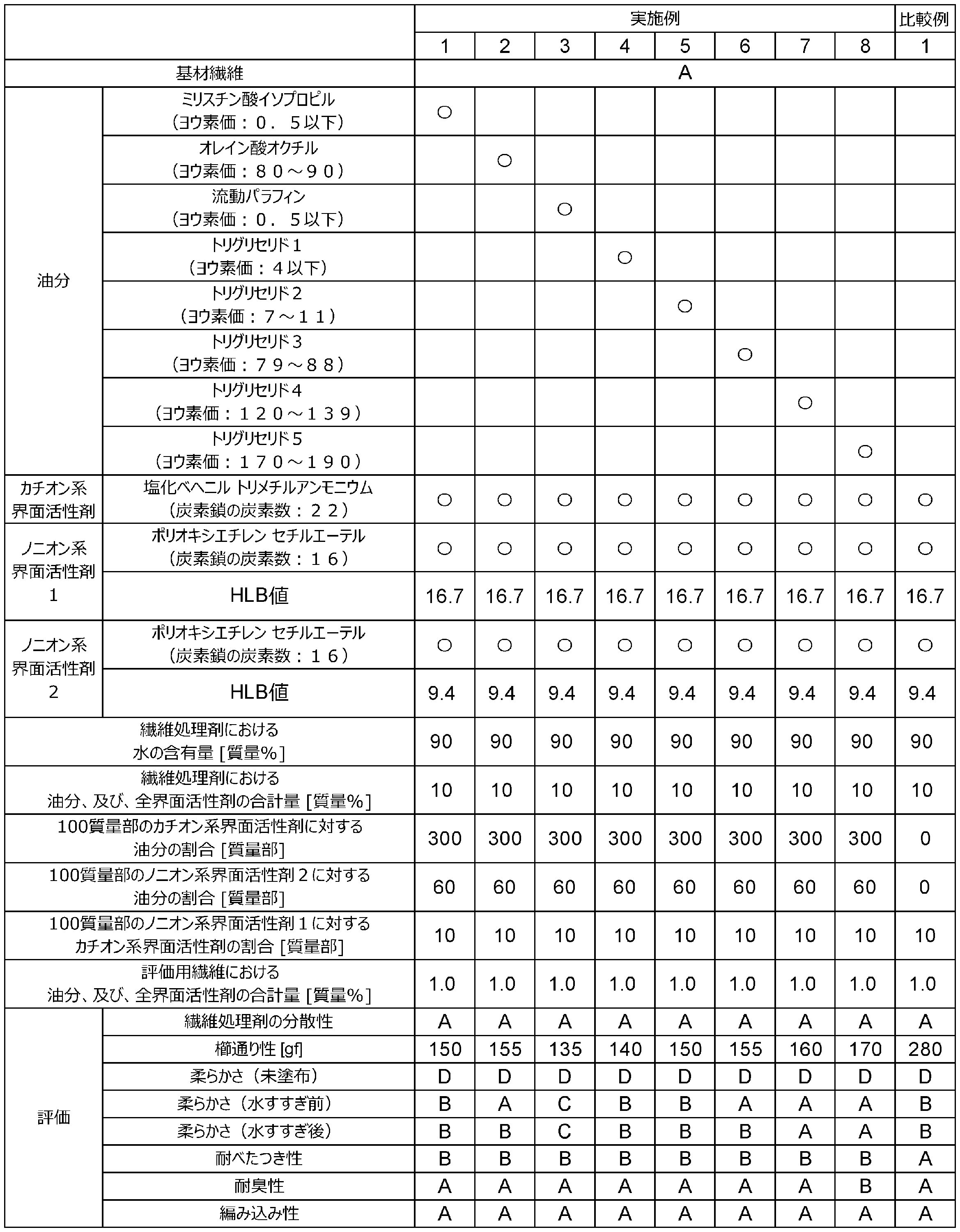
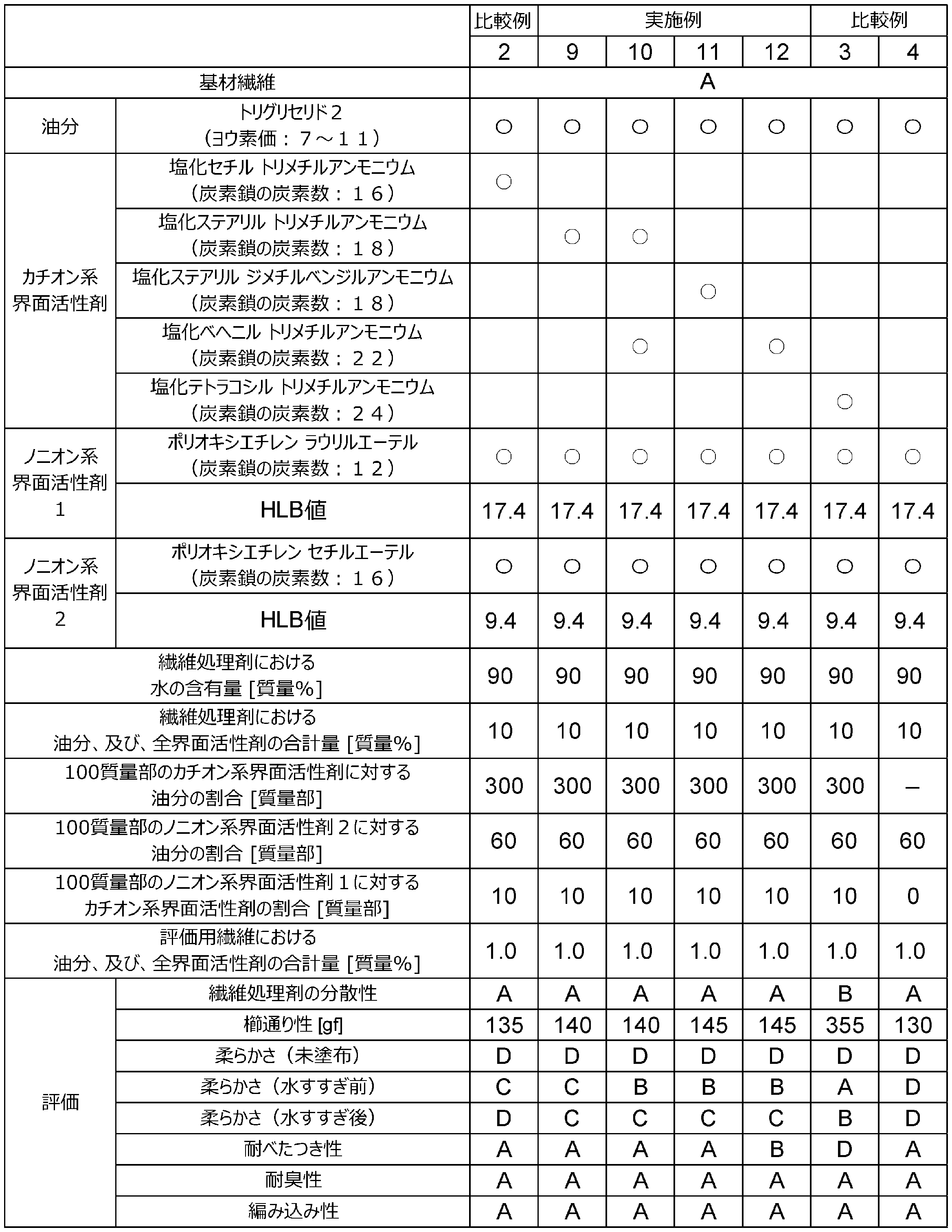
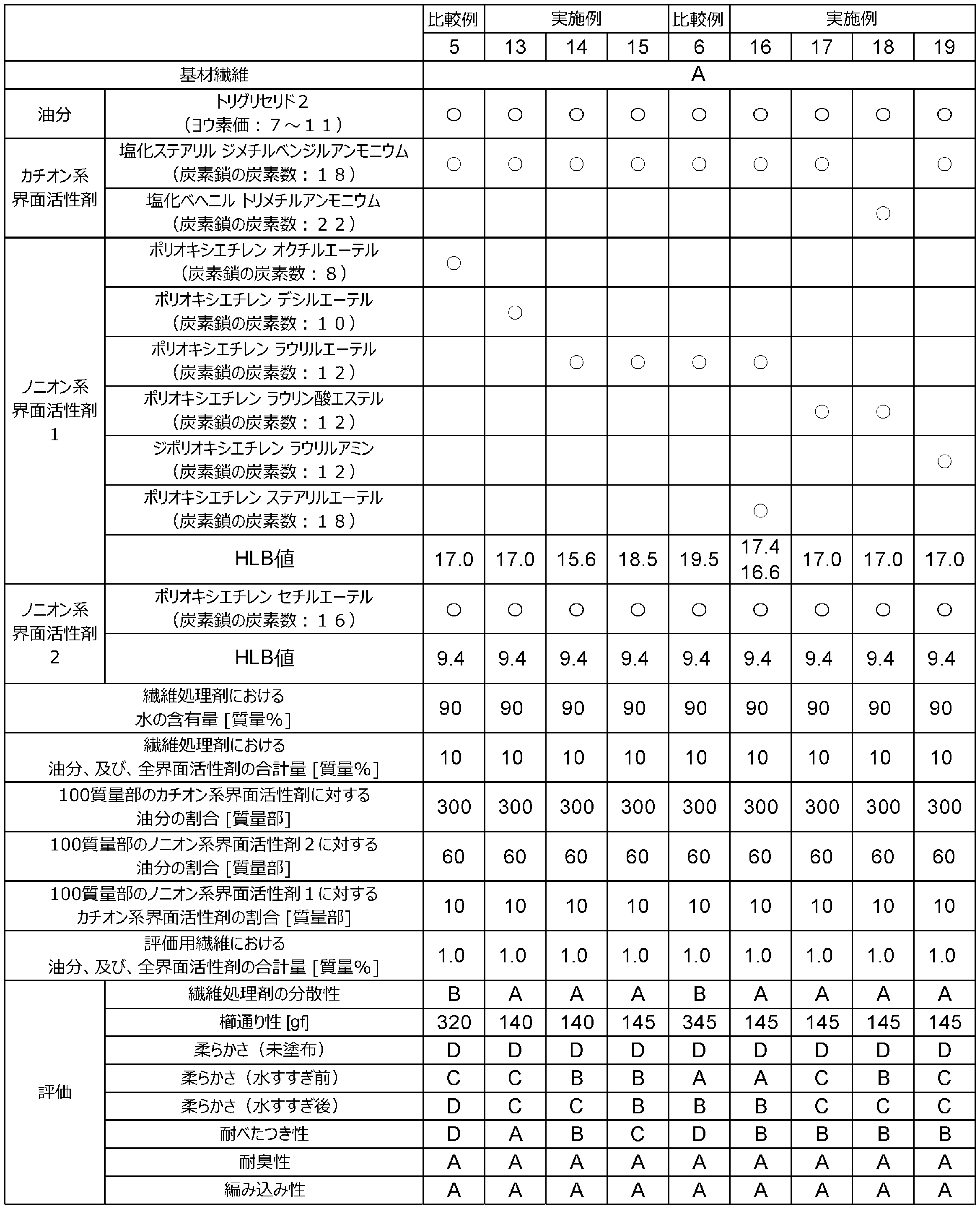


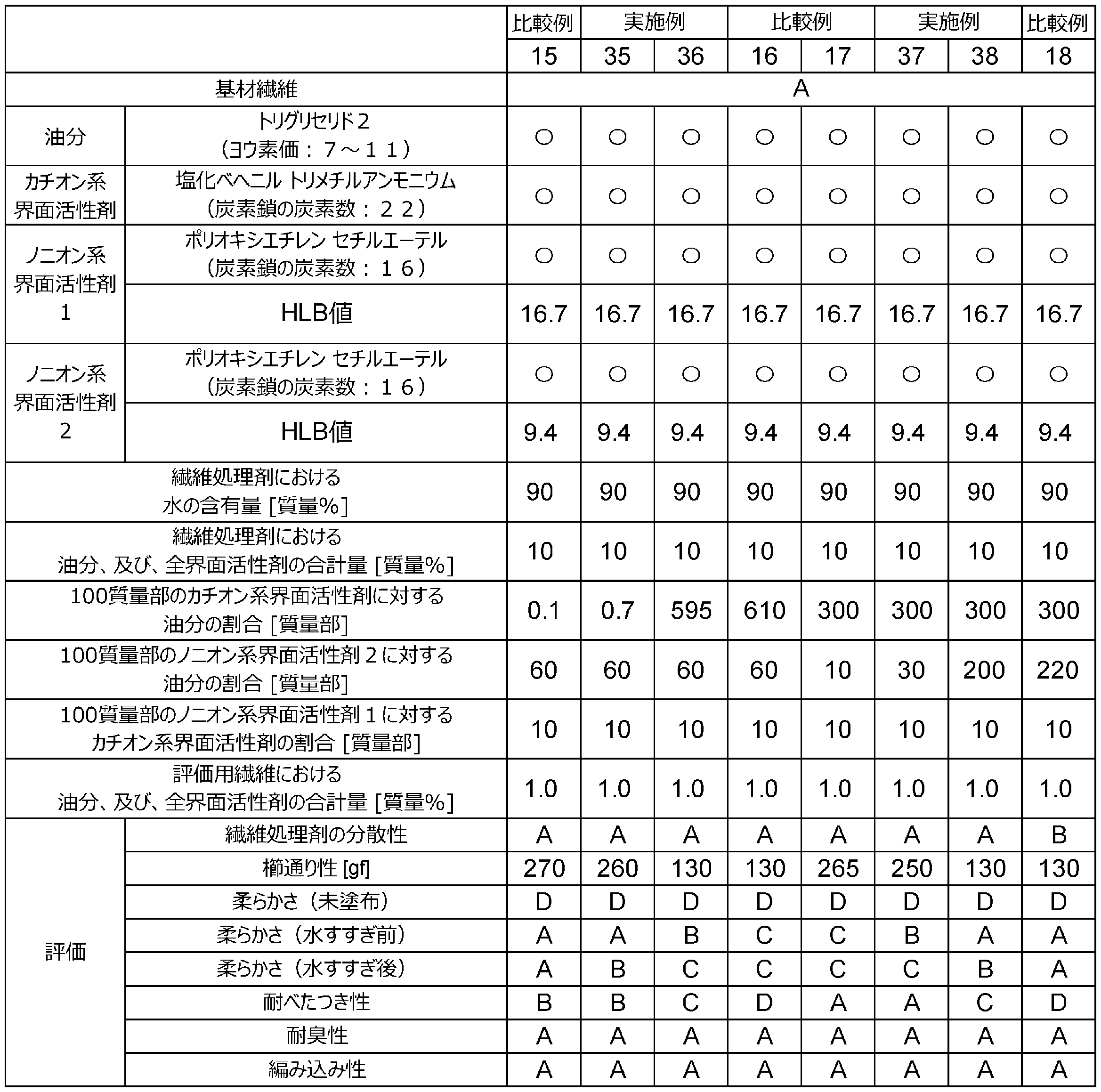


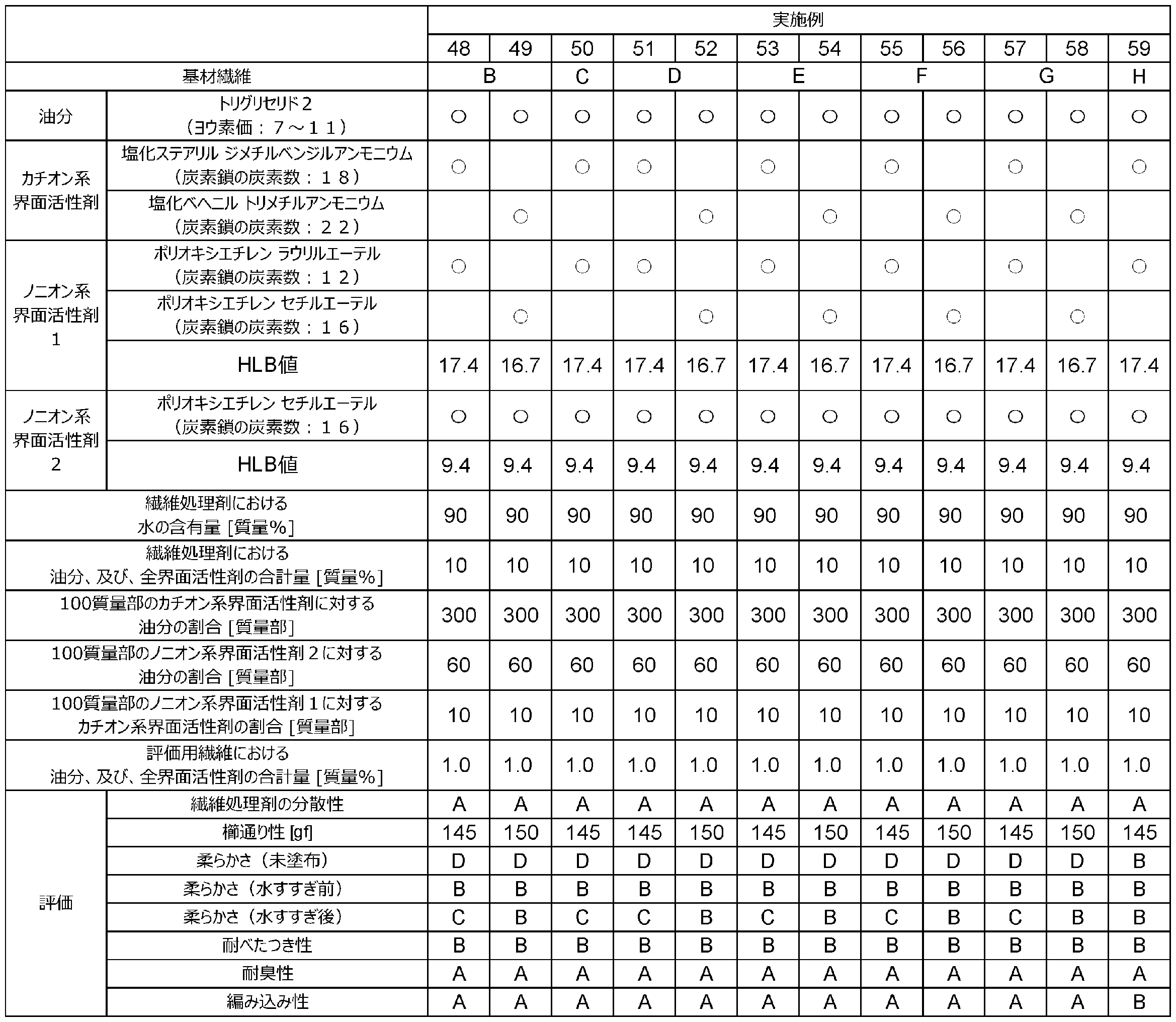
Claims (11)
- 基材繊維と、油分と、カチオン系界面活性剤と、第1のノニオン系界面活性剤と、第2のノニオン系界面活性剤と、を有し、
前記油分、前記カチオン系界面活性剤、前記第1のノニオン系界面活性剤、及び、前記第2のノニオン系界面活性剤が前記基材繊維の表面の少なくとも一部に存在し、
前記油分が、トリグリセリド、脂肪酸アルキル、及び、脂肪族飽和炭化水素からなる群より選ばれる少なくとも一種であり、
前記カチオン系界面活性剤が炭素数18~22の炭素鎖を有し、
前記第1のノニオン系界面活性剤が炭素数10~20の炭素鎖を有し、
前記第1のノニオン系界面活性剤のHLB値が14.0~19.0であり、
前記第2のノニオン系界面活性剤が炭素数10~22の炭素鎖を有し、
前記第2のノニオン系界面活性剤のHLB値が6.0以上14.0未満であり、
前記油分の含有量が100質量部の前記カチオン系界面活性剤に対して0.2~600質量部であり、
前記油分の含有量が100質量部の前記第2のノニオン系界面活性剤に対して20~210質量部であり、
前記カチオン系界面活性剤の含有量が100質量部の前記第1のノニオン系界面活性剤に対して3~20質量部であり、
前記油分、前記カチオン系界面活性剤、前記第1のノニオン系界面活性剤、及び、前記第2のノニオン系界面活性剤の合計量が、当該毛髪用繊維の全量を基準として0.002~4質量%である、毛髪用繊維。 - 前記基材繊維が、塩化ビニルの単独重合体、塩化ビニル-アクリロニトリル共重合体、ポリエチレンテレフタレート、ポリアミド系樹脂、ポリプロピレン、及び、アクリロニトリル-スチレン共重合体からなる群より選ばれる少なくとも一種を含む、請求項1に記載の毛髪用繊維。
- 前記油分がヨウ素価165以下の油分を含む、請求項1に記載の毛髪用繊維。
- 前記油分が前記トリグリセリドを含む、請求項1に記載の毛髪用繊維。
- 前記油分が前記脂肪酸アルキルを含む、請求項1に記載の毛髪用繊維。
- 前記油分が前記脂肪族飽和炭化水素を含む、請求項1に記載の毛髪用繊維。
- 前記カチオン系界面活性剤が、下記一般式(1)で表される構造のカチオンを有する第四級アンモニウム塩を含む、請求項1に記載の毛髪用繊維。

- 前記カチオン系界面活性剤が、前記一般式(1)におけるR12及びR13がメチル基である第四級アンモニウム塩を含む、請求項7に記載の毛髪用繊維。
- 前記第1のノニオン系界面活性剤及び前記第2のノニオン系界面活性剤が、下記一般式(2a)で表される構造、下記一般式(2b)で表される構造、下記一般式(2c)で表される構造、及び、下記一般式(2d)で表される構造からなる群より選ばれる少なくとも一種を有する化合物を含む、請求項1に記載の毛髪用繊維。

- 前記第1のノニオン系界面活性剤及び前記第2のノニオン系界面活性剤がポリオキシアルキレンアルキルエーテルを含む、請求項1に記載の毛髪用繊維。
- 請求項1~10のいずれか一項に記載の毛髪用繊維を備える、頭髪装飾品。
Applications Claiming Priority (2)
| Application Number | Priority Date | Filing Date | Title |
|---|---|---|---|
| JP2022-066454 | 2022-04-13 | ||
| JP2022066454A JP2025078911A (ja) | 2022-04-13 | 2022-04-13 | 毛髪用繊維及び頭髪装飾品 |
Publications (1)
| Publication Number | Publication Date |
|---|---|
| WO2023199690A1 true WO2023199690A1 (ja) | 2023-10-19 |
Family
ID=88329441
Family Applications (1)
| Application Number | Title | Priority Date | Filing Date |
|---|---|---|---|
| PCT/JP2023/010176 Ceased WO2023199690A1 (ja) | 2022-04-13 | 2023-03-15 | 毛髪用繊維及び頭髪装飾品 |
Country Status (2)
| Country | Link |
|---|---|
| JP (1) | JP2025078911A (ja) |
| WO (1) | WO2023199690A1 (ja) |
Cited By (2)
| Publication number | Priority date | Publication date | Assignee | Title |
|---|---|---|---|---|
| WO2025115809A1 (ja) * | 2023-11-30 | 2025-06-05 | デンカ株式会社 | 人工毛髪用繊維束及び頭髪装飾製品 |
| WO2026004749A1 (ja) * | 2024-06-27 | 2026-01-02 | デンカ株式会社 | 人工毛髪用繊維 |
Citations (4)
| Publication number | Priority date | Publication date | Assignee | Title |
|---|---|---|---|---|
| JP2011184831A (ja) * | 2010-03-10 | 2011-09-22 | Denki Kagaku Kogyo Kk | 繊維処理剤、人工毛髪用繊維及び頭飾品 |
| WO2012046748A1 (ja) * | 2010-10-06 | 2012-04-12 | 株式会社カネカ | 人工毛髪用繊維及びそれからなる頭髪装飾品 |
| CN109576995A (zh) * | 2018-12-05 | 2019-04-05 | 宿迁广和新材料有限公司 | 一种耐久抗静电剂及其制造方法 |
| WO2022030147A1 (ja) * | 2020-08-07 | 2022-02-10 | デンカ株式会社 | 人工毛髪用繊維 |
-
2022
- 2022-04-13 JP JP2022066454A patent/JP2025078911A/ja active Pending
-
2023
- 2023-03-15 WO PCT/JP2023/010176 patent/WO2023199690A1/ja not_active Ceased
Patent Citations (4)
| Publication number | Priority date | Publication date | Assignee | Title |
|---|---|---|---|---|
| JP2011184831A (ja) * | 2010-03-10 | 2011-09-22 | Denki Kagaku Kogyo Kk | 繊維処理剤、人工毛髪用繊維及び頭飾品 |
| WO2012046748A1 (ja) * | 2010-10-06 | 2012-04-12 | 株式会社カネカ | 人工毛髪用繊維及びそれからなる頭髪装飾品 |
| CN109576995A (zh) * | 2018-12-05 | 2019-04-05 | 宿迁广和新材料有限公司 | 一种耐久抗静电剂及其制造方法 |
| WO2022030147A1 (ja) * | 2020-08-07 | 2022-02-10 | デンカ株式会社 | 人工毛髪用繊維 |
Cited By (2)
| Publication number | Priority date | Publication date | Assignee | Title |
|---|---|---|---|---|
| WO2025115809A1 (ja) * | 2023-11-30 | 2025-06-05 | デンカ株式会社 | 人工毛髪用繊維束及び頭髪装飾製品 |
| WO2026004749A1 (ja) * | 2024-06-27 | 2026-01-02 | デンカ株式会社 | 人工毛髪用繊維 |
Also Published As
| Publication number | Publication date |
|---|---|
| JP2025078911A (ja) | 2025-05-21 |
Similar Documents
| Publication | Publication Date | Title |
|---|---|---|
| DE60032135T2 (de) | Schaumformende shampoozusammensetzungen | |
| CN106999396A (zh) | 用于增强毛发纤维特性的组合物 | |
| JP2025078911A (ja) | 毛髪用繊維及び頭髪装飾品 | |
| CN110809462A (zh) | 具有改善的冲洗性能的毛发调理组合物 | |
| KR20190050932A (ko) | 헤어 케어 샴푸 조성물 및 그 제조방법 | |
| KR101961487B1 (ko) | 고기능성 실리콘 에멀젼 조성물 및 제조 방법 | |
| JP2023064090A (ja) | 乳化組成物の製造方法 | |
| WO2018163709A1 (ja) | コンディショナー組成物 | |
| WO2025115809A1 (ja) | 人工毛髪用繊維束及び頭髪装飾製品 | |
| JP5213410B2 (ja) | 3剤式ヘアトリートメント用組成物および毛髪の処理方法 | |
| KR20240126045A (ko) | 모발용 섬유 및 그 제조 방법, 섬유 처리제, 그리고 두발 장식품 | |
| JP5213409B2 (ja) | 2剤式ヘアトリートメント用組成物および毛髪の処理方法 | |
| WO2024122112A1 (ja) | 毛髪用繊維及び頭髪装飾品 | |
| WO2003082235A1 (en) | Hair conditioning composition | |
| WO2023195314A1 (ja) | 人工毛髪用繊維及び頭髪装飾品 | |
| CN118103020A (zh) | 包含颗粒状淀粉的毛发调理组合物 | |
| CN1204255A (zh) | 具有改进的稳定性的调理香波组合物 | |
| CN114430784A (zh) | 纤维处理剂、人造毛发用纤维以及头发装饰产品 | |
| JP7503638B2 (ja) | 人工毛髪用繊維及び頭髪装飾品 | |
| JP7631223B2 (ja) | ヘアコンディショニング組成物 | |
| JP2026075713A (ja) | 毛髪化粧料組成物 | |
| JP2024541241A (ja) | ヘアコンディショニング組成物 | |
| WO2026004749A1 (ja) | 人工毛髪用繊維 | |
| WO2026037598A1 (en) | Hair conditioning composition | |
| JP2023126986A (ja) | 人工毛髪用繊維、繊維処理剤、人工毛髪用繊維の製造方法 |
Legal Events
| Date | Code | Title | Description |
|---|---|---|---|
| 121 | Ep: the epo has been informed by wipo that ep was designated in this application |
Ref document number: 23788112 Country of ref document: EP Kind code of ref document: A1 |
|
| NENP | Non-entry into the national phase |
Ref country code: DE |
|
| 122 | Ep: pct application non-entry in european phase |
Ref document number: 23788112 Country of ref document: EP Kind code of ref document: A1 |
|
| NENP | Non-entry into the national phase |
Ref country code: JP |