WO2023195367A1 - シアノバクテリアの外膜剥離の判定方法、シアノバクテリアの外膜剥離の判定装置、及び、プログラム - Google Patents
シアノバクテリアの外膜剥離の判定方法、シアノバクテリアの外膜剥離の判定装置、及び、プログラム Download PDFInfo
- Publication number
- WO2023195367A1 WO2023195367A1 PCT/JP2023/012104 JP2023012104W WO2023195367A1 WO 2023195367 A1 WO2023195367 A1 WO 2023195367A1 JP 2023012104 W JP2023012104 W JP 2023012104W WO 2023195367 A1 WO2023195367 A1 WO 2023195367A1
- Authority
- WO
- WIPO (PCT)
- Prior art keywords
- cyanobacteria
- outer membrane
- wavelength range
- fluorescence
- cell wall
- Prior art date
- Legal status (The legal status is an assumption and is not a legal conclusion. Google has not performed a legal analysis and makes no representation as to the accuracy of the status listed.)
- Ceased
Links
Images


Classifications
-
- G—PHYSICS
- G01—MEASURING; TESTING
- G01N—INVESTIGATING OR ANALYSING MATERIALS BY DETERMINING THEIR CHEMICAL OR PHYSICAL PROPERTIES
- G01N21/00—Investigating or analysing materials by the use of optical means, i.e. using sub-millimetre waves, infrared, visible or ultraviolet light
- G01N21/62—Systems in which the material investigated is excited whereby it emits light or causes a change in wavelength of the incident light
- G01N21/63—Systems in which the material investigated is excited whereby it emits light or causes a change in wavelength of the incident light optically excited
- G01N21/64—Fluorescence; Phosphorescence
-
- G—PHYSICS
- G01—MEASURING; TESTING
- G01N—INVESTIGATING OR ANALYSING MATERIALS BY DETERMINING THEIR CHEMICAL OR PHYSICAL PROPERTIES
- G01N21/00—Investigating or analysing materials by the use of optical means, i.e. using sub-millimetre waves, infrared, visible or ultraviolet light
- G01N21/62—Systems in which the material investigated is excited whereby it emits light or causes a change in wavelength of the incident light
- G01N21/63—Systems in which the material investigated is excited whereby it emits light or causes a change in wavelength of the incident light optically excited
- G01N21/64—Fluorescence; Phosphorescence
- G01N21/6486—Measuring fluorescence of biological material, e.g. DNA, RNA, cells
Definitions
- the present disclosure relates to a method for determining outer membrane detachment of cyanobacteria, an apparatus for determining outer membrane detachment of cyanobacteria, and a program.
- Photosynthetic microorganisms such as cyanobacteria and algae are attracting attention as tools for realizing next-generation material production systems with low environmental impact. Substance production by photosynthetic microorganisms is carried out in an environment of normal temperature and pressure, using water and carbon dioxide (CO 2 ) in the air with light as an energy source. Furthermore, with the recent development of genetic engineering technology, it has become possible to produce a wide range of chemical compounds using genetically modified photosynthetic microorganisms.Therefore, substance production using photosynthetic microorganisms is expected to be a next-generation technology that can achieve carbon neutrality. has been done.
- Patent Document 1 a technology for improving protein productivity using a genetically modified strain of cyanobacteria in which the outer membrane is peeled from the cell wall (Patent Document 1) is extremely important for material production by photosynthetic microorganisms.
- Patent Document 1 it is necessary to determine whether or not the outer membrane of cyanobacteria is detached from the cell wall, for example, by observing cells with an electron microscope or using complicated biochemical analysis techniques. Because of this, it is time-consuming.
- the present disclosure provides a method for determining outer membrane detachment of cyanobacteria, an apparatus for determining outer membrane detachment of cyanobacteria, and a program that can easily determine whether or not the outer membrane has detached from the cell wall. .
- a method for determining outer membrane detachment of cyanobacteria includes a measurement step of measuring fluorescence during irradiation of excitation light to a culture supernatant of cyanobacteria, and based on the wavelength range of the measured fluorescence, The method includes a determining step of determining whether the outer membrane of the cyanobacterium has peeled off from the cell wall.
- the program according to one aspect of the present disclosure determines whether the outer membrane of the cyanobacteria has peeled off from the cell wall, based on the wavelength range of fluorescence measured when the culture supernatant of the cyanobacteria is irradiated with excitation light. This is a program that causes a computer to execute a method for determining.
- the computer-readable recording medium includes, for example, a non-volatile recording medium such as a CD-ROM (Compact Disc-Read Only Memory).
- FIG. 1 is a block diagram showing an example of the functional configuration of a cyanobacterial outer membrane exfoliation determination apparatus according to an embodiment.
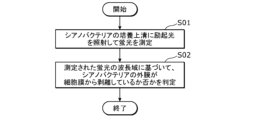
- FIG. 2 is a flowchart illustrating an example of the flow of the method for determining outer membrane detachment of cyanobacteria according to the embodiment.
- FIG. 3 is a diagram showing the results of fluorescence measurement of the culture supernatant of the adventitial membrane detachment strain.
- FIG. 4 is a diagram showing the combination of the wavelength of excitation light irradiated onto the culture supernatant and the fluorescence of the measured wavelength.
- FIG. 5 is a diagram showing the results of fluorescence measurement of the culture supernatant of the wild-type strain.
- FIG. 6 is a graph showing the results of fluorescence measurement of the culture supernatant of the outer membrane detachment strain and the culture supernatant of the wild strain.
- Cyanobacteria also called cyanobacteria or blue-green algae
- Cyanobacteria are a group of eubacteria that decompose water through photosynthesis to produce oxygen, and use the energy obtained to fix CO2 in the air.
- cyanobacteria can also fix nitrogen (N 2 ) in the air.
- N 2 nitrogen
- cyanobacteria are known to grow quickly and have high light utilization efficiency, and in addition, they are easier to genetically manipulate than other algae species. Active research and development is underway.
- examples of substance production by cyanobacteria include sucrose (Non-Patent Document 1), isobutanol (Non-Patent Document 2), fatty acids (Non-Patent Document 3), The production of amino acids (Non-Patent Document 4) and the like has also been reported.
- Non-Patent Document 1 discloses that a genetically modified strain of Synechococcus elongatus in which genes involved in the sucrose biosynthesis pathway have been modified has improved sucrose productivity compared to the wild strain.
- Non-Patent Document 2 describes the production of isobutanol using a genetically modified strain that overexpresses ribulose-1,5-bisphosphate carboxylase/oxidase (Rubisco), which was created by genetically engineering Synechococcus elongatus PCC7942. It has been disclosed that the sex of the strain was improved over that of the wild strain.
- Rubisco ribulose-1,5-bisphosphate carboxylase/oxidase
- Non-Patent Document 3 discloses that a genetically modified strain of Synechocystis sp. PCC6803 in which an acyl-acyl transport protein thioesterase gene has been introduced has improved fatty acid productivity compared to the wild strain.
- Non-Patent Document 4 describes that the tryptophan productivity of a tryptophan overproducing strain isolated by subjecting the wild strain of Synechocystis sp. PCC 6803 to random mutagenesis and selection using amino acids itself It has been disclosed that this has been improved.
- Non-Patent Document 5 the chloroplast of Chlamydomonas reinhardtii, a type of algae, was genetically engineered to produce a chimeric protein consisting of a 25 kDa Plasmodium falciparum surface protein (Pfs25) fused to the ⁇ subunit of cholera toxin (CtxB). It has been disclosed that genetically modified algae in which (CtxB-Pfs25) is produced intracellularly can be used as an oral vaccine for malaria.
- Pfs25 Plasmodium falciparum surface protein fused to the ⁇ subunit of cholera toxin
- the target substance is produced within the cells of the genetically modified strain of photosynthetic microorganisms, it is not secreted outside the cells and accumulates, or it is difficult to secrete outside the cells, so the cells are crushed. It is necessary to collect the desired substance by using the same method, which takes time and effort to produce the substance. Furthermore, since various substances exist within cells, it may be necessary to remove these substances and purify the target substance, which lowers the recovery rate of the target substance. Furthermore, each time a target substance is produced, it is necessary to prepare a new genetically modified strain, which is time-consuming and increases production costs. As described above, in the conventional techniques described above, the production efficiency of substances by photosynthetic microorganisms is still at a low level, and there is a desire to develop a technique with higher production efficiency.
- the structure of the cell wall and cell membrane of cyanobacteria has low permeability to substances produced within the cell, and it is not easy to artificially modify the structure of the cell membrane and cell wall to improve the ability to secrete and produce substances.
- substances with large molecular weights such as proteins (also referred to as high molecular weight compounds) are difficult to secrete outside cells, unlike substances with relatively small molecular weights such as amino acids (also referred to as low molecular weight compounds).
- Non-Patent Document 6 Hikaru Kobata, Studies on molecular basis of cyanobacterial outer membrane function and its evolutionary relationship with primitive chloroplasts, PhD thesis, [Online], 2018.03.27, Internet: ⁇ URL: http://hdl .handle.net/10097/00122689>
- Non-Patent Document 7 Seiji Kojima, Elucidation and application of membrane stabilization and substance permeation mechanisms derived from bacteria that function in the chloroplast surface membrane, Grants-in-Aid for Scientific Research, [Online] , 2018.04.23, Internet: ⁇ URL: https://kaken.nii.ac.jp/grant/KAKENHI-PROJECT-18H02117>).
- Patent Document 1 describes a modified cyanobacterium in which the function of a protein involved in the binding between the outer membrane and the cell wall of cyanobacteria (hereinafter also referred to as binding-related protein) is suppressed or lost, and A method for producing proteins using modified cyanobacteria is disclosed.
- the outer membrane of the cyanobacterium is peeled off from the cell wall while maintaining the ability to proliferate the cell, so by culturing the cell, the modified cyanobacterium can be produced intracellularly. The resulting protein is secreted to the outside of the cell, allowing for efficient protein production.
- the present inventor developed a method for easily determining whether the outer membrane has peeled off from the cell wall as an evaluation index for determining whether the state of cyanobacterial cells is suitable for efficient substance production.
- the present disclosure it is possible to easily determine whether the outer membrane of cyanobacteria has peeled off from the cell wall, based on the fluorescence measurement results of the culture supernatant of cyanobacteria. Therefore, according to the present disclosure, it is possible to determine whether or not the cyanobacteria are suitable for substance production by determining whether the outer membrane of the cyanobacteria has peeled off from the cell wall. can contribute to improving the productivity of materials.
- a method for determining outer membrane detachment of cyanobacteria includes a measurement step of measuring fluorescence during irradiation of excitation light to a culture supernatant of cyanobacteria, and based on the wavelength range of the measured fluorescence, The method includes a determining step of determining whether the outer membrane of the cyanobacterium has peeled off from the cell wall.
- the fluorescence is measured when the culture supernatant is irradiated with the excitation light in a predetermined wavelength range;
- the determination step it may be determined that the outer membrane of the cyanobacteria has peeled off from the cell wall when the fluorescence is measured in a wavelength range corresponding to the predetermined wavelength range.
- the method for determining outer membrane detachment of cyanobacteria is to irradiate excitation light in a predetermined wavelength range and determine whether or not fluorescence in the wavelength range corresponding to the wavelength range is measured. It can be determined whether the outer membrane has peeled off from the cell wall. Therefore, the method for determining outer membrane detachment of cyanobacteria can more simply and accurately determine outer membrane detachment of cyanobacteria.
- the predetermined wavelength range of the excitation light is 620 nm ⁇ 10 nm;
- the wavelength range of the fluorescence corresponding to may be 645 nm ⁇ 10 nm.
- the method for determining the detachment of the outer membrane of cyanobacteria is to irradiate excitation light in a predetermined wavelength range and measure the fluorescence in the wavelength range corresponding to the wavelength range. If it is determined that the cyanobacterium has peeled off and no fluorescence is measured, it can be determined that the outer membrane of the cyanobacteria has not peeled off. Therefore, the method for determining outer membrane detachment of cyanobacteria can more simply and accurately determine outer membrane detachment of cyanobacteria.
- the fluorescence is measured when the culture supernatant is irradiated with the excitation light in a predetermined wavelength range;
- the determination step it may be determined that the outer membrane of the cyanobacterium has peeled off from the cell wall when the intensity of the fluorescence in a wavelength range corresponding to the predetermined wavelength range is equal to or higher than a threshold value.
- the method for determining outer membrane detachment of cyanobacteria is to irradiate excitation light in a predetermined wavelength range, and if the intensity of fluorescence in the wavelength range corresponding to the wavelength range is greater than or equal to a threshold value, cyanobacteria are detected.
- the method for determining outer membrane detachment of cyanobacteria can more simply and accurately determine outer membrane detachment of cyanobacteria.
- the predetermined wavelength range of the excitation light and the predetermined wavelength range of the excitation light are used. If the combination with the corresponding wavelength range of the fluorescence is at least one of the following (1) to (3), it may be determined that the outer membrane of the cyanobacterium has detached from the cell wall. .
- the method for determining outer membrane detachment of cyanobacteria is to irradiate excitation light in a predetermined wavelength range, and if the intensity of fluorescence in the wavelength range corresponding to the wavelength range is greater than or equal to a threshold value, cyanobacteria are detected.
- the method for determining outer membrane detachment of cyanobacteria can more simply and accurately determine outer membrane detachment of cyanobacteria.
- the cyanobacterial outer membrane detachment determination device can easily determine whether the cyanobacterial outer membrane has detached from the cell wall based on the fluorescence measurement results of the cyanobacterial culture supernatant. . Therefore, the cyanobacterial outer membrane detachment determination device can determine whether the cyanobacterium is suitable for material production by determining whether the outer membrane of the cyanobacterium has detached from the cell wall. Therefore, it can contribute to improving the productivity of substances by cyanobacteria.
- the program causes the computer to determine whether or not the outer membrane of the cyanobacteria has detached from the cell wall, based on the fluorescence measurement results of the cyanobacteria culture supernatant. Peeling can be easily determined.
- each figure is not necessarily strictly illustrated.
- substantially the same components are denoted by the same reference numerals, and overlapping explanations may be omitted or simplified.
- the numerical range does not represent only a strict meaning, but includes a substantially equivalent range, for example, measuring the amount of protein (for example, number or concentration, etc.) or the range thereof.
- both a bacterial body and a cell represent one individual cyanobacterium.
- FIG. 1 is a block diagram showing an example of the functional configuration of a cyanobacterial outer membrane exfoliation determination apparatus according to the present embodiment.
- the determination device 100 includes, for example, a measurement section 110, a control section 120, a storage section 130, an input reception section 140, and a display section 150.
- the control unit 120 includes, for example, a determination unit 122.
- the measurement unit 110 is, for example, a fluorescence spectrophotometer.
- the specific configuration of the measurement unit 110 is similar to that of a general fluorescence spectrophotometer.
- the measurement unit 110 measures fluorescence by irradiating excitation light onto a culture solution of cyanobacteria introduced into a measurement cell.
- the measurement cell may be, for example, a spectroscopic cell or a flow cell. These cells may be made of quartz or acrylic, but quartz is more preferable.
- the flow cell may be connected, for example, through piping to a culture tank in which cyanobacteria are cultured.
- the piping may be connected to the culture tank via the dilution section and the liquid feeding section. After the start of the main culture, the culture supernatant may be sampled at predetermined intervals (for example, on a daily basis) and subjected to measurement. Sampling may be performed manually by a user or may be performed automatically.
- the measurement unit 110 includes, for example, a control unit that controls the operation of the measurement unit 110, and the control unit controls the measurement unit 110 according to a control signal output from the control unit 120 of the determination device 100.
- control the behavior of the measurement unit 110 includes the measurement unit 110, but may not include the measurement unit 110.
- the measurement unit 110 is a measurement device, and the determination device 100 is connected to the measurement device via communication.
- the control unit 120 performs information processing to control the operation of the determination device 100.
- the control unit 120 is implemented, for example, by a microcomputer, but may also be implemented by a processor or a dedicated circuit.
- the control unit 120 includes a determination unit 122.
- the determination unit 122 is realized by a processor executing a program for performing the above information processing.
- the determining unit 122 determines whether the outer membrane of the cyanobacteria has peeled off from the cell wall, based on the wavelength range of the fluorescence measured by the measuring unit 110.
- the input accepting unit 140 accepts user operation input.
- the input reception unit 140 is realized by a mouse, a microphone, a touch panel, or the like.
- the display unit 150 is a display device that displays information to be presented to the user based on the control of the control unit 120.
- the display unit 150 is realized by a liquid crystal panel or an organic EL (Electro Luminescence) panel.
- FIG. 2 is a flowchart illustrating an example of the flow of the method for determining outer membrane detachment of cyanobacteria according to the embodiment.
- the determination method is implemented by the determination device 100.
- the measurement unit 110 of the determination device 100 measures fluorescence by irradiating excitation light onto the culture supernatant of cyanobacteria introduced into a measurement cell (S01). More specifically, in step S01, for example, the measurement unit 110 irradiates the culture supernatant with excitation light in a predetermined wavelength range and measures fluorescence.
- the measurement unit 110 may irradiate the culture supernatant with excitation light in one predetermined wavelength range, or sequentially irradiate the culture supernatant with excitation light in two or more predetermined wavelength ranges. Good too.
- the determination unit 122 of the determination device 100 determines whether the outer membrane of the cyanobacteria has peeled off from the cell wall, based on the wavelength range of the fluorescence measured by the measurement unit 110 (S02).
- the determining unit 122 may determine that the outer membrane of the cyanobacteria has peeled off from the cell wall when fluorescence is measured in a wavelength range corresponding to a predetermined wavelength range.
- the predetermined wavelength of the excitation light is 620 nm ⁇ 10 nm
- the wavelength range of fluorescence corresponding to the predetermined wavelength range of the excitation light is 645 nm ⁇ 10 nm.
- excitation light with a wavelength of 620 nm ⁇ 10 nm is irradiated to the culture supernatant of cyanobacteria whose outer membrane has not peeled off from the cell wall
- excitation light in the wavelength range corresponding to the wavelength range for example, 645 nm ⁇ 10 nm
- the wavelength range corresponding to the wavelength range is measured.
- the determining unit 122 determines that the outer membrane of the cyanobacteria has peeled off from the cell wall when the intensity of fluorescence in a wavelength range corresponding to a predetermined wavelength range is equal to or higher than a threshold value. You may. In this case, the determining unit 122 determines that the combination of the predetermined wavelength range of the excitation light and the wavelength range of the fluorescence corresponding to the predetermined wavelength range of the excitation light is one of the following (1) to (3). If there is at least one, it may be determined that the outer membrane of the cyanobacterium has peeled off from the cell wall.
- Excitation light wavelength range 280nm ⁇ 10nm, fluorescence wavelength range: 335nm ⁇ 10nm (2) Excitation light wavelength range: 275nm ⁇ 10nm, fluorescence wavelength range: 450nm ⁇ 10nm (3) Excitation light wavelength range: 360nm ⁇ 10nm, fluorescence wavelength range: 455nm ⁇ 10nm
- the excitation light corresponds to the wavelength range in question. Fluorescence in each wavelength range is measured, but the intensity of the fluorescence is below the threshold.
- the culture supernatant of cyanobacteria of the outer membrane-exfoliating type in which the outer membrane of cyanobacteria is detached from the cell wall, is irradiated with excitation light in at least one wavelength range of (1) to (3) above
- Fluorescence in a wavelength range corresponding to the wavelength range is measured.
- the intensity of the fluorescence in at least one of the above (1) to (3) is equal to or higher than the threshold value, it is determined that the outer membrane of the cyanobacterium has peeled off from the cell wall.
- the threshold value may be a common threshold value for fluorescence in all the wavelength ranges of (1) to (3) above, or may be set for each fluorescence in each wavelength range.
- Cyanobacteria also called blue-green algae or cyanobacteria, are a group of prokaryotes that perform photosynthesis while collecting light energy with chlorophyll and electrolyzing water to generate oxygen. Cyanobacteria are highly diverse, and include, for example, unicellular species such as Synechocystis sp. PCC 6803 and filamentous multicellular species such as Anabaena sp. PCC 7120.
- thermophilic species such as Thermosynechococcus elongatus
- marine species such as Synechococcus elongatus
- freshwater species such as Synechocystis.
- species such as Microcystis aeruginosa, which has gas vesicles and produces toxins
- Gloeobacter violaceus which does not have thylakoid but has a protein called phycobilisome, which is a light-harvesting antenna on its plasma membrane, have unique characteristics.
- phycobilisome which is a light-harvesting antenna on its plasma membrane
- the cell surface layer of cyanobacteria is composed of, in order from the inside, a plasma membrane (also called an inner membrane), peptidoglycan, and an outer membrane, which is a lipid membrane that forms the outermost layer of the cell.
- Peptidoglycan is composed of glucosamine and mannosamine.
- Sugar chains are covalently bonded, and pyruvate is bound to these covalently bonded sugar chains.
- peptidoglycan and covalently bonded sugar chains are collectively referred to as a cell wall.
- SLH domain-retaining outer membrane proteins consist of a C-terminal region embedded in a lipid membrane (also called outer membrane) and an N-terminal SLH domain that protrudes from the lipid membrane. It is widely distributed among bacteria belonging to the class Negativicutes, which is a group of negative bacteria.
- the region embedded in the lipid membrane ie, the outer membrane
- the covalent sugar chains in peptidoglycan must be modified with pyruvate.
- genes encoding SLH domain-retaining outer membrane proteins include slr1841 or slr1908 held by Synechocystis sp. PCC 6803, or oprB held by Anabaena sp. 90.
- cell wall-pyruvate modification enzyme The enzyme that catalyzes the pyruvate modification reaction of covalent sugar chains in peptidoglycan (hereinafter referred to as cell wall-pyruvate modification enzyme) was identified in the Gram-positive bacterium Bacillus anthracis and named CsaB.
- CsaB Gram-positive bacterium Bacillus anthracis
- cyanobacteria whose genome sequences have been published, many species possess genes encoding homologous proteins with amino acid sequence identity of 30% or more with CsaB. Examples include slr0688 held by Synechocystis sp. PCC 6803 or synpcc7502_03092 held by Synechococcus sp. 7502.
- cyanobacteria CO2 fixed through photosynthesis is converted into various amino acids through multi-step enzymatic reactions. Using these as raw materials, proteins are synthesized within the cytoplasm of cyanobacteria. Some of these proteins function within the cytoplasm, while others are transported from the cytoplasm to the periplasm and function within the periplasm. However, no case of active secretion of proteins outside the cell has been reported in cyanobacteria to date.
- cyanobacteria Because cyanobacteria have a high photosynthetic ability, they do not necessarily need to take in organic matter from the outside as nutrients. Therefore, cyanobacteria have very few channel proteins in their outer membranes that allow organic substances to pass through, such as organic channel proteins (eg, Slr1270). For example, in Synechocystis sp. PCC 6803, organic channel proteins that allow organic substances to pass through account for only about 4% of the total protein content of the outer membrane. On the other hand, cyanobacteria produce ion channel proteins that allow inorganic ions to pass through, such as SLH domain-retaining outer membrane proteins (e.g., Slr1841), in order to take in inorganic ions necessary for growth into cells with high efficiency. It is abundant in the adventitia. For example, in Synechocystis sp. PCC 6803, ion channel proteins that permeate inorganic ions account for approximately 80% of the total protein content of the
- Cyanobacteria whose outer membrane has been detached from the cell wall are, for example, cyanobacteria whose outer membrane has been temporarily detached from the cell wall due to drugs or external force (e.g., pressure or temperature).
- it may be a modified cyanobacterium that has been genetically modified so that its outer membrane is detached from the cell wall.
- the modified cyanobacteria means that the total amount of proteins involved in binding between the outer membrane and the cell wall in cyanobacteria (so-called binding-related proteins) is 30% of the total amount of the proteins in the parent strain (so-called parent cyanobacteria).
- Non-Patent Document 6 and Non-Patent Document 7 describe that when the slr1841 gene or slr0688 gene, which is a gene encoding a binding-related protein, is deleted, the ability of cells to proliferate is lost. has been done.
- the modified cyanobacteria of the present disclosure suppresses the expression of genes encoding binding-related proteins, the ability of cells to proliferate is not impaired.
- the modified cyanobacteria produced in this way have a partial reduction in the bond between the outer membrane and the cell wall (e.g., binding amount and strength), and the outer membrane is partially separated from the cell wall. This makes it easier to get rid of.
- modified cyanobacteria do not require extraction operations for intracellularly produced substances, such as crushing the bacterial cells, so that the physiological activity and yield of the intracellularly produced substances are less likely to decrease. Furthermore, since the cell growth function of the modified cyanobacteria is not impaired, it is possible to repeatedly use the modified cyanobacteria even after recovering the substances secreted outside the microbial cells.
- the following describes a cyanobacterium whose outer membrane has been modified so that its outer membrane partially detaches from the cell wall by suppressing the functions of at least one binding-related protein of an SLH domain-retaining outer membrane protein and a cell wall-pyruvate modifying enzyme. explain.
- the parent cyanobacteria may be of the genus Synechocystis, Synechococcus, Anabaena, or Thermosynechococcus, among them Synechocystis sp. PCC 6803, Synechococcus sp. PCC 7942, or Thermosynechococcus elongatus BP-1. Good too.
- the parent strain may be a wild type of cyanobacteria, as long as it has not yet suppressed the total amount of binding-related proteins to 30% or more and 70% or less, or it may be a modified strain that is equivalent to the wild type. binding-related proteins.
- Amino acid sequences of SLH domain-retaining outer membrane proteins and enzymes that catalyze the cell wall-pyruvate modification reaction (so-called cell wall-pyruvate modification enzymes) in these parent cyanobacteria, and base sequences of genes encoding their binding-related proteins.
- cell wall-pyruvate modification enzymes in these parent cyanobacteria
- base sequences of genes encoding their binding-related proteins. and the location of the gene on the chromosomal DNA or plasmid can be found in the NCBI (National Center for Biotechnology Information) database (https://blast.ncbi.nlm.nih.gov/Blast.cgi) and Cyanobase (http:/ /genome.microbedb.jp/cyanobase/).
- the SLH domain-retaining outer membrane protein and the cell wall-pyruvic acid modifying enzyme whose functions are suppressed in the modified cyanobacteria according to the present embodiment may be from any parent cyanobacterium as long as the parent cyanobacteria possesses them. They are not limited by the location of the genes encoding them (for example, on chromosomal DNA or on plasmids).
- the parent cyanobacteria When the parent cyanobacteria is of the genus Cyanothece, it may be A0A3B8XX12_9CYAN, etc. If the parent cyanobacteria belongs to the genus Leptolyngbya, it may be A0A1Q8ZE23_9CYAN, etc. If the parent cyanobacterium belongs to the genus Calothrix, it may be A0A1Z4R6U0_9CYAN, and if the parent cyanobacterium belongs to the genus Nostoc, it may be A0A1C0VG86_9NOSO, etc.
- the parent cyanobacterium belongs to the genus Crocosphaera, it may be B1WRN6_CROS5, and when the parent cyanobacterium belongs to the genus Pleurocapsa, it may be K9TAE4_9CYAN.
- the SLH domain-retaining outer membrane protein may be, for example, Slr1841 of Synechocystis sp. PCC 6803, NIES970_09470 of Synechococcus sp. NIES-970, or Anacy_3458 of Anabaena cylindrica PCC 7122.
- the protein may be a protein having an amino acid sequence that is 50% or more identical to these SLH domain-retaining outer membrane proteins.
- the SLH domain-retaining outer membrane protein whose function is suppressed is, for example, one having an amino acid sequence of 40% or more, preferably 50% or more, more preferably 60% or more of the above-mentioned SLH domain-retaining outer membrane protein. % or more, more preferably 70% or more, even more preferably 80% or more, even more preferably 90% or more, and has the function of binding to covalent sugar chains of the cell wall. It may be a protein or a polypeptide.
- the cell wall-pyruvate modifying enzyme may be Slr0688 etc. when the parent cyanobacterium belongs to the genus Synechocystis, and when the parent cyanobacterium belongs to the genus Synechococcus, it may be Syn7502_03092 or Synpcc7942_1529, etc. If the bacterium is of the genus Anabaena, it may be ANA_C20348 or Anacy_1623, etc. If the parent cyanobacterium is of the genus Microcystis, it may be CsaB (NCBI access ID: TRU80220), etc.
- the parent cyanobacterium belongs to the genus Crocosphaera, it may be CsaB (NCBI access ID: WP_012361697.1), etc. If the parent cyanobacterium belongs to the genus Pleurocapsa, it may be CsaB (NCBI access ID: WP_036798735), etc. good.
- the cell wall-pyruvate modifying enzyme may be, for example, Slr0688 of Synechocystis sp. PCC 6803, Synpcc7942_1529 of Synechococcus sp. PCC 7942, or Anacy_1623 of Anabaena cylindrica PCC 7122.
- the protein may be a protein whose amino acid sequence is 50% or more identical to these cell wall-pyruvate modifying enzymes.
- the cell wall-pyruvate modifying enzyme whose function is suppressed is, for example, one having an amino acid sequence of any of the above-mentioned cell wall-pyruvate modifying enzymes, and 40% or more, preferably 50% or more, more preferably 60% or more. , more preferably consists of an amino acid sequence having an identity of 70% or more, even more preferably 80% or more, still more preferably 90% or more, and modifies the covalent sugar chain of peptidoglycan of the cell wall with pyruvate. It may be a protein or polypeptide that has the function of catalyzing a reaction.
- the means for suppressing the functions of these proteins is not particularly limited as long as it is a means normally used for suppressing the functions of proteins.
- the means include, for example, deleting or inactivating the gene encoding the SLH domain-retaining outer membrane protein and the gene encoding the cell wall-pyruvate modifying enzyme, inhibiting the transcription of these genes, and inhibiting the transcription of these genes.
- the method may include inhibiting the translation of gene transcripts or administering an inhibitor that specifically inhibits these proteins.
- the modified cyanobacteria may have a gene that expresses a protein involved in binding the outer membrane and the cell wall (so-called binding-related protein) deleted or inactivated.
- binding-related protein a protein involved in binding the outer membrane and the cell wall
- the expression of proteins involved in the binding between the cell wall and the outer membrane is suppressed, or the function of the protein is suppressed, so that the binding between the cell wall and the outer membrane (so-called binding) is suppressed. amount and binding strength) are partially reduced.
- the outer membrane tends to partially detach from the cell wall.
- a gene encoding an SLH domain-retaining outer membrane protein and a cell wall-pyruvate modifying enzyme for example, a gene encoding an SLH domain-retaining outer membrane protein and a cell wall-pyruvate modifying enzyme.
- the transcription of at least one of the genes may be suppressed.
- the parent cyanobacteria When the parent cyanobacteria is of the genus Cyanothece, it may be A0A3B8XX12_9CYAN, etc. If the parent cyanobacteria belongs to the genus Leptolyngbya, it may be A0A1Q8ZE23_9CYAN, etc. If the parent cyanobacterium belongs to the genus Calothrix, it may be A0A1Z4R6U0_9CYAN, and if the parent cyanobacterium belongs to the genus Nostoc, it may be A0A1C0VG86_9NOSO, etc.
- the gene encoding SLH domain-retaining outer membrane protein 6 is slr1841 of Synechocystis sp. PCC 6803, nies970_09470 of Synechococcus sp. NIES-970, anacy_3458 of Anabaena cylindrica PCC 7122, or these genes.
- the genes may have 50% or more identical base sequences.
- the amino acid sequences of a protein are 30% or more identical, it is said that the protein is likely to have the same function as the protein. Therefore, if the base sequences of genes encoding proteins are 30% or more identical, it is considered that there is a high possibility that a protein having the same function as the protein will be expressed.
- the gene encoding the SLH domain-retaining outer membrane protein whose function is suppressed is, for example, one of the base sequences of the above-mentioned genes encoding the SLH domain-retaining outer membrane protein and 40% or more, preferably A gene consisting of a base sequence having an identity of 50% or more, more preferably 60% or more, still more preferably 70% or more, even more preferably 80% or more, and even more preferably 90% or more, and that share a cell wall. It may be a gene encoding a protein or polypeptide that has the function of binding to a conjugated sugar chain.
- the gene encoding the cell wall-pyruvate modifying enzyme may be slr0688, etc. when the parent cyanobacterium is of the genus Synechocystis, or may be syn7502_03092 or synpcc7942_1529, etc. when the parent cyanobacterium is of the genus Synechococcus.
- the parent cyanobacterium belongs to the genus Anabaena, it may be ana_C20348 or anacy_1623, and if the parent cyanobacterium belongs to the genus Microcystis, it may be csaB (NCBI access ID: TRU80220), etc.
- Cynahothece genus In the case of the Cynahothece genus, it may be csaB (NCBI access ID: WP_107667006.1), etc., and when the parent cyanobacteria is Spirulina genus, it may be csaB (NCBI access ID: WP_026079530.1), etc. If the parent cyanobacteria belongs to the genus Calothrix, it may be csaB (NCBI access ID: WP_096658142.1), etc. If the parent cyanobacterium belongs to the genus Nostoc, it may be csaB (NCBI access ID: WP_099068528.1), etc.
- the parent cyanobacterium belongs to the genus Crocosphaera, it may be csaB (NCBI access ID: WP_012361697.1), etc. If the parent cyanobacterium belongs to the genus Pleurocapsa, it may be csaB (NCBI access ID: WP_036798735), etc. It may be.
- the base sequences of these genes can be obtained from the NCBI database or Cyanobase mentioned above.
- the gene encoding the cell wall-pyruvate modification enzyme may be slr0688 of Synechocystis sp. PCC 6803, synpcc7942_1529 of Synechococcus sp. PCC 7942, or anacy_1623 of Anabaena cylindrica PCC 7122.
- the gene may have a base sequence that is 50% or more identical to these genes.
- Synechocystis dCas9 strain was created by introducing a gene encoding dCas9 into cyanobacteria (see Comparative Example 1 of Patent Document 1). This Synechocystis dCas9 strain is called the wild strain.
- FIG. 3 is a diagram showing the results of fluorescence measurement of the culture supernatant of the adventitial membrane detachment strain.
- the vertical axis shows the wavelength (nm) of excitation light
- the horizontal axis shows the wavelength (nm) of fluorescence.
- the fluorescence intensity is color-coded so that the higher the intensity, the closer to black, and the lower the intensity, the closer to white. Measurements were performed three times, and representative data from the three measurements is shown.
- FIG. 4 is a diagram showing the combination of the wavelength of excitation light irradiated onto the culture supernatant and the fluorescence of the measured wavelength.
- FIG. 5 is a diagram showing the results of fluorescence measurement of the culture supernatant of the wild-type strain.
- the fluorescence intensities of (A) to (C) above were extremely low. Further, when the excitation light in the wavelength range described in (D) above was irradiated, no fluorescence was measured.
- FIG. 6 is a graph showing the results of fluorescence measurement of the culture supernatant of the outer membrane detachment strain and the culture supernatant of the wild strain. Measurements were performed three times, and the graph shows the average value ⁇ standard deviation.
- threshold value is just the threshold value in this embodiment, and is not limited to this example.
- the threshold value of the fluorescence intensity in each wavelength range may be set as appropriate depending on the cyanobacterial species used, culture conditions, and the like.
- the total amount of proteins involved in the binding between the outer membrane and the cell wall in cyanobacteria is suppressed to 30% or more and 70% or less of the total amount of the protein in the parent strain, so that the outer membrane and the cell wall are bonded together.
- the binding is weakened and a protein produced within the bacterial cell leaks out of the bacterial cell
- the present disclosure is not limited thereto.
- the bond between the outer membrane and the cell wall may be weakened, or the outer membrane may be weakened.
- the outer membrane may be weakened by adding an enzyme or a drug to the cyanobacteria culture solution.
- the determination step determines whether or not the outer membrane of the cyanobacteria is detached from the cell wall based on the wavelength range of the measured fluorescence. It may be determined whether the culture supernatant of cyanobacteria is a culture solution of cyanobacteria from which the outer membrane has been peeled off.
- the suitability of exfoliating the outer membrane of cyanobacteria may be determined based on the wavelength range of the measured fluorescence.
- the degree of detachment of the outer membrane of cyanobacteria from the cell wall is judged to be appropriate if the fluorescence intensity is above a threshold value, and if the fluorescence intensity is below the threshold value, it is judged as appropriate.
- the degree of peeling may be determined as negative.
- the degree of detachment refers to the total amount of proteins involved in binding between the outer membrane and cell wall (also referred to as binding-related proteins) in the cyanobacteria relative to the total amount of proteins involved in the binding between the outer membrane and the cell wall in the parent strain (also referred to as the parent cyanobacteria). It may also be expressed as a ratio.
- the fluorescence intensity corresponding to the degree of peeling may be calculated and set as the threshold value.
- the culture supernatant in the measurement step, is irradiated with excitation light in a predetermined wavelength range to measure fluorescence, and in the determination step, the fluorescence is measured in a wavelength range corresponding to the predetermined wavelength range. If fluorescence is measured in the step, it is determined that the outer membrane of the cyanobacteria has peeled off from the cell wall, but in the determination step, the culture supernatant used for measurement is a culture solution of cyanobacteria with the outer membrane peeled off. It may be determined whether or not it is, or whether or not outer membrane exfoliation in cyanobacteria is appropriate or not may be determined.
- the predetermined wavelength range of the excitation light is 620 nm ⁇ 10 nm
- the wavelength range of fluorescence corresponding to the predetermined wavelength range of the excitation light is 645 nm ⁇ 10 nm.
- the determination step it is determined whether the culture supernatant subjected to the measurement is a culture solution of cyanobacteria with the outer membrane peeled off. It may be determined whether or not the cyanobacteria are capable of exfoliating the outer membrane.
- the cyanobacterial culture supernatant subjected to the measurement is a cyanobacterial culture supernatant whose outer membrane has been peeled off from the cell wall, or it may be determined whether or not the cyanobacteria culture supernatant is The suitability of adventitia peeling may also be determined.
- the program determines whether the outer membrane of the cyanobacteria has detached from the cell wall based on the wavelength range of fluorescence measured by irradiating the culture supernatant of the cyanobacteria with excitation light.
- This is a program that causes a computer to execute a method for measuring the culture supernatant of cyanobacteria, based on the wavelength range of fluorescence measured by irradiating the culture supernatant of cyanobacteria with excitation light.
- It may be a program that causes a computer to execute a method for determining whether or not the culture supernatant of cyanobacteria has a membrane detached from the cell wall, or it may be a program that causes a computer to execute a method of determining whether the culture supernatant of cyanobacteria has been detached from the cell wall.
- the program may be a program for causing a computer to execute a method for determining whether or not outer membrane exfoliation in cyanobacteria is appropriate based on the wavelength range of the measured fluorescence.
- the intensity of the excitation light with respect to the first wavelength range is greater than or equal to the first intensity, A method, wherein the intensity of the fluorescence for a second wavelength range is greater than or equal to a second intensity.
- the first wavelength range may be 620nm ⁇ 10nm, and the second wavelength range may be 645nm ⁇ 10nm.
- the first wavelength range may be 280nm ⁇ 10nm, and the second wavelength range may be 335nm ⁇ 10nm.
- the first wavelength range may be 275nm ⁇ 10nm, and the second wavelength range may be 450nm ⁇ 10nm.
- the first wavelength range may be 360nm ⁇ 10nm, and the second wavelength range may be 455nm ⁇ 10nm.
- One aspect of the present disclosure may be a device as described below.
- a measurement unit that irradiates the culture supernatant with excitation light and measures fluorescence based on the irradiation; a determination unit that determines, based on the measured fluorescence, whether outer membranes of cyanobacteria contained in the culture supernatant have detached from cell walls of the cyanobacteria; including; The intensity of the excitation light with respect to the first wavelength range is greater than or equal to the first intensity, The intensity of the fluorescence in the second wavelength range is equal to or higher than the second intensity; Device.
- the first wavelength range may be 280 nm ⁇ 10 nm, and the second wavelength range may be 335 nm ⁇ 10 nm.
- the first wavelength range may be 275nm ⁇ 10nm, and the second wavelength range may be 450nm ⁇ 10nm.
- the first wavelength range may be 360nm ⁇ 10nm, and the second wavelength range may be 455nm ⁇ 10nm.
- the first wavelength range may be 620nm ⁇ 10nm, and the second wavelength range may be 645nm ⁇ 10nm.
- the first intensity may be 1500 AU.
- the present disclosure it is possible to easily determine whether the outer membrane of cyanobacteria has peeled off from the cell wall, so it is possible to easily determine whether the cyanobacteria are in a state suitable for substance production and also during the culture process. It is possible to quickly determine whether conditions suitable for material production are being maintained.
Landscapes
- Health & Medical Sciences (AREA)
- Life Sciences & Earth Sciences (AREA)
- Immunology (AREA)
- Biochemistry (AREA)
- Pathology (AREA)
- Nuclear Medicine, Radiotherapy & Molecular Imaging (AREA)
- Physics & Mathematics (AREA)
- Chemical & Material Sciences (AREA)
- Analytical Chemistry (AREA)
- General Physics & Mathematics (AREA)
- General Health & Medical Sciences (AREA)
- Biomedical Technology (AREA)
- Engineering & Computer Science (AREA)
- Molecular Biology (AREA)
- Micro-Organisms Or Cultivation Processes Thereof (AREA)
- Investigating Or Analysing Materials By The Use Of Chemical Reactions (AREA)
- Investigating, Analyzing Materials By Fluorescence Or Luminescence (AREA)
Priority Applications (5)
| Application Number | Priority Date | Filing Date | Title |
|---|---|---|---|
| EP23784657.1A EP4506681A4 (en) | 2022-04-08 | 2023-03-27 | METHOD FOR DETERMINING DETACHMENT OF OUTER MEMBRANES OF CYANOBACTERIA, DEVICE FOR DETERMINING DETACHMENT OF OUTER MEMBRANES OF CYANOBACTERIA, AND PROGRAM |
| MX2024011622A MX2024011622A (es) | 2022-04-08 | 2023-03-27 | Metodo para determinar el desprendimiento de la membrana exterior en cianobacterias, aparato para determinar el desprendimiento de la membrana exterior en cianobacterias y programa. |
| JP2024514225A JPWO2023195367A1 (https=) | 2022-04-08 | 2023-03-27 | |
| CN202380030197.0A CN118946802A (zh) | 2022-04-08 | 2023-03-27 | 蓝细菌的外膜剥离的判定方法、蓝细菌的外膜剥离的判定装置及程序 |
| US18/895,447 US20250012725A1 (en) | 2022-04-08 | 2024-09-25 | Method for determining outer membrane detachment in cyanobacteria, apparatus for determining outer membrane detachment in cyanobacteria, and non-transitory computer-readable recording medium |
Applications Claiming Priority (4)
| Application Number | Priority Date | Filing Date | Title |
|---|---|---|---|
| US202263328833P | 2022-04-08 | 2022-04-08 | |
| US63/328,833 | 2022-04-08 | ||
| JP2022-117053 | 2022-07-22 | ||
| JP2022117053 | 2022-07-22 |
Related Child Applications (1)
| Application Number | Title | Priority Date | Filing Date |
|---|---|---|---|
| US18/895,447 Continuation US20250012725A1 (en) | 2022-04-08 | 2024-09-25 | Method for determining outer membrane detachment in cyanobacteria, apparatus for determining outer membrane detachment in cyanobacteria, and non-transitory computer-readable recording medium |
Publications (1)
| Publication Number | Publication Date |
|---|---|
| WO2023195367A1 true WO2023195367A1 (ja) | 2023-10-12 |
Family
ID=88242851
Family Applications (1)
| Application Number | Title | Priority Date | Filing Date |
|---|---|---|---|
| PCT/JP2023/012104 Ceased WO2023195367A1 (ja) | 2022-04-08 | 2023-03-27 | シアノバクテリアの外膜剥離の判定方法、シアノバクテリアの外膜剥離の判定装置、及び、プログラム |
Country Status (5)
| Country | Link |
|---|---|
| US (1) | US20250012725A1 (https=) |
| EP (1) | EP4506681A4 (https=) |
| JP (1) | JPWO2023195367A1 (https=) |
| MX (1) | MX2024011622A (https=) |
| WO (1) | WO2023195367A1 (https=) |
Cited By (1)
| Publication number | Priority date | Publication date | Assignee | Title |
|---|---|---|---|---|
| WO2025074853A1 (ja) * | 2023-10-03 | 2025-04-10 | パナソニックIpマネジメント株式会社 | シアノバクテリアの外膜剥離の判定方法 |
Citations (3)
| Publication number | Priority date | Publication date | Assignee | Title |
|---|---|---|---|---|
| JP2017209073A (ja) * | 2016-05-26 | 2017-11-30 | アズビル株式会社 | 粒子検出装置 |
| WO2021100640A1 (ja) | 2019-11-21 | 2021-05-27 | パナソニックIpマネジメント株式会社 | 改変シアノバクテリア、改変シアノバクテリアの製造方法、及び、タンパク質の製造方法 |
| JP2022016077A (ja) * | 2020-07-10 | 2022-01-21 | アズビル株式会社 | 微細藻類の脂質蓄積量の測定装置及び微細藻類の脂質蓄積量の測定方法 |
Family Cites Families (1)
| Publication number | Priority date | Publication date | Assignee | Title |
|---|---|---|---|---|
| CN114901830A (zh) * | 2019-12-23 | 2022-08-12 | 松下知识产权经营株式会社 | 植物生长促进剂的制造方法、植物生长促进剂及植物生长促进方法 |
-
2023
- 2023-03-27 JP JP2024514225A patent/JPWO2023195367A1/ja active Pending
- 2023-03-27 WO PCT/JP2023/012104 patent/WO2023195367A1/ja not_active Ceased
- 2023-03-27 EP EP23784657.1A patent/EP4506681A4/en active Pending
- 2023-03-27 MX MX2024011622A patent/MX2024011622A/es unknown
-
2024
- 2024-09-25 US US18/895,447 patent/US20250012725A1/en active Pending
Patent Citations (3)
| Publication number | Priority date | Publication date | Assignee | Title |
|---|---|---|---|---|
| JP2017209073A (ja) * | 2016-05-26 | 2017-11-30 | アズビル株式会社 | 粒子検出装置 |
| WO2021100640A1 (ja) | 2019-11-21 | 2021-05-27 | パナソニックIpマネジメント株式会社 | 改変シアノバクテリア、改変シアノバクテリアの製造方法、及び、タンパク質の製造方法 |
| JP2022016077A (ja) * | 2020-07-10 | 2022-01-21 | アズビル株式会社 | 微細藻類の脂質蓄積量の測定装置及び微細藻類の脂質蓄積量の測定方法 |
Non-Patent Citations (8)
Cited By (1)
| Publication number | Priority date | Publication date | Assignee | Title |
|---|---|---|---|---|
| WO2025074853A1 (ja) * | 2023-10-03 | 2025-04-10 | パナソニックIpマネジメント株式会社 | シアノバクテリアの外膜剥離の判定方法 |
Also Published As
| Publication number | Publication date |
|---|---|
| JPWO2023195367A1 (https=) | 2023-10-12 |
| EP4506681A4 (en) | 2025-07-16 |
| EP4506681A1 (en) | 2025-02-12 |
| MX2024011622A (es) | 2024-09-30 |
| US20250012725A1 (en) | 2025-01-09 |
Similar Documents
| Publication | Publication Date | Title |
|---|---|---|
| Shi et al. | Development of a simple and efficient transformation system for the basidiomycetous medicinal fungus Ganoderma lucidum | |
| Karlsson et al. | A novel α‐type carbonic anhydrase associated with the thylakoid membrane in Chlamydomonas reinhardtii is required for growth at ambient CO2 | |
| US8133708B2 (en) | Short chain volatile hydrocarbon production using genetically engineered microalgae, cyanobacteria or bacteria | |
| Klähn et al. | Alkane biosynthesis genes in cyanobacteria and their transcriptional organization | |
| JP7450189B2 (ja) | 植物成長促進剤の製造方法、植物成長促進剤、及び、植物成長促進方法 | |
| JP7766262B2 (ja) | 分泌されたタンパク質の製造方法 | |
| Chien et al. | Solar-to-bioH2 production enhanced by homologous overexpression of hydrogenase in green alga Chlorella sp. DT | |
| JP7668465B2 (ja) | 改変シアノバクテリア | |
| Zedler et al. | Self-assembly of nanofilaments in cyanobacteria for protein co-localization | |
| US20250012725A1 (en) | Method for determining outer membrane detachment in cyanobacteria, apparatus for determining outer membrane detachment in cyanobacteria, and non-transitory computer-readable recording medium | |
| JP2022134906A (ja) | バイオフィルムの製造方法、バイオフィルム、及び有機物の製造方法 | |
| Yoshida et al. | Overproduction and easy recovery of biofuels from engineered cyanobacteria, autolyzing multicellular cells | |
| US20250147032A1 (en) | Method for determining deprivation of outer membrane of cyanobacterium, apparatus for determining deprivation of outer membrane of cyanobacterium, and program | |
| US20190203232A1 (en) | Production of monoterpene blends by unicellular photosynthetic microorganisms | |
| CN118946802A (zh) | 蓝细菌的外膜剥离的判定方法、蓝细菌的外膜剥离的判定装置及程序 | |
| US20130302812A1 (en) | Method of microalgal chloroplast transformation using functional selection in the absence of antibiotics | |
| CN101479378A (zh) | 使用经遗传工程改造的微观藻类、蓝细菌或细菌生产短链挥发烃类 | |
| Wu et al. | Improvement of hydrogen production with expression of lba gene in chloroplast of Chlamydomonas reinhardtii | |
| Xiong et al. | Inducible high level expression of a variant ΔD19A, D58A-ferredoxin-hydrogenase fusion increases photohydrogen production efficiency in the green alga Chlamydomonas reinhardtii | |
| WO2018051916A1 (ja) | 有機酸の製造方法 | |
| EP3408282B1 (en) | Increased triacylglycerol production in microalgae | |
| US20240084245A1 (en) | Modified cyanobacterium, modified cyanobacterium production method, and protein production method | |
| JP2022134907A (ja) | バイオフィルムの製造方法、バイオフィルム、及び有機物の製造方法 | |
| CN103834640A (zh) | 一种向微拟球藻叶绿体中导入外源dna的方法及相关的叶绿体基因组序列 | |
| WO2026014489A1 (ja) | 植物成長促進物質の生産管理方法、植物成長促進物質の生産方法、植物成長促進物質の生産管理装置、及びプログラム |
Legal Events
| Date | Code | Title | Description |
|---|---|---|---|
| 121 | Ep: the epo has been informed by wipo that ep was designated in this application |
Ref document number: 23784657 Country of ref document: EP Kind code of ref document: A1 |
|
| WWE | Wipo information: entry into national phase |
Ref document number: 202447071717 Country of ref document: IN Ref document number: MX/A/2024/011622 Country of ref document: MX |
|
| WWE | Wipo information: entry into national phase |
Ref document number: 202380030197.0 Country of ref document: CN |
|
| WWE | Wipo information: entry into national phase |
Ref document number: 2024514225 Country of ref document: JP |
|
| REG | Reference to national code |
Ref country code: BR Ref legal event code: B01A Ref document number: 112024019866 Country of ref document: BR |
|
| WWE | Wipo information: entry into national phase |
Ref document number: 2023784657 Country of ref document: EP |
|
| NENP | Non-entry into the national phase |
Ref country code: DE |
|
| ENP | Entry into the national phase |
Ref document number: 2023784657 Country of ref document: EP Effective date: 20241108 |
|
| ENP | Entry into the national phase |
Ref document number: 112024019866 Country of ref document: BR Kind code of ref document: A2 Effective date: 20240926 |