WO2023190482A1 - 非水電解液、及び電気化学デバイス - Google Patents
非水電解液、及び電気化学デバイス Download PDFInfo
- Publication number
- WO2023190482A1 WO2023190482A1 PCT/JP2023/012446 JP2023012446W WO2023190482A1 WO 2023190482 A1 WO2023190482 A1 WO 2023190482A1 JP 2023012446 W JP2023012446 W JP 2023012446W WO 2023190482 A1 WO2023190482 A1 WO 2023190482A1
- Authority
- WO
- WIPO (PCT)
- Prior art keywords
- substance
- solvent
- containing organic
- solvent substance
- organic solvent
- Prior art date
- Legal status (The legal status is an assumption and is not a legal conclusion. Google has not performed a legal analysis and makes no representation as to the accuracy of the status listed.)
- Ceased
Links
Classifications
-
- H—ELECTRICITY
- H01—ELECTRIC ELEMENTS
- H01G—CAPACITORS; CAPACITORS, RECTIFIERS, DETECTORS, SWITCHING DEVICES, LIGHT-SENSITIVE OR TEMPERATURE-SENSITIVE DEVICES OF THE ELECTROLYTIC TYPE
- H01G11/00—Hybrid capacitors, i.e. capacitors having different positive and negative electrodes; Electric double-layer [EDL] capacitors; Processes for the manufacture thereof or of parts thereof
- H01G11/54—Electrolytes
- H01G11/58—Liquid electrolytes
- H01G11/60—Liquid electrolytes characterised by the solvent
-
- H—ELECTRICITY
- H01—ELECTRIC ELEMENTS
- H01G—CAPACITORS; CAPACITORS, RECTIFIERS, DETECTORS, SWITCHING DEVICES, LIGHT-SENSITIVE OR TEMPERATURE-SENSITIVE DEVICES OF THE ELECTROLYTIC TYPE
- H01G11/00—Hybrid capacitors, i.e. capacitors having different positive and negative electrodes; Electric double-layer [EDL] capacitors; Processes for the manufacture thereof or of parts thereof
- H01G11/54—Electrolytes
- H01G11/58—Liquid electrolytes
- H01G11/64—Liquid electrolytes characterised by additives
-
- H—ELECTRICITY
- H01—ELECTRIC ELEMENTS
- H01M—PROCESSES OR MEANS, e.g. BATTERIES, FOR THE DIRECT CONVERSION OF CHEMICAL ENERGY INTO ELECTRICAL ENERGY
- H01M10/00—Secondary cells; Manufacture thereof
- H01M10/05—Accumulators with non-aqueous electrolyte
- H01M10/052—Li-accumulators
-
- H—ELECTRICITY
- H01—ELECTRIC ELEMENTS
- H01M—PROCESSES OR MEANS, e.g. BATTERIES, FOR THE DIRECT CONVERSION OF CHEMICAL ENERGY INTO ELECTRICAL ENERGY
- H01M10/00—Secondary cells; Manufacture thereof
- H01M10/05—Accumulators with non-aqueous electrolyte
- H01M10/054—Accumulators with insertion or intercalation of metals other than lithium, e.g. with magnesium or aluminium
-
- H—ELECTRICITY
- H01—ELECTRIC ELEMENTS
- H01M—PROCESSES OR MEANS, e.g. BATTERIES, FOR THE DIRECT CONVERSION OF CHEMICAL ENERGY INTO ELECTRICAL ENERGY
- H01M10/00—Secondary cells; Manufacture thereof
- H01M10/05—Accumulators with non-aqueous electrolyte
- H01M10/056—Accumulators with non-aqueous electrolyte characterised by the materials used as electrolytes, e.g. mixed inorganic/organic electrolytes
- H01M10/0564—Accumulators with non-aqueous electrolyte characterised by the materials used as electrolytes, e.g. mixed inorganic/organic electrolytes the electrolyte being constituted of organic materials only
- H01M10/0566—Liquid materials
- H01M10/0567—Liquid materials characterised by the additives
-
- H—ELECTRICITY
- H01—ELECTRIC ELEMENTS
- H01M—PROCESSES OR MEANS, e.g. BATTERIES, FOR THE DIRECT CONVERSION OF CHEMICAL ENERGY INTO ELECTRICAL ENERGY
- H01M10/00—Secondary cells; Manufacture thereof
- H01M10/05—Accumulators with non-aqueous electrolyte
- H01M10/056—Accumulators with non-aqueous electrolyte characterised by the materials used as electrolytes, e.g. mixed inorganic/organic electrolytes
- H01M10/0564—Accumulators with non-aqueous electrolyte characterised by the materials used as electrolytes, e.g. mixed inorganic/organic electrolytes the electrolyte being constituted of organic materials only
- H01M10/0566—Liquid materials
- H01M10/0568—Liquid materials characterised by the solutes
-
- H—ELECTRICITY
- H01—ELECTRIC ELEMENTS
- H01M—PROCESSES OR MEANS, e.g. BATTERIES, FOR THE DIRECT CONVERSION OF CHEMICAL ENERGY INTO ELECTRICAL ENERGY
- H01M10/00—Secondary cells; Manufacture thereof
- H01M10/05—Accumulators with non-aqueous electrolyte
- H01M10/056—Accumulators with non-aqueous electrolyte characterised by the materials used as electrolytes, e.g. mixed inorganic/organic electrolytes
- H01M10/0564—Accumulators with non-aqueous electrolyte characterised by the materials used as electrolytes, e.g. mixed inorganic/organic electrolytes the electrolyte being constituted of organic materials only
- H01M10/0566—Liquid materials
- H01M10/0569—Liquid materials characterised by the solvents
-
- H—ELECTRICITY
- H01—ELECTRIC ELEMENTS
- H01M—PROCESSES OR MEANS, e.g. BATTERIES, FOR THE DIRECT CONVERSION OF CHEMICAL ENERGY INTO ELECTRICAL ENERGY
- H01M4/00—Electrodes
- H01M4/02—Electrodes composed of, or comprising, active material
- H01M4/13—Electrodes for accumulators with non-aqueous electrolyte, e.g. for lithium-accumulators; Processes of manufacture thereof
- H01M4/133—Electrodes based on carbonaceous material, e.g. graphite-intercalation compounds or CFx
-
- H—ELECTRICITY
- H01—ELECTRIC ELEMENTS
- H01M—PROCESSES OR MEANS, e.g. BATTERIES, FOR THE DIRECT CONVERSION OF CHEMICAL ENERGY INTO ELECTRICAL ENERGY
- H01M4/00—Electrodes
- H01M4/02—Electrodes composed of, or comprising, active material
- H01M4/36—Selection of substances as active materials, active masses, active liquids
- H01M4/58—Selection of substances as active materials, active masses, active liquids of inorganic compounds other than oxides or hydroxides, e.g. sulfides, selenides, tellurides, halogenides or LiCoFy; of polyanionic structures, e.g. phosphates, silicates or borates
- H01M4/583—Carbonaceous material, e.g. graphite-intercalation compounds or CFx
- H01M4/587—Carbonaceous material, e.g. graphite-intercalation compounds or CFx for inserting or intercalating light metals
-
- H—ELECTRICITY
- H01—ELECTRIC ELEMENTS
- H01M—PROCESSES OR MEANS, e.g. BATTERIES, FOR THE DIRECT CONVERSION OF CHEMICAL ENERGY INTO ELECTRICAL ENERGY
- H01M6/00—Primary cells; Manufacture thereof
- H01M6/14—Cells with non-aqueous electrolyte
- H01M6/16—Cells with non-aqueous electrolyte with organic electrolyte
-
- Y—GENERAL TAGGING OF NEW TECHNOLOGICAL DEVELOPMENTS; GENERAL TAGGING OF CROSS-SECTIONAL TECHNOLOGIES SPANNING OVER SEVERAL SECTIONS OF THE IPC; TECHNICAL SUBJECTS COVERED BY FORMER USPC CROSS-REFERENCE ART COLLECTIONS [XRACs] AND DIGESTS
- Y02—TECHNOLOGIES OR APPLICATIONS FOR MITIGATION OR ADAPTATION AGAINST CLIMATE CHANGE
- Y02E—REDUCTION OF GREENHOUSE GAS [GHG] EMISSIONS, RELATED TO ENERGY GENERATION, TRANSMISSION OR DISTRIBUTION
- Y02E60/00—Enabling technologies; Technologies with a potential or indirect contribution to GHG emissions mitigation
- Y02E60/10—Energy storage using batteries
Definitions
- the present invention relates to a nonaqueous electrolyte that can be used in nonaqueous electrochemical devices such as lithium ion primary batteries, lithium ion secondary batteries, and capacitors, and to electrochemical devices that include the nonaqueous electrolyte.
- electrochemical devices such as primary batteries, secondary batteries, and capacitors include an exterior body and contents sealed therein, such as electrolyte, electrodes, and separators, for realizing the functions of the device.
- an electrolytic solution includes an ionic component that functions as a so-called electrolyte and a nonionic solvent component that primarily functions as a solvent.
- a non-aqueous electrolytic solution containing a non-aqueous solvent as a solvent is often used.
- Various types of nonionic solvent components constituting the nonaqueous electrolyte have been known (for example, Patent Documents 1 and 2).
- Organic solvents with low flash points such as chain carbonates and chain esters, are often used in electrolytes for electrochemical devices. Such organic solvents are useful in helping the electrolyte remain in a liquid state, improving the low temperature performance of the electrolyte, and increasing the permeability of the electrolyte to other components of the device. .
- examples of known high flash point solvents include propylene carbonate, ⁇ -butyrolactone, ethylene carbonate, and fluoroethylene carbonate. Since propylene carbonate and ⁇ -butyrolactone are liquid at room temperature, it is easy to obtain a liquid electrolyte, and their ionic conductivity at low temperatures is relatively high. tends to be low. Ethylene carbonate and fluoroethylene carbonate have good compatibility with carbonaceous material negative electrodes containing graphite and have high charge/discharge efficiency, but since they are solid at room temperature, it is difficult to obtain a liquid electrolyte.
- the object of the present invention is to provide an electrolytic solution that has a high ability to maintain a liquid state, can exhibit sufficient ionic conductivity at low temperatures, has good permeability, and has high charging and discharging efficiency.
- An object of the present invention is to provide a non-aqueous electrolyte that has high performance, low flammability, and high safety; an electrochemical device that enjoys such advantages; and a method for manufacturing the same.
- the present inventor conducted studies to solve the above problems. As a result, the inventors have found that the above-mentioned problems can be solved by employing specific components constituting the non-aqueous electrolyte and blending them in specific proportions, and have completed the present invention. That is, the present invention is as follows.
- a nonaqueous electrolyte containing an ionic component and a nonionic solvent component is a hetero element-containing organic solvent substance (A) having a flash point of 90°C or higher; and a fluorine-containing organic solvent substance (B),
- the fluorine-containing organic solvent substance (B) is a substance in which the proportion of fluorine atoms in the molecule is 50% by weight or more,
- V A and V B are the following formulas (1) to (3): V B >10...Formula (1) V A + V B >85...Formula (2) V A > V B ...Formula (3)
- the nonionic solvent component contains the hetero element-containing organic solvent substance (A), the fluorine-containing organic solvent substance (B), or an additive (P) as another nonionic solvent component.
- the additive (P) is one or more selected from the group consisting of a cyclic sulfate compound, a vinyl ethylene carbonate compound, and a cyclic fluorine compound having an unsaturated bond.
- the nonionic solvent component contains two or more types of solvent substances as the hetero element-containing organic solvent substance (A), and the two or more types of solvent substances are ethylene carbonate, fluoroethylene carbonate, or both of these.
- the nonaqueous electrolyte according to (1) or (2) wherein the total ratio of ethylene carbonate and fluoroethylene carbonate to 100 volume% of the hetero element-containing organic solvent substance (A) is 75 volume% or more.
- the nonionic solvent component contains propylene carbonate, ⁇ -butyrolactone, or a combination thereof as the hetero element-containing organic solvent substance (A) based on 100% by volume of the hetero element-containing organic solvent substance (A).
- the non-aqueous electrolyte according to (1) or (2) containing 50% by volume or more.
- the nonionic solvent component contains one or more compounds (a) as the hetero element-containing organic solvent substance (A);
- the compound (a) is an ester compound, an acid anhydride, a nitrile, a sulfoxide, a sulfone, an oxazolidone compound, or an imidazolidinone compound,
- (6) The non-aqueous electrolyte according to any one of (1) to (5), wherein the ionic component contains an imide anion.
- the nonionic solvent component contains a flame retardant solvent substance (AR) as the hetero element-containing organic solvent substance (A) or another solvent substance
- the flame retardant solvent substance (AR) is a compound (R1) which is a phosphoric acid ester or a phosphite ester and has 1 to 6 carbon atoms per molecule, and the hydrogen of the compound (R1) is partially removed.
- the nonaqueous electrolyte according to any one of (1) to (10), which is one or more selected from the group consisting of a fluorinated compound (R2) and a compound having a phosphazene ring (R3).
- the ionic component contains an alkali metal cation, an alkaline earth metal cation, or a combination thereof;
- Electrolyte (13) An electrochemical device comprising a carbon material-containing electrode and an electrolyte, An electrochemical device, wherein the electrolyte is the non-aqueous electrolyte according to any one of (1) to (12).
- the electrolytic solution has a high ability to maintain a liquid state, can exhibit sufficient ionic conductivity at low temperatures, has good permeability, and has high charge/discharge efficiency.
- a non-aqueous electrolyte that has high oxidation, low flammability, and high safety; as well as an electrochemical device that enjoys such advantages and a method for manufacturing the same.
- the "anion amount” of an anion is the molar equivalent of the ion, for example, the anion amount for 1 mole of monovalent anions is 1 mole, and the anion amount for 1 mole of divalent anions is also 1 mole.
- “Amount of cation” is also a molar equivalent.
- the volume of a substance for determining the volume ratio and specific gravity is the volume at the temperature and pressure during the preparation and use of the non-aqueous electrolyte, specifically the volume at 25° C. and 1 atmosphere. Moreover, the boiling point is the temperature at 1 atmosphere.
- solvent refers to not only a medium in a solution (i.e., a mixture of a liquid medium substance and a solute substance dissolved therein) but also a dispersion liquid (i.e., a liquid medium substance and a solute substance dissolved therein). (a mixture of a substance in a medium and a substance that is a dispersion present dispersed therein as solid particles or emulsion particles) and a medium in a mixture containing both a solute and a dispersion. Also includes.
- Non-aqueous electrolyte The nonaqueous electrolyte of the present invention includes an ionic component and a nonionic solvent component.
- the ionic component is a component that functions as an electrolyte in the electrolytic solution.
- the ionic component is composed of one or more types of ionic substances. Ionic substances are commonly represented as anionic and cationic salts. Examples of anions and cations include various types known as constituents of electrolytes.
- anions include F ⁇ , Cl ⁇ , Br ⁇ , I ⁇ , PF 6 ⁇ , AsF 6 ⁇ , BF 4 ⁇ , B(C 2 O 4 )F 2 ⁇ , B(C 2 O 4 ) 2 - , SbF 6 - , AlCl 4 - , ClO 4 - , CF 3 SO 3 - , C 4 F 9 SO 3 - , CF 3 COO - , (CF 3 CO) 2 N - , (CF 3 SO 2 ) 3 C - , CF 2 (CF 2 SO 2 ) 2 N - (cyclohexafluoropropane-1,3-bis(sulfonyl)imide), (FSO 2 ) 2 N - (FSI, bisfluorosulfonylimide), (CF 3 SO 2 ) 2 N - (TFSI, bistrifluoromethanesulfonylimide), and (C 2 F 5 SO 2
- the ionic component contains an imide anion as an anion, since in combination with a specific solvent substance (A) (described later), effects such as a wide temperature range in which the component exhibits a liquid state can be obtained.
- imide anion fluorine-containing sulfonylimides such as bisfluorosulfonylimide and bistrifluoromethanesulfonylimide are particularly preferred from the above viewpoint. Particularly preferred is bisfluorosulfonylimide.
- the proportion of imide anions, especially fluorine-containing sulfonylimide anions, to the anions constituting the ionic component is 50 mol% or more. It is preferable that there be.
- the cation known cations such as alkali metal cations, alkaline earth metal cations, and organic cations can be used. Specific examples thereof include Li + , Na + , Mg 2+ , TEA (triethylammonium cation), TBA (tributylammonium cation), and EMI (ethylmethylimidazolium cation). It is preferable that the ionic component contains an alkali metal cation, an alkaline earth metal cation, or a combination thereof as a cation, since coordination of the solvent substance (A) is relatively strong and flammability is suppressed.
- the proportion of cations of alkali metal cations and alkaline earth metal cations in the cations constituting the ionic component is 50 mol% or more. It is preferable that
- the ionic component may include an ionic liquid as an ionic substance that constitutes the ionic component.
- the ionic liquid is a salt composed of cations and anions, and is liquid at 25° C. and 1 atm, for example.
- An example of an ionic liquid is EMI-TFSI.
- the proportion of ionic components in the non-aqueous electrolyte of the present invention is not particularly limited, but can be adjusted as appropriate within a range that can exhibit the performance as a non-aqueous electrolyte.
- the proportion of ionic components in the non-aqueous electrolyte is preferably 0.1 mol/kg or more, more preferably 0.3 mol/kg or more, while preferably 10 mol/kg or less, more preferably 6 mol/kg. /kg or less.
- the nonionic solvent component is a component that functions as a solvent to maintain an appropriate concentration of ionic components in the electrolytic solution.
- the nonionic solvent component includes a hetero element-containing organic solvent substance (A) and a fluorine-containing organic solvent substance (B). Below, these may be simply referred to as “solvent substance (A)” and “solvent substance (B).”
- the solvent substance (A) is a substance other than the solvent substance (B) and contains a hetero element.
- the solvent substance (A) is a substance that can function as a solvent in the environment in which the non-aqueous electrolyte is used.
- heteroelements that the solvent substance (A) may contain include O, S, N, P and B.
- the solvent substance (A) may contain O, N, or both as heteroelements.
- One molecule of the solvent substance (A) may contain one or more hetero elements, and when it contains two or more hetero elements, they may be the same or different.
- the flash point of the solvent substance (A) is 90°C or higher, preferably 100°C or higher.
- the flash points of liquids such as solvent substances and non-aqueous electrolytes are values evaluated by flash point measurements specified in the tag closed test (JIS K 2265-1) and the Cleveland open test (JIS K 2265-4). It is. Flash points up to 79°C are evaluated using the closed tag test, and if flash points below 79°C are not observed, further evaluation is performed using the Cleveland open test.
- a substance evaluated as having "no flash point” is a substance with a sufficiently high flash point, and thus satisfies the requirement of a flash point of 90° C. or higher.
- the solvent substance (A) a substance other than the solvent substance (B) and having a flash point of 90° C. or higher is appropriately selected from known substances used as a solvent for electrolyte solution. It can be used as The nonionic solvent component may contain only one type of compound as the solvent substance (A), or may contain two or more types of compounds. When the nonionic solvent component contains two or more types of compounds as the solvent substance (A), desired physical properties of the nonaqueous electrolyte can be easily obtained by adjusting their types and proportions.
- the solvent substance (A) may be a substance that has a cyclic molecular structure, or may be a substance that does not include a cyclic molecular structure and only has a chain-like molecular structure.
- the solvent substance (A) may be a substance having a carbon-carbon unsaturated bond, or the solvent substance (A) may be a substance having no carbon-carbon unsaturated bond.
- the solvent substance (A) may be a substance containing a fluorine atom or may be a substance not containing a fluorine atom.
- the solvent substance (A) is a substance in which the proportion of fluorine atoms in its molecule is less than 50% by weight.
- the solvent substance (A) preferably has an oxidation-resistant polar group in its molecular structure.
- R 1 and R 2 are independently a hydrogen atom or an organic substituent.
- the organic substituent preferably has a bond extending from its carbon atom to the N atom.
- Specific examples of R 1 and R 2 include a methyl group, an ethyl group, and a propyl group.
- solvent substances that can be candidates for the solvent substance (A) include esters; acid anhydrides such as succinic anhydride, glutaric anhydride, itaconic anhydride, maleic anhydride, and diglycolic anhydride; Ketones such as acetone, ethyl methyl ketone, and cyclopentanone; Nitriles such as malononitrile, succinonitrile, glutaronitrile, adiponitrile, and various trinitrile compounds; Sulfoxides such as dimethyl sulfoxide; dimethyl sulfone, ethyl Sulfones such as methylsulfone and diethylsulfone; Sultones such as propane sultone and butanesultone; Oxazolines such as methyloxazoline; Dioxolanes such as 1,2-dioxolane; Oxazolidones such as N-methyloxazolidone; and N,N - imidazolidinones
- esters include organic acid esters such as formate, acetate, propionate, ⁇ -butyrolactone, valerolactone, glycolide, lactide, diethyl oxalate, and dimethyl succinate; dibutyl carbonate, ethylene carbonate (ethylene carbonate); ), carbonate esters such as propylene carbonate (propylene carbonate), and fluorinated ethylene carbonate (fluoroethylene carbonate); sulfuric acid esters such as dimethyl sulfate; phosphite esters such as trimethyl phosphite and triethyl phosphite; trimethyl phosphate , phosphoric acid esters such as triethyl phosphate and tributyl phosphate; and boric acid esters.
- organic acid esters such as formate, acetate, propionate, ⁇ -butyrolactone, valerolactone, glycolide, lactide, diethyl oxalate, and dimethyl succ
- those having a flash point of 90° C. or higher can be appropriately selected and used as the solvent substance (A).
- those with relatively small molecular weights, such as ethyl acetate, ethyl propionate, and propyl propionate among acetate esters, and dimethyl carbonate, diethyl carbonate, and ethyl methyl carbonate among carbonate esters have a flash point of less than 90°C. Therefore, it does not fall into the category of solvent substance (A).
- a compound having two or more of the above characteristics can also be used as the solvent substance (A).
- examples of such compounds include methyl cyanoacetate, ethyl cyanoacetate, methyl methanesulfonylacetate, methylsulfonylacetonitrile, and 3,3'-oxydipropionitrile.
- the nonionic solvent component preferably contains ethylene carbonate, fluoroethylene carbonate, or a combination thereof as the solvent substance (A) from the viewpoint of improving the charge/discharge efficiency and cycle performance of the electrochemical device.
- the nonionic solvent component contains two or more solvent substances as the solvent substance (A), and one of the two or more solvent substances is ethylene carbonate or fluoroethylene carbonate, or two or more such solvent substances It is preferable that two of the solvent substances are ethylene carbonate and fluoroethylene carbonate from the viewpoint of suppressing freezing of the non-aqueous electrolyte. Further, it is more preferable to combine these solvent substances (A) with imide anions as ionic components because the temperature range in which the liquid state is exhibited becomes wider.
- Compound (a) is an ester compound, acid anhydride, nitrile, sulfoxide, sulfone, oxazolidone compound, or imidazolidinone compound, and specific examples thereof are as described above.
- the proportion of compound (a) in 100 volume % of solvent substance (A) is preferably 10 volume % or more, while preferably 100 volume % or less.
- the solvent substance (A) contains ethylene carbonate, fluoroethylene carbonate, or a combination thereof, but does not contain compound (a), the one with a higher proportion of ethylene carbonate has higher ionic conductivity, and the one with a higher proportion of fluoroethylene carbonate has excellent oxidation resistance.
- the range in which the ionic conductivity and oxidation resistance can be balanced while lowering the freezing temperature is such that the proportion of ethylene carbonate in the total of 100 volume% of ethylene carbonate and fluoroethylene carbonate is preferably 20 to 80 volume%, more preferably is 30 to 70% by volume.
- the solvent substance (A) contains ethylene carbonate, fluoroethylene carbonate, or a combination thereof, and also contains the compound (a), the proportion of ethylene carbonate and the proportion of fluoroethylene carbonate relative to 100% by volume of the entire solvent substance (A). , or when both of these are included, the total proportion thereof is preferably 75% by volume or more, more preferably 85% by volume or more. The upper limit of the ratio may be 100% by volume.
- the nonionic solvent component preferably contains propylene carbonate, ⁇ -butyrolactone, or a combination thereof as the solvent substance (A) because the ionic conductivity at low temperatures can be increased.
- the proportion thereof relative to 100 volume % of the entire solvent substance (A) is preferably 50 volume % or more, The content is more preferably 60% by volume or more, and even more preferably 70% by volume or more. The upper limit of the ratio may be 100% by volume.
- the nonionic solvent component preferably includes a flame retardant solvent substance (AR) as the solvent substance (A) or another solvent substance.
- the flame-retardant solvent substance (AR) is a compound (R1) that is a phosphoric acid ester or a phosphite ester and has 1 to 6 carbon atoms per molecule, and the hydrogen of the compound (R1) is partially fluorinated.
- the compound is one or more selected from the group consisting of a compound (R2) having a phosphazene ring, and a compound (R3) having a phosphazene ring. More preferably, the flame retardant solvent material (AR) is selected from the solvent materials (A).
- the compound (R1) include trimethyl phosphate, triethyl phosphate, tributyl phosphate, trisbutoxyethyl phosphate, and phosphorous esters corresponding to these.
- the compound (R3) include Nippon Kagaku Kogyo Co., Ltd., trade names "Hishicolin-E”, “Hishicolin-O”, and "Hishicolin-D”.
- the proportion of the flame retardant solvent substance (AR) in 100% by volume of the nonionic solvent component is preferably 1% by volume or more, more preferably 5% by volume or more, while preferably 25% by volume or less, more Preferably it is 20% by volume or less.
- the proportion of the flame-retardant solvent substance (AR) By setting the proportion of the flame-retardant solvent substance (AR) to the above-mentioned lower limit or more, the flame retardancy of the non-aqueous electrolyte can be improved, and the safety of the electrochemical device can be improved.
- the proportion of the flame-retardant solvent substance (AR) below the above-mentioned upper limit, an increase in the resistance of the device can be avoided.
- the solvent substance (A) preferably has a solubility that allows the ionic component to be dissolved therein at a concentration of 1M or more without containing the solvent substance (B).
- solubility By having such solubility, a non-aqueous electrolyte can be easily prepared, and the non-aqueous electrolyte can be stably stored and used.
- the upper limit of the molar amount of the solvent substance (A) relative to the cation amount of the ionic component is preferably within 5 times, more preferably within 4.5 times.
- the molar amount of the solvent substance (A) is below this upper limit, the flammability of the non-aqueous electrolyte can be effectively reduced.
- the lower limit of the molar amount of the solvent substance (A) relative to the cation amount of the ionic component may be 1.8 times or more, preferably 2.2 times or more.
- the molar amount of the solvent substance (A) is at least this lower limit, the desired effect as an electrolytic solution can be satisfactorily expressed.
- the solvent substance (B) can be a substance that is liquid and functions as a solvent in the environment in which the non-aqueous electrolyte is used.
- the nonionic solvent component may contain only one type of substance or two or more types of substances as the solvent substance (B).
- the proportion of fluorine atoms in the molecule of the solvent substance (B) is 50% by weight or more.
- the proportion of fluorine atoms is 50% by weight or more, the oxidation stability of the non-aqueous electrolyte increases and the flammability decreases.
- the solvent substance (B) preferably contains a carbon-carbon unsaturated bond within its molecule.
- the solvent substance (B) has a carbon-carbon unsaturated bond
- the molecule can have fewer hydrogen substitution sites, so a high fluorine atom content can be easily obtained.
- the solvent substance (B) contains a carbon-carbon unsaturated bond
- the ability of the non-aqueous electrolyte to protect the negative electrode can be enhanced, and as a result, for example, electrochemical devices containing the non-aqueous electrolyte can be It is possible to obtain the effect of increasing the capacity retention rate.
- the solvent substance (B) combines one or more structures selected from the group consisting of -CFH-, -CF 2 H, -CH 2 -CF 2 -, -CH 2 CF 3 , and a ring structure into one molecule. It is preferable to have one or more, and more preferably two or more. By having these structures, the polarity of the solvent substance (B) molecules becomes high, and as a result, the ability to dissolve ionic components can be further improved. As the ring structure, a five-membered carbon ring is particularly preferred.
- the molecules of the solvent substance (B) may be molecules consisting only of carbon atoms, hydrogen atoms, oxygen atoms, and fluorine atoms, or may be molecules containing other atoms as well.
- the solvent substance (B) may contain nitrogen atoms, phosphorus atoms, and sulfur atoms.
- the solvent substance (B) may also contain halogen atoms other than fluorine atoms.
- the solvent substance (B) preferably does not contain nitrogen atoms, phosphorus atoms, and sulfur atoms.
- the molecules of the solvent substance (B) are carbon atoms, hydrogen atoms, etc. , a molecule consisting only of oxygen atoms and fluorine atoms is preferable.
- the solvent substance (B) include compounds having a structure in which one or more hydrogen atoms in a hydrocarbon ring or a ring containing an oxygen atom are substituted with a substituent.
- the solvent substance and other substances are not limited by the manufacturing process thereof.
- Preferred examples of the hydrocarbon ring include cyclopentane, cyclohexane, and cyclopentene.
- the ring containing an oxygen atom is a ring composed of a carbon atom, a hydrogen atom, and an oxygen atom, and preferable examples thereof include tetrahydrofuran and tetrahydropyran.
- substituents include halogen atoms such as fluorine atoms, alkyl groups, fluorinated alkyl groups, ether groups, ester groups, and hydroxyl groups.
- solvent substances (B) preferable examples of those having a ring structure and those having both a ring structure and a carbon-carbon unsaturated bond include 1,1,2,2,3,3,4-heptafluorocyclo Pentane, 3,3,4,4,5,5-hexafluorocyclopentene, and 1-methoxy-2,3,3,4,4,5,5-heptafluorocyclopentene are mentioned.
- the boiling point of the solvent substance (B) is preferably at least room temperature in order to adjust the physical properties such as favorable handling properties and generation of internal pressure. From the viewpoint of dealing with heat generation of the electrochemical device and storage and use in high-temperature environments, the lower limit of the boiling point of the solvent substance (B) is preferably set to a temperature higher than a certain degree. Specifically, the boiling point of the solvent substance (B) is preferably higher than 50°C, more preferably higher than 60°C, even more preferably higher than 70°C.
- the solvent substance (B) can be a mixture of a substance with a high boiling point and a substance with a low boiling point, but in that case, from the above point of view, it is preferable that the proportion of the substance with a low boiling point is small. Specifically, it is preferable that the proportion of the solvent component (B) with a boiling point of 50°C or less is 50% by volume or less with respect to 100% by volume of the entire nonionic solvent component; ) is more preferably 50% by volume or less, and even more preferably the proportion of solvent component (B) having a boiling point of 70° C. or less is 50% by volume or less.
- the upper limit of the boiling point of the solvent substance (B) is set to a temperature lower than a certain level. Specifically, the boiling point of the solvent substance (B) is preferably 170°C or lower, more preferably 160°C or lower, even more preferably 150°C or lower.
- the solvent substance (B) has no flash point.
- the entire non-aqueous electrolyte can easily have a high flash point or no flash point.
- adding more than 10% by volume makes it possible to raise the flash point of the entire non-aqueous electrolyte, and adding more than 20% by volume makes it possible to raise the flash point of the entire electrolyte.
- "Having no flash point” means that the flash point is determined by both the tag closure method (JIS K2265-1 (2007)) and the Cleveland Open Method (JIS K2265-4 (2007)). It means that it is evaluated that there is no.
- the dielectric constant of the solvent substance (B) is preferably a large value.
- the dielectric constant (measurement frequency: 1 kHz) is preferably 6 or more, more preferably 8 or more, and even more preferably 10 or more.
- the upper limit of the dielectric constant is not particularly limited, but may be, for example, 50 or less.
- the nonionic solvent component may contain another solvent substance (C).
- the solvent substance (C) includes a hetero element-containing substance whose flash point is less than 90°C and the proportion of fluorine atoms in the molecule is less than 50% by weight, and a hydrocarbon solvent substance that does not contain a hetero element. .
- V A and V B satisfy the following formulas (1) to (3).
- V B >10...Formula (1)
- the value of VA (unit: volume %) is greater than 42.5, preferably greater than or equal to 50, while less than 90, preferably less than or equal to 85.
- the value of V B (unit: volume %) is greater than 10, preferably greater than or equal to 15, while less than 50, preferably less than or equal to 45.
- the nonionic solvent component can include an additive (P) as a solvent material (A), a solvent material (B), or another nonionic solvent component.
- the additive (P) is one selected from the group consisting of a cyclic sulfate compound (PA), a vinyl ethylene carbonate compound (PB), and a cyclic fluorine compound having an unsaturated bond (PC). It can be more than that.
- cyclic sulfate compound (PA) examples include 1,3,2-dioxathiolane 2,2-dioxide (ethylene sulfate), 4-methyl-1,3,2-dioxathiolane 2,2-dioxide, and 1,3,2-dioxathiane 2,2-dioxide is mentioned.
- Examples of the vinyl ethylene carbonate compound (PB) include compounds having a vinyl ethylene carbonate skeleton, such as 3-vinyl ethylene carbonate, 3,4-divinyl ethylene carbonate, and 3-ethynyl ethylene carbonate.
- PC cyclic fluorine compounds having unsaturated bonds
- examples of cyclic fluorine compounds (PC) having unsaturated bonds include 3,3,4,4,5,5-hexafluorocyclopentene and 1-methoxy-2,3,3,4,4,5, 5-heptafluorocyclopentene is mentioned.
- the nonionic solvent component contains the additive (P)
- the effect of improving the efficiency of charging and discharging and the effect of suppressing deterioration due to cycles of charging and discharging can be obtained.
- Such an effect is particularly useful when the nonionic solvent component does not contain ethylene carbonate and fluoroethylene carbonate or contains only a small amount of ethylene carbonate and fluoroethylene carbonate as the solvent substance (A) other than the additive (P). obtain.
- the solvent substance (A) or other solvent substance (C) used in combination with it may include vinylene carbonates, sultones, acetylene group-containing compounds, vinyl group-containing compounds.
- the proportion of vinylene carbonate and propane sultone in 100 volume% of the nonionic solvent component is preferably 10% by volume or less, more preferably 8% by volume, from the viewpoint of suppressing excessive resistance. It is not more than 7% by volume, even more preferably not more than 7% by volume. Further, the lower limit of the amount added is preferably 0.1% by volume or more.
- the additive (P) may be a part of the solvent substance (A), a part of the solvent substance (B), or a solvent other than the solvent substances (A) and (B). It may also fall under substance (C).
- a cyclic sulfate ester compound (PA) and a vinyl ethylene carbonate compound (PB) are solvent substances (A)
- a cyclic fluorine compound having an unsaturated bond (P-C) is a solvent substance (B). Applies to.
- the amount of the additive (P) added is preferably 0.01% by weight or more, more preferably 0.5% by weight or more in 100% by weight of the non-aqueous electrolyte, On the other hand, it is preferably 10% by weight or less, more preferably 7% by weight or less.
- the proportion of the nonionic solvent component in 100% by weight of the non-aqueous electrolyte is preferably 40% by weight or more, more preferably 50% by weight or more, while preferably 80% by weight or less, more preferably 90% by weight or less. be.
- the non-aqueous electrolyte of the present invention exhibits properties in which ionic components are uniformly dissolved without phase separation as a whole at 25°C. By having such properties, it has a high ability to maintain a liquid state, can exhibit sufficient ionic conductivity at low temperatures, has good permeability, and has high charging and discharging efficiency, making it suitable as an electrolytic solution. It is possible to exhibit good performance.
- the presence or absence of phase separation is determined by visually observing the non-aqueous electrolyte at 25° C., and means that neither the presence of solid substances nor separation of the liquid phase is observed.
- Such a non-aqueous electrolyte can be obtained by appropriately adjusting the types and ratios of ionic components and non-ionic components within the ranges described above.
- the non-aqueous electrolyte of the present invention preferably has no flash point.
- a non-aqueous electrolyte having no flash point can be obtained by appropriately selecting non-flammable or low combustible solvent substances from the above-exemplified components as the solvent substance (A) and the solvent substance (B).
- the method for producing a non-aqueous electrolyte of the present invention is not particularly limited, and can be produced by mixing the components described above in an appropriate environment suitable for producing an electrolyte.
- each component is not particularly limited, it is preferable that the ionic component and the solvent substance (A) are mixed first, and then the solvent substance (B) is further mixed into the resulting mixture.
- the ionic component can be quickly dissolved and precipitation of the ionic component can be suppressed.
- some of the components may be mixed in an amount larger than the target ratio, and then the components may be reduced by distilling off or the like.
- each component is encapsulated inside the device in a state in which a portion of each component is solid, and then the solids are dissolved and mixed inside the device, so that each component is mixed at the target ratio.
- a non-aqueous electrolyte can also be obtained.
- part of the solvent substance (B) in a solid state is sealed inside a device along with other components in a liquid state, and then the solvent substance (B) is dissolved, and each component is mixed in a target ratio.
- a water electrolyte can be obtained.
- the electrochemical device of the present invention is an electrochemical device comprising a carbon material-containing electrode and an electrolytic solution, and includes the non-aqueous electrolytic solution of the present invention described above as the electrolytic solution.
- the electrochemical device of the present invention includes the non-aqueous electrolyte of the present invention as an electrolyte, and uses it in combination with a carbon material-containing electrode, so that it has a high capacity retention rate, high operating performance at low temperatures, and high safety. You can enjoy the benefits of
- the electrochemical device of the present invention may include a device exterior and contents such as a carbon material-containing electrode and a non-aqueous electrolyte of the present invention, which are enclosed in a sealed space inside the device exterior.
- the device may further include electrodes other than the carbon material-containing electrode and arbitrary constituent elements such as a separator, as necessary.
- the carbon material-containing electrode may be a negative electrode containing graphite as a carbon material.
- Such negative electrodes generally have poor compatibility with electrolytes that have a high flash point and are easy to handle, and tend to have low charge/discharge efficiency.However, in combination with the non-aqueous electrolyte of the present invention, charge/discharge efficiency is low. It can be used particularly well because the decrease in .
- silicon, silicon oxide, aluminum, lithium titanate, titanium-niobium composite oxide, etc. can also be suitably used as negative electrode materials that are difficult to reduce and decompose the electrolyte because they have a relatively high charge/discharge potential compared to carbon materials.
- the electrodes other than the carbon material-containing electrodes and the separator are not particularly limited, and known ones that are suitable for the use of the device can be used as appropriate.
- the non-aqueous electrolyte of the present invention can be of low risk in the event that it leaks out of the device for some reason. It is possible to have a mechanism that releases the seal by the exterior when the temperature rises above a threshold value, so that the operation can be stopped when an abnormality occurs.
- a threshold may be between 2 atmospheres and 10 atmospheres.
- electrochemical devices of the present invention include various non-aqueous primary batteries, secondary batteries, electric double layer capacitors, electric double layer transistors, electrochromic display materials, electrochemical luminescent elements, electrochemical actuators, and dye-sensitized solar cells.
- batteries include lithium primary batteries, lithium ion secondary batteries, lithium metal secondary batteries, sodium ion batteries, potassium ion batteries, magnesium ion batteries, aluminum ion batteries, fluoride ion batteries, and air batteries.
- the battery is particularly preferably a lithium ion primary battery or a lithium ion secondary battery.
- the electrochemical device of the present invention can be manufactured by any manufacturing method.
- an electrochemical device can be manufactured by arranging components such as electrodes and separators inside a housing, then injecting a non-aqueous electrolyte into the housing, and sealing the housing.
- the method for manufacturing the electrochemical device of the present invention may be such a general method, but is not limited thereto.
- each component of the non-aqueous electrolyte is encapsulated inside the device in a state where a part of each component of the non-aqueous electrolyte is solid, etc., and an electrolyte of a different composition is separately present, and then the inside of the device is It is possible to mix electrolytes of different compositions in an electrochemical device to form a non-aqueous electrolyte by methods such as dissolving and mixing the solids in the electrochemical device, thereby completing the device.
- HFCP 1,1,2,2,3,3,4-heptafluorocyclopentane (solvent substance (B))
- P-C1 3,3,4,4,5,5-hexafluorocyclopentene (solvent substance (B))
- P-C2 1-methoxy-2,3,3,4,4,5,5-heptafluorocyclopentene (solvent substance (B))
- HFE1 1,1,2,2-tetrafluoroethyl 2,2,2-trifluoroethyl ether (trade name "Asahikulin AE-3000", manufactured by AGC)
- HFE2 1,1,2,2-tetrafluoroethyl 2,2,3,3-tetrafluoropropyl ether (solvent substance (B))
- HFE3 bis(2,2,2-trifluoroethyl)ether (solvent substance (B))
- DMC dimethyl carbonate
- a 10 cm x 20 cm rectangular aluminum laminate packaging material was folded in half and two of the three open sides were heat sealed to form a 10 cm x 10 cm container.
- 500 mg of each of the solvent substances shown in Table 1 was weighed out into this, and the remaining one side was heat-sealed to completely seal it, forming a test specimen.
- This test specimen was weighed, left in an atmosphere circulation type oven set at a temperature of 60° C., and weighed again after 60 days to determine the amount of change in weight.
- Example 1 and Comparative Example 1 Mix each component with the composition shown in Tables 2 to 4 below to prepare nonaqueous electrolytes (1-01) to (1-19) of Examples and nonaqueous electrolyte (C1-01) of Comparative Example. did.
- the ionic conductivity of each non-aqueous electrolyte at 0°C was measured.
- the ionic conductivity was measured by the AC impedance method.
- the presence or absence of phase separation of each non-aqueous electrolyte was evaluated.
- ionic component concentration (mol/kg) is the proportion of the ionic component (mol/kg) in the total amount of the non-aqueous electrolyte.
- (A) weight%”, “(B) weight%” and “(A) additive VEC weight%” refer to solvent substance (A), solvent substance (B), and additive VEC (corresponding to solvent substance (A)). ) in the total amount
- “(B) volume %” is the volume % of the solvent substance (B) in the total amount, calculated from the specific gravity of these and each substance.
- the specific gravity of the solvent substances (A) and (B) and additives in Tables 2 to 4 are as shown in Tables 5 to 6 below.
- Example 2 and Comparative Example 2 (Improvement of impregnating property by adding fluorinated solvent) (2-1. Activated carbon electrode)
- Etched aluminum foil with a thickness of 30 ⁇ m was prepared as a base material.
- layers containing activated carbon, acetylene black, SBR (styrene-butadiene rubber) binder, and CMC (carboxymethyl cellulose) as a thickener at a weight ratio of 90, 5, 3, and 2%, respectively, are provided.
- a composite material layer was formed, and an activated carbon electrode consisting of the base material and the composite material layer was prepared.
- the composite material layer had a basis weight of 6.1 mg/cm 2 and a density of 0.48 g/cm 3 .
- a polyolefin separator for lithium ion batteries (Celgard #2325) was cut out to prepare a large number of rectangular separator test pieces of 5 mm x 4 cm.
- TBABF4 concentration and LiFSI concentration are the proportions of TBABF4 and LiFSI (mol/kg) in the total amount of non-aqueous electrolyte.
- PC weight % and "P-B1 weight %” are their respective weight % in the total amount of PC, P-B1 and HFCP, and "(B) volume %” is their and the volume percent of the solvent substance (B) (i.e., HFCP) in the total amount calculated from the specific gravity of each substance.
- Non-aqueous electrolyte C2-01 which does not contain solvent substance (B)
- non-aqueous electrolyte containing 10% by volume or more of solvent substance (B) had high penetration into the separator test piece. showed his sexuality.
- the separator test piece impregnated with the non-aqueous electrolyte was air-dried to the extent that the HFCP contained in the electrolyte in the separator was sufficiently volatilized, and the condition was observed.
- the remaining components of the non-aqueous electrolyte remain impregnated, and even if the solvent substance (B) evaporates after the non-aqueous electrolyte impregnates the separator, the impregnated state can be maintained. .
- Example 3 In addition to EC, DMS, and PC as the solvent substance (A) and HFCP as the solvent substance (B), an electrolytic solution is prepared by adding various compounds corresponding to the solvent substance (A) or (B), The effectiveness of these methods in improving the charging and discharging efficiency of the negative electrode was evaluated.
- a copper foil with a thickness of 10 ⁇ m was prepared as a base material.
- a layer containing 97, 1, and 2% by weight of graphite, CMC, and SBR binders, respectively, is provided on the base material, and the layer is pressed to form a negative electrode composite layer, and the base material and negative electrode composite layer are pressed.
- a negative electrode for a lithium ion battery consisting of a material layer was prepared.
- the negative electrode composite material layer had a basis weight of 12 mg/cm 2 and a density of 1.5 g/cm 3 . This negative electrode was cut into a size of 3 x 4 cm and used as a test electrode.
- a counter electrode was prepared by laminating 200 ⁇ m thick lithium metal on a 10 ⁇ m thick copper foil. Nickel tabs were attached to each end of the test electrode and counter electrode by ultrasonic welding.
- One PTFE membrane filter manufactured by Merck & Co., Ltd., Omnipore JMWP04700
- One PTFE membrane filter manufactured by Merck & Co., Ltd., Omnipore JMWP04700
- (substrate)/(negative electrode composite layer)/(separator) )/(lithium metal)/(substrate) layer structure was obtained.
- the laminate was placed within an aluminum laminate sheath.
- the obtained test cell was charged and discharged at 25° C. with a current value of 0.1 C, and the initial charge/discharge efficiency (initial Coulombic efficiency) was determined.
- the current value was calculated assuming the discharge capacity of graphite to be 360 mAh/g.
- those containing VC which is the most well-known additive for negative electrodes, had almost no effect and had the lowest efficiency among those tested. Next, the effect was not sufficient even when general PS and FEC were added.
- Example 4 and Comparative Example 4 Aluminum foil with a thickness of 20 ⁇ m was prepared as a positive electrode current collector.
- On the positive electrode current collector layers containing lithium cobalt oxide, acetylene black, and PVDF (polyvinylidene fluoride) binder at a weight ratio of 94%, 3%, and 3%, respectively, are provided, and the positive electrode is combined by pressing the layers.
- a lithium ion positive electrode consisting of a positive electrode current collector and a positive electrode composite material layer was prepared.
- the positive electrode composite material layer had a basis weight of 22 mg/cm 2 and a density of 3.0 g/cm 3 .
- a copper foil with a thickness of 10 ⁇ m was prepared as a negative electrode current collector.
- a layer containing graphite (MAG-E manufactured by Hitachi Chemical), acetylene black, SBR binder, and CMC in a weight ratio of 97, 0.5, 1, and 1.5%, respectively, is provided on the negative electrode current collector.
- a negative electrode composite material layer was formed, and a lithium ion negative electrode consisting of a negative electrode current collector and a negative electrode composite material layer was prepared.
- the negative electrode composite material layer had a basis weight of 11 mg/cm 2 and a density of 1.4 g/cm 3 .
- a positive electrode current collector and a negative electrode current collector are formed into an appropriate shape, a tab is attached, and a 100 ⁇ m thick PTFE membrane filter (manufactured by Merck & Co., Ltd., Omnipore JMWP04700) is placed between them as a separator.
- a laminate having a layer structure of (electrical body)/(positive electrode composite material layer)/(separator)/(negative electrode composite material layer)/(negative electrode current collector) was obtained. The laminate was placed within an aluminum laminate sheath.
- the obtained lithium ion battery was charged and discharged. Charging and discharging were performed repeatedly at a current value of 0.1 C for the first time and 0.6 C thereafter at 25° C. between 4.2 V and 3.0 V. The current value was calculated assuming that the discharge capacity of lithium cobalt oxide was 145 mAh/g. The percentage of the ratio of the discharge capacity at the 200th cycle to the discharge capacity at the 1st cycle was determined as the capacity retention rate.
- the lithium ion battery using the nonaqueous electrolyte of the present invention can be charged and discharged with various contents of the solvent substance (B), and the lithium ion battery using the nonaqueous electrolyte of the present invention can be charged and discharged with various contents of the solvent substance (B). It was found that a better cycle capacity retention rate was exhibited for the case.
- Example 5 (Example 5 and Comparative Example 5)
- 1.0 mol/kg of TEABF4 as an ionic substance and the components shown in Table 12 were mixed, and the non-aqueous electrolyte of the example (5-01) and a comparative non-aqueous electrolyte (C5-01) not containing HFCP as a control were prepared.
- phase separation was found to be "absent" in all cases.
- the activated carbon electrode obtained in (2-1) of Example 2 was cut out to obtain a 3 ⁇ 4 cm rectangular test electrode.
- Aluminum tabs were attached to each end of a pair of test electrodes by ultrasonic welding.
- a sheet of paper with a thickness of 35 ⁇ m (manufactured by Nippon Kokoshi Kogyo, TF4535) was placed as a separator between the pair of test electrodes with tabs.
- a laminate having a layer structure of layer)/(base material) was obtained. Place the laminate inside the aluminum laminate exterior, inject 600 ⁇ l of non-aqueous electrolyte (5-01) or (C5-01) with a micropipette, seal the aluminum laminate exterior by heat sealing, and fill the capacitor cells. I got it.
- the obtained cell was charged and discharged at a current value of 1 A/g between 2.5 V and 0 V to evaluate whether charging and discharging was possible, and the initial discharge capacity at that time was measured.
- the results are shown in Table 12. Charging and discharging is possible, and the effect of increasing the capacity per weight of activated carbon was confirmed in the examples. Although the mechanism by which the capacity increased is not clear, it is thought that due to the high permeability of the fluorinated solvent, there is a surface of the active material that cannot be penetrated by the electrolyte of the comparative example, and this is why it is used. .
- Example 6 (Example 6) (6-1. Preparation of non-aqueous electrolyte)
- Non-aqueous electrolytes (6-01) to (6-03) of Examples were prepared by mixing each component with the composition shown in Table 13 below. When the presence or absence of phase separation of the obtained non-aqueous electrolytes was determined, phase separation was found to be "absent" in all cases.
- LiFSI concentration (mol/kg) is the proportion (mol/kg) of LiFSI, which is an ionic component, in the total amount of the non-aqueous electrolyte.
- (A) PC”, “(A) VEC”, and “(B) HFCP” are the respective weight % of the total amount thereof.
- Example 7 (Example 7) (7-1. Preparation of non-aqueous electrolyte) 1.0 mol/kg of LiPF6 as an ionic substance and the components shown in Table 14 were mixed to prepare non-aqueous electrolytes (7-01) and (7-02) of Examples. When the presence or absence of phase separation of the obtained non-aqueous electrolytes was determined, phase separation was found to be "absent" in all cases.
- a polyolefin separator (Celgard #2325) was cut out to prepare a large number of rectangular separator test pieces of 5 mm x 4 cm. Place one separator test piece horizontally on the bottom of a glass petri dish with a lid, take 15 ⁇ l of one of the non-aqueous electrolytes with a micropipette, drop it onto the top of the separator test piece, and immediately place the lid on the petri dish after dropping. was closed and the state of penetration was observed. Permeation of the non-aqueous electrolyte into the separator test piece was determined by the formation of transparent portions in the separator test piece due to the permeation of the non-aqueous electrolyte. The results are shown in Table 14.
- Example 8 and Comparative Example 6 (8-1. Preparation of non-aqueous electrolyte) Each component was mixed with the compositions shown in Tables 15 to 16 below, and the non-aqueous electrolytes (8-01) to (8-05) of Examples and the non-aqueous electrolytes (C6-01) to (C6-01) of Comparative Examples were prepared. C6-03) was prepared. The presence or absence of phase separation of the obtained non-aqueous electrolyte was determined. The results are shown in Tables 15 and 16.
- EMC a low flash point solvent
- the amount of the low flash point solvent that does not fall under the solvent substances (A) and (B) added is less than 15% by volume, more preferably less than 10% by volume, and even more preferably less than 5% by volume.
- Addition of TEP, a solvent known as a flame-retardant solvent, to the electrolyte has no effect of raising the flash point, but has the effect of bringing the overall flash point closer to the flash point of TEP, thus eliminating the flash point. It has been found that when a flame retardant solvent is added for the purpose of increasing the flame resistance, the desired effect cannot be obtained.
- LiTFSI concentration (mol/kg) is the proportion (mol/L) of LiTFSI, which is an ionic component, in the total amount of the non-aqueous electrolyte.
- (A) PC "(A) 5% by weight VEC/PC solution”
- (B) HFCP "EMC” are the respective weight % of the total amount thereof.
- Example 9 1.1 mol/kg of LiFSI as an ionic substance and the components shown in Table 17 were mixed to prepare non-aqueous electrolytes (9-01) and (9-02) of Examples. When the presence or absence of phase separation of the obtained non-aqueous electrolytes was determined, phase separation was found to be "absent" in all cases. Lithium ion The battery was constructed.
- the capacity retention rate of the obtained lithium ion battery was measured using the same method as in Example 3. However, the number of cycles was changed from 200 to 100. Further, the obtained lithium ion battery was charged and discharged at 25° C. with a current value of 0.1 C, and the initial charge/discharge efficiency (initial coulombic efficiency) was determined. The current value was calculated assuming that the discharge capacity of lithium cobalt oxide was 145 mAh/g. The results are shown in Table 17.
Landscapes
- Chemical & Material Sciences (AREA)
- Engineering & Computer Science (AREA)
- Chemical Kinetics & Catalysis (AREA)
- Electrochemistry (AREA)
- General Chemical & Material Sciences (AREA)
- Manufacturing & Machinery (AREA)
- Inorganic Chemistry (AREA)
- Power Engineering (AREA)
- Condensed Matter Physics & Semiconductors (AREA)
- General Physics & Mathematics (AREA)
- Physics & Mathematics (AREA)
- Materials Engineering (AREA)
- Microelectronics & Electronic Packaging (AREA)
- Secondary Cells (AREA)
- Primary Cells (AREA)
Abstract
イオン性成分と、非イオン性溶媒成分を含む非水電解液であって、前記非イオン性溶媒成分が、引火点90℃以上のヘテロ元素含有有機溶媒物質(A)と、含フッ素有機溶媒物質(B)とを含み、前記含フッ素有機溶媒物質(B)は、その分子内のフッ素原子の割合が50重量%以上である物質であり、前記非イオン性溶媒成分100体積%に占める前記ヘテロ元素含有有機溶媒物質(A)の割合がVA体積%であり、前記含フッ素有機溶媒物質(B)の割合がVB体積%であり、VA及びVBが所定の要件を満たし、25℃において均一に溶解した性状を示す、非水電解液;並びにそれを用いたデバイス及び製造方法。
Description
本発明は、リチウムイオン一次電池、リチウムイオン二次電池及びキャパシタ等の、非水系の電気化学デバイスに用いうる非水電解液、並びに当該非水電解液を含む電気化学デバイスに関する。
一般的に、一次電池、二次電池、及びキャパシタ等の電気化学デバイスは、外装体と、その内部に封入される電解液、電極及びセパレーター等の、デバイスの機能を発現するための内容物とを備える。
一般的に電解液は、所謂電解質として機能するイオン性成分と、主に溶媒として機能する非イオン性溶媒成分とを含む。電解液としては、溶媒として非水溶媒を含む非水電解液が多く用いられる。非水電解液を構成する非イオン性溶媒成分としては、従来から種々のものが知られている(例えば特許文献1~2)。
一般的に電解液は、所謂電解質として機能するイオン性成分と、主に溶媒として機能する非イオン性溶媒成分とを含む。電解液としては、溶媒として非水溶媒を含む非水電解液が多く用いられる。非水電解液を構成する非イオン性溶媒成分としては、従来から種々のものが知られている(例えば特許文献1~2)。
電気化学デバイスの電解液には、引火点の低い、鎖状カーボネート及び鎖状エステル等の有機溶媒が用いられることが多い。かかる有機溶媒は、電解液が液体の状態を保つことを助け、電解液の低温での性能を改良し、電解液がデバイスの他の構成要素に浸透する浸透性を向上させることに関して有用である。
しかしながらこれらの有機溶媒の多くは引火性であるために、火災の原因となりやすい。このような引火性の有機溶媒を含まない電解液を採用すれば、デバイスがより安全になると考えられる。
しかしながら、引火性が低く、且つ電解液としてのその他の性能(液体の状態の維持、低温での十分なイオン伝導度の発現、浸透性の向上、及び充放電の効率の向上等)が良好である溶媒は、これまで見出されていない。具体的には、既知の高引火点溶媒の例としてはプロピレンカーボネート、γ-ブチロラクトン、エチレンカーボネート及びフルオロエチレンカーボネートが挙げられる。プロピレンカーボネート及びγブチロラクトンは、室温で液体であるため液状の電解液を得やすく、低温でのイオン伝導度が比較的高い一方、炭素質、特に黒鉛質材料負極との相性が悪く、充放電効率が低くなりやすい。エチレンカーボネートやフルオロエチレンカーボネートは、黒鉛を含む炭素質材料負極との相性が良好で、充放電の効率が高いが、室温で固体であるため、液状の電解液を得ることが困難である。
したがって本発明の目的は、液体の状態を維持する能力が高く、低温での十分なイオン伝導度を発現することができ、浸透性が良好で、且つ充放電の効率が高いといった電解液としての性能が高く、且つ引火性が低く安全性が高い、非水電解液;並びにそのような利点を享受する電気化学デバイス及びその製造方法を提供することにある。
本発明者は、上記課題を解決すべく検討を行った。その結果、非水電解液を構成する成分として特定のものを採用し、それらを特定割合で配合することにより、前記課題を解決しうることを見出し、本発明を完成した。
すなわち、本発明は、以下の通りである。
すなわち、本発明は、以下の通りである。
(1) イオン性成分と、非イオン性溶媒成分を含む非水電解液であって、
前記非イオン性溶媒成分が、
引火点90℃以上のヘテロ元素含有有機溶媒物質(A)と、
含フッ素有機溶媒物質(B)とを含み、
前記含フッ素有機溶媒物質(B)は、その分子内のフッ素原子の割合が50重量%以上である物質であり、
前記非イオン性溶媒成分100体積%に占める前記ヘテロ元素含有有機溶媒物質(A)の割合がVA体積%とし、前記含フッ素有機溶媒物質(B)の割合がVB体積%としたとき、VA及びVBが、下記式(1)~(3):
VB>10 ・・・式(1)
VA+VB>85 ・・・式(2)
VA>VB ・・・式(3)
を満たし、
25℃において全体として相分離することなく、前記イオン性成分が均一に溶解した性状を示す、非水電解液。
(2) 前記非イオン性溶媒成分が、前記ヘテロ元素含有有機溶媒物質(A)、前記含フッ素有機溶媒物質(B)、又はそれ以外の非イオン性溶媒成分としての、添加剤(P)を含み、
前記添加剤(P)は、環状硫酸エステル化合物、ビニルエチレンカーボネート化合物、及び不飽和結合を有する環状フッ素化合物からなる群より選択される一種以上である、(1)に記載の非水電解液。
(3) 前記非イオン性溶媒成分が、前記ヘテロ元素含有有機溶媒物質(A)として2種以上の溶媒物質を含み、前記2種以上の溶媒物質は、エチレンカーボネート、フルオロエチレンカーボネート又はこれらの両方を含み、前記ヘテロ元素含有有機溶媒物質(A)100体積%に対するエチレンカーボネート及びフルオロエチレンカーボネートの合計の割合は75体積%以上である、(1)又は(2)に記載の非水電解液。
(4) 前記非イオン性溶媒成分が、前記ヘテロ元素含有有機溶媒物質(A)として、プロピレンカーボネート、γ-ブチロラクトン又はこれらの組み合わせを、前記ヘテロ元素含有有機溶媒物質(A)100体積%に対して50体積%以上含む、(1)または(2)に記載の非水電解液。
(5) 前記非イオン性溶媒成分が、前記ヘテロ元素含有有機溶媒物質(A)として、1種以上の化合物(a)を含み、
前記化合物(a)は、エステル化合物、酸無水物、ニトリル、スルホキシド、スルホン、オキサゾリドン化合物、又はイミダゾリジノン化合物であり、
前記ヘテロ元素含有有機溶媒物質(A)100体積%に対する前記化合物(a)の割合が、10体積%以上である、(1)~(4)のいずれか1項に記載の非水電解液。
(6) 前記イオン性成分が、イミドアニオンを含む、(1)~(5)のいずれか1項に記載の非水電解液。
(7) 前記イオン性成分が、ビスフロオロスルホニルイミドアニオンを含む、(6)に記載の非水電解液。
(8) 前記含フッ素有機溶媒物質(B)の沸点が70℃超である、(1)~(7)のいずれか1項に記載の非水電解液。
(9) 前記含フッ素有機溶媒物質(B)が、引火点を有しない、(1)~(8)のいずれか1項に記載の非水電解液。
(10) 前記非イオン性溶媒成分が、前記含フッ素有機溶媒物質(B)として、炭素五員環を有する化合物を含む、(1)~(9)のいずれか1項に記載の非水電解液。
(11) 前記非イオン性溶媒成分が、前記ヘテロ元素含有有機溶媒物質(A)又はそれ以外の溶媒物質として、難燃性溶媒物質(A-R)を含み、
前記難燃性溶媒物質(A-R)は、リン酸エステル又は亜リン酸エステルであって一分子当たり炭素数が1以上6以下の化合物(R1)、前記化合物(R1)の水素を部分的にフッ素化した化合物(R2)、及びホスファゼン環を持つ化合物(R3)からなる群より選択される一種以上である、(1)~(10)のいずれか1項に記載の非水電解液。
(12) 前記イオン性成分が、アルカリ金属カチオン、アルカリ土類金属カチオン、またはこれらの組み合わせを含み、
前記イオン性成分を構成するカチオンに占める前記アルカリ金属カチオン及びアルカリ土類金属カチオンのカチオン量の割合が50モル%以上である、(1)~(11)のいずれか1項に記載の非水電解液。
(13) 炭素材料含有電極及び電解液を備える電気化学デバイスであって、
前記電解液が、(1)~(12)のいずれか1項に記載の非水電解液である、電気化学デバイス。
(14) 前記炭素材料含有電極が、炭素材料として黒鉛質を含む負極である、(13)に記載の電気化学デバイス。
本発明によれば、液体の状態を維持する能力が高く、低温での十分なイオン伝導度を発現することができ、浸透性が良好で、且つ充放電の効率が高いといった電解液としての性能が高く、且つ引火性が低く安全性が高い、非水電解液;並びにそのような利点を享受する電気化学デバイス及びその製造方法が提供される。
以下、本発明について実施形態及び例示物を示して詳細に説明する。ただし、本発明は以下に説明する実施形態及び例示物に限定されるものではなく、本発明の請求の範囲及びその均等の範囲を逸脱しない範囲において任意に変更して実施しうる。
本願において、アニオンの「アニオン量」とは、イオンのモル等量であり、例えば一価のアニオン1モルのアニオン量は1モル、二価のアニオン1モルのアニオン量も1モルである。「カチオン量」もモル等量である。
本願において体積比及び比重を求めるための、物質の体積は、非水電解液の調製及び使用に際しての温度及び圧力における体積であり、具体的には25℃、1気圧における体積である。また、沸点は、1気圧における温度である。
以下の説明において、「溶媒」の文言は広義に解され、分散媒の意味をも包含する。即ち、「溶媒」は、溶液(即ち、液体である媒体の物質と、その中に溶解して存在している溶質である物質との混合物)における媒体のみならず、分散液(即ち、液体である媒体の物質と、その中に固形の粒子又はエマルションの粒子として分散して存在している分散物である物質との混合物)における媒体、及び溶質及び分散物の両方を含んだ混合物における媒体をも包含する。
(非水電解液)
本発明の非水電解液は、イオン性成分と、非イオン性溶媒成分とを含む。
本発明の非水電解液は、イオン性成分と、非イオン性溶媒成分とを含む。
(イオン性成分)
イオン性成分は、電解液において電解質として機能する成分である。イオン性成分は、1種類以上のイオン性物質により構成される。イオン性物質は、一般的に、アニオン及びカチオンの塩として表される。アニオンの例及びカチオンの例としては、電解質を構成するものとして既知の各種のものが挙げられる。
イオン性成分は、電解液において電解質として機能する成分である。イオン性成分は、1種類以上のイオン性物質により構成される。イオン性物質は、一般的に、アニオン及びカチオンの塩として表される。アニオンの例及びカチオンの例としては、電解質を構成するものとして既知の各種のものが挙げられる。
アニオンの具体例としては、F-、Cl-、Br-、I-、PF6
-、AsF6
-、BF4
-、B(C2O4)F2
-、B(C2O4)2
-、SbF6
-、AlCl4
-、ClO4
-、CF3SO3
-、C4F9SO3
-、CF3COO-、(CF3CO)2N-、(CF3SO2)3C-、CF2(CF2SO2)2N-(シクロヘキサフルオロプロパン-1,3-ビス(スルホニル)イミド)、(FSO2)2N-(FSI、ビスフルオロスルホニルイミド)、(CF3SO2)2N-(TFSI、ビストリフルオロメタンスルホニルイミド)、及び(C2F5SO2)2N-が挙げられる。イオン性成分は、アニオンとしてイミドアニオンを含むことが、特定の溶媒物質(A)(後述)との組み合わせにおいて、液状を呈する温度範囲が広くなる等の効果が得られる観点から好ましい。さらに、イミドアニオンとしては、ビスフルオロスルホニルイミド、ビストリフルオロメタンスルホニルイミド等のフッ素含有スルホニルイミドが、上記観点から特に好ましい。特に、ビスフルオロスルホニルイミドが好ましい。当該好ましい特性を発現する観点から、イオン性成分が複数種類のアニオンを含む場合は、イオン性成分を構成するアニオンに占めるイミドアニオン、特にフッ素含有スルホニルイミドのアニオン量の割合が50モル%以上であることが好ましい。
カチオンとしては、アルカリ金属カチオン、アルカリ土類金属カチオン、有機カチオン等の既知のカチオンを使用しうる。それらの具体例としては、Li+、Na+、Mg2+、TEA(トリエチルアンモニウムカチオン)、TBA(トリブチルアンモニウムカチオン)、及びEMI(エチルメチルイミダゾリウムカチオン)が挙げられる。イオン性成分は、カチオンとしてアルカリ金属カチオン、アルカリ土類金属カチオン、またはこれらの組み合わせを含むことが、溶媒物質(A)の配位が比較的強く、燃焼性が抑制されるため好ましい。当該好ましい特性を発現する観点から、イオン性成分が複数種類のカチオンを含む場合は、イオン性成分を構成するカチオンに占めるアルカリ金属カチオン及びアルカリ土類金属カチオンのカチオン量の割合は50モル%以上であることが好ましい。
イオン性成分は、それを構成するイオン性物質として、イオン液体を含みうる。ここでイオン液体とは、カチオンとアニオンから構成された塩であるが、例えば25℃1気圧において液体であるものである。イオン液体の例としては、EMI-TFSIが挙げられる。
本発明の非水電解液におけるイオン性成分の割合は、特に限定されないが、非水電解液としての性能を発揮しうる範囲に適宜調整しうる。具体的には、非水電解液におけるイオン性成分の割合は、好ましくは0.1mol/kg以上、より好ましくは0.3mol/kg以上であり、一方好ましくは10mol/kg以下、より好ましくは6mol/kg以下である。
(非イオン性溶媒成分)
非イオン性溶媒成分は、電解液において、イオン性成分を適度な濃度に保つ溶媒として機能する成分である。本発明の非水電解液において非イオン性溶媒成分は、ヘテロ元素含有有機溶媒物質(A)と、含フッ素有機溶媒物質(B)とを含む。以下において、これらを単に「溶媒物質(A)」「溶媒物質(B)」と呼ぶ場合がある。
非イオン性溶媒成分は、電解液において、イオン性成分を適度な濃度に保つ溶媒として機能する成分である。本発明の非水電解液において非イオン性溶媒成分は、ヘテロ元素含有有機溶媒物質(A)と、含フッ素有機溶媒物質(B)とを含む。以下において、これらを単に「溶媒物質(A)」「溶媒物質(B)」と呼ぶ場合がある。
(溶媒物質(A))
溶媒物質(A)は、溶媒物質(B)以外の物質であって、ヘテロ元素を含有する物質である。溶媒物質(A)は、非水電解液の使用環境において溶媒として機能しうる物質である。溶媒物質(A)が含有しうるヘテロ元素の例としては、O、S、N、P及びBが挙げられる。好ましくは、溶媒物質(A)は、ヘテロ元素として、O、N、又はこれらの両方を含有しうる。溶媒物質(A)の一分子が含有するヘテロ元素は1個でも複数個でもよく、2個以上のヘテロ元素を含有する場合それらは同一であってもよく異なっていてもよい。
溶媒物質(A)は、溶媒物質(B)以外の物質であって、ヘテロ元素を含有する物質である。溶媒物質(A)は、非水電解液の使用環境において溶媒として機能しうる物質である。溶媒物質(A)が含有しうるヘテロ元素の例としては、O、S、N、P及びBが挙げられる。好ましくは、溶媒物質(A)は、ヘテロ元素として、O、N、又はこれらの両方を含有しうる。溶媒物質(A)の一分子が含有するヘテロ元素は1個でも複数個でもよく、2個以上のヘテロ元素を含有する場合それらは同一であってもよく異なっていてもよい。
溶媒物質(A)は、その引火点が90℃以上、好ましくは100℃以上である。溶媒物質(B)と組み合わせて、溶媒物質(A)として、このように高い引火点を有するものを用いることにより、電解液としての性能の高さと安全性とを兼ね備えた非水電解液を構成することができる。
本願において、溶媒物質及び非水電解液等の液体の引火点は、タグ密閉式試験(JIS K 2265-1)、及びクリーブランド開放試験(JIS K 2265-4)に定める引火点測定により評価した値である。79℃までの引火点についてはタグ密閉式試験で評価し、79℃以下の引火点が観測されなかった場合はさらにクリーブランド開放試験で評価する。「引火点無し」と評価された物質は、即ち引火点が十分に高い物質であるので、引火点90℃以上の要件を満たす。
溶媒物質(A)としては、電解液用の溶媒として用いられている既知の物質のうち、溶媒物質(B)以外の物質であって、且つ引火点が90℃以上であるものを適宜選択して使用しうる。非イオン性溶媒成分は、溶媒物質(A)として、1種類のみの化合物を含んでもよく、2種類以上の化合物を含んでもよい。非イオン性溶媒成分が溶媒物質(A)として2種類以上の化合物を含む場合、それらの種類及び割合を調整し、所望の非水電解液の物性を容易に得ることができる。
溶媒物質(A)は、環状の分子構造を有する物質であってもよく、環状の分子構造を含まず鎖状の分子構造のみを有する物質であってもよい。溶媒物質(A)は、炭素-炭素不飽和結合を有する物質であってもよく、溶媒物質(A)は、炭素-炭素不飽和結合を有しない物質であってもよい。溶媒物質(A)は、フッ素原子を含む物質であってもよく、フッ素原子を含まない物質であってもよい。但し、溶媒物質(A)は、その分子内のフッ素原子の割合が50重量%未満である物質である。
溶媒物質(A)は、その分子構造内に、耐酸化性の極性基を有するものが好ましい。耐酸化性の極性基の例としては、-F及びその他のハロゲン原子、-CN、-CH=N-、-SO4-、-SO3-、-SO2-、-SO-、-C(=O)-、-C(=O)-O-、-O-C(=O)-O-、-P(=O)-、-P(-O-)2-,P(-O-)3、P(=O)(-O-)3、-B=O、B(-O-)3、-C(=O)NR1-、-NR1-C(=O)NR2-、-NO、及び-NO2が挙げられる。ここでR1及びR2は独立に水素原子、または有機置換基である。有機置換基は、その炭素原子から、N原子への結合手が伸びているものであることが好ましい。R1及びR2の具体例としては、メチル基、エチル基及びプロピル基が挙げられる。
溶媒物質(A)の候補となりうる溶媒物質の具体例としては、エステル類;コハク酸無水物、グルタル酸無水物、イタコン酸無水物、マレイン酸無水物、及びジグリコール酸無水物等の酸無水物類;アセトン、エチルメチルケトン、及びシクロペンタノン等のケトン類;マロノニトリル、スクシノニトリル、グルタロニトリル、アジポニトリル及び各種のトリニトリル化合物等のニトリル類;ジメチルスルホキシド等のスルホキシド類;ジメチルスルホン、エチルメチルスルホン、及びジエチルスルホン等のスルホン類;プロパンスルトン及びブタンスルトン等のスルトン類;メチルオキサゾリン等のオキサゾリン類;1,2-ジオキソラン等のジオキソラン類;N-メチルオキサゾリドン等のオキサゾリドン類;並びにN,N-ジメチルイミダゾリジノン等のイミダゾリジノン類が挙げられる。これらの物質のうち、引火点が90℃以上であるものを適宜選択して、溶媒物質(A)として使用しうる。
エステル類の例としては、ギ酸エステル、酢酸エステル、プロピオン酸エステル、γ-ブチロラクトン、バレロラクトン、グリコリド、ラクチド、シュウ酸ジエチル、及びコハク酸ジメチル等の有機酸エステル;炭酸ジブチル、炭酸エチレン(エチレンカーボネート)、炭酸プロピレン(プロピレンカーボネート)、及びフッ化炭酸エチレン(フルオロエチレンカーボネート)等の炭酸エステル;硫酸ジメチル等の硫酸エステル;亜リン酸トリメチル及び亜リン酸トリエチル等の亜リン酸エステル;リン酸トリメチル、リン酸トリエチル及びリン酸トリブチル等のリン酸エステル;並びにホウ酸エステルが挙げられる。これらの物質のうち、引火点が90℃以上であるものを適宜選択して、溶媒物質(A)として使用しうる。例えば、酢酸エステルのうちの酢酸エチル、プロピオン酸エチル及びプロピオン酸プロピル、並びに炭酸エステルのうち炭酸ジメチル、炭酸ジエチル及び炭酸エチルメチル等の、比較的分子量が小さいものは、引火点が90℃未満であり、したがって溶媒物質(A)の範疇には入らない。
加えて、溶媒物質(A)としては、上記特徴の2以上を備える化合物をも用いうる。そのような化合物の例としては、シアノ酢酸メチル、シアノ酢酸エチル、メタンスルホニル酢酸メチル、メチルスルホニルアセトニトリル、及び3,3’-オキシジプロピオニトリルが挙げられる。
ある態様において、非イオン性溶媒成分は、溶媒物質(A)として、エチレンカーボネート、フルオロエチレンカーボネート又はこれらの組み合わせを含むことが、電気化学デバイスの充放電効率とサイクル性能を高める観点から好ましい。特に、非イオン性溶媒成分が溶媒物質(A)として2種以上の溶媒物質を含み、かかる2種類以上の溶媒物質のうち1種類がエチレンカーボネート又はフルオロエチレンカーボネートであるか、またはかかる2種類以上の溶媒物質のうち2種類がエチレンカーボネート及びフルオロエチレンカーボネートである場合、非水電解液の凍結を抑制する観点から好ましい。また、これらの溶媒物質(A)と、イオン性成分としてのイミドアニオンとを組み合わせた場合、液状を呈する温度範囲が広くなるためさらに好ましい。また、溶媒物質(A)として、これらの化合物と、特定の化合物(a)とを組み合わせて含む場合も、液状を呈する温度範囲を広くなるため好ましい。化合物(a)は、エステル化合物、酸無水物、ニトリル、スルホキシド、スルホン、オキサゾリドン化合物、又はイミダゾリジノン化合物であり、それらの具体例は上に述べた通りである。溶媒物質(A)100体積%における化合物(a)の割合は、好ましくは10体積%以上であり、一方好ましくは100体積%以下である。
溶媒物質(A)がエチレンカーボネート、フルオロエチレンカーボネート又はこれらの組み合わせを含む一方化合物(a)を含まない場合、エチレンカーボネートの割合が多い方がイオン伝導度が高く、フルオロエチレンカーボネートの割合が多い方が耐酸化性に優れる。凍結する温度を低下させつつイオン伝導度と耐酸化性のバランスがとれる範囲は、エチレンカーボネート及びフルオロエチレンカーボネートの合計100体積%中のエチレンカーボネートの割合が、好ましくは20~80体積%、より好ましくは30~70体積%である。
溶媒物質(A)がエチレンカーボネート、フルオロエチレンカーボネート又はこれらの組み合わせを含み、且つ化合物(a)をも含む場合、溶媒物質(A)全体の100体積%に対するエチレンカーボネートの割合、フルオロエチレンカーボネートの割合、又はこれらの両方を含む場合はそれらの合計の割合は、好ましくは75体積%以上、より好ましくは85体積%以上である。当該割合の上限は100体積%としうる。
溶媒物質(A)がエチレンカーボネート、フルオロエチレンカーボネート又はこれらの組み合わせを含み、且つ化合物(a)をも含む場合、溶媒物質(A)全体の100体積%に対するエチレンカーボネートの割合、フルオロエチレンカーボネートの割合、又はこれらの両方を含む場合はそれらの合計の割合は、好ましくは75体積%以上、より好ましくは85体積%以上である。当該割合の上限は100体積%としうる。
別のある態様において、非イオン性溶媒成分は、溶媒物質(A)として、プロピレンカーボネート、γ-ブチロラクトン又はこれらの組み合わせを含むことが、低温におけるイオン伝導度を高くできるため好ましい。上記効果を得る観点から、溶媒物質(A)としてプロピレンカーボネート、γ-ブチロラクトン又はこれらの組み合わせを用いる場合、溶媒物質(A)全体の100体積%に対するそれらの割合は、好ましくは50体積%以上、より好ましくは60体積%以上、さらに好ましくは70体積%以上である。当該割合の上限は100体積%としうる。
他に、非イオン性溶媒成分は、溶媒物質(A)、又はそれ以外の溶媒物質として、難燃性溶媒物質(A-R)を含むことが好ましい。難燃性溶媒物質(A-R)は、リン酸エステル又は亜リン酸エステルであって一分子当たり炭素数が1以上6以下の化合物(R1)、化合物(R1)の水素を部分的にフッ素化した化合物(R2)、及びホスファゼン環を持つ化合物(R3)からなる群より選択される一種以上である。難燃性溶媒物質(A-R)は溶媒物質(A)から選ばれることが、より好ましい。
化合物(R1)の具体例としては、リン酸トリメチル、リン酸トリエチル、リン酸トリブチル、及びリン酸トリスブトキシエチル、並びにこれらに対応する亜リン酸エステルが挙げられる。化合物(R3)の例としては、日本化学工業製、商品名「ヒシコーリン-E」、「ヒシコーリン-O」、及び「ヒシコーリン-D」が挙げられる。非イオン性溶媒成分100体積%中の難燃性溶媒物質(A-R)の割合は、好ましくは1体積%以上、より好ましくは5体積%以上であり、一方好ましくは25体積%以下、より好ましくは20体積%以下である。難燃性溶媒物質(A-R)の割合を前記下限以上とすることにより、非水電解液の難燃性を高め、電気化学デバイスの安全性を高めることができる。一方、難燃性溶媒物質(A-R)の割合を前記上限以下とすることにより、デバイスの抵抗の増大を避けることができる。
溶媒物質(A)は、溶媒物質(B)を含まない状態で、その中にイオン性成分を1M以上の濃度で溶解可能な溶解性を有することが好ましい。かかる溶解性を有することにより、非水電解液を容易に調製することができ、且つ非水電解液を安定的に保存及び使用することができる。
本発明の非水電解液において、イオン性成分のカチオン量に対する溶媒物質(A)のモル量の上限は、好ましくは5倍以内、より好ましくは4.5倍以内である。溶媒物質(A)のモル量がかかる上限以下であることにより、非水電解液の引火のしやすさを効果的に低減することができる。
一方、イオン性成分のカチオン量に対する溶媒物質(A)のモル量の下限は、1.8倍以上、好ましくは2.2倍以上としうる。溶媒物質(A)のモル量がかかる下限以上であることにより、電解液としての所望の効果を良好に発現しうる。
(溶媒物質(B))
溶媒物質(B)は、溶媒物質(A)と同様、非水電解液の使用環境において液体であり溶媒として機能する物質としうる。非イオン性溶媒成分は、溶媒物質(B)として、1種類のみの物質を含んでもよく、2種類以上の物質を含んでもよい。2種類以上の材料の種類及び割合を適宜調整することにより、所望の沸点及び粘度等の物性を得ることができる。
溶媒物質(B)は、溶媒物質(A)と同様、非水電解液の使用環境において液体であり溶媒として機能する物質としうる。非イオン性溶媒成分は、溶媒物質(B)として、1種類のみの物質を含んでもよく、2種類以上の物質を含んでもよい。2種類以上の材料の種類及び割合を適宜調整することにより、所望の沸点及び粘度等の物性を得ることができる。
溶媒物質(B)は、その分子内のフッ素原子の割合が50重量%以上である。フッ素原子の割合が50重量%以上であることにより、非水電解液の酸化安定性が増し、燃焼性が低下する。
溶媒物質(B)は、その分子内に、炭素-炭素不飽和結合を含むことが好ましい。溶媒物質(B)が炭素-炭素不飽和結合を有する場合、水素の置換サイトが少ない分子としうるので高いフッ素原子含有割合を容易に得ることができる。また、溶媒物質(B)が炭素-炭素不飽和結合を含むことにより、非水電解液が負極を保護する能力を高めることができ、その結果、例えば、非水電解液を含む電気化学デバイスの容量維持率を高める効果を得ることができる。
溶媒物質(B)は、-CFH-、-CF2H、-CH2-CF2-、-CH2CF3、及び環構造からなる群より選択される構造の1つ以上を、1つの分子内に1つ以上有することが好ましく、2つ以上有することがより好ましい。これらの構造を有することにより、溶媒物質(B)分子の極性が高くなり、その結果、イオン性成分を溶解する性能をより高めることができる。環構造としては、炭素五員環が特に好ましい。
溶媒物質(B)の分子は、炭素原子、水素原子、酸素原子及びフッ素原子のみからなる分子であってもよく、それ以外の原子をも含む分子であってもよい。例えば、溶媒物質(B)は窒素原子、リン原子、及び硫黄原子を含みうる。溶媒物質(B)はまた、フッ素原子以外のハロゲン原子を含みうる。但し、酸化安定性を向上させる観点から、溶媒物質(B)は窒素原子、リン原子、及び硫黄原子を含まないことが好ましい。また、非水電解液を含むデバイスが異常昇温し非水電解液が分解しガスが発生した際の有毒ガス種を低減させる観点から、溶媒物質(B)の分子は、炭素原子、水素原子、酸素原子及びフッ素原子のみからなる分子であることが好ましい。
溶媒物質(B)の具体例としては、炭化水素環又は酸素原子を含む環の水素原子の1以上を置換基により置換した構造を有する化合物が挙げられる。但し、本願において、溶媒物質及びその他の物質は、その製造の工程によっては限定されない。
炭化水素環の好ましい例としては、シクロペンタン、シクロヘキサン、及びシクロペンテンが挙げられる。酸素原子を含む環とは、炭素原子、水素原子及び酸素原子により構成される環であり、その好ましい例としては、テトラヒドロフラン及びテトラヒドロピランが挙げられる。置換基の例としては、フッ素原子等のハロゲン原子、アルキル基、フッ化アルキル基、エーテル基、エステル基、及び水酸基が挙げられる。
溶媒物質(B)のうち環構造を有するもの、及び環構造及び炭素-炭素不飽和結合の両方を有するものの好ましい例としては、1,1,2,2,3,3,4-ヘプタフルオロシクロペンタン、3,3,4,4,5,5-ヘキサフルオロシクロペンテン、及び1-メトキシ-2,3,3,4,4,5,5-ヘプタフルオロシクロペンテンが挙げられる。溶媒物質(B)のうち炭素-炭素不飽和結合を有するものの他の例としては、CHF2CF=CHCl(商品名「AMOLEA(登録商標)AS-300」、AGC製)、及びCF3CH=CHCl(商品名「セレフィン1233Z」、セントラル硝子社製)が挙げられる。
好ましい取り扱い性及び内圧の発生等の物性の調整のため、溶媒物質(B)の沸点は、室温以上であることが好ましい。電気化学デバイスの発熱、及び高温の環境下での保存及び使用に対応する観点から、溶媒物質(B)の沸点の下限は、ある程度以上高い温度とすることが好ましい。具体的には、溶媒物質(B)の沸点は、好ましくは50℃超、より好ましくは60℃超、さらにより好ましくは70℃超である。
溶媒物質(B)は、沸点の高い物質と沸点の低い物質との混合物とすることが可能であるが、その場合、上記の観点から、沸点の低い物質の割合は少ないことが好ましい。具体的には、非イオン性溶媒成分全体の100体積%に対し、沸点50℃以下の溶媒成分(B)の割合が50体積%以下であることが好ましく、沸点60℃以下の溶媒成分(B)の割合が50体積%以下であることがより好ましく、沸点70℃以下の溶媒成分(B)の割合が50体積%以下であることがさらにより好ましい。
一方、電気化学デバイスの動作中に異常が発生し外装内部の圧力が特定の閾値以上に上昇した際に、外装による密封を開放し動作を停止させる機構を構成することを可能とする観点、及びそのような動作停止に際してセパレーター、シーラント等のデバイス構成要素の溶融及び大きな変形が発生することを抑制する観点からは、溶媒物質(B)の沸点の上限は、ある程度以上低い温度とすることが好ましい。具体的には、溶媒物質(B)の沸点は、好ましくは170℃以下、より好ましくは160℃以下、さらにより好ましくは150℃以下である。
溶媒物質(B)は、引火点を有しないものであることが好ましい。溶媒物質(B)が引火点を有しないものであると、容易に、非水電解液全体も、引火点が高いもの、又は引火点を有しないものとしうる。その結果、何らかの原因で電気化学デバイスが過熱して非水電解液がデバイス外に放出された場合における、火災の発生等の危険性を低減することができる。例えば、溶媒物質(B)が引火点を有しない場合、その10体積%超の添加により、非水電解液全体の引火点を引き上げることが可能となり、20体積%以上の添加により、電解液全体を非危険物とすることが可能である。「引火点を有しない」とは、タグ密閉法(JIS K2265-1(2007))及びクリーブランド開放法(JIS K2265-4(2007))のそれぞれに準拠した引火点測定法の両方において、引火点が無いと評価されることをいう。
溶媒物質(B)の誘電率は、大きい値であることが好ましい。誘電率(測定周波数1kHz)は、好ましくは6以上、より好ましくは8以上、さらにより好ましくは10以上である。誘電率が高い溶媒物質(B)を採用することにより、溶媒物質(A)との混和性に優れ、幅広い条件で相溶することができる。かかる誘電率の上限は、特に限定されないが、例えば50以下としうる。
(その他の溶媒物質)
非イオン性溶媒成分は、溶媒物質(A)及び(B)に加えて、それ以外の溶媒物質(C)を含んでいてもよい。溶媒物質(C)には、引火点が90℃未満であり且つ分子内のフッ素原子の割合が50重量%未満であるヘテロ元素含有物質、及びヘテロ元素を含まない炭化水素の溶媒物質が含まれる。
非イオン性溶媒成分は、溶媒物質(A)及び(B)に加えて、それ以外の溶媒物質(C)を含んでいてもよい。溶媒物質(C)には、引火点が90℃未満であり且つ分子内のフッ素原子の割合が50重量%未満であるヘテロ元素含有物質、及びヘテロ元素を含まない炭化水素の溶媒物質が含まれる。
(溶媒成分の割合)
本発明の非水電解液において、非イオン性溶媒成分100体積%に占める溶媒物質(A)の体積%の割合及び溶媒物質(B)の体積%の割合をそれぞれVA及びVBとすると、VA及びVBは、下記式(1)~(3)を満たす。
VB>10 ・・・式(1)
VA+VB>85 ・・・式(2)
VA>VB ・・・式(3)
本発明の非水電解液において、非イオン性溶媒成分100体積%に占める溶媒物質(A)の体積%の割合及び溶媒物質(B)の体積%の割合をそれぞれVA及びVBとすると、VA及びVBは、下記式(1)~(3)を満たす。
VB>10 ・・・式(1)
VA+VB>85 ・・・式(2)
VA>VB ・・・式(3)
VAの値(単位:体積%)は、42.5超、好ましくは50以上であり、一方90未満、好ましくは85以下である。VBの値(単位:体積%)は、10超、好ましくは15以上であり、一方50未満、好ましくは45以下である。式(1)~(3)を満たすこと、及び好ましくはVA及びVBが上記好ましい範囲を満たすことにより、非水電解液を、液体の状態を維持する能力が高く、低温での十分なイオン伝導度を発現することができ、浸透性が良好で、且つ充放電の効率が高いといった電解液としての性能が高く、且つ引火性が低く安全性が高いものとすることができる。また、式(2)より、溶媒物質(A)及び(B)以外の溶媒物質(C)の割合は必然的に15体積%未満である。
(添加剤(P))
ある態様において、非イオン性溶媒成分は、溶媒物質(A)、溶媒物質(B)、又はそれ以外の非イオン性溶媒成分としての、添加剤(P)を含みうる。前記添加剤(P)は、環状硫酸エステル化合物(P-A)、ビニルエチレンカーボネート化合物(P-B)、及び不飽和結合を有する環状フッ素化合物(P-C)からなる群より選択される一種以上としうる。
ある態様において、非イオン性溶媒成分は、溶媒物質(A)、溶媒物質(B)、又はそれ以外の非イオン性溶媒成分としての、添加剤(P)を含みうる。前記添加剤(P)は、環状硫酸エステル化合物(P-A)、ビニルエチレンカーボネート化合物(P-B)、及び不飽和結合を有する環状フッ素化合物(P-C)からなる群より選択される一種以上としうる。
環状硫酸エステル化合物(P-A)の例としては、1,3,2-ジオキサチオラン2,2-ジオキシド(エチレンスルファート)、4-メチル-1,3,2-ジオキサチオラン2,2-ジオキシド、及び1,3,2-ジオキサチアン2,2-ジオキシドが挙げられる。
ビニルエチレンカーボネート化合物(P-B)の例としては、3-ビニルエチレンカーボネート、及び3,4-ジビニルエチレンカーボネート、3-エチニルエチレンカーボネート等の、ビニルエチレンカーボネートの骨格を有する化合物が挙げられる。
不飽和結合を有する環状フッ素化合物(P-C)の例としては、3,3,4,4,5,5-ヘキサフルオロシクロペンテン及び1-メトキシ-2,3,3,4,4,5,5-ヘプタフルオロシクロペンテンが挙げられる。
非イオン性溶媒成分が添加剤(P)を含むことにより、充放電の効率が向上する効果と、充放電のサイクルによる劣化を抑える効果とが得られる。このような効果は、非イオン性溶媒成分が、添加剤(P)以外の溶媒物質(A)として、エチレンカーボネート及びフルオロエチレンカーボネートを含まない、或いは含有量が少ない場合に、特に有用な効果となり得る。
非イオン性溶媒成分が添加剤(P)を含む場合、それと組み合わせて用いる溶媒物質(A)又はその他の溶媒物質(C)として、炭酸ビニレン類、スルトン類、アセチレン基含有化合物、ビニル基含有化合物、フッ化カーボネート類、フッ化アニソール類、酸無水物類、ベンゼンスルホン酸基含有化合物、フッ化環状炭酸エステル類、アミン類、フッ化ベンゼン、フェニルシクロヘキサン、スピロジラクトン、又はこれらの組み合わせを用いることが好ましい。これらを用いる場合において、ビニレンカーボネート及びプロパンスルトンは、抵抗が過大となることを抑制する観点から、非イオン性溶媒成分100体積%中のこれらの割合は好ましくは10体積%以下、より好ましくは8体積%以下、さらにより好ましくは7体積%以下である。また、添加量の下限は、好ましくは0.1体積%以上である。
非イオン性溶媒成分が添加剤(P)を含む場合、それと組み合わせて用いる溶媒物質(A)又はその他の溶媒物質(C)として、炭酸ビニレン類、スルトン類、アセチレン基含有化合物、ビニル基含有化合物、フッ化カーボネート類、フッ化アニソール類、酸無水物類、ベンゼンスルホン酸基含有化合物、フッ化環状炭酸エステル類、アミン類、フッ化ベンゼン、フェニルシクロヘキサン、スピロジラクトン、又はこれらの組み合わせを用いることが好ましい。これらを用いる場合において、ビニレンカーボネート及びプロパンスルトンは、抵抗が過大となることを抑制する観点から、非イオン性溶媒成分100体積%中のこれらの割合は好ましくは10体積%以下、より好ましくは8体積%以下、さらにより好ましくは7体積%以下である。また、添加量の下限は、好ましくは0.1体積%以上である。
添加剤(P)は、溶媒物質(A)の一部に該当する場合もあり、溶媒物質(B)の一部に該当する場合もあり、又は溶媒物質(A)及び(B)以外の溶媒物質(C)に該当する場合もある。例えば、環状硫酸エステル化合物(P-A)及びビニルエチレンカーボネート化合物(P-B)は溶媒物質(A)に該当し、不飽和結合を有する環状フッ素化合物(P-C)は溶媒物質(B)に該当する。
上記の効果を有効に得る観点から、添加剤(P)の添加量は、非水電解液100重量%中、好ましくは0.01重量%以上、より好ましくは0.5重量%以上であり、一方好ましくは10重量%以下、より好ましくは7重量%以下である。
(非イオン性溶媒成分の割合)
非水電解液100重量%における非イオン性溶媒成分の割合は、好ましくは40重量%以上、より好ましくは50重量%以上であり、一方好ましくは80重量%以下、より好ましくは90重量%以下である。
非水電解液100重量%における非イオン性溶媒成分の割合は、好ましくは40重量%以上、より好ましくは50重量%以上であり、一方好ましくは80重量%以下、より好ましくは90重量%以下である。
(非水電解液の性質)
本発明の非水電解液は、25℃において全体として相分離することなく、イオン性成分が均一に溶解した性状を示す。かかる性状を有することにより、液体の状態を維持する能力が高く、低温での十分なイオン伝導度を発現することができ、浸透性が良好で、且つ充放電の効率が高いといった電解液としての性能を良好に発揮することができる。相分離の有無は、非水電解液を25℃において目視にて観察し、固形の物質の存在又は液相の分離のいずれも認められないことをいう。このような非水電解液は、イオン性成分及び非イオン性成分の種類及びその割合を、上に述べた範囲で適宜調整することにより得ることができる。
本発明の非水電解液は、25℃において全体として相分離することなく、イオン性成分が均一に溶解した性状を示す。かかる性状を有することにより、液体の状態を維持する能力が高く、低温での十分なイオン伝導度を発現することができ、浸透性が良好で、且つ充放電の効率が高いといった電解液としての性能を良好に発揮することができる。相分離の有無は、非水電解液を25℃において目視にて観察し、固形の物質の存在又は液相の分離のいずれも認められないことをいう。このような非水電解液は、イオン性成分及び非イオン性成分の種類及びその割合を、上に述べた範囲で適宜調整することにより得ることができる。
本発明の非水電解液は、引火点を有しないものであることが好ましい。引火点を有しないことにより、非水電解液を含む電気化学デバイスの安全性を高めることができる。引火点を有しない非水電解液は、溶媒物質(A)及び溶媒物質(B)として、上に例示した成分から非引火性又は燃焼性が低いものを適宜選択することにより得うる。
(非水電解液の製造方法)
本発明の非水電解液の製造方法は、特に限定されず、上に述べた成分を、電解液の製造に適した適切な環境下で混合することにより、製造を行うことができる。
本発明の非水電解液の製造方法は、特に限定されず、上に述べた成分を、電解液の製造に適した適切な環境下で混合することにより、製造を行うことができる。
各成分の混合の順序は、特に限定されないが、イオン性成分及び溶媒物質(A)を先に混合し、得られた混合物に、さらに溶媒物質(B)を混合することが好ましい。かかる順序で混合を行うことにより、速やかにイオン性成分を溶解させることができ、且つ、イオン性成分が析出することを抑制することができる。また、成分の一部を、目標とする割合よりも多い量で混合し、その後当該成分を留去するなどして減少させることを行ってもよい。加えて、デバイスの内部に、各成分の一部が固体である状態で各成分を封入し、その後デバイスの内部で当該固体を溶解させ混合させることにより、目標とする割合で各成分が混合した非水電解液を得ることもできる。例えば、溶媒物質(B)の一部を固体状態で、液体状態の他の成分とともにデバイスの内部に封入し、その後溶媒物質(B)を溶解し、目標とする割合で各成分が混合した非水電解液を得ることができる。
(非水電解液の用途:電気化学デバイス)
本発明の電気化学デバイスは、炭素材料含有電極及び電解液を備える電気化学デバイスであって、かかる電解液として上に述べた本発明の非水電解液を含む。本発明の電気化学デバイスは、電解液として本発明の非水電解液を含み、それを特に炭素材料含有電極と組み合わせて用いるので、高い容量維持率及び低温での高い動作性能、並びに高い安全性等の利点を享受することができる。
本発明の電気化学デバイスは、炭素材料含有電極及び電解液を備える電気化学デバイスであって、かかる電解液として上に述べた本発明の非水電解液を含む。本発明の電気化学デバイスは、電解液として本発明の非水電解液を含み、それを特に炭素材料含有電極と組み合わせて用いるので、高い容量維持率及び低温での高い動作性能、並びに高い安全性等の利点を享受することができる。
本発明の電気化学デバイスは、デバイス外装と、その内部の密閉された空間内に封入されて存在する、炭素材料含有電極及び本発明の非水電解液等の内容物を含みうる。デバイスはさらに、必要に応じて炭素材料含有電極以外の電極、及びセパレーター等の任意の構成要素を含みうる。
炭素材料含有電極は、炭素材料として黒鉛質を含む負極としうる。かかる負極は、一般的に高引火点で且つ扱い易い性状の電解液との相性が悪く充放電効率が低くなる傾向があるところ、本発明の非水電解液との組み合わせにおいては、充放電効率の低下が抑制され、特に良好に用いることができる。また、炭素材料に比べて比較的高い充放電電位を有することから電解液を還元分解しにくい負極材料として、シリコン、酸化シリコン、アルミニウム、チタン酸リチウム、チタンニオブ複合酸化物なども好適に用いることができる。
炭素材料含有電極以外の電極、及びセパレーターとしては、特に限定されず、デバイスの用途に適合した既知のものを適宜採用しうる。
本発明の非水電解液は、何らかの原因でデバイス外に漏出した場合における危険性が低いものとしうるので、本発明の電気化学デバイスは、動作中に異常が発生し外装内部の圧力が特定の閾値以上に上昇した際に、外装による密封を開放する機構を有するものとし、それにより、異常発生時に動作を停止しうるものとしうる。かかる閾値は、2気圧~10気圧としうる。
本発明の電気化学デバイスの具体的な種類の例としては、各種の非水系の一次電池、二次電池、電気二重層キャパシタ、電気二重層トランジスタ、エレクトロクロミック表示材、電気化学発光素子、電気化学アクチュエータ、及び色素増感太陽電池が挙げられる。電池の例としては、リチウム一次電池、リチウムイオン二次電池、リチウム金属二次電池、ナトリウムイオン電池、カリウムイオン電池、マグネシウムイオン電池、アルミニウムイオン電池、フッ化物イオン電池、及び空気電池が挙げられる。電池は、特に好ましくは、リチウムイオン一次電池又はリチウムイオン二次電池である。
本発明の電気化学デバイスは、任意の製造方法により製造しうる。一般的には、電気化学デバイスは、外装の内部に、電極及びセパレーター等の構成要素を配置し、その後非水電解液を外装の内部に注入し、外装を密封することにより製造しうる。本発明の電気化学デバイスを製造する方法は、このような一般的な方法であってもよいが、これに限られない。例えば、デバイスの内部に、非水電解液の各成分の一部が固体である状態等とする等して、異なる組成の電解液が別途存在する状態で各成分を封入し、その後デバイスの内部で当該固体を溶解させ混合させる等の手法により、異なる組成の電解液を電気化学デバイス内で混合して非水電解液とし、デバイスを完成させることが可能である。
以下、実施例を示して本発明について具体的に説明する。ただし、本発明は以下に示す実施例に限定されるものではなく、本発明の請求の範囲及びその均等の範囲を逸脱しない範囲において任意に変更して実施しうる。
以下の説明において、量を表す「%」及び「部」は、別に断らない限り質量基準である。また、以下に説明する操作は、別に断らない限り、室温及び常圧の条件において行った。
以下の実施例及び比較例のうち、セパレーターへの非水電解液の浸透性の試験において、実施例と比較例とを対比する場合、PTFE(ポリテトラフルオロエチレン)メンブレンフィルター(メルク社製、オムニポアJMWP04700)、または、紙(ニッポン高度紙工業製、TF4535)を使用した。これは、より浸透性が低いポリオレフィンセパレーターを用いて予備的な実験を行った際に、本発明の電解液は浸透することができる一方、比較例の電解液は浸透することができず、したがって両者を比較する場合には、対比が可能な程度の浸透性が発現するセパレーターを使用する必要があることが判明していたためである。
以下において使用する略号の意味は、それぞれ下記の通りである。
HFCP:1,1,2,2,3,3,4-ヘプタフルオロシクロペンタン(溶媒物質(B))
P-C1:3,3,4,4,5,5-ヘキサフルオロシクロペンテン(溶媒物質(B))
P-C2:1-メトキシ-2,3,3,4,4,5,5-ヘプタフルオロシクロペンテン(溶媒物質(B))
HFE1:1,1,2,2-テトラフルオロエチル2,2,2-トリフルオロエチルエーテル(商品名「アサヒクリンAE-3000」、AGC社製)(溶媒物質(B))
HFE2:1,1,2,2-テトラフルオロエチル 2,2,3,3-テトラフルオロプロピルエーテル(溶媒物質(B))
HFE3:ビス(2,2,2-トリフルオロエチル)エーテル(溶媒物質(B))
DMC:ジメチルカーボネート(溶媒物質(C))
DEC:ジエチルカーボネート(溶媒物質(C))
PC:プロピレンカーボネート(溶媒物質(A))
EC:エチレンカーボネート(溶媒物質(A))
LiFSI:リチウムビスフルオロスルホニルイミド(Li+(FSO2)2N-)
LiTFSI:リチウムビストリフルオロメタンスルホニルイミド(Li+(CF3SO2)2N-)
NaTFSI:ナトリウムビストリフルオロメタンスルホニルイミド
MgTFSI:マグネシウムビストリフルオロメタンスルホニルイミド(Mg2+((CF3SO2)2N-)2)
LiBF4:テトラフルオロホウ酸リチウム
TEABF4:テトラエチルアンモニウムテトラフルオロボレート
TBABF4:テトラブチルアンモニウムテトラフルオロボレート
EMI-TFSI:1-エチル-3-メチルイミダゾリウムビス(トリフルオロメタンスルホニル)イミド
LiPF6:ヘキサフルオロリン酸リチウム
DMS:ジメチルスルホン(溶媒物質(A))
FEC:フルオロエチレンカーボネート(溶媒物質(A))
SN:スクシノニトリル(溶媒物質(A))
SL:スルホラン(溶媒物質(A))
GBL:γ-ブチロラクトン(溶媒物質(A))
VEC:ビニルエチレンカーボネート(溶媒物質(A))
DTD:1,3,2-ジオキサチオラン2,2-ジオキシド(エチレンスルファート)(溶媒物質(A))
MDTD:4-メチル-1,3,2-ジオキサチオラン2,2-ジオキシド(溶媒物質(A))
PCS:1,3,2-ジオキサチアン2,2-ジオキシド(溶媒物質(A))
VC:ビニレンカーボネート(溶媒物質(A))
PS:1,3-プロパンスルトン(溶媒物質(A))
TEP:リン酸トリエチル(溶媒物質(A))
EMC:エチルメチルカーボネート(溶媒物質(C))
(評価方法:相分離の有無)
非水電解液を25℃において目視にて観察し、固形の物質の存在又は液相の分離が認められたものは相分離「有」と評価し、それらのいずれも認められなかったものは相分離「無」と評価した。
非水電解液を25℃において目視にて観察し、固形の物質の存在又は液相の分離が認められたものは相分離「有」と評価し、それらのいずれも認められなかったものは相分離「無」と評価した。
(参考例)
電気化学デバイスの外装として一般的な、アルミラミネート包材を用いて、溶媒物質のそれぞれが、包材外へ散逸する程度を評価した。
電気化学デバイスの外装として一般的な、アルミラミネート包材を用いて、溶媒物質のそれぞれが、包材外へ散逸する程度を評価した。
10cm×20cmの矩形のアルミラミネート包材を二つに折り、開放している3つの辺の内の2辺をヒートシールして、10cm×10cmの容器を形成した。ここへ、表1に示す溶媒物質のそれぞれを500mg計り入れ、残った1辺をヒートシールして、完全に密閉し、試験体とした。この試験体を、秤量し、温度60℃に設定した雰囲気循環式のオーブン内に放置して、60日後に再び秤量し、重量の変化量を求めた。
本願の非水電解液を構成する溶媒物質(A)及び溶媒物質(B)に相当する物質の試験体については、重量現象が認められなかった。一方、電解液溶媒として一般的な、炭酸ジメチル、炭酸ジエチルでは比較的大きな重量減少が認められたので、これらの溶媒物質は、デバイスの使用中に包材外へ散逸しやすいことが明らかとなった。かかる散逸の発生は、電解液の組成の変化及びデバイス使用者への電解液の暴露等の、好ましくない現象をもたらしうる。
散逸量が沸点とは相関がみられなかった。このことから、包材のヒートシール部の材料であるポリエチレンと溶媒物質との親和性の多少により散逸量が増減すると考えられる。
散逸量が沸点とは相関がみられなかった。このことから、包材のヒートシール部の材料であるポリエチレンと溶媒物質との親和性の多少により散逸量が増減すると考えられる。
加えて、これらの溶媒物質の引火点を測定した。引火点の測定は、79℃までの引火点についてはタグ密閉式試験で測定し、79℃以下の引火点が観測されなかった場合はさらにクリーブランド開放試験で測定した。結果を併せて表1に示す。

(実施例1及び比較例1)
下記表2~表4に示す組成にて各成分を混合し、実施例の非水電解液(1-01)~(1-19)及び比較例の非水電解液(C1-01)を調製した。それぞれの非水電解液の0℃におけるイオン伝導度を測定した。イオン伝導度の測定は交流インピーダンス法により行った。さらに、それぞれの非水電解液の相分離の有無を評価した。
下記表2~表4に示す組成にて各成分を混合し、実施例の非水電解液(1-01)~(1-19)及び比較例の非水電解液(C1-01)を調製した。それぞれの非水電解液の0℃におけるイオン伝導度を測定した。イオン伝導度の測定は交流インピーダンス法により行った。さらに、それぞれの非水電解液の相分離の有無を評価した。
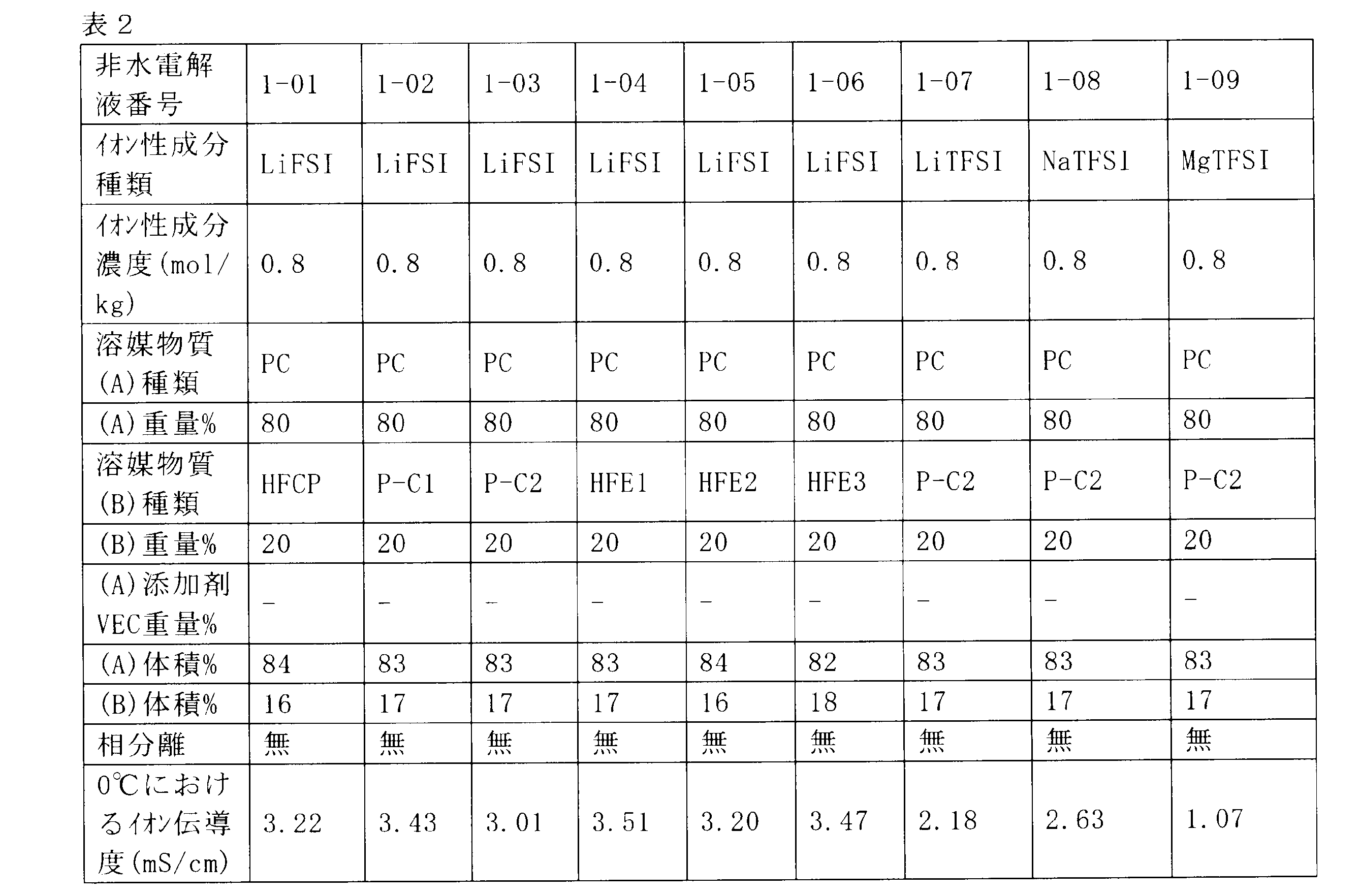
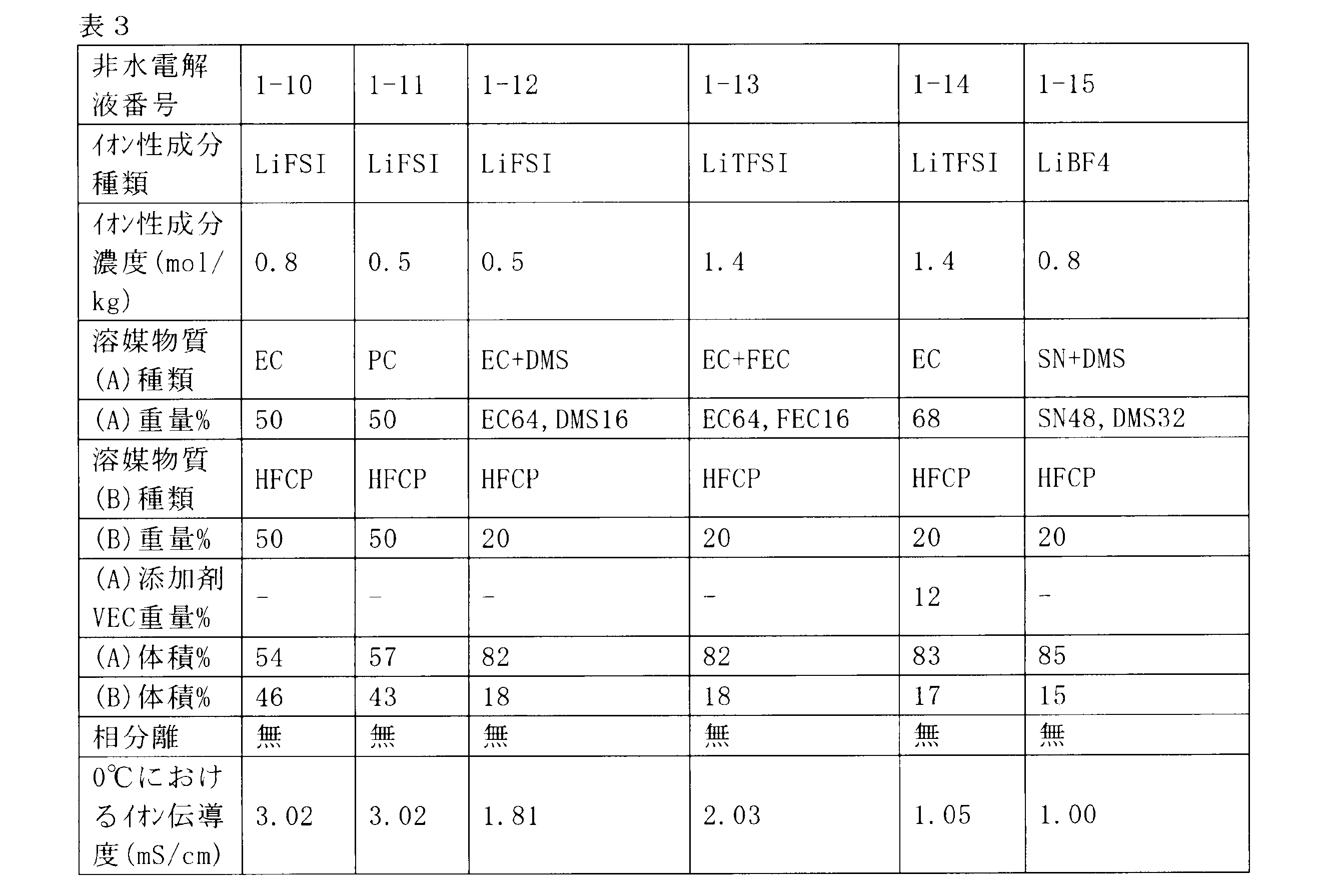
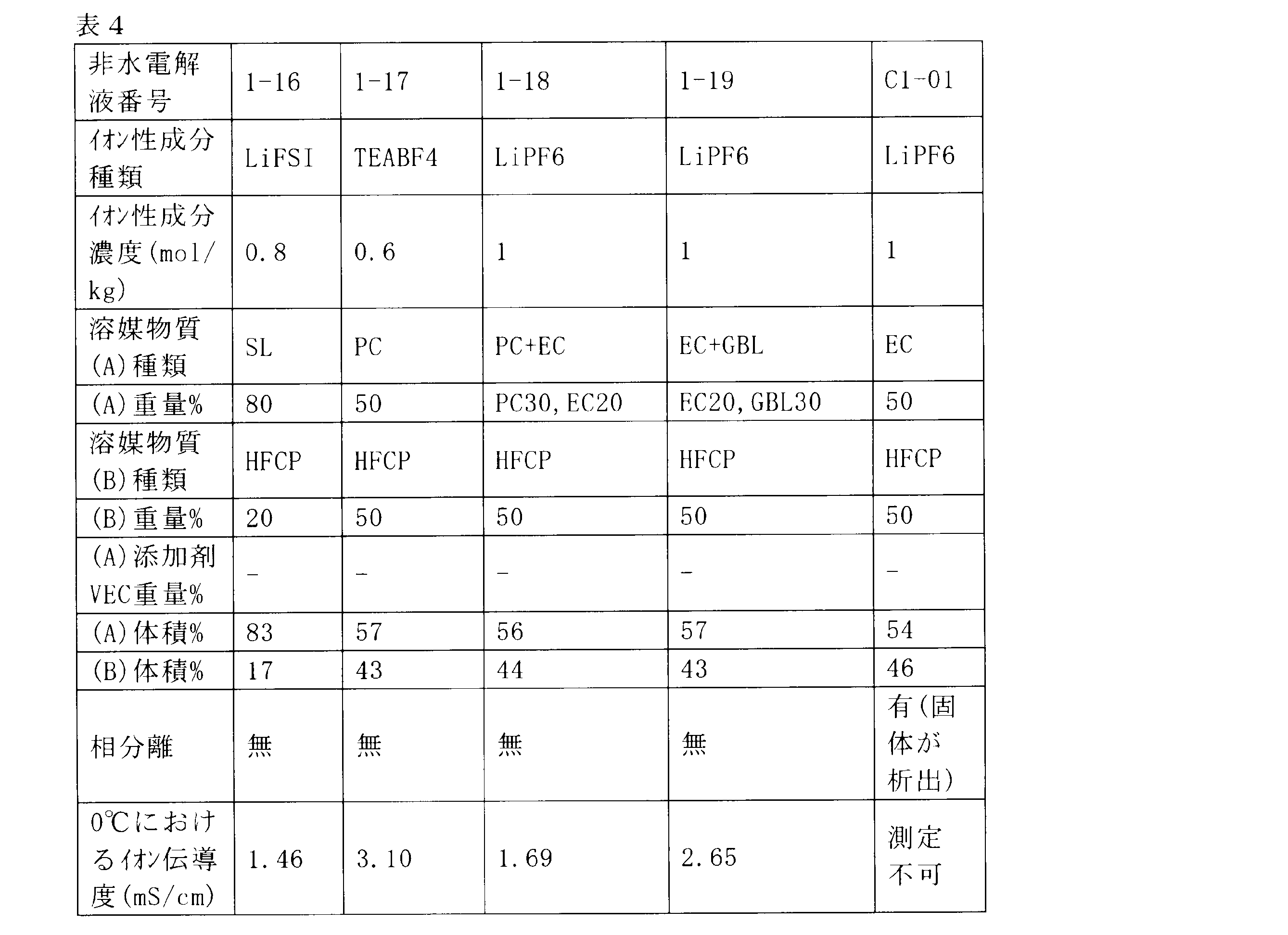
表2~表4中、「イオン性成分濃度(mol/kg)」は、非水電解液の総量に占める、イオン性成分の割合(mol/kg)である。「(A)重量%」「(B)重量%」「(A)添加剤VEC重量%」は、溶媒物質(A)、溶媒物質(B)、及び添加剤VEC(溶媒物質(A)に該当)の総量に占める、それぞれの重量%であり、「(B)体積%」は、それらと、各物質の比重から計算した、これらの総量に占める溶媒物質(B)の体積%である。表2~表4中の溶媒物質(A)及び(B)並びに添加剤の比重は下記表5~表6の通りである。
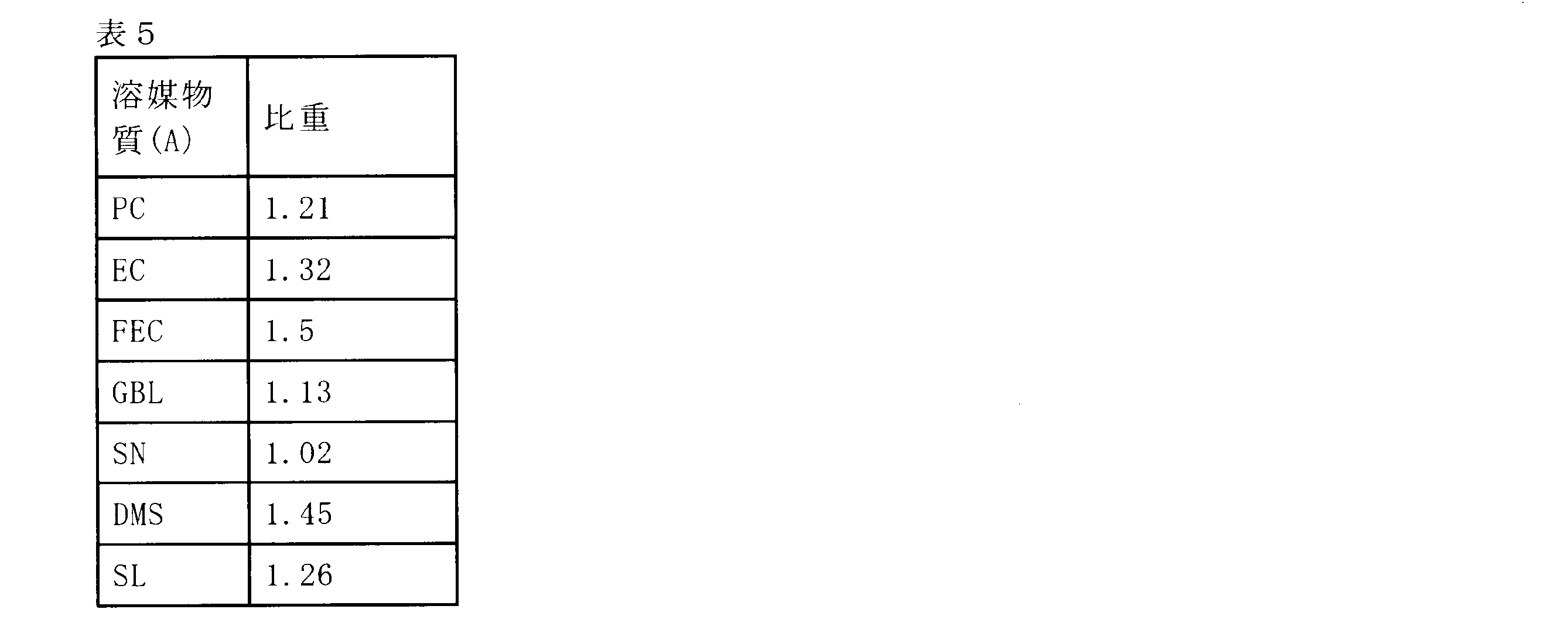
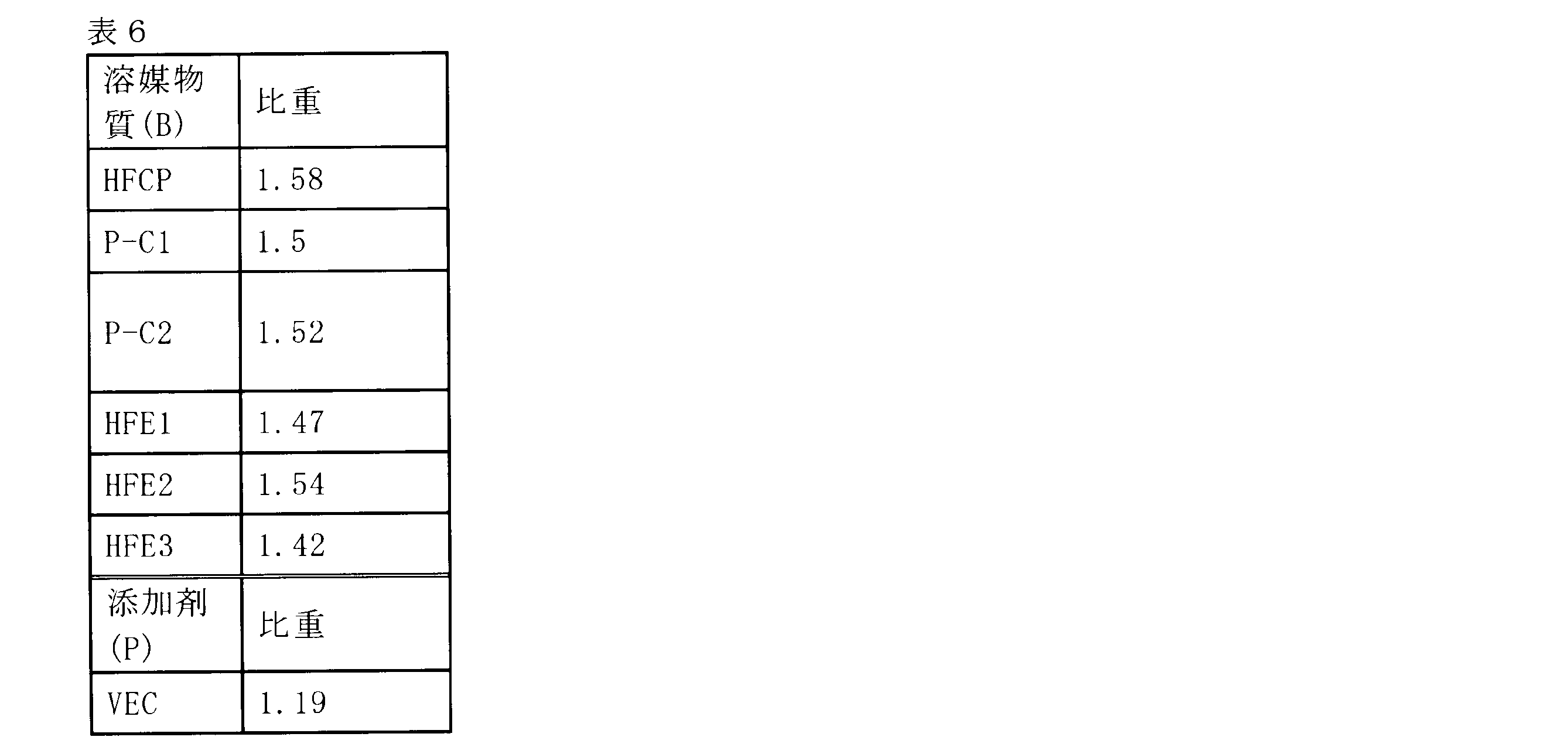
(実施例2及び比較例2)
(フッ素化溶媒の添加による含浸性の向上)
(2-1.活性炭電極)
基材として、厚み30μmのエッチドアルミ箔を用意した。基材の上に、活性炭、アセチレンブラック、SBR(スチレン-ブタジエンゴム)バインダ、及び増粘剤としてのCMC(カルボキシメチルセルロース)をそれぞれ重量比で90、5、3及び2%含む層を設け、当該層をプレスすることにより、合材層を形成し、基材及び合材層からなる活性炭電極を調製した。合材層の目付は6.1mg/cm2、密度は0.48g/cm3であった。
(フッ素化溶媒の添加による含浸性の向上)
(2-1.活性炭電極)
基材として、厚み30μmのエッチドアルミ箔を用意した。基材の上に、活性炭、アセチレンブラック、SBR(スチレン-ブタジエンゴム)バインダ、及び増粘剤としてのCMC(カルボキシメチルセルロース)をそれぞれ重量比で90、5、3及び2%含む層を設け、当該層をプレスすることにより、合材層を形成し、基材及び合材層からなる活性炭電極を調製した。合材層の目付は6.1mg/cm2、密度は0.48g/cm3であった。
(2-2.含浸性試験)
(2-1で得た)活性炭電極を切り出して、4cm角の正方形の電極試験片を多数調製した。
(2-1で得た)活性炭電極を切り出して、4cm角の正方形の電極試験片を多数調製した。
別途、リチウムイオン電池用のポリオレフィンセパレータ(セルガード#2325)を切り出して、5mm×4cmの矩形のセパレーター試験片を多数調製した。
表7に示すイオン性物質(TBABF4又はLiFSI)、溶媒物質(A)(PC)、溶媒物質(B)(HFCP)及び添加剤VEC(溶媒物質(A)に該当)を、表7に示す割合で混合し、実施例の非水電解液(2-01)~(2-04)及び比較例の非水電解液(C2-01)を調製した。それぞれの非水電解液の相分離の有無を評価した。結果を表7に示す。
一枚の電極試験片を蓋付きのガラスシャーレの底面に水平に載置し、非水電解液のいずれかをマイクロピペットで15μlとり、電極試験片の上面に滴下し、滴下後直ちにシャーレの蓋を閉め、滴下してから非水電解液が電極試験片に完全に吸い込まれるまでの時間を、ストップウォッチで計測した。結果を表7に示す。
一枚のセパレーター試験片を蓋付きのガラスシャーレの底面に水平に載置し、非水電解液のいずれかをマイクロピペットで15μlとり、セパレーター試験片の上面に滴下し、滴下後直ちにシャーレの蓋を閉め、浸透の状態を観察した。セパレーター試験片に非水電解液が浸透したことは、非水電解液の浸透によりセパレーター試験片に透明な状態の部分が生じたことにより判定した。結果を表7に示す。
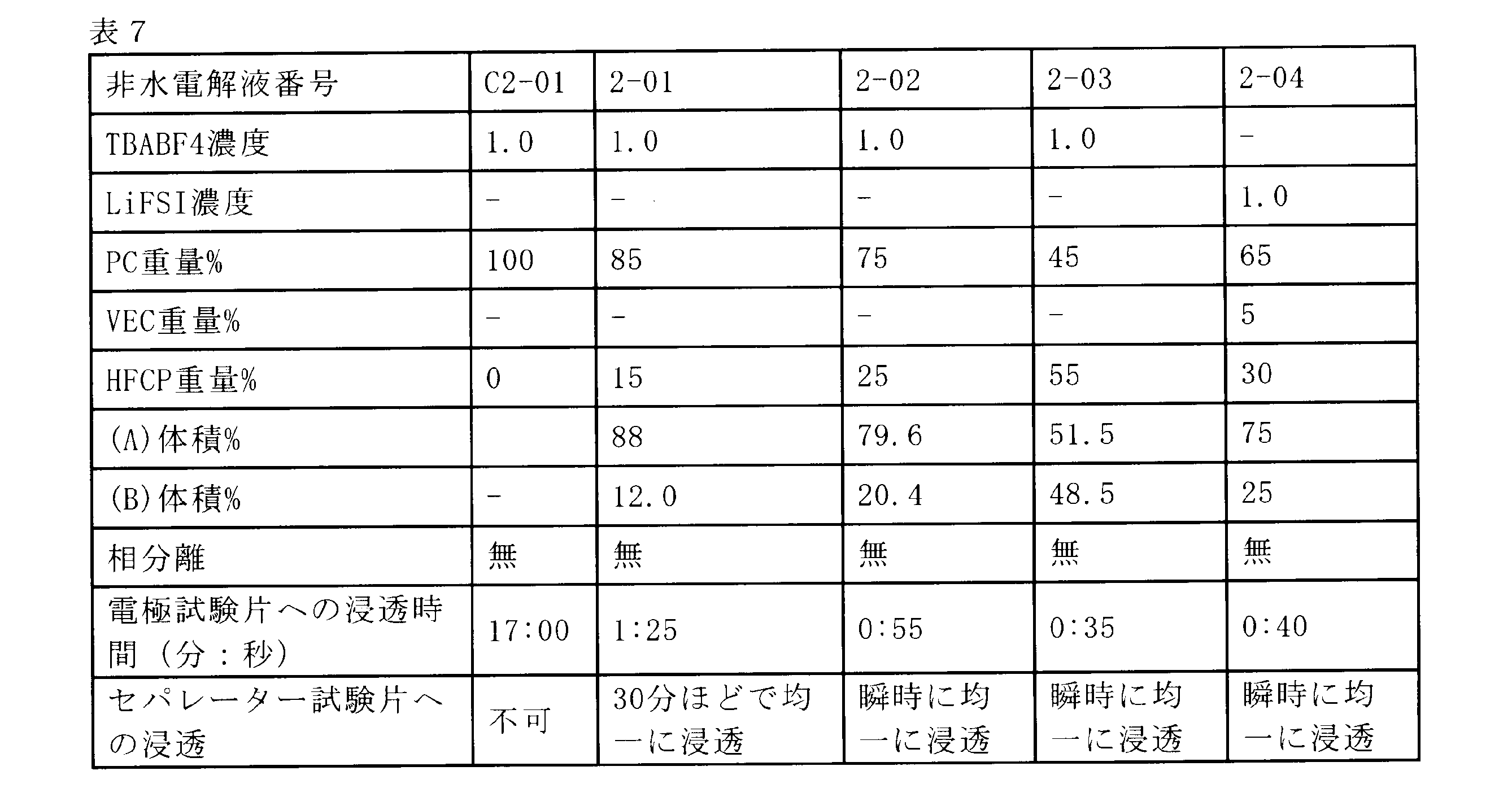
表7中、「TBABF4濃度」及び「LiFSI濃度」は、非水電解液の総量に占める、TBABF4の割合及びLiFSIの割合(mol/kg)である。「PC重量%」、「P-B1重量%」及び「HFCP重量%」は、PC、P-B1及びHFCPの総量に占める、それぞれの重量%であり、「(B)体積%」は、それらと、各物質の比重から計算した、これらの総量に占める溶媒物質(B)(即ちHFCP)の体積%である。
実施例の非水電解液のうち、溶媒物質(B)の割合が大きいものが、電極試験片へのより短い浸透時間を示し、浸透性がより高かった。溶媒物質(B)を含まない非水電解液C2-01は、セパレーター試験片へ浸透しなかった一方、溶媒物質(B)を10体積%以上含む非水電解液はセパレーター試験片への高い浸透性を示した。
さらに、非水電解液が浸透した状態のセパレーター試験片に風を当てて、セパレーター中の電解液に含まれるHFCPが十分に揮発する程度に風乾させ、状態を観察した。その結果、非水電解液の残余の成分は含浸したままであり、一度非水電解液がセパレーターに含浸した後に溶媒物質(B)が揮発しても、含浸状態を維持しうることが分かった。
(実施例3及び比較例3)
溶媒物質(A)としてのEC、DMS及びPCと、溶媒物質(B)としてのHFCPに加えて、溶媒物質(A)又は(B)に該当する種々の化合物を加えた電解液を調製し、それらによる、負極の充放電効率改善の効果を評価した。
溶媒物質(A)としてのEC、DMS及びPCと、溶媒物質(B)としてのHFCPに加えて、溶媒物質(A)又は(B)に該当する種々の化合物を加えた電解液を調製し、それらによる、負極の充放電効率改善の効果を評価した。
基材として、厚み10μmの銅箔を用意した。基材の上に、黒鉛、CMC及びSBRバインダをそれぞれ重量比で97、1、及び2%含む層を設け、当該層をプレスすることにより、負極合材層を形成し、基材及び負極合材層からなる、リチウムイオン電池用の負極を調製した。負極合材層の目付は12mg/cm2、密度は1.5g/cm3であった。この負極を3×4cmのサイズに切り出して試験極とした。
厚み10μmの銅箔の上に厚み200μmのリチウム金属を積層し、対向極を調製した。
試験極及び対向極のそれぞれの端部にニッケル製のタブを超音波溶接により取り付けた。タブ付きの試験極及び対向極の対の間に、セパレーターとして厚み100μmのPTFEメンブレンフィルター(メルク社製、オムニポアJMWP04700)を1枚配置し、(基材)/(負極合材層)/(セパレーター)/(リチウム金属)/(基材)の層構成を有する積層物を得た。積層物を、アルミラミネート外装内に配置した。
試験極及び対向極のそれぞれの端部にニッケル製のタブを超音波溶接により取り付けた。タブ付きの試験極及び対向極の対の間に、セパレーターとして厚み100μmのPTFEメンブレンフィルター(メルク社製、オムニポアJMWP04700)を1枚配置し、(基材)/(負極合材層)/(セパレーター)/(リチウム金属)/(基材)の層構成を有する積層物を得た。積層物を、アルミラミネート外装内に配置した。
イオン性物質としてのLiBF4を1.0mol/kgと、表8~表10に示す成分とを混合し、実施例の非水電解液(3-01)~(3-13)及び比較例の非水電解液(C3-01)~(C3-12)を調製した。得られた非水電解液の相分離の有無を判定したところ、いずれも、相分離「無」であった。非水電解液のそれぞれを、アルミラミネート外装内に、マイクロピペットで600μl注入して、ヒートシールで封止した。これにより、リチウムイオン負極への適合性を評価するための試験セルを得た。
得られた試験セルを、0.1Cの電流値で25℃において充電と放電を行い、初回充放電効率(初回クーロン効率)を求めた。電流値は、黒鉛の放電容量を360mAh/gとして計算した。
評価した非水電解液のうち、最もよく知られた負極用の添加剤であるVCを添加したものではほとんど効果が無く試験した中で最も低い効率となった。次いで一般的なPSやFECを添加したものでも効果は十分でなかった。VEC、DTD、MDTD、及び不飽和環状フッ素化合物のいずれかを添加した非水電解液において高い効率が得られることが分かり、電解液中に占める溶媒物質(B)が10体積%以上含まれる場合に、特に高い効率が得られた。
評価した非水電解液のうち、最もよく知られた負極用の添加剤であるVCを添加したものではほとんど効果が無く試験した中で最も低い効率となった。次いで一般的なPSやFECを添加したものでも効果は十分でなかった。VEC、DTD、MDTD、及び不飽和環状フッ素化合物のいずれかを添加した非水電解液において高い効率が得られることが分かり、電解液中に占める溶媒物質(B)が10体積%以上含まれる場合に、特に高い効率が得られた。
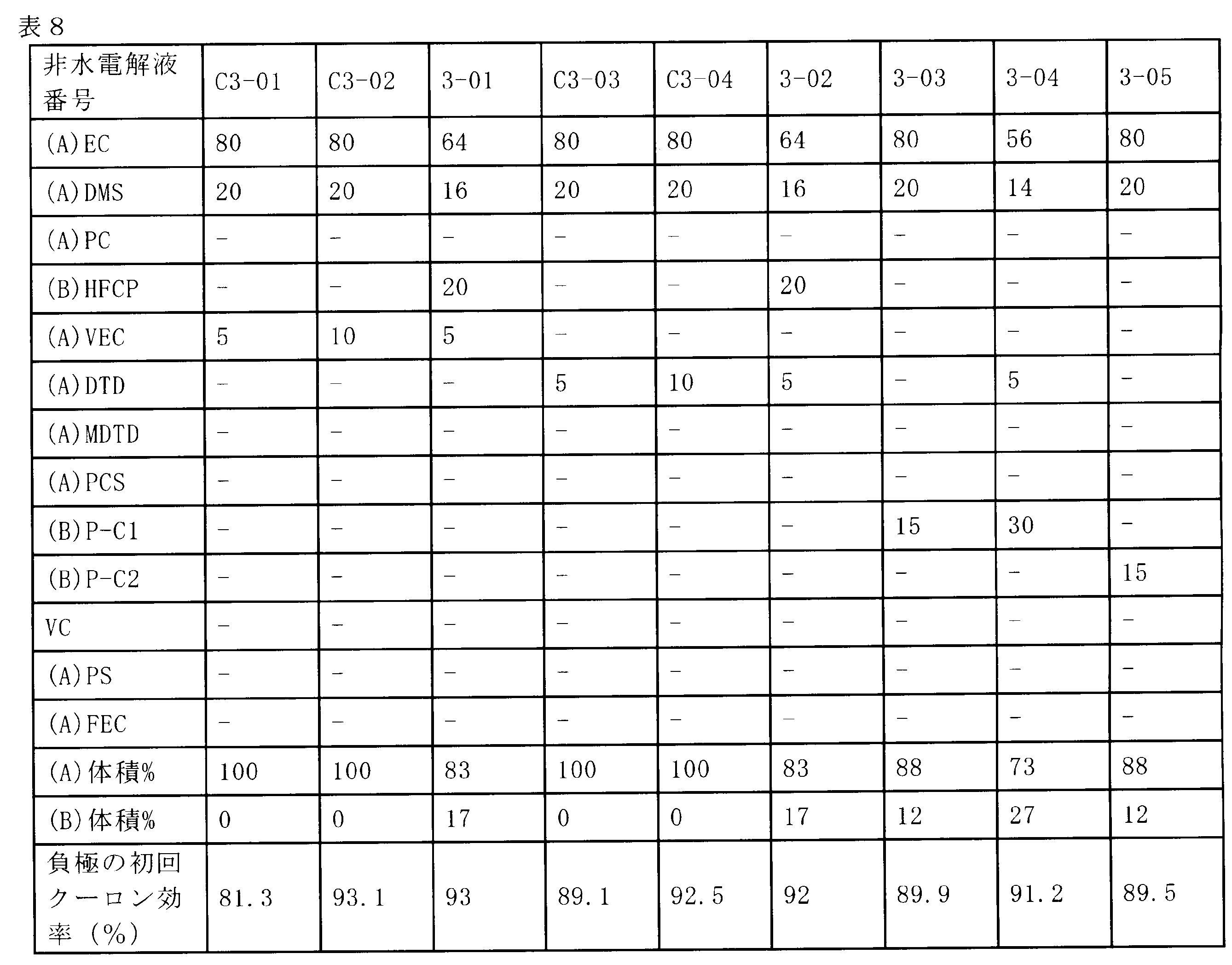
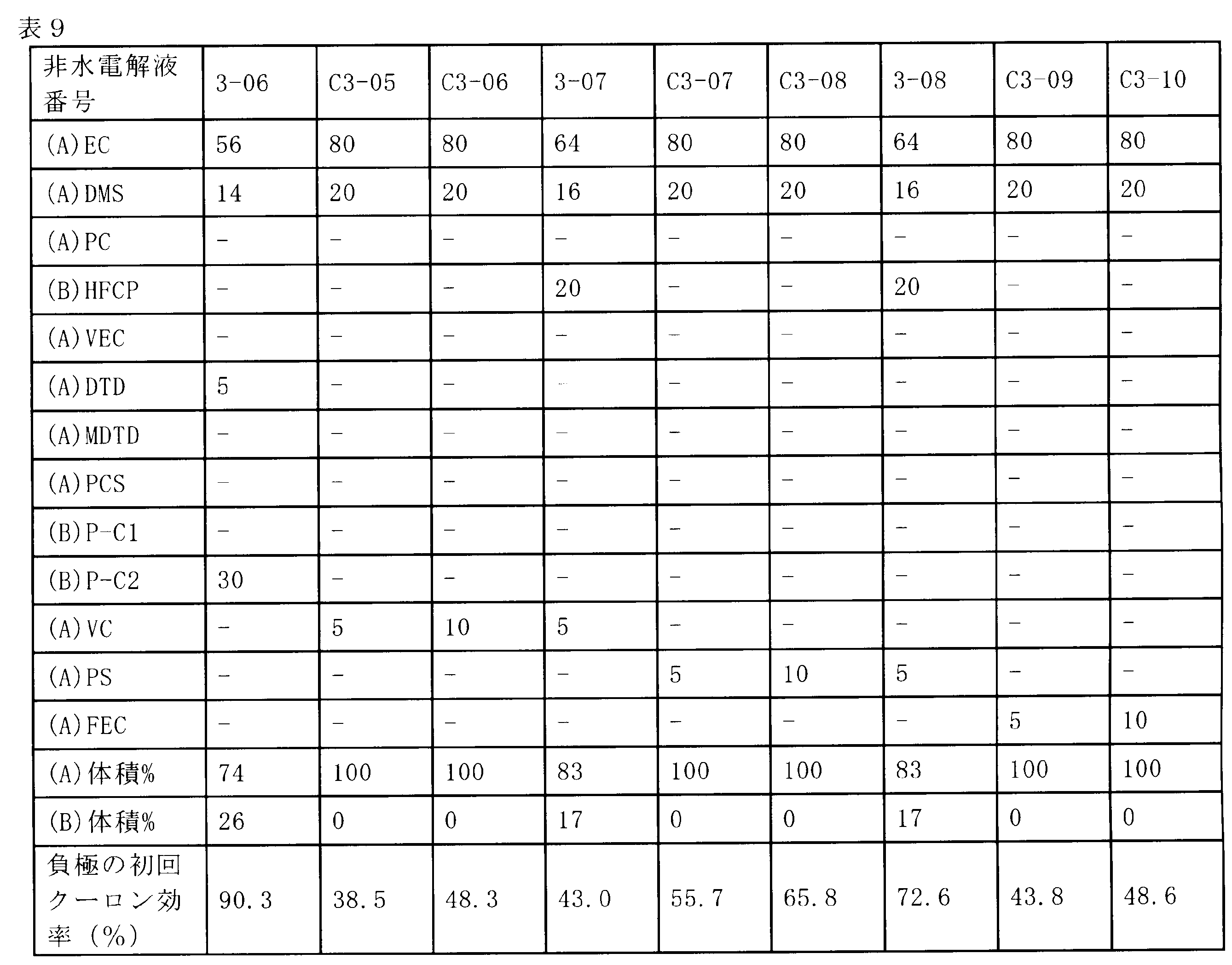
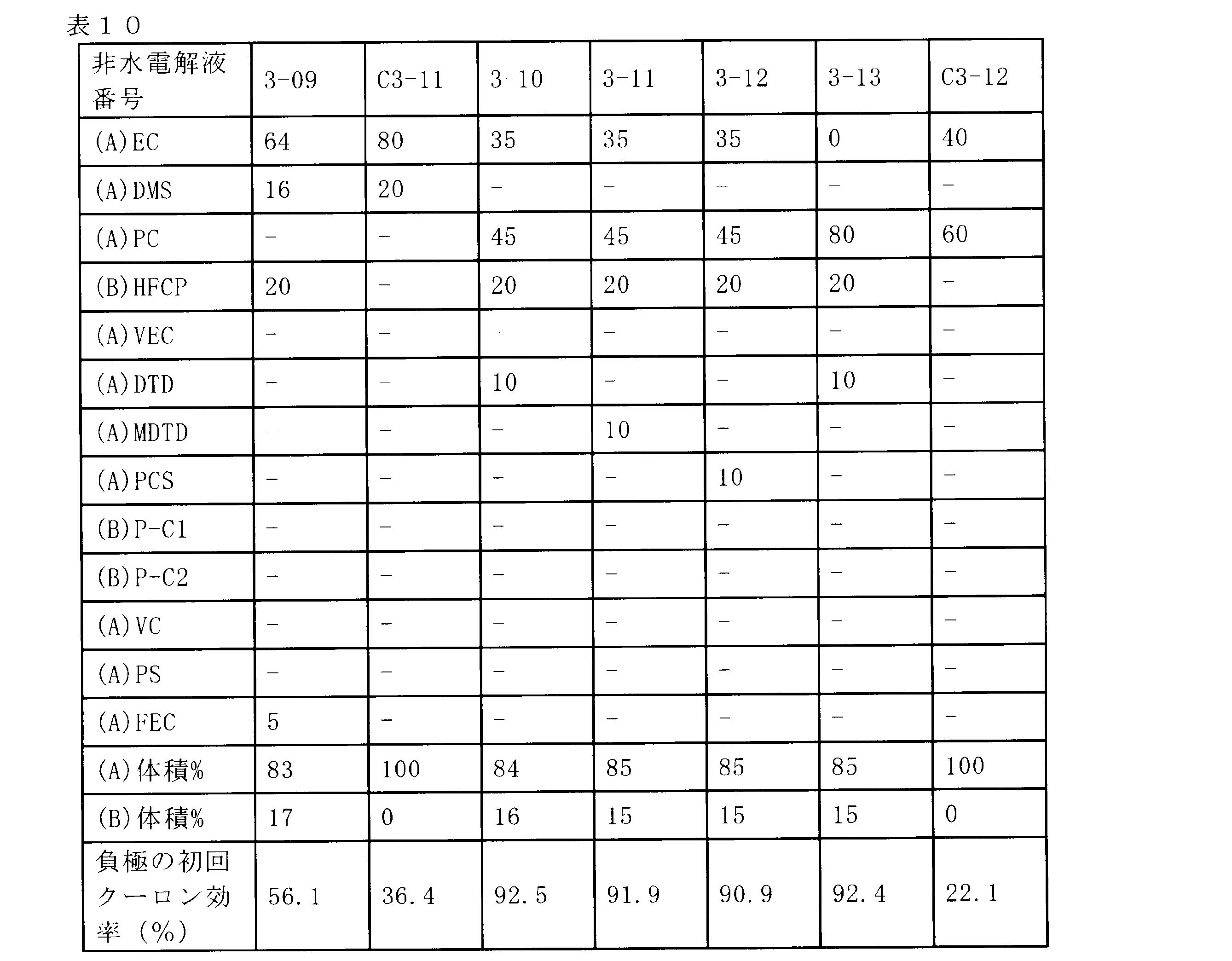
表8~表10中、(A)EC、(A)DMS、(A)PC、(B)HFCP、(A)VEC、(A)DTD、(A)MDTD、(A)PCS、(B)P-C1、(B)P-C2、VC、(A)PS、及び(A)FECの欄の数値は、非イオン性溶媒成分100体積%に対する、これらの体積%の値を示す。
(実施例4及び比較例4)
正極集電体として、厚み20μmのアルミ箔を用意した。正極集電体の上に、コバルト酸リチウム、アセチレンブラック、及びPVDF(ポリフッ化ビニリデン)バインダをそれぞれ重量比で94、3、及び3%含む層を設け、当該層をプレスすることにより、正極合材層を形成し、正極集電体及び正極合材層からなるリチウムイオン正極を調製した。正極合材層の目付は22mg/cm2、密度は3.0g/cm3であった。
正極集電体として、厚み20μmのアルミ箔を用意した。正極集電体の上に、コバルト酸リチウム、アセチレンブラック、及びPVDF(ポリフッ化ビニリデン)バインダをそれぞれ重量比で94、3、及び3%含む層を設け、当該層をプレスすることにより、正極合材層を形成し、正極集電体及び正極合材層からなるリチウムイオン正極を調製した。正極合材層の目付は22mg/cm2、密度は3.0g/cm3であった。
負極集電体として、厚み10μmの銅箔を用意した。負極集電体の上に、黒鉛(日立化成社製 MAG-E)、アセチレンブラック、SBRバインダ、及びCMCをそれぞれ重量比で97、0.5、1、及び1.5%含む層を設け、当該層をプレスすることにより、負極合材層を形成し、負極集電体及び負極合材層からなるリチウムイオン負極を調製した。負極合材層の、目付は11mg/cm2、密度は1.4g/cm3であった。
正極集電体及び負極集電体を適当な形状に成形し、タブを取り付け、これらの間にセパレーターとして厚み100μmのPTFEメンブレンフィルター(メルク社製、オムニポアJMWP04700)を1枚配置し、(正極集電体)/(正極合材層)/(セパレーター)/(負極合材層)/(負極集電体)の層構成を有する積層物を得た。積層物をアルミラミネート外装内に配置した。
イオン性物質としてのLiFSIを1.0mol/kgと、表11に示す成分とを混合し、実施例の非水電解液(4-01)~(4-04)及び比較例の非水電解液(C4-01)~(C4-02)を調製した。得られた非水電解液の相分離の有無を判定したところ、いずれも、相分離「無」であった。非水電解液のそれぞれを、アルミラミネート外装内に注入して、外装を封止した。これにより、ごく標準的なリチウムイオン電池を構成した。
得られたリチウムイオン電池の充放電を行った。充放電は、初回のみ0.1C、その後は0.6Cの電流値で、25℃において、4.2V~3.0Vの間でのサイクルを繰り返し行った。電流値は、コバルト酸リチウムの放電容量を145mAh/gとして計算した。1回目のサイクルの放電容量に対する、200回目のサイクルの放電容量の比の百分率を、容量維持率として求めた。その結果、本発明の非水電解液を用いたリチウムイオン電池では、様々な溶媒物質(B)の含有量において充放電を行うことができ、溶媒物質(B)を含まない電解液を用いた場合に対して、より良好なサイクル容量維持率を示すことが分かった。
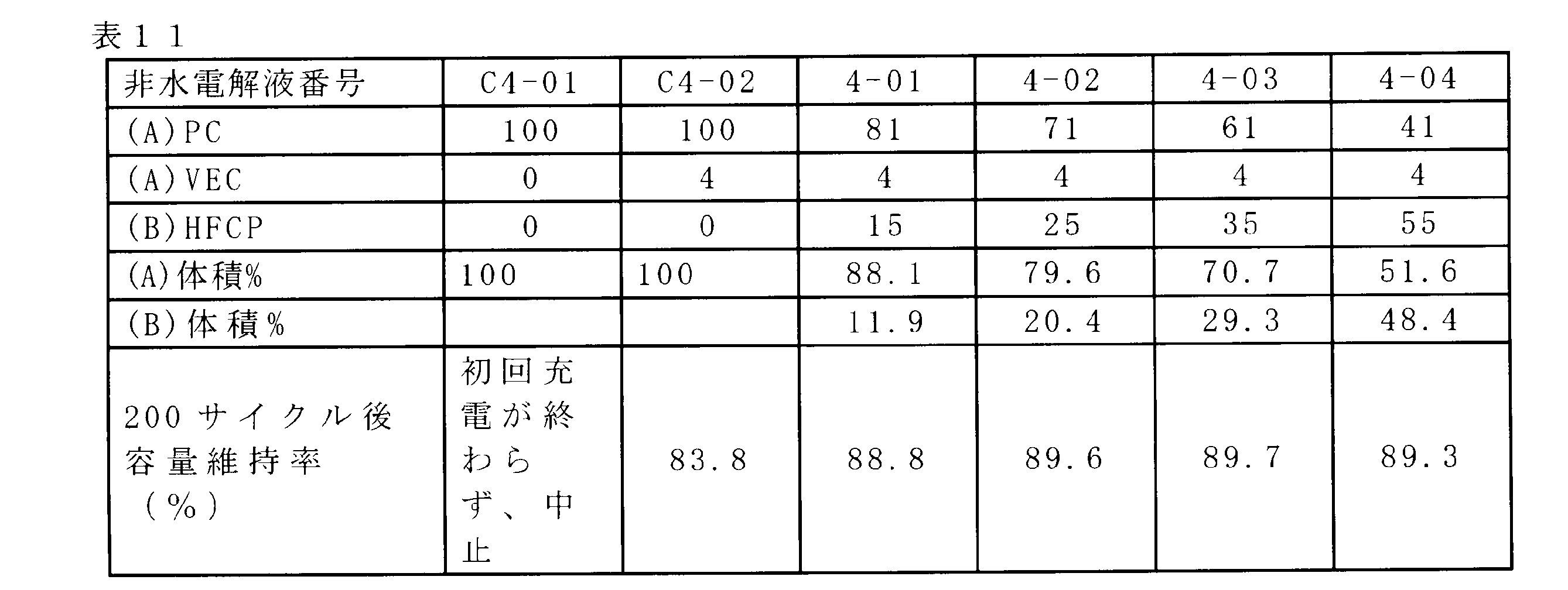
表11中、(A)PC、(A)VEC、及び(B)HFCPの欄の数値は、非イオン性溶媒成分100重量%に対する、これらの重量%の値を示す。
(実施例5及び比較例5)
本発明の非水電解液のキャパシタへの適用性を評価するために、イオン性物質としてのTEABF4を1.0mol/kgと、表12に示す成分とを混合し、実施例の非水電解液(5-01)及び対照としてのHFCPを含まない比較例の非水電解液(C5-01)を調製した。得られた非水電解液の相分離の有無を判定したところ、いずれも、相分離「無」であった。
本発明の非水電解液のキャパシタへの適用性を評価するために、イオン性物質としてのTEABF4を1.0mol/kgと、表12に示す成分とを混合し、実施例の非水電解液(5-01)及び対照としてのHFCPを含まない比較例の非水電解液(C5-01)を調製した。得られた非水電解液の相分離の有無を判定したところ、いずれも、相分離「無」であった。
実施例2の(2-1)で得た活性炭電極を切り出して、3×4cmの矩形の試験極を得た。一対の試験極のそれぞれの端部にアルミニウム製のタブを超音波溶接により取り付けた。タブ付きの試験極の対の間に、セパレーターとして厚み35μmの紙(ニッポン高度紙工業製、TF4535)を1枚配置し、(基材)/(合材層)/(セパレーター)/(合材層)/(基材)の層構成を有する積層物を得た。アルミラミネート外装内に積層物を配置し、非水電解液(5-01)又は(C5-01)をマイクロピペットで600μl注入し、アルミラミネート外装をヒートシールすることにより封止し、キャパシタのセルを得た。
得られたセルに対し、2.5V~0Vの間で1A/gの電流値で充放電を行い、充放電が可能であるか否かを評価し、その際の初回放電容量を測定した。結果を表12に示す。充放電は可能であり、実施例において活性炭重量当たりの容量が増える効果が確認された。容量が増えたメカニズムは定かではないが、フッ素溶媒の浸透性が高いことにより、比較例の電解液では侵入できない活物質表面があり、そこが利用されるようになったのではないかと考えられる。
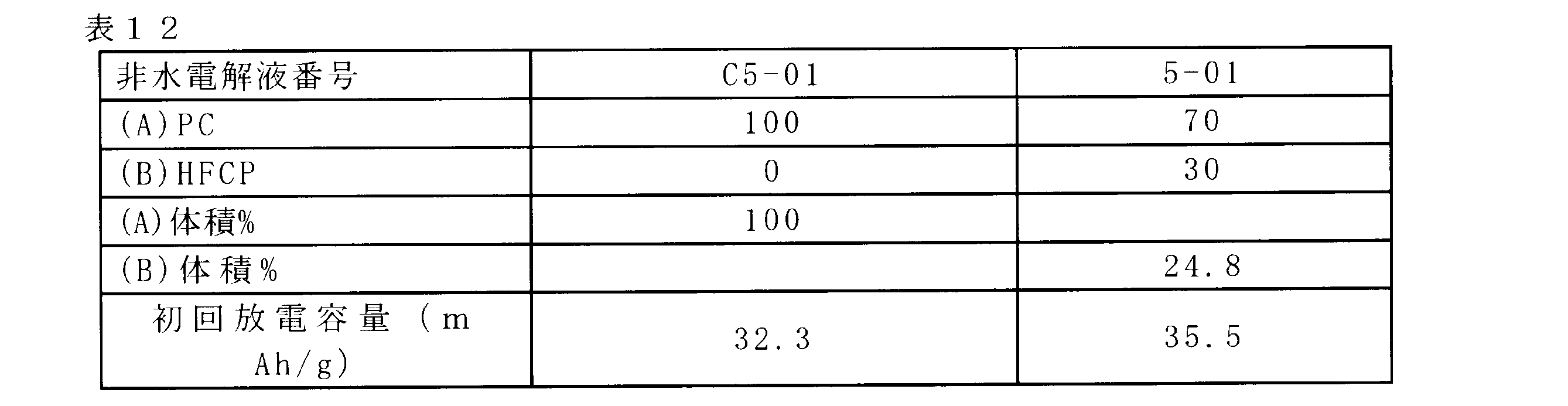
表12中、(A)PC、及び(B)HFCPの欄の数値は、非イオン性溶媒成分100重量%に対する、これらの重量%の値を示す。
(実施例6)
(6-1.非水電解液の調製)
下記表13に示す組成にて各成分を混合し、実施例の非水電解液(6-01)~(6-03)を調製した。得られた非水電解液の相分離の有無を判定したところ、いずれも、相分離「無」であった。
(6-1.非水電解液の調製)
下記表13に示す組成にて各成分を混合し、実施例の非水電解液(6-01)~(6-03)を調製した。得られた非水電解液の相分離の有無を判定したところ、いずれも、相分離「無」であった。
(6-2.容量維持率)
下記の変更点の他は、実施例4と同じ操作により、容量維持率の測定を行った。
・非水電解液として、実施例4で得たものに代えて、(6-1)で得た非水電解液(6-01)~(6-03)を用いた。
・セパレーターとして、PTFEメンブレンフィルターに代えて、ポリオレフィンセパレータ(セルガード#2325)を用いた。
結果を表13に示す。イオン性物質に対する溶媒物質の比が低くなると、初回の充放電効率が向上することが分かった。
下記の変更点の他は、実施例4と同じ操作により、容量維持率の測定を行った。
・非水電解液として、実施例4で得たものに代えて、(6-1)で得た非水電解液(6-01)~(6-03)を用いた。
・セパレーターとして、PTFEメンブレンフィルターに代えて、ポリオレフィンセパレータ(セルガード#2325)を用いた。
結果を表13に示す。イオン性物質に対する溶媒物質の比が低くなると、初回の充放電効率が向上することが分かった。
(6-3.着火試験)
直径2cmのステンレス製の皿に、(6-1)で得た非水電解液のそれぞれを100mg入れ、ライターの炎を直に当てて、炎を当て初めてから着火するまでにかかる時間を計測した。結果を表13に示す。
この結果より、イオン性物質に対する溶媒物質の比が低くなると、着火までにかかる時間が長くなり、より安全性が高いことが分かった。
直径2cmのステンレス製の皿に、(6-1)で得た非水電解液のそれぞれを100mg入れ、ライターの炎を直に当てて、炎を当て初めてから着火するまでにかかる時間を計測した。結果を表13に示す。
この結果より、イオン性物質に対する溶媒物質の比が低くなると、着火までにかかる時間が長くなり、より安全性が高いことが分かった。
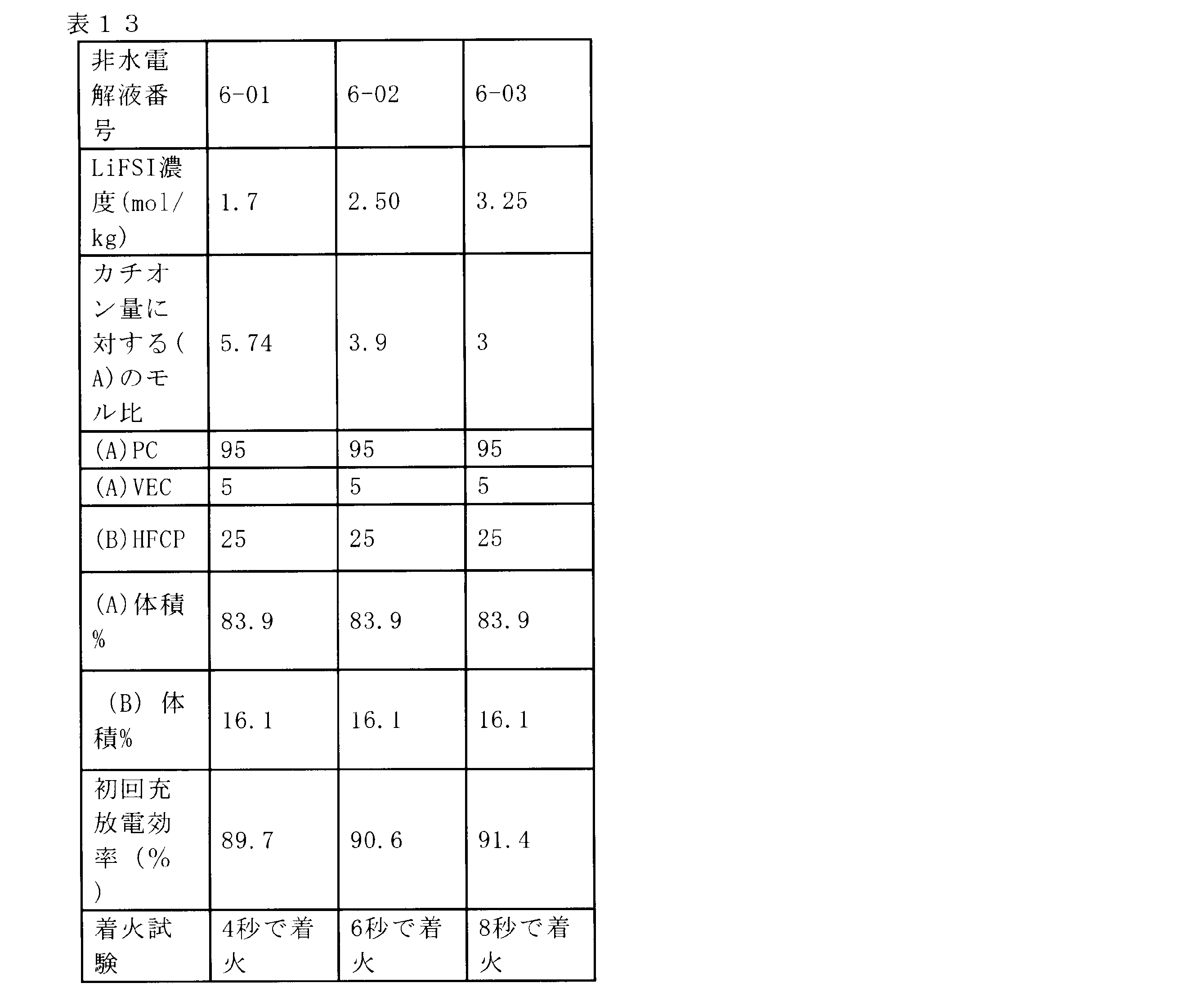
表13中、「LiFSI濃度(mol/kg)」は、非水電解液の総量に占める、イオン性成分であるLiFSIの割合(mol/kg)である。「(A)PC」「(A)VEC」「(B)HFCP」は、これらの総量に占める、それぞれの重量%である。
(実施例7)
(7-1.非水電解液の調製)
イオン性物質としてのLiPF6を1.0mol/kgと、表14に示す成分とを混合し、実施例の非水電解液(7-01)~(7-02)を調製した。得られた非水電解液の相分離の有無を判定したところ、いずれも、相分離「無」であった。
(7-1.非水電解液の調製)
イオン性物質としてのLiPF6を1.0mol/kgと、表14に示す成分とを混合し、実施例の非水電解液(7-01)~(7-02)を調製した。得られた非水電解液の相分離の有無を判定したところ、いずれも、相分離「無」であった。
(7-2.浸透の状態)
ポリオレフィンセパレータ(セルガード#2325)を切り出して、5mm×4cmの矩形のセパレーター試験片を多数調製した。一枚のセパレーター試験片を蓋付きのガラスシャーレの底面に水平に載置し、非水電解液のいずれかをマイクロピペットで15μlとり、セパレーター試験片の上面に滴下し、滴下後直ちにシャーレの蓋を閉め、浸透の状態を観察した。セパレーター試験片に非水電解液が浸透したことは、非水電解液の浸透によりセパレーター試験片に透明な状態の部分が生じたことにより判定した。結果を表14に示す。
ポリオレフィンセパレータ(セルガード#2325)を切り出して、5mm×4cmの矩形のセパレーター試験片を多数調製した。一枚のセパレーター試験片を蓋付きのガラスシャーレの底面に水平に載置し、非水電解液のいずれかをマイクロピペットで15μlとり、セパレーター試験片の上面に滴下し、滴下後直ちにシャーレの蓋を閉め、浸透の状態を観察した。セパレーター試験片に非水電解液が浸透したことは、非水電解液の浸透によりセパレーター試験片に透明な状態の部分が生じたことにより判定した。結果を表14に示す。
(7-3.容量維持率)
下記の変更点の他は、実施例4と同じ操作により、容量維持率の測定を行った。
・非水電解液として、実施例4で得たものに代えて、(7-1)で得た非水電解液(7-01)~(7-02)を用いた。
・セパレーターとして、PTFEメンブレンフィルターに代えて、ポリオレフィンセパレータ(セルガード#2325)を用いた。
・充放電の2回目以降のサイクルの電流値を0.6Cから1.0Cに変更した(充放電の初回の電流値は0.1Cから変更なし)。
結果を表14に示す。
下記の変更点の他は、実施例4と同じ操作により、容量維持率の測定を行った。
・非水電解液として、実施例4で得たものに代えて、(7-1)で得た非水電解液(7-01)~(7-02)を用いた。
・セパレーターとして、PTFEメンブレンフィルターに代えて、ポリオレフィンセパレータ(セルガード#2325)を用いた。
・充放電の2回目以降のサイクルの電流値を0.6Cから1.0Cに変更した(充放電の初回の電流値は0.1Cから変更なし)。
結果を表14に示す。
(7-4.着火試験)
直径2cmのステンレス製の皿に、(7-1)で得た非水電解液のそれぞれを100mg入れ、ライターの炎を直に当てて、炎を当て初めてから着火するまでにかかる時間を計測した。リン酸トリエチルを含まない電解液(7-02)は4秒で着火したが、リン酸トリエチルを含む電解液(7-01)ものは加熱により電解液が揮散して塩を残して完全に無くなったが、電解液が着火することは無かった。
直径2cmのステンレス製の皿に、(7-1)で得た非水電解液のそれぞれを100mg入れ、ライターの炎を直に当てて、炎を当て初めてから着火するまでにかかる時間を計測した。リン酸トリエチルを含まない電解液(7-02)は4秒で着火したが、リン酸トリエチルを含む電解液(7-01)ものは加熱により電解液が揮散して塩を残して完全に無くなったが、電解液が着火することは無かった。
難燃性の溶媒物質であるTEPの非水電解液への添加は、室温における非水電解液の着火性を大きく下げる効果がある一方、サイクル後の容量をやや低下させることが分かった。
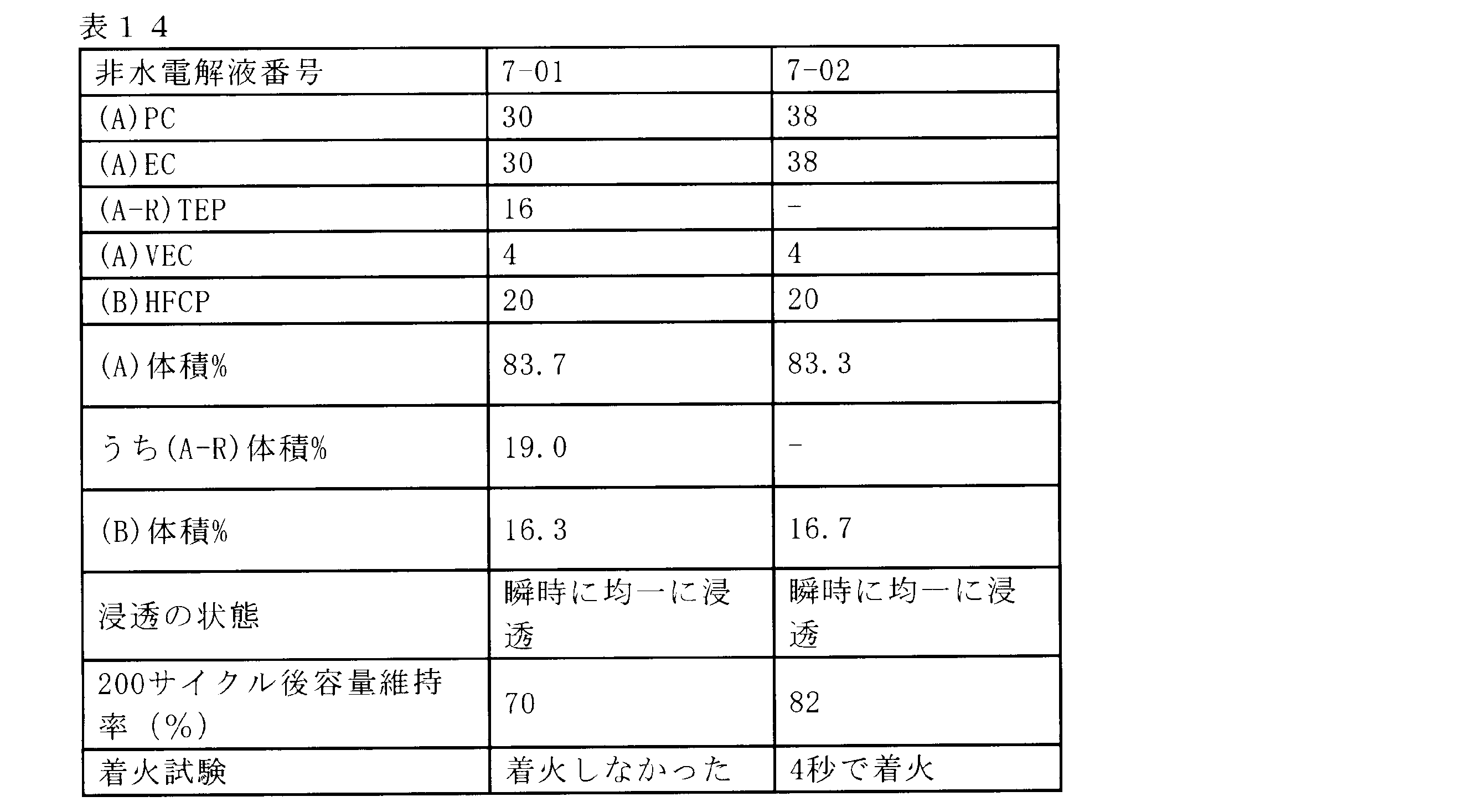
表14中、「(A)PC」、「(A)EC」、「(A)TEP」、「(A)VEC」、「(B)HFCP」は、これらの総量に占める、それぞれの重量%である。
(実施例8及び比較例6)
(8-1.非水電解液の調製)
下記表15~表16に示す組成にて各成分を混合し、実施例の非水電解液(8-01)~(8-05)及び比較例の非水電解液(C6-01)~(C6-03)を調製した。得られた非水電解液の相分離の有無を判定した。結果を表15~表16に示す。
(8-1.非水電解液の調製)
下記表15~表16に示す組成にて各成分を混合し、実施例の非水電解液(8-01)~(8-05)及び比較例の非水電解液(C6-01)~(C6-03)を調製した。得られた非水電解液の相分離の有無を判定した。結果を表15~表16に示す。
(8-2.引火点の測定)
(8-1)で調製した非水電解液について、タグ密閉法(JIS K2265-1(2007))及びクリーブランド開放法(JIS K2265-4(2007))のそれぞれに準拠した引火点測定法により、引火点を測定した。加えて、イオン性成分を含まず、非イオン性溶媒成分のみの状態である液体についても、クリーブランド開放法による引火点測定を行った。さらに、EMC、HFCP、PC及びHFCPの重量比7:3混合物、並びにTEPについても、同じ測定法により、引火点を測定した。結果を表15~表16に示す。
(8-1)で調製した非水電解液について、タグ密閉法(JIS K2265-1(2007))及びクリーブランド開放法(JIS K2265-4(2007))のそれぞれに準拠した引火点測定法により、引火点を測定した。加えて、イオン性成分を含まず、非イオン性溶媒成分のみの状態である液体についても、クリーブランド開放法による引火点測定を行った。さらに、EMC、HFCP、PC及びHFCPの重量比7:3混合物、並びにTEPについても、同じ測定法により、引火点を測定した。結果を表15~表16に示す。
溶媒物質(B)の添加量が10体積%を超える範囲では、PCの引火点132℃よりも高い引火点を得ることができ、16体積%を超える範囲では引火点が消失した。しかし、8体積%の添加では引火点がむしろ低下する傾向が見られた。このことから、燃焼性を低く保つためには溶媒物質(B)の添加量を10体積%超とすることが必須であることが分かった。
また、低引火点溶媒であるEMCの添加は、引火点を引き下げることが分かった。これより溶媒物質(A)(B)に該当しない低引火点溶媒の添加量は15体積%未満、より好ましくは10体積%未満、さらに好ましくは5体積%未満であることが分かった。難燃性の溶媒として知られる溶媒であるTEPの、電解液への添加は、引火点を上昇させる効果は無く、全体の引火点をTEPの引火点へ近づける効果があり、したがって引火点を消失させる目的で難燃性の溶媒を添加した場合、所望の効果が得られないことが分かった。

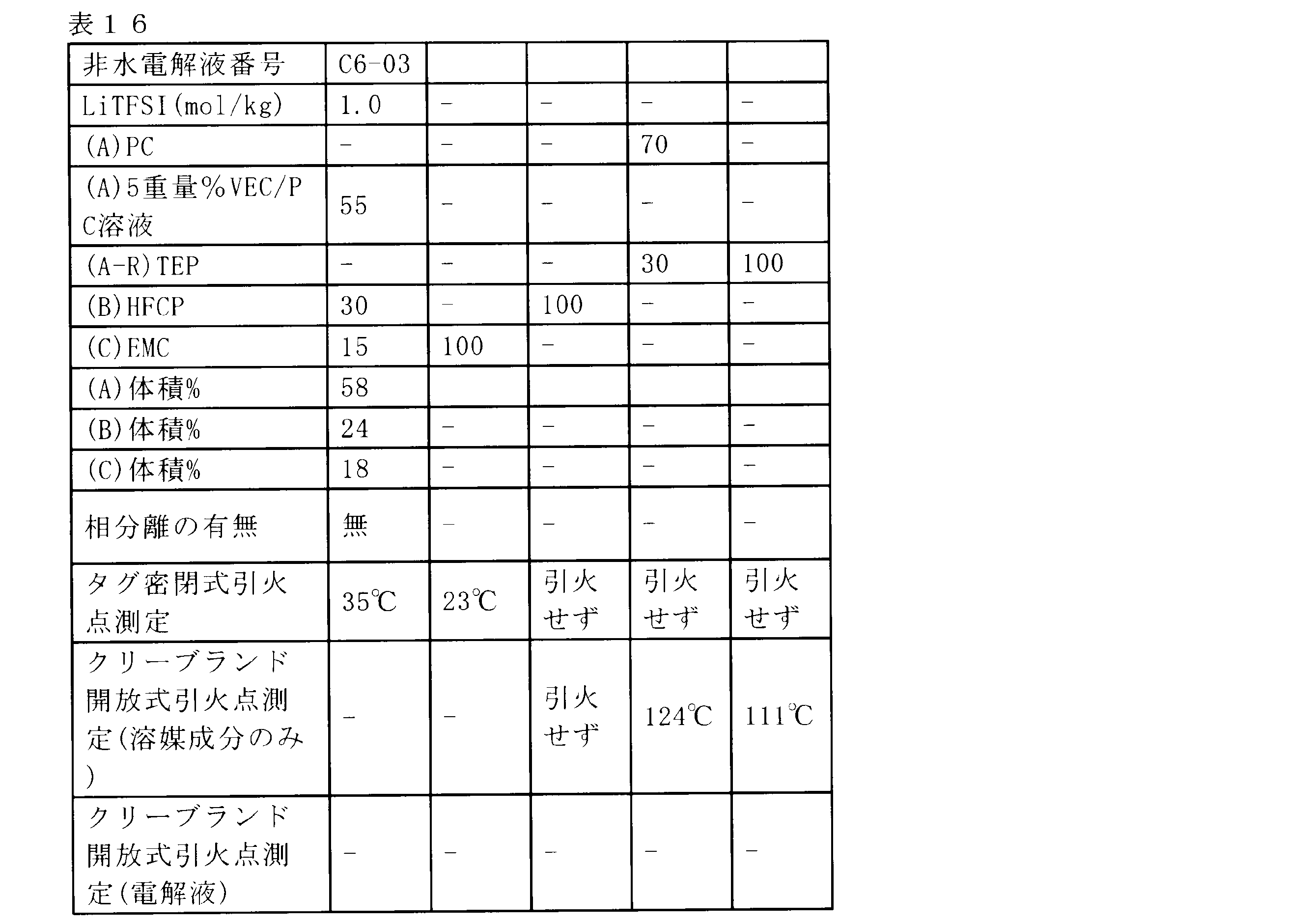
表15~表16中、「LiTFSI濃度(mol/kg)」は、非水電解液の総量に占める、イオン性成分であるLiTFSIの割合(mol/L)である。「(A)PC」「(A)5重量%VEC/PC溶液」「(B)HFCP」「EMC]は、これらの総量に占める、それぞれの重量%である。
(実施例9)
イオン性物質としてのLiFSIを1.1mol/kgと、表17に示す成分とを混合し、実施例の非水電解液(9-01)~(9-02)を調製した。得られた非水電解液の相分離の有無を判定したところ、いずれも、相分離「無」であった。
非水電解液(4-01)~(4-04)に代えて、非水電解液(9-01)~(9-02)を用いた他は、実施例4と同じ操作により、リチウムイオン電池を構成した。
イオン性物質としてのLiFSIを1.1mol/kgと、表17に示す成分とを混合し、実施例の非水電解液(9-01)~(9-02)を調製した。得られた非水電解液の相分離の有無を判定したところ、いずれも、相分離「無」であった。
非水電解液(4-01)~(4-04)に代えて、非水電解液(9-01)~(9-02)を用いた他は、実施例4と同じ操作により、リチウムイオン電池を構成した。
得られたリチウムイオン電池の容量維持率を、実施例3における方法と同じ方法にて実施した。但しサイクル数は200から100に変更した。
また、得られたリチウムイオン電池を、0.1Cの電流値で25℃において充電と放電を行い、初回充放電効率(初回クーロン効率)を求めた。電流値は、コバルト酸リチウムの放電容量を145mAh/gとして計算した。結果を表17に示す。
また、得られたリチウムイオン電池を、0.1Cの電流値で25℃において充電と放電を行い、初回充放電効率(初回クーロン効率)を求めた。電流値は、コバルト酸リチウムの放電容量を145mAh/gとして計算した。結果を表17に示す。
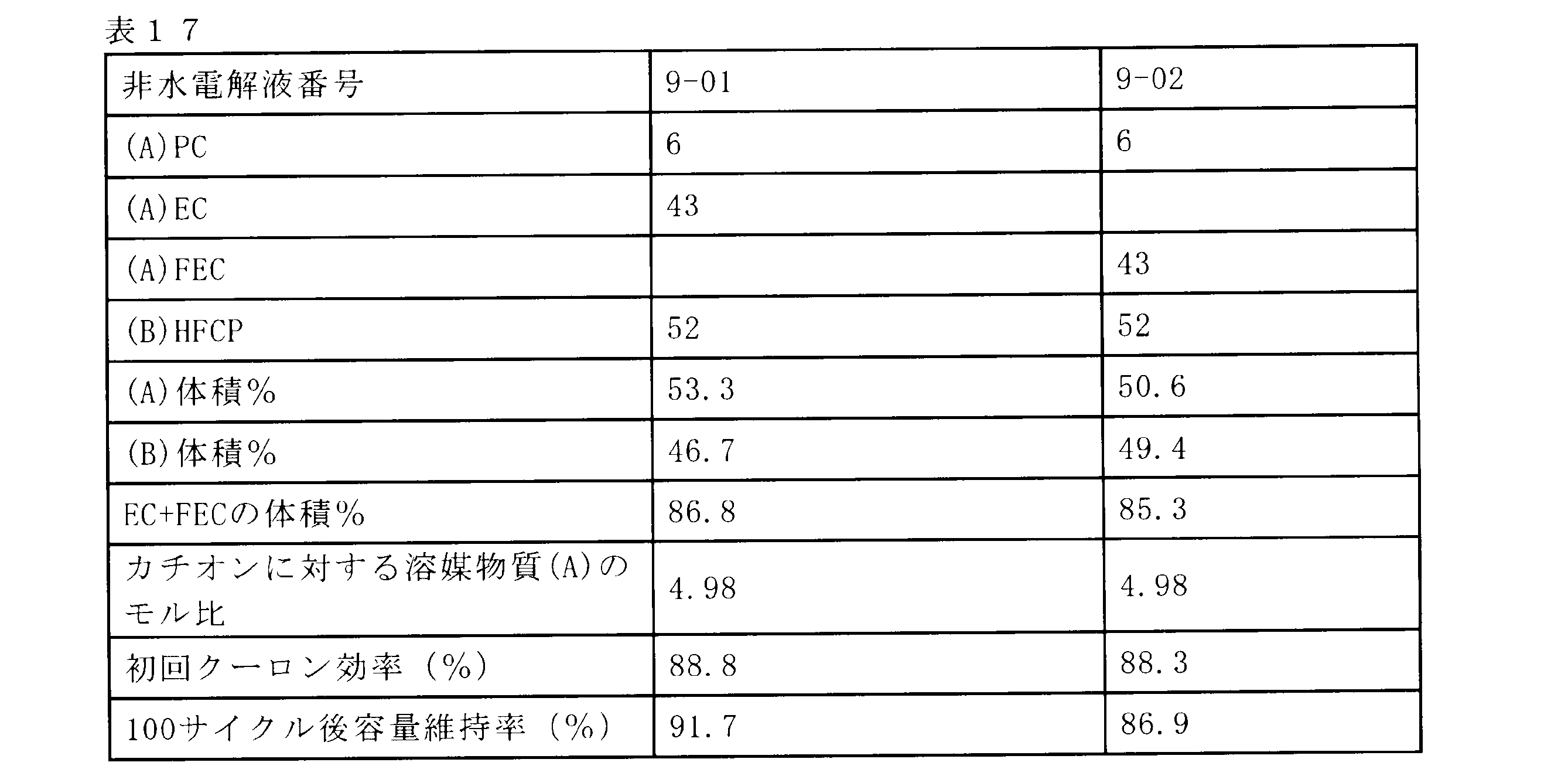
表17中、「(A)PC」「(A)EC」「(A)FEC」「(B)HFCP」は、これらの総量に占める、それぞれの重量%である。
EC又はFECを主体とした非水電解液では、添加剤(P)が無い場合でも高い充放電の効率を得ることができる。また、EC及びFECは凍結しやすいことが知られているところ、2種類の溶媒物質(A)を併用することにより、凍結を抑制することができる。このような効果は、ECとFECとの組み合わせでも得られる。
Claims (14)
- イオン性成分と、非イオン性溶媒成分を含む非水電解液であって、
前記非イオン性溶媒成分が、
引火点90℃以上のヘテロ元素含有有機溶媒物質(A)と、
含フッ素有機溶媒物質(B)とを含み、
前記含フッ素有機溶媒物質(B)は、その分子内のフッ素原子の割合が50重量%以上である物質であり、
前記非イオン性溶媒成分100体積%に占める前記ヘテロ元素含有有機溶媒物質(A)の割合がVA体積%とし、前記含フッ素有機溶媒物質(B)の割合がVB体積%としたとき、VA及びVBが、下記式(1)~(3):
VB>10 ・・・式(1)
VA+VB>85 ・・・式(2)
VA>VB ・・・式(3)
を満たし、
25℃において全体として相分離することなく、前記イオン性成分が均一に溶解した性状を示す、非水電解液。 - 前記非イオン性溶媒成分が、前記ヘテロ元素含有有機溶媒物質(A)、前記含フッ素有機溶媒物質(B)、又はそれ以外の非イオン性溶媒成分としての、添加剤(P)を含み、
前記添加剤(P)は、環状硫酸エステル化合物、ビニルエチレンカーボネート化合物、及び不飽和結合を有する環状フッ素化合物からなる群より選択される一種以上である、請求項1に記載の非水電解液。 - 前記非イオン性溶媒成分が、前記ヘテロ元素含有有機溶媒物質(A)として2種以上の溶媒物質を含み、前記2種以上の溶媒物質は、エチレンカーボネート、フルオロエチレンカーボネート又はこれらの両方を含み、前記ヘテロ元素含有有機溶媒物質(A)100体積%に対するエチレンカーボネート及びフルオロエチレンカーボネートの合計の割合は75体積%以上である、請求項1に記載の非水電解液。
- 前記非イオン性溶媒成分が、前記ヘテロ元素含有有機溶媒物質(A)として、プロピレンカーボネート、γ-ブチロラクトン又はこれらの組み合わせを、前記ヘテロ元素含有有機溶媒物質(A)100体積%に対して50体積%以上含む、請求項1に記載の非水電解液。
- 前記非イオン性溶媒成分が、前記ヘテロ元素含有有機溶媒物質(A)として、1種以上の化合物(a)を含み、
前記化合物(a)は、エステル化合物、酸無水物、ニトリル、スルホキシド、スルホン、オキサゾリドン化合物、又はイミダゾリジノン化合物であり、
前記ヘテロ元素含有有機溶媒物質(A)100体積%に対する前記化合物(a)の割合が、10体積%以上である、請求項1に記載の非水電解液。 - 前記イオン性成分が、イミドアニオンを含む、請求項1に記載の非水電解液。
- 前記イオン性成分が、ビスフロオロスルホニルイミドアニオンを含む、請求項6に記載の非水電解液。
- 前記含フッ素有機溶媒物質(B)の沸点が70℃超である、請求項1に記載の非水電解液。
- 前記含フッ素有機溶媒物質(B)が、引火点を有しない、請求項1に記載の非水電解液。
- 前記非イオン性溶媒成分が、前記含フッ素有機溶媒物質(B)として、炭素五員環を有する化合物を含む、請求項1に記載の非水電解液。
- 前記非イオン性溶媒成分が、前記ヘテロ元素含有有機溶媒物質(A)又はそれ以外の溶媒物質として、難燃性溶媒物質(A-R)を含み、
前記難燃性溶媒物質(A-R)は、リン酸エステル又は亜リン酸エステルであって一分子当たり炭素数が1以上6以下の化合物(R1)、前記化合物(R1)の水素を部分的にフッ素化した化合物(R2)、及びホスファゼン環を持つ化合物(R3)からなる群より選択される一種以上である、請求項1に記載の非水電解液。 - 前記イオン性成分が、アルカリ金属カチオン、アルカリ土類金属カチオン、またはこれらの組み合わせを含み、
前記イオン性成分を構成するカチオンに占める前記アルカリ金属カチオン及びアルカリ土類金属カチオンのカチオン量の割合が50モル%以上である、請求項1に記載の非水電解液。 - 炭素材料含有電極及び電解液を備える電気化学デバイスであって、
前記電解液が、請求項1~12のいずれか1項に記載の非水電解液である、電気化学デバイス。 - 前記炭素材料含有電極が、炭素材料として黒鉛質を含む負極である、請求項13に記載の電気化学デバイス。
Priority Applications (1)
| Application Number | Priority Date | Filing Date | Title |
|---|---|---|---|
| JP2024512546A JPWO2023190482A1 (ja) | 2022-03-30 | 2023-03-28 |
Applications Claiming Priority (2)
| Application Number | Priority Date | Filing Date | Title |
|---|---|---|---|
| JP2022057407 | 2022-03-30 | ||
| JP2022-057407 | 2022-03-30 |
Publications (1)
| Publication Number | Publication Date |
|---|---|
| WO2023190482A1 true WO2023190482A1 (ja) | 2023-10-05 |
Family
ID=88202448
Family Applications (1)
| Application Number | Title | Priority Date | Filing Date |
|---|---|---|---|
| PCT/JP2023/012446 Ceased WO2023190482A1 (ja) | 2022-03-30 | 2023-03-28 | 非水電解液、及び電気化学デバイス |
Country Status (2)
| Country | Link |
|---|---|
| JP (1) | JPWO2023190482A1 (ja) |
| WO (1) | WO2023190482A1 (ja) |
Citations (3)
| Publication number | Priority date | Publication date | Assignee | Title |
|---|---|---|---|---|
| WO2011070925A1 (ja) * | 2009-12-11 | 2011-06-16 | ダイキン工業株式会社 | 電気二重層キャパシタ |
| JP2013055051A (ja) * | 2011-08-31 | 2013-03-21 | Samsung Sdi Co Ltd | リチウム二次電池 |
| JP2013093321A (ja) * | 2011-10-04 | 2013-05-16 | Daikin Ind Ltd | 非水電解液及び電池 |
-
2023
- 2023-03-28 WO PCT/JP2023/012446 patent/WO2023190482A1/ja not_active Ceased
- 2023-03-28 JP JP2024512546A patent/JPWO2023190482A1/ja active Pending
Patent Citations (3)
| Publication number | Priority date | Publication date | Assignee | Title |
|---|---|---|---|---|
| WO2011070925A1 (ja) * | 2009-12-11 | 2011-06-16 | ダイキン工業株式会社 | 電気二重層キャパシタ |
| JP2013055051A (ja) * | 2011-08-31 | 2013-03-21 | Samsung Sdi Co Ltd | リチウム二次電池 |
| JP2013093321A (ja) * | 2011-10-04 | 2013-05-16 | Daikin Ind Ltd | 非水電解液及び電池 |
Also Published As
| Publication number | Publication date |
|---|---|
| JPWO2023190482A1 (ja) | 2023-10-05 |
Similar Documents
| Publication | Publication Date | Title |
|---|---|---|
| CA2422106C (en) | Additive for non-aqueous liquid electrolyte, non-aqueous liquid electrolyte secondary cell and non-aqueous liquid electrolyte electric double layer capacitor | |
| JP5738011B2 (ja) | 二次電池の非水電解液用添加剤、二次電池用非水電解液及び非水電解液二次電池 | |
| JP6665396B2 (ja) | 非水電解液電池用電解液、及びこれを用いた非水電解液電池 | |
| US9123973B2 (en) | Electrolyte for lithium secondary battery and lithium secondary battery comprising the same | |
| CA2423842C (en) | Additive for non-aqueous liquid electrolyte, non-aqueous liquid electrolyte secondary cell and non-aqueous liquid electrolyte electric double layer capacitor | |
| US9236636B2 (en) | Non-aqueous electrolyte solution for secondary batteries, and lithium ion secondary battery | |
| CN102089923B (zh) | 非水系电解液 | |
| CN102037600A (zh) | 二次电池 | |
| JP2008300126A (ja) | 電池用非水電解液及びそれを備えた非水電解液2次電池 | |
| JP5001507B2 (ja) | 非水電解液添加剤、非水電解液二次電池及び非水電解液電気二重層キャパシタ | |
| CN101803100A (zh) | 电解液 | |
| JPWO2009028567A1 (ja) | 電池用非水電解液及びそれを備えた非水電解液電池 | |
| WO2021172456A1 (ja) | 電気化学デバイス用電解液、可塑性組成物、用途及び製造方法 | |
| JP2015069704A (ja) | 二次電池用非水電解液およびリチウムイオン二次電池 | |
| US20040126658A1 (en) | Additive for cell and electric double-layered capacitor | |
| CN106299472A (zh) | 一种高安全性锂离子电池电解液及其应用 | |
| WO2015046171A1 (ja) | 二次電池用非水電解液およびリチウムイオン二次電池 | |
| JP4655537B2 (ja) | 非水系電解液及び非水系電解液電池 | |
| JP2015069705A (ja) | 二次電池用非水電解液およびリチウムイオン二次電池 | |
| JP4655536B2 (ja) | 非水系電解液及び非水系電解液電池 | |
| JP2010015717A (ja) | 電池用非水電解液及びそれを備えた非水電解液二次電池 | |
| JP5095883B2 (ja) | 非水電解液二次電池用添加剤及び非水電解液二次電池 | |
| JP2006179458A (ja) | 電池用非水電解液及びそれを備えた非水電解液電池 | |
| WO2012120847A1 (ja) | 非水電解液用添加剤、非水電解液及び非水電解液二次電池 | |
| KR20200059648A (ko) | 고에너지 밀도 특성을 갖는 전해질 조성물 및 이를 포함하는 전기화학 전지 |
Legal Events
| Date | Code | Title | Description |
|---|---|---|---|
| 121 | Ep: the epo has been informed by wipo that ep was designated in this application |
Ref document number: 23780491 Country of ref document: EP Kind code of ref document: A1 |
|
| ENP | Entry into the national phase |
Ref document number: 2024512546 Country of ref document: JP Kind code of ref document: A |
|
| NENP | Non-entry into the national phase |
Ref country code: DE |
|
| 122 | Ep: pct application non-entry in european phase |
Ref document number: 23780491 Country of ref document: EP Kind code of ref document: A1 |