WO2023190010A1 - 不織布ロールおよびその製造方法 - Google Patents
不織布ロールおよびその製造方法 Download PDFInfo
- Publication number
- WO2023190010A1 WO2023190010A1 PCT/JP2023/011449 JP2023011449W WO2023190010A1 WO 2023190010 A1 WO2023190010 A1 WO 2023190010A1 JP 2023011449 W JP2023011449 W JP 2023011449W WO 2023190010 A1 WO2023190010 A1 WO 2023190010A1
- Authority
- WO
- WIPO (PCT)
- Prior art keywords
- nonwoven fabric
- roll
- less
- melting point
- long fibers
- Prior art date
- Legal status (The legal status is an assumption and is not a legal conclusion. Google has not performed a legal analysis and makes no representation as to the accuracy of the status listed.)
- Ceased
Links
Images
Classifications
-
- D—TEXTILES; PAPER
- D04—BRAIDING; LACE-MAKING; KNITTING; TRIMMINGS; NON-WOVEN FABRICS
- D04H—MAKING TEXTILE FABRICS, e.g. FROM FIBRES OR FILAMENTARY MATERIAL; FABRICS MADE BY SUCH PROCESSES OR APPARATUS, e.g. FELTS, NON-WOVEN FABRICS; COTTON-WOOL; WADDING ; NON-WOVEN FABRICS FROM STAPLE FIBRES, FILAMENTS OR YARNS, BONDED WITH AT LEAST ONE WEB-LIKE MATERIAL DURING THEIR CONSOLIDATION
- D04H3/00—Non-woven fabrics formed wholly or mainly of yarns or like filamentary material of substantial length
- D04H3/08—Non-woven fabrics formed wholly or mainly of yarns or like filamentary material of substantial length characterised by the method of strengthening or consolidating
- D04H3/16—Non-woven fabrics formed wholly or mainly of yarns or like filamentary material of substantial length characterised by the method of strengthening or consolidating with bonds between thermoplastic filaments produced in association with filament formation, e.g. immediately following extrusion
-
- B—PERFORMING OPERATIONS; TRANSPORTING
- B01—PHYSICAL OR CHEMICAL PROCESSES OR APPARATUS IN GENERAL
- B01D—SEPARATION
- B01D69/00—Semi-permeable membranes for separation processes or apparatus characterised by their form, structure or properties; Manufacturing processes specially adapted therefor
- B01D69/10—Supported membranes; Membrane supports
- B01D69/107—Organic support material
- B01D69/1071—Woven, non-woven or net mesh
-
- B—PERFORMING OPERATIONS; TRANSPORTING
- B01—PHYSICAL OR CHEMICAL PROCESSES OR APPARATUS IN GENERAL
- B01D—SEPARATION
- B01D71/00—Semi-permeable membranes for separation processes or apparatus characterised by the material; Manufacturing processes specially adapted therefor
- B01D71/06—Organic material
- B01D71/48—Polyesters
-
- B—PERFORMING OPERATIONS; TRANSPORTING
- B65—CONVEYING; PACKING; STORING; HANDLING THIN OR FILAMENTARY MATERIAL
- B65H—HANDLING THIN OR FILAMENTARY MATERIAL, e.g. SHEETS, WEBS, CABLES
- B65H18/00—Winding webs
-
- D—TEXTILES; PAPER
- D04—BRAIDING; LACE-MAKING; KNITTING; TRIMMINGS; NON-WOVEN FABRICS
- D04H—MAKING TEXTILE FABRICS, e.g. FROM FIBRES OR FILAMENTARY MATERIAL; FABRICS MADE BY SUCH PROCESSES OR APPARATUS, e.g. FELTS, NON-WOVEN FABRICS; COTTON-WOOL; WADDING ; NON-WOVEN FABRICS FROM STAPLE FIBRES, FILAMENTS OR YARNS, BONDED WITH AT LEAST ONE WEB-LIKE MATERIAL DURING THEIR CONSOLIDATION
- D04H3/00—Non-woven fabrics formed wholly or mainly of yarns or like filamentary material of substantial length
- D04H3/005—Synthetic yarns or filaments
- D04H3/009—Condensation or reaction polymers
- D04H3/011—Polyesters
-
- D—TEXTILES; PAPER
- D04—BRAIDING; LACE-MAKING; KNITTING; TRIMMINGS; NON-WOVEN FABRICS
- D04H—MAKING TEXTILE FABRICS, e.g. FROM FIBRES OR FILAMENTARY MATERIAL; FABRICS MADE BY SUCH PROCESSES OR APPARATUS, e.g. FELTS, NON-WOVEN FABRICS; COTTON-WOOL; WADDING ; NON-WOVEN FABRICS FROM STAPLE FIBRES, FILAMENTS OR YARNS, BONDED WITH AT LEAST ONE WEB-LIKE MATERIAL DURING THEIR CONSOLIDATION
- D04H3/00—Non-woven fabrics formed wholly or mainly of yarns or like filamentary material of substantial length
- D04H3/08—Non-woven fabrics formed wholly or mainly of yarns or like filamentary material of substantial length characterised by the method of strengthening or consolidating
- D04H3/14—Non-woven fabrics formed wholly or mainly of yarns or like filamentary material of substantial length characterised by the method of strengthening or consolidating with bonds between thermoplastic yarns or filaments produced by welding
- D04H3/147—Composite yarns or filaments
Definitions
- the present invention relates to a nonwoven fabric roll and a method for manufacturing the same.
- semipermeable membranes such as reverse osmosis membranes used for desalination of seawater, etc.
- flat membranes integrated with a support such as nonwoven fabric or woven fabric are used.
- Reverse osmosis membranes are manufactured by casting a solution of a high molecular weight polymer onto a support such as nonwoven fabric or woven fabric to form a support layer, and then forming a semipermeable membrane on the support layer. .
- this support layer there is a comma coating method in which the cast resin solution is pooled between a roller with a blade and the support, and the excess resin solution is scraped off with the blade, and the role of the mold.
- An example of this method is a die coating method in which a resin solution is applied to a support by bringing a die in contact with the support.
- the comma coat method if there is a foreign object or protrusion between the blade portion and the support, the support will break and the process passability will deteriorate, so forming the support layer by the die coat method has been preferred.
- a support layer when forming a support layer, when a solution of a high molecular weight polymer is cast or coated on a nonwoven fabric or woven fabric that serves as the support, it may bleed through due to excessive penetration, or the membrane material may peel off. In addition, excellent film forming properties are required that do not cause defects such as non-uniformity of the film or pinholes due to fuzzing of the support.
- Reverse osmosis membranes used for seawater desalination etc. may be operated continuously at a constant operating pressure or may be operated by varying the operating pressure in response to changes in the quality and temperature of the supplied seawater, fluctuations in the amount of fresh water produced, etc.
- the nonwoven fabric has a low density layer with an air permeability of 5 to 50 cc/cm 2 /sec and a layer with an air permeability of 0.1 cc/cm 2 /sec. /cm 2 /sec or more and less than 5cc/cm 2 /sec, and the nonwoven fabric has a two-layer structure in which a high density layer is laminated and integrated, and the air permeability of the entire nonwoven fabric is 0.1 to 4.5cc/cm 2 /sec.
- a semipermeable membrane support has been proposed (see Patent Document 2).
- Patent Document 1 uses a support made of a long fiber nonwoven fabric made of continuous filaments, the die coating method that applies a uniform film has drawbacks due to variations in the thickness of the support, and the nonwoven fabric roll When this happens, the variation becomes more obvious, causing problems such as poor film formation and wrinkles.
- Patent Document 2 is a nonwoven fabric composed of short fibers rather than continuous filaments, and there is a risk that the film may become uneven and defects may occur due to fluffing. Furthermore, there has been no improvement in the strength of the nonwoven fabric that is the support, and sufficient mechanical strength and dimensional stability have not been obtained as a support.
- an object of the present invention is to provide a nonwoven fabric roll made of a long fiber nonwoven fabric, which has sufficient mechanical strength and dimensional stability, and is also excellent in film coating processability using a wide die coating method.
- the present invention aims to solve the above problems, and according to the present invention, the following inventions are provided.
- a nonwoven fabric roll obtained by winding up a long fiber nonwoven fabric made of fibers containing a thermoplastic resin as a main component, wherein the apparent density of the long fiber nonwoven fabric is 0.70 g/cm 3 or more. 90 g/cm 3 or less, the winding hardness of the nonwoven fabric roll is 35.0 g or more and 50.0 g or less, and the hardness difference in the roll width direction is 7.0 g or more and 20.0 g or less.
- the winding length of the nonwoven fabric roll is 100 m or more and 20,500 m or less, and the difference between the thickness of the long fiber nonwoven fabric in the outer layer of the roll and the thickness of the long fiber nonwoven fabric in the inner layer of the roll is 0.010 mm or less, [1] The nonwoven fabric roll described in ].
- thermoplastic resin is a polyester resin
- a method for manufacturing a nonwoven fabric roll which sequentially performs the following steps (a) to (d).
- thermocompression bonding with a linear pressure of 500 N/cm or more and 5000 N/cm or less using a pair of flat rolls, at least one of which has a surface temperature higher than the roll surface temperature of step (c) by 20° C. or more and 100° C. or less.
- the step (a) is the following (a'), and the thermoplastic in the step (c) is The method for producing a nonwoven fabric roll according to item [6] above, wherein the melting point of the resin is the melting point of the low melting point polymer.
- thermoplastic resin in step (a) is a polyester resin, or the high melting point polymer and/or low melting point polymer having a melting point lower than the melting point of the high melting point polymer by 10° C. or more and 110° C. or less from a composite spinneret 1 having a discharge hole; After obtaining long fibers covered with a low melting point polymer without exposing the high melting point polymer, Applying gas to the long fibers through the cooling section 2 in a direction perpendicular to the running direction of the long fibers, Next, after applying gas to the long fibers through the gas supply section 3 in a direction perpendicular to the running direction of the long fibers, The long fibers are passed through an intake/exhaust section 4 with a length of 1 mm or more and 150 mm or less, which is provided directly below the gas supply section 3, A step of suction stretching at a spinning speed of 3000 m/min to 5500 m/min [8]
- the thermoplastic resin in step (a) is a polyester resin, or the
- step (d) the nonwoven fabric sheets obtained in step (c) are divided in the width direction, and the nonwoven fabric sheets are stacked so as to satisfy the following formula (1) and bonded under heat to form long fibers.
- the long fiber nonwoven fabric has an apparent density of 0.70 g/cm 3 or more and 0.90 g/cm 3 or less, and the winding hardness of the nonwoven fabric roll is 35.0 g or more and 50.0 g or less, and the roll width direction
- nonwoven fabric roll that has sufficient mechanical strength and dimensional stability when used as a separation membrane support, and also has excellent membrane coating processability using a wide die coating method.
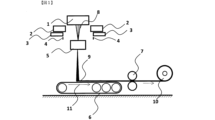
- FIG. 1 is a schematic diagram of a manufacturing apparatus for spinning a thermoplastic resin from a spinneret to obtain a nonwoven fabric sheet according to the method for manufacturing a nonwoven fabric roll of the present invention.
- a nonwoven fabric roll according to an embodiment of the present invention is a nonwoven fabric roll formed by winding up a long fiber nonwoven fabric made of fibers containing a thermoplastic resin as a main component, and wherein the long fiber nonwoven fabric has an apparent density of 0. 70 g/cm 3 or more and 0.90 g/cm 3 or less, the winding hardness of the nonwoven fabric roll is 35.0 g or more and 50.0 g or less, and the hardness difference in the width direction is 7.0 g or more and 20.0 g or less. It's a roll.
- the components will be explained in detail below, but the present invention is not limited to the scope described below unless it goes beyond the gist of the invention, and various modifications may be made without departing from the gist of the invention. Changes are possible.
- the nonwoven fabric roll of one embodiment of the present invention is formed by winding up a long fiber nonwoven fabric made of fibers containing a thermoplastic resin as a main component.
- thermoplastic resin examples include polyester, polyamide, polyolefin, and mixtures and copolymers thereof.
- polyester is preferable because it has excellent mechanical strength and durability such as heat resistance, water resistance, and chemical resistance.
- Polyester consists of an acid component and an alcohol component.
- aromatic carboxylic acids such as terephthalic acid, isophthalic acid, and phthalic acid
- aliphatic dicarboxylic acids such as adipic acid and sebacic acid
- alicyclic dicarboxylic acids such as cyclohexanecarboxylic acid
- ethylene glycol, diethylene glycol, polyethylene glycol, etc. can be used.
- polyester examples include polyethylene terephthalate, polybutylene terephthalate, polytrimethylene terephthalate, polyethylene naphthalate, polylactic acid, polybutylene succinate, and copolymers thereof.
- a crystal nucleating agent, a matting agent, a lubricant, a pigment, an antifungal agent, an antibacterial agent, a flame retardant, a hydrophilic agent, and the like may be added to the fiber containing the thermoplastic resin as a main component.
- metal oxides such as titanium oxide, which have the effect of improving the adhesion of long fiber nonwoven fabrics by increasing thermal conductivity, and mold releasability between the thermocompression roll and the fiber web are used.
- thermoplastic fiber it is preferable to add an aliphatic bisamide such as ethylene bisstearamide and/or an alkyl-substituted aliphatic monoamide, which has the effect of improving adhesive stability by increasing the adhesion stability.
- aliphatic bisamide such as ethylene bisstearamide and/or an alkyl-substituted aliphatic monoamide, which has the effect of improving adhesive stability by increasing the adhesion stability.
- additives may be present in the thermoplastic fiber or on the surface of the thermoplastic fiber.
- examples of the cross-sectional shape of the fibers containing thermoplastic resin as a main component include circular, flat, polygonal, multilobal shapes such as X-shape and Y-shape, and hollow shapes.
- the fiber whose main component is a thermoplastic resin is a composite fiber.
- This composite fiber is preferably a composite fiber in which a high melting point polymer is surrounded by a low melting point polymer having a melting point lower than the melting point of the high melting point polymer.
- thermoplastic continuous fibers will firmly adhere within the nonwoven fabric when bonded under heat and pressure, and surface smoothness can be obtained. Non-uniformity during casting of the polymer solution and membrane defects can be suppressed.
- the long fiber webs that make up the nonwoven fabric can firmly adhere to each other, and the number of bonding points in the nonwoven fabric is greater than when fibers with different melting points are mixed together. This leads to improved dimensional stability and durability when used as a support, especially as a semipermeable membrane support to which high pressure is applied during use.
- the main component refers to a component that accounts for 50% by mass or more of the components of the composite fiber.
- the difference in melting point between the above-mentioned high melting point polymer and low melting point polymer is preferably 10°C or more and 110°C or less.
- the difference in melting point is preferably 10°C or more, more preferably 20°C or more, even more preferably 30°C or more.
- desired thermal adhesiveness can be obtained.
- the temperature is set to 110°C or lower, more preferably 100°C or lower, and still more preferably 90°C or lower, it is possible to suppress the low melting point polymer component from being fused to the thermocompression roll during thermocompression bonding, thereby reducing productivity. I can do it.
- the melting point of the high melting point polymer in the composite fiber is preferably 160°C or more and 320°C or less.
- the temperature is set to 160° C. or higher, more preferably 170° C. or higher, and still more preferably 180° C. or higher.
- the shape stability is excellent even in processing steps where heat is applied.
- the temperature is set to 320°C or lower, more preferably 300°C or lower, and even more preferably 280°C or lower, it is possible to suppress the consumption of a large amount of thermal energy for melting during the production of long fiber nonwoven fabric, which reduces productivity. I can do it.
- the melting point of the low melting point polymer in the composite fiber is preferably 150° C. or higher and 310° C. or lower, while ensuring a difference in melting point between the high melting point polymer and the low melting point polymer.
- the temperature is set to 150° C. or higher, more preferably 160° C. or higher, and still more preferably 170° C. or higher, the shape stability is excellent even in processing steps where heat is applied.
- the temperature is possible to suppress the consumption of a large amount of thermal energy for melting during the production of long fiber nonwoven fabric, which reduces productivity. I can do it.
- high melting point polymer/low melting point polymer examples include polyethylene terephthalate/polybutylene terephthalate, polyethylene terephthalate/polytrimethylene terephthalate, polyethylene terephthalate/polylactic acid, Examples include polyethylene terephthalate/copolymerized polyethylene terephthalate. Isophthalic acid and the like are preferred as the copolymerization component of the copolymerized polyethylene terephthalate.
- the melting point of the thermoplastic resin shall be a value measured as follows.
- a differential scanning calorimeter perform one measurement under the following conditions.
- the differential scanning calorimeter for example, "Q100" manufactured by TA Instruments is used.
- ⁇ Measurement atmosphere Nitrogen flow (150mL/min)
- ⁇ Temperature range 30-350°C
- Heating rate 20°C/min
- mple amount 5mg
- the peak apex temperature on the highest temperature side is used.
- the endothermic peak due to the composite fiber is the endothermic peak (A) on the highest temperature side, the endothermic peak that appears on the side with a shorter elapsed time (the side where the peak appears earlier), and the endothermic peak that appears next to the endothermic peak on the highest temperature side.
- It is a peak group showing a high peak (endothermic peak (B)), and the endothermic peak (A) indicates the melting point of the high melting point polymer, whereas the endothermic peak (B) above indicates the melting point of the low melting point polymer. It indicates the melting point.
- the proportion of the low melting point polymer in such a composite fiber is preferably 10% by mass or more and 70% by mass or less in the composite fiber.
- the content is preferably 10% by mass or more, more preferably 15% by mass or more, still more preferably 20% by mass or more.
- desired thermal adhesiveness can be obtained.
- the content is set to 70% by mass or less, more preferably 60% by mass or less, and still more preferably 50% by mass or less, the low melting point polymer component is fused to the thermocompression roll during thermocompression bonding, thereby reducing productivity. Can be suppressed.
- Examples of the composite form of such a composite fiber include a concentric core-sheath type, an eccentric core-sheath type, and an island-in-the-sea type.
- a concentric core-sheath type particularly an embodiment in which a low melting point polymer is used as the sheath component, is preferred in that the fibers can be firmly adhered to each other by thermocompression bonding.
- the composite fiber has an irregular cross-sectional shape, it is preferable that the low melting point polymer component exists near the outer periphery of the fiber cross section so that it can contribute to thermocompression bonding.
- the cross-sectional shape thereof is particularly preferably circular.
- the fibers can be uniformly and firmly fused together, resulting in a long fiber nonwoven fabric with excellent mechanical strength.
- the average single fiber diameter of the above-mentioned fibers mainly composed of thermoplastic resin is preferably 3 ⁇ m or more and 17 ⁇ m or less.
- the average single fiber diameter is preferably 3 ⁇ m or more, more preferably 7 ⁇ m or more, and even more preferably 10 ⁇ m or more.
- the average single fiber diameter preferably 17 ⁇ m or less, more preferably 15 ⁇ m or less, and even more preferably 14 ⁇ m or less, a long fiber nonwoven fabric and support with excellent uniformity can be obtained, and the support Since it is possible to increase the density of the polymer solution, it is possible to obtain good film forming properties with less excessive permeation during casting of the high molecular weight polymer solution.
- the average single fiber diameter ( ⁇ m) of the fibers whose main component is the thermoplastic resin is a value calculated by the following procedure.
- Ten small samples (100 mm x 100 mm) are randomly taken from the long fiber nonwoven fabric.
- (2) Take a surface photograph with a microscope (for example, "VHX-D500” manufactured by Keyence Corporation) at a magnification of 500 times or more and 3,000 times or less, and measure the diameter of a total of 100 single fibers, 10 from each sample. .
- (3) Calculate the average single fiber diameter ( ⁇ m) by rounding off the arithmetic mean value of the 100 measured values to the first decimal place.
- the apparent density of the long fiber nonwoven fabric in one embodiment of the present invention is 0.70 g/cm 3 or more and 0.90 g/cm 3 or less.
- the apparent density of the long-fiber nonwoven fabric is 0.70 g/cm 3 or more, preferably 0.75 g/cm 3 or more, and more preferably 0.80 g/cm 3 or more. It is possible to obtain a separation membrane that has good film formability with a small amount of carbon dioxide, has high peel strength and mechanical strength, and is excellent in durability.
- the apparent density of the long fiber nonwoven fabric is 0.90 g/cm 3 or less, preferably 0.88/cm 3 or less, more preferably 0.85 g/cm 3 or less, it is possible to provide a support during polymer solution casting. It is possible to obtain a separation membrane that quickly penetrates into the interior, adheres firmly, and has excellent membrane peel strength.
- the apparent density (g/cm 3 ) of the long fiber nonwoven fabric is calculated by the following procedure. (1) Use the value calculated by converting the unit weight (g/m 2 ) of the long fiber nonwoven fabric from the thickness (mm) of the long fiber nonwoven fabric and rounding the result to the third decimal place. shall be taken as a thing.
- the basis weight and thickness of the long fiber nonwoven fabric are calculated using the procedure described below.
- the long fiber nonwoven fabric preferably has a basis weight of 20 g/m 2 or more and 150 g/m 2 .
- the basis weight By setting the basis weight to preferably 20 g/m 2 or more, more preferably 30 g/m 2 or more, and even more preferably 40 g/m 2 or more, good film formability can be obtained with less excessive penetration during polymer solution casting. It is possible to obtain a separation membrane having high peel strength and mechanical strength and excellent durability.
- the basis weight to preferably 150 g/m 2 or less, more preferably 120 g/m 2 or less, even more preferably 90 g/m 2 or less, the thickness can be reduced when used as a support, and the fluid separation element The separation membrane area per unit can be increased.
- the basis weight (g/m 2 ) of the long fiber nonwoven fabric is calculated by the following procedure. (1) Three pieces of long fiber nonwoven fabric of 30 cm x 50 cm are collected. (2) Measure the mass of each sample, convert the average value of the obtained values into mass (g) per unit area, and calculate the basis weight by rounding to the first decimal place.
- the thickness of the long fiber nonwoven fabric is preferably 0.030 mm or more and 0.200 mm or less.
- the thickness of the long-fiber nonwoven fabric is preferably 0.030 mm or more, more preferably 0.040 mm or more, and even more preferably 0.050 mm or more, so that when used as a support, excessive penetration during polymer solution casting can be avoided. etc., and good film forming properties can be obtained.
- it has high dimensional stability, which suppresses curling and bending after film formation, allowing for excellent processability when manufacturing fluid separation elements.
- the film also has high peel strength and mechanical strength, and is highly durable. A separated separation membrane can be obtained.
- the thickness of the long fiber nonwoven fabric can be set to preferably 0.200 mm or less, more preferably 0.160 mm or less, and even more preferably 0.120 mm or less, the thickness of the separation membrane can be reduced and The area of the separation membrane can be increased.
- the thickness (mm) of the long fiber nonwoven fabric is calculated by the following procedure. (1) Using a pressurizer with a diameter of 10 mm, the thickness of the long-fiber nonwoven fabric is measured in 0.01 mm units at 10 points per meter at equal intervals in the width direction of the long fiber nonwoven fabric under a load of 10 kPa. (2) Round off the average value of the above 10 points to the fourth decimal place.
- the smoothness of the long fiber nonwoven fabric according to one embodiment of the present invention is preferably 10 seconds or more and 60 seconds or less on both surfaces.
- the smoothness of the long fiber nonwoven fabric is preferably set to 10 seconds or more, more preferably 15 seconds or more, and still more preferably 20 seconds or more, so that the coagulation liquid mainly composed of water can flow from the back side of the support to the inside during separation membrane production.
- the polymer solution cast onto the support can be solidified after sufficiently permeating into the inside of the support, and the membrane peel strength of the formed separation membrane can be improved. Furthermore, it is possible to suppress scratches on the surface of the separation membrane caused by rubbing between the membrane forming surface and the back surface during the winding process during separation membrane production.
- the smoothness of the long-fiber nonwoven fabric preferably 60 seconds or less, more preferably 50 seconds or less, and still more preferably 45 seconds or less, air inside the support can be quickly exhausted during separation membrane production, and partial It is possible to suppress a decrease in film peel strength and to suppress the occurrence of film forming defects such as pinholes.
- the smoothness (seconds) of the long fiber nonwoven fabric is calculated by the following procedure. (1) Three pieces of long fiber nonwoven fabric with a width of 10 cm in the longitudinal direction are collected. (2) Based on JIS P8155:2010 "Paper and paperboard - Smoothness test method - Oken method” using a smoothness tester (for example, "Oken type smoothness tester EBO1-5 model” manufactured by Asahi Seiko Co., Ltd.) The smoothness was measured in Beck seconds on both sides of the long fiber nonwoven fabric at intervals of 10 cm in the width direction. For example, if the width of the nonwoven fabric is 105 cm, measurements are taken at 10 points at equal intervals of 10 cm, excluding 7.5 cm at both ends.
- the temperature and linear pressure on the surface of a pair of upper and lower flat temporary pressure rolls in the temporary bonding and thermocompression bonding steps of the nonwoven fabric sheet manufacturing method must be adjusted. This can be achieved by adjusting the range described below.
- Nonwoven fabric roll The nonwoven fabric roll of one embodiment of the present invention has a winding hardness of 35.0 g or more and 50.0 g or less.
- the winding hardness of the nonwoven fabric roll By setting the winding hardness of the nonwoven fabric roll to 35.0 g or more, preferably 37.0 g or more, and more preferably 40.0 g or more, it is possible to obtain a nonwoven fabric roll that is free from misalignment or wrinkles when loosened.
- the winding hardness of the nonwoven fabric roll by setting the winding hardness of the nonwoven fabric roll to 50.0 g or less, preferably 48.0 g or less, more preferably 47.0 g or less, excessive winding tension is not applied to the nonwoven fabric roll, and a load is applied to the winding core. Since the long fiber nonwoven fabric is free from wrinkles, it is possible to obtain a nonwoven fabric roll without wrinkles.
- the hardness difference in the width direction of the nonwoven fabric roll is 7.0 g or more and 20.0 g or less.
- the hardness difference in the width direction of the nonwoven fabric roll is 7.0 g or more, preferably 8.0 g or more, more preferably 9.0 g or more, it can be used as a wide support and can be used as a support when coating with a die coating method. Excellent film processability.
- the hardness difference in the width direction of the nonwoven fabric roll to 20.0 g or less, preferably 19.0 g or less, more preferably 18.0 g or less, deformation due to widthwise variation when the support is lengthened It is possible to suppress the occurrence of coating defects during separation membrane production.
- the winding hardness (g) and the hardness difference (g) in the width direction of the nonwoven fabric roll are calculated by the following procedure.
- a roll hardness tester for example, "RoQ Rolling Hardness Meter” manufactured by ACA System
- the nonwoven fabric roll is measured at 3 o'clock or 9 o'clock when viewed from the cross section. From the angle, measure from one end in the width direction to the other end three times in total in the same direction, and round off the arithmetic mean value of the obtained values at intervals of 0.2 cm in the width direction to the second decimal place, and then measure the nonwoven fabric roll. Calculate the winding hardness (g) of.
- (2) Obtain the difference between the maximum and minimum values of the hardness data at 0.2 cm intervals in the width direction obtained by the above method, excluding 7.5 cm at both ends, round to the second decimal place, and calculate the difference in the roll width direction. Calculate the hardness difference (g).
- the maximum basis weight W Max (g/m 2 ) and the minimum basis weight W Min (g/m 2 ) can be achieved by adjusting it within the range described below.
- the nonwoven fabric roll of one embodiment of the present invention preferably has a winding length of 100 m or more and 20,500 m or less.
- the winding length of the nonwoven fabric roll is preferably 20,500 m or less, more preferably 15,500 m or less, and still more preferably 11,500 m or less, thereby preventing excessive winding tension from being applied to the nonwoven fabric roll and deforming the winding core. It is possible to obtain a nonwoven fabric roll that is able to suppress this and also has excellent handling properties when transporting the nonwoven fabric roll.
- the difference in thickness between the roll outer layer nonwoven fabric and the roll inner layer nonwoven fabric is 0.010 mm or less.
- the difference in thickness between the roll outer layer nonwoven fabric and the roll inner layer nonwoven fabric is preferably 0.010 mm or less, more preferably 0.005 mm or less, and still more preferably 0.003 mm or less, so that the difference in thickness of the roll inner layer nonwoven fabric when the roll length is increased is It is possible to wind the film while suppressing winding misalignment.
- the roll inner layer nonwoven fabric and roll outer layer nonwoven fabric described here are the inner layer nonwoven fabric within 10% of the distance on the core side of the nonwoven fabric roll minus the radius of the core, and the outermost 10% of the nonwoven fabric roll is the nonwoven fabric outer layer of the roll. and indicates the thickness of a single sheet of nonwoven fabric located within each of the above ranges.
- the thickness (mm) of the long fiber nonwoven fabric and the difference in thickness (mm) are calculated by the following procedure.
- the roll inner layer nonwoven fabric and the roll outer layer nonwoven fabric are each sampled from three arbitrary locations.
- a pressure element with a diameter of 10 mm for example, "Dial Gauge 2109S-10 (Measuring element: Flat measuring element 101117)" manufactured by Mitutoyo Co., Ltd.
- the thickness is measured in units of 0.001 mm under a load of 10 kPa.
- the width of the nonwoven fabric is 105 cm
- measurements are taken at 10 points at equal intervals of 10 cm, excluding 7.5 cm at both ends.
- (3) Calculate the average value of the values measured at equal intervals above for three each of the roll inner layer nonwoven fabric and the roll outer layer nonwoven fabric, and then calculate the arithmetic mean value of the three average values each of the roll inner layer nonwoven fabric and the roll outer layer nonwoven fabric with a decimal point. The following numbers are rounded off to the fourth place to determine the thickness of the inner layer nonwoven fabric of the roll and the thickness of the nonwoven fabric outer layer of the roll. (4) Determine the difference between the thickness of the roll inner layer nonwoven fabric and the roll outer layer nonwoven fabric.
- the core used in the nonwoven fabric roll of the present invention may be made of a general paper tube or a resin such as polyethylene, polypropylene, or ABS, but the core may be reinforced with metal to prevent the core from being crushed during long winding. It is preferable to use a winding core made of a paper tube, fiber-reinforced plastic, or the like.
- the outer diameter size of the core of the nonwoven fabric roll is not limited, but since folding wrinkles are likely to occur at the beginning of winding, it is preferably 50 mm or more to facilitate winding, and to improve loading efficiency in terms of logistics. From this point of view, the length is preferably 200 mm or less.
- the nonwoven fabric roll according to one embodiment of the present invention preferably has a roll width of 0.5 m or more and 1.5 m or less.
- the roll width of the nonwoven fabric roll By setting the roll width of the nonwoven fabric roll to preferably 0.5 m or more, more preferably 0.6 m or more, and still more preferably 0.7 m or more, it is possible to obtain a nonwoven fabric roll with excellent productivity during support production.
- the roll width of the nonwoven fabric roll to 1.5 m or less, more preferably 1.4 m or less, and even more preferably 1.3 m or less, the width of the nonwoven fabric roll can be set to 1.3 m or less, so that the influence of the widthwise variation of the nonwoven fabric roll is not impaired during support production.
- a nonwoven fabric roll with excellent processability can be obtained.
- the winding misalignment of the nonwoven fabric roll is preferably 0 mm or more and 8 mm or less.
- the winding misalignment refers to the distance between the end face of the roll and the nonwoven fabric that partially protrudes to the outside.
- the winding deviation of this nonwoven fabric roll is more preferably 5 mm or less.
- the method for manufacturing a nonwoven fabric roll of the present invention is a method for manufacturing a nonwoven fabric roll, which is characterized by sequentially performing the following steps (a) to (d). This will be explained in detail with reference to FIG. (a) After obtaining long fibers by spinning a thermoplastic resin from a spinneret 1 having discharge holes, applying gas to the long fibers through a cooling section 2 in a direction perpendicular to the running direction of the long fibers, Next, after applying gas to the long fibers through the gas supply section 3 in a direction perpendicular to the traveling direction of the long fibers, the long fibers are exposed to a long fiber provided directly below the gas supply section 3.
- a step of temporarily adhering with pressure to obtain a nonwoven fabric sheet 10 (d) Two or more layers of the nonwoven fabric sheets are stacked, and the surface temperature of at least one of the rolls is 500 N/cm or more by using a pair of flat rolls at a temperature higher than the roll surface temperature of the step (c) by 20°C or more and 100°C or less.
- the above step (a) is the following (a'), and the melting point of the thermoplastic resin in the above step (c) is the melting point of the low melting point polymer.
- a composite spinneret 1 having a discharge hole After obtaining long fibers covered with a low melting point polymer without exposing the high melting point polymer, Applying gas to the long fibers through the cooling section 2 in a direction perpendicular to the running direction of the long fibers, Next, after applying gas to the long fibers through the gas supply section 3 in a direction perpendicular to the running direction of the long fibers, The long fibers are passed through an intake/exhaust section 4 with a length of 1 mm or more and 150 mm or less, which is provided directly below the gas supply section 3, A step of suction stretching at a spinning speed of 3000 m/min or more and 5500 m/min or less.
- Step of suction stretching after obtaining long fibers Examples of methods for producing the long fiber nonwoven fabric constituting the nonwoven fabric roll of the present invention include spunbond method, flash spinning method, wet method, card method, and air laid method. be able to.
- spunbond nonwoven fabric produced by a spunbond method is an example of a preferred embodiment.
- Spunbond nonwoven fabrics which are long fiber nonwoven fabrics made of thermoplastic filaments, have excellent productivity and can suppress fuzzing, which tends to occur when short fiber nonwoven fabrics are used as supports.
- spunbond nonwoven fabrics are preferably used from the viewpoint that they have excellent mechanical strength and dimensional stability, and can also provide processed products with excellent durability when used as supports.
- conjugate fibers when the above-mentioned conjugate fibers are used as the fibers constituting the nonwoven fabric, a normal conjugate method can be adopted for producing the conjugate fibers.
- gas is applied to the long fibers through the cooling section 2 in a direction perpendicular to the running direction of the spun long fibers 8, and then in the running direction of the long fibers 8.
- the long fibers After applying gas to the long fibers through the gas supply section 3 in a direction perpendicular to the gas supply section 3, the long fibers are exposed to an air intake/exhaust section 4 having a length of 1 mm or more and 150 mm or less, which is provided directly below the gas supply section 3. is passed through and stretched under suction.
- the spun long fibers are cooled, the air flow due to suction stretching is suppressed while the inflow of outside air is suppressed, and the fabric weight distribution in the width direction is not deteriorated due to yarn breakage or yarn shaking.
- a web can be formed.
- the gas supply section 3 is additionally installed at the bottom of the cooling section in order to minimize the yarn shaking. The longer the better.
- the width of the cooling section here refers to the shortest distance among the walls of the passage in which the yarn runs in the cooling section 2
- the width of the gas supply section refers to the shortest distance between the walls of the passage in which the yarn runs.
- section 3 it refers to the shortest distance among the distances between the wall surfaces of the passage along which the yarn runs.
- a mesh may be used to rectify the flow within the gas supply section to suppress yarn sway. It is preferable that it is included.
- the size of this mesh is preferably 20 mesh or more, more preferably 40 mesh or more, and even more preferably 100 mesh or more.
- suction/exhaust part 4 in order to take in the inflow of gas necessary for suction, it is preferable to arrange a mesh structure or a plate with regularly arranged holes such as a staggered pattern.
- the length of the intake and exhaust part is preferably 1 mm or more and 150 mm or less. If the length of the suction/exhaust part is 1 mm or more, more preferably 5 mm or more, and still more preferably 10 mm or more, the inflow of gas necessary for suction is suppressed from increasing the wind speed at the suction/exhaust part, and long fibers are prevented from breaking. can be reduced. Further, if the length of the intake and exhaust part is 150 mm or less, more preferably 100 mm or less, and even more preferably 75 mm or less, it is possible to suppress the yarn sway of the long fibers due to the inflow of outside air, and the fibers have excellent fabric weight distribution in the width direction. You can get the web. Note that the "length of the suction/exhaust section" refers to the vertical distance (distance in the vertical direction in FIG. 1) of the portion of the suction/exhaust section 4 that faces the passage through which the thread runs.
- the fibers may shrink and wrinkle during temporary adhesion or thermocompression bonding in the subsequent process, or the heat roll may have a low melting point.
- the spinning speed should be 3000 m/min or more. The speed is preferably 3,500 m/min or more, and even more preferably 4,000 m/min or more.
- the spinning speed is preferably 5500 m/min or less, and more preferably Preferably it is 5000 m/min or less, more preferably 4500 m/min or less.
- step (b) Step of forming a fibrous web
- the long fibers obtained in step (a) above are collected on a moving net conveyor 6 to obtain a fibrous web 9.
- Collecting refers to sequentially depositing the long fibers ejected from the ejector 5 onto the rotating net conveyor 6, and the net conveyor means that the belt portion of the belt conveyor is composed of punching plates, punching plates, etc.
- net-like materials such as net-like materials or porous materials.
- the collected long fibers may fall into the net conveyor from the penetrating portion of the net, the punching plate, or the pores of the porous body (hereinafter referred to as ⁇ holes, etc.''), or It is preferable to appropriately set the size of the pores, etc., taking into consideration the resin constituting the long fibers, the fiber diameter of the long fibers, etc., so that the holes do not become clogged.
- the net-like portion may be made of metal or synthetic resin.
- Step of obtaining a nonwoven fabric sheet The fiber web 9 collected and formed on the net conveyor 6 is subject to any restrictions as long as it is brought into contact with a pair of flat temporary pressure rolls 7 to suppress fuzzing. However, it is preferable to use a heat treatment process in which a flat temporary pressure bonding roll 7 heated to a predetermined temperature is brought into contact with the fiber web 9, and a flat temporary pressure bonding roll is a roll without unevenness on the surface of the roll.
- the surface temperature of the flat temporary pressure roll is 60°C or more and 120°C or less lower than the melting point of the polymer with the lowest melting point that constitutes the fibrous web present on the surface of the fibrous web. It is preferable. That is, when this melting point is (T m ), the surface temperature of the flat temporary pressure roll is preferably (T m -60) °C or more and (T m -120) °C or less, and (T m -70) )°C or more and (T m -110)°C or less is more preferable, and (T m -80)°C or more and (T m -100)°C or less is most preferable.
- thermocompression bonding of the fibrous web will be insufficient, resulting in poor conveyance of the fibrous web.
- the surface temperature of the flat temporary pressure roll is higher than (T m -60)°C, the heat treatment will be too strong and the constituent fibers in the surface layer will become fused, making it impossible to obtain sufficient mechanical strength.
- the adhesion during thermocompression bonding in post-processing is poor.
- the linear pressure when temporarily bonding the fiber web 9 with a pair of flat temporary pressure rolls 7 is preferably in the range of 100 N/cm or more and 700 N/cm or less, more preferably in the range of 200 N/cm or more and 600 N/cm or less. .
- the linear pressure is 200 N/cm or more, a linear pressure sufficient for forming a fibrous web can be obtained.
- the linear pressure is 600 N/cm or less, sufficient mechanical strength can be obtained without the adhesion between the fibers becoming too strong.
- Step of obtaining a long fiber nonwoven fabric to obtain a nonwoven fabric roll The nonwoven fabric sheet 10 obtained by temporary adhesion may be further thermocompressed using a pair of upper and lower flat rolls; In order to improve uniformity, it is preferable to divide the sheet into 2 to 5 parts in the width direction and overlap them.
- melt-blown nonwoven fabric may be placed between the layers of the nonwoven fabric sheets and overlapped.
- W Min and W Max of the said nonwoven fabric sheet shall employ the value calculated by the following procedure. (1) Calculate the average value of the fabric weight distribution at 5 mm intervals, which is measured by scanning 40 times or more with an X-ray fabric weight meter (for example, "Accure X3" manufactured by Hutech Co., Ltd.). (2) Calculate by averaging the basis weight data corresponding to 0 to 20 cm at both ends from the fiber web width dividing position, rounding to the second decimal place, and calculating the minimum value W Min and maximum value W Max . Note that if one side of W Min is W Max , the next highest value is adopted.
- X-ray fabric weight meter for example, "Accure X3" manufactured by Hutech Co., Ltd.
- thermocompression bonding it is more preferable to thermocompression bond and integrate using a pair of upper and lower flat rolls.
- metal rolls or elastic rolls can be used.
- the elastic roll include so-called paper rolls such as paper, cotton, and aramid paper, and rolls made of resins such as urethane resin, epoxy resin, silicone resin, and hard rubber.
- a metal roll and a metal roll may be used as a pair, or a metal roll and an elastic roll may be used as a pair.
- the nonwoven fabric sheet is thermocompressed by a heated metal roll and an unheated elastic roll can be preferably adopted from the viewpoint of the above-mentioned anchoring effect.
- thermocompression bonding method for obtaining the long fiber nonwoven fabric constituting the nonwoven fabric roll includes a pair of flat rolls in which the surface temperature of at least one of the rolls is 20°C or more and 100°C or less higher than the roll surface temperature at the time of temporary bonding. , it is preferable to carry out thermocompression bonding. That is, the surface temperature on the high temperature side of the flat roll is preferably 20°C or more and 100°C or less, more preferably 30°C or more and 90°C or less, and most preferably 40°C or more and 80°C or less.
- the roll surface temperature By setting the roll surface temperature to 100°C or less, the density becomes too high and by suppressing partial film formation, when used as a support, it is possible to suppress membrane peeling due to insufficient penetration of the support membrane. can. Moreover, by setting the roll surface temperature to 20° C. or higher, the nonwoven fabric sheet can be sufficiently thermocompressed, the surface can be sufficiently smoothed, and the support film can be applied uniformly when used as a support.
- the temperature of the other (lower temperature side) flat roll of the pair of flat rolls is preferably 40°C or more and 120°C or less than the temperature of the high temperature side flat roll.
- the temperature difference between the flat roll on the low-temperature side and the flat roll on the high-temperature side is set to 40°C or more, more preferably 60°C or more, it is possible to suppress the formation of extremely high-density areas on the surface of the long fiber nonwoven fabric, and to improve the support. There is little peeling of the film due to insufficient penetration of the support film solution during body coating, and good film formability can be obtained.
- the temperature difference between the flat roll on the low-temperature side and the flat roll on the high-temperature side is 120°C or less, more preferably 100°C or less, sufficient thermocompression bonding can be achieved, and there is less over-penetration etc. during support coating. It is possible to obtain excellent workability.
- the temperature during thermocompression bonding of the upper and lower rolls is preferably within a range of ⁇ 15°C or less, more preferably within a range of ⁇ 10°C, centered around the temperature at the start of processing, and is more preferably within a range of ⁇ 5°C.
- the following ranges are more preferable.
- it is difficult to strictly control the temperature of an unheated elastic roll but it is possible to carry out a preliminary operation with it in contact with a heated metal roll before processing, or to control the temperature of the elastic roll during processing. If it becomes too high, try air blowing, shower ring, contact with a cooling roll, etc. If it becomes too low, try heating it with an infrared heater, circulating a heat medium inside the roll, or contacting it with a heating roll, etc. It can be controlled by
- the linear pressure of thermocompression bonding to obtain the long fiber nonwoven fabric constituting the nonwoven fabric roll is preferably in the range of 500 N/cm or more and 5000 N/cm or less. Preferably, it is in the range of 500 N/cm or more and 5000 N/cm or less, more preferably 750 N/cm or more and 4000 N/cm or less, and still more preferably 1000 N/cm or more and 3000 N/cm or less.
- the linear pressure is 500 N/cm or more, the fiber web is sufficiently thermocompressed and the surface is smoothed, resulting in excellent film forming processability when used as a support.
- the linear pressure by setting the linear pressure to 5000 N/cm or less, it is possible to suppress the formation of extremely high-density areas on the surface of the long fiber nonwoven fabric. There is little film peeling, etc., and good film formability can be obtained.
- Winding machines for winding long fiber nonwoven fabrics bonded by thermocompression include the center winding system, in which the material web is wound around the surface of the winding roll by rotating the central axis of the core, and A surface winding method may be used in which the roll core is placed on two or more support rollers and the material web is wound around the roll core by rotating at least one of the support rollers. Further, it is preferable that the holding pressure and the winding tension can be adjusted and winding can be performed more stably.
- the width of the ear slit is preferably 1 cm or more and 10 cm or less.
- the range is 1 cm or more and 10 cm or less, more preferably 2 cm or more and 9 cm or less, and even more preferably 3 cm or more and 8 cm or less. If the ear slit width is 1 cm or more, it is possible to wind up the film without causing slit defects due to breakage when the ear slit portion meanders. Furthermore, if the length is 10 cm or less, loss of the nonwoven fabric roll can be reduced and productivity is also excellent.
- the winding tension when winding up the thermocompression-bonded long fiber nonwoven fabric is preferably 40 N/m or more and 170 N/m or less.
- the range is 40 N/m or more and 160 N/m or less, more preferably 50 N/m or more and 150 N/m or less, and even more preferably 60 N/m or more and 150 N/m or less.
- the winding tension is 40 N/m or more, it is possible to wind up the long fiber nonwoven fabric without loosening and causing wrinkles in the nonwoven fabric roll.
- by setting the winding tension to 170 N/m or less it is possible to wind the nonwoven fabric roll without the tension becoming too strong and causing wrinkles in the nonwoven fabric roll.
- the nonwoven fabric roll of the present invention and its manufacturing method will be specifically described based on Examples.
- the present invention is not limited only to these examples.
- Intrinsic viscosity (IV) The intrinsic viscosity (IV) of polyethylene terephthalate resin was measured by the following method. 8 g of a sample was dissolved in 100 ml of orthochlorophenol, and the relative viscosity ⁇ r was determined by the following formula using an Ostwald viscometer at a temperature of 25°C.
- ⁇ is the viscosity of the polymer solution
- ⁇ 0 is the viscosity of orthochlorophenol
- t is the falling time of the solution (seconds)
- d is the density of the solution (g/cm 3 )
- t0 is the falling of orthochlorophenol.
- Time (seconds) and d 0 represent the density of orthochlorophenol (g/cm 3 ), respectively.
- smoothness of long fiber nonwoven fabric (seconds): The smoothness of the long fiber nonwoven fabric was measured by the method described above using "Oken type smoothness tester model EBO1-5" manufactured by Asahi Seiko Co., Ltd.
- smoothness (1) refers to the smoothness of the surface with high temperature during thermocompression bonding
- smoothness (2) refers to the smoothness of the surface with low temperature during thermocompression bonding.
- the value is smoothness (1)>smoothness (2).
- Example 1 (fibrous web) As a fiber whose main component is a thermoplastic resin, a composite fiber consisting of the following high melting point polymer as a core component and the following low melting point polymer as a sheath component was used.
- the thermoplastic resin used is shown below.
- High melting point polymer A polyethylene terephthalate resin having an intrinsic viscosity (IV) of 0.65, a melting point of 260°C, and containing 0.3% by mass of titanium oxide, dried to a moisture content of 10 ppm or less.
- Low melting point polymer has an intrinsic viscosity (IV) of 0.66, an isophthalic acid copolymerization rate of 11 mol%, a melting point of 230°C, and a copolymerized polyethylene terephthalate resin containing 0.2% by mass of titanium oxide and a moisture content of 10 ppm. Below is the dried one.
- the above core component was melted at 295°C and the sheath component at 280°C, and the core/sheath composite ratio was 80/20 by mass to form a concentric core-sheath type with a circular cross section.
- a spun long fiber was obtained. Gas is applied to the spun long fibers 8 through the cooling section 2 in a direction perpendicular to the running direction, and then gas is supplied in a length of 100 mm in a direction perpendicular to the running direction of the long fibers. Gas was applied to the long fibers through section 3. Note that the gas supply section 3 was 50 mm larger than the width of the cooling section, and had a 100 mesh wire mesh installed inside.
- the fibrous web collected as described above is passed through a pair of upper and lower metal flat temporary pressure bonding rolls 7, and the surface temperature of each roll of the temporary pressure bonding rolls is 135°C, and the linear pressure is 490 N/cm to temporarily bond the fiber web.
- a temporarily bonded nonwoven fabric sheet 10 with a width of 2.3 m and an average single fiber diameter of 11.4 ⁇ m and a basis weight of 34.5 g/m 2 was obtained.
- Nonwoven fabric roll The above nonwoven fabric sheet was divided into two parts of 1.15 m, and the two layers were overlapped and thermocompression bonded. For stacking, check the basis weight corresponding to 0 to 20 cm at both ends from the position when the nonwoven fabric sheet is divided into two, and the W min at one end is 34.2 g/m 2 and the W MAX at the end of the two divided parts is 35. It was carried out so that 8 g/m 2 overlapped.
- the stacked sheets were heat-pressed and passed through a set of three flat rolls.
- the upper flat roll is an elastic roll made of resin with a hardness (ShoreD) of 91 and an average surface roughness Ra of 4 ⁇ m, with a surface temperature of 130°C
- the middle flat roll is a metal roll with a surface temperature of 195°C
- the lower flat roll is a metal roll with a surface temperature of 195°C.
- An elastic roll made of resin with a hardness (ShoreD) of 75 and an average surface roughness Ra of 4 ⁇ m, the surface temperature of which is 130°C, is thermocompressed by passing it between the middle and bottom of the flat roll, and then linear pressure is applied between the top and middle of the flat roll. Thermocompression bonding was carried out at 1850 N/cm.
- the surface of the heat-pressed sheet that was in contact with the metal roll of the medium flat roll was brought into contact with a metal cooling roll whose surface temperature was 45°C for 1 second, and then, while slitting 2.5 cm of both ends, At a sheet winding tension of 120 N/m, the sheet was wound for 5000 m around a fiber-reinforced plastic core with an inner diameter of 17.5 cm and a wall thickness of 10 mm using a twin-axis surface winder to obtain a nonwoven fabric roll with a width of 1.1 m.
- the obtained nonwoven fabric had a basis weight of 70 g/m 2 , an apparent density of 0.82 g/cm 3 , and a smoothness of 45 seconds and 14 seconds for the metal roll bonding surface and the elastic roll bonding surface during thermocompression bonding, respectively.
- the rolled nonwoven fabric roll has no wrinkles, winding deviation is 0 mm, the winding hardness is 40.5 g, the hardness difference is 8.2 g, and the thickness of the roll outer layer nonwoven fabric and the roll inner layer nonwoven fabric are 0.086 mm and 0. It was .086 mm.
- Example 2 The same method as in Example 1 was carried out except that the winding length of the nonwoven fabric roll was changed to 12,000 m.
- the rolled nonwoven fabric roll has no wrinkles, winding deviation is 0 mm, winding hardness is 42.3 g, hardness difference is 8.4 g, and the thickness of the roll outer layer nonwoven fabric and the roll inner layer nonwoven fabric are 0.086 mm and 0. It was .086 mm.
- Example 3 Example 2 was carried out in the same manner as in Example 2, except that the length of the gas supply section was 20 mm and the suction/exhaust section was 100 mm when obtaining a fibrous web.
- the W min of the nonwoven fabric sheet is 33.4 g/m 2 and the W MAX is 36.6 g/m 2 .
- the obtained nonwoven fabric has a basis weight of 70 g/m 2 , an apparent density of 0.81 g/cm 3 , and a smoothness of
- the adhesion times for the metal roll and elastic roll surfaces during thermocompression bonding were 43 seconds and 12 seconds, respectively.
- the wound nonwoven fabric roll has no wrinkles, winding deviation is 0 mm, winding hardness is 43.1 g, hardness difference is 19.6 g, and the thickness of the roll outer layer nonwoven fabric and the roll inner layer nonwoven fabric are 0.085 mm and 0. It was .087 mm.
- Example 4 Example 2 was carried out in the same manner as in Example 2, except that the length of the intake and exhaust part was 5 mm when obtaining the fibrous web.
- the W min of the nonwoven fabric sheet is 34.4 g/m 2 and the W MAX is 35.6 g/m 2 .
- the obtained nonwoven fabric has a basis weight of 70 g/m 2 , an apparent density of 0.82 g/cm 3 , and a smoothness of
- the adhesion times for the metal roll and elastic roll surfaces during thermocompression bonding were 44 seconds and 13 seconds, respectively.
- the rolled nonwoven fabric roll has no wrinkles, winding deviation is 0 mm, the winding hardness is 42.1 g, the hardness difference is 17.2 g, and the thickness of the roll outer layer nonwoven fabric and the roll inner layer nonwoven fabric are 0.085 mm and 0. It was .086 mm.
- Example 2 was carried out in the same manner as in Example 2, except that the fibrous web was divided into three parts in the width direction, overlapped and thermocompression bonded, and both ends were slit by 3.0 cm to form a nonwoven fabric roll having a width of 0.7 m.
- the obtained nonwoven fabric had a basis weight of 70 g/m 2 , an apparent density of 0.78 g/cm 3 , and a smoothness of 42 seconds and 12 seconds for the metal roll bonding surface and the elastic roll bonding surface during thermocompression bonding, respectively.
- the rolled nonwoven fabric roll has no wrinkles, winding deviation is 0 mm, the winding hardness is 41.7 g, the hardness difference is 7.5 g, and the thickness of the roll outer layer nonwoven fabric and the roll inner layer nonwoven fabric are 0.088 mm and 0. It was .089 mm.
- Example 6 Example 2 was carried out in the same manner as in Example 2, except that the fibrous web was divided into four parts in the width direction, overlapped and thermocompression bonded, and both ends were slit by 3.2 cm to form a nonwoven fabric roll with a width of 0.5 m.
- the obtained nonwoven fabric had a basis weight of 70 g/m 2 , an apparent density of 0.77 g/cm 3 , and a smoothness of 41 seconds and 11 seconds for the metal roll bonding surface and the elastic roll bonding surface during thermocompression bonding, respectively.
- the rolled nonwoven fabric roll has no wrinkles, winding deviation is 0 mm, the winding hardness is 41.5 g, the hardness difference is 7.1 g, and the thickness of the roll outer layer nonwoven fabric and the roll inner layer nonwoven fabric are 0.089 mm and 0. It was .089 mm.
- Example 2 was carried out in the same manner as in Example 2, except that when obtaining a fibrous web, the gas supply section was set to 0 mm, and the suction/exhaust section was set to 150 mm. When obtaining a fibrous web, it was confirmed that the long fibers swayed significantly at both ends.
- the obtained nonwoven fabric had a basis weight of 70 g/m 2 , an apparent density of 0.81 g/cm 3 , and a smoothness of 45 seconds and 14 seconds for the metal roll bonding surface and the elastic roll bonding surface during thermocompression bonding, respectively.
- the rolled nonwoven fabric roll had no wrinkles and the winding misalignment was 0 mm, unevenness was observed on the surface of the nonwoven fabric roll, the winding hardness was 41.6 g, the hardness difference was 24.6 g, and the thickness of the roll outer layer nonwoven fabric and the roll inner layer nonwoven fabric were found. The thicknesses were 0.086 mm and 0.086 mm, respectively.
- Example 2 was carried out in the same manner as in Example 2, except that the length of the intake and exhaust part was 150 mm when obtaining a fibrous web. When obtaining a fibrous web, it was confirmed that the yarn sway of the long fibers increased over the entire width.
- the obtained nonwoven fabric had a basis weight of 70 g/m 2 , an apparent density of 0.82 g/cm 3 , and a smoothness of 44 seconds and 14 seconds for the metal roll bonding surface and the elastic roll bonding surface during thermocompression bonding, respectively.
- the rolled nonwoven fabric roll had no wrinkles and the winding misalignment was 0 mm, unevenness was observed on the surface of the nonwoven fabric roll, the winding hardness was 41.8 g, the difference in hardness was 23.2 g, and the thickness of the roll outer layer nonwoven fabric and the roll inner layer nonwoven fabric were found. The thicknesses were 0.086 mm and 0.087 mm, respectively.
- Example 2 was carried out in the same manner as in Example 2, except that the intake and exhaust portions were set to 0 mm when obtaining a fibrous web.
- the yarns of the long fibers swayed across the entire width and frequently broke, and during temporary bonding, the fibrous web wound around the flat temporary pressure roll, making it impossible to collect it.
- Example 2 when obtaining a fibrous web, the moving speed of the net conveyor was adjusted so that the fabric weight was 69 g/m 2 .
- the obtained nonwoven fabric was divided into two 1.15 m nonwoven fabric sheets, and thermocompression bonding was carried out in the same manner as in Example 2 using only one side.
- the obtained nonwoven fabric had a basis weight of 70 g/m 2 , an apparent density of 0.82 g/cm 3 , and a smoothness of 45 seconds and 14 seconds for the metal roll bonding surface and the elastic roll bonding surface during thermocompression bonding, respectively.
- the rolled nonwoven fabric roll had a winding misalignment of 0 mm, some wrinkles occurred during winding, the winding hardness was 43.2 g, the difference in hardness was 25.3 g, and the thickness of the roll outer layer nonwoven fabric and the roll inner layer nonwoven fabric were 0.087 mm and 0.088 mm, respectively.
- the obtained nonwoven fabric roll was unwound at a speed of 12 m/min, the surface with high smoothness was used as the coated side using a die coating method, and polysulfone ("Udel” (registered trademark) manufactured by Solvay Advanced Polymers, Inc. - P3500) was applied thereon. ) was applied to a thickness of 35 ⁇ m using a die coating method at room temperature (20°C), immediately immersed in pure water at room temperature (20°C) for 10 seconds, and then heated to 75°C. The membrane was immersed in pure water at a temperature of 90° C. for 120 seconds, and then wound up with a tension of 120 N/m to form a polysulfone membrane, thereby producing a separation membrane.
- a nonwoven fabric roll is obtained by winding up a long fiber nonwoven fabric made of fibers containing thermoplastic resin as a main component, and the apparent density of the long fiber nonwoven fabric is 0.70 g/cm 3 or more and 0.90 g/cm 3 or less, the winding hardness of the nonwoven fabric roll is 35.0 g or more and 50.0 g or less, and the hardness difference in the roll width direction is 7.0 g or more and 20.0 g
- the following nonwoven fabric roll it has sufficient mechanical strength and dimensional stability when used as a separation membrane support, and has excellent support membrane coating processability with a wide die coating method. A nonwoven fabric roll was obtained.
- the nonwoven fabric roll of the present invention is a nonwoven fabric roll that has sufficient mechanical strength and dimensional stability, and has excellent film coating processability using a wide die coating method, so it is particularly suitable for applications such as water treatment. It can be suitably used in a wide range of fields including separation membrane supports.
Landscapes
- Chemical & Material Sciences (AREA)
- Chemical Kinetics & Catalysis (AREA)
- Engineering & Computer Science (AREA)
- Textile Engineering (AREA)
- Nonwoven Fabrics (AREA)
- Winding Of Webs (AREA)
Abstract
Description
(a)熱可塑性樹脂を吐出孔を有する紡糸口金1から紡出して長繊維を得た後、
前記長繊維の走行方向に対して垂直な方向で、冷却部2を通して気体を長繊維に当て、
次いで、前記長繊維の走行方向に対して垂直な方向に、気体供給部3を通して気体を長繊維に当てた後、
前記長繊維を、前記気体供給部3の直下に設けられてなる、長さ1mm以上150mm以下の吸排気部4を通過させ、紡糸速度3000m/分以上5500m/分以下で吸引延伸する工程
(b)延伸した長繊維を、移動するネットコンベア6上に捕集して繊維ウェブ9を形成する工程
(c)前記繊維ウェブ9を、ロール表面温度が前記熱可塑性樹脂の融点よりも60℃以上120℃以下低い温度の一対のフラットな仮圧着ロール7により、100N/cm以上700N/cm以下の線圧で仮接着して、不織布シート10を得る工程
(d)前記不織布シートを2層以上重ね合わせ、少なくとも片方のロール表面温度が前記工程(c)のロール表面温度よりも20℃以上100℃以下高い温度の一対のフラットロールにより、500N/cm以上5000N/cm以下の線圧で熱圧着して長繊維不織布を得て、その後、該長繊維不織布を巻き取って、不織布ロールを得る工程
[7] 前記工程(a)が、以下の(a’)であり、前記工程(c)における熱可塑性樹脂の融点が低融点重合体の融点である、前記[6]に記載の不織布ロールの製造方法。
(a’)高融点重合体と前記高融点重合体の融点よりも10℃以上110℃以下低い融点を有する低融点重合体とを、吐出孔を有する複合紡糸口金1から紡出して、
高融点重合体を露出させずに低融点重合体が覆ってなる長繊維を得た後、
前記長繊維の走行方向に対して垂直な方向に、冷却部2を通して気体を長繊維に当て、
次いで、前記長繊維の走行方向に対して垂直な方向に、気体供給部3を通して気体を長繊維に当てた後、
前記長繊維を、前記気体供給部3の直下に設けられてなる、長さ1mm以上150mm以下の吸排気部4を通過させ、
紡糸速度3000m/分以上5500m/分以下で吸引延伸する工程
[8] 前記工程(a)の熱可塑性樹脂がポリエステル系樹脂、または、前記工程(a’)の高融点重合体および/または低融点重合体がポリエステル系樹脂である、前記[6]または[7]に記載の不織布ロールの製造方法。
ここで、重ね合わせた不織布シートの幅方向において、最大の目付WMaxと(g/m2)と最小の目付WMin(g/m2)とする。
本発明の一実施態様の不織布ロールは、熱可塑性樹脂を主成分とする繊維からなる長繊維不織布がロール状に巻き取られてなるものである。
上記の熱可塑性樹脂を主成分とする繊維には、結晶核剤や艶消し剤、滑剤、顔料、防カビ剤、抗菌剤、難燃剤、親水剤等を添加してもよい。特に長繊維不織布の熱圧着成形の際、熱伝導性を増すことで長繊維不織布の接着性を向上させる効果がある酸化チタン等の金属酸化物や、熱圧着ロールと繊維ウェブ間の離型性を増すことで接着安定性を向上させる効果があるエチレンビスステアリン酸アミド等の脂肪族ビスアミド、および/またはアルキル置換型の脂肪族モノアミドを添加することが好ましい。これら各種の添加剤は、熱可塑性繊維中に存在させてもよいし、熱可塑性繊維の表面に存在させてもよい。
(1)示差走査熱量計を用いて、次の条件で1回測定を行う。なお、示差走査熱量計としては、例えば、TA Instruments社製「Q100」が用いられる。
・測定雰囲気:窒素流(150mL/分)
・温度範囲 :30~350℃
・昇温速度 :20℃/分
・試料量 :5mg
(2)吸熱ピーク頂点温度の平均値を算出して、測定対象の融点とする。ただし、繊維形成前の樹脂において吸熱ピークが複数存在する場合は、最も高温側のピーク頂点温度とする。また、繊維を測定対象とする場合には、同様に測定し、複数の吸熱ピークから各成分の融点を推定する。その際、複合繊維による吸熱ピークは、最も高温側の吸熱ピーク(A)と、経過時間の小さい側(早くピークが現れる側)に現れる吸熱ピークであって、最も高温側の吸熱ピークの次に高いピーク(吸熱ピーク(B))を示すピーク群であり、吸熱ピーク(A)が高融点重合体の融点を示すものであるのに対し、前記の吸熱ピーク(B)が低融点重合体の融点を示すものである。
(1)長繊維不織布からランダムに小片サンプル(100mm×100mm)10個を採取する。
(2)マイクロスコープ(例えば、株式会社キーエンス製「VHX-D500」)で500倍以上3000倍以下の表面写真を撮影し、各サンプルから10本ずつ、計100本の単繊維の直径を測定する。
(3)測定した100本の値の算術平均値を、小数点以下第一位を四捨五入して平均単繊維径(μm)を算出する。
本発明の一実施態様の長繊維不織布の見掛け密度は0.70g/cm3以上0.90g/cm3以下である。長繊維不織布の見掛け密度は0.70g/cm3以上、好ましくは0.75g/cm3以上、より好ましくは0.80g/cm3以上とすることにより、高分子溶液流延時の過浸透等が少なく良好な製膜性を得ることができ、高い膜剥離強度および機械的強度を有し耐久性に優れた分離膜を得ることができる。一方、長繊維不織布の見掛け密度は0.90g/cm3以下、好ましくは0.88/cm3以下、より好ましくは0.85g/cm3以下とすることにより、高分子溶液流延時に支持体内部に速やかに浸透して強固に接着し、膜剥離強度に優れた分離膜を得ることができる。
(1)長繊維不織布の目付(g/m2)を長繊維不織布の厚さ(mm)より単位換算した上で除して、その小数点以下第三位を四捨五入し算出される値を採用するものとする。
(1)30cm×50cmの長繊維不織布を3個採取する。
(2)各試料の質量をそれぞれ測定し、得られた値の平均値を単位面積当たりの質量(g)に換算し、小数点以下第一位を四捨五入して、目付を算出する。
(1)直径10mmの加圧子を使用し、荷重10kPaで長繊維不織布の幅方向に等間隔に1mあたり10点の厚さを0.01mm単位で測定する。
(2)上記10点の平均値の小数点以下第四位を四捨五入する。
(1)長手方向10cm幅なりの長繊維不織布を3個採取する。
(2)平滑度試験機(例えば、旭精工株式会社製「王研式平滑度試験機EBO1-5型」)を用い、JIS P8155:2010「紙及び板紙-平滑度試験方法-王研法」に基づいて、長繊維不織布の両面をそれぞれ、幅方向において10cm間隔で平滑度をベック秒で測定する。例えば、不織布の幅が105cmの場合は、両端7.5cmを除き、10cm等間隔で10点測定を実施する。
(3)得られた測定値の算術平均値を両面それぞれ算出し、小数点以下第一位を四捨五入する。得られた値を、採取した3個の長繊維不織布の両面それぞれで算術平均して小数点以下第一位を四捨五入して、平滑度(秒)とする。
本発明の一実施態様の不織布ロールは、巻き硬度が35.0g以上50.0g以下である。
(1)ロール硬度計(例えば、ACA System社製「RoQロール巻き硬さ測定器」)を用い、不織布ロールを静置した状態で、不織布ロールを断面から見た際に3時あるいは9時の角度より幅方向端部より、もう一方の端部まで同一方向に計3回測定し、得られた幅方向0.2cm間隔の数値の算術平均値を小数点以下第二位で四捨五入し、不織布ロールの巻き硬度(g)を算出する。なお、前記のACA System社製「RoQロール巻き硬さ測定器」は、前記測定器の底面にハンマーが設けられており、ハンマー部がロール表面を叩き、ロール表面にハンマーが当たり減速し、停止するまでのマイナス重力加速度を硬度(単位:g、1g=9.81m/s2である。)として計測する機構を有するものである。
(2)上記方法で得られた、幅方向0.2cm間隔の硬度データ両端7.5cmを除いた数値の最大値と最小値の差を求め、小数点以下第二位を四捨五入し、ロール幅方向の硬度差(g)を算出する。
(1)ロール内層不織布とロール外層不織布をそれぞれ3箇所任意で採取する。
(2)任意で採取した不織布の幅方向において10cm等間隔で、直径10mmの加圧子(例えば、株式会社ミツトヨ製「ダイヤルゲージ2109S-10(測定子:フラット測定子101117)」)を使用して、荷重10kPa、0.001mm単位で、厚さを測定する。例えば、不織布の幅が105cmの場合は、両端7.5cmを除き、10cm等間隔で10点測定を実施する。
(3)上記等間隔で測定した値の平均値を、ロール内層不織布とロール外層不織布のそれぞれ3つにおいて算出し、更にロール内層不織布とロール外層不織布のそれぞれ3つの平均値の算術平均値を小数点以下第四位で四捨五入して、ロール内層不織布の厚さとロール外層不織布の厚さとする。
(4)求めたロール内層不織布の厚さとロール外層不織布の厚さの差を求める。
次に、本発明の不織布ロールの製造方法は、下記(a)~(d)の工程を順次施すことを特徴とする不織布ロールの製造方法である。図1を参考にして詳述する。
(a)熱可塑性樹脂を吐出孔を有する紡糸口金1から紡出して長繊維を得た後、前記長繊維の走行方向に対して垂直な方向に、冷却部2を通して気体を長繊維に当て、次いで、前記長繊維の走行方向に対して垂直な方向に、気体供給部3を通して気体を長繊維に当てた後、前記長繊維を、前記気体供給部3の直下に設けられてなる、長さ1mm以上150mm以下の吸排気部4を通過させ、紡糸速度3000m/分以上5500m/分以下で吸引延伸する工程、
(b)延伸した長繊維を、移動するネットコンベア6上に捕集して繊維ウェブ9を形成する工程、
(c)前記繊維ウェブ9を、ロール表面温度が前記熱可塑性樹脂の融点よりも60℃以上120℃以下低い温度の一対のフラットな仮圧着ロール7により、100N/cm以上700N/cm以下の線圧で仮接着して、不織布シート10を得る工程、
(d)前記不織布シートを2層以上重ね合わせ、少なくとも片方のロール表面温度が前記工程(c)のロール表面温度よりも20℃以上100℃以下高い温度の一対のフラットロールにより、500N/cm以上5000N/cm以下の線圧で熱圧着して長繊維不織布を得て、その後、該長繊維不織布を巻き取って、不織布ロールを得る工程。
(a’)高融点重合体と前記高融点重合体の融点よりも10℃以上110℃以下低い融点を有する低融点重合体とを、吐出孔を有する複合紡糸口金1から紡出して、
高融点重合体を露出させずに低融点重合体が覆ってなる長繊維を得た後、
前記長繊維の走行方向に対して垂直な方向に、冷却部2を通して気体を長繊維に当て、
次いで、前記長繊維の走行方向に対して垂直な方向に、気体供給部3を通して気体を長繊維に当てた後、
前記長繊維を、前記気体供給部3の直下に設けられてなる、長さ1mm以上150mm以下の吸排気部4を通過させ、
紡糸速度3000m/分以上5500m/分以下で吸引延伸する工程。
本発明の不織布ロールを構成する長繊維不織布の製造方法としては、スパンボンド法、フラッシュ紡糸法、湿式法、カード法およびエアレイド法等を挙げることができる。
上記の工程(a)により得られた長繊維を移動するネットコンベア6上に捕集して、繊維ウェブ9を得る。捕集とは、回転移動しているネットコンベア6上に、エジェクター5から噴射された前記の長繊維を順次堆積させていくことを指し、ネットコンベアとは、ベルトコンベアのベルト部分がパンチングプレート、網状物、あるいは多孔質体などのネット状になっているものを指す。ただし、捕集された長繊維が、網状物の貫通部分、あるいはパンチングプレート、多孔質体の孔部分(以下、これらを「孔部分等」と略記する)からネットコンベア内部へ落下したり、孔部分等に目詰まりしたりすることがないよう、長繊維を構成する樹脂や長繊維の繊維径等を考慮して、孔部分等の大きさを適宜設定することが好ましい。なお、ネット状部分は、金属製であっても合成樹脂製であってもよい。
ネットコンベア6上に捕集して形成された繊維ウェブ9は、毛羽立ちを抑制するために一対のフラットな仮圧着ロール7に接触させるものであれば何ら制限されるものではないが、所定温度に加熱したフラットな仮圧着ロール7を繊維ウェブ9に接触させる熱処理加工が好ましく、フラットな仮圧着ロールとは、ロールの表面に凹凸のないロールである。
仮接着し得られた前記不織布シート10においては、そのまま上下1対のフラットロールによりさらに熱圧着してもよいが、幅方向の目付の均一性を向上させるために、幅方向に2~5分割し、重ね合わせることが好ましい。
0.90≦WMin/WMax≦1.00 ・・・(1)
ここで、重ね合わせた不織布シートの幅方向において、最大の目付WMax(g/m2)と最小の目付WMin(g/m2)とする。これにより、端部の最も低い目付部同士を同方向に積層し、幅方向の目付の均一性が悪化し、支持体として使用した際に、加工性に優れる不織布を得ることができる。
(1)X線式目付計(例えば、株式会社ヒューテック製「AccureX3」)でスキャン回数40回以上により計測された5mm間隔の目付分布平均値を算出する。
(2)繊維ウェブ幅分割位置より両端0~20cmに該当する目付データを平均化し小数点以下第二位を四捨五入し算出し、最小値の目付WMinと最大値のWMaxを算出する。なお、WMinの片側がWMaxとなる場合は次いで最も高い数値を採用する。
実施例で用いた評価方法とその測定条件について説明する。各物性の測定において、特段の記載がないものは、前記の方法に基づいて測定を行ったものである。
ポリエチレンテレフタレート樹脂の固有粘度(IV)は、次の方法で測定した。オルソクロロフェノール100mlに対し試料8gを溶解し、温度25℃においてオストワルド粘度計を用いて相対粘度ηrを、下記式により求めた。
・ηr=η/η0=(t×d)/(t0×d0)
(ここで、ηはポリマー溶液の粘度、η0はオルソクロロフェノールの粘度、tは溶液の落下時間(秒)、dは溶液の密度(g/cm3)、t0:はオルソクロロフェノールの落下時間(秒)、d0はオルソクロロフェノールの密度(g/cm3)を、それぞれ表す。)
次いで、上記の相対粘度ηrから、下記式により、固有粘度(IV)を算出した。
・固有粘度(IV)=0.0242ηr+0.2634 。
使用した熱可塑性樹脂の融点は、示差走査熱量計(TA Instruments社製Q100)を用いて、上記の条件で測定し、吸熱ピーク頂点温度の平均値を算出して、測定対象の融点とした。
不織布シートの幅方向における最大の目付WMax、最小の目付WMinは、X線式目付計として、株式会社ヒューテック製「AccureX3」を用い、前記の方法によって測定した。
長繊維不織布の平滑度は、旭精工株式会社製「王研式平滑度試験機EBO1-5型」を用い、前記の方法によって測定した。なお、表1において、平滑度(1)とは、熱圧着時に温度の高い面の平滑度のことを、平滑度(2)とは、熱圧着時に温度の低い面の平滑度のことを略記したものであり、一般的に平滑度(1)>平滑度(2)とした値である。
不織布ロールの巻き硬度、幅方向の硬度差は、ロール硬度計として、ACA System社製「RoQロール巻き硬さ測定器」を用い、前記の方法によって測定した。
(繊維ウェブ)
熱可塑性樹脂を主成分とする繊維として、芯成分として以下の高融点重合体、鞘成分として以下の低融点重合体からなる複合繊維を用いた。以下に、用いた熱可塑性樹脂について示す。
高融点重合体:固有粘度(IV)が0.65、融点が260℃であり、酸化チタンを0.3質量%含むポリエチレンテレフタレート樹脂を水分率10ppm以下に乾燥したもの。
低融点重合体:固有粘度(IV)が0.66、イソフタル酸共重合率が11モル%、融点が230℃であり、酸化チタンを0.2質量%の共重合ポリエチレンテレフタレート樹脂を水分率10ppm以下に乾燥したもの。
上記不織布シートを1.15mに2分割し、2層を重ね合わせ熱圧着を実施した。重ね合わせは、不織布シートを2分割した際の位置より両端0~20cmに該当する目付を確認し、片側端部Wminが34.2g/m2と2分割部端部のWMAXが35.8g/m2が重なり合うように実施した。
実施例1において、不織布ロールの巻き長を12000mとした以外は同じ方法で実施した。
実施例2において、繊維ウェブを得る際に気体供給部の長さを20mm、吸排気部を100mmとしたこと以外は同じ方法で実施した。不織布シートのWminは33.4g/m2、WMAXは36.6g/m2であり、得られた不織布は目付が70g/m2、見掛け密度が0.81g/cm3、平滑度は熱圧着時の金属ロール接着面、弾性ロール接着面がそれぞれ43秒、12秒であった。
実施例2において、繊維ウェブを得る際に吸排気部の長さを5mmとしたこと以外は同じ方法で実施した。不織布シートのWminは34.4g/m2、WMAXは35.6g/m2であり、得られた不織布は目付が70g/m2、見掛け密度が0.82g/cm3、平滑度は熱圧着時の金属ロール接着面、弾性ロール接着面がそれぞれ44秒、13秒であった。
実施例2において、繊維ウェブを幅方向に3分割し、重ね合わせ熱圧着し両端3.0cmを耳スリットし、幅が0.7mの不織布ロールとしたこと以外は同じ方法で実施した。得られた不織布は目付が70g/m2、見掛け密度が0.78g/cm3、平滑度は熱圧着時の金属ロール接着面、弾性ロール接着面がそれぞれ42秒、12秒であった。
実施例2において、繊維ウェブを幅方向に4分割し、重ね合わせ熱圧着し両端3.2cmを耳スリットし、幅が0.5mの不織布ロールとしたこと以外は同じ方法で実施した。得られた不織布は目付が70g/m2、見掛け密度が0.77g/cm3、平滑度は熱圧着時の金属ロール接着面、弾性ロール接着面がそれぞれ41秒、11秒であった。
実施例2において、繊維ウェブを得る際に気体供給部を0mmとし、吸排気部を150mmとしたこと以外は同じ方法で実施した。繊維ウェブを得る際に両端部での長繊維の糸揺れが大きくなる様子が確認できた。得られた不織布は目付が70g/m2、見掛け密度が0.81g/cm3、平滑度は熱圧着時の金属ロール接着面、弾性ロール接着面がそれぞれ45秒、14秒であった。
実施例2において、繊維ウェブを得る際に、吸排気部を150mmとしたこと以外は同じ方法で実施した。繊維ウェブを得る際に全幅での長繊維の糸揺れが大きくなる様子が確認できた。得られた不織布は目付が70g/m2、見掛け密度が0.82g/cm3、平滑度は熱圧着時の金属ロール接着面、弾性ロール接着面がそれぞれ44秒、14秒であった。
実施例2において、繊維ウェブを得る際に、吸排気部を0mmとしたこと以外は同じ方法で実施した。繊維ウェブを得る際に全幅での長繊維の糸揺れが大きく糸切れが多発し、仮接着時にフラットな仮圧着ロールに繊維ウェブが巻き付き、採取不可能であった。
実施例2において、繊維ウェブを得る際に、目付が69g/m2となるようネットコンベアの移動速度を調整し採取した。得られた不織布は不織布シートの1.15mに2分割し、片側のみを用い実施例2と同様に熱圧着を実施した。得られた不織布は目付が70g/m2、見掛け密度が0.82g/cm3、平滑度は熱圧着時の金属ロール接着面、弾性ロール接着面がそれぞれ45秒、14秒であった。

実施例1~6ならびに比較例1、2および4の不織布ロールを以下のダイコート方式の方法により分離膜を形成した。
得られた不織布ロールを、12m/分の速度で巻き出し、ダイコート方式で平滑度が高い面を塗布面側とし、その上にポリスルホン(ソルベイアドバンスドポリマーズ社製の「Udel」(登録商標)-P3500)の16質量%ジメチルホルムアミド溶液(キャスト液)を35μm厚みで、室温(20℃)でダイコート方式により塗布し、ただちに純水中に室温(20℃)で10秒間浸漬した後、75℃の温度の純水中に120秒間浸漬し、続いて90℃の温度の純水中に120秒間浸漬し、120N/mの張力で巻き取り、ポリスルホン膜を形成して分離膜を作製した。
2:冷却部
3:気体供給部
4:吸排気部
5:エジェクター
6:ネットコンベア
7:仮圧着ロール
8:紡出された長繊維
9:繊維ウェブ
10:不織布シート
11:長繊維の走行方向を示す矢印
Claims (10)
- 熱可塑性樹脂を主成分とする繊維からなる長繊維不織布が、ロール状に巻き取られてなる不織布ロールであって、前記長繊維不織布の見掛け密度が0.70g/cm3以上0.90g/cm3以下であり、前記不織布ロールの巻き硬度が35.0g以上50.0g以下で、かつ、ロール幅方向の硬度差が7.0g以上20.0g以下である、不織布ロール。
- 前記不織布ロールの巻き長が100m以上20500m以下であり、かつ、ロール外層の長繊維不織布の厚みとロール内層の長繊維不織布の厚みとの差が0.010mm以下である、請求項1に記載の不織布ロール。
- 前記不織布ロールのロール幅が0.5m以上1.5m以下である、請求項1または2に記載の不織布ロール。
- 前記長繊維不織布の平滑度が両面とも10秒以上60秒以下である、請求項1または2に記載の不織布ロール。
- 前記熱可塑性樹脂がポリエステル系樹脂である、請求項1または2に記載の不織布ロール。
- 下記(a)~(d)の工程を順次施す、不織布ロールの製造方法。
(a)熱可塑性樹脂を吐出孔を有する紡糸口金1から紡出して長繊維を得た後、
前記長繊維の走行方向に対して垂直な方向で、冷却部2を通して気体を長繊維に当て、
次いで、前記長繊維の走行方向に対して垂直な方向に、気体供給部3を通して気体を長繊維に当てた後、
前記長繊維を、前記気体供給部3の直下に設けられてなる、長さ1mm以上150mm以下の吸排気部4を通過させ、紡糸速度3000m/分以上5500m/分以下で吸引延伸する工程
(b)延伸した長繊維を、移動するネットコンベア6上に捕集して繊維ウェブ9を形成する工程
(c)前記繊維ウェブ9を、ロール表面温度が前記熱可塑性樹脂の融点よりも60℃以上120℃以下低い温度の一対のフラットな仮圧着ロール7により、100N/cm以上700N/cm以下の線圧で仮接着して、不織布シート10を得る工程
(d)前記不織布シートを2層以上重ね合わせ、少なくとも片方のロール表面温度が前記工程(c)のロール表面温度よりも20℃以上100℃以下高い温度の一対のフラットロールにより、500N/cm以上5000N/cm以下の線圧で熱圧着して長繊維不織布を得て、その後、該長繊維不織布を巻き取って、不織布ロールを得る工程 - 前記工程(a)が、以下の(a’)であり、前記工程(c)における熱可塑性樹脂の融点が低融点重合体の融点である、請求項6に記載の不織布ロールの製造方法。
(a’)高融点重合体と前記高融点重合体の融点よりも10℃以上110℃以下低い融点を有する低融点重合体とを、吐出孔を有する複合紡糸口金1から紡出して、
高融点重合体を露出させずに低融点重合体が覆ってなる長繊維を得た後、
前記長繊維の走行方向に対して垂直な方向に、冷却部2を通して気体を長繊維に当て、
次いで、前記長繊維の走行方向に対して垂直な方向に、気体供給部3を通して気体を長繊維に当てた後、
前記長繊維を、前記気体供給部3の直下に設けられてなる、長さ1mm以上150mm以下の吸排気部4を通過させ、
紡糸速度3000m/分以上5500m/分以下で吸引延伸する工程 - 前記工程(a)の熱可塑性樹脂がポリエステル系樹脂、または、前記工程(a’)の高融点重合体および/または低融点重合体がポリエステル系樹脂である、請求項6または7に記載の不織布ロールの製造方法。
- 前記工程(d)において、工程(c)により得られた不織布シートの幅方向を分割した不織布シートを、以下の式(1)を満たすように重ね合わせて、熱圧着して長繊維不織布を得て、その後、該長繊維不織布を巻き取って、不織布ロールを得る、請求項6または7に記載の不織布ロールの製造方法。
0.90≦WMin/WMax≦1.00 ・・・(1)
ここで、重ね合わせた不織布シートの幅方向において、最大の目付WMaxと(g/m2)と最小の目付WMin(g/m2)とする。 - 前記長繊維不織布の見掛け密度が0.70g/cm3以上0.90g/cm3以下であり、前記不織布ロールの巻き硬度が35.0g以上50.0g以下で、かつ、ロール幅方向の硬度差が7.0g以上20.0g以下である、請求項6または7に記載の不織布ロールの製造方法。
Priority Applications (3)
| Application Number | Priority Date | Filing Date | Title |
|---|---|---|---|
| JP2023521749A JP7396535B1 (ja) | 2022-03-30 | 2023-03-23 | 不織布ロールおよびその製造方法 |
| CN202380018586.1A CN118647562B (zh) | 2022-03-30 | 2023-03-23 | 无纺布卷及其制造方法 |
| KR1020247029743A KR102866601B1 (ko) | 2022-03-30 | 2023-03-23 | 부직포 롤 및 그 제조 방법 |
Applications Claiming Priority (2)
| Application Number | Priority Date | Filing Date | Title |
|---|---|---|---|
| JP2022-055763 | 2022-03-30 | ||
| JP2022055763 | 2022-03-30 |
Publications (1)
| Publication Number | Publication Date |
|---|---|
| WO2023190010A1 true WO2023190010A1 (ja) | 2023-10-05 |
Family
ID=88202004
Family Applications (1)
| Application Number | Title | Priority Date | Filing Date |
|---|---|---|---|
| PCT/JP2023/011449 Ceased WO2023190010A1 (ja) | 2022-03-30 | 2023-03-23 | 不織布ロールおよびその製造方法 |
Country Status (4)
| Country | Link |
|---|---|
| JP (1) | JP7396535B1 (ja) |
| KR (1) | KR102866601B1 (ja) |
| CN (1) | CN118647562B (ja) |
| WO (1) | WO2023190010A1 (ja) |
Families Citing this family (1)
| Publication number | Priority date | Publication date | Assignee | Title |
|---|---|---|---|---|
| KR102866601B1 (ko) * | 2022-03-30 | 2025-09-30 | 도레이 카부시키가이샤 | 부직포 롤 및 그 제조 방법 |
Citations (7)
| Publication number | Priority date | Publication date | Assignee | Title |
|---|---|---|---|---|
| JPH06306757A (ja) * | 1993-04-23 | 1994-11-01 | Kuraray Co Ltd | 混合長繊維ウエブ及びその製造方法 |
| JPH07190046A (ja) * | 1993-12-27 | 1995-07-28 | Toray Ind Inc | 不織布ロール |
| WO2017038977A1 (ja) * | 2015-09-03 | 2017-03-09 | 東レ株式会社 | スパンボンド不織布の製造方法および製造装置 |
| WO2018043324A1 (ja) * | 2016-09-02 | 2018-03-08 | 東レ株式会社 | スパンボンド不織布およびその製造方法 |
| WO2018043322A1 (ja) * | 2016-09-02 | 2018-03-08 | 東レ株式会社 | スパンボンド不織布およびその製造方法 |
| JP2018138704A (ja) * | 2017-02-24 | 2018-09-06 | 東レ株式会社 | 長繊維不織布および膜基材 |
| CN112359489A (zh) * | 2020-11-11 | 2021-02-12 | 厦门延江新材料股份有限公司 | 一种双组份纺粘无纺布的制造设备及其制造方法 |
Family Cites Families (7)
| Publication number | Priority date | Publication date | Assignee | Title |
|---|---|---|---|---|
| JPH0535009A (ja) | 1991-07-26 | 1993-02-12 | Toshiba Corp | 自動原稿搬送装置 |
| US8501646B2 (en) * | 2007-03-02 | 2013-08-06 | Mitsui Chemicals, Inc. | Non-woven fabric laminate |
| KR101483475B1 (ko) * | 2007-07-31 | 2015-01-16 | 도레이 카부시키가이샤 | 분리막 지지체 및 그 제조 방법 |
| KR101778131B1 (ko) * | 2015-12-28 | 2017-09-27 | 주식회사 휴비스 | 장섬유형 탄성부직포 및 이를 이용한 마스크 시트 |
| EP3382080B1 (de) * | 2017-03-28 | 2019-08-07 | Reifenhäuser GmbH & Co. KG Maschinenfabrik | Verfahren und vorrichtung zur herstellung eines vlieses aus fasern |
| JP2023147960A (ja) | 2022-03-30 | 2023-10-13 | 東レ株式会社 | 不織布ロールおよびその製造方法 |
| KR102866601B1 (ko) | 2022-03-30 | 2025-09-30 | 도레이 카부시키가이샤 | 부직포 롤 및 그 제조 방법 |
-
2023
- 2023-03-23 KR KR1020247029743A patent/KR102866601B1/ko active Active
- 2023-03-23 CN CN202380018586.1A patent/CN118647562B/zh active Active
- 2023-03-23 WO PCT/JP2023/011449 patent/WO2023190010A1/ja not_active Ceased
- 2023-03-23 JP JP2023521749A patent/JP7396535B1/ja active Active
Patent Citations (7)
| Publication number | Priority date | Publication date | Assignee | Title |
|---|---|---|---|---|
| JPH06306757A (ja) * | 1993-04-23 | 1994-11-01 | Kuraray Co Ltd | 混合長繊維ウエブ及びその製造方法 |
| JPH07190046A (ja) * | 1993-12-27 | 1995-07-28 | Toray Ind Inc | 不織布ロール |
| WO2017038977A1 (ja) * | 2015-09-03 | 2017-03-09 | 東レ株式会社 | スパンボンド不織布の製造方法および製造装置 |
| WO2018043324A1 (ja) * | 2016-09-02 | 2018-03-08 | 東レ株式会社 | スパンボンド不織布およびその製造方法 |
| WO2018043322A1 (ja) * | 2016-09-02 | 2018-03-08 | 東レ株式会社 | スパンボンド不織布およびその製造方法 |
| JP2018138704A (ja) * | 2017-02-24 | 2018-09-06 | 東レ株式会社 | 長繊維不織布および膜基材 |
| CN112359489A (zh) * | 2020-11-11 | 2021-02-12 | 厦门延江新材料股份有限公司 | 一种双组份纺粘无纺布的制造设备及其制造方法 |
Also Published As
| Publication number | Publication date |
|---|---|
| KR20240135886A (ko) | 2024-09-12 |
| CN118647562A (zh) | 2024-09-13 |
| CN118647562B (zh) | 2025-03-25 |
| KR102866601B1 (ko) | 2025-09-30 |
| JP7396535B1 (ja) | 2023-12-12 |
| JPWO2023190010A1 (ja) | 2023-10-05 |
Similar Documents
| Publication | Publication Date | Title |
|---|---|---|
| JP6248629B2 (ja) | 分離膜支持体とその製造方法、ならびに分離膜支持体を用いた分離膜および流体分離素子 | |
| US8424687B2 (en) | Support for separation membrane, and method for production thereof | |
| JP5257004B2 (ja) | 分離膜支持体並びにそれを用いた分離膜及び流体分離素子、それらの製造方法 | |
| JP6919573B2 (ja) | スパンボンド不織布およびその製造方法 | |
| JP6492441B2 (ja) | 不織布の製造方法 | |
| JP6492662B2 (ja) | 不織布、分離膜支持体、分離膜、流体分離素子および不織布の製造方法 | |
| JP2011005455A (ja) | 分離膜支持体並びにそれを用いた分離膜および膜分離エレメント | |
| JP2013071106A (ja) | 分離膜支持体ならびにそれを用いた分離膜および流体分離素子 | |
| JP5386901B2 (ja) | 分離膜支持体並びにそれを用いた分離膜及び流体分離素子 | |
| US20200385907A1 (en) | Spunbonded nonwoven fabric and production method therefor | |
| JP5585105B2 (ja) | 分離膜支持体ならびにそれを用いた分離膜および流体分離素子 | |
| JP5581779B2 (ja) | 分離膜支持体の製造方法 | |
| JP2009095828A (ja) | 分離膜支持体、並びにそれを用いた分離膜及び流体分離素子 | |
| JP7396535B1 (ja) | 不織布ロールおよびその製造方法 | |
| JP2009061373A (ja) | 分離膜支持体 | |
| JP2019093366A (ja) | 分離膜 | |
| JP2012045509A (ja) | 分離膜支持体の製造方法 | |
| JP2023147960A (ja) | 不織布ロールおよびその製造方法 | |
| JP6380056B2 (ja) | 分離膜支持体ならびにそれを用いた分離膜 | |
| JP2024154855A (ja) | 長繊維不織布、分離膜支持体および分離膜 |
Legal Events
| Date | Code | Title | Description |
|---|---|---|---|
| WWE | Wipo information: entry into national phase |
Ref document number: 2023521749 Country of ref document: JP |
|
| 121 | Ep: the epo has been informed by wipo that ep was designated in this application |
Ref document number: 23780021 Country of ref document: EP Kind code of ref document: A1 |
|
| WWE | Wipo information: entry into national phase |
Ref document number: 202380018586.1 Country of ref document: CN |
|
| ENP | Entry into the national phase |
Ref document number: 20247029743 Country of ref document: KR Kind code of ref document: A |
|
| WWE | Wipo information: entry into national phase |
Ref document number: 1020247029743 Country of ref document: KR |
|
| NENP | Non-entry into the national phase |
Ref country code: DE |
|
| WWG | Wipo information: grant in national office |
Ref document number: 202380018586.1 Country of ref document: CN |
|
| 122 | Ep: pct application non-entry in european phase |
Ref document number: 23780021 Country of ref document: EP Kind code of ref document: A1 |