WO2023182333A1 - 歯車部品 - Google Patents
歯車部品 Download PDFInfo
- Publication number
- WO2023182333A1 WO2023182333A1 PCT/JP2023/011142 JP2023011142W WO2023182333A1 WO 2023182333 A1 WO2023182333 A1 WO 2023182333A1 JP 2023011142 W JP2023011142 W JP 2023011142W WO 2023182333 A1 WO2023182333 A1 WO 2023182333A1
- Authority
- WO
- WIPO (PCT)
- Prior art keywords
- carbide
- tooth
- layer
- root
- gear
- Prior art date
- Legal status (The legal status is an assumption and is not a legal conclusion. Google has not performed a legal analysis and makes no representation as to the accuracy of the status listed.)
- Ceased
Links
Images



Classifications
-
- C—CHEMISTRY; METALLURGY
- C23—COATING METALLIC MATERIAL; COATING MATERIAL WITH METALLIC MATERIAL; CHEMICAL SURFACE TREATMENT; DIFFUSION TREATMENT OF METALLIC MATERIAL; COATING BY VACUUM EVAPORATION, BY SPUTTERING, BY ION IMPLANTATION OR BY CHEMICAL VAPOUR DEPOSITION, IN GENERAL; INHIBITING CORROSION OF METALLIC MATERIAL OR INCRUSTATION IN GENERAL
- C23C—COATING METALLIC MATERIAL; COATING MATERIAL WITH METALLIC MATERIAL; SURFACE TREATMENT OF METALLIC MATERIAL BY DIFFUSION INTO THE SURFACE, BY CHEMICAL CONVERSION OR SUBSTITUTION; COATING BY VACUUM EVAPORATION, BY SPUTTERING, BY ION IMPLANTATION OR BY CHEMICAL VAPOUR DEPOSITION, IN GENERAL
- C23C8/00—Solid state diffusion of only non-metal elements into metallic material surfaces; Chemical surface treatment of metallic material by reaction of the surface with a reactive gas, leaving reaction products of surface material in the coating, e.g. conversion coatings, passivation of metals
- C23C8/06—Solid state diffusion of only non-metal elements into metallic material surfaces; Chemical surface treatment of metallic material by reaction of the surface with a reactive gas, leaving reaction products of surface material in the coating, e.g. conversion coatings, passivation of metals using gases
- C23C8/08—Solid state diffusion of only non-metal elements into metallic material surfaces; Chemical surface treatment of metallic material by reaction of the surface with a reactive gas, leaving reaction products of surface material in the coating, e.g. conversion coatings, passivation of metals using gases only one element being applied
- C23C8/20—Carburising
- C23C8/22—Carburising of ferrous surfaces
-
- F—MECHANICAL ENGINEERING; LIGHTING; HEATING; WEAPONS; BLASTING
- F16—ENGINEERING ELEMENTS AND UNITS; GENERAL MEASURES FOR PRODUCING AND MAINTAINING EFFECTIVE FUNCTIONING OF MACHINES OR INSTALLATIONS; THERMAL INSULATION IN GENERAL
- F16H—GEARING
- F16H55/00—Elements with teeth or friction surfaces for conveying motion; Worms, pulleys or sheaves for gearing mechanisms
- F16H55/02—Toothed members; Worms
- F16H55/06—Use of materials; Use of treatments of toothed members or worms to affect their intrinsic material properties
-
- C—CHEMISTRY; METALLURGY
- C21—METALLURGY OF IRON
- C21D—MODIFYING THE PHYSICAL STRUCTURE OF FERROUS METALS; GENERAL DEVICES FOR HEAT TREATMENT OF FERROUS OR NON-FERROUS METALS OR ALLOYS; MAKING METAL MALLEABLE, e.g. BY DECARBURISATION OR TEMPERING
- C21D1/00—General methods or devices for heat treatment, e.g. annealing, hardening, quenching or tempering
- C21D1/06—Surface hardening
-
- C—CHEMISTRY; METALLURGY
- C21—METALLURGY OF IRON
- C21D—MODIFYING THE PHYSICAL STRUCTURE OF FERROUS METALS; GENERAL DEVICES FOR HEAT TREATMENT OF FERROUS OR NON-FERROUS METALS OR ALLOYS; MAKING METAL MALLEABLE, e.g. BY DECARBURISATION OR TEMPERING
- C21D1/00—General methods or devices for heat treatment, e.g. annealing, hardening, quenching or tempering
- C21D1/18—Hardening; Quenching with or without subsequent tempering
-
- C—CHEMISTRY; METALLURGY
- C21—METALLURGY OF IRON
- C21D—MODIFYING THE PHYSICAL STRUCTURE OF FERROUS METALS; GENERAL DEVICES FOR HEAT TREATMENT OF FERROUS OR NON-FERROUS METALS OR ALLOYS; MAKING METAL MALLEABLE, e.g. BY DECARBURISATION OR TEMPERING
- C21D1/00—General methods or devices for heat treatment, e.g. annealing, hardening, quenching or tempering
- C21D1/74—Methods of treatment in inert gas, controlled atmosphere, vacuum or pulverulent material
- C21D1/76—Adjusting the composition of the atmosphere
-
- C—CHEMISTRY; METALLURGY
- C21—METALLURGY OF IRON
- C21D—MODIFYING THE PHYSICAL STRUCTURE OF FERROUS METALS; GENERAL DEVICES FOR HEAT TREATMENT OF FERROUS OR NON-FERROUS METALS OR ALLOYS; MAKING METAL MALLEABLE, e.g. BY DECARBURISATION OR TEMPERING
- C21D1/00—General methods or devices for heat treatment, e.g. annealing, hardening, quenching or tempering
- C21D1/78—Combined heat-treatments not provided for above
-
- C—CHEMISTRY; METALLURGY
- C21—METALLURGY OF IRON
- C21D—MODIFYING THE PHYSICAL STRUCTURE OF FERROUS METALS; GENERAL DEVICES FOR HEAT TREATMENT OF FERROUS OR NON-FERROUS METALS OR ALLOYS; MAKING METAL MALLEABLE, e.g. BY DECARBURISATION OR TEMPERING
- C21D8/00—Modifying the physical properties of ferrous metals or ferrous alloys by deformation combined with, or followed by, heat treatment
-
- C—CHEMISTRY; METALLURGY
- C21—METALLURGY OF IRON
- C21D—MODIFYING THE PHYSICAL STRUCTURE OF FERROUS METALS; GENERAL DEVICES FOR HEAT TREATMENT OF FERROUS OR NON-FERROUS METALS OR ALLOYS; MAKING METAL MALLEABLE, e.g. BY DECARBURISATION OR TEMPERING
- C21D9/00—Heat treatment, e.g. annealing, hardening, quenching or tempering, adapted for particular articles; Furnaces therefor
- C21D9/32—Heat treatment, e.g. annealing, hardening, quenching or tempering, adapted for particular articles; Furnaces therefor for gear wheels, worm wheels, or the like
-
- C—CHEMISTRY; METALLURGY
- C21—METALLURGY OF IRON
- C21D—MODIFYING THE PHYSICAL STRUCTURE OF FERROUS METALS; GENERAL DEVICES FOR HEAT TREATMENT OF FERROUS OR NON-FERROUS METALS OR ALLOYS; MAKING METAL MALLEABLE, e.g. BY DECARBURISATION OR TEMPERING
- C21D2211/00—Microstructure comprising significant phases
- C21D2211/004—Dispersions; Precipitations
-
- C—CHEMISTRY; METALLURGY
- C21—METALLURGY OF IRON
- C21D—MODIFYING THE PHYSICAL STRUCTURE OF FERROUS METALS; GENERAL DEVICES FOR HEAT TREATMENT OF FERROUS OR NON-FERROUS METALS OR ALLOYS; MAKING METAL MALLEABLE, e.g. BY DECARBURISATION OR TEMPERING
- C21D2211/00—Microstructure comprising significant phases
- C21D2211/008—Martensite
-
- C—CHEMISTRY; METALLURGY
- C21—METALLURGY OF IRON
- C21D—MODIFYING THE PHYSICAL STRUCTURE OF FERROUS METALS; GENERAL DEVICES FOR HEAT TREATMENT OF FERROUS OR NON-FERROUS METALS OR ALLOYS; MAKING METAL MALLEABLE, e.g. BY DECARBURISATION OR TEMPERING
- C21D2221/00—Treating localised areas of an article
- C21D2221/10—Differential treatment of inner with respect to outer regions, e.g. core and periphery, respectively
-
- C—CHEMISTRY; METALLURGY
- C21—METALLURGY OF IRON
- C21D—MODIFYING THE PHYSICAL STRUCTURE OF FERROUS METALS; GENERAL DEVICES FOR HEAT TREATMENT OF FERROUS OR NON-FERROUS METALS OR ALLOYS; MAKING METAL MALLEABLE, e.g. BY DECARBURISATION OR TEMPERING
- C21D2261/00—Machining or cutting being involved
Definitions
- the present invention relates to gear parts subjected to high-concentration carburizing treatment.
- Gears which are parts of power transmission devices such as transmissions and speed reducers, are generally manufactured by forming case-hardened steel into a component shape and then performing carburizing or carbo-nitriding. In recent years, gears have become smaller and more compact with the aim of reducing costs, and there is a need to develop parts with higher strength.
- Patent Document 1 discloses a mechanical structural steel part in which the area ratio of carbides is 5% or more and the areal density of carbides with a diameter of 0.5 ⁇ m or less is 6.0 pieces/10 ⁇ m 2 or more. According to this part, the pitting resistance can be improved by dispersing and precipitating fine carbides.
- the present invention aims to provide a gear component that has a high hardness in the surface layer of the tooth root and has excellent bending fatigue strength.
- a gear part of the present invention has a tooth portion having a tooth root, a tooth tip, and a tooth surface between the tooth root and the tooth tip, and is subjected to a high concentration carburizing treatment.
- the area ratio of carbide is small, and the surface area of the interface between carbide and matrix is small. Therefore, the number of nuclei of pearlite, bainite transformation, etc. during quenching decreases, and the concentration of alloying elements such as chromium in the matrix decreases in the vicinity of the interface, resulting in a decrease in hardenability. As a result, soft structures such as pearlite and bainite are less likely to be formed during quenching, and the hardness of the tooth root surface layer is improved, thereby improving the bending fatigue strength of the tooth root.
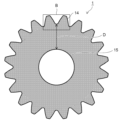
- FIG. 1 is a perspective view showing an embodiment of a gear component according to the present invention.
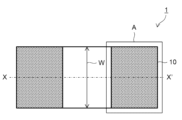
- FIG. 2 is an axial cross-sectional view of a gear component according to an embodiment of the present invention.
- 3 is an enlarged view of part A in FIG. 2.
- FIG. FIG. 2 is a radial cross-sectional view of a gear component according to an embodiment of the present invention.
- 5 is an enlarged view of part B in FIG. 4.
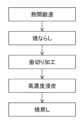
- FIG. It is a figure showing the manufacturing process of the gear part concerning one embodiment of the present invention. It is a figure showing an outline of a high concentration carburizing treatment process. It is a figure showing an outline of a high concentration carburizing treatment process in an example and a comparative example. It is a figure which shows the shape of the test piece of the tooth surface fatigue test in an Example and a comparative example. It is a graph showing the relationship between material structure and characteristics in Examples and Comparative Examples.
- the gear part is made of steel containing various alloying elements, with the remainder containing Fe and unavoidable impurities. Specifically, it can be constructed from materials such as Cr steel (SCr material), Cr-Mo steel (SCM material), and Ni-Cr-Mo steel (SNCM material) specified in JIS G4053 etc. It is.
- FIG. 1 is a perspective view of a gear component according to an embodiment of the present invention.
- This gear component 1 can be used as a gear for construction machinery such as a hydraulic excavator or a dump truck, but is not limited thereto.
- FIG. 2 is an axial cross-sectional view of the gear component 1.
- FIG. 3 is an enlarged view of portion A in FIG. 2, and schematically shows a cross section of the gear component 1 in the axial direction.
- the gear part 1 has an internal structure in which a matrix 11, a carburized layer 12, and a carbide layer 13 are formed in order from the core toward the surface 10 by being subjected to a high-concentration carburizing treatment.
- the carburized layer 12 has a higher carbon concentration than the matrix 11 .
- the carbide layer 13 has a particularly high carbon concentration in the carburized layer 12, and is a layered region in which carbides are dispersed and precipitated.
- the high-concentration carburizing process can also be referred to as a carburizing process that forms the carbide layer 13 (that is, performs the carburizing process to the extent that carbide precipitates in a region close to the surface).
- the carburized layer 12 and the carbide layer 13 can also be collectively referred to as a layer having a higher carbon concentration than the matrix 11 (carburized layer).
- FIG. 4 is a radial cross-sectional view of the gear component 1 (XX' cross-sectional view in FIG. 2).
- the distance between the tooth portion 14 and the inner hole 15 is the rim thickness D.
- FIG. 5 is an enlarged view of portion B in FIG. 4. Similar to the enlarged view of the axial cross section of the gear component 1 shown in FIG. It is configured.
- the range including the tip of the tooth portion 14 is the tooth tip 16, and the range including the intersection of the surface 10 and the pitch circle R is the tooth flank 17. Further, the range including the point of contact between the straight line forming an angle of 30° with respect to the center line P of the tooth portion 14 and the surface 10 is the dedendum (bottom) 18 . That is, the tooth portion 14 includes a tooth base 18, a tooth tip 16, and a tooth surface 17 between the tooth root 18 and the tooth tip 16.
- the surface layer of the dedendum 18, that is, the carbide layer 13 in the dedendum 18, has a carbide area ratio of 10% or less in at least a portion thereof, and a carbide number density of 6 pieces/10 ⁇ m 2 or less.
- the carbide area ratio becomes larger than 10%
- the concentration of alloying elements such as chromium in the matrix decreases, hardenability decreases, and the hardness decreases.
- the surface layer of the tooth surface 17, that is, the carbide layer 13 on the tooth surface 17, preferably has a carbide area ratio of 10% or less in at least a portion thereof.
- the carbide area ratio is greater than 10%, coarse carbide becomes a starting point during gear operation, and cracks are likely to occur and propagate, resulting in a shortened tooth surface pitting fatigue life. There are cases.
- the carbide area ratio of the carbide layer 13 on the tooth surface 17 is preferably larger than the carbide area ratio of the carbide layer 13 on the tooth root 18.
- the carbide area ratio of the carbide layer 13 on the tooth surface 17 becomes smaller, the effect of improving the pitting fatigue life due to the carbide on the tooth surface 17 becomes smaller.
- the carbide area ratio of the carbide layer 13 at the tooth base 18 increases, the concentration of alloying elements such as chromium in the parent phase of the tooth base 18 decreases, hardenability decreases, and the hardness decreases.
- the bending fatigue strength of No. 18 decreases.
- the carbide area ratio of the surface layer of the tooth flank 17 decreases, or the carbide area ratio of the surface layer of the tooth root 18 increases, and the carbide area ratio of the surface layer of the tooth flank 17 becomes equal to or lower than the carbide area ratio of the surface layer of the tooth root 18. If this happens, the durability of the gear as a whole may decrease.
- the thickness of the carbide layer 13 at the root 18 is preferably thicker than the thickness of the carbide layer 13 at the tooth surface 17.
- the thickness of the carbide layer 13 on the tooth surface 17 or the tooth root 18 refers to the thickness of the carbide layer 13 measured in a direction perpendicular to the surface of the tooth surface 17 or tooth root 18. Internally originating pitting fatigue damage on the tooth surface 17 occurs from the depth where the shear stress is maximum. Therefore, the carbide layer 13 only needs to be deeper than the depth at which the shear stress is maximum, and does not need to be thick.
- FIG. 6 is a diagram showing a manufacturing process of a gear component according to an embodiment of the present invention.
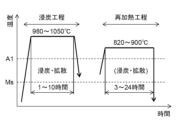
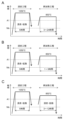
- FIG. 7 is a diagram showing an overview of the high concentration carburizing process.
- a high-concentration carburizing treatment process when manufacturing a gear component according to an embodiment of the present invention will be described using FIG. 7.
- the high concentration carburizing process includes a carburizing process and a reheating process.
- a hydrocarbon gas such as acetylene is introduced intermittently for a certain period of time to introduce carbon from the surface of the material into the interior and diffuse it to form a carburized layer 12 and a carbide layer. 13 is formed.
- the temperature of the carburizing step is set to be equal to or higher than the A1 transformation temperature. If the temperature of the carburizing step is lower than the A1 transformation temperature, the structure will not transform to austenite and will not be carburized. The higher the temperature in the carburizing process, the shorter the carburizing time, but the heat treatment distortion increases, so it is preferably about 980 to 1050°C.
- the temperature of the carburizing step may be changed as necessary during the treatment.
- the time for the carburizing step is preferably about 1 to 10 hours in order to achieve the thickness of the carburized layer 12 required for the gear part.
- Carburizing is preferably performed such that the surface carbon concentration at the end of the carburizing step is equal to or higher than the eutectoid carbon concentration and lower than the carbon concentration corresponding to the Acm line at the temperature of the carburizing step.
- carbide in the carbide layer 13 is dispersed after the reheating step. This carbide improves bending fatigue strength and pitting fatigue life.
- the surface carbon concentration at the end of the carburizing process is 1.0 to 2.0 because the higher the surface carbon concentration, the more the carbide area ratio after the reheating process, the lower the hardenability, and the lower the root hardness after the reheating process.
- the content is in the range of 0 wt%.
- the cooling rate of the carburizing step is not particularly limited as long as it maintains the above carbon concentration in a supersaturated state during cooling and does not form carbides that can become coarse carbides in the next reheating step.
- the temperature after cooling in the carburizing step is lower than the A1 point. When the temperature after cooling in the carburizing step is A1 point or higher, austenite does not transform into pearlite, and carbides in the carbide layer 13 are not dispersed in the reheating step.
- a hydrocarbon gas such as acetylene is introduced intermittently for a certain period of time to introduce carbon into the material from the surface, diffuse it, and harden it. This allows the carbide to reach the above-mentioned area ratio necessary for improving tooth root hardness, centering on the core of the carbide in the carbide layer 13 formed during the cooling process of the carburizing process and the heating and soaking process of the reheating process.
- the gear part 1 is controlled to be within the range of and number density, and a gear component 1 with high root hardness can be obtained after quenching.
- the carbide in the carbide layer 13 obtained by the supersaturated carbon concentration after the carburizing process can achieve the above conditions of area ratio and number density of carbide, acetylene etc. may be introduced in the reheating process. You don't have to.
- the temperature in the reheating step is preferably equal to or higher than the A1 transformation temperature and lower than the Acm temperature at the surface carbon concentration at the end of the reheating step. If the temperature in the reheating step is lower than the A1 transformation temperature, the structure will not transform to austenite and the gear component 1 will not be hardened in the quenching process.
- the precipitated carbide in the carbide layer 13 becomes solid solution.
- the higher the temperature of the reheating step the lower the number density of carbides in the carbide layer 13, but the more the amount of retained austenite after quenching increases, the harder the hardness is, so it is preferably about 820 to 900°C.
- the time of the reheating step is longer than the general reheating time in order to cause Ostwald growth of the carbide in the carbide layer 13 and satisfy the above conditions for the area ratio and number density of the carbide.
- the period is about 3 to 24 hours.
- the temperature may be changed as appropriate during the treatment, and a cooling/heating process may be added as appropriate.
- the temperature after quenching in the reheating step is lower than the Ms point. If the temperature after quenching in the reheating step is above the Ms point, austenite will not transform to martensite and will not be hardened.
- the temperature is appropriately set within the range of 150° C. to 250° C., and the gear component 1 is soaked.
- the treatment time is not particularly limited as long as the gear component 1 is soaked, and the cooling method is also not particularly limited.
- Gear parts 1 of Examples 1 to 3 and Comparative Examples 1 to 5 were produced by changing the high concentration carburizing treatment conditions and rim thickness D as shown in Table 1.
- FIG. 8 is a diagram showing an overview of the high-concentration carburizing process in each example and comparative example.
- the carbide area ratio and carbide number density of the tooth surface 17 and the tooth base 18 are determined by etching the radial cross section of the gear part as shown in FIG. 4 in sodium picrate heated to 80°C for 20 minutes. This was calculated using image analysis software.
- the hardness ratio of the tooth tip 16, tooth surface 17, and tooth root 18 is the value obtained by testing with a Vickers hardness tester in the radial cross section of the gear part shown in Fig. 4, and the value obtained by eutectoid carburization. Calculated by dividing by the value obtained by testing gear parts.
- the tooth surface fatigue life was evaluated by a tooth surface fatigue test, which is an element test simulating tooth surface fatigue.
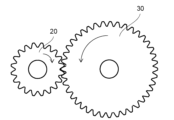
- FIG. 9 shows the shape of the test piece for the tooth surface fatigue test in each Example and Comparative Example.
- the small gear 20 was produced by hot forging, normalizing, gear cutting, and then subjecting the steel material having the above-mentioned composition to the high concentration carburizing treatment shown in Table 1 and tempering it.
- the large gear 30 was manufactured by hot forging, normalizing, gear cutting, eutectoid carburizing, and tempering the steel material having the above-mentioned composition.
- the tooth surface fatigue test was conducted by meshing a pair of small gears 20 and large gears 30, using reducer lubricating oil with an oil temperature of 70° C., and a Hertzian surface pressure of 230 kgf/mm 2 .
- the tooth surface fatigue life was defined as the number of repetitions of the small gear 20 until pitching fatigue damage occurred on the tooth surface of the small gear 20.
- the tooth surface fatigue life ratio was calculated by dividing the tooth surface fatigue life of the small gear 20 subjected to high concentration carburization by the tooth surface fatigue life of the small gear 20 subjected to eutectoid carburization.
- * indicates a case where the tooth base or surface layer of the tooth surface includes a portion where the carbide area ratio exceeds 10%, or a portion where the carbide number density at the tooth base exceeds 6 pieces /10 ⁇ m2. show.
- gear parts 1 with rim thicknesses D of 50 mm and 120 mm were treated under the high concentration carburizing treatment conditions shown in FIG. 8A, and the reheating process time was controlled in the range of 3 to 24 hours.
- the surface layer of the tooth root is controlled to include a portion where the carbide area ratio is 10% or less and the carbide number density is 6 pieces/10 ⁇ m 2 or less, and the carbide area ratio is also controlled to be included in the tooth root surface layer. It was controlled to include a portion in which the amount was 10% or less.
- gear parts 1 with rim thicknesses D of 50 mm and 120 mm were treated under the high concentration carburizing treatment conditions shown in FIG. 8B, and the reheating process was performed for 1 to 3 hours.
- the surface layer of the tooth base was controlled to include a portion where the carbide area ratio exceeds 10% or the carbide number density exceeds 6 pieces/10 ⁇ m 2 .
- the surface layer of the tooth surface was further controlled to include a portion where the carbide area ratio exceeded 10%.
- Comparative Example 3 a gear part 1 with a rim thickness D of 50 mm was treated under the high concentration carburizing treatment conditions shown in FIG. 8C, the reheating process time was in the range of 3 to 12 hours, and the reheating process was By intermittently introducing a hydrocarbon gas for a certain period of time, the surface layer of the root and tooth surface was controlled to include a portion with a carbide area ratio of more than 10%.
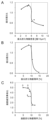
- FIG. 10 is a graph showing the relationship between material structure and characteristics in each example and comparative example.
- FIG. 10A shows the relationship between the number density of carbide at the root of the tooth and the hardness ratio of the root of the tooth, and among the examples and comparative examples in Table 1, those in which the area ratio of carbide at the root of the tooth is 10% or less are plotted. There is. The dedendum hardness ratio changes significantly with the dedendum carbide number density of 6/10 ⁇ m2 .
- FIG. 10B shows the relationship between the area ratio of carbide at the root of the tooth and the hardness ratio of the root of the tooth . plotting. The dedendum hardness ratio changes significantly after the dedendum carbide area ratio reaches 10%.
- FIG. 10C shows the relationship between the tooth surface carbide area ratio and the tooth surface fatigue life ratio. The tooth surface fatigue life ratio changes significantly after the tooth surface carbide area ratio reaches 10%.
- the present invention is not limited to the above embodiments, and can be implemented with various modifications without departing from the spirit thereof.
- the carbide area ratio in at least a portion of the carbide layer 13 in the tooth root 18 is 10% or less, and the carbide number density is 6 pieces/10 ⁇ m 2 or less.
Landscapes
- Chemical & Material Sciences (AREA)
- Engineering & Computer Science (AREA)
- Mechanical Engineering (AREA)
- Thermal Sciences (AREA)
- Physics & Mathematics (AREA)
- Materials Engineering (AREA)
- Metallurgy (AREA)
- Organic Chemistry (AREA)
- Crystallography & Structural Chemistry (AREA)
- General Engineering & Computer Science (AREA)
- Electromagnetism (AREA)
- Chemical Kinetics & Catalysis (AREA)
- Solid-Phase Diffusion Into Metallic Material Surfaces (AREA)
- Heat Treatment Of Articles (AREA)
- Gears, Cams (AREA)
Priority Applications (4)
| Application Number | Priority Date | Filing Date | Title |
|---|---|---|---|
| CN202380015096.6A CN118382717A (zh) | 2022-03-25 | 2023-03-22 | 齿轮部件 |
| JP2024510212A JP7745747B2 (ja) | 2022-03-25 | 2023-03-22 | 歯車部品 |
| EP23774928.8A EP4502226A4 (en) | 2022-03-25 | 2023-03-22 | GEAR COMPONENT |
| US18/729,905 US12338885B2 (en) | 2022-03-25 | 2023-03-22 | Gear component |
Applications Claiming Priority (2)
| Application Number | Priority Date | Filing Date | Title |
|---|---|---|---|
| JP2022-050297 | 2022-03-25 | ||
| JP2022050297 | 2022-03-25 |
Publications (1)
| Publication Number | Publication Date |
|---|---|
| WO2023182333A1 true WO2023182333A1 (ja) | 2023-09-28 |
Family
ID=88101127
Family Applications (1)
| Application Number | Title | Priority Date | Filing Date |
|---|---|---|---|
| PCT/JP2023/011142 Ceased WO2023182333A1 (ja) | 2022-03-25 | 2023-03-22 | 歯車部品 |
Country Status (5)
| Country | Link |
|---|---|
| US (1) | US12338885B2 (https=) |
| EP (1) | EP4502226A4 (https=) |
| JP (1) | JP7745747B2 (https=) |
| CN (1) | CN118382717A (https=) |
| WO (1) | WO2023182333A1 (https=) |
Citations (7)
| Publication number | Priority date | Publication date | Assignee | Title |
|---|---|---|---|---|
| JP2000018369A (ja) * | 1998-06-29 | 2000-01-18 | Nissan Motor Co Ltd | 高強度歯車およびその製造方法 |
| JP2001098343A (ja) * | 1999-07-21 | 2001-04-10 | Daido Steel Co Ltd | 耐高面圧部材およびその製造方法 |
| JP2002113544A (ja) * | 2000-10-06 | 2002-04-16 | Nissan Motor Co Ltd | 歯車の製造方法 |
| JP2005113168A (ja) | 2003-10-03 | 2005-04-28 | Kobe Steel Ltd | 機械構造用鋼部品 |
| JP2005163173A (ja) * | 2003-11-14 | 2005-06-23 | Komatsu Ltd | 歯車部材およびその製造方法 |
| JP2016023346A (ja) * | 2014-07-23 | 2016-02-08 | トヨタ自動車株式会社 | 歯車の浸炭処理方法 |
| JP2022050297A (ja) | 2020-09-17 | 2022-03-30 | 株式会社明電舎 | フィルタユニットおよび排水処理装置 |
Family Cites Families (4)
| Publication number | Priority date | Publication date | Assignee | Title |
|---|---|---|---|---|
| US8733199B2 (en) * | 2010-04-01 | 2014-05-27 | Aisin Aw Co., Ltd. | Gears and its process of manufacture |
| EP3253900B1 (en) * | 2015-02-04 | 2020-08-12 | Sikorsky Aircraft Corporation | Methods and processes of forming gears |
| CN108603261B (zh) * | 2016-03-08 | 2020-07-31 | 爱信艾达株式会社 | 钢部件、齿轮部件以及钢部件的制造方法 |
| KR102820108B1 (ko) * | 2020-01-20 | 2025-06-16 | 현대자동차주식회사 | 자동차 부품용 침탄강 및 이의 제조방법 |
-
2023
- 2023-03-22 WO PCT/JP2023/011142 patent/WO2023182333A1/ja not_active Ceased
- 2023-03-22 US US18/729,905 patent/US12338885B2/en active Active
- 2023-03-22 CN CN202380015096.6A patent/CN118382717A/zh active Pending
- 2023-03-22 EP EP23774928.8A patent/EP4502226A4/en active Pending
- 2023-03-22 JP JP2024510212A patent/JP7745747B2/ja active Active
Patent Citations (7)
| Publication number | Priority date | Publication date | Assignee | Title |
|---|---|---|---|---|
| JP2000018369A (ja) * | 1998-06-29 | 2000-01-18 | Nissan Motor Co Ltd | 高強度歯車およびその製造方法 |
| JP2001098343A (ja) * | 1999-07-21 | 2001-04-10 | Daido Steel Co Ltd | 耐高面圧部材およびその製造方法 |
| JP2002113544A (ja) * | 2000-10-06 | 2002-04-16 | Nissan Motor Co Ltd | 歯車の製造方法 |
| JP2005113168A (ja) | 2003-10-03 | 2005-04-28 | Kobe Steel Ltd | 機械構造用鋼部品 |
| JP2005163173A (ja) * | 2003-11-14 | 2005-06-23 | Komatsu Ltd | 歯車部材およびその製造方法 |
| JP2016023346A (ja) * | 2014-07-23 | 2016-02-08 | トヨタ自動車株式会社 | 歯車の浸炭処理方法 |
| JP2022050297A (ja) | 2020-09-17 | 2022-03-30 | 株式会社明電舎 | フィルタユニットおよび排水処理装置 |
Non-Patent Citations (1)
| Title |
|---|
| See also references of EP4502226A4 |
Also Published As
| Publication number | Publication date |
|---|---|
| EP4502226A1 (en) | 2025-02-05 |
| US12338885B2 (en) | 2025-06-24 |
| JPWO2023182333A1 (https=) | 2023-09-28 |
| CN118382717A (zh) | 2024-07-23 |
| US20250102054A1 (en) | 2025-03-27 |
| EP4502226A4 (en) | 2026-01-14 |
| JP7745747B2 (ja) | 2025-09-29 |
Similar Documents
| Publication | Publication Date | Title |
|---|---|---|
| JP3308377B2 (ja) | 歯面強度の優れた歯車およびその製造方法 | |
| KR100961584B1 (ko) | 침탄 고주파 담금질 부품 | |
| EP3378963B1 (en) | Steel component, gear component, and method for manufacturing steel component | |
| JP4819201B2 (ja) | 軟窒化用鋼、並びに軟窒化鋼部品及びその製造方法 | |
| JP5135558B2 (ja) | 高周波焼入れ用鋼、高周波焼入れ用粗形材、その製造方法、及び高周波焼入れ鋼部品 | |
| JP7152832B2 (ja) | 機械部品 | |
| KR20050046578A (ko) | 기어부재 및 그 제조방법 | |
| JP2001073072A (ja) | 耐ピッチング性に優れた浸炭窒化部品 | |
| JP7270343B2 (ja) | 機械部品の製造方法 | |
| JPH0432537A (ja) | 面圧強度にすぐれた高強度機械構造用部材 | |
| WO2017170540A1 (ja) | 面疲労強度および曲げ疲労強度に優れた浸炭窒化部品、並びにその製造方法 | |
| JP7745747B2 (ja) | 歯車部品 | |
| KR101575435B1 (ko) | 고탄소침탄강 소재 및 이를 이용한 기어 제조방법 | |
| JP2009138261A (ja) | 円柱状部品の熱処理方法 | |
| JP4874199B2 (ja) | なじみ性に優れた歯車部品 | |
| JP4970811B2 (ja) | 高面圧用部品とその製造方法 | |
| JP4940849B2 (ja) | 減圧浸炭部品およびその製造方法 | |
| JPH08174340A (ja) | 面疲労強度に優れた機械構造用部品およびその製造方法 | |
| JPS62185826A (ja) | 高強度歯車の製造方法 | |
| JP6601359B2 (ja) | 耐摩耗性に優れた浸炭部品およびその製造方法 | |
| JPS63210287A (ja) | 鋼部材の浸炭窒化方法 | |
| JP2023069388A (ja) | 鋼、および、浸炭焼入れ部品 | |
| JPS63235452A (ja) | 疲労強度にすぐれる駆動伝達部品用高強度鋼 | |
| IZUMIDA et al. | Fatigue Properties and Improvement Mechanisms of 1500 MPa-Class-High Strength Oil Tempered Wire | |
| JP2021155831A (ja) | 鋼部品の製造方法 |
Legal Events
| Date | Code | Title | Description |
|---|---|---|---|
| 121 | Ep: the epo has been informed by wipo that ep was designated in this application |
Ref document number: 23774928 Country of ref document: EP Kind code of ref document: A1 |
|
| DPE1 | Request for preliminary examination filed after expiration of 19th month from priority date (pct application filed from 20040101) | ||
| WWE | Wipo information: entry into national phase |
Ref document number: 202380015096.6 Country of ref document: CN |
|
| WWE | Wipo information: entry into national phase |
Ref document number: 2024510212 Country of ref document: JP |
|
| WWE | Wipo information: entry into national phase |
Ref document number: 18729905 Country of ref document: US |
|
| WWE | Wipo information: entry into national phase |
Ref document number: 2023774928 Country of ref document: EP |
|
| NENP | Non-entry into the national phase |
Ref country code: DE |
|
| ENP | Entry into the national phase |
Ref document number: 2023774928 Country of ref document: EP Effective date: 20241025 |
|
| WWP | Wipo information: published in national office |
Ref document number: 18729905 Country of ref document: US |
|
| WWG | Wipo information: grant in national office |
Ref document number: 18729905 Country of ref document: US |