WO2023167236A1 - 月経に伴う不快状態の改善用組成物 - Google Patents
月経に伴う不快状態の改善用組成物 Download PDFInfo
- Publication number
- WO2023167236A1 WO2023167236A1 PCT/JP2023/007574 JP2023007574W WO2023167236A1 WO 2023167236 A1 WO2023167236 A1 WO 2023167236A1 JP 2023007574 W JP2023007574 W JP 2023007574W WO 2023167236 A1 WO2023167236 A1 WO 2023167236A1
- Authority
- WO
- WIPO (PCT)
- Prior art keywords
- extract
- menstruation
- composition
- day
- plant
- Prior art date
- Legal status (The legal status is an assumption and is not a legal conclusion. Google has not performed a legal analysis and makes no representation as to the accuracy of the status listed.)
- Ceased
Links
Classifications
-
- A—HUMAN NECESSITIES
- A23—FOODS OR FOODSTUFFS; TREATMENT THEREOF, NOT COVERED BY OTHER CLASSES
- A23L—FOODS, FOODSTUFFS OR NON-ALCOHOLIC BEVERAGES, NOT OTHERWISE PROVIDED FOR; PREPARATION OR TREATMENT THEREOF
- A23L33/00—Modifying nutritive qualities of foods; Dietetic products; Preparation or treatment thereof
- A23L33/10—Modifying nutritive qualities of foods; Dietetic products; Preparation or treatment thereof using additives
- A23L33/105—Plant extracts, their artificial duplicates or their derivatives
-
- A—HUMAN NECESSITIES
- A61—MEDICAL OR VETERINARY SCIENCE; HYGIENE
- A61K—PREPARATIONS FOR MEDICAL, DENTAL OR TOILETRY PURPOSES
- A61K31/00—Medicinal preparations containing organic active ingredients
- A61K31/33—Heterocyclic compounds
- A61K31/335—Heterocyclic compounds having oxygen as the only ring hetero atom, e.g. fungichromin
- A61K31/35—Heterocyclic compounds having oxygen as the only ring hetero atom, e.g. fungichromin having six-membered rings with one oxygen as the only ring hetero atom
- A61K31/352—Heterocyclic compounds having oxygen as the only ring hetero atom, e.g. fungichromin having six-membered rings with one oxygen as the only ring hetero atom condensed with carbocyclic rings, e.g. methantheline
- A61K31/353—3,4-Dihydrobenzopyrans, e.g. chroman, catechin
-
- A—HUMAN NECESSITIES
- A61—MEDICAL OR VETERINARY SCIENCE; HYGIENE
- A61P—SPECIFIC THERAPEUTIC ACTIVITY OF CHEMICAL COMPOUNDS OR MEDICINAL PREPARATIONS
- A61P1/00—Drugs for disorders of the alimentary tract or the digestive system
- A61P1/06—Anti-spasmodics, e.g. drugs for colics, esophagic dyskinesia
-
- A—HUMAN NECESSITIES
- A61—MEDICAL OR VETERINARY SCIENCE; HYGIENE
- A61P—SPECIFIC THERAPEUTIC ACTIVITY OF CHEMICAL COMPOUNDS OR MEDICINAL PREPARATIONS
- A61P1/00—Drugs for disorders of the alimentary tract or the digestive system
- A61P1/08—Drugs for disorders of the alimentary tract or the digestive system for nausea, cinetosis or vertigo; Antiemetics
-
- A—HUMAN NECESSITIES
- A61—MEDICAL OR VETERINARY SCIENCE; HYGIENE
- A61P—SPECIFIC THERAPEUTIC ACTIVITY OF CHEMICAL COMPOUNDS OR MEDICINAL PREPARATIONS
- A61P15/00—Drugs for genital or sexual disorders; Contraceptives
- A61P15/08—Drugs for genital or sexual disorders; Contraceptives for gonadal disorders or for enhancing fertility, e.g. inducers of ovulation or of spermatogenesis
-
- A—HUMAN NECESSITIES
- A61—MEDICAL OR VETERINARY SCIENCE; HYGIENE
- A61P—SPECIFIC THERAPEUTIC ACTIVITY OF CHEMICAL COMPOUNDS OR MEDICINAL PREPARATIONS
- A61P25/00—Drugs for disorders of the nervous system
- A61P25/06—Antimigraine agents
-
- A—HUMAN NECESSITIES
- A61—MEDICAL OR VETERINARY SCIENCE; HYGIENE
- A61P—SPECIFIC THERAPEUTIC ACTIVITY OF CHEMICAL COMPOUNDS OR MEDICINAL PREPARATIONS
- A61P25/00—Drugs for disorders of the nervous system
- A61P25/24—Antidepressants
-
- A—HUMAN NECESSITIES
- A61—MEDICAL OR VETERINARY SCIENCE; HYGIENE
- A61P—SPECIFIC THERAPEUTIC ACTIVITY OF CHEMICAL COMPOUNDS OR MEDICINAL PREPARATIONS
- A61P5/00—Drugs for disorders of the endocrine system
- A61P5/24—Drugs for disorders of the endocrine system of the sex hormones
-
- A—HUMAN NECESSITIES
- A61—MEDICAL OR VETERINARY SCIENCE; HYGIENE
- A61P—SPECIFIC THERAPEUTIC ACTIVITY OF CHEMICAL COMPOUNDS OR MEDICINAL PREPARATIONS
- A61P7/00—Drugs for disorders of the blood or the extracellular fluid
- A61P7/06—Antianaemics
Definitions
- the present invention relates to a composition and a functional food that improve the discomfort associated with menstruation found in many women. More specifically, it relates to a functional food that is effective for young women who tend to feel strong discomfort and anxiety even though no particular organic disorder is observed in the reproductive system.
- Non-Patent Document 1 This tendency is particularly strong in young women who have not experienced childbirth, and functional dysmenorrhoea is defined as a state in which no organic disorder is observed other than such discomfort (Non-Patent Document 1). , is considered to be pre-symptomatic in the sense that no causative disease is found.
- Non-Patent Document 2 the labor loss due to women's menstrual symptoms exceeds 490 billion yen per year (Non-Patent Document 2), and it is not just the serious discomfort related to women's menstruation. It is no exaggeration to say that it is a serious social problem.
- NSAIDs are used to relieve pain, which is a typical discomfort. are mainly used. Since NSAIDs are analgesics that are given up when pain is felt, it is of course impossible to improve the constitution so that the patient does not feel pain. It is thought that the trauma caused by this pain that comes every month is the cause of premenstrual syndrome (PMS) and premenstrual dysphoric disorder (PMDD), which are types of psychosomatic disorders. is difficult to improve.
- PMS premenstrual syndrome
- PMDD premenstrual dysphoric disorder
- Non-Patent Document 3 Treatment to reduce menstrual pain by suppressing the maturation of follicles and the proliferation of the endometrium by administering a small amount of female hormones is performed, but forcibly changing the natural endocrine by the original hormones According to a questionnaire survey of dysmenorrhea patients, the use of estrogen drugs is extremely low at 7.5% (Non-Patent Document 3).
- An object of the present invention is to provide a composition for ameliorating menstrual discomfort, which is effective for women's discomfort from menarche to menopause, particularly strong discomfort for young women, and which has anti-EMT activity and has sufficient eating experience. and a functional food containing the composition thereof.
- compositions listed below [1] A composition for improving discomfort associated with menstruation, containing a plant-derived polyphenol having anti-EMT activity.
- the plant is at least one selected from the group consisting of apple, red rice, purple tea, lychee, acai, amla, cacao, aronia, blackcurrant, maqui berry, black soybean, and lingonberry [1] The composition according to .
- Discomfort associated with menstruation includes: lower abdominal pain, lower back pain, abdominal bloating, headache, nausea, anemia, dizziness on standing up, diarrhea, fatigue, malaise, depression, emotional instability (irritation, etc.), difficulty concentrating from the group consisting of depression, drowsiness, bloated chest (breast pain), bloated lower abdomen, swelling, stiff shoulders, rough skin, decreased appetite, increased appetite, decreased efficiency, cold sweat, weight gain, and conditions that interfere with daily life
- the composition according to any one of [1] to [3], which is at least one selected.
- composition according to any one of [1] to [4], which is an oral preparation is an oral preparation.
- composition of the present invention contains a component having anti-EMT activity with sufficient experience of eating, so that it effectively improves discomfort associated with menstruation, especially strong discomfort that tends to occur in young women. effect can be achieved.
- composition of the present invention contains a plant-derived polyphenol having anti-EMT activity as an active ingredient, and is expected to lead to a fundamental improvement in discomfort associated with menstruation, the mechanism of which has been clarified in recent years. .
- the active ingredient is not particularly limited as long as it is a plant-derived polyphenol having anti-EMT activity.
- an active ingredient is preferably a material that has been eaten in the food and beverage field and/or a component derived from the material.
- Plant-derived polyphenols having anti-EMT activity may be contained as polyphenol alone, or may be contained as a plant containing polyphenol and other components (other than polyphenol) and/or its extract.
- the plant-derived polyphenol having anti-EMT activity is not particularly limited as long as it exhibits anti-EMT activity.
- Anthocyanidins e.g., cyanidin, delphinidin, malvidin, pelargonidin, peonidin, petunidin, etc.
- flavanols e.g., procyanidins, catechins, epicatechins, epigallocatechins, epicatechin gallates, epigallocatechin gallates, theaflavins, etc.
- anthocyanins e.g., cyanidin-3-glucoside (C3G), cyanidin-3-rutinoside (C3R), delphinidin-3-glucoside (D3G), delphinidin-3-rutinoside (D3R)
- flavones e.g., apigenin, luteolin, chrysin, etc.
- Flavonols e.g.
- Isoflavones e.g. daidzein, genistein, glycitein
- gallotannins e.g. pentagalloylglucose, etc.
- ellagitannins e.g., Pedunculagin, Tellimagrandin I, Casuarinin, Tellimagrandin II, Rugosin C, etc.
- phlorotannins e.g. phloroglucinol, etc.
- Other flavonoids eg, resveratrol, etc.
- plant-derived polyphenols having anti-EMT activity at least one selected from the group consisting of, for example, anthocyanidins, flavanols, anthocyanins, flavones, and flavonols, from the viewpoint of significantly exhibiting the effects of the present invention.
- cyanidin from the group consisting of cyanidin, delphinidin, procyanidin, catechin, epicatechin, epigallocatechin, epicatechin gallate, epigallocatechin gallate, theaflavin, cyanidin-3-glucoside (C3G), apigenin, quercetin and kaempferol
- At least one selected is more preferred, and at least one selected from the group consisting of cyanidin, delphinidin, procyanidin, cyanidin-3-glucoside (C3G), apigenin, quercetin, and kaempferol is more preferred, and procyanidin is further preferred.
- procyanidin B1, procyanidin B2, and procyanidin C1 is more preferred, and procyanidin B2 is particularly preferred.
- the number of plant-derived polyphenols having anti-EMT activity may be one, or two or more.
- the plant to be the base is not limited as long as the effect of the present invention is exhibited, but for example, apple, red rice, purple tea, lychee, acai, amla, cacao, aronia, black currant , maqui berry, black soybean, and lingonberry are preferably used, and at least one selected from the group consisting of apple, lychee, aronia, blackcurrant, and black soybean is preferably used It is more preferably used.
- the parts of the plant are not limited as long as the effect of the present invention is achieved, but examples include leaves, stems, stems, flowers, roots, seed coats, pericarp, fruits, and germs.
- the extract may be a crude extract extracted from a plant as it is, a product obtained by further purification treatment, a product obtained by concentration treatment, or a commercially available product.
- a method for obtaining an extract is not particularly limited, and a conventional extraction method, purification method, concentration method, synthesis method, dry powderization method, and the like are employed.
- the extraction solvent for the extract is not limited as long as the effect of the present invention is exhibited, but for example, lower alcohols having 1 to 4 carbon atoms such as methanol, ethanol, propanol, isopropyl alcohol and butanol; glycerin, propylene glycol, polyethylene glycol and the like; Polyhydric alcohols; polar solvents such as water, acetone, ethyl acetate and methyl acetate; nonpolar solvents such as hexane and pyridine. Any mixture of one or two of these may be used. Among these solvents, water, ethanol, 1,3-butylene glycol, propylene glycol, or a mixed solution thereof is preferred, and a mixed solution of water and ethanol (hydrous ethanol) is more preferred.
- lower alcohols having 1 to 4 carbon atoms such as methanol, ethanol, propanol, isopropyl alcohol and butanol
- glycerin propylene glycol, polyethylene glycol
- the extract is not limited as long as the effect of the present invention is exhibited.
- the polyphenol content in the extract is preferably 3% by mass or more, more preferably 5% by mass or more. , more preferably 10% by mass or more, particularly preferably 12% by mass or more, and most preferably 15% by mass or more.
- the polyphenol content is not limited, but can be measured by, for example, the Folin-Denis method.
- apples or apple extracts contain apple-derived polyphenols, and it is known that procyanidins are the main component.
- the apples to be used are not limited, but young fruits (unripe apples) are preferable from the viewpoint of exhibiting the effects of the present invention remarkably.
- apple-derived polyphenols can be obtained by obtaining the juice or extract of young apples (also referred to as unripe apples or unripe apples) and / or peel juice or extract by known means, and if necessary, concentrating , dilution, purification, and drying.
- young apples refer to apples before they are put on the market as apple products.
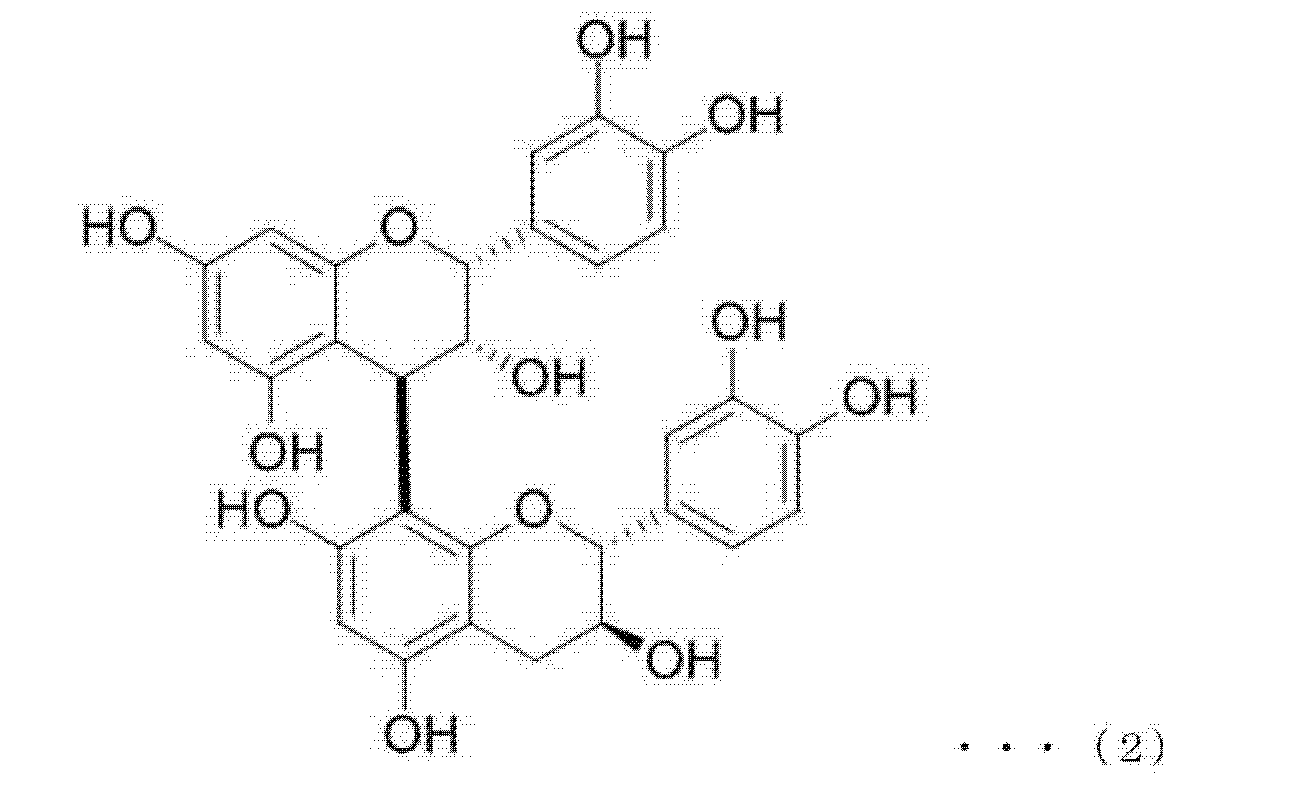
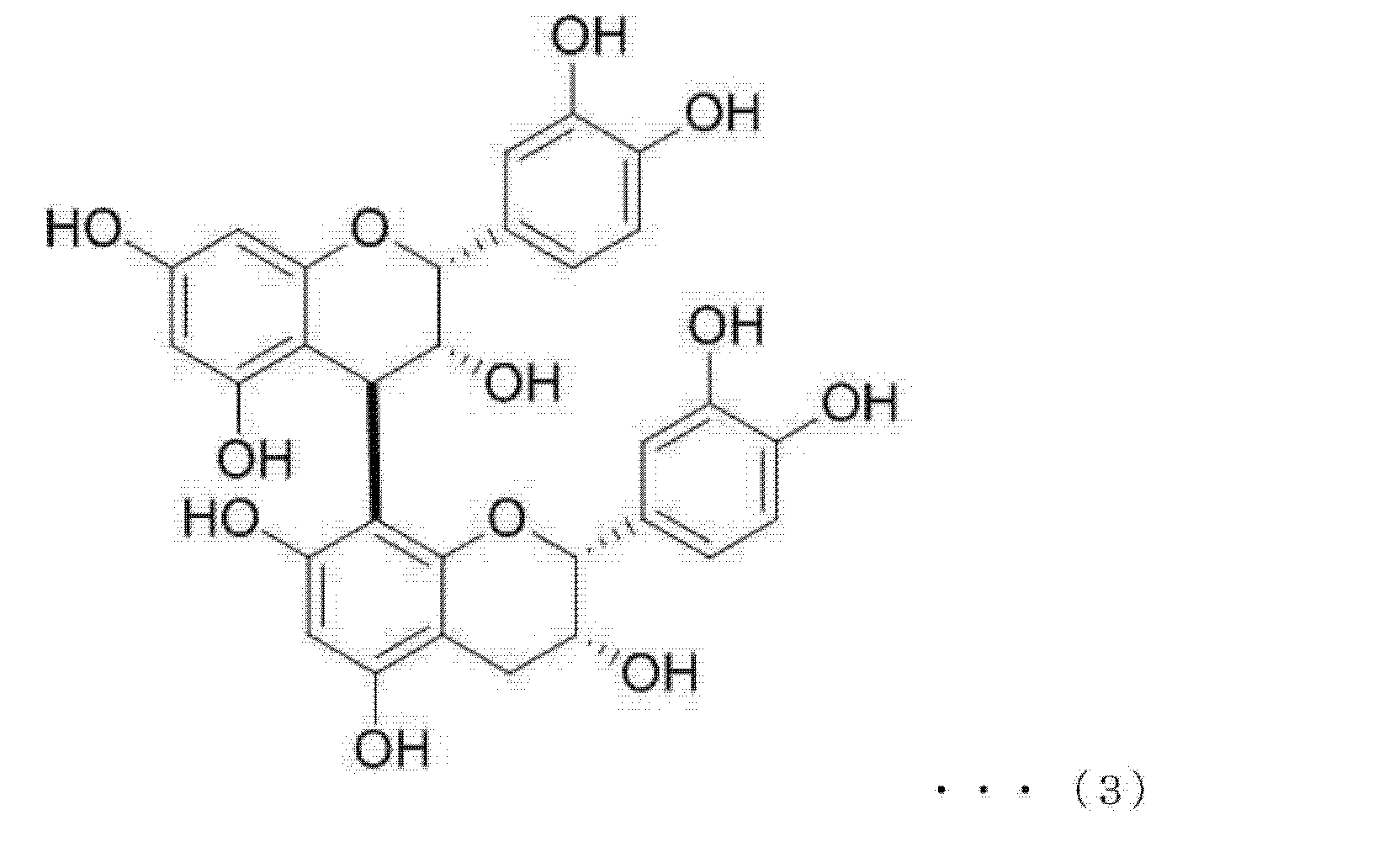
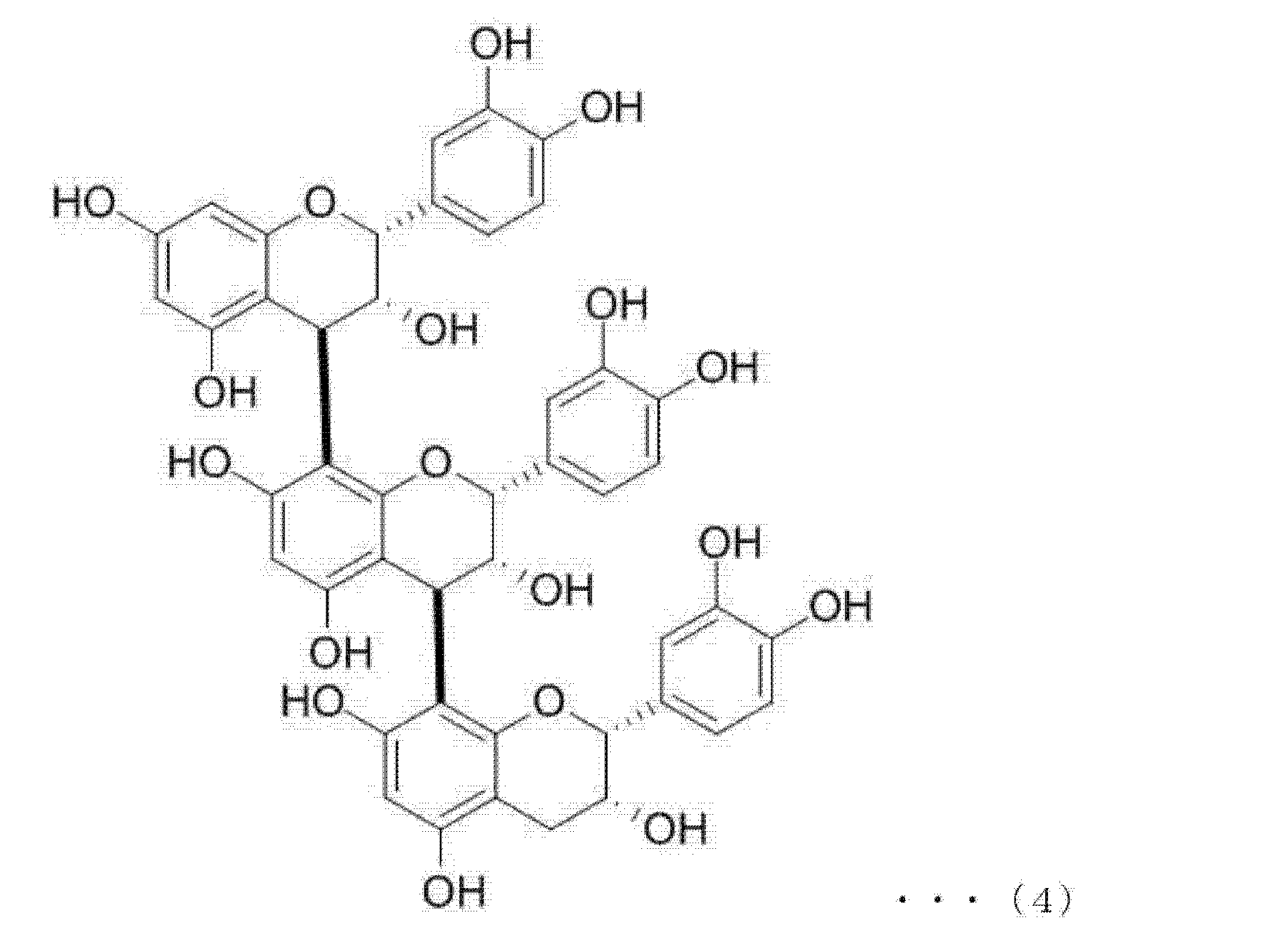
- procyanidins include polymers having the following formula 1 as a basic skeleton, and are not particularly limited, but are preferably dimers or trimers from the viewpoint of absorption into the body.
- Procyanidin dimers include procyanidin B1 and procyanidin B2, and procyanidin trimers include procyanidin C1 and the like.
- Procyanidin B1 is a compound represented by the following formula 2.
- Procyanidin B2 is a compound represented by Formula 3 below.
- Procyanidin C1 is a compound represented by the following formula 4.
- Apple-derived polyphenols include, for example, Applephenon SH (manufactured by BGG Japan Co., Ltd.), Applephenon C-100 (manufactured by BGG Japan Co., Ltd.), Apple procyanidin (18.4% or more of apple-derived procyanidin) (BGG Japan Co., Ltd. product), apple polyphenol (manufactured by Access One Co., Ltd.), and the like.
- red rice or red rice extracts contain red rice-derived polyphenols, and it is known that proanthocyanidins are the main components.
- Red rice has a reddish-brown color of brown rice, and red pigments are contained in the pericarp, seed coat, and the like.
- the variety of red rice is not limited as long as the effect of the present invention is exhibited, but for example, Beni Suzaku, Beni Asuka, Toen, Benikiccho, Nakanoshima red rice, beniakane, etc., may be mentioned, and one type may be used alone, or two or more types may be used in combination.
- red rice-derived polyphenols can be obtained by obtaining an extract of red rice by a known means and, if necessary, performing treatments such as concentration, dilution, purification, and drying.
- red rice-derived polyphenols examples include red rice extract-WSPC (manufactured by Oryza Yuka Co., Ltd.), red rice extract-PC (manufactured by Oryza Yuka Co., Ltd.), and red rice extract-LC (Oryza Yuka Co., Ltd.). manufactured by the company).
- purple tea or purple tea extract contains purple tea-derived polyphenols, and it is known that anthocyanin is the main component. Purple tea has a purple color because the tea leaves and the like contain anthocyanin.
- Kenyan purple tea variety name: TRFK306, etc.
- Sun Rouge, etc. National Research and Development Agency, Agriculture and Food Research Organization
- purple tea-derived polyphenols can be obtained by obtaining an extract of purple tea by a known means, and subjecting it to treatments such as concentration, dilution, purification, and drying, if necessary.
- purple tea-derived polyphenols include, for example, purple tea extract-LC (manufactured by Oryza Yuka Co., Ltd.).
- lychee or lychee extract contains lychee-derived polyphenols such as leucocyanidin and anthocyanin.
- Litchi is a plant belonging to the Sapindaceae family Litchichinensis Sonn. (reishi), and for example, one or more parts such as whole grass, leaves, flowers, trunks, stems, branches, pericarp, fruits, seeds, bark, sap, and seeds can be used.
- pericarp, fruit, and seeds are preferred, and seeds are more preferred.
- lychee-derived polyphenols can be obtained by squeezing or extracting lychee fruit, pericarp, and/or seeds by known means, and if necessary, can be subjected to treatments such as concentration, dilution, purification, and drying. is.
- LITCHI SEED EXTRACT-P manufactured by Oryza Oil & Chemicals Co., Ltd.
- LITCHI SEED EXTRACT-WSP manufactured by Oryza Oil & Chemicals Co., Ltd.
- LITCHI SEED EXTRACT-PC manufactured by Oryza Oil & Chemicals Co., Ltd.
- LITCHI SEED EXTRACT-LC manufactured by Oryza Yuka Co., Ltd.
- acai or acai extract contains acai-derived polyphenols such as cyanidin-3-glycoside, pelargonidin-3-glycoside, ferulic acid, (-)-epicatechin, gallic acid, and ellagic acid.
- It is Acai is a plant Euterpe oleracea belonging to the palm family Palm family, and for example, one or more parts such as whole grass, leaves, flowers, trunks, stems, branches, pericarp, fruits, seeds, bark, sap, and seeds are used. be able to. Among these, pericarp, fruit, and seeds are preferred, and seeds are more preferred.
- acai-derived polyphenols can be obtained by a known means from juices or extracts of acai fruit, pericarp, and/or seeds, and if necessary, can be subjected to treatments such as concentration, dilution, purification, and drying. is.
- acai-derived polyphenols include, for example, acai extract (manufactured by Bioactives Japan Co., Ltd.).
- amla or amla extracts contain amla-derived polyphenols such as ellagitannins such as elaocalpsin, quebulagic acid, and geraniin.
- Amla is a plant of the Phyllanthus family, Phyllanthus emblica, and for example, one or more parts such as whole grass, leaves, flowers, stems, stems, branches, pericarp, fruits, seeds, bark, sap, and seeds can be used. can.
- fruits, bark, roots and leaves are preferred, and fruits are more preferred.
- amla-derived polyphenols can be obtained by obtaining juice or extracts of amla fruit by known means, and then subjecting them to treatments such as concentration, dilution, purification, and drying, if necessary.
- cacao or cacao extract contains cacao-derived polyphenols such as procyanidins.
- Cacao is Theobroma cacao, and for example, one or more parts such as whole grass, leaves, flowers, stems, stems, branches, pericarp, fruits, seeds, bark, sap, and seeds can be used.
- seeds and fruits are preferred, and cacao beans, which are seeds, are more preferred.
- cacao-derived polyphenols are processed into chocolate by roasting cacao beans, removing the skin and germ, grinding the cocoa mass, adding sugar, powdered milk, cacao butter, etc., and kneading well. It is also processed into cocoa powder by, for example, removing the fat from the cocoa mass.
- cacao-derived polyphenols include, for example, cacao bean extract (manufactured by BioActives Japan Co., Ltd.).
- aronia-derived polyphenols include, for example, aronia extract powder 35% (manufactured by BGG Japan Co., Ltd.).
- blackcurrants or blackcurrant extracts contain blackcurrant-derived polyphenols such as anthocyanins.
- Black currant is Ribes nigrum, a small fruit tree belonging to the genus Currant of the family Currant, and is also called cassis, currant (black currant), and black currant.
- the blackcurrant for example, one or more parts such as whole plant, leaf, flower, stem, stem, branch, pericarp, fruit, seed, bark, sap, seed, etc. can be used. Among these, fruits, bark, roots and leaves are preferred, and fruits are more preferred.
- blackcurrant-derived polyphenols can be obtained by obtaining juice or extract of blackcurrant fruit by known means, and if necessary, can be subjected to treatments such as concentration, dilution, purification, and drying.
- blackcurrant-derived polyphenols include, for example, blackcurrant extract powder 35% (manufactured by BGG Japan Co., Ltd.).
- maqui berry or maqui berry extract contains maqui berry-derived polyphenols such as delphinidin and anthocyanidin.
- Maqui berry is the fruit of Aristotelia chilensis (Maki), a plant of the family Asclepiadaceae.
- maqui berry-derived polyphenols can be obtained by obtaining juice or extract of maqui berry (fruit) by known means, and if necessary, performing treatments such as concentration, dilution, purification, and drying.
- black soybeans or black soybean extracts contain black soybean-derived polyphenols such as procyanidins.
- Black soybeans are Glycine Max L. and the seed coat is black.
- black soybean for example, one or two or more parts such as whole plant, leaf, flower, trunk, stem, branch, pericarp, fruit, seed, bark, sap, and seed can be used.
- seeds (black soybeans) and seed coats (black soybean skins) are preferred, and seed coats are more preferred.
- black soybean-derived polyphenol can be obtained by obtaining a black soybean extract by a known means, and subjecting it to treatments such as concentration, dilution, purification, and drying, if necessary.
- black soybean-derived polyphenols include, for example, Chronocare SP15 and Chronocare SP60 (manufactured by Fujicco Co., Ltd.).
- lingonberry or lingonberry extract contains lingonberry-derived polyphenols such as anthocyanins.
- Lingonberry is a plant belonging to the genus Vaccinium of the Ericaceae family, Vaccinium vitis-idaea L. (bilberry) fruit.
- lingonberry-derived polyphenols can be obtained by squeezing or extracting lingonberry (fruit) by known means, and if necessary, performing treatments such as concentration, dilution, purification, and drying.
- lingonberry-derived polyphenols include, for example, Lingon MAX (manufactured by Access One Co., Ltd.).
- extracts are used as plant-derived polyphenols having anti-EMT activity, they are not limited as long as the effects of the present invention are exhibited, but examples include apple extracts, red rice extracts, purple tea extracts, lychee extracts, and acai extracts.
- amla extract, cacao extract, aronia extract, blackcurrant extract, maqui berry extract, black soybean extract, and lingonberry extract preferably at least one selected from the group consisting of apple extract, At least one selected from the group consisting of lychee extract, aronia extract, blackcurrant extract, and black soybean extract is more preferable, and from the group consisting of apple extract, lychee extract, and aronia extract At least one selected is even more preferred, with apple extract being particularly preferred, and unripe apple extract being most preferred.
- the total content of plant-derived polyphenols having anti-EMT activity is appropriately set according to the type of ingredients, the types and contents of other compounding ingredients, the formulation form, the method of use, and the like.
- the total content of plant-derived polyphenols having anti-EMT activity is preferably 0.001% by mass or more, more preferably 0.005%, based on the total amount of the composition in the case of a solid preparation. % by mass or more, more preferably 0.01% by mass or more, particularly preferably 0.05% by mass or more, even more preferably 0.1% by mass or more, and most preferably 0.5% by mass or more.
- the total content of plant-derived polyphenols having anti-EMT activity is preferably 95% by mass or less, more preferably 90% by mass or less, particularly preferably 85% by mass or less, relative to the total amount of the composition in the case of solid preparations. % by weight or less, most preferably 80% by mass or less.
- the total content of plant-derived polyphenols having anti-EMT activity is preferably 0.001 to 95% by mass, more preferably 0.005 to 90% by mass, and more preferably 0.005 to 90% by mass, relative to the total amount of the composition in the case of solid preparations. It is preferably 0.01 to 85% by mass, particularly preferably 0.05 to 80% by mass.
- the content is a dry solid content conversion.
- the total content of plant-derived polyphenols having anti-EMT activity is appropriately set according to the type of ingredients, the types and contents of other compounding ingredients, the formulation form, the method of use, and the like.
- the total content of plant-derived polyphenols having anti-EMT activity is preferably 0.0001% by mass or more, more preferably 0.0005% by mass, based on the total amount of the composition in the case of a liquid formulation. % or more, more preferably 0.001 mass % or more, particularly preferably 0.005 mass % or more, even more particularly preferably 0.01 mass % or more, most preferably 0.05 mass % or more.
- the total content of plant-derived polyphenols having anti-EMT activity is preferably 25% by mass or less, more preferably 20% by mass or less, and particularly preferably 15% by weight, based on the total amount of the composition in the case of a liquid formulation. % or less, most preferably 10 mass % or less.
- the total content of plant-derived polyphenols having anti-EMT activity is preferably 0.0001 to 25% by mass, more preferably 0.0005 to 20% by mass, still more preferably 0.0005 to 20% by mass, based on the total amount of the composition in the case of a liquid formulation. is 0.001 to 15% by weight, particularly preferably 0.005 to 10% by weight.
- the content is a dry solid content conversion.
- composition of the present invention which contains plant-derived polyphenols with anti-EMT activity as active ingredients, is expected to lead to a fundamental improvement in discomfort associated with menstruation, the mechanism of which has been clarified in recent years. be done.
- Dysmenorrhea is classified into functional (primary) dysmenorrhea and organic (secondary) dysmenorrhea.
- the trait changes from epithelial-like to epithelial-like, but it has been found that in patients with dysmenorrhoea, the change in trait is prolonged and a strong mesenchymal-like trait is maintained even in the high-temperature phase.
- tranilast When we searched for drugs that normalized this phenotypic change, that is, changed from mesenchymal-like to epithelial-like, we found that tranilast induced endometrial epithelial cells from mesenchymal-like to epithelial-like. It has been found to have an effect (anti-EMT activity). When tranilast, which has anti-EMT activity, was administered to multiple patients with dysmenorrhea for a certain period of time and its effects were verified, it was found that both functional (primary) dysmenorrhoea and organic (secondary) dysmenorrhea were observed. A clear ameliorating effect on dysmenorrhoea has also been confirmed in patients.
- Discomforts associated with menstruation include lower abdominal pain, lower back pain, abdominal bloating, headache, nausea, anemia, dizziness on standing up, diarrhea, fatigue, malaise, depression, emotional instability (irritation, etc.), and difficulty concentrating. from the group consisting of depression, drowsiness, bloated chest (breast pain), bloated lower abdomen, swelling, stiff shoulders, rough skin, decreased appetite, increased appetite, decreased efficiency, cold sweat, weight gain, and conditions that interfere with daily life Physical or mental conditions such as at least one selected. In this specification, these discomfort states can also be referred to as premenstrual or menstrual discomfort.
- Conditions that interfere with daily life include decreased activity efficiency in housework and work, inability to handle housework and work, decreased time to be active, disruption of life rhythm, restlessness, decreased concentration, and activity. Disturbances such as loss of motivation, sleepless lifestyle, lethargy, mental instability, depression, etc. can be mentioned.
- Discomfort associated with menstruation is heavy in the lower abdomen, discomfort in the lower abdomen, discomfort in the entire abdomen, heaviness in the whole body, discomfort like being squeezed (discomfort), sensation of being pushed into the abdomen, and heavy back. , and may be felt by a sensation of being unable to move.
- the phrase "suppressing and improving the discomfort associated with menstruation” means that the discomfort associated with menstruation as exemplified does not occur, is reduced, or does not feel heavy. .
- Symptoms associated with menstruation include pain (pain in the lower abdomen, easy fatigue, stiff shoulders, headache, lower back pain/heaviness), discomfort in the lower abdomen that feels like a heavy tightening, and concentration (decreased ability to concentrate). , inability to sleep, frequent failures), behavioral changes (tend to stay at home, excessive sleepiness, lack of perseverance at work), water retention (rough skin, breakouts, swelling, weight gain) and bloating), emotional instability (feeling lonely/anxious, depressed, moody, restless, irritable, or irritable).
- the exemplified discomfort associated with menstruation may occur not only during menstruation (during menstruation) but also before menstruation. From 1 to 2 weeks before menstruation, the above physical and mental conditions may be mild. When the physical or mental conditions described above are severe enough to interfere with daily life, they are called premenstrual syndrome (PMS). Although not limited, by using the composition of the present invention, it is possible to improve premenstrual syndrome (PMS), or physical and / or mental discomfort 1 to 2 weeks before menstruation. Become.
- premenstrual mood disorder For those who suffer from particularly heavy menstruation, one to two weeks before menstruation, they may experience mental stress such as depressed mood, decreased motivation, and decreased concentration. When mental stress that occurs one to two weeks before menstruation is severe enough to interfere with daily life, it is called premenstrual mood disorder (PMDD).
- PMDD premenstrual mood disorder
- the composition of the present invention can be used to improve premenstrual mood disorder (PMDD) or mental stress one to two weeks before menstruation.
- the composition of the present invention contains a plant-derived polyphenol having anti-EMT activity as an active ingredient, so that changes in traits in the endometrial epithelial tissue can be maintained in a normal state. be.
- the compositions of the present invention can also be used to prevent, slow the progression of, or treat infertility.
- composition of the present invention can be used by adding to or mixing with food and drink. Alternatively, it can be used as a beverage or food as it is. Or added to or blended with functional foods such as health foods, foods with function claims, foods for the sick, and foods for specified health uses. can be used
- MDQ Menstrual distress questionnaire
- evaluation factors can be classified into factors related to physical symptoms and factors related to mental symptoms.
- Factors related to physical symptoms include (1) pain factors (stiff neck and shoulders, muscle pain, headache, lower abdominal pain, lower back pain, easy fatigue, and body pain), and (2) autonomy.
- Pain factors sleep factors
- Neural factors dizziness, dizziness, cold sweat, nausea, hot flushes
- water retention factors weight gain, rough skin, pimples, breast enlargement, abdomen
- control factors dospnea, feeling of tightness in the chest, ringing in the ears, numbness in the limbs, blurred vision, or blurred vision. is mentioned.
- Factors related to mental symptoms include: (1) Concentration factors (sleeplessness, forgetfulness, inability to organize thoughts, impaired judgment, decreased concentration, distraction, frequent failures, and awkward movements). (2) Behavioral change factors (loss of perseverance in work, falling asleep, inability to get out of bed, desire to avoid socializing with others, laziness at home, decreased work efficiency), (3) Negative emotional factors (crying, loneliness, anxiety, restlessness, irritability, irritability, mood swings, irritability, depression, tension and (4) mood-enhancing factors (feeling kind, honest, excited, feeling satisfied, and active).
- the component is effective for the evaluation item. It can be evaluated that there is
- PMS memory published by the Japan Family Planning Association
- the PMS memory is used not only for diagnosing PMS, but also for recording physical conditions of women.
- PMS memory it is possible to record the date, menstrual cycle, menstrual flow, basal weight, basal body temperature, symptoms and severity, events, and the like.
- scales for evaluating QOL can also be used as methods for evaluating discomfort associated with menstruation.
- Such scales include, for example, SF-36, which is one of the HR-QOL (Health-related QOL) scales, and shortened versions of SF-12v2, SF-8, and EQ-5D-5L. mentioned.
- the SF-36 measures (1) physical functioning, (2) daily role functioning (physical), (3) body pain, (4) overall well-being, (5) vitality, (6) social functioning, (7) ) daily role function (mental), and (8) mental health.
- EQ-5D-5L is a questionnaire developed by the EuroQOL Group, and consists of 5 items: "extent of mobility”, “management of personal belongings”, “ordinary activities”, “pain and discomfort”, and “anxiety and depression”. to answer.
- Health foods, foods with function claims, foods for sick people, and foods for specified health uses include solid formulations (tablets, granules, fine granules, powders, capsules, chewable tablets, etc.) and liquid formulations (drinks). , syrups, suspensions), and liquid foods.
- Foods in pharmaceutical form can be produced in the same manner as known pharmaceutical preparations, and are produced by conventional means after mixing an active ingredient with a food-acceptable carrier, such as a suitable excipient. be able to.
- a tablet can be prepared by mixing a powdered active ingredient with a pharmaceutically acceptable carrier component (such as an excipient) and then compressing the mixture. You may prepare by the method of injecting. Tablets may be sugar-coated to form sugar-coated tablets. Furthermore, the tablet may be a monolayer tablet or a laminated tablet such as a bilayer tablet.
- a pharmaceutically acceptable carrier component such as an excipient
- Powdered granules such as granules are produced by various granulation methods (extrusion granulation method, pulverization granulation method, dry compaction granulation method, fluid bed granulation method, tumbling granulation method, high-speed stirring granulation method, etc.). Tablets can be prepared by appropriately combining the above granulation method, tableting method (wet tableting method, direct tableting method) and the like.
- Capsules can be prepared by filling powdery granules (powders, granules, etc.) into capsules (soft or hard capsules) by a conventional method.
- a liquid formulation can be prepared by dissolving or dispersing each component in an aqueous medium (purified water, ethanol-containing purified water, etc.) as a carrier component, optionally filtering or sterilizing, filling a predetermined container, and sterilizing.
- aqueous medium purified water, ethanol-containing purified water, etc.
- Preferred dosage forms of the solid preparation of the present invention are capsules or tablets, and more preferably soft capsules (soft capsules, soft capsules).
- Soft capsules have a smooth surface and are easy to swallow, making them preferred by users.
- Examples of general methods for producing soft capsules include a flat plate method, a rotary method, and a seamless method.
- the sheet-like capsule shell sandwiches the flowing filling content and forms it into a capsule shape along the hole of the rotating cylindrical mold.
- the seamless method the capsule shell composition and the contents are simultaneously discharged from concentric multiple nozzles to form seamless capsules.
- the base material for the shell of soft capsules is not particularly limited, but starch, pullulan, cellulose, polyvinyl alcohol, gelatin, succinated gelatin, etc., can be used. More preferred is modified gelatin. These may be used alone or in combination of two or more.
- the food composition may contain various food additives.
- Food additives include, for example, antioxidants, pigments, flavors, seasonings, sweeteners, acidulants, pH adjusters, quality stabilizers, preservatives and the like.
- a pharmaceutically acceptable carrier generally refers to an inert, non-toxic, solid or liquid filler, diluent or encapsulating material that does not react with the active ingredient. , ethanol, polyols, suitable mixtures thereof, solvents or dispersion media such as vegetable oils, and the like.
- the pharmaceutical composition is administered orally, parenterally, for example, buccally, into the gastrointestinal tract, or intranasally.
- Oral preparations include solid preparations (tablets, granules, fine granules, powders, capsules, chewable tablets, etc.) and liquid preparations (syrups, suspensions, inhalants), and the like.
- Formulations for parenteral administration include drops, nasal drops, injections, and the like.
- the pharmaceutical composition can be applied in the form of an oral composition, an oral composition, and the like.
- the pharmaceutical composition may also be used therapeutically or non-therapeutically.
- the daily oral intake or dosage of a component having anti-EMT activity for adults depends on individual conditions, body weight, sex, age, activity of ingredients, intake or administration route, intake or administration schedule, formulation form or other factors. It can be determined as appropriate depending on factors.
- the daily oral intake or dosage of plant-derived polyphenols having anti-EMT activity for adults is, for example, preferably 0.001 mg/day or more, more preferably 0.005 mg/day or more, and 0.01 mg/day or more. is more preferred, 0.05 mg/day or more is particularly preferred, and 0.1 mg/day or more is most preferred.
- the daily oral intake or dosage for adults of plant-derived polyphenols having anti-EMT activity is, for example, preferably 2000 mg/day or less, more preferably 1500 mg/day or less, even more preferably 1000 mg/day or less, and 800 mg/day. Days or less are particularly preferred, and 500 mg/day or less are most preferred.
- the daily oral intake or dosage for adults of plant-derived polyphenols having anti-EMT activity is, for example, preferably 0.001 to 2000 mg/day, more preferably 0.005 to 1500 mg/day, and 0.01 to 1000 mg/day is more preferred, 0.05-800 mg/day is particularly preferred, and 0.1-600 mg/day is most preferred.
- the content of the plant-derived polyphenol having anti-EMT activity can be set to the above intake or administration amount.
- the oral intake or dosage per day for an adult may be 1 to 6 capsules, 1 to 4 capsules, 1 to 3 capsules, or 1 to 2 capsules, depending on the dosage form. May be taken separately.
- the daily oral intake or dose of the apple extract for an adult is, for example, preferably 0.001 mg/day or more, and 0.005 mg/day. 0.01 mg/day or more is more preferable, 0.05 mg/day or more is particularly preferable, and 0.1 mg/day or more is most preferable.
- the daily oral intake or dosage of the apple extract for adults is, for example, 1 mg/day or more, 10 mg/day or more, 50 mg/day or more, 100 mg/day or more, 200 mg/day or more. , 300 mg/day or more, 400 mg/day or more, and the like.
- the daily oral intake or dosage of the apple extract for adults is, for example, preferably 2000 mg/day or less, more preferably 1500 mg/day or less, even more preferably 1000 mg/day or less, and 900 mg/day or less. Especially preferred, 800 mg/day or less is most preferred.
- the daily oral intake or dosage of the apple extract for adults is, for example, preferably 0.001 to 2000 mg/day, more preferably 0.005 to 1500 mg/day, and further 0.01 to 1000 mg/day.
- 0.05-900 mg/day is particularly preferred, and 0.1-800 mg/day is most preferred.
- the daily oral intake or dose of apple extract for adults is, for example, 1-800 mg/day, 10-800 mg/day, 50-800 mg/day, 100-800 mg/day, It may be 200-800 mg/day, 300-800 mg/day, 400-800 mg/day, and the like.
- the content of apple-derived procyanidins is, for example, 1% by mass or more, 5% by mass or more, 10% by mass or more, 11% by mass or more, 12% by mass or more, 13% by mass, based on the total amount of the extract. Above, 14% by mass or more, 15% by mass or more, or the like may be used.
- the daily oral intake or dose of procyanidins for adults is, for example, preferably 0.001 mg/day or more, and preferably 0.005 mg/day or more. It is more preferably 0.01 mg/day or more, particularly preferably 0.05 mg/day or more, and most preferably 0.1 mg/day or more.
- the daily oral intake or dose of procyanidins for adults is, for example, 1 mg/day or more, 10 mg/day or more, 20 mg/day or more, 30 mg/day or more, 50 mg/day or more, 100 mg / days or more.
- the daily oral intake or dosage of procyanidins for adults is, for example, preferably 1000 mg/day or less, more preferably 900 mg/day or less, even more preferably 800 mg/day or less, and particularly preferably 600 mg/day or less. , 400 mg/day or less is most preferred.
- the daily oral intake or dosage of procyanidins for adults is, for example, preferably 0.001 to 1000 mg/day, more preferably 0.005 to 900 mg/day, and even more preferably 0.01 to 800 mg/day, Particularly preferred is 0.05-600 mg/day, most preferred is 0.1-400 mg/day.
- the daily oral intake or dose of procyanidins for adults is, for example, 0.1-800 mg/day, 0.1-700 mg/day, 0.1-600 mg/day, 0.1-800 mg/day, 0.1-600 mg/day, 0.1-600 mg/day, It may be 1 to 500 mg/day, 0.1 to 400 mg/day, 0.1 to 300 mg/day, 0.1 to 200 mg/day, and the like.
- the subject can be, for example, suffering from discomfort associated with menstruation.
- applicable subjects are, for example, those who have not been diagnosed with dysmenorrhoea, those who do not continue to visit the hospital for medical treatment related to menstruation, or those who continue to take drugs due to discomfort associated with menstruation. It can also be a person who has not received a prescription. A subject who does not feel particularly uncomfortable except during menstruation or before menstruation can be said to be a non-ill patient.
- the applicable person can be, for example, a person who has been excluded from organic dysmenorrhea as a result of an interview or examination by a doctor. Exclusion of organic dysmenorrhoea is judged to have no abnormalities in at least one selected from the group consisting of pelvic examination, ultrasonography, peripheral blood, CRP test, bacterial culture test, chlamydia antigen test, and diagnostic imaging. It can be done by
- composition of the present invention may be used in adolescence (about 10 to about 18 years of age), adolescence (about 15 to about 30 years of age), about 15 years of age or older, and middle age. (45 years old or more and less than 55 years old).
- the present invention can also have the following aspects.
- a composition for improving discomfort associated with menstruation containing a plant-derived polyphenol having anti-EMT activity
- a composition containing plant-derived polyphenols having anti-EMT activity for use in ameliorating discomfort associated with menstruation;
- a method for improving discomfort associated with menstruation comprising allowing a person to ingest a composition containing a plant-derived polyphenol having anti-EMT activity; said composition, use, or method, wherein said menstrual discomfort is discomfort occurring during or before menstruation;
- Discomfort associated with menstruation includes lower abdominal pain, lower back pain, abdominal bloating, headache, nausea, anemia, diarrhea, fatigue, depression, emotional instability, decreased concentration, drowsiness, chest tightness (breast pain).
- composition, use, or method which is at least one selected from the group consisting of conditions that interfere with daily life; the above composition, use, or method, wherein said premenstrual discomfort is premenstrual syndrome (PMS) or premenstrual mood disorder (PMDD); the above composition, use, or method, wherein the premenstrual discomfort is physical and/or mental discomfort 1-2 weeks prior to menstruation;
- a composition for improving dysmenorrhea containing a plant-derived polyphenol having anti-EMT activity;
- a method for improving dysmenorrhoea comprising allowing a person to ingest a composition containing a plant-derived polyphenol having anti-EMT activity; the
- the plant-derived polyphenols having anti-EMT activity are apple extract, red rice extract, purple tea extract, lychee extract, acai extract, amla extract, cacao extract, aronia extract, blackcurrant extract,
- the above composition, use, or method which is at least one selected from the group consisting of maqui berry extract, black soybean extract, and lingonberry extract;
- the above composition, use or method, wherein the apple extract is a juice or extract of young apple fruit and/or pericarp;
- the above composition, use, or method, wherein the content of apple-derived procyanidins in the apple extract is 1% by mass or more;
- the above composition, use, or method, wherein the plant-derived polyphenol having anti-EMT activity is an apple-derived polyphenol;
- the above composition, use, or method, wherein the plant-derived polyphenol having anti-EMT activity is at least one selected from the group consisting of anthocyanidins, flavanols, anthocyanins
- composition, use, or method the above composition, use, or method, wherein the plant-derived polyphenol having anti-EMT activity is procyanidin B2;
- the above composition, use, or method, wherein the content of the plant-derived polyphenol having anti-EMT activity in the solid formulation is 0.001 to 95% by mass;
- the above composition, use, or method, wherein the content of the plant-derived polyphenol having anti-EMT activity is 0.0001 to 25% by mass in the case of a liquid formulation; a composition, use, or method as described above, which is an oral formulation;
- the above composition, use, or method which is a solid formulation (e.g., tablet, granule, fine granule, powder, capsule, chewable tablet) or liquid formulation (e.g., drink, syrup, suspension) ;
- the above composition, use, or method, wherein the daily oral intake of the plant-derived polyphenol having anti-EMT activity for adults is 0.001 to 2000 mg/day;
- Applephenone (manufacturer: Bggjapan Co., Ltd.) was used as an extract of unripe apples.
- the unripe apple extract is extracted using the unripe apple fruit as a raw material.
- the content of apple-derived procyanidins in the extract is 15% by mass or more.
- the recommended daily intake of the unripe apple extract is about 600 mg/day, and the recommended daily intake of apple-derived procyanidins is about 110 mg/day.
- the present inventors have confirmed that the extract is rich in procyanidin B2 among other procyanidins.
- Red rice extract-WSP (manufacturer: Oryza Petrochemical Co., Ltd.) was used as the red rice extract.
- the red rice extract is obtained by extracting red rice as a raw material using water-containing ethanol.
- the content of polyphenols in the extract is 1% by mass or more.
- Purple tea extract-P (manufacturer: Oryza Oil & Chemicals Co., Ltd.) was used as the purple tea extract.
- the purple tea extract is obtained by extracting water-containing ethanol from purple tea leaves.
- the content of polyphenols in the extract is 30% by mass or more.
- Oligonol (manufacturer: Amino Up Co., Ltd.) was used as the lychee extract. Rich in proanthocyanidins and the like in the extract.
- Acai extract (manufacturer: Bioactives Japan Co., Ltd.) was used as the acai extract.
- the acai extract is obtained by extracting the acai fruit as a raw material.
- the content of polyphenols in the extract is 0.5% by mass or more.
- Amla extract (manufacturer: Bioactives Japan Co., Ltd.) was used as the amla extract.
- the amla extract is obtained by extracting the amla fruit as a raw material.
- the content of tannin in the extract is 20% by mass or more.
- a cacao bean extract (manufacturer: Bioactives Japan Co., Ltd.) was used as the cacao extract.
- the cacao extract is extracted from cacao seeds as a raw material.
- aronia extract powder 35% aronia extract powder (manufacturer: BGG Japan Co., Ltd.) was used.
- the aronia extract is obtained by extracting aronia fruit as a raw material.
- the content of anthocyanins in the extract is 35% by mass or more.
- blackcurrant extract 35% blackcurrant extract powder (manufacturer: BGG Japan Co., Ltd.) was used.
- the blackcurrant extract is extracted from blackcurrant fruit as a raw material.
- the content of anthocyanins in the extract is 35% by mass or more.
- Maqui berry extract (manufacturer: Access One Co., Ltd.) was used as the maqui berry extract.
- the maqui berry extract is obtained by extracting maqui berry fruit as a raw material. Rich in anthocyanin etc. in the extract.
- Chronocare SP60 (manufacturer: Fujicco Co., Ltd.) was used as the black soybean extract.
- the black soybean extract is extracted using the skin of black soybean as a raw material.
- the content of polyphenols in the extract is 58% by mass or more.
- lingonberry extract-P0.5 (manufacturer: Oryza Yuka Co., Ltd.) was used.
- Lingonberry extract is derived from blackcurrant fruit. Rich in resveratrol, anthocyanin, procyanidin, etc. in the extract.
- Cyanidin-3-glucoside (manufacturer: Nagara Science Co., Ltd.) Cyanidin (manufacturer: FUJIFILM Wako Pure Chemical Industries, Ltd.) Delphinidin (manufacturer: Cayman Chemical Company) Apigenin (manufacturer: FUJIFILM Wako Jun Co., Ltd.) Kaempferol (manufacturer: Cayman Chemical Company) Quercetin (manufacturer: Cayman Chemical Company) Procyanidin A1 (manufacturer: Extra Synthesis) Procyanidin B2 (manufacturer: Cayman Chemical Company) Procyanidin B3 (manufacturer: Extra Synthesis)
- the concentration of the raw materials in the above-mentioned commercially available products is used as a standard.
- 0.1 g of the raw material powder is suspended and dissolved in 100 ⁇ L of PBS, and 10 ⁇ L of this solution is added to 240 ⁇ L of Serum-free DMEM/F12 medium and dissolved. Furthermore, 10 ⁇ L of this solution is added and dissolved in 190 ⁇ L of the EMT induction medium described later.
- EMT inhibitory activity Focus formation inhibition assay method
- a method for evaluating EMT suppressive activity using cells is examined and constructed in International Publication No. 2017/104833.
- International Publication No. 2017/104833 describes that when EMT is induced in retinal pigment epithelial cells (RPE cells), formation of Focus is confirmed.
- EMT inhibitory activity can be evaluated by verifying the amount of formation of Focuses (using the number and volume of Focuses as indices) with or without addition of a sample.
- a specific evaluation method is as follows.
- RPE cells (retinal pigment epithelial cell line: ARPE-19) were seeded on the plate and incubated at 37°C for 5 days. EMT was induced by culturing RPE cells in EMT-inducing medium supplemented with TNF- ⁇ and TGF- ⁇ , and samples to be evaluated were added at the same time. As an EMT induction control, a sample to which the sample to be evaluated was not added was used. After 48 hours of EMT induction, the cells were treated with a 4% paraformaldehyde solution at room temperature for 30 minutes to fix the cells, and then washed three times with PBS. It was treated with 0.2% Triton-X/PBS solution for 5 minutes and washed with PBS three times.
- Equation 2 The IC50 in the table was calculated using Equation 2 below.
- extracts based on apples, red rice, purple tea, lychee, acai, amla, cacao, aronia, black currant, maqui berry, black soybean, and lingonberry are the plant-derived polyphenols. By action, it was confirmed to have anti-EMT activity.
- unripe apple extract, lychee extract, aronia extract, blackcurrant extract, and black soybean extract have IC50 values of 5 ⁇ g/ml or less, indicating significant anti-EMT. Activity was observed.
- tranilast has an effect of inducing the mesenchymal-like traits of endometrial epithelial cells into an epithelial-like one (EMT inhibitory activity), and is effective for functional (primary) menstruation.
- EMT inhibitory activity epithelial-like one
- a clear dysmenorrhea-improving effect has been confirmed in both patients with dysmenorrhoea and organic (secondary) dysmenorrhoea.
- the new plant-derived polyphenols having anti-EMT activity found in the present application can maintain the normal state of changes in traits in the endometrial epithelial tissue due to the same action, and the menstrual cycle It is speculated that it can suppress and improve the discomfort associated with
Landscapes
- Health & Medical Sciences (AREA)
- Life Sciences & Earth Sciences (AREA)
- Chemical & Material Sciences (AREA)
- Animal Behavior & Ethology (AREA)
- Pharmacology & Pharmacy (AREA)
- Medicinal Chemistry (AREA)
- General Health & Medical Sciences (AREA)
- Public Health (AREA)
- Veterinary Medicine (AREA)
- Engineering & Computer Science (AREA)
- General Chemical & Material Sciences (AREA)
- Bioinformatics & Cheminformatics (AREA)
- Organic Chemistry (AREA)
- Nuclear Medicine, Radiotherapy & Molecular Imaging (AREA)
- Chemical Kinetics & Catalysis (AREA)
- Endocrinology (AREA)
- Neurosurgery (AREA)
- Diabetes (AREA)
- Reproductive Health (AREA)
- Pain & Pain Management (AREA)
- Biomedical Technology (AREA)
- Neurology (AREA)
- Psychiatry (AREA)
- Nutrition Science (AREA)
- Pregnancy & Childbirth (AREA)
- Epidemiology (AREA)
- Hematology (AREA)
- Botany (AREA)
- Mycology (AREA)
- Gynecology & Obstetrics (AREA)
- Food Science & Technology (AREA)
- Polymers & Plastics (AREA)
- Hospice & Palliative Care (AREA)
- Otolaryngology (AREA)
- Medicines Containing Plant Substances (AREA)
- Pharmaceuticals Containing Other Organic And Inorganic Compounds (AREA)
- Coloring Foods And Improving Nutritive Qualities (AREA)
Abstract
Description
[1]
抗EMT活性を有する植物由来ポリフェノールを含有する、月経に伴う不快状態の改善用組成物。
前記植物が、りんご、赤米、紫茶、ライチ、アサイー、アムラ、カカオ、アロニア、ブラックカラント、マキベリー、黒大豆、及び、リンゴンベリーからなる群より選択される少なくとも1種である、[1]に記載の組成物。
前記月経に伴う不快状態が、月経時又は月経前に生じる不快状態である、[1]又は[2]に記載の組成物。
前記月経に伴う不快状態が、下腹部痛、腰痛、腹部膨満感、頭痛、吐き気、貧血、立ちくらみ、下痢、疲労感、倦怠感、憂鬱、感情の不安定化(苛立ちなど)、集中力の低下、眠気、胸が張る(乳房痛)、下腹部が張る、むくみ、肩こり、肌荒れ、食欲低下、食欲増加、能率低下、冷や汗、体重増加、及び、日常生活に支障をもたらす状態からなる群より選択される少なくとも1種である、[1]~[3]のいずれか1に記載の組成物。
経口剤である、[1]~[4]のいずれか1に記載の組成物。
抗EMT活性を有する植物由来ポリフェノールは、ポリフェノール単体として含有されてもよく、ポリフェノール、及び、その他の成分(ポリフェノール以外)を含む植物及び/又はその抽出物として含まれていてもよい。
アントシアニジン類(例えば、シアニジン、デルフィニジン、マルビジン、ペラルゴニジン、ペオニジン、ペツニジンなど)
フラバノール類(例えば、プロシアニジン、カテキン、エピカテキン、エピガロカテキン、エピカテキンガレート、エピガロカテキンガレート、テアフラビンなど)、
アントシアニン類(例えば、シアニジン-3-グルコシド(C3G)、シアニジン-3-ルチノシド(C3R)、デルフィニジン-3-グルコシド(D3G)、デルフィニジン-3-ルチノシド(D3R))、
フラボン類(例えば、アピゲニン、ルテオリン、クリシンなど)、
フラボノール類(例えば、ケルセチン、ケンフェロール、ミリセチン、イソラムネチンなど)
イソフラボン類(例えば、ダイゼイン、ゲニステイン、グリシテイン)
ガロタンニン類(例えば、ペンタガロイルグルコースなど)、
エラジタンニン類(例えば、ペドゥンクラジン(Pedunculagin)、テリマグランジンI(Tellimagrandin I)、カジュアリニン(Casuarinin)、テリマグランジンII(Tellimagrandin II)、ルゴシンC(Rugosin C)など)、
フロロタンニン類(例えば、フロログルシノールなど)、
他のフラボノイド類(例えば、レスベラトロールなど)などが挙げられる。

本発明の組成物は、抗EMT活性を有する植物由来ポリフェノールを有効成分として含有していることにより、近年メカニズムが明らかにされつつある、月経に関わる不快感の根本的な改善に繋がるものと期待される。
健康食品、機能性表示食品、病者用食品及び特定保健用食品は、具体的には、固形製剤(錠剤、顆粒剤、細粒剤、散剤、カプセル剤、チュアブル錠など)や液剤(ドリンク剤、シロップ剤、懸濁剤)、流動食等の各種製剤形態として使用することができる。製剤形態の食品は、公知の医薬製剤と同様に製造することができ、有効成分と、食品として許容できる担体、例えば適当な賦形剤等とを混合した後、慣用の手段を用いて製造することができる。
本発明を機能性食品等の飲食品分野で用いる場合、制限はされないが、適用対象者は、例えば、月経に伴う不快症状があるものとすることができる。また、適用対象者は、例えば、月経困難症と診断されていない者、月経に関わる診療のため継続的な通院を行っていない者、又は、月経に伴う不快状態のために継続的に医薬品の処方を受けていない者とすることもできる。月経時や月経前を除き、特に不快状態が感じられない対象者は、未病者であると言える。
抗EMT活性を有する植物由来ポリフェノールを含有する、月経に伴う不快状態の改善用組成物;
月経に伴う不快状態の改善における使用のための、抗EMT活性を有する植物由来ポリフェノールを含有する組成物;
抗EMT活性を有する植物由来ポリフェノールを含有する組成物の、月経に伴う不快状態の改善剤の製造のための使用;
抗EMT活性を有する植物由来ポリフェノールを含有する組成物を、人に摂取させることを含む、月経に伴う不快状態の改善方法;
前記月経に伴う不快状態が、月経時又は月経前に生じる不快状態である、上記組成物、使用、又は方法;
前記月経に伴う不快状態が、下腹部痛、腰痛、腹部膨満感、頭痛、吐き気、貧血、下痢、疲労感、憂鬱、感情の不安定化、集中力の低下、眠気、胸が張る(乳房痛)、むくみ、肌荒れ、食欲低下、能率低下、体重増加、及び、日常生活に支障をもたらす状態からなる群より選択される少なくとも1種である、上記組成物、使用、又は方法;
前記月経前に生じる不快状態が、月経前症候群(PMS)又は月経前気分障害(PMDD)である、上記組成物、使用、又は方法;
前記月経前に生じる不快状態が、月経前の1~2週間前の身体的及び/又は精神的な不快状態である、上記組成物、使用、又は方法;
抗EMT活性を有する植物由来ポリフェノールを含有する、月経困難症の改善用組成物;
月経困難症の改善における使用のための、抗EMT活性を有する植物由来ポリフェノールを含有する組成物;
抗EMT活性を有する植物由来ポリフェノールを含有する組成物の、月経困難症改善剤の製造のための使用;
抗EMT活性を有する植物由来ポリフェノールを含有する組成物を、人に摂取させることを含む、月経困難症の改善方法;
前記月経困難症が、機能性(原発性)月経困難症、又は、器質性(続発性)月経困難症である、上記組成物、使用、又は方法;
前記抗EMT活性を有する植物由来ポリフェノールにおける植物が、りんご、赤米、紫茶、ライチ、アサイー、アムラ、カカオ、アロニア、ブラックカラント、マキベリー、黒大豆、及び、リンゴンベリーからなる群より選択される少なくとも1種である、上記組成物、使用、又は方法;
前記抗EMT活性を有する植物由来ポリフェノールが、りんご抽出物、赤米抽出物、紫茶抽出物、ライチ抽出物、アサイー抽出物、アムラ抽出物、カカオ抽出物、アロニア抽出物、ブラックカラント抽出物、マキベリー抽出物、黒大豆抽出物、及び、リンゴンベリー抽出物からなる群より選択される少なくとも1種である、上記組成物、使用、又は方法;
前記りんご抽出物が、りんごの幼果の果実、及び/又は、果皮の搾汁物又は抽出物である、上記組成物、使用、又は方法;
前記りんご抽出物中のりんご由来プロシアニジンの含有量が、1質量%以上である、上記組成物、使用、又は方法;
前記抗EMT活性を有する植物由来ポリフェノールが、りんご由来ポリフェノールである、上記組成物、使用、又は方法;
前記抗EMT活性を有する植物由来ポリフェノールが、アントシアニジン類、フラバノール類、アントシアニン類、フラボン類、及び、フラボノール類からなる群より選択される少なくとも1種である、上記組成物、使用、又は方法;
前記抗EMT活性を有する植物由来ポリフェノールが、シアニジン、デルフィニジン、プロシアニジン、シアニジン-3-グルコシド(C3G)、アピゲニン、ケルセチン、及び、ケンフェロールからなる群より選択される少なくとも1種である、上記組成物、使用、又は方法;
前記抗EMT活性を有する植物由来ポリフェノールが、プロシアニジンB2である、上記組成物、使用、又は方法;
固形製剤の場合の、抗EMT活性を有する植物由来ポリフェノールの含有量が、0.001~95質量%である、上記組成物、使用、又は方法;
液剤の場合の、抗EMT活性を有する植物由来ポリフェノールの含有量が、0.0001~25質量%である、上記組成物、使用、又は方法;
経口剤である、上記組成物、使用、又は方法;
固形製剤(例えば、錠剤、顆粒剤、細粒剤、散剤、カプセル剤、チュアブル錠)、又は、液剤(例えば、ドリンク剤、シロップ剤、懸濁剤)である、上記組成物、使用、又は方法;
抗EMT活性を有する植物由来ポリフェノールの成人1日あたりの経口による摂取量が、0.001~2000mg/日である、上記組成物、使用、又は方法;
抗EMT活性を有する植物由来ポリフェノールの成人1日あたりの経口による摂取量が、0.01~1000mg/日である、上記組成物、使用、又は方法;
抗EMT活性を有する植物由来ポリフェノールの成人1日あたりの経口による摂取量が、0.1~600mg/日である、上記組成物、使用、又は方法;
適用(摂取)対象者が、思春期(10歳頃から18歳頃)、青年期(15歳頃から30歳頃)、15歳頃以上、又は、中年齢者(45歳頃以上55歳未満)である、上記組成物、使用、又は方法;
シアニジン-3-グルコシド(C3G)(製造元:長良サイエンス株式会社)
シアニジン(製造元:富士フイルム和光純薬株式会社)
デルフィニジン(製造元:ケイマンケミカルカンパニー)
アピゲニン(製造元:富士フイルム和光純株式会社)
ケンフェロール(製造元:ケイマンケミカルカンパニー)
ケルセチン(製造元:ケイマンケミカルカンパニー)
プロシアニジンA1(製造元:エキストラシンシース社)
プロシアニジンB2(製造元:ケイマンケミカルカンパニー)
プロシアニジンB3(製造元:エキストラシンシース社)
細胞を用いたEMT抑制活性評価法は、国際公開第2017/104833号公報にて検討・構築されている。国際公開第2017/104833号公報では、網膜色素上皮細胞(RPE細胞)にEMTを誘導した場合、Focusの形成が確認されることが記載されている。Focusの形成量(Focusの数と体積を指標とする)を、試料添加の有無で検証することにより、EMT抑制活性を評価することが可能である。
具体的な評価法は、以下のとおりである。

(式2)

B:50%を挟む低い濃度
C:50%を挟む低い濃度での阻害率
D:50%を挟む高い濃度での阻害率
その結果、以下の化合物において、EMT抑制効果が確認された。

Claims (5)
- 抗EMT活性を有する植物由来ポリフェノールを含有する、月経に伴う不快状態の改善用組成物。
- 前記植物が、りんご、赤米、紫茶、ライチ、アサイー、アムラ、カカオ、アロニア、ブラックカラント、マキベリー、黒大豆、及び、リンゴンベリーからなる群より選択される少なくとも1種である、請求項1に記載の組成物。
- 前記月経に伴う不快状態が、月経時又は月経前に生じる不快状態である、請求項1又は2に記載の組成物。
- 前記月経に伴う不快状態が、下腹部痛、腰痛、腹部膨満感、頭痛、吐き気、貧血、立ちくらみ、下痢、疲労感、倦怠感、憂鬱、感情の不安定化(苛立ちなど)、集中力の低下、眠気、胸が張る(乳房痛)、下腹部が張る、むくみ、肩こり、肌荒れ、食欲低下、食欲増加、能率低下、冷や汗、体重増加、及び、日常生活に支障をもたらす状態からなる群より選択される少なくとも1種である、請求項1~3のいずれか1項に記載の組成物。
- 経口剤である、請求項1~4のいずれか1項に記載の組成物。
Priority Applications (2)
| Application Number | Priority Date | Filing Date | Title |
|---|---|---|---|
| CN202380025029.2A CN118804688A (zh) | 2022-03-02 | 2023-03-01 | 用于改善伴随月经的不适状态的组合物 |
| JP2024504722A JPWO2023167236A1 (ja) | 2022-03-02 | 2023-03-01 |
Applications Claiming Priority (2)
| Application Number | Priority Date | Filing Date | Title |
|---|---|---|---|
| JP2022031834 | 2022-03-02 | ||
| JP2022-031834 | 2022-03-02 |
Publications (1)
| Publication Number | Publication Date |
|---|---|
| WO2023167236A1 true WO2023167236A1 (ja) | 2023-09-07 |
Family
ID=87883907
Family Applications (1)
| Application Number | Title | Priority Date | Filing Date |
|---|---|---|---|
| PCT/JP2023/007574 Ceased WO2023167236A1 (ja) | 2022-03-02 | 2023-03-01 | 月経に伴う不快状態の改善用組成物 |
Country Status (4)
| Country | Link |
|---|---|
| JP (1) | JPWO2023167236A1 (ja) |
| CN (1) | CN118804688A (ja) |
| TW (1) | TW202342085A (ja) |
| WO (1) | WO2023167236A1 (ja) |
Citations (4)
| Publication number | Priority date | Publication date | Assignee | Title |
|---|---|---|---|---|
| JP2003508415A (ja) * | 1999-08-27 | 2003-03-04 | ミシガン ステイト ユニヴァーシティー | 天然シクロオキシゲナーゼ阻害剤を含有する食物サプリメント |
| US20100297230A1 (en) * | 2009-05-21 | 2010-11-25 | Key Naturals Inc. | Compositions and methods for prostate and menstrual/menopausal related health |
| JP4709328B2 (ja) * | 2009-06-17 | 2011-06-22 | 国立大学法人 熊本大学 | 月経困難症の予防及び/又は治療薬 |
| KR20170135001A (ko) * | 2016-05-30 | 2017-12-08 | 하재규 | 월경 전기 증후군 및 월경 곤란증 완화의 기능을 갖는 아로니아 추출물, 이를 포함하는 발효조성물, 및 이들의 제조 방법 |
-
2023
- 2023-03-01 WO PCT/JP2023/007574 patent/WO2023167236A1/ja not_active Ceased
- 2023-03-01 JP JP2024504722A patent/JPWO2023167236A1/ja active Pending
- 2023-03-01 CN CN202380025029.2A patent/CN118804688A/zh active Pending
- 2023-03-02 TW TW112107456A patent/TW202342085A/zh unknown
Patent Citations (4)
| Publication number | Priority date | Publication date | Assignee | Title |
|---|---|---|---|---|
| JP2003508415A (ja) * | 1999-08-27 | 2003-03-04 | ミシガン ステイト ユニヴァーシティー | 天然シクロオキシゲナーゼ阻害剤を含有する食物サプリメント |
| US20100297230A1 (en) * | 2009-05-21 | 2010-11-25 | Key Naturals Inc. | Compositions and methods for prostate and menstrual/menopausal related health |
| JP4709328B2 (ja) * | 2009-06-17 | 2011-06-22 | 国立大学法人 熊本大学 | 月経困難症の予防及び/又は治療薬 |
| KR20170135001A (ko) * | 2016-05-30 | 2017-12-08 | 하재규 | 월경 전기 증후군 및 월경 곤란증 완화의 기능을 갖는 아로니아 추출물, 이를 포함하는 발효조성물, 및 이들의 제조 방법 |
Also Published As
| Publication number | Publication date |
|---|---|
| CN118804688A (zh) | 2024-10-18 |
| JPWO2023167236A1 (ja) | 2023-09-07 |
| TW202342085A (zh) | 2023-11-01 |
Similar Documents
| Publication | Publication Date | Title |
|---|---|---|
| US20120052138A1 (en) | Composition comprising green tea extract | |
| JP2010178736A (ja) | 肌美容改善剤、抗酸化剤、肌美容改善用組成物、又は美容用飲食品 | |
| JPWO2005072684A1 (ja) | マカ抽出物の製造方法 | |
| KR101789424B1 (ko) | 구기자를 포함하는 수면장애 개선용 한방조성물 및 그 제조방법 | |
| JP2022009308A (ja) | 更年期症状又は骨粗鬆症改善用組成物 | |
| JP2002293736A (ja) | メーラード反応阻害剤およびそれを含有する組成物 | |
| Mehjabin et al. | Flavonoid intake and risk of toxicity in chronic metabolic disease | |
| JP4371431B2 (ja) | 抗アレルギー性組成物 | |
| KR102245027B1 (ko) | 상추 및 황금 추출물을 유효성분으로 함유하는 수면 장애 개선용 조성물 | |
| JP2007302577A (ja) | 茶葉抽出組成物 | |
| JP3479224B2 (ja) | ハーブ植物を有効成分とする閉経後骨粗鬆症の予防又は治療剤 | |
| JP2002080387A (ja) | 抗アレルギー剤およびその製造方法 | |
| WO2023167236A1 (ja) | 月経に伴う不快状態の改善用組成物 | |
| JP2005281272A (ja) | 末梢血流改善剤 | |
| JP2024050702A (ja) | エンテロコッカス・フェカーリスを有効成分として含有する肥満または肥満から誘導された代謝症候群の予防または治療用の組成物 | |
| JP7262319B2 (ja) | メラニン生成抑制剤、及びメラニン生成抑制剤の製造方法 | |
| KR20200048459A (ko) | 배 및 유자를 포함하는 기관지 질환 예방 또는 개선용 식품조성물의 제조방법 및 이에 따라 제조된 식품조성물 | |
| KR20230096583A (ko) | 질경이 추출물을 유효성분으로 함유하는 통증의 개선, 예방 또는 치료용 조성물 | |
| KR20170133820A (ko) | 갱년기 증상 또는 골다공증 개선용 조성물 | |
| CN115988969A (zh) | 用于改善伴随月经产生的不适状态的组合物 | |
| HK40085492A (en) | Composition for ameliorating unpleasant state caused by menstruation | |
| JP5265177B2 (ja) | アカシア属樹皮由来物を含有する便通改善用組成物 | |
| JP2020186215A (ja) | 更年期症状改善用組成物 | |
| JP6023398B2 (ja) | アズキ由来抗アレルギー剤の製造方法 | |
| JP2025039061A (ja) | 睡眠の質改善剤 |
Legal Events
| Date | Code | Title | Description |
|---|---|---|---|
| 121 | Ep: the epo has been informed by wipo that ep was designated in this application |
Ref document number: 23763493 Country of ref document: EP Kind code of ref document: A1 |
|
| ENP | Entry into the national phase |
Ref document number: 2024504722 Country of ref document: JP Kind code of ref document: A |
|
| WWE | Wipo information: entry into national phase |
Ref document number: 202380025029.2 Country of ref document: CN |
|
| NENP | Non-entry into the national phase |
Ref country code: DE |
|
| 122 | Ep: pct application non-entry in european phase |
Ref document number: 23763493 Country of ref document: EP Kind code of ref document: A1 |