WO2023167175A1 - ペロブスカイト太陽電池の正孔輸送層材料 - Google Patents
ペロブスカイト太陽電池の正孔輸送層材料 Download PDFInfo
- Publication number
- WO2023167175A1 WO2023167175A1 PCT/JP2023/007266 JP2023007266W WO2023167175A1 WO 2023167175 A1 WO2023167175 A1 WO 2023167175A1 JP 2023007266 W JP2023007266 W JP 2023007266W WO 2023167175 A1 WO2023167175 A1 WO 2023167175A1
- Authority
- WO
- WIPO (PCT)
- Prior art keywords
- perovskite solar
- solar cell
- transport layer
- hole transport
- layer material
- Prior art date
- Legal status (The legal status is an assumption and is not a legal conclusion. Google has not performed a legal analysis and makes no representation as to the accuracy of the status listed.)
- Ceased
Links
Images


Classifications
-
- H—ELECTRICITY
- H10—SEMICONDUCTOR DEVICES; ELECTRIC SOLID-STATE DEVICES NOT OTHERWISE PROVIDED FOR
- H10K—ORGANIC ELECTRIC SOLID-STATE DEVICES
- H10K30/00—Organic devices sensitive to infrared radiation, light, electromagnetic radiation of shorter wavelength or corpuscular radiation
- H10K30/40—Organic devices sensitive to infrared radiation, light, electromagnetic radiation of shorter wavelength or corpuscular radiation comprising a p-i-n structure, e.g. having a perovskite absorber between p-type and n-type charge transport layers
-
- H—ELECTRICITY
- H10—SEMICONDUCTOR DEVICES; ELECTRIC SOLID-STATE DEVICES NOT OTHERWISE PROVIDED FOR
- H10K—ORGANIC ELECTRIC SOLID-STATE DEVICES
- H10K30/00—Organic devices sensitive to infrared radiation, light, electromagnetic radiation of shorter wavelength or corpuscular radiation
- H10K30/50—Photovoltaic [PV] devices
-
- H—ELECTRICITY
- H10—SEMICONDUCTOR DEVICES; ELECTRIC SOLID-STATE DEVICES NOT OTHERWISE PROVIDED FOR
- H10K—ORGANIC ELECTRIC SOLID-STATE DEVICES
- H10K30/00—Organic devices sensitive to infrared radiation, light, electromagnetic radiation of shorter wavelength or corpuscular radiation
- H10K30/80—Constructional details
- H10K30/84—Layers having high charge carrier mobility
- H10K30/86—Layers having high hole mobility, e.g. hole-transporting layers or electron-blocking layers
-
- Y—GENERAL TAGGING OF NEW TECHNOLOGICAL DEVELOPMENTS; GENERAL TAGGING OF CROSS-SECTIONAL TECHNOLOGIES SPANNING OVER SEVERAL SECTIONS OF THE IPC; TECHNICAL SUBJECTS COVERED BY FORMER USPC CROSS-REFERENCE ART COLLECTIONS [XRACs] AND DIGESTS
- Y02—TECHNOLOGIES OR APPLICATIONS FOR MITIGATION OR ADAPTATION AGAINST CLIMATE CHANGE
- Y02E—REDUCTION OF GREENHOUSE GAS [GHG] EMISSIONS, RELATED TO ENERGY GENERATION, TRANSMISSION OR DISTRIBUTION
- Y02E10/00—Energy generation through renewable energy sources
- Y02E10/50—Photovoltaic [PV] energy
- Y02E10/549—Organic PV cells
Definitions
- This application relates to hole transport layer materials for perovskite solar cells.
- Non-Patent Document 1 describes Spiro-OMeTAD (2,2′,7,7′-Tetrakis[N,N-di(4-methoxyphenyl)amino]-9,9′-spirobifluorene) with LiTFSI (lithium bis(trifluoromethane) ) sulfonimide) doped hole transport layers are described.
- LiTFSI lithium bis(trifluoromethane)
- perovskite solar cells with hole transport layers containing LiTFSI have poor thermal stability. There is a need for additives to the hole transport layer that contribute to the thermal stability of perovskite solar cells.
- the present application has been made in view of such circumstances, and an object thereof is to provide a hole transport layer material that contributes to the thermal stability of perovskite solar cells.
- the hole transport layer material of the perovskite solar cell of the present application contains a hole transport substance and an additive represented by the following general formula (1).
- R 1 , R 2 and R 3 are independently alkyl groups having 1 to 2 carbon atoms, and R 4 is an ether group having 2 to 5 carbon atoms.
- the perovskite solar cell of the present application has a transparent electrode layer, an electron transport layer, a perovskite crystal layer, a hole transport layer composed of the hole transport layer material of the present application, and an electrode layer.
- the hole transport layer material of the perovskite solar cell of the present application contains the additive represented by the above general formula (1). Therefore, the perovskite solar cell using the hole transport layer material of the present application has excellent thermal stability.
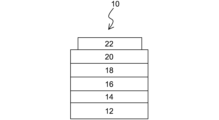
- FIG. 1 is a schematic cross-sectional view of a perovskite solar cell according to an embodiment
- FIG. 1 is a schematic cross-sectional view of a perovskite solar cell of an example
- FIG. 4 is a graph showing the thermal stability of perovskite solar cells of Examples.
- FIG. 1 schematically shows a cross section of a perovskite solar cell 10 according to an embodiment of the present application.
- Perovskite solar cell 10 includes substrate 12 , transparent electrode layer 14 , electron transport layer 16 , perovskite crystal layer 18 , hole transport layer 20 and electrode layer 22 .
- the perovskite solar cell 10 includes (a) a diffusion prevention film provided on the light incident side of the substrate 12, and (b) an interface provided at the interface between the electron transport layer 16 and the perovskite crystal layer 18. (c) an interface modification film or auxiliary layer provided at the interface between the perovskite crystal layer 18 and the hole transport layer 20; or (d) protecting the perovskite solar cell 10 from moisture in the atmosphere. An encapsulant or moisture getter material may be provided. Also, the perovskite solar cell may be an inverted structure solar cell in which the electron transport layer 16 and the hole transport layer 20 of the perovskite solar cell 10 are interchanged.
- the substrate 12 is a glass substrate
- the transparent electrode layer 14 is an FTO (fluorine-doped tin oxide) layer
- the electron transport layer 16 is a tin oxide (SnO 2 ) layer composed of nanoparticles.
- the perovskite crystal layer 18 is Cs 0.05 (FA 0.89 MA 0.11 ) 0.95 Pb (I 0.89 Br 0.11 ) three layers (FA is formamidinium, MA is methylamine (same below)).
- the electrode layer 22 is a gold layer.
- the perovskite crystal layer 18 may be CH3NH3PbI3 , CH( NH2 ) 2PbI3 , and the like.
- Hole transport layer 20 is composed of a hole transport layer material.
- the hole-transporting layer material comprises Spiro-OMeTAD, which is a hole-transporting substance, and an additive represented by the following general formula (1).
- R 1 , R 2 and R 3 are independently alkyl groups having 1 to 2 carbon atoms, and R 4 is an ether group having 2 to 5 carbon atoms. Since R 1 , R 2 , and R 3 are alkyl groups having 1 to 2 carbon atoms, and R 4 is an ether group having 2 to 5 carbon atoms and the number of carbon atoms is small, the lipophilicity of the additive substance is enhanced.
- the hole-transporting layer material may contain substances other than the hole-transporting substance and the additive substance, such as a solvent that dissolves the hole-transporting substance and the additive substance. Moreover, it is preferable that the hole transport layer material does not substantially contain Li. This is to prevent Li from diffusing in the perovskite solar cell 10 and lowering the thermal stability of the perovskite solar cell 10 .
- the fact that the hole transport layer material does not substantially contain Li means that the mass content of Li in the hole transport layer material is 2% or less.
- the mass content of Li in the hole transport layer material is preferably 1% or less, more preferably 0.01% or less.
- the mass content of Li in the hole transport layer material can be measured by mass spectrometry.
- R 1 , R 2 and R 3 are straight chain alkyl groups and R 4 is a straight chain ether group.
- R 1 and R 2 are methyl groups
- R 3 is an ethyl group
- R 4 is a methoxyethyl group.
- the perovskite solar cell 10 is manufactured, for example, as follows. A spin coating method, a sputtering method, a vacuum deposition method, a spray film forming method, a die coating method, a gravure printing method, a screen printing method, or the like is used to form a transparent electrode layer 14 on a substrate 12, and an electron transport method on the transparent electrode layer 14. A layer 16, a perovskite crystal layer 18 on the electron transport layer 16, a hole transport layer 20 on the perovskite crystal layer 18, and an electrode layer 22 on the hole transport layer 20 are formed.
- the substrate was placed on the lower electrode so that the tin oxide layer faced the upper electrode in the processing chamber of a plasma processing apparatus (Diener, FEMTO (high-frequency power source frequency 40 kHz, maximum power 100 W)).
- a plasma processing apparatus Diener, FEMTO (high-frequency power source frequency 40 kHz, maximum power 100 W)
- the pressure inside the processing vessel was reduced to 20 Pa or less by evacuation.
- oxygen gas was introduced into the processing chamber, the pressure in the processing chamber was maintained at 100 Pa, and high frequency power of 100 W was supplied between the upper electrode and the lower electrode to perform plasma cleaning for 30 seconds. went.
- this substrate was heated at 150°C for 1 hour. Then, oxygen gas is introduced into the processing container, the pressure in the processing container is maintained at 100 Pa, and high frequency power of 100 W is supplied between the upper electrode and the lower electrode to convert the oxygen gas into plasma to generate oxygen plasma. , the tin oxide layer was surface-treated for 30 seconds using oxygen ions in an oxygen plasma.
- the substrate is , a transparent electrode layer, an electron transport layer, and a perovskite crystal layer.
- this hole transport layer precursor was spin coated at 3000 rpm for 30 seconds. Then, it was dried at 65° C. for 10 minutes to form a hole transport layer. A gold layer having a thickness of 50 nm was deposited on the surface of this hole transport layer using a vacuum deposition machine to obtain a perovskite solar cell member.
- This perovskite solar cell member corresponds to the perovskite solar cell described in the above embodiment.
- a perovskite solar cell is a combination of a perovskite solar cell member and a housing member described below.
- a housing member was added to this perovskite solar cell member to make a perovskite solar cell. That is, calcium oxide 52 is supported in the center of the surface of a glass plate 50, and an ultraviolet curable adhesive 54 containing glass spheres with a diameter of 10 ⁇ m is applied to the periphery as a spacer with a thickness of 0.05 mm and a width of 0.2 mm. A stop member was obtained. Then, in a nitrogen atmosphere, this sealing member was superimposed on the perovskite solar cell member obtained above, and the adhesive 54 was cured by irradiating with ultraviolet rays to produce the perovskite solar cell of Example 1.
- FIG. 2 schematically shows a cross section of this perovskite solar cell.
- Comparative example 1 61 mg of Spiro-OMeTAD and 10 mg of LiTFSI (Sigma-Aldrich) were dissolved in 0.7 mL of chlorobenzene, and 22 ⁇ L of 4-tert-butylpyridine was added to obtain a hole transport layer precursor solution.
- a perovskite solar cell of Comparative Example 1 was obtained in the same manner as in Example 1 except for this.
- the short-circuit current density, open-circuit voltage, fill factor, and photoelectric conversion efficiency of the perovskite solar cells of Comparative Examples 2 to 4 are similar to those of the perovskite solar cell of Example 1. It was smaller than the photoelectric conversion efficiency. That is, simply adding a substance containing a bis(trifluoromethanesulfonyl)imide anion to the hole-transporting layer is not sufficient. Good initial characteristics of the perovskite solar cell were obtained by adding the additive represented by the general formula (1) to the hole transport layer.
- the photoelectric conversion efficiency was measured in a dark place at 85° C. in the same manner as the method for determining the photoelectric conversion efficiency in the initial characteristics described above. A change over time was measured. The results are shown in FIG. As shown in FIG. 3, in the perovskite solar cell of Example 1, the photoelectric conversion efficiency was 72.5% of the initial value even after 960 hours. In contrast, in the perovskite solar cell of Comparative Example 1, the photoelectric conversion efficiency decreased to the initial value of 51.6% after 960 hours.
- the photoelectric conversion efficiency decreased to the initial value of 16.4% after 456 hours.
Landscapes
- Physics & Mathematics (AREA)
- Electromagnetism (AREA)
- Chemical & Material Sciences (AREA)
- Engineering & Computer Science (AREA)
- Materials Engineering (AREA)
- Photovoltaic Devices (AREA)
Priority Applications (2)
| Application Number | Priority Date | Filing Date | Title |
|---|---|---|---|
| CN202380024304.9A CN118830342A (zh) | 2022-03-03 | 2023-02-28 | 钙钛矿太阳能电池的空穴传输层材料 |
| JP2024504691A JP7685804B2 (ja) | 2022-03-03 | 2023-02-28 | ペロブスカイト太陽電池の正孔輸送層材料 |
Applications Claiming Priority (2)
| Application Number | Priority Date | Filing Date | Title |
|---|---|---|---|
| JP2022-032524 | 2022-03-03 | ||
| JP2022032524 | 2022-03-03 |
Publications (1)
| Publication Number | Publication Date |
|---|---|
| WO2023167175A1 true WO2023167175A1 (ja) | 2023-09-07 |
Family
ID=87883842
Family Applications (1)
| Application Number | Title | Priority Date | Filing Date |
|---|---|---|---|
| PCT/JP2023/007266 Ceased WO2023167175A1 (ja) | 2022-03-03 | 2023-02-28 | ペロブスカイト太陽電池の正孔輸送層材料 |
Country Status (3)
| Country | Link |
|---|---|
| JP (1) | JP7685804B2 (cg-RX-API-DMAC7.html) |
| CN (1) | CN118830342A (cg-RX-API-DMAC7.html) |
| WO (1) | WO2023167175A1 (cg-RX-API-DMAC7.html) |
Families Citing this family (1)
| Publication number | Priority date | Publication date | Assignee | Title |
|---|---|---|---|---|
| CN122248897A (zh) * | 2024-12-18 | 2026-06-19 | 宁德时代未来能源(上海)研究院有限公司 | 钙钛矿太阳能电池、有机化合物及其制备方法、叠层电池、光伏组件、发电装置、用电装置 |
Citations (4)
| Publication number | Priority date | Publication date | Assignee | Title |
|---|---|---|---|---|
| JP2004241378A (ja) * | 2003-01-15 | 2004-08-26 | Nippon Shokubai Co Ltd | 色素増感型太陽電池 |
| JP2006131615A (ja) * | 2004-11-03 | 2006-05-25 | Toyota Motor Corp | 常温溶融塩及びその製造方法 |
| CN101619115A (zh) * | 2009-07-30 | 2010-01-06 | 苏州大学 | 一种高温质子交换聚合物膜及其制备方法 |
| JP2019134159A (ja) * | 2018-02-01 | 2019-08-08 | パナソニック株式会社 | 太陽電池 |
Family Cites Families (6)
| Publication number | Priority date | Publication date | Assignee | Title |
|---|---|---|---|---|
| JP5951839B1 (ja) * | 2015-03-24 | 2016-07-13 | 株式会社東芝 | ポリマーとそれを用いた太陽電池 |
| JP6557098B2 (ja) * | 2015-09-02 | 2019-08-07 | 株式会社日本触媒 | 有機無機ペロブスカイト太陽電池に用いられる正孔輸送材料 |
| KR102123720B1 (ko) * | 2017-03-07 | 2020-06-16 | 주식회사 엘지화학 | 코팅 조성물, 이를 이용하여 제조된 유기 발광 소자 및 이의 제조방법 |
| WO2019126548A1 (en) * | 2017-12-22 | 2019-06-27 | Energy Everywhere, Inc. | Fused and cross-linkable ionic hole transport materials for perovskite solar cells |
| US20210167287A1 (en) * | 2019-11-28 | 2021-06-03 | Tamotsu Horiuchi | Photoelectric conversion element, photoelectric conversion module, electronic device, and power supply module |
| KR102366225B1 (ko) * | 2020-07-09 | 2022-02-21 | 한국화학연구원 | 산염기 부산물로 도핑된 유기 정공 수송물질 및 이를 이용한 광소자 |
-
2023
- 2023-02-28 JP JP2024504691A patent/JP7685804B2/ja active Active
- 2023-02-28 CN CN202380024304.9A patent/CN118830342A/zh active Pending
- 2023-02-28 WO PCT/JP2023/007266 patent/WO2023167175A1/ja not_active Ceased
Patent Citations (4)
| Publication number | Priority date | Publication date | Assignee | Title |
|---|---|---|---|---|
| JP2004241378A (ja) * | 2003-01-15 | 2004-08-26 | Nippon Shokubai Co Ltd | 色素増感型太陽電池 |
| JP2006131615A (ja) * | 2004-11-03 | 2006-05-25 | Toyota Motor Corp | 常温溶融塩及びその製造方法 |
| CN101619115A (zh) * | 2009-07-30 | 2010-01-06 | 苏州大学 | 一种高温质子交换聚合物膜及其制备方法 |
| JP2019134159A (ja) * | 2018-02-01 | 2019-08-08 | パナソニック株式会社 | 太陽電池 |
Non-Patent Citations (1)
| Title |
|---|
| TOKUDA HIROYUKI, SEUNGJO BAEK, MASAYOKI WATANABE: "Room-Temperature Ionic Liquid-Organic Solvent Mixtures: Conductivity and Ionic Association", ELECTROCHEMISTRY, vol. 73, no. 8, 1 January 2005 (2005-01-01), pages 620 - 622, XP093088836 * |
Also Published As
| Publication number | Publication date |
|---|---|
| JP7685804B2 (ja) | 2025-05-30 |
| CN118830342A (zh) | 2024-10-22 |
| JPWO2023167175A1 (cg-RX-API-DMAC7.html) | 2023-09-07 |
Similar Documents
| Publication | Publication Date | Title |
|---|---|---|
| Pisoni et al. | Flexible NIR-transparent perovskite solar cells for all-thin-film tandem photovoltaic devices | |
| Qiu et al. | Hybrid chemical vapor deposition enables scalable and stable Cs-FA mixed cation perovskite solar modules with a designated area of 91.8 cm2 approaching 10% efficiency | |
| Karunakaran et al. | Europium (II)‐doped all‐inorganic CsPbBr3 perovskite solar cells with carbon electrodes | |
| Cannavale et al. | Perovskite photovoltachromic cells for building integration | |
| Destouesse et al. | Slot-die processing and encapsulation of non-fullerene based ITO-free organic solar cells and modules | |
| Wen et al. | Interface engineering via an insulating polymer for highly efficient and environmentally stable perovskite solar cells | |
| Wang et al. | An iodine-free electrolyte based on ionic liquid polymers for all-solid-state dye-sensitized solar cells | |
| Han et al. | Cesium iodide interface modification for high efficiency, high stability and low hysteresis perovskite solar cells | |
| Peiris et al. | Stacked rGO–TiO2 photoanode via electrophoretic deposition for highly efficient dye-sensitized solar cells | |
| JP2020513639A (ja) | 量子ドット発光ダイオードおよびその製造方法、並びに表示パネルおよび表示装置 | |
| Forgacs et al. | Efficient wide band gap double cation–double halide perovskite solar cells | |
| JP2019165073A (ja) | 太陽電池モジュール | |
| Baranwal et al. | Fabrication of fully non-vacuum processed perovskite solar cells using an inorganic CuSCN hole-transporting material and carbon-back contact | |
| Wang et al. | Promising photovoltaic application of multi-walled carbon nanotubes in perovskites solar cells for retarding recombination | |
| Raifuku et al. | Segregation-free bromine-doped perovskite solar cells for IoT applications | |
| JP2021093528A (ja) | 光電変換素子、光電変換モジュール、電子機器、及び電源モジュール | |
| Zhu et al. | Conjugated molecule based 2D perovskites for high-performance perovskite solar cells | |
| Xu et al. | 30% efficient triple-cation perovskite solar cells under indoor illumination enabled by rare earth EuCl3 doping | |
| Feng et al. | A synergistic co-passivation strategy for high-performance perovskite solar cells with large open circuit voltage | |
| JP7685804B2 (ja) | ペロブスカイト太陽電池の正孔輸送層材料 | |
| CN114730846B (zh) | 光电转换元件、光电转换模块、电子设备和电源模块 | |
| Risqi et al. | Highly Stable and Efficient N‐I‐P Structured Tin‐Rich Lead‐Tin Halide Perovskite Solar Cells with Blended Hole‐Transporting Materials | |
| CN117440741A (zh) | 一种半透明钙钛矿太阳电池及其制备方法 | |
| Mei et al. | Synergistic engineering of bromine and cetyltrimethylammonium chloride molecules enabling efficient and stable flexible perovskite solar cells | |
| US10886072B2 (en) | Method for producing photoelectric conversion element |
Legal Events
| Date | Code | Title | Description |
|---|---|---|---|
| 121 | Ep: the epo has been informed by wipo that ep was designated in this application |
Ref document number: 23763432 Country of ref document: EP Kind code of ref document: A1 |
|
| ENP | Entry into the national phase |
Ref document number: 2024504691 Country of ref document: JP Kind code of ref document: A |
|
| WWE | Wipo information: entry into national phase |
Ref document number: 202380024304.9 Country of ref document: CN |
|
| NENP | Non-entry into the national phase |
Ref country code: DE |
|
| 122 | Ep: pct application non-entry in european phase |
Ref document number: 23763432 Country of ref document: EP Kind code of ref document: A1 |