WO2023162961A1 - 二次電池用負極及び二次電池 - Google Patents
二次電池用負極及び二次電池 Download PDFInfo
- Publication number
- WO2023162961A1 WO2023162961A1 PCT/JP2023/006172 JP2023006172W WO2023162961A1 WO 2023162961 A1 WO2023162961 A1 WO 2023162961A1 JP 2023006172 W JP2023006172 W JP 2023006172W WO 2023162961 A1 WO2023162961 A1 WO 2023162961A1
- Authority
- WO
- WIPO (PCT)
- Prior art keywords
- negative electrode
- secondary battery
- conductive
- carbon
- containing material
- Prior art date
- Legal status (The legal status is an assumption and is not a legal conclusion. Google has not performed a legal analysis and makes no representation as to the accuracy of the status listed.)
- Ceased
Links
Images
Classifications
-
- H—ELECTRICITY
- H01—ELECTRIC ELEMENTS
- H01M—PROCESSES OR MEANS, e.g. BATTERIES, FOR THE DIRECT CONVERSION OF CHEMICAL ENERGY INTO ELECTRICAL ENERGY
- H01M4/00—Electrodes
- H01M4/02—Electrodes composed of, or comprising, active material
- H01M4/13—Electrodes for accumulators with non-aqueous electrolyte, e.g. for lithium-accumulators; Processes of manufacture thereof
- H01M4/131—Electrodes based on mixed oxides or hydroxides, or on mixtures of oxides or hydroxides, e.g. LiCoOx
-
- H—ELECTRICITY
- H01—ELECTRIC ELEMENTS
- H01M—PROCESSES OR MEANS, e.g. BATTERIES, FOR THE DIRECT CONVERSION OF CHEMICAL ENERGY INTO ELECTRICAL ENERGY
- H01M4/00—Electrodes
- H01M4/02—Electrodes composed of, or comprising, active material
- H01M4/36—Selection of substances as active materials, active masses, active liquids
- H01M4/38—Selection of substances as active materials, active masses, active liquids of elements or alloys
- H01M4/386—Silicon or alloys based on silicon
-
- H—ELECTRICITY
- H01—ELECTRIC ELEMENTS
- H01M—PROCESSES OR MEANS, e.g. BATTERIES, FOR THE DIRECT CONVERSION OF CHEMICAL ENERGY INTO ELECTRICAL ENERGY
- H01M4/00—Electrodes
- H01M4/02—Electrodes composed of, or comprising, active material
- H01M4/13—Electrodes for accumulators with non-aqueous electrolyte, e.g. for lithium-accumulators; Processes of manufacture thereof
- H01M4/134—Electrodes based on metals, Si or alloys
-
- H—ELECTRICITY
- H01—ELECTRIC ELEMENTS
- H01M—PROCESSES OR MEANS, e.g. BATTERIES, FOR THE DIRECT CONVERSION OF CHEMICAL ENERGY INTO ELECTRICAL ENERGY
- H01M4/00—Electrodes
- H01M4/02—Electrodes composed of, or comprising, active material
- H01M4/36—Selection of substances as active materials, active masses, active liquids
- H01M4/362—Composites
- H01M4/366—Composites as layered products
-
- H—ELECTRICITY
- H01—ELECTRIC ELEMENTS
- H01M—PROCESSES OR MEANS, e.g. BATTERIES, FOR THE DIRECT CONVERSION OF CHEMICAL ENERGY INTO ELECTRICAL ENERGY
- H01M4/00—Electrodes
- H01M4/02—Electrodes composed of, or comprising, active material
- H01M4/36—Selection of substances as active materials, active masses, active liquids
- H01M4/48—Selection of substances as active materials, active masses, active liquids of inorganic oxides or hydroxides
- H01M4/485—Selection of substances as active materials, active masses, active liquids of inorganic oxides or hydroxides of mixed oxides or hydroxides for inserting or intercalating light metals, e.g. LiTi2O4 or LiTi2OxFy
-
- H—ELECTRICITY
- H01—ELECTRIC ELEMENTS
- H01M—PROCESSES OR MEANS, e.g. BATTERIES, FOR THE DIRECT CONVERSION OF CHEMICAL ENERGY INTO ELECTRICAL ENERGY
- H01M4/00—Electrodes
- H01M4/02—Electrodes composed of, or comprising, active material
- H01M4/62—Selection of inactive substances as ingredients for active masses, e.g. binders, fillers
- H01M4/624—Electric conductive fillers
- H01M4/625—Carbon or graphite
-
- H—ELECTRICITY
- H01—ELECTRIC ELEMENTS
- H01M—PROCESSES OR MEANS, e.g. BATTERIES, FOR THE DIRECT CONVERSION OF CHEMICAL ENERGY INTO ELECTRICAL ENERGY
- H01M4/00—Electrodes
- H01M4/02—Electrodes composed of, or comprising, active material
- H01M2004/021—Physical characteristics, e.g. porosity, surface area
-
- H—ELECTRICITY
- H01—ELECTRIC ELEMENTS
- H01M—PROCESSES OR MEANS, e.g. BATTERIES, FOR THE DIRECT CONVERSION OF CHEMICAL ENERGY INTO ELECTRICAL ENERGY
- H01M4/00—Electrodes
- H01M4/02—Electrodes composed of, or comprising, active material
- H01M2004/026—Electrodes composed of, or comprising, active material characterised by the polarity
- H01M2004/027—Negative electrodes
-
- Y—GENERAL TAGGING OF NEW TECHNOLOGICAL DEVELOPMENTS; GENERAL TAGGING OF CROSS-SECTIONAL TECHNOLOGIES SPANNING OVER SEVERAL SECTIONS OF THE IPC; TECHNICAL SUBJECTS COVERED BY FORMER USPC CROSS-REFERENCE ART COLLECTIONS [XRACs] AND DIGESTS
- Y02—TECHNOLOGIES OR APPLICATIONS FOR MITIGATION OR ADAPTATION AGAINST CLIMATE CHANGE
- Y02E—REDUCTION OF GREENHOUSE GAS [GHG] EMISSIONS, RELATED TO ENERGY GENERATION, TRANSMISSION OR DISTRIBUTION
- Y02E60/00—Enabling technologies; Technologies with a potential or indirect contribution to GHG emissions mitigation
- Y02E60/10—Energy storage using batteries
Definitions
- the present disclosure relates to a negative electrode for secondary batteries and secondary batteries.
- Carbon-based materials are generally used for the negative electrodes of secondary batteries such as non-aqueous electrolyte secondary batteries. is being considered.
- Patent Document 1 a Si-containing material containing a lithium silicate phase represented by Li 2z SiO (2+z) (0 ⁇ z ⁇ 2) and silicon particles dispersed in the lithium silicate phase is used as a negative electrode active material.
- a negative electrode for a secondary battery used as a is disclosed.
- Patent Documents 2 to 4 disclose a negative electrode for a secondary battery containing a negative electrode active material of a Si-containing material and a carbon nanotube having a functional group such as a carboxyl group (Patent Documents 2 to 4). ).
- the Si-containing material undergoes a large volume change (expansion and contraction) during charging and discharging, when the charging and discharging are repeated, the large volume change of the Si-containing material causes a conductive path of the negative electrode mixture layer containing the Si-containing material. is cut off, and the charge/discharge cycle characteristics tend to deteriorate.
- an object of the present disclosure is to provide a secondary battery negative electrode capable of suppressing deterioration in charge-discharge cycle characteristics of the battery, and a secondary battery including the secondary battery negative electrode.
- a negative electrode for a secondary battery which is one aspect of the present disclosure, includes a negative electrode current collector and a negative electrode mixture layer formed on the negative electrode current collector, wherein the negative electrode mixture layer contains a Si-containing material.
- a secondary battery according to one embodiment of the present disclosure includes the above negative electrode for a secondary battery.
- a secondary battery negative electrode capable of suppressing deterioration in charge-discharge cycle characteristics of the battery, and a secondary battery including the secondary battery negative electrode.
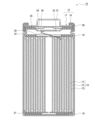
- FIG. 1 is a cross-sectional view of a secondary battery that is an example of an embodiment
- FIG. 1 is a schematic cross-sectional view of a secondary battery that is an example of an embodiment.
- the battery case 15 is composed of a bottomed cylindrical case body 16 and a sealing member 17 that closes the opening of the case body 16 .
- the wound electrode body 14 another form of electrode body such as a stacked electrode body in which positive and negative electrodes are alternately stacked via a separator may be applied.
- Examples of the battery case 15 include cylindrical, rectangular, coin-shaped, button-shaped, and other metal cases, and resin cases formed by laminating resin sheets (so-called laminate type).
- the electrolyte is, for example, a non-aqueous electrolyte containing a non-aqueous solvent and an electrolyte salt dissolved in the non-aqueous solvent.
- non-aqueous solvents include esters, ethers, nitriles, amides, and mixed solvents of two or more thereof.
- the non-aqueous solvent may contain a halogen-substituted product obtained by substituting at least part of the hydrogen atoms of these solvents with halogen atoms such as fluorine.
- a lithium salt such as LiPF 6 is used as the electrolyte salt.
- the electrolyte is not limited to a non-aqueous electrolyte, and may be an aqueous electrolyte containing an aqueous solvent. Moreover, the electrolyte is not limited to a liquid electrolyte, and may be a solid electrolyte using a gel polymer or the like.
- the case body 16 is, for example, a bottomed cylindrical metal container.
- a gasket 28 is provided between the case body 16 and the sealing member 17 to ensure hermeticity inside the battery.
- the case main body 16 has an overhanging portion 22 that supports the sealing member 17, for example, a portion of the side surface overhanging inward.
- the projecting portion 22 is preferably annularly formed along the circumferential direction of the case main body 16 and supports the sealing body 17 on the upper surface thereof.
- the sealing body 17 has a structure in which a filter 23, a lower valve body 24, an insulating member 25, an upper valve body 26, and a cap 27 are layered in order from the electrode body 14 side.
- Each member constituting the sealing member 17 has, for example, a disk shape or a ring shape, and each member except for the insulating member 25 is electrically connected to each other.
- the lower valve body 24 and the upper valve body 26 are connected to each other at their central portions, and an insulating member 25 is interposed between their peripheral edge portions.
- the lower valve body 24 deforms and breaks so as to push the upper valve body 26 upward toward the cap 27 side, breaking the lower valve body 24 and the upper valve body 26 .
- the current path between is interrupted.
- the upper valve body 26 is broken and the gas is discharged from the opening of the cap 27 .
- the positive electrode lead 20 attached to the positive electrode 11 extends through the through hole of the insulating plate 18 toward the sealing member 17
- the negative electrode lead 21 attached to the negative electrode 12 extends through the insulating plate 19 . It extends to the bottom side of the case body 16 through the outside.
- the positive electrode lead 20 is connected to the lower surface of the filter 23, which is the bottom plate of the sealing member 17, by welding or the like, and the cap 27, which is the top plate of the sealing member 17 electrically connected to the filter 23, serves as a positive electrode terminal.
- the negative lead 21 is connected to the inner surface of the bottom of the case body 16 by welding or the like, and the case body 16 serves as a negative terminal.
- the positive electrode 11, the negative electrode 12, and the separator 13 are described in detail below.
- the positive electrode 11 includes a positive electrode current collector and a positive electrode mixture layer disposed on the positive electrode current collector.
- the positive electrode current collector foils of metals such as aluminum and aluminum alloys that are stable in the potential range of the positive electrode, films having such metals arranged on the surface layer, and the like can be used.
- the positive electrode mixture layer includes, for example, a positive electrode active material, a binder, a conductive material, and the like.
- the positive electrode mixture layer is preferably formed on both sides of the positive electrode current collector.
- the positive electrode 11 is produced, for example, by coating a positive electrode mixture slurry containing a positive electrode active material, a binder, a conductive material, etc. on a positive electrode current collector, drying and rolling the coating film, and turning the positive electrode mixture layer into a positive electrode current collector. It can be manufactured by forming it on the body.
- the positive electrode active material is, for example, a lithium composite oxide capable of reversibly intercalating and deintercalating lithium.
- metal elements contained in the lithium composite oxide include Ni, Co, Mn, Al, B, Mg, Ti, V, Cr, Fe, Cu, Zn, Ga, Sr, Zr, Nb, In, Sn , Ta, W, and the like. Among them, it is preferable to contain at least one of Ni, Co, and Mn.
- An example of a suitable lithium composite oxide is represented by the general formula LiMO 2 (M is Ni and X, X is a metal element other than Ni, and the ratio of Ni to the total number of moles of metal elements excluding Li is is 50 mol % or more and 95 mol % or less).
- X in the above formula includes, for example, Co, Mn, Al, B, Mg, Ti, V, Cr, Fe, Cu, Zn, Ga, Sr, Zr, Nb, In, Sn, Ta, W, etc. .
- Examples of the conductive material contained in the positive electrode mixture layer include carbon black, acetylene black, ketjen black, graphene, fibrous carbon such as carbon nanotubes, and carbon materials such as graphite.
- the binder contained in the positive electrode mixture layer includes fluororesins such as polytetrafluoroethylene (PTFE) and polyvinylidene fluoride (PVdF), polyacrylonitrile (PAN), polyimide resins, acrylic resins, polyolefin resins, styrene-butadiene rubber (SBR), carboxymethyl cellulose (CMC) or salts thereof, polyacrylic acid (PAA) or salts thereof (PAA-Na, PAA-K, etc., may also be partially neutralized salts), polyethylene oxide (PEO), polyvinyl alcohol (PVA) and the like.
- fluororesins such as polytetrafluoroethylene (PTFE) and polyvinylidene fluoride (PVdF), polyacrylon
- the negative electrode 12 includes a negative electrode current collector and a negative electrode mixture layer disposed on the negative electrode current collector.
- a negative electrode current collector for example, a foil of a metal such as copper or a copper alloy that is stable in the potential range of the negative electrode, a film having the metal on the surface layer, or the like can be used.
- the negative electrode mixture layer includes a negative electrode active material containing a Si-containing material and a conductive material.
- the conductive material includes carbon nanotubes with sulfone groups.
- the negative electrode mixture layer may additionally contain a binder and the like.
- a negative electrode mixture slurry containing a negative electrode active material, a conductive material, a binder, and the like is applied onto a negative electrode current collector, and the coating film is dried and rolled to form a negative electrode mixture layer as a negative electrode current collector. It can be manufactured by forming it on the body.
- Si-containing material that is the negative electrode active material examples include Si particles, alloy particles containing Si, and composite particles containing Si. These may be used alone or in combination of two or more.
- Si particles are generally obtained by a gas phase method or by pulverizing silicon chips, but they can be produced by any method.
- Alloy particles containing Si include, for example, alloys containing Si and metals selected from alkali metals, alkaline earth metals, transition metals, rare earth metals, or combinations thereof.
- a composite particle containing Si includes, for example, a lithium ion conductive phase and Si particles dispersed in the lithium ion conductive phase.
- the lithium ion conductive phase is, for example, at least one selected from silicon oxide phases, silicate phases and carbon phases.
- the silicate phase contains, for example, at least one element selected from lithium, sodium, potassium, rubidium, cesium, francium, beryllium, magnesium, calcium, strontium, barium, and radium in terms of high lithium ion conductivity. preferably included.
- the silicate phase is preferably a silicate phase containing lithium (hereinafter sometimes referred to as a lithium silicate phase) because of its high lithium ion conductivity.
- Composite particles in which Si particles are dispersed in a silicon oxide phase are represented, for example, by the general formula SiO x (preferably in the range of 0 ⁇ x ⁇ 2, more preferably in the range of 0.5 ⁇ x ⁇ 1.6). be.
- Composite particles in which Si particles are dispersed in a carbon phase are represented, for example, by the general formula Si x C y (preferably in the range of 0 ⁇ x ⁇ 1 and 0 ⁇ y ⁇ 1).
- the content of Si particles constituting the composite particles is, for example, 30% to 80% by mass, 35% to 75% by mass, or 55% to 70% by mass.
- the content of Si particles can be measured by Si-NMR. (Si-NMR measurement conditions) Measurement device: Solid-state nuclear magnetic resonance spectrometer (INOVA-400) manufactured by Varian Probe: Varian 7mm CPMAS-2 MAS: 4.2kHz MAS speed: 4kHz Pulse: DD (45° pulse + signal acquisition time 1H decouple) Repeat time: 1200sec Observation width: 100 kHz Observation center: Around -100 ppm Signal capture time: 0.05 sec Cumulative count: 560 Sample amount: 207.6 mg
- the crystallite size of the Si particles that make up the composite particles is, for example, 10 nm to 30 nm, or 15 nm to 25 nm.
- the crystallite size of Si particles is calculated by Scherrer's formula from the half width of the analytical peak attributed to the Si (111) plane in the X-ray diffraction pattern of Si particles.
- the average particle size of the Si particles that make up the composite particles is, for example, 500 nm or less before the initial charge, and is, for example, 400 nm or less after the initial charge.
- the average particle diameter of the Si particles is a value obtained by observing the cross section of the composite particles with a SEM (scanning electron microscope) and averaging the maximum diameters of arbitrary 100 Si particles.
- a conductive layer coated with conductive carbon is formed on the surface of the Si-containing material.
- the coverage of the conductive layer formed on the surface of the Si-containing material is preferably in the range of 30% to 70%, more preferably in the range of 40% to 60%. If the coverage of the conductive layer is less than 30%, it is presumed that the conductivity of the Si-containing material itself will be lower than when the coverage is in the range of 30% to 70%. In addition, when the coverage of the conductive layer exceeds 70%, the carbon nanotubes described later are less likely to be adsorbed to the Si-containing material than when the coverage is in the range of 30% to 70%. It is assumed that the resistance is increased. In either case, it is considered that the volume change of the Si-containing material due to repeated charging and discharging causes the conductive path of the negative electrode mixture layer to be easily cut, leading to deterioration in charge-discharge cycle characteristics.
- the conductive layer can be formed by, for example, a CVD method using acetylene, methane, etc., or a method of mixing coal pitch, petroleum pitch, phenol resin, etc. with a silicon-based active material and performing heat treatment.
- a heat treatment apparatus for heat treatment for example, a hot air furnace, a hot press, a lamp, a sheath heater, a ceramic heater, a rotary kiln or the like can be used.
- the conductive layer may be formed by adhering a conductive filler such as carbon black to the particle surfaces of the Si-containing material using a binder.
- the coverage of the conductive layer may be adjusted, for example, by controlling the treatment time in the case of the CVD method, or by controlling the baking time and the baking temperature in the case of the heat treatment.
- the coverage of the conductive layer can be measured by XPS (X-ray photoelectron spectroscopy).
- XPS X-ray photoelectron spectroscopy
- Apparatus PHI Quantera SXM manufactured by ULVAC-PHI X-ray source: Al-mono, 15kV/25W Analysis area: 300 ⁇ m ⁇ 800 ⁇ m Photoelectron extraction angle: 45° Neutralization conditions: electrons + floating ions Pass energy: 55 eV Measurement time: 60ms/step
- the coverage of the conductive layer can be calculated by performing XPS measurement under the above measurement conditions and, for example, applying the detected atomic concentrations (at %) of C, Li, and Si to the following formula.
- Conductive layer coverage (%) C (at%) / (C (at%) + Li (at%) + Si (at%))
- the negative electrode active material preferably contains a negative electrode material that expands and contracts less during charging and discharging than the Si-containing material.
- the negative electrode material preferably contains a carbon material capable of reversibly intercalating and deintercalating lithium.
- carbon materials include graphite, graphitizable carbon, and non-graphitizable carbon. Among them, graphite is preferable because it has excellent charging/discharging stability and low irreversible capacity.
- Graphite is a material having graphite crystals, and examples thereof include natural graphite, artificial graphite, and graphitized mesophase carbon particles.
- the content of the Si-containing material is in the range of 1% by mass to 15% by mass with respect to the total mass of the negative electrode active material in terms of, for example, increasing the capacity of the battery and suppressing deterioration in charge-discharge cycle characteristics. is preferred.
- the content of the carbon material used as the negative electrode active material is preferably 85% by mass to 99% by mass with respect to the total mass of the negative electrode active material.
- the content of the negative electrode active material is, for example, 85% by mass or more, 90% by mass or more, or 95% by mass or more with respect to the total mass of the negative electrode mixture layer.
- the conductive material contained in the negative electrode mixture layer contains carbon nanotubes having a sulfone group.
- the sulfone group of the carbon nanotube interacts with the exposed portion of the Si-containing material that is not covered with the conductive layer, so that the carbon nanotube having the sulfone group selectively contains Si. It is thought that it adsorbs to the exposed portion of the material.
- the coverage of the conductive layer exceeds 70%, the exposed portion of the Si-containing material is small, and the carbon nanotubes adsorbed to the exposed portion are reduced, leading to a decrease in charge-discharge cycle characteristics. .
- Carbon nanotubes include single-walled carbon nanotubes, double-walled carbon nanotubes, and multi-walled carbon nanotubes.
- a single-walled carbon nanotube (SWCNT) is a carbon nanostructure in which one layer of graphene sheets constitutes a cylindrical shape, and a double-walled carbon nanotube has two layers of graphene sheets, which are concentrically stacked to form a single line.
- a multi-walled carbon nanotube is a carbon nanostructure in which three or more graphene sheets are concentrically laminated to form a single cylindrical shape.
- the graphene sheet refers to a layer in which carbon atoms of sp2 hybridized orbitals constituting a crystal of graphite (graphite) are positioned at vertexes of a regular hexagon.
- the shape of the carbon nanotube is not limited, but examples thereof include needle-like, cylindrical tube-like, fishbone-like (fishbone or cup laminated type), card-like (platelet), coil-like, and the like.
- the fiber length of the carbon nanotube is preferably 0.5 ⁇ m to 500 ⁇ m, more preferably 1 ⁇ m to 100 ⁇ m, in terms of, for example, further suppressing deterioration in charge-discharge cycle characteristics.
- the fiber length of carbon nanotubes can be obtained by measuring the length of 50 arbitrary carbon nanotubes with a field emission scanning microscope (FE-SEM) and calculating the arithmetic mean.
- the outermost diameter of the carbon nanotube is preferably 0.5 nm to 20 nm, more preferably 1 nm to 10 nm, in terms of, for example, further suppressing deterioration in charge-discharge cycle characteristics.
- the outermost diameter of a carbon nanotube can be obtained by measuring the outer diameters of 50 arbitrary carbon nanotubes with a field emission scanning microscope (FE-SEM) or transmission electron microscope (TEM) and calculating the arithmetic mean.
- the amount of sulfone groups in the carbon nanotube is preferably, for example, 0.01 to 0.25 mmol/g from the viewpoint of adsorption to the exposed portion of the Si-containing material.
- the method for imparting sulfone groups to carbon nanotubes is not particularly limited, but for example, carbon nanotubes can be added to a mixed acid of sulfuric acid and nitric acid and allowed to react for a predetermined time to impart sulfone groups to carbon nanotubes. . It is desirable to stir the mixed acid during the reaction. Although the reaction time is not particularly limited, for example, 1 hour or longer is desirable. Although the reaction temperature is not particularly limited, it is preferably in the range of 20°C to 45°C.
- TPD-MS thermalally evolved gas analysis
- Measuring device Gas chromatograph mass spectrometer (GC part: 7890 manufactured by Agile Technologies, MS part: MS-60030BU) Temperature conditions: from 100°C to 1000°C at a rate of 20°C/min and held for 10 minutes
- the content of the carbon nanotubes is preferably 0.01% by mass to 1% by mass with respect to the total mass of the negative electrode active material in terms of, for example, further suppressing deterioration in charge-discharge cycle characteristics. More preferably, it is 0.01 mass % to 0.1 mass %.
- the conductive material may contain conductive materials other than carbon nanotubes in addition to carbon nanotubes.
- conductive materials other than carbon nanotubes include carbon black, acetylene black, and ketjen black.
- binder examples include the binders exemplified for the positive electrode 11 and the like.
- the content of the binder may be, for example, in the range of 0.5% by mass to 10% by mass with respect to the total mass of the negative electrode active material.
- separator 13 for example, a porous sheet having ion permeability and insulation is used. Specific examples of porous sheets include microporous thin films, woven fabrics, and non-woven fabrics. Suitable materials for the separator 13 include olefin resins such as polyethylene, polypropylene, copolymers containing at least one of ethylene and propylene, and cellulose. The separator 13 may have either a single layer structure or a laminated structure. A heat-resistant layer or the like may be formed on the surface of the separator 13 .
- Example 1 [Preparation of Si-containing material] Silicon dioxide and lithium carbonate were mixed so that the atomic ratio Si/Li was 1.05, and the mixture was fired in the air at 950°C for 10 hours to obtain lithium silicate represented by Li 2 Si 2 O 5 . got This lithium silicate was pulverized to an average particle size of 10 ⁇ m.
- the lithium silicate and silicon powder were mixed at a mass ratio of 50:50.
- This mixture was filled in a pot of a planetary ball mill, 24 SUS balls (20 mm in diameter) were placed in the pot, and the mixture was ground at 200 rpm for 50 hours in an inert atmosphere.
- the pulverized mixture was pressurized by a hot press in an inert atmosphere, and fired at 800° C. for 4 hours in the pressurized state to obtain a Si-containing material.
- the Si-containing material was ground and passed through a 40 ⁇ m mesh.
- the obtained Si-containing material and coal pitch were mixed, and the mixture was fired at 800°C in an inert atmosphere to form a conductive layer coated with conductive carbon on the surface of the Si-containing material.
- the Si-containing material forming the conductive layer was sieved to adjust the average particle size to 5 ⁇ m.
- the coating amount of the conductive layer was 5% by mass with respect to the total mass of the Si-containing material and the conductive layer.
- the coverage of the conductive layer measured by XPS was 45%. Also, the content of Si particles measured by Si-NMR was 50% by mass.
- Ethylene carbonate (EC) and methyl ethyl carbonate (MEC) were mixed at a volume ratio of 30:70.
- LiPF 6 was dissolved in the mixed solvent so as to have a concentration of 1.4 mol/L.
- VC vinylene carbonate
- a separator made of a polyethylene microporous film was placed between the metal Li and the negative electrode, and after winding these, they were flattened to produce a wound electrode assembly. After housing the electrode body and the electrolyte solution in an outer package made of aluminum laminate, the pressure inside the outer package is reduced to impregnate the separator with the electrolytic solution, and then the opening of the outer package is sealed, A secondary battery was produced.
- Example 2 Except that in the preparation of the negative electrode, the negative electrode active material, carbon nanotubes having a sulfone group, sodium carboxymethylcellulose, and styrene-butadiene rubber were mixed at a mass ratio of 100:0.01:1.0:1.0. prepared a secondary battery in the same manner as in Example 1.
- Example 3 Except that in the preparation of the negative electrode, the negative electrode active material, carbon nanotubes having a sulfone group, sodium carboxymethylcellulose, and styrene-butadiene rubber were mixed at a mass ratio of 100:0.03:1.0:1.0. prepared a secondary battery in the same manner as in Example 1.
- Example 4 By adjusting the firing conditions and the like, a Si-containing material having a conductive layer coverage of 30% was produced. A secondary battery was produced in the same manner as in Example 1, except that this Si-containing material was used.
- Example 5 By adjusting the firing conditions and the like, a Si-containing material having a conductive layer coverage of 70% was produced. A secondary battery was produced in the same manner as in Example 1, except that this Si-containing material was used.
- Example 2 A secondary battery was produced in the same manner as in Example 1, except that carbon nanotubes not provided with a sulfone group were used in the production of the negative electrode.
- Example 3 A secondary battery was produced in the same manner as in Example 3, except that carbon nanotubes not provided with a sulfone group were used in the production of the negative electrode.
- Example 6 A secondary battery was produced in the same manner as in Example 1, except that a carbon nanotube having a carboxyl group was used instead of the sulfone group.
- Table 1 summarizes the test results for each example and each comparative example. However, the capacity retention rate shows the results of other examples and comparative examples with the result of example 1 as a standard (100%).
- Examples 1-5 showed a higher capacity retention rate than Comparative Examples 1-6. From this, as the negative electrode active material, a negative electrode active material containing a Si-containing material on which a conductive layer of conductive carbon having a coverage of 30% to 70% is formed, and a conductive material containing a carbon nanotube having a sulfone group. can suppress deterioration of charge-discharge cycle characteristics.
- Non-aqueous electrolyte secondary battery 11 Positive electrode 12 Negative electrode 13 Separator 14 Electrode body 15 Battery case 16 Case main body 17 Sealing body 18, 19 Insulating plate 20 Positive electrode lead 21 Negative electrode lead 22 Overhang Part 23 Filter 24 Lower valve body 25 Insulating member 26 Upper valve body 27 Cap 28 Gasket.
Landscapes
- Chemical & Material Sciences (AREA)
- Chemical Kinetics & Catalysis (AREA)
- Electrochemistry (AREA)
- General Chemical & Material Sciences (AREA)
- Composite Materials (AREA)
- Engineering & Computer Science (AREA)
- Materials Engineering (AREA)
- Inorganic Chemistry (AREA)
- Battery Electrode And Active Subsutance (AREA)
Priority Applications (4)
| Application Number | Priority Date | Filing Date | Title |
|---|---|---|---|
| US18/838,769 US20250183282A1 (en) | 2022-02-25 | 2023-02-21 | Negative electrode for secondary batteries, and secondary battery |
| EP23759962.6A EP4485565A4 (en) | 2022-02-25 | 2023-02-21 | NEGATIVE ELECTRODE FOR SECONDARY BATTERIES AND SECONDARY BATTERY |
| CN202380022053.0A CN118743050A (zh) | 2022-02-25 | 2023-02-21 | 二次电池用负极及二次电池 |
| JP2024503161A JPWO2023162961A1 (https=) | 2022-02-25 | 2023-02-21 |
Applications Claiming Priority (2)
| Application Number | Priority Date | Filing Date | Title |
|---|---|---|---|
| JP2022-027559 | 2022-02-25 | ||
| JP2022027559 | 2022-02-25 |
Publications (1)
| Publication Number | Publication Date |
|---|---|
| WO2023162961A1 true WO2023162961A1 (ja) | 2023-08-31 |
Family
ID=87765886
Family Applications (1)
| Application Number | Title | Priority Date | Filing Date |
|---|---|---|---|
| PCT/JP2023/006172 Ceased WO2023162961A1 (ja) | 2022-02-25 | 2023-02-21 | 二次電池用負極及び二次電池 |
Country Status (5)
| Country | Link |
|---|---|
| US (1) | US20250183282A1 (https=) |
| EP (1) | EP4485565A4 (https=) |
| JP (1) | JPWO2023162961A1 (https=) |
| CN (1) | CN118743050A (https=) |
| WO (1) | WO2023162961A1 (https=) |
Cited By (1)
| Publication number | Priority date | Publication date | Assignee | Title |
|---|---|---|---|---|
| WO2025249258A1 (ja) * | 2024-05-31 | 2025-12-04 | パナソニックエナジー株式会社 | 非水電解質二次電池 |
Citations (6)
| Publication number | Priority date | Publication date | Assignee | Title |
|---|---|---|---|---|
| JP2007242386A (ja) | 2006-03-08 | 2007-09-20 | Matsushita Electric Ind Co Ltd | 電極およびそれを用いた蓄電素子 |
| JP2009507338A (ja) | 2005-09-06 | 2009-02-19 | エルジー・ケム・リミテッド | カーボンナノチューブを含む複合材料バインダーおよびそれを使用するリチウム2次電池 |
| WO2014148043A1 (ja) * | 2013-03-22 | 2014-09-25 | 三洋電機株式会社 | 非水電解質二次電池 |
| WO2016035290A1 (ja) | 2014-09-03 | 2016-03-10 | 三洋電機株式会社 | 非水電解質二次電池用負極活物質及び非水電解質二次電池 |
| JP2021176140A (ja) | 2020-04-27 | 2021-11-04 | 東洋インキScホールディングス株式会社 | カーボンナノチューブ分散液、それを用いた二次電池電極用組成物、電極膜、および二次電池。 |
| JP2022500835A (ja) * | 2019-03-20 | 2022-01-04 | 寧徳新能源科技有限公司Ningde Amperex Technology Limited | 負極活性材料、その製造方法及び該負極活性材料を用いた装置 |
-
2023
- 2023-02-21 EP EP23759962.6A patent/EP4485565A4/en active Pending
- 2023-02-21 CN CN202380022053.0A patent/CN118743050A/zh active Pending
- 2023-02-21 US US18/838,769 patent/US20250183282A1/en active Pending
- 2023-02-21 JP JP2024503161A patent/JPWO2023162961A1/ja active Pending
- 2023-02-21 WO PCT/JP2023/006172 patent/WO2023162961A1/ja not_active Ceased
Patent Citations (6)
| Publication number | Priority date | Publication date | Assignee | Title |
|---|---|---|---|---|
| JP2009507338A (ja) | 2005-09-06 | 2009-02-19 | エルジー・ケム・リミテッド | カーボンナノチューブを含む複合材料バインダーおよびそれを使用するリチウム2次電池 |
| JP2007242386A (ja) | 2006-03-08 | 2007-09-20 | Matsushita Electric Ind Co Ltd | 電極およびそれを用いた蓄電素子 |
| WO2014148043A1 (ja) * | 2013-03-22 | 2014-09-25 | 三洋電機株式会社 | 非水電解質二次電池 |
| WO2016035290A1 (ja) | 2014-09-03 | 2016-03-10 | 三洋電機株式会社 | 非水電解質二次電池用負極活物質及び非水電解質二次電池 |
| JP2022500835A (ja) * | 2019-03-20 | 2022-01-04 | 寧徳新能源科技有限公司Ningde Amperex Technology Limited | 負極活性材料、その製造方法及び該負極活性材料を用いた装置 |
| JP2021176140A (ja) | 2020-04-27 | 2021-11-04 | 東洋インキScホールディングス株式会社 | カーボンナノチューブ分散液、それを用いた二次電池電極用組成物、電極膜、および二次電池。 |
Non-Patent Citations (1)
| Title |
|---|
| See also references of EP4485565A4 |
Cited By (1)
| Publication number | Priority date | Publication date | Assignee | Title |
|---|---|---|---|---|
| WO2025249258A1 (ja) * | 2024-05-31 | 2025-12-04 | パナソニックエナジー株式会社 | 非水電解質二次電池 |
Also Published As
| Publication number | Publication date |
|---|---|
| CN118743050A (zh) | 2024-10-01 |
| US20250183282A1 (en) | 2025-06-05 |
| EP4485565A1 (en) | 2025-01-01 |
| JPWO2023162961A1 (https=) | 2023-08-31 |
| EP4485565A4 (en) | 2025-07-16 |
Similar Documents
| Publication | Publication Date | Title |
|---|---|---|
| US12412891B2 (en) | Non-aqueous electrolyte secondary battery positive electrode and non-aqueous electrolyte secondary battery | |
| JP7716670B2 (ja) | リチウムイオン二次電池用負極およびリチウムイオン二次電池 | |
| US11824185B2 (en) | Negative electrode for nonaqueous electrolyte secondary battery and nonaqueous electrolyte secondary battery | |
| JP7742541B2 (ja) | 巻回型非水電解質二次電池 | |
| JP7804945B2 (ja) | 非水電解質二次電池 | |
| JP7602459B2 (ja) | 二次電池用負極活物質、及び二次電池 | |
| WO2023053773A1 (ja) | リチウムイオン二次電池 | |
| JP7474951B2 (ja) | 二次電池用の負極活物質、及び二次電池 | |
| JP7780733B2 (ja) | 二次電池用負極および二次電池 | |
| WO2022163595A1 (ja) | 二次電池用負極活物質および二次電池 | |
| JPWO2019230297A1 (ja) | 非水電解質二次電池 | |
| JP7668469B2 (ja) | 非水電解質二次電池用負極、及び非水電解質二次電池 | |
| WO2023162961A1 (ja) | 二次電池用負極及び二次電池 | |
| JP2025061474A (ja) | 二次電池用正極及び二次電池 | |
| JP7720569B2 (ja) | リチウムイオン電池 | |
| US20250210630A1 (en) | Negative electrode active material for nonaqueous electrolyte secondary batteries, and nonaqueous electrolyte secondary battery | |
| JP7599138B2 (ja) | リチウムイオン電池 | |
| JP7539392B2 (ja) | 非水電解質二次電池用正極活物質、及び非水電解質二次電池 | |
| CN120390986A (zh) | 二次电池用负极和二次电池 | |
| WO2023145603A1 (ja) | 非水電解液二次電池用負極及び非水電解液二次電池 | |
| WO2025142566A1 (ja) | 二次電池 | |
| WO2023204077A1 (ja) | 非水電解質二次電池用正極活物質および非水電解質二次電池 | |
| JP2026049311A (ja) | 電極活物質、電池 | |
| WO2026070410A1 (ja) | 非水電解質二次電池 | |
| WO2023162689A1 (ja) | 非水電解質二次電池用負極活物質および非水電解質二次電池 |
Legal Events
| Date | Code | Title | Description |
|---|---|---|---|
| 121 | Ep: the epo has been informed by wipo that ep was designated in this application |
Ref document number: 23759962 Country of ref document: EP Kind code of ref document: A1 |
|
| WWE | Wipo information: entry into national phase |
Ref document number: 2024503161 Country of ref document: JP |
|
| WWE | Wipo information: entry into national phase |
Ref document number: 18838769 Country of ref document: US Ref document number: 202380022053.0 Country of ref document: CN |
|
| WWE | Wipo information: entry into national phase |
Ref document number: 202447069386 Country of ref document: IN |
|
| WWE | Wipo information: entry into national phase |
Ref document number: 2023759962 Country of ref document: EP |
|
| NENP | Non-entry into the national phase |
Ref country code: DE |
|
| ENP | Entry into the national phase |
Ref document number: 2023759962 Country of ref document: EP Effective date: 20240925 |
|
| WWP | Wipo information: published in national office |
Ref document number: 18838769 Country of ref document: US |