WO2023153192A1 - アルミニウム箔およびその製造方法 - Google Patents
アルミニウム箔およびその製造方法 Download PDFInfo
- Publication number
- WO2023153192A1 WO2023153192A1 PCT/JP2023/002007 JP2023002007W WO2023153192A1 WO 2023153192 A1 WO2023153192 A1 WO 2023153192A1 JP 2023002007 W JP2023002007 W JP 2023002007W WO 2023153192 A1 WO2023153192 A1 WO 2023153192A1
- Authority
- WO
- WIPO (PCT)
- Prior art keywords
- aluminum foil
- siloxane
- mass
- aluminum
- foil
- Prior art date
- Legal status (The legal status is an assumption and is not a legal conclusion. Google has not performed a legal analysis and makes no representation as to the accuracy of the status listed.)
- Ceased
Links
Images
Classifications
-
- B—PERFORMING OPERATIONS; TRANSPORTING
- B32—LAYERED PRODUCTS
- B32B—LAYERED PRODUCTS, i.e. PRODUCTS BUILT-UP OF STRATA OF FLAT OR NON-FLAT, e.g. CELLULAR OR HONEYCOMB, FORM
- B32B15/00—Layered products comprising a layer of metal
- B32B15/04—Layered products comprising a layer of metal comprising metal as the main or only constituent of a layer, which is next to another layer of the same or of a different material
- B32B15/08—Layered products comprising a layer of metal comprising metal as the main or only constituent of a layer, which is next to another layer of the same or of a different material of synthetic resin
-
- C—CHEMISTRY; METALLURGY
- C22—METALLURGY; FERROUS OR NON-FERROUS ALLOYS; TREATMENT OF ALLOYS OR NON-FERROUS METALS
- C22C—ALLOYS
- C22C21/00—Alloys based on aluminium
-
- C—CHEMISTRY; METALLURGY
- C22—METALLURGY; FERROUS OR NON-FERROUS ALLOYS; TREATMENT OF ALLOYS OR NON-FERROUS METALS
- C22C—ALLOYS
- C22C21/00—Alloys based on aluminium
- C22C21/02—Alloys based on aluminium with silicon as the next major constituent
-
- C—CHEMISTRY; METALLURGY
- C22—METALLURGY; FERROUS OR NON-FERROUS ALLOYS; TREATMENT OF ALLOYS OR NON-FERROUS METALS
- C22C—ALLOYS
- C22C21/00—Alloys based on aluminium
- C22C21/06—Alloys based on aluminium with magnesium as the next major constituent
-
- C—CHEMISTRY; METALLURGY
- C23—COATING METALLIC MATERIAL; COATING MATERIAL WITH METALLIC MATERIAL; CHEMICAL SURFACE TREATMENT; DIFFUSION TREATMENT OF METALLIC MATERIAL; COATING BY VACUUM EVAPORATION, BY SPUTTERING, BY ION IMPLANTATION OR BY CHEMICAL VAPOUR DEPOSITION, IN GENERAL; INHIBITING CORROSION OF METALLIC MATERIAL OR INCRUSTATION IN GENERAL
- C23C—COATING METALLIC MATERIAL; COATING MATERIAL WITH METALLIC MATERIAL; SURFACE TREATMENT OF METALLIC MATERIAL BY DIFFUSION INTO THE SURFACE, BY CHEMICAL CONVERSION OR SUBSTITUTION; COATING BY VACUUM EVAPORATION, BY SPUTTERING, BY ION IMPLANTATION OR BY CHEMICAL VAPOUR DEPOSITION, IN GENERAL
- C23C26/00—Coating not provided for in groups C23C2/00 - C23C24/00
-
- Y—GENERAL TAGGING OF NEW TECHNOLOGICAL DEVELOPMENTS; GENERAL TAGGING OF CROSS-SECTIONAL TECHNOLOGIES SPANNING OVER SEVERAL SECTIONS OF THE IPC; TECHNICAL SUBJECTS COVERED BY FORMER USPC CROSS-REFERENCE ART COLLECTIONS [XRACs] AND DIGESTS
- Y02—TECHNOLOGIES OR APPLICATIONS FOR MITIGATION OR ADAPTATION AGAINST CLIMATE CHANGE
- Y02E—REDUCTION OF GREENHOUSE GAS [GHG] EMISSIONS, RELATED TO ENERGY GENERATION, TRANSMISSION OR DISTRIBUTION
- Y02E60/00—Enabling technologies; Technologies with a potential or indirect contribution to GHG emissions mitigation
- Y02E60/10—Energy storage using batteries
Definitions
- the present invention relates to an aluminum foil that suppresses corrosion due to moisture and has high conductivity, and in particular to an aluminum foil to which a very small amount of siloxane is uniformly or mottled, and a method for producing the same.
- Aluminum foil has excellent electrical conductivity, thermal conductivity, and gas barrier properties, and is used in a variety of applications, from electrical and electronic parts and industrial materials to food, pharmaceutical packaging materials, and household goods.
- Aluminum is known as a metal that is relatively resistant to corrosion because it forms a stable oxide film on its surface.
- a corrosion current flows between the second-phase particles existing on the surface layer and the aluminum matrix, forming aluminum hydroxide, which advances corrosion and discolors the surface. cause problems.
- Methods for preventing this corrosion include coating the surface of the aluminum foil with an anticorrosion coating, laminating it with a different resin, or plating it with a different metal. and a method of adhering or laminating the film.
- Patent Document 1 Japanese Patent Application Laid-Open No. 8-144064
- 1 to 20 mg/m 2 of Si is added to the surface for the purpose of preventing discoloration and thread rust due to corrosion occurring in aluminum alloy materials for automobile body sheet materials. It has been proposed to form a contained oxide layer.
- the conventional corrosion protection method for aluminum involves stacking layers made of a material different from aluminum foil, which goes against the trend of monomaterialization and hinders sorting and recycling. There was a problem.
- the present invention reduces the substances different from aluminum that are laminated on the surface of the aluminum foil to a level that does not hinder sorting and recycling, and yet reduces the corrosion resistance of the aluminum foil in a high-temperature and high-humidity environment. It is an object of the present invention to provide an aluminum foil having high corrosion resistance and high electrical conductivity, and a method for producing the same.
- the present inventors have extensively studied substances different from aluminum to be laminated on the surface of the aluminum foil.
- siloxane is used as the anticorrosion material, it is not necessary to form a uniform coating over the entire surface of the base aluminum foil, so that a very small amount of siloxane that does not hinder recyclability etc. is present on the aluminum surface.
- the inventors have found that a corrosion inhibiting effect can be obtained while maintaining high conductivity, and have completed the present invention.
- siloxane is attached to at least one surface of the base aluminum foil, and the amount of siloxane attached as measured by gas chromatography analysis is 10 ⁇ g/m 2 or more and less than 100 ⁇ g/m 2 .
- the siloxane is preferably a cyclic siloxane, particularly a low-molecular-weight cyclic siloxane.
- the siloxane may be uniformly coated so as to cover the entire surface of the base aluminum foil, or may It may be adhered evenly while forming a speckled, dotted or striped pattern on the surface.
- siloxane when siloxane is applied in a spotty pattern, a very small amount of siloxane can be easily applied to the surface of the base aluminum foil by using a roll or the like coated with a silicone mat.
- the surface of the base aluminum foil is attached to the surface of the base aluminum foil by contacting and removing the silicone mat for a short period of time.
- the use of diluting solvent, coating work, and drying process are not required, so the manufacturing time can be shortened, and the load of manufacturing energy can be greatly reduced. can be done.
- siloxane is uniformly coated so as to cover the entire surface of the base aluminum foil or attached so as to form a mottled pattern on the surface of the base aluminum foil depends on the resulting aluminum foil surface. It can be specified by measuring the water contact angle of the water multiple times and examining the standard deviation.
- the pure aluminum foil itself has good wettability with water even if an oxide film is formed on its surface, and the water contact angle is small.
- an aluminum foil whose entire surface is coated with siloxane has poor wettability with water and a large water contact angle. Therefore, when the siloxane is uniformly coated so as to cover the entire surface of the base aluminum foil, even if the water contact angle is measured multiple times, a relatively large value of the water contact angle is stably measured, Its standard deviation also becomes a small value.
- siloxane adheres to form a speckled, dot-like, or striped pattern the surface of the resulting aluminum foil has areas where siloxane adheres and areas where siloxane does not adhere. Because of the mixture, when the water contact angle is measured a plurality of times, the obtained water contact angle value varies, and the standard deviation also becomes a large value.
- the standard deviation of the water contact angle values at at least 10 or more measurement points on the surface of the aluminum foil to which the siloxane is adhered is preferably 3.0° or more, preferably 5.0°. It is more preferable to be above.
- the thickness of the base aluminum foil is preferably 5 ⁇ m or more and 300 ⁇ m or less from the viewpoint of the strength of the aluminum foil and the ease of production, and from the viewpoint of easily obtaining a highly conductive aluminum foil to which siloxane is adhered. .
- the composition of the base aluminum foil should be 0.00001% by mass or more and 3.0% by mass or less of manganese and 0.02% by mass or more of 1 0.75 mass % or less of iron, 0.00001 mass % or more and 1.0 mass % or less of silicon, 0.00001 mass % or more and 0.3 mass % or less of copper, and 0.00001 mass % or more and 0.3 mass % It is preferably an aluminum alloy foil containing not more than mass % of zinc, not less than 0.00001 mass % and not more than 3.0 mass % of magnesium, and the balance being aluminum and inevitable impurities.
- siloxane is attached to at least one surface of a base aluminum foil, and the amount of siloxane attached as measured by gas chromatography analysis is 10 ⁇ g/m 2 or more and less than 100 ⁇ g/m 2 . Foils and methods of making same are provided.
- the aluminum foil of the present invention exhibits high corrosion resistance even in a hot and humid environment, even though the attached siloxane is reduced to a level that does not hinder sorting and recycling, and also has high conductivity. It also has an excellent effect of having.
- siloxane as the anticorrosive material, it is not necessary to uniformly coat the siloxane so as to cover the entire surface of the base aluminum foil.
- the same anticorrosion effect as in the case of uniform coating can be obtained even if the coating is applied evenly while forming a speckled pattern of dots, stripes, and the like. Therefore, if a silicone mat is adhered to the surface of the base aluminum foil for a short period of time and then peeled off, the siloxane will adhere to the surface of the base aluminum foil in a mottled pattern. Therefore, the manufacturing time can be shortened, and the manufacturing energy load can be greatly reduced.
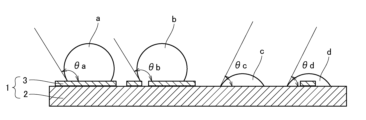
- FIG. 2 is a schematic diagram schematically showing a wet state of water droplets in a region to which siloxane is attached and a wet state of water droplets in a region to which siloxane is not attached in an aluminum foil.
- the aluminum foil that can be used as the base material may be a pure aluminum foil or an aluminum alloy foil. If the substrate aluminum foil itself has corrosion resistance, the corrosion resistance in a high-temperature and high-humidity environment can be further enhanced in combination with the effect of siloxane adhesion.
- the composition of the base aluminum foil having corrosion resistance is not particularly limited, preferred compositions and their ranges are shown below.
- the base aluminum foil may be an aluminum alloy foil containing 0.00001% by mass or more and 3.0% by mass or less of manganese.
- Manganese is an element that improves the strength of aluminum alloys without significantly reducing their corrosion resistance. However, if the manganese content exceeds 3.0% by mass, the hardness of the aluminum alloy surface increases, but the rollability decreases, making it difficult to obtain an aluminum alloy foil. Therefore, the manganese content is preferably 3.0% by mass or less, more preferably 1.5% by mass or less.
- the lower limit of the manganese content is not particularly limited, it is usually about 0.00001% by mass. In order to reduce the manganese content to less than 0.00001% by mass, it is necessary to repeat the fractional crystallization method, etc., and the production cost is significantly increased. It is preferably 0% by mass or less.
- the base aluminum foil may be an aluminum alloy foil containing 0.02% by mass or more and 1.75% by mass or less of iron. By adding a certain amount of iron to the aluminum alloy foil, it is possible to improve the corrosion resistance of the aluminum alloy foil in a hot and humid atmosphere. If the iron content in the aluminum alloy foil is less than 0.02% by mass, the corrosion resistance of the aluminum alloy foil is insufficient in a hot and humid atmosphere. In addition, since the surface hardness of the aluminum alloy foil decreases as the iron content decreases, the iron content is preferably 0.02% by mass or more in consideration of the aforementioned characteristics.
- the content of iron is preferably 0.02% by mass or more and 1.75% by mass or less.
- the base aluminum foil may be an aluminum alloy foil containing 0.00001% by mass or more and 1.0% by mass or less of silicon.
- silicon When silicon is present in the aluminum alloy foil, it is possible to suppress deterioration of the corrosion resistance of the aluminum alloy foil in a hot and humid atmosphere.
- the content of silicon when the content of silicon is reduced, the crystal grain size of the aluminum alloy foil becomes small, and the elongation of the aluminum alloy foil, that is, the rollability can be improved.
- the content of silicon in 100% by mass of the aluminum alloy foil is preferably 0.00001% by mass or more and 1.0% by mass or less.
- the base aluminum foil may be an aluminum alloy foil containing 0.00001% by mass or more and 0.3% by mass or less of copper.
- the strength of the aluminum alloy foil can be relatively easily increased.
- the content of copper is high, the rollability of the aluminum alloy deteriorates.
- the lower limit of the copper content is not particularly limited, it is usually about 0.00001% by mass. In order to reduce the copper content to less than 0.00001% by mass, it is necessary to repeat the fractional crystallization method, etc., which significantly increases the production cost. Therefore, the content of copper is preferably 0.00001% by mass or more and 0.3% by mass or less.
- the base aluminum foil may be an aluminum alloy foil containing 0.00001% by mass or more and 0.3% by mass or less of zinc.
- the presence of zinc in the aluminum alloy foil reduces the corrosion resistance of the aluminum alloy foil. Therefore, the content of zinc in 100% by mass of the aluminum alloy foil is preferably 0.3% by mass or less.
- the lower limit of zinc content is not particularly limited, it is usually about 0.00001% by mass. In order to reduce the zinc content to less than 0.00001% by mass, it is necessary to repeat the three-layer electrolysis method, etc., which significantly increases the production cost. Therefore, the content of zinc is preferably 0.00001% by mass or more and 0.3% by mass or less.
- the base aluminum foil may be an aluminum alloy foil containing 0.00001% by mass or more and 3.0% by mass or less of magnesium.
- Magnesium has a large amount of solid solution in aluminum, and the strength of the aluminum alloy foil can be increased by including it. If the magnesium content is more than 3.0% by mass, rolling extensibility will be poor, making it difficult to produce an aluminum foil. Therefore, the content of magnesium in 100% by mass of the aluminum alloy foil is preferably 3.0% by mass or less. Moreover, when the content of magnesium exceeds 0.01% by mass, it concentrates in the oxide film formed on the surface of aluminum and causes film defects, thereby lowering the corrosion resistance of the aluminum alloy. Therefore, the content of magnesium in 100% by mass of the aluminum alloy foil is more preferably 0.01% by mass or less.
- the lower limit of the content of magnesium is not particularly limited, it is usually about 0.00001% by mass. In order to reduce the content of magnesium to less than 0.00001% by mass, it is necessary to repeat the three-layer electrolysis method, etc., which significantly increases the production cost. Therefore, the content of magnesium is preferably 0.00001% by mass or more and 3.0% by mass or less, and more preferably 0.00001% by mass or more and 0.01% by mass or less.
- the base aluminum foil of the present embodiment includes transition elements such as vanadium (V), titanium (Ti), zirconium (Zr), chromium (Cr), nickel (Ni), and boron (B), in addition to the metal elements described above. , gallium (Ga), bismuth (Bi), and the like.
- the content of each of these elements is preferably 0.05% by mass or less in 100% by mass of the aluminum foil.
- the thickness of the base aluminum foil is preferably 5 ⁇ m or more from the viewpoint of strength and ease of manufacture. Moreover, from the viewpoint of reducing the weight of the aluminum foil, the thickness of the base aluminum foil is preferably 300 ⁇ m or less. More preferably, the thickness is 5 ⁇ m or more and 200 ⁇ m or less. In order to set the thickness of the base aluminum foil within the above range, casting and rolling may be carried out according to a conventional method. In addition, heat treatment may be appropriately performed in the manufacturing process.
- the siloxane is preferably a cyclic siloxane, more preferably a low-molecular-weight cyclic siloxane.
- Low-molecular-weight cyclic siloxane generally refers to a siloxane having a cyclic structure with a relatively small amount of D-form (dimethylsiloxane unit) bound. refers to low-molecular cyclic siloxanes of D3 to D24.
- Examples include, but are not limited to, hexamethylcyclotrisiloxane (D3), octamethylcyclotrisiloxane (D4), decamethylcyclotrisiloxane (D5), dodecamethylcyclotrisiloxane (D6), and the like. .
- the obtained aluminum foil has excellent corrosion resistance, especially while suppressing the occurrence of corrosion accompanied by white discoloration due to the formation of bayerite and the like, while the surface of the aluminum foil Since the amount of siloxane adhering to the resin is small, it does not require sorting, removal or peeling of siloxane, etc., which were conventionally required, and excellent recyclability can be exhibited.
- the adhered amount of siloxane refers to the total amount of detected cyclic siloxanes of D3 to D24 measured by gas chromatography.
- the siloxane may be uniformly coated so as to cover the entire surface of the aluminum foil as long as the amount of siloxane adhered is within the range described above. It may be adhered evenly while forming a mottled pattern of shapes, dots, and stripes. In particular, when siloxane is applied in a spotty pattern, a very small amount of siloxane can be easily applied to the surface of the base aluminum foil by using a roll or the like coated with a silicone mat.
- FIG. 1 in the aluminum foil 1 of the present embodiment in which the siloxane 3 is attached to the base aluminum foil 2, the wet state of the water droplets a and b in the area where the siloxane 3 is attached and the siloxane attached.
- the water wetting state of the water droplets c and d in the region without water is shown schematically.
- the water wettability due to the presence or absence of the siloxane 3 varies depending on the position where the water droplets are dropped. Therefore, it is considered that water droplets a to d having various water contact angles ⁇ a to ⁇ d as shown in FIG. 1 are formed. Therefore, when the water contact angle is measured a plurality of times, the obtained water contact angles have large variations in the values of ⁇ a to ⁇ d, and the standard deviation thereof is also considered to be a large value.
- the siloxane is uniformly coated on the surface of the aluminum foil so as to cover the entire surface or is attached to the surface of the aluminum foil so as to form a mottled pattern depends on the obtained aluminum foil. It can be determined by measuring the water contact angle of the surface multiple times and examining the standard deviation.
- the surface of the aluminum foil to which siloxane has adhered is preferably 3.0° or more, more preferably 5.0° or more.
- An aluminum ingot can be obtained, for example, by melting an aluminum base metal, adding various necessary alloying elements or an aluminum-alloying element binary master alloy, and solidifying the resulting molten metal for casting.
- the casting method is not particularly limited, and a method selected from the group consisting of semi-continuous casting, continuous casting, die casting and the like can be adopted.
- a homogenization heat treatment may be performed on the obtained aluminum ingot.
- the homogenization heat treatment is preferably performed under the conditions of, for example, a heating temperature of 400° C. or higher and 630° C. or lower and a heating time of 1 hour or longer and 20 hours or shorter.
- a hot rolling step may be provided in the middle.
- the number of times of hot rolling in the hot rolling process and the number of times of cold rolling in the cold rolling process may be appropriately set according to the desired final thickness of the aluminum foil.
- the cold rolling process is preferably carried out in the order of one or more cold rolling, intermediate annealing, and one or more cold rolling.
- the intermediate annealing is preferably carried out by setting the annealing temperature to 50° C. to 500° C. and the annealing time to 1 second to 20 hours.
- a foil rolling process may be provided after the hot rolling process and the cold rolling process. By providing the foil rolling step, it becomes easier to adjust the thickness of the base aluminum foil.
- the foil rolling step may be carried out by polymerization rolling.
- a heat treatment step of performing heat treatment at a temperature of 50° C. or more and 450° C. or less for about 1 second to 50 hours may be provided. By providing the heat treatment step, the water wettability can be improved by removing the rolling oil remaining on the surface of the base aluminum alloy foil, and the mechanical properties of the base aluminum alloy foil can be adjusted.
- a known method can be used as a method for adhering siloxane to the surface of the base aluminum foil.
- a method for uniformly coating the entire surface of the base aluminum foil with siloxane there is a method of coating the surface of the base aluminum foil with a solution containing siloxane, followed by baking and drying. More specifically, a solution containing siloxane is diluted with a diluent solvent and applied to the surface of the base aluminum foil, and then the diluent solvent is volatilized by baking and drying to form a film of siloxane. It can be attached to the surface of the substrate aluminum foil.
- composition information of the base aluminum alloy foil was obtained by weighing 1.00 g of the aluminum alloy foil and measuring it using an inductively coupled plasma atomic emission spectrometry method (equipment name: ICPS-8100 manufactured by Shimadzu Corporation). .
- Example 1 and Comparative Examples 1 and 2 an ink containing cyclic siloxane was diluted with ethyl acetate to a predetermined adhesion amount on the obtained base aluminum alloy foil, and bar-coated. An aluminum foil to which cyclic siloxane adhered was produced by coating. Note that TPR6722 manufactured by MOMENTIVE was used as the ink containing cyclic siloxane. In Table 2, the method for adhering the cyclic siloxane is indicated as "Method A".
- Example 2 a silicone sheet containing cyclic siloxane was brought into contact with the obtained base aluminum alloy foil for 1 second to transfer the cyclic siloxane to the base aluminum alloy foil, and the aluminum foil with the cyclic siloxane adhered. was made.
- a heat-resistant silicone sheet manufactured by Tigers Polymer was used as the silicone sheet.
- Method B the method for adhering the cyclic siloxane is indicated as "Method B".
- the obtained base aluminum alloy foil was not subjected to any coating treatment or the like, and the base aluminum alloy foil after the final annealing was used as it was for evaluation.
- GC6890N gas chromatography
- Agilent Technologies gas chromatography
- DB-5MS was used as a column, and the temperature was measured while increasing the temperature from 50°C to 320°C at a heating rate of 5°C/min.
- the cyclic siloxane contents of all D3 to D24 were obtained from the detected peaks for the measured values obtained.
- the conductivity of aluminum foil it is basically considered that the higher the capacitance, the higher the conductivity.
- the aluminum foils of Comparative Examples 3 and 4 before the discoloration test due to moisture corrosion did not undergo corrosion due to the formation of bayerite or the like, so they exhibited the original capacitance of the highly conductive aluminum foil.
- the attached siloxane film if the surface area of the aluminum foil is the same, the capacitance will increase as the distance between the insulators decreases, so the larger the capacitance, the thinner and more uniform the film. It can be said that it is formed.
- the capacitance must be higher than 10 ⁇ F.
- the capacitance was measured by immersing the aluminum foils of Examples 1 to 5 and Comparative Examples 1 to 4 in a 50 mm ⁇ 20 mm area (immersion area) in an 8.0% by mass aqueous solution of ammonium borate. was connected to the anode and the aluminum plate was connected to the cathode, and the amount of charge was measured when a voltage of 50 mV was applied.
- the contact angle of water on the surface of the aluminum foil was determined according to the drop method, using DROP Master 300 manufactured by Kyowa Interface Science Co., Ltd., and dropping 2.0 ⁇ L of pure water on the surface of the aluminum foil. We measured the angle between the ground and the water droplet interface. The average water contact angle and its standard deviation were determined by repeating the above measurements 10 times on randomly selected surfaces of aluminum foil.
- the adhesion amount of siloxane is preferably 10 ⁇ g/m 2 or more and less than 100 ⁇ g/m 2 , more preferably 20 ⁇ g/m 2 or more and less than 80 ⁇ g/m 2 .
- the aluminum foils of Examples 1 to 5 are 5 to 25 ⁇ F, which is equivalent to the pure aluminum foils of Comparative Examples 3 and 4, which were not subjected to a discoloration test due to moisture corrosion. Since it showed a relatively large capacitance, it was found to have high conductivity like the aluminum foils of Comparative Examples 3 and 4.
- the aluminum foils of Examples 1 to 5 had a more uniform siloxane thin film than the aluminum foils of Comparative Examples 1 and 2.
- the average value of the water contact angles at at least 10 or more measurement points on the surface of the base aluminum foil to which siloxane is attached must be It can be said that the angle is preferably 70° or more, and more preferably 75° or more.
- the siloxane was uniformly coated so as to cover the entire surface of the aluminum foil, so that water droplets could be placed at any position on the aluminum foil surface. This is thought to be due to the fact that even if the droplet is dropped, a water-wet state in which the water contact angle ⁇ a is substantially the same as that of the water droplet a shown in FIG. 1 is reproduced.
- the siloxane is thought to adhere to the surface of the aluminum foil so as to form a speckled, dotted, or striped pattern. This is thought to be because the water wettability differs depending on the position where the water droplets a to d shown in FIG.
- the aluminum foil of the present embodiment can be coated with siloxane uniformly so as to form a film or coating layer on the entire surface of the aluminum foil, or the surface of the aluminum foil can be coated with spots, dots, or It was found that even if the siloxane was adhered to form a striped spotted pattern, it was possible to obtain an aluminum foil having high conductivity while suppressing corrosion due to moisture due to the adhesion of a very small amount of siloxane.
- the standard deviation of the water contact angle values at arbitrary 10 points on the surface of the aluminum foil to which siloxane is adhered must be 3.0° or more. and more preferably 5.0° or more.
Landscapes
- Chemical & Material Sciences (AREA)
- Engineering & Computer Science (AREA)
- Materials Engineering (AREA)
- Mechanical Engineering (AREA)
- Metallurgy (AREA)
- Organic Chemistry (AREA)
- Chemical Kinetics & Catalysis (AREA)
- Laminated Bodies (AREA)
Abstract
Description
本実施形態において、基材として用いることができるアルミニウム箔は、純アルミニウム箔であってもアルミニウム合金箔であってもよい。基材アルミニウム箔自体が耐腐食性を有していると、シロキサン付着による効果と相俟って、より一層高温多湿環境雰囲気下における耐腐食性を高めることができる。上記、耐腐食性を有する基材アルミニウム箔の組成は特に限定されるものではないが、好ましい組成およびその範囲を以下に示す。
基材アルミニウム箔は、マンガンを0.00001質量%以上3.0質量%以下含むアルミニウム合金箔であってもよい。マンガンは、アルミニウム合金の耐食性を大きく低下させることなく強度を向上させる元素である。ただし、マンガンの含有量が3.0質量%を超えるとアルミニウム合金表面の硬度は高くなるが、圧延性が低下し、アルミニウム合金箔を得ることが困難となる。このため、マンガンの含有率は3.0質量%以下とすることが好ましく、1.5質量%以下とすることがより好ましい。マンガンの含有量の下限値は特に限定されないが、通常0.00001質量%程度である。マンガンの含有量を0.00001質量%未満にするためには、さらに分別結晶法を繰り返すこと等が必要になり、製造コストが著しく高くなるので、マンガンの含有量を0.00001質量%以上3.0質量%以下であることが好ましい。
基材アルミニウム箔は、鉄を0.02質量%以上1.75質量%以下含むアルミニウム合金箔であってもよい。アルミニウム合金箔中に一定量の鉄を加えることにより、高温多湿雰囲気下におけるアルミニウム合金箔の耐食性を向上させることができる。アルミニウム合金箔中の鉄の含有量が0.02質量%に満たない場合、高温多湿雰囲気下におけるアルミニウム合金箔の耐食性が不十分となる。また、鉄の含有量が少ないほどアルミニウム合金箔の表面硬度は低くなるので、前述の特性を考慮すると、鉄の含有量は0.02質量%以上であることが好ましい。
基材アルミニウム箔は、シリコンを0.00001質量%以上1.0質量%以下含むアルミニウム合金箔であってもよい。シリコンがアルミニウム合金箔中に存在すると、高温多湿雰囲気下におけるアルミニウム合金箔の耐食性の低下を抑制することができる。一方、シリコンの含有量を少なくするとアルミニウム合金箔の結晶粒径が小さくなり、アルミニウム合金箔の伸び、すなわち圧延性を向上させることができる。これらを考慮すれば、アルミニウム合金箔100質量%中におけるシリコンの含有量を0.00001質量%以上1.0質量%以下であることが好ましい。
基材アルミニウム箔は、銅を0.00001質量%以上0.3質量%以下含むアルミニウム合金箔であってもよい。銅は、アルミニウム合金箔中に含有させることで比較的容易にアルミニウム合金箔を高強度にすることができる。ただし、銅の含有量が多いとアルミニウム合金の圧延性が悪くなる。銅の含有量の下限値は特に限定されないが、通常0.00001質量%程度である。銅の含有量を0.00001質量%未満にするためには、さらに分別結晶法を繰り返すこと等が必要になり、製造コストが著しく高くなる。よって、銅の含有量は0.00001質量%以上0.3質量%以下であることが好ましい。
基材アルミニウム箔は、亜鉛を0.00001質量%以上0.3質量%以下含むアルミニウム合金箔であってもよい。亜鉛がアルミニウム合金箔中に存在すると、アルミニウム合金箔の耐食性を低下させる。そのため、アルミニウム合金箔100質量%中における亜鉛の含有量は0.3質量%以下とすることが好ましい。亜鉛の含有量の下限値は特に限定されないが、通常0.00001質量%程度である。亜鉛の含有率を0.00001質量%未満にするためには、三層電解法を繰り返すこと等が必要になり、製造コストが著しく高くなる。よって、亜鉛の含有量は0.00001質量%以上0.3質量%以下であることが好ましい。
基材アルミニウム箔は、マグネシウムを0.00001質量%以上3.0質量%以下含むアルミニウム合金箔であってもよい。マグネシウムは、アルミニウムへの固溶量が多く、含有させることでアルミニウム合金箔の強度を上げることができる。マグネシウム含有量が3.0質量%より多く含まれると、圧延展伸性が悪くなり、アルミニウム箔にすることが難しくなる。そのため、アルミニウム合金箔100質量%中におけるマグネシウムの含有率は3.0質量%以下とすることが好ましい。また、マグネシウムの含有量が0.01質量%より多くなると、アルミニウムの表面上に形成された酸化被膜中に濃縮して被膜欠陥を引き起こすため、アルミニウム合金の耐食性を低下させる。そのため、アルミニウム合金箔100質量%中におけるマグネシウムの含有率は0.01質量%以下とすることがより好ましい。マグネシウムの含有量の下限値は特に限定されないが、通常0.00001質量%程度である。マグネシウムの含有率を0.00001質量%未満にするためには、三層電解法を繰り返すこと等が必要になり、製造コストが著しく高くなる。よって、マグネシウムの含有量は0.00001質量%以上3.0質量%以下であることが好ましく、0.00001質量%以上0.01質量%以下であることがより好ましい。
本実施形態の基材アルミニウム箔は、上述した金属元素以外に、バナジウム(V)、チタン(Ti)、ジルコニウム(Zr)、クロム(Cr)、ニッケル(Ni)等の遷移元素、ホウ素(B)、ガリウム(Ga)及びビスマス(Bi)等からなる群より選択される一種以上の元素を含有するアルミニウム合金箔であってもよい。これら各元素の含有量は、アルミニウム箔100質量%中に、それぞれ0.05質量%以下であることが好ましい。
[基材アルミニウム箔の厚み]
基材アルミニウム箔の厚みは、強度および製造の容易性の観点から、5μm以上とすることが好ましい。また、アルミニウム箔の軽量化という観点から、基材アルミニウム箔の厚みは300μm以下とすることが好ましい。さらに好ましくは、5μm以上200μm以下とすることが好ましい。基材アルミニウム箔の厚みを上記範囲とするには、常法に従って鋳造、圧延を行えばよい。また、製造過程において適宜熱処理を行ってもよい。
アルミニウム箔の表面には数nmの厚みで自然酸化被膜層が形成されており、熱処理を施すことで、その上に、さらに熱による酸化被膜層が形成される。これらの自然酸化被膜や熱酸化被膜は、一般的にpH4~8の中性雰囲気下において安定しているとされるものの、高温多湿環境下に晒されると、酸化被膜のわずかな欠陥からアルミニウムが溶出し、湿気中の酸素と結合することで例えばバイヤライトやベーマイト構造の水酸化アルミニウムを形成し、変色を伴う腐食が発生する。この腐食は、アルミニウム箔の表面近傍の湿気中に含まれる水分子が吸着することにより発生するものと考えられる。
シロキサンとしては、環状シロキサンであることが好ましく、低分子環状シロキサンであるとより好ましい。低分子環状シロキサンとは、一般的に環状構造を有するシロキサンのうちD体(ジメチルシロキサン単位)の結合量が比較的少ないものを指すが、本実施形態においては、ガスクロマトグラフィー(GC)によって測定されるD3~D24の低分子環状シロキサンを指す。一例として、ヘキサメチルシクロトリシロキサン(D3)、オクタメチルシクロトリシロキサン(D4)、デカメチルシクロトリシロキサン(D5)、ドデカメチルシクロトリシロキサン(D6)等が挙げられるがこれに限られるものではない。
本実施形態では、アルミニウム箔の少なくとも一方の表面に、ガスクロマトグラフィーで計測されるシロキサンが10μg/m2以上100μg/m2未満付着していることが好ましく、20μg/m2以上80μg/m2未満付着しているとより好ましい。シロキサンの付着量が上記の範囲であれば、得られたアルミニウム箔は優れた耐腐食性、特にバイヤライト等の形成による白い変色を伴う腐食の発生を抑制しつつ、一方でアルミニウム箔の表面上に付着しているシロキサンが少量であるために、従来必要であった分別やシロキサンの除去や剥離等を必要とせず、優れたリサイクル性を発揮することができる。
本実施形態では、シロキサンは、上述した付着量の範囲であれば、アルミニウム箔の表面全体を被覆するように一様にコーティングしてもよいし、微視的には、アルミニウム箔の表面に斑点状、点状、縞状の斑模様を形成させながら万遍なく付着させてもよい。特にシロキサンを斑模様に付着させる場合は、シリコーンマットで被覆されたロール等を使用することにより簡単に極少量のシロキサンを基材アルミニウム箔の表面に付着量させることができる。
本実施形態に用いる基材アルミニウム箔の製造方法を、以下に説明する。アルミニウムの鋳塊は、例えばアルミニウム地金を溶解し、種々必要な合金元素もしくはアルミニウム-合金元素2元系母合金を添加し、得られる溶湯を凝固させて鋳造することにより得ることができる。鋳造方法は特に限定されず、半連続鋳造、連続鋳造及び金型鋳造等からなる群より選択される方法を採用することができる。
基材アルミニウム箔の表面上へのシロキサンの付着方法としては、公知の方法を用いることができる。例えばシロキサンを基材アルミニウム箔の表面全体を被覆するように一様にコーティングする方法としては、シロキサンを含む溶液を基材アルミニウム箔の表面上にコーティングし、焼き付け乾燥させる方法が挙げられる。より詳細には、シロキサンを含む溶液を希釈溶剤にて希釈して基材アルミニウム箔の表面上に塗布し、その後、焼き付け乾燥によって希釈溶剤を揮発させことにより、シロキサンを、膜を形成するように基材アルミニウム箔の表面に付着させることができる。
表1に示す組成A,Bに基づき、それぞれのアルミニウム合金を、約102℃/秒の冷却速度で溶解鋳造することにより厚み6mmのアルミニウム合金A,Bの板を得た。得られたアルミニウム合金A,Bの板を500℃にて5時間熱処理を行った。炉から板を取り出した後、所定の厚みになるまで複数回冷間圧延した。その後最終焼鈍を250℃の温度で5時間行うことにより、実施例1~5および比較例1~4に用いる基材アルミニウム合金箔を作製した。

表2に示すシロキサンの付着条件により、上述の得られた基材アルミニウム合金箔の表面にシロキサンを付着させて実施例1~5および比較例1,2のアルミニウム箔を作製した。なお、比較例3,4のアルミニウム箔は、人工的に基材アルミニウム合金箔の表面にシロキサンを付着させなかった。
[GC法によるシロキサン付着量]
実施例1~5および比較例1~4のアルミニウム箔を100mm×100mmの大きさに切り取り、各々ヘキサンに浸漬した。アルミニウム箔を浸漬状態で超音波洗浄を行い、ヘキサンのみを取り出した。この作業を1試料について各々3回繰り返した後、3回分のヘキサンを採取し、ヘキサン内のシロキサン成分を抽出した。シロキサンが抽出されたヘキサン溶液の揮発成分をすべて揮発させ、不揮発分として残った固形分に対して0.1mLのヘキサンに溶解させ、ガスクロマトグラフィー測定用サンプルとした。
実施例1~5および比較例1~4のアルミニウム箔を100mm×100mmの大きさに切り取り、それぞれの重量を測定した。その重量から、シロキサンが付着する前の100mm×100mmの大きさの基材アルミニウム箔の重量との差を求め、上記差分をシロキサン付着量と仮定し、1m2の面積相当(単位面積当たり)の付着量に換算した。
アルミニウム箔の導電性およびアルミニウム箔上のシロキサンにより形成された膜がどれほど薄く均一に存在しているかを判断するため、実施例1~5および比較例1,2のアルミニウム箔と比較例3,4の無垢のアルミニウム箔の静電容量を測定した。
シロキサンの付着によってアルミニウム箔の表面に水分がどれほど付着し難くなっているか及びシロキサンの付着分布を判断するため、実施例1~5および比較例1,2のアルミニウム箔と比較例3,4の無垢のアルミニウム箔の水接触角を測定した。
アルミニウム箔の湿気による変色があるか否かの確認は、実施例1~5および比較例1~4のアルミニウム箔を各々50mm×50mmのサイズで2枚ずつ切り取って重ね、200gの荷重を掛けながら温度50℃、相対湿度85%の雰囲気下で72時間晒し、アルミニウム箔とアルミニウム箔の接触している面に変色が認められるか否かによりアルミニウム箔の耐腐食性について評価した。
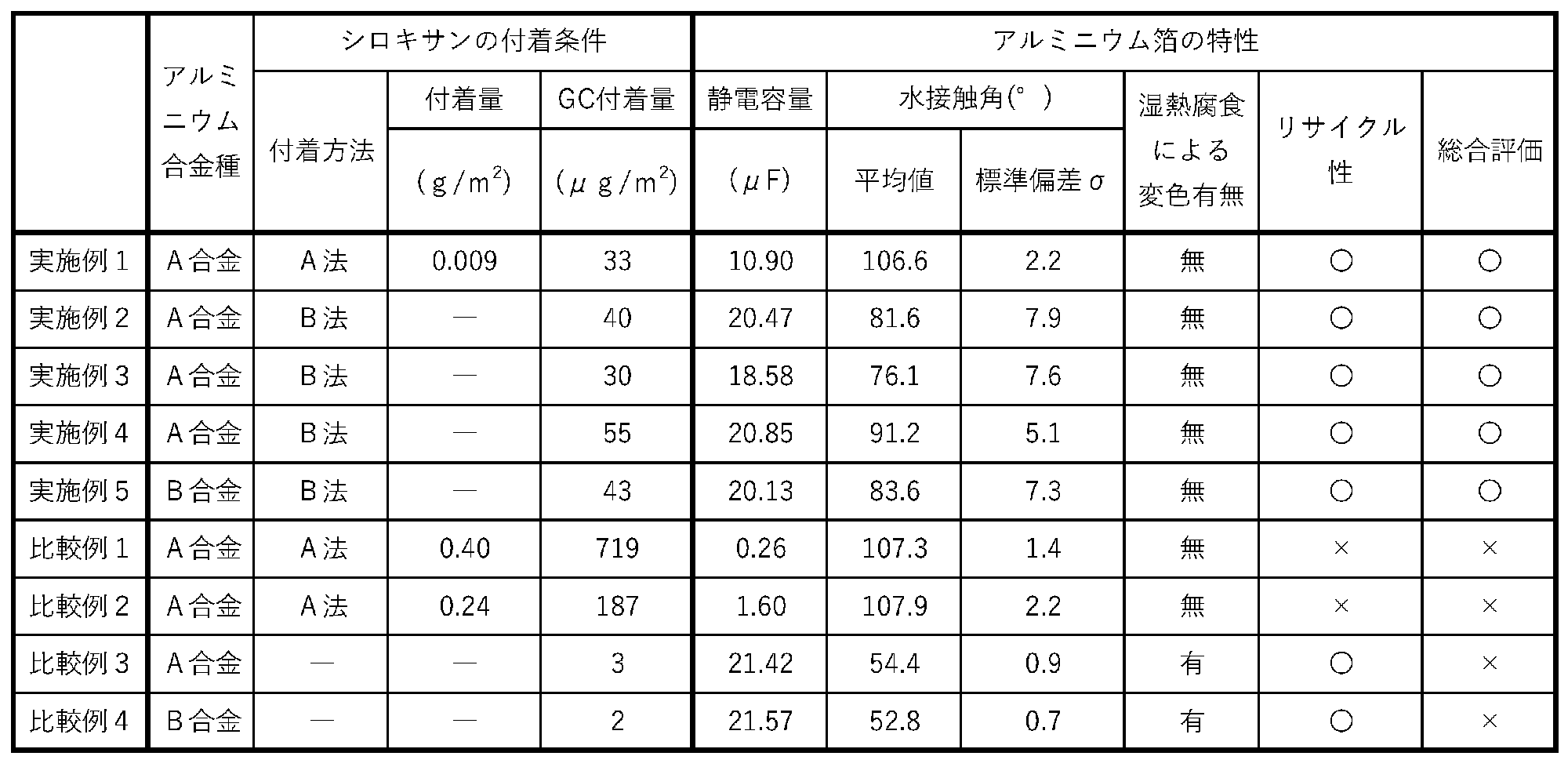
表2に示されるように、実施例1~5のアルミニウム箔は、「静電容量」、「水接触角」および「耐腐食性」の測定結果を総合的に評価すると、比較例1~4のアルミニウム箔よりも優れていることが判った。すなわち、実施例1~5のアルミニウム箔は、環状シロキサンが極少量付着しているのみにも拘らず、高い導電性と高い耐腐食性を有していることが判った。
2・・・基材アルミニウム箔
3・・・(環状)シロキサン
a・・・水滴a
b・・・水滴b
c・・・水滴c
d・・・水滴d
θa,θb,θc,θd・・・水接触角
Claims (6)
- 基材アルミニウム箔の少なくとも一方の表面にシロキサンが付着してなり、
ガスクロマトグラフィー分析で計測される前記シロキサンの付着量が10μg/m2以上100μg/m2未満であることを特徴とするアルミニウム箔。 - 前記シロキサンは環状シロキサンであることを特徴とする、請求項1に記載のアルミニウム箔。
- 前記シロキサンが付着した前記基材アルミニウム箔表面の水接触角の値の標準偏差が3.0°以上であることを特徴とする、請求項1又は2に記載のアルミニウム箔。
- 前記基材アルミニウム箔の厚みが5μm以上300μm以下である、請求項1から3のいずれか1項に記載のアルミニウム箔。
- 前記基材アルミニウム箔は、
0.00001質量%以上3.0質量%以下のマンガンと、
0.02質量%以上1.75質量%以下の鉄と、
0.00001質量%以上1.0質量%以下のシリコンと、
0.00001質量%以上0.3質量%以下の銅と、
0.00001質量%以上0.3質量%以下の亜鉛と、
0.00001質量%以上3.0質量%以下のマグネシウムとを含み、そして
残部がアルミニウムと不可避不純物とからなるアルミニウム合金箔である、請求項1から4のいずれか1項に記載のアルミニウム箔。 - シロキサンは、基材アルミニウム箔の表面にシリコーン樹脂を接触させ、離すことにより付着させることを特徴とする、請求項1から5のいずれか1項に記載のアルミニウム箔の製造方法。
Priority Applications (2)
| Application Number | Priority Date | Filing Date | Title |
|---|---|---|---|
| JP2023580153A JPWO2023153192A1 (ja) | 2022-02-08 | 2023-01-24 | |
| CN202380014439.7A CN118234891A (zh) | 2022-02-08 | 2023-01-24 | 铝箔及其制造方法 |
Applications Claiming Priority (2)
| Application Number | Priority Date | Filing Date | Title |
|---|---|---|---|
| JP2022-017632 | 2022-02-08 | ||
| JP2022017632 | 2022-02-08 |
Publications (1)
| Publication Number | Publication Date |
|---|---|
| WO2023153192A1 true WO2023153192A1 (ja) | 2023-08-17 |
Family
ID=87564116
Family Applications (1)
| Application Number | Title | Priority Date | Filing Date |
|---|---|---|---|
| PCT/JP2023/002007 Ceased WO2023153192A1 (ja) | 2022-02-08 | 2023-01-24 | アルミニウム箔およびその製造方法 |
Country Status (3)
| Country | Link |
|---|---|
| JP (1) | JPWO2023153192A1 (ja) |
| CN (1) | CN118234891A (ja) |
| WO (1) | WO2023153192A1 (ja) |
Citations (5)
| Publication number | Priority date | Publication date | Assignee | Title |
|---|---|---|---|---|
| JP2000239895A (ja) * | 1999-02-24 | 2000-09-05 | Sumitomo Light Metal Ind Ltd | 撥水性に優れたアルミニウム表面処理材及びその製造方法 |
| JP2006192744A (ja) * | 2005-01-14 | 2006-07-27 | Tokai Aluminum Foil Co Ltd | 易剥離性アルミニウム箔 |
| JP2017001166A (ja) * | 2015-06-15 | 2017-01-05 | 学校法人関東学院 | 撥水性面の形成方法及びその方法を用いて形成された撥水性面を備えた撥水性物品 |
| WO2017006804A1 (ja) * | 2015-07-09 | 2017-01-12 | 株式会社神戸製鋼所 | アルミニウム合金材の製造方法、アルミニウム合金材、及び接合体 |
| WO2017158989A1 (ja) * | 2016-03-16 | 2017-09-21 | 東洋アルミニウム株式会社 | 紫外線反射材用アルミニウム箔およびその製造方法 |
-
2023
- 2023-01-24 JP JP2023580153A patent/JPWO2023153192A1/ja active Pending
- 2023-01-24 CN CN202380014439.7A patent/CN118234891A/zh active Pending
- 2023-01-24 WO PCT/JP2023/002007 patent/WO2023153192A1/ja not_active Ceased
Patent Citations (5)
| Publication number | Priority date | Publication date | Assignee | Title |
|---|---|---|---|---|
| JP2000239895A (ja) * | 1999-02-24 | 2000-09-05 | Sumitomo Light Metal Ind Ltd | 撥水性に優れたアルミニウム表面処理材及びその製造方法 |
| JP2006192744A (ja) * | 2005-01-14 | 2006-07-27 | Tokai Aluminum Foil Co Ltd | 易剥離性アルミニウム箔 |
| JP2017001166A (ja) * | 2015-06-15 | 2017-01-05 | 学校法人関東学院 | 撥水性面の形成方法及びその方法を用いて形成された撥水性面を備えた撥水性物品 |
| WO2017006804A1 (ja) * | 2015-07-09 | 2017-01-12 | 株式会社神戸製鋼所 | アルミニウム合金材の製造方法、アルミニウム合金材、及び接合体 |
| WO2017158989A1 (ja) * | 2016-03-16 | 2017-09-21 | 東洋アルミニウム株式会社 | 紫外線反射材用アルミニウム箔およびその製造方法 |
Also Published As
| Publication number | Publication date |
|---|---|
| JPWO2023153192A1 (ja) | 2023-08-17 |
| CN118234891A (zh) | 2024-06-21 |
Similar Documents
| Publication | Publication Date | Title |
|---|---|---|
| CA1103529A (en) | Slurry coating process | |
| KR102557220B1 (ko) | 도금 강재 | |
| JP6762879B2 (ja) | ランタンを含む犠牲カソード防食を提供する皮膜を備える鋼板 | |
| CN102762750A (zh) | 适于热成型的带材、片材或坯料及其生产方法 | |
| WO2008056821A1 (en) | HOT-DIP Zn-Al ALLOY COATED STEEL SHEET AND PROCESS FOR THE PRODUCTION THEREOF | |
| WO2015098644A1 (ja) | アルミニウム電解コンデンサ用電極箔及びその製造方法 | |
| WO2007111354A1 (ja) | 容器用鋼板 | |
| TWI627291B (zh) | 基於銀合金的濺鍍靶 | |
| US7731831B2 (en) | Method for manufacturing a composite material including copper foil and support layer | |
| EP3561154B1 (en) | Plated steel sheet having multilayer structure and manufacturing method therefor | |
| CN114182188A (zh) | 一种热浸镀锌铝镁镀层钢板及其制备方法 | |
| JP5597980B2 (ja) | 熱間プレス部材およびその製造方法 | |
| Kuranishi et al. | Oxidation-resistant multilayer coatings using an anodic alumina layer as a diffusion barrier on γ-TiAl substrates | |
| KR101613354B1 (ko) | 도금 강판 및 그 제조방법 | |
| JP7475328B2 (ja) | アルミニウム合金箔、積層体、アルミニウム合金箔の製造方法、および積層体の製造方法 | |
| WO2023153192A1 (ja) | アルミニウム箔およびその製造方法 | |
| US20140352999A1 (en) | Iron bus bar having copper layer, and method for manufacturing same | |
| KR20180080852A (ko) | 금속 부식방지용 그래핀 적층체 및 그의 제조방법 | |
| JP2023507638A (ja) | 加工性及び耐食性に優れたアルミニウム系合金めっき鋼板及びこの製造方法 | |
| JPS6311420B2 (ja) | ||
| JP2004018906A (ja) | 表面処理アルミニウム材、その製造方法、アルミニウム成形体及びアルミニウム缶 | |
| WO2023181427A1 (ja) | 溶融Al-Zn系めっき鋼板及びその製造方法 | |
| CN113574191A (zh) | 铝合金箔、层叠体、铝合金箔的制造方法及层叠体的制造方法 | |
| JP2006190871A (ja) | 金属抵抗体材料、抵抗薄膜、スパッタリングターゲット、薄膜抵抗器およびその製造方法 | |
| JP2020029587A (ja) | Al合金箔及びその製造方法 |
Legal Events
| Date | Code | Title | Description |
|---|---|---|---|
| 121 | Ep: the epo has been informed by wipo that ep was designated in this application |
Ref document number: 23752660 Country of ref document: EP Kind code of ref document: A1 |
|
| WWE | Wipo information: entry into national phase |
Ref document number: 2023580153 Country of ref document: JP |
|
| WWE | Wipo information: entry into national phase |
Ref document number: 202380014439.7 Country of ref document: CN |
|
| WWE | Wipo information: entry into national phase |
Ref document number: 202417064299 Country of ref document: IN |
|
| NENP | Non-entry into the national phase |
Ref country code: DE |
|
| 122 | Ep: pct application non-entry in european phase |
Ref document number: 23752660 Country of ref document: EP Kind code of ref document: A1 |