WO2023140388A1 - 合金、合金部材および製造物 - Google Patents
合金、合金部材および製造物 Download PDFInfo
- Publication number
- WO2023140388A1 WO2023140388A1 PCT/JP2023/002126 JP2023002126W WO2023140388A1 WO 2023140388 A1 WO2023140388 A1 WO 2023140388A1 JP 2023002126 W JP2023002126 W JP 2023002126W WO 2023140388 A1 WO2023140388 A1 WO 2023140388A1
- Authority
- WO
- WIPO (PCT)
- Prior art keywords
- alloy
- magnesium
- element group
- lattice mismatch
- less
- Prior art date
- Legal status (The legal status is an assumption and is not a legal conclusion. Google has not performed a legal analysis and makes no representation as to the accuracy of the status listed.)
- Ceased
Links
Images



Classifications
-
- C—CHEMISTRY; METALLURGY
- C22—METALLURGY; FERROUS OR NON-FERROUS ALLOYS; TREATMENT OF ALLOYS OR NON-FERROUS METALS
- C22C—ALLOYS
- C22C30/00—Alloys containing less than 50% by weight of each constituent
-
- B—PERFORMING OPERATIONS; TRANSPORTING
- B22—CASTING; POWDER METALLURGY
- B22D—CASTING OF METALS; CASTING OF OTHER SUBSTANCES BY THE SAME PROCESSES OR DEVICES
- B22D17/00—Pressure die casting or injection die casting, i.e. casting in which the metal is forced into a mould under high pressure
- B22D17/20—Accessories: Details
- B22D17/22—Dies; Die plates; Die supports; Cooling equipment for dies; Accessories for loosening and ejecting castings from dies
- B22D17/2209—Selection of die materials
Definitions
- the present invention relates to alloys, alloy members, and products using the same that are resistant to alloys in a molten or plastic state, particularly magnesium alloys.
- JIS SKD61 for example, is used for molds used for magnesium alloy die casting and the like. Repeated casting with the same mold causes damage to the mold. The main cause of damage is erosion. Erosion is said to occur because the portion of the mold that contacts the molten magnesium alloy is alloyed and the melting point is lowered. When the erosion becomes severe, the eroded portion is repaired by overlaying with welding. As the repair material, an alloy having a high melting point and excellent resistance to creep at high temperatures is preferred. An example of this alloy is disclosed in US Pat.
- Patent Document 2 discloses a multi-component HEA containing at least one member of the group consisting of molybdenum, hafnium, tungsten, vanadium and chromium in addition to titanium, zirconium, niobium and tantalum. Patent Document 2 discloses that HEA is used as a biomedical metallic material.
- an object of the present invention is to provide a multicomponent alloy, an alloy member, and a product using the same having resistance to magnesium, particularly corrosion resistance and mechanical strength, during processing such as casting of a magnesium alloy.
- Non-Patent Documents 1 to 6 disclose technical documents necessary for supplementary explanation of the embodiments of the present invention.
- Non-Patent Document 1 describes a method of simulating the process of atomic motion based on the fundamental equations of quantum mechanics, that is, the calculation principle of the first-principles molecular dynamics method. The electrons and nuclei that make up the atoms in a material obey the laws of quantum mechanics, so this simulation can be used to assess the properties of the material.
- Non-Patent Document 2 mentions a method of calculating the diffusion coefficient by molecular dynamics simulation.
- Non-Patent Document 3 refers to a method of calculating adsorption energy by molecular dynamics simulation.
- Other Non-Patent Documents 4 to 6 will be referred to in the section of the mode for carrying out the invention which will be described later.
- a first invention for achieving the above-mentioned object is an alloy characterized by containing Fe, Cr and V as the first element group in an amount of 10 at % or more and 45 at % or less, respectively, having a lattice mismatch with respect to Mg of 13% or more, and dislocation transfer barrier energy of 300 kJ/mol or more.
- one or two or more selected from Mn, Co, Ni, Si, Ge, Ru and Pd may be included at 10 at % or more and 25 at % or less, respectively.
- the adsorption energy for Mg is 0.2 J/m 2 or less.
- the magnesium erosion resistance is excellent, and since the dislocation movement barrier energy is a predetermined value or more, an alloy having sufficient rigidity can be obtained.
- Such an effect can be obtained more reliably if the adsorption energy for magnesium is 0.2 J/m 2 or less.
- the second invention is an alloy member characterized by comprising, in at least a part thereof, an alloy containing Fe, Cr and V as the first element group in an amount of 10 at % or more and 45 at % or less, the balance being composed of unavoidable elements, a lattice mismatch with respect to Mg of 13% or more, and a dislocation transfer barrier energy of 300 kJ/mol or more.
- the alloy may further contain, as the second element group, one or more selected from Mn, Co, Ni, Si, Ge, Ru and Pd at 10 at % or more and 25 at % or less.
- the adsorption energy of the alloy to Mg is 0.2 J/m 2 or less.
- the magnesium erosion resistance is excellent, and since the dislocation movement barrier energy is a predetermined value or more, an alloy member having sufficient rigidity can be obtained.
- the adsorption energy to magnesium is 0.2 J/m 2 or less, the above effect can be obtained more reliably.
- a third invention is a product at least partly comprising the alloy member according to the second invention.
- the product is a mold for working with magnesium.
- the third invention it is possible to obtain a product that is excellent in magnesium erosion resistance and has sufficient rigidity.
- a mold for working magnesium that can suppress erosion loss in casting of magnesium or the like.
- the difficulty in adsorbing magnesium is expressed, for example, by the low adsorption energy (also called detachment energy) disclosed in Non-Patent Document 5, and it can be said that the smaller the adsorption energy, the more difficult it is to adsorb.
- the adsorption energy is obtained by calculation, and the calculation method will be described later.
- the adsorption energy is governed by the lattice constant and the lattice mismatch, which is the relative difference between them.
- the lattice constant and the lattice mismatch which is the relative difference between them, are more dominant factors than other factors (surface energy, cohesive energy, electronegativity). Therefore, in the present invention, attention is focused on the lattice mismatch, which is the relative difference in lattice constant.
- the inventors have found that magnesium resistance, particularly excellent erosion resistance, can be obtained by using a material having a large lattice mismatch with respect to magnesium.
- the lattice mismatch is also called lattice mismatch, and is obtained by calculation, the calculation method of which will be described later.
- Non-Patent Document 5 describes the bonding strength such as the interface strength between the wiring film and the barrier film of electronic components, and has aimed to reduce the lattice mismatch, ideally to zero. Contrary to these, the present invention obtains resistance to magnesium by increasing lattice mismatch, that is, the property of being difficult to react with molten magnesium, which is the opposite of the conventional idea.
- alloys are preferable because they are less likely to deform and less likely to break.
- the cycle time is shortened in order to increase productivity, the mold frequently repeats high and low temperatures, so thermal stress tends to concentrate. Therefore, it is preferable that the material has high mechanical strength.
- the deformation of metals such as alloys is represented by the movement of dislocations
- the difficulty of deformation that is, the mechanical strength of metals, is represented by the difficulty of movement of dislocations.
- Non-Patent Document 4 the mechanical strength of a metal is represented by the dislocation movement barrier energy, and it is determined that the higher the dislocation movement barrier energy required to move dislocations, the harder the metal to deform and the higher the mechanical strength. Therefore, in the present invention, attention is paid also to the movement barrier energy of dislocations. The details of the method of calculating the dislocation mobility barrier energy and the like will be described later.
- FIG. 1 is a diagram showing the relationship between lattice mismatch with magnesium (hereinafter sometimes simply referred to as lattice mismatch) and magnesium adsorption energy (hereinafter sometimes simply referred to as adsorption energy) for several metal elements. From FIG. 1, it can be seen that the adsorption energy decreases as the lattice mismatch increases. In particular, if the lattice mismatch is 13% or more, the adsorption energy will be sufficiently low that it will not drop any further. Therefore, the lattice mismatch is desirably 13% or more.
- the alloy according to this embodiment contains Fe, Cr and V as the first element group. Further, one or more selected from Mn, Co, Ni, Si, Ge, Ru and Pd may be included as the second element group.
- the second element group is included, the amount of each contained element of the second element group is 10 at % to 25 at %.
- B may be added so as to be 1 to 60 at %, preferably 10 to 45 at %, more preferably 14 to 40 at %. Moreover, it is preferably contained in an amount of 1.5 times or more, and more preferably contained in an amount of 2 times or more with respect to the amount of each element of the first element group or the first element group and the second element group.
- the range of element ratios of the first element group and the second element group is recognized as the content of the elements that make up the high entropy alloy.
- the alloy according to the present embodiment may contain unavoidable impurities as the balance in addition to the first element group and the second element group.
- unavoidable impurity elements such as C, N, and O may be contained at 500 ppm or less.
- the high entropy alloy referred to in this specification refers to an alloy containing 45 at % or less of each element at maximum, and more preferably 34 at % or less of each element at maximum.
- the alloy according to the present embodiment preferably has a small adsorption energy and a small diffusion coefficient in order to prevent magnesium from approaching and reacting with the surface or entering and reacting. For this reason, the lattice mismatch with Mg must be 13% or more.
- the deformation of a metal is represented by the movement of dislocations, and the resistance to deformation, that is, the mechanical strength of a metal is represented by the resistance to movement of dislocations.
- the mechanical strength of a metal is represented by the migration barrier energy of dislocations. If this is large, for example, the hardness described later increases.
- the alloy according to the present embodiment preferably has a dislocation mobility barrier energy (for example, a dislocation mobility barrier energy at 800° C.) of 300 kJ/mol or more.
- the dislocation migration barrier energy is one index representing the mechanical strength of the alloy according to this embodiment.
- the alloy according to this embodiment preferably has an adsorption energy (for example, adsorption energy at 800° C.) of 0.2 J/m 2 or less. It can be said that the adsorption energy is one indicator of magnesium resistance. Therefore, in the present embodiment, the adsorption energy is preferably 0.2 J/m 2 or less.
- the adsorption energy in this embodiment is more preferably 0.15 J/m 2 or less, more preferably 0.1 J/m 2 or less, still more preferably 0.08 J/m 2 or less.
- diffusion coefficient of magnesium It is important to improve resistance that dissolved magnesium does not enter and react from the surface. The ease with which magnesium penetrates can be evaluated by the diffusion coefficient that penetrates from the surface to the inside. It can be said that the diffusion coefficient is one indicator of magnesium tolerance. Details of the diffusion coefficient will be described later.
- the alloy according to the present embodiment preferably has a Vickers hardness (HV) of 430 or higher at room temperature. Hardness is one indicator of the mechanical strength of the alloy according to this embodiment.
- alloys according to this embodiment have a body-centered cubic (bcc) crystal structure.
- the crystal structure is observed by X-ray diffraction (XRD).
- XRD X-ray diffraction
- alloys having a single type of bcc structure alloys having a plurality of types of bcc structures may also be used.
- the alloy according to the present embodiment most preferably has a body-centered cubic lattice structure in its entirety, preferably at a volume ratio (content ratio) of 60% or more, more preferably at a volume ratio (content ratio) of 80% or more.
- Each item can be calculated using a molecular dynamics simulation as disclosed in Non-Patent Document 1 and the like.
- the lattice constant for calculating the lattice mismatch was defined as follows based on Non-Patent Document 5. That is, the mismatch between the short-side lattice constant a and the long-side lattice constant b of the face-centered rectangular lattice representing the plane with the highest atomic number density, that is, the close-packed crystal plane described below, is expressed in percent, and is defined as the short-side lattice mismatch ⁇ a and the long-side lattice mismatch ⁇ b. Since ⁇ a with a short interatomic distance is more important, ⁇ a is defined as lattice mismatch in this embodiment unless otherwise specified.
- the short side lattice mismatch ⁇ a with magnesium is as small as about 2% or less
- the long side lattice mismatch ⁇ b is as large as 16% or more, so the arithmetic mean of ⁇ a and ⁇ b was taken as the lattice mismatch.
- the close-packed crystal plane is the (110) plane
- the ratio of short side a to long side b is about 1: ⁇ 2.
- magnesium which is the counterpart material, has a hexagonal close-packed (hcp) crystal structure that is stable at room temperature and pressure, and when the temperature is raised, the body-centered cubic lattice becomes stable.
- the close-packed crystal plane of the hexagonal close-packed structure is the (0001) plane, and the ratio of short side a to long side b is about 1: ⁇ 3. It is known from Non-Patent Document 5 and others that crystal planes other than the close-packed crystal planes defined here have a weak contribution to the adsorption energy and therefore do not have much effect.
- the dislocation migration barrier energy is the barrier energy that the dislocation must overcome on the way from the state before migration to the state after migration, and is calculated by molecular dynamics simulation, for example, in the same manner as the method shown in Non-Patent Document 4.
- the barrier energy was calculated using self-developed molecular dynamics software, and in parallel with Dmol3 and Forcite in Materials Studio of Dassault Systèmes, and it was confirmed that the results of both were consistent.
- the adsorption energy represents the energy required to change the adsorption state to the detachment state, and is obtained by subtracting the energy in the adsorption state from the energy in the detachment state, as shown in Equation (3) in Non-Patent Document 3.
- Adsorption energies were calculated using self-developed molecular dynamics software, and in parallel with Dmol3 and Forcite of Materials Studio of Dassault Systèmes, and it was confirmed that the results of the two agree. The larger this value, the easier it is to adsorb.
- Equation 1 equation (A) and equation (B)), which is the following Einstein relational expression, as shown in Equation (2) of Non-Patent Document 2.
- Equation (B) is obtained by dividing the mean square displacement from t 0 to t + t 0 at the reference time set after sufficient relaxation by 6t, and actually converges in a finite time step, so the diffusion coefficient can be calculated without calculating to infinity.
- r i (t+t 0 ) ⁇ r i (t 0 ) can be calculated from the equation of motion.
- the diffusion coefficient of penetration in the direction perpendicular to the interface it can be calculated from the mean square displacement of the displacement in that direction. The larger the diffusion coefficient, the easier the penetration. In other words, it means that molten magnesium is likely to enter and react from the surface, in other words, it is likely to be eroded.
- each alloy according to this embodiment will be described.
- Table 2 shows the calculation results of lattice mismatch with Mg, dislocation migration barrier energy, and Mg adsorption energy for nine types of alloys according to this embodiment.
- each alloy was made into the alloy of the equielemental ratio. For example, when composed of three elements, each contains 33.3 at % of the constituent elements, when composed of five elements, each contains 20 at % of the constituent elements, and when composed of six elements, each contains 16.6 at %.
- KUMADAI magnesium alloy Mg-Al-Ca
- KUMADAI magnesium alloy is a registered trademark
- all the alloys according to the examples had a lattice mismatch with respect to Mg of 13% or more, a dislocation migration barrier energy of 300 kJ/mol or more, and a Mg adsorption energy of 0.2 J/m 2 or less (0.08 J/m 2 or less).
- the conventional SKD61 alloy had a small lattice mismatch with Mg of less than 13%, and the Mg adsorption energy exceeded 0.2 J/m 2 regardless of the presence or absence of nitriding treatment.
- the PdRuZn alloy which does not contain the first element group and is mainly composed of the second element group, has a lattice mismatch with Mg of 13% or more and satisfies the Mg adsorption energy of 0.2 J/m 2 or less (0.08 J/m 2 or less), but the dislocation migration barrier energy is less than 300 kJ/mol, and sufficient strength cannot be obtained.
- Table 4 shows the manufactured molded article.
- the composition of the shaped article shown in Table 4 is No. 1 and no. 2 contains 33.3 at % each of Fe, Cr and V, which are the first element group.
- No. 3 to No. 7, No. 14 and no. 15 contains 20 at % each of Fe, Cr and V of the first element group and 20 at % each of two selected from the second element group of Mn, Co, Ni and Si.
- No. 10 to No. 13 contains 14.3 at% each of Fe, Cr and V of the first element group, 14.3 at% each of two selected from the second element group of Mn, Co, Ni and Si, and 28.6 at% of B.
- No. 3 is shown in FIG.
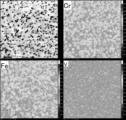
- the structure photograph and elemental mapping of No. 2 are shown in FIG. Thirteen micrographs and elemental mapping are shown.
- FIG. 3 in the shaped body of FeCrV composition, although some segregation was observed, all the elements were melted and alloyed.
- FIG. 4 in the FeCrVB 2 CoNi composition shaped body, the VB 2 added as a powder was not dissolved and scattered in the form of particles. There was also an overlap in the mapping of VB2 and Cr.
- No. An erosion test piece was prepared from the molded body composed of the alloy compositions of 2 and 8, and an erosion test against Mg was performed.
- the erosion test piece had a cylindrical shape with an outer diameter of ⁇ 13, an inner diameter of ⁇ 5.5 and a height of 3.5.
- a similar erosion test was performed on a erosion test piece (No. 0) in which the surface of SKD61, a hot work tool steel generally used for Mg die casting molds, was nitrided.
- SKD61 has a Rockwell hardness of 45 HRC, and the surface is nitrided to a thickness of 50 ⁇ m.
- the prepared erosion test piece was placed so as to be immersed in a 99% pure Mg alloy melted in a melting furnace. While stirring the Mg alloy using a stirring rod rotating at 116 rpm, the erosion test piece was immersed for 1 hour. The temperature of the molten metal was 936K-961K.
- Table 5 shows the results of the Mg corrosion test. As shown in Table 5, the erosion rate of No. 0.0393% in No. 2; 8, 0.1287%, and No. 8 in which the surface of SKD61 as a comparative example was subjected to nitriding treatment. 0 was 0.2778%. Based on the results of the erosion test, No. 0 compared to No. 2 containing Fe, Cr and V as the first element group in an amount of 10 at % or more and 45 at % or less, respectively; An alloy containing 10 at% or more and 45 at% or less of Fe, Cr, and V as the first element group as in No. 8 and further containing 0.5 at% or more and 60 at% or less of B has excellent Mg corrosion resistance.
- the alloy according to the present embodiment can be applied to an alloy member at least partially containing the alloy (for example, the surface of the base material) and to a product at least partially including the alloy member.
- it is preferably applied to molds used for processing magnesium.
- molding can be performed by irradiating an alloy powder having a desired element ratio with an electron beam or a laser beam to melt and solidify it.
- a magnesium die casting mold or the like by forming the alloy of this embodiment at least on the surface of the mold, it is possible to obtain a magnesium die casting mold capable of suppressing erosion caused by magnesium.
Landscapes
- Chemical & Material Sciences (AREA)
- Engineering & Computer Science (AREA)
- Materials Engineering (AREA)
- Mechanical Engineering (AREA)
- Metallurgy (AREA)
- Organic Chemistry (AREA)
- Molds, Cores, And Manufacturing Methods Thereof (AREA)
Priority Applications (3)
| Application Number | Priority Date | Filing Date | Title |
|---|---|---|---|
| EP23743380.0A EP4446449A4 (en) | 2022-01-24 | 2023-01-24 | Alloy, alloy member and product |
| US18/729,694 US20250207227A1 (en) | 2022-01-24 | 2023-01-24 | Alloy, alloy member and product |
| JP2023575330A JPWO2023140388A1 (https=) | 2022-01-24 | 2023-01-24 |
Applications Claiming Priority (2)
| Application Number | Priority Date | Filing Date | Title |
|---|---|---|---|
| JP2022008438 | 2022-01-24 | ||
| JP2022-008438 | 2022-01-24 |
Publications (1)
| Publication Number | Publication Date |
|---|---|
| WO2023140388A1 true WO2023140388A1 (ja) | 2023-07-27 |
Family
ID=87348368
Family Applications (1)
| Application Number | Title | Priority Date | Filing Date |
|---|---|---|---|
| PCT/JP2023/002126 Ceased WO2023140388A1 (ja) | 2022-01-24 | 2023-01-24 | 合金、合金部材および製造物 |
Country Status (4)
| Country | Link |
|---|---|
| US (1) | US20250207227A1 (https=) |
| EP (1) | EP4446449A4 (https=) |
| JP (1) | JPWO2023140388A1 (https=) |
| WO (1) | WO2023140388A1 (https=) |
Citations (9)
| Publication number | Priority date | Publication date | Assignee | Title |
|---|---|---|---|---|
| JPH01502680A (ja) | 1987-01-28 | 1989-09-14 | メタルウエルク、プランゼー、ゲゼルシヤフト、ミツト、ベシユレンクテル、ハフツング | 高融点金属からなる耐クリープ性合金及びその製法 |
| JP2006144098A (ja) * | 2004-11-24 | 2006-06-08 | Nachi Fujikoshi Corp | マグネシウム合金の射出成形機部品用材料 |
| JP2007063576A (ja) * | 2005-08-29 | 2007-03-15 | Hitachi Metals Ltd | 非鉄溶融金属用合金 |
| JP2018070949A (ja) | 2016-10-28 | 2018-05-10 | 国立大学法人大阪大学 | 多成分系からなる合金 |
| JP2019163535A (ja) * | 2018-03-20 | 2019-09-26 | ザ・スウォッチ・グループ・リサーチ・アンド・ディベロップメント・リミテッド | 外装部品のための高エントロピー合金 |
| CN111364040A (zh) * | 2020-05-13 | 2020-07-03 | 南京工程学院 | 一种高硬度高熵合金涂层及其制备方法和应用 |
| CN111411286A (zh) * | 2020-05-13 | 2020-07-14 | 南京工程学院 | 一种Laves相和Sigma相协同弥散强化的高熵合金涂层及其制备方法和应用 |
| JP2021500469A (ja) * | 2017-07-18 | 2021-01-07 | ポステク アカデミー−インダストリー ファウンデーション | 変態誘起塑性高エントロピー合金及びその製造方法 |
| CN114351028A (zh) * | 2021-12-03 | 2022-04-15 | 核工业西南物理研究院 | 一种(FeVCrMn)xTiy低活化高熵合金及其制备方法 |
Family Cites Families (5)
| Publication number | Priority date | Publication date | Assignee | Title |
|---|---|---|---|---|
| US20020159914A1 (en) * | 2000-11-07 | 2002-10-31 | Jien-Wei Yeh | High-entropy multielement alloys |
| US20110293742A1 (en) * | 2010-06-01 | 2011-12-01 | Industrial Technology Research Institute | Antibacterial alloy coating composition |
| KR101888299B1 (ko) * | 2016-03-21 | 2018-08-16 | 포항공과대학교 산학협력단 | 극저온용 고 엔트로피 합금 |
| CN111074133A (zh) * | 2020-01-07 | 2020-04-28 | 北京大学 | 一种低活化多主元固溶体合金及其制备方法 |
| CN113528985B (zh) * | 2021-07-30 | 2022-05-24 | 西安工业大学 | 一种微合金化的脆性耐蚀高熵非晶合金及其制备方法 |
-
2023
- 2023-01-24 EP EP23743380.0A patent/EP4446449A4/en active Pending
- 2023-01-24 US US18/729,694 patent/US20250207227A1/en active Pending
- 2023-01-24 WO PCT/JP2023/002126 patent/WO2023140388A1/ja not_active Ceased
- 2023-01-24 JP JP2023575330A patent/JPWO2023140388A1/ja active Pending
Patent Citations (9)
| Publication number | Priority date | Publication date | Assignee | Title |
|---|---|---|---|---|
| JPH01502680A (ja) | 1987-01-28 | 1989-09-14 | メタルウエルク、プランゼー、ゲゼルシヤフト、ミツト、ベシユレンクテル、ハフツング | 高融点金属からなる耐クリープ性合金及びその製法 |
| JP2006144098A (ja) * | 2004-11-24 | 2006-06-08 | Nachi Fujikoshi Corp | マグネシウム合金の射出成形機部品用材料 |
| JP2007063576A (ja) * | 2005-08-29 | 2007-03-15 | Hitachi Metals Ltd | 非鉄溶融金属用合金 |
| JP2018070949A (ja) | 2016-10-28 | 2018-05-10 | 国立大学法人大阪大学 | 多成分系からなる合金 |
| JP2021500469A (ja) * | 2017-07-18 | 2021-01-07 | ポステク アカデミー−インダストリー ファウンデーション | 変態誘起塑性高エントロピー合金及びその製造方法 |
| JP2019163535A (ja) * | 2018-03-20 | 2019-09-26 | ザ・スウォッチ・グループ・リサーチ・アンド・ディベロップメント・リミテッド | 外装部品のための高エントロピー合金 |
| CN111364040A (zh) * | 2020-05-13 | 2020-07-03 | 南京工程学院 | 一种高硬度高熵合金涂层及其制备方法和应用 |
| CN111411286A (zh) * | 2020-05-13 | 2020-07-14 | 南京工程学院 | 一种Laves相和Sigma相协同弥散强化的高熵合金涂层及其制备方法和应用 |
| CN114351028A (zh) * | 2021-12-03 | 2022-04-15 | 核工业西南物理研究院 | 一种(FeVCrMn)xTiy低活化高熵合金及其制备方法 |
Non-Patent Citations (7)
Also Published As
| Publication number | Publication date |
|---|---|
| US20250207227A1 (en) | 2025-06-26 |
| EP4446449A1 (en) | 2024-10-16 |
| EP4446449A4 (en) | 2025-10-22 |
| JPWO2023140388A1 (https=) | 2023-07-27 |
Similar Documents
| Publication | Publication Date | Title |
|---|---|---|
| Ladani et al. | Review of powder bed fusion additive manufacturing for metals | |
| Senkov et al. | Development and exploration of refractory high entropy alloys—A review | |
| KR102493233B1 (ko) | 적층 가공을 위한 고강인성 금속성 유리-기반 복합물 | |
| Liao et al. | Effect of Al concentration on the microstructural and mechanical properties of lightweight Ti60Alx (VCrNb) 40-x medium-entropy alloys | |
| US20190055627A1 (en) | Ni-Based Super Alloy Powder for Laminate Molding | |
| BR112018075617B1 (pt) | Aço para preparação de um molde para formação de plásticos, pó pré-formado para formar liga, seu uso, e artigo | |
| JP7521165B2 (ja) | 積層造形体からなるNi基合金部材、Ni基合金部材の製造方法、およびNi基合金部材を用いた製造物 | |
| ES2967967T3 (es) | Productos de aleación de titanio y métodos para fabricar los mismos | |
| CN113597476B (zh) | 一种Co基合金结构体的制造方法 | |
| JP3827149B2 (ja) | チタン合金部材およびその製造方法 | |
| Soundararajan et al. | Enhancement of tensile strength in AA 6061-T6 plates joined by gas tungsten arc welding using high entropy alloy filler sheet | |
| EP4257715A1 (en) | Formed part with high-temperature persistence and low anisotropy, forming method and forming powder | |
| Liu et al. | Role of Nano-TiC particles in enhancing the microstructure and wear resistance of IN718 superalloys fabricated by directed energy deposition | |
| Nyamuchiwa et al. | Precipitation Behaviour at the Interface of an Additively Manufactured M789–N709 Hybrid Alloy: K. Nyamuchiwa et al. | |
| JP2018508652A (ja) | 耐食性物品および製造方法 | |
| WO2023140388A1 (ja) | 合金、合金部材および製造物 | |
| Haq et al. | Effect of various thermal treatments and Cu contents on precipitation mechanism, martensitic growth, and cold workability of Ti50Ni50-xCux ternary shape memory alloys | |
| US10179943B2 (en) | Corrosion resistant article and methods of making | |
| Gondhalekar | Design and Development of Light Weight High Entropy Alloys | |
| Awotunde et al. | Influence of Ti/TiC interface and its site of formation on the properties of powder metallurgically fabricated Ti-based composites reinforced with carbonaceous materials: A review | |
| JP7334896B2 (ja) | 耐熱軽量高強度焼結体製造方法 | |
| CN107208192B (zh) | 包括钛基合金的涡轮发动机部件 | |
| Babalola et al. | Mechanical and tribological studies of sintered nickel-based ternary alloys | |
| JP2004083951A (ja) | 低熱膨張合金、低熱膨張部材およびそれらの製造方法 | |
| TWI776372B (zh) | 高硬度耐溫合金及其用途 |
Legal Events
| Date | Code | Title | Description |
|---|---|---|---|
| 121 | Ep: the epo has been informed by wipo that ep was designated in this application |
Ref document number: 23743380 Country of ref document: EP Kind code of ref document: A1 |
|
| WWE | Wipo information: entry into national phase |
Ref document number: 2023743380 Country of ref document: EP |
|
| ENP | Entry into the national phase |
Ref document number: 2023743380 Country of ref document: EP Effective date: 20240709 |
|
| ENP | Entry into the national phase |
Ref document number: 2023575330 Country of ref document: JP Kind code of ref document: A |
|
| NENP | Non-entry into the national phase |
Ref country code: DE |
|
| WWP | Wipo information: published in national office |
Ref document number: 18729694 Country of ref document: US |