WO2023136135A1 - 樹脂、硬化性樹脂組成物及び硬化膜 - Google Patents
樹脂、硬化性樹脂組成物及び硬化膜 Download PDFInfo
- Publication number
- WO2023136135A1 WO2023136135A1 PCT/JP2022/048177 JP2022048177W WO2023136135A1 WO 2023136135 A1 WO2023136135 A1 WO 2023136135A1 JP 2022048177 W JP2022048177 W JP 2022048177W WO 2023136135 A1 WO2023136135 A1 WO 2023136135A1
- Authority
- WO
- WIPO (PCT)
- Prior art keywords
- group
- structural unit
- resin composition
- resin
- curable resin
- Prior art date
- Legal status (The legal status is an assumption and is not a legal conclusion. Google has not performed a legal analysis and makes no representation as to the accuracy of the status listed.)
- Ceased
Links
Classifications
-
- C—CHEMISTRY; METALLURGY
- C08—ORGANIC MACROMOLECULAR COMPOUNDS; THEIR PREPARATION OR CHEMICAL WORKING-UP; COMPOSITIONS BASED THEREON
- C08F—MACROMOLECULAR COMPOUNDS OBTAINED BY REACTIONS ONLY INVOLVING CARBON-TO-CARBON UNSATURATED BONDS
- C08F226/00—Copolymers of compounds having one or more unsaturated aliphatic radicals, each having only one carbon-to-carbon double bond, and at least one being terminated by a single or double bond to nitrogen or by a heterocyclic ring containing nitrogen
- C08F226/06—Copolymers of compounds having one or more unsaturated aliphatic radicals, each having only one carbon-to-carbon double bond, and at least one being terminated by a single or double bond to nitrogen or by a heterocyclic ring containing nitrogen by a heterocyclic ring containing nitrogen
- C08F226/12—N-Vinylcarbazole
-
- C—CHEMISTRY; METALLURGY
- C08—ORGANIC MACROMOLECULAR COMPOUNDS; THEIR PREPARATION OR CHEMICAL WORKING-UP; COMPOSITIONS BASED THEREON
- C08F—MACROMOLECULAR COMPOUNDS OBTAINED BY REACTIONS ONLY INVOLVING CARBON-TO-CARBON UNSATURATED BONDS
- C08F220/00—Copolymers of compounds having one or more unsaturated aliphatic radicals, each having only one carbon-to-carbon double bond, and only one being terminated by only one carboxyl radical or a salt, anhydride ester, amide, imide or nitrile thereof
- C08F220/02—Monocarboxylic acids having less than ten carbon atoms; Derivatives thereof
- C08F220/04—Acids; Metal salts or ammonium salts thereof
- C08F220/06—Acrylic acid; Methacrylic acid; Metal salts or ammonium salts thereof
-
- C—CHEMISTRY; METALLURGY
- C08—ORGANIC MACROMOLECULAR COMPOUNDS; THEIR PREPARATION OR CHEMICAL WORKING-UP; COMPOSITIONS BASED THEREON
- C08F—MACROMOLECULAR COMPOUNDS OBTAINED BY REACTIONS ONLY INVOLVING CARBON-TO-CARBON UNSATURATED BONDS
- C08F220/00—Copolymers of compounds having one or more unsaturated aliphatic radicals, each having only one carbon-to-carbon double bond, and only one being terminated by only one carboxyl radical or a salt, anhydride ester, amide, imide or nitrile thereof
- C08F220/02—Monocarboxylic acids having less than ten carbon atoms; Derivatives thereof
- C08F220/10—Esters
- C08F220/26—Esters containing oxygen in addition to the carboxy oxygen
-
- C—CHEMISTRY; METALLURGY
- C08—ORGANIC MACROMOLECULAR COMPOUNDS; THEIR PREPARATION OR CHEMICAL WORKING-UP; COMPOSITIONS BASED THEREON
- C08F—MACROMOLECULAR COMPOUNDS OBTAINED BY REACTIONS ONLY INVOLVING CARBON-TO-CARBON UNSATURATED BONDS
- C08F222/00—Copolymers of compounds having one or more unsaturated aliphatic radicals, each having only one carbon-to-carbon double bond, and at least one being terminated by a carboxyl radical and containing at least one other carboxyl radical in the molecule; Salts, anhydrides, esters, amides, imides, or nitriles thereof
- C08F222/10—Esters
- C08F222/1006—Esters of polyhydric alcohols or polyhydric phenols
- C08F222/102—Esters of polyhydric alcohols or polyhydric phenols of dialcohols, e.g. ethylene glycol di(meth)acrylate or 1,4-butanediol dimethacrylate
-
- C—CHEMISTRY; METALLURGY
- C08—ORGANIC MACROMOLECULAR COMPOUNDS; THEIR PREPARATION OR CHEMICAL WORKING-UP; COMPOSITIONS BASED THEREON
- C08F—MACROMOLECULAR COMPOUNDS OBTAINED BY REACTIONS ONLY INVOLVING CARBON-TO-CARBON UNSATURATED BONDS
- C08F222/00—Copolymers of compounds having one or more unsaturated aliphatic radicals, each having only one carbon-to-carbon double bond, and at least one being terminated by a carboxyl radical and containing at least one other carboxyl radical in the molecule; Salts, anhydrides, esters, amides, imides, or nitriles thereof
- C08F222/10—Esters
- C08F222/12—Esters of phenols or saturated alcohols
- C08F222/20—Esters containing oxygen in addition to the carboxy oxygen
-
- C—CHEMISTRY; METALLURGY
- C08—ORGANIC MACROMOLECULAR COMPOUNDS; THEIR PREPARATION OR CHEMICAL WORKING-UP; COMPOSITIONS BASED THEREON
- C08F—MACROMOLECULAR COMPOUNDS OBTAINED BY REACTIONS ONLY INVOLVING CARBON-TO-CARBON UNSATURATED BONDS
- C08F226/00—Copolymers of compounds having one or more unsaturated aliphatic radicals, each having only one carbon-to-carbon double bond, and at least one being terminated by a single or double bond to nitrogen or by a heterocyclic ring containing nitrogen
- C08F226/06—Copolymers of compounds having one or more unsaturated aliphatic radicals, each having only one carbon-to-carbon double bond, and at least one being terminated by a single or double bond to nitrogen or by a heterocyclic ring containing nitrogen by a heterocyclic ring containing nitrogen
-
- C—CHEMISTRY; METALLURGY
- C08—ORGANIC MACROMOLECULAR COMPOUNDS; THEIR PREPARATION OR CHEMICAL WORKING-UP; COMPOSITIONS BASED THEREON
- C08F—MACROMOLECULAR COMPOUNDS OBTAINED BY REACTIONS ONLY INVOLVING CARBON-TO-CARBON UNSATURATED BONDS
- C08F271/00—Macromolecular compounds obtained by polymerising monomers on to polymers of nitrogen-containing monomers as defined in group C08F26/00
- C08F271/02—Macromolecular compounds obtained by polymerising monomers on to polymers of nitrogen-containing monomers as defined in group C08F26/00 on to polymers of monomers containing heterocyclic nitrogen
-
- C—CHEMISTRY; METALLURGY
- C08—ORGANIC MACROMOLECULAR COMPOUNDS; THEIR PREPARATION OR CHEMICAL WORKING-UP; COMPOSITIONS BASED THEREON
- C08F—MACROMOLECULAR COMPOUNDS OBTAINED BY REACTIONS ONLY INVOLVING CARBON-TO-CARBON UNSATURATED BONDS
- C08F290/00—Macromolecular compounds obtained by polymerising monomers on to polymers modified by introduction of aliphatic unsaturated end or side groups
- C08F290/08—Macromolecular compounds obtained by polymerising monomers on to polymers modified by introduction of aliphatic unsaturated end or side groups on to polymers modified by introduction of unsaturated side groups
- C08F290/12—Polymers provided for in subclasses C08C or C08F
-
- C—CHEMISTRY; METALLURGY
- C08—ORGANIC MACROMOLECULAR COMPOUNDS; THEIR PREPARATION OR CHEMICAL WORKING-UP; COMPOSITIONS BASED THEREON
- C08F—MACROMOLECULAR COMPOUNDS OBTAINED BY REACTIONS ONLY INVOLVING CARBON-TO-CARBON UNSATURATED BONDS
- C08F8/00—Chemical modification by after-treatment
- C08F8/14—Esterification
-
- C—CHEMISTRY; METALLURGY
- C08—ORGANIC MACROMOLECULAR COMPOUNDS; THEIR PREPARATION OR CHEMICAL WORKING-UP; COMPOSITIONS BASED THEREON
- C08G—MACROMOLECULAR COMPOUNDS OBTAINED OTHERWISE THAN BY REACTIONS ONLY INVOLVING UNSATURATED CARBON-TO-CARBON BONDS
- C08G61/00—Macromolecular compounds obtained by reactions forming a carbon-to-carbon link in the main chain of the macromolecule
- C08G61/12—Macromolecular compounds containing atoms other than carbon in the main chain of the macromolecule
-
- C—CHEMISTRY; METALLURGY
- C08—ORGANIC MACROMOLECULAR COMPOUNDS; THEIR PREPARATION OR CHEMICAL WORKING-UP; COMPOSITIONS BASED THEREON
- C08L—COMPOSITIONS OF MACROMOLECULAR COMPOUNDS
- C08L39/00—Compositions of homopolymers or copolymers of compounds having one or more unsaturated aliphatic radicals, each having only one carbon-to-carbon double bond, and at least one being terminated by a single or double bond to nitrogen or by a heterocyclic ring containing nitrogen; Compositions of derivatives of such polymers
- C08L39/04—Homopolymers or copolymers of monomers containing heterocyclic rings having nitrogen as ring member
-
- G—PHYSICS
- G03—PHOTOGRAPHY; CINEMATOGRAPHY; ANALOGOUS TECHNIQUES USING WAVES OTHER THAN OPTICAL WAVES; ELECTROGRAPHY; HOLOGRAPHY
- G03F—PHOTOMECHANICAL PRODUCTION OF TEXTURED OR PATTERNED SURFACES, e.g. FOR PRINTING, FOR PROCESSING OF SEMICONDUCTOR DEVICES; MATERIALS THEREFOR; ORIGINALS THEREFOR; APPARATUS SPECIALLY ADAPTED THEREFOR
- G03F7/00—Photomechanical, e.g. photolithographic, production of textured or patterned surfaces, e.g. printing surfaces; Materials therefor, e.g. comprising photoresists; Apparatus specially adapted therefor
- G03F7/004—Photosensitive materials
- G03F7/038—Macromolecular compounds which are rendered insoluble or differentially wettable
Definitions
- the present invention relates to a resin, a curable resin composition using the resin, and a cured film formed from the curable resin composition.
- Liquid crystal displays, plasma displays, paper-like displays, touch panels, etc. are known as display devices.
- a photosensitive resin composition to provide a spacer between a color filter and an array substrate that constitute a display device such as a liquid crystal display or a touch panel, in order to maintain a gap between the two substrates.
- Patent Document 1 describe a photosensitive resin composition containing, as a resin component, a reaction product obtained by polymerizing methyl methacrylate, ethyl methacrylate and methacrylic acid and then reacting glycidyl methacrylate.
- Patent Document 2 International Publication No. 2012/053377 describes a high refractive index resin composition for electronic devices containing a carbazole compound.
- the present invention was made based on the knowledge that a cured film formed by heating at a low temperature using a composition containing a resin having a structural unit having a heterocyclic ring such as a carbazole ring has poor solvent resistance. It is a thing.
- the present invention is a resin having a structural unit having a heterocyclic ring, and even when a composition containing the same is heated at a low temperature of 150 ° C. or less to form a cured film, it has excellent solvent resistance.
- An object of the present invention is to provide a novel resin from which a cured film can be obtained, a curable resin composition containing the resin, and a cured film formed from the resin composition. Moreover, the cured film obtained by the present invention has a high refractive index and excellent developability.
- the present invention includes the following.
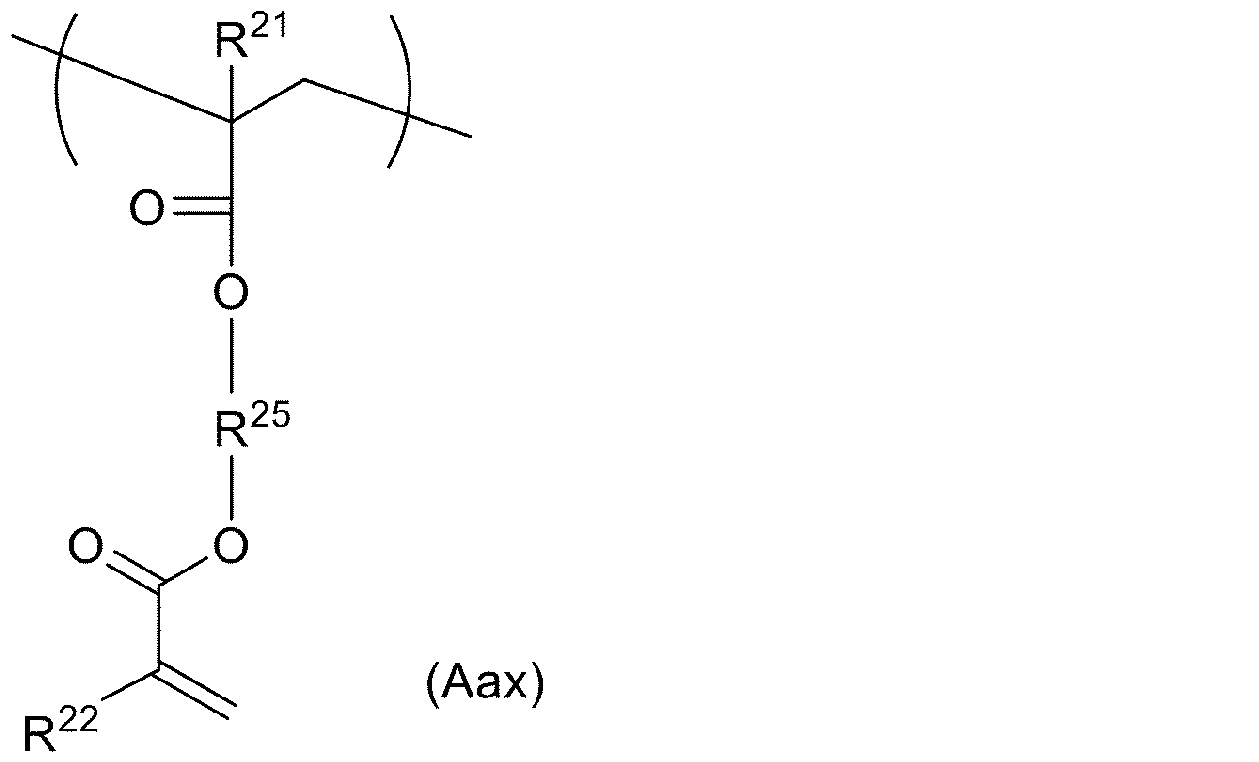
- a resin having a structural unit (Ad) having an optionally heterocyclic ring [2] The resin according to [1], wherein the structural unit (Aa) is represented by the following formula (Aax).
- R 21 and R 22 independently represent a hydrogen atom or a methyl group
- R 25 represents an alkanediyl group having 1 to 20 carbon atoms
- —CH 2 — contained in the alkanediyl group may be replaced with —O— or —CO—.
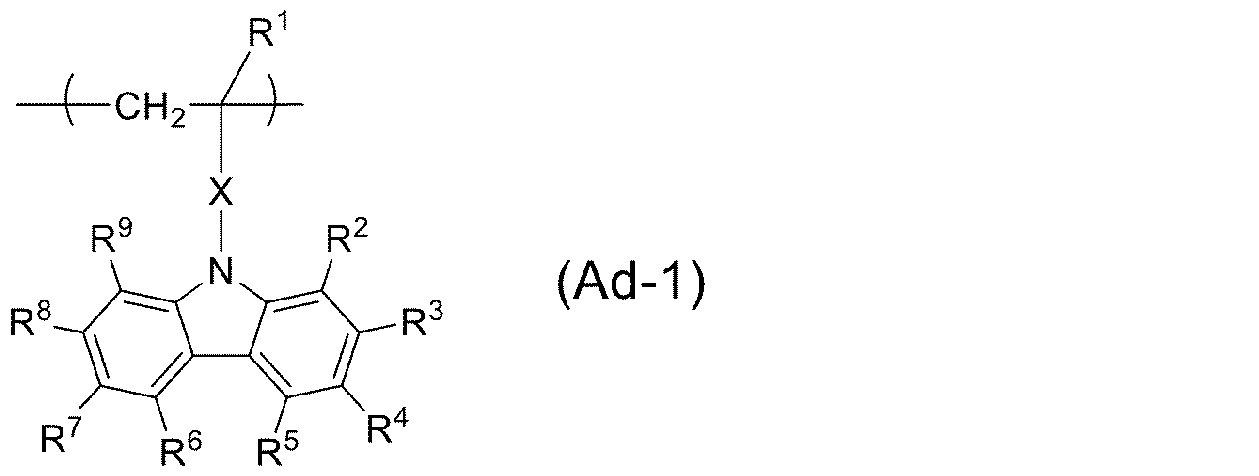
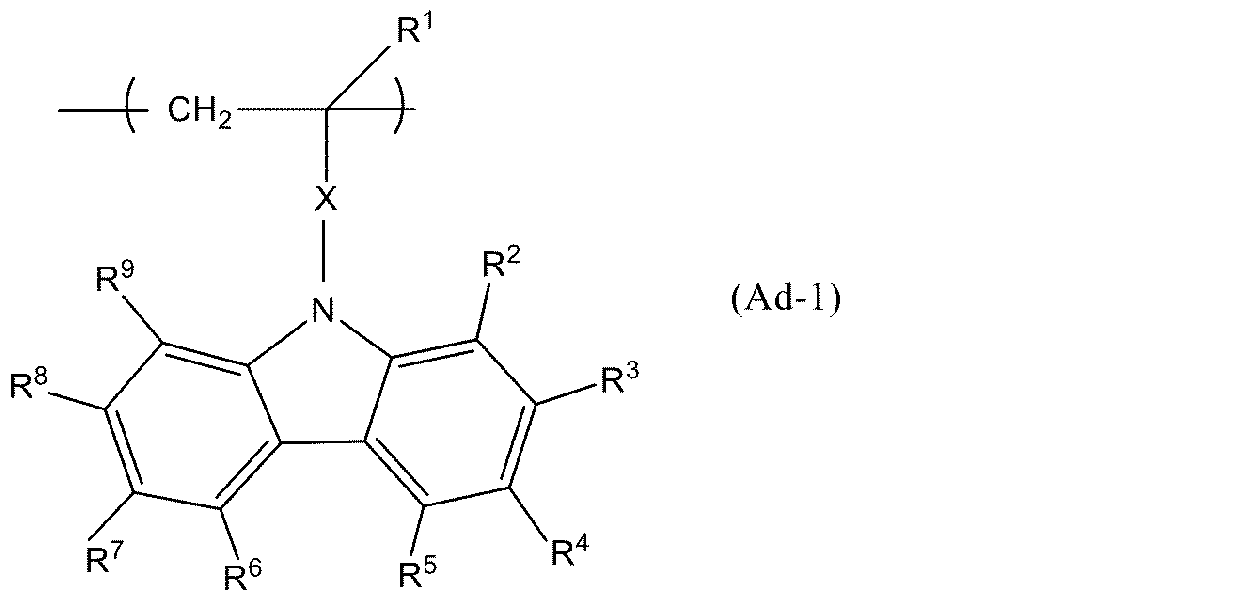
- Ad The resin according to [1] or [2], wherein the structural unit (Ad) is represented by the following formula (Ad-1).
- R 1 represents a hydrogen atom, a methyl group, or a hydroxymethyl group.
- R 2 to R 9 each independently represent a hydrogen atom, a halogen atom, a saturated hydrocarbon group having 1 to 20 carbon atoms or an aryl group having 6 to 20 carbon atoms, and the hydrogen atom contained in the saturated hydrocarbon group is , an alkoxy group or an aryl group.
- X represents a single bond, an alkanediyl group having 1 or more carbon atoms, or a linear or branched group represented by the following formula (V).
- a curable resin composition comprising the resin according to any one of [1] to [3], a polymerizable compound, and a polymerization initiator.
- the curable resin composition containing the resin of the present invention even when the cured film is formed by heating at a low temperature of 150°C or less, for example, a cured film with excellent solvent resistance can be formed.
- the resin of the present invention (hereinafter referred to as "resin (A)") is mainly used as a binder resin for curable resin compositions.
- the resin (A) comprises a structural unit (Aa) having an ⁇ , ⁇ -unsaturated carbonyl group, a structural unit (Ab) having an active methylene group or an active methine group, a structural unit (Ac) having an acid group, and a substituent. It is a resin having a structural unit (Ad) having a heterocyclic ring which may have
- the resin (A) is as follows.
- the resin (A) comprises a structural unit having an ⁇ , ⁇ -unsaturated carbonyl group (the structural unit is hereinafter referred to as a “structural unit (Aa)”) and a structural unit having an active methylene group or an active methine group ( Ab) (the structural unit is hereinafter referred to as the “structural unit (Ab)”) and a structural unit (Ac) having an acid group (the structural unit is hereinafter referred to as the “structural unit (Ac)”); , and a structural unit (Ad) having a heterocyclic ring which may have a substituent (the structural unit is hereinafter referred to as "structural unit (Ad)").
- the resin may further contain other repeating units (Ae). Further, the resin may contain two or more kinds of structural units (Aa), structural units (Ab), structural units (Ac) and structural units (Ad). From the viewpoint that the resin (A) is used as a binder resin for a curable resin composition, the resin (A) is preferably an alkali-soluble resin.
- Alkali solubility refers to the property of dissolving in a developer that is an aqueous solution of an alkaline compound. Since the resin (A) contains a polymer containing the structural unit (Ac), it easily imparts alkali solubility.
- a structural unit derived from (meth)acrylic acid and/or its ester is also referred to as a "(meth)acrylic structural unit”.
- (meth)acrylic acid shall mean “methacrylic acid and/or acrylic acid.”
- Structural unit (Aa) is a structural unit having an ⁇ , ⁇ -unsaturated carbonyl group.
- the resin (A) can improve the solvent resistance of the cured film obtained by heating at a low temperature.
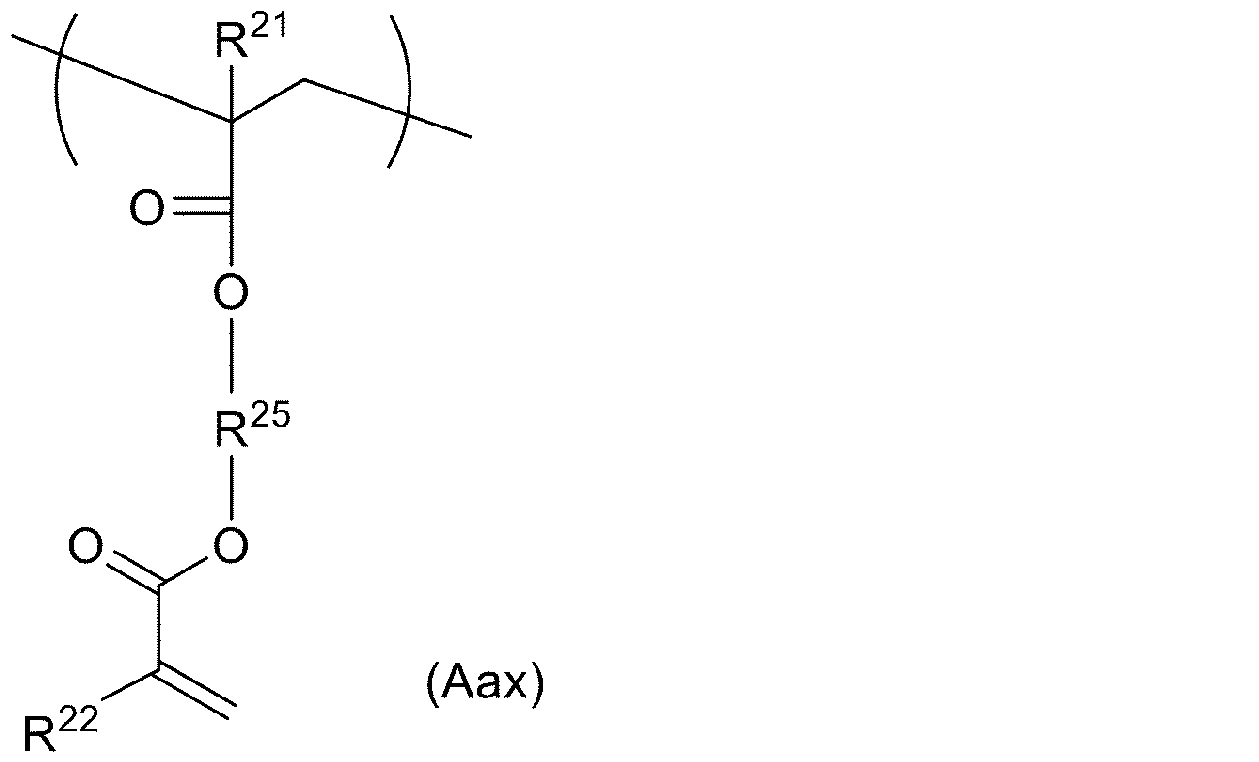
- structural units (Aa) include structural units represented by the following formula (Aax) (hereinafter, the structural units are referred to as “structural units (Aax)").
- R 21 and R 22 independently represent a hydrogen atom or a methyl group
- R 25 represents an alkanediyl group having 1 to 20 carbon atoms
- —CH 2 — contained in the alkanediyl group may be replaced with —O— or —CO—.
- the alkanediyl group includes a linear alkanediyl group, a branched alkanediyl group, a cyclic alkanediyl group, and a combination thereof.
- Linear alkanediyl groups include methylene, ethylene, propane-1,3-diyl, butane-1,4-diyl, pentane-1,5-diyl, and hexane-1,6-diyl groups. , heptane-1,7-diyl group, octane-1,8-diyl group, nonane-1,9-diyl group, decane-1,10-diyl group, undecane-1,11-diyl group, and dodecane-1 , 12-diyl group and the like.
- Branched alkanediyl groups include ethane-1,1-diyl, propane-1,1-diyl, propane-1,2-diyl, propane-2,2-diyl, and pentane-2. , 4-diyl group, 2-methylpropane-1,3-diyl group, 2-methylpropane-1,2-diyl group, pentane-1,4-diyl group, 2-methylbutane-1,4-diyl group, and 2-methyloctane-1,8-diyl group.
- Cyclic alkanediyl groups include cycloalkanediyl groups such as cyclobutane-1,3-diyl group, cyclopentane-1,3-diyl group, cyclohexane-1,4-diyl group and cyclooctane-1,5-diyl group. and polycyclic divalent alicyclic groups such as norbornane-1,4-diyl group, norbornane-2,5-diyl group, adamantane-1,5-diyl group and adamantane-2,6-diyl group.
- a hydrocarbon group is mentioned.
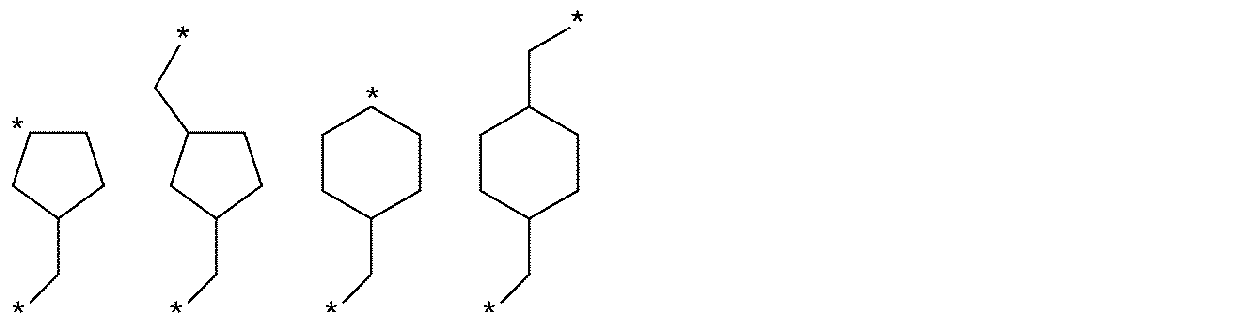
- Groups in which a linear alkanediyl group and a cyclic alkanediyl group are combined include, for example, the following groups (in the following formulas, * represents a bond).
- R 25 is preferably an alkanediyl group having 4 to 18 carbon atoms, more preferably an alkanediyl group having 4 to 10 carbon atoms, and an alkanediyl group having 6 to 9 carbon atoms. is more preferred.
- a preferred example of the structural unit (Aax) is a structural unit in which one —CH 2 — contained in the alkanediyl group in R 25 is replaced with —O—. Examples include formula (Aa-21) and formula (Aa-22) below.
- the structural unit (Aa) represented by formula (Aa-1) can be produced, for example, by referring to the method for producing chemical structure (1) described in JP-A-2015-172117.
- R 21 and R 22 each independently represent a hydrogen atom or a methyl group
- R 23 and R 24 independently represent an alkanediyl group.
- R 23 and R 24 is preferably an alkanediyl group having 1 to 8 carbon atoms and an alkanediyl group having 1 to 8 carbon atoms, and an alkanediyl group having 1 to 3 carbon atoms and A straight-chain alkanediyl group of 4 to 10 is more preferred, and a methylene group and a straight-chain alkanediyl group of 4 to 8 carbon atoms are even more preferred.
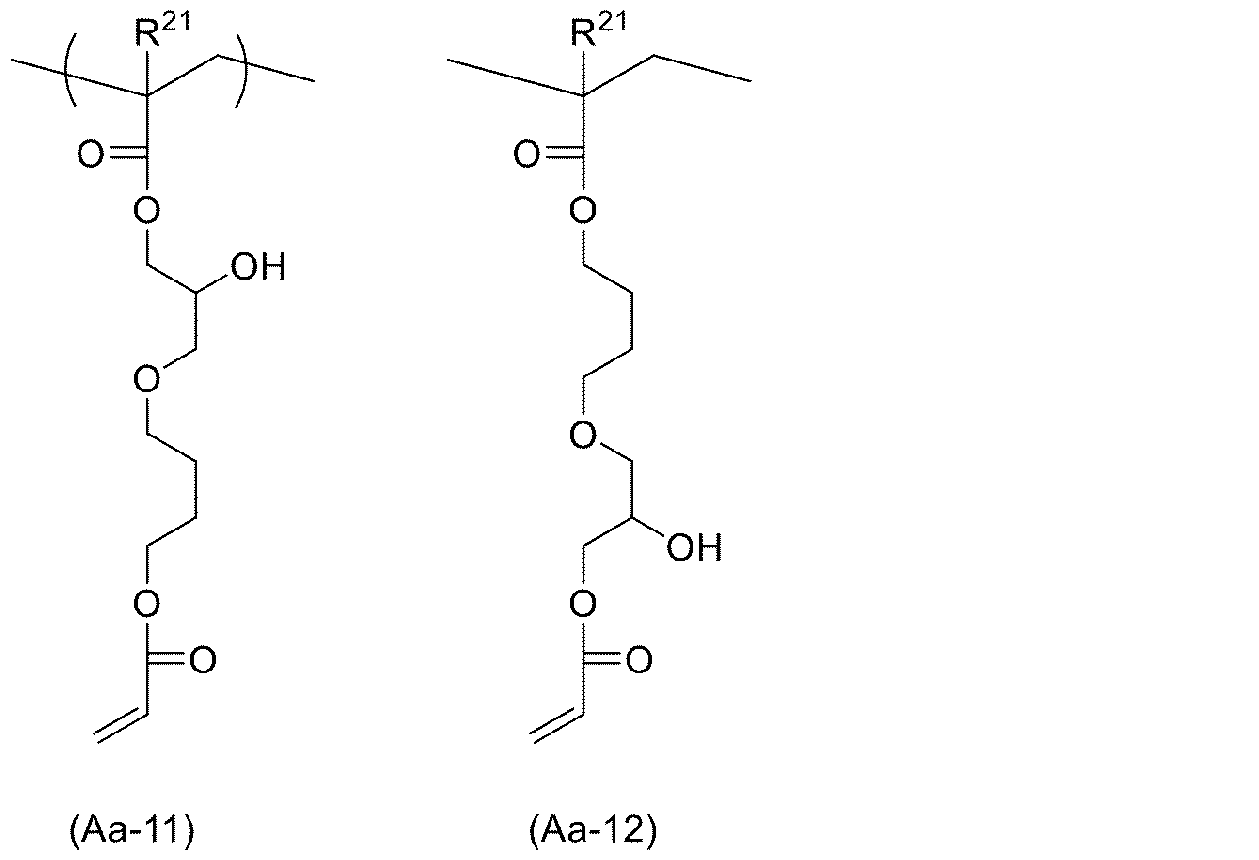
- a preferable example of the above formula (Aa-1) is represented by the following formula (Aa-11) or formula (Aa-12).
- the structural unit represented by the following formula (Aa-11) is represented by the formula (Aa-1), wherein R 23 is a methylene group, R 24 is a hexane-1,4-diyl group In the structural unit represented by 12), R 23 is a hexane-1,4-diyl group and R 24 is a methylene group in formula (Aa-1).
- the structural units (Aa) represented by formulas (Aa-21) and (Aa-22) are, for example, described in JP-A-2015-172117 with reference to the preparation method of chemical structure (1). can be made.
- R 27 and R 28 each independently represent a hydrogen atom or a methyl group
- R 26 represents an alkanediyl group having 1 to 4 carbon atoms
- Ring W represents a cycloalkanediyl group having 5 to 7 carbon atoms.
- R 26 is preferably a methylene group
- ring W is preferably a cyclohexanediyl group, more preferably a cyclohexane-1,4-diyl group.
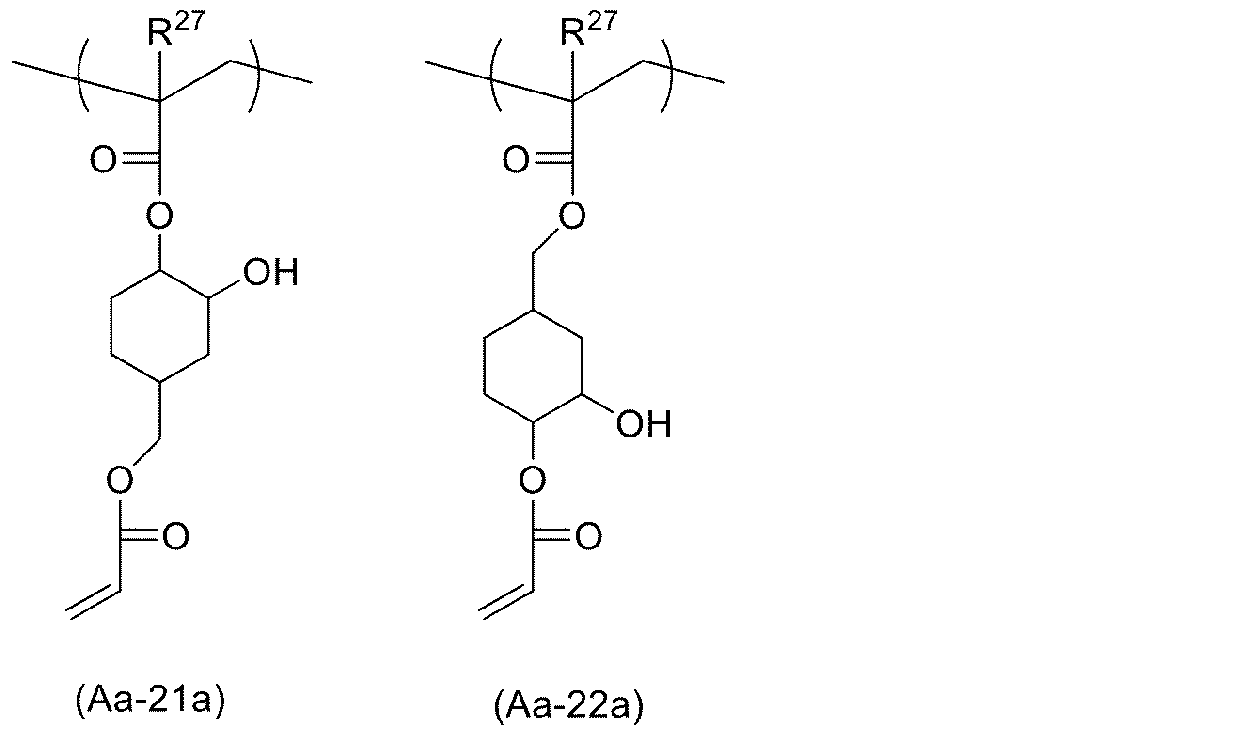
- a preferable example of the above formulas (Aa-21) and (Aa-22) is represented by the following formula (Aa-21a) or formula (Aa-22a).
- the structural unit (Aa) is typically a structural unit having a carboxyl group of the copolymer (hereinafter, the structural unit is referred to as a “structural unit (Aa′)”), and an ⁇ , ⁇ -unsaturated carbonyl It can be obtained by adding a compound having a group, or by reacting a structural unit having an epoxy group of a copolymer with (meth)acrylic acid.
- the structural unit (Aa') is one type of structural unit (Ac) described later.
- the compound having an ⁇ , ⁇ -unsaturated carbonyl group is not particularly limited as long as it can react with the carboxylic acid of the structural unit (Aa').
- Compounds having an ⁇ , ⁇ -unsaturated carbonyl group include (meth)acrylates (Aa'') having an epoxy group.
- (Meth)acrylate (Aa'') having an epoxy group has an aliphatic epoxy group.
- An aliphatic epoxy group refers to a group obtained by epoxidizing a linear or branched unsaturated aliphatic hydrocarbon.
- a structural unit represented by the formula (Aax) can be obtained.
- the structural unit (Aa) is obtained by reacting 5-hydroxypentyl acrylate glycidyl ether or 6-hydroxyhexyl acrylate glycidyl ether with a (meth)acrylic structural unit having a carboxy group or a (meth)acrylic structural unit having an epoxy group. It may be a structural unit obtained by
- a structural unit (Ab) is a structural unit derived from an unsaturated compound having an active methylene group or an active methine group.
- the structural unit can be obtained by obtaining a copolymer using an unsaturated compound having an active methylene group or an active methine group as a monomer. Alternatively, it can also be obtained by reacting another structural unit (Ab') with a compound (Ab'') having an active methylene group or an active methine group.
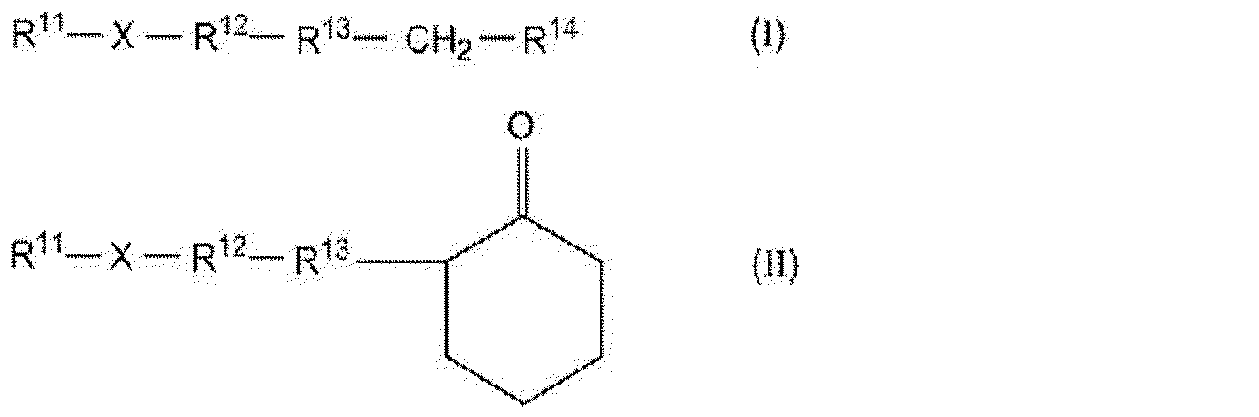
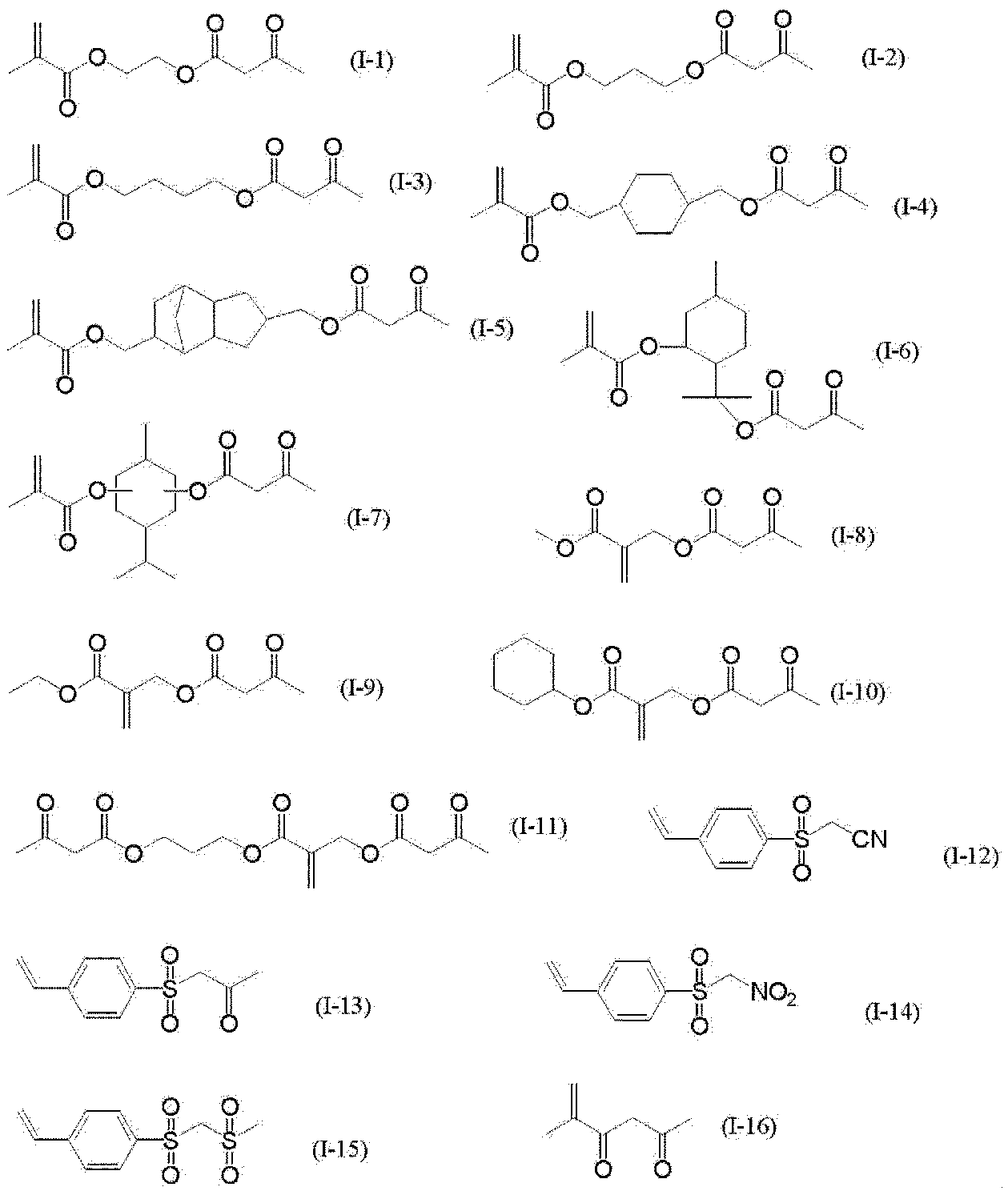
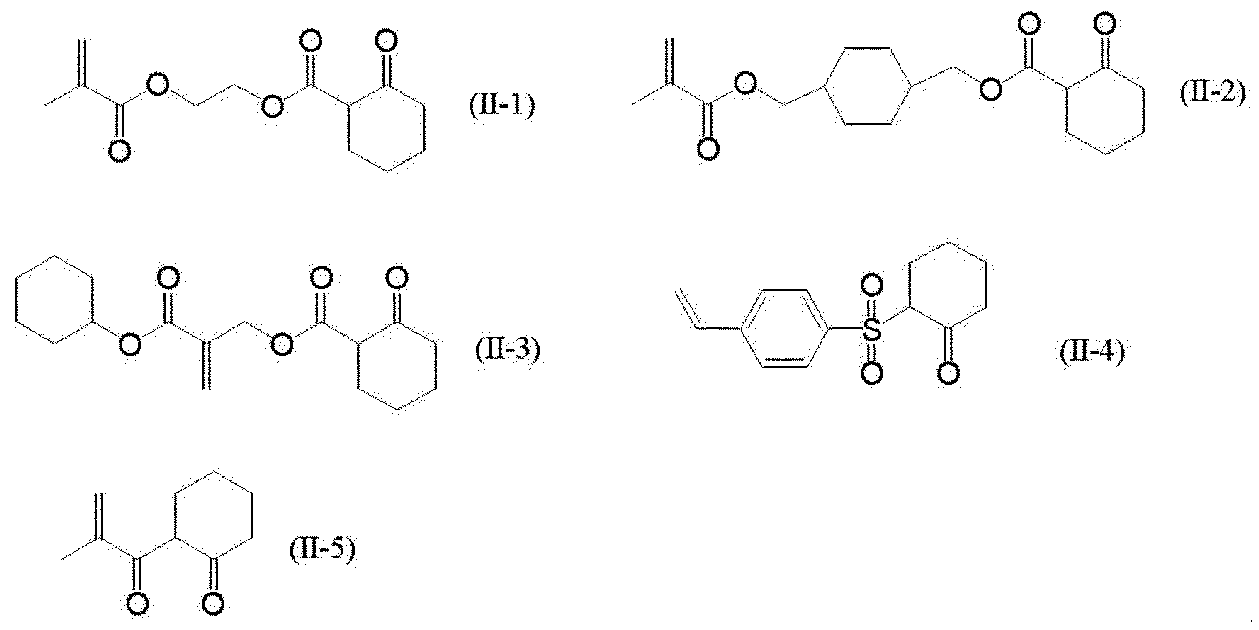
- Examples of unsaturated compounds having an active methylene group include compounds represented by formula (I).
- Examples of unsaturated compounds having an active methine group include compounds represented by formula (II).
- R 11 independently represents a hydrogen atom or a hydrocarbon group having 1 to 24 carbon atoms which may contain a heteroatom.
- R 12 represents a single bond or a divalent hydrocarbon group having 1 to 20 carbon atoms.
- R 13 represents a divalent group represented by any one of formulas (1-1) to (1-3).
- R 14 represents a group represented by any one of formulas (1-4) to (1-7).
- R 15 is a hydrocarbon group having 1 to 24 carbon atoms which may contain a heteroatom.
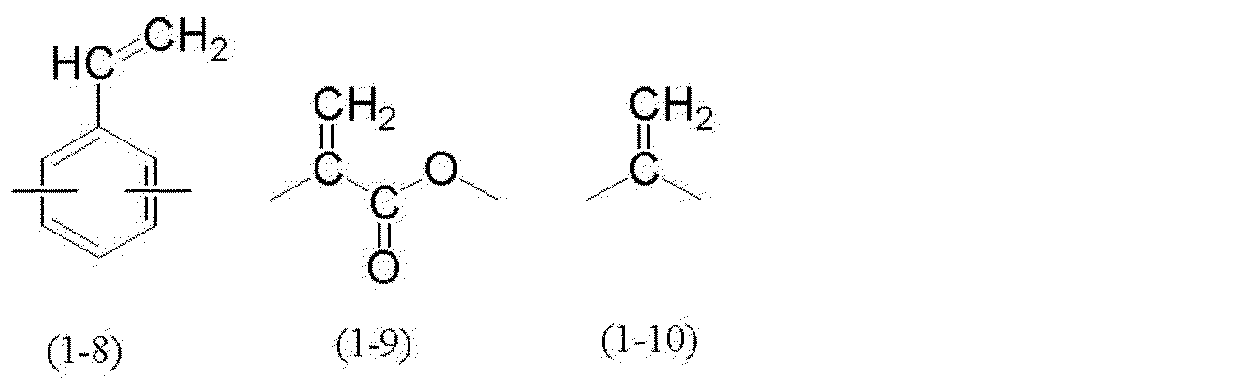
- X represents a divalent group represented by any one of formulas (1-8) to (1-10).
- R 11 is preferably a hydrogen atom, methyl group, ethyl group, propyl group, butyl group, hexyl group, cyclohexyl group, methoxy group, ethoxy group, propoxy group, hexoxy group, cyclohexoxy group or formula (1-11) to It is a group represented by formula (1-13), more preferably a hydrogen atom or a methyl group.
- R 15 is preferably a methyl group, an ethyl group, a propyl group, a butyl group, a hexyl group, a cyclohexyl group, a methoxy group, an ethoxy group, a propoxy group, a hexoxy group, a cyclohexoxy group or a group of formulas (1-11) to ( 1-13), more preferably a methyl group.
- R 12 is preferably a single bond, a methylene group, an ethylene group, a propylene group, a butylene group, a propylene group, a hexylene group, a cyclohexylene group, an octylene group, a decylene group or a dodecylene group, more preferably a single bond, methylene group and ethylene group.
- Formulas (I-1) to (I-7), (I-16), (II-1), (II-2) and (II-5) are compounds having CH 3 —CH 2 ⁇ CH— However, compounds in which CH 3 —CH 2 ⁇ CH— is replaced by H—CH 2 ⁇ CH— in these formulas can also be mentioned.
- the structural unit (Ab) preferably includes a structural unit represented by formula (Ab-1).
- R 33 represents a hydrogen atom or a methyl group
- R 34 represents a hydrogen atom or an alkyl group having 1 to 6 carbon atoms.
- the alkyl group having 1 to 6 carbon atoms in R 34 includes methyl group, ethyl group, n-propyl group, isopropyl group, n-butyl group, sec-butyl group, tert-butyl group, n-pentyl group and n- A hexyl group and the like can be mentioned.
- R 34 preferably includes a hydrogen atom and a methyl group.
- Examples of the compound leading to the structural unit represented by formula (Ab-1) include 2-(methacryloyloxy)ethylacetoacetate [compound represented by formula (I-1)].
- a structural unit (Ac) is a structural unit derived from an unsaturated compound having an acid group.
- a carboxyl group, a phenolic hydroxyl group, a sulfonic acid etc. are mentioned as an acid group.
- the carboxyl group may be anhydrided.
- the structural unit can be obtained by obtaining a copolymer using an unsaturated compound having an acid group as a monomer. It can also be obtained by reacting another structural unit (Ac') with a compound (Ac'') having an acid group.
- the unsaturated compound having an acid group is preferably unsaturated carboxylic acid or unsaturated carboxylic acid anhydride.
- unsaturated carboxylic acids or unsaturated carboxylic acid anhydrides include: (Meth)acrylic acid, crotonic acid, vinylbenzoic acid, methyl-5-norbornene-2,3-dicarboxylic acid, 5-carboxybicyclo[2.2.1]hept-2-ene, 5-carboxy-5-methyl Bicyclo[2.2.1]hept-2-ene, 5-carboxy-5-ethylbicyclo[2.2.1]hept-2-ene, 5-carboxy-6-methylbicyclo[2.2.1] hept-2-ene, 5-carboxy-6-ethylbicyclo[2.2.1]hept-2-ene, ⁇ -(hydroxymethyl)(meth)acrylic acid; Maleic acid, fumaric acid, citraconic acid, mesaconic acid, itaconic acid, 3-vinyl phthalic acid, 4-vinyl phthalic acid, 3,4,5,6-tetrahydrophthalic acid, 1,2,3,6-tetrahydr
- a structural unit (Ad) is a structural unit derived from an unsaturated compound having a heterocyclic ring.
- the heterocyclic ring may have a substituent.
- the structural unit can be obtained by obtaining a copolymer using an unsaturated compound having a heterocyclic ring as a monomer. Alternatively, it can be obtained by reacting another structural unit (Ad') with a heterocyclic ring-containing compound (Ad'').
- the structural unit (Ad) in the resin (A) By having the structural unit (Ad) in the resin (A), the refractive index of the resulting cured film can be improved. Refractive index can be measured, for example, by ellipsometry.
- a heterocyclic ring may be a monocyclic ring or a condensed ring.
- a heterocycle is an n-valent heterocycle, where the n-valence is, for example, monovalent or divalent.
- An n-valent heterocyclic ring is an n-valent heterocyclic ring in which the remaining atomic groups excluding n hydrogen atoms among the hydrogen atoms directly bonded to the carbon atoms or hetero atoms constituting the ring from the heterocyclic compound , the atomic group remaining after removing one hydrogen atom is a monovalent heterocyclic ring, and the atomic group remaining after removing two hydrogen atoms is a divalent heterocyclic ring.
- the number of carbon atoms in the heterocyclic group is usually 2-60, preferably 4-20, not including the number of carbon atoms in the substituents.
- the heterocyclic ring is preferably an aromatic heterocyclic compound from which n hydrogen atoms have been removed.
- aromatic heterocyclic compound means oxadiazole, thiadiazole, thiazole, oxazole, thiophene, pyrrole, phosphole, furan, pyridine, pyrazine, pyrimidine, triazine, pyridazine, quinoline, isoquinoline, carbazole, dibenzosilole, Compounds such as dibenzophosphole in which the heterocycle itself exhibits aromaticity, and compounds such as phenoxazine, phenothiazine, dibenzoborol, dibenzosilole, benzopyran, etc. in which the heterocycle itself does not exhibit aromaticity, means a fused compound.
- the heterocyclic ring is preferably a nitrogen-containing heterocyclic ring, more preferably carbazole.
- the structural unit (Ad) is preferably a structural unit represented by the following formula (Ad-1).
- R 1 represents a hydrogen atom, a methyl group, or a hydroxymethyl group.
- R 2 to R 9 each independently represent a hydrogen atom, a halogen atom, a saturated hydrocarbon group having 1 to 20 carbon atoms or an aryl group having 6 to 20 carbon atoms, and the hydrogen contained in the saturated hydrocarbon group Atoms may be substituted with alkoxy or aryl groups.
- X represents a single bond, an alkanediyl group having 1 or more carbon atoms, or a linear or branched group represented by the following formula (V).
- the resin (A) includes structural units other than the structural unit (Aa), the structural unit (Ab), the structural unit (Ac), and the structural unit (Ad) (hereinafter, the structural units are referred to as "structural units (Ae)”).
- the structural unit (Ae) is a structural unit different from the structural unit (Aa), the structural unit (Ab), the structural unit (Ac) and the structural unit (Ad).
- the structural unit (Ae) is polymerized with a monomer that leads to structural units other than the structural unit (Ae) (for example, the structural unit (Aa), the structural unit (Ab), the structural unit (Ac) and the structural unit (Ad)). Derived from possible monomers.
- Such monomers include: (Meth)acrylic acid alkyl esters such as methyl (meth)acrylate, ethyl (meth)acrylate, isopropyl (meth)acrylate, n-butyl (meth)acrylate, sec-butyl (meth)acrylate and tert-butyl (meth)acrylate ; acrylic acid alkyl esters such as methyl acrylate and isopropyl acrylate; cyclohexyl (meth) acrylate, 2-methylcyclohexyl (meth) acrylate, tricyclo[5.2.1.0 2,6 ]decan-8-yl (meth) acrylate (in the technical field, dicyclopenta It is called Nil (meth)acrylate.), Dicyclopentanyloxyethyl (meth)acrylate, Isobornyl (meth)acrylate, (meth)acrylic acid esters such as phenyl (meth)acrylate, benzyl
- (meth)acrylic acid esters, styrene compounds and dicarbonylimide compounds are preferable in terms of reactivity in copolymerization and heat resistance of the copolymer, and methyl (meth)acrylate and n-butyl (meth)acrylate.
- tricyclo[5.2.1.0 2,6 ]decan-8-yl (meth)acrylate, styrene, vinyltoluene, N-phenylmaleimide, N-cyclohexylmaleimide, N-benzylmaleimide, bicyclo[2.2. 1] Hept-2-ene, alkyl acrylate and the like are preferred from the viewpoint of reactivity in copolymerization and solubility in alkaline aqueous solution.
- the resin (A) may have two or more types of structural units (Ae).
- the resin (A) contains the structural unit (Aa), the structural unit (Ab), the structural unit (Ac), the structural unit (Ad), and further contains the structural unit (Ae). It is preferable that the ratio of each structural unit is in the following range as a mole fraction with respect to the total number of moles of the structural units constituting the copolymer. Structural unit (Aa): 1 to 50 mol%, Structural unit (Ab): 1 to 50 mol%, Structural unit (Ac): 1 to 50 mol%, Structural unit (Ad): 1 to 90 mol% Structural unit (Ae): 0 to 50 mol%.
- Copolymers containing each structural unit are described, for example, in the document "Experimental Methods for Polymer Synthesis” (written by Takayuki Otsu, Published by Kagaku Dojin, 1st Edition, 1st Edition, March 1, 1972). It can be manufactured according to the method and the reference described in the literature.
- Resin (A) can be produced, for example, through a two-stage process. Specifically, each compound leading to the structural unit (Ab), the structural unit (Ac) and the structural unit (Ad), and a predetermined amount of the compound leading to the structural unit (Aa′), a polymerization initiator and a solvent are added in a reaction vessel. By replacing oxygen with nitrogen, stirring, heating (for example, 50 to 140 ° C.), and keeping warm (for example, 1 to 10 hours) in the absence of oxygen, the structural unit (Aa'), A copolymer having units (Ab), structural units (Ac) and structural units (Ad) is obtained.
- (meth)acrylate (Aa'') having an epoxy group, a reaction catalyst, a polymerization inhibitor, etc. are placed in the reaction vessel, stirred and heated (for example, 60 to 130 ° C. ), and by keeping the temperature warm (for example, 1 to 10 hours), the structural unit (Aa) is introduced by reacting the structural unit (Aa′) with (meth)acrylate (Aa′′) having an epoxy group, and the structural unit A copolymer having (Aa), structural units (Ab), structural units (Ac) and structural units (Ad) is obtained.
- the obtained copolymer may be used as a solution after the reaction as it is, may be used as a concentrated or diluted solution, or may be taken out as a solid by a method such as reprecipitation and dissolved again in a solvent. can be used as
- each compound leading to the structural unit (Ab), the structural unit (Ac) and the structural unit (Ad) and the structural unit (Aa') are The structural unit (Ae) may be introduced together with the lead compound.
- the structural unit (Aa) when the structural unit (Ac) has a carboxy group, the structural unit (Aa) can be obtained by reacting the structural unit (Ac) with a (meth)acrylate (Aa'') having an epoxy group.
- the polystyrene equivalent weight average molecular weight of the resin (A) is preferably 3,000 to 100,000, more preferably 5,000 to 50,000, still more preferably 10,000 to 50,000.
- a curable resin composition containing a resin (A) having a weight-average molecular weight within the above range tends to have good coatability when applied, is less prone to film thinning during development, and is unremovable during development. It tends to be easy to remove the hardened portion.
- the dispersity [weight average molecular weight (Mw)/number average molecular weight (Mn)] of the resin (A) is preferably 1.1 to 6.0, more preferably 1.2 to 4.0. When the degree of dispersion is within the above range, the curable resin composition containing this as a binder resin tends to have excellent developability, which is preferable.
- the acid value of resin (A) is preferably 70-150 mg-KOH/g, more preferably 75-135 mg-KOH/g. As used herein, the acid value is a value measured according to JIS K 2501-2003.
- the curable resin composition of the present invention contains a resin (A), a polymerizable compound and a polymerization initiator.
- the resin composition of the present invention may further contain a solvent.
- the polymerizable compound, polymerization initiator and solvent in the curable resin composition of the present invention are referred to as polymerizable compound (B), polymerization initiator (C) and solvent (D), respectively.
- Resin (A) Since the curable resin composition of the present invention contains the resin (A), a cured film having excellent solvent resistance can be obtained.
- the cured film formed from the curable resin composition containing the resin (A) has a temperature of 150° C. or less, 130° C. or less, or Excellent solvent resistance can be exhibited even at 100° or less.
- the temperature of the heating step is, for example, 80° or higher.
- the content of the resin (A) is preferably 5 to 90% by mass, more preferably 10 to 70% by mass relative to the solid content in the curable resin composition. % by mass.
- the solid content refers to the amount obtained by removing the content of the solvent from the total amount of the curable resin composition.
- the total amount of solids and the content of each component relative thereto can be measured by known analysis means such as liquid chromatography or gas chromatography.
- an acrylic binder resin that is commonly used in this field may be used in combination as long as it does not impair the effects of the present invention.
- the polymerizable compound (B) is not particularly limited as long as it is a compound that can be polymerized by active radicals generated from the polymerization initiator (D) by light irradiation or the like.
- Examples of the polymerizable compound (B) include compounds having an ethylenically unsaturated bond, monofunctional monomers having one functional group having an ethylenically unsaturated bond, and bifunctional monomers having two such functional groups. , and other polyfunctional monomers having three or more of the functional groups.
- monofunctional monomers include nonylphenyl carbitol (meth)acrylate, 2-hydroxy-3-phenoxypropyl (meth)acrylate, 2-ethylhexylcarbitol (meth)acrylate, and 2-hydroxyethyl (meth)acrylate. , N-vinylpyrrolidone, and the like.
- bifunctional monomer examples include 1,6-hexanediol di(meth)acrylate, ethylene glycol di(meth)acrylate, neopentyl glycol di(meth)acrylate, triethylene glycol di(meth)acrylate, bisphenol A bis(acryloyloxyethyl) ether, 3-methylpentanediol di(meth)acrylate and the like.
- polyfunctional monomer examples include trimethylolpropane tri(meth)acrylate, pentaerythritol tri(meth)acrylate, pentaerythritol tetra(meth)acrylate, dipentaerythritol penta(meth)acrylate, dipentaerythritol hexa(meth) ) acrylate, reaction product of pentaerythritol tri(meth)acrylate and acid anhydride, reaction product of dipentaerythritol penta(meth)acrylate and acid anhydride, and the like.
- bifunctional monomers and polyfunctional monomers are preferably used.
- polymerizable compounds (B) may be used alone or in combination of two or more.
- the content of the polymerizable compound (B) is preferably 1 to 70% by mass, more preferably 5 to 60% by mass, based on the total amount of the resin (A) and the polymerizable compound (B). is.
- the content of the polymerizable compound (B) is within the above range, the cured film obtained by curing the curable resin composition tends to have good strength, smoothness and solvent resistance, which is preferable.
- the polymerization initiator (C) is not particularly limited as long as it is a compound capable of initiating polymerization by generating active radicals, acids, etc. by the action of light or heat, and known polymerization initiators can be used.
- Preferred polymerization initiators (C) are O-acyloxime compounds, alkylphenone compounds, triazine compounds, acylphosphine oxide compounds and biimidazole compounds.
- O-acyloxime compounds examples include N-benzoyloxy-1-(4-phenylsulfanylphenyl)butan-1-one-2-imine, N-benzoyloxy-1-(4-phenylsulfanylphenyl)octane, -1-one-2-imine, N-benzoyloxy-1-(4-phenylsulfanylphenyl)-3-cyclopentylpropan-1-one-2-imine, N-acetyloxy-1-(4-phenylsulfanylphenyl )-O-acyloxime compounds having a diphenylsulfide skeleton such as 3-cyclohexylpropan-1-one-2-imine; N-acetoxy-1-[9-ethyl-6-(2-methylbenzoyl)-9H-carbazole -3-yl]ethan-1-imine, N-acetoxy-1-[9-ethyl-6- ⁇ 2-methyl-4-(
- O-acyloxime compounds include N-benzoyloxy-1-(4-phenylsulfanylphenyl)octan-1-one-2-imine, N-acetyloxy-1-(4-phenylsulfanylphenyl)-3- Cyclohexylpropan-1-one-2-imine, N-acetoxy-1-[9-ethyl-6- ⁇ 2-methyl-4-(3,3-dimethyl-2,4-dioxacyclopentanylmethyloxy) benzoyl ⁇ -9H-carbazol-3-yl]ethan-1-imine and 1-[7-(2-methylbenzoyl)-9,9-dipropyl-9H-fluoren-2-yl]ethanone O-acetyloxime At least one selected from the group is preferable, and an O-acyloxime compound different from an O-acyloxime compound having a carbazole ring to which a nitro group is bonded is preferable.
- alkylphenone compounds examples include 2-methyl-2-morpholino-1-(4-methylsulfanylphenyl)propan-1-one, 2-dimethylamino-1-(4-morpholinophenyl)-2-benzylbutane, -1-one, 2-(dimethylamino)-2-[(4-methylphenyl)methyl]-1-[4-(4-morpholinyl)phenyl]butan-1-one, 2-hydroxy-2-methyl- 1-phenylpropan-1-one, 2-hydroxy-2-methyl-1-[4-(2-hydroxyethoxy)phenyl]propan-1-one, 1-hydroxycyclohexylphenyl ketone (Omnirad® 184, former Irgacure® 184), oligomers of 2-hydroxy-2-methyl-1-(4-isopropenylphenyl)propan-1-one, ⁇ , ⁇ -diethoxyacetophenone, benzyl dimethyl ketal (Omnirad® 184
- triazine compound examples include 2,4-bis(trichloromethyl)-6-(4-methoxyphenyl)-1,3,5-triazine, 2,4-bis(trichloromethyl)-6-(4- methoxynaphthyl)-1,3,5-triazine, 2,4-bis(trichloromethyl)-6-piperonyl-1,3,5-triazine, 2,4-bis(trichloromethyl)-6-(4-methoxy styryl)-1,3,5-triazine, 2,4-bis(trichloromethyl)-6-[2-(5-methylfuran-2-yl)ethenyl]-1,3,5-triazine, 2,4 -bis(trichloromethyl)-6-[2-(furan-2-yl)ethenyl]-1,3,5-triazine, 2,4-bis(trichloromethyl)-6-[2-(furan-2-yl)ethenyl]-1,3,
- acylphosphine oxide compound examples include 2,4,6-trimethylbenzoyldiphenylphosphine oxide.
- Commercially available products such as Irgacure (registered trademark) 819 (manufactured by BASF) may also be used.
- biimidazole compound examples include 2,2'-bis(2-chlorophenyl)-4,4',5,5'-tetraphenylbiimidazole, 2,2'-bis(2,3-dichlorophenyl)- 4,4',5,5'-tetraphenylbiimidazole (see, for example, JP-A-6-75372 and JP-A-6-75373), 2,2'-bis(2-chlorophenyl)-4 ,4′,5,5′-tetraphenylbiimidazole, 2,2′-bis(2-chlorophenyl)-4,4′,5,5′-tetra(alkoxyphenyl)biimidazole, 2,2′-bis (2-chlorophenyl)-4,4′,5,5′-tetra(dialkoxyphenyl)biimidazole, 2,2′-bis(2-chlorophenyl)-4,4′,5,5′-tetra(triphen
- Polymerization initiators that generate acids include, for example, 4-hydroxyphenyldimethylsulfonium p-toluenesulfonate, 4-hydroxyphenyldimethylsulfonium hexafluoroantimonate, 4-acetoxyphenyldimethylsulfonium p-toluenesulfonate, 4-acetoxy Onium salts such as phenyl methyl benzylsulfonium hexafluoroantimonate, triphenylsulfonium p-toluenesulfonate, triphenylsulfonium hexafluoroantimonate, diphenyliodonium p-toluenesulfonate, diphenyliodonium hexafluoroantimonate, and nitrobenzyl tosylates, benzoin tosylates and the like.
- a polymerization initiator or the like commonly used in this field can be used in combination, and examples of the polymerization initiator include benzoin-based compounds, benzophenone-based compounds, thioxanthone-based compounds, and anthracene-based compounds. More specifically, the following compounds can be mentioned, and these can be used alone or in combination of two or more.
- benzoin-based compounds examples include benzoin, benzoin methyl ether, benzoin ethyl ether, benzoin isopropyl ether, and benzoin isobutyl ether.
- benzophenone compounds examples include benzophenone, methyl o-benzoylbenzoate, 4-phenylbenzophenone, 4-benzoyl-4'-methyldiphenylsulfide, 3,3',4,4'-tetra(tert-butylperoxy carbonyl)benzophenone, 2,4,6-trimethylbenzophenone, and the like.
- thioxanthone-based compounds examples include 2-isopropylthioxanthone, 4-isopropylthioxanthone, 2,4-diethylthioxanthone, 2,4-dichlorothioxanthone, and 1-chloro-4-propoxythioxanthone.
- anthracene-based compounds examples include 9,10-dimethoxyanthracene, 2-ethyl-9,10-dimethoxyanthracene, 9,10-diethoxyanthracene, and 2-ethyl-9,10-diethoxyanthracene.
- 10-butyl-2-chloroacridone, 2-ethylanthraquinone, benzyl, 9,10-phenanthrenequinone, camphorquinone, methyl phenylglyoxylate, titanocene compounds and the like are exemplified as polymerization initiators.
- polymerization initiator having a group capable of causing chain transfer As the polymerization initiator having a group capable of causing chain transfer, the polymerization initiator described in JP-T-2002-544205 can be used. Examples of the polymerization initiator having a group capable of causing chain transfer include polymerization initiators represented by formulas (P5) to (P10).
- the polymerization initiator having a group capable of causing chain transfer can also be used as the constituent component (Ae) of the resin (A). Then, the obtained resin (A) can be used as a binder resin for the curable resin composition of the present invention.
- a polymerization initiation aid can also be used in combination with the polymerization initiator.
- the polymerization initiation aid an amine compound and the following carboxylic acid compounds are preferred, and the amine compound is more preferably an aromatic amine compound.
- polymerization initiation aids include aliphatic amine compounds such as triethanolamine, methyldiethanolamine and triisopropanolamine, methyl 4-dimethylaminobenzoate, ethyl 4-dimethylaminobenzoate, and isoamyl 4-dimethylaminobenzoate.
- 2-ethylhexyl 4-dimethylaminobenzoate, 2-dimethylaminoethyl benzoate, N,N-dimethyl p-toluidine, 4,4′-bis(dimethylamino)benzophenone, 4,4′-bis(diethylamino)benzophenone aromatic amine compounds such as
- carboxylic acid compounds include phenylthioacetic acid, methylphenylthioacetic acid, ethylphenylthioacetic acid, methylethylphenylthioacetic acid, dimethylphenylthioacetic acid, methoxyphenylthioacetic acid, dimethoxyphenylthioacetic acid, chlorophenylthioacetic acid, dichlorophenylthioacetic acid, aromatic heteroacetic acids such as N-phenylglycine, phenoxyacetic acid, naphthylthioacetic acid, N-naphthylglycine, naphthoxyacetic acid;
- the content of the polymerization initiator (C) is preferably 0.1 to 40% by mass, more preferably 1 to 30% by mass, based on the total amount of the resin (A) and the polymerizable compound (B). %.
- the content of the polymerization initiation aid is preferably 0.01 to 50% by mass, more preferably 0.1 to 40% by mass, based on the total amount of the resin (A) and the polymerizable compound (B). %.
- the amount of the polymerization initiation aid is within the above range, the sensitivity of the resulting curable resin composition is further increased, and the productivity of patterned substrates formed using the above curable resin composition. tends to improve, which is preferable.
- the curable resin composition of the present invention preferably contains a solvent (D).
- the solvent (D) can be various organic solvents used in the field of curable resin compositions that are used after being cured. Specific examples thereof include ethylene glycol monoalkyl ethers such as ethylene glycol monomethyl ether, ethylene glycol monoethyl ether, ethylene glycol monopropyl ether and ethylene glycol monobutyl ether; diethylene glycol monoalkyl ethers such as diethylene glycol monomethyl ether, diethylene glycol monoethyl ether, diethylene glycol monopropyl ether and diethylene glycol monobutyl ether; diethylene glycol dialkyl ethers such as diethylene glycol dimethyl ether, diethylene glycol diethyl ether, diethylene glycol ethyl methyl ether, diethylene glycol dipropyl ether and diethylene glycol dibutyl ether; ethylene glycol alkyl ether acetates such as
- organic solvents having a boiling point of 100 to 200° C. are preferred, and alkylene glycol alkyl ether acetate, ketone, and 3-ethoxy are more preferred.
- Esters such as ethyl propionate and methyl 3-methoxypropionate, more preferably propylene glycol monomethyl ether acetate, propylene glycol monoethyl ether acetate, cyclohexanone, ethyl 3-ethoxypropionate and methyl 3-methoxypropionate. be done.
- the solvent (D) can be used alone or in combination of two or more.
- the content of the solvent (D) is preferably 60 to 90% by mass, more preferably 70 to 85% by mass, based on the curable resin composition.
- a coating device such as a spin coater, a slit & spin coater, a slit coater (also called a die coater or curtain flow coater), an inkjet, etc. It is expected that the coatability will be improved in this case, and is therefore preferable.
- the curable resin composition of the present invention may optionally contain a colorant, a filler, other polymer compounds, a pigment dispersant, an adhesion promoter, an antioxidant, an ultraviolet absorber, a chain transfer agent, and an acid generator.
- Additives (F) such as agents and base generators can also be used in combination.
- a curable resin composition for a color filter can be configured by adding a coloring agent, for example.
- coloring agents include dyes and/or pigments. These coloring agents may be used alone or in combination of two or more. In that case, a combination of only dyes, a combination of only pigments, or a combination of dyes and pigments may be used. In particular, it preferably contains a dye.
- Dyes include acid dyes, basic dyes, direct dyes, sulfur dyes, vat dyes, naphthol dyes, reactive dyes, disperse dyes, and the like, and can be selected from dyes conventionally known for use in color filters.
- anthraquinone, anthrapyridone, phthalocyanine, dioxazine, quinophthalone, and xanthene more preferably pyrazole azo, pyridone azo, phthalocyanine, quinophthalone, and xanthene.
- C.I. I. Solvent Yellow 4 (hereinafter, the description of C.I. Solvent Yellow is omitted and only the number is described.), 14, 15, 23, 24, 38, 62, 63, 68, 82, 94, 98, 99 , 117, 162, 163, 167, 189;
- I. direct dye C. I. Disperse Yellow 51, 54, 76; C. I. Disperse Violet 26, 27; C. I. C.I. I. disperse dyes, C. I. Basic Red 1, 10; C. I. basic blue 1, 3, 5, 7, 9, 19, 21, 22, 24, 25, 26, 28, 29, 40, 41, 45, 47, 54, 58, 59, 60, 64, 65, 66, 67, 68, 81, 83, 88, 89; C. I. basic violet 2; C. I. basic red 9; C. I. Basic Green 1; I.
- JP-A-2010-32999, JP-A-4492760, JP-A-2013-50693 and JP-A-2013-178478 are included. These dyes may be appropriately selected according to the spectral spectrum of the desired color filter.
- the pigment examples include organic pigments and inorganic pigments, and include compounds classified as pigments in the Color Index (published by The Society of Dyers and Colourists). For example, C.I. I. Pigment Yellow 1, 3, 12, 13, 14, 15, 16, 17, 20, 24, 31, 53, 83, 86, 93, 94, 109, 110, 117, 125, 128, 137, 138, 139, yellow pigments such as 147, 148, 150, 153, 154, 166, 173, 194, 214; C. I. orange pigments such as Pigment Orange 13, 31, 36, 38, 40, 42, 43, 51, 55, 59, 61, 64, 65, 71, 73; C. I.
- Red such as Pigment Red 9, 97, 105, 122, 123, 144, 149, 166, 168, 176, 177, 180, 192, 209, 215, 216, 224, 242, 254, 255, 264, 265, 291 pigment;
- C. I. blue pigments such as Pigment Blue 15, 15:3, 15:4, 15:6, 16, 60;
- C. I. Violet color pigments such as Pigment Violet 1, 19, 23, 29, 32, 36, 38;
- Green pigments such as Pigment Green 7, 36, 58, 59;
- C. I. Brown pigments such as Pigment Brown 23, 25;
- C. I. black pigments such as Pigment Black 1 and 7; Among them, C.I. I.
- Pigment Yellow 138, 139, 150 C.I. I. Pigment Red 177, 209, 254, C.I. I. Pigment Violet 23, C.I. I. Pigment Blue 15:6 and C.I. I. It preferably contains at least one pigment selected from Pigment Green 36. These pigments may be used alone or in combination of two or more.
- organic pigments may optionally be subjected to rosin treatment, surface treatment using a pigment derivative or pigment dispersant into which an acidic group or basic group is introduced, or grafting onto the pigment surface using a polymer compound or the like.
- treatment atomization treatment such as sulfuric acid atomization method, washing treatment with an organic solvent or water for removing impurities, removal treatment of ionic impurities by ion exchange method or the like may be performed.
- the pigment preferably has a uniform particle size.
- a pigment dispersion in which the pigment is uniformly dispersed in the solution can be obtained by adding the pigment dispersant and performing the dispersion treatment.
- a commercially available surfactant can be used as the pigment dispersant.
- surfactants include silicone-based, fluorine-based, ester-based, cationic, anionic, nonionic, and amphoteric surfactants. These may be used alone or in combination of two or more. Specific examples include polyoxyethylene alkyl ether, polyoxyethylene alkylphenyl ether, polyethylene glycol diester, sorbitan fatty acid ester, fatty acid-modified polyester, tertiary amine-modified polyurethane, and polyethyleneimine.
- KP (manufactured by Shin-Etsu Chemical Co., Ltd.), Polyflow (manufactured by Kyoei Chemical Co., Ltd.), F-top (manufactured by Tochem Products Co., Ltd.), Megafac (manufactured by DIC Corporation), ), Florard (manufactured by Sumitomo 3M Co., Ltd.), Asahi Guard, Surflon (manufactured by Asahi Glass Co., Ltd.), Solsperse (manufactured by Zeneca Co., Ltd.), EFKA (manufactured by EFKA CHEMICALS), PB821 (manufactured by Ajinomoto Co., Ltd.) ), Disperbyk (manufactured by BYK-Chemie) and the like.
- a filler may be added for adjusting the strength and coloring of the cured film.
- Specific examples of the filler include glass, silica, alumina, and pigments.
- polymer compounds may be added to adjust the strength of the cured film.
- resins such as epoxy resins and maleimide resins
- thermoplastic resins such as polyvinyl alcohol, polyacrylic acid, polyethylene glycol monoalkyl ethers, polyfluoroalkyl acrylates, polyesters, and polyurethanes. can be done.
- the adhesion promoter may be added to improve adhesion to the substrate or base material.
- Specific examples of the adhesion promoter include vinyltrimethoxysilane, vinyltriethoxysilane, vinyltris(2-methoxyethoxy)silane, N-(2-aminoethyl)-3-aminopropylmethyldimethoxysilane, N-( 2-aminoethyl)-3-aminopropyltrimethoxysilane, 3-aminopropyltriethoxysilane, 3-glycidoxypropyltrimethoxysilane, 3-glycidoxypropylmethyldimethoxysilane, 2-(3,4-epoxy cyclohexyl)ethyltrimethoxysilane, 3-chloropropylmethyldimethoxysilane, 3-chloropropyltrimethoxysilane, 3-methacryloyloxypropyltrimethoxysilane, 3-mercapto
- the antioxidant may be added to prevent deterioration of the cured film due to oxidation.
- Specific examples of the antioxidant include 2,2'-thiobis(4-methyl-6-tert-butylphenol), 2,6-di-tert-butyl-4-methylphenol and the like.
- a UV absorber may be added to prevent UV degradation of the cured film.
- Specific examples of the ultraviolet absorber include 2-(3-tert-butyl-2-hydroxy-5-methylphenyl)-5-chlorobenzotriazole and alkoxybenzophenone.
- a chain transfer agent may be added to control the molecular weight in the curing reaction.
- Examples of the chain transfer agent include dodecyl mercaptan and 2,4-diphenyl-4-methyl-1-pentene.
- the acid generator may be added as a curing reaction catalyst.
- the acid generator include aryldiazonium salts, diaryliodonium salts, triarylsulfonium salts, triarylsulfoxonium salts, pyridinium salts, quinolinium salts, isoquinolinium salts, sulfonic acid esters, and iron arene complexes.
- the base generator may be added as a curing reaction catalyst.
- the base generator include carbamate derivatives such as 1-methyl-1-(4-biphenylyl)ethylcarbamate and 1,1-dimethyl-2-cyanoethylcarbamate, urea and N,N-dimethyl-N'-methyl Urea derivatives such as urea, dihydropyridine derivatives such as 1,4-dihydronicotinamide, quaternary ammonium salts of organic silanes and organic boranes, dicyandiamide, benzoylcyclohexylcarbamates and triglycerides described in JP-A-4-162040.
- Compounds such as phenylmethanol, compounds described in JP-A-5-158242, and the like.
- Cured Film A cured film formed from the curable resin composition of the present invention is also one aspect of the present invention.
- the cured film of the present invention includes a coating step of applying the curable resin composition on a substrate, a drying step of forming a curable resin composition layer by drying the curable resin composition, and a curable resin composition. It can be obtained by a manufacturing method including an exposure step of exposing a layer and a heating step of heating the exposed curable resin composition layer.
- a curable resin composition is applied on a substrate, the applied curable resin composition is dried to form a curable resin composition layer, and if necessary
- a cured film having a pattern (hereinafter “pattern”) is formed by a method of exposing and developing the curable resin composition layer through a photomask, or by applying a curable resin composition using an inkjet device.
- the substrate include resin substrates such as transparent glass plates, silicon wafers, polycarbonate substrates, polyester substrates, aromatic polyamide substrates, polyamideimide substrates, and polyimide substrates.
- a black matrix, another film or colored pattern, a transparent pattern for film thickness adjustment, a TFT, and the like may be formed on the substrate.
- the thickness of the film in this case is not particularly limited, and can be appropriately adjusted depending on the material used, application, etc. For example, about 0.1 to 30 ⁇ m, preferably about 1 to 20 ⁇ m, more preferably about 1 to 6 ⁇ m. are exemplified.
- methods for applying the curable resin composition include extrusion coating, direct gravure coating, reverse gravure coating, CAP coating, and die coating. Coating may also be performed using a dip coater, bar coater, spin coater, slit & spin coater, slit coater (also called die coater, curtain flow coater, spinless coater), roller, or the like. Especially, it is preferable to apply using a spin coater.
- methods for drying the curable resin composition include natural drying, ventilation drying, and reduced pressure drying.
- a specific heating temperature about 30 to 120°C is suitable, and about 60 to 100°C is preferable.
- a suitable heating time is about 10 seconds to 60 minutes, preferably about 30 seconds to 30 minutes.
- the reduced pressure drying is exemplified by carrying out under a pressure of about 50 to 150 Pa and a temperature range of about 20 to 25°C.
- the solvent (D) can be removed by the drying described above.
- the obtained curable resin composition layer may be irradiated with radiation through a photomask.
- a photomask a mask in which a light shielding portion is formed according to an intended pattern is used. Rays such as g-line and i-line are used as the radiation.
- devices such as a mask aligner and a stepper.
- the curable resin composition layer is developed. Development can be performed on the exposed curable resin composition layer by a puddle method, an immersion method, a spray method, a shower method, or the like. In addition, when irradiating radiation to a curable resin composition layer without passing through a photomask, development is unnecessary.
- an alkaline aqueous solution is usually used.
- an aqueous solution of an alkaline compound is used, and the alkaline compound may be an inorganic alkaline compound or an organic alkaline compound.
- the alkaline developer may contain a surfactant.
- the alkaline compound may be either inorganic or organic alkaline compounds.
- inorganic alkaline compounds include sodium hydroxide, potassium hydroxide, disodium hydrogen phosphate, sodium dihydrogen phosphate, diammonium hydrogen phosphate, ammonium dihydrogen phosphate, potassium dihydrogen phosphate, sodium silicate, potassium silicate, sodium carbonate, potassium carbonate, sodium hydrogencarbonate, potassium hydrogencarbonate, sodium borate, potassium borate, ammonia and the like.
- organic alkaline compounds include tetramethylammonium hydroxide, 2-hydroxyethyltrimethylammonium hydroxide, monomethylamine, dimethylamine, trimethylamine, monoethylamine, diethylamine, triethylamine, monoisopropylamine, diisopropylamine, ethanolamine, and the like. mentioned. These inorganic and organic alkaline compounds can be used either alone or in combination of two or more.
- the concentration of the alkaline compound in the alkaline developer is preferably 0.01 to 10% by mass, more preferably 0.03 to 5% by mass.
- the surfactant in the alkaline developer may be any of nonionic surfactants, anionic surfactants and cationic surfactants.
- nonionic surfactants include polyoxyethylene alkyl ethers, polyoxyethylene aryl ethers, polyoxyethylene alkyl aryl ethers, other polyoxyethylene derivatives, oxyethylene/oxypropylene block copolymers, sorbitan fatty acid esters, poly oxyethylene sorbitan fatty acid esters, polyoxyethylene sorbitol fatty acid esters, glycerin fatty acid esters, polyoxyethylene fatty acid esters, polyoxyethylene alkylamines and the like.
- anionic surfactants include higher alcohol sulfates such as sodium lauryl alcohol sulfate and sodium oleyl alcohol sulfate, alkyl sulfates such as sodium lauryl sulfate and ammonium lauryl sulfate, sodium dodecylbenzenesulfonate and dodecyl and alkylarylsulfonates such as sodium naphthalenesulfonate.
- Specific examples of cationic surfactants include amine salts such as stearylamine hydrochloride and lauryltrimethylammonium chloride, and quaternary ammonium salts. These surfactants can be used alone or in combination of two or more.
- the concentration of the surfactant in the alkaline developer is preferably in the range of 0.01-10% by mass, more preferably 0.05-8% by mass, still more preferably 0.1-5% by mass.
- the heating (post-baking) temperature in the heating step is preferably 150° C. or lower.
- it is preferably lower than the glass transition temperature (Tg) of the substrate on which the cured film is formed, and if it contains a component that deteriorates at a temperature exceeding a specific temperature, such as a coloring agent, it should be lower than the temperature at which the component begins to deteriorate. is preferred. Therefore, the temperature at the time of post-baking may be appropriately determined according to the type of substrate on which the cured film is formed, the components contained in the curable resin composition, and the like. It is more preferably 100° C. or less, more preferably 100° C. or less. When the post-baking temperature is 150° C. or less, a cured film having excellent solvent resistance can be obtained without deteriorating the properties of the substrate, colorant, and the like.
- the temperature during post-baking is preferably 60° C. or higher.
- the curable resin composition of the present invention in order to increase solvent resistance, heating at a temperature exceeding 150 ° C., which has been usually performed in the past, is no longer essential, so it has excellent solvent resistance. Furthermore, it is possible to obtain a cured film that does not deteriorate the properties of the substrate, coloring agent, and the like.
- a cured film can be formed on a substrate from the curable resin composition of the present invention through the steps described above.
- This cured film is useful as a photospacer used in a liquid crystal display device, an interlayer insulating film, a coating layer for adjusting the film thickness of a colored pattern, and the like.
- An interlayer insulating film having holes can be obtained by using a photomask for forming holes when the curable resin composition layer is exposed for patterning in the production of the cured film.
- the curable resin composition of the present invention contains a coloring agent, it is useful as a colored pattern in a color filter.
- the cured film When exposing the curable resin composition layer in the production of the cured film, the cured film can be formed only by exposure and heat curing without using a photomask, or only by heat curing. Useful as an overcoat.
- a display device such as a liquid crystal display device can be configured by incorporating the cured film obtained as described above. Such a display device has excellent display quality.
- Resin preparation ⁇ Resin 1> A resin 1 consisting of the following structural units was synthesized.
- a flask equipped with a stirring blade, a reflux condenser, a thermometer and a dropping funnel was charged with 100.0 parts by mass of cyclopentanone and heated to 90°C.
- Continuous dropping of the mixed solution into the flask was started using a dropping funnel.
- the temperature inside the flask was kept at 90 ⁇ 1° C. during the dropwise addition of the mixed solution, and the dropwise addition was completed in 3 hours.
- a suitable amount of nitrogen was flowed into a flask equipped with a reflux condenser, a dropping funnel and a stirrer to replace the nitrogen atmosphere, 324 parts of propylene glycol monomethyl ether acetate was added, and the flask was heated to 85°C while stirring.
- a flask equipped with a stirring blade, a reflux condenser, a thermometer and a dropping funnel was charged with 70 parts by mass of propylene glycol monomethyl ether and heated to 90°C. 52.6 parts by mass of dicyclopentanyl methacrylate, 20.7 parts by mass of 2-(acetoacetoxy)ethyl methacrylate, 26.7 parts by mass of methacrylic acid, 5 parts by mass of azobis(isobutyronitrile), 30 parts by mass of propylene glycol monomethyl ether
- Continuous dropping of the mixed solution into the flask was started using a dropping funnel.
- the temperature inside the flask was kept at 90 ⁇ 1° C. during the dropwise addition of the mixed solution, and the dropwise addition was completed in 3 hours.
- a flask equipped with a stirring blade, a reflux condenser, a thermometer and a dropping funnel was charged with 150.0 parts by mass of cyclopentanone and heated to 90°C.
- Continuous dropping of the mixed solution into the flask was started using a dropping funnel. The temperature inside the flask was kept at 90 ⁇ 1° C. during the dropwise addition of the mixed solution, and the dropwise addition was completed in 3 hours.
- Curable resin compositions of Examples 1 to 5 and Comparative Examples 1 to 5 having compositions shown in Table 1 were prepared as follows.
- a resin solution containing resin 1 is 30 parts of trimethylolpropane triacrylate (A-TMPT, manufactured by Shin-Nakamura Chemical Co., Ltd.) (hereinafter referred to as “polymerizable compound (B1)”), a photopolymerization initiator (IRGACURE ( Registered trademark) OXE01, manufactured by BASF) (hereinafter referred to as “polymerization initiator (C1)”) 3 parts, propylene glycol monomethyl ether acetate (hereinafter referred to as "solvent D1”) 502 parts are mixed to obtain a solid content A 15% curable resin composition was obtained.
- This curable resin composition is referred to as the curable resin composition of Example 1.
- Example 2 instead of the polymerizable compound B1, dipentaerythritol polyacrylate (A-9550, manufactured by Shin-Nakamura Chemical Co., Ltd.) (hereinafter referred to as "polymerizable compound (B2)”) 30 parts was used, except that A curable resin composition having a solid content of 15% was obtained in the same manner as in Example 1. This curable resin composition is referred to as the curable resin composition of Example 2.
- polymerizable compound (B2) dipentaerythritol polyacrylate
- Example 3 A curable resin composition having a solid content of 15% was obtained in the same manner as in Example 1, except that the resin solution containing resin 2 was used at 100 parts in terms of solid content instead of the resin solution containing resin 1. rice field. This curable resin composition is referred to as a curable resin composition of Comparative Example 1.
- Example 4 A curable resin composition having a solid content of 15% was obtained in the same manner as in Example 1, except that the proportion of Resin 1 was as shown in Table 1. This curable resin composition is referred to as the curable resin composition of Example 4.
- Example 5 A curable resin composition having a solid content of 15% was obtained in the same manner as in Example 2, except that the proportion of Resin 1 was as shown in Table 1. This curable resin composition is referred to as the curable resin composition of Example 5.
- the obtained curable resin composition layer was heated on a hot plate at 150° C. for 15 minutes to obtain a cured film (heating step).
- the film thickness of the obtained cured film was measured with a film thickness measuring device (DEKTAK3; manufactured by ULVAC, Inc.) and found to be 1.5 ⁇ m.
- ⁇ Refractive index> The refractive index at 550 nm of the resulting cured film was measured using an ellipsometer (JA Woollam M2000). Resin 3 of Comparative Example 1 was 1.52, Resin 4 of Comparative Example 2 was 1.54, and Resin 5 of Comparative Example 3 was 1.64.
Landscapes
- Chemical & Material Sciences (AREA)
- Organic Chemistry (AREA)
- Health & Medical Sciences (AREA)
- Chemical Kinetics & Catalysis (AREA)
- Medicinal Chemistry (AREA)
- Polymers & Plastics (AREA)
- Physics & Mathematics (AREA)
- Spectroscopy & Molecular Physics (AREA)
- General Physics & Mathematics (AREA)
- General Chemical & Material Sciences (AREA)
- Addition Polymer Or Copolymer, Post-Treatments, Or Chemical Modifications (AREA)
- Manufacture Of Macromolecular Shaped Articles (AREA)
- Macromonomer-Based Addition Polymer (AREA)
- Materials For Photolithography (AREA)
- Compositions Of Macromolecular Compounds (AREA)
- Graft Or Block Polymers (AREA)
- Polyoxymethylene Polymers And Polymers With Carbon-To-Carbon Bonds (AREA)
Abstract
Description
〔1〕 α,β-不飽和カルボニル基を有する構成単位(Aa)、活性メチレン基又は活性メチン基を有する構成単位(Ab)、酸基を有する構成単位(Ac)、及び置換基を有していてもよい複素環を有する構成単位(Ad)を有する樹脂。
〔2〕 前記構成単位(Aa)は、下記式(Aax)で表される、〔1〕に記載の樹脂。
R25は炭素原子数1~20のアルカンジイル基を表し、該アルカンジイル基に含まれる-CH2-は、-O-又は-CO-に置き換わっていてもよい。]
〔3〕 前記構成単位(Ad)は、下記式(Ad-1)で表される、〔1〕または〔2〕に記載の樹脂。
R2~R9は、互いに独立に、水素原子、ハロゲン原子、炭素数1~20の飽和炭化水素基又は炭素数6~20のアリール基を表し、該飽和炭化水素基に含まれる水素原子は、アルコキシ基又はアリール基で置換されていてもよい。
Xは、単結合、炭素数1以上のアルカンジイル基、もしくは直鎖状又は分枝鎖状の下記の式(V)で表される基を表す。

〔4〕 〔1〕~〔3〕のいずれか1項に記載の樹脂、重合性化合物、及び重合開始剤を含む、硬化性樹脂組成物。
〔5〕 〔4〕に記載の硬化性樹脂組成物から形成された硬化膜。
〔6〕 〔4〕記載の硬化性樹脂組成物を基板の上に塗布する塗布工程、
前記樹脂組成物を乾燥することにより樹脂組成物層を形成する乾燥工程、
前記樹脂組成物層を露光する露光工程、及び、
前記樹脂組成物層を加熱する加熱工程、
をこの順で含む、硬化膜の製造方法。
〔7〕 前記加熱工程において、露光された前記樹脂組成物層を150℃以下で加熱する、〔6〕に記載の硬化膜の製造方法。
本発明の樹脂(以下、該樹脂を「樹脂(A)」と称する。)は、主に硬化性樹脂組成物のバインダー樹脂として使用される。樹脂(A)は、α,β-不飽和カルボニル基を有する構成単位(Aa)、活性メチレン基又は活性メチン基を有する構成単位(Ab)、酸基を有する構成単位(Ac)、及び置換基を有してもよい複素環を有する構成単位(Ad)を有する樹脂である。
樹脂(A)は、α,β-不飽和カルボニル基を有する構成単位(以下、該構成単位を「構成単位(Aa)」と称する。)と、活性メチレン基又は活性メチン基を有する構成単位(Ab)(以下、該構成単位を「構成単位(Ab)」と称する。)と、酸基を有する構成単位(Ac)(以下、該構成単位を「構成単位(Ac)」と称する。)と、置換基を有してもよい複素環を有する構成単位(Ad)(以下、該構成単位を「構成単位(Ad)」と称する。)を含む。
該樹脂は、さらに他の繰り返し単位(Ae)を含んでいてもよい。また、該樹脂は、構成単位(Aa)、構成単位(Ab)、構成単位(Ac)及び構成単位(Ad)を、それぞれ2種以上含んでいてもよい。
樹脂(A)は、樹脂(A)が硬化性樹脂組成物のバインダー樹脂として使用される観点から、アルカリ可溶性樹脂であることが好ましい。アルカリ可溶性とは、アルカリ化合物の水溶液である現像液に溶解する性質のことをいう。
樹脂(A)は、構成単位(Ac)を含む重合体を含むため、アルカリ可溶性を付与しやすい。
本明細書において、「(メタ)アクリル酸及び/又はそのエステルに由来する構成単位」を「(メタ)アクリル系構成単位」ともいう。なお、「(メタ)アクリル酸」は、「メタクリル酸及び/又はアクリル酸」を意味するものとする。以下、各構成単位について詳細に説明する。
構成単位(Aa)は、α,β-不飽和カルボニル基を有する構造単位である。
R25は炭素原子数1~20のアルカンジイル基を表し、該アルカンジイル基に含まれる-CH2-は、-O-又は-CO-に置き換わっていてもよい。
該アルカンジイル基としては、直鎖状のアルカンジイル基、分枝鎖状のアルカンジイル基、環状のアルカンジイル基、及びこれらを組み合わせた基が挙げられる。
直鎖状アルカンジイル基としては、メチレン基、エチレン基、プロパン-1,3-ジイル基、ブタン-1,4-ジイル基、ペンタン-1,5-ジイル基、ヘキサン-1,6-ジイル基、ヘプタン-1,7-ジイル基、オクタン-1,8-ジイル基、ノナン-1,9-ジイル基、デカン-1,10-ジイル基、ウンデカン-1,11-ジイル基、及びドデカン-1,12-ジイル基等が挙げられる。
分枝鎖状のアルカンジイル基としては、エタン-1,1-ジイル基、プロパン-1,1-ジイル基、プロパン-1,2-ジイル基、プロパン-2,2-ジイル基、ペンタン-2,4-ジイル基、2-メチルプロパン-1,3-ジイル基、2-メチルプロパン-1,2-ジイル基、ペンタン-1,4-ジイル基、2-メチルブタン-1,4-ジイル基、及び2-メチルオクタン-1,8-ジイル基等が挙げられる。
環状のアルカンジイル基としては、シクロブタン-1,3-ジイル基、シクロペンタン-1,3-ジイル基、シクロヘキサン-1,4-ジイル基、シクロオクタン-1,5-ジイル基等のシクロアルカンジイル基、及びノルボルナン-1,4-ジイル基、ノルボルナン-2,5-ジイル基、アダマンタン-1,5-ジイル基、アダマンタン-2,6-ジイル基等の多環式の2価の脂環式炭化水素基が挙げられる。
直鎖状のアルカンジイル基と環状のアルカンジイル基とを組み合わせた基としては、例えば下記の基が挙げられる(下記式中、*は結合手を表す)。

R23及びR24は、互いに独立に、はアルカンジイル基を表す。

R26は、炭素原子数1~4のアルカンジイル基を表し、
環Wは、炭素原子数5~7のシクロアルカンジイル基を表す。
α,β-不飽和カルボニル基を有する化合物は、構成単位(Aa’)が有するカルボン酸と反応可能であれば、特に限定されない。α,β-不飽和カルボニル基を有する化合物としては、エポキシ基を有する(メタ)アクリレート(Aa’’)が挙げられる。
構成単位(Ab)は、活性メチレン基又は活性メチン基を有する不飽和化合物から導かれる構成単位である。
該構成単位は、活性メチレン基又は活性メチン基を有する不飽和化合物を単量体として用いて共重合体を得ることによって得ることができる。あるいは、他の構成単位(Ab’)に、活性メチレン基又は活性メチン基を有する化合物(Ab’’)を反応させることによっても得ることもできる。
R12は、単結合又は炭素原子数1~20の二価の炭化水素基を表す。
R13は、式(1-1)~式(1-3)のいずれかで表される二価の基を表す。
R14は、式(1-4)~式(1-7)のいずれかで表される基を表す。

Xは、式(1-8)~式(1-10)のいずれかで表される二価の基を表す。]
R15は、好ましくは、メチル基、エチル基、プロピル基、ブチル基、ヘキシル基、シクロヘキシル基、メトキシ基、エトキシ基、プロポキシ基、ヘキソキシ基、シクロヘキソキシ基又は式(1-11)~式(1-13)で表される基であり、より好ましくはメチル基である。


R34としては、好ましくは水素原子及びメチル基が挙げられる。
式(Ab-1)で表される構成単位を導く化合物としては、例えば、2-(メタクリロイルオキシ)エチルアセトアセテート〔式(I-1)で表される化合物〕が挙げられる。
構成単位(Ac)は、酸基を有する不飽和化合物から導かれる構成単位である。
酸基としては、カルボキシル基、フェノール性水酸基、スルホン酸等が挙げられる。該カルボキシル基は無水物化されていてもよい。
酸基を有する不飽和化合物は、好ましくは、不飽和カルボン酸、不飽和カルボン酸無水物である。不飽和カルボン酸又は不飽和カルボン酸無水物の具体例としては、
(メタ)アクリル酸、クロトン酸、ビニル安息香酸、メチル-5-ノルボルネン-2,3-ジカルボン酸、5-カルボキシビシクロ[2.2.1]ヘプト-2-エン、5-カルボキシ-5-メチルビシクロ[2.2.1]ヘプト-2-エン、5-カルボキシ-5-エチルビシクロ[2.2.1]ヘプト-2-エン、5-カルボキシ-6-メチルビシクロ[2.2.1]ヘプト-2-エン、5-カルボキシ-6-エチルビシクロ[2.2.1]ヘプト-2-エン、α-(ヒドロキシメチル)(メタ)アクリル酸;
マレイン酸、フマル酸、シトラコン酸、メサコン酸、イタコン酸、3-ビニルフタル酸、4-ビニルフタル酸、3,4,5,6-テトラヒドロフタル酸、1,2,3,6-テトラヒドロフタル酸、ジメチルテトラヒドロフタル酸、1、4-シクロヘキセンジカルボン酸、5,6-ジカルボキシビシクロ[2.2.1]ヘプト-2-エンなどの不飽和ジカルボン酸;
無水マレイン酸、シトラコン酸無水物、イタコン酸無水物、3-ビニルフタル酸無水物、4-ビニルフタル酸無水物、3,4,5,6-テトラヒドロフタル酸無水物、1,2,3,6-テトラヒドロフタル酸無水物、ジメチルテトラヒドロフタル酸無水物、5,6-ジカルボキシビシクロ[2.2.1]ヘプト-2-エン無水物(ハイミック酸無水物)等の不飽和ジカルボン酸無水物;
コハク酸モノ〔2-(メタ)アクリロイロキシエチル〕、フタル酸モノ〔2-(メタ)アクリロイロキシエチル〕などの2価以上の多価カルボン酸の不飽和モノ〔(メタ)アクリロイロキシアルキル〕エステル;
α-(ヒドロキシメチル)(メタ)アクリル酸のような、同一分子中にヒドロキシ基及びカルボキシル基を含有する不飽和アクリレートなどが挙げられる。
これらのうち、(メタ)アクリル酸及び無水マレイン酸などが、共重合反応性及びアルカリ水溶液に対する溶解性から好ましく用いられる。これらは、単独又は組合せて用いられる。
構成単位(Ad)は、複素環を有する不飽和化合物から導かれる構成単位である。当該複素環は置換基を有していてもよい。
該構成単位は、複素環を有する不飽和化合物を単量体として用いて共重合体を得ることによって得ることができる。あるいは、他の構成単位(Ad’)に、複素環を有する化合物(Ad’’)を反応させることによっても得ることができる。
樹脂(A)が構成単位(Ad)を有することにより、得られる硬化膜の屈折率を向上させることができる。屈折率は、例えばエリプソメトリーにより測定することができる。
R2~R9は、互いに独立に、水素原子、ハロゲン原子、炭素原子数1~20の飽和炭化水素基又は炭素原子数6~20のアリール基を表し、該飽和炭化水素基に含まれる水素原子は、アルコキシ基又はアリール基で置換されていてもよい。
Xは、単結合、炭素原子数1以上のアルカンジイル基、もしくは直鎖状又は分枝鎖状の下記の式(V)で表される基を表す。

樹脂(A)は、構成単位(Aa)、構成単位(Ab)、構成単位(Ac)及び構成単位(Ad)以外の構成単位(以下、該構成単位を「構成単位(Ae)」と称する。)を有していてよい。
構成単位(Ae)は、構成単位(Aa)、構成単位(Ab)、構成単位(Ac)及び構成単位(Ad)とは異なる構成単位である。構成単位(Ae)は、構成単位(Ae)以外の構成単位(例えば、構成単位(Aa)、構成単位(Ab)、構成単位(Ac)及び構成単位(Ad))を導く単量体と重合可能な単量体から導かれる。
このような単量体の具体例としては、
メチル(メタ)アクリレート、エチル(メタ)アクリレート、イソプロピル(メタ)アクリレート、n-ブチル(メタ)アクリレート、sec-ブチル(メタ)アクリレート、tert-ブチル(メタ)アクリレートなどの(メタ)アクリル酸アルキルエステル;
メチルアクリレート、イソプロピルアクリレートなどのアクリル酸アルキルエステル;
シクロヘキシル(メタ)アクリレート、2-メチルシクロヘキシル(メタ)アクリレート、トリシクロ[5.2.1.02,6]デカン-8-イル(メタ)アクリレート(当該技術分野では、慣用名として、ジシクロペンタニル(メタ)アクリレートといわれている。)、ジシクロペンタニルオキシエチル(メタ)アクリレート、イソボロニル(メタ)アクリレート、
フェニル(メタ)アクリレート、ベンジル(メタ)アクリレート、2-ヒドロキシエチル(メタ)アクリレート、2-ヒドロキシプロピル(メタ)アクリレートなどの(メタ)アクリル酸エステル;
マレイン酸ジエチル、フマル酸ジエチル、イタコン酸ジエチルなどのジカルボン酸ジエステル;
2-ヒドロキシエチル(メタ)アクリレート、2-ヒドロキシプロピル(メタ)アクリレートなどのヒドロキシアルキルエステル;
ビシクロ[2.2.1]ヘプト-2-エン、5-メチルビシクロ[2.2.1]ヘプト-2-エン、5-エチルビシクロ[2.2.1]ヘプト-2-エン、5-ヒドロキシビシクロ[2.2.1]ヘプト-2-エン、5-カルボキシビシクロ[2.2.1]ヘプト-2-エン、5-ヒドロキシメチルビシクロ[2.2.1]ヘプト-2-エン、5-(2’-ヒドロキシエチル)ビシクロ[2.2.1]ヘプト-2-エン、5-メトキシビシクロ[2.2.1]ヘプト-2-エン、5-エトキシビシクロ[2.2.1]ヘプト-2-エン、5,6-ジヒドロキシビシクロ[2.2.1]ヘプト-2-エン、5,6-ジカルボキシビシクロ[2.2.1]ヘプト-2-エン、5,6-ジ(ヒドロキシメチル)ビシクロ[2.2.1]ヘプト-2-エン、5,6-ジ(2’-ヒドロキシエチル)ビシクロ[2.2.1]ヘプト-2-エン、5,6-ジメトキシビシクロ[2.2.1]ヘプト-2-エン、5,6-ジエトキシビシクロ[2.2.1]ヘプト-2-エン、5-ヒドロキシ-5-メチルビシクロ[2.2.1]ヘプト-2-エン、5-ヒドロキシ-5-エチルビシクロ[2.2.1]ヘプト-2-エン、5-カルボキシ-5-メチルビシクロ[2.2.1]ヘプト-2-エン、5-カルボキシ-5-エチルビシクロ[2.2.1]ヘプト-2-エン、5-ヒドロキシメチル-5-メチルビシクロ[2.2.1]ヘプト-2-エン、5-カルボキシ-6-メチルビシクロ[2.2.1]ヘプト-2-エン、5-カルボキシ-6-エチルビシクロ[2.2.1]ヘプト-2-エン、5,6-ジカルボキシビシクロ[2.2.1]ヘプト-2-エン無水物(ハイミック酸無水物)、5-tert-ブトキシカルボニルビシクロ[2.2.1]ヘプト-2-エン、5-シクロヘキシルオキシカルボニルビシクロ[2.2.1]ヘプト-2-エン、5-フェノキシカルボニルビシクロ[2.2.1]ヘプト-2-エン、5,6-ジ(tert-ブトキシカルボニル)ビシクロ[2.2.1]ヘプト-2-エン、5,6-ジ(シクロヘキシルオキシカルボニル)ビシクロ[2.2.1]ヘプト-2-エンなどのビシクロ不飽和化合物;
N-フェニルマレイミド、N-シクロヘキシルマレイミド、N-ベンジルマレイミド、N-スクシンイミジル-3-マレイミドベンゾエート、N-スクシンイミジル-4-マレイミドブチレート、N-スクシンイミジル-6-マレイミドカプロエート、N-スクシンイミジル-3-マレイミドプロピオネート、N-(9-アクリジニル)マレイミドなどのジカルボニルイミド誘導体;
スチレン、α-メチルスチレン、m-メチルスチレン、p-メチルスチレン、ビニルトルエン、p-メトキシスチレン等のスチレン化合物;
アクリロニトリル、メタクリロニトリル、塩化ビニル、塩化ビニリデン、アクリルアミド、メタクリルアミド、酢酸ビニル、1,3-ブタジエン、イソプレン、2,3-ジメチル-1,3-ブタジエン;などが挙げられる。
樹脂(A)は、構成単位(Aa)、構成単位(Ab)、構成単位(Ac)、構成単位(Ad)を含有し、さらに構成単位(Ae)を含有してもよい共重合体を含み、各構成単位の比率が、該共重合体を構成する構成単位の合計モル数に対してモル分率で、以下の範囲にあることが好ましい。
構成単位(Aa):1~50モル%、
構成単位(Ab):1~50モル%、
構成単位(Ac):1~50モル%、
構成単位(Ad):1~90モル%
構成単位(Ae):0~50モル%。
構成単位(Aa):5~30モル%、
構成単位(Ab):5~30モル%、
構成単位(Ac):5~30モル%、
構成単位(Ad):5~8モル%、
構成単位(Ae):0~30モル%。
得られた共重合体は、反応後の溶液をそのまま使用してもよいし、濃縮あるいは希釈した溶液を使用してもよいし、再沈殿などの方法で固体として取り出したものを再度溶剤に溶解して使用してもよい。
樹脂(A)のポリスチレン換算の重量平均分子量は、好ましくは3,000~100,000、より好ましくは5,000~50,000、更に好ましくは10,000~50,000である。
重量平均分子量が前記の範囲内にある樹脂(A)を含む硬化性樹脂組成物は、塗布する際の塗布性が良好となる傾向があり、また現像時に膜減りが生じにくく、さらに現像時に未硬化部分の抜け性が良好である傾向にある。
樹脂(A)の酸価は、好ましくは70~150mg-KOH/gであり、より好ましくは75~135mg-KOH/gである。
本明細書において、酸価は、JIS K 2501-2003により測定した値である。
本発明の硬化性樹脂組成物は、樹脂(A)、重合性化合物及び重合開始剤を含む。本発明の樹脂組成物は、更に溶剤を含んでいてよい。以下、本発明の硬化性樹脂組成物における重合性化合物、重合開始剤及び溶剤を、それぞれ重合性化合物(B)、重合開始剤(C)及び溶剤(D)と称する。
本発明の硬化性樹脂組成物は、樹脂(A)を含むので、耐溶剤性に優れた硬化膜を得ることができる。
樹脂(A)を含む硬化性樹脂組成物から形成される硬化膜は、硬化膜を作製する際に露光後の加熱工程(いわゆる、ポストベーク工程)の温度が150℃以下、130°以下、あるいは100°以下であっても、優れた耐溶剤性を示すことができる。加熱工程の温度は、例えば80°以上である。
本発明の硬化性樹脂組成物において、樹脂(A)の含有量は、硬化性樹脂組成物中の固形分に対して質量分率で、好ましくは5~90質量%、より好ましくは10~70質量%である。
樹脂(A)の含有量が、前記の範囲にあると、現像液への溶解性が十分であり、現像残渣が発生しにくく、また現像時に露光され硬化した部分の膜減りが生じにくく、露光されず未硬化である部分の抜け性が良好な傾向にあり、好ましい。
ここで、固形分は、硬化性樹脂組成物の総量から溶剤の含有量を除いた量のことをいう。固形分の総量及びこれに対する各成分の含有量は、液体クロマトグラフィー又はガスクロマトグラフィーなどの公知の分析手段で測定することができる。
また、本発明の効果を損なわない範囲であれば、通常この分野で用いられる、アクリル系のバインダー樹脂を併用してもよい。
重合性化合物(B)は、光照射等により重合開始剤(D)から発生する活性ラジカル等によって重合し得る化合物であれば、特に限定されない。重合性化合物(B)としては、例えば、エチレン性不飽和結合を有する化合物が挙げられ、エチレン性不飽和結合を有する官能基を1つ有する単官能モノマー、該官能基を2つ有する2官能モノマー、その他、該官能基を3つ以上有する多官能モノマーが挙げられる。
上記単官能モノマーの具体例としては、ノニルフェニルカルビトール(メタ)アクリレート、2-ヒドロキシ-3-フェノキシプロピル(メタ)アクリレート、2-エチルヘキシルカルビトール(メタ)アクリレート、2-ヒドロキシエチル(メタ)アクリレート、N-ビニルピロリドンなどが挙げられる。
上記2官能モノマーの具体例としては、1,6-ヘキサンジオールジ(メタ)アクリレート、エチレングリコールジ(メタ)アクリレート、ネオペンチルグリコールジ(メタ)アクリレート、トリエチレングリコールジ(メタ)アクリレート、ビスフェノールAのビス(アクリロイロキシエチル)エーテル、3-メチルペンタンジオールジ(メタ)アクリレートなどが挙げられる。
上記多官能モノマーの具体例としては、トリメチロールプロパントリ(メタ)アクリレート、ペンタエリスリトールトリ(メタ)アクリレート、ペンタエリスリトールテトラ(メタ)アクリレート、ジペンタエリスリトールペンタ(メタ)アクリレート、ジペンタエリスリトールヘキサ(メタ)アクリレート、ペンタエリスリトールトリ(メタ)アクリレートと酸無水物との反応物、ジペンタエリスリトールペンタ(メタ)アクリレートと酸無水物との反応物などが挙げられる。
なかでも、2官能モノマーや多官能モノマーが好ましく用いられる。
これらの重合性化合物(B)は、単独でも二種以上併用してもよい。
重合性化合物(B)の含有量は、樹脂(A)及び重合性化合物(B)の合計量に対して、質量分率で、好ましくは1~70質量%、より好ましくは5~60質量%である。重合性化合物(B)の含有量が、前記の範囲にあると、硬化性樹脂組成物を硬化してなる硬化膜の強度や平滑性及び耐溶剤性が良好になる傾向があり、好ましい。
重合開始剤(C)は、光や熱の作用により活性ラジカル、酸等を発生し、重合を開始し得る化合物であれば特に限定されることなく、公知の重合開始剤を用いることができる。
重合開始剤(C)としては、O-アシルオキシム化合物、アルキルフェノン化合物、トリアジン化合物、アシルホスフィンオキサイド化合物及びビイミダゾール化合物が好ましい。
これらの重合開始剤(C)に、重合開始助剤を併用することで、得られる硬化性樹脂組成物は更に高感度となるので、これを用いてパターンを形成すると、パターンの生産性が向上するので、好ましい。
前記O-アシルオキシム化合物としては、例えば、N-ベンゾイルオキシ-1-(4-フェニルスルファニルフェニル)ブタン-1-オン-2-イミン、N-ベンゾイルオキシ-1-(4-フェニルスルファニルフェニル)オクタン-1-オン-2-イミン、N-ベンゾイルオキシ-1-(4-フェニルスルファニルフェニル)-3-シクロペンチルプロパン-1-オン-2-イミン、N-アセチルオキシ-1-(4-フェニルスルファニルフェニル)-3-シクロヘキシルプロパン-1-オン-2-イミン等のジフェニルスルフィド骨格を有するO-アシルオキシム化合物;N-アセトキシ-1-[9-エチル-6-(2-メチルベンゾイル)-9H-カルバゾール-3-イル]エタン-1-イミン、N-アセトキシ-1-[9-エチル-6-{2-メチル-4-(3,3-ジメチル-2,4-ジオキサシクロペンタニルメチルオキシ)ベンゾイル}-9H-カルバゾール-3-イル]エタン-1-イミン、N-アセトキシ-1-[9-エチル-6-(2-メチルベンゾイル)-9H-カルバゾール-3-イル]-3-シクロペンチルプロパン-1-イミン、N-ベンゾイルオキシ-1-[9-エチル-6-(2-メチルベンゾイル)-9H-カルバゾール-3-イル]-3-シクロペンチルプロパン-1-オン-2-イミン等のカルバゾール骨格を有するO-アシルオキシム化合物;1-[7-(2-メチルベンゾイル)-9,9-ジプロピル-9H-フルオレン-2-イル]エタノン O-アセチルオキシム等のフルオレン骨格を有するO-アシルオキシム化合物;等が挙げられる。イルガキュア(登録商標)OXE01、OXE02、OXE03(以上、BASF社製)、N-1919(ADEKA社製)、DFI-091(ダイトーケミックス株式会社製)等の市販品を用いてもよい。中でも、O-アシルオキシム化合物は、N-ベンゾイルオキシ-1-(4-フェニルスルファニルフェニル)オクタン-1-オン-2-イミン、N-アセチルオキシ-1-(4-フェニルスルファニルフェニル)-3-シクロヘキシルプロパン-1-オン-2-イミン、N-アセトキシ-1-[9-エチル-6-{2-メチル-4-(3,3-ジメチル-2,4-ジオキサシクロペンタニルメチルオキシ)ベンゾイル}-9H-カルバゾール-3-イル]エタン-1-イミン及び1-[7-(2-メチルベンゾイル)-9,9-ジプロピル-9H-フルオレン-2-イル]エタノン O-アセチルオキシムからなる群から選ばれる少なくとも1種が好ましく、ニトロ基が結合したカルバゾール環を有するO-アシルオキシム化合物とは異なるO-アシルオキシム化合物であることが好ましい。これらのO-アシルオキシム化合物であると、高明度なカラーフィルタが得られる傾向にある。

重合開始助剤の含有量は、樹脂(A)及び重合性化合物(B)の合計量に対して質量分率で、好ましくは0.01~50質量%、より好ましくは0.1~40質量%である。
重合開始剤(C)の合計量が前記の範囲にあると、硬化性樹脂組成物が高感度となり、前記の硬化性樹脂組成物を用いて形成した硬化膜の強度や、前記の硬化膜の表面における平滑性が良好になる傾向があり、好ましい。前記に加えて、重合開始助剤の量が前記の範囲にあると、得られる硬化性樹脂組成物の感度がさらに高くなり、前記の硬化性樹脂組成物を用いて形成するパターン基板の生産性が向上する傾向にあり、好ましい。
本発明の硬化性樹脂組成物は、好ましくは、溶剤(D)を含む。前記の溶剤(D)は、硬化して用いられる硬化性樹脂組成物の分野で用いられている各種の有機溶剤であることができる。その具体例としては、エチレングリコールモノメチルエーテル、エチレングリコールモノエチルエーテル、エチレングリコールモノプロピルエーテル及びエチレングリコールモノブチルエーテルのようなエチレングリコールモノアルキルエーテル;
ジエチレングリコールモノメチルエーテル、ジエチレングリコールモノエチルエーテル、ジエチレングリコールモノプロピルエーテル及びジエチレングリコールモノブチルエーテルのようなジエチレングリコールモノアルキルエーテル;
ジエチレングリコールジメチルエーテル、ジエチレングリコールジエチルエーテル、ジエチレングリコールエチルメチルエーテル、ジエチレングリコールジプロピルエーテル及びジエチレングリコールジブチルエーテルのようなジエチレングリコールジアルキルエーテル;
メチルセロソルブアセテート及びエチルセロソルブアセテートのようなエチレングリコールアルキルエーテルアセテート;
プロピレングリコールモノメチルエーテルアセテート、プロピレングリコールモノエチルエーテルアセテート、プロピレングリコールモノプロピルエーテルアセテート、メトキシブチルアセテート及びメトキシペンチルアセテートのようなアルキレングリコールアルキルエーテルアセテート;
ジプロピレングリコールモノメチルエーテル、ジプロピレングリコールモノエチルエーテル及びジプロピレングリコールモノプロピルエーテルのようなジプロピレングリコールモノアルキルエーテル;
ジプロピレングリコールモノメチルエーテルアセテート、ジプロピレングリコールモノエチルエーテルアセテート及びジプロピレングリコールモノプロピルエーテルアセテートのようなジプロピレングリコールモノアルキルエーテルアセテート;
ベンゼン、トルエン、キシレン及びメシチレンのような芳香族炭化水素;
メチルエチルケトン、アセトン、メチルアミルケトン、メチルイソブチルケトン及びシクロヘキサノンのようなケトン;
エタノール、プロパノール、ブタノール、ヘキサノール、シクロヘキサノール、エチレングリコール及びグリセリンのようなアルコール;
3-エトキシプロピオン酸エチル及び3-メトキシプロピオン酸メチルのようなエステル;
γ-ブチロラクトンのような環状エステルなどが挙げられる。
本発明の硬化性樹脂組成物には、必要に応じて、着色剤、充填剤、他の高分子化合物、顔料分散剤、密着促進剤、酸化防止剤、紫外線吸収剤、連鎖移動剤、酸発生剤、塩基発生剤などの添加剤(F)を併用することもできる。カラーフィルタ用の硬化性樹脂組成物は、例えば、着色剤の添加により構成することができる。
具体的には、ピラゾールアゾ系、アニリノアゾ系、アリールアゾ系、ピラゾロトリアゾールアゾ系、ピリドンアゾ系、トリフェニルメタン系、アントラキノン系、アントラピリドン系、ベンジリデン系、オキソノール系、シアニン系、ポリメチン系、フェノチアジン系、ピロロピラゾールアゾメチン系、キサンテン系、フタロシアニン系、キノフタロン系、ベンゾピラン系、インジゴ系、ジオキサジン系、クマリン系、スクアリリウム系、が挙げられ、好ましくはピラゾールアゾ系、アニリノアゾ系、ピラゾロトリアゾールアゾ系、ピリドンアゾ系、アントラキノン系、アントラピリドン系、フタロシアニン系、ジオキサジン系、キノフタロン系、キサンテン系が挙げられ、より好ましくはピラゾールアゾ系、ピリドンアゾ系、フタロシアニン系、キノフタロン系、キサンテン系などが挙げられる。
C.I.ソルベントレッド45、49、111、125、130、143、145、146、150、151、155、168、169、172、175、181、207、218、222、227、230、245、247;
C.I.ソルベントオレンジ2、7、11、15、26、56、77、86;
C.I.ソルベントバイオレット11、13、14、26、31、36、37、38、45、47、48、51、59、60;
C.I.ソルベントブルー4、5、14、18、35、36、37、45、58、59、59:1、63、67、68、69、70、78、79、83、90、94、97、98、100、101、102、104、105、111、112、122、128、132、136、139;
C.I.ソルベントグリーン1、3、4、5、7、28、29、32、33、34、35等のC.I.ソルベント染料、
C.I.アシッドイエロー1、3、7、9、11、17、23、25、29、34、36、38、40、42、54、65、72、73、76、79、98、99、111、112、113、114、116、119、123、128、134、135、138、139、140、144、150、155、157、160、161、163、168、169、172、177、178、179、184、190、193、196、197、199、202、203、204、205、207、212、214、220、221、228、230、232、235、238、240、242、243、251;
C.I.アシッドレッド1、4、8、14、17、18、26、27、29、31、33、34、35、37、40、42、44、50、51、52、57、66、73、76、80、87、88、91、92、94、95、97、98、103、106、111、114、129、133、134、138、143、145、150、151、155、158、160、172、176、182、183、195、198、206、211、215、216、217、227、228、249、252、257、258、260、261、266、268、270、274、277、280、281、289、308、312、315、316、339、341、345、346、349、382、383、388、394、401、412、417、418、422、426;
C.I.アシッドオレンジ6、7、8、10、12、26、50、51、52、56、62、63、64、74、75、94、95、107、108、169、173;
C.I.アシッドバイオレット6B、7、9、15、16、17、19、21、23、24、25、30、34、38、49、72、102;
C.I.アシッドブルー1、3、5、7、9、11、13、15、17、18、22、23、24、25、26、27、29、34、38、40、41、42、43、45、48、51、54、59、60、62、70、72、74、75、78、80、82、83、86、87、88、90、90:1、91、92、93、93:1、96、99、100、102、103、104、108、109、110、112、113、117、119、120、123、126、127、129、130、131、138、140、142、143、147、150、151、154、158、161、166、167、168、170、171、175、182、183、184、187、192、199、203、204、205、210、213、229、234、236、242、243、256、259、267、269、278、280、285、290、296、315、324:1、335、340;
C.I.アシッドグリーン1、3、5、6、7、8、9、11、13、14、15、16、22、25、27、28、41、50、50:1、58、63、65、80、104、105、106、109等のC.I.アシッド染料、
C.I.ダイレクトイエロー2、33、34、35、38、39、43、47、50、54、58、68、69、70、71、86、93、94、95、98、102、108、109、129、136、138、141;
C.I.ダイレクトレッド79、82、83、84、91、92、96、97、98、99、105、106、107、172、173、176、177、179、181、182、184、204、207、211、213、218、220、221、222、232、233、234、241、243、246、250;
C.I.ダイレクトオレンジ26、34、39、41、46、50、52、56、57、61、64、65、68、70、96、97、106、107;
C.I.ダイレクトバイオレット47、52、54、59、60、65、66、79、80、81、82、84、89、90、93、95、96、103、104;
C.I.ダイレクトブルー1、2、3、6、8、15、22、25、28、29、40、41、42、47、52、55、57、71、76、77、78、80、81、84、85、86、90、93、94、95、97、98、99、100、101、106、107、108、109、113、114、115、117、119、120、137、149、150、153、155、156、158、159、160、161、162、163、164、165、166、167、168、170、171、172、173、188、189、190、192、193、194、195、196、198、199、200、201、202、203、207、209、210、212、213、214、222、225、226、228、229、236、237、238、242、243、244、245、246、247、248、249、250、251、252、256、257、259、260、268、274、275、293;
C.I.ダイレクトグリーン25、27、31、32、34、37、63、65、66、67、68、69、72、77、79、82等のC.I.ダイレクト染料、
C.I.ディスパースイエロー51、54,76;
C.I.ディスパースバイオレット26、27;
C.I.ディスパースブルー1、14、56、60等のC.I.ディスパース染料、
C.I.ベーシックレッド1、10;
C.I.ベーシックブルー1、3、5、7、9、19、21、22、24、25、26、28、29、40、41、45、47、54、58、59、60、64、65、66、67、68、81、83、88、89;
C.I.ベーシックバイオレット2;
C.I.ベーシックレッド9;
C.I.ベーシックグリーン1;等のC.I.ベーシック染料、
C.I.リアクティブイエロー2,76,116;
C.I.リアクティブオレンジ16;
C.I.リアクティブレッド36;等のC.I.リアクティブ染料、
C.I.モーダントイエロー5、8、10、16、20、26、30、31、33、42、43、45、56、61、62、65;
C.I.モーダントレッド1、2、3、4、9、11、12、14、17、18、19、22、23、24、25、26、27、29、30、32、33、36、37、38、39、41、42、43、45、46、48、52、53、56、62、63、71、74、76、78、85、86、88、90、94、95;
C.I.モーダントオレンジ3、4、5、8、12、13、14、20、21、23、24、28、29、32、34、35、36、37、42、43、47、48;
C.I.モーダントバイオレット1、1:1、2、3、4、5、6、7、8、10、11、14、15、16、17、18、19、21、22、23、24、27、28、30、31、32、33、36、37、39、40、41、44、45、47、48、49、53、58;
C.I.モーダントブルー1、2、3、7、8、9、12、13、15、16、19、20、21、22、23、24、26、30、31、32、39、40、41、43、44、48、49、53、61、74、77、83、84;
C.I.モーダントグリーン1、3、4、5、10、13、15、19、21、23、26、29、31、33、34、35、41、43、53等のC.I.モーダント染料、
C.I.バットグリーン1等のC.I.バット染料等が挙げられる。
また、特開2010-32999号公報、特許第4492760号公報、特開2013-50693号公報及び特開2013-178478号公報に記載された染料等が挙げられる。
これらの染料は、所望するカラーフィルタの分光スペクトルに合わせて適宜選択すればよい。
例えば、C.I.ピグメントイエロー1、3、12、13、14、15、16、17、20、24、31、53、83、86、93、94、109、110、117、125、128、137、138、139、147、148、150、153、154、166、173、194、214などの黄色顔料;
C.I.ピグメントオレンジ13、31、36、38、40、42、43、51、55、59、61、64、65、71、73などのオレンジ色の顔料;
C.I.ピグメントレッド9、97、105、122、123、144、149、166、168、176、177、180、192、209、215、216、224、242、254、255、264、265、291などの赤色顔料;
C.I.ピグメントブルー15、15:3、15:4、15:6、16、60などの青色顔料;
C.I.ピグメントバイオレット1、19、23、29、32、36、38などのバイオレット色顔料;
C.I.ピグメントグリーン7、36、58、59などの緑色顔料;
C.I.ピグメントブラウン23、25などのブラウン色顔料;
C.I.ピグメントブラック1、7などの黒色顔料;が挙げられる。
中でも、C.I.ピグメントイエロー138、139、150、C.I.ピグメントレッド177、209、254、C.I.ピグメントバイオレット23、C.I.ピグメントブルー15:6及びC.I.ピグメントグリーン36から選ばれる少なくとも一つの顔料を含有していることが好ましい。これらの顔料は、これらは単独で又は2種以上を組合せて用いてもよい。
顔料は、粒径が均一であることが好ましい。顔料分散剤を含有させて分散処理を行うことで、顔料が溶液中で均一に分散した状態の顔料分散液を得ることができる。
本発明の硬化性樹脂組成物から形成された硬化膜もまた、本発明の1つである。
ここで、基板としては、透明なガラス板、シリコンウエハ、ポリカーボネート基板、ポリエステル基板、芳香族ポリアミド基板、ポリアミドイミド基板、ポリイミド基板などの樹脂基板などが挙げられる。
前記基板上には、ブラックマトリクス、別の膜又は着色パターン、膜厚調整用の透明パターン、TFTなどが形成されていてもよい。この場合の膜の膜厚は、特に限定されず、用いる材料、用途等によって適宜調整することができ、例えば、0.1~30μm程度、好ましくは1~20μm程度、より好ましくは1~6μm程度が例示される。
フォトマスクとして、目的とするパターンに応じて遮光部が形成されたマスクを用いる。放射線としては、g線、i線などの光線が用いられる。放射線の照射は、例えば、マスクアライナー、ステッパーなどの装置を使用するのが好ましい。放射線の照射後、硬化性樹脂組成物層を現像する。現像は、露光後の硬化性樹脂組成物層を、パドル法、浸漬法、スプレー法又はシャワー法などによって行うことができる。なお、フォトマスクを介さずに、硬化性樹脂組成物層に放射線を照射する場合、現像は不要である。
アルカリ性化合物は、無機及び有機のアルカリ性化合物のいずれでもよい。無機アルカリ性化合物の具体例としては、水酸化ナトリウム、水酸化カリウム、燐酸水素二ナトリウム、燐酸二水素ナトリウム、燐酸水素二アンモニウム、燐酸二水素アンモニウム、燐酸二水素カリウム、ケイ酸ナトリウム、ケイ酸カリウム、炭酸ナトリウム、炭酸カリウム、炭酸水素ナトリウム、炭酸水素カリウム、ホウ酸ナトリウム、ホウ酸カリウム、アンモニアなどが挙げられる。
有機アルカリ性化合物の具体例としては、テトラメチルアンモニウムヒドロキシド、2-ヒドロキシエチルトリメチルアンモニウムヒドロキシド、モノメチルアミン、ジメチルアミン、トリメチルアミン、モノエチルアミン、ジエチルアミン、トリエチルアミン、モノイソプロピルアミン、ジイソプロピルアミン、エタノールアミンなどが挙げられる。これらの無機及び有機アルカリ性化合物は、それぞれ単独で又は2種以上組合せて用いることができる。アルカリ現像液中のアルカリ性化合物の濃度は、好ましくは0.01~10質量%であり、より好ましくは0.03~5質量%である。
アニオン系界面活性剤の具体例としては、ラウリルアルコール硫酸エステルナトリウムやオレイルアルコール硫酸エステルナトリウム等の高級アルコール硫酸エステル塩、ラウリル硫酸ナトリウムやラウリル硫酸アンモニウムのようなアルキル硫酸塩、ドデシルベンゼンスルホン酸ナトリウムやドデシルナフタレンスルホン酸ナトリウムのようなアルキルアリールスルホン酸塩などが挙げられる。
カチオン系界面活性剤の具体例としては、ステアリルアミン塩酸塩やラウリルトリメチルアンモニウムクロライドのようなアミン塩又は第四級アンモニウム塩などが挙げられる。これらの界面活性剤は、それぞれ単独で用いることも、また2種以上組合せて用いることもできる。
アルカリ現像液中の界面活性剤の濃度は、好ましくは0.01~10質量%の範囲、より好ましくは0.05~8質量%、更に好ましくは0.1~5質量%である。
また、硬化膜を形成する基板のガラス転移温度(Tg)より低いことが好ましく、また着色剤等、特定の温度を超える温度で劣化する成分を含む場合はその成分の劣化が始まる温度より低いことが好ましい。
したがって、ポストベーク時の温度は、硬化膜を形成する基板の種類、硬化性樹脂組成物に含まれる成分等に応じて適宜決定すればよく、例えば、150℃以下であることが好ましく、130℃以下であることがより好ましく、100℃以下であることがさらに好ましい。ポストベーク時の温度が150℃以下であることにより、基板、着色剤等の特性を低下させることなく、優れた耐溶剤性を有する硬化膜を得ることができる。ポストベーク時の温度は、好ましくは60℃以上である。
上記硬化膜の製造において硬化性樹脂組成物層へのパターニング露光の際にホール形成用フォトマスクを使用すれば、ホールを有する層間絶縁膜を得ることができる。
本発明の硬化性樹脂組成物が着色剤を含む場合、カラーフィルタにおける着色パターンとして有用である。
上記硬化膜の製造において硬化性樹脂組成物層への露光の際に、フォトマスクを使用せず全面露光及び加熱硬化、あるいは加熱硬化のみで硬化膜を形成することができ、この硬化膜は、オーバーコートとして有用である。
上記のようにして得られる硬化膜を組み込むことにより、液晶表示装置などの表示装置を構成することができる。このような表示装置は、表示品質に優れている。
<樹脂1>
下記構成単位からなる樹脂1を合成した。

滴下終了後、フラスコ内温度を90±1℃にして6時間熟成反応を行った。
反応後、反応液を40℃以下になるまで冷却し、重合禁止剤0.12質量部、4-ヒドロキシブチルアクリレートグリシジルエーテル12.4質量部、トリフェニルホスフィン4.5質量部、シクロペンタノン15.6質量部を投入し、フラスコ内温度を110℃まで昇温させた後、フラスコ内温度110±1℃にて付加反応を行うことにより、固形分40.1質量%の樹脂1の溶液を得た。得られた樹脂1の重量平均分子量(Mw)は6,800、分散度(Mw/Mn)は2.7、固形分換算の酸価は60(mg-KOH/g)であった。
下記構成単位からなる樹脂2を合成した。
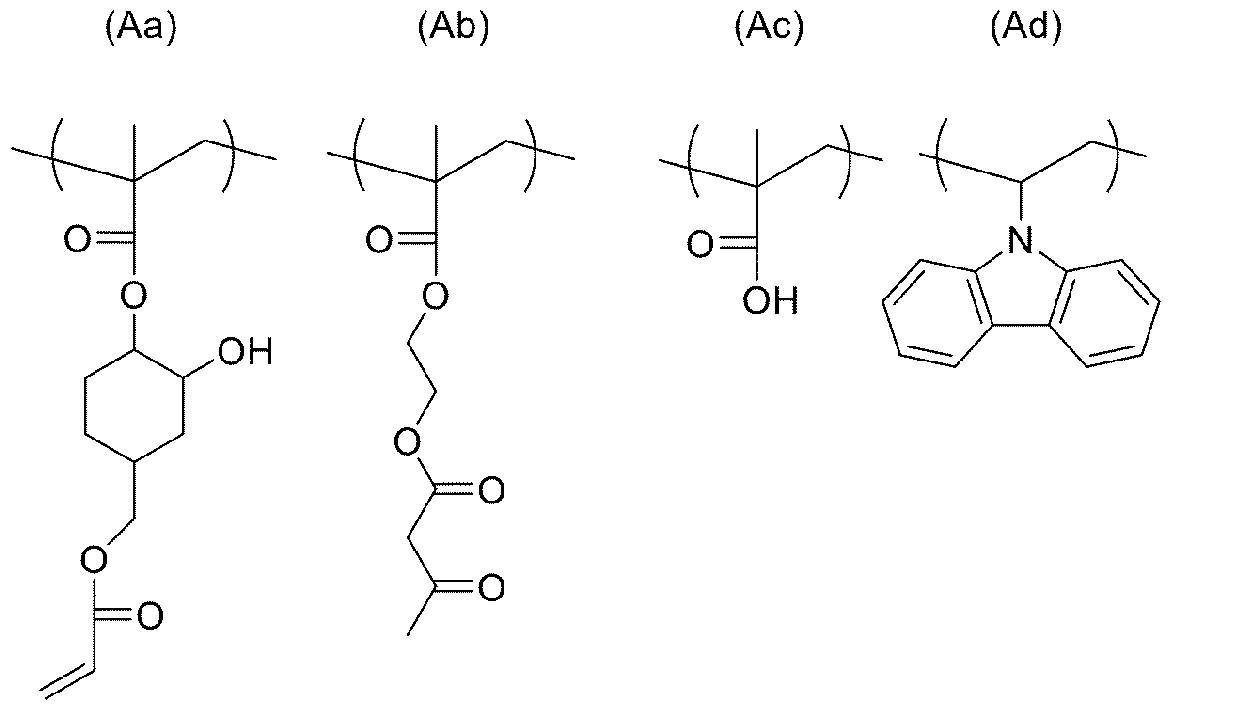
滴下終了後、フラスコ内温度を90±1℃にして6時間熟成反応を行った。
反応後、反応液を40℃以下になるまで冷却し、重合禁止剤0.12質量部、3,4-エポキシシクロヘキシルメチルアクリレート11.2質量部、トリフェニルホスフィン4.5質量部、シクロペンタノン14.0質量部を投入し、フラスコ内温度を110℃まで昇温させた後、フラスコ内温度110±1℃にて付加反応を行うことにより、固形分38.5質量%の樹脂2の溶液を得た。得られた樹脂2の重量平均分子量(Mw)は15,800、分散度(Mw/Mn)は2.4、固形分換算の酸価は80(mg-KOH/g)であった。
下記構成単位からなる樹脂3を合成した。
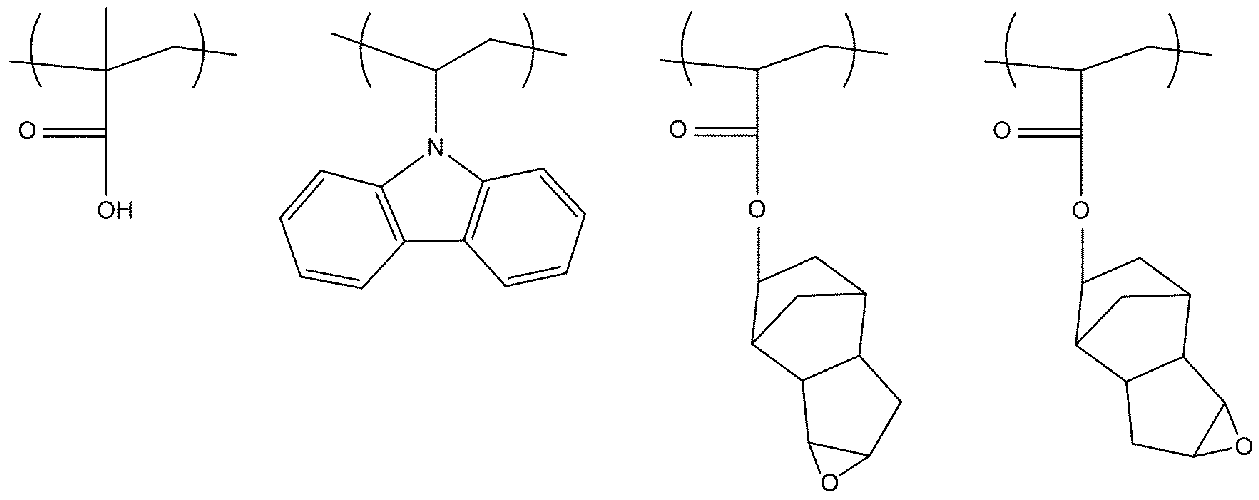
下記構成単位からなる樹脂4を合成した。

下記構成単位からなる樹脂5を合成した。
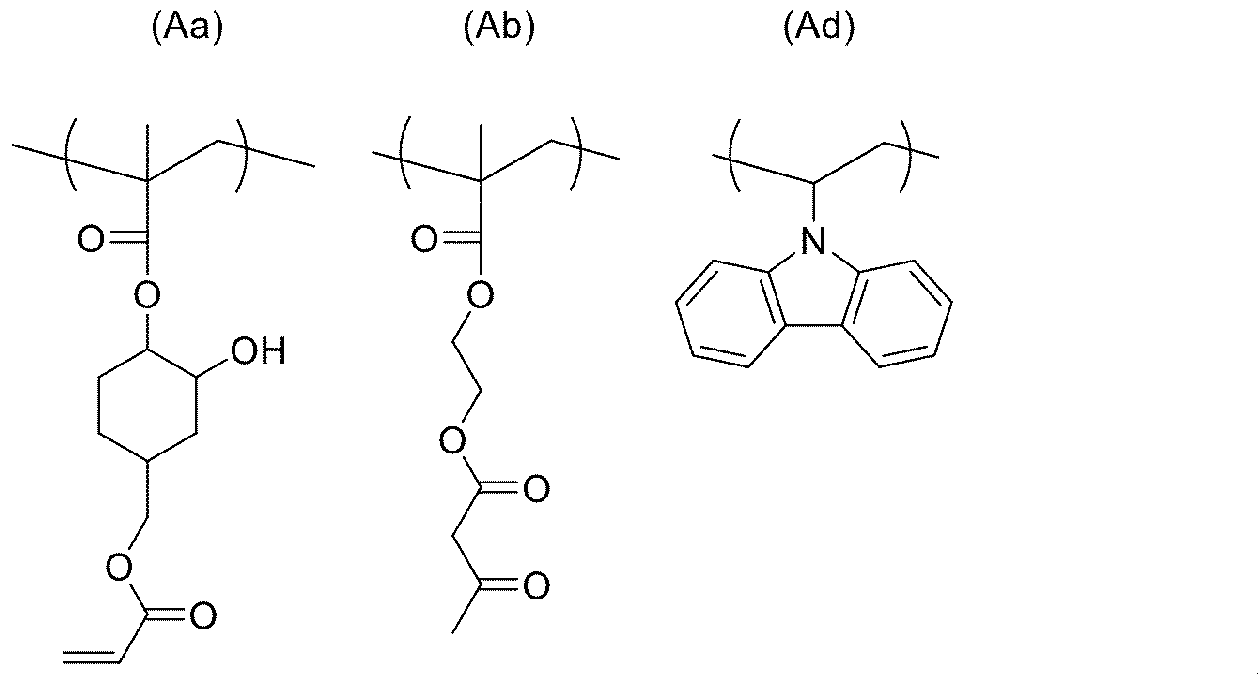
滴下終了後、フラスコ内温度を90±1℃にして6時間熟成反応を行った。
反応後、反応液を40℃以下になるまで冷却し、4-メトキシフェノール0.10質量部、3,4-エポキシシクロヘキシルメチルアクリレート9.3質量部、トリフェニルホスフィン4.0質量部、シクロペンタノン70質量部を投入し、フラスコ内温度を110℃まで昇温させた後、フラスコ内温度110±1℃にて付加反応を行うことにより樹脂5の溶液を得た。本樹脂はメタクリル酸のカルボン酸部分が付加反応によって全て消費されている。得られた樹脂5の重量平均分子量(Mw)は6,800、分散度は2.1、固形分は26.3質量%であった。
前記の樹脂1~3の重量平均分子量(Mw)及び数平均分子量(Mn)の測定については、GPC法を用いて、以下の条件で行なった。
装置;K2479((株)島津製作所製)
カラム;SHIMADZU Shim-pack GPC-80M
カラム温度;40℃
溶媒;THF(テトラヒドロフラン)
流速;1.0mL/min
検出器;RI
上記で得られたポリスチレン換算の重量平均分子量(Mw)及び数平均分子量(Mn)の比を分散度(Mw/Mn)とした。
表1に示す組成の実施例1~5及び比較例1~5の硬化性樹脂組成物を以下のようにして調製した。
樹脂1を含む樹脂溶液をトリメチロールプロパントリアクリレート(A―TMPT、新中村化学工業(株)製)(以下、「重合性化合物(B1)」とする)30部、光重合開始剤(IRGACURE(登録商標) OXE01、BASF社製)(以下、「重合開始剤(C1)」とする)3部、プロピレングリコールモノメチルエーテルアセテート(以下、「溶剤D1」とする)502部を混合して、固形分15%の硬化性樹脂組成物を得た。かかる硬化性樹脂組成物を実施例1の硬化性樹脂組成物とする。
重合性化合物B1に代えて、ジペンタエリスリトールポリアクリレート(A-9550、新中村化学工業(株)製)(以下、重合性化合物(B2)」とする)30部を用いた点以外は、実施例1と同様にして、固形分15%の硬化性樹脂組成物を得た。かかる硬化性樹脂組成物を実施例2の硬化性樹脂組成物とする。
樹脂1を含む樹脂溶液に代えて、樹脂2を含む樹脂溶液を固形分換算で100部で用いた点以外は、実施例1と同様にして、固形分15%の硬化性樹脂組成物を得た。かかる硬化性樹脂組成物を比較例1の硬化性樹脂組成物とする。
樹脂1を含む樹脂溶液に代えて、樹脂3を含む樹脂溶液を固形分換算で100部で用いた点以外は、実施例1と同様にして、固形分15%の硬化性樹脂組成物を得た。かかる硬化性樹脂組成物を比較例1の硬化性樹脂組成物とする。
樹脂1の配合部を表1に示す通りとした点以外は、実施例1と同様にして、固形分15%の硬化性樹脂組成物を得た。かかる硬化性樹脂組成物を実施例4の硬化性樹脂組成物とする。
樹脂1の配合部を表1に示す通りとした点以外は、実施例2と同様にして、固形分15%の硬化性樹脂組成物を得た。かかる硬化性樹脂組成物を実施例5の硬化性樹脂組成物とする。
樹脂1を含む樹脂溶液に代えて、樹脂4を含む樹脂溶液を固形分換算で100部で用いた点以外は、実施例1と同様にして、固形分15%の硬化性樹脂組成物を得た。かかる硬化性樹脂組成物を比較例2の硬化性樹脂組成物とする。
樹脂1を含む樹脂溶液に代えて、樹脂5を含む樹脂溶液を固形分換算で100部で用いた点以外は、実施例1と同様にして、固形分15%の硬化性樹脂組成物を得た。かかる硬化性樹脂組成物を比較例3の硬化性樹脂組成物とする。
樹脂1を含む樹脂溶液に代えて、樹脂4を含む樹脂溶液を固形分換算で100部で用いた点以外は、実施例2と同様にして、固形分15%の硬化性樹脂組成物を得た。かかる硬化性樹脂組成物を比較例4の硬化性樹脂組成物とする。
樹脂1を含む樹脂溶液に代えて、樹脂5を含む樹脂溶液を固形分換算で100部で用いた点以外は、実施例2と同様にして、固形分15%の硬化性樹脂組成物を得た。かかる硬化性樹脂組成物を比較例5の硬化性樹脂組成物とする。
実施例1~5及び比較例1~5の硬化性樹脂組成物をそれぞれ、別の2インチ角のガラス基板(イーグルXG;コーニング社製)上に、ポストベーク後の膜厚が1.5μmとなるように、スピンコート法で塗布した後に(塗布工程)、真空乾燥(到達圧66Pa)を行い硬化性樹脂組成物層を得た(乾燥工程)。得られた硬化性樹脂組成物層を、露光機(TME-150RSK;トプコン(株)製、光源;超高圧水銀灯)を用いて、大気圧雰囲気下、100mJ/cm2の露光量(波長365nm基準)で光照射した。その後、得られた硬化性樹脂組成物層を、ホットプレートで、150℃で15分間加熱することにより、硬化膜を得た(加熱工程)。得られた硬化膜の膜厚を膜厚測定装置(DEKTAK3;(株)アルバック製)で測定したところ、1.5μmであった。
<耐溶剤性>
得られた硬化膜を、プロピレングリコールモノメチルエーテルアセテート(PGMEA)に温度23℃で5分間浸漬し、浸漬後の硬化膜について、膜厚測定装置(DEKTAK3;(株)アルバック製)を用いて膜厚を測定し、浸漬前の膜厚との比を算出し、この値を残膜率とした。結果を表1に示す。
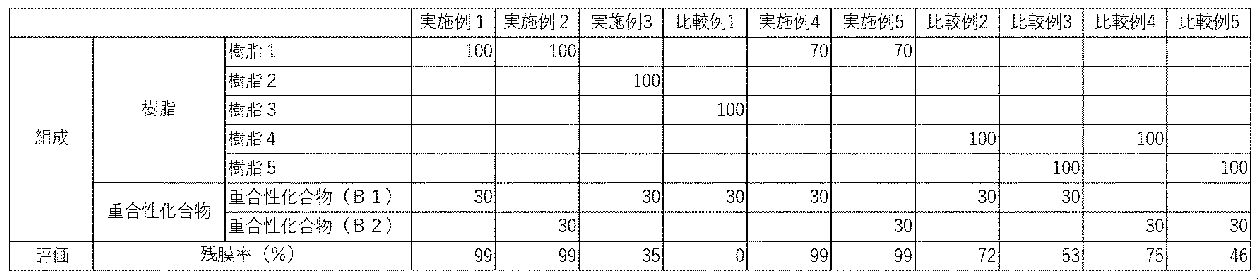
得られた硬化膜について、エリプソメーター(J.A. WoollamのM2000)を用いて550nmにおける屈折率を測定したところ、実施例1の樹脂1は1.62、実施例3の樹脂2は1.62、比較例1の樹脂3は1.52、比較例2の樹脂4は1.54、比較例3の樹脂5は1.64であった。
実施例1、3及び比較例1~3の硬化性樹脂組成物をそれぞれ、別の2インチ角のガラス基板(イーグルXG;コーニング社製)上に、ポストベーク後の膜厚が1.5μmとなるように、スピンコート法で塗布した後に(塗布工程)、真空乾燥(到達圧66Pa)を行い硬化性樹脂組成物層を得た(乾燥工程)。得られた硬化性樹脂組成物層を23℃のテトラメチルアンモニウムヒドロキシドの2.38%水溶液に60秒間浸漬し、溶解性を確認したところ、実施例1の樹脂1、実施例3の樹脂2、比較例1の樹脂3、及び比較例2の樹脂4の溶解性は○であったが、比較例3の樹脂5の溶解性は×であった。
Claims (7)
- α,β-不飽和カルボニル基を有する構成単位(Aa)、活性メチレン基又は活性メチン基を有する構成単位(Ab)、酸基を有する構成単位(Ac)、及び置換基を有していてもよい複素環を有する構成単位(Ad)を有する樹脂。
- 前記構成単位(Aa)は、下記式(Aax)で表される、請求項1に記載の樹脂。

R25は炭素原子数1~20のアルカンジイル基を表し、該アルカンジイル基に含まれる-CH2-は、-O-又は-CO-に置き換わっていてもよい。] - 前記構成単位(Ad)は、下記式(Ad-1)で表される、請求項1または2に記載の樹脂。
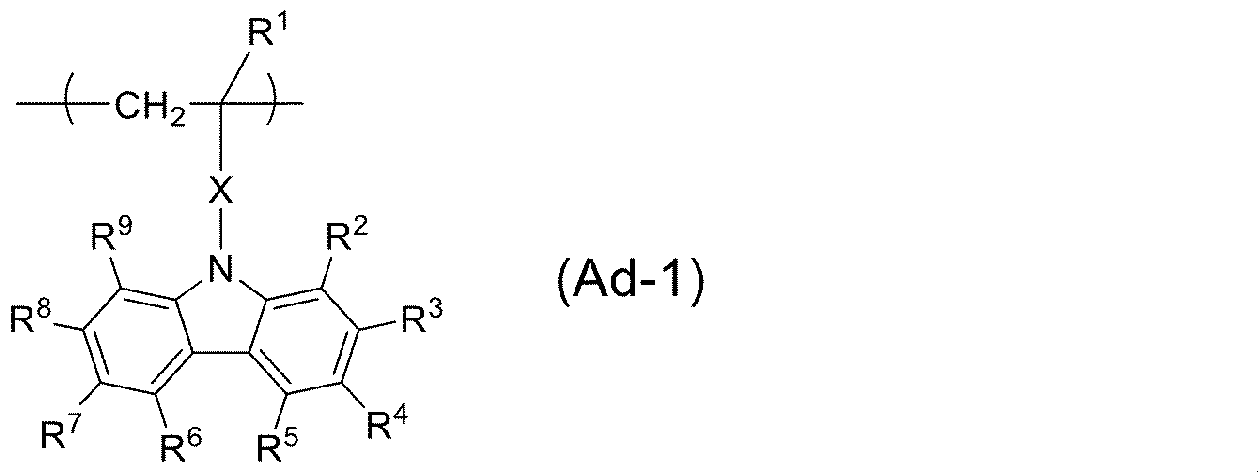
R2~R9は、互いに独立に、水素原子、ハロゲン原子、炭素数1~20の飽和炭化水素基又は炭素数6~20のアリール基を表し、該飽和炭化水素基に含まれる水素原子は、アルコキシ基又はアリール基で置換されていてもよい。
Xは、単結合、炭素数1以上のアルカンジイル基、もしくは直鎖状又は分枝鎖状の下記の式(V)で表される基を表す。

- 請求項1~3のいずれか1項に記載の樹脂、重合性化合物、及び重合開始剤を含む、硬化性樹脂組成物。
- 請求項4に記載の樹脂組成物から形成された硬化膜。
- 請求項4記載の樹脂組成物を基板の上に塗布する塗布工程、
前記樹脂組成物を乾燥することにより樹脂組成物層を形成する乾燥工程、
前記樹脂組成物層を露光する露光工程、及び、
前記樹脂組成物層を加熱する加熱工程、
をこの順で含む、硬化膜の製造方法。 - 前記加熱工程において、露光された前記樹脂組成物層を150℃以下で加熱する、請求項6に記載の硬化膜の製造方法。
Priority Applications (2)
| Application Number | Priority Date | Filing Date | Title |
|---|---|---|---|
| CN202280085996.3A CN118451113A (zh) | 2022-01-14 | 2022-12-27 | 树脂、固化性树脂组合物及固化膜 |
| KR1020247025717A KR20240131406A (ko) | 2022-01-14 | 2022-12-27 | 수지, 경화성 수지 조성물 및 경화막 |
Applications Claiming Priority (2)
| Application Number | Priority Date | Filing Date | Title |
|---|---|---|---|
| JP2022-004037 | 2022-01-14 | ||
| JP2022004037 | 2022-01-14 |
Publications (1)
| Publication Number | Publication Date |
|---|---|
| WO2023136135A1 true WO2023136135A1 (ja) | 2023-07-20 |
Family
ID=87279101
Family Applications (1)
| Application Number | Title | Priority Date | Filing Date |
|---|---|---|---|
| PCT/JP2022/048177 Ceased WO2023136135A1 (ja) | 2022-01-14 | 2022-12-27 | 樹脂、硬化性樹脂組成物及び硬化膜 |
Country Status (5)
| Country | Link |
|---|---|
| JP (1) | JP2023103970A (ja) |
| KR (1) | KR20240131406A (ja) |
| CN (1) | CN118451113A (ja) |
| TW (1) | TW202330642A (ja) |
| WO (1) | WO2023136135A1 (ja) |
Cited By (3)
| Publication number | Priority date | Publication date | Assignee | Title |
|---|---|---|---|---|
| JP2023147017A (ja) * | 2022-03-29 | 2023-10-12 | 東京応化工業株式会社 | 感光性組成物 |
| WO2026134131A1 (ja) * | 2024-12-18 | 2026-06-25 | 住友化学株式会社 | 混合組成物、これを用いたフィルム、光学部品及び画像表示装置 |
| JP7908758B2 (ja) | 2022-03-29 | 2026-08-20 | 東京応化工業株式会社 | 感光性組成物 |
Citations (5)
| Publication number | Priority date | Publication date | Assignee | Title |
|---|---|---|---|---|
| JP2003066592A (ja) * | 2001-08-27 | 2003-03-05 | Konica Corp | 感光性平版印刷版 |
| JP2009091465A (ja) * | 2007-10-09 | 2009-04-30 | Nippon Shokubai Co Ltd | 硬化性組成物および成形体 |
| JP2009244447A (ja) * | 2008-03-31 | 2009-10-22 | Adeka Corp | アルカリ現像性感光性樹脂組成物 |
| JP2018135515A (ja) * | 2017-02-21 | 2018-08-30 | 住友化学株式会社 | 樹脂組成物及び硬化膜 |
| JP2018165351A (ja) * | 2016-07-28 | 2018-10-25 | 住友化学株式会社 | 樹脂、硬化性樹脂組成物及び硬化膜 |
Family Cites Families (1)
| Publication number | Priority date | Publication date | Assignee | Title |
|---|---|---|---|---|
| KR20120053377A (ko) | 2010-11-17 | 2012-05-25 | (주)일양포덱소 | 액상물 자동포장기의 파우치 이송장치 |
-
2022
- 2022-12-27 WO PCT/JP2022/048177 patent/WO2023136135A1/ja not_active Ceased
- 2022-12-27 KR KR1020247025717A patent/KR20240131406A/ko active Pending
- 2022-12-27 CN CN202280085996.3A patent/CN118451113A/zh active Pending
- 2022-12-28 JP JP2022211245A patent/JP2023103970A/ja active Pending
- 2022-12-30 TW TW111150871A patent/TW202330642A/zh unknown
Patent Citations (5)
| Publication number | Priority date | Publication date | Assignee | Title |
|---|---|---|---|---|
| JP2003066592A (ja) * | 2001-08-27 | 2003-03-05 | Konica Corp | 感光性平版印刷版 |
| JP2009091465A (ja) * | 2007-10-09 | 2009-04-30 | Nippon Shokubai Co Ltd | 硬化性組成物および成形体 |
| JP2009244447A (ja) * | 2008-03-31 | 2009-10-22 | Adeka Corp | アルカリ現像性感光性樹脂組成物 |
| JP2018165351A (ja) * | 2016-07-28 | 2018-10-25 | 住友化学株式会社 | 樹脂、硬化性樹脂組成物及び硬化膜 |
| JP2018135515A (ja) * | 2017-02-21 | 2018-08-30 | 住友化学株式会社 | 樹脂組成物及び硬化膜 |
Cited By (3)
| Publication number | Priority date | Publication date | Assignee | Title |
|---|---|---|---|---|
| JP2023147017A (ja) * | 2022-03-29 | 2023-10-12 | 東京応化工業株式会社 | 感光性組成物 |
| JP7908758B2 (ja) | 2022-03-29 | 2026-08-20 | 東京応化工業株式会社 | 感光性組成物 |
| WO2026134131A1 (ja) * | 2024-12-18 | 2026-06-25 | 住友化学株式会社 | 混合組成物、これを用いたフィルム、光学部品及び画像表示装置 |
Also Published As
| Publication number | Publication date |
|---|---|
| CN118451113A (zh) | 2024-08-06 |
| JP2023103970A (ja) | 2023-07-27 |
| KR20240131406A (ko) | 2024-08-30 |
| TW202330642A (zh) | 2023-08-01 |
Similar Documents
| Publication | Publication Date | Title |
|---|---|---|
| JP7256247B2 (ja) | 樹脂、硬化性樹脂組成物及び硬化膜 | |
| CN102213917B (zh) | 黑色感光性树脂组合物、用其制得的黑色矩阵及具有该黑色矩阵的彩色滤光片 | |
| JP6091831B2 (ja) | 着色感光性樹脂組成物 | |
| CN103048882A (zh) | 着色固化性树脂组合物 | |
| JP6019596B2 (ja) | 着色感光性樹脂組成物 | |
| KR102284012B1 (ko) | 착색 경화성 수지 조성물 | |
| JP7736441B2 (ja) | 赤色着色組成物 | |
| KR101962481B1 (ko) | 착색 감광성 수지 조성물, 이를 포함하는 컬러 필터 및 표시 장치 | |
| CN102967994A (zh) | 固化性树脂组合物 | |
| JP7812654B2 (ja) | 着色硬化性樹脂組成物 | |
| JP6051689B2 (ja) | 着色感光性樹脂組成物 | |
| JP2023103970A (ja) | 樹脂、硬化性樹脂組成物及び硬化膜 | |
| JP2021059721A (ja) | 着色硬化性樹脂組成物 | |
| CN111344359B (zh) | 蓝色固化性树脂组合物、蓝色滤色器和包括该蓝色滤色器的显示装置 | |
| KR20130015631A (ko) | 착색 감광성 수지 조성물, 착색 패턴, 컬러필터 및 이를 구비한 액정표시장치 | |
| CN109212899B (zh) | 着色固化性树脂组合物、滤色器及显示装置 | |
| JP7523888B2 (ja) | 着色樹脂組成物 | |
| JP7203626B2 (ja) | 着色硬化性樹脂組成物 | |
| CN113050375A (zh) | 着色树脂组成物、所形成的彩色滤光片、以及含有所述彩色滤光片的显示装置 | |
| JP7594962B2 (ja) | 赤色着色組成物 | |
| JP2024014738A (ja) | 着色組成物及び化合物 | |
| TWI738809B (zh) | 著色硬化性樹脂組成物、彩色濾光片及顯示裝置 | |
| JP2024117074A (ja) | 着色硬化性樹脂組成物、カラーフィルタ、表示装置、及び固体撮像素子 | |
| JP2024069149A (ja) | 着色硬化性樹脂組成物、カラーフィルタ、表示装置、及び固体撮像素子 | |
| JP2024117073A (ja) | 着色硬化性樹脂組成物、カラーフィルタ、表示装置、及び固体撮像素子 |
Legal Events
| Date | Code | Title | Description |
|---|---|---|---|
| 121 | Ep: the epo has been informed by wipo that ep was designated in this application |
Ref document number: 22920651 Country of ref document: EP Kind code of ref document: A1 |
|
| WWE | Wipo information: entry into national phase |
Ref document number: 202280085996.3 Country of ref document: CN |
|
| ENP | Entry into the national phase |
Ref document number: 20247025717 Country of ref document: KR Kind code of ref document: A |
|
| NENP | Non-entry into the national phase |
Ref country code: DE |
|
| 122 | Ep: pct application non-entry in european phase |
Ref document number: 22920651 Country of ref document: EP Kind code of ref document: A1 |