WO2023132280A1 - 硫化物固体電解質の製造方法 - Google Patents
硫化物固体電解質の製造方法 Download PDFInfo
- Publication number
- WO2023132280A1 WO2023132280A1 PCT/JP2022/047740 JP2022047740W WO2023132280A1 WO 2023132280 A1 WO2023132280 A1 WO 2023132280A1 JP 2022047740 W JP2022047740 W JP 2022047740W WO 2023132280 A1 WO2023132280 A1 WO 2023132280A1
- Authority
- WO
- WIPO (PCT)
- Prior art keywords
- solid electrolyte
- solvent
- sulfide
- sulfide solid
- crystal structure
- Prior art date
- Legal status (The legal status is an assumption and is not a legal conclusion. Google has not performed a legal analysis and makes no representation as to the accuracy of the status listed.)
- Ceased
Links
Images



Classifications
-
- C—CHEMISTRY; METALLURGY
- C01—INORGANIC CHEMISTRY
- C01D—COMPOUNDS OF ALKALI METALS, i.e. LITHIUM, SODIUM, POTASSIUM, RUBIDIUM, CAESIUM, OR FRANCIUM
- C01D15/00—Lithium compounds
-
- C—CHEMISTRY; METALLURGY
- C01—INORGANIC CHEMISTRY
- C01B—NON-METALLIC ELEMENTS; COMPOUNDS THEREOF; METALLOIDS OR COMPOUNDS THEREOF NOT COVERED BY SUBCLASS C01C
- C01B17/00—Sulfur; Compounds thereof
- C01B17/20—Methods for preparing sulfides or polysulfides, in general
-
- C—CHEMISTRY; METALLURGY
- C01—INORGANIC CHEMISTRY
- C01B—NON-METALLIC ELEMENTS; COMPOUNDS THEREOF; METALLOIDS OR COMPOUNDS THEREOF NOT COVERED BY SUBCLASS C01C
- C01B25/00—Phosphorus; Compounds thereof
- C01B25/14—Sulfur, selenium, or tellurium compounds of phosphorus
-
- H—ELECTRICITY
- H01—ELECTRIC ELEMENTS
- H01G—CAPACITORS; CAPACITORS, RECTIFIERS, DETECTORS, SWITCHING DEVICES, LIGHT-SENSITIVE OR TEMPERATURE-SENSITIVE DEVICES OF THE ELECTROLYTIC TYPE
- H01G11/00—Hybrid capacitors, i.e. capacitors having different positive and negative electrodes; Electric double-layer [EDL] capacitors; Processes for the manufacture thereof or of parts thereof
- H01G11/54—Electrolytes
- H01G11/56—Solid electrolytes, e.g. gels; Additives therein
-
- H—ELECTRICITY
- H01—ELECTRIC ELEMENTS
- H01M—PROCESSES OR MEANS, e.g. BATTERIES, FOR THE DIRECT CONVERSION OF CHEMICAL ENERGY INTO ELECTRICAL ENERGY
- H01M10/00—Secondary cells; Manufacture thereof
- H01M10/05—Accumulators with non-aqueous electrolyte
- H01M10/056—Accumulators with non-aqueous electrolyte characterised by the materials used as electrolytes, e.g. mixed inorganic/organic electrolytes
- H01M10/0561—Accumulators with non-aqueous electrolyte characterised by the materials used as electrolytes, e.g. mixed inorganic/organic electrolytes the electrolyte being constituted of inorganic materials only
- H01M10/0562—Solid materials
-
- C—CHEMISTRY; METALLURGY
- C01—INORGANIC CHEMISTRY
- C01P—INDEXING SCHEME RELATING TO STRUCTURAL AND PHYSICAL ASPECTS OF SOLID INORGANIC COMPOUNDS
- C01P2002/00—Crystal-structural characteristics
- C01P2002/70—Crystal-structural characteristics defined by measured X-ray, neutron or electron diffraction data
- C01P2002/72—Crystal-structural characteristics defined by measured X-ray, neutron or electron diffraction data by d-values or two theta-values, e.g. as X-ray diagram
-
- C—CHEMISTRY; METALLURGY
- C01—INORGANIC CHEMISTRY
- C01P—INDEXING SCHEME RELATING TO STRUCTURAL AND PHYSICAL ASPECTS OF SOLID INORGANIC COMPOUNDS
- C01P2002/00—Crystal-structural characteristics
- C01P2002/90—Other crystal-structural characteristics not specified above
-
- C—CHEMISTRY; METALLURGY
- C01—INORGANIC CHEMISTRY
- C01P—INDEXING SCHEME RELATING TO STRUCTURAL AND PHYSICAL ASPECTS OF SOLID INORGANIC COMPOUNDS
- C01P2006/00—Physical properties of inorganic compounds
- C01P2006/40—Electric properties
-
- H—ELECTRICITY
- H01—ELECTRIC ELEMENTS
- H01G—CAPACITORS; CAPACITORS, RECTIFIERS, DETECTORS, SWITCHING DEVICES, LIGHT-SENSITIVE OR TEMPERATURE-SENSITIVE DEVICES OF THE ELECTROLYTIC TYPE
- H01G11/00—Hybrid capacitors, i.e. capacitors having different positive and negative electrodes; Electric double-layer [EDL] capacitors; Processes for the manufacture thereof or of parts thereof
- H01G11/84—Processes for the manufacture of hybrid or EDL capacitors, or components thereof
-
- H—ELECTRICITY
- H01—ELECTRIC ELEMENTS
- H01M—PROCESSES OR MEANS, e.g. BATTERIES, FOR THE DIRECT CONVERSION OF CHEMICAL ENERGY INTO ELECTRICAL ENERGY
- H01M2300/00—Electrolytes
- H01M2300/0017—Non-aqueous electrolytes
- H01M2300/0065—Solid electrolytes
- H01M2300/0068—Solid electrolytes inorganic
-
- Y—GENERAL TAGGING OF NEW TECHNOLOGICAL DEVELOPMENTS; GENERAL TAGGING OF CROSS-SECTIONAL TECHNOLOGIES SPANNING OVER SEVERAL SECTIONS OF THE IPC; TECHNICAL SUBJECTS COVERED BY FORMER USPC CROSS-REFERENCE ART COLLECTIONS [XRACs] AND DIGESTS
- Y02—TECHNOLOGIES OR APPLICATIONS FOR MITIGATION OR ADAPTATION AGAINST CLIMATE CHANGE
- Y02E—REDUCTION OF GREENHOUSE GAS [GHG] EMISSIONS, RELATED TO ENERGY GENERATION, TRANSMISSION OR DISTRIBUTION
- Y02E60/00—Enabling technologies; Technologies with a potential or indirect contribution to GHG emissions mitigation
- Y02E60/10—Energy storage using batteries
Definitions
- a complexing agent solution (or slurry) is prepared from solid electrolyte raw materials, the solution is dried to obtain a complex crystal, and then the complex crystal is calcined to obtain a solid electrolyte with a separate crystal.
- Patent Document 1 a raw material-containing liquid containing a raw material and a solvent is supplied to another medium maintained at a higher temperature than the solvent, the solvent is volatilized, and the raw material is reacted to produce an aldirodite type
- a method for producing a sulfide solid electrolyte that precipitates a crystalline structure is disclosed.
- the present invention has been made in view of such circumstances, and in a method for producing a sulfide solid electrolyte having an aldirodite-type crystal structure in a liquid phase, the production efficiency is improved by effectively using raw material inclusions. It is an object of the present invention to provide a method for easily producing a high-quality sulfide solid electrolyte.
- the method for producing a sulfide solid electrolyte according to the present invention comprises: mixing the raw material inclusions and the first solvent to obtain a mixture; mixing the mixture with a second solvent to obtain a solution containing a solid electrolyte precursor; heat-treating the solid electrolyte precursor while supplying hydrogen sulfide to obtain a heated solid electrolyte precursor; and calcining the heated solid electrolyte precursor; including, A method for producing a sulfide solid electrolyte having an aldirodite-type crystal structure. is.
- the production efficiency is improved by effectively using raw material inclusions, and a high-quality sulfide solid electrolyte is produced.
- An easy manufacturing method can be provided.
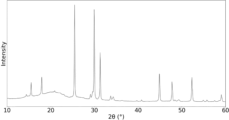
- FIG. 2 is an X-ray diffraction spectrum of the sulfide solid electrolyte obtained in Example 1.
- FIG. 4 is an X-ray diffraction spectrum of the sulfide solid electrolyte obtained in Comparative Example 1.
- FIG. 4 is an X-ray diffraction spectrum of the sulfide solid electrolyte obtained in Example 2.
- FIG. 4 is an X-ray diffraction spectrum of the sulfide solid electrolyte obtained in Example 3.
- this embodiment An embodiment of the present invention (hereinafter sometimes referred to as "this embodiment") will be described below.
- the upper and lower numerical values of the numerical ranges of “more than”, “less than”, and “to” are numerical values that can be arbitrarily combined, and the numerical values of the examples are used as the upper and lower numerical values. can also
- Patent Document 2 The production method described in Patent Document 2 is also based on a liquid phase method, and ethanol is assumed as one of the solvents used for preparing the material containing material.
- Alcohol solvents such as ethanol have the advantage that the reaction of the raw materials proceeds easily, but also have disadvantages. For example, some of the raw materials do not contribute to the production of the solid electrolyte, which may reduce the production efficiency.
- Lithium sulfide (Li 2 S) which is widely used as a raw material for solid electrolytes, partly reacts with alcohol solvents such as ethanol to generate lithium alkoxides such as lithium ethoxide, and is widely used together with lithium sulfide (Li 2 S).
- Phosphorus sulfide e.g., diphosphorus pentasulfide ( P2S5 )
- P2S5 diphosphorus pentasulfide
- P2S5 diphosphorus pentasulfide
- the quality deteriorates, such as a decrease in Phosphorus sulfide (for example, diphosphorus pentasulfide (P 2 S 5 )) dissolves in an alcoholic solvent such as ethanol, but when dissolved, it contributes to the reaction with other raw materials such as lithium sulfide (Li 2 S). become difficult.
- the liquid-phase production methods described in Patent Documents 1 and 2 can be said to be highly efficient production methods in that a solid electrolyte can be produced by supplying a raw material-containing liquid to a medium.
- a solid electrolyte can be produced by supplying a raw material-containing liquid to a medium.
- some of the raw materials may be lost, resulting in a decrease in production efficiency or restrictions on raw materials depending on the solvent used.
- the operation may become complicated. Therefore, the method of producing a solid electrolyte by reacting raw materials in a liquid phase using ethanol or other solvents has room for further improvement in terms of production efficiency, versatility, and the like.
- the present inventors focused on the affinity with the raw material used in the production of the solid electrolyte, and found out how to separate a part of the raw material. , and whether it is possible to suppress loss. Then, by selectively using a solvent that dissolves the raw material and a solvent that does not dissolve it, the problem when adopting the liquid phase method, that is, part of the raw material is separated and lost. It has been found that a high-quality solid electrolyte can be obtained while solving the problem of
- solid electrolyte means an electrolyte that remains solid at 25°C under a nitrogen atmosphere.
- the "sulfide solid electrolyte” of the present embodiment is a solid electrolyte containing at least one halogen atom selected from a lithium atom, a sulfur atom, a phosphorus atom, and a chlorine atom and a bromine atom, and having ionic conductivity attributed to the lithium atom. is.
- the crystalline sulfide solid electrolyte includes a crystal structure derived from the solid electrolyte, and even if part of the crystal structure is derived from the solid electrolyte, the entire crystal structure is derived from the solid electrolyte. It is a thing. If the crystalline sulfide solid electrolyte has the X-ray diffraction pattern as described above, part of it contains an amorphous sulfide solid electrolyte (also referred to as a "glass component"). It is acceptable. Therefore, crystalline sulfide solid electrolytes include so-called glass ceramics obtained by heating an amorphous solid electrolyte (glass component) to a crystallization temperature or higher.
- a method for producing a sulfide solid electrolyte according to the first form of the present embodiment includes: mixing the raw material inclusions and the first solvent to obtain a mixture; mixing the mixture with a second solvent to obtain a solution containing a solid electrolyte precursor; heat-treating the solid electrolyte precursor while supplying hydrogen sulfide to obtain a heated solid electrolyte precursor; and calcining the heated solid electrolyte precursor; including, A method for producing a sulfide solid electrolyte having an aldirodite-type crystal structure. is.
- each raw material contained in the raw material content is held by forming a bond between the raw materials and the solvent. It dissolves while maintaining a loose bond with one solvent to obtain a solution in which the solid electrolyte precursor is dissolved.
- the raw materials are supplied to the second solvent in a state in which the raw materials form a bonding state with each other and further form a loose bonding state with the first solvent, thereby separating and reacting the second solvent and the raw materials.
- the solid electrolyte precursor obtained by mixing the mixture and the second solvent is a reaction product in which the raw materials contained in the mixture form a bonded state with each other, and the raw materials themselves are dissolved in the second solvent.
- a sulfide solid electrolyte having an aldirodite-type crystal structure is obtained by firing while supplying hydrogen sulfide, which will be described later. Therefore, it is considered that the solid electrolyte precursor obtained by mixing the mixture and the second solvent has a structure that facilitates the formation of an aldirodite crystal structure.
- the method for producing a sulfide solid electrolyte according to the first embodiment further includes heat-treating the solid electrolyte precursor while supplying hydrogen sulfide to obtain a heated solid electrolyte precursor.
- the raw materials form a bonded state, so it is possible to reduce the separation and loss of the raw materials compared to the conventional manufacturing method.
- it exists partially as raw material For example, when lithium sulfide (Li 2 S) is used as a raw material, if lithium sulfide (Li 2 S) exists as it is, lithium alkoxide is generated as described above, which contributes to the reaction with other raw materials. Gone.
- the production efficiency is improved and a high-quality sulfide solid electrolyte is produced in the same manner as described in the method for producing a sulfide solid electrolyte according to the third embodiment. It becomes possible to manufacture easily.
- a method for producing a sulfide solid electrolyte according to the sixth aspect of the present embodiment includes: The heat treatment is performed at 200 ° C. or higher, That's what it means. By setting the temperature of the heat treatment to 200° C. or higher, it is possible to more efficiently convert the lithium alkoxide to Li 2 S and suppress quality deterioration such as a decrease in ionic conductivity due to the inclusion of lithium alkoxide. , It becomes easy to obtain a sulfide solid electrolyte having a desired aldirodite-type crystal structure without composition deviation due to the loss of Li 2 S, so that the production efficiency is improved and a high-quality sulfide solid electrolyte is easily produced. becomes possible.
- a method for producing a sulfide solid electrolyte according to the seventh aspect of the present embodiment includes: Mixing the raw material content and the first solvent using a mixer or a stirrer, That's what it means. Further, the method for producing a sulfide solid electrolyte according to the eighth form of the present embodiment includes: mixing the mixture and the second solvent using a mixer or stirrer; That's what it means. Mixing of the raw material content with the first solvent and mixing of the mixture with the second solvent can be performed by using a mixer or a stirrer. Therefore, it can be said that the manufacturing method is excellent in manufacturing efficiency.
- a method for producing a sulfide solid electrolyte according to the ninth form of the present embodiment includes: wherein the mixture comprises a reaction product of the raw material content; That's what it means.
- a mixture is obtained by mixing the raw material contents and the first solvent, but as described above, there is some force (intermolecular force, chemical bond, etc.) between the raw materials or between the raw material and the first solvent.
- reaction products such as Li 3 PS 4 form a loose bond with the first solvent, thereby being protected from the second solvent and capable of forming the basic structure of the sulfide solid electrolyte. Therefore, it becomes easy to obtain a sulfide solid electrolyte having an aldirodite-type crystal structure. As a result, a solid electrolyte precursor can be obtained more efficiently, and as a result, production efficiency can be improved, and a high-quality sulfide solid electrolyte can be easily produced.
- Combinations of compounds that can be used as raw materials include, for example, a combination of lithium sulfide, diphosphorus pentasulfide and lithium halide, a combination of lithium sulfide, diphosphorus pentasulfide and a single halogen, lithium sulfide, diphosphorus pentasulfide and lithium halide. and a combination of a halogen simple substance is preferable, and among them, a combination of lithium sulfide, diphosphorus pentasulfide and lithium halide is preferable.
- the lithium sulfide is preferably particles.
- the average particle size (D 50 ) of the lithium sulfide particles is preferably 10 ⁇ m or more and 2000 ⁇ m or less, more preferably 30 ⁇ m or more and 1500 ⁇ m or less, and even more preferably 50 ⁇ m or more and 1000 ⁇ m or less.
- Nitro solvents include nitrobenzene and the like, and nitrile solvents include acetonitrile, methoxyacetonitrile, acrylonitrile, propionitrile, isobutyronitrile, methoxypropionitrile, benzonitrile, and the like.
- the second solvent is preferably an aliphatic alcohol, more preferably a primary aliphatic alcohol, still more preferably methanol or ethanol, and particularly preferably ethanol.
- the shape of the stirring impeller used in the mechanical stirring mixer includes blade type, arm type, anchor type, paddle type, full zone type, ribbon type, multi-blade type, double arm type, shovel type, twin blade type, Flat blade type, C type blade type, etc., and from the viewpoint of promoting the reaction of raw materials more efficiently, shovel type, flat blade type, C type blade type, anchor type, paddle type, full zone type, etc. are preferable. Anchor type, paddle type and full zone type are more preferred.
- the heating temperature for firing may vary depending on the types of the first solvent and the second solvent, and cannot be unconditionally specified, but it is preferably a temperature higher than the heating temperature during the heat treatment. , usually preferably 200 ° C. or higher, more preferably 250 ° C. or higher, still more preferably 350 ° C. or higher, still more preferably 400 ° C. or higher, and the upper limit is preferably 700 ° C. or lower, more preferably 600 ° C. or lower, further preferably It can be selected from a temperature range of 500° C. or less, more preferably 450° C. or less.
- the firing temperature means the maximum temperature at the time of firing.
- the production method of the present embodiment improves the ion conductivity and produces high-quality sulfides that do not contain impurities as long as the heat treatment is performed while supplying hydrogen sulfide. It can be seen that a solid electrolyte is obtained.
- the sulfide solid electrolytes obtained in Examples 2 and 3 used the same raw materials as in Example 1, had the same firing temperature, and had ionic conductivities of 4.4 mS/cm and 3.2 mS. /cm, it has an aldirodite type crystal structure as in Example 1. This can be confirmed by FIGS.
Landscapes
- Chemical & Material Sciences (AREA)
- Organic Chemistry (AREA)
- Engineering & Computer Science (AREA)
- Inorganic Chemistry (AREA)
- Chemical Kinetics & Catalysis (AREA)
- Electrochemistry (AREA)
- Condensed Matter Physics & Semiconductors (AREA)
- Physics & Mathematics (AREA)
- General Physics & Mathematics (AREA)
- Manufacturing & Machinery (AREA)
- General Chemical & Material Sciences (AREA)
- Power Engineering (AREA)
- Materials Engineering (AREA)
- Microelectronics & Electronic Packaging (AREA)
- Conductive Materials (AREA)
Priority Applications (4)
| Application Number | Priority Date | Filing Date | Title |
|---|---|---|---|
| JP2023572441A JPWO2023132280A1 (https=) | 2022-01-05 | 2022-12-23 | |
| EP22918864.4A EP4462453A4 (en) | 2022-01-05 | 2022-12-23 | PROCESS FOR THE PRODUCTION OF A SOLID SULPHIDE ELECTROLYTE |
| CN202280086730.0A CN118475993A (zh) | 2022-01-05 | 2022-12-23 | 硫化物固体电解质的制造方法 |
| US18/725,795 US20250100879A1 (en) | 2022-01-05 | 2022-12-23 | Method for producing sulfide solid electrolyte |
Applications Claiming Priority (2)
| Application Number | Priority Date | Filing Date | Title |
|---|---|---|---|
| JP2022000675 | 2022-01-05 | ||
| JP2022-000675 | 2022-01-05 |
Publications (1)
| Publication Number | Publication Date |
|---|---|
| WO2023132280A1 true WO2023132280A1 (ja) | 2023-07-13 |
Family
ID=87073626
Family Applications (1)
| Application Number | Title | Priority Date | Filing Date |
|---|---|---|---|
| PCT/JP2022/047740 Ceased WO2023132280A1 (ja) | 2022-01-05 | 2022-12-23 | 硫化物固体電解質の製造方法 |
Country Status (5)
| Country | Link |
|---|---|
| US (1) | US20250100879A1 (https=) |
| EP (1) | EP4462453A4 (https=) |
| JP (1) | JPWO2023132280A1 (https=) |
| CN (1) | CN118475993A (https=) |
| WO (1) | WO2023132280A1 (https=) |
Cited By (1)
| Publication number | Priority date | Publication date | Assignee | Title |
|---|---|---|---|---|
| CN117842948A (zh) * | 2024-01-05 | 2024-04-09 | 潍柴动力股份有限公司 | 一种小粒径硫化物固态电解质的制备方法及其应用 |
Citations (4)
| Publication number | Priority date | Publication date | Assignee | Title |
|---|---|---|---|---|
| JP2019169459A (ja) * | 2017-09-06 | 2019-10-03 | 出光興産株式会社 | 固体電解質の製造方法 |
| JP2020095953A (ja) * | 2018-12-05 | 2020-06-18 | 出光興産株式会社 | アルジロダイト型結晶構造を有する固体電解質の製造方法 |
| WO2020153973A1 (en) * | 2019-01-25 | 2020-07-30 | Solid Power, Inc. | Solid electrolyte material synthesis method |
| JP2020196640A (ja) * | 2019-05-31 | 2020-12-10 | 三星電子株式会社Samsung Electronics Co.,Ltd. | 固体電解質の製造方法 |
Family Cites Families (2)
| Publication number | Priority date | Publication date | Assignee | Title |
|---|---|---|---|---|
| US10879559B2 (en) * | 2017-09-06 | 2020-12-29 | Idemitsu Kosan Co., Ltd. | Method for producing solid electrolyte |
| CN119452436A (zh) * | 2022-07-07 | 2025-02-14 | 出光兴产株式会社 | 硫化物固体电解质的制造方法 |
-
2022
- 2022-12-23 EP EP22918864.4A patent/EP4462453A4/en active Pending
- 2022-12-23 CN CN202280086730.0A patent/CN118475993A/zh active Pending
- 2022-12-23 JP JP2023572441A patent/JPWO2023132280A1/ja active Pending
- 2022-12-23 WO PCT/JP2022/047740 patent/WO2023132280A1/ja not_active Ceased
- 2022-12-23 US US18/725,795 patent/US20250100879A1/en active Pending
Patent Citations (4)
| Publication number | Priority date | Publication date | Assignee | Title |
|---|---|---|---|---|
| JP2019169459A (ja) * | 2017-09-06 | 2019-10-03 | 出光興産株式会社 | 固体電解質の製造方法 |
| JP2020095953A (ja) * | 2018-12-05 | 2020-06-18 | 出光興産株式会社 | アルジロダイト型結晶構造を有する固体電解質の製造方法 |
| WO2020153973A1 (en) * | 2019-01-25 | 2020-07-30 | Solid Power, Inc. | Solid electrolyte material synthesis method |
| JP2020196640A (ja) * | 2019-05-31 | 2020-12-10 | 三星電子株式会社Samsung Electronics Co.,Ltd. | 固体電解質の製造方法 |
Non-Patent Citations (1)
| Title |
|---|
| See also references of EP4462453A4 * |
Cited By (2)
| Publication number | Priority date | Publication date | Assignee | Title |
|---|---|---|---|---|
| CN117842948A (zh) * | 2024-01-05 | 2024-04-09 | 潍柴动力股份有限公司 | 一种小粒径硫化物固态电解质的制备方法及其应用 |
| CN117842948B (zh) * | 2024-01-05 | 2026-04-21 | 潍柴动力股份有限公司 | 一种小粒径硫化物固态电解质的制备方法及其应用 |
Also Published As
| Publication number | Publication date |
|---|---|
| EP4462453A1 (en) | 2024-11-13 |
| US20250100879A1 (en) | 2025-03-27 |
| JPWO2023132280A1 (https=) | 2023-07-13 |
| EP4462453A4 (en) | 2026-01-07 |
| CN118475993A (zh) | 2024-08-09 |
Similar Documents
| Publication | Publication Date | Title |
|---|---|---|
| KR102796988B1 (ko) | 황화물 고체 전해질 및 그 처리 방법 | |
| US11978848B2 (en) | Method for producing solid electrolyte | |
| JP7329607B2 (ja) | 固体電解質の製造方法 | |
| US11746014B2 (en) | Method for producing sulfide solid electrolyte | |
| JP7727298B2 (ja) | 硫化物固体電解質の製造方法 | |
| KR20230010639A (ko) | 고체 전해질의 제조 방법 | |
| EP4553862A1 (en) | Method for producing sulfide solid electrolyte | |
| WO2023132167A1 (ja) | 硫化物固体電解質の製造方法 | |
| US20240030486A1 (en) | Method for producing sulfide solid electrolyte | |
| US20250201909A1 (en) | Method for manufacturing sulfide solid electrolyte | |
| US20240322223A1 (en) | Method for producing reformed sulfide solid electrolyte powder | |
| WO2023132280A1 (ja) | 硫化物固体電解質の製造方法 | |
| US20240083761A1 (en) | Method for manufacturing halogenated lithium and method for manufacturing sulfide solid electrolyte | |
| US12612313B2 (en) | Method for producing lithium halide compound | |
| KR20250141701A (ko) | 황화물 고체 전해질의 제조 방법 | |
| US20240283008A1 (en) | Sulfide solid electrolyte composition, electrode mixture containing same, and method for producing sulfide solid electrolyte composition | |
| JP7627612B2 (ja) | 硫化物固体電解質の製造方法 | |
| WO2023286842A1 (ja) | 硫化物固体電解質 | |
| CN117836876A (zh) | 硫化物固体电解质的制造方法及硫化物固体电解质 | |
| WO2024158030A1 (ja) | 硫化物固体電解質の製造方法 | |
| JP2025079064A (ja) | 硫化物固体電解質の製造方法 | |
| CN116438611A (zh) | 固体电解质的制造方法 | |
| JP2024007439A (ja) | 硫化物固体電解質の製造方法 | |
| WO2025070532A1 (ja) | アルジロダイト型結晶構造を有する硫化物固体電解質の製造方法 |
Legal Events
| Date | Code | Title | Description |
|---|---|---|---|
| 121 | Ep: the epo has been informed by wipo that ep was designated in this application |
Ref document number: 22918864 Country of ref document: EP Kind code of ref document: A1 |
|
| ENP | Entry into the national phase |
Ref document number: 2023572441 Country of ref document: JP Kind code of ref document: A |
|
| WWE | Wipo information: entry into national phase |
Ref document number: 202280086730.0 Country of ref document: CN |
|
| WWE | Wipo information: entry into national phase |
Ref document number: 18725795 Country of ref document: US |
|
| WWE | Wipo information: entry into national phase |
Ref document number: 2022918864 Country of ref document: EP |
|
| NENP | Non-entry into the national phase |
Ref country code: DE |
|
| ENP | Entry into the national phase |
Ref document number: 2022918864 Country of ref document: EP Effective date: 20240805 |
|
| WWP | Wipo information: published in national office |
Ref document number: 18725795 Country of ref document: US |