WO2023120233A1 - 皮脂産生抑制/促進剤 - Google Patents
皮脂産生抑制/促進剤 Download PDFInfo
- Publication number
- WO2023120233A1 WO2023120233A1 PCT/JP2022/045410 JP2022045410W WO2023120233A1 WO 2023120233 A1 WO2023120233 A1 WO 2023120233A1 JP 2022045410 W JP2022045410 W JP 2022045410W WO 2023120233 A1 WO2023120233 A1 WO 2023120233A1
- Authority
- WO
- WIPO (PCT)
- Prior art keywords
- extract
- sebum production
- leaf
- camellia
- skin
- Prior art date
- Legal status (The legal status is an assumption and is not a legal conclusion. Google has not performed a legal analysis and makes no representation as to the accuracy of the status listed.)
- Ceased
Links
Images

Classifications
-
- A—HUMAN NECESSITIES
- A61—MEDICAL OR VETERINARY SCIENCE; HYGIENE
- A61K—PREPARATIONS FOR MEDICAL, DENTAL OR TOILETRY PURPOSES
- A61K36/00—Medicinal preparations of undetermined constitution containing material from algae, lichens, fungi or plants, or derivatives thereof, e.g. traditional herbal medicines
- A61K36/18—Magnoliophyta (angiosperms)
- A61K36/185—Magnoliopsida (dicotyledons)
-
- A—HUMAN NECESSITIES
- A61—MEDICAL OR VETERINARY SCIENCE; HYGIENE
- A61K—PREPARATIONS FOR MEDICAL, DENTAL OR TOILETRY PURPOSES
- A61K31/00—Medicinal preparations containing organic active ingredients
- A61K31/16—Amides, e.g. hydroxamic acids
- A61K31/17—Amides, e.g. hydroxamic acids having the group >N—C(O)—N< or >N—C(S)—N<, e.g. urea, thiourea, carmustine
-
- A—HUMAN NECESSITIES
- A61—MEDICAL OR VETERINARY SCIENCE; HYGIENE
- A61K—PREPARATIONS FOR MEDICAL, DENTAL OR TOILETRY PURPOSES
- A61K31/00—Medicinal preparations containing organic active ingredients
- A61K31/185—Acids; Anhydrides, halides or salts thereof, e.g. sulfur acids, imidic, hydrazonic or hydroximic acids
- A61K31/19—Carboxylic acids, e.g. valproic acid
- A61K31/195—Carboxylic acids, e.g. valproic acid having an amino group
- A61K31/197—Carboxylic acids, e.g. valproic acid having an amino group the amino and the carboxyl groups being attached to the same acyclic carbon chain, e.g. gamma-aminobutyric acid [GABA], beta-alanine, epsilon-aminocaproic acid or pantothenic acid
- A61K31/198—Alpha-amino acids, e.g. alanine or edetic acid [EDTA]
-
- A—HUMAN NECESSITIES
- A61—MEDICAL OR VETERINARY SCIENCE; HYGIENE
- A61K—PREPARATIONS FOR MEDICAL, DENTAL OR TOILETRY PURPOSES
- A61K31/00—Medicinal preparations containing organic active ingredients
- A61K31/185—Acids; Anhydrides, halides or salts thereof, e.g. sulfur acids, imidic, hydrazonic or hydroximic acids
- A61K31/205—Amine addition salts of organic acids; Inner quaternary ammonium salts, e.g. betaine, carnitine
-
- A—HUMAN NECESSITIES
- A61—MEDICAL OR VETERINARY SCIENCE; HYGIENE
- A61K—PREPARATIONS FOR MEDICAL, DENTAL OR TOILETRY PURPOSES
- A61K31/00—Medicinal preparations containing organic active ingredients
- A61K31/33—Heterocyclic compounds
- A61K31/395—Heterocyclic compounds having nitrogen as a ring hetero atom, e.g. guanethidine or rifamycins
- A61K31/435—Heterocyclic compounds having nitrogen as a ring hetero atom, e.g. guanethidine or rifamycins having six-membered rings with one nitrogen as the only ring hetero atom
- A61K31/44—Non condensed pyridines; Hydrogenated derivatives thereof
- A61K31/445—Non condensed piperidines, e.g. piperocaine
- A61K31/4453—Non condensed piperidines, e.g. piperocaine only substituted in position 1, e.g. propipocaine, diperodon
-
- A—HUMAN NECESSITIES
- A61—MEDICAL OR VETERINARY SCIENCE; HYGIENE
- A61K—PREPARATIONS FOR MEDICAL, DENTAL OR TOILETRY PURPOSES
- A61K36/00—Medicinal preparations of undetermined constitution containing material from algae, lichens, fungi or plants, or derivatives thereof, e.g. traditional herbal medicines
- A61K36/18—Magnoliophyta (angiosperms)
- A61K36/185—Magnoliopsida (dicotyledons)
- A61K36/31—Brassicaceae or Cruciferae (Mustard family), e.g. broccoli, cabbage or kohlrabi
-
- A—HUMAN NECESSITIES
- A61—MEDICAL OR VETERINARY SCIENCE; HYGIENE
- A61K—PREPARATIONS FOR MEDICAL, DENTAL OR TOILETRY PURPOSES
- A61K36/00—Medicinal preparations of undetermined constitution containing material from algae, lichens, fungi or plants, or derivatives thereof, e.g. traditional herbal medicines
- A61K36/18—Magnoliophyta (angiosperms)
- A61K36/185—Magnoliopsida (dicotyledons)
- A61K36/38—Clusiaceae, Hypericaceae or Guttiferae (Hypericum or Mangosteen family), e.g. common St. Johnswort
-
- A—HUMAN NECESSITIES
- A61—MEDICAL OR VETERINARY SCIENCE; HYGIENE
- A61K—PREPARATIONS FOR MEDICAL, DENTAL OR TOILETRY PURPOSES
- A61K36/00—Medicinal preparations of undetermined constitution containing material from algae, lichens, fungi or plants, or derivatives thereof, e.g. traditional herbal medicines
- A61K36/18—Magnoliophyta (angiosperms)
- A61K36/185—Magnoliopsida (dicotyledons)
- A61K36/42—Cucurbitaceae (Cucumber family)
-
- A—HUMAN NECESSITIES
- A61—MEDICAL OR VETERINARY SCIENCE; HYGIENE
- A61K—PREPARATIONS FOR MEDICAL, DENTAL OR TOILETRY PURPOSES
- A61K36/00—Medicinal preparations of undetermined constitution containing material from algae, lichens, fungi or plants, or derivatives thereof, e.g. traditional herbal medicines
- A61K36/18—Magnoliophyta (angiosperms)
- A61K36/185—Magnoliopsida (dicotyledons)
- A61K36/48—Fabaceae or Leguminosae (Pea or Legume family); Caesalpiniaceae; Mimosaceae; Papilionaceae
-
- A—HUMAN NECESSITIES
- A61—MEDICAL OR VETERINARY SCIENCE; HYGIENE
- A61K—PREPARATIONS FOR MEDICAL, DENTAL OR TOILETRY PURPOSES
- A61K36/00—Medicinal preparations of undetermined constitution containing material from algae, lichens, fungi or plants, or derivatives thereof, e.g. traditional herbal medicines
- A61K36/18—Magnoliophyta (angiosperms)
- A61K36/185—Magnoliopsida (dicotyledons)
- A61K36/53—Lamiaceae or Labiatae (Mint family), e.g. thyme, rosemary or lavender
- A61K36/535—Perilla (beefsteak plant)
-
- A—HUMAN NECESSITIES
- A61—MEDICAL OR VETERINARY SCIENCE; HYGIENE
- A61K—PREPARATIONS FOR MEDICAL, DENTAL OR TOILETRY PURPOSES
- A61K36/00—Medicinal preparations of undetermined constitution containing material from algae, lichens, fungi or plants, or derivatives thereof, e.g. traditional herbal medicines
- A61K36/18—Magnoliophyta (angiosperms)
- A61K36/185—Magnoliopsida (dicotyledons)
- A61K36/58—Meliaceae (Chinaberry or Mahogany family), e.g. Azadirachta (neem)
-
- A—HUMAN NECESSITIES
- A61—MEDICAL OR VETERINARY SCIENCE; HYGIENE
- A61K—PREPARATIONS FOR MEDICAL, DENTAL OR TOILETRY PURPOSES
- A61K36/00—Medicinal preparations of undetermined constitution containing material from algae, lichens, fungi or plants, or derivatives thereof, e.g. traditional herbal medicines
- A61K36/18—Magnoliophyta (angiosperms)
- A61K36/185—Magnoliopsida (dicotyledons)
- A61K36/63—Oleaceae (Olive family), e.g. jasmine, lilac or ash tree
-
- A—HUMAN NECESSITIES
- A61—MEDICAL OR VETERINARY SCIENCE; HYGIENE
- A61K—PREPARATIONS FOR MEDICAL, DENTAL OR TOILETRY PURPOSES
- A61K36/00—Medicinal preparations of undetermined constitution containing material from algae, lichens, fungi or plants, or derivatives thereof, e.g. traditional herbal medicines
- A61K36/18—Magnoliophyta (angiosperms)
- A61K36/185—Magnoliopsida (dicotyledons)
- A61K36/73—Rosaceae (Rose family), e.g. strawberry, chokeberry, blackberry, pear or firethorn
- A61K36/738—Rosa (rose)
-
- A—HUMAN NECESSITIES
- A61—MEDICAL OR VETERINARY SCIENCE; HYGIENE
- A61K—PREPARATIONS FOR MEDICAL, DENTAL OR TOILETRY PURPOSES
- A61K36/00—Medicinal preparations of undetermined constitution containing material from algae, lichens, fungi or plants, or derivatives thereof, e.g. traditional herbal medicines
- A61K36/18—Magnoliophyta (angiosperms)
- A61K36/185—Magnoliopsida (dicotyledons)
- A61K36/75—Rutaceae (Rue family)
- A61K36/752—Citrus, e.g. lime, orange or lemon
-
- A—HUMAN NECESSITIES
- A61—MEDICAL OR VETERINARY SCIENCE; HYGIENE
- A61K—PREPARATIONS FOR MEDICAL, DENTAL OR TOILETRY PURPOSES
- A61K36/00—Medicinal preparations of undetermined constitution containing material from algae, lichens, fungi or plants, or derivatives thereof, e.g. traditional herbal medicines
- A61K36/18—Magnoliophyta (angiosperms)
- A61K36/185—Magnoliopsida (dicotyledons)
- A61K36/77—Sapindaceae (Soapberry family), e.g. lychee or soapberry
-
- A—HUMAN NECESSITIES
- A61—MEDICAL OR VETERINARY SCIENCE; HYGIENE
- A61K—PREPARATIONS FOR MEDICAL, DENTAL OR TOILETRY PURPOSES
- A61K36/00—Medicinal preparations of undetermined constitution containing material from algae, lichens, fungi or plants, or derivatives thereof, e.g. traditional herbal medicines
- A61K36/18—Magnoliophyta (angiosperms)
- A61K36/185—Magnoliopsida (dicotyledons)
- A61K36/82—Theaceae (Tea family), e.g. camellia
-
- A—HUMAN NECESSITIES
- A61—MEDICAL OR VETERINARY SCIENCE; HYGIENE
- A61K—PREPARATIONS FOR MEDICAL, DENTAL OR TOILETRY PURPOSES
- A61K8/00—Cosmetics or similar toiletry preparations
- A61K8/18—Cosmetics or similar toiletry preparations characterised by the composition
- A61K8/30—Cosmetics or similar toiletry preparations characterised by the composition containing organic compounds
- A61K8/40—Cosmetics or similar toiletry preparations characterised by the composition containing organic compounds containing nitrogen
- A61K8/44—Aminocarboxylic acids or derivatives thereof, e.g. aminocarboxylic acids containing sulfur; Salts; Esters or N-acylated derivatives thereof
-
- A—HUMAN NECESSITIES
- A61—MEDICAL OR VETERINARY SCIENCE; HYGIENE
- A61K—PREPARATIONS FOR MEDICAL, DENTAL OR TOILETRY PURPOSES
- A61K8/00—Cosmetics or similar toiletry preparations
- A61K8/18—Cosmetics or similar toiletry preparations characterised by the composition
- A61K8/30—Cosmetics or similar toiletry preparations characterised by the composition containing organic compounds
- A61K8/49—Cosmetics or similar toiletry preparations characterised by the composition containing organic compounds containing heterocyclic compounds
-
- A—HUMAN NECESSITIES
- A61—MEDICAL OR VETERINARY SCIENCE; HYGIENE
- A61K—PREPARATIONS FOR MEDICAL, DENTAL OR TOILETRY PURPOSES
- A61K8/00—Cosmetics or similar toiletry preparations
- A61K8/18—Cosmetics or similar toiletry preparations characterised by the composition
- A61K8/30—Cosmetics or similar toiletry preparations characterised by the composition containing organic compounds
- A61K8/67—Vitamins
-
- A—HUMAN NECESSITIES
- A61—MEDICAL OR VETERINARY SCIENCE; HYGIENE
- A61K—PREPARATIONS FOR MEDICAL, DENTAL OR TOILETRY PURPOSES
- A61K8/00—Cosmetics or similar toiletry preparations
- A61K8/18—Cosmetics or similar toiletry preparations characterised by the composition
- A61K8/96—Cosmetics or similar toiletry preparations characterised by the composition containing materials, or derivatives thereof of undetermined constitution
- A61K8/97—Cosmetics or similar toiletry preparations characterised by the composition containing materials, or derivatives thereof of undetermined constitution from algae, fungi, lichens or plants; from derivatives thereof
- A61K8/9783—Angiosperms [Magnoliophyta]
- A61K8/9789—Magnoliopsida [dicotyledons]
-
- A—HUMAN NECESSITIES
- A61—MEDICAL OR VETERINARY SCIENCE; HYGIENE
- A61P—SPECIFIC THERAPEUTIC ACTIVITY OF CHEMICAL COMPOUNDS OR MEDICINAL PREPARATIONS
- A61P17/00—Drugs for dermatological disorders
-
- A—HUMAN NECESSITIES
- A61—MEDICAL OR VETERINARY SCIENCE; HYGIENE
- A61Q—SPECIFIC USE OF COSMETICS OR SIMILAR TOILETRY PREPARATIONS
- A61Q19/00—Preparations for care of the skin
Definitions
- the present invention relates to a sebum production inhibitor/promoter. It also relates to an external preparation for skin containing this sebum production inhibitor/promoter.
- Sebum is secreted from the sebaceous glands to the surface of the skin and has the function of protecting the skin from external stimuli. In order to maintain the health of the skin, it is important to secrete just the right amount of sebum. Therefore, external preparations such as cosmetics that moderate the production of sebum are desired.
- Sebum secretion inhibition and prevention/improvement of rough skin have been extensively studied and developed as a medicinal effect required for prevention/improvement of various skin diseases and cosmetic troubles.
- Sebum secretion inhibitory action is one of the medicinal effects required for prevention and improvement of acne, skin stickiness, shine, and the like.
- Plant extracts, vitamins, female hormones, and the like have been reported as conventional sebum secretion inhibitors.
- sebum secretion is dominated by androgenic hormones, there are cases where follicular hormones exhibiting antagonistic action, specifically female hormones such as estradiol and estrone, are blended as sebum secretion inhibitors (non-patent literature). 1), and because of the apprehension of side effects, there are major restrictions on compounding, and it can be said that the situation is not satisfactory in terms of practical use.
- Sebum secretion inhibitors have two possible mechanisms: the action of suppressing the proliferation of sebaceous gland cells and the action of suppressing lipid synthesis of sebaceous gland cells. Therefore, there is a need for a sebum secretion inhibitor that exhibits effects similar to those of female hormones and that is free from side effects (without hormone-like effects).
- a sebum-suppressing topical preparation for skin containing a metalloprotease inhibitor as an active ingredient Patent Document 1
- Patent Document 2 a sebum-suppressing cosmetic containing pyridoxine or a derivative thereof
- the present disclosure provides a novel sebum production inhibitor/promoter.
- the inventors have searched for ingredients that suppress and promote sebum production by quantifying lipid synthesis using human-derived sebaceous gland cells, and found that Eijitsu extract, hamamelis extract, raspberry extract, and hydrolyzed pearl.
- Aspect 1 Hamamelis extract, Eijitsu extract, Rubus extract, Hydrolyzed pearl protein extract, Camellia flower extract, Camellia leaf extract, Mangosteen extract, Pepper extract, Lemon extract, Sapindactyl extract, Fuyubegonia
- a composition for improving oily skin containing as an active ingredient at least one substance selected from the group consisting of extract, neem leaf extract, carnitine, glycylglycine, 1-piperidinepropionic acid and allantoin.
- Aspect 2 The composition according to Aspect 1 for suppressing sebum production.
- a dry skin improvement comprising at least one substance selected from the group consisting of perilla extract, okra extract, Dutch mustard extract, olive leaf extract, kakkon extract and jojoba leaf extract as an active ingredient.
- composition [Aspect 4] The composition according to Aspect 3, for promoting sebum production.
- a sebum production inhibitor comprising, as an active ingredient, at least one substance selected from the group consisting of extract, neem leaf extract, carnitine, glycylglycine, 1-piperidinepropionic acid and allantoin.
- a sebum production inhibitor according to Aspect 5 which is used for improving oily skin.
- [Aspect 7] Promotes sebum production, containing as an active ingredient at least one substance selected from the group consisting of perilla extract, okra extract, Dutch mustard extract, olive leaf extract, kakkon extract and jojoba leaf extract. agent.
- An external skin preparation comprising the sebum production inhibitor according to Aspect 5 or 6 or the sebum production enhancer according to Aspect 7 or 8.
- a cosmetic method comprising applying the external preparation for skin according to Aspect 9 to the skin of a subject.
- a method for improving oily skin comprising administering to a subject at least one substance selected from the group consisting of extract, neem leaf extract, carnitine, glycylglycine, 1-piperidinepropionic acid and allantoin.
- sebum production inhibitor By administering the sebum production inhibitor according to the present disclosure, sebum production can be suppressed.
- Administration of the sebum production-enhancing agent according to the present disclosure can promote sebum production.
- a composition containing a sebum production inhibitor or a sebum production enhancer can be provided. By suppressing or promoting sebum production, sebum production can be moderately adjusted, and skin health can be maintained.
- Fig. 1 is an extract of Agitsu, Hamamelis extract, Raspberry extract, Hydrolyzed pearl protein extract, Camellia flower extract, Camellia leaf extract, Mangosteen extract, Pepper extract, Lemon extract, Sapindactyl extract, Fuyubegonia
- Fig. 3 is a graph showing the results of comparing the sebum production inhibitory effects of an extract, a neem leaf extract, carnitine, glycylglycine, 1-piperidinepropionic acid and allantoin with a control to which these samples are not added.
- the vertical axis indicates the relative amount of oil droplets, with the amount of oil droplets per control cell set to 100%.
- the present disclosure is an extract of Agitsu, hamamelis extract, raspberry extract, hydrolyzed pearl protein extract, camellia flower extract, camellia leaf extract, mangosteen extract, capsicum extract, lemon extract, sapindactyl extract, fuyubegonia
- a sebum production inhibitor containing, as an active ingredient, at least one substance selected from the group consisting of extracts, neem leaf extracts, carnitine, glycylglycine, 1-piperidinepropionic acid and allantoin.
- Eijitsu is a herbal medicine or plant derived from the fruit of Rosa rosea. It has long been known as a herbal medicine and has been used as a laxative and diuretic. However, it has not been reported that the Eijitsu extract has sebum production inhibitory action, which is a very surprising discovery.
- Hamamelis also known as witch hazel, is effective in relieving minor skin inflammations such as insect bites and sunburns, treating minor injuries such as scrapes, cuts and bruises, and treating hemorrhoids, sore throats and stomatitis. It is said to be effective in treatment. As a cosmetic product, it is known to have an astringent effect. However, it has not been reported that Hamamelis extract has sebum production inhibitory action, which is a very surprising discovery.
- Neem leaf extract is a liquid obtained by extracting neem leaves. Expected actions include anti-inflammatory action and action to suppress melanin production. However, it has not been reported that a neem leaf extract has sebum production inhibitory action, which is a very surprising discovery.
- the raspberry extract is a liquid obtained by extracting from the raspberry fruit.
- a moisturizing effect As expected effects, it is known to have a moisturizing effect, an astringent effect, a whitening effect, a calming effect, and an effect of activating skin metabolism.
- a raspberry extract has sebum production inhibitory action, which is a very surprising discovery.
- the hydrolyzed pearl protein extract is a liquid obtained by hydrolyzing conchiolin, a hard protein contained in the mother-of-pearl of pearl oysters (pearl oysters).
- Expected effects include anti-aging, damaged hair improvement, moisturizing, and antioxidant effects, and are known to have the effect of activating skin cells.
- the hydrolyzed pearl protein extract has sebum production inhibitory action, which is a very surprising discovery.
- Camellia extract is an extract obtained by extracting from camellia seeds, flowers, and leaves.
- Camellia seed extract is known to have various effects such as beautiful skin, anti-glycation, blood flow improvement, and thermal effect.
- Camellia flower extract is known to have antioxidant, anti-aging, and hair-restoring effects.
- Camellia leaf extract is known to have anti-wrinkle, anti-aging, cell activation, and anti-elastase activity inhibitory effects.
- the mangosteen extract is an extract obtained by extracting from the mangosteen pericarp.
- This mangosteen extract is rich in xanthones and is known to have antioxidant, antibacterial/bactericidal, antiviral, and anti-inflammatory effects.
- the mangosteen extract has sebum production inhibitory action, which is a very surprising discovery.
- Red pepper extract is an extract obtained by extracting from the seeds of red pepper (winter melon). It is known to have antitussive, expectorant, pus-draining, and anti-inflammatory diuretic effects. However, it has not been reported that the capsicum extract has sebum production inhibitory action, which is a very surprising discovery.
- Lemon extract is an extract obtained by extracting from lemon fruit. It contains vitamin A, vitamin B, vitamin C, vitamin P, etc., and has whitening and anti-inflammatory effects. However, it has not been reported that lemon extract has sebum production inhibitory action, which is a very surprising discovery.
- Sapindactyl extract is an extract obtained by extracting from the pericarp of Sapindactyl. Sapindactyl has long been used as a natural surfactant (cleansing component) for shampooing and washing hair. However, it has not been reported that the soapberry extract has sebum production inhibitory action, which is a very surprising discovery.
- Carnitine is an amino acid-derived substance that exists in almost all cells of the body. It is known to have the effect of promoting fatty acid metabolism. However, it has not been reported that carnitine has sebum production inhibitory action, which is a very surprising discovery.
- Glycylglycine is the simplest of the glycine dipeptides. It is known to have moisturizing and anti-inflammatory effects. However, it has not been reported that glycylglycine has sebum production inhibitory action, which is a very surprising discovery.
- Allantoin is the diureide of glyoxylic acid. Allantoin is known to have anti-inflammatory and tissue repair effects. However, it has not been reported that allantoin has sebum production inhibitory action, which is a very surprising discovery.
- Fuyubegonia extract is a liquid obtained by extracting from Fuyubegonia roots. It belongs to the genus Bergenia in the family Saxifrage, and its English name is Winter Begonia. It is an evergreen perennial herb that is distributed from the Cashmere region to an altitude of 7,000 to 10,000 feet in Bhutan. It is traditionally used in Vietnamese medicine, and its rhizome is known to have tonic, astringent, and diuretic effects, and is also used for cough-related diseases. . It has been found to have elastase inhibitory (Japanese Patent Application No. 11-335229), lipase inhibitory and tyrosinase inhibitory actions, but it is not known to have sebum secretion inhibitory action.
- 1-Piperidinepropionic acid has a moisturizing effect as a cosmetic raw material.
- its inhibitory effect on the bad protein serpin SCCA1 has been found to be a factor that accumulates damage in the epidermis, adversely affecting the basement membrane and dermis, and accelerating rough skin and aging (Katagiri, C., Iida).
- T Nakanishi, J., Ozawa, M., Aiba, S., Hibino, T.
- Up-regulation of serpin SCCA1 is associated with epidermal barrier disruption. (2010) J Dermatol. Sci., 57, 95-101. ) is not known to have a sebum secretion inhibitory effect.
- the present disclosure promotes sebum production containing as an active ingredient at least one substance selected from the group consisting of perilla extract, okra extract, Dutch mustard extract, olive leaf extract, kakkon extract and jojoba leaf extract. provide drugs.
- Perilla extract is a liquid extracted from perilla leaves. It is known to have anti-inflammatory and astringent effects. However, it has not been reported that perilla extract has a sebum production promoting action, which is a very surprising discovery.
- the okra extract is a liquid extracted from the okra fruit. It is known to have a hyaluronic acid production action, a moisturizing action, and an action to improve rough skin. However, it has not been reported that okra extract has a sebum production-promoting effect, which is a very surprising discovery.
- Dutch mustard extract is a liquid extracted from Dutch mustard. It is known to have effects of promoting blood circulation and activating skin cells. However, it has not been reported that a Dutch mustard extract has a sebum production-promoting effect, which is a very surprising discovery.
- the olive leaf extract is a liquid extracted from olive leaves. It is known to have anti-inflammatory and antioxidant effects. However, it has not been reported that an olive leaf extract has a sebum production promoting effect, which is a very surprising discovery.
- Kakon extract is a liquid extracted from the root of the kudzu without the pericarp. It is known to have effects such as moisturizing effect, whitening effect, collagen synthesis promoting action, ultraviolet absorption action, epidermis/keratinocyte proliferation promoting action, and blood circulation promoting action. However, it has not been reported so far that an extract of scutellaria japonica has a sebum production-promoting effect, which is a very surprising discovery.
- Jojoba leaf extract is an extract extracted from jojoba leaves. It is known to have whitening, antioxidant, anti-inflammatory and anti-aging effects. However, it has not been reported that jojoba leaf extract has a sebum production promoting action, which is a very surprising discovery.
- plant extracts such as "Hamamelis extract” and “Neem leaf extract” used in the present invention can be extracted from plant raw materials by methods known to those skilled in the art.
- a plant extract can be obtained using any method known to those skilled in the art, for example, an extraction method using a solvent, a method including a grinding or pressing step.
- the part of the plant to be extracted is washed with water in advance to remove foreign matter, then it is left as it is or dried, then cut into small pieces or pulverized as necessary, and then brought into contact with the extraction solvent for extraction.
- Extraction can be carried out by contacting with an extraction solvent according to a conventional method such as immersion, but supercritical extraction or steam distillation may also be used.
- the plant body When performing extraction, the plant body can be used as it is, but it is better to crush it into granules or powder before subjecting it to extraction, as it is possible to extract active ingredients with high extraction efficiency in a short period of time under mild conditions. It can be carried out.
- the extraction temperature is not particularly limited, and may be appropriately set according to the particle size of the pulverized material, the type of solvent, and the like. Usually, it is set within the range from room temperature to the boiling point of the solvent.
- the extraction time is also not particularly limited, and may be appropriately set according to the particle size of the pulverized material, the type of solvent, the extraction temperature, and the like. Furthermore, at the time of extraction, stirring may be performed, the liquid may be allowed to stand without stirring, or ultrasonic waves may be applied.
- extraction solvents include water; lower alcohols such as methanol, ethanol and propanol; higher alcohols such as oleyl alcohol, stearyl alcohol and octyldodecanol; ethylene glycol, 1,3-propanediol, 1,3-butylene glycol, polyhydric alcohols such as glycerin; esters such as ethyl acetate, butyl acetate, methyl propionate and glyceryl trioctanoate; ketones such as acetone and methyl ethyl ketone; ethers such as ethyl ether and isopropyl ether; n-hexane, toluene, Hydrocarbon solvents such as chloroform can be mentioned, and they can be used alone or in combination of two or more.
- lower alcohols such as methanol, ethanol and propanol
- higher alcohols such as oleyl alcohol, stearyl alcohol and octyld
- Preferable solvents are polar solvents such as water, lower alcohols and liquid polyhydric alcohols, more preferably water or lower alcohols such as methanol, ethanol or 1,3-butylene glycol.
- the lower alcohol may be, for example, a hydrous lower alcohol, in which case the water content is, for example, 0-10 v/v%, 10-40 v/v%, 20-30 v/v%, 30-50 v/v%. , 50 to 80 v/v%, 80 to 99.5 v/v%, and the like.
- the lower alcohol may be, for example, a C1-C5 lower alcohol.
- These solvents may be used singly or in combination of two or more. Moreover, you may add an enzyme to a solvent and may perform an extraction process.
- the mixing ratio is, for example, a mixed solvent of water and ethyl alcohol in the range of 1:1 to 25:1 by volume (same below); a mixed solvent of water and glycerin In the range of 1:1 to 15:1; or in the case of a mixed solvent of water and 1,3-propanediol or 1,3-butylene glycol, the range is preferably in the range of 1:1 to 15:1.
- the pH is not particularly limited, but it is generally preferred to be in the range of pH 3-9.
- the extraction solvent is blended with an alkalinity adjuster such as sodium hydroxide, sodium carbonate, potassium hydroxide, or an acidity adjuster such as citric acid, hydrochloric acid, phosphoric acid, sulfuric acid, etc. to achieve the desired pH.
- an alkalinity adjuster such as sodium hydroxide, sodium carbonate, potassium hydroxide, or an acidity adjuster such as citric acid, hydrochloric acid, phosphoric acid, sulfuric acid, etc.
- Extraction conditions such as extraction temperature and extraction time vary depending on the type and pH of the solvent used, and are not limited.
- water or 1,3-butylene glycol, or a mixture of water and 1,3-butylene glycol When used as a solvent, the extraction temperature may be in the range of 0°C to 90°C, and the extraction time may be in the range of 0.5 hours to 10 days.
- the solvent containing the extract may be used as it is, or may be used after being subjected to conventional purification treatments such as sterilization, washing, filtration, decolorization and deodorization. Moreover, you may use, after concentrating or diluting if necessary. Further, the solvent may be entirely volatilized to form a solid (dried product) before use, or the dried product may be redissolved in an arbitrary solvent before use.
- the extraction site Prior to the extraction process or in parallel with the extraction process, the extraction site may be subjected to hydrolysis treatment as necessary. As a result, there is a possibility that the extract can be used more effectively by improving the skin irritation, efficacy, storage stability, or the like of the extract.
- the pressed liquid obtained by pressing the raw material plant also contains the same active ingredients as the extract, so the pressed liquid can be used instead of the extract.
- Suppression of sebum production means, for example, that the amount of oil droplets per cell is reduced when a sebum production inhibitor is applied, compared to a state (control) in which no sebum production inhibitor is applied. obtain.
- the suppression of sebum production means that, for example, when the sebum production inhibitor is applied, the amount of oil droplets per cell is reduced by, for example, 10% or more, compared to the state (control) where the sebum production inhibitor is not applied (control). % or more, 30% or more, 40% or more, 50% or more, 60% or more, 70% or more, 80% or more, 90% or more, 100% or more, 200% or more, 300% or more, 400% or more, or 500% It can mean that it is decreasing more than
- the promotion of sebum production means, for example, that the amount of oil droplets per cell increases when the sebum production-enhancing agent is applied, compared to the state (control) in which the sebum production-enhancing agent is not applied. obtain.
- the promotion of sebum production means that the amount of oil droplets per cell is, for example, 10% or more, 20 % or more, 30% or more, 40% or more, 50% or more, 60% or more, 70% or more, 80% or more, 90% or more, 100% or more, 200% or more, 300% or more, 400% or more, or 500% It can mean that there is more than
- the present disclosure includes Agitsu extract, Hamamelis extract, Rubus extract, Hydrolyzed pearl protein extract, Camellia flower extract, Camellia leaf extract, Mangosteen extract, Pepper extract, Lemon extract, Sapindactyl extract , Fuyubegonia extract, neem leaf extract, carnitine, glycylglycine, 1-piperidinepropionic acid and allantoin as an active ingredient.
- the sebum production inhibitor according to the present disclosure can improve oily skin by suppressing sebum production.
- the present disclosure includes age extract, hamamelis extract, raspberry extract, hydrolyzed pearl protein extract, camellia flower extract, camellia leaf extract, mangosteen extract, capsicum extract, lemon extract, soapberry extract.
- the present disclosure promotes sebum production containing as an active ingredient at least one substance selected from the group consisting of perilla extract, okra extract, Dutch mustard extract, olive leaf extract, kakkon extract and jojoba leaf extract. provide drugs.
- the sebum production promoter according to the present disclosure can improve dry skin by promoting sebum production.
- the present disclosure also provides sebum containing as an active ingredient at least one substance selected from the group consisting of perilla extract, okra extract, Dutch mustard extract, olive leaf extract, kakkon extract and jojoba leaf extract.
- a composition comprising a production enhancer.
- a composition according to the present disclosure may be a cosmetic composition or a food composition.
- the composition according to the present disclosure may also be a composition that improves oily skin and dry skin by moderately regulating sebum production.
- the sebum production inhibitor or composition according to the present disclosure includes, as active ingredients, Eijitsu extract, Hamamelis extract, Raspberry extract, Hydrolyzed pearl protein extract, Camellia flower extract, Camellia leaf extract, Mangosteen extract, Red pepper At least one substance selected from the group consisting of extract, lemon extract, soapberry extract, fuyubegonia extract, neem leaf extract, carnitine, glycylglycine, 1-piperidinepropionic acid and allantoin, for example, 10 mass % or more, 20 mass% or more, 30 mass% or more, 40 mass% or more, 50 mass% or more, 60 mass% or more, 70 mass% or more, 80 mass% or more, 90 mass% or more, 95 mass% or more, or 99 % or more may be contained.
- the sebum production-enhancing agent or composition according to the present disclosure contains at least One substance, for example, 10% by mass or more, 20% by mass or more, 30% by mass or more, 40% by mass or more, 50% by mass or more, 60% by mass or more, 70% by mass or more, 80% by mass or more, 90% by mass Above, it may contain 95% by mass or more, or 99% by mass or more.
- the sebum production inhibitor or composition according to the present disclosure includes: Age extract, Hamamelis extract, Rubus extract, Hydrolyzed pearl protein extract, Camellia flower extract, Camellia leaf extract, Mangosteen extract, Capsicum extract, Containing two or all three substances selected from the group consisting of lemon extract, soapberry extract, fuyubegonia extract, neem leaf extract, carnitine, glycylglycine, 1-piperidine propionic acid and allantoin You can
- the sebum production inhibitor according to the present disclosure is an extract of Agitsugi extract, hamamelis extract, raspberry extract, hydrolyzed pearl protein extract, camellia flower extract, camellia leaf extract, mangosteen extract, capsicum extract.
- Age extract used in the present invention hamamelis extract, raspberry extract, hydrolyzed pearl protein extract, camellia flower extract, camellia leaf extract, mangosteen extract, hot pepper extract, lemon extract, soapberry extract, Fuyubegonia extract, neem leaf extract, carnitine, glycylglycine, 1-piperidinepropionic acid and at least one substance selected from the group consisting of allantoin can be obtained by any method, depending on the manufacturing method, source of supply, etc. Not limited.
- the sebum production-enhancing agent or composition according to the present disclosure is two substances selected from the group consisting of perilla extract, okra extract, Dutch mustard extract, olive leaf extract, kakkon extract and jojoba leaf extract. Or it may contain all three substances.
- the sebum production-enhancing agent according to the present disclosure is at least one selected from the group consisting of perilla extract, okra extract, Dutch mustard extract, olive leaf extract, kakkon extract and jojoba leaf extract. It may consist of one substance.
- At least one substance selected from the group consisting of perilla extract, okra extract, Dutch mustard extract, olive leaf extract, kakkon extract and jojoba leaf extract used in the present invention can be obtained by any method. It is not limited by manufacturing method or supply source.
- the sebum production inhibitor, sebum production promoter, or composition according to the present disclosure can be administered externally or orally.
- the form of external administration can be arbitrarily selected, for example, cream, milky lotion, liquid, sheet, spray, gel, and the like.
- Oral administration forms can be arbitrarily selected, for example, tablets, supplements, beverages, powders, and the like.
- the present disclosure also provides an external skin preparation containing a sebum production inhibitor and a skin external preparation containing a sebum production enhancer.
- the cosmetic composition according to the present disclosure may be various cosmetics such as milky lotions, creams, serums, lotions, packs, facial cleansers, soaps, body soaps and shampoos, and may be liquid, milky, creamy, solid, It may be in various forms such as sheet, spray, gel, foam and powder.
- the food composition according to the present disclosure may be powder, beverage, or tablet, and may be in various forms such as powder, liquid, solid, granules, granules, paste, and gel.
- the sebum production inhibitor or composition according to the present disclosure includes: Age extract, Hamamelis extract, Rubus extract, Hydrolyzed pearl protein extract, Camellia flower extract, Camellia leaf extract, Mangosteen extract, Capsicum extract, At least one substance selected from the group consisting of lemon extract, sapindactyl extract, fuyubegonia extract, neem leaf extract, carnitine, glycylglycine, 1-piperidinepropionic acid and allantoin is used to sufficiently exert the effect of suppressing sebum production.
- the sebum production-enhancing agent or composition according to the present disclosure is at least one substance selected from the group consisting of perilla extract, okra extract, Dutch mustard extract, olive leaf extract, kakkon extract and jojoba leaf extract. is preferably contained in such an amount that the effect of promoting sebum production is sufficiently exhibited.
- Age extract, hamamelis extract, raspberry extract, hydrolyzed pearl protein extract, camellia flower extract, camellia leaf extract, mangosteen extract, capsicum extract, lemon in the sebum production inhibitor or composition according to the present disclosure The amount of at least one substance selected from the group consisting of extract, soapberry extract, fuyubegonia extract, neem leaf extract, carnitine, glycylglycine, 1-piperidinepropionic acid and allantoin , form, method of use, and the like.
- At least one substance selected from the group consisting of perilla extract, okra extract, Dutch mustard extract, olive leaf extract, kakkon extract and jojoba leaf extract in the sebum production promoter or composition according to the present disclosure The blending amount can be appropriately determined according to the type, purpose, form, method of use, and the like.
- the amount of at least one substance selected from the group consisting of perilla extract, okra extract, Dutch mustard extract, olive leaf extract, kakkon extract and jojoba leaf extract is the sebum production promoter according to the present disclosure. or 0.0001-20% by weight, 0.001-10% by weight, 0.001-5% by weight, etc., based on the total weight of the composition, but not limited thereto.
- Eijitsu extract, Hamamelis extract, Raspberry extract, Hydrolyzed pearl protein extract, Camellia flower extract, Camellia leaf extract, Mangosteen extract, Pepper extract, Lemon extract, Sapindactyl extract The amount of at least one substance selected from the group consisting of fuyubegonia extract, neem leaf extract, carnitine, glycylglycine, 1-piperidinepropionic acid and allantoin is the sebum production inhibitor or composition according to the present disclosure. 0.0001-20% by weight, 0.001-10% by weight, 0.001-5% by weight, etc., based on the total weight, but not limited thereto.
- the amount of at least one substance selected from the group consisting of Perilla extract, Okra extract, Dutch mustard extract, Olive leaf extract, Kakon extract and Jojoba leaf extract is within the scope of the present disclosure. 0.0001 to 20% by weight, 0.001 to 10% by weight, 0.001 to 5% by weight, etc., based on the total weight of the sebum production enhancer or composition, but not limited thereto.
- the frequency of administration was once every 4 weeks, once every 2 weeks, once a week, once every 3 days, once every 2 days, once a day, twice a day, and 3 times a day. , 4 times a day, 5 times a day, administration as needed, etc. can be arbitrarily selected, but are not limited to these.
- the sebum production inhibitor, sebum production enhancer, or composition according to the present disclosure can be used together with additives optionally selected as necessary. Excipients and the like can be included as additives.
- any excipients that are usually used for the desired dosage form may be used, and examples thereof include wheat starch, rice starch, corn starch, potato starch, dextrin, starches such as cyclodextrin, and crystalline celluloses. , lactose, glucose, sugar, reduced maltose, starch syrup, fructooligosaccharide, emulsified oligosaccharide, and sugar alcohols such as sorbitol, erythritol, xylitol, lactitol, and mannitol. These excipients can be used alone or in combination of two or more.
- additives include colorants, preservatives, thickeners, binders, disintegrants, dispersants, stabilizers, gelling agents, antioxidants, surfactants, preservatives, pH adjusters, oils, Known substances such as water, alcohols, chelating agents, silicones, ultraviolet absorbers, moisturizing agents, fragrances, various medicinal ingredients, preservatives, neutralizers, etc. can be appropriately selected and used.
- the method according to the present disclosure is a method for the purpose of beauty, and may not be a treatment by a doctor or a medical professional.
- the present disclosure provides a cosmetic method comprising applying the external skin preparation according to the present invention to the skin of a subject.
- the sebum production suppressing or promoting effect of the present invention can be judged using the amount of oil droplets per cell as an index. Measurement of the amount of oil droplets per cell can be performed by any method known to those skilled in the art.
- the method for measuring the amount of oil droplets per cell includes the steps of 1) preparing a sample containing a test agent, 2) contacting the sample with cells, and 3) measuring the amount of oil droplets in the cell. can include the step of evaluating whether there is an increase in Based on the results obtained in step 3, if the amount of oil droplets per cell is reduced, the test agent is a sebum production inhibitor and can suppress sebum production and improve oily skin. , when the amount of oil droplets per cell is increased, it can be determined that the test agent is a sebum production-enhancing agent and can promote sebum production and improve dry skin.
- hamster-derived sebaceous cells can be used as the cells to be contacted.
- the present invention is based on confirming the effect of lipid synthesis in sebaceous gland cells by measuring the amount of oil droplets per cell using human-derived sebaceous gland cells.
- the number of cells is measured using Alamar Blue, and the amount of oil droplets is measured by staining with Oil red, eluting Oil red with isopropanol, and measuring the absorbance.
- a drug to be tested can be, for example, any substance such as low-molecular-weight compounds, high-molecular polymers, proteins, peptides, antibodies, enzymes, nucleic acids, sugar chains, lipids, etc., and compositions containing them.
- drugs to be tested include, for example, vitamin C, vitamin E, ⁇ -carotene, astaxanthin, derivatives thereof, and plant extract compositions.
- drugs to be tested include cosmetics, base materials, pharmaceuticals, and sunscreens.
- Example 1 Age extract, Hamamelis extract, Rubus extract, Hydrolyzed pearl protein extract, Camellia flower extract, Camellia leaf extract, Mangosteen extract, Capsicum extract, Lemon extract, Sapindactyl extract, Fuyubegonia Sebum production inhibitory effect of extract, neem leaf extract, carnitine, glycylglycine, 1-piperidinepropionic acid and allantoin (sample preparation)
- Commercially available aged extract (trade name: aged extract, 0.01% by weight), hamamelis extract (trade name: 1,3-BG.VEGETOL HAMAMELIS GR-372, 0.1% by weight), raspberry extract (trade name: raspberry) extract BG, 0.1% by weight), hydrolyzed pearl protein extract (trade name: pearl protein extract BG-JC ⁇ NP>, 0.1% by weight), camellia flower extract (trade name: camellia flower extract BG, 0.1 %), camellia leaf extract (trade name: Camellia leaf extract BG, 0.1
- Mangosteen extract (0.2% by weight) is obtained by soaking mangosteen pericarp or bark in 1,3-butylene glycol at room temperature for one week, and Fuyubegonia extract is obtained by soaking the rhizome of Fuyubegonia in ethanol at room temperature for one week. and used to prepare samples.
- Sebaceous gland cells derived from the scalp of a 50-year-old Caucasian female were seeded at 10,000 cells/well as a tissue close to the face, and differentiated during 2 to 9 days of culture using a commercially available medium for sebaceous cells (Seb4Gln).
- LDS Life Science Reagent
- Age extract, hamamelis extract, raspberry extract, hydrolyzed pearl protein extract, camellia flower extract, camellia leaf extract, mangosteen extract, capsicum extract, lemon extract, soapberry extract Liquid, fuubegonia extract, neem leaf extract, carnitine, glycylglycine, 1-piperidine propionic acid and allantoin were added and the culture was continued.
- a control a system without the addition of the above sample was cultured.
- the results are shown in FIG.
- the vertical axis indicates the relative amount of oil droplets, with the amount of oil droplets per control cell set to 100%.
- Agitsu extract, hamamelis extract, raspberry extract, hydrolyzed pearl protein extract, camellia flower extract, camellia leaf extract, mangosteen extract, capsicum extract, lemon extract, soapberry extract, fuyubegonia extract, neem Leaf extract, carnitine, glycylglycine, 1-piperidinepropionic acid, and allantoin were confirmed to have a sebum production inhibitory effect compared to the control.
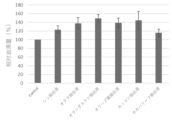
- Example 2 Sebum production-enhancing action of perilla extract, okra extract, Dutch mustard extract, olive leaf extract, kakkon extract, and jojoba leaf extract.
- sample preparation Commercially available perilla extract (trade name: perilla extract, 0.1% by weight), okra extract (trade name: Phytohyalon B, 0.1% by weight), Dutch mustard extract (trade name: Falcolex Dutch mustard B, 0.1% by weight) %), olive leaf extract (trade name: olive leaf extract BG, 0.1% by weight), kakkon extract (trade name: Falcorex kakkon B, 0.1% by weight), jojoba leaf extract (trade name: jojoba leaf extract , 0.1 wt%) samples were prepared.
- Sebaceous gland cells derived from the scalp of a 50-year-old Caucasian female were seeded at 10,000 cells/well as tissues close to the face, and differentiated during 2 to 9 days of culture using a commercially available medium for sebaceous gland cells (Seb4Gln).
- the reagent (LDS) and the above samples, perilla extract, okra extract, Dutch mustard extract, olive leaf extract, kakkon extract, and jojoba leaf extract were added and culture continued. As a control, a system without the addition of the above sample was cultured.
- the results are shown in Figure 2.
- the vertical axis indicates the relative amount of oil droplets, with the amount of oil droplets per control cell set to 100%.
- Perilla extract, okra extract, Dutch mustard extract, olive leaf extract, kakkon extract and jojoba leaf extract were confirmed to have a sebum production promoting effect compared to the control.
- Sebum production is suppressed by administering a sebum production inhibitor containing as an active ingredient at least one substance selected from the group consisting of extract, neem leaf extract, carnitine, glycylglycine, 1-piperidinepropionic acid and allantoin. can be suppressed.
- a sebum production-enhancing agent containing as an active ingredient at least one substance selected from the group consisting of perilla extract, okra extract, Dutch mustard extract, olive leaf extract, kakkon extract and jojoba leaf extract.
- Administration can promote the production of sebum.
- Administration of the sebum production inhibitor/stimulator moderately regulates the production of sebum, enables the secretion of just the right amount of sebum, and improves oily skin and dry skin.
Landscapes
- Health & Medical Sciences (AREA)
- Natural Medicines & Medicinal Plants (AREA)
- Life Sciences & Earth Sciences (AREA)
- Veterinary Medicine (AREA)
- Public Health (AREA)
- General Health & Medical Sciences (AREA)
- Animal Behavior & Ethology (AREA)
- Epidemiology (AREA)
- Pharmacology & Pharmacy (AREA)
- Chemical & Material Sciences (AREA)
- Medicinal Chemistry (AREA)
- Engineering & Computer Science (AREA)
- Biotechnology (AREA)
- Mycology (AREA)
- Microbiology (AREA)
- Botany (AREA)
- Medical Informatics (AREA)
- Alternative & Traditional Medicine (AREA)
- Birds (AREA)
- Dermatology (AREA)
- Bioinformatics & Cheminformatics (AREA)
- Chemical Kinetics & Catalysis (AREA)
- General Chemical & Material Sciences (AREA)
- Nuclear Medicine, Radiotherapy & Molecular Imaging (AREA)
- Organic Chemistry (AREA)
- Cosmetics (AREA)
- Medicines Containing Plant Substances (AREA)
Abstract
Description
一方、乾燥肌に潤い、ハリを与える皮脂の産生を促進する促進剤について報告されていない。また、これまでハムスター由来の皮脂腺細胞については検討が行われてきたが、例えばハムスター皮脂にはヒト皮脂に存在するスクワレンが存在せず、組成が異なっているため、ハムスター皮脂腺を用いて得られた有効成分が、必ずしもヒト皮脂腺で効果を示すかどうかは分からない。ヒト由来の皮脂腺細胞について脂質合成を抑制/促進に関する研究が望まれるところ、十分にされてきていないのが現状である。
[態様2]皮脂の産生を抑制するための、態様1記載の組成物。
[態様3]シソ抽出液、オクラ抽出液、オランダカラシ抽出液、オリーブ葉抽出液、カッコン抽出液およびホホバリーフ抽出液から成る群より選択される少なくとも1つの物質を有効成分として含む、乾性肌改善用組成物。
[態様4]皮脂の産生を促進するための、態様3記載の組成物。
[態様5]ハマメリス抽出液、エイジツ抽出液、キイチゴ抽出液、加水分解真珠タンパク抽出液、ツバキ花抽出液、ツバキ葉抽出液、マンゴスチン抽出液、トウガシ抽出液、レモン抽出液、ムクロジ抽出液、フユベゴニア抽出液、ニームリーフ抽出液、カルニチン、グリシルグリシン、1-ピペリジンプロピオン酸およびアラントインから成る群より選択される少なくとも1つの物質を有効成分として含む、皮脂産生抑制剤。
[態様6]脂性肌の改善に用いるための、態様5記載の皮脂産生抑制剤。
[態様7]シソ抽出液、オクラ抽出液、オランダカラシ抽出液、オリーブ葉抽出液、カッコン抽出液およびホホバリーフ抽出液から成る群より選択される少なくとも1つの物質を有効成分として含む、皮脂産生促進剤。
[態様8]乾燥肌の改善に用いるための、態様7記載の皮脂産生促進剤。
[態様9]態様5もしくは6記載の皮脂産生抑制剤または態様7もしくは8記載の皮脂産生促進剤を含む、皮膚外用剤。
[態様10]態様9記載の皮膚外用剤を対象の皮膚に適用することを含む、美容方法。
[態様11]ハマメリス抽出液、エイジツ抽出液、キイチゴ抽出液、加水分解真珠タンパク抽出液、ツバキ花抽出液、ツバキ葉抽出液、マンゴスチン抽出液、トウガシ抽出液、レモン抽出液、ムクロジ抽出液、フユベゴニア抽出液、ニームリーフ抽出液、カルニチン、グリシルグリシン、1-ピペリジンプロピオン酸およびアラントインから成る群より選択される少なくとも1つの物質を対象に投与することを含む、脂性肌の改善方法。
[態様12]シソ抽出液、オクラ抽出液、オランダカラシ抽出液、オリーブ葉抽出液、カッコン抽出液およびホホバリーフ抽出液から成る群より選択される少なくとも1つの物質を対象に投与することを含む、乾燥肌の改善方法。
本発明に用いられるシソ抽出液、オクラ抽出液、オランダカラシ抽出液、オリーブ葉抽出液、カッコン抽出液およびホホバリーフ抽出液から成る群より選択される少なくとも1つの物質は、任意の方法で得ることができ、製法や供給源等に限定されない。
本開示に係る皮脂産生促進剤又は組成物は、シソ抽出液、オクラ抽出液、オランダカラシ抽出液、オリーブ葉抽出液、カッコン抽出液およびホホバリーフ抽出液から成る群より選択される少なくとも1つの物質を皮脂産生促進効果が十分発揮されるような量で含有させることが好ましい。
本開示に係る皮脂産生促進剤又は組成物におけるシソ抽出液、オクラ抽出液、オランダカラシ抽出液、オリーブ葉抽出液、カッコン抽出液およびホホバリーフ抽出液から成る群より選択される少なくとも1つの物質の配合量は、それらの種類、目的、形態、利用方法などに応じて、適宜決めることができる。
(試料の調製)
市販のエイジツ抽出液(商品名:エイジツ抽出液、0.01重量%)、ハマメリス抽出液(商品名:1,3-BG.VEGETOL HAMAMELIS GR-372、0.1重量%)、キイチゴ抽出液(商品名:キイチゴ抽出液BG、0.1重量%)、加水分解真珠タンパク抽出液(商品名:真珠たん白抽出液BG-JC<NP>、0.1重量%)、ツバキ花抽出液(商品名:ツバキ花エキス BG、0.1重量%)、ツバキ葉抽出液(商品名:ツバキ葉エキス BG、0.1重量%)、トウガシ抽出液(商品名:ファルコレックス トウガシ E、0.1重量%)、レモン抽出液(商品名:Hormo Fruit Lemon、0.1重量%)、ムクロジ抽出液(商品名:ムクロジエキスパウダー、0.005重量%)、フユベゴニア抽出液(0.1重量%)、ニームリーフ抽出液(商品名:ニームリーフリキッドB、0.1重量%)、カルニチン(0.1重量%)、グリシルグリシン(0.05重量%)、1-ピペリジンプロピオン酸(0.1重量%)およびアラントイン(0.004重量%)を用いて試料を調製した。マンゴスチン抽出液(0.2重量%)は、マンゴスチンの果皮または樹皮を室温で1週間1,3-ブチレングリコールに浸漬することにより、フユベゴニア抽出液は、フユベゴニアの根茎を室温で1週間エタノールに浸漬することにより得ることができ、これらを用いて試料を調製した。
顔に近い組織として、50歳白人女性の頭皮由来の皮脂腺細胞を10,000cells/ウェルとなるように播種し、市販の皮脂腺細胞用培地(Seb4Gln)を用いて2日~9日間培養中に、分化試薬(LDS)および上記試料エイジツ抽出液、ハマメリス抽出液、キイチゴ抽出液、加水分解真珠タンパク抽出液、ツバキ花抽出液、ツバキ葉抽出液、マンゴスチン抽出液、トウガシ抽出液、レモン抽出液、ムクロジ抽出液、フユベゴニア抽出液、ニームリーフ抽出液、カルニチン、グリシルグリシン、1-ピペリジンプロピオン酸およびアラントインを添加し培養を続けた。コントロールとして、上記試料を添加しない系の培養を行った。
エイジツ抽出液、ハマメリス抽出液、キイチゴ抽出液、加水分解真珠タンパク抽出液、ツバキ花抽出液、ツバキ葉抽出液、マンゴスチン抽出液、トウガシ抽出液、レモン抽出液、ムクロジ抽出液、フユベゴニア抽出液、ニームリーフ抽出液、カルニチン、グリシルグリシン、1-ピペリジンプロピオン酸およびアラントインは、コントロールと比較して皮脂産生抑制作用があることが確認された。
市販のシソ抽出液(商品名:シソ抽出液、0.1重量%)、オクラ抽出液(商品名:フィトヒアロン B、0.1重量%)、オランダカラシ抽出液(商品名:ファルコレックス オランダカラシ B、0.1重量%)、オリーブ葉抽出液(商品名:オリーブ葉抽出液BG、0.1重量%)、カッコン抽出液(商品名:ファルコレックス カッコン B、0.1重量%)、ホホバリーフ抽出液(商品名:ホホバリーフエキス、0.1重量%)試料を調製した。
顔に近い組織として、50歳白人女性の頭皮由来の皮脂腺細胞を10,000cells/ウェルとなるように播種し、市販の皮脂腺細胞用培地(Seb4Gln)を用いて2日~9日間培養中に、分化試薬(LDS)および上記試料、シソ抽出液、オクラ抽出液、オランダカラシ抽出液、オリーブ葉抽出液、カッコン抽出液、ホホバリーフ抽出液を添加し培養を続けた。コントロールとして、上記試料を添加しない系の培養を行った。
Claims (12)
- ハマメリス抽出液、エイジツ抽出液、キイチゴ抽出液、加水分解真珠タンパク抽出液、ツバキ花抽出液、ツバキ葉抽出液、マンゴスチン抽出液、トウガシ抽出液、レモン抽出液、ムクロジ抽出液、フユベゴニア抽出液、ニームリーフ抽出液、カルニチン、グリシルグリシン、1-ピペリジンプロピオン酸およびアラントインから成る群より選択される少なくとも1つの物質を有効成分として含む、脂性肌改善用組成物。
- 皮脂の産生を抑制するための、請求項1に記載の組成物。
- シソ抽出液、オクラ抽出液、オランダカラシ抽出液、オリーブ葉抽出液、カッコン抽出液およびホホバリーフ抽出液から成る群より選択される少なくとも1つの物質を有効成分として含む、乾性肌改善用組成物。
- 皮脂の産生を促進するための、請求項3に記載の組成物。
- ハマメリス抽出液、エイジツ抽出液、キイチゴ抽出液、加水分解真珠タンパク抽出液、ツバキ花抽出液、ツバキ葉抽出液、マンゴスチン抽出液、トウガシ抽出液、レモン抽出液、ムクロジ抽出液、フユベゴニア抽出液、ニームリーフ抽出液、カルニチン、グリシルグリシン、1-ピペリジンプロピオン酸およびアラントインから成る群より選択される少なくとも1つの物質を有効成分として含む、皮脂産生抑制剤。
- 脂性肌の改善に用いるための、請求項5記載の皮脂産生抑制剤。
- シソ抽出液、オクラ抽出液、オランダカラシ抽出液、オリーブ葉抽出液、カッコン抽出液およびホホバリーフ抽出液から成る群より選択される少なくとも1つの物質を有効成分として含む、皮脂産生促進剤。
- 乾燥肌の改善に用いるための、請求項7記載の皮脂産生促進剤。
- 請求項5もしくは6記載の皮脂産生抑制剤または請求項7もしくは8記載の皮脂産生促進剤を含む、皮膚外用剤。
- 請求項9記載の皮膚外用剤を対象の皮膚に適用することを含む、美容方法。
- ハマメリス抽出液、エイジツ抽出液、キイチゴ抽出液、加水分解真珠タンパク抽出液、ツバキ花抽出液、ツバキ葉抽出液、マンゴスチン抽出液、トウガシ抽出液、レモン抽出液、ムクロジ抽出液、フユベゴニア抽出液、ニームリーフ抽出液、カルニチン、グリシルグリシン、1-ピペリジンプロピオン酸およびアラントインから成る群より選択される少なくとも1つの物質を対象に投与することを含む、脂性肌の改善方法。
- シソ抽出液、オクラ抽出液、オランダカラシ抽出液、オリーブ葉抽出液、カッコン抽出液およびホホバリーフ抽出液から成る群より選択される少なくとも1つの物質を対象に投与することを含む、乾燥肌の改善方法。
Priority Applications (2)
| Application Number | Priority Date | Filing Date | Title |
|---|---|---|---|
| CN202280077774.7A CN118524828A (zh) | 2021-12-23 | 2022-12-09 | 皮脂产生抑制/促进剂 |
| JP2023569308A JPWO2023120233A1 (ja) | 2021-12-23 | 2022-12-09 |
Applications Claiming Priority (2)
| Application Number | Priority Date | Filing Date | Title |
|---|---|---|---|
| JP2021-209252 | 2021-12-23 | ||
| JP2021209252 | 2021-12-23 |
Publications (1)
| Publication Number | Publication Date |
|---|---|
| WO2023120233A1 true WO2023120233A1 (ja) | 2023-06-29 |
Family
ID=86902365
Family Applications (1)
| Application Number | Title | Priority Date | Filing Date |
|---|---|---|---|
| PCT/JP2022/045410 Ceased WO2023120233A1 (ja) | 2021-12-23 | 2022-12-09 | 皮脂産生抑制/促進剤 |
Country Status (3)
| Country | Link |
|---|---|
| JP (1) | JPWO2023120233A1 (ja) |
| CN (1) | CN118524828A (ja) |
| WO (1) | WO2023120233A1 (ja) |
Cited By (3)
| Publication number | Priority date | Publication date | Assignee | Title |
|---|---|---|---|---|
| CN118078704A (zh) * | 2024-01-23 | 2024-05-28 | 广州美兮生物科技有限公司 | 具有控油效果的组合物及其在洗发用品中的应用 |
| CN119112741A (zh) * | 2024-09-30 | 2024-12-13 | 广州市华侬化妆品股份有限公司 | 一种含有无患子提取物的复合物及其制备方法 |
| WO2025083495A1 (en) * | 2023-10-19 | 2025-04-24 | Dyson Operations PTE. LTD. | Compositions for sebum control |
Citations (3)
| Publication number | Priority date | Publication date | Assignee | Title |
|---|---|---|---|---|
| JPH1179968A (ja) * | 1997-09-04 | 1999-03-23 | Kao Corp | 化粧料 |
| JP2005047910A (ja) * | 2003-07-17 | 2005-02-24 | Rohto Pharmaceut Co Ltd | 皮脂分泌抑制用組成物 |
| JP2008534614A (ja) * | 2005-03-30 | 2008-08-28 | ルバンス セラピュティックス インク. | ざ瘡を治療するための組成物及び方法 |
-
2022
- 2022-12-09 WO PCT/JP2022/045410 patent/WO2023120233A1/ja not_active Ceased
- 2022-12-09 CN CN202280077774.7A patent/CN118524828A/zh active Pending
- 2022-12-09 JP JP2023569308A patent/JPWO2023120233A1/ja active Pending
Patent Citations (3)
| Publication number | Priority date | Publication date | Assignee | Title |
|---|---|---|---|---|
| JPH1179968A (ja) * | 1997-09-04 | 1999-03-23 | Kao Corp | 化粧料 |
| JP2005047910A (ja) * | 2003-07-17 | 2005-02-24 | Rohto Pharmaceut Co Ltd | 皮脂分泌抑制用組成物 |
| JP2008534614A (ja) * | 2005-03-30 | 2008-08-28 | ルバンス セラピュティックス インク. | ざ瘡を治療するための組成物及び方法 |
Cited By (3)
| Publication number | Priority date | Publication date | Assignee | Title |
|---|---|---|---|---|
| WO2025083495A1 (en) * | 2023-10-19 | 2025-04-24 | Dyson Operations PTE. LTD. | Compositions for sebum control |
| CN118078704A (zh) * | 2024-01-23 | 2024-05-28 | 广州美兮生物科技有限公司 | 具有控油效果的组合物及其在洗发用品中的应用 |
| CN119112741A (zh) * | 2024-09-30 | 2024-12-13 | 广州市华侬化妆品股份有限公司 | 一种含有无患子提取物的复合物及其制备方法 |
Also Published As
| Publication number | Publication date |
|---|---|
| JPWO2023120233A1 (ja) | 2023-06-29 |
| CN118524828A (zh) | 2024-08-20 |
Similar Documents
| Publication | Publication Date | Title |
|---|---|---|
| US8709511B2 (en) | External preparation composition for skin comprising ginseng flower or ginseng seed extracts | |
| KR102923573B1 (ko) | 폴리페놀이 풍부한 아보카도 과육 및/또는 껍질 추출물 및 이를 포함한 화장학적, 피부과학적 및 기능식품 조성물 | |
| TWI381834B (zh) | Abnormal protein removal composition | |
| JP2004131500A (ja) | 皮膚老化防止剤又は改善剤 | |
| CN118524828A (zh) | 皮脂产生抑制/促进剂 | |
| JP2003201229A (ja) | マトリックスメタロプロテアーゼ活性阻害剤および抗老化用化粧料 | |
| CN103494737B (zh) | 一种以姜花作为抗衰老护肤因子的化妆品制剂及制备方法 | |
| KR101922635B1 (ko) | 마유 및 새싹 추출물을 함유하는 피부 염증 개선용 화장료 조성물 | |
| CN112641856B (zh) | 抗衰老的中药组合物 | |
| JP2009209063A (ja) | 皮膚外用剤または皮膚化粧料 | |
| KR102214985B1 (ko) | 식물추출물 또는 이의 분획물을 유효성분으로 함유하는 피부 상태 개선용 조성물 | |
| JP2005047910A (ja) | 皮脂分泌抑制用組成物 | |
| KR102300581B1 (ko) | 식물추출물 또는 이의 분획물을 유효성분으로 함유하는 피부 상태 개선용 조성물 | |
| CN107970278A (zh) | 莲雾水萃取物的水解产物及其制备方法与用途 | |
| TWI635873B (zh) | 蓮霧水萃取物的水解產物及其製備方法與用途 | |
| KR100539298B1 (ko) | 인플라메이징 개선용 피부 외용제 조성물 | |
| KR100564107B1 (ko) | 피부노화방지 효능을 갖는 혼합 식물 추출물을 함유한화장료 조성물 | |
| KR20100120451A (ko) | 여드름 피부 개선용 화장료 조성물 | |
| KR102226179B1 (ko) | 항노화 화장료 조성물 | |
| KR100776346B1 (ko) | 한련초, 숙지황, 하수오 및 반하 혼합 생약 추출물을함유하는 항비듬, 항염 활성을 갖는 조성물 | |
| KR20130088665A (ko) | 생강 초임계 추출물 및 발효 미나리 박 추출물을 함유하는 식품 조성물, 화장료 조성물 및 약학 조성물 | |
| KR102498980B1 (ko) | 작약 추출물을 함유하는 미백용 화장료 조성물 제조방법 및 그에 의해 제조된 작약 추출물을 함유하는 미백용 화장료 조성물 | |
| KR20050028565A (ko) | 질경이 추출물을 함유하는 피부 외용제 조성물 | |
| JP2008143784A (ja) | 細胞増殖促進剤 | |
| JP2008088075A (ja) | プロフィラグリン/フィラグリン産生促進剤、表皮角化細胞増殖促進剤、表皮/角層正常化用皮膚外用剤、プロフィラグリン及び/又はフィラグリン産生促進方法、及び表皮角化細胞増殖促進方法 |
Legal Events
| Date | Code | Title | Description |
|---|---|---|---|
| 121 | Ep: the epo has been informed by wipo that ep was designated in this application |
Ref document number: 22910944 Country of ref document: EP Kind code of ref document: A1 |
|
| ENP | Entry into the national phase |
Ref document number: 2023569308 Country of ref document: JP Kind code of ref document: A |
|
| WWE | Wipo information: entry into national phase |
Ref document number: 202280077774.7 Country of ref document: CN |
|
| NENP | Non-entry into the national phase |
Ref country code: DE |
|
| 122 | Ep: pct application non-entry in european phase |
Ref document number: 22910944 Country of ref document: EP Kind code of ref document: A1 |