WO2023119752A1 - 粘着シート - Google Patents
粘着シート Download PDFInfo
- Publication number
- WO2023119752A1 WO2023119752A1 PCT/JP2022/034509 JP2022034509W WO2023119752A1 WO 2023119752 A1 WO2023119752 A1 WO 2023119752A1 JP 2022034509 W JP2022034509 W JP 2022034509W WO 2023119752 A1 WO2023119752 A1 WO 2023119752A1
- Authority
- WO
- WIPO (PCT)
- Prior art keywords
- pressure
- sensitive adhesive
- adhesive layer
- adhesive sheet
- mass
- Prior art date
- Legal status (The legal status is an assumption and is not a legal conclusion. Google has not performed a legal analysis and makes no representation as to the accuracy of the status listed.)
- Ceased
Links
Images


Classifications
-
- B—PERFORMING OPERATIONS; TRANSPORTING
- B32—LAYERED PRODUCTS
- B32B—LAYERED PRODUCTS, i.e. PRODUCTS BUILT-UP OF STRATA OF FLAT OR NON-FLAT, e.g. CELLULAR OR HONEYCOMB, FORM
- B32B25/00—Layered products comprising a layer of natural or synthetic rubber
- B32B25/18—Layered products comprising a layer of natural or synthetic rubber comprising butyl or halobutyl rubber
-
- B—PERFORMING OPERATIONS; TRANSPORTING
- B32—LAYERED PRODUCTS
- B32B—LAYERED PRODUCTS, i.e. PRODUCTS BUILT-UP OF STRATA OF FLAT OR NON-FLAT, e.g. CELLULAR OR HONEYCOMB, FORM
- B32B27/00—Layered products comprising a layer of synthetic resin
-
- C—CHEMISTRY; METALLURGY
- C09—DYES; PAINTS; POLISHES; NATURAL RESINS; ADHESIVES; COMPOSITIONS NOT OTHERWISE PROVIDED FOR; APPLICATIONS OF MATERIALS NOT OTHERWISE PROVIDED FOR
- C09J—ADHESIVES; NON-MECHANICAL ASPECTS OF ADHESIVE PROCESSES IN GENERAL; ADHESIVE PROCESSES NOT PROVIDED FOR ELSEWHERE; USE OF MATERIALS AS ADHESIVES
- C09J109/00—Adhesives based on homopolymers or copolymers of conjugated diene hydrocarbons
- C09J109/10—Latex
-
- C—CHEMISTRY; METALLURGY
- C09—DYES; PAINTS; POLISHES; NATURAL RESINS; ADHESIVES; COMPOSITIONS NOT OTHERWISE PROVIDED FOR; APPLICATIONS OF MATERIALS NOT OTHERWISE PROVIDED FOR
- C09J—ADHESIVES; NON-MECHANICAL ASPECTS OF ADHESIVE PROCESSES IN GENERAL; ADHESIVE PROCESSES NOT PROVIDED FOR ELSEWHERE; USE OF MATERIALS AS ADHESIVES
- C09J11/00—Features of adhesives not provided for in group C09J9/00, e.g. additives
- C09J11/02—Non-macromolecular additives
- C09J11/04—Non-macromolecular additives inorganic
-
- C—CHEMISTRY; METALLURGY
- C09—DYES; PAINTS; POLISHES; NATURAL RESINS; ADHESIVES; COMPOSITIONS NOT OTHERWISE PROVIDED FOR; APPLICATIONS OF MATERIALS NOT OTHERWISE PROVIDED FOR
- C09J—ADHESIVES; NON-MECHANICAL ASPECTS OF ADHESIVE PROCESSES IN GENERAL; ADHESIVE PROCESSES NOT PROVIDED FOR ELSEWHERE; USE OF MATERIALS AS ADHESIVES
- C09J11/00—Features of adhesives not provided for in group C09J9/00, e.g. additives
- C09J11/02—Non-macromolecular additives
- C09J11/06—Non-macromolecular additives organic
-
- C—CHEMISTRY; METALLURGY
- C09—DYES; PAINTS; POLISHES; NATURAL RESINS; ADHESIVES; COMPOSITIONS NOT OTHERWISE PROVIDED FOR; APPLICATIONS OF MATERIALS NOT OTHERWISE PROVIDED FOR
- C09J—ADHESIVES; NON-MECHANICAL ASPECTS OF ADHESIVE PROCESSES IN GENERAL; ADHESIVE PROCESSES NOT PROVIDED FOR ELSEWHERE; USE OF MATERIALS AS ADHESIVES
- C09J11/00—Features of adhesives not provided for in group C09J9/00, e.g. additives
- C09J11/08—Macromolecular additives
-
- C—CHEMISTRY; METALLURGY
- C09—DYES; PAINTS; POLISHES; NATURAL RESINS; ADHESIVES; COMPOSITIONS NOT OTHERWISE PROVIDED FOR; APPLICATIONS OF MATERIALS NOT OTHERWISE PROVIDED FOR
- C09J—ADHESIVES; NON-MECHANICAL ASPECTS OF ADHESIVE PROCESSES IN GENERAL; ADHESIVE PROCESSES NOT PROVIDED FOR ELSEWHERE; USE OF MATERIALS AS ADHESIVES
- C09J123/00—Adhesives based on homopolymers or copolymers of unsaturated aliphatic hydrocarbons having only one carbon-to-carbon double bond; Adhesives based on derivatives of such polymers
- C09J123/02—Adhesives based on homopolymers or copolymers of unsaturated aliphatic hydrocarbons having only one carbon-to-carbon double bond; Adhesives based on derivatives of such polymers not modified by chemical after-treatment
- C09J123/18—Homopolymers or copolymers of hydrocarbons having four or more carbon atoms
- C09J123/20—Homopolymers or copolymers of hydrocarbons having four or more carbon atoms having four to nine carbon atoms
- C09J123/22—Copolymers of isobutene; Butyl rubber ; Homo- or copolymers of other iso-olefines
-
- C—CHEMISTRY; METALLURGY
- C09—DYES; PAINTS; POLISHES; NATURAL RESINS; ADHESIVES; COMPOSITIONS NOT OTHERWISE PROVIDED FOR; APPLICATIONS OF MATERIALS NOT OTHERWISE PROVIDED FOR
- C09J—ADHESIVES; NON-MECHANICAL ASPECTS OF ADHESIVE PROCESSES IN GENERAL; ADHESIVE PROCESSES NOT PROVIDED FOR ELSEWHERE; USE OF MATERIALS AS ADHESIVES
- C09J125/00—Adhesives based on homopolymers or copolymers of compounds having one or more unsaturated aliphatic radicals, each having only one carbon-to-carbon double bond, and at least one being terminated by an aromatic carbocyclic ring; Adhesives based on derivatives of such polymers
- C09J125/02—Homopolymers or copolymers of hydrocarbons
- C09J125/04—Homopolymers or copolymers of styrene
- C09J125/08—Copolymers of styrene
- C09J125/10—Copolymers of styrene with conjugated dienes
-
- C—CHEMISTRY; METALLURGY
- C09—DYES; PAINTS; POLISHES; NATURAL RESINS; ADHESIVES; COMPOSITIONS NOT OTHERWISE PROVIDED FOR; APPLICATIONS OF MATERIALS NOT OTHERWISE PROVIDED FOR
- C09J—ADHESIVES; NON-MECHANICAL ASPECTS OF ADHESIVE PROCESSES IN GENERAL; ADHESIVE PROCESSES NOT PROVIDED FOR ELSEWHERE; USE OF MATERIALS AS ADHESIVES
- C09J153/00—Adhesives based on block copolymers containing at least one sequence of a polymer obtained by reactions only involving carbon-to-carbon unsaturated bonds; Adhesives based on derivatives of such polymers
- C09J153/02—Vinyl aromatic monomers and conjugated dienes
-
- C—CHEMISTRY; METALLURGY
- C09—DYES; PAINTS; POLISHES; NATURAL RESINS; ADHESIVES; COMPOSITIONS NOT OTHERWISE PROVIDED FOR; APPLICATIONS OF MATERIALS NOT OTHERWISE PROVIDED FOR
- C09J—ADHESIVES; NON-MECHANICAL ASPECTS OF ADHESIVE PROCESSES IN GENERAL; ADHESIVE PROCESSES NOT PROVIDED FOR ELSEWHERE; USE OF MATERIALS AS ADHESIVES
- C09J7/00—Adhesives in the form of films or foils
- C09J7/30—Adhesives in the form of films or foils characterised by the adhesive composition
- C09J7/38—Pressure-sensitive adhesives [PSA]
Definitions
- the present invention relates to an adhesive sheet. More specifically, the present invention relates to a pressure-sensitive adhesive sheet that is used, for example, for applying a moisture-permeable waterproof sheet to an object to be applied.
- Patent Literature 1 describes a pressure-sensitive adhesive sheet including a first pressure-sensitive adhesive layer attached to a construction target and a second pressure-sensitive adhesive layer attached to a waterproof/moisture-permeable sheet.
- the first adhesive layer contains a first rubber component containing 40 to 93% by mass of butyl rubber and 7 to 60% by mass of polyisobutylene
- the first pressure-sensitive adhesive layer contains the first softener having a kinematic viscosity of 100 to 9000 mm 2 /s at 40° C. in a blending ratio of 82 to 128 parts by mass with respect to 100 parts by mass of the first rubber component. It is stated that It is also described that by configuring the pressure-sensitive adhesive sheet as described above, excellent adhesion can be achieved in a wide temperature range (-10°C to 60°C) when the moisture-permeable waterproof sheet is applied to the application site. .
- adhesive sheets are required to exhibit excellent adhesiveness over a wide temperature range, but it is difficult to say that this requirement is fully satisfied.
- an object of the present invention is to provide a pressure-sensitive adhesive sheet that can exhibit more sufficient adhesiveness in a wide temperature range from low to high temperatures.
- the pressure-sensitive adhesive sheet according to the present invention is a substrate; A pressure-sensitive adhesive sheet having a pressure-sensitive adhesive layer laminated on at least one surface of the substrate, The pressure-sensitive adhesive layer contains butyl rubber as an organic component,
- the ratio of the storage modulus value G 2 ' at ⁇ 10° C. to the storage modulus value G 1 ' at 60° C. (G 2 '/G 1 ') is less than 12;
- the value G 2 ' of the storage modulus at -10°C is 0.7 MPa or less,
- the adhesive strength at -10°C is 2.0 N/25 mm or more.
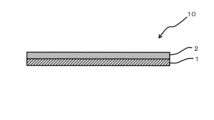
- FIG. 2 is a cross-sectional view showing a configuration in which a filler layer is arranged in the pressure-sensitive adhesive sheet according to one embodiment of the present invention.
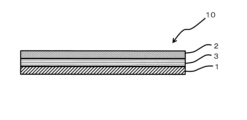
- Sectional drawing which shows the structure of the adhesive sheet which concerns on other embodiment of this invention.
- the pressure-sensitive adhesive sheet according to the present invention is a pressure-sensitive adhesive sheet having a base material and a pressure-sensitive adhesive layer laminated on at least one surface of the base material.
- the adhesive layer contains butyl rubber (isobutylene-isoprene rubber (IIR)) as an organic component.
- IIR isobutylene-isoprene rubber
- the pressure-sensitive adhesive layer has a ratio of the storage elastic modulus value G 2 ' at -10°C to the storage elastic modulus value G 1 ' at 60°C (G 2 '/G 1 '). is less than 12.
- the pressure-sensitive adhesive layer has a storage modulus value G 2 ' at -10°C of 0.7 MPa or less. Furthermore, in the adhesive sheet according to the present invention, the adhesive layer has an adhesive strength of 2.0 N/25 mm or more at -10°C.
- the storage elastic modulus value G 2 ' of the adhesive layer at -10 ° C. is 0.7 MPa or less, and the storage elastic modulus value G 1 ' at 60 ° C. at -10 ° C.
- the ratio (G 2 '/G 1 ') of the value G 2 ' of the storage elastic modulus is less than 12. Therefore, in the pressure-sensitive adhesive sheet according to the present invention, the pressure-sensitive adhesive layer has an appropriate elastic modulus in a wide temperature range from low temperature (-10°C) to high temperature (60°C). It is possible to exhibit good conformability to the substrate (object to be constructed such as a moisture-permeable waterproof sheet or the inner wall of a house) in a wide temperature range from low temperature to high temperature.
- the pressure-sensitive adhesive layer has a high pressure-sensitive adhesive strength of 2 N/25 mm or more even at a low temperature (-10°C) at which the pressure-sensitive adhesiveness may decrease significantly. Therefore, in the pressure-sensitive adhesive sheet according to the present invention, the pressure-sensitive adhesive layer can exhibit sufficient adhesiveness in a wide temperature range from low to high. Thereby, the pressure-sensitive adhesive sheet according to the present invention can exhibit more sufficient adhesiveness in a wide temperature range from low temperature to high temperature.
- the butyl rubber may maintain a molecular weight of 20% or more after being heated at 100°C for 7 weeks.
- the maintenance rate of the molecular weight of the butyl rubber after being heated at 100°C for 7 weeks is 20% or more
- the peak top value of the peak of the molecular weight (range of 250,000 or more and 800,000 or less) attributed to the butyl rubber is defined as MP0
- M P1 the value calculated by dividing M P1 by M P0 and multiplying by 100 (M P1 / M P0 ⁇ 100 calculated value ) is 20 or more.
- the molecular weight attributed to the butyl rubber means the weight average molecular weight.
- the molecular weight (mass average molecular weight) attributed to the butyl rubber by GPC can be determined as a standard polystyrene conversion value. More specifically, using HLC-8420GPC manufactured by TOSOH, it can be determined by measuring the sample obtained as follows under the following conditions. [Method of acquiring specimen] (1) Samples collected from the adhesive layer containing the butyl rubber (sample collected from the adhesive layer before heating at 100 ° C. and sample collected from the adhesive layer after heating at 100 ° C. for 7 weeks ) was prepared in a 1.0 g/L THF solution and allowed to stand overnight.
- the butyl rubber is obtained by addition polymerization of isobutylene, which is one raw material monomer, and isoprene, which is another raw material monomer.
- the deterioration of the butyl rubber is caused by the scission of the main chain due to an oxidation reaction or the like at the ⁇ -position carbon portion adjacent to the carbon-carbon double bond, and the butyl rubber becomes low-molecular or the molecular weight of the butyl rubber becomes less than 250,000. or), at the ⁇ -position carbon portion adjacent to the carbon-carbon double bond, the main chains are bonded to each other by an oxidation reaction or the like to polymerize (the molecular weight of the butyl rubber exceeds 800,000). occur.
- the pressure-sensitive adhesive layer contains polymerized butyl rubber
- the pressure-sensitive adhesive layer becomes hard
- the pressure-sensitive adhesive layer contains low-molecular-weight butyl rubber
- the pressure-sensitive adhesive layer becomes soft. Become.
- the pressure-sensitive adhesive layer becomes hard or soft in this way, it becomes difficult for the pressure-sensitive adhesive layer to exhibit sufficient adhesiveness to an application target (for example, an inner wall of a house).
- heating the adhesive sheet at 100 ° C. for 7 weeks means that the deterioration of butyl rubber occurring in the adhesive layer over a long period of time is considered to progress in a short time by exposing the adhesive sheet to severe conditions. This corresponds to the "deterioration test". Therefore, after heating at 100° C. for 7 weeks, the higher the molecular weight retention rate of the butyl rubber in the adhesive layer, that is, the lower the ratio of the deteriorated butyl rubber in the adhesive layer, the higher the The adhesive layer exhibits sufficient adhesiveness over a long period of time with respect to the object to be applied.
- the pressure-sensitive adhesive layer has excellent long-term durability, and by extension, the pressure-sensitive adhesive sheet provided with the pressure-sensitive adhesive layer also has excellent long-term durability.
- the adhesive layer when the molecular weight retention rate of the butyl rubber after being heated at 100° C. for 7 weeks is a relatively high value of 20% or more, , the adhesive layer exhibits sufficient adhesiveness to the object to be applied over a long period of time.
- the adhesive sheet provided with the adhesive layer as described above can be applied to the object to be applied to several tens of times after application.
- the pressure-sensitive adhesive sheet according to the present invention has the pressure-sensitive adhesive layer as described above, the pressure-sensitive adhesive sheet has excellent long-term durability.
- the maintenance rate of the molecular weight of the butyl rubber after being heated at 100° C. for 7 weeks is also referred to as the maintenance rate of the molecular weight of the butyl rubber after the accelerated deterioration test.
- the retention rate of the molecular weight of the butyl rubber after the accelerated deterioration test is preferably 50% or more, more preferably 60% or more, still more preferably 70% or more, and 80% or more. More preferably, it is particularly preferably 90% or more.
- a single-sided pressure-sensitive adhesive sheet in which a pressure-sensitive adhesive layer is laminated on one side of a substrate will be described as an example of a pressure-sensitive adhesive sheet according to an embodiment of the present invention.
- a pressure-sensitive adhesive sheet 10 As shown in FIG. 1A, a pressure-sensitive adhesive sheet 10 according to one embodiment of the present invention has a base material 1 and a pressure-sensitive adhesive layer 2 laminated on one side of the base material 1 .
- the pressure-sensitive adhesive layer 2 is attached to the moisture-permeable waterproof sheet.
- the adhesive layer 2 contains butyl rubber as an organic component.
- butyl rubber is a copolymer of isobutene (isobutylene) and a small amount of isoprene (isobutylene-isoprene).
- examples of butyl rubber include synthetic butyl rubber and recycled butyl rubber.
- the adhesive layer 2 preferably contains synthetic butyl rubber as a main component.
- the pressure-sensitive adhesive layer 2 preferably contains 70% by mass or more, more preferably 80% by mass or more, and more preferably 90% by mass or more of synthetic butyl rubber based on the total amount of butyl rubber. is more preferred, and 100% by mass is particularly preferred. That is, it is particularly preferable that all of the butyl rubber contained in the pressure-sensitive adhesive layer 2 is synthetic butyl rubber.
- the recycled butyl rubber is obtained by recycling rubber products (for example, tires and tubes) obtained using butyl rubber as a raw material.
- oils such as pine oil and mineral oil are used. be. Therefore, the oil used in the regeneration process remains in the reclaimed butyl rubber.
- the adhesive layer 2 contains recycled butyl rubber as the butyl rubber
- a moisture-permeable waterproof sheet is attached to the adhesive layer 2
- the oil contained in the recycled butyl rubber migrates to the moisture-permeable waterproof sheet.
- the moisture-permeable waterproof sheet is made of a fiber sheet (in particular, when it is made of a high-density polyethylene non-woven fabric), the oil transferred from the pressure-sensitive adhesive layer 2 causes the moisture-permeable waterproof sheet to becomes swollen. If the moisture-permeable waterproof sheet swells in this way, it is not preferable because the adhesion of the pressure-sensitive adhesive layer 2 to the moisture-permeable waterproof sheet cannot be sufficiently ensured.
- the adhesive layer 2 contains 70% by mass or more of synthetic butyl rubber based on the total amount of butyl rubber, the content of the oil derived from the recycled rubber in the adhesive layer 2 can be relatively reduced, it is possible to suppress swelling of the moisture-permeable waterproof sheet even if the moisture-permeable waterproof sheet is made of a fiber sheet.
- the weight average molecular weight of the butyl rubber is preferably 30,000 or more and 1,500,000 or less.
- the weight average molecular weight of the butyl rubber is more preferably 200,000 or more, more preferably 300,000 or more.
- the mass-average molecular weight of the butyl rubber is more preferably 800,000 or less, more preferably 700,000 or less.
- the weight average molecular weight of the butyl rubber contained in the pressure-sensitive adhesive layer 2 can be obtained as a standard polystyrene conversion value from GPC (gel permeation chromatography) measurement. More specifically, the mass average molecular weight of the butyl rubber contained in the pressure-sensitive adhesive layer 2 can be measured using HLC-8420GPC manufactured by TOSOH in the same manner as described above.
- the adhesive layer 2 may contain a rubber component other than butyl rubber as an organic component.
- Rubber components other than butyl rubber include rubbers other than butyl rubber and thermoplastic elastomers.
- Examples of rubbers other than butyl rubber include polyisobutylene rubber, acrylic rubber, silicone rubber, urethane rubber, vinyl alkyl ether rubber, polyvinyl alcohol rubber, polyvinylpyrrolidone rubber, polyacrylamide rubber, cellulose rubber, natural rubber, butadiene rubber, and chloroprene rubber. , styrene-butadiene rubber, acrylonitrile-butadiene rubber, isoprene rubber, ethylene-propylene rubber, and the like.
- Examples of thermoplastic elastomers include styrene-based thermoplastic elastomers and acrylic-based thermoplastic elastomers.
- styrene-based thermoplastic elastomer examples include styrene/ethylene/butadiene/styrene block copolymer (SEBS), styrene/isoprene/styrene block copolymer (SIS), and styrene/butadiene/styrene block copolymer (SBS). ), and styrene/ethylene/propylene/styrene block copolymer (SEPS).
- acrylic thermoplastic elastomers examples include acrylic rubbers containing acrylic acid ester as a main component.
- the acrylic rubbers include copolymers of acrylic acid esters and 2-chloroethylvinyl ether, acrylic acid Copolymers of esters and acrylonitrile and copolymers of acrylic acid esters and acrylic acid can be mentioned.
- the pressure-sensitive adhesive layer 2 preferably contains the thermoplastic elastomer, and preferably contains at least one of a styrene-based thermoplastic elastomer and an acrylic-based thermoplastic elastomer.
- the thermoplastic elastomer may be a styrene-based thermoplastic elastomer.
- the pressure-sensitive adhesive layer 2 contains at least one of styrene-isoprene-styrene block copolymer (SIS) and styrene-isobutylene-styrene block copolymer (SIBS) among the styrene-based thermoplastic elastomers. is preferred.
- SIS styrene-isoprene-styrene block copolymer
- SIBS styrene-isobutylene-styrene block copolymer
- the pressure-sensitive adhesive layer 2 may contain only a thermoplastic elastomer as rubber other than the butyl rubber. In such a case, the pressure-sensitive adhesive layer 2 contains 70% by mass or more of the butyl rubber when the sum of the content of the butyl rubber and the content of the thermoplastic elastomer is taken as 100% by mass. It may contain 30% by mass or less of a thermoplastic elastomer. In the above case, the pressure-sensitive adhesive layer 2 may contain 80% by mass or more of the butyl rubber and 20% by mass or less of the thermoplastic elastomer. Furthermore, in the above case, the pressure-sensitive adhesive layer 2 may contain the thermoplastic elastomer in an amount of 1% by mass or more, 2% by mass or more, or 3% by mass or more. .
- the pressure-sensitive adhesive layer 2 may contain synthetic butyl rubber as the butyl rubber in an amount of 70% by mass or more, 80% by mass or more, 90% by mass or more, or 100% by mass. good too.
- the pressure-sensitive adhesive layer 2 may contain the butyl rubber as described above, and may contain only a thermoplastic elastomer as rubber other than the butyl rubber. As the content of the butyl rubber and the content of the thermoplastic elastomer, those described above can be adopted. When the pressure-sensitive adhesive layer 2 contains the butyl rubber and the thermoplastic elastomer in the form described above, it is possible to reduce the extent to which the pressure-sensitive adhesive layer 2 stains (colors and stains) the adherend.
- the pressure-sensitive adhesive layer 2 preferably contains 1 part by mass or more of the thermoplastic elastomer with respect to 100 parts by mass of the total amount of the butyl rubber and the thermoplastic elastomer. Further, the pressure-sensitive adhesive layer 2 preferably contains 3 parts by mass or more of the thermoplastic elastomer with respect to 100 parts by mass of the total amount of the butyl rubber and the thermoplastic elastomer, and more preferably 5 parts by mass or more. is more preferable, it is more preferable that it contains 7 parts by mass or more, and it is more preferable that it contains 9 parts by mass or more.
- the upper limit of the mass parts of the thermoplastic elastomer to 100 mass parts of the total amount of the butyl rubber and the thermoplastic elastomer is usually 30 parts by mass.
- the upper limit value may be 20 parts by mass. Since the pressure-sensitive adhesive layer 2 contains the thermoplastic elastomer within the above numerical range, the pressure-sensitive adhesive layer 2 can withstand a wide temperature range from low temperature (eg, -10°C) to high temperature (eg, 60°C). , more sufficient adhesiveness can be exhibited. That is, the pressure-sensitive adhesive layer 2 can exhibit more sufficient adhesion to the adherend.
- the mass average molecular weight of the thermoplastic elastomer is preferably 20,000 or more and 1,500,000 or less.
- the mass average molecular weight can be obtained as a standard polystyrene conversion value from GPC (gel permeation chromatography) measurement.
- the mass-average molecular weight of the thermoplastic elastomer can be measured in the same manner as the mass-average molecular weight of the butyl rubber described above.
- the styrene content (styrene content) in the styrene-based thermoplastic elastomer is preferably 10% by mass or more, and 15% by mass. It is more preferably 20% by mass or more, and more preferably 20% by mass or more.
- the styrene content in the styrene-based thermoplastic elastomer is preferably 40% by mass or less, more preferably 30% by mass or less, and even more preferably 25% by mass or less.
- the diblock ratio of the styrene-based thermoplastic elastomer is preferably 10% or more, and preferably 25% or more. is more preferable, and 50% or more is even more preferable. Further, the diblock ratio of the styrene-based thermoplastic elastomer is preferably 70% or less. Since the diblock ratio of the styrene-based thermoplastic elastomer is within the above numerical range, the pressure-sensitive adhesive sheet 10 can be used in a wide temperature range from a low temperature (eg, -10°C) to a high temperature (eg, 60°C). Sufficient adhesiveness can be exhibited.
- a low temperature eg, -10°C
- a high temperature eg, 60°C
- the diblock ratio is obtained by measuring the molecular weight of the styrene-based thermoplastic elastomer by gel permeation chromatography (GPC), and the peak attributed to the diblock copolymer in the resulting chart, It can be calculated from the area ratio to the peak attributed to the block copolymer.
- GPC gel permeation chromatography
- Methods for adjusting the diblock ratio in the styrenic thermoplastic elastomer include changing the amount ratio of the polymerization initiator and the coupling agent used during polymerization (coupling agent amount/polymerization initiator amount). .
- the pressure-sensitive adhesive layer 2 preferably contains 8% by mass or more of the rubber component, more preferably 10% by mass or more.
- the pressure-sensitive adhesive layer 2 preferably contains the rubber component in an amount of 50% by mass or less, more preferably 45% by mass or less.
- the term "rubber component" is a general concept that includes butyl rubber, rubbers other than butyl rubber, and thermoplastic elastomers.
- the pressure-sensitive adhesive layer 2 may contain a softening agent, a tackifier, an anti-aging agent, etc. as organic components other than the rubber component.
- the pressure-sensitive adhesive layer 2 preferably contains an anti-aging agent among the organic components other than the above various rubber components.
- the adhesive layer 2 preferably contains a tackifier among the organic components other than the various rubber components described above.
- the softening agent examples include paraffins, waxes, naphthenes, aromas, asphalts, drying oils (eg, linseed oil), animal and vegetable oils, petroleum oils (eg, process oils), polybutene , polyisobutylene, ethylene/ ⁇ -olefin co-oligomer, low-molecular-weight polyethylene glycol, phthalates, phosphates, stearic acid or its esters, and alkylsulfonates.
- the said softening agent may be used individually and may be used in combination of 2 or more type.
- the pressure-sensitive adhesive layer 2 preferably contains at least one of polyisobutylene and ethylene/ ⁇ -olefin co-oligomer.
- the kinematic viscosity of the softener at 40° C. is preferably 700 mm 2 /s or more, more preferably 900 mm 2 /s or more. Also, the kinematic viscosity of the softener at 40° C. is preferably 100000 mm 2 /s or less, more preferably 50000 mm 2 /s or less.
- the kinematic viscosity is measured according to JIS K 2283 (2000). Specifically, the kinematic viscosity is measured with a glass capillary viscometer. When using a plurality of softeners having different kinematic viscosities, the kinematic viscosity is determined as the kinematic viscosity of a mixture of the plurality of softeners.
- the adhesive layer 2 preferably contains 30 parts by mass or more, more preferably 50 parts by mass or more, and 120 parts by mass or more of the softener with respect to 100 parts by mass of the rubber component. More preferably 130 parts by mass or more, more preferably 170 parts by mass or more.
- the pressure-sensitive adhesive layer 2 preferably contains 500 parts by mass or less, more preferably 400 parts by mass or less, and 300 parts by mass or less of the softener with respect to 100 parts by mass of the rubber component. More preferably, it contains 260 parts by mass or less.
- tackifiers include rosin-based resins, terpene-based resins, styrene-based resins, petroleum-based resins, phenol-based resins, and hydrogenated resins obtained by hydrogenating these resins. These tackifiers may be used alone or in combination of two or more.
- rosin-based resins examples include rosin resins, rosin ester resins, and rosin phenol resins.
- the terpene-based resin may be any compound having a structural unit derived from isoprene, and examples thereof include terpene resins, aromatic modified terpene resins, and terpene phenol-based resins.
- Styrenic resins include, for example, resins obtained by copolymerizing styrenic monomers such as ⁇ -methylstyrene or ⁇ -methylstyrene with aliphatic monomers.
- Petroleum-based resins include, for example, C5-based hydrocarbon resins obtained by copolymerizing C5 fractions such as pentene, isoprene, piperine, and 1,3-pentadiene produced by thermal decomposition of petroleum naphtha; thermal decomposition of petroleum naphtha and C9-based hydrocarbon resins obtained by copolymerizing C9 fractions such as indene and vinyltoluene produced in .
- phenolic resins include alkylphenolic resins, xylylene formaldehyde resins, resols, and novolacs.
- the pressure-sensitive adhesive layer 2 preferably contains a petroleum-based resin, and more preferably contains a C5-based hydrocarbon resin as the petroleum-based resin.
- the pressure-sensitive adhesive layer 2 preferably contains 5 parts by mass or more of the tackifier, more preferably 10 parts by mass or more, relative to 100 parts by mass of the rubber component.
- the pressure-sensitive adhesive layer 2 preferably contains 200 parts by mass or less of the tackifier, more preferably 150 parts by mass or less, and 70 parts by mass, relative to 100 parts by mass of the rubber component. More preferably, it contains 40 parts by mass or less, and more preferably 30 parts by mass or less.
- the ratio of the content of the butyl rubber to the content of the tackifier is preferably 2.2 or more. It is more preferably 0 or more, and even more preferably 5.0 or more.
- the ratio of the content of the butyl rubber to the content of the tackifier is preferably 15.0 or less, more preferably 10.0 or less, and 8.0 or less. is more preferable.
- anti-aging agents examples include phenol-based anti-aging agents, amine-based anti-aging agents, phosphorus-based anti-aging agents, and sulfur-based anti-aging agents.
- Examples of the phenol-based anti-aging agent include bisphenol-based anti-aging agents and hindered phenol-based anti-aging agents.
- Examples of the bisphenol-based antioxidants include 2,2'-methylenebis(4-methyl-6-tert-butylphenol) represented by the following formula (1), 4,4 '-thiobis(3-methyl-6-tert-butylphenol) and the like.
- Commercially available products of the bisphenol-based antioxidant represented by the following formula (1) include "Nocrac NS-6" (trade name) manufactured by Ouchi Shinko Kagaku Kogyo Co., Ltd., and the like.
- Commercially available products of the bisphenol-based antioxidant represented by the following formula (2) include "Nocrac 300" (trade name) manufactured by Ouchi Shinko Kagaku Kogyo Co., Ltd., and the like.
- hindered phenol anti-aging agent examples include, for example, tetrakis[methylene-3-(3,5-di-tert-butyl-4-hydroxyphenyl)propionate]methane represented by the following formula (3), 3,9-bis[2-[3-(3-tert-butyl-4-hydroxy-5-methylphenyl)propionyloxy]-1,1-dimethylethyl]-2,4, represented by (4), 8,10-tetraoxaspiro[5.5]undecane and the like.
- hindered phenol anti-aging agent represented by the following formula (3)
- Commercial products of the hindered phenol anti-aging agent represented by the following formula (3) include ADEKA's trade name "ADEKA STAB AO-60", SONGWON's trade name “SONGNOX (registered trademark) 1010", and BASF. trade name "Irganox (registered trademark) 1000" manufactured by the company.
- Commercially available hindered phenol anti-aging agents represented by the following formula (4) include "SUMILIZER GA-80" (trade name) manufactured by Sumitomo Chemical Co., Ltd., "ADEKA STAB AO-80” (trade name) manufactured by ADEKA, and the like. is mentioned.
- the phenol-based antioxidant preferably has a mass average molecular weight of 350 or more, more preferably 500 or more, more preferably 600 or more, more preferably 700 or more, and 800 or more. , more preferably 900 or more, and more preferably 1000 or more.
- mass average molecular weight of the phenolic antiaging agent is within the above numerical range, volatilization of the phenolic antiaging agent from the pressure-sensitive adhesive layer 2 can be suppressed.
- deterioration of the butyl rubber contained in the pressure-sensitive adhesive layer 2 due to an oxidation reaction or the like polymerization or low-molecularization of the butyl rubber
- the amine anti-aging agent is preferably an aromatic secondary amine anti-aging agent.
- the aromatic secondary amine anti-aging agent is a secondary amine in which an aromatic pipe is bound to a nitrogen atom.
- the aromatic secondary amine antioxidant preferably has a softening point of 50°C or higher, more preferably 80°C or higher.
- the aromatic secondary amine anti-aging agent preferably has a mass average molecular weight of 300 or more, more preferably 350 or more.
- aromatic secondary amine-based antioxidant examples include, for example, N-phenyl-N'-(1,3-dimethylbutyl)-p-phenylenediamine represented by the following formula (5); ), and 4,4'-bis( ⁇ , ⁇ -dimethylbenzyl)diphenylamine represented by the following formula (7).
- aromatic secondary amine anti-aging agent represented by the following formula (5) examples include "Nocrac 6C" (trade name) manufactured by Ouchi Shinko Kagaku Kogyo Co., Ltd., and the like.
- aromatic secondary amine anti-aging agents represented by the following formula (6) include "Nocrac White” (trade name) manufactured by Ouchi Shinko Kagaku Kogyo Co., Ltd., and the like. Further, commercial products of the aromatic secondary amine anti-aging agent represented by the following formula (7) include "Nocrac CD” (trade name) manufactured by Ouchi Shinko Kagaku Kogyo Co., Ltd., and the like.
- Amine anti-aging agents generally have the property of being highly colored with respect to rubber components such as the butyl rubber.
- the aromatic secondary amine anti-aging agent represented by the above formula (5) has the property of being highly colored with respect to rubber components such as the butyl rubber.
- the aromatic secondary amine anti-aging agent represented by the above formula (6) and the aromatic secondary amine anti-aging agent represented by the above formula (7) are the butyl rubber and the like. It has the property of being low in colorability (staining resistance) to the rubber component. That is, the aromatic secondary amine anti-aging agents represented by the above formulas (6) and (7) are amine anti-aging agents characterized by being non-staining. Therefore, from the viewpoint of suppressing contamination due to coloring of the rubber component, it is preferable to use an aromatic secondary amine antioxidant represented by the above formula (6) or (7) as the amine antioxidant. .
- Examples of the phosphorus anti-aging agent include tris(2,4-di-tert-butylphenyl)phosphite represented by the following formula (8).
- Commercially available phosphorus-based antioxidants represented by the following formula (8) include BASF's trade name "Irgafos (registered trademark) 168" and SONGWON's trade name "SONGNOX (registered trademark) 168". mentioned.
- sulfur-based anti-aging agent examples include 2-mercaptobenzimidazole represented by the following formula (9).
- Commercial products of the sulfur-based anti-aging agent represented by the following formula (9) include "Sumilizer (registered trademark) MB” manufactured by Sumika Chemtex Co., Ltd., and the like.
- the phenol-based anti-aging agent and the amine-based anti-aging agent are called primary anti-aging agents, and the phosphorus-based anti-aging agent and the sulfur-based anti-aging agent are They are called secondary antioxidants.
- the primary anti-aging agent is caused by radicals generated from the butyl rubber, in other words, a reaction in which radicals are generated from the butyl rubber becomes an initiation reaction, and oxidation of the butyl rubber progresses. (hereinafter referred to as auto-oxidation reaction), it is an anti-aging agent that preferentially reacts with the radical to stabilize the radical, and the secondary anti-aging agent decomposes the hydroperoxide generated in the auto-oxidation reaction.
- the secondary anti-aging agent is also called a peroxide-decomposing anti-aging agent because it has the property of decomposing hydroperoxide as described above.
- the autoxidation reaction is one aspect of the oxidation reaction of the butyl rubber.
- Another aspect of the oxidation reaction of the butyl rubber is a direct oxidation reaction in which the pressure-sensitive adhesive layer 2 contains an oxidizing agent so that the oxidation of the butyl rubber proceeds.
- the anti-aging agent may be a composite anti-aging agent having both the properties of the primary anti-aging agent and the properties of the secondary anti-aging agent.
- the composite anti-aging agent include those in which sulfur is contained in the structure of a compound having a phenol structure, that is, a sulfur-containing phenol anti-aging agent.
- the sulfur-containing phenolic anti-aging agent include, for example, 2,6-di-tert-butyl-4-(4,6-bis(octylthio)-1,3,5- triazin-2-ylamino)phenol and the like.
- Commercially available sulfur-containing phenol antioxidants represented by the following formula (10) include BASF's trade name "Irganox (registered trademark) 565".
- the pressure-sensitive adhesive layer 2 preferably contains 2 parts by mass or more, more preferably 3 parts by mass or more, and 4 parts by mass or more of the antioxidant with respect to 100 parts by mass of the rubber component. more preferably 5 parts by mass or more.
- the pressure-sensitive adhesive layer 2 preferably contains 15 parts by mass or less, more preferably 12 parts by mass or less, of the antioxidant with respect to 100 parts by mass of the rubber component, and 10 parts by mass. It is more preferable to contain the following, and it is more preferable to contain 8 parts by mass or less.
- the content of the anti-aging agent is within the above range, it is possible to suppress the bleeding phenomenon due to the anti-aging agent in the pressure-sensitive adhesive layer 2, and to suppress the deterioration of the butyl rubber due to the oxidation reaction. . Moreover, setting the upper limit of the anti-aging agent as described above is advantageous in terms of cost.
- the pressure-sensitive adhesive layer 2 contains at least one selected from the group consisting of the phenol-based anti-aging agent, the amine-based anti-aging agent, the phosphorus-based anti-aging agent, and the sulfur-based anti-aging agent. is preferred.
- the pressure-sensitive adhesive layer 2 preferably contains the phenol-based anti-aging agent. That is, the pressure-sensitive adhesive layer 2 preferably contains the phenol-based anti-aging agent as the primary anti-aging agent.
- the pressure-sensitive adhesive layer 2 comprises at least one selected from the first group consisting of the phenol-based antioxidant and the amine-based antioxidant, and the second antioxidant consisting of the phosphorus-based antioxidant and the sulfur-based antioxidant. and at least one selected from the group. That is, the pressure-sensitive adhesive layer 2 preferably contains both the primary anti-aging agent and the secondary anti-aging agent. Moreover, it is preferable that the pressure-sensitive adhesive layer 2 contains the phenol-based anti-aging agent as the primary anti-aging agent and the phosphorus-based anti-aging agent as the secondary anti-aging agent.
- the pressure-sensitive adhesive layer 2 contains the amine-based antioxidant in addition to the phenol-based antioxidant as the primary anti-aging agent, and the phosphorus-based anti-aging agent as the secondary anti-aging agent. is more preferable.
- the pressure-sensitive adhesive layer 2 contains at least one of the primary anti-aging agent and the secondary anti-aging agent, so that the molecular weight of the butyl rubber after being heated at 100 ° C. for 7 weeks is It can be sufficiently maintained at 20% by mass or more. As a result, the adhesive layer 2 becomes excellent in long-term durability, and by extension the adhesive sheet 10 also becomes excellent in long-term durability.
- the phenol-based anti-aging agent is the phosphorus-based anti-aging agent. It is preferably contained in a larger amount than the anti-aging agent.
- the ratio of CF to CP is preferably 1.1 or more, more preferably 1.5 or more, and more preferably 1.8 or more.
- the phenol antioxidant is contained in a larger amount than the amine antioxidant. preferably.
- the ratio of C F to C A is preferably 1.1 or more. More preferably 5 or more, more preferably 2.0 or more, more preferably 2.5 or more, more preferably 3.0 or more, more preferably 3.5 or more more preferred.
- the autoxidation reaction extracts hydrogen from the main chain of the butyl rubber to obtain radicals derived from the butyl rubber (hereinafter also referred to as first radicals) generated by the abstraction of hydrogen, and hydrogen
- An initiation reaction to obtain a radical see (a) in FIG. 2)
- a chain-growth reaction to generate a plurality of radicals different from the first radical and to obtain a plurality of products while regenerating the first radical.
- a termination reaction (see (c) in FIG. 2).
- (a) initiation reaction, (b) chain-propagation reaction, and (c) termination reaction will be described.
- H represents the hydrogen that is abstracted by the initiation reaction
- R represents the portion that forms the first radical by abstraction of the hydrogen H.
- the butyl rubber contained in the pressure-sensitive adhesive layer 2 has carbon-carbon double bonds derived from isoprene in its main chain.
- the hydrogen (H ) is the most likely to be pulled out. Therefore, when the pressure-sensitive adhesive layer 2 containing the butyl rubber receives external energy such as heat or light, the bond between carbon (C) at the ⁇ -position and hydrogen (H) is excited to a high energy state. As a result, the hydrogen (H) bonded to the ⁇ -position carbon (C) is extracted from the ⁇ -position carbon (C).
- the first radical R. generated by the initiation reaction can easily react with oxygen ( O.sub.2 ) in the air.
- a peroxy radical (ROO*) different from R* is generated (see formula (2) in FIG. 2).
- the peroxy radical (ROO) abstracts hydrogen (H) from the ⁇ -position carbon (C) different from the previous ⁇ -position carbon (C), thereby producing hydroperoxide (ROOH) as a product.
- the first radical R. is generated (see formula (3) in FIG. 2). That is, the first radical R ⁇ is regenerated and hydroperoxide (ROOH) is obtained as a product.
- the hydroperoxide (ROOH) is a peroxide, and the bond between RO and OH is easily broken. Therefore, in the hydroperoxide (ROOH), the bond between RO and OH is then broken to generate a radical RO and a hydroxyl radical (.OH), which are different from the first radical R. (see equation (4) in FIG. 2).
- the radical RO generated by the formula (4) abstracts hydrogen (H) from the ⁇ -position carbon (C) different from the ⁇ -position carbon (C) above, thereby producing An alcohol (ROH) is obtained and the first radical R* is generated (see formula (5) in FIG. 2).
- the hydroxy radical (.OH) generated by the formula (4) also produces the product
- water (H 2 O) is obtained
- the first radical R ⁇ is generated (see formula (6) in FIG. 2). That is, the first radical R ⁇ is regenerated, and alcohol (ROH) and water (H 2 O) are obtained as products.
- the radicals RO generated by the formula (4) undergo a main chain scission reaction at the R portion, resulting in a compound R 2 having an aldehyde group (CHO). CHO is obtained and a radical R 1. different from the first radical R. is generated (see formula (7) in FIG. 2).
- the butyl rubber Due to the occurrence of the reaction of formula (7), the butyl rubber is made to have a low molecular weight.
- the pressure-sensitive adhesive layer 2 containing such degraded butyl rubber softens and deteriorates.
- ⁇ (c) termination reaction As described above, while the chain-propagation reaction proceeds, various radicals generated by the chain-propagation reaction also react with each other. Then, when all the generated radicals disappear, the chain/propagation reaction stops (termination reaction).
- the termination reaction for example, a reaction in which a first radical R and a hydrogen radical H are reacted to obtain RH as a product (see formula (8) in FIG. 2), is obtained as a product RR (see formula (9) in FIG. 2), and a reaction in which radicals RO react with each other to obtain ROOR as a product (see formula (10) in FIG. 2 See ).
- the butyl rubber is polymerized when the termination reaction produces a product such as RR or ROOR.
- the pressure-sensitive adhesive layer 2 containing the polymerized butyl rubber is cured and deteriorated.
- the butyl rubber contained in the pressure-sensitive adhesive layer 2 deteriorates due to the radical reaction.
- the various radicals generated as described above in the pressure-sensitive adhesive layer 2 are preferentially reacted with the primary anti-aging agent to obtain the above Radical species can be stabilized.
- the progress of the auto-oxidation reaction in the pressure-sensitive adhesive layer 2 can be suppressed.
- the pressure-sensitive adhesive layer 2 contains the secondary antioxidant, the hydroperoxide (ROOH) generated in the pressure-sensitive adhesive layer 2 as described above can be decomposed. Also in this way, the progress of the auto-oxidation reaction in the pressure-sensitive adhesive layer 2 can be suppressed.
- ROOH hydroperoxide
- the pressure-sensitive adhesive layer 2 may contain a diene rubber such as a styrene-isoprene-styrene block copolymer (SIS) in addition to the butyl rubber as the rubber component.
- SIS styrene-isoprene-styrene block copolymer
- a diene rubber such as SIS has a larger number of carbon-carbon double bonds than the butyl rubber. It also has many ⁇ -position carbons. Therefore, in the diene rubber, hydrogen (H) is more easily extracted from the ⁇ -position carbon (C) as shown by the formula (1) in FIG. 2 than in the butyl rubber.
- derived radicals hereinafter also referred to as 1' radicals
- ROOH hydroperoxide
- the pressure-sensitive adhesive layer 2 contains the diene rubber in addition to the butadiene rubber, the pressure-sensitive adhesive layer 2 contains at least one of the primary anti-aging agent and the secondary anti-aging agent. Thus, deterioration of the butyl rubber in the pressure-sensitive adhesive layer 2 can be suppressed.
- the adhesive layer 2 may contain an inorganic component.
- the adhesive layer 2 may contain an inorganic filler and an inorganic colorant as inorganic components.
- the adhesive layer 2 preferably contains an inorganic filler as an inorganic component.
- the inorganic filler examples include calcium carbonate (eg, heavy calcium carbonate, light calcium carbonate, etc.), talc, titanium oxide, silica, and magnesium oxide. Among these, it is preferable to use calcium carbonate.
- the content of the inorganic filler in the adhesive layer 2 is preferably 20% by mass or more, more preferably 30% by mass or more, and even more preferably 35% by mass or more.
- the content of the inorganic filler in the pressure-sensitive adhesive layer 2 is preferably 90% by mass or less, more preferably 80% by mass or less, and even more preferably 70% by mass or less.
- Carbon is preferably used as the inorganic colorant, and carbon black is more preferably used.
- the pressure-sensitive adhesive layer 2 preferably contains 500 parts by mass or less, more preferably 450 parts by mass or less, and 400 parts by mass or less of the inorganic component with respect to 100 parts by mass of the rubber component. More preferably. In addition, the pressure-sensitive adhesive layer 2 preferably contains 50 parts by mass or more of the inorganic component, more preferably 150 parts by mass or more, and 270 parts by mass or more, relative to 100 parts by mass of the rubber component. It is more preferable to include
- the ratio of the mass value WO of the organic component to the mass value WI of the inorganic component is preferably 0.5 or more and 1.3 or less.
- the adhesive sheet 10 can exhibit more sufficient adhesiveness in a wide temperature range from low temperature to high temperature.
- W O /W I is more preferably 0.7 or more, even more preferably 0.8 or more. Further, W O /W I is more preferably 1.2 or less, and even more preferably 1.0 or less.
- the ratio of the butyl rubber content to the inorganic component content is preferably 0.15 or more, and preferably 0.20 or more. It is more preferable to have Moreover, in the adhesive layer 2, the ratio of the content of the butyl rubber to the content of the inorganic component is preferably 0.45 or less, more preferably 0.30 or less.
- the oxidation start temperature of the pressure-sensitive adhesive layer 2 measured using a chemiluminescence analyzer is preferably 200°C or higher. Further, the oxidation initiation temperature of the adhesive layer 2 is more preferably 220° C. or higher, more preferably 240° C. or higher, more preferably 250° C. or higher, and more preferably 260° C. or higher. preferable. In addition, the upper limit of the oxidation start temperature of the adhesive layer 2 is usually 300°C. When the oxidation initiation temperature of the pressure-sensitive adhesive layer 2 is within the above numerical range, the pressure-sensitive adhesive layer 2 is less susceptible to deterioration due to oxidation. Thereby, the adhesive sheet 10 becomes excellent in long-term durability.
- the oxidation start temperature of the pressure-sensitive adhesive layer 2 using a chemiluminescence analyzer is measured under the following conditions using, for example, a chemiluminescence analyzer with the trade name "CLA-FS4" manufactured by Tohoku Denshi Sangyo Co., Ltd. After obtaining a graph in which the horizontal axis is the temperature and the vertical axis is the light emission luminance, the graph can be obtained by analyzing the graph as follows.
- the pressure-sensitive adhesive layer 2 has a ratio (G 2 '/G 1 ' ) of the storage modulus value G 2 ' at ⁇ 10° C. to the storage modulus value G 1 ' at 60° C. of less than 12. be. Further, in the pressure-sensitive adhesive sheet according to the present invention, the pressure-sensitive adhesive layer has a storage elastic modulus value G 2 ' at -10°C of 0.7 MPa or less.
- G 1 ' and G 2 ' satisfy the above relationship, the pressure-sensitive adhesive layer 2 has an appropriate elastic modulus in a wide temperature range from low temperature (eg, ⁇ 10° C.) to high temperature (eg, 60° C.). will have. Therefore, such a pressure-sensitive adhesive layer 2 can exhibit good conformability to adherends (objects to be applied such as moisture-permeable waterproof sheets and inner walls of houses) in a wide temperature range from low to high temperatures. become.
- G 2 '/G 1 ' is preferably 11 or less.
- G 2 ′/G 1 ′ is preferably 3 or more, more preferably 5 or more.
- G 2 ′ is preferably 0.6 MPa or less, more preferably 0.5 MPa or less.
- G 2 ′ is preferably 0.1 MPa or more, more preferably 0.2 MPa or more.
- G 1 ′ is preferably 0.03 MPa or more and 0.06 MPa or less.
- the storage modulus value G 1 ' at 60°C and the storage modulus value G 2 ' at -10°C were measured using a dynamic viscoelasticity measuring device "ARES" manufactured by Rheometric Co., Ltd. It can be obtained by performing dynamic viscoelasticity measurement under the following conditions. As a measurement sample, a part of the adhesive obtained from the adhesive layer 2 is pressed to a thickness of 2 mm at a temperature of 80° C. for 1 minute.
- Apparatus ARES (Advanced Rheometric Expansion System) manufactured by Rheometric Scientific ⁇ Frequency: 1Hz ⁇ Temperature: -30 to 120°C ⁇ Temperature increase rate: 5°C/min ⁇ Deformation mode: twist ⁇ Shape: parallel plate (7.9mm ⁇ )
- G 1 ′ is the value at 60° C. in the above measurement
- G 2 ′ is the value at ⁇ 10° C. in the above measurement.
- the adhesive layer 2 has an adhesive strength of 2.0 N/25 mm or more at -10°C.
- the adhesive layer 2 preferably has an adhesive strength of 3.0 N/25 mm or more at -10°C, more preferably 5.0 N/25 mm or more.
- the upper limit of the adhesive strength of the adhesive layer 2 at ⁇ 10° C. is usually 20.0 N/25 mm.
- the adhesive layer 2 preferably has an adhesive strength at 23° C. of 9.0 N/25 mm or more, more preferably 11.0 N/25 mm or more. Thereby, the pressure-sensitive adhesive layer 2 can exhibit sufficient adhesiveness even at normal temperature such as 23°C.
- the upper limit of the adhesive strength of the adhesive layer 2 at 23° C. is usually 30.0 N/25 mm.
- the adhesive layer 2 preferably has an adhesive strength at 60° C. of 4.0 N/25 mm or more, more preferably 6.0 N/25 mm or more. Thereby, the pressure-sensitive adhesive layer 2 can exhibit sufficient adhesiveness even at a high temperature of 60°C.
- the upper limit of the adhesive strength of the adhesive layer 2 at 60° C. is usually 20.0 N/25 mm.
- the adhesive strength of the adhesive layer 2 at each evaluation temperature can be measured according to the following procedure.
- a test piece having a width of 25 mm is cut out from the adhesive sheet 10 .
- the test piece and the adherend moisture-permeable waterproof sheet (Lamitect Hi (product number RI-100-50), manufactured by Seiren Co., Ltd.) at each evaluation temperature (-10 ° C., 23 ° C., and 60 ° C.) Incubate for 1 hour.
- the pressure-sensitive adhesive layer 2 of the test piece is attached to one surface of the moisture-permeable waterproof sheet in an atmosphere of each evaluation temperature, and a roller with a mass of 2 kg is applied. By reciprocating once, the test piece is crimped to the moisture-permeable waterproof sheet.
- the adhesive strength of the pressure-sensitive adhesive layer 2 to the moisture-permeable waterproof sheet is measured under conditions of a peeling angle of 180° and a peeling speed of 300 mm/min. The above measurement is performed for three samples at each evaluation temperature, and the adhesive strength of the adhesive layer 2 at each evaluation temperature is determined by arithmetically averaging the measured values of the three samples.
- the substrate 1, the first adhesive layer 2a laminated on one surface of the substrate 1, and the second adhesive layer 2b laminated on the other surface of the substrate 1 In the case of measuring the adhesive strength of the adhesive sheet 10 ' (double-sided adhesive sheet) having the For the agent layer, measure adhesion according to the procedure above. For example, in the pressure-sensitive adhesive sheet 10' shown in FIG. After attaching a backing material to the first adhesive layer 2a, the adhesive force is measured.
- the backing material thin printed paper with a width of 30 mm, or polyethylene terephthalate film (hereinafter referred to as PET film) with a thickness of 25 ⁇ 2.5 ⁇ m specified in JIS C 2318, or equivalent or higher quality A PET film etc. are mentioned.
- the thin printing paper means printing paper having a basis weight of 40 g/m 2 or less, and includes, for example, India paper used for dictionaries and type/copy paper.
- a PET film as the backing material
- thin printing paper is preferably used as the backing material.
- the thickness of the adhesive layer 2 is preferably 50 ⁇ m or more, more preferably 100 ⁇ m or more. Moreover, the thickness of the adhesive layer 2 is preferably 500 ⁇ m or less, more preferably 400 ⁇ m or less.
- the base material 1 is preferably made of any sheet selected from the group consisting of a fiber sheet, a rubber sheet, a plastic sheet, a metal sheet, and a foam sheet. Since the substrate 1 is composed of any sheet selected from the above group, it becomes easier to form the pressure-sensitive adhesive layer 2 on the substrate 1 with a relatively uniform thickness. Moreover, the pressure-sensitive adhesive layer 2 can be preferably held on the base material 1 . Furthermore, among the sheets included in the above group, plastic sheets and metal sheets generally have high tensile strength. can improve sexuality. In addition, among the sheets included in the above group, fiber sheets, rubber sheets, and foam sheets generally have high flexibility. can be sufficiently followed even by an adherend having Among these, the base material 1 is preferably made of a fiber sheet.
- fibers constituting the fiber sheet include synthetic resin fibers, metal fibers, and natural fibers. Among these, synthetic resin fibers are preferred.
- the synthetic resin fibers include fibers made of thermoplastic resins and thermosetting resins.
- the synthetic resin fibers are preferably fibers made of a thermoplastic resin.
- thermoplastic resin examples include polyolefin resins such as polyethylene (PE) and polypropylene (PP); polyester resins such as polyethylene terephthalate (PET); polyamide resins such as polyamide 6 and polyamide 6,6; is mentioned. These thermoplastic resins may be used singly or in combination of two or more. Among these, the thermoplastic resin is preferably a polyester-based resin or a polyolefin-based resin, and more preferably polyethylene terephthalate or polypropylene.
- the fiber sheet is preferably a nonwoven fabric sheet or a woven fabric sheet.
- the fiber sheet is preferably composed of a nonwoven fabric sheet or a woven fabric sheet.
- the nonwoven fabric sheet may be manufactured by various known manufacturing methods.
- Various known production methods include, for example, a dry method, a wet method, a spunbond method, a thermal bond method, a chemical bond method, a stitch bond method, a needle punch method, a melt blow method, a spunlace method, and a steam jet method.
- a commercial thing can be used as a nonwoven fabric sheet.
- the basis weight of the nonwoven fabric sheet is preferably 25 g/m 2 or more, more preferably 30 g/m 2 or more, and even more preferably 40 g/m 2 or more.
- the basis weight of the nonwoven fabric sheet is preferably 80 g/m 2 or less, more preferably 70 g/m 2 or less.
- the woven sheet can be made using various known looms.
- the woven sheet may be woven in any weave. Examples of the weaving method of the woven fabric sheet include plain weave, twill weave, and satin weave. A commercially available product can be used as the woven fabric sheet.
- the thickness of the substrate 1 is preferably 60 ⁇ m or more, more preferably 80 ⁇ m or more. Also, the thickness of the substrate 1 is preferably 500 ⁇ m or less, more preferably 400 ⁇ m or less.
- the pressure-sensitive adhesive layer 2 is obtained by mixing the above-described organic component and inorganic component in the above-described amounts, kneading the resulting pressure-sensitive adhesive composition, and molding (gluing) the resulting pressure-sensitive adhesive composition into a sheet on the substrate 1. be able to.
- a kneader for example, a kneader, a Banbury mixer, a batch type kneader such as a mixing roll, a continuous kneader such as a twin-screw kneader, or the like is used.
- a forming apparatus such as a press (heat press) is used.
- a filler layer 3 may be provided between the substrate 1 and the pressure-sensitive adhesive layer 2 as shown in FIG. 1B.
- the filler layer 3 is a barrier layer for preventing the components contained in the pressure-sensitive adhesive layer 2 from penetrating into the substrate 1 .
- thermoplastic resin is preferably used as the material (filling material) forming the filling layer 3 .
- thermoplastic resins include ethylene-vinyl acetate copolymers, polyolefin resins such as polyethylene and polypropylene; and polyester resins such as polyethylene terephthalate. These thermoplastic resins may be used singly or in combination of two or more. Among these, the thermoplastic resin is preferably a polyolefin resin, more preferably polyethylene.
- the filling layer 3 can be laminated on the base material 1 by, for example, thermally melting a filling material and applying the melted material to one surface of the base material 1 .
- the coating method of the melt includes doctor blade method, calender roll coating, screen coating, gravure coating and the like. Further, the filling layer 3 can be laminated on the base material 1 by transferring it to the base material 1 via an adhesive.
- the thickness of the filling layer 3 is preferably 12 ⁇ m or more, more preferably 15 ⁇ m or more.
- the thickness of the filling layer 3 is preferably 35 ⁇ m or less, more preferably 25 ⁇ m or less.
- the single-sided pressure-sensitive adhesive sheet in which the pressure-sensitive adhesive layer 2 is laminated on one side of the substrate 1 has been described above as the pressure-sensitive adhesive sheet 10 according to one embodiment of the present invention with reference to FIGS. 1A and 1B.
- the pressure-sensitive adhesive sheet may be a double-sided pressure-sensitive adhesive sheet in which pressure-sensitive adhesive layers are laminated on both sides of a substrate, as shown in FIG. That is, as shown in FIG. 3, a pressure-sensitive adhesive sheet 10' according to another embodiment of the present invention includes a substrate 1, a first pressure-sensitive adhesive layer 2a laminated on one surface of the substrate 1, and a substrate and a second pressure-sensitive adhesive layer 2b laminated on the other side of the first adhesive layer.
- one pressure-sensitive adhesive layer (for example, the first pressure-sensitive adhesive layer 2a) is attached to the moisture-permeable waterproof sheet in the same manner as described for the single-sided pressure-sensitive adhesive sheet. Therefore, for example, when the first pressure-sensitive adhesive layer 2a is a pressure-sensitive adhesive layer to be attached to a moisture-permeable waterproof sheet, the first pressure-sensitive adhesive layer 2a is the pressure-sensitive adhesive layer of the pressure-sensitive adhesive sheet 10 according to one embodiment of the present invention. Configured in the same manner as Layer 2. On the other hand, the other pressure-sensitive adhesive layer (for example, the second pressure-sensitive adhesive layer 2b) is attached to a construction target such as an inner wall of a house.
- a construction target such as an inner wall of a house.
- the second pressure-sensitive adhesive layer 2b is a pressure-sensitive adhesive layer that is attached to a construction target such as an inner wall of a house
- the second pressure-sensitive adhesive layer 2b is configured in the same manner as the first pressure-sensitive adhesive layer 2a. , or may be configured differently.
- the second pressure-sensitive adhesive layer 2b has a different structure from the first pressure-sensitive adhesive layer 2a, from the viewpoint of sufficiently adhering the second pressure-sensitive adhesive layer 2b to the object to be applied, the second pressure-sensitive adhesive layer 2b is, for example, Japan 100 parts by mass of a rubber component containing 40 to 93% by mass of butyl rubber and 7 to 60% by mass of polyisobutylene, as described in JP-A-2013-189523 and JP-A-2015-54888, and 82 to 128 parts by mass of a softener having a kinematic viscosity of 100 to 9000 mm 2 /s, and a butyl rubber base, such as described in Japanese Patent Application Laid-Open No. 2003-213231.
- a cross-linking agent for cross-linking the butyl rubber and (a) a rubbery polymer, as described in Japanese Patent Application Laid-Open No. 2003-41233, ( b) a tackifier; and (c) a pressure-sensitive adhesive composition comprising a cross-linking agent containing at least one selected from thilium vulcanizing agents, quinoid vulcanizing agents, quinonedioxime vulcanizing agents, and maleimide vulcanizing agents. It is preferable to use a material.
- a suitable one is adopted according to the object to be applied.
- the first pressure-sensitive adhesive layer 2a and the second pressure-sensitive adhesive layer 2b are the same as described in the pressure-sensitive adhesive sheet 10 according to one embodiment of the present invention.
- Each pressure-sensitive adhesive composition (composition for the first pressure-sensitive adhesive layer and composition for the second pressure-sensitive adhesive layer) obtained by kneading with a batch type kneader or a continuous kneader is kneaded using a molding device such as an extruder. can be obtained by forming sheets on both sides of the base material 1 respectively.
- the adhesive sheet according to this embodiment is used for attaching a moisture-permeable waterproof sheet to construction objects such as building materials used for construction and civil engineering work.
- Moisture-permeable and waterproof properties are required for construction objects, for example, building materials for housing (peripheral parts around windows, girth parts, roofing materials, walls, etc.), members for construction and civil engineering work ( penetration portion, joint portion, etc.). That is, the pressure-sensitive adhesive sheet according to the present invention is used as a waterproof tape for houses.
- Moisture-permeable waterproof sheets are made of resin sheets with multiple fine holes formed through the thickness direction, non-woven fabrics with gaps between fibers, etc. Moisture passes through the fine holes and gaps, but rainwater is blocked. It is a sheet that is The moisture-permeable waterproof sheet is not particularly limited as long as it has the above functions. and the like. The moisture-permeable waterproof sheet is usually formed larger than the pressure-sensitive adhesive sheet.
- the adhesive sheets 10, 10' are laminated on at least one side of the substrate and the substrate. and a pressure-sensitive adhesive layer, wherein the pressure-sensitive adhesive layer contains butyl rubber as an organic component, and further, the molecular weight retention rate of the butyl rubber after being heated at 100 ° C. for 7 weeks is 20%. or more. That is, when focusing only on the problem of excellent long-term durability, the pressure-sensitive adhesive sheets 10 and 10' have a storage elastic modulus value G 2 at ⁇ 10° C.
- a substrate A pressure-sensitive adhesive sheet having a pressure-sensitive adhesive layer laminated on at least one surface of the substrate, The pressure-sensitive adhesive layer contains butyl rubber as an organic component,
- the ratio of the storage modulus value G 2 ' at ⁇ 10° C. to the storage modulus value G 1 ' at 60° C. (G 2 '/G 1 ') is less than 12;
- the value G 2 ' of the storage modulus at -10°C is 0.7 MPa or less,
- An adhesive sheet having an adhesive strength of 2.0 N/25 mm or more at -10°C.
- the adhesive sheet can exhibit more sufficient adhesiveness in a wide temperature range from low temperature to high temperature.
- the adhesive sheet can exhibit more sufficient adhesiveness in a wide temperature range from low temperature to high temperature, and also has excellent long-term durability.
- the adhesive sheet can exhibit more sufficient adhesiveness in a wide temperature range from low temperature to high temperature.
- the pressure-sensitive adhesive layer is less susceptible to deterioration due to oxidation. This makes the pressure-sensitive adhesive sheet more excellent in long-term durability.
- the pressure-sensitive adhesive layer further contains an inorganic component, Any one of the above (1) to (4), wherein the ratio of the mass value W O of the organic component to the mass value W I of the inorganic component (W O /W I ) is 0.5 or more and 1.3 or less. 1.
- the adhesive sheet can exhibit more sufficient adhesiveness in a wide temperature range from low temperature to high temperature.
- the adhesive sheet can exhibit more sufficient adhesiveness in a wide temperature range from low temperature to high temperature.
- thermoplastic elastomer is at least one of a styrene thermoplastic elastomer and an acrylic thermoplastic elastomer.
- the adhesive sheet can exhibit more sufficient adhesiveness in a wide temperature range from low temperature to high temperature.
- thermoplastic elastomer is a styrene-based thermoplastic elastomer.
- the adhesive sheet can exhibit more sufficient adhesiveness in a wide temperature range from low temperature to high temperature.
- the adhesive sheet can exhibit more sufficient adhesiveness in a wide temperature range from low temperature to high temperature.
- the adhesive sheet can exhibit more sufficient adhesiveness in a wide temperature range from low temperature to high temperature.
- the inclusion of the inorganic filler facilitates ensuring the thickness of the pressure-sensitive adhesive sheet.
- the adhesive sheet can exhibit more sufficient adhesive strength in a wide temperature range from low to high temperatures.
- the pressure-sensitive adhesive layer is more resistant to deterioration due to oxidation. This makes the pressure-sensitive adhesive sheet more excellent in long-term durability.
- the anti-aging agent contains at least one selected from the group consisting of a phenol-based anti-aging agent, an amine-based anti-aging agent, a phosphorus anti-aging agent, and a sulfur-based anti-aging agent. adhesive sheet.
- the pressure-sensitive adhesive layer is much less susceptible to deterioration due to oxidation. As a result, the pressure-sensitive adhesive sheet becomes more excellent in long-term durability.
- the anti-aging agent is selected from at least one selected from the first group consisting of phenol-based anti-aging agents and amine-based anti-aging agents, and the second group consisting of phosphorus-based anti-aging agents and sulfur-based anti-aging agents.
- the pressure-sensitive adhesive layer is much less susceptible to deterioration due to oxidation. As a result, the pressure-sensitive adhesive sheet becomes more excellent in long-term durability.
- the substrate is made of any sheet selected from the group consisting of a fiber sheet, a rubber sheet, a plastic sheet, a metal sheet, and a foam sheet. adhesive sheet.
- the pressure-sensitive adhesive layer can be favorably retained.
- plastic sheets and metal sheets generally have high tensile strength. can be improved.
- fiber sheets, rubber sheets, and foam sheets generally have high flexibility. can be sufficiently followed even by an adherend having
- Such a configuration makes it easier to form the pressure-sensitive adhesive layer with a relatively uniform thickness. Moreover, the pressure-sensitive adhesive layer can be held more favorably.
- a substrate having a pressure-sensitive adhesive layer laminated on at least one surface of the substrate,
- the pressure-sensitive adhesive layer contains butyl rubber as an organic component,
- a pressure-sensitive adhesive sheet wherein the butyl rubber maintains a molecular weight of 20% or more after being heated at 100°C for 7 weeks.
- the adhesive strength of the adhesive layer at -10 ° C. is 2.0 N / 25 mm or more
- the ratio (G 2 '/G 1 ') of the storage modulus value G 2 ' of the pressure-sensitive adhesive layer at -10°C to the value G 1 ' of the storage modulus of the pressure-sensitive adhesive layer at 60°C is less than 12; ,
- the pressure-sensitive adhesive layer further contains an inorganic component,
- the ratio of the mass value W O of the organic component to the mass value W I of the inorganic component (W O /W I ) is 0.5 or more and 1.3 or less of the above (1′) to (4′)
- the pressure-sensitive adhesive sheet according to any one of the above.
- thermoplastic elastomer is a styrene-based thermoplastic elastomer.
- the anti-aging agent contains at least one selected from the group consisting of a phenol-based anti-aging agent, an amine-based anti-aging agent, a phosphorus anti-aging agent, and a sulfur-based anti-aging agent. adhesive sheet.
- the anti-aging agent is selected from at least one selected from the first group consisting of phenol-based anti-aging agents and amine-based anti-aging agents, and the second group consisting of phosphorus-based anti-aging agents and sulfur-based anti-aging agents.
- the adhesive tape which concerns on this invention is not limited to the said embodiment.
- the pressure-sensitive adhesive tape according to the present invention is not limited by the effects described above. Various modifications can be made to the adhesive tape according to the present invention without departing from the gist of the present invention.
- Rubber component (a) butyl rubber (IIR) ⁇ JSR BUTYL 268 (manufactured by JSR, mass average molecular weight 500,000) ⁇ Recycled butyl rubber: Recycled butyl S (manufactured by Kangomu Kogyo Co., Ltd., mass average molecular weight 200,000)
- PIB Polyisobutylene
- Oppanol N100 (manufactured by BASF Japan, mass average molecular weight 1,300,000)
- SIS Thermoplastic elastomer/styrene/isoprene/styrene copolymer
- SIS1 styrene content 24% by mass, diblock ratio 67%
- SIS2 styrene content 16% by mass
- diblock ratio 56% SIS3 styrene content 14% by mass
- diblock ratio 26% SIS4 styrene
- Polyisobutylene 3 HV-15 (manufactured by Nippon Petrochemical Co., Ltd., number average molecular weight 630, kinematic viscosity at 40° C. 655 mm 2 /s)
- Ethylene- ⁇ -olefin co-oligomer Lucant LX-400 manufactured by Mitsui Chemicals, mass average molecular weight 12000, dynamic viscosity at 40° C.
- a rubber component (butyl rubber, polyisobutylene rubber, and thermoplastic elastomer), a tackifier, a softening agent, an inorganic filler, a coloring agent, and an antiaging agent are blended at the blending ratio (parts by mass) shown in Table 1 below. Then, while heating, adhesive compositions according to Examples 1 to 10 and Comparative Examples 1 to 3 were obtained.
- the pressure-sensitive adhesive composition according to each example was applied to one side of a substrate (polyethylene terephthalate nonwoven fabric (thickness: 100 ⁇ m)). Specifically, one side of the base material was coated with a calendar roll (8-inch roll, 4 rolls) while being heated to 80° C. so as to have a thickness of 0.2 mm. Thus, a pressure-sensitive adhesive sheet according to each example was obtained.
- the storage elastic modulus G 1 ' at 60°C and the storage elastic modulus G 2 ' at -10°C were measured for the PSA sheet according to each example.
- the storage moduli G 1 ′ and G 2 ′ were measured by the method described in the embodiment section above.
- the results of measuring the storage elastic moduli G 1 ′ and G 2 ′ are shown in Table 2 below.
- Table 2 below also shows the ratio of the value of the storage modulus G 2 ′ to the value of the storage modulus G 1 ′ (G 2 ′/G 1 ′ ).
- Adhesive force The pressure-sensitive adhesive sheet according to each example was measured for pressure-sensitive adhesive strength at -10°C, 23°C, and 60°C. Adhesion was measured by the method described in the embodiment section above. Table 2 below shows the measurement results of adhesive strength at each temperature.
- Adhesion stability test In accordance with JIS A 6112: 2019 (Double-sided adhesive waterproof tape for housing), "5.8 Adhesion stability test 10", the adhesive sheet according to each example was subjected to an adhesion stability test, and adhesion at 60 ° C. Stability was evaluated. Adhesion stability was evaluated according to the following criteria. ⁇ Good: Water leakage is confirmed. ⁇ Poor: No water leakage is confirmed. The results of the adhesion stability test are shown in Table 2 below.
- the pressure-sensitive adhesive sheet according to each example is fixed to a support in an atmosphere of room temperature (23 ⁇ 2° C.). As the adhesive sheet according to each example, a sheet with a width of 50 mm is used.
- the fixing of the pressure-sensitive adhesive sheet according to each example to the support is carried out in such a manner that the substrate is brought into contact with the support. That is, the pressure-sensitive adhesive sheet according to each example is fixed to the support with the pressure-sensitive adhesive layer exposed.
- a 50-mm-wide cotton cloth Kanahwa No. 3 is crimped onto the pressure-sensitive adhesive layer. The cotton cloth is pressed onto the pressure-sensitive adhesive layer by placing the cotton cloth on the pressure-sensitive adhesive layer and then reciprocating a 2-kg pressure roller once.
- the cotton cloth is separated from the pressure-sensitive adhesive layer one minute after the cotton cloth is pressure-bonded onto the pressure-sensitive adhesive layer.
- the cotton cloth is peeled off from the pressure-sensitive adhesive layer under conditions of a peeling angle of 90° and a tensile speed of 100 mm/min.
- a multi-angle spectrophotometer MA68II, manufactured by X-rite
- the whiteness L * 1 is measured in the same manner as the whiteness L * 0 .
- the adhesive sheets according to Examples 1 to 10 exhibited excellent adhesiveness in a wide range from low temperature (-10°C) to high temperature (60°C).
- the pressure-sensitive adhesive sheets according to Comparative Examples 1 to 3 were inferior in adhesiveness at at least one of low temperature and high temperature.
- the adhesive sheets according to Examples 1 to 10 are all excellent in adhesion stability at 60°C. From this, it was found that the pressure-sensitive adhesive sheets according to Examples 1 to 10 can exhibit excellent holdability to the adherend at 60°C.
- the pressure-sensitive adhesive sheets according to Examples 1 to 10 were evaluated as "good” in terms of the degree of staining of the cotton cloth to be adhered, that is, the degree of staining the cotton cloth was small.
- the recycled butyl rubber contained in the adhesive layer of the adhesive sheet according to Comparative Example 2 contains a large amount of carbon black (for example, it was obtained from a rubber product containing about 30% by mass), so it is presumed that the value of ⁇ L * was particularly high.
- Polyisobutylene 3′ HV-15 (manufactured by Nippon Petrochemical Co., Ltd., number average molecular weight 630, kinematic viscosity at 40° C. 655 mm 2 /s) (4) Inorganic filler Heavy calcium carbonate (manufactured by Maruo Calcium Co., Ltd., sieve residue (350 mesh) 0.5% or less (according to JIS K5101)) (5) Colorant Carbon: Seast 3H (manufactured by Tokai Carbon Co., Ltd., carbon black) (6) Anti-aging agent/primary anti-aging agent Amine anti-aging agent 1': Nocrack 6C (manufactured by Ouchi Shinko Chemical Industry Co., Ltd.) Amine anti-aging agent 2': Nocrack White (manufactured by Ouchi Shinko Kagaku Kogyo Co., Ltd.) Amine anti-aging agent 3': Nocrack CD (manufactured by
- a rubber component butyl rubber and thermoplastic elastomer
- a tackifier e.g., a softening agent
- an inorganic filler e.g., a coloring agent
- an anti-aging agent e.g., a tackifier, a softening agent, an inorganic filler, a coloring agent, and an anti-aging agent
- PSA compositions according to Examples 1' to 8' and Comparative Examples 1' to 4' were obtained.
- a pressure-sensitive adhesive composition according to each example was obtained while heating the liquid temperature to 140° C. using a kneader.
- the pressure-sensitive adhesive composition according to each example was applied to one side of a substrate (polyethylene terephthalate nonwoven fabric (thickness: 100 ⁇ m)). Specifically, one side of the base material was coated with a calendar roll (8-inch roll, 4 rolls) while being heated to 80° C. so as to have a thickness of 0.2 mm. Thus, a pressure-sensitive adhesive sheet according to each example was obtained.
- the storage elastic modulus G 1 ' of the adhesive layer at 60°C and the storage elastic modulus G 2 ' of the adhesive layer at -10°C were measured.
- the storage moduli G 1 ′ and G 2 ′ were measured by the method described in the embodiment section above.
- the results of measuring the storage elastic moduli G 1 ′ and G 2 ′ are shown in Table 4 below.
- Table 4 below also shows the ratio of the value of the storage modulus G 2 ′ to the value of the storage modulus G 1 ′ (G 2 ′/G 1 ′ ).
- the oxidation start temperature of the pressure-sensitive adhesive layer was measured using a chemiluminescence analyzer.
- the oxidation initiation temperature of the pressure-sensitive adhesive layer was measured by the method described in the embodiment section above. Table 4 below shows the results of measuring the oxidation initiation temperature of the pressure-sensitive adhesive layer.
- Adhesive force The pressure-sensitive adhesive sheet according to each example was measured for pressure-sensitive adhesive strength at -10°C, 23°C, and 60°C. Adhesion was measured by the method described in the embodiment section above. Table 4 below shows the measurement results of adhesive strength at each temperature.
- Adhesion stability test An adhesion stability test was conducted in accordance with JIS A 6112:2019 (Double-sided adhesive waterproof tape for housing), Section "5.8 Adhesion stability test 10", and adhesion stability at 60°C was evaluated. Adhesion stability was evaluated according to the following criteria. ⁇ Good: Water leakage is confirmed. ⁇ Poor: No water leakage is confirmed. The results are shown in Table 4 below.
- the pressure-sensitive adhesive sheet according to each example was evaluated for discoloration of the pressure-sensitive adhesive layer according to the following procedure.
- (1) The pressure-sensitive adhesive sheet according to each example is pressed so that the pressure-sensitive adhesive layer has a thickness of 0.2 mm.
- (2) The exposed surface of the adhesive layer of the adhesive sheet according to each example is attached to a hard type Tyvek sheet (trade name "Tyvek Hard Type 1060B", manufactured by Asahi DuPont Flashspun Products), and the Tyvek sheet and A first laminate is obtained with the pressure-sensitive adhesive sheet.
- Tyvek sheet trade name "Tyvek Hard Type 1060B", manufactured by Asahi DuPont Flashspun Products
- the maintenance rate of the molecular weight of the butyl rubber after being heated at 100° C. for 7 weeks is 20% or more. From this, it can be said that the pressure-sensitive adhesive sheet according to each example is excellent in long-term durability.
- the maintenance rate of the molecular weight of the butyl rubber after being heated at 100° C. for 7 weeks was found to be less than 15%. From this, it can be said that the pressure-sensitive adhesive sheets according to the respective comparative examples cannot sufficiently exhibit long-term durability.
- the pressure-sensitive adhesive sheet according to each example can exhibit excellent adhesiveness in a wide range from low temperature ( ⁇ 10° C.) to high temperature (60° C.).
- the pressure-sensitive adhesive sheet according to Comparative Example 1' does not exhibit sufficient low-temperature pressure-sensitive adhesiveness.
- the pressure-sensitive adhesive sheets according to each example are all excellent in adhesion stability at 60°C. From this, it can be seen that the pressure-sensitive adhesive sheet according to each example can exhibit excellent holdability to the object to be adhered at 60°C.
- the discoloration (yellowing) of the pressure-sensitive adhesive layer was evaluated as “no", whereas in the pressure-sensitive adhesive sheet according to Comparative Example 3', the discoloration (yellowing) of the pressure-sensitive adhesive layer ) is evaluated as “yes”. This is probably because the pressure-sensitive adhesive sheet according to Comparative Example 3' contains the amine-based anti-aging agent 1' whose coloring (staining property) to the rubber component is not suppressed in the pressure-sensitive adhesive layer. .
- Base Material 2 Adhesive Layer 2a First Adhesive Layer 2b Second Adhesive Layer 3 Sealing Layer 10 Adhesive Sheet 10' Adhesive Sheet
Landscapes
- Chemical & Material Sciences (AREA)
- Organic Chemistry (AREA)
- Inorganic Chemistry (AREA)
- Chemical Kinetics & Catalysis (AREA)
- Adhesives Or Adhesive Processes (AREA)
- Adhesive Tapes (AREA)
- Laminated Bodies (AREA)
Abstract
本発明に係る粘着シートは、基材と、該基材の少なくとも一方面に積層された粘着剤層と、を有する粘着シートであって、前記粘着剤層は、有機成分としてブチルゴムを含み、60℃における貯蔵弾性率の値G1'に対する-10℃における貯蔵弾性率の値G2'の比(G2'/G1')が12未満であり、-10℃における貯蔵弾性率の値G2'が0.7MPa以下であり、-10℃における粘着力が、2.0N/25mm以上である。
Description
本願は、日本国特願2021-207004号、日本国特願2022-113444号、及び、日本国特願2022-126281号の優先権を主張し、その開示内容は、引用によって本願明細書の記載に組み込まれる。
本発明は、粘着シートに関する。より詳しくは、本発明は、透湿防水シートを施工対象に施工するためなどに用いられる粘着シートに関する。
従来、住宅における内壁などを雨水などから保護するために、該内壁などを施工対象として、該施工対象に不織布などで構成された透湿防水シートを取り付けることが知られている(例えば、下記特許文献1)。
下記特許文献1には、施工対象に取り付けられる第1粘着剤層と防水透湿シートに取り付けられる第2粘着剤層とを備える粘着シートが記載されている。
また、下記特許文献1には、前記粘着シートにおいて、前記第1粘着剤層にブチルゴムを40~93質量%及びポリイソブチレンを7~60質量%含有する第1ゴム成分を含ませた上で、さらに、前記第1粘着剤層に40℃における動粘度が100~9000mm2/sである前記第1軟化剤を前記第1ゴム成分100質量部に対して82~128質量部の配合割合で含ませることが記載されている。
そして、粘着シートを上記のように構成することにより、透湿防水シートを施工箇所に施工した場合、広い温度範囲(-10℃~60℃)において優れた粘着性を実現できることが記載されている。
また、下記特許文献1には、前記粘着シートにおいて、前記第1粘着剤層にブチルゴムを40~93質量%及びポリイソブチレンを7~60質量%含有する第1ゴム成分を含ませた上で、さらに、前記第1粘着剤層に40℃における動粘度が100~9000mm2/sである前記第1軟化剤を前記第1ゴム成分100質量部に対して82~128質量部の配合割合で含ませることが記載されている。
そして、粘着シートを上記のように構成することにより、透湿防水シートを施工箇所に施工した場合、広い温度範囲(-10℃~60℃)において優れた粘着性を実現できることが記載されている。
上記のように、粘着シートには広い温度範囲において優れた粘着性を発揮できることが要求されているものの、この要求は、必ずしも十分に満たされているとは言い難い。
そこで、本発明は、低温から高温までの広い温度範囲において、より十分な粘着性を発揮できる粘着シートを提供することを課題とする。
本発明に係る粘着シートは、
基材と、
該基材の少なくとも一方面に積層された粘着剤層と、を有する粘着シートであって、
前記粘着剤層は、有機成分としてブチルゴムを含み、
60℃における貯蔵弾性率の値G1’に対する-10℃における貯蔵弾性率の値G2’の比(G2’/G1’)が12未満であり、
-10℃における貯蔵弾性率の値G2’が0.7MPa以下であり、
-10℃における粘着力が、2.0N/25mm以上である。
基材と、
該基材の少なくとも一方面に積層された粘着剤層と、を有する粘着シートであって、
前記粘着剤層は、有機成分としてブチルゴムを含み、
60℃における貯蔵弾性率の値G1’に対する-10℃における貯蔵弾性率の値G2’の比(G2’/G1’)が12未満であり、
-10℃における貯蔵弾性率の値G2’が0.7MPa以下であり、
-10℃における粘着力が、2.0N/25mm以上である。
以下、本発明に係る粘着シートについて説明する。
本発明に係る粘着シートは、基材と、該基材の少なくとも一方面に積層された粘着剤層と、を有する粘着シートである。
前記粘着剤層は、有機成分としてブチルゴム(イソブチレン・イソプレンゴム(IIR))を含む。
また、本発明に係る粘着シートでは、粘着剤層は、60℃における貯蔵弾性率の値G1’に対する-10℃における貯蔵弾性率の値G2’の比(G2’/G1’)が12未満である。
さらに、本発明に係る粘着シートでは、粘着剤層は、-10℃における貯蔵弾性率の値G2’が0.7MPa以下である。
さらに、本発明に係る粘着シートでは、粘着剤層は、-10℃における粘着力が2.0N/25mm以上である。
本発明に係る粘着シートは、基材と、該基材の少なくとも一方面に積層された粘着剤層と、を有する粘着シートである。
前記粘着剤層は、有機成分としてブチルゴム(イソブチレン・イソプレンゴム(IIR))を含む。
また、本発明に係る粘着シートでは、粘着剤層は、60℃における貯蔵弾性率の値G1’に対する-10℃における貯蔵弾性率の値G2’の比(G2’/G1’)が12未満である。
さらに、本発明に係る粘着シートでは、粘着剤層は、-10℃における貯蔵弾性率の値G2’が0.7MPa以下である。
さらに、本発明に係る粘着シートでは、粘着剤層は、-10℃における粘着力が2.0N/25mm以上である。
本発明に係る粘着シートでは、-10℃における粘着剤層の貯蔵弾性率の値G2’を0.7MPa以下とした上で、60℃における貯蔵弾性率の値G1’に対する-10℃における貯蔵弾性率の値G2’の比(G2’/G1’)が12未満としている。
そのため、本発明に係る粘着シートにおいては、低温(-10℃)から高温(60℃)の広い温度範囲において粘着剤層が適度な弾性率を有するものとなるので、該粘着剤層は、被着体(透湿防水シートや住宅における内壁などの施工対象)に対して低温から高温までの広い温度範囲において良好な追従性を発揮することができるようになる。
また、本発明に係る粘着シートでは、特に、粘着性の低下が顕著となり得る低温(-10℃)においても、粘着剤層の粘着力は2N/25mm以上という高い値となっている。
そのため、本発明に係る粘着シートにおいては、前記粘着剤層は、低温から高温の広い温度範囲において、十分な粘着性を示すことができる。
これにより、本発明に係る粘着シートは、低温から高温までの広い温度範囲において、より十分な粘着性を発揮することができる。
そのため、本発明に係る粘着シートにおいては、低温(-10℃)から高温(60℃)の広い温度範囲において粘着剤層が適度な弾性率を有するものとなるので、該粘着剤層は、被着体(透湿防水シートや住宅における内壁などの施工対象)に対して低温から高温までの広い温度範囲において良好な追従性を発揮することができるようになる。
また、本発明に係る粘着シートでは、特に、粘着性の低下が顕著となり得る低温(-10℃)においても、粘着剤層の粘着力は2N/25mm以上という高い値となっている。
そのため、本発明に係る粘着シートにおいては、前記粘着剤層は、低温から高温の広い温度範囲において、十分な粘着性を示すことができる。
これにより、本発明に係る粘着シートは、低温から高温までの広い温度範囲において、より十分な粘着性を発揮することができる。
本発明に係る粘着シートにおいては、100℃で7週間加熱された後における前記ブチルゴムの分子量の維持率が20%以上であってもよい。
ここで、「100℃で7週間加熱された後における前記ブチルゴムの分子量の維持率が20%以上である」とは、100℃で加熱される前においてGPC(ゲル浸透クロマトグラフィー)によって求められる前記ブチルゴムに帰属される分子量(25万以上80万以下の領域)のピークのピークトップ値をMP0とし、100℃で7週間加熱された後においてGPCによって求められる前記ブチルゴムに帰属される分子量(25万以上80万以下の領域)のピークのピークトップ値をMP1としたときに、MP1をMP0で除した後に100を乗じて算出される値(MP1/MP0×100の算出値)が20以上となっていることを意味する。
なお、前記ブチルゴムに帰属される分子量は、質量平均分子量を意味する。
なお、前記ブチルゴムに帰属される分子量は、質量平均分子量を意味する。
前記GPCによる前記ブチルゴムの帰属される分子量(質量平均分子量)は、標準ポリスチレンの換算値として求めることができる。
より具体的には、TOSOH社製のHLC-8420GPCを用いて、以下のようにして取得される検体を以下の条件を採用して測定することにより求めることができる。
[検体の取得方法]
(1)前記ブチルゴムを含む粘着剤層から採取した試料(100℃で加熱される前の粘着剤層から採取した試料、及び、100℃で7週間加熱された後の粘着剤層から採取した試料)を1.0g/LのTHF溶液に調製した一晩静置する。
(2)一晩静置したTHF溶液を孔径0.45μmのメンブレンフィルタでろ過し、得られたろ液を検体とする。
[GPC測定条件]
・カラム
TSKgel SuperHZM-H、TSKgel SuperHZ4000、TSKgel SuperHZ3000、及び、TSKgel SuperHZ200(いずれも、TOSOH社製)をフェラル方式にて直列に接続したもの
・カラムサイズ
それぞれ、6.0mmI.D.×150mm
・溶離液
THF
・流量
0.6mL/min
・カラム温度
40℃
・検出器
RI
・注入量
20μL
より具体的には、TOSOH社製のHLC-8420GPCを用いて、以下のようにして取得される検体を以下の条件を採用して測定することにより求めることができる。
[検体の取得方法]
(1)前記ブチルゴムを含む粘着剤層から採取した試料(100℃で加熱される前の粘着剤層から採取した試料、及び、100℃で7週間加熱された後の粘着剤層から採取した試料)を1.0g/LのTHF溶液に調製した一晩静置する。
(2)一晩静置したTHF溶液を孔径0.45μmのメンブレンフィルタでろ過し、得られたろ液を検体とする。
[GPC測定条件]
・カラム
TSKgel SuperHZM-H、TSKgel SuperHZ4000、TSKgel SuperHZ3000、及び、TSKgel SuperHZ200(いずれも、TOSOH社製)をフェラル方式にて直列に接続したもの
・カラムサイズ
それぞれ、6.0mmI.D.×150mm
・溶離液
THF
・流量
0.6mL/min
・カラム温度
40℃
・検出器
RI
・注入量
20μL
前記ブチルゴムは、一の原料モノマーであるイソブチレンと他の原料モノマーであるイソプレンとを付加重合させて得られるものであることから、前記ブチルゴムの主鎖には、前記イソプレン由来の炭素-炭素二重結合が存在している。
前記ブチルゴムの劣化は、前記炭素-炭素二重結合に隣接したα位の炭素部分において、酸化反応などによって主鎖が切断されて前記ブチルゴムが低分子化したり前記ブチルゴムの分子量が25万未満になったり)、前記炭素-炭素二重結合に隣接したα位の炭素部分において、酸化反応などによって主鎖どうしが結合されて高分子化したり(前記ブチルゴムの分子量が80万を超えたり)することによって生じる。
そして、前記粘着剤層が高分子化されたブチルゴムを含む場合には、該粘着剤層は硬くなり、前記粘着剤層が低分子化されたブチルゴムを含む場合には、該粘着剤層は軟らかくなる。
このように、前記粘着剤層が硬くなったり軟らかくなったりすると、該粘着剤層は施工対象(例えば、住宅における内壁など)に対して十分な粘着性を発揮し難くなる。
前記ブチルゴムの劣化は、前記炭素-炭素二重結合に隣接したα位の炭素部分において、酸化反応などによって主鎖が切断されて前記ブチルゴムが低分子化したり前記ブチルゴムの分子量が25万未満になったり)、前記炭素-炭素二重結合に隣接したα位の炭素部分において、酸化反応などによって主鎖どうしが結合されて高分子化したり(前記ブチルゴムの分子量が80万を超えたり)することによって生じる。
そして、前記粘着剤層が高分子化されたブチルゴムを含む場合には、該粘着剤層は硬くなり、前記粘着剤層が低分子化されたブチルゴムを含む場合には、該粘着剤層は軟らかくなる。
このように、前記粘着剤層が硬くなったり軟らかくなったりすると、該粘着剤層は施工対象(例えば、住宅における内壁など)に対して十分な粘着性を発揮し難くなる。
ここで、粘着シートを100℃で7週間加熱することは、過酷条件下に粘着シートを曝すことにより、前記粘着剤層中において長期間で生じるブチルゴムの劣化が短時間に進行するとみなした“加速劣化試験”に相当するものである。
そのため、100℃で7週間加熱された後において、前記粘着剤層中における前記ブチルゴムの分子量の維持率が高いほど、すなわち、前記粘着剤層中において劣化された前記ブチルゴムの比率が低いほど、前記粘着剤層は、前記施工対象に対して長きにわたって十分粘着性を発揮するものとなる。
すなわち、前記粘着剤層は長期耐久性に優れるものとなり、延いては、前記粘着剤層を備える粘着シートも長期耐久性に優れるものとなる。
そして、上で説明したように、本発明に係る粘着シートにおいて、100℃で7週間加熱された後における前記ブチルゴムの分子量の維持率が20%以上という比較的高い値となっている場合には、前記粘着剤層は前記施工対象に対して長きにわたって十分な粘着性を示すものとなる。
その結果、粘着シートの施工対象が住宅における内壁などの長い耐用年数を有するものであったとしても、上記のような粘着剤層を備える粘着シートは、上記のごとき施工対象に施工した後に数10年以上の長きにわたって該施工対象から剥がれ難いものとなる。
すなわち、本発明に係る粘着シートが上記のような粘着剤層を備える場合には、該粘着シートは、長期耐久性に優れるものとなる。
なお、以下では、100℃で7週間加熱された後における前記ブチルゴムの分子量の維持率を、加速劣化試験後の前記ブチルゴムの分子量の維持率ともいう。
そのため、100℃で7週間加熱された後において、前記粘着剤層中における前記ブチルゴムの分子量の維持率が高いほど、すなわち、前記粘着剤層中において劣化された前記ブチルゴムの比率が低いほど、前記粘着剤層は、前記施工対象に対して長きにわたって十分粘着性を発揮するものとなる。
すなわち、前記粘着剤層は長期耐久性に優れるものとなり、延いては、前記粘着剤層を備える粘着シートも長期耐久性に優れるものとなる。
そして、上で説明したように、本発明に係る粘着シートにおいて、100℃で7週間加熱された後における前記ブチルゴムの分子量の維持率が20%以上という比較的高い値となっている場合には、前記粘着剤層は前記施工対象に対して長きにわたって十分な粘着性を示すものとなる。
その結果、粘着シートの施工対象が住宅における内壁などの長い耐用年数を有するものであったとしても、上記のような粘着剤層を備える粘着シートは、上記のごとき施工対象に施工した後に数10年以上の長きにわたって該施工対象から剥がれ難いものとなる。
すなわち、本発明に係る粘着シートが上記のような粘着剤層を備える場合には、該粘着シートは、長期耐久性に優れるものとなる。
なお、以下では、100℃で7週間加熱された後における前記ブチルゴムの分子量の維持率を、加速劣化試験後の前記ブチルゴムの分子量の維持率ともいう。
加速劣化試験後の前記ブチルゴムの分子量の維持率は、50%以上であることが好ましく、60%以上であることがより好ましく、70%以上であることがさらに好ましく、80%以上であることがよりさらに好ましく、90%以上であることが特に好ましい。
以下では、まず、図1Aを参照しながら、本発明の一実施形態に係る粘着シートとして、基材の片面に粘着剤層が積層されている片面粘着シートを例に挙げて説明する。
図1Aに示しように、本発明の一実施形態に係る粘着シート10は、基材1と、基材1の片面に積層された粘着剤層2と、を有する。
なお、このような片面粘着シートでは、粘着剤層2は、透湿防水シートに貼り付けられる。
なお、このような片面粘着シートでは、粘着剤層2は、透湿防水シートに貼り付けられる。
上記したように、粘着剤層2は、有機成分として、ブチルゴムを含む。
上記したように、ブチルゴムは、イソブテン(イソブチレン)と少量のイソプレンとの共重合体(イソブチレン・イソプレン)である。
ブチルゴムとしては、合成ブチルゴム、再生ブチルゴムなどが挙げられる。
粘着剤層2は、主成分として合成ブチルゴムを含んでいることが好ましい。
粘着剤層2は、ブチルゴムの総量を基準としたときに、合成ブチルゴムを70質量%以上含んでいることが好ましく、80質量%以上含んでいることがより好ましく、90質量%以上含んでいることがさらに好ましく、100質量%であることが特に好ましい。
すなわち、粘着剤層2に含まれるブチルゴムの全てが合成ブチルゴムであることが特に好ましい。
前記再生ブチルゴムは、ブチルゴムを原料として得られたゴム製品(例えば、タイヤやチューブなど)を再生処理することにより得られるものであり、前記再生処理においては、パイン油や鉱油などのオイルが使用される。
そのため、前記再生ブチルゴムには、前記再生処理に使用したオイルが残留している。
ここで、粘着剤層2が前記ブチルゴムとして再生ブチルゴムを含む場合には、粘着剤層2に透湿防水シートを貼り付けると、前記再生ブチルゴムに含まれる前記オイルは前記透湿防水シートに成分移行するようになる。
そして、前記透湿防水シートが繊維シートで構成されたものである場合(特に、高密ポリエチレン不織布で構成されたものである場合)、粘着剤層2から成分移行した前記オイルによって前記透湿防水シートは膨潤するようになる。
このように、前記透湿防水シートが膨潤すると、前記透湿防水シートに対する粘着剤層2の密着性を十分に確保することができなくなることから好ましくない。
しかしながら、上記のように、ブチルゴムの総量を基準としたときに、粘着剤層2が合成ブチルゴムを70質量%以上含んでいることにより、粘着剤層2における前記再生ゴム由来の前記オイルの含有量を比較的少なくすることができるので、前記透湿防水シートが繊維シートで構成されたものであったとしても、前記透湿防水シートが膨潤することを抑制することができる。
ブチルゴムとしては、合成ブチルゴム、再生ブチルゴムなどが挙げられる。
粘着剤層2は、主成分として合成ブチルゴムを含んでいることが好ましい。
粘着剤層2は、ブチルゴムの総量を基準としたときに、合成ブチルゴムを70質量%以上含んでいることが好ましく、80質量%以上含んでいることがより好ましく、90質量%以上含んでいることがさらに好ましく、100質量%であることが特に好ましい。
すなわち、粘着剤層2に含まれるブチルゴムの全てが合成ブチルゴムであることが特に好ましい。
前記再生ブチルゴムは、ブチルゴムを原料として得られたゴム製品(例えば、タイヤやチューブなど)を再生処理することにより得られるものであり、前記再生処理においては、パイン油や鉱油などのオイルが使用される。
そのため、前記再生ブチルゴムには、前記再生処理に使用したオイルが残留している。
ここで、粘着剤層2が前記ブチルゴムとして再生ブチルゴムを含む場合には、粘着剤層2に透湿防水シートを貼り付けると、前記再生ブチルゴムに含まれる前記オイルは前記透湿防水シートに成分移行するようになる。
そして、前記透湿防水シートが繊維シートで構成されたものである場合(特に、高密ポリエチレン不織布で構成されたものである場合)、粘着剤層2から成分移行した前記オイルによって前記透湿防水シートは膨潤するようになる。
このように、前記透湿防水シートが膨潤すると、前記透湿防水シートに対する粘着剤層2の密着性を十分に確保することができなくなることから好ましくない。
しかしながら、上記のように、ブチルゴムの総量を基準としたときに、粘着剤層2が合成ブチルゴムを70質量%以上含んでいることにより、粘着剤層2における前記再生ゴム由来の前記オイルの含有量を比較的少なくすることができるので、前記透湿防水シートが繊維シートで構成されたものであったとしても、前記透湿防水シートが膨潤することを抑制することができる。
前記ブチルゴムの質量平均分子量は、3万以上150万以下であることが好ましい。
前記ブチルゴムの質量平均分子量は、20万以上であることがより好ましく、30万以上であることがさらに好ましい。
また、前記ブチルゴムの質量平均分子量は、80万以下であることがより好ましく、70万以下であることがさらに好ましい。
前記ブチルゴムの質量平均分子量は、20万以上であることがより好ましく、30万以上であることがさらに好ましい。
また、前記ブチルゴムの質量平均分子量は、80万以下であることがより好ましく、70万以下であることがさらに好ましい。
粘着剤層2に含まれる前記ブチルゴムの質量平均分子量は、GPC(ゲル浸透クロマトグラフィー)測定から標準ポリスチレンの換算値として求めることができる。
より具体的には、粘着剤層2に含まれる前記ブチルゴムの質量平均分子量は、TOSOH社製のHLC-8420GPCを用いて、先に説明したのと同様にして測定することができる。
より具体的には、粘着剤層2に含まれる前記ブチルゴムの質量平均分子量は、TOSOH社製のHLC-8420GPCを用いて、先に説明したのと同様にして測定することができる。
粘着剤層2は、ブチルゴム以外のゴム成分を有機成分として含んでいてもよい。
ブチルゴム以外のゴム成分としては、ブチルゴム以外のゴムや熱可塑性エラストマーが挙げられる。
ブチルゴム以外のゴム成分としては、ブチルゴム以外のゴムや熱可塑性エラストマーが挙げられる。
ブチルゴム以外のゴムとしては、例えば、ポリイソブチレンゴム、アクリルゴム、シリコーンゴム、ウレタンゴム、ビニルアルキルエーテルゴム、ポリビニルアルコールゴム、ポリビニルピロリドンゴム、ポリアクリルアミドゴム、セルロースゴム、天然ゴム、ブタジエンゴム、クロロプレンゴム、スチレン・ブタジエンゴム、アクリロニトリル・ブタジエンゴム、イソプレンゴム、エチレン・プロピレンゴムなどが挙げられる。
また、熱可塑性エラストマーとしては、例えば、スチレン系熱可塑性エラストマーやアクリル系熱可塑性エラストマーなどが挙げられる。
前記スチレン系熱可塑性エラストマーとしては、例えば、スチレン・エチレン・ブタジエン・スチレンブロック共重合体(SEBS)、スチレン・イソプレン・スチレンブロック共重合体(SIS)、スチレン・ブタジエン・スチレンブロック共重合体(SBS)、スチレン・エチレン・プロピレン・スチレンブロック共重合体(SEPS)などが挙げられる。
前記アクリル系熱可塑性エラストマーとしては、例えば、アクリル酸エステルを主成分とするアクリルゴムが挙げられ、前記アクリルゴムとしては、例えば、アクリル酸エステルと2-クロロエチルビニルエーテルとの共重合体、アクリル酸エステルとアクリロニトリルとの共重合体、アクリル酸エステルとアクリル酸との共重合体が挙げられる。
上記した中でも、粘着剤層2は、前記熱可塑性エラストマーを含んでいることが好ましく、スチレン系熱可塑性エラストマー及びアクリル系熱可塑性エラストマーの少なくとも一方を含んでいることが好ましい。
また、前記熱可塑性エラストマーは、スチレン系熱可塑性エラストマーであってもよい。
さらに、粘着剤層2は、前記スチレン系熱可塑性エラストマーの中でも、スチレン・イソプレン・スチレンブロック共重合体(SIS)及びスチレン・イソブチレン・スチレンブロック共重合体(SIBS)の少なくとも一方を含んでいることが好ましい。
また、熱可塑性エラストマーとしては、例えば、スチレン系熱可塑性エラストマーやアクリル系熱可塑性エラストマーなどが挙げられる。
前記スチレン系熱可塑性エラストマーとしては、例えば、スチレン・エチレン・ブタジエン・スチレンブロック共重合体(SEBS)、スチレン・イソプレン・スチレンブロック共重合体(SIS)、スチレン・ブタジエン・スチレンブロック共重合体(SBS)、スチレン・エチレン・プロピレン・スチレンブロック共重合体(SEPS)などが挙げられる。
前記アクリル系熱可塑性エラストマーとしては、例えば、アクリル酸エステルを主成分とするアクリルゴムが挙げられ、前記アクリルゴムとしては、例えば、アクリル酸エステルと2-クロロエチルビニルエーテルとの共重合体、アクリル酸エステルとアクリロニトリルとの共重合体、アクリル酸エステルとアクリル酸との共重合体が挙げられる。
上記した中でも、粘着剤層2は、前記熱可塑性エラストマーを含んでいることが好ましく、スチレン系熱可塑性エラストマー及びアクリル系熱可塑性エラストマーの少なくとも一方を含んでいることが好ましい。
また、前記熱可塑性エラストマーは、スチレン系熱可塑性エラストマーであってもよい。
さらに、粘着剤層2は、前記スチレン系熱可塑性エラストマーの中でも、スチレン・イソプレン・スチレンブロック共重合体(SIS)及びスチレン・イソブチレン・スチレンブロック共重合体(SIBS)の少なくとも一方を含んでいることが好ましい。
粘着剤層2は、前記ブチルゴム以外のゴムとして、熱可塑性エラストマーのみを含んでいてもよい。
このような場合、粘着剤層2は、前記ブチルゴムの含有量と前記熱可塑性エラストマーの含有量とを合算したものを100質量%としたときに、前記ブチルゴムを70質量%以上含んでいて、前記熱可塑性エラストマーを30質量%以下含んでいてもよい。
また、上のような場合、粘着剤層2は、前記ブチルゴムを80質量%以上含んでいて、前記熱可塑性エラストマーを20質量%以下含んでいてもよい。
さらに、上のような場合、粘着剤層2は、前記熱可塑性エラストマーを1質量%以上含んでいてもよいし、2質量%以上含んでいてもよいし、3質量%以上含んでいてもよい。
このような場合、粘着剤層2は、前記ブチルゴムの含有量と前記熱可塑性エラストマーの含有量とを合算したものを100質量%としたときに、前記ブチルゴムを70質量%以上含んでいて、前記熱可塑性エラストマーを30質量%以下含んでいてもよい。
また、上のような場合、粘着剤層2は、前記ブチルゴムを80質量%以上含んでいて、前記熱可塑性エラストマーを20質量%以下含んでいてもよい。
さらに、上のような場合、粘着剤層2は、前記熱可塑性エラストマーを1質量%以上含んでいてもよいし、2質量%以上含んでいてもよいし、3質量%以上含んでいてもよい。
また、粘着剤層2は、前記ブチルゴムとして合成ブチルゴムを70質量%以上含んでいてもよく、80質量%以上含んでいてもよく、90質量%以上含んでいてもよく、100質量%含んでいてもよい。
そして、粘着剤層2は、上記のように前記ブチルゴムを含んだ上で、前記ブチルゴム以外のゴムとして、熱可塑性エラストマーのみを含んでいてもよい。
なお、前記ブチルゴムの含有量と前記熱可塑性エラストマーの含有量としては、上記したものを採用することができる。
粘着剤層2が上のような形で前記ブチルゴム及び前記熱可塑性エラストマーを含むことにより、該粘着剤層2が被着対象物を汚染(着色汚染)する程度を小さくすることができる。
そして、粘着剤層2は、上記のように前記ブチルゴムを含んだ上で、前記ブチルゴム以外のゴムとして、熱可塑性エラストマーのみを含んでいてもよい。
なお、前記ブチルゴムの含有量と前記熱可塑性エラストマーの含有量としては、上記したものを採用することができる。
粘着剤層2が上のような形で前記ブチルゴム及び前記熱可塑性エラストマーを含むことにより、該粘着剤層2が被着対象物を汚染(着色汚染)する程度を小さくすることができる。
粘着剤層2は、前記ブチルゴム及び前記熱可塑性エラストマーの合計量100質量部に対して、前記熱可塑性エラストマーを1質量部以上含んでいることが好ましい。
また、粘着剤層2は、前記ブチルゴム及び前記熱可塑性エラストマーの合計量100質量部に対して、前記熱可塑性エラストマーを3質量部以上含んでいることがより好ましく、5質量部以上含んでいることがより好ましく、7質量部以上含んでいることがより好ましく、9質量部以上含んでいることがより好ましい。
なお、前記ブチルゴム及び前記熱可塑性エラストマーの合計量100質量部に対する前記熱可塑性エラストマーの質量部の上限値は、通常、30質量部である。
前記上限値は、20質量部であってもよい。
粘着剤層2が上記の数値範囲内で前記熱可塑性エラストマーを含んでいることにより、粘着剤層2は、低温(例えば、-10℃)から高温(例えば、60℃)までの広い温度範囲において、より一層十分な粘着性を発揮することができる。
すなわち、粘着剤層2は、被着体に対してより一層十分な密着性を発揮し得るものとなる。
また、粘着剤層2は、前記ブチルゴム及び前記熱可塑性エラストマーの合計量100質量部に対して、前記熱可塑性エラストマーを3質量部以上含んでいることがより好ましく、5質量部以上含んでいることがより好ましく、7質量部以上含んでいることがより好ましく、9質量部以上含んでいることがより好ましい。
なお、前記ブチルゴム及び前記熱可塑性エラストマーの合計量100質量部に対する前記熱可塑性エラストマーの質量部の上限値は、通常、30質量部である。
前記上限値は、20質量部であってもよい。
粘着剤層2が上記の数値範囲内で前記熱可塑性エラストマーを含んでいることにより、粘着剤層2は、低温(例えば、-10℃)から高温(例えば、60℃)までの広い温度範囲において、より一層十分な粘着性を発揮することができる。
すなわち、粘着剤層2は、被着体に対してより一層十分な密着性を発揮し得るものとなる。
前記熱可塑性エラストマーの質量平均分子量は、2万以上150万以下であることが好ましい。
なお、上記質量平均分子量は、GPC(ゲル浸透クロマトグラフィー)測定から標準ポリスチレンの換算値として求めることができる。
前記熱可塑性エラストマーの質量平均分子量の測定は、上記したブチルゴムの質量平均分子量の測定と同様にして実施することができる。
なお、上記質量平均分子量は、GPC(ゲル浸透クロマトグラフィー)測定から標準ポリスチレンの換算値として求めることができる。
前記熱可塑性エラストマーの質量平均分子量の測定は、上記したブチルゴムの質量平均分子量の測定と同様にして実施することができる。
粘着剤層2が前記熱可塑性エラストマーとしてスチレン系熱可塑性エラストマーを含んでいる場合、前記スチレン系熱可塑性エラストマーにおけるスチレン含有量(スチレン量)は、10質量%以上であることが好ましく、15質量%以上であることがより好ましく、20質量%以上であることがさらに好ましい。
また、前記スチレン系熱可塑性エラストマーにおけるスチレン含有量は、40質量%以下であることが好ましく、30質量%以下であることがより好ましく、25質量%以下であることがさらに好ましい。
さらに、粘着剤層2が前記熱可塑性エラストマーとしてスチレン系熱可塑性エラストマーを含んでいる場合、前記スチレン系熱可塑性エラストマーのジブロック率は、10%以上であることが好ましく、25%以上であることがより好ましく、50%以上であることがさらに好ましい。
また、前記スチレン系熱可塑性エラストマーのジブロック率は、70%以下であることが好ましい。
前記スチレン系熱可塑性エラストマーのジブロック率が上記数値範囲内であることにより、粘着シート10は、低温(例えば、-10℃)から高温(例えば、60℃)までの広い温度範囲において、より一層十分な粘着性を発揮できるものとなる。
また、前記スチレン系熱可塑性エラストマーにおけるスチレン含有量は、40質量%以下であることが好ましく、30質量%以下であることがより好ましく、25質量%以下であることがさらに好ましい。
さらに、粘着剤層2が前記熱可塑性エラストマーとしてスチレン系熱可塑性エラストマーを含んでいる場合、前記スチレン系熱可塑性エラストマーのジブロック率は、10%以上であることが好ましく、25%以上であることがより好ましく、50%以上であることがさらに好ましい。
また、前記スチレン系熱可塑性エラストマーのジブロック率は、70%以下であることが好ましい。
前記スチレン系熱可塑性エラストマーのジブロック率が上記数値範囲内であることにより、粘着シート10は、低温(例えば、-10℃)から高温(例えば、60℃)までの広い温度範囲において、より一層十分な粘着性を発揮できるものとなる。
ジブロック率(%)は、以下の式により算出することができる。
ジブロック率(%)=ジブロック共重合体の質量部/(ジブロック共重合体の質量部+トリブロック共重合体の質量部)×100
ジブロック率(%)=ジブロック共重合体の質量部/(ジブロック共重合体の質量部+トリブロック共重合体の質量部)×100
ジブロック率は、具体的には、ゲル浸透クロマトグラフ(GPC)法により、スチレン系熱可塑性エラストマーの分子量を測定し、得られたチャート中のジブロック共重合体に帰属されるピークと、トリブロック共重合体に帰属されるピークとの面積比から算出することができる。
GPC法は、ブチルゴムの質量平均分子量の測定方法で説明したのと同様にして実施することができる。
GPC法は、ブチルゴムの質量平均分子量の測定方法で説明したのと同様にして実施することができる。
前記スチレン系熱可塑性エラストマーにおいてジブロック率を調整する方法としては、重合時に使用する重合開始剤及びカップリング剤の量比(カップリング剤量/重合開始剤量)を変えたりすることが挙げられる。
粘着剤層2は、ゴム成分を8質量%以上含んでいることが好ましく、10質量%以上含んでいることがより好ましい。
また、粘着剤層2は、前記ゴム成分を50質量%以下含んでいることが好ましく、45質量%以下含んでいることがより好ましい。
なお、ゴム成分とは、ブチルゴム、ブチルゴム以外のゴム、及び、熱可塑性エラストマーを総称した概念である。
また、粘着剤層2は、前記ゴム成分を50質量%以下含んでいることが好ましく、45質量%以下含んでいることがより好ましい。
なお、ゴム成分とは、ブチルゴム、ブチルゴム以外のゴム、及び、熱可塑性エラストマーを総称した概念である。
粘着剤層2は、ゴム成分以外の有機成分として、軟化剤、粘着付与剤、老化防止剤などを含んでいてもよい。
粘着剤層2において前記ブチルゴムに生じる劣化をより抑制する上において、粘着剤層2は、上記の各種のゴム成分以外の有機成分のうち、老化防止剤を含んでいることが好ましい。
また、粘着剤層2により良好な粘着性を発揮させる上において、粘着剤層2は、上記の各種のゴム成分以外の有機成分のうち、粘着付与剤を含んでいることが好ましい。
粘着剤層2において前記ブチルゴムに生じる劣化をより抑制する上において、粘着剤層2は、上記の各種のゴム成分以外の有機成分のうち、老化防止剤を含んでいることが好ましい。
また、粘着剤層2により良好な粘着性を発揮させる上において、粘着剤層2は、上記の各種のゴム成分以外の有機成分のうち、粘着付与剤を含んでいることが好ましい。
前記軟化剤としては、例えば、パラフィン類、ワックス類、ナフテン類、アロマ類、アスファルト類、乾性油(例えば、アマニ油など)、動植物油類、石油系オイル類(例えば、プロセスオイルなど)、ポリブテン、ポリイソブチレン、エチレン・αオレフィンコオリゴマー、低分子量ポリエチレングルコール、フタル酸エステル類、リン酸エステル類、ステアリン酸またはそのエステル類、アルキルスルホン酸エステル類などが挙げられる。
前記軟化剤は、単独で使用してもよいし、2種以上を組み合わせて使用してもよい。
粘着剤層2は、これらの中でも、ポリイソブチレン及びエチレン・αオレフィンコオリゴマーの少なくとも1種を含んでいることが好ましい。
前記軟化剤は、単独で使用してもよいし、2種以上を組み合わせて使用してもよい。
粘着剤層2は、これらの中でも、ポリイソブチレン及びエチレン・αオレフィンコオリゴマーの少なくとも1種を含んでいることが好ましい。
前記軟化剤の40℃における動粘度は、700mm2/s以上であることが好ましく、900mm2/s以上であることがより好ましい。
また、前記軟化剤の40℃における動粘度は、100000mm2/s以下であることが好ましく、50000mm2/s以下であることがより好ましい。
また、前記軟化剤の40℃における動粘度は、100000mm2/s以下であることが好ましく、50000mm2/s以下であることがより好ましい。
前記動粘度は、JIS K 2283(2000)に準拠して測定される。
具体的には、前記動粘度は、ガラス製毛管式粘度計装置により測定される。
なお、前記動粘度が異なる複数の軟化剤を用いる場合には、前記動粘度は、複数の軟化剤の混合物の動粘度として求められる。
具体的には、前記動粘度は、ガラス製毛管式粘度計装置により測定される。
なお、前記動粘度が異なる複数の軟化剤を用いる場合には、前記動粘度は、複数の軟化剤の混合物の動粘度として求められる。
粘着剤層2は、前記ゴム成分の100質量部に対して、前記軟化剤を30質量部以上含んでいることが好ましく、50質量部以上含んでいることがより好ましく、120質量部以上含んでいることがより好ましく、130質量部以上含んでいることがより好ましく、170質量部以上含んでいることがより好ましい。
また、粘着剤層2は、前記ゴム成分の100質量部に対して、前記軟化剤を500質量部以下含んでいることが好ましく、400質量部以下含んでいることがより好ましく、300質量部以下含んでいることがより好ましく、260質量部以下含んでいることがより好ましい。
また、粘着剤層2は、前記ゴム成分の100質量部に対して、前記軟化剤を500質量部以下含んでいることが好ましく、400質量部以下含んでいることがより好ましく、300質量部以下含んでいることがより好ましく、260質量部以下含んでいることがより好ましい。
粘着付与剤としては、ロジン系樹脂、テルペン系樹脂、スチレン系樹脂、石油系樹脂、及び、フェノール系樹脂、並びに、これらの樹脂を水素化した水素化樹脂などが挙げられる。
これらの粘着付与剤は、単独で使用してもよいし、2種以上を組み合わせて使用してもよい。
これらの粘着付与剤は、単独で使用してもよいし、2種以上を組み合わせて使用してもよい。
ロジン系樹脂としては、例えば、ロジン樹脂、ロジンエステル樹脂、及び、ロジンフェノール樹脂などが挙げられる。
テルペン系樹脂としては、イソプレンに由来する構成単位を有する化合物であればよく、例えば、テルペン樹脂、芳香族変性テルペン樹脂、及び、テルペンフェノール系樹脂などが挙げられる。
スチレン系樹脂としては、例えば、α-メチルスチレンまたはβ-メチルスチレンなどのスチレン系モノマーと脂肪族系モノマーとを共重合して得られる樹脂などが挙げられる。
石油系樹脂としては、例えば、石油ナフサの熱分解で生成するペンテン、イソプレン、ピペリン、1,3-ペンタジエンなどのC5留分を共重合して得られるC5系炭化水素樹脂;石油ナフサの熱分解で生成するインデン、ビニルトルエンなどのC9留分を共重合して得られるC9系炭化水素樹脂などが挙げられる。
フェノール系樹脂としては、例えば、アルキルフェノール系樹脂、キシリレンホルムアルデヒド樹脂、レゾール、ノボラックなどが挙げられる。
テルペン系樹脂としては、イソプレンに由来する構成単位を有する化合物であればよく、例えば、テルペン樹脂、芳香族変性テルペン樹脂、及び、テルペンフェノール系樹脂などが挙げられる。
スチレン系樹脂としては、例えば、α-メチルスチレンまたはβ-メチルスチレンなどのスチレン系モノマーと脂肪族系モノマーとを共重合して得られる樹脂などが挙げられる。
石油系樹脂としては、例えば、石油ナフサの熱分解で生成するペンテン、イソプレン、ピペリン、1,3-ペンタジエンなどのC5留分を共重合して得られるC5系炭化水素樹脂;石油ナフサの熱分解で生成するインデン、ビニルトルエンなどのC9留分を共重合して得られるC9系炭化水素樹脂などが挙げられる。
フェノール系樹脂としては、例えば、アルキルフェノール系樹脂、キシリレンホルムアルデヒド樹脂、レゾール、ノボラックなどが挙げられる。
粘着剤層2は、上記の粘着付与剤の中でも、石油系樹脂を含んでいることが好ましく、石油系樹脂として、C5系炭化水素樹脂を含んでいることがより好ましい。
粘着剤層2は、前記ゴム成分の100質量部に対して、前記粘着付与剤を5質量部以上含んでいることが好ましく、10質量部以上含んでいることがより好ましい。
また、粘着剤層2は、前記ゴム成分の100質量部に対して、前記粘着付与剤を200質量部以下含んでいることが好ましく、150質量部以下含んでいることがより好ましく、70質量部以下含んでいることがより好ましく、40質量部以下含んでいることがより好ましく、30質量部以下含んでいることがより好ましい。
さらに、粘着剤層2では、前記粘着付与剤の含有量に対する前記ブチルゴムの含有量の比(ブチルゴムの含有量/粘着付与剤の含有量)が、2.2以上であることが好ましく、3.0以上であることがより好ましく、5.0以上であることがさらに好ましい。
また、粘着剤層2では、前記粘着付与剤の含有量に対する前記ブチルゴムの含有量の比は、15.0以下であることが好ましく、10.0以下であることがより好ましく、8.0以下であることがさらに好ましい。
粘着剤層2は、前記ゴム成分の100質量部に対して、前記粘着付与剤を5質量部以上含んでいることが好ましく、10質量部以上含んでいることがより好ましい。
また、粘着剤層2は、前記ゴム成分の100質量部に対して、前記粘着付与剤を200質量部以下含んでいることが好ましく、150質量部以下含んでいることがより好ましく、70質量部以下含んでいることがより好ましく、40質量部以下含んでいることがより好ましく、30質量部以下含んでいることがより好ましい。
さらに、粘着剤層2では、前記粘着付与剤の含有量に対する前記ブチルゴムの含有量の比(ブチルゴムの含有量/粘着付与剤の含有量)が、2.2以上であることが好ましく、3.0以上であることがより好ましく、5.0以上であることがさらに好ましい。
また、粘着剤層2では、前記粘着付与剤の含有量に対する前記ブチルゴムの含有量の比は、15.0以下であることが好ましく、10.0以下であることがより好ましく、8.0以下であることがさらに好ましい。
前記老化防止剤としては、フェノール系老化防止剤、アミン系老化防止剤、リン系老化防止剤、及び、硫黄系老化防止剤などが挙げられる。
前記フェノール系老化防止剤としては、例えば、ビスフェノール系老化防止剤、ヒンダードフェノール系老化防止剤が挙げられる。
前記ビスフェノール系老化防止剤としては、例えば、下記式(1)で示される、2,2’-メチレンビス(4-メチル-6-tert-ブチルフェノール)、下記式(2)で示される、4,4’-チオビス(3-メチル-6-tert-ブチルフェノール)などが挙げられる。
下記式(1)で示されるビスフェノール系老化防止剤の市販品としては、大内新興化学工業社製の商品名「ノクラック NS-6」などが挙げられる。
また、下記式(2)で示されるビスフェノール系老化防止剤の市販品としては、大内新興化学工業社製の商品名「ノクラック 300」などが挙げられる。
前記ビスフェノール系老化防止剤としては、例えば、下記式(1)で示される、2,2’-メチレンビス(4-メチル-6-tert-ブチルフェノール)、下記式(2)で示される、4,4’-チオビス(3-メチル-6-tert-ブチルフェノール)などが挙げられる。
下記式(1)で示されるビスフェノール系老化防止剤の市販品としては、大内新興化学工業社製の商品名「ノクラック NS-6」などが挙げられる。
また、下記式(2)で示されるビスフェノール系老化防止剤の市販品としては、大内新興化学工業社製の商品名「ノクラック 300」などが挙げられる。

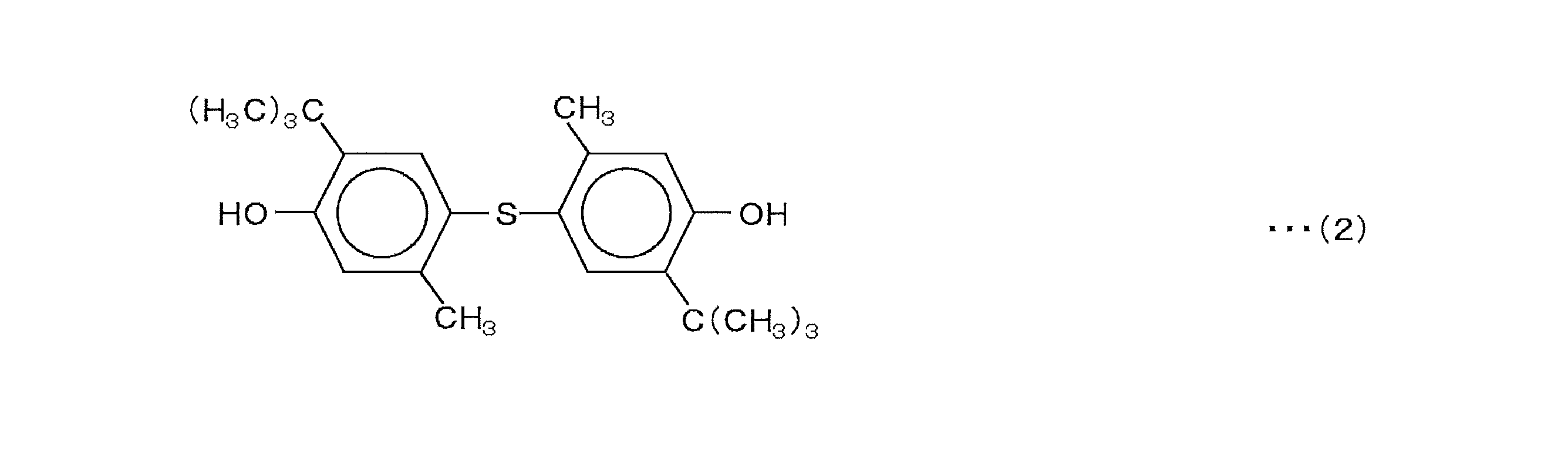
前記ヒンダードフェノール系老化防止剤としては、例えば、下記式(3)で示される、テトラキス[メチレン-3-(3,5-ジ-tert-ブチル-4-ヒドロキシフェニル)プロピオネート]メタン、下記式(4)で示される、3,9-ビス[2-[3-(3-tert-ブチル-4-ヒドロキシ-5-メチルフェニル)プロピオニルオキシ]-1,1-ジメチルエチル]-2,4,8,10-テトラオキサスピロ[5.5]ウンデカンなどが挙げられる。
下記式(3)で示されるヒンダードフェノール系老化防止剤の市販品としては、ADEKA社製の商品名「アデカスタブAO-60」、SONGWON社製の商品名「SONGNOX(登録商標)1010」、BASF社製の商品名「イルガノックス(Irganox)(登録商標)1000」などが挙げられる。
また、下記式(4)で示されるヒンダードフェノール系老化防止剤の市販品としては、住友化学社製の商品名「SUMILIZER GA-80」、ADEKA社製の商品名「アデカスタブAO-80」などが挙げられる。
下記式(3)で示されるヒンダードフェノール系老化防止剤の市販品としては、ADEKA社製の商品名「アデカスタブAO-60」、SONGWON社製の商品名「SONGNOX(登録商標)1010」、BASF社製の商品名「イルガノックス(Irganox)(登録商標)1000」などが挙げられる。
また、下記式(4)で示されるヒンダードフェノール系老化防止剤の市販品としては、住友化学社製の商品名「SUMILIZER GA-80」、ADEKA社製の商品名「アデカスタブAO-80」などが挙げられる。
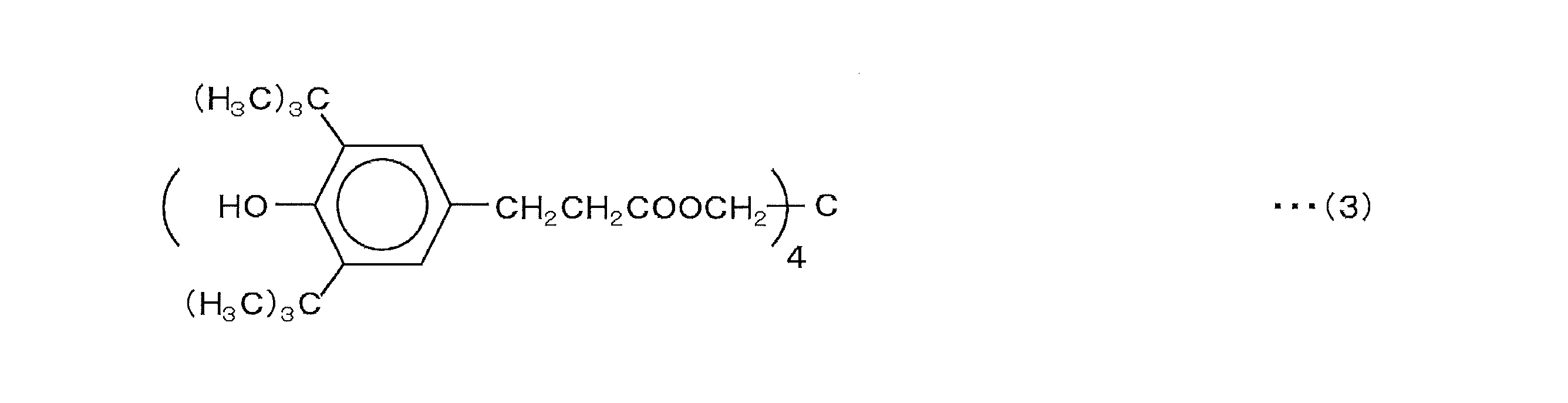

前記フェノール系老化防止剤は、質量平均分子量が350以上であるものが好ましく、500以上であるものがより好ましく、600以上であるものがより好ましく、700以上あるものがより好ましく、800以上であるものがより好ましく、900以上であるものがより好ましく、1000以上であるものがより好ましい。
前記フェノール系老化防止剤の質量平均分子量が上記数値範囲内であることにより、前記フェノール系老化防止剤が粘着剤層2から揮発することを抑制することができる。
これにより、粘着剤層2に含まれる前記ブチルゴムが酸化反応などによって劣化すること(前記ブチルゴムが高分子化したり低分子化したりすること)をより十分に抑制することができる。
前記フェノール系老化防止剤の質量平均分子量が上記数値範囲内であることにより、前記フェノール系老化防止剤が粘着剤層2から揮発することを抑制することができる。
これにより、粘着剤層2に含まれる前記ブチルゴムが酸化反応などによって劣化すること(前記ブチルゴムが高分子化したり低分子化したりすること)をより十分に抑制することができる。
前記アミン系老化防止剤は、芳香族二級アミン系老化防止剤であることが好ましい。
前記芳香族第二級アミン系老化防止剤は、窒素原子に芳香族管が結合した第二級アミンである。
前記芳香族第二級アミン系老化防止剤は、軟化点が50℃以上であるものが好ましく、80℃以上であるものがより好ましい。
また、前記芳香族第二級アミン系老化防止剤は、質量平均分子量が300以上であるものが好ましく、350以上であるものがより好ましい。
前記芳香族第二級アミン系老化防止剤は、窒素原子に芳香族管が結合した第二級アミンである。
前記芳香族第二級アミン系老化防止剤は、軟化点が50℃以上であるものが好ましく、80℃以上であるものがより好ましい。
また、前記芳香族第二級アミン系老化防止剤は、質量平均分子量が300以上であるものが好ましく、350以上であるものがより好ましい。
前記芳香族第二級アミン系老化防止剤としては、例えば、下記式(5)で示される、N-フェニル-N’-(1,3-ジメチルブチル)-p-フェニレンジアミン、下記式(6)で示される、N,N’-ジ-ナフチル-p-フェニレンジアミン、下記式(7)で示される、4,4’-ビス(α,α-ジメチルベンジル)ジフェニルアミンなどが挙げられる。
下記式(5)で示される芳香族第二級アミン系老化防止剤の市販品としては、大内新興化学工業社製の商品名「ノクラック6C」などが挙げられる。
また、下記式(6)で示される芳香族第二級アミン系老化防止剤の市販品としては、大内新興化学工業社製の商品名「ノクラックWhite」などが挙げられる。
さらに、下記式(7)で示される芳香族第二級アミン系老化防止剤の市販品としては、大内新興化学工業社製の商品名「ノクラックCD」などが挙げられる。
下記式(5)で示される芳香族第二級アミン系老化防止剤の市販品としては、大内新興化学工業社製の商品名「ノクラック6C」などが挙げられる。
また、下記式(6)で示される芳香族第二級アミン系老化防止剤の市販品としては、大内新興化学工業社製の商品名「ノクラックWhite」などが挙げられる。
さらに、下記式(7)で示される芳香族第二級アミン系老化防止剤の市販品としては、大内新興化学工業社製の商品名「ノクラックCD」などが挙げられる。

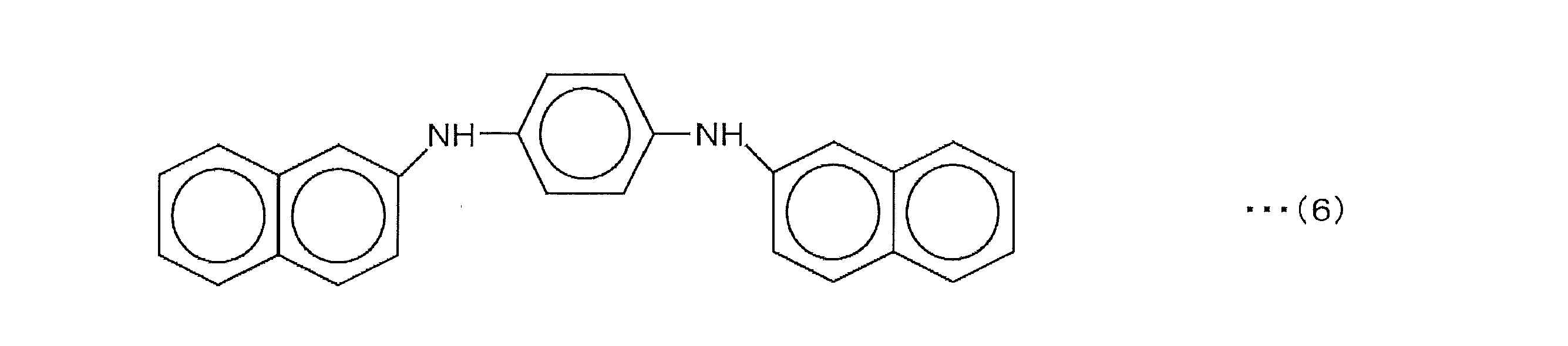
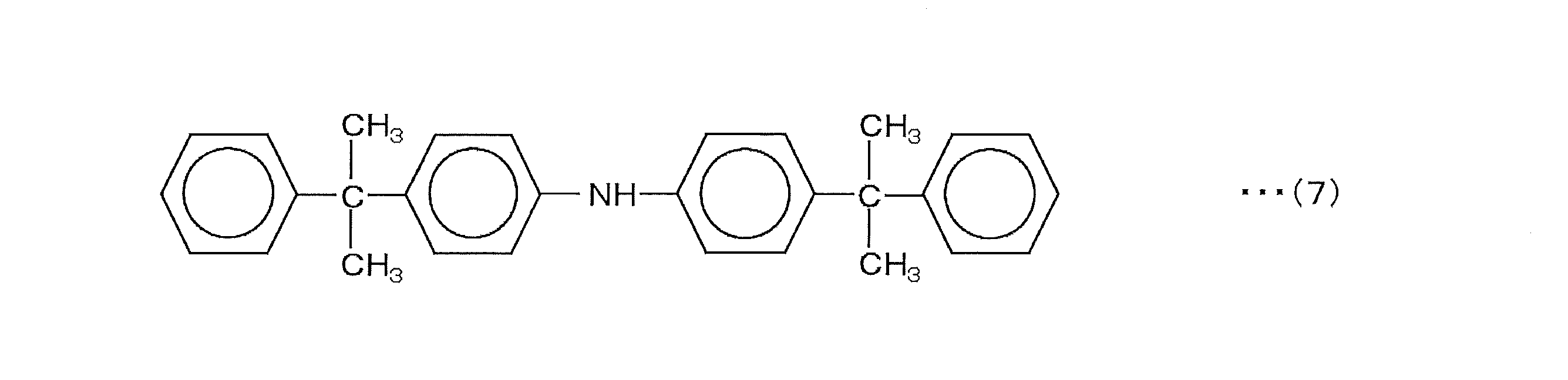
なお、アミン系老化防止剤は、一般に、前記ブチルゴムなどのゴム成分に対する着色性が高いという性質を有する。
例えば、上記式(5)で示される芳香族第二級アミン系老化防止剤は、前記ブチルゴムなどのゴム成分に対する着色性が高いという性質を有する。
これに対して、上記式(6)で示される芳香族第二級アミン系老化防止剤、及び、上記式(7)で示される芳香族第二級アミン系老化防止剤は、前記ブチルゴムなどのゴム成分に対する着色性(汚染性)が低いという性質を有するものである。
すなわち、上記式(6)及び(7)で示される芳香族第二級アミン系老化防止剤は、非汚染性であることを特徴とするアミン系老化防止剤である。
そのため、ゴム成分に対する着色による汚染を抑制する観点から、前記アミン系老化防止剤としては、上記式(6)や(7)で示される芳香族第二級アミン系老化防止剤を用いることが好ましい。
例えば、上記式(5)で示される芳香族第二級アミン系老化防止剤は、前記ブチルゴムなどのゴム成分に対する着色性が高いという性質を有する。
これに対して、上記式(6)で示される芳香族第二級アミン系老化防止剤、及び、上記式(7)で示される芳香族第二級アミン系老化防止剤は、前記ブチルゴムなどのゴム成分に対する着色性(汚染性)が低いという性質を有するものである。
すなわち、上記式(6)及び(7)で示される芳香族第二級アミン系老化防止剤は、非汚染性であることを特徴とするアミン系老化防止剤である。
そのため、ゴム成分に対する着色による汚染を抑制する観点から、前記アミン系老化防止剤としては、上記式(6)や(7)で示される芳香族第二級アミン系老化防止剤を用いることが好ましい。
前記リン系老化防止剤としては、例えば、下記式(8)で示される、トリス(2,4-ジ-tert-ブチルフェニル)フォスファイトなどが挙げられる。
下記式(8)で示されるリン系老化防止剤の市販品としては、BASF社製の商品名「Irgafos(登録商標)168」、SONGWON社製の商品名「SONGNOX(登録商標)168」などが挙げられる。
下記式(8)で示されるリン系老化防止剤の市販品としては、BASF社製の商品名「Irgafos(登録商標)168」、SONGWON社製の商品名「SONGNOX(登録商標)168」などが挙げられる。

前記硫黄系老化防止剤としては、例えば、下記式(9)で示される、2-メルカプトベンズイミダゾールなどが挙げられる。
下記式(9)で示される硫黄系老化防止剤の市販品としては、住化ケムテックス社製の商品名「Sumilizer(登録商標)MB」などが挙げられる。
下記式(9)で示される硫黄系老化防止剤の市販品としては、住化ケムテックス社製の商品名「Sumilizer(登録商標)MB」などが挙げられる。
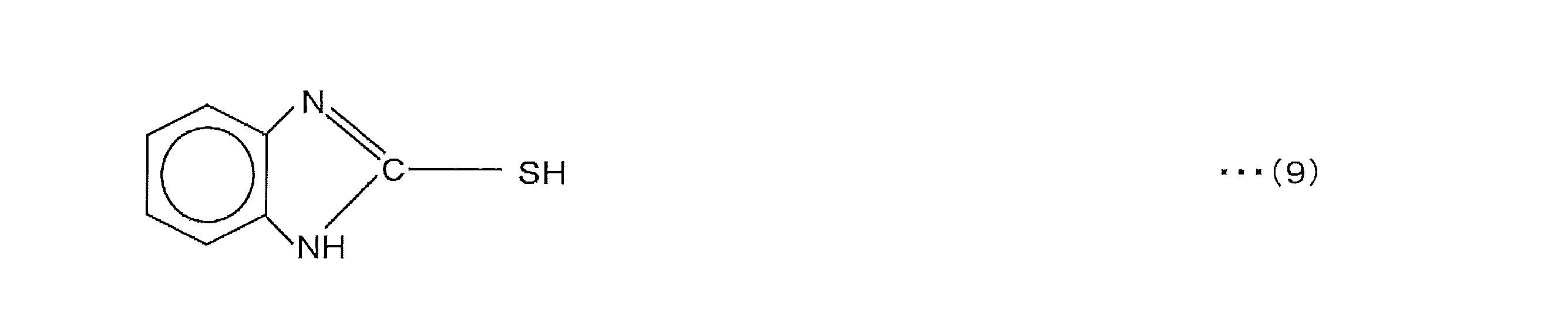
上で説明した老化防止剤のうち、前記フェノール系老化防止剤及び前記アミン系老化防止剤は、一次老化防止剤と呼ばれるものであり、前記リン系老化防止剤及び前記硫黄系老化防止剤は、二次老化防止剤と呼ばれるものである。
ここで、前記一次老化防止剤とは、前記ブチルゴムから生じたラジカルが原因となって、換言すれば、前記ブチルゴムからラジカルが発生する反応が開始反応となって、前記ブチルゴムの酸化が進行する反応(以下、自動酸化反応という)において、前記ラジカルと優先的に反応して前記ラジカルを安定化する老化防止剤であり、前記二次老化防止剤とは、自動酸化反応において発生するヒドロペルオキシドを分解することにより、自動酸化反応の進行を抑制する老化防止剤である。
ここで、前記二次老化防止剤は、上記のようにヒドロペルオキシドを分解するという性質を有することから、過酸化物分解型老化防止剤とも呼ばれる。
なお、前記自動酸化反応は前記ブチルゴムの酸化反応の一態様である。
そして、前記ブチルゴムの酸化反応の他態様としては、粘着剤層2が酸化剤を含むことにより前記ブチルゴムの酸化が進行するような直接酸化反応などが挙げられる。
ここで、前記一次老化防止剤とは、前記ブチルゴムから生じたラジカルが原因となって、換言すれば、前記ブチルゴムからラジカルが発生する反応が開始反応となって、前記ブチルゴムの酸化が進行する反応(以下、自動酸化反応という)において、前記ラジカルと優先的に反応して前記ラジカルを安定化する老化防止剤であり、前記二次老化防止剤とは、自動酸化反応において発生するヒドロペルオキシドを分解することにより、自動酸化反応の進行を抑制する老化防止剤である。
ここで、前記二次老化防止剤は、上記のようにヒドロペルオキシドを分解するという性質を有することから、過酸化物分解型老化防止剤とも呼ばれる。
なお、前記自動酸化反応は前記ブチルゴムの酸化反応の一態様である。
そして、前記ブチルゴムの酸化反応の他態様としては、粘着剤層2が酸化剤を含むことにより前記ブチルゴムの酸化が進行するような直接酸化反応などが挙げられる。
また、前記老化防止剤は、前記一次老化防止剤の性質と前記二次老化防止剤の性質とを併せ持つ複合系老化防止剤であってもよい。
前記複合系老化防止剤としては、例えば、フェノール構造を有する化合物の構造中に硫黄を含有させたもの、すなわち、硫黄含有フェノール系老化防止剤が挙げられる。
前記硫黄含有フェノール系老化防止剤としては、例えば、下記式(10)で示される、2,6-ジ-tert-ブチル-4-(4,6-ビス(オクチルチオ)-1,3,5-トリアジン-2-イルアミノ)フェノールなどが挙げられる。
下記式(10)で示される硫黄含有フェノール系老化防止剤の市販品としては、BASF社製の商品名「Irganox(登録商標)565」などが挙げられる。
前記複合系老化防止剤としては、例えば、フェノール構造を有する化合物の構造中に硫黄を含有させたもの、すなわち、硫黄含有フェノール系老化防止剤が挙げられる。
前記硫黄含有フェノール系老化防止剤としては、例えば、下記式(10)で示される、2,6-ジ-tert-ブチル-4-(4,6-ビス(オクチルチオ)-1,3,5-トリアジン-2-イルアミノ)フェノールなどが挙げられる。
下記式(10)で示される硫黄含有フェノール系老化防止剤の市販品としては、BASF社製の商品名「Irganox(登録商標)565」などが挙げられる。

粘着剤層2は、前記ゴム成分の100質量部に対して、前記老化防止剤を2質量部以上含んでいることが好ましく、3質量部以上含んでいることがより好ましく、4質量部以上含んでいることがより好ましく、5質量部以上含んでいることがより好ましい。
また、粘着剤層2は、前記ゴム成分の100質量部に対して、前記老化防止剤を15質量部以下含んでいることが好ましく、12質量部以下含んでいることがより好ましく、10質量部以下含んでいることがより好ましく、8質量部以下含んでいることがより好ましい。
前記老化防止剤の含有量が上記範囲内であることにより、粘着剤層2中で前記老化防止剤によるブリード現象が生じることを抑制した上で、前記ブチルゴムが酸化反応により劣化することを抑制できる。
また、前記老化防止剤の上限値を上記のように設定することにより、コスト面でも有利となる。
また、粘着剤層2は、前記ゴム成分の100質量部に対して、前記老化防止剤を15質量部以下含んでいることが好ましく、12質量部以下含んでいることがより好ましく、10質量部以下含んでいることがより好ましく、8質量部以下含んでいることがより好ましい。
前記老化防止剤の含有量が上記範囲内であることにより、粘着剤層2中で前記老化防止剤によるブリード現象が生じることを抑制した上で、前記ブチルゴムが酸化反応により劣化することを抑制できる。
また、前記老化防止剤の上限値を上記のように設定することにより、コスト面でも有利となる。
粘着剤層2は、前記フェノール系老化防止剤、前記アミン系老化防止剤、前記リン系老化防止剤、及び、前記硫黄系老化防止剤からなる群から選択される少なくとも1種を含んでいることが好ましい。
上の各種老化防止剤の中でも、粘着剤層2は、前記フェノール系老化防止剤を含んでいることが好ましい。
すなわち、粘着剤層2は、前記一次老化防止剤として前記フェノール系老化防止剤を含んでいることが好ましい。
上の各種老化防止剤の中でも、粘着剤層2は、前記フェノール系老化防止剤を含んでいることが好ましい。
すなわち、粘着剤層2は、前記一次老化防止剤として前記フェノール系老化防止剤を含んでいることが好ましい。
粘着剤層2は、前記フェノール系老化防止剤及び前記アミン系老化防止剤からなる第1群から選択される少なくとも1種と、前記リン系老化防止剤及び前記硫黄系老化防止剤からなる第2群から選択される少なくとも1種とを含んでいることが好ましい。
すなわち、粘着剤層2は、前記一次老化防止剤及び前記二次老化防止剤の両方を含んでいることが好ましい。
また、粘着剤層2は、前記一次老化防止剤として前記フェノール系老化防止剤を含むとともに、前記二次老化防止剤として前記リン系老化防止剤を含んでいることが好ましい。
さらに、粘着剤層2は、前記一次老化防止剤として前記フェノール系老化防止剤に加えて前記アミン系老化防止剤を含むとともに、前記二次老化防止剤として前記リン系老化防止剤を含んでいることがより好ましい。
粘着剤層2が上のいずれかの態様で、前記一次老化防止剤及び前記二次老化防止剤の少なくとも一方を含むことにより、100℃で7週間加熱された後における前記ブチルゴムの分子量を、より十分に20質量%以上に維持することができる。
これにより、粘着剤層2は長期耐久性に優れるものとなり、延いては、粘着シート10も長期耐久性に優れるものとなる。
すなわち、粘着剤層2は、前記一次老化防止剤及び前記二次老化防止剤の両方を含んでいることが好ましい。
また、粘着剤層2は、前記一次老化防止剤として前記フェノール系老化防止剤を含むとともに、前記二次老化防止剤として前記リン系老化防止剤を含んでいることが好ましい。
さらに、粘着剤層2は、前記一次老化防止剤として前記フェノール系老化防止剤に加えて前記アミン系老化防止剤を含むとともに、前記二次老化防止剤として前記リン系老化防止剤を含んでいることがより好ましい。
粘着剤層2が上のいずれかの態様で、前記一次老化防止剤及び前記二次老化防止剤の少なくとも一方を含むことにより、100℃で7週間加熱された後における前記ブチルゴムの分子量を、より十分に20質量%以上に維持することができる。
これにより、粘着剤層2は長期耐久性に優れるものとなり、延いては、粘着シート10も長期耐久性に優れるものとなる。
粘着剤層2が前記一次老化防止剤として前記フェノール系老化防止剤を含むとともに、前記二次老化防止剤として前記リン系老化防止剤を含む場合には、前記フェノール系老化防止剤は前記リン系老化防止剤よりも多く含まれていることが好ましい。
粘着剤層2中における前記フェノール系老化防止剤の含有量をCFとし、粘着剤層2中における前記リン系老化防止剤の含有量をCPとした場合、CPに対するCFの比(CF/CP)は、1.1以上であることが好ましく、1.5以上であることがより好ましく、1.8以上であることがより好ましい。
粘着剤層2中における前記フェノール系老化防止剤の含有量をCFとし、粘着剤層2中における前記リン系老化防止剤の含有量をCPとした場合、CPに対するCFの比(CF/CP)は、1.1以上であることが好ましく、1.5以上であることがより好ましく、1.8以上であることがより好ましい。
粘着剤層2が前記一次老化防止剤として前記フェノール系老化防止剤に加えて前記アミン系老化防止剤を含む場合には、前記フェノール系老化防止剤は前記アミン系老化防止剤よりも多く含まれていることが好ましい。
粘着剤層2中における前記アミン系老化防止剤の含有量をCAとした場合、CAに対するCFの比(CF/CA)は、1.1以上であることが好ましく、1.5以上であることがより好ましく、2.0以上であることがより好ましく、2.5以上であることがより好ましく、3.0以上であることがより好ましく、3.5以上であることがより好ましい。
粘着剤層2中における前記アミン系老化防止剤の含有量をCAとした場合、CAに対するCFの比(CF/CA)は、1.1以上であることが好ましく、1.5以上であることがより好ましく、2.0以上であることがより好ましく、2.5以上であることがより好ましく、3.0以上であることがより好ましく、3.5以上であることがより好ましい。
次に、図2を参照しながら、前記自動酸化反応について以下に説明する。
図2に示したように、前記自動酸化反応は、前記ブチルゴムの主鎖から水素を引き抜いて、この水素の引き抜きによって生じる前記ブチルゴム由来のラジカル(以下、第1ラジカルともいう)を得るとともに、水素ラジカルを得る開始反応(図2中の(a)を参照)と、第1ラジカルとは異なる複数のラジカルを発生させるとともに、前記第1ラジカルを再生させつつ複数の生成物を得る連鎖・成長反応(図2中の(b)を参照)と、前記第1ラジカル、前記第1ラジカル種とは異なる複数のラジカル、及び、前記水素ラジカルを消失させて前記連鎖・成長反応を停止させる停止反応(図2中の(c)を参照)と、を有する。
以下、(a)開始反応、(b)連鎖・成長反応、及び、(c)停止反応について説明する。
なお、図2では、前記ブチルゴムについて、開始反応によって引き抜かれる水素をHと表記するとともに、水素Hの引き抜きによって第1ラジカルを構成する部分をRと表記している。
図2に示したように、前記自動酸化反応は、前記ブチルゴムの主鎖から水素を引き抜いて、この水素の引き抜きによって生じる前記ブチルゴム由来のラジカル(以下、第1ラジカルともいう)を得るとともに、水素ラジカルを得る開始反応(図2中の(a)を参照)と、第1ラジカルとは異なる複数のラジカルを発生させるとともに、前記第1ラジカルを再生させつつ複数の生成物を得る連鎖・成長反応(図2中の(b)を参照)と、前記第1ラジカル、前記第1ラジカル種とは異なる複数のラジカル、及び、前記水素ラジカルを消失させて前記連鎖・成長反応を停止させる停止反応(図2中の(c)を参照)と、を有する。
以下、(a)開始反応、(b)連鎖・成長反応、及び、(c)停止反応について説明する。
なお、図2では、前記ブチルゴムについて、開始反応によって引き抜かれる水素をHと表記するとともに、水素Hの引き抜きによって第1ラジカルを構成する部分をRと表記している。
<(a)開始反応>
先に説明したように、粘着剤層2に含まれる前記ブチルゴムは、主鎖にイソプレン由来の炭素-炭素二重結合を有している。
そして、このように構成されるブチルゴムにおいては、主鎖に存在する複数の水素(H)のうち、前記炭素-炭素二重結合に隣接したα位の炭素(C)に結合された水素(H)が最も引き抜かれ易くなっている。
そのため、前記ブチルゴムを含む粘着剤層2が熱や光などの外部エネルギーを受けると、α位の炭素(C)と水素(H)との結合は、高いエネルギー状態に励起されるようになる。
これにより、α位の炭素(C)に結合された水素(H)は、前記α位の炭素(C)から引き抜かれるようになる。
すなわち、前記α位の炭素(C)から水素(H)が引き抜かれて、第1ラジカルとしてのR・と、水素ラジカルH・とが生じるようになる。
このように、第1ラジカルとしてのR・、及び、水素ラジカルH・が生じる反応が前記自動酸化反応の開始反応となる(図2の式(1)を参照)。
先に説明したように、粘着剤層2に含まれる前記ブチルゴムは、主鎖にイソプレン由来の炭素-炭素二重結合を有している。
そして、このように構成されるブチルゴムにおいては、主鎖に存在する複数の水素(H)のうち、前記炭素-炭素二重結合に隣接したα位の炭素(C)に結合された水素(H)が最も引き抜かれ易くなっている。
そのため、前記ブチルゴムを含む粘着剤層2が熱や光などの外部エネルギーを受けると、α位の炭素(C)と水素(H)との結合は、高いエネルギー状態に励起されるようになる。
これにより、α位の炭素(C)に結合された水素(H)は、前記α位の炭素(C)から引き抜かれるようになる。
すなわち、前記α位の炭素(C)から水素(H)が引き抜かれて、第1ラジカルとしてのR・と、水素ラジカルH・とが生じるようになる。
このように、第1ラジカルとしてのR・、及び、水素ラジカルH・が生じる反応が前記自動酸化反応の開始反応となる(図2の式(1)を参照)。
<(b)連鎖・成長反応>
開始反応によって生じた第1ラジカルR・は、空気中の酸素(O2)と容易に反応することができるので、第1ラジカルR・が酸素(O2)と反応することにより、第1ラジカルR・とは異なるペルオキシラジカル(ROO・)が生じるようになる(図2の式(2)を参照)。
次に、ペルオキシラジカル(ROO・)が、先のα位の炭素(C)とは別のα位の炭素(C)から水素(H)を引き抜くことによって、生成物としてヒドロペルオキシド(ROOH)が得られるとともに、第1ラジカルR・が生成されるようになる(図2の式(3)を参照)。
すなわち、第1ラジカルR・が再生されるとともに、生成物としてのヒドロペルオキシド(ROOH)が得られるようになる。
ここで、前記ヒドロペルオキシド(ROOH)は過酸化物であり、ROとOHとの間の結合が容易に切断され易くなっている。
そのため、次に、前記ヒドロペルオキシド(ROOH)において、ROとOHとの間の結合が切断されて、第1ラジカルR・とは異なる、ラジカルRO・とヒドロキシラジカル(・OH)とが生成されるようになる(図2の式(4)を参照)。
次に、式(4)によって生成されたラジカルRO・が、先のα位の炭素(C)とは別のα位の炭素(C)から水素(H)を引き抜くことによって、生成物としてのアルコール(ROH)が得られるとともに、第1ラジカルR・が生成されるようになる(図2の式(5)を参照)。
また、式(4)によって生成されたヒドロキシラジカル(・OH)も、先のα位の炭素(C)とは別のα位の炭素(C)から水素(H)を引き抜くことによって、生成物としての水(H2O)が得られるとともに、第1ラジカルR・が生成されるようになる(図2の式(6)を参照)。
すなわち、第1ラジカルR・が再生されるとともに、生成物としてのアルコール(ROH)及び水(H2O)が得られるようになる。
また、連鎖・成長反応においては、式(4)によって生成されたラジカルRO・の少なくとも一部では、R部分において主鎖切断反応が生じるようになって、アルデヒド基(CHO)を有する化合物R2CHOが得られるとともに、第1ラジカルR・とは異なるラジカルR1・が生成されるようになる(図2の式(7)を参照)。
このような式(7)の反応が生じることにより、前記ブチルゴムは低分子化されるようになる。
そして、前記ブチルゴムが低分子化された場合においては、このような低分子化されたブチルゴムを含む粘着剤層2は軟化するような形で劣化するようになる。
開始反応によって生じた第1ラジカルR・は、空気中の酸素(O2)と容易に反応することができるので、第1ラジカルR・が酸素(O2)と反応することにより、第1ラジカルR・とは異なるペルオキシラジカル(ROO・)が生じるようになる(図2の式(2)を参照)。
次に、ペルオキシラジカル(ROO・)が、先のα位の炭素(C)とは別のα位の炭素(C)から水素(H)を引き抜くことによって、生成物としてヒドロペルオキシド(ROOH)が得られるとともに、第1ラジカルR・が生成されるようになる(図2の式(3)を参照)。
すなわち、第1ラジカルR・が再生されるとともに、生成物としてのヒドロペルオキシド(ROOH)が得られるようになる。
ここで、前記ヒドロペルオキシド(ROOH)は過酸化物であり、ROとOHとの間の結合が容易に切断され易くなっている。
そのため、次に、前記ヒドロペルオキシド(ROOH)において、ROとOHとの間の結合が切断されて、第1ラジカルR・とは異なる、ラジカルRO・とヒドロキシラジカル(・OH)とが生成されるようになる(図2の式(4)を参照)。
次に、式(4)によって生成されたラジカルRO・が、先のα位の炭素(C)とは別のα位の炭素(C)から水素(H)を引き抜くことによって、生成物としてのアルコール(ROH)が得られるとともに、第1ラジカルR・が生成されるようになる(図2の式(5)を参照)。
また、式(4)によって生成されたヒドロキシラジカル(・OH)も、先のα位の炭素(C)とは別のα位の炭素(C)から水素(H)を引き抜くことによって、生成物としての水(H2O)が得られるとともに、第1ラジカルR・が生成されるようになる(図2の式(6)を参照)。
すなわち、第1ラジカルR・が再生されるとともに、生成物としてのアルコール(ROH)及び水(H2O)が得られるようになる。
また、連鎖・成長反応においては、式(4)によって生成されたラジカルRO・の少なくとも一部では、R部分において主鎖切断反応が生じるようになって、アルデヒド基(CHO)を有する化合物R2CHOが得られるとともに、第1ラジカルR・とは異なるラジカルR1・が生成されるようになる(図2の式(7)を参照)。
このような式(7)の反応が生じることにより、前記ブチルゴムは低分子化されるようになる。
そして、前記ブチルゴムが低分子化された場合においては、このような低分子化されたブチルゴムを含む粘着剤層2は軟化するような形で劣化するようになる。
<(c)停止反応>
上のように、連鎖・成長反応が進行する一方で、前記連鎖・成長反応によって生成された各種のラジカルどうしも反応し合うようになる。
そして、生成された全てのラジカルが消失すると、前記連鎖・成長反応は停止する(停止反応)。
停止反応の一例としては、例えば、第1ラジカルR・と水素ラジカルH・とが反応して生成物としてRHが得られる反応(図2の式(8)を参照)、第1ラジカルR・どうしが反応して生成物としてR-Rが得られる反応(図2の式(9)を参照)、ラジカルRO・どうしが反応して生成物としてROORが得られる反応(図2の式(10)を参照)などが挙げられる。
ここで、前記停止反応によって、R-RやROORなどの生成物が得られるような場合には、前記ブチルゴムは高分子化されるようになる。
そして、前記ブチルゴムが高分子化された場合には、このような高分子化されたブチルゴムを含む粘着剤層2は硬化するような形で劣化するようになる。
上のように、連鎖・成長反応が進行する一方で、前記連鎖・成長反応によって生成された各種のラジカルどうしも反応し合うようになる。
そして、生成された全てのラジカルが消失すると、前記連鎖・成長反応は停止する(停止反応)。
停止反応の一例としては、例えば、第1ラジカルR・と水素ラジカルH・とが反応して生成物としてRHが得られる反応(図2の式(8)を参照)、第1ラジカルR・どうしが反応して生成物としてR-Rが得られる反応(図2の式(9)を参照)、ラジカルRO・どうしが反応して生成物としてROORが得られる反応(図2の式(10)を参照)などが挙げられる。
ここで、前記停止反応によって、R-RやROORなどの生成物が得られるような場合には、前記ブチルゴムは高分子化されるようになる。
そして、前記ブチルゴムが高分子化された場合には、このような高分子化されたブチルゴムを含む粘着剤層2は硬化するような形で劣化するようになる。
上記のように、前記自動酸化反応においては、ラジカル反応が原因となって粘着剤層2中に含まれる前記ブチルゴムが劣化するようになる。
ここで、粘着剤層2が前記一次老化防止剤を含んでいる場合には、粘着剤層2中において上記のように生じる各種ラジカルと前記一次老化防止剤とを優先的に反応させて、前記ラジカル種を安定化させることができる。
これにより、前記自動酸化反応が粘着剤層2中において進行することを抑制できる。
また、粘着剤層2が前記二次老化防止剤を含んでいる場合には、粘着剤層2中において上記ように生じるヒドロペルオキシド(ROOH)を分解させることができる。
このようにしても、前記自動酸化反応が粘着剤層2中において進行することを抑制できる。
ここで、粘着剤層2が前記一次老化防止剤を含んでいる場合には、粘着剤層2中において上記のように生じる各種ラジカルと前記一次老化防止剤とを優先的に反応させて、前記ラジカル種を安定化させることができる。
これにより、前記自動酸化反応が粘着剤層2中において進行することを抑制できる。
また、粘着剤層2が前記二次老化防止剤を含んでいる場合には、粘着剤層2中において上記ように生じるヒドロペルオキシド(ROOH)を分解させることができる。
このようにしても、前記自動酸化反応が粘着剤層2中において進行することを抑制できる。
ところで、粘着剤層2が、前記ゴム成分として、前記ブチルゴムに加えてスチレン・イソプレン・スチレンブロック共重合体(SIS)のようなジエン系ゴムを含んでいることがある。
そして、SISのようなジエン系ゴムは、前記ブチルゴムに比べて、多数の炭素-炭素二重結合を多数有していることから、前記ブチルゴムに比べて、前記炭素-炭素二重結合に隣接したα位の炭素も多数有している。
そのため、前記ジエン系ゴムは、前記ブチルゴムに比べて、図2において式(1)で示したようなα位の炭素(C)から水素(H)が引き抜かれ易くなっていて、前記ジエン系ゴム由来のラジカル(以下、第1’ラジカルともいう)が発生され易くなっている。
そして、このような第1’ラジカルの一部は、前記ブチルゴムにおけるα位の炭素を攻撃して、前記ブチルゴムにおけるα位の炭素から水素を引き抜くように作用するので、前記第1ラジカルが生成され易くなる。
したがって、粘着剤層2が前記ジエン系ゴムを含んでいるような場合には、前記ブチルゴムにおいて前記自動酸化反応が起こり易くなっている。
しかしながら、上記のように、粘着剤層2が前記一次老化防止剤を含んでいる場合には、前記ジエン系ゴムの自動酸化反応において生じる各種のラジカルを前記一次老化防止剤によって安定化させることができる。
また、上記のように、粘着剤層2が前記二次老化防止剤を含んでいる場合には、前記自動酸化反応によって生じるヒドロペルオキシド(ROOH)を前記二次老化防止剤によって分解させることができる。
すなわち、粘着剤層2が前記ブタジエンゴムに加えて前記ジエン系ゴムを含んでいる場合においても、粘着剤層2が前記一次老化防止剤及び前記二次老化防止剤の少なくとも一方を含んでいることにより、粘着剤層2において前記ブチルゴムが劣化することを抑制することができる。
そして、SISのようなジエン系ゴムは、前記ブチルゴムに比べて、多数の炭素-炭素二重結合を多数有していることから、前記ブチルゴムに比べて、前記炭素-炭素二重結合に隣接したα位の炭素も多数有している。
そのため、前記ジエン系ゴムは、前記ブチルゴムに比べて、図2において式(1)で示したようなα位の炭素(C)から水素(H)が引き抜かれ易くなっていて、前記ジエン系ゴム由来のラジカル(以下、第1’ラジカルともいう)が発生され易くなっている。
そして、このような第1’ラジカルの一部は、前記ブチルゴムにおけるα位の炭素を攻撃して、前記ブチルゴムにおけるα位の炭素から水素を引き抜くように作用するので、前記第1ラジカルが生成され易くなる。
したがって、粘着剤層2が前記ジエン系ゴムを含んでいるような場合には、前記ブチルゴムにおいて前記自動酸化反応が起こり易くなっている。
しかしながら、上記のように、粘着剤層2が前記一次老化防止剤を含んでいる場合には、前記ジエン系ゴムの自動酸化反応において生じる各種のラジカルを前記一次老化防止剤によって安定化させることができる。
また、上記のように、粘着剤層2が前記二次老化防止剤を含んでいる場合には、前記自動酸化反応によって生じるヒドロペルオキシド(ROOH)を前記二次老化防止剤によって分解させることができる。
すなわち、粘着剤層2が前記ブタジエンゴムに加えて前記ジエン系ゴムを含んでいる場合においても、粘着剤層2が前記一次老化防止剤及び前記二次老化防止剤の少なくとも一方を含んでいることにより、粘着剤層2において前記ブチルゴムが劣化することを抑制することができる。
粘着剤層2は無機成分を含んでいてもよい。
粘着剤層2は無機成分として無機フィラー及び無機着色剤を含んでいてもよい。
粘着剤層2は無機成分として無機フィラーを含んでいることが好ましい。
粘着剤層2は無機成分として無機フィラー及び無機着色剤を含んでいてもよい。
粘着剤層2は無機成分として無機フィラーを含んでいることが好ましい。
前記無機フィラーとしては、炭酸カルシウム(例えば、重質炭酸カルシウムや軽質炭酸カルシウムなど)、タルク、酸化チタン、シリカ、酸化マグネシウムなどが挙げられる。
これの中でも、炭酸カルシウムを用いることが好ましい。
粘着剤層2における前記無機フィラーの含有量は、20質量%以上であることが好ましく、30質量%以上であることがより好ましく、35質量%以上であることがさらに好ましい。
また、粘着剤層2における前記無機フィラーの含有量は、90質量%以下であることが好ましく、80質量%以下であることがより好ましく、70質量%以下であることがさらに好ましい。
これの中でも、炭酸カルシウムを用いることが好ましい。
粘着剤層2における前記無機フィラーの含有量は、20質量%以上であることが好ましく、30質量%以上であることがより好ましく、35質量%以上であることがさらに好ましい。
また、粘着剤層2における前記無機フィラーの含有量は、90質量%以下であることが好ましく、80質量%以下であることがより好ましく、70質量%以下であることがさらに好ましい。
前記無機着色剤としては、カーボンを用いることが好ましく、カーボンブラックを用いることがより好ましい。
粘着剤層2は、前記ゴム成分の100質量部に対して、前記無機成分を500質量部以下含んでいることが好ましく、450質量部以下含んでいることがより好ましく、400質量部以下含んでいることがさらに好ましい。
また、粘着剤層2は、前記ゴム成分の100質量部に対して、前記無機成分を50質量部以上含んでいることが好ましく、150質量部以上含んでいることがより好ましく、270質量部以上含んでいることがより好ましい。
また、粘着剤層2は、前記ゴム成分の100質量部に対して、前記無機成分を50質量部以上含んでいることが好ましく、150質量部以上含んでいることがより好ましく、270質量部以上含んでいることがより好ましい。
粘着剤層2においては、前記無機成分の質量の値WIに対する前記有機成分の質量の値WOの比(WO/WI)が0.5以上1.3以下であることが好ましい。
これにより、粘着シート10は、低温から高温までの広い温度範囲において、より十分な粘着性を発揮できるものとなる。
WO/WIは、0.7以上であることがより好ましく、0.8以上であることがさらに好ましい。
また、WO/WIは、1.2以下であることがより好ましく、1.0以下であることがさらに好ましい。
これにより、粘着シート10は、低温から高温までの広い温度範囲において、より十分な粘着性を発揮できるものとなる。
WO/WIは、0.7以上であることがより好ましく、0.8以上であることがさらに好ましい。
また、WO/WIは、1.2以下であることがより好ましく、1.0以下であることがさらに好ましい。
粘着剤層2においては、前記無機成分の含有量に対する前記ブチルゴムの含有量の比(ブチルゴムの含有量/無機成分の含有量)が、0.15以上であることが好ましく、0.20以上であることがより好ましい。
また、粘着剤層2においては、前記無機成分の含有量に対する前記ブチルゴムの含有量の比が、0.45以下であることが好ましく、0.30以下であることがより好ましい。
また、粘着剤層2においては、前記無機成分の含有量に対する前記ブチルゴムの含有量の比が、0.45以下であることが好ましく、0.30以下であることがより好ましい。
粘着シート10においては、ケミルミネッセンスアナライザーを用いて測定される粘着剤層2の酸化開始温度が200℃以上であることが好ましい。
また、粘着剤層2の酸化開始温度は、220℃以上であることがより好ましく、240℃以上であることがより好ましく、250℃以上であることがより好ましく、260℃以上であることがより好ましい。
なお、粘着剤層2の酸化開始温度の上限値は、通常、300℃である。
粘着剤層2の酸化開始温度が上記の数値範囲内であることにより、粘着剤層2は酸化による劣化を受け難いものとなる。
これにより、粘着シート10は、長期耐久性により優れるものとなる。
また、粘着剤層2の酸化開始温度は、220℃以上であることがより好ましく、240℃以上であることがより好ましく、250℃以上であることがより好ましく、260℃以上であることがより好ましい。
なお、粘着剤層2の酸化開始温度の上限値は、通常、300℃である。
粘着剤層2の酸化開始温度が上記の数値範囲内であることにより、粘着剤層2は酸化による劣化を受け難いものとなる。
これにより、粘着シート10は、長期耐久性により優れるものとなる。
ケミルミネッセンスアナライザーを用いた粘着剤層2の酸化開始温度は、例えば、ケミルミネセンスアナライザーとして東北電子産業社製の商品名「CLA-FS4」を用いて、以下の条件にて測定を実施することにより、横軸を温度、縦軸を発光輝度とするグラフを得た後、該グラフを以下のように解析することにより得ることができる。
測定条件
・測定温度:30℃~350℃
・昇温条件:5℃/min
・雰囲気:酸素(O2)
・測定項目:発光輝度(Count Pre Sce)
・最小測定時間:1sec
・分光フィルタ:20枚内蔵
・測定試料室:CLS-SH1(フロー型)
・測定試料の平面寸法:厚み0.2mmt、φ20mm(粘着剤層2から切り出したもの)
グラフの解析
(1)測定開始温度30℃のときの発光輝度の値(Ei1)を読み取る。
(2)前記グラフにおいて検出される最も高いピークのトップをピークトップとして、該ピークトップに対応する発光輝度の値(Ei2)を読み取る。
(3)Ei2からEi1を減じた値(ΔEi)を算出する。
(4)前記グラフにおいて発光輝度がΔEiの10%になるときの温度の値を読み取り、この温度の値を粘着剤層2の酸化開始温度とする。
測定条件
・測定温度:30℃~350℃
・昇温条件:5℃/min
・雰囲気:酸素(O2)
・測定項目:発光輝度(Count Pre Sce)
・最小測定時間:1sec
・分光フィルタ:20枚内蔵
・測定試料室:CLS-SH1(フロー型)
・測定試料の平面寸法:厚み0.2mmt、φ20mm(粘着剤層2から切り出したもの)
グラフの解析
(1)測定開始温度30℃のときの発光輝度の値(Ei1)を読み取る。
(2)前記グラフにおいて検出される最も高いピークのトップをピークトップとして、該ピークトップに対応する発光輝度の値(Ei2)を読み取る。
(3)Ei2からEi1を減じた値(ΔEi)を算出する。
(4)前記グラフにおいて発光輝度がΔEiの10%になるときの温度の値を読み取り、この温度の値を粘着剤層2の酸化開始温度とする。
上記したように、粘着剤層2は、60℃における貯蔵弾性率の値G1’に対する-10℃における貯蔵弾性率の値G2’の比(G2’/G1’)が12未満である。
また、本発明に係る粘着シートでは、粘着剤層は、-10℃における貯蔵弾性率の値G2’が0.7MPa以下である。
G1’及びG2’が上記のような関係を満たすことにより、粘着剤層2は、低温(例えば、-10℃)から高温(例えば、60℃)の広い温度範囲において適度な弾性率を有するものとなる。
そのため、このような粘着剤層2は、被着体(透湿防水シートや住宅における内壁などの施工対象)に対して低温から高温までの広い温度範囲において良好な追従性を発揮することができるようになる。
また、本発明に係る粘着シートでは、粘着剤層は、-10℃における貯蔵弾性率の値G2’が0.7MPa以下である。
G1’及びG2’が上記のような関係を満たすことにより、粘着剤層2は、低温(例えば、-10℃)から高温(例えば、60℃)の広い温度範囲において適度な弾性率を有するものとなる。
そのため、このような粘着剤層2は、被着体(透湿防水シートや住宅における内壁などの施工対象)に対して低温から高温までの広い温度範囲において良好な追従性を発揮することができるようになる。
G2’/G1’は、11以下であることが好ましい。
G2’/G1’は、3以上であること好ましく、5以上であることがより好ましい。
G2’は、0.6MPa以下であることが好ましく、0.5MPa以下であることがさらに好ましい。
G2’は、0.1MPa以上であることが好ましく、0.2MPa以上であることがより好ましい。
G1’は、0.03MPa以上0.06MPa以下であることが好ましい。
G2’/G1’は、3以上であること好ましく、5以上であることがより好ましい。
G2’は、0.6MPa以下であることが好ましく、0.5MPa以下であることがさらに好ましい。
G2’は、0.1MPa以上であることが好ましく、0.2MPa以上であることがより好ましい。
G1’は、0.03MPa以上0.06MPa以下であることが好ましい。
粘着剤層2について、60℃における貯蔵弾性率の値G1’及び-10℃における貯蔵弾性率の値G2’は、レオメトリック社製の動的粘弾性測定装置「ARES」を用いて、下記の条件で動的粘弾性測定を行うことにより求めることができる。
なお、測定試料としては、粘着剤層2から一部採取した粘着剤を、温度80℃、1分の条件で2mm厚さにプレスしたものを使用する。
・装置:Rheometric Scientific社製 ARES(Advanced Rheometric Expansion System)
・周波数:1Hz
・温度:-30~120℃
・昇温速度:5℃/分
・変形モード:ねじり
・形状:パラレルプレート(7.9mmφ)
なお、G1’は、上記測定における60℃の値であり、G2’は、上記測定における-10℃の値である。
なお、測定試料としては、粘着剤層2から一部採取した粘着剤を、温度80℃、1分の条件で2mm厚さにプレスしたものを使用する。
・装置:Rheometric Scientific社製 ARES(Advanced Rheometric Expansion System)
・周波数:1Hz
・温度:-30~120℃
・昇温速度:5℃/分
・変形モード:ねじり
・形状:パラレルプレート(7.9mmφ)
なお、G1’は、上記測定における60℃の値であり、G2’は、上記測定における-10℃の値である。
上記したように、粘着剤層2は、-10℃における粘着力が2.0N/25mm以上である。
粘着剤層2は、-10℃における粘着力が3.0N/25mm以上であることが好ましく、5.0N/25mm以上であることがより好ましい。
これにより、粘着剤層2は、粘着性の低下が特に顕著となり得る-10℃といった低温においても、十分な粘着性を発揮することができる。
なお、粘着剤層2の-10℃における粘着力の上限は、通常、20.0N/25mmである。
粘着剤層2は、-10℃における粘着力が3.0N/25mm以上であることが好ましく、5.0N/25mm以上であることがより好ましい。
これにより、粘着剤層2は、粘着性の低下が特に顕著となり得る-10℃といった低温においても、十分な粘着性を発揮することができる。
なお、粘着剤層2の-10℃における粘着力の上限は、通常、20.0N/25mmである。
粘着剤層2は、23℃における粘着力が9.0N/25mm以上であることが好ましく、11.0N/25mm以上であることがより好ましい。
これにより、粘着剤層2は、23℃といった常温においても、十分な粘着性を発揮することができる。
なお、粘着剤層2の23℃における粘着力の上限は、通常、30.0N/25mmである。
これにより、粘着剤層2は、23℃といった常温においても、十分な粘着性を発揮することができる。
なお、粘着剤層2の23℃における粘着力の上限は、通常、30.0N/25mmである。
粘着剤層2は、60℃における粘着力が4.0N/25mm以上であることが好ましく、6.0N/25mm以上であることがより好ましい。
これにより、粘着剤層2は、60℃といった高温においても、十分な粘着性を発揮することができる。
なお、粘着剤層2の60℃における粘着力の上限は、通常、20.0N/25mmである。
これにより、粘着剤層2は、60℃といった高温においても、十分な粘着性を発揮することができる。
なお、粘着剤層2の60℃における粘着力の上限は、通常、20.0N/25mmである。
各評価温度(-10℃、23℃、及び、60℃)における粘着剤層2の粘着力は、以下の手順にしたがって測定することができる。
(1)粘着シート10から幅25mmの試験片を切り出す。
(2)該試験片及び被着体たる透湿防水シート(ラミテクトHi(品番RI-100-50)、セーレン株式会社製)を各評価温度(-10℃、23℃、及び、60℃)で1時間養生させる。
(3)前記試験片及び前記透湿防水シートを養生させた後、各評価温度雰囲気下で前記試験片の粘着剤層2を前記透湿防水シートの一方面に貼付し、質量2kgのローラを1往復させることにより、前記試験片を前記透湿防水シートに圧着させる。
(4)各評価温度でさらに30分養生させた後、剥離角度180°、引き剥がし速度300mm/minの条件で、粘着剤層2の前記透湿防水シートに対する粘着力を測定する。
なお、上記測定は各評価温度ごとに3検体ずつ行い、各評価温度における粘着剤層2の粘着力は、3検体についての測定値を算術平均することにより求める。
また、図3に示したように、基材1と、基材1の一方面に積層された第1粘着剤層2aと、基材1の他方面に積層された第2粘着剤層2bとを有する粘着シート10’(両面粘着シート)について粘着力を測定する場合においては、粘着力の測定対象とはならない粘着剤層に裏打ち材を貼り付けた上で、粘着力の測定対象となる粘着剤層について、上の手順にしたがって粘着力を測定する。
例えば、図3に示す粘着シート10’において、第1粘着剤層2aが粘着力の測定対象となり、第2粘着剤層2bが粘着力の測定対象とならない場合には、第2粘着剤層2bに裏打ち材を貼り合わせた上で、第1粘着剤層2aについて粘着力を測定する。
なお、裏打ち材としては、幅30mmの薄葉印刷紙、または、JIS C 2318に規定された厚さ25±2.5μmのポリエチレンテレフタレートフィルム(以下、PETフィルムという)若しくはこれと同等以上の品質を有するPETフィルムなどが挙げられる。
前記薄葉印刷紙とは、坪量40g/m2以下の印刷用紙を意味し、例えば、辞書などに用いられるインディアペーパー、タイプ・コピー用紙などが、これに該当する。
なお、-10℃における粘着剤層の粘着力、及び、23℃における粘着剤層の粘着力の測定においては、前記裏打ち材としてPETフィルムを用いることが好ましく、60℃における粘着剤層の粘着力の測定においては、前記裏打ち材として薄葉印刷紙を用いることが好ましい。
(1)粘着シート10から幅25mmの試験片を切り出す。
(2)該試験片及び被着体たる透湿防水シート(ラミテクトHi(品番RI-100-50)、セーレン株式会社製)を各評価温度(-10℃、23℃、及び、60℃)で1時間養生させる。
(3)前記試験片及び前記透湿防水シートを養生させた後、各評価温度雰囲気下で前記試験片の粘着剤層2を前記透湿防水シートの一方面に貼付し、質量2kgのローラを1往復させることにより、前記試験片を前記透湿防水シートに圧着させる。
(4)各評価温度でさらに30分養生させた後、剥離角度180°、引き剥がし速度300mm/minの条件で、粘着剤層2の前記透湿防水シートに対する粘着力を測定する。
なお、上記測定は各評価温度ごとに3検体ずつ行い、各評価温度における粘着剤層2の粘着力は、3検体についての測定値を算術平均することにより求める。
また、図3に示したように、基材1と、基材1の一方面に積層された第1粘着剤層2aと、基材1の他方面に積層された第2粘着剤層2bとを有する粘着シート10’(両面粘着シート)について粘着力を測定する場合においては、粘着力の測定対象とはならない粘着剤層に裏打ち材を貼り付けた上で、粘着力の測定対象となる粘着剤層について、上の手順にしたがって粘着力を測定する。
例えば、図3に示す粘着シート10’において、第1粘着剤層2aが粘着力の測定対象となり、第2粘着剤層2bが粘着力の測定対象とならない場合には、第2粘着剤層2bに裏打ち材を貼り合わせた上で、第1粘着剤層2aについて粘着力を測定する。
なお、裏打ち材としては、幅30mmの薄葉印刷紙、または、JIS C 2318に規定された厚さ25±2.5μmのポリエチレンテレフタレートフィルム(以下、PETフィルムという)若しくはこれと同等以上の品質を有するPETフィルムなどが挙げられる。
前記薄葉印刷紙とは、坪量40g/m2以下の印刷用紙を意味し、例えば、辞書などに用いられるインディアペーパー、タイプ・コピー用紙などが、これに該当する。
なお、-10℃における粘着剤層の粘着力、及び、23℃における粘着剤層の粘着力の測定においては、前記裏打ち材としてPETフィルムを用いることが好ましく、60℃における粘着剤層の粘着力の測定においては、前記裏打ち材として薄葉印刷紙を用いることが好ましい。
粘着剤層2の厚みは、50μm以上であることが好ましく、100μm以上であることがより好ましい。
また、粘着剤層2の厚みは、500μm以下であることが好ましく、400μm以下であることがより好ましい。
また、粘着剤層2の厚みは、500μm以下であることが好ましく、400μm以下であることがより好ましい。
基材1としては、各種公知の材料から構成されたシートを用いることができる。
基材1は、繊維シート、ゴムシート、プラスチックシート、金属シート、及び、発泡シートからなる群から選択されるいずれかのシートによって構成されていることが好ましい。
基材1が上記の群から選択されるいずれかのシートによって構成されていることより、基材1上に粘着剤層2を比較的均一な厚さで形成し易くなる。
また、基材1上に粘着剤層2を好適に保持することができる。
さらに、上記の群に含まれるシートのうち、プラスチックシート及び金属シートは、一般に、高い引張強度を有することから、基材1をこれらのシートで構成することにより、粘着シート10の防水性及び耐久性を向上させることができる。
また、上記の群に含まれるシートのうち、繊維シート、ゴムシート、及び、発泡シートは、一般に、高い柔軟性を有することから、基材1をこれらのシートで構成することにより、表面に凹凸を有する被着体であっても十分に追従させることができる。
基材1は、これらの中でも、繊維シートによって構成されていることが好ましい。
基材1は、繊維シート、ゴムシート、プラスチックシート、金属シート、及び、発泡シートからなる群から選択されるいずれかのシートによって構成されていることが好ましい。
基材1が上記の群から選択されるいずれかのシートによって構成されていることより、基材1上に粘着剤層2を比較的均一な厚さで形成し易くなる。
また、基材1上に粘着剤層2を好適に保持することができる。
さらに、上記の群に含まれるシートのうち、プラスチックシート及び金属シートは、一般に、高い引張強度を有することから、基材1をこれらのシートで構成することにより、粘着シート10の防水性及び耐久性を向上させることができる。
また、上記の群に含まれるシートのうち、繊維シート、ゴムシート、及び、発泡シートは、一般に、高い柔軟性を有することから、基材1をこれらのシートで構成することにより、表面に凹凸を有する被着体であっても十分に追従させることができる。
基材1は、これらの中でも、繊維シートによって構成されていることが好ましい。
前記繊維シートを構成する繊維としては、例えば、合成樹脂繊維、金属繊維、天然繊維などが挙げられ、これらの中でも、合成樹脂繊維であることが好ましい。
前記合成樹脂繊維としては、例えば、熱可塑性樹脂、熱硬化性樹脂からなる繊維が挙げられる。
前記合成樹脂繊維としては、熱可塑性樹脂からなる繊維であることが好ましい。
前記合成樹脂繊維としては、例えば、熱可塑性樹脂、熱硬化性樹脂からなる繊維が挙げられる。
前記合成樹脂繊維としては、熱可塑性樹脂からなる繊維であることが好ましい。
前記熱可塑性樹脂としては、例えば、ポリエチレン(PE)、ポリプロピレン(PP)などのポリオレフィン系樹脂;ポリエチレンテレフタレート(PET)などのポリエステル系樹脂;ポリアミド6やポリアミド6,6などのポリアミド樹脂;セルロース樹脂などが挙げられる。
これらの熱可塑性樹脂は、1種単独で用いてもよいし、2種以上を組み合わせて用いてもよい。
これらの中でも、前記熱可塑性樹脂は、ポリエステル系樹脂、ポリオレフィン系樹脂であることが好ましく、ポリエチレンテレフタレート、ポリプロピレンであることがより好ましい。
これらの熱可塑性樹脂は、1種単独で用いてもよいし、2種以上を組み合わせて用いてもよい。
これらの中でも、前記熱可塑性樹脂は、ポリエステル系樹脂、ポリオレフィン系樹脂であることが好ましく、ポリエチレンテレフタレート、ポリプロピレンであることがより好ましい。
基材1が繊維シートから構成されている場合、前記繊維シートは、不織布シートまたは織物シートであることが好ましい。
換言すれば、前記繊維シートは、不織布シートまたは織物シートで構成されていることが好ましい。
換言すれば、前記繊維シートは、不織布シートまたは織物シートで構成されていることが好ましい。
不織布シートは、各種公知の製法で製造されたものであってもよい。
各種公知の製法としては、例えば、乾式法、湿式法、スパンボンド法、サーマルボンド法、ケミカルボンド法、ステッチボンド法、ニードルパンチ法、メルトブロー法、スパンレース法、スチームジェット法などが挙げられる。
不織布シートとしては、市販のものを使用することができる。
各種公知の製法としては、例えば、乾式法、湿式法、スパンボンド法、サーマルボンド法、ケミカルボンド法、ステッチボンド法、ニードルパンチ法、メルトブロー法、スパンレース法、スチームジェット法などが挙げられる。
不織布シートとしては、市販のものを使用することができる。
不織布シートの目付量は、25g/m2以上であることが好ましく、30g/m2以上であることがより好ましく、40g/m2以上であることがさらに好ましい。
また、不織布シートの目付量は、80g/m2以下であることが好ましく、70g/m2以下であることが好ましい。
目付量が上記数値範囲内であることにより、粘着シート10を十分な引張強度を有するものとすることができることに加えて、基材1の剛性が高くなり過ぎることが原因となって施工対象から粘着シート10が剥離し易くなることを抑制することができる。
また、不織布シートの目付量は、80g/m2以下であることが好ましく、70g/m2以下であることが好ましい。
目付量が上記数値範囲内であることにより、粘着シート10を十分な引張強度を有するものとすることができることに加えて、基材1の剛性が高くなり過ぎることが原因となって施工対象から粘着シート10が剥離し易くなることを抑制することができる。
織物シートは、各種公知の織機を用いて作製することができる。
織物シートは、どのような織り方で織られたものであってもよい。
織物シートの織り方としては、例えば、平織、斜文織、朱子織などが挙げられる。
織物シートとしては、市販のものを使用することができる。
織物シートは、どのような織り方で織られたものであってもよい。
織物シートの織り方としては、例えば、平織、斜文織、朱子織などが挙げられる。
織物シートとしては、市販のものを使用することができる。
基材1の厚みは、60μm以上であることが好ましく、80μm以上であることがより好ましい。
また、基材1の厚みは、500μm以下であることが好ましく、400μm以下であることがより好ましい。
また、基材1の厚みは、500μm以下であることが好ましく、400μm以下であることがより好ましい。
粘着剤層2は、上記した有機成分及び無機成分を上記した量で配合して、混練して得た粘着剤組成物を基材1上にシート状に成形する(糊引きする)ことにより得ることができる。
前記混練には、例えば、ニーダー、バンバリーミキサー、ミキシングロールなどのバッチ式の混練機や、2軸混練機などの連続混練機などが用いられ、シート状の成形には、押出機、カレンダーロール、プレス機(熱プレス機)などの成形装置が用いられる。
基材1と粘着剤層2との間には、図1Bに示したように、目止め層3が備えられていてもよい。
目止め層3は、粘着剤層2に含まれる成分が基材1に浸透することを防止するためのバリア層である。
目止め層3は、粘着剤層2に含まれる成分が基材1に浸透することを防止するためのバリア層である。
目止め層3を構成する材料(目止材料)としては、熱可塑性樹脂を用いることが好ましい。熱可塑性樹脂としては、エチレン-酢酸ビニル共重合体、ポリエチレン、ポリプロピレンなどのポリオレフィン系樹脂;ポリエチレンテレフタレートなどのポリエステル系樹脂などが挙げられる。
これらの熱可塑性樹脂は、1種単独で用いてもよいし、2種以上を組み合わせて用いてもよい。
これらの中でも、前記熱可塑性樹脂は、ポリオレフィン系樹脂であることが好ましく、ポリエチレンであることがより好ましい。
これらの熱可塑性樹脂は、1種単独で用いてもよいし、2種以上を組み合わせて用いてもよい。
これらの中でも、前記熱可塑性樹脂は、ポリオレフィン系樹脂であることが好ましく、ポリエチレンであることがより好ましい。
目止め層3は、例えば、目止材料を熱溶融し、その溶融物を基材1の一方面に塗布することにより基材1に積層させることができる。
溶融物の塗布方法としては、ドクターブレード法、カレンダーロール塗工、スクリ-ン塗工、グラビア塗工などが挙げられる。
また、目止め層3は、接着剤を介して基材1に転写させることにより基材1に積層させることができる。
溶融物の塗布方法としては、ドクターブレード法、カレンダーロール塗工、スクリ-ン塗工、グラビア塗工などが挙げられる。
また、目止め層3は、接着剤を介して基材1に転写させることにより基材1に積層させることができる。
目止め層3の厚みは、12μm以上であることが好ましく、15μm以上であることがより好ましい。
また、目止め層3の厚みは、35μm以下であることが好ましく、25μm以下であることがより好ましい。
また、目止め層3の厚みは、35μm以下であることが好ましく、25μm以下であることがより好ましい。
以上、図1A及び図1Bを参照しながら、本発明の一実施形態に係る粘着シート10として、基材1の片面に粘着剤層2が積層されている片面粘着シートについて説明したが、本発明に係る粘着シートは、図3に示したように、基材の両面に粘着剤層が積層されている両面粘着シートであってもよい。
すなわち、本発明の他の実施形態に係る粘着シート10’は、図3に示したように、基材1と、基材1の一方面に積層された第1粘着剤層2aと、基材1の他方面に積層された第2粘着剤層2bと、を有するものであってもよい。
上記のように、第1粘着剤層2aと第2粘着剤層2bとの間に基材1を介在させておくことにより、各粘着剤層間で成分移行が生じることを抑制できる。
すなわち、本発明の他の実施形態に係る粘着シート10’は、図3に示したように、基材1と、基材1の一方面に積層された第1粘着剤層2aと、基材1の他方面に積層された第2粘着剤層2bと、を有するものであってもよい。
上記のように、第1粘着剤層2aと第2粘着剤層2bとの間に基材1を介在させておくことにより、各粘着剤層間で成分移行が生じることを抑制できる。
このような両面粘着シートでは、一方の粘着剤層(例えば、第1粘着剤層2a)は、片面粘着シートで説明したのと同様に、透湿防水シートに貼り付けられる。
そのため、例えば、第1粘着剤層2aが透湿防水シートに貼り付けられる粘着剤層である場合には、第1粘着剤層2aは、本発明の一実施形態に係る粘着シート10の粘着剤層2と同様に構成される。
一方で、他方の粘着剤層(例えば、第2粘着剤層2b)は、住宅における内壁などの施工対象に貼り付けられる。
そのため、第2粘着剤層2bが住宅における内壁などの施工対象に貼り付けられる粘着剤層である場合には、第2粘着剤層2bは、第1粘着剤層2aと同様に構成されていてもよいし、異なる構成とされていてもよい。
そのため、例えば、第1粘着剤層2aが透湿防水シートに貼り付けられる粘着剤層である場合には、第1粘着剤層2aは、本発明の一実施形態に係る粘着シート10の粘着剤層2と同様に構成される。
一方で、他方の粘着剤層(例えば、第2粘着剤層2b)は、住宅における内壁などの施工対象に貼り付けられる。
そのため、第2粘着剤層2bが住宅における内壁などの施工対象に貼り付けられる粘着剤層である場合には、第2粘着剤層2bは、第1粘着剤層2aと同様に構成されていてもよいし、異なる構成とされていてもよい。
第2粘着剤層2bを第1粘着剤層2aと異なる構成とする場合、第2粘着剤層2bを施工対象により十分に接着させる観点から、第2粘着剤層2bとしては、例えば、日本国特開2013-189523号公報及び日本国特開2015-54888号公報に記載されたような、ブチルゴム40~93質量%およびポリイソブチレン7~60質量%を含むゴム成分100質量部と、40℃における動粘度が100~9000mm2/sである軟化剤82~128質量部とを含む粘着剤組成物で形成されたもの、日本国特開2003-213231号公報に記載されたような、ブチルゴムをベースとして含み、さらに該ブチルゴムを架橋処理する架橋剤を含む粘着剤組成物で形成されたもの、並びに、日本国特開2003-41233号公報に記載されたような、(a)ゴム質ポリマー、(b)粘着付与剤、(c)チラウム加硫剤、キノイド加硫剤、キノンジオキシム加硫剤、マレイミド加硫剤から選択される少なくとも一種を含む架橋剤を含む粘着剤組成物で形成されたものを用いることが好ましい。
なお、第2粘着剤層2bの構成には、施工対象に応じて好適なものが採用される。
なお、第2粘着剤層2bの構成には、施工対象に応じて好適なものが採用される。
本発明の他の実施形態に係る粘着シート10’においても、第1粘着剤層2a及び第2粘着剤層2bは、本発明の一実施形態に係る粘着シート10において説明したのと同様に、バッチ式の混練機や連続混練機などで混練して得た各粘着剤組成物(第1粘着剤層用組成物及び第2粘着剤層用組成物)を、押出機などの成形装置を用いて、基材1の両面のそれぞれにシート状に形成することより得ることができる。
本実施形態に係る粘着シートは、建築・土木工事などに用いられる建材などの施工対象に透湿防水シートを貼り付けるために用いられる。
施工対象としては、透湿防水性が要求されるものであり、例えば、住宅用の建材(窓周り部の周縁部、胴差部、屋根材、壁など)、建築・土木工事用の部材(貫通部、接合部など)などが挙げられる。
すなわち、本発明に係る粘着シートは、住宅用の防水テープとして用いられる。
すなわち、本発明に係る粘着シートは、住宅用の防水テープとして用いられる。
透湿防水シートは、厚み方向に貫通する複数の微細孔が形成された樹脂シートや、繊維間に隙間が形成された不織布などからなり、湿気は微細孔や隙間を通過するものの、雨水は遮断されるシートである。
透湿防水シートは、上記機能を有するものであれば特に限定されず、例えば、日本国特開2006-241769号公報、日本国特開2004-003225号公報、日本国特開2004-002577号公報などに例示されたものが挙げられる。
透湿防水シートは、通常、粘着シートよりも大きく形成されている。
透湿防水シートは、上記機能を有するものであれば特に限定されず、例えば、日本国特開2006-241769号公報、日本国特開2004-003225号公報、日本国特開2004-002577号公報などに例示されたものが挙げられる。
透湿防水シートは、通常、粘着シートよりも大きく形成されている。
なお、上で説明したような粘着シート10,10’を長期耐久性に優れるものとする上においては、該粘着シート10,10’を、基材と、該基材の少なくとも一方面に積層された粘着剤層と、を有するものとし、前記粘着剤層を有機成分としてブチルゴムを含むものとした上で、さらに、100℃で7週間加熱された後における前記ブチルゴムの分子量の維持率が20%以上であるものとすればよい。
すなわち、長期耐久性に優れるという課題にのみ着目した場合においては、前記粘着シート10,10’は、「60℃における貯蔵弾性率の値G1’に対する-10℃における貯蔵弾性率の値G2’の比(G2’/G1’)が12未満である」という第1構成、「-10℃における貯蔵弾性率の値G2’が0.7MPa以下である」という第2構成、及び、「-10℃における粘着力が、2.0N/25mm以上である」という第3構成を、備えていなくてもよい。
すなわち、長期耐久性に優れるという課題にのみ着目した場合においては、前記粘着シート10,10’は、「60℃における貯蔵弾性率の値G1’に対する-10℃における貯蔵弾性率の値G2’の比(G2’/G1’)が12未満である」という第1構成、「-10℃における貯蔵弾性率の値G2’が0.7MPa以下である」という第2構成、及び、「-10℃における粘着力が、2.0N/25mm以上である」という第3構成を、備えていなくてもよい。
本明細書によって開示される事項は、以下のものを含む。
(1)
基材と、
該基材の少なくとも一方面に積層された粘着剤層と、を有する粘着シートであって、
前記粘着剤層は、有機成分としてブチルゴムを含み、
60℃における貯蔵弾性率の値G1’に対する-10℃における貯蔵弾性率の値G2’の比(G2’/G1’)が12未満であり、
-10℃における貯蔵弾性率の値G2’が0.7MPa以下であり、
-10℃における粘着力が、2.0N/25mm以上である
粘着シート。
基材と、
該基材の少なくとも一方面に積層された粘着剤層と、を有する粘着シートであって、
前記粘着剤層は、有機成分としてブチルゴムを含み、
60℃における貯蔵弾性率の値G1’に対する-10℃における貯蔵弾性率の値G2’の比(G2’/G1’)が12未満であり、
-10℃における貯蔵弾性率の値G2’が0.7MPa以下であり、
-10℃における粘着力が、2.0N/25mm以上である
粘着シート。
斯かる構成によれば、前記粘着シートは、低温から高温までの広い温度範囲において、より十分な粘着性を発揮できるものとなる。
(2)
100℃で7週間加熱された後における前記ブチルゴムの分子量の維持率が20%以上である
上記(1)に記載の粘着シート。
100℃で7週間加熱された後における前記ブチルゴムの分子量の維持率が20%以上である
上記(1)に記載の粘着シート。
斯かる構成によれば、前記粘着シートは、低温から高温までの広い温度範囲において、より十分な粘着性を発揮できるものとなることに加えて、長期耐久性にも優れるものとなる。
(3)
60℃における粘着力が、2.0N/25mm以上である
上記(1)または(2)に記載の粘着シート。
60℃における粘着力が、2.0N/25mm以上である
上記(1)または(2)に記載の粘着シート。
斯かる構成によれば、前記粘着シートは、低温から高温までの広い温度範囲において、より十分な粘着性を発揮できるものとなる。
(4)
ケミルミネッセンスアナライザーを用いて測定される前記粘着剤層の酸化開始温度が200℃以上である
上記(2)または(3)に記載の粘着シート。
ケミルミネッセンスアナライザーを用いて測定される前記粘着剤層の酸化開始温度が200℃以上である
上記(2)または(3)に記載の粘着シート。
斯かる構成によれば、前記粘着剤層は酸化による劣化を受け難いものとなる。
これにより、前記粘着シートは、長期耐久性により優れるものとなる。
これにより、前記粘着シートは、長期耐久性により優れるものとなる。
(5)
前記粘着剤層は、無機成分をさらに含んでおり、
前記無機成分の質量の値WIに対する前記有機成分の質量の値WOの比(WO/WI)が0.5以上1.3以下である
上記(1)乃至(4)のいずれか1項に記載の粘着シート。
前記粘着剤層は、無機成分をさらに含んでおり、
前記無機成分の質量の値WIに対する前記有機成分の質量の値WOの比(WO/WI)が0.5以上1.3以下である
上記(1)乃至(4)のいずれか1項に記載の粘着シート。
斯かる構成によれば、前記粘着シートは、低温から高温までの広い温度範囲において、より一層十分な粘着性を発揮できるものとなる。
(6)
前記粘着剤層は、前記有機成分として熱可塑性エラストマーをさらに含む
上記(1)乃至(5)のいずれか1項に記載の粘着シート。
前記粘着剤層は、前記有機成分として熱可塑性エラストマーをさらに含む
上記(1)乃至(5)のいずれか1項に記載の粘着シート。
斯かる構成によれば、前記粘着シートは、低温から高温までの広い温度範において、より一層十分な粘着性を発揮できるものとなる。
(7)
前記熱可塑性エラストマーは、スチレン系熱可塑性エラストマー及びアクリル系熱可塑性エラストマーの少なくとも一方である
上記(6)に記載の粘着シート。
前記熱可塑性エラストマーは、スチレン系熱可塑性エラストマー及びアクリル系熱可塑性エラストマーの少なくとも一方である
上記(6)に記載の粘着シート。
斯かる構成によれば、前記粘着シートは、低温から高温までの広い温度範において、より一層十分な粘着性を発揮できるものとなる。
(8)
前記熱可塑性エラストマーは、スチレン系熱可塑性エラストマーである
上記(6)または(7)に記載の粘着シート。
前記熱可塑性エラストマーは、スチレン系熱可塑性エラストマーである
上記(6)または(7)に記載の粘着シート。
斯かる構成によれば、前記粘着シートは、低温から高温までの広い温度範において、より一層十分な粘着性を発揮できるものとなる。
(9)
前記粘着剤層は、前記ブチルゴム及び前記熱可塑性エラストマーの合計量100質量部に対して、前記熱可塑性エラストマーを1質量部以上含む
上記(6)乃至(8)のいずれか1項に記載の粘着シート。
前記粘着剤層は、前記ブチルゴム及び前記熱可塑性エラストマーの合計量100質量部に対して、前記熱可塑性エラストマーを1質量部以上含む
上記(6)乃至(8)のいずれか1項に記載の粘着シート。
斯かる構成によれば、前記粘着シートは、低温から高温までの広い温度範囲において、より一層十分な粘着性を発揮できるものとなる。
(10)
前記スチレン系熱可塑性エラストマーは、ジブロック率が10%以上70%以下である
上記(7)または(8)に記載の粘着シート。
前記スチレン系熱可塑性エラストマーは、ジブロック率が10%以上70%以下である
上記(7)または(8)に記載の粘着シート。
斯かる構成によれば、前記粘着シートは、低温から高温までの広い温度範において、より一層十分な粘着性を発揮できるものとなる。
(11)
前記無機成分として無機フィラーを含む
上記(5)乃至(10)のいずれかに記載の粘着シート。
前記無機成分として無機フィラーを含む
上記(5)乃至(10)のいずれかに記載の粘着シート。
斯かる構成によれば、前記無機フィラーを含んでいることにより、前記粘着シートの厚みを確保し易くなる。
(12)
前記粘着剤層における前記無機フィラーの含有量は20質量%以上である
上記(11)に記載の粘着シート。
前記粘着剤層における前記無機フィラーの含有量は20質量%以上である
上記(11)に記載の粘着シート。
斯かる構成によれば、前記粘着シートの厚みをより一層確保し易くなる。
(13)
前記粘着剤層は、前記有機成分として粘着付与剤をさらに含む
上記(1)乃至(12)のいずれかに記載の粘着シート。
前記粘着剤層は、前記有機成分として粘着付与剤をさらに含む
上記(1)乃至(12)のいずれかに記載の粘着シート。
斯かる構成によれば、前記粘着シートは、低温から高温までの広い温度範において、より一層十分な粘着力を発揮できるものとなる。
(14)
前記粘着剤層は、前記有機成分として老化防止剤をさらに含む
上記(2)乃至(13)のいずれかに記載の粘着シート。
前記粘着剤層は、前記有機成分として老化防止剤をさらに含む
上記(2)乃至(13)のいずれかに記載の粘着シート。
斯かる構成によれば、前記粘着剤層は酸化による劣化をより受け難いものとなる。
これにより、前記粘着シートは、長期耐久性により優れるものとなる。
これにより、前記粘着シートは、長期耐久性により優れるものとなる。
(15)
前記老化防止剤が、フェノール系老化防止剤、アミン系老化防止剤、リン系老化防止剤、及び、硫黄系老化防止剤からなる群から選択される少なくとも1種を含む
上記(14)に記載の粘着シート。
前記老化防止剤が、フェノール系老化防止剤、アミン系老化防止剤、リン系老化防止剤、及び、硫黄系老化防止剤からなる群から選択される少なくとも1種を含む
上記(14)に記載の粘着シート。
斯かる構成によれば、前記粘着剤層は酸化による劣化をより一層受け難いものとなる。
これにより、前記粘着シートは、長期耐久性により一層優れるものとなる。
これにより、前記粘着シートは、長期耐久性により一層優れるものとなる。
(16)
前記老化防止剤が、フェノール系老化防止剤及びアミン系老化防止剤からなる第1群から選択される少なくとも1種と、リン系老化防止剤及び硫黄系老化防止剤からなる第2群から選択される少なくとも1種とを含む
上記(14)または(15)に記載の粘着シート。
前記老化防止剤が、フェノール系老化防止剤及びアミン系老化防止剤からなる第1群から選択される少なくとも1種と、リン系老化防止剤及び硫黄系老化防止剤からなる第2群から選択される少なくとも1種とを含む
上記(14)または(15)に記載の粘着シート。
斯かる構成によれば、前記粘着剤層は酸化による劣化をより一層受け難いものとなる。
これにより、前記粘着シートは、長期耐久性により一層優れるものとなる。
これにより、前記粘着シートは、長期耐久性により一層優れるものとなる。
(17)
前記基材は、繊維シート、ゴムシート、プラスチックシート、金属シート、及び、発泡シートからなる群から選択されるいずれかのシートによって構成されている
上記(1)乃至(16)のいずれかに記載の粘着シート。
前記基材は、繊維シート、ゴムシート、プラスチックシート、金属シート、及び、発泡シートからなる群から選択されるいずれかのシートによって構成されている
上記(1)乃至(16)のいずれかに記載の粘着シート。
斯かる構成によれば、前記粘着剤層を比較的均一な厚さで形成し易くなる。
また、前記粘着剤層を好適に保持することができる。
さらに、上記の群に含まれるシートのうち、プラスチックシート及び金属シートは、一般に、高い引張強度を有することから、前記基材をこれらのシートで構成することにより、粘着シートの防水性及び耐久性を向上させることができる。
また、上記の群に含まれるシートのうち、繊維シート、ゴムシート、及び、発泡シートは、一般に、高い柔軟性を有することから、前記基材をこれらのシートで構成することにより、表面に凹凸を有する被着体であっても十分に追従させることができる。
また、前記粘着剤層を好適に保持することができる。
さらに、上記の群に含まれるシートのうち、プラスチックシート及び金属シートは、一般に、高い引張強度を有することから、前記基材をこれらのシートで構成することにより、粘着シートの防水性及び耐久性を向上させることができる。
また、上記の群に含まれるシートのうち、繊維シート、ゴムシート、及び、発泡シートは、一般に、高い柔軟性を有することから、前記基材をこれらのシートで構成することにより、表面に凹凸を有する被着体であっても十分に追従させることができる。
(18)
前記繊維シートは、不織布シートまたは織物シートである
上記(17)に記載の粘着シート。
前記繊維シートは、不織布シートまたは織物シートである
上記(17)に記載の粘着シート。
斯かる構成によれば、前記粘着剤層を比較的均一な厚さでより形成し易くなる。
また、前記粘着剤層をより好適に保持することができる。
また、前記粘着剤層をより好適に保持することができる。
また、本明細書によって開示される事項は、以下のものも含む。
(1’)
基材と、
該基材の少なくとも一方面に積層された粘着剤層と、を有する粘着シートであって、
前記粘着剤層は、有機成分としてブチルゴムを含み、
100℃で7週間加熱された後における前記ブチルゴムの分子量の維持率が20%以上である
粘着シート。
基材と、
該基材の少なくとも一方面に積層された粘着剤層と、を有する粘着シートであって、
前記粘着剤層は、有機成分としてブチルゴムを含み、
100℃で7週間加熱された後における前記ブチルゴムの分子量の維持率が20%以上である
粘着シート。
(2’)
-10℃における前記粘着剤層の粘着力が、2.0N/25mm以上であり、
60℃における前記粘着剤層の粘着力が、2.0N/25mm以上である
上記(1’)に記載の粘着シート。
-10℃における前記粘着剤層の粘着力が、2.0N/25mm以上であり、
60℃における前記粘着剤層の粘着力が、2.0N/25mm以上である
上記(1’)に記載の粘着シート。
(3’)
ケミルミネッセンスアナライザーを用いて測定される前記粘着剤層の酸化開始温度が200℃以上である
上記(1’)または(2’)に記載の粘着シート。
ケミルミネッセンスアナライザーを用いて測定される前記粘着剤層の酸化開始温度が200℃以上である
上記(1’)または(2’)に記載の粘着シート。
(4’)
60℃における前記粘着剤層の貯蔵弾性率の値G1’に対する-10℃における前記粘着剤層の貯蔵弾性率の値G2’の比(G2’/G1’)が12未満であり、
-10℃における前記粘着剤層の貯蔵弾性率の値G2’が0.7MPa以下である
上記(1)乃至(3’)のいずれかに記載の粘着シート。
60℃における前記粘着剤層の貯蔵弾性率の値G1’に対する-10℃における前記粘着剤層の貯蔵弾性率の値G2’の比(G2’/G1’)が12未満であり、
-10℃における前記粘着剤層の貯蔵弾性率の値G2’が0.7MPa以下である
上記(1)乃至(3’)のいずれかに記載の粘着シート。
(5’)
前記粘着剤層は、無機成分をさらに含んでおり、
前記無機成分の質量の値WIに対する前記有機成分の質量の値WOの比(WO/WI)が0.5以上1.3以下である
上記(1’)乃至(4’)のいずれかに記載の粘着シート。
前記粘着剤層は、無機成分をさらに含んでおり、
前記無機成分の質量の値WIに対する前記有機成分の質量の値WOの比(WO/WI)が0.5以上1.3以下である
上記(1’)乃至(4’)のいずれかに記載の粘着シート。
(6’)
前記粘着剤層は、前記有機成分として熱可塑性エラストマーをさらに含む
上記(1’)乃至(5’)のいずれかに記載の粘着シート。
前記粘着剤層は、前記有機成分として熱可塑性エラストマーをさらに含む
上記(1’)乃至(5’)のいずれかに記載の粘着シート。
(7’)
前記熱可塑性エラストマーは、スチレン系熱可塑性エラストマーである
上記(6’)に記載の粘着シート。
前記熱可塑性エラストマーは、スチレン系熱可塑性エラストマーである
上記(6’)に記載の粘着シート。
(8’)
前記粘着剤層は、前記ブチルゴム及び前記熱可塑性エラストマーの合計量100質量部に対して、前記熱可塑性エラストマーを1質量部以上含む
上記(6’)または(7’)に記載の粘着シート。
前記粘着剤層は、前記ブチルゴム及び前記熱可塑性エラストマーの合計量100質量部に対して、前記熱可塑性エラストマーを1質量部以上含む
上記(6’)または(7’)に記載の粘着シート。
(9’)
前記スチレン系熱可塑性エラストマーは、ジブロック率が10%以上70%以下である
上記(8’)に記載の粘着シート。
前記スチレン系熱可塑性エラストマーは、ジブロック率が10%以上70%以下である
上記(8’)に記載の粘着シート。
(10’)
前記粘着剤層は、前記無機成分として無機フィラーを含む
上記(5’)に記載の粘着シート。
前記粘着剤層は、前記無機成分として無機フィラーを含む
上記(5’)に記載の粘着シート。
(11’)
前記粘着剤層における前記無機フィラーの含有量は20質量%以上である
上記(10’)に記載の粘着シート。
前記粘着剤層における前記無機フィラーの含有量は20質量%以上である
上記(10’)に記載の粘着シート。
(12’)
前記粘着剤層は、前記有機成分として老化防止剤をさらに含む
上記(1’)乃至(11’)のいずれかに記載の粘着シート。
前記粘着剤層は、前記有機成分として老化防止剤をさらに含む
上記(1’)乃至(11’)のいずれかに記載の粘着シート。
(13’)
前記老化防止剤が、フェノール系老化防止剤、アミン系老化防止剤、リン系老化防止剤、及び、硫黄系老化防止剤からなる群から選択される少なくとも1種を含む
上記(12’)に記載の粘着シート。
前記老化防止剤が、フェノール系老化防止剤、アミン系老化防止剤、リン系老化防止剤、及び、硫黄系老化防止剤からなる群から選択される少なくとも1種を含む
上記(12’)に記載の粘着シート。
(14’)
前記老化防止剤が、フェノール系老化防止剤及びアミン系老化防止剤からなる第1群から選択される少なくとも1種と、リン系老化防止剤及び硫黄系老化防止剤からなる第2群から選択される少なくとも1種とを含む
上記(12’)または(13’)に記載の粘着シート。
前記老化防止剤が、フェノール系老化防止剤及びアミン系老化防止剤からなる第1群から選択される少なくとも1種と、リン系老化防止剤及び硫黄系老化防止剤からなる第2群から選択される少なくとも1種とを含む
上記(12’)または(13’)に記載の粘着シート。
(15’)
前記基材は、繊維シート、ゴムシート、プラスチックシート、金属シート、及び、発泡シートからなる群から選択されるいずれかのシートによって構成されている
上記(1’)乃至(14’)のいずれかに記載の粘着シート。
前記基材は、繊維シート、ゴムシート、プラスチックシート、金属シート、及び、発泡シートからなる群から選択されるいずれかのシートによって構成されている
上記(1’)乃至(14’)のいずれかに記載の粘着シート。
(16’)
前記繊維シートは、不織布シートまたは織物シートである
上記(15’)に記載の粘着シート。
前記繊維シートは、不織布シートまたは織物シートである
上記(15’)に記載の粘着シート。
なお、本発明に係る粘着テープは、前記実施形態に限定されるものではない。
また、本発明に係る粘着テープは、前記した作用効果によって限定されるものでもない。
本発明に係る粘着テープは、本発明の要旨を逸脱しない範囲で種々の変更が可能である。
また、本発明に係る粘着テープは、前記した作用効果によって限定されるものでもない。
本発明に係る粘着テープは、本発明の要旨を逸脱しない範囲で種々の変更が可能である。
次に、実施例を挙げて本発明についてさらに具体的に説明する。以下の実施例は本発明をさらに詳しく説明するためのものであり、本発明の範囲を限定するものではない。
まず、下記表1に示す原料について説明する。
(1)ゴム成分
(a)ブチルゴム(IIR)
・JSR BUTYL 268(JSR社製、質量平均分子量50万)
・再生ブチルゴム:再生ブチルS(懸ゴム工業社製、質量平均分子量20万)
(b)ポリイソブチレン(PIB)
オパノールN100(BASFジャパン社製、質量平均分子量130万)
(c)熱可塑性エラストマー
・スチレン・イソプレン・スチレン共重合体(SIS)
SIS1:スチレン量24質量%、ジブロック率67%
SIS2:スチレン量16質量%、ジブロック率56%
SIS3:スチレン量14質量%、ジブロック率26%
SIS4:スチレン量16質量%、ジブロック率12%
・スチレン・イソブチレン・スチレン(SIBS)
SIBS1:スチレン量20質量%、ジブロック率41%
SIBS2:スチレン量20質量%、ジブロック率46%
・アクリルゴム
アクリル酸ブチル(BA):アクリル酸(AA)=98:2、質量平均分子量100万
(2)粘着付与剤
粘着付与剤1:TREZ RC093(新日本石油化学社製、C5系炭化水素、質量平均分子量1440、軟化点94℃)
粘着付与剤2:TREZ RB100(新日本石油化学社製、C5系炭化水素、質量平均分子量3090、軟化点98℃)
(3)軟化剤
(a)ポリイソブチレン(PIB)
ポリイソブチレン1:テトラックス5T(新日本石油化学社製、質量平均分子量5万)
ポリイソブチレン2:HV-300(新日本石油化学社製、数平均分子量1400、40℃での動粘度26000mm2/s)
ポリイソブチレン3:HV-15(新日本石油化学社製、数平均分子量630、40℃での動粘度655mm2/s)
(b)エチレン-αオレフィンコオリゴマー
ルーカントLX-400(三井化学社製、質量平均分子量12000、40℃での動粘度38000mm2/s)
(4)無機充填剤
重質炭酸カルシウム(丸尾カルシウム社製、篩残分(350メッシュ)0.5%以下(JIS K5101に準拠))
(5)着色剤
カーボン:シースト3H(東海カーボン社製、カーボンブラック)
(6)老化防止剤
フェノール系老化防止剤:Songnox1010(SONGWON社製)
リン系老化防止剤:Irgafos168(BASF社製)
なお、表1には、粘着剤組成物中の有機成分の質量比率(質量%)、無機成分の質量比率(質量%)、無機成分の質量に対する有機成分の質量の比率、無機成分の質量に対するブチルゴムの比率、及び、粘着付与剤の質量に対するブチルゴムの質量の比率についても示している。
(1)ゴム成分
(a)ブチルゴム(IIR)
・JSR BUTYL 268(JSR社製、質量平均分子量50万)
・再生ブチルゴム:再生ブチルS(懸ゴム工業社製、質量平均分子量20万)
(b)ポリイソブチレン(PIB)
オパノールN100(BASFジャパン社製、質量平均分子量130万)
(c)熱可塑性エラストマー
・スチレン・イソプレン・スチレン共重合体(SIS)
SIS1:スチレン量24質量%、ジブロック率67%
SIS2:スチレン量16質量%、ジブロック率56%
SIS3:スチレン量14質量%、ジブロック率26%
SIS4:スチレン量16質量%、ジブロック率12%
・スチレン・イソブチレン・スチレン(SIBS)
SIBS1:スチレン量20質量%、ジブロック率41%
SIBS2:スチレン量20質量%、ジブロック率46%
・アクリルゴム
アクリル酸ブチル(BA):アクリル酸(AA)=98:2、質量平均分子量100万
(2)粘着付与剤
粘着付与剤1:TREZ RC093(新日本石油化学社製、C5系炭化水素、質量平均分子量1440、軟化点94℃)
粘着付与剤2:TREZ RB100(新日本石油化学社製、C5系炭化水素、質量平均分子量3090、軟化点98℃)
(3)軟化剤
(a)ポリイソブチレン(PIB)
ポリイソブチレン1:テトラックス5T(新日本石油化学社製、質量平均分子量5万)
ポリイソブチレン2:HV-300(新日本石油化学社製、数平均分子量1400、40℃での動粘度26000mm2/s)
ポリイソブチレン3:HV-15(新日本石油化学社製、数平均分子量630、40℃での動粘度655mm2/s)
(b)エチレン-αオレフィンコオリゴマー
ルーカントLX-400(三井化学社製、質量平均分子量12000、40℃での動粘度38000mm2/s)
(4)無機充填剤
重質炭酸カルシウム(丸尾カルシウム社製、篩残分(350メッシュ)0.5%以下(JIS K5101に準拠))
(5)着色剤
カーボン:シースト3H(東海カーボン社製、カーボンブラック)
(6)老化防止剤
フェノール系老化防止剤:Songnox1010(SONGWON社製)
リン系老化防止剤:Irgafos168(BASF社製)
なお、表1には、粘着剤組成物中の有機成分の質量比率(質量%)、無機成分の質量比率(質量%)、無機成分の質量に対する有機成分の質量の比率、無機成分の質量に対するブチルゴムの比率、及び、粘着付与剤の質量に対するブチルゴムの質量の比率についても示している。
下記表1に示す配合割合(質量部)で、ゴム成分(ブチルゴム、ポリイソブチレンゴム、及び、熱可塑性エラストマー)、粘着付与剤、軟化剤、無機充填剤、着色剤、及び、老化防止剤を配合し、加熱しながら、実施例1~10及び比較例1~3に係る粘着剤組成物を得た。
次に、各例に係る粘着剤組成物を基材(ポリエチレンテレフタレート不織布(厚み100μm))の一方面にそれぞれ塗工した。
具体的には、前記基材の一方面に、カレンダーロール(8インチロール、4本)を用いて、80℃に加熱しながら厚みが0.2mmとなるように塗工した。
これにより、各例に係る粘着シートを得た。
具体的には、前記基材の一方面に、カレンダーロール(8インチロール、4本)を用いて、80℃に加熱しながら厚みが0.2mmとなるように塗工した。
これにより、各例に係る粘着シートを得た。
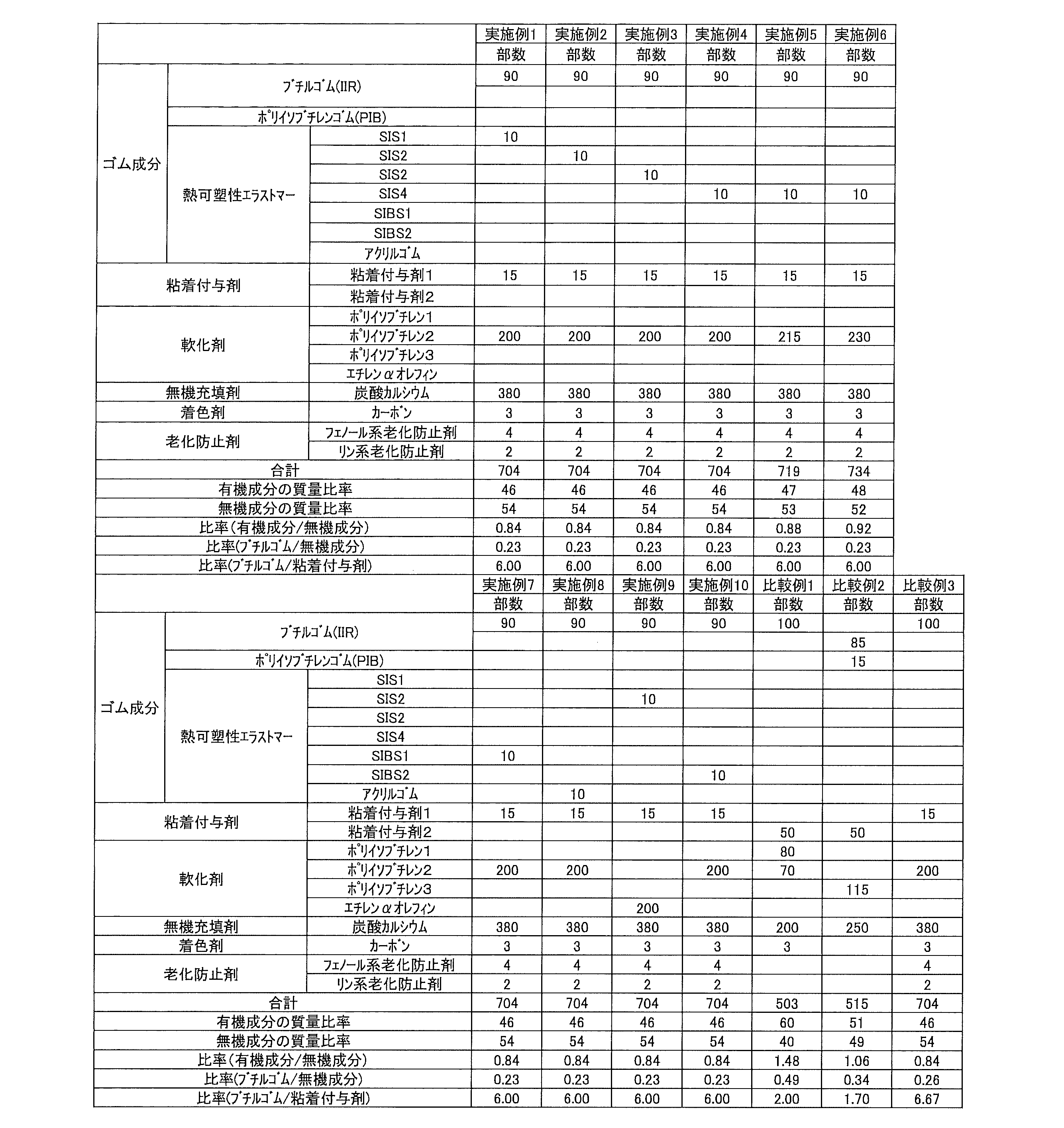
[貯蔵弾性率]
各例に係る粘着シートについて、60℃における貯蔵弾性率G1’及び-10℃における貯蔵弾性率G2’を測定した。
貯蔵弾性率G1’及びG2’は、上記の実施形態の項で説明した方法で測定した。
貯蔵弾性率G1’及びG2’を測定した結果について、以下の表2に示した。
また、以下の表2には、貯蔵弾性率G1’の値に対する貯蔵弾性率G2’の値の比(G2’/G1’)についても示した。
各例に係る粘着シートについて、60℃における貯蔵弾性率G1’及び-10℃における貯蔵弾性率G2’を測定した。
貯蔵弾性率G1’及びG2’は、上記の実施形態の項で説明した方法で測定した。
貯蔵弾性率G1’及びG2’を測定した結果について、以下の表2に示した。
また、以下の表2には、貯蔵弾性率G1’の値に対する貯蔵弾性率G2’の値の比(G2’/G1’)についても示した。
[粘着力]
各例に係る粘着シートについて、-10℃、23℃、及び、60℃における粘着力を測定した。
粘着力は、上記の実施形態の項で説明した方法で測定した。
各温度における粘着力の測定結果について、以下の表2に示した。
各例に係る粘着シートについて、-10℃、23℃、及び、60℃における粘着力を測定した。
粘着力は、上記の実施形態の項で説明した方法で測定した。
各温度における粘着力の測定結果について、以下の表2に示した。
[密着安定性試験]
JIS A 6112:2019(住宅用両面粘着防水テープ)の「5.8 密着安定性試験 10」の項に準拠して、各例に係る粘着シートについて密着安定性試験を行い、60℃での密着安定性について評価した。
密着安定性については、以下の基準にしたがって評価した。
・良:漏水が確認される。
・不良:漏水が確認されない。
密着安定性試験の結果を以下の表2に示した。
JIS A 6112:2019(住宅用両面粘着防水テープ)の「5.8 密着安定性試験 10」の項に準拠して、各例に係る粘着シートについて密着安定性試験を行い、60℃での密着安定性について評価した。
密着安定性については、以下の基準にしたがって評価した。
・良:漏水が確認される。
・不良:漏水が確認されない。
密着安定性試験の結果を以下の表2に示した。
[汚染度]
各例に係る粘着シートを被着対象物に被着させた際に、前記粘着シートの粘着剤層(前記粘着剤組成物の塗工物)によって前記被着対象物がどの程度汚染されるかについて評価した。
なお、以下では、前記被着対象物の汚染の程度を“汚染度”と称する。
“汚染度”は、以下の手順にしたがって評価した。
(1)50mm幅の綿布(金巾3号)を中性・上質紙(プラス社製、商品名「スマートバリュー A040J コピーペーパー高白色」)上に載置し、多角度分光側色計(MA68II、X-rite社製)を用いて、前記綿布について白色度L* 0を測定する。
なお、前記多角度分光側色計の測定角度は15°を採用する。
(2)室温(23±2℃)雰囲気下にて、各例に係る粘着シートを支持体に固定する。
なお、各例に係る粘着シートとしては、50mm幅のものを用いる。
また、前記支持体への各例に係る粘着シートの固定は、基材を前記支持体に当接させる形で実施する。すなわち、各例に係る粘着シートは、前記粘着剤層を露出させた状態で前記支持体に固定される。
(3)前記支持体に固定された各例に係る粘着シートについて、粘着剤層上に50mm幅の綿布(金巾3号)を圧着させる。
粘着剤層上への綿布の圧着は、粘着剤層上に前記綿布を載置させた後、2kgの圧着ローラを1往復させることにより実施する。
(4)前記支持体に固定された各例に係る粘着シートについて、粘着剤層上に前記綿布を圧着させてから1分経過後に、前記綿布を前記粘着剤層から剥離させる。
前記粘着剤層からの前記綿布の剥離は、剥離角度90°、引張速度100mm/minの条件で実施する。
(5)多角度分光側色計(MA68II、X-rite社製)を用いて、前記粘着剤層から剥離させた前記綿布の白色度L* 1を測定する。
白色度L* 1の測定は、白色度L* 0と同様にして実施する。
(6)白色度L* 1と白色度L* 0との差であるΔL*(L* 1-L* 0)を算出し、以下の評価基準に戻づいて、汚染度を評価する。
・良:ΔL*が5以下
・不良:ΔL*が5を上回る
汚染度を評価した結果を以下の表2に示した。
また、以下の表2には、ΔL*の算出結果についても示している。
各例に係る粘着シートを被着対象物に被着させた際に、前記粘着シートの粘着剤層(前記粘着剤組成物の塗工物)によって前記被着対象物がどの程度汚染されるかについて評価した。
なお、以下では、前記被着対象物の汚染の程度を“汚染度”と称する。
“汚染度”は、以下の手順にしたがって評価した。
(1)50mm幅の綿布(金巾3号)を中性・上質紙(プラス社製、商品名「スマートバリュー A040J コピーペーパー高白色」)上に載置し、多角度分光側色計(MA68II、X-rite社製)を用いて、前記綿布について白色度L* 0を測定する。
なお、前記多角度分光側色計の測定角度は15°を採用する。
(2)室温(23±2℃)雰囲気下にて、各例に係る粘着シートを支持体に固定する。
なお、各例に係る粘着シートとしては、50mm幅のものを用いる。
また、前記支持体への各例に係る粘着シートの固定は、基材を前記支持体に当接させる形で実施する。すなわち、各例に係る粘着シートは、前記粘着剤層を露出させた状態で前記支持体に固定される。
(3)前記支持体に固定された各例に係る粘着シートについて、粘着剤層上に50mm幅の綿布(金巾3号)を圧着させる。
粘着剤層上への綿布の圧着は、粘着剤層上に前記綿布を載置させた後、2kgの圧着ローラを1往復させることにより実施する。
(4)前記支持体に固定された各例に係る粘着シートについて、粘着剤層上に前記綿布を圧着させてから1分経過後に、前記綿布を前記粘着剤層から剥離させる。
前記粘着剤層からの前記綿布の剥離は、剥離角度90°、引張速度100mm/minの条件で実施する。
(5)多角度分光側色計(MA68II、X-rite社製)を用いて、前記粘着剤層から剥離させた前記綿布の白色度L* 1を測定する。
白色度L* 1の測定は、白色度L* 0と同様にして実施する。
(6)白色度L* 1と白色度L* 0との差であるΔL*(L* 1-L* 0)を算出し、以下の評価基準に戻づいて、汚染度を評価する。
・良:ΔL*が5以下
・不良:ΔL*が5を上回る
汚染度を評価した結果を以下の表2に示した。
また、以下の表2には、ΔL*の算出結果についても示している。

表2より、実施例1~10に係る粘着シートでは、低温(-10℃)から高温(60℃)までの広い範囲において、優れた粘着性を発揮できることが確認された。
これに対し、比較例1~3に係る粘着シートでは、低温及び高温の少なくとも一方において、粘着性に劣る結果となった。
また、実施例1~10に係る粘着シートは、いずれも60℃における密着安定性に優れていることが分かった。
このことから、実施例1~10に係る粘着シートは、60℃において、被着対象に対して優れた保持性を発揮できることが分かった。
さらに、実施例1~10に係る粘着シートは、被着対象物である綿布を汚染させる汚染度の評価が「良」であること、すなわち、前記綿布を汚染させる程度が小さいのに対し、比較例1及び2に係る粘着シートは、前記綿布を汚染させる汚染度の評価が「不良」でああること、すなわち、前記綿布を汚染させる程度が大きいことが分かった。
なお、比較例2に係る粘着シートについて、ΔL*の値が特に高いのは、比較例2に係る粘着シートの粘着剤層が、ブチルゴムとして再生ブチルゴムを含んでいるからであると推察される(表1参照)。
より詳しくは、再生ブチルゴムは、一般に、タイヤなどのゴム製品からブチルゴム成分を取り出すことにより得られるものの、比較例2係る粘着シートの粘着剤層に含有させた再生ブチルゴムはカーボンブラックを多量に含む(例えば、30質量%程度含む)ゴム製品から得られたものであったため、ΔL*の値が特に高くなっていたものと推察される。
これに対し、比較例1~3に係る粘着シートでは、低温及び高温の少なくとも一方において、粘着性に劣る結果となった。
また、実施例1~10に係る粘着シートは、いずれも60℃における密着安定性に優れていることが分かった。
このことから、実施例1~10に係る粘着シートは、60℃において、被着対象に対して優れた保持性を発揮できることが分かった。
さらに、実施例1~10に係る粘着シートは、被着対象物である綿布を汚染させる汚染度の評価が「良」であること、すなわち、前記綿布を汚染させる程度が小さいのに対し、比較例1及び2に係る粘着シートは、前記綿布を汚染させる汚染度の評価が「不良」でああること、すなわち、前記綿布を汚染させる程度が大きいことが分かった。
なお、比較例2に係る粘着シートについて、ΔL*の値が特に高いのは、比較例2に係る粘着シートの粘着剤層が、ブチルゴムとして再生ブチルゴムを含んでいるからであると推察される(表1参照)。
より詳しくは、再生ブチルゴムは、一般に、タイヤなどのゴム製品からブチルゴム成分を取り出すことにより得られるものの、比較例2係る粘着シートの粘着剤層に含有させた再生ブチルゴムはカーボンブラックを多量に含む(例えば、30質量%程度含む)ゴム製品から得られたものであったため、ΔL*の値が特に高くなっていたものと推察される。
次に、表3に示す原料について説明する。
(1)ゴム成分
(a)ブチルゴム(IIR)
・JSR BUTYL 268(JSR社製、質量平均分子量50万)
(b)熱可塑性エラストマー
・スチレン・イソプレン・スチレンブロック共重合体(SIS)
SIS1’:スチレン量16質量%、ジブロック率56%
・スチレン・イソブチレン・スチレンブロック共重合体(SIBS)
SIBS1’:スチレン量20質量%、ジブロック率41%
SIBS2’:スチレン量20質量%、ジブロック率46%
(2)粘着付与剤
粘着付与剤1’:TREZ RC093(新日本石油化学社製、C5系炭化水素、質量平均分子量1440、軟化点94℃)
粘着付与剤2’:TREZ RB100(新日本石油化学社製、C5系炭化水素、質量平均分子量3090、軟化点98℃)
(3)軟化剤
・ポリイソブチレン(PIB)
ポリイソブチレン1’:テトラックス5T(新日本石油化学社製、質量平均分子量5万)
ポリイソブチレン2’:HV-300(新日本石油化学社製、数平均分子量1400、40℃での動粘度26000mm2/s)
ポリイソブチレン3’:HV-15(新日本石油化学社製、数平均分子量630、40℃での動粘度655mm2/s)
(4)無機充填剤
重質炭酸カルシウム(丸尾カルシウム社製、篩残分(350メッシュ)0.5%以下(JIS K5101に準拠))
(5)着色剤
カーボン:シースト3H(東海カーボン社製、カーボンブラック)
(6)老化防止剤
・一次老化防止剤
アミン系老化防止剤1’:ノクラック6C(大内新興化学工業社製)
アミン系老化防止剤2’:ノクラックWhite(大内新興化学工業社製)
アミン系老化防止剤3’:ノクラックCD(大内新興化学工業社製)
フェノール系老化防止剤1’:ノクラックNS-6(大内新興化学工業社製)
フェノール系老化防止剤2’:Songnox1010(SONGWON社製)
・複合系老化防止剤(一次老化防止剤+二次老化防止剤)
複合系老化防止剤1’:Irganox565(BASF社製)
・二次老化防止剤
リン系老化防止剤1’:Irgafos168(BASF社製)
なお、表3には、粘着剤組成物中の有機成分の質量比率(質量%)、無機成分の質量比率(質量%)、無機成分の質量に対する有機成分の質量の比率、無機成分の質量に対するブチルゴムの比率、及び、粘着付与剤の質量に対するブチルゴムの質量の比率についても示している。
(1)ゴム成分
(a)ブチルゴム(IIR)
・JSR BUTYL 268(JSR社製、質量平均分子量50万)
(b)熱可塑性エラストマー
・スチレン・イソプレン・スチレンブロック共重合体(SIS)
SIS1’:スチレン量16質量%、ジブロック率56%
・スチレン・イソブチレン・スチレンブロック共重合体(SIBS)
SIBS1’:スチレン量20質量%、ジブロック率41%
SIBS2’:スチレン量20質量%、ジブロック率46%
(2)粘着付与剤
粘着付与剤1’:TREZ RC093(新日本石油化学社製、C5系炭化水素、質量平均分子量1440、軟化点94℃)
粘着付与剤2’:TREZ RB100(新日本石油化学社製、C5系炭化水素、質量平均分子量3090、軟化点98℃)
(3)軟化剤
・ポリイソブチレン(PIB)
ポリイソブチレン1’:テトラックス5T(新日本石油化学社製、質量平均分子量5万)
ポリイソブチレン2’:HV-300(新日本石油化学社製、数平均分子量1400、40℃での動粘度26000mm2/s)
ポリイソブチレン3’:HV-15(新日本石油化学社製、数平均分子量630、40℃での動粘度655mm2/s)
(4)無機充填剤
重質炭酸カルシウム(丸尾カルシウム社製、篩残分(350メッシュ)0.5%以下(JIS K5101に準拠))
(5)着色剤
カーボン:シースト3H(東海カーボン社製、カーボンブラック)
(6)老化防止剤
・一次老化防止剤
アミン系老化防止剤1’:ノクラック6C(大内新興化学工業社製)
アミン系老化防止剤2’:ノクラックWhite(大内新興化学工業社製)
アミン系老化防止剤3’:ノクラックCD(大内新興化学工業社製)
フェノール系老化防止剤1’:ノクラックNS-6(大内新興化学工業社製)
フェノール系老化防止剤2’:Songnox1010(SONGWON社製)
・複合系老化防止剤(一次老化防止剤+二次老化防止剤)
複合系老化防止剤1’:Irganox565(BASF社製)
・二次老化防止剤
リン系老化防止剤1’:Irgafos168(BASF社製)
なお、表3には、粘着剤組成物中の有機成分の質量比率(質量%)、無機成分の質量比率(質量%)、無機成分の質量に対する有機成分の質量の比率、無機成分の質量に対するブチルゴムの比率、及び、粘着付与剤の質量に対するブチルゴムの質量の比率についても示している。
下記表3に示す配合割合(質量部)で、ゴム成分(ブチルゴム、及び、熱可塑性エラストマー)、粘着付与剤、軟化剤、無機充填剤、着色剤、及び、老化防止剤を配合し、加熱しながら、実施例1’~8’及び比較例1’~4’に係る粘着剤組成物を得た。
具体的には、ニーダーを用いて液温を140℃に加熱しながら、各例に係る粘着剤組成物を得た。
具体的には、ニーダーを用いて液温を140℃に加熱しながら、各例に係る粘着剤組成物を得た。
次に、各例に係る粘着剤組成物を基材(ポリエチレンテレフタレート不織布(厚み100μm))の一方面にそれぞれ塗工した。
具体的には、前記基材の一方面に、カレンダーロール(8インチロール、4本)を用いて、80℃に加熱しながら厚みが0.2mmとなるように塗工した。
これにより、各例に係る粘着シートを得た。
具体的には、前記基材の一方面に、カレンダーロール(8インチロール、4本)を用いて、80℃に加熱しながら厚みが0.2mmとなるように塗工した。
これにより、各例に係る粘着シートを得た。

[貯蔵弾性率]
各例に係る粘着シートについて、60℃における粘着剤層の貯蔵弾性率G1’及び-10℃における粘着剤層の貯蔵弾性率G2’を測定した。
貯蔵弾性率G1’及びG2’は、上記の実施形態の項で説明した方法で測定した。
貯蔵弾性率G1’及びG2’を測定した結果について、以下の表4に示した。
また、以下の表4には、貯蔵弾性率G1’の値に対する貯蔵弾性率G2’の値の比(G2’/G1’)についても示した。
各例に係る粘着シートについて、60℃における粘着剤層の貯蔵弾性率G1’及び-10℃における粘着剤層の貯蔵弾性率G2’を測定した。
貯蔵弾性率G1’及びG2’は、上記の実施形態の項で説明した方法で測定した。
貯蔵弾性率G1’及びG2’を測定した結果について、以下の表4に示した。
また、以下の表4には、貯蔵弾性率G1’の値に対する貯蔵弾性率G2’の値の比(G2’/G1’)についても示した。
[酸化開始温度]
各例に係る粘着シートについて、ケミルミネッセンスアナライザーを用いて粘着剤層の酸化開始温度を測定した。
粘着剤層の酸化開始温度は、上記の実施形態の項で説明した方法で測定した。
粘着剤層の酸化開始温度を測定した結果について、以下の表4に示した。
各例に係る粘着シートについて、ケミルミネッセンスアナライザーを用いて粘着剤層の酸化開始温度を測定した。
粘着剤層の酸化開始温度は、上記の実施形態の項で説明した方法で測定した。
粘着剤層の酸化開始温度を測定した結果について、以下の表4に示した。
[分子量維持率]
各例に係る粘着シートについて、前記ブチルゴムの分子量の維持率を求めた。
前記ブチルゴムの分子量の維持率は、上記の実施形態の項で説明した方法で測定した。
前記ブチルゴムの分子量の維持率を測定した結果について、以下の表4に示した。
各例に係る粘着シートについて、前記ブチルゴムの分子量の維持率を求めた。
前記ブチルゴムの分子量の維持率は、上記の実施形態の項で説明した方法で測定した。
前記ブチルゴムの分子量の維持率を測定した結果について、以下の表4に示した。
[粘着力]
各例に係る粘着シートについて、-10℃、23℃、及び、60℃における粘着力を測定した。
粘着力は、上記の実施形態の項で説明した方法で測定した。
各温度における粘着力の測定結果について、以下の表4に示した。
各例に係る粘着シートについて、-10℃、23℃、及び、60℃における粘着力を測定した。
粘着力は、上記の実施形態の項で説明した方法で測定した。
各温度における粘着力の測定結果について、以下の表4に示した。
[密着安定性試験]
JIS A 6112:2019(住宅用両面粘着防水テープ)の「5.8 密着安定性試験 10」の項に準拠して、密着安定性試験を行い、60℃での密着安定性について評価した。
密着安定性については、以下の基準にしたがって評価した。
・良:漏水が確認される。
・不良:漏水が確認されない。
その結果を以下の表4に示した。
JIS A 6112:2019(住宅用両面粘着防水テープ)の「5.8 密着安定性試験 10」の項に準拠して、密着安定性試験を行い、60℃での密着安定性について評価した。
密着安定性については、以下の基準にしたがって評価した。
・良:漏水が確認される。
・不良:漏水が確認されない。
その結果を以下の表4に示した。
[60℃で5分間加熱した後のずれ]
JIS A 6112:2019(住宅用両面粘着防水テープ)の「5.7 保持力試験」の項に準拠して、保持力試験を行い、60℃での保持力について評価した。
その評価結果を、60℃で5分間加熱した後のずれとして、以下の表4に示した。
JIS A 6112:2019(住宅用両面粘着防水テープ)の「5.7 保持力試験」の項に準拠して、保持力試験を行い、60℃での保持力について評価した。
その評価結果を、60℃で5分間加熱した後のずれとして、以下の表4に示した。
[100℃で7週間加熱後の粘着力]
各例に係る粘着シートを100℃で7週間加熱した後、JIS A6112の粘着耐久性の評価方法に準拠して、各例に係る粘着シートの粘着剤層の粘着力を測定した。
なお、被着体としては、ハードタイプのタイベックシート(商品名「タイベックハードタイプ 1060B」、旭・デュポン フラッシュスパンプロダクツ社製)を用いた。
100℃で7週間加熱後の粘着力の測定結果について、以下の表4に示した。
各例に係る粘着シートを100℃で7週間加熱した後、JIS A6112の粘着耐久性の評価方法に準拠して、各例に係る粘着シートの粘着剤層の粘着力を測定した。
なお、被着体としては、ハードタイプのタイベックシート(商品名「タイベックハードタイプ 1060B」、旭・デュポン フラッシュスパンプロダクツ社製)を用いた。
100℃で7週間加熱後の粘着力の測定結果について、以下の表4に示した。
[変色]
各例に係る粘着シートについて、粘着剤層の変色を以下の手順にしたがって評価した。
(1)各例に係る粘着シートについて、粘着剤層を0.2mm厚さとなるようにプレスする。
(2)各例に係る粘着シートの粘着剤層の露出面をハードタイプのタイベックシート(商品名「タイベックハードタイプ 1060B」、旭・デュポン フラッシュスパンプロダクツ社製)に貼り付けて、前記タイベックシートと前記粘着シートとの第1積層体を得る。
(3)前記タイベックシートが前記SUS304板と当接するように、前記SUS304板上に前記第1積層体を載置する。
(4)前記SUS304板上に載置された前記第1積層体の一方面から基材を剥離させて、前記タイベックシートと前記粘着剤層との第2積層体を得る。
(5)前記第2積層体を載置させた状態の前記SUS304板を加熱オーブン内に入れた後、温度60℃で1日間の加熱を行う。
(6)前記加熱オーブン内から前記第2積層体を載置させた状態の前記SUS304板を取り出して、前記第2積層体における前記粘着剤層の露出面について色差(b*値)の測定を行う。
なお、色差(b*値)の測定は、測定機器として、多角度分光色計(X-rite社製)を用いて、測定角度45°の条件にて実施した。
色差(b*値)の測定結果について、以下の表4に示した。
なお、以下の表4においては、色差(b*値)の値が3以上のものについて、黄変有と評価し、色差(b*値)が3未満のものについて、黄変無と評価している。
各例に係る粘着シートについて、粘着剤層の変色を以下の手順にしたがって評価した。
(1)各例に係る粘着シートについて、粘着剤層を0.2mm厚さとなるようにプレスする。
(2)各例に係る粘着シートの粘着剤層の露出面をハードタイプのタイベックシート(商品名「タイベックハードタイプ 1060B」、旭・デュポン フラッシュスパンプロダクツ社製)に貼り付けて、前記タイベックシートと前記粘着シートとの第1積層体を得る。
(3)前記タイベックシートが前記SUS304板と当接するように、前記SUS304板上に前記第1積層体を載置する。
(4)前記SUS304板上に載置された前記第1積層体の一方面から基材を剥離させて、前記タイベックシートと前記粘着剤層との第2積層体を得る。
(5)前記第2積層体を載置させた状態の前記SUS304板を加熱オーブン内に入れた後、温度60℃で1日間の加熱を行う。
(6)前記加熱オーブン内から前記第2積層体を載置させた状態の前記SUS304板を取り出して、前記第2積層体における前記粘着剤層の露出面について色差(b*値)の測定を行う。
なお、色差(b*値)の測定は、測定機器として、多角度分光色計(X-rite社製)を用いて、測定角度45°の条件にて実施した。
色差(b*値)の測定結果について、以下の表4に示した。
なお、以下の表4においては、色差(b*値)の値が3以上のものについて、黄変有と評価し、色差(b*値)が3未満のものについて、黄変無と評価している。
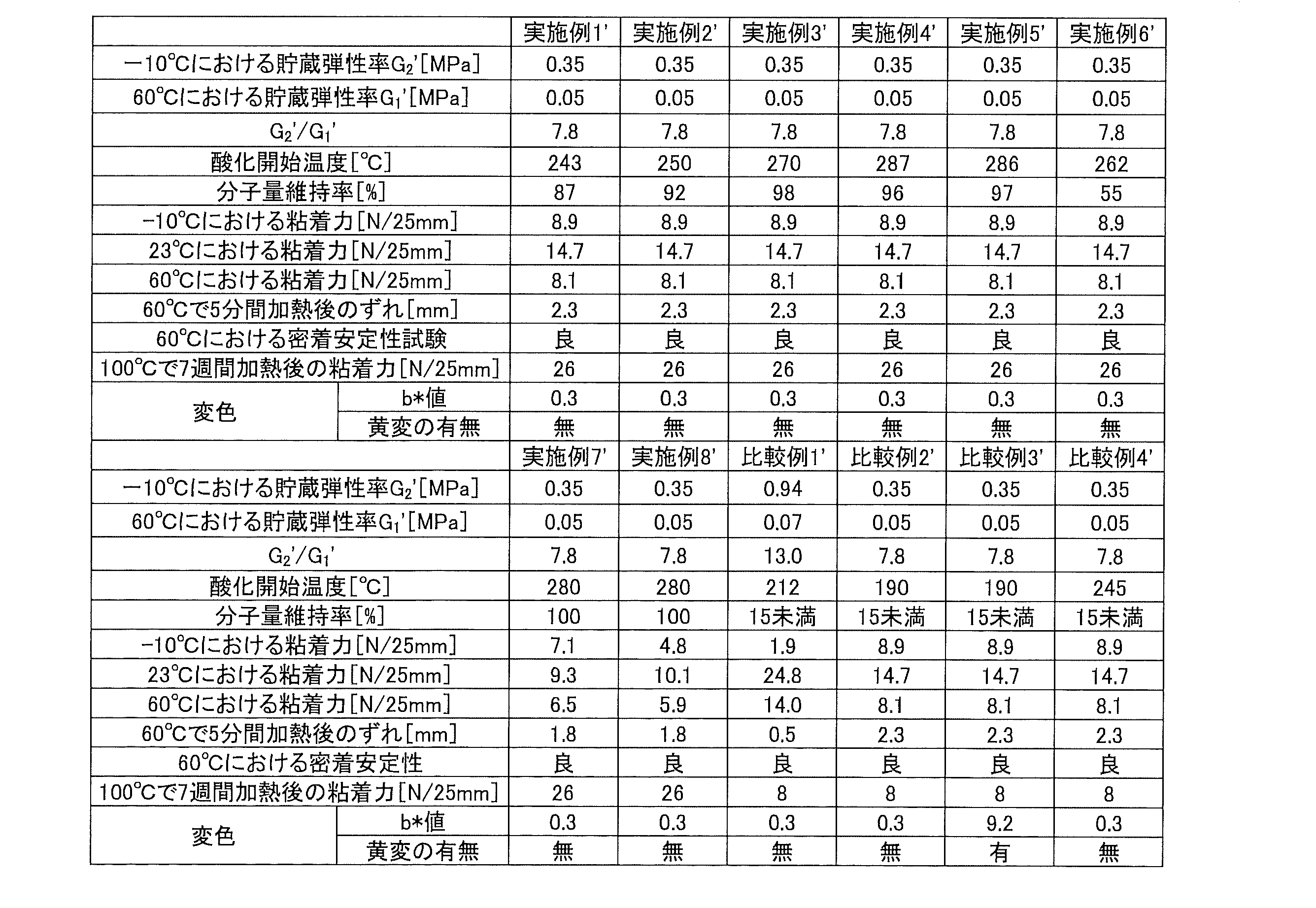
表4より、各実施例に係る粘着シートでは、100℃で7週間加熱された後におけるブチルゴムの分子量の維持率が20%以上となっていることが分かる。
このことから、各実施例に係る粘着シートは、長期耐久性に優れるものであるといえる。
これに対して、各比較例に係る粘着シートでは、100℃で7週間加熱された後におけるブチルゴムの分子量の維持率が15%未満となっていることが分かる。
このことから、各比較例に係る粘着シートは、長期耐久性を十分に発揮し得ないものであるといえる。
また、表4より、各実施例に係る粘着シートでは、低温(-10℃)から高温(60℃)までの広い範囲において、優れた粘着性を発揮できることが分かる。
これに対し、比較例1’に係る粘着シートでは、低温における粘着性が十分に発揮されていないことが分かる。
さらに、各実施例に係る粘着シートは、いずれも60℃における密着安定性に優れていることが分かる。
このことから、各実施例に係る粘着シートは、60℃において、被着対象に対して優れた保持性を発揮できることが分かる。
また、各実施例に係る粘着シートでは、粘着剤層の変色(黄変)の評価が「無」であるのに対し、比較例3’に係る粘着シートでは、粘着剤層の変色(黄変)の評価が「有」であることが分かる。
これは、比較例3’に係る粘着シートでは、粘着剤層にゴム成分に対する着色性(汚染性)が抑制されていないアミン系老化防止剤1’を含ませたことが原因であると考えられる。
このことから、各実施例に係る粘着シートは、長期耐久性に優れるものであるといえる。
これに対して、各比較例に係る粘着シートでは、100℃で7週間加熱された後におけるブチルゴムの分子量の維持率が15%未満となっていることが分かる。
このことから、各比較例に係る粘着シートは、長期耐久性を十分に発揮し得ないものであるといえる。
また、表4より、各実施例に係る粘着シートでは、低温(-10℃)から高温(60℃)までの広い範囲において、優れた粘着性を発揮できることが分かる。
これに対し、比較例1’に係る粘着シートでは、低温における粘着性が十分に発揮されていないことが分かる。
さらに、各実施例に係る粘着シートは、いずれも60℃における密着安定性に優れていることが分かる。
このことから、各実施例に係る粘着シートは、60℃において、被着対象に対して優れた保持性を発揮できることが分かる。
また、各実施例に係る粘着シートでは、粘着剤層の変色(黄変)の評価が「無」であるのに対し、比較例3’に係る粘着シートでは、粘着剤層の変色(黄変)の評価が「有」であることが分かる。
これは、比較例3’に係る粘着シートでは、粘着剤層にゴム成分に対する着色性(汚染性)が抑制されていないアミン系老化防止剤1’を含ませたことが原因であると考えられる。
1 基材
2 粘着剤層
2a 第1粘着剤層
2b 第2粘着剤層
3 目止め層
10 粘着シート
10’粘着シート
2 粘着剤層
2a 第1粘着剤層
2b 第2粘着剤層
3 目止め層
10 粘着シート
10’粘着シート
Claims (18)
- 基材と、
該基材の少なくとも一方面に積層された粘着剤層と、を有する粘着シートであって、
前記粘着剤層は、有機成分としてブチルゴムを含み、
60℃における貯蔵弾性率の値G1’に対する-10℃における貯蔵弾性率の値G2’の比(G2’/G1’)が12未満であり、
-10℃における貯蔵弾性率の値G2’が0.7MPa以下であり、
-10℃における粘着力が、2.0N/25mm以上である
粘着シート。 - 100℃で7週間加熱された後における前記ブチルゴムの分子量の維持率が20%以上である
請求項1に記載の粘着シート。 - 60℃における粘着力が、2.0N/25mm以上である
請求項1または2に記載の粘着シート。 - ケミルミネッセンスアナライザーを用いて測定される前記粘着剤層の酸化開始温度が200℃以上である
請求項2または3に記載の粘着シート。 - 前記粘着剤層は、無機成分をさらに含んでおり、
前記無機成分の質量の値WIに対する前記有機成分の質量の値WOの比(WO/WI)が0.5以上1.3以下である
請求項1乃至4のいずれか1項に記載の粘着シート。 - 前記粘着剤層は、前記有機成分として熱可塑性エラストマーをさらに含む
請求項1乃至5のいずれか1項に記載の粘着シート。 - 前記熱可塑性エラストマーは、スチレン系熱可塑性エラストマー及びアクリル系熱可塑性エラストマーの少なくとも一方である
請求項6に記載の粘着シート。 - 前記熱可塑性エラストマーは、スチレン系熱可塑性エラストマーである
請求項6または7に記載の粘着シート。 - 前記粘着剤層は、前記ブチルゴム及び前記熱可塑性エラストマーの合計量100質量部に対して、前記熱可塑性エラストマーを1質量部以上含む
請求項6乃至8のいずれか1項に記載の粘着シート。 - 前記スチレン系熱可塑性エラストマーは、ジブロック率が10%以上70%以下である
請求項7または8に記載の粘着シート。 - 前記粘着剤層は、前記無機成分として無機フィラーを含む
請求項5乃至10のいずれか1項に記載の粘着シート。 - 前記粘着剤層における前記無機フィラーの含有量は20質量%以上である
請求項11に記載の粘着シート。 - 前記粘着剤層は、前記有機成分として粘着付与剤をさらに含む
請求項1乃至12のいずれか1項に記載の粘着シート。 - 前記粘着剤層は、前記有機成分として老化防止剤をさらに含む
請求項2乃至13のいずれか1項に記載の粘着シート。 - 前記老化防止剤が、フェノール系老化防止剤、アミン系老化防止剤、リン系老化防止剤、及び、硫黄系老化防止剤からなる群から選択される少なくとも1種を含む
請求項14に記載の粘着シート。 - 前記老化防止剤が、フェノール系老化防止剤及びアミン系老化防止剤からなる第1群から選択される少なくとも1種と、リン系老化防止剤及び硫黄系老化防止剤からなる第2群から選択される少なくとも1種とを含む
請求項14または15に記載の粘着シート。 - 前記基材は、繊維シート、ゴムシート、プラスチックシート、金属シート、及び、発泡シートからなる群から選択されるいずれかのシートによって構成されている
請求項1乃至16のいずれか1項に記載の粘着シート。 - 前記繊維シートは、不織布シートまたは織物シートである
請求項17に記載の粘着シート。
Applications Claiming Priority (6)
| Application Number | Priority Date | Filing Date | Title |
|---|---|---|---|
| JP2021-207004 | 2021-12-21 | ||
| JP2021207004 | 2021-12-21 | ||
| JP2022113444A JP2023092434A (ja) | 2021-12-21 | 2022-07-14 | 粘着シート |
| JP2022-113444 | 2022-07-14 | ||
| JP2022-126281 | 2022-08-08 | ||
| JP2022126281A JP2023092439A (ja) | 2021-12-21 | 2022-08-08 | 粘着シート |
Publications (1)
| Publication Number | Publication Date |
|---|---|
| WO2023119752A1 true WO2023119752A1 (ja) | 2023-06-29 |
Family
ID=86901878
Family Applications (1)
| Application Number | Title | Priority Date | Filing Date |
|---|---|---|---|
| PCT/JP2022/034509 Ceased WO2023119752A1 (ja) | 2021-12-21 | 2022-09-15 | 粘着シート |
Country Status (2)
| Country | Link |
|---|---|
| TW (1) | TW202338040A (ja) |
| WO (1) | WO2023119752A1 (ja) |
Citations (7)
| Publication number | Priority date | Publication date | Assignee | Title |
|---|---|---|---|---|
| JP2003517343A (ja) * | 1999-03-17 | 2003-05-27 | コロプラスト アクティーゼルスカブ | 感圧接着剤組成物 |
| WO2014084352A1 (ja) * | 2012-11-30 | 2014-06-05 | リンテック株式会社 | 接着剤組成物、接着シート、電子デバイス及びその製造方法 |
| WO2018199177A1 (ja) * | 2017-04-28 | 2018-11-01 | Agc株式会社 | 複層ガラス及びその製造方法、並びに複層ガラス用シール材 |
| JP2019508566A (ja) * | 2016-04-22 | 2019-03-28 | エルジー・ケム・リミテッド | 光学用粘着剤組成物及びこの硬化物を含む光学用粘着層 |
| JP2019157350A (ja) * | 2018-03-07 | 2019-09-19 | マクセルホールディングス株式会社 | コンクリート劣化抑制粘着テープの使用方法及びそれに使用するコンクリート劣化抑制粘着テープ |
| WO2021041418A1 (en) * | 2019-08-26 | 2021-03-04 | Bostik, Inc. | Roofing underlayment using a pressure sensitive adhesive and methods for making and using the same |
| WO2021251021A1 (ja) * | 2020-06-12 | 2021-12-16 | 日東電工株式会社 | 防水用シート |
-
2022
- 2022-09-15 WO PCT/JP2022/034509 patent/WO2023119752A1/ja not_active Ceased
- 2022-10-06 TW TW111138006A patent/TW202338040A/zh unknown
Patent Citations (7)
| Publication number | Priority date | Publication date | Assignee | Title |
|---|---|---|---|---|
| JP2003517343A (ja) * | 1999-03-17 | 2003-05-27 | コロプラスト アクティーゼルスカブ | 感圧接着剤組成物 |
| WO2014084352A1 (ja) * | 2012-11-30 | 2014-06-05 | リンテック株式会社 | 接着剤組成物、接着シート、電子デバイス及びその製造方法 |
| JP2019508566A (ja) * | 2016-04-22 | 2019-03-28 | エルジー・ケム・リミテッド | 光学用粘着剤組成物及びこの硬化物を含む光学用粘着層 |
| WO2018199177A1 (ja) * | 2017-04-28 | 2018-11-01 | Agc株式会社 | 複層ガラス及びその製造方法、並びに複層ガラス用シール材 |
| JP2019157350A (ja) * | 2018-03-07 | 2019-09-19 | マクセルホールディングス株式会社 | コンクリート劣化抑制粘着テープの使用方法及びそれに使用するコンクリート劣化抑制粘着テープ |
| WO2021041418A1 (en) * | 2019-08-26 | 2021-03-04 | Bostik, Inc. | Roofing underlayment using a pressure sensitive adhesive and methods for making and using the same |
| WO2021251021A1 (ja) * | 2020-06-12 | 2021-12-16 | 日東電工株式会社 | 防水用シート |
Also Published As
| Publication number | Publication date |
|---|---|
| TW202338040A (zh) | 2023-10-01 |
Similar Documents
| Publication | Publication Date | Title |
|---|---|---|
| US9376599B2 (en) | Adhesive article comprising an acrylic foam layer | |
| TWI487767B (zh) | 黏著帶 | |
| CN110088222B (zh) | 粘合剂组合物、粘合剂层及粘合片材 | |
| JP6230347B2 (ja) | 粘着テープ | |
| KR20190132518A (ko) | 전기화학 전지의 결합 및 전기화학 전지의 적층 | |
| JP2008169331A (ja) | 粘着性樹脂組成物及びそれを用いた粘着性板材 | |
| WO2013137072A1 (ja) | 粘着剤組成物、粘着シートおよび透湿防水粘着シート | |
| EP4353794B1 (en) | Pressure-sensitive adhesive tape | |
| US20210222030A1 (en) | Pressure-sensitive adhesive composition, pressure-sensitive adhesive layer, and pressure-sensitive adhesive sheet | |
| JP2011528737A (ja) | ストラッピング接着テープ | |
| CN112334538A (zh) | 热熔组合物以及密封材料 | |
| CN116891696A (zh) | 可再次分离的自粘产品 | |
| KR20110019736A (ko) | 점탄성 폴리올레핀 후면을 갖는 접착 테이프 | |
| JP2021088614A (ja) | 研磨部材固定用粘着剤および粘着シート | |
| US20040241434A1 (en) | Pressure-sensitive adhesive double-coated sheet | |
| WO2023119752A1 (ja) | 粘着シート | |
| JP2023092434A (ja) | 粘着シート | |
| JP4414251B2 (ja) | 滑り止め加工用ホットメルト組成物 | |
| US20220403215A1 (en) | Roofing underlayment using a pressure sensitive adhesive and methods for making and using the same | |
| JP2015048430A (ja) | 両面粘着テープ | |
| CN112752814A (zh) | 粘合带 | |
| US20240228836A1 (en) | Adhesive tape | |
| JP5086666B2 (ja) | ホットメルト接着剤組成物 | |
| JP2008274257A (ja) | 難接着基材用ホットメルト接着剤 | |
| JP2024169089A (ja) | 光硬化型ホットメルト組成物 |
Legal Events
| Date | Code | Title | Description |
|---|---|---|---|
| 121 | Ep: the epo has been informed by wipo that ep was designated in this application |
Ref document number: 22910478 Country of ref document: EP Kind code of ref document: A1 |
|
| NENP | Non-entry into the national phase |
Ref country code: DE |
|
| 122 | Ep: pct application non-entry in european phase |
Ref document number: 22910478 Country of ref document: EP Kind code of ref document: A1 |