WO2023100749A1 - ガラス繊維 - Google Patents
ガラス繊維 Download PDFInfo
- Publication number
- WO2023100749A1 WO2023100749A1 PCT/JP2022/043461 JP2022043461W WO2023100749A1 WO 2023100749 A1 WO2023100749 A1 WO 2023100749A1 JP 2022043461 W JP2022043461 W JP 2022043461W WO 2023100749 A1 WO2023100749 A1 WO 2023100749A1
- Authority
- WO
- WIPO (PCT)
- Prior art keywords
- glass fiber
- glass
- content
- resin
- elastic modulus
- Prior art date
- Legal status (The legal status is an assumption and is not a legal conclusion. Google has not performed a legal analysis and makes no representation as to the accuracy of the status listed.)
- Ceased
Links
Images

Classifications
-
- C—CHEMISTRY; METALLURGY
- C03—GLASS; MINERAL OR SLAG WOOL
- C03C—CHEMICAL COMPOSITION OF GLASSES, GLAZES OR VITREOUS ENAMELS; SURFACE TREATMENT OF GLASS; SURFACE TREATMENT OF FIBRES OR FILAMENTS MADE FROM GLASS, MINERALS OR SLAGS; JOINING GLASS TO GLASS OR OTHER MATERIALS
- C03C13/00—Fibre or filament compositions
-
- D—TEXTILES; PAPER
- D01—NATURAL OR MAN-MADE THREADS OR FIBRES; SPINNING
- D01F—CHEMICAL FEATURES IN THE MANUFACTURE OF ARTIFICIAL FILAMENTS, THREADS, FIBRES, BRISTLES OR RIBBONS; APPARATUS SPECIALLY ADAPTED FOR THE MANUFACTURE OF CARBON FILAMENTS
- D01F9/00—Artificial filaments or the like of other substances; Manufacture thereof; Apparatus specially adapted for the manufacture of carbon filaments
- D01F9/08—Artificial filaments or the like of other substances; Manufacture thereof; Apparatus specially adapted for the manufacture of carbon filaments of inorganic material
Definitions
- the present invention relates to glass fibers, glass fiber materials using the same, and resin-impregnated fiber sheets.
- Glass fibers are used in various fields. For example, as shown in Patent Document 1, they are sometimes used to rehabilitate existing pipes.
- the present invention has been made to solve this problem, and is used for pipes and high-voltage power transmission line protection materials, etc., and provides acid-resistant glass fibers, glass fiber materials using the same, and resin-impregnated fiber sheets. intended to provide
- Section 1 A glass fiber contained in a resin-impregnated fiber sheet forming a pipe, SiO 2 forming a glass skeleton; Al 2 O 3 and contains Glass fiber with acid resistance.
- Item 3. The glass fiber according to Item 1 or 2, which has an elastic modulus of 85 Pa or more.
- Section 4. Item 3. The glass fiber according to item 1 or 2, which has an elastic modulus of 90 GPa or more.
- Item 5 The glass fiber according to Item 1 or 2, which has an elastic modulus of 95 GPa or more.
- Item 6 The glass fiber according to Item 1 or 2, which has an elastic modulus of 100 GPa or more.
- Item 7 Grams of the specific gravity of the pulverized glass fiber were placed in a platinum basket, immersed in 80 ml of sulfuric acid solution with a specific gravity of 1.2 in the flask, heated at 99 ° C. for 60 minutes, dried at 120 ° C., and weighed. Item 7. The glass fiber according to any one of Items 1 to 6, wherein is 0.4% or less.
- Item 8 Grams of the specific gravity of the pulverized glass fiber were placed in a platinum basket, immersed in 80 ml of sulfuric acid solution with a specific gravity of 1.2 in the flask, heated at 99 ° C. for 60 minutes, dried at 120 ° C., and weighed.
- Item 7. The glass fiber according to any one of Items 1 to 6, wherein is 0.2% or less.
- Item 9 The glass fiber according to any one of Items 1 to 8, which is used in the resin-impregnated sheet so as to be in contact with a liquid.
- Item 10 The glass fiber according to Item 9, wherein the liquid contains an acidic substance.
- Item 11 Formed from the glass fiber according to any one of Items 1 to 10, Fiberglass material in the form of strands, chopped strands, yarns and rovings.
- the glass fiber according to the present invention is used as the glass fiber contained in the resin-impregnated fiber sheet forming the pipe or the glass fiber contained in the resin-impregnated fiber sheet forming the high-voltage transmission line protective material, and contains at least SiO 2 and Al 2 O 3 is contained.
- % indicating the content of the glass component is mol % unless otherwise specified.
- SiO2 > SiO 2 is the main component of glass fiber, that is, the component that forms the glass skeleton, and its content is set, for example, in the range of 55 to 70%.
- the content of SiO 2 is preferably 57% or more, more preferably 58% or more, particularly 62% or more. If the SiO 2 content is too low, the acid resistance may deteriorate. On the other hand, if the SiO2 content is too high, the elastic modulus (eg Young's modulus) may decrease. Therefore, the content of SiO 2 is preferably 67% or less, more preferably 65% or less.
- Al 2 O 3 > Al 2 O 3 is a component that contributes to maintenance of the heat resistance, water resistance, etc. of the glass composition and also affects the devitrification temperature, viscosity, and the like.
- the content of Al 2 O 3 is set in the range of 7.5-26%.
- the content of Al 2 O 3 is preferably 9% or more, more preferably 10% or more, particularly preferably 11% or more, and may be 12% or more, further 14% or more in some cases. If the content of Al 2 O 3 is too high, the liquidus temperature rises significantly, which may cause problems in production. Therefore, the content of Al 2 O 3 is preferably 24% or less, more preferably 22% or less, and in some cases may be 20% or less, further 19% or less.
- the devitrification temperature of the glass composition is preferably sufficiently lower than the liquidus temperature.
- a content of Al 2 O 3 suitable for lowering the devitrification temperature sufficiently below the liquidus temperature is 10-18%, further 11-14%, especially 11.5-13.5%.
- an appropriate amount of Li 2 O and/or B 2 O 3 should be added in order to sufficiently lower the devitrification temperature compared to the liquidus temperature.
- the glass fiber according to the present invention can contain a component for improving the elastic modulus (elastic modulus adjusting component).
- the elastic modulus adjusting components shown below are not essential components, but are appropriately contained as necessary.
- Examples of such elastic modulus adjusting components include alkaline earth metal compounds and rare earth compounds.
- Examples of alkaline earth metal compounds include MgO and CaO.
- Examples of rare earth compounds include Y 2 O 3 , La 2 O 3 and CeO 2 .
- At least one composition may be contained as the elastic modulus adjusting component, and two or more compositions may be contained. This will be explained below.
- MgO MgO is also a component that contributes to an improvement in elastic modulus (for example, Young's modulus) and affects devitrification temperature, viscosity, and the like.
- the content of MgO can be set, for example, in the range of 15-30%.
- the MgO content is preferably 17% or more, more preferably 18% or more, particularly preferably 20% or more, and may be 21% or more, further 22% or more in some cases. If the MgO content is too high, the liquidus temperature may rise significantly. Therefore, the MgO content is preferably 29% or less, and may be 28% or less, or even 27% or less in some cases.
- a suitable MgO content for lowering the devitrification temperature sufficiently below the liquidus temperature is 18 to 30%, more preferably 20 to 28%. At least MgO is preferably contained as the elastic modulus adjusting component.
- CaO CaO is an optional component that contributes to the adjustment of elastic modulus (eg, Young's modulus), maintenance of water resistance, improvement of alkali resistance, etc., and affects devitrification temperature, viscosity, and the like.
- the CaO content can be set, for example, in the range of 0 to 8%. Addition of an appropriate amount of CaO is preferable from the viewpoint of lowering the liquidus temperature. Therefore, it is preferable to add CaO (content rate of more than 0%), and the content rate is preferably 0.1% or more, more preferably 0.12% or more, and in some cases 2% or more, further 3% or more. may be However, too much CaO may reduce Young's modulus and acid resistance. Therefore, the CaO content is preferably 13% or less, more preferably 5% or less. A CaO content of less than 1% is particularly suitable for improving Young's modulus and crack load resistance.
- MgO/RO total amount of alkaline earth metal compounds
- rare earth compound examples include Y 2 O 3 , La 2 O 3 and CeO 2 as described above.
- the content of rare earth compounds can be set, for example, in the range of 0 to 8%.
- the content of the rare earth compound is preferably 0.1% or more, more preferably 1% or more, particularly 3% or more. If the content of the rare earth compound is too high, the acid resistance may be weakened and the batch cost may increase. Therefore, the content of the rare earth compound is preferably 8% or less, more preferably 6% or less.
- ZrO2 ZrO 2 is a component for improving acid resistance performance.
- the content of ZrO 2 can be set, for example, in the range of 0.1-3%.
- the content of ZrO 2 is preferably 0.1% or more, more preferably 0.3% or more, particularly 0.5% or more. If the ZrO 2 content is too high, the glass tends to crystallize, which may result in devitrification. Therefore, the ZrO 2 content is preferably 3% or less, more preferably 1.5% or less.
- TiO2 TiO 2 is a component for improving acid resistance performance.
- the content of TiO 2 can be set, for example, in the range of 0.1 to 3%.
- the content of TiO 2 is preferably 0.1 to 3% or more, more preferably 0.3% or more, particularly 0.5% or more. If the TiO 2 content is too high, the uniformity of the glass is lost, and devitrification may occur in this case as well. Therefore, the TiO 2 content is preferably 5% or less, more preferably 1.5% or less.
- B 2 O 3 is an optional component that forms the skeleton of the glass and affects properties such as devitrification temperature and viscosity.
- B 2 O 3 is a component that significantly deteriorates acid resistance. Therefore, the content of B 2 O 3 is set in the range of 0 to 3%. Addition of a small amount of B 2 O 3 may contribute to lowering the devitrification temperature. Therefore, B 2 O 3 may be added (content rate of more than 0%), and when added, the content rate is preferably 0.1% or more, particularly preferably 0.3% or more, and in some cases 0.5%. 0.7% or more, or even 0.7% or more. However, too much B 2 O 3 may reduce Young's modulus.
- the content of B 2 O 3 is preferably 2.5% or less, more preferably 2% or less, particularly preferably 1.8% or less, and in some cases may be 1.6% or less, further 1.5% or less.
- An example of a preferable range of the B 2 O 3 content is 0.1 to 1.6%.
- Li 2O is a component that modifies the skeleton of glass, and is an optional component that affects properties such as liquidus temperature, devitrification temperature and viscosity.
- the content of Li 2 O is set in the range of 0 to 3%. Addition of Li 2 O in this range is effective in lowering the devitrification temperature. Therefore, Li 2 O may be added (content rate of more than 0%), and when added, the content rate is preferably 0.1% or more, further 0.2% or more, particularly 0.3% or more. , depending on the case, it may be 0.5% or more, further 0.7% or more. If the Li 2 O content is too high, the Young's modulus may decrease.
- the content of Li 2 O is preferably 2.5% or less, more preferably 2% or less, particularly preferably 1.8% or less, and in some cases may be 1.6% or less, further 1.5% or less.
- An example of a preferable Li 2 O content range is 0.2 to 2.5%, which is higher than the Na 2 O content.
- Na2O Na 2 O is an optional component that affects properties such as liquidus temperature, devitrification temperature and viscosity. However, since it has a greater effect of lowering the Young's modulus than Li 2 O, its content is set in the range of 0 to 0.2%. It is desirable not to contain Na 2 O basically, but for clarification of the glass melt, the limit is 0.2%, further the limit is 0.15%, for example, more than 0% and 0.1% It is preferable to add in the range of less than
- the content of transition element oxides (ZrO 2 , Y 2 O 3 , La 2 O 3 , CeO 2 , etc.) present with multiple valences in the glass fiber is the content of the metal. It is calculated by converting to the oxide with the maximum oxidation number.
- the total content of the components (SiO 2 and Al 2 O 3 ) described above is preferably 60% or more, more preferably 65% or more, and particularly preferably 67% or more. More preferably, it is 70% or more.
- the total content of SiO 2 , Al 2 O 3 and elastic modulus-adjusting components is preferably 95% or more, more preferably 97% or more, particularly 98% or more, especially 99% or more, and in some cases 99%. It may exceed 5%, or even 99.9%, or even 100%.
- the elastic modulus of glass fibers can be measured by Young's modulus. Young's modulus is preferably 85 GPa or more, more preferably 90 GPa or more, more preferably 95 GPa or more, and particularly preferably 100 GPa or more. Although the upper limit of Young's modulus is not particularly limited, it may be 110 GPa or less. Young's modulus is measured as follows for bulk glass of the same composition rather than the glass fiber.
- the Young's modulus is measured according to the ultrasonic pulse method described in Japanese Industrial Standards (JIS) R1602-1995.
- Each test piece is a rectangular parallelepiped of 5 mm x 25 mm x 35 mm.
- the measurement is performed at room temperature in the air, and a Panametrics model 25DL Plus is used as a measuring device.
- glass fiber and bulk glass made of the same glass composition usually have a relatively low elastic modulus. This is believed to be due to the much more rapid cooling of the glass fibers as they are formed from the glass melt.
- the elastic modulus of glass fiber and the elastic modulus of bulk glass (elastic modulus measured by the above JIS)
- the measured value by the above JIS is used as glass fiber or glass fiber It is appropriate to evaluate the properties of glass compositions for
- the acid resistance performance of glass fibers can be evaluated, for example, by a method based on JOGIS J06-1999. That is, put the specific gravity gram of the pulverized glass fiber in a platinum basket, immerse it in 80 ml of sulfuric acid solution with a specific gravity of 1.2 in the flask, heat it at 99 ° C. for 60 minutes, dry it at 120 ° C., weigh it, and weigh it. measure the rate. As a result, the weight reduction rate is preferably 0.4% or less, and particularly preferably 0.2% or less.
- the glass fiber as described above is produced by flowing out a viscosity-controlled glass melt from a nozzle and winding it up with a winder. This continuous fiber is cut into appropriate lengths for use. Short glass fibers are produced while blowing off a glass melt with high-pressure air, centrifugal force, or the like.
- the glass fiber according to the present invention can be applied to various forms of glass fiber material.
- a strand can be formed by bundling a plurality of glass fibers.
- Each strand consists of, for example, 100-10000, typically 200-4000 glass fibers.
- Chopped strands can also be formed by cutting strands to a predetermined length.
- the length of the chopped strands is not particularly limited, but can be, for example, 1 to 25 mm, preferably 3 to 6 mm.
- a yarn can also be formed by twisting a plurality of glass fibers to form a plied yarn.
- a roving can be formed by bundling a plurality of glass fibers.
- a plurality of glass fibers can form a woven fabric. In this case, weaving methods such as plain weave, twill weave, leno weave, and braid can be applied.
- a nonwoven fabric can be formed from a plurality of glass fibers.
- a mat having voids in which glass fibers are randomly accumulated can be formed.
- a resin-impregnated fiber sheet is a sheet obtained by forming a woven fabric, a non-woven fabric, or a fiber bundle from the glass fibers described above and impregnating this with a resin.
- thermosetting resin examples include resins such as urethane resins, vinyl ester resins, and epoxy resins.
- thermoplastic resins include polyethylene resins, polypropylene resins, polypropylene copolymers, nylon resins, polymethacrylic resins, polyvinyl chloride resins, and polycarbonate resins.
- photocurable resins include ultraviolet curable resins that are cured by irradiation with ultraviolet rays. As the resin impregnated in the resin-impregnated fiber sheet, one of these resins may be used alone, or a plurality of resins may be mixed and used.
- the thickness of the resin-impregnated fiber sheet is not particularly limited, but can be, for example, 1 to 10 mm.
- the fiber content for such applications is preferably 10-80% by weight, more preferably 30-50% by weight.
- the fiber content is less than 10% by weight, the hardness of the piping and high-voltage transmission line protective material cannot be guaranteed.
- the fiber content is less than 80% by weight, the area available for contact with the impregnating resin relative to the glass surface is small, resulting in poor glass-resin adhesion and poor mechanical performance of the composite.
- the glass fiber content is high, and the glass fiber is exposed on the resin surface and tends to become the starting point of cracks. Therefore, it is required not only to have a high elastic modulus, but also to have acid resistance and crack resistance.
- such a resin-impregnated fiber sheet can be applied to rehabilitation pipes for rehabilitation of pipes buried underground.
- the resin-impregnated fiber sheet can be used alone as a rehabilitating pipe, or can be used as one layer of a plurality of layers constituting a rehabilitating pipe.
- a rehabilitating pipe can be formed in which liquid-impermeable resin sheets are arranged so as to sandwich a resin-impregnated fiber sheet. Piping and rehabilitating pipes buried in the ground are subjected to a large load, come into contact with liquid flowing through the pipe, and such liquid may contain acidic components. Glass fibers that are acid-resistant are particularly advantageous, even if they are exposed from the sheet. Furthermore, in such applications, it is more advantageous to have the modulus of elasticity as described above.
- a resin-impregnated fiber sheet can also be used as a high-voltage transmission line protective material. Since it may be affected by rain or acid rain, acid resistance is also required. Therefore, it is advantageous to use glass fibers having acid resistance as described above for high-voltage transmission line protection materials.
- Such high-voltage power lines are used as overhead power lines, and are sometimes buried underground. When buried in the ground, acid rain may permeate into the ground. Therefore, even if the glass fiber is exposed from the protective material, the glass fiber of the present invention is advantageous as a protective material for high-voltage transmission lines buried underground.
- the high-voltage transmission line protective material is coated on the surface of the transmission line and is subjected to bending of the transmission line, a high elastic modulus is particularly advantageous.
- a high elastic modulus is also particularly advantageous when buried in the ground, since it will be subjected to higher pressures from the soil and superstructures.
- the glass fiber according to the present invention has acid resistance because the glass skeleton is formed of SiO 2 . Therefore, it can be suitably used as a glass fiber contained in a resin-impregnated fiber sheet forming a pipe that may come into contact with an acidic substance or a resin-impregnated fiber sheet forming a high-voltage transmission line protective material.
- SiO 2 content For example, by setting the SiO 2 content to 55% or more, high acid resistance can be achieved.
- the pulverized glass fiber put the pulverized glass fiber in grams with a specific gravity in a platinum basket, immerse it in 80 ml of sulfuric acid solution with a specific gravity of 1.2 in the flask, heat it at 99 ° C. for 60 minutes, and dry it at 120 ° C.
- the weight loss rate is 0.4% or less, so high acid resistance can be achieved.
- the glass fiber contains an elastic modulus adjusting component, a high elastic modulus can be achieved.
Landscapes
- Chemical & Material Sciences (AREA)
- Chemical Kinetics & Catalysis (AREA)
- General Chemical & Material Sciences (AREA)
- Engineering & Computer Science (AREA)
- Geochemistry & Mineralogy (AREA)
- Life Sciences & Earth Sciences (AREA)
- Textile Engineering (AREA)
- Materials Engineering (AREA)
- Organic Chemistry (AREA)
- Glass Compositions (AREA)
- Laminated Bodies (AREA)
- Reinforced Plastic Materials (AREA)
- Inorganic Fibers (AREA)
Abstract
本発明は、配管を形成する樹脂含浸繊維シートに含まれるガラス繊維であって、ガラス骨格を形成するSiO2と、Al2O3と、を含有し、耐酸性を有する。
Description
本発明は、ガラス繊維、これを用いたガラス繊維材料、樹脂含浸繊維シートに関する。
ガラス繊維は、種々の分野で用いられており、例えば、特許文献1に示すように、既設管の更生に用いられることがある。
しかしながら、このような既設管には酸性の液体が流れることがあるため、これがガラス繊維に触れると、ガラス繊維が劣化するおそれがある。このような問題は既設管の更生だけでなく、耐酸性が求められる種々の環境で起こりうることである。本発明は、この問題を解決するためになされたものであり、配管や高圧送電線保護材用などに用いられ、耐酸性を有するガラス繊維、これを用いたガラス繊維材料、樹脂含浸繊維シートを提供することを目的とする。
項1.配管を形成する樹脂含浸繊維シートに含まれるガラス繊維であって、
ガラス骨格を形成するSiO2と、
Al2O3と、
を含有し、
耐酸性を有する、ガラス繊維。
ガラス骨格を形成するSiO2と、
Al2O3と、
を含有し、
耐酸性を有する、ガラス繊維。
項2.高圧送電線保護材を形成する樹脂含浸繊維シートに含まれるガラス繊維であって、
ガラス骨格を形成するSiO2と、
Al2O3と、
を含有し、
耐酸性を有する、ガラス繊維。
ガラス骨格を形成するSiO2と、
Al2O3と、
を含有し、
耐酸性を有する、ガラス繊維。
項3.弾性率が、85Pa以上である、項1または2に記載のガラス繊維。
項4.弾性率が、90GPa以上である、項1または2に記載のガラス繊維。
項5.弾性率が、95GPa以上である、項1または2に記載のガラス繊維。
項6.弾性率が、100GPa以上である、項1または2に記載のガラス繊維。
項7.粉砕された前記ガラス繊維の比重グラムを白金製カゴに入れ、フラスコ内の比重1.2の硫酸液80mlに浸して99℃で60分間加熱し、120℃にて乾燥後秤量した結果、減量率が0.4%以下である、項1から6のいずれかに記載のガラス繊維。
項8.粉砕された前記ガラス繊維の比重グラムを白金製カゴに入れ、フラスコ内の比重1.2の硫酸液80mlに浸して99℃で60分間加熱し、120℃にて乾燥後秤量した結果、減量率が0.2%以下である、項1から6のいずれかに記載のガラス繊維。
項9.前記樹脂含浸シートにおいて、液体と接触可能な状態で使用される、項1から8のいずれかに記載のガラス繊維。
項10.前記液体は酸性物質を含有する、項9に記載のガラス繊維。
項11.項1から10のいずれかに記載のガラス繊維により形成され、
ストランド、チョップドストランド、ヤーン、及びロービングのいずれかの形態である、ガラス繊維材。
ストランド、チョップドストランド、ヤーン、及びロービングのいずれかの形態である、ガラス繊維材。
項12.項1から10のいずれかに記載のガラス繊維により形成され、織布または不織布のいずれかの形態である、ガラス繊維材と、
前記ガラス繊維材料に含浸させる樹脂と、
を備えている、樹脂含浸繊維シート。
前記ガラス繊維材料に含浸させる樹脂と、
を備えている、樹脂含浸繊維シート。
本発明によれば、弾性率を向上可能で、耐酸性を有するガラス繊維を提供することができる。
本発明に係るガラス繊維の実施形態について説明する。本発明に係るガラス繊維は、配管を形成する樹脂含浸繊維シートに含まれるガラス繊維、または高圧送電線保護材を形成する樹脂含浸繊維シートに含まれるガラス繊維として用いられ、少なくとも、SiO2と、Al2O3とが含有されている。以下、詳細に説明する。以下では、ガラス成分の含有率を示す%は、特に断らない限り、すべてモル%である。
<1.ガラス繊維の成分>
<1-1.SiO2>
SiO2は、ガラス繊維の主成分、つまりガラス骨格を形成する成分であり、その含有率は、例えば、55~70%の範囲に設定される。SiO2の含有率は、57%以上、さらに58%以上、特に62%以上が好ましい。SiO2の含有率が低すぎると、耐酸性が低下するおそれがある。一方、SiO2の含有率が高すぎると、弾性率(例えば、ヤング率)が低下することがある。したがって、SiO2の含有率は、67%以下、さらに65%以下が好ましい。
<1-1.SiO2>
SiO2は、ガラス繊維の主成分、つまりガラス骨格を形成する成分であり、その含有率は、例えば、55~70%の範囲に設定される。SiO2の含有率は、57%以上、さらに58%以上、特に62%以上が好ましい。SiO2の含有率が低すぎると、耐酸性が低下するおそれがある。一方、SiO2の含有率が高すぎると、弾性率(例えば、ヤング率)が低下することがある。したがって、SiO2の含有率は、67%以下、さらに65%以下が好ましい。
<1-2.Al2O3>
Al2O3は、ガラス組成物の耐熱性、耐水性等の維持に貢献し、失透温度、粘度等に影響を与える成分でもある。Al2O3の含有率は、7.5~26%の範囲に設定される。Al2O3の含有率は、9%以上、さらに10%以上、特に11%以上が好ましく、場合によっては12%以上、さらには14%以上であってもよい。Al2O3の含有率が高すぎると、液相温度が大きく上昇して製造に不都合が生じることがある。したがって、Al2O3の含有率は、24%以下、さらに22%以下が好ましく、場合によっては20%以下、さらには19%以下であってもよい。
Al2O3は、ガラス組成物の耐熱性、耐水性等の維持に貢献し、失透温度、粘度等に影響を与える成分でもある。Al2O3の含有率は、7.5~26%の範囲に設定される。Al2O3の含有率は、9%以上、さらに10%以上、特に11%以上が好ましく、場合によっては12%以上、さらには14%以上であってもよい。Al2O3の含有率が高すぎると、液相温度が大きく上昇して製造に不都合が生じることがある。したがって、Al2O3の含有率は、24%以下、さらに22%以下が好ましく、場合によっては20%以下、さらには19%以下であってもよい。
特に量産を考慮すると、ガラス組成物の失透温度は液相温度よりも十分低いことが好ましい。失透温度を液相温度よりも十分に低下させるために適したAl2O3の含有率は、10~18%、さらに11~14%、特に11.5~13.5%である。後述するように、失透温度を液相温度と比較して十分に低下させるためには、適量のLi2O及び/又はB2O3を添加するとよい。
<1-3.弾性率を向上するための成分>
本発明に係るガラス繊維には、弾性率を向上するための成分(弾性率調整成分)を含有させることができる。以下に示す弾性率調整成分は必須の成分ではないが、必要に応じて適宜含有される。このような弾性率調整成分としては、例えば、アルカリ土類金属化合物、希土類化合物等を挙げることができる。アルカリ土類金属化合物としては、例えば、MgO、CaO等を挙げることができる。希土類化合物としては、例えば、Y2O3、La2O3、CeO2等を挙げることができる。また、弾性率調整成分としては、少なくとも1つの組成物が含有されていればよく、2以上の組成物が含有されていてもよい。
以下、説明する。
(MgO)
MgOは、弾性率(例えば、ヤング率)の向上に寄与し、失透温度、粘度等に影響を与える成分でもある。MgOの含有率は、例えば、15~30%の範囲に設定することができる。MgOの含有率は、17%以上、さらに18%以上、特に20%以上が好ましく、場合によっては21%以上、さらには22%以上であってもよい。MgOの含有率が高すぎると、液相温度が大きく上昇することがある。したがって、MgOの含有率は、29%以下が好ましく、場合によっては28%以下、さらには27%以下であってもよい。
本発明に係るガラス繊維には、弾性率を向上するための成分(弾性率調整成分)を含有させることができる。以下に示す弾性率調整成分は必須の成分ではないが、必要に応じて適宜含有される。このような弾性率調整成分としては、例えば、アルカリ土類金属化合物、希土類化合物等を挙げることができる。アルカリ土類金属化合物としては、例えば、MgO、CaO等を挙げることができる。希土類化合物としては、例えば、Y2O3、La2O3、CeO2等を挙げることができる。また、弾性率調整成分としては、少なくとも1つの組成物が含有されていればよく、2以上の組成物が含有されていてもよい。
以下、説明する。
(MgO)
MgOは、弾性率(例えば、ヤング率)の向上に寄与し、失透温度、粘度等に影響を与える成分でもある。MgOの含有率は、例えば、15~30%の範囲に設定することができる。MgOの含有率は、17%以上、さらに18%以上、特に20%以上が好ましく、場合によっては21%以上、さらには22%以上であってもよい。MgOの含有率が高すぎると、液相温度が大きく上昇することがある。したがって、MgOの含有率は、29%以下が好ましく、場合によっては28%以下、さらには27%以下であってもよい。
失透温度を液相温度よりも十分に低下させるために適したMgOの含有率は、18~30%、さらに20~28%である。なお、弾性率調整成分としては、少なくともMgOを含有させることが好ましい。
(CaO)
CaOは、弾性率(例えば、ヤング率)の調整のほか、耐水性の維持、および耐アルカリ性の向上等に貢献し、失透温度、粘度等に影響を与える任意成分である。CaOの含有率は、例えば、0~8%の範囲に設定することができる。適量のCaOの添加は液相温度を低下させる観点から好ましい。したがって、CaOは添加することが好ましく(含有率0%超)、その含有率は、0.1%以上、さらには0.12%以上が好ましく、場合によっては2%以上、さらには3%以上であってもよい。ただし、多すぎるCaOはヤング率や、耐酸性性能を低下させることがある。したがって、CaOの含有率は、13%以下、さらには5%以下が好ましい。ヤング率及び耐クラック荷重の改善のために特に適しているCaOの含有率は、1%未満である。
CaOは、弾性率(例えば、ヤング率)の調整のほか、耐水性の維持、および耐アルカリ性の向上等に貢献し、失透温度、粘度等に影響を与える任意成分である。CaOの含有率は、例えば、0~8%の範囲に設定することができる。適量のCaOの添加は液相温度を低下させる観点から好ましい。したがって、CaOは添加することが好ましく(含有率0%超)、その含有率は、0.1%以上、さらには0.12%以上が好ましく、場合によっては2%以上、さらには3%以上であってもよい。ただし、多すぎるCaOはヤング率や、耐酸性性能を低下させることがある。したがって、CaOの含有率は、13%以下、さらには5%以下が好ましい。ヤング率及び耐クラック荷重の改善のために特に適しているCaOの含有率は、1%未満である。
(MgO/RO(アルカリ土類金属化合物総量))
MgO/ROの比が向上すると、耐酸性性能が向上することが分かった。例えば、MgO/ROは、0.5以上が好ましく、0.7以上がさらに好ましい。
MgO/ROの比が向上すると、耐酸性性能が向上することが分かった。例えば、MgO/ROは、0.5以上が好ましく、0.7以上がさらに好ましい。
(希土類化合物)
希土類化合物としては、上記のように、例えば、Y2O3、La2O3、CeO2を挙げることができる。希土類化合物の含有率は、例えば、0~8%の範囲に設定することができる。希土類化合物の含有率は、0.1%以上、さらに1%以上、特に3%以上が好ましい。希土類化合物の含有率が高すぎると、耐酸性が弱まるし、バッチコストが上昇してしまうことがある。したがって、希土類化合物の含有率は、8%以下が好ましく、6%以下がさらに好ましい。
希土類化合物としては、上記のように、例えば、Y2O3、La2O3、CeO2を挙げることができる。希土類化合物の含有率は、例えば、0~8%の範囲に設定することができる。希土類化合物の含有率は、0.1%以上、さらに1%以上、特に3%以上が好ましい。希土類化合物の含有率が高すぎると、耐酸性が弱まるし、バッチコストが上昇してしまうことがある。したがって、希土類化合物の含有率は、8%以下が好ましく、6%以下がさらに好ましい。
<1-4.その他の成分>
本発明に係るガラス繊維には、上記の成分に加え、必要に応じて、以下の成分を添加することができる。但し、以下の成分に限定されず、これら以外にも適宜添加することができる。
本発明に係るガラス繊維には、上記の成分に加え、必要に応じて、以下の成分を添加することができる。但し、以下の成分に限定されず、これら以外にも適宜添加することができる。
(ZrO2)
ZrO2は、耐酸性性能を向上するための成分である。ZrO2の含有率は、例えば、0.1~3%の範囲に設定することができる。ZrO2の含有率は、0.1%以上、さらに0.3%以上、特に0.5%以上が好ましい。ZrO2の含有率が高すぎると、ガラスが結晶化しやすくなり、その結果、失透が発生してしまうことがある。したがって、ZrO2の含有率は、3%以下が好ましく、1.5%以下がさらに好ましい。
ZrO2は、耐酸性性能を向上するための成分である。ZrO2の含有率は、例えば、0.1~3%の範囲に設定することができる。ZrO2の含有率は、0.1%以上、さらに0.3%以上、特に0.5%以上が好ましい。ZrO2の含有率が高すぎると、ガラスが結晶化しやすくなり、その結果、失透が発生してしまうことがある。したがって、ZrO2の含有率は、3%以下が好ましく、1.5%以下がさらに好ましい。
(TiO2)
TiO2は、耐酸性性能を向上するための成分である。TiO2の含有率は、例えば、0.1~3%の範囲に設定することができる。TiO2の含有率は、0.1~3%以上、さらに0.3%以上、特に0.5%以上が好ましい。TiO2の含有率が高すぎると、ガラスの均一性がなくなり、この場合も失透が発生してしまうことがある。したがって、TiO2の含有率は、5%以下が好ましく、1.5%以下がさらに好ましい。
TiO2は、耐酸性性能を向上するための成分である。TiO2の含有率は、例えば、0.1~3%の範囲に設定することができる。TiO2の含有率は、0.1~3%以上、さらに0.3%以上、特に0.5%以上が好ましい。TiO2の含有率が高すぎると、ガラスの均一性がなくなり、この場合も失透が発生してしまうことがある。したがって、TiO2の含有率は、5%以下が好ましく、1.5%以下がさらに好ましい。
(B2O3)
B2O3は、ガラスの骨格を形成すると共に、失透温度、粘度等の特性に影響を与える任意成分である。特にB2O3は、耐酸性を著しく悪化させる成分である。したがって、B2O3の含有率は0~3%の範囲に設定される。微量のB2O3の添加は、失透温度の低下に寄与することがある。したがって、B2O3は添加してもよく(含有率0%超)、添加した場合の含有率は、0.1%以上、特に0.3%以上が好ましく、場合によっては0.5%以上、さらには0.7%以上であってもよい。ただし、多すぎるB2O3はヤング率を低下させることがある。B2O3の含有率は、2.5%以下、さらに2%以下、特に1.8%以下が好ましく、場合によっては1.6%以下、さらに1.5%以下であってもよい。B2O3の含有率の好ましい範囲の一例は、0.1~1.6%である。
B2O3は、ガラスの骨格を形成すると共に、失透温度、粘度等の特性に影響を与える任意成分である。特にB2O3は、耐酸性を著しく悪化させる成分である。したがって、B2O3の含有率は0~3%の範囲に設定される。微量のB2O3の添加は、失透温度の低下に寄与することがある。したがって、B2O3は添加してもよく(含有率0%超)、添加した場合の含有率は、0.1%以上、特に0.3%以上が好ましく、場合によっては0.5%以上、さらには0.7%以上であってもよい。ただし、多すぎるB2O3はヤング率を低下させることがある。B2O3の含有率は、2.5%以下、さらに2%以下、特に1.8%以下が好ましく、場合によっては1.6%以下、さらに1.5%以下であってもよい。B2O3の含有率の好ましい範囲の一例は、0.1~1.6%である。
(Li2O)
Li2Oは、ガラスの骨格を修飾する成分であり、液相温度、失透温度、粘度等の特性に影響を与える任意成分である。Li2Oの含有率は、0~3%の範囲に設定される。この範囲のLi2Oの添加は、失透温度の低下に効果がある。したがって、Li2Oは、添加してもよく(含有率0%超)、添加した場合の含有率は、0.1%以上、さらには0.2%以上、特に0.3%以上が好ましく、場合によっては0.5%以上、さらには0.7%以上であってもよい。Li2Oの含有率が高すぎると、ヤング率が低下することがある。したがって、Li2Oの含有率は、2.5%以下、さらに2%以下、特に1.8%以下が好ましく、場合によっては1.6%以下、さらに1.5%以下であってもよい。Li2Oの含有率の好ましい範囲の一例は、0.2~2.5%であってNa2Oの含有率よりも高い範囲である。
Li2Oは、ガラスの骨格を修飾する成分であり、液相温度、失透温度、粘度等の特性に影響を与える任意成分である。Li2Oの含有率は、0~3%の範囲に設定される。この範囲のLi2Oの添加は、失透温度の低下に効果がある。したがって、Li2Oは、添加してもよく(含有率0%超)、添加した場合の含有率は、0.1%以上、さらには0.2%以上、特に0.3%以上が好ましく、場合によっては0.5%以上、さらには0.7%以上であってもよい。Li2Oの含有率が高すぎると、ヤング率が低下することがある。したがって、Li2Oの含有率は、2.5%以下、さらに2%以下、特に1.8%以下が好ましく、場合によっては1.6%以下、さらに1.5%以下であってもよい。Li2Oの含有率の好ましい範囲の一例は、0.2~2.5%であってNa2Oの含有率よりも高い範囲である。
(Na2O)
Na2Oは、Li2Oと同様、液相温度、失透温度、粘度等の特性に影響を与える任意成分である。ただし、Li2Oよりもヤング率を低下させる効果が大きいため、その含有率は0~0.2%の範囲に設定される。Na2Oは、基本的に含有させないことが望ましいが、ガラス融液の清澄のために0.2%を限度として、さらには0.15%を限度として、例えば0%を超え0.1%未満の範囲で添加すること好ましい。
Na2Oは、Li2Oと同様、液相温度、失透温度、粘度等の特性に影響を与える任意成分である。ただし、Li2Oよりもヤング率を低下させる効果が大きいため、その含有率は0~0.2%の範囲に設定される。Na2Oは、基本的に含有させないことが望ましいが、ガラス融液の清澄のために0.2%を限度として、さらには0.15%を限度として、例えば0%を超え0.1%未満の範囲で添加すること好ましい。
なお、本明細書では、ガラス繊維において複数の価数をとって存在する遷移元素の酸化物(ZrO2、Y2O3、La2O3、CeO2等)の含有率は、その金属の酸化数が最大である酸化物に換算して算出することとする。
(以上に説明した成分の合計)
以上に説明した成分(SiO2、Al2O3)の含有率の合計は、60%以上であることが好ましく、65%以上であることがより好ましく、67%以上であることが特に好ましく、70%以上であることがさらに好ましい。また、SiO2、Al2O3、弾性率調整成分の含有率の合計は、95%以上、さらには97%以上、特に98%以上、とりわけ99%以上であることが好ましく、場合によって99.5%、さらには99.9%を上回っていてもよく、100%であってもよい。
以上に説明した成分(SiO2、Al2O3)の含有率の合計は、60%以上であることが好ましく、65%以上であることがより好ましく、67%以上であることが特に好ましく、70%以上であることがさらに好ましい。また、SiO2、Al2O3、弾性率調整成分の含有率の合計は、95%以上、さらには97%以上、特に98%以上、とりわけ99%以上であることが好ましく、場合によって99.5%、さらには99.9%を上回っていてもよく、100%であってもよい。
<2.ガラス繊維の特性>
<2-1.弾性率>
本発明の一実施形態において、ガラス繊維の弾性率は、ヤング率にて測定することができる。ヤング率は、85GPa以上が好ましく、90GPa以上、95GPa以上がさらに好ましく、100GPa以上が特に好ましい。ヤング率の上限は、特に限定されないが、110GPa以下であってよい。ヤング率は、ガラス繊維ではなく、同じ組成を有するバルクガラスとして、以下のように測定する。
<2-1.弾性率>
本発明の一実施形態において、ガラス繊維の弾性率は、ヤング率にて測定することができる。ヤング率は、85GPa以上が好ましく、90GPa以上、95GPa以上がさらに好ましく、100GPa以上が特に好ましい。ヤング率の上限は、特に限定されないが、110GPa以下であってよい。ヤング率は、ガラス繊維ではなく、同じ組成を有するバルクガラスとして、以下のように測定する。
ヤング率は、日本工業規格 (JIS)R1602-1995に記載された超音波パルス法に従って測定する。各試験片は5mm×25mm×35mmの直方体とする。また、測定は、室温、大気中で実施し、測定装置として、Panametrics製model25DLPlusを用いる。
なお、同一のガラス組成物からなるガラス繊維とバルクガラスとでは、通常、ガラス繊維が相対的に低い弾性率を有することが知られている。これは、ガラス融液から成形される際にガラス繊維がはるかに急速に冷却されるためと考えられている。しかし、ガラス繊維の弾性率とバルクガラスの弾性率(上記 JISにより測定される弾性率)との間には正の相関があるため、上記JISによる測定値を用いてガラス繊維或いはガラス繊維として使用するためのガラス組成物の特性を評価することは妥当である。
<2-2.耐酸性性能>
本発明の一実施形態において、ガラス繊維の耐酸性性能は、例えば、JOGIS J06-1999に準拠した方法評価することができる。すなわち、粉砕されたガラス繊維の比重グラムを白金製カゴに入れ、フラスコ内の比重1.2の硫酸液80mlに浸して99℃で60分間加熱し、120℃にて乾燥後秤量し、その減量率を測定する。その結果、減量率が0.4以下であることが望ましく、減量率が0.2%以下であることが特に望ましい。
本発明の一実施形態において、ガラス繊維の耐酸性性能は、例えば、JOGIS J06-1999に準拠した方法評価することができる。すなわち、粉砕されたガラス繊維の比重グラムを白金製カゴに入れ、フラスコ内の比重1.2の硫酸液80mlに浸して99℃で60分間加熱し、120℃にて乾燥後秤量し、その減量率を測定する。その結果、減量率が0.4以下であることが望ましく、減量率が0.2%以下であることが特に望ましい。
<3.ガラス繊維の製造方法>
上記のようなガラス繊維は、粘度を制御したガラス融液をノズルから流出させ、巻き取り機によって巻き取って製造される。この連続繊維は、使用時に適切な長さに切断される。ガラス短繊維は、高圧空気、遠心力等によってガラス融液を吹き飛ばしながら製造される。
上記のようなガラス繊維は、粘度を制御したガラス融液をノズルから流出させ、巻き取り機によって巻き取って製造される。この連続繊維は、使用時に適切な長さに切断される。ガラス短繊維は、高圧空気、遠心力等によってガラス融液を吹き飛ばしながら製造される。
<4.ガラス繊維材料>
本発明に係るガラス繊維は、種々の形態のガラス繊維材料に適用することができる。例えば、複数本のガラス繊維を束ねたストランドを形成することができる。各ストランドは、例えば100~10000本、典型的には200~4000本のガラス繊維から構成されている。また、ストランドを所定の長さに切断したチョップドストランドを形成することもできる。チョップドストランドの長さは、特には限定されないが、例えば、1~25mm、好ましくは3~6mmとすることができる。
本発明に係るガラス繊維は、種々の形態のガラス繊維材料に適用することができる。例えば、複数本のガラス繊維を束ねたストランドを形成することができる。各ストランドは、例えば100~10000本、典型的には200~4000本のガラス繊維から構成されている。また、ストランドを所定の長さに切断したチョップドストランドを形成することもできる。チョップドストランドの長さは、特には限定されないが、例えば、1~25mm、好ましくは3~6mmとすることができる。
また、複数のガラス繊維に撚りをかけて合撚糸としたヤーンを形成することもできる。あるいは、複数のガラス繊維を集束したロービングを形成することもできる。さらには、複数のガラス繊維によって、織布を形成することができる。この場合、平織り、綾織り、絡み織り、組布等の織り方を適用することができる。あるいは、複数のガラス繊維によって不織布を形成することもできる。その他、ガラス繊維がランダムに集積された、空隙を有するマットを形成することができる。
<5.樹脂含浸繊維シート>
上述したガラス繊維は、樹脂含浸繊維シートに適用することができる。樹脂含浸繊維シートは、上記のガラス繊維により織布、不織布、または繊維束を形成し、これに樹脂を含浸させたシートである。
上述したガラス繊維は、樹脂含浸繊維シートに適用することができる。樹脂含浸繊維シートは、上記のガラス繊維により織布、不織布、または繊維束を形成し、これに樹脂を含浸させたシートである。
この樹脂含浸繊維シートに含浸される樹脂は、特に限定されないが、例えば、熱硬化性樹脂、熱可塑性樹脂,光硬化性樹脂を用いることができる。熱硬化性樹脂としては、例えば、ウレタン樹脂、ビニルエステル樹脂、エポキシ樹脂等の樹脂を挙げることができる。熱可塑性樹脂としては、例えば、ポリエチレン樹脂、ポリプロピレン樹脂、ポリプロピレン共重合体、ナイロン樹脂、ポリメタクリル樹脂、ポリ塩化ビニル樹脂、及びポリカーボネイト樹脂等を挙げることができる。光硬化性樹脂としては、例えば、紫外線の照射により硬化する紫外線硬化樹脂を挙げることができる。樹脂含浸繊維シートに含浸されている樹脂として、これらの樹脂を1種のみ用いてもよいし、複数種類の樹脂を混合して用いてもよい。
樹脂含浸繊維シートの厚みは、特には限定されないが、例えば、1~10mmとすることができる。
このような樹脂含浸繊維シートにおいて、樹脂の含有量が多いと、シートのヤング率が低くなる。したがって、このようなシートを、後述する配管や高圧送電線保護材に用いる場合、樹脂の含有量が多いと、作用する荷重によって変形しやすく、それによりクラックが発生するリスクが上昇するおそれがある。その結果、クラックを起点に配管の水漏れや、送電不良が発生するおそれがある。
一方、ガラス繊維の含有量が多くなると、ガラス繊維がシートの表面に露出しやすくなる。これにより、表面に露出したガラス繊維の耐酸性が弱いとガラス成分が溶け出し、そこから配管や高圧送電線保護材の劣化が進み、クラック等の破損を生じ易くなるおそれがある。その結果、クラックを起点に配管の水漏れや送電不良が発生する。したがって、このような用途での繊維含有率は10~80重量%であることが好ましく、30~50重量%であることがさらに好ましい。
繊維含有率が10重量%を下回ると配管や高圧送電線保護材の硬度が担保できない。一方、繊維含有率が80重量%を下回るとガラス表面に対して含浸樹脂との接触に用いられる面積が小さいので、ガラス-樹脂の接着があまりよくなく、複合材料の機械的性能が劣る。
本発明ではガラス繊維含有率が高く、ガラス繊維が樹脂表面に露出しクラックの起点になりやすい。したがって高弾性率を有するのみならず、耐酸性、耐クラック性が求められる。
このような樹脂含浸繊維シートは、上記のように、地中に埋設される配管を更生するための更生管に適用することができる。例えば、樹脂含浸繊維シートを単独で更生管として用いることもできるし、更生管を構成する複数の層の一層として用いることができる。例えば、樹脂含浸繊維シートを挟むように、液体を透過しない樹脂シートを配置した更生管を形成することができる。地中に埋設される配管及び更生管には、大きい荷重が作用し、また配管を流れる液体に接触したり、さらにはそのような液体に酸性成分が含まれることがあるため、仮に、ガラス繊維がシートから露出したとしても、耐酸性を有するガラス繊維は特に有利である。さらに、このような用途では、上記のような弾性率を有すると、さらに有利である。
あるいは、上記のように、樹脂含浸繊維シートを高圧送電線保護材として用いることもできる。雨や酸性雨の影響を受けるおそれがあるため、耐酸性も必要である。したがって、上記のような耐酸性を有するガラス繊維を、高圧送電線保護材に用いると、有利である。なお、このような高圧送電線は、架空送電線として用いられるほか、地中に埋設されることもある。地中に埋設される場合には、酸性雨が地中に浸透することもある。したがって、仮に、ガラス繊維が保護材から露出したとしても、地中に埋設される高圧送電線の保護材としても、本発明のガラス繊維は有利である。さらに、高圧送電線保護材は、送電線の表面に被覆されるものであり、送電線のたわみを受けるため、高い弾性率であると特に有利である。また、地中に埋設される場合には、土壌および上部構造物により強い圧力を受けるため、高い弾性率であると特に有利である。
<6.特徴>
以上のように、本発明に係るガラス繊維は、SiO2によりガラス骨格が形成されているため、耐酸性を有する。したがって、酸性物質との接触のおそれがある配管を形成する樹脂含浸繊維シートや高圧送電線保護材を形成する樹脂含浸繊維シートに含まれるガラス繊維として好適に利用することができる。
以上のように、本発明に係るガラス繊維は、SiO2によりガラス骨格が形成されているため、耐酸性を有する。したがって、酸性物質との接触のおそれがある配管を形成する樹脂含浸繊維シートや高圧送電線保護材を形成する樹脂含浸繊維シートに含まれるガラス繊維として好適に利用することができる。
例えば、SiO2の含有量を、55%以上とすることにより、高い耐酸性性能を実現することができる。
また、上記のように、粉砕されたガラス繊維の比重グラムを白金製カゴに入れ、フラスコ内の比重1.2の硫酸液80mlに浸して99℃で60分間加熱し、120℃にて乾燥後秤量した結果、減量率が0.4%以下であることを特徴とするので高い耐酸性性能を実現することができる。
また、ガラス繊維に弾性率調整成分を含有させると、高い弾性率を実現することができる。
以下、本発明の実施例について説明する。但し、本発明は、以下の実施例に限定されない。
<1.評価1>
表1に示す組成を有するガラス繊維を作成し、ヤング率(バルク弾性率)及び耐酸性性能(減量率)を評価した。
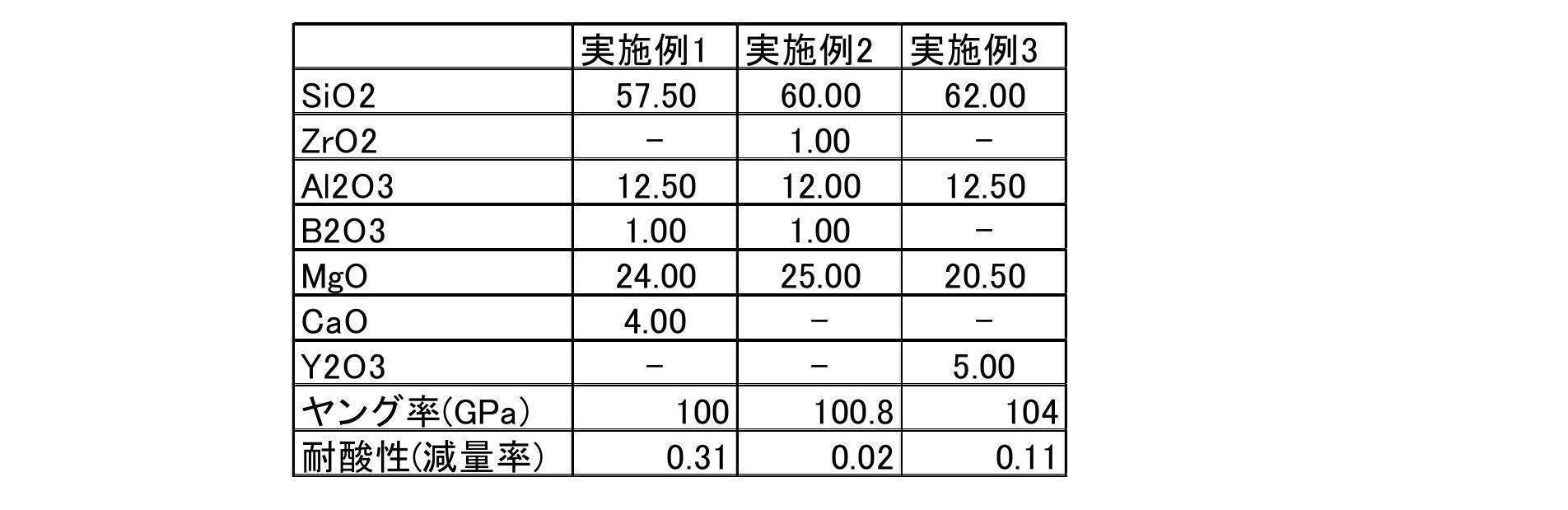
表1に示す組成を有するガラス繊維を作成し、ヤング率(バルク弾性率)及び耐酸性性能(減量率)を評価した。
表1によれば、SiO2の含有量が大きいと、耐酸性性能が向上していることが分かった。また、いずれの実施例も弾性率調整成分(MgO、Y2O3等)が含有されているため、ヤング率が高くなっている。
<2.評価2>
表2に示す組成を有するガラス繊維を作成し、耐酸性性能(減量率)を評価した。結果は、図1及び表2に示すとおりである。実施例4~9は、図1の左から右へ順に並ぶプロットを示している。
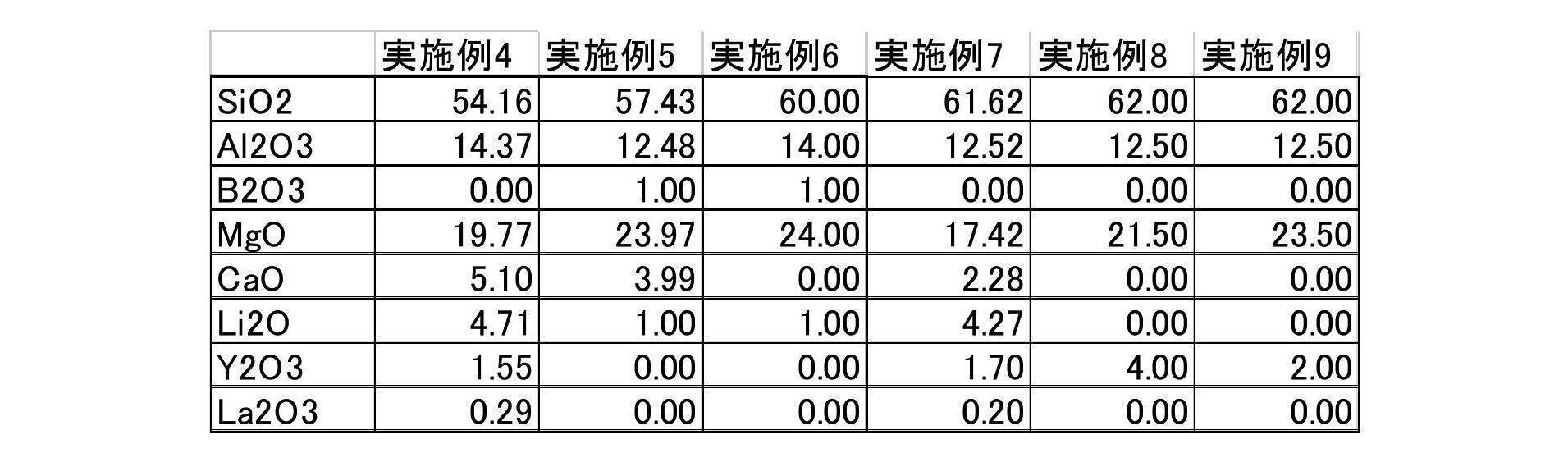
表2に示す組成を有するガラス繊維を作成し、耐酸性性能(減量率)を評価した。結果は、図1及び表2に示すとおりである。実施例4~9は、図1の左から右へ順に並ぶプロットを示している。
図1及び表2によれば、SiO2の含有量が大きいと、耐酸性性能が向上していることが分かる。特に、SiO2の含有量が57%以上になると、耐酸性性能が著しく向上していることが分かった。なお、この試験で用いている酸は濃硫酸であるが、試験に用いる液体の酸性が低くなると、SiO2の含有量が低くても十分な耐酸性性能を示すことができると考えられる。特に、一般的な用途では濃硫酸のような高い酸性の液体に対する耐酸性は求められない。したがって、SiO2の含有量は55%以上であれば十分な耐酸性を備えると考えられる。また、Al2O3の減少によっても、耐酸性性能が向上していることが分かった。一方、Y2O3の含有量は、表2に示す程度の含有量であれば、耐酸性性能に影響していないことも分かる。
<3.評価3>
表3に示す組成を有するガラス繊維を作成し、ヤング率(バルクガラスの弾性率)及び耐酸性性能(減量率)を評価した。結果は、図2に示すとおりである。実施例10~13は、図2の左から右へ順に並ぶプロットを示している。
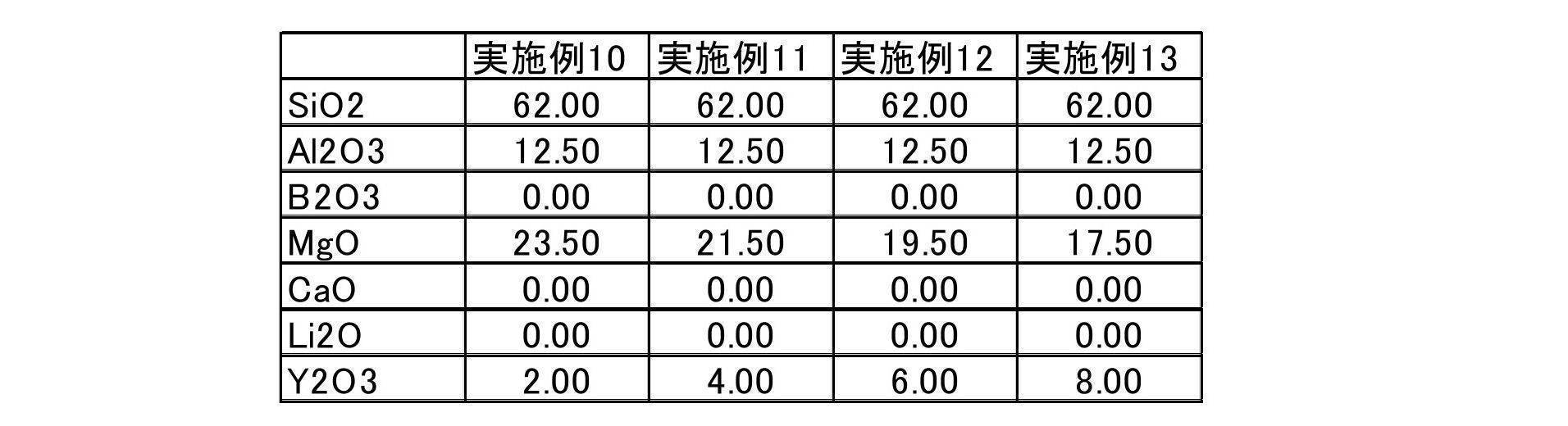
表3に示す組成を有するガラス繊維を作成し、ヤング率(バルクガラスの弾性率)及び耐酸性性能(減量率)を評価した。結果は、図2に示すとおりである。実施例10~13は、図2の左から右へ順に並ぶプロットを示している。
表3及び図2によれば、MgOの含有量が低減するものの、Y2O3の含有量が増加するほど、ヤング率(弾性率)が向上することが分かった。また、Y2O3の含有量が6mol%以内(20重量%)であれば、耐酸性性能は低く抑えられるが、6mol%(20重量%)を超えると、耐酸性性能が低下することが分かった。
Claims (12)
- 配管を形成する樹脂含浸繊維シートに含まれるガラス繊維であって、
ガラス骨格を形成するSiO2と、
Al2O3と、
を含有し、
耐酸性を有する、ガラス繊維。 - 高圧送電線保護材を形成する樹脂含浸繊維シートに含まれるガラス繊維であって、
ガラス骨格を形成するSiO2と、
Al2O3と、
を含有し、
耐酸性を有する、ガラス繊維。 - 弾性率が、85GPa以上である、請求項1または2に記載のガラス繊維。
- 弾性率が、90GPa以上である、請求項1または2に記載のガラス繊維。
- 弾性率が、95GPa以上である、請求項1または2に記載のガラス繊維。
- 弾性率が、100GPa以上である、請求項1または2に記載のガラス繊維。
- 粉砕された前記ガラス繊維の比重グラムを白金製カゴに入れ、フラスコ内の比重1.2の硫酸液80mlに浸して99℃で60分間加熱し、120℃にて乾燥後秤量した結果、減量率が0.4%以下である、請求項1から6のいずれかに記載のガラス繊維。
- 粉砕された前記ガラス繊維の比重グラムを白金製カゴに入れ、フラスコ内の比重1.2の硫酸液80mlに浸して99℃で60分間加熱し、120℃にて乾燥後秤量した結果、減量率が0.2%以下である、請求項1から6のいずれかに記載のガラス繊維。
- 前記樹脂含浸シートにおいて、液体と接触可能な状態で使用される、請求項1から8のいずれかに記載のガラス繊維。
- 前記液体は酸性物質を含有する、請求項9に記載のガラス繊維。
- 請求項1から10のいずれかに記載のガラス繊維により形成され、
ストランド、チョップドストランド、ヤーン、及びロービングのいずれかの形態である、ガラス繊維材料。 - 請求項1から10のいずれかに記載のガラス繊維により形成され、織布または不織布のいずれかの形態である、ガラス繊維材料と、
前記ガラス繊維材料に含浸させる樹脂と、
を備えている、樹脂含浸繊維シート。
Applications Claiming Priority (2)
| Application Number | Priority Date | Filing Date | Title |
|---|---|---|---|
| JP2021196563A JP2023082636A (ja) | 2021-12-02 | 2021-12-02 | ガラス繊維 |
| JP2021-196563 | 2021-12-02 |
Publications (1)
| Publication Number | Publication Date |
|---|---|
| WO2023100749A1 true WO2023100749A1 (ja) | 2023-06-08 |
Family
ID=86612121
Family Applications (1)
| Application Number | Title | Priority Date | Filing Date |
|---|---|---|---|
| PCT/JP2022/043461 Ceased WO2023100749A1 (ja) | 2021-12-02 | 2022-11-25 | ガラス繊維 |
Country Status (3)
| Country | Link |
|---|---|
| JP (1) | JP2023082636A (ja) |
| TW (1) | TW202337861A (ja) |
| WO (1) | WO2023100749A1 (ja) |
Citations (7)
| Publication number | Priority date | Publication date | Assignee | Title |
|---|---|---|---|---|
| JP2011105554A (ja) * | 2009-11-19 | 2011-06-02 | Nippon Electric Glass Co Ltd | ガラス繊維用ガラス組成物、ガラス繊維及びガラス製シート状物 |
| US20130210602A1 (en) * | 2010-06-08 | 2013-08-15 | Nitto Boseki Co., Ltd. | Glass Fiber |
| JP2014234319A (ja) * | 2013-05-31 | 2014-12-15 | 日本電気硝子株式会社 | ガラス繊維組成物、ガラス繊維及びガラス繊維の製造方法 |
| US20160326045A1 (en) * | 2015-05-07 | 2016-11-10 | Ppg Industries, Inc. | Glass Compositions, Fiberizable Glass Compositions, and Glass Fibers Made Therefrom |
| JP2018517653A (ja) * | 2016-02-29 | 2018-07-05 | ジュシ グループ カンパニー リミテッド | 高弾性率ガラス繊維組成物及びそのガラス繊維並びに複合材料 |
| JP2019011234A (ja) * | 2017-06-29 | 2019-01-24 | 日本板硝子株式会社 | ガラス組成物及びこれを用いたガラス製品 |
| JP2021516206A (ja) * | 2018-03-07 | 2021-07-01 | エレクトリック グラス ファイバー アメリカ, エルエルシー | ガラス組成物、繊維化可能なガラス組成物、およびそれから作成されたガラス繊維 |
-
2021
- 2021-12-02 JP JP2021196563A patent/JP2023082636A/ja active Pending
-
2022
- 2022-11-25 WO PCT/JP2022/043461 patent/WO2023100749A1/ja not_active Ceased
- 2022-11-30 TW TW111145898A patent/TW202337861A/zh unknown
Patent Citations (7)
| Publication number | Priority date | Publication date | Assignee | Title |
|---|---|---|---|---|
| JP2011105554A (ja) * | 2009-11-19 | 2011-06-02 | Nippon Electric Glass Co Ltd | ガラス繊維用ガラス組成物、ガラス繊維及びガラス製シート状物 |
| US20130210602A1 (en) * | 2010-06-08 | 2013-08-15 | Nitto Boseki Co., Ltd. | Glass Fiber |
| JP2014234319A (ja) * | 2013-05-31 | 2014-12-15 | 日本電気硝子株式会社 | ガラス繊維組成物、ガラス繊維及びガラス繊維の製造方法 |
| US20160326045A1 (en) * | 2015-05-07 | 2016-11-10 | Ppg Industries, Inc. | Glass Compositions, Fiberizable Glass Compositions, and Glass Fibers Made Therefrom |
| JP2018517653A (ja) * | 2016-02-29 | 2018-07-05 | ジュシ グループ カンパニー リミテッド | 高弾性率ガラス繊維組成物及びそのガラス繊維並びに複合材料 |
| JP2019011234A (ja) * | 2017-06-29 | 2019-01-24 | 日本板硝子株式会社 | ガラス組成物及びこれを用いたガラス製品 |
| JP2021516206A (ja) * | 2018-03-07 | 2021-07-01 | エレクトリック グラス ファイバー アメリカ, エルエルシー | ガラス組成物、繊維化可能なガラス組成物、およびそれから作成されたガラス繊維 |
Also Published As
| Publication number | Publication date |
|---|---|
| JP2023082636A (ja) | 2023-06-14 |
| TW202337861A (zh) | 2023-10-01 |
Similar Documents
| Publication | Publication Date | Title |
|---|---|---|
| US10647610B2 (en) | Low density and high strength fiber glass for reinforcement applications | |
| TW201217295A (en) | Low density and high strength fiber glass for reinforcement applications | |
| WO2007100816A3 (en) | Sizing for high performance glass fibers and composite materials incorporating same | |
| Aveston et al. | Long-term strength of glass-reinforced plastics in dilute sulphuric acid | |
| EP3126305A1 (en) | Sizing compositions for wet and dry filament winding | |
| TW201224018A (en) | Low density and high strength fiber glass for ballistic applications | |
| JP2008503439A (ja) | 耐食性ガラスヤーンによる強化プラスチック | |
| JP2023082636A (ja) | ガラス繊維 | |
| WO2023100990A1 (ja) | ガラス繊維 | |
| JP2024544480A (ja) | ガラス組成物、繊維化可能なガラス組成物、およびそれから作製されたガラス繊維 | |
| WO2023100994A1 (ja) | ガラス繊維 | |
| KR101929095B1 (ko) | 유리섬유용 집속제 조성물 | |
| US20120186833A1 (en) | Flame resistant fiberglass insulation, products, and methods | |
| WO2024034545A1 (ja) | ガラス組成物、ガラス繊維、ガラスフィラー、ガラス繊維の製造方法、及びガラスフィラーの製造方法 | |
| JP2000186787A (ja) | 繊維強化樹脂管 | |
| WO2023100996A1 (ja) | ガラス繊維ストランド | |
| EP3510191B1 (en) | A corrosion-resistant non-woven for pipe liner pultrusion applications | |
| CN114635291B (zh) | 一种热固性树脂裹覆无机非金属纤维复合束及其制备方法 | |
| CN221546109U (zh) | 一种玄武岩纤维复合筋 | |
| JP2021155286A (ja) | コンクリート補強部材 | |
| CN110164622A (zh) | 一种纤维绳芯铝绞线 | |
| Guruprasad et al. | Influence on mechanical properties of epoxy polymer matrix composites reinforced with surface treated woven strand mat E-glass fibers | |
| Römhild et al. | Corrosion resistance of glass-fiber materials–a crucial property for reliability and durability of FRP structures in aggressive environments | |
| Spaude | Reinforced Thermosetting Resins | |
| CN117432921A (zh) | 一种玄武岩纤维复合筋及制备方法 |
Legal Events
| Date | Code | Title | Description |
|---|---|---|---|
| 121 | Ep: the epo has been informed by wipo that ep was designated in this application |
Ref document number: 22901182 Country of ref document: EP Kind code of ref document: A1 |
|
| NENP | Non-entry into the national phase |
Ref country code: DE |
|
| 122 | Ep: pct application non-entry in european phase |
Ref document number: 22901182 Country of ref document: EP Kind code of ref document: A1 |