WO2023100736A1 - 感光性組成物及びパターン膜付き基板、並びに基板積層体及びその製造方法 - Google Patents
感光性組成物及びパターン膜付き基板、並びに基板積層体及びその製造方法 Download PDFInfo
- Publication number
- WO2023100736A1 WO2023100736A1 PCT/JP2022/043327 JP2022043327W WO2023100736A1 WO 2023100736 A1 WO2023100736 A1 WO 2023100736A1 JP 2022043327 W JP2022043327 W JP 2022043327W WO 2023100736 A1 WO2023100736 A1 WO 2023100736A1
- Authority
- WO
- WIPO (PCT)
- Prior art keywords
- substrate
- photosensitive composition
- group
- cured
- semi
- Prior art date
- Legal status (The legal status is an assumption and is not a legal conclusion. Google has not performed a legal analysis and makes no representation as to the accuracy of the status listed.)
- Ceased
Links
Images


Classifications
-
- C—CHEMISTRY; METALLURGY
- C08—ORGANIC MACROMOLECULAR COMPOUNDS; THEIR PREPARATION OR CHEMICAL WORKING-UP; COMPOSITIONS BASED THEREON
- C08G—MACROMOLECULAR COMPOUNDS OBTAINED OTHERWISE THAN BY REACTIONS ONLY INVOLVING UNSATURATED CARBON-TO-CARBON BONDS
- C08G59/00—Polycondensates containing more than one epoxy group per molecule; Macromolecules obtained by polymerising compounds containing more than one epoxy group per molecule using curing agents or catalysts which react with the epoxy groups
- C08G59/18—Macromolecules obtained by polymerising compounds containing more than one epoxy group per molecule using curing agents or catalysts which react with the epoxy groups ; e.g. general methods of curing
- C08G59/20—Macromolecules obtained by polymerising compounds containing more than one epoxy group per molecule using curing agents or catalysts which react with the epoxy groups ; e.g. general methods of curing characterised by the epoxy compounds used
-
- C—CHEMISTRY; METALLURGY
- C09—DYES; PAINTS; POLISHES; NATURAL RESINS; ADHESIVES; COMPOSITIONS NOT OTHERWISE PROVIDED FOR; APPLICATIONS OF MATERIALS NOT OTHERWISE PROVIDED FOR
- C09D—COATING COMPOSITIONS, e.g. PAINTS, VARNISHES OR LACQUERS; FILLING PASTES; CHEMICAL PAINT OR INK REMOVERS; INKS; CORRECTING FLUIDS; WOODSTAINS; PASTES OR SOLIDS FOR COLOURING OR PRINTING; USE OF MATERIALS THEREFOR
- C09D183/00—Coating compositions based on macromolecular compounds obtained by reactions forming in the main chain of the macromolecule a linkage containing silicon, with or without sulfur, nitrogen, oxygen, or carbon only; Coating compositions based on derivatives of such polymers
- C09D183/04—Polysiloxanes
-
- C—CHEMISTRY; METALLURGY
- C09—DYES; PAINTS; POLISHES; NATURAL RESINS; ADHESIVES; COMPOSITIONS NOT OTHERWISE PROVIDED FOR; APPLICATIONS OF MATERIALS NOT OTHERWISE PROVIDED FOR
- C09D—COATING COMPOSITIONS, e.g. PAINTS, VARNISHES OR LACQUERS; FILLING PASTES; CHEMICAL PAINT OR INK REMOVERS; INKS; CORRECTING FLUIDS; WOODSTAINS; PASTES OR SOLIDS FOR COLOURING OR PRINTING; USE OF MATERIALS THEREFOR
- C09D4/00—Coating compositions, e.g. paints, varnishes or lacquers, based on organic non-macromolecular compounds having at least one polymerisable carbon-to-carbon unsaturated bond ; Coating compositions, based on monomers of macromolecular compounds of groups C09D183/00 - C09D183/16
-
- C—CHEMISTRY; METALLURGY
- C09—DYES; PAINTS; POLISHES; NATURAL RESINS; ADHESIVES; COMPOSITIONS NOT OTHERWISE PROVIDED FOR; APPLICATIONS OF MATERIALS NOT OTHERWISE PROVIDED FOR
- C09D—COATING COMPOSITIONS, e.g. PAINTS, VARNISHES OR LACQUERS; FILLING PASTES; CHEMICAL PAINT OR INK REMOVERS; INKS; CORRECTING FLUIDS; WOODSTAINS; PASTES OR SOLIDS FOR COLOURING OR PRINTING; USE OF MATERIALS THEREFOR
- C09D7/00—Features of coating compositions, not provided for in group C09D5/00; Processes for incorporating ingredients in coating compositions
- C09D7/40—Additives
- C09D7/60—Additives non-macromolecular
- C09D7/63—Additives non-macromolecular organic
-
- G—PHYSICS
- G03—PHOTOGRAPHY; CINEMATOGRAPHY; ANALOGOUS TECHNIQUES USING WAVES OTHER THAN OPTICAL WAVES; ELECTROGRAPHY; HOLOGRAPHY
- G03F—PHOTOMECHANICAL PRODUCTION OF TEXTURED OR PATTERNED SURFACES, e.g. FOR PRINTING, FOR PROCESSING OF SEMICONDUCTOR DEVICES; MATERIALS THEREFOR; ORIGINALS THEREFOR; APPARATUS SPECIALLY ADAPTED THEREFOR
- G03F7/00—Photomechanical, e.g. photolithographic, production of textured or patterned surfaces, e.g. printing surfaces; Materials therefor, e.g. comprising photoresists; Apparatus specially adapted therefor
- G03F7/004—Photosensitive materials
-
- G—PHYSICS
- G03—PHOTOGRAPHY; CINEMATOGRAPHY; ANALOGOUS TECHNIQUES USING WAVES OTHER THAN OPTICAL WAVES; ELECTROGRAPHY; HOLOGRAPHY
- G03F—PHOTOMECHANICAL PRODUCTION OF TEXTURED OR PATTERNED SURFACES, e.g. FOR PRINTING, FOR PROCESSING OF SEMICONDUCTOR DEVICES; MATERIALS THEREFOR; ORIGINALS THEREFOR; APPARATUS SPECIALLY ADAPTED THEREFOR
- G03F7/00—Photomechanical, e.g. photolithographic, production of textured or patterned surfaces, e.g. printing surfaces; Materials therefor, e.g. comprising photoresists; Apparatus specially adapted therefor
- G03F7/004—Photosensitive materials
- G03F7/027—Non-macromolecular photopolymerisable compounds having carbon-to-carbon double bonds, e.g. ethylenic compounds
-
- G—PHYSICS
- G03—PHOTOGRAPHY; CINEMATOGRAPHY; ANALOGOUS TECHNIQUES USING WAVES OTHER THAN OPTICAL WAVES; ELECTROGRAPHY; HOLOGRAPHY
- G03F—PHOTOMECHANICAL PRODUCTION OF TEXTURED OR PATTERNED SURFACES, e.g. FOR PRINTING, FOR PROCESSING OF SEMICONDUCTOR DEVICES; MATERIALS THEREFOR; ORIGINALS THEREFOR; APPARATUS SPECIALLY ADAPTED THEREFOR
- G03F7/00—Photomechanical, e.g. photolithographic, production of textured or patterned surfaces, e.g. printing surfaces; Materials therefor, e.g. comprising photoresists; Apparatus specially adapted therefor
- G03F7/004—Photosensitive materials
- G03F7/027—Non-macromolecular photopolymerisable compounds having carbon-to-carbon double bonds, e.g. ethylenic compounds
- G03F7/028—Non-macromolecular photopolymerisable compounds having carbon-to-carbon double bonds, e.g. ethylenic compounds with photosensitivity-increasing substances, e.g. photoinitiators
- G03F7/031—Organic compounds not covered by group G03F7/029
-
- G—PHYSICS
- G03—PHOTOGRAPHY; CINEMATOGRAPHY; ANALOGOUS TECHNIQUES USING WAVES OTHER THAN OPTICAL WAVES; ELECTROGRAPHY; HOLOGRAPHY
- G03F—PHOTOMECHANICAL PRODUCTION OF TEXTURED OR PATTERNED SURFACES, e.g. FOR PRINTING, FOR PROCESSING OF SEMICONDUCTOR DEVICES; MATERIALS THEREFOR; ORIGINALS THEREFOR; APPARATUS SPECIALLY ADAPTED THEREFOR
- G03F7/00—Photomechanical, e.g. photolithographic, production of textured or patterned surfaces, e.g. printing surfaces; Materials therefor, e.g. comprising photoresists; Apparatus specially adapted therefor
- G03F7/004—Photosensitive materials
- G03F7/038—Macromolecular compounds which are rendered insoluble or differentially wettable
-
- G—PHYSICS
- G03—PHOTOGRAPHY; CINEMATOGRAPHY; ANALOGOUS TECHNIQUES USING WAVES OTHER THAN OPTICAL WAVES; ELECTROGRAPHY; HOLOGRAPHY
- G03F—PHOTOMECHANICAL PRODUCTION OF TEXTURED OR PATTERNED SURFACES, e.g. FOR PRINTING, FOR PROCESSING OF SEMICONDUCTOR DEVICES; MATERIALS THEREFOR; ORIGINALS THEREFOR; APPARATUS SPECIALLY ADAPTED THEREFOR
- G03F7/00—Photomechanical, e.g. photolithographic, production of textured or patterned surfaces, e.g. printing surfaces; Materials therefor, e.g. comprising photoresists; Apparatus specially adapted therefor
- G03F7/004—Photosensitive materials
- G03F7/075—Silicon-containing compounds
Definitions
- the present invention relates to a photosensitive composition, a substrate with a pattern film, a substrate laminate, and a method for producing the same.
- Image sensors such as CMOS sensors and CCD sensors are used in digital cameras, smartphones, etc.
- the amount used has increased, and there has been an increase in miniaturization and higher resolution. increasingly demanded.
- a substrate laminate that constitutes an image sensor has, for example, a hollow structure in which a semiconductor element substrate having a light receiving element and a glass substrate are bonded together with an adhesive.
- a substrate laminate having a hollow structure is obtained, for example, by applying a liquid adhesive such as an epoxy resin or an acrylic resin to the peripheral edge of a semiconductor element substrate, placing a glass substrate as a sealing substrate, and then heating to remove the liquid adhesive. Obtained by curing.
- a method using a photosensitive composition instead of a liquid adhesive is also being studied for the purpose of improving pattern accuracy.
- Patent Document 1 a step of forming a coating film by applying a photosensitive composition on a first substrate (for example, a glass substrate), a step of patterning the obtained coating film, and a patterned A step of forming a laminate by laminating a first substrate and a second substrate (for example, a semiconductor element substrate) with a coating film (hereinafter sometimes referred to as a “pattern film”) interposed therebetween; A method of manufacturing a substrate laminate is described that includes heating the laminate to bond a first substrate and a second substrate.
- Patent Document 1 discloses that the photosensitive composition contains a cationic polymerizable compound and a photoacid generator (photocationic polymerization initiator), and that in the step of patterning the coating film, the coating film is passed through a photomask. It is described that a patterned film in a semi-cured state is formed by irradiating the exposed portion of the coating film with light to make it a semi-cured state and then developing it. Hereinafter, forming a pattern film in a semi-cured state may be referred to as "to B-stage”. Further, by heating the laminate in which the first substrate and the second substrate are laminated via the semi-cured pattern film, the pattern film is further cured and the first substrate and the second substrate are bonded. This is sometimes described as “C stage”.
- substrates with semi-cured pattern films are transferred to the C stage. It may be stored at room temperature for a long time until it hardens. In that case, cationic polymerization proceeds due to the residual cations in the pattern film, and as a result, the pattern film may harden until it becomes difficult to bond the substrates together during the C-stage.
- the degree of polymerization of the cationic polymerizable compound in the exposed area is reduced in order to maintain the semi-cured state of the pattern film during storage, the pattern film becomes thinner during development (hereinafter referred to as "film reduction"). ) may occur. Therefore, there is a demand for a photosensitive composition that can stably maintain the semi-cured state of the pattern film while suppressing film reduction during development.
- Patent Document 1 leaves room for improvement in stably maintaining the semi-cured state of the pattern film while suppressing film reduction during development.
- the present invention provides a photosensitive composition capable of stably maintaining a semi-cured state of a pattern film while suppressing film reduction during development, and a substrate with a pattern film obtained using the photosensitive composition. and a substrate laminate obtained using the photosensitive composition and a method for producing the same.
- the present invention includes the following aspects.
- a photosensitive composition containing a cationically polymerizable compound, a radically polymerizable compound, and a photopolymerization initiator is a photoradical polymerization initiator
- the cationically polymerizable compound has a cationically polymerizable group and an alkali-soluble group in one molecule
- the radically polymerizable compound has a (meth)acryloyl group
- the amount of the radical polymerizable compound is 5 parts by mass or more with respect to 100 parts by mass of the cationically polymerizable compound
- the alkali-soluble group is one or more selected from the group consisting of a monovalent organic group represented by the following chemical formula (X1), a divalent organic group represented by the following chemical formula (X2), and a phenolic hydroxyl group.
- a photosensitive composition is one or more selected from the group consisting of a monovalent organic group represented by the following chemical formula (X1), a divalent organic group represented by the following chemical formula (X
- the cationically polymerizable group is one or more selected from the group consisting of an alicyclic epoxy group, a glycidyl group and an oxetanyl group, according to any one of the above [1] to [3].
- Photosensitive composition is one or more selected from the group consisting of an alicyclic epoxy group, a glycidyl group and an oxetanyl group, according to any one of the above [1] to [3].
- a substrate with a patterned film comprising a substrate and a patterned film made of a semi-cured photosensitive composition disposed on the substrate, A substrate with a pattern film, wherein the photosensitive composition is the photosensitive composition according to any one of [1] to [6].
- a patterned film-attached substrate comprising a substrate and a patterned film disposed on the substrate,
- the pattern film comprises, from the substrate side, a first semi-cured layer composed of a semi-cured first photosensitive composition and a second semi-cured layer composed of a semi-cured second photosensitive composition.
- the first photosensitive composition is an alkali-soluble, cationic polymerizable and photopolymerizable photosensitive composition containing no colorant
- a substrate with a pattern film, wherein the second photosensitive composition is the photosensitive composition according to [6].
- a substrate laminate having a first substrate, a second substrate, and a cured material layer that bonds the first substrate and the second substrate, A substrate laminate, wherein the cured product layer is composed of a cured product of the photosensitive composition according to any one of [1] to [6].
- a substrate laminate having a first substrate, a second substrate, and a cured material layer that bonds the first substrate and the second substrate,
- the cured product layer comprises a first layer composed of a cured product of a first photosensitive composition and a second layer composed of a cured product of a second photosensitive composition in this order from the first substrate side
- the first photosensitive composition is an alkali-soluble, cationic polymerizable and photopolymerizable photosensitive composition containing no colorant
- the substrate laminate, wherein the second photosensitive composition is the photosensitive composition according to [6].
- the first substrate is a glass substrate, The substrate laminate according to [9] or [10], wherein the second substrate is a semiconductor element substrate.
- [12] forming a coating film by applying the photosensitive composition according to any one of [1] to [6] on a first substrate; By irradiating the coating film with light through a photomask, an exposed portion and a non-exposed portion composed of the photosensitive composition in a semi-cured state are formed in the coating film, forming the patterned coating film on the first substrate by removing the non-exposed portion from the first substrate with an alkaline developer; forming a laminate by laminating the first substrate and the second substrate via the patterned coating film; A method for manufacturing a substrate laminate, wherein the laminate is heated to further cure the patterned coating film in a semi-cured state, thereby bonding the first substrate and the second substrate.
- the first photosensitive composition is an alkali-soluble, cationic polymerizable and photopolymerizable photosensitive composition containing no colorant,
- the method for producing a substrate laminate, wherein the second photosensitive composition is the photosensitive composition according to [6].
- the first substrate is a glass substrate
- a photosensitive composition capable of stably maintaining a semi-cured state of a pattern film while suppressing film reduction during development, a substrate with a pattern film obtained using the photosensitive composition, and the A substrate laminate obtained using a photosensitive composition and a method for producing the same can be provided.
- FIG. 4 is a cross-sectional view showing another example of the substrate laminate according to the present invention
- 1A, 1B, 1C, 1D, and 1E are cross-sectional views showing steps of an example of a method for manufacturing a substrate laminate according to the present invention.
- A, B, C, D, E and F are cross-sectional views according to steps showing another example of the method for manufacturing a substrate laminate according to the present invention.
- active species refers to one or more species selected from the group consisting of radicals, cations and anions.
- a “radical photopolymerization initiator” refers to a compound that generates only radicals as active species upon irradiation with light.
- a “cationically polymerizable group” refers to a functional group that undergoes a chain polymerization reaction in the presence of a cation.
- alkali-soluble group refers to a functional group that enhances solubility in alkaline solutions by interacting or reacting with alkali.
- a “polysiloxane structure” refers to a structure having a siloxane unit (Si--O--Si).
- alicyclic epoxy group refers to a functional group formed by bonding one oxygen atom to two adjacent carbon atoms among the carbon atoms constituting an alicyclic structure. , 4-epoxycyclohexyl group and the like.
- a "semi-cured state” refers to a state in which the degree of curing can be further increased by a subsequent step (for example, a heating step).
- Solid content is a non-volatile component in the composition
- total solid content means the total amount of constituent components of the composition excluding the solvent.
- system may be added after the name of the compound to generically refer to the compound and its derivatives.
- polymer name When the polymer name is expressed by adding "system” after the compound name, it means that the repeating unit of the polymer is derived from the compound or its derivative.
- Acrylate and methacrylate may be collectively referred to as "(meth)acrylate”.
- An acryloyl group and a methacryloyl group may be collectively referred to as a "(meth)acryloyl group”.
- the photosensitive composition according to the first embodiment of the present invention comprises a cationic polymerizable compound (hereinafter sometimes referred to as “component (A)”) and a radically polymerizable compound (hereinafter referred to as “component (B)”). and a photopolymerization initiator (hereinafter sometimes referred to as “component (C)”), and the component (C) is a radical photopolymerization initiator.
- component (A) has a cationic polymerizable group and an alkali-soluble group in one molecule.
- Component (B) has a (meth)acryloyl group.
- the amount of component (B) is preferably 5 parts by mass or more per 100 parts by mass of component (A).
- the alkali-soluble group of the component (A) is a monovalent organic group represented by the following chemical formula (X1) (hereinafter referred to as "X1 group” ), a divalent organic group represented by the following chemical formula (X2) (hereinafter sometimes referred to as “X2 group”), and one or more selected from the group consisting of a phenolic hydroxyl group.
- the X1 group is a monovalent organic group derived from N-monosubstituted isocyanuric acid.
- the X2 group is a divalent organic group derived from N,N'-disubstituted isocyanuric acid. Both X1 group and X2 group have an isocyanuric ring.
- the photosensitive composition contains a photopolymerization initiator (component (C)), and the component (C) is a photoradical polymerization initiator” means that the photosensitive composition contains a photoradical polymerization initiator, and
- the content of a photopolymerization initiator other than a photoradical polymerization initiator is less than 0.1 parts by mass relative to 100 parts by mass of the component (A) in the photosensitive composition (preferably is less than 0.01 parts by mass, more preferably less than 0.001 parts by mass, and even more preferably less than 0.0001 parts by mass).
- the photosensitive composition according to the first embodiment can stably maintain the semi-cured state of the pattern film while suppressing film reduction during development. The reason is presumed as follows.
- the photosensitive composition according to the first embodiment includes a component (A) having a cationic polymerizable group and an alkali-soluble group in one molecule, a component (B) having a (meth)acryloyl group, and a component (C) and component (C) is a radical photopolymerization initiator.
- a component (A) having a cationic polymerizable group and an alkali-soluble group in one molecule a component (B) having a (meth)acryloyl group
- component (C) and component (C) is a radical photopolymerization initiator.
- the alkali-soluble group of component (A) is one or more selected from the group consisting of X1 group, X2 group and phenolic hydroxyl group. Since these alkali-soluble groups have a relatively low acidity, even if the substrate completed up to the B-stage is stored for a long time, the progression of cationic polymerization in the pattern film can be suppressed.
- the photosensitive composition according to the first embodiment can stably maintain the semi-cured state of the pattern film.
- the components in the pattern film (A) can be cationic polymerized to bond the first substrate and the second substrate.
- the amount of component (B), which is a curing component when B-staged is 5 parts by mass or more with respect to 100 parts by mass of component (A).
- the number of reaction points for radical polymerization reaction is relatively large. Thereby, the alkali resistance of the semi-cured exposed portion can be enhanced. Therefore, the photosensitive composition according to the first embodiment can suppress film reduction during development.
- the alkali-soluble group contained in component (A) is one or more selected from the group consisting of X1 group and X2 group. is preferred, and the X2 group is more preferred.
- the amount of component (B) is preferably 8 parts by mass or more with respect to 100 parts by mass of component (A), and 10 parts by mass. It is more preferably 20 parts by mass or more, and even more preferably 30 parts by mass or more.
- the amount of component (B) should be 200 parts by mass or less with respect to 100 parts by mass of component (A) in order to increase the adhesiveness of the pattern film when C-staged.
- it is 150 parts by mass or less, more preferably 100 parts by mass or less, even more preferably 90 parts by mass or less, particularly preferably 80 parts by mass or less, and 70 parts by mass. It may be below.
- Component (A) is not particularly limited as long as it is a cationically polymerizable compound having a cationically polymerizable group and the specific alkali-soluble group in one molecule.
- Component (A) preferably has a plurality of cationic polymerizable groups in one molecule.
- component (A) When component (A) has a plurality of cationically polymerizable groups in one molecule, a cured product layer having a high crosslink density is obtained, and as a result, the cured product layer tends to have improved heat resistance.
- the plurality of cationically polymerizable groups may be of the same type or may be two or more different functional groups.
- component (A) preferably has a plurality of alkali-soluble groups in one molecule. When the component (A) has a plurality of alkali-soluble groups in one molecule, the removability of the non-exposed areas increases during development, and patterning properties tend to improve.
- the plurality of alkali-soluble groups may be of the same kind or may be two or more different functional groups.
- Examples of cationically polymerizable groups possessed by component (A) include epoxy groups, glycidyl groups, vinyl ether groups, oxetanyl groups, and alkoxysilyl groups.
- the cationically polymerizable group is preferably one or more selected from the group consisting of an epoxy group, a glycidyl group and an oxetanyl group, and an alicyclic epoxy group, a glycidyl group and an oxetanyl group.
- One or more selected from the group consisting of groups is more preferred.
- an alicyclic epoxy group is particularly preferable because it has relatively high reactivity during curing and can suppress curing shrinkage of the cured product layer. Further, when the cationic polymerizable group of the component (A) is an alicyclic epoxy group, the semi-cured state of the pattern film can be more stably maintained.
- component (A) preferably contains a polymer skeleton structure.
- polymer backbone structures include polyacryl, polyphenol, polyamide, polyanhydride, polycarbonate, polydiene, polyester, polyhaloolefin, polyimide, polyimine, polyketone, polyolefin, polyether, polyphenylene, polyphosphazene, polysiloxane, and polysilane. , polystyrene, polysulfide, polysulfone, polyurethane, polyurea, and polyvinyl.
- component (A) preferably has a polysiloxane structure, more preferably a polymer having a polysiloxane structure in the main chain, and a cyclic polysiloxane in the main chain. More preferably, it is a polymer having a structure.
- Cyclic polysiloxane structure means a cyclic molecular structure skeleton having a siloxane unit (Si—O—Si) as a ring constituent.
- the cyclic polysiloxane structure may be a monocyclic structure or a polycyclic structure.
- the polycyclic structure may be a polyhedral structure.
- T units XSiO 3/2
- Q units SiO 4/2
- M units X 3 SiO 1/2
- D units X 2 SiO 2/2
- the weight average molecular weight of the polymer is preferably 10,000 or more and 50,000 or less, more preferably 20,000 or more and 40,000 or less, and more preferably 25,000 or more and 35,000. More preferably: When the weight average molecular weight is 10,000 or more, there is a tendency to obtain a cured product layer having excellent heat resistance. On the other hand, when the weight-average molecular weight is 50,000 or less, the removability of the non-exposed areas is enhanced during development, and patterning properties tend to be improved.
- Component (A) having a polysiloxane structure is, for example, the following compound ( ⁇ ), compound ( ⁇ ) and the compound ( ⁇ ) are obtained by a hydrosilylation reaction as starting materials.
- ⁇ Compound ( ⁇ ) A polysiloxane compound having at least two SiH groups (hydrosilyl groups) in one molecule
- ⁇ Compound ( ⁇ ) A carbon-carbon double bond having reactivity with SiH groups in one molecule and a cationic polymerizable group/compound ( ⁇ ): a compound having a carbon-carbon double bond reactive with an SiH group and an alkali-soluble group in one molecule
- Compound ( ⁇ ) is a polysiloxane compound having at least two SiH groups in one molecule, for example, the compound described in WO 96/15194, which has at least two SiH groups in one molecule. You can use what you have.
- Specific examples of the compound ( ⁇ ) include a hydrosilyl group-containing polysiloxane having a linear structure, a polysiloxane having a hydrosilyl group at the molecular end, and a cyclic polysiloxane having a hydrosilyl group (hereinafter simply referred to as “cyclic polysiloxane”). sometimes), etc.
- the cyclic polysiloxane may have a polycyclic structure, and the polycyclic structure may be a polyhedral structure.
- a cyclic polysiloxane having at least two SiH groups in one molecule as the compound ( ⁇ ).
- Compound ( ⁇ ) is preferably a cyclic polysiloxane having 3 or more SiH groups in one molecule.
- the group present on the Si atom is preferably either a hydrogen atom or a methyl group.
- hydrosilyl group-containing polysiloxanes having a linear structure examples include copolymers of dimethylsiloxane units, methylhydrogensiloxane units and terminal trimethylsiloxy units, and copolymers of diphenylsiloxane units, methylhydrogensiloxane units and terminal trimethylsiloxy units.
- examples include polymers, copolymers of methylphenylsiloxane units, methylhydrogensiloxane units and terminal trimethylsiloxy units, and polysiloxanes whose ends are blocked with dimethylhydrogensilyl groups.
- polysiloxanes having hydrosilyl groups at their molecular terminals include polysiloxanes whose terminals are blocked with dimethylhydrogensilyl groups, dimethylhydrogensiloxane units (H(CH 3 ) 2 SiO 1/2 units), and SiO 2 units. , SiO 3/2 units and one or more siloxane units selected from the group consisting of SiO units.
- a cyclic polysiloxane is represented, for example, by the following general formula (1).
- R 1 , R 2 and R 3 each independently represent a monovalent organic group having 1 to 20 carbon atoms
- m represents an integer of 2 to 10
- n is It represents an integer of 0 or more and 10 or less.
- m is preferably 3 or more.
- m+n is preferably 3 or more and 12 or less.
- n is 0 in order to facilitate the hydrosilylation reaction.
- R 1 , R 2 and R 3 are preferably organic groups composed of elements selected from the group consisting of C, H and O.
- R 1 , R 2 and R 3 include alkyl groups, hydroxyalkyl groups, alkoxyalkyl groups, oxyalkyl groups, aryl groups and the like. Among them, chain alkyl groups such as methyl group, ethyl group, propyl group, hexyl group, octyl group, decyl group and dodecyl group; cyclic alkyl groups such as cyclohexyl group and norbornyl group; and phenyl group are preferable.
- R 1 , R 2 and R 3 are preferably chain alkyl groups having 1 to 6 carbon atoms or phenyl groups.
- each of R 1 , R 2 and R 3 is preferably a chain alkyl group having 1 to 6 carbon atoms, more preferably a methyl group.
- Examples of the cyclic polysiloxane represented by the general formula (1) include 1,3,5,7-tetrahydrogen-1,3,5,7-tetramethylcyclotetrasiloxane, 1-propyl-3,5,7 -trihydrogen-1,3,5,7-tetramethylcyclotetrasiloxane, 1,5-dihydrogen-3,7-dihexyl-1,3,5,7-tetramethylcyclotetrasiloxane, 1,3 ,5-trihydrogen-1,3,5-trimethylcyclotrisiloxane, 1,3,5,7,9-pentahydrogen-1,3,5,7,9-pentamethylcyclopentasiloxane, and 1 , 3,5,7,9,11-hexahydrogen-1,3,5,7,9,11-hexamethylcyclohexasiloxane and the like. Among them, 1,3,5,7-tetrahydrogen-1,3,5,7-tetramethylcyclotetrasiloxan
- the compound ( ⁇ ) is obtained by a known synthetic method.
- the cyclic polysiloxane represented by general formula (1) can be synthesized by the method described in International Publication No. 96/15194 and the like.
- a cyclic polysiloxane having a polyhedral skeleton can be synthesized, for example, by the methods described in JP-A-2004-359933, JP-A-2004-143449, JP-A-2006-269402, and the like.
- the compound ( ⁇ ) is a compound having, in one molecule, a carbon-carbon double bond reactive with an SiH group (hydrosilyl group) and a cationically polymerizable group.
- the cationically polymerizable group in the compound ( ⁇ ) is the same as the cationically polymerizable group of the component (A) described above, and preferred embodiments are also the same. That is, the compound ( ⁇ ) preferably has one or more selected from the group consisting of an epoxy group, a glycidyl group and an oxetanyl group as a cationically polymerizable group, and an alicyclic epoxy group, a glycidyl group and an oxetanyl group. It is more preferable to have one or more selected from the group consisting of, more preferably to have an alicyclic epoxy group.
- alkenyl groups Groups containing carbon-carbon double bonds reactive with SiH groups (hereinafter sometimes simply referred to as "alkenyl groups”) include vinyl groups, allyl groups, methallyl groups, 2-allylphenyl groups, 3-allylphenyl group, 4-allylphenyl group, 2-(allyloxy)phenyl group, 3-(allyloxy)phenyl group, 4-(allyloxy)phenyl group, 2-(allyloxy)ethyl group, 2,2-bis( allyloxymethyl)butyl group, 3-allyloxy-2,2-bis(allyloxymethyl)propyl group, vinyl ether group and the like.
- the compound ( ⁇ ) preferably has at least one alkenyl group selected from the group consisting of vinyl groups and allyl groups.
- the compound ( ⁇ ) examples include 1-vinyl-3,4-epoxycyclohexane, allyl glycidyl ether, diallyl monoglycidyl isocyanurate, monoallyl diglycidyl isocyanurate, 3-ethyl-3-(vinyloxymethyl)oxetane. etc.
- the compound ( ⁇ ) is preferably a compound having an alicyclic epoxy group, and particularly preferably 1-vinyl-3,4-epoxycyclohexane.
- the compound ( ⁇ ) is a compound having, in one molecule, a carbon-carbon double bond reactive with SiH groups and an alkali-soluble group.
- the alkali-soluble group in compound ( ⁇ ) is the same as the alkali-soluble group of component (A) described above, and preferred embodiments are also the same. That is, the compound ( ⁇ ) preferably has, as an alkali-soluble group, one or more selected from the group consisting of X1 group, X2 group and phenolic hydroxyl group, and is selected from the group consisting of X1 group and X2 group. It is more preferred to have one or more, and it is even more preferred to have the X2 group.
- the compound ( ⁇ ) has a group (alkenyl group) containing a carbon-carbon double bond that is reactive with SiH groups.
- alkenyl group possessed by the compound ( ⁇ ) include the same alkenyl groups as those exemplified as the alkenyl group possessed by the compound ( ⁇ ) described above, and preferred embodiments are also the same. That is, compound ( ⁇ ) preferably has at least one alkenyl group selected from the group consisting of vinyl groups and allyl groups.
- the compound ( ⁇ ) include diallyl isocyanurate, monoallyl isocyanurate, 2,2'-diallylbisphenol A, vinylphenol, allylphenol, and the like.
- the compound ( ⁇ ) is one selected from the group consisting of diallyl isocyanurate, monoallyl isocyanurate and 2,2′-diallyl bisphenol A.
- diallyl isocyanurate and monoallyl isocyanurate is more preferred
- diallyl isocyanurate is even more preferred.
- component (A) having X1 group as alkali-soluble group is obtained.
- diallyl isocyanurate is used as the compound ( ⁇ )
- the component (A) having X2 group as an alkali-soluble group is obtained.
- an alkenyl group-containing compound (hereinafter sometimes referred to as "another alkenyl group-containing compound") different from the above compounds ( ⁇ ) and ( ⁇ ) may be used.
- compound ( ⁇ ) a compound having two or more alkenyl groups in one molecule
- compound ( ⁇ ) a compound having two or more alkenyl groups in one molecule
- the compound ( ⁇ ) is used, the number of cross-linking points increases during the hydrosilylation reaction, so that the heat resistance of the cured product layer obtained by C-staging tends to be improved.
- the compound ( ⁇ ) include diallyl phthalate, triallyl trimellitate, diethylene glycol bisallyl carbonate, 1,1,2,2-tetraallyloxyethane, triallyl cyanurate, triallyl isocyanurate, and diallyl monobenzyl.
- Diallyl monomethyl isocyanurate is preferable as the compound ( ⁇ ) in order to further improve the heat resistance of the resulting cured product layer.
- compound ( ⁇ ) compounds having an alkenyl group and a (meth)acryloyl group in one molecule
- compound ( ⁇ ) compounds having an alkenyl group and a (meth)acryloyl group in one molecule
- compound ( ⁇ ) compounds having an alkenyl group and a (meth)acryloyl group in one molecule
- compound ( ⁇ ) a (meth)acryloyl group is introduced into the component (A), so that the reaction sites for the radical polymerization reaction are relatively increased. Thereby, the alkali resistance of the semi-cured exposed portion can be enhanced.
- the compound ( ⁇ ) examples include vinyl acrylate, vinyl methacrylate, allyl acrylate, allyl methacrylate, 2-butenyl acrylate, 2-butenyl methacrylate, and the like.
- the compound ( ⁇ ) is preferably one or more selected from the group consisting of vinyl acrylate and allyl acrylate, and more preferably allyl acrylate.
- component (A) The order and method of the hydrosilylation reaction to obtain component (A) are not particularly limited.
- Component (A) having a polysiloxane structure is obtained by the hydrosilylation reaction.
- the component (A) obtained using the above-described compound ( ⁇ ), compound ( ⁇ ), compound ( ⁇ ), and optionally other optional starting materials is, for example, a plurality of It is a polymer having a cationic polymerizable group and a plurality of alkali-soluble groups and having a polysiloxane structure in its main chain.
- the ratio of each compound in the hydrosilylation reaction is not particularly limited, but the total amount A of alkenyl groups and the total amount B of SiH groups in the starting materials preferably satisfy 1 ⁇ B/A ⁇ 30, and 1 ⁇ It is more preferable to satisfy B/A ⁇ 10.
- the charging ratio of the compound ( ⁇ ) to the compound ( ⁇ ) in the hydrosilylation reaction is preferably from 0.01 to 1.0, more preferably from 0.1 to 1.0, and from 0.2 to 0.2. It is more preferably 9 or less.
- the charging ratio of compound ( ⁇ ) to compound ( ⁇ ) in the hydrosilylation reaction is 0.1. It is preferably 0.9 or less, and more preferably 0.2 or more and 0.8 or less.
- the compound ( ⁇ ) in the hydrosilylation reaction is preferably 0.01 or more and 0.7 or less, and is 0.05 or more and 0.6 or less is more preferred.
- the charge ratio of compound ( ⁇ ) is preferably 0.1 or more and 0.5 or less, and more preferably 0.2 or more and 0.4 or less. more preferred.
- Hydrosilylation catalysts such as chloroplatinic acid, platinum-olefin complexes and platinum-vinylsiloxane complexes may be used in the hydrosilylation reaction.
- a hydrosilylation catalyst and co-catalyst may be used in combination.
- the amount (amount of substance) added of the hydrosilylation catalyst is not particularly limited, but is preferably 10 ⁇ 8 times or more and 10 ⁇ 1 times or less, more preferably 10 ⁇ 6 times the total amount of alkenyl groups contained in the starting material. It is more than 10 -2 times or less.
- the reaction temperature for hydrosilylation may be appropriately set, preferably 30°C or higher and 200°C or lower, more preferably 50°C or higher and 150°C or lower.
- the oxygen concentration in the gas phase in the hydrosilylation reaction is preferably 3% by volume or less. From the viewpoint of promoting the hydrosilylation reaction, the gas phase portion may contain 0.1% by volume or more and 3% by volume or less of oxygen.
- a solvent may be used for the hydrosilylation reaction.
- a single solvent or a mixed solvent in which two or more kinds are mixed can be used.
- Solvents include hydrocarbon solvents such as benzene, toluene, xylene, hexane and heptane; ether solvents such as tetrahydrofuran, 1,4-dioxane, 1,3-dioxolane and diethyl ether; ketone solvents such as acetone and methyl ethyl ketone. ; Halogen solvents such as chloroform, methylene chloride and 1,2-dichloroethane can be used.
- Toluene, xylene, tetrahydrofuran, 1,4-dioxane, 1,3-dioxolane, or chloroform are preferred because they are easily distilled off after the reaction.
- a gelation inhibitor may be used in the hydrosilylation reaction, if desired.
- Component (B) is not particularly limited as long as it is a radically polymerizable compound having a (meth)acryloyl group.
- radically polymerizable compounds having a (meth)acryloyl group include compounds having at least one acryloyl group or methacryloyl group per molecule.
- a compound having an acryloyl group is preferable as the component (B) in order to increase the alkali resistance of the semi-cured exposed area by increasing the reactivity of the radical polymerization reaction and to further suppress film loss during development. .
- a (meth)acryloyl group is used as the component (B).
- a compound having two or more in one molecule is preferable, a compound having three or more (meth)acryloyl groups in one molecule is more preferable, and a compound having four or more (meth)acryloyl groups in one molecule is more preferable.
- the component (B) is preferably a compound having two or more acryloyl groups in one molecule, more preferably a compound having three or more acryloyl groups in one molecule. , a compound having 4 or more acryloyl groups in one molecule is more preferable.
- the number of (meth)acryloyl groups that the component (B) has in one molecule is preferably 6 or less, and 5 or less. It is more preferable that there is one, and it is even more preferable that the number is four or less.
- Component (B) having one (meth)acryloyl group per molecule includes isoamyl acrylate, lauryl acrylate, octyl acrylate, decyl acrylate, isostearyl acrylate, butoxyethyl (meth) acrylate, ethoxydiethylene glycol acrylate, methoxydiethylene glycol acrylate. , methoxytripropylene glycol acrylate, methoxypolyethylene glycol acrylate, phenoxyethyl acrylate, tetrahydrofurfuryl (meth)acrylate, and the like.
- (Meth) As the component (B) having two acryloyl groups in one molecule, triethylene glycol di(meth) acrylate, tetraethylene glycol di(meth) acrylate, polyethylene glycol di(meth) acrylate, tripropylene glycol di (Meth)acrylate, polypropylene glycol di(meth)acrylate (more specifically, polypropylene glycol #700 diacrylate, etc.), 1,6-hexanediol di(meth)acrylate, 1,9-nonanediol di(meth) Acrylate, neopentyl glycol di(meth)acrylate, polytetramethylene glycol di(meth)acrylate, bis(2-acryloyloxyethyl)isocyanurate, bis(2-methacryloyloxyethyl)isocyanurate and the like.
- the component (B) having three (meth)acryloyl groups in one molecule includes trimethylolpropane tri(meth)acrylate, pentaerythritol tri(meth)acrylate, glycerin propoxytri(meth)acrylate, tris(2-acryloyl oxyethyl)isocyanurate, tris(2-methacryloyloxyethyl)isocyanurate and the like.
- Examples of the component (B) having four (meth)acryloyl groups in one molecule include pentaerythritol tetra(meth)acrylate and ditrimethylolpropane tetra(meth)acrylate.
- a compound having an isocyanuric ring and a (meth)acryloyl group in one molecule is preferable as the component (B) in order to improve the reliability of the substrate laminate in a thermal shock test.
- Compounds having an isocyanuric ring and a (meth)acryloyl group in one molecule include bis(2-acryloyloxyethyl)isocyanurate, bis(2-methacryloyloxyethyl)isocyanurate, tris(2-acryloyloxyethyl)isocyanate nurate, tris(2-methacryloyloxyethyl) isocyanurate and the like.
- the component (B) may have a cationically polymerizable group.
- Component (B) may also have an alkali-soluble group.
- the photosensitive composition according to the first embodiment contains, as the component (B), cationic polymerization in one molecule. It preferably does not contain a compound having a functional group and an alkali-soluble group. That is, in the photosensitive composition according to the first embodiment, the component (B) is preferably a compound that does not have a cationic polymerizable group and an alkali-soluble group in one molecule.
- Component (C) is a photoradical polymerization initiator.
- the photoradical polymerization initiator used as the component (C) is a compound that does not generate cations when heat-treated in the manufacturing process up to the B stage. and more preferably a compound that does not generate cations even when heat-treated at a temperature of 200° C. or less for a heating time of 60 minutes or less.
- component (C) examples include acetophenone-based compounds, acylphosphine oxide-based compounds, benzoin-based compounds, benzophenone-based compounds, ⁇ -diketone-based compounds, biimidazole-based compounds, polynuclear quinone-based compounds, triazine-based compounds, and oximes. Ester-based compounds, titanocene-based compounds, xanthone-based compounds, thioxanthone-based compounds, ketal-based compounds, azo-based compounds, peroxides, 2,3-dialkyldione-based compounds, disulfide-based compounds, fluoroamine-based compounds, and the like. In order to further suppress film reduction during development, component (C) is preferably at least one selected from the group consisting of acetophenone compounds, benzophenone compounds, and oxime ester compounds.
- acetophenone compounds include 1-(4-dodecylphenyl)-2-hydroxy-2-methylpropan-1-one, 2,2-dimethoxy-2-phenylacetophenone, 2-hydroxy-2-methyl-1 -phenylpropan-1-one, 1-(4′-i-propylphenyl)-2-hydroxy-2-methylpropan-1-one, 4-(2′-hydroxyethoxy)phenyl(2-hydroxy-2- propyl)ketone, 2,2-dimethoxyacetophenone, 2,2-diethoxyacetophenone, 2-methyl-1-(4'-methylthiophenyl)-2-morpholinopropan-1-one, 2-benzyl-2-dimethyl Amino-1-(4'-morpholinophenyl)butan-1-one, 1-hydroxycyclohexylphenyl ketone and the like can be mentioned.
- oxime ester compounds examples include 1,2-octanedione 1-[4-(phenylthio)-2-(O-benzoyloxime)], ethanone 1-[9-ethyl-6-(2-methylbenzoyl) -9H-carbazol-3-yl]-1-(O-acetyloxime) and the like.
- benzophenone-based compounds include benzyldimethylketone, benzophenone, 4,4'-bis(dimethylamino)benzophenone, 4,4'-bis(diethylamino)benzophenone, and the like.
- the amount of component (C) is preferably 0.1 parts by mass or more, and 0.3 parts by mass or more, relative to 100 parts by mass of component (B). is more preferable. Further, in order to ensure the adhesiveness of the pattern film when C-staged, the amount of component (C) is preferably 30 parts by mass or less with respect to 100 parts by mass of component (B). It is more preferably not more than parts by mass.
- the photosensitive composition according to the first embodiment may contain a solvent.
- a solvent for example, by dissolving or dispersing the components (A), (B), and (C) described above, and other components described later, which are used as necessary, in a solvent, the photosensitive composition according to the first embodiment can be obtained.
- a sexual composition is obtained.
- solvents include hydrocarbon solvents such as benzene, toluene, hexane and heptane; ether solvents such as tetrahydrofuran, 1,4-dioxane, 1,3-dioxolane and diethyl ether; acetone, methyl ethyl ketone and methyl isobutyl ketone.
- ketone solvents such as cyclohexanone
- glycol solvents such as propylene glycol 1-monomethyl ether 2-acetate, diethylene glycol dimethyl ether, diethylene glycol ethyl methyl ether, ethylene glycol diethyl ether
- halogen solvents such as chloroform, methylene chloride, 1,2-dichloroethane A solvent etc.
- the solvent is preferably a glycol-based solvent, more preferably propylene glycol 1-monomethyl ether 2-acetate.
- the amount of the solvent is preferably 10 parts by mass or more and 200 parts by mass or less with respect to 100 parts by mass of the component (A), and 20 parts by mass. More preferably, the amount is 100 parts by mass or less.
- the above-described component (A), component (B) and component (C) are included as solids (components other than the solvent) in a range that does not impair the object and effect of the present invention. It may contain components (other components) other than. However, in order to more stably maintain the semi-cured state of the pattern film while suppressing film reduction during development, the total content of component (A), component (B) and component (C) should be
- the total solid content of the photosensitive composition is preferably 50% by mass or more, more preferably 60% by mass or more, still more preferably 70% by mass or more, and 80% by mass or more.
- thermal cationic polymerization initiators include thermal cationic polymerization initiators, radical scavengers, colorants, sensitizers, fillers, adhesion improvers, coupling agents such as silane coupling agents, anti-degradation agents, release agents, Retardants, flame retardants, surfactants, defoamers, emulsifiers, leveling agents, anti-repellent agents, thixotropic agents, tackifiers, storage stability improvers, light stabilizers, thickeners, plasticizers, Examples include reactive diluents, antioxidants, heat stabilizers, conductivity imparting agents, antistatic agents, radiation shielding agents, nucleating agents, lubricants, metal deactivators, thermal conductivity imparting agents and the like.
- Thermal cationic polymerization initiator When the photosensitive composition according to the first embodiment contains a thermal cationic polymerization initiator (a compound that produces only cations as active species by heating) as another component, the heating temperature during C-staging can be reduced. , the deterioration of the substrate due to heating can be suppressed.
- the thermal cationic polymerization initiator is preferably a compound whose thermal decomposition temperature is higher than the baking temperature (for example, 120 ° C.) when B-staged, and the thermal decomposition temperature is the bake temperature when B-staged + 5 ° C. The above compounds are more preferable.
- the photosensitive composition according to the first embodiment does not contain a thermal cationic polymerization initiator. Even if the photosensitive composition according to the first embodiment does not contain a thermal cationic polymerization initiator, due to heating during C-staging, for example, cations are generated from alkali-soluble groups of component (A). , thermal curing of the pattern film is possible.
- the "thermal decomposition temperature” is the temperature at which the weight of the thermal cationic polymerization initiator begins to decrease due to thermal decomposition when the thermogravimetric measurement of the thermal cationic polymerization initiator is performed using a simultaneous differential thermogravimetric analyzer. means
- the photosensitive composition according to the first embodiment contains a radical scavenger as another component, diffusion of active radicals generated by light irradiation to non-exposed areas is suppressed during B-staging. As a result, hardening of the non-exposed areas is suppressed, so that generation of residues after development (for example, non-exposed areas that remain without being removed by development) can be suppressed.
- radical scavengers examples include 4-hydroxy-2,2,6,6-tetramethylpiperidine-1-oxyl, 2,2,6,6-tetramethylpiperidine-1-oxyl, 4-amino-2, 2,6,6-tetramethylpiperidine-1-oxyl, 4-cyano-2,2,6,6-tetramethylpiperidine-1-oxyl, 4-benzoxy-2,2,6,6-tetramethylpiperidine- 1-oxyl, 4-methoxy-2,2,6,6-tetramethylpiperidine-1-oxyl, 4-oxo-2,2,6,6-tetramethylpiperidine-1-oxyl, 4-acetamido-2, 2,6,6-tetramethylpiperidine-1-oxyl, bis-(2,2,6,6-tetramethylpiperidine-1-oxyl)-sebacate and the like.
- 4-Hydroxy-2,2,6,6-tetramethylpiperidine-1-oxyl is preferred as the radical scavenger in order to further suppress the generation of residues after development
- the amount of the radical scavenger is 0.01 parts by mass or more and 5 parts by mass with respect to 100 parts by mass of component (B). parts by mass or less, and more preferably 0.03 parts by mass or more and 3 parts by mass or less.
- the photosensitive composition according to the first embodiment contains a colorant as another component
- the cured product layer obtained using the photosensitive composition can be used as a light-shielding partition for suppressing flare and ghost, for example. can be used.
- coloring agents include organic pigments, inorganic pigments, and dyes. From the viewpoint of heat resistance and colorability, it is preferable to use a pigment as the colorant. When forming a black colored pattern such as a barrier rib having a light-shielding property, it is preferable to use a black pigment as the coloring agent. Colored patterns other than the black pattern include a red pattern, a yellow pattern, a blue pattern, and the like.
- black organic pigments include anthraquinone-based black pigments, perylene-based black pigments, azo-based black pigments, lactam-based black pigments, and the like.
- perylene-based black pigments and lactam-based black pigments are preferred because of their excellent light-shielding properties.
- black inorganic pigments include carbon black and black low-order titanium oxynitride.
- inorganic pigments examples include composite metal oxide pigments, titanium oxide, barium sulfate, lead sulfate, yellow lead, red iron oxide, ultramarine blue, Prussian blue, chromium oxide, antimony white, zinc sulfide, zinc, manganese purple, cobalt purple, Magnesium carbonate etc. are mentioned.
- dyes include azo-based compounds, anthraquinone-based compounds, perylene-based compounds, perinone-based compounds, phthalocyanine-based compounds, carbonium-based compounds, and indigoid-based compounds.
- Pigments used to obtain colored patterns other than black patterns include chromatic pigments such as red, orange, yellow, green, blue, purple, cyanine, and magenta.
- the colorant is preferably a black inorganic pigment, more preferably carbon black.
- the amount of the colorant is 100 parts by mass of the component (A).
- it is preferably from 0.1 parts by mass to 10 parts by mass, more preferably from 0.3 parts by mass to 7 parts by mass, and from 0.3 parts by mass to 5 parts by mass. More preferred.
- the photosensitive material according to the first embodiment is used.
- the composition preferably satisfies the following condition 1, more preferably satisfies the following condition 2, further preferably satisfies the following condition 3, and even more preferably satisfies the following condition 4.
- the photosensitive composition according to the first embodiment preferably satisfies the following conditions 1 and 5, more preferably satisfies the following conditions 2 and 5, and satisfies the following conditions 3 and 5. More preferably, it is even more preferable to satisfy conditions 4 and 5 below.
- Condition 1 Component (A) has a polysiloxane structure, and the amount of Component (B) is 10 parts by mass or more and 200 parts by mass or less with respect to 100 parts by mass of Component (A).
- Condition 2 Condition 1 above is satisfied, and component (A) has X2 group as an alkali-soluble group.
- Condition 3 A compound that satisfies Condition 2 above and component (B) has two or more acryloyl groups in one molecule.
- Condition 4 Condition 3 above is satisfied, and component (A) has an alicyclic epoxy group as a cationically polymerizable group.
- Condition 5 Component (B) is a compound having an isocyanuric ring and a (meth)acryloyl group in one molecule.
- substrate laminate L1 a substrate laminate (hereinafter sometimes referred to as "substrate laminate L1") according to a second embodiment of the present invention will be described with reference to the drawings as appropriate. In the following description, the description may be omitted for the content that overlaps with the first embodiment.
- the substrate laminate L1 has a first substrate, a second substrate, and a cured material layer that bonds the first substrate and the second substrate.
- the cured product layer is composed of the cured product of the photosensitive composition according to the first embodiment.
- the substrate laminate L1 is obtained using the photosensitive composition according to the first embodiment.
- the photosensitive composition according to the first embodiment can stably maintain the semi-cured state of the pattern film while suppressing film reduction during development. You can easily adjust the lead time. Therefore, the board
- FIG. 1 is a cross-sectional view showing a substrate laminate 10, which is an example of the substrate laminate L1.
- the substrate laminate 10 has a first substrate 11 , a second substrate 12 , and a cured material layer 13 that bonds the first substrate 11 and the second substrate 12 .
- the cured product layer 13 is composed of a cured product of the photosensitive composition according to the first embodiment, and is, for example, a patterned cured product layer.
- the thickness of the first substrate 11 is, for example, 50 ⁇ m or more and 2000 ⁇ m or less.
- the thickness of the second substrate 12 is, for example, 50 ⁇ m or more and 800 ⁇ m or less.
- the thickness of the cured product layer 13 is, for example, 0.01 ⁇ m or more and 200 ⁇ m or less, preferably 0.1 ⁇ m or more and 150 ⁇ m or less, and more preferably 5 ⁇ m or more and 150 ⁇ m or less.
- the width of the cured product layer 13 is, for example, 10 ⁇ m or more and 200 ⁇ m or less, preferably 20 ⁇ m or more and 150 ⁇ m or less.
- Examples of the first substrate 11 and the second substrate 12 include silicon wafers, glass substrates, resin substrates (such as transparent resin substrates), ceramic substrates, and semiconductor element substrates.
- Examples of semiconductor element substrates include sensor substrates (more specifically, image sensor substrates, etc.).
- the first substrate 11 and the second substrate 12 may be substrates of the same kind or substrates of different kinds.
- the substrate laminate 10 is suitable for a semiconductor device constituting an image sensor, for example.
- the substrate laminate 10 may be a hollow structure having a hollow portion between the first substrate 11 and the second substrate 12 .
- the internal space Z of the hollow structure may be a closed space.
- the substrate laminate 10 is suitable for a semiconductor device constituting an image sensor.
- substrate laminate L2 Substrate laminate L2
- substrate laminate L1 a substrate laminate according to a third embodiment of the present invention
- the description of the content that overlaps with the first embodiment and the second embodiment may be omitted.
- the points different from the second embodiment will be mainly described.
- the substrate laminate L2 has a first substrate, a second substrate, and a cured material layer that bonds the first substrate and the second substrate.
- the cured product layers are, from the first substrate side, a first layer composed of a cured product of the first photosensitive composition and a second layer composed of a cured product of the second photosensitive composition. It has layers in this order.
- the first photosensitive composition is a photosensitive composition that is alkali-soluble, cationic polymerizable and photopolymerizable and does not contain a coloring agent.
- the second photosensitive composition is the photosensitive composition containing a colorant according to the first embodiment. That is, the second photosensitive composition contains at least component (A), component (B), component (C), and a colorant.
- the amount of component (B) is 5 parts by mass or more with respect to 100 parts by mass of component (A).
- the first photosensitive composition does not contain a coloring agent means that the amount of the coloring agent in the first layer composed of the cured product of the first photosensitive composition is equal to that of the second photosensitive composition. Less than 0.1 parts by mass (preferably less than 0.01 parts by mass, more preferably less than 0.001 parts by mass, per 100 parts by mass of the colorant in the second layer composed of a cured product of the composition) More preferably less than 0.0001 parts by mass).
- the substrate laminate L2 is obtained using the second photosensitive composition (an example of the photosensitive composition according to the first embodiment).
- the photosensitive composition according to the first embodiment can stably maintain the semi-cured state of the pattern film while suppressing film reduction during development. You can easily adjust the lead time. Therefore, the board
- FIG. 2 is a cross-sectional view showing a substrate laminate 20, which is an example of the substrate laminate L2.
- the substrate laminate 20 has a first substrate 11 , a second substrate 12 , and a cured material layer 21 that bonds the first substrate 11 and the second substrate 12 .
- the cured product layer 21 is composed of, from the first substrate 11 side, the first layer 22 composed of the cured product of the first photosensitive composition and the cured product of the second photosensitive composition. It has a second layer 23 in this order.
- the cured material layer 21 is, for example, a patterned cured material layer.
- the first photosensitive composition is a photosensitive composition that is alkali-soluble, cationic polymerizable and photopolymerizable and does not contain a coloring agent.
- the second photosensitive composition is the photosensitive composition containing a colorant according to the first embodiment.
- the thickness of the first layer 22 is, for example, 0.01 ⁇ m or more and 20 ⁇ m or less, preferably 0.1 ⁇ m or more and 10 ⁇ m or less, and more preferably 1 ⁇ m or more and 10 ⁇ m or less.
- the thickness of the second layer 23 is, for example, 0.01 ⁇ m or more and 200 ⁇ m or less, preferably 0.1 ⁇ m or more and 150 ⁇ m or less, and more preferably 5 ⁇ m or more and 150 ⁇ m or less.
- the width of the first layer 22 is, for example, 10 ⁇ m or more and 200 ⁇ m or less, preferably 20 ⁇ m or more and 150 ⁇ m or less.
- the width of the second layer 23 is, for example, 10 ⁇ m or more and 200 ⁇ m or less, preferably 20 ⁇ m or more and 150 ⁇ m or less.
- the interface between the first layer 22 and the second layer 23 may or may not be clearly identified. If the interface between the first layer 22 and the second layer 23 cannot be clearly specified, the cured product of the first photosensitive composition and the cured second photosensitive composition between the first layer 22 and the second layer 23 There may be an intermediate layer (not shown) mixed with material. In that case, the cured product layer 21 is composed of a first layer 22 , an intermediate layer and a second layer 23 .
- the second layer 23 functions as a light-shielding partition wall, which prevents reflected light and scattered light from entering the imaging area of the image sensor during imaging. can be suppressed. Therefore, according to the board
- the substrate laminate 20 can be manufactured by the method for manufacturing the substrate laminate according to the fifth embodiment, which will be described later, foreign matter (for example, foreign matter that is not removed during development) may be present on the surface 11a of the first substrate 11 on the inner space Z side. It is possible to suppress the adhesion of residual coloring agent). Therefore, when the substrate laminate 20 is applied to, for example, a semiconductor device that constitutes an image sensor, it is possible to suppress reflection caused by foreign matter during imaging.
- the first photosensitive composition is not particularly limited as long as it is alkali-soluble, cationic polymerizable and photopolymerizable and does not contain a coloring agent.
- Examples of the first photosensitive composition include compositions shown in the following aspects (a) to (f).
- the first photosensitive composition is preferably the composition shown in the aspect (e) or the aspect (f).
- the first photosensitive composition is the composition shown in the above aspect (e) or the above aspect (f)
- the details of the first photosensitive composition are described in the above ⁇ First embodiment: photosensitive composition> It is the same as the photosensitive composition that does not contain a colorant among the photosensitive compositions described in the section.
- the component (A), the component (B) and the component (C) contained in the first photosensitive composition and component (A), component (B), and component (C) contained in the second photosensitive composition may be of the same type or different types.
- the component (A), the component (B) and the component (C) contained in the first photosensitive composition, and the second photosensitive composition Component (A), component (B) and component (C) contained in the sexual composition are preferably of the same type.
- the manufacturing method M1 is a suitable method for manufacturing the substrate laminate (substrate laminate L1) according to the second embodiment described above. In the following description, the description of the content that overlaps with the first embodiment and the second embodiment may be omitted.
- the manufacturing method M1 includes a coating film formation process, an exposure process, a development process, a lamination process, and a heating process.
- a coating film is formed by applying the photosensitive composition according to the first embodiment onto the first substrate.
- the coating film is irradiated with light through a photomask to form an exposed portion and a non-exposed portion of the coating film made of the semi-cured photosensitive composition.
- a patterned coating film is formed on the first substrate by removing the non-exposed portions from the first substrate with an alkaline developer.
- the lamination step a laminate is formed by laminating the first substrate and the second substrate via the patterned coating film.
- the laminate is heated to further cure the semi-cured patterned coating film, thereby bonding the first substrate and the second substrate.
- manufacturing method M1 a substrate laminate is manufactured using the photosensitive composition according to the first embodiment.
- the photosensitive composition according to the first embodiment can stably maintain the semi-cured state of the pattern film while suppressing film reduction during development. You can easily adjust the lead time. Therefore, manufacturing method M1 is excellent in the productivity of the substrate laminate.
- FIGS. 3A to 3E are cross-sectional views for each step showing an example of the manufacturing method M1.
- the coating film 14 is formed by applying the photosensitive composition according to the first embodiment onto the first substrate 11 (FIG. 3A).
- Methods for applying the photosensitive composition onto the first substrate 11 include spin coating, roll coating, printing, bar coating, and the like.
- the thickness of the coating film 14 is, for example, 0.01 ⁇ m or more and 200 ⁇ m or less, preferably 0.1 ⁇ m or more and 150 ⁇ m or less, and more preferably 5 ⁇ m or more and 150 ⁇ m or less.
- the coating film 14 may be heated (pre-baked) in order to dry the coating film 14 .
- the heating temperature can be appropriately set, but is preferably 60° C. or higher and 200° C. or lower, more preferably 80° C. or higher and 150° C. or lower.
- the coating film 14 is irradiated with light through a photomask (not shown), thereby exposing the coating film 14 to an exposed portion 14a composed of a semi-cured photosensitive composition and an unexposed portion 14b. (Fig. 3B).
- a photomask not shown
- the coating film 14 is irradiated with light through a photomask (not shown), thereby exposing the coating film 14 to an exposed portion 14a composed of a semi-cured photosensitive composition and an unexposed portion 14b.
- Fig. 3B In the exposure step, only radicals are generated as active species by light irradiation in the exposed portions 14a, and the component (B) in the exposed portions 14a undergoes radical polymerization, thereby leaving the exposed portions 14a in a semi-cured state without generating cations. can be formed.
- the wavelength of the light irradiated in the exposure process is, for example, in the range of 200 nm or more and 450 nm or less.
- Light sources that can be used in the exposure process include high pressure mercury lamps, ultra high pressure mercury lamps, metal halide lamps, high power metal halide lamps, xenon lamps, carbon arc lamps, light emitting diodes and the like.
- the cumulative exposure amount of the exposed portion 14a irradiated with light in the exposure step is preferably 1 mJ/cm 2 or more and 50000 mJ/cm 2 or less, more preferably 1 mJ/cm 2 or more and 20000 mJ/cm 2 or less.
- the patterned film 15, which is the patterned coating film 14, is formed on the first substrate 11 by removing the non-exposed portions 14b from the first substrate 11 with an alkaline developer (FIG. 3C).
- the alkaline developer used in the development step includes an aqueous solution containing an alkaline component.
- alkaline components contained in the alkaline developer include alkaline organic components and alkaline inorganic components.
- alkaline organic components include tetramethylammonium hydroxide (hereinafter sometimes referred to as “TMAH”), choline, and the like.
- alkaline inorganic components include potassium hydroxide, sodium hydroxide, potassium carbonate, sodium carbonate, and lithium carbonate.
- the concentration of the alkaline component in the alkaline developer is preferably 25% by mass or less, more preferably 10% by mass or less, and more preferably 5% by mass. More preferably:
- the temperature of the alkaline developer can be adjusted according to the developability of the coating film 14 . Examples of the method for bringing the alkaline developing solution into contact with the non-exposed portion 14b include an immersion method, a paddle method, and a spray method.
- the laminate having the first substrate 11 and the exposed portions 14a may be washed with water and dried.
- moisture on the surface of the laminate after washing can be removed by compressed air, natural drying, or the like.
- the pattern film 15 may be heated after the development process and before the later-described lamination process to such an extent that the adhesiveness of the pattern film 15 is not lowered.
- the heating temperature at this time can be appropriately set, but is preferably 40° C. or higher and 200° C. or lower.
- the laminate 16 is formed by laminating the first substrate 11 and the second substrate 12 via the pattern film 15 (FIG. 3D).
- the laminate 16 is heated to further cure the pattern film 15 in a semi-cured state, thereby forming the first substrate 11 and the second substrate 12 into a cured product layer composed of the cured product of the pattern film 15. 13 (patterned cured product layer 13) is adhered (FIG. 3E).
- the laminate 16 may be heated while applying a load in the range of 0.1 kg to 2 kg, for example.
- the heating temperature in the heating step is, for example, 60° C. or higher and 300° C. or lower.
- the manufacturing method M2 is a suitable method for manufacturing the substrate laminate (substrate laminate L2) according to the third embodiment described above. In the following description, the description may be omitted for the content that overlaps with the first, second, and third embodiments.
- the manufacturing method M2 includes a first coating layer forming process, a second coating layer forming process, an exposure process, a developing process, a stacking process, and a heating process.
- the first coating layer forming step the first coating layer is formed by applying the first photosensitive composition onto the first substrate.
- the second coating layer forming step the second coating layer is formed by applying the second photosensitive composition onto the first coating layer.
- the exposure step the coating film composed of the first coating layer and the second coating layer is irradiated with light through a photomask, so that the coating film is composed of the first photosensitive composition in a semi-cured state.
- the first photosensitive composition is a photosensitive composition that is alkali-soluble, cationic polymerizable and photopolymerizable and does not contain a coloring agent.
- the second photosensitive composition is the photosensitive composition containing a colorant according to the first embodiment.
- the first coating layer may be referred to as the "base layer”.
- the second coating layer may be referred to as a "colored layer”.
- the first photosensitive composition may be referred to as "underlayer composition”.
- the second photosensitive composition may be referred to as a "colored layer composition”.
- a substrate laminate is manufactured using a colored layer composition (an example of a photosensitive composition according to the first embodiment).
- the photosensitive composition according to the first embodiment can stably maintain the semi-cured state of the pattern film while suppressing film reduction during development. You can easily adjust the lead time. Therefore, manufacturing method M2 is excellent in the productivity of the substrate laminate.
- a second photosensitive composition containing a colorant is formed on the underlayer. A colored layer composed of a substance can be formed. Thereby, contact between the second photosensitive composition containing the colorant and the first substrate can be suppressed.
- a base layer 24 is formed by applying a base layer composition onto the first substrate 11 (FIG. 4A).
- Methods for applying the underlayer composition onto the first substrate 11 include spin coating, roll coating, printing, bar coating, and the like.
- the thickness of the underlying layer 24 is, for example, 0.01 ⁇ m or more and 20 ⁇ m or less, preferably 0.1 ⁇ m or more and 10 ⁇ m or less, and more preferably 1 ⁇ m or more and 10 ⁇ m or less.
- the underlayer 24 may be heated (pre-baked) in order to dry the underlayer 24 .
- the heating temperature can be appropriately set, but is preferably 60° C. or higher and 200° C. or lower, more preferably 80° C. or higher and 150° C. or lower.
- a colored layer 25 is formed by applying a colored layer composition onto the base layer 24 (FIG. 4B).
- a coating film 26 composed of the base layer 24 and the colored layer 25 is obtained (FIG. 4B).
- the interface between the underlying layer 24 and the colored layer 25 may or may not be clearly identified.
- an intermediate layer (not shown) in which the underlayer composition and the colored layer composition are mixed between the underlayer 24 and the colored layer 25 may be present.
- the coating film 26 is composed of the base layer 24 , the intermediate layer, and the colored layer 25 .
- Examples of the method for applying the colored layer composition onto the underlying layer 24 include a spin coating method, a roll coating method, a printing method, a bar coating method, and the like.
- the thickness of the colored layer 25 is, for example, 0.01 ⁇ m or more and 200 ⁇ m or less, preferably 0.1 ⁇ m or more and 150 ⁇ m or less, and more preferably 5 ⁇ m or more and 150 ⁇ m or less.
- the colored layer 25 may be heated (pre-baked) in order to dry the colored layer 25 .
- the heating temperature can be appropriately set, but is preferably 60° C. or higher and 200° C. or lower, more preferably 80° C. or higher and 150° C. or lower.
- the coating film 26 composed of the base layer 24 and the colored layer 25 is irradiated with light through a photomask (not shown) to form an exposed portion 26a and a non-exposed portion 26b in the coating film 26.
- the exposed portion 26a is composed of a first semi-cured layer 24a composed of a semi-cured base layer composition and a second semi-cured layer 25a composed of a semi-cured colored layer composition (Fig. 4C).
- the non-exposed portion 26b consists of a base layer non-exposed portion 24b, which is a non-exposed portion of the base layer 24, and a colored layer non-exposed portion 25b, which is a non-exposed portion of the colored layer 25 (FIG. 4C).
- a base layer non-exposed portion 24b which is a non-exposed portion of the base layer 24, and a colored layer non-exposed portion 25b, which is a non-exposed portion of the colored layer 25 (FIG. 4C).
- the second semi-hardened layer 25a in the state can be formed.
- the wavelength of the light irradiated in the exposure process is, for example, in the range of 200 nm or more and 450 nm or less.
- Light sources that can be used in the exposure process include high pressure mercury lamps, ultra high pressure mercury lamps, metal halide lamps, high power metal halide lamps, xenon lamps, carbon arc lamps, light emitting diodes and the like.
- the cumulative exposure amount of the exposed portion 26a irradiated with light in the exposure step is preferably 1 mJ/cm 2 or more and 50000 mJ/cm 2 or less, more preferably 1 mJ/cm 2 or more and 20000 mJ/cm 2 or less.
- the pattern film 27, which is the patterned coating film 26, is formed on the first substrate 11 by removing the non-exposed portions 26b from the first substrate 11 with an alkaline developer (FIG. 4D).
- the pattern film 27 is composed of a first semi-hardened layer 24a and a second semi-hardened layer 25a (FIG. 4D).
- the alkaline developer used in the development step includes an aqueous solution containing an alkaline component. Examples of alkaline components contained in the alkaline developer include alkaline organic components and alkaline inorganic components. Examples of alkaline organic components include TMAH and choline.
- alkaline inorganic components include potassium hydroxide, sodium hydroxide, potassium carbonate, sodium carbonate, lithium carbonate and the like.
- concentration of the alkaline component in the alkaline developer is preferably 25% by mass or less, more preferably 10% by mass or less, and more preferably 5% by mass. More preferably:
- the temperature of the alkaline developer can be adjusted according to the developability of the coating film 26 .
- the method of bringing the alkaline developing solution into contact with the non-exposed portion 26b include an immersion method, a paddle method, and a spray method.
- the conditions for developing the colored layer 25 and the conditions for developing the underlying layer 24 may be the same or different from each other. However, from the viewpoint of productivity, the conditions for developing the colored layer 25 and the conditions for developing the underlying layer 24 are preferably the same.
- the manufacturing method M2 contact between the second photosensitive composition containing the colorant and the first substrate 11 can be suppressed. Further, in the developing step of manufacturing method M2, after the colored layer non-exposed portion 25b, which is the non-exposed portion of the colored layer 25, is removed, the base layer non-exposed portion 24b, which is the non-exposed portion of the base layer 24, is removed. . For these reasons, according to the manufacturing method M2, it is possible to prevent foreign matter (for example, a coloring agent remaining after being removed during development) from adhering to the inner space Z (see FIG. 4F) side surface 11a of the first substrate 11. can be suppressed.
- foreign matter for example, a coloring agent remaining after being removed during development
- the laminate having the first substrate 11 and the exposed portion 26a may be washed with water and dried.
- moisture on the surface of the laminate after washing can be removed by compressed air, natural drying, or the like.
- the pattern film 27 may be heated after the development process and before the later-described lamination process to such an extent that the adhesiveness of the pattern film 27 is not lowered.
- the heating temperature at this time can be appropriately set, but is preferably 40° C. or higher and 200° C. or lower.
- the laminate 28 is formed by stacking the first substrate 11 and the second substrate 12 via the pattern film 27 (FIG. 4E).
- the laminate 28 is heated to further cure the pattern film 27 in a semi-cured state, thereby forming the first substrate 11 and the second substrate 12 into a cured product layer composed of a cured product of the pattern film 27. 21 (patterned cured product layer 21) is adhered (FIG. 4F).
- the laminate 28 may be heated while applying a load in the range of 0.1 kg to 2 kg, for example.
- the heating temperature in the heating step is, for example, 60° C. or higher and 300° C. or lower.
- substrate with pattern film a substrate with a pattern film (hereinafter sometimes referred to as "substrate P1 with a pattern film”) according to a sixth embodiment of the present invention will be described with reference to the drawings as appropriate.
- substrate P1 with a pattern film a substrate with a pattern film
- the patterned film-attached substrate P1 has a substrate and a patterned film (patterned coating film) composed of a semi-cured photosensitive composition disposed on the substrate.
- the photosensitive composition is the photosensitive composition according to the first embodiment.
- the substrate P1 with the pattern film is, for example, an intermediate product of the manufacturing method (manufacturing method M1) of the substrate laminate according to the fourth embodiment described above.
- a substrate P1 with a pattern film is obtained using the photosensitive composition according to the first embodiment.
- the photosensitive composition according to the first embodiment can stably maintain the semi-cured state of the pattern film while suppressing film reduction during development. Therefore, since the substrate P1 with the pattern film can stably maintain the semi-cured state of the pattern film, it is possible to easily adjust the lead time during mass production of the substrate laminate.
- the substrate P1 with the pattern film will be described below with reference to FIG. 3C.
- the patterned film-attached substrate P1 includes a substrate (eg, the first substrate 11 in FIG. 3C) and a patterned film (eg, the patterned film 15 in FIG. 3C) composed of a semi-cured photosensitive composition disposed on the substrate. and
- the photosensitive composition is the photosensitive composition according to the first embodiment.
- the surface elastic modulus of the patterned film measured by the method described in Examples below or a method equivalent thereto is preferably 30 MPa or less, more preferably 25 MPa or less, even more preferably 20 MPa or less, even more preferably 15 MPa or less, and particularly preferably 10 MPa or less.
- substrate with pattern film a substrate with a pattern film (hereinafter sometimes referred to as "substrate P2 with a pattern film”) according to the seventh embodiment of the present invention will be described with reference to the drawings as appropriate. In the following description, the description may be omitted for the content that overlaps with the first, second, third, and fifth embodiments.
- the patterned film-attached substrate P2 has a substrate and a patterned film (patterned coating film) arranged on the substrate.
- the pattern film is composed of, from the substrate side, the first semi-cured layer composed of the semi-cured first photosensitive composition and the semi-cured second photosensitive composition. It has a second semi-hardened layer in this order.
- the first photosensitive composition is a photosensitive composition that is alkali-soluble, cationic polymerizable and photopolymerizable and does not contain a coloring agent.
- the second photosensitive composition is the photosensitive composition containing a colorant according to the first embodiment.
- the patterned film-attached substrate P2 is, for example, an intermediate product of the substrate laminate manufacturing method (manufacturing method M2) according to the fifth embodiment described above.
- the substrate P2 with the pattern film is obtained using the second photosensitive composition (an example of the photosensitive composition according to the first embodiment).
- the photosensitive composition according to the first embodiment can stably maintain the semi-cured state of the pattern film while suppressing film reduction during development. Therefore, since the substrate P2 with the pattern film can stably maintain the semi-cured state of the pattern film, it is possible to easily adjust the lead time during mass production of the substrate laminate.
- the substrate P2 with the pattern film will be described below with reference to FIG. 4D.
- the patterned film-attached substrate P2 has a substrate (eg, the first substrate 11 in FIG. 4D) and a patterned film (eg, the patterned film 27 in FIG. 4D) arranged on the substrate.
- the pattern film is composed of, from the substrate side, a first semi-cured layer (for example, the first semi-cured layer 24a in FIG. 4D) composed of a semi-cured first photosensitive composition, and a semi-cured layer.
- a second semi-cured layer for example, the second semi-cured layer 25a in FIG. 4D
- a second photosensitive composition in a state in this order.
- the first photosensitive composition is a photosensitive composition that is alkali-soluble, cationic polymerizable and photopolymerizable and does not contain a coloring agent.
- the second photosensitive composition is the photosensitive composition containing a colorant according to the first embodiment.
- the surface elastic modulus of the patterned film measured by the method described in Examples below or a method equivalent thereto is preferably 30 MPa or less, more preferably 25 MPa or less, even more preferably 20 MPa or less, even more preferably 15 MPa or less, and particularly preferably 10 MPa or less.
- the solution S2 was heated to a temperature of 105° C., and the solution S1 was added dropwise to the solution S2 over 3 hours. After stirring for a minute, a solution S3 was obtained.
- the reaction rate of the alkenyl group of the compound contained in the obtained solution S3 was measured by 1 H-NMR and found to be 95% or more.
- solution S3 is heated to a temperature of 105° C., and the solution S4 is added dropwise to the solution S3 over 1 hour. After stirring for 30 minutes, solution S5 was obtained.
- the reaction rate of the alkenyl group of the compound contained in the obtained solution S5 was measured by 1 H-NMR, and the reaction rate was 95% or more.
- the solution S5 is cooled, and the solvent (toluene, xylene and 1,4-dioxane) is distilled off from the solution S5 under reduced pressure to obtain a solid content.
- Acetate hereinafter referred to as “PGMEA” was added to obtain a solution SC1 containing cationically polymerizable compound C1 (concentration of cationically polymerizable compound C1: 70% by mass).
- the cationically polymerizable compound C1 has a plurality of cationically polymerizable groups (specifically alicyclic epoxy groups) and a plurality of alkali-soluble groups (specifically X2 groups) in one molecule, and It was a polymer having a cyclic polysiloxane structure in its main chain (weight average molecular weight: 30000). Moreover, the cationic polymerizable compound C1 was alkali-soluble and organic solvent-soluble.
- Cationically polymerizable compound C3 has a plurality of cationically polymerizable groups (specifically alicyclic epoxy groups) and a plurality of alkali-soluble groups (specifically phenolic hydroxyl groups) in one molecule, Moreover, it was a polymer having a cyclic polysiloxane structure in its main chain (weight average molecular weight: 30,000). Moreover, the cationic polymerizable compound C3 was alkali-soluble and organic solvent-soluble.
- Solution SC4 containing cationically polymerizable compound C4 (concentration of cationically polymerizable compound C4: 70% by mass) in the same manner as in [Synthesis of cationically polymerizable compound C1] except that solution S4 was obtained by dissolving in got
- the cationically polymerizable compound C4 has a plurality of cationically polymerizable groups (specifically alicyclic epoxy groups) and a plurality of alkali-soluble groups (specifically X2 groups) in one molecule, and It was a polymer (weight average molecular weight: 50000) having a chain polysiloxane structure in its main chain.
- the cationic polymerizable compound C4 was alkali-soluble and organic solvent-soluble.
- Cationically polymerizable compound C5 solution SC5 containing cationically polymerizable compound C5 (cationically polymerizable compound C5 concentration: 70% by mass).
- Cationically polymerizable compound C5 has a plurality of cationically polymerizable groups (specifically glycidyl groups) and a plurality of alkali-soluble groups (specifically X2 groups) in one molecule, and It was a polymer having a cyclic polysiloxane structure (weight average molecular weight: 30000).
- the cationic polymerizable compound C5 was alkali-soluble and organic solvent-soluble.
- the cationically polymerizable compound C6 has a plurality of cationically polymerizable groups (specifically oxetanyl groups) and a plurality of alkali-soluble groups (specifically X2 groups) in one molecule, and has It was a polymer having a cyclic polysiloxane structure (weight average molecular weight: 30000). Moreover, the cationic polymerizable compound C6 was alkali-soluble and organic solvent-soluble.
- Cationically polymerizable compound C7 has a plurality of cationically polymerizable groups (specifically alicyclic epoxy groups) and a plurality of alkali-soluble groups (specifically X1 groups) in one molecule, and It was a polymer having a cyclic polysiloxane structure in its main chain (weight average molecular weight: 30000). Moreover, the cationically polymerizable compound C7 was alkali-soluble and organic solvent-soluble.
- the cationically polymerizable compound C8 has multiple cationically polymerizable groups (specifically alicyclic epoxy groups) and multiple alkali-soluble groups (specifically carboxyl groups) in one molecule, and It was a polymer having a cyclic polysiloxane structure in its main chain (weight average molecular weight: 30000). Moreover, the cationic polymerizable compound C8 was alkali-soluble and organic solvent-soluble.
- AD-TMP a radically polymerizable compound having four acryloyl groups in one molecule, hereinafter referred to as "AD-TMP"
- A-TMPT Trimethylolpropane triacrylate
- A-TMPT a radically polymerizable compound having three acryloyl groups in one molecule, hereinafter referred to as "A-TMPT”
- A-TMPT Tris (2-acryloyloxyethyl) isocyanurate
- A-9300 a radically polymerizable compound having one isocyanuric ring and three acryloyl groups in one molecule, hereinafter, “ A-9300”) ⁇ Polypropylene glycol # 700 diacrylate (“APG-700” manufactured by Shin-Nakamura Chemical Co., Ltd., a radically polymerizable compound having two acryloyl groups in one molecule, hereinafter referred to as "APG-700”) - Methoxytripropylene glycol acrylate (manufactured by Shin-Nakamura Chemical Co., Ltd.
- AM-30PG a radically polymerizable compound having one acryloyl group in one molecule, hereinafter referred to as "AM-30PG") - Ditrimethylolpropane tetramethacrylate (manufactured by Shin-Nakamura Chemical Co., Ltd.
- D-TMP a radically polymerizable compound having four methacryloyl groups in one molecule, hereinafter referred to as "D-TMP" - 3',4'-epoxycyclohexylmethyl-3,4-epoxycyclohexane carboxylate (manufactured by Daicel "Celoxide (registered trademark) 2021P", an epoxy monomer having two alicyclic epoxy groups in one molecule, hereinafter , described as “2021P”) - A benzophenone-based compound as a photoradical polymerization initiator ("Omnirad (registered trademark) 651” manufactured by IGM Resins, hereinafter referred to as "651”) - An oxime ester compound as a photoradical polymerization initiator (manufactured by BASF Japan Ltd.
- OXE02 An acetophenone-based compound as a photoradical polymerization initiator
- Omnirad (registered trademark) 1173 manufactured by IGM Resins, hereinafter referred to as "1173”
- An oxime sulfonate compound as a photocationic polymerization initiator (ADEKA “SP-606”, hereinafter referred to as “SP-606")
- SP-606 Aromatic sulfonium salt compound as a photocationic polymerization initiator (manufactured by San-Apro Co., Ltd.
- CPI-210S Carbon black as a coloring agent
- MA100 manufactured by Mitsubishi Chemical Corporation, hereinafter referred to as "MA100”
- MA100 4-hydroxy-2,2,6,6-tetramethylpiperidine-1-oxyl as a radical scavenger (manufactured by Evonik, hereinafter referred to as "TEMPO)
- each photosensitive composition described in Tables 1 to 3 was applied with a spin coater so that the thickness of the coating film after prebaking was 50 ⁇ m, and heated at 85 ° C. with a hot plate. and then pre-baked by heating at 120° C. for 10 minutes to obtain a sample 1.
- the coating film of sample 1 was exposed (specifically, soft contact exposure) by irradiating the coating film of sample 1 with light under the condition of an integrated exposure amount of 3000 mJ/cm 2 .
- the exposed sample 1 was left in an atmosphere at a temperature of 25°C for 1 minute, and then immersed in an aqueous TMAH solution (TMAH concentration: 2.38% by mass) as an alkaline developer for 60 seconds.
- TMAH concentration: 2.38% by mass TMAH concentration: 2.38% by mass
- the sample 1 immersed in the alkaline developer was washed with water for 30 seconds, and then the moisture on the surface was removed with compressed air to obtain a sample 2 having a semi-cured pattern film in which the coating film was patterned in a lattice. Obtained.
- Example 14 On a glass plate as a glass substrate, the underlayer composition obtained by the above preparation method was applied by a spin coater so that the thickness of the coating film after prebaking was 4 ⁇ m, and the temperature was 120° C. with a hot plate. was pre-baked by heating for 5 minutes to form an underlying layer (underlying layer forming step).
- Example 14 the photosensitive composition (coloring layer composition) described in Example 14 in Table 2 was applied on the resulting underlayer by a spin coater so that the thickness of the coating film after prebaking was 50 ⁇ m. It was pre-baked by heating on a hot plate at a temperature of 120° C. for 10 minutes to obtain Sample 1 having a coating film composed of an undercoat layer and a colored layer.
- the coating film of Sample 1 was exposed (specifically, soft contact exposure) by irradiating the coating film of Sample 1 with light under the condition of an integrated exposure amount of 10000 mJ/ cm2 .
- the exposed sample 1 was left in an atmosphere at a temperature of 25°C for 1 minute, and then immersed in an aqueous TMAH solution (TMAH concentration: 2.38% by mass) as an alkaline developer for 60 seconds.
- TMAH concentration: 2.38% by mass TMAH concentration: 2.38% by mass
- the sample 1 immersed in the alkaline developer was washed with water for 30 seconds, and then the moisture on the surface was removed with compressed air to obtain a sample 2 having a semi-cured pattern film in which the coating film was patterned in a lattice. Obtained.
- the surface elastic modulus (unit: MPa) of the upper surface of the patterned film of sample 2 was measured by a nanoindentation test method (ISO 14577 instrumented indentation test).
- the surface elastic modulus measured here may be referred to as "initial surface elastic modulus”.
- a detailed method for measuring the initial surface elastic modulus is shown below. Note that the lower the surface elastic modulus of the pattern film, the higher the adhesiveness (adhesiveness to other substrates) of the surface of the pattern film.
- the sample 2 was placed on the measuring table of the measuring apparatus with the pattern film of the sample 2 facing upward. Next, a load was gradually applied to the pattern film from above with an indenter, and the displacement (depth to which the pattern film was pushed by the indenter) for each load was measured to obtain a load-displacement curve. Then, the Young's modulus was calculated from the obtained load-displacement curve, and the calculated Young's modulus was defined as the initial surface elastic modulus. Detailed measurement conditions are as follows.
- Measuring device Nanoindentation tester ("ENT-NEXUS (registered trademark)" manufactured by Elionix) Temperature of sample 2 during measurement (temperature of measurement environment): 100°C Indenter approach speed: 100 nm/sec Maximum load: 1 mN Load application speed: 0.6mN/sec Maximum load holding time: 5sec Unloading speed: 0.6mN/sec Stiffness calculation: When the load is 10% off the maximum load Drift measurement: When the load is 90% off the maximum load
- the laminated body after thermocompression bonding was heated in an oven at a temperature of 200° C. for 2 hours to further cure the pattern film.
- the silicon wafer and the glass substrate were bonded via the cured pattern film (cured material layer) to obtain a substrate laminate for evaluation.
- the photosensitive compositions used in Examples 1 to 21 contained a cationically polymerizable compound, a radically polymerizable compound having a (meth)acryloyl group, and a photopolymerization initiator.
- the photoinitiator was a photoradical polymerization initiator.
- the cationically polymerizable compound had a cationically polymerizable group and an alkali-soluble group in one molecule.
- the amount of the radically polymerizable compound was 5 parts by mass or more with respect to 100 parts by mass of the cationically polymerizable compound.
- the alkali-soluble group possessed by the cationic polymerizable compound was one or more selected from the group consisting of X1 group, X2 group and phenolic hydroxyl group.
- Example 1 to 21 the determination result of film reduction was A or B. Therefore, in Examples 1 to 21, film reduction during development could be suppressed. In Examples 1 to 21, the judgment result of the stability of the semi-cured state was A, B or C. Therefore, in Examples 1 to 21, the semi-cured state of the pattern film could be stably maintained.
- the photosensitive compositions used in Comparative Examples 1, 2 and 4 did not contain a radically polymerizable compound having a (meth)acryloyl group and a radical photopolymerization initiator.
- the photosensitive composition used in Comparative Example 3 contained a photoradical polymerization initiator and a photocationic polymerization initiator as photopolymerization initiators.
- the amount of the radically polymerizable compound was less than 5 parts by mass with respect to 100 parts by mass of the cationically polymerizable compound.
- the alkali-soluble group possessed by the cationic polymerizable compound was a carboxy group.
- Comparative Example 5 the determination result of film reduction was C. Therefore, in Comparative Example 5, film reduction during development could not be suppressed. In Comparative Examples 1 to 4 and 6, the judgment result of the stability of the semi-cured state was D. Therefore, Comparative Examples 1 to 4 and 6 could not stably maintain the semi-cured state of the pattern film.
- the photosensitive composition according to the present invention can stably maintain the semi-cured state of the pattern film while suppressing film reduction during development.
- first substrate laminate 20 substrate laminate 11 first substrate 12 second substrate 13, 21 cured material layers 14, 26 coating films 14a, 26a exposed portions 14b, 26b non-exposed portions 15, 27 pattern film (patterned coating film) 16, 28 Laminate 22 First layer 23 Second layer 24 Base layer (first coating layer) 24a First semi-cured layer 25 Colored layer (second coating layer) 25a second semi-hardened layer
Landscapes
- Chemical & Material Sciences (AREA)
- Physics & Mathematics (AREA)
- General Physics & Mathematics (AREA)
- Organic Chemistry (AREA)
- Materials Engineering (AREA)
- Engineering & Computer Science (AREA)
- Life Sciences & Earth Sciences (AREA)
- Wood Science & Technology (AREA)
- Spectroscopy & Molecular Physics (AREA)
- Chemical Kinetics & Catalysis (AREA)
- Health & Medical Sciences (AREA)
- Medicinal Chemistry (AREA)
- Polymers & Plastics (AREA)
- Materials For Photolithography (AREA)
Abstract
基板積層体(10)は、第1基板(11)、第2基板(12)、及び第1基板(11)と第2基板(12)とを接着する硬化物層(13)を有する。硬化物層(13)は、感光性組成物の硬化物から構成される。感光性組成物は、1分子中にカチオン重合性基と特定のアルカリ可溶性基とを有するカチオン重合性化合物と、(メタ)アクリロイル基を有するラジカル重合性化合物と、光重合開始剤とを含み、光重合開始剤は、光ラジカル重合開始剤である。ラジカル重合性化合物の量は、カチオン重合性化合物100質量部に対して5質量部以上である。
Description
本発明は、感光性組成物及びパターン膜付き基板、並びに基板積層体及びその製造方法に関する。
CMOSセンサやCCDセンサ等のイメージセンサは、デジタルカメラやスマートフォン等に使用されており、近年では、自動車や工場の監視カメラの普及に伴い使用量が増大するとともに、小型化・高精細化がますます要求されてきている。
イメージセンサを構成する基板積層体は、例えば、受光素子を有する半導体素子基板とガラス基板とが接着剤で貼り合わされた中空構造を有する。中空構造を有する基板積層体は、例えば、半導体素子基板上の周縁にエポキシ樹脂やアクリル樹脂等の液状接着剤を塗布し、封止基板となるガラス基板を設置した後に加熱して液状接着剤を硬化させて得られる。また、パターン精度の向上を目的として液状接着剤の代わりに感光性組成物を用いる方法も検討されている。
例えば、特許文献1には、第1基板(例えばガラス基板)上に感光性組成物を塗布することにより塗膜を形成する工程と、得られた塗膜をパターン化する工程と、パターン化された塗膜(以下、「パターン膜」と記載することがある)を介して第1基板と第2基板(例えば半導体素子基板)とを積層することにより積層物を形成する工程と、得られた積層物を加熱して第1基板と第2基板とを接着する工程とを備える基板積層体の製造方法が記載されている。また、特許文献1には、感光性組成物がカチオン重合性化合物と光酸発生剤(光カチオン重合開始剤)とを含むこと、及び上記塗膜をパターン化する工程において、フォトマスクを通して塗膜に光を照射することで、塗膜の露光部を半硬化状態とした後、現像することにより、半硬化状態のパターン膜を形成することが記載されている。以下、半硬化状態のパターン膜を形成することを「Bステージ化する」と記載することがある。また、半硬化状態のパターン膜を介して第1基板と第2基板とが積層された積層物を加熱することにより、パターン膜を更に硬化させて、第1基板と第2基板とを接着することを、「Cステージ化する」と記載することがある。
イメージセンサ等に使用される基板積層体を大量生産する際は、リードタイムを調整するために、半硬化状態のパターン膜が形成された基板(Bステージ化まで行われた基板)を、Cステージ化するまでの間、室温下、長時間保管する場合がある。その場合、パターン膜中において、残留したカチオンによりカチオン重合が進行し、その結果、Cステージ化の際、基板同士を接着することが困難になるまでパターン膜の硬化が進行する場合がある。また、保管中のパターン膜の半硬化状態を維持するために、露光部のカチオン重合性化合物の重合度を低減すると、現像時にパターン膜が薄くなる現象(以下、「膜減り」と記載することがある)が発生する場合がある。そのため、現像時の膜減りを抑制しつつ、パターン膜の半硬化状態を安定して維持できる感光性組成物が望まれている。
特許文献1に記載の技術は、現像時の膜減りを抑制しつつ、パターン膜の半硬化状態を安定して維持することについて、改善の余地が残されている。
上記に鑑みて、本発明は、現像時の膜減りを抑制しつつ、パターン膜の半硬化状態を安定して維持できる感光性組成物及び当該感光性組成物を用いて得られるパターン膜付き基板、並びに当該感光性組成物を用いて得られる基板積層体及びその製造方法を提供することを目的とする。
<本発明の態様>
本発明には、以下の態様が含まれる。
本発明には、以下の態様が含まれる。
[1]カチオン重合性化合物と、ラジカル重合性化合物と、光重合開始剤とを含む感光性組成物であって、
前記光重合開始剤は、光ラジカル重合開始剤であり、
前記カチオン重合性化合物は、1分子中にカチオン重合性基とアルカリ可溶性基とを有し、
前記ラジカル重合性化合物は、(メタ)アクリロイル基を有し、
前記ラジカル重合性化合物の量が、前記カチオン重合性化合物100質量部に対して、5質量部以上であり、
前記アルカリ可溶性基は、下記化学式(X1)で表される1価の有機基、下記化学式(X2)で表される2価の有機基、及びフェノール性水酸基からなる群より選択される1種以上である、感光性組成物。
前記光重合開始剤は、光ラジカル重合開始剤であり、
前記カチオン重合性化合物は、1分子中にカチオン重合性基とアルカリ可溶性基とを有し、
前記ラジカル重合性化合物は、(メタ)アクリロイル基を有し、
前記ラジカル重合性化合物の量が、前記カチオン重合性化合物100質量部に対して、5質量部以上であり、
前記アルカリ可溶性基は、下記化学式(X1)で表される1価の有機基、下記化学式(X2)で表される2価の有機基、及びフェノール性水酸基からなる群より選択される1種以上である、感光性組成物。
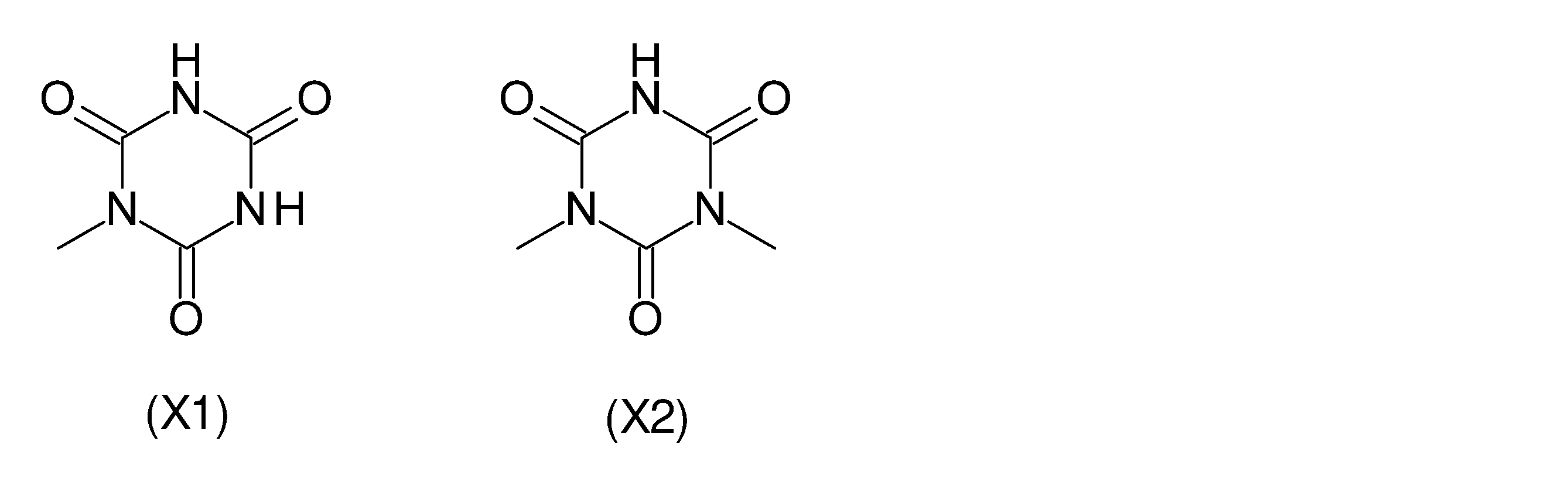
[2]前記ラジカル重合性化合物の量が、前記カチオン重合性化合物100質量部に対して、200質量部以下である、前記[1]に記載の感光性組成物。
[3]前記カチオン重合性化合物は、ポリシロキサン構造を有する、前記[1]又は[2]に記載の感光性組成物。
[4]前記カチオン重合性基は、脂環式エポキシ基、グリシジル基及びオキセタニル基からなる群より選択される1種以上である、前記[1]~[3]のいずれか一つに記載の感光性組成物。
[5]前記ラジカル重合性化合物は、1分子中にイソシアヌル環と前記(メタ)アクリロイル基とを有する、前記[1]~[4]のいずれか一つに記載の感光性組成物。
[6]着色剤を更に含む、前記[1]~[5]のいずれか一つに記載の感光性組成物。
[7]基板と、前記基板上に配置された、半硬化状態の感光性組成物から構成されるパターン膜とを有するパターン膜付き基板であって、
前記感光性組成物は、前記[1]~[6]のいずれか一つに記載の感光性組成物である、パターン膜付き基板。
前記感光性組成物は、前記[1]~[6]のいずれか一つに記載の感光性組成物である、パターン膜付き基板。
[8]基板と、前記基板上に配置されたパターン膜とを有するパターン膜付き基板であって、
前記パターン膜が、前記基板側から、半硬化状態の第1感光性組成物から構成される第1半硬化層、及び半硬化状態の第2感光性組成物から構成される第2半硬化層をこの順に有し、
前記第1感光性組成物は、アルカリ可溶性、カチオン重合性及び光重合性を有し、かつ着色剤を含まない感光性組成物であり、
前記第2感光性組成物は、前記[6]に記載の感光性組成物である、パターン膜付き基板。
前記パターン膜が、前記基板側から、半硬化状態の第1感光性組成物から構成される第1半硬化層、及び半硬化状態の第2感光性組成物から構成される第2半硬化層をこの順に有し、
前記第1感光性組成物は、アルカリ可溶性、カチオン重合性及び光重合性を有し、かつ着色剤を含まない感光性組成物であり、
前記第2感光性組成物は、前記[6]に記載の感光性組成物である、パターン膜付き基板。
[9]第1基板、第2基板、及び前記第1基板と前記第2基板とを接着する硬化物層を有する基板積層体であって、
前記硬化物層は、前記[1]~[6]のいずれか一つに記載の感光性組成物の硬化物から構成される、基板積層体。
前記硬化物層は、前記[1]~[6]のいずれか一つに記載の感光性組成物の硬化物から構成される、基板積層体。
[10]第1基板、第2基板、及び前記第1基板と前記第2基板とを接着する硬化物層を有する基板積層体であって、
前記硬化物層が、前記第1基板側から、第1感光性組成物の硬化物から構成される第1層、及び第2感光性組成物の硬化物から構成される第2層をこの順に有し、
前記第1感光性組成物は、アルカリ可溶性、カチオン重合性及び光重合性を有し、かつ着色剤を含まない感光性組成物であり、
前記第2感光性組成物は、前記[6]に記載の感光性組成物である、基板積層体。
前記硬化物層が、前記第1基板側から、第1感光性組成物の硬化物から構成される第1層、及び第2感光性組成物の硬化物から構成される第2層をこの順に有し、
前記第1感光性組成物は、アルカリ可溶性、カチオン重合性及び光重合性を有し、かつ着色剤を含まない感光性組成物であり、
前記第2感光性組成物は、前記[6]に記載の感光性組成物である、基板積層体。
[11]前記第1基板は、ガラス基板であり、
前記第2基板は、半導体素子基板である、前記[9]又は[10]に記載の基板積層体。
前記第2基板は、半導体素子基板である、前記[9]又は[10]に記載の基板積層体。
[12]第1基板上に前記[1]~[6]のいずれか一つに記載の感光性組成物を塗布することにより塗膜を形成し、
前記塗膜にフォトマスクを通して光を照射することにより、前記塗膜において、半硬化状態の前記感光性組成物から構成される露光部と、非露光部とを形成し、
アルカリ性現像液で前記非露光部を前記第1基板上から除去することにより、前記第1基板上にパターン化された前記塗膜を形成し、
前記第1基板と第2基板とを、前記パターン化された塗膜を介して積層することにより積層物を形成し、
前記積層物を加熱して半硬化状態の前記パターン化された塗膜を更に硬化させることにより、前記第1基板と前記第2基板とを接着する、基板積層体の製造方法。
前記塗膜にフォトマスクを通して光を照射することにより、前記塗膜において、半硬化状態の前記感光性組成物から構成される露光部と、非露光部とを形成し、
アルカリ性現像液で前記非露光部を前記第1基板上から除去することにより、前記第1基板上にパターン化された前記塗膜を形成し、
前記第1基板と第2基板とを、前記パターン化された塗膜を介して積層することにより積層物を形成し、
前記積層物を加熱して半硬化状態の前記パターン化された塗膜を更に硬化させることにより、前記第1基板と前記第2基板とを接着する、基板積層体の製造方法。
[13]第1基板上に第1感光性組成物を塗布することにより第1塗工層を形成し、
前記第1塗工層上に第2感光性組成物を塗布することにより第2塗工層を形成し、
前記第1塗工層及び前記第2塗工層から構成される塗膜にフォトマスクを通して光を照射することにより、前記塗膜において、半硬化状態の前記第1感光性組成物から構成される第1半硬化層及び半硬化状態の前記第2感光性組成物から構成される第2半硬化層からなる露光部と、非露光部とを形成し、
アルカリ性現像液で前記非露光部を前記第1基板上から除去することにより、前記第1基板上にパターン化された前記塗膜を形成し、
前記第1基板と第2基板とを、前記パターン化された塗膜を介して積層することにより積層物を形成し、
前記積層物を加熱して半硬化状態の前記パターン化された塗膜を更に硬化させることにより、前記第1基板と前記第2基板とを接着する、基板積層体の製造方法であって、
前記第1感光性組成物は、アルカリ可溶性、カチオン重合性及び光重合性を有し、かつ着色剤を含まない感光性組成物であり、
前記第2感光性組成物は、前記[6]に記載の感光性組成物である、基板積層体の製造方法。
前記第1塗工層上に第2感光性組成物を塗布することにより第2塗工層を形成し、
前記第1塗工層及び前記第2塗工層から構成される塗膜にフォトマスクを通して光を照射することにより、前記塗膜において、半硬化状態の前記第1感光性組成物から構成される第1半硬化層及び半硬化状態の前記第2感光性組成物から構成される第2半硬化層からなる露光部と、非露光部とを形成し、
アルカリ性現像液で前記非露光部を前記第1基板上から除去することにより、前記第1基板上にパターン化された前記塗膜を形成し、
前記第1基板と第2基板とを、前記パターン化された塗膜を介して積層することにより積層物を形成し、
前記積層物を加熱して半硬化状態の前記パターン化された塗膜を更に硬化させることにより、前記第1基板と前記第2基板とを接着する、基板積層体の製造方法であって、
前記第1感光性組成物は、アルカリ可溶性、カチオン重合性及び光重合性を有し、かつ着色剤を含まない感光性組成物であり、
前記第2感光性組成物は、前記[6]に記載の感光性組成物である、基板積層体の製造方法。
[14]前記第1基板は、ガラス基板であり、
前記第2基板は、半導体素子基板である、前記[12]又は[13]に記載の基板積層体の製造方法。
前記第2基板は、半導体素子基板である、前記[12]又は[13]に記載の基板積層体の製造方法。
本発明によれば、現像時の膜減りを抑制しつつ、パターン膜の半硬化状態を安定して維持できる感光性組成物及び当該感光性組成物を用いて得られるパターン膜付き基板、並びに当該感光性組成物を用いて得られる基板積層体及びその製造方法を提供できる。
以下、本発明の好適な実施形態について詳しく説明するが、本発明はこれらに限定されるものではない。また、本明細書中に記載された学術文献及び特許文献の全てが、本明細書中において参考として援用される。
まず、本明細書中で使用される用語について説明する。「活性種」とは、ラジカル、カチオン及びアニオンからなる群より選択される1種以上をさす。「光ラジカル重合開始剤」とは、光照射により活性種としてラジカルのみを生じる化合物をさす。「カチオン重合性基」とは、カチオンの存在下で連鎖的に重合反応を起こす官能基をさす。「アルカリ可溶性基」とは、アルカリと相互作用、又はアルカリと反応することにより、アルカリ性溶液に対する溶解性を高める官能基をさす。「ポリシロキサン構造」とは、シロキサン単位(Si-O-Si)を有する構造をさす。「脂環式エポキシ基」とは、脂環式構造を構成する炭素原子のうち、隣接する2個の炭素原子に酸素原子1個が結合して形成される官能基をさし、例えば、3,4-エポキシシクロヘキシル基等が挙げられる。「半硬化状態」とは、その後の工程(例えば、加熱工程)によって硬化度を更に高めることが可能な状態をいう。「固形分」とは組成物中の不揮発成分であり、「固形分全量」とは、組成物の構成成分から溶媒を除外した全量を意味する。
以下、化合物名の後に「系」を付けて、化合物及びその誘導体を包括的に総称する場合がある。化合物名の後に「系」を付けて重合体名を表す場合には、重合体の繰り返し単位が化合物又はその誘導体に由来することを意味する。アクリレート及びメタクリレートを包括的に「(メタ)アクリレート」と総称する場合がある。アクリロイル基及びメタクリロイル基を包括的に「(メタ)アクリロイル基」と総称する場合がある。
本明細書に例示の成分や官能基等は、特記しない限り、単独で用いてもよく、2種以上を併用してもよい。
以下の説明において参照する図面は、理解しやすくするために、それぞれの構成要素を主体に模式的に示しており、図示された各構成要素の大きさ、個数、形状等は、図面作成の都合上から実際とは異なる場合がある。また、説明の都合上、後に説明する図面において、先に説明した図面と同一構成部分については、同一符号を付して、その説明を省略する場合がある。
<第1実施形態:感光性組成物>
本発明の第1実施形態に係る感光性組成物は、カチオン重合性化合物(以下、「成分(A)」と記載することがある)と、ラジカル重合性化合物(以下、「成分(B)」と記載することがある)と、光重合開始剤(以下、「成分(C)」と記載することがある)とを含み、成分(C)は、光ラジカル重合開始剤である。成分(A)は、カチオン重合性基とアルカリ可溶性基とを1分子中に有する。成分(B)は、(メタ)アクリロイル基を有する。成分(B)の量は、成分(A)100質量部に対して、5質量部以上であることが好ましい。
本発明の第1実施形態に係る感光性組成物は、カチオン重合性化合物(以下、「成分(A)」と記載することがある)と、ラジカル重合性化合物(以下、「成分(B)」と記載することがある)と、光重合開始剤(以下、「成分(C)」と記載することがある)とを含み、成分(C)は、光ラジカル重合開始剤である。成分(A)は、カチオン重合性基とアルカリ可溶性基とを1分子中に有する。成分(B)は、(メタ)アクリロイル基を有する。成分(B)の量は、成分(A)100質量部に対して、5質量部以上であることが好ましい。
また、第1実施形態に係る感光性組成物では、成分(A)が有するアルカリ可溶性基が、下記化学式(X1)で表される1価の有機基(以下、「X1基」と記載することがある)、下記化学式(X2)で表される2価の有機基(以下、「X2基」と記載することがある)、及びフェノール性水酸基からなる群より選択される1種以上である。なお、X1基は、N-モノ置換イソシアヌル酸由来の1価の有機基である。また、X2基は、N,N’-ジ置換イソシアヌル酸由来の2価の有機基である。X1基及びX2基は、いずれもイソシアヌル環を有する。
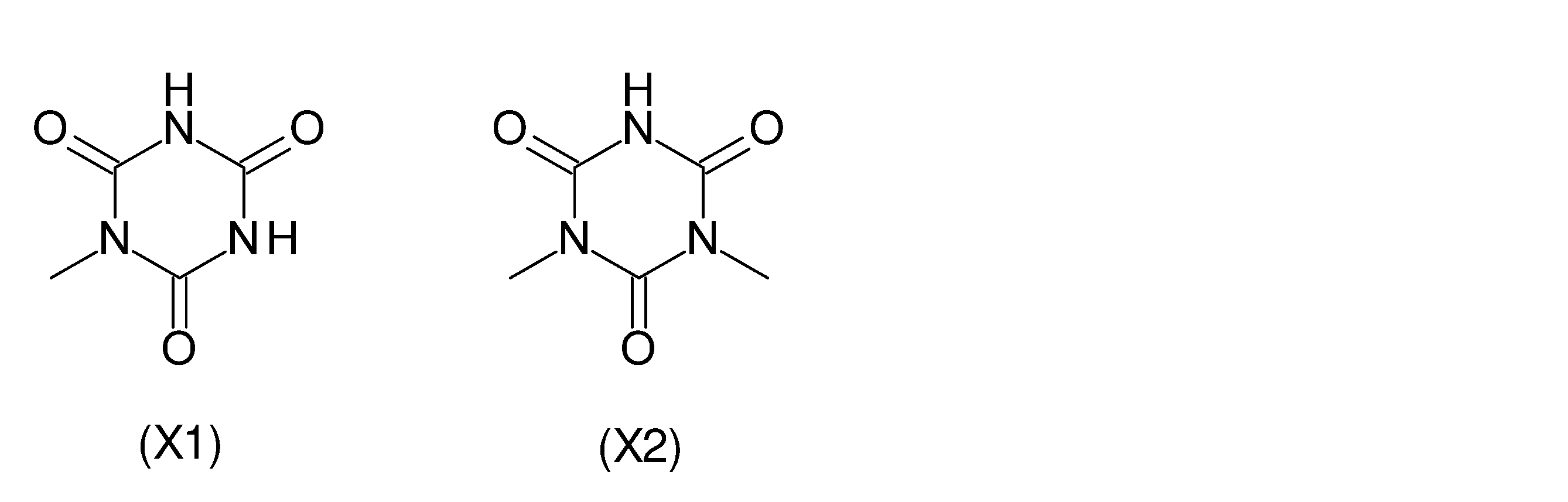
上記「感光性組成物が光重合開始剤(成分(C))を含み、成分(C)が光ラジカル重合開始剤である」とは、感光性組成物が光ラジカル重合開始剤を含み、かつ光ラジカル重合開始剤以外の光重合開始剤(例えば、光カチオン重合開始剤等)の含有量が、感光性組成物中の成分(A)100質量部に対して0.1質量部未満(好ましくは、0.01質量部未満、より好ましくは0.001質量部未満、更に好ましくは0.0001質量部未満)であることを意味する。
第1実施形態に係る感光性組成物は、現像時の膜減りを抑制しつつ、パターン膜の半硬化状態を安定して維持できる。その理由は、以下のように推測される。
第1実施形態に係る感光性組成物は、1分子中にカチオン重合性基とアルカリ可溶性基とを有する成分(A)と、(メタ)アクリロイル基を有する成分(B)と、成分(C)とを含み、成分(C)は、光ラジカル重合開始剤である。これにより、第1実施形態に係る感光性組成物を用いてBステージ化(露光)する際は、光照射により活性種としてラジカルのみが発生し、露光部中の成分(B)がラジカル重合することにより、カチオンを発生させることなく半硬化状態のパターン膜を形成できる。このため、第1実施形態に係る感光性組成物によれば、Bステージ化まで完了した基板をCステージ化するまで長時間保管しても、残留したカチオンに起因するパターン膜の更なる硬化を抑制できる。また、第1実施形態に係る感光性組成物では、成分(A)が有するアルカリ可溶性基が、X1基、X2基及びフェノール性水酸基からなる群より選択される1種以上である。これらのアルカリ可溶性基は、比較的酸性度が低いため、Bステージ化まで完了した基板を長時間保管しても、パターン膜中におけるカチオン重合の進行を抑制できる。これらのことから、第1実施形態に係る感光性組成物は、パターン膜の半硬化状態を安定して維持できる。なお、Cステージ化する際は、半硬化状態が維持されたパターン膜を介して第1基板と第2基板とを積層した後、積層された積層物を加熱することにより、パターン膜中の成分(A)をカチオン重合させて、第1基板と第2基板とを接着することができる。
また、第1実施形態に係る感光性組成物は、Bステージ化する際の硬化成分である成分(B)の量が、成分(A)100質量部に対して5質量部以上であるため、ラジカル重合反応の反応点が比較的多くなる。これにより、半硬化させた露光部のアルカリ耐性を高めることができる。よって、第1実施形態に係る感光性組成物は、現像時の膜減りを抑制できる。
第1実施形態において、パターン膜の半硬化状態をより安定して維持するためには、成分(A)が有するアルカリ可溶性基としては、X1基及びX2基からなる群より選択される1種以上が好ましく、X2基がより好ましい。
第1実施形態において、現像時の膜減りをより抑制するためには、成分(B)の量が、成分(A)100質量部に対して、8質量以上であることが好ましく、10質量部以上であることがより好ましく、20質量部以上であることが更に好ましく、30質量部以上であることが更により好ましい。
第1実施形態において、Cステージ化する際のパターン膜の接着性を高めるためには、成分(B)の量が、成分(A)100質量部に対して、200質量部以下であることが好ましく、150質量部以下であることがより好ましく、100質量部以下であることが更に好ましく、90質量部以下であることが更により好ましく、80質量部以下であることが特に好ましく、70質量部以下であってもよい。
以下、第1実施形態に係る感光性組成物に含まれる各成分について詳述する。
[成分(A)]
成分(A)としては、1分子中にカチオン重合性基と上記特定のアルカリ可溶性基とを有するカチオン重合性化合物である限り、特に限定されない。成分(A)が1分子中にカチオン重合性基とアルカリ可溶性基とを有することにより、パターニング性及び硬化性の双方に優れる感光性組成物が得られる。成分(A)は、1分子中に複数個のカチオン重合性基を有することが好ましい。成分(A)が1分子中に複数個のカチオン重合性基を有する場合、架橋密度の高い硬化物層が得られ、その結果、硬化物層の耐熱性が向上する傾向がある。複数個のカチオン重合性基は、同種でもよく、2種以上の異なる官能基でもよい。また、成分(A)は、1分子中に複数個のアルカリ可溶性基を有することが好ましい。成分(A)が1分子中に複数個のアルカリ可溶性基を有する場合、現像時に非露光部の除去性が高くなるため、パターニング性が向上する傾向がある。複数個のアルカリ可溶性基は、同種でもよく、2種以上の異なる官能基でもよい。
成分(A)としては、1分子中にカチオン重合性基と上記特定のアルカリ可溶性基とを有するカチオン重合性化合物である限り、特に限定されない。成分(A)が1分子中にカチオン重合性基とアルカリ可溶性基とを有することにより、パターニング性及び硬化性の双方に優れる感光性組成物が得られる。成分(A)は、1分子中に複数個のカチオン重合性基を有することが好ましい。成分(A)が1分子中に複数個のカチオン重合性基を有する場合、架橋密度の高い硬化物層が得られ、その結果、硬化物層の耐熱性が向上する傾向がある。複数個のカチオン重合性基は、同種でもよく、2種以上の異なる官能基でもよい。また、成分(A)は、1分子中に複数個のアルカリ可溶性基を有することが好ましい。成分(A)が1分子中に複数個のアルカリ可溶性基を有する場合、現像時に非露光部の除去性が高くなるため、パターニング性が向上する傾向がある。複数個のアルカリ可溶性基は、同種でもよく、2種以上の異なる官能基でもよい。
成分(A)が有するカチオン重合性基としては、例えば、エポキシ基、グリシジル基、ビニルエーテル基、オキセタニル基、アルコキシシリル基等が挙げられる。感光性組成物の保存安定性の観点から、カチオン重合性基としては、エポキシ基、グリシジル基及びオキセタニル基からなる群より選択される1種以上が好ましく、脂環式エポキシ基、グリシジル基及びオキセタニル基からなる群より選択される1種以上がより好ましい。中でも脂環式エポキシ基は、硬化時の反応性が比較的高い上、硬化物層の硬化収縮を抑制できるため、特に好ましい。また、成分(A)が有するカチオン重合性基が脂環式エポキシ基である場合、パターン膜の半硬化状態をより安定して維持できる。
硬化物層の耐熱性を高めるためには、成分(A)は、ポリマー骨格構造を含むことが好ましい。ポリマー骨格構造としては、例えば、ポリアクリル、ポリフェノール、ポリアミド、ポリ酸無水物、ポリカーボネート、ポリジエン、ポリエステル、ポリハロオレフィン、ポリイミド、ポリイミン、ポリケトン、ポリオレフィン、ポリエーテル、ポリフェニレン、ポリホスファゼン、ポリシロキサン、ポリシラン、ポリスチレン、ポリスルフィド、ポリスルホン、ポリウレタン、ポリウレア、ポリビニル等のポリマーの主鎖構造が挙げられる。
硬化物層の耐熱性をより高めるためには、成分(A)は、ポリシロキサン構造を有することが好ましく、主鎖にポリシロキサン構造を有するポリマーであることがより好ましく、主鎖に環状ポリシロキサン構造を有するポリマーであることが更に好ましい。「環状ポリシロキサン構造」とは、環の構成要素としてシロキサン単位(Si-O-Si)を有する環状分子構造骨格を意味する。
環状ポリシロキサン構造は、単環構造でもよく、多環構造でもよい。多環構造は多面体構造でもよい。環を構成するシロキサン単位のうち、T単位(XSiO3/2)又はQ単位(SiO4/2)の含有率が高いほど、得られる硬化物層は、硬度が高くなり、耐熱性に優れる傾向がある。一方、M単位(X3SiO1/2)又はD単位(X2SiO2/2)の含有率が高いほど、得られる硬化物層は、より柔軟であり、かつ残留応力を低減できる傾向がある。
成分(A)が主鎖にポリシロキサン構造を有するポリマーである場合、当該ポリマーの重量平均分子量は、10000以上50000以下であることが好ましく、20000以上40000以下であることがより好ましく、25000以上35000以下であることが更に好ましい。重量平均分子量が10000以上である場合、耐熱性に優れる硬化物層が得られる傾向がある。一方、重量平均分子量が50000以下である場合、現像時に非露光部の除去性が高くなるため、パターニング性が向上する傾向がある。
ポリシロキサン構造を有する成分(A)(詳しくは、1分子中にカチオン重合性基とアルカリ可溶性基とポリシロキサン構造とを有するカチオン重合性化合物)は、例えば、下記の化合物(α)、化合物(β)及び化合物(γ)を出発物質とするヒドロシリル化反応により得られる。
・化合物(α):1分子中に少なくとも2個のSiH基(ヒドロシリル基)を有するポリシロキサン化合物
・化合物(β):1分子中に、SiH基との反応性を有する炭素-炭素二重結合と、カチオン重合性基とを有する化合物
・化合物(γ):1分子中に、SiH基との反応性を有する炭素-炭素二重結合と、アルカリ可溶性基とを有する化合物
・化合物(α):1分子中に少なくとも2個のSiH基(ヒドロシリル基)を有するポリシロキサン化合物
・化合物(β):1分子中に、SiH基との反応性を有する炭素-炭素二重結合と、カチオン重合性基とを有する化合物
・化合物(γ):1分子中に、SiH基との反応性を有する炭素-炭素二重結合と、アルカリ可溶性基とを有する化合物
(化合物(α))
化合物(α)は、1分子中に少なくとも2個のSiH基を有するポリシロキサン化合物であり、例えば、国際公開第96/15194号に記載の化合物で、1分子中に少なくとも2個のSiH基を有するもの等が使用できる。化合物(α)の具体例としては、直鎖構造を有するヒドロシリル基含有ポリシロキサン、分子末端にヒドロシリル基を有するポリシロキサン、ヒドロシリル基を有する環状ポリシロキサン(以下、単に「環状ポリシロキサン」と記載することがある)等が挙げられる。環状ポリシロキサンは、多環構造を有していてもよく、多環構造は多面体構造であってもよい。耐熱性及び機械強度の高い硬化物層を形成するためには、化合物(α)として、1分子中に少なくとも2個のSiH基を有する環状ポリシロキサンを用いることが好ましい。化合物(α)は、好ましくは1分子中に3個以上のSiH基を有する環状ポリシロキサンである。耐熱性及び耐光性の観点から、Si原子上に存在する基は、水素原子及びメチル基のいずれかであることが好ましい。
化合物(α)は、1分子中に少なくとも2個のSiH基を有するポリシロキサン化合物であり、例えば、国際公開第96/15194号に記載の化合物で、1分子中に少なくとも2個のSiH基を有するもの等が使用できる。化合物(α)の具体例としては、直鎖構造を有するヒドロシリル基含有ポリシロキサン、分子末端にヒドロシリル基を有するポリシロキサン、ヒドロシリル基を有する環状ポリシロキサン(以下、単に「環状ポリシロキサン」と記載することがある)等が挙げられる。環状ポリシロキサンは、多環構造を有していてもよく、多環構造は多面体構造であってもよい。耐熱性及び機械強度の高い硬化物層を形成するためには、化合物(α)として、1分子中に少なくとも2個のSiH基を有する環状ポリシロキサンを用いることが好ましい。化合物(α)は、好ましくは1分子中に3個以上のSiH基を有する環状ポリシロキサンである。耐熱性及び耐光性の観点から、Si原子上に存在する基は、水素原子及びメチル基のいずれかであることが好ましい。
直鎖構造を有するヒドロシリル基含有ポリシロキサンとしては、ジメチルシロキサン単位とメチルハイドロジェンシロキサン単位及び末端トリメチルシロキシ単位との共重合体、ジフェニルシロキサン単位とメチルハイドロジェンシロキサン単位及び末端トリメチルシロキシ単位との共重合体、メチルフェニルシロキサン単位とメチルハイドロジェンシロキサン単位及び末端トリメチルシロキシ単位との共重合体、並びにジメチルハイドロジェンシリル基によって末端が封鎖されたポリシロキサン等が例示される。
分子末端にヒドロシリル基を有するポリシロキサンとしては、ジメチルハイドロジェンシリル基によって末端が封鎖されたポリシロキサン、並びにジメチルハイドロジェンシロキサン単位(H(CH3)2SiO1/2単位)と、SiO2単位、SiO3/2単位及びSiO単位からなる群より選択される1種以上のシロキサン単位とからなるポリシロキサン等が例示される。
環状ポリシロキサンは、例えば下記一般式(1)で表される。

一般式(1)中、R1、R2及びR3は、それぞれ独立に、炭素原子数1以上20以下の1価の有機基を表し、mは2以上10以下の整数を表し、nは0以上10以下の整数を表す。ヒドロシリル化反応を容易に行うためには、mが3以上であることが好ましい。ヒドロシリル化反応を容易に行うためには、m+nが3以上12以下であることが好ましい。ヒドロシリル化反応をより容易に行うためには、nが0であることが好ましい。
R1、R2及びR3としては、C、H及びOからなる群より選択される元素により構成される有機基が好ましい。R1、R2及びR3の例としては、アルキル基、ヒドロキシアルキル基、アルコキシアルキル基、オキシアルキル基、アリール基等が挙げられる。中でも、メチル基、エチル基、プロピル基、ヘキシル基、オクチル基、デシル基、ドデシル基等の鎖状アルキル基;シクロヘキシル基、ノルボルニル基等の環状アルキル基;又はフェニル基が好ましい。環状ポリシロキサンの入手容易性の観点から、R1、R2及びR3としては、炭素原子数1以上6以下の鎖状アルキル基、又はフェニル基が好ましい。ヒドロシリル化反応を容易に行うためには、R1、R2及びR3としては、炭素原子数1以上6以下の鎖状アルキル基が好ましく、メチル基がより好ましい。
一般式(1)で表される環状ポリシロキサンとしては、1,3,5,7-テトラハイドロジェン-1,3,5,7-テトラメチルシクロテトラシロキサン、1-プロピル-3,5,7-トリハイドロジェン-1,3,5,7-テトラメチルシクロテトラシロキサン、1,5-ジハイドロジェン-3,7-ジヘキシル-1,3,5,7-テトラメチルシクロテトラシロキサン、1,3,5-トリハイドロジェン-1,3,5-トリメチルシクロトリシロキサン、1,3,5,7,9-ペンタハイドロジェン-1,3,5,7,9-ペンタメチルシクロペンタシロキサン、及び1,3,5,7,9,11-ヘキサハイドロジェン-1,3,5,7,9,11-ヘキサメチルシクロヘキサシロキサン等が例示される。中でも、入手容易性及びSiH基の反応性の観点から、1,3,5,7-テトラハイドロジェン-1,3,5,7-テトラメチルシクロテトラシロキサン(一般式(1)において、m=4、n=0であり、R1がメチル基である化合物)が好ましい。
化合物(α)は、公知の合成方法により得られる。例えば、一般式(1)で表される環状ポリシロキサンは、国際公開第96/15194号等に記載の方法により合成できる。多面体骨格を有する環状ポリシロキサンは、例えば、特開2004-359933号公報、特開2004-143449号公報、特開2006-269402号公報等に記載の方法により合成できる。また、化合物(α)として、市販のポリシロキサン化合物を用いてもよい。
(化合物(β))
化合物(β)は、1分子中に、SiH基(ヒドロシリル基)との反応性を有する炭素-炭素二重結合と、カチオン重合性基とを有する化合物である。化合物(β)におけるカチオン重合性基は、前述の成分(A)が有するカチオン重合性基と同じであり、好ましい態様も同じである。すなわち、化合物(β)は、カチオン重合性基として、エポキシ基、グリシジル基及びオキセタニル基からなる群より選択される1種以上を有することが好ましく、脂環式エポキシ基、グリシジル基及びオキセタニル基からなる群より選択される1種以上を有することがより好ましく、脂環式エポキシ基を有することが更に好ましい。
化合物(β)は、1分子中に、SiH基(ヒドロシリル基)との反応性を有する炭素-炭素二重結合と、カチオン重合性基とを有する化合物である。化合物(β)におけるカチオン重合性基は、前述の成分(A)が有するカチオン重合性基と同じであり、好ましい態様も同じである。すなわち、化合物(β)は、カチオン重合性基として、エポキシ基、グリシジル基及びオキセタニル基からなる群より選択される1種以上を有することが好ましく、脂環式エポキシ基、グリシジル基及びオキセタニル基からなる群より選択される1種以上を有することがより好ましく、脂環式エポキシ基を有することが更に好ましい。
SiH基との反応性を有する炭素-炭素二重結合を含む基(以下、単に「アルケニル基」と記載することがある)としては、ビニル基、アリル基、メタリル基、2-アリルフェニル基、3-アリルフェニル基、4-アリルフェニル基、2-(アリルオキシ)フェニル基、3-(アリルオキシ)フェニル基、4-(アリルオキシ)フェニル基、2-(アリルオキシ)エチル基、2,2-ビス(アリルオキシメチル)ブチル基、3-アリルオキシ-2,2-ビス(アリルオキシメチル)プロピル基、ビニルエーテル基等が挙げられる。SiH基との反応性の観点から、化合物(β)は、アルケニル基として、ビニル基及びアリル基からなる群より選択される1種以上を有することが好ましい。
化合物(β)の具体例としては、1-ビニル-3,4-エポキシシクロヘキサン、アリルグリシジルエーテル、ジアリルモノグリシジルイソシアヌレート、モノアリルジグリシジルイソシアヌレート、3-エチル-3-(ビニルオキシメチル)オキセタン等が挙げられる。カチオン重合における反応性の観点から、化合物(β)としては、脂環式エポキシ基を有する化合物が好ましく、1-ビニル-3,4-エポキシシクロヘキサンが特に好ましい。
(化合物(γ))
化合物(γ)は、1分子中に、SiH基との反応性を有する炭素-炭素二重結合と、アルカリ可溶性基とを有する化合物である。化合物(γ)におけるアルカリ可溶性基は、前述の成分(A)が有するアルカリ可溶性基と同じであり、好ましい態様も同じである。すなわち、化合物(γ)は、アルカリ可溶性基として、X1基、X2基及びフェノール性水酸基からなる群より選択される1種以上を有することが好ましく、X1基及びX2基からなる群より選択される1種以上を有することがより好ましく、X2基を有することが更に好ましい。
化合物(γ)は、1分子中に、SiH基との反応性を有する炭素-炭素二重結合と、アルカリ可溶性基とを有する化合物である。化合物(γ)におけるアルカリ可溶性基は、前述の成分(A)が有するアルカリ可溶性基と同じであり、好ましい態様も同じである。すなわち、化合物(γ)は、アルカリ可溶性基として、X1基、X2基及びフェノール性水酸基からなる群より選択される1種以上を有することが好ましく、X1基及びX2基からなる群より選択される1種以上を有することがより好ましく、X2基を有することが更に好ましい。
化合物(γ)は、SiH基との反応性を有する炭素-炭素二重結合を含む基(アルケニル基)を有する。化合物(γ)が有するアルケニル基の例としては、前述の化合物(β)が有するアルケニル基として例示したものと同じアルケニル基が挙げられ、好ましい態様も同じである。すなわち、化合物(γ)は、アルケニル基として、ビニル基及びアリル基からなる群より選択される1種以上を有することが好ましい。
化合物(γ)の具体例としては、ジアリルイソシアヌレート、モノアリルイソシアヌレート、2,2’-ジアリルビスフェノールA、ビニルフェノール、アリルフェノール等が挙げられる。パターン膜の半硬化状態をより安定して維持するためには、化合物(γ)としては、ジアリルイソシアヌレート、モノアリルイソシアヌレート及び2,2’-ジアリルビスフェノールAからなる群より選択される1種以上が好ましく、ジアリルイソシアヌレート及びモノアリルイソシアヌレートからなる群より選択される1種以上がより好ましく、ジアリルイソシアヌレートが更に好ましい。化合物(γ)としてモノアリルイソシアヌレートを使用すると、アルカリ可溶性基としてX1基を有する成分(A)が得られる。また、化合物(γ)としてジアリルイソシアヌレートを使用すると、アルカリ可溶性基としてX2基を有する成分(A)が得られる。
(他の出発物質)
ヒドロシリル化反応において、上記の化合物(α)、化合物(β)及び化合物(γ)に加えて、他の出発物質を用いてもよい。例えば、他の出発物質として、上記の化合物(β)及び化合物(γ)とは異なるアルケニル基含有化合物(以下、「他のアルケニル基含有化合物」と記載することがある)を用いてもよい。
ヒドロシリル化反応において、上記の化合物(α)、化合物(β)及び化合物(γ)に加えて、他の出発物質を用いてもよい。例えば、他の出発物質として、上記の化合物(β)及び化合物(γ)とは異なるアルケニル基含有化合物(以下、「他のアルケニル基含有化合物」と記載することがある)を用いてもよい。
耐熱性に優れる硬化物層を得るためには、他のアルケニル基含有化合物として、1分子中に2個以上のアルケニル基を有する化合物(以下、「化合物(δ)」と記載することがある)を用いることが好ましい。化合物(δ)を用いれば、ヒドロシリル化反応の際、架橋点が増えるため、Cステージ化により得られる硬化物層の耐熱性が向上する傾向がある。
化合物(δ)の具体例としては、ジアリルフタレート、トリアリルトリメリテート、ジエチレングリコールビスアリルカーボネート、1,1,2,2-テトラアリロキシエタン、トリアリルシアヌレート、トリアリルイソシアヌレート、ジアリルモノベンジルイソシアヌレート、ジアリルモノメチルイソシアヌレート、1,2,4-トリビニルシクロヘキサン、トリエチレングリコールジビニルエーテル、ジビニルベンゼン、ジビニルビフェニル、1,3-ジイソプロペニルベンゼン、1,4-ジイソプロペニルベンゼン、1,3-ビス(アリルオキシ)アダマンタン、1,3-ビス(ビニルオキシ)アダマンタン、1,3,5-トリス(アリルオキシ)アダマンタン、1,3,5-トリス(ビニルオキシ)アダマンタン、ジシクロペンタジエン、ビニルシクロへキセン、1,5-ヘキサジエン、1,9-デカジエン、ジアリルエーテル、及びこれらのオリゴマーが挙げられる。
得られる硬化物層の耐熱性をより向上させるためには、化合物(δ)としては、ジアリルモノメチルイソシアヌレートが好ましい。
現像時の膜減りをより抑制するためには、他のアルケニル基含有化合物として、1分子中にアルケニル基と(メタ)アクリロイル基とを有する化合物(以下、「化合物(ε)」と記載することがある)を用いることが好ましい。化合物(ε)を用いれば、成分(A)に(メタ)アクリロイル基が導入されるため、ラジカル重合反応の反応点が比較的多くなる。これにより、半硬化させた露光部のアルカリ耐性を高めることができる。
化合物(ε)の具体例としては、ビニルアクリレート、ビニルメタクリレート、アリルアクリレート、アリルメタクリレート、2-ブテニルアクリレート、2-ブテニルメタクリレート等が挙げられる。現像時の膜減りを更に抑制するためには、化合物(ε)としては、ビニルアクリレート及びアリルアクリレートからなる群より選択される1種以上が好ましく、アリルアクリレートがより好ましい。
(ヒドロシリル化反応)
成分(A)を得るためのヒドロシリル化反応の順序及び方法は特に限定されない。例えば、上述した化合物(α)、化合物(β)、化合物(γ)、及び必要に応じて任意成分である他の出発物質を用いて、国際公開第2009/075233号に記載の方法に準じたヒドロシリル化反応により、ポリシロキサン構造を有する成分(A)が得られる。上述した化合物(α)、化合物(β)、化合物(γ)、及び必要に応じて任意成分である他の出発物質を用いて得られる成分(A)は、例えば、1分子中に複数個のカチオン重合性基と複数個のアルカリ可溶性基とを有し、かつ主鎖にポリシロキサン構造を有するポリマーである。
成分(A)を得るためのヒドロシリル化反応の順序及び方法は特に限定されない。例えば、上述した化合物(α)、化合物(β)、化合物(γ)、及び必要に応じて任意成分である他の出発物質を用いて、国際公開第2009/075233号に記載の方法に準じたヒドロシリル化反応により、ポリシロキサン構造を有する成分(A)が得られる。上述した化合物(α)、化合物(β)、化合物(γ)、及び必要に応じて任意成分である他の出発物質を用いて得られる成分(A)は、例えば、1分子中に複数個のカチオン重合性基と複数個のアルカリ可溶性基とを有し、かつ主鎖にポリシロキサン構造を有するポリマーである。
ヒドロシリル化反応における各化合物の割合は特に限定されないが、出発物質のアルケニル基の総物質量AとSiH基の総物質量Bとが、1≦B/A≦30を満たすことが好ましく、1≦B/A≦10を満たすことがより好ましい。
パターン膜の半硬化状態を安定して維持しつつ、Cステージ化により得られる硬化物層の耐熱性を高めるためには、ヒドロシリル化反応における化合物(α)に対する化合物(β)の仕込み比(化合物(β)の質量/化合物(α)の質量)は、0.01以上1.0以下であることが好ましく、0.1以上1.0以下であることがより好ましく、0.2以上0.9以下であることが更に好ましい。
パターニング性に優れる感光性組成物を得るためには、ヒドロシリル化反応における化合物(α)に対する化合物(γ)の仕込み比(化合物(γ)の質量/化合物(α)の質量)は、0.1以上0.9以下であることが好ましく、0.2以上0.8以下であることがより好ましい。
出発物質として化合物(δ)を使用する場合、Cステージ化により得られる硬化物層の耐熱性を高めつつ、パターニング性に優れる感光性組成物を得るためには、ヒドロシリル化反応における化合物(α)に対する化合物(δ)の仕込み比(化合物(δ)の質量/化合物(α)の質量)は、0.01以上0.7以下であることが好ましく、0.05以上0.6以下であることがより好ましい。
出発物質として化合物(ε)を使用する場合、Cステージ化する際のパターン膜の接着性を確保しつつ、現像時の膜減りをより抑制するためには、ヒドロシリル化反応における化合物(α)に対する化合物(ε)の仕込み比(化合物(ε)の質量/化合物(α)の質量)は、0.1以上0.5以下であることが好ましく、0.2以上0.4以下であることがより好ましい。
ヒドロシリル化反応には、塩化白金酸、白金-オレフィン錯体、白金-ビニルシロキサン錯体等のヒドロシリル化触媒を用いてもよい。ヒドロシリル化触媒と助触媒とを併用してもよい。ヒドロシリル化触媒の添加量(物質量)は特に限定されないが、出発物質に含まれるアルケニル基の総物質量に対して、好ましくは10-8倍以上10-1倍以下、より好ましくは10-6倍以上10-2倍以下である。
ヒドロシリル化の反応温度は適宜に設定すればよく、好ましくは30℃以上200℃以下、より好ましくは50℃以上150℃以下である。ヒドロシリル化反応における気相部の酸素濃度は3体積%以下が好ましい。ヒドロシリル化反応促進の観点からは、気相部には0.1体積%以上3体積%以下の酸素が含まれていてもよい。
ヒドロシリル化反応には、溶媒を使用してもよい。溶媒としては、1種単独溶媒、又は2種以上を混合した混合溶媒が使用できる。溶媒としては、ベンゼン、トルエン、キシレン、ヘキサン、ヘプタン等の炭化水素系溶媒;テトラヒドロフラン、1,4-ジオキサン、1,3-ジオキソラン、ジエチルエーテル等のエーテル系溶媒;アセトン、メチルエチルケトン等のケトン系溶媒;クロロホルム、塩化メチレン、1,2-ジクロロエタン等のハロゲン系溶媒等を使用できる。反応後の留去が容易であることから、トルエン、キシレン、テトラヒドロフラン、1,4-ジオキサン、1,3-ジオキソラン、又はクロロホルムが好ましい。ヒドロシリル化反応においては、必要に応じて、ゲル化抑制剤を用いてもよい。
[成分(B)]
成分(B)としては、(メタ)アクリロイル基を有するラジカル重合性化合物である限り特に限定されない。(メタ)アクリロイル基を有するラジカル重合性化合物としては、アクリロイル基及びメタクリロイル基のうちの少なくとも1つを、1分子中に1個以上有する化合物が挙げられる。
成分(B)としては、(メタ)アクリロイル基を有するラジカル重合性化合物である限り特に限定されない。(メタ)アクリロイル基を有するラジカル重合性化合物としては、アクリロイル基及びメタクリロイル基のうちの少なくとも1つを、1分子中に1個以上有する化合物が挙げられる。
ラジカル重合反応の反応性を高めることで半硬化させた露光部のアルカリ耐性を高めて、現像時の膜減りをより抑制するためには、成分(B)としては、アクリロイル基を有する化合物が好ましい。
また、ラジカル重合反応の反応性を高めることで半硬化させた露光部のアルカリ耐性を高めて、現像時の膜減りをより抑制するためには、成分(B)としては、(メタ)アクリロイル基を1分子中に2個以上有する化合物が好ましく、(メタ)アクリロイル基を1分子中に3個以上有する化合物がより好ましく、(メタ)アクリロイル基を1分子中に4個以上有する化合物が更に好ましい。現像時の膜減りを特に抑制するためには、成分(B)としては、アクリロイル基を1分子中に2個以上有する化合物が好ましく、アクリロイル基を1分子中に3個以上有する化合物がより好ましく、アクリロイル基を1分子中に4個以上有する化合物が更に好ましい。
Cステージ化する際のパターン膜の接着性を確保するためには、成分(B)が1分子中に有する(メタ)アクリロイル基の個数が、6個以下であることが好ましく、5個以下であることがより好ましく、4個以下であることが更に好ましい。
(メタ)アクリロイル基を1分子中に1個有する成分(B)としては、イソアミルアクリレート、ラウリルアクリレート、オクチルアクリレート、デシルアクリレート、イソステアリルアクリレート、ブトキシエチル(メタ)アクリレート、エトキシジエチレングリコールアクリレート、メトキシジエチレングリコールアクリレート、メトキシトリプロピレングリコールアクリレート、メトキシポリエチレングリコールアクリレート、フェノキシエチルアクリレート、テトラヒドロフルフリル(メタ)アクリレート等が挙げられる。
(メタ)アクリロイル基を1分子中に2個有する成分(B)としては、トリエチレングリコールジ(メタ)アクリレート、テトラエチレングリコールジ(メタ)アクリレート、ポリエチレングリコールジ(メタ)アクリレート、トリプロピレングリコールジ(メタ)アクリレート、ポリプロピレングリコールジ(メタ)アクリレート(より具体的には、ポリプロピレングリコール#700ジアクリレート等)、1,6-ヘキサンジオールジ(メタ)アクリレート、1,9-ノナンジオールジ(メタ)アクリレート、ネオペンチルグリコールジ(メタ)アクリレート、ポリテトラメチレングリコールジ(メタ)アクリレート、ビス(2-アクリロイルオキシエチル)イソシアヌレート、ビス(2-メタクリロイルオキシエチル)イソシアヌレート等が挙げられる。
(メタ)アクリロイル基を1分子中に3個有する成分(B)としては、トリメチロールプロパントリ(メタ)アクリレート、ペンタエリスリトールトリ(メタ)アクリレート、グリセリンプロポキシトリ(メタ)アクリレート、トリス(2-アクリロイルオキシエチル)イソシアヌレート、トリス(2-メタクリロイルオキシエチル)イソシアヌレート等が挙げられる。
(メタ)アクリロイル基を1分子中に4個有する成分(B)としては、ペンタエリスリトールテトラ(メタ)アクリレート、ジトリメチロールプロパンテトラ(メタ)アクリレート等が挙げられる。
基板積層体の冷熱衝撃試験による信頼性を高めるためには、成分(B)としては、1分子中にイソシアヌル環と(メタ)アクリロイル基とを有する化合物が好ましい。1分子中にイソシアヌル環と(メタ)アクリロイル基とを有する化合物としては、ビス(2-アクリロイルオキシエチル)イソシアヌレート、ビス(2-メタクリロイルオキシエチル)イソシアヌレート、トリス(2-アクリロイルオキシエチル)イソシアヌレート、トリス(2-メタクリロイルオキシエチル)イソシアヌレート等が挙げられる。
成分(B)は、カチオン重合性基を有してもよい。また、成分(B)は、アルカリ可溶性基を有してもよい。ただし、パターニング性を向上させつつ、パターン膜の半硬化状態をより安定して維持するためには、第1実施形態に係る感光性組成物は、成分(B)として、1分子中にカチオン重合性基及びアルカリ可溶性基を有する化合物を含まないことが好ましい。つまり、第1実施形態に係る感光性組成物では、成分(B)が、1分子中にカチオン重合性基及びアルカリ可溶性基を有しない化合物であることが好ましい。
[成分(C)]
成分(C)は、光ラジカル重合開始剤である。パターン膜の半硬化状態をより安定して維持するためには、成分(C)として使用する光ラジカル重合開始剤は、Bステージ化までの製造工程で加熱処理した際に、カチオンを生じない化合物であることが好ましく、200℃以下の温度かつ60分以内の加熱時間で加熱処理してもカチオンを生じない化合物であることがより好ましい。
成分(C)は、光ラジカル重合開始剤である。パターン膜の半硬化状態をより安定して維持するためには、成分(C)として使用する光ラジカル重合開始剤は、Bステージ化までの製造工程で加熱処理した際に、カチオンを生じない化合物であることが好ましく、200℃以下の温度かつ60分以内の加熱時間で加熱処理してもカチオンを生じない化合物であることがより好ましい。
成分(C)の具体例としては、アセトフェノン系化合物、アシルフォスフィンオキサイド系化合物、ベンゾイン系化合物、ベンゾフェノン系化合物、α-ジケトン系化合物、ビイミダゾール系化合物、多核キノン系化合物、トリアジン系化合物、オキシムエステル系化合物、チタノセン系化合物、キサントン系化合物、チオキサントン系化合物、ケタール系化合物、アゾ系化合物、過酸化物、2,3-ジアルキルジオン系化合物、ジスルフィド系化合物、フルオロアミン系化合物等が挙げられる。現像時の膜減りをより抑制するためには、成分(C)としては、アセトフェノン系化合物、ベンゾフェノン系化合物、及びオキシムエステル系化合物からなる群より選択される1種以上が好ましい。
アセトフェノン系化合物としては、例えば、1-(4-ドデシルフェニル)-2-ヒドロキシ-2-メチルプロパン-1-オン、2,2-ジメトキシ-2-フェニルアセトフェノン、2-ヒドロキシ-2-メチル-1-フェニルプロパン-1-オン、1-(4’-i-プロピルフェニル)-2-ヒドロキシ-2-メチルプロパン-1-オン、4-(2’-ヒドロキシエトキシ)フェニル(2-ヒドロキシ-2-プロピル)ケトン、2,2-ジメトキシアセトフェノン、2,2-ジエトキシアセトフェノン、2-メチル-1-(4’-メチルチオフェニル)-2-モルフォリノプロパン-1-オン、2-ベンジル-2-ジメチルアミノ-1-(4’-モルフォリノフェニル)ブタン-1-オン、1-ヒドロキシシクロヘキシルフェニルケトン等が挙げられる。
オキシムエステル系化合物としては、例えば、1,2-オクタンジオン1-[4-(フェニルチオ)-2-(O-ベンゾイルオキシム)]、エタノン1-[9-エチル-6-(2-メチルベンゾイル)-9H-カルバゾール-3-イル]-1-(O-アセチルオキシム)等が挙げられる。
ベンゾフェノン系化合物としては、例えば、ベンジルジメチルケトン、ベンゾフェノン、4,4’-ビス(ジメチルアミノ)ベンゾフェノン、4,4’-ビス(ジエチルアミノ)ベンゾフェノン等が挙げられる。
現像時の膜減りをより抑制するためには、成分(C)の量は、成分(B)100質量部に対して、0.1質量部以上であることが好ましく、0.3質量部以上であることがより好ましい。また、Cステージ化する際のパターン膜の接着性を確保するためには、成分(C)の量は、成分(B)100質量部に対して、30質量部以下であることが好ましく、25質量部以下であることがより好ましい。
[溶媒]
第1実施形態に係る感光性組成物は、溶媒を含有してもよい。例えば、上述の成分(A)、成分(B)、成分(C)、及び必要に応じて使用する後述の他の成分を、溶媒中に溶解又は分散させることにより、第1実施形態に係る感光性組成物が得られる。
第1実施形態に係る感光性組成物は、溶媒を含有してもよい。例えば、上述の成分(A)、成分(B)、成分(C)、及び必要に応じて使用する後述の他の成分を、溶媒中に溶解又は分散させることにより、第1実施形態に係る感光性組成物が得られる。
溶媒の具体例としては、ベンゼン、トルエン、ヘキサン、ヘプタン等の炭化水素系溶媒;テトラヒドロフラン、1,4-ジオキサン、1,3-ジオキソラン、ジエチルエーテル等のエーテル系溶媒;アセトン、メチルエチルケトン、メチルイソブチルケトン、シクロヘキサノン等のケトン系溶媒;プロピレングリコール1-モノメチルエーテル2-アセタート、ジエチレングリコールジメチルエーテル、ジエチレングリコールエチルメチルエーテル、エチレングリコールジエチルエーテル等のグリコール系溶媒;クロロホルム、塩化メチレン、1,2-ジクロロエタン等のハロゲン系溶媒等が挙げられる。感光性組成物の塗布性(製膜安定性)の観点から、溶媒としては、グリコール系溶媒が好ましく、プロピレングリコール1-モノメチルエーテル2-アセタートがより好ましい。
感光性組成物の塗布性(製膜安定性)の観点から、溶媒の量は、成分(A)100質量部に対して、10質量部以上200質量部以下であることが好ましく、20質量部以上100質量部以下であることがより好ましい。
[他の成分]
第1実施形態に係る感光性組成物は、本発明の目的及び効果を損なわない範囲において、固形分(溶媒以外の成分)として、上述の成分(A)、成分(B)及び成分(C)以外の成分(他の成分)を含有してもよい。ただし、現像時の膜減りをより抑制しつつ、パターン膜の半硬化状態をより安定して維持するためには、成分(A)、成分(B)及び成分(C)の合計含有率が、感光性組成物の固形分全量に対して、50質量%以上であることが好ましく、60質量%以上であることがより好ましく、70質量%以上であることが更に好ましく、80質量%以上であることが更により好ましく、90質量%以上100質量%以下であることが特に好ましい。他の成分としては、熱カチオン重合開始剤、ラジカル捕捉剤、着色剤、増感剤、充填材、接着性改良剤、シランカップリング剤等のカップリング剤、劣化防止剤、離型剤、難燃剤、難燃助剤、界面活性剤、消泡剤、乳化剤、レベリング剤、はじき防止剤、チクソ性付与剤、粘着性付与剤、保存安定改良剤、光安定剤、増粘剤、可塑剤、反応性希釈剤、酸化防止剤、熱安定化剤、導電性付与剤、帯電防止剤、放射線遮断剤、核剤、滑剤、金属不活性化剤、熱伝導性付与剤等が挙げられる。
第1実施形態に係る感光性組成物は、本発明の目的及び効果を損なわない範囲において、固形分(溶媒以外の成分)として、上述の成分(A)、成分(B)及び成分(C)以外の成分(他の成分)を含有してもよい。ただし、現像時の膜減りをより抑制しつつ、パターン膜の半硬化状態をより安定して維持するためには、成分(A)、成分(B)及び成分(C)の合計含有率が、感光性組成物の固形分全量に対して、50質量%以上であることが好ましく、60質量%以上であることがより好ましく、70質量%以上であることが更に好ましく、80質量%以上であることが更により好ましく、90質量%以上100質量%以下であることが特に好ましい。他の成分としては、熱カチオン重合開始剤、ラジカル捕捉剤、着色剤、増感剤、充填材、接着性改良剤、シランカップリング剤等のカップリング剤、劣化防止剤、離型剤、難燃剤、難燃助剤、界面活性剤、消泡剤、乳化剤、レベリング剤、はじき防止剤、チクソ性付与剤、粘着性付与剤、保存安定改良剤、光安定剤、増粘剤、可塑剤、反応性希釈剤、酸化防止剤、熱安定化剤、導電性付与剤、帯電防止剤、放射線遮断剤、核剤、滑剤、金属不活性化剤、熱伝導性付与剤等が挙げられる。
(熱カチオン重合開始剤)
第1実施形態に係る感光性組成物が他の成分として熱カチオン重合開始剤(加熱により活性種としてカチオンのみを生じる化合物)を含むと、Cステージ化の際の加熱温度を低減できるため、例えば、加熱による基板の劣化を抑制できる。熱カチオン重合開始剤としては、熱分解温度がBステージ化する際のベーク温度(例えば、120℃)よりも高い化合物であることが好ましく、熱分解温度がBステージ化する際のベーク温度+5℃以上の化合物であることがより好ましい。ただし、パターン膜の半硬化状態をより安定して維持するためには、第1実施形態に係る感光性組成物は、熱カチオン重合開始剤を含まないことが好ましい。第1実施形態に係る感光性組成物が熱カチオン重合開始剤を含んでいなくても、Cステージ化の際の加熱により、例えば成分(A)が有するアルカリ可溶性基等からカチオンが発生するため、パターン膜の熱硬化は可能である。なお、「熱分解温度」とは、示差熱熱重量同時測定装置を用いて熱カチオン重合開始剤の熱重量測定を行った際に、当該熱カチオン重合開始剤の熱分解による重量減少が始まる温度を意味する。
第1実施形態に係る感光性組成物が他の成分として熱カチオン重合開始剤(加熱により活性種としてカチオンのみを生じる化合物)を含むと、Cステージ化の際の加熱温度を低減できるため、例えば、加熱による基板の劣化を抑制できる。熱カチオン重合開始剤としては、熱分解温度がBステージ化する際のベーク温度(例えば、120℃)よりも高い化合物であることが好ましく、熱分解温度がBステージ化する際のベーク温度+5℃以上の化合物であることがより好ましい。ただし、パターン膜の半硬化状態をより安定して維持するためには、第1実施形態に係る感光性組成物は、熱カチオン重合開始剤を含まないことが好ましい。第1実施形態に係る感光性組成物が熱カチオン重合開始剤を含んでいなくても、Cステージ化の際の加熱により、例えば成分(A)が有するアルカリ可溶性基等からカチオンが発生するため、パターン膜の熱硬化は可能である。なお、「熱分解温度」とは、示差熱熱重量同時測定装置を用いて熱カチオン重合開始剤の熱重量測定を行った際に、当該熱カチオン重合開始剤の熱分解による重量減少が始まる温度を意味する。
(ラジカル捕捉剤)
第1実施形態に係る感光性組成物が他の成分としてラジカル捕捉剤を含むと、Bステージ化の際、光照射により発生した活性ラジカルの非露光部への拡散が抑制される。その結果、非露光部の硬化が抑制されるため、現像後の残渣(例えば、現像により除去されずに残存した非露光部)の発生を抑制できる。
第1実施形態に係る感光性組成物が他の成分としてラジカル捕捉剤を含むと、Bステージ化の際、光照射により発生した活性ラジカルの非露光部への拡散が抑制される。その結果、非露光部の硬化が抑制されるため、現像後の残渣(例えば、現像により除去されずに残存した非露光部)の発生を抑制できる。
ラジカル捕捉剤としては、例えば、4-ヒドロキシ-2,2,6,6-テトラメチルピペリジン-1-オキシル、2,2,6,6-テトラメチルピペリジン-1-オキシル、4-アミノ-2,2,6,6-テトラメチルピペリジン-1-オキシル、4-シアノ-2,2,6,6-テトラメチルピペリジン-1-オキシル、4-ベンゾキシ-2,2,6,6-テトラメチルピペリジン-1-オキシル、4-メトキシ-2,2,6,6-テトラメチルピペリジン-1-オキシル、4-オキソ-2,2,6,6-テトラメチルピペリジン-1-オキシル、4-アセトアミド-2,2,6,6-テトラメチルピペリジン-1-オキシル、ビス-(2,2,6,6-テトラメチルピペリジン-1-オキシル)-セバケート等が挙げられる。現像後の残渣の発生をより抑制するためには、ラジカル捕捉剤としては、4-ヒドロキシ-2,2,6,6-テトラメチルピペリジン-1-オキシルが好ましい。
現像時の膜減りを抑制しつつ、現像後の残渣の発生をより抑制するためには、ラジカル捕捉剤の量は、成分(B)100質量部に対して、0.01質量部以上5質量部以下であることが好ましく、0.03質量部以上3質量部以下であることがより好ましい。
(着色剤)
第1実施形態に係る感光性組成物が他の成分として着色剤を含むと、感光性組成物を用いて得られる硬化物層を、例えば、フレアやゴーストを抑制するための遮光性の隔壁として用いることができる。
第1実施形態に係る感光性組成物が他の成分として着色剤を含むと、感光性組成物を用いて得られる硬化物層を、例えば、フレアやゴーストを抑制するための遮光性の隔壁として用いることができる。
着色剤としては、有機顔料、無機顔料、染料等が挙げられる。耐熱性及び着色性の観点からは、着色剤として顔料を用いることが好ましい。遮光性を有する隔壁等の黒色の着色パターンを形成する場合は、着色剤として黒色顔料を用いることが好ましい。また、黒色パターン以外の着色パターンとして、赤色パターン、黄色パターン、青色パターン等が挙げられる。
顔料としては、可視光領域の波長を広く吸収するものが好ましい。可視光領域の波長を広く吸収する顔料のうち、黒色有機顔料としては、アントラキノン系黒色顔料、ペリレン系黒色顔料、アゾ系黒色顔料、ラクタム系黒色顔料等が挙げられる。これらの中でも遮光性に優れることから、ペリレン系黒色顔料、ラクタム系黒色顔料が好ましい。黒色無機顔料としては、カーボンブラック、黒色低次酸窒化チタン等が挙げられる。その他の無機顔料の例としては、複合金属酸化物顔料、酸化チタン、硫酸バリウム、硫酸鉛、黄色鉛、ベンガラ、群青、紺青、酸化クロム、アンチモン白、硫化亜鉛、亜鉛、マンガン紫、コバルト紫、炭酸マグネシウム等が挙げられる。染料としては、アゾ系化合物、アントラキノン系化合物、ペリレン系化合物、ペリノン系化合物、フタロシアニン系化合物、カルボニウム系化合物、インジゴイド系化合物等が挙げられる。
黒色パターン以外の着色パターンを得るために用いられる顔料としては、赤、橙、黄、緑、青、紫、シアニン、マゼンダ等の有彩色の顔料が挙げられる。
フレアやゴーストをより抑制するためには、着色剤としては、黒色無機顔料が好ましく、カーボンブラックがより好ましい。
現像後の残渣の発生、フレア及びゴーストを抑制しつつ、Bステージ化する際の光重合性に優れる感光性組成物を得るためには、着色剤の量は、成分(A)100質量部に対して、0.1質量部以上10質量部以下であることが好ましく、0.3質量部以上7質量部以下であることがより好ましく、0.3質量部以上5質量部以下であることが更に好ましい。
現像時の膜減りをより抑制しつつ、パターン膜の半硬化状態をより安定して維持できる上、Cステージ化する際のパターン膜の接着性を高めるためには、第1実施形態に係る感光性組成物は、下記条件1を満たすことが好ましく、下記条件2を満たすことがより好ましく、下記条件3を満たすことが更に好ましく、下記条件4を満たすことが更により好ましい。また、現像時の膜減りをより抑制しつつ、パターン膜の半硬化状態をより安定して維持できる上、Cステージ化する際のパターン膜の接着性及び基板積層体の冷熱衝撃試験による信頼性を高めるためには、第1実施形態に係る感光性組成物は、下記条件1及び5を満たすことが好ましく、下記条件2及び5を満たすことがより好ましく、下記条件3及び5を満たすことが更に好ましく、下記条件4及び5を満たすことが更により好ましい。
条件1:成分(A)がポリシロキサン構造を有し、かつ成分(B)の量が、成分(A)100質量部に対して、10質量部以上200質量部以下である。
条件2:上記条件1を満たし、かつ成分(A)が、アルカリ可溶性基としてX2基を有する。
条件3:上記条件2を満たし、かつ成分(B)が、アクリロイル基を1分子中に2個以上有する化合物である。
条件4:上記条件3を満たし、かつ成分(A)が、カチオン重合性基として脂環式エポキシ基を有する。
条件5:成分(B)が、1分子中にイソシアヌル環と(メタ)アクリロイル基とを有する化合物である。
条件1:成分(A)がポリシロキサン構造を有し、かつ成分(B)の量が、成分(A)100質量部に対して、10質量部以上200質量部以下である。
条件2:上記条件1を満たし、かつ成分(A)が、アルカリ可溶性基としてX2基を有する。
条件3:上記条件2を満たし、かつ成分(B)が、アクリロイル基を1分子中に2個以上有する化合物である。
条件4:上記条件3を満たし、かつ成分(A)が、カチオン重合性基として脂環式エポキシ基を有する。
条件5:成分(B)が、1分子中にイソシアヌル環と(メタ)アクリロイル基とを有する化合物である。
<第2実施形態:基板積層体>
次に、本発明の第2実施形態に係る基板積層体(以下、「基板積層体L1」と記載することがある)について、適宜図面を参照しながら説明する。以下の説明において、第1実施形態と重複する内容については、その説明を省略する場合がある。
次に、本発明の第2実施形態に係る基板積層体(以下、「基板積層体L1」と記載することがある)について、適宜図面を参照しながら説明する。以下の説明において、第1実施形態と重複する内容については、その説明を省略する場合がある。
基板積層体L1は、第1基板、第2基板、及び第1基板と第2基板とを接着する硬化物層を有する。基板積層体L1では、硬化物層が、第1実施形態に係る感光性組成物の硬化物から構成される。基板積層体L1は、第1実施形態に係る感光性組成物を用いて得られる。第1実施形態に係る感光性組成物は、現像時の膜減りを抑制しつつ、パターン膜の半硬化状態を安定して維持できるため、基板積層体の製造時の歩留まりを高めつつ、大量生産時のリードタイムを容易に調整できる。よって、基板積層体L1は、生産性に優れる。
図1は、基板積層体L1の一例である基板積層体10を示す断面図である。基板積層体10は、第1基板11、第2基板12、及び第1基板11と第2基板12とを接着する硬化物層13を有する。硬化物層13は、第1実施形態に係る感光性組成物の硬化物から構成されており、例えば、パターン化された硬化物層である。
第1基板11の厚みは、例えば50μm以上2000μm以下である。第2基板12の厚みは、例えば50μm以上800μm以下である。硬化物層13の厚みは、例えば0.01μm以上200μm以下であり、好ましくは0.1μm以上150μm以下であり、より好ましくは5μm以上150μm以下である。硬化物層13の幅は、例えば10μm以上200μm以下であり、好ましくは20μm以上150μm以下である。
第1基板11及び第2基板12としては、例えば、シリコンウェハー、ガラス基板、樹脂基板(透明樹脂基板等)、セラミック基板、半導体素子基板等が挙げられる。半導体素子基板としては、例えばセンサ基板(より具体的には、イメージセンサ基板等)等が挙げられる。
第1基板11と第2基板12とは、同種の基板であってもよく、互いに異なる種類の基板であってもよい。
第1基板11がガラス基板であり、かつ第2基板12が半導体素子基板である場合、基板積層体10は、例えばイメージセンサを構成する半導体装置に好適である。
基板積層体10は、第1基板11と第2基板12との間に中空部を有する中空構造体であってもよい。この場合、中空構造体の内部空間Zは密閉された空間であってもよい。基板積層体10が、密閉された内部空間Zを有する場合、基板積層体10は、イメージセンサを構成する半導体装置に好適である。
<第3実施形態:基板積層体>
次に、本発明の第3実施形態に係る基板積層体(以下、「基板積層体L2」と記載することがある)について、適宜図面を参照しながら説明する。以下の説明において、第1実施形態及び第2実施形態と重複する内容については、その説明を省略する場合がある。以下、第2実施形態(基板積層体L1)と異なる点を中心に説明する。
次に、本発明の第3実施形態に係る基板積層体(以下、「基板積層体L2」と記載することがある)について、適宜図面を参照しながら説明する。以下の説明において、第1実施形態及び第2実施形態と重複する内容については、その説明を省略する場合がある。以下、第2実施形態(基板積層体L1)と異なる点を中心に説明する。
基板積層体L2は、第1基板、第2基板、及び第1基板と第2基板とを接着する硬化物層を有する。基板積層体L2では、硬化物層が、第1基板側から、第1感光性組成物の硬化物から構成される第1層、及び第2感光性組成物の硬化物から構成される第2層をこの順に有する。第1感光性組成物は、アルカリ可溶性、カチオン重合性及び光重合性を有し、かつ着色剤を含まない感光性組成物である。第2感光性組成物は、第1実施形態に係る、着色剤を含む感光性組成物である。つまり、第2感光性組成物は、成分(A)と、成分(B)と、成分(C)と、着色剤とを少なくとも含む。また、第2感光性組成物では、成分(B)の量が成分(A)100質量部に対して5質量部以上である。なお、本明細書において「第1感光性組成物が着色剤を含まない」とは、第1感光性組成物の硬化物から構成される第1層中の着色剤の量が、第2感光性組成物の硬化物から構成される第2層中の着色剤100質量部に対して0.1質量部未満(好ましくは、0.01質量部未満、より好ましくは0.001質量部未満、更に好ましくは0.0001質量部未満)であることを意味する。
基板積層体L2は、第2感光性組成物(第1実施形態に係る感光性組成物の一例)を用いて得られる。第1実施形態に係る感光性組成物は、現像時の膜減りを抑制しつつ、パターン膜の半硬化状態を安定して維持できるため、基板積層体の製造時の歩留まりを高めつつ、大量生産時のリードタイムを容易に調整できる。よって、基板積層体L2は、生産性に優れる。
図2は、基板積層体L2の一例である基板積層体20を示す断面図である。基板積層体20は、第1基板11、第2基板12、及び第1基板11と第2基板12とを接着する硬化物層21を有する。基板積層体20では、硬化物層21が、第1基板11側から、第1感光性組成物の硬化物から構成される第1層22、及び第2感光性組成物の硬化物から構成される第2層23をこの順に有する。硬化物層21は、例えば、パターン化された硬化物層である。第1感光性組成物は、アルカリ可溶性、カチオン重合性及び光重合性を有し、かつ着色剤を含まない感光性組成物である。第2感光性組成物は、第1実施形態に係る、着色剤を含む感光性組成物である。
第1層22の厚みは、例えば0.01μm以上20μm以下であり、好ましくは0.1μm以上10μm以下であり、より好ましくは1μm以上10μm以下である。第2層23の厚みは、例えば0.01μm以上200μm以下であり、好ましくは0.1μm以上150μm以下であり、より好ましくは5μm以上150μm以下である。第1層22の幅は、例えば10μm以上200μm以下であり、好ましくは20μm以上150μm以下である。第2層23の幅は、例えば10μm以上200μm以下であり、好ましくは20μm以上150μm以下である。なお、基板積層体20において、第1層22と第2層23との界面は、明確に特定可能であってもよく、明確に特定できなくてもよい。第1層22と第2層23との界面が明確に特定できない場合、第1層22と第2層23との間に第1感光性組成物の硬化物と第2感光性組成物の硬化物とが混在した中間層(図示せず)が存在していてもよい。その場合、硬化物層21は、第1層22と中間層と第2層23とから構成される。
基板積層体20を、例えばイメージセンサを構成する半導体装置に適用した場合、第2層23が遮光性の隔壁となるため、撮像時に反射光や散乱光がイメージセンサの撮像エリアに侵入することを抑制できる。よって、基板積層体20によれば、例えば、フレアやゴーストを抑制できる。
また、基板積層体20は、後述する第5実施形態に係る基板積層体の製造方法により製造できるため、第1基板11の内部空間Z側の面11aに異物(例えば、現像時に除去されずに残存した着色剤の残渣)が付着することを抑制できる。よって、基板積層体20を、例えばイメージセンサを構成する半導体装置に適用した場合、撮像時の異物に起因する映り込みを抑制できる。
第1感光性組成物は、アルカリ可溶性、カチオン重合性及び光重合性を有し、かつ着色剤を含まない感光性組成物である限り、特に限定されない。第1感光性組成物としては、例えば、以下の態様(a)~(f)に示す組成物が挙げられる。
態様(a):アルカリ可溶性基を有する化合物と、カチオン重合性基を有する化合物と、光カチオン重合開始剤とを含む組成物
態様(b):アルカリ可溶性基を有する化合物と、カチオン重合性基を有する化合物と、(メタ)アクリロイル基を有する化合物と、光ラジカル重合開始剤とを含む組成物
態様(c):1分子中にアルカリ可溶性基及びカチオン重合性基を有する化合物と、光カチオン重合開始剤とを含む組成物
態様(d):1分子中にアルカリ可溶性基とカチオン重合性基と(メタ)アクリロイル基とを有する化合物と、光ラジカル重合開始剤とを含む組成物
態様(e):1分子中にアルカリ可溶性基とカチオン重合性基とを有する化合物と、(メタ)アクリロイル基を有する化合物と、光ラジカル重合開始剤とを含む組成物
態様(f):1分子中にアルカリ可溶性基とカチオン重合性基と(メタ)アクリロイル基とを有する化合物と、(メタ)アクリロイル基を有する化合物と、光ラジカル重合開始剤とを含む組成物
態様(a):アルカリ可溶性基を有する化合物と、カチオン重合性基を有する化合物と、光カチオン重合開始剤とを含む組成物
態様(b):アルカリ可溶性基を有する化合物と、カチオン重合性基を有する化合物と、(メタ)アクリロイル基を有する化合物と、光ラジカル重合開始剤とを含む組成物
態様(c):1分子中にアルカリ可溶性基及びカチオン重合性基を有する化合物と、光カチオン重合開始剤とを含む組成物
態様(d):1分子中にアルカリ可溶性基とカチオン重合性基と(メタ)アクリロイル基とを有する化合物と、光ラジカル重合開始剤とを含む組成物
態様(e):1分子中にアルカリ可溶性基とカチオン重合性基とを有する化合物と、(メタ)アクリロイル基を有する化合物と、光ラジカル重合開始剤とを含む組成物
態様(f):1分子中にアルカリ可溶性基とカチオン重合性基と(メタ)アクリロイル基とを有する化合物と、(メタ)アクリロイル基を有する化合物と、光ラジカル重合開始剤とを含む組成物
第1層22と第2層23とを同一条件でパターニングするためには、第1感光性組成物が、上記態様(e)又は上記態様(f)に示す組成物であることが好ましい。第1感光性組成物が、上記態様(e)又は上記態様(f)に示す組成物である場合、第1感光性組成物の詳細は、上記<第1実施形態:感光性組成物>の項で説明した感光性組成物のうち、着色剤を含まない感光性組成物と同じである。
第1感光性組成物が、上記態様(e)又は上記態様(f)に示す組成物である場合、第1感光性組成物に含まれる成分(A)、成分(B)及び成分(C)と、第2感光性組成物に含まれる成分(A)、成分(B)及び成分(C)とは、それぞれ同種であってもよく、互いに異なる種類であってもよい。ただし、後述する現像工程において露光部と非露光部とのコントラストを高める観点からは、第1感光性組成物に含まれる成分(A)、成分(B)及び成分(C)と、第2感光性組成物に含まれる成分(A)、成分(B)及び成分(C)とは、それぞれ同種であることが好ましい。
第3実施形態のその他の点については、上述した<第2実施形態:基板積層体>の項で説明した内容と同じである。
<第4実施形態:基板積層体の製造方法>
次に、本発明の第4実施形態に係る基板積層体の製造方法(以下、「製造方法M1」と記載することがある)について、適宜図面を参照しながら説明する。製造方法M1は、上述した第2実施形態に係る基板積層体(基板積層体L1)の好適な製造方法である。以下の説明において、第1実施形態及び第2実施形態と重複する内容については、その説明を省略する場合がある。
次に、本発明の第4実施形態に係る基板積層体の製造方法(以下、「製造方法M1」と記載することがある)について、適宜図面を参照しながら説明する。製造方法M1は、上述した第2実施形態に係る基板積層体(基板積層体L1)の好適な製造方法である。以下の説明において、第1実施形態及び第2実施形態と重複する内容については、その説明を省略する場合がある。
製造方法M1は、塗膜形成工程と、露光工程と、現像工程と、積層工程と、加熱工程とを備える。塗膜形成工程では、第1基板上に第1実施形態に係る感光性組成物を塗布することにより塗膜を形成する。露光工程では、塗膜にフォトマスクを通して光を照射することにより、塗膜において、半硬化状態の感光性組成物から構成される露光部と、非露光部とを形成する。現像工程では、アルカリ性現像液で非露光部を第1基板上から除去することにより、第1基板上にパターン化された塗膜を形成する。積層工程では、第1基板と第2基板とを、パターン化された塗膜を介して積層することにより積層物を形成する。加熱工程では、積層物を加熱して半硬化状態のパターン化された塗膜を更に硬化させることにより、第1基板と第2基板とを接着する。
製造方法M1では、第1実施形態に係る感光性組成物を用いて基板積層体を製造する。第1実施形態に係る感光性組成物は、現像時の膜減りを抑制しつつ、パターン膜の半硬化状態を安定して維持できるため、基板積層体の製造時の歩留まりを高めつつ、大量生産時のリードタイムを容易に調整できる。よって、製造方法M1は、基板積層体の生産性に優れる。以下、製造方法M1が備える各工程について、製造方法M1の一例を示す工程別断面図である図3A~図3Eを参照しながら説明する。
[塗膜形成工程]
塗膜形成工程では、第1基板11上に第1実施形態に係る感光性組成物を塗布することにより塗膜14を形成する(図3A)。感光性組成物を第1基板11上に塗布する方法としては、スピンコート法、ロールコート法、印刷法、バーコート法等が挙げられる。塗膜14の厚みは、例えば0.01μm以上200μm以下であり、好ましくは0.1μm以上150μm以下であり、より好ましくは5μm以上150μm以下である。
塗膜形成工程では、第1基板11上に第1実施形態に係る感光性組成物を塗布することにより塗膜14を形成する(図3A)。感光性組成物を第1基板11上に塗布する方法としては、スピンコート法、ロールコート法、印刷法、バーコート法等が挙げられる。塗膜14の厚みは、例えば0.01μm以上200μm以下であり、好ましくは0.1μm以上150μm以下であり、より好ましくは5μm以上150μm以下である。
塗膜14を形成した後、塗膜14を乾燥させるため、塗膜14を加熱(プリベーク)してもよい。加熱温度は、適宜設定され得るが、好ましくは60℃以上200℃以下であり、より好ましくは80℃以上150℃以下である。
[露光工程]
露光工程では、塗膜14にフォトマスク(図示せず)を通して光を照射することにより、塗膜14において、半硬化状態の感光性組成物から構成される露光部14aと、非露光部14bとを形成する(図3B)。露光工程では、露光部14aにおいて光照射により活性種としてラジカルのみが発生し、露光部14a中の成分(B)がラジカル重合することにより、カチオンを発生させることなく半硬化状態の露光部14aを形成できる。露光工程で照射する光の波長は、例えば200nm以上450nm以下の範囲である。露光工程で使用可能な光源としては、高圧水銀ランプ、超高圧水銀ランプ、メタルハライドランプ、ハイパワーメタルハライドランプ、キセノンランプ、カーボンアークランプ、発光ダイオード等が挙げられる。露光工程で光が照射される露光部14aの積算露光量は、好ましくは1mJ/cm2以上50000mJ/cm2以下であり、より好ましくは1mJ/cm2以上20000mJ/cm2以下である。
露光工程では、塗膜14にフォトマスク(図示せず)を通して光を照射することにより、塗膜14において、半硬化状態の感光性組成物から構成される露光部14aと、非露光部14bとを形成する(図3B)。露光工程では、露光部14aにおいて光照射により活性種としてラジカルのみが発生し、露光部14a中の成分(B)がラジカル重合することにより、カチオンを発生させることなく半硬化状態の露光部14aを形成できる。露光工程で照射する光の波長は、例えば200nm以上450nm以下の範囲である。露光工程で使用可能な光源としては、高圧水銀ランプ、超高圧水銀ランプ、メタルハライドランプ、ハイパワーメタルハライドランプ、キセノンランプ、カーボンアークランプ、発光ダイオード等が挙げられる。露光工程で光が照射される露光部14aの積算露光量は、好ましくは1mJ/cm2以上50000mJ/cm2以下であり、より好ましくは1mJ/cm2以上20000mJ/cm2以下である。
[現像工程]
現像工程では、アルカリ性現像液で非露光部14bを第1基板11上から除去することにより、第1基板11上にパターン化された塗膜14であるパターン膜15を形成する(図3C)。現像工程で用いるアルカリ性現像液としては、アルカリ成分を含む水溶液が挙げられる。アルカリ性現像液に含まれるアルカリ成分としては、アルカリ有機成分、アルカリ無機成分等が挙げられる。アルカリ有機成分としては、例えば、テトラメチルアンモニウムヒドロキシド(以下、「TMAH」と記載することがある)、コリン等が挙げられる。アルカリ無機成分としては、例えば、水酸化カリウム、水酸化ナトリウム、炭酸カリウム、炭酸ナトリウム、炭酸リチウム等が挙げられる。露光部14aと非露光部14bとのコントラストを高める観点から、アルカリ性現像液におけるアルカリ成分の濃度は、25質量%以下であることが好ましく、10質量%以下であることがより好ましく、5質量%以下であることが更に好ましい。アルカリ性現像液の温度は、塗膜14の現像性に合わせて調整することができる。アルカリ性現象液を非露光部14bに接触させる方法としては、浸漬法、パドル法、スプレー法等が挙げられる。
現像工程では、アルカリ性現像液で非露光部14bを第1基板11上から除去することにより、第1基板11上にパターン化された塗膜14であるパターン膜15を形成する(図3C)。現像工程で用いるアルカリ性現像液としては、アルカリ成分を含む水溶液が挙げられる。アルカリ性現像液に含まれるアルカリ成分としては、アルカリ有機成分、アルカリ無機成分等が挙げられる。アルカリ有機成分としては、例えば、テトラメチルアンモニウムヒドロキシド(以下、「TMAH」と記載することがある)、コリン等が挙げられる。アルカリ無機成分としては、例えば、水酸化カリウム、水酸化ナトリウム、炭酸カリウム、炭酸ナトリウム、炭酸リチウム等が挙げられる。露光部14aと非露光部14bとのコントラストを高める観点から、アルカリ性現像液におけるアルカリ成分の濃度は、25質量%以下であることが好ましく、10質量%以下であることがより好ましく、5質量%以下であることが更に好ましい。アルカリ性現像液の温度は、塗膜14の現像性に合わせて調整することができる。アルカリ性現象液を非露光部14bに接触させる方法としては、浸漬法、パドル法、スプレー法等が挙げられる。
現像工程でアルカリ性現像液を非露光部14bに接触させた後、第1基板11と露光部14a(パターン膜15)とを有する積層物を水洗し、乾燥させてもよい。上記積層物を乾燥させる場合、例えば、水洗後の上記積層物の表面の水分を、圧縮空気や自然乾燥等により除去することができる。
また、現像工程後、かつ後述する積層工程の前に、パターン膜15の接着性が低下しない程度に、パターン膜15を加熱してもよい。この際の加熱温度は、適宜設定され得るが、好ましくは40℃以上200℃以下である。
[積層工程]
積層工程では、第1基板11と第2基板12とを、パターン膜15を介して積層することにより積層物16を形成する(図3D)。
積層工程では、第1基板11と第2基板12とを、パターン膜15を介して積層することにより積層物16を形成する(図3D)。
[加熱工程]
加熱工程では、積層物16を加熱して半硬化状態のパターン膜15を更に硬化させることにより、第1基板11と第2基板12とを、パターン膜15の硬化物から構成される硬化物層13(パターン化された硬化物層13)を介して接着する(図3E)。加熱工程では、積層物16に対して、例えば0.1kg以上2kg以下の範囲で荷重をかけながら加熱してもよい。加熱工程における加熱温度は、例えば60℃以上300℃以下である。以上の工程を経て、図3Eに示す基板積層体10が得られる。
加熱工程では、積層物16を加熱して半硬化状態のパターン膜15を更に硬化させることにより、第1基板11と第2基板12とを、パターン膜15の硬化物から構成される硬化物層13(パターン化された硬化物層13)を介して接着する(図3E)。加熱工程では、積層物16に対して、例えば0.1kg以上2kg以下の範囲で荷重をかけながら加熱してもよい。加熱工程における加熱温度は、例えば60℃以上300℃以下である。以上の工程を経て、図3Eに示す基板積層体10が得られる。
<第5実施形態:基板積層体の製造方法>
次に、本発明の第5実施形態に係る基板積層体の製造方法(以下、「製造方法M2」と記載することがある)について、適宜図面を参照しながら説明する。製造方法M2は、上述した第3実施形態に係る基板積層体(基板積層体L2)の好適な製造方法である。以下の説明において、第1実施形態、第2実施形態及び第3実施形態と重複する内容については、その説明を省略する場合がある。
次に、本発明の第5実施形態に係る基板積層体の製造方法(以下、「製造方法M2」と記載することがある)について、適宜図面を参照しながら説明する。製造方法M2は、上述した第3実施形態に係る基板積層体(基板積層体L2)の好適な製造方法である。以下の説明において、第1実施形態、第2実施形態及び第3実施形態と重複する内容については、その説明を省略する場合がある。
製造方法M2は、第1塗工層形成工程と、第2塗工層形成工程と、露光工程と、現像工程と、積層工程と、加熱工程とを備える。第1塗工層形成工程では、第1基板上に第1感光性組成物を塗布することにより第1塗工層を形成する。第2塗工層形成工程では、第1塗工層上に第2感光性組成物を塗布することにより第2塗工層を形成する。露光工程では、第1塗工層及び第2塗工層から構成される塗膜にフォトマスクを通して光を照射することにより、塗膜において、半硬化状態の第1感光性組成物から構成される第1半硬化層及び半硬化状態の第2感光性組成物から構成される第2半硬化層からなる露光部と、非露光部とを形成する。現像工程では、アルカリ性現像液で非露光部を第1基板上から除去することにより、第1基板上にパターン化された塗膜を形成する。積層工程では、第1基板と第2基板とを、パターン化された塗膜を介して積層することにより積層物を形成する。加熱工程では、積層物を加熱して半硬化状態のパターン化された塗膜を更に硬化させることにより、第1基板と第2基板とを接着する。第1感光性組成物は、アルカリ可溶性、カチオン重合性及び光重合性を有し、かつ着色剤を含まない感光性組成物である。第2感光性組成物は、第1実施形態に係る、着色剤を含む感光性組成物である。
以下、第1塗工層を「下地層」と記載することがある。また、第2塗工層を「着色層」と記載することがある。また、第1感光性組成物を「下地層用組成物」と記載することがある。また、第2感光性組成物を「着色層用組成物」と記載することがある。
製造方法M2では、着色層用組成物(第1実施形態に係る感光性組成物の一例)を用いて基板積層体を製造する。第1実施形態に係る感光性組成物は、現像時の膜減りを抑制しつつ、パターン膜の半硬化状態を安定して維持できるため、基板積層体の製造時の歩留まりを高めつつ、大量生産時のリードタイムを容易に調整できる。よって、製造方法M2は、基板積層体の生産性に優れる。また、製造方法M2では、第1基板上に、着色剤を含まない第1感光性組成物から構成される下地層を形成した後、この下地層上に、着色剤を含む第2感光性組成物から構成される着色層を形成することができる。これにより、着色剤を含む第2感光性組成物と第1基板との接触を抑制できる。以下、製造方法M2が備える各工程について、製造方法M2の一例を示す工程別断面図である図4A~図4Fを参照しながら説明する。
[第1塗工層形成工程]
第1塗工層形成工程では、第1基板11上に下地層用組成物を塗布することにより下地層24を形成する(図4A)。下地層用組成物を第1基板11上に塗布する方法としては、スピンコート法、ロールコート法、印刷法、バーコート法等が挙げられる。下地層24の厚みは、例えば0.01μm以上20μm以下であり、好ましくは0.1μm以上10μm以下であり、より好ましくは1μm以上10μm以下である。
第1塗工層形成工程では、第1基板11上に下地層用組成物を塗布することにより下地層24を形成する(図4A)。下地層用組成物を第1基板11上に塗布する方法としては、スピンコート法、ロールコート法、印刷法、バーコート法等が挙げられる。下地層24の厚みは、例えば0.01μm以上20μm以下であり、好ましくは0.1μm以上10μm以下であり、より好ましくは1μm以上10μm以下である。
下地層24を形成した後、下地層24を乾燥させるため、下地層24を加熱(プリベーク)してもよい。加熱温度は、適宜設定され得るが、好ましくは60℃以上200℃以下であり、より好ましくは80℃以上150℃以下である。
[第2塗工層形成工程]
第2塗工層形成工程では、下地層24上に着色層用組成物を塗布することにより着色層25を形成する(図4B)。この工程により、下地層24及び着色層25から構成される塗膜26が得られる(図4B)。下地層24と着色層25との界面は、明確に特定可能であってもよく、明確に特定できなくてもよい。下地層24と着色層25との界面が明確に特定できない場合、下地層24と着色層25との間に下地層用組成物と着色層用組成物とが混在した中間層(図示せず)が存在していてもよい。その場合、塗膜26は、下地層24と中間層と着色層25とから構成される。着色層用組成物を下地層24上に塗布する方法としては、スピンコート法、ロールコート法、印刷法、バーコート法等が挙げられる。着色層25の厚みは、例えば0.01μm以上200μm以下であり、好ましくは0.1μm以上150μm以下であり、より好ましくは5μm以上150μm以下である。
第2塗工層形成工程では、下地層24上に着色層用組成物を塗布することにより着色層25を形成する(図4B)。この工程により、下地層24及び着色層25から構成される塗膜26が得られる(図4B)。下地層24と着色層25との界面は、明確に特定可能であってもよく、明確に特定できなくてもよい。下地層24と着色層25との界面が明確に特定できない場合、下地層24と着色層25との間に下地層用組成物と着色層用組成物とが混在した中間層(図示せず)が存在していてもよい。その場合、塗膜26は、下地層24と中間層と着色層25とから構成される。着色層用組成物を下地層24上に塗布する方法としては、スピンコート法、ロールコート法、印刷法、バーコート法等が挙げられる。着色層25の厚みは、例えば0.01μm以上200μm以下であり、好ましくは0.1μm以上150μm以下であり、より好ましくは5μm以上150μm以下である。
着色層25を形成した後、着色層25を乾燥させるため、着色層25を加熱(プリベーク)してもよい。加熱温度は、適宜設定され得るが、好ましくは60℃以上200℃以下であり、より好ましくは80℃以上150℃以下である。
[露光工程]
露光工程では、下地層24及び着色層25から構成される塗膜26にフォトマスク(図示せず)を通して光を照射することにより、塗膜26において、露光部26aと非露光部26bとを形成する(図4C)。露光部26aは、半硬化状態の下地層用組成物から構成される第1半硬化層24aと、半硬化状態の着色層用組成物から構成される第2半硬化層25aとからなる(図4C)。非露光部26bは、下地層24の非露光個所である下地層非露光部24bと、着色層25の非露光個所である着色層非露光部25bとからなる(図4C)。露光工程では、着色層25の露光個所において光照射により活性種としてラジカルのみが発生し、着色層25の露光個所中の成分(B)がラジカル重合することにより、カチオンを発生させることなく半硬化状態の第2半硬化層25aを形成できる。露光工程で照射する光の波長は、例えば200nm以上450nm以下の範囲である。露光工程で使用可能な光源としては、高圧水銀ランプ、超高圧水銀ランプ、メタルハライドランプ、ハイパワーメタルハライドランプ、キセノンランプ、カーボンアークランプ、発光ダイオード等が挙げられる。露光工程で光が照射される露光部26aの積算露光量は、好ましくは1mJ/cm2以上50000mJ/cm2以下であり、より好ましくは1mJ/cm2以上20000mJ/cm2以下である。
露光工程では、下地層24及び着色層25から構成される塗膜26にフォトマスク(図示せず)を通して光を照射することにより、塗膜26において、露光部26aと非露光部26bとを形成する(図4C)。露光部26aは、半硬化状態の下地層用組成物から構成される第1半硬化層24aと、半硬化状態の着色層用組成物から構成される第2半硬化層25aとからなる(図4C)。非露光部26bは、下地層24の非露光個所である下地層非露光部24bと、着色層25の非露光個所である着色層非露光部25bとからなる(図4C)。露光工程では、着色層25の露光個所において光照射により活性種としてラジカルのみが発生し、着色層25の露光個所中の成分(B)がラジカル重合することにより、カチオンを発生させることなく半硬化状態の第2半硬化層25aを形成できる。露光工程で照射する光の波長は、例えば200nm以上450nm以下の範囲である。露光工程で使用可能な光源としては、高圧水銀ランプ、超高圧水銀ランプ、メタルハライドランプ、ハイパワーメタルハライドランプ、キセノンランプ、カーボンアークランプ、発光ダイオード等が挙げられる。露光工程で光が照射される露光部26aの積算露光量は、好ましくは1mJ/cm2以上50000mJ/cm2以下であり、より好ましくは1mJ/cm2以上20000mJ/cm2以下である。
[現像工程]
現像工程では、アルカリ性現像液で非露光部26bを第1基板11上から除去することにより、第1基板11上にパターン化された塗膜26であるパターン膜27を形成する(図4D)。パターン膜27は、第1半硬化層24aと第2半硬化層25aとから構成される(図4D)。現像工程で用いるアルカリ性現像液としては、アルカリ成分を含む水溶液が挙げられる。アルカリ性現像液に含まれるアルカリ成分としては、アルカリ有機成分、アルカリ無機成分等が挙げられる。アルカリ有機成分としては、例えば、TMAH、コリン等が挙げられる。アルカリ無機成分としては、水酸化カリウム、水酸化ナトリウム、炭酸カリウム、炭酸ナトリウム、炭酸リチウム等が挙げられる。露光部26aと非露光部26bとのコントラストを高める観点から、アルカリ性現像液におけるアルカリ成分の濃度は、25質量%以下であることが好ましく、10質量%以下であることがより好ましく、5質量%以下であることが更に好ましい。アルカリ性現像液の温度は、塗膜26の現像性に合わせて調整することができる。アルカリ性現象液を非露光部26bに接触させる方法としては、浸漬法、パドル法、スプレー法等が挙げられる。なお、着色層25の現像条件と、下地層24の現像条件とは、同じ条件であってもよく、互いに異なる条件であってもよい。ただし、生産性の観点から、着色層25の現像条件と下地層24の現像条件とは、同じ条件であることが好ましい。
現像工程では、アルカリ性現像液で非露光部26bを第1基板11上から除去することにより、第1基板11上にパターン化された塗膜26であるパターン膜27を形成する(図4D)。パターン膜27は、第1半硬化層24aと第2半硬化層25aとから構成される(図4D)。現像工程で用いるアルカリ性現像液としては、アルカリ成分を含む水溶液が挙げられる。アルカリ性現像液に含まれるアルカリ成分としては、アルカリ有機成分、アルカリ無機成分等が挙げられる。アルカリ有機成分としては、例えば、TMAH、コリン等が挙げられる。アルカリ無機成分としては、水酸化カリウム、水酸化ナトリウム、炭酸カリウム、炭酸ナトリウム、炭酸リチウム等が挙げられる。露光部26aと非露光部26bとのコントラストを高める観点から、アルカリ性現像液におけるアルカリ成分の濃度は、25質量%以下であることが好ましく、10質量%以下であることがより好ましく、5質量%以下であることが更に好ましい。アルカリ性現像液の温度は、塗膜26の現像性に合わせて調整することができる。アルカリ性現象液を非露光部26bに接触させる方法としては、浸漬法、パドル法、スプレー法等が挙げられる。なお、着色層25の現像条件と、下地層24の現像条件とは、同じ条件であってもよく、互いに異なる条件であってもよい。ただし、生産性の観点から、着色層25の現像条件と下地層24の現像条件とは、同じ条件であることが好ましい。
上述のように、製造方法M2では、着色剤を含む第2感光性組成物と第1基板11との接触を抑制できる。また、製造方法M2の現像工程では、着色層25の非露光個所である着色層非露光部25bが除去された後、下地層24の非露光個所である下地層非露光部24bが除去される。これらのことから、製造方法M2によれば、第1基板11の内部空間Z(図4F参照)側の面11aに異物(例えば、現像時に除去されずに残存した着色剤)が付着することを抑制できる。
現像工程でアルカリ性現像液を非露光部26bに接触させた後、第1基板11と露光部26a(パターン膜27)とを有する積層物を水洗し、乾燥させてもよい。上記積層物を乾燥させる場合、例えば、水洗後の上記積層物の表面の水分を、圧縮空気や自然乾燥等により除去することができる。
また、現像工程後、かつ後述する積層工程の前に、パターン膜27の接着性が低下しない程度に、パターン膜27を加熱してもよい。この際の加熱温度は、適宜設定され得るが、好ましくは40℃以上200℃以下である。
[積層工程]
積層工程では、第1基板11と第2基板12とを、パターン膜27を介して積層することにより積層物28を形成する(図4E)。
積層工程では、第1基板11と第2基板12とを、パターン膜27を介して積層することにより積層物28を形成する(図4E)。
[加熱工程]
加熱工程では、積層物28を加熱して半硬化状態のパターン膜27を更に硬化させることにより、第1基板11と第2基板12とを、パターン膜27の硬化物から構成される硬化物層21(パターン化された硬化物層21)を介して接着する(図4F)。加熱工程では、積層物28に対して、例えば0.1kg以上2kg以下の範囲で荷重をかけながら加熱してもよい。加熱工程における加熱温度は、例えば60℃以上300℃以下である。以上の工程を経て、図4Fに示す基板積層体20が得られる。
加熱工程では、積層物28を加熱して半硬化状態のパターン膜27を更に硬化させることにより、第1基板11と第2基板12とを、パターン膜27の硬化物から構成される硬化物層21(パターン化された硬化物層21)を介して接着する(図4F)。加熱工程では、積層物28に対して、例えば0.1kg以上2kg以下の範囲で荷重をかけながら加熱してもよい。加熱工程における加熱温度は、例えば60℃以上300℃以下である。以上の工程を経て、図4Fに示す基板積層体20が得られる。
<第6実施形態:パターン膜付き基板>
次に、本発明の第6実施形態に係るパターン膜付き基板(以下、「パターン膜付き基板P1」と記載することがある)について、適宜図面を参照しながら説明する。以下の説明において、第1実施形態、第2実施形態及び第4実施形態と重複する内容については、その説明を省略する場合がある。
次に、本発明の第6実施形態に係るパターン膜付き基板(以下、「パターン膜付き基板P1」と記載することがある)について、適宜図面を参照しながら説明する。以下の説明において、第1実施形態、第2実施形態及び第4実施形態と重複する内容については、その説明を省略する場合がある。
パターン膜付き基板P1は、基板と、基板上に配置された、半硬化状態の感光性組成物から構成されるパターン膜(パターン化された塗膜)とを有する。パターン膜付き基板P1では、上記感光性組成物が、第1実施形態に係る感光性組成物である。パターン膜付き基板P1は、例えば上述した第4実施形態に係る基板積層体の製造方法(製造方法M1)の中間生産物である。パターン膜付き基板P1は、第1実施形態に係る感光性組成物を用いて得られる。第1実施形態に係る感光性組成物は、現像時の膜減りを抑制しつつ、パターン膜の半硬化状態を安定して維持できる。よって、パターン膜付き基板P1は、パターン膜の半硬化状態を安定して維持できるため、基板積層体の大量生産時のリードタイムを容易に調整できる。
以下、パターン膜付き基板P1について、図3Cを参照しながら説明する。パターン膜付き基板P1は、基板(例えば図3Cの第1基板11)と、基板上に配置された、半硬化状態の感光性組成物から構成されるパターン膜(例えば図3Cのパターン膜15)とを有する。パターン膜付き基板P1では、上記感光性組成物が、第1実施形態に係る感光性組成物である。
パターン膜付き基板P1において、パターン膜表面の接着性(他の基板との接着性)を確保するためには、後述する実施例に記載の方法又はそれに準ずる方法で測定したパターン膜の表面弾性率が、30MPa以下であることが好ましく、25MPa以下であることがより好ましく、20MPa以下であることが更に好ましく、15MPa以下であることが更により好ましく、10MPa以下であることが特に好ましい。
<第7実施形態:パターン膜付き基板>
次に、本発明の第7実施形態に係るパターン膜付き基板(以下、「パターン膜付き基板P2」と記載することがある)について、適宜図面を参照しながら説明する。以下の説明において、第1実施形態、第2実施形態、第3実施形態及び第5実施形態と重複する内容については、その説明を省略する場合がある。
次に、本発明の第7実施形態に係るパターン膜付き基板(以下、「パターン膜付き基板P2」と記載することがある)について、適宜図面を参照しながら説明する。以下の説明において、第1実施形態、第2実施形態、第3実施形態及び第5実施形態と重複する内容については、その説明を省略する場合がある。
パターン膜付き基板P2は、基板と、基板上に配置されたパターン膜(パターン化された塗膜)とを有する。パターン膜付き基板P2では、パターン膜が、基板側から、半硬化状態の第1感光性組成物から構成される第1半硬化層、及び半硬化状態の第2感光性組成物から構成される第2半硬化層をこの順に有する。第1感光性組成物は、アルカリ可溶性、カチオン重合性及び光重合性を有し、かつ着色剤を含まない感光性組成物である。第2感光性組成物は、第1実施形態に係る、着色剤を含む感光性組成物である。パターン膜付き基板P2は、例えば上述した第5実施形態に係る基板積層体の製造方法(製造方法M2)の中間生産物である。パターン膜付き基板P2は、第2感光性組成物(第1実施形態に係る感光性組成物の一例)を用いて得られる。第1実施形態に係る感光性組成物は、現像時の膜減りを抑制しつつ、パターン膜の半硬化状態を安定して維持できる。よって、パターン膜付き基板P2は、パターン膜の半硬化状態を安定して維持できるため、基板積層体の大量生産時のリードタイムを容易に調整できる。
以下、パターン膜付き基板P2について、図4Dを参照しながら説明する。パターン膜付き基板P2は、基板(例えば図4Dの第1基板11)と、基板上に配置されたパターン膜(例えば図4Dのパターン膜27)とを有する。パターン膜付き基板P2では、パターン膜が、基板側から、半硬化状態の第1感光性組成物から構成される第1半硬化層(例えば図4Dの第1半硬化層24a)、及び半硬化状態の第2感光性組成物から構成される第2半硬化層(例えば図4Dの第2半硬化層25a)をこの順に有する。第1感光性組成物は、アルカリ可溶性、カチオン重合性及び光重合性を有し、かつ着色剤を含まない感光性組成物である。第2感光性組成物は、第1実施形態に係る、着色剤を含む感光性組成物である。
パターン膜付き基板P2において、パターン膜表面の接着性(他の基板との接着性)を確保するためには、後述する実施例に記載の方法又はそれに準ずる方法で測定したパターン膜の表面弾性率が、30MPa以下であることが好ましく、25MPa以下であることがより好ましく、20MPa以下であることが更に好ましく、15MPa以下であることが更により好ましく、10MPa以下であることが特に好ましい。
以下、本発明の実施例について説明するが、本発明は以下の実施例に限定されるものではない。
<カチオン重合性化合物の合成>
以下、カチオン重合性化合物C1~C8の合成方法について説明する。なお、カチオン重合性化合物C1~C8の重量平均分子量は、東ソー社製「HLC-8420GPC」(カラム:Shodex GPC KD-806M(2本)、TSKgel SuperAWM-H(2本))を用い、N,N-ジメチルホルムアミドを溶媒として、流速1.0mL/分で測定したクロマトグラムから、標準ポリスチレン換算により算出した。
以下、カチオン重合性化合物C1~C8の合成方法について説明する。なお、カチオン重合性化合物C1~C8の重量平均分子量は、東ソー社製「HLC-8420GPC」(カラム:Shodex GPC KD-806M(2本)、TSKgel SuperAWM-H(2本))を用い、N,N-ジメチルホルムアミドを溶媒として、流速1.0mL/分で測定したクロマトグラムから、標準ポリスチレン換算により算出した。
[カチオン重合性化合物C1の合成]
ジアリルイソシアヌレート40gとジアリルモノメチルイソシアヌレート29gと1,4-ジオキサン264gとの混合物に、白金-ビニルシロキサン錯体のキシレン溶液(ユミコアプレシャスメタルズ・ジャパン社製「Pt-VTSC-3X」、白金を3質量%含有する溶液)143μLを加えて溶液S1を得た。また、別途、1,3,5,7-テトラハイドロジェン-1,3,5,7-テトラメチルシクロテトラシロキサン88gをトルエン176gに溶解させて溶液S2を得た。
ジアリルイソシアヌレート40gとジアリルモノメチルイソシアヌレート29gと1,4-ジオキサン264gとの混合物に、白金-ビニルシロキサン錯体のキシレン溶液(ユミコアプレシャスメタルズ・ジャパン社製「Pt-VTSC-3X」、白金を3質量%含有する溶液)143μLを加えて溶液S1を得た。また、別途、1,3,5,7-テトラハイドロジェン-1,3,5,7-テトラメチルシクロテトラシロキサン88gをトルエン176gに溶解させて溶液S2を得た。
そして、酸素を3体積%含有する窒素雰囲気下、溶液S2を温度105℃に加熱した状態で、溶液S2に溶液S1を3時間かけて滴下し、滴下終了後、温度105℃に保持しつつ30分間攪拌して、溶液S3を得た。なお、得られた溶液S3に含まれる化合物のアルケニル基の反応率を、1H-NMRで測定したところ、当該反応率は95%以上であった。
また、別途、1-ビニル-3,4-エポキシシクロヘキサン62gをトルエン62gに溶解させて溶液S4を得た。
そして、酸素を3体積%含有する窒素雰囲気下、溶液S3を温度105℃に加熱した状態で、溶液S3に、溶液S4を1時間かけて滴下し、滴下終了後、温度105℃に保持しつつ30分間攪拌して、溶液S5を得た。なお、得られた溶液S5に含まれる化合物のアルケニル基の反応率を、1H-NMRで測定したところ、当該反応率は95%以上であった。
次いで、溶液S5を冷却し、溶液S5から溶媒(トルエン、キシレン及び1,4-ジオキサン)を減圧留去して固形分を得た後、得られた固形分にプロピレングリコール1-モノメチルエーテル2-アセタート(以下、「PGMEA」と記載する)を加えて、カチオン重合性化合物C1を含む溶液SC1(カチオン重合性化合物C1の濃度:70質量%)を得た。カチオン重合性化合物C1は、1分子中に複数個のカチオン重合性基(具体的には脂環式エポキシ基)と複数個のアルカリ可溶性基(具体的にはX2基)とを有し、かつ主鎖に環状ポリシロキサン構造を有するポリマー(重量平均分子量:30000)であった。また、カチオン重合性化合物C1は、アルカリ可溶性であり、かつ有機溶剤可溶性であった。
[カチオン重合性化合物C2の合成]
1-ビニル-3,4-エポキシシクロヘキサン31g及びアリルアクリレート28gを、トルエン59gに溶解させて溶液S4を得たこと以外は、上記[カチオン重合性化合物C1の合成]と同じ方法で、カチオン重合性化合物C2を含む溶液SC2(カチオン重合性化合物C2の濃度:70質量%)を得た。カチオン重合性化合物C2は、1分子中に複数個のカチオン重合性基(具体的には脂環式エポキシ基)と複数個のアルカリ可溶性基(具体的にはX2基)と複数個のラジカル重合性基(具体的にはアクリロイル基)とを有し、かつ主鎖に環状ポリシロキサン構造を有するポリマー(重量平均分子量:30000)であった。また、カチオン重合性化合物C2は、アルカリ可溶性であり、かつ有機溶剤可溶性であった。
1-ビニル-3,4-エポキシシクロヘキサン31g及びアリルアクリレート28gを、トルエン59gに溶解させて溶液S4を得たこと以外は、上記[カチオン重合性化合物C1の合成]と同じ方法で、カチオン重合性化合物C2を含む溶液SC2(カチオン重合性化合物C2の濃度:70質量%)を得た。カチオン重合性化合物C2は、1分子中に複数個のカチオン重合性基(具体的には脂環式エポキシ基)と複数個のアルカリ可溶性基(具体的にはX2基)と複数個のラジカル重合性基(具体的にはアクリロイル基)とを有し、かつ主鎖に環状ポリシロキサン構造を有するポリマー(重量平均分子量:30000)であった。また、カチオン重合性化合物C2は、アルカリ可溶性であり、かつ有機溶剤可溶性であった。
[カチオン重合性化合物C3の合成]
40gの2,2’-ジアリルビスフェノールAと19gのジアリルモノメチルイソシアヌレートと240gの1,4-ジオキサンとを混合した混合物に、白金-ビニルシロキサン錯体のキシレン溶液(ユミコアプレシャスメタルズ・ジャパン社製「Pt-VTSC-3X」、白金を3質量%含有する溶液)97μLを加えて溶液S1を得たこと以外は、上記[カチオン重合性化合物C1の合成]と同じ方法で、カチオン重合性化合物C3を含む溶液SC3(カチオン重合性化合物C3の濃度:70質量%)を得た。カチオン重合性化合物C3は、1分子中に複数個のカチオン重合性基(具体的には脂環式エポキシ基)と複数個のアルカリ可溶性基(具体的にはフェノール性水酸基)とを有し、かつ主鎖に環状ポリシロキサン構造を有するポリマー(重量平均分子量:30000)であった。また、カチオン重合性化合物C3は、アルカリ可溶性であり、かつ有機溶剤可溶性であった。
40gの2,2’-ジアリルビスフェノールAと19gのジアリルモノメチルイソシアヌレートと240gの1,4-ジオキサンとを混合した混合物に、白金-ビニルシロキサン錯体のキシレン溶液(ユミコアプレシャスメタルズ・ジャパン社製「Pt-VTSC-3X」、白金を3質量%含有する溶液)97μLを加えて溶液S1を得たこと以外は、上記[カチオン重合性化合物C1の合成]と同じ方法で、カチオン重合性化合物C3を含む溶液SC3(カチオン重合性化合物C3の濃度:70質量%)を得た。カチオン重合性化合物C3は、1分子中に複数個のカチオン重合性基(具体的には脂環式エポキシ基)と複数個のアルカリ可溶性基(具体的にはフェノール性水酸基)とを有し、かつ主鎖に環状ポリシロキサン構造を有するポリマー(重量平均分子量:30000)であった。また、カチオン重合性化合物C3は、アルカリ可溶性であり、かつ有機溶剤可溶性であった。
[カチオン重合性化合物C4の合成]
直鎖構造を有するヒドロシリル基含有ポリシロキサン(Gelest社製「HMS-301」)385gをトルエン780gに溶解させて溶液S2を得たこと、及び1-ビニル-3,4-エポキシシクロヘキサン14gをトルエン14gに溶解させて溶液S4を得たこと以外は、上記[カチオン重合性化合物C1の合成]と同じ方法で、カチオン重合性化合物C4を含む溶液SC4(カチオン重合性化合物C4の濃度:70質量%)を得た。カチオン重合性化合物C4は、1分子中に複数個のカチオン重合性基(具体的には脂環式エポキシ基)と複数個のアルカリ可溶性基(具体的にはX2基)とを有し、かつ主鎖に鎖状ポリシロキサン構造を有するポリマー(重量平均分子量:50000)であった。また、カチオン重合性化合物C4は、アルカリ可溶性であり、かつ有機溶剤可溶性であった。
直鎖構造を有するヒドロシリル基含有ポリシロキサン(Gelest社製「HMS-301」)385gをトルエン780gに溶解させて溶液S2を得たこと、及び1-ビニル-3,4-エポキシシクロヘキサン14gをトルエン14gに溶解させて溶液S4を得たこと以外は、上記[カチオン重合性化合物C1の合成]と同じ方法で、カチオン重合性化合物C4を含む溶液SC4(カチオン重合性化合物C4の濃度:70質量%)を得た。カチオン重合性化合物C4は、1分子中に複数個のカチオン重合性基(具体的には脂環式エポキシ基)と複数個のアルカリ可溶性基(具体的にはX2基)とを有し、かつ主鎖に鎖状ポリシロキサン構造を有するポリマー(重量平均分子量:50000)であった。また、カチオン重合性化合物C4は、アルカリ可溶性であり、かつ有機溶剤可溶性であった。
[カチオン重合性化合物C5の合成]
アリルグリシジルエーテル57gをトルエン57gに溶解させて溶液S4を得たこと以外は、上記[カチオン重合性化合物C1の合成]と同じ方法で、カチオン重合性化合物C5を含む溶液SC5(カチオン重合性化合物C5の濃度:70質量%)を得た。カチオン重合性化合物C5は、1分子中に複数個のカチオン重合性基(具体的にはグリシジル基)と複数個のアルカリ可溶性基(具体的にはX2基)とを有し、かつ主鎖に環状ポリシロキサン構造を有するポリマー(重量平均分子量:30000)であった。また、カチオン重合性化合物C5は、アルカリ可溶性であり、かつ有機溶剤可溶性であった。
アリルグリシジルエーテル57gをトルエン57gに溶解させて溶液S4を得たこと以外は、上記[カチオン重合性化合物C1の合成]と同じ方法で、カチオン重合性化合物C5を含む溶液SC5(カチオン重合性化合物C5の濃度:70質量%)を得た。カチオン重合性化合物C5は、1分子中に複数個のカチオン重合性基(具体的にはグリシジル基)と複数個のアルカリ可溶性基(具体的にはX2基)とを有し、かつ主鎖に環状ポリシロキサン構造を有するポリマー(重量平均分子量:30000)であった。また、カチオン重合性化合物C5は、アルカリ可溶性であり、かつ有機溶剤可溶性であった。
[カチオン重合性化合物C6の合成]
3-エチル-3-(ビニルオキシメチル)オキセタン71gをトルエン71gに溶解させて溶液S4を得たこと以外は、上記[カチオン重合性化合物C1の合成]と同じ方法で、カチオン重合性化合物C6を含む溶液SC6(カチオン重合性化合物C6の濃度:70質量%)を得た。カチオン重合性化合物C6は、1分子中に複数個のカチオン重合性基(具体的にはオキセタニル基)と複数個のアルカリ可溶性基(具体的にはX2基)とを有し、かつ主鎖に環状ポリシロキサン構造を有するポリマー(重量平均分子量:30000)であった。また、カチオン重合性化合物C6は、アルカリ可溶性であり、かつ有機溶剤可溶性であった。
3-エチル-3-(ビニルオキシメチル)オキセタン71gをトルエン71gに溶解させて溶液S4を得たこと以外は、上記[カチオン重合性化合物C1の合成]と同じ方法で、カチオン重合性化合物C6を含む溶液SC6(カチオン重合性化合物C6の濃度:70質量%)を得た。カチオン重合性化合物C6は、1分子中に複数個のカチオン重合性基(具体的にはオキセタニル基)と複数個のアルカリ可溶性基(具体的にはX2基)とを有し、かつ主鎖に環状ポリシロキサン構造を有するポリマー(重量平均分子量:30000)であった。また、カチオン重合性化合物C6は、アルカリ可溶性であり、かつ有機溶剤可溶性であった。
[カチオン重合性化合物C7の合成]
ジアリルモノメチルイソシアヌレート60gとトルエン120gとの混合物に、白金ビニルシロキサン錯体のキシレン溶液(ユミコアプレシャスメタルズ・ジャパン社製「Pt-VTSC-3X」、白金を3質量%含有する溶液)143μLを加えて溶液S1を得たこと、及び1-ビニル-3,4-エポキシシクロヘキサン31gとモノアリルイソシアヌレート20gとを1,4-ジオキサン150gに溶解させて溶液S4を得たこと以外は、上記[カチオン重合性化合物C1の合成]と同じ方法で、カチオン重合性化合物C7を含む溶液SC7(カチオン重合性化合物C7の濃度:70質量%)を得た。カチオン重合性化合物C7は、1分子中に複数個のカチオン重合性基(具体的には脂環式エポキシ基)と複数個のアルカリ可溶性基(具体的にはX1基)とを有し、かつ主鎖に環状ポリシロキサン構造を有するポリマー(重量平均分子量:30000)であった。また、カチオン重合性化合物C7は、アルカリ可溶性であり、かつ有機溶剤可溶性であった。
ジアリルモノメチルイソシアヌレート60gとトルエン120gとの混合物に、白金ビニルシロキサン錯体のキシレン溶液(ユミコアプレシャスメタルズ・ジャパン社製「Pt-VTSC-3X」、白金を3質量%含有する溶液)143μLを加えて溶液S1を得たこと、及び1-ビニル-3,4-エポキシシクロヘキサン31gとモノアリルイソシアヌレート20gとを1,4-ジオキサン150gに溶解させて溶液S4を得たこと以外は、上記[カチオン重合性化合物C1の合成]と同じ方法で、カチオン重合性化合物C7を含む溶液SC7(カチオン重合性化合物C7の濃度:70質量%)を得た。カチオン重合性化合物C7は、1分子中に複数個のカチオン重合性基(具体的には脂環式エポキシ基)と複数個のアルカリ可溶性基(具体的にはX1基)とを有し、かつ主鎖に環状ポリシロキサン構造を有するポリマー(重量平均分子量:30000)であった。また、カチオン重合性化合物C7は、アルカリ可溶性であり、かつ有機溶剤可溶性であった。
[カチオン重合性化合物C8の合成]
ジアリルモノメチルイソシアヌレート60gとトルエン120gとの混合物に、白金ビニルシロキサン錯体のキシレン溶液(ユミコアプレシャスメタルズ・ジャパン社製「Pt-VTSC-3X」、白金を3質量%含有する溶液)143μLを加えて溶液S1を得たこと、及び1-ビニル-3,4-エポキシシクロヘキサン31gと4-ペンテン酸15gとをトルエン100gに溶解させて溶液S4を得たこと以外は、上記[カチオン重合性化合物C1の合成]と同じ方法で、カチオン重合性化合物C8を含む溶液SC8(カチオン重合性化合物C8の濃度:70質量%)を得た。カチオン重合性化合物C8は、1分子中に複数個のカチオン重合性基(具体的には脂環式エポキシ基)と複数個のアルカリ可溶性基(具体的にはカルボキシ基)とを有し、かつ主鎖に環状ポリシロキサン構造を有するポリマー(重量平均分子量:30000)であった。また、カチオン重合性化合物C8は、アルカリ可溶性であり、かつ有機溶剤可溶性であった。
ジアリルモノメチルイソシアヌレート60gとトルエン120gとの混合物に、白金ビニルシロキサン錯体のキシレン溶液(ユミコアプレシャスメタルズ・ジャパン社製「Pt-VTSC-3X」、白金を3質量%含有する溶液)143μLを加えて溶液S1を得たこと、及び1-ビニル-3,4-エポキシシクロヘキサン31gと4-ペンテン酸15gとをトルエン100gに溶解させて溶液S4を得たこと以外は、上記[カチオン重合性化合物C1の合成]と同じ方法で、カチオン重合性化合物C8を含む溶液SC8(カチオン重合性化合物C8の濃度:70質量%)を得た。カチオン重合性化合物C8は、1分子中に複数個のカチオン重合性基(具体的には脂環式エポキシ基)と複数個のアルカリ可溶性基(具体的にはカルボキシ基)とを有し、かつ主鎖に環状ポリシロキサン構造を有するポリマー(重量平均分子量:30000)であった。また、カチオン重合性化合物C8は、アルカリ可溶性であり、かつ有機溶剤可溶性であった。
<他の材料の準備>
感光性組成物の材料として、上記溶液SC1~SC8及びPGMEA以外に、以下の材料を準備した。なお、以下に記載の光ラジカル重合開始剤は、いずれも後述する<パターン膜の形成>において加熱処理した際に、カチオンを生じない化合物であった。
・ジトリメチロールプロパンテトラアクリレート(新中村化学工業社製「AD-TMP」、1分子中に4個のアクリロイル基を有するラジカル重合性化合物、以下、「AD-TMP」と記載する)
・トリメチロールプロパントリアクリレート(新中村化学工業社製「A-TMPT」、1分子中に3個のアクリロイル基を有するラジカル重合性化合物、以下、「A-TMPT」と記載する)
・トリス(2-アクリロイルオキシエチル)イソシアヌレート(新中村化学工業社製「A-9300」、1分子中に1個のイソシアヌル環と3個のアクリロイル基とを有するラジカル重合性化合物、以下、「A-9300」と記載する)
・ポリプロピレングリコール#700ジアクリレート(新中村化学工業社製「APG-700」、1分子中に2個のアクリロイル基を有するラジカル重合性化合物、以下、「APG-700」と記載する)
・メトキシトリプロピレングリコールアクリレート(新中村化学工業社製「AM-30PG」、1分子中に1個のアクリロイル基を有するラジカル重合性化合物、以下、「AM-30PG」と記載する)
・ジトリメチロールプロパンテトラメタクリレート(新中村化学工業社製「D-TMP」、1分子中に4個のメタクリロイル基を有するラジカル重合性化合物、以下、「D-TMP」と記載する)
・3’,4’-エポキシシクロヘキシルメチル-3,4-エポキシシクロヘキサンカルボキシレート(ダイセル社製「セロキサイド(登録商標)2021P」、1分子中に2個の脂環式エポキシ基を有するエポキシモノマー、以下、「2021P」と記載する)
・光ラジカル重合開始剤としてのベンゾフェノン系化合物(IGM Resins社製「Omnirad(登録商標)651」、以下、「651」と記載する)
・光ラジカル重合開始剤としてのオキシムエステル系化合物(BASFジャパン社製「Irgacure(登録商標)OXE02」、以下、「OXE02」と記載する)
・光ラジカル重合開始剤としてのアセトフェノン系化合物(IGM Resins社製「Omnirad(登録商標)1173」、以下、「1173」と記載する)
・光カチオン重合開始剤としてのオキシムスルホネート系化合物(ADEKA社製「SP-606」、以下、「SP-606」と記載する)
・光カチオン重合開始剤としての芳香族スルホニウム塩系化合物(サンアプロ社製「CPI-210S」、以下、「CPI-210S」と記載する)
・着色剤としてのカーボンブラック(三菱ケミカル社製「MA100」、以下、「MA100」と記載する)
・ラジカル捕捉剤としての4-ヒドロキシ-2,2,6,6-テトラメチルピペリジン-1-オキシル(エボニック社製、以下、「TEMPO」と記載する)
感光性組成物の材料として、上記溶液SC1~SC8及びPGMEA以外に、以下の材料を準備した。なお、以下に記載の光ラジカル重合開始剤は、いずれも後述する<パターン膜の形成>において加熱処理した際に、カチオンを生じない化合物であった。
・ジトリメチロールプロパンテトラアクリレート(新中村化学工業社製「AD-TMP」、1分子中に4個のアクリロイル基を有するラジカル重合性化合物、以下、「AD-TMP」と記載する)
・トリメチロールプロパントリアクリレート(新中村化学工業社製「A-TMPT」、1分子中に3個のアクリロイル基を有するラジカル重合性化合物、以下、「A-TMPT」と記載する)
・トリス(2-アクリロイルオキシエチル)イソシアヌレート(新中村化学工業社製「A-9300」、1分子中に1個のイソシアヌル環と3個のアクリロイル基とを有するラジカル重合性化合物、以下、「A-9300」と記載する)
・ポリプロピレングリコール#700ジアクリレート(新中村化学工業社製「APG-700」、1分子中に2個のアクリロイル基を有するラジカル重合性化合物、以下、「APG-700」と記載する)
・メトキシトリプロピレングリコールアクリレート(新中村化学工業社製「AM-30PG」、1分子中に1個のアクリロイル基を有するラジカル重合性化合物、以下、「AM-30PG」と記載する)
・ジトリメチロールプロパンテトラメタクリレート(新中村化学工業社製「D-TMP」、1分子中に4個のメタクリロイル基を有するラジカル重合性化合物、以下、「D-TMP」と記載する)
・3’,4’-エポキシシクロヘキシルメチル-3,4-エポキシシクロヘキサンカルボキシレート(ダイセル社製「セロキサイド(登録商標)2021P」、1分子中に2個の脂環式エポキシ基を有するエポキシモノマー、以下、「2021P」と記載する)
・光ラジカル重合開始剤としてのベンゾフェノン系化合物(IGM Resins社製「Omnirad(登録商標)651」、以下、「651」と記載する)
・光ラジカル重合開始剤としてのオキシムエステル系化合物(BASFジャパン社製「Irgacure(登録商標)OXE02」、以下、「OXE02」と記載する)
・光ラジカル重合開始剤としてのアセトフェノン系化合物(IGM Resins社製「Omnirad(登録商標)1173」、以下、「1173」と記載する)
・光カチオン重合開始剤としてのオキシムスルホネート系化合物(ADEKA社製「SP-606」、以下、「SP-606」と記載する)
・光カチオン重合開始剤としての芳香族スルホニウム塩系化合物(サンアプロ社製「CPI-210S」、以下、「CPI-210S」と記載する)
・着色剤としてのカーボンブラック(三菱ケミカル社製「MA100」、以下、「MA100」と記載する)
・ラジカル捕捉剤としての4-ヒドロキシ-2,2,6,6-テトラメチルピペリジン-1-オキシル(エボニック社製、以下、「TEMPO」と記載する)
<感光性組成物の調製>
溶液SC1~SC8のいずれかと、他の材料とを、表1~3に記載の配合量で配合し、実施例1~21及び比較例1~6で使用する感光性組成物をそれぞれ得た。
溶液SC1~SC8のいずれかと、他の材料とを、表1~3に記載の配合量で配合し、実施例1~21及び比較例1~6で使用する感光性組成物をそれぞれ得た。
<下地層用組成物の調製>
溶液SC1と、AD-TMPと、651と、PGMEAとを混合し、実施例14で使用する下地層用組成物を得た。下地層用組成物中の各成分の配合比(質量比)は、カチオン重合性化合物C1:AD-TMP:651:PGMEA(溶液SC1中のPGMEAも含む)=100:30:1:49であった。
溶液SC1と、AD-TMPと、651と、PGMEAとを混合し、実施例14で使用する下地層用組成物を得た。下地層用組成物中の各成分の配合比(質量比)は、カチオン重合性化合物C1:AD-TMP:651:PGMEA(溶液SC1中のPGMEAも含む)=100:30:1:49であった。
<パターン膜の形成>
[実施例1~13、実施例15~21、及び比較例1~6]
ガラス基板としてのガラス板上に、プリベーク後の塗膜の厚みが50μmとなるように、表1~3に記載の各感光性組成物をスピンコーターにより塗布し、ホットプレートにて、温度85℃で10分間加熱した後、温度120℃で10分間加熱することによりプリベークし、試料1を得た。
[実施例1~13、実施例15~21、及び比較例1~6]
ガラス基板としてのガラス板上に、プリベーク後の塗膜の厚みが50μmとなるように、表1~3に記載の各感光性組成物をスピンコーターにより塗布し、ホットプレートにて、温度85℃で10分間加熱した後、温度120℃で10分間加熱することによりプリベークし、試料1を得た。
次いで、手動露光機(大日本科研社製「MA-1300」、ランプ:高圧水銀ランプ)を用いて、格子状にラインパターンが形成されたフォトマスク(縦方向:ライン/スペース=50μm/50μm、横方向:ライン/スペース=100μm/100μm)を通して、積算露光量3000mJ/cm2の条件で試料1の塗膜に光を照射することにより、塗膜を露光(詳しくは、ソフトコンタクト露光)した。
そして、露光後の試料1を、温度25℃の雰囲気下で1分間放置した後、アルカリ性現像液としてのTMAH水溶液(TMAHの濃度:2.38質量%)に60秒間浸漬した。次いで、アルカリ性現像液に浸漬した試料1を、30秒間水洗した後、表面の水分を圧縮空気で除去し、塗膜が格子状にパターン化された、半硬化状態のパターン膜を有する試料2を得た。
[実施例14]
ガラス基板としてのガラス板上に、プリベーク後の塗膜の厚みが4μmとなるように、上記調製方法で得られた下地層用組成物をスピンコーターにより塗布し、ホットプレートにて、温度120℃で5分間加熱することによりプリベークし、下地層を形成した(下地層形成工程)。
ガラス基板としてのガラス板上に、プリベーク後の塗膜の厚みが4μmとなるように、上記調製方法で得られた下地層用組成物をスピンコーターにより塗布し、ホットプレートにて、温度120℃で5分間加熱することによりプリベークし、下地層を形成した(下地層形成工程)。
次いで、得られた下地層上に、プリベーク後の塗膜の厚みが50μmとなるように、表2の実施例14の欄に記載の感光性組成物(着色層用組成物)をスピンコーターにより塗布し、ホットプレートにて、温度120℃で10分間加熱することによりプリベークし、下地層と着色層とから構成される塗膜を有する試料1を得た。
次いで、手動露光機(大日本科研社製「MA-1300」、ランプ:高圧水銀ランプ)を用いて、格子状にラインパターンが形成されたフォトマスク(縦方向:ライン/スペース=50μm/50μm、横方向:ライン/スペース=100μm/100μm)を通して、積算露光量10000mJ/cm2の条件で試料1の塗膜に光を照射することにより、塗膜を露光(詳しくは、ソフトコンタクト露光)した。
そして、露光後の試料1を、温度25℃の雰囲気下で1分間放置した後、アルカリ性現像液としてのTMAH水溶液(TMAHの濃度:2.38質量%)に60秒間浸漬した。次いで、アルカリ性現像液に浸漬した試料1を、30秒間水洗した後、表面の水分を圧縮空気で除去し、塗膜が格子状にパターン化された、半硬化状態のパターン膜を有する試料2を得た。
<評価>
[膜減りの評価]
触針式表面形状測定器(ブルカー社製「Dektak(登録商標)150」)を用いて、露光前の試料1の塗膜の厚み(以下、「露光前厚み」と記載する)と、試料2のパターン膜の厚み(以下、「現像後厚み」と記載する)とを測定し、減膜率(単位:%)を、式「減膜率=100×(露光前厚み-現像後厚み)/露光前厚み」に従って算出し、下記判定基準に従って判定した。判定がA又はBの場合、「現像時の膜減りを抑制できている」と評価した。一方、判定がCの場合、「現像時の膜減りを抑制できていない」と評価した。
[膜減りの評価]
触針式表面形状測定器(ブルカー社製「Dektak(登録商標)150」)を用いて、露光前の試料1の塗膜の厚み(以下、「露光前厚み」と記載する)と、試料2のパターン膜の厚み(以下、「現像後厚み」と記載する)とを測定し、減膜率(単位:%)を、式「減膜率=100×(露光前厚み-現像後厚み)/露光前厚み」に従って算出し、下記判定基準に従って判定した。判定がA又はBの場合、「現像時の膜減りを抑制できている」と評価した。一方、判定がCの場合、「現像時の膜減りを抑制できていない」と評価した。
(膜減りの判定基準)
A:減膜率が20%以下である。
B:減膜率が20%超40%以下である。
C:減膜率が40%超である。
A:減膜率が20%以下である。
B:減膜率が20%超40%以下である。
C:減膜率が40%超である。
[スペース部の残渣の有無]
3D測定レーザー顕微鏡(オリンパス社製「LEXT(登録商標)OLS4000」)を用いて、試料2のパターン膜を観察し、ライン/スペース=50μm/50μmのラインパターンにおけるスペース部の残渣の有無を確認した。
3D測定レーザー顕微鏡(オリンパス社製「LEXT(登録商標)OLS4000」)を用いて、試料2のパターン膜を観察し、ライン/スペース=50μm/50μmのラインパターンにおけるスペース部の残渣の有無を確認した。
[表面弾性率]
試料2(詳しくは、表面の水分を圧縮空気で除去した直後の試料2)のパターン膜の上面の表面弾性率(単位:MPa)を、ナノインデンテーション試験法(ISO 14577の計装化押込み試験)により測定した。以下、ここで測定された表面弾性率を、「初期表面弾性率」と記載することがある。初期表面弾性率の詳細な測定方法を以下に示す。なお、パターン膜の表面弾性率が低いほど、パターン膜表面の接着性(他の基板との接着性)が高くなる傾向がある。
試料2(詳しくは、表面の水分を圧縮空気で除去した直後の試料2)のパターン膜の上面の表面弾性率(単位:MPa)を、ナノインデンテーション試験法(ISO 14577の計装化押込み試験)により測定した。以下、ここで測定された表面弾性率を、「初期表面弾性率」と記載することがある。初期表面弾性率の詳細な測定方法を以下に示す。なお、パターン膜の表面弾性率が低いほど、パターン膜表面の接着性(他の基板との接着性)が高くなる傾向がある。
(初期表面弾性率の測定方法)
試料2のパターン膜を上に向けて試料2を測定装置の測定台に載置した。次に、パターン膜に対して上から圧子で荷重を徐々にかけ、各荷重に対する変位(圧子でパターン膜を押し込んだ深さ)を測定し、荷重変位曲線を得た。そして、得られた荷重変位曲線からヤング率を算出し、算出したヤング率を初期表面弾性率とした。詳細な測定条件は以下の通りである。
測定装置:ナノインデンテーション試験機(エリオニクス社製「ENT-NEXUS(登録商標)」)
測定時の試料2の温度(測定環境の温度):100℃
圧子アプローチ速度:100nm/秒
最大荷重:1mN
荷重印加速度:0.6mN/秒
最大荷重保持時間:5秒
除荷速度:0.6mN/秒
スティフネス計算:最大荷重から10%除荷時
ドリフト計測:最大荷重から90%除荷時
試料2のパターン膜を上に向けて試料2を測定装置の測定台に載置した。次に、パターン膜に対して上から圧子で荷重を徐々にかけ、各荷重に対する変位(圧子でパターン膜を押し込んだ深さ)を測定し、荷重変位曲線を得た。そして、得られた荷重変位曲線からヤング率を算出し、算出したヤング率を初期表面弾性率とした。詳細な測定条件は以下の通りである。
測定装置:ナノインデンテーション試験機(エリオニクス社製「ENT-NEXUS(登録商標)」)
測定時の試料2の温度(測定環境の温度):100℃
圧子アプローチ速度:100nm/秒
最大荷重:1mN
荷重印加速度:0.6mN/秒
最大荷重保持時間:5秒
除荷速度:0.6mN/秒
スティフネス計算:最大荷重から10%除荷時
ドリフト計測:最大荷重から90%除荷時
[半硬化状態の安定性の評価]
試料2を温度40℃に設定された恒温機内で30日間保管した後、保管後の試料2のパターン膜の上面の表面弾性率を、上述した初期表面弾性率と同じ方法で測定した。以下、ここで測定された表面弾性率を、「保管後表面弾性率」と記載することがある。そして、表面弾性率変化率(単位:%)を、式「表面弾性率変化率=100×保管後表面弾性率/初期表面弾性率」に従って算出し、下記判定基準に従って判定した。判定がA、B又はCの場合、「パターン膜の半硬化状態を安定して維持できている」と評価した。一方、判定がDの場合、「パターン膜の半硬化状態を安定して維持できていない」と評価した。
試料2を温度40℃に設定された恒温機内で30日間保管した後、保管後の試料2のパターン膜の上面の表面弾性率を、上述した初期表面弾性率と同じ方法で測定した。以下、ここで測定された表面弾性率を、「保管後表面弾性率」と記載することがある。そして、表面弾性率変化率(単位:%)を、式「表面弾性率変化率=100×保管後表面弾性率/初期表面弾性率」に従って算出し、下記判定基準に従って判定した。判定がA、B又はCの場合、「パターン膜の半硬化状態を安定して維持できている」と評価した。一方、判定がDの場合、「パターン膜の半硬化状態を安定して維持できていない」と評価した。
(半硬化状態の安定性の判定基準)
A:表面弾性率変化率が100%以下である。
B:表面弾性率変化率が100%超200%以下である。
C:表面弾性率変化率が200%超300%以下である。
D:表面弾性率変化率が300%超である。
A:表面弾性率変化率が100%以下である。
B:表面弾性率変化率が100%超200%以下である。
C:表面弾性率変化率が200%超300%以下である。
D:表面弾性率変化率が300%超である。
[冷熱衝撃試験による信頼性評価]
(評価用の基板積層体の作製)
まず、試料2をダイシング装置で切断し、12mm×12mmの大きさに個片化した試料3を得た。次いで、試料3と、第2基板としてのシリコンウェハー(大きさ:12mm×12mm)とを積層し、積層体を形成した。この際、試料3のパターン膜が設けられた面と、シリコンウェハーとが、対向するように積層した。次いで、積層体に対して、温度120℃のホットプレート上で1kgの荷重を30秒間かけることで、シリコンウェハーとガラス基板とをパターン膜を介して熱圧着した。次いで、熱圧着させた後の積層体を、オーブン中において、温度200℃で2時間加熱し、パターン膜を更に硬化させた。これにより、シリコンウェハーとガラス基板とが、硬化後のパターン膜(硬化物層)を介して接着され、評価用の基板積層体を得た。
(評価用の基板積層体の作製)
まず、試料2をダイシング装置で切断し、12mm×12mmの大きさに個片化した試料3を得た。次いで、試料3と、第2基板としてのシリコンウェハー(大きさ:12mm×12mm)とを積層し、積層体を形成した。この際、試料3のパターン膜が設けられた面と、シリコンウェハーとが、対向するように積層した。次いで、積層体に対して、温度120℃のホットプレート上で1kgの荷重を30秒間かけることで、シリコンウェハーとガラス基板とをパターン膜を介して熱圧着した。次いで、熱圧着させた後の積層体を、オーブン中において、温度200℃で2時間加熱し、パターン膜を更に硬化させた。これにより、シリコンウェハーとガラス基板とが、硬化後のパターン膜(硬化物層)を介して接着され、評価用の基板積層体を得た。
(冷熱衝撃試験)
ヒートショック試験装置(日立ジョンソンコントロールズ空調社製「コスモピア(登録商標)S」)を用いて、上記評価用の基板積層体を、-50℃の雰囲気下で30分保持した後、125℃の雰囲気下で30分保持する操作を1サイクルとして、500サイクル行った。次いで、光学顕微鏡により基板積層体をガラス基板側から観察し、硬化物層のクラック箇所の数と、硬化物層の剥離箇所の数とを計数した。そして、下記基準で信頼性について判定した。判定がA、B又はCの場合、「信頼性に優れている」と評価した。一方、判定がDの場合、「信頼性に優れていない」と評価した。
ヒートショック試験装置(日立ジョンソンコントロールズ空調社製「コスモピア(登録商標)S」)を用いて、上記評価用の基板積層体を、-50℃の雰囲気下で30分保持した後、125℃の雰囲気下で30分保持する操作を1サイクルとして、500サイクル行った。次いで、光学顕微鏡により基板積層体をガラス基板側から観察し、硬化物層のクラック箇所の数と、硬化物層の剥離箇所の数とを計数した。そして、下記基準で信頼性について判定した。判定がA、B又はCの場合、「信頼性に優れている」と評価した。一方、判定がDの場合、「信頼性に優れていない」と評価した。
(信頼性の判定基準)
A:硬化物層のクラック箇所の数と、硬化物層の剥離箇所の数との合計が1箇所以下である。
B:硬化物層のクラック箇所の数と、硬化物層の剥離箇所の数との合計が2箇所以上4箇所以下である。
C:硬化物層のクラック箇所の数と、硬化物層の剥離箇所の数との合計が5箇所以上9箇所以下である。
D:硬化物層のクラック箇所の数と、硬化物層の剥離箇所の数との合計が10箇所以上である。
A:硬化物層のクラック箇所の数と、硬化物層の剥離箇所の数との合計が1箇所以下である。
B:硬化物層のクラック箇所の数と、硬化物層の剥離箇所の数との合計が2箇所以上4箇所以下である。
C:硬化物層のクラック箇所の数と、硬化物層の剥離箇所の数との合計が5箇所以上9箇所以下である。
D:硬化物層のクラック箇所の数と、硬化物層の剥離箇所の数との合計が10箇所以上である。
<結果>
実施例1~21及び比較例1~6について、使用した感光性組成物の組成、下地層形成工程の有無、膜減りの判定結果、スペース部の残渣の有無、初期表面弾性率、半硬化状態の安定性の判定結果、及び冷熱衝撃試験の判定結果を、表1~3にそれぞれ示す。なお、表1~3において、「配合量」の欄の数値の単位は、「質量部」である。また、表1~3において、PGMEAの配合量には、溶液SC1~SC8のいずれか1つの溶液中のPGMEAの量も含まれる。また、表1~3において、「感光性組成物の組成」の欄の「-」は、当該成分を配合しなかったことを意味する。また、比較例5は、膜減りが著しく進行していたため、膜減り以外の評価を行わなかった。
実施例1~21及び比較例1~6について、使用した感光性組成物の組成、下地層形成工程の有無、膜減りの判定結果、スペース部の残渣の有無、初期表面弾性率、半硬化状態の安定性の判定結果、及び冷熱衝撃試験の判定結果を、表1~3にそれぞれ示す。なお、表1~3において、「配合量」の欄の数値の単位は、「質量部」である。また、表1~3において、PGMEAの配合量には、溶液SC1~SC8のいずれか1つの溶液中のPGMEAの量も含まれる。また、表1~3において、「感光性組成物の組成」の欄の「-」は、当該成分を配合しなかったことを意味する。また、比較例5は、膜減りが著しく進行していたため、膜減り以外の評価を行わなかった。
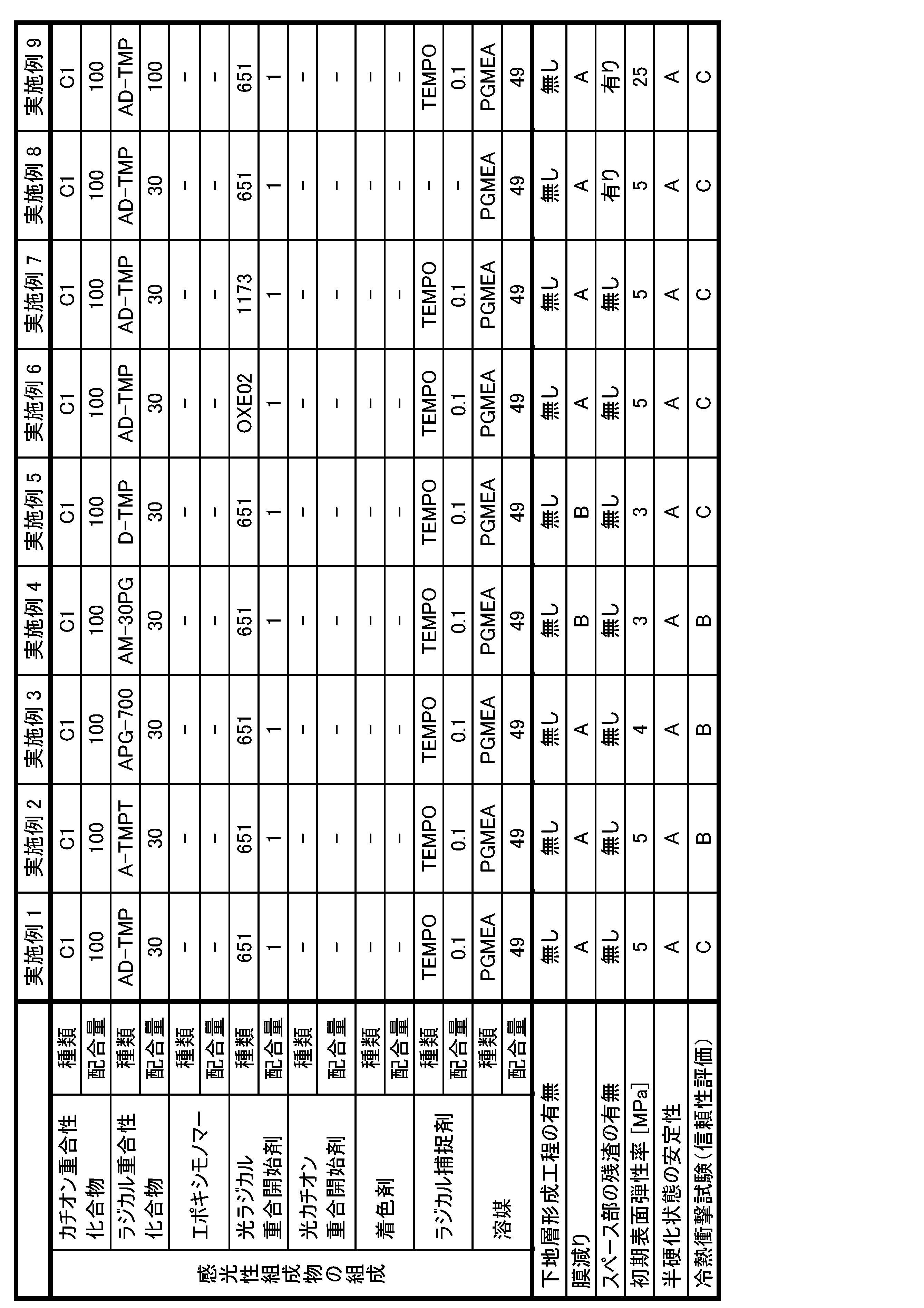
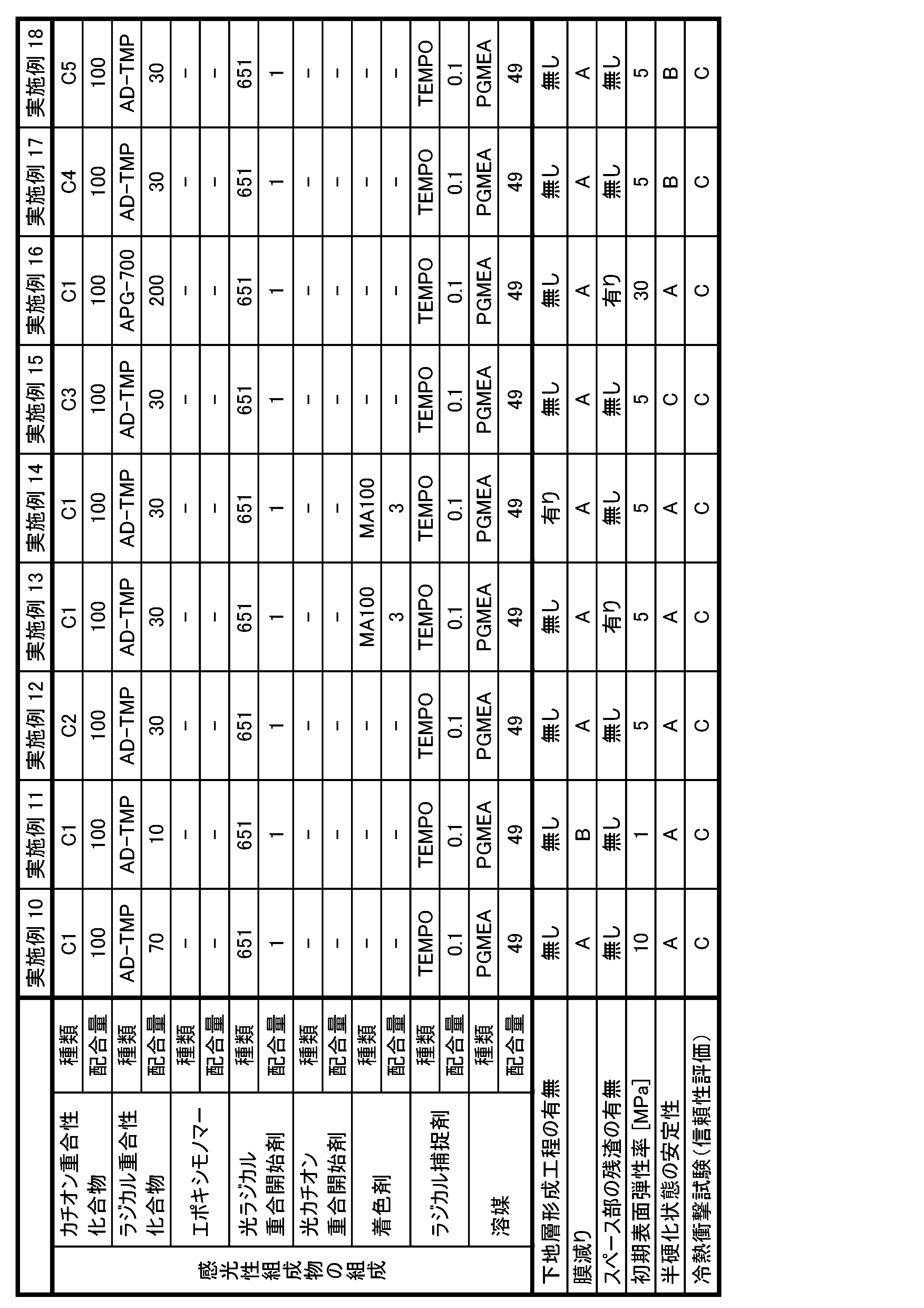

実施例1~21で使用した感光性組成物は、カチオン重合性化合物と、(メタ)アクリロイル基を有するラジカル重合性化合物と、光重合開始剤とを含んでいた。実施例1~21で使用した感光性組成物では、光重合開始剤が光ラジカル重合開始剤であった。実施例1~21で使用した感光性組成物では、カチオン重合性化合物が、1分子中にカチオン重合性基とアルカリ可溶性基とを有していた。実施例1~21で使用した感光性組成物では、ラジカル重合性化合物の量が、カチオン重合性化合物100質量部に対して、5質量部以上であった。実施例1~21で使用した感光性組成物では、カチオン重合性化合物が有するアルカリ可溶性基が、X1基、X2基及びフェノール性水酸基からなる群より選択される1種以上であった。
実施例1~21では、膜減りの判定結果がA又はBであった。よって、実施例1~21は、現像時の膜減りを抑制できていた。実施例1~21では、半硬化状態の安定性の判定結果がA、B又はCであった。よって、実施例1~21は、パターン膜の半硬化状態を安定して維持できていた。
比較例1、2及び4で使用した感光性組成物は、(メタ)アクリロイル基を有するラジカル重合性化合物及び光ラジカル重合開始剤を含んでいなかった。比較例3で使用した感光性組成物は、光重合開始剤として光ラジカル重合開始剤及び光カチオン重合開始剤を含んでいた。比較例5で使用した感光性組成物では、ラジカル重合性化合物の量が、カチオン重合性化合物100質量部に対して、5質量部未満であった。比較例6で使用した感光性組成物では、カチオン重合性化合物が有するアルカリ可溶性基が、カルボキシ基であった。
比較例5では、膜減りの判定結果がCであった。よって、比較例5は、現像時の膜減りを抑制できていなかった。比較例1~4及び6では、半硬化状態の安定性の判定結果がDであった。よって、比較例1~4及び6は、パターン膜の半硬化状態を安定して維持できていなかった。
以上の結果から、本発明に係る感光性組成物が、現像時の膜減りを抑制しつつ、パターン膜の半硬化状態を安定して維持できることが示された。
10、20 基板積層体
11 第1基板
12 第2基板
13、21 硬化物層
14、26 塗膜
14a、26a 露光部
14b、26b 非露光部
15、27 パターン膜(パターン化された塗膜)
16、28 積層物
22 第1層
23 第2層
24 下地層(第1塗工層)
24a 第1半硬化層
25 着色層(第2塗工層)
25a 第2半硬化層
11 第1基板
12 第2基板
13、21 硬化物層
14、26 塗膜
14a、26a 露光部
14b、26b 非露光部
15、27 パターン膜(パターン化された塗膜)
16、28 積層物
22 第1層
23 第2層
24 下地層(第1塗工層)
24a 第1半硬化層
25 着色層(第2塗工層)
25a 第2半硬化層
Claims (14)
- カチオン重合性化合物と、ラジカル重合性化合物と、光重合開始剤とを含む感光性組成物であって、
前記光重合開始剤は、光ラジカル重合開始剤であり、
前記カチオン重合性化合物は、1分子中にカチオン重合性基とアルカリ可溶性基とを有し、
前記ラジカル重合性化合物は、(メタ)アクリロイル基を有し、
前記ラジカル重合性化合物の量が、前記カチオン重合性化合物100質量部に対して、5質量部以上であり、
前記アルカリ可溶性基は、下記化学式(X1)で表される1価の有機基、下記化学式(X2)で表される2価の有機基、及びフェノール性水酸基からなる群より選択される1種以上である、感光性組成物。

- 前記ラジカル重合性化合物の量が、前記カチオン重合性化合物100質量部に対して、200質量部以下である、請求項1に記載の感光性組成物。
- 前記カチオン重合性化合物は、ポリシロキサン構造を有する、請求項1に記載の感光性組成物。
- 前記カチオン重合性基は、脂環式エポキシ基、グリシジル基及びオキセタニル基からなる群より選択される1種以上である、請求項1に記載の感光性組成物。
- 前記ラジカル重合性化合物は、1分子中にイソシアヌル環と前記(メタ)アクリロイル基とを有する、請求項1に記載の感光性組成物。
- 着色剤を更に含む、請求項1に記載の感光性組成物。
- 基板と、前記基板上に配置された、半硬化状態の感光性組成物から構成されるパターン膜とを有するパターン膜付き基板であって、
前記感光性組成物は、請求項1に記載の感光性組成物である、パターン膜付き基板。 - 基板と、前記基板上に配置されたパターン膜とを有するパターン膜付き基板であって、
前記パターン膜が、前記基板側から、半硬化状態の第1感光性組成物から構成される第1半硬化層、及び半硬化状態の第2感光性組成物から構成される第2半硬化層をこの順に有し、
前記第1感光性組成物は、アルカリ可溶性、カチオン重合性及び光重合性を有し、かつ着色剤を含まない感光性組成物であり、
前記第2感光性組成物は、請求項6に記載の感光性組成物である、パターン膜付き基板。 - 第1基板、第2基板、及び前記第1基板と前記第2基板とを接着する硬化物層を有する基板積層体であって、
前記硬化物層は、請求項1に記載の感光性組成物の硬化物から構成される、基板積層体。 - 第1基板、第2基板、及び前記第1基板と前記第2基板とを接着する硬化物層を有する基板積層体であって、
前記硬化物層が、前記第1基板側から、第1感光性組成物の硬化物から構成される第1層、及び第2感光性組成物の硬化物から構成される第2層をこの順に有し、
前記第1感光性組成物は、アルカリ可溶性、カチオン重合性及び光重合性を有し、かつ着色剤を含まない感光性組成物であり、
前記第2感光性組成物は、請求項6に記載の感光性組成物である、基板積層体。 - 前記第1基板は、ガラス基板であり、
前記第2基板は、半導体素子基板である、請求項9又は10に記載の基板積層体。 - 第1基板上に請求項1に記載の感光性組成物を塗布することにより塗膜を形成し、
前記塗膜にフォトマスクを通して光を照射することにより、前記塗膜において、半硬化状態の前記感光性組成物から構成される露光部と、非露光部とを形成し、
アルカリ性現像液で前記非露光部を前記第1基板上から除去することにより、前記第1基板上にパターン化された前記塗膜を形成し、
前記第1基板と第2基板とを、前記パターン化された塗膜を介して積層することにより積層物を形成し、
前記積層物を加熱して半硬化状態の前記パターン化された塗膜を更に硬化させることにより、前記第1基板と前記第2基板とを接着する、基板積層体の製造方法。 - 第1基板上に第1感光性組成物を塗布することにより第1塗工層を形成し、
前記第1塗工層上に第2感光性組成物を塗布することにより第2塗工層を形成し、
前記第1塗工層及び前記第2塗工層から構成される塗膜にフォトマスクを通して光を照射することにより、前記塗膜において、半硬化状態の前記第1感光性組成物から構成される第1半硬化層及び半硬化状態の前記第2感光性組成物から構成される第2半硬化層からなる露光部と、非露光部とを形成し、
アルカリ性現像液で前記非露光部を前記第1基板上から除去することにより、前記第1基板上にパターン化された前記塗膜を形成し、
前記第1基板と第2基板とを、前記パターン化された塗膜を介して積層することにより積層物を形成し、
前記積層物を加熱して半硬化状態の前記パターン化された塗膜を更に硬化させることにより、前記第1基板と前記第2基板とを接着する、基板積層体の製造方法であって、
前記第1感光性組成物は、アルカリ可溶性、カチオン重合性及び光重合性を有し、かつ着色剤を含まない感光性組成物であり、
前記第2感光性組成物は、請求項6に記載の感光性組成物である、基板積層体の製造方法。 - 前記第1基板は、ガラス基板であり、
前記第2基板は、半導体素子基板である、請求項12又は13に記載の基板積層体の製造方法。
Priority Applications (1)
| Application Number | Priority Date | Filing Date | Title |
|---|---|---|---|
| JP2023564915A JPWO2023100736A1 (ja) | 2021-12-02 | 2022-11-24 |
Applications Claiming Priority (2)
| Application Number | Priority Date | Filing Date | Title |
|---|---|---|---|
| JP2021-196496 | 2021-12-02 | ||
| JP2021196496 | 2021-12-02 |
Publications (1)
| Publication Number | Publication Date |
|---|---|
| WO2023100736A1 true WO2023100736A1 (ja) | 2023-06-08 |
Family
ID=86612086
Family Applications (1)
| Application Number | Title | Priority Date | Filing Date |
|---|---|---|---|
| PCT/JP2022/043327 Ceased WO2023100736A1 (ja) | 2021-12-02 | 2022-11-24 | 感光性組成物及びパターン膜付き基板、並びに基板積層体及びその製造方法 |
Country Status (2)
| Country | Link |
|---|---|
| JP (1) | JPWO2023100736A1 (ja) |
| WO (1) | WO2023100736A1 (ja) |
Cited By (1)
| Publication number | Priority date | Publication date | Assignee | Title |
|---|---|---|---|---|
| WO2026028872A1 (ja) * | 2024-07-31 | 2026-02-05 | パナソニックIpマネジメント株式会社 | 感光性樹脂組成物、液状材料、感光性樹脂シート及び電気配線板 |
Citations (7)
| Publication number | Priority date | Publication date | Assignee | Title |
|---|---|---|---|---|
| JP2010106120A (ja) * | 2008-10-29 | 2010-05-13 | Mitsubishi Rayon Co Ltd | 水性被覆材用樹脂分散液及びその製造方法、並びに水性被覆材 |
| JP2010223992A (ja) * | 2009-03-19 | 2010-10-07 | Hitachi Chem Co Ltd | 感光性接着剤組成物、並びにそれを用いたフィルム状接着剤、接着シート、接着剤パターン、接着剤層付半導体ウェハ及び半導体装置 |
| JP2011221192A (ja) * | 2010-04-07 | 2011-11-04 | Kaneka Corp | 硬化性組成物および硬化物 |
| JP2015069164A (ja) * | 2013-09-30 | 2015-04-13 | Jsr株式会社 | 感放射線性樹脂組成物、表示素子の絶縁膜、その形成方法及び表示素子 |
| JP2017082173A (ja) * | 2015-10-30 | 2017-05-18 | Jsr株式会社 | 硬化膜形成用樹脂材料、硬化膜の形成方法、硬化膜、半導体素子及び表示素子 |
| JP2017090513A (ja) * | 2015-11-02 | 2017-05-25 | 株式会社カネカ | ネガ型感光性樹脂組成物、硬化物および積層体 |
| JP2018060136A (ja) * | 2016-10-07 | 2018-04-12 | 東京応化工業株式会社 | 感光性樹脂組成物、硬化膜、カラーフィルタ、及び硬化膜の製造方法 |
-
2022
- 2022-11-24 WO PCT/JP2022/043327 patent/WO2023100736A1/ja not_active Ceased
- 2022-11-24 JP JP2023564915A patent/JPWO2023100736A1/ja active Pending
Patent Citations (7)
| Publication number | Priority date | Publication date | Assignee | Title |
|---|---|---|---|---|
| JP2010106120A (ja) * | 2008-10-29 | 2010-05-13 | Mitsubishi Rayon Co Ltd | 水性被覆材用樹脂分散液及びその製造方法、並びに水性被覆材 |
| JP2010223992A (ja) * | 2009-03-19 | 2010-10-07 | Hitachi Chem Co Ltd | 感光性接着剤組成物、並びにそれを用いたフィルム状接着剤、接着シート、接着剤パターン、接着剤層付半導体ウェハ及び半導体装置 |
| JP2011221192A (ja) * | 2010-04-07 | 2011-11-04 | Kaneka Corp | 硬化性組成物および硬化物 |
| JP2015069164A (ja) * | 2013-09-30 | 2015-04-13 | Jsr株式会社 | 感放射線性樹脂組成物、表示素子の絶縁膜、その形成方法及び表示素子 |
| JP2017082173A (ja) * | 2015-10-30 | 2017-05-18 | Jsr株式会社 | 硬化膜形成用樹脂材料、硬化膜の形成方法、硬化膜、半導体素子及び表示素子 |
| JP2017090513A (ja) * | 2015-11-02 | 2017-05-25 | 株式会社カネカ | ネガ型感光性樹脂組成物、硬化物および積層体 |
| JP2018060136A (ja) * | 2016-10-07 | 2018-04-12 | 東京応化工業株式会社 | 感光性樹脂組成物、硬化膜、カラーフィルタ、及び硬化膜の製造方法 |
Cited By (1)
| Publication number | Priority date | Publication date | Assignee | Title |
|---|---|---|---|---|
| WO2026028872A1 (ja) * | 2024-07-31 | 2026-02-05 | パナソニックIpマネジメント株式会社 | 感光性樹脂組成物、液状材料、感光性樹脂シート及び電気配線板 |
Also Published As
| Publication number | Publication date |
|---|---|
| JPWO2023100736A1 (ja) | 2023-06-08 |
Similar Documents
| Publication | Publication Date | Title |
|---|---|---|
| JP5867083B2 (ja) | ネガ型感光性樹脂組成物およびそれを用いた保護膜 | |
| US8475996B2 (en) | Photosensitive resin composition | |
| JP5144646B2 (ja) | 感光性樹脂組成物 | |
| AU2016232011A1 (en) | Novel siloxane polymer compositions and their use | |
| CN104245846B (zh) | 具有自由基交联性基团的聚硅氧烷组合物 | |
| JP5576622B2 (ja) | 感光性樹脂組成物 | |
| KR20180136942A (ko) | 수지 조성물, 그 경화막과 그 제조방법, 및 고체촬상소자 | |
| JP2021161401A (ja) | 樹脂組成物、遮光膜、遮光膜の製造方法および隔壁付き基板 | |
| KR102925365B1 (ko) | 수지 조성물, 및 감광성 수지 조성물 및 그 경화물 | |
| JP2020023654A (ja) | ポリマー、ポリマーの製造方法、感光性樹脂組成物、パターン、カラーフィルタ、ブラックマトリクス、液晶表示装置および固体撮像素子 | |
| JP2016151753A (ja) | 感光性組成物、硬化膜の製造方法、硬化膜、液晶表示装置、有機el表示装置、タッチパネル及びタッチパネル表示装置 | |
| WO2023100736A1 (ja) | 感光性組成物及びパターン膜付き基板、並びに基板積層体及びその製造方法 | |
| TW202312510A (zh) | 附肋基板及光半導體裝置 | |
| WO2022270546A1 (ja) | ネガ型感光性ポリマー、ポリマー溶液、ネガ型感光性樹脂組成物、硬化膜および半導体装置 | |
| JP2017137371A (ja) | 硬化性組成物および硬化物、硬化物と基材の接着方法 | |
| JP2024174546A (ja) | 固体撮像素子用パターン膜付き基板 | |
| WO2023140257A1 (ja) | ポリマー、ポリマー溶液、感光性樹脂組成物、および硬化物 | |
| US20250015105A1 (en) | Substrate laminate, image sensor, and method for manufacturing sustrate laminate | |
| TW202208510A (zh) | 硬化性樹脂組成物、硬化膜、積層體、硬化膜的製造方法、半導體元件及熱硬化性樹脂 | |
| CN115298611A (zh) | 含有反射率调节剂的负型感光性组合物 | |
| JP7631834B2 (ja) | ポリマー、ポリマー溶液、感光性樹脂組成物、および硬化物 | |
| JP7631832B2 (ja) | ポリマー、ポリマー溶液、感光性樹脂組成物、および硬化物 | |
| CN121941131A (zh) | 用于固体摄像元件的基板层叠体的制造方法 | |
| JP7669703B2 (ja) | ポリマー、ポリマー溶液、感光性樹脂組成物、および硬化物 | |
| JP2024165625A (ja) | 硬化性組成物、アルカリ現像性レジスト、および硬化物 |
Legal Events
| Date | Code | Title | Description |
|---|---|---|---|
| 121 | Ep: the epo has been informed by wipo that ep was designated in this application |
Ref document number: 22901169 Country of ref document: EP Kind code of ref document: A1 |
|
| ENP | Entry into the national phase |
Ref document number: 2023564915 Country of ref document: JP Kind code of ref document: A |
|
| NENP | Non-entry into the national phase |
Ref country code: DE |
|
| 122 | Ep: pct application non-entry in european phase |
Ref document number: 22901169 Country of ref document: EP Kind code of ref document: A1 |