WO2023095857A1 - 発光装置及び電子機器 - Google Patents
発光装置及び電子機器 Download PDFInfo
- Publication number
- WO2023095857A1 WO2023095857A1 PCT/JP2022/043476 JP2022043476W WO2023095857A1 WO 2023095857 A1 WO2023095857 A1 WO 2023095857A1 JP 2022043476 W JP2022043476 W JP 2022043476W WO 2023095857 A1 WO2023095857 A1 WO 2023095857A1
- Authority
- WO
- WIPO (PCT)
- Prior art keywords
- light
- sub
- protective film
- pixel
- light emitting
- Prior art date
- Legal status (The legal status is an assumption and is not a legal conclusion. Google has not performed a legal analysis and makes no representation as to the accuracy of the status listed.)
- Ceased
Links
Images

























Classifications
-
- H—ELECTRICITY
- H10—SEMICONDUCTOR DEVICES; ELECTRIC SOLID-STATE DEVICES NOT OTHERWISE PROVIDED FOR
- H10H—INORGANIC LIGHT-EMITTING SEMICONDUCTOR DEVICES HAVING POTENTIAL BARRIERS
- H10H20/00—Individual inorganic light-emitting semiconductor devices having potential barriers, e.g. light-emitting diodes [LED]
- H10H20/80—Constructional details
- H10H20/85—Packages
- H10H20/855—Optical field-shaping means, e.g. lenses
-
- H—ELECTRICITY
- H10—SEMICONDUCTOR DEVICES; ELECTRIC SOLID-STATE DEVICES NOT OTHERWISE PROVIDED FOR
- H10K—ORGANIC ELECTRIC SOLID-STATE DEVICES
- H10K59/00—Integrated devices, or assemblies of multiple devices, comprising at least one organic light-emitting element covered by group H10K50/00
- H10K59/10—OLED displays
- H10K59/12—Active-matrix OLED [AMOLED] displays
-
- G—PHYSICS
- G02—OPTICS
- G02B—OPTICAL ELEMENTS, SYSTEMS OR APPARATUS
- G02B5/00—Optical elements other than lenses
- G02B5/20—Filters
-
- G—PHYSICS
- G09—EDUCATION; CRYPTOGRAPHY; DISPLAY; ADVERTISING; SEALS
- G09F—DISPLAYING; ADVERTISING; SIGNS; LABELS OR NAME-PLATES; SEALS
- G09F9/00—Indicating arrangements for variable information in which the information is built-up on a support by selection or combination of individual elements
- G09F9/30—Indicating arrangements for variable information in which the information is built-up on a support by selection or combination of individual elements in which the desired character or characters are formed by combining individual elements
-
- G—PHYSICS
- G09—EDUCATION; CRYPTOGRAPHY; DISPLAY; ADVERTISING; SEALS
- G09F—DISPLAYING; ADVERTISING; SIGNS; LABELS OR NAME-PLATES; SEALS
- G09F9/00—Indicating arrangements for variable information in which the information is built-up on a support by selection or combination of individual elements
- G09F9/30—Indicating arrangements for variable information in which the information is built-up on a support by selection or combination of individual elements in which the desired character or characters are formed by combining individual elements
- G09F9/302—Indicating arrangements for variable information in which the information is built-up on a support by selection or combination of individual elements in which the desired character or characters are formed by combining individual elements characterised by the form or geometrical disposition of the individual elements
-
- H—ELECTRICITY
- H10—SEMICONDUCTOR DEVICES; ELECTRIC SOLID-STATE DEVICES NOT OTHERWISE PROVIDED FOR
- H10H—INORGANIC LIGHT-EMITTING SEMICONDUCTOR DEVICES HAVING POTENTIAL BARRIERS
- H10H20/00—Individual inorganic light-emitting semiconductor devices having potential barriers, e.g. light-emitting diodes [LED]
- H10H20/80—Constructional details
- H10H20/83—Electrodes
- H10H20/832—Electrodes characterised by their material
- H10H20/833—Transparent materials
-
- H—ELECTRICITY
- H10—SEMICONDUCTOR DEVICES; ELECTRIC SOLID-STATE DEVICES NOT OTHERWISE PROVIDED FOR
- H10H—INORGANIC LIGHT-EMITTING SEMICONDUCTOR DEVICES HAVING POTENTIAL BARRIERS
- H10H20/00—Individual inorganic light-emitting semiconductor devices having potential barriers, e.g. light-emitting diodes [LED]
- H10H20/80—Constructional details
- H10H20/85—Packages
- H10H20/851—Wavelength conversion means
- H10H20/8514—Wavelength conversion means characterised by their shape, e.g. plate or foil
-
- H—ELECTRICITY
- H10—SEMICONDUCTOR DEVICES; ELECTRIC SOLID-STATE DEVICES NOT OTHERWISE PROVIDED FOR
- H10H—INORGANIC LIGHT-EMITTING SEMICONDUCTOR DEVICES HAVING POTENTIAL BARRIERS
- H10H20/00—Individual inorganic light-emitting semiconductor devices having potential barriers, e.g. light-emitting diodes [LED]
- H10H20/80—Constructional details
- H10H20/85—Packages
- H10H20/857—Interconnections, e.g. lead-frames, bond wires or solder balls
-
- H—ELECTRICITY
- H10—SEMICONDUCTOR DEVICES; ELECTRIC SOLID-STATE DEVICES NOT OTHERWISE PROVIDED FOR
- H10K—ORGANIC ELECTRIC SOLID-STATE DEVICES
- H10K50/00—Organic light-emitting devices
- H10K50/80—Constructional details
- H10K50/84—Passivation; Containers; Encapsulations
- H10K50/844—Encapsulations
-
- H—ELECTRICITY
- H10—SEMICONDUCTOR DEVICES; ELECTRIC SOLID-STATE DEVICES NOT OTHERWISE PROVIDED FOR
- H10K—ORGANIC ELECTRIC SOLID-STATE DEVICES
- H10K50/00—Organic light-emitting devices
- H10K50/80—Constructional details
- H10K50/85—Arrangements for extracting light from the devices
- H10K50/856—Arrangements for extracting light from the devices comprising reflective means
-
- H—ELECTRICITY
- H10—SEMICONDUCTOR DEVICES; ELECTRIC SOLID-STATE DEVICES NOT OTHERWISE PROVIDED FOR
- H10K—ORGANIC ELECTRIC SOLID-STATE DEVICES
- H10K50/00—Organic light-emitting devices
- H10K50/80—Constructional details
- H10K50/85—Arrangements for extracting light from the devices
- H10K50/858—Arrangements for extracting light from the devices comprising refractive means, e.g. lenses
-
- H—ELECTRICITY
- H10—SEMICONDUCTOR DEVICES; ELECTRIC SOLID-STATE DEVICES NOT OTHERWISE PROVIDED FOR
- H10K—ORGANIC ELECTRIC SOLID-STATE DEVICES
- H10K59/00—Integrated devices, or assemblies of multiple devices, comprising at least one organic light-emitting element covered by group H10K50/00
- H10K59/10—OLED displays
-
- H—ELECTRICITY
- H10—SEMICONDUCTOR DEVICES; ELECTRIC SOLID-STATE DEVICES NOT OTHERWISE PROVIDED FOR
- H10K—ORGANIC ELECTRIC SOLID-STATE DEVICES
- H10K59/00—Integrated devices, or assemblies of multiple devices, comprising at least one organic light-emitting element covered by group H10K50/00
- H10K59/30—Devices specially adapted for multicolour light emission
- H10K59/38—Devices specially adapted for multicolour light emission comprising colour filters or colour changing media [CCM]
-
- H—ELECTRICITY
- H10—SEMICONDUCTOR DEVICES; ELECTRIC SOLID-STATE DEVICES NOT OTHERWISE PROVIDED FOR
- H10K—ORGANIC ELECTRIC SOLID-STATE DEVICES
- H10K59/00—Integrated devices, or assemblies of multiple devices, comprising at least one organic light-emitting element covered by group H10K50/00
- H10K59/80—Constructional details
- H10K59/87—Passivation; Containers; Encapsulations
- H10K59/873—Encapsulations
-
- H—ELECTRICITY
- H10—SEMICONDUCTOR DEVICES; ELECTRIC SOLID-STATE DEVICES NOT OTHERWISE PROVIDED FOR
- H10K—ORGANIC ELECTRIC SOLID-STATE DEVICES
- H10K59/00—Integrated devices, or assemblies of multiple devices, comprising at least one organic light-emitting element covered by group H10K50/00
- H10K59/80—Constructional details
- H10K59/875—Arrangements for extracting light from the devices
- H10K59/879—Arrangements for extracting light from the devices comprising refractive means, e.g. lenses
-
- H—ELECTRICITY
- H10—SEMICONDUCTOR DEVICES; ELECTRIC SOLID-STATE DEVICES NOT OTHERWISE PROVIDED FOR
- H10W—GENERIC PACKAGES, INTERCONNECTIONS, CONNECTORS OR OTHER CONSTRUCTIONAL DETAILS OF DEVICES COVERED BY CLASS H10
- H10W90/00—Package configurations
Definitions
- the present disclosure relates to light-emitting devices and electronic devices.
- the display device has, for example, a plurality of pixels configured by a lower electrode, a light-emitting layer laminated on the lower electrode, and an upper electrode laminated on the light-emitting layer. By supplying a predetermined voltage to the lower electrode and the upper electrode, the light emitting layer sandwiched between the lower electrode and the upper electrode emits light.
- the present disclosure proposes a light-emitting device and an electronic device that can improve light extraction efficiency.
- a light-emitting device comprising a plurality of pixels arranged on a substrate, the pixels having a plurality of sub-pixels, at least one sub-pixel among the plurality of sub-pixels having a plurality of each of the light emitting elements includes a first electrode provided on the substrate, a light emitting layer laminated on the first electrode and emitting light, and a light emitting layer laminated on the light emitting layer a second electrode that transmits light from the light-emitting layer; and a first protective film that is laminated on the second electrode and transmits light from the light-emitting layer, and transmits the light to the light-emitting layer.
- a light-emitting device is provided in which a second protective film forming an interface for leading directly above a light-emitting element is embedded between the adjacent light-emitting elements.
- an electronic device equipped with a light-emitting device having a plurality of pixels arranged on a substrate, wherein the pixel has a plurality of sub-pixels, and at least one of the plurality of sub-pixels
- One sub-pixel has a plurality of light-emitting elements, and each of the light-emitting elements includes a first electrode provided on the substrate and a light-emitting layer laminated on the first electrode and emitting light.
- a second electrode stacked on the light emitting layer and transmitting light from the light emitting layer; and a first protective film stacked on the second electrode and transmitting light from the light emitting layer.
- a second protective film forming an interface for guiding the light directly above the light emitting elements is embedded between the adjacent light emitting elements.
- FIG. 1 is a schematic diagram showing an example of the overall configuration of a light emitting device 10 according to an embodiment of the present disclosure
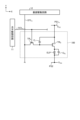
- FIG. FIG. 4 is a schematic circuit diagram for explaining the connection relationship in the sub-pixel 100 on the m-th row and n-th column.
- FIG. 5 is a cross-sectional view for explaining an example of a pixel configuration according to a comparative example
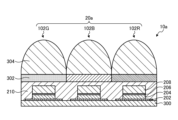
- 1 is a cross-sectional view for explaining an example of a pixel configuration according to a first embodiment of the present disclosure
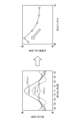
- FIG. 1 is a conceptual diagram for explaining the concept of a first embodiment of the present disclosure;
- FIG. 4 is an explanatory diagram showing simulation results regarding the light emitting element according to the first embodiment of the present disclosure
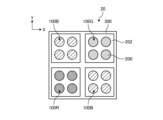
- 1 is a plan view for explaining the concept of a first embodiment of the present disclosure
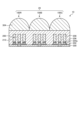
- FIG. FIG. 7 is a cross-sectional view for explaining an example of a pixel configuration according to a modification of the first embodiment of the present disclosure
- FIG. 4 is an explanatory diagram for explaining the pixel manufacturing method according to the first embodiment of the present disclosure
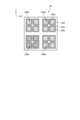
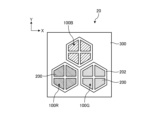
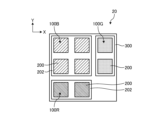
- FIG. 7 is a plan view for explaining an example of a pixel configuration according to a second embodiment of the present disclosure
- FIG. FIG. 11 is a plan view (part 1) for explaining an example of a pixel configuration according to a modification of the second embodiment of the present disclosure
- FIG. 11 is a plan view (Part 2) for explaining an example of a pixel configuration according to a modification of the second embodiment of the present disclosure
- FIG. 11 is a plan view (part 3) for explaining an example of a pixel configuration according to a modification of the second embodiment of the present disclosure
- FIG. 11 is a plan view (part 4) for explaining an example of a pixel configuration according to a modification of the second embodiment of the present disclosure
- FIG. 11 is a plan view (No. 5) for explaining an example of a pixel configuration according to a modification of the second embodiment of the present disclosure
- FIG. 16 is a plan view (No. 6) for explaining an example of a pixel configuration according to a modification of the second embodiment of the present disclosure
- FIG. 16 is a plan view (No. 6) for explaining an example of a pixel configuration according to a modification of the second embodiment of the present disclosure
- FIG. 16 is a plan view (No. 6) for explaining an example of a pixel configuration according to a modification of the
- FIG. 12 is a plan view (No. 8) for explaining an example of a pixel configuration according to a modification of the second embodiment of the present disclosure
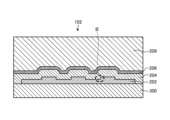
- FIG. 5 is a cross-sectional view for explaining an example of the configuration of a sub-pixel according to a comparative example
- FIG. 11 is a cross-sectional view for explaining an example of a sub-pixel configuration according to a third embodiment of the present disclosure
- FIG. 11 is a cross-sectional view for explaining an example of a pixel configuration according to a fourth embodiment of the present disclosure
- FIG. 11 is a cross-sectional view for explaining an example of a configuration of a light emitting device according to a fifth embodiment of the present disclosure
- FIG. 20 is a cross-sectional view (part 1) for explaining an example of a configuration of a light-emitting element according to a modification of the fifth embodiment of the present disclosure
- FIG. 21 is a cross-sectional view (part 2) for explaining an example of a configuration of a light-emitting element according to a modification of the fifth embodiment of the present disclosure
- FIG. 20 is a cross-sectional view (Part 3) for explaining an example of a configuration of a light-emitting element according to a modification of the fifth embodiment of the present disclosure
- FIG. 12 is a cross-sectional view (part 1) for explaining an example of a configuration of a pixel according to the sixth embodiment of the present disclosure
- FIG. 21 is a cross-sectional view (part 2) for explaining an example of a configuration of a pixel according to the sixth embodiment of the present disclosure
- FIG. 20 is a cross-sectional view (part 3) for explaining an example of a configuration of a pixel according to the sixth embodiment of the present disclosure
- FIG. 21 is a plan view (part 1) for explaining an example of a pixel configuration according to the seventh embodiment of the present disclosure
- FIG. 21 is a plan view (part 2) for explaining an example of a pixel configuration according to the seventh embodiment of the present disclosure
- FIG. 21 is a plan view (Part 3) for explaining an example of a configuration of a pixel according to the seventh embodiment of the present disclosure
- FIG. 22 is a plan view (part 4) for explaining an example of a pixel configuration according to the seventh embodiment of the present disclosure
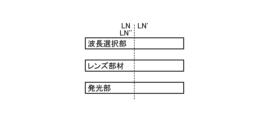
- FIG. 4 is a conceptual diagram (Part 1) for explaining the relationship between a normal LN passing through the center of the light emitting section, a normal LN' passing through the center of the lens member, and a normal LN'' passing through the center of the wavelength selecting section; .
- Part 1 for explaining the relationship between a normal LN passing through the center of the light emitting section, a normal LN' passing through the center of the lens member, and a normal LN'' passing through the center of the wavelength selecting section; .
- FIG. 2 is a conceptual diagram (Part 2) for explaining the relationship between a normal LN passing through the center of the light emitting section, a normal LN' passing through the center of the lens member, and a normal LN'' passing through the center of the wavelength selecting section; .
- FIG. 3 is a conceptual diagram (3) for explaining the relationship between a normal LN passing through the center of the light emitting section, a normal LN' passing through the center of the lens member, and a normal LN'' passing through the center of the wavelength selecting section; .
- FIG. 3 is a conceptual diagram (3) for explaining the relationship between a normal LN passing through the center of the light emitting section, a normal LN' passing through the center of the lens member, and a normal LN'' passing through the center of the wavelength selecting section; .
- FIG. 4 is a conceptual diagram (part 4) for explaining the relationship between a normal LN passing through the center of the light emitting section, a normal LN' passing through the center of the lens member, and a normal LN'' passing through the center of the wavelength selecting section; .
- FIG. 11 is a conceptual diagram (No. 5) for explaining the relationship between a normal LN passing through the center of the light emitting section, a normal LN' passing through the center of the lens member, and a normal LN'' passing through the center of the wavelength selecting section; .
- FIG. 11 is a conceptual diagram (No.
- FIG. 11 is a conceptual diagram (No. 7) for explaining the relationship between a normal LN passing through the center of the light emitting section, a normal LN' passing through the center of the lens member, and a normal LN'' passing through the center of the wavelength selecting section; .
- FIG. 2 is a schematic cross-sectional view for explaining a first example of a resonator structure
- FIG. 5 is a schematic cross-sectional view for explaining a second example of the resonator structure
- FIG. 10 is a schematic cross-sectional view for explaining a third example of the resonator structure;
- FIG. 11 is a schematic cross-sectional view for explaining a fourth example of the resonator structure;
- FIG. 11 is a schematic cross-sectional view for explaining a fifth example of the resonator structure;
- FIG. 11 is a schematic cross-sectional view for explaining a sixth example of the resonator structure;
- FIG. 11 is a schematic cross-sectional view for explaining a seventh example of the resonator structure;
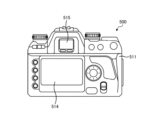
- 1 is a front view showing an example of the appearance of a digital still camera;
- FIG. 1 is a rear view showing an example of the appearance of a digital still camera;
- FIG. 1 is an external view of a head mounted display;
- FIG. 1 is an external view of a see-through head-mounted display
- FIG. 1 is an external view of a television device
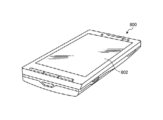
- FIG. 1 is an external view of a smartphone
- FIG. 1 is a diagram (part 1) showing the internal configuration of an automobile
- FIG. 1 is a diagram (part 2) showing the internal configuration of an automobile
- shapes expressed in the following descriptions refer not only to shapes defined mathematically or geometrically, but also to differences (errors and distortions) tolerable in the operation of the light-emitting device and the manufacturing process of the light-emitting device. ) are also meant to include similar shapes. Furthermore, “same” as used for specific shapes in the following description does not only mean that they are completely matched mathematically or geometrically; This includes cases where there is an allowable degree of difference (error/distortion) in the manufacturing process.
- electrically connecting means connecting a plurality of elements directly or indirectly through other elements.
- sharing means using one other element (eg, on-chip lens, etc.) between mutually different elements (eg, pixels, etc.).
- FIG. 1 is a schematic diagram showing an example of the overall configuration of a light emitting device 10 according to an embodiment of the present disclosure.
- the light-emitting device 10 is, for example, a device in which light-emitting elements such as OLED (Organic Light Emitting Diode) or Micro-OLED are formed in an array.
- a light emitting device 10 can be used as a display device, for example, a display device for VR (Virtual Reality), MR (Mixed Reality) or AR (Augmented Reality), an electronic view finder (EVF), or a small It can be applied to projectors and the like.
- the light emitting device 10 has a display area and a peripheral area provided around the periphery of the display area. As shown in FIG. 1, within the display area of the light emitting device 10, a plurality of sub-pixels 100R, 100G, and 100B are arranged in a matrix. Subpixel 100R can emit red light, subpixel 100G can emit green light, and subpixel 100B can emit blue light. In the following description, the sub-pixels 100R, 100G, and 100B are referred to as sub-pixels 100 when not distinguished.
- one pixel (pixel) 20 is configured by combining, for example, three types of sub-pixels 100R, 100G, and 100B that emit different light.
- the number and arrangement of the three types of sub-pixels 100R, 100G, and 100B included in one pixel 20 are not particularly limited.
- one pixel 20 is not limited to being composed of a plurality of sub-pixels 100 that emit different light, as described above. It may be composed of pixels 100 .
- the pixel 20 is also the minimum unit (pixel) controlled during light emission control of the light emitting device 10, and is composed of a plurality of sub-pixels 100 treated as one unit during control.
- the light emitting device 10 has a plurality of pixels 20 arranged in a matrix on the substrate.
- a horizontal drive circuit 11 and a vertical drive circuit 12 are provided in the peripheral area of the light emitting device 10 .
- the horizontal driving circuit 11 scans each row (in FIG. 1, the direction extending along the X direction is called the row direction) when writing a signal to each sub-pixel 100, and sends a scanning signal to each scanning line SCL m . can be supplied sequentially.
- the horizontal driving circuit 11 can be composed of, for example, a shift register or the like that sequentially shifts (transfers) start pulses in synchronization with input clock pulses.
- the vertical drive circuit 12 applies a signal voltage of a signal corresponding to luminance information supplied from a signal supply source (not shown) via a signal line DTL n in units of columns (in FIG. 1, extending along the Y direction). direction is referred to as column direction) to the selected sub-pixel 100 .
- the configuration of the light emitting device 10 is not limited to the configuration shown in FIG. That is, the configuration shown in FIG. 1 is merely an example, and various configurations can be adopted in the light emitting device 10 according to the embodiment of the present disclosure.
- FIG. 2 is a schematic circuit diagram for explaining the connection relationship in the sub-pixel 100 on the m-th row and n-th column.
- the sub-pixels 100 each including the light-emitting element ELP are provided with scanning lines SCL m extending in the row direction (the X direction in FIG. 1) and in the column direction (the Y direction in FIG. 1). They are arranged in a two-dimensional matrix while being connected to the signal line DTLn .
- the light emitting device 10 has a feeder line PS1m for supplying a driving voltage to the sub-pixels 100 and a common feeder line PS2 commonly connected to all the sub-pixels 100.
- a predetermined drive voltage Vcc or the like is supplied from a power supply unit (not shown) to the feeder line PS1m , and a common voltage Vcat (for example, ground potential) is supplied to the common feeder line PS2.
- the sub-pixel 100 positioned in the m-th row and n-th column may be referred to as the (n, m)-th sub-pixel 100 .
- the scanning signal from the horizontal driving circuit 11 sequentially scans the light-emitting device 10 row by row.
- the M sub-pixels 100 arranged in the m-th row are driven simultaneously.
- the light emission/non-light emission timing is controlled for each row to which they belong. For example, when the display frame rate of the light emitting device 10 is FR (times/second), the scanning period per row (so-called horizontal scanning period) when the light emitting device 10 is sequentially scanned row by row is (1/FR ) ⁇ (1/P) seconds.
- the sub-pixel 100 is composed of a light-emitting element ELP and a driving circuit for driving the same, as shown in FIG.
- the light-emitting element ELP consists of an organic electroluminescence light-emitting element.
- the drive circuit is composed of a write transistor TR W , a drive transistor TR D , and a capacitor C 1 . When current flows through the light emitting element ELP through the driving transistor TRD , the light emitting element ELP can emit light.
- Each transistor is composed of, for example, a p-channel field effect transistor.
- one source/drain region of the driving transistor TRD is electrically connected to one end of the capacitance section C1 and the power supply line PS1m , and the other source/drain region is electrically connected to the power supply line PS1m.
- the /drain region is electrically connected to one end (specifically, the anode electrode) of the light emitting element ELP.
- a gate electrode of the drive transistor TRD is connected to the other source/drain region of the write transistor TRW and electrically connected to the other end of the capacitance section C1 .
- one source/drain region of the write transistor TR_w is electrically connected to the signal line DTL_n , and the gate electrode of the write transistor TR_w is electrically connected to the scanning line SCL_m . properly connected.
- the other end (specifically, the cathode electrode) of the light emitting element ELP is electrically connected to the common feed line PS2. Further, a predetermined cathode voltage Vcat is supplied to the common power supply line PS2. Note that in FIG. 2, the capacitance of the light emitting element ELP is indicated by the symbol CEL .
- the configuration of the drive circuit that controls the light emission of the light emitting element ELP is not limited to the configuration shown in FIG. Therefore, the configuration shown in FIG. 2 is merely an example, and various configurations can be adopted in the light emitting device 10 according to the embodiment of the present disclosure.
- FIG. 3 is a cross-sectional view for explaining an example of the configuration of a pixel 20a according to a comparative example.
- the comparative example shall mean the pixel 20a which the present inventor repeatedly examined before making the embodiment of the present disclosure.
- the light emitting device 10a has a plurality of pixels (pixels) 20a.
- pixels pixels
- FIG. It consists of a combination of
- the sub-pixel 102R can emit red light
- the sub-pixel 102G can emit green light
- the sub-pixel 102B can emit blue light.
- the number and arrangement of the three types of sub-pixels 102R, 102G, and 102B included in one pixel 20a are not limited.
- each sub-pixel 102 includes an anode electrode (first electrode) 202 provided on the substrate 300, a light emitting layer 204 laminated on the anode electrode 202, and a light emitting layer 204 on the light emitting layer 204. and a cathode electrode (second electrode) 206 that transmits light from the light emitting layer 204, and a protective film (first protective film) that is stacked on the cathode electrode 206 and transmits light from the light emitting layer 204. 208.
- the sub-pixels 102 are covered with a protective film (second protective film) 210, and the color filter 302 and the on-chip lens 304 are formed on the protective film 210 for each sub-pixel 102. is provided in
- the pixel 20a according to the comparative example a predetermined voltage is supplied to the anode electrode 202 and the cathode electrode 206, so that the light emitting layer 204 sandwiched between the anode electrode 202 and the cathode electrode 206 emits light. becomes. Specifically, in the comparative example, light is emitted from the light emitting layer 204 along the direction from the anode electrode 202 toward the cathode electrode 206 side. In other words, the light emitting device 10a according to the comparative example is a top emission type light emitting device.
- the inventor of the present invention has been earnestly studying how to further improve the light extraction efficiency from each sub-pixel 102 in such a pixel 20a.
- the light emitted from the light-emitting layer 204 in FIG. 3 has a large emission angle and is widely diffused. Improvement was limited. Therefore, the inventors of the present invention believe that if the spread of light emitted upward from each sub-pixel 102 can be narrowed (in other words, the radiation angle can be reduced), the light extraction efficiency of the light emitting device 10 can be further improved. This realization led to the creation of the embodiments of the present disclosure described below.
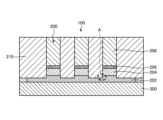
- FIG. 4 is a cross-sectional view for explaining an example of the configuration of the pixel 20 according to the first embodiment of the present disclosure. Specifically, the pixel 20 is cut in a direction perpendicular to the plane of the substrate 300. It is a cross-sectional view of the case. 5 is a conceptual diagram for explaining the concept of the first embodiment of the present disclosure, and FIG. 6 is an explanatory diagram showing simulation results regarding the light emitting element 200 according to the first embodiment of the present disclosure. is. Furthermore, FIG. 7 is a plan view for explaining the concept of the first embodiment of the present disclosure.
- FIG. 7 shows the case where the pixel 20a according to the comparative example is cut parallel to the plane of the substrate 300 at the height of the light emitting layer 204, and the right side of FIG.
- the pixel 20 according to the embodiment is shown cut parallel to the plane of the substrate 300 at the height of the light emitting layer 204 .
- the pixel 20 includes three types of sub-pixels 100R that emit light of different colors, It is configured by combining 100G and 100B.
- the sub-pixel 100R can emit red light
- the sub-pixel 100G can emit green light
- the sub-pixel 100B can emit blue light.
- the number and arrangement of the three types of sub-pixels 100R, 100G, and 100B included in one pixel 20 are not limited.
- each sub-pixel 100 has a plurality of light emitting elements 200 that emit light of the same color. In other words, the sub-pixel 100 is divided into a plurality of light emitting elements 200 in this embodiment.
- each light emitting element 200 has an anode electrode (first electrode) 202 provided on the substrate 300 and a light emitting layer 204 laminated on the anode electrode 202, as in the comparative example.
- a cathode electrode (second electrode) 206 stacked on the light emitting layer 204 and transmitting light from the light emitting layer 204; and a protective film (second electrode) stacked on the cathode electrode 206 and transmitting light from the light emitting layer 204 ( (first protective film) 208 .
- a color filter 302 and an on-chip lens 304 are provided for each sub-pixel 100, as in the comparative example.
- the light extraction efficiency of the light emitting device 10 can be improved by further dividing the sub-pixel 100 into smaller pieces so that it is composed of a plurality of light emitting elements 200.
- the width d of the light emitting element 200 is narrow in this embodiment.
- the protective film 208 functions like a waveguide, and the light from the light emitting layer 204 can be guided upward while suppressing the spread. As a result, in the present embodiment, it is possible to improve the upward light extraction efficiency of the light emitting device 10 .
- FIG. 6 shows the results of a simulation conducted by the inventor of the degree of spread of light with respect to the width d of the light emitting element 200 .
- FIG. 6 shows a graph showing the relationship between the width d of the light emitting element 200 and the light extraction angle (degree of spread) and the light extraction efficiency (light intensity) based on the simulation results, and the width d of the light emitting element 200.
- 3 shows a graph showing the relationship between (processing pitch) and the light extraction efficiency in front of the light emitting element 200.
- FIG. 6 by narrowing the width d of the light emitting element 200, the spread of light from the light emitting layer 204 is suppressed, and the light extraction efficiency of the light emitting device 10 in front of the light emitting element 200 is improved. can be done.
- the width d of the light emitting element 200 is narrowed.
- the aperture ratio is the ratio of the area of the light emitting layer 204 to the area of the substrate 300 when the substrate 300 is viewed from above.
- the present inventor provides a plurality of light emitting elements 200 each having a narrow width d in the sub-pixel 100, thereby improving the light extraction efficiency without lowering the aperture ratio. .
- the pixel 20 is a combination of three types of sub-pixels 100R, 100G, and 100B that emit light of different colors. It is constructed by being Here, the sub-pixel 100R emits red light (eg, visible light having a wavelength of approximately 640 nm to 770 nm), and the sub-pixel 100G emits green light (eg, visible light having a wavelength of approximately 490 nm to 550 nm). , the sub-pixel 100B can emit blue light (for example, visible light having a wavelength of about 430 nm to 490 nm).
- the number and arrangement of the three types of sub-pixels 100R, 100G, and 100B included in one pixel 20 are not limited. Furthermore, in this embodiment, the pixel 20 may have sub-pixels 100 that emit light other than red, blue, and green light.
- each sub-pixel 100 has a plurality of light-emitting elements 200 that emit light of the same color.
- each sub-pixel 100 only needs to have a plurality of light emitting elements 200, and is not limited to having a plurality of light emitting elements 200 that emit light of the same color.
- the light emitting element 200 has a rectangular shape, and the length of one side of the light emitting element 200 ( That is, the width d) is preferably about 400 nm to 800 nm.
- the shape of the light emitting element 200 in plan view is not limited to a rectangular shape, and may be, for example, a polygonal shape, a circular shape, an elliptical shape, or the like.
- each light emitting element 200 includes an anode electrode (first electrode) 202 provided on a substrate 300, a light emitting layer 204 stacked on the anode electrode 202 and emitting light, A cathode electrode (second electrode) 206 stacked on the light emitting layer 204 and transmitting light from the light emitting layer 204 and a protective film (first electrode) stacked on the cathode electrode 206 and transmitting light from the light emitting layer 204 (first electrode) protective film) 208.
- the substrate 300 is a glass substrate such as high strain point glass, soda glass, borosilicate glass, forsterite, lead glass, or quartz glass, a semiconductor substrate such as amorphous silicon or polycrystalline silicon, or polymethyl methacrylate. , polyvinyl alcohol, polyvinyl phenol, polyethersulfone, polyimide, polycarbonate, polyethylene terephthalate, or polyethylene naphthalate.
- the anode electrodes 202 of the plurality of light emitting elements 200 in one sub-pixel 100 are electrically connected to each other. More specifically, as shown on the right side of FIG.
- the electrodes 202 together constitute one shared electrode. In other words, multiple light emitting elements 200 in one sub-pixel 100 share one common electrode 202 .
- the anode electrode 202 may also function as a reflective layer, and is preferably composed of a metal film with a high reflectance and a large work function to improve light extraction efficiency.
- metal films include chromium (Cr), gold (Au), platinum (Pt), nickel (Ni), copper (Cu), molybdenum (Mo), titanium (Ti), tantalum (Ta),
- a metal film containing at least one element or alloy of metal elements such as aluminum (Al), magnesium (Mg), iron (Fe), tungsten (W), and silver (Ag) can be mentioned.
- the alloys include aluminum (Al) alloys such as AlNi alloys and AlCu alloys, and silver (Ag) alloys such as MgAg alloys.
- the anode electrode 202 may be formed of a transparent conductive film such as indium tin oxide (ITO), indium zinc oxide (IZO), zinc oxide (ZnO), or the like.
- the light-emitting layer 204 provided on the anode electrode 202 is a layer made of an organic material or an inorganic material and capable of emitting white light.
- the light emitting layer 204 includes a hole injection layer (not shown) and a hole transport layer (not shown) provided adjacent to the anode electrode 202, and an electron transport layer (not illustrated) provided adjacent to the cathode electrode 206. (illustration omitted).
- the light emitting layer 204 can have a structure in which a hole injection layer, a hole transport layer, a light emitting layer 204, and an electron transport layer (not shown) are laminated from the anode electrode 202 side.
- the hole injection layer functions as a layer that increases the efficiency of hole injection into the light emitting layer 204 and also functions as a buffer layer for suppressing leakage.
- the hole-transporting layer functions as a layer that increases the efficiency of transporting holes to the light-emitting layer 204 .
- recombination of electrons and holes occurs when an electric field is generated, and light can be generated.
- the electron transport layer functions as a layer that enhances electron transport efficiency to the light emitting layer 204 .
- the light emitting layer 204 may have an electron injection layer (not shown) between the electron transport layer and the cathode electrode 206 .
- the electron injection layer functions as a layer that increases electron injection efficiency.
- the structure of the light-emitting layer 204 is not limited to the structure described above, and layers other than the hole injection layer and the light-emitting layer 204 can be provided as necessary. Further, in the present embodiment, the light-emitting layers 204 of the light-emitting elements 200 of all the sub-pixels 100 may be formed to have the same structure, or may be formed to have different structures. not to be
- the cathode electrode 206 provided on the light-emitting layer 204 is a transparent electrode that is transparent to the light generated in the light-emitting layer 204.
- the transparent electrode also includes a semi-transmissive electrode.
- the cathode electrode 206 is formed from a metal film containing at least one element or alloy of metal elements such as aluminum (Al), magnesium (Mg), calcium (Ca), sodium (Na), and silver (Ag). be able to.
- Specific examples of alloys include aluminum (Al) alloys such as MgAg alloys and AlLi alloys, and silver (Ag) alloys.
- the cathode electrode 206 may be formed from a transparent conductive film such as indium tin oxide (ITO), indium zinc oxide (IZO), zinc oxide (ZnO), or the like.
- the protective film 208 provided on the cathode electrode 206 is made of a material with a high refractive index.
- the protective film 208 is made of a material having a refractive index of about 1.7 to 2.1 for light having a wavelength of about 450 nm at room temperature.
- the protective film 208 is, for example, a nitride film such as silicon nitride (SiN), a transparent conductive film such as indium tin oxide (ITO), indium zinc oxide (IZO), or zinc oxide (ZnO), or a transparent organic film. etc.
- a protective film (second protective film) 210 which constitutes an interface with a protective film 208 for guiding light directly above the light emitting element 200, is an adjacent light emitting element. embedded between 200.
- the protective film 210 is embedded between the adjacent light emitting elements 200 and provided so as to cover the light emitting elements 200 .
- the protective film 210 is provided so as to fill between the adjacent light emitting elements 200 from the upper surface of the protective film 208 to the lower surface of the light emitting layer 204 .
- the protective film 210 may be formed of a material having a lower refractive index than the protective film 208, and may be formed of a material having a refractive index different from that of the protective film 208 by, for example, 0.3 or more. preferable.
- the protective film 210 can be formed of, for example, an oxide film such as silicon oxide (SiO 2 ) or aluminum oxide (Al 2 O 3 ), a resin film, or a cavity, that is, air (air gap).
- the protective films 208 and 210 from a material having a refractive index as described above, the light from the light emitting layer 204 is diffracted many times at the boundary between the protective films 208 and 210. and can be confined within the protective film 208 and interfere.
- the color filter 302 and the on-chip lens 304 are provided above the protective film 208 for each sub-pixel 100 .
- the plurality of light emitting elements 200 included in one sub-pixel 100 share one on-chip lens 304, and one lens provided between the protective film 208 and the on-chip lens 304.
- the color filter 302 is shared.
- the color filter 302 can be formed from a color filter that transmits a red wavelength component, a color filter that transmits a green wavelength component, or a color filter that transmits a blue wavelength component.
- color filter 302 may be formed from a material having pigments or dyes dispersed in a clear binder such as silicone.
- the on-chip lens 304 can be made of a styrene resin, an acrylic resin, a styrene-acrylic copolymer resin, a siloxane resin, or the like.
- the sub-pixel 100 is composed of a plurality of light emitting elements 200 having a width d of, for example, 400 nm to 800 nm, and the protective film 210 embedded between adjacent light emitting elements 200 is , is formed of a material having a lower refractive index than the protective film 208 of the light emitting device 200 . Therefore, in this embodiment, the protective film 208 and the protective film 210 form an interface for guiding light directly above the light emitting element 200 . As a result, in this embodiment, the light from the light emitting layer 204 of the light emitting element 200 is diffracted many times at the boundary between the protective film 208 and the protective film 210 surrounding the protective film 208, causing interference within the protective film 208.
- the protective film 208 functions like a waveguide to guide more of the light from the light emitting layer 204 upward, thereby improving the light extraction efficiency of the light emitting device 10. be able to. Furthermore, in the present embodiment, since the sub-pixel 100 has a plurality of light emitting elements 200 sharing one anode electrode 202, even when the light emitting elements 200 having a small width d are provided, the aperture ratio can be reduced. You can avoid lowering it. As a result, according to this embodiment, the light extraction efficiency can be improved without lowering the aperture ratio.
- the sub-pixel 100 by configuring the sub-pixel 100 with a plurality of light-emitting elements 200, for example, if one light-emitting element 200 included in one sub-pixel 100 fails and does not emit light, Also, other light emitting elements 200 emit light, so that the light emission of the sub-pixel 100 can be maintained. Therefore, in this embodiment, the operation of the light emitting device 10 can be made more stable.
- FIG. 8 is a cross-sectional view for explaining an example of a pixel configuration according to a modification of this embodiment, and corresponds to the cross-sectional view shown in FIG.
- the color filter 302 may not be provided between the protective film 208 and the on-chip lens 304 .
- the light emitting layer 204a of each light emitting element 200 is made of an organic material or an inorganic material, and emits any one of red light, green light and blue light. formed from layers capable of emitting
- FIG. 9A and 9B are explanatory diagrams for explaining the manufacturing method of the pixel 20 of this embodiment, and correspond to the cross-sectional view of FIG.
- a patterned anode electrode 202 is formed on a substrate 300, and a light-emitting layer 204, a cathode electrode 206, and a protective film 208 are sequentially laminated on the anode electrode 202. As shown in FIG. 9, a patterned anode electrode 202 is formed on a substrate 300, and a light-emitting layer 204, a cathode electrode 206, and a protective film 208 are sequentially laminated on the anode electrode 202. As shown in FIG.
- photolithography is used to form a mask 400 having a predetermined pattern on the protective film 208 .
- a protective film 210 is embedded between the divided light emitting elements 200 .
- the structure shown in FIG. 4 can be obtained by forming contact electrodes (not shown), color filters 302, and on-chip lenses 304 on the protective film 210 and the light emitting element 200.
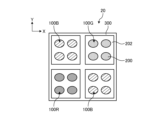
- FIG. 10 is a plan view for explaining an example of a pixel configuration according to the second embodiment of the present disclosure, and corresponds to the plan view shown on the right side of FIG.
- a plurality of light emitting elements 200 are provided on one anode electrode 202.
- the embodiment of the present disclosure is not limited to such a form, and the anode electrodes 202 of the plurality of light emitting elements 200 in one subpixel 100 may be electrically connected to each other.
- anodes of four light-emitting elements 200 arranged in a square (more specifically, a light-emitting element 200 is positioned at each vertex of the square).
- the electrodes 202 are electrically connected to each other by a connection electrode 202a located in the center of the four light emitting elements 200 as a whole.
- FIGS. 11A to 11H which describe a modification of the present embodiment, are plan views illustrating an example of a pixel configuration according to the modification of the present embodiment. be.
- one or two sub-pixels 100 (in FIG. 11A, a sub-pixel 100B emitting blue light) is configured to have a plurality of light emitting elements 200 as in the first embodiment.
- the remaining sub-pixels 102 (sub-pixels 102R emitting red light and sub-pixels 102G emitting green light in FIG. 11A) do not have a plurality of light-emitting elements 200, as in the comparative example. It is configured as one sub-pixel 102 .
- the light extraction efficiency can be adjusted according to the color of the light.
- Modification 2 Next, as shown in FIG. 11B, among the three types of sub-pixels 100 included in one pixel 20, one or two types of sub-pixels 100 (sub-pixels 100B emitting blue light in FIG. 11B) are The size of the light emitting element 200 and the size of the light emitting elements 200 of the remaining sub-pixels 100 (in FIG. 11B, the sub-pixel 100R emitting red light and the sub-pixel 100G emitting green light) may be different. Specifically, in the example shown in FIG. 11B, the size of the light-emitting element 200 of the sub-pixel 100B that emits blue light is larger than the size of the light-emitting element 200 of the sub-pixels 100R and 100G that emit red and green light. big. By doing so, according to this modified example, the light extraction efficiency can be adjusted according to the color of the light.
- the sub-pixel 100 is not limited to being composed of four light-emitting elements 200 arranged in a square, but two rectangular light-emitting elements 200 arranged along the Y direction in the drawing. It may be composed of one light emitting element 200 .
- the width of the light emitting element 200 is wide in the X direction, so the light emission angle is large, and the width of the light emitting element 200 is narrow in the Y direction, so the light emission angle is large. angle becomes smaller.
- the sub-pixel 100 may be composed of two light-emitting elements 200 arranged along the X direction in the figure.
- the sub-pixel 100 may be composed of an inner light emitting element 200a and a light emitting element 200b surrounding the light emitting element 200a.
- the width of one side of the inner light emitting element 200a is wider than the width of the outer light emitting element 200b, so the light spreads easily, but the outer light emitting element 200b is narrow. Therefore, the spread of light can be suppressed in the sub-pixel 100 as a whole. By doing so, according to this modification, the intensity of the light from the sub-pixels 100 can be made uniform.
- one sub-pixel 100 is not limited to being composed of four light-emitting elements 200 arranged in a square. For example, as shown in FIG. It may be composed of three light emitting elements 200 arranged along the . In addition, in this modification, the sub-pixel 100 may be composed of three light-emitting elements 200 arranged along the X direction in the figure. In addition, in this modification, one sub-pixel 100 may be composed of a plurality of light-emitting elements 200 arranged in a polygonal arrangement (specifically, a light-emitting element 200 is positioned at each vertex of the polygon). good. By doing so, according to this modified example, it is possible to adjust how light spreads along the X direction and the Y direction in the figure.
- one sub-pixel 100 is not limited to being composed of a plurality of rectangular light-emitting elements 200.
- FIG. It may be composed of a plurality of light emitting elements 200 having a shape of shape.
- the light emitting element 200 has a pentagonal shape.
- the three types of sub-pixels 100 included in one pixel 20 do not have to have the same number of light-emitting elements 200 .
- the three sub-pixels 100 included in one pixel 20 among the three sub-pixels 100 included in one pixel 20, one or two sub-pixels 100 (in FIGS. 11G and 11H, emit blue light).
- the number of light-emitting elements 200 of the sub-pixel 100B) is four
- the number of the remaining sub-pixels 100 (sub-pixel 100R emitting red light and sub-pixel 100G emitting green light in FIGS. 11G and 11H) is four.
- the number of light emitting elements 200 is two.
- FIG. 12 is a cross-sectional view for explaining an example of the configuration of the sub-pixel 102 according to the comparative example
- FIG. 13 is a cross-sectional view for explaining an example of the configuration of the sub-pixel 100 according to this embodiment. , these figures correspond to the cross-sectional view of FIG.
- a periodic nanostructure plasmonic crystal
- the vector of the surface plasmon along the surface direction of the anode electrode 202 is reduced, so that the light from the light emitting layer 204 moves along the surface of the anode electrode 202.
- periodic steps are formed on the surface of the anode electrode 202 in order to suppress plasmon loss.
- a light-emitting layer 204, a cathode electrode 206, and a protective film 208 are sequentially laminated on the anode electrode 202 having periodic steps.
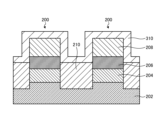
- periodic steps are formed in the anode electrode (common electrode) 202 of the light emitting element 200 in order to suppress plasmon loss.
- a convex portion (first region) on which the light-emitting layer 204 is laminated and a concave portion (second region) on which the light-emitting layer 204 is not laminated are formed on the upper surface of the anode electrode 202.
- the protective film 210 is provided so as to fill between the adjacent light emitting elements 200 from the upper surface of the protective film 208 to a position lower than the lower surface of the light emitting layer 204 .
- the anode electrode 202 is etched halfway to be divided into a plurality of light emitting elements 200. . Furthermore, by embedding a protective film 210 between the divided light emitting elements 200, a structure as shown in FIG. 13 can be obtained. That is, in this embodiment, the light-emitting layer 204 can be formed in self-alignment on the anode electrode 202 having periodic steps.
- the light emitted from the sub-pixels 102 can be easily spread and the occurrence of failure of the light emitting element 200 can be suppressed.
- the width d of the light emitting element 200 may be changed according to the color of light emitted by the sub-pixel 100.
- FIG. Therefore, with reference to FIG. 14, a fourth embodiment of the present disclosure will be described in which the width d of the light emitting element 200 is changed according to the color of light emitted by the sub-pixel 100.
- FIG. FIG. 14 is a cross-sectional view for explaining an example of the configuration of the pixel 20 according to this embodiment, and corresponds to the cross-sectional view of FIG.
- the width d of the light emitting element 200 differs according to the color of the light emitted by the sub-pixel 100 . Specifically, by narrowing the width d of the light-emitting element 200 according to the wavelength of light, the light from the light-emitting layer 204 can be more effectively interfered within the protective film 208, and the protective film 208 can Since the light can be guided upward, the light extraction efficiency can be improved. In this embodiment, the light extraction efficiency can be further improved by narrowing the width d of the light emitting element 200 so as to approach the interference limit of each light.
- the width dG of the adjacent light emitting elements 200 in the sub-pixel 100G emitting green light is equal to the width dG of the adjacent light emitting elements 200 in the sub-pixel 100B emitting blue light. It is narrower than the width d B of the element 200 and wider than the width d R of the adjacent light emitting element 200 in the sub-pixel 100R emitting red light. According to this embodiment, by changing the width d of the light emitting element 200 according to the color of the light emitted by the sub-pixel 100, the light interference effect in the protective film 208 is further enhanced, and the light extraction efficiency is improved. can be improved.
- FIG. 15 is a cross-sectional view for explaining an example of the configuration of the light-emitting element 200 according to this embodiment, and corresponds to the cross-sectional view of FIG.
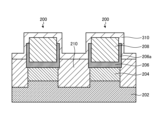
- FIG. 15 shows an example of the common contact electrode 310 when the protective film 208 is made of a conductive material.
- the common contact electrode 310 is provided so as to cover the protective film 208 and electrically connects the cathode electrodes 206 of the plurality of adjacent light emitting elements 200 by electrically connecting the protective film 208 . be able to.
- 16A to 16C an example of a common contact electrode 310 in which the protective film 208 is formed from a non-conductive material (that is, an insulating material) will be described as a modified example of the present embodiment.
- 16A to 16C are cross-sectional views for explaining an example of the configuration of the light-emitting element 200 according to the modified example of this embodiment, and correspond to the cross-sectional view of FIG.
- the protective film 210 is provided so as to fill between the adjacent light emitting elements 200 from the position of the lower surface of the protective film 208 to a position lower than the lower surface of the light emitting layer 204 .
- the common contact electrode 310 is provided so as to cover the entire protective film 208 and part of the side surface of the cathode electrode 206 .
- common contact electrode 310 is electrically connected to a portion of the side surface of cathode electrode 206 .
- the common contact electrode 310 can electrically connect the cathode electrodes 206 of the plurality of adjacent light emitting elements 200 .
- a wall 206a is formed of a conductive material so as to surround the periphery of the cathode electrode 206, and a protective film 208 is laminated within the area surrounded by the wall 206a.
- the common contact electrode 310 is formed to cover the entire protective film 208 surrounded by the wall 206a. According to this modification, the common contact electrode 310 can electrically connect the cathode electrodes 206 of the plurality of adjacent light emitting elements 200 .
- the protective film 208 has an opening 208a that exposes the upper surface of the cathode electrode 206, and the common contact electrode 310 is provided so as to cover the inside of the opening 208a.
- the common contact electrode 310 can electrically connect the cathode electrodes 206 of the plurality of adjacent light emitting elements 200 .
- the protective film (second protective film) 210 may be provided so as to form an interface for guiding light directly above the light emitting element 200 . That is, in the present disclosure, the protective film 210 is embedded between the adjacent light emitting elements 200 and provided so as to cover the light emitting elements 200 as in each of the embodiments described so far. is not limited to Therefore, a sixth embodiment of the present disclosure, in which a protective film (second protective film) 214 has a different form from the protective film 210 in the previous embodiments, will be described with reference to FIGS. 17 to 19.
- FIG. 17 to 19 are cross-sectional views for explaining an example of the pixel configuration according to this embodiment.
- each sub-pixel 100 has a plurality of light-emitting elements 200, similarly to the embodiments described so far.
- Each light-emitting element 200 includes an anode electrode 202 provided on the substrate 300, a light-emitting layer 204 laminated on the anode electrode 202, a cathode electrode 206 laminated on the light-emitting layer 204, and a cathode electrode 206 laminated on the cathode electrode 206. and a protective film 208 laminated on the substrate. Since each layer constituting the light emitting element 200 is formed of the materials described in the first embodiment, the description thereof is omitted here.
- the light emitting element 200 when viewed from above the substrate 300 (plan view), has a rectangular shape, and the length of one side of the light emitting element 200 is about 400 nm to 800 nm. is preferred. Also in this embodiment, the shape of the light emitting element 200 in plan view is not limited to being rectangular, and may be, for example, polygonal, circular, or elliptical.
- a protective film 214 forming an interface for guiding light directly above the light emitting elements 200 is embedded between adjacent light emitting elements 200 .
- the upper surface of the protective film 214 is higher than the upper surface of the protective film 208, and the lower surface of the protective film 214 is lower than the upper surface of the light emitting layer 204. is preferred.
- the protective film 214 has a lower refractive index than the protective film 208 and a lower refractive index than the protective film (third protective film) 212, which will be described later, similarly to the embodiments described so far. It is formed from the material it has.
- the protective film 214 is formed of a material having a refractive index lower than that of the protective films 208 and 212, and formed of a material having a refractive index different from that of the protective films 208 and 212 by, for example, 0.3 or more. is preferred.
- the protective film 214 can be formed of, for example, an oxide film such as silicon oxide (SiO 2 ) or aluminum oxide (Al 2 O 3 ), a resin film, or a cavity, that is, air (air gap).
- the protective film 214 may be formed from a metal film.
- the protective film 214 is formed using, for example, metals such as aluminum (Al), silver (Ag), copper (Cu), titanium (Ti), tungsten (W), or alloys containing these as main components. can be done.
- the interval between adjacent protective films 214 is preferably 400 nm to 800 nm, for example.
- the protective films 208 and 210 are covered with a protective film (third protective film) 212 .
- Protective film 212 is formed from a material having the same or a lower refractive index than protective film 208 .
- the protective film 212 is formed of a nitride film such as silicon nitride (SiN), an oxide film such as silicon oxide (SiO 2 ) or aluminum oxide (Al 2 O 3 ), a resin film, or the like.
- the protective film 214 embedded between the adjacent light emitting elements 200 is formed of a material or metal film having a lower refractive index than the protective films 208 and 212. . Therefore, in this embodiment, the protective film 214 and the protective film 212 constitute an interface for guiding light directly above the light emitting element 200 . As a result, in this embodiment, the light from the light emitting layer 204 of the light emitting element 200 is diffracted many times at the interface between the protective films 214 and 212 and interferes within the protective film 208 .
- the light from the light emitting layer 204 of the light emitting element 200 is reflected many times by the protective film 214 formed of a metal film and interferes within the protective film 208 . Therefore, in this embodiment, the protective film 208 functions like a waveguide to guide more of the light from the light emitting layer 204 upward, thereby improving the light extraction efficiency of the light emitting device 10. be able to. Furthermore, in the present embodiment, since the sub-pixel 100 has a plurality of light emitting elements 200 sharing one anode electrode 202, even when the light emitting elements 200 having a small width d are provided, the aperture ratio can be reduced. You can avoid dropping it. As a result, according to this embodiment, the light extraction efficiency can be improved without lowering the aperture ratio.
- the upper surface of the protective film 214 is protected so that it reaches the height of the lower surface of the color filter 302 above the protective film (third protective film) 212 described later.
- a membrane 214 is preferably provided. By doing so, the light from the light-emitting layer 204 of the light-emitting element 200 can be more guided upwardly of the light-emitting element 200 .
- the anode electrode 202 may have periodic steps, similar to the third embodiment of the present disclosure.
- a light-emitting layer 204 is provided on the convex portion.
- the protective film 214 is preferably provided so that the lower surface of the protective film 214 reaches the surface of the concave portion of the anode electrode 202 . By doing so, the light from the light-emitting layer 204 of the light-emitting element 200 can be more guided upwardly of the light-emitting element 200 .
- FIGS. 20 to 23 are plan views for explaining an example of the configuration of the pixel 20 according to this embodiment. Specifically, FIGS. 20-23 show the case where the pixel 20 is cut parallel to the plane of the substrate 300 at the height of the light-emitting layer 204 .
- one pixel (pixel) 20 may be composed of a plurality of sub-pixels 100 that emit light of the same color. Further, each sub-pixel 100 may have multiple light-emitting elements 200 that emit light of the same color.
- each light emitting element 200 may have a circular shape when viewed from above the substrate 300 .
- each light emitting element 200 may have an elliptical shape when viewed from above the substrate 300 .
- one pixel 20 may have a plurality of sub-pixels 100 having light-emitting elements 200 with different planar shapes.
- sub-pixels 100G and 100R have circular light-emitting elements 200
- sub-pixels 100B-1 and 100B-2 have elliptical light-emitting elements 200.
- the light-emitting element 200 is not limited to having a different shape for each sub-pixel 100 .
- the plurality of light emitting elements 200 may have different shapes, or the light emitting elements 200 may have different shapes for each pixel 20. .
- the light emitting element 200 of the sub-pixel 100B-1 has an elliptical shape with the long axis along the X direction in the figure
- the light emitting element 200 of the sub-pixel 100B-2 It has an elliptical shape with the major axis along the Y direction inside.
- the major axis of the ellipse may be inclined with respect to the X direction or the Y direction.
- the long axis of the ellipse of the light emitting element 200 is not limited to having different inclinations for each sub-pixel 100 .
- the long axes of the ellipses of the plurality of light emitting elements 200 may have different inclinations, or each pixel 20 may have an elliptical shape of the light emitting element 200.
- the major axis may have different slopes.
- the shape of the light emitting element 200 in plan view is not limited to a rectangular shape, and may be various shapes such as a polygonal shape, a circular shape, and an elliptical shape. .
- the sub-pixel 100 is composed of a plurality of light-emitting elements 200 having a width d of, for example, 400 nm to 800 nm, and a protective film embedded between adjacent light-emitting elements 200 210 is made of a material having a lower refractive index than protective film 208 of light emitting device 200 . Therefore, in this embodiment, the light from the light emitting layer 204 of the light emitting element 200 is diffracted many times at the interface between the protective films 208 and 210 and interferes within the protective film 208 .
- the protective film 214 embedded between the adjacent light emitting elements 200 has a lower refractive index than the protective film 212 covering the protective film 208 and the protective films 208 and 214 of the light emitting elements 200. formed from a material with Therefore, in this embodiment, the light from the light emitting layer 204 of the light emitting element 200 is diffracted many times at the interface between the protective films 212 and 214 and interferes in the protective film 208 .
- the protective film 214 embedded between the adjacent light emitting elements 200 is formed of a metal film.
- the light from the light emitting layer 204 of the light emitting element 200 is reflected many times by the protective film 214 and interferes within the protective film 208 . Therefore, in this embodiment, the protective film 208 functions like a waveguide to guide more of the light from the light emitting layer 204 upward, thereby improving the light extraction efficiency of the light emitting device 10. be able to. Furthermore, in the present embodiment, since the sub-pixel 100 has a plurality of light emitting elements 200 sharing one anode electrode 202, even when the light emitting elements 200 having a small width d are provided, the aperture ratio can be reduced. You can avoid dropping it. As a result, according to this embodiment, the light extraction efficiency can be improved without lowering the aperture ratio.
- one light-emitting element 200 included in one sub-pixel 100 may fail to emit light. Even if there is, it is possible to maintain the light emission of the sub-pixel 100 by causing the other light-emitting element 200 to emit light. Therefore, in this embodiment, the operation of the light emitting device 10 can be made more stable.
- the light-emitting device 10 according to the embodiment of the present disclosure can be manufactured using methods, devices, and conditions that are used for manufacturing general semiconductor devices. That is, the light-emitting device 10 according to this embodiment can be manufactured using an existing method for manufacturing a semiconductor device.
- PVD Physical Vapor Deposition
- CVD Chemical Vapor Deposition
- ALD Atomic Layer Deposition
- PVD method vacuum deposition method, EB (electron beam) deposition method, various sputtering methods (magnetron sputtering method, RF (Radio Frequency)-DC (Direct Current) combined bias sputtering method, ECR (Electron Cyclotron Resonance) sputtering method , facing target sputtering method, high frequency sputtering method, etc.), ion plating method, laser ablation method, molecular beam epitaxy method (MBE (Molecular Beam Epitaxy) method), and laser transfer method.
- MBE molecular beam epitaxy
- CVD methods include plasma CVD, thermal CVD, metal-organic (MO) CVD, and optical CVD.
- other methods include electrolytic plating method, electroless plating method, spin coating method; immersion method; casting method; microcontact printing method; drop casting method; screen printing method, inkjet printing method, offset printing method, gravure printing.
- Various printing methods such as printing method, flexographic printing method; stamp method; spray method; air doctor coater method, blade coater method, rod coater method, knife coater method, squeeze coater method, reverse roll coater method, transfer roll coater method, gravure coater method , kiss coater method, cast coater method, spray coater method, slit orifice coater method and calendar coater method.
- planarization techniques include a CMP (Chemical Mechanical Polishing) method, a laser planarization method, a reflow method, and the like.
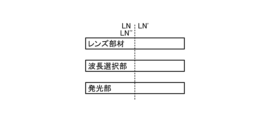
- the center of the sub-pixel 100 (more specifically, the center of the plurality of light-emitting elements 200 included in one sub-pixel 100) is a normal LN passing through, a normal LN′ passing through the center of the lens member (specifically, the on-chip lens 304), and a normal LN′′ passing through the center of the wavelength selection unit (specifically, the color filter 302) 24A to 24G show a normal LN passing through the center of the light emitting section, a normal LN' passing through the center of the lens member, and a normal LN'' passing through the center of the wavelength selecting section.
- 1 is a conceptual diagram for explaining the relationship between .
- the center of the sub-pixel 100 is called the center of the light-emitting portion.
- the size of the wavelength selector may be appropriately changed according to the light emitted by the sub-pixel 100. Furthermore, when a light absorption layer (black matrix layer) is provided between the wavelength selection portion (for example, the color filter 302) of the adjacent sub-pixel 100, the light emitted from the sub-pixel 100 can be The size of the absorbing layer (black matrix layer) may be changed as appropriate. In addition, the size of the wavelength selection unit (for example, the color filter 302) is adjusted according to the distance (offset amount) d0 between the normal line passing through the center of the sub-pixel 100 and the normal line passing through the center of the color filter 302. , may be changed as appropriate.
- the planar shape of the wavelength selector eg, color filter 302 may be the same as, similar to, or different from the planar shape of the lens member (eg, on-chip lens 304). .
- the normal LN passing through the center of the light emitting section, the normal LN'' passing through the center of the wavelength selecting section, and the normal LN' passing through the center of the lens member should be aligned.
- the distance (offset amount) D0 between the normal line passing through the center of the light emitting section and the normal line passing through the center of the lens member, and the distance between the normal line passing through the center of the light emitting section and the wavelength selection section The distance (offset amount) d0 between the normal line passing through the center is equal to 0 (zero).
- the normal LN passing through the center of the light emitting portion and the normal LN'' passing through the center of the wavelength selecting portion match, but the normal line passing through the center of the light emitting portion
- the normal LN′′ passing through the center of LN and the wavelength selection part and the normal LN′ passing through the center of the lens member do not have to match.
- D 0 ⁇ d 0 0.
- the normal LN passing through the center of the light emitting section, the normal LN'' passing through the center of the wavelength selecting section, and the normal LN' passing through the center of the lens member coincide.
- the normal LN′′ passing through the center of the wavelength selection section and the normal LN′ passing through the center of the lens member may coincide.
- D 0 d 0 >0.
- the normal LN passing through the center of the light emitting section, the normal LN'' passing through the center of the wavelength selecting section, and the normal LN' passing through the center of the lens member are aligned.
- the normal LN′ passing through the center of the lens member may not coincide with the normal LN passing through the center of the light emitting section and the normal LN′′ passing through the center of the wavelength selecting section.
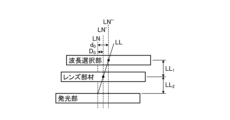
- the center of the wavelength selection section (indicated by a black square in FIG. 24D) be positioned on a straight line LL connecting the center of the light emitting section and the center of the lens member (indicated by a black circle in FIG. 24D).
- the lamination relationship between the wavelength front end portion and the lens member may be exchanged.
- the normal LN passing through the center of the light emitting section, the normal LN'' passing through the center of the wavelength selecting section, and the normal LN' passing through the center of the lens member coincide.
- the normal LN′′ passing through the center of the wavelength selection section and the normal LN′ passing through the center of the lens member may coincide.
- D 0 d 0 >0.
- the normal LN passing through the center of the light emitting section, the normal LN'' passing through the center of the wavelength selecting section, and the normal LN' passing through the center of the lens member are all aligned.
- the normal line LN′ passing through the center of the lens member may not match the normal line LN passing through the center of the light emitting unit and the normal line LN′′ passing through the center of the wavelength selection unit.
- the center of the wavelength selection portion is positioned on the straight line LL connecting the center of the light emitting portion and the center of the lens member.
- the distance from the center of the light emitting portion in the thickness direction to the center of the wavelength selection portion is LL 1
- the distance from the center of the wavelength selection portion in the thickness direction to the center of the lens member ( 24G) is LL 2
- D 0 : d 0 LL 2 : (LL 1 + LL 2 ) is preferably satisfied.
- the sub-pixel 100 (specifically, the light-emitting element 200) used in the light-emitting device according to the embodiment of the present disclosure described above may be configured to have a resonator structure that resonates light generated in the light-emitting layer 204. can.
- the resonator structure will be described below with reference to FIGS. 25 to 31.
- FIG. 25 is a schematic cross-sectional view for explaining a first example of the resonator structure
- FIG. 26 is a schematic cross-sectional view for explaining a second example of the resonator structure
- FIG. 12 is a schematic cross-sectional view for explaining a third example of the resonator structure; 28 is a schematic cross-sectional view for explaining a fourth example of the resonator structure, and FIG. 29 is a schematic cross-sectional view for explaining a fifth example of the resonator structure. Furthermore, FIG. 30 is a schematic cross-sectional view for explaining a sixth example of the resonator structure, and FIG. 31 is a schematic cross-sectional view for explaining a seventh example of the resonator structure.
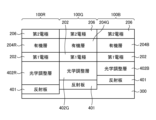
- FIG. 25 is a schematic cross-sectional view for explaining a first example of the resonator structure.
- the first electrode eg, anode electrode
- the second electrode for example, cathode electrode
- a reflector 401 is arranged under the first electrode 202 of the sub-pixel 100 with an optical adjustment layer 402 interposed therebetween.
- a resonator structure is formed between the reflector 401 and the second electrode 206 to resonate the light generated by the organic layer (specifically, the light emitting layer) 204 .
- the reflector 401 is formed with a common film thickness in each sub-pixel 100 .
- the film thickness of the optical adjustment layer 402 differs according to the colors to be displayed by the sub-pixels 100 .
- the upper surfaces of the reflectors 401 of the sub-pixels 100R, 100G, and 100B are aligned.
- the film thickness of the optical adjustment layer 402 differs depending on the color to be displayed by the sub-pixel 100, so the position of the upper surface of the second electrode 206 varies depending on the type of the sub-pixels 100R, 100G, and 100B. differ accordingly.
- the reflector 401 can be formed using, for example, metals such as aluminum (Al), silver (Ag), and copper (Cu), or alloys containing these as main components.
- the optical adjustment layer 402 is made of an inorganic insulating material such as silicon nitride (SiNx), silicon oxide (SiOx), or silicon oxynitride (SiOxNy), or an organic resin material such as acrylic resin or polyimide resin. Can be configured.
- the optical adjustment layer 402 may be a single layer, or may be a laminated film of these materials. Also, the number of stacked layers may differ depending on the type of sub-pixel 100 .
- the first electrode 202 can be formed using transparent conductive materials such as indium tin oxide (ITO), indium zinc oxide (IZO), and zinc oxide (ZnO).
- transparent conductive materials such as indium tin oxide (ITO), indium zinc oxide (IZO), and zinc oxide (ZnO).
- the second electrode 206 preferably functions as a transflective film.
- the second electrode 206 is formed using magnesium (Mg), silver (Ag), a magnesium-silver alloy (MgAg) containing these as main components, an alloy containing an alkali metal or an alkaline earth metal, or the like. be able to.
- FIG. 26 is a schematic cross-sectional view for explaining a second example of the resonator structure. Also in the second example, the first electrode 202 and the second electrode 206 are formed with the same film thickness in each sub-pixel 100 .
- the reflector 401 is arranged under the first electrode 202 of the sub-pixel 100 with the optical adjustment layer 402 interposed therebetween.
- a resonator structure is formed between the reflector 401 and the second electrode 206 to resonate the light generated by the organic layer 204 .
- the reflector 401 is formed with a common film thickness for each sub-pixel 100, and the film thickness of the optical adjustment layer 402 differs according to the color to be displayed by the sub-pixel 100.
- the upper surfaces of the reflectors 401 of the sub-pixels 100R, 100G, and 100B are aligned, and the position of the upper surface of the second electrode 206 varies depending on the type of the sub-pixels 100R, 100G, and 100B. They differed accordingly.
- the upper surfaces of the second electrodes 206 are arranged so as to be aligned in the sub-pixels 100R, 100G, and 100B.
- the upper surfaces of the reflectors 401 of the sub-pixels 100R, 100G, and 100B are arranged differently depending on the type of the sub-pixels 100R, 100G, and 100B. Therefore, the lower surface of the reflector 401 has a stepped shape corresponding to the types of the sub-pixels 100R, 100G, and 100B.
- the materials and the like that constitute the reflector 401, the optical adjustment layer 402, the first electrode 202, and the second electrode 206 are the same as those described in the first example, so description thereof will be omitted.
- FIG. 27 is a schematic cross-sectional view for explaining a third example of the resonator structure. Also in the third example, the first electrode 202 and the second electrode 206 are formed with a common film thickness in each sub-pixel 100 .
- the reflector 401 is arranged under the first electrode 202 of the sub-pixel 100 with the optical adjustment layer 402 interposed therebetween.
- a resonator structure that resonates light generated by the organic layer 204 is formed between the reflector 401 and the second electrode 206 .
- the film thickness of the optical adjustment layer 402 differs according to the colors to be displayed by the sub-pixels 100 .
- the upper surfaces of the second electrodes 206 are arranged so as to be aligned in the sub-pixels 100R, 100G, and 100B.
- the lower surface of the reflector 401 has a stepped shape corresponding to the types of the sub-pixels 100R, 100G, and 100B.
- the film thickness of the reflector 401 is set differently according to the types of the sub-pixels 100R, 100G, and 100B. More specifically, the film thickness is set so that the lower surfaces of the reflectors 401R, 401G, and 401B are aligned.
- the materials and the like that constitute the reflector 401, the optical adjustment layer 402, the first electrode 202, and the second electrode 206 are the same as those described in the first example, so description thereof will be omitted.
- FIG. 28 is a schematic cross-sectional view for explaining a fourth example of the resonator structure.
- the first electrode 202 and the second electrode 206 of the sub-pixel 100 are formed with a common film thickness.
- a reflector 401 is arranged under the first electrode 202 of the sub-pixel 100 with an optical adjustment layer 402 interposed therebetween.
- the optical adjustment layer 402 is omitted, and the film thickness of the first electrode 202 is set differently according to the types of the sub-pixels 100R, 100G, and 100B.
- the reflector 401 is formed with a common film thickness in each sub-pixel 100 .
- the film thickness of the first electrode 202 differs according to the color to be displayed by the sub-pixel 100 . Since the first electrodes 202R, 202G, and 202B have different film thicknesses, it is possible to set an optical distance that produces optimum resonance for the wavelength of light corresponding to the color to be displayed.
- the materials and the like that constitute the reflector 401, the first electrode 202, and the second electrode 206 are the same as those described in the first example, so description thereof will be omitted.
- FIG. 29 is a schematic cross-sectional view for explaining a fifth example of the resonator structure.
- the first electrode 202 and the second electrode 206 are formed with a common film thickness in each sub-pixel 100 .
- a reflector 401 is arranged under the first electrode 202 of the sub-pixel 100 with an optical adjustment layer 402 interposed therebetween.
- the optical adjustment layer 402 was omitted, and an oxide film 404 was formed on the surface of the reflector 401 instead.
- the film thickness of the oxide film 404 was set differently according to the types of the sub-pixels 100R, 100G, and 100B.
- the film thickness of the oxide film 404 differs according to the color that the sub-pixel 100 should display.
- Oxide films 404R, 404G, and 404B having different film thicknesses make it possible to set an optical distance that produces optimum resonance for the wavelength of light corresponding to the color to be displayed.
- the oxide film 404 is a film obtained by oxidizing the surface of the reflector 401, and is made of, for example, aluminum oxide, tantalum oxide, titanium oxide, magnesium oxide, zirconium oxide, or the like.
- the oxide film 404 functions as an insulating film for adjusting the optical path length (optical distance) between the reflector 401 and the second electrode 206 .
- the oxide film 404 having different film thicknesses depending on the types of the sub-pixels 100R, 100G, and 100B can be formed, for example, as follows.
- the container is filled with an electrolytic solution, and the substrate on which the reflector 401 is formed is immersed in the electrolytic solution. Further, an electrode is arranged so as to face the reflecting plate 401 .
- a positive voltage is applied to the reflector 401 with reference to the electrode to anodize the reflector 401 .
- the thickness of the oxide film formed by anodization is proportional to the voltage value applied to the electrode. Therefore, anodization is performed while voltages corresponding to the types of the sub-pixels 100R, 100G, and 100B are applied to the reflectors 401R, 401G, and 401B, respectively. As a result, the oxide films 404 having different thicknesses can be collectively formed.
- the materials and the like that constitute the reflector 401, the first electrode 202, and the second electrode 206 are the same as those described in the first example, so description thereof will be omitted.
- FIG. 30 is a schematic cross-sectional view for explaining a sixth example of the resonator structure.
- the sub-pixel 100 is configured by laminating a first electrode 202, an organic layer 204, and a second electrode 206.
- the first electrode 202 is formed so as to function both as an electrode and as a reflector.
- the first electrode (also serving as a reflector) 202 is made of a material having an optical constant selected according to the type of sub-pixels 100R, 100G, and 100B. By varying the phase shift by the first electrode (also serving as a reflector) 202, it is possible to set an optical distance that produces optimum resonance for the wavelength of light corresponding to the color to be displayed.
- the first electrode (also serving as a reflector) 202 can be composed of a single metal such as aluminum (Al), silver (Ag), gold (Au), copper (Cu), or an alloy containing these as main components.
- the first electrode (cum-reflector) 202R of the sub-pixel 100R is made of copper (Cu)
- the first electrode (cum-reflector) 202G of the sub-pixel 100G and the first electrode (cum-reflector) of the sub-pixel 100B are formed.
- 202B can be made of aluminum.
- the materials and the like that constitute the second electrode 206 are the same as those explained in the first example, so the explanation is omitted.
- FIG. 31 is a schematic cross-sectional view for explaining a seventh example of the resonator structure.
- the seventh example basically has a configuration in which the sixth example is applied to the sub-pixels 100R and 100G, and the first example is applied to the sub-pixel 100B. Also in this configuration, it is possible to set the optical distance that produces the optimum resonance for the wavelength of light corresponding to the color to be displayed.
- the first electrodes (also serving as reflectors) 202R and 202G used in the sub-pixels 100R and 100G are single metals such as aluminum (Al), silver (Ag), gold (Au), and copper (Cu), or are composed mainly of these metals. It can be composed of an alloy with
- the materials and the like that make up the reflector 401B, the optical adjustment layer 402B, and the first electrode 202B used in the sub-pixel 100B are the same as those described in the first example, so description thereof will be omitted.
- FIG. 32A is a front view showing an example of the appearance of the digital still camera 500
- FIG. 32B is a rear view showing an example of the appearance of the digital still camera 500.
- FIG. This digital still camera 500 is of a lens interchangeable single-lens reflex type, and has an interchangeable photographing lens unit (interchangeable lens) 512 in approximately the center of the front of a camera main body (camera body) 511, and on the left side of the front. It has a grip portion 513 for a photographer to hold.
- interchangeable photographing lens unit interchangeable lens
- a monitor 514 is provided at a position shifted to the left from the center of the rear surface of the camera body 511 .
- An electronic viewfinder (eyepiece window) 515 is provided above the monitor 514 . By looking through the electronic viewfinder 515, the photographer can view the optical image of the subject guided from the photographing lens unit 512 and determine the composition.
- the light emitting device 10 according to the embodiment of the present disclosure can be used.
- FIG. 33 is an external view of the head mounted display 600.
- the head-mounted display 600 has, for example, ear hooks 612 on both sides of an eyeglass-shaped display 611 to be worn on the user's head.
- the light emitting device 10 according to the embodiment of the present disclosure can be used as the display section 611 thereof.
- FIG. 34 is an external view of the see-through head-mounted display 634.
- FIG. A see-through head-mounted display 634 is composed of a main body 632 , an arm 633 and a lens barrel 631 .
- the body part 632 is connected with the arm 633 and the glasses 630 . Specifically, the end of the body portion 632 in the long side direction is coupled to the arm 633, and one side of the body portion 632 is coupled to the spectacles 630 via a connection member. Note that the main body portion 632 may be directly attached to the head of the human body.
- the body part 632 incorporates a control board for controlling the operation of the see-through head-mounted display 634 and a display part.
- the arm 633 connects the body portion 632 and the lens barrel 631 and supports the lens barrel 631 . Specifically, the arm 633 is coupled to the end of the main body 632 and the end of the lens barrel 631 to fix the lens barrel 631 .
- the arm 633 also incorporates a signal line for communicating data relating to an image provided from the main body 632 to the lens barrel 631 .
- the lens barrel 631 projects image light provided from the main body 632 via the arm 633 toward the eyes of the user wearing the see-through head-mounted display 634 through the eyepiece.
- the light emitting device 10 according to the embodiment of the present disclosure can be used for the display section of the main body section 632.
- FIG. 35 shows an example of the appearance of the television device 710.
- This television device 710 has, for example, an image display screen portion 711 including a front panel 712 and a filter glass 713, and this image display screen portion 711 is configured by the light emitting device 10 according to the embodiment of the present disclosure. .
- FIG. 36 shows an example of the appearance of smartphone 800 .
- the smartphone 800 has a display unit 802 that displays various types of information, and an operation unit and the like that include buttons and the like that receive operation input by the user.
- the display unit 802 can be the light emitting device 10 according to this embodiment.
- FIG. 37A and 37B are diagrams showing the internal configuration of an automobile having the light emitting device 10 according to the embodiment of the present disclosure as a display device. Specifically, FIG. 37A is a diagram showing the interior of the automobile from the rear to the front, and FIG. 37B is a diagram showing the interior of the automobile from the oblique rear to the oblique front.
- the automobile shown in FIGS. 37A and 37B has a center display 911, a console display 912, a head-up display 913, a digital rear mirror 914, a steering wheel display 915, and a rear entertainment display 916.
- a part or all of these displays can apply the light emitting device 10 according to the embodiment of the present disclosure.
- a center display 911 is arranged on the center console 907 at a location facing the driver's seat 901 and the passenger's seat 902 .
- 37A and 37B show an example of a horizontally elongated center display 911 extending from the driver's seat 901 side to the passenger's seat 902 side, but the screen size and arrangement location of the center display 911 are arbitrary.
- Information detected by various sensors can be displayed on the center display 911 .
- the center display 911 can display an image captured by an image sensor, a distance image to an obstacle in front of or to the side of the vehicle measured by a ToF (Time of Flight) sensor, and an image detected by an infrared sensor.
- a passenger's body temperature etc. can be displayed.
- Center display 911 can be used to display at least one of safety-related information, operation-related information, lifelogs, health-related information, authentication/identification-related information, and entertainment-related information, for example.
- the safety-related information includes information such as the detection of dozing off, the detection of looking away, the detection of tampering by a child in the passenger seat, whether or not the seat belt is worn, and the detection of an abandoned passenger. (illustration omitted).
- the operation-related information uses a sensor to detect a gesture related to the operation of the passenger.
- the gestures that are detected may include manipulating various equipment within the vehicle.
- the sensors detect operations of air conditioners, navigation devices, AV (Audio/Visual) devices, lighting devices, and the like.
- the lifelog includes lifelogs of all crew members.
- the lifelog includes a record of each occupant's behavior during the ride.
- the health-related information detects the body temperature of the occupant using a temperature sensor, and infers the health condition of the occupant based on the detected body temperature.
- an image sensor may be used to capture an image of the occupant's face, and the occupant's health condition may be estimated from the captured facial expression.
- an automated voice conversation may be conducted with the passenger, and the health condition of the passenger may be estimated based on the content of the passenger's answers.
- Authentication/identification-related information includes a keyless entry function that performs face authentication using a sensor, and a function that automatically adjusts seat height and position by face recognition.
- the entertainment-related information includes a function of detecting operation information of the AV device by the passenger using a sensor, a function of recognizing the face of the passenger with the sensor, and providing content suitable for the passenger with the AV device.
- the console display 912 can be used, for example, to display lifelog information.
- Console display 912 is located near shift lever 908 on center console 907 between driver's seat 901 and passenger's seat 902 .
- a console display 912 can also display information sensed by various sensors (not shown).
- the console display 912 may display an image around the vehicle captured by an image sensor, or may display an image of the distance to an obstacle around the vehicle.
- a head-up display 913 is virtually displayed behind the windshield 904 in front of the driver's seat 901 .
- Heads-up display 913 can be used to display at least one of safety-related information, operation-related information, lifelogs, health-related information, authentication/identification-related information, and entertainment-related information, for example. Since the head-up display 913 is often placed virtually in front of the driver's seat 901, it is suitable for displaying information directly related to the operation of the automobile, such as the speed of the automobile and the amount of fuel (battery) remaining.
- the digital rear mirror 914 can display not only the rear of the car but also the passengers in the rear seats. Can be used for display.
- the steering wheel display 915 is arranged near the center of the steering wheel 906 of the automobile. Steering wheel display 915 can be used to display at least one of safety-related information, operation-related information, lifelogs, health-related information, authentication/identification-related information, and entertainment-related information, for example. In particular, since the steering wheel display 915 is located near the driver's hands, it is suitable for displaying life log information such as the driver's body temperature and information regarding the operation of AV equipment and air conditioning equipment. there is
- the rear entertainment display 916 is attached to the rear side of the driver's seat 901 and the passenger's seat 902, and is intended for viewing by passengers in the rear seats.
- Rear entertainment display 916 can be used to display at least one of safety-related information, operation-related information, lifelogs, health-related information, authentication/identification-related information, and entertainment-related information, for example.
- information relevant to the rear seat occupants is displayed. For example, information about the operation of an AV device or an air conditioner may be displayed, or the results obtained by measuring the body temperature of passengers in the rear seats with a temperature sensor (not shown) may be displayed.
- a light-emitting device comprising a plurality of pixels arranged on a substrate, the pixel has a plurality of sub-pixels, at least one sub-pixel among the plurality of sub-pixels has a plurality of light-emitting elements;
- Each of the light emitting elements is a first electrode provided on the substrate; a light-emitting layer stacked on the first electrode and emitting light; a second electrode laminated on the light-emitting layer and transmitting light from the light-emitting layer; a first protective film laminated on the second electrode and transmitting light from the light emitting layer; has A second protective film forming an interface for guiding the light directly above the light emitting element is embedded between the adjacent light emitting elements.
- Luminescent device (2)
- the second protective film has a lower refractive index than the first protective film, and forms an interface with the first protective film for guiding the light directly above the light emitting element.
- the light-emitting device is any one of (1) to (4) above, wherein the second protective film is an oxide film, a resin film, or an air gap.
- the second protective film is provided so as to cover the first protective film.
- the second protective film is made of a metal film.
- each of the light emitting elements has a rectangular shape, The length of one side of the light emitting element is 400 to 800 nm, The light-emitting device according to any one of (1) to (10) above.
- each light emitting element has a circular or elliptical shape
- the pixel has the plurality of sub-pixels that emit light of the same color.
- the pixel has the plurality of sub-pixels that emit light of different colors.
- the pixel has the sub-pixel that emits green light, the sub-pixel that emits blue light, and the sub-pixel that emits red light;
- the width of the light-emitting element in the sub-pixel that emits green light is narrower than the width of the light-emitting element in the sub-pixel that emits blue light, and the light-emitting element in the sub-pixel that emits red light. wide compared to the width of The light-emitting device as described in (16) above.
- the upper surface of the common electrode has a first region where the light emitting layer is stacked and a second region where the light emitting layer is not stacked, Between the first region and the second region, there is a step such that the first region is a convex portion, The second protective film is provided so as to fill between the adjacent light emitting elements from the position of the upper surface of the first protective film to a position lower than the lower surface of the light emitting layer.
- the light-emitting device as described in (23) above.
- (25) The light-emitting device according to any one of (1) to (24) above, wherein the first electrode is made of a metal film or a transparent conductive film.
- the second electrode is made of a metal film or a transparent conductive film.
- the plurality of light-emitting elements share a common contact electrode provided to cover the first protective film and electrically connecting the second electrode. ) to (26).
- the common contact electrode is electrically connected to part of the side surface of the second electrode.
- the first protective film has an opening that exposes the upper surface of the second electrode; The light-emitting device according to (28) above, wherein the common contact electrode is provided so as to cover the inside of the opening.
- Each of the light emitting elements is a first electrode provided on the substrate; a light-emitting layer stacked on the first electrode and emitting light; a second electrode laminated on the light-emitting layer and transmitting light from the light-emitting layer; a first protective film laminated on the second electrode and transmitting light from the light emitting layer; has A second protective film forming an interface for guiding the light directly above the light emitting element is embedded between the adjacent light emitting elements.
Landscapes
- Physics & Mathematics (AREA)
- Optics & Photonics (AREA)
- Engineering & Computer Science (AREA)
- General Physics & Mathematics (AREA)
- Theoretical Computer Science (AREA)
- Microelectronics & Electronic Packaging (AREA)
- Electroluminescent Light Sources (AREA)
Priority Applications (3)
| Application Number | Priority Date | Filing Date | Title |
|---|---|---|---|
| CN202280075598.3A CN118235539A (zh) | 2021-11-26 | 2022-11-25 | 发光装置和电子装置 |
| JP2023563740A JPWO2023095857A1 (https=) | 2021-11-26 | 2022-11-25 | |
| US18/697,810 US20250006876A1 (en) | 2021-11-26 | 2022-11-25 | Light emitting device and electronic device |
Applications Claiming Priority (2)
| Application Number | Priority Date | Filing Date | Title |
|---|---|---|---|
| JP2021192116 | 2021-11-26 | ||
| JP2021-192116 | 2021-11-26 |
Publications (1)
| Publication Number | Publication Date |
|---|---|
| WO2023095857A1 true WO2023095857A1 (ja) | 2023-06-01 |
Family
ID=86539652
Family Applications (1)
| Application Number | Title | Priority Date | Filing Date |
|---|---|---|---|
| PCT/JP2022/043476 Ceased WO2023095857A1 (ja) | 2021-11-26 | 2022-11-25 | 発光装置及び電子機器 |
Country Status (4)
| Country | Link |
|---|---|
| US (1) | US20250006876A1 (https=) |
| JP (1) | JPWO2023095857A1 (https=) |
| CN (1) | CN118235539A (https=) |
| WO (1) | WO2023095857A1 (https=) |
Cited By (1)
| Publication number | Priority date | Publication date | Assignee | Title |
|---|---|---|---|---|
| WO2025197545A1 (ja) * | 2024-03-22 | 2025-09-25 | ソニーセミコンダクタソリューションズ株式会社 | 発光装置及び電子機器 |
Citations (6)
| Publication number | Priority date | Publication date | Assignee | Title |
|---|---|---|---|---|
| JP2014207105A (ja) * | 2013-04-11 | 2014-10-30 | ソニー株式会社 | 表示装置および電子機器 |
| WO2014192396A1 (ja) * | 2013-05-28 | 2014-12-04 | ソニー株式会社 | 表示装置および電子機器 |
| JP2016115444A (ja) * | 2014-12-11 | 2016-06-23 | ソニー株式会社 | 表示装置および電子機器 |
| JP2017135243A (ja) * | 2016-01-27 | 2017-08-03 | 株式会社Joled | 表示装置 |
| JP2019194960A (ja) * | 2018-05-02 | 2019-11-07 | 東京エレクトロン株式会社 | 塗布装置、塗布方法および有機elディスプレイ |
| WO2020162355A1 (ja) * | 2019-02-08 | 2020-08-13 | ソニー株式会社 | 発光素子及び表示装置 |
-
2022
- 2022-11-25 JP JP2023563740A patent/JPWO2023095857A1/ja active Pending
- 2022-11-25 WO PCT/JP2022/043476 patent/WO2023095857A1/ja not_active Ceased
- 2022-11-25 CN CN202280075598.3A patent/CN118235539A/zh active Pending
- 2022-11-25 US US18/697,810 patent/US20250006876A1/en active Pending
Patent Citations (6)
| Publication number | Priority date | Publication date | Assignee | Title |
|---|---|---|---|---|
| JP2014207105A (ja) * | 2013-04-11 | 2014-10-30 | ソニー株式会社 | 表示装置および電子機器 |
| WO2014192396A1 (ja) * | 2013-05-28 | 2014-12-04 | ソニー株式会社 | 表示装置および電子機器 |
| JP2016115444A (ja) * | 2014-12-11 | 2016-06-23 | ソニー株式会社 | 表示装置および電子機器 |
| JP2017135243A (ja) * | 2016-01-27 | 2017-08-03 | 株式会社Joled | 表示装置 |
| JP2019194960A (ja) * | 2018-05-02 | 2019-11-07 | 東京エレクトロン株式会社 | 塗布装置、塗布方法および有機elディスプレイ |
| WO2020162355A1 (ja) * | 2019-02-08 | 2020-08-13 | ソニー株式会社 | 発光素子及び表示装置 |
Cited By (1)
| Publication number | Priority date | Publication date | Assignee | Title |
|---|---|---|---|---|
| WO2025197545A1 (ja) * | 2024-03-22 | 2025-09-25 | ソニーセミコンダクタソリューションズ株式会社 | 発光装置及び電子機器 |
Also Published As
| Publication number | Publication date |
|---|---|
| CN118235539A (zh) | 2024-06-21 |
| US20250006876A1 (en) | 2025-01-02 |
| JPWO2023095857A1 (https=) | 2023-06-01 |
Similar Documents
| Publication | Publication Date | Title |
|---|---|---|
| CN113130615A (zh) | 显示装置和电子设备 | |
| JP2022080974A (ja) | 表示装置、光電変換装置、および電子機器 | |
| KR20200078242A (ko) | 표시장치 | |
| WO2025070503A1 (ja) | 表示装置および電子機器 | |
| WO2023095857A1 (ja) | 発光装置及び電子機器 | |
| US20250151586A1 (en) | Light emitting device and electronic apparatus | |
| WO2024128206A1 (ja) | 発光装置及び電子機器 | |
| WO2024048559A1 (ja) | 発光装置および電子機器 | |
| WO2025197545A1 (ja) | 発光装置及び電子機器 | |
| WO2024204302A1 (ja) | 発光装置及び電子機器 | |
| US20250280690A1 (en) | Light emitting device, electronic device, and method of manufacturing light emitting device | |
| WO2026070319A1 (ja) | 表示装置 | |
| WO2024053611A1 (ja) | 発光装置および電子機器 | |
| WO2025173549A1 (ja) | 発光装置及び電子機器 | |
| WO2026070730A1 (ja) | 表示装置 | |
| CN121866874A (zh) | 发光设备、电子装置及制造发光设备的方法 | |
| WO2025206155A1 (ja) | 表示装置および電子機器 | |
| WO2025258266A1 (ja) | 表示装置及び電子機器 | |
| WO2024024491A1 (ja) | 表示装置及び電子機器 | |
| WO2026063373A1 (ja) | 表示装置及び電子機器 | |
| WO2024116879A1 (ja) | 発光装置およびその製造方法、ならびに電子機器 | |
| WO2024247697A1 (ja) | 表示装置および電子機器 | |
| KR20260010405A (ko) | 표시 장치 및 전자 기기 | |
| WO2024117219A1 (ja) | 発光装置および電子機器 | |
| WO2025094849A1 (ja) | 表示装置、光学系および電子機器 |
Legal Events
| Date | Code | Title | Description |
|---|---|---|---|
| 121 | Ep: the epo has been informed by wipo that ep was designated in this application |
Ref document number: 22898639 Country of ref document: EP Kind code of ref document: A1 |
|
| ENP | Entry into the national phase |
Ref document number: 2023563740 Country of ref document: JP Kind code of ref document: A |
|
| WWE | Wipo information: entry into national phase |
Ref document number: 202280075598.3 Country of ref document: CN |
|
| NENP | Non-entry into the national phase |
Ref country code: DE |
|
| 122 | Ep: pct application non-entry in european phase |
Ref document number: 22898639 Country of ref document: EP Kind code of ref document: A1 |